EP3534291A1 - Dispositif de lecture de code optoélectronique et procédé de lecture de codes - Google Patents
Dispositif de lecture de code optoélectronique et procédé de lecture de codes Download PDFInfo
- Publication number
- EP3534291A1 EP3534291A1 EP18159349.2A EP18159349A EP3534291A1 EP 3534291 A1 EP3534291 A1 EP 3534291A1 EP 18159349 A EP18159349 A EP 18159349A EP 3534291 A1 EP3534291 A1 EP 3534291A1
- Authority
- EP
- European Patent Office
- Prior art keywords
- code
- codes
- filter unit
- reading device
- read
- Prior art date
- Legal status (The legal status is an assumption and is not a legal conclusion. Google has not performed a legal analysis and makes no representation as to the accuracy of the status listed.)
- Granted
Links
Images


Classifications
-
- G—PHYSICS
- G06—COMPUTING OR CALCULATING; COUNTING
- G06K—GRAPHICAL DATA READING; PRESENTATION OF DATA; RECORD CARRIERS; HANDLING RECORD CARRIERS
- G06K7/00—Methods or arrangements for sensing record carriers, e.g. for reading patterns
- G06K7/10—Methods or arrangements for sensing record carriers, e.g. for reading patterns by electromagnetic radiation, e.g. optical sensing; by corpuscular radiation
- G06K7/14—Methods or arrangements for sensing record carriers, e.g. for reading patterns by electromagnetic radiation, e.g. optical sensing; by corpuscular radiation using light without selection of wavelength, e.g. sensing reflected white light
- G06K7/1404—Methods for optical code recognition
- G06K7/1439—Methods for optical code recognition including a method step for retrieval of the optical code
- G06K7/1443—Methods for optical code recognition including a method step for retrieval of the optical code locating of the code in an image
-
- G—PHYSICS
- G06—COMPUTING OR CALCULATING; COUNTING
- G06K—GRAPHICAL DATA READING; PRESENTATION OF DATA; RECORD CARRIERS; HANDLING RECORD CARRIERS
- G06K7/00—Methods or arrangements for sensing record carriers, e.g. for reading patterns
- G06K7/10—Methods or arrangements for sensing record carriers, e.g. for reading patterns by electromagnetic radiation, e.g. optical sensing; by corpuscular radiation
- G06K7/10544—Methods or arrangements for sensing record carriers, e.g. for reading patterns by electromagnetic radiation, e.g. optical sensing; by corpuscular radiation by scanning of the records by radiation in the optical part of the electromagnetic spectrum
- G06K7/10712—Fixed beam scanning
- G06K7/10722—Photodetector array or CCD scanning
-
- G—PHYSICS
- G06—COMPUTING OR CALCULATING; COUNTING
- G06K—GRAPHICAL DATA READING; PRESENTATION OF DATA; RECORD CARRIERS; HANDLING RECORD CARRIERS
- G06K7/00—Methods or arrangements for sensing record carriers, e.g. for reading patterns
- G06K7/10—Methods or arrangements for sensing record carriers, e.g. for reading patterns by electromagnetic radiation, e.g. optical sensing; by corpuscular radiation
- G06K7/10544—Methods or arrangements for sensing record carriers, e.g. for reading patterns by electromagnetic radiation, e.g. optical sensing; by corpuscular radiation by scanning of the records by radiation in the optical part of the electromagnetic spectrum
- G06K7/10821—Methods or arrangements for sensing record carriers, e.g. for reading patterns by electromagnetic radiation, e.g. optical sensing; by corpuscular radiation by scanning of the records by radiation in the optical part of the electromagnetic spectrum further details of bar or optical code scanning devices
- G06K7/10861—Methods or arrangements for sensing record carriers, e.g. for reading patterns by electromagnetic radiation, e.g. optical sensing; by corpuscular radiation by scanning of the records by radiation in the optical part of the electromagnetic spectrum further details of bar or optical code scanning devices sensing of data fields affixed to objects or articles, e.g. coded labels
-
- G—PHYSICS
- G06—COMPUTING OR CALCULATING; COUNTING
- G06K—GRAPHICAL DATA READING; PRESENTATION OF DATA; RECORD CARRIERS; HANDLING RECORD CARRIERS
- G06K7/00—Methods or arrangements for sensing record carriers, e.g. for reading patterns
- G06K7/10—Methods or arrangements for sensing record carriers, e.g. for reading patterns by electromagnetic radiation, e.g. optical sensing; by corpuscular radiation
- G06K7/14—Methods or arrangements for sensing record carriers, e.g. for reading patterns by electromagnetic radiation, e.g. optical sensing; by corpuscular radiation using light without selection of wavelength, e.g. sensing reflected white light
- G06K7/1404—Methods for optical code recognition
- G06K7/1439—Methods for optical code recognition including a method step for retrieval of the optical code
-
- G—PHYSICS
- G06—COMPUTING OR CALCULATING; COUNTING
- G06K—GRAPHICAL DATA READING; PRESENTATION OF DATA; RECORD CARRIERS; HANDLING RECORD CARRIERS
- G06K7/00—Methods or arrangements for sensing record carriers, e.g. for reading patterns
- G06K7/10—Methods or arrangements for sensing record carriers, e.g. for reading patterns by electromagnetic radiation, e.g. optical sensing; by corpuscular radiation
- G06K7/14—Methods or arrangements for sensing record carriers, e.g. for reading patterns by electromagnetic radiation, e.g. optical sensing; by corpuscular radiation using light without selection of wavelength, e.g. sensing reflected white light
- G06K7/1404—Methods for optical code recognition
- G06K7/146—Methods for optical code recognition the method including quality enhancement steps
- G06K7/1486—Setting the threshold-width for bar codes to be decoded
-
- G—PHYSICS
- G06—COMPUTING OR CALCULATING; COUNTING
- G06K—GRAPHICAL DATA READING; PRESENTATION OF DATA; RECORD CARRIERS; HANDLING RECORD CARRIERS
- G06K7/00—Methods or arrangements for sensing record carriers, e.g. for reading patterns
- G06K7/10—Methods or arrangements for sensing record carriers, e.g. for reading patterns by electromagnetic radiation, e.g. optical sensing; by corpuscular radiation
- G06K7/14—Methods or arrangements for sensing record carriers, e.g. for reading patterns by electromagnetic radiation, e.g. optical sensing; by corpuscular radiation using light without selection of wavelength, e.g. sensing reflected white light
- G06K7/1404—Methods for optical code recognition
- G06K7/1439—Methods for optical code recognition including a method step for retrieval of the optical code
- G06K7/1456—Methods for optical code recognition including a method step for retrieval of the optical code determining the orientation of the optical code with respect to the reader and correcting therefore
Definitions
- the invention relates to an optoelectronic code reading device and a method for reading codes according to the preamble of claims 1 and 13, respectively.
- Code readers are known by supermarket cashiers, for automatic parcel identification, mail sorting, airport baggage handling and other logistics applications. Often it is not specified on which object side and in which orientation a code is attached. Therefore, many code readers are often placed in different perspectives to accommodate objects from multiple or all sides.
- a reading beam is guided across the code by means of a rotating mirror or a polygon mirror wheel.
- This technology was dominant in the past and was originally the only one available.
- camera-based code readers which record images of the objects with the codes located thereon by means of an image sensor, are increasingly being used in the applications mentioned.
- Image analysis software extracts the code information from these images.
- hybrid systems are also used in which both code scanners and camera-based code readers are installed.
- the code reading device comprises at least one camera-based code reader, typically several of them in different perspectives, whereby hybrid systems with at least one code scanner are also conceivable.
- the camera-based code reader captures image data of the reading area, and a decoding unit finds code areas therein and decodes them.
- a filter unit determines whether several codes have been read (MultiRead). This means in particular several codes of different content, redundant codes or multiple reading of the same code would not cause ambiguity in the treatment of the code-carrying object.
- the conventional response to multiple reading is error output and manual handling.
- the invention is based on the basic idea that, in the case of a multiple reading, an attempt is made to distinguish the main code to be evaluated from additional codes accidentally included, such as the abort codes mentioned in the introduction.
- To the geometry of the respective code area is examined. This may be the geometry of the code itself, but also the geometry of the label or label on which the code resides.
- a corresponding segmentation of code regions for example on the basis of additional sensor information, of color or contrast criteria, has already taken place in the decoding unit as part of the readout, so that the geometry is available in principle, but has not been considered conventionally. Based on the geometry, it is decided which of the several codes is a valid code and which code can be discarded, for example.
- the invention has the advantage that errors by multiple reading are drastically reduced with a very simple measure, according to which the reading or sorting rate is improved.
- camera-based code readers can be used with their advantages over code scanners, without creating an additional source of error in particular by reading demolition codes.
- the filter unit is preferably designed to check the geometry based on the ratio of width to height.
- the implicit assumption of rectangular code ranges, labels or codes is permissible since codes are usually used in this form.
- This aspect ratio (Aspect Ratio) is a very simple criterion that can be easily tested. At the same time, it is a very selective criterion with regard to demolition codes. This is important because it would be counterproductive if the read rate would be affected again by erroneous exclusion of read main codes.
- the filter unit is preferably designed to check whether the geometry corresponds to a square.
- a main code is at least reasonably square. It does not depend on mathematical accuracy.
- a tear code has a small height compared to its width, the height being defined as the direction parallel to the bars of a bar code. About the criterion of the geometry of a square is to be distinguished only against such clearly elongated rectangles.
- the filter unit is preferably designed to recognize a code as non-square in a geometry with an aspect ratio of at least 1.5: 1.
- the aspect ratio again denotes the ratio of width to height.
- the filter unit is preferably designed to regard a non-square code as invalid code.
- the filter unit applies the geometric criterion that tear-off codes typically have a low height.
- an at least largely square code is considered the main code.
- the filter unit is preferably designed to suppress an output of code contents of invalid codes. Invalid codes are thus no longer passed on or filtered out. Only the codes identified as valid, in particular sufficiently square codes, are output. To the outside, the code reading device behaves as if it could not read the tear code. The code reader, however, continues to benefit from its improved reading capabilities in the detection of major codes.
- the filter unit is preferably designed to output a multiple-read message in the case of several codes identified as valid.
- the code of different content which is identified only for several valid ones, preferably applies, because only then does a real ambiguity arise in relation to the further handling of the code-carrying object. If several main codes are read, the multiple reading has nothing to do with tear codes. At this point, the geometric criterion for distinguishing between the main code and the demolition code may reach its limits. In any case, in such a case as before an error message is issued, which indicates the multiple reading (MultiRead). It probably has to be followed by manual post-processing or manual sorting. However, this case occurs much less frequently than conventionally, since at least the demolition codes identifiable on the basis of the geometry no longer trigger such a multiple read message.
- the filter unit is preferably designed to output a multi-read message in the case of none as valid, but a plurality of codes identified as invalid. This is the mirror case in which, according to the geometric criterion, no main code remains. This may actually be so, in this case the cause of the error lies outside the code reader. In the course of manual post-processing, it may still be found that one of the codes read was a main code, but that is geometrically too different from a tear code.
- the multi-read message may advantageously differ as a help for the manual post-processing from that of several read main codes of the previous paragraph. In simple terms, too many and here too few main codes have been read there, and a suitable indication of this difference facilitates manual post-treatment.
- the decoding unit is preferably designed to decode barcodes. More preferably, the decoding unit is designed exclusively for reading barcodes. Accordingly, barcodes are attached as codes to be detected in the application. A barcode is actually a 1D code, although of course a real barcode occupies a 2D area. However, its one-dimensional nature is one reason why traditionally the height of the code parallel to its strokes and thus the aspect ratio remain indifferent and unnoticed.
- the decoding unit in the code reader and the filter unit are implemented in a system unit outside the code reader.
- the functionality of the control and evaluation unit with decoding and filter unit can be divided in different ways among the components of the code reader.
- An advantageous embodiment assigns to the code reader the actual code reading and thus to the decoding unit.
- the filter unit preferably operates with the data of all participating code readers and / or data of several time intervals (frames) in order to have all relevant code information of an object available.
- the control and evaluation unit comprises a central system unit with the filter unit outside the code reader.
- the decoding unit is preferably designed to output the ratio of width to height to the filter unit.
- the image data are regularly segmented as a preprocessing step.
- the width and height or their ratio can therefore be detected without much additional effort in the decoding unit. Therefore, it is advantageous to pass these values, instead of the filter unit having to access the image data again.
- This data transfer is particularly useful if the decoding unit is associated with the code reader and the filter unit is assigned to a central system unit.
- the code reading device preferably has a geometry detection sensor for detecting code-bearing objects.
- this is a Laser scanner, which misses the objects.
- the object geometries are used to associate the read codes with a specific object.
- Ambiguities in codes read preferably refer to the same object, since different objects usually carry different codes as intended.
- the geometry detection sensor is particularly advantageous if several objects can be located in the read area of the code reader. An alternative is to ensure that in each case only one object can be detected, such as for individually inserted pieces of luggage or conveyor systems that mechanically ensure a separation.
- the code reading device is preferably mounted on a baggage sorting system, in particular of an airport. This is a typical application situation involving invalid codes or teardown codes.
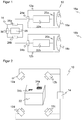
- FIG. 1 shows a block diagram of a code reading device 10.
- the code reading device 10 has here, for example, two camera-based code reader 12a-b and a system unit 14 as a central control.
- Other embodiments include further camera-based code readers, only a camera-based code reader, or at least one additional bar code scanner in a hybrid system.
- the respective code reader 12a-b is a basic structure of a camera, the receiving light from a reading area 16a-b over a simplified illustrated as a single lens receiving optics 18a-b on an image sensor 20a-b, for example, a matrix arrangement of light receiving elements or pixels.
- a single lens receiving optics 18a-b on an image sensor 20a-b for example, a matrix arrangement of light receiving elements or pixels.
- line scan cameras which gradually build up an overall image in the course of the relative movement.
- the construction shown is purely schematic and roughly simplified, for example, an advantageous active lighting unit and largely the electronics are omitted.
- a respective decoding unit 22a-b evaluates the image data by means of image evaluation and decoding methods in order to find code areas therein and to read out the information coded there.
- Image processing methods for segmentation and the actual decoding are known per se, they are only used in the context of the invention and therefore not explained in detail.
- the results of the decoding are provided at an interface 24a-b.
- the system unit 14 is also connected to the code readers 12a-b with corresponding interfaces 26a-b and thus obtains access to the code information of all code readers 12a-b of the code reader 10.
- the interfaces 24a-b, 26a-b or other connections can also be used for central Control tasks are used, which will not be discussed here.
- a filter unit 28 examines a later with reference to FIGS FIG. 3 to be explained in more detail the decoding results on multiple readings and decides in this case, if possible on the basis of the geometry of code areas, which code is to be regarded as valid.
- a central output interface 30 outputs consolidated read results, in particular only those of valid codes, as well as error messages or other messages. Depending on the application, it is also possible to output further data, such as raw or preprocessed image data and the like.
- FIG. 1 illustrates the code reader 10 with decode unit 22a-b in the code readers 12a-b and filter unit 28 in the central system unit 14.
- the one extreme is completely centralized in that the code readers 12a-b provide only image data and both decode unit 22a-b and filter unit 28 are housed in the system unit 14.
- the code reader 12a-b already comprises both decoding unit 22a-b and filter unit 28.
- the system unit 14 may also be integrated with one or more of the code readers 12a-b, which then function as a kind of master code reader.
- FIG. 2 shows a schematic representation of the arrangement of a code reader 10 on an object 32.
- four code readers 12a-d are provided, this number is again only an example.
- FIG. 2 shows a schematic representation of the arrangement of a code reader 10 on an object 32.
- four code readers 12a-d are provided, this number is again only an example.
- FIG. 2 shows a schematic representation of the arrangement of a code reader 10 on an object 32.
- four code readers 12a-d are provided, this number is again only an example.
- FIG. 2 shows a schematic representation of the arrangement of a code reader 10 on an object 32.
- four code readers 12a-d are provided, this number is again only an example.
- FIG. 2 shows a schematic representation of the arrangement of a code reader 10 on an object 32.
- four code readers 12a-d are provided, this number is again only an example.
- FIG. 2 shows a schematic representation of the arrangement of a code reader 10 on an object 32.
- four code readers 12a-d are provided,
- the object 32 shown carries two codes 34a-b at its top. Under certain circumstances, several code readers 12a-d will read the code 34a or the code 34b several times in the reading process due to partially overlapping read areas 16a-b. This type of multiple reading is harmless. On the one hand, it can be stated very simply that this is identical code information. In addition, it does not matter which set of redundant code information is used, as it leads to the same result.
- FIG. 3 shows a three-dimensional view of a code reading device 10 as a reading tunnel on a conveyor belt 36, which conveys the objects 32 through the reading area 16a-b of the code reader 12a-b.
- the code reading device 10 here again comprises, by way of example only, two code readers 12a-b, more or only one code reader are also conceivable.
- an additional, optional geometry detection sensor 38 is mounted. This allows objects 32 to be measured and, in particular, the codes 34a-b to be assigned to specific objects 32.
- FIG. 4 is a diagram showing a flow in the filter unit 28 for avoiding multiple readings by recognizing main codes 34a and invalid codes 34b by the geometry. This procedure is an example of an overall process that is not restrictive in terms of either the order or the individual, partially optional steps.
- the codes 34a-b are referred to as bar codes, again an advantageous but not the only embodiment.
- the codes 34a-b are detected and read out by the code readers 12a-b during a read operation.
- a read process preferably comprises all detections of the codes 34a-b, be it by a plurality of code readers 12a-b and / or multiple conveyor positions according to FIG FIG. 3 until the object 32 has left the reading areas 16a-b. This is one reason why the filter unit 28 is advantageously implemented in the central system unit 14, thus having access to all code reading results.
- step S2 it is checked whether a code 34a-b has been read at all during the reading process in step S1. If this is not the case, a read error (NoRead) is output in a step S2a.
- NoRead a read error
- a step S3 it is then checked if more than one code 34a-b has been read. If not, there is no multiple reading and the only code read is output in a step S3a (GoodRead). As already mentioned repeatedly, is with Multiple reading does not mean that one and the same code 34a or 34b has been read several times by several code readers 12a-b and / or at several times. This is otherwise filtered out or ignored by the identical code information because multiple assignment of the correct, redundantly read code information to an object 32 would be harmless except for unnecessary data overhead.
- a step S4 it is now checked whether one of the several read codes 34a-b is a main code 34a.
- a geometric criterion is used, ie the geometry of the code areas with the codes 34a-b evaluated. Due to the segmentation during the decoding, such geometry information is preferably available without reprocessing the image data itself and can also already be provided directly by the decoding unit 20a-b.
- the aspect ratio is checked, i. the ratio of width to height of the code areas.
- the height is given by the stroke length.
- a main code 34a is assumed when the aspect ratio corresponds to an at least approximately square shape.
- main codes 34a are at least reasonably square, invalid codes 34b or tear codes are much wider than high.
- the square shape can be defined, for example, by a threshold of the aspect ratio.
- a main code 34a is assumed at an aspect ratio of at most 1.5: 1, or conversely, an invalid code 34b at an aspect ratio of at least 1.5: 1.
- the value for n can also be chosen relative to the existing shapes. Illustratively speaking, the forms closest to a square are classified among the currently detected codes 34a-b as main codes 34a, the others as invalid codes 34b.
- step S4 If it now turns out in step S4 that exactly one code 34a-b according to the geometric criterion is a main code 34a, then this code 34a becomes in a step S4a spent (additional GoodRead).
- the at least one further code 34b which is recognized as invalid, is suppressed and not output. Information that or how many invalid codes 34b have been suppressed is possible. Alternatively, invalid codes 34b are also output, but marked as such. The handling of invalid codes 34b may be selected by the requirements in the particular application.
- step S4 If, according to step S4, there is not exactly one main code 34a, then the filter unit 28 can not clear the multiple reading, it remains with an error message (MultiRead) and usually a manual post-processing or manual sorting. It is then not clear which code 34a-b is the main code 34a to be evaluated.
- MultiRead error message
- step S5 it is checked whether there is no main code 34a at all. Thus, all read codes 34a-b are much wider than high and thus classified as invalid codes 34b.
- step S6 only the case of step S6 remains in the flow logic that at least two read codes 34a-b have a substantially square shape and would therefore be regarded as the main code 34a.
- the filter unit 32 can not solve the problem, therefore, an error message is output in each case in a step S5a or S6a. However, this error message can still differentiate the two cases in order to support manual postprocessing or error diagnosis. In addition, with the error message, the read code information can be output.
- FIG. 5 shows four examples of real camera images with code ranges to be detected. In all four examples, multiple codes of different content are read, so it would be conventional reading errors (MultiRead). According to the invention, for example after step S4, S4a of the flowchart of FIG. 4 , a main code is identified and the additional tear codes are suppressed.
- the codes 34a-b were altogether recorded on 885 objects by a code reader 10 and the results compared with and without a filter unit 28 according to the invention.
Landscapes
- Physics & Mathematics (AREA)
- Engineering & Computer Science (AREA)
- Electromagnetism (AREA)
- Health & Medical Sciences (AREA)
- General Health & Medical Sciences (AREA)
- Toxicology (AREA)
- Artificial Intelligence (AREA)
- Computer Vision & Pattern Recognition (AREA)
- General Physics & Mathematics (AREA)
- Theoretical Computer Science (AREA)
- Quality & Reliability (AREA)
- Sorting Of Articles (AREA)
Priority Applications (3)
| Application Number | Priority Date | Filing Date | Title |
|---|---|---|---|
| ES18159349T ES2784029T3 (es) | 2018-03-01 | 2018-03-01 | Lector de códigos optoelectrónico y método para leer códigos |
| EP18159349.2A EP3534291B1 (fr) | 2018-03-01 | 2018-03-01 | Dispositif de lecture de code optoélectronique et procédé de lecture de codes |
| US16/287,544 US10853613B2 (en) | 2018-03-01 | 2019-02-27 | Optoelectronic code reading apparatus and method of reading codes |
Applications Claiming Priority (1)
| Application Number | Priority Date | Filing Date | Title |
|---|---|---|---|
| EP18159349.2A EP3534291B1 (fr) | 2018-03-01 | 2018-03-01 | Dispositif de lecture de code optoélectronique et procédé de lecture de codes |
Publications (2)
| Publication Number | Publication Date |
|---|---|
| EP3534291A1 true EP3534291A1 (fr) | 2019-09-04 |
| EP3534291B1 EP3534291B1 (fr) | 2020-02-12 |
Family
ID=61557062
Family Applications (1)
| Application Number | Title | Priority Date | Filing Date |
|---|---|---|---|
| EP18159349.2A Active EP3534291B1 (fr) | 2018-03-01 | 2018-03-01 | Dispositif de lecture de code optoélectronique et procédé de lecture de codes |
Country Status (3)
| Country | Link |
|---|---|
| US (1) | US10853613B2 (fr) |
| EP (1) | EP3534291B1 (fr) |
| ES (1) | ES2784029T3 (fr) |
Cited By (1)
| Publication number | Priority date | Publication date | Assignee | Title |
|---|---|---|---|---|
| EP4557161A1 (fr) | 2023-11-15 | 2025-05-21 | Sick Ag | Lecture de codes optiques |
Families Citing this family (2)
| Publication number | Priority date | Publication date | Assignee | Title |
|---|---|---|---|---|
| JP7335762B2 (ja) * | 2019-09-18 | 2023-08-30 | 東芝テック株式会社 | シンボル読取装置およびプログラム |
| US11314959B1 (en) | 2021-06-30 | 2022-04-26 | Datalogic Ip Tech S.R.L. | System and method for identification and quantification of types of failure in automated reading of barcodes |
Citations (3)
| Publication number | Priority date | Publication date | Assignee | Title |
|---|---|---|---|---|
| US6015089A (en) * | 1996-06-03 | 2000-01-18 | Accu-Sort Systems, Inc. | High speed image acquisition system and method of processing and decoding bar code symbol |
| US20130256416A1 (en) * | 2012-03-27 | 2013-10-03 | Visionatics Inc. | Barcode recognion method and computer product thereof |
| US9501681B1 (en) * | 2015-07-14 | 2016-11-22 | A9.Com, Inc. | Decoding visual codes |
Family Cites Families (4)
| Publication number | Priority date | Publication date | Assignee | Title |
|---|---|---|---|---|
| EP2420954B8 (fr) * | 2004-12-01 | 2017-04-12 | Datalogic USA, Inc. | Lecteur de données à réglage automatique de l'exposition et procédés de fonctionnement d'un lecteur de données |
| US9098764B2 (en) * | 2009-07-20 | 2015-08-04 | The Regents Of The University Of California | Image-based barcode reader |
| US9104934B2 (en) * | 2010-03-31 | 2015-08-11 | Hand Held Products, Inc. | Document decoding system and method for improved decoding performance of indicia reading terminal |
| IT1403978B1 (it) * | 2011-02-15 | 2013-11-08 | Datalogic Automation Srl | Metodo di acquisizione di immagini |
-
2018
- 2018-03-01 ES ES18159349T patent/ES2784029T3/es active Active
- 2018-03-01 EP EP18159349.2A patent/EP3534291B1/fr active Active
-
2019
- 2019-02-27 US US16/287,544 patent/US10853613B2/en active Active
Patent Citations (3)
| Publication number | Priority date | Publication date | Assignee | Title |
|---|---|---|---|---|
| US6015089A (en) * | 1996-06-03 | 2000-01-18 | Accu-Sort Systems, Inc. | High speed image acquisition system and method of processing and decoding bar code symbol |
| US20130256416A1 (en) * | 2012-03-27 | 2013-10-03 | Visionatics Inc. | Barcode recognion method and computer product thereof |
| US9501681B1 (en) * | 2015-07-14 | 2016-11-22 | A9.Com, Inc. | Decoding visual codes |
Cited By (1)
| Publication number | Priority date | Publication date | Assignee | Title |
|---|---|---|---|---|
| EP4557161A1 (fr) | 2023-11-15 | 2025-05-21 | Sick Ag | Lecture de codes optiques |
Also Published As
| Publication number | Publication date |
|---|---|
| US10853613B2 (en) | 2020-12-01 |
| ES2784029T3 (es) | 2020-09-21 |
| EP3534291B1 (fr) | 2020-02-12 |
| US20190272405A1 (en) | 2019-09-05 |
Similar Documents
| Publication | Publication Date | Title |
|---|---|---|
| EP2555160B1 (fr) | Production d'une image présegmentée en domaines intéressants et inintéressants | |
| EP2693364B1 (fr) | Système de caméra et procédé de détermination d'un flux d'objets | |
| EP3454298B1 (fr) | Système de caméra et procédé de détermination d'un flux d'objets | |
| EP3428834B1 (fr) | Lecteur de code optoélectronique et procédé de lecture de code optique | |
| DE102007048679B4 (de) | Vorrichtung und Verfahren zum Aufnehmen von Bildern von auf einer Fördereinrichtung bewegten Objekten | |
| EP3327611B1 (fr) | Dispositif de détection et procédé de détection d'un objet dotés d'une multitude de capteurs optoélectroniques | |
| EP3663963B1 (fr) | Lecture de codes optiques | |
| EP4231195B1 (fr) | Détection des zones d'image de code dans une image d'un objet portant un code | |
| EP2693362A1 (fr) | Système de détection destiné à être monté sur une bande de transport | |
| EP3428835B1 (fr) | Procédé de lecture d'un code optique | |
| EP3534291B1 (fr) | Dispositif de lecture de code optoélectronique et procédé de lecture de codes | |
| EP4312150B1 (fr) | Lecture d'un code optique | |
| DE68929041T2 (de) | Optische Abtastvorrichtung | |
| EP4167123B1 (fr) | Lecteur de code basé sur une caméra et procédé de lecture de code optique | |
| EP4607404B1 (fr) | Lecture d'un code optique | |
| EP4332832B1 (fr) | Localisation d'un code optique | |
| EP0852362A2 (fr) | Lecteur de code optique muni d'un appareil de balayage optique | |
| DE102013101787A1 (de) | Optoelektronischer Codeleser und Verfahren zur Diagnose und Verbesserung des Leseverhaltens | |
| EP4287066B1 (fr) | Détermination de la taille de module d'un code optique | |
| EP4528582B1 (fr) | Appareil de caméra et procédé de lecture de code optique | |
| EP4571570B1 (fr) | Lecture d'un code optique | |
| EP3866128A1 (fr) | Système de détection et procédé de détection des objets pour ou dans un distributeur automatique d'acceptation | |
| EP4557161B1 (fr) | Lecture de codes optiques | |
| EP4571571B1 (fr) | Lecture d'un code optique | |
| DE202014101714U1 (de) | Codelesesystem zum Lesen von Codes |
Legal Events
| Date | Code | Title | Description |
|---|---|---|---|
| STAA | Information on the status of an ep patent application or granted ep patent |
Free format text: STATUS: EXAMINATION IS IN PROGRESS |
|
| PUAI | Public reference made under article 153(3) epc to a published international application that has entered the european phase |
Free format text: ORIGINAL CODE: 0009012 |
|
| 17P | Request for examination filed |
Effective date: 20181127 |
|
| AK | Designated contracting states |
Kind code of ref document: A1 Designated state(s): AL AT BE BG CH CY CZ DE DK EE ES FI FR GB GR HR HU IE IS IT LI LT LU LV MC MK MT NL NO PL PT RO RS SE SI SK SM TR |
|
| AX | Request for extension of the european patent |
Extension state: BA ME |
|
| GRAP | Despatch of communication of intention to grant a patent |
Free format text: ORIGINAL CODE: EPIDOSNIGR1 |
|
| STAA | Information on the status of an ep patent application or granted ep patent |
Free format text: STATUS: GRANT OF PATENT IS INTENDED |
|
| INTG | Intention to grant announced |
Effective date: 20190918 |
|
| GRAS | Grant fee paid |
Free format text: ORIGINAL CODE: EPIDOSNIGR3 |
|
| GRAA | (expected) grant |
Free format text: ORIGINAL CODE: 0009210 |
|
| STAA | Information on the status of an ep patent application or granted ep patent |
Free format text: STATUS: THE PATENT HAS BEEN GRANTED |
|
| AK | Designated contracting states |
Kind code of ref document: B1 Designated state(s): AL AT BE BG CH CY CZ DE DK EE ES FI FR GB GR HR HU IE IS IT LI LT LU LV MC MK MT NL NO PL PT RO RS SE SI SK SM TR |
|
| REG | Reference to a national code |
Ref country code: GB Ref legal event code: FG4D Free format text: NOT ENGLISH |
|
| REG | Reference to a national code |
Ref country code: CH Ref legal event code: EP |
|
| REG | Reference to a national code |
Ref country code: AT Ref legal event code: REF Ref document number: 1233099 Country of ref document: AT Kind code of ref document: T Effective date: 20200215 |
|
| RAP2 | Party data changed (patent owner data changed or rights of a patent transferred) |
Owner name: SICK AG |
|
| REG | Reference to a national code |
Ref country code: IE Ref legal event code: FG4D Free format text: LANGUAGE OF EP DOCUMENT: GERMAN |
|
| REG | Reference to a national code |
Ref country code: DE Ref legal event code: R096 Ref document number: 502018000735 Country of ref document: DE |
|
| REG | Reference to a national code |
Ref country code: NL Ref legal event code: FP |
|
| PG25 | Lapsed in a contracting state [announced via postgrant information from national office to epo] |
Ref country code: NO Free format text: LAPSE BECAUSE OF FAILURE TO SUBMIT A TRANSLATION OF THE DESCRIPTION OR TO PAY THE FEE WITHIN THE PRESCRIBED TIME-LIMIT Effective date: 20200512 Ref country code: RS Free format text: LAPSE BECAUSE OF FAILURE TO SUBMIT A TRANSLATION OF THE DESCRIPTION OR TO PAY THE FEE WITHIN THE PRESCRIBED TIME-LIMIT Effective date: 20200212 Ref country code: FI Free format text: LAPSE BECAUSE OF FAILURE TO SUBMIT A TRANSLATION OF THE DESCRIPTION OR TO PAY THE FEE WITHIN THE PRESCRIBED TIME-LIMIT Effective date: 20200212 |
|
| REG | Reference to a national code |
Ref country code: LT Ref legal event code: MG4D |
|
| PG25 | Lapsed in a contracting state [announced via postgrant information from national office to epo] |
Ref country code: IS Free format text: LAPSE BECAUSE OF FAILURE TO SUBMIT A TRANSLATION OF THE DESCRIPTION OR TO PAY THE FEE WITHIN THE PRESCRIBED TIME-LIMIT Effective date: 20200612 Ref country code: HR Free format text: LAPSE BECAUSE OF FAILURE TO SUBMIT A TRANSLATION OF THE DESCRIPTION OR TO PAY THE FEE WITHIN THE PRESCRIBED TIME-LIMIT Effective date: 20200212 Ref country code: SE Free format text: LAPSE BECAUSE OF FAILURE TO SUBMIT A TRANSLATION OF THE DESCRIPTION OR TO PAY THE FEE WITHIN THE PRESCRIBED TIME-LIMIT Effective date: 20200212 Ref country code: LV Free format text: LAPSE BECAUSE OF FAILURE TO SUBMIT A TRANSLATION OF THE DESCRIPTION OR TO PAY THE FEE WITHIN THE PRESCRIBED TIME-LIMIT Effective date: 20200212 Ref country code: GR Free format text: LAPSE BECAUSE OF FAILURE TO SUBMIT A TRANSLATION OF THE DESCRIPTION OR TO PAY THE FEE WITHIN THE PRESCRIBED TIME-LIMIT Effective date: 20200513 Ref country code: BG Free format text: LAPSE BECAUSE OF FAILURE TO SUBMIT A TRANSLATION OF THE DESCRIPTION OR TO PAY THE FEE WITHIN THE PRESCRIBED TIME-LIMIT Effective date: 20200512 |
|
| REG | Reference to a national code |
Ref country code: ES Ref legal event code: FG2A Ref document number: 2784029 Country of ref document: ES Kind code of ref document: T3 Effective date: 20200921 |
|
| PG25 | Lapsed in a contracting state [announced via postgrant information from national office to epo] |
Ref country code: DK Free format text: LAPSE BECAUSE OF FAILURE TO SUBMIT A TRANSLATION OF THE DESCRIPTION OR TO PAY THE FEE WITHIN THE PRESCRIBED TIME-LIMIT Effective date: 20200212 Ref country code: LT Free format text: LAPSE BECAUSE OF FAILURE TO SUBMIT A TRANSLATION OF THE DESCRIPTION OR TO PAY THE FEE WITHIN THE PRESCRIBED TIME-LIMIT Effective date: 20200212 Ref country code: PT Free format text: LAPSE BECAUSE OF FAILURE TO SUBMIT A TRANSLATION OF THE DESCRIPTION OR TO PAY THE FEE WITHIN THE PRESCRIBED TIME-LIMIT Effective date: 20200705 Ref country code: SM Free format text: LAPSE BECAUSE OF FAILURE TO SUBMIT A TRANSLATION OF THE DESCRIPTION OR TO PAY THE FEE WITHIN THE PRESCRIBED TIME-LIMIT Effective date: 20200212 Ref country code: EE Free format text: LAPSE BECAUSE OF FAILURE TO SUBMIT A TRANSLATION OF THE DESCRIPTION OR TO PAY THE FEE WITHIN THE PRESCRIBED TIME-LIMIT Effective date: 20200212 Ref country code: CZ Free format text: LAPSE BECAUSE OF FAILURE TO SUBMIT A TRANSLATION OF THE DESCRIPTION OR TO PAY THE FEE WITHIN THE PRESCRIBED TIME-LIMIT Effective date: 20200212 Ref country code: RO Free format text: LAPSE BECAUSE OF FAILURE TO SUBMIT A TRANSLATION OF THE DESCRIPTION OR TO PAY THE FEE WITHIN THE PRESCRIBED TIME-LIMIT Effective date: 20200212 Ref country code: SK Free format text: LAPSE BECAUSE OF FAILURE TO SUBMIT A TRANSLATION OF THE DESCRIPTION OR TO PAY THE FEE WITHIN THE PRESCRIBED TIME-LIMIT Effective date: 20200212 |
|
| REG | Reference to a national code |
Ref country code: DE Ref legal event code: R097 Ref document number: 502018000735 Country of ref document: DE |
|
| PG25 | Lapsed in a contracting state [announced via postgrant information from national office to epo] |
Ref country code: MC Free format text: LAPSE BECAUSE OF FAILURE TO SUBMIT A TRANSLATION OF THE DESCRIPTION OR TO PAY THE FEE WITHIN THE PRESCRIBED TIME-LIMIT Effective date: 20200212 |
|
| PLBE | No opposition filed within time limit |
Free format text: ORIGINAL CODE: 0009261 |
|
| STAA | Information on the status of an ep patent application or granted ep patent |
Free format text: STATUS: NO OPPOSITION FILED WITHIN TIME LIMIT |
|
| REG | Reference to a national code |
Ref country code: BE Ref legal event code: MM Effective date: 20200331 |
|
| PG25 | Lapsed in a contracting state [announced via postgrant information from national office to epo] |
Ref country code: LU Free format text: LAPSE BECAUSE OF NON-PAYMENT OF DUE FEES Effective date: 20200301 |
|
| 26N | No opposition filed |
Effective date: 20201113 |
|
| PG25 | Lapsed in a contracting state [announced via postgrant information from national office to epo] |
Ref country code: IE Free format text: LAPSE BECAUSE OF NON-PAYMENT OF DUE FEES Effective date: 20200301 |
|
| PG25 | Lapsed in a contracting state [announced via postgrant information from national office to epo] |
Ref country code: PL Free format text: LAPSE BECAUSE OF FAILURE TO SUBMIT A TRANSLATION OF THE DESCRIPTION OR TO PAY THE FEE WITHIN THE PRESCRIBED TIME-LIMIT Effective date: 20200212 Ref country code: BE Free format text: LAPSE BECAUSE OF NON-PAYMENT OF DUE FEES Effective date: 20200331 |
|
| PG25 | Lapsed in a contracting state [announced via postgrant information from national office to epo] |
Ref country code: TR Free format text: LAPSE BECAUSE OF FAILURE TO SUBMIT A TRANSLATION OF THE DESCRIPTION OR TO PAY THE FEE WITHIN THE PRESCRIBED TIME-LIMIT Effective date: 20200212 Ref country code: MT Free format text: LAPSE BECAUSE OF FAILURE TO SUBMIT A TRANSLATION OF THE DESCRIPTION OR TO PAY THE FEE WITHIN THE PRESCRIBED TIME-LIMIT Effective date: 20200212 Ref country code: CY Free format text: LAPSE BECAUSE OF FAILURE TO SUBMIT A TRANSLATION OF THE DESCRIPTION OR TO PAY THE FEE WITHIN THE PRESCRIBED TIME-LIMIT Effective date: 20200212 |
|
| PG25 | Lapsed in a contracting state [announced via postgrant information from national office to epo] |
Ref country code: MK Free format text: LAPSE BECAUSE OF FAILURE TO SUBMIT A TRANSLATION OF THE DESCRIPTION OR TO PAY THE FEE WITHIN THE PRESCRIBED TIME-LIMIT Effective date: 20200212 Ref country code: AL Free format text: LAPSE BECAUSE OF FAILURE TO SUBMIT A TRANSLATION OF THE DESCRIPTION OR TO PAY THE FEE WITHIN THE PRESCRIBED TIME-LIMIT Effective date: 20200212 |
|
| PG25 | Lapsed in a contracting state [announced via postgrant information from national office to epo] |
Ref country code: SI Free format text: LAPSE BECAUSE OF FAILURE TO SUBMIT A TRANSLATION OF THE DESCRIPTION OR TO PAY THE FEE WITHIN THE PRESCRIBED TIME-LIMIT Effective date: 20200212 |
|
| PGFP | Annual fee paid to national office [announced via postgrant information from national office to epo] |
Ref country code: ES Payment date: 20250416 Year of fee payment: 8 |
|
| PGFP | Annual fee paid to national office [announced via postgrant information from national office to epo] |
Ref country code: IT Payment date: 20250331 Year of fee payment: 8 |
|
| PGFP | Annual fee paid to national office [announced via postgrant information from national office to epo] |
Ref country code: CH Payment date: 20250401 Year of fee payment: 8 |
|
| REG | Reference to a national code |
Ref country code: CH Ref legal event code: U11 Free format text: ST27 STATUS EVENT CODE: U-0-0-U10-U11 (AS PROVIDED BY THE NATIONAL OFFICE) Effective date: 20260401 |
|
| PGFP | Annual fee paid to national office [announced via postgrant information from national office to epo] |
Ref country code: GB Payment date: 20260324 Year of fee payment: 9 |
|
| PGFP | Annual fee paid to national office [announced via postgrant information from national office to epo] |
Ref country code: DE Payment date: 20260320 Year of fee payment: 9 |
|
| PGFP | Annual fee paid to national office [announced via postgrant information from national office to epo] |
Ref country code: AT Payment date: 20260319 Year of fee payment: 9 |
|
| PGFP | Annual fee paid to national office [announced via postgrant information from national office to epo] |
Ref country code: NL Payment date: 20260323 Year of fee payment: 9 |
|
| PGFP | Annual fee paid to national office [announced via postgrant information from national office to epo] |
Ref country code: FR Payment date: 20260324 Year of fee payment: 9 |