EP3563164B1 - Spectral-based method for fuel cell faults detection - Google Patents
Spectral-based method for fuel cell faults detection Download PDFInfo
- Publication number
- EP3563164B1 EP3563164B1 EP17829041.7A EP17829041A EP3563164B1 EP 3563164 B1 EP3563164 B1 EP 3563164B1 EP 17829041 A EP17829041 A EP 17829041A EP 3563164 B1 EP3563164 B1 EP 3563164B1
- Authority
- EP
- European Patent Office
- Prior art keywords
- fuel cell
- cell assembly
- voltage
- psd
- steady
- Prior art date
- Legal status (The legal status is an assumption and is not a legal conclusion. Google has not performed a legal analysis and makes no representation as to the accuracy of the status listed.)
- Active
Links
Images


Classifications
-
- H—ELECTRICITY
- H01—ELECTRIC ELEMENTS
- H01M—PROCESSES OR MEANS, e.g. BATTERIES, FOR THE DIRECT CONVERSION OF CHEMICAL ENERGY INTO ELECTRICAL ENERGY
- H01M8/00—Fuel cells; Manufacture thereof
- H01M8/04—Auxiliary arrangements, e.g. for control of pressure or for circulation of fluids
- H01M8/04298—Processes for controlling fuel cells or fuel cell systems
- H01M8/04313—Processes for controlling fuel cells or fuel cell systems characterised by the detection or assessment of variables; characterised by the detection or assessment of failure or abnormal function
- H01M8/04664—Failure or abnormal function
- H01M8/04671—Failure or abnormal function of the individual fuel cell
-
- G—PHYSICS
- G01—MEASURING; TESTING
- G01R—MEASURING ELECTRIC VARIABLES; MEASURING MAGNETIC VARIABLES
- G01R31/00—Arrangements for testing electric properties; Arrangements for locating electric faults; Arrangements for electrical testing characterised by what is being tested not provided for elsewhere
- G01R31/36—Arrangements for testing, measuring or monitoring the electrical condition of accumulators or electric batteries, e.g. capacity or state of charge [SoC]
- G01R31/367—Software therefor, e.g. for battery testing using modelling or look-up tables
-
- G—PHYSICS
- G01—MEASURING; TESTING
- G01R—MEASURING ELECTRIC VARIABLES; MEASURING MAGNETIC VARIABLES
- G01R31/00—Arrangements for testing electric properties; Arrangements for locating electric faults; Arrangements for electrical testing characterised by what is being tested not provided for elsewhere
- G01R31/36—Arrangements for testing, measuring or monitoring the electrical condition of accumulators or electric batteries, e.g. capacity or state of charge [SoC]
- G01R31/392—Determining battery ageing or deterioration, e.g. state of health
-
- H—ELECTRICITY
- H01—ELECTRIC ELEMENTS
- H01M—PROCESSES OR MEANS, e.g. BATTERIES, FOR THE DIRECT CONVERSION OF CHEMICAL ENERGY INTO ELECTRICAL ENERGY
- H01M8/00—Fuel cells; Manufacture thereof
- H01M8/04—Auxiliary arrangements, e.g. for control of pressure or for circulation of fluids
- H01M8/04298—Processes for controlling fuel cells or fuel cell systems
- H01M8/04313—Processes for controlling fuel cells or fuel cell systems characterised by the detection or assessment of variables; characterised by the detection or assessment of failure or abnormal function
- H01M8/04537—Electric variables
- H01M8/04544—Voltage
- H01M8/04552—Voltage of the individual fuel cell
-
- Y—GENERAL TAGGING OF NEW TECHNOLOGICAL DEVELOPMENTS; GENERAL TAGGING OF CROSS-SECTIONAL TECHNOLOGIES SPANNING OVER SEVERAL SECTIONS OF THE IPC; TECHNICAL SUBJECTS COVERED BY FORMER USPC CROSS-REFERENCE ART COLLECTIONS [XRACs] AND DIGESTS
- Y02—TECHNOLOGIES OR APPLICATIONS FOR MITIGATION OR ADAPTATION AGAINST CLIMATE CHANGE
- Y02E—REDUCTION OF GREENHOUSE GAS [GHG] EMISSIONS, RELATED TO ENERGY GENERATION, TRANSMISSION OR DISTRIBUTION
- Y02E60/00—Enabling technologies; Technologies with a potential or indirect contribution to GHG emissions mitigation
- Y02E60/30—Hydrogen technology
- Y02E60/50—Fuel cells
Definitions
- the present invention relates to a method for detecting faults and/or degradation in fuel cell assemblies, by analysing the power spectrum density (PSD) of the voltage signal output by a fuel cell assembly during steady-state operations.
- PSD power spectrum density
- the method according to the present invention identifies specific faults and/or degradation signatures from specific patterns attained by the PSD of the measured voltage signal.
- PSD the PSD
- the present invention is mainly directed towards the detection of faults and/or degradation concerning fuel utilization in solid-oxide fuel cell (SOFC) assemblies, it may be applied to any other faults causing frequency peaks in PSD due to electrochemical processes, different from those concerning fuel utilization, and to any other fuel cells technologies, besides SOFC assemblies, still remaining within the scope of protection as defined by the attached claims.
- SOFC solid-oxide fuel cell
- fuel cell assembly will be used herein for both a single fuel cell and a system comprising at least one cell and other sub-systems and components (the so called Balance of Plant - BoP - sub-system).
- Fuel cells are promising systems for the production of electricity due to their load-independent high electrical efficiency, their capability to exploit a wide range of fuels and to their capability to be easily assembled into a stack to satisfy different power requirements. They can be exploited in a large range of applications, from distributed generation to residential and industrial cogeneration, and to portable generation and traction. Furthermore, they provide power with lower fuel consumption and exhaust emissions with respect to other technologies.
- document US 7531253 discloses a diagnostic tool for the monitoring of fuel cell stacks based on voltage drifts analysis through an analysis of the total harmonic distortion (THD), by superimposing a current periodic signal and evaluating the voltage signal harmonics. If an extra spectral component (i.e. harmonic distortion) occurs, critical conditions within the stack are detected.
- TDD total harmonic distortion
- Document US 2014/0093802 A1 discloses both a method and a system to diagnose faults and to control a fuel cell.
- the method consists in the application of alternating current (AC) signals to an individual fuel cell.
- the AC signals have a wide range of different frequencies.
- a voltage across the individual fuel cell is determined at each frequency, then an error is detected if the voltage differs from its reference value.
- Document US 2007/0172708 A1 discloses a failure diagnosis method for a fuel cell assembly.
- the method deals with the evaluation of the impedance in a prescribed portion of a fuel cell assembly.
- a signal is obtained by superimposing an alternating current on the direct current generated from the fuel cell assembly.
- the estimated impedance is compared with a reference one, previously determined in standard operating conditions. Such comparison may lead to the detection of an abnormality in the prescribed portion of the fuel cell.
- Document WO 2013/083873 A1 discloses a model-based diagnostic approach for the diagnosis of solid oxide cells.
- a model of the SOFC stack simulates the standard conditions that are compared with those measured in the real systems. The comparisons performed between the real system measurements and the model outputs permit to detect a deviation in SOFC assembly operations.
- Document US 2006/0078788 A1 discloses a method for condition monitoring of a fuel cell stack, comprising several series-connected single cells, wherein a low-frequency current or voltage signal is impressed on the fuel cell stack. Then the resulting voltage or current signal is measured. At least one change of the harmonic content of the signal allows the inference of the current status of each cell of the stack.
- the step of acquiring voltage signal output by the fuel cell assembly may use a sampling frequency not lower than 1/10 Hz, optionally equal to 1 Hz.
- the step of identifying at least one voltage segment s i may be automatically performed through Change Detection Algorithms (CDAs).
- CDAs Change Detection Algorithms
- the length of the i -th time interval may be such that the corresponding voltage segment s i , contains at least 1000 samples.
- the sampling frequency may be of 1 Hz and the length of the i -th time interval is not shorter than 1 h, optionally equal to 2h.
- each one of the at least one de-trended voltage segment s i ' may be obtained by subtracting from the voltage segment s i , its Least Square Linear Fit, optionally through First differencing or Digital filtering.
- the characteristic frequencies f k and the reference values R k , ⁇ k, of a specific fuel cell assembly may be preliminarily obtained by performing steps from acquiring a voltage signal output to estimating the PSD on the fuel cell assembly operating in a steady-state condition after a warm up period, when it is assumed no substantial fault/degradation has yet occurred.
- the characteristic frequencies f k and the reference values R k , ⁇ k, of a first specific fuel cell assembly may be preliminarily obtained by performing steps from acquiring a voltage signal output to estimating the PSD on a second fuel cell assembly operating in a steady-state condition after a warm up period, when it is assumed no substantial fault/degradation has yet occurred, said second fuel cell assembly being of the same type of the first fuel cell assembly.
- the characteristic frequencies f k and the reference values R k , ⁇ k, of a specific fuel cell assembly may be provided by manufacturer.
- the predetermined threshold y may be equal to a percentile 1 - ⁇ of the empirical distribution of the test statistic T i computed for a plurality of operations in nominal conditions, i. e. in normal steady-state operations, optionally a being equal to 0,05.
- the main advantage of the present invention is that it involves a passive spectral analysis method, differently from the existing state of art involving active systems; this causes a decrease of complexity, and consequently manufacturing and maintenance costs, of the system implementing the diagnostic procedure for detecting faults and/or degradation in fuel cell assemblies.
- the method of a preferred embodiment of the present invention starts at step 100 acquiring a voltage signal output by a fuel cell assembly 15 as a function of time, by using a sampling frequency not lower than 1/10 Hz optionally equal to 1 Hz.
- the transitions from one steady-state to another is characterized by an abrupt change in the voltage values that can be easily revealed.
- the identification step 101 can be automatically performed through Change Detection Algorithms (CDAs).
- Graph 101' shown in Fig. 1 is a voltage signal output by a SOFC assembly obtained by testing the method of the present invention on the SOFC assembly varying its FU according to a preferred embodiment, as disclosed below.
- the voltage segments can be also consecutive if any abrupt change in the fuel cell assembly and in the voltage signal has occurred.
- the length of the i -th time interval must be selected by considering the trade-off between a quick detection (short intervals, strengthening also the assumption of steady-state conditions for the fuel cell assembly in the time interval), and the accuracy of the analysis to be performed in the next steps of the method according to the invention in the frequency domain, requiring long time intervals.
- the length of the i -th time interval is such that the corresponding voltage segment s i , contains at least 1000 samples.
- the length of the i -th time interval is optionally equal to 1 h, more optional equal to 2h.
- Longer voltage segments may be considered to reduce the bias of the PSD estimate and to increase spectral resolution, if the fuel cell assembly can be safely considered in steady-state operations.
- a de-trending is performed at step 110 to remove the slow-varying component from each voltage segment s i as the frequency content of that component (very close to the frequency 0 Hz) may be assumed not useful.
- the slow-varying component is identified and removed by subtracting the Least Square Linear Fit of data obtaining a de-trended segment s i ' .
- de-trending can be performed through well-known techniques different from subtracting the Least Square Linear Fit, such as the First differencing or Digital filtering, still remaining within the scope of the invention.
- a peak is a local maximum present in the PSD of the segment si'.
- the characteristic frequencies f k depend on the specific fuel cell assembly 15 under investigation.
- a magnitude variation of at least one peak P k i in respect to a corresponding reference value R k is adopted as a signature for faults/degradation detection.
- the reference values R k are the magnitude of peaks at characteristic frequencies f k of the specific fuel cell assembly 15 during a normal steady-state operation, i.e. the fuel cell assembly has not affected by fault/degradation.
- values of the characteristic frequencies f k and of the reference values R k , ⁇ k , of a specific fuel cell assembly 15 are preliminarily obtained by performing steps from 100 to 120 on the fuel cell assembly 15 operating in a normal steady-state condition after a warm up period, when it is assumed no substantial fault/degradation has yet occurred.
- values of the characteristic frequencies f k and of the reference values R k , ⁇ k, of a first specific fuel cell assembly 15 are preliminarily obtained by performing steps from 100 to 120 on a second fuel cell assembly 15' operating in a normal steady-state condition after a warm up period, said second fuel cell assembly 15' being of the same type of the first fuel cell assembly 15, when it is assumed no substantial fault/degradation has yet occurred.
- fuel cell manufacturer provides the values f k and R k , ⁇ k.
- test statistic T i is lower than or equal to the predetermined threshold ⁇
- the flow continues through the "NO" branch from step 125, whereby the method according to the invention recognises (step 130') that the fuel cell assembly 15 is in a normal steady-state operation (namely, no fault/degradation occurred), and the method ends (or return to step 100).
- the test statistic T i is greater than the predetermined threshold ⁇
- the flow continues through the "YES" branch from step 125, whereby the method according to the invention recognises (step 130) that a fault/degradation occurred in the fuel cell system, and the method ends (or return to step 100).
- the value of the threshold ⁇ can be predetermined by the percentile 1 - ⁇ of the empirical distribution of the statistic T i computed for a plurality of operations in nominal conditions, i.e. in normal steady-state operations, where the fluctuations of the statistic T i are due to measurement noise and small variations of the output voltage caused by small perturbations of the current density, of the temperature the cells and fuel, of the air and fuel flows, typically affecting real systems.
- the nominal value of FU depends on the specific fuel cell assembly under analysis, but it may change for different fuel cell assemblies. Starting from the nominal value, the analysis was performed for higher values of FU, since these conditions may induce a fault in the assembly.
- a first sequence ⁇ FU ⁇ of FU parameter values was ⁇ 0.6; 0.7; 0.6; 0.8; 0.6; 0.9; 0.6; 0.7; 0.6; 0.8; 0.6 ⁇ .
- the testing procedure was designed to induce high FU by varying both inlet gas flow rate (in the first part of the testing procedure) and current density (the last 0.7 and 0.8 FU values) keeping fixed the other control variables/parameters.
- the method started acquiring (step 100 of Fig. 1 ) the SOFC assembly voltage signal in mV as a function of time t up to more than 300 hours.
- the transitions from one steady-state to another are characterized by an abrupt change in the voltage values that can be easily revealed by change detection algorithms.
- the voltage measurements In two hours after the abrupt change, the voltage measurements have a new almost linear behaviour and can be considered representative of a new steady-state operating condition, with typically a new FU value.
- Such a voltage signal segmentation results in a second sequence ⁇ s i ⁇ of voltage segments ⁇ 1; 2; 3; 4; 5; 6; 7; 8; 9; 10; 11 ⁇ corresponding to the first sequence ⁇ FU ⁇ .
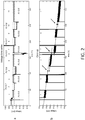
- FIG. 2a shows the resulting voltage signal waveform (101') with segmentation as a function of FU.
- the length of the voltage segments is chosen as large as possible in order to increase the accuracy of the PSD estimates and the data point corresponding to a FU variation, i.e. corresponding to non-stationary state operation of the SOFC assembly, were neglected.
- a linear model for each voltage segment s i is assumed by adopting Least Square Estimation procedures and subtracted from the related experimental data resulting in a third sequence of de-trended voltage segments ⁇ s i ' ⁇ (step 110 of Fig. 1 ).
- the inventors estimated (step 120 of Fig. 1 ) the PSD of each de-trended segment s i ' obtaining a corresponding PSD spectrum (as shown in the graph 120' of Fig. 1 ).
- Figs. 3a, 3b, 3c, 3d show PSD spectra of de-trended segments ⁇ 6, 4, 2, 1 ⁇ for time intervals of ⁇ (160.4h - 162.2h); (100.1h - 121.2h); (50.2h - 71.3h); (26.2h - 47.3h) ⁇ respectively.
- Each segment of the set ⁇ 6, 4, 2, 1 ⁇ corresponds to a different FU, namely in the set ⁇ 0.9, 0.8, 0.7, 0.6 ⁇ respectively.
- PSD peak magnitude increases with FU.
- the evidence on the PSD behaviour for different values of FU suggests that PSD peak(s) magnitude of the de-trended voltage time segments can be adopted as a signature for high FU faults.
Landscapes
- Physics & Mathematics (AREA)
- General Physics & Mathematics (AREA)
- Life Sciences & Earth Sciences (AREA)
- Engineering & Computer Science (AREA)
- Manufacturing & Machinery (AREA)
- Sustainable Development (AREA)
- Sustainable Energy (AREA)
- Chemical & Material Sciences (AREA)
- Chemical Kinetics & Catalysis (AREA)
- Electrochemistry (AREA)
- General Chemical & Material Sciences (AREA)
- Fuel Cell (AREA)
Description
- The present invention relates to a method for detecting faults and/or degradation in fuel cell assemblies, by analysing the power spectrum density (PSD) of the voltage signal output by a fuel cell assembly during steady-state operations. The method according to the present invention identifies specific faults and/or degradation signatures from specific patterns attained by the PSD of the measured voltage signal.
- Estimation of power spectra is useful in a variety of applications, including the detection of signals buried in wide-band noise. Measured data are always affected by (wide-band) measurement noise representing a random process. The distribution over frequency of the power contained in a signal is expressed by the PSD. In general terms, one way of estimating the PSD of a signal is to simply find the Fast Fourier Transform, FFT, of the (equispaced) signal data and to appropriately scale the squared magnitude of the result.
- Although the present invention is mainly directed towards the detection of faults and/or degradation concerning fuel utilization in solid-oxide fuel cell (SOFC) assemblies, it may be applied to any other faults causing frequency peaks in PSD due to electrochemical processes, different from those concerning fuel utilization, and to any other fuel cells technologies, besides SOFC assemblies, still remaining within the scope of protection as defined by the attached claims.
- The wording "fuel cell assembly" will be used herein for both a single fuel cell and a system comprising at least one cell and other sub-systems and components (the so called Balance of Plant - BoP - sub-system).
- Fuel cells are promising systems for the production of electricity due to their load-independent high electrical efficiency, their capability to exploit a wide range of fuels and to their capability to be easily assembled into a stack to satisfy different power requirements. They can be exploited in a large range of applications, from distributed generation to residential and industrial cogeneration, and to portable generation and traction. Furthermore, they provide power with lower fuel consumption and exhaust emissions with respect to other technologies.
- However, they suffer from several problems including the membrane hydration and the degradation of their components, such as the membrane, the electrodes, and the gas diffusion layers, which compromise their performance. Hence, it is crucial to monitor the state of health of the fuel cell systems while operating. Many solutions have been proposed in the prior art.
- As an example, document
US 7531253 discloses a diagnostic tool for the monitoring of fuel cell stacks based on voltage drifts analysis through an analysis of the total harmonic distortion (THD), by superimposing a current periodic signal and evaluating the voltage signal harmonics. If an extra spectral component (i.e. harmonic distortion) occurs, critical conditions within the stack are detected. - Document
US 2014/0093802 A1 discloses both a method and a system to diagnose faults and to control a fuel cell. The method consists in the application of alternating current (AC) signals to an individual fuel cell. The AC signals have a wide range of different frequencies. A voltage across the individual fuel cell is determined at each frequency, then an error is detected if the voltage differs from its reference value. - Document
US 2007/0172708 A1 discloses a failure diagnosis method for a fuel cell assembly. The method deals with the evaluation of the impedance in a prescribed portion of a fuel cell assembly. A signal is obtained by superimposing an alternating current on the direct current generated from the fuel cell assembly. The estimated impedance is compared with a reference one, previously determined in standard operating conditions. Such comparison may lead to the detection of an abnormality in the prescribed portion of the fuel cell. - Document
US 2007/0259256 A1 discloses systems and methods to determine the occurrence of a particular set of faults in electrochemical cells based on impedance measurements. The evaluation of the impedance signature with respect to a reference information allows the detection of several faults. - Document
WO 2013/083873 A1 discloses a model-based diagnostic approach for the diagnosis of solid oxide cells. A model of the SOFC stack simulates the standard conditions that are compared with those measured in the real systems. The comparisons performed between the real system measurements and the model outputs permit to detect a deviation in SOFC assembly operations. - Document
US 2006/0078788 A1 discloses a method for condition monitoring of a fuel cell stack, comprising several series-connected single cells, wherein a low-frequency current or voltage signal is impressed on the fuel cell stack. Then the resulting voltage or current signal is measured. At least one change of the harmonic content of the signal allows the inference of the current status of each cell of the stack. Anonymous, "Design: Degradation Signatures Identification for Stack Operation Diagnostics", 15 February 2016, pages 1-12, XP055401689, http://cordis.europa.eu/result/rcn/177527_en.pdf discloses a method for detecting faults and/or degradation in a fuel cell assembly by analysis of the power spectrum density of a voltage signal output by the fuel cell assembly during its steady-state operations. - However, prior art solutions suffer from a number of drawbacks. In fact, they require complex implementations for the system actively interacting with fuel cell assemblies (e.g., by injecting an external signal), and they are not completely reliable, increasing both device and measuring costs.
- Therefore, it is an object of this invention to provide a method to evaluate the state of fuel cell assemblies during operation in a fully efficient, reliable, simple and inexpensive way, the results of which monitoring method may be used for diagnostic purposes.
- It is specific subject-matter of the present invention a method for detecting faults and/or degradation a fuel cell assembly by analysis of the power spectrum density (PSD) of a voltage signal output by the fuel cell assembly during its steady-state operations, the method comprising the following steps:
- acquiring a voltage signal output by the fuel cell assembly as a function of time;
- identifying at least one voltage segment s i in the acquired voltage signal with i= 1,..,n, n ∈ N and n ≥ 1, each voltage segment s i being a collection of voltage measurements in a i-th time interval in which the fuel cell assembly is considered in a steady-state condition;
- detrending each one of the at least one voltage segment s i to remove a slow-varying component, obtaining a de-trended voltage segment si ';
- estimating the Power Spectrum Density (PSD) of each one of the at least one voltage segment si ' and its PSD peaks

- computing a test statistic


- checking whether the test statistic Ti is greater than a predetermined threshold γ:
- if the test statistic Ti is lower than or equal to the predetermined threshold γ, recognising that the fuel cell assembly is in normal steady-state operation during the corresponding i-th time interval;
- if the test statistic Ti is greater than the predetermined threshold γ, recognising that fault/degradation occurred in the fuel cell system during the corresponding i-th time interval.
- According to another aspect of the invention, the step of acquiring voltage signal output by the fuel cell assembly may use a sampling frequency not lower than 1/10 Hz, optionally equal to 1 Hz.
- According to a further aspect of the invention, the step of identifying at least one voltage segment s i may be automatically performed through Change Detection Algorithms (CDAs).
- According to an additional aspect of the invention, the length of the i-th time interval may be such that the corresponding voltage segment s i, contains at least 1000 samples.
- According to another aspect of the invention, the sampling frequency may be of 1 Hz and the length of the i-th time interval is not shorter than 1 h, optionally equal to 2h.
- According to a further aspect of the invention, each one of the at least one de-trended voltage segment si ' may be obtained by subtracting from the voltage segment s i, its Least Square Linear Fit, optionally through First differencing or Digital filtering.
- According to an additional aspect of the invention, the characteristic frequencies fk and the reference values Rk , ∀k, may be obtained estimating a PSD of a de-trended voltage segment sj ' in a j-th time interval in which the fuel cell assembly is assumed being in a normal steady-state operation and measuring its PSD peaks

- According to another aspect of the invention, the characteristic frequencies fk and the reference values Rk , ∀k, of a specific fuel cell assembly may be preliminarily obtained by performing steps from acquiring a voltage signal output to estimating the PSD on the fuel cell assembly operating in a steady-state condition after a warm up period, when it is assumed no substantial fault/degradation has yet occurred.
- According to a further aspect of the invention, the characteristic frequencies fk and the reference values Rk , ∀k, of a first specific fuel cell assembly may be preliminarily obtained by performing steps from acquiring a voltage signal output to estimating the PSD on a second fuel cell assembly operating in a steady-state condition after a warm up period, when it is assumed no substantial fault/degradation has yet occurred, said second fuel cell assembly being of the same type of the first fuel cell assembly.
- According to an additional aspect of the invention, the characteristic frequencies fk and the reference values Rk , ∀k, of a specific fuel cell assembly may be provided by manufacturer.
- According to another aspect of the invention, the test statistic Ti for each one of the at least one voltage segment si , may be equal to


- According to a further aspect of the invention, the test statistic Ti for each one of the at least one voltage segment si , may be equal to


- According to an additional aspect of the invention, the test statistic Ti for each one of the at least one voltage segment si , may be equal to


- According to another aspect of the invention, the predetermined threshold y may be equal to a percentile 1 - α of the empirical distribution of the test statistic Ti computed for a plurality of operations in nominal conditions, i. e. in normal steady-state operations, optionally a being equal to 0,05.
- The main advantage of the present invention is that it involves a passive spectral analysis method, differently from the existing state of art involving active systems; this causes a decrease of complexity, and consequently manufacturing and maintenance costs, of the system implementing the diagnostic procedure for detecting faults and/or degradation in fuel cell assemblies.
- The present invention will be now described, by way of illustration and not by way of limitation, according to its preferred embodiment, by particularly referring to the Figures of the annexed drawings, in which:
-
Fig. 1 is a schematic flow diagram of a preferred embodiment of the method for detecting faults and/or degradation of fuel cell assemblies according to the invention; -
Fig. 2 shows a voltage signal measured in a specific test of the invention where different values of fuel utilization (FU) of a SOFC assembly are imposed to the SOFC assembly (Fig. 2a ); a close-up of the voltage signal is also provided (Fig. 2b ). -
Fig. 3 shows the PSD spectra of the voltage signal ofFigure 2 , i.e. the PSD spectra of the voltage time series for different values of FU ofFigure 2 . - Referring to
Fig. 1 , the method of a preferred embodiment of the present invention starts atstep 100 acquiring a voltage signal output by afuel cell assembly 15 as a function of time, by using a sampling frequency not lower than 1/10 Hz optionally equal to 1 Hz. Atstep 101, the method identifies voltage segments s i in the acquired voltage signal, with i = 1,...,n , where n ∈ N and n ≥ 1, where each voltage segment s i is a collection of voltage measurements in the i-th time interval in which the fuel cell assembly can be considered in steady-state conditions. The transitions from one steady-state to another is characterized by an abrupt change in the voltage values that can be easily revealed. Optionally, theidentification step 101 can be automatically performed through Change Detection Algorithms (CDAs). Graph 101' shown inFig. 1 is a voltage signal output by a SOFC assembly obtained by testing the method of the present invention on the SOFC assembly varying its FU according to a preferred embodiment, as disclosed below. The voltage segments can be also consecutive if any abrupt change in the fuel cell assembly and in the voltage signal has occurred. The length of the i-th time interval must be selected by considering the trade-off between a quick detection (short intervals, strengthening also the assumption of steady-state conditions for the fuel cell assembly in the time interval), and the accuracy of the analysis to be performed in the next steps of the method according to the invention in the frequency domain, requiring long time intervals. In particular, the length of the i-th time interval is such that the corresponding voltage segment si, contains at least 1000 samples. For a sampling frequency of 1 Hz the length of the i-th time interval is optionally equal to 1 h, more optional equal to 2h. Longer voltage segments may be considered to reduce the bias of the PSD estimate and to increase spectral resolution, if the fuel cell assembly can be safely considered in steady-state operations. In order to highlight the dynamics at the (relatively) higher frequencies, a de-trending is performed atstep 110 to remove the slow-varying component from each voltage segment s i as the frequency content of that component (very close to thefrequency 0 Hz) may be assumed not useful. For each voltage segment s i , the slow-varying component is identified and removed by subtracting the Least Square Linear Fit of data obtaining a de-trended segment s i ' . In other embodiments of the method according to the invention, de-trending can be performed through well-known techniques different from subtracting the Least Square Linear Fit, such as the First differencing or Digital filtering, still remaining within the scope of the invention. Then atstep 120, each de-trended segment s i ' output bystep 110 is analysed in the frequency domain to estimate its PSD, obtaining a PSD graph 120' of each segment s i ', and to measure its PSD peaks
fuel cell assembly 15 under investigation. A magnitude variation of at least one peak
fuel cell assembly 15 during a normal steady-state operation, i.e. the fuel cell assembly has not affected by fault/degradation. The values of the characteristic frequencies fk and of the reference values Rk , ∀k, depend on the specific type of thefuel cell assembly 15 under investigation; however, a characteristic frequency f1 (k = 1) is typically within the range [10-3, 10-1] Hz regardless of the fuel cell assembly, while the other characteristic frequencies fk (k = 2, 3, ...) are multiples of f 1 as it happens for the harmonic components of periodic signals corrupted by noise. In a preferred embodiment of the present invention, the values of the characteristic frequencies fk and of the reference values Rk , ∀k, of a specificfuel cell assembly 15 are obtained atstep 120 estimating a PSD of a de-trended voltage segment sj' in a j-th time interval in which the fuel cell assembly is assumed being in a normal steady-state operation and measuring its PSD peaks
fuel cell assembly 15 are preliminarily obtained by performing steps from 100 to 120 on thefuel cell assembly 15 operating in a normal steady-state condition after a warm up period, when it is assumed no substantial fault/degradation has yet occurred. More optionally, values of the characteristic frequencies fk and of the reference values Rk , ∀k, of a first specificfuel cell assembly 15 are preliminarily obtained by performing steps from 100 to 120 on a second fuel cell assembly 15' operating in a normal steady-state condition after a warm up period, said second fuel cell assembly 15' being of the same type of the firstfuel cell assembly 15, when it is assumed no substantial fault/degradation has yet occurred. In other embodiments of the present invention, fuel cell manufacturer provides the values fk and Rk , ∀k. Atstep 123, the method computes a test statistic


step 125, it is checked whether the test statistic Ti is greater than a predetermined threshold γ. If the test statistic Ti is lower than or equal to the predetermined threshold γ, the flow continues through the "NO" branch fromstep 125, whereby the method according to the invention recognises (step 130') that thefuel cell assembly 15 is in a normal steady-state operation (namely, no fault/degradation occurred), and the method ends (or return to step 100). Alternatively, if the test statistic Ti is greater than the predetermined threshold γ, the flow continues through the "YES" branch fromstep 125, whereby the method according to the invention recognises (step 130) that a fault/degradation occurred in the fuel cell system, and the method ends (or return to step 100). In a preferred embodiment of the present invention, given a false alarm probability α, the value of the threshold γ can be predetermined by the percentile 1 - α of the empirical distribution of the statistic Ti computed for a plurality of operations in nominal conditions, i.e. in normal steady-state operations, where the fluctuations of the statistic Ti are due to measurement noise and small variations of the output voltage caused by small perturbations of the current density, of the temperature the cells and fuel, of the air and fuel flows, typically affecting real systems. In a preferred embodiment of this invention, the test statistic Ti is written as


- To verify the reliability of the method according to a preferred embodiment of the present invention, inventors conducted a test to detect faults in a
SOFC assembly 15 during its operation while varying FU parameter. After a warm up period (not considered in the method), FU was varied from the nominal value FU = 0.6 up to 0.7, 0.8, 0.9. The nominal value of FU depends on the specific fuel cell assembly under analysis, but it may change for different fuel cell assemblies. Starting from the nominal value, the analysis was performed for higher values of FU, since these conditions may induce a fault in the assembly. A first sequence {FU} of FU parameter values was {0.6; 0.7; 0.6; 0.8; 0.6; 0.9; 0.6; 0.7; 0.6; 0.8; 0.6}. The testing procedure was designed to induce high FU by varying both inlet gas flow rate (in the first part of the testing procedure) and current density (the last 0.7 and 0.8 FU values) keeping fixed the other control variables/parameters. With reference toFigs. 2 and3 , the method started acquiring (step 100 ofFig. 1 ) the SOFC assembly voltage signal in mV as a function of time t up to more than 300 hours. - Then, inventors identified (step 101 of
Fig. 1 ) voltage segments s i in the acquired voltage signal in time domain, with i = 1,...,n, n ∈ N, by visual inspection. The transitions from one steady-state to another are characterized by an abrupt change in the voltage values that can be easily revealed by change detection algorithms. In two hours after the abrupt change, the voltage measurements have a new almost linear behaviour and can be considered representative of a new steady-state operating condition, with typically a new FU value. Such a voltage signal segmentation results in a second sequence {si } of voltage segments {1; 2; 3; 4; 5; 6; 7; 8; 9; 10; 11} corresponding to the first sequence {FU}.Fig. 2a shows the resulting voltage signal waveform (101') with segmentation as a function of FU. The length of the voltage segments is chosen as large as possible in order to increase the accuracy of the PSD estimates and the data point corresponding to a FU variation, i.e. corresponding to non-stationary state operation of the SOFC assembly, were neglected. The inventors noted that voltage decreased almost linearly in every voltage segment s i , as shown inFig. 2b for voltage segments {1; 3; 5; 7; 9; 11} corresponding to FU=0.6. No evident difference was present among decreasing rates of all voltage segments si but that related to FU = 0.9, where a fault occurs (seeFig. 2a ). Thus, the inventors have ascertained that decreasing rates cannot be considered as signature of fuel cell faults/degradation or, on the other hand, that the decreasing rate seems not meaningful to detect FU changes. However, drops were evident in the voltage signal, after higher fuel utilization operations (as indicated by arrow inFig. 2b ), highlighting that an accelerated degradation mechanism has occurred. - To remove the voltage decrease component, i.e. the slow-varying component, a linear model for each voltage segment si is assumed by adopting Least Square Estimation procedures and subtracted from the related experimental data resulting in a third sequence of de-trended voltage segments {si '} (step 110 of
Fig. 1 ). Finally, the inventors estimated (step 120 ofFig. 1 ) the PSD of each de-trended segment si ' obtaining a corresponding PSD spectrum (as shown in the graph 120' ofFig. 1 ). - For clarity, only PSD analysis of four segments are herein described summarizing results and conclusions on the analysis of the whole set {si '} of segments.
Figs. 3a, 3b, 3c, 3d show PSD spectra of de-trended segments {6, 4, 2, 1} for time intervals of {(160.4h - 162.2h); (100.1h - 121.2h); (50.2h - 71.3h); (26.2h - 47.3h)} respectively. Each segment of the set {6, 4, 2, 1} corresponds to a different FU, namely in the set {0.9, 0.8, 0.7, 0.6} respectively. All spectra show peaks Pk in W/Hz at frequencies fk of about k/380 Hz, for k = 1, 2, 3, ..., n. The magnitude of the peaks Pk for FU = 0.6 are set equal to the reference values Rk , since it is the period in which thefuel cell assembly 15 under analysis is in normal condition after the warm up period. This behaviour of the PSDs underlines the presence of a periodic component with a period T within the voltage time segments, which for the SOFC assembly of the testing is of about 380 s. Such a period T is specific for the SOFC assembly under investigation. As shown inFig. 3 , the PSD peak magnitude at the frequency of 1/380 Hz is related to the FU value; also the multiples follow the same trend. In particular, PSD peak magnitude increases with FU. The evidence on the PSD behaviour for different values of FU suggests that PSD peak(s) magnitude of the de-trended voltage time segments can be adopted as a signature for high FU faults. For instance, given a false alarm α = 0.05 and considering only the first PSD peak for the test statistic (i.e. M = 1), the value of threshold can be determined by computing the empirical distribution of values T 1 = P 1/R 1 measured during operations where the FU = 0.6. By setting the threshold y = 2, the test T 1 > γ is able to detect every high FU faults, namely FU = 0.7, FU = 0.8 and FU = 0.9, for theparticular SOFC assembly 15 under test. - The preferred embodiment of this invention has been described, but it should be understood that those skilled in the art can make other variations and changes, without so departing from the scope of protection thereof, as defined by the attached claims.
Claims (14)
- Method for detecting faults and/or degradation in a fuel cell assembly by analysis of the power spectrum density (PSD) of a voltage signal output by the fuel cell assembly during its steady-state operations, the method comprising the following step:acquiring (100) a voltage signal output by the fuel cell assembly (15) as a function of time;the method being characterized by comprising the following steps:identifying (101) at least one voltage segment s i in the acquired voltage signal with i= 1,...,n, n ∈ N and n ≥ 1, each voltage segment s i being a collection of voltage measurements in a i-th time interval in which the fuel cell assembly is considered in a steady-state condition;detrending (110) each one of the at least one voltage segment s i to remove a slow-varying component, obtaining a de-trended voltage segment si ';estimating (120) the Power Spectrum Density, PSD, of each one of the at least one voltage segment si ' and its PSD peaks
 computing (123) a test statistic
 checking (125) whether the test statistic Ti is greater than a predetermined threshold γ:if the test statistic Ti is lower than or equal to the predetermined threshold γ, recognising (130') that the fuel cell assembly (15) is in normal steady-state operation during the corresponding i-th time interval;if the test statistic Ti is greater than the predetermined threshold γ, recognising (130) that fault and/or degradation occurred in the fuel cell system during the corresponding i-th time interval.
 - Method according to claim 1, wherein the step (100) of acquiring voltage signal output by the fuel cell assembly (15) uses a sampling frequency not lower than 1/10 Hz, optionally equal to 1 Hz.
- Method according to claim 1 or 2, wherein the step (101) of identifying (101) at least one voltage segment s i is automatically performed through Change Detection Algorithms (CDAs).
- Method according to any of the previous claims, wherein the length of the i-th time interval is such that the corresponding voltage segment si contains at least 1000 samples.
- Method according to claim 2 and 4, wherein the sampling frequency is of 1 Hz and the length of the i-th time interval is not shorter than 1 h, optionally equal to 2h.
- Method according to any of previous claims, wherein each one of the at least one de-trended voltage segment si ' is obtained by subtracting from the voltage segment s i its Least Square Linear Fit, optionally through First differencing or Digital filtering.
- Method according to any of previous claims, wherein the characteristic frequencies fk and the reference values Rk , ∀k, are obtained estimating (120) a PSD of a de-trended voltage segment sj ' in a j-th time interval in which the fuel cell assembly is assumed being in a normal steady-state operation and measuring (120) its PSD peaks

- Method according to any of claims 1 to 6, wherein the characteristic frequencies fk and the reference values Rk , ∀k, of a specific fuel cell assembly (15) are preliminarily obtained by performing steps from acquiring (100) a voltage signal output to estimating (120) the PSD on the fuel cell assembly (15) operating in a steady-state condition after a warm up period, when it is assumed no substantial fault and/or degradation has yet occurred.
- Method according to any of claims 1 to 6, wherein the characteristic frequencies fk and the reference values Rk , ∀k, of a first specific fuel cell assembly (15) are preliminarily obtained by performing steps from acquiring (100) a voltage signal output to estimating (120) the PSD on a second fuel cell assembly (15') operating in a steady-state condition after a warm up period, when it is assumed no substantial fault and/or degradation has yet occurred, said second fuel cell assembly (15') being of the same type of the first fuel cell assembly (15).
- Method according to any of claims 1 to 6, wherein the characteristic frequencies fk and the reference values Rk , ∀k, of a specific fuel cell assembly (15) are provided by manufacturer.
- Method according to any of previous claims, wherein the test statistic Ti for each one of the at least one voltage segment s i , is equal to


- Method according to any of claims 1 to 10, wherein the test statistic Ti for each one of the at least one voltage segment s i , is equal to


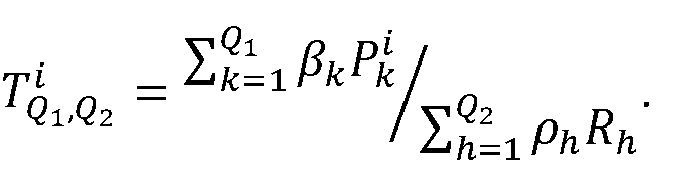
- Method according to any of claims 1 to 10, wherein the test statistic Ti for each one of the at least one voltage segment si , is equal to

- Method according to any of previous claims, wherein the predetermined threshold γ is equal to a percentile 1 - α of the empirical distribution of the test statistic Ti computed for a plurality of operations in nominal conditions, i. e. in normal steady-state operations, optionally α being equal to 0,05.
Applications Claiming Priority (2)
| Application Number | Priority Date | Filing Date | Title |
|---|---|---|---|
| IT102016000131225A IT201600131225A1 (en) | 2016-12-27 | 2016-12-27 | METHOD FOR DETECTION OF FAULTS IN FUEL CELLS |
| PCT/IB2017/058353 WO2018122715A1 (en) | 2016-12-27 | 2017-12-22 | Spectral-based method for fuel cell faults detection |
Publications (2)
| Publication Number | Publication Date |
|---|---|
| EP3563164A1 EP3563164A1 (en) | 2019-11-06 |
| EP3563164B1 true EP3563164B1 (en) | 2020-06-17 |
Family
ID=58609890
Family Applications (1)
| Application Number | Title | Priority Date | Filing Date |
|---|---|---|---|
| EP17829041.7A Active EP3563164B1 (en) | 2016-12-27 | 2017-12-22 | Spectral-based method for fuel cell faults detection |
Country Status (3)
| Country | Link |
|---|---|
| EP (1) | EP3563164B1 (en) |
| IT (1) | IT201600131225A1 (en) |
| WO (1) | WO2018122715A1 (en) |
Cited By (1)
| Publication number | Priority date | Publication date | Assignee | Title |
|---|---|---|---|---|
| WO2024016043A3 (en) * | 2022-07-21 | 2024-05-10 | Avl List Gmbh | Method and system for effecting and determining a defect on a pem fuel cell |
Families Citing this family (1)
| Publication number | Priority date | Publication date | Assignee | Title |
|---|---|---|---|---|
| JP7232548B2 (en) * | 2019-11-29 | 2023-03-03 | ミンテク カンパニー リミテッド | Battery state estimation device and method |
Family Cites Families (9)
| Publication number | Priority date | Publication date | Assignee | Title |
|---|---|---|---|---|
| US5790413A (en) * | 1993-03-22 | 1998-08-04 | Exxon Chemical Patents Inc. | Plant parameter detection by monitoring of power spectral densities |
| US6240372B1 (en) * | 1997-11-14 | 2001-05-29 | Arch Development Corporation | System for surveillance of spectral signals |
| JPWO2005088753A1 (en) | 2004-03-12 | 2007-08-09 | 松下電器産業株式会社 | FUEL CELL SYSTEM FAILURE DIAGNOSIS METHOD, FAILURE DIAGNOSIS DEVICE USING THE SAME, AND FUEL CELL SYSTEM |
| AT500968B8 (en) | 2004-10-07 | 2007-02-15 | Avl List Gmbh | METHOD FOR MONITORING THE OPERATING STATE OF A FUEL CELL STACK |
| JP2008522350A (en) | 2004-11-29 | 2008-06-26 | ハイドロジェニクス コーポレイション | System and method for detecting and displaying a fault condition of an electrochemical cell |
| EP1699101A1 (en) * | 2005-02-15 | 2006-09-06 | Paul Scherrer Institut | Fast locally resolved electrochemical impedance spectroscopy in polymer electrolyte fuel cells |
| US8652697B2 (en) | 2009-02-25 | 2014-02-18 | Bloom Energy Corporation | Controlling a fuel cell system based on fuel cell impedance characteristic |
| FR2956743B1 (en) * | 2010-02-25 | 2012-10-05 | Inst Francais Du Petrole | NON-INTRUSTIVE METHOD FOR DETERMINING THE ELECTRICAL IMPEDANCE OF A BATTERY |
| FI20116257A7 (en) | 2011-12-09 | 2013-06-10 | Waertsilae Finland Oy | Method and arrangement for diagnosis of solid oxide cells operating conditions |
-
2016
- 2016-12-27 IT IT102016000131225A patent/IT201600131225A1/en unknown
-
2017
- 2017-12-22 EP EP17829041.7A patent/EP3563164B1/en active Active
- 2017-12-22 WO PCT/IB2017/058353 patent/WO2018122715A1/en not_active Ceased
Non-Patent Citations (1)
| Title |
|---|
| None * |
Cited By (1)
| Publication number | Priority date | Publication date | Assignee | Title |
|---|---|---|---|---|
| WO2024016043A3 (en) * | 2022-07-21 | 2024-05-10 | Avl List Gmbh | Method and system for effecting and determining a defect on a pem fuel cell |
Also Published As
| Publication number | Publication date |
|---|---|
| EP3563164A1 (en) | 2019-11-06 |
| IT201600131225A1 (en) | 2018-06-27 |
| WO2018122715A1 (en) | 2018-07-05 |
Similar Documents
| Publication | Publication Date | Title |
|---|---|---|
| US10929776B2 (en) | Thermally-compensated prognostic-surveillance technique for critical assets in outdoor environments | |
| US8671315B2 (en) | Prognostic analysis system and methods of operation | |
| US20170051725A1 (en) | Method and apparatus for diagnosing blades of wind turbine | |
| CN103149475A (en) | Method and system for fault diagnosis of electrical equipment | |
| RU2684225C2 (en) | Aircraft engine monitoring system validation instrument | |
| CN116484267B (en) | Transformer fault characteristic extraction and determination method, computer equipment and storage medium | |
| CN106597160B (en) | Electronic equipment fault detection method and device | |
| KR20120137623A (en) | System and method for monitoring electrical power equipment | |
| EP3563164B1 (en) | Spectral-based method for fuel cell faults detection | |
| CN117374330A (en) | A fuel cell stack status identification method, device, medium, and electronic equipment | |
| CN118673317B (en) | Instrument equipment fault diagnosis method and device, electronic equipment and readable storage medium | |
| JP2009281955A (en) | Storage battery deterioration diagnostic system, storage battery deterioration diagnostic apparatus, storage battery deterioration diagnostic method and program | |
| US20200064406A1 (en) | Method for diagnosing a technical system | |
| KR101774451B1 (en) | Device and method monitoring the PEMFC stack using a signal processing method | |
| Salim et al. | A review on fault diagnosis tools of the proton exchange membrane fuel cell | |
| CN120428130B (en) | A battery health status diagnosis and control method and system | |
| CN115563868A (en) | Fault diagnosis method and device for oil circuit system of aviation alternating-current generator | |
| CN115663242A (en) | Fuel cell detection method and system | |
| CN120910748A (en) | Industrial equipment data acquisition and abnormal behavior monitoring system | |
| Zhang et al. | Applied sensor fault detection and validation using transposed input data PCA and ANNs | |
| CN115754821B (en) | A method and device for diagnosing commutator mechanical instability based on vibration-acoustic correlation. | |
| Peeters et al. | Wind turbine planetary gear fault identification using statistical condition indicators and machine learning | |
| Sharp | Prognostic approaches using transient monitoring methods | |
| KR102379920B1 (en) | Fuel cell failure diagnosis system using bi-metal switch and parallel circuit and the method using it | |
| CN117555943A (en) | Pressure sensor fault data analysis method, device and electronic equipment |
Legal Events
| Date | Code | Title | Description |
|---|---|---|---|
| STAA | Information on the status of an ep patent application or granted ep patent |
Free format text: STATUS: UNKNOWN |
|
| STAA | Information on the status of an ep patent application or granted ep patent |
Free format text: STATUS: THE INTERNATIONAL PUBLICATION HAS BEEN MADE |
|
| PUAI | Public reference made under article 153(3) epc to a published international application that has entered the european phase |
Free format text: ORIGINAL CODE: 0009012 |
|
| STAA | Information on the status of an ep patent application or granted ep patent |
Free format text: STATUS: REQUEST FOR EXAMINATION WAS MADE |
|
| REG | Reference to a national code |
Ref country code: DE Ref legal event code: R079 Ref document number: 602017018489 Country of ref document: DE Free format text: PREVIOUS MAIN CLASS: G01R0031360000 Ipc: G01R0031367000 |
|
| 17P | Request for examination filed |
Effective date: 20190729 |
|
| AK | Designated contracting states |
Kind code of ref document: A1 Designated state(s): AL AT BE BG CH CY CZ DE DK EE ES FI FR GB GR HR HU IE IS IT LI LT LU LV MC MK MT NL NO PL PT RO RS SE SI SK SM TR |
|
| AX | Request for extension of the european patent |
Extension state: BA ME |
|
| RAP1 | Party data changed (applicant data changed or rights of an application transferred) |
Owner name: COMMISSARIAT A L'ENERGIE ATOMIQUE ET AUX ENERGIES Owner name: UNIVERSITA DEGLI STUDI DI SALERNO |
|
| RIC1 | Information provided on ipc code assigned before grant |
Ipc: H01M 8/04664 20160101ALI20191017BHEP Ipc: G01R 31/367 20190101AFI20191017BHEP Ipc: H01M 8/04537 20160101ALI20191017BHEP Ipc: G01R 31/392 20190101ALI20191017BHEP |
|
| GRAP | Despatch of communication of intention to grant a patent |
Free format text: ORIGINAL CODE: EPIDOSNIGR1 |
|
| STAA | Information on the status of an ep patent application or granted ep patent |
Free format text: STATUS: GRANT OF PATENT IS INTENDED |
|
| INTG | Intention to grant announced |
Effective date: 20191129 |
|
| GRAS | Grant fee paid |
Free format text: ORIGINAL CODE: EPIDOSNIGR3 |
|
| GRAJ | Information related to disapproval of communication of intention to grant by the applicant or resumption of examination proceedings by the epo deleted |
Free format text: ORIGINAL CODE: EPIDOSDIGR1 |
|
| GRAL | Information related to payment of fee for publishing/printing deleted |
Free format text: ORIGINAL CODE: EPIDOSDIGR3 |
|
| STAA | Information on the status of an ep patent application or granted ep patent |
Free format text: STATUS: REQUEST FOR EXAMINATION WAS MADE |
|
| DAV | Request for validation of the european patent (deleted) | ||
| DAX | Request for extension of the european patent (deleted) | ||
| GRAP | Despatch of communication of intention to grant a patent |
Free format text: ORIGINAL CODE: EPIDOSNIGR1 |
|
| STAA | Information on the status of an ep patent application or granted ep patent |
Free format text: STATUS: GRANT OF PATENT IS INTENDED |
|
| GRAJ | Information related to disapproval of communication of intention to grant by the applicant or resumption of examination proceedings by the epo deleted |
Free format text: ORIGINAL CODE: EPIDOSDIGR1 |
|
| INTC | Intention to grant announced (deleted) | ||
| STAA | Information on the status of an ep patent application or granted ep patent |
Free format text: STATUS: REQUEST FOR EXAMINATION WAS MADE |
|
| GRAR | Information related to intention to grant a patent recorded |
Free format text: ORIGINAL CODE: EPIDOSNIGR71 |
|
| STAA | Information on the status of an ep patent application or granted ep patent |
Free format text: STATUS: GRANT OF PATENT IS INTENDED |
|
| GRAJ | Information related to disapproval of communication of intention to grant by the applicant or resumption of examination proceedings by the epo deleted |
Free format text: ORIGINAL CODE: EPIDOSDIGR1 |
|
| GRAR | Information related to intention to grant a patent recorded |
Free format text: ORIGINAL CODE: EPIDOSNIGR71 |
|
| INTG | Intention to grant announced |
Effective date: 20200416 |
|
| GRAA | (expected) grant |
Free format text: ORIGINAL CODE: 0009210 |
|
| STAA | Information on the status of an ep patent application or granted ep patent |
Free format text: STATUS: THE PATENT HAS BEEN GRANTED |
|
| INTC | Intention to grant announced (deleted) | ||
| AK | Designated contracting states |
Kind code of ref document: B1 Designated state(s): AL AT BE BG CH CY CZ DE DK EE ES FI FR GB GR HR HU IE IS IT LI LT LU LV MC MK MT NL NO PL PT RO RS SE SI SK SM TR |
|
| INTG | Intention to grant announced |
Effective date: 20200512 |
|
| REG | Reference to a national code |
Ref country code: GB Ref legal event code: FG4D |
|
| REG | Reference to a national code |
Ref country code: CH Ref legal event code: EP |
|
| REG | Reference to a national code |
Ref country code: DE Ref legal event code: R096 Ref document number: 602017018489 Country of ref document: DE |
|
| REG | Reference to a national code |
Ref country code: IE Ref legal event code: FG4D |
|
| REG | Reference to a national code |
Ref country code: AT Ref legal event code: REF Ref document number: 1281984 Country of ref document: AT Kind code of ref document: T Effective date: 20200715 |
|
| PG25 | Lapsed in a contracting state [announced via postgrant information from national office to epo] |
Ref country code: NO Free format text: LAPSE BECAUSE OF FAILURE TO SUBMIT A TRANSLATION OF THE DESCRIPTION OR TO PAY THE FEE WITHIN THE PRESCRIBED TIME-LIMIT Effective date: 20200917 Ref country code: FI Free format text: LAPSE BECAUSE OF FAILURE TO SUBMIT A TRANSLATION OF THE DESCRIPTION OR TO PAY THE FEE WITHIN THE PRESCRIBED TIME-LIMIT Effective date: 20200617 Ref country code: LT Free format text: LAPSE BECAUSE OF FAILURE TO SUBMIT A TRANSLATION OF THE DESCRIPTION OR TO PAY THE FEE WITHIN THE PRESCRIBED TIME-LIMIT Effective date: 20200617 Ref country code: SE Free format text: LAPSE BECAUSE OF FAILURE TO SUBMIT A TRANSLATION OF THE DESCRIPTION OR TO PAY THE FEE WITHIN THE PRESCRIBED TIME-LIMIT Effective date: 20200617 Ref country code: GR Free format text: LAPSE BECAUSE OF FAILURE TO SUBMIT A TRANSLATION OF THE DESCRIPTION OR TO PAY THE FEE WITHIN THE PRESCRIBED TIME-LIMIT Effective date: 20200918 |
|
| REG | Reference to a national code |
Ref country code: LT Ref legal event code: MG4D |
|
| REG | Reference to a national code |
Ref country code: NL Ref legal event code: MP Effective date: 20200617 |
|
| PG25 | Lapsed in a contracting state [announced via postgrant information from national office to epo] |
Ref country code: BG Free format text: LAPSE BECAUSE OF FAILURE TO SUBMIT A TRANSLATION OF THE DESCRIPTION OR TO PAY THE FEE WITHIN THE PRESCRIBED TIME-LIMIT Effective date: 20200917 Ref country code: HR Free format text: LAPSE BECAUSE OF FAILURE TO SUBMIT A TRANSLATION OF THE DESCRIPTION OR TO PAY THE FEE WITHIN THE PRESCRIBED TIME-LIMIT Effective date: 20200617 Ref country code: RS Free format text: LAPSE BECAUSE OF FAILURE TO SUBMIT A TRANSLATION OF THE DESCRIPTION OR TO PAY THE FEE WITHIN THE PRESCRIBED TIME-LIMIT Effective date: 20200617 Ref country code: LV Free format text: LAPSE BECAUSE OF FAILURE TO SUBMIT A TRANSLATION OF THE DESCRIPTION OR TO PAY THE FEE WITHIN THE PRESCRIBED TIME-LIMIT Effective date: 20200617 |
|
| REG | Reference to a national code |
Ref country code: AT Ref legal event code: MK05 Ref document number: 1281984 Country of ref document: AT Kind code of ref document: T Effective date: 20200617 |
|
| PG25 | Lapsed in a contracting state [announced via postgrant information from national office to epo] |
Ref country code: AL Free format text: LAPSE BECAUSE OF FAILURE TO SUBMIT A TRANSLATION OF THE DESCRIPTION OR TO PAY THE FEE WITHIN THE PRESCRIBED TIME-LIMIT Effective date: 20200617 Ref country code: NL Free format text: LAPSE BECAUSE OF FAILURE TO SUBMIT A TRANSLATION OF THE DESCRIPTION OR TO PAY THE FEE WITHIN THE PRESCRIBED TIME-LIMIT Effective date: 20200617 |
|
| PG25 | Lapsed in a contracting state [announced via postgrant information from national office to epo] |
Ref country code: EE Free format text: LAPSE BECAUSE OF FAILURE TO SUBMIT A TRANSLATION OF THE DESCRIPTION OR TO PAY THE FEE WITHIN THE PRESCRIBED TIME-LIMIT Effective date: 20200617 Ref country code: SM Free format text: LAPSE BECAUSE OF FAILURE TO SUBMIT A TRANSLATION OF THE DESCRIPTION OR TO PAY THE FEE WITHIN THE PRESCRIBED TIME-LIMIT Effective date: 20200617 Ref country code: AT Free format text: LAPSE BECAUSE OF FAILURE TO SUBMIT A TRANSLATION OF THE DESCRIPTION OR TO PAY THE FEE WITHIN THE PRESCRIBED TIME-LIMIT Effective date: 20200617 Ref country code: RO Free format text: LAPSE BECAUSE OF FAILURE TO SUBMIT A TRANSLATION OF THE DESCRIPTION OR TO PAY THE FEE WITHIN THE PRESCRIBED TIME-LIMIT Effective date: 20200617 Ref country code: CZ Free format text: LAPSE BECAUSE OF FAILURE TO SUBMIT A TRANSLATION OF THE DESCRIPTION OR TO PAY THE FEE WITHIN THE PRESCRIBED TIME-LIMIT Effective date: 20200617 Ref country code: PT Free format text: LAPSE BECAUSE OF FAILURE TO SUBMIT A TRANSLATION OF THE DESCRIPTION OR TO PAY THE FEE WITHIN THE PRESCRIBED TIME-LIMIT Effective date: 20201019 Ref country code: ES Free format text: LAPSE BECAUSE OF FAILURE TO SUBMIT A TRANSLATION OF THE DESCRIPTION OR TO PAY THE FEE WITHIN THE PRESCRIBED TIME-LIMIT Effective date: 20200617 |
|
| PG25 | Lapsed in a contracting state [announced via postgrant information from national office to epo] |
Ref country code: PL Free format text: LAPSE BECAUSE OF FAILURE TO SUBMIT A TRANSLATION OF THE DESCRIPTION OR TO PAY THE FEE WITHIN THE PRESCRIBED TIME-LIMIT Effective date: 20200617 Ref country code: SK Free format text: LAPSE BECAUSE OF FAILURE TO SUBMIT A TRANSLATION OF THE DESCRIPTION OR TO PAY THE FEE WITHIN THE PRESCRIBED TIME-LIMIT Effective date: 20200617 Ref country code: IS Free format text: LAPSE BECAUSE OF FAILURE TO SUBMIT A TRANSLATION OF THE DESCRIPTION OR TO PAY THE FEE WITHIN THE PRESCRIBED TIME-LIMIT Effective date: 20201017 |
|
| REG | Reference to a national code |
Ref country code: DE Ref legal event code: R097 Ref document number: 602017018489 Country of ref document: DE |
|
| PLBE | No opposition filed within time limit |
Free format text: ORIGINAL CODE: 0009261 |
|
| STAA | Information on the status of an ep patent application or granted ep patent |
Free format text: STATUS: NO OPPOSITION FILED WITHIN TIME LIMIT |
|
| PG25 | Lapsed in a contracting state [announced via postgrant information from national office to epo] |
Ref country code: DK Free format text: LAPSE BECAUSE OF FAILURE TO SUBMIT A TRANSLATION OF THE DESCRIPTION OR TO PAY THE FEE WITHIN THE PRESCRIBED TIME-LIMIT Effective date: 20200617 |
|
| 26N | No opposition filed |
Effective date: 20210318 |
|
| PG25 | Lapsed in a contracting state [announced via postgrant information from national office to epo] |
Ref country code: TR Free format text: LAPSE BECAUSE OF FAILURE TO SUBMIT A TRANSLATION OF THE DESCRIPTION OR TO PAY THE FEE WITHIN THE PRESCRIBED TIME-LIMIT Effective date: 20200617 Ref country code: MT Free format text: LAPSE BECAUSE OF FAILURE TO SUBMIT A TRANSLATION OF THE DESCRIPTION OR TO PAY THE FEE WITHIN THE PRESCRIBED TIME-LIMIT Effective date: 20200617 Ref country code: CY Free format text: LAPSE BECAUSE OF FAILURE TO SUBMIT A TRANSLATION OF THE DESCRIPTION OR TO PAY THE FEE WITHIN THE PRESCRIBED TIME-LIMIT Effective date: 20200617 |
|
| PG25 | Lapsed in a contracting state [announced via postgrant information from national office to epo] |
Ref country code: MK Free format text: LAPSE BECAUSE OF FAILURE TO SUBMIT A TRANSLATION OF THE DESCRIPTION OR TO PAY THE FEE WITHIN THE PRESCRIBED TIME-LIMIT Effective date: 20200617 |
|
| PG25 | Lapsed in a contracting state [announced via postgrant information from national office to epo] |
Ref country code: SI Free format text: LAPSE BECAUSE OF FAILURE TO SUBMIT A TRANSLATION OF THE DESCRIPTION OR TO PAY THE FEE WITHIN THE PRESCRIBED TIME-LIMIT Effective date: 20200617 |
|
| PGFP | Annual fee paid to national office [announced via postgrant information from national office to epo] |
Ref country code: CH Payment date: 20250101 Year of fee payment: 8 |
|
| REG | Reference to a national code |
Ref country code: CH Ref legal event code: U11 Free format text: ST27 STATUS EVENT CODE: U-0-0-U10-U11 (AS PROVIDED BY THE NATIONAL OFFICE) Effective date: 20260101 |
|
| PGFP | Annual fee paid to national office [announced via postgrant information from national office to epo] |
Ref country code: DE Payment date: 20251209 Year of fee payment: 9 |
|
| PGFP | Annual fee paid to national office [announced via postgrant information from national office to epo] |
Ref country code: GB Payment date: 20251201 Year of fee payment: 9 |
|
| PGFP | Annual fee paid to national office [announced via postgrant information from national office to epo] |
Ref country code: MC Payment date: 20251210 Year of fee payment: 9 |
|
| PGFP | Annual fee paid to national office [announced via postgrant information from national office to epo] |
Ref country code: IT Payment date: 20251205 Year of fee payment: 9 |
|
| PGFP | Annual fee paid to national office [announced via postgrant information from national office to epo] |
Ref country code: LU Payment date: 20251209 Year of fee payment: 9 Ref country code: FR Payment date: 20251201 Year of fee payment: 9 |
|
| PGFP | Annual fee paid to national office [announced via postgrant information from national office to epo] |
Ref country code: BE Payment date: 20251209 Year of fee payment: 9 |
|
| PGFP | Annual fee paid to national office [announced via postgrant information from national office to epo] |
Ref country code: IE Payment date: 20251201 Year of fee payment: 9 |