EP3577101B1 - Matériaux pour dispositifs électroniques - Google Patents
Matériaux pour dispositifs électroniques Download PDFInfo
- Publication number
- EP3577101B1 EP3577101B1 EP18701493.1A EP18701493A EP3577101B1 EP 3577101 B1 EP3577101 B1 EP 3577101B1 EP 18701493 A EP18701493 A EP 18701493A EP 3577101 B1 EP3577101 B1 EP 3577101B1
- Authority
- EP
- European Patent Office
- Prior art keywords
- formula
- aromatic ring
- atoms
- group
- groups
- Prior art date
- Legal status (The legal status is an assumption and is not a legal conclusion. Google has not performed a legal analysis and makes no representation as to the accuracy of the status listed.)
- Active
Links
- 0 C*CC[C@@](C1)C(C)=*[C@@]1(C)C(C)=CC Chemical compound C*CC[C@@](C1)C(C)=*[C@@]1(C)C(C)=CC 0.000 description 15
- OFHAARLMLAFNES-UHFFFAOYSA-N Oc1nc(C2(c3nnnnc3-c3nnnnc3C2(c2c-3nnnn2)c2c-4nnnn2)c2c-4nnnn2)c-3nn1 Chemical compound Oc1nc(C2(c3nnnnc3-c3nnnnc3C2(c2c-3nnnn2)c2c-4nnnn2)c2c-4nnnn2)c-3nn1 OFHAARLMLAFNES-UHFFFAOYSA-N 0.000 description 2
- KMPMQICGNVUJOR-UHFFFAOYSA-N CC(C=C1)C=C2C3=C1C(c1c(c4ccc5)c5ccc1)=C4C3=CC=C2 Chemical compound CC(C=C1)C=C2C3=C1C(c1c(c4ccc5)c5ccc1)=C4C3=CC=C2 KMPMQICGNVUJOR-UHFFFAOYSA-N 0.000 description 1
- IWFHHTPBNFOETO-UHFFFAOYSA-N CC(N=NN(C)C1C2(c3nnnnc3-c3nnnnc33)c4nnnnc4-4)=C1C1=NN(C)NN=C1C23c1c-4nnnn1 Chemical compound CC(N=NN(C)C1C2(c3nnnnc3-c3nnnnc33)c4nnnnc4-4)=C1C1=NN(C)NN=C1C23c1c-4nnnn1 IWFHHTPBNFOETO-UHFFFAOYSA-N 0.000 description 1
- IFUXKUVCPNUJJF-UHFFFAOYSA-N CC1(C)C=CC([n]2c3nc(cccc4)c4[n]3c3c2cccc3)=CC=C1 Chemical compound CC1(C)C=CC([n]2c3nc(cccc4)c4[n]3c3c2cccc3)=CC=C1 IFUXKUVCPNUJJF-UHFFFAOYSA-N 0.000 description 1
- FABOIYJFLQHUJK-UHFFFAOYSA-N CC1(C)C=Nc([o]c2c3cccc2)c3N=C1 Chemical compound CC1(C)C=Nc([o]c2c3cccc2)c3N=C1 FABOIYJFLQHUJK-UHFFFAOYSA-N 0.000 description 1
- SHMOJFOEGYWNJH-UHFFFAOYSA-N CC1(C)OB(c(cc2)ccc2-c2nc(-c3cccc(-c4ccccc4)c3)nc(-c(cc3)cc4c3[o]c3ccccc43)n2)OC1(C)C Chemical compound CC1(C)OB(c(cc2)ccc2-c2nc(-c3cccc(-c4ccccc4)c3)nc(-c(cc3)cc4c3[o]c3ccccc43)n2)OC1(C)C SHMOJFOEGYWNJH-UHFFFAOYSA-N 0.000 description 1
- PVGOPEUJUVXCGN-UHFFFAOYSA-N CC1(C)OB(c(cc2)ccc2-c2nc(-c3ccccc3)nc(-c3ccccc3)n2)OC1(C)C Chemical compound CC1(C)OB(c(cc2)ccc2-c2nc(-c3ccccc3)nc(-c3ccccc3)n2)OC1(C)C PVGOPEUJUVXCGN-UHFFFAOYSA-N 0.000 description 1
- MSUJHLBWRAHCQA-UHFFFAOYSA-N CC1(C)OB(c(cc2)ccc2N(C2C=CC=CC2c2c3)c2cc(C2(C)C)c3-c3c2cccc3)OC1(C)C Chemical compound CC1(C)OB(c(cc2)ccc2N(C2C=CC=CC2c2c3)c2cc(C2(C)C)c3-c3c2cccc3)OC1(C)C MSUJHLBWRAHCQA-UHFFFAOYSA-N 0.000 description 1
- NJPHSIAHYKLODA-UHFFFAOYSA-N CC1(C)OB(c(cc2)ccc2N(c2ccccc2)c(cc2)cc3c2-c2ccccc2C3(C)CCCS)OC1(C)C Chemical compound CC1(C)OB(c(cc2)ccc2N(c2ccccc2)c(cc2)cc3c2-c2ccccc2C3(C)CCCS)OC1(C)C NJPHSIAHYKLODA-UHFFFAOYSA-N 0.000 description 1
- BVKPVZXQFYUQMG-UHFFFAOYSA-N CC1(C)OB(c(cc2)ccc2N(c2ccccc2)c2cccc3c2[o]c2ccccc32)OC1(C)C Chemical compound CC1(C)OB(c(cc2)ccc2N(c2ccccc2)c2cccc3c2[o]c2ccccc32)OC1(C)C BVKPVZXQFYUQMG-UHFFFAOYSA-N 0.000 description 1
- PURXEYYMHXIZRD-UHFFFAOYSA-N CC1(C)OB(c2cccc(-c3cc(N(c(cc4)ccc4-c4ccccc4)c(cc4)ccc4-c4ccccc4)ccc3)c2)OC1(C)C Chemical compound CC1(C)OB(c2cccc(-c3cc(N(c(cc4)ccc4-c4ccccc4)c(cc4)ccc4-c4ccccc4)ccc3)c2)OC1(C)C PURXEYYMHXIZRD-UHFFFAOYSA-N 0.000 description 1
- UNTNWLCTOAVLJM-UHFFFAOYSA-N CC1(C)c(cc(cc2)Nc3cc(-c4ccccc4)ccc3)c2-c(cc2)c1cc2-c1ccccc1 Chemical compound CC1(C)c(cc(cc2)Nc3cc(-c4ccccc4)ccc3)c2-c(cc2)c1cc2-c1ccccc1 UNTNWLCTOAVLJM-UHFFFAOYSA-N 0.000 description 1
- DLQAJBPZDZZFLK-UHFFFAOYSA-N COc(c1c2c(cccc3)c3[o]1)ccc2Br Chemical compound COc(c1c2c(cccc3)c3[o]1)ccc2Br DLQAJBPZDZZFLK-UHFFFAOYSA-N 0.000 description 1
- ZAQLWMUDNQIIJQ-UHFFFAOYSA-N COc1ccccc1-c1ccccc1Br Chemical compound COc1ccccc1-c1ccccc1Br ZAQLWMUDNQIIJQ-UHFFFAOYSA-N 0.000 description 1
- ZZLCFHIKESPLTH-UHFFFAOYSA-N Cc(cc1)ccc1-c1ccccc1 Chemical compound Cc(cc1)ccc1-c1ccccc1 ZZLCFHIKESPLTH-UHFFFAOYSA-N 0.000 description 1
- SNHMUERNLJLMHN-UHFFFAOYSA-N Ic1ccccc1 Chemical compound Ic1ccccc1 SNHMUERNLJLMHN-UHFFFAOYSA-N 0.000 description 1
- DKHNGUNXLDCATP-UHFFFAOYSA-N N#Cc1c(C#N)nc2c3nc(C#N)c(C#N)nc3c3nc(C#N)c(C#N)nc3c2n1 Chemical compound N#Cc1c(C#N)nc2c3nc(C#N)c(C#N)nc3c3nc(C#N)c(C#N)nc3c2n1 DKHNGUNXLDCATP-UHFFFAOYSA-N 0.000 description 1
- CFMCFZLGEAHZCW-UHFFFAOYSA-N O=C(c1cccc2c1c1cc(Br)c2)C1=O Chemical compound O=C(c1cccc2c1c1cc(Br)c2)C1=O CFMCFZLGEAHZCW-UHFFFAOYSA-N 0.000 description 1
- CRCZGQBWVHLTDX-UHFFFAOYSA-N Oc(nc1C2(c3nnnnc3-c3nnnnc3C223)c4nnnnc4-c4c2nnnn4)nc2c1c3nnn2 Chemical compound Oc(nc1C2(c3nnnnc3-c3nnnnc3C223)c4nnnnc4-c4c2nnnn4)nc2c1c3nnn2 CRCZGQBWVHLTDX-UHFFFAOYSA-N 0.000 description 1
- NLIZIGAQBVSPTK-UHFFFAOYSA-N Oc1nnc(C2(C3(c4nnnnc4-4)c5nnnnc5-c5nnnnc5C23c2nnnnc2-2)c3c-4nnnn3)c-2n1 Chemical compound Oc1nnc(C2(C3(c4nnnnc4-4)c5nnnnc5-c5nnnnc5C23c2nnnnc2-2)c3c-4nnnn3)c-2n1 NLIZIGAQBVSPTK-UHFFFAOYSA-N 0.000 description 1
Classifications
-
- C—CHEMISTRY; METALLURGY
- C07—ORGANIC CHEMISTRY
- C07C—ACYCLIC OR CARBOCYCLIC COMPOUNDS
- C07C211/00—Compounds containing amino groups bound to a carbon skeleton
- C07C211/43—Compounds containing amino groups bound to a carbon skeleton having amino groups bound to carbon atoms of six-membered aromatic rings of the carbon skeleton
- C07C211/57—Compounds containing amino groups bound to a carbon skeleton having amino groups bound to carbon atoms of six-membered aromatic rings of the carbon skeleton having amino groups bound to carbon atoms of six-membered aromatic rings being part of condensed ring systems of the carbon skeleton
- C07C211/61—Compounds containing amino groups bound to a carbon skeleton having amino groups bound to carbon atoms of six-membered aromatic rings of the carbon skeleton having amino groups bound to carbon atoms of six-membered aromatic rings being part of condensed ring systems of the carbon skeleton with at least one of the condensed ring systems formed by three or more rings
-
- C—CHEMISTRY; METALLURGY
- C07—ORGANIC CHEMISTRY
- C07D—HETEROCYCLIC COMPOUNDS
- C07D307/00—Heterocyclic compounds containing five-membered rings having one oxygen atom as the only ring hetero atom
- C07D307/77—Heterocyclic compounds containing five-membered rings having one oxygen atom as the only ring hetero atom ortho- or peri-condensed with carbocyclic rings or ring systems
- C07D307/91—Dibenzofurans; Hydrogenated dibenzofurans
-
- C—CHEMISTRY; METALLURGY
- C07—ORGANIC CHEMISTRY
- C07D—HETEROCYCLIC COMPOUNDS
- C07D405/00—Heterocyclic compounds containing both one or more hetero rings having oxygen atoms as the only ring hetero atoms, and one or more rings having nitrogen as the only ring hetero atom
- C07D405/02—Heterocyclic compounds containing both one or more hetero rings having oxygen atoms as the only ring hetero atoms, and one or more rings having nitrogen as the only ring hetero atom containing two hetero rings
- C07D405/04—Heterocyclic compounds containing both one or more hetero rings having oxygen atoms as the only ring hetero atoms, and one or more rings having nitrogen as the only ring hetero atom containing two hetero rings directly linked by a ring-member-to-ring-member bond
-
- C—CHEMISTRY; METALLURGY
- C07—ORGANIC CHEMISTRY
- C07D—HETEROCYCLIC COMPOUNDS
- C07D405/00—Heterocyclic compounds containing both one or more hetero rings having oxygen atoms as the only ring hetero atoms, and one or more rings having nitrogen as the only ring hetero atom
- C07D405/02—Heterocyclic compounds containing both one or more hetero rings having oxygen atoms as the only ring hetero atoms, and one or more rings having nitrogen as the only ring hetero atom containing two hetero rings
- C07D405/12—Heterocyclic compounds containing both one or more hetero rings having oxygen atoms as the only ring hetero atoms, and one or more rings having nitrogen as the only ring hetero atom containing two hetero rings linked by a chain containing hetero atoms as chain links
-
- C—CHEMISTRY; METALLURGY
- C07—ORGANIC CHEMISTRY
- C07D—HETEROCYCLIC COMPOUNDS
- C07D407/00—Heterocyclic compounds containing two or more hetero rings, at least one ring having oxygen atoms as the only ring hetero atoms, not provided for by group C07D405/00
- C07D407/02—Heterocyclic compounds containing two or more hetero rings, at least one ring having oxygen atoms as the only ring hetero atoms, not provided for by group C07D405/00 containing two hetero rings
- C07D407/12—Heterocyclic compounds containing two or more hetero rings, at least one ring having oxygen atoms as the only ring hetero atoms, not provided for by group C07D405/00 containing two hetero rings linked by a chain containing hetero atoms as chain links
-
- C—CHEMISTRY; METALLURGY
- C07—ORGANIC CHEMISTRY
- C07D—HETEROCYCLIC COMPOUNDS
- C07D471/00—Heterocyclic compounds containing nitrogen atoms as the only ring hetero atoms in the condensed system, at least one ring being a six-membered ring with one nitrogen atom, not provided for by groups C07D451/00 - C07D463/00
- C07D471/02—Heterocyclic compounds containing nitrogen atoms as the only ring hetero atoms in the condensed system, at least one ring being a six-membered ring with one nitrogen atom, not provided for by groups C07D451/00 - C07D463/00 in which the condensed system contains two hetero rings
- C07D471/04—Ortho-condensed systems
-
- C—CHEMISTRY; METALLURGY
- C07—ORGANIC CHEMISTRY
- C07F—ACYCLIC, CARBOCYCLIC OR HETEROCYCLIC COMPOUNDS CONTAINING ELEMENTS OTHER THAN CARBON, HYDROGEN, HALOGEN, OXYGEN, NITROGEN, SULFUR, SELENIUM OR TELLURIUM
- C07F5/00—Compounds containing elements of Groups 3 or 13 of the Periodic Table
- C07F5/02—Boron compounds
- C07F5/025—Boronic and borinic acid compounds
-
- C—CHEMISTRY; METALLURGY
- C09—DYES; PAINTS; POLISHES; NATURAL RESINS; ADHESIVES; COMPOSITIONS NOT OTHERWISE PROVIDED FOR; APPLICATIONS OF MATERIALS NOT OTHERWISE PROVIDED FOR
- C09K—MATERIALS FOR MISCELLANEOUS APPLICATIONS, NOT PROVIDED FOR ELSEWHERE
- C09K11/00—Luminescent materials, e.g. electroluminescent or chemiluminescent
- C09K11/02—Use of particular materials as binders, particle coatings or suspension media therefor
- C09K11/025—Use of particular materials as binders, particle coatings or suspension media therefor non-luminescent particle coatings or suspension media
-
- C—CHEMISTRY; METALLURGY
- C09—DYES; PAINTS; POLISHES; NATURAL RESINS; ADHESIVES; COMPOSITIONS NOT OTHERWISE PROVIDED FOR; APPLICATIONS OF MATERIALS NOT OTHERWISE PROVIDED FOR
- C09K—MATERIALS FOR MISCELLANEOUS APPLICATIONS, NOT PROVIDED FOR ELSEWHERE
- C09K11/00—Luminescent materials, e.g. electroluminescent or chemiluminescent
- C09K11/06—Luminescent materials, e.g. electroluminescent or chemiluminescent containing organic luminescent materials
-
- H—ELECTRICITY
- H10—SEMICONDUCTOR DEVICES; ELECTRIC SOLID-STATE DEVICES NOT OTHERWISE PROVIDED FOR
- H10K—ORGANIC ELECTRIC SOLID-STATE DEVICES
- H10K50/00—Organic light-emitting devices
- H10K50/10—OLEDs or polymer light-emitting diodes [PLED]
- H10K50/14—Carrier transporting layers
- H10K50/15—Hole transporting layers
-
- H—ELECTRICITY
- H10—SEMICONDUCTOR DEVICES; ELECTRIC SOLID-STATE DEVICES NOT OTHERWISE PROVIDED FOR
- H10K—ORGANIC ELECTRIC SOLID-STATE DEVICES
- H10K50/00—Organic light-emitting devices
- H10K50/10—OLEDs or polymer light-emitting diodes [PLED]
- H10K50/14—Carrier transporting layers
- H10K50/16—Electron transporting layers
-
- H—ELECTRICITY
- H10—SEMICONDUCTOR DEVICES; ELECTRIC SOLID-STATE DEVICES NOT OTHERWISE PROVIDED FOR
- H10K—ORGANIC ELECTRIC SOLID-STATE DEVICES
- H10K85/00—Organic materials used in the body or electrodes of devices covered by this subclass
- H10K85/60—Organic compounds having low molecular weight
- H10K85/615—Polycyclic condensed aromatic hydrocarbons, e.g. anthracene
- H10K85/624—Polycyclic condensed aromatic hydrocarbons, e.g. anthracene containing six or more rings
-
- H—ELECTRICITY
- H10—SEMICONDUCTOR DEVICES; ELECTRIC SOLID-STATE DEVICES NOT OTHERWISE PROVIDED FOR
- H10K—ORGANIC ELECTRIC SOLID-STATE DEVICES
- H10K85/00—Organic materials used in the body or electrodes of devices covered by this subclass
- H10K85/60—Organic compounds having low molecular weight
- H10K85/631—Amine compounds having at least two aryl rest on at least one amine-nitrogen atom, e.g. triphenylamine
- H10K85/633—Amine compounds having at least two aryl rest on at least one amine-nitrogen atom, e.g. triphenylamine comprising polycyclic condensed aromatic hydrocarbons as substituents on the nitrogen atom
-
- H—ELECTRICITY
- H10—SEMICONDUCTOR DEVICES; ELECTRIC SOLID-STATE DEVICES NOT OTHERWISE PROVIDED FOR
- H10K—ORGANIC ELECTRIC SOLID-STATE DEVICES
- H10K85/00—Organic materials used in the body or electrodes of devices covered by this subclass
- H10K85/60—Organic compounds having low molecular weight
- H10K85/649—Aromatic compounds comprising a hetero atom
- H10K85/654—Aromatic compounds comprising a hetero atom comprising only nitrogen as heteroatom
-
- H—ELECTRICITY
- H10—SEMICONDUCTOR DEVICES; ELECTRIC SOLID-STATE DEVICES NOT OTHERWISE PROVIDED FOR
- H10K—ORGANIC ELECTRIC SOLID-STATE DEVICES
- H10K85/00—Organic materials used in the body or electrodes of devices covered by this subclass
- H10K85/60—Organic compounds having low molecular weight
- H10K85/649—Aromatic compounds comprising a hetero atom
- H10K85/657—Polycyclic condensed heteroaromatic hydrocarbons
- H10K85/6574—Polycyclic condensed heteroaromatic hydrocarbons comprising only oxygen in the heteroaromatic polycondensed ring system, e.g. cumarine dyes
-
- C—CHEMISTRY; METALLURGY
- C07—ORGANIC CHEMISTRY
- C07C—ACYCLIC OR CARBOCYCLIC COMPOUNDS
- C07C2603/00—Systems containing at least three condensed rings
- C07C2603/02—Ortho- or ortho- and peri-condensed systems
- C07C2603/04—Ortho- or ortho- and peri-condensed systems containing three rings
- C07C2603/06—Ortho- or ortho- and peri-condensed systems containing three rings containing at least one ring with less than six ring members
- C07C2603/10—Ortho- or ortho- and peri-condensed systems containing three rings containing at least one ring with less than six ring members containing five-membered rings
- C07C2603/12—Ortho- or ortho- and peri-condensed systems containing three rings containing at least one ring with less than six ring members containing five-membered rings only one five-membered ring
- C07C2603/18—Fluorenes; Hydrogenated fluorenes
-
- C—CHEMISTRY; METALLURGY
- C07—ORGANIC CHEMISTRY
- C07C—ACYCLIC OR CARBOCYCLIC COMPOUNDS
- C07C2603/00—Systems containing at least three condensed rings
- C07C2603/56—Ring systems containing bridged rings
-
- H—ELECTRICITY
- H10—SEMICONDUCTOR DEVICES; ELECTRIC SOLID-STATE DEVICES NOT OTHERWISE PROVIDED FOR
- H10K—ORGANIC ELECTRIC SOLID-STATE DEVICES
- H10K50/00—Organic light-emitting devices
- H10K50/10—OLEDs or polymer light-emitting diodes [PLED]
- H10K50/14—Carrier transporting layers
- H10K50/15—Hole transporting layers
- H10K50/155—Hole transporting layers comprising dopants
-
- H—ELECTRICITY
- H10—SEMICONDUCTOR DEVICES; ELECTRIC SOLID-STATE DEVICES NOT OTHERWISE PROVIDED FOR
- H10K—ORGANIC ELECTRIC SOLID-STATE DEVICES
- H10K50/00—Organic light-emitting devices
- H10K50/10—OLEDs or polymer light-emitting diodes [PLED]
- H10K50/14—Carrier transporting layers
- H10K50/15—Hole transporting layers
- H10K50/156—Hole transporting layers comprising a multilayered structure
-
- H—ELECTRICITY
- H10—SEMICONDUCTOR DEVICES; ELECTRIC SOLID-STATE DEVICES NOT OTHERWISE PROVIDED FOR
- H10K—ORGANIC ELECTRIC SOLID-STATE DEVICES
- H10K50/00—Organic light-emitting devices
- H10K50/10—OLEDs or polymer light-emitting diodes [PLED]
- H10K50/14—Carrier transporting layers
- H10K50/16—Electron transporting layers
- H10K50/165—Electron transporting layers comprising dopants
-
- H—ELECTRICITY
- H10—SEMICONDUCTOR DEVICES; ELECTRIC SOLID-STATE DEVICES NOT OTHERWISE PROVIDED FOR
- H10K—ORGANIC ELECTRIC SOLID-STATE DEVICES
- H10K50/00—Organic light-emitting devices
- H10K50/10—OLEDs or polymer light-emitting diodes [PLED]
- H10K50/18—Carrier blocking layers
-
- Y—GENERAL TAGGING OF NEW TECHNOLOGICAL DEVELOPMENTS; GENERAL TAGGING OF CROSS-SECTIONAL TECHNOLOGIES SPANNING OVER SEVERAL SECTIONS OF THE IPC; TECHNICAL SUBJECTS COVERED BY FORMER USPC CROSS-REFERENCE ART COLLECTIONS [XRACs] AND DIGESTS
- Y02—TECHNOLOGIES OR APPLICATIONS FOR MITIGATION OR ADAPTATION AGAINST CLIMATE CHANGE
- Y02E—REDUCTION OF GREENHOUSE GAS [GHG] EMISSIONS, RELATED TO ENERGY GENERATION, TRANSMISSION OR DISTRIBUTION
- Y02E10/00—Energy generation through renewable energy sources
- Y02E10/50—Photovoltaic [PV] energy
- Y02E10/549—Organic PV cells
Definitions
- the present application relates to propellane compounds according to the formulas defined below, which are suitable for use in electronic devices.
- the present application also relates to processes for producing the compounds mentioned, as well as electronic devices containing the compounds mentioned.
- OLEDs organic electroluminescent devices
- OLEDs organic electroluminescent devices
- the term OLEDs are understood to mean electronic devices which have one or more layers containing organic compounds and which emit light when an electrical voltage is applied.
- the structure and the general functional principle of OLEDs are known to the person skilled in the art.
- Emission layers, layers with a hole-transporting function, and layers with an electron-transporting function have a great influence on the performance data of electronic devices.
- New materials, in particular materials with hole-transporting and electron-transporting properties, are still being sought for use in these layers.
- triarylamine compounds in particular are known as hole-transporting materials for electronic devices.
- triarylamine compounds with a large number of different types of aryl groups as substituents on the nitrogen atom of the triarylamine, for example phenanthrenyl groups, Spirobifluorenyl groups and fluorenyl groups.
- phenanthrenyl groups for example phenanthrenyl groups, Spirobifluorenyl groups and fluorenyl groups.
- triarylamine compounds having novel embodiments of aryl groups on the nitrogen atom of the triarylamine which are suitable for use in electronic devices.
- improvement with regard to the performance data when the connections mentioned are used in electronic devices, in particular with regard to service life and efficiency.
- a large number of substance classes are also known in the prior art as electron-transporting materials, for example triazine derivatives, pyrimidine derivatives and quinoline derivatives.
- electron-transporting materials for example triazine derivatives, pyrimidine derivatives and quinoline derivatives.
- improvement with regard to the performance data when the connections mentioned are used in electronic devices in particular with regard to service life and efficiency.
- WO 2015/086108 A1 discloses polycyclic compounds for use in electronic devices.
- propellane compounds of the formulas (I) to (IV) defined in more detail below are outstandingly suitable for use in electronic devices, in particular for use in OLEDs, again in particular for use therein as hole-transporting or electron-transporting materials. When used in OLEDs, they preferably bring about excellent service life and efficiency of the device.
- an aryl group contains 6 to 40 aromatic ring atoms, none of which is a heteroatom.
- an aryl group is understood to mean either a simple aromatic cycle, that is to say benzene, or a condensed aromatic polycycle, for example naphthalene, phenanthrene or anthracene.
- a condensed aromatic polycycle consists of two or more simple aromatic rings condensed with one another. Condensation between cycles is to be understood as meaning that the cycles share at least one edge with one another.
- a heteroaryl group contains 5 to 40 aromatic ring atoms, at least one of which is a heteroatom.
- the heteroatoms of the heteroaryl group are preferably selected from N, O and S.
- a heteroaryl group in the context of this invention is understood to mean either a simple heteroaromatic cycle, for example pyridine, pyrimidine or thiophene, or a condensed heteroaromatic polycycle, for example quinoline or carbazole.
- a condensed heteroaromatic polycycle consists of two or more simple heteroaromatic rings condensed with one another. Condensation between cycles is to be understood as meaning that the cycles share at least one edge with one another.
- An aryl or heteroaryl group which can be substituted with the above-mentioned radicals and which can be linked via any positions on the aromatic or heteroaromatic, is understood in particular to mean groups which are derived from benzene, naphthalene, anthracene, phenanthrene, pyrene, Dihydropyrene, chrysene, perylene, triphenylene, fluoranthene, benzanthracene, benzphenanthrene, tetracene, pentacene, benzpyrene, furan, benzofuran, isobenzofuran, dibenzofuran, thiophene, benzothiophene, isobenzothiophene, dibenzothiophene, pyrrole, indole, isoindole, pyrrole, indole, isoindole, pyrrole, indole, isoindole, pyrrole, ind
- an aromatic ring system contains 6 to 40 carbon atoms in the ring system and does not include any heteroatoms as aromatic ring atoms.
- An aromatic ring system for the purposes of this invention therefore does not contain any heteroaryl groups.
- an aromatic ring system is to be understood as meaning a system which does not necessarily contain only aryl groups, but also in which several aryl groups are formed by a single bond or by a non-aromatic unit, such as, for example, one or more optionally substituted C-, Si- , N, O or S atoms, can be connected.
- the non-aromatic unit here preferably comprises less than 10% of the atoms other than H, based on the total number of atoms other than H in the system.
- systems such as 9,9'-spirobifluorene, 9,9'-diarylfluorene, triarylamine, diaryl ether and stilbene are to be understood as aromatic ring systems for the purposes of this invention, as well as systems in which two or more aryl groups, for example, by a linear or cyclic alkyl, alkenyl or alkynyl group or linked by a silyl group.
- systems in which two or more aryl groups are linked to one another via single bonds are also understood as aromatic ring systems for the purposes of this invention, such as, for example, systems such as biphenyl and terphenyl.
- a heteroaromatic ring system contains 5 to 40 aromatic ring atoms, at least one of which is a heteroatom.
- the heteroatoms of the heteroaromatic ring system are preferably selected from N, O and / or S.
- a heteroaromatic ring system corresponds to the above definition of an aromatic ring system, but has at least one heteroatom as one of the aromatic ring atoms. It differs from an aromatic ring system in the sense of the definition of the present application, which according to this definition cannot contain a heteroatom as an aromatic ring atom.
- An aromatic ring system with 6 to 40 aromatic ring atoms or a heteroaromatic ring system with 5 to 40 aromatic ring atoms is understood to mean in particular groups which are derived from the groups mentioned above under aryl groups and heteroaryl groups and from biphenyl, terphenyl, quaterphenyl, fluorene, spirobifluorene, Dihydrophenanthrene, dihydropyrene, tetrahydropyrene, indenofluoren, Truxen, Isotruxen, Spirotruxen, Spiroisotruxen, Indenocarbazole, or combinations of these groups.
- a straight-chain alkyl group with 1 to 20 carbon atoms or a branched or cyclic alkyl group with 3 to 20 carbon atoms or an alkenyl or alkynyl group with 2 to 40 carbon atoms in which also individual H atoms or CH 2 groups can be substituted by the groups mentioned above in the definition of the radicals, preferably the radicals methyl, ethyl, n-propyl, i-propyl, n-butyl, i-butyl, s-butyl, t -Butyl, 2-methylbutyl, n-pentyl, s-pentyl, cyclopentyl, neoPentyl, n-hexyl, cyclohexyl, neo-hexyl, n-heptyl, cycloheptyl, n-octyl, cyclooctyl, 2-e
- An alkoxy or thioalkyl group with 1 to 20 carbon atoms in which individual H atoms or CH 2 groups can also be substituted by the groups mentioned above in the definition of the radicals are preferably methoxy, trifluoromethoxy, ethoxy, n- Propoxy, i-propoxy, n-butoxy, i-butoxy, s-butoxy, t-butoxy, n-pentoxy, s-pentoxy, 2-methylbutoxy, n-hexoxy, cyclohexyloxy, n-heptoxy, cycloheptyloxy, n-octyloxy, Cyclooctyloxy, 2-ethylhexyloxy, pentafluoroethoxy, 2,2,2-trifluoroethoxy, methylthio, ethylthio, n-propylthio, i-propylthio, n-butylthio, i-butylthio,
- two or more radicals can form a ring with one another is to be understood in the context of the present application, inter alia, to mean that the two radicals are linked to one another by a chemical bond. Furthermore, the abovementioned formulation should also be understood to mean that, in the event that one of the two radicals represents hydrogen, the second radical binds to the position to which the hydrogen atom was bound to form a ring.
- Formula (I) is preferred among formulas (I) to (IV).
- At most three groups Z per aromatic ring are equal to N, and the remaining groups Z in the aromatic ring are equal to CR 1 or C.
- Z is preferably CR 1 or C, where Z is C exactly when a group Y is bonded to it.
- Y is preferably selected identically or differently on each occurrence from NR 2 , O, S and C (R 2 ) 2 .
- Y is particularly preferably selected identically or differently on each occurrence from O and NR 2 .
- Y is very particularly preferably O.
- the sum of the indices n in a compound of the formula (I) or (II) is preferably equal to 1 or 0, particularly preferably equal to 0.
- the sum of the indices n in a compound of the formula (III) is preferably equal to 0.
- n is 0 on each occurrence.
- the group Y is preferably bonded to that six-membered ring which carries a group of the formula (A) or (H).
- R 1 is selected identically or differently on each occurrence from H, D, F, CN, straight-chain alkyl groups with 1 to 12 carbon atoms, branched or cyclic alkyl groups with 3 to 12 carbon atoms, and aromatic ring systems with 6 to 24 aromatic ring atoms ; where two or more radicals R 1 can be linked to one another and can form a ring; and wherein said alkyl groups and said aromatic ring systems can each be substituted by one or more radicals R 3; it being possible for an indole ring to be fused onto one of the six-membered rings in formulas (I) to (IV), which in turn can be substituted by radicals R 3.
- Preferred examples of compounds of the formula (I) which have an indole ring fused to formula (I) correspond to one of the formulas (I-In-1) and (I-In-2) shown below Formula (I-In-1) Formula (I-In-2), where the groups and indices occurring are as defined for formula (I), and otherwise the preferences given in the present application apply.
- R 1 is particularly preferably selected identically or differently on each occurrence from H, D, straight-chain or branched alkyl groups with up to 12 carbon atoms, and aromatic ring systems with 6 to 24 aromatic ring atoms, it being possible for the alkyl groups and aromatic ring systems mentioned to be substituted by one or more radicals R 3.
- R 1 is very particularly preferably H.
- R 2 is selected identically or differently on each occurrence from F, straight-chain alkyl groups with 1 to 12 carbon atoms, branched or cyclic alkyl groups with 3 to 12 carbon atoms, and aromatic ring systems with 6 to 24 aromatic ring atoms; where two radicals R 2 can be linked to one another and can form a ring; and wherein said alkyl groups and said aromatic ring systems can each be substituted by one or more radicals R 3.
- R 2 is particularly preferably selected from straight-chain or branched alkyl groups with up to 12 carbon atoms, and aromatic ring systems with 6 to 24 aromatic ring atoms, where two radicals R 2 , which bond to the same carbon atom of a group C (R 2 ) 2 , and which are alkyl groups or aryl groups can be linked to one another to form a cyclic alkyl group or to form a fluorene group. Cyclic alkyl groups with 5 to 6 carbon atoms are preferred.
- R 3 is preferably selected identically or differently on each occurrence from H, D, F, CN, straight-chain alkyl groups with 1 to 12 carbon atoms, branched or cyclic alkyl groups with 3 to 12 carbon atoms, and aromatic ring systems with 6 to 24 aromatic ones Ring atoms; where two or more radicals R 3 can be linked to one another and can form a ring; and where said alkyl groups and said aromatic ring systems can each be substituted by one or more radicals R 4.
- R 4 is preferably selected identically or differently on each occurrence from H, D, F, CN, straight-chain alkyl groups with 1 to 12 carbon atoms, branched or cyclic alkyl groups with 3 to 12 carbon atoms, and aromatic ring systems with 6 to 24 aromatic ones Ring atoms; where two or more radicals R 4 can be linked to one another and can form a ring; and wherein said alkyl groups and the mentioned aromatic ring systems can be substituted by F or CN.
- Precisely one group R 1 per formula (I) is preferably replaced by a group of the formula (A).
- the group of formula (H) or (A) is preferably bonded in one of the positions designated below with 1, 2, and 4, particularly preferably in one of the positions designated below with 3 and 4, very particularly preferably in the position designated 4 below.
- L 1 is preferably an aromatic ring system with 6 to 24 aromatic ring atoms which can be substituted by one or more radicals R 5.
- L 1 is particularly preferably a divalent group selected from phenylene, biphenylene, terphenylene, naphthylene, dibenzofuran, dibenzothiophene, carbazole and fluorene, it being possible for the divalent group to be substituted by one or more radicals R 5.
- Ar 1 is preferably selected identically or differently on each occurrence from phenyl, biphenyl, terphenyl, fluorenyl, naphthyl, spirobifluorenyl, pyridyl, pyrimidyl, triazinyl, dibenzofuranyl, benzo-condensed dibenzofuranyl, dibenzothiophenyl, benzo-condensed Dibenzothiophenyl, carbazolyl, and benzo-fused carbazolyl, and combinations of two, three or four of these groups, it being possible for the groups mentioned to be substituted by one or more radicals R 5 in each case.
- L 1 is preferably an aromatic ring system with 6 to 24 aromatic ring atoms, which can be substituted by one or more radicals R 5.
- L 1 is particularly preferably a divalent group selected from phenylene, biphenylene, terphenylene, naphthylene, dibenzofuran, dibenzothiophene, carbazole and fluorene, it being possible for the divalent group to be substituted by one or more radicals R 5.
- Ar 2 is preferably a heteroaryl group with 6 to 24 aromatic ring atoms, which can be substituted by one or more radicals R 5.
- Ar 2 is particularly preferably selected from pyridine, pyrimidine, pyridazine, pyrazine, triazine, carbazole, imidazole, pyrazole, triazole, benzimidazole, benzimidazo-quinoline, imidazophenanthridine, benzimidazophenanthridine, bathocuproine, benzimidazo-zenantidine, diazoline, quinanthridine, diazoline, quinanthroline, and, phenapholenthroline, aquina-zimidazole, a can each be substituted by one or more radicals R 5.
- Groups of the formula (A) are preferably selected from the following groups: Formula (A-1) Formula (A-2) Formula (A-3) Formula (A-4) Formula (A-5) Formula (A-6) Formula (A-7) Formula (A-8) Formula (A-9) Formula (A-10) Formula (A-11) Formula (A-12) Formula (A-13) Formula (A-14) Formula (A-15) Formula (A-16) Formula (A-17) Formula (A-18) Formula (A-19) Formula (A-20) Formula (A-21) Formula (A-22) Formula (A-23) Formula (A-24) Formula (A-25) Formula (A-26) Formula (A-27) Formula (A-28) Formula (A-29) Formula (A-30) Formula (A-31) Formula (A-32) Formula (A-33) Formula (A-34) Formula (A-35) Formula (A-36) Formula (A-37) Formula (A-38) Formula (A-39) Formula (A-40) Formula (A-41) Formula (A-42) Formula (A-43) Formula (A-44) Formula (A-45) Formula (
- Groups of the formula (H) are preferably selected from the following groups: Formula (H-1) Formula (H-2) Formula (H-3) Formula (H-4) Formula (H-5) Formula (H-6) Formula (H-7) Formula (H-8) Formula (H-9) Formula (H-10) Formula (H-11) Formula (H-12) Formula (H-13) Formula (H-14) Formula (H-15) Formula (H-16) Formula (H-17) Formula (H-18) Formula (H-19) Formula (H-20) Formula (H-21) Formula (H-22) Formula (H-23) Formula (H-24) Formula (H-25) Formula (H-26) Formula (H-27) Formula (H-28) Formula (H-29) Formula (H-30) Formula (H-31) Formula (H-32) Formula (H-33) Formula (H-34) Formula (H-35) Formula (H-36) Formula (H-37) Formula (H-38) Formula (H-39) Formula (H-40) Formula (H-41) Formula (H-42) Formula (H-43) Formula (H-44) Formula (H-45) Formula (
- Preferred embodiments of the formula (I) correspond to the following formulas (IH-1) to (IH-7) and (IA-1) to (IA-7) Formula (IH-1) Formula (IH-2) Formula (IH-3) Formula (IH-4) Formula (IH-5) Formula (IH-6) Formula (IH-7) Formula (IA-1) Formula (IA-2) Formula (IA-3) Formula (IA-4) Formula (IA-5) Formula (IA-6) Formula (IH-7) Formula (IA-1) Formula (IA-2) Formula (IA-3) Formula (IA-4) Formula (IA-5) Formula (IA-6) Formula (IA-7), where the occurring groups are as defined above and preferably correspond to their preferred embodiments, and where "Formula (A)” is a group of the formula (A) as defined above, and where "Formula (H)” is a group of the formula ( H) is as defined above.
- Z is CR 1 .
- Preferred embodiments of the formula (II) correspond to the following formulas (II-A-1) to (II-A-3) Formula (II-A-1) Formula (II-A-2) Formula (II-A-3) where the groups occurring are as defined above and preferably correspond to their preferred embodiments, and where “formula (A)” is a group of the formula (A) as defined above.
- Z is CR 1 .
- Preferred embodiments of the formula (III) correspond to the following formulas (III-A-1) to (III-A-3) Formula (III-A-1) Formula (III-A-2) Formula (III-A-3) where the groups occurring are as defined above and preferably correspond to their preferred embodiments, and where “formula (A)” is a group of the formula (A) as defined above.
- Z is CR 1 .
- Preferred embodiments of the formula (IV) correspond to the following formulas (IV-A-1) to (IV-A-3) Formula (IV-A-1) Formula (IV-A-2) Formula (IV-A-3) where the groups occurring are as defined above and preferably correspond to their preferred embodiments, and where “formula (A)” is a group of the formula (A) as defined above.
- Z is CR 1 .
- the compounds according to the invention can be prepared by means of known synthetic methods.
- secondary amines in CN couplings e.g. Hartwig-Buchwald coupling
- aryl / heteroaryl boronic acids, boronic acid esters, organotin or zinc Compounds in CC couplings for example Suzuki, Stille, Negishi coupling, etc.
- Compounds of the formula (IV) can be prepared from alkoxy-substituted 1,2-acenaphthenes and unsubstituted or substituted 1-naphthylmagnesium bromides and acid-catalyzed rearrangement of the intermediate diols, with the sequence of steps described above in Scheme 1 in step 1 in Scheme 4 shown below 3-5 connects.
- the present application relates to a process for producing a compound according to the invention, characterized in that the alkoxy-substituted basic structure is first produced, which is converted into a reactive compound in a further step, preferably into a triflate derivative, which is converted into the compound according to the invention in a further step by transition metal-catalyzed coupling reaction, preferably Hartwig-Buchwald, Suzuki, Stille or Negishi coupling.
- transition metal-catalyzed coupling reaction preferably Hartwig-Buchwald, Suzuki, Stille or Negishi coupling.
- a biphenyl derivative is used for the synthesis of the abovementioned alkoxy-substituted basic structure which has both an alkoxy group and a halogen atom, preferably bromine, as substituents.
- This biphenyl derivative is first metalated, preferably by lithium organyls or magnesium, and the metalated derivative is then added to a spiro [9H-fluorene-9,9 '(10'H) -phenanthren] -10'-one derivative This is followed by cyclization of the tertiary alcohol and rearrangement, in which the above-mentioned alkoxy-substituted basic structure of the formula (I) is formed as the end product.
- a naphthyl derivative is used for the synthesis of the abovementioned alkoxy-substituted basic structure, which carries both an alkoxy group and a halogen atom, preferably bromine, as substituents.
- This naphthyl derivative is first metalated, preferably by lithium organyls or magnesium, and the metalated derivative is then added to a spiro [9H-fluorene-9,9 '(10'H) -phenanthren] -10'-one derivative , which is followed by a cyclization of the tertiary alcohol and rearrangement, in which the above-mentioned alkoxy-substituted basic structure of the formula (II) is formed as the end product.
- an iodobenzene derivative is used for the synthesis of the abovementioned alkoxy-substituted basic structure.
- This iodobenzene derivative is reacted with a methoxy-acenaphth [1,2-a] acenaphthylene derivative under Pd catalysis, in a Sequence of Heck reaction and Pd-catalyzed CC coupling and Pd-catalyzed CC coupling with CH activation.
- the end product is the abovementioned alkoxy-substituted basic structure of the formula (III).
- a 1-naphthylmagnesium bromide derivative is reacted with an alkoxy-substituted 1,2-acenaphthene for the synthesis of the above-mentioned alkoxy-substituted skeleton, the intermediate diol formed being rearranged under acid catalysis to form the alkoxy- or halogen-substituted skeleton of the formula (IV ).
- Suitable reactive leaving groups are, for example, bromine, iodine, chlorine, boronic acids, boronic acid esters, amines, alkenyl or alkynyl groups with a terminal CC double bond or CC triple bond, oxiranes, oxetanes, groups that require a cycloaddition, for example a 1,3-dipolar cycloaddition , such as dienes or azides, carboxylic acid derivatives, alcohols and silanes.
- reactive leaving groups are, for example, bromine, iodine, chlorine, boronic acids, boronic acid esters, amines, alkenyl or alkynyl groups with a terminal CC double bond or CC triple bond, oxiranes, oxetanes, groups that require a cycloaddition, for example a 1,3-dipolar cycloaddition , such as dienes or azides, carboxylic acid derivatives, alcohols and silane
- the invention therefore further relates to oligomers, polymers or dendrimers containing one or more compounds of the formula (I), (II), (III) or (IV), the bond (s) to the polymer, oligomer or dendrimer being attached to any can be located in the formulas mentioned with R 1 , R 2 or R 5 substituted positions.
- the compound is part of a side chain of the oligomer or polymer or part of the main chain.
- an oligomer is understood to mean a compound which is built up from at least three monomer units.
- a polymer in the context of the invention is understood to mean a compound which is built up from at least ten monomer units.
- the polymers, oligomers or dendrimers according to the invention can be conjugated, partially conjugated or non-conjugated be.
- the oligomers or polymers according to the invention can be linear, branched or dendritic.
- the units according to the above formulas can be linked directly to one another or they can be linked to one another via a divalent group, for example via a substituted or unsubstituted alkylene group, via a heteroatom or via a divalent aromatic or heteroaromatic group.
- branched and dendritic structures for example, three or more units according to the above formulas can be linked via a trivalent or higher-valent group, for example via a trivalent or higher-valent aromatic or heteroaromatic group, to form a branched or dendritic oligomer or polymer.
- the monomers according to the invention are homopolymerized or copolymerized with other monomers.
- Suitable and preferred comonomers are selected from fluorene (e.g. according to EP 842208 or WO 2000/22026 ), Spirobifluorenes (e.g. according to EP 707020 , EP 894107 or WO 2006/061181 ), Paraphenylenes (e.g. according to WO 1992/18552 ), Carbazoles (e.g. according to WO 2004/070772 or WO 2004/113468 ), Thiophenes (e.g. according to EP 1028136 ), Dihydrophenanthrenes (e.g.
- cis and trans indenofluorenes e.g. according to WO 2004/041901 or WO 2004/113412
- Ketones e.g. according to WO 2005/040302
- Phenanthrenes e.g. according to WO 2005/104264 or WO 2007/017066
- the polymers, oligomers and dendrimers usually also contain other units, for example emitting (fluorescent or phosphorescent) units, such as.
- B. vinyl triarylamines e.g. according to WO 2007/068325
- phosphorescent metal complexes e.g. according to WO 2006/003000
- charge transport units in particular those based on triarylamines.
- the polymers and oligomers according to the invention are generally produced by polymerizing one or more types of monomers, at least one of which leads to repeat units of the formula (I), (II), (III) or (IV) in the polymer.
- Suitable polymerization reactions are known to the person skilled in the art and are described in the literature.
- Particularly suitable and preferred polymerization reactions which lead to C-C or C-N linkages are Suzuki polymerization and Yamamoto polymerization; the Stille polymerization; and the Hartwig-Buchwald polymerization.
- formulations of the compounds according to the invention are required. These formulations can be, for example, solutions, dispersions or emulsions. It can be preferred to use mixtures of two or more solvents for this purpose.
- Suitable and preferred solvents are, for example, toluene, anisole, o-, m- or p-xylene, methyl benzoate, mesitylene, tetralin, veratrole, THF, methyl THF, THP, chlorobenzene, dioxane, phenoxytoluene, especially 3-phenoxytoluene, (-) -Fenchone, 1,2,3,5-tetramethylbenzene, 1,2,4,5-tetramethylbenzene, 1-methylnaphthalene, 2-methylbenzothiazole, 2-phenoxyethanol, 2-pyrrolidinone, 3-methylanisole, 4-methylanisole, 3,4 -Dimethylanisole, 3,5-dimethylanisole, acetophenone, ⁇ -terpineol, benzothiazole, butylbenzoate, cumene, cyclohexanol, cyclohexanone, cyclohexylbenzene, decalin,
- the invention therefore furthermore relates to a formulation, in particular containing a solution, dispersion or emulsion at least one compound of the formula (I), (II), (III) or (IV) and at least one solvent, preferably an organic solvent.
- a formulation in particular containing a solution, dispersion or emulsion at least one compound of the formula (I), (II), (III) or (IV) and at least one solvent, preferably an organic solvent.
- the compounds according to the invention are suitable for use in electronic devices, in particular in organic electroluminescent devices (OLEDs). Depending on the substitution, the compounds are used in different functions and layers.
- OLEDs organic electroluminescent devices
- the invention therefore further relates to the use of the compound of the formula (I), (II), (III) or (IV) in an electronic device.
- the electronic device is preferably selected from the group consisting of organic integrated circuits (OICs), organic field effect transistors (OFETs), organic thin-film transistors (OTFTs), organic light-emitting transistors (OLETs), organic solar cells (OSCs), organic optical Detectors, organic photoreceptors, organic field quench devices (OFQDs), organic light-emitting electrochemical cells (OLECs), organic laser diodes (O lasers) and particularly preferably organic electroluminescent devices (OLEDs).
- OICs organic integrated circuits
- OFETs organic field effect transistors
- OTFTs organic thin-film transistors
- OLETs organic light-emitting transistors
- OSCs organic solar cells
- OFDs organic optical Detectors
- organic photoreceptors organic photoreceptors
- OFQDs organic field que
- the invention also relates to an electronic device containing at least one compound according to the invention.
- the electronic device is preferably selected from the devices mentioned above.
- OLED organic electroluminescent device
- the organic electroluminescent device can also contain further layers. These are selected, for example, from one or more hole injection layers, hole transport layers, hole blocking layers, electron transport layers, electron injection layers, electron blocking layers, exciton blocking layers, interlayers, charge generation layers (IDMC 2003, Taiwan; Session 21 OLED (5), T. Matsumoto, T. Nakada, J. Endo, K. Mori, N. Kawamura, A. Yokoi, J. Kido, Multiphoton Organic EL Device Having Charge Generation Layer ) and / or organic or inorganic p / n junctions.
- the sequence of layers of the organic electroluminescent device containing the compound of the formula (I), (II), (III) or (IV) is preferably the following: Anode-hole injection layer-hole transport layer-optionally further hole-transport layer (s)-optionally electron-blocking layer-emitting layer-optionally hole-blocking layer-electron transport layer-electron injection layer-cathode. Additional layers can also be present in the OLED.
- the organic electroluminescent device according to the invention can contain a plurality of emitting layers.
- these emission layers particularly preferably have a total of several emission maxima between 380 nm and 750 nm, so that overall white emission results, that is, different emitting compounds are used in the emitting layers which can fluoresce or phosphoresce and which are blue, green, yellow, Emit orange or red light.
- Three-layer systems are particularly preferred, i.e. systems with three emitting layers, the three layers showing blue, green and orange or red emission (for the basic structure, see e.g. WO 2005/011013 ).
- the compounds according to the invention are preferably present in a hole transport layer, hole injection layer, electron blocking layer, emitting layer, hole blocking layer and / or electron transport layer, particularly preferably in a hole transport layer, an emitting layer as matrix material, in a hole blocking layer and / or in an electron transport layer.
- the compound according to the invention is used in an electronic device containing one or more phosphorescent emitting compounds.
- the compound can be contained in different layers, preferably in a hole transport layer, an electron blocking layer, a hole injection layer, an emitting layer, a hole blocking layer, and / or an electron transport layer. It is particularly preferably contained in an emitting layer in combination with a phosphorescent emitting compound.
- phosphorescent emitting compounds typically includes compounds in which the light emission occurs through a spin-forbidden transition, for example a transition from an excited triplet state or a state with a higher spin quantum number, for example a quintet state.
- Particularly suitable phosphorescent emitting compounds are compounds which, when suitably excited, emit light, preferably in the visible range, and which also contain at least one atom with an atomic number greater than 20, preferably greater than 38 and less than 84, particularly preferably greater than 56 and less than 80 .
- phosphorescent emitting compounds preference is given to using compounds containing copper, molybdenum, tungsten, rhenium, ruthenium, osmium, rhodium, iridium, palladium, platinum, silver, gold or europium, in particular compounds containing iridium, platinum or copper.
- all luminescent iridium, platinum or copper complexes are regarded as phosphorescent emitting compounds.
- Examples of the emitting compounds described above can be found in the applications WO 00/70655 , WO 01/41512 , WO 02/02714 , WO 02/15645 , EP 1191613 , EP 1191612 , EP 1191614 , WO 05/033244 , WO 05/019373 and US 2005/0258742 can be removed.
- all phosphorescent complexes are suitable, as they are used according to the prior art for phosphorescent OLEDs and as they are known to the person skilled in the art in the field of organic electroluminescent devices.
- the person skilled in the art can also use further phosphorescent complexes in combination with the compounds according to the invention in organic electroluminescent devices without inventive work. Further examples are given in the following table:
- the compounds according to the invention are used as hole-transporting material.
- compounds of the formulas (I) to (IV) which contain exactly one group of the formula (A) are particularly suitable.
- the compounds are then preferably in a hole transport layer, an electron blocking layer or a hole injection layer.
- a hole transport layer according to the present application is a layer with a hole transport function which is located between the anode and the emitting layer.
- Hole injection layers and electron blocking layers are understood in the sense of the present application as special embodiments of hole transport layers.
- a hole injection layer is a hole transport layer which is directly adjacent to the anode or is only separated from it by a single coating on the anode.
- an electron blocking layer is that hole transport layer which directly adjoins the emitting layer on the anode side.
- the inventive OLED preferably contains two, three or four hole-transporting layers between anode and emitting layer, at least one of which preferably contains a compound of the formula (I), (II), (III) or (IV), particularly preferably exactly one or two contain a compound according to formula (I), (II), (III) or (IV).
- the compound according to the invention is used as a hole transport material in a hole transport layer, a hole injection layer or an electron blocking layer, the compound can be used as a pure material, ie in a proportion of 100%, in the hole transport layer, or it can be used in combination with one or more other compounds become.
- the organic layer containing the compound according to the invention then additionally contains one or more p-dopants.
- Organic electron acceptor compounds which can oxidize one or more of the other compounds of the mixture are preferably used as p-dopants according to the present invention.
- p-dopants are those in WO 2011/073149 , EP 1968131 , EP 2276085 , EP 2213662 , EP 1722602 , EP 2045848 , DE 102007031220 , US 8044390 , US 8057712 , WO 2009/003455 , WO 2010/094378 , WO 2011/120709 , US 2010/0096600 , WO 2012/095143 and DE 102012209523 disclosed compounds.
- Particularly preferred p-dopants are quinodimethane compounds, azaindenofluorenediones, azaphenalenes, azatriphenylenes, I 2 , metal halides, preferably transition metal halides, metal oxides, preferably metal oxides containing at least one transition metal or a metal from main group 3, and transition metal complexes, preferably complexes of Cu, Co, Ni , Pd and Pt with ligands containing at least one oxygen atom as a binding site.
- Transition metal oxides are also preferred as dopants, preferably oxides of rhenium, molybdenum and tungsten, particularly preferably Re 2 O 7 , MoO 3 , WO 3 and ReO 3 .
- the p-dopants are preferably distributed largely uniformly in the p-doped layers. This can be achieved, for example, by co-evaporation of the p-dopant and the hole transport material matrix.
- the compound according to the invention is used as a hole transport material in combination with a hexaazatriphenylene derivative, as in US 2007/0092755 described, used.
- the hexaazatriphenylene derivative is particularly preferably used in a separate layer. This separate layer is preferably directly adjacent to the anode and arranged between the anode and the hole transport layer next to the anode.
- the compound according to the invention is used in an emitting layer as a matrix material in combination with one or more phosphorescent emitting compounds.
- Compounds of the formula (I) - (IV) which have exactly one group of the formula (H) are particularly suitable for this, in particular compounds of the above formulas which have exactly one group of the formula (H) which contains one or more carbazole groups .
- At least one group L 1 is preferably carbazole and / or the group Ar 2 is carbazole.
- the proportion of the matrix material in the emitting layer is between 50.0 and 99.9% by volume, preferably between 80.0 and 99.5% by volume and particularly preferably between 85.0 and 97.0% by volume.
- the proportion of the emitting compound is between 0.1 and 50.0% by volume, preferably between 0.5 and 20.0% by volume and particularly preferably between 3.0 and 15.0% by volume.
- An emitting layer of an organic electroluminescent device can also contain systems comprising several matrix materials (mixed matrix systems) and / or several emitting compounds.
- the emitting compounds are generally those compounds whose proportion in the system is the smaller and the matrix materials are those compounds whose proportion in the system is the larger.
- the proportion of an individual matrix material in the system can be smaller than the proportion of an individual emitting compound.
- the compounds according to the invention are used as a component of mixed matrix systems.
- the mixed matrix systems preferably comprise two or three different matrix materials, particularly preferably two different matrix materials.
- One of the two materials is preferably a material with hole-transporting properties and the other material is a material with electron-transporting properties.
- the compound according to the invention preferably represents the matrix material with hole-transporting properties.
- the desired electron-transporting and hole-transporting properties of the mixed matrix components can can also be combined mainly or completely in a single mixed matrix component, the further or further mixed matrix components fulfilling other functions.
- the two different matrix materials can be present in a ratio of 1:50 to 1: 1, preferably 1:20 to 1: 1, particularly preferably 1:10 to 1: 1 and very particularly preferably 1: 4 to 1: 1.
- Mixed matrix systems are preferably used in phosphorescent organic electroluminescent devices. More detailed information on mixed matrix systems can be found in the registration form WO 2010/108579 contain.
- the mixed matrix systems can comprise one or more emitting compounds, preferably one or more phosphorescent emitting compounds.
- mixed matrix systems are preferably used in phosphorescent organic electroluminescent devices.
- Particularly suitable matrix materials which can be used in combination with the compounds according to the invention as matrix components of a mixed matrix system, are selected from the preferred matrix materials for phosphorescent emitting compounds given below or the preferred matrix materials for fluorescent emitting compounds, depending on which type of emitting one Compound in the mixed matrix system is used.
- Preferred phosphorescent emitting compounds for use in mixed matrix systems are the same as those listed above as generally preferred phosphorescent emitter materials.
- the compounds according to the invention are used in one or more layers on the electron transport side, preferably in a hole blocking layer and / or an electron transport layer.
- compounds of the formula (I) - (IV) are particularly suitable which have exactly one group of the formula (H), in particular a group of the formula (H) in which at least one group L 1 or the group Ar 2 is selected from Triazine and pyrimidine.
- a metal complex preferably a metal quinolinate, particularly preferably a lithium quinolinate.
- Preferred fluorescent emitting compounds are selected from the class of the arylamines.
- an arylamine or an aromatic amine is understood to mean a compound which contains three substituted or unsubstituted aromatic or heteroaromatic ring systems bonded directly to the nitrogen. At least one of these aromatic or heteroaromatic ring systems is preferably a condensed ring system, particularly preferably having at least 14 aromatic ring atoms.
- Preferred examples of these are aromatic anthracenamines, aromatic anthracenediamines, aromatic pyrenamines, aromatic pyrenediamines, aromatic chrysenamines or aromatic chrysendiamines.
- aromatic anthracenamine is understood to mean a compound in which a diarylamino group is bonded directly to an anthracene group, preferably in the 9-position.
- aromatic anthracenediamine is understood to mean a compound in which two diarylamino groups are directly attached an anthracene group are attached, preferably in the 9,10-position.
- Aromatic pyrenamines, pyrenediamines, chrysenamines and chrysendiamines are defined analogously to this, the diarylamino groups being bonded to the pyrene preferably in the 1 position or in the 1,6 position.
- indenofluorenamines or diamines for example according to WO 2006/108497 or WO 2006/122630 , Benzoindenofluorenamines or -diamines, for example according to WO 2008/006449 , and dibenzoindenofluorenamines or diamines, for example according to WO 2007/140847 , as well as the in WO 2010/012328 disclosed indenofluorene derivatives with fused aryl groups.
- WO 2012/048780 and the in WO 2013/185871 disclosed pyrene arylamines are also preferred.
- WO 2014/037077 disclosed benzoindenofluorene amines, which in WO 2014/106522 disclosed benzofluorene amines, which in WO 2014/111269 and in the not yet disclosed application EP 15182993.4 disclosed extended benzoindenofluorenes in the as yet undisclosed applications EP 15181178.3 and EP 15181177.5 disclosed Phenoxazine, and those in WO 2016/150544 disclosed fluorene derivatives which are linked with furan units or with thiophene units.
- matrix materials Materials from various classes of substances can be used as matrix materials, preferably for fluorescent emitting compounds.
- Preferred matrix materials are selected from the classes of the oligoarylenes (e.g. 2,2 ', 7,7'-tetraphenylspirobifluorene according to EP 676461 or dinaphthylanthracene), in particular the oligoarylene containing condensed aromatic groups, the oligoarylenvinylenes (e.g. DPVBi or Spiro-DPVBi according to EP 676461 ), the polypodal metal complexes (e.g. according to WO 2004/081017 ), the hole-conducting connections (e.g.
- the electron-conducting compounds in particular ketones, phosphine oxides, sulfoxides, etc. (e.g. according to WO 2005/084081 and WO 2005/084082 ), the atropisomers (e.g. according to WO 2006/048268 ), the boronic acid derivatives (e.g. according to WO 2006/117052 ) or the benzanthracenes (e.g. according to WO 2008/145239 ).
- Particularly preferred matrix materials are selected from the classes of oligoarylenes containing naphthalene, anthracene, benzanthracene and / or pyrene or atropisomers of these compounds, the oligoarylenevinylenes, the ketones, the phosphine oxides and the sulfoxides.
- Very particularly preferred matrix materials are selected from the classes of oligoarylenes containing anthracene, benzanthracene, benzphenanthrene and / or pyrene or atropisomers of these compounds.
- an oligoarylene is to be understood as a compound in which at least three aryl or arylene groups are bonded to one another.
- WO 2006/097208 WO 2006/131192 , WO 2007/065550 , WO 2007/110129 , WO 2007/065678 , WO 2008/145239 , WO 2009/100925 , WO 2011/054442 , and EP 1553154 disclosed anthracene derivatives in EP 1749809 , EP 1905754 and US 2012/0187826 disclosed pyrene compounds disclosed in WO 2015/158409 disclosed benzanthracenyl anthracene compounds in the as yet unpublished application EP 15180777.3 disclosed indeno-benzofurans, and those in the as yet unpublished application EP 15182962.9 disclosed phenanthryl anthracenes.
- Preferred matrix materials for phosphorescent emitting compounds are, in addition to the compounds according to the invention, aromatic ketones, aromatic phosphine oxides or aromatic sulfoxides or sulfones, e.g. B. according to WO 2004/013080 , WO 2004/093207 , WO 2006/005627 or WO 2010/006680 , Triarylamines, carbazole derivatives, e.g. B.
- CBP N, N-biscarbazolylbiphenyl
- carbazole derivatives indolocarbazole derivatives, e.g. B. according to WO 2007/063754 or WO 2008/056746
- Indenocarbazole derivatives e.g. B. according to WO 2010/136109 , WO 2011/000455 or WO 2013/041176
- Azacarbazole derivatives e.g. B.
- bipolar matrix materials e.g. B. according to WO 2007/137725 , Silanes, e.g. B. according to WO 2005/111172 , Azaboroles or boronic esters, e.g. B. according to WO 2006/117052 , Triazine derivatives, e.g. B. according to WO 2010/015306 , WO 2007/063754 or WO 2008/056746 , Zinc complexes, e.g. B.
- Diazasilol or tetraazasilol derivatives e.g. B. according to WO 2010/054729
- Diazaphosphole derivatives e.g. B. according to WO 2010/054730
- bridged carbazole derivatives e.g. B. according to US 2009/0136779 , WO 2010/050778 , WHERE 2011/042107 , WO 2011/088877 or WO 2012/143080
- Triphenylene derivatives e.g. B. according to WO 2012/048781
- lactams e.g. B. according to WO 2011/116865 or WO 2011/137951 .
- Suitable charge transport materials such as can be used in the hole injection or hole transport layer or electron blocking layer or in the electron transport layer of the electronic device according to the invention are, in addition to the compounds according to the invention, for example those in Y. Shirota et al., Chem. Rev. 2007, 107 (4), 953-1010 disclosed compounds or other materials as used in these layers according to the prior art.
- the OLED according to the invention preferably comprises two or more different hole-transporting layers.
- the compound according to the invention can be used in one or in several or in all hole-transporting layers.
- the compound according to the invention is used in exactly one or exactly two hole-transporting layers, and other compounds, preferably aromatic amine compounds, are used in the other hole-transporting layers that are present.
- Further compounds which, in addition to the compounds according to the invention, are preferably used in hole-transporting layers of the OLEDs according to the invention are, in particular, indenofluorenamine derivatives (for example according to FIG WO 06/122630 or WO 06/100896 ), in the EP 1661888 disclosed amine derivatives, hexaazatriphenylene derivatives (e.g.
- Xanthene diarylamines for example according to WO 2014/072017
- 9,10-dihydroanthracene spiro compounds with diarylamino groups according to WO 2015/086108 .
- materials for the electron transport layer all materials can be used as are used according to the prior art as electron transport materials in the electron transport layer.
- Particularly suitable are aluminum complexes, for example Alq 3 , zirconium complexes, for example Zrq 4 , lithium complexes, for example Liq, benzimidazole derivatives, triazine derivatives, pyrimidine derivatives, pyridine derivatives, pyrazine derivatives, quinoxaline derivatives, quinoline derivatives, oxadiazole derivatives, aromatic ketone derivatives, lactams, boranes, diazaphospholones, and phosphinoxide derivatives.
- aluminum complexes for example Alq 3
- zirconium complexes for example Zrq 4
- lithium complexes for example Liq
- benzimidazole derivatives triazine derivatives
- pyrimidine derivatives pyridine derivatives
- pyrazine derivatives quinoxaline derivatives
- quinoline derivatives
- Metals with a low work function metal alloys or multilayer structures made of different metals are preferred as cathodes of the electronic device, such as alkaline earth metals, alkali metals, main group metals or lanthanoids (e.g. Ca, Ba, Mg, Al, In, Mg, Yb, Sm, Etc.). Furthermore, alloys of an alkali or alkaline earth metal and silver, for example an alloy of magnesium and silver, are suitable. In the case of multi-layer structures, other metals can also be used in addition to the metals mentioned, which have a relatively high work function, such as. B. Ag or Al, in which case combinations of metals such as Ca / Ag, Mg / Ag or Ba / Ag are usually used.
- a thin intermediate layer of a material with a high dielectric constant between a metallic cathode and the organic semiconductor bring in.
- a material with a high dielectric constant between a metallic cathode and the organic semiconductor bring in.
- alkali metal or alkaline earth metal fluorides but also the corresponding oxides or carbonates (e.g. LiF, Li 2 O, BaF 2 , MgO, NaF, CsF, Cs 2 CO 3 , etc.) are suitable.
- Lithium quinolinate (LiQ) can also be used for this purpose.
- the layer thickness of this layer is preferably between 0.5 and 5 nm.
- the anode preferably has a work function greater than 4.5 eV vs. vacuum.
- metals with a high redox potential are suitable for this, such as Ag, Pt or Au.
- metal / metal oxide electrodes for example Al / Ni / NiO x , Al / PtO x
- at least one of the electrodes must be transparent or partially transparent in order to enable either the irradiation of the organic material (organic solar cell) or the extraction of light (OLED, O-LASER).
- Preferred anode materials here are conductive mixed metal oxides.
- ITO Indium-tin oxide
- IZO indium-zinc oxide
- conductive, doped organic materials in particular conductive doped polymers, are preferred.
- the anode can also consist of several layers, for example an inner layer made of ITO and an outer layer made of a metal oxide, preferably tungsten oxide, molybdenum oxide or vanadium oxide.
- the device is structured, contacted and finally sealed accordingly (depending on the application) in order to exclude the damaging effects of water and air.
- the electronic device is characterized in that one or more layers are coated using a sublimation process.
- the materials are vapor-deposited in vacuum sublimation systems at an initial pressure of less than 10 -5 mbar, preferably less than 10 -6 mbar. However, it is also possible that the initial pressure is even lower, for example less than 10 -7 mbar.
- An electronic device is also preferred, characterized in that one or more layers are coated with the OVPD (Organic Vapor Phase Deposition) process or with the aid of a carrier gas sublimation.
- the materials are applied at a pressure between 10 -5 mbar and 1 bar.
- OVJP Organic Vapor Jet Printing
- the materials are applied directly through a nozzle and structured in this way (e.g. MS Arnold et al., Appl. Phys. Lett. 2008, 92, 053301 ).
- an electronic device characterized in that one or more layers of solution, such as. B. by spin coating, or with any printing process, such as. B. screen printing, flexographic printing, nozzle printing or offset printing, but particularly preferably LITI (Light Induced Thermal Imaging, thermal transfer printing) or ink-jet printing (inkjet printing) can be produced.
- Soluble compounds according to formula (I), (II), (III) or (IV) are necessary for this. High solubility can be achieved by suitable substitution of the compounds.
- one or more layers of solution and one or more layers are applied by a sublimation process.
- the electronic devices containing one or more compounds according to the invention can be used in displays, as light sources in lighting applications and as light sources in medical and / or cosmetic applications (e.g. light therapy).
- the following syntheses are carried out under a protective gas atmosphere in dried solvents.
- the metal complexes are also handled with exclusion of light or under yellow light.
- the solvents and reagents can e.g. B. from Sigma-ALDRICH or ABCR.
- the particulars given in square brackets or the numbers given for individual compounds relate to the CAS numbers of the compounds known from the literature.
- the corresponding lithium reagent is prepared from a solution, cooled to -78 ° C., of 26.3 g (100 mmol) S1 in 1000 ml diethyl ether and 40 ml (100 mmol) n-butyllithium, 2.5 M in n-hexane. 34.4 g (100 mmol) of spiro [9H-fluorene-9,9 '(10'H) -phenanthren] -10'-one [1749-36-6] are added with thorough stirring, and the mixture is stirred at -78 ° for 30 min C., then allowed to slowly warm to room temperature and stir for a further 24 h.
- the reaction is stopped by adding 200 ml of water and 200 ml of saturated ammonium chloride solution, and the org. Phase off and dry over magnesium sulfate.
- the desiccant is filtered off, the solvent is removed in vacuo, the residue is taken up in 500 ml in glacial acetic acid and the mixture is homogenized with heating. Then 1 conc. Sulfuric acid and 20 g of phosphorus pentoxide and heated under reflux for 2 h.
- reaction mixture is diluted with 1000 ml of dichloromethane and filtered through a pre-slurried silica gel bed.
- the filtrate is freed from dichloromethane in vacuo and then from excess iodobenzene in a high vacuum.
- the residue is separated by flash chromatography on an automatic column machine (Torrent from a. A. Semrau). Yield: 2.6 g (5.6 mmol), 56%; Purity: 95% according to 1 H-NMR.
- the corresponding Grignard reagent is prepared from 23.8 g (100 mmol) 1-bromonaphthalene [90-11-9] and 2.4 g (100 mmol) magnesium turnings in 800 ml THF. 13.1 g (50 mmol) of 3-bromo-1,2-acenaphthylenedione [21170-55-8] are added with thorough stirring and the mixture is stirred at 50 ° C. for 4 h. After cooling to room temperature, quenching is carried out by carefully adding 20 ml of water. Most of the THF is removed in vacuo, the residue is taken up in 1500 ml of toluene and washed twice with water and once with saturated sodium chloride solution.
- the mixture is allowed to cool to 60 ° C., the aqueous phase is separated off and the org. Phase with twice 300 ml of water each, once with 300 ml of sat. Saline solution and filtered while still warm through a Celite bed pre-slurried with toluene. The filtrate is concentrated to approx. 100 ml in vacuo and 200 ml of methanol are then added while warming with thorough stirring. The mixture is allowed to cool while stirring, the product which has crystallized out is filtered off with suction and washed three times with 100 ml of methanol each time.
- the mixture is allowed to cool to 60 ° C., the aqueous phase is separated off and the org. Phase twice with 300 ml of water each time, once with 300 ml of sat. Saline solution and filtered while still warm through a Celite bed pre-slurried with toluene. The filtrate is concentrated to approx. 100 ml in vacuo and 200 ml of methanol are then added while warming with thorough stirring. The mixture is allowed to cool while stirring, the product which has crystallized out is filtered off with suction and washed three times with 100 ml of methanol each time.
- the OLEDs can be produced as follows: Cleaned glass plates (cleaning in a Miele laboratory dishwasher, Merck Extran cleaner), which are coated with structured ITO (indium tin oxide) with a thickness of 50 nm, are pretreated with UV ozone for 25 minutes (UV ozone generator PR-100, from UVP), coated with 25 nm PEDOT: PSS within 30 min for improved processing (obtained as CLEVIOS TM P VP AI 4083 from Heraeus Precious Metals GmbH Germany, centrifuged from an aqueous solution), and then at 180 ° C 10 baked for min.
- These coated glass flakes form the substrates to which the OLEDs are applied.
- the OLEDs have the following layer structure: substrate / hole transport layer 1 (HTL1) consisting of the compound HTM (see table 3) doped with 5% NDP-9 (commercially available from Novaled), 20 nm / hole transport layer 2 (HTL2) / optional electron blocking layer (EBL) / emission layer (EML) / hole blocking layer (HBL) / electron transport layer (ETL) and finally a cathode.
- HTL1 substrate / hole transport layer 1
- HTL2 20 nm / hole transport layer 2
- EBL electron blocking layer
- EML emission layer
- HBL hole blocking layer
- ETL electron transport layer
- ETL electron transport layer
- cathode is formed by a 100 nm thick aluminum layer.
- the exact composition of the layers HTL1, EBL (if present), EML, HBL and ETL is shown in the following tables.
- the materials used in a layer are thermally vapor deposited in a vacuum chamber.
- the emission layer always consists of at least one matrix material (host material, host material) and an emitting dopant (dopant, emitter), which is mixed into the matrix material or matrix materials in a certain volume proportion by co-evaporation.
- a specification such as M1: M2: Ir1 (55%: 35%: 10%) means that the material M1 in a volume proportion of 55%, M2 in a proportion of 35% and Ir1 in a proportion of 10% in the layer is present.
- the electron transport layer can also consist of a mixture of two materials.
- Table 1 The exact structure of the OLEDs is shown in Table 1.
- the materials used to produce the OLEDs are shown in Table 3.
- the OLEDs are characterized as standard.
- the electroluminescence spectra, the external quantum efficiency (EQE, measured in percent) as a function of the luminance, calculated from current-voltage-luminance characteristics (IUL characteristics) assuming a Lambertian emission characteristic, and the service life are determined.
- the electroluminescence spectra are determined at a luminance of 1000 cd / m 2 and the CIE 1931 x and y color coordinates are calculated therefrom.
- the specification U1000 in Table 2 denotes the voltage that is required for a luminance of 1000 cd / m 2.
- EQE1000 denotes the external quantum efficiency at an operating luminance of 1000 cd / m 2 .
- the service life LD80 is defined as the time after which the luminance drops to 80% of the initial luminance when operated with a constant current of 40 mA / cm 2.
- the compounds according to the invention H3, H5, H6, H9, H10, H13, H26 and H104 are used as hole transport materials in green-emitting triplet OLEDs (emitters in each case Ir1 or Ir2).
- the compounds H9, H37, H47, H49 and H131 according to the invention are used as hole transport materials in yellow-emitting triplet OLEDs (emitters in each case Ir3 or Ir4).
- OLEDs emitters in each case Ir3 or Ir4.
- the compound H26 according to the invention is used as hole transport material.
- the compound H32 or H34 according to the invention is present as a co-host (h-type TMM) together with the further matrix material M1 in the emitting layer.
- the green emitter Ir-2 is used as the triplet emitter.
- Example D15 shows that the compounds according to the invention can be used as materials of the hole blocking layer and additionally in the same OLED also as materials of the electron transport layer.
- the compound E3 according to the invention is used in each case as hole blocking material.
- the same compound E3 is present in the electron transport layer in a mixture with the further electron transport material ETM2.
- the green emitter Ir-2 is used as a triplet emitter.
- the OLED in question measured excellent performance data, which is shown below: E.g. EQE1000 (%) U1000 (V) CIE x / y LD80 (h) D15 19.9 2.9 0.37 / 0.62 390
- Examples D16, D17 and D21 compounds according to the invention are additionally used in the hole transport layer (D16, D17).
- compounds according to the invention are even present in all layers of the OLED from HTL to ETL: E.g. HTL2 thickness EBL thickness EML thickness HBL thickness ETL thickness D16 H26 --- M1: M2: Ir2 E3 E3: ETM2 40nm (45%: 45%: 10%) 10nm (50%: 50%) 30nm 30nm D17 H26 --- M1: M2: Ir2 E8 E8: ETM2 40nm (45%: 45%: 10%) 10nm (50%: 50%) 30nm 30nm D21 H26 H131 M1: H34: Ir3 E8 E8: ETM2 30nm 10nm (40%: 50%: 10%) 10nm (50%: 50%) 30nm 30nm 30nm 30nm 30nm 30nm D21 H26 H131 M1: H34: Ir3 E8 E8: ETM2
- the OLED in question measured excellent performance data, which is shown below: E.g. EQE1000 (%) U1000 (V) CIE x / y LD80 (h) D16 19.5 3.0 0.37 / 0.62 430 D17 19.6 3.1 0.36 / 0.62 450 D21 18.2 3.0 0.40 / 0.58 550
- OLEDs containing the material H9 The performance of OLEDs containing the material H9 is compared with reference OLEDs containing the material HTM-Ref in different device structures.
- HTL2 thickness EML thickness HBL thickness
- ETL thickness D-Ref1 HTM ref M1 Ir1
- ETM1 ETM1
- ETM2 40nm (85%: 15%) 10nm (50%: 50%) 30nm 30nm D1 H9 so so so 40nm D-Ref2 M1: Ir2 so so HTM ref 40nm (85%: 15%) 30nm D2 H9 so so so 40nm D-Ref3 HTM ref M1: M2: Ir1 so so so 40nm (45%: 45%: 10%) 30nm D3 H9 so so so so so so so 40nm D-Ref4 HTM ref M1: M2: Ir2 so so so 40nm (45%: 45%: 10%) 30nm D4 H9 so so so so so so so 40nm D-Ref5 M1: Ir3 so so so HTM ref 40nm (80%: 20%) 30nm D18 H9 so so so so so 40n
Landscapes
- Chemical & Material Sciences (AREA)
- Organic Chemistry (AREA)
- Physics & Mathematics (AREA)
- Engineering & Computer Science (AREA)
- Materials Engineering (AREA)
- Spectroscopy & Molecular Physics (AREA)
- Optics & Photonics (AREA)
- Electroluminescent Light Sources (AREA)
- Nitrogen Condensed Heterocyclic Rings (AREA)
- Plural Heterocyclic Compounds (AREA)
- Organic Low-Molecular-Weight Compounds And Preparation Thereof (AREA)
- Furan Compounds (AREA)
- Indole Compounds (AREA)
- Low-Molecular Organic Synthesis Reactions Using Catalysts (AREA)
Claims (24)
- Composé d'une formule (I), (II), (III) ou (IV),
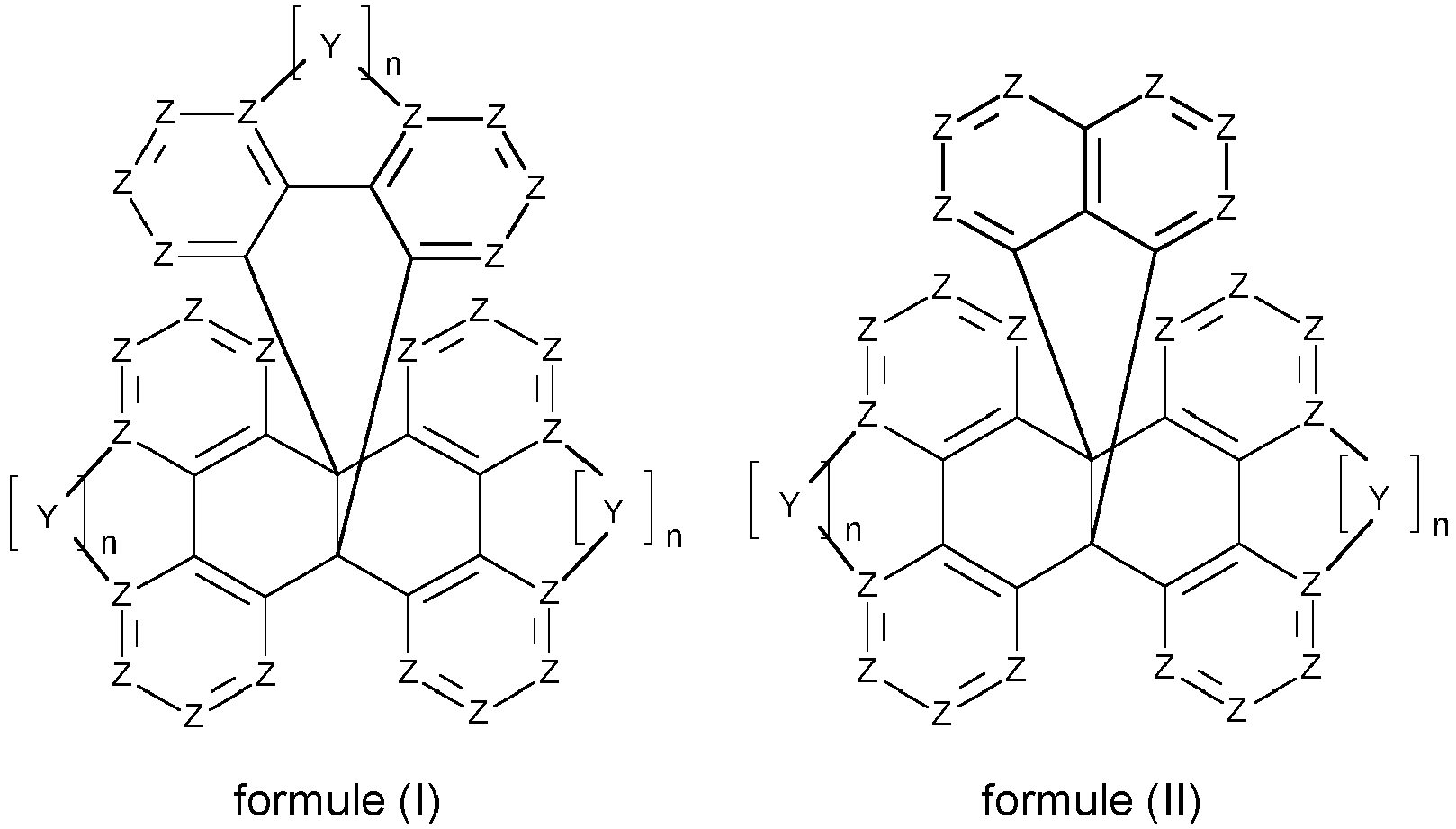
 Z est sélectionné pour chaque occurrence, de manière identique ou différente, parmi N et CR1, ou est C, où un groupe Z est égal C précisément lorsqu'un groupe Y lui est lié;Y est sélectionné pour chaque occurrence, de manière identique ou différente, parmi BR2, C(R2)2, Si(R2)2, NR2, P(O)R2, O, S, SO, SO2;n est pour chaque occurrence, de manière identique ou différente, 0 ou 1 ;R1, R2 sont sélectionnés pour chaque occurrence, de manière identique ou différente, parmi H, D, F, CN, Si(R3)3, les groupes alkyle ou alcoxy en chaîne droite qui comportent de 1 à 20 atome(s) de C, les groupes alkyle ou alcoxy ramifiés ou cycliques qui comportent de 3 à 20 atomes de C, les groupes alkényle ou alkynyle qui comportent de 2 à 20 atomes de C, et les systèmes de cycle aromatique qui comportent de 6 à 40 atomes de cycle aromatique ; où deux radicaux R1 et/ou R2 ou plus peuvent être liés l'un à l'autre ou les uns aux autres et peuvent former un cycle ; où lesdits groupes alkyle, alcoxy, alkényle et alkynyle et lesdits systèmes de cycle aromatique peuvent dans chaque cas être substitués par un radical ou par plusieurs radicaux R3; où un cycle indole, lequel peut à son tour être substitué par des radicaux R3, peut dans chaque cas être condensé sur un ou plusieurs des cycles à six éléments dans les formules (I) à (IV) ;R3 est sélectionné pour chaque occurrence, de manière identique ou différente, parmi H, D, F, CN, Si(R4)3, les groupes alkyle ou alcoxy en chaîne droite qui comportent de 1 à 20 atome(s) de C, les groupes alkyle ou alcoxy ramifiés ou cycliques qui comportent de 3 à 20 atomes de C, les groupes alkényle ou alkynyle qui comportent de 2 à 20 atomes de C, et les systèmes de cycle aromatique qui comportent de 6 à 40 atomes de cycle aromatique ; où deux radicaux R3 ou plus peuvent être liés l'un à l'autre ou les uns aux autres et peuvent former un cycle ; où lesdits groupes alkyle, alcoxy, alkényle et alkynyle et lesdits système de cycle aromatique peuvent dans chaque cas être substitués par un radical ou par plusieurs radicaux R4;R4 est sélectionné pour chaque occurrence, de manière identique ou différente, parmi H, D, F, CN, les groupes alkyle ou alcoxy qui comportent de 1 à 20 atome(s) de C, les groupes alkényle ou alkynyle qui comportent de 2 à 20 atomes de C, et les systèmes de cycle aromatique qui comportent de 6 à 40 atomes de cycle aromatique ; où deux radicaux R4 ou plus peuvent être liés l'un à l'autre ou les uns aux autres et peuvent former un cycle ; et où lesdits groupes alkyle, alcoxy, alkényle et alkynyle et lesdits systèmes de cycle aromatique peuvent être substitués par F ou par CN ;caractérisé en ce qu'au moins un groupe Z par formule sélectionnée parmi les formules (I), (II), (III) et (IV) est égal à CR1;et caractérisé en outre en ce que précisément un groupe R1 par formule (I) a été remplacé par un groupe de la formule (A) ou par un groupe de la formule (H),
 et caractérisé en outre en ce que précisément un groupe R1 par formule sélectionnée parmi les formules (II), (III) et (IV) a été remplacé par un groupe de la formule (A),
où :L1 est pour chaque occurrence, de manière identique ou différente, un système de cycle aromatique qui comporte de 6 à 24 atomes de cycle aromatique ou un système de cycle hétéroaromatique qui comporte de 5 à 24 atomes de cycle aromatique, lequel peut dans chaque cas être substitué par un radical ou par plusieurs radicaux R5;k est égal à 0, 1, 2 ou 3 ;Ar1 est pour chaque occurrence, de manière identique ou différente, un système de cycle aromatique qui comporte de 6 à 24 atomes de cycle aromatique ou un système de cycle hétéroaromatique qui comporte de 5 à 24 atomes de cycle aromatique, lequel peut être substitué par un radical ou par plusieurs radicaux R5;Ar2 est un système de cycle aromatique qui comporte de 5 à 24 atomes de cycle aromatique, lequel peut être substitué par un radical ou par plusieurs radicaux R5;R5 est sélectionné pour chaque occurrence, de manière identique ou différente, parmi H, D, F, C(=O)R6, CN, Si(R6)3, N(R6)2, P(=O)(R6)2, OR6, S(=O)R6, S(=O)2R6, les groupes alkyle ou alcoxy en chaîne droite qui comportent de 1 à 20 atome(s) de C, les groupes alkyle ou alcoxy ramifiés ou cycliques qui comportent de 3 à 20 atomes de C, les groupes alkényle ou alkynyle qui comportent de 2 à 20 atomes de C, les systèmes de cycle aromatique qui comportent de 6 à 40 atomes de cycle aromatique, et les systèmes de cycle hétéroaromatique qui comportent de 5 à 40 atomes de cycle aromatique ; où deux radicaux R5 ou plus peuvent être liés l'un à l'autre ou les uns aux autres et peuvent former un cycle ; où lesdits groupes alkyle, alcoxy, alkényle et alkynyle et lesdits systèmes de cycle aromatique et lesdits systèmes de cycle hétéroaromatique peuvent dans chaque cas être substitués par un radical ou par plusieurs radicaux R6; et où un ou plusieurs groupe(s) CH2 dans lesdits groupes alkyle, alcoxy, alkényle et alkynyle peut/peuvent être remplacé(s) par -R6C=CR6-, -C≡C-, Si(R6)2, C=O, C=NR6, -C(=O)O-, -C(=O)NR6-, NR6, P(=O)(R6), -O-, -S-, SO ou SO2;R6 est sélectionné pour chaque occurrence, de manière identique ou différente, parmi H, D, F, CN, les groupes alkyle ou alcoxy qui comportent de 1 à 20 atome(s) de C, les groupes alkényle ou alkynyle qui comportent de 2 à 20 atomes de C, et les systèmes de cycle aromatique qui comportent de 6 à 40 atomes de cycle aromatique et les systèmes de cycle hétéroaromatique qui comportent de 5 à 40 atomes de cycle aromatique ; où deux radicaux R6 ou plus peuvent être liés l'un à l'autre ou les uns aux autres et peuvent former un cycle ; et où lesdits groupes alkyle, alcoxy, alkényle et alkynyle, lesdits systèmes de cycle aromatique et lesdits systèmes de cycle hétéroaromatique peuvent être substitués par F ou par CN ;où le groupe de la formule (A) ou le groupe de la formule (H) est lié via la liaison repérée au moyen de *. - Composé selon la revendication 1, caractérisé en ce que la formule (I) correspond à l'une des formules (I-H-1) à (I-H-7) et (I-A-1) à (I-A-7)


formule (I-H-1) formule (I-H-2) 

formule (I-H-3) formule (I-H-4) 

formule (I-H-5) formule (I-H-6) 

formule (I-H-7) formule (I-A-1) 

formule (I-A-2) formule (I-A-3) 

formule (I-A-4) formule (I-A-5) 
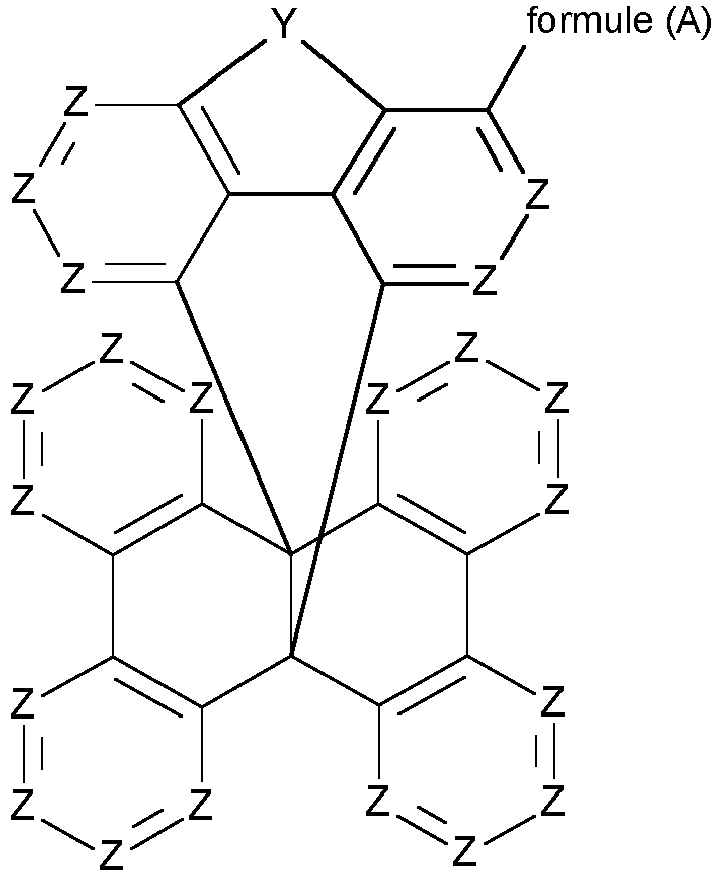
formule (I-A-6) formule (I-A-7), 
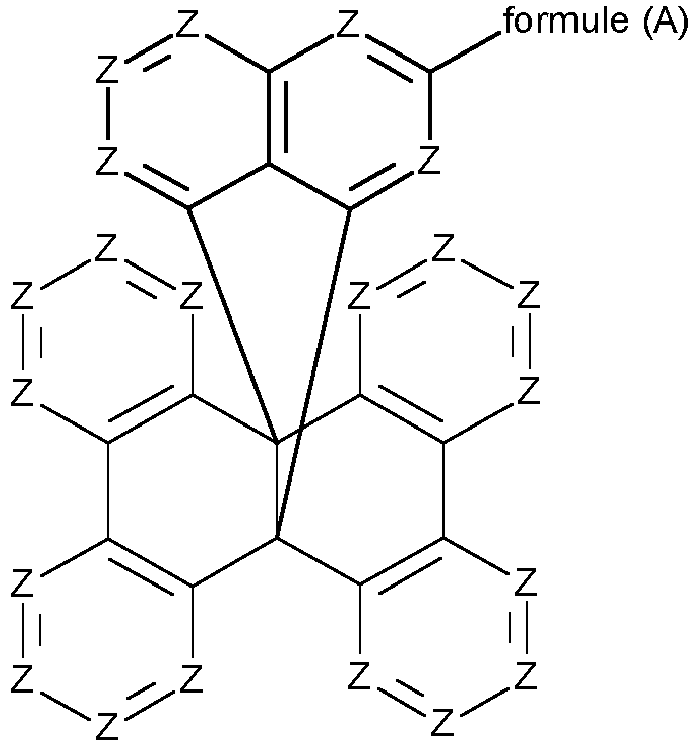
formule (II-A-1) formule (II-A-2) 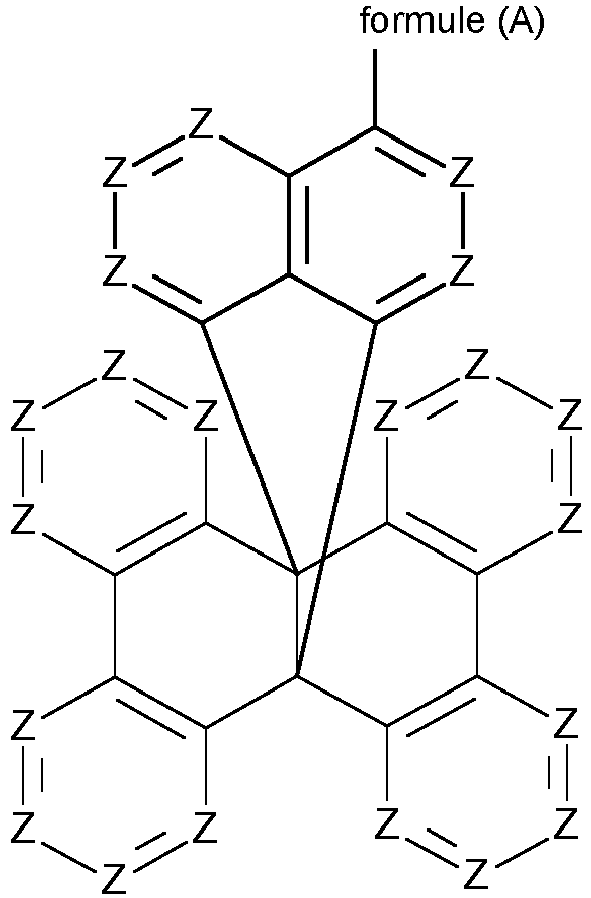
formule (II-A-3), 

formule (III-A-1) formule (III-A-2) 
formule (III-A-3), 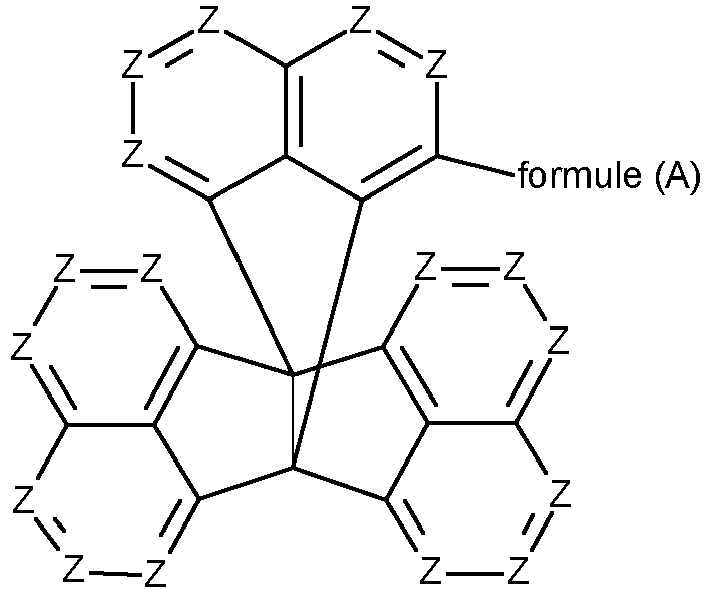
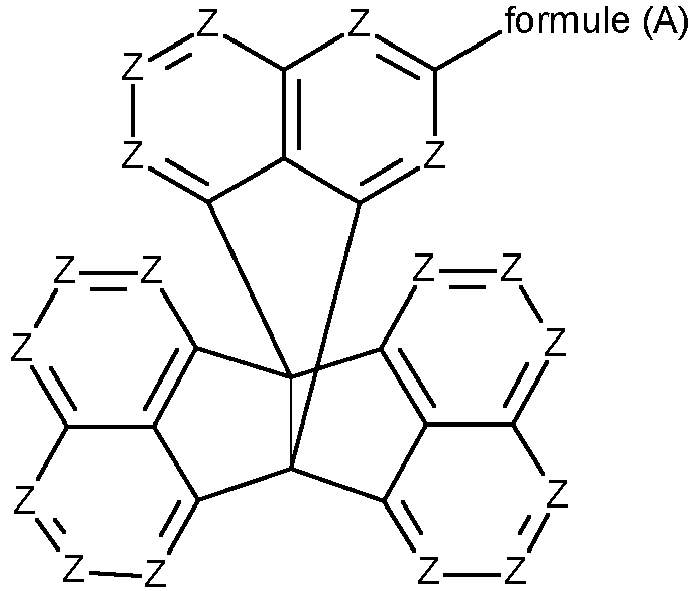
formule (IV-A-1) formule (IV-A-2) 
formule (IV-A-3), - Composé selon la revendication 1 ou 2, caractérisé en ce que Z est égal à CR1 ou à C, où Z est égal à C précisément lorsqu'un groupe Y lui est lié.
- Composé selon une ou plusieurs des revendications 1 à 3, caractérisé en ce que Y est sélectionné pour chaque occurrence, de manière identique ou différente, parmi O et NR2.
- Composé selon une ou plusieurs des revendications 1 à 4, caractérisé en ce que la somme des indices n dans un composé de la formule (II) est égale à 1 ou à 0, et/ou en ce que la somme des indices n dans un composé de la formule (III) est égale à 0.
- Composé selon une ou plusieurs des revendications 1 à 5, caractérisé en ce que l'indice n est égal à 0.
- Composé selon une ou plusieurs des revendications 1 à 6, caractérisé en ce que le groupe Y est lié au cycle à six éléments qui est porteur d'un groupe de la formule (A) ou (H).
- Composé selon une ou plusieurs des revendications 1 à 7, caractérisé en ce que R1 est sélectionné pour chaque occurrence, de manière identique ou différente, parmi H, D, les groupes alkyle en chaîne droite ou ramifiés qui comportent jusqu'à 12 atomes de C, et les systèmes de cycle aromatique qui comportent de 6 à 24 atomes de cycle aromatique, où lesdits groupes alkyle et lesdits systèmes de cycle aromatique peuvent dans chaque cas être substitués par un radical ou par plusieurs radicaux R3.
- Composé selon une ou plusieurs des revendications 1 à 8, caractérisé en ce que R2 est sélectionné parmi les groupes alkyle en chaîne droite ou ramifiés qui comportent jusqu'à 12 atomes de C, et les systèmes de cycle aromatique qui comportent de 6 à 24 atomes de cycle aromatique, où deux radicaux R2 qui sont liés au même atome de carbone d'un groupe C(R2)2 et qui sont des groupes alkyle ou des groupes aryle peuvent être connectés l'un à l'autre pour former un groupe alkyle cyclique ou pour former un groupe fluorène.
- Composé selon une ou plusieurs des revendications 1 à 9, caractérisé en ce que R3 est sélectionné pour chaque occurrence, de manière identique ou différente, parmi H, D, F, CN, les groupes alkyle en chaîne droite qui comportent de 1 à 12 atome(s) de C, les groupes alkyle ramifiés ou cycliques qui comportent de 3 à 12 atomes de C, et les systèmes de cycle aromatique qui comportent de 6 à 24 atomes de cycle aromatique ; où deux radicaux R3 ou plus peuvent être liés l'un à l'autre ou les uns aux autres et peuvent former un cycle ; et où lesdits groupes alkyle et lesdits systèmes de cycle aromatique peuvent dans chaque cas être substitués par un radical ou par plusieurs radicaux R4.
- Composé selon une ou plusieurs des revendications 1 à 10, caractérisé en ce que R4 est sélectionné pour chaque occurrence, de manière identique ou différente, parmi H, D, F, CN, les groupes alkyle en chaîne droite qui comportent de 1 à 12 atome(s) de C, les groupes alkyle ramifiés ou cycliques qui comportent de 3 à 12 atomes de C, et les systèmes de cycle aromatique qui comportent de 6 à 24 atomes de cycle aromatique ; où deux radicaux R4 ou plus peuvent être liés l'un à l'autre ou les uns aux autres et peuvent former un cycle ; et où lesdits groupes alkyle et lesdits systèmes de cycle aromatique peuvent être substitués par F ou par CN.
- Composé selon une ou plusieurs des revendications 1 à 11, caractérisé en ce que précisément un groupe R1 par formule (I) a été remplacé par un groupe de la formule (A).
- Composé selon une ou plusieurs des revendications 1 à 12, caractérisé en ce que L1 est un groupe divalent qui est sélectionné parmi phénylène, biphénylène, terphénylène, naphtylène, dibenzofurane, dibenzothiophène, carbazole et fluorène, où le groupe divalent peut être substitué par un radical ou par plusieurs radicaux R5.
- Composé selon une ou plusieurs des revendications 1 à 13, caractérisé en ce que Ar1 est sélectionné pour chaque occurrence, de manière identique ou différente, parmi phényle, biphényle, terphényle, fluorényle, naphtyle, spirobifluorényle, pyridyle, pyrimidyle, triazinyle, dibenzofuranyle, dibenzofuranyle benzo-condensé, dibenzothiophényle, dibenzothiophényle benzo-condensé, carbazolyle et carbazolyle benzo-condensé, et des combinaisons de deux, trois ou quatre de ces groupes, où lesdits groupes peuvent dans chaque cas être substitués par un radical ou par plusieurs radicaux R5.
- Composé selon une ou plusieurs des revendications 1 à 14, caractérisé en ce que L1 est un groupe divalent qui est sélectionné parmi phénylène, biphénylène, terphénylène, naphtylène, dibenzofurane, dibenzothiophène, carbazole et fluorène, où le groupe divalent peut être substitué par un radical ou par plusieurs radicaux R5.
- Composé selon une ou plusieurs des revendications 1 à 15, caractérisé en ce que Ar2 est sélectionné pour chaque occurrence, de manière identique ou différente, parmi les groupes des formules qui suivent :


(Ar2-A) (Ar2-B) 

(Ar2-C) (Ar2-D) V est pour chaque occurrence, de manière identique ou différente, N ou CR5, où, dans les formules (Ar2-A) et (Ar2-D), au moins un groupe V par formule est égal à N ;W est pour chaque occurrence, de manière identique ou différente, N ou CR5;U est égal à NR5;où un groupe R5 par formule a été remplacé par la liaison sur le groupe L1 ou sur le groupe propellane. - Composé selon une ou plusieurs des revendications 1 à 16, caractérisé en ce que Ar2 est sélectionné parmi pyridine, pyrimidine, pyridazine, pyrazine, triazine, carbazole, imidazole, pyrazole, triazole, benzimidazole, benzimidazoisoquinoline, imidazophénanthridine, benzimidazophénanthridine, bathocuproine, benzimidazobenzimidazole, quinoline, quinazoline, phénanthroline, phénanthridine, diazaphénanthrène et acridine, lequel peut dans chaque cas être substitué par un radical ou par plusieurs radicaux R5.
- Composé selon une ou plusieurs des revendications 1 à 17, caractérisé en ce que R5 est sélectionné parmi H, D, F, CN, Si(R6)3, N(R6)2, les groupes alkyle ou alcoxy en chaîne droite qui comportent de 1 à 20 atome(s) de C, les groupes alkyle ou alcoxy ramifiés ou cycliques qui comportent de 3 à 20 atomes de C, les systèmes de cycle aromatique qui comportent de 6 à 40 atomes de cycle aromatique et les systèmes de cycle hétéroaromatique qui comportent de 5 à 40 atomes de cycle aromatique ; où lesdits groupes alkyle et alcoxy, lesdits systèmes de cycle aromatique et lesdits systèmes de cycle hétéroaromatique peuvent dans chaque cas être substitués par un radical ou par plusieurs radicaux R6; et où un ou plusieurs groupe(s) CH2 dans lesdits groupes alkyle ou alcoxy peut/ peuvent être remplacé(s) par -C=C-, -R6C=CR6-, Si(R6)2, C=O, C=NR6, -NR6-, -O-, -S-, -C(=O)O- ou -C(=O)NR6-.
- Procédé pour la préparation d'un composé selon une ou plusieurs des revendications 1 à 18, caractérisé en ce que, en premier lieu, le squelette substitué par alcoxy est préparé, lequel est converti lors d'une étape ultérieure selon un composé réactif, de préférence selon un dérivé de triflate, lequel est converti lors d'une étape ultérieure selon le composé selon une ou plusieurs des revendications 1 à 18 au moyen d'une réaction de couplage catalysée par métal/métaux de transition, de préférence un couplage de Hartwig-Buchwald, un couplage de Suzuki, un couplage de Stille ou un couplage de Negishi.
- Oligomère, polymère ou dendrimère contenant un ou plusieurs composé(s) selon une ou plusieurs des revendications 1 à 18, où la/les liaison(s) sur le polymère, sur l'oligomère ou sur le dendrimère peut/peuvent être localisée(s) au niveau de n'importe quelles positions souhaitées qui sont substituées par R1, par R2 ou par R5.
- Formulation comprenant un ou plusieurs composé(s) selon une ou plusieurs des revendications 1 à 18, et au moins un solvant.
- Dispositif électronique, sélectionné parmi le groupe qui est constitué par les circuits intégrés organiques (OIC), les transistors à effet de champ organiques (OFET), les transistors à film mince organiques (OTFT), les transistors à émission de lumière ou électroluminescents organiques (OLET), les cellules solaires organiques (OSC), les détecteurs optiques organiques, les photorécepteurs organiques, les dispositifs à extinction de champ organiques (OFQD), les cellules électrochimiques à émission de lumières ou électroluminescentes organiques (OLEC), les diodes laser organiques (O-laser) et les dispositifs électroluminescents organiques (OLED), contenant au moins un composé selon une ou plusieurs des revendications 1 à 18.
- Dispositif électroluminescent organique selon la revendication 22, contenant une anode, une cathode et au moins une couche organique, dans lequel le composé est présent dans une couche de transport de trous, en tant que matériau de matrice dans une couche d'émission, ou dans une couche de transport d'électrons.
- Utilisation d'un composé selon une ou plusieurs des revendications 1 à 18 dans un dispositif électronique qui est sélectionné parmi le groupe qui est constitué par les circuits intégrés organiques (OIC), les transistors à effet de champ organiques (OFET), les transistors à film mince organiques (OTFT), les transistors à émission de lumière ou électroluminescents organiques (OLET), les cellules solaires organiques (OSC), les détecteurs optiques organiques, les photorécepteurs organiques, les dispositifs à extinction de champ organiques (OFQD), les cellules électrochimiques à émission de lumières ou électroluminescentes organiques (OLEC), les diodes laser organiques (O-laser) et les dispositifs électroluminescents organiques (OLED).
Applications Claiming Priority (2)
| Application Number | Priority Date | Filing Date | Title |
|---|---|---|---|
| EP17154481 | 2017-02-02 | ||
| PCT/EP2018/052196 WO2018141706A1 (fr) | 2017-02-02 | 2018-01-30 | Matériaux pour dispositifs électroniques |
Publications (2)
| Publication Number | Publication Date |
|---|---|
| EP3577101A1 EP3577101A1 (fr) | 2019-12-11 |
| EP3577101B1 true EP3577101B1 (fr) | 2021-03-03 |
Family
ID=58017912
Family Applications (1)
| Application Number | Title | Priority Date | Filing Date |
|---|---|---|---|
| EP18701493.1A Active EP3577101B1 (fr) | 2017-02-02 | 2018-01-30 | Matériaux pour dispositifs électroniques |
Country Status (6)
| Country | Link |
|---|---|
| US (1) | US12503424B2 (fr) |
| EP (1) | EP3577101B1 (fr) |
| JP (2) | JP7069184B2 (fr) |
| KR (1) | KR102683465B1 (fr) |
| CN (1) | CN110291064B (fr) |
| WO (1) | WO2018141706A1 (fr) |
Families Citing this family (3)
| Publication number | Priority date | Publication date | Assignee | Title |
|---|---|---|---|---|
| US10600966B2 (en) * | 2015-02-27 | 2020-03-24 | Universal Display Corporation | Organic electroluminescent materials and devices |
| CN112062775B (zh) * | 2020-09-18 | 2021-08-17 | 中节能万润股份有限公司 | 一种有机电致发光材料及其制备方法与应用 |
| US20220119418A1 (en) * | 2020-10-19 | 2022-04-21 | Universal Display Corporation | Organic electroluminescent materials and devices |
Family Cites Families (135)
| Publication number | Priority date | Publication date | Assignee | Title |
|---|---|---|---|---|
| US5061569A (en) | 1990-07-26 | 1991-10-29 | Eastman Kodak Company | Electroluminescent device with organic electroluminescent medium |
| DE4111878A1 (de) | 1991-04-11 | 1992-10-15 | Wacker Chemie Gmbh | Leiterpolymere mit konjugierten doppelbindungen |
| JP3295088B2 (ja) | 1993-09-29 | 2002-06-24 | 出光興産株式会社 | 有機エレクトロルミネッセンス素子 |
| JPH07133483A (ja) | 1993-11-09 | 1995-05-23 | Shinko Electric Ind Co Ltd | El素子用有機発光材料及びel素子 |
| DE59510315D1 (de) | 1994-04-07 | 2002-09-19 | Covion Organic Semiconductors | Spiroverbindungen und ihre Verwendung als Elektrolumineszenzmaterialien |
| DE4436773A1 (de) | 1994-10-14 | 1996-04-18 | Hoechst Ag | Konjugierte Polymere mit Spirozentren und ihre Verwendung als Elektrolumineszenzmaterialien |
| CN1229415C (zh) | 1995-07-28 | 2005-11-30 | 陶氏环球技术公司 | 2,7-芳基-9-取代的芴和9-取代的芴的低聚物和聚合物 |
| DE19614971A1 (de) | 1996-04-17 | 1997-10-23 | Hoechst Ag | Polymere mit Spiroatomen und ihre Verwendung als Elektrolumineszenzmaterialien |
| JP3302945B2 (ja) | 1998-06-23 | 2002-07-15 | ネースディスプレイ・カンパニー・リミテッド | 新規な有機金属発光物質およびそれを含む有機電気発光素子 |
| DE19846766A1 (de) | 1998-10-10 | 2000-04-20 | Aventis Res & Tech Gmbh & Co | Konjugierte Polymere, enthaltend spezielle Fluorenbausteine mit verbesserten Eigenschaften |
| WO2000027946A1 (fr) | 1998-11-11 | 2000-05-18 | Kabushiki Kaisha Toyota Chuo Kenkyusho | Element organique electroluminescent |
| US6166172A (en) | 1999-02-10 | 2000-12-26 | Carnegie Mellon University | Method of forming poly-(3-substituted) thiophenes |
| CN101312235B (zh) | 1999-05-13 | 2010-06-09 | 普林斯顿大学理事会 | 基于电致磷光的极高效有机发光器件 |
| JP4357781B2 (ja) | 1999-12-01 | 2009-11-04 | ザ、トラスティーズ オブ プリンストン ユニバーシティ | 有機led用燐光性ドーパントとしての式l2mxの錯体 |
| KR100377321B1 (ko) | 1999-12-31 | 2003-03-26 | 주식회사 엘지화학 | 피-형 반도체 성질을 갖는 유기 화합물을 포함하는 전기소자 |
| US6660410B2 (en) | 2000-03-27 | 2003-12-09 | Idemitsu Kosan Co., Ltd. | Organic electroluminescence element |
| US20020121638A1 (en) | 2000-06-30 | 2002-09-05 | Vladimir Grushin | Electroluminescent iridium compounds with fluorinated phenylpyridines, phenylpyrimidines, and phenylquinolines and devices made with such compounds |
| JP5241053B2 (ja) | 2000-08-11 | 2013-07-17 | ザ、トラスティーズ オブ プリンストン ユニバーシティ | 有機金属化合物及び放射移行有機電気燐光体 |
| JP4154139B2 (ja) | 2000-09-26 | 2008-09-24 | キヤノン株式会社 | 発光素子 |
| JP4154138B2 (ja) | 2000-09-26 | 2008-09-24 | キヤノン株式会社 | 発光素子、表示装置及び金属配位化合物 |
| JP4154140B2 (ja) | 2000-09-26 | 2008-09-24 | キヤノン株式会社 | 金属配位化合物 |
| WO2002043449A1 (fr) | 2000-11-24 | 2002-05-30 | Toray Industries, Inc. | Materiau luminescent et element luminescent contenant celui-ci |
| WO2002072714A1 (fr) | 2001-03-10 | 2002-09-19 | Covion Organic Semiconductors Gmbh | Solutions et dispersions de semi-conducteurs organiques |
| DE10141624A1 (de) | 2001-08-24 | 2003-03-06 | Covion Organic Semiconductors | Lösungen polymerer Halbleiter |
| KR100691543B1 (ko) | 2002-01-18 | 2007-03-09 | 주식회사 엘지화학 | 새로운 전자 수송용 물질 및 이를 이용한 유기 발광 소자 |
| ITRM20020411A1 (it) | 2002-08-01 | 2004-02-02 | Univ Roma La Sapienza | Derivati dello spirobifluorene, loro preparazione e loro uso. |
| EP1553154B2 (fr) | 2002-08-23 | 2022-08-03 | Idemitsu Kosan Co., Ltd. | Dispositif organique electroluminescent et derive d'anthracene |
| KR20050057518A (ko) | 2002-09-20 | 2005-06-16 | 이데미쓰 고산 가부시키가이샤 | 유기 전기발광 소자 |
| GB0226010D0 (en) | 2002-11-08 | 2002-12-18 | Cambridge Display Tech Ltd | Polymers for use in organic electroluminescent devices |
| EP1578885A2 (fr) | 2002-12-23 | 2005-09-28 | Covion Organic Semiconductors GmbH | Element electroluminescent organique |
| DE10304819A1 (de) | 2003-02-06 | 2004-08-19 | Covion Organic Semiconductors Gmbh | Carbazol-enthaltende konjugierte Polymere und Blends, deren Darstellung und Verwendung |
| DE10310887A1 (de) | 2003-03-11 | 2004-09-30 | Covion Organic Semiconductors Gmbh | Matallkomplexe |
| JP4185097B2 (ja) | 2003-03-13 | 2008-11-19 | 出光興産株式会社 | 新規含窒素複素環誘導体及びそれを用いた有機エレクトロルミネッセンス素子 |
| JP4411851B2 (ja) | 2003-03-19 | 2010-02-10 | コニカミノルタホールディングス株式会社 | 有機エレクトロルミネッセンス素子 |
| EP1717291A3 (fr) | 2003-04-15 | 2007-03-21 | Merck Patent GmbH | Mélanges de semi-conducteurs organiques aptes à l'émission et de matières matricielles, leur utilisation et composants électroniques contenant ces mélanges |
| EP1617711B1 (fr) | 2003-04-23 | 2016-08-17 | Konica Minolta Holdings, Inc. | Dispositif organique électroluminescent et affichage |
| EP1491568A1 (fr) | 2003-06-23 | 2004-12-29 | Covion Organic Semiconductors GmbH | Polymères semi-conducteurs |
| DE10328627A1 (de) | 2003-06-26 | 2005-02-17 | Covion Organic Semiconductors Gmbh | Neue Materialien für die Elektrolumineszenz |
| DE10333232A1 (de) | 2003-07-21 | 2007-10-11 | Merck Patent Gmbh | Organisches Elektrolumineszenzelement |
| DE10337346A1 (de) | 2003-08-12 | 2005-03-31 | Covion Organic Semiconductors Gmbh | Konjugierte Polymere enthaltend Dihydrophenanthren-Einheiten und deren Verwendung |
| DE10338550A1 (de) | 2003-08-19 | 2005-03-31 | Basf Ag | Übergangsmetallkomplexe mit Carbenliganden als Emitter für organische Licht-emittierende Dioden (OLEDs) |
| DE10345572A1 (de) | 2003-09-29 | 2005-05-19 | Covion Organic Semiconductors Gmbh | Metallkomplexe |
| US7795801B2 (en) | 2003-09-30 | 2010-09-14 | Konica Minolta Holdings, Inc. | Organic electroluminescent element, illuminator, display and compound |
| US7659540B2 (en) | 2003-10-22 | 2010-02-09 | Merck Patent Gmbh | Materials for electroluminescence and the utilization thereof |
| DE102004008304A1 (de) | 2004-02-20 | 2005-09-08 | Covion Organic Semiconductors Gmbh | Organische elektronische Vorrichtungen |
| EP1722602A1 (fr) | 2004-03-05 | 2006-11-15 | Idemitsu Kosan Co., Ltd. | Dispositif electroluminescent organique et affichage electroluminescent organique |
| US7790890B2 (en) | 2004-03-31 | 2010-09-07 | Konica Minolta Holdings, Inc. | Organic electroluminescence element material, organic electroluminescence element, display device and illumination device |
| KR100787425B1 (ko) | 2004-11-29 | 2007-12-26 | 삼성에스디아이 주식회사 | 페닐카바졸계 화합물 및 이를 이용한 유기 전계 발광 소자 |
| DE102004020298A1 (de) | 2004-04-26 | 2005-11-10 | Covion Organic Semiconductors Gmbh | Elektrolumineszierende Polymere und deren Verwendung |
| DE102004023277A1 (de) | 2004-05-11 | 2005-12-01 | Covion Organic Semiconductors Gmbh | Neue Materialmischungen für die Elektrolumineszenz |
| US7598388B2 (en) | 2004-05-18 | 2009-10-06 | The University Of Southern California | Carbene containing metal complexes as OLEDs |
| WO2005115950A1 (fr) | 2004-05-27 | 2005-12-08 | Idemitsu Kosan Co., Ltd. | Derive de pyrene asymetrique et dispositif electroluminescent organique utilisant celui-ci |
| JP4862248B2 (ja) | 2004-06-04 | 2012-01-25 | コニカミノルタホールディングス株式会社 | 有機エレクトロルミネッセンス素子、照明装置及び表示装置 |
| DE102004032527A1 (de) | 2004-07-06 | 2006-02-02 | Covion Organic Semiconductors Gmbh | Elektrolumineszierende Polymere |
| ITRM20040352A1 (it) | 2004-07-15 | 2004-10-15 | Univ Roma La Sapienza | Derivati oligomerici dello spirobifluorene, loro preparazione e loro uso. |
| US7579090B2 (en) * | 2004-09-20 | 2009-08-25 | Eastman Kodak Company | Organic element for electroluminescent devices |
| EP1655359A1 (fr) | 2004-11-06 | 2006-05-10 | Covion Organic Semiconductors GmbH | Dispositif organique électroluminescent |
| EP1669386A1 (fr) | 2004-12-06 | 2006-06-14 | Covion Organic Semiconductors GmbH | Polymères conjugués, leur représentation et utilisation |
| WO2006097208A1 (fr) | 2005-03-16 | 2006-09-21 | Merck Patent Gmbh | Nouveaux materiaux pour des dispositifs electroluminescents organiques |
| JP4358884B2 (ja) | 2005-03-18 | 2009-11-04 | 出光興産株式会社 | 芳香族アミン誘導体及びそれを用いた有機エレクトロルミネッセンス素子 |
| EP1869141B1 (fr) | 2005-04-14 | 2020-03-11 | Merck Patent GmbH | Composés pour dispositifs electroniques organiques |
| EP1888706B1 (fr) | 2005-05-03 | 2017-03-01 | Merck Patent GmbH | Dispositif electroluminescent organique, et derives d'acide boronique et d'acide borinique utilises pour produire ce dispositif electroluminescent organique |
| DE102005023437A1 (de) | 2005-05-20 | 2006-11-30 | Merck Patent Gmbh | Verbindungen für organische elektronische Vorrichtungen |
| DE102005026651A1 (de) | 2005-06-09 | 2006-12-14 | Merck Patent Gmbh | Neue Materialien für organische Elektrolumineszenzvorrichtungen |
| JP2007015961A (ja) | 2005-07-06 | 2007-01-25 | Idemitsu Kosan Co Ltd | ピレン誘導体及びそれらを用いた有機エレクトロルミネッセンス素子 |
| US20090092706A1 (en) | 2005-07-08 | 2009-04-09 | Van Der Hijden Hendrikus Theodorus | Food Product and Process for Preparing it |
| DE102005037734B4 (de) | 2005-08-10 | 2018-02-08 | Merck Patent Gmbh | Elektrolumineszierende Polymere, ihre Verwendung und bifunktionelle monomere Verbindungen |
| US20070092755A1 (en) | 2005-10-26 | 2007-04-26 | Eastman Kodak Company | Organic element for low voltage electroluminescent devices |
| EP1956022B1 (fr) | 2005-12-01 | 2012-07-25 | Nippon Steel Chemical Co., Ltd. | Compose pour element electroluminescent organique et element electroluminescent organique |
| DE102005058557A1 (de) | 2005-12-08 | 2007-06-14 | Merck Patent Gmbh | Organische Elektrolumineszenzvorrichtung |
| EP1957604B1 (fr) | 2005-12-08 | 2015-09-23 | Merck Patent GmbH | Nouvelles matières pour dispositifs électroluminescents organiques |
| DE102005060473A1 (de) | 2005-12-17 | 2007-06-28 | Merck Patent Gmbh | Konjugierte Polymere, deren Darstellung und Verwendung |
| KR101308341B1 (ko) | 2005-12-27 | 2013-09-17 | 이데미쓰 고산 가부시키가이샤 | 유기 전계발광 소자용 재료 및 유기 전계발광 소자 |
| DE102006013802A1 (de) | 2006-03-24 | 2007-09-27 | Merck Patent Gmbh | Neue Materialien für organische Elektrolumineszenzvorrichtungen |
| DE102006025777A1 (de) | 2006-05-31 | 2007-12-06 | Merck Patent Gmbh | Neue Materialien für organische Elektrolumineszenzvorrichtungen |
| DE102006025846A1 (de) | 2006-06-02 | 2007-12-06 | Merck Patent Gmbh | Neue Materialien für organische Elektrolumineszenzvorrichtungen |
| DE102006031990A1 (de) | 2006-07-11 | 2008-01-17 | Merck Patent Gmbh | Neue Materialien für organische Elektrolumineszenzvorrichtungen |
| EP2080762B1 (fr) | 2006-11-09 | 2016-09-14 | Nippon Steel & Sumikin Chemical Co., Ltd. | Composé pour un dispositif électroluminescent organique et dispositif électroluminescent organique |
| DE102007002714A1 (de) | 2007-01-18 | 2008-07-31 | Merck Patent Gmbh | Neue Materialien für organische Elektrolumineszenzvorrichtungen |
| US8044390B2 (en) | 2007-05-25 | 2011-10-25 | Idemitsu Kosan Co., Ltd. | Material for organic electroluminescent device, organic electroluminescent device, and organic electroluminescent display |
| DE102007024850A1 (de) | 2007-05-29 | 2008-12-04 | Merck Patent Gmbh | Neue Materialien für organische Elektrolumineszenzvorrichtungen |
| DE102007031220B4 (de) | 2007-07-04 | 2022-04-28 | Novaled Gmbh | Chinoide Verbindungen und deren Verwendung in halbleitenden Matrixmaterialien, elektronischen und optoelektronischen Bauelementen |
| WO2009011327A1 (fr) | 2007-07-18 | 2009-01-22 | Idemitsu Kosan Co., Ltd. | Matériau de dispositif électroluminescent organique et dispositif électroluminescent organique |
| DE102007053771A1 (de) | 2007-11-12 | 2009-05-14 | Merck Patent Gmbh | Organische Elektrolumineszenzvorrichtungen |
| US7862908B2 (en) | 2007-11-26 | 2011-01-04 | National Tsing Hua University | Conjugated compounds containing hydroindoloacridine structural elements, and their use |
| ATE554073T1 (de) | 2007-11-30 | 2012-05-15 | Idemitsu Kosan Co | Azaindenofluorendionderivat, material für ein organisches elektrolumineszierendes gerät und organisches lumineszierendes gerät |
| DE102008008953B4 (de) | 2008-02-13 | 2019-05-09 | Merck Patent Gmbh | Neue Materialien für organische Elektrolumineszenzvorrichtungen |
| TWI478624B (zh) | 2008-03-27 | 2015-03-21 | Nippon Steel & Sumikin Chem Co | Organic electroluminescent elements |
| US8057712B2 (en) | 2008-04-29 | 2011-11-15 | Novaled Ag | Radialene compounds and their use |
| DE102008033943A1 (de) | 2008-07-18 | 2010-01-21 | Merck Patent Gmbh | Neue Materialien für organische Elektrolumineszenzvorrichtungen |
| DE102008035413A1 (de) | 2008-07-29 | 2010-02-04 | Merck Patent Gmbh | Verbindungen für organische elektronische Vorrichtungen |
| DE102008036982A1 (de) | 2008-08-08 | 2010-02-11 | Merck Patent Gmbh | Organische Elektrolumineszenzvorrichtung |
| US8119037B2 (en) | 2008-10-16 | 2012-02-21 | Novaled Ag | Square planar transition metal complexes and organic semiconductive materials using them as well as electronic or optoelectric components |
| KR101506919B1 (ko) | 2008-10-31 | 2015-03-30 | 롬엔드하스전자재료코리아유한회사 | 신규한 유기 전자재료용 화합물 및 이를 포함하는 유기 전자 소자 |
| DE102008056688A1 (de) | 2008-11-11 | 2010-05-12 | Merck Patent Gmbh | Materialien für organische Elektrolumineszenzvorrichtungen |
| JP5701766B2 (ja) | 2008-11-11 | 2015-04-15 | メルク パテント ゲーエムベーハー | 有機エレクトロルミネセント素子 |
| DE102008064200A1 (de) | 2008-12-22 | 2010-07-01 | Merck Patent Gmbh | Organische Elektrolumineszenzvorrichtung |
| DE102009009277B4 (de) | 2009-02-17 | 2023-12-07 | Merck Patent Gmbh | Organische elektronische Vorrichtung, Verfahren zu deren Herstellung und Verwendung von Verbindungen |
| DE102009014513A1 (de) | 2009-03-23 | 2010-09-30 | Merck Patent Gmbh | Organische Elektrolumineszenzvorrichtung |
| DE102009023155A1 (de) | 2009-05-29 | 2010-12-02 | Merck Patent Gmbh | Materialien für organische Elektrolumineszenzvorrichtungen |
| DE102009031021A1 (de) | 2009-06-30 | 2011-01-05 | Merck Patent Gmbh | Materialien für organische Elektrolumineszenzvorrichtungen |
| DE102009048791A1 (de) | 2009-10-08 | 2011-04-14 | Merck Patent Gmbh | Materialien für organische Elektrolumineszenzvorrichtungen |
| DE102009053191A1 (de) | 2009-11-06 | 2011-05-12 | Merck Patent Gmbh | Materialien für elektronische Vorrichtungen |
| EP2513125B1 (fr) | 2009-12-14 | 2014-10-29 | Basf Se | Complexes des metaux avec un ligand carbene diazabenzimidazole et leur usage en dispositifs d'éclairage à diodes électroluminescentes organiques |
| US9353027B2 (en) | 2009-12-21 | 2016-05-31 | Idemitsu Kosan Co., Ltd. | Organic electroluminescent element using pyrene derivative |
| DE102010005697A1 (de) | 2010-01-25 | 2011-07-28 | Merck Patent GmbH, 64293 | Verbindungen für elektronische Vorrichtungen |
| DE102010012738A1 (de) | 2010-03-25 | 2011-09-29 | Merck Patent Gmbh | Materialien für organische Elektrolumineszenzvorrichtungen |
| DE102010013495A1 (de) | 2010-03-31 | 2011-10-06 | Siemens Aktiengesellschaft | Dotierstoff für eine Lochleiterschicht für organische Halbleiterbauelemente und Verwendung dazu |
| DE102010019306B4 (de) | 2010-05-04 | 2021-05-20 | Merck Patent Gmbh | Organische Elektrolumineszenzvorrichtungen |
| DE102010045405A1 (de) | 2010-09-15 | 2012-03-15 | Merck Patent Gmbh | Materialien für organische Elektrolumineszenzvorrichtungen |
| DE102010048608A1 (de) | 2010-10-15 | 2012-04-19 | Merck Patent Gmbh | Materialien für organische Elektrolumineszenzvorrichtungen |
| DE102010048607A1 (de) | 2010-10-15 | 2012-04-19 | Merck Patent Gmbh | Verbindungen für elektronische Vorrichtungen |
| EP2663567B1 (fr) | 2011-01-13 | 2016-06-01 | Merck Patent GmbH | Composés pour des dispositifs électroluminescents organiques |
| JP6215192B2 (ja) | 2011-04-18 | 2017-10-18 | メルク パテント ゲーエムベーハー | 有機エレクトロルミネッセンス素子用材料 |
| KR101884496B1 (ko) | 2011-05-05 | 2018-08-01 | 메르크 파텐트 게엠베하 | 전자 소자용 화합물 |
| IN2014KN00846A (fr) | 2011-09-21 | 2015-10-02 | Merck Patent Gmbh | |
| US10305040B2 (en) | 2011-11-17 | 2019-05-28 | Merck Patent Gmbh | Spiro dihydroacridine derivatives and the use thereof as materials for organic electroluminescence devices |
| WO2013120577A1 (fr) | 2012-02-14 | 2013-08-22 | Merck Patent Gmbh | Composés de spirobifluorène pour dispositifs organiques électroluminescents |
| DE102012209523A1 (de) | 2012-06-06 | 2013-12-12 | Osram Opto Semiconductors Gmbh | Hauptgruppenmetallkomplexe als p-Dotanden für organische elektronische Matrixmaterialien |
| WO2013185871A1 (fr) | 2012-06-12 | 2013-12-19 | Merck Patent Gmbh | Composés pour dispositifs électroniques |
| KR102155492B1 (ko) | 2012-07-23 | 2020-09-14 | 메르크 파텐트 게엠베하 | 플루오렌 및 이를 함유하는 전자 소자 |
| KR20150038193A (ko) | 2012-07-23 | 2015-04-08 | 메르크 파텐트 게엠베하 | 2-디아릴아미노플루오렌의 유도체 및 이를 함유하는 유기 전자 화합물 |
| KR102583348B1 (ko) | 2012-07-23 | 2023-09-26 | 메르크 파텐트 게엠베하 | 화합물 및 유기 전계 발광 디바이스 |
| WO2014037077A1 (fr) | 2012-09-04 | 2014-03-13 | Merck Patent Gmbh | Composés pour dispositifs électroniques |
| EP3378857B1 (fr) | 2012-11-12 | 2021-03-24 | Merck Patent GmbH | Matériaux pour dispositifs électroniques |
| CN104884572B (zh) | 2013-01-03 | 2017-09-19 | 默克专利有限公司 | 用于电子器件的材料 |
| CN105492574B (zh) | 2013-08-15 | 2019-03-29 | 默克专利有限公司 | 用于电子器件的材料 |
| CN105636944B (zh) | 2013-10-14 | 2019-03-01 | 默克专利有限公司 | 用于电子器件的材料 |
| KR102445509B1 (ko) | 2013-12-06 | 2022-09-20 | 메르크 파텐트 게엠베하 | 화합물 및 유기 전자 소자 |
| JP6644688B2 (ja) | 2013-12-12 | 2020-02-12 | メルク パテント ゲーエムベーハー | 電子素子のための材料 |
| CN110698351B (zh) | 2014-03-07 | 2023-06-09 | 默克专利有限公司 | 电子器件的材料 |
| JP6651460B2 (ja) | 2014-04-14 | 2020-02-19 | メルク パテント ゲーエムベーハー | 電子素子のための材料 |
| KR102375992B1 (ko) | 2014-04-16 | 2022-03-17 | 메르크 파텐트 게엠베하 | 전자 소자용 물질 |
| US10600966B2 (en) * | 2015-02-27 | 2020-03-24 | Universal Display Corporation | Organic electroluminescent materials and devices |
| CN107406352B (zh) | 2015-03-25 | 2020-12-01 | 默克专利有限公司 | 用于有机电致发光器件的材料 |
-
2018
- 2018-01-30 US US16/482,502 patent/US12503424B2/en active Active
- 2018-01-30 KR KR1020197025673A patent/KR102683465B1/ko active Active
- 2018-01-30 JP JP2019542159A patent/JP7069184B2/ja active Active
- 2018-01-30 CN CN201880009148.8A patent/CN110291064B/zh active Active
- 2018-01-30 WO PCT/EP2018/052196 patent/WO2018141706A1/fr not_active Ceased
- 2018-01-30 EP EP18701493.1A patent/EP3577101B1/fr active Active
-
2021
- 2021-10-20 JP JP2021171600A patent/JP7309809B2/ja active Active
Non-Patent Citations (1)
| Title |
|---|
| None * |
Also Published As
| Publication number | Publication date |
|---|---|
| CN110291064B (zh) | 2023-04-28 |
| KR20190115034A (ko) | 2019-10-10 |
| JP7069184B2 (ja) | 2022-05-17 |
| WO2018141706A1 (fr) | 2018-08-09 |
| CN110291064A (zh) | 2019-09-27 |
| JP7309809B2 (ja) | 2023-07-18 |
| JP2020506937A (ja) | 2020-03-05 |
| EP3577101A1 (fr) | 2019-12-11 |
| US12503424B2 (en) | 2025-12-23 |
| KR102683465B1 (ko) | 2024-07-09 |
| JP2022031639A (ja) | 2022-02-22 |
| US20200013960A1 (en) | 2020-01-09 |
Similar Documents
| Publication | Publication Date | Title |
|---|---|---|
| EP3335253B1 (fr) | Matériaux pour dispositifs électroniques | |
| EP2737554B1 (fr) | Composés pour dispositifs électroniques | |
| EP3027708B1 (fr) | Matériaux pour dispositifs électroniques | |
| EP3033405B1 (fr) | Matériaux destinés à des dispositifs électroniques | |
| EP3238286B1 (fr) | Matériaux pour dispositifs électroniques | |
| EP3131901B1 (fr) | Matières pour dispositifs électroniques | |
| EP3259330B1 (fr) | Matériaux à base de dérivés de spirobifluorène pour dispositifs électroniques | |
| EP2935276B1 (fr) | Matériaux pour dispositifs organiques électroluminescents | |
| EP3378857B1 (fr) | Matériaux pour dispositifs électroniques | |
| EP3533794B1 (fr) | Matériaux pour dispositifs électroniques | |
| EP3114102B1 (fr) | Materiaux pour dispositifs electroniques | |
| EP4037000B1 (fr) | Matériaux pour dispositifs électroniques | |
| EP2768808B1 (fr) | Matériaux destinés à des dispositifs électroluminescents organiques | |
| EP3057947B1 (fr) | Matériaux pour dispositifs électroniques | |
| EP3411455B1 (fr) | Matériaux pour dispositifs électroniques | |
| EP3016952B1 (fr) | Composés de lactame spirocondensés pour des dispositifs électroluminescents organiques | |
| WO2018069167A1 (fr) | Dispositif électronique | |
| EP3647393A1 (fr) | Matériaux pour dispositifs électroniques | |
| EP2926385B1 (fr) | Dispositif électronique | |
| EP3615542B1 (fr) | Composés pour dispositifs électroniques | |
| WO2018083053A1 (fr) | Matériaux pour dispositifs électroniques | |
| WO2015000549A1 (fr) | Matériaux pour dispositifs électroniques | |
| EP3094703B1 (fr) | Materiaux pour dispositifs électroluminescents organiques | |
| DE112011102056B4 (de) | Verbindungen für elektronische Vorrichtungen | |
| EP3052477A1 (fr) | Dérivés de benzo[h]quinoline substituée par une triarylamine comme matériaux pour des dispositifs électroniques |
Legal Events
| Date | Code | Title | Description |
|---|---|---|---|
| STAA | Information on the status of an ep patent application or granted ep patent |
Free format text: STATUS: UNKNOWN |
|
| STAA | Information on the status of an ep patent application or granted ep patent |
Free format text: STATUS: THE INTERNATIONAL PUBLICATION HAS BEEN MADE |
|
| PUAI | Public reference made under article 153(3) epc to a published international application that has entered the european phase |
Free format text: ORIGINAL CODE: 0009012 |
|
| STAA | Information on the status of an ep patent application or granted ep patent |
Free format text: STATUS: REQUEST FOR EXAMINATION WAS MADE |
|
| 17P | Request for examination filed |
Effective date: 20190717 |
|
| AK | Designated contracting states |
Kind code of ref document: A1 Designated state(s): AL AT BE BG CH CY CZ DE DK EE ES FI FR GB GR HR HU IE IS IT LI LT LU LV MC MK MT NL NO PL PT RO RS SE SI SK SM TR |
|
| AX | Request for extension of the european patent |
Extension state: BA ME |
|
| DAV | Request for validation of the european patent (deleted) | ||
| DAX | Request for extension of the european patent (deleted) | ||
| GRAP | Despatch of communication of intention to grant a patent |
Free format text: ORIGINAL CODE: EPIDOSNIGR1 |
|
| STAA | Information on the status of an ep patent application or granted ep patent |
Free format text: STATUS: GRANT OF PATENT IS INTENDED |
|
| INTG | Intention to grant announced |
Effective date: 20201007 |
|
| GRAS | Grant fee paid |
Free format text: ORIGINAL CODE: EPIDOSNIGR3 |
|
| GRAA | (expected) grant |
Free format text: ORIGINAL CODE: 0009210 |
|
| STAA | Information on the status of an ep patent application or granted ep patent |
Free format text: STATUS: THE PATENT HAS BEEN GRANTED |
|
| AK | Designated contracting states |
Kind code of ref document: B1 Designated state(s): AL AT BE BG CH CY CZ DE DK EE ES FI FR GB GR HR HU IE IS IT LI LT LU LV MC MK MT NL NO PL PT RO RS SE SI SK SM TR |
|
| REG | Reference to a national code |
Ref country code: GB Ref legal event code: FG4D Free format text: NOT ENGLISH |
|
| REG | Reference to a national code |
Ref country code: AT Ref legal event code: REF Ref document number: 1367051 Country of ref document: AT Kind code of ref document: T Effective date: 20210315 Ref country code: CH Ref legal event code: EP |
|
| REG | Reference to a national code |
Ref country code: DE Ref legal event code: R096 Ref document number: 502018004130 Country of ref document: DE |
|
| REG | Reference to a national code |
Ref country code: IE Ref legal event code: FG4D Free format text: LANGUAGE OF EP DOCUMENT: GERMAN |
|
| REG | Reference to a national code |
Ref country code: LT Ref legal event code: MG9D |
|
| PG25 | Lapsed in a contracting state [announced via postgrant information from national office to epo] |
Ref country code: NO Free format text: LAPSE BECAUSE OF FAILURE TO SUBMIT A TRANSLATION OF THE DESCRIPTION OR TO PAY THE FEE WITHIN THE PRESCRIBED TIME-LIMIT Effective date: 20210603 Ref country code: LT Free format text: LAPSE BECAUSE OF FAILURE TO SUBMIT A TRANSLATION OF THE DESCRIPTION OR TO PAY THE FEE WITHIN THE PRESCRIBED TIME-LIMIT Effective date: 20210303 Ref country code: BG Free format text: LAPSE BECAUSE OF FAILURE TO SUBMIT A TRANSLATION OF THE DESCRIPTION OR TO PAY THE FEE WITHIN THE PRESCRIBED TIME-LIMIT Effective date: 20210603 Ref country code: GR Free format text: LAPSE BECAUSE OF FAILURE TO SUBMIT A TRANSLATION OF THE DESCRIPTION OR TO PAY THE FEE WITHIN THE PRESCRIBED TIME-LIMIT Effective date: 20210604 Ref country code: FI Free format text: LAPSE BECAUSE OF FAILURE TO SUBMIT A TRANSLATION OF THE DESCRIPTION OR TO PAY THE FEE WITHIN THE PRESCRIBED TIME-LIMIT Effective date: 20210303 Ref country code: HR Free format text: LAPSE BECAUSE OF FAILURE TO SUBMIT A TRANSLATION OF THE DESCRIPTION OR TO PAY THE FEE WITHIN THE PRESCRIBED TIME-LIMIT Effective date: 20210303 |
|
| REG | Reference to a national code |
Ref country code: NL Ref legal event code: MP Effective date: 20210303 |
|
| PG25 | Lapsed in a contracting state [announced via postgrant information from national office to epo] |
Ref country code: SE Free format text: LAPSE BECAUSE OF FAILURE TO SUBMIT A TRANSLATION OF THE DESCRIPTION OR TO PAY THE FEE WITHIN THE PRESCRIBED TIME-LIMIT Effective date: 20210303 Ref country code: LV Free format text: LAPSE BECAUSE OF FAILURE TO SUBMIT A TRANSLATION OF THE DESCRIPTION OR TO PAY THE FEE WITHIN THE PRESCRIBED TIME-LIMIT Effective date: 20210303 Ref country code: RS Free format text: LAPSE BECAUSE OF FAILURE TO SUBMIT A TRANSLATION OF THE DESCRIPTION OR TO PAY THE FEE WITHIN THE PRESCRIBED TIME-LIMIT Effective date: 20210303 Ref country code: PL Free format text: LAPSE BECAUSE OF FAILURE TO SUBMIT A TRANSLATION OF THE DESCRIPTION OR TO PAY THE FEE WITHIN THE PRESCRIBED TIME-LIMIT Effective date: 20210303 |
|
| PG25 | Lapsed in a contracting state [announced via postgrant information from national office to epo] |
Ref country code: NL Free format text: LAPSE BECAUSE OF FAILURE TO SUBMIT A TRANSLATION OF THE DESCRIPTION OR TO PAY THE FEE WITHIN THE PRESCRIBED TIME-LIMIT Effective date: 20210303 |
|
| PG25 | Lapsed in a contracting state [announced via postgrant information from national office to epo] |
Ref country code: CZ Free format text: LAPSE BECAUSE OF FAILURE TO SUBMIT A TRANSLATION OF THE DESCRIPTION OR TO PAY THE FEE WITHIN THE PRESCRIBED TIME-LIMIT Effective date: 20210303 Ref country code: EE Free format text: LAPSE BECAUSE OF FAILURE TO SUBMIT A TRANSLATION OF THE DESCRIPTION OR TO PAY THE FEE WITHIN THE PRESCRIBED TIME-LIMIT Effective date: 20210303 Ref country code: SM Free format text: LAPSE BECAUSE OF FAILURE TO SUBMIT A TRANSLATION OF THE DESCRIPTION OR TO PAY THE FEE WITHIN THE PRESCRIBED TIME-LIMIT Effective date: 20210303 |
|
| PG25 | Lapsed in a contracting state [announced via postgrant information from national office to epo] |
Ref country code: IS Free format text: LAPSE BECAUSE OF FAILURE TO SUBMIT A TRANSLATION OF THE DESCRIPTION OR TO PAY THE FEE WITHIN THE PRESCRIBED TIME-LIMIT Effective date: 20210703 Ref country code: PT Free format text: LAPSE BECAUSE OF FAILURE TO SUBMIT A TRANSLATION OF THE DESCRIPTION OR TO PAY THE FEE WITHIN THE PRESCRIBED TIME-LIMIT Effective date: 20210705 Ref country code: RO Free format text: LAPSE BECAUSE OF FAILURE TO SUBMIT A TRANSLATION OF THE DESCRIPTION OR TO PAY THE FEE WITHIN THE PRESCRIBED TIME-LIMIT Effective date: 20210303 Ref country code: SK Free format text: LAPSE BECAUSE OF FAILURE TO SUBMIT A TRANSLATION OF THE DESCRIPTION OR TO PAY THE FEE WITHIN THE PRESCRIBED TIME-LIMIT Effective date: 20210303 |
|
| REG | Reference to a national code |
Ref country code: DE Ref legal event code: R097 Ref document number: 502018004130 Country of ref document: DE |
|
| PLBE | No opposition filed within time limit |
Free format text: ORIGINAL CODE: 0009261 |
|
| STAA | Information on the status of an ep patent application or granted ep patent |
Free format text: STATUS: NO OPPOSITION FILED WITHIN TIME LIMIT |
|
| PG25 | Lapsed in a contracting state [announced via postgrant information from national office to epo] |
Ref country code: DK Free format text: LAPSE BECAUSE OF FAILURE TO SUBMIT A TRANSLATION OF THE DESCRIPTION OR TO PAY THE FEE WITHIN THE PRESCRIBED TIME-LIMIT Effective date: 20210303 Ref country code: AL Free format text: LAPSE BECAUSE OF FAILURE TO SUBMIT A TRANSLATION OF THE DESCRIPTION OR TO PAY THE FEE WITHIN THE PRESCRIBED TIME-LIMIT Effective date: 20210303 Ref country code: ES Free format text: LAPSE BECAUSE OF FAILURE TO SUBMIT A TRANSLATION OF THE DESCRIPTION OR TO PAY THE FEE WITHIN THE PRESCRIBED TIME-LIMIT Effective date: 20210303 |
|
| 26N | No opposition filed |
Effective date: 20211206 |
|
| PG25 | Lapsed in a contracting state [announced via postgrant information from national office to epo] |
Ref country code: SI Free format text: LAPSE BECAUSE OF FAILURE TO SUBMIT A TRANSLATION OF THE DESCRIPTION OR TO PAY THE FEE WITHIN THE PRESCRIBED TIME-LIMIT Effective date: 20210303 |
|
| PG25 | Lapsed in a contracting state [announced via postgrant information from national office to epo] |
Ref country code: IT Free format text: LAPSE BECAUSE OF FAILURE TO SUBMIT A TRANSLATION OF THE DESCRIPTION OR TO PAY THE FEE WITHIN THE PRESCRIBED TIME-LIMIT Effective date: 20210303 |
|
| PG25 | Lapsed in a contracting state [announced via postgrant information from national office to epo] |
Ref country code: IS Free format text: LAPSE BECAUSE OF FAILURE TO SUBMIT A TRANSLATION OF THE DESCRIPTION OR TO PAY THE FEE WITHIN THE PRESCRIBED TIME-LIMIT Effective date: 20210703 |
|
| PG25 | Lapsed in a contracting state [announced via postgrant information from national office to epo] |
Ref country code: MC Free format text: LAPSE BECAUSE OF FAILURE TO SUBMIT A TRANSLATION OF THE DESCRIPTION OR TO PAY THE FEE WITHIN THE PRESCRIBED TIME-LIMIT Effective date: 20210303 |
|
| REG | Reference to a national code |
Ref country code: CH Ref legal event code: PL |
|
| GBPC | Gb: european patent ceased through non-payment of renewal fee |
Effective date: 20220130 |
|
| REG | Reference to a national code |
Ref country code: BE Ref legal event code: MM Effective date: 20220131 |
|
| PG25 | Lapsed in a contracting state [announced via postgrant information from national office to epo] |
Ref country code: LU Free format text: LAPSE BECAUSE OF NON-PAYMENT OF DUE FEES Effective date: 20220130 Ref country code: GB Free format text: LAPSE BECAUSE OF NON-PAYMENT OF DUE FEES Effective date: 20220130 |
|
| PG25 | Lapsed in a contracting state [announced via postgrant information from national office to epo] |
Ref country code: FR Free format text: LAPSE BECAUSE OF NON-PAYMENT OF DUE FEES Effective date: 20220131 Ref country code: BE Free format text: LAPSE BECAUSE OF NON-PAYMENT OF DUE FEES Effective date: 20220131 |
|
| PG25 | Lapsed in a contracting state [announced via postgrant information from national office to epo] |
Ref country code: LI Free format text: LAPSE BECAUSE OF NON-PAYMENT OF DUE FEES Effective date: 20220131 Ref country code: CH Free format text: LAPSE BECAUSE OF NON-PAYMENT OF DUE FEES Effective date: 20220131 |
|
| PG25 | Lapsed in a contracting state [announced via postgrant information from national office to epo] |
Ref country code: IE Free format text: LAPSE BECAUSE OF NON-PAYMENT OF DUE FEES Effective date: 20220130 |
|
| P01 | Opt-out of the competence of the unified patent court (upc) registered |
Effective date: 20230519 |
|
| REG | Reference to a national code |
Ref country code: AT Ref legal event code: MM01 Ref document number: 1367051 Country of ref document: AT Kind code of ref document: T Effective date: 20230130 |
|
| PG25 | Lapsed in a contracting state [announced via postgrant information from national office to epo] |
Ref country code: AT Free format text: LAPSE BECAUSE OF NON-PAYMENT OF DUE FEES Effective date: 20230130 |
|
| PG25 | Lapsed in a contracting state [announced via postgrant information from national office to epo] |
Ref country code: MK Free format text: LAPSE BECAUSE OF FAILURE TO SUBMIT A TRANSLATION OF THE DESCRIPTION OR TO PAY THE FEE WITHIN THE PRESCRIBED TIME-LIMIT Effective date: 20210303 Ref country code: CY Free format text: LAPSE BECAUSE OF FAILURE TO SUBMIT A TRANSLATION OF THE DESCRIPTION OR TO PAY THE FEE WITHIN THE PRESCRIBED TIME-LIMIT Effective date: 20210303 Ref country code: AT Free format text: LAPSE BECAUSE OF NON-PAYMENT OF DUE FEES Effective date: 20230130 |
|
| PG25 | Lapsed in a contracting state [announced via postgrant information from national office to epo] |
Ref country code: HU Free format text: LAPSE BECAUSE OF FAILURE TO SUBMIT A TRANSLATION OF THE DESCRIPTION OR TO PAY THE FEE WITHIN THE PRESCRIBED TIME-LIMIT; INVALID AB INITIO Effective date: 20180130 |
|
| PG25 | Lapsed in a contracting state [announced via postgrant information from national office to epo] |
Ref country code: MT Free format text: LAPSE BECAUSE OF FAILURE TO SUBMIT A TRANSLATION OF THE DESCRIPTION OR TO PAY THE FEE WITHIN THE PRESCRIBED TIME-LIMIT Effective date: 20210303 |
|
| PG25 | Lapsed in a contracting state [announced via postgrant information from national office to epo] |
Ref country code: TR Free format text: LAPSE BECAUSE OF FAILURE TO SUBMIT A TRANSLATION OF THE DESCRIPTION OR TO PAY THE FEE WITHIN THE PRESCRIBED TIME-LIMIT Effective date: 20210303 |
|
| PGFP | Annual fee paid to national office [announced via postgrant information from national office to epo] |
Ref country code: DE Payment date: 20251217 Year of fee payment: 9 |
|
| PGFP | Annual fee paid to national office [announced via postgrant information from national office to epo] |
Ref country code: AT Payment date: 20260410 Year of fee payment: 5 |