EP3588202B1 - Vielseitige uhrenkomponente - Google Patents
Vielseitige uhrenkomponente Download PDFInfo
- Publication number
- EP3588202B1 EP3588202B1 EP18179672.3A EP18179672A EP3588202B1 EP 3588202 B1 EP3588202 B1 EP 3588202B1 EP 18179672 A EP18179672 A EP 18179672A EP 3588202 B1 EP3588202 B1 EP 3588202B1
- Authority
- EP
- European Patent Office
- Prior art keywords
- component
- horology component
- horology
- openings
- light wave
- Prior art date
- Legal status (The legal status is an assumption and is not a legal conclusion. Google has not performed a legal analysis and makes no representation as to the accuracy of the status listed.)
- Active
Links
Images


Classifications
-
- G—PHYSICS
- G04—HOROLOGY
- G04B—MECHANICALLY-DRIVEN CLOCKS OR WATCHES; MECHANICAL PARTS OF CLOCKS OR WATCHES IN GENERAL; TIME PIECES USING THE POSITION OF THE SUN, MOON OR STARS
- G04B19/00—Indicating the time by visual means
- G04B19/30—Illumination of dials or hands
- G04B19/32—Illumination of dials or hands by luminescent substances
-
- C—CHEMISTRY; METALLURGY
- C04—CEMENTS; CONCRETE; ARTIFICIAL STONE; CERAMICS; REFRACTORIES
- C04B—LIME, MAGNESIA; SLAG; CEMENTS; COMPOSITIONS THEREOF, e.g. MORTARS, CONCRETE OR LIKE BUILDING MATERIALS; ARTIFICIAL STONE; CERAMICS; REFRACTORIES; TREATMENT OF NATURAL STONE
- C04B35/00—Shaped ceramic products characterised by their composition; Ceramics compositions; Processing powders of inorganic compounds preparatory to the manufacturing of ceramic products
- C04B35/01—Shaped ceramic products characterised by their composition; Ceramics compositions; Processing powders of inorganic compounds preparatory to the manufacturing of ceramic products based on oxide ceramics
- C04B35/44—Shaped ceramic products characterised by their composition; Ceramics compositions; Processing powders of inorganic compounds preparatory to the manufacturing of ceramic products based on oxide ceramics based on aluminates
-
- C—CHEMISTRY; METALLURGY
- C04—CEMENTS; CONCRETE; ARTIFICIAL STONE; CERAMICS; REFRACTORIES
- C04B—LIME, MAGNESIA; SLAG; CEMENTS; COMPOSITIONS THEREOF, e.g. MORTARS, CONCRETE OR LIKE BUILDING MATERIALS; ARTIFICIAL STONE; CERAMICS; REFRACTORIES; TREATMENT OF NATURAL STONE
- C04B35/00—Shaped ceramic products characterised by their composition; Ceramics compositions; Processing powders of inorganic compounds preparatory to the manufacturing of ceramic products
- C04B35/01—Shaped ceramic products characterised by their composition; Ceramics compositions; Processing powders of inorganic compounds preparatory to the manufacturing of ceramic products based on oxide ceramics
- C04B35/447—Shaped ceramic products characterised by their composition; Ceramics compositions; Processing powders of inorganic compounds preparatory to the manufacturing of ceramic products based on oxide ceramics based on phosphates, e.g. hydroxyapatite
-
- C—CHEMISTRY; METALLURGY
- C04—CEMENTS; CONCRETE; ARTIFICIAL STONE; CERAMICS; REFRACTORIES
- C04B—LIME, MAGNESIA; SLAG; CEMENTS; COMPOSITIONS THEREOF, e.g. MORTARS, CONCRETE OR LIKE BUILDING MATERIALS; ARTIFICIAL STONE; CERAMICS; REFRACTORIES; TREATMENT OF NATURAL STONE
- C04B35/00—Shaped ceramic products characterised by their composition; Ceramics compositions; Processing powders of inorganic compounds preparatory to the manufacturing of ceramic products
- C04B35/01—Shaped ceramic products characterised by their composition; Ceramics compositions; Processing powders of inorganic compounds preparatory to the manufacturing of ceramic products based on oxide ceramics
- C04B35/48—Shaped ceramic products characterised by their composition; Ceramics compositions; Processing powders of inorganic compounds preparatory to the manufacturing of ceramic products based on oxide ceramics based on zirconium or hafnium oxides, zirconates, zircon or hafnates
- C04B35/481—Shaped ceramic products characterised by their composition; Ceramics compositions; Processing powders of inorganic compounds preparatory to the manufacturing of ceramic products based on oxide ceramics based on zirconium or hafnium oxides, zirconates, zircon or hafnates containing silicon, e.g. zircon
-
- G—PHYSICS
- G04—HOROLOGY
- G04B—MECHANICALLY-DRIVEN CLOCKS OR WATCHES; MECHANICAL PARTS OF CLOCKS OR WATCHES IN GENERAL; TIME PIECES USING THE POSITION OF THE SUN, MOON OR STARS
- G04B19/00—Indicating the time by visual means
- G04B19/04—Hands; Discs with a single mark or the like
-
- G—PHYSICS
- G04—HOROLOGY
- G04B—MECHANICALLY-DRIVEN CLOCKS OR WATCHES; MECHANICAL PARTS OF CLOCKS OR WATCHES IN GENERAL; TIME PIECES USING THE POSITION OF THE SUN, MOON OR STARS
- G04B19/00—Indicating the time by visual means
- G04B19/06—Dials
- G04B19/10—Ornamental shape of the graduations or the surface of the dial; Attachment of the graduations to the dial
-
- G—PHYSICS
- G04—HOROLOGY
- G04B—MECHANICALLY-DRIVEN CLOCKS OR WATCHES; MECHANICAL PARTS OF CLOCKS OR WATCHES IN GENERAL; TIME PIECES USING THE POSITION OF THE SUN, MOON OR STARS
- G04B19/00—Indicating the time by visual means
- G04B19/06—Dials
- G04B19/12—Selection of materials for dials or graduations markings
-
- G—PHYSICS
- G04—HOROLOGY
- G04B—MECHANICALLY-DRIVEN CLOCKS OR WATCHES; MECHANICAL PARTS OF CLOCKS OR WATCHES IN GENERAL; TIME PIECES USING THE POSITION OF THE SUN, MOON OR STARS
- G04B19/00—Indicating the time by visual means
- G04B19/06—Dials
- G04B19/14—Fastening the dials to the clock or watch plates
-
- G—PHYSICS
- G04—HOROLOGY
- G04B—MECHANICALLY-DRIVEN CLOCKS OR WATCHES; MECHANICAL PARTS OF CLOCKS OR WATCHES IN GENERAL; TIME PIECES USING THE POSITION OF THE SUN, MOON OR STARS
- G04B37/00—Cases
- G04B37/0008—Cases for pocket watches and wrist watches
-
- G—PHYSICS
- G04—HOROLOGY
- G04B—MECHANICALLY-DRIVEN CLOCKS OR WATCHES; MECHANICAL PARTS OF CLOCKS OR WATCHES IN GENERAL; TIME PIECES USING THE POSITION OF THE SUN, MOON OR STARS
- G04B37/00—Cases
- G04B37/22—Materials or processes of manufacturing pocket watch or wrist watch cases
- G04B37/225—Non-metallic cases
Definitions
- the present invention relates to a versatile watch component.
- This watch component may be a dial, a dial counter, an index, a bezel disc, or more generally a decorative plate.
- the invention also relates to a timepiece, such as a watch, comprising such a versatile watch component.
- the general objective of the invention is to provide a versatile watch component solution which does not include all or part of the drawbacks of the state of the art, which forms an improved solution compared to existing solutions.
- an object of the invention is to offer a simple, versatile watch component solution that achieves an attractive aesthetic effect.
- the invention is based on a timepiece component for a timepiece, characterized in that it comprises a first portion and a second portion, the first portion comprising at least one part made of at least one opaque material at least partially superimposed above the second portion, this second portion comprising a material capable of emitting at least one emission light wave in the event of excitation by at least one excitation light wave, and said at least one part of the first portion comprising a structuring making it possible to transmit at least partially to the outside of the timepiece component an emission light wave emitted by the second portion, so that the timepiece component has at least a first appearance by day and at least a second different appearance by night in which the first portion is backlit by an emission light wave emitted by the second portion.
- Such a watch component can be a dial, a dial counter, an index, a bezel disc or a decorative plate.
- the invention also relates to a timepiece, in particular a wristwatch, as such, which comprises such a timepiece component.
- opaque designate the property of a material when the material considered results in a transmission of less than 10% of light radiation which will in practice include at least visible and/or ultraviolet wavelengths.
- opaque material we consider a material whose nature, combined with the thickness used, forms an opaque barrier to the aforementioned light radiation.
- the material of a first portion will be opaque with reference to the light wavelengths allowing the excitation of another material of a second portion and/or to the wavelengths of a light wave emitted by such another excited material, as will be detailed later.
- the same material can be opaque when used at a certain thickness, and non-opaque for a reduced thickness.
- opaque materials in the plural for a structure comprising the arrangement of several materials whose assembly meets the conditions explained above for the definition of an “opaque material”.
- opaque zone or “opaque part” to designate a localized part of a component formed from at least one opaque material and which behaves as mentioned above with respect to radiation, and ultimately prevents any visible effect of a light wave through said opaque zone or part.
- transparent we will use the adjective "transparent” to designate a material or part of a component that is not opaque, thus covering fully transparent and partially transparent, as well as semi-transparent or translucent embodiments.
- transparent we will use the adjective “transparent” to designate the property of a material when the material considered results in a transmission of more than 10% inclusive of light radiation which will in practice include at least visible and/or ultraviolet wavelengths.
- transparent material we consider a material whose nature, combined with the thickness used, allows at least partial transmission of the aforementioned light radiation.
- the material of all or part of a first portion will be transparent with reference to the light wavelengths allowing the excitation of another material of a second portion and/or to the wavelengths of a light wave emitted by such another excited material, as will be detailed later.
- the same material can be transparent when used at a certain thickness, and non-transparent for a greater thickness.
- transparent materials for a structure comprising the arrangement of several materials whose assembly meets the conditions explained above for the definition of a "transparent material”.
- transparent zone or "transparent part” to designate a localized part of a component formed from at least one transparent material and which is behaves as mentioned above with respect to radiation, and ultimately allows any visible effect of a light wave through said transparent area or part.
- a transparent part can be obtained by the use of at least one transparent material, or by the use of at least one transparent material advantageously combined with a particular structuring, as will be described later.
- the embodiments of the invention are all based on the use of a portion within a watch component capable of emitting light when it is or has been subjected to lighting, in particular external lighting or any appropriate source of excitation, in a certain range of wavelengths, because the portion is composed of a material that is in particular phosphorescent and/or fluorescent.
- excitation light wave lighting in a range of wavelengths allowing the excitation of this portion capable of emitting light or lighting in return: in practice, this range of wavelengths is all or part of the wavelengths corresponding to ultraviolet and visible light.
- emission light wave any lighting or emission spectrum producing a visual effect for an observer of the watch component in question, in particular at night or under conditions of reduced brightness, emitted by said portion following its reception of an excitation light wave.
- emission light wave any lighting or emission spectrum producing a visual effect for an observer of the watch component in question, in particular at night or under conditions of reduced brightness, emitted by said portion following its reception of an excitation light wave.
- an excitation light wave may come from outside, and reach the second portion after passing through the first portion.
- an excitation light wave may be generated by any other means, including an internal light source.
- it could be generated by a light source comprising LEDs placed in a timepiece, under the second portion.
- Such a watch component 1 may, for example, be a dial for a timepiece, in particular for a wristwatch. It comprises a first portion 10 formed from at least one opaque material, as well as a second portion 20 formed from at least one material capable of emitting an emission light wave, in particular by phosphorescence and/or fluorescence, when it is or has been subjected to an excitation light wave in a certain frequency range.
- the first portion 10 comprises at least one structuring 13 capable of making said first portion at least partially transparent, so that the second portion 20 can be subjected to lighting, in particular external lighting, and so that the light emitted by the second portion 20 can generate a visual effect for an observer of the watch component.
- the first portion comprises at least one opaque material, which would make it opaque without the structuring.
- a “structuration” may be any opening formed on the surface or in the thickness of the first portion.
- opening 13 may be blind or through or through or represent an internal porosity in the thickness of the first portion.
- Such an opening may be a micro-opening or a nano-opening, preferably of a size small enough to be invisible or substantially invisible to the naked eye during the day.
- such an opening may have a larger, macroscopic dimension to make it deliberately visible. It then also contributes to the daytime decor.
- Alternatively, such a blind opening can be made on the non-visible face, to make it deliberately invisible. It then does not contribute to the daytime decor.
- the openings, whether through or not can have any section, not necessarily circular. This section can in fact be rectangular or star-shaped, for example, or have any other appropriate geometry.
- a structuring may be at least a local modification of the transparency properties of the material constituting the first portion in all or part of the thickness of said first portion.
- Such structuring can be obtained in particular by any conventional machining technique, or by laser machining, in particular by femtosecond laser machining, or by deep reactive ion etching (DRIE) or even by chemical attack.
- DRIE deep reactive ion etching
- the first portion 10 is in the form of a solid portion. It comprises an outer surface 11, intended to be oriented towards the outside of a wristwatch and visible or partially visible to the observer. It further comprises an inner surface 12 opposite and parallel or substantially parallel, invisible to the observer. It may have a thickness less than or equal to 2 mm inclusive, or even a thickness between 0.05 mm and 2 mm inclusive.
- a portion is in particular considered solid when, considered independently of the other portions, it constitutes a solid object which has no structurally does not need mechanical support for its maintenance without deformation.
- certain mother-of-pearl in particular black, certain fossil materials, tortoiseshell, mangano-calcite, lepidolite, silicified wood, coral, amber, pearl, ivory, metal or metal alloy, such as platinum or ferrite or meteorite, technical ceramic based on zirconia and/or pigmented or non-pigmented alumina, gem, mineral, rock or precious substance of organic origin, sphalerite, fluorite, agate, alexandrite, amethyst, anatase, aventurine, chalcedony, chrysoberyl, chrysoprase, citrine, jasper, tiger's eye, opal, quartz, spinel, aragonite, azurite, malachite, crocoite, apatite, lazulite, turquoise, aquamarine, beryl, tourmaline, obsidian, or snowflake obsi
- the second portion 20 is in the form of a solid portion.
- a second portion thus advantageously comprises a solid structure integrating a luminescent material distributed in its volume.
- Such a second portion may have a substantially constant thickness, on average between 0.01 mm and 5 mm.
- Such a second portion may have a surface area greater than or equal to 1 mm 2 or a surface area between 0.01 cm 2 and 15 cm 2 inclusive.
- Such a second portion may be a plate formed from fluorescent and/or phosphorescent ceramic, in particular a composite ceramic based on yttria-containing zirconia and Dy/Eu-doped strontium aluminate, advantageously made of “luminescent zirconia”, for example as described in the document EP2730636 .
- the advantage of such a second portion is that it has sufficient rigidity to provide it with a mechanical property allowing it to be used as a mechanical support for the construction.
- the second portion can form a mechanical support for the first portion and/or a support allowing the mounting of the watch component within a timepiece.
- the second portion can fulfill the dual function of night lighting, namely that it can produce an emission light wave, and of support for the first portion of the watch component.
- the two portions 10 and 20 of the watch component are presented as two separate solid or massive elements assembled together.
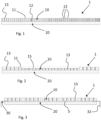
- Figure 1 illustrates, for example, a particular execution of such a watch component provided with only two massive or solid portions assembled to each other, for example by gluing.
- this timepiece component is provided with a first portion 10 comprising a structure 13 taking the form of several through openings.
- the function of these through openings is to make the first portion at least partially transparent.
- the first portion may comprise a sufficient quantity of openings to obtain a visible backlighting effect provided by the luminescent material present in the second portion: these through openings are therefore sufficient to, on the one hand, allow the transmission of excitation light waves to the second portion coming from the outside, and on the other hand for the transmission of light waves emitted by the second portion following its excitation.
- the openings 13 of the first portion are here through micro-openings or through nano-openings, preferably of a size small enough not to be identifiable with the naked eye.
- these openings may be in a substantially cylindrical shape with a diameter less than or equal to 60 ⁇ m, since it is commonly accepted that at 20 cm, the eye perceives details greater than such a dimension.
- these through openings are not seen during the day, their dimensions are preferably less than the maximum resolving power of the eye under normal conditions of observation of a watch.
- the resolving power of the eye is approximately one minute of arc.
- the first portion although formed from an opaque material, allows the second portion 20 to be subjected to lighting, in particular external lighting, and allows the light emitted by the second portion 20 to generate a visual effect for an observer of the watch component.
- the quantity of openings 13, their respective dimensions and their distribution represent a compromise chosen according to a desired aesthetic result.
- the conformation, arrangement and density of the structuring depend on the desired effect in terms of pattern obtained and/or level of persistence, depending on the search for an ephemeral decoration or a display lasting several hours. This compromise also depends on the luminescent material chosen for the second portion. There are thus a very large number of possibilities.
- the openings can have any geometry suitable for the passage of excitation and/or emission waves.
- At least one blind opening can be formed from the outer surface or from the inner surface of the first portion. It can have straight or inclined sides.
- this opening can include optical means, such as optical fibers or be filled with any at least partially transparent material.
- the first portion may comprise a structuring that modifies at least locally the transparency properties of the material constituting said first portion.
- different structurings may be combined to create the desired visual effects.
- the Figure 2 illustrates a particular execution of a component according to a first variant of the first embodiment, which is provided with a first portion comprising both through openings 13 and a blind opening 15.
- the structuring may be homogeneous, in particular all the openings may be identical and uniformly distributed over the entire surface of the first portion, to form a homogeneous effect.
- their distribution and/or their geometry may differ within the first portion, to form a heterogeneous effect, which will provide a different visual effect.
- the watch component may comprise blind openings of variable depth, which may evolve according to a gradient. This makes it possible to observe a progressively variable brightness depending on the areas of the watch component.
- the distribution of the openings is not uniform, as in the particular execution represented by the Figure 1 , but these openings are positioned so as to form a design, which will be perceptible at night, highlighted by the backlighting by the second luminescent portion.
- the openings fulfill the dual function of making the first portion at least partially transparent while forming an aesthetic design, i.e. a decoration visible at night.
- this design can, for example, be a pattern, providing not only a decoration but also an indication or any information visible at night.
- the first portion 10 defines the daytime aesthetics of the watch component.
- the observer does not see through the first portion.
- the watch component only as if it only included this first portion without an opening.
- the watch component thus obtained is therefore a versatile watch component, since it has at least a first daytime appearance in which the appearance of the component corresponds substantially to the appearance of the first portion, and at least a second nighttime appearance in which the first portion is backlit by a visible emission light wave emitted by the second portion.
- the backlighting can vary depending on the intensity of the emission light wave emitted by the second portion which decreases over time.
- the night appearance of the component can be scalable.
- the two portions of the watch component are therefore presented as two separate solid elements assembled to each other.
- the assembly of the two portions of the watch component can, for example, be achieved by gluing.
- the assembly of the two portions of the watch component can be achieved by capillary adhesion. This assembly thus advantageously allows a more or less removable fixing of the two portions to each other.
- the two portions can be assembled by riveting, crimping, or driving in related mechanical means.
- the two portions can be brought into contact and held together by a mechanical strapping.
- FIG. 3 illustrates an embodiment of such a watch component.
- the third portion 30 is interposed between the first two portions, at their circumference, so as to form a skirt comprising an inward extension 32 intended for fixing the watch component.
- the two portions 10, 20 are superimposed but not in contact, a space 5 corresponding to the thickness of the third portion 30 separating them.
- this third portion makes it possible to modulate the day and/or night aesthetics of the watch component by keeping the first and second portions at a distance.
- FIG. 4 illustrates another embodiment of such a timepiece component in which a third portion 30 is in the form of a decorative mask, integrated between the two portions 10, 20 of the timepiece component.
- This mask may be opaque and have openings 31 which can allow the excitation and emission light waves to pass through, these openings 31 possibly forming a decorative design.
- this third portion makes it possible to modulate the day and/or night aesthetics of the timepiece component.
- this third portion may comprise optical means for modulating the backlighting of the second portion, such as for example optical fibers.
- this third portion may be in the form of a layer, in particular a semi-transparent layer, for example in the form of a semi-transparent fluorescent layer, which may be excited by the second portion.
- the second portion 20 is not in the form of a solid part, and/or does not fulfill the mechanical support function described above. It could be in any other form allowing its lighting function to be fulfilled, from any luminescent, phosphorescent and/or fluorescent or other material.
- it may be in the form of a varnish applied under the first portion 10, i.e. on the inner face 12 of the first portion 10.
- Figure 5 illustrates, for example, such an execution of a watch component.
- it may be in the form of a varnish applied in openings formed in the inner surface 12 of the first portion.
- the watch component can be presented in the form of a single-piece watch component, and no longer as two separate elements assembled, in a more or less removable manner.
- the second portion may be in the form of a varnish applied to an element distinct from the first portion and positioned under this first portion.
- This distinct element may, for example, be a support portion in the form of a solid element advantageously possessing sufficient rigidity to provide it with a mechanical property enabling it to be used as a mechanical support for the construction.
- the support portion can form a mechanical support for the first and second portions and/or a support allowing the mounting of the watch component within a timepiece.
- a third portion may be provided to modulate, or even enhance, the effects generated by the second portion of said timepiece component, and therefore modulate the daytime and/or nighttime aesthetics of the timepiece component.
- This third portion may be interposed between the first and second portions.
- This third portion may, for example, be in the form of a mask that limits the transmission of light regardless of the structuring of the first portion located above.
- This third portion may also be in the form of a layer, in particular a semi-transparent layer, for example in the form of a semi-transparent fluorescent layer, which may be excited by the second portion.
- a third portion may be provided to assemble the first and second portions of said timepiece component.
- the first portion 10 is in the form of a coating applied to the second portion 20.
- the thickness of this coating is such that the material(s) constituting it is opaque.
- the structuring 13 consists, for example, of micro-openings or nano-openings made in this coating, as explained previously.
- the coating may be composed of metals, metal alloys, polymers, lacquers, varnishes, enamels, ceramics, glass-ceramics, or hybrid materials.
- the coating may be deposited by any means, such as physical vapor deposition (PVD), chemical vapor deposition (CVD), atomic layer deposition (ALD), spraying (making it possible to vaporize a liquid into fine droplets under the effect of air overpressure), a sol-gel process, etc.
- the second portion 20 is in the form of a solid portion.
- a second portion thus advantageously comprises a solid structure integrating a luminescent material distributed throughout its volume.
- Such a second portion may have a substantially constant thickness, on average between 0.01 mm and 5 mm.
- Such a second portion may be a plate formed from luminescent ceramic, advantageously from luminescent zirconia.
- the advantage of such a second portion is that it has sufficient rigidity to provide it with a mechanical property allowing it to be used as a mechanical support for the construction.
- the second portion can form a mechanical support for the first portion and/or a support allowing the mounting of the watch component within a timepiece.
- the second portion can fulfill the dual function of night lighting, namely that it can produce an emission light wave, and of support for the first portion of the watch component.
- the first portion is in the form of a coating applied to the outer surface of the second portion.
- the watch component according to the first variant of the second embodiment is in the form of a single-piece watch component, and no longer as two separate elements assembled, in a more or less removable manner.
- FIG. 6 represents a particular execution of a watch component according to the first variant of the second embodiment.
- a structuring 13 based on micro-openings represented on the enlargement of the Figure 7 , is carried out in this coating.
- FIGS. 8a and 8b represent a particular execution of a watch component according to the first variant of the second embodiment, comprising a first portion 10 formed by a gray gradient on an opaque layer 100 nm thick of titanium, forming a coating on a second portion 20 of massive luminescent zirconia.
- the titanium layer is perforated, in particular using a femtosecond laser, with progressively increased perforation rates, in order to create a gray gradient, which the observer perceives during the day. More particularly, the titanium layer comprises micro-openings whose density varies locally.
- Figure 8a represents the day watch component, which has a degraded metallic gray appearance
- Figure 8b represents this same watch component at night, which presents a luminous appearance of variable intensity according to the aforementioned gradient.
- the titanium layer can be thinned using a femtosecond laser, with gradually increased ablation rates. This creates a gray gradient, which the observer may or may not perceive during the day, which provides aesthetic effects such as those represented in Figures 8a and 8b .
- ablation we mean here at least a local thinning of the coating forming the first portion 10.
- FIG. 9 represents another particular execution of a watch component according to the first variant of the second embodiment, in which the second portion 20 has internal extensions 24 to facilitate its fixing.
- FIG. 10 represents another particular execution of a watch component according to the first variant of the second embodiment, in which a first portion 10 is in the form of an opaque platinum coating on a second solid portion 20 incorporating luminescent material, such as luminescent zirconia.
- the first portion comprises micro-openings, not shown, and macroscopic openings 13, forming a decoration visible by day. All or part of the macroscopic openings can optionally be filled with at least one second coating which can constitute a decoration or inscriptions.
- Such openings can be made by localized deposition, or by means of masking during the deposition of the coating.
- FIG. 11 illustrates another particular embodiment of a timepiece component according to the first variant of the second embodiment.
- This timepiece component incorporates a third portion 30 in the form of a solid component serving as a base plate of the timepiece component, and incorporating, for example, feet 34 for fixing to a timepiece such as a watch movement.
- a second portion 20 comprises several separate solid parts incorporating luminescent material distributed in their volume, such as luminescent zirconia, included in hollows in the outer surface of the third portion 30.
- the outer surfaces of the second and third portions are substantially at the same level and are coated with a first portion 10, such as a coating.
- the second portion 20 may constitute attached indexes. Alternatively, these added indexes may be in relief rather than in the same plane as the third portion 30. Such indexes may, for example, be added to a dial plate which constitutes the third portion 30.
- this third portion may act as a support and/or make it possible to modulate the day and/or night aesthetics of the watch component.
- a third portion may be interposed between the first and second portions.
- This third portion may, for example, be in the form of a mask which limits the transmission of light regardless of the structuring of the first portion located above.
- this third portion may also be in the form of a layer, in particular a semi-transparent layer, for example in the form of a semi-transparent fluorescent layer, which may be excited by the second portion.
- the second portion is not in the form of a solid part, and/or does not fulfill the mechanical support function described above. It could be in any other form allowing its lighting function to be fulfilled, from any luminescent, phosphorescent or other material.
- it may be in the form of a varnish applied to a separate element such as a support portion in the form of a solid element advantageously having sufficient rigidity to provide it with a mechanical property allowing it to be used as a mechanical support for the construction.
- the support portion can form a mechanical support for the second portion and/or for the watch component.
- FIG. 12 illustrates such an execution in which a support portion 40 is coated on its outer surface with a second portion 20, on which a first portion 10 is coated.
- This support portion 40 is in the form of a solid component serving as a base plate of the watch component, and incorporates, for example, feet 44 for fixing to a timepiece such as a watch movement.
- the first portion is in the form of a coating applied to the second portion supported by the support portion.
- the watch component according to the second variant of the second embodiment is in the form of a support portion doubly coated by first and second portions at least partially superimposed.
- the watch component may be a dial, a dial counter, an index, a bezel disc, or more generally a decorative plate.
- the decorative plate may be assembled with any other watch component to decorate it: it may thus complement a dial of substantially traditional structure and not form the dial alone, as in the particular embodiments which are described.
- the invention is applicable to any object whose exterior or decoration implements the described solution.
- the invention also relates to a timepiece, in particular a wristwatch, incorporating a versatile watch component according to an embodiment of the invention.
- the watch component has been described previously in a non-limiting manner. Many other executions are possible.
- additional elements such as indexes or decals, may be superimposed on the first portion, masking certain areas. Depending on the nature of these additional elements, the luminescence effect may be retained or removed.
- the two portions 10, 20 of the watch component may be only partially superimposed. They can occupy any geometry, for example forming the entirety of a dial or only a sub-part of a dial, such as indexes or counters.
- the first portion can comprise one or more areas of opaque material, as described above, combined with one or more areas of transparent material(s), for which structuring is not obligatory, but possible in order to optionally modulate the transparency property of such an area.
- the first portion can have a small thickness, less than or equal to 2 mm inclusive, or even a thickness of between 5 nm and 2 mm inclusive, or even between 5 nm and 1 mm inclusive, or even between 5 nm and 0.8 mm inclusive.
Landscapes
- Chemical & Material Sciences (AREA)
- Engineering & Computer Science (AREA)
- Physics & Mathematics (AREA)
- General Physics & Mathematics (AREA)
- Ceramic Engineering (AREA)
- Manufacturing & Machinery (AREA)
- Materials Engineering (AREA)
- Structural Engineering (AREA)
- Organic Chemistry (AREA)
- Composite Materials (AREA)
- Illuminated Signs And Luminous Advertising (AREA)
- Adornments (AREA)
Claims (18)
- Uhrenkomponente (1) für ein Zeitmessgerät, dadurch gekennzeichnet, dass sie einen ersten Abschnitt (10) und einen zweiten Abschnitt (20) umfasst, wobei der erste Abschnitt (10) einen Teil aus mindestens einem opaken Material umfasst, dessen Art, kombiniert mit der verwendeten Dicke, zu einer Transmission von weniger als 10 % einer Lichtstrahlung führt, und mindestens teilweise dem zweiten Abschnitt (20) überlagert ist, wobei dieser zweite Abschnitt (20) in Form eines massiven Abschnitts ausgebildet ist, der unabhängig von den anderen Abschnitten einen festen Gegenstand bildet, der strukturell keine mechanische Unterstützung für seinen verformungsfreien Halt benötigt, wobei dieser massive Abschnitt ein Material umfasst, das geeignet ist, im Fall der Anregung durch mindestens eine Anregungslichtwelle mindestens eine Emissionslichtwelle zu emittieren, und wobei der Teil des ersten Abschnitts (10) eine Strukturierung (13) umfasst, die aus mindestens einer mit bloßem Auge bei Tag unsichtbaren Öffnung, die an einer Außenfläche (11) und/oder an einer Innenfläche (12) gebildet ist, und/oder aus einer Öffnung, die in der Dicke des Teils des ersten Abschnitts (10) ausgebildet ist, und/oder aus einer Abtragung des Teils des ersten Abschnitts (10) besteht und die es ermöglicht, mindestens teilweise nach außerhalb der Uhrenkomponente eine Emissionslichtwelle zu emittieren, die von dem zweiten Abschnitt (20) emittiert wird, und es ermöglicht, mindestens teilweise zu dem zweiten Abschnitt eine von außerhalb der Uhrenkomponente kommende Anregungslichtwelle zu transmittieren, so dass die Uhrenkomponente mindestens ein erstes Tagerscheinungsbild, das im Wesentlichen dem Erscheinungsbild des ersten Abschnitts (10) entspricht, und mindestens ein davon verschiedenes zweites Nachterscheinungsbild, bei dem der erste Abschnitt (10) durch eine von dem zweiten Abschnitt (20) emittierte Emissionslichtwelle hinterleuchtet wird, aufweist.
- Uhrenkomponente nach dem vorhergehenden Anspruch, dadurch gekennzeichnet, dass der Teil des ersten Abschnitts (10) aus mindestens einem für eine Anregungslichtwelle des zweiten Abschnitts und/oder für eine von dem zweiten Abschnitt emittierte Emissionslichtwelle opaken Material gebildet wird.
- Uhrenkomponente nach einem der vorhergehenden Ansprüche, dadurch gekennzeichnet, dass der Teil des ersten Abschnitts (10) eine Strukturierung (13) umfasst, die aus an einer Außenfläche (11) oder an einer Innenfläche (12) gebildeten Öffnungen und/oder aus in der Dicke des Teils des ersten Abschnitts (10) gebildeten Öffnungen und/oder aus einer Abtragung des Teils des ersten Abschnitts (10) besteht.
- Uhrenkomponente nach einem der vorhergehenden Ansprüche, dadurch gekennzeichnet, dass der Teil des ersten Abschnitts (10) eine Strukturierung (13) umfasst, die eine mindestens lokale Änderung der Transparenzeigenschaften des Materials ausführt, aus dem der erste Abschnitt (10) besteht.
- Uhrenkomponente nach einem der vorhergehenden Ansprüche, dadurch gekennzeichnet, dass der Teil des ersten Abschnitts (10) eine Strukturierung (13) umfasst, die Öffnungen von ausreichend geringer Größe wie Mikroöffnungen oder Nanoöffnungen umfasst, insbesondere durch Mikroöffnungen, die äquivalent zu durchgängigen oder einmündenden Zylindern mit einem Durchmesser kleiner oder gleich 100 Mikrometer, sogar kleiner oder gleich 60 Mikrometer, und größer oder gleich 250 nm sind.
- Uhrenkomponente nach einem der vorhergehenden Ansprüche, dadurch gekennzeichnet, dass der Teil des ersten Abschnitts (10) eine homogen verteilte Strukturierung oder eine heterogen verteilte Strukturierung umfasst, die ein Muster, eine Information bilden kann und/oder einen Gradienten aufweist.
- Uhrenkomponente nach einem der vorhergehenden Ansprüche, dadurch gekennzeichnet, dass der erste Abschnitt (10) mindestens einen Teil aus mindestens teilweise transparentem, homogenem oder heterogenem Material umfasst, der neben mindestens einem Teil angeordnet ist, der mindestens ein opakes Material umfasst, das eine Strukturierung umfasst.
- Uhrenkomponente nach einem der vorhergehenden Ansprüche, dadurch gekennzeichnet, dass der zweite Abschnitt (20) aus einer Struktur ausgebildet ist, die aus einem Material gebildet wird, das eine phosphoreszierende und/oder fluoreszierende Eigenschaft umfasst.
- Uhrenkomponente nach dem vorhergehenden Anspruch, dadurch gekennzeichnet, dass der zweite Abschnitt (20) aus einer fluoreszierenden und/oder phosphoreszierenden Keramik, insbesondere aus einer Verbundkeramik auf der Basis von Yttrium-stabilisiertem Zirkonoxid und Dy/Eu-dotiertem Strontiumaluminat, insbesondere aus einem lumineszierenden Zirkonoxid, ausgebildet ist.
- Uhrenkomponente nach einem der vorhergehenden Ansprüche, dadurch gekennzeichnet, dass der zweite Abschnitt (20) einen Träger des ersten Abschnitts bildet und/oder eine Vorrichtung zur Befestigung der Uhrenkomponente an einem Zeitmessgerät umfasst.
- Uhrenkomponente nach einem der vorhergehenden Ansprüche, dadurch gekennzeichnet, dass der erste Abschnitt (10) aus einer massiven Struktur oder in Form einer Beschichtung des zweiten Abschnitts (20) ausgebildet ist.
- Uhrenkomponente nach einem der vorangehenden Ansprüche, dadurch gekennzeichnet, dass der erste Abschnitt aus Perlmutt, insbesondere aus schwarzem Perlmutt, aus fossilem Material, aus Schildplatt, aus Mangancalcit, aus Lepidolit, aus verkieseltem Holz, aus Koralle, aus Bernstein, aus Perle, aus Elfenbein, aus Metall oder Metalllegierung wie Platin oder Ferrit oder Meteorit, aus technischer Keramik auf der Basis von Zirkonoxid und/oder pigmentiertem oder unpigmentiertem Aluminiumoxid, aus Edelstein, aus Mineral, aus Gestein oder wertvoller Substanz organischen Ursprungs, aus Sphalerit, aus Fluorit, aus Achat, aus Alexandrit, aus Amethyst, aus Anatas, aus Aventurin, aus Chalcedon, aus Chrysoberyll, aus Chrysopras, aus Citrin, aus Jaspis, aus Tigerauge, aus Opal, aus Quarz, aus Spinell, aus Aragonit, aus Azurit, aus Malachit, aus Krokoit, aus Apatit, aus Lazulit, aus Türkis, aus Aquamarin, aus Beryll, aus Turmalin, aus Obsidian oder aus Schneeflockenobsidian ist.
- Uhrenkomponente nach einem der Ansprüche 1 bis 10, dadurch gekennzeichnet, dass sie eine lösbare oder unlösbare Verbindung zwischen dem ersten und dem zweiten Abschnitt (10; 20) durch Kleben oder durch eine mechanische Vorrichtung wie eine mechanische Umreifung oder eine Einfassung oder durch kapillare Adhäsion umfasst, oder dadurch, dass der erste Abschnitt (10) eine Oberflächenbeschichtung des zweiten Abschnitts (20) ist, insbesondere eine Beschichtung aus Metall, aus Metalllegierung, aus Polymer, oder eine Glasur oder ein Email oder eine Keramik oder eine Glaskeramik oder ein Hybridmaterial oder ein Lack ist, oder dadurch, dass der zweite Abschnitt (20) ein Lack ist, der unter dem ersten Abschnitt (10) an der Innenfläche (12) des ersten Abschnitts oder in einer Vertiefung dieser Innenfläche (12) oder auf einer Fläche eines anderen Abschnitts appliziert ist, oder dadurch, dass der zweite Abschnitt (20) ein Lack ist, der auf einem anderen Abschnitt appliziert ist, und dadurch, dass der erste Abschnitt (10) eine Beschichtung ist, die auf dem den zweiten Abschnitt (20) bildenden Lack appliziert ist.
- Uhrenkomponente nach einem der vorhergehenden Ansprüche, dadurch gekennzeichnet, dass der erste Abschnitt eine Dicke kleiner oder gleich 2 mm einschließlich, sogar eine mittlere Dicke zwischen 5 nm und 2 mm einschließlich, sogar zwischen 5 nm und 1 mm einschließlich, sogar zwischen 5 nm und 0,8 mm einschließlich aufweist, und/oder dadurch, dass der zweite Abschnitt (20) eine Dicke von größer oder gleich 0,01 mm, sogar im Mittel zwischen 0,01 mm und 5 mm einschließlich aufweist, und/oder dadurch, dass der zweite Abschnitt (20) eine Fläche größer oder gleich 1 mm2, insbesondere eine Fläche zwischen 0,01 cm2 und 15 cm2 einschließlich, aufweist.
- Uhrenkomponente nach einem der vorhergehenden Ansprüche, dadurch gekennzeichnet, dass sie aus dem ersten Abschnitt (10) und aus dem zweiten Abschnitt (20) besteht, oder dadurch, dass sie einen dritten Abschnitt (30) umfasst, der über oder im Wesentlichen an dem zweiten Abschnitt (20) angeordnet ist oder zwischen dem ersten und dem zweiten Abschnitt eingefügt ist.
- Uhrenkomponente nach dem vorhergehenden Anspruch, dadurch gekennzeichnet, dass der dritte Abschnitt (30) eine selektive oder nicht selektive Maske ist, und/oder dadurch, dass der dritte Abschnitt (30) eine Vorrichtung zur Befestigung der Uhrenkomponente umfasst, und/oder dadurch, dass der dritte Abschnitt (30) mehrere unterschiedliche Teile des zweiten Abschnitts (20) trägt, und/oder dadurch, dass der dritte Abschnitt (30) zu der Funktion des Verbindens des ersten und des zweiten Abschnitts beiträgt, und/oder dadurch, dass der dritte Abschnitt (30) optische Elemente wie optische Fasern umfasst.
- Uhrenkomponente nach einem der vorhergehenden Ansprüche, dadurch gekennzeichnet, dass sie ein Zifferblatt, ein Zifferblattzähler, ein Index, eine Lünettenscheibe oder eine dekorative Scheibe ist.
- Zeitmessgerät, insbesondere Armbanduhr, dadurch gekennzeichnet, dass es eine Uhrenkomponente nach einem der vorhergehenden Ansprüche umfasst.
Priority Applications (5)
| Application Number | Priority Date | Filing Date | Title |
|---|---|---|---|
| EP18179672.3A EP3588202B1 (de) | 2018-06-25 | 2018-06-25 | Vielseitige uhrenkomponente |
| US16/448,962 US20190391534A1 (en) | 2018-06-25 | 2019-06-21 | Versatile horology component |
| JP2019115319A JP7733970B2 (ja) | 2018-06-25 | 2019-06-21 | 可変時計部品 |
| CN201910555193.XA CN110632840B (zh) | 2018-06-25 | 2019-06-25 | 可变的钟表构件 |
| JP2024075594A JP2024099836A (ja) | 2018-06-25 | 2024-05-08 | 可変時計部品 |
Applications Claiming Priority (1)
| Application Number | Priority Date | Filing Date | Title |
|---|---|---|---|
| EP18179672.3A EP3588202B1 (de) | 2018-06-25 | 2018-06-25 | Vielseitige uhrenkomponente |
Publications (2)
| Publication Number | Publication Date |
|---|---|
| EP3588202A1 EP3588202A1 (de) | 2020-01-01 |
| EP3588202B1 true EP3588202B1 (de) | 2025-04-16 |
Family
ID=62784036
Family Applications (1)
| Application Number | Title | Priority Date | Filing Date |
|---|---|---|---|
| EP18179672.3A Active EP3588202B1 (de) | 2018-06-25 | 2018-06-25 | Vielseitige uhrenkomponente |
Country Status (4)
| Country | Link |
|---|---|
| US (1) | US20190391534A1 (de) |
| EP (1) | EP3588202B1 (de) |
| JP (2) | JP7733970B2 (de) |
| CN (1) | CN110632840B (de) |
Families Citing this family (9)
| Publication number | Priority date | Publication date | Assignee | Title |
|---|---|---|---|---|
| JP7432311B2 (ja) * | 2018-06-25 | 2024-02-16 | ロレックス・ソシエテ・アノニム | 可変時計部品 |
| EP4047107A1 (de) * | 2021-02-22 | 2022-08-24 | The Swatch Group Research and Development Ltd | Verfahren zum aufbringen eines seltenen materials im dünnschichtverfahren auf ein uhren- oder schmuckgehäuse und nach diesem verfahren hergestelltes gehäuse |
| EP4071558A1 (de) * | 2021-04-06 | 2022-10-12 | Rolex Sa | Verfahren zur herstellung einer uhrenkomponente durch oberflächenstrukturierung |
| EP4102309B1 (de) * | 2021-06-08 | 2025-03-26 | The Swatch Group Research and Development Ltd | Uhr, die ein verkleidungselement umfasst, das mit einem teil aus zirkonoxid ausgestattet ist |
| EP4102308B1 (de) * | 2021-06-08 | 2025-02-19 | The Swatch Group Research and Development Ltd | Verfahren zur herstellung einer leuchtenden uhrenkomponente |
| JP2023182120A (ja) * | 2022-06-14 | 2023-12-26 | セイコーエプソン株式会社 | 時計部品、時計および時計部品の製造方法 |
| JP2024003355A (ja) * | 2022-06-27 | 2024-01-15 | セイコーエプソン株式会社 | 文字板の加飾方法、文字板、および時計 |
| CH720567A1 (fr) * | 2023-02-28 | 2024-09-13 | Richemont Int Sa | Procédé de fabrication d'un cadran horloger |
| EP4640655A1 (de) * | 2024-04-23 | 2025-10-29 | Comadur S.A. | Artikel mit hinterleuchtem pille-zu-leucht-dekor und verfahren zu seiner herstellung |
Family Cites Families (25)
| Publication number | Priority date | Publication date | Assignee | Title |
|---|---|---|---|---|
| GB797122A (en) * | 1956-04-03 | 1958-06-25 | Bulova Watch Co Inc | Luminescent article and method of making the same |
| US4205522A (en) * | 1978-05-05 | 1980-06-03 | Hitachi, Ltd. | Liquid crystal display device |
| JPS55157706A (en) * | 1979-05-29 | 1980-12-08 | Fujitsu Ltd | Optical axis adjusting method of optical system for invisible light |
| JP2814884B2 (ja) * | 1993-08-06 | 1998-10-27 | セイコーエプソン株式会社 | 時計用文字板の夜光構造 |
| US6707515B1 (en) * | 1997-07-30 | 2004-03-16 | Citizen Watch Co., Ltd. | Liquid crystal display |
| JP3586370B2 (ja) * | 1998-03-25 | 2004-11-10 | 河口湖精密株式会社 | 発光表示板 |
| JP2001249189A (ja) * | 1999-11-12 | 2001-09-14 | Casio Comput Co Ltd | 時計用文字板および時計 |
| JP2001296374A (ja) * | 2000-04-13 | 2001-10-26 | Casio Comput Co Ltd | 時計用文字板、その製造方法、および時計 |
| JP4481564B2 (ja) * | 2001-12-13 | 2010-06-16 | アスラブ・エス アー | 特に時計の発光針およびそれを備えた表示装置 |
| CH697210A5 (fr) * | 2003-04-01 | 2008-06-25 | Artecad Sa | Cadran. |
| CN2891018Y (zh) * | 2006-03-01 | 2007-04-18 | 陈继颖 | 一种新型的夜光钟 |
| US20070210282A1 (en) * | 2006-03-13 | 2007-09-13 | Association Suisse Pour La Recherche Horlogere (Asrh) | Phosphorescent compounds |
| WO2008072605A1 (ja) * | 2006-12-15 | 2008-06-19 | Seiko Epson Corporation | 時計用文字板および時計 |
| JP3140649U (ja) | 2008-01-23 | 2008-04-03 | 有限会社エスプリマ | 時計 |
| US9284485B2 (en) * | 2012-11-07 | 2016-03-15 | Rolex Sa | Persistent phosphorescent composite material |
| ES2881397T3 (es) * | 2012-12-11 | 2021-11-29 | Sicpa Holding Sa | Método para autentificar un aparato de relojería. |
| JP3185348U (ja) * | 2013-04-03 | 2013-08-15 | 根本特殊化学株式会社 | 時計用表示部材 |
| JP3185663U (ja) * | 2013-05-08 | 2013-08-29 | 株式会社時計企画工房Suwa | 時計用文字板、時計 |
| EP2874024A1 (de) * | 2013-11-15 | 2015-05-20 | The Swatch Group Research and Development Ltd. | Perlmuttzifferblatt für versteckte Anzeigevorrichtung |
| EP3035128B1 (de) * | 2014-12-17 | 2020-09-16 | Nivarox-FAR S.A. | Herstellungsverfahren eines Dekorelements einer Uhr oder eines Schmuckstücks |
| JP6752583B2 (ja) | 2015-03-11 | 2020-09-09 | シチズン時計株式会社 | 夜光性装飾物 |
| CN205485304U (zh) * | 2016-03-17 | 2016-08-17 | 闽江学院 | 一种夜光表盘和表带 |
| JP2018018063A (ja) * | 2016-07-13 | 2018-02-01 | シチズン時計株式会社 | 夜光性装飾物 |
| CH713156B1 (fr) * | 2016-11-25 | 2020-08-31 | Officine Panerai Ag | Cadran pour pièce d'horlogerie. |
| CN107718990A (zh) * | 2017-10-25 | 2018-02-23 | 邓东江 | 一种夜光工艺品及其制作方法 |
-
2018
- 2018-06-25 EP EP18179672.3A patent/EP3588202B1/de active Active
-
2019
- 2019-06-21 JP JP2019115319A patent/JP7733970B2/ja active Active
- 2019-06-21 US US16/448,962 patent/US20190391534A1/en active Pending
- 2019-06-25 CN CN201910555193.XA patent/CN110632840B/zh active Active
-
2024
- 2024-05-08 JP JP2024075594A patent/JP2024099836A/ja active Pending
Also Published As
| Publication number | Publication date |
|---|---|
| EP3588202A1 (de) | 2020-01-01 |
| CN110632840A (zh) | 2019-12-31 |
| JP2024099836A (ja) | 2024-07-25 |
| JP7733970B2 (ja) | 2025-09-04 |
| JP2020030201A (ja) | 2020-02-27 |
| CN110632840B (zh) | 2023-09-08 |
| US20190391534A1 (en) | 2019-12-26 |
Similar Documents
| Publication | Publication Date | Title |
|---|---|---|
| EP3588202B1 (de) | Vielseitige uhrenkomponente | |
| EP3588203B1 (de) | Vielseitig einsetzbare uhrenkomponente | |
| EP1893542B1 (de) | Technisches oder dekoratives teil mit einer kombination aus einem transparenten material und einem auf siliciumdioxid basierenden amorphen material und herstellungsverfahren dafür | |
| EP3114534B1 (de) | Armbanduhr mit dekorelement | |
| EP1882212B1 (de) | Aus kristallinem material hergestelltes analoganzeigeelement, mit einem anzeigeelement dieses typs ausgestattete uhr und herstellungsverfahren dafür | |
| WO2022033741A1 (fr) | Composant noir et son procede de fabrication | |
| EP4170435A1 (de) | Verfahren zur herstellung eines verkleidungsteils, insbesondere eines verkleidungsteils für uhren | |
| CH714234A1 (fr) | Procédé de fabrication d'une pièce et une pièce pour l'horlogerie ou la joaillerie, avec une surface comprenant du titane coloré par oxydation. | |
| EP3892151A1 (de) | Uhrenkomponente und verfahren zur herstellung einer uhrenkomponente | |
| CH717875A2 (fr) | Composant noir et son procédé de fabrication. | |
| EP3671365B1 (de) | Zifferblatt einer uhr | |
| EP3835880B1 (de) | Uhrzifferblatt mit füsschen | |
| EP3232276B1 (de) | Komponente eines uhrwerks | |
| EP4338639A1 (de) | Verfahren zur herstellung einer verkleidungskomponente mit einem beugungsgitter | |
| CH719085A2 (fr) | Procédé de fabrication d'une pièce d'habillage, notamment d'une pièce d'horlogerie. | |
| CH716022B1 (fr) | Cadran de pièce d'horlogerie et pièce d'horlogerie. | |
| CH714643A1 (fr) | Composant horloger intégrant au moins un élément d'ornement. | |
| EP1734018A1 (de) | Technisches oder dekoratives Element , wobei transparenten und amorphen Materialen verbunden werden, und Erstellungsverfahren dafür | |
| EP3293587B1 (de) | Uhrenglas für armbanduhr | |
| CH720559A2 (fr) | Procédé de fabrication d'un cadran horloger à base de polymère | |
| CH716919A2 (fr) | Cadran en matériau non conducteur avec pieds. | |
| CH720046A2 (fr) | Procédé de fabrication d'un composant d'habillage comportant un réseau de diffraction. | |
| CH715674A2 (fr) | Cadran de pièce d'horlogerie. | |
| WO2008065281A2 (fr) | Procede de fabrication d'un decor ou signe, notamment destine a la bijouterie, joaillerie ou horlogerie, et produit obtenable a partir de ce procede | |
| CH717749B1 (fr) | Pièce technique ou décorative associant un matériau transparent et un matériau amorphe à base de silice et son procédé de fabrication. |
Legal Events
| Date | Code | Title | Description |
|---|---|---|---|
| PUAI | Public reference made under article 153(3) epc to a published international application that has entered the european phase |
Free format text: ORIGINAL CODE: 0009012 |
|
| STAA | Information on the status of an ep patent application or granted ep patent |
Free format text: STATUS: THE APPLICATION HAS BEEN PUBLISHED |
|
| AK | Designated contracting states |
Kind code of ref document: A1 Designated state(s): AL AT BE BG CH CY CZ DE DK EE ES FI FR GB GR HR HU IE IS IT LI LT LU LV MC MK MT NL NO PL PT RO RS SE SI SK SM TR |
|
| AX | Request for extension of the european patent |
Extension state: BA ME |
|
| STAA | Information on the status of an ep patent application or granted ep patent |
Free format text: STATUS: REQUEST FOR EXAMINATION WAS MADE |
|
| 17P | Request for examination filed |
Effective date: 20200630 |
|
| RBV | Designated contracting states (corrected) |
Designated state(s): AL AT BE BG CH CY CZ DE DK EE ES FI FR GB GR HR HU IE IS IT LI LT LU LV MC MK MT NL NO PL PT RO RS SE SI SK SM TR |
|
| STAA | Information on the status of an ep patent application or granted ep patent |
Free format text: STATUS: EXAMINATION IS IN PROGRESS |
|
| 17Q | First examination report despatched |
Effective date: 20221103 |
|
| P01 | Opt-out of the competence of the unified patent court (upc) registered |
Effective date: 20230530 |
|
| GRAP | Despatch of communication of intention to grant a patent |
Free format text: ORIGINAL CODE: EPIDOSNIGR1 |
|
| STAA | Information on the status of an ep patent application or granted ep patent |
Free format text: STATUS: GRANT OF PATENT IS INTENDED |
|
| INTG | Intention to grant announced |
Effective date: 20241112 |
|
| GRAS | Grant fee paid |
Free format text: ORIGINAL CODE: EPIDOSNIGR3 |
|
| GRAA | (expected) grant |
Free format text: ORIGINAL CODE: 0009210 |
|
| STAA | Information on the status of an ep patent application or granted ep patent |
Free format text: STATUS: THE PATENT HAS BEEN GRANTED |
|
| AK | Designated contracting states |
Kind code of ref document: B1 Designated state(s): AL AT BE BG CH CY CZ DE DK EE ES FI FR GB GR HR HU IE IS IT LI LT LU LV MC MK MT NL NO PL PT RO RS SE SI SK SM TR |
|
| REG | Reference to a national code |
Ref country code: GB Ref legal event code: FG4D Free format text: NOT ENGLISH |
|
| REG | Reference to a national code |
Ref country code: CH Ref legal event code: EP |
|
| REG | Reference to a national code |
Ref country code: IE Ref legal event code: FG4D Free format text: LANGUAGE OF EP DOCUMENT: FRENCH |
|
| REG | Reference to a national code |
Ref country code: DE Ref legal event code: R096 Ref document number: 602018081099 Country of ref document: DE |
|
| PGFP | Annual fee paid to national office [announced via postgrant information from national office to epo] |
Ref country code: DE Payment date: 20250617 Year of fee payment: 8 |
|
| PGFP | Annual fee paid to national office [announced via postgrant information from national office to epo] |
Ref country code: GB Payment date: 20250625 Year of fee payment: 8 |
|
| PGFP | Annual fee paid to national office [announced via postgrant information from national office to epo] |
Ref country code: FR Payment date: 20250630 Year of fee payment: 8 |
|
| REG | Reference to a national code |
Ref country code: NL Ref legal event code: MP Effective date: 20250416 |
|
| PG25 | Lapsed in a contracting state [announced via postgrant information from national office to epo] |
Ref country code: NL Free format text: LAPSE BECAUSE OF FAILURE TO SUBMIT A TRANSLATION OF THE DESCRIPTION OR TO PAY THE FEE WITHIN THE PRESCRIBED TIME-LIMIT Effective date: 20250416 |
|
| REG | Reference to a national code |
Ref country code: AT Ref legal event code: MK05 Ref document number: 1786146 Country of ref document: AT Kind code of ref document: T Effective date: 20250416 |
|
| PG25 | Lapsed in a contracting state [announced via postgrant information from national office to epo] |
Ref country code: FI Free format text: LAPSE BECAUSE OF FAILURE TO SUBMIT A TRANSLATION OF THE DESCRIPTION OR TO PAY THE FEE WITHIN THE PRESCRIBED TIME-LIMIT Effective date: 20250416 Ref country code: ES Free format text: LAPSE BECAUSE OF FAILURE TO SUBMIT A TRANSLATION OF THE DESCRIPTION OR TO PAY THE FEE WITHIN THE PRESCRIBED TIME-LIMIT Effective date: 20250416 Ref country code: PT Free format text: LAPSE BECAUSE OF FAILURE TO SUBMIT A TRANSLATION OF THE DESCRIPTION OR TO PAY THE FEE WITHIN THE PRESCRIBED TIME-LIMIT Effective date: 20250818 |
|
| REG | Reference to a national code |
Ref country code: LT Ref legal event code: MG9D |
|
| PG25 | Lapsed in a contracting state [announced via postgrant information from national office to epo] |
Ref country code: NO Free format text: LAPSE BECAUSE OF FAILURE TO SUBMIT A TRANSLATION OF THE DESCRIPTION OR TO PAY THE FEE WITHIN THE PRESCRIBED TIME-LIMIT Effective date: 20250716 Ref country code: GR Free format text: LAPSE BECAUSE OF FAILURE TO SUBMIT A TRANSLATION OF THE DESCRIPTION OR TO PAY THE FEE WITHIN THE PRESCRIBED TIME-LIMIT Effective date: 20250717 |
|
| PG25 | Lapsed in a contracting state [announced via postgrant information from national office to epo] |
Ref country code: PL Free format text: LAPSE BECAUSE OF FAILURE TO SUBMIT A TRANSLATION OF THE DESCRIPTION OR TO PAY THE FEE WITHIN THE PRESCRIBED TIME-LIMIT Effective date: 20250416 |
|
| PG25 | Lapsed in a contracting state [announced via postgrant information from national office to epo] |
Ref country code: BG Free format text: LAPSE BECAUSE OF FAILURE TO SUBMIT A TRANSLATION OF THE DESCRIPTION OR TO PAY THE FEE WITHIN THE PRESCRIBED TIME-LIMIT Effective date: 20250416 |
|
| PG25 | Lapsed in a contracting state [announced via postgrant information from national office to epo] |
Ref country code: HR Free format text: LAPSE BECAUSE OF FAILURE TO SUBMIT A TRANSLATION OF THE DESCRIPTION OR TO PAY THE FEE WITHIN THE PRESCRIBED TIME-LIMIT Effective date: 20250416 |
|
| PG25 | Lapsed in a contracting state [announced via postgrant information from national office to epo] |
Ref country code: AT Free format text: LAPSE BECAUSE OF FAILURE TO SUBMIT A TRANSLATION OF THE DESCRIPTION OR TO PAY THE FEE WITHIN THE PRESCRIBED TIME-LIMIT Effective date: 20250416 |
|
| PGFP | Annual fee paid to national office [announced via postgrant information from national office to epo] |
Ref country code: CH Payment date: 20250701 Year of fee payment: 8 |
|
| PG25 | Lapsed in a contracting state [announced via postgrant information from national office to epo] |
Ref country code: RS Free format text: LAPSE BECAUSE OF FAILURE TO SUBMIT A TRANSLATION OF THE DESCRIPTION OR TO PAY THE FEE WITHIN THE PRESCRIBED TIME-LIMIT Effective date: 20250716 |
|
| PG25 | Lapsed in a contracting state [announced via postgrant information from national office to epo] |
Ref country code: IS Free format text: LAPSE BECAUSE OF FAILURE TO SUBMIT A TRANSLATION OF THE DESCRIPTION OR TO PAY THE FEE WITHIN THE PRESCRIBED TIME-LIMIT Effective date: 20250816 |
|
| PG25 | Lapsed in a contracting state [announced via postgrant information from national office to epo] |
Ref country code: LV Free format text: LAPSE BECAUSE OF FAILURE TO SUBMIT A TRANSLATION OF THE DESCRIPTION OR TO PAY THE FEE WITHIN THE PRESCRIBED TIME-LIMIT Effective date: 20250416 |
|
| PG25 | Lapsed in a contracting state [announced via postgrant information from national office to epo] |
Ref country code: DK Free format text: LAPSE BECAUSE OF FAILURE TO SUBMIT A TRANSLATION OF THE DESCRIPTION OR TO PAY THE FEE WITHIN THE PRESCRIBED TIME-LIMIT Effective date: 20250416 Ref country code: SM Free format text: LAPSE BECAUSE OF FAILURE TO SUBMIT A TRANSLATION OF THE DESCRIPTION OR TO PAY THE FEE WITHIN THE PRESCRIBED TIME-LIMIT Effective date: 20250416 |
|
| REG | Reference to a national code |
Ref country code: DE Ref legal event code: R097 Ref document number: 602018081099 Country of ref document: DE |
|
| PG25 | Lapsed in a contracting state [announced via postgrant information from national office to epo] |
Ref country code: CZ Free format text: LAPSE BECAUSE OF FAILURE TO SUBMIT A TRANSLATION OF THE DESCRIPTION OR TO PAY THE FEE WITHIN THE PRESCRIBED TIME-LIMIT Effective date: 20250416 |
|
| PG25 | Lapsed in a contracting state [announced via postgrant information from national office to epo] |
Ref country code: EE Free format text: LAPSE BECAUSE OF FAILURE TO SUBMIT A TRANSLATION OF THE DESCRIPTION OR TO PAY THE FEE WITHIN THE PRESCRIBED TIME-LIMIT Effective date: 20250416 |
|
| PG25 | Lapsed in a contracting state [announced via postgrant information from national office to epo] |
Ref country code: RO Free format text: LAPSE BECAUSE OF FAILURE TO SUBMIT A TRANSLATION OF THE DESCRIPTION OR TO PAY THE FEE WITHIN THE PRESCRIBED TIME-LIMIT Effective date: 20250416 Ref country code: SK Free format text: LAPSE BECAUSE OF FAILURE TO SUBMIT A TRANSLATION OF THE DESCRIPTION OR TO PAY THE FEE WITHIN THE PRESCRIBED TIME-LIMIT Effective date: 20250416 |
|
| PG25 | Lapsed in a contracting state [announced via postgrant information from national office to epo] |
Ref country code: IT Free format text: LAPSE BECAUSE OF FAILURE TO SUBMIT A TRANSLATION OF THE DESCRIPTION OR TO PAY THE FEE WITHIN THE PRESCRIBED TIME-LIMIT Effective date: 20250416 |
|
| PG25 | Lapsed in a contracting state [announced via postgrant information from national office to epo] |
Ref country code: MC Free format text: LAPSE BECAUSE OF FAILURE TO SUBMIT A TRANSLATION OF THE DESCRIPTION OR TO PAY THE FEE WITHIN THE PRESCRIBED TIME-LIMIT Effective date: 20250416 |
|
| PG25 | Lapsed in a contracting state [announced via postgrant information from national office to epo] |
Ref country code: LU Free format text: LAPSE BECAUSE OF NON-PAYMENT OF DUE FEES Effective date: 20250625 |
|
| PLBE | No opposition filed within time limit |
Free format text: ORIGINAL CODE: 0009261 |
|
| STAA | Information on the status of an ep patent application or granted ep patent |
Free format text: STATUS: NO OPPOSITION FILED WITHIN TIME LIMIT |
|
| REG | Reference to a national code |
Ref country code: CH Ref legal event code: L10 Free format text: ST27 STATUS EVENT CODE: U-0-0-L10-L00 (AS PROVIDED BY THE NATIONAL OFFICE) Effective date: 20260225 |
|
| REG | Reference to a national code |
Ref country code: BE Ref legal event code: MM Effective date: 20250630 |
|
| 26N | No opposition filed |
Effective date: 20260119 |
|
| PG25 | Lapsed in a contracting state [announced via postgrant information from national office to epo] |
Ref country code: IE Free format text: LAPSE BECAUSE OF NON-PAYMENT OF DUE FEES Effective date: 20250625 |
|
| PG25 | Lapsed in a contracting state [announced via postgrant information from national office to epo] |
Ref country code: BE Free format text: LAPSE BECAUSE OF NON-PAYMENT OF DUE FEES Effective date: 20250630 |