EP3593833B1 - Katheter zur erhöhten intrathekalen wirkstoffdispersionen - Google Patents
Katheter zur erhöhten intrathekalen wirkstoffdispersionen Download PDFInfo
- Publication number
- EP3593833B1 EP3593833B1 EP19185551.9A EP19185551A EP3593833B1 EP 3593833 B1 EP3593833 B1 EP 3593833B1 EP 19185551 A EP19185551 A EP 19185551A EP 3593833 B1 EP3593833 B1 EP 3593833B1
- Authority
- EP
- European Patent Office
- Prior art keywords
- catheter
- medicament
- cerebrospinal fluid
- drug delivery
- intrathecal drug
- Prior art date
- Legal status (The legal status is an assumption and is not a legal conclusion. Google has not performed a legal analysis and makes no representation as to the accuracy of the status listed.)
- Active
Links
Images



Classifications
-
- A—HUMAN NECESSITIES
- A61—MEDICAL OR VETERINARY SCIENCE; HYGIENE
- A61M—DEVICES FOR INTRODUCING MEDIA INTO, OR ONTO, THE BODY; DEVICES FOR TRANSDUCING BODY MEDIA OR FOR TAKING MEDIA FROM THE BODY; DEVICES FOR PRODUCING OR ENDING SLEEP OR STUPOR
- A61M25/00—Catheters; Hollow probes
- A61M25/0043—Catheters; Hollow probes characterised by structural features
-
- A—HUMAN NECESSITIES
- A61—MEDICAL OR VETERINARY SCIENCE; HYGIENE
- A61M—DEVICES FOR INTRODUCING MEDIA INTO, OR ONTO, THE BODY; DEVICES FOR TRANSDUCING BODY MEDIA OR FOR TAKING MEDIA FROM THE BODY; DEVICES FOR PRODUCING OR ENDING SLEEP OR STUPOR
- A61M25/00—Catheters; Hollow probes
- A61M25/0067—Catheters; Hollow probes characterised by the distal end, e.g. tips
- A61M25/0068—Static characteristics of the catheter tip, e.g. shape, atraumatic tip, curved tip or tip structure
-
- A—HUMAN NECESSITIES
- A61—MEDICAL OR VETERINARY SCIENCE; HYGIENE
- A61M—DEVICES FOR INTRODUCING MEDIA INTO, OR ONTO, THE BODY; DEVICES FOR TRANSDUCING BODY MEDIA OR FOR TAKING MEDIA FROM THE BODY; DEVICES FOR PRODUCING OR ENDING SLEEP OR STUPOR
- A61M5/00—Devices for bringing media into the body in a subcutaneous, intra-vascular or intramuscular way; Accessories therefor, e.g. filling or cleaning devices, arm-rests
- A61M5/14—Infusion devices, e.g. infusing by gravity; Blood infusion; Accessories therefor
- A61M5/142—Pressure infusion, e.g. using pumps
- A61M5/14244—Pressure infusion, e.g. using pumps adapted to be carried by the patient, e.g. portable on the body
- A61M5/14276—Pressure infusion, e.g. using pumps adapted to be carried by the patient, e.g. portable on the body specially adapted for implantation
-
- A—HUMAN NECESSITIES
- A61—MEDICAL OR VETERINARY SCIENCE; HYGIENE
- A61K—PREPARATIONS FOR MEDICAL, DENTAL OR TOILETRY PURPOSES
- A61K9/00—Medicinal preparations characterised by special physical form
- A61K9/0012—Galenical forms characterised by the site of application
- A61K9/0085—Brain, e.g. brain implants; Spinal cord
-
- A—HUMAN NECESSITIES
- A61—MEDICAL OR VETERINARY SCIENCE; HYGIENE
- A61M—DEVICES FOR INTRODUCING MEDIA INTO, OR ONTO, THE BODY; DEVICES FOR TRANSDUCING BODY MEDIA OR FOR TAKING MEDIA FROM THE BODY; DEVICES FOR PRODUCING OR ENDING SLEEP OR STUPOR
- A61M25/00—Catheters; Hollow probes
- A61M25/0043—Catheters; Hollow probes characterised by structural features
- A61M2025/0057—Catheters delivering medicament other than through a conventional lumen, e.g. porous walls or hydrogel coatings
-
- A—HUMAN NECESSITIES
- A61—MEDICAL OR VETERINARY SCIENCE; HYGIENE
- A61M—DEVICES FOR INTRODUCING MEDIA INTO, OR ONTO, THE BODY; DEVICES FOR TRANSDUCING BODY MEDIA OR FOR TAKING MEDIA FROM THE BODY; DEVICES FOR PRODUCING OR ENDING SLEEP OR STUPOR
- A61M25/00—Catheters; Hollow probes
- A61M25/0067—Catheters; Hollow probes characterised by the distal end, e.g. tips
- A61M25/0068—Static characteristics of the catheter tip, e.g. shape, atraumatic tip, curved tip or tip structure
- A61M2025/0073—Tip designed for influencing the flow or the flow velocity of the fluid, e.g. inserts for twisted or vortex flow
-
- A—HUMAN NECESSITIES
- A61—MEDICAL OR VETERINARY SCIENCE; HYGIENE
- A61M—DEVICES FOR INTRODUCING MEDIA INTO, OR ONTO, THE BODY; DEVICES FOR TRANSDUCING BODY MEDIA OR FOR TAKING MEDIA FROM THE BODY; DEVICES FOR PRODUCING OR ENDING SLEEP OR STUPOR
- A61M25/00—Catheters; Hollow probes
- A61M25/0067—Catheters; Hollow probes characterised by the distal end, e.g. tips
- A61M25/0068—Static characteristics of the catheter tip, e.g. shape, atraumatic tip, curved tip or tip structure
- A61M25/007—Side holes, e.g. their profiles or arrangements; Provisions to keep side holes unblocked
-
- A—HUMAN NECESSITIES
- A61—MEDICAL OR VETERINARY SCIENCE; HYGIENE
- A61M—DEVICES FOR INTRODUCING MEDIA INTO, OR ONTO, THE BODY; DEVICES FOR TRANSDUCING BODY MEDIA OR FOR TAKING MEDIA FROM THE BODY; DEVICES FOR PRODUCING OR ENDING SLEEP OR STUPOR
- A61M27/00—Drainage appliance for wounds or the like, i.e. wound drains, implanted drains
- A61M27/002—Implant devices for drainage of body fluids from one part of the body to another
- A61M27/006—Cerebrospinal drainage; Accessories therefor, e.g. valves
-
- A—HUMAN NECESSITIES
- A61—MEDICAL OR VETERINARY SCIENCE; HYGIENE
- A61M—DEVICES FOR INTRODUCING MEDIA INTO, OR ONTO, THE BODY; DEVICES FOR TRANSDUCING BODY MEDIA OR FOR TAKING MEDIA FROM THE BODY; DEVICES FOR PRODUCING OR ENDING SLEEP OR STUPOR
- A61M5/00—Devices for bringing media into the body in a subcutaneous, intra-vascular or intramuscular way; Accessories therefor, e.g. filling or cleaning devices, arm-rests
- A61M5/14—Infusion devices, e.g. infusing by gravity; Blood infusion; Accessories therefor
- A61M5/142—Pressure infusion, e.g. using pumps
- A61M5/145—Pressure infusion, e.g. using pumps using pressurised reservoirs, e.g. pressurised by means of pistons
Definitions
- the present disclosure relates generally to implantable medical devices, and more particularly to a system utilizing a catheter for increased intrathecal drug dispersion, especially a curved catheter for increased intrathecal drug dispersion.
- a variety of medical devices are used for chronic, i.e., long-term, delivery of therapy to patients suffering from a variety of conditions, such as chronic pain, tremor, Parkinson's disease, cancer, epilepsy, urinary or fecal incontinence, sexual dysfunction, obesity, spasticity, or gastroparesis.
- pumps or other fluid delivery devices can be used for chronic delivery of therapeutic medicaments, such as drugs or other agents.
- therapeutic medicaments such as drugs or other agents.
- Such devices provide therapy continuously or periodically according to programmed parameters.
- the programmed parameters can specify the therapeutic regimen (e.g., the rate, quantity, and timing of medicament delivery to a patient), as well as other functions of the medical device.
- Implantable medical infusion pumps have important advantages over other forms of medicament administration. For example, oral administration is often not workable because the systematic dose of the substance needed to achieve the therapeutic dose at the target site may be too large for the patient to tolerate without adverse side effects. Also, some substances simply cannot be absorbed in the gut adequately for a therapeutic dose to reach the target site. Moreover, substances that are not lipid soluble may not cross the blood brain barrier adequately if needed in the brain. In addition, infusion of substances from outside the body requires a transcutaneous catheter, which results in other risks such as infection or catheter dislodgment. Further, implantable medical pumps avoid the problem of patient noncompliance, namely the patient failing to take the prescribed drug or therapy has instructed.
- Implantable medical infusion pumps are typically implanted at a location within the body of a patient (typically a subcutaneous region in the lower abdomen), and are configured to deliver a fluid medicament through a catheter.
- the catheter is generally configured as a flexible tube with a lumen running the length of the catheter to a selected delivery site in the body, such as the spinal canal or subarachnoid space.
- implantable medical pumps typically include an expandable fluid reservoir, which is accessible for refill etc. through an access port. Medicament flows from the reservoir via the lumen in the catheter according to programmed parameters.
- Drug molecules exiting the catheter lumen flow into the subarachnoid space, and begin mixing with the cerebrospinal fluid. Frequently, the drug exits the catheter slowly (e.g., a flow rate of 1 mL per hour or less), where it tends to stagnate in the slow-moving cerebrospinal fluid immediately surrounding the catheter.
- This slow moving fluid is known to those schooled in the science of fluid mechanics as a boundary-layer, which is a consequence of friction between a viscous fluid and a surface (i.e. the catheter).
- a slow or delayed mixing of the drug with the cerebrospinal fluid can decrease the efficacy of the drug and resultant therapeutic effect.
- Embodiments of the present disclosure provide a system of utilizing the contours of a catheter positioned within the subarachnoid space of a patient to generate vortices within the natural flow of cerebrospinal fluid for the purpose of improving the dispersion of the infused medicament.
- the catheter can have a curve configured to orient a distal portion of the catheter substantially orthogonal to the natural flow of the cerebrospinal fluid, which can in turn promote mixing within the cerebrospinal fluid in the form of von Kármán vortex street. Improved mixing in the vicinity of the catheter can improve the dispersion of the otherwise relatively slow-moving medicament dispensed from the catheter.
- the at least one feature configured to generate vortices within the cerebrospinal fluid can be described as a dispersion feature.
- the dispersion feature is located at or adjacent a distal portion of the catheter.
- the medicament exit can be located at or adjacent the dispersion feature.
- the medicament exit itself should not be considered as the dispersion feature.
- the curve can be configured to orient the distal portion substantially orthogonal to a natural flow of cerebrospinal fluid within the subarachnoid space.
- the angle with respect to a proximal portion of the catheter is at least 45°, especially between 45° and 110° and specifically between 60° and 100°.
- the distal portion can induce a von Kármán vortex street within the cerebrospinal fluid. In one embodiment, the distal portion can induce turbulence within the cerebrospinal fluid. In one embodiment, the medicament exit can be positioned to expel medicament in axial alignment with a natural flow of the cerebrospinal fluid within the subarachnoid space. In one embodiment, the catheter can be manipulated between an insertion position and an infusion position. In one embodiment the catheter can be configured to assume a sinusoidal shape. In one embodiment, multiple portions of the catheter can be positioned at a substantially orthogonal angle relative to a natural flow of cerebrospinal fluid within the subarachnoid space.
- An example of the present disclosure and not covered by the present invention provides a method of intrathecal drug delivery configured to improve dispersion of medicament with cerebrospinal fluid in a subarachnoid space of the patient.
- the method can comprise dispensing medicament from an implantable medical infusion device into the subarachnoid space the patient; and utilizing at least one feature defined by catheter of the implantable medical infusion device to promote mixing within the cerebrospinal fluid for the purpose of improving intrathecal drug dispersion.
- the one or more feature is a curve defined by catheter wall configured to orient a distal portion of the catheter at an angle with respect to a proximal portion of the catheter. In one embodiment, the curve is configured to orient the distal portion substantially orthogonal to a natural flow of the cerebrospinal fluid within the subarachnoid space. In one embodiment, the distal portion can generate vortices within the cerebrospinal fluid. In one embodiment, the distal portion can induce turbulence within the cerebrospinal fluid.
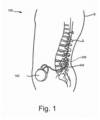
- an intrathecal drug delivery system 100 is depicted in accordance with an embodiment of the disclosure.
- the intrathecal drug delivery system 100 can include an implantable medical pump 102 and a catheter 104.
- the implantable medical pump 102 can be implanted within the body B of a patient.
- the implantable medical pump 102 can be in fluid communication with the catheter 104 having a distal tip 106 positioned within the subarachnoid space of the patient's spinal column S, thereby enabling intrathecal delivery of medicament through a lumen of the catheter 104.
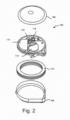
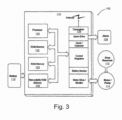
- the implantable medical pump 102 can generally include a housing 108, power source 110, medicament reservoir 112, medicament pump 114, and electronics 116.
- the housing 108 can be constructed of a material that is biocompatible and hermetically sealed, such as titanium, tantalum, stainless steel, plastic, ceramic, or the like.
- the power source 110 can be a battery, such as a lithium-ion battery.
- the power source 110 can be carried in the housing 108, and can be selected to operate the medicament pump 114 and electronics 116.
- the medicament reservoir 112 can be carried by the housing 108 and can be configured to contain medicament.
- medicament within the medicament reservoir 112 can be accessed via an access port 118. Accordingly, the access port 118 can be utilized to refill, empty, or exchange the fluid within the medicament reservoir 112.
- the medicament pump 114 can be carried by the housing 108.
- the medicament pump 114 can be in fluid communication with the medicament reservoir 112 and can be in electrical communication with the electronics 116.
- the medicament pump 114 can be any pump sufficient for infusing medicament to the patient, such as a piston pump, a peristaltic pump, a pump powered by a stepper motor, a pump powered by an AC motor, a pump powered by a DC motor, an electrostatic diaphragm, a piezioelectric motor, a solenoid, a shape memory alloy, or the like.
- the electronics 116 are carried in the housing 108, and can be in electrical communication with the power source 110 and medicament pump 114.
- the electronics 116 can include a processor 120, memory 122 and 124, and transceiver circuitry 126.
- the processor 120 can be in Application-Specific Integrated Circuit (ASIC) state machine, gate array, controller, or the like.
- the electronics 116 can be generally configured to control infusion of medicament according to programmed parameters or a specified treatment protocol.
- the programmed parameters or specified treatment protocol can be stored in the memory 122, 124.
- the transceiver circuitry 126 can be configured to receive information from an external programmer (not depicted).
- the electronics 116 can be further be configured to operate a number of other features, such a patient alarm 128.
- the distal tip 106 of the catheter 104 can extend into the subarachnoid space of a patient's spine, thereby enabling delivery of medicament into the cerebrospinal fluid of the patient.
- the cerebrospinal fluid resides within the brain ventricles and the cranial and spinal subarachnoid spaces. Cerebrospinal fluid circulation is a dynamic phenomenon closely correlated with the patient's arterial pulse wave; although other factors, such as respiratory waves, the patient's posture, jugular venous pressure, and physical effort may also affect cerebrospinal fluid flow dynamics and pressure.
- the cerebrospinal fluid volume is estimated to be about 150 mL in adults, with approximately 125 mL located in the cranial and spinal subarachnoid spaces and the remaining 25 mL located in the brain ventricles. Through normal pulsatile flow, the cerebrospinal fluid is renewed about four times every 24 hours.
- a catheter 200 according to the prior art is depicted as being positioned within the subarachnoid space of a patient.
- the catheter 200 which can have a substantially cylindrical cross section, can extend between a proximal end and a distal tip 202.
- the catheter 200 generally includes a wall 204 defining a lumen 206 extending between the proximal end and a medicament exit 208.
- the medicament exit 208 can be positioned on the distal tip 202 of the catheter. Alternatively, as depicted, the medicament exit 208 can be positioned proximately from the distal tip 202 along the wall 204 of the catheter 200.
- the proximal end of the catheter 200 can be operably coupled to the implantable medical pump, such that the lumen 206 of the catheter 200 is in fluid communication with the medical pump 114 and reservoir 112.
- the catheter 200 enters the subarachnoid space at an insertion site, and extends substantially parallel to a longitudinal axis A of the patient's spinal column S, thereby enabling intrathecal delivery of medicament through the lumen of the catheter 104.
- FIGS. 4B and 4C depict the catheter 200 as the medicament 210 exits the medicament exit 208 and flows into the subarachnoid space. Specifically, FIG. 4B depicts the dispersion of medicament 210 after approximately 7.5 seconds of initiating infusion, and FIG. 4C depicts the dispersion of medicament 210 after approximately 15 seconds of initiating infusion. As the medicament 210 exits the medicament exit 208 and flows into the subarachnoid space, the medicament 210 begins mixing with the cerebrospinal fluid. However, because the medicament 210 is expelled from the medicament exit 208 at a relatively slow rate (e.g., a flow rate of 1 mL per hour), the medicament 210 commonly stagnates in the slow-moving cerebrospinal fluid immediately surrounding the catheter 200.
- a relatively slow rate e.g., a flow rate of 1 mL per hour
- a catheter 300 configured for increased intrathecal drug dispersion is depicted in accordance with an embodiment of the disclosure.
- the catheter 300 can generally include cylindrical cross-section, and can extend between a proximal end and a distal tip 302. Similar to conventional catheter designs, catheter 300 can generally include a wall 304 defining a lumen 306 extending between the proximal end and a medicament exit 308. However, unlike conventional catheter designs, catheter 300 can include one or more features 310 configured to generate vortices within the cerebrospinal fluid for the purpose of improving intrathecal drug dispersion.
- the wall 304 of the catheter 300 can define a curved portion 310, such that a distal portion 312 of the catheter 300 is oriented substantially orthogonally to a proximal portion 314 of the catheter 300.
- a medicament exit 308 which can be positioned proximately from the distal tip 302 along the wall 304 of the catheter 300, can be positioned to expel medicament in-line with or parallel to the longitudinal axis A of the patient's spinal column S.
- the distal portion 312 (which can include the medicament exit 308) can be positioned substantially perpendicular to the flow of cerebrospinal fluid within the subarachnoid space, thereby generating vortices, inducing turbulence, or otherwise generally promoting mixing in the cerebrospinal fluid immediately surrounding the distal portion 312.
- the catheter 300 can be manipulated between an insertion position and an infusion position.
- the catheter 300 can be constructed of a heat-setting polyurethane or similar material, which can be naturally biased to orient the distal portion 312 relative to the proximal portion 314 in the desired infusion position.
- a needle or stylet can be positioned within the lumen 306 to straighten the catheter 300, or otherwise inhibit the catheter 300 from assuming the infusion position.
- the dispersion of medicament delivered via catheter 300 into the subarachnoid space can be simulated using computational fluid dynamics (CFD) modeling methods such as the well-known finite-volume, finite-element, or finite-difference techniques for finding approximate solutions to systems of partial differential equations.
- CFD computational fluid dynamics
- the system of partial differential equations that model conservation of mass and momentum also known as the Navier-Stokes equations, can simulate cerebrospinal fluid flow.
- the equations for laminar, oscillating flow of an incompressible fluid with properties similar to water at body temperature can be used to simulate medicament deliver scenarios.
- Medicament dispersion can further be modeled using various techniques including the Eulerian passive scalar approach or the Lagrangian particle approach.
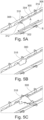
- FIGS. 4A-C and FIGS. 5A-C represent predictions of the respective volumes of dispersed clouds of medicament in an idealized intrathecal space geometry with cerebrospinal fluid that oscillates according to a sine function with a 1Hz frequency and 3 ml/s amplitude.
- a nominal straight catheter 200 such as that depicted in FIGS. 4A-C
- the infused medicament can occupy a volume of approximately 25mm 3 .
- the tip of the catheter 300 is curved (such as that depicted in FIGS.
- the infused medicament can occupy a volume of approximately 500mm 3 .
- the one or more features 310 described above can have the effect of increasing the volume of dispersed medicament approximately 20 times that of prior art designs after 30 seconds of infusion.
- bolus deliveries may be longer than a period longer than 30 seconds, and the presence of the medicament in the cerebrospinal fluid can last for several hours after infusion.
- a cylindrical object positioned within a fluid flow can result in a repeating pattern of swirling vortices, caused by a process known as vortex shedding, which is responsible for the unsteady separation of flow of a fluid around blunt bodies.
- vortex shedding a process known as vortex shedding
- Such a fluid flow is commonly referred to in the field of fluid dynamics as a von Karman vortex street, and is responsible for such phenomena as the "singing" of suspended telephone power lines and the vibration of a car antenna at certain speeds.
- positioning of the distal portion 312 perpendicular to the pulsatile flow of cerebrospinal fluid can be used to generate a series of counter-rotating vortices to promote local mixing of the medicament with the cerebrospinal fluid along the flow direction, thereby carrying the medicament away from the relatively slow-moving fluid in the boundary layer of the catheter 300.
- the medicament exit 308 can be positioned within the subarachnoid space, such that the pulsatile flow of cerebrospinal fluid can act to push slow-moving or stagnant medicament out of the medicament exit 308 to further improve mixing.
- FIGS. 5B and 5C depict the catheter 300 as the medicament 316 exits the medicament exit 308 and flows into the subarachnoid space. Specifically, FIG.5B depicts the dispersion of medicament 316 after approximately 7.5 seconds of initiating infusion, and FIG. 5C depicts the dispersion of medicament 316 after approximately 15 seconds of initiating infusion. As the medicament 316 exits the medicament exit 308 and flows into the subarachnoid space, the medicament 316 begins mixing with the cerebrospinal fluid.
- Catheter 400 configured for increased intrathecal drug dispersion is depicted in accordance with a second embodiment of the disclosure.
- Catheter 400 can generally include a cylindrical cross-section, and can extend between a proximal end and a distal tip 402.
- Catheter 400 can generally include a wall 404 defining a lumen 406 extending between the proximal end and a medicament exit 408.
- Catheter 400 can include multiple features 410A, 410B, and 410C configured to generate vortices within the cerebrospinal fluid for the purpose of improving intrathecal drug dispersion.
- catheter 400 can be configured to assume a sinusoidal shape, such that multiple portions 412A, 412B, 412C, 412D of the catheter 400 can be positioned and an acute, obtuse, or substantially orthogonal angle relative to the flow of cerebrospinal fluid within the subarachnoid space.
- the medicament exit 408, which can be positioned proximately from the distal tip 402 along the wall 404 of the catheter 400 can be positioned to expel medicament substantially in-line with the longitudinal axis A of the patient's spinal column S.
- the catheter 400 can include multiple medicament exits oriented in different directions or extending along the length of the catheter 400.
- FIGS. 8B and 8C depict the catheter 400 as the medicament 416 exits the medicament exit 408 and flows into the subarachnoid space. Specifically, FIG.8B depicts the dispersion of medicament 416 after approximately 7.5 seconds of initiating infusion, and FIG. 8C depicts the dispersion of medicament 416 after approximately 15 seconds of initiating infusion. As the medicament 416 exits the medicament exit 408 and flows into the subarachnoid space, the medicament 416 begins mixing with the cerebrospinal fluid. Upon infusion, mixing of the medicament 416 with the cerebrospinal fluid is initially promoted by the vortices associated with portion 412A and feature 410A.
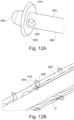
- FIGS. 9-12B depict alternative embodiments of catheters 500, 600, 700, 800 including one or more features 502, 602, 702, 802 configured to generate vortices within the cerebrospinal fluid of a patient for the purpose of improving the dispersion of intrathecally administered medicament.
- the one or more features 502, 602, 702, 802 can be positioned between a distal tip 504, 604, 704, 804 and a medicament exit 506, 606, 706, 806 defined by the catheter wall 508, 608, 708, 808.
- Other configurations are also contemplated.
- the one or more features 502, 602 can be in the form of a V-shaped ridge 510, 610 originating in proximity to the distal tip 504, 604 and terminating at an apex 512, 612 in proximity to the medicament exit 506, 606.
- the catheter 500, 600 can include a pair of V-shaped ridges 510, 610 positioned on opposing lateral sides of the catheter 500, 600.
- the V-shaped ridge 510, 610 can interact with medicament expelled from the medicament exit 506, 606, so as to promote separation of the medicament from the slow moving cerebrospinal fluid immediately surrounding the catheter 500, 600, as well as generating vortices within the cerebrospinal fluid surrounding the catheter 500, 600.
- the distal tip 504 can be pointed or otherwise formed as a wedge.
- the distal tip 604 can be blunt or otherwise assume a frustoconical shape.
- the one or more features 702 can be in the form of a spiral ridge 710 originating in proximity to the distal tip 704 and terminating in proximity to the medicament exit 606.
- the spiral ridge 710 generate vortices within the cerebrospinal fluid surrounding the catheter 700, thereby promoting faster mixing of the medicament expelled from the medicament exit 706 with the cerebrospinal fluid.
- the one or more features 802 can be in the form of a shelf 810 at least partially surrounding the wall 808 of the catheter 800.
- the shelf 810 can present a barrier to inhibit fluid from traversing along a boundary layer, and to generate vortices in the vicinity of the medicament exit 806, thereby improving local mixing of the medicament with the cerebrospinal fluid.
- Predictions of the respective volumes of dispersed clouds of medicament for catheters 500, 600, 700, and 800 having one or more features 502, 602, 702, and 802 can have an infused medicament volume of approximately 100mm. Accordingly, in comparison to a nominal straight catheter 200 (such as that depicted in FIGS. 4A-C ), the one or more features 502, 602, 702, and 802 can have the effect of increasing the volume of dispersed medicament approximately 4 times that of prior art designs after 30 seconds of infusion.
- the system can be used in combination with a method of intrathecal drug delivery configured to improve dispersion of medicament with cerebrospinal fluid in a subarachnoid space of a patient.
- the method comprises: dispensing medicament from an implantable medical infusion device into the subarachnoid space of the patient; and utilizing at least one feature defined by a catheter of the implantable medical infusion device to promote mixing within the cerebrospinal fluid for the purpose of improving intrathecal drug dispersion.
- the at least one feature can be a curve defined by a catheter wall configured to orient a distal portion of the catheter at an angle with respect to a proximal portion of the catheter, especially the curve can be configured to orient the distal portion substantially orthogonal to a natural flow of the cerebrospinal fluid within the subarachnoid space.
- the distal portion can induce a von Kármán vortex street within the cerebrospinal fluid.
Landscapes
- Health & Medical Sciences (AREA)
- Life Sciences & Earth Sciences (AREA)
- Hematology (AREA)
- Animal Behavior & Ethology (AREA)
- Engineering & Computer Science (AREA)
- Anesthesiology (AREA)
- Biomedical Technology (AREA)
- Heart & Thoracic Surgery (AREA)
- Veterinary Medicine (AREA)
- Public Health (AREA)
- General Health & Medical Sciences (AREA)
- Pulmonology (AREA)
- Biophysics (AREA)
- Vascular Medicine (AREA)
- Infusion, Injection, And Reservoir Apparatuses (AREA)
- Media Introduction/Drainage Providing Device (AREA)
- External Artificial Organs (AREA)
Claims (11)
- Intrathekales Medikamentenverabreichungssystem (100), das dazu ausgestaltet ist, die Dispergierung von Medikamenten mit Liquor cerebrospinalis in einem Subarachnoidalraum eines Patienten zu verbessern, wobei das intrathekale Medikamentenverabreichungssystem (100) Folgendes umfasst:eine implantierbare medizinische Pumpe (102) undeinen Katheter (300, 400, 500, 600, 700, 800) mit einer Wand (304, 404, 508, 608, 708, 808), die ein Lumen definiert, das sich zwischen einem proximalen Ende in Fluidverbindung mit der implantierbaren medizinischen Pumpe (102) und einer Struktur erstreckt, die einen Medikamentenausgang (308, 408, 506, 606, 706, 806) definiert, der im Subarachnoidalraum des Patienten positionierbar ist, wobei die Wand (304, 404, 508, 608, 708, 808) ferner mindestens ein Merkmal (310, 410A, 410B, 410C, 510, 610, 710, 810) definiert, das zur Erzeugung von Wirbeln in dem Liquor cerebrospinalis ausgestaltet ist,dadurch gekennzeichnet, dass das mindestens eine Merkmal eine Kurve (310), die durch die Katheterwand (304) definiert ist, die dazu ausgestaltet ist, einen distalen Abschnitt (312) des Katheters (300) in einem Winkel zu einem proximalen Abschnitt des Katheters auszurichten, und/oder eine V-förmige Erhöhung (510, 610) und/oder eine spiralförmige Erhöhung (710) und/oder einen Sockel (810) und/oder eine Nut und/oder eine Kombination davon umfasst.
- Intrathekales Medikamentenverabreichungssystem (100) nach Anspruch 1, wobei die Kurve (310) dazu ausgestaltet ist, den distalen Abschnitt (312) im Wesentlichen orthogonal zu einer natürlichen Strömung des Liquor cerebrospinalis innerhalb des Subarachnoidalraums auszurichten.
- Intrathekales Medikamentenverabreichungssystem nach Anspruch 2, wobei der distale Abschnitt eine Kärmänsche Wirbelstraße innerhalb des Liquor cerebrospinalis induziert.
- Intrathekales Medikamentenverabreichungssystem (100) nach einem der vorhergehenden Ansprüche, wobei der distale Abschnitt (312) Turbulenzen innerhalb des Liquor cerebrospinalis induziert.
- Intrathekales Medikamentenverabreichungssystem (100) nach einem der vorhergehenden Ansprüche, wobei der Medikamentenausgang (308, 408, 506, 606, 706, 806) so positioniert ist, dass ein Medikament in axialer Ausrichtung auf eine natürliche Strömung des Liquor cerebrospinalis in dem Subarachnoidalraum ausgestoßen wird.
- Intrathekales Medikamentenverabreichungssystem (100) nach einem der vorhergehenden Ansprüche, wobei der Katheter (300, 400, 500, 600, 700, 800) zwischen einer Einführungsposition und einer Infusionsposition manipuliert werden kann.
- Intrathekales Medikamentenverabreichungssystem (100) nach einem der vorhergehenden Ansprüche, wobei der Katheter (300, 400, 500, 600, 700, 800) so ausgestaltet sein kann, dass er eine sinusförmige Form annimmt.
- Intrathekales Medikamentenverabreichungssystem (100) nach einem der vorhergehenden Ansprüche, wobei mehrere Abschnitte des Katheters (300, 400, 500, 600, 700, 800) in einem im Wesentlichen orthogonalen Winkel bezüglich einer natürlichen Strömung des Liquor cerebrospinalis in dem Subarachnoidalraum positioniert werden können.
- Intrathekales Medikamentenverabreichungssystem (100) nach einem der vorhergehenden Ansprüche, wobei das System für Medikamente mit einem Dispersionsvolumen von ungefähr 100-500 mm3 30 Sekunden nach Einleitung der Infusion ausgestaltet ist.
- Intrathekales Medikamentenverabreichungssystem (100) nach einem der vorhergehenden Ansprüche, wobei 30 Sekunden nach Einleiten der Infusion ein Volumen an dispergiertem Medikament aus dem Katheter (300, 400, 500, 600, 700, 800) ungefähr 4-20 Mal größer sein kann als ein Volumen an dispergiertem Medikament, das aus einem Katheter infundiert worden ist, der nicht mindestens ein Merkmal aufweist, das zur Erzeugung von Wirbeln in dem Liquor cerebrospinalis ausgestaltet ist.
- Intrathekales Medikamentenverabreichungssystem (100) nach einem der vorhergehenden Ansprüche, wobei das mindestens eine Merkmal (310, 410A, 410B, 410C, 510, 610, 710, 810) dazu ausgestaltet ist, Wirbel in dem Liquor cerebrospinalis zu erzeugen, um die intrathekale Medikamentendispergierung zu verbessern.
Applications Claiming Priority (1)
| Application Number | Priority Date | Filing Date | Title |
|---|---|---|---|
| US201862697537P | 2018-07-13 | 2018-07-13 |
Publications (2)
| Publication Number | Publication Date |
|---|---|
| EP3593833A1 EP3593833A1 (de) | 2020-01-15 |
| EP3593833B1 true EP3593833B1 (de) | 2024-11-06 |
Family
ID=67226174
Family Applications (1)
| Application Number | Title | Priority Date | Filing Date |
|---|---|---|---|
| EP19185551.9A Active EP3593833B1 (de) | 2018-07-13 | 2019-07-10 | Katheter zur erhöhten intrathekalen wirkstoffdispersionen |
Country Status (2)
| Country | Link |
|---|---|
| US (1) | US11793971B2 (de) |
| EP (1) | EP3593833B1 (de) |
Families Citing this family (3)
| Publication number | Priority date | Publication date | Assignee | Title |
|---|---|---|---|---|
| EP3593833B1 (de) | 2018-07-13 | 2024-11-06 | Medtronic, Inc. | Katheter zur erhöhten intrathekalen wirkstoffdispersionen |
| US11344714B2 (en) | 2019-11-04 | 2022-05-31 | Medtronic, Inc. | Intrathecal catheter with features to reduce drug dispersion |
| CN113318294A (zh) * | 2021-05-18 | 2021-08-31 | 常州瑞神安医疗器械有限公司 | 可植入式的鞘内药物输注泵 |
Citations (1)
| Publication number | Priority date | Publication date | Assignee | Title |
|---|---|---|---|---|
| US20180185058A1 (en) * | 2016-12-21 | 2018-07-05 | Alcyone Lifesciences, Inc. | Drug delivery systems and methods |
Family Cites Families (47)
| Publication number | Priority date | Publication date | Assignee | Title |
|---|---|---|---|---|
| US4502488A (en) | 1983-01-13 | 1985-03-05 | Allied Corporation | Injection system |
| US4730623A (en) | 1985-06-14 | 1988-03-15 | Lee Arnold St J | Cardiac output estimation method and apparatus |
| US4817624A (en) | 1985-12-20 | 1989-04-04 | The General Hospital Corporation | Mini-bolus technique for thermodilution cardiac output measurements |
| US4834709A (en) | 1986-03-26 | 1989-05-30 | Sherwood Medical Company | Preformable catheter |
| US20010044588A1 (en) | 1996-02-22 | 2001-11-22 | Mault James R. | Monitoring system |
| US5807324A (en) | 1996-04-01 | 1998-09-15 | Procath Corporation | Steerable catheter |
| US6913763B2 (en) | 1996-11-19 | 2005-07-05 | Intrabrain International Nv | Method and device for enhanced delivery of a biologically active agent through the spinal spaces into the central nervous system of a mammal |
| US5931805A (en) | 1997-06-02 | 1999-08-03 | Pharmasonics, Inc. | Catheters comprising bending transducers and methods for their use |
| US6261312B1 (en) | 1998-06-23 | 2001-07-17 | Innercool Therapies, Inc. | Inflatable catheter for selective organ heating and cooling and method of using the same |
| US5897528A (en) | 1998-04-30 | 1999-04-27 | Medtronic, Inc. | Filtered intracerebroventricular or intraspinal access port with direct cerebrospinal fluid access |
| AU750050B2 (en) | 1998-06-03 | 2002-07-11 | Scott Laboratories, Inc. | Apparatus and method for providing a conscious patient relief from pain and anxiety associated with medical or surgical procedures |
| US6013051A (en) | 1998-10-22 | 2000-01-11 | Medtronic, Inc. | Filtered access port with filter bypass for accessing body fluid samples |
| US6579280B1 (en) | 1999-04-30 | 2003-06-17 | Medtronic, Inc. | Generic multi-step therapeutic treatment protocol |
| US7806886B2 (en) | 1999-06-03 | 2010-10-05 | Medtronic Minimed, Inc. | Apparatus and method for controlling insulin infusion with state variable feedback |
| US6868739B1 (en) | 1999-10-19 | 2005-03-22 | Transonic Systems, Inc. | Method and apparatus to measure blood flow by an introduced volume change |
| US6799149B2 (en) | 2000-12-29 | 2004-09-28 | Medtronic, Inc. | Therapy management techniques for an implantable medical device |
| US7083593B2 (en) | 2001-04-18 | 2006-08-01 | Advanced Bionics Corporation | Programmable implantable pump with accessory reservoirs and multiple independent lumen catheter |
| US7438701B2 (en) | 2001-07-26 | 2008-10-21 | Durect Corporation | Local concentration management system |
| US7070591B2 (en) | 2002-09-17 | 2006-07-04 | Transoma Medical, Inc. | Vascular access port with physiological sensor |
| US8043281B2 (en) | 2002-12-23 | 2011-10-25 | Medtronic, Inc. | Catheters incorporating valves and permeable membranes |
| WO2004100769A2 (en) | 2003-05-09 | 2004-11-25 | Falco Frank J | Methods for using gadolinium as a contrast media |
| US7445592B2 (en) * | 2004-06-10 | 2008-11-04 | Orqis Medical Corporation | Cannulae having reduced flow resistance |
| US20060064009A1 (en) * | 2004-09-21 | 2006-03-23 | Webler William E | Vessel imaging devices and methods |
| US20060282043A1 (en) | 2005-06-14 | 2006-12-14 | Pyles Stephen T | Intrathecal catheter having a stylet with a curved tip |
| US20070073250A1 (en) | 2005-07-08 | 2007-03-29 | Schneiter James A | Implantable port |
| ES2845146T3 (es) * | 2006-10-09 | 2021-07-26 | Neurofluidics Inc | Sistema de purificación de líquido cefalorraquídeo |
| WO2008076895A1 (en) | 2006-12-15 | 2008-06-26 | Boston Scientific Scimed, Inc. | Stroke intervention apparatus |
| US9364586B2 (en) * | 2007-05-31 | 2016-06-14 | Abbott Cardiovascular Systems Inc. | Method and apparatus for improving delivery of an agent to a kidney |
| US9149610B2 (en) * | 2007-05-31 | 2015-10-06 | Abbott Cardiovascular Systems Inc. | Method and apparatus for improving delivery of an agent to a kidney |
| US9421325B2 (en) | 2008-11-20 | 2016-08-23 | Medtronic, Inc. | Pressure based refill status monitor for implantable pumps |
| US9122785B2 (en) | 2009-01-22 | 2015-09-01 | Medtronic, Inc. | Display of supplemental bolus in relation to programmed dose |
| US20120302938A1 (en) | 2010-03-19 | 2012-11-29 | University Of Washington | Drainage systems for excess body fluids and associated methods |
| WO2011140118A1 (en) | 2010-05-03 | 2011-11-10 | Spirus Medical, Inc. | Rotate-to-advance catheterization system |
| CA2808457C (en) | 2010-08-17 | 2018-09-04 | University Of Florida Research Foundation, Inc. | Intelligent drug and/or fluid delivery system to optimize medical treatment or therapy using pharmacodynamic and/or pharmacokinetic data |
| US8936581B2 (en) | 2011-03-22 | 2015-01-20 | Becton, Dickinson And Company | Catheter having a spiral slit |
| JP6200895B2 (ja) | 2011-11-21 | 2017-09-20 | インキューブ ラブズ, エルエルシー | 心筋薬剤送達装置および方法 |
| US20130324892A1 (en) | 2012-05-29 | 2013-12-05 | Boston Scientific Neuromodulation Corporation | Ultrasonic means and methods for dorsal root ganglion neuromodulation |
| US20140228765A1 (en) | 2013-02-11 | 2014-08-14 | Flowonix Medical Incorporated | Needle Penetration Detection Method and Device for Refillable and Implantable Drug Delivery Systems |
| US9655528B2 (en) | 2013-07-15 | 2017-05-23 | Boston Scientific Neuromodulation Corporation | Systems and methods for detecting cerebrospinal-fluid pulsation using an implantable electrical stimulation device |
| AU2015247353B2 (en) | 2014-04-18 | 2020-07-09 | Anuncia, Inc | Systems and methods for shunting fluid |
| US10452247B2 (en) | 2015-03-03 | 2019-10-22 | DStephens & Associates Partnership | Integrated agent player-client management system and method with automated event trigger initiated communications |
| CA2985347A1 (en) | 2015-05-11 | 2016-11-17 | Alcyone Lifesciences, Inc. | Drug delivery systems and methods |
| US10973495B2 (en) | 2016-01-12 | 2021-04-13 | Tempdrop Ltd. | System and method for determining physiological conditions based on variations in body temperature |
| CN109310338B (zh) | 2016-06-29 | 2021-11-19 | 皮科洛医疗公司 | 用于血管导航、评估和/或诊断的装置和方法 |
| JP2021502882A (ja) | 2017-11-15 | 2021-02-04 | アルキオーネ・ライフサイエンシズ・インコーポレイテッドAlcyone Lifesciences, Inc. | 治療法別の事前プログラムされた自動注射デバイス |
| EP3586893B1 (de) | 2018-06-21 | 2025-11-05 | Medtronic, Inc. | Optimierte intrathekale wirkstoffabgabe |
| EP3593833B1 (de) | 2018-07-13 | 2024-11-06 | Medtronic, Inc. | Katheter zur erhöhten intrathekalen wirkstoffdispersionen |
-
2019
- 2019-07-10 EP EP19185551.9A patent/EP3593833B1/de active Active
- 2019-07-11 US US16/508,442 patent/US11793971B2/en active Active
Patent Citations (1)
| Publication number | Priority date | Publication date | Assignee | Title |
|---|---|---|---|---|
| US20180185058A1 (en) * | 2016-12-21 | 2018-07-05 | Alcyone Lifesciences, Inc. | Drug delivery systems and methods |
Also Published As
| Publication number | Publication date |
|---|---|
| US20200016368A1 (en) | 2020-01-16 |
| EP3593833A1 (de) | 2020-01-15 |
| US11793971B2 (en) | 2023-10-24 |
Similar Documents
| Publication | Publication Date | Title |
|---|---|---|
| EP3593833B1 (de) | Katheter zur erhöhten intrathekalen wirkstoffdispersionen | |
| CN105025977B (zh) | 用于将药物递送至靶部位的方法和设备 | |
| JP2020501800A (ja) | 薬物送達システムおよび方法 | |
| PL1615682T3 (pl) | Medyczny system infuzyjny | |
| CN113041451A (zh) | 药物输送系统和方法 | |
| CN114401757A (zh) | 用于增加鞘内药物分散的植入式系统 | |
| US12138413B2 (en) | Optimized intrathecal drug delivery | |
| EP4030988B1 (de) | Intrathekaler katheter mit mitteln zum messen der qualität einer arzneimitteldispersion | |
| US11992642B2 (en) | Implantable medical device for delivery of pharmacological agents to the deep brain structures | |
| US20220257854A1 (en) | Implantable microsphere reservoir | |
| US11344714B2 (en) | Intrathecal catheter with features to reduce drug dispersion | |
| EP4291263A1 (de) | Implantierbarer mikrokugelbehälter | |
| US12303595B2 (en) | Methods of administering anti-epilepsy agents and transport inhibitors to a subject | |
| EP1983996A2 (de) | Multiparameter-überwachungsvorrichtung zur verwendung mit zentraler und intravenöser verabreichung von medikamenten | |
| EP2113281A1 (de) | Transvenöser Tröpfelkatheter | |
| Hayek et al. | Intrathecal drug delivery systems: functional characteristics and tissue reactivity | |
| Heruth | Medtronic SynchroMed Infusion System | |
| WO2024151968A1 (en) | Concentric tube fluidic valve system | |
| Gianino et al. | Implantable Delivery Systems | |
| WO2021163005A1 (en) | Alternative cannula configurations to control fluid distribution in tissue | |
| Wright et al. | Long-term controlled delivery of therapeutic agents by the osmotically driven DUROS® implant | |
| HK1139083A (en) | Transvenous soaker catheter |
Legal Events
| Date | Code | Title | Description |
|---|---|---|---|
| PUAI | Public reference made under article 153(3) epc to a published international application that has entered the european phase |
Free format text: ORIGINAL CODE: 0009012 |
|
| STAA | Information on the status of an ep patent application or granted ep patent |
Free format text: STATUS: THE APPLICATION HAS BEEN PUBLISHED |
|
| AK | Designated contracting states |
Kind code of ref document: A1 Designated state(s): AL AT BE BG CH CY CZ DE DK EE ES FI FR GB GR HR HU IE IS IT LI LT LU LV MC MK MT NL NO PL PT RO RS SE SI SK SM TR |
|
| AX | Request for extension of the european patent |
Extension state: BA ME |
|
| STAA | Information on the status of an ep patent application or granted ep patent |
Free format text: STATUS: REQUEST FOR EXAMINATION WAS MADE |
|
| 17P | Request for examination filed |
Effective date: 20200708 |
|
| RBV | Designated contracting states (corrected) |
Designated state(s): AL AT BE BG CH CY CZ DE DK EE ES FI FR GB GR HR HU IE IS IT LI LT LU LV MC MK MT NL NO PL PT RO RS SE SI SK SM TR |
|
| STAA | Information on the status of an ep patent application or granted ep patent |
Free format text: STATUS: EXAMINATION IS IN PROGRESS |
|
| 17Q | First examination report despatched |
Effective date: 20240112 |
|
| GRAP | Despatch of communication of intention to grant a patent |
Free format text: ORIGINAL CODE: EPIDOSNIGR1 |
|
| STAA | Information on the status of an ep patent application or granted ep patent |
Free format text: STATUS: GRANT OF PATENT IS INTENDED |
|
| INTG | Intention to grant announced |
Effective date: 20240607 |
|
| GRAS | Grant fee paid |
Free format text: ORIGINAL CODE: EPIDOSNIGR3 |
|
| GRAA | (expected) grant |
Free format text: ORIGINAL CODE: 0009210 |
|
| STAA | Information on the status of an ep patent application or granted ep patent |
Free format text: STATUS: THE PATENT HAS BEEN GRANTED |
|
| AK | Designated contracting states |
Kind code of ref document: B1 Designated state(s): AL AT BE BG CH CY CZ DE DK EE ES FI FR GB GR HR HU IE IS IT LI LT LU LV MC MK MT NL NO PL PT RO RS SE SI SK SM TR |
|
| REG | Reference to a national code |
Ref country code: GB Ref legal event code: FG4D |
|
| REG | Reference to a national code |
Ref country code: CH Ref legal event code: EP |
|
| REG | Reference to a national code |
Ref country code: DE Ref legal event code: R096 Ref document number: 602019061402 Country of ref document: DE |
|
| REG | Reference to a national code |
Ref country code: IE Ref legal event code: FG4D |
|
| REG | Reference to a national code |
Ref country code: LT Ref legal event code: MG9D |
|
| REG | Reference to a national code |
Ref country code: NL Ref legal event code: MP Effective date: 20241106 |
|
| PG25 | Lapsed in a contracting state [announced via postgrant information from national office to epo] |
Ref country code: IS Free format text: LAPSE BECAUSE OF FAILURE TO SUBMIT A TRANSLATION OF THE DESCRIPTION OR TO PAY THE FEE WITHIN THE PRESCRIBED TIME-LIMIT Effective date: 20250306 Ref country code: PT Free format text: LAPSE BECAUSE OF FAILURE TO SUBMIT A TRANSLATION OF THE DESCRIPTION OR TO PAY THE FEE WITHIN THE PRESCRIBED TIME-LIMIT Effective date: 20250306 Ref country code: HR Free format text: LAPSE BECAUSE OF FAILURE TO SUBMIT A TRANSLATION OF THE DESCRIPTION OR TO PAY THE FEE WITHIN THE PRESCRIBED TIME-LIMIT Effective date: 20241106 |
|
| PG25 | Lapsed in a contracting state [announced via postgrant information from national office to epo] |
Ref country code: NL Free format text: LAPSE BECAUSE OF FAILURE TO SUBMIT A TRANSLATION OF THE DESCRIPTION OR TO PAY THE FEE WITHIN THE PRESCRIBED TIME-LIMIT Effective date: 20241106 Ref country code: FI Free format text: LAPSE BECAUSE OF FAILURE TO SUBMIT A TRANSLATION OF THE DESCRIPTION OR TO PAY THE FEE WITHIN THE PRESCRIBED TIME-LIMIT Effective date: 20241106 |
|
| REG | Reference to a national code |
Ref country code: AT Ref legal event code: MK05 Ref document number: 1738680 Country of ref document: AT Kind code of ref document: T Effective date: 20241106 |
|
| PG25 | Lapsed in a contracting state [announced via postgrant information from national office to epo] |
Ref country code: BG Free format text: LAPSE BECAUSE OF FAILURE TO SUBMIT A TRANSLATION OF THE DESCRIPTION OR TO PAY THE FEE WITHIN THE PRESCRIBED TIME-LIMIT Effective date: 20241106 |
|
| PG25 | Lapsed in a contracting state [announced via postgrant information from national office to epo] |
Ref country code: ES Free format text: LAPSE BECAUSE OF FAILURE TO SUBMIT A TRANSLATION OF THE DESCRIPTION OR TO PAY THE FEE WITHIN THE PRESCRIBED TIME-LIMIT Effective date: 20241106 |
|
| PG25 | Lapsed in a contracting state [announced via postgrant information from national office to epo] |
Ref country code: NO Free format text: LAPSE BECAUSE OF FAILURE TO SUBMIT A TRANSLATION OF THE DESCRIPTION OR TO PAY THE FEE WITHIN THE PRESCRIBED TIME-LIMIT Effective date: 20250206 |
|
| PG25 | Lapsed in a contracting state [announced via postgrant information from national office to epo] |
Ref country code: LV Free format text: LAPSE BECAUSE OF FAILURE TO SUBMIT A TRANSLATION OF THE DESCRIPTION OR TO PAY THE FEE WITHIN THE PRESCRIBED TIME-LIMIT Effective date: 20241106 Ref country code: GR Free format text: LAPSE BECAUSE OF FAILURE TO SUBMIT A TRANSLATION OF THE DESCRIPTION OR TO PAY THE FEE WITHIN THE PRESCRIBED TIME-LIMIT Effective date: 20250207 Ref country code: AT Free format text: LAPSE BECAUSE OF FAILURE TO SUBMIT A TRANSLATION OF THE DESCRIPTION OR TO PAY THE FEE WITHIN THE PRESCRIBED TIME-LIMIT Effective date: 20241106 |
|
| PG25 | Lapsed in a contracting state [announced via postgrant information from national office to epo] |
Ref country code: PL Free format text: LAPSE BECAUSE OF FAILURE TO SUBMIT A TRANSLATION OF THE DESCRIPTION OR TO PAY THE FEE WITHIN THE PRESCRIBED TIME-LIMIT Effective date: 20241106 |
|
| PG25 | Lapsed in a contracting state [announced via postgrant information from national office to epo] |
Ref country code: RS Free format text: LAPSE BECAUSE OF FAILURE TO SUBMIT A TRANSLATION OF THE DESCRIPTION OR TO PAY THE FEE WITHIN THE PRESCRIBED TIME-LIMIT Effective date: 20250206 |
|
| PG25 | Lapsed in a contracting state [announced via postgrant information from national office to epo] |
Ref country code: SM Free format text: LAPSE BECAUSE OF FAILURE TO SUBMIT A TRANSLATION OF THE DESCRIPTION OR TO PAY THE FEE WITHIN THE PRESCRIBED TIME-LIMIT Effective date: 20241106 |
|
| PG25 | Lapsed in a contracting state [announced via postgrant information from national office to epo] |
Ref country code: DK Free format text: LAPSE BECAUSE OF FAILURE TO SUBMIT A TRANSLATION OF THE DESCRIPTION OR TO PAY THE FEE WITHIN THE PRESCRIBED TIME-LIMIT Effective date: 20241106 |
|
| PG25 | Lapsed in a contracting state [announced via postgrant information from national office to epo] |
Ref country code: EE Free format text: LAPSE BECAUSE OF FAILURE TO SUBMIT A TRANSLATION OF THE DESCRIPTION OR TO PAY THE FEE WITHIN THE PRESCRIBED TIME-LIMIT Effective date: 20241106 |
|
| PG25 | Lapsed in a contracting state [announced via postgrant information from national office to epo] |
Ref country code: RO Free format text: LAPSE BECAUSE OF FAILURE TO SUBMIT A TRANSLATION OF THE DESCRIPTION OR TO PAY THE FEE WITHIN THE PRESCRIBED TIME-LIMIT Effective date: 20241106 |
|
| PG25 | Lapsed in a contracting state [announced via postgrant information from national office to epo] |
Ref country code: SK Free format text: LAPSE BECAUSE OF FAILURE TO SUBMIT A TRANSLATION OF THE DESCRIPTION OR TO PAY THE FEE WITHIN THE PRESCRIBED TIME-LIMIT Effective date: 20241106 |
|
| PG25 | Lapsed in a contracting state [announced via postgrant information from national office to epo] |
Ref country code: CZ Free format text: LAPSE BECAUSE OF FAILURE TO SUBMIT A TRANSLATION OF THE DESCRIPTION OR TO PAY THE FEE WITHIN THE PRESCRIBED TIME-LIMIT Effective date: 20241106 |
|
| PG25 | Lapsed in a contracting state [announced via postgrant information from national office to epo] |
Ref country code: IT Free format text: LAPSE BECAUSE OF FAILURE TO SUBMIT A TRANSLATION OF THE DESCRIPTION OR TO PAY THE FEE WITHIN THE PRESCRIBED TIME-LIMIT Effective date: 20241106 |
|
| REG | Reference to a national code |
Ref country code: DE Ref legal event code: R097 Ref document number: 602019061402 Country of ref document: DE |
|
| PG25 | Lapsed in a contracting state [announced via postgrant information from national office to epo] |
Ref country code: SE Free format text: LAPSE BECAUSE OF FAILURE TO SUBMIT A TRANSLATION OF THE DESCRIPTION OR TO PAY THE FEE WITHIN THE PRESCRIBED TIME-LIMIT Effective date: 20241106 |
|
| PLBE | No opposition filed within time limit |
Free format text: ORIGINAL CODE: 0009261 |
|
| STAA | Information on the status of an ep patent application or granted ep patent |
Free format text: STATUS: NO OPPOSITION FILED WITHIN TIME LIMIT |
|
| 26N | No opposition filed |
Effective date: 20250807 |
|
| REG | Reference to a national code |
Ref country code: DE Ref legal event code: R119 Ref document number: 602019061402 Country of ref document: DE |
|
| REG | Reference to a national code |
Ref country code: CH Ref legal event code: H13 Free format text: ST27 STATUS EVENT CODE: U-0-0-H10-H13 (AS PROVIDED BY THE NATIONAL OFFICE) Effective date: 20260224 |
|
| PG25 | Lapsed in a contracting state [announced via postgrant information from national office to epo] |
Ref country code: LU Free format text: LAPSE BECAUSE OF NON-PAYMENT OF DUE FEES Effective date: 20250710 |
|
| GBPC | Gb: european patent ceased through non-payment of renewal fee |
Effective date: 20250710 |
|
| REG | Reference to a national code |
Ref country code: BE Ref legal event code: MM Effective date: 20250731 |
|
| PG25 | Lapsed in a contracting state [announced via postgrant information from national office to epo] |
Ref country code: GB Free format text: LAPSE BECAUSE OF NON-PAYMENT OF DUE FEES Effective date: 20250710 |
|
| PG25 | Lapsed in a contracting state [announced via postgrant information from national office to epo] |
Ref country code: DE Free format text: LAPSE BECAUSE OF NON-PAYMENT OF DUE FEES Effective date: 20260203 |
|
| PG25 | Lapsed in a contracting state [announced via postgrant information from national office to epo] |
Ref country code: BE Free format text: LAPSE BECAUSE OF NON-PAYMENT OF DUE FEES Effective date: 20250731 |
|
| PG25 | Lapsed in a contracting state [announced via postgrant information from national office to epo] |
Ref country code: FR Free format text: LAPSE BECAUSE OF NON-PAYMENT OF DUE FEES Effective date: 20250731 |