EP3598576A1 - Systèmes de réflexion, tels que des systèmes d'antenne à réflecteur, comportant un appareil de position de réflecteur à tension stabilisée - Google Patents
Systèmes de réflexion, tels que des systèmes d'antenne à réflecteur, comportant un appareil de position de réflecteur à tension stabilisée Download PDFInfo
- Publication number
- EP3598576A1 EP3598576A1 EP19184066.9A EP19184066A EP3598576A1 EP 3598576 A1 EP3598576 A1 EP 3598576A1 EP 19184066 A EP19184066 A EP 19184066A EP 3598576 A1 EP3598576 A1 EP 3598576A1
- Authority
- EP
- European Patent Office
- Prior art keywords
- reflector
- restraints
- sub
- tensioning members
- systems
- Prior art date
- Legal status (The legal status is an assumption and is not a legal conclusion. Google has not performed a legal analysis and makes no representation as to the accuracy of the status listed.)
- Granted
Links
Images




Classifications
-
- H—ELECTRICITY
- H01—ELECTRIC ELEMENTS
- H01Q—ANTENNAS, i.e. RADIO AERIALS
- H01Q15/00—Devices for reflection, refraction, diffraction or polarisation of waves radiated from an antenna, e.g. quasi-optical devices
- H01Q15/14—Reflecting surfaces; Equivalent structures
- H01Q15/16—Reflecting surfaces; Equivalent structures curved in two dimensions [2D], e.g. paraboloidal
- H01Q15/161—Collapsible reflectors
-
- H—ELECTRICITY
- H01—ELECTRIC ELEMENTS
- H01Q—ANTENNAS, i.e. RADIO AERIALS
- H01Q19/00—Combinations of primary active antenna elements and units with secondary devices, e.g. with quasi-optical devices, for giving the antenna a desired directional characteristic
- H01Q19/10—Combinations of primary active antenna elements and units with secondary devices, e.g. with quasi-optical devices, for giving the antenna a desired directional characteristic using reflecting surfaces
- H01Q19/18—Combinations of primary active antenna elements and units with secondary devices, e.g. with quasi-optical devices, for giving the antenna a desired directional characteristic using reflecting surfaces having two or more spaced reflecting surfaces
-
- H—ELECTRICITY
- H01—ELECTRIC ELEMENTS
- H01Q—ANTENNAS, i.e. RADIO AERIALS
- H01Q15/00—Devices for reflection, refraction, diffraction or polarisation of waves radiated from an antenna, e.g. quasi-optical devices
- H01Q15/14—Reflecting surfaces; Equivalent structures
-
- H—ELECTRICITY
- H01—ELECTRIC ELEMENTS
- H01Q—ANTENNAS, i.e. RADIO AERIALS
- H01Q15/00—Devices for reflection, refraction, diffraction or polarisation of waves radiated from an antenna, e.g. quasi-optical devices
- H01Q15/14—Reflecting surfaces; Equivalent structures
- H01Q15/16—Reflecting surfaces; Equivalent structures curved in two dimensions [2D], e.g. paraboloidal
-
- H—ELECTRICITY
- H01—ELECTRIC ELEMENTS
- H01Q—ANTENNAS, i.e. RADIO AERIALS
- H01Q19/00—Combinations of primary active antenna elements and units with secondary devices, e.g. with quasi-optical devices, for giving the antenna a desired directional characteristic
- H01Q19/10—Combinations of primary active antenna elements and units with secondary devices, e.g. with quasi-optical devices, for giving the antenna a desired directional characteristic using reflecting surfaces
- H01Q19/12—Combinations of primary active antenna elements and units with secondary devices, e.g. with quasi-optical devices, for giving the antenna a desired directional characteristic using reflecting surfaces wherein the surfaces are concave
- H01Q19/13—Combinations of primary active antenna elements and units with secondary devices, e.g. with quasi-optical devices, for giving the antenna a desired directional characteristic using reflecting surfaces wherein the surfaces are concave the primary radiating source being a single radiating element, e.g. a dipole, a slot, a waveguide termination
- H01Q19/134—Rear-feeds; Splash plate feeds
-
- H—ELECTRICITY
- H01—ELECTRIC ELEMENTS
- H01Q—ANTENNAS, i.e. RADIO AERIALS
- H01Q1/00—Details of, or arrangements associated with, antennas
- H01Q1/27—Adaptation for use in or on movable bodies
- H01Q1/28—Adaptation for use in or on aircraft, missiles, satellites, or balloons
- H01Q1/288—Satellite antennas
Definitions
- This document relates to antenna reflector systems and other types of systems and structures having a first component, such as a primary reflector, and a second component, such as a sub-reflector, that is spaced apart from the first component in predetermined positional relationship.
- a first component such as a primary reflector
- a second component such as a sub-reflector
- Reflector antenna systems are used on satellites and other systems that communicate using radio-frequency (RF) energy and other types of electromagnetic energy. Reflector antenna systems focus the RF energy that is being received or transmitted by the satellite.
- a reflector antenna system can include a primary reflector having a parabolic shape; a radio frequency (RF) feed positioned proximate the center, or hub of the primary reflector; and a sub-reflector spaced apart from, and facing the primary reflector and the feed.
- RF radio frequency
- the primary reflector When the satellite is receiving RF energy from an external transmitting source, the primary reflector focuses and reflects the RF energy on the sub-reflector. The sub-reflector further focuses the RF energy and reflects the energy onto the feed in a folded optics configuration.
- the feed converts the RF energy into an electrical signal, and transmits the signal to a transceiver of the satellite.
- the feed converts an electrical signal from the transceiver into RF energy, and directs the RF energy onto the sub-reflector.
- the sub-reflector focuses and reflects the RF energy onto the primary reflector.
- the primary reflector further focuses and reflects the RF energy away from the satellite and toward an external receiving source.
- the sub-reflector In order to optimally focus and reflect the RF energy between the primary reflector and the feed, the sub-reflector needs to be precisely located at a predetermined position in relation to the primary reflector and the feed.
- the primary reflector of a typical reflector antenna system needs a relatively large reflecting surface to adequately focus the RF energy being transmitted and received.
- the large surface area of the primary reflector usually necessitates folding of the antenna system into a relatively compact stowed configuration. This be achieved, for example, by forming the reflecting surface of the primary reflector from a foldable material that is supported by a rigid frame; and configuring the frame to fold inwardly to reduce the overall diameter of the antenna system. Further reductions in the stowed volume can be achieved by configuring each individual arm, or rib of the frame to include two or more sections that hinge, or fold in relation to each other, so as to reduce the overall stowed height of the antenna system.
- compact stowage of a reflector antenna system usually requires that the sub-reflector be moved to a position proximate the feed and the hub. This previously has been achieved, for example, by mounting the sub-reflector on rigid struts that are retracted below the hub, and remain in that position until the antenna is ready to be deployed.
- the struts are biased upward, toward the raised, or deployed position of the sub-reflector, by springs.
- the struts are retained in their retracted position by a locking mechanism.
- Mechanisms for stowing the sub-reflector typically add weight and complexity to an antenna system. Also, the rigid struts typically used to support the sub-reflector can partially block, and thereby impair, the RF energy being transmitted and received by the antenna system.
- the antenna systems can include a reflector, a feed, and a sub-reflector configured to reflect energy between the reflector and the feed.
- the systems also include a sub-reflector positioning apparatus.
- the sub-reflector positioning apparatus has a tensioner attached to the sub-reflector and configured to exert a force on the sub-reflector. The force urges the sub-reflector away from the reflector.
- the sub-reflector positioning apparatus also includes a plurality of restraints attached to the sub-reflector. The restraints are configured to be tensioned in response to the force on the sub-reflector, and to restrain the sub-reflector in relation to the reflector.
- the systems can include a first reflector, a second reflector, and a plurality of collapsible restraints each being attached to the first and second reflectors.
- the restraints are configured so that the restraints, when under tension and fully extended, locate the first reflector at a first predetermined position in relation to the second reflector.
- Such systems can include a first member, a second member adjacent to the first member and being located in a predetermined position in relation to the first member, and a support apparatus.
- the support apparatus has a tensioner in the form of an elongated beam that is attached to the first and second members, and is configured to exert a force on the second member when the elongated beam resiliently deflects. The force urges the second member away from the first member.
- the support apparatus also has six restraints each being attached to the first and the second members and positioned in the form of a hexapod. The restraints are configured to be tensioned in response to the force on the second member, and to locate the second member in the pre-determined position when tensioned.
- the reflector antenna system 10 can both receive and transmit RF energy.
- the antenna system 10 receives and focuses RF energy, converts the focused RF energy into an electrical signal, and sends the signal to a transceiver of the satellite.
- the antenna system 10 also converts electrical signals from the transceiver into RF energy, and focuses and transmits the RF energy.
- inventive concepts disclosed herein can be applied to other types of antenna systems and other types of reflecting systems, including antenna systems used in applications other than satellites and other zero-gravity applications; antenna systems that only transmit or only receive RF energy; antenna systems that receive and/or transmit energy other than RF energy; and antenna systems with a dish-type reflector that does not fold or otherwise assume a relatively compact stowed configuration. Also, the inventive concepts can be applied to other types of devices requiring precise relative positioning of two or more components spaced apart by a predetermined distance, including but not limited to reflecting systems that receive and focus sunlight and other visible light.
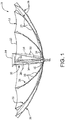
- the reflector antenna system 10 includes a primary reflector 12, a sub-reflector 14, and a feed 16.
- the primary reflector 12 comprises a centrally-located hub 24, a plurality of ribs 26 pivotally coupled to the hub 24, and an RF-reflective fabric 22.
- the fabric 22 can be formed from a foldable material that, when unfolded as shown in FIGs. 1 , 2 , and 5 , forms a surface that reflects RF energy.
- the ribs 26 provide structural support to the flexible fabric 22.
- Each rib 26 comprises multiple rib tubes 29 connected via common hinge points.
- the innermost rib tube 29 is connected to the hub 24 by way of an additional hinge point that, in conjunction with the common hinge points, permit the ribs 26, and the attached fabric 22, to be folded into a compact configuration as depicted in FIGs. 3 , 6 , and 7 , thereby facilitating storage of the reflector antenna system 10 within a relatively small volume.
- the fabric 22 can be unfolded into a deployed configuration as shown in Figs. 1 , 2 , 4 , and 5 .
- the ribs 26 form a rigid framework that causes the fabric 22 to assume a parabolic shape. Due to its parabolic shape and reflective characteristics, the fabric 22 reflects and focuses RF energy incident thereupon.
- the feed 16 is positioned at the center of the primary reflector 12, as can be seen in FIGs. 1 and 2 .
- the sub-reflector 14 is shaped for folded optics and is not limited to either hyperbolic or parabolic shapes.
- the sub-reflector 14 is positioned directly above the feed 16, from the perspective of FIGs. 1 and 2 , so that the convex side of the sub-reflector 14, in this example of a Cassegrain folded optic system, faces the feed 16.
- the primary reflector 12 When the reflector antenna system 10 is receiving RF energy from an external transmitting source, the primary reflector 12 receives the RF energy, and focuses and reflects the RF energy onto the sub-reflector 14. The sub-reflector 14 further focuses and reflects the RF energy onto the feed 16, which converts the RF energy into an electrical signal and transmits the signal to the transceiver of the satellite.
- the feed 16 converts an electrical signal from the transceiver into RF energy, and transmits the RF energy onto the sub-reflector 14.
- the sub-reflector 14 focuses and reflects the RF energy onto the primary reflector 12.
- the primary reflector 12 further focuses and reflects the RF energy toward an external receiving source.
- the reflector antenna system 10 further comprises a tension-stabilized sub-reflector positioning apparatus 30.
- the positioning apparatus 30 is configurable in a stowed configuration shown in Figs. 6 and 7 , and a deployed configuration shown in FIGs. 1 , 2 , 4 , and 5 .
- the positioning apparatus 30, when in its deployed configuration, supports the sub-reflector 14, and positions the sub-reflector 14 at a predetermined position in relation to the primary reflector 12.
- the positioning apparatus 30 comprises six restraints 32, and three tensioners in the form of tensioning members 34.
- the restraints 32 can be cables or cords capable of bearing tensile loads, and which collapse, i.e., buckle, in the absence of tensile loading.
- the tensioning members 34 are configured so that the tensioning members 34 resiliently deflect when the positioning apparatus 30 is in its deployed configuration.
- the resilient deflection of the tensioning members 34 places the restraints 32 in tension, which in turn maintains the sub-reflector 14 in a predetermined position in relation to the primary reflector 12 and the feed 16.
- the tensioning members 34 can further deflect as shown in FIGs. 3 , 6 , and 7 , so that the positioning apparatus 30 can assume its relatively compact stowed configuration in which the sub-reflector 14 is positioned proximate the feed 16.
- the upper ends of the restraints 32 and the tensioning members 34 are attached to the sub-reflector 14, proximate the outer edge of the sub-reflector 14.
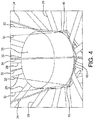
- the lower ends of the restraints 32 and the tensioning members 34 are attached to a bracket 40 of the system 10 as shown, for example, in FIG. 4 .
- the bracket 40 is securely attached to the hub 24.
- the lower ends of the restraints 32 and the tensioning members 34 therefore, are indirectly attached to the primary reflector 12, by way of the bracket 40.
- the term "attached,” as used herein and unless otherwise noted, is intended to encompass the direct attachment of two or more components to each other, as well as indirect attachment through one or more intermediate members.
- the lower ends of the restraints 32 and the tensioning members 34 can be attached directly to the ribs 26 in alternative embodiments.
- the lower ends of the restraints 32 and the tensioning members 34 can be attached directly to the dish.
- the respective upper and lower ends of the restraints 32 can be attached to the sub-reflector 14 and the bracket 40 using any suitable means, such as brackets, clips, anchors, adhesive, etc., that secures the restraints 32 to the sub-reflector 14 and the bracket 40, and permits little or no relative movement between the ends of the restraint 32 and the adjacent sub-reflector 14 or bracket 40 in the lengthwise direction of the restraint 32.
- the respective upper and lower ends of the tensioning members 34 can be attached to the sub-reflector 14 and the bracket 40, or alternate attachment locations, using a suitable means, such as ball joints, swivels, rotational end fittings, etc., that secures the tensioning members 34 to the sub-reflector 14 and the bracket 40, and permits little or no relative movement between the ends the tensioning members 34 and the adjacent sub-reflector 14 or bracket 40 in the lengthwise direction of the tensioning members 34; while permitting relative rotation between the tensioning members 34, and the sub-reflector 14 and bracket 40, i.e., the attachment means allows the tensioning members 34 to twist in relation to the sub-reflector 14 and the bracket 40.
- a suitable means such as ball joints, swivels, rotational end fittings, etc.
- the restraints 32 are arranged in the form of a hexapod.
- the upper end of each restraint 32 is attached the sub-reflector 14 at a common point with one of its adjacent, i.e., neighboring, restraints 32, as can be seen in FIG. 1 .
- the lower end of the restraint 32 is attached to the bracket 40 at a common point with its other adjacent restraint 32, as can be seen FIGs. 1 and 4 .
- each restraint 32 meets one of its neighboring restraints 32 at its upper end, and meets its other neighboring restraint 32 at its lower end.
- This arrangement results in a total of three attachment points between the restraints 32 and the sub-reflector 14, and three attachment points between the restraints 32 and the bracket 40.
- the attachment points for the neighboring restraints 32 can be at proximate, as opposed to common, locations on the sub-reflector 14 and the bracket 40 in alternative embodiments.
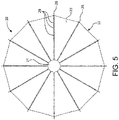
- the three attachment points between the restraints 32 and the sub-reflector 14 are angularly spaced around the periphery of the sub-reflector 14 by approximately 120 degrees, from the perspective of FIG. 5 .
- the three attachment points between the restraints 32 and the bracket 40 likewise are angularly spaced around the periphery of the bracket 40 by approximately 120 degrees.
- the attachment points on the sub-reflector 14 are angularly offset from the attachment points on the bracket 40 by approximately 60 degrees, as viewed from the perspective of FIG. 5 .
- Each of the tensioning members 34 is associated with two of the restraints 32, as can be seen in FIGs. 1 , 2 , and 4 .
- a first, or upper end of each of the tensioning members 34 is attached to the sub-reflector 14 proximate the common attachment point for the two restraints 32 associated with that particular tensioning member 34.
- the attachment point between the second, or lower end of each tensioning member 34 and the bracket 40 is at the same angular or clock position, from the perspective of FIG. 5 , as the attachment point of the upper end of the tensioning member 34. Due to this arrangement, the attachment point of the lower end of the tensioning member 34 to the bracket 40 is approximately equidistant from the attachment points between its associated restraints 32 and the bracket 40.
- the tensioning members 34 are configured to resiliently deflect when the positioning apparatus 30 is in its deployed position, and the resilient deflection of the tensioning members 34 places the restraints 32 in tension.
- the length of the restraints 32 is selected so that the sub-reflector 14 is located at a desired position in relation to the primary reflector 12 and the feed 16 when the restraints 32 are fully extended as depicted in FIGs. 1 , 2 , and 4 .
- the length of the tensioning members 34 is selected so that the tensioning members 34 cannot fully extend, and thus remain partially deflected, when the restraints 32 are fully extended.
- the resilience of the tensioning members 34 causes the tensioning members 34 to generate a spring force when deflected in this manner, which in turn causes the tensioning members 34 to exert an upwardly-directed reactive force on the sub-reflector 14, This force is transmitted to the restraints 32 by way of the rigid sub-reflector 14, and urges the restraints 32 upward so as to maintain tension in the restraints 32. Because the tension in the restraints 32 causes each restraint 32 to extend to its maximum length, and the restraints 32 restrain the sub-reflector 14 at three locations on the sub-reflector 14, the tensioned restraints 32 maintain, or stabilize, the sub-reflector 14 in a precise, pre-determined position in relation to the primary reflector 12 and the feed 16.
- the requisite or desired tension in the restraints 32 is application dependent, and can vary with factors such as the allowable or desired degree of relative movement between the sub-reflector 14 and the primary reflector 12 and feed 16; the magnitude of any external forces, e.g., maneuvering loads or gravitational forces, to which the sub-reflector 14 will be subjected when deployed; the mechanical properties, e.g., modulus of elasticity and coefficient of thermal expansion, of the material from which the restraints 32 are formed; the range of temperatures to which the restraints 32 will be exposed, etc.
- the restraints 32 and the tensioning members 34 each have a substantially circular cross section.
- the restraints 32 and the tensioning members 34 can have other types of cross sections in the alternative.
- the restraints 32 can be formed from a material that is relatively stiff, i.e., having a relatively high modulus of elasticity; and that has a relatively low coefficient of thermal expansion. These characteristics can help minimize the deflection, or change in length, of the restraints 32 in response to the mechanical loads on the restraint 32, and changes in temperature. Minimizing the change in length of the restraints 32 allows the positioning apparatus 30 to maintain the sub-reflector 14 at a precise location in relation to the primary reflector 12 and the feed 16 on a consistent and repeatable basis. Also, the material needs to have sufficient flexibility to permit the restraints 32 to easily bend, fold, and collapse when not under tension, to facilitate movement of the positioning apparatus 30 between its deployed and stowed configurations.
- the restraints 32 can be formed, for example, from quartz, graphite, or Kevlar®. Other types of materials can be use in the alternative, based on considerations such as the temperature range and mechanical loading to which the restraints 32 will be subjected; the degree of precision with which the sub-reflector 14 needs to positioned; cost; etc.
- the tensioning members 34 can be formed from any suitable material that provides the tensioning members 34 with the ability to resiliently deflect or bend, as shown in Figs. 3 , 6 , and 7 , when subjected to a lateral bending load or compressive loading along its lengthwise axis.
- the tensioning members 32 can be formed from fiberglass, graphite, or carbon fiber. The requisite or desired degree of tension in the restraints 32 can be achieved by selecting an appropriate combination of material type, length, and cross-sectional area for the tensioning members 34.
- the restraints 32 have sufficient flexibility to permit the restraints 32 to fold, bend, and collapse when the restraints 32 are not under tension.
- the ability of the restraints 32 to fold, bend, and collapse permits the restraints 32 to assume a relatively compact footprint that facilitates storage between the sub-reflector 14 and the primary reflector 12, when the sub-reflector 14 is in its stowed positon proximate the primary reflector 12.
- tensioning members 34 prevents them from collapsing in a manner similar to the restraints 32 when the positioning apparatus 30 is in its stowed configuration. Instead, the tensioning members 34 are bent as shown in FIGs. 6 and 7 , so that the tensioning members 34 assume a spiral configuration centered about the feed 16. This feature permits the sub-reflector 14 to be lowered in relation to the primary reflector 12 and the feed 16, without bending the tensioning members 34 to an extent sufficient to cause permanent deformation or breakage of the tensioning members 34.
- the resilience of the tensioning members 34 causes the tensioning members 34 to exert an upwardly-acting spring force on the sub-reflector 14 when the positioning apparatus 30 is in its stowed configuration.
- the sub-reflector 14, or the tensioning members 34 themselves can be restrained from upward movement by a suitable means (not shown) such as latches, cables, ties, retractable or foldable arms, etc., to maintain the sub-reflector 14 in its stowed position.
- the antenna system 10 has a relatively compact configuration when the primary reflector 12 and sub-reflector 14 are in their stowed positions, as shown in FIGs. 6 and 7 .
- the antenna system 10 can be configured in this manner during launch of the satellite on which the system 10 is installed.
- the primary reflector 12 and the sub-reflector 14 can be moved to their deployed positions when the satellite has been inserted into orbit and is otherwise ready to begin normal operations.
- the primary reflector 12 can be configured in its deployed position using a mechanism (not shown) that moves the ribs 26 to the unfolded state, which in turn unfolds the fabric 22 and causes the fabric 22 to assume its parabolic shape, as shown in FIGs. 1 , 2 , and 5 .
- the primary reflector 12 can be deployed before, during, or after the sub-reflector 14 is moved to its deployed position.
- the sub-reflector 14 can be deployed by removing the restraining means that prevents the tensioning members 34 from moving to their deployed positions. Upon removal of the restraining means, the resilience of the highly-deflected tensioning members 34 causes the tensioning members 34 to move toward their less deflected, deployed position shown FIGs. 1 , 2 , and 4 . This movement of the tensioning members 34 draws the restraints 32 from their collapsed state, and into tension.
- known cord-management techniques can be applied to the restraints 32 in alternative embodiments, to help minimize the potential for the restraints 32 to tangle as they deploy.
- the above-noted ability of the tensioning members 34 to rotate in relation to the primary reflector 12 and the sub-reflector 14 permits the tensioning members 34 to move from the highly-deflected spiral arrangement shown in FIGs. 6 and 7 to their less-deflected deployed orientation shown in FIGs. 1 , 2 , and 4 , without subjecting the tensioning members 34 to excessive torsional loading.
- the positioning apparatus 30 include a rotary damper 50 or other suitable means for slowing the movement of the sub-reflector 14 as it moves away from the primary reflector 12 in response to the force exerted by the tensioning members 34.
- the damper 50 is mounted on the sub-reflector 14 as depicted in FIG. 3 , and is connected to the primary reflector 12 by a restraint cord 52 that unwinds from the damper 50 as the sub-reflector 14 moves away from the primary reflector 12.
- the damper 50 dampens the speed at which the restraining cord 52 unwinds, thereby slowing the movement of the sub-reflector 14 toward its deployed position.
- Alternative embodiments can be configured without the damper 50.
- the tensioning members 34 are inhibited from further movement toward their un-deflected state, and remain partially deflected as shown in Fig. 1 .
- the resilience of the partially-deflected tensioning members 34 maintains tension in the restraints 32, and the tensioned restraints 32 maintain the sub-reflector 14 in a desired, stabilized position in relation to the primary reflector 12 and the feed 16.
- the configuration of the restraints 32 in a hexapod arrangement is described for exemplary purposes only.
- the restraints 32 can be configured in other arrangements that result in three or more points of restraint on the sub-reflector 14, including but not limited to arrangements in which the points of restraint are not equally spaced around the periphery of the sub-reflector 14, or in which some or all the points of restraint are located radially inward of the periphery of the sub-reflector 14.
- alternative embodiments can use less, or more than three tensioning members 34; and tensioners other than elongated, resilient members such as the tensioning members 34.
- alternative embodiments can include a single tensioning member 34a as depicted in FIG. 8 .
- the tensioning member 34a adjoins a first end of a curvilinear support arm 60.
- a second, freestanding end of the support arm 60 is positioned over the center of the sub-reflector 14.
- the support arm 60 is connected to the sub-reflector 14 by way of a connecting member 62.
- the support arm 60 can be connected directly to the sub-reflector 14 in alternative embodiments.
- the tensioning member 34a and the support arm 60 pull the sub-reflector 14 away from the primary reflector 12 with a net force that causes tension in the restraints 32.
- the support arm 60 can be rigid.
- the support arm 60 can be flexible, so that the support arm 60 resiliently deflects and thereby generates a spring force that supplements the force resulting from the resilient deflection of the tensioning member 34a.
- the positioning apparatus 30 can be used in applications where stowage within a limited volume is not required. In such applications, the restraints 32, the tensioning members 34, and other components of the system 10 do not need to be configured to facilitate reconfiguration of the positioning apparatus 30 between stowed and deployed positions.
- the positioning apparatus 30 is relatively low cost, compact, and lightweight, and does not require motors, linkages, or other devices to deploy, making the use of the positioning apparatus 30 particularly advantageous, for example, in miniaturized satellites and spacecraft such as CubeSat satellites and ESPA-class spacecraft. Also, the relatively small restraints 32 and tensioning members 34 produce minimal blockage of the RF energy being received and transmitted by the reflector antenna system 10, resulting in minimal, or no significant impairment of the transmissions to and from the antenna system 10.
- the positioning apparatus 30, and alternative embodiments thereof are not limited to use with reflector antenna systems, and can be applied to other types of devices requiring precise relative positioning of two or more components spaced apart by a predetermined distance.
- FIG. 9 shows the positioning apparatus 30 being applied to position two objects 66 other than a primary reflector and a sub-reflector of a reflector antenna.
- FIG. 10 depicts the tensioning member 34a and support arm 60 being applied to position the objects 66.
Landscapes
- Physics & Mathematics (AREA)
- Electromagnetism (AREA)
- Aerials With Secondary Devices (AREA)
Applications Claiming Priority (1)
| Application Number | Priority Date | Filing Date | Title |
|---|---|---|---|
| US16/037,954 US10601142B2 (en) | 2018-07-17 | 2018-07-17 | Reflecting systems, such as reflector antenna systems, with tension-stabilized reflector positioning apparatus |
Publications (2)
| Publication Number | Publication Date |
|---|---|
| EP3598576A1 true EP3598576A1 (fr) | 2020-01-22 |
| EP3598576B1 EP3598576B1 (fr) | 2021-03-31 |
Family
ID=67145676
Family Applications (1)
| Application Number | Title | Priority Date | Filing Date |
|---|---|---|---|
| EP19184066.9A Active EP3598576B1 (fr) | 2018-07-17 | 2019-07-03 | Systèmes de réflexion, tels que des systèmes d'antenne à réflecteur, comportant un appareil de position de réflecteur à tension stabilisée |
Country Status (2)
| Country | Link |
|---|---|
| US (1) | US10601142B2 (fr) |
| EP (1) | EP3598576B1 (fr) |
Cited By (1)
| Publication number | Priority date | Publication date | Assignee | Title |
|---|---|---|---|---|
| CN113764899A (zh) * | 2021-08-04 | 2021-12-07 | 同济大学 | 一种肋网式可展开天线的网面安装方法 |
Families Citing this family (6)
| Publication number | Priority date | Publication date | Assignee | Title |
|---|---|---|---|---|
| US10811759B2 (en) * | 2018-11-13 | 2020-10-20 | Eagle Technology, Llc | Mesh antenna reflector with deployable perimeter |
| USD904359S1 (en) * | 2019-03-19 | 2020-12-08 | Telefrontier Co., Ltd. | Dual reflector antenna |
| IL291576B2 (en) * | 2019-09-24 | 2024-10-01 | Airbus Defence & Space Sa | Deployable assembly for antennas |
| CN113206359B (zh) * | 2021-03-27 | 2022-04-05 | 西安电子科技大学 | 一种与波导馈源同轴连接的中心轮毂及应用 |
| EP4507966A4 (fr) * | 2022-04-12 | 2025-08-13 | Ascendarc Inc | Satellite conçu pour être empilé et lancé en groupes |
| US12548915B2 (en) * | 2023-03-17 | 2026-02-10 | United States Of America As Represented By The Administrator Of Nasa | Deployable antenna reflector |
Citations (4)
| Publication number | Priority date | Publication date | Assignee | Title |
|---|---|---|---|---|
| US3913109A (en) * | 1974-12-02 | 1975-10-14 | Us Navy | Antenna erection mechanism |
| US20070200789A1 (en) * | 2006-02-28 | 2007-08-30 | The Boeing Company | Arbitrarily shaped deployable mesh reflectors |
| US9608333B1 (en) * | 2015-12-07 | 2017-03-28 | Harris Corporation | Scalable high compaction ratio mesh hoop column deployable reflector system |
| US20180048059A1 (en) * | 2015-03-09 | 2018-02-15 | Tentguild Eng. Co. | Tension Structure For The Spatial Positioning Of Functional Elements |
Family Cites Families (18)
| Publication number | Priority date | Publication date | Assignee | Title |
|---|---|---|---|---|
| US3120831A (en) | 1960-10-07 | 1964-02-11 | Samuel K Fulton | Mooring whip |
| US3553731A (en) * | 1967-05-15 | 1971-01-05 | Rca Corp | Antenna comprising restraining means for resilient support members |
| US3739538A (en) | 1970-04-29 | 1973-06-19 | Hughes Aircraft Co | Non-rotatably extendible mast |
| US3836979A (en) | 1973-12-14 | 1974-09-17 | Trw Inc | Lightweight deployable helical antenna |
| US3981500A (en) | 1974-10-17 | 1976-09-21 | Ryan Vernon L | Adjustable support apparatus |
| US4527166A (en) | 1981-03-26 | 1985-07-02 | Luly Robert A | Lightweight folding parabolic reflector and antenna system |
| US4683475A (en) | 1981-07-02 | 1987-07-28 | Luly Robert A | Folding dish reflector |
| US4771293A (en) | 1984-11-07 | 1988-09-13 | The General Electric Company P.L.C. | Dual reflector folding antenna |
| US5150556A (en) | 1989-10-06 | 1992-09-29 | Shimizu Construction Co. | Chord truss roof structure |
| EP0507440A1 (fr) | 1991-02-25 | 1992-10-07 | Gerald Alexander Bayne | Antenne |
| US5531567A (en) | 1994-06-20 | 1996-07-02 | Flowind Corporation | Vertical axis wind turbine with blade tensioner |
| US5485168A (en) | 1994-12-21 | 1996-01-16 | Electrospace Systems, Inc. | Multiband satellite communication antenna system with retractable subreflector |
| US5721558A (en) | 1996-05-03 | 1998-02-24 | Cta Space Systems, Inc. | Deployable helical antenna |
| US6366252B1 (en) | 2000-07-24 | 2002-04-02 | Neil D. Terk | Method and apparatus for mounting an auxiliary antenna to a reflector antenna |
| US6366255B1 (en) | 2000-09-15 | 2002-04-02 | Space Systems/Loral, Inc. | Main reflector and subreflector deployment and storage systems |
| US6904722B2 (en) | 2001-02-21 | 2005-06-14 | The United States Of America As Represented By The Secretary Of The Navy | Elongated truss boom structures for space applications |
| WO2005057620A2 (fr) | 2003-12-04 | 2005-06-23 | Essig John Raymond Jr | Appareil modulaire, gonflable, multifonction et pouvant etre deploye sur le terrain et procedes de fabrication |
| US8816187B1 (en) | 2011-04-18 | 2014-08-26 | The Boeing Company | Stowing or deploying a solar array |
-
2018
- 2018-07-17 US US16/037,954 patent/US10601142B2/en active Active
-
2019
- 2019-07-03 EP EP19184066.9A patent/EP3598576B1/fr active Active
Patent Citations (4)
| Publication number | Priority date | Publication date | Assignee | Title |
|---|---|---|---|---|
| US3913109A (en) * | 1974-12-02 | 1975-10-14 | Us Navy | Antenna erection mechanism |
| US20070200789A1 (en) * | 2006-02-28 | 2007-08-30 | The Boeing Company | Arbitrarily shaped deployable mesh reflectors |
| US20180048059A1 (en) * | 2015-03-09 | 2018-02-15 | Tentguild Eng. Co. | Tension Structure For The Spatial Positioning Of Functional Elements |
| US9608333B1 (en) * | 2015-12-07 | 2017-03-28 | Harris Corporation | Scalable high compaction ratio mesh hoop column deployable reflector system |
Cited By (1)
| Publication number | Priority date | Publication date | Assignee | Title |
|---|---|---|---|---|
| CN113764899A (zh) * | 2021-08-04 | 2021-12-07 | 同济大学 | 一种肋网式可展开天线的网面安装方法 |
Also Published As
| Publication number | Publication date |
|---|---|
| US10601142B2 (en) | 2020-03-24 |
| EP3598576B1 (fr) | 2021-03-31 |
| US20200028274A1 (en) | 2020-01-23 |
Similar Documents
| Publication | Publication Date | Title |
|---|---|---|
| US10601142B2 (en) | Reflecting systems, such as reflector antenna systems, with tension-stabilized reflector positioning apparatus | |
| US9755318B2 (en) | Mesh reflector with truss structure | |
| EP3654452B1 (fr) | Réflecteur d'antenne à maillage à périmètre déployable | |
| US7009578B2 (en) | Deployable antenna with foldable resilient members | |
| EP3111508B1 (fr) | Réflecteur à mailles dotée d'une structure en treillis | |
| US9496621B2 (en) | Large deployable reflector for a satellite antenna | |
| US10847893B2 (en) | Articulated folding rib reflector for concentrating radiation | |
| KR101759620B1 (ko) | 인공위성에 탑재되는 안테나 | |
| US3360798A (en) | Collapsible reflector | |
| EP2482378A1 (fr) | Antenne déployable | |
| WO2014127813A1 (fr) | Structure de support déployable | |
| US6229501B1 (en) | Reflector and reflector element for antennas for use in outer space and a method for deploying the reflectors | |
| CN114503361B (zh) | 天线可展开组件 | |
| KR101754234B1 (ko) | 인공위성에 탑재되는 안테나 | |
| JP2008187650A (ja) | 展開型アンテナ | |
| EP3923412B1 (fr) | Systèmes et procédés permettant de fournir des antennes ayant des positions décalés couplés mécaniquement | |
| EP3700010B1 (fr) | Réflecteurs déployables | |
| RU2795105C1 (ru) | Развертываемый узел для антенн | |
| JPH0317405B2 (fr) |
Legal Events
| Date | Code | Title | Description |
|---|---|---|---|
| PUAI | Public reference made under article 153(3) epc to a published international application that has entered the european phase |
Free format text: ORIGINAL CODE: 0009012 |
|
| STAA | Information on the status of an ep patent application or granted ep patent |
Free format text: STATUS: REQUEST FOR EXAMINATION WAS MADE |
|
| 17P | Request for examination filed |
Effective date: 20190703 |
|
| AK | Designated contracting states |
Kind code of ref document: A1 Designated state(s): AL AT BE BG CH CY CZ DE DK EE ES FI FR GB GR HR HU IE IS IT LI LT LU LV MC MK MT NL NO PL PT RO RS SE SI SK SM TR |
|
| AX | Request for extension of the european patent |
Extension state: BA ME |
|
| GRAP | Despatch of communication of intention to grant a patent |
Free format text: ORIGINAL CODE: EPIDOSNIGR1 |
|
| STAA | Information on the status of an ep patent application or granted ep patent |
Free format text: STATUS: GRANT OF PATENT IS INTENDED |
|
| RIC1 | Information provided on ipc code assigned before grant |
Ipc: H01Q 1/28 20060101ALN20201021BHEP Ipc: H01Q 15/16 20060101AFI20201021BHEP Ipc: H01Q 19/13 20060101ALI20201021BHEP |
|
| INTG | Intention to grant announced |
Effective date: 20201109 |
|
| GRAS | Grant fee paid |
Free format text: ORIGINAL CODE: EPIDOSNIGR3 |
|
| GRAA | (expected) grant |
Free format text: ORIGINAL CODE: 0009210 |
|
| STAA | Information on the status of an ep patent application or granted ep patent |
Free format text: STATUS: THE PATENT HAS BEEN GRANTED |
|
| AK | Designated contracting states |
Kind code of ref document: B1 Designated state(s): AL AT BE BG CH CY CZ DE DK EE ES FI FR GB GR HR HU IE IS IT LI LT LU LV MC MK MT NL NO PL PT RO RS SE SI SK SM TR |
|
| REG | Reference to a national code |
Ref country code: GB Ref legal event code: FG4D Ref country code: CH Ref legal event code: EP |
|
| REG | Reference to a national code |
Ref country code: AT Ref legal event code: REF Ref document number: 1377984 Country of ref document: AT Kind code of ref document: T Effective date: 20210415 |
|
| REG | Reference to a national code |
Ref country code: DE Ref legal event code: R096 Ref document number: 602019003563 Country of ref document: DE |
|
| REG | Reference to a national code |
Ref country code: IE Ref legal event code: FG4D |
|
| REG | Reference to a national code |
Ref country code: LT Ref legal event code: MG9D |
|
| PG25 | Lapsed in a contracting state [announced via postgrant information from national office to epo] |
Ref country code: NO Free format text: LAPSE BECAUSE OF FAILURE TO SUBMIT A TRANSLATION OF THE DESCRIPTION OR TO PAY THE FEE WITHIN THE PRESCRIBED TIME-LIMIT Effective date: 20210630 Ref country code: FI Free format text: LAPSE BECAUSE OF FAILURE TO SUBMIT A TRANSLATION OF THE DESCRIPTION OR TO PAY THE FEE WITHIN THE PRESCRIBED TIME-LIMIT Effective date: 20210331 Ref country code: HR Free format text: LAPSE BECAUSE OF FAILURE TO SUBMIT A TRANSLATION OF THE DESCRIPTION OR TO PAY THE FEE WITHIN THE PRESCRIBED TIME-LIMIT Effective date: 20210331 Ref country code: BG Free format text: LAPSE BECAUSE OF FAILURE TO SUBMIT A TRANSLATION OF THE DESCRIPTION OR TO PAY THE FEE WITHIN THE PRESCRIBED TIME-LIMIT Effective date: 20210630 |
|
| PG25 | Lapsed in a contracting state [announced via postgrant information from national office to epo] |
Ref country code: LV Free format text: LAPSE BECAUSE OF FAILURE TO SUBMIT A TRANSLATION OF THE DESCRIPTION OR TO PAY THE FEE WITHIN THE PRESCRIBED TIME-LIMIT Effective date: 20210331 Ref country code: RS Free format text: LAPSE BECAUSE OF FAILURE TO SUBMIT A TRANSLATION OF THE DESCRIPTION OR TO PAY THE FEE WITHIN THE PRESCRIBED TIME-LIMIT Effective date: 20210331 Ref country code: SE Free format text: LAPSE BECAUSE OF FAILURE TO SUBMIT A TRANSLATION OF THE DESCRIPTION OR TO PAY THE FEE WITHIN THE PRESCRIBED TIME-LIMIT Effective date: 20210331 |
|
| REG | Reference to a national code |
Ref country code: NL Ref legal event code: MP Effective date: 20210331 |
|
| REG | Reference to a national code |
Ref country code: AT Ref legal event code: MK05 Ref document number: 1377984 Country of ref document: AT Kind code of ref document: T Effective date: 20210331 |
|
| PG25 | Lapsed in a contracting state [announced via postgrant information from national office to epo] |
Ref country code: AT Free format text: LAPSE BECAUSE OF FAILURE TO SUBMIT A TRANSLATION OF THE DESCRIPTION OR TO PAY THE FEE WITHIN THE PRESCRIBED TIME-LIMIT Effective date: 20210331 Ref country code: NL Free format text: LAPSE BECAUSE OF FAILURE TO SUBMIT A TRANSLATION OF THE DESCRIPTION OR TO PAY THE FEE WITHIN THE PRESCRIBED TIME-LIMIT Effective date: 20210331 Ref country code: SM Free format text: LAPSE BECAUSE OF FAILURE TO SUBMIT A TRANSLATION OF THE DESCRIPTION OR TO PAY THE FEE WITHIN THE PRESCRIBED TIME-LIMIT Effective date: 20210331 Ref country code: LT Free format text: LAPSE BECAUSE OF FAILURE TO SUBMIT A TRANSLATION OF THE DESCRIPTION OR TO PAY THE FEE WITHIN THE PRESCRIBED TIME-LIMIT Effective date: 20210331 Ref country code: CZ Free format text: LAPSE BECAUSE OF FAILURE TO SUBMIT A TRANSLATION OF THE DESCRIPTION OR TO PAY THE FEE WITHIN THE PRESCRIBED TIME-LIMIT Effective date: 20210331 Ref country code: EE Free format text: LAPSE BECAUSE OF FAILURE TO SUBMIT A TRANSLATION OF THE DESCRIPTION OR TO PAY THE FEE WITHIN THE PRESCRIBED TIME-LIMIT Effective date: 20210331 |
|
| PG25 | Lapsed in a contracting state [announced via postgrant information from national office to epo] |
Ref country code: SK Free format text: LAPSE BECAUSE OF FAILURE TO SUBMIT A TRANSLATION OF THE DESCRIPTION OR TO PAY THE FEE WITHIN THE PRESCRIBED TIME-LIMIT Effective date: 20210331 Ref country code: PT Free format text: LAPSE BECAUSE OF FAILURE TO SUBMIT A TRANSLATION OF THE DESCRIPTION OR TO PAY THE FEE WITHIN THE PRESCRIBED TIME-LIMIT Effective date: 20210802 Ref country code: RO Free format text: LAPSE BECAUSE OF FAILURE TO SUBMIT A TRANSLATION OF THE DESCRIPTION OR TO PAY THE FEE WITHIN THE PRESCRIBED TIME-LIMIT Effective date: 20210331 Ref country code: PL Free format text: LAPSE BECAUSE OF FAILURE TO SUBMIT A TRANSLATION OF THE DESCRIPTION OR TO PAY THE FEE WITHIN THE PRESCRIBED TIME-LIMIT Effective date: 20210331 Ref country code: IS Free format text: LAPSE BECAUSE OF FAILURE TO SUBMIT A TRANSLATION OF THE DESCRIPTION OR TO PAY THE FEE WITHIN THE PRESCRIBED TIME-LIMIT Effective date: 20210731 |
|
| REG | Reference to a national code |
Ref country code: DE Ref legal event code: R097 Ref document number: 602019003563 Country of ref document: DE |
|
| PG25 | Lapsed in a contracting state [announced via postgrant information from national office to epo] |
Ref country code: DK Free format text: LAPSE BECAUSE OF FAILURE TO SUBMIT A TRANSLATION OF THE DESCRIPTION OR TO PAY THE FEE WITHIN THE PRESCRIBED TIME-LIMIT Effective date: 20210331 Ref country code: AL Free format text: LAPSE BECAUSE OF FAILURE TO SUBMIT A TRANSLATION OF THE DESCRIPTION OR TO PAY THE FEE WITHIN THE PRESCRIBED TIME-LIMIT Effective date: 20210331 Ref country code: ES Free format text: LAPSE BECAUSE OF FAILURE TO SUBMIT A TRANSLATION OF THE DESCRIPTION OR TO PAY THE FEE WITHIN THE PRESCRIBED TIME-LIMIT Effective date: 20210331 |
|
| PLBE | No opposition filed within time limit |
Free format text: ORIGINAL CODE: 0009261 |
|
| STAA | Information on the status of an ep patent application or granted ep patent |
Free format text: STATUS: NO OPPOSITION FILED WITHIN TIME LIMIT |
|
| 26N | No opposition filed |
Effective date: 20220104 |
|
| PG25 | Lapsed in a contracting state [announced via postgrant information from national office to epo] |
Ref country code: MC Free format text: LAPSE BECAUSE OF FAILURE TO SUBMIT A TRANSLATION OF THE DESCRIPTION OR TO PAY THE FEE WITHIN THE PRESCRIBED TIME-LIMIT Effective date: 20210331 |
|
| REG | Reference to a national code |
Ref country code: BE Ref legal event code: MM Effective date: 20210731 |
|
| PG25 | Lapsed in a contracting state [announced via postgrant information from national office to epo] |
Ref country code: IS Free format text: LAPSE BECAUSE OF FAILURE TO SUBMIT A TRANSLATION OF THE DESCRIPTION OR TO PAY THE FEE WITHIN THE PRESCRIBED TIME-LIMIT Effective date: 20210731 Ref country code: LU Free format text: LAPSE BECAUSE OF NON-PAYMENT OF DUE FEES Effective date: 20210703 Ref country code: FR Free format text: LAPSE BECAUSE OF NON-PAYMENT OF DUE FEES Effective date: 20210731 |
|
| PG25 | Lapsed in a contracting state [announced via postgrant information from national office to epo] |
Ref country code: IT Free format text: LAPSE BECAUSE OF FAILURE TO SUBMIT A TRANSLATION OF THE DESCRIPTION OR TO PAY THE FEE WITHIN THE PRESCRIBED TIME-LIMIT Effective date: 20210331 Ref country code: IE Free format text: LAPSE BECAUSE OF NON-PAYMENT OF DUE FEES Effective date: 20210703 Ref country code: BE Free format text: LAPSE BECAUSE OF NON-PAYMENT OF DUE FEES Effective date: 20210731 |
|
| REG | Reference to a national code |
Ref country code: CH Ref legal event code: PL |
|
| PG25 | Lapsed in a contracting state [announced via postgrant information from national office to epo] |
Ref country code: LI Free format text: LAPSE BECAUSE OF NON-PAYMENT OF DUE FEES Effective date: 20220731 Ref country code: CH Free format text: LAPSE BECAUSE OF NON-PAYMENT OF DUE FEES Effective date: 20220731 |
|
| P01 | Opt-out of the competence of the unified patent court (upc) registered |
Effective date: 20230515 |
|
| PG25 | Lapsed in a contracting state [announced via postgrant information from national office to epo] |
Ref country code: CY Free format text: LAPSE BECAUSE OF FAILURE TO SUBMIT A TRANSLATION OF THE DESCRIPTION OR TO PAY THE FEE WITHIN THE PRESCRIBED TIME-LIMIT Effective date: 20210331 |
|
| PG25 | Lapsed in a contracting state [announced via postgrant information from national office to epo] |
Ref country code: HU Free format text: LAPSE BECAUSE OF FAILURE TO SUBMIT A TRANSLATION OF THE DESCRIPTION OR TO PAY THE FEE WITHIN THE PRESCRIBED TIME-LIMIT; INVALID AB INITIO Effective date: 20190703 Ref country code: GR Free format text: LAPSE BECAUSE OF FAILURE TO SUBMIT A TRANSLATION OF THE DESCRIPTION OR TO PAY THE FEE WITHIN THE PRESCRIBED TIME-LIMIT Effective date: 20210331 |
|
| PG25 | Lapsed in a contracting state [announced via postgrant information from national office to epo] |
Ref country code: MK Free format text: LAPSE BECAUSE OF FAILURE TO SUBMIT A TRANSLATION OF THE DESCRIPTION OR TO PAY THE FEE WITHIN THE PRESCRIBED TIME-LIMIT Effective date: 20210331 |
|
| PG25 | Lapsed in a contracting state [announced via postgrant information from national office to epo] |
Ref country code: MT Free format text: LAPSE BECAUSE OF FAILURE TO SUBMIT A TRANSLATION OF THE DESCRIPTION OR TO PAY THE FEE WITHIN THE PRESCRIBED TIME-LIMIT Effective date: 20210331 |
|
| PGFP | Annual fee paid to national office [announced via postgrant information from national office to epo] |
Ref country code: DE Payment date: 20250729 Year of fee payment: 7 |
|
| PGFP | Annual fee paid to national office [announced via postgrant information from national office to epo] |
Ref country code: GB Payment date: 20250728 Year of fee payment: 7 |
|
| PG25 | Lapsed in a contracting state [announced via postgrant information from national office to epo] |
Ref country code: TR Free format text: LAPSE BECAUSE OF FAILURE TO SUBMIT A TRANSLATION OF THE DESCRIPTION OR TO PAY THE FEE WITHIN THE PRESCRIBED TIME-LIMIT Effective date: 20210331 |