EP3618466B1 - Génération de flux audio binaural extensible - Google Patents
Génération de flux audio binaural extensible Download PDFInfo
- Publication number
- EP3618466B1 EP3618466B1 EP19194288.7A EP19194288A EP3618466B1 EP 3618466 B1 EP3618466 B1 EP 3618466B1 EP 19194288 A EP19194288 A EP 19194288A EP 3618466 B1 EP3618466 B1 EP 3618466B1
- Authority
- EP
- European Patent Office
- Prior art keywords
- filtering
- virtual
- filters
- audio stream
- audio
- Prior art date
- Legal status (The legal status is an assumption and is not a legal conclusion. Google has not performed a legal analysis and makes no representation as to the accuracy of the status listed.)
- Active
Links
Images




Classifications
-
- H—ELECTRICITY
- H04—ELECTRIC COMMUNICATION TECHNIQUE
- H04S—STEREOPHONIC SYSTEMS
- H04S7/00—Indicating arrangements; Control arrangements, e.g. balance control
- H04S7/30—Control circuits for electronic adaptation of the sound field
- H04S7/302—Electronic adaptation of stereophonic sound system to listener position or orientation
- H04S7/303—Tracking of listener position or orientation
- H04S7/304—For headphones
-
- H—ELECTRICITY
- H04—ELECTRIC COMMUNICATION TECHNIQUE
- H04S—STEREOPHONIC SYSTEMS
- H04S7/00—Indicating arrangements; Control arrangements, e.g. balance control
- H04S7/30—Control circuits for electronic adaptation of the sound field
- H04S7/302—Electronic adaptation of stereophonic sound system to listener position or orientation
-
- H—ELECTRICITY
- H04—ELECTRIC COMMUNICATION TECHNIQUE
- H04R—LOUDSPEAKERS, MICROPHONES, GRAMOPHONE PICK-UPS OR LIKE ACOUSTIC ELECTROMECHANICAL TRANSDUCERS; ELECTRIC HEARING AIDS; PUBLIC ADDRESS SYSTEMS
- H04R3/00—Circuits for transducers
- H04R3/04—Circuits for transducers for correcting frequency response
-
- H—ELECTRICITY
- H04—ELECTRIC COMMUNICATION TECHNIQUE
- H04R—LOUDSPEAKERS, MICROPHONES, GRAMOPHONE PICK-UPS OR LIKE ACOUSTIC ELECTROMECHANICAL TRANSDUCERS; ELECTRIC HEARING AIDS; PUBLIC ADDRESS SYSTEMS
- H04R5/00—Stereophonic arrangements
- H04R5/033—Headphones for stereophonic communication
-
- H—ELECTRICITY
- H04—ELECTRIC COMMUNICATION TECHNIQUE
- H04R—LOUDSPEAKERS, MICROPHONES, GRAMOPHONE PICK-UPS OR LIKE ACOUSTIC ELECTROMECHANICAL TRANSDUCERS; ELECTRIC HEARING AIDS; PUBLIC ADDRESS SYSTEMS
- H04R5/00—Stereophonic arrangements
- H04R5/04—Circuit arrangements, e.g. for selective connection of amplifier inputs/outputs to loudspeakers, for loudspeaker detection, or for adaptation of settings to personal preferences or hearing impairments
-
- H—ELECTRICITY
- H04—ELECTRIC COMMUNICATION TECHNIQUE
- H04S—STEREOPHONIC SYSTEMS
- H04S2400/00—Details of stereophonic systems covered by H04S but not provided for in its groups
- H04S2400/11—Positioning of individual sound objects, e.g. moving airplane, within a sound field
-
- H—ELECTRICITY
- H04—ELECTRIC COMMUNICATION TECHNIQUE
- H04S—STEREOPHONIC SYSTEMS
- H04S2400/00—Details of stereophonic systems covered by H04S but not provided for in its groups
- H04S2400/13—Aspects of volume control, not necessarily automatic, in stereophonic sound systems
-
- H—ELECTRICITY
- H04—ELECTRIC COMMUNICATION TECHNIQUE
- H04S—STEREOPHONIC SYSTEMS
- H04S2420/00—Techniques used stereophonic systems covered by H04S but not provided for in its groups
- H04S2420/01—Enhancing the perception of the sound image or of the spatial distribution using head related transfer functions [HRTF's] or equivalents thereof, e.g. interaural time difference [ITD] or interaural level difference [ILD]
Definitions
- the disclosure relates to the field of audio processing.
- the disclosure relates to techniques for generating a binaural audio stream.
- a problem with audio processing is generating a high-quality binaural audio stream using a limited number of processing resources.
- binaural audio stream generators apply a large fixed set of filters to an audio stream to generate a binaural audio stream. Applying the fixed set of filters is computationally expensive and may not be achievable by all computational devices (computation devices) that have limited processing resources. Accordingly, a method to determine the available processing power of a client device and generate a binaural audio stream from the available resources would be beneficial.
- Document EP 2 946 571 B1 generally relates to a transmitting device comprising a binaural circuit which provides a plurality of binaural rendering data sets, each binaural rendering data set comprising data representing parameters for a virtual position binaural rendering; and to a receiving device comprising a receiver to receive a bitstream comprising the data sets and the representation indications, a selector to select a selected binaural rendering data set based on the representation indications and a capability of the apparatus, and an audio processor to process the audio signal in response to data of the selected binaural rendering data set.
- Document US 2017/105083 A1 generally relates to obtaining filter coefficients for a binaural synthesis filter; and applying a compensation filter to reduce artefacts resulting from the binaural synthesis filter; wherein the filter coefficients and compensation filter are configured to be used to obtain binaural audio output from a monaural audio input.
- Document US 2015/063572 A1 generally relates to a method performed by a computation device for generating a binaural audio stream wherein a filtering mode from among a predefined set of filtering modes for use in an audio filtering process is selected, based on the determined measure of processing capability, wherein each filtering mode specifies a respective set of filters.
- the present disclosure provides a method performed by a computation device for generating a binaural audio stream, a computation device, and a computer program, having the features of the respective independent claims.
- the dependent claims relate to preferred embodiments.
- a method for generating a binaural audio stream is provided according to claim 1.
- Generating binaural audio streams from source audio streams can considerably improve the perceived user experience for headphone use cases including, but not limited to teleconferencing applications.
- the proposed method can monitor the processing capability of the computation device that is to perform the binaural filtering, and adjust the binaural filtering in accordance with the available processing capability. This ensures that the best possible sound quality is presented to the user, while also taking care that the computation device is not overburdened with the binaural audio filtering.
- the generated binaural audio stream may be intended for playback through the left and right loudspeakers of a headset (pair of headphone loudspeakers). Accordingly, in some implementations the method may include rendering the generated binaural audio stream to the left and right loudspeakers of the headset.
- determining the measure of processing capability of the computation device may be repeatedly performed to thereby monitor the processing capability of the computation device. This allows to repeatedly and dynamically determine an appropriate filtering mode for generating the binaural audio stream based on the real-time measure of the processing capability of the computation device.
- determining the measure of processing capability of the computation device includes at least one of: determining a processor load for a processor of the computation device, determining a number of processes running on the computation device, determining an amount of free memory of the computation device, determining an operating system of the computation device, and determining a set of device characteristics of the computation device.
- selecting the filtering mode from among the predefined set of filtering modes may include ranking the filtering modes in the predefined set of filtering modes based on one or more criteria. Said selecting may further include determining, based on the determined measure of processing capability, those filtering modes that the computation device can implement in the audio filtering process. Said selecting may yet further include selecting the filtering mode that is highest ranked among those filtering modes that the computation device can implement in the audio filtering process.
- the one or more criteria may include at least one of: an indication of an error between an ideal binaural audio stream and a binaural audio stream that would result from applying the audio filtering process using the set of filters specified by the filtering mode, a frequency band in which the set of filters specified by the filtering mode is effective, a gain level of the set of filters specified by the filtering mode, and a resonance level of the set of filters specified by the filtering mode. Considering such criteria allows to find the appropriate filtering mode, given the processing capability of the computation device and a desired level of, for example, sound quality.
- the predefined set of filtering modes may include at least one time-domain cascaded filtering mode specifying a set of cascaded time-domain filters.
- Using a cascade of (preferably short) time domain filters allows to implement the filtering in an efficient and scalable manner for computation devices that are not capable of frequency-domain filtering.
- the predefined set of filtering modes may include a plurality of time-domain cascaded filtering modes that respectively specify sets of cascaded time-domain filters with associated numbers of time-domain filters in respective cascades. Then, selecting the filtering mode from among the predefined set of filtering modes may include selecting a time-domain cascaded filtering mode from among the plurality of time-domain cascaded filtering modes based on the determined measure of processing capability.
- Said selecting the filtering mode may further include, for the selected time-domain cascaded filtering mode, selecting time-domain filters from a predefined set of time-domain filters, up to the number of time-domain filters associated with the selected filtering mode and constructing cascaded time-domain filters for the audio filtering process using the selected time-domain filters.
- the predefined set of filtering modes may include at least one spherical harmonics filtering mode specifying a set of filters that are modeled based on a set of spherical harmonics.
- the predefined set of filtering modes may include a plurality of spherical harmonics filtering modes that respectively specify filters that are modeled based on a set of spherical harmonics up to respective orders of spherical harmonics. Then, selecting the filtering mode from among the predefined set of filtering modes may include selecting, based on the determined measure of processing capability, that spherical harmonics filtering mode from among the plurality of spherical harmonics filtering modes that has the highest order of spherical harmonics that can still be implemented by the computational device. This provides for another option for scalably implementing the binaural audio filtering.
- the predefined set of filtering modes may include at least one virtual panning filtering mode specifying filters for binaurally rendering panned audio streams resulting from virtual panning of the audio stream to respective virtual loudspeakers at virtual loudspeaker locations to the virtual listener location. That is, the filtering mode may specify two HRTFs for each virtual loudspeaker location.
- This filtering mode has the advantage that the required computational capacity does not scale with the number of sound sources. If plural sound sources are present, the method may receive a plurality of audio streams for respective sound sources.
- the method may further include implementing virtual movement of the sound source by adjusting the virtual panning of the audio stream to the virtual loudspeakers. Since the filter parameters depend only on the relative position of the virtual loudspeaker locations and the virtual listener location, the virtual movement of the sound source can be implemented at low computational cost.
- the parameters for the set of filters specified by the selected filtering mode may control at least one of gain, frequency, timbre, spatial accuracy, and resonance when generating the binaural audio stream.
- the predefined set of filtering modes may be stored at a storage location of the computation device. Then, the method may further include accessing a network system to update the predefined set of filtering modes stored in the storage location of the computation device.
- the computation device may be part of a client device or implemented by the client device.
- the computation device may include a processor configured to perform any of the methods described throughout the disclosure.
- a computer program may include instruction that, when executed by a computation device, cause the computation device to perform any of the methods described throughout the disclosure.
- a computer-readable storage medium may store the aforementioned computer program.
- FIG. 1A shows an example a real-world listening environment.
- a sound source or source (S) 120 generates a sound (or sound field) and a listener perceives the generated sound.
- the sound generated by the sound source 120 may relate to an audio stream (source audio stream) for the sound source 120 that is representative of the sound generated by the sound source 120.
- the sound (or sound field) at the location of the listener 130 is a function of the orientation (relative position) between the source 120 and the listener 130. That is, the way the listener 130 perceives the sound is a function of the distance r, azimuth ⁇ , and inclination ⁇ of the audio source 120 relative to the listener 130.
- the listener 130 perceives the sound differently for his left ear and his right ear. For example, if a source 120 generates a sound on the left side of the head of a listener 130, the left ear of the listener 130 will perceive a different sound than his right ear. This allows the listener 130 to perceive the source at the source's 120 location.
- a sound generated by source 120 can be modeled as two different sound components: one for the left ear and one for the right ear.
- the two different sound components are the original sound filtered by a head-related transfer function (HRTF) for the left ear and a HRTF for the right ear of the listener 130, respectively.
- HRTF head-related transfer function
- audio streams for the left and right ears would be HRTF-filtered versions of an original audio stream for the sound source.
- a HRTF is a response that characterizes how an ear receives a sound from a point in space and, more specifically, models the acoustic path from the source 120 at a specific location to the ears of a listener 130. Accordingly, a pair of HRTFs for two ears can be used to synthesize a binaural audio stream that is perceived to originate from the particular location in space of the source 120.
- Embodiments of the disclosure relate to generating binaural audio streams from source audio streams in virtual listening environments.
- FIG. 1B shows an example of such virtual listening environment.
- the virtual listening environment is recreating the sound generated by a source 120 for a listener 130 wearing a pair of headphones 140.
- the source 120 is arranged at (or assigned to) a virtual source location in the virtual listening environment and the listener 130 is arranged at a virtual listener location in the virtual listening environment.
- the virtual source location has a relative position (or relative orientation, relative displacement, offset) with respect to the virtual listener location.
- the virtual listening environment does not include HRTFs to generate a binaural audio stream from the source audio stream, the user cannot perceive a location of the source 120.
- the virtual listening environment includes an audio filter that generates a binaural audio stream using HRTFs.
- the generated binaural audio stream allows the listener 130 to perceive the generated audio stream as if it originated from the source at the source location.
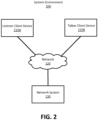
- FIG. 2 shows an example system environment for generating a binaural audio stream using a computation device, according to some embodiments.
- the computation device may correspond to, implement, comprise, or be comprised by, an audio processing module.
- the system environment includes a listener client device 210A, a talker client device 210B, a network 120, and a network system 230.
- the listener client device 210A is operated by a user (e.g., a listener 130) and the talker client device 210B is operated by a different user (e.g., a talker (or any other audio source)).
- the talker may also be referred to as a presenter or speaker in a virtual listening session.
- the talker (or speaker) is a non-limiting example of a sound source generating an audio stream. While this disclosure may make frequent reference to a talker, it is understood that the scope of the disclosure also covers (generic) sound sources in place of the talkers.
- the listener and the talker may connect to a listening session via a network 120.
- the listening session is hosted by a device (e.g., a hosting device) within the environment. Both the talker and the listener are assigned a virtual location within the listening session.
- the hosting device may be either the network system 230 or the listener client device 210A.
- the hosting device is the device that generates a binaural audio stream by applying appropriate audio filters (e.g., HRTF filters).
- HRTF filters e.g., HRTF filters
- the talker client device 210B may transmit an audio stream to the network system 230 via the network 120.
- the network system 130 generates the binaural audio stream from the received audio stream and transmits the binaural audio stream to the listener client device 210A.
- the listener client device 210 is the hosting device.
- the talker client device 210B transmits an audio stream to the listener client device 210A via the network 120 and the listener client device 210A generates the binaural audio stream.
- the hosting device may comprise or otherwise implement the aforementioned audio processing module (e.g., computation device).
- the talker client device 210B generates an audio stream by recording the speech of the talker. Other methods of generating the audio stream are feasible and should be understood to be within the scope of this disclosure.
- the audio stream is transmitted to the hosting device via the network 120.
- the hosting device generates a binaural audio stream from the audio stream using an audio filtering process.
- the audio filtering process may involve applying a binaural audio filter.
- the binaural audio filter can include any number of audio filters with an increasing number of filters improving the quality of the binaural audio filter.
- the number of audio filters to apply is selected based on a computational resource availability of the hosting device.
- the binaural audio filters are also selected based on the virtual locations of the talker and the listener within the listening session.
- the hosting device provides the binaural audio stream to the listener client device.
- the binaural audio stream is a representation of the received audio stream.
- the binaural audio stream allows the listener to perceive the talker at a real-world location that corresponds to the virtual location of the talker in the listening session.
- the computation device receives an audio stream from the sound source and generates a binaural audio stream from the received audio stream by means of an audio filtering process.
- the binaural audio stream is intended for playback through left and right loudspeakers of a headset.
- the audio filtering process may select and use one among a predefined set of filtering modes that may have different characteristics (e.g., targeted frequency bands, gains, resonance levels, effects, etc.) and system requirements (e.g., required processing power), for example.
- the filtering modes represent different digital signal processing (DSP) techniques for binaural filtering of the audio stream. These DSP techniques may be scalable.
- Each filtering mode may specify a respective set of filters (e.g., HRTF filters).
- each filtering mode may specify a pair of HRTF filters, one for the (virtual) listeners left ear and one for the (virtual) listener's right ear.
- a filtering mode involves spatial audio panning, it may specify a pair of HRTF filters for each of a plurality of virtual loudspeaker locations.
- Each of these filters may be characterized by a filtering function with a plurality of filtering parameters.
- the filter parameters themselves may not yet be specified.
- the actual filter parameters may depend on the virtual orientation (relative position) between the virtual source location (virtual talker location) and the virtual listener location.
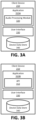
- FIG. 3A and FIG. 3B illustrate example client devices that can participate in a listening session.
- Each client device 210 is a computer or other electronic device used by one or more users to perform activities including recording and/or capturing audio, playing back audio, and participating in a listening session.
- the client devices may be a listener client device 210A or a listener client device 210B.
- the client device 210 for example, can be a personal computer executing a web browser or dedicated software application that allows the user to participate in listening sessions with other client devices and the network system.
- the client device is a network-capable device other than a computer, such as a mobile phone (or smartphone), personal digital assistant (PDA), a tablet, a laptop computer, a wearable device, a networked television or "smart TV,” etc.
- a network-capable device other than a computer, such as a mobile phone (or smartphone), personal digital assistant (PDA), a tablet, a laptop computer, a wearable device, a networked television or "smart TV,” etc.
- the client devices include software applications, such as application 310A, 310B (generally 310), which execute on the processor of the respective client device.
- the applications may communicate with one another and with network system (e.g. during a listening session).
- the application 310 executing on the client device 210 additionally performs various functions for participating in a listening session. Examples of such applications can be a web browser, a virtual meeting application, a messaging application, a gaming application, etc.
- An application may include an audio processing module 320.
- the audio processing module 320 can initiate a listening session. Any number of client devices 210 can connect to the listening session via the network. Because the audio processing module 320 can be located on a client device 210 or a network system 230, the listening session can be hosted on either a client device 210 or a network system 230 (e.g., the hosting device).
- a user initiating the listening session is a listener operating a listener client device and users connecting to the listening session are talkers operating talker client devices 210.
- a listener is a virtual listener and a talker is a virtual talker.
- every user connected to a listening session is a virtual talker and a virtual listener. That is, a listener for one client device in the session is a talker for another client device in the listening session and vice versa.
- the audio processing module 320 generates a virtual listening environment for the listening session.
- the virtual listening environment acts as a virtual analog to a real world listening environment.
- the virtual environment can be a set of virtual locations (e.g., chairs) around a virtual conference table.
- the audio processing system 320 assigns the virtual listener and the virtual talkers to virtual locations (e.g., a virtual source location and a virtual listener location) within the virtual environment. Continuing the example, each virtual talker and virtual listener is assigned a virtual location around the virtual conference table.
- Each combination (i.e., pair) of virtual locations has an associated virtual orientation (or relative position).
- a virtual orientation (relative position) is the position of a virtual location relative to the position of another virtual location in the virtual environment. Take, for example as in FIG. 4 , a virtual environment including four virtual locations arranged along the four sides of a square (e.g., the top 410A, bottom 410D, left 410B, and right 410C virtual locations 410).
- Each virtual orientation 420 can include information about the distance r, azimuth, and elevation between virtual locations.
- Each virtual orientation 420 is associated with a number (e.g., pair) of binaural audio filters to generate a binaural audio stream for a listener from a talker, e.g., 130, for a given virtual orientation.
- the audio processing module 320 can determine a resource availability (e.g., measure of processing capability) of the computation device implementing the audio processing module (e.g., a client device 210 or a network system 230).
- the resource availability is a measure of a processors available processing power. There can be any number of measures of a processors available processing power. Determining the resource availability can include sending a resource query to a processor and receiving a resource availability in response.
- determining the measure of processing capability of the computation device can include any of: determining a processor load for a processor of the computation device, determining a number of processes running on the computation device, determining an amount of free memory of the computation device, determining an operating system of the computation device, and determining a set of device characteristics of the computation device. It is to be noted that the measure of processing capability can be performed repeatedly (e.g., periodically), to thereby monitor the processing capability of the computation device, for example in real time.
- the audio processing module 320 generates a binaural audio stream from a received audio stream using audio filters.
- the audio processing module 320 on a listener client device 210A receives an audio stream (e.g., from a talker client device 210B), and applies an audio filtering process to generate a binaural audio stream.
- each binaural audio filter can be decomposed into several audio filters that, in aggregate, function similarly to a binaural audio filter.
- Each audio filter may include a number of parameters that when applied to the received audio stream generate a binaural audio stream. Any number of audio filters can be applied to an audio stream and the greater the number of audio filters applied, the better the generated binaural audio stream (e.g., more accurate).
- each audio filter can be associated with a characteristic of the generated binaural audio stream (e.g., gain.).
- an array (bench) of different filtering modes (or DSP techniques) for use in the audio filtering process can be provided.
- filtering modes will be described below.
- Each filtering mode specifies a respective set of filters (e.g., a pair of HRTF filters) for generating a binaural audio stream from an input audio stream.
- the audio processing module can select an appropriate one among the predefined filtering modes and use the filters specified by that filtering mode for generating the binaural audio stream. This selection may be made based on the determined measure of processing capability. In particular, this selection may be performed dynamically, assuming that the processing capability of the computation device is repeatedly or periodically determined (i.e., monitored).
- the filtering mode/DSP technique can be matched to the processing capability of the computation device, and an optimum result at the available processing capability can be ensured.
- the filtering mode and thus, the filters specified by this filtering mode
- the actual filter parameters for use in the filters specified by that filtering mode may be determined based on the virtual orientation (relative position) of the virtual source location to the virtual listener location.
- binaural audio filters are decomposed into parametric infinite impulse response filters.
- other audio filters may be used to approximate a binaural audio filter.
- Various audio filters and their characteristics are described below.
- the audio processing module selects a filtering mode (e.g., a number of audio filters) to apply to the audio stream based on the determined resource availability. For example, if there is a first amount of resource availability, the audio processing module applies a number of audio filters that uses less than the first amount of resource availability to implement.
- a filtering mode e.g., a number of audio filters
- FIG. 3B illustrates a client device executing an application including an application programming interface (API) to communicate with the network system through the network.
- the API can expose the application to an audio processing module on the network system.
- the accessed audio processing module can provide any of its functionality described herein to the client device.
- the API is configured to allow the application to participate in a listening session as a listener or a talker.
- a client device may include a user interface.
- the user interface includes an input device or mechanism (e.g., a hardware and/or software button, keypad, microphone) for data entry and output device or mechanism for data output (e.g., a port, headphone port/socket, display, loudspeaker).
- the output devices can output data provided by a client device or a network system.
- a listener using a listener client device can play back a binaural audio stream using the user interface.
- the listener client device may include a headset (a pair of headphone loudspeakers).
- the input devices enable the user to take an action (e.g., an input) to interact with the application or network system via a user interface.
- a talker using a talker client device can record her speech as an audio stream using the user interface.
- the user interface includes a display that allows a user to interact with the client devices during a listening session.
- the user interface can process inputs that can affect the listening session in a variety of ways, such as: displaying audio filters on the user interface, displaying virtual locations on a user interface, receiving virtual location assignments, or any of the other interactions, processes, or events described within the environment during a listening session.
- the device data store contains information to facilitate listening sessions.
- the information includes a ranked list of the filtering modes.
- the filtering modes may be ranked based on one or more criteria. This ranking may be performed by the audio processing module. In some implementations, this ranking may be updated in accordance with a user (listener) input, for example indicating the user's preference for certain filtering modes or certain types of audio processing.
- the one or more criteria for ranking the filtering modes may include any of: an indication of an error between an ideal binaural audio stream and a binaural audio stream that would result from applying the audio filtering process using the set of filters specified by the filtering mode, a frequency band in which the set of filters specified by the filtering mode is effective, a gain level of the set of filters specified by the filtering mode, or a resonance level of the set of filters specified by the filtering mode.
- These criteria may be determined or updated by user input, for example.
- the information includes ranked lists of audio filters and their parameters.
- Each list can include any number of audio filters and parameters, and each audio filter and parameter may be associated with an audio characteristic or combination of audio characteristics.
- Each ranked list can be associated with a virtual orientation. Further, all possible virtual orientations for any listening session are associated with a ranked list such that the audio processing module 320 can generate a binaural audio stream for any virtual orientation. That is, device data store stores ranked lists such that a listener at any location can perceive a talker at a real-world location corresponding to any of the virtual locations.
- the network represents the communication pathways between the client devices and the network system.
- the network is the Internet, but can also be any network, including but not limited to a LAN, a MAN, a WAN, a mobile, wired or wireless network, a cloud computing network, a private network, or a virtual private network, and any combination thereof.
- all or some of links can be encrypted using conventional encryption technologies such as the secure sockets layer (SSL), Secure HTTP and/or virtual private networks (VPNs).
- the entities can use custom and/or dedicated data communications technologies instead of, or in addition to, the ones described above.
- FIG. 3C illustrates a diagram of a network system 230 for facilitating listening sessions between client devices via the network.
- the network system 230 includes an audio processing module 320, a filter generation module 350, and a network data store 360.
- the filter generation module 350 may be integrated with the audio processing module 320.
- the audio processing module 320 of the network system 230 functions similarly to the audio processing module 320 of a client device 210.
- the filter generation module 350 generates audio filters and their constituent parameters for generating a binaural audio stream.
- the binaural audio filter e.g., a HRTF
- the filter generation module can determine the set of audio filters (e.g., the parametric IIR filters) from the empirical data to approximate, in aggregate, the binaural audio filter.
- Each audio filter of the set reduces the error between an ideal binaural audio stream and a generated binaural audio stream.
- the ideal binaural audio stream is the binaural audio stream perceived by a listener listening to a talker in a real world location.
- a talker in a real-world location generates an audio stream at a real-world talker location.
- the network system records the generated audio stream at the real-world talker location.
- the network system additionally records the audio stream as perceived by a listener at a real-world listener location (i.e., the ideal binaural audio stream).
- the network system determines a binaural audio filter from the generated audio stream at the real-world talker location and the binaural audio stream as perceived by the listener.
- the relative spatial difference between the real-world talker and listener locations can be associated with a virtual orientation. That is, the difference in the real-world listening environment is translated to a virtual listening environment.
- the relative spatial differences and the virtual orientations may also be used to generate audio filters that approximate a binaural audio filter.
- the filter generation module 350 generates a set of audio filters and their parameters that approximate the determined binaural audio filters. That is, the set of audio filters, in aggregate, approximate a binaural audio filter that can be used to generate the audio stream perceived by the listener at the real-world listener location.
- each audio filter is associated with a particular characteristic of the generated binaural audio stream (e.g., resonance, gain, frequency, filter type, etc.).
- each audio filter from the set of audio filters applied to an audio stream may increase the accuracy of the generated binaural audio stream.
- the accuracy of the binaural audio stream is a measure of how dissimilar the generated binaural audio stream and ideal binaural audio stream are. For example, using three audio filters to generate a binaural audio stream more accurate (e.g., more similar to the ideal binaural audio stream) than a binaural audio stream generated from a single audio filter.
- the accuracy of a binaural audio stream can be measured using a variety of metrics.
- the accuracy can be a difference in a frequency-domain response, a difference time-domain response or any other metric that can measure audio accuracy.
- using more audio filter to generate a binaural audio stream may be non-linear in terms of accuracy improvement. That is, for a given combination of filters, or ordered combination of filters, the accuracy may change more or less than the accuracy for each filter individually.
- the filter generation module 350 can associate each filter, or combination of filters, with an impact factor.
- the impact factor is a quantification of an amount of accuracy change in a generated binaural audio stream when applying a particular audio filter or combination of audio filters. For example, if an audio filter increases the accuracy of a generated binaural audio stream by 5% its impact factor may be 5. If a second audio filter increases the accuracy of a generated binaural audio stream by 3% its impact factor may be 3.
- the first and second audio filters may have a combined impact factor of 8, while in other examples the combined impact factor is some other number.
- the impact factor is a quantification of the importance for a particular audio filter.
- the audio filters for a particular virtual orientation are an audio filter for increasing gain in the speech spectrum and an audio filter for reducing a specific frequency (e.g., a noise band).
- the filter for reducing the a specific frequency increases the accuracy of the generated binaural audio stream to a greater degree than the filter for increasing gain.
- the virtual listening environment is for conducting a business meeting.
- increasing the gain in the speech frequency region is more important than reducing a specific frequency.
- the impact factor for the increasing gain in speech region filter is higher than the frequency removal filter despite the floor filter increasing the accuracy to a greater degree.
- the importance for each filter can be defined by a listener, a talker, the virtual listening environment, or any other information within the environment.
- the filter generation module 350 can rank the filters for a particular virtual orientation.
- the filters are ranked based on the impact factor. For example, the filters that increase the accuracy to the greatest degree are ranked highest. In another example, filters that are most important for the virtual listening environment are ranked highest.
- the filter generation module 350 determines a resource requirement for each filter. While applying additional audio filters to an audio stream increases the accuracy of the generated binaural audio stream, it can also increase the amount of computational resources required. Additionally, applying additional audio filters to an audio stream may be non-linear in terms of resource requirements. That is, for a given combinations of audio filters, or ordered combinations of audio filters, the resource requirement may be more or less than the resource requirement for each filter individually. The filter generation module 350 associates a resource requirement with each filter.
- the filter generation module 350 stores the ranked filters and their associated resource requirements in the network data store. In some cases, the ranked filters and their associated resource requirements are transmitted to a client device via the network. The client devices may store the ranked filters and their associated resource requirements in the device datastore.
- the generation of the binaural audio stream may proceed as follows.
- the predefined filtering modes are stored in a data store accessible to the computation device (e.g., audio processing module).
- the stored set of filtering modes may be updated by accessing the network system.
- the computation device may select one of these filtering modes for binaural audio filtering based on the determined measure of processing capability.
- filter parameters for the filters specified by the selected filtering mode can be determined based on the relative position of the virtual talker location and the virtual listener location.
- the filter parameters for the filters specified by the selected filtering mode may control any one of a gain, frequency, timbre, spatial accuracy, and resonance when generating the binaural audio stream.
- the determination of the filter parameters may be further based on any one of a desired gain, frequency, timbre, spatial accuracy, and resonance.
- the data store may store, for each filtering mode, a plurality of relative positions and associated filter parameters for the filters specified by the respective filtering mode. Then, the filter parameters for the filters specified by the filtering mode can be determined based on the stored filter parameters. This may involve, for a selected filtering mode and a given relative position, using those filter parameters in the data store that have an associated relative position that is most similar to the given relative position. This may imply that an appropriate similarity metric for relative positions is defined. Alternatively, the filter parameters may be determined by interpolation methods that interpolate between two or more associated relative positions that are most similar to the given relative position.
- the filtering mode to be used for the binaural audio filtering is selected by ranking the predefined set of filtering modes based on one or more criteria (e.g., the criteria listed above). For such ranked filtering modes, the selection may be to pick that filtering mode that is highest ranked among all those filtering modes that could be implemented with the determined processing capability. For example, the computation device may first determine all those filtering modes that it could implement with its available processing capability, and then select, among these filtering modes, the highest ranked filtering mode.
- the network system 230 and client devices 210 include a number of "modules," which refers to hardware components and/or computational logic for providing the specified functionality.
- a module can be implemented in hardware, firmware, and/or software (e.g., a hardware server comprising computational logic). It will be understood that the named components represent one embodiment of the disclosed method, and other embodiments can include other components. In addition, other embodiments can lack the components described herein and/or distribute the described functionality among the components in a different manner. Additionally, the functionalities attributed to more than one component can be incorporated into a single component.
- modules described herein are implemented as software, the module can be implemented as a standalone program, but can also be implemented through other means, for example as part of a larger program, as a plurality of separate programs, or as one or more statically or dynamically linked libraries.
- the modules are stored on the computer readable persistent storage devices of the media hosting service, loaded into memory, and executed by one or more processors of the system's computers.
- the present disclosure is to be understood to relate to the methods described herein, as well as to corresponding computation devices (host devices, client devices, etc.), computer programs, and computer-readable storage media storing such computer programs.
- the audio filters (e.g., specified by the filtering modes) used to approximate a binaural audio filter can include any number or type of audio filter or audio processing technique to generate a binaural audio stream.
- Binaural synthesis consists in filtering a monophonic sound S by a pair of HRTFs (left and right) corresponding to a source S at location P.
- the synthesized audio is played back on a dual channel audio playback device, such as a playback device comprising a pair of headphone loudspeakers, for example.
- methods according to embodiments of this disclosure may include rendering a generated binaural audio stream to the left and right loudspeakers of a headphone.
- the binaural signals contain the auditory spatial cues corresponding to position P such that the listener auditory perceives the source S virtually placed at location P.
- filtering modes for implementing or modeling the binaural audio filtering (e.g., HRTF filtering) will be described below. Any of these filtering modes can be included in the predefined set of filtering modes for the binaural audio filtering according to embodiments of the disclosure.
- binaural synthesis can emulate moving sources.
- the methods consists of commuting between pairs of HRTF filters. That is, for 1 virtual source, one may use 4 filters to perform moving source spatialization.
- (virtual) spatial audio panning may be used.
- (Virtual) spatial audio panning pans each of one or more sound sources (e.g., talkers) to a set of virtual loudspeakers at respective virtual loudspeaker locations (e.g., in a 2.1 configuration, 5.1 configuration, 7.1 configuration, 7.2.1 configuration, etc.). This yields a set of virtual loudspeaker audio streams, one for each virtual loudspeaker.
- These virtual loudspeaker audio streams can then be subjected to binaural audio filtering, based on relative positions of respective virtual loudspeaker locations to the virtual listener location, yielding individual binaural audio streams.
- a binaural audio stream that captures the perceived sound from the plurality of sound sources at the virtual listener location can then be obtained by combining (e.g., summing) the individual binaural audio streams.
- This procedure has several advantages. For example, virtual movement of one of the sound sources can be implemented by adjusting the virtual panning of the moving sound source's audio stream to the set of virtual loudspeakers. This can be achieved by adjusting the panning gains for this audio stream for the set of virtual loudspeakers.
- virtual spatial audio panning has the advantage that the required computational capacity does not scale with the actual number of sound sources, but rather with the number of virtual loudspeakers. Accordingly, the computation device can receive and process a large number of audio streams for respective sound sources at a reasonable processing cost.
- the predefined set of filtering modes can include at least one virtual panning filtering mode that specifies filters for binaurally rendering panned audio streams resulting from virtual panning of the audio stream to respective virtual loudspeakers at virtual loudspeaker locations to the virtual listener location.
- Each of these virtual panning filtering modes may specify a pair of HRTF filters for each virtual loudspeaker location.
- HRTF filters can be modeled in a variety of manners.
- One method of HRTF modelling uses finite impulse response.
- HRTF FIR filter represents a straight forward approach of performing binaural audio synthesis.
- HRTFs measurements are used with time or frequency domain convolution.
- the predefined set of filtering modes includes at least one filtering mode that specifies a set of filters for filtering the audio stream in the frequency domain.
- the set of filters may relate to a pair of FIR filters for implementing HRTFs, e.g., one for the listener's left ear and one for the listener's right ear.
- FIR HRTFs are very precise at high frequencies.
- the drawbacks to this approach may include, for example, FIR HRTFs usually include many coefficients (e.g., 256 or 512 coefficients for one FIR filter). FIR HRTFs can also have lower precision for low frequencies.
- frequency domain convolution using FFTs are not available in all DSPs and time domain convolution is too slow for real-time processing.
- the predefined set of filtering modes further includes at least one filtering mode that specifies a set (e.g., pair) of filters for filtering the audio stream in the time domain.
- the computation device is not capable of implementing frequency-domain filtering, it may resort to one of the time-domain filtering modes. Whether or not the computation device is capable of implementing frequency-domain filtering may be decided based on the determined measure of processing capability of the computation device.
- IIR filters are examples of filters for filtering the audio signal in the time domain. Magnitude response of HRTFs is modelled with IIR filters.
- the IIR HRTF models include a delay between the ears to account for inter-aural time delay.
- Various techniques can be used to model original HRTF filters into IIR HRTFs. For example, some modelling algorithms include: yulewalk, slessnesslitz mcbride, prony.
- IIR HRTF models can be implemented using cascades (i.e., a product) of second order sections.
- the benefits of IIR HRTF models are that IIR filters are scalable because the number of modelling IIRs can be set.
- IIR HRTF usually has fewer than coefficients than FIR HRTFs (e.g., 100 coefficients).
- the drawbacks of such IIR modelling is that IIR coefficients are arbitrary and cannot be adapted after modelling.
- the predefined set of filtering modes can include at least one time-domain cascaded filtering mode that specified a set (e.g., pair) of cascaded time-domain filters.
- the constituents of the cascaded time-domain filters may be the second order sections.
- the predefined set of filtering modes includes a plurality of time-domain cascaded filtering modes.
- Each of these time-domain cascaded filtering modes specifies a set (e.g., pair) of cascaded time-domain filters with an associated number of time-domain filters in the cascade.
- the complexity of the binaural audio filtering can be scaled by selecting from the time-domain cascaded filtering modes with different (e.g., gradually increasing) associated numbers of time-domain filters in the cascade.
- Selecting the filtering mode from the predefined filtering mode can then include selecting a time-domain cascaded filtering mode from among the plurality of time-domain cascaded filtering modes based on the determined measure of processing capability.
- the time-domain cascaded filtering mode with the largest associated number of time-domain filters in the cascade that can still be implemented with the available processing capability can be selected.
- individual time-domain filters can be selected from a predefined set of time-domain filters up to the associated number of the selected time-domain cascaded filtering mode.
- the selected individual time-domain filters can then be used to construct the cascaded time-domain filters for the binaural audio filtering. If the filter parameters of the time-domain filters are fixed in accordance with a previous modeling procedure, selecting the individual time-domain filters from the predefined set of time-domain filters can also be seen as part of determining the filter parameters for the filters specified by the selected time-domain cascaded filtering mode.
- PIIR HRTFs are modeled using parametric IIRs.
- the 2 nd order IIR filter is driven by 6 coefficients (a0, a1, a2, b0, b1, b2).
- these coefficients are now computed via the 4 parameters (frequency, gain, resonance and filter type).
- the meaningless IIR coefficients are linked to meaningful parameters.
- the predefined set of filtering modes may include at least one parametric IIR filtering mode that specifies a set of parametric IIR filters.
- the parametric IIR filters may be constituents of cascaded time-domain filters.
- the predefined set of filtering modes can include at least one spherical harmonics filtering mode that specifies a set (e.g., pair) of filters that are modeled based on a set of spherical harmonics.
- the HRTF database may consist of various HRTFs samples around a given listener. These HRTFs samples can be seen as spatial samples of the directivity function of the listeners head considered as a microphone. Density of the sampling of directivity function (i.e., the number of HRTF measurements) allows for spatial decomposition (encoding) into spherical harmonics functions (up to order N, depending on the spatial distribution of HRTF sampling grid).
- binaural synthesis consists of recomposing (decoding) virtual source direction (HRTF) with spherical harmonics, up to a maximum order in encoding.
- the spherical harmonics modeling depends on CPU possibilities.
- a benefit of spherical harmonic modelling is to offer flexible spatial resolution and interpolation.
- the drawbacks of spherical harmonic modelling are that it is generally processed in frequency domain and its decoding accuracy depends on accuracy of encoding (which is driven by the spatial sampling grid of HRTFs).
- the predefined set of filtering modes can include a plurality of spherical harmonics filtering modes.
- Each spherical harmonics filtering mode specifies a set (e.g., pair) of filters that are modeled based on a set of spherical harmonics up to a given order N of spherical harmonics. It is understood that different spherical harmonics filtering modes relate to different orders N. Then, selecting the filtering mode from among the predefined set of filtering modes may include selecting, based on the determined measure of processing capability, that spherical harmonics filtering mode from among the plurality of spherical harmonics filtering modes that has the highest order N of spherical harmonics that can still be implemented by the computational device, given its processing capability.
- Simple modelling can also include modeling ILD (interaural level difference) into a frequency dependent weighted cosine functions.
- ILD interaural level difference
- An ILD model is computed to fit the average ILD curve among a set of subjects.
- the ILD format is not resource intense and allows for the reproduction of horizontal plane binaural. However, the reproduction is only in the frequency domain.
- a model can operate in the time-domain, be scalable, and be tunable.
- Time domain processing means that it is available for all digital signal processors.
- a scalable models means that the filter process can adapt based on the available CPU resources.
- a tunable model means that a user can adapt characteristics based on the desired tradeoff for spatialization and/or coloration.
- the model includes IIR modeling that allows determination of the average ILD in the horizontal plane. The modeling can use the Nelder-Mead algorithm to find the best least square model fitting the desired ILD curve.
- all parameters (center frequency, gain, resonance) of the filters can vary. Second order sections are then ordered from the most important to less important. Importance is decided upon various criteria.
- the criteria can include minimization of least square error, the characteristics of the parametric filter, if the parametric filter is prominent or not (whether the gain and resonance of the filter are high).
- the model can then be used with one or a few biquad sections (simple model).
- the model can also include a high fidelity model using the whole cascade of second order sections.
- the model can also control spectral content.
- the control allows for control the tradeoff between spatial quality and timbre quality. Additionally the model allows to fine tune the audio spectrum to improve the spatial perception on an individual basis (i.e., for a given listener).
- FIG. 5A is a flow diagram illustrating an example of a method of generating a binaural audio stream.
- the method is understood to be performed by a computational device.
- a sound source e.g., talker
- the virtual source location may be determined based on a number (count) of sound sources that are to be rendered, or a predetermined set of source locations in the virtual listening environment, etc.
- the virtual source location has a relative position (virtual orientation) to a virtual listener location in the virtual listening environment.
- a listener is assumed to be assigned to the virtual listener location.
- an audio stream for the sound source is received.
- a measure of processing capability (e.g., resource availability, CPU availability, available processing power) of the computation device is determined.
- a filtering mode is selected from a predefined set of filtering modes, based on the determined measure of processing capability.
- the filtering mode is intended for use in an audio filtering process.
- the audio filtering process in turn is intended to convert the received audio stream into a binaural audio stream.
- Each filtering mode specifies a respective set of filters.
- the set of filters for each filtering mode may include two filters, one relating to (an impulse response of) a propagation path from the virtual source location to a left ear of a virtual listener at the virtual listener location and one relating to (an impulse response of) a propagation path from the virtual source location to a right ear of the virtual listener.
- the filters may implement HRTFs, for example.
- filter parameters for the set of filters specified by the selected filtering mode are determined, based on the relative position of the virtual source location to the virtual listener location.
- the binaural audio stream is generated by applying the audio filtering process to the audio stream, using the set of filters specified by the selected filtering mode and the determined filter parameters for the set of filters.
- the binaural audio stream is intended to allow a listener at the virtual listener location to perceive sound from the sound source as emanating from the virtual source location. Accordingly, the binaural audio stream may be intended for playback through the left and right loudspeakers of a headset (pair of headphone loudspeakers).
- the binaural audio stream is output for playback. Playback may be performed by a playback device, for example.
- the playback device may comprise or be coupled to a pair of headphone loudspeakers, for example.
- the method may further comprise (not shown) rendering the generated binaural audio stream to the left and right loudspeakers of the pair of headphone loudspeakers.
- FIG. 5B is a flow diagram of another example of one method for generating a binaural audio stream, according to one example embodiment not forming part of the claimed invention. It is understood that the described details of the methods of FIG. 5A and FIG. 5B may be combined where appropriate.
- the process may be performed by a client device (e.g., an audio processing module executing on the client device) in the environment.
- the process is performed by a network system in the environment.
- other modules may perform some or all of the steps of the process in other embodiments.
- embodiments may include different and/or additional steps, or perform the steps in different orders.
- a listener using a client device initiates a listening session.
- the listening session relates to a virtual conferencing session.
- the present disclosure likewise relates to alternative listening sessions.
- Any number of talkers using a client device can connect to the listening session via the network.
- the listener creates a listening environment including the talkers connected to the listening session.
- the listener assigns 510B each talker as a virtual talker at a virtual speaking location to create the listening environment.
- the listener also can assign himself a virtual listening location in the listening environment.
- the specific manner in which the virtual positions are assigned is not of particular importance for the described methods.
- Each virtual talker location has a virtual orientation (i.e., relative position to the virtual listener location).
- the virtual orientation is the position of the virtual talker at a virtual speaking location relative to the position of the listener at the virtual listening location in the environment.
- the listener and virtual talkers are automatically assigned to a location in the listening environment by the audio processing module.
- a talker (as a non-limiting example of a sound source) generates an audio stream.
- the audio stream is a recording of the talker's voice by his client device.
- the audio stream is transmitted to the listener client device via the network and the listener client device receives 520B the audio stream via the processing module.
- the processing module associates the audio stream with the talker's virtual talker location in the listening environment. Accordingly, the audio stream is associated with the virtual talker location corresponding to the virtual talker.
- the processing module determines 530B a resource availability of the listener's client device.
- the processing module sends a resource query to a processor of the listener client device and receives a resource availability in response.
- the resource availability is the amount of available processing power that the processing module may use to generate a binaural audio stream.
- the processing module accesses 540B a set of audio filters and filter parameters to apply based on the determined resource availability and the virtual orientation.
- the set of audio filters is selected from a ranked list of audio filters associated with the virtual orientation.
- the ranked list of audio filters is stored in the device data store of the listener client device.
- the number of selected audio filters is based on the determined resource availability.
- a ranked list of audio filters for a particular virtual orientation includes ten audio filters.
- each of the audio filters uses approximately 5% processing power to implement when generating a binaural audio stream.
- the determined resource availability for the listener client device is 18% processing power. Accordingly, the processing module selects the three highest ranked audio filters for generating a binaural audio stream.
- the processing module generates 550B a binaural audio stream by applying the selected audio filters.
- the audio filters are a set of audio filters that approximate a binaural audio filter where each additional audio filter of the set applied to the audio stream generates a more accurate binaural audio stream.
- the binaural audio stream portrays the audio stream of the virtual talker within the listening environment. Additionally, the binaural audio stream allows the listener at the virtual listener location to perceive the virtual talker at the virtual talker location. That is, the binaural audio stream allows the listener to perceive the speech of the talker as if the talker was at a real-world location corresponding to the virtual speaking location. For example, if the listener assigned the talker as a virtual talker with a virtual orientation "to the right" of the listener location, the listener would hear the speech of the talker as if they were located to the right of the listener.
- the processing module After generating the binaural audio stream, the processing module provides the binaural audio stream to the listener audio device for audio playback.
- the listener audio devices plays 560A the binaural audio stream using the client device 210.
- the binaural audio stream may be played back by an audio playback device of the listener client device or, in various other configurations, by an audio playback device connected to the listener client device (e.g., headphones, loudspeakers, etc.).
- FIG. 6 is a diagram of a virtual listening environment created by a listener in a listening session.
- the virtual environment includes six virtual locations oriented similarly to six chairs around a virtual conference table.
- the listener 610 assigns himself to a virtual location 620 (e.g., a virtual listener location) at the head of the conference table.
- the listener assigns five talkers connected to the listening session as virtual talkers 630 at virtual locations B, C, D, E, and F (e.g., virtual talker location).
- Each virtual talker location has a virtual orientation (relative position to the virtual listener location).
- a listener assigns each talker in a listening session to a virtual talker at a virtual talker location.
- the processing module receives an audio stream from a talker assigned as virtual talker at virtual talker location.
- the audio processing module 320 determines a resource availability for the listener's client device.
- the processing module then accesses a set of filters and filter parameters to generate a binaural audio stream based on the virtual orientation and the determined resource availability, for example in the manner described above.
- the audio processing module 320 generates a binaural audio stream from the audio stream using the audio filter and the accessed parameters.
- the binaural audio stream is provided to the listener client device and the listener client devices plays back the binaural audio stream.
- the binaural audio stream represents the talker at the virtual location. In other words, the listener perceives the talker at a real-world location corresponding to the virtual location.
- processor may refer to any device or portion of a device that processes electronic data, e.g., from registers and/or memory to transform that electronic data into other electronic data that, e.g., may be stored in registers and/or memory.
- a "computer” or a “computing machine” or a “computing platform” may include one or more processors.
- the methodologies described herein are, in one example embodiment, performable by one or more processors that accept computer-readable (also called machine-readable) code containing a set of instructions that when executed by one or more of the processors carry out at least one of the methods described herein.
- Any processor capable of executing a set of instructions (sequential or otherwise) that specify actions to be taken are included.
- a typical processing system that includes one or more processors.
- Each processor may include one or more of a CPU, a graphics processing unit, and a programmable DSP unit.
- the processing system further may include a memory subsystem including main RAM and/or a static RAM, and/or ROM.
- a bus subsystem may be included for communicating between the components.
- the processing system further may be a distributed processing system with processors coupled by a network. If the processing system requires a display, such a display may be included, e.g., a liquid crystal display (LCD) or a cathode ray tube (CRT) display. If manual data entry is required, the processing system also includes an input device such as one or more of an alphanumeric input unit such as a keyboard, a pointing control device such as a mouse, and so forth. The processing system may also encompass a storage system such as a disk drive unit. The processing system in some configurations may include a sound output device, and a network interface device.
- LCD liquid crystal display
- CRT cathode ray tube
- the memory subsystem thus includes a computer-readable carrier medium that carries computer-readable code (e.g., software) including a set of instructions to cause performing, when executed by one or more processors, one or more of the methods described herein.
- the software may reside in the hard disk, or may also reside, completely or at least partially, within the RAM and/or within the processor during execution thereof by the computer system.
- the memory and the processor also constitute computer-readable carrier medium carrying computer-readable code.
- a computer-readable carrier medium may form, or be included in a computer program product.
- the one or more processors operate as a standalone device or may be connected, e.g., networked to other processor(s), in a networked deployment, the one or more processors may operate in the capacity of a server or a user machine in server-user network environment, or as a peer machine in a peer-to-peer or distributed network environment.
- the one or more processors may form a personal computer (PC), a tablet PC, a Personal Digital Assistant (PDA), a cellular telephone, a web appliance, a network router, switch or bridge, or any machine capable of executing a set of instructions (sequential or otherwise) that specify actions to be taken by that machine.
- machine shall also be taken to include any collection of machines that individually or jointly execute a set (or multiple sets) of instructions to perform any one or more of the methodologies discussed herein.
- each of the methods described herein is in the form of a computer-readable carrier medium carrying a set of instructions, e.g., a computer program that is for execution on one or more processors, e.g., one or more processors that are part of web server arrangement.
- example embodiments of the present disclosure may be embodied as a method, an apparatus such as a special purpose apparatus, an apparatus such as a data processing system, or a computer-readable carrier medium, e.g., a computer program product.
- the computer-readable carrier medium carries computer readable code including a set of instructions that when executed on one or more processors cause the processor or processors to implement a method.
- aspects of the present disclosure may take the form of a method, an entirely hardware example embodiment, an entirely software example embodiment or an example embodiment combining software and hardware aspects.
- the present disclosure may take the form of carrier medium (e.g., a computer program product on a computer-readable storage medium) carrying computer-readable program code embodied in the medium.
- the software may further be transmitted or received over a network via a network interface device.
- the carrier medium is in an example embodiment a single medium, the term “carrier medium” should be taken to include a single medium or multiple media (e.g., a centralized or distributed database, and/or associated caches and servers) that store the one or more sets of instructions.
- the term “carrier medium” shall also be taken to include any medium that is capable of storing, encoding or carrying a set of instructions for execution by one or more of the processors and that cause the one or more processors to perform any one or more of the methodologies of the present disclosure.
- a carrier medium may take many forms, including but not limited to, non-volatile media, volatile media, and transmission media.
- Non-volatile media includes, for example, optical, magnetic disks, and magneto-optical disks.
- Volatile media includes dynamic memory, such as main memory.
- Transmission media includes coaxial cables, copper wire and fiber optics, including the wires that comprise a bus subsystem. Transmission media may also take the form of acoustic or light waves, such as those generated during radio wave and infrared data communications.
- carrier medium shall accordingly be taken to include, but not be limited to, solid-state memories, a computer product embodied in optical and magnetic media; a medium bearing a propagated signal detectable by at least one processor or one or more processors and representing a set of instructions that, when executed, implement a method; and a transmission medium in a network bearing a propagated signal detectable by at least one processor of the one or more processors and representing the set of instructions.
- any one of the terms comprising, comprised of or which comprises is an open term that means including at least the elements/features that follow, but not excluding others.
- the term comprising, when used in the claims should not be interpreted as being limitative to the means or elements or steps listed thereafter.
- the scope of the expression a device comprising A and B should not be limited to devices consisting only of elements A and B.
- Any one of the terms including or which includes or that includes as used herein is also an open term that also means including at least the elements/features that follow the term, but not excluding others. Thus, including is synonymous with and means comprising.
Landscapes
- Physics & Mathematics (AREA)
- Engineering & Computer Science (AREA)
- Acoustics & Sound (AREA)
- Signal Processing (AREA)
- Stereophonic System (AREA)
Claims (14)
- Procédé effectué par un dispositif de calcul pour générer un flux audio binaural, le procédé comprenant :l'attribution (510A) d'une source sonore à un emplacement de source virtuelle dans un environnement d'écoute virtuel (112), l'emplacement de source virtuelle présentant une position relative par rapport à un emplacement d'auditeur virtuel dans l'environnement d'écoute virtuel (112) ;la réception (520A) d'un flux audio pour la source sonore ;la détermination (530A) d'une mesure de capacité de traitement du dispositif de calcul ;la sélection (540A), sur la base de la mesure de capacité de traitement déterminée, d'un mode de filtrage parmi un ensemble prédéfini de modes de filtrage à utiliser dans un processus de filtrage audio, dans lequel le processus de filtrage audio est configuré pour convertir le flux audio en un flux audio binaural et dans lequel chaque mode de filtrage spécifie un ensemble de filtres respectif ;la détermination (550A), sur la base de la position relative de l'emplacement de source virtuelle par rapport à l'emplacement d'auditeur virtuel, de paramètres de filtre pour l'ensemble de filtres spécifié par le mode de filtrage sélectionné ;la génération (560A) du flux audio binaural en appliquant le processus de filtrage audio au flux audio, en utilisant l'ensemble de filtres spécifié par le mode de filtrage sélectionné et les paramètres de filtre déterminés pour l'ensemble de filtres, dans lequel le flux audio binaural est destiné à permettre à un auditeur (130) à l'emplacement d'auditeur virtuel de percevoir un son provenant de la source sonore comme émanant de l'emplacement de source virtuelle ; etl'émission (570A) du flux audio binaural pour une lecture,dans lequel l'ensemble de modes de filtrage prédéfini inclut au moins un mode de filtrage spécifiant un ensemble de filtres pour filtrer le flux audio dans le domaine fréquentiel et au moins un mode de filtrage spécifiant un ensemble de filtres pour filtrer le flux audio dans le domaine temporel.
- Procédé selon la revendication 1, dans lequel le flux audio binaural généré est lu au moyen des haut-parleurs gauche et droit d'un casque.
- Procédé selon l'une quelconque des revendications précédentes, dans lequel la détermination (530A) de la mesure de capacité de traitement du dispositif de calcul est effectuée de manière répétée pour surveiller, de ce fait, la capacité de traitement du dispositif de calcul.
- Procédé selon l'une quelconque des revendications précédentes, dans lequel la détermination (530A) de la mesure de la capacité de traitement du dispositif de calcul inclut au moins l'une de :la détermination d'une charge de processeur pour un processeur du dispositif de calcul ;la détermination d'un nombre de processus exécutés sur le dispositif de calcul ;la détermination d'une quantité de mémoire libre du dispositif de calcul ;la détermination d'un système d'exploitation du dispositif de calcul ; etla détermination d'un ensemble de caractéristiques de dispositif du dispositif de calcul.
- Procédé selon l'une quelconque des revendications précédentes, dans lequel la sélection (540A) du mode de filtrage parmi l'ensemble prédéfini de modes de filtrage comprend :le classement des modes de filtrage dans l'ensemble prédéfini de modes de filtrage sur la base d'un ou de plusieurs critères ;la détermination, sur la base de la mesure déterminé de capacité de traitement, des modes de filtrage que le dispositif de calcul peut mettre en oeuvre dans le processus de filtrage audio ; etla sélection du mode de filtrage qui est le mieux classé parmi ces modes de filtrage que le dispositif de calcul peut mettre en oeuvre dans le processus de filtrage audio.
- Procédé selon la revendication précédente, dans lequel les un ou plusieurs critères incluent au moins l'un :d'une indication d'une erreur entre un flux audio binaural idéal et un flux audio binaural qui résulterait de l'application du processus de filtrage audio à l'aide du l'ensemble de filtres spécifié par le mode de filtrage ed'une bande de fréquences dans laquelle l'ensemble de filtres spécifié par le mode de filtrage est efficace ;d'un niveau de gain de l'ensemble de filtres spécifié par le mode de filtrage ; etd'un niveau de résonance de l'ensemble de filtres spécifié par le mode de filtrage.
- Procédé selon l'une quelconque des revendications précédentes, dans lequel l'ensemble prédéfini de modes de filtrage inclut au moins un mode de filtrage en cascade dans le domaine temporel spécifiant un ensemble de filtres en cascade dans le domaine temporel, dans lequel facultativement :l'ensemble prédéfini de modes de filtrage inclut une pluralité de modes de filtrage en cascade dans le domaine temporel qui spécifient respectivement des ensembles de filtres en cascade dans le domaine temporel avec des nombres associés de filtres dans le domaine temporel dans des cascades respectives ; etla sélection (540A) du mode de filtrage parmi l'ensemble prédéfini de modes de filtrage comprend :la sélection d'un mode de filtrage en cascade dans le domaine temporel parmi la pluralité de modes de filtrage en cascade dans le domaine temporel sur la base de la mesure déterminé de capacité de traitement ; etpour le mode de filtrage en cascade dans le domaine temporel sélectionné, la sélection de filtres dans le domaine temporel parmi un ensemble prédéfini de filtres dans le domaine temporel, jusqu'au nombre de filtres dans le domaine temporel associés au mode de filtrage sélectionné et la construction de filtres an cascade dans le domaine temporel pour le processus de filtrage audio à l'aide des filtres dans le domaine temporel sélectionnés.
- Procédé selon l'une quelconque des revendications précédentes, dans lequel l'ensemble prédéfini de modes de filtrage inclut au moins un mode de filtrage d'harmoniques sphériques spécifiant des filtres qui sont modélisés sur la base d'un ensemble d'harmoniques sphériques,
dans lequel, facultativement :l'ensemble prédéfini de modes de filtrage inclut une pluralité de modes de filtrage d'harmoniques sphériques qui spécifient respectivement des filtres qui sont modélisés sur la base d'un ensemble d'harmoniques sphériques jusqu'à des ordres respectifs d'harmoniques sphériques ; etla sélection (540A) du mode de filtrage parmi l'ensemble prédéfini de modes de filtrage comprend :
la sélection, sur la base de la mesure déterminée de capacité de traitement, du mode de filtrage d'harmoniques sphériques parmi la pluralité de modes de filtrage d'harmoniques sphériques qui présente l'ordre d'harmoniques sphériques le plus élevé qui peut encore être mis en oeuvre par le dispositif de calcul. - Procédé selon l'une quelconque des revendications précédentes, dans lequel l'ensemble prédéfini de modes de filtrage inclut au moins un mode de filtrage de panoramique virtuel spécifiant des filtres pour le rendu binaural de flux audio panoramiques résultant d'un panoramique virtuel du flux audio vers des haut-parleurs virtuels respectifs à des emplacements de haut-parleurs virtuels par rapport à l'emplacement d'auditeur virtuel,
facultativement, comprenant en outre :
la mise en oeuvre d'un mouvement virtuel de la source sonore en ajustant le panoramique virtuel du flux audio sur les haut-parleurs virtuels. - Procédé selon l'une quelconque des revendications précédentes, dans lequel les paramètres pour l'ensemble de filtres spécifié par le mode de filtrage sélectionné commandent au moins l'un du gain, de la fréquence, du timbre, de la précision spatiale et de la résonance lors de la génération du flux audio binaural.
- Procédé selon l'une quelconque des revendications précédentes, dans lequel l'ensemble prédéfini de modes de filtrage est stocké à un emplacement de stockage du dispositif de calcul et le procédé comprend en outre :
l'accès à un système de réseau (230) pour mettre à jour l'ensemble prédéfini de modes de filtrage stocké dans l'emplacement de stockage du dispositif de calcul. - Procédé selon l'une quelconque des revendications précédentes, dans lequel le dispositif de calcul fait partie d'un dispositif client ou est mis en oeuvre par le dispositif client.
- Dispositif de calcul comprenant un processeur configuré pour effectuer le procédé selon l'une quelconque des revendications précédentes.
- Programme informatique incluant des instructions qui, lorsqu'elles sont exécutées par un dispositif de calcul, amènent le dispositif de calcul à effectuer le procédé selon l'une quelconque des revendications 1 à 12.
Applications Claiming Priority (1)
| Application Number | Priority Date | Filing Date | Title |
|---|---|---|---|
| US201862724577P | 2018-08-29 | 2018-08-29 |
Publications (2)
| Publication Number | Publication Date |
|---|---|
| EP3618466A1 EP3618466A1 (fr) | 2020-03-04 |
| EP3618466B1 true EP3618466B1 (fr) | 2024-02-21 |
Family
ID=67809283
Family Applications (1)
| Application Number | Title | Priority Date | Filing Date |
|---|---|---|---|
| EP19194288.7A Active EP3618466B1 (fr) | 2018-08-29 | 2019-08-29 | Génération de flux audio binaural extensible |
Country Status (2)
| Country | Link |
|---|---|
| US (2) | US11272310B2 (fr) |
| EP (1) | EP3618466B1 (fr) |
Families Citing this family (12)
| Publication number | Priority date | Publication date | Assignee | Title |
|---|---|---|---|---|
| US11328735B2 (en) * | 2017-11-10 | 2022-05-10 | Nokia Technologies Oy | Determination of spatial audio parameter encoding and associated decoding |
| US11102578B1 (en) * | 2018-09-27 | 2021-08-24 | Apple Inc. | Audio system and method of augmenting spatial audio rendition |
| US11113092B2 (en) * | 2019-02-08 | 2021-09-07 | Sony Corporation | Global HRTF repository |
| US11451907B2 (en) | 2019-05-29 | 2022-09-20 | Sony Corporation | Techniques combining plural head-related transfer function (HRTF) spheres to place audio objects |
| US11347832B2 (en) | 2019-06-13 | 2022-05-31 | Sony Corporation | Head related transfer function (HRTF) as biometric authentication |
| US11172328B2 (en) * | 2019-09-27 | 2021-11-09 | Sonos, Inc. | Systems and methods for device localization |
| US11146908B2 (en) | 2019-10-24 | 2021-10-12 | Sony Corporation | Generating personalized end user head-related transfer function (HRTF) from generic HRTF |
| US11070930B2 (en) | 2019-11-12 | 2021-07-20 | Sony Corporation | Generating personalized end user room-related transfer function (RRTF) |
| US11533116B2 (en) | 2020-03-19 | 2022-12-20 | Sonos, Inc. | Systems and methods for state detection via wireless radios |
| US11750745B2 (en) | 2020-11-18 | 2023-09-05 | Kelly Properties, Llc | Processing and distribution of audio signals in a multi-party conferencing environment |
| CN115866188A (zh) * | 2022-11-30 | 2023-03-28 | 北京奇艺世纪科技有限公司 | 线上会议的音频处理方法、装置、电子设备及存储介质 |
| GB2628172A (en) * | 2023-03-17 | 2024-09-18 | Sony Interactive Entertainment Europe Ltd | Audio adjustment in a video gaming system |
Citations (2)
| Publication number | Priority date | Publication date | Assignee | Title |
|---|---|---|---|---|
| US20150063572A1 (en) * | 2013-08-30 | 2015-03-05 | Gleim Conferencing, Llc | Multidimensional virtual learning system and method |
| EP2946571B1 (fr) * | 2013-01-15 | 2018-04-11 | Koninklijke Philips N.V. | Traitement audio binauriculaire |
Family Cites Families (13)
| Publication number | Priority date | Publication date | Assignee | Title |
|---|---|---|---|---|
| AUPP271598A0 (en) * | 1998-03-31 | 1998-04-23 | Lake Dsp Pty Limited | Headtracked processing for headtracked playback of audio signals |
| US7680289B2 (en) * | 2003-11-04 | 2010-03-16 | Texas Instruments Incorporated | Binaural sound localization using a formant-type cascade of resonators and anti-resonators |
| US20080298610A1 (en) * | 2007-05-30 | 2008-12-04 | Nokia Corporation | Parameter Space Re-Panning for Spatial Audio |
| FR2942096B1 (fr) * | 2009-02-11 | 2016-09-02 | Arkamys | Procede pour positionner un objet sonore dans un environnement sonore 3d, support audio mettant en oeuvre le procede, et plate-forme de test associe |
| US20150131824A1 (en) * | 2012-04-02 | 2015-05-14 | Sonicemotion Ag | Method for high quality efficient 3d sound reproduction |
| US9420393B2 (en) * | 2013-05-29 | 2016-08-16 | Qualcomm Incorporated | Binaural rendering of spherical harmonic coefficients |
| US10425763B2 (en) * | 2014-01-03 | 2019-09-24 | Dolby Laboratories Licensing Corporation | Generating binaural audio in response to multi-channel audio using at least one feedback delay network |
| CN106105269B (zh) * | 2014-03-19 | 2018-06-19 | 韦勒斯标准与技术协会公司 | 音频信号处理方法和设备 |
| US10063989B2 (en) * | 2014-11-11 | 2018-08-28 | Google Llc | Virtual sound systems and methods |
| US9602947B2 (en) * | 2015-01-30 | 2017-03-21 | Gaudi Audio Lab, Inc. | Apparatus and a method for processing audio signal to perform binaural rendering |
| GB2544458B (en) * | 2015-10-08 | 2019-10-02 | Facebook Inc | Binaural synthesis |
| US10492016B2 (en) * | 2016-09-29 | 2019-11-26 | Lg Electronics Inc. | Method for outputting audio signal using user position information in audio decoder and apparatus for outputting audio signal using same |
| WO2019116890A1 (fr) * | 2017-12-12 | 2019-06-20 | ソニー株式会社 | Dispositif et procédé de traitement de signal, et programme |
-
2019
- 2019-08-29 US US16/554,904 patent/US11272310B2/en active Active
- 2019-08-29 EP EP19194288.7A patent/EP3618466B1/fr active Active
-
2022
- 2022-03-07 US US17/688,554 patent/US12445797B2/en active Active
Patent Citations (2)
| Publication number | Priority date | Publication date | Assignee | Title |
|---|---|---|---|---|
| EP2946571B1 (fr) * | 2013-01-15 | 2018-04-11 | Koninklijke Philips N.V. | Traitement audio binauriculaire |
| US20150063572A1 (en) * | 2013-08-30 | 2015-03-05 | Gleim Conferencing, Llc | Multidimensional virtual learning system and method |
Also Published As
| Publication number | Publication date |
|---|---|
| US20220191639A1 (en) | 2022-06-16 |
| EP3618466A1 (fr) | 2020-03-04 |
| US12445797B2 (en) | 2025-10-14 |
| US11272310B2 (en) | 2022-03-08 |
| US20200077222A1 (en) | 2020-03-05 |
Similar Documents
| Publication | Publication Date | Title |
|---|---|---|
| US12445797B2 (en) | Scalable binaural audio stream generation | |
| US11991315B2 (en) | Audio conferencing using a distributed array of smartphones | |
| Rafaely et al. | Spatial audio signal processing for binaural reproduction of recorded acoustic scenes–review and challenges | |
| Algazi et al. | Headphone-based spatial sound | |
| JP2012120219A (ja) | パンされたステレオオーディオコンテンツについての改善された頭部伝達関数 | |
| US20250254465A1 (en) | Subband spatial processing and crosstalk processing system for conferencing | |
| Politis et al. | JSAmbisonics: A Web Audio library for interactive spatial sound processing on the web | |
| US12395806B2 (en) | Object-based audio spatializer | |
| US20190394596A1 (en) | Transaural synthesis method for sound spatialization | |
| US11665498B2 (en) | Object-based audio spatializer | |
| JP2023070650A (ja) | 音場の少なくとも一部の位置決めによる空間オーディオ再生 | |
| EP4451710A1 (fr) | Dispositif et procédé de génération de son, dispositif de reproduction de son, et programme de traitement de signal sonore | |
| De Sena | downloaded from the King’s Research Portal at https://kclpure. kcl. ac. uk/portal | |
| Ranjan | 3D audio reproduction: natural augmented reality headset and next generation entertainment system using wave field synthesis | |
| Kleijn et al. | Incoherent idempotent ambisonics rendering | |
| US20250350898A1 (en) | Object-based Audio Spatializer With Crosstalk Equalization | |
| KR102559015B1 (ko) | 공연과 영상에 몰입감 향상을 위한 실감음향 처리 시스템 | |
| Rothbucher et al. | Integrating a HRTF-based sound synthesis system into Mumble | |
| HK40081515A (en) | Sound effect processing method, sound effect processing device, terminal and storage medium | |
| WO2026018859A1 (fr) | Procédé de traitement d'informations, système de traitement d'informations et programme | |
| WO2025218310A1 (fr) | Procédé et appareil de lecture de scène acoustique | |
| WO2025218311A1 (fr) | Procédé et appareil de lecture de scène acoustique | |
| KR20250165851A (ko) | 실시간 합주시스템 및 이를 이용한 합주서비스 제공방법 | |
| Que et al. | Rendering Models for Immersive Voice Communications within Distributed Virtual Environment |
Legal Events
| Date | Code | Title | Description |
|---|---|---|---|
| PUAI | Public reference made under article 153(3) epc to a published international application that has entered the european phase |
Free format text: ORIGINAL CODE: 0009012 |
|
| STAA | Information on the status of an ep patent application or granted ep patent |
Free format text: STATUS: THE APPLICATION HAS BEEN PUBLISHED |
|
| AK | Designated contracting states |
Kind code of ref document: A1 Designated state(s): AL AT BE BG CH CY CZ DE DK EE ES FI FR GB GR HR HU IE IS IT LI LT LU LV MC MK MT NL NO PL PT RO RS SE SI SK SM TR |
|
| AX | Request for extension of the european patent |
Extension state: BA ME |
|
| STAA | Information on the status of an ep patent application or granted ep patent |
Free format text: STATUS: REQUEST FOR EXAMINATION WAS MADE |
|
| 17P | Request for examination filed |
Effective date: 20200904 |
|
| RBV | Designated contracting states (corrected) |
Designated state(s): AL AT BE BG CH CY CZ DE DK EE ES FI FR GB GR HR HU IE IS IT LI LT LU LV MC MK MT NL NO PL PT RO RS SE SI SK SM TR |
|
| STAA | Information on the status of an ep patent application or granted ep patent |
Free format text: STATUS: EXAMINATION IS IN PROGRESS |
|
| 17Q | First examination report despatched |
Effective date: 20210602 |
|
| RAP3 | Party data changed (applicant data changed or rights of an application transferred) |
Owner name: DOLBY LABORATORIES LICENSING CORPORATION |
|
| P01 | Opt-out of the competence of the unified patent court (upc) registered |
Effective date: 20230414 |
|
| GRAP | Despatch of communication of intention to grant a patent |
Free format text: ORIGINAL CODE: EPIDOSNIGR1 |
|
| STAA | Information on the status of an ep patent application or granted ep patent |
Free format text: STATUS: GRANT OF PATENT IS INTENDED |
|
| INTG | Intention to grant announced |
Effective date: 20230920 |
|
| GRAS | Grant fee paid |
Free format text: ORIGINAL CODE: EPIDOSNIGR3 |
|
| GRAA | (expected) grant |
Free format text: ORIGINAL CODE: 0009210 |
|
| STAA | Information on the status of an ep patent application or granted ep patent |
Free format text: STATUS: THE PATENT HAS BEEN GRANTED |
|
| AK | Designated contracting states |
Kind code of ref document: B1 Designated state(s): AL AT BE BG CH CY CZ DE DK EE ES FI FR GB GR HR HU IE IS IT LI LT LU LV MC MK MT NL NO PL PT RO RS SE SI SK SM TR |
|
| REG | Reference to a national code |
Ref country code: GB Ref legal event code: FG4D |
|
| REG | Reference to a national code |
Ref country code: CH Ref legal event code: EP |
|
| REG | Reference to a national code |
Ref country code: DE Ref legal event code: R096 Ref document number: 602019046810 Country of ref document: DE |
|
| REG | Reference to a national code |
Ref country code: IE Ref legal event code: FG4D |
|
| REG | Reference to a national code |
Ref country code: LT Ref legal event code: MG9D |
|
| REG | Reference to a national code |
Ref country code: NL Ref legal event code: MP Effective date: 20240221 |
|
| PG25 | Lapsed in a contracting state [announced via postgrant information from national office to epo] |
Ref country code: IS Free format text: LAPSE BECAUSE OF FAILURE TO SUBMIT A TRANSLATION OF THE DESCRIPTION OR TO PAY THE FEE WITHIN THE PRESCRIBED TIME-LIMIT Effective date: 20240621 |
|
| PG25 | Lapsed in a contracting state [announced via postgrant information from national office to epo] |
Ref country code: LT Free format text: LAPSE BECAUSE OF FAILURE TO SUBMIT A TRANSLATION OF THE DESCRIPTION OR TO PAY THE FEE WITHIN THE PRESCRIBED TIME-LIMIT Effective date: 20240221 |
|
| PG25 | Lapsed in a contracting state [announced via postgrant information from national office to epo] |
Ref country code: GR Free format text: LAPSE BECAUSE OF FAILURE TO SUBMIT A TRANSLATION OF THE DESCRIPTION OR TO PAY THE FEE WITHIN THE PRESCRIBED TIME-LIMIT Effective date: 20240522 |
|
| REG | Reference to a national code |
Ref country code: AT Ref legal event code: MK05 Ref document number: 1660162 Country of ref document: AT Kind code of ref document: T Effective date: 20240221 |
|
| PG25 | Lapsed in a contracting state [announced via postgrant information from national office to epo] |
Ref country code: HR Free format text: LAPSE BECAUSE OF FAILURE TO SUBMIT A TRANSLATION OF THE DESCRIPTION OR TO PAY THE FEE WITHIN THE PRESCRIBED TIME-LIMIT Effective date: 20240221 Ref country code: NL Free format text: LAPSE BECAUSE OF FAILURE TO SUBMIT A TRANSLATION OF THE DESCRIPTION OR TO PAY THE FEE WITHIN THE PRESCRIBED TIME-LIMIT Effective date: 20240221 Ref country code: RS Free format text: LAPSE BECAUSE OF FAILURE TO SUBMIT A TRANSLATION OF THE DESCRIPTION OR TO PAY THE FEE WITHIN THE PRESCRIBED TIME-LIMIT Effective date: 20240521 |
|
| PG25 | Lapsed in a contracting state [announced via postgrant information from national office to epo] |
Ref country code: ES Free format text: LAPSE BECAUSE OF FAILURE TO SUBMIT A TRANSLATION OF THE DESCRIPTION OR TO PAY THE FEE WITHIN THE PRESCRIBED TIME-LIMIT Effective date: 20240221 |
|
| PG25 | Lapsed in a contracting state [announced via postgrant information from national office to epo] |
Ref country code: AT Free format text: LAPSE BECAUSE OF FAILURE TO SUBMIT A TRANSLATION OF THE DESCRIPTION OR TO PAY THE FEE WITHIN THE PRESCRIBED TIME-LIMIT Effective date: 20240221 |
|
| PG25 | Lapsed in a contracting state [announced via postgrant information from national office to epo] |
Ref country code: RS Free format text: LAPSE BECAUSE OF FAILURE TO SUBMIT A TRANSLATION OF THE DESCRIPTION OR TO PAY THE FEE WITHIN THE PRESCRIBED TIME-LIMIT Effective date: 20240521 Ref country code: NO Free format text: LAPSE BECAUSE OF FAILURE TO SUBMIT A TRANSLATION OF THE DESCRIPTION OR TO PAY THE FEE WITHIN THE PRESCRIBED TIME-LIMIT Effective date: 20240521 Ref country code: NL Free format text: LAPSE BECAUSE OF FAILURE TO SUBMIT A TRANSLATION OF THE DESCRIPTION OR TO PAY THE FEE WITHIN THE PRESCRIBED TIME-LIMIT Effective date: 20240221 Ref country code: LT Free format text: LAPSE BECAUSE OF FAILURE TO SUBMIT A TRANSLATION OF THE DESCRIPTION OR TO PAY THE FEE WITHIN THE PRESCRIBED TIME-LIMIT Effective date: 20240221 Ref country code: IS Free format text: LAPSE BECAUSE OF FAILURE TO SUBMIT A TRANSLATION OF THE DESCRIPTION OR TO PAY THE FEE WITHIN THE PRESCRIBED TIME-LIMIT Effective date: 20240621 Ref country code: HR Free format text: LAPSE BECAUSE OF FAILURE TO SUBMIT A TRANSLATION OF THE DESCRIPTION OR TO PAY THE FEE WITHIN THE PRESCRIBED TIME-LIMIT Effective date: 20240221 Ref country code: GR Free format text: LAPSE BECAUSE OF FAILURE TO SUBMIT A TRANSLATION OF THE DESCRIPTION OR TO PAY THE FEE WITHIN THE PRESCRIBED TIME-LIMIT Effective date: 20240522 Ref country code: FI Free format text: LAPSE BECAUSE OF FAILURE TO SUBMIT A TRANSLATION OF THE DESCRIPTION OR TO PAY THE FEE WITHIN THE PRESCRIBED TIME-LIMIT Effective date: 20240221 Ref country code: ES Free format text: LAPSE BECAUSE OF FAILURE TO SUBMIT A TRANSLATION OF THE DESCRIPTION OR TO PAY THE FEE WITHIN THE PRESCRIBED TIME-LIMIT Effective date: 20240221 Ref country code: BG Free format text: LAPSE BECAUSE OF FAILURE TO SUBMIT A TRANSLATION OF THE DESCRIPTION OR TO PAY THE FEE WITHIN THE PRESCRIBED TIME-LIMIT Effective date: 20240221 Ref country code: AT Free format text: LAPSE BECAUSE OF FAILURE TO SUBMIT A TRANSLATION OF THE DESCRIPTION OR TO PAY THE FEE WITHIN THE PRESCRIBED TIME-LIMIT Effective date: 20240221 |
|
| PG25 | Lapsed in a contracting state [announced via postgrant information from national office to epo] |
Ref country code: PL Free format text: LAPSE BECAUSE OF FAILURE TO SUBMIT A TRANSLATION OF THE DESCRIPTION OR TO PAY THE FEE WITHIN THE PRESCRIBED TIME-LIMIT Effective date: 20240221 Ref country code: PT Free format text: LAPSE BECAUSE OF FAILURE TO SUBMIT A TRANSLATION OF THE DESCRIPTION OR TO PAY THE FEE WITHIN THE PRESCRIBED TIME-LIMIT Effective date: 20240621 |
|
| PG25 | Lapsed in a contracting state [announced via postgrant information from national office to epo] |
Ref country code: SE Free format text: LAPSE BECAUSE OF FAILURE TO SUBMIT A TRANSLATION OF THE DESCRIPTION OR TO PAY THE FEE WITHIN THE PRESCRIBED TIME-LIMIT Effective date: 20240221 Ref country code: PT Free format text: LAPSE BECAUSE OF FAILURE TO SUBMIT A TRANSLATION OF THE DESCRIPTION OR TO PAY THE FEE WITHIN THE PRESCRIBED TIME-LIMIT Effective date: 20240621 Ref country code: PL Free format text: LAPSE BECAUSE OF FAILURE TO SUBMIT A TRANSLATION OF THE DESCRIPTION OR TO PAY THE FEE WITHIN THE PRESCRIBED TIME-LIMIT Effective date: 20240221 Ref country code: LV Free format text: LAPSE BECAUSE OF FAILURE TO SUBMIT A TRANSLATION OF THE DESCRIPTION OR TO PAY THE FEE WITHIN THE PRESCRIBED TIME-LIMIT Effective date: 20240221 |
|
| PG25 | Lapsed in a contracting state [announced via postgrant information from national office to epo] |
Ref country code: DK Free format text: LAPSE BECAUSE OF FAILURE TO SUBMIT A TRANSLATION OF THE DESCRIPTION OR TO PAY THE FEE WITHIN THE PRESCRIBED TIME-LIMIT Effective date: 20240221 |
|
| PG25 | Lapsed in a contracting state [announced via postgrant information from national office to epo] |
Ref country code: SM Free format text: LAPSE BECAUSE OF FAILURE TO SUBMIT A TRANSLATION OF THE DESCRIPTION OR TO PAY THE FEE WITHIN THE PRESCRIBED TIME-LIMIT Effective date: 20240221 |
|
| PG25 | Lapsed in a contracting state [announced via postgrant information from national office to epo] |
Ref country code: CZ Free format text: LAPSE BECAUSE OF FAILURE TO SUBMIT A TRANSLATION OF THE DESCRIPTION OR TO PAY THE FEE WITHIN THE PRESCRIBED TIME-LIMIT Effective date: 20240221 Ref country code: EE Free format text: LAPSE BECAUSE OF FAILURE TO SUBMIT A TRANSLATION OF THE DESCRIPTION OR TO PAY THE FEE WITHIN THE PRESCRIBED TIME-LIMIT Effective date: 20240221 |
|
| PG25 | Lapsed in a contracting state [announced via postgrant information from national office to epo] |
Ref country code: SK Free format text: LAPSE BECAUSE OF FAILURE TO SUBMIT A TRANSLATION OF THE DESCRIPTION OR TO PAY THE FEE WITHIN THE PRESCRIBED TIME-LIMIT Effective date: 20240221 |
|
| PG25 | Lapsed in a contracting state [announced via postgrant information from national office to epo] |
Ref country code: SM Free format text: LAPSE BECAUSE OF FAILURE TO SUBMIT A TRANSLATION OF THE DESCRIPTION OR TO PAY THE FEE WITHIN THE PRESCRIBED TIME-LIMIT Effective date: 20240221 Ref country code: SK Free format text: LAPSE BECAUSE OF FAILURE TO SUBMIT A TRANSLATION OF THE DESCRIPTION OR TO PAY THE FEE WITHIN THE PRESCRIBED TIME-LIMIT Effective date: 20240221 Ref country code: RO Free format text: LAPSE BECAUSE OF FAILURE TO SUBMIT A TRANSLATION OF THE DESCRIPTION OR TO PAY THE FEE WITHIN THE PRESCRIBED TIME-LIMIT Effective date: 20240221 Ref country code: EE Free format text: LAPSE BECAUSE OF FAILURE TO SUBMIT A TRANSLATION OF THE DESCRIPTION OR TO PAY THE FEE WITHIN THE PRESCRIBED TIME-LIMIT Effective date: 20240221 Ref country code: DK Free format text: LAPSE BECAUSE OF FAILURE TO SUBMIT A TRANSLATION OF THE DESCRIPTION OR TO PAY THE FEE WITHIN THE PRESCRIBED TIME-LIMIT Effective date: 20240221 Ref country code: CZ Free format text: LAPSE BECAUSE OF FAILURE TO SUBMIT A TRANSLATION OF THE DESCRIPTION OR TO PAY THE FEE WITHIN THE PRESCRIBED TIME-LIMIT Effective date: 20240221 |
|
| REG | Reference to a national code |
Ref country code: DE Ref legal event code: R097 Ref document number: 602019046810 Country of ref document: DE |
|
| PG25 | Lapsed in a contracting state [announced via postgrant information from national office to epo] |
Ref country code: IT Free format text: LAPSE BECAUSE OF FAILURE TO SUBMIT A TRANSLATION OF THE DESCRIPTION OR TO PAY THE FEE WITHIN THE PRESCRIBED TIME-LIMIT Effective date: 20240221 |
|
| PLBE | No opposition filed within time limit |
Free format text: ORIGINAL CODE: 0009261 |
|
| STAA | Information on the status of an ep patent application or granted ep patent |
Free format text: STATUS: NO OPPOSITION FILED WITHIN TIME LIMIT |
|
| PG25 | Lapsed in a contracting state [announced via postgrant information from national office to epo] |
Ref country code: IT Free format text: LAPSE BECAUSE OF FAILURE TO SUBMIT A TRANSLATION OF THE DESCRIPTION OR TO PAY THE FEE WITHIN THE PRESCRIBED TIME-LIMIT Effective date: 20240221 |
|
| 26N | No opposition filed |
Effective date: 20241122 |
|
| REG | Reference to a national code |
Ref country code: CH Ref legal event code: PL |
|
| PG25 | Lapsed in a contracting state [announced via postgrant information from national office to epo] |
Ref country code: LU Free format text: LAPSE BECAUSE OF NON-PAYMENT OF DUE FEES Effective date: 20240829 |
|
| PG25 | Lapsed in a contracting state [announced via postgrant information from national office to epo] |
Ref country code: SI Free format text: LAPSE BECAUSE OF FAILURE TO SUBMIT A TRANSLATION OF THE DESCRIPTION OR TO PAY THE FEE WITHIN THE PRESCRIBED TIME-LIMIT Effective date: 20240221 Ref country code: CH Free format text: LAPSE BECAUSE OF NON-PAYMENT OF DUE FEES Effective date: 20240831 Ref country code: MC Free format text: LAPSE BECAUSE OF FAILURE TO SUBMIT A TRANSLATION OF THE DESCRIPTION OR TO PAY THE FEE WITHIN THE PRESCRIBED TIME-LIMIT Effective date: 20240221 |
|
| REG | Reference to a national code |
Ref country code: BE Ref legal event code: MM Effective date: 20240831 |
|
| PG25 | Lapsed in a contracting state [announced via postgrant information from national office to epo] |
Ref country code: BE Free format text: LAPSE BECAUSE OF NON-PAYMENT OF DUE FEES Effective date: 20240831 |
|
| PG25 | Lapsed in a contracting state [announced via postgrant information from national office to epo] |
Ref country code: IE Free format text: LAPSE BECAUSE OF NON-PAYMENT OF DUE FEES Effective date: 20240829 |
|
| PGFP | Annual fee paid to national office [announced via postgrant information from national office to epo] |
Ref country code: DE Payment date: 20250724 Year of fee payment: 7 |
|
| PGFP | Annual fee paid to national office [announced via postgrant information from national office to epo] |
Ref country code: GB Payment date: 20250724 Year of fee payment: 7 |
|
| PGFP | Annual fee paid to national office [announced via postgrant information from national office to epo] |
Ref country code: FR Payment date: 20250723 Year of fee payment: 7 |
|
| PG25 | Lapsed in a contracting state [announced via postgrant information from national office to epo] |
Ref country code: CY Free format text: LAPSE BECAUSE OF FAILURE TO SUBMIT A TRANSLATION OF THE DESCRIPTION OR TO PAY THE FEE WITHIN THE PRESCRIBED TIME-LIMIT; INVALID AB INITIO Effective date: 20190829 |
|
| PG25 | Lapsed in a contracting state [announced via postgrant information from national office to epo] |
Ref country code: HU Free format text: LAPSE BECAUSE OF FAILURE TO SUBMIT A TRANSLATION OF THE DESCRIPTION OR TO PAY THE FEE WITHIN THE PRESCRIBED TIME-LIMIT; INVALID AB INITIO Effective date: 20190829 |