EP3633742B1 - Ultraviolett-emittierende vorrichtung - Google Patents
Ultraviolett-emittierende vorrichtung Download PDFInfo
- Publication number
- EP3633742B1 EP3633742B1 EP18827929.3A EP18827929A EP3633742B1 EP 3633742 B1 EP3633742 B1 EP 3633742B1 EP 18827929 A EP18827929 A EP 18827929A EP 3633742 B1 EP3633742 B1 EP 3633742B1
- Authority
- EP
- European Patent Office
- Prior art keywords
- light
- emitting element
- ultraviolet
- emitting device
- emitting
- Prior art date
- Legal status (The legal status is an assumption and is not a legal conclusion. Google has not performed a legal analysis and makes no representation as to the accuracy of the status listed.)
- Active
Links
Images




Classifications
-
- A—HUMAN NECESSITIES
- A61—MEDICAL OR VETERINARY SCIENCE; HYGIENE
- A61L—METHODS OR APPARATUS FOR STERILISING MATERIALS OR OBJECTS IN GENERAL; DISINFECTION, STERILISATION OR DEODORISATION OF AIR; CHEMICAL ASPECTS OF BANDAGES, DRESSINGS, ABSORBENT PADS OR SURGICAL ARTICLES; MATERIALS FOR BANDAGES, DRESSINGS, ABSORBENT PADS OR SURGICAL ARTICLES
- A61L2/00—Disinfection or sterilisation of materials or objects, in general; Accessories therefor
- A61L2/02—Disinfection or sterilisation of materials or objects, in general; Accessories therefor using physical processes
- A61L2/08—Radiation
- A61L2/10—Ultraviolet [UV] radiation
-
- C—CHEMISTRY; METALLURGY
- C02—TREATMENT OF WATER, WASTE WATER, SEWAGE, OR SLUDGE
- C02F—TREATMENT OF WATER, WASTE WATER, SEWAGE, OR SLUDGE
- C02F1/00—Treatment of water, waste water, or sewage
- C02F1/30—Treatment of water, waste water, or sewage by irradiation
- C02F1/32—Treatment of water, waste water, or sewage by irradiation with ultraviolet light
- C02F1/325—Irradiation devices or lamp constructions
-
- H—ELECTRICITY
- H05—ELECTRIC TECHNIQUES NOT OTHERWISE PROVIDED FOR
- H05B—ELECTRIC HEATING; ELECTRIC LIGHT SOURCES NOT OTHERWISE PROVIDED FOR; CIRCUIT ARRANGEMENTS FOR ELECTRIC LIGHT SOURCES, IN GENERAL
- H05B45/00—Circuit arrangements for operating light-emitting diodes [LED]
- H05B45/10—Controlling the intensity of the light
- H05B45/12—Controlling the intensity of the light using optical feedback
-
- H—ELECTRICITY
- H05—ELECTRIC TECHNIQUES NOT OTHERWISE PROVIDED FOR
- H05B—ELECTRIC HEATING; ELECTRIC LIGHT SOURCES NOT OTHERWISE PROVIDED FOR; CIRCUIT ARRANGEMENTS FOR ELECTRIC LIGHT SOURCES, IN GENERAL
- H05B45/00—Circuit arrangements for operating light-emitting diodes [LED]
- H05B45/10—Controlling the intensity of the light
- H05B45/18—Controlling the intensity of the light using temperature feedback
-
- H—ELECTRICITY
- H10—SEMICONDUCTOR DEVICES; ELECTRIC SOLID-STATE DEVICES NOT OTHERWISE PROVIDED FOR
- H10F—INORGANIC SEMICONDUCTOR DEVICES SENSITIVE TO INFRARED RADIATION, LIGHT, ELECTROMAGNETIC RADIATION OF SHORTER WAVELENGTH OR CORPUSCULAR RADIATION
- H10F55/00—Radiation-sensitive semiconductor devices covered by groups H10F10/00, H10F19/00 or H10F30/00 being structurally associated with electric light sources and electrically or optically coupled thereto
- H10F55/10—Radiation-sensitive semiconductor devices covered by groups H10F10/00, H10F19/00 or H10F30/00 being structurally associated with electric light sources and electrically or optically coupled thereto wherein the radiation-sensitive semiconductor devices control the electric light source, e.g. image converters, image amplifiers or image storage devices
- H10F55/15—Radiation-sensitive semiconductor devices covered by groups H10F10/00, H10F19/00 or H10F30/00 being structurally associated with electric light sources and electrically or optically coupled thereto wherein the radiation-sensitive semiconductor devices control the electric light source, e.g. image converters, image amplifiers or image storage devices wherein the radiation-sensitive devices and the electric light source are all semiconductor devices
- H10F55/155—Radiation-sensitive semiconductor devices covered by groups H10F10/00, H10F19/00 or H10F30/00 being structurally associated with electric light sources and electrically or optically coupled thereto wherein the radiation-sensitive semiconductor devices control the electric light source, e.g. image converters, image amplifiers or image storage devices wherein the radiation-sensitive devices and the electric light source are all semiconductor devices formed in, or on, a common substrate
-
- H—ELECTRICITY
- H10—SEMICONDUCTOR DEVICES; ELECTRIC SOLID-STATE DEVICES NOT OTHERWISE PROVIDED FOR
- H10H—INORGANIC LIGHT-EMITTING SEMICONDUCTOR DEVICES HAVING POTENTIAL BARRIERS
- H10H20/00—Individual inorganic light-emitting semiconductor devices having potential barriers, e.g. light-emitting diodes [LED]
- H10H20/80—Constructional details
- H10H20/85—Packages
- H10H20/851—Wavelength conversion means
- H10H20/8514—Wavelength conversion means characterised by their shape, e.g. plate or foil
-
- H—ELECTRICITY
- H10—SEMICONDUCTOR DEVICES; ELECTRIC SOLID-STATE DEVICES NOT OTHERWISE PROVIDED FOR
- H10H—INORGANIC LIGHT-EMITTING SEMICONDUCTOR DEVICES HAVING POTENTIAL BARRIERS
- H10H20/00—Individual inorganic light-emitting semiconductor devices having potential barriers, e.g. light-emitting diodes [LED]
- H10H20/80—Constructional details
- H10H20/85—Packages
- H10H20/851—Wavelength conversion means
- H10H20/8515—Wavelength conversion means not being in contact with the bodies
-
- H—ELECTRICITY
- H10—SEMICONDUCTOR DEVICES; ELECTRIC SOLID-STATE DEVICES NOT OTHERWISE PROVIDED FOR
- H10H—INORGANIC LIGHT-EMITTING SEMICONDUCTOR DEVICES HAVING POTENTIAL BARRIERS
- H10H20/00—Individual inorganic light-emitting semiconductor devices having potential barriers, e.g. light-emitting diodes [LED]
- H10H20/80—Constructional details
- H10H20/85—Packages
- H10H20/855—Optical field-shaping means, e.g. lenses
- H10H20/856—Reflecting means
-
- A—HUMAN NECESSITIES
- A61—MEDICAL OR VETERINARY SCIENCE; HYGIENE
- A61L—METHODS OR APPARATUS FOR STERILISING MATERIALS OR OBJECTS IN GENERAL; DISINFECTION, STERILISATION OR DEODORISATION OF AIR; CHEMICAL ASPECTS OF BANDAGES, DRESSINGS, ABSORBENT PADS OR SURGICAL ARTICLES; MATERIALS FOR BANDAGES, DRESSINGS, ABSORBENT PADS OR SURGICAL ARTICLES
- A61L2202/00—Aspects relating to methods or apparatus for disinfecting or sterilising materials or objects
- A61L2202/10—Apparatus features
- A61L2202/11—Apparatus for generating biocidal substances, e.g. vaporisers, UV lamps
-
- C—CHEMISTRY; METALLURGY
- C02—TREATMENT OF WATER, WASTE WATER, SEWAGE, OR SLUDGE
- C02F—TREATMENT OF WATER, WASTE WATER, SEWAGE, OR SLUDGE
- C02F2201/00—Apparatus for treatment of water, waste water or sewage
- C02F2201/32—Details relating to UV-irradiation devices
- C02F2201/322—Lamp arrangement
- C02F2201/3222—Units using UV-light emitting diodes [LED]
-
- C—CHEMISTRY; METALLURGY
- C02—TREATMENT OF WATER, WASTE WATER, SEWAGE, OR SLUDGE
- C02F—TREATMENT OF WATER, WASTE WATER, SEWAGE, OR SLUDGE
- C02F2201/00—Apparatus for treatment of water, waste water or sewage
- C02F2201/32—Details relating to UV-irradiation devices
- C02F2201/322—Lamp arrangement
- C02F2201/3228—Units having reflectors, e.g. coatings, baffles, plates, mirrors
-
- C—CHEMISTRY; METALLURGY
- C02—TREATMENT OF WATER, WASTE WATER, SEWAGE, OR SLUDGE
- C02F—TREATMENT OF WATER, WASTE WATER, SEWAGE, OR SLUDGE
- C02F2201/00—Apparatus for treatment of water, waste water or sewage
- C02F2201/32—Details relating to UV-irradiation devices
- C02F2201/326—Lamp control systems
-
- C—CHEMISTRY; METALLURGY
- C02—TREATMENT OF WATER, WASTE WATER, SEWAGE, OR SLUDGE
- C02F—TREATMENT OF WATER, WASTE WATER, SEWAGE, OR SLUDGE
- C02F2303/00—Specific treatment goals
- C02F2303/04—Disinfection
-
- H—ELECTRICITY
- H10—SEMICONDUCTOR DEVICES; ELECTRIC SOLID-STATE DEVICES NOT OTHERWISE PROVIDED FOR
- H10W—GENERIC PACKAGES, INTERCONNECTIONS, CONNECTORS OR OTHER CONSTRUCTIONAL DETAILS OF DEVICES COVERED BY CLASS H10
- H10W90/00—Package configurations
Definitions
- the present invention relates to an ultraviolet-emitting device which adjusts a light-emitting element emitting light having wavelengths shorter than the visible range.
- a glass dosimeter reader is known to read the dose of radiation applied to a fluorescent glass element emitting fluorescence in the visible range by excitation of ultraviolet rays, using the characteristics of the fluorescent glass element (for example, patent literature 1) .
- An adjustment device is also known to detect a certain component of ultraviolet rays emitted by a light-emitting element and adjust the emission intensity (for example, patent literature 2).
- a light-emitting device having a light-emitting element, a lens, an optical extraction portion, and an optical sensor located on a side of a board opposite to a mounting side of the light-emitting element is also known (for example, from patent literature 3).
- an ultraviolet-emitting device configured to emit an ultraviolet ray
- a light-emitting element configured to emit an ultraviolet ray
- a board on which the light-emitting element is placed a fluorescent glass element placed at a position irradiated with the ultraviolet ray emitted by the light-emitting element, and placed in a through hole formed through the board, and being adjacent to the light-emitting element, emitting fluorescence in a visible range by excitation of an ultraviolet ray, and a photodetection element configured to detect an intensity of the fluorescence emitted by the fluorescent glass element, wherein the photodetection element is placed on an opposite side of a placement side of the light-emitting element with respect to the board, and wherein the fluorescent glass element is formed in a pillar shape and has, at one end, an inclined surface lower in a direction away from the light-emitting element.
- an ultraviolet-emitting device configured to emit an ultraviolet ray
- a light-emitting element configured to emit an ultraviolet ray
- a board on which the light-emitting element is placed a fluorescent glass element placed at a position irradiated with the ultraviolet ray emitted by the light-emitting element, and placed in a through hole formed through the board, and being adjacent to the light-emitting element, emitting fluorescence in a visible range by excitation of an ultraviolet ray, and a photodetection element configured to detect an intensity of the fluorescence emitted by the fluorescent glass element, wherein the photodetection element is placed on an opposite side of a placement side of the light-emitting element with respect to the board, and wherein the fluorescent glass element is formed in a shape having a spherical surface.
- each aspect of the present invention it is possible to achieve suppressed deterioration, and prolonged life of the components used in a light-emitting device while monitoring a light emitting state of the light-emitting element and maintaining an emission intensity.
- Embodiment 1 of the present invention An ultraviolet-emitting device according to Embodiment 1 of the present invention will be described below with reference to FIGS. 1 to 7 .
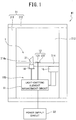
- the schematic configuration of an ultraviolet-emitting device 1 according to the present embodiment will be described first with reference to FIGS. 1 to 4 .
- the ultraviolet-emitting device 1 includes a light-emitting element 121 which emits ultraviolet rays, a mounting board (an example of a board) 314 on which the light-emitting element 121 is placed, and a fluorescent glass element 21 which is placed at a position irradiated with the ultraviolet rays emitted by the light-emitting element 121 and emits fluorescence in the visible range by excitation of the ultraviolet rays.
- the light-emitting element 121 is provided in a ceramic package 122 including a ceramic board.
- the light-emitting element 121 is mounted on the ceramic board.
- the light-emitting element 121 and the ceramic package 122 are provided in a light source 12.
- the ultraviolet-emitting device 1 includes a photodetection element 14 which detects the intensity of the fluorescence emitted by the fluorescent glass element 21, and a light-emitting element management circuit (an example of a management circuit) 11 which controls the light-emitting element 121, based on the intensity of the fluorescence detected by the photodetection element 14.
- the ultraviolet-emitting device 1 includes an electronic component group 100.
- the electronic component group 100 may include at least one of a photodetection element 14 which detects at least one of the presence or the absence of the emission and emission intensity (fluorescence intensity) of light emitted by the fluorescent glass element 21, a light-emitting element management circuit 11 which adjusts at least one of the presence or the absence of the emission and emission intensity of ultraviolet rays emitted by the light-emitting element 121, and a temperature sensor 15 (to be described in detail later).
- the electronic component group 100 includes the photodetection element 14, the light-emitting element management circuit 11, and the temperature sensor 15.
- the light-emitting element management circuit 11 is configured to control the light-emitting element 121, based on the fluorescence intensity detected by the photodetection element 14.
- the photodetection element 14, the light-emitting element management circuit 11, and the temperature sensor 15 correspond to examples of electronic components.
- the electronic component group 100 includes a plurality of electronic components. In other words, a plurality of electronic components are provided in the ultraviolet-emitting device 1 to form the electronic component group 100.
- the ultraviolet-emitting device 1 is accommodated in a box-shaped or cylindrical sterilization module M1.
- the sterilization module M1 includes an accommodation member 31 which can accommodate an object (not illustrated) to be sterilized by the ultraviolet-emitting device 1 and the light-emitting element 121 in an external light-shielded state.
- the sterilization module M1 includes an accommodation space 313 which can accommodate the ultraviolet-emitting device 1 and the object to be sterilized.
- the sterilization module M1 is configured to sterilize running water (an example of an object to be sterilized) flowing from one outside into the accommodation space 313, using ultraviolet rays emitted by the light-emitting element 121, and guide the sterilized running water to the other outside.
- the accommodation member 31 has a main body portion 311 having the accommodation space 313, and a lid portion 312 which can block incidence of external light on the accommodation space 313.
- the main body portion 311 has a box shape open at its one end.
- the lid portion 312 is provided on the main body portion 311 to allow opening and closing of one end of the main body portion 311.
- the sterilization module M1 has its lid portion 312 opened to open one end of the main body portion 311, and, after the ultraviolet-emitting device 1 is accommodated in the accommodation space 313, has its lid portion 312 closed to form a closed space in the accommodation space 313. After a closed space is formed in the accommodation space 313, running water flows into the sterilization module M1.
- the sterilization module M1 has in the accommodation space 313, a mounting board 314 on which the light source 12 and the like is placed.
- the mounting board 314 supports not only the light source 12 but also the fluorescent glass element 21, the photodetection element 14, and the temperature sensor 15 mounted on it.
- a through hole 314a having a stepped wall surface is formed in the mounting substrate 314.
- the fluorescent glass element 21 and the photodetection element 14 are inserted into the through hole 314a. If there is a gap between the fluorescent glass element 21 and the through hole 314a in a direction perpendicular to the through direction of the through hole 314a, light emitted from the fluorescent glass element 21 leaks out of the gap.
- the fluorescent glass element 21 is good to be inserted in a state where the outer surface is in contact with the inner wall surface of the through hole 314a. This prevents light emitted from the fluorescent glass element 21 from leaking between the fluorescent glass element 21 and the through hole 314a, thereby suppressing a decrease in the amount of light detected by the photodetection element 14, and the detection accuracy is improved.
- the gap between the fluorescent glass element 21 and the through hole 314a in the direction orthogonal to the through direction of the through hole 314a is preferably as small as possible from the viewpoint of improving the fluorescence detection accuracy of the photodetection element 14.
- the fluorescent glass element 21 and the photodetection element 14 are arranged to face each other in the through hole 314a.
- the mounting board 314 is made of a material (for example, aluminum) having a low thermal resistance and therefore also serves as a heat radiation member for dissipating heat generated by the light-emitting element 121.
- the sterilization module M1 also includes a power supply circuit 32 which supplies power to the ultraviolet-emitting device 1 and the like.
- the power supply circuit 32 is connected to a power supply cable connected to the ultraviolet-emitting device 1 and routed out of the accommodation member 31.
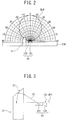
- FIG. 2 illustrates only the light source 12, the fluorescent glass element 21, and the mounting board 314 of the components provided in the accommodation space 313 of the sterilization module M1, to facilitate an understanding.
- FIG. 2 also illustrates an exemplary light distribution pattern of the light-emitting element 121, to facilitate an understanding.
- FIG. 3 illustrates only the fluorescent glass element 21 and the light source 12 of the components illustrated in FIG. 2 , to facilitate an understanding.
- the fluorescent glass element 21 is placed adjacent to the light-emitting element 121 to protrude higher than the light-emitting element 121. More specifically, the fluorescent glass element 21 protrude higher than the light-emitting element 121 with respect to an upper surface 123 of the ceramic package 122 accommodating the light-emitting element 121 and is adjacent to the light-emitting element 121 or adjacent to the light source 12.
- the "upper surface” may be defined herein, for example, as the surface of the ceramic package 122 opposite to a surface where the ceramic package 122 comes into contact with the mounting board 314, or as a virtual plane BP1 (see Fig. 3 ) including the surface.
- the height plane defining the light distribution pattern DLP is the virtual plane BP1.
- the light-emitting element 121 emits ultraviolet rays having a distribution of luminous intensity similar to the Lambert distribution of luminous intensity, as indicated by a light distribution pattern DLP.
- the light distribution pattern DLP possesses a directivity having a half-power angle of about 50°.
- the ultraviolet-emitting device 1 is not placed on the optical axis of the ultraviolet rays emitted by the light-emitting element 121 but crosses the ultraviolet rays at a position where the ultraviolet rays emitted by the light-emitting element 121 have a relatively low intensity.
- the ultraviolet-emitting device 1 can guide the ultraviolet rays emitted by the light-emitting element 121 to the fluorescent glass element 21 while suppressing attenuation of the ultraviolet rays impinging on the object to be sterilized.
- the sterilization module M1 can detect the effective light emission intensity while preventing a decrease in sterilization efficiency of the object to be sterilized.
- the fluorescent glass element 21 exhibits a fluorescence spectrum having a maximum peak in a wavelength range in which the photodetection element 14 has a relatively high detection sensitivity.
- the fluorescent glass element 21 exhibits a fluorescence spectrum having a maximum peak at a wavelength of, for example, 540 nm and is configured to emit green fluorescence.
- the photodetection element 14 exhibits a maximum sensitivity at a wavelength of, for example, 560 nm and detection characteristics having a full width at half maximum of about 120 nm. Hence, the photodetection element 14 can receive light emitted by the fluorescent glass element 21 even when ultraviolet rays are applied to the fluorescent glass element 21 in a small amount and the fluorescent glass element 21 emits low-intensity fluorescence.
- the fluorescent glass element 21 is formed in a pillar shape and has, at its one end, an inclined surface lower in the direction away from the light-emitting element 121, as illustrated in FIG. 3 . More specifically, the fluorescent glass element 21 has, at its one end, an inclined surface 211 whose level with reference to the upper surface 123 of the ceramic package 122 is lower in the direction away from the light-emitting element 121.
- the inclined surface 211 is inclined at an angle which allows total reflection of ultraviolet rays UV incident on the fluorescent glass element 21.
- the fluorescent glass element 21 is made of an ultraviolet-transmissible material, the ultraviolet rays UV incident on the fluorescent glass element 21 can be totally reflected by the inclined surface 211.
- the amount of ultraviolet rays exciting the fluorescent glass element 21 increases, and the intensity of fluorescence emitted by the fluorescent glass element 21, in turn, increases. This improves the detection sensitivity of the photodetection element 14.
- the fluorescent glass element 21 has, for example, a quadrangular prismatic shape, as illustrated in FIGS. 2 and 3 .
- the shape of the fluorescent glass element 21 is not limited to this and may be prismatic shapes other than a quadrangular prismatic shape, circular and elliptical shapes and the like.
- the fluorescent glass element 21 may have no inclined surface 211.
- the fluorescent glass element 21 may be mounted on the mounting board 314 as inclined at an angle which allows total reflection of the ultraviolet rays incident on the fluorescent glass element 21 by one end of the fluorescent glass element 21.
- the circuit configuration of the ultraviolet-emitting device 1 will be described below with reference to FIG. 4 .
- the ultraviolet-emitting device 1 includes a light-emitting element 121, a fluorescent glass element 21, a photodetection element 14, and a light-emitting element management circuit 11, as illustrated in FIG. 4 .
- the light-emitting element 121 is designed as, for example, an LED (Light Emitting Diode) which emits ultraviolet rays.
- the anode of the light-emitting element 121 is connected to, for example, an analog power supply and the cathode of the light-emitting element 121 is connected to, for example, the positive electrode of a constant current source 119 (to be described in detail later) provided in a light-emitting element driving circuit 11c.
- the fluorescent glass element 21 emits, for example, green fluorescence (having a wavelength of, for example, 560 nm) upon being excited by ultraviolet rays (having a wavelength of, for example, 265 nm) emitted by the light-emitting element 121, as described above. In other words, the fluorescent glass element 21 converts 265-nm-wavelength light into 560-nm-wavelength light.
- the photodetection element 14 is designed as, for example, a PD (Photodiode) .
- the cathode of the photodetection element 14 is connected to, for example, an analog power supply and its anode connected to, for example, a current-to-voltage conversion circuit 114 (to be described in detail later) provided in an auto power control circuit 11b.
- the photodetection element 14 is configured to convert the fluorescence emitted by the fluorescent glass element 21 into a current and output it to the current-to-voltage conversion circuit 114.
- the light-emitting element management circuit 11 has a setting circuit (an example of a setting unit) 11a which sets a target value for causing the light-emitting element 121 to emit light with a desired emission intensity, and an APC (Auto Power Control) circuit (an example of an automatic power controller) 11b which maintains the light-emitting element 121 at the desired emission intensity, as illustrated in FIG. 4 .
- the target value set by the setting circuit 11a is the value of the drive current for the light-emitting element 121, although details will be described later.
- the light-emitting element management circuit 11 further has a light-emitting element driving circuit (an example of a driver) which drives the light-emitting element 121.
- the setting circuit 11a has an amplifier 110 which amplifies a voltage based on a detection signal obtained by the photodetection element 14, a bias adjuster 111 which adjusts the DC bias of the voltage output from the amplifier 110, and an offset adjuster 112 which adjusts an offset voltage included in the voltage output from the amplifier 110.
- the setting circuit 11a further has an addition unit 113 which sums the voltage output from the amplifier 110, that output from the bias adjuster 111, and that output from the offset adjuster 112.
- the input terminal of the amplifier 110 is connected to the output terminal of the current-to-voltage conversion circuit 114 provided in the auto power control circuit 11b.
- the output terminal of the amplifier 110 is connected to one of the three input terminals of the addition unit 113.
- the one remaining terminal of the addition unit 113 is connected to the output terminal of the bias adjuster 111 and the other remaining terminal of the addition unit 113 is connected to the output terminal of the offset adjuster 112.
- the output terminal of the addition unit 113 is connected to the input terminal of an analog-to-digital converter 115 (to be described in detail later) provided in the auto power control circuit 11b.
- the input terminal of the bias adjuster 111 to receive an input bit signal, is connected to a predetermined output terminal of a microprocessor 116 (to be described in detail later) provided in the auto power control circuit 11b.
- the amplifier 110 is designed as, for example, a PGA (Programmable Gain Amplifier).
- the amplifier 110 is configured to amplify a voltage input from the current-to-voltage conversion circuit 114 and output it to the addition unit 113.
- the amplification factor (gain) of the amplifier 110 is adjusted as needed upon setting of a target drive current for causing the light-emitting element 121 to emit light with a desired emission intensity (to be sometimes simply referred to as "a target drive current for the light-emitting element 121" hereinafter) and at the start of the operation of the light-emitting element 121, although details will be described later.
- the bias adjuster 111 is designed as, for example, a digital-to-analog conversion circuit (Digital-to-Analog Converter: DAC).
- the bias adjuster 111 includes a DAC for high-order 8 bits and a DAC for low-order 8 bits.
- the bias adjuster 111 allows bias adjustment of the voltage output from the amplifier 110, using 16 bits accordingly.
- the bias adjuster 111 allows bias adjustment with a sufficient resolution even when a small amount of light is detected by the photodetection element 14.
- the number of input bits of the bias adjuster 111 is not limited to 16 bits and may be set as appropriate in accordance with the amount of light detected by the photodetection element 14.
- the voltage output from the bias adjuster 111 (that is, the input bit value) is adjusted as needed at the start of the operation of the light-emitting element 121, although details will be described later.
- the offset adjuster 112 is designed as, for example, a digital-to-analog conversion circuit (Digital-to-Analog Converter: DAC).
- the offset adjuster 112 includes a DAC for high-order 8 bits and a DAC for low-order 8 bits.
- the offset adjuster 112 allows offset adjustment of the voltage output from the amplifier 110, using 16 bits accordingly.
- the offset adjuster 112 allows offset adjustment with a sufficient resolution even when a small amount of light is detected by the photodetection element 14.
- the number of input bits of the offset adjuster 112 is not limited to 16 bits and may be set as appropriate in accordance with the amount of light detected by the photodetection element 14.
- the offset adjuster 112 is used to adjust an offset voltage generated by the entire circuit constituting the ultraviolet-emitting device 1.
- the voltage output from the offset adjuster 112 (that is, the input bit value) is adjusted as needed upon setting of a target drive current for the light-emitting element 121, although details will be described later.
- the addition unit 113 is configured to output to the auto power control circuit 11b, a sum voltage obtained by summing the voltage output from the amplifier 110, the voltage output from the bias adjuster 111, and the voltage output from the offset adjuster 112.
- the addition unit 113 has a 3-input/1-output configuration.
- the addition unit 113 can have various circuit configurations.
- the addition unit 113 may have two 2-input/1-output operational amplifiers, one of which is configured to sum the voltage output from the bias adjuster 111 and the voltage output from the offset adjuster 112 and the other of which is configured to sum the voltage output from the former operational amplifier and the voltage output from the amplifier 110.
- the addition unit 113 Upon setting of a target drive current for the light-emitting element 121, the addition unit 113 finally outputs a voltage based on the emission intensity of the light-emitting element 121 driven by the target drive current as a feedback voltage Vfb. The addition unit 113 further outputs a voltage based on the emission intensity of the light-emitting element 121 as a feedback voltage Vfb during a sterilization operation for the object to be sterilized by the light-emitting element 121.
- the auto power control circuit 11b has a current-to-voltage (to be sometimes referred to as "I/V" hereinafter) conversion circuit 114 having its input terminal connected to the anode of the photodetection element 14, as illustrated in FIG. 4 .
- the I/V conversion circuit 114 is implemented using, for example, a current input operational amplifier, although a detailed circuit configuration will not be described.
- the output terminal of the I/V conversion circuit 114 is connected to the noninverting input terminal of the amplifier 110 provided in the setting circuit 11a.
- the I/V conversion circuit 114 is configured to convert a current input from the photodetection element 14 into a voltage and output it to the amplifier 110.
- the auto power control circuit 11b has an analog-to-digital converter ("analog-to-digital" will sometimes be abbreviated as "A/D” hereinafter) 115 which converts an analog signal output from the setting circuit 11a into a digital signal.
- the auto power control circuit 11b also has a microprocessor (an example of a determination unit) 116 which determines whether the light-emitting element 121 maintains a desired emission intensity, based on the digital signal converted by the A/D converter 115.
- the auto power control circuit 11b further has a pulse-width modulated signal generator (an example of a generator) 117 which generates a PWM (Pulse Width Modulation) signal (an example of a control signal) for controlling the light-emitting element driving circuit (an example of a driver) 11c, based on an instruction from the microprocessor 116.
- a pulse-width modulated signal generator an example of a generator
- PWM Pulse Width Modulation
- control signal an example of a control signal
- the microprocessor is symbolized by “ ⁇ P.
- Pulse width modulation will sometimes be abbreviated as "PWM” hereinafter.
- the auto power control circuit 11b determines whether the light-emitting element 121 operates with a desired emission intensity, based on the feedback voltage Vfb during a sterilization operation, although details will be described later.
- the output terminal of the A/D converter 115 is connected to a predetermined input terminal, to receive a bit signal, of the microprocessor 116.
- the predetermined output terminal of the microprocessor 116 is connected to the input terminal of the PWM signal generator 117.
- the output terminal of the PWM signal generator 117 is connected to the input terminal of a controller 118 (to be described in detail later) provided in the light-emitting element driving circuit 11c.
- the A/D converter (Analog-to-Digital Converter: ADC) 115 converts the feedback voltage Vfb of an analog signal input from the addition unit 113 provided in the setting circuit 11a into a digital signal and outputs it to the microprocessor 116.
- ADC Analog-to-Digital Converter
- the microprocessor 116 stores a digital signal, input from the A/D converter 115 when setting of a target drive current for the light-emitting element 121 is complete, in a predetermined storage area as a target code.
- the target code is the condition of a drive current for driving the light-emitting element 121 with a desired emission intensity.
- the microprocessor 116 stores the allowable operating range of the light-emitting element 121 in a predetermined storage area as a threshold code.
- the microprocessor 116 sets an upper limit threshold code defining the upper limit and a lower limit threshold code defining the lower limit of the allowable operating range of the light-emitting element 121.
- the microprocessor 116 compares the digital signal input from the A/D converter 115 with the target code and the threshold code during a sterilization operation for the object to be sterilized by the light-emitting element 121. When the value of the input digital signal falls within the range between the target code and the threshold code, the microprocessor 116 determines that the light-emitting element 121 maintains a desired emission intensity. When the value of the input digital signal falls outside the range between the target code and the threshold code, the microprocessor 116 determines that the light-emitting element 121 maintains no desired emission intensity. The microprocessor 116 outputs no special instruction signal to the PWM signal generator 117 when it determines that the light-emitting element 121 maintains a desired emission intensity.
- the microprocessor 116 outputs a signal for instructing the PWM signal generator 117 to change the drive current when it determines that the light-emitting element 121 maintains no desired emission intensity.
- the microprocessor 116 When the value of the input digital signal is larger than the upper limit threshold code, the microprocessor 116 outputs a signal for an instruction to decrease the amount of drive current to the PWM signal generator 117.
- the microprocessor 116 When the value of the input digital signal is smaller than the lower limit threshold code, the microprocessor 116 outputs a signal for an instruction to increase the amount of drive current to the PWM signal generator 117.
- the light-emitting element management circuit 11 When the sterilization module M1 is used in an unusual manner in the state of a sterilization operation for the object to be sterilized by the light-emitting element 121, the light-emitting element management circuit 11 immediately stops the light-emitting element 121, based on the state identification signal Smode. Hence, the ultraviolet-emitting device 1 can prevent ultraviolet rays from leaking out while the sterilization module M1 sterilizes the object to be sterilized.
- the PWM signal generator 117 outputs a duty signal Sduty to the light-emitting element driving circuit 11c, based on the instruction signal input from the microprocessor 116.
- the PWM signal generator 117 When a signal for an instruction to decrease the drive current is input from the microprocessor 116, the PWM signal generator 117 outputs a duty signal Sduty lower in duty ratio than the last output duty signal Sduty to the light-emitting element driving circuit 11c.
- the PWM signal generator 117 outputs a duty signal Sduty higher in duty ratio than the last output duty signal Sduty to the light-emitting element driving circuit 11c.
- the ultraviolet-emitting device 1 includes a temperature sensor (an example of a temperature detector) 15 which detects the temperature of the light-emitting element 121.
- the auto power control circuit 11b controls the light-emitting element driving circuit 11c, based on the temperature detected by the temperature sensor 15.
- the output terminal of the temperature sensor 15 is connected to a predetermined input terminal of the microprocessor 116.
- the temperature sensor 15 When the temperature of the light-emitting element 121 detected by the thermistor is higher than the predetermined temperature, the temperature sensor 15 outputs, for example, a high voltage (a high input voltage allowed by the microprocessor 116) from the comparator to the microprocessor 116.
- a high voltage a high input voltage allowed by the microprocessor 116
- the microprocessor 116 instructs the PWM signal generator 117 to change the duty ratio of the duty signal Sduty, in accordance with the level of the voltage input from the temperature sensor 15.
- the microprocessor 116 receives a low voltage from the temperature sensor 15, it does not instruct the PWM signal generator 117 to change the duty ratio of the duty signal Sduty.
- the microprocessor 116 receives a high voltage from the temperature sensor 15, it instructs the PWM signal generator 117 to raise the duty ratio of the duty signal Sduty. With this operation, since the amount of drive current flowing through the light-emitting element 121 increases, the emission intensity reduced with increased temperature of the light-emitting element 121 is compensated for.
- the ultraviolet-emitting device 1 can compensate for the reduction in emission intensity due to factors associated with the temperature characteristics of the light-emitting element 121, independently of the reduction in emission intensity due to aging of the light-emitting element 121 (to be described in detail later).
- the microprocessor 116 is configured to change the input bit values of the bias adjuster 111 and the offset adjuster 112 as needed in the setting state of a target drive current for the light-emitting element 121 and the state of a sterilization operation for the object to be sterilized by the light-emitting element 121.
- the microprocessor 116 is configured to further change the amplification factor of the amplifier 110 as needed in the setting state of a target drive current for the light-emitting element 121.
- the light-emitting element driving circuit 11c has a controller 118 and a constant current source 119, as illustrated in FIG. 4 .
- the controller 118 is configured to control the amount of current output from the constant current source 119, based on the duty signal Sduty input from the PWM signal generator 117.
- the controller 118 drives the constant current source 119 to decrease the amount of current to be output.
- the controller 118 drives the constant current source 119 to increase the amount of current to be output.
- the light-emitting element 121 is connected in series with the constant current source 119.
- the positive electrode of the constant current source 119 is connected to the cathode of the light-emitting element 121 and the negative electrode of the constant current source 119 is connected to an analog reference potential (analog ground).
- the constant current source 119 is configured to output a predetermined amount of constant current from an analog power supply to the analog ground under the control of the controller 118. Since the light-emitting element 121 is connected in series with the constant current source 119, a constant current in an amount output from the constant current source 119 flows through the light-emitting element 121.
- the voltage value of the analog power supply applied to the anode of the light-emitting element 121 stays constant.
- the intensity of ultraviolet rays emitted by the light-emitting element 121 is determined by the amount of constant current output from the constant current source 119.
- the ultraviolet-emitting device 1 sets the drive current flowing through the light-emitting element 121, that is, the current output from the constant current source 119 as an initial current in the setting state of a target drive current for the light-emitting element 121.
- the ultraviolet-emitting device 1 is configured to operate in two states: the target value setting state in which a target drive current for the light-emitting element 121 is set and the sterilization operation state in which the object to be sterilized is sterilized by the light-emitting element 121.
- the ultraviolet-emitting device 1 sets a target value for the light-emitting element 121 (in the present embodiment, a target value for the amount of drive current for the light-emitting element 121) by executing four steps.
- the initial value of the amplification factor of the amplifier 110 is set to a maximum value.
- the input bit value is set so that the initial value of the voltage output from the bias adjuster 111 is 1/2 of the maximum voltage VDD.
- the input bit value is further set so that the initial value of the voltage output from the offset adjuster 112 is 1/2 of the maximum voltage VDD.
- the state identification signal Smode is set to "1.”
- the operations of the setting circuit 11a and the auto power control circuit 11b are started without operating the light-emitting element 121. Since the light-emitting element 121 is inactive, no fluorescence is generated by the fluorescent glass element 21, but a dark current, for example, flows through the photodetection element 14, and the current is therefore input from the photodetection element 14 to the I/V conversion circuit 114. Since the amplification factor of the amplifier 110 is set to a maximum value, the feedback voltage Vfb is output from the addition unit 113. At time t1, the feedback voltage Vfb takes a value larger than the maximum voltage VDD.
- the microprocessor 116 When a feedback voltage Vfb having a value larger than the maximum voltage VDD is output from the addition unit 113, the microprocessor 116 reduces the amplification factor of the amplifier 110 in steps of one grade in the first step. The microprocessor 116 determines whether the feedback voltage Vfb has dropped to an input voltage VIN1 on the high side on which the operation of the microprocessor 116 is compensated for, every time the amplification factor of the amplifier 110 is reduced. The microprocessor 116 reduces the amplification factor of the amplifier 110 until it determines that the feedback voltage Vfb has dropped to the input voltage VIN1.
- the microprocessor 116 changes the input bit value in steps of one bit to lower the voltage output from the DAC for high-order bits provided in the offset adjuster 112.
- the microprocessor 116 determines whether the value of the feedback voltage Vfb falls within the range of 1/2 of the maximum voltage VDD to the error voltage (VDD/2 + ⁇ V), every time the input bit value of the DAC for high-order bits is changed by one bit.
- the microprocessor 116 determines that the value of the feedback voltage Vfb falls within the range of 1/2 of the maximum voltage VDD to the error voltage (VDD/2 + ⁇ V) at, for example, time t3, it ends the change in input bit value of the DAC for high-order bits in the offset adjuster 112.
- the ultraviolet-emitting device 1 executes the first and second steps again to adjust the offset voltage by the DAC for low-order bits provided in the offset adjuster 112.
- the light-emitting element management circuit 11 sets the amplification factor of the amplifier 110 to a maximum value again.
- the feedback voltage Vfb takes a value larger than the maximum voltage VDD.
- the light-emitting element management circuit 11 gradually reduces the amplification factor of the amplifier 110 to lower the feedback voltage Vfb to the input voltage VIN1 on the high side on which the operation of the microprocessor 116 is compensated for.
- the light-emitting element management circuit 11 changes the input bit value to lower the voltage output from the DAC for low-order bits provided in the offset adjuster 112.
- the value of the feedback voltage Vfb falls within the range of 1/2 of the maximum voltage VDD to the error voltage (VDD/2 + ⁇ V) at time t6
- the light-emitting element management circuit 11 ends the change in input bit value of the DAC for low-order bits in the offset adjuster 112.
- FIG. 5 illustrates an example in which the feedback voltage Vfb takes a value larger than the maximum voltage VDD when the operations of the setting circuit 11a and the auto power control circuit 11b are started in the target value setting state, but the feedback voltage Vfb may take a value smaller than the minimum voltage (0 V).
- the operations of the setting circuit 11a and the auto power control circuit 11b are started without operating the light-emitting element 121. Since the light-emitting element 121 is inactive, no fluorescence is generated by the fluorescent glass element 21, but a dark current, for example, flows through the photodetection element 14, and the current is therefore input from the photodetection element 14 to the I/V conversion circuit 114. Since the amplification factor of the amplifier 110 is set to a maximum value, the feedback voltage Vfb is output from the addition unit 113. At time t1, the feedback voltage Vfb takes a value smaller than the minimum voltage (0 V) .
- the light-emitting element management circuit 11 gradually reduces the amplification factor of the amplifier 110 to raise the feedback voltage Vfb to an input voltage VIN2 on the low side on which the operation of the microprocessor 116 is compensated for.
- the microprocessor 116 changes the input bit value in steps of one bit to raise the voltage output from the DAC for high-order bits provided in the offset adjuster 112.
- the microprocessor 116 determines that the value of the feedback voltage Vfb falls within the range of 1/2 of the maximum voltage VDD to the error voltage (VDD/2 - ⁇ V) at time t3, it ends the change in input bit value of the DAC for high-order bits in the offset adjuster 112.
- the ultraviolet-emitting device 1 executes the first and second steps again to adjust the offset voltage by the DAC for low-order bits provided in the offset adjuster 112.
- the light-emitting element management circuit 11 sets the amplification factor of the amplifier 110 to a maximum value again.
- the feedback voltage Vfb takes a value smaller than the minimum voltage (0 V).
- the microprocessor 116 reduces the amplification factor of the amplifier 110 in steps of one grade to raise the feedback voltage Vfb to the input voltage VIN2 on the low side on which the operation of the microprocessor 116 is compensated for.
- the microprocessor 116 changes the input bit value in steps of one bit to raise the voltage output from the DAC for low-order bits provided in the offset adjuster 112.
- the value of the feedback voltage Vfb falls within the range of 1/2 of the maximum voltage VDD to the error voltage (VDD/2 - ⁇ V) at time t6
- the change in input bit value of the DAC for low-order bits in the offset adjuster 112 is ended.
- Periods P1 and P3 illustrated in FIGS. 5 and 6 correspond to the first step in which the amplification factor of the amplifier 110 is adjusted.
- Periods P2 and P4 illustrated in FIGS. 5 and 6 correspond to the second step in which an offset voltage included in the entire circuit constituting the ultraviolet-emitting device 1 is adjusted using the offset adjuster 112.
- a current having an initial value is supplied to the light-emitting element 121 at time t7.
- the light-emitting element 121 starts its operation to emit ultraviolet rays. Since the fluorescent glass element 21 emits fluorescence upon being excited by ultraviolet rays incident from the light-emitting element 121, a current is input from the photodetection element 14 to the I/V conversion circuit 114.
- the current flowing from the photodetection element 14 to the I/V conversion circuit 114 in this case is larger than the amount of dark current by several orders of magnitude. Accordingly, at time t8, the feedback voltage Vfb output from the addition unit 113 takes a value larger than the maximum voltage VDD.
- the microprocessor 116 reduces the amplification factor of the amplifier 110 in steps of one grade to lower the feedback voltage Vfb to the input voltage VIN1 on the high side on which the operation of the microprocessor 116 is compensated for.
- the microprocessor 116 changes the input bit value in steps of one bit to lower the voltage output from the DAC provided in the bias adjuster 111.
- the value of the feedback voltage Vfb falls within the range of 1/2 of the maximum voltage VDD to the error voltage (VDD/2 + ⁇ V) at time t10, the change in input bit value of the DAC in the bias adjuster 111 is ended.
- the microprocessor 116 stores a digital signal, obtained by A/D-converting the feedback voltage Vfb at time t10 by the A/D converter 115, in a predetermined storage area as a target code.
- the microprocessor 116 sets an upper limit threshold code and a lower limit threshold code in a predetermined storage area, based on the stored target code.
- the ultraviolet-emitting device 1 completes the initial setting operation.
- a period P5 illustrated in FIG. 7 corresponds to the third step in which the amplification factor of the amplifier 110 is adjusted when a current having an initial value has been supplied to the light-emitting element 121.
- a period P6 illustrated in FIG. 7 corresponds to the fourth step in which a DC bias included in the feedback voltage Vfb is adjusted when a current having an initial value has been supplied to the light-emitting element 121.
- the ultraviolet-emitting device 1 When the ultraviolet-emitting device 1 completes the initial setting operation, it sets the state identification signal Smode to "0 . "
- the sterilization module M1 starts to sterilize the object to be sterilized at subsequent time t11, and the light-emitting element 121 continues to emit light, the light-emitting element 121 deteriorates over time and voltage vs. current characteristic of the light-emitting element 121 varies.
- the feedback voltage Vfb becomes lower than a lower limit threshold voltage VthL corresponding to the lower limit threshold code.
- the microprocessor 116 determines that the value of the digital signal input from the A/D converter 115 is smaller than the lower limit threshold code and the light-emitting element 121 maintains no desired emission intensity. Therefore, the microprocessor 116 outputs an instruction signal for increasing the drive current for the light-emitting element 121 to the PWM signal generator 117. Upon receiving the instruction signal, the PWM signal generator 117 generates a duty signal Sduty higher in duty ratio than the duty signal Sduty corresponding to the target code and outputs it to the light-emitting element driving circuit 11c. As a result, since the amount of current output from the constant current source 119 increases, the current flowing through the light-emitting element 121 also increases.
- the microprocessor 116 determines that the value of the digital signal input from the A/D converter 115 falls within the range of the upper limit threshold code and the lower limit threshold code, and the light-emitting element 121 maintains a desired emission intensity. Then, the microprocessor 116 stops outputting an instruction signal for increasing the drive current for the light-emitting element 121 to the PWM signal generator 117.
- the PWM signal generator 117 thus continuously outputs a duty signal Sduty having the last output duty ratio to the light-emitting element driving circuit 11c.
- the amount of current output from the constant current source 119 is maintained, and the amount of current flowing through the light-emitting element 121 is also maintained.
- the light-emitting element 121 maintains a desired emission intensity accordingly.
- the microprocessor 116 can detect and compensate for the deterioration over time of the light-emitting element 121.
- the ultraviolet-emitting device 1 performs the same operation as that at time t12 to time t13.
- the feedback voltage Vfb exceeds 1/2 of the maximum voltage VDD and the light-emitting element 121 emits light with a desired emission intensity again.
- the ultraviolet-emitting device 1 performs initial setting of an operating point for the light-emitting element 121 to obtain not the maximum emission intensity of the light-emitting element 121 but a minimum emission intensity required to sterilize the object to be sterilized. Therefore, the ultraviolet-emitting device 1 can repeatedly compensate for the operation of the light-emitting element 121 until the operating point after compensation reaches an operating point having a maximum emission intensity even when the deterioration over time occurs in the light-emitting element 121.
- the ultraviolet-emitting device 1 adjusts the offset voltage of the entire circuit constituting the ultraviolet-emitting device 1 in the target value setting state to set the feedback voltage Vfb to 1/2 of the maximum voltage VDD. Hence, even when the voltage fluctuates in the sterilization operation state, it is hardly probable that the feedback voltage Vfb will be higher than the maximum voltage VDD or lower than the minimum voltage (0 V) . As a result, the ultraviolet-emitting device 1 can stabilize the sterilization operation in the sterilization module M1.
- the lid portion 312 of the sterilization module M1 is opened, although not illustrated. Then, not only fluorescence emitted by the fluorescent glass element 21 but also external light strikes the photodetection element 14. The amount of external light is larger than the amount of fluorescence emitted by the fluorescent glass element 21 by several orders of magnitude. The feedback voltage Vfb is therefore higher than the maximum voltage VDD.
- the microprocessor 116 receives a state identification signal Smode having value "0."
- the light-emitting element management circuit 11 stops the operation of the light-emitting element 121 by, for example, forcibly setting the value of the feedback voltage Vfb input to the A/D converter 115 to 0V or inputting a duty signal Sduty having zero duty ratio to the controller 118 of the light-emitting element driving circuit 11c.
- the ultraviolet-emitting device 1 can prevent ultraviolet rays from leaking out of the accommodation member 31.
- the ultraviolet-emitting device 1 includes a light-emitting element 121 which emits ultraviolet rays, a fluorescent glass element 21 which is placed at a position, irradiated with the ultraviolet rays emitted by the light-emitting element 121, to protrude higher than the light-emitting element 121, and emits fluorescence in the visible range by excitation of the ultraviolet rays, a mounting board 314 on which the light-emitting element 121 is placed, and a photodetection element 14 which detects the intensity of the fluorescence emitted by the fluorescent glass element 21.
- the ultraviolet-emitting device 1 achieves prolonged life of the light-emitting element while maintaining a certain emission intensity of the light-emitting element.
- the ultraviolet-emitting device 1 further includes a light-emitting element management circuit 11 which controls the light-emitting element 121, based on the intensity of the fluorescence detected by the photodetection element 14.
- the ultraviolet-emitting device 1 can automatically learn the initial value of the drive current for the light-emitting element 121 within the range of variation in the circuit system constituting the ultraviolet-emitting device 1 and operate to maintain the emission intensity (output power) of the light-emitting element 121 constant when the deterioration over time of the light-emitting element 121 falls within the expected range.
- the ultraviolet-emitting device 1 can stop the light-emitting element 121 when a high power exceeding the gain of the circuit system constituting the ultraviolet-emitting device 1 is input (that is, when the lid portion 312 of the sterilization module M1 is opened during a sterilization operation). Hence, the ultraviolet-emitting device 1 can serve as a safety device.
- the ultraviolet-emitting device 1 uses the fluorescent glass element 21 to keep ultraviolet rays from being directly input to the photodetection element 14. This can prevent the resin used to mold the detection unit of the photodetection element 14 from deteriorating upon irradiation with ultraviolet rays. Since the feedback voltage Vfb can hardly include variations based on the deterioration of the photodetection element 14, the deterioration of the light-emitting element 121 can be accurately compensated for based on the feedback voltage Vfb.
- the ultraviolet-emitting device 1 can use the fluorescent glass element 21 to convert 265-nm-wavelength ultraviolet rays emitted by the light-emitting element 121 into 580-nm-wavelength fluorescence and detect the ultraviolet rays emitted by the light-emitting element 121. This allows the use of a highly sensitive photodetection element 14 and, in turn, allows stabilization of the operation of the light-emitting element management circuit 11.
- Embodiment 2 (including Embodiments 2-1 to 2-3) of the present disclosure relates to an ultraviolet-emitting device including a light-emitting element which emits light having wavelengths shorter than the visible range.
- Embodiment 2-1 of the present disclosure An ultraviolet-emitting device according to Embodiment 2-1 of the present disclosure will be described below with reference to FIGS. 8 and 9 .
- the schematic configuration of an ultraviolet-emitting device 2 according to the present embodiment will be described first with reference to FIGS. 8 and 9 .
- the same reference numerals denote components exhibiting the same actions and functions as those of the components in above-described Embodiment 1.
- the ultraviolet-emitting device 2 includes a light-emitting element 131 which emits ultraviolet rays, a mounting board (an example of a board) 314 on which the light-emitting element 131 is placed, and a fluorescent glass element 22 placed at a position irradiated with ultraviolet rays UV1 emitted by the light-emitting element 131, and placed in a through hole 314a formed through the mounting board 314, and emitting fluorescence in the visible range by excitation of an ultraviolet rays.
- the light-emitting element 131 is provided in a ceramic package 132 including a ceramic board.
- the light-emitting element 131 is mounted on the ceramic board.
- the light-emitting element 131 and the ceramic package 132 are provided in a light source 13. At least a part of the mounting board 314 is made of a member absorbing or reflecting ultraviolet rays.
- the ultraviolet-emitting device 2 includes an electronic component group 100 on the opposite side of a placement side of the light-emitting element 131 with respect to the mounting board 314.
- the electronic component group 100 may include at least one of a photodetection element 14 which detects at least one of the presence or the absence of the emission and emission intensity (fluorescence intensity) of light emitted by the fluorescent glass element 22, a light-emitting element management circuit 11 which adjusts at least one of the presence or the absence of the emission and emission intensity of ultraviolet rays emitted by the light-emitting element 131, and a temperature sensor 15 (to be described in detail later) .
- the electronic component group 100 includes the photodetection element 14, the light-emitting element management circuit 11, and the temperature sensor 15.
- the light-emitting element management circuit 11 corresponds to an example of an element which can perform at least one of sending of at least one of the presence or the absence of the emission and emission intensity of ultraviolet rays emitted by the light-emitting element 131 to the outside, control (for example, ON/OFF control) to cause the light-emitting element 131 to emit ultraviolet rays with a desired emission intensity, and adjustment of the ultraviolet rays emitted by the light-emitting element 131 to a desired emission intensity.
- the light-emitting element management circuit 11 is configured to control the light-emitting element 131, based on the fluorescence intensity detected by the photodetection element 14.
- the photodetection element 14, the light-emitting element management circuit 11, and the temperature sensor 15 correspond to examples of electronic components.
- the electronic component group 100 has a plurality of electronic components.
- a plurality of electronic components are provided in the ultraviolet-emitting device 2 to form the electronic component group 100.
- the electronic component group 100 may be disposed in whole on the opposite side of a placement side of the light-emitting element 131 with respect to the mounting board 314 without being partly exposed on or protruded to the placement side of the light-emitting element 131.
- each of the photodetection element 14, the light-emitting element management circuit 11, the temperature sensor 15, and other electronic components constituting the electronic component group 100 may be disposed in whole on the opposite side of the placement side of the light-emitting element 131 with respect to the mounting board 314 without being partly exposed on or being partly protruded to the placement side of the light-emitting element 131 .
- the ultraviolet-emitting device 2 is accommodated in a box-shaped or cylindrical sterilization module M2.
- the sterilization module M2 includes an accommodation member 31 which can accommodate an object (not illustrated) to be sterilized by the ultraviolet-emitting device 2 and the light-emitting element 131 in an external light-shielded state.
- the sterilization module M2 includes an accommodation space 313 which can accommodate the ultraviolet-emitting device 2 and the object to be sterilized.
- the sterilization module M2 is configured to sterilize running water (an example of an object to be sterilized) flowing from one outside into the accommodation space 313, using ultraviolet rays emitted by the light-emitting element 131, and guide the sterilized running water to the other outside.
- the accommodation member 31 has a main body portion 311 having the accommodation space 313, and a lid portion 312 which can block incidence of external light on the accommodation space 313.
- the main body portion 311 has a box shape open at its one end.
- the lid portion 312 is provided on the main body portion 311 to allow opening and closing of one end of the main body portion 311.
- the sterilization module M2 has its lid portion 312 opened to open one end of the main body portion 311, and, after the ultraviolet-emitting device 2 is accommodated in the accommodation space 313, has its lid portion 312 closed to form a closed space in the accommodation space 313. After a closed space is formed in the accommodation space 313, running water flows into the sterilization module M2.
- the accommodation space 313 is surrounded by the main body portion 311 and the lid portion 312.
- the object to be sterilized accommodated in the accommodation space 313 is sterilized with ultraviolet rays emitted by the light-emitting element 131.
- the light-emitting element 131 is provided to allow irradiation of the object to be sterilized with ultraviolet rays.
- the ultraviolet-emitting device 2 can serve as a sterilizer and can be used as such.
- the sterilization module M2 has in the accommodation space 313, a mounting board 314 on which the light source 13 and the like is placed.
- the mounting board 314 corresponds to a board on which the light-emitting element 131 is placed.
- the mounting board 314 supports not only the light source 13 but also the fluorescent glass element 22, the photodetection element 14, and the temperature sensor 15 mounted on it.
- the mounting board 314 is made of a material (for example, aluminum) absorbing or reflecting ultraviolet rays and having a low thermal resistance.
- the mounting board 314 serves both as a preventive member which prevents ultraviolet rays from striking the opposite side of the placement side of the light-emitting element 131 with respect to the mounting board 314, and as a heat radiation member for dissipating heat generated by the light-emitting element 131.
- FIG. 9 represents the regions of a setting circuit 11a, an APC circuit 11b, and a light-emitting element driving circuit 11c (all will be described in detail later) constituting the light-emitting element management circuit 11, the photodetection element 14, and the temperature sensor 15.
- the positions of the setting circuit 11a, the APC circuit 11b, the light-emitting element driving circuit 11c, the photodetection element 14, and the temperature sensor 15 relative to each other are not limited to those represented in FIG. 9 and may be changed as appropriate.
- the light-emitting element management circuit 11 is placed on the opposite side of a surface (to be sometimes referred to as an "element mounting surface” hereinafter) on the side (placement side) where the light-emitting element 131 is placed with respect to the mounting board 314, as illustrated in FIG. 9 .
- the photodetection element 14 and the temperature sensor 15 are also placed on the opposite side of the element mounting surface of the mounting board 314.
- the light-emitting element 131 has a predetermined directivity. Ultraviolet rays emitted by the light-emitting element 131 may be partially guided to the mounting board 314 .
- the mounting board 314 includes at least a part (for example, a portion corresponding to the region of the electronic component group 100) made of a member absorbing or reflecting ultraviolet rays. Ultraviolet rays emitted by the light-emitting element 131 are blocked by the mounting board 314 and do not strike the opposite side of the element mounting surface. This prevents ultraviolet rays from striking the light-emitting element management circuit 11 that are electronic components included in the electronic component group 100, the photodetection element 14, and the temperature sensor 15.
- the photodetection element 14, and the temperature sensor 15 are made of a material deteriorated by ultraviolet rays, such as a resin, they are prevented from being deteriorated by ultraviolet rays emitted by the light-emitting element 131.
- the fluorescent glass element 22 is inserted into the through hole 314a and is arranged through the mounting board 314, as illustrated in FIG. 9 .
- the fluorescent glass element 22 is disposed so as to protrude from the mounting board 314 to a level higher than the light-emitting element 131. Therefore, the fluorescent glass element 22 is partially exposed on the element mounting surface of the mounting board 314.
- the fluorescent glass element 22 is adjacent to the light-emitting element 131. With this arrangement, the ultraviolet rays UV1 emitted by the light-emitting element 131 can be guided to the fluorescent glass element 22.
- the fluorescent glass element 22 is also partially exposed on a surface (to be sometimes referred to as a "mounting back surface” hereinafter) opposite to the element mounting surface of the mounting board 314.
- the fluorescent glass element 22 can thus guide fluorescence in the visible range emitted by excitation of the ultraviolet rays UV1 to the photodetection element 14 placed below the mounting back surface of the mounting board 314.
- the fluorescent glass element 22 protrudes to the side where the light-emitting element 131 is placed from the mounting board 314 and a part of the fluorescent glass element 22 is arranged the side where the light-emitting element 131 is placed. Accordingly, the fluorescent glass element 22 corresponds to neither an electronic component that is placed on the opposite side of the placement side of the light-emitting element 131 with respect to the mounting board 314 nor an electronic component constituting the electronic component group 100.
- the sterilization module M2 includes a power supply circuit 32 which supplies power to the ultraviolet-emitting device 2 and the like.
- the power supply circuit 32 is connected to a power supply cable connected to the ultraviolet-emitting device 2 and routed out of the accommodation member 31.
- the fluorescent glass element 22 will be described below.
- the fluorescent glass element 22 protrudes from the mounting board 314 to a level higher than the light-emitting element 131 with respect to an upper surface 133 of the ceramic package 132 accommodating the light-emitting element 131 and is adjacent to the light-emitting element 131 or adjacent to the light source 13.
- the "upper surface” may be defined herein, for example, as the surface of the ceramic package 132 opposite to a surface (element mounting surface) which allows the ceramic package 132 to come into contact with the mounting board 314, or as a virtual plane BP2 including this surface of the ceramic package 132.
- the light-emitting element 131 emits ultraviolet rays having a distribution of luminous intensity (see FIG. 2 ) similar to, for example, the Lambert distribution of luminous intensity.
- the light distribution pattern possesses a directivity having a half-power angle of about 50°.
- the fluorescent glass element 22 crosses ultraviolet rays UV1 having a relative radiation intensity lower than the relative radiation intensity in terms of the half-power angle of ultraviolet rays emitted by the light-emitting element 131.
- the ultraviolet-emitting device 2 can guide ultraviolet rays emitted by the light-emitting element 131 to the fluorescent glass element 22 while suppressing attenuation of the ultraviolet rays impinging on the object to be sterilized.
- the sterilization module M2 can prevent degradation in sterilization efficiency of the object to be sterilized.
- the fluorescent glass element 22 exhibits a fluorescence spectrum having a maximum peak in a wavelength range in which the photodetection element 14 has a relatively high detection sensitivity.
- the fluorescent glass element 22 exhibits a fluorescence spectrum having a maximum peak at a wavelength of, for example, 540 nm and is configured to emit green fluorescence.
- the photodetection element 14 exhibits a maximum sensitivity at a wavelength of, for example, 560 nm and detection characteristics having a full width at half maximum of about 120 nm. Hence, the photodetection element 14 can receive light emitted by the fluorescent glass element 22 even when ultraviolet rays are applied to the fluorescent glass element 22 in a small amount and the fluorescent glass element 22 emits low-intensity fluorescence.
- the fluorescent glass element 22 has, for example, a quadrangular prismatic shape.
- the shape of the fluorescent glass element 22 is not limited to this and may be prismatic shapes other than a quadrangular prismatic shape, circular and elliptical shapes and the like.
- the fluorescent glass element 22 may have its one end face inclined and exposed on the element mounting surface of the mounting board 314 to allow nearly perpendicular incidence of the ultraviolet rays UV1.
- the fluorescent glass element 22 may include, at its one end, an inclined surface lower in the direction away from the light-emitting element 131.
- the circuit configuration of the ultraviolet-emitting device 2 will be described.
- the ultraviolet-emitting device 2 has the same as the circuit configuration of the ultraviolet-emitting device 1 according to above-described Embodiment 1, except that the fluorescent glass element 22 is provided instead of the fluorescent glass element 21 and the light source 13 is provided instead of the light source 12. Therefore, the circuit configuration of the ultraviolet-emitting device 2 will be described with reference to FIG.4 .
- the fluorescent glass element 21 is read as the fluorescent glass element 22, and the light emitting element 121 is read as the light emitting element 131.
- the ultraviolet-emitting device 2 includes a light-emitting element 131, a fluorescent glass element 22, and an electronic component group 100, as illustrated in FIG. 4 .
- a photodetection element 14, a temperature sensor 15, and a light-emitting element management circuit 11 are included in the electronic component group 100.
- the light-emitting element 131 is designed as, for example, an LED (Light Emitting Diode) which emits ultraviolet rays.
- the light-emitting element 131 has its anode connected to, for example, an analog power supply and its cathode connected to, for example, the positive electrode of a constant current source 119 (to be described in detail later) provided in a light-emitting element driving circuit 11c.
- the fluorescent glass element 22 emits, for example, green fluorescence (having a wavelength of, for example, 560 nm) upon being excited by ultraviolet rays (having a wavelength of, for example, 265 nm) emitted by the light-emitting element 131, as described above. In other words, the fluorescent glass element 22 converts 265-nm-wavelength light into 560-nm-wavelength light.
- the photodetection element 14 is designed as, for example, a PD (Photodiode).
- the photodetection element 14 has its cathode connected to, for example, an analog power supply and its anode connected to, for example, a current-to-voltage conversion circuit 114 (to be described in detail later) provided in an auto power control circuit 11b.
- the photodetection element 14 is configured to convert the fluorescence emitted by the fluorescent glass element 22 into a current and output it to the current-to-voltage conversion circuit 114.
- the light-emitting element management circuit 11 has a setting circuit (an example of a setting unit) 11a which sets a target value for causing the light-emitting element 131 to emit light with a desired emission intensity, and an APC (Auto Power Control) circuit (an example of an automatic power controller) 11b which maintains the light-emitting element 131 at the desired emission intensity, as illustrated in FIG. 4 .
- the target value set by the setting circuit 11a is the value of the drive current for the light-emitting element 131, although details will be described later.
- the light-emitting element management circuit 11 further has a light-emitting element driving circuit (an example of a driver) which drives the light-emitting element 131.
- the setting circuit 11a has an amplifier 110 which amplifies a voltage based on a detection signal detected by the photodetection element 14, a bias adjuster 111 which adjusts the DC bias of the voltage output from the amplifier 110, and an offset adjuster 112 which adjusts an offset voltage included in the voltage output from the amplifier 110.
- the setting circuit 11a further has an addition unit 113 which sums the voltage output from the amplifier 110, that output from the bias adjuster 111, and that output from the offset adjuster 112.
- the amplifier 110 has its input terminal connected to the output terminal of the current-to-voltage conversion circuit 114 provided in the auto power control circuit 11b.
- the amplifier 110 has its output terminal connected to one of the three input terminals of the addition unit 113.
- the addition unit 113 has its one remaining terminal connected to the output terminal of the bias adjuster 111 and its other remaining terminal connected to the output terminal of the offset adjuster 112.
- the addition unit 113 has its output terminal connected to the input terminal of an analog-to-digital converter 115 (to be described in detail later) provided in the auto power control circuit 11b.
- the bias adjuster 111 has its input terminal, to receive an input bit signal, connected to a predetermined output terminal of a microprocessor 116 (to be described in detail later) provided in the auto power control circuit 11b.
- the offset adjuster 112 has its input terminal, to receive an input bit signal, connected to a predetermined output terminal of the microprocessor 116.
- the amplifier 110 is designed as, for example, a PGA (Programmable Gain Amplifier).
- the amplifier 110 is configured to amplify a voltage input from the current-to-voltage conversion circuit 114 and output it to the addition unit 113.
- the amplification factor (gain) of the amplifier 110 is adjusted as needed upon setting of a target drive current for causing the light-emitting element 131 to emit light with a desired emission intensity (to be sometimes simply referred to as "a target drive current for the light-emitting element 131" hereinafter) and at the start of the operation of the light-emitting element 131, although details will be described later.
- the bias adjuster 111 is designed as, for example, a digital-to-analog conversion circuit (Digital-to-Analog Converter: DAC) .
- the bias adjuster 111 includes a DAC for high-order 8 bits and a DAC for low-order 8 bits.
- the bias adjuster 111 allows bias adjustment of the voltage output from the amplifier 110, using 16 bits accordingly.
- the bias adjuster 111 allows bias adjustment with a sufficient resolution even when a small amount of light is detected by the photodetection element 14.
- the number of input bits of the bias adjuster 111 is not limited to 16 bits and may be set as appropriate in accordance with the amount of light detected by the photodetection element 14.
- the voltage output from the bias adjuster 111 (that is, the input bit value) is adjusted as needed at the start of the operation of the light-emitting element 131, although details will be described later.
- the offset adjuster 112 is designed as, for example, a digital-to-analog conversion circuit (Digital-to-Analog Converter: DAC).
- the offset adjuster 112 includes a DAC for high-order 8 bits and a DAC for low-order 8 bits.
- the offset adjuster 112 allows offset adjustment of the voltage output from the amplifier 110, using 16 bits accordingly.
- the offset adjuster 112 allows offset adjustment with a sufficient resolution even when a small amount of light is detected by the photodetection element 14.
- the number of input bits of the offset adjuster 112 is not limited to 16 bits and may be set as appropriate in accordance with the amount of light detected by the photodetection element 14.
- the offset adjuster 112 is used to adjust an offset voltage generated by the entire circuit constituting the ultraviolet-emitting device 1.
- the voltage output from the offset adjuster 112 (that is, the input bit value) is adjusted as needed upon setting of a target drive current for the light-emitting element 131, although details will be described later.
- the addition unit 113 is configured to output to the auto power control circuit 11b, a sum voltage obtained by summing the voltage output from the amplifier 110, the voltage output from the bias adjuster 111, and the voltage output from the offset adjuster 112.
- the addition unit 113 has a 3-input/1-output configuration.
- the addition unit 113 can have various circuit configurations.
- the addition unit 113 may have two 2-input/1-output operational amplifiers, one of which is configured to sum the voltage output from the bias adjuster 111 and the voltage output from the offset adjuster 112 and the other of which is configured to sum the voltage output from the former operational amplifier and the voltage output from the amplifier 110.
- the addition unit 113 Upon setting of a target drive current for the light-emitting element 131, the addition unit 113 finally outputs a voltage based on the emission intensity of the light-emitting element 131 driven by the target drive current as a feedback voltage Vfb. The addition unit 113 further outputs a voltage based on the emission intensity of the light-emitting element 131 as a feedback voltage Vfb during a sterilization operation for the object to be sterilized by the light-emitting element 131.
- the auto power control circuit 11b has a current-to-voltage (to be sometimes referred to as "I/V" hereinafter) conversion circuit 114 having its input terminal connected to the anode of the photodetection element 14, as illustrated in FIG. 4 .
- the I/V conversion circuit 114 is implemented using, for example, a current input operational amplifier, although a detailed circuit configuration will not be described.
- the output terminal of the I/V conversion circuit 114 is connected to the noninverting input terminal of the amplifier 110 provided in the setting circuit 11a.
- the I/V conversion circuit 114 is configured to convert a current input from the photodetection element 14 into a voltage and output it to the amplifier 110.
- the auto power control circuit 11b has an analog-to-digital converter ("analog-to-digital" will sometimes be abbreviated as "A/D” hereinafter) 115 which converts an analog signal output from the setting circuit 11a into a digital signal.
- the auto power control circuit 11b also has a microprocessor (an example of a determination unit) 116 which determines whether the light-emitting element 131 maintains a desired emission intensity, based on the digital signal converted by the A/D converter 115.
- the auto power control circuit 11b further includes a pulse-width modulated signal generator (an example of a generator) 117 which generates a PWM (Pulse Width Modulation) signal (an example of a control signal) for controlling the light-emitting element driving circuit (an example of a driver) 11c, based on an instruction from the microprocessor 116.
- a pulse-width modulated signal generator an example of a generator
- PWM Pulse Width Modulation
- control signal an example of a control signal
- ⁇ P Pulse width modulation will sometimes be abbreviated as "PWM” hereinafter.
- the auto power control circuit 11b determines whether the light-emitting element 131 operates with a desired emission intensity, based on the feedback voltage Vfb during a sterilization operation, although details will be described later.
- the output terminal of the A/D converter 115 is connected to a predetermined input terminal, to receive a bit signal, of the microprocessor 116.
- the predetermined output terminal of the microprocessor 116 is connected to the input terminal of the PWM signal generator 117.
- the output terminal of the PWM signal generator 117 is connected to the input terminal of a controller 118 (to be described in detail later) provided in the light-emitting element driving circuit 11c.
- the A/D converter (Analog-to-Digital Converter: ADC) 115 converts the feedback voltage Vfb of an analog signal input from the addition unit 113 provided in the setting circuit 11a into a digital signal and outputs it to the microprocessor 116.
- ADC Analog-to-Digital Converter
- the microprocessor 116 stores a digital signal, input from the A/D converter 115 when setting of a target drive current for the light-emitting element 131 is complete, in a predetermined storage area as a target code.
- the target code is the condition of a drive current for driving the light-emitting element 131 with a desired emission intensity.
- the microprocessor 116 stores the allowable operating range of the light-emitting element 131 in a predetermined storage area as a threshold code.
- the microprocessor 116 sets an upper limit threshold code defining the upper limit and a lower limit threshold code defining the lower limit of the allowable operating range of the light-emitting element 131.
- the microprocessor 116 compares the digital signal input from the A/D converter 115 with the target code and the threshold code during a sterilization operation for the object to be sterilized by the light-emitting element 131. When the value of the input digital signal falls within the range between the target code and the threshold code, the microprocessor 116 determines that the light-emitting element 131 maintains a desired emission intensity. When the value of the input digital signal falls outside the range between the target code and the threshold code, the microprocessor 116 determines that the light-emitting element 131 maintains no desired emission intensity. The microprocessor 116 outputs no special instruction signal to the PWM signal generator 117 when it determines that the light-emitting element 131 maintains a desired emission intensity.
- the microprocessor 116 outputs a signal for instructing the PWM signal generator 117 to change the drive current when it determines that the light-emitting element 131 maintains no desired emission intensity.
- the microprocessor 116 When the value of the input digital signal is larger than the upper limit threshold code, the microprocessor 116 outputs a signal for an instruction to decrease the amount of drive current to the PWM signal generator 117.
- the microprocessor 116 When the value of the input digital signal is smaller than the lower limit threshold code, the microprocessor 116 outputs a signal for an instruction to increase the amount of drive current to the PWM signal generator 117.
- the ultraviolet-emitting device 1 performs control to allow the light-emitting element 131 to maintain a desired emission intensity by feeding back the emission intensity of the light-emitting element 131 during a sterilization operation for the object to be sterilized by the light-emitting element 131.
- the microprocessor 116 receives a state identification signal Smode, as illustrated in FIG. 4 .
- the state identification signal Smode is used to identify whether the operation state of the ultraviolet-emitting device 1 is the state of a sterilization operation for the object to be sterilized by the light-emitting element 131 or the setting state of a target drive current for the light-emitting element 131.
- the state identification signal Smode is "0"
- the microprocessor 116 determines that, for example, the state of a sterilization operation for the object to be sterilized by the light-emitting element 131 has been set.
- the state identification signal Smode is "1," the microprocessor 116 determines that, for example, the setting state of a target drive current for the light-emitting element 131 has been set.
- the microprocessor 116 can determine whether the light-emitting element 131 is active, based on the signal level of the state identification signal Smode. Therefore, when the light-emitting element management circuit 11 determines that external light has entered the accommodation member 31 that can accommodate the object to be sterilized and the light-emitting element 131, during the operation of the light-emitting element 131 while the object to be sterilized is ready to be sterilized, it stops the operation of the light-emitting element 131.
- the light-emitting element management circuit 11 When the sterilization module M1 is used in an unusual manner in the state of a sterilization operation for the object to be sterilized by the light-emitting element 131, the light-emitting element management circuit 11 immediately stops the light-emitting element 131, based on the state identification signal Smode. Hence, the ultraviolet-emitting device 1 can prevent ultraviolet rays from leaking out while the sterilization module M1 sterilizes the object to be sterilized.
- the PWM signal generator 117 outputs a duty signal Sduty to the light-emitting element driving circuit 11c, based on the instruction signal input from the microprocessor 116.
- the PWM signal generator 117 When a signal for an instruction to decrease the drive current is input from the microprocessor 116, the PWM signal generator 117 outputs a duty signal Sduty lower in duty ratio than the last output duty signal Sduty to the light-emitting element driving circuit 11c.
- the PWM signal generator 117 outputs a duty signal Sduty higher in duty ratio than the last output duty signal Sduty to the light-emitting element driving circuit 11c.
- the ultraviolet-emitting device 1 includes a temperature sensor (an example of a temperature detector) 15 which detects the temperature of the light-emitting element 131.
- the auto power control circuit 11b controls the light-emitting element driving circuit 11c, based on the temperature detected by the temperature sensor 15.
- the output terminal of the temperature sensor 15 is connected to a predetermined input terminal of the microprocessor 116.
- the temperature sensor 15 has, for example, a thermistor and a resistor connected in series between an analog power supply and an analog reference potential (analog ground).
- the temperature sensor 15 further has a comparator which compares the voltage of the node between the thermistor and the resistor with a predetermined voltage.
- the output terminal of the comparator serves as the output terminal of the temperature sensor 15.
- the predetermined voltage is set to a voltage corresponding to a predetermined temperature (for example, 80°C) of the light-emitting element 131.
- a predetermined temperature for example, 80°C
- the temperature sensor 15 outputs, for example, a low (0 V) voltage from the comparator to the microprocessor 116.
- the temperature sensor 15 When the temperature of the light-emitting element 131 detected by the thermistor is higher than the predetermined temperature, the temperature sensor 15 outputs, for example, a high voltage (a high input voltage allowed by the microprocessor 116) from the comparator to the microprocessor 116.
- a high voltage a high input voltage allowed by the microprocessor 116
- the microprocessor 116 instructs the PWM signal generator 117 to change the duty ratio of the duty signal Sduty, in accordance with the level of the voltage input from the temperature sensor 15.
- the microprocessor 116 receives a low voltage from the temperature sensor 15, it does not instruct the PWM signal generator 117 to change the duty ratio of the duty signal Sduty.
- the microprocessor 116 receives a high voltage from the temperature sensor 15, it instructs the PWM signal generator 117 to raise the duty ratio of the duty signal Sduty.
- the ultraviolet-emitting device 1 can compensate for the reduction in emission intensity due to factors associated with the temperature characteristics of the light-emitting element 131, independently of the reduction in emission intensity due to aging of the light-emitting element 131 (to be described in detail later).
- the microprocessor 116 is configured to change the input bit values of the bias adjuster 111 and the offset adjuster 112 as needed in the setting state of a target drive current for the light-emitting element 131 and the state of a sterilization operation for the object to be sterilized by the light-emitting element 131.
- the microprocessor 116 is configured to further change the amplification factor of the amplifier 110 as needed in the setting state of a target drive current for the light-emitting element 131.
- the light-emitting element driving circuit 11c includes a controller 118 and a constant current source 119, as illustrated in FIG. 4 .
- the controller 118 is configured to control the amount of current output from the constant current source 119, based on the duty signal Sduty input from the PWM signal generator 117.
- the controller 118 drives the constant current source 119 to decrease the amount of current to be output.
- the controller 118 drives the constant current source 119 to increase the amount of current to be output.
- the light-emitting element 131 is connected in series with the constant current source 119.
- the positive electrode of the constant current source 119 is connected to the cathode of the light-emitting element 131 and the negative electrode of the constant current source 119 is connected to an analog reference potential (analog ground).
- the constant current source 119 is configured to output a predetermined amount of constant current from an analog power supply to the analog ground under the control of the controller 118. Since the light-emitting element 131 is connected in series with the constant current source 119, a constant current in an amount output from the constant current source 119 flows through the light-emitting element 131.
- the voltage value of the analog power supply applied to the anode of the light-emitting element 131 stays constant.
- the intensity of ultraviolet rays emitted by the light-emitting element 131 is determined by the amount of constant current output from the constant current source 119.
- the ultraviolet-emitting device 1 sets the drive current flowing through the light-emitting element 131, that is, the current output from the constant current source 119 as an initial current in the setting state of a target drive current for the light-emitting element 131.
- FIGS. 5 and 7 or FIGS. 6 and 7 represent the operations of the ultraviolet-emitting device 1 in time sequence in the order of operations .
- the time scales represented in FIGS. 5 to 7 are different from the actual scales.
- the number of fluctuations in feedback voltage Vfb is not equal to the actual number of bits, and parts of the feedback voltage Vfb are simply indicated by straight arrows.
- the ultraviolet-emitting device 1 is configured to operate in two states: the target value setting state in which a target drive current for the light-emitting element 131 is set and the sterilization operation state in which the object to be sterilized is sterilized by the light-emitting element 131.
- the ultraviolet-emitting device 1 sets a target value for the light-emitting element 131 (in the present embodiment, a target value for the amount of drive current for the light-emitting element 131) by executing four steps.
- the initial value of the amplification factor of the amplifier 110 is set to a maximum value.
- the input bit value is set so that the initial value of the voltage output from the bias adjuster 111 is 1/2 of the maximum voltage VDD.
- the input bit value is further set so that the initial value of the voltage output from the offset adjuster 112 is 1/2 of the maximum voltage VDD.
- the state identification signal Smode is set to "1.”
- the operations of the setting circuit 11a and the auto power control circuit 11b are started without operating the light-emitting element 131. Since the light-emitting element 131 is inactive, no fluorescence is generated by the fluorescent glass element 22, but a dark current, for example, flows through the photodetection element 14, and the current is therefore input from the photodetection element 14 to the I/V conversion circuit 114. Since the amplification factor of the amplifier 110 is set to a maximum value, the feedback voltage Vfb is output from the addition unit 113. At time t1, the feedback voltage Vfb takes a value larger than the maximum voltage VDD.
- the microprocessor 116 When a feedback voltage Vfb having a value larger than the maximum voltage VDD is output from the addition unit 113, the microprocessor 116 reduces the amplification factor of the amplifier 110 in steps of one grade in the first step. The microprocessor 116 determines whether the feedback voltage Vfb has dropped to an input voltage VIN1 on the high side on which the operation of the microprocessor 116 is compensated for, every time the amplification factor of the amplifier 110 is reduced. The microprocessor 116 reduces the amplification factor of the amplifier 110 until it determines that the feedback voltage Vfb has dropped to the input voltage VIN1.
- the microprocessor 116 changes the input bit value in steps of one bit to lower the voltage output from the DAC for high-order bits provided in the offset adjuster 112.
- the microprocessor 116 determines whether the value of the feedback voltage Vfb falls within the range of 1/2 of the maximum voltage VDD to the error voltage (VDD/2 + ⁇ V), every time the input bit value of the DAC for high-order bits is changed by one bit.
- the microprocessor 116 determines that the value of the feedback voltage Vfb falls within the range of 1/2 of the maximum voltage VDD to the error voltage (VDD/2 + ⁇ V) at, for example, time t3, it ends the change in input bit value of the DAC for high-order bits in the offset adjuster 112.
- the ultraviolet-emitting device 1 executes the first and second steps again to adjust the offset voltage by the DAC for low-order bits provided in the offset adjuster 112.
- the light-emitting element management circuit 11 sets the amplification factor of the amplifier 110 to a maximum value again.
- the feedback voltage Vfb takes a value larger than the maximum voltage VDD.
- the light-emitting element management circuit 11 gradually reduces the amplification factor of the amplifier 110 to lower the feedback voltage Vfb to the input voltage VIN1 on the high side on which the operation of the microprocessor 116 is compensated for.
- the light-emitting element management circuit 11 changes the input bit value to lower the voltage output from the DAC for low-order bits provided in the offset adjuster 112.
- the value of the feedback voltage Vfb falls within the range of 1/2 of the maximum voltage VDD to the error voltage (VDD/2 + ⁇ V) at time t6
- the light-emitting element management circuit 11 ends the change in input bit value of the DAC for low-order bits in the offset adjuster 112.
- FIG. 5 illustrates an example in which the feedback voltage Vfb takes a value larger than the maximum voltage VDD when the operations of the setting circuit 11a and the auto power control circuit 11b are started in the target value setting state, but the feedback voltage Vfb may take a value smaller than the minimum voltage (0 V).
- the operations of the setting circuit 11a and the auto power control circuit 11b are started without operating the light-emitting element 131. Since the light-emitting element 131 is inactive, no fluorescence is generated by the fluorescent glass element 22, but a dark current, for example, flows through the photodetection element 14, and the current is therefore input from the photodetection element 14 to the I/V conversion circuit 114. Since the amplification factor of the amplifier 110 is set to a maximum value, the feedback voltage Vfb is output from the addition unit 113. At time t1, the feedback voltage Vfb takes a value smaller than the minimum voltage (0 V) .
- the light-emitting element management circuit 11 gradually reduces the amplification factor of the amplifier 110 to raise the feedback voltage Vfb to an input voltage VIN2 on the low side on which the operation of the microprocessor 116 is compensated for.
- the microprocessor 116 changes the input bit value in steps of one bit to raise the voltage output from the DAC for high-order bits provided in the offset adjuster 112.
- the microprocessor 116 determines that the value of the feedback voltage Vfb falls within the range of 1/2 of the maximum voltage VDD to the error voltage (VDD/2 - ⁇ V) at time t3, it ends the change in input bit value of the DAC for high-order bits in the offset adjuster 112.
- the ultraviolet-emitting device 1 executes the first and second steps again to adjust the offset voltage by the DAC for low-order bits provided in the offset adjuster 112.
- the light-emitting element management circuit 11 sets the amplification factor of the amplifier 110 to a maximum value again.
- the feedback voltage Vfb takes a value smaller than the minimum voltage (0 V).
- the microprocessor 116 reduces the amplification factor of the amplifier 110 in steps of one grade to raise the feedback voltage Vfb to the input voltage VIN2 on the low side on which the operation of the microprocessor 116 is compensated for.
- the microprocessor 116 changes the input bit value in steps of one bit to raise the voltage output from the DAC for low-order bits provided in the offset adjuster 112.
- the value of the feedback voltage Vfb falls within the range of 1/2 of the maximum voltage VDD to the error voltage (VDD/2 - ⁇ V) at time t6
- the change in input bit value of the DAC for low-order bits in the offset adjuster 112 is ended.
- Periods P1 and P3 illustrated in FIGS. 5 and 6 correspond to the first step in which the amplification factor of the amplifier 110 is adjusted.
- Periods P2 and P4 illustrated in FIGS. 5 and 6 correspond to the second step in which an offset voltage included in the entire circuit constituting the ultraviolet-emitting device 1 is adjusted using the offset adjuster 112.
- a current having an initial value is supplied to the light-emitting element 131 at time t7.
- the light-emitting element 131 starts its operation to emit ultraviolet rays. Since the fluorescent glass element 22 emits fluorescence upon being excited by ultraviolet rays incident from the light-emitting element 131, a current is input from the photodetection element 14 to the I/V conversion circuit 114.
- the current flowing from the photodetection element 14 to the I/V conversion circuit 114 in this case is larger than the amount of dark current by several orders of magnitude. Accordingly, at time t8, the feedback voltage Vfb output from the addition unit 113 takes a value larger than the maximum voltage VDD.
- the microprocessor 116 reduces the amplification factor of the amplifier 110 in steps of one grade to lower the feedback voltage Vfb to the input voltage VIN1 on the high side on which the operation of the microprocessor 116 is compensated for.
- the microprocessor 116 changes the input bit value in steps of one bit to lower the voltage output from the DAC provided in the bias adjuster 111.
- the value of the feedback voltage Vfb falls within the range of 1/2 of the maximum voltage VDD to the error voltage (VDD/2 + ⁇ V) at time t10, the change in input bit value of the DAC in the bias adjuster 111 is ended.
- the microprocessor 116 stores a digital signal, obtained by A/D-converting the feedback voltage Vfb at time t10 by the A/D converter 115, in a predetermined storage area as a target code.
- the microprocessor 116 sets an upper limit threshold code and a lower limit threshold code in a predetermined storage area, based on the stored target code.
- the ultraviolet-emitting device 1 completes the initial setting operation.
- a period P5 illustrated in FIG. 7 corresponds to the third step in which the amplification factor of the amplifier 110 is adjusted when a current having an initial value has been supplied to the light-emitting element 131.
- a period P6 illustrated in FIG. 7 corresponds to the fourth step in which a DC bias included in the feedback voltage Vfb is adjusted when a current having an initial value has been supplied to the light-emitting element 131.
- the ultraviolet-emitting device 1 When the ultraviolet-emitting device 1 completes the initial setting operation, it sets the state identification signal Smode to "0."
- the sterilization module M1 starts to sterilize the object to be sterilized at subsequent time t11, and the light-emitting element 131 continues to emit light, the light-emitting element 131 deteriorates over time and voltage vs. current characteristic of the light-emitting element 121 varies.
- the feedback voltage Vfb becomes lower than a lower limit threshold voltage VthL corresponding to the lower limit threshold code.
- the microprocessor 116 determines that the value of the digital signal input from the A/D converter 115 is smaller than the lower limit threshold code and the light-emitting element 131 maintains no desired emission intensity. Therefore, the microprocessor 116 outputs an instruction signal for increasing the drive current for the light-emitting element 131 to the PWM signal generator 117. Upon receiving the instruction signal, the PWM signal generator 117 generates a duty signal Sduty higher in duty ratio than the duty signal Sduty corresponding to the target code and outputs it to the light-emitting element driving circuit 11c. As a result, since the amount of current output from the constant current source 119 increases, the current flowing through the light-emitting element 131 also increases.
- the microprocessor 116 determines that the value of the digital signal input from the A/D converter 115 falls within the range of the upper limit threshold code and the lower limit threshold code, and the light-emitting element 131 maintains a desired emission intensity. Then, the microprocessor 116 stops outputting an instruction signal for increasing the drive current for the light-emitting element 131 to the PWM signal generator 117.
- the ultraviolet-emitting device 1 performs the same operation as that at time t12 to time t13.
- the feedback voltage Vfb exceeds 1/2 of the maximum voltage VDD and the light-emitting element 131 emits light with a desired emission intensity again.
- the ultraviolet-emitting device 1 performs initial setting of an operating point for the light-emitting element 131 to obtain not the maximum emission intensity of the light-emitting element 131 but a minimum emission intensity required to sterilize the object to be sterilized. Therefore, the ultraviolet-emitting device 1 can repeatedly compensate for the operation of the light-emitting element 131 until the operating point after compensation reaches an operating point having a maximum emission intensity even when the deterioration over time occurs in the light-emitting element 131.
- the ultraviolet-emitting device 1 adjusts the offset voltage of the entire circuit constituting the ultraviolet-emitting device 1 in the target value setting state to set the feedback voltage Vfb to 1/2 of the maximum voltage VDD. Hence, even when the voltage fluctuates in the sterilization operation state, it is hardly probable that the feedback voltage Vfb will be higher than the maximum voltage VDD or lower than the minimum voltage (0 V). As a result, the ultraviolet-emitting device 1 can stabilize the sterilization operation in the sterilization module M1.
- the lid portion 312 of the sterilization module M1 is opened, although not illustrated. Then, not only fluorescence emitted by the fluorescent glass element 22 but also external light strikes the photodetection element 14. The amount of external light is larger than the amount of fluorescence emitted by the fluorescent glass element 22 by several orders of magnitude. The feedback voltage Vfb is therefore higher than the maximum voltage VDD.
- the microprocessor 116 receives a state identification signal Smode having value "0."
- the light-emitting element management circuit 11 stops the operation of the light-emitting element 131 by, for example, forcibly setting the value of the feedback voltage Vfb input to the A/D converter 115 to 0V or inputting a duty signal Sduty having zero duty ratio to the controller 118 of the light-emitting element driving circuit 11c.
- the ultraviolet-emitting device 1 can prevent ultraviolet rays from leaking out of the accommodation member 31.
- the ultraviolet-emitting device 2 includes a light-emitting element 131 which emits ultraviolet rays, a mounting board 314 on which the light-emitting element 131 is placed, a fluorescent glass element 22 placed at a position irradiated with the ultraviolet rays emitted by the light-emitting element 131, and placed in a through hole 314a formed through the mounting board 314, and emitting fluorescence in the visible range by excitation of an ultraviolet rays, and a photodetection element 14 which detects the intensity of the fluorescence emitted by the fluorescent glass element 22.
- the ultraviolet-emitting device 2 achieves prolonged life of the light-emitting element 131 while maintaining a certain emission intensity of the light-emitting element 131.
- the ultraviolet-emitting device 2 further includes electronic components (for example, a light-emitting element management circuit 11) on the opposite side of the placement side of the light-emitting element 131 is placed with respect to the mounting board 314. Hence, the ultraviolet-emitting device 2 can prevent the light-emitting element management circuit 11 that controls the light-emitting element 131 from being deteriorated by ultraviolet rays emitted by the light-emitting element 131.
- electronic components for example, a light-emitting element management circuit 11
- the ultraviolet-emitting device 2 can automatically learn the initial value of the drive current for the light-emitting element 131 within the range of variation in the circuit system constituting the ultraviolet-emitting device 2 and operate to maintain the emission intensity (output power) of the light-emitting element 131 constant when the deterioration over time of the light-emitting element 131 falls within the expected range.
- the ultraviolet-emitting device 2 can stop the light-emitting element 131 when a high power exceeding the gain of the circuit system constituting the ultraviolet-emitting device 2 is input (that is, when the lid portion 312 of the sterilization module M2 is opened during a sterilization operation). Hence, the ultraviolet-emitting device 2 can serve as a safety device.
- the ultraviolet-emitting device 2 uses the fluorescent glass element 22 to keep ultraviolet rays from being directly input to the photodetection element 14. This can prevent the resin used to mold the detection unit of the photodetection element 14 from deteriorating upon irradiation with ultraviolet rays. Since the feedback voltage Vfb can hardly include variations based on the deterioration of the photodetection element 14, the deterioration of the light-emitting element 131 can be accurately compensated for based on the feedback voltage Vfb.
- the ultraviolet-emitting device 2 can use the fluorescent glass element 22 to convert 265-nm-wavelength ultraviolet rays emitted by the light-emitting element 131 into 580-nm-wavelength fluorescence and detect the ultraviolet rays emitted by the light-emitting element 131. This allows the use of a highly sensitive photodetection element 14 and, in turn, allows stabilization of the operation of the light-emitting element management circuit 11.
- An ultraviolet-emitting device according to Embodiment 2-2 of the present disclosure will be described below with reference to FIG. 10 .
- An ultraviolet-emitting device 3 according to the present embodiment and a sterilization module M3 including the ultraviolet-emitting device 3 are the same as the ultraviolet-emitting device 2 according to above-described Embodiment 2-1 and the sterilization module M2 including the ultraviolet-emitting device 2, except that the former includes a reflecting member. Therefore, in the ultraviolet-emitting device 3 and the sterilization module M3, the same reference numerals denote components exhibiting the same actions and functions as those of the components constituting the ultraviolet-emitting device 2 and the sterilization module M2, and a description thereof will not be given.
- the ultraviolet-emitting device 3 includes a reflecting member 16 which reflects a part of ultraviolet rays emitted by a light-emitting element 131 and transmits a part of the remaining the ultraviolet rays, as illustrated in FIG. 10 .
- the reflecting member 16 is made of a material which reflects a very minor part (for example, less than 5% of incident light) of incident ultraviolet rays and transmits the remaining major part of the ultraviolet rays.
- the reflecting member 16 is made of, for example, glass.
- a fluorescent glass element 22 protrudes from a mounting board 314 to a level higher than the light-emitting element 131.
- the fluorescent glass element 22 receives not only ultraviolet rays UV1 as direct light emitted by the light-emitting element 131 but also ultraviolet rays UV2 reflected by the reflecting member 16. Therefore, the fluorescent glass element 22 receives ultraviolet rays in an amount larger than ultraviolet rays incident on the fluorescent glass element 22 in above-described Embodiment 2-1 by the amount of ultraviolet rays UV2 reflected by the reflecting member 16. As a result, the fluorescent glass element 22 emits fluorescence with a higher intensity, leading to a higher detection sensitivity of a photodetection element 14.
- An accommodation space 313 is surrounded by a main body portion 311, a lid portion 312, and the reflecting member 16.
- An object (not illustrated) to be sterilized accommodated in the accommodation space 313 is sterilized with ultraviolet rays UV0 emitted by the light-emitting element 131 and transmitted through the reflecting member 16.
- ultraviolet rays are reflected by the reflecting member 16 in an amount as very small as, for example, less than 5% of the amount of ultraviolet rays incident on the reflecting member 16. Therefore, even when the ultraviolet-emitting device 3 includes the reflecting member 16, it can guide the ultraviolet rays UV0 to the accommodation space 313 in an amount which allows sufficient sterilization of the object to be sterilized accommodated in the accommodation space 313.
- the ultraviolet-emitting device 3 can guide ultraviolet rays emitted by the light-emitting element 131 to the fluorescent glass element 22 and efficiently guide them to the object to be sterilized accommodated in the accommodation space 313, the sterilization module M3 can prevent degradation in sterilization efficiency of the object to be sterilized.
- the fluorescent glass element 22 may have one end face inclined in two steps and exposed on the element mounting surface of the mounting board 314 to allow nearly perpendicular incidence of the ultraviolet rays UV1 and UV2.
- the operation of the ultraviolet-emitting device 3 according to the present embodiment is the same as that of the ultraviolet-emitting device 2 according to above-described Embodiment 2-1, a description thereof will not be given.
- the ultraviolet-emitting device 3 includes a light-emitting element 131 which emits ultraviolet rays, a mounting board 314 on which the light-emitting element 131 is placed, and a fluorescent glass element 22 placed at a position irradiated with the ultraviolet rays emitted by the light-emitting element 131, and placed in a through hole 314a formed through the mounting board 314, and emitting fluorescence in the visible range by excitation of an ultraviolet rays.
- the ultraviolet-emitting device 3 has the same effect as the ultraviolet-emitting device 2 according to above-described Embodiment 2-1.
- the ultraviolet-emitting device 3 further includes electronic components (for example, a light-emitting element management circuit 11) on the opposite side of the placement side of the light-emitting element 131 with respect to the mounting board 314. Hence, the ultraviolet-emitting device 3 has the same effect as the ultraviolet-emitting device 2 according to above-described Embodiment 2-1.
- electronic components for example, a light-emitting element management circuit 11
- the ultraviolet-emitting device 3 further includes a reflecting member 16 which reflects a part of ultraviolet rays emitted by the light-emitting element 131 and transmits a part of the remaining the ultraviolet rays.
- the fluorescent glass element 22 receives not only ultraviolet rays UV1 as direct light emitted by the light-emitting element 131 but also ultraviolet rays UV2 reflected by the reflecting member 16.
- ultraviolet rays are applied to the fluorescent glass element 22 in a larger amount, the fluorescent glass element 22 emits fluorescence with a higher intensity, leading to a higher detection sensitivity of the photodetection element 14.
- An ultraviolet-emitting device according to Embodiment 2-3 of the present disclosure will be described below with reference to FIG. 11 .
- An ultraviolet-emitting device 4 according to the present embodiment and a sterilization module M4 including the ultraviolet-emitting device 4 are the same as the ultraviolet-emitting device 3 according to above-described Embodiment 2-2 and the sterilization module M3 including the ultraviolet-emitting device 3, except that the former includes a fluorescent glass element placed without protruding from a board to a level higher than a light-emitting element.
- the same reference numerals denote components exhibiting the same actions and functions as those of the components constituting the ultraviolet-emitting device 3 and the sterilization module M3, and a description thereof will not be given.
- a fluorescent glass element 23 is inserted into the through hole 314a and is disposed through a mounting board 314, as illustrated in FIG. 11 .
- the fluorescent glass element 23 is partially exposed on the element mounting surface of the mounting board 314.
- ultraviolet rays UV1 reflected by a reflecting member 16 can be guided to the fluorescent glass element 23.
- the fluorescent glass element 23 is also partially exposed on the mounting back surface of the mounting board 314.
- the fluorescent glass element 23 can guide fluorescence in the visible range emitted by excitation of the ultraviolet rays UV1 to a photodetection element 14 placed below the mounting back surface of the mounting board 314.
- the fluorescent glass element 23 is partially exposed on the element mounting surface of the mounting board 314 and is therefore partially exposed on the side where a light-emitting element 131 is placed. Accordingly, the fluorescent glass element 23 corresponds to neither an electronic component on the opposite side of the placement side of the light-emitting element 131 with respect to the mounting board 314 nor an electronic component constituting an electronic component group 100.
- the fluorescent glass element 23 is placed with its one end face flush with the element mounting surface of the mounting board 314 at the position adjacent to the light-emitting element 131, as illustrated in FIG. 11B . More specifically, the fluorescent glass element 23 is located below the light-emitting element 131 with respect to an upper surface 133 of a ceramic package 132 accommodating the light-emitting element 131 and is adjacent to the light-emitting element 131 or adjacent to a light source 13.
- the "upper surface” may be defined herein, for example, as the surface of the ceramic package 132 opposite to a surface (that is, the element mounting surface) which allows the ceramic package 132 to come into contact with the mounting board 314, or as a virtual plane BP2 including this surface of the ceramic package 132.
- the degree of freedom in designing the ultraviolet-emitting device 4 improves.
- the fluorescent glass element 23 adjacent to the light-emitting element 131 keeps the fluorescent glass element 23 from crossing the optical axis of ultraviolet rays emitted by the light-emitting element 131.
- the fluorescent glass element 23 is not placed on ultraviolet rays UV0 having a highest intensity emitted by the light-emitting element 131 (see FIG. 11A ).
- the light-emitting element 131 emits ultraviolet rays having a distribution of luminous intensity (see FIG.
- the ultraviolet-emitting device 4 is configured to irradiate the fluorescent glass element 23 with ultraviolet rays UV1 output not onto the optical axis of ultraviolet rays emitted by the light-emitting element 131 but at a predetermined angle with respect to the optical axis and reflected by a reflecting member 16. With this arrangement, the ultraviolet-emitting device 4 can guide the ultraviolet rays UV1 emitted by the light-emitting element 131 to a fluorescent glass element 22 while suppressing attenuation of the ultraviolet rays UV0 impinging on the object to be sterilized. Hence, the sterilization module M4 can prevent degradation in sterilization efficiency of the object to be sterilized.
- the fluorescent glass element 23 has, for example, a quadrangular prismatic shape.
- the fluorescent glass element 23 has the same shape as that of the fluorescent glass element 22 except for the dimension in the direction of thickness of the mounting board 314.
- the shape of the fluorescent glass element 23 is not limited to this and may be prismatic shapes other than a quadrangular prismatic shape, circular and elliptical shapes and the like.
- the fluorescent glass element 23 may have its one end face inclined and exposed on the element mounting surface of the mounting board 314 to allow nearly perpendicular incidence of the ultraviolet rays UV1.
- the operation of the ultraviolet-emitting device 4 according to the present embodiment is the same as that of the ultraviolet-emitting device 2 according to above-described Embodiment 2-1, a description thereof will not be given.
- the ultraviolet-emitting device 4 includes a light-emitting element 131 which emits ultraviolet rays, a mounting board 314 on which the light-emitting element 131 is placed, and a fluorescent glass element 23 placed at a position irradiated with the ultraviolet rays emitted by the light-emitting element 131, and placed in a through hole 314a formed through the mounting board 314, and emitting fluorescence in the visible range by excitation of an ultraviolet rays.
- the ultraviolet-emitting device 4 further includes a reflecting member 16 which reflects a part of ultraviolet rays emitted by the light-emitting element 131 and transmits a part of the remaining the ultraviolet rays.
- the ultraviolet-emitting device 4 has the same effect as the ultraviolet-emitting device 3 according to above-described Embodiment 2-2.
- the ultraviolet-emitting device 4 further includes electronic components (for example, a light-emitting element management circuit 11) on the opposite side of the placement side of the light-emitting element 131 with respect to the mounting board 314. Hence, the ultraviolet-emitting device 4 has the same effect as the ultraviolet-emitting device 2 according to above-described Embodiment 2-1.
- electronic components for example, a light-emitting element management circuit 11
- the fluorescent glass element 23 provided in the ultraviolet-emitting device 4 is placed so as not to protrude from the light-emitting element 131 and the element mounting surface of the mounting board 314. This can improve the degree of freedom in designing the ultraviolet-emitting device 4.
- UV-emitting devices according to modifications to Embodiments 1 and 2 will be described below with reference to FIG. 12 .
- the ultraviolet-emitting devices according to the present modification have the same configurations as those of the ultraviolet-emitting device according to Embodiment 1 and the ultraviolet-emitting devices according to Embodiment 2, except for the shapes of fluorescent glass elements. Therefore, components other than the fluorescent glass elements for the ultraviolet-emitting devices according to the present modification will not be described.
- the ultraviolet-emitting device 1 according to the modification in accordance with the present invention to Embodiment 1 includes a fluorescent glass element 24 having a spherical surface, as illustrated in FIG. 12A .
- the fluorescent glass element 24 has is a spherical shape.
- the surface of the fluorescent glass element 24 is formed in a spherical shape.
- the fluorescent glass element 24 is placed so as to protrude higher than the light-emitting element 121 at a position irradiated with ultraviolet rays emitted by the light-emitting element 121.
- the fluorescent glass element 24 is also placed on the photodetection element 14.
- the ultraviolet-emitting device 1 according to the present modification has the same effect as the ultraviolet-emitting device 1 according to Embodiment 1.
- the ultraviolet-emitting device 2 includes a fluorescent glass element 25 having a spherical surface, as illustrated in FIG. 12B .
- the fluorescent glass element 25 has a spherical shape.
- the surface of the fluorescent glass element 25 is formed in a spherical shape.
- the fluorescent glass element 25 is placed so as to protrude higher than the light-emitting element 131 at a position irradiated with ultraviolet rays emitted by the light-emitting element 131.
- the fluorescent glass element 25 is also placed at a position irradiated with ultraviolet rays emitted by the light-emitting element 131, and placed in a through hole 314a formed through the mounting board 314 .
- the fluorescent glass element 25 is inserted into the through hole 314a and is arranged through the mounting board 314.
- the fluorescent glass element 25 is even placed on the photodetection element 14.
- the ultraviolet-emitting device 2 according to the present modification has the same effect as the ultraviolet-emitting device 2 according to Embodiment 2-1.
- the ultraviolet-emitting device 3 according to the modification in accordance with the present invention to Embodiment 2-2 includes a fluorescent glass element 25 identical to that of the ultraviolet-emitting device 2 according to the modification to Embodiment 2-1, as illustrated in FIG. 12B .
- the ultraviolet-emitting device 3 according to the present modification has the same effect as the ultraviolet-emitting device 3 according to Embodiment 2-2.
- the ultraviolet-emitting device 4 includes a fluorescent glass element 26 having a spherical surface, as illustrated in FIG. 12C .
- the fluorescent glass element 26 has a spherical shape.
- the surface of the fluorescent glass element 26 is formed in a spherical shape.
- the fluorescent glass element 26 is placed at a position irradiated with ultraviolet rays emitted by the light-emitting element 131, and placed in a through hole 314a formed through the mounting board 314.
- the fluorescent glass element 26 is inserted into the through hole 314a and is arranged through the mounting board 314.
- the fluorescent glass element 26 is placed in the through hole 314a so that a mounting surface of the mounting board 314 on which the light source 13 is mounted and an apex of the fluorescent glass element 26exposed in the through hole 314a are flush with each other.
- the fluorescent glass element 26 may be placed in the through hole 314a so that the apex exposed in the through hole 314a is lower than the mounting surface of the mounting board 314.
- the fluorescent glass element 26 is also placed on the photodetection element 14.
- the fluorescent glass element 26 is even placed lower than the upper surface 133 of the ceramic package 132 of the light source 13. This makes it hard for ultraviolet rays emitted by the light-emitting element 131 to directly strike the fluorescent glass element 26.
- the ultraviolet-emitting device 4 according to the present modification includes a reflecting member 16 (not illustrated in FIG. 12C ; see FIG. 11A ) above the light source 13, like the ultraviolet-emitting device 4 according to Embodiment 2-3.
- the ultraviolet-emitting device 4 according to the present modification has the same effect as the ultraviolet-emitting device 4 according to Embodiment 2-3.
- the ultraviolet-emitting device 4 according to the modification 2 in accordance with the present invention to Embodiment 2-3 includes a fluorescent glass element 26 having a spherical surface, like the ultraviolet-emitting device 4 according to the modification 1, as illustrated in FIG. 12D .
- the fluorescent glass element 26 is inserted into the through hole 314a so that a part of the fluorescent glass element 26 is higher than the mounting surface of the mounting board 314, unlike the ultraviolet light emitting device 4 according to the modification 1.
- a part of the ultraviolet rays emitted by the light source 13 is reflected by the reflecting member 16 and is irradiated to the fluorescent glass element 26.
- the ultraviolet-emitting device 4 according to the present modification has the same effect as the ultraviolet-emitting device 4 according to the Embodiment 2-3.
- the ultraviolet-emitting device 4 according to the present modification can guide directly a part of the ultraviolet rays emitted by the light source 13 to the fluorescent glass element 26.
- the ultraviolet-emitting device 4 according to the present modification can improve the detection sensitivity of ultraviolet rays more than the ultraviolet-emitting device 4 according to the Embodiment 2-3.
- the ultraviolet-emitting device 4 according to the modification 3, in accordance with the present illustrative only disclosure, to Embodiment 2-3 includes a fluorescent glass element 27 having a rectangular parallelepiped shape, unlike the ultraviolet-emitting device 4 according to the modification 2, as illustrated in FIG. 12E .
- the fluorescent glass element 27 has the rectangular parallelepiped shape, but may have a cubic shape .
- the fluorescent glass element 27 is inserted into the through hole 314a so that a part of the fluorescent glass element 27 is higher than the mounting surface of the mounting board 314 .
- the ultraviolet rays emitted by the light source 13 is reflected by the reflecting member 16 and is irradiated to the fluorescent glass element 27.
- the ultraviolet-emitting device 4 according to the present modification has the same effect as the ultraviolet-emitting device 4 according to the Embodiment 2-3.
- the ultraviolet-emitting device 4 according to the present modification can guide directly a part of the ultraviolet rays emitted by the light source 13 to the fluorescent glass element 27.
- the ultraviolet-emitting device 4 according to the present modification can improve the detection sensitivity of ultraviolet rays more than the ultraviolet-emitting device 4 according to the Embodiment 2-3.
- the ultraviolet-emitting device 4 according to the present modification has a photodetection element 14, the light-emitting element management circuit 11, and a temperature sensor 15 and the like on the back surface of the mounting surface of the mounting board 314 on which the light source 13 is mounted.
- the mounting board 314 has a configuration capable of double-sided mounting, it is possible to prevent the ultraviolet rays emitted by the light source 13 from being irradiated to the photodetection element 14, the light-emitting element management circuit 11, and the temperature sensor 15.
- the ultraviolet-emitting device 4 according to the present modification can prevent the electronic component group from being deteriorated by the ultraviolet light emitted by the light source 13.
- the light-emitting element management circuit 11 provided in each of the ultraviolet-emitting device 1 according to the Embodiment 1 and the ultraviolet-emitting devices 2, 3, 4 according to the Embodiment 2 can control the light emitting element 121 or 131 so as to maintain the desired light emitting intensity by feeding back the emission intensity of the light-emitting element 121 or 131 during a sterilization operation for the object to be sterilized by the light-emitting element 121 or 131, but the present invention is not limited to this.
- the light-emitting element management circuit 11 may detect an output based on the intensity of the fluorescence detected by the photodetection element 14 and monitor the light amount of the light emitting element 121 or 131.
- the management of the light emitting element 121 or 131 by the light-emitting element management circuit 11 may be either feedback control of the light emission intensity of the light emitting element 121 or 131 described above or monitoring of the light amount of the light emitting element 121 or 131 described above. Further, as the management of the light emitting element 121 or 131, the light-emitting element management circuit 11 may perform both feedback control of the light emission intensity of the light emitting element 121 or 131 described above and monitoring of the light amount of the light emitting element 121 or 131 described above.
- the ultraviolet-emitting device 1 according to above-described Embodiment 1 and the ultraviolet-emitting devices 2, 3, and 4 according to above-described Embodiment 2 include the offset adjusters 112, but the present invention is not limited to this.
- the ultraviolet-emitting devices 1, 2, 3, and 4 may include no offset adjusters 112.
- An ultraviolet-emitting device as in this case cannot adjust the value of the feedback voltage Vfb to 1/2 of the maximum voltage VDD in the target value setting state and are therefore less stable with respect to variations in voltage of the analog power supply, compared to the ultraviolet-emitting device 1 according to above-described Embodiment 1 and the ultraviolet-emitting devices 2, 3, and 4 according to above-described Embodiment 2.
- this ultraviolet-emitting device achieves simple circuitry and target value setting processing because it includes no offset adjuster.
- the target value is defined as the drive current for the light-emitting element 121, but the present invention is not limited to this. The same effect can be obtained even when, for example, the target value is defined as the voltage applied to the light-emitting element 121 and the drive current takes a fixed value.
- a generator which receives an instruction signal output from the microprocessor 116 is implemented as the pulse-width modulated signal generator 117, but the present invention is not limited to this.
- the generator may be implemented in, for example, a digital-to-analog conversion circuit.
- an offset voltage generated by the entire circuit constituting each of the ultraviolet-emitting devices 1, 2, 3, and 4 is adjusted by adding or subtracting the voltage output from the offset adjuster 112 to or from that output from the amplifier 110, but the present invention is not limited to this.
- This offset voltage can be adjusted even by, for example, directly adding or subtracting a current to or from the I/V conversion circuit 114.
- the offset adjuster 112 can output a current according to the input value (the input bit value when the offset adjuster 112 is implemented in a DAC) to the I/V conversion circuit 114.
- Each of the ultraviolet-emitting devices 2, 3, and 4 according to above-described Embodiments 2-1 to 2-3 includes a mounting board 314 made of a member absorbing or reflecting ultraviolet rays, but the present invention is not limited to this.
- a predetermined film absorbing or reflecting ultraviolet rays may be formed on the surface of the mounting board 314. Even in this case, since the mounting board 314 can prevent ultraviolet rays from striking the side opposite to the element mounting surface, the same effect as in the ultraviolet-emitting devices 2, 3, and 4 according to above-described Embodiments 2-1 to 2-3 can be obtained.
- a part of the mounting board 314 may be made of a member absorbing or reflecting ultraviolet rays, and the light-emitting element management circuit 11, for example, may be placed on the opposite side of the element mounting surface in the part of the mounting board 314.
- a predetermined film absorbing or reflecting ultraviolet rays may be formed on a part of the surface of the mounting board 314, and the light-emitting element management circuit 11, for example, may be placed on the opposite side of the element mounting surface including the predetermined film formed on it.
- the light-emitting element management circuit 11 may include a mechanism which receives a signal for driving the light-emitting element 121 (or the light-emitting element 131) from the outside or outputs a signal for sending the information of the emission state of the light-emitting element 121 (or the light-emitting element 131) or the state of the light-emitting element management circuit 11 to the outside.
- Embodiment 1 and Embodiments 2-1 to 2-3 exemplify devices or operations for illustrating the technical aspects of the present invention.
- the present invention does not limit, for example, the materials, shapes, structures, and arrangements of components to specific examples.
- Various changes can be made to the present invention within the technical scope defined by the appended claims.
- the light emitting element 121 in the Embodiment 1 is provided in a ceramic package 122, and the light emitting elements 131 in the Embodiments 2-1 to 2-3 and each of the Modifications are provided in the ceramic package 132, but the present invention is not limited to this.
- the light emitting elements 121 and 131 may be provided in a package made of a material other than ceramic.
- the light emitting elements 121 and 131 may be directly mounted (for example, die mounted) on the mounting board 314 without having a package.
Landscapes
- Health & Medical Sciences (AREA)
- Life Sciences & Earth Sciences (AREA)
- Epidemiology (AREA)
- Animal Behavior & Ethology (AREA)
- General Health & Medical Sciences (AREA)
- Public Health (AREA)
- Veterinary Medicine (AREA)
- Hydrology & Water Resources (AREA)
- Toxicology (AREA)
- Engineering & Computer Science (AREA)
- Environmental & Geological Engineering (AREA)
- Water Supply & Treatment (AREA)
- Chemical & Material Sciences (AREA)
- Organic Chemistry (AREA)
- Led Device Packages (AREA)
- Apparatus For Disinfection Or Sterilisation (AREA)
- Physical Water Treatments (AREA)
- Led Devices (AREA)
Claims (11)
- Ultraviolett emittierende Vorrichtung (1, 2, 3, 4), umfassend:ein lichtemittierendes Element (121, 131), das so ausgebildet ist, dass es einen ultravioletten Strahl emittiert;eine Platte (314), auf der das lichtemittierende Element platziert ist;ein fluoreszierendes Glaselement (21, 24, 25, 26), das an einer Stelle platziert ist, die mit dem von dem lichtemittierenden Element (121, 131) emittierten ultravioletten Strahl bestrahlt wird, und in einem durch die Platte (314) hindurch gebildeten Durchgangsloch (314a) platziert ist und an das lichtemittierende Element (121, 131) angrenzt, das durch Anregung mit einem ultravioletten Strahl Fluoreszenz in einem sichtbaren Bereich emittiert; undein Photodetektorelement (14), das so ausgebildet ist, dass es eine Intensität der von dem fluoreszierenden Glaselement emittierten Fluoreszenz erkennt,wobei das Photodetektorelement (14) in Bezug auf die Platte (314) auf einer gegenüberliegenden Seite einer Platzierungsseite des lichtemittierenden Elements (121, 131) platziert ist, undwobeidas fluoreszierende Glaselement (21) in einer Säulenform gebildet ist und an einem Ende eine Schrägfläche (211) aufweist, die in einer von dem lichtemittierenden Element (121) abgewandten Richtung niedriger ist, oderdas fluoreszierende Glaselement (24, 25, 26) in einer Form gebildet ist, die eine Kugelfläche aufweist.
- Ultraviolett emittierende Vorrichtung (1, 2, 3) nach Anspruch 1, wobei das fluoreszierende Glaselement (21, 24, 25, 26) höher herausragt als das lichtemittierende Element (121, 131).
- Ultraviolett emittierende Vorrichtung (3, 4) nach Anspruch 1 oder 2, die weiter ein reflektierendes Glied (16) umfasst, das so ausgebildet ist, dass es einen Teil des von dem lichtemittierenden Element (131) emittierten ultravioletten Strahls reflektiert und einen restlichen Teil des ultravioletten Strahls durchlässt,
wobei das fluoreszierende Glaselement (25, 26) an einer Stelle platziert ist, die mit dem von dem reflektierenden Glied (16) reflektierten ultravioletten Strahl bestrahlt wird. - Ultraviolett emittierende Vorrichtung (1, 2, 3, 4) nach einem der Ansprüche 1 bis 3, wobei das lichtemittierende Element (121, 131) so bereitgestellt ist, dass es das Bestrahlen eines Gegenstandes ermöglicht, der mit dem ultravioletten Strahl sterilisiert werden soll.
- Ultraviolett emittierende Vorrichtung (1, 2, 3, 4) nach einem der Ansprüche 1 bis 4, die in Bezug auf die Platte (314) auf einer gegenüberliegenden Seite einer Platzierungsseite des lichtemittierenden Elements (121, 131) weiter eine Elektronikkomponente (11, 15) umfasst.
- Ultraviolett emittierende Vorrichtung (1, 2, 3, 4) nach Anspruch 5, die eine Elektronikkomponentengruppe (100) umfasst, welche eine Vielzahl der Elektronikkomponenten (11, 15) aufweist,
wobei die Elektronikkomponentengruppe (100) eine Verwaltungsschaltung (11) aufweist, die mindestens einige aus der Vielzahl von Elektronikkomponenten (11, 15) ausbildet und so ausgebildet ist, dass sie das lichtemittierende Element (121, 131) auf Basis der Intensität der von dem Photodetektorelement (14) erkannten Fluoreszenz verwaltet. - Ultraviolett emittierende Vorrichtung (1, 2, 3, 4) nach Anspruch 6, wobei die Verwaltungsschaltung (11) umfasst:eine Einstelleinheit (11a), die so ausgebildet ist, dass sie einen Zielwert einstellt, um das lichtemittierende Element (121, 131) dazu zu bringen, Licht mit einer gewünschten Emissionsintensität zu emittieren; undeine automatische Leistungssteuerung (11b), die so ausgebildet ist, dass sie das lichtemittierende Element (121, 131) auf der gewünschten Emissionsintensität hält.
- Ultraviolett emittierende Vorrichtung (1, 2, 3, 4) nach Anspruch 7, wobei die Einstelleinheit (11a) umfasst:einen Verstärker (110), der so ausgebildet ist, dass er eine Spannung auf Basis eines von dem Photodetektorelement (14) erhaltenen Detektionssignals verstärkt;einen Vorspannungsjustierer (111), der so ausgebildet ist, dass er eine Gleichstromvorspannung der aus dem Verstärker (110) ausgegebenen Spannung justiert;einen Offset-Justierer (112), der so ausgebildet ist, dass er eine Offset-Spannung, die in der aus dem Verstärker (110) ausgegebenen Spannung eingeschlossen ist, justiert; undeine Addiereinheit (113), die so ausgebildet ist, dass sie die aus dem Verstärker (110) ausgegebene Spannung, die aus dem Vorspannungsjustierer (111) ausgegebene Spannung und die aus dem Offset-Justierer (112) ausgegebene Spannung summiert.
- Ultraviolett emittierende Vorrichtung (1, 2, 3, 4) nach Anspruch 7 oder 8, wobei die Verwaltungsschaltung (11) einen Treiber (11c) umfasst, der so ausgebildet ist, dass er das lichtemittierende Element (121, 131) ansteuert, und
die automatische Leistungssteuerung (11b) umfasst:einen Analog-Digital-Wandler (115), der so ausgebildet ist, dass er ein aus der Einstelleinheit (11a) ausgegebenes analoges Signal in ein digitales Signal umwandelt;eine Bestimmungseinheit (116), die so ausgebildet ist, dass sie auf Basis des von dem Analog-Digital-Wandler (115) umgewandelten digitalen Signals bestimmt, ob das lichtemittierende Element (121, 131) die gewünschte Emissionsintensität hält; undeinen Generator (117), der so ausgebildet ist, dass er auf Basis einer Anweisung aus der Bestimmungseinheit (116) ein Steuersignal erzeugt, um den Treiber (11c) zu steuern. - Ultraviolett emittierende Vorrichtung (1, 2, 3, 4) nach Anspruch 9, die weiter einen Temperaturdetektor (15) umfasst, der so ausgebildet ist, dass er eine Temperatur des lichtemittierenden Elements (121, 131) erkennt,
wobei die automatische Leistungssteuerung (11b) den Treiber (11c) auf Basis der von dem Temperaturdetektor (15) erkannten Temperatur steuert. - Ultraviolett emittierende Vorrichtung (1, 2, 3, 4) nach einem der Ansprüche 7 bis 10, wobei die Verwaltungsschaltung (11) so ausgebildet ist, dass sie einen Betrieb des lichtemittierenden Elements (121, 131) stoppt, wenn die Verwaltungsschaltung (11) bestimmt, dass in ein Aufnahmeglied (31), das so ausgebildet ist, dass es das lichtemittierende Element (121, 131) und einen zu sterilisierenden Gegenstand aufnimmt, Licht von außen gefallen ist, während das lichtemittierende Element (121, 131) so ausgebildet ist, dass es in einem Zustand betrieben wird, in dem der zu sterilisierende Gegenstand bereit ist, sterilisiert zu werden.
Applications Claiming Priority (3)
| Application Number | Priority Date | Filing Date | Title |
|---|---|---|---|
| JP2017131132 | 2017-07-04 | ||
| JP2018081734 | 2018-04-20 | ||
| PCT/JP2018/025414 WO2019009343A1 (ja) | 2017-07-04 | 2018-07-04 | 紫外線発光装置 |
Publications (3)
| Publication Number | Publication Date |
|---|---|
| EP3633742A1 EP3633742A1 (de) | 2020-04-08 |
| EP3633742A4 EP3633742A4 (de) | 2020-04-29 |
| EP3633742B1 true EP3633742B1 (de) | 2021-08-18 |
Family
ID=64950122
Family Applications (1)
| Application Number | Title | Priority Date | Filing Date |
|---|---|---|---|
| EP18827929.3A Active EP3633742B1 (de) | 2017-07-04 | 2018-07-04 | Ultraviolett-emittierende vorrichtung |
Country Status (5)
| Country | Link |
|---|---|
| US (1) | US11458217B2 (de) |
| EP (1) | EP3633742B1 (de) |
| JP (1) | JP6934053B2 (de) |
| CN (1) | CN110832646B (de) |
| WO (1) | WO2019009343A1 (de) |
Families Citing this family (13)
| Publication number | Priority date | Publication date | Assignee | Title |
|---|---|---|---|---|
| JP7210305B2 (ja) * | 2019-01-31 | 2023-01-23 | 日機装株式会社 | 流体殺菌装置 |
| JP7191738B2 (ja) * | 2019-03-11 | 2022-12-19 | 日機装株式会社 | 流体殺菌装置 |
| EP3744690A1 (de) * | 2019-05-28 | 2020-12-02 | Watersprint AB | Steuerungsschaltung zur steuerung einer uv-licht-quelle |
| JP7388852B2 (ja) * | 2019-09-11 | 2023-11-29 | 旭化成株式会社 | 紫外線照射装置及びカテーテル殺菌器 |
| JP7401365B2 (ja) * | 2020-03-19 | 2023-12-19 | 旭化成株式会社 | 紫外線照射装置 |
| CN111397156A (zh) * | 2020-03-31 | 2020-07-10 | 广东美的制冷设备有限公司 | 杀菌控制方法及其装置、空调器 |
| JP7431104B2 (ja) * | 2020-05-27 | 2024-02-14 | 旭化成株式会社 | 光量調整装置、光量調整システム及び光量調整方法 |
| US12101860B2 (en) * | 2021-06-09 | 2024-09-24 | Jae-Hyun Jung | Light emitting device capable of adjusting intensity and curing apparatus employing the same |
| US20220400541A1 (en) * | 2021-06-09 | 2022-12-15 | Jae-Hyun Jung | Light emitting device capable of adjusting sensitivity and curing apparatus employing the same |
| CN113398294A (zh) * | 2021-06-29 | 2021-09-17 | 上海科世达-华阳汽车电器有限公司 | 一种车内杀菌装置 |
| US12051769B2 (en) * | 2021-10-13 | 2024-07-30 | Creeled, Inc. | Integrated warning structures for energized ultraviolet light-emitting diode packages |
| KR20240111944A (ko) * | 2023-01-11 | 2024-07-18 | 세메스 주식회사 | 기판 처리 장치 및 기판 처리 방법 |
| WO2025042984A1 (en) * | 2023-08-21 | 2025-02-27 | Ekare Inc. | Fluorescence imaging system for wounds |
Family Cites Families (25)
| Publication number | Priority date | Publication date | Assignee | Title |
|---|---|---|---|---|
| JP4179641B2 (ja) | 1994-10-31 | 2008-11-12 | 株式会社住田光学ガラス | Tb又はEuを含有するフツ燐酸塩蛍光ガラス |
| JP3974211B2 (ja) | 1996-12-12 | 2007-09-12 | 株式会社住田光学ガラス | 可視蛍光を呈する酸化物蛍光ガラス |
| JP3463135B2 (ja) | 1998-08-20 | 2003-11-05 | オムロン株式会社 | 紫外線検出器 |
| US6844280B2 (en) * | 2000-03-06 | 2005-01-18 | Nippon Sheet Glass Company, Limited | Flat glass having high transmittance |
| JP2001339286A (ja) | 2000-05-26 | 2001-12-07 | Atsumi Electric Co Ltd | ビームセンサの投光回路 |
| JP2005227241A (ja) | 2004-02-16 | 2005-08-25 | Keyence Corp | 紫外線照射装置及び紫外線照射方法 |
| JP2005268262A (ja) * | 2004-03-16 | 2005-09-29 | Mitsumi Electric Co Ltd | 発光装置及びこれを用いた位置検出装置 |
| JP2007027295A (ja) | 2005-07-14 | 2007-02-01 | Ushio Inc | 紫外線照射装置 |
| JP2007096031A (ja) * | 2005-09-29 | 2007-04-12 | Showa Shell Sekiyu Kk | Cis系薄膜太陽電池モジュール及びその製造方法 |
| JP5228412B2 (ja) * | 2006-11-21 | 2013-07-03 | 日亜化学工業株式会社 | 半導体発光装置 |
| EP1926154B1 (de) * | 2006-11-21 | 2019-12-25 | Nichia Corporation | Lichtemittierendes Halbleiterbauelement |
| JP2008153014A (ja) * | 2006-12-15 | 2008-07-03 | Sony Corp | 面状光源装置、液晶表示装置組立体、発光素子組立体、及び、発光素子・光センサー組立体 |
| JP2009080078A (ja) | 2007-09-27 | 2009-04-16 | Iwasaki Electric Co Ltd | 光量モニタとそれを用いた光源装置 |
| JP5126035B2 (ja) | 2008-03-18 | 2013-01-23 | ウシオ電機株式会社 | ランプユニットおよび光センサ |
| JP5045945B2 (ja) * | 2008-10-01 | 2012-10-10 | ウシオ電機株式会社 | エキシマランプ装置 |
| JP5035272B2 (ja) * | 2009-03-03 | 2012-09-26 | ウシオ電機株式会社 | 光照射装置 |
| JP5190020B2 (ja) * | 2009-04-28 | 2013-04-24 | オプテックスエフエー株式会社 | 照明装置 |
| JP5422811B2 (ja) | 2010-07-08 | 2014-02-19 | Agcテクノグラス株式会社 | ガラス線量計読取装置 |
| WO2013040652A1 (en) | 2011-09-22 | 2013-03-28 | The Silanna Group Pty Ltd | A light source assembly and a process for producing a light source assembly |
| KR101346297B1 (ko) * | 2012-04-24 | 2014-02-04 | 주식회사 금륜팬아크 | 아크 측정 시스템 및 이에 사용되는 아크 전달 소자 |
| JP6093525B2 (ja) | 2012-08-31 | 2017-03-08 | 株式会社オーク製作所 | 照明モニタ装置およびそれを備えた露光装置 |
| JP2014233383A (ja) | 2013-05-31 | 2014-12-15 | シャープ株式会社 | 光触媒殺菌消臭装置 |
| EP3370269B1 (de) | 2015-10-29 | 2021-05-05 | KYOCERA Corporation | Lichtbestrahlungsvorrichtung und lichtbestrahlungssystem |
| WO2017078201A1 (ko) * | 2015-11-06 | 2017-05-11 | 실리콘디스플레이 (주) | 평판형 이미지 센서 |
| US10393357B2 (en) * | 2016-12-28 | 2019-08-27 | WLC Enterprises, Inc. | Combination built-in air flow mechanism, grow lighting and bug killer |
-
2018
- 2018-07-04 EP EP18827929.3A patent/EP3633742B1/de active Active
- 2018-07-04 JP JP2019527754A patent/JP6934053B2/ja active Active
- 2018-07-04 WO PCT/JP2018/025414 patent/WO2019009343A1/ja not_active Ceased
- 2018-07-04 CN CN201880044989.2A patent/CN110832646B/zh active Active
- 2018-07-04 US US16/628,270 patent/US11458217B2/en active Active
Also Published As
| Publication number | Publication date |
|---|---|
| JPWO2019009343A1 (ja) | 2020-07-09 |
| US11458217B2 (en) | 2022-10-04 |
| JP6934053B2 (ja) | 2021-09-08 |
| WO2019009343A1 (ja) | 2019-01-10 |
| US20200155718A1 (en) | 2020-05-21 |
| CN110832646A (zh) | 2020-02-21 |
| EP3633742A1 (de) | 2020-04-08 |
| EP3633742A4 (de) | 2020-04-29 |
| CN110832646B (zh) | 2023-02-28 |
Similar Documents
| Publication | Publication Date | Title |
|---|---|---|
| EP3633742B1 (de) | Ultraviolett-emittierende vorrichtung | |
| US20190165543A1 (en) | Eye-safe laser-based lighting | |
| US6563848B1 (en) | Semiconductor laser drive device | |
| TW200527787A (en) | Open loop laser power control in optical navigation | |
| US6559941B1 (en) | UV-VIS spectrophotometry | |
| US10091852B2 (en) | Lighting system and methods for reducing noise at light sensing device | |
| US20050135440A1 (en) | Excessive current input suppressing semiconductor laser light emitting circuit | |
| CN110535024A (zh) | 线光斑输出系统 | |
| JPH09191126A (ja) | フォトセンサ | |
| JP7401365B2 (ja) | 紫外線照射装置 | |
| JP7431104B2 (ja) | 光量調整装置、光量調整システム及び光量調整方法 | |
| JP6590444B2 (ja) | 物体検出装置 | |
| CN210182776U (zh) | 一种影像扫描装置的激光功率衰减补偿电路 | |
| KR102696788B1 (ko) | 조명유닛, 이를 적용한 광조사장치, 수광유닛 및 이를 적용한 수광장치 | |
| EP4331719A1 (de) | Ultraviolettstrahlenvorrichtung | |
| KR100238310B1 (ko) | 모니터용 광검출기 일체형 표면광 레이저장치 | |
| JPH10178229A (ja) | 半導体レーザ駆動方法および装置並びに放射線画像読取装置 | |
| KR102936784B1 (ko) | 광 세기 보상 기능을 구비한 광 경화장치 | |
| JP2021039884A (ja) | 照明装置 | |
| US20240157010A1 (en) | Device and control method for disinfecting objects | |
| US20240347679A1 (en) | Light generating system providing uv light | |
| JP2022055135A (ja) | 紫外線照射装置 | |
| JP2018182109A (ja) | 紫外線led駆動装置 | |
| CN117203564A (zh) | 共聚焦显微镜单元、共聚焦显微镜及共聚焦显微镜单元的控制方法 | |
| JPH10178224A (ja) | 半導体レーザ駆動回路および光ビーム走査装置 |
Legal Events
| Date | Code | Title | Description |
|---|---|---|---|
| STAA | Information on the status of an ep patent application or granted ep patent |
Free format text: STATUS: THE INTERNATIONAL PUBLICATION HAS BEEN MADE |
|
| PUAI | Public reference made under article 153(3) epc to a published international application that has entered the european phase |
Free format text: ORIGINAL CODE: 0009012 |
|
| STAA | Information on the status of an ep patent application or granted ep patent |
Free format text: STATUS: REQUEST FOR EXAMINATION WAS MADE |
|
| 17P | Request for examination filed |
Effective date: 20200103 |
|
| AK | Designated contracting states |
Kind code of ref document: A1 Designated state(s): AL AT BE BG CH CY CZ DE DK EE ES FI FR GB GR HR HU IE IS IT LI LT LU LV MC MK MT NL NO PL PT RO RS SE SI SK SM TR |
|
| AX | Request for extension of the european patent |
Extension state: BA ME |
|
| A4 | Supplementary search report drawn up and despatched |
Effective date: 20200330 |
|
| RIC1 | Information provided on ipc code assigned before grant |
Ipc: H01L 33/50 20100101ALI20200324BHEP Ipc: H05B 45/12 20200101ALI20200324BHEP Ipc: H01L 31/16 20060101ALN20200324BHEP Ipc: A61L 2/10 20060101AFI20200324BHEP Ipc: H01L 25/16 20060101ALI20200324BHEP Ipc: C02F 1/32 20060101ALI20200324BHEP Ipc: H01L 33/32 20100101ALN20200324BHEP |
|
| STAA | Information on the status of an ep patent application or granted ep patent |
Free format text: STATUS: EXAMINATION IS IN PROGRESS |
|
| 17Q | First examination report despatched |
Effective date: 20200717 |
|
| DAV | Request for validation of the european patent (deleted) | ||
| DAX | Request for extension of the european patent (deleted) | ||
| REG | Reference to a national code |
Ref country code: DE Ref legal event code: R079 Ref document number: 602018022175 Country of ref document: DE Free format text: PREVIOUS MAIN CLASS: H01L0033000000 Ipc: C02F0001320000 |
|
| GRAP | Despatch of communication of intention to grant a patent |
Free format text: ORIGINAL CODE: EPIDOSNIGR1 |
|
| STAA | Information on the status of an ep patent application or granted ep patent |
Free format text: STATUS: GRANT OF PATENT IS INTENDED |
|
| RIC1 | Information provided on ipc code assigned before grant |
Ipc: H01L 25/16 20060101ALN20210222BHEP Ipc: A61L 2/10 20060101ALI20210222BHEP Ipc: H05B 45/18 20200101ALI20210222BHEP Ipc: H01L 33/50 20100101ALN20210222BHEP Ipc: C02F 1/32 20060101AFI20210222BHEP Ipc: H01L 31/16 20060101ALN20210222BHEP |
|
| RIC1 | Information provided on ipc code assigned before grant |
Ipc: A61L 2/10 20060101ALI20210301BHEP Ipc: H01L 25/16 20060101ALN20210301BHEP Ipc: H01L 31/16 20060101ALN20210301BHEP Ipc: C02F 1/32 20060101AFI20210301BHEP Ipc: H05B 45/18 20200101ALI20210301BHEP Ipc: H01L 33/50 20100101ALN20210301BHEP |
|
| INTG | Intention to grant announced |
Effective date: 20210319 |
|
| GRAS | Grant fee paid |
Free format text: ORIGINAL CODE: EPIDOSNIGR3 |
|
| GRAA | (expected) grant |
Free format text: ORIGINAL CODE: 0009210 |
|
| STAA | Information on the status of an ep patent application or granted ep patent |
Free format text: STATUS: THE PATENT HAS BEEN GRANTED |
|
| AK | Designated contracting states |
Kind code of ref document: B1 Designated state(s): AL AT BE BG CH CY CZ DE DK EE ES FI FR GB GR HR HU IE IS IT LI LT LU LV MC MK MT NL NO PL PT RO RS SE SI SK SM TR |
|
| REG | Reference to a national code |
Ref country code: GB Ref legal event code: FG4D |
|
| REG | Reference to a national code |
Ref country code: CH Ref legal event code: EP |
|
| REG | Reference to a national code |
Ref country code: DE Ref legal event code: R096 Ref document number: 602018022175 Country of ref document: DE |
|
| REG | Reference to a national code |
Ref country code: IE Ref legal event code: FG4D Ref country code: AT Ref legal event code: REF Ref document number: 1421489 Country of ref document: AT Kind code of ref document: T Effective date: 20210915 |
|
| REG | Reference to a national code |
Ref country code: LT Ref legal event code: MG9D |
|
| REG | Reference to a national code |
Ref country code: NL Ref legal event code: MP Effective date: 20210818 |
|
| REG | Reference to a national code |
Ref country code: AT Ref legal event code: MK05 Ref document number: 1421489 Country of ref document: AT Kind code of ref document: T Effective date: 20210818 |
|
| PG25 | Lapsed in a contracting state [announced via postgrant information from national office to epo] |
Ref country code: RS Free format text: LAPSE BECAUSE OF FAILURE TO SUBMIT A TRANSLATION OF THE DESCRIPTION OR TO PAY THE FEE WITHIN THE PRESCRIBED TIME-LIMIT Effective date: 20210818 Ref country code: SE Free format text: LAPSE BECAUSE OF FAILURE TO SUBMIT A TRANSLATION OF THE DESCRIPTION OR TO PAY THE FEE WITHIN THE PRESCRIBED TIME-LIMIT Effective date: 20210818 Ref country code: FI Free format text: LAPSE BECAUSE OF FAILURE TO SUBMIT A TRANSLATION OF THE DESCRIPTION OR TO PAY THE FEE WITHIN THE PRESCRIBED TIME-LIMIT Effective date: 20210818 Ref country code: ES Free format text: LAPSE BECAUSE OF FAILURE TO SUBMIT A TRANSLATION OF THE DESCRIPTION OR TO PAY THE FEE WITHIN THE PRESCRIBED TIME-LIMIT Effective date: 20210818 Ref country code: AT Free format text: LAPSE BECAUSE OF FAILURE TO SUBMIT A TRANSLATION OF THE DESCRIPTION OR TO PAY THE FEE WITHIN THE PRESCRIBED TIME-LIMIT Effective date: 20210818 Ref country code: BG Free format text: LAPSE BECAUSE OF FAILURE TO SUBMIT A TRANSLATION OF THE DESCRIPTION OR TO PAY THE FEE WITHIN THE PRESCRIBED TIME-LIMIT Effective date: 20211118 Ref country code: LT Free format text: LAPSE BECAUSE OF FAILURE TO SUBMIT A TRANSLATION OF THE DESCRIPTION OR TO PAY THE FEE WITHIN THE PRESCRIBED TIME-LIMIT Effective date: 20210818 Ref country code: NO Free format text: LAPSE BECAUSE OF FAILURE TO SUBMIT A TRANSLATION OF THE DESCRIPTION OR TO PAY THE FEE WITHIN THE PRESCRIBED TIME-LIMIT Effective date: 20211118 Ref country code: PT Free format text: LAPSE BECAUSE OF FAILURE TO SUBMIT A TRANSLATION OF THE DESCRIPTION OR TO PAY THE FEE WITHIN THE PRESCRIBED TIME-LIMIT Effective date: 20211220 Ref country code: HR Free format text: LAPSE BECAUSE OF FAILURE TO SUBMIT A TRANSLATION OF THE DESCRIPTION OR TO PAY THE FEE WITHIN THE PRESCRIBED TIME-LIMIT Effective date: 20210818 |
|
| PG25 | Lapsed in a contracting state [announced via postgrant information from national office to epo] |
Ref country code: PL Free format text: LAPSE BECAUSE OF FAILURE TO SUBMIT A TRANSLATION OF THE DESCRIPTION OR TO PAY THE FEE WITHIN THE PRESCRIBED TIME-LIMIT Effective date: 20210818 Ref country code: LV Free format text: LAPSE BECAUSE OF FAILURE TO SUBMIT A TRANSLATION OF THE DESCRIPTION OR TO PAY THE FEE WITHIN THE PRESCRIBED TIME-LIMIT Effective date: 20210818 Ref country code: GR Free format text: LAPSE BECAUSE OF FAILURE TO SUBMIT A TRANSLATION OF THE DESCRIPTION OR TO PAY THE FEE WITHIN THE PRESCRIBED TIME-LIMIT Effective date: 20211119 |
|
| PG25 | Lapsed in a contracting state [announced via postgrant information from national office to epo] |
Ref country code: NL Free format text: LAPSE BECAUSE OF FAILURE TO SUBMIT A TRANSLATION OF THE DESCRIPTION OR TO PAY THE FEE WITHIN THE PRESCRIBED TIME-LIMIT Effective date: 20210818 |
|
| PG25 | Lapsed in a contracting state [announced via postgrant information from national office to epo] |
Ref country code: DK Free format text: LAPSE BECAUSE OF FAILURE TO SUBMIT A TRANSLATION OF THE DESCRIPTION OR TO PAY THE FEE WITHIN THE PRESCRIBED TIME-LIMIT Effective date: 20210818 |
|
| REG | Reference to a national code |
Ref country code: DE Ref legal event code: R097 Ref document number: 602018022175 Country of ref document: DE |
|
| PG25 | Lapsed in a contracting state [announced via postgrant information from national office to epo] |
Ref country code: SM Free format text: LAPSE BECAUSE OF FAILURE TO SUBMIT A TRANSLATION OF THE DESCRIPTION OR TO PAY THE FEE WITHIN THE PRESCRIBED TIME-LIMIT Effective date: 20210818 Ref country code: SK Free format text: LAPSE BECAUSE OF FAILURE TO SUBMIT A TRANSLATION OF THE DESCRIPTION OR TO PAY THE FEE WITHIN THE PRESCRIBED TIME-LIMIT Effective date: 20210818 Ref country code: RO Free format text: LAPSE BECAUSE OF FAILURE TO SUBMIT A TRANSLATION OF THE DESCRIPTION OR TO PAY THE FEE WITHIN THE PRESCRIBED TIME-LIMIT Effective date: 20210818 Ref country code: EE Free format text: LAPSE BECAUSE OF FAILURE TO SUBMIT A TRANSLATION OF THE DESCRIPTION OR TO PAY THE FEE WITHIN THE PRESCRIBED TIME-LIMIT Effective date: 20210818 Ref country code: CZ Free format text: LAPSE BECAUSE OF FAILURE TO SUBMIT A TRANSLATION OF THE DESCRIPTION OR TO PAY THE FEE WITHIN THE PRESCRIBED TIME-LIMIT Effective date: 20210818 Ref country code: AL Free format text: LAPSE BECAUSE OF FAILURE TO SUBMIT A TRANSLATION OF THE DESCRIPTION OR TO PAY THE FEE WITHIN THE PRESCRIBED TIME-LIMIT Effective date: 20210818 |
|
| PLBE | No opposition filed within time limit |
Free format text: ORIGINAL CODE: 0009261 |
|
| STAA | Information on the status of an ep patent application or granted ep patent |
Free format text: STATUS: NO OPPOSITION FILED WITHIN TIME LIMIT |
|
| 26N | No opposition filed |
Effective date: 20220519 |
|
| PG25 | Lapsed in a contracting state [announced via postgrant information from national office to epo] |
Ref country code: IT Free format text: LAPSE BECAUSE OF FAILURE TO SUBMIT A TRANSLATION OF THE DESCRIPTION OR TO PAY THE FEE WITHIN THE PRESCRIBED TIME-LIMIT Effective date: 20210818 |
|
| PG25 | Lapsed in a contracting state [announced via postgrant information from national office to epo] |
Ref country code: SI Free format text: LAPSE BECAUSE OF FAILURE TO SUBMIT A TRANSLATION OF THE DESCRIPTION OR TO PAY THE FEE WITHIN THE PRESCRIBED TIME-LIMIT Effective date: 20210818 |
|
| PG25 | Lapsed in a contracting state [announced via postgrant information from national office to epo] |
Ref country code: MC Free format text: LAPSE BECAUSE OF FAILURE TO SUBMIT A TRANSLATION OF THE DESCRIPTION OR TO PAY THE FEE WITHIN THE PRESCRIBED TIME-LIMIT Effective date: 20210818 |
|
| REG | Reference to a national code |
Ref country code: CH Ref legal event code: PL |
|
| REG | Reference to a national code |
Ref country code: BE Ref legal event code: MM Effective date: 20220731 |
|
| PG25 | Lapsed in a contracting state [announced via postgrant information from national office to epo] |
Ref country code: LU Free format text: LAPSE BECAUSE OF NON-PAYMENT OF DUE FEES Effective date: 20220704 Ref country code: LI Free format text: LAPSE BECAUSE OF NON-PAYMENT OF DUE FEES Effective date: 20220731 Ref country code: CH Free format text: LAPSE BECAUSE OF NON-PAYMENT OF DUE FEES Effective date: 20220731 |
|
| PG25 | Lapsed in a contracting state [announced via postgrant information from national office to epo] |
Ref country code: BE Free format text: LAPSE BECAUSE OF NON-PAYMENT OF DUE FEES Effective date: 20220731 |
|
| P01 | Opt-out of the competence of the unified patent court (upc) registered |
Effective date: 20230515 |
|
| PG25 | Lapsed in a contracting state [announced via postgrant information from national office to epo] |
Ref country code: IE Free format text: LAPSE BECAUSE OF NON-PAYMENT OF DUE FEES Effective date: 20220704 |
|
| PG25 | Lapsed in a contracting state [announced via postgrant information from national office to epo] |
Ref country code: HU Free format text: LAPSE BECAUSE OF FAILURE TO SUBMIT A TRANSLATION OF THE DESCRIPTION OR TO PAY THE FEE WITHIN THE PRESCRIBED TIME-LIMIT; INVALID AB INITIO Effective date: 20180704 |
|
| PG25 | Lapsed in a contracting state [announced via postgrant information from national office to epo] |
Ref country code: MK Free format text: LAPSE BECAUSE OF FAILURE TO SUBMIT A TRANSLATION OF THE DESCRIPTION OR TO PAY THE FEE WITHIN THE PRESCRIBED TIME-LIMIT Effective date: 20210818 Ref country code: CY Free format text: LAPSE BECAUSE OF FAILURE TO SUBMIT A TRANSLATION OF THE DESCRIPTION OR TO PAY THE FEE WITHIN THE PRESCRIBED TIME-LIMIT Effective date: 20210818 |
|
| PG25 | Lapsed in a contracting state [announced via postgrant information from national office to epo] |
Ref country code: MT Free format text: LAPSE BECAUSE OF FAILURE TO SUBMIT A TRANSLATION OF THE DESCRIPTION OR TO PAY THE FEE WITHIN THE PRESCRIBED TIME-LIMIT Effective date: 20210818 |
|
| PGFP | Annual fee paid to national office [announced via postgrant information from national office to epo] |
Ref country code: GB Payment date: 20250529 Year of fee payment: 8 |
|
| PGFP | Annual fee paid to national office [announced via postgrant information from national office to epo] |
Ref country code: FR Payment date: 20250610 Year of fee payment: 8 |
|
| PGFP | Annual fee paid to national office [announced via postgrant information from national office to epo] |
Ref country code: DE Payment date: 20250528 Year of fee payment: 8 |
|
| PG25 | Lapsed in a contracting state [announced via postgrant information from national office to epo] |
Ref country code: TR Free format text: LAPSE BECAUSE OF FAILURE TO SUBMIT A TRANSLATION OF THE DESCRIPTION OR TO PAY THE FEE WITHIN THE PRESCRIBED TIME-LIMIT Effective date: 20210818 |