EP3638676B1 - Dérivés de diazépane substitué et ponté et leur utilisation comme inhibiteurs de task-1 and task-3 - Google Patents
Dérivés de diazépane substitué et ponté et leur utilisation comme inhibiteurs de task-1 and task-3 Download PDFInfo
- Publication number
- EP3638676B1 EP3638676B1 EP18733193.9A EP18733193A EP3638676B1 EP 3638676 B1 EP3638676 B1 EP 3638676B1 EP 18733193 A EP18733193 A EP 18733193A EP 3638676 B1 EP3638676 B1 EP 3638676B1
- Authority
- EP
- European Patent Office
- Prior art keywords
- formula
- diazabicyclo
- group
- fluorine
- enantiomer
- Prior art date
- Legal status (The legal status is an assumption and is not a legal conclusion. Google has not performed a legal analysis and makes no representation as to the accuracy of the status listed.)
- Active
Links
- 0 CC1C(C=CC=CC)=NC(c(cc2)ccc2Br)=C*1 Chemical compound CC1C(C=CC=CC)=NC(c(cc2)ccc2Br)=C*1 0.000 description 16
- FSTVNQITLOJDKN-UHFFFAOYSA-N C=C(CC1CC2)C2CCC1=C Chemical compound C=C(CC1CC2)C2CCC1=C FSTVNQITLOJDKN-UHFFFAOYSA-N 0.000 description 1
- JZNPWNRDDOZTKJ-UHFFFAOYSA-N C=C(CC1CC2)C2CCCC1=C Chemical compound C=C(CC1CC2)C2CCCC1=C JZNPWNRDDOZTKJ-UHFFFAOYSA-N 0.000 description 1
- FFWMIRXDQSGXIF-UHFFFAOYSA-N CC(C)c(cc1)ccc1-c1c(CN(CCC2CC3)CC3N2C(c2nc(OC)ccc2)=O)[n](cccn2)c2n1 Chemical compound CC(C)c(cc1)ccc1-c1c(CN(CCC2CC3)CC3N2C(c2nc(OC)ccc2)=O)[n](cccn2)c2n1 FFWMIRXDQSGXIF-UHFFFAOYSA-N 0.000 description 1
- JUQCZQWJYSDLSU-UHFFFAOYSA-N CC(C)c(cc1)ccc1-c1c(CN(CCC2CC3)CC3N2C(c2nc(OC)ccc2F)=O)[n](cccn2)c2n1 Chemical compound CC(C)c(cc1)ccc1-c1c(CN(CCC2CC3)CC3N2C(c2nc(OC)ccc2F)=O)[n](cccn2)c2n1 JUQCZQWJYSDLSU-UHFFFAOYSA-N 0.000 description 1
- LKENTYLPIUIMFG-UHFFFAOYSA-N CC(C1CCCC1)=O Chemical compound CC(C1CCCC1)=O LKENTYLPIUIMFG-UHFFFAOYSA-N 0.000 description 1
- YQHMUNGVWYCHOX-UHFFFAOYSA-N COc(nc1C(N2C3CNCCC2CC3)=O)ccc1Cl Chemical compound COc(nc1C(N2C3CNCCC2CC3)=O)ccc1Cl YQHMUNGVWYCHOX-UHFFFAOYSA-N 0.000 description 1
Classifications
-
- C—CHEMISTRY; METALLURGY
- C07—ORGANIC CHEMISTRY
- C07D—HETEROCYCLIC COMPOUNDS
- C07D519/00—Heterocyclic compounds containing more than one system of two or more relevant hetero rings condensed among themselves or condensed with a common carbocyclic ring system not provided for in groups C07D453/00 or C07D455/00
-
- A—HUMAN NECESSITIES
- A61—MEDICAL OR VETERINARY SCIENCE; HYGIENE
- A61P—SPECIFIC THERAPEUTIC ACTIVITY OF CHEMICAL COMPOUNDS OR MEDICINAL PREPARATIONS
- A61P11/00—Drugs for disorders of the respiratory system
-
- A—HUMAN NECESSITIES
- A61—MEDICAL OR VETERINARY SCIENCE; HYGIENE
- A61K—PREPARATIONS FOR MEDICAL, DENTAL OR TOILETRY PURPOSES
- A61K31/00—Medicinal preparations containing organic active ingredients
- A61K31/33—Heterocyclic compounds
- A61K31/395—Heterocyclic compounds having nitrogen as a ring hetero atom, e.g. guanethidine or rifamycins
- A61K31/55—Heterocyclic compounds having nitrogen as a ring hetero atom, e.g. guanethidine or rifamycins having seven-membered rings, e.g. azelastine, pentylenetetrazole
- A61K31/551—Heterocyclic compounds having nitrogen as a ring hetero atom, e.g. guanethidine or rifamycins having seven-membered rings, e.g. azelastine, pentylenetetrazole having two nitrogen atoms, e.g. dilazep
- A61K31/5513—1,4-Benzodiazepines, e.g. diazepam or clozapine
-
- A—HUMAN NECESSITIES
- A61—MEDICAL OR VETERINARY SCIENCE; HYGIENE
- A61K—PREPARATIONS FOR MEDICAL, DENTAL OR TOILETRY PURPOSES
- A61K45/00—Medicinal preparations containing active ingredients not provided for in groups A61K31/00 - A61K41/00
- A61K45/06—Mixtures of active ingredients without chemical characterisation, e.g. antiphlogistics and cardiaca
-
- A—HUMAN NECESSITIES
- A61—MEDICAL OR VETERINARY SCIENCE; HYGIENE
- A61P—SPECIFIC THERAPEUTIC ACTIVITY OF CHEMICAL COMPOUNDS OR MEDICINAL PREPARATIONS
- A61P25/00—Drugs for disorders of the nervous system
Definitions
- the present application relates to novel imidazopyridinyl- or imidazopyrimidinyl-substituted, bridged 1,4-diazepane derivatives, to processes for their preparation, to their use alone or in combinations for the treatment and/or prevention of diseases, and to their use for preparing medicaments for the treatment and/or prevention of diseases, in particular for treatment and/or prevention of respiratory disorders including, sleep-related respiratory disorders such as obstructive sleep apnoeas and central sleep apnoeas and snoring.
- sleep-related respiratory disorders such as obstructive sleep apnoeas and central sleep apnoeas and snoring.
- Potassium channels are virtually ubiquitous membrane proteins which are involved in a large number of different physiological processes. This also includes the regulation of the membrane potential and the electric excitability of neurons and muscle cells. Potassium channels are divided into three major groups which differ in the number of transmembrane domains (2, 4 or 6). The group of potassium channels where two pore-forming domains are flanked by four transmembrane domains is referred to as K2P channels. Functionally, the K2P channels mediate, substantially time- and voltage-independently, K + background currents, and their contribution to the maintenance of the resting membrane potential is crucial. The family of the K2P channels includes 15 members which are divided into six subfamilies, based on similarities in sequence, structure and function: TWIK, TREK, TASK, TALK, THIK and TRESK.
- TASK-1 KCNK3 or K2P3.1
- TASK-3 KCNK9 or K2P9.1
- TASK channels are characterized in that, during maintenance of voltage-independent kinetics, they have "leak” or “background” streams flowing through them, and they respond to numerous physiological and pathological influences by increasing or decreasing their activity.
- a characteristic feature of TASK channels is the sensitive reaction to a change of the extracellular pH: at acidic pH the channels are inhibited, and at alkaline pH they are activated.
- TASK-1 is expressed mainly in the central nervous system and in the cardiovascular system. Relevant expression of TASK-1 was demonstrated in the brain, in spinal ganglia, in motoneurons of the Nervus hypoglossus and Nervus trigeminus, in the heart, Glomus caroticum, the pulmonary artery, aorta, lung, pancreas, placenta, uterus, kidney, adrenal gland, small intestine and stomach, and also on T lymphocytes.
- TASK-3 is expressed mainly in the central nervous system.
- TASK-3 Relevant expression of TASK-3 was demonstrated in the brain, in motoneurons of the Nervus hypoglossus and Nervus trigeminus and in neuroepithelial cells of the Glomus caroticum and the lung, and also on T lymphocytes. A lower expression is found in the heart, stomach, testicular tissue and adrenal gland.
- TASK-1 and TASK-3 channels play a role in respiratory regulation. Both channels are expressed in the respiratory neurons of the respiratory centre in the brain stem, inter alia in neurons which generate the respiratory rhythm (ventral respiratory group with pre-Botzinger complex), and in the noradrenergic Locus caeruleus, and also in serotonergic neurons of the raphe nuclei. Owing to the pH dependency, here the TASK channels have the function of a sensor which translates changes in extracellular pH into corresponding cellular signals [ Bayliss et al., Pflugers Arch. 467, 917-929 (2015 )].
- TASK-1 and TASK-3 are also expressed in the Glomus caroticum, a peripheral chemoreceptor which measures pH, O 2 and CO 2 content of the blood and transmits signals to the respiratory centre in the brain stem to regulate respiration. It was shown that TASK-1 knock-out mice have a reduced ventilatory response (increase of respiratory rate and tidal volume) to hypoxia and normoxic hypercapnia [ Trapp et al., J. Neurosci. 28, 8844-8850 (2008 )].
- TASK-1 and TASK-3 channels were demonstrated in motoneurons of the Nervus hypoglossus, the XIIth cranial nerve, which has an important role in keeping the upper airways open [ Berg et al., J. Neurosci. 24, 6693-6702 (2004 )].
- intranasal administration of a potassium channel blocker which blocks the TASK-1 channel in the nanomolar range led to inhibition of collapsibility of the pharyngeal respiratory musculature and sensitization of the negative pressure reflex of the upper airways. It is assumed that intranasal administration of the potassium channel blocker depolarizes mechanoreceptors in the upper airways and, via activation of the negative pressure reflex, leads to increased activity of the musculature of the upper airways, thus stabilizing the upper airways and preventing collapse.
- the TASK channel blockade may be of great importance for obstructive sleep apnoea and also for snoring [ Wirth et al., Sleep 36, 699-708 (2013 ); Kiper et al., Pflugers Arch. 467, 1081-1090 (2015 )].
- Obstructive sleep apnoea is a sleep-related respiratory disorder which is characterized by repeat episodes of obstruction of the upper airways.
- OSA Obstructive sleep apnoea
- the dilative effects of the musculature of the upper airways counteract the negative intraluminal pressure, which constricts the lumen.
- the active contraction of the diaphragm and the other auxiliary respiratory muscles generates a negative pressure in the airways, thus constituting the driving force for breathing.
- the stability of the upper respiratory tract is substantially determined by the coordination and contraction property of the dilating muscles of the upper airways.
- the Musculus genioglossus plays a decisive role in the pathogenesis of obstructive sleep apnoea.
- the activity of the Musculus genioglossus increases with decreasing pressure in the pharynx in the sense of a dilative compensation mechanism. Innervated by the Nervus hypoglossus, it drives the tongue forward and downward, thus widening the pharyngeal airway [ Verse et al., Somnologie 3, 14-20 (1999 )].
- Tensioning of the dilating muscles of the upper airways is modulated inter alia via mechanoreceptors/stretch receptors in the nasal cavity/pharynx [ Bouillette et al., J. Appl.
- central sleep apnoea owing to impaired brain function and impaired respiratory regulation there are episodic inhibitions of the respiratory drive. Central respiratory disorders result in mechanical respiratory arrests, i.e. during these episodes there is no breathing activity; temporarily, all respiratory muscles including the diaphragm are at rest. In the case of central sleep apnoea, there is no obstruction of the upper airways.
- Obstructive snoring (upper airway resistance syndrome, heavy snoring, hypopnoea syndrome) is caused by repeat partial obstruction of the upper airways during sleep. This results in an increased respiratory resistance and thus in an increase in work of breathing with considerable fluctuations in intrathoracic pressure. During inspiration, the negative intrathoracic pressure may reach values similar to those that are encountered as a result of complete airway obstruction during obstructive sleep apnoea. The pathophysiological consequences for heart, circulation and sleep quality correspond to those of obstructive sleep apnoea. As in obstructive sleep apnoea, the pathogenesis is assumed to be an impaired reflex mechanism of the pharynx-dilating muscles during inspiration when sleeping. Frequently, obstructive snoring is the preliminary stage of obstructive sleep apnoea [ Hollandt et al., HNO 48, 628-634 (2000 )].
- TASK channels also appear to play a role in the apoptosis of neurons.
- MOG myelin oligodendrocyte glycoprotein
- TASK-1 knock-out mice showed reduced neuronal degeneration.
- inhibition of TASK channels appears to act neuroprotectively, and may thus be of interest for the treatment of neurodegenerative disorders [ Bittner et al., Brain 132, 2501-2516 (2009 )].
- T lymphocytes express TASK-1 and TASK-3 channels and that inhibition of these channels leads to reduced cytokine production and proliferation after stimulation of T lymphocytes.
- the selective inhibition of TASK channels on T lymphocytes improved the course of the disease in an animal model of multiple sclerosis.
- the blockade of TASK channels may therefore also be of importance for treatment of autoimmune disorders [ Meuth et al., J. Biol. Chem. 283, 14559-14579 (2008 )].
- TASK-1 and TASK-3 are also expressed in the heart [ Rinné et al., J. Mol. Cell. Cardiol. 81, 71-80 (2015 )]. Since TASK-1 is expressed particularly strongly in the nervous stimuli conduction system and in the atrium, this channel may have a role in disrupting stimuli conduction or triggering supraventricular arrhythmias. In the heart, TASK-1 appears to contribute to a background current which for its part contributes to maintenance of the resting potential, to action potential duration and to repolarization [ Kim et al., Am. J. Physiol. 277, H1669-1678 (1999 )].
- TASK channels also appear to play a role in the regulation of the vascular tone.
- a relevant expression of TASK-1 was noticed in smooth muscles of pulmonary and mesenteric arteries. In studies on smooth muscle cells of human pulmonary arteries, it was shown that TASK-1 plays a role in the regulation of the pulmonary vascular tone. TASK-1 may be involved in hypoxic and acidosis-induced pulmonary vasoconstriction [ Tang et al., Am. J. Respir. Cell. Mol. Biol. 41, 476-483 (2009 )].
- TASK-1 plays a role in potassium conductivity [ Czirjak et al., Mol. Endocrinol. 14, 863-874 (2000 )].
- TASK channels also play an important role in apoptosis and tumorigenesis.
- breast cancer, colon cancer and lung cancer biopsies and also in metastasizing prostate cancer and in melanoma cells TASK-3 has been found to be strongly overexpressed [ Mu et al., Cancer Cell 3, 297-302 (2003 ); Kim et al., APMIS 112, 588-594 (2004 ); Pocsai et al., Cell. Mol. Life Sci. 63, 2364-2376 (2006 )].
- a point mutation at the TASK-3 channel which switches off the channel function, simultaneously cancels the tumour-forming action (proliferation, tumour growth, apoptosis resistance) [ Mu et al., Cancer Cell 3, 297-302 (2003 )].
- Overexpression of TASK-3 and TASK-1 in a murine fibroblast cell line (C8 cells) inhibits intracellular apoptosis routes [ Liu et al., Brain Res. 1031, 164-173 (2005 )]. Accordingly, the blockade of TASK channels may also be relevant for the treatment of various neoplastic disorders.
- US 2002/0022624-A1 describes various azaindole derivatives including imidazo[1,2-a]pyridines as substance P antagonists for the treatment of CNS disorders.
- WO 2009/143156-A2 discloses 2-phenylimidazo[1,2-a]pyridine derivatives which, as modulators of GABA A receptors, are likewise suitable for treating CNS disorders.
- WO 2011/113606-A1 and WO 2012/143796-A2 disclose bicyclic imidazole derivatives suitable for the treatment of bacterial infections and inflammatory disorders.
- EP 2 671 582-A1 discloses further bicyclic imidazole derivatives and options for their therapeutic use as inhibitors of T type calcium channels.
- WO 2012/130322-A1 claims 2,6-diaryl-3-(1,4-diazepanylmethyl)imidazo[1,2-a]pyridines which, by virtue of their HIF-1 inhibiting activity, are suitable in particular for the treatment of inflammatory and hyperproliferative disorders.
- WO 2014/187922-A1 discloses various 2-phenyl-3-(heterocyclomethyl)imidazo[1,2-a]pyridine and - imidazo[1,2-a]pyrazine derivatives as inhibitors of glucose transporters (GLUT) which can be employed for treating inflammatory, proliferative, metabolic, neurological and/or autoimmune disorders.
- GLUT glucose transporters
- WO 2015/144605-A1 and WO 2017/050732-A1 describe acylated bicyclic amine compounds suitable as inhibitors of autotaxin and of lysophosphatidic acid production for the treatment of various disorders.
- WO 2016/084866-A1 and WO 2016/088813-A1 disclose acylated bridged piperazine derivatives and WO 2016/085783-A1 and WO 2016/085784-A1 acylated 1,4-diazepane derivatives as orexin receptor antagonists which can be used for treating neurodegenerative, neurological and psychiatric disorders, mental disorders and eating and sleep disorders, in particular insomnia.
- WO2013/037415 A1 and Bioorganic&Medicinal Chemsitry Letters vol 24, no 16, pages 3968-3973 disclose 4,5,6,7-Tetrahydro-1H-pyrazolo[4,3-c]pyridines and bis-amido phenyl derivatives, respectively, as inhibitors of the potassium channels TASK1 and/or TASK3.
- the present invention provides compounds of the general formula (I) in which the ring Q represents a bridged 1,4-diazepane cycle of the formula in which * denotes the bond to the adjacent methylene group and ** the bond to the carbonyl group,
- Inventive compounds are the compounds of the formula (I) and the salts, solvates and solvates of the salts thereof, the compounds of the formulae (I-A), (I-B), (I-C) and (I-D) below that are encompassed by formula (I) and the salts, solvates and solvates of the salts thereof, and the compounds cited hereinafter as working examples that are encompassed by formula (I) and the salts, solvates and solvates of the salts thereof, if the compounds cited hereinafter that are encompassed by formula (I) are not already salts, solvates and solvates of the salts.
- Preferred salts in the context of the present invention are physiologically acceptable salts of the compounds of the invention. Also encompassed are salts which are not themselves suitable for pharmaceutical applications but can be used, for example, for the isolation, purification or storage of the compounds of the invention.
- Physiologically acceptable salts of the compounds of the invention include acid addition salts of mineral acids, carboxylic acids and sulfonic acids, for example salts of hydrochloric acid, hydrobromic acid, sulfuric acid, phosphoric acid, methanesulfonic acid, ethanesulfonic acid, benzenesulfonic acid, toluenesulfonic acid, naphthalenedisulfonic acid, formic acid, acetic acid, trifluoroacetic acid, propionic acid, succinic acid, fumaric acid, maleic acid, lactic acid, tartaric acid, malic acid, citric acid, gluconic acid, benzoic acid and embonic acid.
- Solvates in the context of the invention are described as those forms of the compounds of the invention which form a complex in the solid or liquid state by coordination with solvent molecules. Hydrates are a specific form of the solvates in which the coordination is with water. Solvates preferred in the context of the present invention are hydrates.
- the compounds of the invention may, depending on their structure, exist in different stereoisomeric forms, i.e. in the form of configurational isomers or else, if appropriate, as conformational isomers (enantiomers and/or diastereomers, including those in the case of atropisomers).
- the present invention therefore encompasses the enantiomers and diastereomers, and the respective mixtures thereof.
- the stereoisomerically homogeneous constituents can be isolated from such mixtures of enantiomers and/or diastereomers in a known manner; chromatography processes are preferably employed for the purpose, especially HPLC chromatography on chiral or achiral separation phases. In the case of chiral amines as intermediates or end products, separation is alternatively also possible via diastereomeric salts using enantiomerically pure carboxylic acids.
- the present invention encompasses all the tautomeric forms.
- the present invention also encompasses all suitable isotopic variants of the compounds of the invention.
- An isotopic variant of a compound of the invention is understood here to mean a compound in which at least one atom within the compound of the invention has been exchanged for another atom of the same atomic number, but with a different atomic mass from the atomic mass which usually or predominantly occurs in nature.
- isotopes which can be incorporated into a compound of the invention are those of hydrogen, carbon, nitrogen, oxygen, phosphorus, sulfur, fluorine, chlorine, bromine and iodine, such as 2 H (deuterium), 3 H (tritium), 13 C, 14 C, 15 N, 17 O, 18 O, 32 P, 33 P, 33 S, 34 S, 35 S, 36 S, 18 F, 36 Cl, 82 Br, 123 I, 124 I, 129 I and 131 I.
- Particular isotopic variants of a compound according to the invention may be beneficial, for example, for the examination of the mechanism of action or of the active ingredient distribution in the body; due to the comparatively easy preparability and detectability, especially compounds labeled with 3 H or 14 C isotopes are suitable for this purpose.
- the incorporation of isotopes, for example of deuterium can lead to particular therapeutic benefits as a consequence of greater metabolic stability of the compound, for example an extension of the half-life in the body or a reduction in the active dose required; such modifications of the compounds of the invention may therefore possibly also constitute a preferred embodiment of the present invention.
- Isotopic variants of the compounds of the invention can be prepared by commonly used processes known to those skilled in the art, for example by the methods described further down and the procedures described in the working examples, by using corresponding isotopic modifications of the respective reagents and/or starting compounds.
- prodrugs refers here to compounds which may themselves be biologically active or inactive, but are converted while present in the body, for example by a metabolic or hydrolytic route, to compounds of the invention.
- (C 1 -C 4) -alkyl is a straight-chain or branched alkyl radical having 1 to 4 carbon atoms. Examples include: methyl, ethyl, n -propyl, isopropyl, n -butyl, isobutyl, sec -butyl and tert- butyl .
- (C 1 -C 3 )-alkyl is a straight-chain or branched alkyl radical having 1 to 3 carbon atoms. Examples include: methyl, ethyl, n -propyl and isopropyl.
- (C 1 -C 3 )-Alkoxy in the context of the invention is a straight-chain or branched alkoxy radical having 1 to 3 carbon atoms. Examples include: methoxy, ethoxy, n-propoxy and isopropoxy.
- Mono-(C 1 -C 3 )-alkylamino in the context of the invention is an amino group having a straight-chain or branched alkyl substituent having 1 to 3 carbon atoms. Examples include: methylamino, ethylamino, n -propylamino and isopropylamino.
- Di-(C 1 -C 3 )-alkylamino in the context of the invention is an amino group having two identical or different straight-chain or branched alkyl substituents each having 1 to 3 carbon atoms.
- Examples include: N , N -dimethylamino, N,N -diethylamino, N -ethyl- N- methylamino, N -methyl- N - n -propylamino, N -isopropyl- N -methylamino, N,N- di -n- propylamino, N -isopropyl- N - n -propylamino and N , N -diisopropylamino.
- (C 1 -C 3 )-Alkylsulfanyl [also referred to as (C 1 -C 3 )-alkylthio] in the context of the invention is a straight-chain or branched alkyl radical having 1 to 3 carbon atoms which is attached to the remainder of the molecule via a sulfur atom. Examples include: methylsulfanyl, ethylsulfanyl, n-propylsulfanyl and isopropylsulfanyl.
- (C 3 -C 6 )-Cycloalkyl in the context of the invention is a monocyclic saturated cycloalkyl group having 3 to 6 ring carbon atoms. Examples include: cyclopropyl, cyclobutyl, cyclopentyl and cyclohexyl.
- (C 4 -C 6 )-Cycloalkyl in the context of the invention is a monocyclic saturated cycloalkyl group having 4 to 6 carbon atoms. Examples include: cyclobutyl, cyclopentyl and cyclohexyl.
- Halogen in the context of the invention includes fluorine, chlorine, bromine and iodine. Preference is given to fluorine, chlorine or bromine.
- radicals which occur more than once are defined independently of one another.
- the radicals may be mono- or polysubstituted, unless specified otherwise. Substitution by one substituent or by two identical or different substituents is preferred. Particular preference is given to substitution by one substituent.
- the ring Q represents a bridged 1,4-diazepane cycle of the formula or in which * denotes the bond to the adjacent methylene group and ** the bond to the carbonyl group,
- a particular embodiment of the present invention relates to compounds of the formula (I) in which the ring Q represents a bridged 1,4-diazepane cycle of the formula in which * denotes the bond to the adjacent methylene group and ** the bond to the carbonyl group, and the salts, solvates and solvates of the salts thereof.
- a further particular embodiment of the present invention relates to compounds of the formula (I) in which the ring Q represents a bridged 1,4-diazepane cycle of the formula in which * denotes the bond to the adjacent methylene group and ** the bond to the carbonyl group, and the salts, solvates and solvates of the salts thereof.
- a further particular embodiment of the present invention relates to compounds of the formula (I) in which the ring Q represents a bridged 1,4-diazepane cycle of the formula in which * denotes the bond to the adjacent methylene group and ** the bond to the carbonyl group, and the salts, solvates and solvates of the salts thereof.
- a further particular embodiment of the present invention relates to compounds of the formula (I) in which A is CH and D is N, and the salts, solvates and solvates of the salts thereof.
- a further particular embodiment of the present invention relates to compounds of the formula (I) in which A is N and D is CH, and the salts, solvates and solvates of the salts thereof.
- a further particular embodiment of the present invention relates to compounds of the formula (I) in which R 1 is chlorine, bromine or isopropyl, and the salts, solvates and solvates of the salts thereof.
- a further particular embodiment of the present invention relates to compounds of the formula (I) in which R 2 represents cyclopentyl or cyclohexyl, and the salts, solvates and solvates of the salts thereof.
- a further particular embodiment of the present invention relates to compounds of the formula (I) in which R 2 is a phenyl group of the formula (a) in which ** marks the bond to the adjacent carbonyl group,
- a further particular embodiment of the present invention relates to compounds of the formula (I) in which
- a further particular embodiment of the present invention relates to compounds of the formula (I) in which R 2 represents an azole group of the formula (d), (e) or (f) in which ** marks the bond to the adjacent carbonyl group,
- a further particular embodiment of the present invention relates to compounds of the formula (I) in which R 2 represents an azole group of the formula (g) in which *** marks the bond to the adjacent carbonyl group and R 9 represents (C 1 -C 3 )-alkyl or amino, and the salts, solvates and solvates of the salts thereof.
- radical definitions specified in the respective combinations or preferred combinations of radicals arc, independently of the respective combinations of the radicals specified, also replaced as desired by radical definitions of other combinations. Particular preference is given to combinations of two or more of the abovementioned preferred ranges.
- the invention furthermore provides a process for preparing the compounds of the formula (I) according to the invention, characterized in that a compound of the formula (II) in which A, D and R 1 have the meanings given above is reacted in the presence of a suitable reducing agent either
- Suitable reducing agents for the process steps [A] (II) + (III) ⁇ (I) and [B] (II) + (IV) ⁇ (V) [reductive aminations] for such purposes are customary alkali metal borohydrides such as sodium borohydride, sodium cyanoborohydride or sodium triacetoxyborohydride; preference is given to using sodium triacetoxyborohydride.
- an acid such as acetic acid in particular, and/or of a dehydrating agent, for example molecular sieve or trimethyl orthoformate or triethyl orthoformate, may be advantageous in these reactions.
- Suitable solvents for these reactions are especially alcohols such as methanol, ethanol, n-propanol or isopropanol, ethers such as diisopropyl ether, methyl tert -butyl ether, tetrahydrofuran, 1,4-dioxane or 1,2-dimethoxyethane, polar aprotic solvents such as acetonitrile or N,N- dimethylformamide (DMF) or mixtures of such solvents; preference is given to using tetrahydrofuran.
- the reactions are generally effected within a temperature range of 0°C to +50°C.
- the protecting group PG used in compound (IV) may be a standard amino protecting group, for example tert -butoxycarbonyl (Boc), benzyloxycarbonyl (Z) or (9 H -fluoren-9-ylmethoxy)carbonyl (Fmoc); preference is given to using tert -butoxycarbonyl (Boc).
- tert -butoxycarbonyl Boc
- benzyloxycarbonyl (Z) or (9 H -fluoren-9-ylmethoxy)carbonyl preference is given to using tert -butoxycarbonyl (Boc).
- the tert -butoxycarbonyl group is typically detached by treatment with a strong acid such as hydrogen chloride, hydrogen bromide or trifluoroacetic acid, in an inert solvent such as diethyl ether, 1,4-dioxane, dichloromethane or acetic acid.
- a strong acid such as hydrogen chloride, hydrogen bromide or trifluoroacetic acid
- an inert solvent such as diethyl ether, 1,4-dioxane, dichloromethane or acetic acid.
- benzyloxycarbonyl as protecting group, this is preferably removed by hydrogenolysis in the presence of a suitable palladium catalyst such as palladium on activated carbon.
- the (9 H -fluoren-9-ylmethoxy)carbonyl group is generally detached with the aid of a secondary amine base such as diethylamine or piperidine [see, for example, T.W. Greene and P.G.M. Wuts, Protective Group
- the process step [B-1] (VI) + (VII) ⁇ (I-A) [amide formation] is conducted by known methods with the aid of a condensing or activating agent.
- Suitable agents of this kind are, for example, carbodiimides such as N,N' -diethyl-, N,N' -dipropyl-, N,N' -diisopropyl-, N,N'- dicyclohexylcarbodiimide (DCC) or N -(3-dimethylaminopropyl)- N' -ethylcarbodiimide hydrochloride (EDC), phosgene derivatives such as N,N '-carbonyldiimidazole (CDI) or isobutyl chloroformate, 1,2-oxazolium compounds such as 2-ethyl-5-phenyl-1,2-oxazolium 3-sulfate or 2- tert -butyl-5-methylisox
- the condensing agent or activating agent used with preference is O -(7-azabenzotriazol-1-yl)- N,N,N',N' -tetramethyluronium hexafluorophosphate (HATU) in combination with N,N -diisopropylethylamine as base.
- HATU O -(7-azabenzotriazol-1-yl)- N,N,N',N' -tetramethyluronium hexafluorophosphate
- the alternative process via the carbonyl chloride (VIII) [(VI) + (VIII) ⁇ (I-A)] is generally effected in the presence of a base such as sodium carbonate, potassium carbonate, triethylamine, N,N -diisopropylethylamine, N -methylmorpholine (NMM), N- methylpiperidine (NMP), pyridine, 2,6-dimethylpyridine, 4- N,N -dimethylaminopyridine (DMAP), 1,5-diazabicyclo[4.3.0]non-5-ene (DBN) or 1,8-diazabicyclo[5.4.0]undec-7-ene (DBU); preference is given to using triethylamine or N,N -diisopropylethylamine.
- a base such as sodium carbonate, potassium carbonate, triethylamine, N,N -diisopropylethylamine, N -methylmorpholine (
- Suitable inert solvents for these amide-forming reactions are, for example, ethers such as diethyl ether, diisopropyl ether, methyl tert -butyl ether, tetrahydrofuran, 1,4-dioxane, 1,2-dimethoxyethane or bis(2-methoxyethyl) ether, hydrocarbons such as benzene, toluene, xylene, pentane, hexane or cyclohexane, halohydrocarbons such as dichloromethane, trichloromethane, carbon tetrachloride, 1,2-dichloroethane, trichloroethylene or chlorobenzene, or polar aprotic solvents such as acetone, methyl ethyl ketone, ethyl acetate, acetonitrile, butyronitrile, pyridine, dimethyl sulfoxide (DMSO),
- reaction [B-3] (VI) + (X) ⁇ (I-C) is likewise effected in one of the above-listed inert solvents or solvent mixtures at a temperature in the range from 0°C to +60°C; the addition of a base in this reaction can optionally be dispensed with.
- the amine compound (VI) can also be also be used in the process steps [B-1] (VI) + (VII) or (VIII) ⁇ (I-A), [B-2] (VI) + (IX) ⁇ (I-B) and [B-3] (VI) + (X) ⁇ (I-C) in the form of a salt, for example as hydrochloride or trifluoroacetate. In such a case, the conversion is effected in the presence of an appropriately increased amount of the respective auxiliary base used.
- a salt for example as hydrochloride or trifluoroacetate
- the reduction (II) ⁇ (XI) is carried out by known methods using sodium borohydride in an alcoholic solvent such as ethanol in a temperature range from 0°C to +30°C.
- Subsequent conversion into the mesylate (XII) is carried out in a customary manner by treating the alcohol (XI) with methanesulfonyl chloride in the presence of a tertiary amine base such as, for example, triethylamine, N,N- diisopropylethylamine, N -methylmorpholine or else pyridine; the reaction is typically carried out in a chlorinated hydrocarbon such as dichloromethane or 1,2-dichloroethane as inert solvent in a temperature range from -20°C to +20°C.
- the mesylate (XII) is preferably not isolated beforehand but employed directly as crude product in a one-pot process with addition of a dipolar-aprotic solvent.
- a dipolar-aprotic solvent preference is given to using acetonitrile or N,N- dimethylformamide, and the reaction is generally carried out in a temperature range from 0°C to +60°C.
- the reaction (XII) + (III) ⁇ (I) is likewise carried out in the presence of a base; expediently - in the case of the configuration mentioned as a one-pot reaction - , an appropriate excess of the amine base used beforehand for the preparation of the mesylate may be used for this purpose.
- the compounds of the formula (II) can be prepared by a process known from the literature by condensing a compound of the formula (XIII) in which A has the meaning given above, under the influence of a base with a compound of the formula (XIV) in which D and R 1 have the meanings given above and X represents a suitable leaving group, for example chlorine, bromine or iodine, to give a bicyclic system of the formula (XV) in which A, D and R have the meanings given above and then formylating this with a mixture of N,N- dimethylformamide and phosphorus oxychloride to give (II).
- the condensation reaction (XIII) + (XIV) ⁇ (XV) is usually conducted in an alcoholic solvent such as methanol, ethanol, n -propanol, isopropanol or n -butanol, in an ether such as diethyl ether, diisopropyl ether, methyl tert -butyl ether, tetrahydrofuran, 1,4-dioxane, 1,2-dimethoxyethane or bis(2-methoxyethyl) ether, in a dipolar aprotic solvent such as N,N -dimethylformamide (DMF), N,N '-dimethylpropyleneurea (DMPU) or N- methylpyrrolidinone (NMP), or else in water, at a temperature in the range from +50°C to +150°C; preference is given to using ethanol or water as solvent.
- an alcoholic solvent such as methanol, ethanol, n -propanol
- Bases suitable for this reaction are in particular alkali metal bicarbonates or carbonates such as sodium bicarbonate or potassium bicarbonate or lithium carbonate, sodium carbonate, potassium carbonate or caesium carbonate, alkali metal hydroxides such as sodium hydroxide or potassium hydroxide, or else alumina; preference is given to using sodium bicarbonate or sodium hydroxide.
- alkali metal bicarbonates or carbonates such as sodium bicarbonate or potassium bicarbonate or lithium carbonate, sodium carbonate, potassium carbonate or caesium carbonate, alkali metal hydroxides such as sodium hydroxide or potassium hydroxide, or else alumina; preference is given to using sodium bicarbonate or sodium hydroxide.
- the reaction temperature is increased appropriately - the reaction can also be carried out without addition of a base.
- the regioselective formylation (XV) ⁇ (II) is carried out under the customary conditions of a Vilsmaier-Haack reaction by treating (XV) with a pre-formed mixture of N,N- dimethylformamide and phosphorus oxychloride which is employed in a large excess and simultaneously also serves as solvent.
- the reaction is generally carried out within a temperature range of from 0°C to +100°C.
- the processes described above can be conducted at atmospheric, elevated or reduced pressure (for example in the range from 0.5 to 5 bar); in general, the reactions are each carried out at atmospheric pressure.
- Separation of the compounds of the invention into the corresponding enantiomers and/ or diastereomers can, as appropriate, optionally also be carried out at the early stage of the compounds (III), (IV), (V) or (VI), which are then converted further in separated form in accordance with the process steps described above.
- Such a separation of stereoisomers can be conducted by customary methods known to the person skilled in the art.
- dialdehyde (2) was obtained by ozonolysis at -78°C in dichloromethane as solvent, which was directly, as crude product without any further purification, taken up in water and treated with dicarboxylic acid (3) and sodium acetate.
- benzylamine (4) in 3 N hydrochloric acid, the resulting mixture was stirred at room temperature for 16 h, and the bicyclic aminoketone (5) was then isolated in a yield of 16%.
- ketone (5) was then converted in a yield of 87% into the oxime (6) as an E / Z mixture, by reacting with hydroxylamine hydrochloride and sodium acetate at 70°-80°C for three hours. Reaction with sodium carbonate and tosyl chloride in an acetonitrile/water mixture at a temperature of 70°-80°C over 15 h gave the ring-extended product, the seven-membered lactam (7), in a yield of 71%.
- This lactam (7) was then, by reduction with lithium aluminium hydride in THF at a temperature of 20°-30°C and a reaction time of 16 h, converted into the bridged diamine (8), which was reacted as a crude product with di- tert- butyl dicarbonate and triethylamine in dichloromethane over 5 h at 20°-30°C.
- the resulting doubly protected diamine (9) was, after work-up and chromatographic purification, obtained in a yield of 82%.
- the bicyclic aminoketone (21) was converted by reaction with hydroxylamine hydrochloride and diisopropylethylamine in ethanol at a temperature of 35°C over 2 h into the E / Z oxime (22) (yield 84%).
- Oxime (22) was then treated with polyphosphoric acid in toluene at 110°-120°C for 2 h.
- the ring-extended product i.e. the bicyclic lactam (23) was isolated in a yield of 49%.
- the compounds of the invention have valuable pharmacological properties and can be used for prevention and treatment of diseases in humans and animals.
- the compounds of the invention are potent and selective blockers of TASK-1 and in particular TASK-3 channels and are therefore suitable for the treatment and/or prevention of disorders and pathological processes, in particular those caused by activation of TASK-1 and/or TASK-3 or by activated TASK-1 and/or TASK-3, and of disorders secondary to damage caused by TASK-1 and/or TASK-3.
- this includes in particular disorders from the group of the respiratory disorders and sleep-related respiratory disorders, such as obstructive sleep apnoea (in adults and children), primary snoring, obstructive snoring (upper airway resistance syndrome, heavy snoring, hypopnoea syndrome), central sleep apnoea, mixed sleep apnoea, Cheyne-Stokes respiration, primary sleep apnoea of infancy, apparent life-threatening event, central sleep apnoea as a result of the use of medicaments or the use of other substances, obesity hypoventilation syndrome, disrupted central respiratory drive, sudden infant death, primary alveolar hypoventilation syndrome, postoperative hypoxia and apnoea, muscular respiratory disorders, respiratory disorders following long-term ventilation, respiratory disorders during adaptation in high mountains, acute and chronic pulmonary diseases with hypoxia and hypercapnia, sleep-related non-obstructive alveolar hypovent
- the compounds of the invention can additionally be used for treatment and/or prevention of neurodegenerative disorders such as dementia, dementia with Lewy bodies, Alzheimer's disease, Parkinson's disease, Huntington's disease, Pick's disease, Wilson's disease, progressive supranuclear paresis, corticobasal degeneration, tauopathy, frontotemporal dementia and parkinsonism linked to chromosome 17, multisystem atrophy, spinocerebellar ataxias, spinobulbar muscular atrophy of the Kennedy type, Friedreich's ataxia, dentatorubral-pallidoluysian atrophy, amyotrophic lateral sclerosis, primary lateral sclerosis, spinal muscular atrophy, Creutzfeldt-Jakob disease and variants of Creutzfeldt-Jakob disease, infantile neuroaxonal dystrophy, neurodegeneration with brain iron accumulation, frontotemporal lobar degeneration with ubiquitin proteasome system and familial encephalopathy with neuroserpin inclusions.
- neurodegenerative disorders such as
- the compounds of the invention can be used for treatment and/or prevention of neuroinflammatory and neuroimmunological disorders of the central nervous system (CNS), for example multiple sclerosis (Encephalomyelitis disseminata), transverse myelitis, Neuromyelitis optica, acute disseminated encephalomyelitis, optic neuritis, meningitis, encephalitis, demyelinating diseases and also inflammatory vascular changes in the central nervous system.
- CNS central nervous system
- the compounds of the invention are suitable for the treatment and/or prevention of neoplastic disorders such as, for example, skin cancer, breast cancer, lung cancer, colon cancer and prostate cancer.
- the compounds of the invention are also suitable for treatment and/or prevention of cardiac arrhythmias, for example atrial and ventricular arrhythmias, conduction defects such as first- to third-degree atrio-ventricular blocks, supraventricular tachyarrhythmia, atrial fibrillation, atrial flutter, ventricular fibrillation, ventricular flutter, ventricular tachyarrhythmia, Torsade de pointes tachycardia, atrial and ventricular extrasystoles, AV-junctional extrasystoles, sick sinus syndrome, syncopes and AV nodal re-entrant tachycardia.
- cardiac arrhythmias for example atrial and ventricular arrhythmias, conduction defects such as first- to third-degree atrio-ventricular blocks, supraventricular tachyarrhythmia, atrial fibrillation, atrial flutter, ventricular fibrillation, ventricular flutter, ventricular tachyarrhythmia, Tors
- cardiovascular disorders where the compounds of the invention can be employed for treatment and/or prevention are, for example, heart failure, coronary heart disease, stable and unstable angina pectoris, high blood pressure (hypertension), pulmonary-arterial hypertension (PAH) and other forms of pulmonary hypertension (PH), renal hypertension, peripheral and cardial vascular disorders, Wolff-Parkinson-White syndrome, acute coronary syndrome (ACS), autoimmune cardiac disorders (pericarditis, endocarditis, valvolitis, aortitis, cardiomyopathies), boxer cardiomyopathy, aneurysms, shock such as cardiogenic shock, septic shock and anaphylactic shock, furthermore thromboembolic disorders and ischaemias such as myocardial ischaemia, myocardial infarction, stroke, cardiac hypertrophy, transient and ischaemic attacks, preeclampsia, inflammatory cardiovascular disorders, spasms of the coronary arteries and peripheral arteries, oedema formation such as, for example, pulmonary o
- heart failure encompasses both acute and chronic forms of heart failure, and also specific or related disease types thereof, such as acute decompensated heart failure, right heart failure, left heart failure, global failure, ischaemic cardiomyopathy, dilatative cardiomyopathy, hypertrophic cardiomyopathy, idiopathic cardiomyopathy, congenital heart defects, heart valve defects, heart failure associated with heart valve defects, mitral valve stenosis, mitral valve insufficiency, aortic valve stenosis, aortic valve insufficiency, tricuspid valve stenosis, tricuspid valve insufficiency, pulmonary valve stenosis, pulmonary valve insufficiency, combined heart valve defects, myocardial inflammation (myocarditis), chronic myocarditis,vine myocarditis, viral myocarditis, diabetic heart failure, alcoholic cardiomyopathy, cardiac storage disorders and diastolic and systolic heart failure
- the compounds of the invention can additionally be used for treatment and/or prevention of asthmatic disorders of varying severity with intermittent or persistent characteristics (refractive asthma, bronchial asthma, allergic asthma, intrinsic asthma, extrinsic asthma, medicament- or dust-induced asthma), of various forms of bronchitis (chronic bronchitis, infectious bronchitis, eosinophilic bronchitis), of bronchiectasis, pneumonia, farmer's lung and related disorders, coughs and colds (chronic inflammatory cough, iatrogenic cough), inflammation of the nasal mucosa (including medicament-related rhinitis, vasomotoric rhinitis and seasonal allergic rhinitis, for example hay fever) and of polyps.
- intermittent or persistent characteristics reactive asthma, bronchial asthma, allergic asthma, intrinsic asthma, extrinsic asthma, medicament- or dust-induced asthma
- various forms of bronchitis chronic bronchitis, infectious bronchitis, eosin
- the compounds of the invention are also suitable for treatment and/or prevention of renal disorders, in particular renal insufficiency and kidney failure.
- renal insufficiency and kidney failure encompass both acute and chronic manifestations thereof and also underlying or related renal disorders such as renal hypoperfusion, intradialytic hypotension, obstructive uropathy, glomerulopathies, glomerulonephritis, acute glomerulonephritis, glomerulosclerosis, tubulointerstitial diseases, nephropathic disorders such as primary and congenital kidney disease, nephritis, immunological kidney disorders such as kidney transplant rejection and immunocomplex-induced kidney disorders, nephropathy induced by toxic substances, nephropathy induced by contrast agents, diabetic and non-diabetic nephropathy, pyelonephritis, renal cysts, nephrosclerosis, hypertensive nephrosclerosis and nephrotic syndrome which
- the present invention also encompasses the use of the compounds of the invention for treatment and/or prevention of sequelae of renal insufficiency, for example hypertension, pulmonary oedema, heart failure, uraemia, anaemia, electrolyte disturbances (for example hyperkalaemia, hyponatraemia) and disturbances in bone and carbohydrate metabolism.
- sequelae of renal insufficiency for example hypertension, pulmonary oedema, heart failure, uraemia, anaemia, electrolyte disturbances (for example hyperkalaemia, hyponatraemia) and disturbances in bone and carbohydrate metabolism.
- the compounds of the invention are suitable for treatment and/or prevention of disorders of the urogenital system, for example benign prostate syndrome (BPS), benign prostate hyperplasia (BPH), benign prostate enlargement (BPE), bladder outlet obstruction (BOO), lower urinary tract syndromes (LUTS), neurogenic overactive bladder (OAB), incontinence, for example mixed urinary incontinence, urge urinary incontinence, stress urinary incontinence or overflow urinary incontinence (MUI, UUI, SUI, OUI), pelvic pain, and also erectile dysfunction and female sexual dysfunction.
- BPS benign prostate syndrome
- BPH benign prostate hyperplasia
- BPE benign prostate enlargement
- BOO bladder outlet obstruction
- LUTS lower urinary tract syndromes
- OAB neurogenic overactive bladder
- incontinence for example mixed urinary incontinence, urge urinary incontinence, stress urinary incontinence or overflow urinary incontinence (MUI, UUI, SUI, OUI), pelvic pain
- the compounds of the invention are further suitable for treatment and/or prevention of inflammatory disorders and autoimmune disorders such as, for example, rheumatoid disorders, inflammatory eye disorders, chronic obstructive pulmonary disease (COPD), acute respiratory distress syndrome (ARDS), acute lung injury (ALI), alpha-1-antitrypsin deficiency (AATD), pulmonary emphysema (e.g.
- inflammatory disorders and autoimmune disorders such as, for example, rheumatoid disorders, inflammatory eye disorders, chronic obstructive pulmonary disease (COPD), acute respiratory distress syndrome (ARDS), acute lung injury (ALI), alpha-1-antitrypsin deficiency (AATD), pulmonary emphysema (e.g.
- pulmonary emphysema induced by cigarette smoke cystic fibrosis (CF), sepsis (SIRS), multiple organ failure (MODS, MOF), inflammatory disorders of the kidney, chronic intestinal inflammations (IBD, Crohn's disease, ulcerative colitis), pancreatitis, peritonitis, cystitis, urethritis, prostatitis, epidimytitis, oophoritis, salpingitis and vulvovaginitis, and also for the treatment and/or prevention of fibrotic disorders of internal organs such as, for example, the lung, the heart, the kidney, the bone marrow and especially the liver, of dermatological fibroses and of fibrotic disorders of the eye.
- fibrotic disorders includes in particular disorders such as hepatic fibrosis, cirrhosis of the liver, pulmonary fibrosis, endomyocardial fibrosis, nephropathy, glomerulonephritis, interstitial renal fibrosis, fibrotic damage resulting from diabetes, bone marrow fibrosis, peritoneal fibrosis and similar fibrotic disorders, scleroderma, morphea, keloids, hypertrophic scarring, nevi, diabetic retinopathy, proliferative vitroretinopathy and disorders of the connective tissue (for example sarcoidosis).
- the compounds of the invention can likewise be used for promotion of wound healing, for controlling postoperative scarring, for example following glaucoma operations and cosmetically for ageing or keratinized skin.
- the compounds of the invention can be used for treatment and/or prevention of arteriosclerosis, impaired lipid metabolism and dyslipidemias (hypolipoproteinaemia, hypertriglyceridaemias, hyperlipidaemia, combined hyperlipidaemias, hypercholesterolaemia, abetalipoproteinaemia, sitosterolaemia), xanthomatosis, Tangier disease, adiposity, obesity, metabolic disorders (metabolic syndrome, hyperglycaemia, insulin-dependent diabetes, non-insulin-dependent diabetes, gestation diabetes, hyperinsulinaemia, insulin resistance, glucose intolerance and diabetic sequelae, such as retinopathy, nephropathy and neuropathy), of anaemias such as hemolytic anaemias, in particular haemoglobinopathies such as sickle cell anaemia and thalassaemias, megaloblastic anaemias, iron deficiency anaemias, anaemias owing to acute blood loss, displacement anaemias and aplastic an
- the compounds of the invention are preferably suitable for treatment and/or prevention of respiratory disorders, in particular of sleep-related respiratory disorders such as obstructive and central sleep apnoea and also primary and obstructive snoring, for treatment and/or prevention of cardiac arrhythmias and also for treatment and/or prevention of neurodegenerative, neuroinflammatory and neuroimmunological disorders.
- sleep-related respiratory disorders such as obstructive and central sleep apnoea and also primary and obstructive snoring
- cardiac arrhythmias and also for treatment and/or prevention of neurodegenerative, neuroinflammatory and neuroimmunological disorders.
- treatment includes inhibition, retardation, checking, alleviating, attenuating, restricting, reducing, suppressing, repelling or healing of a disease, a condition, a disorder, an injury or a health problem, or the development, the course or the progression of such states and/or the symptoms of such states.
- therapy is understood here to be synonymous with the term “treatment”.
- prevention means prevention, prophylaxis and “preclusion” are used synonymously in the context of the present invention and refer to the avoidance or reduction of the risk of contracting, experiencing, suffering from or having a disease, a condition, a disorder, an injury or a health problem, or a development or advancement of such states and/or the symptoms of such states.
- the treatment or prevention of a disease, a condition, a disorder, an injury or a health problem may be partial or complete.
- the present invention thus further provides for the use of the compounds of the invention for treatment and/or prevention of disorders, especially of the aforementioned disorders.
- the present invention further provides for the use of the compounds of the invention for production of a medicament for treatment and/or prevention of disorders, especially of the aforementioned disorders.
- the present invention further provides a medicament comprising at least one of the compounds of the invention for treatment and/or prevention of disorders, especially of the aforementioned disorders.
- the present invention further provides for the use of the compounds of the invention in a method for treatment and/or prevention of disorders, especially of the aforementioned disorders.
- the present invention further provides a process for treatment and/or prevention of disorders, especially of the aforementioned disorders, using an effective amount of at least one of the compounds of the invention.
- the compounds of the invention can be used alone or, if required, in combination with one or more other pharmacologically active substances, provided that this combination does not lead to undesirable and unacceptable side effects.
- the present invention therefore further provides medicaments comprising at least one of the compounds of the invention and one or more further drugs, especially for treatment and/or prevention of the aforementioned disorders.
- Preferred examples of combination active ingredients suitable for this purpose include:
- the compounds of the invention are administered in combination with a beta-adrenergic receptor agonist, by way of example and with preference albuterol, isoproterenol, metaproterenol, terbutalin, fenoterol, formoterol, reproterol, salbutamol or salmeterol.
- a beta-adrenergic receptor agonist by way of example and with preference albuterol, isoproterenol, metaproterenol, terbutalin, fenoterol, formoterol, reproterol, salbutamol or salmeterol.
- the compounds of the invention are administered in combination with an antimuscarinergic substance, by way of example and with preference ipratropium bromide, tiotropium bromide or oxitropium bromide.
- the compounds of the invention are administered in combination with a corticosteroid, by way of example and with preference prednisone, prednisolone, methylprednisolone, triamcinolone, dexamethasone, betamethasone, beclomethasone, flunisolide, budesonide or fluticasone.
- a corticosteroid by way of example and with preference prednisone, prednisolone, methylprednisolone, triamcinolone, dexamethasone, betamethasone, beclomethasone, flunisolide, budesonide or fluticasone.
- Antithrombotic agents are preferably understood to mean compounds from the group of the platelet aggregation inhibitors, the anticoagulants and the profibrinolytic substances.
- the compounds of the invention are administered in combination with a platelet aggregation inhibitor, by way of example and with preference aspirin, clopidogrel, ticlopidine or dipyridamole.
- the compounds of the invention are administered in combination with a thrombin inhibitor, by way of example and with preference ximelagatran, melagatran, dabigatran, bivalirudin or clexane.
- the compounds of the invention are administered in combination with a GPIIb/IIIa antagonist, by way of example and with preference tirofiban or abciximab.
- the compounds of the invention are administered in combination with a factor Xa inhibitor, by way of example and with preference rivaroxaban, apixaban, fidexaban, razaxaban, fondaparinux, idraparinux, DU-176b, PMD-3112, YM-150, KFA-1982, EMD-503982, MCM-17, MLN-1021, DX 9065a, DPC 906, JTV 803, SSR-126512 or SSR-128428.
- a factor Xa inhibitor by way of example and with preference rivaroxaban, apixaban, fidexaban, razaxaban, fondaparinux, idraparinux, DU-176b, PMD-3112, YM-150, KFA-1982, EMD-503982, MCM-17, MLN-1021, DX 9065a, DPC 906, JTV 803, SSR-126512 or SSR-128428.
- the compounds of the invention are administered in combination with heparin or with a low molecular weight (LMW) heparin derivative.
- LMW low molecular weight
- the compounds of the invention are administered in combination with a vitamin K antagonist, by way of example and with preference coumarin.
- Hypotensive agents are preferably understood to mean compounds from the group of the calcium antagonists, angiotensin All antagonists, ACE inhibitors, endothelin antagonists, renin inhibitors, alpha-receptor blockers, beta-receptor blockers, mineralocorticoid receptor antagonists, and the diuretics.
- the compounds of the invention are administered in combination with a calcium antagonist, by way of example and with preference nifedipine, amlodipine, verapamil or diltiazem.
- a calcium antagonist by way of example and with preference nifedipine, amlodipine, verapamil or diltiazem.
- the compounds of the invention are administered in combination with an alpha-1-receptor blocker, by way of example and with preference prazosin.
- the compounds of the invention are administered in combination with a beta-receptor blocker, by way of example and with preference propranolol, atenolol, timolol, pindolol, alprenolol, oxprenolol, penbutolol, bupranolol, metipranolol, nadolol, mepindolol, carazalol, sotalol, metoprolol, betaxolol, celiprolol, bisoprolol, carteolol, esmolol, labetalol, carvedilol, adaprolol, landiolol, nebivolol, epanolol or bucindolol.
- a beta-receptor blocker by way of example and with preference propranolol, atenolol, timolol, pindol
- the inventive compounds are administered in combination with an angiotensin All antagonist, preferred examples being losartan, candesartan, valsartan, telmisartan or embusartan.
- the compounds of the invention are administered in combination with an ACE inhibitor, by way of example and with preference enalapril, captopril, lisinopril, ramipril, delapril, fosinopril, quinopril, perindopril or trandopril.
- an ACE inhibitor by way of example and with preference enalapril, captopril, lisinopril, ramipril, delapril, fosinopril, quinopril, perindopril or trandopril.
- the compounds of the invention are administered in combination with an endothelin antagonist, by way of example and with preference bosentan, darusentan, ambrisentan or sitaxsentan.
- the compounds of the invention are administered in combination with a renin inhibitor, by way of example and with preference aliskiren, SPP-600 or SPP-800.
- the compounds of the invention are administered in combination with a mineralocorticoid receptor antagonist, by way of example and with preference spironolactone, eplerenone or finerenone.
- a mineralocorticoid receptor antagonist by way of example and with preference spironolactone, eplerenone or finerenone.
- the compounds of the invention are administered in combination with a diuretic, by way of example and with preference furosemide, bumetanide, torsemide, bendroflumethiazide, chlorothiazide, hydrochlorothiazide, hydroflumethiazide, methyclothiazide, polythiazide, trichlormethiazide, chlorthalidone, indapamide, metolazone, quinethazone, acetazolamide, dichlorphenamide, methazolamide, glycerol, isosorbide, mannitol, amiloride or triamterene.
- a diuretic by way of example and with preference furosemide, bumetanide, torsemide, bendroflumethiazide, chlorothiazide, hydrochlorothiazide, hydroflumethiazide, methyclothiazide, polythiazide, trichlormethiazide, chlorthal
- Lipid metabolism modifiers are preferably understood to mean compounds from the group of the CETP inhibitors, thyroid receptor agonists, cholesterol synthesis inhibitors such as HMG-CoA reductase inhibitors or squalene synthesis inhibitors, the ACAT inhibitors, MTP inhibitors, PPAR-alpha, PPAR-gamma and/or PPAR-delta agonists, cholesterol absorption inhibitors, polymeric bile acid adsorbers, bile acid reabsorption inhibitors, lipase inhibitors and the lipoprotein(a) antagonists.
- the compounds of the invention are administered in combination with a CETP inhibitor, by way of example and with preference torcetrapib (CP-529 414), JJT-705 or CETP vaccine (Avant).
- a CETP inhibitor by way of example and with preference torcetrapib (CP-529 414), JJT-705 or CETP vaccine (Avant).
- the compounds of the invention are administered in combination with a thyroid receptor agonist, by way of example and with preference D-thyroxine, 3,5,3'-triiodothyronine (T3), CGS 23425 or axitirome (CGS 26214).
- a thyroid receptor agonist by way of example and with preference D-thyroxine, 3,5,3'-triiodothyronine (T3), CGS 23425 or axitirome (CGS 26214).
- the compounds of the invention are administered in combination with an HMG-CoA reductase inhibitor from the class of statins, by way of example and with preference lovastatin, simvastatin, pravastatin, fluvastatin, atorvastatin, rosuvastatin or pitavastatin.
- an HMG-CoA reductase inhibitor from the class of statins, by way of example and with preference lovastatin, simvastatin, pravastatin, fluvastatin, atorvastatin, rosuvastatin or pitavastatin.
- the compounds of the invention are administered in combination with a squalene synthesis inhibitor, by way of example and with preference BMS-188494 or TAK-475.
- the compounds of the invention are administered in combination with an ACAT inhibitor, by way of example and with preference avasimibe, melinamide, pactimibe, eflucimibe or SMP-797.
- an ACAT inhibitor by way of example and with preference avasimibe, melinamide, pactimibe, eflucimibe or SMP-797.
- the compounds of the invention are administered in combination with an MTP inhibitor, by way of example and with preference implitapide, BMS-201038, R-103757 or JTT-130.
- the compounds of the invention are administered in combination with a PPAR-gamma agonist, by way of example and with preference pioglitazone or rosiglitazone.
- the compounds of the invention are administered in combination with a PPAR-delta agonist, by way of example and with preference GW 501516 or BAY 68-5042.
- the compounds of the invention are administered in combination with a cholesterol absorption inhibitor, by way of example and with preference ezetimibe, tiqueside or pamaqueside.
- the compounds of the invention are administered in combination with a lipase inhibitor, by way of example and with preference orlistat.
- the compounds of the invention are administered in combination with a polymeric bile acid adsorber, by way of example and with preference cholestyramine, colestipol, colesolvam, CholestaGel or colestimide.
- ASBT IBAT
- the compounds of the invention are administered in combination with a lipoprotein(a) antagonist, by way of example and with preference gemcabene calcium (CI-1027) or nicotinic acid.
- a lipoprotein(a) antagonist by way of example and with preference gemcabene calcium (CI-1027) or nicotinic acid.
- compositions of the invention with one or more further active ingredients selected from the group consisting of respiratory stimulants, psychostimulants, serotonin reuptake inhibitors, noradrenergic, serotonergic and tricyclic antidepressants, sGC stimulators, mineralocorticoid receptor antagonists, antiinflammatory drugs, immunomodulators, immunosuppressives and cytotoxic drugs.
- respiratory stimulants psychostimulants, serotonin reuptake inhibitors, noradrenergic, serotonergic and tricyclic antidepressants, sGC stimulators, mineralocorticoid receptor antagonists, antiinflammatory drugs, immunomodulators, immunosuppressives and cytotoxic drugs.
- the substances of the invention can also be employed in conjunction with the use of one or more medical technical devices or auxiliaries, provided that this does not lead to unwanted and unacceptable side-effects.
- Medical devices and auxiliaries suitable for such a combined application are, by way of example and with preference:
- the present invention further provides medicaments which comprise at least one compound of the invention, typically together with one or more inert, non-toxic, pharmaceutically suitable excipients, and for the use thereof for the aforementioned purposes.
- the compounds of the invention can act systemically and/or locally.
- they can be administered in a suitable manner, for example by the oral, parenteral, pulmonal, intrapulmonal (inhalative), nasal, intranasal, pharyngeal, lingual, sublingual, buccal, rectal, dermal, transdermal, conjunctival or otic route, or as an implant or stent.
- the compounds of the invention can be administered in administration forms suitable for these administration routes.
- Suitable administration forms for oral administration are those which work according to the prior art and release the compounds of the invention rapidly and/or in a modified manner and which contain the compounds of the invention in crystalline and/or amorphized and/or dissolved form, for example tablets (uncoated or coated tablets, for example with gastric juice-resistant or retarded-dissolution or insoluble coatings which control the release of the compound of the invention), tablets or films/oblates which disintegrate rapidly in the oral cavity, films/lyophilizates, capsules (for example hard or soft gelatin capsules), sugar-coated tablets, granules, pellets, powders, emulsions, suspensions, aerosols or solutions.
- tablets uncoated or coated tablets, for example with gastric juice-resistant or retarded-dissolution or insoluble coatings which control the release of the compound of the invention
- tablets or films/oblates which disintegrate rapidly in the oral cavity
- films/lyophilizates for example hard or soft gelatin capsules
- sugar-coated tablets
- Parenteral administration can bypass an absorption step (e.g. take place intravenously, intraarterially, intracardially, intraspinally or intralumbally) or include an absorption (e.g. take place inhalatively, intramuscularly, subcutaneously, intracutaneously, percutaneously or intraperitoneally).
- Administration forms suitable for parenteral administration include preparations for injection and infusion in the form of solutions, suspensions, emulsions, lyophilizates or sterile powders.
- Suitable for the other administration routes are, for example, pharmaceutical forms for inhalation (including powder inhalers, nebulizers, metered aerosols), nasal drops, solutions or sprays, throat sprays, tablets for lingual, sublingual or buccal administration, films/wafers or capsules, suppositories, eye drops, eye ointments or eyewashes, ocular inserts, ear drops, sprays, powders, washes or tampons, vaginal capsules, aqueous suspensions (lotions, shaking mixtures), lipophilic suspensions, emulsions, microemulsions, ointments, creams, transdermal therapeutic systems (e.g. patches), milk, pastes, foams, dusting powders, implants or stents.
- pharmaceutical forms for inhalation including powder inhalers, nebulizers, metered aerosols
- nasal drops solutions or sprays, throat sprays, tablets for lingual, sublingual or buccal administration
- administration is by the intranasal route. In one embodiment, intranasal administration is effected with the eye of eye drops or a nasal spray. In one embodiment, intranasal administration is effected with the eye of a nasal spray.
- the compounds of the invention can be converted to the administration forms mentioned. This can be done in a manner known per se, by mixing with inert, nontoxic, pharmaceutically suitable excipients.
- excipients include
- the dosage is about 0.01 to 100 mg/kg, preferably about 0.01 to 20 mg/kg and most preferably 0.1 to 10 mg/kg of body weight.
- the amount of active compound is generally about 0.1 to 50 mg per inhalation.
- the dosage in the case of intranasal administration is about 0.1 ⁇ g to 500 ⁇ g per day. In a further embodiment, the dosage in the case of intranasal administration is about 1 ⁇ g to 250 ⁇ g per day. In a further embodiment, the dosage in the case of intranasal administration is about 1 ⁇ g to 120 ⁇ g per day. In a further embodiment, the dose of about 0.1 ⁇ g to 500 ⁇ g per day, or of about 1 ⁇ g to 250 ⁇ g per day, or of about 1 ⁇ g to 120 ⁇ g per day, is administered once daily by the intranasal route before sleeping.
- the dose of about 0.1 ⁇ g to 500 ⁇ g per day, or of about 1 ⁇ g to 250 ⁇ g per day, or of about 1 ⁇ g to 120 ⁇ g per day is administered once daily with half to each nostril. In one embodiment, the dose of about 0.1 ⁇ g to 500 ⁇ g per day, or of about 1 ⁇ g to 250 ⁇ g per day, or of about 1 ⁇ g to 120 ⁇ g per day, is administered once daily with half to each nostril before sleeping.
- MS instrument Thermo Scientific FT-MS; instrument type UHPLC: Thermo Scientific UltiMate 3000; column: Waters HSS T3 C18 1.8 ⁇ m, 75 mm x 2.1 mm; mobile phase A: 1 1 of water + 0.01% formic acid, mobile phase B: 1 1 of acetonitrile + 0.01% formic acid; gradient: 0.0 min 10% B ⁇ 2.5 min 95% B ⁇ 3.5 min 95% B; temperature: 50°C; flow rate: 0.90 ml/min; UV detection: 210 nm / optimum integration path 210-300 nm.
- MS instrument Waters Micromass QM
- HPLC instrument Agilent 1100 series
- column Agilent ZORBAX Extend-C18 3.5 ⁇ m, 50 mm x 3.0 mm
- mobile phase A 1 1 of water + 0.01 mol of ammonium carbonate
- mobile phase B 1 1 of acetonitrile
- gradient 0.0 min 98% A ⁇ 0.2 min 98% A ⁇ 3.0 min 5% A ⁇ 4.5 min 5% A
- temperature 40°C
- flow rate 1.75 ml/min
- UV detection 210 nm.
- MS instrument Waters Micromass Quattro Micro
- HPLC instrument Waters UPLC Acquity
- column Waters BEH C18 1.7 ⁇ m, 50 mm x 2.1 mm
- mobile phase A 1 1 of water + 0.01 mol of ammonium formate
- mobile phase B 1 1 of acetonitrile
- gradient 0.0 min 95% A ⁇ 0.1 min 95% A ⁇ 2.0 min 15% A ⁇ 2.5 min 15% A ⁇ 2.51 min 10% A ⁇ 3.0 min 10% A
- temperature: 40°C flow rate: 0.5 ml/min
- UV detection 210 nm.
- MS instrument Waters Single Quad MS-System
- HPLC instrument Waters UPLC Acquity
- column Waters BEH C18 1.7 ⁇ m, 50 mm x 2.1 mm
- mobile phase A 1 1 of water + 1.0 ml of 25% strength ammonia
- mobile phase B 1 1 of acetonitrile
- gradient 0.0 min 92%
- temperature 50°C
- flow rate 0.45 ml/min
- UV detection 210 nm (208-400 nm).
- MS instrument Waters SQD
- HPLC instrument Waters UPLC
- column Zorbax SB-Aq (Agilent), 50 mm x 2.1 mm, 1.8 ⁇ m
- mobile phase A water + 0.025% formic acid
- mobile phase B acetonitrile + 0,025% formic acid
- gradient 0.0 min 98% A ⁇ 0.9 min 25% A ⁇ 1.0 min 5% A ⁇ 1.4 min 5% A ⁇ 1.41 min 98% A ⁇ 1.5 min 98% A
- flow rate 0.60 ml/min
- UV detection DAD, 210 nm.
- Instrument Abimed Gilson 305; column: Reprosil C18 10 ⁇ m, 250 mm x 30 mm; mobile phase A: water, eluent B: acetonitrile; gradient: 0-3 min 10% B, 3-27 min 10% B ⁇ 95% B, 27-34.5 min 95% B, 34.5-35.5 min 95% B ⁇ 10% B, 35.5-36.5 min 10% B; flow rate: 50 ml/min; room temperature; UV detection: 210 nm.
- Purity figures are generally based on corresponding peak integrations in the LC/MS chromatogram, but may additionally also have been determined with the aid of the 1 H NMR spectrum. If no purity is stated, the purity is generally > 95% according to automated peak integration in the LC/MS chromatogram, or the purity has not been determined explicitly.
- the 1 H NMR data of synthesis intermediates and working examples can also be stated in the form of 1 H NMR peak lists.
- the peak list for a compound has the form: ⁇ 1 (intensity 1 ), ⁇ 2 (intensity), ... , ⁇ i (intensity i ), ... , ⁇ n (intensity n ).
- the intensity of sharp signals correlates with the height of the signals (in cm) in a printed example of an NMR spectrum and shows the true ratios of the signal intensities in comparison with other signals. In the case of broad signals, several peaks or the middle of the signal and their relative intensity may be given in comparison to the most intense signal in the spectrum.
- the lists of the 1 H NMR peaks are similar to the conventional 1 H NMR printouts and thus usually contain all peaks listed in a conventional NMR interpretation. In addition, like classic 1 H NMR printouts, they may comprise solvent signals, signals of stereoisomers of the target compound in question, peaks of impurities, 13 C satellite peaks and/or rotation side bands.
- Peaks of stereoisomers of the target compound and/or peaks of impurities usually have a lower intensity on average than the peaks of the target compound (for example with a purity of > 90%). Such stereoisomers and/or impurities may be typical of the particular preparation process. Their peaks can thus help in identifying reproduction of the preparation process with reference to "by-product fingerprints".
- An expert calculating the peaks of a target compound by known methods can, if required, isolate the peaks of the target compound, optionally using additional intensity filters. This isolation would be similar to the peak picking in question in conventional 1 H NMR interpretation.
- Example 22A and Example 23A are Example 22A and Example 23A.
- the aqueous phase was adjusted to a pH of 10 using aqueous sodium hydroxide solution.
- the solution was then extracted twice with 10 litres of dichloromethane, and the combined organic phases were dried over sodium sulfate, filtered and concentrated to dryness under reduced pressure. This gave 270 g (1.12 mmol, 39% of theory) of the title compound.
- Example 27A The solution obtained in Example 27A was transferred into a 20 litre flask, and 310 g (1.82 mol) of benzyl carbonochloridate were added a little at a time with stirring. Stirring of the resulting reaction solution was continued at room temperature overnight. The solution was then filtered, and the filtrate obtained was extracted three times with 3 litres of dichloromethane. The combined organic phases were concentrated to dryness under reduced pressure. On silica gel (mobile phase: dichloromethane/methanol 10:1), the residue obtained was separated into its components.
- Example 29A Under an atmosphere of nitrogen, the solution obtained in Example 29A was transferred into a 5 litre four-necked flask, and 191 g (875 mmol) of di- tert -butyl dicarbonate were added. The resulting solution was stirred at room temperature for 3 h. 3 litres of water were then added slowly. The solution was extracted three times with ethyl acetate, and the organic phases were combined and concentrated to dryness under reduced pressure. On silica gel (mobile phase: petroleum ether/ethyl acetate 10:1), the residue obtained was separated into its components.
- silica gel mobile phase: petroleum ether/ethyl acetate 10:1
- Example 31A and Example 32A are identical to Example 31A and Example 32A.
- Example 30A 100 g (277 mmol) of racemic 6-benzyl 2- tert -butyl 2,6-diazabicyclo[3.2.2]nonane-2,6-dicarboxylate (Example 30A) were separated into the enantiomers by preparative SFC-HPLC on a chiral phase [column: ColumnTEK EnantioPak-A1, 5 ⁇ m, 250 mm x 50 mm; mobile phase: carbon dioxide/ethanol 50:50 (v/v); flow rate: 150 ml/min; pressure: 100 bar; UV detection: 220 nm; temperature: 35°C]:
- the reaction mixture was cooled to 30°C, and 1 litre of ice-water was then added slowly to stop the reaction.
- the pH was then adjusted to 10 by addition of 1 M aqueous sodium hydroxide solution.
- the resulting solution was extracted with 500 ml of toluene.
- the organic phase was separated off and then washed successively with in each case 500 ml of 1 M aqueous sodium hydroxide solution, water and saturated sodium chloride solution.
- the organic phase was then dried over sodium sulfate, filtered and concentrated to dryness under reduced pressure. This gave 89.7 g (crude product) of the title compound as a yellowish oil which was used in the subsequent reaction without further purification.
- reaction solution was stirred at 10°C for another 2 h. Thereafter, 1 litre of water was added to the solution. The organic phase was removed and then washed successively with 1 litre of water and 500 ml of saturated sodium chloride solution, dried over sodium sulfate, filtered and concentrated to dryness under reduced pressure. On silica gel (mobile phase: petroleum ether/THF 15:1), the residue obtained was separated into its components. This gave 95 g (263 mmol, 69% of theory) of the title compound.
- Example 41A and Example 42A are Example 41A and Example 42A.
- Example 65A 553 mg (1.53 mmol) of racemic tert -butyl 9-[(6-methoxypyridin-2-yl)carbonyl]-3,9-diazabicyclo[4.2.1]nonane-3-carboxylate (Example 65A) were separated into the enantiomers by preparative SFC-HPLC on a chiral phase [column: Chiralcel AD-H, 5 ⁇ m, 250 mm x 30 mm; mobile phase: carbon dioxide/isopropanol 88:12 (v/v); flow rate: 125 g/min; pressure: 135 bar; UV detection: 210 nm; temperature: 38°C]:
- Example 17 Analogously to Example 17, the following compounds were prepared from the starting materials specified in each case: Example Name / Structure / Starting materials
- Example 17 Analogously to Example 17, the following compounds were prepared from the starting materials specified in each case: Example Name / Structure / Starting materials
- Analytical data 94 [3- ⁇ [2-(4-chlorophenyl)imidazo[1,2-a]pyridin-3-yl]methyl ⁇ -3,6-diazabicyclo[3.2.2]non-6-yl](3-fluoro-6-methoxypyridin-2-yl)methanone ( enantiomer 1 )
- reaction solution was concentrated to dryness and the residue obtained was then taken up in 2 ml of THF, and 2-[4-(propan-2-yl)phenyl]imidazo[1,2-a]pyrimidine-3-carbaldehyde (60.0 mg, 230 ⁇ mol), 0.25 ml of dichloromethane and acetic acid (32 ⁇ l, 570 ⁇ mol) were added.
- Sodium triacetoxyborohydride 72 mg, 340 ⁇ mol was then added and the mixture was stirred at room temperature overnight. After the addition of saturated ammonium chloride solution, the reaction mixture was evaporated to dryness.
- Example Name / Structure / Starting materials Analytical data 102 (3-Fluoro-6-methoxypyridin-2-yl)[3- ⁇ [2-(4-isopropylphenyl)imidazo[1,2-a]pyrimidin-3-yl]methyl ⁇ -3,9-diazabicyclo[4.2.1]nonan-9-yl]methanone ( Enantiomer 1 ) 1 H NMR (500 MHz, DMSO- d 6 ) ⁇ ppm 1.25 (d, 6 H), 1.30 - 1.41 (m, 1 H), 1.44 - 2.17 (m, 5 H), 2.33 - 2.47 (m, 2 H), 2.52 - 2.64 (m, 1 H), 2.76 - 2.86 (m, 1 H), 2.95 (dt, 1 H), 3.78 (d, 3 H), 3.84 - 3.93 (m, 1 H), 4.10 - 4.23 (m, 2
- Xenopus laevis oocytes were selected as described elsewhere by way of illustration [ Decher et al., FEBS Lett. 492, 84-89 (2001 )]. Subsequently, the oocytes were injected with 0.5-5 ng of a cRNA solution coding for TASK-1 or TASK-3. For the electrophysiological analysis of the channel proteins expressed in the oocytes, the two-electrode voltage clamp technique [ Stühmer, Methods Enzymol. 207, 319-339 (1992 )] was used. The measurements were conducted as described [ Decher et al., FEBS Lett.
- Table 1 below shows the half-maximum inhibition, determined in this test, of the human TASK-1 channel (IC 50 ) by representative working examples of the invention: Table 1 Example No. TASK-1 IC 50 [nM] TASK-3 IC 50 [nM] 11 11.4 ⁇ 2.2 4.8 ⁇ 0.4 12 17.6 ⁇ 2.2 13 ⁇ 0.9 13 40.3 ⁇ 3.4 23.5 ⁇ 5.9 14 20.6 ⁇ 3.1 17.3 ⁇ 1.6 15 7.54 ⁇ 1.4 15.5 ⁇ 1.5 93 35.1 ⁇ 3.5 41.8 ⁇ 8.0
- Table 2 below lists the IC 50 values from this assay determined for individual working examples of the invention (some as mean values from multiple independent individual determinations):
- German Landrace pigs are used for the model.
- the pigs are anaesthetized and tracheotomized.
- One cannula each is inserted into the rostral and the caudal part of the trachea.
- the rostral cannula is connected on the one hand to a device generating negative pressures and on the other hand to the caudal cannula.
- the caudal cannula is connected to the rostral cannula and to a tube which allows spontaneous breathing circumventing the upper respiratory tract.
- the pig By appropriate closing and opening of the tubes it is thus possible for the pig to change from normal nasal breathing to breathing via the caudal cannula during the time when the upper respiratory tract is isolated and connected to the device for generating negative pressures.
- the muscle activity of the Musculus genioglossus is recorded by electromyogram (EMG).
- the collapsibility of the upper respiratory tract is tested by having the pig breathe via the caudal cannula and applying negative pressures of -50, -100 and -150 cm water head (cm H 2 O) to the upper respiratory tract.
- This causes the upper respiratory tract to collapse, which manifests itself in an interruption of the airflow and a pressure drop in the tube system.
- This test is conducted prior to the administration of the test substance and at certain intervals after the administration of the test substance.
- An appropriately effective test substance can prevent this collapse of the respiratory tract in the inspiratory phase.
- the negative pressure at which EMG activity restarts is then determined. This threshold value is, if a test substance is effective, shifted to more positive values.
- the test is likewise conducted prior to the administration of the test substance and at certain intervals after the administration of the test substance. Administration of the test substance can be intranasal, intravenous, subcutaneous, intraperitoneal or intragastral.
- the compounds of the invention can be converted to pharmaceutical preparations as follows:
- the mixture of compound of the invention, lactose and starch is granulated with a 5% solution (w/w) of the PVP in water.
- the granules are dried and then mixed with the magnesium stearate for 5 minutes.
- This mixture is compressed using a conventional tableting press (see above for format of the tablet).
- the guide value used for the pressing is a pressing force of 15 kN.
- 10 ml of oral suspension correspond to a single dose of 100 mg of the compound of the invention.
- Rhodigel is suspended in ethanol; the compound of the invention is added to the suspension. The water is added while stirring. The mixture is stirred for about 6 h until the swelling of the Rhodigel is complete.
- the compound of the invention is suspended in the mixture of polyethylene glycol and polysorbate with stirring. The stirring operation is continued until dissolution of the compound of the invention is complete.
- the compound of the invention is dissolved in a concentration below the saturation solubility in a physiologically acceptable solvent (e.g. isotonic saline solution, glucose solution 5% and/or PEG 400 solution 30%).
- a physiologically acceptable solvent e.g. isotonic saline solution, glucose solution 5% and/or PEG 400 solution 30%.
- the solution is subjected to sterile filtration and dispensed into sterile and pyrogen-free injection vessels.
- the compound of the invention is dissolved in a concentration below the saturation solubility in a physiologically acceptable solvent (e.g. purified water, phosphate buffer, citrate buffer).
- a physiologically acceptable solvent e.g. purified water, phosphate buffer, citrate buffer.
- the solution may contain further additives for isotonization, for preservation, for adjusting the pH, for improvement in the solubility and/or for stabilization.
Landscapes
- Health & Medical Sciences (AREA)
- Chemical & Material Sciences (AREA)
- Organic Chemistry (AREA)
- General Health & Medical Sciences (AREA)
- Public Health (AREA)
- Veterinary Medicine (AREA)
- Animal Behavior & Ethology (AREA)
- Life Sciences & Earth Sciences (AREA)
- Pharmacology & Pharmacy (AREA)
- Medicinal Chemistry (AREA)
- General Chemical & Material Sciences (AREA)
- Nuclear Medicine, Radiotherapy & Molecular Imaging (AREA)
- Chemical Kinetics & Catalysis (AREA)
- Engineering & Computer Science (AREA)
- Bioinformatics & Cheminformatics (AREA)
- Pulmonology (AREA)
- Epidemiology (AREA)
- Neurosurgery (AREA)
- Neurology (AREA)
- Biomedical Technology (AREA)
- Pharmaceuticals Containing Other Organic And Inorganic Compounds (AREA)
Claims (10)
- Composé de la formule (I)

le cycle Q représente un cycle 1,4-diazépane ponté de la formule
 A représente CH ou N,D représente CH ou N,R1 représente halogène, cyano, (C1-C4)-alkyle, cyclopropyle ou cyclobutyleoù (C1-C4)-alkyle peut être jusqu'à trisubstitué par fluor et cyclopropyle et cyclobutyle peuvent être jusqu'à disubstitués par fluor,
etR2 représente (C4-C6)-cycloalkyle dans lequel un groupe CH2 de cycle peut être remplacé par -O-, ouR2 représente un groupe phényle de la formule (a), un groupe pyridinyle de la formule (b) ou (c) ou un groupe azole de la formule (d), (e), (f) ou (g),
 R3 représente hydrogène, fluor, chlore, brome ou méthyle,R4 représente hydrogène, fluor, chlore, brome, cyano, (C1-C3) -alkyle ou (C1-C3) -alcoxy,où (C1-C3) -alkyle et (C1-C3) -alcoxy peuvent chacun être jusqu'à trisubstitués par fluor,R5 représente hydrogène, fluor, chlore, brome ou méthyle,R6 représente hydrogène, (C1-C3) -alcoxy, cyclobutyloxy, oxétan-3-yloxy, tétrahydrofuran-3-yloxy, tétrahydro-2H-pyran-4-yloxy, mono-(C1-C3)-alkylamino, di-(C1-C3)-alkylamino ou (C1-C3)-alkylsulfanyle,où (C1-C3)-alcoxy peut être jusqu'à trisubstitué par fluor,R7 représente hydrogène, fluor, chlore, brome, (C1-C3) -alkyle ou (C1-C3) -alcoxy,R8A et R8B sont identiques ou différents et représentent indépendamment l'un de l'autre hydrogène, fluor, chlore, brome, (C1-C3) -alkyle, cyclopropyle ou (C1-C3)-alcoxyoù (C1-C3) -alkyle et (C1-C3) -alcoxy peuvent chacun être jusqu'à trisubstitué par fluor,R9 représente hydrogène, (C1-C3) -alkyle ou amino
etY représente O ou S,
ouR2 représente un groupe -OR10 ou -NR11R12 dans lesquels R10 représente (C1-C6)-alkyle, (C4-C6)-cycloalkyle ou [(C3-C6)-cycloalkyl]méthyle,R11 représente hydrogène ou (C1-C3) -alkyle
etR12 représente (C1-C6)-alkyle, (C3-C6)-cycloalkyle, phényle ou benzyle,où (C1-C6)-alkyle peut être jusqu'à trisubstitué par fluor,
etoù phényle et le groupe phényle dans benzyle peuvent être jusqu'à trisubstitués par des radicaux identiques ou différents choisis dans le groupe constitué par fluor, chlore, méthyle, éthyle, trifluorométhyle, méthoxy, éthoxy et trifluorométhoxy,
ouR11 et R12 sont fixés l'un à l'autre et, conjointement avec l'atome d'azote auquel ils sont liés, forment un cycle pyrrolidine, pipéridine, morpholine ou thiomorpholine,et sels, solvates et solvates des sels correspondants. - Composé de la formule (I) selon la revendication 1 dans laquelle
le cycle Q représente un cycle 1,4-diazépane ponté de la formule
 A représente CH ou N,D représente CH ou N,R1 représente fluor, chlore, brome, méthyle, isopropyle, tert-butyle, cyclopropyle ou cyclobutyle
etR2 représente cyclobutyle, cyclopentyle ou cyclohexyle
ouR2 représente un groupe phényle de la formule (a), un groupe pyridinyle de la formule (b) ou un groupe azole de la formule (d), (e), (f) ou (g),
 R3 représente hydrogène, fluor ou chlore,R4 représente fluor, chlore, cyano, (C1-C3) -alkyle, (C1-C3)-alcoxy ou trifluorométhoxy,R5 représente hydrogène, fluor, chlore, brome ou méthyle,R6 représente (C1-C3)-alcoxy, cyclobutyloxy ou (C1-C3)-alkylsulfanyle,où (C1-C3)-alcoxy peut être jusqu'à trisubstitué par fluor,R8A et R8B sont identiques ou différents et représentent indépendamment l'un de l'autre hydrogène, chlore, brome, (C1-C3) -alkyle ou cyclopropyle,où (C1-C3)-alkyle peut être jusqu'à trisubstitué par fluor,R9 représente méthyle ou amino
etY représente O ou S,et sels, solvates et solvates des sels correspondants. - Composé de la formule (I) selon la revendication 1 ou 2, dans laquelle
le cycle Q représente un cycle 1,4-diazépane ponté de la formule A représente CH ou N,D représente CH ou N,R1 représente chlore, brome, isopropyle ou cyclopropyle
etR2 représente cyclopentyle ou cyclohexyle,
ouR2 représente un groupe phényle de la formule (a), un groupe pyridinyle de la formule (b) ou un groupe azole de la formule (g), R3 représente hydrogène, fluor ou chlore,R4 représente fluor, chlore, méthyle, isopropyle, méthoxy ou éthoxy,R5 représente hydrogène, fluor, chlore, brome ou méthyle,R6 représente méthoxy, difluorométhoxy, trifluorométhoxy, isopropoxy, cyclobutyloxy ou méthylsulfanyle
etR9 représente méthyle ou amino,et sels, solvates et solvates des sels correspondants. - Procédé pour la préparation d'un composé de la formule (I) tel que défini dans l'une quelconque des revendications 1 à 3, caractérisé en ce qu'un composé de la formule (II)

est mis à réagir en la présence d'un agent de réduction approprié
soit[A] avec un composé de la formule (III)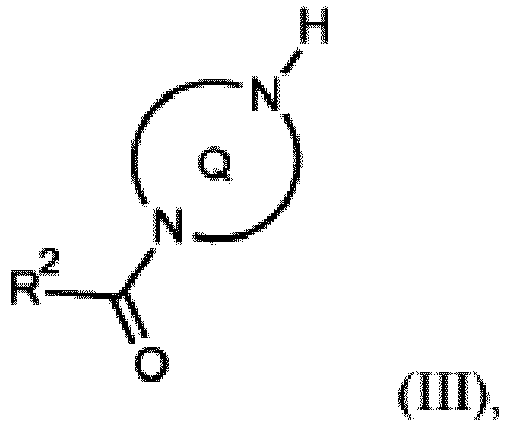
pour donner un composé de la formule (I),
soit[B] avec un système diazabicyclique protégé de la
formule (IV)
et
PG représente un groupe protecteur d'amino approprié, par exemple tert-butoxycarbonyle, benzyloxycarbonyle ou (9H-fluorén-9-ylméthoxy) carbonyle,
tout d'abord pour donner un composé de la formule (V)
puis le groupe protecteur PG est éliminé et le composé résultant de la formule (VI)
est ensuite mis à réagir, en fonction de la signification spécifique du radical R2,[B-1] avec un acide carboxylique de la formule (VII)
R2A représente (C4-C6)-cycloalkyle dans lequel un groupe CH2 de cycle peut être remplacé par -O-, ou est un groupe phényle de la formule (a), un groupe pyridinyle de la formule (b) ou (c) ou un groupe azole de la formule (d), (e), (f) ou (g), tel que décrit dans les revendications 1 à 3,
avec activation de la fonction acide carboxylique dans (VII), ou est mis à réagir avec le chlorure d'acide correspondant de la formule (VIII)

ou[B-2] avec un chloroformiate ou un chlorure de carbamoyle de la formule (IX)
R2B est le groupe -OR10 ou -NR11AR12 dans lesquels R10 et R12 possèdent les significations données dans les revendications 1 à 3
et
R11A possèdent la définition de R11 donnée dans les revendications 1 à 3, mais n'est pas hydrogène,
pour donner un composé de la formule (I-B)
ou[B-3] avec un isocyanate de la formule (X)
R12-N=C=O (X),
dans laquelle R12 possède la signification donnée dans les revendications 1 à 3,
pour donner un composé de la formule (I-C)
et les composés des formules (I), (I- A), (I-B) ou (I-C) ainsi obtenus étant éventuellement séparés en leur énantiomères et/ou leurs diastéréoisomères et/ou éventuellement convertis avec (i) les solvants et/ou (ii) les acides appropriés en solvates, sels et/ou solvates des sels correspondants. - Composé tel que défini dans l'une quelconque des revendications 1 à 3 pour une utilisation dans le traitement et/ou la prévention de maladies.
- Composé tel que défini dans l'une quelconque des revendications 1 à 3 pour une utilisation dans un procédé pour le traitement et/ou la prévention de troubles respiratoires, de troubles respiratoires liés au sommeil, d'apnées du sommeil obstructives, d'apnées du sommeil centrales, du ronflement, d'arythmies cardiaques, de troubles neurodégénératifs, de troubles neuroinflammatoires et de troubles neuroimmunologiques.
- Utilisation d'un composé tel que défini dans l'une quelconque des revendications 1 à 3 pour la préparation d'un médicament pour le traitement et/ou la prévention de troubles respiratoires, de troubles respiratoires liés au sommeil, d'apnées du sommeil obstructives, d'apnées du sommeil centrales, du ronflement, d'arythmies cardiaques, de troubles neurodégénératifs, de troubles neuroinflammatoires et de troubles neuroimmunologiques.
- Médicament comprenant un composé tel que défini dans l'une quelconque des revendications 1 à 3 en combinaison avec un ou plusieurs excipients inertes, non toxiques, pharmaceutiquement appropriés.
- Médicament comprenant un composé tel que défini dans l'une quelconque des revendications 1 à 3 en combinaison avec un ou plusieurs composés actifs supplémentaires choisis dans le groupe constitué par des stimulants respiratoires, des composés psychostimulants, des inhibiteurs de la recapture de la sérotonine, des antidépresseurs noradrénergiques, sérotonergiques et tricycliques, des stimulateurs de sGC, des antagonistes du récepteur minéralocorticoïde, des médicaments anti-inflammatoires, des immunomodulateurs, des immunosuppresseurs et des médicaments cytotoxiques.
- Médicament tel que défini dans la revendication 8 ou 9 pour une utilisation dans le traitement et/ou la prévention de troubles respiratoires, de troubles respiratoires liés au sommeil, d'apnées du sommeil obstructives, d'apnées du sommeil centrales, du ronflement, d'arythmies cardiaques, de troubles neurodégénératifs, de troubles neuroinflammatoires et de troubles neuroimmunologiques.
Applications Claiming Priority (2)
| Application Number | Priority Date | Filing Date | Title |
|---|---|---|---|
| PCT/CN2017/088237 WO2018227427A1 (fr) | 2017-06-14 | 2017-06-14 | Dérivés de diazépane pontés substitués et leur utilisation |
| PCT/EP2018/064980 WO2018228909A1 (fr) | 2017-06-14 | 2018-06-07 | Dérivés de diazépane pontés substitués et leur utilisation en tant qu'inhibiteurs de task-1 et de task-3 |
Publications (2)
| Publication Number | Publication Date |
|---|---|
| EP3638676A1 EP3638676A1 (fr) | 2020-04-22 |
| EP3638676B1 true EP3638676B1 (fr) | 2021-08-25 |
Family
ID=62705555
Family Applications (1)
| Application Number | Title | Priority Date | Filing Date |
|---|---|---|---|
| EP18733193.9A Active EP3638676B1 (fr) | 2017-06-14 | 2018-06-07 | Dérivés de diazépane substitué et ponté et leur utilisation comme inhibiteurs de task-1 and task-3 |
Country Status (4)
| Country | Link |
|---|---|
| US (1) | US11208422B2 (fr) |
| EP (1) | EP3638676B1 (fr) |
| CA (1) | CA3066909A1 (fr) |
| WO (2) | WO2018227427A1 (fr) |
Families Citing this family (12)
| Publication number | Priority date | Publication date | Assignee | Title |
|---|---|---|---|---|
| WO2017097792A1 (fr) | 2015-12-10 | 2017-06-15 | Bayer Pharma Aktiengesellschaft | Dérivés de 2-phényl-3-(pipérazinométhyl)imidazo[1,2-a]pyridine utilisés comme bloqueurs des canaux task-1 et task-2 pour traiter des troubles respiratoires liés au sommeil |
| JOP20190284A1 (ar) | 2017-06-14 | 2019-12-11 | Bayer Pharma AG | مركبات إيميدازوبيريميدين مستبدلة بديازا ثنائي الحلقة واستخدامها للمعالجة من اضطرابات التنفس |
| US20220218695A1 (en) | 2019-05-09 | 2022-07-14 | Bayer Aktiengesellschaft | Combination of an alpha2-adrenoceptor subtype c (alpha-2c) antagonists with a task1/3 channel blocker for the treatment of sleep apnea |
| CA3160035A1 (fr) | 2019-11-06 | 2021-05-14 | Bayer Aktiengesellschaft | Inhibiteurs de l'adrenorecepteur adrac2 |
| BR112022026398A2 (pt) | 2020-07-06 | 2023-01-17 | Bayer Ag | Combinação de antagonista de receptor ¿2 adrenérgico subtipo c (alfa-2c) com bloqueador de canal task1/3 para tratamento da apneia do sono |
| GB202101734D0 (en) * | 2021-02-08 | 2021-03-24 | Cerevance Inc | Novel Compounds |
| MX2024007764A (es) * | 2021-12-22 | 2024-07-04 | Bayer Ag | Combinacion de un bloqueante de canales task1/3 con un inhibidor de la recaptacion de norepinefrina para el tratamiento de la apnea del sue?o. |
| US20250057845A1 (en) * | 2021-12-22 | 2025-02-20 | Bayer Aktiengesellschaft | Combination of a task1/3 channel blocker with a p2x3 receptor antagonist for the treatment of sleep apnea |
| KR20240124998A (ko) * | 2021-12-22 | 2024-08-19 | 바이엘 악티엔게젤샤프트 | 수면 무호흡의 치료를 위한 task1/3 채널 차단제와 무스카린성 수용체 길항제의 조합물 |
| CN118785902A (zh) | 2022-01-07 | 2024-10-15 | 拜耳公司 | 用于治疗睡眠呼吸暂停的α2-肾上腺素受体亚型C拮抗剂 |
| KR20240132345A (ko) | 2022-01-07 | 2024-09-03 | 바이엘 악티엔게젤샤프트 | 수면 무호흡의 치료를 위한 2,3-디히드로벤조[b][1,4]디옥신-2-일메틸)피페라진-1-일 유도체 |
| AR133983A1 (es) | 2023-09-28 | 2025-11-19 | Bayer Ag | Carboxamidas heterocíclicas sustituidas y su uso |
Family Cites Families (34)
| Publication number | Priority date | Publication date | Assignee | Title |
|---|---|---|---|---|
| DE19834044A1 (de) | 1998-07-29 | 2000-02-03 | Bayer Ag | Neue substituierte Pyrazolderivate |
| DE19834047A1 (de) | 1998-07-29 | 2000-02-03 | Bayer Ag | Substituierte Pyrazolderivate |
| DE19943635A1 (de) | 1999-09-13 | 2001-03-15 | Bayer Ag | Neuartige Aminodicarbonsäurederivate mit pharmazeutischen Eigenschaften |
| DE19943634A1 (de) | 1999-09-13 | 2001-04-12 | Bayer Ag | Neuartige Dicarbonsäurederivate mit pharmazeutischen Eigenschaften |
| DE19943636A1 (de) | 1999-09-13 | 2001-03-15 | Bayer Ag | Neuartige Dicarbonsäurederivate mit pharmazeutischen Eigenschaften |
| DE19943639A1 (de) | 1999-09-13 | 2001-03-15 | Bayer Ag | Dicarbonsäurederivate mit neuartigen pharmazeutischen Eigenschaften |
| GB0017256D0 (en) | 2000-07-13 | 2000-08-30 | Merck Sharp & Dohme | Therapeutic agents |
| AR031176A1 (es) | 2000-11-22 | 2003-09-10 | Bayer Ag | Nuevos derivados de pirazolpiridina sustituidos con piridina |
| DE10110749A1 (de) | 2001-03-07 | 2002-09-12 | Bayer Ag | Substituierte Aminodicarbonsäurederivate |
| DE10110750A1 (de) | 2001-03-07 | 2002-09-12 | Bayer Ag | Neuartige Aminodicarbonsäurederivate mit pharmazeutischen Eigenschaften |
| DE10220570A1 (de) | 2002-05-08 | 2003-11-20 | Bayer Ag | Carbamat-substituierte Pyrazolopyridine |
| CA2724842A1 (fr) | 2008-05-19 | 2009-11-26 | Sunovion Pharmaceuticals Inc. | Composes imidazo[1,2-a]pyridines |
| SG184073A1 (en) | 2010-03-18 | 2012-10-30 | Pasteur Institut Korea | Anti-infective compounds |
| DE102010021637A1 (de) | 2010-05-26 | 2011-12-01 | Bayer Schering Pharma Aktiengesellschaft | Substituierte 5-Fluor-1H-Pyrazolopyridine und ihre Verwendung |
| PE20130779A1 (es) | 2010-07-09 | 2013-06-21 | Bayer Ip Gmbh | Pirimidinas y triazinas condensadas y su uso |
| DE102010040233A1 (de) | 2010-09-03 | 2012-03-08 | Bayer Schering Pharma Aktiengesellschaft | Bicyclische Aza-Heterocyclen und ihre Verwendung |
| DE102010043379A1 (de) | 2010-11-04 | 2012-05-10 | Bayer Schering Pharma Aktiengesellschaft | Substituierte 6-Fluor-1H-Pyrazolo[4,3-b]pyridine und ihre Verwendung |
| US9000186B2 (en) | 2011-02-01 | 2015-04-07 | Kyowa Hakko Kirin Co., Ltd. | Ring-fused heterocyclic derivative |
| CA2831356A1 (fr) * | 2011-03-31 | 2012-10-04 | Emblem Technology Transfer Gmbh | Composes d'imidazo[1,2-a]pyridine pour l'utilisation en therapie |
| KR20140093610A (ko) | 2011-04-21 | 2014-07-28 | 재단법인 한국파스퇴르연구소 | 소염 화합물 |
| AU2011376721B2 (en) * | 2011-09-16 | 2017-06-08 | Sanofi | Substituted 4,5,6,7-tetrahydro-1H-pyrazolo[4,3-c]pyridines, their use as medicament, and pharmaceutical preparations comprising them |
| EP3004088A1 (fr) * | 2013-05-24 | 2016-04-13 | Iomet Pharma Ltd. | Inhibiteurs du transporteur slc2a |
| AU2014348518B2 (en) | 2013-11-14 | 2019-01-03 | Novira Therapeutics, Inc. | Azepane derivatives and methods of treating hepatitis B infections |
| CN106103446B (zh) | 2014-03-26 | 2019-07-30 | 豪夫迈·罗氏有限公司 | 作为自分泌运动因子(atx)和溶血磷脂酸(lpa)生产抑制剂的二环化合物 |
| US9994570B2 (en) * | 2014-11-26 | 2018-06-12 | Merck Sharp & Dohme Corp. | Bridged diazepane orexin receptor antagonists |
| WO2016085784A1 (fr) | 2014-11-26 | 2016-06-02 | Merck Sharp & Dohme Corp. | Antagonistes de récepteur d'orexine de type méthyl-diazépane |
| JP2018012645A (ja) | 2014-11-26 | 2018-01-25 | 持田製薬株式会社 | 新規ジアザビシクロ誘導体 |
| JP2018016544A (ja) | 2014-12-03 | 2018-02-01 | 持田製薬株式会社 | 新規ジアザビシクロ[2.2.2]オクタン誘導体 |
| KR20180054830A (ko) | 2015-09-24 | 2018-05-24 | 에프. 호프만-라 로슈 아게 | 오토탁신(atx) 억제제로서의 이환형 화합물 |
| US10414765B2 (en) | 2015-12-10 | 2019-09-17 | Bayer Pharma Aktiengesellschaft | Substituted perhydropyrrolo[3,4-c]pyrrole derivatives and the use of same |
| WO2017097792A1 (fr) | 2015-12-10 | 2017-06-15 | Bayer Pharma Aktiengesellschaft | Dérivés de 2-phényl-3-(pipérazinométhyl)imidazo[1,2-a]pyridine utilisés comme bloqueurs des canaux task-1 et task-2 pour traiter des troubles respiratoires liés au sommeil |
| JOP20190005A1 (ar) | 2016-07-20 | 2019-01-20 | Bayer Ag | مركبات ديازاهيترو ثنائية الحلقة مستبدلة واستخداماتها |
| JOP20190141A1 (ar) | 2016-12-21 | 2019-06-12 | Bayer Pharma AG | أشكال جرعات صيدلية تحتوي على مثبطات لقناة task-1 و task-3 واستخدامها في معالجة اضطراب تنفسي |
| JOP20190284A1 (ar) | 2017-06-14 | 2019-12-11 | Bayer Pharma AG | مركبات إيميدازوبيريميدين مستبدلة بديازا ثنائي الحلقة واستخدامها للمعالجة من اضطرابات التنفس |
-
2017
- 2017-06-14 WO PCT/CN2017/088237 patent/WO2018227427A1/fr not_active Ceased
-
2018
- 2018-06-07 EP EP18733193.9A patent/EP3638676B1/fr active Active
- 2018-06-07 WO PCT/EP2018/064980 patent/WO2018228909A1/fr not_active Ceased
- 2018-06-07 US US16/622,779 patent/US11208422B2/en active Active
- 2018-06-07 CA CA3066909A patent/CA3066909A1/fr active Pending
Also Published As
| Publication number | Publication date |
|---|---|
| WO2018228909A1 (fr) | 2018-12-20 |
| EP3638676A1 (fr) | 2020-04-22 |
| US11208422B2 (en) | 2021-12-28 |
| WO2018227427A1 (fr) | 2018-12-20 |
| CA3066909A1 (fr) | 2018-12-20 |
| US20200140461A1 (en) | 2020-05-07 |
Similar Documents
| Publication | Publication Date | Title |
|---|---|---|
| EP3638676B1 (fr) | Dérivés de diazépane substitué et ponté et leur utilisation comme inhibiteurs de task-1 and task-3 | |
| US12180227B2 (en) | Diazabicyclic substituted imidazopyrimidines and their use for the treatment of breathing disorders | |
| AU2017298421B2 (en) | Substituted diazahetero-bicyclic compounds and their use | |
| US10414765B2 (en) | Substituted perhydropyrrolo[3,4-c]pyrrole derivatives and the use of same | |
| HK40085267A (en) | Diazabicyclic substituted imidazopyrimidines and their use for the treatment of breathing disorders | |
| HK40085266A (en) | Diazabicyclic substituted imidazopyrimidines and their use for the treatment of breathing disorders | |
| HK40085266B (zh) | 二氮杂双环取代的咪唑并嘧啶及其用於治疗呼吸障碍的用途 | |
| HK40015098B (en) | Diazabicyclic substituted imidazopyrimidines and their use for the treatment of breathing disorders | |
| HK40015098A (en) | Diazabicyclic substituted imidazopyrimidines and their use for the treatment of breathing disorders |
Legal Events
| Date | Code | Title | Description |
|---|---|---|---|
| STAA | Information on the status of an ep patent application or granted ep patent |
Free format text: STATUS: UNKNOWN |
|
| STAA | Information on the status of an ep patent application or granted ep patent |
Free format text: STATUS: THE INTERNATIONAL PUBLICATION HAS BEEN MADE |
|
| PUAI | Public reference made under article 153(3) epc to a published international application that has entered the european phase |
Free format text: ORIGINAL CODE: 0009012 |
|
| STAA | Information on the status of an ep patent application or granted ep patent |
Free format text: STATUS: REQUEST FOR EXAMINATION WAS MADE |
|
| 17P | Request for examination filed |
Effective date: 20200114 |
|
| AK | Designated contracting states |
Kind code of ref document: A1 Designated state(s): AL AT BE BG CH CY CZ DE DK EE ES FI FR GB GR HR HU IE IS IT LI LT LU LV MC MK MT NL NO PL PT RO RS SE SI SK SM TR |
|
| AX | Request for extension of the european patent |
Extension state: BA ME |
|
| DAV | Request for validation of the european patent (deleted) | ||
| DAX | Request for extension of the european patent (deleted) | ||
| GRAP | Despatch of communication of intention to grant a patent |
Free format text: ORIGINAL CODE: EPIDOSNIGR1 |
|
| STAA | Information on the status of an ep patent application or granted ep patent |
Free format text: STATUS: GRANT OF PATENT IS INTENDED |
|
| INTG | Intention to grant announced |
Effective date: 20210318 |
|
| RIN1 | Information on inventor provided before grant (corrected) |
Inventor name: CHEN, DENGHUI Inventor name: YANG, JIANFEI Inventor name: DUAN, DEHE Inventor name: DANG, HONGKAI Inventor name: ROSENSTEIN, BJOERN Inventor name: GEHRING, DORIS Inventor name: ALBUS, UDO Inventor name: BECK-BROICHSITTER, MORITZ Inventor name: NICOLAI, JANINE Inventor name: COLLINS, KARL Inventor name: ANLAHR, JOHANNA Inventor name: LUSTIG, KLEMENS Inventor name: MUELLER, THOMAS Inventor name: HAHN, MICHAEL Inventor name: DELBECK, MARTINA |
|
| GRAS | Grant fee paid |
Free format text: ORIGINAL CODE: EPIDOSNIGR3 |
|
| GRAA | (expected) grant |
Free format text: ORIGINAL CODE: 0009210 |
|
| STAA | Information on the status of an ep patent application or granted ep patent |
Free format text: STATUS: THE PATENT HAS BEEN GRANTED |
|
| AK | Designated contracting states |
Kind code of ref document: B1 Designated state(s): AL AT BE BG CH CY CZ DE DK EE ES FI FR GB GR HR HU IE IS IT LI LT LU LV MC MK MT NL NO PL PT RO RS SE SI SK SM TR |
|
| REG | Reference to a national code |
Ref country code: CH Ref legal event code: EP |
|
| REG | Reference to a national code |
Ref country code: IE Ref legal event code: FG4D Ref country code: AT Ref legal event code: REF Ref document number: 1423697 Country of ref document: AT Kind code of ref document: T Effective date: 20210915 |
|
| REG | Reference to a national code |
Ref country code: DE Ref legal event code: R096 Ref document number: 602018022408 Country of ref document: DE |
|
| REG | Reference to a national code |
Ref country code: LT Ref legal event code: MG9D |
|
| REG | Reference to a national code |
Ref country code: NL Ref legal event code: MP Effective date: 20210825 |
|
| REG | Reference to a national code |
Ref country code: AT Ref legal event code: MK05 Ref document number: 1423697 Country of ref document: AT Kind code of ref document: T Effective date: 20210825 |
|
| PG25 | Lapsed in a contracting state [announced via postgrant information from national office to epo] |
Ref country code: HR Free format text: LAPSE BECAUSE OF FAILURE TO SUBMIT A TRANSLATION OF THE DESCRIPTION OR TO PAY THE FEE WITHIN THE PRESCRIBED TIME-LIMIT Effective date: 20210825 Ref country code: ES Free format text: LAPSE BECAUSE OF FAILURE TO SUBMIT A TRANSLATION OF THE DESCRIPTION OR TO PAY THE FEE WITHIN THE PRESCRIBED TIME-LIMIT Effective date: 20210825 Ref country code: FI Free format text: LAPSE BECAUSE OF FAILURE TO SUBMIT A TRANSLATION OF THE DESCRIPTION OR TO PAY THE FEE WITHIN THE PRESCRIBED TIME-LIMIT Effective date: 20210825 Ref country code: SE Free format text: LAPSE BECAUSE OF FAILURE TO SUBMIT A TRANSLATION OF THE DESCRIPTION OR TO PAY THE FEE WITHIN THE PRESCRIBED TIME-LIMIT Effective date: 20210825 Ref country code: RS Free format text: LAPSE BECAUSE OF FAILURE TO SUBMIT A TRANSLATION OF THE DESCRIPTION OR TO PAY THE FEE WITHIN THE PRESCRIBED TIME-LIMIT Effective date: 20210825 Ref country code: BG Free format text: LAPSE BECAUSE OF FAILURE TO SUBMIT A TRANSLATION OF THE DESCRIPTION OR TO PAY THE FEE WITHIN THE PRESCRIBED TIME-LIMIT Effective date: 20211125 Ref country code: AT Free format text: LAPSE BECAUSE OF FAILURE TO SUBMIT A TRANSLATION OF THE DESCRIPTION OR TO PAY THE FEE WITHIN THE PRESCRIBED TIME-LIMIT Effective date: 20210825 Ref country code: LT Free format text: LAPSE BECAUSE OF FAILURE TO SUBMIT A TRANSLATION OF THE DESCRIPTION OR TO PAY THE FEE WITHIN THE PRESCRIBED TIME-LIMIT Effective date: 20210825 Ref country code: NO Free format text: LAPSE BECAUSE OF FAILURE TO SUBMIT A TRANSLATION OF THE DESCRIPTION OR TO PAY THE FEE WITHIN THE PRESCRIBED TIME-LIMIT Effective date: 20211125 Ref country code: PT Free format text: LAPSE BECAUSE OF FAILURE TO SUBMIT A TRANSLATION OF THE DESCRIPTION OR TO PAY THE FEE WITHIN THE PRESCRIBED TIME-LIMIT Effective date: 20211227 |
|
| PG25 | Lapsed in a contracting state [announced via postgrant information from national office to epo] |
Ref country code: PL Free format text: LAPSE BECAUSE OF FAILURE TO SUBMIT A TRANSLATION OF THE DESCRIPTION OR TO PAY THE FEE WITHIN THE PRESCRIBED TIME-LIMIT Effective date: 20210825 Ref country code: LV Free format text: LAPSE BECAUSE OF FAILURE TO SUBMIT A TRANSLATION OF THE DESCRIPTION OR TO PAY THE FEE WITHIN THE PRESCRIBED TIME-LIMIT Effective date: 20210825 Ref country code: GR Free format text: LAPSE BECAUSE OF FAILURE TO SUBMIT A TRANSLATION OF THE DESCRIPTION OR TO PAY THE FEE WITHIN THE PRESCRIBED TIME-LIMIT Effective date: 20211126 |
|
| PG25 | Lapsed in a contracting state [announced via postgrant information from national office to epo] |
Ref country code: NL Free format text: LAPSE BECAUSE OF FAILURE TO SUBMIT A TRANSLATION OF THE DESCRIPTION OR TO PAY THE FEE WITHIN THE PRESCRIBED TIME-LIMIT Effective date: 20210825 |
|
| PG25 | Lapsed in a contracting state [announced via postgrant information from national office to epo] |
Ref country code: DK Free format text: LAPSE BECAUSE OF FAILURE TO SUBMIT A TRANSLATION OF THE DESCRIPTION OR TO PAY THE FEE WITHIN THE PRESCRIBED TIME-LIMIT Effective date: 20210825 |
|
| REG | Reference to a national code |
Ref country code: DE Ref legal event code: R097 Ref document number: 602018022408 Country of ref document: DE |
|
| PG25 | Lapsed in a contracting state [announced via postgrant information from national office to epo] |
Ref country code: SM Free format text: LAPSE BECAUSE OF FAILURE TO SUBMIT A TRANSLATION OF THE DESCRIPTION OR TO PAY THE FEE WITHIN THE PRESCRIBED TIME-LIMIT Effective date: 20210825 Ref country code: SK Free format text: LAPSE BECAUSE OF FAILURE TO SUBMIT A TRANSLATION OF THE DESCRIPTION OR TO PAY THE FEE WITHIN THE PRESCRIBED TIME-LIMIT Effective date: 20210825 Ref country code: RO Free format text: LAPSE BECAUSE OF FAILURE TO SUBMIT A TRANSLATION OF THE DESCRIPTION OR TO PAY THE FEE WITHIN THE PRESCRIBED TIME-LIMIT Effective date: 20210825 Ref country code: EE Free format text: LAPSE BECAUSE OF FAILURE TO SUBMIT A TRANSLATION OF THE DESCRIPTION OR TO PAY THE FEE WITHIN THE PRESCRIBED TIME-LIMIT Effective date: 20210825 Ref country code: CZ Free format text: LAPSE BECAUSE OF FAILURE TO SUBMIT A TRANSLATION OF THE DESCRIPTION OR TO PAY THE FEE WITHIN THE PRESCRIBED TIME-LIMIT Effective date: 20210825 Ref country code: AL Free format text: LAPSE BECAUSE OF FAILURE TO SUBMIT A TRANSLATION OF THE DESCRIPTION OR TO PAY THE FEE WITHIN THE PRESCRIBED TIME-LIMIT Effective date: 20210825 |
|
| PLBE | No opposition filed within time limit |
Free format text: ORIGINAL CODE: 0009261 |
|
| STAA | Information on the status of an ep patent application or granted ep patent |
Free format text: STATUS: NO OPPOSITION FILED WITHIN TIME LIMIT |
|
| PG25 | Lapsed in a contracting state [announced via postgrant information from national office to epo] |
Ref country code: IT Free format text: LAPSE BECAUSE OF FAILURE TO SUBMIT A TRANSLATION OF THE DESCRIPTION OR TO PAY THE FEE WITHIN THE PRESCRIBED TIME-LIMIT Effective date: 20210825 |
|
| 26N | No opposition filed |
Effective date: 20220527 |
|
| PG25 | Lapsed in a contracting state [announced via postgrant information from national office to epo] |
Ref country code: SI Free format text: LAPSE BECAUSE OF FAILURE TO SUBMIT A TRANSLATION OF THE DESCRIPTION OR TO PAY THE FEE WITHIN THE PRESCRIBED TIME-LIMIT Effective date: 20210825 |
|
| PG25 | Lapsed in a contracting state [announced via postgrant information from national office to epo] |
Ref country code: MC Free format text: LAPSE BECAUSE OF FAILURE TO SUBMIT A TRANSLATION OF THE DESCRIPTION OR TO PAY THE FEE WITHIN THE PRESCRIBED TIME-LIMIT Effective date: 20210825 |
|
| REG | Reference to a national code |
Ref country code: CH Ref legal event code: PL |
|
| REG | Reference to a national code |
Ref country code: BE Ref legal event code: MM Effective date: 20220630 |
|
| PG25 | Lapsed in a contracting state [announced via postgrant information from national office to epo] |
Ref country code: LU Free format text: LAPSE BECAUSE OF NON-PAYMENT OF DUE FEES Effective date: 20220607 Ref country code: LI Free format text: LAPSE BECAUSE OF NON-PAYMENT OF DUE FEES Effective date: 20220630 Ref country code: IE Free format text: LAPSE BECAUSE OF NON-PAYMENT OF DUE FEES Effective date: 20220607 Ref country code: CH Free format text: LAPSE BECAUSE OF NON-PAYMENT OF DUE FEES Effective date: 20220630 |
|
| PG25 | Lapsed in a contracting state [announced via postgrant information from national office to epo] |
Ref country code: BE Free format text: LAPSE BECAUSE OF NON-PAYMENT OF DUE FEES Effective date: 20220630 |
|
| P01 | Opt-out of the competence of the unified patent court (upc) registered |
Effective date: 20230504 |
|
| PG25 | Lapsed in a contracting state [announced via postgrant information from national office to epo] |
Ref country code: MK Free format text: LAPSE BECAUSE OF FAILURE TO SUBMIT A TRANSLATION OF THE DESCRIPTION OR TO PAY THE FEE WITHIN THE PRESCRIBED TIME-LIMIT Effective date: 20210825 Ref country code: CY Free format text: LAPSE BECAUSE OF FAILURE TO SUBMIT A TRANSLATION OF THE DESCRIPTION OR TO PAY THE FEE WITHIN THE PRESCRIBED TIME-LIMIT Effective date: 20210825 |
|
| PG25 | Lapsed in a contracting state [announced via postgrant information from national office to epo] |
Ref country code: HU Free format text: LAPSE BECAUSE OF FAILURE TO SUBMIT A TRANSLATION OF THE DESCRIPTION OR TO PAY THE FEE WITHIN THE PRESCRIBED TIME-LIMIT; INVALID AB INITIO Effective date: 20180607 |
|
| PG25 | Lapsed in a contracting state [announced via postgrant information from national office to epo] |
Ref country code: MT Free format text: LAPSE BECAUSE OF FAILURE TO SUBMIT A TRANSLATION OF THE DESCRIPTION OR TO PAY THE FEE WITHIN THE PRESCRIBED TIME-LIMIT Effective date: 20210825 |
|
| PGFP | Annual fee paid to national office [announced via postgrant information from national office to epo] |
Ref country code: DE Payment date: 20250521 Year of fee payment: 8 |
|
| PGFP | Annual fee paid to national office [announced via postgrant information from national office to epo] |
Ref country code: GB Payment date: 20250522 Year of fee payment: 8 |
|
| PGFP | Annual fee paid to national office [announced via postgrant information from national office to epo] |
Ref country code: FR Payment date: 20250523 Year of fee payment: 8 |
|
| PG25 | Lapsed in a contracting state [announced via postgrant information from national office to epo] |
Ref country code: TR Free format text: LAPSE BECAUSE OF FAILURE TO SUBMIT A TRANSLATION OF THE DESCRIPTION OR TO PAY THE FEE WITHIN THE PRESCRIBED TIME-LIMIT Effective date: 20210825 |