EP3647487A1 - Gummikomponente verstärkendes stahlseil - Google Patents
Gummikomponente verstärkendes stahlseil Download PDFInfo
- Publication number
- EP3647487A1 EP3647487A1 EP18822739.1A EP18822739A EP3647487A1 EP 3647487 A1 EP3647487 A1 EP 3647487A1 EP 18822739 A EP18822739 A EP 18822739A EP 3647487 A1 EP3647487 A1 EP 3647487A1
- Authority
- EP
- European Patent Office
- Prior art keywords
- sheath
- filaments
- steel cord
- core
- strands
- Prior art date
- Legal status (The legal status is an assumption and is not a legal conclusion. Google has not performed a legal analysis and makes no representation as to the accuracy of the status listed.)
- Withdrawn
Links
- 229910001294 Reinforcing steel Inorganic materials 0.000 title claims abstract description 31
- 229910000831 Steel Inorganic materials 0.000 claims abstract description 122
- 239000010959 steel Substances 0.000 claims abstract description 122
- 238000007747 plating Methods 0.000 claims description 41
- HCHKCACWOHOZIP-UHFFFAOYSA-N Zinc Chemical compound [Zn] HCHKCACWOHOZIP-UHFFFAOYSA-N 0.000 claims description 33
- 229910052725 zinc Inorganic materials 0.000 claims description 33
- 239000011701 zinc Substances 0.000 claims description 33
- 229910001369 Brass Inorganic materials 0.000 claims description 14
- 239000010951 brass Substances 0.000 claims description 14
- 238000005260 corrosion Methods 0.000 abstract description 18
- 230000007797 corrosion Effects 0.000 abstract description 17
- 230000035515 penetration Effects 0.000 description 15
- 238000005452 bending Methods 0.000 description 10
- 239000000463 material Substances 0.000 description 9
- 230000000694 effects Effects 0.000 description 6
- OKTJSMMVPCPJKN-UHFFFAOYSA-N Carbon Chemical compound [C] OKTJSMMVPCPJKN-UHFFFAOYSA-N 0.000 description 4
- 229910052799 carbon Inorganic materials 0.000 description 4
- 230000000052 comparative effect Effects 0.000 description 4
- 238000009713 electroplating Methods 0.000 description 4
- 238000011156 evaluation Methods 0.000 description 4
- RYGMFSIKBFXOCR-UHFFFAOYSA-N Copper Chemical compound [Cu] RYGMFSIKBFXOCR-UHFFFAOYSA-N 0.000 description 3
- 239000011248 coating agent Substances 0.000 description 3
- 238000000576 coating method Methods 0.000 description 3
- 229910052802 copper Inorganic materials 0.000 description 3
- 239000010949 copper Substances 0.000 description 3
- 230000006866 deterioration Effects 0.000 description 3
- 101100386719 Caenorhabditis elegans dcs-1 gene Proteins 0.000 description 2
- 229910000677 High-carbon steel Inorganic materials 0.000 description 2
- 238000005299 abrasion Methods 0.000 description 2
- 238000007796 conventional method Methods 0.000 description 2
- 230000003111 delayed effect Effects 0.000 description 2
- 238000009792 diffusion process Methods 0.000 description 2
- 238000004519 manufacturing process Methods 0.000 description 2
- 230000003014 reinforcing effect Effects 0.000 description 2
- 239000012779 reinforcing material Substances 0.000 description 2
- MKYBYDHXWVHEJW-UHFFFAOYSA-N N-[1-oxo-1-(2,4,6,7-tetrahydrotriazolo[4,5-c]pyridin-5-yl)propan-2-yl]-2-[[3-(trifluoromethoxy)phenyl]methylamino]pyrimidine-5-carboxamide Chemical compound O=C(C(C)NC(=O)C=1C=NC(=NC=1)NCC1=CC(=CC=C1)OC(F)(F)F)N1CC2=C(CC1)NN=N2 MKYBYDHXWVHEJW-UHFFFAOYSA-N 0.000 description 1
- NIPNSKYNPDTRPC-UHFFFAOYSA-N N-[2-oxo-2-(2,4,6,7-tetrahydrotriazolo[4,5-c]pyridin-5-yl)ethyl]-2-[[3-(trifluoromethoxy)phenyl]methylamino]pyrimidine-5-carboxamide Chemical compound O=C(CNC(=O)C=1C=NC(=NC=1)NCC1=CC(=CC=C1)OC(F)(F)F)N1CC2=C(CC1)NN=N2 NIPNSKYNPDTRPC-UHFFFAOYSA-N 0.000 description 1
- AFCARXCZXQIEQB-UHFFFAOYSA-N N-[3-oxo-3-(2,4,6,7-tetrahydrotriazolo[4,5-c]pyridin-5-yl)propyl]-2-[[3-(trifluoromethoxy)phenyl]methylamino]pyrimidine-5-carboxamide Chemical compound O=C(CCNC(=O)C=1C=NC(=NC=1)NCC1=CC(=CC=C1)OC(F)(F)F)N1CC2=C(CC1)NN=N2 AFCARXCZXQIEQB-UHFFFAOYSA-N 0.000 description 1
- 229910002651 NO3 Inorganic materials 0.000 description 1
- 101100042259 Schizosaccharomyces pombe (strain 972 / ATCC 24843) rpn15 gene Proteins 0.000 description 1
- QAOWNCQODCNURD-UHFFFAOYSA-L Sulfate Chemical compound [O-]S([O-])(=O)=O QAOWNCQODCNURD-UHFFFAOYSA-L 0.000 description 1
- 239000007864 aqueous solution Substances 0.000 description 1
- 230000005540 biological transmission Effects 0.000 description 1
- 101150069022 dss-1 gene Proteins 0.000 description 1
- 238000009661 fatigue test Methods 0.000 description 1
- 230000008595 infiltration Effects 0.000 description 1
- 238000001764 infiltration Methods 0.000 description 1
- JEIPFZHSYJVQDO-UHFFFAOYSA-N iron(III) oxide Inorganic materials O=[Fe]O[Fe]=O JEIPFZHSYJVQDO-UHFFFAOYSA-N 0.000 description 1
- 238000002955 isolation Methods 0.000 description 1
- 238000000034 method Methods 0.000 description 1
- 230000007935 neutral effect Effects 0.000 description 1
- -1 nitrate ions Chemical class 0.000 description 1
- 230000002028 premature Effects 0.000 description 1
- 238000004073 vulcanization Methods 0.000 description 1
- XLYOFNOQVPJJNP-UHFFFAOYSA-N water Substances O XLYOFNOQVPJJNP-UHFFFAOYSA-N 0.000 description 1
- 239000013585 weight reducing agent Substances 0.000 description 1
Images


Classifications
-
- D—TEXTILES; PAPER
- D07—ROPES; CABLES OTHER THAN ELECTRIC
- D07B—ROPES OR CABLES IN GENERAL
- D07B1/00—Constructional features of ropes or cables
- D07B1/06—Ropes or cables built-up from metal wires, e.g. of section wires around a hemp core
- D07B1/0606—Reinforcing cords for rubber or plastic articles
- D07B1/0613—Reinforcing cords for rubber or plastic articles the reinforcing cords being characterised by the rope configuration
-
- C—CHEMISTRY; METALLURGY
- C25—ELECTROLYTIC OR ELECTROPHORETIC PROCESSES; APPARATUS THEREFOR
- C25D—PROCESSES FOR THE ELECTROLYTIC OR ELECTROPHORETIC PRODUCTION OF COATINGS; ELECTROFORMING; APPARATUS THEREFOR
- C25D7/00—Electroplating characterised by the article coated
- C25D7/06—Wires; Strips; Foils
-
- D—TEXTILES; PAPER
- D07—ROPES; CABLES OTHER THAN ELECTRIC
- D07B—ROPES OR CABLES IN GENERAL
- D07B1/00—Constructional features of ropes or cables
- D07B1/06—Ropes or cables built-up from metal wires, e.g. of section wires around a hemp core
-
- B—PERFORMING OPERATIONS; TRANSPORTING
- B65—CONVEYING; PACKING; STORING; HANDLING THIN OR FILAMENTARY MATERIAL
- B65G—TRANSPORT OR STORAGE DEVICES, e.g. CONVEYORS FOR LOADING OR TIPPING, SHOP CONVEYOR SYSTEMS OR PNEUMATIC TUBE CONVEYORS
- B65G15/00—Conveyors having endless load-conveying surfaces, i.e. belts and like continuous members, to which tractive effort is transmitted by means other than endless driving elements of similar configuration
- B65G15/30—Belts or like endless load-carriers
- B65G15/32—Belts or like endless load-carriers made of rubber or plastics
- B65G15/34—Belts or like endless load-carriers made of rubber or plastics with reinforcing layers, e.g. of fabric
- B65G15/36—Belts or like endless load-carriers made of rubber or plastics with reinforcing layers, e.g. of fabric the layers incorporating ropes, chains, or rolled steel sections
-
- D—TEXTILES; PAPER
- D07—ROPES; CABLES OTHER THAN ELECTRIC
- D07B—ROPES OR CABLES IN GENERAL
- D07B1/00—Constructional features of ropes or cables
- D07B1/06—Ropes or cables built-up from metal wires, e.g. of section wires around a hemp core
- D07B1/0606—Reinforcing cords for rubber or plastic articles
- D07B1/062—Reinforcing cords for rubber or plastic articles the reinforcing cords being characterised by the strand configuration
- D07B1/0633—Reinforcing cords for rubber or plastic articles the reinforcing cords being characterised by the strand configuration having a multiple-layer configuration
-
- D—TEXTILES; PAPER
- D07—ROPES; CABLES OTHER THAN ELECTRIC
- D07B—ROPES OR CABLES IN GENERAL
- D07B2201/00—Ropes or cables
- D07B2201/20—Rope or cable components
- D07B2201/2001—Wires or filaments
- D07B2201/2006—Wires or filaments characterised by a value or range of the dimension given
-
- D—TEXTILES; PAPER
- D07—ROPES; CABLES OTHER THAN ELECTRIC
- D07B—ROPES OR CABLES IN GENERAL
- D07B2201/00—Ropes or cables
- D07B2201/20—Rope or cable components
- D07B2201/2001—Wires or filaments
- D07B2201/201—Wires or filaments characterised by a coating
- D07B2201/2011—Wires or filaments characterised by a coating comprising metals
-
- D—TEXTILES; PAPER
- D07—ROPES; CABLES OTHER THAN ELECTRIC
- D07B—ROPES OR CABLES IN GENERAL
- D07B2201/00—Ropes or cables
- D07B2201/20—Rope or cable components
- D07B2201/2001—Wires or filaments
- D07B2201/201—Wires or filaments characterised by a coating
- D07B2201/2013—Wires or filaments characterised by a coating comprising multiple layers
-
- D—TEXTILES; PAPER
- D07—ROPES; CABLES OTHER THAN ELECTRIC
- D07B—ROPES OR CABLES IN GENERAL
- D07B2201/00—Ropes or cables
- D07B2201/20—Rope or cable components
- D07B2201/2015—Strands
- D07B2201/2024—Strands twisted
- D07B2201/2029—Open winding
-
- D—TEXTILES; PAPER
- D07—ROPES; CABLES OTHER THAN ELECTRIC
- D07B—ROPES OR CABLES IN GENERAL
- D07B2201/00—Ropes or cables
- D07B2201/20—Rope or cable components
- D07B2201/2015—Strands
- D07B2201/2024—Strands twisted
- D07B2201/2029—Open winding
- D07B2201/2031—Different twist pitch
- D07B2201/2032—Different twist pitch compared with the core
-
- D—TEXTILES; PAPER
- D07—ROPES; CABLES OTHER THAN ELECTRIC
- D07B—ROPES OR CABLES IN GENERAL
- D07B2201/00—Ropes or cables
- D07B2201/20—Rope or cable components
- D07B2201/2015—Strands
- D07B2201/2036—Strands characterised by the use of different wires or filaments
- D07B2201/2037—Strands characterised by the use of different wires or filaments regarding the dimension of the wires or filaments
-
- D—TEXTILES; PAPER
- D07—ROPES; CABLES OTHER THAN ELECTRIC
- D07B—ROPES OR CABLES IN GENERAL
- D07B2201/00—Ropes or cables
- D07B2201/20—Rope or cable components
- D07B2201/2015—Strands
- D07B2201/2042—Strands characterised by a coating
- D07B2201/2043—Strands characterised by a coating comprising metals
-
- D—TEXTILES; PAPER
- D07—ROPES; CABLES OTHER THAN ELECTRIC
- D07B—ROPES OR CABLES IN GENERAL
- D07B2201/00—Ropes or cables
- D07B2201/20—Rope or cable components
- D07B2201/2047—Cores
- D07B2201/2051—Cores characterised by a value or range of the dimension given
-
- D—TEXTILES; PAPER
- D07—ROPES; CABLES OTHER THAN ELECTRIC
- D07B—ROPES OR CABLES IN GENERAL
- D07B2201/00—Ropes or cables
- D07B2201/20—Rope or cable components
- D07B2201/2047—Cores
- D07B2201/2052—Cores characterised by their structure
- D07B2201/2059—Cores characterised by their structure comprising wires
-
- D—TEXTILES; PAPER
- D07—ROPES; CABLES OTHER THAN ELECTRIC
- D07B—ROPES OR CABLES IN GENERAL
- D07B2201/00—Ropes or cables
- D07B2201/20—Rope or cable components
- D07B2201/2047—Cores
- D07B2201/2052—Cores characterised by their structure
- D07B2201/2059—Cores characterised by their structure comprising wires
- D07B2201/206—Cores characterised by their structure comprising wires arranged parallel to the axis
-
- D—TEXTILES; PAPER
- D07—ROPES; CABLES OTHER THAN ELECTRIC
- D07B—ROPES OR CABLES IN GENERAL
- D07B2201/00—Ropes or cables
- D07B2201/20—Rope or cable components
- D07B2201/2047—Cores
- D07B2201/2052—Cores characterised by their structure
- D07B2201/2059—Cores characterised by their structure comprising wires
- D07B2201/2061—Cores characterised by their structure comprising wires resulting in a twisted structure
-
- D—TEXTILES; PAPER
- D07—ROPES; CABLES OTHER THAN ELECTRIC
- D07B—ROPES OR CABLES IN GENERAL
- D07B2205/00—Rope or cable materials
- D07B2205/30—Inorganic materials
- D07B2205/3021—Metals
- D07B2205/3025—Steel
-
- D—TEXTILES; PAPER
- D07—ROPES; CABLES OTHER THAN ELECTRIC
- D07B—ROPES OR CABLES IN GENERAL
- D07B2205/00—Rope or cable materials
- D07B2205/30—Inorganic materials
- D07B2205/3021—Metals
- D07B2205/3025—Steel
- D07B2205/3046—Steel characterised by the carbon content
- D07B2205/3057—Steel characterised by the carbon content having a high carbon content, e.g. greater than 0,8 percent respectively SHT or UHT wires
-
- D—TEXTILES; PAPER
- D07—ROPES; CABLES OTHER THAN ELECTRIC
- D07B—ROPES OR CABLES IN GENERAL
- D07B2205/00—Rope or cable materials
- D07B2205/30—Inorganic materials
- D07B2205/3021—Metals
- D07B2205/3071—Zinc (Zn)
-
- D—TEXTILES; PAPER
- D07—ROPES; CABLES OTHER THAN ELECTRIC
- D07B—ROPES OR CABLES IN GENERAL
- D07B2205/00—Rope or cable materials
- D07B2205/30—Inorganic materials
- D07B2205/3021—Metals
- D07B2205/3085—Alloys, i.e. non ferrous
- D07B2205/3089—Brass, i.e. copper (Cu) and zinc (Zn) alloys
-
- D—TEXTILES; PAPER
- D07—ROPES; CABLES OTHER THAN ELECTRIC
- D07B—ROPES OR CABLES IN GENERAL
- D07B2401/00—Aspects related to the problem to be solved or advantage
- D07B2401/20—Aspects related to the problem to be solved or advantage related to ropes or cables
- D07B2401/202—Environmental resistance
- D07B2401/2025—Environmental resistance avoiding corrosion
-
- D—TEXTILES; PAPER
- D07—ROPES; CABLES OTHER THAN ELECTRIC
- D07B—ROPES OR CABLES IN GENERAL
- D07B2401/00—Aspects related to the problem to be solved or advantage
- D07B2401/20—Aspects related to the problem to be solved or advantage related to ropes or cables
- D07B2401/208—Enabling filler penetration
-
- D—TEXTILES; PAPER
- D07—ROPES; CABLES OTHER THAN ELECTRIC
- D07B—ROPES OR CABLES IN GENERAL
- D07B2501/00—Application field
- D07B2501/20—Application field related to ropes or cables
- D07B2501/2046—Tyre cords
-
- D—TEXTILES; PAPER
- D07—ROPES; CABLES OTHER THAN ELECTRIC
- D07B—ROPES OR CABLES IN GENERAL
- D07B2501/00—Application field
- D07B2501/20—Application field related to ropes or cables
- D07B2501/2076—Power transmissions
Definitions
- the present invention relates to a rubber article-reinforcing steel cord (hereinafter, also simply referred to as "steel cord”), more particularly a rubber article-reinforcing steel cord in which the corrosion resistance is improved without an increase in weight.
- steel cord also simply referred to as "steel cord”
- Patent Document 1 proposes a steel cord having a multi-twisted structure in which two core filaments are used in a core strand and the diameter of outermost-layer sheath filaments of each sheath strand is controlled to be larger than the diameter of a filament inside the outermost-layer sheaths of the sheath strand, whereby the cut resistance is improved while avoiding an increase in the diameter and the weight of the steel cord.
- Patent Document 2 proposes a steel cord having a multi-twisted structure in which a ratio (dc/ds) between the diameter (dc) of sheath filaments of a core strand and the diameter (ds) of outermost-layer sheath filaments of sheath strands is controlled to be higher than 1.25 but 1.50 or lower, whereby the cut resistance is improved while maintaining the amount of steel.
- Patent Document 3 proposes a steel cord having a multi-twisted structure in which plural strands each having a layer-twisted structure composed of a core formed by two or three core filaments and at least one sheath layer are twisted together, wherein gaps between filaments constituting the outermost-layer sheaths of the strands are controlled to be 0.5 to 4.0% of the diameter of outermost-layer sheath filaments 13 and the occurrence of premature breakage of an outermost layer filament is thereby inhibited.
- Patent Document 4 proposes a steel cord composed of a single core strand having a layer-twisted structure and plural sheath strands each having a layer-twisted structure, in which the average size of gaps between outermost-layer sheath filaments of the core strand is controlled to be 0.073 to 0.130 mm and the number of the outermost-layer sheath filaments is set at 7 to 10, whereby the rust resistance, the cord strength and the shear resistance are improved.
- Patent Document 5 proposes a steel cord having a (2+M+N) structure in which filaments having a prescribed wire diameter are used in each layer and twisted together at a prescribed twist pitch and the amount of a filling rubber is controlled at a prescribed level, whereby the productivity and the fatigue-corrosion resistance are improved.
- Patent Document 6 proposes a steel cord obtained by twisting together plural strands each having outermost layer filaments and inner filaments, in which the adhesion with rubber is improved by performing a brass plating treatment on the outermost layer filaments of each outermost layer strand constituting an outer circumferential part and performing a zinc plating treatment on at least one filament positioned on the inner side than the outermost layer strand.
- Steel cords for conveyor belts are usually plated with zinc.
- the reason for this is because, even when rainwater or the like reached filaments through a cut or the like generated on a conveyor belt by an article being conveyed, corrosion of the filaments can be delayed by allowing the plated zinc to corrode preferentially to the filaments.
- water does not reach the filaments in the first place as long as a rubber has infiltrated to the interior of the steel cord (this property is hereinafter also referred to as "rubber penetration"), which is preferred in terms of corrosion resistance.
- the easiness of a rubber to infiltrate into the interior of the steel cord means that the steel cord has large gaps therein and, in this case, the occupancy of the filaments with respect to the cord circumscribed circle is reduced, resulting in a corresponding reduction in the strength. Accordingly, the filament diameter is increased in order to ensure the strength; however, this leads to deterioration of the rubber penetration and an increase in the cord weight. Conventionally, these problems have not been sufficiently examined for steel cords having a multi-twisted structure, and there is still room for further improvement.
- an object of the present invention is to provide a rubber article-reinforcing steel cord in which the corrosion resistance is improved without an increase in weight.
- the present inventor intensively studied to solve the above-described problems and consequently discovered that the problems can be solved by controlling the diameters of filaments constituting a steel cord having a multi-twisted structure to satisfy a prescribed relationship, thereby completing the present invention.
- the rubber article-reinforcing steel cord according to the present invention is a rubber article-reinforcing steel cord in which plural sheath strands each formed by twisting together plural steel filaments are twisted together around at least one core strand formed by twisting together plural steel filaments, the rubber-article-reinforcing cord being characterized in that the core strand and the sheath strands are each formed by twisting together one or two core filaments and plural sheath filaments, and a relationship represented by the following Formula (1) is satisfied when a wire diameter of the core filament(s) of the core strand, a wire diameter of the sheath filaments of the core strand, a wire diameter of the core filaments of the sheath strands, and a wire diameter of the sheath filaments of the sheath strands are defined as dcc, dcs, dsc and dss, respectively: dcc > dcs ⁇ dsc > dss
- a relationship represented by the following Formula (2) be satisfied when a tensile strength of the core filament(s) of the core strand, a tensile strength of the sheath filaments of the core strand, a tensile strength of the core filaments of the sheath strands, and a tensile strength of the sheath filaments of the sheath strands are defined as Tcc, Tcs, Tsc and Tss, respectively: Tss > Tsc ⁇ Tcs > Tcc
- the steel filaments have a tensile strength T (MPa) satisfying a relationship represented by the following formula: ⁇ 2,000 ⁇ d + 3,825 ⁇ T ⁇ ⁇ 2,000 ⁇ d + 4,525 .
- the steel filaments have a diameter (d) of 0.3 to 0.8 mm. Yet still further, in the steel cord of the present invention, it is preferred that an average gap between adjacent sheath filaments in the same sheath filament layer of the core strand be 35 to 76 ⁇ m, and that an average gap between adjacent sheath filaments in the same sheath filament layer of the sheath strands be 20 to 76 ⁇ m.
- the core filaments of the core strand and the sheath strands be not twisted, and that the core strand and the sheath strands have a short axis/long axis ratio of 0.7 to 0.85 in a cross-sectional view taken along a direction perpendicular to the longitudinal direction of the strands.
- the diameter (dcs) of the sheath filaments be smaller in the sheath filament layers on the strand radial-direction outer side, and that, when the sheath strands each include two or more sheath filament layers, the diameter (dss) of the sheath filaments be smaller in the sheath filament layers on the strand radial-direction outer side.
- an average gap between adjacent sheath filaments of a sheath filament layer on the strand radial-direction outer side be larger than an average gap between adjacent sheath filaments of a sheath filament layer on the strand radial-direction inner side.
- a ratio between a long axis of the sheath strands and that of the core strand (long axis of sheath strands: long axis of core strand) be 100:105 to 130.
- the steel cord of the present invention have a short axis/long axis ratio of 0.80 to 0.95 in a cross-sectional view taken along a direction perpendicular to the longitudinal direction of the steel cord.
- brass plating and zinc plating be sequentially performed on the steel filaments.
- an amount (g/m 2 ) of the brass plating adhered to the steel filaments be 6d to 10d, and an amount (g/m 2 ) of the zinc plating adhered to the steel filaments be 25d to 95d.
- the steel cord of the present invention can be suitably used for reinforcing a conveyor.
- a rubber article-reinforcing steel cord in which the corrosion resistance is improved without an increase in weight can be provided.
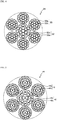
- FIG. 1 is a cross-sectional view illustrating a rubber article-reinforcing steel cord according to one preferred embodiment of the present invention.
- a steel cord 1 of the present invention has a multi-twisted structure in which plural sheath strands 3 each formed by twisting together plural filaments are twisted together around at least one core strand 2 formed by twisting together plural filaments.
- the core strand 2 and the sheath strands 3 are each formed by twisting together one or two core filaments and plural sheath filaments.
- the illustrated steel cord 1 has a (2+8)+6 ⁇ (2+8) structure in which six sheath strands 3 are twisted together around a single core strand 2, and the core strand 2 and the sheath strands 3 are each composed of a core in which two core filaments 2c or 3c are parallelly aligned without being twisted together, and eight sheath filaments 2s or 3s that are twisted together around the core.
- each core of the core strand 2 and the sheath strands 3 is constituted by one or two core filaments is because, when the core is constituted by three or more core filaments, corrosion resistance cannot be obtained in some cases since gaps into which a rubber does not infiltrate are formed inside the core.
- a relationship represented by the following Formula (1) is satisfied when a wire diameter of the core filaments 2c of the core strand 2, a wire diameter of the sheath filaments 2s of the core strand 2, a wire diameter of the core filaments 3c of the sheath strands 3, and a wire diameter of the sheath filaments 3s of the sheath strands 3 are defined as dcc, dcs, dsc and dss, respectively: dcc > dcs ⁇ dsc > dss
- the rubber penetration is improved by reducing the diameter of the filaments constituting the steel cord 1 toward the cord radial-direction outer side.
- a relationship represented by the following Formula (3) (wherein, a wire diameter of a first sheath filament of the core strand is dcs1, a wire diameter of a second sheath filament of the core strand is dcs2, a wire diameter of a first sheath filament of the sheath strands is dss1, and a wire diameter of a second sheath filament of the sheath strands is dss2) is satisfied: dcc > dcs 1 > dcs 2 ⁇ dsc > dss 1 > dss 2
- the dcs2 or the dss2 of the stand having a single sheath filament layer can be excluded from the above-described Formula (3).
- a relationship represented by the following Formula (2) be satisfied when a tensile strength of the core filaments 2c of the core strand 2, a tensile strength of the sheath filaments 2s of the core strand 2, a tensile strength of the core filaments 3c of the sheath strands 3, and a tensile strength of the sheath filaments 3s of the sheath strands 3 are defined as Tcc, Tcs, Tsc and Tss, respectively: Tss > Tsc ⁇ Tcs > Tcc
- the tensile strength T of the filaments constituting the steel cord 1 increases toward the cord radial-direction outer side.
- a bending input is applied to the steel cord 1
- a larger input is added to a filament positioned on the cord radial-direction outer side. Therefore, in the steel cord 1 of the present invention, the fatigue durability is improved by increasing the tensile strength T of the filaments constituting the steel cord 1 toward the cord radial-direction outer side.
- the steel filaments have a tensile strength T (MPa) satisfying a relationship represented by the following formula: ⁇ 2,000 ⁇ d + 3,825 ⁇ Ts ⁇ ⁇ 2,000 ⁇ d + 4,525 .
- the filaments preferably have a diameter (d) in a range of 0.3 to 0.8 mm.
- an average gap Gc between adjacent sheath filaments 2s in the same sheath filament layer of the core strand 2 be 35 to 76 ⁇ m, and that an average gap Gs between adjacent sheath filaments 3s in the same sheath filament layer of the sheath strands 3 be 20 to 76 ⁇ m.
- the average gaps Gc and Gs between the sheath filaments 2s and 3s, respectively, are smaller than the above-described respective ranges, a rubber is unlikely to infiltrate into the steel cord 1, which is not preferred.
- the core filaments 2c and 3c of the core strand 2 and the sheath strands 3 be not twisted, and the core strand 2 and the sheath strands 3 have a short axis/long axis ratio of 0.7 to 0.85 in a cross-sectional view taken along a direction perpendicular to the longitudinal direction of the strands.
- the cross-sections of the strands are flattened in the direction perpendicular to the longitudinal direction.
- the short axis/long axis ratio is lower than 0.7, since the gaps Gc and Gs between sheath filaments in the same sheath filament layer are reduced, the rubber penetration is deteriorated. Meanwhile, when the short axis/long axis ratio is higher than 0.85, since the cross-sections of the strands in the direction perpendicular to the longitudinal direction are close to being circular, the cord diameter is increased, which is disadvantageous in terms of lightweightness.
- the diameter (dcs) of the sheath filaments be smaller in the sheath filament layers on the strand radial-direction outer side.
- the rubber penetration is improved and, therefore, the effects of the present invention can be favorably attained.
- the diameter (dss) of the sheath filaments 3s be smaller in the sheath filament layers on the strand radial-direction outer side.
- an average gap between adjacent sheath filaments of a sheath filament layer on the strand radial-direction outer side be larger than an average gap between adjacent sheath filaments of a sheath filament layer on the strand radial-direction inner side.
- a ratio between a long axis of the sheath strands 3 and that of the core strand 2 be 100:105 to 130.
- this ratio is lower than 105, the core strand 2 and the sheath strands 3 have substantially the same diameter; therefore, the gaps between the sheath strands 3 in the same sheath strand layer are reduced, resulting in deterioration of the rubber penetration.
- the ratio is higher than 130, the cord diameter must be increased in order to obtain the required strength, and this leads to an increase in the gauge thickness of a coating rubber, which is disadvantageous in terms of lightweightness.
- the steel cord 1 of the present invention have a short axis/long axis ratio of 0.80 to 0.95 in a cross-sectional view taken along a direction perpendicular to the longitudinal direction of the steel cord.
- this ratio is lower than 0.80, the steel cord 1 is overly flat; therefore, the gaps between the sheath strands 3 in the same sheath strand layer are reduced, resulting in deterioration of the rubber penetration.
- the ratio is higher than 0.95, since the steel cord 1 is close to being circular, the gauge thickness of a coating rubber is increased, which is disadvantageous in terms of lightweightness.
- the steel cord 1 of the present invention it is preferred that brass plating and zinc plating be sequentially performed on the filaments.
- This constitution allows the zinc plating to corrode preferentially to the filaments and, therefore, corrosion of the filaments can be delayed.
- the zinc plating does not hinder the adhesion with a rubber.
- the zinc plating step is preferably performed by electroplating.
- molten zinc plating that is common zinc plating, since a plating treatment is performed by immersing filaments in molten zinc at 450°C or higher, the strength of the filaments is greatly reduced when the filaments have a strength of 2,500 MPa or higher. Therefore, in the production method of the present invention, this problem can be avoided by performing the zinc plating step by electroplating.
- an amount (g/m 2 ) of the brass plating adhered to the steel filaments be 6d to 10d, and an amount (g/m 2 ) of the zinc plating adhered to the steel filaments be 25d to 95d.
- the amount of the adhered brass plating is less than 6d, the drawability is deteriorated, which is not preferred. Meanwhile, when this amount is greater than 10d, the productivity is reduced, which is disadvantageous and thus not preferred from the standpoint of economic efficiency.
- the amount of the adhered zinc plating is less than 25d, the corrosion resistance may be deteriorated, which is not preferred, while an amount of greater than 95d is also not preferred since the productivity is reduced, which is disadvantageous from the standpoint of economic efficiency.
- Means for performing brass plating on a steel wire material is not particularly restricted, and a brass-plated layer may be formed by sequentially plating copper and zinc and subsequently performing a thermal diffusion treatment, or by simultaneously plating copper and zinc.
- FIGs. 2 to 5 each show a cross-sectional view of a rubber article-reinforcing steel cord according to other preferred embodiment of the present invention.
- a steel cord 11 illustrated in FIG. 2 has a structure in which six sheath strands 13 are wound on a single core strand 12, and the core strand 12 and the sheath strands 13 are each formed by twisting together six sheath filaments 12s or 13s around a single core filament 12c or 13c.
- a steel cord 21 illustrated in FIG. 3 has a structure in which six sheath strands 23 are wound on a single core strand 22, and the core strand 22 and the sheath strands 23 are each formed by twisting together eight sheath filaments 22s or 23s around a core in which two core filaments 22c or 23c are twisted together.
- a steel cord 41 illustrated in FIG. 1 A steel cord 41 illustrated in FIG.
- sheath strands 43 have a structure in which six sheath strands 43 are wound on a single core strand 42, and the core strand 42 and the sheath strands 43 are each formed by twisting together eight sheath filaments 42s or 43s around a core in which two core filaments 42c or 43c are twisted together, and further twisting together fourteen sheath filaments 42s or 43s thereon.
- the twist pitch and the twist direction of the core filaments and the sheath filaments that constitute the respective strands can be selected as appropriate in accordance with a conventional method. Further, the twist direction, the twist pitch and the like of the strands are also not particularly restricted and can be selected as appropriate in accordance with a conventional method.
- any conventionally used filaments can be selected; however, the filaments are preferably made of a high-carbon steel containing not less than 0.80% by mass of a carbon component.
- a high-hardness and high-carbon steel containing not less than 0.80% by mass of a carbon component as the material of the filaments, an effect of reinforcing a rubber article, such as a tire or a conveyer belt, can be sufficiently obtained.
- a carbon component content of higher than 1.5% is not preferred since it reduces the ductility and the fatigue resistance is thereby deteriorated.
- the use of the steel cord 1 of the present invention is not particularly restricted, and the steel cord 1 of the present invention can be widely used in a variety of rubber products and components, for example, automobile tires and industrial belts such as dynamic transmission belts and conveyor belts, as well as rubber crawlers, hoses, and seismic isolation rubber bearings. Thereamong, the steel cord 1 of the present invention can be particularly suitably used as a reinforcing material of a conveyor belt that is likely to sustain a cut damage.
- Steel cords having the respective structures shown in Tables 1 to 4 were produced.
- a steel wire material one having a wire diameter of 1.86 to 2.62 mm that was obtained by drawing and patenting a piano wire rod having a diameter of 5.5 mm and a carbon content of 0.82% by mass was used.
- This steel wire material was drawn again to obtain filaments having various wire diameters. Thereafter, the thus obtained filaments were twisted together to form strands, and these strands were plated with zinc by electroplating and further twisted together to obtain a steel cord.
- the steel wire material was patented and then plated with copper and zinc, followed by thermal diffusion and brass plating, after which the steel wire material was drawn again to obtain filaments having prescribed wire diameters. The thus obtained filaments were subsequently twisted together to form strands, and these strands were plated with zinc by electroplating and further twisted together to obtain a steel cord.
- the rubber penetration, the corrosion resistance, the cord weight, and the resistance to repeated bending fatigue were evaluated.
- the rubber penetration, the corrosion resistance, the cord weight, and the resistance to repeated bending fatigue were tested by the below-described methods.
- the steel cords were each embedded in an unvulcanized rubber and subsequently vulcanized at 145°C for 45 minutes to prepare an evaluation sample, and the state of rubber infiltration was evaluated by observing a cross-section of the steel cord in the sample.
- An evaluation of " o” was given when the rubber infiltrated into the central part of the core strand, while an evaluation of " ⁇ ” was given when the rubber did not infiltrate into the central part of the core strand.
- Tables 1 to 4 The results thereof are also shown in Tables 1 to 4.
- the steel cords were each arranged in parallel to one another at intervals of 2.0 mm and subsequently coated with a rubber sheet from both above and below, and the resultant was vulcanized at 145°C for 40 minutes to prepare an evaluation sample. From the thus obtained sample, a steel cord cut at a length of 200 mm was taken out and then immersed in a neutral aqueous solution containing nitrate ions and sulfate ions in small amounts. A bending stress of 300 N/mm 2 was repeatedly applied to the steel cord at a rate of 1,000 rotations/minute, and the number of rotations required for breaking the steel cord was measured. The number of rotations was measured up to 1,000,000. The thus obtained results were indicated as indices, taking the value measured for the steel cord of Example 1 as 100. The results thereof are also shown in Tables 1 to 4.
- the steel cords were each arranged in parallel to one another at intervals of 2.0 mm and subsequently coated with a rubber sheet from both above and below, and the resultant was vulcanized at 145°C for 40 minutes.
- a fatigue test where the sample was passed through a pulley of 50 mm in diameter and driven vertically with a tension of 8.0% of the cord strength being applied was conducted, and the number of the repeated vertical movements required for breaking the sample was measured and indicated as an index, taking the value measured for the steel cord of Example 1 as 100. The results thereof are also shown in Tables 1 to 4.
- Example 3 since the stands were not bilayer twisted cords but were three-layer twisted cords, the cord strength was higher and the cord diameter and the cord weight were larger as compared to Example 1.
Landscapes
- Chemical & Material Sciences (AREA)
- Engineering & Computer Science (AREA)
- Chemical Kinetics & Catalysis (AREA)
- Electrochemistry (AREA)
- Materials Engineering (AREA)
- Metallurgy (AREA)
- Organic Chemistry (AREA)
- Ropes Or Cables (AREA)
- Tires In General (AREA)
Applications Claiming Priority (2)
| Application Number | Priority Date | Filing Date | Title |
|---|---|---|---|
| JP2017129979A JP6936059B2 (ja) | 2017-06-30 | 2017-06-30 | ゴム物品補強用スチールコード |
| PCT/JP2018/024702 WO2019004393A1 (ja) | 2017-06-30 | 2018-06-28 | ゴム物品補強用スチールコード |
Publications (2)
| Publication Number | Publication Date |
|---|---|
| EP3647487A1 true EP3647487A1 (de) | 2020-05-06 |
| EP3647487A4 EP3647487A4 (de) | 2021-03-03 |
Family
ID=64742388
Family Applications (1)
| Application Number | Title | Priority Date | Filing Date |
|---|---|---|---|
| EP18822739.1A Withdrawn EP3647487A4 (de) | 2017-06-30 | 2018-06-28 | Gummikomponente verstärkendes stahlseil |
Country Status (6)
| Country | Link |
|---|---|
| US (1) | US11352744B2 (de) |
| EP (1) | EP3647487A4 (de) |
| JP (1) | JP6936059B2 (de) |
| CN (1) | CN110799699B (de) |
| AU (1) | AU2018291351B2 (de) |
| WO (1) | WO2019004393A1 (de) |
Cited By (1)
| Publication number | Priority date | Publication date | Assignee | Title |
|---|---|---|---|---|
| FR3115799A1 (fr) * | 2020-11-05 | 2022-05-06 | Compagnie Generale Des Etablissements Michelin | Câble multi-torons à deux couches avec couche interne gainée à pénétrabilité améliorée |
Families Citing this family (4)
| Publication number | Priority date | Publication date | Assignee | Title |
|---|---|---|---|---|
| US11685191B2 (en) * | 2018-09-11 | 2023-06-27 | Bridgestone Corporation | Steel cord for reinforcing rubber article |
| FR3111921B1 (fr) | 2020-06-24 | 2022-06-17 | Michelin & Cie | Câble multi-torons à deux couches à endurance sous flexion améliorée |
| FR3111923B1 (fr) * | 2020-06-24 | 2022-06-17 | Michelin & Cie | Câble multi-torons à deux couches à endurance sous flexion améliorée |
| WO2024023791A1 (en) * | 2022-07-29 | 2024-02-01 | Foundry Innovation & Research 1, Ltd. | Multistranded conductors adapted to dynamic in vivo environments |
Family Cites Families (28)
| Publication number | Priority date | Publication date | Assignee | Title |
|---|---|---|---|---|
| US4143209A (en) * | 1977-06-07 | 1979-03-06 | The Goodyear Tire & Rubber Company | Process for making zinc coated steel wire and product made thereby |
| JPS6010968B2 (ja) * | 1978-09-13 | 1985-03-22 | バンドー化学株式会社 | スチ−ルコ−ドコンベヤベルト |
| JPS5917234B2 (ja) * | 1978-12-29 | 1984-04-20 | 横浜ゴム株式会社 | スチ−ルコ−ドコンベアベルト |
| FR2470170A1 (fr) | 1979-11-23 | 1981-05-29 | Sodetal Develop Fil Metalli | Procede de fabrication de fils metalliques pour le renforcement d'objets en caoutchouc |
| JPH06173179A (ja) * | 1992-12-01 | 1994-06-21 | Bridgestone Corp | ゴム物品補強用スチールコード |
| JP3486252B2 (ja) * | 1995-04-11 | 2004-01-13 | 株式会社ブリヂストン | スチールコード |
| US5806296A (en) * | 1995-05-26 | 1998-09-15 | Bridgestone Metalpha Corporation | Corrosion resistant spiral steel filament and steel cord made therefrom |
| JP3096238B2 (ja) * | 1996-02-15 | 2000-10-10 | 神鋼鋼線工業株式会社 | ワイヤロープ |
| FR2798408B1 (fr) * | 1999-09-15 | 2002-01-18 | Freyssinet Int Stup | Cable a fils paralleles pour structure d'ouvrage de construction, ancrage d'un tel cable, et procede d'ancrage |
| US6295799B1 (en) * | 1999-09-27 | 2001-10-02 | Otis Elevator Company | Tension member for an elevator |
| ATE294889T1 (de) * | 2000-05-08 | 2005-05-15 | Bekaert Sa Nv | Verzinktes stahlseil mit verbesserter dauerfestigkeit |
| KR100356311B1 (ko) * | 2000-05-30 | 2002-10-12 | 고려제강 주식회사 | 자동차 윈도우 레귤레이터용 와이어 케이블 |
| US6817395B2 (en) * | 2002-07-30 | 2004-11-16 | The Goodyear Tire & Rubber Company | Crown reinforcement for heavy duty tires |
| JP4628239B2 (ja) * | 2005-10-13 | 2011-02-09 | 株式会社ブリヂストン | ゴム物品補強用スチールコードおよび空気入りラジアルタイヤ |
| JP2009108460A (ja) | 2007-10-11 | 2009-05-21 | Bridgestone Corp | ゴム物品補強用スチールコードおよびそれを用いた空気入りタイヤ |
| JP5847990B2 (ja) * | 2008-11-14 | 2016-01-27 | 株式会社ブリヂストン | ゴム物品補強用スチールコードおよび空気入りタイヤ |
| FR2947576B1 (fr) | 2009-07-03 | 2011-08-19 | Michelin Soc Tech | Cable metallique a trois couches gomme in situ de construction 2+m+n |
| ES2567783T3 (es) * | 2009-10-14 | 2016-04-26 | Inventio Ag | Instalación de ascensor y medio de suspensión para dicha instalación |
| WO2011070542A1 (en) * | 2009-12-11 | 2011-06-16 | Pirelli Tyre S.P.A. | Tyre for a wheel of a heavy load vehicle |
| JP2011202291A (ja) | 2010-03-24 | 2011-10-13 | Bridgestone Corp | ゴム体補強用スチールコードおよびコンベヤベルト |
| CN102975422B (zh) * | 2012-12-12 | 2015-04-22 | 华勤钢丝绳有限公司 | 一种高强度钢丝、其制备方法以及输送带用超高强度钢丝绳 |
| CN203373487U (zh) * | 2013-07-05 | 2014-01-01 | 江苏兴达钢帘线股份有限公司 | 巨型工程机械子午线轮胎带束层用钢丝帘线 |
| JP6206168B2 (ja) * | 2013-12-25 | 2017-10-04 | 横浜ゴム株式会社 | スチールコード及びそれを用いた空気入りラジアルタイヤ |
| CN103911893B (zh) * | 2014-04-14 | 2017-02-15 | 江苏法尔胜技术开发中心有限公司 | 一种输送带用钢丝绳 |
| EP3196353B1 (de) | 2014-07-28 | 2018-09-12 | Bridgestone Corporation | Stahlseil zur verstärkung eines gummiartikels |
| JP6400972B2 (ja) | 2014-07-28 | 2018-10-03 | 株式会社ブリヂストン | ゴム物品補強用スチールコード |
| JP6545942B2 (ja) | 2014-10-01 | 2019-07-17 | 株式会社ブリヂストン | ゴム物品補強用スチールコードおよびそれを用いた空気入りタイヤ |
| JP6892374B2 (ja) * | 2017-12-15 | 2021-06-23 | 株式会社ブリヂストン | ゴム物品補強用スチールコード及びタイヤ |
-
2017
- 2017-06-30 JP JP2017129979A patent/JP6936059B2/ja active Active
-
2018
- 2018-06-28 AU AU2018291351A patent/AU2018291351B2/en not_active Ceased
- 2018-06-28 EP EP18822739.1A patent/EP3647487A4/de not_active Withdrawn
- 2018-06-28 WO PCT/JP2018/024702 patent/WO2019004393A1/ja not_active Ceased
- 2018-06-28 CN CN201880042677.8A patent/CN110799699B/zh active Active
-
2019
- 2019-12-27 US US16/728,125 patent/US11352744B2/en active Active
Cited By (2)
| Publication number | Priority date | Publication date | Assignee | Title |
|---|---|---|---|---|
| FR3115799A1 (fr) * | 2020-11-05 | 2022-05-06 | Compagnie Generale Des Etablissements Michelin | Câble multi-torons à deux couches avec couche interne gainée à pénétrabilité améliorée |
| WO2022096799A1 (fr) * | 2020-11-05 | 2022-05-12 | Compagnie Generale Des Etablissements Michelin | Câble multi-torons à deux couches avec couche interne gainée à pénétrabilité améliorée |
Also Published As
| Publication number | Publication date |
|---|---|
| AU2018291351B2 (en) | 2021-10-21 |
| US11352744B2 (en) | 2022-06-07 |
| CN110799699B (zh) | 2022-05-10 |
| EP3647487A4 (de) | 2021-03-03 |
| JP2019011536A (ja) | 2019-01-24 |
| JP6936059B2 (ja) | 2021-09-15 |
| US20200131699A1 (en) | 2020-04-30 |
| WO2019004393A1 (ja) | 2019-01-03 |
| CN110799699A (zh) | 2020-02-14 |
| AU2018291351A1 (en) | 2020-02-06 |
Similar Documents
| Publication | Publication Date | Title |
|---|---|---|
| US11352744B2 (en) | Rubber component reinforcing-steel cord | |
| EP3647488B1 (de) | Stahlseil zur verstärkung von gummikomponenten und herstellungsverfahren dafür | |
| EP1280958B1 (de) | Verzinktes stahlseil mit verbesserter dauerfestigkeit | |
| US4854032A (en) | Method of manufacturing a steel wire with high tensile strength | |
| EP2504485B1 (de) | Offenes mehrstrangiges kabel | |
| KR100285075B1 (ko) | 고무제품 보강용 스틸코오드 | |
| JPWO2009011397A1 (ja) | コードおよびその製造方法並びに、コードおよびゴムの複合体 | |
| US9951469B2 (en) | Steel cord for rubber reinforcement | |
| US20130032264A1 (en) | Open off-the-road cord with preformed filaments | |
| US5888321A (en) | Super high tensile steel wire for rubber product reinforcement, steel cord using this steel wire and radial tire using this steel cord | |
| EP2060673A1 (de) | Stahlkord | |
| EP2016221B1 (de) | Metallseil sowie verfahren und vorrichtung zur herstellung eines metallseils | |
| EP3851575B1 (de) | Stahlseil zur verstärkung eines gummiartikels | |
| GB2252774A (en) | Reinforced transmission belt | |
| EP3710286B1 (de) | Stahlseil zur gummiverstärkung | |
| JPH0261184A (ja) | スチールコードおよびタイヤ | |
| JPH0673673A (ja) | ゴム補強用スチールコード | |
| JPH05338752A (ja) | コンベヤベルト | |
| JPH0253981A (ja) | スチールコードおよびタイヤ | |
| JPH07229078A (ja) | 金属コード及びこれとゴムとの複合物 | |
| KR20090100495A (ko) | 승용차 래디얼 타이어용 스틸코드 |
Legal Events
| Date | Code | Title | Description |
|---|---|---|---|
| STAA | Information on the status of an ep patent application or granted ep patent |
Free format text: STATUS: THE INTERNATIONAL PUBLICATION HAS BEEN MADE |
|
| PUAI | Public reference made under article 153(3) epc to a published international application that has entered the european phase |
Free format text: ORIGINAL CODE: 0009012 |
|
| STAA | Information on the status of an ep patent application or granted ep patent |
Free format text: STATUS: REQUEST FOR EXAMINATION WAS MADE |
|
| 17P | Request for examination filed |
Effective date: 20200129 |
|
| AK | Designated contracting states |
Kind code of ref document: A1 Designated state(s): AL AT BE BG CH CY CZ DE DK EE ES FI FR GB GR HR HU IE IS IT LI LT LU LV MC MK MT NL NO PL PT RO RS SE SI SK SM TR |
|
| AX | Request for extension of the european patent |
Extension state: BA ME |
|
| DAV | Request for validation of the european patent (deleted) | ||
| DAX | Request for extension of the european patent (deleted) | ||
| A4 | Supplementary search report drawn up and despatched |
Effective date: 20210128 |
|
| RIC1 | Information provided on ipc code assigned before grant |
Ipc: C25D 7/06 20060101ALI20210122BHEP Ipc: D07B 1/06 20060101AFI20210122BHEP |
|
| STAA | Information on the status of an ep patent application or granted ep patent |
Free format text: STATUS: EXAMINATION IS IN PROGRESS |
|
| 17Q | First examination report despatched |
Effective date: 20221021 |
|
| STAA | Information on the status of an ep patent application or granted ep patent |
Free format text: STATUS: THE APPLICATION IS DEEMED TO BE WITHDRAWN |
|
| 18D | Application deemed to be withdrawn |
Effective date: 20230301 |