EP3650186A1 - Verfahren und vorrichtung zur direktkristallisation von polykondensaten - Google Patents
Verfahren und vorrichtung zur direktkristallisation von polykondensaten Download PDFInfo
- Publication number
- EP3650186A1 EP3650186A1 EP18205205.0A EP18205205A EP3650186A1 EP 3650186 A1 EP3650186 A1 EP 3650186A1 EP 18205205 A EP18205205 A EP 18205205A EP 3650186 A1 EP3650186 A1 EP 3650186A1
- Authority
- EP
- European Patent Office
- Prior art keywords
- treatment room
- granules
- gas
- temperature
- polycondensate
- Prior art date
- Legal status (The legal status is an assumption and is not a legal conclusion. Google has not performed a legal analysis and makes no representation as to the accuracy of the status listed.)
- Granted
Links
Images


Classifications
-
- C—CHEMISTRY; METALLURGY
- C08—ORGANIC MACROMOLECULAR COMPOUNDS; THEIR PREPARATION OR CHEMICAL WORKING-UP; COMPOSITIONS BASED THEREON
- C08J—WORKING-UP; GENERAL PROCESSES OF COMPOUNDING; AFTER-TREATMENT NOT COVERED BY SUBCLASSES C08B, C08C, C08F, C08G or C08H
- C08J3/00—Processes of treating or compounding macromolecular substances
- C08J3/12—Powdering or granulating
-
- B—PERFORMING OPERATIONS; TRANSPORTING
- B29—WORKING OF PLASTICS; WORKING OF SUBSTANCES IN A PLASTIC STATE IN GENERAL
- B29B—PREPARATION OR PRETREATMENT OF THE MATERIAL TO BE SHAPED; MAKING GRANULES OR PREFORMS; RECOVERY OF PLASTICS OR OTHER CONSTITUENTS OF WASTE MATERIAL CONTAINING PLASTICS
- B29B9/00—Making granules
- B29B9/16—Auxiliary treatment of granules
-
- B—PERFORMING OPERATIONS; TRANSPORTING
- B01—PHYSICAL OR CHEMICAL PROCESSES OR APPARATUS IN GENERAL
- B01J—CHEMICAL OR PHYSICAL PROCESSES, e.g. CATALYSIS OR COLLOID CHEMISTRY; THEIR RELEVANT APPARATUS
- B01J2/00—Processes or devices for granulating materials, e.g. fertilisers in general; Rendering particulate materials free flowing in general, e.g. making them hydrophobic
- B01J2/20—Processes or devices for granulating materials, e.g. fertilisers in general; Rendering particulate materials free flowing in general, e.g. making them hydrophobic by expressing the material, e.g. through sieves and fragmenting the extruded length
-
- B—PERFORMING OPERATIONS; TRANSPORTING
- B01—PHYSICAL OR CHEMICAL PROCESSES OR APPARATUS IN GENERAL
- B01J—CHEMICAL OR PHYSICAL PROCESSES, e.g. CATALYSIS OR COLLOID CHEMISTRY; THEIR RELEVANT APPARATUS
- B01J8/00—Chemical or physical processes in general, conducted in the presence of fluids and solid particles; Apparatus for such processes
- B01J8/005—Separating solid material from the gas/liquid stream
-
- B—PERFORMING OPERATIONS; TRANSPORTING
- B29—WORKING OF PLASTICS; WORKING OF SUBSTANCES IN A PLASTIC STATE IN GENERAL
- B29B—PREPARATION OR PRETREATMENT OF THE MATERIAL TO BE SHAPED; MAKING GRANULES OR PREFORMS; RECOVERY OF PLASTICS OR OTHER CONSTITUENTS OF WASTE MATERIAL CONTAINING PLASTICS
- B29B7/00—Mixing; Kneading
- B29B7/74—Mixing; Kneading using other mixers or combinations of mixers, e.g. of dissimilar mixers ; Plant
- B29B7/7476—Systems, i.e. flow charts or diagrams; Plants
- B29B7/748—Plants
-
- B—PERFORMING OPERATIONS; TRANSPORTING
- B29—WORKING OF PLASTICS; WORKING OF SUBSTANCES IN A PLASTIC STATE IN GENERAL
- B29B—PREPARATION OR PRETREATMENT OF THE MATERIAL TO BE SHAPED; MAKING GRANULES OR PREFORMS; RECOVERY OF PLASTICS OR OTHER CONSTITUENTS OF WASTE MATERIAL CONTAINING PLASTICS
- B29B7/00—Mixing; Kneading
- B29B7/80—Component parts, details or accessories; Auxiliary operations
- B29B7/82—Heating or cooling
- B29B7/826—Apparatus therefor
-
- B—PERFORMING OPERATIONS; TRANSPORTING
- B29—WORKING OF PLASTICS; WORKING OF SUBSTANCES IN A PLASTIC STATE IN GENERAL
- B29B—PREPARATION OR PRETREATMENT OF THE MATERIAL TO BE SHAPED; MAKING GRANULES OR PREFORMS; RECOVERY OF PLASTICS OR OTHER CONSTITUENTS OF WASTE MATERIAL CONTAINING PLASTICS
- B29B7/00—Mixing; Kneading
- B29B7/80—Component parts, details or accessories; Auxiliary operations
- B29B7/88—Adding charges, i.e. additives
-
- B—PERFORMING OPERATIONS; TRANSPORTING
- B29—WORKING OF PLASTICS; WORKING OF SUBSTANCES IN A PLASTIC STATE IN GENERAL
- B29B—PREPARATION OR PRETREATMENT OF THE MATERIAL TO BE SHAPED; MAKING GRANULES OR PREFORMS; RECOVERY OF PLASTICS OR OTHER CONSTITUENTS OF WASTE MATERIAL CONTAINING PLASTICS
- B29B9/00—Making granules
- B29B9/02—Making granules by dividing preformed material
- B29B9/06—Making granules by dividing preformed material in the form of filamentary material, e.g. combined with extrusion
- B29B9/065—Making granules by dividing preformed material in the form of filamentary material, e.g. combined with extrusion under-water, e.g. underwater pelletizers
-
- B—PERFORMING OPERATIONS; TRANSPORTING
- B29—WORKING OF PLASTICS; WORKING OF SUBSTANCES IN A PLASTIC STATE IN GENERAL
- B29B—PREPARATION OR PRETREATMENT OF THE MATERIAL TO BE SHAPED; MAKING GRANULES OR PREFORMS; RECOVERY OF PLASTICS OR OTHER CONSTITUENTS OF WASTE MATERIAL CONTAINING PLASTICS
- B29B9/00—Making granules
- B29B9/12—Making granules characterised by structure or composition
-
- B—PERFORMING OPERATIONS; TRANSPORTING
- B29—WORKING OF PLASTICS; WORKING OF SUBSTANCES IN A PLASTIC STATE IN GENERAL
- B29C—SHAPING OR JOINING OF PLASTICS; SHAPING OF MATERIAL IN A PLASTIC STATE, NOT OTHERWISE PROVIDED FOR; AFTER-TREATMENT OF THE SHAPED PRODUCTS, e.g. REPAIRING
- B29C71/00—After-treatment of articles without altering their shape; Apparatus therefor
- B29C71/0009—After-treatment of articles without altering their shape; Apparatus therefor using liquids, e.g. solvents, swelling agents
-
- B—PERFORMING OPERATIONS; TRANSPORTING
- B29—WORKING OF PLASTICS; WORKING OF SUBSTANCES IN A PLASTIC STATE IN GENERAL
- B29C—SHAPING OR JOINING OF PLASTICS; SHAPING OF MATERIAL IN A PLASTIC STATE, NOT OTHERWISE PROVIDED FOR; AFTER-TREATMENT OF THE SHAPED PRODUCTS, e.g. REPAIRING
- B29C71/00—After-treatment of articles without altering their shape; Apparatus therefor
- B29C71/0063—After-treatment of articles without altering their shape; Apparatus therefor for changing crystallisation
-
- C—CHEMISTRY; METALLURGY
- C08—ORGANIC MACROMOLECULAR COMPOUNDS; THEIR PREPARATION OR CHEMICAL WORKING-UP; COMPOSITIONS BASED THEREON
- C08G—MACROMOLECULAR COMPOUNDS OBTAINED OTHERWISE THAN BY REACTIONS ONLY INVOLVING UNSATURATED CARBON-TO-CARBON BONDS
- C08G63/00—Macromolecular compounds obtained by reactions forming a carboxylic ester link in the main chain of the macromolecule
- C08G63/02—Polyesters derived from hydroxycarboxylic acids or from polycarboxylic acids and polyhydroxy compounds
- C08G63/12—Polyesters derived from hydroxycarboxylic acids or from polycarboxylic acids and polyhydroxy compounds derived from polycarboxylic acids and polyhydroxy compounds
- C08G63/16—Dicarboxylic acids and dihydroxy compounds
- C08G63/18—Dicarboxylic acids and dihydroxy compounds the acids or hydroxy compounds containing carbocyclic rings
- C08G63/181—Acids containing aromatic rings
- C08G63/183—Terephthalic acids
-
- C—CHEMISTRY; METALLURGY
- C08—ORGANIC MACROMOLECULAR COMPOUNDS; THEIR PREPARATION OR CHEMICAL WORKING-UP; COMPOSITIONS BASED THEREON
- C08G—MACROMOLECULAR COMPOUNDS OBTAINED OTHERWISE THAN BY REACTIONS ONLY INVOLVING UNSATURATED CARBON-TO-CARBON BONDS
- C08G63/00—Macromolecular compounds obtained by reactions forming a carboxylic ester link in the main chain of the macromolecule
- C08G63/78—Preparation processes
- C08G63/80—Solid-state polycondensation
-
- C—CHEMISTRY; METALLURGY
- C08—ORGANIC MACROMOLECULAR COMPOUNDS; THEIR PREPARATION OR CHEMICAL WORKING-UP; COMPOSITIONS BASED THEREON
- C08G—MACROMOLECULAR COMPOUNDS OBTAINED OTHERWISE THAN BY REACTIONS ONLY INVOLVING UNSATURATED CARBON-TO-CARBON BONDS
- C08G63/00—Macromolecular compounds obtained by reactions forming a carboxylic ester link in the main chain of the macromolecule
- C08G63/88—Post-polymerisation treatment
-
- C—CHEMISTRY; METALLURGY
- C08—ORGANIC MACROMOLECULAR COMPOUNDS; THEIR PREPARATION OR CHEMICAL WORKING-UP; COMPOSITIONS BASED THEREON
- C08G—MACROMOLECULAR COMPOUNDS OBTAINED OTHERWISE THAN BY REACTIONS ONLY INVOLVING UNSATURATED CARBON-TO-CARBON BONDS
- C08G69/00—Macromolecular compounds obtained by reactions forming a carboxylic amide link in the main chain of the macromolecule
- C08G69/02—Polyamides derived from amino-carboxylic acids or from polyamines and polycarboxylic acids
- C08G69/04—Preparatory processes
- C08G69/06—Solid state polycondensation
-
- C—CHEMISTRY; METALLURGY
- C08—ORGANIC MACROMOLECULAR COMPOUNDS; THEIR PREPARATION OR CHEMICAL WORKING-UP; COMPOSITIONS BASED THEREON
- C08J—WORKING-UP; GENERAL PROCESSES OF COMPOUNDING; AFTER-TREATMENT NOT COVERED BY SUBCLASSES C08B, C08C, C08F, C08G or C08H
- C08J7/00—Chemical treatment or coating of shaped articles made of macromolecular substances
- C08J7/02—Chemical treatment or coating of shaped articles made of macromolecular substances with solvents, e.g. swelling agents
-
- F—MECHANICAL ENGINEERING; LIGHTING; HEATING; WEAPONS; BLASTING
- F26—DRYING
- F26B—DRYING SOLID MATERIALS OR OBJECTS BY REMOVING LIQUID THEREFROM
- F26B17/00—Machines or apparatus for drying materials in loose, plastic, or fluidised form, e.g. granules, staple fibres, with progressive movement
-
- B—PERFORMING OPERATIONS; TRANSPORTING
- B29—WORKING OF PLASTICS; WORKING OF SUBSTANCES IN A PLASTIC STATE IN GENERAL
- B29B—PREPARATION OR PRETREATMENT OF THE MATERIAL TO BE SHAPED; MAKING GRANULES OR PREFORMS; RECOVERY OF PLASTICS OR OTHER CONSTITUENTS OF WASTE MATERIAL CONTAINING PLASTICS
- B29B9/00—Making granules
- B29B9/16—Auxiliary treatment of granules
- B29B2009/165—Crystallizing granules
-
- B—PERFORMING OPERATIONS; TRANSPORTING
- B29—WORKING OF PLASTICS; WORKING OF SUBSTANCES IN A PLASTIC STATE IN GENERAL
- B29B—PREPARATION OR PRETREATMENT OF THE MATERIAL TO BE SHAPED; MAKING GRANULES OR PREFORMS; RECOVERY OF PLASTICS OR OTHER CONSTITUENTS OF WASTE MATERIAL CONTAINING PLASTICS
- B29B7/00—Mixing; Kneading
- B29B7/30—Mixing; Kneading continuous, with mechanical mixing or kneading devices
- B29B7/34—Mixing; Kneading continuous, with mechanical mixing or kneading devices with movable mixing or kneading devices
- B29B7/38—Mixing; Kneading continuous, with mechanical mixing or kneading devices with movable mixing or kneading devices rotary
-
- B—PERFORMING OPERATIONS; TRANSPORTING
- B29—WORKING OF PLASTICS; WORKING OF SUBSTANCES IN A PLASTIC STATE IN GENERAL
- B29C—SHAPING OR JOINING OF PLASTICS; SHAPING OF MATERIAL IN A PLASTIC STATE, NOT OTHERWISE PROVIDED FOR; AFTER-TREATMENT OF THE SHAPED PRODUCTS, e.g. REPAIRING
- B29C35/00—Heating, cooling or curing, e.g. crosslinking or vulcanising; Apparatus therefor
- B29C35/16—Cooling
- B29C2035/1616—Cooling using liquids
-
- B—PERFORMING OPERATIONS; TRANSPORTING
- B29—WORKING OF PLASTICS; WORKING OF SUBSTANCES IN A PLASTIC STATE IN GENERAL
- B29K—INDEXING SCHEME ASSOCIATED WITH SUBCLASSES B29B, B29C OR B29D, RELATING TO MOULDING MATERIALS OR TO MATERIALS FOR MOULDS, REINFORCEMENTS, FILLERS OR PREFORMED PARTS, e.g. INSERTS
- B29K2067/00—Use of polyesters or derivatives thereof, as moulding material
- B29K2067/003—PET, i.e. poylethylene terephthalate
Definitions
- the present invention relates to a method and an apparatus for the direct crystallization of polycondensates, in particular of polyesters such as polyethylene terephthalate (PET).
- PET polyethylene terephthalate
- the prepolymer obtained from the melt polycondensation is processed into granules.
- the granules are partially crystallized before the SSP reaction. This is also known from the prior art (e.g. Scheirs / Long (ed.), Modern Polyesters, Wiley 2003, Chapter 4, pp. 158-164 ).
- the high molecular weight polycondensate can be produced by melt polycondensation, a partial crystallization may still be necessary afterwards to enable further processing steps, such as devolatilization.
- the polycondensate or polycondensate prepolymer is usually cooled after it has been formed into granules and heated again for crystallization.
- methods are also known from the prior art in which the granules are fed into the crystallization stage immediately after their formation in the hot state without intermediate cooling. Such processes are referred to as direct crystallization.
- latent heat crystallization processes are described, for example, in which the crystallization takes place exclusively using the natural heat of the granulate.
- WO 2006/128408 describes a process for the partial crystallization of polyester pellets, in which the pellets (after production by underwater granulation and drying) with a granulate temperature of greater than 100 ° C. without the addition of external energy or heat by means of the inherent heat present in the granules in an at least slightly inclined orientation Crystallization reactor are partially crystallized.
- WO 2008/071023 describes a process in which still hot granulate is separated from the cooling medium in a granulate dryer and then transferred to a crystallizer, where it is treated under certain conditions.
- Both granule dryers and crystallizers are operated in an air atmosphere. Evaporated cooling medium can be removed with the help of air.
- the flow rate of the treatment gas in the crystallizer must be above the loosening point of the polycondensate, and the polycondensate granules must have a narrow residence time spectrum in the crystallizer in order to obtain homogeneously crystallized polycondensate granules. In order to obtain a narrow residence time spectrum, strong swirling must be avoided at least in parts of the crystallizer.
- the moist process gas can be disposed of and replaced with fresh dry process gas.
- This variant is expensive and therefore unsatisfactory.
- the high moisture content in the SSP reactor leads to cooling of the granules, since the water has to adhere to the granules and must be evaporated. Therefore, more process gas is required in the SSP reactor to reach the desired reaction temperature, which is economically disadvantageous.
- EP-3 363 841 A1 describes a process for the continuous production of semi-crystalline polycondensate granules, in which the crystallization of a by underwater granulation produced polycondensate granules after cooling to an average granule temperature within the crystallization temperature range of the polycondensate in a crystallizer under fluidized bed conditions by means of a specific energy supply from the outside. Since fluidized bed conditions can only be achieved with a high level of equipment and energy expenditure, the useful field of application of this method is limited for economic reasons.
- Semi-crystalline polycondensate granules refer to polycondensate granules which have both amorphous zones and zones with a crystalline structure.
- the term “without a crystallization unit located in between” is to be understood to mean that no unit is provided between the separating device and the unit arranged downstream thereof, in which an increase in the degree of crystallization of the polycondensate granules is deliberately effected and by at least 5%.
- Units with a different purpose and in which, due to the conditions in them, only a slight increase in the degree of crystallization by at most 5% is inadvertently brought about, such as, for example, a screening screen or a tubular connecting line, are not crystallization units.
- Suitable polycondensates include crystallizable, thermoplastic polycondensates such as, for example, polyamides, polycarbonates and polyesters Polyhydroxyalkanoates, polylactides or their copolymers, which are obtained by a polycondensation reaction with elimination of a low molecular weight reaction product.
- the polycondensation can take place directly between the monomers or via an intermediate stage, which is then reacted by transesterification, the transesterification again being able to take place with the elimination of a low molecular weight reaction product or by ring opening polymerization.
- the polycondensate obtained in this way is essentially linear, and a small number of branches can arise.
- Polycondensates of one type of polymer are each obtained from the same main monomers. A limited amount of other monomers, so-called comonomers, can be used.
- Polyamides are polymers which are usually obtained by polycondensation from a diamine component with the general structure H 2 N-R1-NH 2 and a dicarboxylic acid component with the general structure HOOC-R2-COOH, R1 and R2 usually being optionally substituted, are linear or branched aliphatic hydrocarbons with 1 to 15 carbon atoms, aromatic or heteroaromatic hydrocarbons with 1 to 3 aromatic rings, cyclic hydrocarbons with 4 to 10 carbon atoms or heterocyclic hydrocarbons with 1 to 3 oxygen or nitrogen atoms and 3 to 10 carbon atoms.
- dicarboxylic acid instead of the dicarboxylic acid, it is also possible to use its corresponding dicarboxylic acid halide, preferably dicarboxylic acid chloride.
- polyamides examples include PA-6,6, which is made from hexamethylenediamine and adipic acid, or PA-mXD6, which is made from m-xylylenediamine and adipic acid.
- Polyamides are also polymers with repeating amide groups with the general structure H- [N (H) -R-CO] x-OH, where R is usually an optionally substituted, linear or branched aliphatic hydrocarbon with 1 to 15 carbon atoms, an aromatic or heteroaromatic Is a hydrocarbon having 1 to 3 aromatic rings, a cyclic hydrocarbon having 4 to 10 carbon atoms or a heterocyclic hydrocarbon having 1 to 3 oxygen or nitrogen atoms and 3 to 10 carbon atoms.
- R is usually an optionally substituted, linear or branched aliphatic hydrocarbon with 1 to 15 carbon atoms, an aromatic or heteroaromatic Is a hydrocarbon having 1 to 3 aromatic rings, a cyclic hydrocarbon having 4 to 10 carbon atoms or a heterocyclic hydrocarbon having 1 to 3 oxygen or nitrogen atoms and 3 to 10 carbon atoms.
- Polyamides are also polymers which are produced by ring-opening polymerization from heterocyclic monomers with at least one amide group, such as, for example, polycaprolactam (PA6) made from caprolactam.
- PA6 polycaprolactam
- Polyesters are polymers which are usually obtained by polycondensation from a diol component with the general structure HO-R1-OH and a dicarboxylic acid component with the general structure HOOC-R2-COOH, R1 and R2 usually being optionally substituted, linear or branched are aliphatic hydrocarbons with 1 to 15 carbon atoms, aromatic or heteroaromatic hydrocarbons with 1 to 3 aromatic rings, cyclic hydrocarbons with 4 to 10 carbon atoms or heterocyclic hydrocarbons with 1 to 3 oxygen atoms and 3 to 10 carbon atoms.
- Linear or cyclic diol components and aromatic or heterocyclic dicarboxylic acid components are usually used instead of the dicarboxylic acid, its corresponding diester, usually dimethyl ester, can also be used.
- polyesters are polyethylene terephthalate (PET), polybutylene terephthalate (PBT), polytrimethylene terephthalate (PTT), polyethylene furanoate (PEF), polytrimethylene furanoate (PTF), polybutylene succinate (PBS) and polyethylene naphthalate (PEN), which are used either as a homopolymer or as a copolymer .
- polyethylene terephthalate which is obtained from its monomers, a diol component and a dicarboxylic acid component, the diol component as the main monomer consisting of ethylene glycol (1,2-ethanediol) and the dicarboxylic acid component as the main monomer consisting of terephthalic acid.
- diol component as the main monomer consisting of ethylene glycol (1,2-ethanediol)
- dicarboxylic acid component as the main monomer consisting of terephthalic acid.
- Other linear, cyclic or aromatic diol and dicarboxylic acid compounds are suitable as comonomers.
- Typical comonomers are diethylene glycol (DEG), isophthalic acid (IPA) or 1,4-bishydroxymethyl-cyclohexane (CHDM).
- polyethylene furanoate which is obtained from its monomers, a diol component and a dicarboxylic acid component, the diol component as the main monomer from ethylene glycol (1,2-ethanediol) and the dicarboxylic acid component as the main monomer from 2, 5-furandicarboxylic acid.
- diol component as the main monomer from ethylene glycol (1,2-ethanediol)
- dicarboxylic acid component as the main monomer from 2, 5-furandicarboxylic acid.
- Other linear, cyclic or aromatic diol and dicarboxylic acid compounds are suitable as comonomers.
- Typical comonomers are diethylene glycol (DEG) or trimethylene glycol.
- Polyesters are also polymers with repeating ester groups with the general structure H- [OR-CO] x -OH, where R is usually an optionally substituted, linear or branched aliphatic hydrocarbon having 1 to 15 carbon atoms, an aromatic or heteroaromatic hydrocarbon having 1 to 3 aromatic rings, a cyclic hydrocarbon having 4 to 10 carbon atoms or a heterocyclic hydrocarbon having 1 to 3 oxygen or nitrogen atoms and 3 to 10 carbon atoms.
- R is usually an optionally substituted, linear or branched aliphatic hydrocarbon having 1 to 15 carbon atoms, an aromatic or heteroaromatic hydrocarbon having 1 to 3 aromatic rings, a cyclic hydrocarbon having 4 to 10 carbon atoms or a heterocyclic hydrocarbon having 1 to 3 oxygen or nitrogen atoms and 3 to 10 carbon atoms.
- polyhydroxyalkanoates with the general structure H- [OC (R) H- (CH 2 ) n -CO] x -OH, where R is usually a hydrogen or a linear or branched aliphatic hydrocarbon with 1 to 15 carbon atoms and n is 1 to 10.
- R is usually a hydrogen or a linear or branched aliphatic hydrocarbon with 1 to 15 carbon atoms and n is 1 to 10.
- Examples are poly-4-hydroxybutyrate and poly-3-hydroxyvalerate.
- polylactides with the general structure H- [OC (R) H-CO] x -OH, where R is usually a methyl group or an aliphatic hydrocarbon with 1 to 15 carbon atoms.
- polyglycolic acid with the general structure H- [O-CH 2 -CO] x -OH].
- Polyesters are also polymers which are prepared by ring-opening polymerization from heterocyclic monomers with an ester group, such as, for example, polycaprolactone from caprolactone, or by ring-opening polymerization from heterocyclic monomers with at least two ester groups, such as, for example, polylactide from lactide.
- an ester group such as, for example, polycaprolactone from caprolactone
- ring-opening polymerization from heterocyclic monomers with at least two ester groups such as, for example, polylactide from lactide.
- polylactide polylactic acid with the structure H- [OC (CH 3 ) H-CO] x -OH. Due to the chirality of lactic acid, various forms of polylactic acid exist. Homopolymers are poly-L-lactide (PLLA), which is usually made from L, L-lactide is produced, and poly-D-lactide (PDLA), which is usually produced from D, D-lactide.
- PLLA poly-L-lactide
- PDLA poly-D-lactide
- Copolymers such as poly (L-lactide-co-D, L-lactide) contain small amounts of lactide units with a chirality that is different from the main monomer.
- Polyesters can also be produced by biosynthesis by microorganisms or in plant cells, from which they are obtained by disrupting the cell.
- the suitable polycondensates can be crystallizable homopolymers. Despite the term homopolymer, a small proportion of comonomers can form in the manufacturing process. In the production of polyethylene terephthalate, the formation of diethylene glycol from ethylene glycol is known. However, many suitable polycondensates are crystallizable copolymers which contain a certain amount of comonomer.
- the comonomers can be introduced as part of the monomers in the manufacturing process of the polycondensate or they form as part of the manufacturing process, which usually results in a random distribution. The comonomers can also be inserted as blocks, made from different monomers, resulting in so-called block copolymers.
- Typical amounts of one or more comonomers range from 1% to about 30% w / w. Due to the fact that in many cases an excessive proportion of comonomer completely prevents crystallization, the maximum comonomer content can be limited to below 20% w / w, preferably below 10% w / w.
- the suitable polycondensates can be polymer mixtures which have any number and amount of different ones Polymer types can contain.
- a small amount of a polymer can act as a nucleating agent in polycondensates, thereby increasing its rate of crystallization.
- Specific polycondensate mixtures can form interacting crystal structures with a crystallization behavior that differs from the individual components.
- An example of this is a mixture of PDLA and PLLA, which forms a stereocomplex crystal structure with increased crystallinity.
- each polycondensate chain has chain terminating groups with usually the functionality of at least one of its monomers.
- a polyester chain may have one or more hydroxyl and / or carboxyl end groups.
- a polyamide chain can have one or more hydroxyl and / or amine end groups.
- Such end groups can be modified by a so-called endcapping reagent, or they can be modified by a degradation reaction.
- suitable polymers can have such modified end groups.
- the polycondensate can be a new material or a recyclate.
- Recycled polymers from the manufacturing and processing processes (post industrial) or polymers collected and reprocessed after consumer use (post consumer) are referred to as recyclates.
- Additives can be added to the polycondensate.
- suitable additives are catalysts, dyes and pigments, UV blockers, processing aids, stabilizers, impact modifiers, chemical and physical blowing agents, Fillers, nucleating agents, flame retardants, plasticizers, particles that improve barrier or mechanical properties, reinforcing bodies, such as spheres or fibers, and reactive substances, such as, for example, oxygen absorbers, acetaldehyde absorbers or substances that increase molecular weight.
- a polycondensate melt is fed as the starting material to the granulation device according to the invention for forming a polycondensate granulate.
- a polycondensate melt is produced by means of apparatus or reactors known in the art (for example Scheirs / Long (ed.), Modern Polyesters, Wiley 2003, in particular S-31-104 ).
- polymerization reactors are possible in which polycondensates are produced in the liquid phase, such as, for example, stirred tanks, cage reactors or disk reactors, or else apparatuses in which previously prepared polycondensates are melted, such as extruders or kneaders.
- the polycondensate melt can be produced continuously or in batches. Continuous processes are preferred for further processing.
- Individual polycondensate strands are formed from the polycondensate melt in an outlet device, in particular a nozzle or nozzle plate.
- the granulation techniques known in the prior art such as strand granulation, water ring granulation, underwater granulation or head granulation (also hot face granulation) can be used to produce granules (ie particles of a defined shape and size) from the polycondensate strands.
- the polycondensate strands which emerge from the melt channels are solidified and separated into a large number of individual granules, it being possible for the separation to take place before or after the solidification.
- the separation takes place, for example, through an independent drop formation, by using a liquid shear medium or by mechanical separation, in particular cutting. While the droplet forms independently or is forced by a shear medium at the nozzle outlet, cutting can take place both directly at the nozzle outlet or only after passing through a treatment section.
- the polycondensate melt is solidified by cooling using at least one liquid cooling medium or a combination of different liquid cooling media.
- Liquids which have a high specific heat capacity, preferably greater than 2 kJ / (kgK) and a sufficiently high boiling point, preferably greater than 90 ° C, and which do not significantly attack or change the polycondensate and do not have any toxic substances are particularly suitable as the liquid cooling medium Leave residues in the polycondensate.
- a single liquid cooling medium is preferably used. Water or ethylene glycol or mixtures thereof are preferred. Water is particularly preferred as the cooling medium.
- the polycondensate in particular as polycondensate strands or as drops, can, for example, flow through a path which contains a process gas, in particular air or water mist, before entering the liquid cooling medium.
- a process gas in particular air or water mist
- other liquid media can also be used.
- cooling can take place before, during or after the material has been shaped into granules.
- the liquid cooling medium usually has a temperature when entering the granulation device which is more than 50 ° C. but is at least 10 ° C. below its boiling point.
- the temperature of the cooling medium is according to this embodiment at normal pressure, therefore 50 ° C to 90 ° C. Due to the pressure dependence of the boiling point, the suitable temperature of the liquid cooling medium increases with increased pressure in the liquid system. At lower pressures, the suitable temperature is reduced, which is also the case with open systems with low external pressures.
- the liquid cooling medium preferably water, depending on the Tg of the polycondensate to be formed, correspondingly has a temperature of less than 85 ° C., particularly preferably between 50 ° C. and 80 ° C., particularly preferably between 60 ° C. and 75 ° C. on.
- the liquid cooling medium when entering the granulation device, has a temperature which is below the glass transition temperature (also called glass transition point, abbreviated to Tg) of the polycondensate to be molded.
- Tg glass transition point
- the granulate begins to stick above the glass transition temperature of the material, i.e. the particles adhere to one another to form agglomerates.
- the glass transition temperature of polyethylene terephthalate is, for example, about 75 ° C. to 82 ° C. (depending on the comonomer content and the type of comonomers added).
- the glass transition temperature of a polycondensate can be determined using a DSC (digital scanning calorimetry) measurement.
- DSC digital scanning calorimetry
- Devices for DSC measurements are also well known and commercially available.
- the Mettler DSC821 is an example.
- the sample is held at 290 ° C for 1 minute, then rapidly cooled to room temperature and heated a second time from 25 ° C to 290 ° C at a rate of 10 ° C / min.
- the glass transition point (Tg) is determined from this second pass.
- the inflection point of the corresponding signal in the DSC is used as the Tg.
- the granules produced in this way are preferably intended to have a defined granulate shape, such as, for example, cylindrical, spherical, drop-shaped, spherical, or a design shape, as described, for example, in EP 0 541 674 is proposed to have.
- the average granule size should be between 0.1 mm and 10 mm, preferably between 0.5 mm and 3.5 mm and particularly preferably between 0.85 mm and 3 mm.
- the average granule size is the statistical mean of the average granule diameter, which results from the average of the granule height, length and width (measurable with known methods).
- the granule size distribution should be kept within a narrow spectrum.
- the standard deviation of the granule weights of 100 measured granules is between 2 and 20%.
- the granules produced are subjected to direct crystallization, ie the granules are not cooled to such an extent (for example to room temperature) that they have to be heated with great energy expenditure for subsequent crystallization.
- the granulate is cooled to an average granulate temperature which lies within the crystallization temperature range of the polycondensate. This is achieved by selecting the temperature of the cooling medium as described above and selecting the residence time of the granules in the cooling medium to be correspondingly short.
- the cooling medium is preferably separated from the granules within 0.1 to 5 seconds, particularly preferably within 0.3 to 3 seconds after the addition of the cooling medium.
- the polycondensate granules can be conveyed to a further process step.
- the average granulate temperature denotes the mean value of the temperatures of the individual granules, each granulate having an average temperature which is obtained when the temperature profile in the granulate balances out without heat being transferred to the outside.
- the suitable crystallization temperature range for polyethylene terephthalate is between 110 and 220 ° C, for polyethylene furanoate between 110 and 190 ° C and for poly-L-lactide between 80 and 140 ° C.
- the crystallization half-life (t1 ⁇ 2) is determined using isothermal crystallization using DSC (differential scanning calorimetry).
- the crystallization half-life corresponds to the time required to reach 50% of the achievable crystallinity at the given temperature.
- the minimum crystallization half-life (t1 ⁇ 2 min) is the shortest crystallization half-life that is obtained in the crystallization temperature range.
- the granules are cooled to a temperature in the range from 110 to 180 ° C, preferably to between 115 ° C and 160 ° C and particularly preferably from 120 ° C to 150 ° C.
- PET polyethylene terephthalate
- cooling medium After cooling, the cooling medium is separated from the granules and thus dried. A further treatment (conditioning) of the granules is optionally carried out in a liquid medium, for which the cooling medium or another liquid can be used directly.
- the granules are separated from a liquid cooling medium in a first treatment room by means of separation devices known in the prior art as a drying device.
- separation devices known in the prior art as a drying device.
- These can only be passive separation devices, such as grids or grids, through which the cooling medium, but not the granulate, can pass.
- Active separation devices are usually used for at least part of the separation, the separation being able to take place, for example, due to a gas flow, a centrifugal force, an impact, an evaporation or combinations thereof.
- Such devices are known for example as suction devices, impact driers or centrifugal dryers.
- the separation can be supported by the supply of a gas flow into the separation device, the gas flow optionally comprising heated or dried gas, in particular air. A centrifugal dryer with air supply is preferred.
- the granules are transferred from a unit for shaping the granules described above via a connecting line to a unit for separating the cooling medium.
- the transfer of the granules into the separating device takes place at such a speed that the granulate does not cool below its crystallization temperature range.
- the flow rate of the granules in the connecting line can be increased by supplying air or another suitable gas into the connecting line.
- a temperature in the range from 100 to 200 ° C., preferably from 110 ° C. to 160 ° C. and particularly preferably from 120 to 150 ° C. is applied to the first treatment room.
- the granules remain in the first treatment room, preferably for a period of a tenth of a second to 10 seconds.
- the granulate preferably has a temperature T GR in the range from 100-180 ° C., preferably from 120 ° C. to 160 ° C., after leaving the first treatment room.
- the separating device has at least one entry opening for feeding the granulate into the unit.
- the entry opening can be, for example, an opening in the housing or an outlet from a pipe which is guided into the housing.
- the separating device has at least one discharge opening for the removal of the granules from the unit.
- the discharge opening can be, for example, an opening in the housing or an entry into a tube which is led out of the housing.
- the separating device has at least one discharge opening for the removal of the liquid cooling medium from the unit.
- the gas is preferably air. However, other gases or gas mixtures can also be used with a lower oxygen content than air.
- the separating device is preferably not a closed unit.
- the separating device preferably has at least one outlet opening for the removal of gas, preferably air.
- the outlet opening of the separating device preferably opens into a gas discharge line, in which a fan for air circulation through the separating device is arranged.
- the outlet opening is optionally connected to a condenser for the recovery of liquid cooling medium from the discharged gas.
- the separating device can furthermore have at least one inlet opening for introducing gas, preferably air.
- the inlet opening is preferably arranged at the opposite end of the first treatment room to the outlet opening in order to ensure that gas flows completely through the first treatment room.
- the inlet opening for introducing gas is not arranged in the separating device, but in a subsequent unit or a connecting line to a subsequent unit.
- the gas is supplied to the inlet opening via an intake filter.
- a fan for air circulation through the separating device can be arranged in the gas line leading to the inlet opening. This fan can be provided in addition to the fan in the gas discharge line or can take its place.
- the line leading to the inlet opening and the line leaving the outlet opening can be connected to one another to form a closed circuit.
- the gas must be passed through a condenser before re-entering the first treatment room in order to separate the evaporated cooling medium in the gas.
- the device according to the invention preferably has a cooling medium circuit.
- the cooling medium is fed from a storage container (tank), preferably via a circulation pump and, if appropriate, a heat exchanger (for optionally heating or cooling the cooling medium) into the molding unit (granulation device).
- a heat exchanger for optionally heating or cooling the cooling medium
- the cooling medium separated in the separating device or any condenser can be led back into the storage container via a pipeline.
- the subsequent unit which comprises a second treatment room.
- This is preferably achieved with the aid of a connecting line which is arranged between the separating device and the subsequent unit and connects the discharge opening of the separating device to the entry opening of the subsequent unit.
- the connecting line is preferably designed in such a way that unimpeded passage of the polycondensate granules to be treated is ensured from the upstream unit to the subsequent unit.
- a sieve is arranged between the separating device and the subsequent unit, through which individual granules of the specified size can pass unhindered, but which holds back granulate agglomerates and granules that are too large.
- a shut-off unit preferably a lock unit, such as a cellular wheel lock, is optionally arranged between the separating device and the subsequent unit.
- the connecting line according to the invention can be used as in FIG WO 2008/071278 described be connected to an intermediate store in which the material is passed through a control device in the event of a fault and is stored there under conditions (in particular lowering the granulate temperature below its glass transition point) in which agglomeration of the granulate does not occur.
- conditions in particular lowering the granulate temperature below its glass transition point
- the separating device is connected to the subsequent unit in such a way that the granules can be transferred directly from the separating device to the subsequent unit.
- the granules to be treated are generally essentially amorphous, ie they have a degree of crystallization of less than 10%, preferably less than 5%.
- the granules preferably have an IV value of 0.4 to 0.8 dl / g, in particular 0.5 to 0.67 dl / g, in the case of polyethylene terephthalate (PET) before entering the subsequent unit.
- PET polyethylene terephthalate
- the IV value indicates the intrinsic viscosity of a polymer and is a measure of its molecular weight. The IV value and its determination are known from the prior art.
- the intrinsic viscosity (IV) is determined according to the following rule: A mixture of phenol / dichlorobenzene (50: 50% by weight) is used as solvent to measure the solution viscosity. The polyester sample is dissolved for 10 minutes at 130 ° C with a concentration of 0.5% (0.5g / dl). The measurement of the relative viscosity (RV) is carried out at 25 ° C. with an Ubbelohde viscometer (according to DIN instruction No. 53728, part 3 from January 1985). The relative viscosity is the quotient of the viscosity of the solution and the viscosity of the pure solvent, which is comparable to the ratio of the corresponding capillary flow rate.
- the viscosity of the polyester can be given either as an intrinsic viscosity (IV) or as an average molecular weight (number average: Mn).
- IV intrinsic viscosity
- Mn average molecular weight
- the polycondensate granules preferably flow through the second treatment space essentially from top to bottom, while a process gas flows through the second treatment space in counterflow or alternatively in crossflow or a combination of counterflow and crossflow.
- air, water vapor or inert gases such as nitrogen, noble gases such as argon, or CO 2 can be used as process gases.
- the process gas can comprise a mixture of several process gases.
- the process gas can contain additives which either react reactively to the polycondensate to be treated, have a swelling effect on the polycondensate or are passively deposited on the polycondensate granules to be treated.
- the oxygen content of the process gas should be less than 0.1% by weight, preferably less than 0.05% by weight and particularly preferably less than 0.02% by weight.
- the polycondensate granules are present in the second treatment room as a fixed bed which comprises the fixed bed which is moved during continuous operation.
- the unit with a second treatment room can in principle be any unit in which granulate treatment is carried out under fixed bed conditions, the advantages according to the invention are achieved in particular by using a corresponding unit that is usually already present in an SSP system for this purpose.
- the unit with a second treatment room is therefore preferably a preheater.
- Such units are well known and for example in the DE 43 00 913 A1 and the WO 99/18404 A1 described.
- the method according to the invention can be carried out with any unit in which the conditions according to the invention can be set.
- the entire advantages of the present invention are achieved when using a device according to the invention which is described and claimed in detail below.
- the second treatment room is preferably arranged below the first treatment room.
- the second treatment room is surrounded by a housing.
- the horizontal cross section of the treatment room can have any shape, but is preferably round or rectangular.
- the treatment room is preferably arranged essentially or preferably exactly vertically, so that the granulate can flow through the device from top to bottom. It is important that a uniform product flow can be achieved.
- the second treatment room is laterally delimited by a jacket.
- the jacket wall can consist of cylindrical, conical or a combination of conical and cylindrical segments, whereby the gas velocity distribution over the height of the device can be influenced. A narrowing in the ceiling area allows an increase in the gas velocity, which leads to local turbulence, which can result in an improved product distribution.
- a particular embodiment of the present invention provides an at least approximately rotationally symmetrical housing jacket, which results in manufacturing advantages and advantages for a regular product flow.
- Displacement bodies can be arranged in the interior of the second treatment room which are not traversed by the granulate and thus reduce the size of the second treatment room.
- Such displacement bodies can be used, for example, to carry out process gas, to adapt the free cross-sectional area or to improve the flow of granules.
- Partitions can be arranged in the interior of the second treatment room, dividing the second treatment room into two or more Subdivide chambers.
- the chambers can be connected to one another by passage openings for the granules.
- At least one entry opening preferably opens into the ceiling area of the second treatment room and enables the granules to be treated to be introduced into the second treatment room.
- the entry opening can be, for example, an opening in the housing or an outlet from a pipe which is guided into the housing.
- the entry opening can be divided into several segments, which allows the granules to be distributed in the treatment room.
- At least one discharge opening preferably opens into the lower part of the second treatment room, through which treated granules can be discharged from the treatment room.
- the discharge opening can be, for example, an opening in the housing or an entry into a tube which is led out of the housing.
- the granulate is usually fed through a conical area of the discharge opening.
- the angle of the discharge cone to the horizontal is preferably 50-80 ° if the granules in the discharge cone are not fluidized or vibrated, and 15-60 °, in particular 30-50 °, if the granules in the discharge cone are fluidized or vibrated.
- the granulate can also be fed to the discharge opening by means of a mechanical discharge device, such as a screw.
- a shut-off unit preferably a lock unit, such as a cellular wheel lock, or a roller unit, with the aid of which the granulate outflow from the second treatment room is regulated, is preferably located below the discharge opening.
- the filling level of the granules in the second treatment room or the weight can be used as a control variable the granules in the unit comprising the second treatment room.
- At least two supply devices and at least two removal devices for a process gas lead to the second treatment room of the device according to the invention.
- Each feed device has at least one inlet opening through which process gas flows into the second treatment room.
- Each removal device has at least one outlet opening through which process gas flows from the second treatment room.
- the feed device for a process gas can comprise devices with at least one inlet opening, such as, for example, cones, roofs or roof rows that are open at the bottom, as well as lines or sheets with outlet bores, or also split sheets, as well as screens or grids, through which process gas flows into the second treatment room.
- the removal device for the process gas can comprise devices with at least one outlet opening, such as, for example, cones, roofs or roof rows which are open at the bottom, as well as lines or sheets with outlet bores, or also split plates, and sieves or grids, through which process gas flows out of the second treatment room.
- the feed devices can be located independently of one another in the jacket or in the floor area of the treatment room.
- the routing devices can be located independently of one another in the jacket or in the ceiling area of the treatment room.
- a special embodiment provides that a removal device for the process gas is integrated in the entry opening of the polycondensate granules.
- a special embodiment provides that the second treatment room is partially bounded at the bottom by a gas-permeable shut-off device, in particular a perforated plate with a large number of inlet openings, through which process gas can flow at least in places but not through the granules.
- the openings are smaller than the diameter of the granules.
- the passage area preferably has between 1% and 30%. Openings between 20 and 90%, in particular between 30 and 80%, of the diameter of the granules are preferred.
- the number, size and arrangement of the openings can be uniform or non-uniform.
- the shut-off device is arranged conically or obliquely downwards, the angles described for the outlet cone also being valid here.
- a distribution space through which process gas is guided to the feed devices can be located in front of the feed devices. At least one feed opening for process gas opens into this distribution space.
- a collection room can be located after the removal devices, in which process gas is collected from the removal devices. At least one exit opening for process gas opens into this collecting space.
- devices for distributing the process gas such as baffle plates, valves or flaps, as well as separate channels for individual supply and removal of process gas can be arranged. Devices which allow the passage of process gas but which prevent the passage of granules can be located in or below the removal device. This can be done, for example, through a curved or deflected flow channel or with the help of deflecting internals, such as a zigzag separator.
- a preferred embodiment of the present invention provides that in the second treatment room on one level A large number of roof-shaped or tubular feed devices is located, into which process gas coming from a distribution space flows, and above this level there is a plurality of roof-shaped or tubular exit devices through which process gas flows into a collecting space, the process gas flowing from the lower level flows to the upper level and in the process flows through the bulk material, which flows through the second treatment room from top to bottom, in countercurrent.
- the feed devices and the removal devices are arranged in such a way that a direct gas flow from the distribution space to the collecting space is avoided.
- roof-shaped feed devices these can be arranged in such a way that the tips of the roofs are directed essentially upwards and are thus arranged opposite the flow of the polymer granules, and the gas can escape downwards.
- roof-shaped or tubular feed devices these can be arranged in such a way that the tips of the roofs are directed essentially upwards and are thus arranged opposite the flow of the polymer granules, and the gas can escape through inlet openings directed upwards. To do this, the corresponding inlet openings must be smaller than the average granule diameter. Hole size and hole area apply as for the gas-permeable shut-off device, which can limit the second treatment room downwards.
- roof-shaped routing devices are used, they are arranged in such a way that the tips of the roofs point essentially upwards and are thus arranged opposite to the flow of the polymer granules, and the gas enters from below can.
- they should have a roof slope of 50 ° to 80 ° compared to the horizontal. Regardless of the shape of the equipment, horizontal surfaces or surfaces with a slope of less than 45 °, on which granules can be deposited, should be avoided, the maximum width of the permissible horizontal surfaces should not exceed 50% of the average diameter of the granules.
- a further preferred embodiment of the present invention provides that a feed device is located in a lateral surface in the second treatment room and a removal device for process gas is located in a further lateral surface in the second treatment room, the two lateral surfaces being arranged essentially opposite one another and an essentially rectangular flow channel in between form for the polycondensate granules to be treated.
- At least one additional supply device and removal device for process gas opens into the second treatment room.
- the at least one further feed device and removal device should be arranged such that the polycondensate granules are exposed to the gas flow from the at least one additional feed device after passing through a region of the second treatment room in which it was exposed to a gas flow from the at least one feed device.
- the additional feed device and removal device is arranged below the at least one feed device, as a result of which a multistage heat supply and a multistage gas velocity profile are achieved leaves.
- the granulate is heated in the second treatment room by supplying energy from outside using the hot process gas.
- the process gas is fed into the second treatment room at a temperature T gas which is greater than the sum of the granule temperature T GR and the temperature increase T KR , ie T gas > (T GR + T KR ), which occurs in the second treatment room due to the heat of crystallization released.
- the gas temperature T gas is therefore above the average granulate temperature which the polycondensate granules would reach in the second treatment room without the supply of energy from outside, which has the advantage that the polycondensate granules can be set to a constant and defined outlet temperature. It has been shown according to the invention that in order to obtain a homogeneously crystallized polycondensate, the energy must be supplied from outside, taking into account the temperature increase T KR that occurs in the second treatment room due to the heat of crystallization released.
- the temperature increase T KR occurring in the second treatment room as a result of the heat of crystallization released is in the range from 5 ° C. to 40 ° C.
- T KR is in the range from 10 ° C to 30 ° C, whereby a value of 20 ° C can be used as the standard value for PET with a comonomer content of 3 to 7% w / w, if none concrete measured values are available.
- the gas inlet temperature T gas and the ratio X of the amount of gas to the amount of product are preferably selected such that the polycondensate granules are heated at the outlet from the second treatment room to a temperature T PH which is 10 to 90 ° C.
- the treatment in the second treatment room can preferably be carried out in several stages, preferably 2 to 200 stages, particularly preferably 2 to 100 steps take place, one step each comprising a pair of feed devices and removal devices.
- Several feeders of one stage can start from one distribution room.
- Several routing devices of one level can start from a collecting room.
- the granules are preferably heated in the second treatment room to a temperature which is 20 ° C. or more below the melting point of the polycondensate.
- the granules are preferably heated in the second treatment room to a temperature in the range from 170 to 240 ° C., particularly preferably to 180 ° C. to 225 ° C.
- a further preheater is optionally installed downstream of the unit with the second treatment room. In this case too, the granules are heated to the temperature provided for a subsequent SSP reaction.
- the residence time of the polycondensate granules in the second treatment room is 10 minutes to 5 hours, preferably over 30 minutes and preferably under 3 hours, the residence time being intended to include at least 5 crystallization half-lives.
- a rapidly crystallizing polymer such as polyethylene terephthalate (PET) with a comonomer content of less than 7% w / w
- PET polyethylene terephthalate
- the residence time is preferably between 30 minutes and 3 hours. Slowly crystallizing polymers have to stay in the second treatment room until the desired increase in the degree of crystallization is reached.
- the process gas used is preferably led at least partially in a circulation system, a small amount of replacement gas being able to be fed in and out in each case.
- compression devices e.g. fans, blowers or compressors
- heat exchangers e.g. heaters
- shut-off devices e.g. a valve or tap
- cleaning devices e.g. filters, cyclones, scrubbers or catalytic combustion devices.
- the unit is connected to the second treatment room, preferably by a feed line, to an inert gas tank.
- inert gas can be introduced from the inert gas tank into the circuit system of pipelines or directly into the unit with the second treatment room.
- a metering unit for example a control valve, is preferably arranged in this feed line, with which the supply of inert gas can be controlled.
- the pressure p2 in the second treatment room is set such that it is above the pressure p1 present in the first treatment room. This will result in a cooling medium overflow prevented from the first treatment room in the dryer into the second treatment room. Due to the higher pressure in the second treatment room, inert gas passes from the second treatment room into the first treatment room.
- the granulate When leaving the second treatment room, the granulate preferably has a degree of crystallization that is greater than 35% of the maximum degree of crystallization that can be achieved at the treatment temperature in the second treatment room.
- the granulate particularly preferably has a degree of crystallization when it emerges from the second treatment room, which is between 40% and 80% of the maximum degree of crystallization achievable at the crystallization temperature.
- the polycondensate granules are annealed at the same time as the crystallization, as a result of which any low melting peak is shifted to a temperature which is at least 10 ° above the treatment temperature in the third treatment room described below, and / or as a result of which any low melting peak is reduced to a value below 3J / g.
- the low melting peak can be determined by means of DSC (digital scanning calorimetry) measurement.
- DSC digital scanning calorimetry
- a polycondensate such as a polyester
- 5-25 mg of a corresponding polymer sample can be heated in a Mettler DSC821 measuring device at a rate of 10 ° C / min from room temperature to a temperature above the melting point of the polycondensate.
- the low melting peak is the peak of the endothermic melting peak that precedes the actual melting peak, whereby the low melting peak and the melting peak can mix if the low melting peak is on the flank of the melting peak.
- the low melting peak can be determined from the first derivative of the DSC curve, the intermediate minimum on the flank being considered a low melting peak.
- the granulate has a degree of crystallization between 20% and 50%, in particular between 31% and 45%, when it emerges from the second treatment room, and the low melting peak is in the range from 190-250 ° C. especially in the range of 200 - 240 ° C.
- the polycondensate granules obtained after the crystallization can be fed to a further thermal treatment stage, which is preferably selected from the group consisting of a devolatilization stage, preferably dealdehydization stage, and a solid phase post-condensation (SSP).
- This thermal treatment stage is carried out in a third treatment room, which is preferably located in a separate reactor.
- this thermal treatment is preferably carried out in a third treatment room in a gas phase made of inert gas, volatile components from the polymer evaporating during the treatment and passing into the gas phase.
- Nitrogen is preferably used as the inert gas.
- the oxygen content of the gas in the third treatment room should be less than 0.1% by weight, preferably less than 0.05% by weight and particularly preferably less than 0.02% by weight, in order to cause oxidative damage to the polycondensate granules reduce or exclude.
- the process gas is preferably conducted in countercurrent to the flow of the polymer particles.
- Any type of reactor known in the prior art for the thermal treatment of bulk materials can be used.
- a conventional shaft reactor may be mentioned.
- the crystallized polycondensate granules are transferred from the second treatment room to the third treatment room in a known manner.
- the granules can be transferred from the second treatment room to the third treatment room by means of pneumatic conveying.
- the polycondensate granules can be cooled by between 2 and 15 ° C., preferably between 3 and 15 ° C. and particularly preferably between 5 and 15 ° C. If necessary, additional heating of the granules can be carried out in a known manner before entering the third treatment room.
- the dealdehydization of, for example, polyethylene terephthalate can take place in the third treatment room at a temperature of 140 to 200 ° C.
- a temperature increase of 3 to 15 ° C in the third treatment room can be observed.
- the SSP reaction of, for example, polyethylene terephthalate in the third treatment room can take place at a temperature of 180 to 240 ° C., preferably 180 to 225 ° C.
- a temperature increase of 3 to 15 ° C in the third treatment room can be observed.
- the device according to Fig. 1 has a reactor 1 for producing a polymer melt.
- This can be a reactor in which melt polymerization is carried out and a prepolymer is thus prepared from the monomers becomes.
- the reactor 1 can also be a device for melting a solid product, for example a prepolymer.
- the reactor 1 can be an extruder, for example.
- a granulate is produced from the molten material in a known manner.
- it can be an underwater pelletizer (as in Fig. 1 shown) act.
- the granulation takes place under water.
- the granulate particles obtained are simultaneously cooled in the granulator 2.
- the cooling must not be so strong that the granulate particles are cooled below their crystallization temperature range. This can be achieved by using heated water which has a temperature above 50 ° C. but at least 10 ° C. below its pressure-dependent boiling point, in particular a temperature below the Tg of the polycondensate, preferably a temperature of 50 to 80 ° C.
- PET polyethylene terephthalate
- the granules should be cooled to a temperature of 110 to 180 ° C., preferably 115 to 160 ° C. and particularly preferably 120 to 150 ° C.
- the granules are transferred via a connecting line 3 through an inlet opening 3a into the unit for drying the granules (separating device) 4. To avoid excessive cooling of the granulate, it should be led out of the granulator 2 and through the connecting line 3 as quickly as possible.
- the flow rate in the connecting line 3 can preferably be increased by introducing a gas stream (preferably air).
- the granules are separated from the liquid cooling medium (water) in a first treatment room 4a and dried.
- the separated cooling medium is led through a discharge opening 3c via a pipeline 9a back into the storage container (tank) 9b for the cooling medium.
- the reservoir 9b has an inlet 9e for supplying cooling medium.
- the cooling medium is transferred from the storage container 9b into the granulation device 2 with the aid of a circulating device (pump) 9c.
- the cooling medium preferably passes through a heat exchanger 9d.
- the cooling medium can be heated or cooled as required. Cooling medium returned in particular from the separating device 4 can have an excessively high temperature due to contact with hot granules and must be cooled before entering the granulating device 2.
- the fresh cooling medium supplied via the inlet 9e can contain a basic medium or a pH buffer medium.
- a basic medium or a pH buffer medium can also directly into the cooling circuit, e.g. into the storage tank 9b.
- the drying of the granules in the first treatment room 4a in the unit 4 takes place in addition to a mechanical separating device with the aid of gas, preferably air or a gas atmosphere comprising essentially air, at a temperature of 100 to 200 ° C., preferably 110 to 160 ° C.
- gas preferably air or a gas atmosphere comprising essentially air
- the air is led into the separating device 4 through an inlet opening 10a.
- the inlet opening 10a for the gas can be located in the housing of the separating device 4 or in the connecting line 5 or at both locations.
- a suction filter (not shown) can be arranged in the gas line leading to the inlet opening 10a.
- the air leaves the separating device 4 through the outlet opening 10b.
- a fan 10d for circulating the air through the separating device 4 is arranged in the gas line 10c leading away from the outlet opening 10b.
- the fan could alternatively also be arranged in the air inlet line 10a.
- inlet opening 10a and outlet opening 10b could be connected to one another to form a circulatory system. A capacitor must then be provided in this circulatory system.
- the granules are transferred from the separating device 4 through a discharge opening 3b via a connecting line 5 via cellular wheel sluice 11 through an entry opening 6b into a unit 6 with a second treatment room 6a.
- the granules can pass freely from the separating device 4 into the unit 6.
- the unit 6 is a preheater.
- the essentially amorphous granules are at least partially crystallized in a second treatment room 6a.
- the granulate particles are heat-treated by a gas flow directed through the unit 6 in counterflow or crossflow.
- the conditions of a fixed bed exist within the second treatment room 6a.
- the crystallization of the particles takes place by supplying energy from the outside, with a process gas for counter-current to the pellet flow being passed through the second treatment chamber 6a, which has a temperature T gas that is greater than the sum of the pellet temperature T GR and that released by the supply of energy from the outside Heat of crystallization occurring in the second treatment room 6a increases in temperature T KR , ie T gas > (T GR + T KR ).
- T PH polyethylene terephthalate
- process gas with a temperature T gas of 175 to 240 ° C. is used.
- an inert gas essentially nitrogen
- the crystallized granulate leaves the unit 6 through a discharge opening 6c via a discharge device 7, for example a shut-off unit such as a cellular wheel sluice.
- a second lock unit (such as a rotary valve) can be arranged downstream of the rotary valve.
- the particles can be subjected to a subsequent thermal treatment such as a dealdehydization or SSP reaction.
- a subsequent thermal treatment such as a dealdehydization or SSP reaction.
- the particles can also be fed to a cooling stage.
- the process gas used in the unit 6 is led through a closed circuit system of pipes 8a.
- the process gas enters the unit 6 through an inlet opening 6d and leaves the unit 6 through an outlet opening 6e.
- a fan 8b for circulating the gas is located in the process gas circulation system.
- a heat exchanger 8c is provided in front of the inlet opening 6d in order to bring the gas to the desired temperature before it enters the unit 6.
- the gas is preferably heated in the heat exchanger 8c.
- FIG. 2 is a schematic representation of a preferred embodiment of a downstream unit 6 in the form of a countercurrent preheater with a second treatment room 6a according to the present invention, as shown, for example, in FIG Scheirs / Long (ed.), Modern Polyesters, Wiley 2003, p. 170 , is described.
- This preferred embodiment of a downstream unit 6 with a second treatment room 6a also has an inlet opening 6b and an outlet opening 6c for the polycondensate granules, as above Fig. 1 described.
- This preferred embodiment of a downstream unit 6 with a second treatment room 6a has a feed device 6f and a removal device 6i for the process gas.
- This particular embodiment is characterized in that the inlet opening 6d is located in a feed device 6f. In front of the feed device 6f there is a distribution space 6g, through which process gas is fed to the feed device 6f. There may be several feed devices 6f with corresponding inlet openings 6d.
- At least one feed opening 6h for process gas opens into this distribution space 6g.
- This particular embodiment is further characterized in that the outlet opening 6e is located in a removal device 6i. There may be several exit devices 6i with corresponding outlet openings 6e. After the removal devices 6i there is a collecting space 6j, in which process gas from the removal devices 6i is collected. At least one exit opening 6k for process gas opens into this collecting space 6j.
- devices for distributing the process gas such as baffle plates, valves or flaps, as well as separate channels be arranged for individual process gas supply and removal.
- Devices that allow the passage of process gas but hinder the passage of granules may be located in or below the removal device 6i. This can be done, for example, through a curved or deflected flow channel or with the help of deflecting internals, such as a zigzag separator.
- a plurality of roof-shaped or tubular feed devices 6f, into which process gas coming from a distribution space 6g flows, are preferably located on one level, and above this level a plurality of roof-shaped or tubular removal devices 6i through which process gas flows into a collecting space 6j , wherein the process gas flows from the lower level to the upper level and thereby flows through the bulk material, which flows through the second treatment chamber 6a from top to bottom, in countercurrent.
- the feed devices 6f and the removal devices 6i are arranged such that a direct gas flow from the distribution space 6g to the collection space 6j is avoided.
- the preferred embodiment is according to Fig. 2 characterized in that below and in addition to the at least one feed device 6f and removal device 6i for process gas, at least one further feed device 6f2 and removal device 6i2 for process gas opens into the second treatment space 6a.
- the inlet opening 6d2 is located in the feed device 6f2.
- the feed device 6f2 likewise opens into the distribution space 6g, through which process gas is guided to the feed device 6f2.
- the inlet opening 6e2 is located in the removal device 6i2.
- the routing device 6i2 also opens into the collecting space 6j.
- the at least one further feed device 6f2 and removal device 6i2 are arranged such that the polycondensate granules are exposed to the gas flow from the at least one additional feed device 6f2 after they have passed through an area of the second treatment chamber 6a in which it was exposed to a gas flow from the at least one feed device 6f . This enables a multi-stage heat supply to be achieved.
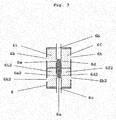
- FIG. 3 is a schematic representation of a further preferred embodiment of a downstream unit 6 with a second treatment room 6a according to the present invention.
- the second treatment room 6a is essentially a vertically aligned slot in a round, cylindrical jacket of the downstream unit 6.
- This preferred embodiment of a downstream unit 6 with a second treatment room 6a also has an inlet opening 6b and an outlet opening 6c for the polycondensate granules, as above Fig. 1 and 2nd described.
- This preferred embodiment of a downstream unit 6 with a second treatment room 6a also has a feed device 6f and a removal device 6i for the process gas.
- the special embodiment according to Fig. 3 is characterized in that the inlet opening 6d is in a feed device 6f is located.
- the feed device 6f is preferably provided with a multiplicity of inlet openings 6d, the inlet openings 6d being selected such that process gas, but not granules, can flow through them.
- the feed device 6f comprises a perforated plate or a slotted screen in which the inlet openings 6d are arranged.
- At least one feed opening 6h for process gas opens into the feed device 6f.
- This particular embodiment is further characterized in that the outlet opening 6e is located in a removal device 6i.
- the removal device 6i is preferably provided with a multiplicity of outlet openings 6e, the outlet openings 6e being selected such that process gas, but not granules, can flow through them.
- a preferred embodiment provides that the removal device 6i comprises a perforated plate or a slotted screen in which the outlet openings 6e are arranged.
- At least one removal opening 6k for process gas opens into the removal device 6i.
- devices for distributing the process gas such as baffle plates, valves or flaps, as well as separate channels for individual supply and removal of process gas can be arranged.
- the feed devices 6f and the removal devices 6i are preferably located essentially on the same level, the process gas flowing from the feed device 6f to the removal device 6i and the bulk material, which is the second Flows through treatment room 6a from top to bottom, flows in cross flow.
- the preferred embodiment is according to Fig. 3 characterized in that below and in addition to the at least one feed device 6f and removal device 6i for process gas, at least one further feed device 6f2 and removal device 6i2 for process gas opens into the second treatment space 6a.
- the at least one further feed device 6f2 and removal device 6i2 are arranged such that the polycondensate granules are exposed to the gas flow from the at least one additional feed device 6f2 after they have passed through an area of the second treatment chamber 6a in which it was exposed to a gas flow from the at least one feed device 6f . This enables a multi-stage heat supply to be achieved.
- the device according to the invention can advantageously be used for the continuous granulation and crystallization of a polymer, in particular a polycondensate, preferably a polyester such as polyethylene terephthalate.
- gas temperature The relationship between gas temperature and gas to product quantity ratio to product temperature can be illustrated by the following non-limiting examples:
- T gas is thus 61.3 ° C higher than T GR + T KR
- X * (T gas -T GR -T KR ) is 18.4 ° C
- T PH is 12.3 ° C higher than T GR + T KR .
- the gas velocity at the gas outlet was 0.36 m / s, which resulted in fixed bed conditions. There was a pressure drop of 34 mbar. The residence time of the granules in the treatment room was 16.3 minutes.
- T gas remains 61.3 ° C higher than T GR + T KR , and X * (T gas -T GR -T KR ) is 36.8 ° C, and T PH is 24.2 ° C higher than T GR + T KR .
- the gas velocity at the gas outlet was 0.73 m / s, which still meant fixed bed conditions. There was a pressure drop of 66 mbar.
- This example shows the better heating with a higher gas volume in the fixed bed.
- This example shows the poorer heating in spite of the higher gas volume and the higher pressure drop when the heating is no longer carried out under fixed bed conditions.
- T KR With unchanged T KR , X * (T Gas -T GR -T KR ) is 166 ° C, and T PH is 47.3 ° C greater than T GR + T KR .
- the average gas velocity at the gas outlet was 0.79 m / s, which means that there are still fixed bed conditions. There was a pressure drop of 71 mbar.
- This example shows the better heating for multi-stage driving.
- the second treatment room was provided in a simple crystallization container, at least an H / D ratio of 2 had to be observed to ensure sufficient product and gas distribution.
- a dwell time of 7.5 minutes a crystallization vessel with a diameter of 1 m and a height of 2 m resulted with a throughput of 10 t / h.
- T gas is thus 65.8 ° C higher than T GR + T KR
- X * (T gas -T GR -T KR ) is 11.8 ° C
- T PH is 7.8 ° C higher than T GR + T KR .
- the gas velocity at the gas outlet was 0.78 m / s, which still meant fixed bed conditions. However, there was a pressure drop of 112 mbar.
- This example shows the poorer heating in a conventional crystallization vessel with a high pressure drop. A significantly higher amount of gas cannot be used, since otherwise there are no more fixed bed conditions.
- T gas is thus 65.4 ° C higher than T GR + T KR
- X * (T gas -T GR -T KR ) is 7.2 ° C
- T PH is 4.8 ° C higher than T GR + T KR .
- the gas velocity at the gas outlet was 0.77m / s, which means that there were still fixed bed conditions. However, there was a pressure drop of 188 mbar.
- This example shows how the situation worsens with increasing throughput with a conventional crystallization container.
Landscapes
- Chemical & Material Sciences (AREA)
- Chemical Kinetics & Catalysis (AREA)
- Organic Chemistry (AREA)
- Engineering & Computer Science (AREA)
- Polymers & Plastics (AREA)
- Medicinal Chemistry (AREA)
- Health & Medical Sciences (AREA)
- Mechanical Engineering (AREA)
- Crystallography & Structural Chemistry (AREA)
- General Engineering & Computer Science (AREA)
- Polyesters Or Polycarbonates (AREA)
- Processing And Handling Of Plastics And Other Materials For Molding In General (AREA)
- Processes Of Treating Macromolecular Substances (AREA)
Abstract
Description
- Die vorliegende Erfindung betrifft ein Verfahren und eine Vorrichtung zur Direktkristallisation von Polykondensaten, insbesondere von Polyestern wie Polyethylenterephthalat (PET).
- Die Herstellung bestimmter hochmolekularer Polymere, insbesondere von Polykondensaten wie Polyestern, ist über eine Schmelzpolykondensation oft nicht möglich, da wegen der damit einhergehenden zu hohen thermischen Belastung ein Produktabbau und eine inakzeptable Verunreinigung mit Nebenprodukten auftreten. Aus diesem Grund werden über eine Schmelzpolykondensation Prepolymere mit einem geringeren Molekulargewicht hergestellt. Die Prepolymere werden anschliessend in einer Festphasennachkondensation (SSP) auf das gewünschte Molekulargewicht angehoben. Diese Vorgehensweise ist aus dem Stand der Technik bekannt (z.B. Scheirs/ Long (Hrsg.), Modern Polyesters, Wiley 2003, Kapitel 4, S. 143 ff.).
- Für die SSP-Reaktion wird das aus der Schmelzpolykondensation erhaltene Prepolymer zu Granulat verarbeitet. Um ein Verkleben des Granulats unter den Bedingungen der SSP-Reaktion zu verhindern, wird das Granulat vor der SSP-Reaktion teilkristallisiert. Auch dies ist aus dem Stand der Technik bekannt (z.B. Scheirs/ Long (Hrsg.), Modern Polyesters, Wiley 2003, Kapitel 4, S. 158-164) .
- Lässt sich das hochmolekulare Polykondensat mittels Schmelzpolykondensation herstellen, kann anschliessend trotzdem eine teilweise Kristallisation notwendig sein, um weitere Verarbeitungsschritte, wie eine Devolatilisierung, zu ermöglichen.
- Üblicherweise wird das Polykondensat oder Polykondensat-Prepolymer nach seiner Formung zu Granulat abgekühlt und für die Kristallisation wieder aufgeheizt. Es sind aber aus dem Stand der Technik auch Verfahren bekannt, bei denen das Granulat direkt nach seiner Bildung in heissem Zustand ohne zwischenzeitliche Abkühlung der Kristallisationsstufe zugeführt wird. Derartige Verfahren werden als Direktkristallisation bezeichnet. In der
DE 103 49 016 und derDE 10 2004 015 515 sind beispielsweise sogenannte Latentwärmekristallisationsverfahren beschrieben, bei welchem die Kristallisation ausschliesslich unter Ausnutzung der Eigenwärme des Granulats erfolgt. - In der
WO 2006/128408 ist ein Verfahren zur Teilkristallisation von Polyesterpellets beschrieben, bei denen die Pellets (nach Herstellung durch Unterwassergranulation und Trocknung) mit einer Granulattemperatur von grösser als 100°C ohne Zuführung externer Energie bzw. Wärme mittels der in den Granulaten vorhandenen Eigenwärme in einem wenigstens leicht geneigt ausgerichteten Kristallisationsreaktor teilkristallisiert werden. - In der
DE 10 2007 040 135 A1 ist ein Verfahren zur Herstellung von Polyester-Granulat unter Bedingungen beschrieben, welche eine anschliessende Hydrolyse des Polyesters möglichst gering halten. Es wird beschrieben, dass unter diesen Bedingungen ohne Zuführung externer Energie bzw. Wärme eine erste Kristallisation auf <10% eintritt, welche eine Agglomeration des Polyester-Granulats verhindern und somit eine weitere Kristallisation z.B. auf einer Schwingrinne zur Vermeidung von Agglomeration überflüssig machen soll. - Diese Verfahren haben aber den Nachteil, dass sie die Anforderungen an eine flexibel einstellbare und homogene Austrittsqualität bezüglich Temperatur und Kristallisationsgrad nicht erfüllen können. Weiterhin nachteilig ist, dass sich im Anfangsbereich der Kristallisationszone häufig Agglomerate bilden, die sich nicht immer vollständig auflösen.
- Bessere Ergebnisse lassen sich erzielen, wenn die Kristallisation der noch heissen Granulate unter zusätzlichem Erhitzen mittels eines heissen Prozessgases erfolgt. Dies ist beispielsweise in der
US-3,544,525 allgemein vorgeschlagen, ohne dass diesem Dokument Einzelheiten zur Verfahrensführung entnehmbar sind. Wie nachstehend ausgeführt ist dieses Verfahren mit mehreren Nachteilen behaftet. - In der
WO 2008/071023 ist ein Verfahren beschrieben, bei welchem noch heisses Granulat in einem Granulattrockner vom Kühlmedium getrennt und anschliessend in einen Kristallisator überführt wird, wo es unter bestimmten Bedingungen behandelt wird. Sowohl Granulattrockner als auch Kristallisator werden hierbei unter Luftatmosphäre betrieben. Verdampftes Kühlmedium kann mit Hilfe von Luft entfernt werden. Die Strömungsgeschwindigkeit des Behandlungsgases im Kristallisator muss über dem Lockerungspunkt des Polykondensats liegen, und die Polykondensatgranulate müssen im Kristallisator ein enges Verweilzeitspektrum aufweisen, um ein homogen kristallisiertes Polykondensatgranulat zu erhalten. Zum Erhalt eines engen Verweilzeitspektrums muss zumindest in Teilen des Kristallisators eine starke Verwirbelung vermieden werden. Diese spezifischen Verfahrensbedingungen sind einschränkend und daher nachteilig. - Nicht immer kann jedoch unter Luftatmosphäre kristallisiert werden, da es bei den hohen Kristallisationstemperaturen zu oxidativem Abbau kommen kann. Bei bestimmten Materialien beziehungsweise bestimmten Qualitätsanforderungen muss daher unter Inertgasatmosphäre kristallisiert werden.
- In der vorstehend bereits erwähnten
US-3,544,525 ist ein Verfahren beschrieben, bei welchem Polymerschmelze mittels einer Unterwassergranulation in ein Prepolymer-Granulat geformt wird. Das Granulat wird anschliessend in einer Entwässerungseinheit (Granulattrockner) getrocknet und in eine Kristallisationsapparatur überführt, wo es mit heissem Inertgas kristallisiert wird. - Dieses Verfahren weist verschiedene Nachteile auf. Neben einer nicht zufriedenstellenden Kontrolle und Homogenität der Kristallisation kommt es aufgrund der Ausgestaltung des Granulattrockners als geschlossenes System in diesem durch die verdampfende Kühlflüssigkeit (Wasser) zu einem Überdruck. Als Konsequenz wird das Wasser aus dem Granulattrockner in den Kristallisator gedrückt und in den sich anschliessenden SSP-Reaktor eingetragen. Obwohl das Prepolymer in der
US-3,544,525 nach Durchlaufen des Granulattrockners als relativ trocken beschrieben wird, liegt im SSP-Reaktor dennoch ein hoher Feuchtigkeitsgehalt vor, welcher vom Prozessgas aufgenommen wird, das den SSP-Reaktor durchströmt. Vor der Rückführung des Prozessgases in den SSP-Reaktor muss dieses in zusätzlichen Einheiten (Kondensator und Trockner) aufwendig vom Wasser befreit werden. Alternativ kann das feuchte Prozessgas entsorgt und durch frisches trockenes Prozessgas ersetzt werden. Diese Variante ist kostspielig und daher nicht zufriedenstellend. Zudem führt der hohe Feuchtigkeitsgehalt im SSP-Reaktor zu einer Abkühlung des Granulats, da das Wasser am Granulat anhaftet und abgedampft werden muss. Es wird daher im SSP-Reaktor mehr Prozessgas zum Erreichen der gewünschten Reaktionstemperatur benötigt, was ökonomisch nachteilig ist. - In der
EP-3 363 841 A1 ist Verfahren zur kontinuierlichen Herstellung eines teilkristallinen Polykondensatgranulats beschrieben, bei welchem die Kristallisation eines durch Unterwassergranulation hergestellten Polykondensatgranulats nach Abkühlen auf eine mittlere Granulat-Temperatur innerhalb des Kristallisationstemperaturbereiches des Polykondensates in einem Kristallisator unter Wirbelbettbedingungen mittels einer spezifischen Energiezufuhr von aussen erfolgt. Da sich Wirbelbettbedingungen nur unter hohem apparativen und energetischen Aufwand erreichen lassen, ist der sinnvolle Einsatzbereich dieses Verfahrens aus wirtschaftlichen Gründen beschränkt. - Es war die Aufgabe der vorliegenden Erfindung, ein Verfahren und eine Vorrichtung zur Direktkristallisation von Polykondensat bereitzustellen, welche nicht die Nachteile aus dem Stand der Technik aufweisen und gegenüber dem Stand der Technik eine Vereinfachung der Verfahrensführung und erforderlichen Apparatur darstellen.
- Es wurde erfindungsgemäss überraschend gefunden, dass die Nachteile aus dem Stand der Technik überwunden werden können, wenn die Kristallisation unter einer spezifischen Energiezufuhr von aussen unter Festbettbedingungen erfolgt. Dadurch kann überraschend auf einen separaten Kristallisator verzichtet werden. Stattdessen kann die Kristallisation in einer üblicherweise in SSP-Anlagen bereits vorhandenen Festbetteinheit wie einem Vorerhitzer durchgeführt werden. Dadurch kann auf einen separaten Schritt der Kristallisation und einer hierfür erforderlichen Baueinheit verzichtet werden, mit entsprechenden ökonomischen Vorteilen einer einfacheren und schnelleren Verfahrensführung und einer apparativen Vereinfachung.
- Die vorliegende Erfindung betrifft ein Verfahren zur kontinuierlichen Herstellung eines teilkristallinen Polykondensatgranulats, umfassend die Schritte:
- a) Formen einer Polykondensatschmelze zu Granulat unter Zugabe eines flüssigen Kühlmediums, und Abkühlen auf eine mittlere Granulat-Temperatur innerhalb des Kristallisationstemperaturbereiches des Polykondensates, wobei das Abkühlen vor oder während oder nach dem Formen zu Granulat erfolgt;
- b) Abtrennen des flüssigen Kühlmediums vom Granulat in einem ersten Behandlungsraum, wobei das Granulat nach Austritt aus dem ersten Behandlungsraum eine Temperatur TGR aufweist;
- c) Kristallisieren des Granulats in einem zweiten Behandlungsraum,
- Teilkristalline Polykondensatgranulate bezeichnen dabei Polykondensatgranulate, die sowohl amorphe Zonen wie auch Zonen mit kristalliner Struktur aufweisen.
- Die vorliegende Erfindung betrifft weiterhin eine Vorrichtung zur Durchführung des vorstehend beschriebenen Verfahrens, umfassend
- eine Granulationsvorrichtung mit einer Leitung zur Zuführung eines Kühlmediums und einer Leitung zur Wegführung eines Granulat/Kühlmedium Gemisches,
- eine stromabwärts von der Granulationsvorrichtung angeordnete Trennvorrichtung, welche einen ersten Behandlungsraum bereitstellt,
- und einer stromabwärts von der Trennvorrichtung ohne dazwischen befindlicher Kristallisationseinheit angeordneten Einheit, welche einen zweiten Behandlungsraum bereitstellt und mit jeweils einem Einlass und Auslass für das Granulat ausgestattet ist,
- Erfindungsgemäss soll unter dem Begriff "ohne dazwischen befindlicher Kristallisationseinheit" verstanden werden, dass zwischen der Trennvorrichtung und der stromabwärts davon angeordneten Einheit keine Einheit bereitgestellt ist, in welcher ein Anstieg des Kristallisationsgrades der Polykondensatgranulate bewusst und um mindestens 5% bewirkt wird. Einheiten mit anderem Zweck und in denen aufgrund der darin herrschenden Bedingungen lediglich unbeabsichtigt eine geringfügige Anhebung des Kristallisationsgrades um höchstens 5% bewirkt wird, wie beispielsweise ein Klassiersieb oder eine rohrförmige Verbindungsleitung, sind keine Kristallisationseinheiten.
- Die vorliegende Erfindung ist zur Behandlung von kristallisierbaren Polykondensaten vorgesehen. Geeignete Polykondensate umfassen kristallisierbare, thermoplastische Polykondensate, wie zum Beispiel Polyamide, Polycarbonate und Polyester inklusive Polyhydroxyalkanoate, Polylaktide oder deren Copolymere, die durch eine Polykondensationsreaktion unter Abspaltung eines niedermolekularen Reaktionsproduktes gewonnen werden. Dabei kann die Polykondensation direkt zwischen den Monomeren erfolgen oder über eine Zwischenstufe, die anschliessend durch Transesterifikation umgesetzt wird, wobei die Transesterifikation wiederum unter Abspaltung eines niedermolekularen Reaktionsproduktes oder durch Ringöffnungspolymerisation erfolgen kann. Im Wesentlichen ist das so gewonnene Polykondensat linear, wobei eine geringe Anzahl an Verzweigungen entstehen kann.
- Polykondensate eines Polymertyps werden jeweils aus den gleichen Hauptmonomeren gewonnen. Eine begrenzte Menge weiterer Monomere, sogenannter Comonomere, kann dabei zum Einsatz kommen.
- Polyamide sind Polymere, welche üblicherweise durch Polykondensation aus einer Diamin-Komponente mit der allgemeinen Struktur H2N-R1-NH2 und einer Dicarbonsäure-Komponente mit der allgemeinen Struktur HOOC-R2-COOH gewonnen werden, wobei R1 und R2 üblicherweise gegebenenfalls substituierte, lineare oder verzweigte aliphatische Kohlenwasserstoffe mit 1 bis 15 Kohlenstoffatomen, aromatische oder heteroaromatische Kohlenwasserstoffe mit 1 bis 3 aromatischen Ringen, zyklische Kohlenwasserstoffe mit 4 bis 10 Kohlenstoffatomen oder heterozyklische Kohlenwasserstoffe mit 1 bis 3 Sauerstoff- oder Stickstoffatomen und 3 bis 10 Kohlenstoffatomen sind.
- Anstelle der Dicarbonsäure kann auch ihr entsprechendes Dicarbonsäurehalogenid, vorzugsweise Dicarbonsäurechlorid eingesetzt werden.
- Beispiele solcher Polyamide sind PA-6,6, das aus Hexamethylendiamin und Adipinsäure hergestellt wird, oder PA-mXD6, das aus m-Xylylendiamin und Adipinsäure hergestellt wird.
- Polyamide sind auch Polymere mit sich wiederholenden Amidgruppen mit der allgemeinen Struktur H-[N(H)-R-CO]x-OH, wobei R üblicherweise ein gegebenenfalls substituierter, linearer oder verzweigter aliphatischer Kohlenwasserstoff mit 1 bis 15 Kohlenstoffatomen, ein aromatischer oder heteroaromatischer Kohlenwasserstoff mit 1 bis 3 aromatischen Ringen, ein zyklischer Kohlenwasserstoff mit 4 bis 10 Kohlenstoffatomen oder ein heterozyklischer Kohlenwasserstoff mit 1 bis 3 Sauerstoff- oder Stickstoffatomen und 3 bis 10 Kohlenstoffatomen ist.
- Polyamide sind auch Polymere, welche durch Ringöffnungspolymerisation aus heterozyklischen Monomeren mit wenigstens einer Amidgruppe hergestellt werden, wie zum Beispiel Polycaprolactam (PA6) hergestellt aus Caprolactam.
- Polyester sind Polymere, welche üblicherweise durch Polykondensation aus einer Diol-Komponente mit der allgemeinen Struktur HO-R1-OH und einer Dicarbonsäure-Komponente mit der allgemeinen Struktur HOOC-R2-COOH gewonnen werden, wobei R1 und R2 üblicherweise gegebenenfalls substituierte, lineare oder verzweigte aliphatische Kohlenwasserstoffe mit 1 bis 15 Kohlenstoffatomen, aromatische oder heteroaromatische Kohlenwasserstoffe mit 1 bis 3 aromatischen Ringen, zyklische Kohlenwasserstoffe mit 4 bis 10 Kohlenstoffatomen oder heterozyklische Kohlenwasserstoffe mit 1 bis 3 Sauerstoffatomen und 3 bis 10 Kohlenstoffatomen sind.
- Üblicherweise werden lineare oder zyklische Diol-Komponenten und aromatische oder heterozyklische Dicarbonsäure-Komponenten verwendet Anstelle der Dicarbonsäure kann auch ihr entsprechender Diester, üblicherweise Dimethylester eingesetzt werden.
- Typische Beispiele der Polyester sind Polyethylenterephthalat (PET), Polybutylenterephthalat (PBT), Polytrimethylenterephthalat (PTT), Polyethylenfuranoat (PEF), Polytrimethylenfuranoat (PTF), Polybutylensuccinat (PBS) und Polyethylennaphthalat (PEN), die entweder als Homopolymer oder als Copolymere zum Einsatz kommen.
- Ein Beispiel ist Polyethyleneterephthalat, das aus seinen Monomeren, einer Diol-Komponente und einer Dicarbonsäure-Komponente, gewonnen wird, wobei die Diol-Komponente als Hauptmonomer aus Ethylenglykol (1,2- Ethandiol) und die Dicarbonsäure-Komponente als Hauptmonomer aus Terephthalsäure besteht. Als Comonomere kommen weitere lineare, cyclische oder aromatische Diol- und Dicarbonsäureverbindungen in Frage. Typische Comonomere sind Diethylenglykol (DEG), Isophthalsäure (IPA) oder 1,4-Bishydroxymethyl-cyclohexan (CHDM).
- Ein weiteres Beispiel ist Polyethylenfuranoat, das aus seinen Monomeren, einer Diol-Komponente und einer Dicarbonsäure-Komponente, gewonnen wird, wobei die Diol-Komponente als Hauptmonomer aus Ethylenglykol (1,2- Ethandiol) und die Dicarbonsäure-Komponente als Hauptmonomer aus 2,5-Furandicarbonsäure besteht. Als Comonomere kommen weitere lineare, cyclische oder aromatische Diol- und Dicarbonsäureverbindungen in Frage. Typische Comonomere sind Diethylenglykol (DEG) oder Trimethylenglykol.
- Polyester sind auch Polymere mit sich wiederholenden Estergruppen mit der allgemeinen Struktur H-[O-R-CO]x-OH, wobei R üblicherweise ein gegebenenfalls substituierter, linearer oder verzweigter aliphatischer Kohlenwasserstoff mit 1 bis 15 Kohlenstoffatomen, ein aromatischer oder heteroaromatischer Kohlenwasserstoff mit 1 bis 3 aromatischen Ringen, ein zyklischer Kohlenwasserstoff mit 4 bis 10 Kohlenstoffatomen oder ein heterozyklischer Kohlenwasserstoff mit 1 bis 3 Sauerstoff- oder Stickstoffatomen und 3 bis 10 Kohlenstoffatomen ist.
- Ein Beispiel sind Polyhydroxyalkanoate mit der allgemeinen Struktur H-[O-C(R)H-(CH2)n-CO]x-OH, wobei R üblicherweise ein Wasserstoff oder ein linearer oder verzweigter aliphatischer Kohlenwasserstoff mit 1 bis 15 Kohlenstoffatomen und n gleich 1 bis 10 ist. Beispiele sind Poly-4-hydroxybutyrat und Poly-3-hydroxyvalerat.
- Ein weiteres Beispiel sind Polylactide mit der allgemeinen Struktur H-[O-C(R)H-CO]x-OH, wobei R üblicherweise eine Methylgruppe oder ein aliphatischer Kohlenwasserstoffe mit 1 bis 15 Kohlenstoffatomen ist.
- Ein weiteres Beispiel ist die Polyglycolsäure mit der allgemeinen Struktur H-[O-CH2-CO]x-OH].
- Polyester sind auch Polymere, welche durch Ringöffnungspolymerisation aus heterozyklischen Monomeren mit einer Estergruppe, wie zum Beispiel Polycaprolacton aus Caprolacton, oder durch Ringöffnungspolymerisation aus heterozyklischen Monomeren mit wenigstens zwei Estergruppen, wie zum Beispiel Polylactid aus Lactid, hergestellt werden.
- Das am meisten verbreitete Polylactid ist die Polymilchsäure mit der Struktur H-[O-C(CH3)H-CO]x-OH. Durch die Chiralität der Milchsäure existieren verschiedene Formen der Polymilchsäure. Homopolymere sind Poly-L-Lactid (PLLA), das üblicherweise aus L,L-Lactid hergestellt wird, und Poly-D-Lactid (PDLA), das üblicherweise aus D,D-Lactid hergestellt wird.
- Copolymere wie Poly-(L-Lactid-co-D,L-Lactid) enthalten geringe Mengen an Lactid-Einheiten mit einer Chiralität, die sich vom Hauptmonomer unterscheidet.
- Polyester können auch durch Biosynthese durch Mikroorganismen oder in pflanzlichen Zellen hergestellt werden, woraus sie durch Aufschluss der Zelle gewonnen werden.
- Bei den geeigneten Polykondensaten kann es sich um kristallisierbare Homopolymere handeln. Trotz der Bezeichnung Homopolymer kann sich im Herstellprozess ein geringer Anteil an Comonomeren bilden. So ist bei der Herstellung von Polyethyleneterephthalat die Bildung von Diethyleneglykol aus Ethylenglykol bekannt. Viele geeignete Polykondensate sind jedoch kristallisierbare Copolymere, die einen gewissen Anteil an Comonomer enthalten. Die Comonomere können als Teil der Monomere in den Herstellprozess des Polykondensates eingeführt werden oder sie bilden sich als Teil des Herstellprozesses, wodurch sich üblicherweise eine zufällige Verteilung ergibt. Die Comonomere können auch als Blöcken, hergestellt aus unterschiedlichen Monomeren, eingefügt werden, woraus sich sogenannte Blockcopolymere ergeben.
- Typische Mengen eines oder mehrerer Comonomere reichen von 1% bis zu ungefähr 30% w/w. Durch die Tatsache, dass in vielen Fällen ein übergrosser Anteil an Comonomer die Kristallisation gänzlich verhindert, kann der maximal Gehalt an Comonomer auf unter 20% w/w, bevorzugt unter 10% w/w beschränkt sein.
- Bei den geeigneten Polykondensaten kann es sich um Polymergemische handeln, welche eine beliebige Anzahl und Menge von unterschiedlichen Polymertypen enthalten kann. Eine kleine Menge eines Polymeren kann als Nukleierungsmittel in Polykondensaten wirken und dadurch dessen Kristallisationsrate erhöhen. Spezifische Polykondensatgemische können untereinander wechselwirkende Kristallstrukturen bilden, mit einem Kristallisationsverhalten, das von den einzelnen Komponenten abweicht.
- Ein Beispiel dafür ist ein Gemisch aus PDLA und PLLA, welches eine stereocomplexe Kristallstruktur mit erhöhter Kristallinität bildet.
- Nach der Polymerisation hat jede Polykondensatkette kettenbeendende Gruppen mit üblicherweise der Funktionalität von wenigstens einem seiner Monomere. Als Beispiel kann eine Polyesterkette eine oder mehrere Hydroxyl- und/oder Carboxylendgruppen haben. Eine Polyamidkette kann eine oder mehrere Hydroxyl- und/ oder Aminendgruppen haben. Solche Endgruppen können durch ein sogenanntes Endcapping-Reagens modifiziert sein, oder sie können durch eine Abbaureaktion modifiziert sein. Obwohl dies bei den obenstehenden allgemeinen Strukturen nicht spezifisch erwähnt ist, können geeignete Polymere derartige modifizierte Endgruppen haben.
- Bei dem Polykondensat kann es sich um ein Neumaterial oder um ein Recyclat handeln. Als Recyclate werden wiederaufbereitete Polymere aus den Herstell- und Verarbeitungsprozessen (post industrial) oder nach dem Konsumentengebrauch gesammelte und wiederaufbereitete Polymere (post consumer) bezeichnet.
- Dem Polykondensat können Additive zugegeben werden. Als Additive eignen sich zum Beispiel Katalysatoren, Farbstoffe und Pigmente, UV-Blocker, Verarbeitungshilfsmittel, Stabilisatoren, Schlagzähmodifikatoren, Treibmittel chemischer und physikalischer Art, Füllstoffe, Nukleierungsmittel, Flammhemmungsmittel, Weichmacher, Barriere- oder mechanische Eigenschaften verbessernde Partikel, verstärkende Körper, wie Kugeln oder Fasern, sowie reaktive Substanzen, wie zum Beispiel Sauerstoffabsorber, Acetaldehydabsorber oder molekulargewichtserhöhende Substanzen.
- Der erfindungsgemässen Granulationsvorrichtung zum Formen eines Polykondensatgranulats wird eine Polykondensatschmelze als Ausgangsmaterial zugeführt. Die Herstellung einer Polykondensatschmelze erfolgt mittels im Stand der Technik bekannter Apparaten oder Reaktoren (z.B. Scheirs/Long (Hrsg.), Modern Polyesters, Wiley 2003, insbesondere S- 31-104). Grundsätzlich kommen Polymerisationsreaktoren in Frage, in denen Polykondensate in flüssiger Phase hergestellt werden, wie zum Beispiel Rührkessel, Käfigreaktoren oder Scheibenreaktoren, oder aber Apparaturen, in denen zuvor hergestellte Polykondensate aufgeschmolzen werden, wie zum Beispiel Extruder oder Kneter. Die Polykondensatschmelzeherstellung kann kontinuierlich oder batchweise erfolgen. Für die weitere Verarbeitung sind aber kontinuierliche Prozesse bevorzugt.
- In einer Austrittsvorrichtung, insbesondere einer Düse oder Düsenplatte, werden aus der Polykondensatschmelze einzelne Polykondensatstränge geformt. Zur Herstellung von Granulaten (d.h. Teilchen definierter Form und Grösse) aus den Polykondensatsträngen können die im Stand der Technik bekannten Granulationstechniken, wie Stranggranulation, Wasserringgranulation, Unterwassergranulation oder Kopfgranulation (auch hot face - Granulation) verwendet werden. Dabei werden die Polykondensatstränge, die aus den Schmelzekanälen austreten, verfestigt und in eine Vielzahl an einzelnen Granulaten aufgetrennt, wobei das Auftrennen vor oder nach dem Verfestigen erfolgen kann. Das Auftrennen erfolgt zum Beispiel durch eine selbstständige Tropfenbildung, durch den Einsatz eines flüssigen Schermediums oder durch ein mechanisches Trennen, insbesondere Schneiden. Während eine selbstständige oder eine durch ein Schermedium erzwungene Tropfenbildung am Düsenaustritt erfolgt, kann ein Schneiden sowohl direkt am Düsenaustritt erfolgen oder aber erst nach dem Durchlaufen einer Behandlungsstrecke.
- Das Verfestigen der Polykondensatschmelze erfolgt durch Kühlen mit Hilfe mindestens eines flüssigen Kühlmediums oder einer Kombination verschiedener flüssiger Kühlmedien. Als flüssiges Kühlmedium sind insbesondere Flüssigkeiten geeignet, die eine hohe spezifische Wärmekapazität, bevorzugt grösser als 2 kJ/(kg·K) und einen ausreichend hohen Siedepunkt, bevorzugt grösser als 90°C aufweisen, sowie das Polykondensat nicht wesentlich angreifen oder verändern und keine toxischen Rückstände im Polykondensat hinterlassen. Erfindungsgemäss bevorzugt wird ein einziges flüssiges Kühlmedium verwendet. Bevorzugt sind Wasser oder Ethylenglykol oder deren Gemische. Besonders bevorzugt ist Wasser als Kühlmedium.
- Das Polykondensat, insbesondere als Polykondensatstränge oder als Tropfen, kann zum Beispiel vor dem Eintritt in das flüssige Kühlmedium eine Strecke durchfliessen, die ein Prozessgas, insbesondere Luft oder Wassernebel, enthält. Trotz der Verwendung des Begriffs "Wasser" in der Bezeichnung der Granulationseinrichtungen können auch andere flüssige Medien verwendet werden. Das Abkühlen kann erfindungsgemäss vor, während oder nach dem Formen des Materials zu Granulat erfolgen.
- Üblicherweise hat das flüssige Kühlmedium bei Eintritt in die Granulationsvorrichtung eine Temperatur, welche mehr als 50°C beträgt, aber mindestens 10°C unterhalb seines Siedepunktes liegt. Im Fall von Wasser beträgt die Temperatur des Kühlmediums gemäss dieser Ausführungsform bei Normaldruck daher 50°C bis 90°C. Durch die Druckabhängigkeit des Siedepunktes erhöht sich die geeignete Temperatur des flüssigen Kühlmediums bei erhöhtem Druck im Flüssigkeitssystem. Bei tieferem Druck reduziert sich die geeignete Temperatur, was unter anderem auch bei offenen Systemen mit tiefem Aussendruck der Fall ist.
- Bevorzugt weist das flüssige Kühlmedium, vorzugsweise Wasser, abhängig vom Tg des zu formenden Polykondensats, entsprechend eine Temperatur von weniger als 85°C, besonders bevorzugt von zwischen 50°C und 80°C, insbesondere bevorzugt von zwischen 60°C und 75°C auf.
- Gemäss einer erfindungsgemäss bevorzugten Ausführungsform hat das flüssige Kühlmedium bei Eintritt in die Granulationsvorrichtung eine Temperatur, welche unterhalb der Glasübergangstemperatur (auch Glasübergangspunkt genannt, mit Tg abgekürzt) des zu formenden Polykondensats liegt. Bei Polyestern beginnt das Granulat oberhalb der Glasübergangstemperatur des Materials zu verkleben, d.h. die Teilchen haften unter Bildung von Agglomeraten aneinander. Die Glasübergangstemperatur von Polyethylenterephthalat liegt beispielsweise bei etwa 75°C bis 82°C (abhängig vom Comonomergehalt und der Art der zugesetzten Comonomere).
- Die Glasübergangstemperatur eines Polykondensats kann mit Hilfe einer DSC (Digital scanning calorimetry)-Messung ermittelt werden. DSC ist ein herkömmliches, dem Fachmann hinlänglich bekanntes Verfahren. Vorrichtungen für DSC-Messungen sind ebenfalls hinlänglich bekannt und käuflich erhältlich. Beispielhaft sei das Gerät Mettler DSC821 genannt. Zur Messung der Glasüberganstemperatur eines Polykondensats wie eines Polyesters können beispielsweise 5-25 mg einer entsprechenden Polymerprobe in einem Mettler DSC821-Messgerät mit einer Rate von 10°C/min von 25°C auf 290°C erhitzt werden. Die Probe wird 1 min bei 290°C gehalten, dann rasch auf Raumtemperatur abgekühlt und ein zweites Mal mit einer Rate von 10°C/min von 25°C auf 290°C erhitzt. Der Glasübergangspunkt (Tg) wird aus diesem zweiten Durchgang ermittelt. Als Tg wird der Wendepunkt des entsprechenden Signals im DSC herangezogen.
- Die derart hergestellten Granulate sollen bevorzugterweise eine definierte Granulatform, wie zum Beispiel zylinderförmig, kugelförmig, tropfenförmig, kugelähnlich oder einer Design-Form, wie sie zum Beispiel in
EP 0 541 674 vorgeschlagen ist, aufweisen. Die mittlere Granulatgrösse soll zwischen 0.1 mm und 10 mm, bevorzugterweise zwischen 0.5 mm und 3.5 mm und besonders bevorzugt zwischen 0.85 mm und 3 mm liegen. - Als mittlere Granulatgrösse gilt der statistische Mittelwert des mittleren Granulatdurchmessers, der sich aus dem Durchschnitt aus Granulathöhe, -länge und -breite (mit bekannten Methoden messbar) ergibt. Die Granulatgrössenverteilung soll in einem engen Spektrum gehalten werden. Bevorzugt ist die Standardabweichung der Granulatgewichte von 100 gemessenen Granulaten zwischen 2 und 20%.
- Gemäss der vorliegenden Erfindung wird das hergestellte Granulat einer Direktkristallisation unterzogen, d.h. das Granulat wird nicht derart stark abgekühlt (z.B. auf Raumtemperatur), dass es für eine nachfolgende Kristallisation mit grossem Energieaufwand erhitzt werden muss. Gemäss der vorliegenden Erfindung wird das Granulat auf eine mittlere Granulat-Temperatur abgekühlt, die innerhalb des Kristallisationstemperaturbereiches des Polykondensates liegt. Dies wird erreicht, indem die Temperatur des Kühlmediums wie vorstehend beschrieben gewählt und die Verweilzeit des Granulats im Kühlmedium entsprechend kurz gewählt wird. Erfindungsgemäss bevorzugt erfolgt das Abtrennen des Kühlmediums vom Granulat innerhalb von 0,1 bis 5 Sekunden, besonders bevorzugt innerhalb von 0,3 bis 3 Sekunden nach Zugabe des Kühlmediums. Gleichzeitig mit dem Abkühlen können die Polykondensatgranulate zu einem weiteren Prozessschritt gefördert werden.
- Die mittlere Granulat-Temperatur bezeichnet dabei den Mittelwert der Temperaturen der einzelnen Granulate, wobei jedes Granulat eine mittlere Temperatur aufweist, die sich ergibt, wenn sich das Temperaturprofil im Granulat, ohne Wärmeaustauch nach aussen, ausgleicht.
- Der geeignete Kristallisationstemperaturbereich wird ersichtlich, wenn die Kristallisationshalbwertszeit (t½) als Funktion der Temperatur aufgezeichnet wird. Er ist nach oben und unten begrenzt durch die Temperatur, bei der die Kristallisationshalbwertszeit das ungefähr 10-Fache der minimalen Kristallisationshalbwertszeit (t½ min) erreicht. Da sehr kurze Kristallisationshalbwertszeiten (t½) nur schwer bestimmbar sind, wird als Minimalwert t½ min = 1 Minute eingesetzt. Zum Beispiel liegt der geeignete Kristallisationstemperaturbereich bei Polyethylenterephthalat zwischen 110 und 220 °C, bei Polyethylenfuranoat zwischen 110 und 190°C und bei Poly-L-lactid zwischen 80 und 140°C.
- Die Kristallisationshalbwertszeit (t½) wird mittels isothermer Kristallisation mittels DSC (differential scanning calorimetry) bestimmt. Die Kristallisationshalbwertszeit entspricht der Zeit, die bei der gegebenen Temperatur benötigt wird, um 50% der erreichbaren Kristallinität zu erreichen. Die minimale Kristallisationshalbwertszeit (t½ min) ist die kürzeste Kristallisationshalbwertszeit die im Kristallisationstemperaturbereich erhalten wird.
- Bevorzugt, im Fall von Polyethylenterephthalat (PET) als zu behandelndem Polymer, erfolgt eine Abkühlung des Granulats auf eine Temperatur im Bereich von 110 bis 180 °C, vorzugsweise auf zwischen 115 °C und 160 °C und besonders bevorzugt von 120 °C bis 150 °C.
- Nach dem Abkühlen wird das Kühlmedium von den Granulaten getrennt und somit getrocknet. Optional erfolgt eine weitere Behandlung (Konditionierung) der Granulate in einem flüssigen Medium, wofür direkt das Kühlmedium oder eine andere Flüssigkeit verwendet werden kann.
- Das Trennen der Granulate von einem flüssigen Kühlmedium erfolgt in einem ersten Behandlungsraum mittels im Stand der Technik bekannter Trennvorrichtungen als Trocknungsvorrichtung. Dabei kann es sich lediglich um passive Trennvorrichtungen, wie zum Beispiel Gitter oder Roste, handeln, durch die das Kühlmedium, nicht aber das Granulat durchtreten kann. Üblicherweise werden aktive Trennvorrichtungen zumindest für einen Teil der Trennung verwendet, wobei die Trennung zum Beispiel aufgrund einer Gasdurchströmung, einer Zentrifugalkraft, eines Aufpralls, einer Verdampfung oder Kombinationen daraus erfolgen kann. Solche Vorrichtungen sind zum Beispiel als Absaugvorrichtungen, Pralltrockner oder Zentrifugaltrockner bekannt. Das Abtrennen kann durch die Zufuhr eines Gasflusses in die Trennvorrichtung unterstützt werden, wobei der Gasfluss optional erwärmtes oder getrocknetes Gas, insbesondere Luft umfasst. Ein Zentrifugaltrockner mit Luftzufuhr ist bevorzugt.
- Für die Abtrennung vom Kühlmedium wird das Granulat aus einer vorstehend beschriebenen Einheit zum Formen des Granulats über eine Verbindungsleitung in eine Einheit zum Abtrennen des Kühlmediums überführt. Die Überführung des Granulats in die Trennvorrichtung erfolgt mit einer derartigen Geschwindigkeit, dass es nicht zu einer Abkühlung des Granulats unter dessen Kristallisationstemperaturbereich kommt. Die Fliessgeschwindigkeit des Granulats in der Verbindungsleitung kann durch Zufuhr von Luft oder einem anderen geeigneten Gas in die Verbindungsleitung erhöht werden.
- Zur beschleunigten Verdampfung von flüssigem Kühlmedium wird an den ersten Behandlungsraum bevorzugt eine Temperatur im Bereich von 100 bis 200°C, vorzugsweise von 110 °C bis 160 °C und besonders bevorzugt von 120 bis 150 °C angelegt. Das Granulat verweilt im ersten Behandlungsraum vorzugsweise für einen Zeitraum von einer Zehntelsekunde bis zu 10 Sekunden.
- Erfindungsgemäss bevorzugt weist das Granulat nach Austritt aus dem ersten Behandlungsraum eine Temperatur TGR im Bereich von 100-180°C, vorzugsweise von 120 °C bis 160°C auf.
- Die Trennvorrichtung weist mindestens eine Eintragsöffnung für die Zufuhr des Granulats in die Einheit auf. Bei der Eintragsöffnung kann es sich zum Beispiel um eine Öffnung im Gehäuse oder um den Austritt aus einem Rohr, das in das Gehäuse geführt wird, handeln. Weiterhin weist die Trennvorrichtung mindestens eine Austragsöffnung für die Wegfuhr des Granulats aus der Einheit auf. Bei der Austragsöffnung kann es sich zum Beispiel um eine Öffnung im Gehäuse oder um den Eintritt in ein Rohr, das aus dem Gehäuse heraus geführt wird, handeln. Weiterhin weist die Trennvorrichtung mindestens eine Austragsöffnung für die Wegfuhr des flüssigen Kühlmediums aus der Einheit auf.
- Im ersten Behandlungsraum liegt eine Gasphase vor, welche das verdampfende Kühlmedium aufnimmt. Bevorzugt handelt es sich bei dem Gas um Luft. Es können aber auch andere Gase oder Gasgemische mit einem niedrigeren Sauerstoffgehalt als Luft verwendet werden.
- Die Trennvorrichtung ist vorzugsweise keine abgeschlossene Einheit. Die Trennvorrichtung weist vorzugsweise mindestens eine Austrittsöffnung zur Abfuhr von Gas, vorzugsweise Luft, auf. Bevorzugt mündet die Austrittsöffnung der Trennvorrichtung in eine Gasabfuhrleitung, in welcher ein Ventilator zur Luftzirkulation durch die Trennvorrichtung angeordnet ist. Optional ist die Austrittsöffnung mit einem Kondensator zur Rückgewinnung von flüssigem Kühlmedium aus dem abgeführten Gas verbunden.
- Die Trennvorrichtung kann weiterhin mindestens eine Eintrittsöffnung zur Einleitung von Gas, vorzugsweise Luft, aufweisen. Die Eintrittsöffnung ist in diesem Fall bevorzugt am entgegen gesetzten Ende des ersten Behandlungsraums zur Austrittsöffnung angeordnet, um ein vollständiges Durchströmen des ersten Behandlungsraums mit Gas zu gewährleisten. Es ist aber auch möglich, dass die Eintrittsöffnung zur Einleitung von Gas nicht in der Trennvorrichtung angeordnet ist, sondern in einer nachfolgenden Einheit oder einer Verbindungsleitung zu einer nachfolgenden Einheit.
- Gemäss einer Ausführungsform wird das Gas über einen Ansaugfilter der Eintrittsöffnung zugeführt. In der zur Eintrittsöffnung führenden Gasleitung kann ein Ventilator zur Luftzirkulation durch die Trennvorrichtung angeordnet sein. Dieser Ventilator kann zusätzlich zum Ventilator in der Gasabfuhrleitung vorgesehen sein oder an dessen Stelle treten.
- Die zur Eintrittsöffnung führende Leitung und die von der Austrittsöffnung abgehende Leitung können miteinander untere Ausbildung eines geschlossenen Kreislaufs verbunden sein. Bei dieser Ausführungsform muss das Gas vor Wiedereintritt in den ersten Behandlungsraum aber durch einen Kondensator geführt werden, um das im Gas befindliche verdampfte Kühlmedium abzutrennen.
- Die erfindungsgemässe Vorrichtung weist vorzugsweise einen Kühlmedium-Kreislauf auf. Das Kühlmedium wird aus einem Vorratsbehälter (Tank) vorzugsweise über eine Umwälzpumpe und gegebenenfalls einen Wärmetauscher (zum wahlweisen Erhitzen oder Abkühlen des Kühlmediums) in die Formeinheit (Granulationsvorrichtung) geführt. Das in der Trennvorrichtung oder einem allfälligen Kondensator abgetrennte Kühlmedium kann über eine Rohrleitung zurück in den Vorratsbehälter geführt werden.
- Nach dem Abtrennen der Polykondensatgranulate vom flüssigen Kühlmedium erfolgt ein Übertrag in die nachfolgende Einheit, welche einen zweiten Behandlungsraum umfasst. Vorzugsweise wird dies mit Hilfe einer Verbindungsleitung erreicht, welche zwischen Trennvorrichtung und nachfolgender Einheit angeordnet ist und die Austragsöffnung der Trennvorrichtung mit der Eintragsöffnung der nachfolgenden Einheit verbindet. Die Verbindungsleitung ist bevorzugt derart ausgestaltet, dass ein ungehinderter Durchtritt der zu behandelnden Polykondensatgranulate von der vorgeschalteten Einheit zur nachfolgenden Einheit gewährleistet ist.
- Optional ist zwischen Trennvorrichtung und nachfolgender Einheit ein Sieb angeordnet, durch das einzelne Granulate mit spezifikationsgemässer Grösse ungehindert durchtreten können, das jedoch Granulatagglomerate und zu grosse Granulate zurück hält. Optional ist zwischen Trennvorrichtung und nachfolgender Einheit eine Absperreinheit, vorzugsweise eine Schleuseneinheit, wie zum Beispiel eine Zellradschleuse angeordnet. Mehrere Trennvorrichtungen können mit einer nachfolgenden Einheit verbunden sein.
- Um im Fall einer Störung des Kristallisationsprozesses ein aufwendiges und kostspieliges Entsorgen von Material zu vermeiden, kann die erfindungsgemässe Verbindungsleitung wie in der
WO 2008/071278 beschrieben mit einem Zwischenspeicher verbunden sein, in welchen das Material durch eine Steuerungsvorrichtung im Störungsfall geleitet und dort unter Bedingungen (insbesondere Absenkung der Granulat-Temperatur unterhalb seines Glasübergangspunktes) gelagert wird, bei denen eine Agglomeration des Granulats nicht auftritt. Auf den entsprechenden Inhalt derWO 2008/071278 wird hier ausdrücklich Bezug genommen. - Alternativ ist die Trennvorrichtung derart mit der nachfolgenden Einheit verbunden, dass ein direkter Übertrag der Granulate aus der Trennvorrichtung in die nachfolgende Einheit erfolgen kann.
- Beim Eintritt in die nachfolgende Einheit ist das zu behandelnde Granulat in der Regel im Wesentlichen amorph, d.h. es weist einen Kristallisationsgrad von weniger als 10%, vorzugsweise weniger als 5% auf. Erfindungsgemäss bevorzugt weist das Granulat im Fall von Polyethylenterephthalat (PET) vor Eintritt in die nachfolgende Einheit einen IV-Wert von 0.4 bis 0.8 dl/g, insbesondere 0.5 bis 0.67 dl/g auf. Der IV-Wert gibt die intrinsische Viskosität eines Polymers an und ist ein Mass für dessen Molekulargewicht. Der IV-Wert und seine Bestimmung sind aus dem Stand der Technik bekannt. Die intrinsische Viskosität (IV) wird erfindungsgemäss nach folgender Vorschrift bestimmt: Zur Messung der Lösungsviskosität wird eine Mischung aus Phenol/Dichlorbenzol (50 : 50 Gew.%) als Lösungsmittel benutzt. Die Polyesterprobe wird während 10 Minuten bei 130°C mit einer Konzentration von 0.5% (0.5g/dl) aufgelöst. Die Messung der relativen Viskosität (R.V.) wird bei 25°C mit einem Ubbelohde-Viskosimeter (nach DIN Anweisung Nr. 53728, Teil 3 vom Januar 1985) durchgeführt. Die relative Viskosität ist der Quotient aus der Viskosität der Lösung und der Viskosität des reinen Lösungsmittels, welcher mit dem Verhältnis der entsprechenden Kapillardurchflussgeschwindigkeit vergleichbar ist. Mit der Gleichung von Huggins wird der Wert der intrinsischen Viskosität aus der gemessenen relativen Viskosität berechnet:

- Mit den obigen Messmethoden (Polymerkonzentration C=0,5.g/dl und der Huggins Konstante KH=0.35) wird die Gleichung:

- Die Viskosität des Polyesters kann entweder als intrinsische Viskosität (IV) oder als mittleres Molekulargewicht (Zahlenmittel: Mn) angegeben sein. Zur Umrechnung eines IV-Wertes gemessen in Phenol:Dichlormethan = 1:1 in das mittlere Molekulargewicht wird die Gleichung

- Diese Gleichung ist allgemein auf publizierte Daten anwendbar, wenn nicht explizit ein anderes Lösemittelgemisch und die dazu gehörenden Umrechnungsfaktoren gegeben sind.
- Erfindungsgemäss bevorzugt durchfliessen die Polykondensatgranulate den zweiten Behandlungsraum im Wesentlichen von oben nach unten, während der zweite Behandlungsraum im Gegenstrom oder alternativ im Kreuzstrom oder einer Kombination von Gegenstrom und Kreuzstrom von einem Prozessgas durchströmt wird.
- Als Prozessgase können zum Beispiel Luft, Wasserdampf oder Inertgase wie Stickstoff, Edelgase wie Argon, oder CO2 zum Einsatz kommen. Das Prozessgas kann ein Gemisch mehrerer Prozessgase umfassen. Das Prozessgas kann Additive enthalten, die entweder reaktiv auf das zu behandelnde Polykondensat einwirken, eine Quellwirkung auf das Polykondensat haben oder sich passiv auf den zu behandelnden Polykondensatgranulaten ablagern. Der Sauerstoffgehalt des Prozessgases soll weniger als 0,1 Gew.-%, vorzugsweise weniger als 0,05 Gew.-% und besonders bevorzugt weniger als 0,02 Gew.-% betragen.
- In der erfindungsgemässen nachfolgenden Einheit liegen die Polykondensatgranulate im zweiten Behandlungsraum als Festbett vor, welches das im kontinuierlichen Betrieb bewegte Festbett umfasst.
- Obwohl die Einheit mit zweitem Behandlungsraum grundsätzlich eine beliebige Einheit sein kann, in welcher eine Granulatbehandlung unter Festbettbedingungen durchgeführt wird, werden die erfindungsgemässen Vorteile insbesondere dadurch realisiert, dass eine üblicherweise in einer SSP-Anlage bereits vorhandene entsprechende Einheit für diesen Zweck eingesetzt wird. Erfindungsgemäss bevorzugt ist daher die Einheit mit zweitem Behandlungsraum ein Vorerhitzer. Derartige Einheiten sind hinlänglich bekannt und beispielsweise in der
DE 43 00 913 A1 und derWO 99/18404 A1 - Mit anderen Worten kann das erfindungsgemässe Verfahren mit jeder Einheit durchgeführt werden, in welche die erfindungsgemässen Bedingungen eingestellt werden können. Die gesamten Vorteile der vorliegenden Erfindung werden jedoch bei Verwendung einer nachstehend im Detail beschriebenen und beanspruchten erfindungsgemässen Vorrichtung erreicht.
- Erfindungsgemäss bevorzugt ist der zweite Behandlungsraum unterhalb des ersten Behandlungsraums angeordnet.
- Der zweite Behandlungsraum ist von einem Gehäuse umgeben. Der horizontale Querschnitt des Behandlungsraumes kann eine beliebige Form aufweisen, ist bevorzugterweise aber rund oder rechteckig. Der Behandlungsraum ist bevorzugt im Wesentlichen beziehungsweise bevorzugt genau vertikal angeordnet, so dass das Granulat die Vorrichtung von oben nach unten durchfliessen kann. Wichtig ist dabei, dass ein gleichmässiger Produktfluss erreicht werden kann. Der zweite Behandlungsraum ist seitlich durch einen Mantel begrenzt. Die Mantelwand kann dabei aus zylindrischen, konischen oder aus einer Kombination aus konischen und zylindrischen Segmenten bestehen, wodurch sich die Gasgeschwindigkeitsverteilung über die Höhe der Vorrichtung beeinflussen lässt. Eine Verengung im Deckenbereich erlaubt eine Erhöhung der Gasgeschwindigkeit, was zu einer lokalen Verwirbelung führt, wodurch sich eine verbesserte Produktverteilung erreichen lässt.
- Eine besondere Ausführungsform der vorliegenden Erfindung sieht einen wenigstens annähernd rotationssymmetrischen Gehäusemantel vor, was fertigungstechnische Vorteile sowie Vorteile für einen regelmässigen Produktfluss ergibt.
- Im Innern des zweiten Behandlungsraumes können Verdrängungskörper angeordnet sein, die nicht vom Granulat durchflossen werden und somit den zweiten Behandlungsraum verkleinern. Solche Verdrängungskörper können zum Beispiel zur Durchführung von Prozessgas, zur Anpassung der freien Querschnittsfläche oder zur Verbesserung des Granulatflusses eingesetzt werden.
- Im Innern des zweiten Behandlungsraumes können Trennwände angeordnet sein, die den zweiten Behandlungsraum in zwei oder mehrere Kammern unterteilen. Die Kammern können durch Durchlassöffnungen für die Granulate miteinander verbunden sein.
- Bevorzugt mündet zumindest eine Eintragsöffnung in den Deckenbereich des zweiten Behandlungsraumes und ermöglicht das Einführen des zu behandelnden Granulats in den zweiten Behandlungsraum. Bei der Eintragsöffnung kann es sich zum Beispiel um eine Öffnung im Gehäuse oder um den Austritt aus einem Rohr, das in das Gehäuse geführt wird, handeln. Die Eintragsöffnung kann in mehrere Segmente unterteilt sein, was eine Verteilung der Granulate im Behandlungsraum erlaubt.
- Bevorzugt mündet zumindest eine Austragsöffnung in den unteren Teil des zweiten Behandlungsraumes, durch die behandeltes Granulat aus dem Behandlungsraum ausgetragen werden kann. Bei der Austragsöffnung kann es sich zum Beispiel um eine Öffnung im Gehäuse oder um den Eintritt in ein Rohr, das aus dem Gehäuse heraus geführt wird, handeln. Üblicherweise wird das Granulat durch einen konischen Bereich der Austragsöffnung zugeführt. Der Winkel des Auslaufkonus beträgt zur Horizontalen bevorzugterweise 50 - 80°, wenn das Granulat im Austragskonus nicht fluidisiert oder vibriert wird, und 15-60°, insbesondere 30-50°, wenn das Granulat im Austragskonus fluidisiert oder vibriert wird. Alternativ kann das Granulat auch mittels einer mechanischen Austragsvorrichtung, wie zum Beispiel einer Schnecke, der Austragsöffnung zugeführt werden.
- Unterhalb der Austragsöffnung befindet sich erfindungsgemäss bevorzugt eine Absperreinheit, vorzugsweise eine Schleuseneinheit, wie zum Beispiel eine Zellradschleuse, oder eine Walzeneinheit mit deren Hilfe der Granulatabfluss aus dem zweiten Behandlungsraum geregelt wird. Als Regelgrösse kann dabei zum Beispiel die Füllhöhe des Granulates im zweiten Behandlungsraum oder das Gewicht der Granulate in der den zweiten Behandlungsraum umfassenden Einheit dienen.
- Zum zweiten Behandlungsraum der erfindungsgemässen Vorrichtung führen zumindest zwei Zuführeinrichtungen und zumindest zwei Wegführeinrichtungen für ein Prozessgas. Jede Zuführeinrichtung weist zumindest eine Eintrittsöffnung auf, durch die Prozessgas in den zweiten Behandlungsraum strömt. Jede Wegführeinrichtung weist zumindest eine Austrittsöffnung auf, durch die Prozessgas aus dem zweiten Behandlungsraum strömt.
- Die Zuführeinrichtung für ein Prozessgas kann Vorrichtungen mit mindestens einer Eintrittsöffnung, wie zum Beispiel nach unten offene Kegel, Dächer oder Dachreihen sowie Leitungen oder Bleche mit Austrittsbohrungen, oder auch Spaltbleche sowie Siebe oder Gitter umfassen, durch die Prozessgas in den zweiten Behandlungsraum fliesst. Die Wegführeinrichtung für das Prozessgas kann Vorrichtungen mit mindestens einer Austrittsöffnung, wie zum Beispiel nach unten offene Kegel, Dächer oder Dachreihen sowie Leitungen oder Bleche mit Austrittsbohrungen oder auch Spaltbleche sowie Siebe oder Gitter umfassen, durch die Prozessgas aus dem zweiten Behandlungsraum abfliesst.
- Die Zuführeinrichtungen können sich dabei unabhängig voneinander im Mantel oder im Bodenbereich des Behandlungsraumes befinden. Die Wegführeinrichtungen können sich dabei unabhängig voneinander im Mantel oder im Deckenbereich des Behandlungsraumes befinden.
- Eine besondere Ausführungsform sieht vor, dass eine Wegführeinrichtung für das Prozessgas in die Eintragsöffnung der Polykondensatgranulate integriert ist.
- Eine besondere Ausführungsform sieht vor, dass der zweite Behandlungsraum nach unten teilweise durch eine gasdurchlässige Absperreinrichtung, insbesondere ein Lochblech mit einer Vielzahl an Eintrittsöffnungen, begrenzt wird, die von Prozessgas zumindest stellenweise, nicht aber von den Granulaten durchströmt werden kann. Dazu sind die Öffnungen kleiner als der Durchmesser der Granulate. Die Durchlassfläche weist bevorzugterweise zwischen 1% und 30% auf. Bevorzugt sind Öffnungen zwischen 20 und 90%, insbesondere zwischen 30 und 80% des Durchmessers der Granulate. Die Anzahl, Grösse und Anordnung der Öffnungen kann dabei gleichmässig oder ungleichmässig sein. Die Absperreinrichtung ist konisch oder schräg nach unten angeordnet, wobei die für den Auslaufkonus beschriebenen Winkel auch hier Gültigkeit haben.
- Vor den Zuführeinrichtungen kann sich ein Verteilraum befinden, durch den Prozessgas zu den Zuführeinrichtungen geführt wird. In diesen Verteilraum mündet zumindest eine Zuführöffnung für Prozessgas. Nach den Wegführeinrichtungen kann sich ein Sammelraum befinden, in dem Prozessgas aus den Wegführeinrichtungen gesammelt wird. In diesen Sammelraum mündet zumindest eine Wegführöffnung für Prozessgas. Weiterhin können Vorrichtungen zur Verteilung des Prozessgases, wie Staubleche, Ventile oder Klappen, wie auch getrennte Kanäle zur individuellen Prozessgaszufuhr und -Wegfuhr angeordnet sein. In oder unterhalb der Wegführeinrichtung können sich Vorrichtungen befinden, die den Durchtritt von Prozessgas erlauben, den Durchtritt von Granulaten aber behindern. Dies kann zum Beispiel durch einen gebogenen oder umgelenkten Durchflusskanal oder mit Hilfe von ablenkenden Einbauten, wie zum Beispiel einem Zick-Zack-Abscheider, erfolgen.
- Eine bevorzugte Ausführungsform der vorliegenden Erfindung sieht vor, dass sich im zweiten Behandlungsraum auf einer Ebene eine Vielzahl von dächerförmigen oder rohrförmigen Zuführeinrichtungen befindet, in die aus einem Verteilraum kommendes Prozessgas fliesst, und sich oberhalb dieser Ebene auf einer weiteren Ebene eine Vielzahl von dächerförmigen oder rohrförmigen Wegführeinrichtungen befindet, durch die Prozessgas in einen Sammelraum fliesst, wobei das Prozessgas von der unteren Ebene zur oberen Ebene strömt und dabei das Schüttgut, das den zweiten Behandlungsraum von oben nach unten durchfliesst, im Gegenstrom durchströmt.
- Die Zuführeinrichtungen und die Wegführeinrichtungen sind dazu derart angeordnet, dass ein direkter Gasfluss vom Verteilraum zum Sammelraum vermieden wird.
- Werden dächerförmige Zuführeinrichtungen verwendet, können diese derart angeordnet werden, dass die Spitzen der Dächer im Wesentlichen nach oben gerichtet und so dem Fluss der Polymergranulate entgegengesetzt angeordnet sind, und das Gas nach unten austreten kann. Werden dächerförmige oder rohrförmige Zuführeinrichtungen verwendet, können diese derart angeordnet werden, dass die Spitzen der Dächer im Wesentlichen nach oben gerichtet und so dem Fluss der Polymergranulate entgegengesetzt angeordnet sind, und das Gas durch nach oben gerichtete Eintrittsöffnungen austreten kann. Dazu müssen die entsprechenden Eintrittsöffnungen kleiner sein als der mittlere Granulatdurchmesser. Lochgrösse und Lochfläche gelten dabei wie für die gasdurchlässige Absperreinrichtung, die den zweiten Behandlungsraum nach unten begrenzen kann.
- Werden dächerförmige Wegführeinrichtungen verwendet, werden diese derart angeordnet, dass die Spitzen der Dächer im Wesentlichen nach oben gerichtet und so dem Fluss der Polymergranulate entgegengesetzt angeordnet sind, und das Gas von unten eintreten kann. Um einen möglichst gleichmässigen Fluss der Polymergranulate an den dächerförmigen Einrichtungen vorbei zu gewährleisten, sollen diese eine Dachsteilheit im Vergleich zur Horizontalen von 50° bis 80° aufweisen. Unabhängig von der Form der Einrichtungen sollen horizontale Flächen oder Flächen mit einer Steilheit von weniger als 45°,auf denen sich Granulate ablagern können, vermieden werden, wobei die maximale Breite der zulässigen horizontalen Flächen 50% des mittleren Durchmessers der Granulate nicht überschreiten soll.
- Eine weitere bevorzugte Ausführungsform der vorliegenden Erfindung sieht vor, dass sich in einer Mantelfläche im zweiten Behandlungsraum eine Zuführeinrichtung und in einer weiteren Mantelfläche im zweiten Behandlungsraum eine Wegführeinrichtung für Prozessgas befindet, wobei die beiden Mantelflächen im Wesentlichen gegenüberliegend angeordnet sind und dazwischen einen im Wesentlichen rechteckigen Durchflusskanal für die zu behandelnden Polykondensatgranulate bilden.
- Gemäss der Vorrichtung der vorliegenden Erfindung ist vorgesehen, dass zusätzlich zur zumindest einen Zuführeinrichtung und Wegführeinrichtung für Prozessgas zumindest eine weitere Zuführeinrichtung und Wegführeinrichtung für Prozessgas in den zweiten Behandlungsraum mündet. Die zumindest eine weitere Zuführeinrichtung und Wegführeinrichtung soll derart angeordnet sein, dass die Polykondensatgranulate nach Durchlaufen eines Bereiches des zweiten Behandlungsraumes, in dem es einem Gasfluss aus der zumindest einen Zuführeinrichtung ausgesetzt war, dem Gasfluss aus der zumindest einen zusätzlichen Zuführeinrichtung ausgesetzt wird. Insbesondere ist die zusätzliche Zuführeinrichtung und Wegführeinrichtung unterhalb der zumindest einen Zuführeinrichtung angeordnet, wodurch sich eine mehrstufige Wärmezufuhr sowie ein mehrstufiges Gasgeschwindigkeitsprofil erreichen lässt.
- Das Granulat wird im zweiten Behandlungsraum durch Energiezufuhr von aussen mit Hilfe des heissen Prozessgases erhitzt. Hierbei wird das Prozessgas mit einer Temperatur TGas in den zweiten Behandlungsraum geführt, die grösser ist als die Summe der Granulattemperatur TGR und der durch freigesetzte Kristallisationswärme im zweiten Behandlungsraum auftretenden Temperaturerhöhung TKR, d.h. TGas > (TGR + TKR). Die Gastemperatur TGas liegt also über der mittleren Granulattemperatur, welche die Polykondensatgranulate ohne Energiezufuhr von aussen im zweiten Behandlungsraum erreichen würden, woraus sich der Vorteil ergibt, dass sich die Polykondensatgranulate auf eine konstante und definierte Austrittstemperatur einstellen lassen. Es hat sich erfindungsgemäss gezeigt, dass zum Erhalt eines homogen kristallisierten Polykondensats die Energiezufuhr von aussen unter Berücksichtigung der durch freigesetzte Kristallisationswärme im zweiten Behandlungsraum auftretenden Temperaturerhöhung TKR zu erfolgen hat.
- Die durch freigesetzte Kristallisationswärme im zweiten Behandlungsraum auftretende Temperaturerhöhung TKR lässt sich auf bekannte Weise berechnen (q=m·c·ΔT, wobei q die Kristallisationswärme des Polykondensats, m die Masse und c die spezifische Wärmekapazität des Polykondensats sind und q und c aus einschlägigen Handbüchern entnommen werden können).
- Durch die Zunahme der Kristallinität wird Kristallisationswärme freigesetzt. Aufgrund dieser Kristallisationswärme erfolgt eine Temperaturerhöhung TKR, die sich wie vorstehend ausgeführt aus der freigesetzten Wärmemenge geteilt durch die spezifische Wärmekapazität und die Masse des Polykondensates ergibt.
- Im Allgemeinen liegt die durch freigesetzte Kristallisationswärme im zweiten Behandlungsraum auftretende Temperaturerhöhung TKR im Bereich von 5°C bis 40°C. Insbesondere im Fall von Polyethylenterephthalat (PET) liegt TKR im Bereich von 10°C bis 30°C, wobei als Standardwert für PET mit einem Comonomergehalt von 3 bis 7% w/w ein Wert von 20°C eingesetzt werden kann, wenn keine konkreten Messwerte vorliegen.
- Gemäss einer bevorzugen Ausführungsform der vorliegenden Erfindung wird das Verhältnis X der Massenströme von Gas (mG) und Granulat (mP) (X = mG/mP) im zweiten Behandlungsraum so eingestellt, dass 4°C ≤ (TGas - TKR - TGR) * X ≤ 400°C, vorzugsweise 15°C < (TGas - TKR - TGR) * X ≤ 300°C, bevorzugter 15°C < (TGas - TKR - TGR) * X ≤ 250°C, besonders bevorzugt 90°C < (TGas - TKR - TGR) * X ≤ 300°C, und insbesondere bevorzugt 90°C < (TGas - TKR - TGR) * X ≤ 250°C ist. Damit wird ein Polykondensat mit besonders vorteilhaften Eigenschaften hinsichtlich homogener Kristallisation und weiterer Verarbeitung mittels SSP Reaktion erhalten.
- Erfindungsgemäss bevorzugt erfolgt die Auswahl der Gaseintrittstemperatur TGas und dem Verhältnis X von Gasmenge zu Produktmenge derart, dass ein Aufheizen der Polykondensatgranulate am Austritt aus dem zweiten Behandlungsraum auf eine Temperatur TPH erfolgt, die um 10 bis 90°C grösser ist als die Summe der Granulattemperatur TGR und der durch freigesetzte Kristallisationswärme im zweiten Behandlungsraum auftretenden Temperaturerhöhung TKR, d.h. (TGR + TKR + 90°C) ≥ TPH ≥ (TGR + TKR + 10°C), wobei das Aufheizen bevorzugt auf (TGR + TKR + 90°C) ≥ TPH ≥ (TGR + TKR + 15°C) und besonders bevorzugt auf (TGR + TKR + 90°C) ≥ TPH ≥ (TGR + TKR + 20°C) erfolgt.
- Erfindungsgemäss bevorzugt kann die Behandlung im zweiten Behandlungsraum in mehreren Stufen, vorzugsweise 2 bis 200 Stufen, besonders bevorzugt 2 bis 100 Stufen, erfolgen, wobei eine Stufe jeweils ein Paar an Zuführeinrichtungen und Wegführeinrichtungen umfasst. Mehrere Zuführeinrichtungen einer Stufe können von einem Verteilraum ausgehen. Mehrere Wegführeinrichtungen einer Stufe können von einem Sammelraum ausgehen. Hierbei wird vorzugsweise jede Stufe mit einem Verhältnis X der Massenströme von Gas (mG) und Granulat (mP) (X = mG/mP) von kleiner als 1, besonders bevorzugt kleiner als 0.5 durchgeführt.
- Das Granulat wird erfindungsgemäss bevorzugt im zweiten Behandlungsraum auf eine Temperatur erhitzt, die 20°C oder mehr unter dem Schmelzpunkt des Polykondensates liegt. Im Fall von Polyethylenterephthalat (PET) wird das Granulat erfindungsgemäss bevorzugt im zweiten Behandlungsraum auf eine Temperatur im Bereich von 170 bis 240°C, insbesondere bevorzugt auf 180°C bis 225°C erhitzt.
- Optional ist der Einheit mit dem zweiten Behandlungsraum ein weiterer Vorerhitzer nachgeschaltet. Auch in diesem Fall wird das Granulat auf die für eine nachfolgende SSP-Reaktion vorgesehene Temperatur erhitzt.
- Die Verweilzeit der Polykondensatgranulate im zweiten Behandlungsraum beträgt 10 Minuten bis 5 Stunden, bevorzugt über 30 Minuten und bevorzugt unter 3 Stunden, wobei die Verweilzeit zumindest 5 Kristallisationshalbwertszeiten umfassen soll. Im Fall eines schnell kristallisierenden Polymers wie Polyethylenterephthalat (PET) mit einem Comonomergehalt von weniger als 7% w/w beträgt die Verweilzeit bevorzugt zwischen 30 Minuten und 3 Stunden. Langsam kristallisierende Polymere müssen entsprechend länger im zweiten Behandlungsraum verweilen, bis der gewünschte Anstieg des Kristallisationsgrades erreicht ist.
- Da erhitzte Prozessgase teuer sind, wird erfindungsgemäss bevorzugt das eingesetzte Prozessgas zumindest teilweise in einem Kreislaufsystem geführt, wobei jeweils eine geringe Menge an Austauschgas zu- und weggeführt werden kann. Zwischen der Wegführeinrichtung und Zuführeinrichtung für das Prozessgas besteht gemäss dieser bevorzugten Ausführungsform ein im Wesentlichen geschlossener Kreislauf aus Rohrleitungen.
- Im Kreislauf können sich weitere Einheiten, wie zum Beispiel Verdichtungseinrichtungen (z. B. Ventilatoren, Gebläse oder Kompressoren), Wärmetauscher (z.B. Erhitzer), Absperrvorrichtungen z.B. ein Ventil oder Hahn) oder Reinigungseinrichtungen (z. B. Filter, Zyklone, Wäscher oder katalytische Verbrennungseinrichtungen), befinden. Wird das Prozessgas dem zweiten Behandlungsraum in mehreren Stufen zugegeben, können sich zwischen den Stufen zusätzliche Einheiten befinden, ausgewählt aus der Gruppe bestehend aus Verdichtern wie Ventilatoren, Wärmetauschern wie Erhitzern, Abscheidern wie Filtern, oder Absperrvorrichtungen.
- Gemäss einer bevorzugten Ausführungsform der vorliegenden Erfindung ist die Einheit mit dem zweiten Behandlungsraum, vorzugsweise durch eine Zuführleitung, mit einem Inertgastank verbunden. Durch die Zuführleitung kann Inertgas aus dem Inertgastank in das Kreislaufsystem aus Rohrleitungen oder direkt in die Einheit mit dem zweiten Behandlungsraum eingeführt werden. Vorzugsweise ist in dieser Zuführleitung eine Dosiereinheit, beispielsweise ein Regelventil, angeordnet, mit welcher die Zufuhr von Inertgas kontrolliert werden kann.
- Gemäss einer bevorzugten Ausführungsform der vorliegenden Erfindung wird der Druck p2 im zweiten Behandlungsraum so eingestellt, dass er oberhalb des im ersten Behandlungsraum vorliegenden Druckes p1 liegt. Dadurch wird ein Übergehen von Kühlmedium aus dem ersten Behandlungsraum im Trockner in den zweiten Behandlungsraum verhindert. Aufgrund des höheren Drucks im zweiten Behandlungsraum geht hierbei Inertgas aus dem zweiten Behandlungsraum in den ersten Behandlungsraum über.
- Beim Austritt aus dem zweiten Behandlungsraum weist das Granulat vorzugsweise einen Kristallisationsgrad auf, der grösser ist als 35% des maximal bei der Behandlungstemperatur im zweiten Behandlungsraum erreichbaren Kristallisationsgrades. Insbesondere bevorzugt weist das Granulat beim Austritt aus dem zweiten Behandlungsraum einen Kristallisationsgrad auf, der zwischen 40% und 80% des maximal bei der Kristallisationstemperatur erreichbaren Kristallisationsgrades liegt.
- Gemäss einer bevorzugten Ausführung der vorliegenden Erfindung erfolgt gleichzeitig mit der Kristallisation ein Annealing der Polykondensatgranulate, wodurch ein allfälliger low melting-Peak auf eine Temperatur verschoben wird, die zumindest 10° über der Behandlungstemperatur im nachfolgend beschriebenen dritten Behandlungsraum liegt, und/oder wodurch ein allfälliger low melting-Peak auf einen Wert von unter 3J/g reduziert wird.
- Der low melting-Peak kann mittels DSC (Digital scanning calorimetry)-Messung ermittelt werden. Zur Messung des low melting-Peak eines Polykondensats wie eines Polyesters können beispielsweise 5-25 mg einer entsprechenden Polymerprobe in einem Mettler DSC821-Messgerät mit einer Rate von 10°C/min von Raumtemperatur auf eine Temperatur über dem Schmelzpunkt des Polykondensates erhitzt werden. Als low melting-Peak wird die Spitze des endothermen Schmelzpeaks bezeichnet, der dem eigentlichen Schmelzpeak vorgelagert ist, wobei es zu einer Vermischung des low melting-Peaks und des Schmelzpeaks kommen kann, wenn sich der low melting-Peak auf der Flanke des Schmelzpeaks befindet. In diesem Fall kann der low melting Peak aus der ersten Ableitung der DSC-Kurve ermittelt werden, wobei das Zwischenminimum auf der Flanke als low melting-Peak gilt.
- Im Fall von Polyethylenterephthalat (PET) weist das Granulat beim Austritt aus dem zweiten Behandlungsraum einen Kristallisationsgrad zwischen 20% und 50%, insbesondere zwischen 31% und 45% auf, und der low melting-Peak liegt im Bereich von 190 - 250°C, insbesondere im Bereich von 200 - 240°C.
- Gemäss der vorliegenden Erfindung können die nach der Kristallisation erhaltenen Polykondensatgranulate einer weiteren thermischen Behandlungsstufe zugeführt werden, welche vorzugsweise aus der Gruppe bestehend aus einer Devolatilisierungsstufe, vorzugsweise Dealdehydisierungsstufe, und einer Festphasen-Nachkondensation (SSP) ausgewählt ist. Diese thermische Behandlungsstufe wird in einem dritten Behandlungsraum durchgeführt, welcher sich vorzugsweise in einem separaten Reaktor befindet.
- Sowohl die Devolatliisierung, vorzugsweise Dealdehydisierung, als auch die SSP-Reaktion sind dem Fachmann bekannt und müssen an dieser Stelle nicht näher erläutert werden. Erfindungsgemäss bevorzugt wird diese thermische Behandlung in einem dritten Behandlungsraum in einer Gasphase aus Inertgas durchgeführt, wobei flüchtige Komponenten aus dem Polymer während der Behandlung verdampfen und in die Gasphase übergehen. Vorzugsweise wird Stickstoff als Inertgas verwendet. Erfindungsgemäss soll der Sauerstoffgehalt des Gases im dritten Behandlungsraum weniger als 0,1 Gew.-%, vorzugsweise weniger als 0,05 Gew.-% und besonders bevorzugt weniger als 0,02 Gew.-% betragen, um eine oxidative Beschädigung der Polykondensatgranulate zu verringern beziehungsweise auszuschliessen.
- Aufgrund der hohen Temperatur des in den dritten Behandlungsraum eintretenden Polymers ist es nicht erforderlich, sehr heisses Prozessgas in den dritten Behandlungsraum einzuleiten. Aufgrund frei werdender Kristallisationswärme wird erfindungsgemäss im dritten Behandlungsraum im Fall von Polyethylenterephthalat (PET) in der Regel ein Temperaturanstieg von 2 bis 15 °C, vorzugsweise von 3 bis 15°C und besonders bevorzugt von 5 bis 15°C beobachtet. Gemäss der vorliegenden Erfindung kann daher in bestimmten Fällen in den dritten Behandlungsraum ein Prozessgas eingeleitet werden, dessen Temperatur unterhalb der Temperatur der im dritten Behandlungsraum vorliegenden Polykondensatgranulate liegt. Durch die vorliegende Erfindung kann eine sich anschliessende thermische Behandlungsstufe daher energieeffizient durchgeführt werden.
- Im dritten Behandlungsraum wird das Prozessgas vorzugsweise im Gegenstrom zum Strom der Polymerpartikel geführt. Es können beliebige Reaktoren, die im Stand der Technik zur thermischen Behandlung von Schüttgütern bekannt sind, eingesetzt werden. Beispielsweise sei ein herkömmlicher Schachtreaktor erwähnt.
- Die kristallisierten Polykondensatgranulate werden aus dem zweiten Behandlungsraum auf bekannte Art in den dritten Behandlungsraum überführt. Beispielsweise können die Granulate aus dem zweiten Behandlungsraum mittels einer pneumatischen Förderung in den dritten Behandlungsraum überführt werden. Hierbei kann je nach Geschwindigkeit der Förderung eine Abkühlung der Polykondensatgranulate um zwischen 2 und 15°C, vorzugsweise zwischen 3 und 15°C und besonders bevorzugt zwischen 5 und 15°C erfolgen. Falls erforderlich kann ein zusätzliches Erhitzen der Granulate vor Eintritt in den dritten Behandlungsraum auf bekannte Art durchgeführt werden.
- Erfindungsgemäss kann die Dealdehydisierung von beispielsweise Polyethylenterephthalat im dritten Behandlungsraum bei einer Temperatur von 140 bis 200°C erfolgen. Es ist hierbei beispielsweise ein Temperaturanstieg im dritten Behandlungsraum von 3 bis 15°C zu beobachten.
- Erfindungsgemäss kann die SSP-Reaktion von beispielsweise Polyethylenterephthalat im dritten Behandlungsraum bei einer Temperatur von 180 bis 240°C, vorzugsweise 180 bis 225°C erfolgen. Es ist hierbei beispielsweise ein Temperaturanstieg im dritten Behandlungsraum von 3 bis 15°C zu beobachten.
- Die vorliegende Erfindung wird nachstehend anhand einer nicht einschränkenden Zeichnung näher erläutert. Es zeigen:
- Fig. 1
- eine schematische Darstellung einer bevorzugten Ausführungsform einer Vorrichtung gemäss der vorliegenden Erfindung.
- Fig. 2
- eine schematische Darstellung einer bevorzugten Ausführungsform einer nachgeschalteten Einheit mit zweitem Behandlungsraum gemäss der vorliegenden Erfindung, wobei das Prozessgas im Wesentlichen im Gegenstrom geführt wird.
- Fig. 3
- eine schematische Darstellung einer bevorzugten Ausführungsform einer nachgeschalteten Einheit mit zweitem Behandlungsraum gemäss der vorliegenden Erfindung, wobei das Prozessgas im Wesentlichen im Kreuzstrom geführt wird.
- Die Vorrichtung gemäss
Fig. 1 weist einen Reaktor 1 zur Herstellung einer Polymerschmelze auf. Es kann sich hierbei um einen Reaktor handeln, in welchem eine Schmelzpolymerisation durchgeführt und somit ein Prepolymer aus den Monomeren hergestellt wird. Wahlweise kann es sich bei dem Reaktor 1 auch um eine Vorrichtung zum Aufschmelzen eines festen Produkts, beispielsweise eines Prepolymer handeln. Beispielhaft kann der Reaktor 1 in diesem Fall ein Extruder sein. - Das geschmolzene Material wird in eine Granulationsvorrichtung 2 überführt. In der Granulationsvorrichtung 2 wird auf bekannte Weise ein Granulat aus dem geschmolzenen Material hergestellt. Beispielsweise kann es sich um einen Unterwassergranulator (wie in
Fig. 1 gezeigt) handeln. Die Granulierung erfolgt in diesem Fall unter Wasser. Die erhaltenen Granulatpartikel werden im Granulator 2 gleichzeitig abgekühlt. Wie vorstehend ausgeführt darf die Abkühlung aber nicht so stark ausfallen, dass die Granulatpartikel unterhalb ihres Kristallisationstemperaturbereiches abgekühlt werden. Dies kann durch den Einsatz von erwärmtem Wasser, welches eine Temperatur über 50°C, aber zumindest 10°C unterhalb seines druckabhängigen Siedepunktes, insbesondere eine Temperatur unterhalb des Tg des Polykondensates, vorzugsweise eine Temperatur von 50 bis 80°C aufweist, erreicht werden. Das Granulat sollte im Fall von Polyethylenterephthalat (PET) auf eine Temperatur von 110 bis 180°C, vorzugsweise 115 to 160°C und besonders bevorzugt 120 bis 150°C, gekühlt werden. - Das Granulat wird über eine Verbindungsleitung 3 durch eine Eintragsöffnung 3a in die Einheit zum Trocknen des Granulats (Trennvorrichtung) 4 überführt. Zur Vermeidung einer zu starken Abkühlung des Granulats sollte dieses so schnell wie möglich aus dem Granulator 2 und durch die Verbindungsleitung 3 geführt werden. Vorzugsweise kann die Fliessgeschwindigkeit in der Verbindungsleitung 3 durch Einleitung eines Gasstroms (vorzugsweise Luft) erhöht werden.
- In der Einheit zum Trocknen des Granulats (Trennvorrichtung) 4 wird das Granulat in einem ersten Behandlungsraum 4a vom flüssigen Kühlmedium (Wasser) abgetrennt und getrocknet. Das abgetrennte Kühlmedium wird durch eine Austragsöffnung 3c über eine Rohrleitung 9a zurück in den Vorratsbehälter (Tank) 9b für das Kühlmedium geführt. Der Vorratsbehälter 9b weist einen Einlass 9e zur Zuführung von Kühlmedium auf. Vom Vorratsbehälter 9b wird das Kühlmedium mit Hilfe einer Umwälzvorrichtung (Pumpe) 9c in die Granulationsvorrichtung 2 überführt. Hierbei durchläuft das Kühlmedium vorzugsweise einen Wärmetauscher 9d. Im Wärmetauscher 9d kann das Kühlmedium nach Bedarf erwärmt oder abgekühlt werden. Insbesondere aus der Trennvorrichtung 4 zurückgeführtes Kühlmedium kann aufgrund des Kontakts mit heissem Granulat eine zu hohe Temperatur aufweisen und muss vor dem Eintritt in die Granulationsvorrichtung 2 gekühlt werden.
- Das frische Kühlmedium, das über den Einlass 9e zugeführt wird, kann ein basisches Medium oder ein pH-Puffermedium enthalten. Insbesondere ist hier die Verwendung von Wasser mit einer in einem engen Bereich eingestellten Neutralisations- oder Pufferwirkung vorgesehen. Alternativ kann die Zugabe eines basischen Mediums oder eines pH-Puffermediums auch direkt in den Kühlkreislauf, z.B. in den Vorratstank 9b, erfolgen.
- Die Trocknung des Granulats im ersten Behandlungsraum 4a in der Einheit 4 erfolgt neben einer mechanischen Trennvorrichtung mit Hilfe von Gas, vorzugsweise Luft oder einer im wesentlichen Luft umfassenden Gasatmosphäre, bei einer Temperatur von 100 bis 200°C, vorzugsweise 110 bis 160°C. In der Vorrichtung gemäss
Fig. 1 wird die Luft durch eine Eintrittsöffnung 10a in die Trennvorrichtung 4 geführt. Die Eintrittsöffnung 10a für das Gas kann sich im Gehäuse der Trennvorrichtung 4 oder in der Verbindungsleitung 5 oder an beiden Orten befinden. Optional kann in der zur Eintrittsöffnung 10a führenden Gasleitung ein (nicht gezeigter) Ansaugfilter angeordnet sein. Die Luft verlässt die Trennvorrichtung 4 durch die Austrittsöffnung 10b. In der Vorrichtung gemässFig. 1 ist in der von der Austrittsöffnung 10b wegführenden Gasleitung 10c ein Ventilator 10d zur Zirkulation der Luft durch die Trennvorrichtung 4 angeordnet. Der Ventilator könnte jedoch alternativ auch in der Lufteinlassleitung 10a angeordnet sein. Weiterhin könnten Eintrittsöffnung 10a und Austrittsöffnung 10b miteinander unter Bildung eines Kreislaufsystems verbunden sein. In diesem Kreislaufsystem ist dann ein Kondensator bereitzustellen. - Das Granulat wird aus der Trennvorrichtung 4 durch eine Austragsöffnung 3b über eine Verbindungsleitung 5 via Zellradschleuse 11 durch eine Eintragsöffnung 6b in eine Einheit 6 mit einem zweiten Behandlungsraum 6a überführt. Das Granulat kann ungehindert von der Trennvorrichtung 4 in die Einheit 6 übergehen. In dieser Ausführungsform ist die Einheit 6 ein Vorerhitzer.
- In der Einheit 6 wird das im Wesentlichen amorphe Granulat in einem zweiten Behandlungsraum 6a zumindest teilkristallisiert. Innerhalb des zweiten Behandlungsraums 6a werden die Granulatpartikel durch einen im Gegenstrom oder Kreuzstrom durch die Einheit 6 geleiteten Gasstrom wärmebehandelt. Innerhalb des zweiten Behandlungsraums 6a liegen die Bedingungen eines Festbetts vor.
- Die Kristallisation der Partikel erfolgt durch Energiezufuhr von aussen, wobei zur Energiezufuhr von aussen ein Prozessgas im Gegenstrom zum Granulatstrom durch den zweiten Behandlungsraum 6a geführt wird, welches eine Temperatur TGas aufweist, die grösser ist als die Summe der Granulattemperatur TGR und der durch freigesetzte Kristallisationswärme im zweiten Behandlungsraum 6a auftretenden Temperaturerhöhung TKR, d.h. TGas > (TGR + TKR). Im Fall von Polyethylenterephthalat (PET) erfolgt die Kristallisation durch Aufheizen auf eine Temperatur TPH von 170 bis 235°C, wobei dazu Prozessgas mit einer Temperatur TGas von 175 bis 240°C verwendet wird. Bei Temperaturen über 180°C wird bevorzugt ein Inertgas, im wesentlichen Stickstoff, als Prozessgas verwendet. Das kristallisierte Granulat verlässt die Einheit 6 durch eine Austragsöffnung 6c über eine Austragsvorrichtung 7, beispielsweise einer Absperreinheit wie einer Zellradschleuse.
- Alternativ kann stromabwärts von der Zellradschleuse eine zweite Schleuseneinheit (wie eine Zellradschleuse) angeordnet sein.
- Die Partikel können einer anschliessenden thermischen Behandlung wie einer Dealdehydisierung oder SSP-Reaktion zugeführt werden. Wahlweise können die Partikel auch einer Kühlstufe zugeführt werden.
- Das in der Einheit 6 verwendete Prozessgas wird durch ein geschlossenes Kreislaufsystem aus Rohrleitungen 8a geführt. Das Prozessgas tritt in die Einheit 6 durch eine Eintrittsöffnung 6d ein und verlässt die Einheit 6 durch eine Austrittsöffnung 6e. Im Kreislaufsystem des Prozessgases befindet sich ein Ventilator 8b zur Zirkulation des Gases. Vor der Eintrittsöffnung 6d ist ein Wärmetauscher 8c bereitgestellt, um das Gas vor dem Eintritt in die Einheit 6 auf die gewünschte Temperatur zu bringen. Vorzugsweise wird das Gas im Wärmetauscher 8c erhitzt.
- In
Fig. 2 ist eine schematische Darstellung einer bevorzugten Ausführungsform einer nachgeschalteten Einheit 6 in Form eines Gegenstromvorerhitzers mit zweitem Behandlungsraum 6a gemäss der vorliegenden Erfindung gezeigt, wie er beispielsweise in Scheirs/Long (Hrsg.), Modern Polyesters, Wiley 2003, S. 170, beschrieben ist. - Auch diese bevorzugte Ausführungsform einer nachgeschalteten Einheit 6 mit zweitem Behandlungsraum 6a weist eine Eintragsöffnung 6b und eine Austragsöffnung 6c für das Polykondensatgranulat auf, wie vorstehend zu
Fig. 1 beschrieben. - Diese bevorzugte Ausführungsform einer nachgeschalteten Einheit 6 mit zweitem Behandlungsraum 6a weist eine Zuführeinrichtung 6f und eine Wegführeinrichtung 6i für das Prozessgas auf.
- Diese besondere Ausführungsform ist dadurch gekennzeichnet, dass sich die Eintrittsöffnung 6d in einer Zuführeinrichtung 6f befindet. Vor der Zuführeinrichtung 6f befindet sich ein Verteilraum 6g, durch den Prozessgas zu der Zuführeinrichtung 6f geführt wird. Es können mehrere Zuführeinrichtungen 6f mit entsprechenden Eintrittsöffnungen 6d vorhanden sein.
- In diesen Verteilraum 6g mündet zumindest eine Zuführöffnung 6h für Prozessgas.
- Diese besondere Ausführungsform ist weiterhin dadurch gekennzeichnet, dass sich die Austrittsöffnung 6e in einer Wegführeinrichtung 6i befindet. Es können mehrere Wegführeinrichtungen 6i mit entsprechenden Austrittsöffnungen 6e vorhanden sein. Nach den Wegführeinrichtungen 6i befindet sich ein Sammelraum 6j, in dem Prozessgas aus den Wegführeinrichtungen 6i gesammelt wird. In diesen Sammelraum 6j mündet zumindest eine Wegführöffnung 6k für Prozessgas.
- Weiterhin können Vorrichtungen zur Verteilung des Prozessgases, wie Staubleche, Ventile oder Klappen, wie auch getrennte Kanäle zur individuellen Prozessgaszufuhr und -Wegfuhr angeordnet sein. In oder unterhalb der Wegführeinrichtung 6i können sich Vorrichtungen befinden, die den Durchtritt von Prozessgas erlauben, den Durchtritt von Granulaten aber behindern. Dies kann zum Beispiel durch einen gebogenen oder umgelenkten Durchflusskanal oder mit Hilfe von ablenkenden Einbauten, wie zum Beispiel einem Zick-Zack-Abscheider, erfolgen.
- Vorzugsweise befinden sich auf einer Ebene eine Vielzahl von dächerförmigen oder rohrförmigen Zuführeinrichtungen 6f, in die aus einem Verteilraum 6g kommendes Prozessgas fliesst, und oberhalb dieser Ebene auf einer weiteren Ebene eine Vielzahl von dächerförmigen oder rohrförmigen Wegführeinrichtungen 6i, durch die Prozessgas in einen Sammelraum 6j fliesst, wobei das Prozessgas von der unteren Ebene zur oberen Ebene strömt und dabei das Schüttgut, das den zweiten Behandlungsraum 6a von oben nach unten durchfliesst, im Gegenstrom durchströmt.
- Die Zuführeinrichtungen 6f und die Wegführeinrichtungen 6i sind dazu derart angeordnet, dass ein direkter Gasfluss vom Verteilraum 6g zum Sammelraum 6j vermieden wird.
- Weiterhin ist die bevorzugte Ausführungsform gemäss
Fig. 2 dadurch gekennzeichnet, dass unterhalb und zusätzlich zur zumindest einen Zuführeinrichtung 6f und Wegführeinrichtung 6i für Prozessgas zumindest eine weitere Zuführeinrichtung 6f2 und Wegführeinrichtung 6i2 für Prozessgas in den zweiten Behandlungsraum 6a mündet. Die Eintrittsöffnung 6d2 befindet sich in der Zuführeinrichtung 6f2. Die Zuführeinrichtung 6f2 mündet ebenfalls in den Verteilraum 6g, durch den Prozessgas zu der Zuführeinrichtung 6f2 geführt wird. - Die Eintrittsöffnung 6e2 befindet sich in der Wegführeinrichtung 6i2. Die Wegführeinrichtung 6i2 mündet ebenfalls in den Sammelraum 6j.
- Die zumindest eine weitere Zuführeinrichtung 6f2 und Wegführeinrichtung 6i2 sind derart angeordnet, dass die Polykondensatgranulate nach Durchlaufen eines Bereiches des zweiten Behandlungsraumes 6a, in dem es einem Gasfluss aus der zumindest einen Zuführeinrichtung 6f ausgesetzt war, dem Gasfluss aus der zumindest einen zusätzlichen Zuführeinrichtung 6f2 ausgesetzt wird. Dadurch lässt sich eine mehrstufige Wärmezufuhr erreichen.
- In
Fig. 3 ist eine schematische Darstellung einer weiteren bevorzugten Ausführungsform einer nachgeschalteten Einheit 6 mit zweitem Behandlungsraum 6a gemäss der vorliegenden Erfindung gezeigt. - Der zweite Behandlungsraum 6a ist im Wesentlichen ein vertikal ausgerichteter Schlitz in einem runden, zylinderförmigen Mantel der nachgeschalteten Einheit 6.
- Auch diese bevorzugte Ausführungsform einer nachgeschalteten Einheit 6 mit zweitem Behandlungsraum 6a weist eine Eintragsöffnung 6b und eine Austragsöffnung 6c für die Polykondensatgranulate auf, wie vorstehend zu
Fig. 1 und2 beschrieben. - Auch diese bevorzugte Ausführungsform einer nachgeschalteten Einheit 6 mit zweitem Behandlungsraum 6a weist eine Zuführeinrichtung 6f und eine Wegführeinrichtung 6i für das Prozessgas auf.
- Die besondere Ausführungsform gemäss
Fig. 3 ist dadurch gekennzeichnet, dass sich die Eintrittsöffnung 6d in einer Zuführeinrichtung 6f befindet. Bevorzugt ist die Zuführeinrichtung 6f mit einer Vielzahl von Eintrittsöffnungen 6d versehen, wobei die Eintrittsöffnungen 6d derart gewählt werden, dass sie von Prozessgas, jedoch nicht von Granulaten durchströmt werden können. Eine bevorzugte Ausführungsform sieht vor, dass die Zuführeinrichtung 6f ein Lochblech oder ein Spaltsieb umfasst, in dem die Eintrittsöffnungen 6d angeordnet sind. - In die Zuführeinrichtung 6f mündet zumindest eine Zuführöffnung 6h für Prozessgas.
- Diese besondere Ausführungsform ist weiterhin dadurch gekennzeichnet, dass sich die Austrittsöffnung 6e in einer Wegführeinrichtung 6i befindet. Bevorzugt ist die Wegführeinrichtung 6i mit einer Vielzahl von Austrittsöffnungen 6e versehen, wobei die Austrittsöffnungen 6e derart gewählt werden, dass sie von Prozessgas, jedoch nicht von Granulaten durchströmt werden können. Eine bevorzugte Ausführungsform sieht vor, dass die Wegführeinrichtung 6i ein Lochblech oder ein Spaltsieb umfasst, in dem die Austrittsöffnungen 6e angeordnet sind.
- In die Wegführeinrichtung 6i mündet zumindest eine Wegführöffnung 6k für Prozessgas.
- Weiterhin können Vorrichtungen zur Verteilung des Prozessgases, wie Staubleche, Ventile oder Klappen, wie auch getrennte Kanäle zur individuellen Prozessgaszufuhr und -Wegfuhr angeordnet sein.
- Vorzugsweise befinden sich die Zuführeinrichtungen 6f und die Wegführeinrichtungen 6i im Wesentlichen auf der gleichen Ebene, wobei das Prozessgas von der Zuführeinrichtung 6f zur Wegführeinrichtung 6i strömt und dabei das Schüttgut, das den zweiten Behandlungsraum 6a von oben nach unten durchfliesst, im Kreuzstrom durchströmt.
- Weiterhin ist die bevorzugte Ausführungsform gemäss
Fig. 3 dadurch gekennzeichnet, dass unterhalb und zusätzlich zur zumindest einen Zuführeinrichtung 6f und Wegführeinrichtung 6i für Prozessgas zumindest eine weitere Zuführeinrichtung 6f2 und Wegführeinrichtung 6i2 für Prozessgas in den zweiten Behandlungsraum 6a mündet. Die zumindest eine weitere Zuführeinrichtung 6f2 und Wegführeinrichtung 6i2 sind derart angeordnet, dass die Polykondensatgranulate nach Durchlaufen eines Bereiches des zweiten Behandlungsraumes 6a, in dem es einem Gasfluss aus der zumindest einen Zuführeinrichtung 6f ausgesetzt war, dem Gasfluss aus der zumindest einen zusätzlichen Zuführeinrichtung 6f2 ausgesetzt wird. Dadurch lässt sich eine mehrstufige Wärmezufuhr erreichen. - Die vorliegende erfindungsgemässe Vorrichtung kann vorteilhaft zur kontinuierlichen Granulation und Kristallisation eines Polymers, insbesondere eines Polykondensats, vorzugsweise eines Polyesters wie Polyethylenterephthalat verwendet werden.
- Der Zusammenhang zwischen Gastemperatur und Gas- zu Produktmengenverhältnis zur Produkttemperatur lässt sich durch folgende nicht einschränkende Beispiele verdeutlichen:
- In einem runden, zylindrischen Behandlungsraum mit 1.9 m Durchmesser und 1.2 m vertikalem Abstand zwischen Gaseintritt und -austritt wurden 10 t/h PET Granulat mit einer Ausgangskristallinität von 2.5% und einer Eingangstemperatur von TGR = 140°C behandelt.
- Wurden 3000 kg/h (X = 0.3) an Stickstoff mit TGas = 220°C im Gegenstrom zugefügt, erfolgte eine Erwärmung auf TPH = 171°C und eine Erhöhung der Kristallinität auf 32.5%, was einer Temperaturerhöhung durch die Kristallisation TKR = 18.7°C entspricht. Für die Kristallisationswärme q wird 115 J/g für 100% Kristallinität, und für die Wärmekapazität c wird 1.84 J/g/K eingesetzt.
- TGas ist somit 61.3°C höher als TGR+TKR, und X*(TGas-TGR-TKR) liegt bei 18.4°C, und TPH ist um 12.3°C grösser als TGR+TKR.
- Die Gasgeschwindigkeit am Gasaustritt betrug 0.36 m/s, wodurch Festbettbedingungen vorlagen. Es ergab sich ein Druckabfall von 34 mbar. Die Verweilzeit der Granulate im Behandlungsraum betrug 16.3 Minuten.
- Wurde die Gasmenge in Beispiel 1 auf 6000 kg/h (X = 0.6) erhöht, erfolgte eine Erwärmung auf TPH = 181.2°C. Die Kristallinitätszunahme und somit TKR bleiben unverändert.
- TGas bleibt 61.3°C höher als TGR+TKR, und X*(TGas-TGR-TKR) liegt bei 36.8°C, und TPH ist um 24.2°C grösser als TGR+TKR.
- Die Gasgeschwindigkeit am Gasaustritt betrug 0.73 m/s, wodurch immer noch Festbettbedingungen vorlagen. Es ergab sich ein Druckabfall von 66mbar.
- Dieses Beispiel zeigt die bessere Aufheizung bei höherer Gasmenge im Festbett.
- Wurde die Gasmenge in Beispiel 1 auf 8000 kg/h (X = 0.8) erhöht, ergab sich eine Gasgeschwindigkeit am Gasaustritt von >1 m/s, wodurch örtliche Wirbelbettbedingungen entstanden. Es erfolgte nur noch eine Erwärmung auf TPH = 178.8°C.
- Es ergab sich ein Druckabfall von 75 mbar.
- Dieses Beispiel zeigt die schlechtere Aufheizung trotz höherer Gasmenge, sowie den höheren Druckabfall, wenn die Aufheizung nicht mehr unter Festbettbedingungen erfolgt.
- Wurde der Behandlungsraum aus Beispiel 1 in 4 Zonen von 0.3 m Höhe aufgeteilt und das Produkt in jeder Zone mit einer Gasmenge von 6000 kg/h (X total = 2.4) behandelt, erfolgte eine Erwärmung auf TPH = 206°C.
- Bei unverändertem TKR liegt X*(TGas-TGR-TKR) bei 166°C, und TPH ist um 47.3°C grösser als TGR+TKR.
- Die durchschnittliche Gasgeschwindigkeit am Gasaustritt betrug 0.79 m/s, wodurch immer noch Festbettbedingungen vorlagen. Es ergab sich ein Druckabfall von 71 mbar.
- Dieses Beispiel zeigt die bessere Aufheizung bei mehrstufiger Fahrweise.
- Wurde der zweite Behandlungsraum in einem einfachen Kristallisationsbehälter bereitgestellt, musste dazu zur ausreichenden Produkt- und Gasverteilung zumindest ein H/D Verhältnis von 2 eingehalten werden. Bei einer Verweilzeit von 7.5 Minuten ergab sich somit bei einem Durchsatz von 10 t/h ein Kristallisationsbehälter mit 1 m Durchmesser und 2m Höhe. Das PET-Granulat mit einer Ausgangskristallinität von 2.5% wurde mit einer Eingangstemperatur von TGR = 140°C behandelt.
- Wurden 1800 kg/h (X = 0.18) an Stickstoff mit TGas = 220°C im Gegenstrom zugefügt, erfolgte eine Erwärmung auf TPH = 162°C und eine Erhöhung der Kristallinität auf 25.3%, was einer Temperaturerhöhung durch die Kristallisation TKR = 14.2°C entspricht.
- TGas ist somit 65.8°C höher als TGR+TKR, und X*(TGas-TGR-TKR) liegt bei 11.8°C, und TPH ist um 7.8°C grösser als TGR+TKR.
- Die Gasgeschwindigkeit am Gasaustritt betrug 0.78 m/s, wodurch immer noch Festbettbedingungen vorlagen. Es ergab sich jedoch ein Druckabfall von 112 mbar.
- Dieses Beispiel zeigt die schlechtere Aufheizung in einem konventionellen Kristallisationsbehälter bei gleichzeitig hohem Druckabfall. Eine deutlich höhere Gasmenge kann nicht verwendet werden, da sonst keine Festbettbedingungen mehr vorliegen.
- Wurde Vergleichsbeispiel 2 mit 50 t/h Produktdurchsatz durchgeführt, ergab sich bei einer Verweilzeit von 8 Minuten ein Kristallisationsbehälter mit 1.75 m Durchmesser und 3.5 m Höhe. Wurden 5500 kg/h (X = 0.11) an Stickstoff mit TGas = 220°C im Gegenstrom zugefügt, erfolgt eine Erwärmung auf TPH = 159.4°C und eine Erhöhung der Kristallinität auf 25.9%, was einer Temperaturerhöhung durch die Kristallisation TKR = 14.6°C entspricht.
- TGas ist somit 65.4°C höher als TGR+TKR, und X*(TGas-TGR-TKR) liegt bei 7.2°C, und TPH ist um 4.8°C grösser als TGR+TKR.
- Die Gasgeschwindigkeit am Gasaustritt betrug 0.77m/s, wodurch immer noch Festbettbedingungen vorlagen. Es ergab sich jedoch ein Druckabfall von 188 mbar.
- Dieses Beispiel zeigt, wie sich die Situation mit zunehmendem Durchsatz mit einem konventionellen Kristallisationsbehälter verschlechtert.
Claims (15)
- Verfahren zur kontinuierlichen Herstellung eines teilkristallinen Polykondensatgranulats, umfassend die Schritte:a) Formen einer Polykondensatschmelze zu Granulat unter Zugabe eines flüssigen Kühlmediums, und Abkühlen auf eine mittlere Granulat-Temperatur innerhalb des Kristallisationstemperaturbereiches des Polykondensates, wobei das Abkühlen vor oder während oder nach dem Formen zu Granulat erfolgt;b) Abtrennen des flüssigen Kühlmediums vom Granulat in einem ersten Behandlungsraum (4a), wobei das Granulat nach Austritt aus dem ersten Behandlungsraum (4a) eine Temperatur TGR aufweist;c) Kristallisieren des Granulats in einem zweiten Behandlungsraum (6a),dadurch gekennzeichnet, dass
im zweiten Behandlungsraum (6a) Bedingungen eines Festbetts vorliegen und das Granulat im zweiten Behandlungsraum (6a) durch Energiezufuhr von aussen mittels eines Prozessgases erhitzt wird, wobei das Prozessgas eine Temperatur TGas aufweist, die grösser ist als die Summe der Granulattemperatur TGR und der durch freigesetzte Kristallisationswärme im zweiten Behandlungsraum (6a) auftretenden Temperaturerhöhung TKR, d.h. TGas > (TGR + TKR), und wobei das Granulat am Austritt aus dem zweiten Behandlungsraum (6a) eine mittlere Temperatur TPH aufweist, die um 10 bis 90°C grösser ist als die Summe der Granulattemperatur TGR und der durch freigesetzte Kristallisationswärme im zweiten Behandlungsraum (6a) auftretenden Temperaturerhöhung TKR, d.h. (TGR + TKR + 90°C) ≥ TPH ≥ (TGR + TKR + 10°C) . - Verfahren nach Anspruch 1, dadurch gekennzeichnet, dass das Polykondensat ausgewählt ist aus der Gruppe bestehend aus Polyestern und Polyamiden.
- Verfahren nach Anspruch 2, dadurch gekennzeichnet, dass das Polykondensat ein Polyethylenterephthalat-Homopolymer oder - Copolymer ist.
- Verfahren nach Anspruch 3, wobei die Trocknung des Granulats im ersten Behandlungsraum (4a) erfolgt und das Granulat nach Austritt aus dem ersten Behandlungsraum (4a) eine Temperatur TGR im Bereich von 100 bis 180°C, vorzugsweise von 120 °C bis 160°C aufweist.
- Verfahren nach einem der Ansprüche 1 bis 4, dadurch gekennzeichnet, dass das flüssige Kühlmedium, vorzugsweise Wasser, eine Temperatur im Bereich von 50°C bis 80°C, bevorzugt im Bereich von 60°C bis 75°C aufweist.
- Verfahren nach einem der Ansprüche 1 bis 5, dadurch gekennzeichnet, dass das Verhältnis X der Massenströme von Gas (mG) und Granulat (mP) (X = mG/mP) im zweiten Behandlungsraum (6a) so eingestellt wird, dass °C ≤ (TGas - TKR - TGR) * X ≤ 400°C, vorzugsweise 15°C < (TGas - TKR - TGR) * X ≤ 300°C, bevorzugter 15°C < (TGas - TKR - TGR) * X ≤ 250°C, besonders bevorzugt 90°C < (TGas - TKR - TGR) * X ≤ 300°C, und insbesondere bevorzugt 90°C < (TGas - TKR - TGR) * X ≤ 250°C ist.
- Verfahren nach einem der Ansprüche 1 bis 6, dadurch gekennzeichnet, dass der zweite Behandlungsraum (6a) im Gegenstrom oder alternativ im Kreuzstrom oder einer Kombination von Gegenstrom und Kreuzstrom von einem Prozessgas durchströmt wird.
- Verfahren nach einem der Ansprüche 1 bis 7, dadurch gekennzeichnet, dass die Behandlung im zweiten Behandlungsraum (6a) in mehreren Stufen, vorzugsweise 2 bis 8 Stufen, besonders bevorzugt 2 bis 5 Stufen, erfolgt, wobei eine Stufe jeweils alle Zuführeinrichtungen (6f, 6f2) die von einen Verteilraum (6g) ausgehen und alle Wegführeinrichtungen (6i, 6i2) die in einem zugehörigen Sammelraum (6j) münden, umfasst und vorzugsweise jede Stufe mit einem Verhältnis X der Massenströme von Gas (mG) und Granulat (mP) (X = mG/mP) von kleiner als 1, besonders bevorzugt kleiner als 0.5 durchgeführt wird.
- Verfahren nach einem der Ansprüche 1 bis 8, dadurch gekennzeichnet, dass im zweiten Behandlungsraum (6a) das Granulat auf die für eine nachfolgende SSP-Reaktion vorgesehene Temperatur erhitzt wird.
- Verfahren nach einem der Ansprüche 1 bis 9, dadurch gekennzeichnet, dass in Schritt a) das Kühlmedium eine Temperatur unterhalb des Glasübergangspunkts (Tg) des Polykondensats aufweist.
- Verfahren nach einem der Ansprüche 1 bis 10, dadurch gekennzeichnet, dass das Aufheizen der Polykondensatgranulate am Austritt aus dem zweiten Behandlungsraum auf (TGR + TKR + 90°C) ≥ TPH ≥ (TGR + TKR + 15°C) und besonders bevorzugt auf (TGR + TKR + 90°C) ≥ TPH ≥ (TGR + TKR + 20°C) erfolgt.
- Vorrichtung, vorzugsweise zur Durchführung eines Verfahrens gemäss einem der Ansprüche 1 bis 11, umfassend- eine Granulationsvorrichtung (2) mit einer Leitung zur Zuführung eines Kühlmediums und einer Leitung (3) zur Wegführung eines Granulat/Kühlmedium Gemisches,- eine stromabwärts von der Granulationsvorrichtung (2) angeordnete Trennvorrichtung (4), welche einen ersten Behandlungsraum (4a) bereitstellt,- und einer stromabwärts von der Trennvorrichtung (4) ohne dazwischen befindlicher Kristallisationseinheit angeordneten Einheit (6), welche einen zweiten Behandlungsraum (6a) bereitstellt und mit jeweils einer Eintragsöffnung (6b) und einer Austragsöffnung (6c) für das Granulat ausgestattet ist,dadurch gekennzeichnet, dass der zweite Behandlungsraum (6a) mit zumindest zwei Zuführeinrichtungen (6f, 6f2) und zumindest zwei Wegführeinrichtungen (6i, 6i2) für Prozessgas verbunden ist, so dass im zweiten Behandlungsraum (6a) das Gas unter Bedingungen eines Festbetts durch das Granulat geführt werden kann.
- Vorrichtung nach Anspruch 12, dadurch gekennzeichnet, dass die zumindest zwei Zuführeinrichtungen (6f, 6f2) und zumindest zwei Wegführeinrichtungen (6i, 6i2) derart angeordnet sind, dass die Polykondensatgranulate nach Durchlaufen eines Bereiches des zweiten Behandlungsraumes, in dem es einem Gasfluss aus der zumindest einen Zuführeinrichtung (6f) ausgesetzt werden kann, in einen Bereich des zweiten Behandlungsraumes gelangt, in welchem es einem Gasfluss aus der zumindest einen zusätzlichen Zuführeinrichtung (6f2) ausgesetzt werden kann.
- Vorrichtung nach Anspruch 12 oder 13, dadurch gekennzeichnet, dass die Einheit (6) mit zweitem Behandlungsraum (6a) ein Vorerhitzer ist.
- Vorrichtung nach einem der Ansprüche 12 bis 14, dadurch gekennzeichnet, dass der zweite Behandlungsraum (6a) unterhalb des ersten Behandlungsraums (4a) angeordnet ist.
Priority Applications (3)
| Application Number | Priority Date | Filing Date | Title |
|---|---|---|---|
| EP18205205.0A EP3650186B1 (de) | 2018-11-08 | 2018-11-08 | Verfahren und vorrichtung zur direktkristallisation von polykondensaten |
| US16/663,508 US12570806B2 (en) | 2018-11-08 | 2019-10-25 | Process and apparatus for direct crystallization of polycondesates |
| CN201911075382.3A CN111152382B (zh) | 2018-11-08 | 2019-11-06 | 用于缩聚物的直接结晶的方法和装置 |
Applications Claiming Priority (1)
| Application Number | Priority Date | Filing Date | Title |
|---|---|---|---|
| EP18205205.0A EP3650186B1 (de) | 2018-11-08 | 2018-11-08 | Verfahren und vorrichtung zur direktkristallisation von polykondensaten |
Publications (3)
| Publication Number | Publication Date |
|---|---|
| EP3650186A1 true EP3650186A1 (de) | 2020-05-13 |
| EP3650186B1 EP3650186B1 (de) | 2023-07-19 |
| EP3650186C0 EP3650186C0 (de) | 2023-07-19 |
Family
ID=64308514
Family Applications (1)
| Application Number | Title | Priority Date | Filing Date |
|---|---|---|---|
| EP18205205.0A Active EP3650186B1 (de) | 2018-11-08 | 2018-11-08 | Verfahren und vorrichtung zur direktkristallisation von polykondensaten |
Country Status (3)
| Country | Link |
|---|---|
| US (1) | US12570806B2 (de) |
| EP (1) | EP3650186B1 (de) |
| CN (1) | CN111152382B (de) |
Cited By (3)
| Publication number | Priority date | Publication date | Assignee | Title |
|---|---|---|---|---|
| WO2022171307A1 (en) * | 2021-02-15 | 2022-08-18 | T.EN Zimmer GmbH | Method and device for the production of polyamide 6 pellets |
| WO2023017038A1 (de) * | 2021-08-11 | 2023-02-16 | Alpla Werke Alwin Lehner Gmbh & Co. Kg | Verfahren zur herstellung eines kunststoffgranulats, und verwendung des granulats |
| EP4435366A1 (de) | 2023-03-21 | 2024-09-25 | Polymetrix AG | Wärmetauscher für eine feststoffschüttung |
Families Citing this family (2)
| Publication number | Priority date | Publication date | Assignee | Title |
|---|---|---|---|---|
| EP4198075A1 (de) * | 2021-12-14 | 2023-06-21 | Köksan Pet ve Plastik Ambalaj Sanayi ve Ticaret Anonim Sirketi | Verfahren zur herstellung von recyceltem pet-harz und verfahren zur herstellung von formartikeln |
| DE102021133419A1 (de) * | 2021-12-16 | 2023-06-22 | Maag Germany Gmbh | Verfahren und Vorrichtung zum Verarbeiten von PET-Polymeren zu PET-Pellets |
Citations (14)
| Publication number | Priority date | Publication date | Assignee | Title |
|---|---|---|---|---|
| US3544525A (en) | 1968-03-26 | 1970-12-01 | Allied Chem | Process for crystallization,drying and solid-state polymerization of polyesters |
| US4197660A (en) * | 1975-12-24 | 1980-04-15 | Hoechst Aktiengesellschaft | Process for crystallizing and drying polyethylene terephthalate and apparatus to carry out said process |
| EP0541674A1 (de) | 1990-08-03 | 1993-05-19 | Eastman Kodak Co | Polymere-pellet-konfiguration zur polymerisation in festem zustand. |
| DE4300913A1 (de) | 1993-01-15 | 1994-07-21 | Buehler Gmbh | Dächertrockner |
| WO1999018404A1 (de) | 1997-10-01 | 1999-04-15 | Bühler AG | Trockner-wärmetauscher |
| DE102004015515A1 (de) | 2004-03-28 | 2004-09-16 | Zimmer Ag | Verfahren zur Herstellung von hochkondensiertem Polyestergranulat |
| DE10349016A1 (de) | 2003-10-17 | 2005-06-16 | Bkg Bruckmann & Kreyenborg Granuliertechnik Gmbh | Verfahren zur Herstellung von Kunststoffgranulat |
| US20060047103A1 (en) * | 2004-09-02 | 2006-03-02 | Armentrout Rodney S | Removal of residual acetaldehyde from polyester polymer particles |
| WO2006128408A1 (de) | 2005-06-01 | 2006-12-07 | Bkg Bruckmann & Kreyenborg Granuliertechnik Gmbh | Verfahren zur thermischen behandlung von polyesterpellets, um eine teilkristallisation zu erreichen |
| WO2008071278A1 (de) | 2006-12-12 | 2008-06-19 | Rieter Automatik Gmbh | Verfahren und vorrichtung zur herstellung und behandlung von granulatkörnern |
| WO2008071023A1 (de) | 2006-12-11 | 2008-06-19 | Bühler AG | Verfahren zur herstellung homogen kristallisierter polykondensatgranulate |
| DE102007040135A1 (de) | 2007-08-24 | 2009-02-26 | Bkg Bruckmann & Kreyenborg Granuliertechnik Gmbh | Verfahren zur Herstellung von Polyester-Granulaten aus hochviskosen Polyester-Schmelzen sowie Vorrichtung zur Herstellung der Polyester-Granulate |
| EP2712881A1 (de) * | 2012-09-26 | 2014-04-02 | Bühler Thermal Processes AG | Verfahren und Vorrichtung zur Direktkristallisation von Polymeren unter Inertgas |
| EP3363841A1 (de) | 2017-02-17 | 2018-08-22 | Polymetrix AG | Verfahren und vorrichtung zur direktkristallisation von polykondensaten |
Family Cites Families (4)
| Publication number | Priority date | Publication date | Assignee | Title |
|---|---|---|---|---|
| DE102004012579A1 (de) * | 2004-03-12 | 2005-09-29 | Bühler AG | Verfahren zur Herstellung eines teilkristallinen Polykondensates |
| WO2010003956A1 (en) * | 2008-07-11 | 2010-01-14 | Dsm Ip Assets B.V. | Process for heat treatment of semi-crystalline polymers |
| AT508252B1 (de) * | 2009-12-28 | 2010-12-15 | Erema | Verfahren und vorrichtung zur herstellung von teilkristallinem polymermaterial |
| CN114347299B (zh) * | 2017-02-17 | 2024-03-29 | 保利麦特瑞斯公司 | 用于缩聚物的直接结晶的方法和装置 |
-
2018
- 2018-11-08 EP EP18205205.0A patent/EP3650186B1/de active Active
-
2019
- 2019-10-25 US US16/663,508 patent/US12570806B2/en active Active
- 2019-11-06 CN CN201911075382.3A patent/CN111152382B/zh active Active
Patent Citations (14)
| Publication number | Priority date | Publication date | Assignee | Title |
|---|---|---|---|---|
| US3544525A (en) | 1968-03-26 | 1970-12-01 | Allied Chem | Process for crystallization,drying and solid-state polymerization of polyesters |
| US4197660A (en) * | 1975-12-24 | 1980-04-15 | Hoechst Aktiengesellschaft | Process for crystallizing and drying polyethylene terephthalate and apparatus to carry out said process |
| EP0541674A1 (de) | 1990-08-03 | 1993-05-19 | Eastman Kodak Co | Polymere-pellet-konfiguration zur polymerisation in festem zustand. |
| DE4300913A1 (de) | 1993-01-15 | 1994-07-21 | Buehler Gmbh | Dächertrockner |
| WO1999018404A1 (de) | 1997-10-01 | 1999-04-15 | Bühler AG | Trockner-wärmetauscher |
| DE10349016A1 (de) | 2003-10-17 | 2005-06-16 | Bkg Bruckmann & Kreyenborg Granuliertechnik Gmbh | Verfahren zur Herstellung von Kunststoffgranulat |
| DE102004015515A1 (de) | 2004-03-28 | 2004-09-16 | Zimmer Ag | Verfahren zur Herstellung von hochkondensiertem Polyestergranulat |
| US20060047103A1 (en) * | 2004-09-02 | 2006-03-02 | Armentrout Rodney S | Removal of residual acetaldehyde from polyester polymer particles |
| WO2006128408A1 (de) | 2005-06-01 | 2006-12-07 | Bkg Bruckmann & Kreyenborg Granuliertechnik Gmbh | Verfahren zur thermischen behandlung von polyesterpellets, um eine teilkristallisation zu erreichen |
| WO2008071023A1 (de) | 2006-12-11 | 2008-06-19 | Bühler AG | Verfahren zur herstellung homogen kristallisierter polykondensatgranulate |
| WO2008071278A1 (de) | 2006-12-12 | 2008-06-19 | Rieter Automatik Gmbh | Verfahren und vorrichtung zur herstellung und behandlung von granulatkörnern |
| DE102007040135A1 (de) | 2007-08-24 | 2009-02-26 | Bkg Bruckmann & Kreyenborg Granuliertechnik Gmbh | Verfahren zur Herstellung von Polyester-Granulaten aus hochviskosen Polyester-Schmelzen sowie Vorrichtung zur Herstellung der Polyester-Granulate |
| EP2712881A1 (de) * | 2012-09-26 | 2014-04-02 | Bühler Thermal Processes AG | Verfahren und Vorrichtung zur Direktkristallisation von Polymeren unter Inertgas |
| EP3363841A1 (de) | 2017-02-17 | 2018-08-22 | Polymetrix AG | Verfahren und vorrichtung zur direktkristallisation von polykondensaten |
Non-Patent Citations (3)
| Title |
|---|
| "Modern Polyesters", 2003, WILEY, pages: 143 |
| "Modern Polyesters", 2003, WILEY, pages: 158 - 164 |
| "Modern Polyesters", 2003, WILEY, pages: 170 |
Cited By (7)
| Publication number | Priority date | Publication date | Assignee | Title |
|---|---|---|---|---|
| WO2022171307A1 (en) * | 2021-02-15 | 2022-08-18 | T.EN Zimmer GmbH | Method and device for the production of polyamide 6 pellets |
| KR20230040336A (ko) * | 2021-02-15 | 2023-03-22 | 티.엔 짐머 게엠베하 | 폴리아미드 6 펠릿의 제조를 위한 방법 및 장치 |
| US12558815B2 (en) | 2021-02-15 | 2026-02-24 | T.EN Zimmer GmbH | Method and device for the production of polyamide 6 pellets |
| WO2023017038A1 (de) * | 2021-08-11 | 2023-02-16 | Alpla Werke Alwin Lehner Gmbh & Co. Kg | Verfahren zur herstellung eines kunststoffgranulats, und verwendung des granulats |
| US20240342959A1 (en) * | 2021-08-11 | 2024-10-17 | Alpla Werke Alwin Lehner Gmbh & Co. Kg | Method for producing a plastic granulate, and use of the granulate |
| EP4435366A1 (de) | 2023-03-21 | 2024-09-25 | Polymetrix AG | Wärmetauscher für eine feststoffschüttung |
| WO2024193976A1 (de) | 2023-03-21 | 2024-09-26 | Polymetrix Ag | Wärmetauscher für eine feststoffschüttung |
Also Published As
| Publication number | Publication date |
|---|---|
| US12570806B2 (en) | 2026-03-10 |
| EP3650186B1 (de) | 2023-07-19 |
| EP3650186C0 (de) | 2023-07-19 |
| CN111152382A (zh) | 2020-05-15 |
| CN111152382B (zh) | 2023-12-26 |
| US20200148838A1 (en) | 2020-05-14 |
Similar Documents
| Publication | Publication Date | Title |
|---|---|---|
| EP2712881B1 (de) | Verfahren und Vorrichtung zur Direktkristallisation von Polymeren unter Inertgas | |
| DE69631305T2 (de) | Verfahren zur Herstellung von Polymilchsäure | |
| EP3650186B1 (de) | Verfahren und vorrichtung zur direktkristallisation von polykondensaten | |
| EP3363841B1 (de) | Verfahren und vorrichtung zur direktkristallisation von polykondensaten | |
| DE1905677A1 (de) | Verfahren zum Kristallisieren von Polyestern | |
| EP2433771B1 (de) | Verfahren zur Erhöhung des Molekulargewichts unter Nutzung der Restwärme von Polyestergranulat | |
| EP2101972B1 (de) | Verfahren zur herstellung homogen kristallisierter polykondensatgranulate | |
| WO2001081450A1 (de) | Verfahren und vorrichtung zur herstellung von granulat aus vorprodukten thermoplastischer polyester und copolyester | |
| EP2188047A1 (de) | Polymerisationsreaktor, polymerisationsvorrichtung, verfahren zur herstellung von bioabbaubarem polyester sowie verwendungen | |
| EP2794715B1 (de) | Verfahren zur festphasen-polykondensation | |
| US10745517B2 (en) | Process and apparatus for direct crystallization of polycondensates | |
| DE10042476A1 (de) | Verfahren und Vorrichtung zum Herstellen kugelförmiger Partikel aus einer Polymerschmelze | |
| EP3865529B1 (de) | Verfahren und vorrichtung zur verarbeitung eines gemisches aus rezykliertem polyestermaterial und einem polyester-prepolymer aus einem polyester-herstellprozess | |
| DE102009009957A1 (de) | Verfahren zur Herstellung von Polyesterpartikeln bei hohem Durchsatz in einer Linie | |
| DE102015206688B4 (de) | Verfahren zur Kristallisation und Abtrennung niedermolekularer Komponenten aus einem Granulat eines kristallisationsfähigen thermoplastischen Materials sowie Vorrichtung hierzu | |
| DE102006012587A1 (de) | Verfahren und Vorrichtung zur Kristallisation von Polyestermaterial | |
| EP2671902B1 (de) | Polyamid-konditionierung | |
| EP2043831B1 (de) | Verfahren zur kristallisation eines langsam kristallisierenden polymers und polymergranulat | |
| EP4435366B1 (de) | Wärmetauscher für eine feststoffschüttung | |
| EP1727849B1 (de) | Teilkristallines polyethylenterephthalat | |
| EP2454311B1 (de) | Verfahren und vorrichtung zur herstellung von teilkristallinem polymermaterial | |
| EP3689440A1 (de) | Verfahren und vorrichtung zur reinigung von im kreislauf geführten prozessgasen aus der thermischen behandlung von schüttgütern | |
| DE102007026737A1 (de) | Verfahren zur Kristallisation eines langsam kristallisierenden Polymeren |
Legal Events
| Date | Code | Title | Description |
|---|---|---|---|
| PUAI | Public reference made under article 153(3) epc to a published international application that has entered the european phase |
Free format text: ORIGINAL CODE: 0009012 |
|
| STAA | Information on the status of an ep patent application or granted ep patent |
Free format text: STATUS: THE APPLICATION HAS BEEN PUBLISHED |
|
| AK | Designated contracting states |
Kind code of ref document: A1 Designated state(s): AL AT BE BG CH CY CZ DE DK EE ES FI FR GB GR HR HU IE IS IT LI LT LU LV MC MK MT NL NO PL PT RO RS SE SI SK SM TR |
|
| AX | Request for extension of the european patent |
Extension state: BA ME |
|
| STAA | Information on the status of an ep patent application or granted ep patent |
Free format text: STATUS: REQUEST FOR EXAMINATION WAS MADE |
|
| 17P | Request for examination filed |
Effective date: 20201030 |
|
| RBV | Designated contracting states (corrected) |
Designated state(s): AL AT BE BG CH CY CZ DE DK EE ES FI FR GB GR HR HU IE IS IT LI LT LU LV MC MK MT NL NO PL PT RO RS SE SI SK SM TR |
|
| STAA | Information on the status of an ep patent application or granted ep patent |
Free format text: STATUS: EXAMINATION IS IN PROGRESS |
|
| 17Q | First examination report despatched |
Effective date: 20210311 |
|
| GRAP | Despatch of communication of intention to grant a patent |
Free format text: ORIGINAL CODE: EPIDOSNIGR1 |
|
| STAA | Information on the status of an ep patent application or granted ep patent |
Free format text: STATUS: GRANT OF PATENT IS INTENDED |
|
| RIC1 | Information provided on ipc code assigned before grant |
Ipc: B29B 9/06 20060101ALN20230216BHEP Ipc: C08J 3/12 20060101ALI20230216BHEP Ipc: F26B 17/00 20060101ALI20230216BHEP Ipc: C08G 69/06 20060101ALI20230216BHEP Ipc: C08G 63/88 20060101ALI20230216BHEP Ipc: B29B 7/88 20060101ALI20230216BHEP Ipc: B29B 7/74 20060101ALI20230216BHEP Ipc: B29B 7/00 20060101ALI20230216BHEP Ipc: B29B 9/12 20060101ALI20230216BHEP Ipc: B29B 9/16 20060101AFI20230216BHEP |
|
| INTG | Intention to grant announced |
Effective date: 20230317 |
|
| GRAS | Grant fee paid |
Free format text: ORIGINAL CODE: EPIDOSNIGR3 |
|
| GRAA | (expected) grant |
Free format text: ORIGINAL CODE: 0009210 |
|
| STAA | Information on the status of an ep patent application or granted ep patent |
Free format text: STATUS: THE PATENT HAS BEEN GRANTED |
|
| AK | Designated contracting states |
Kind code of ref document: B1 Designated state(s): AL AT BE BG CH CY CZ DE DK EE ES FI FR GB GR HR HU IE IS IT LI LT LU LV MC MK MT NL NO PL PT RO RS SE SI SK SM TR |
|
| REG | Reference to a national code |
Ref country code: GB Ref legal event code: FG4D Free format text: NOT ENGLISH |
|
| REG | Reference to a national code |
Ref country code: CH Ref legal event code: EP |
|
| REG | Reference to a national code |
Ref country code: DE Ref legal event code: R096 Ref document number: 502018012719 Country of ref document: DE |
|
| REG | Reference to a national code |
Ref country code: IE Ref legal event code: FG4D Free format text: LANGUAGE OF EP DOCUMENT: GERMAN |
|
| U01 | Request for unitary effect filed |
Effective date: 20230810 |
|
| U07 | Unitary effect registered |
Designated state(s): AT BE BG DE DK EE FI FR IT LT LU LV MT NL PT SE SI Effective date: 20230817 |
|
| REG | Reference to a national code |
Ref country code: LT Ref legal event code: MG9D |
|
| U20 | Renewal fee for the european patent with unitary effect paid |
Year of fee payment: 6 Effective date: 20231009 |
|
| PG25 | Lapsed in a contracting state [announced via postgrant information from national office to epo] |
Ref country code: GR Free format text: LAPSE BECAUSE OF FAILURE TO SUBMIT A TRANSLATION OF THE DESCRIPTION OR TO PAY THE FEE WITHIN THE PRESCRIBED TIME-LIMIT Effective date: 20231020 |
|
| PG25 | Lapsed in a contracting state [announced via postgrant information from national office to epo] |
Ref country code: IS Free format text: LAPSE BECAUSE OF FAILURE TO SUBMIT A TRANSLATION OF THE DESCRIPTION OR TO PAY THE FEE WITHIN THE PRESCRIBED TIME-LIMIT Effective date: 20231119 |
|
| PG25 | Lapsed in a contracting state [announced via postgrant information from national office to epo] |
Ref country code: RS Free format text: LAPSE BECAUSE OF FAILURE TO SUBMIT A TRANSLATION OF THE DESCRIPTION OR TO PAY THE FEE WITHIN THE PRESCRIBED TIME-LIMIT Effective date: 20230719 Ref country code: NO Free format text: LAPSE BECAUSE OF FAILURE TO SUBMIT A TRANSLATION OF THE DESCRIPTION OR TO PAY THE FEE WITHIN THE PRESCRIBED TIME-LIMIT Effective date: 20231019 Ref country code: IS Free format text: LAPSE BECAUSE OF FAILURE TO SUBMIT A TRANSLATION OF THE DESCRIPTION OR TO PAY THE FEE WITHIN THE PRESCRIBED TIME-LIMIT Effective date: 20231119 Ref country code: HR Free format text: LAPSE BECAUSE OF FAILURE TO SUBMIT A TRANSLATION OF THE DESCRIPTION OR TO PAY THE FEE WITHIN THE PRESCRIBED TIME-LIMIT Effective date: 20230719 Ref country code: GR Free format text: LAPSE BECAUSE OF FAILURE TO SUBMIT A TRANSLATION OF THE DESCRIPTION OR TO PAY THE FEE WITHIN THE PRESCRIBED TIME-LIMIT Effective date: 20231020 |
|
| PG25 | Lapsed in a contracting state [announced via postgrant information from national office to epo] |
Ref country code: PL Free format text: LAPSE BECAUSE OF FAILURE TO SUBMIT A TRANSLATION OF THE DESCRIPTION OR TO PAY THE FEE WITHIN THE PRESCRIBED TIME-LIMIT Effective date: 20230719 |
|
| REG | Reference to a national code |
Ref country code: DE Ref legal event code: R097 Ref document number: 502018012719 Country of ref document: DE |
|
| PG25 | Lapsed in a contracting state [announced via postgrant information from national office to epo] |
Ref country code: ES Free format text: LAPSE BECAUSE OF FAILURE TO SUBMIT A TRANSLATION OF THE DESCRIPTION OR TO PAY THE FEE WITHIN THE PRESCRIBED TIME-LIMIT Effective date: 20230719 |
|
| PG25 | Lapsed in a contracting state [announced via postgrant information from national office to epo] |
Ref country code: SM Free format text: LAPSE BECAUSE OF FAILURE TO SUBMIT A TRANSLATION OF THE DESCRIPTION OR TO PAY THE FEE WITHIN THE PRESCRIBED TIME-LIMIT Effective date: 20230719 Ref country code: RO Free format text: LAPSE BECAUSE OF FAILURE TO SUBMIT A TRANSLATION OF THE DESCRIPTION OR TO PAY THE FEE WITHIN THE PRESCRIBED TIME-LIMIT Effective date: 20230719 Ref country code: ES Free format text: LAPSE BECAUSE OF FAILURE TO SUBMIT A TRANSLATION OF THE DESCRIPTION OR TO PAY THE FEE WITHIN THE PRESCRIBED TIME-LIMIT Effective date: 20230719 Ref country code: CZ Free format text: LAPSE BECAUSE OF FAILURE TO SUBMIT A TRANSLATION OF THE DESCRIPTION OR TO PAY THE FEE WITHIN THE PRESCRIBED TIME-LIMIT Effective date: 20230719 Ref country code: SK Free format text: LAPSE BECAUSE OF FAILURE TO SUBMIT A TRANSLATION OF THE DESCRIPTION OR TO PAY THE FEE WITHIN THE PRESCRIBED TIME-LIMIT Effective date: 20230719 |
|
| PLBE | No opposition filed within time limit |
Free format text: ORIGINAL CODE: 0009261 |
|
| STAA | Information on the status of an ep patent application or granted ep patent |
Free format text: STATUS: NO OPPOSITION FILED WITHIN TIME LIMIT |
|
| 26N | No opposition filed |
Effective date: 20240422 |
|
| REG | Reference to a national code |
Ref country code: CH Ref legal event code: PL |
|
| PG25 | Lapsed in a contracting state [announced via postgrant information from national office to epo] |
Ref country code: MC Free format text: LAPSE BECAUSE OF FAILURE TO SUBMIT A TRANSLATION OF THE DESCRIPTION OR TO PAY THE FEE WITHIN THE PRESCRIBED TIME-LIMIT Effective date: 20230719 |
|
| PG25 | Lapsed in a contracting state [announced via postgrant information from national office to epo] |
Ref country code: CH Free format text: LAPSE BECAUSE OF NON-PAYMENT OF DUE FEES Effective date: 20231130 |
|
| GBPC | Gb: european patent ceased through non-payment of renewal fee |
Effective date: 20231108 |
|
| PG25 | Lapsed in a contracting state [announced via postgrant information from national office to epo] |
Ref country code: MC Free format text: LAPSE BECAUSE OF FAILURE TO SUBMIT A TRANSLATION OF THE DESCRIPTION OR TO PAY THE FEE WITHIN THE PRESCRIBED TIME-LIMIT Effective date: 20230719 Ref country code: CH Free format text: LAPSE BECAUSE OF NON-PAYMENT OF DUE FEES Effective date: 20231130 |
|
| REG | Reference to a national code |
Ref country code: IE Ref legal event code: MM4A |
|
| PG25 | Lapsed in a contracting state [announced via postgrant information from national office to epo] |
Ref country code: IE Free format text: LAPSE BECAUSE OF NON-PAYMENT OF DUE FEES Effective date: 20231108 |
|
| PG25 | Lapsed in a contracting state [announced via postgrant information from national office to epo] |
Ref country code: GB Free format text: LAPSE BECAUSE OF NON-PAYMENT OF DUE FEES Effective date: 20231108 |
|
| PG25 | Lapsed in a contracting state [announced via postgrant information from national office to epo] |
Ref country code: IE Free format text: LAPSE BECAUSE OF NON-PAYMENT OF DUE FEES Effective date: 20231108 Ref country code: GB Free format text: LAPSE BECAUSE OF NON-PAYMENT OF DUE FEES Effective date: 20231108 |
|
| U20 | Renewal fee for the european patent with unitary effect paid |
Year of fee payment: 7 Effective date: 20241007 |
|
| PG25 | Lapsed in a contracting state [announced via postgrant information from national office to epo] |
Ref country code: CY Free format text: LAPSE BECAUSE OF FAILURE TO SUBMIT A TRANSLATION OF THE DESCRIPTION OR TO PAY THE FEE WITHIN THE PRESCRIBED TIME-LIMIT; INVALID AB INITIO Effective date: 20181108 |
|
| PG25 | Lapsed in a contracting state [announced via postgrant information from national office to epo] |
Ref country code: HU Free format text: LAPSE BECAUSE OF FAILURE TO SUBMIT A TRANSLATION OF THE DESCRIPTION OR TO PAY THE FEE WITHIN THE PRESCRIBED TIME-LIMIT; INVALID AB INITIO Effective date: 20181108 |
|
| U20 | Renewal fee for the european patent with unitary effect paid |
Year of fee payment: 8 Effective date: 20251008 |
|
| PG25 | Lapsed in a contracting state [announced via postgrant information from national office to epo] |
Ref country code: TR Free format text: LAPSE BECAUSE OF FAILURE TO SUBMIT A TRANSLATION OF THE DESCRIPTION OR TO PAY THE FEE WITHIN THE PRESCRIBED TIME-LIMIT Effective date: 20230719 |