EP3693426A1 - Antifouling paint composition and coated article having antifouling coating formed using said composition on surface - Google Patents
Antifouling paint composition and coated article having antifouling coating formed using said composition on surface Download PDFInfo
- Publication number
- EP3693426A1 EP3693426A1 EP18864643.4A EP18864643A EP3693426A1 EP 3693426 A1 EP3693426 A1 EP 3693426A1 EP 18864643 A EP18864643 A EP 18864643A EP 3693426 A1 EP3693426 A1 EP 3693426A1
- Authority
- EP
- European Patent Office
- Prior art keywords
- ester compound
- monomer
- antifouling coating
- coating composition
- group
- Prior art date
- Legal status (The legal status is an assumption and is not a legal conclusion. Google has not performed a legal analysis and makes no representation as to the accuracy of the status listed.)
- Granted
Links
Classifications
-
- C—CHEMISTRY; METALLURGY
- C09—DYES; PAINTS; POLISHES; NATURAL RESINS; ADHESIVES; COMPOSITIONS NOT OTHERWISE PROVIDED FOR; APPLICATIONS OF MATERIALS NOT OTHERWISE PROVIDED FOR
- C09D—COATING COMPOSITIONS, e.g. PAINTS, VARNISHES OR LACQUERS; FILLING PASTES; CHEMICAL PAINT OR INK REMOVERS; INKS; CORRECTING FLUIDS; WOODSTAINS; PASTES OR SOLIDS FOR COLOURING OR PRINTING; USE OF MATERIALS THEREFOR
- C09D201/00—Coating compositions based on unspecified macromolecular compounds
- C09D201/02—Coating compositions based on unspecified macromolecular compounds characterised by the presence of specified groups, e.g. terminal or pendant functional groups
- C09D201/10—Coating compositions based on unspecified macromolecular compounds characterised by the presence of specified groups, e.g. terminal or pendant functional groups containing hydrolysable silane groups
-
- C—CHEMISTRY; METALLURGY
- C09—DYES; PAINTS; POLISHES; NATURAL RESINS; ADHESIVES; COMPOSITIONS NOT OTHERWISE PROVIDED FOR; APPLICATIONS OF MATERIALS NOT OTHERWISE PROVIDED FOR
- C09D—COATING COMPOSITIONS, e.g. PAINTS, VARNISHES OR LACQUERS; FILLING PASTES; CHEMICAL PAINT OR INK REMOVERS; INKS; CORRECTING FLUIDS; WOODSTAINS; PASTES OR SOLIDS FOR COLOURING OR PRINTING; USE OF MATERIALS THEREFOR
- C09D5/00—Coating compositions, e.g. paints, varnishes or lacquers, characterised by their physical nature or the effects produced; Filling pastes
- C09D5/16—Antifouling paints; Underwater paints
-
- C—CHEMISTRY; METALLURGY
- C08—ORGANIC MACROMOLECULAR COMPOUNDS; THEIR PREPARATION OR CHEMICAL WORKING-UP; COMPOSITIONS BASED THEREON
- C08F—MACROMOLECULAR COMPOUNDS OBTAINED BY REACTIONS ONLY INVOLVING CARBON-TO-CARBON UNSATURATED BONDS
- C08F230/00—Copolymers of compounds having one or more unsaturated aliphatic radicals, each having only one carbon-to-carbon double bond, and containing phosphorus, selenium, tellurium or a metal
- C08F230/04—Copolymers of compounds having one or more unsaturated aliphatic radicals, each having only one carbon-to-carbon double bond, and containing phosphorus, selenium, tellurium or a metal containing a metal
- C08F230/08—Copolymers of compounds having one or more unsaturated aliphatic radicals, each having only one carbon-to-carbon double bond, and containing phosphorus, selenium, tellurium or a metal containing a metal containing silicon
-
- C—CHEMISTRY; METALLURGY
- C08—ORGANIC MACROMOLECULAR COMPOUNDS; THEIR PREPARATION OR CHEMICAL WORKING-UP; COMPOSITIONS BASED THEREON
- C08K—Use of inorganic or non-macromolecular organic substances as compounding ingredients
- C08K5/00—Use of organic ingredients
- C08K5/04—Oxygen-containing compounds
- C08K5/10—Esters; Ether-esters
-
- C—CHEMISTRY; METALLURGY
- C09—DYES; PAINTS; POLISHES; NATURAL RESINS; ADHESIVES; COMPOSITIONS NOT OTHERWISE PROVIDED FOR; APPLICATIONS OF MATERIALS NOT OTHERWISE PROVIDED FOR
- C09D—COATING COMPOSITIONS, e.g. PAINTS, VARNISHES OR LACQUERS; FILLING PASTES; CHEMICAL PAINT OR INK REMOVERS; INKS; CORRECTING FLUIDS; WOODSTAINS; PASTES OR SOLIDS FOR COLOURING OR PRINTING; USE OF MATERIALS THEREFOR
- C09D133/00—Coating compositions based on homopolymers or copolymers of compounds having one or more unsaturated aliphatic radicals, each having only one carbon-to-carbon double bond, and at least one being terminated by only one carboxyl radical, or of salts, anhydrides, esters, amides, imides, or nitriles thereof; Coating compositions based on derivatives of such polymers
- C09D133/04—Homopolymers or copolymers of esters
-
- C—CHEMISTRY; METALLURGY
- C09—DYES; PAINTS; POLISHES; NATURAL RESINS; ADHESIVES; COMPOSITIONS NOT OTHERWISE PROVIDED FOR; APPLICATIONS OF MATERIALS NOT OTHERWISE PROVIDED FOR
- C09D—COATING COMPOSITIONS, e.g. PAINTS, VARNISHES OR LACQUERS; FILLING PASTES; CHEMICAL PAINT OR INK REMOVERS; INKS; CORRECTING FLUIDS; WOODSTAINS; PASTES OR SOLIDS FOR COLOURING OR PRINTING; USE OF MATERIALS THEREFOR
- C09D143/00—Coating compositions based on homopolymers or copolymers of compounds having one or more unsaturated aliphatic radicals, each having only one carbon-to-carbon double bond, and containing boron, silicon, phosphorus, selenium, tellurium, or a metal; Coating compositions based on derivatives of such polymers
- C09D143/04—Homopolymers or copolymers of monomers containing silicon
-
- C—CHEMISTRY; METALLURGY
- C09—DYES; PAINTS; POLISHES; NATURAL RESINS; ADHESIVES; COMPOSITIONS NOT OTHERWISE PROVIDED FOR; APPLICATIONS OF MATERIALS NOT OTHERWISE PROVIDED FOR
- C09D—COATING COMPOSITIONS, e.g. PAINTS, VARNISHES OR LACQUERS; FILLING PASTES; CHEMICAL PAINT OR INK REMOVERS; INKS; CORRECTING FLUIDS; WOODSTAINS; PASTES OR SOLIDS FOR COLOURING OR PRINTING; USE OF MATERIALS THEREFOR
- C09D7/00—Features of coating compositions, not provided for in group C09D5/00; Processes for incorporating ingredients in coating compositions
- C09D7/40—Additives
- C09D7/60—Additives non-macromolecular
- C09D7/63—Additives non-macromolecular organic
-
- C—CHEMISTRY; METALLURGY
- C08—ORGANIC MACROMOLECULAR COMPOUNDS; THEIR PREPARATION OR CHEMICAL WORKING-UP; COMPOSITIONS BASED THEREON
- C08G—MACROMOLECULAR COMPOUNDS OBTAINED OTHERWISE THAN BY REACTIONS ONLY INVOLVING UNSATURATED CARBON-TO-CARBON BONDS
- C08G75/00—Macromolecular compounds obtained by reactions forming a linkage containing sulfur with or without nitrogen, oxygen, or carbon in the main chain of the macromolecule
-
- C—CHEMISTRY; METALLURGY
- C08—ORGANIC MACROMOLECULAR COMPOUNDS; THEIR PREPARATION OR CHEMICAL WORKING-UP; COMPOSITIONS BASED THEREON
- C08K—Use of inorganic or non-macromolecular organic substances as compounding ingredients
- C08K3/00—Use of inorganic substances as compounding ingredients
- C08K3/18—Oxygen-containing compounds, e.g. metal carbonyls
- C08K3/20—Oxides; Hydroxides
- C08K3/22—Oxides; Hydroxides of metals
- C08K2003/2248—Oxides; Hydroxides of metals of copper
-
- C—CHEMISTRY; METALLURGY
- C08—ORGANIC MACROMOLECULAR COMPOUNDS; THEIR PREPARATION OR CHEMICAL WORKING-UP; COMPOSITIONS BASED THEREON
- C08K—Use of inorganic or non-macromolecular organic substances as compounding ingredients
- C08K3/00—Use of inorganic substances as compounding ingredients
- C08K3/18—Oxygen-containing compounds, e.g. metal carbonyls
- C08K3/20—Oxides; Hydroxides
- C08K3/22—Oxides; Hydroxides of metals
- C08K2003/2296—Oxides; Hydroxides of metals of zinc
-
- C—CHEMISTRY; METALLURGY
- C08—ORGANIC MACROMOLECULAR COMPOUNDS; THEIR PREPARATION OR CHEMICAL WORKING-UP; COMPOSITIONS BASED THEREON
- C08K—Use of inorganic or non-macromolecular organic substances as compounding ingredients
- C08K5/00—Use of organic ingredients
- C08K5/04—Oxygen-containing compounds
- C08K5/10—Esters; Ether-esters
- C08K5/101—Esters; Ether-esters of monocarboxylic acids
-
- C—CHEMISTRY; METALLURGY
- C08—ORGANIC MACROMOLECULAR COMPOUNDS; THEIR PREPARATION OR CHEMICAL WORKING-UP; COMPOSITIONS BASED THEREON
- C08K—Use of inorganic or non-macromolecular organic substances as compounding ingredients
- C08K5/00—Use of organic ingredients
- C08K5/04—Oxygen-containing compounds
- C08K5/10—Esters; Ether-esters
- C08K5/101—Esters; Ether-esters of monocarboxylic acids
- C08K5/103—Esters; Ether-esters of monocarboxylic acids with polyalcohols
-
- C—CHEMISTRY; METALLURGY
- C08—ORGANIC MACROMOLECULAR COMPOUNDS; THEIR PREPARATION OR CHEMICAL WORKING-UP; COMPOSITIONS BASED THEREON
- C08K—Use of inorganic or non-macromolecular organic substances as compounding ingredients
- C08K5/00—Use of organic ingredients
- C08K5/04—Oxygen-containing compounds
- C08K5/10—Esters; Ether-esters
- C08K5/11—Esters; Ether-esters of acyclic polycarboxylic acids
-
- C—CHEMISTRY; METALLURGY
- C08—ORGANIC MACROMOLECULAR COMPOUNDS; THEIR PREPARATION OR CHEMICAL WORKING-UP; COMPOSITIONS BASED THEREON
- C08K—Use of inorganic or non-macromolecular organic substances as compounding ingredients
- C08K5/00—Use of organic ingredients
- C08K5/04—Oxygen-containing compounds
- C08K5/10—Esters; Ether-esters
- C08K5/12—Esters; Ether-esters of cyclic polycarboxylic acids
Definitions
- the present invention relates to an antifouling coating composition, and to a coated object having on its surface an antifouling coating film formed using the composition.
- Aquatic fouling organisms such as barnacles, tubeworms, common mussels, Bugula neritina, sea squirts, green laver, sea lettuce, and slimes adhere to ships (especially ship bottoms), fishing tools such as fishing nets and fishing net accessories, and structures submerged in seawater such as power plant aqueducts, leading to dysfunction, impaired appearance, and other problems of the ships and the like.
- Patent Literature 1 a technique which forms an antifouling coating film by coating an antifouling coating composition on a ship and the like, and allows controlled release of an antifouling agent to realize an antifouling performance for a long period of time has been known.
- Patent Literature 1 Even when the technique of Patent Literature 1 is used, there are cases where the initial film dissolution becomes too large, and film defects such as cracks occur after a relatively short period of time. Accordingly, further improvement is required.
- the present invention has been made by taking the afore-mentioned circumstances into consideration.
- the present invention provides an antifouling coating composition which can maintain stable film dissolution speed for a long period of time in seawater, and can maintain stable antifouling performance without occurrence of film defects such as cracks in the coating film.
- an antifouling coating composition comprising: a resin component (A) ; and an ester compound (B) ; wherein the ester compound (B) comprises at least one ester compound represented by chemical formulas (1) to (5); is provided.
- the present inventors have conducted intensive studies, and have found that when the antifouling coating composition is allowed to include a resin component (A) and an ester compound (B) having a particular structure, an unpredictable effect in which the initial film dissolution defect (excessive dissolution) and film dissolution defect in the later stage (termination of film dissolution and the like) are improved and the intrinsic film dissolution speed of the resin component (A) is maintained stably for a long period of time, without impairing the film property (particularly the anti-cracking property) can be achieved, thereby completing the present invention.
- an antifouling coating composition which can form an antifouling coating film capable of maintaining high antifouling performance for a long period of time stably, is provided.
- the antifouling coating composition of the present invention allows the coating film formed to have a stable dissolution speed for a long period of time, the film thickness can be designed more precisely, thereby allowing adjustment of the amount of coating to achieve the necessary antifouling performance (time period) without shortage or excess.
- the antifouling coating composition of the present invention includes a resin component (A) and an ester compound (B).
- acrylic resin As the resin component (A) of the present invention, acrylic resin, polyester resin, urethane resin and the like can be mentioned. Acrylic resin is especially preferable.
- the acrylic resin is preferably obtained by polymerizing a monomer including one or more among monomer (a), monomer (b), monomer (c), and monomer (d).
- the monomer for polymerizing the acrylic resin can include only one monomer among the monomers (a) to (d), or can include two, three, or four monomers among the monomers (a) to (d) .
- the compound included as the monomers (a) to (d) each of them can be a single compound, or can be two or more compounds.
- the monomer (a) has a structure represented by chemical formula (9) .
- R 1 represents a hydrogen atom or a methyl group
- three R 2 are the same or different from each other and represent a C3-C8 hydrocarbon group branched at its ⁇ -position or at its ⁇ -position
- the hydrocarbon group is an aliphatic or an aromatic group, and has a linear, branched, or ring structure.
- the C3-C8 hydrocarbon group branched at its ⁇ -position for example, isopropyl group, s-butyl group, t-butyl group, 1-ethylpropyl group, 1-methylbutyl group, 1-methylpentyl group, 1,1-dimethylpropyl group, 1,1-dimethylbutyl group, texyl group, cyclohexyl group, 1,1-dimethylpentyl group, 1-methylhexyl group, 1,1-dimethylhexyl group, 1-methylheptyl group and the like can be mentioned.
- hydrocarbon group branched at its ⁇ -position for example, 2,2-dimethylpropyl group, cyclohexylmethyl group, 2-ethylhexyl group, 2-propylpentyl group and the like can be mentioned.
- R 2 are the same or different from each other and are each preferably isopropyl group, s-butyl group, t-butyl group, phenyl group, and 2-ethylhexyl group; and more preferably isopropyl group.
- the monomer (a) for example, triisopropylsilyl (meth)acrylate, tri-s-butylsilyl (meth)acrylate, triphenylsilyl (meth)acrylate, diisopropyl s-butylsilyl (meth)acrylate, diisopropyl t-butylsilyl (meth)acrylate, diisopropyltexylsilyl (meth)acrylate, diisopropylphenylsilyl (meth)acrylate, isopropyl di-s-butylsilyl (meth)acrylate, isopropyldiphenylsilyl (meth)acrylate, diphenyltexylsilyl (meth)acrylate, t-butyldiphenylsilyl (meth)acrylate, diisopropylcyclohexylsilane (meth)acrylate, tricyclohexylsilane (meth)acrylate
- triisopropylsilyl (meth)acrylate In view of the ability to form an antifouling coating film which hardly occur film defect and is superior in water resistance, triisopropylsilyl (meth)acrylate, tri-s-butylsilyl (meth)acrylate, t-butyldiphenylsilyl (meth)acrylate, and tri-2-ethylhexylsilyl (meth)acrylate are preferable, and triisopropylsilyl (meth)acrylate is further preferable. These monomers can be used alone or two or more of these can be used in combination.
- Monomer (b) has a structure represented by chemical formula (10).
- R 1 represents a group selected from a hydrogen atom and a methyl group
- M represents a metal atom of Zn, Cu, or Mg
- R 2 represents an organic acid residue group.
- Number of carbon atoms included in the organic acid residue group is 6 to 20 for example, preferably 7 to 15, and further preferably 7 to 12.
- the organic acid for example, versatic acid, octylic acid, lauric acid, stearic acid, naphthenic acid, hydrogenated rosin and the like can be mentioned. From the viewpoint of availability or raw material and film property, versatic acid, naphthenic acid, and hydrogenated rosin are preferable.
- the monomer (b) for example, zinc versatate (meth)acrylate, magnesium versatate (meth)acrylate, copper versatate (meth)acrylate, zinc octylate (meth)acrylate, magnesium octylate (meth)acrylate, copper octylate (meth)acrylate, zinc laurate (meth)acrylate, magnesium laurate (meth)acrylate, copper laurate (meth)acrylate, zinc stearate (meth)acrylate, magnesium stearate (meth)acrylate, copper stearate (meth)acrylate, zinc naphthenate (meth)acrylate, magnesium naphthenate (meth)acrylate, copper naphthenate (meth)acrylate, hydrogenated rosin zinc (meth) acrylate, hydrogenated rosin copper (meth)acrylate, and the like can be mentioned.
- Monomer (c) has a structure represented by chemical formula (11) .
- M represents a metal atom of Zn, Cu, or Mg.
- the monomer (c) for example, zinc (meth)acrylate, magnesium (meth)acrylate, copper (meth)acrylate, and calcium (meth)acrylate can be mentioned. From the viewpoint of manufacturing process, manufacturing cost, raw material availability, environmental safety, and film property, zinc (meth)acrylate and copper (meth)acrylate are preferable. These can be used alone, or two or more of these can be used in combination.
- Monomer (d) is an ethylenically unsaturated monomer other than monomer (a), monomer (b), and monomer (c). Monomer (d) is preferably capable to undergo polymerization with one or more of monomer (a), monomer (b), and monomer (c) .
- (meth)acrylates such as methyl (meth)acrylate, ethyl (meth)acrylate, n-butyl (meth)acrylate, i-butyl (meth)acrylate, t-butyl (meth)acrylate, 2-ethylhexyl (meth)acrylate, lauryl (meth)acrylate, 2-methoxyethyl acrylate, 2-methoxypropyl acrylate, 4-methoxybutyl acrylate, 2-ethoxyethyl (meth)acrylate, propylene glycol monomethyl (meth)acrylate, 2-hydroxyethyl (meth)acrylate, 2-hydroxypropyl (meth)acrylate, glycidyl (meth)acrylate, furfuryl (meth)acrylate, tetrahydrofurfuryl (meth)acrylate, dimethylaminoethyl (meth)acrylate, diethylamino
- (meth)acrylic acid ester or styrene are preferable. From the viewpoint of the availability of the raw material and film property, methyl (meth)acrylate, ethyl (meth)acrylate, n-butyl (meth)acrylate, i-butyl (meth)acrylate, 2-ethylhexyl (meth)acrylate, and styrene are preferable.
- 2-methoxyethyl (meth)acrylate propylene glycol mono methyl (meth)acrylate, 2-hydroxyethyl (meth)acrylate, 2-hydroxypropyl (meth)acrylate, glycidyl (meth)acrylate, furfuryl (meth)acrylate, and tetrahydrofurfuryl (meth)acrylate are more preferable.
- These monomers can be used alone, or two or more of these can be used in combination.
- the resin component (A) a copolymer obtained by polymerizing a mixture of the monomer (a) and the monomer (d) can be mentioned.
- the monomer (a) is contained in the mixture preferably by approximately 20 to 70 mass%, more preferably approximately 30 to 60 wt%.
- the content of the monomer (a) is approximately 30 to 60 wt%, the film formed by using the antifouling coating composition obtained would have a stable film dissolution property, and can maintain the antifouling performance for a long period of time.
- the copolymer can be a random copolymer, an alternating copolymer, a periodic copolymer, or a block copolymer of the monomer (a) and the monomer (d) .
- the copolymer can be, for example, obtained by polymerizing monomer (a) and monomer (d) in the presence of a polymerization initiator. The same can be said for other combinations.
- a copolymer obtained by polymerizing a mixture of the monomer (b), monomer (c), and monomer (d) can be mentioned.
- the monomer (b) and monomer (c) are contained in the mixture preferably by approximately 2 to 60 mass%, and the monomer (d) is contained in the mixture preferably by approximately 40 to 90 mass%.
- the film formed by using the antifouling coating composition obtained would have a stable film dissolution property, and can maintain the antifouling performance for a long period of time.
- the resin component (A) As another embodiment of the resin component (A), a copolymer obtained by polymerizing a mixture of the monomer (a), monomer (b), monomer (c), and the monomer (d) can be mentioned.
- the monomer (a) is contained in the mixture preferably by approximately 5 to 60 mass%, and the monomer (b) and monomer (c) are contained in the mixture preferably by approximately 2 to 20 mass%, and the monomer (d) is contained in the mixture preferably by approximately 60 to 80 mass%.
- the film formed by using the antifouling coating composition obtained would have a stable film dissolution property, and can maintain the antifouling performance for a long period of time.
- a (co)polymer obtained by using one or two or more of the compounds included as the monomer (d), and then polymerizing the monomer (d) can be mentioned.
- the monomer (d) (meth) acrylic acid ester or styrene are preferable; 2-ethoxyethyl (meth)acrylate and 2-(2-ethoxyethoxy)ethyl (meth)acrylate are especially preferable.
- the (co)polymer two or more of these are preferably used.
- the content of the methacrylic ester in the monomer (d) of the (co)polymer is preferably approximately 20 to 70 mass%, and the content of the acrylic ester in the monomer (d) of the (co) polymer is preferably approximately 30 to 80 mass%.
- the film formed by using the antifouling coating composition obtained would have a stable film dissolution property, and can maintain the antifouling performance for a long period of time.
- azo compounds such as 2,2' -azobisisobutyronitrile (AIBN), 2,2'-azobis(2-methylbutyronitrile), and dimethyl-2,2'-azobisisobutylate; and peroxides such as benzoyl peroxide, di-tert-butylperoxide, tert-butyl peroxybenzoate, tert-butyl peroxyisopropyl carbonate, tert-butyl peroxy 2-ethylhexanoate, 1,1,3,3-tetramethylbutylperoxy-2-ethylhexanoate, and 1,1,3,3-tetramethylbutylperoxy neodecanoate can be mentioned.
- AIBN 2,2' -azobisisobutyronitrile
- 2-methylbutyronitrile 2,2'-azobis(2-methylbutyronitrile)
- dimethyl-2,2'-azobisisobutylate and peroxides
- peroxides such
- polymerization initiators can be used alone, or two or more of these can be used in combination.
- AIBN tert-butylperoxy 2-ethylhexanoate, 1,1,3,3-tetramethylbutylperoxy-2-ethylhexanoate, or 1,1,3,3-tetramethylbutylperoxy neodecanoate are especially preferable.
- chain transfer agent such as mercaptan and ⁇ -methyl styrene dimer can be used.
- solution polymerization As the method of polymerization, solution polymerization, bulk polymerization, emulsion polymerization, suspension polymerization and the like can be mentioned. Among these, in view of the capability of obtaining the resin component (A) simply with accuracy, solution polymerization is preferable.
- organic solvent can be used if necessary.
- organic solvent for example, aromatic hydrocarbon solvents such as xylene and toluene; aliphatic hydrocarbon solvents such as hexane and heptane; ester solvents such as ethyl acetate, butyl acetate, isobutyl acetate, and methoxypropyl acetate; alcohol solvents such as isopropyl alcohol, butyl alcohol, and propylene glycol monomethyl ether; ether solvents such as dioxane, diethyl ether, and dibutyl ether; and ketone solvents such as methyl ethyl ketone, and methyl isobutyl ketone; can be mentioned.
- ester solvents alcohol solvents, and aromatic hydrocarbon solvents are preferable, and butyl acetate, isobutyl acetate, butyl alcohol, propylene glycol monomethyl ether, toluene, and xylene are further preferable.
- These solvents can be used alone, or two or more of these can be used in combination.
- the reaction temperature in the polymerization reaction shall be suitably controlled depending on the type of the polymerization initiator used and the like.
- the reaction temperature is usually 70 to 140°C, preferably 80 to 120°C.
- the reaction time in the polymerization reaction shall be suitably controlled depending on the reaction temperature and the like, and is usually approximately 4 to 8 hours.
- the polymerization reaction is preferably performed under inert gas atmosphere such as nitrogen gas and argon gas.
- the weight average molecular weight (Mw) is preferably 10,000 to 100, 000, especially preferably 20, 000 to 70, 000. When the Mw is in the range of 10, 000 to 100, 000, the coating film would not become brittle, and the dissolution of the coating film would be reasonable, thereby exhibiting the desired antifouling effect sufficiently.
- GPC gel permeation chromatography
- the content of the resin component (A) in the composition of the present invention is not particularly limited, and is usually 2 to 50 mass%, preferably 4 to 25 mass% in the solids of the composition of the present invention.
- suitable film dissolution speed and film property can be obtained in seawater, stable surface renewal property can be maintained for a long period of time, and thus desired antifouling effect can be realized sufficiently.
- superior recoating property of the coating film can be realized.
- the ester compound (B) of the present invention comprises at least one of ester compounds (1) to (5) represented by chemical formulas (1) to (5).
- Ester compound (1) has a structure represented by chemical formula (1).
- Ester compound (1) is, for example, an aliphatic chain ester.
- it is an ester compound obtained via formation of ester bonds between two monocarboxylic acids and a diol.
- each of X and R is a C1-C22 hydrocarbon group which can include a hetero atom, and the hydrocarbon group is an aliphatic or an aromatic, and has a linear, branched, or cyclic structure.
- the two R are the same or different from each other.
- the ester compound represented by chemical formula (1) preferably includes the ester compound represented by chemical formula (7).
- each of R 1 and R 2 is a C1-C22 hydrocarbon group which can include a hetero atom, and the hydrocarbon group is an aliphatic or an aromatic, and has a linear, branched, or cyclic structure.
- the number of carbon atoms in the hydrocarbon groups of X, R, R 1 , and R 2 are preferably 2 to 18.
- the number of carbon atoms is particularly, for example, 1, 2, 3, 4, 5, 6, 7, 8, 9, 10, 11, 12, 13, 14, 15, 16, 17, 18, 19, 20, 21, or 22, and can be in the range between the two values exemplified herein.
- oxygen atom, sulfur atom, nitrogen atom and the like can be mentioned.
- ester compound (1) propylene glycol diacetate, 1,3-butylene glycol diacetate, 1,2-pentanediol diacetate, 1,6-hexanediol diacetate, 2,2,4-trimethyl-1,3-pentanediol diacetate, 2 2,2,4-trimethyl-1,3-pentanediol diisobutyrate, 2,2,4-trimethyl-1,3-pentanediol di-2-methylbutyrate, 2,2,4-trimethyl-1,3-pentanediol dibenzoate, 1,4-cyclohexane dimethanol diisovalerate, 2,2,4-trimethyl-1,3-pentanediol di-2-ethylhexanoate, 1,4-cyclohexane dimethanol bis(2-ethylhexanoate) can be mentioned.
- Ester compound (2) has a structure represented by chemical formula (2) .
- Ester compound (2) is, for example, a glycerol ester.
- it is an ester compound obtained via formation of ester bonds between three monocarboxylic acids and a triol.
- each of X and R is a C1-C22 hydrocarbon group which can include a hetero atom, and the hydrocarbon group is an aliphatic or an aromatic, and has a linear, branched, or cyclic structure.
- the three R are the same or different from each other.
- the ester compound represented by chemical formula (2) preferably comprises the ester compound represented by chemical formula (8).
- each of R 1 and R 2 is a C1-C22 hydrocarbon group which can include a hetero atom, and the hydrocarbon group is an aliphatic or an aromatic, and has a linear, branched, or cyclic structure.
- the two R 1 are the same or different from each other.
- the number of carbon atoms in the hydrocarbon groups of X, R, R 1 , and R 2 are preferably 2 to 18.
- the number of carbon atoms is particularly, for example, 1, 2, 3, 4, 5, 6, 7, 8, 9, 10, 11, 12, 13, 14, 15, 16, 17, 18, 19, 20, 21, or 22, and can be in the range between the two values exemplified herein.
- oxygen atom, sulfur atom, nitrogen atom and the like can be mentioned.
- ester compound (2) glycerol triacetate, glycerol tributyrate, glycerol tris(2-ethylhexanoate), glycerol trioctanoate, glycerol trilaurate, glycerol tristearate, and glycerol trioleate can be mentioned.
- Ester compound (3) has a structure represented by chemical formula (3).
- R 1 or R 2 includes a hydroxyl group, acetyl group, or phenyloxiranyl group
- ester compound (3) is an ester compound obtained via formation of ester bond between hydroxycarboxylic acid, acetylated hydroxycarboxylic acid, or phenyloxiranyl group-includeing carboxylic acid and a mono alcohol; or a hydroxy-containing ester compound obtained via formation of ester bond between one of the hydroxyl group of poly alcohol and a mono carboxylic acid.
- ester compound (3) is an aliphatic cyclic ester compound obtained via formation of ester bond between a mono carboxylic acid having a cyclic structure and a mono alcohol.
- ester compound (3) is an aromatic ester compound obtained via formation of ester bond between a mono carboxylic acid having an aromatic ring including a hetero atom and a mono alcohol; or an aromatic ester compound obtained via formation of ester bond between a mono carboxylic acid and a mono alcohol having an aromatic ring including a hetero atom.
- each of R 1 and R 2 is a C1-C22 hydrocarbon group which can include a hetero atom, and the hydrocarbon group is an aliphatic or an aromatic, and has a linear, branched, or cyclic structure.
- R 1 or R 2 includes a hydroxyl group, acetyl group, or phenyloxiranyl group; or R 2 has a ring structure or two or more branched structure; or R 1 or R 2 has an aromatic ring including a hetero atom.
- the number of carbon atoms in the hydrocarbon groups of R 1 and R 2 are preferably 2 to 18.
- the number of carbon atoms is particularly, for example, 1, 2, 3, 4, 5, 6, 7, 8, 9, 10, 11, 12, 13, 14, 15, 16, 17, 18, 19, 20, 21, or 22, and can be in the range between the two values exemplified herein.
- oxygen atom, sulfur atom, nitrogen atom and the like can be mentioned.
- R 1 and R 2 of the ester compound (3) include a hydroxyl group, acetyl group, or phenyloxiranyl group; butyl ricinoleate, methyl acetyl ricinoleate, isopentyl lactate, menthyl lactate, hexadecyl lactate, 3-hydroxy-2,2,4-trimethylpentyl isobutyrate, glycerol monooleate, glycerol monoisostearate, ethyl 3-phenylglycidate, ethyl 3-methyl-3-phenylglycidate and the like can be mentioned.
- ester compound (3) preferably includes an ester compound represented by chemical formula (12).
- each of R 3 , R 4 , R 5 , and R 6 is a hydrogen atom or a C1-C5 hydrocarbon group which can include a hetero atom, and the hydrocarbon group is an aliphatic or an aromatic, and has a linear, branched, or cyclic structure.
- Each of n and m is an integer of 0 to 5.
- X is a C0-C5 hydrocarbon group which can include a hetero atom.
- Two R 3 are the same or different from each other.
- Two R 5 are the same or different from each other.
- the ester compound represented by chemical formula (12) is a tetrahydrofuran monocarboxylic acid ester having a 5-membered ring structure of monocycles.
- Ester compound represented by chemical formula (12) preferably comprises an ester compound represented by chemical formula (13).
- the number of carbon atoms in the hydrocarbon groups of R 3 , R 4 , R 5 , and R 6 are, for example, 1, 2, 3, 4, or 5, and can be in the range between the two values exemplified herein.
- the number of carbon atoms in X is, for example, 0, 1, 2, 3, 4, or 5, and can be in the range between the two values exemplified herein.
- X is a hetero atom-containing group containing no carbon atom, and represents O, S, NH and the like for example.
- n and m are, for example, 0, 1, 2, 3, 4, or 5, and can be in the range between the two values exemplified herein.
- R 2 of ester compound (3) has a cyclic structure or two or more branched structure
- R 1 or R 2 of ester compound (3) has an aromatic ring including a hetero atom, furfuryl acetate, tetrahydrofurfuryl acetate, ethyl 2-furan carboxylate, tetrahydrofurfuryl propionate, n-octyl 2-furan carboxylate, isoamyl 2-furan carboxylate and the like can be mentioned.
- Ester compound (4) has a structure represented by chemical formula (4).
- Ester compound (4) is an ester compound obtained via formation of ester bond between a hydroxy tricarboxylic acid and three mono alcohols.
- each of X and R is a C1-C22 hydrocarbon group which can include a hetero atom, and the hydrocarbon group is an aliphatic or an aromatic, and has a linear, branched, or cyclic structure.
- the three R are the same or different from each other.
- Ester compound (4) preferably includes an ester compound represented by chemical formula (6).
- R 1 is a hydrogen atom or C1-C22 hydrocarbon group which includes an acyl group or an acetyl group and can include a hetero atom.
- the number of carbon atoms in the hydrocarbon groups of X, R, and R 1 are preferably 2 to 18.
- the number of carbon atoms is particularly, for example, 1, 2, 3, 4, 5, 6, 7, 8, 9, 10, 11, 12, 13, 14, 15, 16, 17, 18, 19, 20, 21, or 22, and can be in the range between the two values exemplified herein.
- oxygen atom, sulfur atom, nitrogen atom and the like can be mentioned.
- ester compound (4) triethylmethane tricarboxylate, triethyl n-butyrate, triethyl trimesate, triethyl citrate, triethyl acetyl citrate, tributyl citrate, tributyl acetyl citrate, 2-ethylhexyl citrate, 2-ethylhexyl acetyl citrate, triethyl cyclohexane-1,2,4-tricarboxylate and the like can be mentioned.
- Ester compound (5) has a structure represented by chemical formula (5).
- Ester compound (5) is, for example, an aliphatic cyclic ester compound obtained via formation of ester bond between a dicarboxylic acid having a cyclic structure and two mono alcohols.
- each of X and R is a C1-C22 hydrocarbon group which can include a hetero atom, and the hydrocarbon group is an aliphatic or an aromatic, and has a linear, branched, or cyclic structure.
- the two R are the same or different from each other.
- Ester compound (5) preferably comprises at least one ester compound represented by chemical formula (14) to chemical formula (19).
- X 1 is a C0-C6 group which can include a hetero atom.
- X 1 is a hetero atom-containing group containing no carbon atom, and represents O, S, NH and the like for example.
- R 1 and R 2 is a C1-C22 hydrocarbon group which can include a hetero atom, and the hydrocarbon group is an aliphatic or an aromatic, and has a linear, branched, or cyclic structure, n is an integer of 0 to 5.
- the substituent group having R 2 is bonded to either one of the atoms structuring the cyclic structure.
- each of R 3 and R 4 is a C1-C22 hydrocarbon group which can include a hetero atom, and the hydrocarbon group is an aliphatic or an aromatic, and has a linear, branched, or cyclic structure.
- the substituent group having R 4 is bonded to either one of the atoms structuring the cyclic structure.
- each of R 5 and R 6 is a C1-C22 hydrocarbon group which can include a hetero atom, and the hydrocarbon group is an aliphatic or an aromatic, and has a linear, branched, or cyclic structure.
- the substituent group having R 6 is bonded to either one of the atoms structuring the cyclic structure.
- each of R 8 and R 9 is a C1-C22 hydrocarbon group which can include a hetero atom, and the hydrocarbon group is an aliphatic or an aromatic, and has a linear, branched, or cyclic structure.
- the substituent group having R 9 is bonded to either one of the atoms structuring the cyclic structure.
- the number of carbon atoms in the hydrocarbon groups of X, R, R 1 to R 9 are preferably 2 to 18.
- the number of carbon atoms is particularly, for example, 1, 2, 3, 4, 5, 6, 7, 8, 9, 10, 11, 12, 13, 14, 15, 16, 17, 18, 19, 20, 21, or 22, and can be in the range between the two values exemplified herein.
- the number of carbon atoms in X 1 is preferably 0 to 5, and is particularly, for example, 0, 1, 2, 3, 4, or 5, and can be in the range between the two values exemplified herein.
- oxygen atom, sulfur atom, nitrogen atom and the like can be mentioned.
- n is, for example, 0, 1, 2, 3, 4, or 5, and can be in the range between the two values exemplified herein.
- the ester compound represented by chemical formula (14) is a tetrahydrofuran dicarboxylic acid ester having a 5-membered ring structure.
- ester compound (5) diisononyl 2,5-furandicarboxylate, di-n-decyl 3,4-furandicarboxylate, diisononyl 2,5-tetrahydrofurancarboxylate, di-2-ethylhexyl 3,4-tetrahydrofurancarboxylate, dimethyl 1,4-cyclohexanedicarboxylate, diethyl 1,1-cyclohexanedicarboxylate, diethyl 1,2-cyclohexanedicarboxyate, diethyl 1,4-cyclohexanedicarboxylate, diglycidyl 1,2-cyclohexanedicarboxylate, dimethyl 1,4-cyclohexanedione-2,5-dicarboxylate, diethyl 1,4-cyclohexanedione-2,5-dicarboxylate, di-2-ethylhexyl 4-cyclohexene-1
- ester compound (B) there is no particular limitation regarding ester compound (B), and those manufactured by known manufacturing method, commercially available product, and those available as reagent and the like can be used.
- ester compounds can be manufactured by hydrogenating the unsaturated portion of a commercially available analogous compound, or by cyclizing a commercially available linear ester compound.
- ester compound (B) of the present invention is formulated into the coating composition.
- the ester compound (B) can be formulated when during the coating dispersion process, or can be formulated during the final process.
- the ester compound (B) of the present invention is contained by 0.1 to 15 mass%, preferably 0.4 to 10 mass%, and especially preferably 0.5 to 8 mass% in the solids of the composition of the present invention.
- the content of the ester compound (B) is in the afore-mentioned range, the dissolution speed of the film would be constant, thereby maintaining antifouling property for a long period of time. Further, no film defect (cracks and the like) would not occur in the antifouling coating film after allowing the film be immersed in seawater for a predetermined period.
- the antifouling coating composition of the present invention can be formulated with antifouling agent (C), thermoplastic resin (D), other resin (E), other additives (F) and the like in addition to the resin component (A) and ester compound (B), if necessary. Accordingly, a further superior antifouling effect can be achieved.
- the antifouling agent (C) there is no particular limitation so long as it is a substance having a killing or repellent effect to marine fouling organisms.
- an inorganic chemical and an organic chemical can be mentioned.
- cuprous oxide, cuprous thiocyanate (generic name: copper rhodanide), cupro-nickel, copper powder and the like can be mentioned.
- cuprous oxide and copper rhodanide are particularly preferable.
- organic copper compounds such as copper 2-mercaptopyridine-N-oxide (generic name: copper pyrithione) and the like
- organic zinc compounds such as zinc 2-mercaptopyridine-N-oxide (generic name: zinc pyrithione), zinc ethylenebis(dithiocarbamate) (generic name: zineb), zinc bis(dimethyldithiocarbamate) (generic name: ziram), bis(dimethyldithiocarbamate) ethylenebis(dithiocarbamate)dizinc (generic name: polycarbamate) and the like
- organic boron compounds such as pyridine-triphenylborane, 4-isopropylpyridine-diphenylmethylborane, 4-phenylpyridine-diphenylborane, triphenylboron-n-octadecylamine, triphenyl[3-(2-ethylhexyloxy)propyl
- zinc pyrithione, copper pyrithione, pyridine-triphenylborane, 4-isopropylpyridine-diphenylmethylborane, Bethoxazin, Zineb, Sea-nine 211, and Irgarol 1051 are preferable, and copper pyrithione, zinc pyrithione, Sea-nine 211, pyridine-triphenylborane, and Bethoxazin are more preferable.
- These antifouling agents can be used alone, or two or more of these can be used in combination.
- the content of the antifouling agent (C) in the composition of the present invention is not particularly limited.
- the content in the solids of the composition of the present invention is usually 0.1 to 75 mass%, preferably 1 to 60 mass%.
- the content of the antifouling agent (C) is less than 0.1 mass%, sufficient antifouling effect may not be achieved.
- the content of the antifouling agent (C) exceeds 75 mass%, the coating film formed would become weak, and the adhesion property with the object onto which the coating film is formed would become weak. Therefore, function as the antifouling coating film cannot be fully realized.
- thermoplastic resin (D) for example, rosin, rosin derivative, and metal salts thereof, monocarboxylic acid and salt thereof, or alicyclic hydrocarbon resin and the like can be mentioned.
- rosin tall oil rosin, gum rosin, wood rosin and the like can be exemplified.
- rosin derivative hydrogenated rosin, disproportionated rosin, maleic acid modified rosin, formylated rosin, polymerized rosin and the like can be exemplified.
- Reactant of metal compound and rosin can be used as the metal salt of rosin and metal salt of rosin derivative.
- metal salt of rosin for example, gum rosin zinc (or copper) salt, wood rosin zinc (or copper) salt, tall oil rosin zinc (or copper) salt and the like can be mentioned.
- metal salt of rosin derivative hydrogenated rosin zinc (or copper) salt, disproportionated rosin zinc (or copper) salt, maleic acid modified rosin zinc (or copper) salt, formylated rosin zinc (or copper) salt, polymerized rosin zinc (or copper) salt and the like can be mentioned.
- the monocarboxylic acid for example, fatty acid having approximately 5 to 30 carbon atoms, synthetic fatty acid, naphthenic acid and the like can be mentioned.
- the salt of monocarboxylic acid copper salt, zinc salt, magnesium salt, calcium salt and the like can be mentioned.
- Quintone 1500, Quintone 1525L, and Quintone 1700 can be mentioned as commercially available product for example.
- the composition of the present invention preferably comprises at least one selected from rosin, rosin derivative, and metal salts thereof as the thermoplastic resin (D) . Further, in terms of improving crack resistance and water resistance, the composition preferably comprises copper salt or zinc salt of rosin or rosin derivative.
- the content of thermoplastic resin (D) in the composition of the present invention is usually 1 to 80 parts by mass, preferably 10 to 50 parts by mass with respect to 100 parts by mass of the resin component (A) .
- the content of thermoplastic resin (D) is less than 1 part by mass, effect for preventing adhesion of aquatic fouling organisms, especially during the anchorage period, cannot be exhibited sufficiently.
- the content of thermoplastic resin (D) exceeds 80 parts by mass, defects in the coating film such as cracks and delamination tend to occur, thereby being unable to exhibit sufficient effect for preventing adhesion of aquatic fouling organisms.
- the content of the thermoplastic resin (D) is for example, 1, 5, 10, 15, 20, 25, 30, 35, 40, 45, 50, 55, 60, 65, 70, 75, or 80 parts by mass with respect to 100 parts by mass of the resin component (A), and can be in the range between the two values exemplified herein.
- the antifouling coating composition of the present invention By allowing the antifouling coating composition of the present invention to include other resin (E), cost can be reduced without deteriorating the effect of the present invention. In addition, synergistic effect with the property of the resin (E) can be obtained.
- the other resin (E) for example, alkyd resin, chloride rubber resin, vinyl resin, petroleum resin, (modified) terpene phenol resin, cellulose-based resin, vinyl ether resin, epoxy resin, zwitterionic compound-containing resin and the like can be mentioned.
- the other resin (E) in the composition of the present invention can be contained in a range which does not deteriorate adequate film dissolution speed and film property in seawater.
- Such content is 1 to 200 parts by mass, preferably 20 to 100 parts by mass with respect to 100 parts by mass of the resin component (A).
- the antifouling coating composition of the present invention can further include pigment, dye, antifoaming agent, anti-sagging agent, dispersant, anti-settling agent, dehydrating agent, plasticizer, organic solvent and the like, in a range which does not deteriorate adequate film dissolution speed and film property in seawater.
- the antifouling coating composition of the present invention can be manufactured by mixing and dispersing a mixture solution including the resin component (A), ester compound (B), and other additives.
- the content of the resin component, antifouling agent and the like in the mixture solution shall be adjusted so that the content of the resin component, antifouling agent and the like in the antifouling coating composition would be satisfied.
- the ingredients such as resin component, antifouling agent and the like are preferably dissolved or dispersed in the solvent.
- the solvent organic solvents similar to those mentioned above can be used.
- the one which can be used as a micro-pulverizer can be suitably used.
- a commercially available homo mixer, sand mill, bead mill and the like can be used.
- the mixed solution can be mixed and dispersed by using a stirrer-equipped container containing glass beads for mixing and dispersing.
- the method for antifouling treatment of the present invention is characterized in that an antifouling coating film is formed using the above-explained antifouling coating composition on the surface of an object that is subjected to coating.
- the method for antifouling treatment of the present invention can prevent adhesion of aquatic fouling organisms by the gradual dissolution of the surface of the antifouling coating film such that the surface of the coating film is continually renewed. After the dissolution of the coating film, the antifouling effect can be continuously exhibited by recoating the composition.
- Examples of objects on which a coating film can be formed include ships (in particular, ship bottoms), fishing tools, and structures submerged in seawater.
- Examples of the fishing tools include fishing nets for use in aquaculture or in fixed netting, and fishing net accessories such as ropes and floats attached to fishing nets.
- Examples of the structures submerged in seawater include power plant aqueducts, bridges, and port facilities.
- the antifouling coating film can be formed by applying the antifouling coating composition onto the surface (entirely or partially) of an object on which the coating film is to be formed.
- the coating method include brush coating, spray coating, dipping, flow coating, and spin coating. These coating methods can be employed singly or in combination.
- the coating composition is dried after the application.
- the drying temperature can be room temperature.
- the drying time can be suitably selected depending on the thickness of the coating film and the like.
- the antifouling coating film produced using the above antifouling coating composition according to an embodiment of the present invention can exhibit suitable dissolving rate and properties of the coating film in seawater.
- the stable surface renewal property can remain constant for a long period of time and a desired antifouling effect can be effectively exerted.
- the coating film can advantageously exert excellent recoating performance.
- the thickness of the antifouling coating film can be suitably selected depending on the type of an object on which the coating film is to be formed, the navigation speed of a ship, the seawater temperature and the like.
- the thickness of the antifouling coating film is usually 50 to 700 ⁇ m, and preferably 100 to 500 ⁇ m.
- the antifouling coating film of the present invention has a suitable hardness. Specifically, the antifouling coating film of the present invention has a hardness sufficient enough to cause no coating film defects such as cold flow.
- the coated object of the present invention has the antifouling coating film on its surface.
- the coated object of the present invention can have the antifouling coating film on the entire surface thereof or on the partial surface thereof.
- the coated object of the present invention is provided with a coating film having stable long-term surface renewal property and excellent recoating performance since the suitable dissolving rate and properties of the coating film in seawater are improved. Accordingly, the coated object can be preferably applied for the above ships (in particular, ship bottoms), fishing tools, structures submerged in seawater, etc.
- the antifouling coating film when the antifouling coating film is formed on the surface of a ship bottom, the antifouling coating film gradually dissolves from the surface, so that the coating film surface is always renewed. This prevents the adhesion of aquatic fouling organisms.
- the hydrolysis speed of the antifouling coating film is controlled adequately. Accordingly, the ship can maintain the antifouling performance for a long period of time. For example, when the ship is in a static state such as during the anchorage period and during the rigging period, adhesion and accumulation of the aquatic fouling organisms hardly occur, thereby exhibiting antifouling effect for a long period of time.
- the surface of the antifouling coating film is basically free from cracks or peeling even after a long period of time. Accordingly, it is unnecessary to completely remove the existing coating film before re-forming a new coating film.
- the antifouling coating film can be effectively formed. This makes it possible to continuously maintain the antifouling performance in a simple and inexpensive manner.
- % denotes "% by mass”.
- the viscosity was measured at 25°C using a Brookfield viscometer.
- the weight-average molecular weight (Mw) was determined by gel permeation chromatography (GPC) (using a polystyrene standard) . GPC was performed under the following conditions.
- Solids is a value calculated by rounding the value of non-volataile content obtained by the above method to one decimal place.
- the reaction mixture was agitated at the same temperature for 1 hour, and then 0.3 g of 1,1,3,3-tetramethylbutyl peroxy-2-ethyl hexanoate was added every 1 hour for 5 times, thereby completing the polymerization reaction.
- Xylene was added so that the non-volatile content would be 50%, and the product was dissolved to give the copolymer solution A-1.
- Viscosity of the copolymer solution obtained was 310 mPa ⁇ s (25°C), non-volatile content was 49.8%, and Mw was 49,100.
- Table 1 production example 3 4 5 6 7 8 9 10 11 12 13 14 copolymer (A) organic solvent in initial reactor xylene 200 400 200 200 300 200 100 180 350 450 350 195 propylene glycol monomethyl ether 100 20 monomer (a) triisopropylsilyl acrylate 270 120 120 270 triisopropylsilyl methacrylate 250 250 150 180 120 tri(2-ethylhexyl)silyl methacrylate 30 200 monomer (b, c) monomer (b, c)-1 100 monomer (b, c)-2 10 monomer (d) ethyl acrylate 300 20 methyl methacrylate 30 30 200 100 40 90 150 5 150 n-butyl acrylate 20 80 20 250 300 250 40 2-methoxyethyl acrylate 50 50 30 10 40 10 30 2-methoxyethyl methacrylate 170 170 100 100 80 20 250 220 110 2-ethoxyethyl acrylate 10 10 2-eth
- acid value is a value measured in accordance with Standard Methods for the Analysis of Fats, Oils and Related Materials 2.3.1-2013, established by Japan Oil Chemists' Society
- hydroxyl value is a value measured in accordance with Standard Methods for the Analysis of Fats, Oils and Related Materials 2.3.6.2-1996, established by Japan Oil Chemists' Society.
- polyester polyol produced by production example 15 and 17.1 g of isophorone diisocyanate (isocyanate index: 0.9) were charged into a reactor, and urethanization reaction was carried out under nitrogen atmosphere at 80 to 90°C with agitation. After one hour, 0.02 g of dibutyltin dilaurate was added, and the temperature was gradually raised to 100 to 105°C, while adding 5 g of toluene in the middle of the reaction to mitigate extreme increase in viscosity. After carrying out the reaction for 4 hours, the reaction mixture was cooled, and toluene was added to dissolve the content so that the non-volatile content would be 50%. The non-volatile content of the resin solution obtained was 50.2%, Mw was 28, 800, and viscosity was 1690 mPa ⁇ s.
- the copolymer solution thus obtained is hereinafter referred to as copolymer A-13.
- the components shown in Table 2 to Table 11 were formulated by the ratio (mass%) shown in the Tables, and were mixed and dispersed with a glass bead having a diameter of 1.5 to 2.5 mm, thereby producing the coating composition.
- a tank was provided, in the center thereof, with a rotating drum having a diameter of 515 mm and a height of 440 mm to allow the rotation of the drum by a motor.
- the tank was also provided with a cooling apparatus for keeping the temperature of seawater constant, and an automatic pH controller for keeping the pH of the seawater constant.
- Test plates were prepared for each coating composition in accordance with the following method.
- an anti-corrosive coating film was formed by applying an anti-corrosive coating material (an epoxy vinyl-based A/C) onto a titanium plate (71 x 100 x 0.5 mm) such that the thickness after drying would be about 100 ⁇ m, followed by drying.
- an anti-corrosive coating material an epoxy vinyl-based A/C
- Each of the antifouling coating compositions obtained in Examples and Comparative Examples was applied onto the anti-corrosive coating film so that the thickness after drying would be about 300 ⁇ m.
- the applied coating was dried for 3 days at 40°C, and the test plate having the dry coating film with a thickness of about 300 ⁇ m was prepared.
- test plates One of the thus-prepared test plates was secured to the rotating drum of the rotary apparatus of the above-mentioned equipment and was made to contact the seawater, and the rotating drum was rotated at a speed of 20 knots.
- the seawater temperature was maintained at 25°C and the pH at 8.0 to 8.2; and the seawater was replaced once every week.
- the initial thickness of the coating film and the remaining thickness of the coating film as measured every 3 months from the beginning of the test were determined using a laser focus displacement meter for each test plate, and the thickness of the dissolved coating film was calculated from the difference therebetween to give the dissolving amount of the coating film per month ( ⁇ m/month).
- the measurement was conducted for a period of time mentioned in the Table, and the dissolving amount of the coating film was calculated every 3 months. Stability of the dissolving amount of the coating film was evaluated by the following method.
- the test plate was dried, and the surface of each coating film was visually inspected to evaluate the state of the coating film. Evaluation was performed as follows.
- each of the coating compositions obtained in Examples and Comparative Examples was applied onto both surfaces of a hard vinyl chloride plate (100 x 200 x 2 mm) such that the thickness of a dry coating film would be about 200 ⁇ m.
- the applied coating was dried for 3 days at room temperature (25°C), and the test plate having the dry coating film with a thickness of about 200 ⁇ m was prepared.
- This test plate was immersed at 1.5 m below sea level in Owase City, Mie Prefecture, Japan, and the test plate fouling due to attached objects was examined after a period mentioned in the Table has elapsed.
- the state of the surface of the coating film was visually evaluated in accordance with criteria shown below.
- Example 1 to 106 Test results are shown in Table 2 to Table 11. From these results, it can be seen that the coating film formed by using the coating composition of the present invention (Examples 1 to 106) can maintain stable film dissolution amount in all of the time periods when compared with the coating film formed by using the coating composition of Comparative Examples 1 to 15. Further, water resistance, anti-cracking property, and adhesion are superior, while fouling organisms such as shellfish or algae do not attach. Accordingly, long-term antifouling performance is high.
- MP 25 product name "Laroflex (registered tradename) MP 25" (available from BASF Dispersions & Resins)
- EVA 15 product name "NovatecTM EVA LV440" (available from Japan Polyethylene Corporation)
- TP-217 product name "Polyester TP-217 S40CI” (available from The Nippon Synthetic Chemical Industry Co., Ltd.)
- HDOA 1,6-hexanediol diacetate: product name "1,6-Diacetoxyhexane” (available from TOKYO CHEMICAL INDUSTRY CO., LTD.)
- TMPIB 2,2,4-trimethyl-1,3-pentanediol diisobutyrate: product name "2,2,4-Trimethyl-1,3-pentanediol Diisobutyrate” (available from TOKYO CHEMICAL INDUSTRY CO., LTD.)
- CHMEH 1,4-cyclohexane dimethanol bis(2-ethylhexanoate)
- TAAG glycerol triacetate: product name "Triacetin” (available from TOKYO CHEMICAL INDUSTRY CO., LTD.)
- TBAG glycerol tributyrate: product name "Tributyrin” (available from Wako Pure Chemical Industries, Ltd.)
- TEHAG glycerol tris(2-ethylhexanoate): product name "tris(2-ethylhexanoate) glycerol” (available from Wako Pure Chemical Industries, Ltd.)
- LAHD hexadecyl lactate: product name "Hexadecyl Lactate” (available from TOKYO CHEMICAL INDUSTRY CO., LTD.)
- MISAG glycerol monoisostearate: product name "Glycerol Monoisostearate” (available from Wako Pure Chemical Industries, Ltd.)
- ARAM methyl acetylricinoleate: product name "Methyl O-Acetylricinoleate” (available from TOKYO CHEMICAL INDUSTRY CO., LTD.)
- MPhGAE ethyl 3-methyl-3-phenylglycidate: product name "Ethyl 3-Methyl-3-phenylglycidate” (available from TOKYO CHEMICAL INDUSTRY CO., LTD.)
- TPA terpinyl acetate: product name "Terpinyl Acetate” (available from TOKYO CHEMICAL INDUSTRY CO.,
- TECA triethyl citrate: product name "Triethyl Citrate” (available from TOKYO CHEMICAL INDUSTRY CO., LTD.)
- TEACA triethyl acetylcitrate: product name "Triethyl O-Acetylcitrate” (available from TOKYO CHEMICAL INDUSTRY CO., LTD.)
- TBACA tributyl acetylcitrate: product name "Tributyl O-Acetylcitrate” (available from TOKYO CHEMICAL INDUSTRY CO., LTD.)
- TEHACA (2-ethylhexyl) acetylcitrate: product name "CITROFOL (registered tradename) AHII" (available from JUNGBUNZLAUER SUISSE AG)
- DMCH dimethyl 1,4-cyclohexanedicarboxylate: product name "Dimethyl 1,4-Cyclohexanedicarboxylate” (available from TOKYO CHEMICAL INDUSTRY CO., LTD.)
- 1,1-DECH diethyl 1,1-cyclohexanedicarboxylate: product name "Diethyl 1,1-Cyclohexanedicarboxylate” (available from TOKYO CHEMICAL INDUSTRY CO., LTD.)
- 1,2-DECH diethyl 1,2-cyclohexanedicarboxylate: product name "Diethyl 1,2-Cyclohexanedicarboxylate” (available from TOKYO CHEMICAL INDUSTRY CO., LTD.)
- DGCH diglycidyl 1,2-cyclohexanedicarboxylate: product name "Diglycidyl 1,2-Cyclohexanedicarboxylate” (available from TOK
- DEHTH di-2-ethylhexyl 4-cyclohexene-1,2-dicarboxylate: product name "SANSO CIZER DEHTH” (available from New Japan Chemical Co., Ltd.)
- DINCH diisononyl 1,2-cyclohexane dicarboxylate: product name "HEXAMOLL (registered tradename) DINCH (registered tradename)"
- E-PS di-2-ethylhexyl 4,5-epoxycyclohexane-1,2-dicarboxylate: product name "SANSO CIZER E-PS” (available from New Japan Chemical Co., Ltd.)
- EP-18 distearyl 4,5-epoxycyclohexane-1,2-dicarboxylate : product name "RIKAFLOW EP-18” (available from New Japan Chemical Co., Ltd.)
- E-PO diepoxystearyl 4,5-epoxycyclohexane-1,2-dicarboxylate: product name "SANSO CIZER E-PO” (available from New Japan Chemical Co., Ltd.)
- cuprous oxide product name "NC-301” (available from NISSIN CHEMCO LTD.)
- copper pyrithione product name "copper Omadine” (available from Arch Chemical, Inc.) Sea Nine: product name "Sea Nine 211” (4,5-dichloro-2-n-octyl-3-(2H)isothiazoline, 30% solids, xylene solution, available from Rohm & Haas, Inc.)
- zinc pyrithione product name "zinc Omadine” (available from Arch Chemical, Inc.)
- Econia product name "Econea 028” (2-(p-chlorophenyl)3-cyano-4-bromo-5-trifluoromethyl pyrrole, available from JANSSEN PMP)
- Medetomidine product name "4-(1-(2,3-Dimethylphenyl)ethyl)-1H-imidazole” (available from Wako Pure Chemical Industries, Ltd.)
- thermoplastic resin (D) thermoplastic resin
- rosin zinc salt solution The one produced in production example 17 was used.
- hydrogenated rosin solution product name "HYPALE CH” (50% solids xylene solution, available from ARAKAWA CHEMICAL INDUSTRIES, LTD.)
- rosin solution xylene solution (50% solids) of Chinese gum rosin (WW)
- NT-RMZ hydrogenated rosin zinc salt solution: product name "NT-RMZ", 65% solids (available from Nitto Kasei Co., Ltd.)
- LutonalA25 “Lutonal (registered tradename A 25" (Product name, available from BASF)
- red oxide product name "TODA COLOR EP-13D” (available from Toda Pigment Corp.)
- talc product name "CROWN TALC 3S” (available from matsumura sangyo Co., Ltd.)
- zinc oxide product name "zinc oxide II” (available from Seido Chemical Industry Co., Ltd.)
- titanium oxide product name "FR-41” (available from FURUKAWA CO., LTD.)
- additive (F) [dehydrating agent, anti-sagging agent]
- Tetraethoxysilane product name "Tetraethyl Orthosilicate” (available from TOKYO CHEMICAL INDUSTRY CO., LTD.)
- aliphatic amide thixotropic agent product name "Disparlon A603-20X” (available from Kusumoto Chemicals, Ltd.)
- calcium sulfate anhydrite product name "D-1” (available from NORITAKE CO., LIMITED)
Landscapes
- Chemical & Material Sciences (AREA)
- Organic Chemistry (AREA)
- Life Sciences & Earth Sciences (AREA)
- Engineering & Computer Science (AREA)
- Materials Engineering (AREA)
- Wood Science & Technology (AREA)
- Health & Medical Sciences (AREA)
- Chemical Kinetics & Catalysis (AREA)
- Medicinal Chemistry (AREA)
- Polymers & Plastics (AREA)
- Paints Or Removers (AREA)
Abstract
Description
- The present invention relates to an antifouling coating composition, and to a coated object having on its surface an antifouling coating film formed using the composition.
- Aquatic fouling organisms such as barnacles, tubeworms, common mussels, Bugula neritina, sea squirts, green laver, sea lettuce, and slimes adhere to ships (especially ship bottoms), fishing tools such as fishing nets and fishing net accessories, and structures submerged in seawater such as power plant aqueducts, leading to dysfunction, impaired appearance, and other problems of the ships and the like.
- In order to prevent such problems, a technique which forms an antifouling coating film by coating an antifouling coating composition on a ship and the like, and allows controlled release of an antifouling agent to realize an antifouling performance for a long period of time has been known (Patent Literature 1).
- [Patent Literature 1]
JP-A-2000-17203 - However, even when the technique of Patent Literature 1 is used, there are cases where the initial film dissolution becomes too large, and film defects such as cracks occur after a relatively short period of time. Accordingly, further improvement is required.
- The present invention has been made by taking the afore-mentioned circumstances into consideration. The present invention provides an antifouling coating composition which can maintain stable film dissolution speed for a long period of time in seawater, and can maintain stable antifouling performance without occurrence of film defects such as cracks in the coating film.
- According to the present invention, an antifouling coating composition, comprising: a resin component (A) ; and an ester compound (B) ; wherein the ester compound (B) comprises at least one ester compound represented by chemical formulas (1) to (5); is provided.
- The present inventors have conducted intensive studies, and have found that when the antifouling coating composition is allowed to include a resin component (A) and an ester compound (B) having a particular structure, an unpredictable effect in which the initial film dissolution defect (excessive dissolution) and film dissolution defect in the later stage (termination of film dissolution and the like) are improved and the intrinsic film dissolution speed of the resin component (A) is maintained stably for a long period of time, without impairing the film property (particularly the anti-cracking property) can be achieved, thereby completing the present invention.
- According to the present invention, an antifouling coating composition which can form an antifouling coating film capable of maintaining high antifouling performance for a long period of time stably, is provided. In addition, since the antifouling coating composition of the present invention allows the coating film formed to have a stable dissolution speed for a long period of time, the film thickness can be designed more precisely, thereby allowing adjustment of the amount of coating to achieve the necessary antifouling performance (time period) without shortage or excess.
- Hereinafter, the present invention will be described in detail.
- The antifouling coating composition of the present invention includes a resin component (A) and an ester compound (B).
- As the resin component (A) of the present invention, acrylic resin, polyester resin, urethane resin and the like can be mentioned. Acrylic resin is especially preferable.
- The acrylic resin is preferably obtained by polymerizing a monomer including one or more among monomer (a), monomer (b), monomer (c), and monomer (d). The monomer for polymerizing the acrylic resin can include only one monomer among the monomers (a) to (d), or can include two, three, or four monomers among the monomers (a) to (d) . As the compound included as the monomers (a) to (d), each of them can be a single compound, or can be two or more compounds.
- The monomer (a) has a structure represented by chemical formula (9) .

- (Wherein, R1 represents a hydrogen atom or a methyl group; three R2 are the same or different from each other and represent a C3-C8 hydrocarbon group branched at its α-position or at its β-position; and the hydrocarbon group is an aliphatic or an aromatic group, and has a linear, branched, or ring structure.)
- As the C3-C8 hydrocarbon group branched at its α-position, for example, isopropyl group, s-butyl group, t-butyl group, 1-ethylpropyl group, 1-methylbutyl group, 1-methylpentyl group, 1,1-dimethylpropyl group, 1,1-dimethylbutyl group, texyl group, cyclohexyl group, 1,1-dimethylpentyl group, 1-methylhexyl group, 1,1-dimethylhexyl group, 1-methylheptyl group and the like can be mentioned. As the hydrocarbon group branched at its β-position, for example, 2,2-dimethylpropyl group, cyclohexylmethyl group, 2-ethylhexyl group, 2-propylpentyl group and the like can be mentioned.
- By selecting a particular group as R2, occurrence of film defects can be further suppressed, and the water resistance of the antifouling coating film is especially improved. From such viewpoints, R2 are the same or different from each other and are each preferably isopropyl group, s-butyl group, t-butyl group, phenyl group, and 2-ethylhexyl group; and more preferably isopropyl group.
- As the monomer (a), for example, triisopropylsilyl (meth)acrylate, tri-s-butylsilyl (meth)acrylate, triphenylsilyl (meth)acrylate, diisopropyl s-butylsilyl (meth)acrylate, diisopropyl t-butylsilyl (meth)acrylate, diisopropyltexylsilyl (meth)acrylate, diisopropylphenylsilyl (meth)acrylate, isopropyl di-s-butylsilyl (meth)acrylate, isopropyldiphenylsilyl (meth)acrylate, diphenyltexylsilyl (meth)acrylate, t-butyldiphenylsilyl (meth)acrylate, diisopropylcyclohexylsilane (meth)acrylate, tricyclohexylsilane (meth)acrylate, tri-1,1-dimethylpentylsilane (meth)acrylate, tri-1-methylhexylsilane (meth)acrylate, tri-1,1-dimethylhexylsilane (meth)acrylate, tri-1-methylheptylsilane (meth)acrylate, tri-2,2-dimethylpropylsilane (meth)acrylate, tricyclohexylmethylsilane (meth)acrylate, diisopropylcyclohexylmethylsilane (meth)acrylate, tri-2-ethylhexylsilane (meth)acrylate, tri-2-propylpentylsilane (meth) acrylate and the like can be mentioned. In view of the ability to form an antifouling coating film which hardly occur film defect and is superior in water resistance, triisopropylsilyl (meth)acrylate, tri-s-butylsilyl (meth)acrylate, t-butyldiphenylsilyl (meth)acrylate, and tri-2-ethylhexylsilyl (meth)acrylate are preferable, and triisopropylsilyl (meth)acrylate is further preferable. These monomers can be used alone or two or more of these can be used in combination.
- Monomer (b) has a structure represented by chemical formula (10).


- (Wherein, R1 represents a group selected from a hydrogen atom and a methyl group, M represents a metal atom of Zn, Cu, or Mg, and R2 represents an organic acid residue group.)
- Number of carbon atoms included in the organic acid residue group is 6 to 20 for example, preferably 7 to 15, and further preferably 7 to 12. As the organic acid, for example, versatic acid, octylic acid, lauric acid, stearic acid, naphthenic acid, hydrogenated rosin and the like can be mentioned. From the viewpoint of availability or raw material and film property, versatic acid, naphthenic acid, and hydrogenated rosin are preferable. As the monomer (b), for example, zinc versatate (meth)acrylate, magnesium versatate (meth)acrylate, copper versatate (meth)acrylate, zinc octylate (meth)acrylate, magnesium octylate (meth)acrylate, copper octylate (meth)acrylate, zinc laurate (meth)acrylate, magnesium laurate (meth)acrylate, copper laurate (meth)acrylate, zinc stearate (meth)acrylate, magnesium stearate (meth)acrylate, copper stearate (meth)acrylate, zinc naphthenate (meth)acrylate, magnesium naphthenate (meth)acrylate, copper naphthenate (meth)acrylate, hydrogenated rosin zinc (meth) acrylate, hydrogenated rosin copper (meth)acrylate, and the like can be mentioned.
- Monomer (c) has a structure represented by chemical formula (11) .

- (Wherein, two R are the same or different from each other and represent a group selected from a hydrogen atom and a methyl group, M represents a metal atom of Zn, Cu, or Mg.)
- As the monomer (c), for example, zinc (meth)acrylate, magnesium (meth)acrylate, copper (meth)acrylate, and calcium (meth)acrylate can be mentioned. From the viewpoint of manufacturing process, manufacturing cost, raw material availability, environmental safety, and film property, zinc (meth)acrylate and copper (meth)acrylate are preferable. These can be used alone, or two or more of these can be used in combination.
- Monomer (d) is an ethylenically unsaturated monomer other than monomer (a), monomer (b), and monomer (c). Monomer (d) is preferably capable to undergo polymerization with one or more of monomer (a), monomer (b), and monomer (c) . As the monomer (d), for example, (meth)acrylates such as methyl (meth)acrylate, ethyl (meth)acrylate, n-butyl (meth)acrylate, i-butyl (meth)acrylate, t-butyl (meth)acrylate, 2-ethylhexyl (meth)acrylate, lauryl (meth)acrylate, 2-methoxyethyl acrylate, 2-methoxypropyl acrylate, 4-methoxybutyl acrylate, 2-ethoxyethyl (meth)acrylate, propylene glycol monomethyl (meth)acrylate, 2-hydroxyethyl (meth)acrylate, 2-hydroxypropyl (meth)acrylate, glycidyl (meth)acrylate, furfuryl (meth)acrylate, tetrahydrofurfuryl (meth)acrylate, dimethylaminoethyl (meth)acrylate, diethylaminoethyl (meth)acrylate, benzyl (meth)acrylate, and phenyl (meth)acrylate; vinyl compounds such as vinyl chloride, vinylidene chloride, (meth)acrylonitrile, vinyl acetate, butyl vinyl ether, lauryl vinyl ether, and N-vinylpyrrolidone; and aromatic compounds such as styrene, vinyl toluene, and α-methyl styrene can be mentioned. As the monomer (d), (meth)acrylic acid ester or styrene are preferable. From the viewpoint of the availability of the raw material and film property, methyl (meth)acrylate, ethyl (meth)acrylate, n-butyl (meth)acrylate, i-butyl (meth)acrylate, 2-ethylhexyl (meth)acrylate, and styrene are preferable. From the viewpoint of improving film dissolution, 2-methoxyethyl (meth)acrylate, propylene glycol mono methyl (meth)acrylate, 2-hydroxyethyl (meth)acrylate, 2-hydroxypropyl (meth)acrylate, glycidyl (meth)acrylate, furfuryl (meth)acrylate, and tetrahydrofurfuryl (meth)acrylate are more preferable. These monomers can be used alone, or two or more of these can be used in combination.
- As one embodiment of the resin component (A), a copolymer obtained by polymerizing a mixture of the monomer (a) and the monomer (d) can be mentioned.
- The monomer (a) is contained in the mixture preferably by approximately 20 to 70 mass%, more preferably approximately 30 to 60 wt%. When the content of the monomer (a) is approximately 30 to 60 wt%, the film formed by using the antifouling coating composition obtained would have a stable film dissolution property, and can maintain the antifouling performance for a long period of time.
- The copolymer can be a random copolymer, an alternating copolymer, a periodic copolymer, or a block copolymer of the monomer (a) and the monomer (d) . The copolymer can be, for example, obtained by polymerizing monomer (a) and monomer (d) in the presence of a polymerization initiator. The same can be said for other combinations.
- As another embodiment of the resin component (A), a copolymer obtained by polymerizing a mixture of the monomer (b), monomer (c), and monomer (d) can be mentioned.
- The monomer (b) and monomer (c) are contained in the mixture preferably by approximately 2 to 60 mass%, and the monomer (d) is contained in the mixture preferably by approximately 40 to 90 mass%. When the contents of the monomers are in such range, the film formed by using the antifouling coating composition obtained would have a stable film dissolution property, and can maintain the antifouling performance for a long period of time.
- As another embodiment of the resin component (A), a copolymer obtained by polymerizing a mixture of the monomer (a), monomer (b), monomer (c), and the monomer (d) can be mentioned.
- The monomer (a) is contained in the mixture preferably by approximately 5 to 60 mass%, and the monomer (b) and monomer (c) are contained in the mixture preferably by approximately 2 to 20 mass%, and the monomer (d) is contained in the mixture preferably by approximately 60 to 80 mass%. When the contents of the monomers are in such range, the film formed by using the antifouling coating composition obtained would have a stable film dissolution property, and can maintain the antifouling performance for a long period of time.
- As another embodiment of the resin component (A), a (co)polymer obtained by using one or two or more of the compounds included as the monomer (d), and then polymerizing the monomer (d) can be mentioned. As the monomer (d), (meth) acrylic acid ester or styrene are preferable; 2-ethoxyethyl (meth)acrylate and 2-(2-ethoxyethoxy)ethyl (meth)acrylate are especially preferable. As the (co)polymer, two or more of these are preferably used. From the viewpoint of improving the water resistance, the content of the methacrylic ester in the monomer (d) of the (co)polymer is preferably approximately 20 to 70 mass%, and the content of the acrylic ester in the monomer (d) of the (co) polymer is preferably approximately 30 to 80 mass%. When the contents of the monomers are in such range, the film formed by using the antifouling coating composition obtained would have a stable film dissolution property, and can maintain the antifouling performance for a long period of time.
- As the polymerization initiator used in the polymerization reaction for example, azo compounds such as 2,2' -azobisisobutyronitrile (AIBN), 2,2'-azobis(2-methylbutyronitrile), and dimethyl-2,2'-azobisisobutylate; and peroxides such as benzoyl peroxide, di-tert-butylperoxide, tert-butyl peroxybenzoate, tert-butyl peroxyisopropyl carbonate, tert-butyl peroxy 2-ethylhexanoate, 1,1,3,3-tetramethylbutylperoxy-2-ethylhexanoate, and 1,1,3,3-tetramethylbutylperoxy neodecanoate can be mentioned. These polymerization initiators can be used alone, or two or more of these can be used in combination. As the polymerization initiator, AIBN, tert-butylperoxy 2-ethylhexanoate, 1,1,3,3-tetramethylbutylperoxy-2-ethylhexanoate, or 1,1,3,3-tetramethylbutylperoxy neodecanoate are especially preferable. By suitably controlling the amount of the polymerization initiator being used, the molecular weight of the resin component (A) can be adjusted. Here, chain transfer agent such as mercaptan and α-methyl styrene dimer can be used.
- As the method of polymerization, solution polymerization, bulk polymerization, emulsion polymerization, suspension polymerization and the like can be mentioned. Among these, in view of the capability of obtaining the resin component (A) simply with accuracy, solution polymerization is preferable.
- In the polymerization reaction, organic solvent can be used if necessary. As the organic solvent, for example, aromatic hydrocarbon solvents such as xylene and toluene; aliphatic hydrocarbon solvents such as hexane and heptane; ester solvents such as ethyl acetate, butyl acetate, isobutyl acetate, and methoxypropyl acetate; alcohol solvents such as isopropyl alcohol, butyl alcohol, and propylene glycol monomethyl ether; ether solvents such as dioxane, diethyl ether, and dibutyl ether; and ketone solvents such as methyl ethyl ketone, and methyl isobutyl ketone; can be mentioned. Among these, ester solvents, alcohol solvents, and aromatic hydrocarbon solvents are preferable, and butyl acetate, isobutyl acetate, butyl alcohol, propylene glycol monomethyl ether, toluene, and xylene are further preferable. These solvents can be used alone, or two or more of these can be used in combination.
- The reaction temperature in the polymerization reaction shall be suitably controlled depending on the type of the polymerization initiator used and the like. The reaction temperature is usually 70 to 140°C, preferably 80 to 120°C. The reaction time in the polymerization reaction shall be suitably controlled depending on the reaction temperature and the like, and is usually approximately 4 to 8 hours. The polymerization reaction is preferably performed under inert gas atmosphere such as nitrogen gas and argon gas.
- The weight average molecular weight (Mw) is preferably 10,000 to 100, 000, especially preferably 20, 000 to 70, 000. When the Mw is in the range of 10, 000 to 100, 000, the coating film would not become brittle, and the dissolution of the coating film would be reasonable, thereby exhibiting the desired antifouling effect sufficiently. As the method for measuring Mw, gel permeation chromatography (GPC) can be mentioned for example.
- The content of the resin component (A) in the composition of the present invention is not particularly limited, and is usually 2 to 50 mass%, preferably 4 to 25 mass% in the solids of the composition of the present invention. When the content of the resin component (A) is in the range of 4 mass% to 25 mass%, suitable film dissolution speed and film property can be obtained in seawater, stable surface renewal property can be maintained for a long period of time, and thus desired antifouling effect can be realized sufficiently. In addition, superior recoating property of the coating film can be realized.
- The ester compound (B) of the present invention comprises at least one of ester compounds (1) to (5) represented by chemical formulas (1) to (5).
- Ester compound (1) has a structure represented by chemical formula (1). Ester compound (1) is, for example, an aliphatic chain ester. For example, it is an ester compound obtained via formation of ester bonds between two monocarboxylic acids and a diol.

- (Wherein, each of X and R is a C1-C22 hydrocarbon group which can include a hetero atom, and the hydrocarbon group is an aliphatic or an aromatic, and has a linear, branched, or cyclic structure. The two R are the same or different from each other.)
- The ester compound represented by chemical formula (1) preferably includes the ester compound represented by chemical formula (7).

- (Wherein, each of R1 and R2 is a C1-C22 hydrocarbon group which can include a hetero atom, and the hydrocarbon group is an aliphatic or an aromatic, and has a linear, branched, or cyclic structure.)
- The number of carbon atoms in the hydrocarbon groups of X, R, R1, and R2 are preferably 2 to 18. The number of carbon atoms is particularly, for example, 1, 2, 3, 4, 5, 6, 7, 8, 9, 10, 11, 12, 13, 14, 15, 16, 17, 18, 19, 20, 21, or 22, and can be in the range between the two values exemplified herein. As the hetero atom of X, R, R1, and R2, oxygen atom, sulfur atom, nitrogen atom and the like can be mentioned.
- As a specific example of the ester compound (1), propylene glycol diacetate, 1,3-butylene glycol diacetate, 1,2-pentanediol diacetate, 1,6-hexanediol diacetate, 2,2,4-trimethyl-1,3-pentanediol diacetate, 2 2,2,4-trimethyl-1,3-pentanediol diisobutyrate, 2,2,4-trimethyl-1,3-pentanediol di-2-methylbutyrate, 2,2,4-trimethyl-1,3-pentanediol dibenzoate, 1,4-cyclohexane dimethanol diisovalerate, 2,2,4-trimethyl-1,3-pentanediol di-2-ethylhexanoate, 1,4-cyclohexane dimethanol bis(2-ethylhexanoate) can be mentioned.
- Ester compound (2) has a structure represented by chemical formula (2) . Ester compound (2) is, for example, a glycerol ester. For example, it is an ester compound obtained via formation of ester bonds between three monocarboxylic acids and a triol.

- (Wherein, each of X and R is a C1-C22 hydrocarbon group which can include a hetero atom, and the hydrocarbon group is an aliphatic or an aromatic, and has a linear, branched, or cyclic structure. The three R are the same or different from each other.)
- The ester compound represented by chemical formula (2) preferably comprises the ester compound represented by chemical formula (8).

- (Wherein, each of R1 and R2 is a C1-C22 hydrocarbon group which can include a hetero atom, and the hydrocarbon group is an aliphatic or an aromatic, and has a linear, branched, or cyclic structure. The two R1 are the same or different from each other.)
- The number of carbon atoms in the hydrocarbon groups of X, R, R1, and R2 are preferably 2 to 18. The number of carbon atoms is particularly, for example, 1, 2, 3, 4, 5, 6, 7, 8, 9, 10, 11, 12, 13, 14, 15, 16, 17, 18, 19, 20, 21, or 22, and can be in the range between the two values exemplified herein. As the hetero atom of X, R, R1, and R2, oxygen atom, sulfur atom, nitrogen atom and the like can be mentioned.
- As a specific example of the ester compound (2), glycerol triacetate, glycerol tributyrate, glycerol tris(2-ethylhexanoate), glycerol trioctanoate, glycerol trilaurate, glycerol tristearate, and glycerol trioleate can be mentioned.
- Ester compound (3) has a structure represented by chemical formula (3). When R1 or R2 includes a hydroxyl group, acetyl group, or phenyloxiranyl group, ester compound (3) is an ester compound obtained via formation of ester bond between hydroxycarboxylic acid, acetylated hydroxycarboxylic acid, or phenyloxiranyl group-includeing carboxylic acid and a mono alcohol; or a hydroxy-containing ester compound obtained via formation of ester bond between one of the hydroxyl group of poly alcohol and a mono carboxylic acid. When R2 has a cyclic structure, ester compound (3) is an aliphatic cyclic ester compound obtained via formation of ester bond between a mono carboxylic acid having a cyclic structure and a mono alcohol. When R1 or R2 has an aromatic ring including a hetero atom, ester compound (3) is an aromatic ester compound obtained via formation of ester bond between a mono carboxylic acid having an aromatic ring including a hetero atom and a mono alcohol; or an aromatic ester compound obtained via formation of ester bond between a mono carboxylic acid and a mono alcohol having an aromatic ring including a hetero atom.


- (Wherein, each of R1 and R2 is a C1-C22 hydrocarbon group which can include a hetero atom, and the hydrocarbon group is an aliphatic or an aromatic, and has a linear, branched, or cyclic structure. R1 or R2 includes a hydroxyl group, acetyl group, or phenyloxiranyl group; or R2 has a ring structure or two or more branched structure; or R1 or R2 has an aromatic ring including a hetero atom.)
- The number of carbon atoms in the hydrocarbon groups of R1 and R2 are preferably 2 to 18. The number of carbon atoms is particularly, for example, 1, 2, 3, 4, 5, 6, 7, 8, 9, 10, 11, 12, 13, 14, 15, 16, 17, 18, 19, 20, 21, or 22, and can be in the range between the two values exemplified herein. As the hetero atom of R1 and R2, oxygen atom, sulfur atom, nitrogen atom and the like can be mentioned.
- As a specific example when R1 and R2 of the ester compound (3) include a hydroxyl group, acetyl group, or phenyloxiranyl group; butyl ricinoleate, methyl acetyl ricinoleate, isopentyl lactate, menthyl lactate, hexadecyl lactate, 3-hydroxy-2,2,4-trimethylpentyl isobutyrate, glycerol monooleate, glycerol monoisostearate, ethyl 3-phenylglycidate, ethyl 3-methyl-3-phenylglycidate and the like can be mentioned.
- When R2 of ester compound (3) has a ring structure or two or more branched structure, ester compound (3) preferably includes an ester compound represented by chemical formula (12).


- (Wherein, each of R3, R4, R5, and R6 is a hydrogen atom or a C1-C5 hydrocarbon group which can include a hetero atom, and the hydrocarbon group is an aliphatic or an aromatic, and has a linear, branched, or cyclic structure. Each of n and m is an integer of 0 to 5. X is a C0-C5 hydrocarbon group which can include a hetero atom. Two R3 are the same or different from each other. Two R5 are the same or different from each other. When n is 0 and X is an oxygen atom, the ester compound represented by chemical formula (12) is a tetrahydrofuran monocarboxylic acid ester having a 5-membered ring structure of monocycles.)
- Ester compound represented by chemical formula (12) preferably comprises an ester compound represented by chemical formula (13).

- The number of carbon atoms in the hydrocarbon groups of R3, R4, R5, and R6 are, for example, 1, 2, 3, 4, or 5, and can be in the range between the two values exemplified herein. The number of carbon atoms in X is, for example, 0, 1, 2, 3, 4, or 5, and can be in the range between the two values exemplified herein. When the number of carbon atoms in X is 0, X is a hetero atom-containing group containing no carbon atom, and represents O, S, NH and the like for example. n and m are, for example, 0, 1, 2, 3, 4, or 5, and can be in the range between the two values exemplified herein.
- As a specific example when R2 of ester compound (3) has a cyclic structure or two or more branched structure, 3,7-dimethyl-6-octen-1-ol acetate, terpinyl acetate, 4-tert-butyl cyclohexyl acetate, menthyl acetate, isobornyl acetate, isobornyl ethylate, isobornyl stearate, methyl dihydrojasmonate, 3,4-epoxycyclohexylmethyl 3,4-epoxycyclohexanecarboxylate and the like can be mentioned.
- As a specific example when R1 or R2 of ester compound (3) has an aromatic ring including a hetero atom, furfuryl acetate, tetrahydrofurfuryl acetate, ethyl 2-furan carboxylate, tetrahydrofurfuryl propionate, n-octyl 2-furan carboxylate, isoamyl 2-furan carboxylate and the like can be mentioned.
- Ester compound (4) has a structure represented by chemical formula (4). Ester compound (4) is an ester compound obtained via formation of ester bond between a hydroxy tricarboxylic acid and three mono alcohols.

- (Wherein, each of X and R is a C1-C22 hydrocarbon group which can include a hetero atom, and the hydrocarbon group is an aliphatic or an aromatic, and has a linear, branched, or cyclic structure. The three R are the same or different from each other.)
- Ester compound (4) preferably includes an ester compound represented by chemical formula (6).
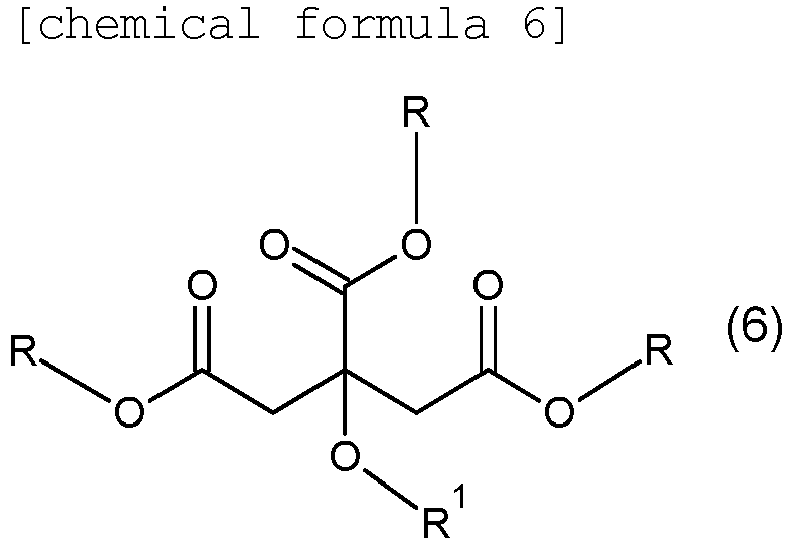
- (Wherein, R1 is a hydrogen atom or C1-C22 hydrocarbon group which includes an acyl group or an acetyl group and can include a hetero atom.)
- The number of carbon atoms in the hydrocarbon groups of X, R, and R1 are preferably 2 to 18. The number of carbon atoms is particularly, for example, 1, 2, 3, 4, 5, 6, 7, 8, 9, 10, 11, 12, 13, 14, 15, 16, 17, 18, 19, 20, 21, or 22, and can be in the range between the two values exemplified herein. As the hetero atom of X, R, and R1, oxygen atom, sulfur atom, nitrogen atom and the like can be mentioned.
- As a specific example of ester compound (4), triethylmethane tricarboxylate, triethyl n-butyrate, triethyl trimesate, triethyl citrate, triethyl acetyl citrate, tributyl citrate, tributyl acetyl citrate, 2-ethylhexyl citrate, 2-ethylhexyl acetyl citrate, triethyl cyclohexane-1,2,4-tricarboxylate and the like can be mentioned.
- Ester compound (5) has a structure represented by chemical formula (5). Ester compound (5) is, for example, an aliphatic cyclic ester compound obtained via formation of ester bond between a dicarboxylic acid having a cyclic structure and two mono alcohols.

- (Wherein, each of X and R is a C1-C22 hydrocarbon group which can include a hetero atom, and the hydrocarbon group is an aliphatic or an aromatic, and has a linear, branched, or cyclic structure. The two R are the same or different from each other.)
- Ester compound (5) preferably comprises at least one ester compound represented by chemical formula (14) to chemical formula (19).

- (Wherein, X1 is a C0-C6 group which can include a hetero atom. When the number of carbon atoms in X1 is 0, X1 is a hetero atom-containing group containing no carbon atom, and represents O, S, NH and the like for example. Each of R1 and R2 is a C1-C22 hydrocarbon group which can include a hetero atom, and the hydrocarbon group is an aliphatic or an aromatic, and has a linear, branched, or cyclic structure, n is an integer of 0 to 5. The substituent group having R2 is bonded to either one of the atoms structuring the cyclic structure.)


- (Wherein, each of R3 and R4 is a C1-C22 hydrocarbon group which can include a hetero atom, and the hydrocarbon group is an aliphatic or an aromatic, and has a linear, branched, or cyclic structure. The substituent group having R4 is bonded to either one of the atoms structuring the cyclic structure.)

- (Wherein, each of R5 and R6 is a C1-C22 hydrocarbon group which can include a hetero atom, and the hydrocarbon group is an aliphatic or an aromatic, and has a linear, branched, or cyclic structure. The substituent group having R6 is bonded to either one of the atoms structuring the cyclic structure.)

- (Wherein, each of R8 and R9 is a C1-C22 hydrocarbon group which can include a hetero atom, and the hydrocarbon group is an aliphatic or an aromatic, and has a linear, branched, or cyclic structure. The substituent group having R9 is bonded to either one of the atoms structuring the cyclic structure.)
- The number of carbon atoms in the hydrocarbon groups of X, R, R1 to R9 are preferably 2 to 18. The number of carbon atoms is particularly, for example, 1, 2, 3, 4, 5, 6, 7, 8, 9, 10, 11, 12, 13, 14, 15, 16, 17, 18, 19, 20, 21, or 22, and can be in the range between the two values exemplified herein. The number of carbon atoms in X1 is preferably 0 to 5, and is particularly, for example, 0, 1, 2, 3, 4, or 5, and can be in the range between the two values exemplified herein. As the hetero atom of X, X1, R, R1 to R9, oxygen atom, sulfur atom, nitrogen atom and the like can be mentioned.
- Each of n is, for example, 0, 1, 2, 3, 4, or 5, and can be in the range between the two values exemplified herein. When n is 0 and X is an oxygen atom, the ester compound represented by chemical formula (14) is a tetrahydrofuran dicarboxylic acid ester having a 5-membered ring structure.)
- As the specific example of ester compound (5), diisononyl 2,5-furandicarboxylate, di-n-decyl 3,4-furandicarboxylate, diisononyl 2,5-tetrahydrofurancarboxylate, di-2-ethylhexyl 3,4-tetrahydrofurancarboxylate, dimethyl 1,4-cyclohexanedicarboxylate, diethyl 1,1-cyclohexanedicarboxylate, diethyl 1,2-cyclohexanedicarboxyate, diethyl 1,4-cyclohexanedicarboxylate, diglycidyl 1,2-cyclohexanedicarboxylate, dimethyl 1,4-cyclohexanedione-2,5-dicarboxylate, diethyl 1,4-cyclohexanedione-2,5-dicarboxylate, di-2-ethylhexyl 4-cyclohexene-1,2-dicarboxylate, diisononyl 1,2-cyclohexanedicarboxylate, diisononyl 1,3-cyclohexanedicarboxylate, ic acid, diisononyl 1,4-cyclohexanedicarboxylate, di-2-ethylhexyl 4,5-epoxycyclohexane-1,2-dicarboxylate, distearyl 4,5-epoxycyclohexane-1,2-dicarboxylate, diepoxystearyl 4,5-epoxycyclohexane-1,2-dicarboxylate and the like can be mentioned.
- There is no particular limitation regarding ester compound (B), and those manufactured by known manufacturing method, commercially available product, and those available as reagent and the like can be used.
- As a known manufacturing method for example, dehydration condensation reaction of carboxylic acids and alcohols, transesterification reaction of esters and alcohols, and esterification reaction of carboxylic acid chlorides and alcohols can be mentioned. Here, some of the ester compounds can be manufactured by hydrogenating the unsaturated portion of a commercially available analogous compound, or by cyclizing a commercially available linear ester compound.
- There is no particular limitation on how ester compound (B) of the present invention is formulated into the coating composition. The ester compound (B) can be formulated when during the coating dispersion process, or can be formulated during the final process.
- The ester compound (B) of the present invention is contained by 0.1 to 15 mass%, preferably 0.4 to 10 mass%, and especially preferably 0.5 to 8 mass% in the solids of the composition of the present invention. When the content of the ester compound (B) is in the afore-mentioned range, the dissolution speed of the film would be constant, thereby maintaining antifouling property for a long period of time. Further, no film defect (cracks and the like) would not occur in the antifouling coating film after allowing the film be immersed in seawater for a predetermined period.
- When the content ratio of resin component (A) and ester compound (B) (converted as solid content) by mass ratio (resin component (A)/ester compound (B)) is 0.5 to 60, the effect of stabilizing the film dissolution speed in the later stage (stage after being immersed in seawater) would be exhibited prominently. When the ratio is in the range of 0.5 to 40, the effect is exhibited further.
- The antifouling coating composition of the present invention can be formulated with antifouling agent (C), thermoplastic resin (D), other resin (E), other additives (F) and the like in addition to the resin component (A) and ester compound (B), if necessary. Accordingly, a further superior antifouling effect can be achieved.
- As the antifouling agent (C), there is no particular limitation so long as it is a substance having a killing or repellent effect to marine fouling organisms. For example, an inorganic chemical and an organic chemical can be mentioned.
- As the inorganic chemical for example, cuprous oxide, cuprous thiocyanate (generic name: copper rhodanide), cupro-nickel, copper powder and the like can be mentioned. Among these, cuprous oxide and copper rhodanide are particularly preferable.
- As the organic chemical for example, organic copper compounds such as copper 2-mercaptopyridine-N-oxide (generic name: copper pyrithione) and the like; organic zinc compounds such as zinc 2-mercaptopyridine-N-oxide (generic name: zinc pyrithione), zinc ethylenebis(dithiocarbamate) (generic name: zineb), zinc bis(dimethyldithiocarbamate) (generic name: ziram), bis(dimethyldithiocarbamate) ethylenebis(dithiocarbamate)dizinc (generic name: polycarbamate) and the like; organic boron compounds such as pyridine-triphenylborane, 4-isopropylpyridine-diphenylmethylborane, 4-phenylpyridine-diphenylborane, triphenylboron-n-octadecylamine, triphenyl[3-(2-ethylhexyloxy)propylamine]boron and the like; maleimide compounds such as 2,4,6-trichloromaleimide, N-(2,6-diethylphenyl)2,3-dichloromaleimide and the like; and other compounds such as 4,5-dichloro-2-n-octyl-3-isothiazolone (generic name: Sea-nine 211), 3,4-dichlorophenyl-N-N-dimethylurea (generic name: Diuron), 2-methylthio-4-t-butylamino-6-cyclopropylamino-s-triazine (generic name: Irgarol 1051), 2,4,5,6-tetrachloroisophthalonitrile (generic name: Chlorothalonil), N-dichlorofluoromethylthio-N' ,N'-dimethyl-N-p-tolylsulfamide (generic name: Tolylfluanid), N-dichloromethylthio-N',N'-dimethyl-N-phenylsulfamide (generic name: Dichlofluanid), 2-(4-thiazolyl)benzimidazole (generic name: Thiabendazole), 3-(benzo[b]thien-2-yl)-5,6-dihydro-1,4,2-oxathiazine-4-oxide (generic name: Bethoxazin), 2-(p-chlorophenyl)-3-cyano-4-bromo-5-trifluoromethyl pyrrole (generic name: ECONEA 028), 4-[1-(2,3-dimethylphenyl)ethyl]-1H-imidazole (generic name: Medetomidine) and the like can be mentioned. Among these, zinc pyrithione, copper pyrithione, pyridine-triphenylborane, 4-isopropylpyridine-diphenylmethylborane, Bethoxazin, Zineb, Sea-nine 211, and Irgarol 1051 are preferable, and copper pyrithione, zinc pyrithione, Sea-nine 211, pyridine-triphenylborane, and Bethoxazin are more preferable. These antifouling agents can be used alone, or two or more of these can be used in combination.
- The content of the antifouling agent (C) in the composition of the present invention is not particularly limited. Here, the content in the solids of the composition of the present invention is usually 0.1 to 75 mass%, preferably 1 to 60 mass%. When the content of the antifouling agent (C) is less than 0.1 mass%, sufficient antifouling effect may not be achieved. When the content of the antifouling agent (C) exceeds 75 mass%, the coating film formed would become weak, and the adhesion property with the object onto which the coating film is formed would become weak. Therefore, function as the antifouling coating film cannot be fully realized.
- As the thermoplastic resin (D) for example, rosin, rosin derivative, and metal salts thereof, monocarboxylic acid and salt thereof, or alicyclic hydrocarbon resin and the like can be mentioned.
- As the rosin, tall oil rosin, gum rosin, wood rosin and the like can be exemplified. As the rosin derivative, hydrogenated rosin, disproportionated rosin, maleic acid modified rosin, formylated rosin, polymerized rosin and the like can be exemplified. Reactant of metal compound and rosin can be used as the metal salt of rosin and metal salt of rosin derivative. As the metal salt of rosin for example, gum rosin zinc (or copper) salt, wood rosin zinc (or copper) salt, tall oil rosin zinc (or copper) salt and the like can be mentioned. As the metal salt of rosin derivative, hydrogenated rosin zinc (or copper) salt, disproportionated rosin zinc (or copper) salt, maleic acid modified rosin zinc (or copper) salt, formylated rosin zinc (or copper) salt, polymerized rosin zinc (or copper) salt and the like can be mentioned.
- As the monocarboxylic acid for example, fatty acid having approximately 5 to 30 carbon atoms, synthetic fatty acid, naphthenic acid and the like can be mentioned. As the salt of monocarboxylic acid, copper salt, zinc salt, magnesium salt, calcium salt and the like can be mentioned.
- As the alicyclic hydrocarbon resin, Quintone 1500, Quintone 1525L, and Quintone 1700 (product name, available from Zeon Corporation) and the like can be mentioned as commercially available product for example.
- Especially, in terms of providing adequate film hardness and water resistance to the composition of the present invention, the composition of the present invention preferably comprises at least one selected from rosin, rosin derivative, and metal salts thereof as the thermoplastic resin (D) . Further, in terms of improving crack resistance and water resistance, the composition preferably comprises copper salt or zinc salt of rosin or rosin derivative.
- The content of thermoplastic resin (D) in the composition of the present invention is usually 1 to 80 parts by mass, preferably 10 to 50 parts by mass with respect to 100 parts by mass of the resin component (A) . When the content of thermoplastic resin (D) is less than 1 part by mass, effect for preventing adhesion of aquatic fouling organisms, especially during the anchorage period, cannot be exhibited sufficiently. When the content of thermoplastic resin (D) exceeds 80 parts by mass, defects in the coating film such as cracks and delamination tend to occur, thereby being unable to exhibit sufficient effect for preventing adhesion of aquatic fouling organisms. The content of the thermoplastic resin (D) is for example, 1, 5, 10, 15, 20, 25, 30, 35, 40, 45, 50, 55, 60, 65, 70, 75, or 80 parts by mass with respect to 100 parts by mass of the resin component (A), and can be in the range between the two values exemplified herein.
- By allowing the antifouling coating composition of the present invention to include other resin (E), cost can be reduced without deteriorating the effect of the present invention. In addition, synergistic effect with the property of the resin (E) can be obtained.
- As the other resin (E), for example, alkyd resin, chloride rubber resin, vinyl resin, petroleum resin, (modified) terpene phenol resin, cellulose-based resin, vinyl ether resin, epoxy resin, zwitterionic compound-containing resin and the like can be mentioned.
- The other resin (E) in the composition of the present invention can be contained in a range which does not deteriorate adequate film dissolution speed and film property in seawater. Such content is 1 to 200 parts by mass, preferably 20 to 100 parts by mass with respect to 100 parts by mass of the resin component (A).
- Further, if necessary, the antifouling coating composition of the present invention can further include pigment, dye, antifoaming agent, anti-sagging agent, dispersant, anti-settling agent, dehydrating agent, plasticizer, organic solvent and the like, in a range which does not deteriorate adequate film dissolution speed and film property in seawater.
- The antifouling coating composition of the present invention can be manufactured by mixing and dispersing a mixture solution including the resin component (A), ester compound (B), and other additives.
- The content of the resin component, antifouling agent and the like in the mixture solution shall be adjusted so that the content of the resin component, antifouling agent and the like in the antifouling coating composition would be satisfied.
- Regarding the mixture solution, the ingredients such as resin component, antifouling agent and the like are preferably dissolved or dispersed in the solvent. As the solvent, organic solvents similar to those mentioned above can be used.
- As the disperser for example, the one which can be used as a micro-pulverizer can be suitably used. For example, a commercially available homo mixer, sand mill, bead mill and the like can be used. Furthermore, the mixed solution can be mixed and dispersed by using a stirrer-equipped container containing glass beads for mixing and dispersing.
- The method for antifouling treatment of the present invention is characterized in that an antifouling coating film is formed using the above-explained antifouling coating composition on the surface of an object that is subjected to coating. The method for antifouling treatment of the present invention can prevent adhesion of aquatic fouling organisms by the gradual dissolution of the surface of the antifouling coating film such that the surface of the coating film is continually renewed. After the dissolution of the coating film, the antifouling effect can be continuously exhibited by recoating the composition.
- Examples of objects on which a coating film can be formed include ships (in particular, ship bottoms), fishing tools, and structures submerged in seawater. Examples of the fishing tools include fishing nets for use in aquaculture or in fixed netting, and fishing net accessories such as ropes and floats attached to fishing nets. Examples of the structures submerged in seawater include power plant aqueducts, bridges, and port facilities.
- The antifouling coating film can be formed by applying the antifouling coating composition onto the surface (entirely or partially) of an object on which the coating film is to be formed. Examples of the coating method include brush coating, spray coating, dipping, flow coating, and spin coating. These coating methods can be employed singly or in combination. The coating composition is dried after the application. The drying temperature can be room temperature. The drying time can be suitably selected depending on the thickness of the coating film and the like.
- The antifouling coating film produced using the above antifouling coating composition according to an embodiment of the present invention can exhibit suitable dissolving rate and properties of the coating film in seawater. In addition, the stable surface renewal property can remain constant for a long period of time and a desired antifouling effect can be effectively exerted. Also, the coating film can advantageously exert excellent recoating performance.
- The thickness of the antifouling coating film can be suitably selected depending on the type of an object on which the coating film is to be formed, the navigation speed of a ship, the seawater temperature and the like. For example, when the object on which a coating film is formed is a ship bottom, the thickness of the antifouling coating film is usually 50 to 700 µm, and preferably 100 to 500 µm.
- The antifouling coating film of the present invention has a suitable hardness. Specifically, the antifouling coating film of the present invention has a hardness sufficient enough to cause no coating film defects such as cold flow.
- The coated object of the present invention has the antifouling coating film on its surface. The coated object of the present invention can have the antifouling coating film on the entire surface thereof or on the partial surface thereof.
- The coated object of the present invention is provided with a coating film having stable long-term surface renewal property and excellent recoating performance since the suitable dissolving rate and properties of the coating film in seawater are improved. Accordingly, the coated object can be preferably applied for the above ships (in particular, ship bottoms), fishing tools, structures submerged in seawater, etc. For example, when the antifouling coating film is formed on the surface of a ship bottom, the antifouling coating film gradually dissolves from the surface, so that the coating film surface is always renewed. This prevents the adhesion of aquatic fouling organisms.
- Further, the hydrolysis speed of the antifouling coating film is controlled adequately. Accordingly, the ship can maintain the antifouling performance for a long period of time. For example, when the ship is in a static state such as during the anchorage period and during the rigging period, adhesion and accumulation of the aquatic fouling organisms hardly occur, thereby exhibiting antifouling effect for a long period of time.
- In addition, the surface of the antifouling coating film is basically free from cracks or peeling even after a long period of time. Accordingly, it is unnecessary to completely remove the existing coating film before re-forming a new coating film. Thus, by directly recoating the antifouling coating film composition, the antifouling coating film can be effectively formed. This makes it possible to continuously maintain the antifouling performance in a simple and inexpensive manner.
- Examples and the like are provided hereinafter, and further clarifies characteristics of the present invention. The present invention, however, is not limited to these Examples.
- Examples and the like are provided hereinafter, and further clarifies characteristics of the present invention. The present invention, however, is not limited to these Examples.
- In each of Production Examples, Comparative Production Examples, Examples, and Comparative Examples, "%" denotes "% by mass". The viscosity was measured at 25°C using a Brookfield viscometer. The weight-average molecular weight (Mw) was determined by gel permeation chromatography (GPC) (using a polystyrene standard) . GPC was performed under the following conditions.
Equipment: HLC-8220 GPC (available from Tosoh Corporation)
Column: TSK-gel Super HZM-M (available from Tosoh Corporation), two columns used
Flow rate: 0.35 mL/min
Detector: RI
Column thermostat temperature: 40°C
Developing solvent: THF
The non-volatile content is a value determined in accordance with JIS K 5601-1-2:1999 (ISO 3251:1993) "Testing methods for paint components-Determination of non-volatile matter content". - Solids is a value calculated by rounding the value of non-volataile content obtained by the above method to one decimal place.
- The formulation among of each component shown in Table 1 are represented in grams.
- Hereinafter, production example of copolymers used as the resin component (A) in the Examples will be shown.
- To a flask equipped with a thermometer, reflux condenser, stirrer, and dropping funnel, 270 g of propylene glycol monomethyl ether (PGM), 96 g of zinc oxide, and 3 g of water were charged, and the mixture was heated to 75°C. Subsequently, a mixture of 85 g of acrylic acid and 300 g of naphthenic acid (acid value 220 mg KOH/g) was added dropwise over 3 hours. After dropwise addition, the mixture was aged further for 2 hours, thereby obtaining a pale yellow transparent liquid. The liquid was cooled, followed by addition of PGM so that the non-volatile content would be 50%, thereby obtaining a monomer (b) and monomer (c) containing solution-1. The non-volatile content of this solution was 50.3%.
- To a flask equipped with a thermometer, reflux condenser, stirrer, and dropping funnel, 350 g of propylene glycol monomethyl ether (PGM), 96 g of copper hydroxide, and 3 g of water were charged, and the mixture was heated to 75°C. Subsequently, a mixture of 70 g of acrylic acid and 330 g of hydrogenated rosin (HYPALE CH, available from ARAKAWA CHEMICAL INDUSTRIES, LTD.) was added dropwise over 3 hours. After dropwise addition, the mixture was aged further for 5 hours, thereby obtaining a dark green transparent liquid. The liquid was cooled, followed by addition of PGM so that the non-volatile content would be 50%, thereby obtaining a monomer (b) and monomer (c) containing solution-2. The non-volatile content of this solution was 50.2%.
- To a flask equipped with a thermometer, reflux condenser, stirrer, and dropping funnel, 200 g of xylene was charged. Under nitrogen atmosphere with agitation at 85±5°C, a mixture of 250 g of triisopropyl silyl methacrylate, 30 g of methyl methacrylate, 50 g of 2-methoxy ethyl acrylate, 170 g of 2-methoxyethyl methacrylate, and 5.3 g of 1,1,3, 3-tetramethylbutyl peroxy-2-ethyl hexanoate as a polymerization initiator was added dropwise over 2 hours. The reaction mixture was agitated at the same temperature for 1 hour, and then 0.3 g of 1,1,3,3-tetramethylbutyl peroxy-2-ethyl hexanoate was added every 1 hour for 5 times, thereby completing the polymerization reaction. Xylene was added so that the non-volatile content would be 50%, and the product was dissolved to give the copolymer solution A-1. Viscosity of the copolymer solution obtained was 310 mPa·s (25°C), non-volatile content was 49.8%, and Mw was 49,100.
- Organic solvent, monomer, and polymerization initiator shown in Table 1 were used by the amount mentioned in the table, and polymerization was performed by processes similar to those of production example 3, thereby obtaining copolymer solutions A-2 to A-12. Non-volatile content, viscosity, and weight average molecular weight of each of the copolymer solutions were measured. Results are shown in Table 1.
[Table 1] Table 1 production example 3 4 5 6 7 8 9 10 11 12 13 14 copolymer (A) organic solvent in initial reactor xylene 200 400 200 200 300 200 100 180 350 450 350 195 propylene glycol monomethyl ether 100 20 monomer (a) triisopropylsilyl acrylate 270 120 120 270 triisopropylsilyl methacrylate 250 250 150 180 120 tri(2-ethylhexyl)silyl methacrylate 30 200 monomer (b, c) monomer (b, c)-1 100 monomer (b, c)-2 10 monomer (d) ethyl acrylate 300 20 methyl methacrylate 30 30 200 100 40 90 150 5 150 n-butyl acrylate 20 80 20 250 300 250 40 2-methoxyethyl acrylate 50 50 30 10 40 10 30 2-methoxyethyl methacrylate 170 170 100 100 80 20 250 220 110 2-ethoxyethyl acrylate 10 10 2-ethoxyethyl methacrylate 10 5 2-(2-ethoxyethoxy)ethyl acrylate 10 5 isobutyl methacrylate 60 190 cyclohexyl acrylate 100 5 styrene 10 polymerization initiator initial 5.3 30.0 2.4 4.7 4.8 4.6 1.0 2.4 14.8 8.0 14.5 5.0 post addition 5 times 0.3 0.3 0.3 0.2 0.3 0.4 0.7 0.3 0.8 0.3 0.8 0.6 organic solvent added after completion of reaction xylene 300 0 300 300 200 300 300 300 150 50 150 305 reaction temperature [°C] (within the range of ±5°C) 85 85 90 100 85 100 85 85 130 130 85 85 property of copolymer solids [%] 50 60 50 50 50 50 50 50 50 50 50 50 weight average molecular weight [Mw] 49,000 13,000 48,000 52,000 53,000 51,000 8,000 48,000 29,000 33,000 35,000 55,000 viscosity [mPa·s] (25°C) 300 200 300 350 350 360 96 300 100 110 150 430 name A-1 A-2 A-3 A-4 A-5 A-6 A-7 A-8 A-9 A-10 A-11 A-12 - To the reactor, 146 g of adipic acid and 131 g of 1, 4-butane diol were charged, and the mixture was agitated under normal pressure at 200°C while distilling generated water, thereby performing esterification reaction. When the amount of water generated became small, 0.02 g (70 ppm) of tetraisopropyl titanate was added, and the reaction was further proceeded while reducing the pressure to 100 to 200 mmHg. When the acid value reached 1.0 mg·KOH/g, degree of vacuum was gradually raised by a vacuum pump, thereby completing the reaction. Hydroxyl value of the polyester polyol obtained was 113.7 mg·KOH/g, acid value was 0.2 mg·KOH/g, and Mw was 3000. Here, acid value is a value measured in accordance with Standard Methods for the Analysis of Fats, Oils and Related Materials 2.3.1-2013, established by Japan Oil Chemists' Society, and hydroxyl value is a value measured in accordance with Standard Methods for the Analysis of Fats, Oils and Related Materials 2.3.6.2-1996, established by Japan Oil Chemists' Society.
- 84.2 g of polyester polyol produced by production example 15 and 17.1 g of isophorone diisocyanate (isocyanate index: 0.9) were charged into a reactor, and urethanization reaction was carried out under nitrogen atmosphere at 80 to 90°C with agitation. After one hour, 0.02 g of dibutyltin dilaurate was added, and the temperature was gradually raised to 100 to 105°C, while adding 5 g of toluene in the middle of the reaction to mitigate extreme increase in viscosity. After carrying out the reaction for 4 hours, the reaction mixture was cooled, and toluene was added to dissolve the content so that the non-volatile content would be 50%. The non-volatile content of the resin solution obtained was 50.2%, Mw was 28, 800, and viscosity was 1690 mPa·s. The copolymer solution thus obtained is hereinafter referred to as copolymer A-13.
- To a flask equipped with a thermometer, reflux condenser, and a stirrer, 240 g of gum rosin available from China (WW) and 360 g of xylene were charged, and 120 g of zinc oxide was added so that all of the resin acid in the rosin would form zinc salt. The reaction mixture was dehydrated under reflux under reduced pressure for 3 hours at 70 to 80°C. Then, the reaction mixture was cooled and filtered to give a xylene solution of rosin zinc salt (dark brown transparent liquid, 50% solids) . The non-volatile content of the xylene solution obtained was 50.4%.
- The components shown in Table 2 to Table 11 were formulated by the ratio (mass%) shown in the Tables, and were mixed and dispersed with a glass bead having a diameter of 1.5 to 2.5 mm, thereby producing the coating composition.
- The following tests were performed with the coating compositions of Examples and Comparative Examples.
- A tank was provided, in the center thereof, with a rotating drum having a diameter of 515 mm and a height of 440 mm to allow the rotation of the drum by a motor. The tank was also provided with a cooling apparatus for keeping the temperature of seawater constant, and an automatic pH controller for keeping the pH of the seawater constant. Test plates were prepared for each coating composition in accordance with the following method.
- First, an anti-corrosive coating film was formed by applying an anti-corrosive coating material (an epoxy vinyl-based A/C) onto a titanium plate (71 x 100 x 0.5 mm) such that the thickness after drying would be about 100 µm, followed by drying. Each of the antifouling coating compositions obtained in Examples and Comparative Examples was applied onto the anti-corrosive coating film so that the thickness after drying would be about 300 µm. The applied coating was dried for 3 days at 40°C, and the test plate having the dry coating film with a thickness of about 300 µm was prepared.
- One of the thus-prepared test plates was secured to the rotating drum of the rotary apparatus of the above-mentioned equipment and was made to contact the seawater, and the rotating drum was rotated at a speed of 20 knots. During the test, the seawater temperature was maintained at 25°C and the pH at 8.0 to 8.2; and the seawater was replaced once every week.
- The initial thickness of the coating film and the remaining thickness of the coating film as measured every 3 months from the beginning of the test were determined using a laser focus displacement meter for each test plate, and the thickness of the dissolved coating film was calculated from the difference therebetween to give the dissolving amount of the coating film per month (µm/month). The measurement was conducted for a period of time mentioned in the Table, and the dissolving amount of the coating film was calculated every 3 months. Stability of the dissolving amount of the coating film was evaluated by the following method.
-
- A: difference between average dissolving amount of the coating film per month for the past 3 months and the average dissolving amount of the coating film per month for the current 3 months is 5 µm/month or less.
- B: difference between average dissolving amount of the coating film per month for the past 3 months and the average dissolving amount of the coating film per month for the current 3 months is 5 to 10 µm/month or less.
- C: difference between average dissolving amount of the coating film per month for the past 3 months and the average dissolving amount of the coating film per month for the current 3 months is larger than 10 µm/month.
- X: average dissolving amount of the coating film per month for the current 3 months is 1 µm/month or less.
- -: all of the film coating dissolved during the 3 month period observation
- After the rotary test was completed, the test plate was dried, and the surface of each coating film was visually inspected to evaluate the state of the coating film. Evaluation was performed as follows.
-
- A: No defects observed.
- B: Hairline cracks are slightly observed.
- C: Hairline cracks are observed on the entire surface of the coating film.
- X: Coating film defects such as large cracks, blisters or peel-offs are observed.
- Each of the coating compositions obtained in Examples and Comparative Examples was applied onto both surfaces of a hard vinyl chloride plate (100 x 200 x 2 mm) such that the thickness of a dry coating film would be about 200 µm. The applied coating was dried for 3 days at room temperature (25°C), and the test plate having the dry coating film with a thickness of about 200 µm was prepared. This test plate was immersed at 1.5 m below sea level in Owase City, Mie Prefecture, Japan, and the test plate fouling due to attached objects was examined after a period mentioned in the Table has elapsed.
- The state of the surface of the coating film was visually evaluated in accordance with criteria shown below.
- A: Fouling organisms such as shellfish or algae do not attach, and slime hardly attaches.
- B: Fouling organisms such as shellfish or algae do not attach, and slime thinly attaches (to the extent that the coating film surface is observable) and the slime can be removed when wiped softly with a brush.
- C: Fouling organisms such as shellfish or algae do not attach, but slime thickly attaches (to the extent that the coating film surface is not observable) and the slime cannot be removed even when wiped strongly with a brush.
- X: Fouling organisms such as shellfish or algae do attach.
- Test results are shown in Table 2 to Table 11. From these results, it can be seen that the coating film formed by using the coating composition of the present invention (Examples 1 to 106) can maintain stable film dissolution amount in all of the time periods when compared with the coating film formed by using the coating composition of Comparative Examples 1 to 15. Further, water resistance, anti-cracking property, and adhesion are superior, while fouling organisms such as shellfish or algae do not attach. Accordingly, long-term antifouling performance is high.
- This result is achieved by the combination of resin component (A) and suitable ester compound (B), and shows the effect of the present invention which is stabilization of film dissolution amount by ester compound (B).
- In addition, it is clear that this effect can be maintained when the composition is altered in various ways (Examples 80 to 106).
-
Table 2 component Example 1 2 3 4 5 6 7 8 9 10 11 resin component (A) A-1 31 31 31 31 31 31 31 31 31 31 31 ester compound (B) HDOA 1 TMPIB 1 CHMEH 1 TAAG 1 TBAG 1 TEHAG 1 LAHD 1 MISAG 1 ARAM 1 MPhGAE 1 TPA 1 antifouling agent (C) cuprous oxide 45 45 45 45 45 45 45 45 45 45 45 copper pyrithione 3 3 3 3 3 3 3 3 3 3 3 other additives (F) [pigment] red oxide 2 2 2 2 2 2 2 2 2 2 2 talc 2 2 2 2 2 2 2 2 2 2 2 zinc oxide 4 4 4 4 4 4 4 4 4 4 4 titanium oxide 1 1 1 1 1 1 1 1 1 1 1 other additives (F) [dehydrating agent, anti-sagging agent] tetraethoxy silane 1 1 1 1 1 1 1 1 1 1 1 aliphatic amide thixotropic agent 4 4 4 4 4 4 4 4 4 4 4 solvent xylene 6 6 6 6 6 6 6 6 6 6 6 total 100 100 100 100 100 100 100 100 100 100 100 test example 1 rotary test evaluation of average dissolving amount of coating film 3 to 6 months A A A A A A A A A A A 6 to 9 months A A A A A A A A A A A 9 to 12 months A A A A A A A A A A A 12 to 15 months A A A A A A A A A A A 15 to 18 months A A A A A A A A A A A 18 to 21 months A A A A A A A A A A A 21 to 24 months A A A A A A A A A A A evaluation of condition of coating film after 24 months A A A A A A A A A A A test example 2 antifouling test after 12 months A A A A A A A A A A A after 24 months A A A A A A A A A A A -
Table 3 component Example 12 13 14 15 16 17 18 19 20 21 22 23 resin component (A) A-1 31 31 31 31 31 31 31 31 31 31 31 31 ester compound (B) t-BCHA 1 MENTA 1 i-BoAc 1 DHJAM 1 ECHECH 1 PATHF 1 DMOA 1 n-OFA 1 TECA 1 TEACA 1 TBACA 1 TEHACA 1 antifouling agent (C) cuprous oxide 45 45 45 45 45 45 45 45 45 45 45 45 copper pyrithione 3 3 3 3 3 3 3 3 3 3 3 3 other additives (F) [pigment] red oxide 2 2 2 2 2 2 2 2 2 2 2 2 talc 2 2 2 2 2 2 2 2 2 2 2 2 zinc oxide 4 4 4 4 4 4 4 4 4 4 4 4 titanium oxide 1 1 1 1 1 1 1 1 1 1 1 1 other additives (F) [dehydrating agent, anti-sagging agent] tetraethoxy silane 1 1 1 1 1 1 1 1 1 1 1 1 aliphatic amide thixotropic agent 4 4 4 4 4 4 4 4 4 4 4 4 solvent xylene 6 6 6 6 6 6 6 6 6 6 6 6 total 100 100 100 100 100 100 100 100 100 100 100 100 test example 1 rotary test evaluation of average dissolving amount of coating film 3 to 6 months A A A A A A A A A A A A 6 to 9 months A A A A A A A A A A A A 9 to 12 months A A A A A A A A A A A A 12 to 15 months A A A A A A A A A A A A 15 to 18 months A A A A A A A A A A A A 18 to 21 months A A A A A A A A A A A A 21 to 24 months A A A A A A A A A A A A evaluation of condition of coating film after 24 months A A A A A A A A A A A A test example 2 antifouling test after 12 months A A A A A A A A A A A A after 24 months A A A A A A A A A A A A [Table 4] component Example Comparative Example 24 25 26 27 28 29 30 31 32 33 1 resin component (A) A-1 31 31 31 31 31 31 31 31 31 31 31 ester compound (B) DMCH 1 1,1-DECH 1 1,2-DECH 1 DGCH 1 DMCDO 1 DEHTH 1 DINCH 1 E-PS 1 EP-18 1 E-PO 1 antifouling agent (C) cuprous oxide 45 45 45 45 45 45 45 45 45 45 45 copper pyrithione 3 3 3 3 3 3 3 3 3 3 3 other additives (F) [pigment] red oxide 2 2 2 2 2 2 2 2 2 2 2 talc 2 2 2 2 2 2 2 2 2 2 2 zinc oxide 4 4 4 4 4 4 4 4 4 4 4 titanium oxide 1 1 1 1 1 1 1 1 1 1 1 other additives (F) [dehydrating agent, anti-sagging agent] tetraethoxy silane 1 1 1 1 1 1 1 1 1 1 1 aliphatic amide thixotropic agent 4 4 4 4 4 4 4 4 4 4 4 solvent xylene 6 6 6 6 6 6 6 6 6 6 7 total 100 100 100 100 100 100 100 100 100 100 100 test example 1 rotary test evaluation of average dissolving amount of coating film 3 to 6 months A A A A A A A A A A X 6 to 9 months A A A A A A A A A A A 9 to 12 months A A A A A A A A A A B 12 to 15 months A A A A A A A A A A C 15 to 18 months A A A A A A A A A A C 18 to 21 months A A A A A A A A A A - 21 to 24 months A A A A A A A A A A evaluation of condition of coating film after 24 months A A A A A A A A A A test example 2 antifouling test after 12 months A A A A A A A A A A B after 24 months A A A A A A A A A A X 


-
Table 8 component Example 80 81 82 83 84 85 resin component (A) A-1 19 24.8 15 15.19 A-2 20.6 A-3 12 A-4 28.5 A-8 2.5 A-10 6.51 ester compound (B) TMPIB 0.5 1 0.5 TEHAG 1 0.5 MPhGAE 0.5 TPA 1 1.5 1.5 TEHACA 1 1 DINCH 1.5 1 antifouling agent (C) cuprous oxide 45 45 45 45 45 30 copper pyrithione 3 3 3 3 2 1.5 copper rhodanide 0.5 0.5 Zineb 0.5 SeaNine 0.5 0.5 thermoplastic resin (D) rosin zinc salt solution 6.2 6.2 9.3 hydrogenated rosin solution 1 NT-RMZ 7.5 other additives (F) [pigment] red oxide 2 2 2 2 2 2 talc 2 2 2 2 3 7 zinc oxide 4 4 4 4 2 14 titanium oxide 1 1 1 1 1 1 other additives (F) tetraethoxy silane 1 1 1 1 0.5 0.5 calcium sulfate anhydrite 0.5 aliphatic amide thixotropic agent 4 4 4 4 3 3 solvent xylene 4.5 4.5 5.5 8.2 14 8 total 100 100 100 100 100 100 test example 1 rotary test evaluation of average dissolving amount of coating film 3 to 6 months A A A A A A 6 to 9 months A A A A A A 9 to 12 months A A A A A A 12 to 15 months A A A A A A 15 to 18 months A A A A A A 18 to 21 months A A A A A A 21 to 24 months A A A A A A evaluation of condition of coating film after 24 months A A A A A A test example 2 antifouling test after 12 months A A A A A A after 24 months A A A A A B -
Table 9 componene Example Comparative Example 86 87 88 89 90 91 92 10 11 12 reisin component (A) A-1 10 15 24.8 A-3 15 15 A-5 21.7 12.5 7.5 10 7.5 A-6 5 2 5 A-7 2.5 2 5 A-9 5 5 A-10 2.5 2.5 A-11 2 A-12 1 MP25 0.5 1 EVA15 1 1 ester compound (B) TMPIB 1 0.5 0.5 TEHAG 0.5 0.5 0.5 0.5 DINCH 1.5 2 1.5 0.5 1.5 1.5 0.5 E-PS 1.5 0.5 0.5 antifouling agent (C) cuprous oxide 30 30 30 30 30 30 45 30 30 copper pyrithione 1.5 1.5 1.5 1.5 1.5 1 3 3 1.5 1.5 zinc pyrithione 2.5 SeaNine 0.5 0.5 1 Econea 0.5 7 medetomidine 0.5 0.5 0.5 thermoplastic resin (D) rosin zinc salt solution 8.8 13 14 14 14 13 5 6.2 14 14 NT-RMZ 12 Lutonal A-25 1 other additives (F) [pigment] red oxide 2 2 2 2 2 2 2 2 2 2 talc 7 7 7 7 7 7 5 2 7 7 zinc oxide 14 14 14 14 14 14 15 4 14 14 titanium oxide 1 1 1 1 1 1 1 1 1 1 other additives (F) tetraethoxy silane 0.5 0.5 0.5 0.5 0.5 0.5 0.5 1 0.5 0.5 calcium sulfate anhydrite 0.5 aliphatic amide thixotropic 3 2 2 2 2 2 3 4 2 2 solvent xylene 7.5 8.5 10.5 11 10.5 8.5 14 7 13 13 total 100 100 100 100 100 100 100 100 100 100 test example 1 rotary test evaluation of average dissolving amount of coating film 3 to 6 months A A A A A A B A A B 6 to 9 months A A A A A A B B B B 9 to 12 months A A A A A A A A C B 12 to 15 months A A A A A A A C C X 15 to 18 months A A A A A A A C C A 18 to 21 months A A A A A A A - - X 21 to 24 months A A A A A A B X evaluation of condition of coating film after 24 months A A A A A A B C test example 2 antifouling test after 12 months A A A A A A A B C X after 24 months A B A B A A B X X X -
Table 10 component Example 93 94 95 96 97 98 99 100 101 102 resin component (A) A-7 24.8 15 24.8 15 20 A-8 24.8 15 24.8 15 26 A-10 5 EVA15 1 TP-217 5 ester compound (B) TMPIB 0.5 0.5 0.5 TEHAG 0.5 1 0.5 0.5 TEHACA 0.5 0.5 1 1.5 1 1.5 0.5 0.5 DINCH 1 1 1 1 0.5 1 antifouling agent (C) cuprous oxide 45 30 45 45 45 30 45 45 copper pyrithione 3 1.5 3 2 3 1.5 3 2 zinc pyrithione 5 2.5 copper rhodanide 0.5 0.5 Zineb 0.5 0.5 SeaNine 3 3 Econea 0.5 0.5 7 7 medetomidine 0.5 0.5 1 0.5 thermoplastic resin (D) rosin solution 3.2 14 3.2 14 rosin zinc salt solution 3 14 3 14 5 5 hydrogenated rosin solution 3 3 NT-RMZ 3.2 3.2 5 13 Lutonal A-25 1 other additives (F) [pigment] red oxide 2 2 2 2 2 2 2 2 2 2 talc 2 7 2 3 2 7 2 3 5 5 zinc oxide 4 14 4 2 4 14 4 2 15 15 titanium oxide 1 1 1 1 1 1 1 1 1 1 other additives (F) tetraethoxy silane 1 0.5 1 0.5 1 0.5 1 0.5 0.5 0.5 calcium sulfate anhydrite 0.5 0.5 0.5 aliphatic amide thixotropic 4 2 4 3 4 2 4 3 3 3 solvent xylene 5 11.5 5 10 4 11 4.5 9 15 14 total 100 100 100 100 100 100 100 100 100 100 test example 1 rotary test evaluation of average dissolving amount of coating film 3 to 6 months A A A A A A A A B B 6 to 9 months A A A A A A A A A A 9 to 12 months A A A A A A A A B A 12 to 15 months A A A A A A A A A A evaluation of condition of coating film after 15 months A A A A A A A A B B test example 2 antifouling test after 9 months A A A A A A A A B A after 15 months A A A A A A A A B B -
Table 11 component Example Comparative Example 103 104 105 106 13 14 15 resin component (A) A-7 15 A-8 15 A-9 24.3 15 23.8 15 15 A-12 0.5 A-13 0.5 0.5 1 MP25 0.5 TP-217 0.5 ester compound (B) TMPIB 0.5 TEHAG 0.5 TEHACA 0.5 1.5 1 DINCH 1 1 antifouling agent (C) cuprous oxide 45 30 45 45 30 30 30 copper pyrithione 3 1.5 3 2 1.5 1.5 1.5 copper rhodanide 0.5 Zineb 0.5 Econea 0.5 medetomidine 0.5 thermoplastic resin (D) rosin solution 3.2 15 rosin zinc salt solution 3 13 14 14 14 hydrogenated rosin solution 3 NT-RMZ 3.2 other additives (F) [pigment] red oxide 2 2 2 2 2 2 2 talc 2 7 2 3 7 7 7 zinc oxide 4 14 4 2 14 14 14 titanium oxide 1 1 1 1 1 1 1 other additives (F) tetraethoxy silane 1 0.5 1 0.5 0.5 0.5 0.5 aliphatic amide thixotropic 4 2 4 3 2 2 2 solvent xylene 5 11 5 8.5 13 13 13 total 100 100 100 100 100 100 100 test example 1 rotary test evaluation of average dissolving amount of coating film 3 to 6 months A A A A C A B 6 to 9 months A A A A B A B 9 to 12 months A A A A A A X 12 to 15 months A A A A X X X evaluation of condition of coating film after 15 months A A A A X C X test example 2 antifouling test after 9 months A A A A B C C after 15 months A A A A X X X - Details of each of the components mentioned in Table 2 to Table 11 are as follows.
- MP 25: product name "Laroflex (registered tradename) MP 25" (available from BASF Dispersions & Resins)
EVA 15: product name "Novatec™ EVA LV440" (available from Japan Polyethylene Corporation)
TP-217: product name "Polyester TP-217 S40CI" (available from The Nippon Synthetic Chemical Industry Co., Ltd.) - HDOA: 1,6-hexanediol diacetate: product name "1,6-Diacetoxyhexane" (available from TOKYO CHEMICAL INDUSTRY CO., LTD.)
TMPIB: 2,2,4-trimethyl-1,3-pentanediol diisobutyrate: product name "2,2,4-Trimethyl-1,3-pentanediol Diisobutyrate" (available from TOKYO CHEMICAL INDUSTRY CO., LTD.)
CHMEH: 1,4-cyclohexane dimethanol bis(2-ethylhexanoate) - TAAG: glycerol triacetate: product name "Triacetin" (available from TOKYO CHEMICAL INDUSTRY CO., LTD.)
TBAG: glycerol tributyrate: product name "Tributyrin" (available from Wako Pure Chemical Industries, Ltd.)
TEHAG: glycerol tris(2-ethylhexanoate): product name "tris(2-ethylhexanoate) glycerol" (available from Wako Pure Chemical Industries, Ltd.) - LAHD: hexadecyl lactate: product name "Hexadecyl Lactate" (available from TOKYO CHEMICAL INDUSTRY CO., LTD.)
MISAG: glycerol monoisostearate: product name "Glycerol Monoisostearate" (available from Wako Pure Chemical Industries, Ltd.)
ARAM: methyl acetylricinoleate: product name "Methyl O-Acetylricinoleate" (available from TOKYO CHEMICAL INDUSTRY CO., LTD.)
MPhGAE: ethyl 3-methyl-3-phenylglycidate: product name "Ethyl 3-Methyl-3-phenylglycidate" (available from TOKYO CHEMICAL INDUSTRY CO., LTD.)
TPA: terpinyl acetate: product name "Terpinyl Acetate" (available from TOKYO CHEMICAL INDUSTRY CO., LTD.)
t-BCHA: 4-tert-butylcyclohexylacetate: product name "p-t-Butylcyclohexyl Acetate" (available from Wako Pure Chemical Industries, Ltd.)
MENTA: menthyl acetate: product name "(-)-Menthyl Acetate" (available from TOKYO CHEMICAL INDUSTRY CO., LTD.)
i-BoAc: isobornyl acetate: produce name "Isobornyl Acetate" (available from TOKYO CHEMICAL INDUSTRY CO., LTD.)
DHJAM: methyl dihydrojasmonate: product name "Methyl Dihydrojasmonate" (available from TOKYO CHEMICAL INDUSTRY CO., LTD.)
ECHECH: 3,4-epoxycyclohexylmethyl 3',4'-epoxycyclohexanecarboxylate: product name "3,4-Epoxycyclohexylmethyl 3',4'-Epoxycyclohexanecarboxylate" (available from Wako Pure Chemical Industries, Ltd.)
PATHF: tetrahydrofurfuryl propionate: product name "Tetrahydrofurfuryl Propionate" (available from TOKYO CHEMICAL INDUSTRY CO., LTD.)
DMOA: 3,7-dimethyl-6-octen-1-yl acetate: product name "3, 7-Dimethyl-6-octen-1-yl Acetate" (available from Wako Pure Chemical Industries, Ltd.)
n-OFA: n-octyl 2-furancarboxylate: product name "n-Octyl 2-Furancarboxylate" (available from TOKYO CHEMICAL INDUSTRY CO., LTD.) - TECA: triethyl citrate: product name "Triethyl Citrate" (available from TOKYO CHEMICAL INDUSTRY CO., LTD.)
TEACA: triethyl acetylcitrate: product name "Triethyl O-Acetylcitrate" (available from TOKYO CHEMICAL INDUSTRY CO., LTD.)
TBACA: tributyl acetylcitrate: product name "Tributyl O-Acetylcitrate" (available from TOKYO CHEMICAL INDUSTRY CO., LTD.)
TEHACA: (2-ethylhexyl) acetylcitrate: product name "CITROFOL (registered tradename) AHII" (available from JUNGBUNZLAUER SUISSE AG) - DMCH: dimethyl 1,4-cyclohexanedicarboxylate: product name "Dimethyl 1,4-Cyclohexanedicarboxylate" (available from TOKYO CHEMICAL INDUSTRY CO., LTD.)
1,1-DECH: diethyl 1,1-cyclohexanedicarboxylate: product name "Diethyl 1,1-Cyclohexanedicarboxylate" (available from TOKYO CHEMICAL INDUSTRY CO., LTD.)
1,2-DECH: diethyl 1,2-cyclohexanedicarboxylate: product name "Diethyl 1,2-Cyclohexanedicarboxylate" (available from TOKYO CHEMICAL INDUSTRY CO., LTD.)
DGCH: diglycidyl 1,2-cyclohexanedicarboxylate: product name "Diglycidyl 1,2-Cyclohexanedicarboxylate" (available from TOKYO CHEMICAL INDUSTRY CO., LTD.)
DMCDO: dimethyl 1,4-cyclohexanedione-2,5-dicarboxylate: product name "Dimethyl 1,4-Cyclohexanedione-2,5-dicarboxylate" - DEHTH: di-2-ethylhexyl 4-cyclohexene-1,2-dicarboxylate: product name "SANSO CIZER DEHTH" (available from New Japan Chemical Co., Ltd.)
DINCH: diisononyl 1,2-cyclohexane dicarboxylate: product name "HEXAMOLL (registered tradename) DINCH (registered tradename)" - E-PS: di-2-ethylhexyl 4,5-epoxycyclohexane-1,2-dicarboxylate: product name "SANSO CIZER E-PS" (available from New Japan Chemical Co., Ltd.)
EP-18: distearyl 4,5-epoxycyclohexane-1,2-dicarboxylate : product name "RIKAFLOW EP-18" (available from New Japan Chemical Co., Ltd.)
E-PO: diepoxystearyl 4,5-epoxycyclohexane-1,2-dicarboxylate: product name "SANSO CIZER E-PO" (available from New Japan Chemical Co., Ltd.) - cuprous oxide : product name "NC-301" (available from NISSIN CHEMCO LTD.)
copper pyrithione : product name "copper Omadine" (available from Arch Chemical, Inc.)
Sea Nine: product name "Sea Nine 211" (4,5-dichloro-2-n-octyl-3-(2H)isothiazoline, 30% solids, xylene solution, available from Rohm & Haas, Inc.)
zinc pyrithione: product name "zinc Omadine" (available from Arch Chemical, Inc.)
Econia: product name "Econea 028" (2-(p-chlorophenyl)3-cyano-4-bromo-5-trifluoromethyl pyrrole, available from JANSSEN PMP)
Medetomidine: product name "4-(1-(2,3-Dimethylphenyl)ethyl)-1H-imidazole" (available from Wako Pure Chemical Industries, Ltd.)
copper rhodanide: product name "cuprous thiocyanate (I)" (available from Sigma-Aldrich, Inc.)
Zineb: product name "Zineb" (available from Sigma-Aldrich, Inc.) - rosin zinc salt solution: The one produced in production example 17 was used.
hydrogenated rosin solution: product name "HYPALE CH" (50% solids xylene solution, available from ARAKAWA CHEMICAL INDUSTRIES, LTD.)
rosin solution : xylene solution (50% solids) of Chinese gum rosin (WW)
NT-RMZ: hydrogenated rosin zinc salt solution: product name "NT-RMZ", 65% solids (available from Nitto Kasei Co., Ltd.)
LutonalA25: "Lutonal (registered tradename A 25" (Product name, available from BASF) - red oxide: product name "TODA COLOR EP-13D" (available from Toda Pigment Corp.)
talc: product name "CROWN TALC 3S" (available from matsumura sangyo Co., Ltd.)
zinc oxide: product name "zinc oxide II" (available from Seido Chemical Industry Co., Ltd.)
titanium oxide: product name "FR-41" (available from FURUKAWA CO., LTD.) - Tetraethoxysilane: product name "Tetraethyl Orthosilicate" (available from TOKYO CHEMICAL INDUSTRY CO., LTD.)
aliphatic amide thixotropic agent: product name "Disparlon A603-20X" (available from Kusumoto Chemicals, Ltd.)
calcium sulfate anhydrite: product name "D-1" (available from NORITAKE CO., LIMITED)
Claims (20)
- An antifouling coating composition, comprising:a resin component (A); andan ester compound (B); whereinthe ester compound (B) comprises at least one ester compound represented by chemical formulas (1) to (5).(Wherein, each of X and R is a C1-C22 hydrocarbon group which can include a hetero atom, and the hydrocarbon group is an aliphatic or an aromatic, and has a linear, branched, or cyclic structure. The two R are the same or different from each other.)


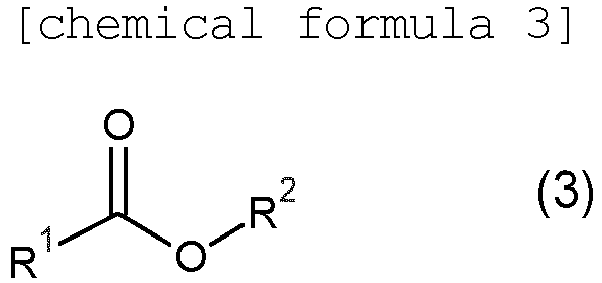
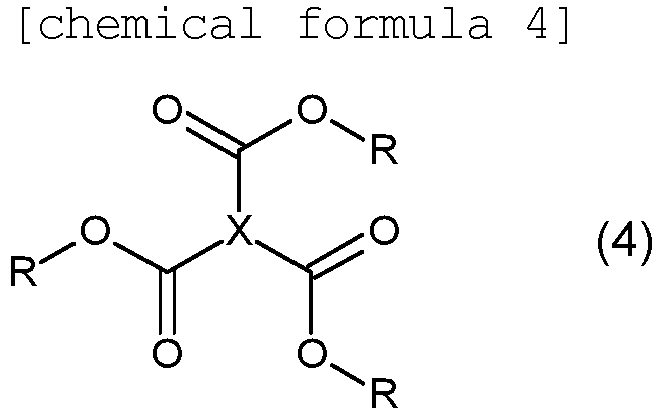

- The antifouling coating composition of Claim 1, wherein the ester compound (B) comprises the ester compound represented by chemical formula (5).
- The antifouling coating composition of Claim 2, wherein X of chemical formula (5) has a cyclic structure.
- The antifouling coating composition of Claim 2 or 3, wherein X of chemical formula (5) has an aliphatic six-membered ring structure.
- The antifouling coating composition of any one of Claims 1 to 4, wherein the ester compound (B) comprises the ester compound represented by chemical formula (4).
- The antifouling coating composition of Claim 5, wherein the ester compound represented by chemical formula (4) comprises an ester compound represented by chemical formula (6).

- The antifouling coating composition of any one of Claims 1 to 6, wherein the ester compound (B) comprises the ester compound represented by chemical formula (1).
- The antifouling coating composition of Claim 7, wherein X in chemical formula (1) is a C2-C18 aliphatic or an aromatic, and has a linear, branched, or cyclic structure.
- The antifouling coating composition of Claim 7 or 8, wherein the ester compound represented by chemical formula (1) comprises an ester compound represented by chemical formula (7).

- The antifouling coating composition of any one of Claims 1 to 9, wherein the ester compound (B) comprises the ester compound represented by chemical formula (2).
- The antifouling coating composition of Claim 10, wherein the ester compound represented by chemical formula (2) comprises an ester compound represented by chemical formula (8).

- The antifouling coating composition of any one of Claims 1 to 11, wherein the ester compound (B) comprises the ester compound represented by chemical formula (3).
- The antifouling coating composition of Claim 12, wherein R1 or R2 of chemical formula (3) includes a hydroxyl group, acetyl group, or phenyloxiranyl group.
- The antifouling coating composition of Claim 12 or 13, wherein R2 of chemical formula (3) has a ring structure or two or more branched structure.
- The antifouling coating composition of any one of Claims 12 to 14, wherein R1 or R2 of chemical formula (3) has an aromatic ring including a hetero atom.
- The antifouling coating composition of any one of Claims 1 to 15, wherein the resin component (A) is a polymer obtained from a monomer comprising one or more among monomer (a), monomer (b), monomer (c), and monomer (d).(a) chemical formula (9):
 (b) chemical formula (10):
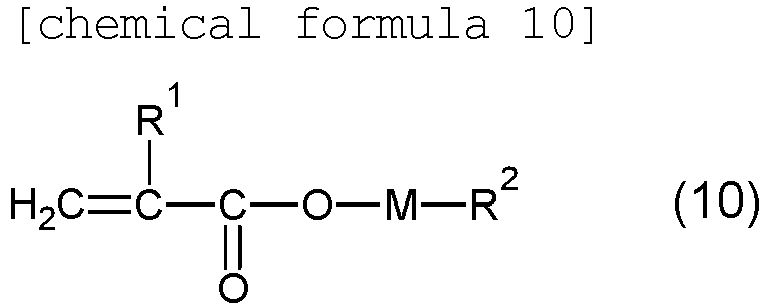 (c) chemical formula (11):
 (d) an ethylenically unsaturated monomer other than monomer (a), monomer (b), and monomer (c)
 - The antifouling coating composition of Claim 16, wherein the resin component (A) is a polymer obtained from a monomer comprising monomer (a).
- The antifouling coating composition of Claim 16 or 17, wherein the resin component (A) is a polymer obtained from a monomer comprising one or more of monomer (b) and monomer (c).
- The antifouling coating composition of any one of Claims 16 to 18, wherein the resin component (A) is a polymer obtained from a monomer comprising monomer (d).
- A coated object having on its surface an antifouling coating film formed by using the antifouling coating composition of any one of Claims 1 to 19.
Applications Claiming Priority (2)
| Application Number | Priority Date | Filing Date | Title |
|---|---|---|---|
| JP2017194706 | 2017-10-04 | ||
| PCT/JP2018/035887 WO2019069777A1 (en) | 2017-10-04 | 2018-09-27 | Antifouling paint composition and coated article having antifouling coating formed using said composition on surface |
Publications (3)
| Publication Number | Publication Date |
|---|---|
| EP3693426A1 true EP3693426A1 (en) | 2020-08-12 |
| EP3693426A4 EP3693426A4 (en) | 2020-11-11 |
| EP3693426B1 EP3693426B1 (en) | 2021-12-29 |
Family
ID=65995062
Family Applications (1)
| Application Number | Title | Priority Date | Filing Date |
|---|---|---|---|
| EP18864643.4A Active EP3693426B1 (en) | 2017-10-04 | 2018-09-27 | Antifouling paint composition and coated article having antifouling coating formed using said composition on surface |
Country Status (7)
| Country | Link |
|---|---|
| EP (1) | EP3693426B1 (en) |
| JP (1) | JP7213554B2 (en) |
| KR (1) | KR102659594B1 (en) |
| CN (1) | CN111148806A (en) |
| ES (1) | ES2905417T3 (en) |
| SG (1) | SG11202002092WA (en) |
| WO (1) | WO2019069777A1 (en) |
Cited By (4)
| Publication number | Priority date | Publication date | Assignee | Title |
|---|---|---|---|---|
| CN112795277A (en) * | 2021-04-09 | 2021-05-14 | 中国科学院宁波材料技术与工程研究所 | Ester antifouling agent, antifouling coating, multilayer protective film structure and application thereof |
| DE102020127468A1 (en) | 2020-10-19 | 2022-04-21 | Werner H. Salewski | Multifunctional epoxy systems |
| WO2024094746A1 (en) * | 2022-11-04 | 2024-05-10 | I-Tech Ab | A medetomidine containing particle and use thereof |
| EP4303277A4 (en) * | 2021-03-05 | 2024-08-28 | Nitto Kasei Co., Ltd. | ANTI-ROTATE COATING COMPOSITION |
Families Citing this family (4)
| Publication number | Priority date | Publication date | Assignee | Title |
|---|---|---|---|---|
| GB201718899D0 (en) * | 2017-11-15 | 2017-12-27 | Jotun As | Antifouling coating composition |
| JP7295172B2 (en) * | 2020-08-03 | 2023-06-20 | 関西ペイントマリン株式会社 | Antifouling paint composition |
| CN112608400B (en) * | 2020-12-15 | 2021-10-22 | 浙江大学 | Preparation method of bromopyrrole nitrile grafted block acrylic self-polishing resin and green marine antifouling composition |
| JP7785373B2 (en) * | 2021-03-12 | 2025-12-15 | 日東化成株式会社 | Antifouling paint composition |
Family Cites Families (13)
| Publication number | Priority date | Publication date | Assignee | Title |
|---|---|---|---|---|
| EP0562730B1 (en) * | 1992-03-27 | 1996-10-23 | Rohm And Haas Company | Non-removable, stain-resistant coatings |
| JPH10259326A (en) * | 1997-03-17 | 1998-09-29 | Nippon Paint Co Ltd | Method for sustained release of compound having antibiotic activity and coating composition |
| JP3693501B2 (en) | 1998-07-06 | 2005-09-07 | 日東化成株式会社 | Antifouling paint composition |
| JP3857010B2 (en) * | 2000-02-17 | 2006-12-13 | 日本ペイント株式会社 | Copolymer and coating composition |
| EP1466949A1 (en) * | 2003-04-10 | 2004-10-13 | Symrise GmbH & Co. KG | Non-toxic coating composition, methods of use thereof and articles protected from attachment of biofouling organisms |
| ES2568924T3 (en) | 2008-04-30 | 2016-05-05 | Bluestar Silicones France | Article presenting antifouling properties and intended to be used in aquatic applications, in particular marine |
| WO2011046086A1 (en) * | 2009-10-13 | 2011-04-21 | 日本ペイントマリン株式会社 | Antifouling coating composition, antifouling film, composite film, and in-water structure |
| EP2489711B1 (en) * | 2009-10-13 | 2016-11-30 | Nippon Paint Marine Coatings Co., Ltd. | Antifouling coating composition, antifouling film, composite film, and in-water structure |
| US7973194B1 (en) * | 2010-03-18 | 2011-07-05 | Eastman Chemical Company | High solvating cyclohexane dicarboxylate diesters plasticizers |
| JP2012166195A (en) | 2012-03-27 | 2012-09-06 | Asahi Kasei Chemicals Corp | Method for forming stain-proof layer |
| JP5835069B2 (en) * | 2012-04-05 | 2015-12-24 | 信越化学工業株式会社 | Antifouling imparting hard coat composition |
| JP6222462B2 (en) * | 2014-02-24 | 2017-11-01 | 株式会社スリーボンド | Paint composition |
| KR20170074925A (en) * | 2014-10-22 | 2017-06-30 | 닛토 가세이 가부시끼 가이샤 | Copolymer for antifouling co ating composition, antifouling co ating composition, antifouling co ating film |
-
2018
- 2018-09-27 JP JP2019546658A patent/JP7213554B2/en active Active
- 2018-09-27 SG SG11202002092WA patent/SG11202002092WA/en unknown
- 2018-09-27 CN CN201880062771.XA patent/CN111148806A/en active Pending
- 2018-09-27 ES ES18864643T patent/ES2905417T3/en active Active
- 2018-09-27 KR KR1020207011841A patent/KR102659594B1/en active Active
- 2018-09-27 WO PCT/JP2018/035887 patent/WO2019069777A1/en not_active Ceased
- 2018-09-27 EP EP18864643.4A patent/EP3693426B1/en active Active
Cited By (6)
| Publication number | Priority date | Publication date | Assignee | Title |
|---|---|---|---|---|
| DE102020127468A1 (en) | 2020-10-19 | 2022-04-21 | Werner H. Salewski | Multifunctional epoxy systems |
| WO2022083958A1 (en) | 2020-10-19 | 2022-04-28 | SALEWSKI, Werner, H. | Multifunctional epoxy systems and use thereof |
| EP4303277A4 (en) * | 2021-03-05 | 2024-08-28 | Nitto Kasei Co., Ltd. | ANTI-ROTATE COATING COMPOSITION |
| CN112795277A (en) * | 2021-04-09 | 2021-05-14 | 中国科学院宁波材料技术与工程研究所 | Ester antifouling agent, antifouling coating, multilayer protective film structure and application thereof |
| CN112795277B (en) * | 2021-04-09 | 2021-07-02 | 中国科学院宁波材料技术与工程研究所 | Ester antifouling agents, antifouling coatings, multilayer protective film structures and their applications |
| WO2024094746A1 (en) * | 2022-11-04 | 2024-05-10 | I-Tech Ab | A medetomidine containing particle and use thereof |
Also Published As
| Publication number | Publication date |
|---|---|
| JP7213554B2 (en) | 2023-01-27 |
| EP3693426B1 (en) | 2021-12-29 |
| SG11202002092WA (en) | 2020-04-29 |
| ES2905417T3 (en) | 2022-04-08 |
| CN111148806A (en) | 2020-05-12 |
| KR20200062256A (en) | 2020-06-03 |
| KR102659594B1 (en) | 2024-04-19 |
| EP3693426A4 (en) | 2020-11-11 |
| JPWO2019069777A1 (en) | 2020-11-05 |
| WO2019069777A1 (en) | 2019-04-11 |
Similar Documents
| Publication | Publication Date | Title |
|---|---|---|
| EP3693426B1 (en) | Antifouling paint composition and coated article having antifouling coating formed using said composition on surface | |
| EP2990450B1 (en) | Antifouling paint composition, copolymer for antifouling paint composition and method for manufacturing same, and painted object having on surface antifouling paint film formed using said composition | |
| EP2975095B1 (en) | Antifouling coating composition, antifouling coating film formed using said composition, and coated article having antifouling coating film on surface | |
| EP4098709B1 (en) | Anti-fouling coating material composition | |
| CN103080249B (en) | Antifouling paint compositions, antifouling paint compositions multipolymer, surface have the coated article of the antifouling coat using said composition to be formed | |
| EP3693421B1 (en) | Antifouling paint composition and coated article having antifouling coating formed using said composition on surface | |
| EP3211014A1 (en) | Copolymer for antifouling coating composition, antifouling coating composition, antifouling coating film | |
| EP3783073B1 (en) | Antifouling coating composition | |
| JP7714250B2 (en) | Antifouling paint composition | |
| JP6624665B1 (en) | Copolymer for antifouling paint composition, antifouling paint composition containing the copolymer | |
| KR20260029395A (en) | antifouling composition | |
| EP4328276A1 (en) | Antifouling coating composition |
Legal Events
| Date | Code | Title | Description |
|---|---|---|---|
| STAA | Information on the status of an ep patent application or granted ep patent |
Free format text: STATUS: THE INTERNATIONAL PUBLICATION HAS BEEN MADE |
|
| PUAI | Public reference made under article 153(3) epc to a published international application that has entered the european phase |
Free format text: ORIGINAL CODE: 0009012 |
|
| STAA | Information on the status of an ep patent application or granted ep patent |
Free format text: STATUS: REQUEST FOR EXAMINATION WAS MADE |
|
| 17P | Request for examination filed |
Effective date: 20200331 |
|
| AK | Designated contracting states |
Kind code of ref document: A1 Designated state(s): AL AT BE BG CH CY CZ DE DK EE ES FI FR GB GR HR HU IE IS IT LI LT LU LV MC MK MT NL NO PL PT RO RS SE SI SK SM TR |
|
| AX | Request for extension of the european patent |
Extension state: BA ME |
|
| A4 | Supplementary search report drawn up and despatched |
Effective date: 20201009 |
|
| RIC1 | Information provided on ipc code assigned before grant |
Ipc: C09D 5/16 20060101ALI20201005BHEP Ipc: C09D 201/00 20060101AFI20201005BHEP Ipc: C09D 133/06 20060101ALI20201005BHEP Ipc: C09D 143/04 20060101ALI20201005BHEP Ipc: C08K 5/11 20060101ALI20201005BHEP Ipc: C09D 201/10 20060101ALI20201005BHEP Ipc: C08K 5/103 20060101ALI20201005BHEP Ipc: C09D 133/00 20060101ALI20201005BHEP Ipc: C08K 5/10 20060101ALI20201005BHEP Ipc: C09D 7/63 20180101ALI20201005BHEP |
|
| DAV | Request for validation of the european patent (deleted) | ||
| DAX | Request for extension of the european patent (deleted) | ||
| STAA | Information on the status of an ep patent application or granted ep patent |
Free format text: STATUS: EXAMINATION IS IN PROGRESS |
|
| 17Q | First examination report despatched |
Effective date: 20210311 |
|
| GRAP | Despatch of communication of intention to grant a patent |
Free format text: ORIGINAL CODE: EPIDOSNIGR1 |
|
| STAA | Information on the status of an ep patent application or granted ep patent |
Free format text: STATUS: GRANT OF PATENT IS INTENDED |
|
| INTG | Intention to grant announced |
Effective date: 20210827 |
|
| GRAS | Grant fee paid |
Free format text: ORIGINAL CODE: EPIDOSNIGR3 |
|
| GRAA | (expected) grant |
Free format text: ORIGINAL CODE: 0009210 |
|
| STAA | Information on the status of an ep patent application or granted ep patent |
Free format text: STATUS: THE PATENT HAS BEEN GRANTED |
|
| AK | Designated contracting states |
Kind code of ref document: B1 Designated state(s): AL AT BE BG CH CY CZ DE DK EE ES FI FR GB GR HR HU IE IS IT LI LT LU LV MC MK MT NL NO PL PT RO RS SE SI SK SM TR |
|
| REG | Reference to a national code |
Ref country code: GB Ref legal event code: FG4D |
|
| REG | Reference to a national code |
Ref country code: CH Ref legal event code: EP |
|
| REG | Reference to a national code |
Ref country code: AT Ref legal event code: REF Ref document number: 1458651 Country of ref document: AT Kind code of ref document: T Effective date: 20220115 |
|
| REG | Reference to a national code |
Ref country code: IE Ref legal event code: FG4D |
|
| REG | Reference to a national code |
Ref country code: DE Ref legal event code: R096 Ref document number: 602018028959 Country of ref document: DE |
|
| REG | Reference to a national code |
Ref country code: NL Ref legal event code: FP |
|
| REG | Reference to a national code |
Ref country code: ES Ref legal event code: FG2A Ref document number: 2905417 Country of ref document: ES Kind code of ref document: T3 Effective date: 20220408 |
|
| REG | Reference to a national code |
Ref country code: LT Ref legal event code: MG9D |
|
| PG25 | Lapsed in a contracting state [announced via postgrant information from national office to epo] |
Ref country code: RS Free format text: LAPSE BECAUSE OF FAILURE TO SUBMIT A TRANSLATION OF THE DESCRIPTION OR TO PAY THE FEE WITHIN THE PRESCRIBED TIME-LIMIT Effective date: 20211229 Ref country code: LT Free format text: LAPSE BECAUSE OF FAILURE TO SUBMIT A TRANSLATION OF THE DESCRIPTION OR TO PAY THE FEE WITHIN THE PRESCRIBED TIME-LIMIT Effective date: 20211229 Ref country code: FI Free format text: LAPSE BECAUSE OF FAILURE TO SUBMIT A TRANSLATION OF THE DESCRIPTION OR TO PAY THE FEE WITHIN THE PRESCRIBED TIME-LIMIT Effective date: 20211229 Ref country code: BG Free format text: LAPSE BECAUSE OF FAILURE TO SUBMIT A TRANSLATION OF THE DESCRIPTION OR TO PAY THE FEE WITHIN THE PRESCRIBED TIME-LIMIT Effective date: 20220329 |
|
| REG | Reference to a national code |
Ref country code: AT Ref legal event code: MK05 Ref document number: 1458651 Country of ref document: AT Kind code of ref document: T Effective date: 20211229 |
|
| REG | Reference to a national code |
Ref country code: NO Ref legal event code: T2 Effective date: 20211229 |
|
| PG25 | Lapsed in a contracting state [announced via postgrant information from national office to epo] |
Ref country code: SE Free format text: LAPSE BECAUSE OF FAILURE TO SUBMIT A TRANSLATION OF THE DESCRIPTION OR TO PAY THE FEE WITHIN THE PRESCRIBED TIME-LIMIT Effective date: 20211229 Ref country code: LV Free format text: LAPSE BECAUSE OF FAILURE TO SUBMIT A TRANSLATION OF THE DESCRIPTION OR TO PAY THE FEE WITHIN THE PRESCRIBED TIME-LIMIT Effective date: 20211229 Ref country code: HR Free format text: LAPSE BECAUSE OF FAILURE TO SUBMIT A TRANSLATION OF THE DESCRIPTION OR TO PAY THE FEE WITHIN THE PRESCRIBED TIME-LIMIT Effective date: 20211229 Ref country code: GR Free format text: LAPSE BECAUSE OF FAILURE TO SUBMIT A TRANSLATION OF THE DESCRIPTION OR TO PAY THE FEE WITHIN THE PRESCRIBED TIME-LIMIT Effective date: 20220330 |
|
| PG25 | Lapsed in a contracting state [announced via postgrant information from national office to epo] |
Ref country code: SM Free format text: LAPSE BECAUSE OF FAILURE TO SUBMIT A TRANSLATION OF THE DESCRIPTION OR TO PAY THE FEE WITHIN THE PRESCRIBED TIME-LIMIT Effective date: 20211229 Ref country code: SK Free format text: LAPSE BECAUSE OF FAILURE TO SUBMIT A TRANSLATION OF THE DESCRIPTION OR TO PAY THE FEE WITHIN THE PRESCRIBED TIME-LIMIT Effective date: 20211229 Ref country code: RO Free format text: LAPSE BECAUSE OF FAILURE TO SUBMIT A TRANSLATION OF THE DESCRIPTION OR TO PAY THE FEE WITHIN THE PRESCRIBED TIME-LIMIT Effective date: 20211229 Ref country code: PT Free format text: LAPSE BECAUSE OF FAILURE TO SUBMIT A TRANSLATION OF THE DESCRIPTION OR TO PAY THE FEE WITHIN THE PRESCRIBED TIME-LIMIT Effective date: 20220429 Ref country code: EE Free format text: LAPSE BECAUSE OF FAILURE TO SUBMIT A TRANSLATION OF THE DESCRIPTION OR TO PAY THE FEE WITHIN THE PRESCRIBED TIME-LIMIT Effective date: 20211229 Ref country code: CZ Free format text: LAPSE BECAUSE OF FAILURE TO SUBMIT A TRANSLATION OF THE DESCRIPTION OR TO PAY THE FEE WITHIN THE PRESCRIBED TIME-LIMIT Effective date: 20211229 |
|
| PG25 | Lapsed in a contracting state [announced via postgrant information from national office to epo] |
Ref country code: PL Free format text: LAPSE BECAUSE OF FAILURE TO SUBMIT A TRANSLATION OF THE DESCRIPTION OR TO PAY THE FEE WITHIN THE PRESCRIBED TIME-LIMIT Effective date: 20211229 Ref country code: AT Free format text: LAPSE BECAUSE OF FAILURE TO SUBMIT A TRANSLATION OF THE DESCRIPTION OR TO PAY THE FEE WITHIN THE PRESCRIBED TIME-LIMIT Effective date: 20211229 |
|
| PG25 | Lapsed in a contracting state [announced via postgrant information from national office to epo] |
Ref country code: IS Free format text: LAPSE BECAUSE OF FAILURE TO SUBMIT A TRANSLATION OF THE DESCRIPTION OR TO PAY THE FEE WITHIN THE PRESCRIBED TIME-LIMIT Effective date: 20220429 |
|
| REG | Reference to a national code |
Ref country code: DE Ref legal event code: R097 Ref document number: 602018028959 Country of ref document: DE |
|
| PG25 | Lapsed in a contracting state [announced via postgrant information from national office to epo] |
Ref country code: DK Free format text: LAPSE BECAUSE OF FAILURE TO SUBMIT A TRANSLATION OF THE DESCRIPTION OR TO PAY THE FEE WITHIN THE PRESCRIBED TIME-LIMIT Effective date: 20211229 Ref country code: AL Free format text: LAPSE BECAUSE OF FAILURE TO SUBMIT A TRANSLATION OF THE DESCRIPTION OR TO PAY THE FEE WITHIN THE PRESCRIBED TIME-LIMIT Effective date: 20211229 |
|
| PLBE | No opposition filed within time limit |
Free format text: ORIGINAL CODE: 0009261 |
|
| STAA | Information on the status of an ep patent application or granted ep patent |
Free format text: STATUS: NO OPPOSITION FILED WITHIN TIME LIMIT |
|
| 26N | No opposition filed |
Effective date: 20220930 |
|
| PG25 | Lapsed in a contracting state [announced via postgrant information from national office to epo] |
Ref country code: SI Free format text: LAPSE BECAUSE OF FAILURE TO SUBMIT A TRANSLATION OF THE DESCRIPTION OR TO PAY THE FEE WITHIN THE PRESCRIBED TIME-LIMIT Effective date: 20211229 |
|
| REG | Reference to a national code |
Ref country code: DE Ref legal event code: R119 Ref document number: 602018028959 Country of ref document: DE |
|
| PG25 | Lapsed in a contracting state [announced via postgrant information from national office to epo] |
Ref country code: MC Free format text: LAPSE BECAUSE OF FAILURE TO SUBMIT A TRANSLATION OF THE DESCRIPTION OR TO PAY THE FEE WITHIN THE PRESCRIBED TIME-LIMIT Effective date: 20211229 |
|
| REG | Reference to a national code |
Ref country code: CH Ref legal event code: PL |
|
| REG | Reference to a national code |
Ref country code: BE Ref legal event code: MM Effective date: 20220930 |
|
| PG25 | Lapsed in a contracting state [announced via postgrant information from national office to epo] |
Ref country code: IT Free format text: LAPSE BECAUSE OF FAILURE TO SUBMIT A TRANSLATION OF THE DESCRIPTION OR TO PAY THE FEE WITHIN THE PRESCRIBED TIME-LIMIT Effective date: 20211229 |
|
| PG25 | Lapsed in a contracting state [announced via postgrant information from national office to epo] |
Ref country code: LU Free format text: LAPSE BECAUSE OF NON-PAYMENT OF DUE FEES Effective date: 20220927 |
|
| PG25 | Lapsed in a contracting state [announced via postgrant information from national office to epo] |
Ref country code: LI Free format text: LAPSE BECAUSE OF NON-PAYMENT OF DUE FEES Effective date: 20220930 Ref country code: IE Free format text: LAPSE BECAUSE OF NON-PAYMENT OF DUE FEES Effective date: 20220927 Ref country code: FR Free format text: LAPSE BECAUSE OF NON-PAYMENT OF DUE FEES Effective date: 20220930 Ref country code: DE Free format text: LAPSE BECAUSE OF NON-PAYMENT OF DUE FEES Effective date: 20230401 Ref country code: CH Free format text: LAPSE BECAUSE OF NON-PAYMENT OF DUE FEES Effective date: 20220930 |
|
| PG25 | Lapsed in a contracting state [announced via postgrant information from national office to epo] |
Ref country code: BE Free format text: LAPSE BECAUSE OF NON-PAYMENT OF DUE FEES Effective date: 20220930 |
|
| PG25 | Lapsed in a contracting state [announced via postgrant information from national office to epo] |
Ref country code: CY Free format text: LAPSE BECAUSE OF FAILURE TO SUBMIT A TRANSLATION OF THE DESCRIPTION OR TO PAY THE FEE WITHIN THE PRESCRIBED TIME-LIMIT Effective date: 20211229 |
|
| PG25 | Lapsed in a contracting state [announced via postgrant information from national office to epo] |
Ref country code: MK Free format text: LAPSE BECAUSE OF FAILURE TO SUBMIT A TRANSLATION OF THE DESCRIPTION OR TO PAY THE FEE WITHIN THE PRESCRIBED TIME-LIMIT Effective date: 20211229 Ref country code: HU Free format text: LAPSE BECAUSE OF FAILURE TO SUBMIT A TRANSLATION OF THE DESCRIPTION OR TO PAY THE FEE WITHIN THE PRESCRIBED TIME-LIMIT; INVALID AB INITIO Effective date: 20180927 |
|
| PG25 | Lapsed in a contracting state [announced via postgrant information from national office to epo] |
Ref country code: TR Free format text: LAPSE BECAUSE OF FAILURE TO SUBMIT A TRANSLATION OF THE DESCRIPTION OR TO PAY THE FEE WITHIN THE PRESCRIBED TIME-LIMIT Effective date: 20211229 |
|
| PG25 | Lapsed in a contracting state [announced via postgrant information from national office to epo] |
Ref country code: MT Free format text: LAPSE BECAUSE OF FAILURE TO SUBMIT A TRANSLATION OF THE DESCRIPTION OR TO PAY THE FEE WITHIN THE PRESCRIBED TIME-LIMIT Effective date: 20211229 |
|
| PGFP | Annual fee paid to national office [announced via postgrant information from national office to epo] |
Ref country code: NO Payment date: 20250923 Year of fee payment: 8 |
|
| PGFP | Annual fee paid to national office [announced via postgrant information from national office to epo] |
Ref country code: NL Payment date: 20250918 Year of fee payment: 8 |
|
| PGFP | Annual fee paid to national office [announced via postgrant information from national office to epo] |
Ref country code: GB Payment date: 20250919 Year of fee payment: 8 |
|
| PGFP | Annual fee paid to national office [announced via postgrant information from national office to epo] |
Ref country code: ES Payment date: 20251030 Year of fee payment: 8 |