EP3722491A1 - Appareil de traitement de vêtements - Google Patents
Appareil de traitement de vêtements Download PDFInfo
- Publication number
- EP3722491A1 EP3722491A1 EP18885620.7A EP18885620A EP3722491A1 EP 3722491 A1 EP3722491 A1 EP 3722491A1 EP 18885620 A EP18885620 A EP 18885620A EP 3722491 A1 EP3722491 A1 EP 3722491A1
- Authority
- EP
- European Patent Office
- Prior art keywords
- vibration
- elastic member
- vibration module
- treatment apparatus
- axis
- Prior art date
- Legal status (The legal status is an assumption and is not a legal conclusion. Google has not performed a legal analysis and makes no representation as to the accuracy of the status listed.)
- Granted
Links
Images








Classifications
-
- D—TEXTILES; PAPER
- D06—TREATMENT OF TEXTILES OR THE LIKE; LAUNDERING; FLEXIBLE MATERIALS NOT OTHERWISE PROVIDED FOR
- D06F—LAUNDERING, DRYING, IRONING, PRESSING OR FOLDING TEXTILE ARTICLES
- D06F58/00—Domestic laundry dryers
- D06F58/20—General details of domestic laundry dryers
- D06F58/203—Laundry conditioning arrangements
-
- D—TEXTILES; PAPER
- D06—TREATMENT OF TEXTILES OR THE LIKE; LAUNDERING; FLEXIBLE MATERIALS NOT OTHERWISE PROVIDED FOR
- D06F—LAUNDERING, DRYING, IRONING, PRESSING OR FOLDING TEXTILE ARTICLES
- D06F58/00—Domestic laundry dryers
- D06F58/10—Drying cabinets or drying chambers having heating or ventilating means
- D06F58/12—Drying cabinets or drying chambers having heating or ventilating means having conveying means for moving clothes, e.g. along an endless track
-
- D—TEXTILES; PAPER
- D06—TREATMENT OF TEXTILES OR THE LIKE; LAUNDERING; FLEXIBLE MATERIALS NOT OTHERWISE PROVIDED FOR
- D06F—LAUNDERING, DRYING, IRONING, PRESSING OR FOLDING TEXTILE ARTICLES
- D06F58/00—Domestic laundry dryers
- D06F58/20—General details of domestic laundry dryers
-
- B—PERFORMING OPERATIONS; TRANSPORTING
- B06—GENERATING OR TRANSMITTING MECHANICAL VIBRATIONS IN GENERAL
- B06B—METHODS OR APPARATUS FOR GENERATING OR TRANSMITTING MECHANICAL VIBRATIONS OF INFRASONIC, SONIC, OR ULTRASONIC FREQUENCY, e.g. FOR PERFORMING MECHANICAL WORK IN GENERAL
- B06B1/00—Methods or apparatus for generating mechanical vibrations of infrasonic, sonic, or ultrasonic frequency
- B06B1/10—Methods or apparatus for generating mechanical vibrations of infrasonic, sonic, or ultrasonic frequency making use of mechanical energy
- B06B1/12—Methods or apparatus for generating mechanical vibrations of infrasonic, sonic, or ultrasonic frequency making use of mechanical energy operating with systems involving reciprocating masses
- B06B1/14—Methods or apparatus for generating mechanical vibrations of infrasonic, sonic, or ultrasonic frequency making use of mechanical energy operating with systems involving reciprocating masses the masses being elastically coupled
-
- D—TEXTILES; PAPER
- D06—TREATMENT OF TEXTILES OR THE LIKE; LAUNDERING; FLEXIBLE MATERIALS NOT OTHERWISE PROVIDED FOR
- D06F—LAUNDERING, DRYING, IRONING, PRESSING OR FOLDING TEXTILE ARTICLES
- D06F58/00—Domestic laundry dryers
- D06F58/10—Drying cabinets or drying chambers having heating or ventilating means
-
- D—TEXTILES; PAPER
- D06—TREATMENT OF TEXTILES OR THE LIKE; LAUNDERING; FLEXIBLE MATERIALS NOT OTHERWISE PROVIDED FOR
- D06F—LAUNDERING, DRYING, IRONING, PRESSING OR FOLDING TEXTILE ARTICLES
- D06F69/00—Ironing machines not otherwise provided for
-
- D—TEXTILES; PAPER
- D06—TREATMENT OF TEXTILES OR THE LIKE; LAUNDERING; FLEXIBLE MATERIALS NOT OTHERWISE PROVIDED FOR
- D06F—LAUNDERING, DRYING, IRONING, PRESSING OR FOLDING TEXTILE ARTICLES
- D06F73/00—Apparatus for smoothing or removing creases from garments or other textile articles by formers, cores, stretchers, or internal frames, with the application of heat or steam
- D06F73/02—Apparatus for smoothing or removing creases from garments or other textile articles by formers, cores, stretchers, or internal frames, with the application of heat or steam having one or more treatment chambers
-
- D—TEXTILES; PAPER
- D06—TREATMENT OF TEXTILES OR THE LIKE; LAUNDERING; FLEXIBLE MATERIALS NOT OTHERWISE PROVIDED FOR
- D06F—LAUNDERING, DRYING, IRONING, PRESSING OR FOLDING TEXTILE ARTICLES
- D06F2103/00—Parameters monitored or detected for the control of domestic laundry washing machines, washer-dryers or laundry dryers
- D06F2103/28—Air properties
- D06F2103/36—Flow or velocity
Definitions
- the present disclosure relates to a structure for vibrating clothes in a clothes treatment apparatus.
- a clothes treatment apparatus refers to all kinds of apparatuses for maintaining or treating clothes, such washing, drying, and dewrinkling them, at home or at a laundromat.
- clothes treatment apparatuses include a washer for washing clothes, a dryer for drying clothes, a washer-dryer which performs both washing and drying functions, a refresher for refreshing clothes, and a steamer for removing unnecessary wrinkles in clothes.
- the refresher is a device used for keeping clothes crisp and fresh, which performs functions like drying clothes, providing fragrance to clothes, preventing static cling on clothes, removing wrinkles from clothes, and so on.
- the steamer is generally a device that provides steam to clothes to remove wrinkles from them, which can remove wrinkles from clothes in a more delicate way, without the hot plate touching the clothes like in traditional irons.
- a first aspect of the present disclosure is to allow the hanging bar to move in a vibrating motion by adjusting it to various vibration frequencies and amplitudes when the hanging bar vibrates.
- a problem with the conventional art is that amplitude is maintained even if the vibration frequency of the hanging bar is changed, thus putting stress on items.
- a second aspect of the present disclosure is reduce the stress on items caused by a change of frequency by solving this problem.
- a third aspect of the present disclosure is to solve this problem.
- a further problem with the conventional art is that, if amplitude is kept high when the hanger body is shaken at a high vibration frequency, this will cause excessive stress on clothes, even making clothes fall off the hanging bar or causing damage to clothes.
- a fourth aspect of the present disclosure is to significantly increase vibration frequency without clothes falling off or getting damaged by solving this problem.
- a further problem with the conventional art is that unnecessary vibrations occur in other directions than the direction of vibration when the hanging bar is vibrated.
- a fifth aspect of the present disclosure is to minimize unnecessary vibrations by solving this problem.
- a clothes treatment apparatus comprises: a frame; a hanger body configured to move with respect to the frame and provided to hang clothes or clothes hangers; a vibration module that generates vibrations by comprising at least one eccentric portion that rotates around at least one predetermined rotational axis in such a way that the weight is off-center, and that is connected to the hanger body to transmit the vibrations; and at least one elastic member that exerts an elastic force on the vibration module when the vibration module vibrates, wherein the angular speed of the eccentric portion is changeable.
- Two or more different angular speeds may be maintained for a predetermined time or longer.
- the clothes treatment apparatus may be configured to perform a first mode in which the vibration frequency of the hanger body is relatively low and the amplitude is relatively large and a second mode in which the vibration frequency of the hanger body is relatively high and the amplitude is relatively small, by changing and controlling the angular speed.
- the vibration frequency for the first mode may be preset to be closer to the natural vibration frequency than the vibration frequency for the second mode.
- the amplitude of vibration of the hanger body in a steady state may be preset to have a peak value when the angular speed has a specific value greater than zero.
- the clothes treatment apparatus may further comprise a supporting member fixed to the frame, to which the other end of the elastic member is fixed.
- the at least one elastic member may comprise: a first elastic member that elastically deforms when the vibration module moves to one side in the vibration direction; and a second elastic member that elastically deforms when the vibration module moves to the other side.
- the at least one eccentric portion may comprise: a first eccentric portion that rotates around a predetermined first rotational axis in such a way that the weight is off-center; and a second eccentric portion that rotates around a predetermined second rotational axis, which is the same as or parallel to the first rotational axis, in such a way that the weight is off-center.
- the vibration module may be configured in such a way as to rotate around a predetermined center axis where the position relative to the frame is fixed.
- the first rotational axis and the second rotational axis may be placed apart from each other, in opposite directions with respect to the center axis.
- the hanger body may be configured to move with respect to the frame in a predetermined vibration direction.
- the elastic member may be configured to elastically deform or regain elasticity when the hanger body moves in the vibration direction.
- the vibration pattern of the hanger body can be varied only by changing the angular speed of the eccentric portion, and therefore clothes treatment can be done more efficiently and the hanger body can have a vibration pattern that suits the user's preferences, clothing types, and so on.
- the vibrating motion of the hanger body can be made in two or more steady states by maintaining the two or more angular speeds for a predetermined time or longer.
- a first mode in which the vibration frequency of the hanger body is relatively low and the amplitude is relatively large and a second mode in which the vibration frequency of the hanger body is relatively high and the amplitude is relatively small are provided.
- clothes can be vibrated slowly with a large amplitude through the first mode, or clothes may be vibrated fast, rather than being shaken off, with a small amplitude through the second mode.
- the vibration frequency of the hanger body can be greatly increased without physical limitations.
- the hanger body can be adjusted to various vibration frequencies and amplitudes, since the amplitude of vibration of the hanger body in a steady state is preset to have a peak value when the angular speed has a specific value greater than zero.
- the first mode allows for larger amplitude and the second mode allows for high vibration frequency without stress on items, since the vibration frequency for the first mode is preset to be closer to the natural vibration frequency than the vibration frequency for the second mode.
- the vibration module Since the first rotational axis and the second rotational axis are spaced apart from the center axis in opposite directions, the vibration module is off-centered to one side of the center axis, thereby reducing the risk of putting stress on the structure.
- Each axis direction refers to two directions in which each axis runs.
- Each axis direction with a '+' sign in front of it (+X-axis direction, +Y-axis direction, and +Z-axis direction) refers to a positive direction which is one of the two directions in which each axis runs.
- Each axis direction with a '-' sign in front of it refers to a negative direction which is the other of the two directions in which each axis runs.
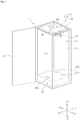
- a clothes treatment apparatus 1 comprises a frame10 placed on a floor on the outside or fixed to a wall on the outside.
- the frame 10 has a treatment space 10s for storing clothes.
- the clothes treatment apparatus 1 comprises a supply part 20 for supplying at least one among air, steam, a deodorizer, and an anti-static agent to clothes.
- the clothes treatment apparatus 1 comprise a hanger module 30, 230, and 430 provided to hang clothes or clothes hangers.
- the hanger module 30, 230, and 430 is supported by the frame 10.
- the clothes treatment apparatus 1 comprises a vibration module 50, 150, 250, 350, 450, and 550 for generating vibration.
- the vibration module 50, 150, 250, 350, 450, and 550 vibrates the hanger module 30, 230, and 430.
- the clothes treatment apparatus 1 comprises at least one elastic member 60, 260, 460, and 560 configured to elastically deform or regain its elasticity when the hanger module 30, 230, and 430 moves.
- the elastic member 60, 260, 460, and 560 is configured to elastically deform or regain its elasticity when the vibration module 50, 150, 250, 350, 450, and 550 moves.
- the clothes treatment apparatus 1 comprises a supporting member 270, 470, and 570 for supporting one end of the elastic member 60, 260, 460, and 560.
- the supporting member 270, 470, and 570 may movably support the vibration module 50, 150, 250, 350, 450, and 550.
- the supporting member 270, 470, and 570 may be fixed to the frame 10.
- the clothes treatment apparatus 1 may comprise a control part (not shown) for controlling the operation of the supply part 20.
- the control part may control whether to operate the vibration module 50, 150, 250, 350, 450, and 550 or not and its operating pattern.
- the clothes treatment apparatus 1 may further comprise a clothes recognition sensor (not shown) for sensing clothes contained inside the treatment space 10s.
- the frame 10 forms the external appearance.
- the frame 10 has the treatment space 10s in which clothes are stored.
- the frame 10 comprises a top frame 11 forming the top side, a side frame 12 forming the left and right sides, and a rear frame (not shown) forming the rear side.
- the frame 10 comprises a base frame (not shown) forming the bottom side.
- the frame 10 may comprise an interior frame 11a forming the inner side and an exterior frame 11b forming the outer side.
- the inner side of the interior frame 11a forms the treatment space 10s.
- a configuration space 11s is formed between the interior frame 11a and the exterior frame 11b.
- the vibration module 50, 150, 250, 350, 450, and 550 may be disposed within the configuration space 11s.
- the elastic member 60, 260, 460, and 560 and the supporting member 270, 470, and 570 may be disposed within the configuration space 11s.
- the treatment space 10s is a space in which air (for example, hot air), steam, a deodorizer, and/or an anti-static agent is applied to clothes so as to change physical or chemical properties of the clothes.
- Clothes treatment may be done on the clothes in the treatment space 10s by various methods - for example, applying hot air to the clothes in the treatment space 10 to dry the clothes, removing wrinkles on the clothes with steam, spraying a deodorizer to clothes to give them a fragrance, spraying an anti-static agent to clothes to prevent static cling on them.
- At least part of the hanger module 30, 230, and 430 is disposed within the treatment space 10s.
- a hanger body 31, 231, and 431 is disposed within the treatment space 10s.
- One side of the treatment space 10s is open so that clothes can be taken in and out, and the open side is opened or closed by a door 15. When the door 15 is closed, the treatment space 10s is separated from the outside, and when the door 15 is opened, the treatment space 10s is exposed to the outside.
- the supply part 20 may supply air into the treatment space 10s.
- the supply part 20 may circulate the air in the treatment space 10s while supplying it. Specifically, the supply part 20 may draw in air from inside the treatment space 10s and discharge it into the treatment space 10s.
- the supply part 20s may supply outside air into the treatment space 10s.
- the supply part 20 may supply air that has undergone a predetermined treatment process into the treatment space 10s.
- the supply part 20 may supply heated air into the treatment space 10s.
- the supply part 20 also may supply cooled air into the treatment space 10s.
- the supply part 20 may supply untreated air into the treatment space 10s.
- the supply part 20 may add steam, a deodorizer, or an anti-static agent to air and supply the air into the treatment space 10s.
- the supply part 20 may comprise an air intake opening 20a through which air is drawn in from inside the treatment space 10s.
- the supply part 20 may comprise an air discharge opening 20b through which air is discharged into the treatment space 10s.
- the air drawn in through the air intake opening 20a may be discharged through the air discharge opening 20b after a predetermined treatment.
- the supply part 20 may comprise a steam spout 20c for spraying steam into the treatment space 10s.
- the supply part 20 may comprise a heater (not shown) for heating drawn-in air.
- the supply part 20 may comprise a filter (not shown) for filtering drawn-in air.
- the supply part 20 may comprise a fan (not shown) for pressurizing air.
- the air and/or steam supplied by the supply part 20 is applied to the clothes stored in the treatment space 10s and affects the physical or chemical properties of the clothes.
- the tissue structure of the clothes is relaxed by hot air or steam, so that the wrinkles are smoothed out, and an unpleasant odor is removed as odor molecules trapped in the clothes react with steam.
- the hot air and/or steam generated by the supply part 20 may sterilize bacteria present in the clothes.
- the hanger module 30, 230, and 430 may be disposed above the treatment space 10s.
- the hanger module 30, 230, and 430 is provided to hang clothes or clothes hangers.
- the hanger module 30, 230, and 430 is supported by the frame 10.
- the hanger module 30, 230, and 430 is movable.
- the hanger module 30, 230, and 430 is connected to the vibration module 50, 150, 250, 350, 450, and 550 and receives vibrations from the vibration module 50, 150, 250, 350, 450, and 550.
- the hanger module 30, 230, and 430 comprises a hanger body 31, 231, and 431 provided to hang clothes or clothes hangers.
- the hanger body 31, 231, and 431 may be formed with locking grooves 31a for hanging clothes hangers, and, in another exemplary embodiment, the hanger body 31, 231, and 431 may be formed with hooks (not shown) or the like so that clothes are hung directly on them.
- the hanger body 31, 231, and 431 is supported by the frame 10.
- the hanger body 31, 231, and 431 may be connected to the frame 10 through a hanger moving portion 33 and a hanger supporting portion 35.
- the hanger body 31, 231, and 431 is configured to move with respect to the frame 10.
- the hanger body 31, 231, and 431 is configured to move (vibrate) with respect to the frame 10 in a predetermined vibration direction (+X, -X).
- the hanger body 31, 231, and 431 may vibrate with respect to the frame 10 in the vibration direction (+X, -X).
- the hanger body 31, 231, and 431 reciprocates in the vibration direction (+X, -X) by the vibration module 50, 150, 250, 350, 450, and 550.
- the hanger module 30, 230, and 430 reciprocates while hanging in an upper portion of the treatment space 10s.
- the hanger body 31, 231, and 431 may extend longitudinally in the vibration direction (+X, -X).
- a plurality of locking grooves 31a may be disposed on the upper side of the hanger body 31, 231, and 431, spaced apart from each other, in the vibration direction (+X, -X).
- the locking grooves 31a may extend in a direction (+Y, - Y) intersecting the vibration direction (+X, -X).
- the hanger module 30, 230, and 430 may comprise a hanger moving portion 33 which movably supports the hanger body 31, 231, and 431.
- the hanger moving portion 33 is movable in the vibration direction (+X, -X).
- the hanger moving portion 33 may be made of a flexible material so as to make the hanger body 31, 231, and 431 move.
- the hanger moving portion 33 may comprise an elastic member that is elastically deformable when the hanger body 31, 231, and 431 moves.
- the upper end of the hanger moving portion 33 is fixed to the frame 10, and the lower end is fixed to the hanger body 31, 231, and 431.
- the hanger moving portion 33 may extend vertically. The upper end of the hanger moving portion 33 rests on a hanger supporting portion 35.
- the hanger moving portion 33 connects the hanger supporting portion 35 and the hanger body 31, 231, and 431.
- the hanger moving portion 33 is configured to vertically penetrate a hanger guide portion 37.
- the length of a horizontal cross-section of the hanger moving portion 33 in the vibration direction (+X, -X) is shorter than its length in the direction (+Y, -Y) perpendicular to the vibration direction (+X, -X).
- the hanger module 30, 230, and 430 comprises a hanger supporting portion 35 fixed to the frame 10.
- the hanger supporting portion 35 secures the hanger moving portion 33 to the frame 10.
- the hanger supporting portion 35 may be fixed to the interior frame 11a.
- the upper end of the hanger moving portion 33 may be locked and hung on the hanger supporting portion 35.
- the hanger supporting portion 35 may be formed in the shape of a horizontal plate, and the hanger moving portion 33 may be configured to penetrate the hanger supporting portion 35.
- the hanger module 30, 230, and 430 may further comprise a hanger guide portion 37 for guiding the position of the hanger moving portion 33.
- the hanger guide portion 37 is fixed to the frame 10.
- the gap between the upper side of the hanger guide portion 37 and the hanger moving portion 33 may be sealed.
- the lower side of the hanger guide portion 37 has an upward recess formed in it, and the hanger moving portion 33 may move in the vibration direction (+X, -X) within the upward recess of the hanger guide portion 37.
- the vibration module 50, 150, 250, 350, 450, and 550 comprises a hanger driving unit 258, 458, and 558 connected to the hanger module 30, 230, and 430.
- the hanger body 31, 231, and 431 comprises a hanger driven unit 231b and 431b connected to the hanger driving unit 258, 458, and 558.
- the hanger driving unit 258 connects and holds together the vibration module 150 and 250 and the hanger body 231.
- the hanger driving unit 258 may connect and hold together the lower side of the vibration module 150 and 250 and the center of the hanger body 231. Therefore, the vibration module 150 and 250 and the hanger body 231 vibrate as a single unit.
- the hanger driving unit 258 may extend in parallel with a center axis Oc.
- the hanger driving unit 258 may be in the shape of a bar.
- the hanger driving unit 258 may extend along a predetermined connection axis Oh to be described later.
- the hanger driving unit 258 may be disposed on the connection axis Oh.
- the hanger driven unit 231b may be in the shape of a casing that is open at the top.
- the hanger driving unit 258 is fixed to the hanger driven unit 231b.
- the upper end of the hanger driving unit 258 is fixed to the vibration module 150 and 250, and the lower end is fixed to the hanger driven unit 231b.
- the hanger driving unit 258 While fixed to the hanger driven unit 231b, reciprocates in the vibration direction (+X, -X) of the vibration module 150 and 250, the hanger body 231 reciprocates in the vibration direction (+X, -X), integrally with the vibration module 150 and 250.
- the direction in which the hanger driving unit 258 linearly reciprocates is indicated by an arrow, and therefore the range of movement of the hanger driven unit 231b vibrating in the left-right direction (+X, -X) is indicated by a dotted line.
- the hanger driving unit 458 and 558 and hanger driven unit 431b according to another exemplary embodiment will be described below.
- Either the hanger driving unit 458 and 558 or the hanger driven unit 431b has a slit that extends in the direction (+Y, -Y) intersecting the vibration direction (+X, -X), and the other has a protruding portion that protrudes in parallel with the center axis Oc to be described later and is inserted into the slit.
- the hanger driven unit 431b has a slit 431bh that extends in the direction (+Y, -Y), and the hanger driving unit 458 and 558 comprises a protruding portion 458a and 558a that protrudes downward and is inserted into the slit 431bh.
- the hanger driven unit has a slit that extends in the direction (+Y, -Y) and the hanger driving unit comprises a protruding portion that protrudes upward and is inserted into the slit of the hanger driving unit.
- the protruding portion 458a and 558a protrudes in parallel with the center axis Oc.
- the protruding portion 458a and 558a extends along a predetermined connection axis Oh to be described later.
- the protruding portion 458a and 558a is disposed on the connection axis Oh.
- the slit 431bh is formed longitudinally in the direction (+Y, -Y) perpendicular to the vibration direction (+X, -X) of the hanger module 430.
- the direction in which the protruding portion 458a and 558a inserted in the slit 431bh moves in an arc (rotates) within a predetermined range is indicated by an arrow, and therefore the range of movement of the hanger driven unit 431b vibrating in the left-right direction (+X, -X) is indicated by a dotted line.
- the elastic member 60, 260, 460, and 560 is configured to elastically deform or regain its elasticity when the vibration module 50, 150, 250, 350, 450, and 550 vibrates.
- the elastic member 60, 260, 460, and 560 is configured to elastically deform or regain its elasticity when a vibrating body 251, 451, and 551 vibrates.
- the elastic member 60, 260, 460, and 560 is configured to elastically deform or regain its elasticity when the hanger body 31, 231, and 431 moves in the vibration direction (+X, -X).
- the elastic member 60, 260, 460, and 560 may restrict the vibration of the vibration module 50, 150, 250, 350, 450, and 550 to a predetermined range.
- the elastic member 60, 260, 460, and 560 exerts an elastic force on the vibration module 50, 150, 250, 350, 450, and 550 when the vibration module 50, 150, 250, 350, 450, and 550 vibrates.
- the vibration pattern (amplitude and vibration frequency) of the vibration module 50, 150, 250, 350, 450, and 550 may be determined by putting together the elastic force of at least one elastic member 60, 260, 460, and 560 and the centrifugal force of at least one eccentric portion 55 and 56.
- the vibration pattern (amplitude and vibration frequency) of the vibration module 50, 150, 250, 350, 450, and 550 may be determined by putting together the elastic force of at least one elastic member 60, 260, 460, and 560, the centrifugal force of at least one eccentric portion 55 and 56, and the damping force c ⁇ dx dt determined by factors like structure, clothes, etc.
- the elastic member 60, 260, 460, and 560 is fixed to the vibration module 50, 150, 250, 350, 450, and 550, and the other end is fixed to a supporting member 270, 470, and 570.
- the elastic member 60, 260, 460, and 560 60, 260, 460, and 560 may comprise a spring or a mainspring.
- the supporting member 270, 470, and 570 may comprise a tension spring, a compression spring, or a torsion spring.
- an elastic member 60 and 260 is configured to elastically deform or regain its elasticity when the vibration module 150 and 250 reciprocates in the vibration direction (+X, -X).
- the elastic member 60 and 260 may restrict the vibration of the vibration module 50 and 150 to a predetermined distance range.
- the elastic member 60 and 260 may comprise a compression spring or a tension spring.
- an elastic member 60, 460, and 560 is configured to elastically deform or regain its elasticity when the vibration module 350, 450, and 550 rotates around the center axis Oc.
- the elastic member 60, 460, and 560 may restrict the vibration of the vibration module 350, 450, and 550 to a predetermined angular range.
- the elastic member 60, 460, and 560 may comprise a torsion spring.
- the at least one elastic member 60 may comprise a plurality of elastic members 60a and 60b.
- the plurality of elastic members 60a and 60b may comprise a first elastic member 60a that elastically deforms when the vibration module 50, 150, 250, 350, 450, and 550 moves to one side in the vibration direction (+X, -X), and a second elastic member 60b that elastically deforms when it moves to the other side.
- the supporting member 270, 470, and 570 is fixed to the frame 10.
- the supporting member 270, 470, and 570 may be fixed to the interior frame 11a.
- the supporting member 270, 470, and 570 may support the elastic member 60, 260, 460, and 560.
- One end of the elastic member 60, 260, 460, and 560 is fixed to the vibration module 50, 150, 250, 350, 450, and 550, and the other end of the elastic member 60, 260, and 460, and 560 is fixed to the supporting member 270, 470, and 570.
- the supporting member 270 does not need to support the vibration module 250.
- the vibration module 250 may be supported by the hanger module 230.
- the supporting member 270 may slidably support the vibration module 250.
- the supporting member 270 may guide the vibration direction (+X, -X) of the vibration module 250.
- the supporting member 270 may function as a guide that restricts the movement of the vibration module 250 in a direction other than a predetermined direction (+X, -X).
- the supporting member 470 and 570 supports the vibration module 450 and 550.
- the vibration module 450 and 550 may be supported by the interior frame 11a.
- the vibration module 450 and 550 may be fixed to the frame 10 by the supporting member 470 and 570.
- the supporting member 470 and 570 movably supports the vibration module 450 and 550.
- the supporting member 470 and 570 rotatably supports the vibration module 450 and 550.
- the supporting member 470 and 570 supports the vibration module 450 and 550 in such a way as to make it movable around the center axis Oc.
- the supporting member 470 and 570 supports the vibrating body 451 and 551.
- the vibrating body 451 and 551 may be connected to the frame 10 by the supporting member 470 and 570.
- the vibration module 50, 150, 250, 350, 450, and 550 will be briefly described below.
- the vibration module 50, 150, 250, 350, 450, and 550 generates vibration.
- the vibration module 50, 150, 250, 350, 450, and 550 moves (vibrates) the hanger body 31, 231, and 431.
- the vibration module 50, 150, 250, 350, 450, and 550 is connected to the hanger body 31, 231, and 431, and transmits vibrations from the vibration module 50, 150, 250, 350, 450, and 550 to the hanger body 31, 231, and 431.
- the vibration module 50, 150, 250, 350, 450, and 550 may be disposed between the interior frame 11a and the exterior frame 11b.
- the interior frame 11a on the upper side may be recessed downward to form the configuration space 11s, and the vibration module 50, 150, 250, 350, 450, and 550 may be disposed in the configuration space 11s.
- the vibration module 50, 150, 250, 350, 450, and 550 may be located above the treatment space 10s.
- the vibration module 50, 150, 250, 350, 450, and 550 may be disposed above the hanger body 31, 231, and 431.
- the vibration module 150 and 250 is configured in such a way as to linearly reciprocate in a predetermined vibration direction (+X, -X).
- the elastic member 60 is configured to elastically deform or regain its elasticity when the vibration module 150 and 250 linearly reciprocates.
- the position of the vibration module 150 and 250 relative to the hanger body 231 is fixed.
- the hanger driving unit 258 connects and holds together the vibration module 150 and 250 and the hanger body 231.
- the vibration module 150 and 250 and the hanger body 231 vibrate as a single unit.
- the vibration module 150 and 250 may be configured to reciprocate only within a predetermined distance range.
- the frame 10 or the supporting member 270 may comprise a limit portion that can come into contact with the vibration module 150 and 250, so as to restrict the range of reciprocating motion of the vibration module 150 and 250.
- the elastic force of the elastic member 60 increases as the vibration module 150 and 250 moves, thus limiting the range of movement (vibration) of the vibration module 150 and 250.
- a predetermined center axis Oc is preset on the vibration module 350, 450, and 550 according to the third to fifth exemplary embodiments.
- the vibration module 350, 450, and 550 is configured in such a way as to rotate and reciprocate around a predetermined center axis Oc where the position relative to the frame 10 is fixed.
- the supporting member 470 and 570 rotatably supports the vibration module 350, 450, and 550.
- the hanger body 431 and the vibration module 350, 450, and 550 are connected on a predetermined connection axis Oh spaced apart from the center axis Oc.
- the hanger driving unit 458 and 558 rotates and reciprocates, integrally with the vibration module 150 and 250, and the protruding portion 458a and 558a makes relative motion in the front-back direction (+Y, -Y) along the slit 431bh formed in the hanger body 431, thereby transmitting excitation force Fo(t) to the vibration module 350, 450, and 550 only in the vibration direction (+X, -X).
- the elastic member 60 is configured to elastically deform or regain its elasticity when the vibration module 350, 450, and 550 rotates and reciprocates.
- the vibration module 350, 450, and 550 may be configured to rotate only within a predetermined angular range.
- the frame 10 or the supporting member 470 and 570 may comprise a limit portion that can come into contact with the vibration module 350, 450, and 550, so as to restrict the range of rotation of the vibration module 350, 450, and 550.
- the elastic force of the elastic member 60 increases as the vibration module 350, 450, and 550 rotates, thus limiting the range of rotation of the vibration module 350, 450, and 550.
- the vibration module 50, 150, 250, 350, 450, and 550 may comprise a vibrating body 251, 451, and 551 configured to move with respect to the frame 10.
- the vibrating body 251, 451, and 551 may form the outer appearance of the vibration module 50, 150, 250, 350, 450, and 550.
- the vibrating body 251, 451, and 551 supports the motor 52.
- the vibrating body 251, 451, and 551 and the hanger driving unit 258, 458, and 558 are fixed to each other.
- the vibrating body 251, 451, and 551 supports a weight shaft 54.
- the vibrating body 251, 451, and 551 supports a first eccentric portion 55 and a second eccentric portion 56.
- the vibrating body 251, 451, and 551 may accommodate the first eccentric portion 55 and the second eccentric portion 56 in it.
- the vibration module 50, 150, 250, 350, 450, and 550 comprises at least one eccentric portion 55 or 55 and 56 that rotates around at least one predetermined rotational axis Ow or Ow1 and Ow2 in such a way that the weight is off-center.
- the vibration module 150 and 350 comprises an eccentric portion 55 that rotates around the rotational axis Ow in such a way that the weight is off-center.
- the vibration module 250, 450, and 550 comprises a first eccentric portion 55 that rotates around the first rotational axis Ow and Ow1 in such a way that the weight is off-center, and a second eccentric portion 56 that rotates around a predetermined second rotational axis Ow and Ow2, which is the same as or parallel to the first rotational axis Ow and Ow1, in such a way that the weight is off-center.
- This can efficiently reduce the vibrations generated in the direction (+Y, -Y) intersecting the vibration direction (+X, -X).
- the vibration module 250 and 450 according to the second and fourth exemplary embodiments comprises a first eccentric portion 55 and second eccentric portion 56 that rotate around the same rotational axis Ow in such a way that the weight is off-center.
- the vibration module 55 according to the fifth exemplary embodiment comprises a first eccentric portion 55 that rotates around the first rotational axis Ow1 in such a way that the weight is off-center, and a second eccentric portion 56 that rotates around the second rotational axis Ow2, which is different from the first rotational axis Ow2 in such a way that the weight is off-center.
- the eccentric portion 55 and 56 may be supported by the vibrating body 51, 251, 451, and 551. At least one eccentric portion 55 or 55 and 56 may be rotatably supported by at least one weight shaft 54 or 554a and 554b disposed on the vibrating body 51, 251, 451, and 551. The at least one eccentric portion 55 or 55 and 56 according to the first to fourth exemplary embodiments may be rotatably supported by one weight shaft 54. The first eccentric portion 55 and second eccentric portion 56 according to the fifth exemplary embodiment may be rotatably supported by a first weight shaft 554a and a second weight shaft 554b, respectively.
- the eccentric portion 55 and 56 comprises a rotating portion 55b, 56b, 555b, and 556b that rotates around the rotational axis Ow, Ow1, and Ow2 in contact with a transmitting portion 53 and 553.
- the rotating portion 55b, 56b, 555b, and 556b receives torques from the transmitting portion 53 and 553.
- the rotating portion 55b, 56b, 555b, and 556b may be formed entirely in the shape of a cylinder around the corresponding rotational axis Ow, Ow1, and Ow2.
- the eccentric portion 55 and 56 comprises a weight member 55a, 56a, 555a, and 556a fixed to the corresponding rotating portion 55b, 56b, 555b, and 556b.
- the weight member 55a, 56a, 555a, and 556a rotates integrally with the corresponding rotating portion 55b, 56b, 555b, and 556b.
- the weight member 55a, 56a, 555a, and 556a is made of a material with a specific gravity higher than that of the corresponding rotating portion 55b, 56b, 555b, and 556b.
- the weight member 55a, 56a, 555a, and 556a is placed on one side of the corresponding rotational axis, and causes the weight of the corresponding eccentric portion 55 and 56 to be off-centered.
- the weight member 55a, 56a, 555a, and 556a may be formed entirely in the shape of a column whose base is semi-circular.
- the vibration module 50, 150, 250, 350, 450, and 550 may comprise a motor 52 and 552 that generates torque for at least one eccentric portion 55 or 55 and 56.
- the motor 52 and 552 is disposed on the vibrating body 251, 451, and 551.
- the motor 52 and 552 comprises a rotating motor shaft 52a and 552a.
- the motor shaft 52a and 552a transmits torque to the transmitting portion 53 and 553.
- the vibration module 50, 150, 250, 350, 450, and 550 may comprise a transmitting portion 53 and 553 that transmits the torque of the motor 52 to at least one eccentric portion 55 or 55 and 56.
- the transmitting portion 53 and 553 is disposed on the vibrating body 251, 451, and 551.
- the transmitting portion 53 and 553 may comprise a gear, belt, and/or pulley.
- the vibration module 50, 150, 250, 350, 450, and 550 comprises a hanger driving unit 258, 458, and 558 that connects the vibrating body 251, 451, and 551 and the hanger body 31, 231, and 431.
- the hanger driving unit 258, 458, and 558 is configured to connect the vibration module 50, 150, 250, 350, 450, and 550 and the hanger body 31, 231, and 431.
- the hanger driving unit 258, 458, and 558 transmits the vibration of the vibration module 50, 150, 250, 350, 450, and 550 to the hanger body 31, 231, and 431.
- the hanger driving unit 258, 458, and 558 may transmit the vibration of the vibrating body 251, 451, and 551 to the hanger body 31, 231, and 431, along the connection axis Oh.
- the vibration module 50, 150, 250, 350, 450, and 550 comprises an elastic member locking portion 259, 459, and 559 on which one end of the elastic member 60, 260, 460, and 560 is locked.
- the elastic member locking portion 259, 459, and 559 may be disposed on the vibrating body 251, 451, and 551.
- the elastic member locking portion 259, 459, and 559 may apply pressure to the elastic member 60, 260, 460, and 560 or receive elastic force from the elastic member 60, 260, 460, and 560, when the vibration module 50, 150, 250, 350, 450, and 550 moves.
- the vibration direction (+X, -X) refers to a preset direction in which the hanger body 31, 231, and 431 reciprocates.
- the left-right direction is preset as the vibration direction (+X, -X).
- center axis Oc, rotational axis Ow, Ow1, and Ow2, and connection axis Oh are imaginary axes used to describe the present disclosure, and do not designate actual components of the apparatus.
- the rotational axis Ow, Ow1, and Ow2 refers to an imaginary straight line through the center of rotation of the corresponding eccentric portion 55 and 56.
- the rotational axis Ow, Ow1, and Ow2 maintains a fixed position relative to the vibration module 251, 451, and 551. That is, even when the vibrating body 251, 451, and 551 moves, the rotational axis Ow, Ow1, and Ow2 moves integrally with the vibrating body 251, 451, and 551 and maintains the position relative to the vibrating body 251, 451, and 551.
- the rotational axis Ow, Ow1, and Ow2 may extend vertically.
- the weight shaft 54, 554a, and 554b disposed on the rotational axis Ow, Ow1, and Ow2 may be provided as in this exemplary embodiment.
- a projection protruding along the rotational axis Ow, Ow1, and Ow2 may be formed on either the eccentric portion 55 and 56 or the vibrating body 251, 451, and 551, and a groove with which the projection rotatably engages may be formed in the other.
- the rotational axis Ow, Ow1, and Ow2 may be disposed perpendicular to the vibration direction (+X, -X).
- the first rotational axis Ow1 and the second rotational axis Ow2 may be disposed perpendicular to the vibration direction (+X, -X).
- connection axis Oh refers to an imaginary straight line through the point at which excitation force Fo(t) is applied to the hanger body 251, 451, and 551 by the vibration generated by the vibration module 50, 150, 250, 350, 450, and 550.
- the connection axis Oh may be defined as a straight line that passes through the point of action of excitation force Fo(t) and extends vertically.
- the connection axis Oh maintains a fixed position relative to the vibrating body 251, 451, and 551. That is, even when the vibrating body 251, 451, and 551 moves, the connection axis Oh moves integrally with the vibrating body 251, 451, and 551 and maintains the position relative to the vibrating body 251, 451, and 551.
- the center axis Oc refers to an imaginary straight line through the center of rotation of the vibration module 350, 450, and 550.
- the center axis Oc is an imaginary straight line that maintains a fixed position relative to the frame 10.
- the center axis Oc may extend vertically.
- a center axial portion 475 and 575 protruding along the center axis Oc may be formed on the supporting member 70, and a central groove 551h or hole with which the center axial portion 475 and 575 rotatably engages may be formed in the vibrating body 451 and 551, as in this exemplary embodiment.
- a projection protruding along the center axis Oc may be formed on the vibrating body 451 and 551, and a groove with which the projection rotatably engages may be formed in the supporting member 470 and 570.
- the rotational axis Ow, Ow1, and Ow2 and the center axis Oc are placed apart in parallel with each other. This allows the vibration module 350, 450, and 550 to efficiently rotate and vibrate by the centrifugal force F1 and F2 caused by the rotation of the eccentric portion 55 and 56.
- connection axis Oh and the center axis Oc are placed apart in parallel with each other.
- the vibration module 350, 450, and 550 and the hanger body 31 and 431 are connected together so that the rotating and reciprocating motion (arc motion) of the vibration module 350, 450, and 550 is converted into the linear reciprocating motion of the hanger body 31 and 431.
- the circumferential direction DI refers to the direction of a perimeter around the center axis Oc, and encompasses the clockwise direction DI1 and the counterclockwise direction DI2.
- the clockwise direction DI1 and the counterclockwise direction DI2 are defined as viewed from one of the extension directions (+Z, -Z) of the center axis Oc.
- the diametrical direction Dr refers to a direction across the center axis Oc, and encompasses the centrifugal direction Dr1 and the mesial direction Dr2.
- the centrifugal direction Dr1 refers to a direction away from the center axis Oc
- the mesial direction Dr2 refers to a direction toward the center axis Oc.
- the centrifugal force F1 with respect to the rotational axis Ow and Ow1 caused by the rotation of the eccentric portion 55 is directed in the circumferential direction Dl, the centrifugal force F1 causes a rotation of the vibration module 350, 450, and 550 on the center axis Oc.
- the centrifugal force F1 with respect to the rotational axis Ow and Ow1 caused by the rotation of the eccentric portion 55 is directed in the diametrical direction Dr, the centrifugal force F1 causes no rotation of the vibration module 350, 450, and 550 on the center axis Oc.
- the centrifugal force F1 with respect to the rotational axis Ow and Ow1 caused by the rotation of the first eccentric portion 55 is directed in the circumferential direction Dl
- the centrifugal force F1 cause a rotation of the vibration module 450 and 550 on the center axis Oc
- the centrifugal force F2 with respect to the rotational axis Ow and Ow2 caused by the rotation of the second eccentric portion 56 is directed in the circumferential direction Dl
- the centrifugal force F2 causes a rotation of the vibration module 450 and 550 on the center axis Oc.
- the centrifugal force F1 with respect to the rotational axis Ow and Ow1 caused by the rotation of the first eccentric portion 55 is directed in the diametrical direction Dr
- the centrifugal force F1 causes no rotation of the vibration module 450 and 550 on the center axis Oc
- the centrifugal force F2 with respect to the rotational axis Ow and Ow2 caused by the rotation of the second eccentric portion 56 is directed in the diametrical direction Dr
- the centrifugal force F2 causes no rotation of the vibration module 450 and 550 on the center axis Oc.
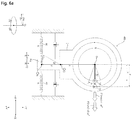
- FIGS. 3a to 7d illustrate the center m, m1, and m2 of mass of the eccentric portion 55 and 56, the radius r, r1, and r2 of rotation of the center of mass m, m1, and m2 with respect to the corresponding rotational axis Ow, Ow1, and Ow2, and the angular speed w of the eccentric portion 55 and 56 around the corresponding rotational axis Ow, Ow1, and Ow2.
- FIGS. 5a to 7d illustrate the distance A, A1, and A2 between the center axis Oc and the rotational axis Ow, Ow1, and Ow2, the distance B between the center axis Oc and the connection axis Oh, and the angle ⁇ of rotation of the vibration module 350, 450, and 550 around the center axis Oc.
- FIGS. 3a to 7d illustrate the direction of the centrifugal force F1 of the eccentric portion 55 with respect to the rotational axis Ow and Ow1
- FIGS. 4a to 4d and FIGS. 6a to 7d illustrate the direction of the centrifugal force F2 of the eccentric portion 56 with respect to the rotational axis Ow and Ow2 as well.
- the centrifugal forces F1 and F2 are applied to the vibration module 50, 150, 250, 350, 450, and 550.
- the excitation force Fo(t) is a force applied to the hanger body 31, 231, and 431 by the centrifugal forces F1 and F2, which refers to an external force along the vibration direction (+X, -X) with respect to time t.
- the formula Fo(t) Fo ⁇ cos wt is satisfied.
- the magnitude of the centrifugal force F1 is m ⁇ r ⁇ w 2 .
- the centrifugal force F1 is exerted on the vibration module 150 and 350, and the point of action of the centrifugal force F1 is positioned on the rotational axis Ow.
- the magnitude of the centrifugal force F1 is m1 ⁇ r1 ⁇ w 2
- the magnitude of the centrifugal force F2 is m2 ⁇ r2 ⁇ w 2 .
- the centrifugal forces F1 and F2 are exerted on the vibration module 250, 450, and the points of action of the centrifugal forces F1 and F2 are positioned on the rotational axis Ow and Ow1 and rotational axis Ow and Ow2, respectively.
- the centrifugal force F1 and the centrifugal force F2 are set to reinforce each other when they generate an excitation force Fo(t) in the vibration direction (+X, -X).
- the centrifugal force F1 and the centrifugal force F2 are set to offset each other when they generate no excitation force Fo(t) in the vibration direction (+X, -X).
- the centrifugal force F1 and the centrifugal force F2 act in opposite directions and are exerted on the same line of action, and therefore the sum of the centrifugal forces F1 and F2 is equal to the difference between the magnitude of the centrifugal force F1 and the magnitude of the centrifugal force F2.
- at least one of the centrifugal forces F1 and F2 is offset by the other.
- the centrifugal force F1 and the centrifugal force F2 are set to "completely offset" each other when they generate no excitation force Fo(t) in a predetermined vibration direction (+X, -X).
- m1 ⁇ r1 and m2 ⁇ r2 may be set equal so that the centrifugal force F1 and centrifugal force F2 in the intersecting direction (+Y, -Y) completely offset each other.
- the first eccentric portion 55 and the second eccentric portion 56 may be configured to rotate at the same angular speed w. This allows for periodic reinforcement and offsetting of the centrifugal forces F1 and F2 caused by the rotation of the first eccentric portion 55 and second eccentric portion 56.
- the angular speed refers to a scalar which only has magnitude but no direction of rotation, which is different from angular velocity which is a vector having both direction of rotation and magnitude. That is, if the angular speed w of the first eccentric portion 55 and the angular speed w of the second eccentric portion 56 are equal, this does not mean that they rotate in the same direction. In the second and fourth exemplary embodiments, even if the angular speed w of the first eccentric portion 55 and the angular speed w of the second eccentric portion 56 are equal, the first eccentric portion 55 and the second eccentric portion 56 rotate in opposite directions of rotation. In the fifth exemplary embodiment, the angular speed w of the first eccentric portion 55 and the angular speed w of the second eccentric portion 56 are equal and rotate in the same direction of rotation.
- the distance A and A1 between the first rotational axis Ow and Ow1 of the first eccentric portion 55; and ii) the center axis Oc and the distance A and A2 between the second rotational axis Ow and Ow2 of the second eccentric portion 56 may be set equal.
- first rotational axis Ow and Ow1 and the second rotational axis Ow and Ow2 may be spaced apart from the center axis Oc in the same direction or in opposite directions.
- the center axis Oc, first rotational axis Ow1, and second rotational axis Ow2 are disposed to intersect an imaginary straight line at a right angle.
- first rotational axis Ow and the second rotational axis Ow are spaced apart from the center axis Oc in the same direction.
- the first rotational axis Ow1 and the second rotational axis Ow2 are spaced apart from the center axis Oc in opposite directions. This allows the vibration module 550 to be off-centered to one side of the center axis Oc, thereby reducing the risk of putting stress on the structure.
- the excitation force Fo(t) for each exemplary embodiment can be calculated as follows.
- the excitation force Fo(t) is calculated on the presumption that the eccentric portion 55 and 56 rotates at a specific angular speed w.
- the first exemplary embodiment with reference to FIGS. 3a and 3b shows the angular momentum of 180-degree rotation of the eccentric portion 55 rotating at a constant angular speed w. Since the vibration module 150 vibrates integrally with the hanger body 31, the excitation fore Fo(t) can be calculated as the force in the vibration direction (+X, -X) caused by the centrifugal force F1.
- the excitation force Fo(t) acting on the vibration module 150 in the +X axis direction, caused by the centrifugal force F1 has the maximum value Fo.
- the excitation force Fo is F1 in the +X axis direction.
- the excitation force Fo(t) acting on the vibration module 150 in the -X axis direction, caused by the centrifugal force F1 has the maximum value Fo.
- the excitation force Fo is F1 in the -X axis direction.
- the second exemplary embodiment with reference to FIGS. 4a and 4b shows the angular momentum of 90-degree rotation of the first eccentric portion 55 and second eccentric portion 56 rotating at the same constant angular speed w. Since the vibration module 250 vibrates integrally with the hanger body 31, the excitation fore Fo(t) can be calculated as the sum of the centrifugal force F1 and centrifugal force F2 in the vibration direction (+X, -X).
- the centrifugal force F1 and the centrifugal force F2 are set to reinforce each other when exerted on the vibration module 250 in the vibration direction (+X, -X).
- the excitation force Fo in the vibration direction (+X, -X) caused by the centrifugal force F1 and centrifugal force F2 is F1+F2.
- the centrifugal force F1 and the centrifugal force F2 are set to be directed in opposite directions when exerted on the vibration module 250 in the intersecting direction (+Y, -Y).
- the excitation force Fo(t) in the vibration direction (+X, -X) caused by the centrifugal force F1 and centrifugal force F2 is zero.
- the excitation force in the intersecting direction (+Y, -Y) caused by the centrifugal force F1 and centrifugal force F2 is
- the excitation force in the intersecting direction (+Y, -Y) caused by the centrifugal force F1 and centrifugal force F2 is preset to zero.
- the centrifugal force F1 and the centrifugal force F2 reinforce each other and act on the vibration module 250 in the +X axis direction.
- the excitation force transmitted to the hanger body 31 along the connection axis Oh has the maximum value Fo in the +X axis direction.
- the excitation force Fo is F1+F2 in the +X axis direction.
- the centrifugal force F1 and the centrifugal force F2 do not act on the vibration module 250 in the vibration direction (+X, -X). Also, the centrifugal force F1 and centrifugal force F2 acting in opposite directions offset each other.
- the excitation force in the vibration direction (+X, -X) transmitted to the hanger body 31 along the connection axis Oh is zero.
- the centrifugal force F1 and the centrifugal force F2 reinforce each other and act on the vibration module 250 in the -X axis direction.
- the excitation force transmitted to the hanger body 31 along the connection axis Oh has the maximum value Fo in the -X axis direction.
- the excitation force Fo is F1+F2 in the -X axis direction.
- the centrifugal force F1 and the centrifugal force F2 do not act on the vibration module 250 in the vibration direction (+X, -X). Also, the centrifugal force F1 and centrifugal force F2 acting in opposite directions offset each other.
- the excitation force Fo in the vibration direction (+X, -X) transmitted to the hanger body 31 along the connection axis Oh is zero.
- the third exemplary embodiment with reference to FIGS. 5a and 5b shows the angular momentum of 180-degree rotation of the eccentric portion 55 rotating at a constant angular speed w. Since the vibration module 350 rotates around the center axis Oc, the excitation fore Fo(t) can be calculated by converting the centrifugal force F1 into an external force with a point of action on the connection axis Oh, taking the moment arm lengths A and B into account.
- the eccentric portion 55 generates a centrifugal force F1 with respect to the rotational axis Ow in the clockwise direction Dl1.
- the vibration module 350 has a rotational moment generated in the clockwise direction DI1
- the excitation force transmitted to the hanger body 31 along the connection axis Oh has the maximum value Fo in the -X axis direction.
- the excitation force Fo is A B ⁇ F 1 in the -X axis direction.
- the eccentric portion 55 generates a centrifugal force F1 with respect to the rotational axis Ow in the counterclockwise direction DI2.
- the vibration module 350 has a rotational movement generated in the counterclockwise direction DI2, and the excitation force transmitted to the hanger body 31 along the connection axis Oh has the maximum value Fo in the +X axis direction.
- the excitation force Fo is A B ⁇ F 1 in the +X axis direction.
- the fourth exemplary embodiment with reference to FIGS.6a to 6d shows the angular momentum of 90-degree rotation of the first eccentric portion 55 and second eccentric portion 56 rotating at the same constant angular speed w. Since the vibration module 450 rotates around the center axis Oc, the excitation fore Fo can be calculated by converting the sum of the centrifugal force F1 and centrifugal force F2 into an external force with a point of action on the connection axis Oh, taking the moment arm lengths A and B into account.
- the centrifugal force F1 and the centrifugal force F2 are set to reinforce each other when they generate a torque around the center axis Oc of the vibration module 450.
- the moment (A ⁇ F1+ A ⁇ F2) caused by the centrifugal force F1 and centrifugal force F2 is equal to the moment (B ⁇ Fo) caused by the excitation force Fo.
- Fo becomes A B ⁇ F 1 + A B ⁇ F 2 .
- the centrifugal force F1 and the centrifugal force F2 are set to be directed in opposite directions when they generate no torque around the center axis Oc of the vibration module 450.
- the excitation force Fo(t) in the vibration direction (+X, -X) caused by the centrifugal force F1 and centrifugal force F2 is zero.
- the excitation force in the intersecting direction (+Y, -Y) caused by the centrifugal force F1 and centrifugal force F2 is
- the excitation force in the intersecting direction (+Y, -Y) caused by the centrifugal force F1 and centrifugal force F2 is preset to zero.
- the vibration module 450 has a rotational moment generated in the clockwise direction DI1
- the excitation force transmitted to the hanger body 31 along the connection axis Oh has the maximum value Fo in the -X axis direction.
- the excitation force Fo is A B ⁇ F 1 + F 2 in the - X axis direction.
- the second eccentric portion 56 when the first eccentric portion 55 generates a centrifugal force F1 with respect to the first rotational axis Ow in the centrifugal direction Dr1, the second eccentric portion 56 generates a centrifugal force F2 with respect to the second rotational axis Ow in the mesial direction Dr2.
- the centrifugal force F1 and the centrifugal force F2 generate no torque for the vibration module 450.
- the excitation force transmitted to the hanger body 31 along the connection axis Oh is zero.
- the vibration module 450 has a rotational moment generated in the counterclockwise direction DI2, and the excitation force transmitted to the hanger body 31 along the connection axis Oh has the maximum value Fo in the +X axis direction.
- the excitation force Fo is A B ⁇ F 1 + F 2 in the +X axis direction.
- the second eccentric portion 56 when the first eccentric portion 55 generates a centrifugal force F1 with respect to the first rotational axis Ow in the mesial direction Dr2, the second eccentric portion 56 generates a centrifugal force F2 with respect to the second rotational axis Ow in the centrifugal direction Dr1.
- the centrifugal force F1 and the centrifugal force F2 generate no torque for the vibration module 450.
- the excitation force transmitted to the hanger body 31 along the connection axis Oh is zero.
- the excitation force Fo(t) is given by the following Mathematical Formula 4:
- the fifth exemplary embodiment with reference to FIGS.7a to 7d shows the angular momentum of 90-degree rotation of the first eccentric portion 55 and second eccentric portion 56 rotating at the same constant angular speed w. Since the vibration module 550 rotates around the center axis Oc, the excitation fore Fo can be calculated by converting the sum of the centrifugal force F1 and centrifugal force F2 into an external force with a point of action on the connection axis Oh, taking the moment arm lengths A1, A2, and B into account.
- the centrifugal force F1 and the centrifugal force F2 are set to reinforce each other when they generate a torque around the center axis Oc of the vibration module 550.
- the moment (A1 ⁇ F1 + A2 ⁇ F2) caused by the centrifugal force F1 and centrifugal force F2 is equal to the moment (B ⁇ Fo) caused by the excitation force Fo.
- Fo becomes A 1 B ⁇ F 1 + A 2 B ⁇ F 2 .
- the centrifugal force F1 and the centrifugal force F2 are set to be directed in opposite directions when they generate no torque around the center axis Oc of the vibration module 550.
- the excitation force Fo(t) in the vibration direction (+X, -X) caused by the centrifugal force F1 and centrifugal force F2 is zero.
- the excitation force in the intersecting direction (+Y, -Y) caused by the centrifugal force F1 and centrifugal force F2 is
- the excitation force in the intersecting direction (+Y, -Y) caused by the centrifugal force F1 and centrifugal force F2 is preset to zero.
- the vibration module 550 has a rotational moment generated in the clockwise direction DI1
- the excitation force transmitted to the hanger body 31 along the connection axis Oh has the maximum value Fo in the -X axis direction.
- the excitation force Fo is A 1 B ⁇ F 1 + A 2 B ⁇ F 2 in the -X axis direction.
- the second eccentric portion 56 when the first eccentric portion 55 generates a centrifugal force F1 with respect to the first rotational axis Ow1 in the mesial direction Dr2, the second eccentric portion 56 generates a centrifugal force F2 with respect to the second rotational axis Ow2 in the mesial direction Dr2.
- the centrifugal force F1 and the centrifugal force F2 generate no torque for the vibration module 550.
- the excitation force transmitted to the hanger body 31 along the connection axis Oh is zero.
- the vibration module 550 has a rotational moment generated in the counterclockwise direction DI2, and the excitation force transmitted to the hanger body 31 along the connection axis Oh has the maximum value Fo in the +X axis direction.
- the excitation force Fo is A 1 B ⁇ F 1 + A 2 B ⁇ F 2 in the +X axis direction.
- the second eccentric portion 56 when the first eccentric portion 55 generates a centrifugal force F1 with respect to the first rotational axis Ow in the centrifugal direction Dr1, the second eccentric portion 56 generates a centrifugal force F2 with respect to the second rotational axis Ow2 in the centrifugal direction Dr1.
- the centrifugal force F1 and the centrifugal force F2 generate no torque for the vibration module 550.
- the excitation force transmitted to the hanger body 31 along the connection axis Oh is zero.
- the excitation force Fo(t) is given by the following Mathematical Formula 5: Mathematical Formula 5
- the equation Fo t 2 ⁇ A 1 B ⁇ m 1 ⁇ r 1 ⁇ w 2 ⁇ cos wt is satisfied.
- the equation of forced vibration caused by excitation force Fo(t) can be expressed by a second-order ordinary differential equation using the following Mathematical Formula 6.
- the value to be obtained is the position x(t) of the connection axis Oh in the vibration direction (+X, -X) with respect to time t.
- a transient solution x1(t) for Mathematical Formula 6 can be expressed by the following Mathematical Formula 7.
- the general solution x h ( t ) to Mathematical Formula 7 is a solution determined only by the constants p1, p2, and p3, and, as is well known, the general solution x h ( t ) converges to 0 when the time t diverges to infinity ⁇ . Also, the particular solution x p ( t ) to Mathematical Formula 7 is a solution determined by the constants p1, p2, and p3 and excitation force Fo(t) in Mathematical Formula 6.
- the solution x(t) to Mathematical Formula 6 is affected by the excitation force Fo(t), and the excitation force Fo(t) in the present disclosure takes the form of Fo ⁇ cos wt .
- the solution x(t) to Mathematical Formula 6 is given by the following Mathematical Formula 9 according to a well-known method of solving a second-order ordinary differential equation.
- w n may represent natural angular speed w n
- w n 2 ⁇ may represent natural frequency
- the coefficient p2 may have a value greater than zero. If the following Mathematical Formula 10 is satisfied according to a solution to an already-known vibration equation, the amplitude X(w) has the maximum value (peak value) X(w max ) when the angular speed w of the eccentric portion 55 and 56 has a certain value w max near the natural angular speed w n . As p1 ⁇ p3 becomes larger than p 2 2 2 2 , the peak shape of the amplitude X(w) becomes more distinct and the peak value X(w max ) becomes larger, as in the graph of FIG. 2 . According to a well-known solving method, the peak value X(w max ) is finite if p2>0.
- the value w max is given as a single value according to a well-known solving method if p2>0, increases as p2 decreases, and approaches the natural angular speed w n as p2 gets closer to 0. p 1 ⁇ p 3 ⁇ p 2 2 2
- Mathematical Formula 10 it is preferable that Mathematical Formula 10 be satisfied. Through this, it becomes easier to control the frequency w 2 ⁇ and amplitude X(w) of the hanger body 31 in various ways.
- the equations of forced vibration use the property that the excitation force Fo(t) is equal to the sum of inertia force, damping force, and elastic force.
- the damping force may be generated by structural factors of the hanger module 30 and vibration module 50 and/or clothes hung on the hanger body 31.
- FIGS. 3a to 7d conceptually show the damping coefficient c for convenience, the damping coefficient c, in reality, is seen as being applied to the movement of the position x in the vibration direction (+X, -X) along the connection axis Oh.
- FIGS. 3a to 7d conceptually show the elastic modulus k for convenience
- the elastic modulus k in reality, may be a tensile or compressive elastic modulus applied to the movement of the position x in the vibration direction (+X, -X) along the connection axis Oh, or a torsional elastic modulus applied to the angle ⁇ of rotation of the vibration module 50 around the center axis Oc.
- the calculations are based on the assumption that the elastic modulus k is the tensile or compressive elastic modulus
- the calculation is based on the assumption that the elastic modulus k is the torsional elastic modulus.
- the tensile or compressive elastic modulus refers to the elastic modulus for elastic force proportional to tensile or compressive length x
- the torsional elastic modulus refers to the elastic modulus for elastic force proportional to the angle ⁇ of rotation of the vibration module 350, 450, and 550.
- the solution x(t) and amplitude X(w) can be obtained by substituting the obtained coefficients p1, p2, and p3 and the obtained excitation force Fo(t) into Mathematical Formula 9 and Mathematical Formula 10 (see Mathematical Formula 9), and the condition for the peak value H(wmax) can be found (see Mathematical Formula 10).
- m1 is the mass of the first eccentric portion 55
- m2 is the mass of the second eccentric portion 56
- r1 is the radius of rotation from the center of mass of the first eccentric portion 55 on the rotational axis Ow
- r2 is the radius of rotation from the center of mass of the second eccentric portion 56 on the rotational axis Ow
- M is the mass of the vibration module 250 and hanger body 31 moving in the vibration direction (+X, -X)
- k is the tensile or compressive elastic modulus of the elastic member 60 in the vibration direction (+X, -X)
- c is the damping coefficient in the vibration direction (+X, -X).
- the clothes treatment apparatus 1 is configured in such a way that the angular speed w of the eccentric portion 55 and 56 is changeable.
- the control part may change and control the angular speed of the eccentric portion 55 and 56. This means that there are two or more preset angular speeds w that allow the vibrating motion of the vibration module 50, 150, 250, 350, 450, and 550 to reach a steady state.
- the clothes treatment apparatus 1 is configured in such a way as to provide two or more different steady states by changing the angular speed w of the eccentric portion 55 and 56.
- the clothes treatment apparatus 1 is configured in such a way that the two or more different angular speeds w are maintained for a predetermined time or longer.
- the predetermined time may be preset to a sufficient period of time to reach the steady state.
- the predetermined time may be around 5 seconds.
- the clothes treatment apparatus 1 is configured to perform a first mode mode1 in which the vibration frequency w 1 2 ⁇ of the hanger body 31 is relatively low and the amplitude X(w1) is relatively large and a second mode mode2 in which the vibration frequency w 2 2 ⁇ of the hanger body 31 is relatively high and the amplitude X(w2) is relatively small, by changing and controlling the angular speed w of the eccentric portion 55 and 56.
- the motion of the hanger body 31 may be varied. For example, clothes may be vibrated slowly with a large amplitude X(w) through the first mode mode1, or clothes may be vibrated fast, rather than being shaken off, with a small amplitude X(w) through the second mode mode2.
- the first angular speed w1 of the eccentric portion 55 and 56 is maintained for a predetermined time or longer
- the second angular speed w2 of the eccentric portion 55 and 56 is maintained for a predetermined time or longer.
- the second angular speed w2 is preset to be higher than the first angular speed w1.
- the vibration frequency w 1 2 ⁇ for the first mode mode1 is preset to be closer to the natural vibration frequency w 2 2 ⁇ than the vibration frequency w n 2 ⁇ for the second mode mode2.
- the vibration frequency w 1 2 ⁇ for the first mode mode1 is preset to be closer to 1 2 ⁇ ⁇ k M than the vibration frequency w 2 2 ⁇ for the second mode mode2, with reference to Mathematical Formulae 11 and 12.
- the vibration frequency w 1 2 ⁇ for the first mode mode1 is preset to be closer to k M + I B 2 or k ⁇ B 2 ⁇ M + I than the vibration frequency w 2 2 ⁇ for the second mode mode2, with reference to Mathematical Formulae 13 to 15.
- the first mode mode1 allows for larger amplitude
- the second mode mode2 allows for high vibration frequency without stress on items.
- the amplitude of vibration of the hanger body 31 in a steady state is preset to have a peak value X(w max ) when the angular speed w has a specific value w max greater than zero.
- a condition for the peak value needs to be satisfied with reference to Mathematical Formula 11 to Mathematical Formulae 15.
- the clothes treatment apparatus 1 is configured to provide the peak value X(w max ), since M and k are preset to satisfy M ⁇ k > c 2 2 even if c is assumed to have the maximum value by taking into account the maximum/minimum range and error range (safety value) of clothes that can be hung on the hanger body 31 and 231.
- the clothes treatment apparatus 1 is configured to provide the peak value X(w max ), since I and k are preset to satisfy a predetermined value (determined by I, M, k, and B) > c 2 2 even if c is assumed to have the maximum value by taking into account the maximum/minimum range and error range (safety value) of clothes that can be hung on the hanger body 31 and 431.
- the numerator of X(w) also increases as the value B increases, it is desirable that the distance A, A1, and A2 between the center axis Oc and the rotational axis Ow, Ow1, and Ow2 is greater than the distance between the center axis Oc and the connection axis Oh, in order to efficiently obtain a larger amplitude X(w) with the same angular speed w.
- the ratio A/B of the distance A between the center axis and the rotational axis to the distance B between the center axis Oc and the connection axis Oh is equal to or greater than 2.6.
- the maximum value of the ratio A/B is limited by the frame 10. That is, the distance A is not greater than a certain value since the vibration module is disposed within the cabinet.
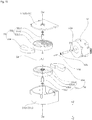
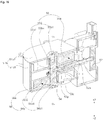
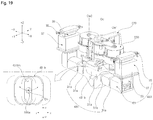
- FIGS. 15 and 16 a structural example common to the second and fourth exemplary embodiments will be described below.
- the vibration module 350 and 450 comprises a vibrating body 251 and 451 configured to move with respect to the frame 10.
- the vibration module 250 and 450 comprises a weight shaft 54 providing function the rotational axis Ox and first and second eccentric portions 55 and 56 rotating around the weight shaft 54.
- the first eccentric portion 55 comprises a first rotating portion 55b rotating around the rotational axis Ow in contact with the transmitting portion 53.
- the first rotating portion 55b may comprise a center portion 55b1 that makes rotatable contact with the weight shaft 54.
- the weight shaft 54 is placed to penetrate the center portion 55b1.
- the center portion 55b1 extends along the rotational axis Ow.
- the center portion 55b1 has a center hole along the rotational axis Ow.
- the first rotating portion 55b may comprise a peripheral portion 55b2 mounted to the center portion 55b1.
- the center portion 55b1 is placed to penetrate the peripheral portion 55b2.
- the peripheral portion 55b2 may be formed entirely in the shape of a cylinder that extends along the rotational axis Ow.
- a mounting groove 55b3 where the first weight member 55a rests may be formed in the peripheral portion 55b2.
- the mounting groove 55b3 may be formed in such a way that its top is open. A centrifugal side of the mounting groove 55b3 around the rotational axis Ow may be blocked.
- the peripheral portion 55b2 and the first weight member 55a rotate as a single unit.
- the first eccentric portion 55 comprises a toothed portion 55b4 that receives torque by meshing with a bevel gear 53a.
- the toothed portion 55b4 is formed on the underside of the peripheral portion 55b2.
- the toothed portion 55b4 is placed on the perimeter around the rotational axis Ow.
- the first eccentric portion 55 comprises a first weight member 55a fixed to the first rotating portion 55b.
- the first weight member 55a rotates integrally with the first rotating portion 55b.
- the first weight member 55a is made of a material with a higher specific gravity than the first rotating portion 55b.
- the first weight member 55a is placed on one side around the rotational axis Ow, and causes the weight of the first eccentric portion 55 to be off-centered.
- the second eccentric portion 56 comprises a second rotating portion 56b rotating around the rotational axis Ow in contact with the transmitting portion 53.
- the second rotating portion 56b may comprise a center portion 56b1 that makes rotatable contact with the weight shaft 54.
- the weight shaft 54 is placed to penetrate the center portion 56b1.
- the center portion 56b1 extends along the rotational axis Ow.
- the center portion 56b1 has a center hole along the rotational axis Ow.
- the center portion 56b1 may be formed in the shape of a pipe.
- the second rotating portion 56b may comprise a peripheral portion 56b2 mounted to the center portion 56b1.
- the center portion 56b1 is placed to penetrate the peripheral portion 56b2.
- the peripheral portion 56b2 may be formed entirely in the shape of a cylinder that extends along the rotational axis Ow.
- a mounting groove 56b3 where the second weight member 56a rests may be formed in the peripheral portion 56b2.
- the mounting groove 56b3 may be formed in such a way that its bottom is open. A centrifugal side of the mounting groove 56b around the rotational axis Ow may be blocked.
- the peripheral portion 56b2 and the second weight member 56a rotate as a single unit.
- the second eccentric portion 56 comprises a toothed portion 56b4 that receives torque by meshing with the bevel gear 53a.
- the toothed portion 56b4 is formed on the topside of the peripheral portion 56b2.
- the toothed portion 56b4 is placed on the perimeter around the rotational axis Ow.
- the second eccentric portion 56 comprises a second weight member 56a fixed to the second rotating portion 56b.
- the second weight member 56a rotates integrally with the second rotating portion 56b.
- the second weight member 56a is made of a material with a higher specific gravity than the second rotating portion 56b.
- the second weight member 56a is placed on one side around the rotational axis Ow, and causes the weight of the second eccentric portion 56 to be off-centered.
- the first eccentric portion 55 and the second eccentric portion 56 may be arranged along the center axis Oc, spaced apart from each other.
- the first eccentric portion 55 and the second eccentric portion 56 may be placed to face each other.
- the first eccentric portion 55 may be placed above the second eccentric portion 56.
- One weight shaft 54 is fixed to the vibrating body 251 and 451.
- the upper and lower ends of the weight shaft 54 may be fixed to a weight casing 51b.
- the weight shaft 54 may be placed to penetrate the first eccentric portion 55 and the second eccentric portion 56.
- the vibrating body 251 and 451 may comprise a weight casing 51b accommodating the first eccentric portion 55 and the second eccentric portion 56 in it.
- the weight casing 51b may comprise a first part 51b1 forming an upper portion and a second part 51b2 forming a lower portion.
- the second part 51b1 may form an inner space forming the bottom surface and peripheral surface, and the first part 51b1 may cover the top of the inner space.
- the weight casing 51b may be attached to the motor 52.
- a hole through which the motor shaft 52a is inserted may be formed in one side of the weight casing 51b.
- the motor shaft 52a is inserted and protrudes between the first eccentric portion 55 and the second eccentric portion 56.
- the motor shaft 52a is connected to the transmitting portion 53.
- the transmitting portion 53 comprises a bevel gear 53a that rotates integrally with the motor shaft 52a.
- the bevel gear 53a has a plurality of gear teeth arranged along the perimeter of the motor shaft 52a.
- the bevel gear 53a is placed between the first eccentric portion 55 and the second eccentric portion 56.
- the transmitting portion 53 may comprise a transmission shaft 53g that rotatably supports the bevel gear 53a.
- the transmission shaft 53g may be supported by the weight shaft 54.
- One end of the transmission shaft 53g may be fixed to the weight shaft 54, and the other end may be inserted into the center of the bevel gear 53a.
- the vibrating body 251 according to the second exemplary embodiment is fixed to the hanger body 231 and moves integrally with the hanger body 231.
- the weight casing 51b may be disposed in front of the motor 52.
- the motor shaft 52a may protrude forward.
- the hanger driving unit 258 connects and holds the vibrating body 251 and the hanger body 231 together.
- the hanger driving unit 258 is fixed to the vibrating body 251.
- the hanger driving unit 258 may protrude and extend downward from the vibrating body 251, so that the lower end is fixed to the hanger body 231.
- the lower end of the hanger driving unit 258 is fixed to the hanger driven unit 231b.
- the hanger driving unit 258 vibrates integrally with the hanger driven unit 231b.
- connection axis Oh is disposed between the rotational axis Ow and the center Mm of mass of the motor 52.
- the hanger driving unit 258 is fixed to the hanger body 231, in a position between the center Mm of mass of the motor 52 and the first rotational axis Ow1.
- the elastic member 260 When the vibration module 250 reciprocates to the left and right, the elastic member 260 may be elastically deformed by the elastic member locking portion 259, or the restoring force of the elastic member 260 is transmitted to the elastic member locking portion 259.
- the elastic member locking portion 259 is disposed on the weight casing 51b.
- the elastic member locking portion 259 may comprise a first locking portion 259a on which one end of the first elastic member 60a is locked.
- the first locking portion 259a may be formed on one side (+X) of the weight casing 51b.
- the elastic member locking portion 259 may comprise a second locking portion 259b on which one end of the second elastic member 60b is locked.
- the second locking portion 259b may be formed on the other side (-X) of the weight casing 51b.
- the elastic member 260 may be disposed between the vibration module 250 and the supporting member 270. One end of the elastic member 260 is locked on the vibration module 250, and the other end is locked on an elastic member mounting portion 277 of the supporting member 270.
- the elastic member 260 may comprise a tension spring and/or a compression spring.
- a pair of elastic members 60a and 60b may be disposed on both sides of the connection axis Oh in the vibration direction (+X, -X).
- a plurality of elastic members 60a and 60b may be provided.
- the elastic members 60a and 60b may be configured to elastically deform when the vibration module 250 moves to one side in the vibration direction (+X, -X) and regain their elasticity when it moves to the other side.
- the elastic members 60a and 60b may be configured to elastically deform when the hanger body 231 moves to one side in the vibration direction (+X, -X) and regain their elasticity when it moves to the other side.
- the first elastic member 60a is disposed on one side (+X) of the vibrating body 251. One end of the first elastic member 60a may be locked on the first locking portion 259a, and the other end may be locked on a first mounting portion 277a of the supporting member 270.
- the first elastic member 60a may comprise a spring that elastically deforms in the vibration direction (+X, -x) and regains its elasticity.
- the second elastic member 60b is disposed on the other side (-X) of the vibrating body 251. One end of the second elastic member 60b may be locked on the second locking portion 259b, and the other end may be locked on a second mounting portion 277b of the supporting member 270.
- the second elastic member 60b may comprise a spring that elastically deforms in the vibration direction (+X, -x) and regains its elasticity.
- the supporting member 270 comprises an elastic member mounting portion 277 where one end of the elastic member 260 is fixed.
- the elastic member mounting portion 277 is fixed to the frame 10.
- the elastic member mounting portion 277 may be fixed to the interior frame 11a.
- the first mounting portion 277a and the second mounting portion 277b are placed apart from each other, in opposite directions with respect to the connection axis Oh.
- the supporting member 270 may further comprise a module guide 278 that allows the vibration module 250 to move in the vibration direction (+X, -X) but restricts the movement in a direction (+Y, -Y) intersecting the vibration direction (+X, -X).
- the module guide 278 may make contact with the hanger driving unit 258 and guide the hanger driving unit 258 in the vibration direction (+X, -X).
- the module guide 278 may be disposed between the pair of mounting portions 277a and 477b.
- the module guide 278 may be disposed under the vibrating body 251.
- the module guide 278 may be formed in the shape of a horizontal plate.
- the module guide 278 is fixed to the frame 10.
- the vibrating body 451 according to the fourth exemplary embodiment is configured to be rotatable around the center axis Oc.
- the weight casing 51b is placed apart from the center axis Oc in the centrifugal direction Dr1.
- the weight casing 51b and the hanger driving unit 458 may be placed apart from each other, in opposite directions with respect to the center axis Oc.
- the connection axis Oh and the rotational axis Ow may be placed apart from each other, in opposite directions with respect to the center axis Oc.
- the motor 52 may be disposed between the center axis Oc and the rotational axis Ow.
- the motor shaft 52a may protrude in the centrifugal direction Dr1.
- the motor shaft 52a may protrude in the -Y axis direction.
- the vibrating body 451 may comprise a base casing 451d rotatably supported by the center axial portion 475.
- the center axial portion 475 is placed to penetrate the base casing 451d.
- a bearing B is interposed between the center axial portion 475 and the base casing 451d.
- the base casing 451d is disposed between the weight casing 51b and an elastic member mount 451c.
- the vibrating body 451 may comprise a motor supporting portion 451e supporting the motor 52.
- the motor supporting portion 451e may support the bottom end of the motor.
- the motor supporting portion 451e may be disposed between the weight casing 51b and the base casing 451d.
- the vibrating body 451 may comprise an elastic member mount 451c on which one end of the elastic member 460 is locked.
- the elastic member mount 451c applies pressure on the elastic member 460 or receive restoring force from the elastic member 460.
- the elastic member mount 451c may be disposed on one end of the vibrating body 451 in the centrifugal direction Dr1.
- the elastic member mount 451c may connect and extend between the center axis Oc and the connection axis Oh.
- the elastic member mount 451c may extend in the centrifugal direction Dr1 and therefore have a distal end.
- the elastic member mount 451c is disposed on the other side of the first and second rotational axes Ow with respect to the center axis Oc.
- the elastic member mount 451c may be fixed to the base casing 451d.
- the elastic member mount 451c, base casing 451d, and motor supporting portion 451e may be formed as a single unit.
- the motor 52 may be placed apart from the center axis Oc.
- the motor 52 may be disposed between the center axis Oc and the first and second rotational axes Ow.
- the motor 52 has a motor shaft 52a placed perpendicular to the center axis Oc.
- the motor shaft 52a may protrude from the motor in the centrifugal direction Dr1.
- the hanger driving unit 458 is connected to the hanger body 431, in a position where it is spaced part from the center axis Oc.
- the hanger driving unit 458 may be configured to be connected to the hanger body 431 on the outside, in a position where it is spaced apart from the center axis Oc.
- the hanger driving unit 458 may comprise a protruding portion 458a that protrudes along the connection axis Oh.
- the protruding portion 458a protrudes downward from the hanger driving unit 458.
- the protruding portion 458a protrudes along the connection axis Oh.
- the hanger driving unit 458 may comprise a connecting rod 458a and 458b comprising the protruding portion 458a.
- the connecting rod 458a and 458b may be configured as a separate member.
- One end 458a of the connecting rod 458a and 458b may be inserted into a slit 431bh of the hanger driven unit 431b.
- the connecting rod 458a and 458b converts the rotating motion of the vibration module 450 to reciprocate the hanger body 431.
- the connecting rod 458a and 458b is fixed to the vibrating body 451.
- the upper end of the connecting rod 458a and 458b may be fixed to the vibrating body 451.
- the connecting rod 458a and 458b rotates integrally with the vibrating body 451.
- the connecting rod 458a and 458b may be disposed on the connection axis Oh.
- the connecting rod 458a and 458b may transmit the torque of the vibrating body 451 to the hanger body 431.
- the connecting rod 458a and 458b may comprise a vertical extension 458b which extends in an up-down direction.
- the vertical extension 458b may extend along the connection axis Oh.
- the upper end of the vertical extension 458b may be fixed to the elastic member mount 451c.
- the connecting rod 458a and 458b comprises the protruding portion 458a formed at the distal end of the vertical extension 458b.
- the protruding portion 458a is disposed on the lower end of the vertical extension 458b.
- the vibration module 450 comprises an elastic member locking portion 459 on which one end of the elastic member 460 is locked.
- the elastic member 460 is elastically deformed by the elastic member locking portion 459, or the restoring force of the elastic member 460 is transmitted to the elastic member locking portion 459.
- the elastic member locking portion 459 is disposed on the elastic member mount 451c.
- the elastic member locking portion 459 may comprise a first locking portion 459a on which one end of the first elastic member 60a is locked.
- the first locking portion 459a may be formed on one side (+X) of the elastic member mount 451c.
- the elastic member locking portion 459 may comprise a second locking portion 459b on which one end of the second elastic member 60b is locked.
- the second locking portion 459b may be formed on the other side (-X) of the elastic member mount 451c.
- the elastic member 460 may be disposed between the vibration module 450 and the supporting member 470. One end of the elastic member 460 is locked on the vibration module 450, and the other end is locked on an elastic member mounting portion 477 of the supporting member 470.
- the elastic member 460 may comprise a tension spring and/or a compression spring.
- a pair of elastic members 60a and 60b may be disposed on both sides of the connection axis Oh in the vibration direction (+X, -X).
- the elastic member 460 may be placed apart from the center axis Oc.
- a plurality of elastic members 60a and 60b may be provided.
- the elastic members 60a and 60b each may be configured to elastically deform when the vibration module 450 moves in either the clockwise direction DI1 or the counterclockwise direction DI2 and regain their elasticity when it moves in the other direction.
- the elastic members 60a and 60b may be configured to elastically deform when the hanger body 431 moves to one side in the vibration direction (+X, -X) and regain their elasticity when it moves to the other side.
- the first elastic member 60a is disposed on one side (+X) of the vibrating body 451. One end of the first elastic member 60a may be locked on the first locking portion 459a, and the other end may be locked on a first mounting portion 477a of the supporting member 470.
- the first elastic member 60a may comprise a spring that elastically deforms in the vibration direction (+X, -X) and regains its elasticity.
- the second elastic member 60b is disposed on the other side (-X) of the vibrating body 451.
- the elastic member mount 451c is disposed between the first elastic member 60a and the second elastic member 60b.
- One end of the second elastic member 60b may be locked on the second locking portion 459b, and the other end may be locked on a second mounting portion 477b of the supporting member 470.
- the second elastic member 60b may comprise a spring that elastically deforms in the vibration direction (+X, -X) and regains its elasticity.
- the supporting member 470 may comprise a center axial portion 475 protruding along the center axis Oc.
- the center axial portion 475 may protrude upward from a center axis supporting portion 476.
- the center axial portion 475 is inserted into a hole formed in the vibrating body 451.
- the center axial portion 475 rotatably supports the vibrating body 451 through a bearing B.
- the supporting member 470 may comprise a center axial supporting portion 476 to which the center axial portion 475 is fixed.
- the center axial supporting portion 476 may be located a distance below the vibrating body 451.
- the center axial supporting portion 476 is fixed to the frame 10.
- the supporting member 470 comprises an elastic member mounting portion 477 where one end of the elastic member 460 is fixed.
- the elastic member mounting portion 477 is fixed to the frame 10.
- the elastic member mounting portion 477 may be fixed to the interior frame 11a.
- the first mounting portion 477a and the second mounting portion 477b are placed apart from each other, in opposite directions with respect to the connection axis Oh.
- the vibrating body 551 according to the fifth exemplary embodiment is configured to be rotatable around the center axis Oc.
- the vibrating body 551 may comprise a weight casing 551b containing the first eccentric portion 55 and the second eccentric portion 56 in it.
- the weight casing 551b may form the outer appearance of an upper portion of the vibration module 50.
- the upper ends of the weight shafts 554a and 554b are fixed to the weight casing 551b.
- the weight casing 551b comprises a first part 551b1 covering the top of the first eccentric portion 55 and a second part 551b2 covering the top of the second eccentric portion 56.
- the upper end of the first weight shaft 554a is fixed to the first part 551b1.
- the upper end of the second weight shaft 554b is fixed to the second part 551b2.
- the vibrating body 551 may comprise a base casing 551d forming the outer appearance of a lower portion.
- the lower ends of the weight shafts 554a and 554b are fixed to the base casing 551d.
- the first eccentric portion 55 and the second eccentric portion 56 are disposed between the weight casing 551b and the base casing 551d.
- the first eccentric portion 55 is disposed between the first part 551b1 and the base casing 551d.
- the second eccentric portion 56 is disposed between the second part 551b2 and the base casing 551d.
- the vibrating body 551 may comprise a motor supporting portion 551e supporting the motor 552.
- the motor supporting portion 551e may support the bottom end of the motor 552.
- the motor supporting portion 551e is disposed between the first part 551b1 and the second part 551b2.
- the motor shaft 552a may be placed to penetrate the motor supporting portion 551e.
- the motor supporting portion 551e may be fixed to the weight casing 551b, and may be formed integrally with the weight casing 551b.
- the vibrating body 551 may comprise an elastic member mount 551c on which one end of at least one elastic member 560 is locked.
- the elastic member mount 551cd may be disposed in the upper portion of the vibrating body 551.
- the elastic member mount 551c may be fixed to the upper ends of the first part 551b1 and second part 551b2.
- the elastic member mount 551c may be placed to run across the center axis Oc.
- the center axial portion 575 may be placed to penetrate the elastic member mount 551c.
- the vibrating body 551 may have a central groove 551h or hole into which the center axial portion 575 is inserted.
- the central groove 551h may be formed on the upper side and/or lower side of the vibrating body 551.
- the central groove 551h is formed in the elastic member mount 551c.
- a bearing B1 is placed in the central groove 551h, so that the vibrating body 551 may be rotatably supported on the center axial portion 575.
- the motor 552 may be disposed on the center axis Oc.
- the motor 52 is disposed between the first eccentric portion 55 and the second eccentric portion 56.
- the motor 552 has a motor shaft 552a disposed on the center axis Oc.
- the motor shaft 552 may protrude downward and be connected to the transmitting portion 553.
- the transmitting portion 553 comprises a center transmitting portion 553c that rotates integrally with the motor shaft 552a.
- the center transmitting portion 553c may be fixed to the motor shaft 552a.
- the transmitting portion 553 may comprise a first transmitting portion 553a comprising a gear or belt for transmitting the torque of the center transmitting portion 553c to the first eccentric portion 55.
- the transmitting portion 553 may comprise a second transmitting portion 553b comprising a gear or belt for transmitting the torque of the center transmitting portion 553c to the second eccentric portion 56.
- the first weight shaft 554a and the second weight shaft 554b are formed as separate members.
- the first weight shaft 554a is disposed on the first rotational axis Ow1.
- the second weight shaft 554b is disposed on the second rotational axis Ow2.
- the first weight shaft 554a and the second weight shaft 554b are placed in opposite directions with respect to the center axis Oc.
- the first weight shaft 554a and the second weight shaft 554b are placed symmetrically with respect to the center axis Oc.
- the first weight shaft 554a and the second weight shaft 554b are fixed to the vibrating body 5551.
- the first weight shaft 554a is placed to penetrate the first rotating portion 555b.
- the second weight shaft 554b is placed to penetrate the second rotating portion 556b.
- the first eccentric portion 55 and the second eccentric portion 56 are placed in opposite directions with respect to the center axis Oc.
- the first eccentric portion 55 and the second eccentric portion 56 may be placed to face each other horizontally.
- the first eccentric portion 55 may be disposed on one side (+X) in the vibration direction (+X, -X), and the second eccentric portion 56 may be disposed on the other side (-X).
- the first eccentric portion 55 may comprise a first weight member 555a and a first rotating portion 555b.
- the first rotating portion 555b may comprise a center portion 555b1 that makes rotatable contact with the first weight shaft 554a.
- the first weight shaft 554a is placed to penetrate the center portion 555b1.
- the center portion 555b1 extends along the first rotational axis Ow1.
- the center portion 555b1 has a center hole along the first rotational axis Ow1.
- the first rotating portion 555b may comprise a peripheral portion 555b2 mounted to the center portion 555b1.
- the center portion 555b1 is placed to penetrate the peripheral portion 555b2.
- the peripheral portion 555b2 may be formed entirely in the shape of a cylinder that extends along the first rotational axis Ow1.
- a mounting groove 555b3 where the first weight member 555a rests may be formed in the peripheral portion 555b2.
- the mounting groove 555b3 may be formed in such a way that its top is open. A centrifugal side of the mounting groove 555b3 around the first rotational axis Ow1 may be blocked.
- the peripheral portion 555b2 and the first weight member 555a rotate as a single unit.
- the second eccentric portion 56 may comprise a second weight member 556a and a second rotating portion 556b.
- the second rotating portion 556b may comprise a center portion 556b1 that makes rotatable contact with the second weight shaft 554a.
- the second weight shaft 554a is placed to penetrate the center portion 556b1.
- the center portion 556b1 extends along the second rotational axis Ow2.
- the center portion 556b1 has a center hole along the second rotational axis Ow2.
- the second rotating portion 556b may comprise a peripheral portion 556b2 mounted to the center portion 556b1.
- the center portion 556b1 is placed to penetrate the peripheral portion 556b2.
- the peripheral portion 556b2 may be formed entirely in the shape of a cylinder that extends along the second rotational axis Ow2.
- a mounting groove 556b3 where the second weight member 556a rests may be formed in the peripheral portion 556b2.
- the mounting groove 556b3 may be formed in such a way that its top is open. A centrifugal side of the mounting groove 556b3 around the second rotational axis Ow2 may be blocked.
- the peripheral portion 556b2 and the second weight member 556a rotate as a single unit.
- the transmitting portion 553 comprises a gear type center transmitting portion 553c.
- the center axis Oc may run across the center of the center transmitting portion 553c.
- the center transmitting portion 553c may comprise a spur gear.
- the transmitting portion 553 may comprise a first transmitting portion 553a that rotates by meshing with the center transmitting portion 553c.
- the first transmitting portion 553a may comprise a spun gear.
- the transmitting portion 553 may comprise a second transmitting portion 553b that rotates by meshing with the center transmitting portion 553c.
- the second transmitting portion 553b may comprise a spun gear.
- the transmitting portion 553 comprises a first transmission shaft 553f providing a rotational axis function to the first transmitting portion 553a.
- the first transmission shaft 553f may be fixed to the vibrating body 551.
- the transmitting portion 553 comprises a second transmission shaft 553g providing a rotational axis function to the second transmitting portion 553b.
- the second transmission shaft 553g may be fixed to the vibrating body 551.
- the first eccentric portion 55 comprises a toothed portion 555b4 that receives torque by meshing with the first transmitting portion 553a.
- the toothed portion 555b4 is formed along the perimeter of the peripheral portion 555b2. Torque from the motor shaft 552a is transmitted sequentially to the center transmitting portion 553c, the first transmitting portion 553a, and then the toothed portion 555b4.
- the second eccentric portion 56 comprises a toothed portion 556b4 that receives torque by meshing with the second transmitting portion 553b.
- the toothed portion 556b4 is formed along the perimeter of the peripheral portion 556b2. Torque from the motor shaft 552a is transmitted sequentially to the center transmitting portion 553c, the second transmitting portion 553b, and then the toothed portion 556b4.
- FIG. 24 depicts the positions of the center axis Oc, first rotational axis Ow1, second rotational axis Ow2, and connection axis Oh.
- the hanger driving unit 558 comprises a rotating projection 558c fixed to the vibrating body 551.
- the upper end of the rotating projection 558c may be fixed to the lower side of the vibrating body 551.
- the rotating projection 558c rotates integrally with the vibrating body 551.
- the rotating projection 558c is placed to penetrate a lower supporting portion 571 along the center axis Oc.
- a bearing B2 may be interposed between the rotating projection 558c and the lower supporting portion 571, thus rotatably supporting the rotating projection 558c by the lower supporting portion 571.
- the rotating projection 558c may transmit the torque of the vibrating body 551 to the connecting rod 558a and 558b.
- the hanger driving unit 558 comprises a connecting rod 558a and 558b that transmits the torque of the vibration module 50 to the hanger body 431.
- the connecting rod 558a and 558b is fixed to the rotating projection 558c, and rotates integrally with the rotating projection 558c.
- the connecting rod 558a and 558b may be fixed to the lower end of the rotating projection 558c.
- the connecting rod 558a and 558b comprises a centrifugal extension 558b which extends from the rotating projection 558c in the centrifugal direction Dr1.
- the distal end of the centrifugal extension 558b along the mesial direction Dr2 is fixed to the rotating projection 558c.
- the connecting rod 558a and 558b comprises the protruding portion 558a protruding along the connection axis Oh.
- the protruding portion 558a may protrude downward from the distal end of the centrifugal extension 558b along the centrifugal direction Dr1.
- the vibration module 50 comprise an elastic member locking portion 559 on which one end of the elastic member 560 is locked.
- the elastic member 560 is elastically deformed by the elastic member locking portion 559, or the restoring force of the elastic member 560 is transmitted to the elastic member locking portion 559.
- the elastic member locking portion 559 may be fixedly placed on the vibrating body 551.
- the elastic member locking portion 559 may comprise a first locking portion 559a on which one end of the first elastic member 60a is locked.
- the first locking portion 559a may be formed on the upper side of the elastic member mount 551c.
- the elastic member locking portion 559 may comprise a second locking portion (not shown) on which one end of the second elastic member 60b is locked.
- the second locking portion is formed on the lower side of the base casing 551d.
- the elastic member locking portion 559 may comprise a third locking portion (not shown) on which one end of a third elastic member 60c is locked.
- the third locking portion may be formed on the connecting rod 558a and 558b.
- the elastic member 560 may be disposed between the vibration module 50 and the supporting member 570. One end of the elastic member 560 is locked on the vibration module 50, and the other end is locked on an elastic member mounting portion 577 of the supporting member 570.
- the elastic member 560 may comprise a torsional spring.
- a plurality of elastic members 60a, 60b, and 60c may be provided.
- the elastic members 60a, 60b, and 60c each may be configured to elastically deform when the vibration module 50 rotates in either the clockwise direction DI1 or the counterclockwise direction and regain its elasticity when it rotates in the other direction.
- the first elastic member 60a is disposed on the upper side of the vibration module 50. One end of the first elastic member 60a may be locked on the first locking portion 559a, and the other end may be locked on a first mounting portion 577a of the supporting member 570.
- the first elastic member 60a may comprise a torsional spring disposed around the perimeter of the center axial portion 575.
- the second elastic member 60b is disposed on the lower side of the vibration module 50. One end of the second elastic member 60b may be locked on the second locking portion of the vibration module 50, and the other end may be locked on a second mounting portion 577b of the supporting member 570.
- the second elastic member 60b may comprise a torsional spring disposed around the perimeter of the rotating projection 558c.
- the third elastic member 60c is disposed under the lower supporting portion 571.
- the third elastic member 60c may be disposed between the lower supporting portion 571 and the connecting rod 558a and 558b.
- One end of the third elastic member 60c may be locked on the third locking portion of the vibration module 50, and the other end may be locked on a third mounting portion (not shown) of the supporting member 570.
- the supporting member 570 comprises a lower supporting portion 571 disposed on the lower side of the vibrating body 551.
- the lower supporting portion 571 may be formed in the shape of a horizontal plate.
- the lower supporting portion 571 has a hole formed on the center axis Oc, and the rotating projection 558c penetrates through the hole.
- the bearing B2 is placed in the hole of the lower supporting portion 571, thereby rotatably supporting the rotating projection 558c.
- the supporting member 570 comprises an upper supporting portion 572 disposed on the upper side of the vibrating body 551.
- the upper supporting portion 572 may be formed in the shape of a horizontal plate.
- the supporting member 570 comprises a center axial portion 575 protruding from the upper supporting portion 572 along the center axis Oc.
- the center axial portion 575 may protrude downward from the underside of the upper supporting portion 572.
- the lower end of the center axial portion 575 is inserted into a central groove 551h of the vibrating body 551.
- the center axial portion 575 rotatably supports the vibrating body 551 via the bearing B1.
- the supporting member 570 comprises a vertical extension 573 that extends by connecting the lower supporting portion 571 and the upper supporting portion 572.
- the vertical extension 573 extends in an up-down direction.
- a pair of vertical extensions 573 may be disposed on either end of the upper supporting portion 572.
- the upper supporting portion 572 may be fixed to the lower supporting portion 571 by the vertical extension 573.
- the supporting member 570 comprises an elastic member mounting portion 577 on which one end of the elastic member 560 is locked.
- the first mounting portion 577a is fixedly placed on the underside of the upper supporting portion 572.
- the second mounting portion 577b is fixedly placed on the topside of the lower supporting portion 571.
- the third mounting portion is fixedly placed on the underside of the lower supporting portion 571.
Landscapes
- Engineering & Computer Science (AREA)
- Textile Engineering (AREA)
- Mechanical Engineering (AREA)
- Accessory Of Washing/Drying Machine, Commercial Washing/Drying Machine, Other Washing/Drying Machine (AREA)
- Holders For Apparel And Elements Relating To Apparel (AREA)
- Jigging Conveyors (AREA)
- Vibration Prevention Devices (AREA)
- Percussion Or Vibration Massage (AREA)
Applications Claiming Priority (2)
| Application Number | Priority Date | Filing Date | Title |
|---|---|---|---|
| KR1020170168513A KR102003820B1 (ko) | 2017-12-08 | 2017-12-08 | 의류 처리 장치 |
| PCT/KR2018/015456 WO2019112354A1 (fr) | 2017-12-08 | 2018-12-07 | Appareil de traitement de vêtements |
Publications (3)
| Publication Number | Publication Date |
|---|---|
| EP3722491A1 true EP3722491A1 (fr) | 2020-10-14 |
| EP3722491A4 EP3722491A4 (fr) | 2021-09-15 |
| EP3722491B1 EP3722491B1 (fr) | 2025-08-27 |
Family
ID=66751594
Family Applications (1)
| Application Number | Title | Priority Date | Filing Date |
|---|---|---|---|
| EP18885620.7A Active EP3722491B1 (fr) | 2017-12-08 | 2018-12-07 | Appareil de traitement de vêtements |
Country Status (7)
| Country | Link |
|---|---|
| US (2) | US11414810B2 (fr) |
| EP (1) | EP3722491B1 (fr) |
| KR (1) | KR102003820B1 (fr) |
| CN (2) | CN111684123B (fr) |
| AU (1) | AU2018379509B2 (fr) |
| RU (1) | RU2742206C1 (fr) |
| WO (1) | WO2019112354A1 (fr) |
Cited By (1)
| Publication number | Priority date | Publication date | Assignee | Title |
|---|---|---|---|---|
| EP4067556A1 (fr) * | 2021-04-02 | 2022-10-05 | LG Electronics Inc. | Appareil de traitement du linge |
Families Citing this family (12)
| Publication number | Priority date | Publication date | Assignee | Title |
|---|---|---|---|---|
| KR102309301B1 (ko) * | 2017-12-08 | 2021-10-06 | 엘지전자 주식회사 | 의류 처리 장치 |
| CN115298384B (zh) * | 2020-03-18 | 2025-09-19 | Lg电子株式会社 | 衣物处理装置 |
| KR20220031333A (ko) * | 2020-09-04 | 2022-03-11 | 엘지전자 주식회사 | 의류처리장치 |
| KR102899362B1 (ko) * | 2020-09-04 | 2025-12-12 | 엘지전자 주식회사 | 의류처리장치 |
| KR20220111110A (ko) * | 2021-02-01 | 2022-08-09 | 삼성전자주식회사 | 의류관리기 |
| CN113546768A (zh) * | 2021-08-17 | 2021-10-26 | 芦育莹 | 一种离心力输出装置 |
| WO2023163421A1 (fr) * | 2022-02-22 | 2023-08-31 | 엘지전자 주식회사 | Appareil de traitement de vêtements et son procédé de commande |
| KR102906306B1 (ko) * | 2022-11-11 | 2026-01-22 | 엘지전자 주식회사 | 의류처리장치 및 의류처리장치의 제어방법 |
| AU2024330327A1 (en) * | 2023-08-30 | 2026-03-05 | Lg Electronics Inc. | Clothes treating apparatus |
| AU2024330187A1 (en) * | 2023-08-30 | 2026-03-05 | Lg Electronics Inc. | Clothing treatment apparatus |
| AU2024334163A1 (en) * | 2023-08-30 | 2026-03-19 | Lg Electronics Inc. | Clothes treatment apparatus |
| KR20250108443A (ko) * | 2024-01-08 | 2025-07-15 | 엘지전자 주식회사 | 의류처리장치 |
Family Cites Families (26)
| Publication number | Priority date | Publication date | Assignee | Title |
|---|---|---|---|---|
| US1602315A (en) * | 1925-05-09 | 1926-10-05 | Ideal Filter Company | Clothes drier |
| US2206386A (en) * | 1938-10-25 | 1940-07-02 | Rudolf K Bernhard | Testing apparatus |
| GB1347800A (en) * | 1971-03-24 | 1974-02-27 | Mc Graw Edison Co | Steam air cabinet finisher |
| SU1442582A1 (ru) * | 1987-04-24 | 1988-12-07 | Азербайджанский Научно-Исследовательский Электротехнический Институт Производственного Объединения "Азерэлектромаш" | Устройство дл сушки текстильных изделий |
| KR0166924B1 (ko) * | 1995-11-07 | 1999-04-15 | 구자홍 | 저주파 진동 세탁기의 구동장치 |
| US7103996B2 (en) * | 2002-05-15 | 2006-09-12 | Ark-Les Corporation | Agitator for removing wrinkles from clothing |
| CN1667177A (zh) * | 2004-03-09 | 2005-09-14 | 三洋电机株式会社 | 干燥机 |
| US7137211B2 (en) * | 2004-08-18 | 2006-11-21 | Maytag Corporation | Drying cabinet shaker mechanism |
| WO2015006467A1 (fr) * | 2013-07-09 | 2015-01-15 | Coactive Drive Corporation | Ensemble synchronisé d'actionneurs à vibration dans un module intégré |
| KR101457594B1 (ko) * | 2008-08-20 | 2014-11-03 | 엘지전자 주식회사 | 의류 처리 장치 |
| JP2010051432A (ja) * | 2008-08-27 | 2010-03-11 | Panasonic Corp | 衣類乾燥機、乾燥制御方法およびプログラム |
| US8296967B2 (en) * | 2008-12-09 | 2012-10-30 | Lg Electronics Inc. | Fabric treating apparatus |
| KR101525568B1 (ko) | 2008-12-09 | 2015-06-03 | 엘지전자 주식회사 | 의류 처리 장치 |
| ES2452546T3 (es) | 2008-12-09 | 2014-04-01 | Lg Electronics Inc. | Aparato de tratamiento de la ropa |
| KR101155002B1 (ko) * | 2009-01-15 | 2012-06-14 | 엘지전자 주식회사 | 의류 처리 장치 |
| DE102010002048A1 (de) * | 2010-02-17 | 2011-08-18 | BSH Bosch und Siemens Hausgeräte GmbH, 81739 | Verfahren zur Einstellung einer Schleuderdrehzahl einer Trommel eines Hausgeräts zur Pflege von Wäschestücken |
| KR101737841B1 (ko) | 2010-12-31 | 2017-05-19 | 엘지전자 주식회사 | 의류처리장치 |
| PL2478969T3 (pl) * | 2011-01-24 | 2017-08-31 | Electrolux Home Products Corporation N.V. | Urządzenie gospodarstwa domowego |
| KR20140112386A (ko) * | 2011-03-17 | 2014-09-23 | 코액티브 드라이브 코포레이션 | 다수의 동기화 진동 액츄에이터로부터의 비대칭적이고 일반적인 진동 파형 |
| KR101819511B1 (ko) * | 2011-10-10 | 2018-01-17 | 엘지전자 주식회사 | 다중 의류처리 시스템의 구동방법 |
| DE102011084267A1 (de) * | 2011-10-11 | 2013-04-11 | BSH Bosch und Siemens Hausgeräte GmbH | Wäschebehandlungsgerät mit Transportsicherung und zugeordneter Überwachungseinrichtung sowie dafür geeignetes Verfahren |
| KR102083959B1 (ko) * | 2013-04-25 | 2020-03-03 | 엘지전자 주식회사 | 의류처리장치 |
| KR102102757B1 (ko) * | 2013-07-22 | 2020-04-21 | 엘지전자 주식회사 | 세탁물 처리기기 |
| JP6426916B2 (ja) * | 2014-05-27 | 2018-11-21 | アクア株式会社 | 洗濯機 |
| KR101721401B1 (ko) * | 2015-04-17 | 2017-03-30 | 와이.엘산업주식회사 | 세탁물 건조장치 |
| KR101832784B1 (ko) * | 2017-01-19 | 2018-02-27 | 엘지전자 주식회사 | 의류처리장치 |
-
2017
- 2017-12-08 KR KR1020170168513A patent/KR102003820B1/ko active Active
-
2018
- 2018-12-07 AU AU2018379509A patent/AU2018379509B2/en active Active
- 2018-12-07 CN CN201880088846.1A patent/CN111684123B/zh active Active
- 2018-12-07 RU RU2020122223A patent/RU2742206C1/ru active
- 2018-12-07 CN CN202310850498.XA patent/CN116892112A/zh active Pending
- 2018-12-07 US US16/957,881 patent/US11414810B2/en active Active
- 2018-12-07 WO PCT/KR2018/015456 patent/WO2019112354A1/fr not_active Ceased
- 2018-12-07 EP EP18885620.7A patent/EP3722491B1/fr active Active
-
2022
- 2022-07-19 US US17/868,387 patent/US11821134B2/en active Active
Cited By (1)
| Publication number | Priority date | Publication date | Assignee | Title |
|---|---|---|---|---|
| EP4067556A1 (fr) * | 2021-04-02 | 2022-10-05 | LG Electronics Inc. | Appareil de traitement du linge |
Also Published As
| Publication number | Publication date |
|---|---|
| US11821134B2 (en) | 2023-11-21 |
| RU2021101609A (ru) | 2021-02-04 |
| AU2018379509B2 (en) | 2022-03-03 |
| AU2018379509A1 (en) | 2020-07-16 |
| CN111684123A (zh) | 2020-09-18 |
| EP3722491A4 (fr) | 2021-09-15 |
| US20220364293A1 (en) | 2022-11-17 |
| EP3722491B1 (fr) | 2025-08-27 |
| RU2742206C1 (ru) | 2021-02-03 |
| WO2019112354A1 (fr) | 2019-06-13 |
| CN116892112A (zh) | 2023-10-17 |
| US11414810B2 (en) | 2022-08-16 |
| KR20190068275A (ko) | 2019-06-18 |
| KR102003820B1 (ko) | 2019-07-25 |
| CN111684123B (zh) | 2023-07-25 |
| US20210363683A1 (en) | 2021-11-25 |
Similar Documents
| Publication | Publication Date | Title |
|---|---|---|
| EP3722491B1 (fr) | Appareil de traitement de vêtements | |
| CN111684121B (zh) | 衣物处理装置 | |
| US20220074123A1 (en) | Clothes treatment apparatus | |
| US12031265B2 (en) | Clothes treatment apparatus | |
| KR102439471B1 (ko) | 의류 처리 장치 | |
| KR101989104B1 (ko) | 의류 처리 장치 | |
| RU2832008C2 (ru) | Устройство для обработки белья | |
| KR101989103B1 (ko) | 의류 처리 장치 | |
| RU2829125C2 (ru) | Устройство для обработки белья |
Legal Events
| Date | Code | Title | Description |
|---|---|---|---|
| STAA | Information on the status of an ep patent application or granted ep patent |
Free format text: STATUS: THE INTERNATIONAL PUBLICATION HAS BEEN MADE |
|
| PUAI | Public reference made under article 153(3) epc to a published international application that has entered the european phase |
Free format text: ORIGINAL CODE: 0009012 |
|
| STAA | Information on the status of an ep patent application or granted ep patent |
Free format text: STATUS: REQUEST FOR EXAMINATION WAS MADE |
|
| 17P | Request for examination filed |
Effective date: 20200708 |
|
| AK | Designated contracting states |
Kind code of ref document: A1 Designated state(s): AL AT BE BG CH CY CZ DE DK EE ES FI FR GB GR HR HU IE IS IT LI LT LU LV MC MK MT NL NO PL PT RO RS SE SI SK SM TR |
|
| AX | Request for extension of the european patent |
Extension state: BA ME |
|
| DAV | Request for validation of the european patent (deleted) | ||
| DAX | Request for extension of the european patent (deleted) | ||
| A4 | Supplementary search report drawn up and despatched |
Effective date: 20210818 |
|
| RIC1 | Information provided on ipc code assigned before grant |
Ipc: D06F 73/02 20060101ALN20210812BHEP Ipc: D06F 58/12 20060101ALI20210812BHEP Ipc: D06F 58/20 20060101AFI20210812BHEP |
|
| STAA | Information on the status of an ep patent application or granted ep patent |
Free format text: STATUS: EXAMINATION IS IN PROGRESS |
|
| 17Q | First examination report despatched |
Effective date: 20230801 |
|
| GRAP | Despatch of communication of intention to grant a patent |
Free format text: ORIGINAL CODE: EPIDOSNIGR1 |
|
| STAA | Information on the status of an ep patent application or granted ep patent |
Free format text: STATUS: GRANT OF PATENT IS INTENDED |
|
| RIC1 | Information provided on ipc code assigned before grant |
Ipc: D06F 73/02 20060101ALN20250314BHEP Ipc: D06F 58/12 20060101ALI20250314BHEP Ipc: D06F 58/20 20060101AFI20250314BHEP |
|
| INTG | Intention to grant announced |
Effective date: 20250328 |
|
| GRAS | Grant fee paid |
Free format text: ORIGINAL CODE: EPIDOSNIGR3 |
|
| GRAA | (expected) grant |
Free format text: ORIGINAL CODE: 0009210 |
|
| STAA | Information on the status of an ep patent application or granted ep patent |
Free format text: STATUS: THE PATENT HAS BEEN GRANTED |
|
| AK | Designated contracting states |
Kind code of ref document: B1 Designated state(s): AL AT BE BG CH CY CZ DE DK EE ES FI FR GB GR HR HU IE IS IT LI LT LU LV MC MK MT NL NO PL PT RO RS SE SI SK SM TR |
|
| REG | Reference to a national code |
Ref country code: GB Ref legal event code: FG4D |
|
| REG | Reference to a national code |
Ref country code: CH Ref legal event code: EP |
|
| REG | Reference to a national code |
Ref country code: DE Ref legal event code: R096 Ref document number: 602018085067 Country of ref document: DE |
|
| REG | Reference to a national code |
Ref country code: IE Ref legal event code: FG4D |
|
| REG | Reference to a national code |
Ref country code: NL Ref legal event code: MP Effective date: 20250827 |
|
| PG25 | Lapsed in a contracting state [announced via postgrant information from national office to epo] |
Ref country code: IS Free format text: LAPSE BECAUSE OF FAILURE TO SUBMIT A TRANSLATION OF THE DESCRIPTION OR TO PAY THE FEE WITHIN THE PRESCRIBED TIME-LIMIT Effective date: 20251227 |
|
| PGFP | Annual fee paid to national office [announced via postgrant information from national office to epo] |
Ref country code: DE Payment date: 20251105 Year of fee payment: 8 |
|
| PG25 | Lapsed in a contracting state [announced via postgrant information from national office to epo] |
Ref country code: NO Free format text: LAPSE BECAUSE OF FAILURE TO SUBMIT A TRANSLATION OF THE DESCRIPTION OR TO PAY THE FEE WITHIN THE PRESCRIBED TIME-LIMIT Effective date: 20251127 |
|
| REG | Reference to a national code |
Ref country code: LT Ref legal event code: MG9D |
|
| PG25 | Lapsed in a contracting state [announced via postgrant information from national office to epo] |
Ref country code: PT Free format text: LAPSE BECAUSE OF FAILURE TO SUBMIT A TRANSLATION OF THE DESCRIPTION OR TO PAY THE FEE WITHIN THE PRESCRIBED TIME-LIMIT Effective date: 20251229 |
|
| PG25 | Lapsed in a contracting state [announced via postgrant information from national office to epo] |
Ref country code: FI Free format text: LAPSE BECAUSE OF FAILURE TO SUBMIT A TRANSLATION OF THE DESCRIPTION OR TO PAY THE FEE WITHIN THE PRESCRIBED TIME-LIMIT Effective date: 20250827 |
|
| PGFP | Annual fee paid to national office [announced via postgrant information from national office to epo] |
Ref country code: IT Payment date: 20251121 Year of fee payment: 8 |
|
| PG25 | Lapsed in a contracting state [announced via postgrant information from national office to epo] |
Ref country code: HR Free format text: LAPSE BECAUSE OF FAILURE TO SUBMIT A TRANSLATION OF THE DESCRIPTION OR TO PAY THE FEE WITHIN THE PRESCRIBED TIME-LIMIT Effective date: 20250827 Ref country code: NL Free format text: LAPSE BECAUSE OF FAILURE TO SUBMIT A TRANSLATION OF THE DESCRIPTION OR TO PAY THE FEE WITHIN THE PRESCRIBED TIME-LIMIT Effective date: 20250827 |
|
| PGFP | Annual fee paid to national office [announced via postgrant information from national office to epo] |
Ref country code: FR Payment date: 20251111 Year of fee payment: 8 |
|
| PG25 | Lapsed in a contracting state [announced via postgrant information from national office to epo] |
Ref country code: GR Free format text: LAPSE BECAUSE OF FAILURE TO SUBMIT A TRANSLATION OF THE DESCRIPTION OR TO PAY THE FEE WITHIN THE PRESCRIBED TIME-LIMIT Effective date: 20251128 |
|
| PG25 | Lapsed in a contracting state [announced via postgrant information from national office to epo] |
Ref country code: SE Free format text: LAPSE BECAUSE OF FAILURE TO SUBMIT A TRANSLATION OF THE DESCRIPTION OR TO PAY THE FEE WITHIN THE PRESCRIBED TIME-LIMIT Effective date: 20250827 |
|
| PG25 | Lapsed in a contracting state [announced via postgrant information from national office to epo] |
Ref country code: LV Free format text: LAPSE BECAUSE OF FAILURE TO SUBMIT A TRANSLATION OF THE DESCRIPTION OR TO PAY THE FEE WITHIN THE PRESCRIBED TIME-LIMIT Effective date: 20250827 |
|
| PG25 | Lapsed in a contracting state [announced via postgrant information from national office to epo] |
Ref country code: BG Free format text: LAPSE BECAUSE OF FAILURE TO SUBMIT A TRANSLATION OF THE DESCRIPTION OR TO PAY THE FEE WITHIN THE PRESCRIBED TIME-LIMIT Effective date: 20250827 Ref country code: PL Free format text: LAPSE BECAUSE OF FAILURE TO SUBMIT A TRANSLATION OF THE DESCRIPTION OR TO PAY THE FEE WITHIN THE PRESCRIBED TIME-LIMIT Effective date: 20250827 |
|
| PG25 | Lapsed in a contracting state [announced via postgrant information from national office to epo] |
Ref country code: RS Free format text: LAPSE BECAUSE OF FAILURE TO SUBMIT A TRANSLATION OF THE DESCRIPTION OR TO PAY THE FEE WITHIN THE PRESCRIBED TIME-LIMIT Effective date: 20251127 |
|
| PG25 | Lapsed in a contracting state [announced via postgrant information from national office to epo] |
Ref country code: ES Free format text: LAPSE BECAUSE OF FAILURE TO SUBMIT A TRANSLATION OF THE DESCRIPTION OR TO PAY THE FEE WITHIN THE PRESCRIBED TIME-LIMIT Effective date: 20250827 |
|
| REG | Reference to a national code |
Ref country code: AT Ref legal event code: MK05 Ref document number: 1830059 Country of ref document: AT Kind code of ref document: T Effective date: 20250827 |
|
| PG25 | Lapsed in a contracting state [announced via postgrant information from national office to epo] |
Ref country code: RO Free format text: LAPSE BECAUSE OF FAILURE TO SUBMIT A TRANSLATION OF THE DESCRIPTION OR TO PAY THE FEE WITHIN THE PRESCRIBED TIME-LIMIT Effective date: 20250827 |
|
| PG25 | Lapsed in a contracting state [announced via postgrant information from national office to epo] |
Ref country code: SM Free format text: LAPSE BECAUSE OF FAILURE TO SUBMIT A TRANSLATION OF THE DESCRIPTION OR TO PAY THE FEE WITHIN THE PRESCRIBED TIME-LIMIT Effective date: 20250827 |
|
| PG25 | Lapsed in a contracting state [announced via postgrant information from national office to epo] |
Ref country code: DK Free format text: LAPSE BECAUSE OF FAILURE TO SUBMIT A TRANSLATION OF THE DESCRIPTION OR TO PAY THE FEE WITHIN THE PRESCRIBED TIME-LIMIT Effective date: 20250827 |
|
| PG25 | Lapsed in a contracting state [announced via postgrant information from national office to epo] |
Ref country code: AT Free format text: LAPSE BECAUSE OF FAILURE TO SUBMIT A TRANSLATION OF THE DESCRIPTION OR TO PAY THE FEE WITHIN THE PRESCRIBED TIME-LIMIT Effective date: 20250827 |