EP3737755B1 - Procédé de synthèse d'acides nucléiques enzymatique géométrique sans matrice - Google Patents
Procédé de synthèse d'acides nucléiques enzymatique géométrique sans matrice Download PDFInfo
- Publication number
- EP3737755B1 EP3737755B1 EP19706056.9A EP19706056A EP3737755B1 EP 3737755 B1 EP3737755 B1 EP 3737755B1 EP 19706056 A EP19706056 A EP 19706056A EP 3737755 B1 EP3737755 B1 EP 3737755B1
- Authority
- EP
- European Patent Office
- Prior art keywords
- mer
- mers
- anchor primer
- terminus
- complex
- Prior art date
- Legal status (The legal status is an assumption and is not a legal conclusion. Google has not performed a legal analysis and makes no representation as to the accuracy of the status listed.)
- Active
Links
Images












Classifications
-
- C—CHEMISTRY; METALLURGY
- C12—BIOCHEMISTRY; BEER; SPIRITS; WINE; VINEGAR; MICROBIOLOGY; ENZYMOLOGY; MUTATION OR GENETIC ENGINEERING
- C12N—MICROORGANISMS OR ENZYMES; COMPOSITIONS THEREOF; PROPAGATING, PRESERVING, OR MAINTAINING MICROORGANISMS; MUTATION OR GENETIC ENGINEERING; CULTURE MEDIA
- C12N15/00—Mutation or genetic engineering; DNA or RNA concerning genetic engineering, vectors, e.g. plasmids, or their isolation, preparation or purification; Use of hosts therefor
- C12N15/09—Recombinant DNA-technology
- C12N15/10—Processes for the isolation, preparation or purification of DNA or RNA
-
- C—CHEMISTRY; METALLURGY
- C12—BIOCHEMISTRY; BEER; SPIRITS; WINE; VINEGAR; MICROBIOLOGY; ENZYMOLOGY; MUTATION OR GENETIC ENGINEERING
- C12N—MICROORGANISMS OR ENZYMES; COMPOSITIONS THEREOF; PROPAGATING, PRESERVING, OR MAINTAINING MICROORGANISMS; MUTATION OR GENETIC ENGINEERING; CULTURE MEDIA
- C12N15/00—Mutation or genetic engineering; DNA or RNA concerning genetic engineering, vectors, e.g. plasmids, or their isolation, preparation or purification; Use of hosts therefor
- C12N15/09—Recombinant DNA-technology
- C12N15/11—DNA or RNA fragments; Modified forms thereof; Non-coding nucleic acids having a biological activity
- C12N15/115—Aptamers, i.e. nucleic acids binding a target molecule specifically and with high affinity without hybridising therewith ; Nucleic acids binding to non-nucleic acids, e.g. aptamers
-
- C—CHEMISTRY; METALLURGY
- C12—BIOCHEMISTRY; BEER; SPIRITS; WINE; VINEGAR; MICROBIOLOGY; ENZYMOLOGY; MUTATION OR GENETIC ENGINEERING
- C12P—FERMENTATION OR ENZYME-USING PROCESSES TO SYNTHESISE A DESIRED CHEMICAL COMPOUND OR COMPOSITION OR TO SEPARATE OPTICAL ISOMERS FROM A RACEMIC MIXTURE
- C12P19/00—Preparation of compounds containing saccharide radicals
- C12P19/26—Preparation of nitrogen-containing carbohydrates
- C12P19/28—N-glycosides
- C12P19/30—Nucleotides
- C12P19/34—Polynucleotides, e.g. nucleic acids, oligoribonucleotides
-
- C—CHEMISTRY; METALLURGY
- C12—BIOCHEMISTRY; BEER; SPIRITS; WINE; VINEGAR; MICROBIOLOGY; ENZYMOLOGY; MUTATION OR GENETIC ENGINEERING
- C12Q—MEASURING OR TESTING PROCESSES INVOLVING ENZYMES, NUCLEIC ACIDS OR MICROORGANISMS; COMPOSITIONS OR TEST PAPERS THEREFOR; PROCESSES OF PREPARING SUCH COMPOSITIONS; CONDITION-RESPONSIVE CONTROL IN MICROBIOLOGICAL OR ENZYMOLOGICAL PROCESSES
- C12Q1/00—Measuring or testing processes involving enzymes, nucleic acids or microorganisms; Compositions therefor; Processes of preparing such compositions
- C12Q1/68—Measuring or testing processes involving enzymes, nucleic acids or microorganisms; Compositions therefor; Processes of preparing such compositions involving nucleic acids
- C12Q1/6806—Preparing nucleic acids for analysis, e.g. for polymerase chain reaction [PCR] assay
-
- C—CHEMISTRY; METALLURGY
- C12—BIOCHEMISTRY; BEER; SPIRITS; WINE; VINEGAR; MICROBIOLOGY; ENZYMOLOGY; MUTATION OR GENETIC ENGINEERING
- C12N—MICROORGANISMS OR ENZYMES; COMPOSITIONS THEREOF; PROPAGATING, PRESERVING, OR MAINTAINING MICROORGANISMS; MUTATION OR GENETIC ENGINEERING; CULTURE MEDIA
- C12N2310/00—Structure or type of the nucleic acid
- C12N2310/10—Type of nucleic acid
- C12N2310/16—Aptamers
Definitions
- compositions and methods for template-free geometric enzymatic nucleic acid synthesis of arbitrarily programmed sequence The present invention is defined by the appended claims. The herein mentioned compositions are not part of the present invention.
- compositions and methods for template-free geometric enzymatic DNA synthesis that provide a solution to the unmet need in the art for the production of long, error-free, inexpensive DNA sequences having the superior accuracy and speed of synthesis demonstrated by the compositions and methods of the present disclosure.
- WO0188173 A2 , WO2011056866 A2 , WO2012078312 A2 , DE4343591 A1 and WO2013036810 A1 describe ligation methods for preparing nucleic acids.
- each NA sequence of the plurality of NA sequences comprises or consists of a 3-nucleotide oligonucleotide (a 3-mer), a 4-nucleotide oligonucleotide (a 4-mer), or a 5-nucleotide oligonucleotide (a 5-mer).
- each NA sequence of the plurality of NA sequences comprises or consists of a 3-mer and wherein the plurality of NA sequences comprises 64 unique NA sequences. In some aspects, each NA sequence of the plurality of NA sequences comprises or consists of a 4-mer and wherein the plurality of NA sequences comprises 256 unique NA sequences. In some aspects, each NA sequence of the plurality of NA sequences comprises or consists of a 5-mer and wherein the plurality of NA sequences comprises 1024 unique NA sequences. In some aspects, the plurality of NA sequences comprises or consists of each unique 3-mer NA sequence, each unique 4-mer NA sequence and each unique 5-mer NA sequence, and the plurality of NA sequences comprises 1344 unique NA sequences.
- each NA sequence of the plurality of NA sequences comprises a monophosphate at a 3' end or at a 5' end of the NA sequence. In some aspects, each NA sequence of the plurality of NA sequences comprises a monophosphate at a 3' end and at a 5' end of the NA sequence.
- each NA sequence of the plurality of NA sequences is 5' adenylated.
- each NA sequence of the plurality of NA sequences comprises a hydroxyl group at a 3' end or at a 5' end of the NA sequence. In some aspects, each NA sequence of the plurality of NA sequences comprises a hydroxyl group at a 3' end and at a 5' end of the NA sequence.
- each NA sequence of the plurality of NA sequences comprises a photo-convertible blocking group at a 3' end or at a 5' end of the NA sequence. In some aspects, each NA sequence of the plurality of NA sequences comprises a photo-convertible blocking group at a 3' end and at a 5' end of the NA sequence.
- each NA sequence of the plurality of NA sequences comprises an O-2-nitrobenzyl blocking at a 3' end or at a 5' end of the NA sequence. In some aspects, each NA sequence of the plurality of NA sequences comprises an O-2-nitrobenzyl blocking at a 3' end and at a 5' end of the NA sequence.
- each NA sequence of the plurality of NA sequences comprises a triphosphate at a 5' end of the NA sequence.
- the disclosure provides a composition comprising a nucleic acid sequence comprising an anchor primer sequence, wherein the anchor primer sequence comprises a nucleic acid sequence comprising a spacer and a moiety and wherein the spacer and the moiety attach the anchor primer sequence to a solid support at a first end, and a release element, wherein the release element comprises at least one nucleic acid sequence that facilitates release of a distal sequence at a second end, wherein the distal sequence is located 3' of the release element.
- the moiety is positioned at a 5' end of the anchor primer sequence or at a 5' end of the nucleic acid sequence.
- the moiety is positioned at a 3' end of the anchor primer sequence or at a 3' end of the nucleic acid sequence. In some aspects, the moiety allows direct covalent attachment of the anchor primer sequence to the solid support. In some aspects, the moiety allows indirect or non-covalent attachment of the anchor primer sequence to the solid support. In some aspects, the moiety comprises an azide. In some aspects, the moiety comprises an alkyne. In some aspects, the moiety comprises a dibenzocyclooctyne (DBCO). In some aspects, the moiety comprises a biotin. In some aspects, the spacer comprises a polyethylene glycol (PEG). In some aspects, the release element or the distal sequence comprises a deoxyuridine.
- PEG polyethylene glycol
- the release element or the distal sequence comprises a penultimate deoxyinosine at a 5' end of the release element, the distal sequence or the nucleic acid sequence. In some aspects, the release element or the distal sequence comprises an abasic deoxyribose. In some aspects, the release element or the distal sequence comprises a Type II S endonuclease site, an offset cutter endonuclease site, or a restriction endonuclease site. In some aspects, the release element or the distal sequence comprises a restriction endonuclease site. In some aspects, the release element or the distal sequence comprises a MlyI restriction endonuclease site. In some aspects, the release element or the distal sequence comprises a sequence capable be being cleaved by a single-stranded specific Cas9 endonuclease.
- the anchor primer sequence or the nucleic acid sequence comprising the anchor primer sequence has minimal secondary structure.
- the anchor primer sequence comprises a long homopolymeric tract or a simple bi-polymeric tract.
- the e anchor primer sequence comprises a long bi-polymeric tract comprising a form [CT] N .
- the composition comprises a plurality of nucleic acid sequences comprising an anchor primer sequence or a plurality of anchor primer sequences, wherein at least one nucleic acid sequence of the plurality of nucleic acid sequences or at least one anchor primer sequence of the plurality of anchor primer sequences comprises a NA sequence or an N-mer of the disclosure.
- each nucleic acid sequence of the plurality of nucleic acid sequences or each anchor primer sequence of the plurality of anchor primer sequences comprises a NA sequence or an N-mer of the composition.
- the anchor primer sequence of the at least one nucleotide sequence or of each nucleotide of the plurality of nucleic acid sequences comprising an anchor primer sequence has been extended to comprise the NA sequence or an N-mer of the disclosure. In some aspects, the at least one anchor primer sequence or each anchor primer sequence of the plurality of anchor primer sequences has been extended to comprise the NA sequence or an N-mer of the disclosure. In some aspects, the composition comprises a plurality of 64, 256, 1024 or 1344 unique nucleic acid sequences. In some aspects, the composition comprises a plurality of 64, 256, 1024 or 1344 unique nucleic acid sequences.
- each unique nucleic acid sequence comprises a monophosphate at a 3' end or at a 5' end. In some aspects, the each unique nucleic acid sequence comprises a hydroxyl group at a 3' end or at a 5' end.
- the disclosure provides a composition comprising a solid support for the attachment of an anchor primer sequence or a plurality of anchor primer sequences.
- the solid support comprises a plurality of monodispersed beads.
- each of the plurality of monodispersed beads comprise polyacrylamide.
- each of the plurality of monodispersed beads comprise agarose.
- each of the plurality of monodispersed beads comprise polystyrene.
- each of the plurality of monodispersed beads comprise ferromagnetic particles.
- the solid support comprises a well or chamber.
- the solid support comprises a plurality of wells or chambers.
- the plurality of wells comprises a multi-well plate.
- the solid support comprises a glass. In some aspects, the solid support comprises a glass slide. In some aspects, the solid support comprises a quartz. In some aspects, the solid support comprises a quartz slide. In some aspects, the solid support comprises a polystyrene. In some aspects, the solid support comprises a polystyrene slide. In some aspects, the solid support comprises a coating and wherein the coating prevents non-specific binding of unwanted proteins, unwanted nucleic acids or other unwanted biomolecules. In some aspects, the coating comprises polyethylene glycol (PEG). In some aspects, the coating comprises triethylene glycol (TEG).
- PEG polyethylene glycol
- TEG triethylene glycol
- the disclosure provides a composition comprising an enzyme, one or more reaction components and specific N-mer substrates, wherein each N-mer substrate is capable of one and only one unit extension from either a 3' end or 5' end of an anchor primer in a geometric NA synthesis reaction.
- the one or more reaction components comprise potassium acetate, tris-acetate, magnesium acetate or bovine serum albumin.
- the one or more reaction components comprise polyethylene glycol 8000, hexamine cobalt chloride or adenosine triphosphate.
- the enzyme is selected from the group consisting of a ribozyme, a T4 RNA ligase, a T4 DNA ligase, a calf intestinal alkaline phosphatase, a shrimp alkaline phosphatase, a Klenow large fragment (3'-5' exonuclease), a lambda exonuclease (5'-3' exonuclease), a polynucleotide kinase, a terminal deoxynucleotidyl transferase (TdT), a DNA polymerase theta, an endonuclease V, an uracil DNA glycosylase, an endonuclease VIII, a 5' deadenylase or a transposase.
- the enzyme is a ribozyme.
- the transposase is a piggyBac transposase, a sleeping beauty transposase, or a Tn10 transposase.
- the enzyme comprises a mutation or a sequence variation having a desired new or a selectively eliminated activity.
- composition comprising any nucleic acid sequence derived from 3' extension geometric synthesis, 5' extension geometric synthesis, 3' extension parallel synthesis or 5'3' co-synthesis.
- each NA sequence of arbitrary length capable of participating in geometric synthesis or parallel synthesis reactions comprises DNA, RNA or a combination thereof.
- the NA sequence comprises a 5' terminal base that is a DNA base and a 3' terminal base that is an RNA base.
- either or both the 5' and 3' terminal nucleotides of each NA sequence possesses a reversible dimethoxytrityl-phosphate group.
- each NA sequence possesses an arbitrary number of DNA or RNA nucleotides in an arbitrary order.
- the disclosure provides a vector comprising a composition of the disclosure.
- the vector further comprises a 5' inverted terminal repeat (ITR) and a 3' ITR.
- ITR inverted terminal repeat
- the vector comprises the 5' ITR, a least one N-mer sequence, and the 3' ITR.
- the vector further comprises a selectable marker.
- the selectable marker comprise a sequence encoding an antibiotic resistance gene.
- the sequence encoding an antibiotic resistance gene comprises a sequence encoding an ampicillin resistance gene.
- the disclosure provides a composition comprising a vector of the disclosure.
- the disclosure provides a method comprising: a) contacting at least one first plurality of solid supports and at least one first plurality of anchor primers, under conditions that allow for the attachment of a 3' terminus of at least one anchor primer of the at least one first plurality of anchor primers to at least one solid support of the at least one first plurality of solid supports to produce at least one first anchor primer-substrate complex; b) contacting the at least one first anchor primer-substrate complex and at least one first plurality of N-mers under conditions that append a 3' terminus of at least one N-mer of the at least one first plurality of N-mers to a 5' terminus of the at least one first anchor primer-substrate to produce at least one first extended anchor primer-substrate complex; c) contacting the at least one first extended anchor primer-substrate complex and at least one second plurality of N-mers under conditions that append a 3' terminus of at least one N-Mer of the at least one second plurality of N-
- appending comprises enzymatic ligation under conditions that allow for ligase activity. In some aspects, appending comprises ligation that is not enzymatic. In some aspects, the enzymatic ligation comprises T4 RNA ligase activity.
- the method further comprises, after the production of the at least one first anchor primer-substrate complex, removing at least one unattached anchor primer.
- the method further comprises, prior to removing the at least one unattached anchor primer, de-adenylating the at least one first anchor primer-substrate complex.
- the method further comprises, after the production of the at least one second anchor primer-substrate complex, removing unattached anchor primers.
- the method further comprises, prior to removing the at least one unattached anchor primer, de-adenylating the at least one second anchor primer-substrate complex.
- removing the at least one unattached anchor primer comprises an exonuclease activity.
- the exonuclease comprises a 5' to 3' specific exonuclease.
- the 5' to 3' exonuclease cannot digest nucleic acid molecules comprising a 5' OH group.
- the method further comprises, after production of the at least one first extended anchor primer-substrate complex, removing at least one un-appended N-mer.
- the method further comprises, prior to removing the at least one un-appended N-mer, de-adenylating the at least one first extended anchor primer-substrate complex.
- the method further comprises, after production of the at least one first donor complex, removing at least one un-appended N-mer.
- the method further comprises, prior to removing the at least one un-appended N-mer, de-adenylating the at least one first donor complex.
- the method further comprises, after production of the at least one second extended anchor primer-substrate complex, removing at least one un-appended N-mer.
- the method further comprises, prior to removing the at least one un-appended N-mer, de-adenylating the at least one second extended anchor primer-substrate complex.
- the method further comprises, after production of the at least one first target complex, removing at least one un-appended N-mer.
- the method further comprises, prior to removing the at least one un-appended N-mer, de-adenylating the at least one first target complex.
- the method further comprises, after production of the at least one first extended target complex, removing at least one un-appended N-mer.
- the method further comprises, prior to removing the at least one un-appended N-mer, de-adenylating the at least one first extended target complex.
- removing the at least one un-appended N-mer comprises an exonuclease activity.
- the exonuclease comprises a 5' to 3' specific exonuclease.
- the 5' to 3' exonuclease cannot digest nucleic acid molecules comprising a 5' OH group.
- the 5' to 3' exonuclease comprises a lambda exonuclease, a XRN-1 exonuclease or a combination thereof.
- de-adenylating comprises an enzymatic activity.
- the enzymatic activity comprises a deadenylase activity.
- the deadenylase comprises a S. cerevisiae 5' deadenylase.
- de-adenylating comprises a non-enzymatic activity.
- the at least one first plurality of N-mers, the at least one second plurality of N-mers, the at least one third plurality of N-mers, the at least one fourth plurality of N-mers or any combination thereof comprise(s) at least one N-mer comprising an OH group at the 3' terminus and the 5' terminus of the N-mer.
- the method further comprises, after production of the at least one first extended anchor primer-substrate complex and before contacting the at least one first extended anchor primer-substrate complex with at least one second plurality of N-mers, appending a PO 4 group to the 5' end of at least one N-mer of the at least one first plurality of N-mers.
- the method further comprises, after producing the at least one second extended anchor primer-substrate complex and before contacting the at least one second extended anchor primer-substrate complex and at least one fourth plurality of N-mers, appending a PO 4 group to the 5' end of at least one N-mer of the at least one third plurality of N-mers.
- the method further comprises, prior to contacting the at least one first target complex and the at least one released intermediate complex, appending a PO 4 group to the 5' end of at least one N-mer of the at least one fourth plurality of N-mers.
- appending a PO 4 group comprises enzymatic phosphorylation.
- the enzymatic phosphorylation comprises T4 polynucleotide kinase activity.
- appending a PO 4 group comprises non-enzymatic phosphorylation.
- releasing the at least one composition occurs under conditions that preserve the OH group at the 3' terminus and the OH group at the 5' terminus of the at least one N-mer.
- the at least one first plurality of N-mers, the at least one second plurality of N-mers, the at least one third plurality of N-mers, the at least one fourth plurality of N-mers or any combination thereof comprise(s) at least one N-mer comprising an OH group at the 3' terminus and a PO 4 group at the 5' terminus of the N-mer.
- the PO 4 group is operably-linked to a protecting group.
- the protecting group comprises 4,4'-dimethoxytrityl phosphate.
- the method further comprises, after production of the at least one first extended anchor primer-substrate complex and before the production of the at least one first donor complex, removing the protecting group from the at least one first extended anchor primer-substrate complex.
- the method further comprises, after production of the at least one second extended anchor primer-substrate complex and before the production of the at least one first target complex, removing the protecting group from the at least one second extended anchor primer-substrate complex.
- the method further comprises, before production of the at least one first extended target complex, removing the protecting group from the at least one first target complex.
- releasing the at least one composition occurs under conditions that preserve the OH group at the 3' terminus and the PO 4 group at the 5' terminus of the N-mer.
- the method further comprises, after production of the at least one first extended anchor primer-substrate complex and before the production of the at least one first donor complex, adenylating the 5' terminus of the at least one first extended anchor primer-substrate complex.
- the method further comprises, after production of the at least one second extended anchor primer-substrate complex and before the production of the at least one first target complex, adenylating the 5' terminus of the at least one second extended anchor primer-substrate complex.
- the method further comprises, before production of the at least one first extended target complex, adenylating the 5' terminus of the at least one first target complex.
- adenylating comprises enzymatic activity.
- enzymatic activity comprises an Mth RNA ligase activity.
- adenylation comprises non-enzymatic activity.
- the disclosure provides a method comprising: a) contacting at least one first plurality of solid supports and at least one first plurality of anchor primers, under conditions that allow for the attachment of a 5' terminus of at least one anchor primer of the at least one first plurality of anchor primers to at least one solid support of the at least one first plurality of solid supports to produce at least one first anchor primer-substrate complex; b) contacting the at least one first anchor primer-substrate complex and at least one first plurality of N-mers under conditions that append a 5' terminus of at least one N-mer of the at least one first plurality of N-mers to a 3' terminus of the at least one first anchor primer-substrate to produce at least one first extended anchor primer-substrate complex; c) contacting the at least one first extended anchor primer-substrate complex and at least one second plurality of N-mers under conditions that append a 5' terminus of at least one N-mer of the at least one second plurality of N-mers
- appending comprises enzymatic ligation under conditions that allow for ligase activity.
- enzymatic ligation comprises a T4 RNA ligase activity.
- appending comprises ligation that is not enzymatic.
- the method comprises, after the production of the at least one first anchor primer-substrate complex, removing at least one unattached anchor primer.
- the method further comprises, after the production of the at least one second anchor primer-substrate complex, removing at least one unattached anchor primer.
- removing the at least one unattached anchor primer comprises an exonuclease activity.
- the exonuclease comprises a 3' to 5' specific exonuclease.
- the 3' to 5' exonuclease cannot digest nucleic acid molecules comprising a 3' PO 4 group.
- the method further comprises, after production of the at least one first extended anchor primer-substrate complex, removing at least one un-appended N-mer.
- the method further comprises, after production of the at least one donor complex, removing at least one un-appended N-mer.
- the method further comprises, after production of the at least one second extended anchor primer-substrate complex, removing at least one un-appended N-mer.
- the method further comprises, after production of the at least one target complex, removing at least one un-appended N-mer.
- the method further comprises, after production of the at least one first extended target complex, removing at least one un-appended N-mer.
- removing the at least one un-appended N-mer comprises an exonuclease activity.
- the exonuclease comprises a 3' to 5' specific exonuclease.
- the 3' to 5' exonuclease cannot digest nucleic acid molecules comprising a 3' PO 4 group.
- the 3' to 5' exonuclease comprises a Klenow polymerase.
- the at least one first plurality of N-mers, the at least one second plurality of N-mers, the at least one third plurality of N-mers, the at least one fourth plurality of N-mers or any combination thereof comprise(s) at least one N-mer comprising a PO 4 group at the 3' terminus and the 5' terminus of the N-mer.
- the method further comprises, after production of the at least one first extended anchor primer-substrate complex and before the production of the at least one first donor complex, removing the PO 4 group at the 3' terminus of the at least one first extended anchor primer-substrate complex.
- the method further comprises, after production of the at least one second extended anchor primer-substrate complex and before the production of the at least one first target complex, removing the PO 4 group at the 3' terminus of the at least one first extended anchor primer-substrate complex.
- the method further comprises, before production of the at least one first extended target complex, removing the PO 4 group at the 3' terminus of the at least one first target complex.
- removing the PO 4 group comprises enzymatic phosphatase activity.
- the enzymatic phosphatase activity comprises calf intestinal alkaline phosphatase (CIP) activity, shrimp alkaline phosphatase (SAP) activity or any combination thereof.
- removing the PO 4 group comprises non-enzymatic phosphatase activity.
- the disclosure provides a method comprising, a) providing a first composition comprising a first plurality of anchor primers, wherein a 5' terminus of at least one anchor primer is operably-linked to at least one solid substrate and wherein the at least one anchor primer comprises a reversible blocking group at a 3' terminus to form a first blocked anchor primer-substrate complex and a second composition comprising at least a second plurality of anchor primers, wherein a 5' terminus of at least one anchor primer is operably-linked to at least one solid substrate and wherein the at least one anchor primer comprises a reversible blocking group at a 3' terminus to form a second blocked anchor primer-substrate complex, b) removing the reversible blocking group from either the first blocked anchor-primer substrate complex or the second anchor-primer substrate complex to produce at least one unblocked anchor primer-substrate complex; c) contacting the unblocked anchor primer-substrate complex and at least one first plurality of N-mers
- a portion of the anchor primers of the first plurality of anchor primers are operably linked to at least one solid substrate.
- a portion of the anchor primers of the second plurality of anchor primers are operably linked to at least one solid substrate.
- each anchor primer of the first plurality of anchor primers is operably linked to at least one solid substrate.
- each anchor primer of the second plurality of anchor primers is operably linked to at least one solid substrate.
- each anchor primer of the first plurality of anchor primers is operably linked to a first solid substrate. In some aspects, each anchor primer of the second plurality of anchor primers is operably linked to a second solid substrate. In some aspects, the first substrate and the second substrate are the same. In some aspects, the first substrate and the second substrate are not the same.
- the at least first plurality of anchor primers or the at least second plurality of anchor primers is arranged in an array. In some aspects, the at least first plurality of anchor primers is arranged in a first array and the at least second plurality of anchor primers is arranged in a second array. In some aspects, the first array and the second array are the same. In some aspects, the first array and the second array are not the same.
- the reversible blocking group is a photo-liable blocking group.
- removing comprises exposing the photo-liable blocking group to light with a wavelength sufficient to induce removal of the photo-liable blocking group.
- the disclosure provides a method comprising: a) contacting at least one first plurality of solid supports and at least one first plurality of anchor primers, under conditions that allow for the attachment of a terminus of at least one anchor primer of the at least one first plurality of anchor primers to at least one solid support of the at least one first plurality of solid supports to produce at least one first anchor primer-substrate complex; b) contacting the at least one first anchor primer-substrate complex and at least one first plurality of N-mers under conditions that append at least one N-mers of the at least one first plurality of N-mers to at least one first anchor primer-substrate, wherein at least one N-mer of the at least one first plurality of N-mers comprises a sequence encoding a 5' inverted terminal repeat (ITR) and a sequence encoding a 3' inverted terminal repeat (ITR) that are reverse oriented with respect to each other, to produce at least one first extended anchor primer-substrate complex; c) contacting the at
- the sequence encoding the 5' ITR and sequence encoding the 3'ITR of the at least one N-mer are derived from a precisely excising transposable element.
- the releasing comprises an enzymatic activity. In some aspects, the releasing comprises a break in a sequence of one or more of a 3' ITR, a 3' terminus, a 5' terminus, or a 5' ITR. In some aspects, the releasing produces a 5' or a 3' overhang.
- the releasing comprises a non-enzymatic activity.
- the appending comprises an enzymatic activity. In some aspects, the appending comprises a ligation.
- the appending comprises a non-enzymatic activity.
- At least one anchor primer comprises a composition of the disclosure.
- the disclosure provides a method comprising: a) providing a template complex that comprises at least one template nucleic acid molecule, wherein a first terminus of the template nucleic acid molecule is operably-linked to a solid support, wherein the first terminus comprises a first primer binding region and, wherein a second terminus of the template nucleic acid molecule comprises a second primer binding region; b) contacting the template complex and at least one first amplification primer, wherein the at least one first amplification primer comprises a nucleic acid sequence that is complementary to the second primer binding region under conditions sufficient for the hybridization of the at least one first amplification primer to the second primer binding region; c) extending the at least one first amplification primer to produce at least one first replicated nucleic acid molecule; d) contacting the at least one first replicated nucleic acid molecule and at least one substrate bound primer complex, wherein the at least one substrate bound primer complex comprises at least one second amplification primer operably-linked to a solid support, wherein the
- At least one solid support comprises a composition of the disclosure.
- the disclosure provides a method comprising: (a) contacting a plurality of nucleic acid sequences under conditions suitable for at least a first sequence to form first duplex with a second sequence and the first sequence to form a second duplex with a third sequence, wherein each sequence comprising a first region of complementarity and a second region of complementarity, wherein the first region of complementarity comprises a portion of the sequence that can form a first duplex in the presence of second sequence, wherein the second region of complementarity comprises a portion of sequence that can form a second duplex with a third sequence, wherein the second sequence and the third sequence are distinct; and (b) inducing synthesis from a 3' terminus of at least one sequence of the first duplex or the second duplex under conditions suitable for nucleic acid polymerization to form at least 1 extended sequence.
- the plurality of nucleic acid sequences comprises sense sequences and antisense sequences. In some aspects, the plurality of nucleic acid sequences comprises at least 2 sense sequences or at least 2 antisense sequences. In some aspects, the plurality of nucleic acid sequences comprises at least 2 sense sequences or at least 2 antisense sequences. In some aspects, the method forms at least 2 extended sense sequences or at least 2 extended antisense sequences. In some aspects, the method further comprises appending the at least 2 extended sense sequences or at least 2 extended antisense sequences to form a unified sense strand or a unified antisense strand. In some aspects, the appending comprises an enzymatic activity. In some aspects, the appending comprises a ligation or a ligase activity. In some aspects, the appending comprises a non-enzymatic activity.
- At least one sequence of the plurality of nucleic acid sequences comprises an N-mer.
- the N-mer is a 3-mer or a 5-mer.
- at least one sequence of the plurality of nucleic acid sequences is produced according to the method of the disclosure.
- a portion of the sequences of the plurality of nucleic acid sequences is produced according to the method of the disclosure.
- each sequences of the plurality of nucleic acid sequences is produced according to the method of the disclosure.
- the disclosure provides a nucleic acid sequence produced according to the method of the disclosure.
- the disclosure provides a vector comprising a nucleic acid sequence of the disclosure, including those produced according to the method of the disclosure.
- the disclosure provides a composition comprising a nucleic acid sequence of the disclosure, including those produced according to the method of the disclosure.
- the disclosure provides a composition comprising the vector of the disclosure.
- the disclosure provides a cell comprising a nucleic acid sequence of the disclosure, including those produced according to the method of the disclosure.
- the disclosure provides a cell comprising the vector of the disclosure.
- the disclosure provides a cell comprising the composition of the disclosure.
- the disclosure provides a composition comprising a cell of the disclosure.
- compositions, kits and methods for template-free geometric enzymatic nucleic acid synthesis of an arbitrarily programmed sequence are provided.
- NA nucleic acid
- the present disclosure also provides compositions of plasmid libraries containing all possible 3-mer, 4-mer and 5-mers in the form of enzymatically excisable elements.
- the present disclosure provides compositions of modified N-mers, assembled sequences, plasmid constructs, reaction conditions, reaction substrates and proprietary short oligo sequences. Additionally, the present disclosure provides several different methods for fast, accurate generation of long arbitrary NA chains as well as surface to surface amplification of NA molecules.
- compositions comprising N-mers for both 3' and 5' extension in non-templated NA synthesis.
- N-mers include all possible 3-mers (64), 4-mers (256) and 5-mers (1024) comprising either RNA or DNA.
- the N-mer oligonucleotides do not require a phosphate group at either the 3' or 5' end.
- N-mers may possess a phosphate group at both 3' and 5' ends of each oligonucleotide.
- N-mers may include reversible extension blocking groups, such as photo-labile blocking groups or the 4,4'-dimethoxytrityl phosphate (DMT-PO 4 ) group, at either the 5' end the 3' end or both ends of the N-mer oligonucleotide.
- reversible extension blocking groups such as photo-labile blocking groups or the 4,4'-dimethoxytrityl phosphate (DMT-PO 4 ) group
- DMT-PO 4 4,4'-dimethoxytrityl phosphate
- 5' ends may be activated by 5' adenylation for subsequent ligation with appropriately selective enzymes. 5' adenylation can be performed, for example, by treatment of the N-mer with Mth RNA ligase.
- compositions comprising N-mers of any possible 3-mer (64), 4-mer (256) and 5- mer (1024) comprising RNA, DNA or a combination thereof.
- These N-mers may be chimeric NA molecules with a deoxyribose 5' (DNA) terminus and a ribose 3' (RNA) terminus.
- These N-mers may be wholly or partially comprised of DNA, RNA backbones.
- compositions comprising assembled modules of N-mers into NA oligonucleotides of arbitrary length and sequence. These oligonucleotides may wholly or partially comprise DNA or RNA.
- compositions comprising N-mers for 3' extension in non-templated NA synthesis.
- N-mers include all possible 3-mers (64), 4-mers (256) and 5-mers (1024) comprising either RNA or DNA.
- These N-mers possess 5' triphosphate groups which may be a substrate for terminal transferase activity.
- compositions comprising anchor primer sequences, which are proprietary short oligonucleotide sequences generally attached to a solid support with either the 3' or 5' end distal to the solid support.
- anchor primer sequences are proprietary short oligonucleotide sequences generally attached to a solid support with either the 3' or 5' end distal to the solid support.
- These oligonucleotide sequences are designed to allow the specific removal of any additional sequence that has been extended from the end of the anchoring primer sequence. Specific removal from the distal end of the anchoring primer sequence may be accomplished in several ways.
- Attachments may be non-covalently mediated, such as by biotin and avidin interactions or may be covalent links, such as a range of 'click' chemistries. Attachments may include spacer molecules such as polyethylene glycol (PEG) or triethylene glycol (TEG).
- PEG polyethylene glycol
- TEG triethylene glycol
- compositions of the present disclosure for precise release of synthetic NA, include anchoring primer NAs with appropriately positioned abasic sites, which may be cut with DNA glycosylase-lyase Endonuclease VIII. Additionally, appropriately positioned deoxyuridine (U) sites may be first made abasic through the activity of Uracil DNA glycosylase, then the resulting abasic site may be cut using DNA glycosylase-lyase Endonuclease VIII.
- U deoxyuridine
- compositions of the present disclosure for precise release of synthetic NA, include anchoring primer NAs with appropriately positioned deoxyinosine (I) sites, which may be cut with Endonuclease V.
- compositions of the present disclosure for precise release of synthetic NA, include anchoring primer NAs with appropriately positioned sites for cleavage by a variety of restriction endonucleases (RE). These restriction nuclease sites may be for offset cutting REs, called Type II S restriction endonucleases, such as the enzyme MlyI.
- RE restriction endonucleases
- compositions of the present disclosure for precise release of synthetic NA, include anchoring primer NAs with appropriately positioned sites for single stranded specific cutting by Cas9 and appropriate guide RNAs.
- compositions comprising solid supports.
- solid supports include microscopic beads, magnetic or non-magnetic, made of polyacrylamide, polystyrene, crosslinked agarose or other similar materials.
- Solid supports may also include plastic or glass surfaces, such as the surfaces of wells of multi-well plates. Solid supports may be treated to enhance the NA binding properties or permit specific enzymatic activities. Likewise, surfaces may be treated to prevent non-specific or un-wanted binding.
- compositions comprising DNA or RNA ligases, either ribozyme or protein, such as T4 RNA ligase, including mutant or modified DNA or RNA ligases, which require 5' adenylated N-mer substrates.
- Ligase are mixed with solid surface bound anchor primers and / or extended NA and N-mers in appropriate reactions solutions to affect the extension of the NA chain by one and only one N-mer unit.
- extension of the synthetic NA chain is mediated by terminal transferase enzymes such as terminal deoxynucleotidyl transferase (TdT), members of the X family of DNA polymerases or DNA polymerase Pol theta.
- terminal transferase enzymes such as terminal deoxynucleotidyl transferase (TdT), members of the X family of DNA polymerases or DNA polymerase Pol theta.
- compositions comprising NA sequences derived de novo from a geometric synthesis process.
- sequences of NA are generated by combinations of N-mers. These NA sequences can be generated by the geometric 3' method, by the geometric 5' method, by the geometric transposase method or by the geometric 3', 5' co-synthesis method.
- compositions comprising NA sequences derived de novo from 3' extension parallel synthesis using N-mers.
- a multiplicity of NA sequences generated in parallel are made by one at a time extension from solid support bound anchor primers.
- the present disclosure provides compositions of plasmid sequences that possess N-mer sequences for enzymatic addition of N-mers using transposase elements. Activity of transposases lead to the excision of transposable element specific sequences from the elongating synthetic NA chain, leaving only N-mer additions.
- the basic plasmid design includes 1) reverse oriented, transposable element derived right and left inverted terminal repeat (ITR) elements positioned on either side of an N-mer sequence, 2) a selectable marker, such as ampicillin resistance, 3) an origin of replication and 4) a multiple cloning site containing an appropriate set of restriction endonuclease sites.
- ITR inverted terminal repeat
- the present disclosure provides compositions for a plurality of plasmid sequence each possessing a unique N-mer sequence as well as transposable element specific sequences and elements for the propagation of the plasmid in bacterial cells.
- compositions comprising a system for the amplification of intermediate or final products of geometric NA synthesis.
- Solid supports for example beads, micro-well plate surfaces or glass slide surfaces are coated with oligonucleotide primers, which are also anchor primers for ongoing synthesis reactions.
- a template bearing surface and an anchor primer bearing surface are brought together in a common reaction buffer along with free oligonucleotide primers, which are the reverse complementary sequence of the distal end of the template NA.
- Amplification is carried out by polymerase chain reaction, recombinase-polymerase reaction or a similar NA replication, amplification system.
- the present disclosure provides a method of 5' extension geometric synthesis. Initially an appropriate number of samples is set up, for example in multi-well plates. Each sample first contains anchor primers, which bear -PO 4 at 5' ends and have been affixed to solid supports. 1) The process begins with ligation of an N-mer species onto anchor primers. The N-mers bear a -OH at each the 3' and 5' ends. 2) After the first ligation, a 5' to 3' specific exonuclease, such as Lambda exonuclease is used to remove un-ligated anchor primers from the solid supports. Lambda cannot digest NAs bearing a 5' -OH.
- the present disclosure provides a method of 3' extension geometric synthesis. Initially an appropriate number of samples is set up, for example in multi-well plates. Each sample first contains anchor primers, which bear -OH at 3' ends and have been affixed to solid supports. 1) The process begins with ligation of an N-mer species onto anchor primers. The N-mers bear a -PO 4 at each the 3' and 5' ends. 2) After the first ligation, a 3' to 5' specific exonuclease, such as Klenow is used to remove un-ligated anchor primers from the solid supports. Klenow cannot digest NAs bearing a 3' -PO 4 .
- Donor samples are released from solid support, preserving both 3' and 5' -PO 4 groups using described methods such as a restriction enzyme cutting a partially double stranded anchor primer. On subsequent rounds 'donor' samples are ligated to 'target' samples according to 1), 2) and 5).
- the present disclosure provides a method of 3' extension parallel synthesis using N-mers.
- the N-mers described in the present disclosure may also possess reversible blocks on the 3' hydroxyl group, which make the site unavailable for enzymatic incorporation of additional nucleotides, N-mers or longer oligonucleotides.
- the reversible block may be removed by a variety of methods, including exposure to light or chemical reagents.
- parallel synthesis many different reactions can be specifically controlled allowing arbitrary incorporation of specific N-mers. In a two-dimensional grid, regions are specifically addressed by light focused on grid elements. Exposed areas become activated and are then able to incorporate the available short oligonucleotide sequence.
- the two-dimensional grid may begin with general attachment of 3' reversibly blocked anchor primer sequences. If the incorporation of a specific N-mer, such as ACG, is required, then the region of the two-dimensional grid where ACG is required is exposed to light, which will reverse the block and allow the ACG N-mer to be incorporated only there. Such a process ensues for all 64 possible 3-mers suitably blocked at the 3' end. Any possible sequence combination can be manifest at any specific location on the grid.
- the grid may be a chamber with activated regions on a flat glass or similar surface. Additionally, the grid may be a chamber capable of holding an array of beads with attached anchor primers. In either case the reagents of the reactions are delivered by a microfluidic system.
- the present disclosure provides a method of double stranded geometric synthesis mediated by transposases.
- This method relies on a collection of plasmids with reverse oriented left and right terminal repeats derived from a precisely excising transposable element, such as piggyBac.
- Each plasmid in the collection carries a different N-mer sequence (3-, 4-, and 5-mers).
- Each required N-mer sequence is excised from its plasmid backbone by appropriate restriction endonuclease (RE) or similar digestion.
- RE restriction endonuclease
- Each reaction possesses a solid support carrying a double-stranded anchor primer sequence with a distal RE site compatible with the RE used to excise the N-mer sequence from the plasmids.
- the process begins with ligation of an N-mer carrying inverse transposable element onto anchor primers followed by reaction cleanup.
- ITR inverted terminal repeat sequence
- the resulting inverse transposable element is not a target transposase activity.
- a second N-mer carrying inverse transposable element is then ligated to the extending NA chain on the solid support followed by cleanup.
- the present disclosure provides a method of 5' extension and 3' extension geometric co-synthesis. This allows accelerated long, fast NA synthesis using a mixed 3', 5' co-synthesis with DNA polymerase filling and ligation. Initially a set of partially overlapping NA fragments is generated using another method. An annealing reaction is carried out with the partially overlapping complementary fragments. A polymerase reaction extends each of the overlapping 3' end is extended. The final product is generated by a ligase reaction that resolved the breaks between fragments.
- the present disclosure provides a method of surface to surface transfer amplification.
- Amplification begins with template molecules, which are brought into the reaction on a solid support.
- the template NA molecules bear unique sequences at the proximal and distal ends.
- the distal unique sequence may be ligated onto the template sequence.
- primers attached to the beads which in the case of geometric synthesis would essentially be the anchor primers, and opposing primers that are free in solution.
- amplification reaction which can be mediated by either PCR or RPA, a polymerase synthesizing from a template bound free primer will make a reverse complement copy of the template NA.
- the replicated strand is released, for example, during the melt phase of a PCR cycle, and can then hybridize to acceptor-surface bound primers.
- the copy strands then serve as templates for new generation of original NA molecules mediated by polymerase synthesizing from surface-bound primers (black).
- the donor surface could be a small bead and the acceptor a larger bead. If the smaller bead were 20 ⁇ m in diameter and the larger bead 150 ⁇ m in diameter the degree of amplification would be more than 50-fold.
- the template may be initially on the surface of a well of a multi-well plate and the acceptor surface could be a bead introduced into the well.
- the donor surface may be a small bead introduced to a large surface well or onto a flat surface of a microscope slide. NAs are both amplified and transferred in the reaction.
- an N-mer can comprise a polynucleotide.
- An N-mer can comprise at least about 1 nucleotide, or at least about 2 nucleotides, or at least about 3 nucleotides, or at least about 4 nucleotides, or at least about 5 nucleotides, or at least about 6 nucleotides, or at least about 7 nucleotides, or at least about 8 nucleotides, or at least about 9 nucleotides, or at least about 10 nucleotides, or at least about 11 nucleotides, or at least about 12 nucleotides, or at least about 13 nucleotides, or at least about 14 nucleotides, or at least about 15 nucleotides, or at least about 16 nucleotides, or at least about 17 nucleotides, or at least about 18 nucleotides, or at least about 19 nucleotides,
- an N-mer can comprise a 3' -PO 4 group. In some aspects, an N-mer can comprise a 5' -PO 4 group. In some aspects, an N-mer can comprise a 3' -PO 4 group and a 5' -PO 4 group.
- an N-mer can comprise a 3' -OH group. In some aspects, and N-mer can comprise a 5' -OH group. In some aspects, and N-mer can comprise a 3' -OH group and a 5' -OH group.
- an N-mer can comprise a 3' triphosphate group. In some aspects, an N-mer can comprise a 5' triphosphate group. In some aspects, an N-mer can comprise a 3' triphosphate group and a 5' triphosphate group.
- an N-mer can comprise RNA.
- an N-mer can comprise DNA.
- an N-mer can comprise DNA and RNA, referred to herein as a chimeric N-mer.
- An N-mer can be wholly or partially comprised of DNA or RNA.
- An N-mer can be about 1%, or about 5%, or about 10%, or about 15%, or about 20%, or about 25%, or about 30%, or about 35%, or about 40%, or about 45%, or about 50%, or about 55%, or about 60%, or about 65%, or about 70%, or about 75%, or about 80%, or about 85%, or about 90%, or about 95% RNA.
- An N-mer can be about 1%, or about 5%, or about 10%, or about 15%, or about 20%, or about 25%, or about 30%, or about 35%, or about 40%, or about 45%, or about 50%, or about 55%, or about 60%, or about 65%, or about 70%, or about 75%, or about 80%, or about 85%, or about 90%, or about 95% DNA.
- an N-mer can be a chimeric N-mer comprising a deoxyribose 5' (DNA) terminus and a ribose 3' (RNA) terminus. In some aspects, an N-mer can be a chimeric N-mer comprising a deoxyribose 3' (DNA) terminus and a ribose 5' (RNA) terminus. In some aspects, an N-mer can be a chimeric N-mer comprising a deoxyribose 5' (DNA) terminus and a deoxyribose 3' (DNA) terminus. In some aspects, an N-mer can be a chimeric N-mer comprising a ribose 5' (RNA) terminus and a ribose 3' (RNA) terminus.
- an N-mer can comprise a reversible extension blocking group.
- a reversible extension blocking group is a chemical group that prevents ligation and/or extension at the terminus of the nucleic acid molecule to which it is attached and that can be removed, for example by exposure to light of a specific wavelength or to a particular chemical.
- a reversible extension blocking group can be a photo-liable blocking group or a 4,4'-dimethoxytrityl phosphate (DMT-PO 4 ).
- An N-mer can have a reversible blocking group at the 5' terminus.
- An N-mer can have a reversible blocking group at the 3' terminus.
- N-mer can have a reversible blocking group at both the 5' and the 3' terminus.
- blocking group and “protecting group” are used interchangeably.
- removing the blocking group and “deprotecting” are used interchangeably.
- the 5' end of an N-mer can be activated by 5' adenylation for subsequent ligation with appropriately selective enzymes.
- N-mers as described herein can be used in any method of the present disclosure, as described herein.
- the present disclosure provides a composition comprising a library of N-mers.
- a library of N-mers comprises a plurality of N-mer species such that there is at least one N-mer comprising every possible nucleic acid sequence for the given length of N-mers in the library.
- the N-mers comprise 3 nucleotides (3-mer)
- a 3-mer library of the present disclosure comprises at least 64 species of 3-mers.
- in a library of N-mers wherein the N-mers comprise 4 nucleotides (4-mer), there are 256 possible sequences of 4 nucleotides.
- a 4-mer library of the present disclosure comprises at least 256 species of N-mers.
- a library of N-mers wherein the N-mers comprise 5 nucleotides (5-mer)
- a 5-mer library of the present disclosure comprises at least 1024 species of N-mers. This can be extrapolated to libraries of N-mers with any number of nucleotides in each N-mer: a library of N-mers that comprise x nucleotides ( x -mer) comprise at least 4 x different species of x- mers.
- the present disclosure provides libraries of N-mers comprising all possible 3-mers (64), or 4-mers (256), or 5-mers (1024), or 6-mers (4096), or 7-mers (16,384), or 8-mers (65,536), or 9-mers (262,144), or 10-mers (1,048,576), and so on and so forth, wherein the N-mers in the library comprise DNA, RNA or a combination of RNA and DNA.
- each species of N-mer can be present in the same amount. In some aspects, in libraries of the present disclosure, each species of N-mer can be present in different amounts. In some aspects, in libraries of the present disclosure, some species of N-mer are present in the same amount and other species of N-mer are present in different amounts.
- Each N-mer in a library of N-mers can comprise any attribute or feature as described herein.
- compositions comprising anchor primer sequences.
- anchor primer sequences and “anchor primers” are used interchangeably herein.
- Anchor primer sequences can comprise a polynucleotide.
- Anchor primer sequences can comprise at least about 1 nucleotide, or at least about 2 nucleotides, or at least about 3 nucleotides, or at least about 4 nucleotides, or at least about 5 nucleotides, or at least about 6 nucleotides, or at least about 7 nucleotides, or at least about 8 nucleotides, or at least about 9 nucleotides, or at least about 10 nucleotides, or at least about 11 nucleotides, or at least about 12 nucleotides, or at least about 13 nucleotides, or at least about 14 nucleotides, or at least about 15 nucleotides, or at least about 16 nucleotides, or at least about 17 nucleotides, or at least about 18 nucleotides, or at least about 19 nucleotides, or at least about 20 nucleotides, or at least about 21 nucleotides,
- an anchor primer sequence can comprise RNA. In some aspects, an anchor primer sequence can comprise DNA. In some aspects, an anchor primer sequence can comprise DNA and RNA. An anchor primer sequence can be wholly or partially comprised of DNA or RNA. An anchor primer sequence can be about 1%, or about 5%, or about 10%, or about 15%, or about 20%, or about 25%, or about 30%, or about 35%, or about 40%, or about 45%, or about 50%, or about 55%, or about 60%, or about 65%, or about 70%, or about 75%, or about 80%, or about 85%, or about 90%, or about 95% RNA.
- An anchor primer sequence can be about 1%, or about 5%, or about 10%, or about 15%, or about 20%, or about 25%, or about 30%, or about 35%, or about 40%, or about 45%, or about 50%, or about 55%, or about 60%, or about 65%, or about 70%, or about 75%, or about 80%, or about 85%, or about 90%, or about 95% DNA.
- an anchor primer sequence can be double-stranded.
- An anchor primer sequence can be single-stranded.
- An anchor primer sequence can be partially double-stranded.
- An anchor primer sequence can be partially single-stranded.
- an anchor primer sequence can comprise a restriction endonuclease site.
- restriction endonuclease site and “restriction site” are used interchangeably herein.
- an anchor primer sequence can comprise at least about 1 restriction site, or at least about 2 restriction sites, or at least about 3 restriction sites, or at least about 4 restriction sites, or at least about 5 restriction sites, or at least about 6 restriction sites, or at least about 7 restriction sites, or at least about 8 restriction sites, or at least about 9 restriction sites, or at least about 10 restriction sites.
- an anchor primer sequence can comprise an EcoRI restriction site. In some aspects, an anchor primer sequence can comprise a MlyI restriction site. In some aspects, an anchor primer sequence can comprise an EcoRV restriction site. In some aspects, an anchor primer sequence can comprise a SbfI restriction site.
- Endonuclease restriction sites include, but are not limited to, AclI, HindIII, SspI, MluCI, PciI, AgeI, BspMI, BfuAI, SexAI, MluI, BceAI, HpyCH4IV, HpyCH4III, BaeI, BsaXI, AflIII, SpeI, BsrI, BmrI, BglII, AfeI, AluI, StuI, BspDI, ClaI, PI-SceI, NsiI, AseI, SwaI, CspCI, MfeI, Nb.BssSI, BssS ⁇ I, BmgBI, Pmll, AleI, EcoP15I, PvuII, AlwNI, BtsIMutI, NdeI, CviAII, FatI, NlaIII, MslI, FspEI, XcmI, BstXI
- An anchor primer sequence can be directly or indirectly attached to a solid support.
- Attachments may be non-covalently mediated, such as by biotin and avidin interactions or may be covalent links, such as a range of 'click' chemistries.
- Attachments may include spacer molecules such as polyethylene glycol (PEG) or triethylene glycol (TEG).
- An anchor primer sequence can comprise at least about 1, or at least about 2, or at least about 3, or at least about 4, or at least about 5, or at least about 6, or at least about 7, or at least about 8, or at least about 9, or at least about 10 abasic nucleic acid molecules.
- the terms "abasic nucleic acid molecule” and "abasic site” are used interchangeably herein.
- An abasic nucleic acid molecule is a nucleic acid molecule that has neither a purine nor a pyrimidine base.
- a polynucleotide comprising a basic nucleic acid molecule can be cleaved with DNA glycosylate-lyase endonuclease VIII.
- An anchor primer sequence can comprise at least about 1, or at least about 2, or at least about 3, or at least about 4, or at least about 5, or at least about 6, or at least about 7, or at least about 8, or at least about 9, or at least about 10 deoxyuridine nucleic acid molecules.
- deoxyuridine nucleic acid molecules and "deoxyuridine sites” are used interchangeably herein.
- a deoyuridine site can be transformed into an abasic by treatment with Uracil DNA glycosylase, then the resulting abasic site may be cleaved using DNA glycosylate-lyase endonuclease VIII.
- An anchor primer sequence can comprise at least about 1, or at least about 2, or at least about 3, or at least about 4, or at least about 5, or at least about 6, or at least about 7, or at least about 8, or at least about 9, or at least about 10 deoxyinosine nucleic acid molecules.
- deoxyinosine nucleic acid molecule and “deoxyinosine site” are used interchangeably herein.
- a deoxyinosine site can be cleaved with endonuclease V.
- An anchor primer sequence can comprise a targeting nucleic acid sequence that is complementary to a guide RNA.
- the targeting nucleic acid sequence can then be cleaved by Cas9 and the complementary guide RNA.
- anchor primers are designed to allow the specific removal of any additional sequence and/or nucleic acid fragment that has been extended from the end of the anchoring primer sequence.
- Specific removal of the additional sequence and/or nucleic acid fragment may be accomplished in several ways.
- a restriction site located between the additional sequence/nucleic acid fragment and the anchor primer sequence can be cleaved with the appropriate restriction endonuclease.
- the restriction site located between the additional sequence/nucleic acid fragment and the anchor primer sequence can be formed by hybridizing a short reverse complementary oligonucleotide to the anchor primer sequence.
- an abasic site located between the additional sequence/nucleic acid fragment and the anchor primer sequence can be cleaved using DNA glycosylate-lyase endonuclease VIII.
- a deoxyuridine site located between the additional sequence/nucleic acid fragment and the anchor primer sequence can be first converted into an abasic site using Uracil DNA glycosylase, and the abasic site then cleaved using DNA glycosylate-lyase endonuclease VIII.
- a deoxyinsone site between the additional sequence/nucleic acid fragment and the anchor primer sequence can be cleaved using endonuclease V.
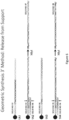
- Figure 2 shows four exemplary anchor primer sequences of the present disclosure attached to solid supports.
- the solid supports are beads.
- FIG. 2A shows an anchor primer sequence for use in a 3' extension geometric synthesis method of the present disclosure.
- the anchor primer sequence comprises a low-complexity polynucleotide that is attached to the solid support bead at its 5' terminus. The 3' terminus is therefore exposed for ligation and extension of nucleic acid fragments.
- Hybridized to the anchor primer sequence is a short reverse complementary oligonucleotide.
- the short reverse complementary oligonucleotide is hybridized such that the resulting double-stranded structure comprises a MlyI restriction site, shown in red font.
- Figure 2B shows an anchor primer sequence for use in a 5' extension geometric synthesis method of the present disclosure.
- the anchor primer sequence comprises a low-complexity polynucleotide that is attached to the solid support bead at its 3' terminus. The 5' terminus is therefore exposed for ligation and extension of nucleic acid fragments.
- Hybridized to the anchor primer sequence is a short reverse complementary oligonucleotide.
- the short reverse complementary oligonucleotide is hybridized such that the resulting double-stranded structure comprises a MlyI restriction site (shown in red font), an EcoRI restriction site (shown in green font), an EcoRV (shown in blue font) and a SbfI site (shown in purple font).
- FIG. 2C shows an anchor primer sequence for use in a 3' extension geometric synthesis method of the present disclosure.
- the anchor primer sequence comprises a low-complexity polynucleotide that is attached to the solid support bead at its 5' terminus. The 3' terminus is therefore exposed for ligation and extension of nucleic acid fragments.
- the anchor primer sequence comprises a deoxyuridine site (U) at the 3' terminus (shown in red) that can be transformed into an abasic site through the activity of Uracil DNA glycosylase. The resulting abasic site may then be cut using DNA glycosylate-lyase endonuclease VIII.
- Figure 2D shows an anchor primer sequence for use in a 5' extension geometric synthesis method of the present disclosure.
- the anchor primer sequence comprises a low-complexity polynucleotide that is attached to the solid support bead at its 3' terminus. The 5' terminus is therefore exposed for ligation and extension of nucleic acid fragments.
- the anchor primer sequence comprises a combination of deoxyadenosine (A) and deoxyinosine (I) at the 5' terminus (shown in red font) that can be cleaved by Endonuclease V.
- Anchor primers as described herein can be used in any method of the present disclosure, as described herein.
- Solid supports can include, but are not limited to, magnetic microscopic beads or non-magnetic microscopic beads.
- the beads can comprise polyacrylamide, polystyrene, crosslinked agarose, or other similar materials.
- Solid supports can include, but are not limited to, plastic or glass surfaces, such as the surfaces of wells of multi-well plates.
- solid supports may be treated to enhance the nucleic acid binding properties or permit specific enzymatic activities.
- solid supports may be treated to prevent non-specific or un-wanted binding.
- a solid support of the present disclosure can comprise a plurality of chambers.
- the chambers can be arranged in a grid.
- a solid support of the present disclosure can be a 6, 12, 24, 48, 96, 384 or 1536 well microplate. Chambers can be hold an array of beads with attached anchor primers.
- a solid support of the present disclosure can be connected to a microfluidic system for the delivery of reagents.
- Solid supports as described herein can be used in any method of the present disclosure, as described herein.
- a composition comprising a set of overlapping nucleic acid fragments.
- a set of overlapping nucleic acid fragments can comprise a plurality of nucleic acid fragments.
- Each nucleic acid fragment in the plurality of nucleic acid fragments can comprise at least about 2, or at least about 5, or at least about 10, or at least about 20, or at least about 25, or at least about 30, or at least about 35, or at least about 40, or at least about 45, or at least about 50, or at least about 55, or at least about 60, or at least about 65, or at least about 70, or at least about 75, or at least about 80, or at least about 85, or at least about 90, or at least about 95, or at least about 100, or at least about 105, or at least about 110, or at least about 115, or at least about 120, or at least about 125, or at least about 130, or at least about 135, or at least about 140, or at least about 145, or at least about 150 nucleotides.
- a first nucleic acid fragment can comprise a first region that is complementary to a second nucleic acid fragment
- the second nucleic acid fragment can comprise a first region that is complementary to the first nucleic acid fragment and a second region that is complementary to a third nucleic acid fragment
- the third nucleic acid fragment can comprise a first region that is complementary to the second nucleic acid fragment and a second region that is complementary to a fourth nucleic acid fragment, and so on and so forth.
- the regions of a nucleic acid fragment that are complementary to another nucleic acid fragment in a set can be referred to as the overlap regions.
- the overlap regions can comprise at least about 1 nucleotide, or at least about 2 nucleotides, or at least about 3 nucleotides, or at least about 4 nucleotides, or at least about 5 nucleotides, or at least about 6 nucleotides, or at least about 7 nucleotides, or at least about 8 nucleotides, or at least about 9 nucleotides, or at least about 10 nucleotides, or at least about 11 nucleotides, or at least about 12 nucleotides, or at least about 13 nucleotides, or at least about 14 nucleotides, or at least about 15 nucleotides, or at least about 16 nucleotides, or at least about 17 nucleotides, or at least about 18 nucleotides, or at least about 19 nucleotides, or at least about 20 nucleotides, or at least about 21 nucleotides, or at least about 22 nucleotides, or at least about 23 nucleo
- the regions of a nucleic acid fragment that are not complementary to another nucleic acid fragment can comprise at least about 30 nucleotides, or at least about 31 nucleotide, or at least about 32 nucleotides, or at least about 33 nucleotides, or at least about 34 nucleotides, or at least about 35 nucleotides, or at least about 36 nucleotides, or at least about 37 nucleotides, or at least about 38 nucleotides, or at least about 39 nucleotides, or at least about 40 nucleotides, or at least about 41 nucleotides, or at least about 42 nucleotides, or at least about 43 nucleotides, or at least about 44 nucleotides, or at least about 45 nucleotides, or at least about 46 nucleotides, or at least about 47 nucleotides, or at least about 48 nucleotides, or at least about 49 nucleotides, or at least about 50 nucleotides, or
- Overlapping sets of nucleic acid fragments as described herein can be used in any method of the present disclosure, as described herein.
- At least one of the nucleic acid fragments can be a chimeric nucleic acid fragment comprising a deoxyribose 5' (DNA) terminus and a ribose 3' (RNA) terminus. In some aspects, at least one of the nucleic acid fragments can be a chimeric nucleic acid fragment comprising a deoxyribose 3' (DNA) terminus and a ribose 5' (RNA) terminus.
- At least one of the nucleic acid fragments can be a chimeric nucleic acid fragment comprising a deoxyribose 5' (DNA) terminus and a deoxyribose 3' (DNA) terminus. In some aspects, at least one of the nucleic acid fragments can be a chimeric nucleic acid fragment comprising a ribose 5' (RNA) terminus and a ribose 3' (RNA) terminus.
- the nucleic acid fragments in a set of overlapping nucleic acid fragments can be an N-mer of the present disclosure.
- Methods of geometric synthesis include a geometric 3' method (also referred to as the 3' extension geometric synthesis method), a geometric 5' (also referred to as the 5' extension geometric synthesis method) method, a geometric transposase method, a geometric 3', 5' co-synthesis method (also referred to as the 5' extension and 3' extension geometric co-synthesis), a 3' extension parallel synthesis method and a 5' extension parallel synthesis method.
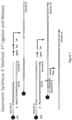
- Figures 1 and 15 depict a schematic overview of the geometric synthesis methods of the present disclosure.
- First a plurality of N-mers as described above is provided.
- Figures 1 and 15 there are 8 different N-mer species provided.
- anchor primers that are attached to solid supports.
- Ligation 1 a single N-mer is ligated onto the anchor primers that are attached to the solid support to create a N-men-anchor primer complex.
- Ligation 2 a second N-mer is ligated to the exposed end of the first N-mer to extend the first N-mer and create a N-mer 2 -anchor primer complex.
- a subset of the N-mer 2 -anchor primer complexes are designated to be donor samples and the other subset of the N-mer 2 -anchor primer complexes are designated to be target samples.
- the ligated N-mers are cleaved from the anchor primers in the donor samples, releasing a nucleic acid fragment that comprises two ligated N-mers.
- the released nucleic acid fragments are then ligated onto the exposed end of an N-mer in a target sample to extend the target sample N-men-anchor primer complex, thereby forming a N-mera-anchor primer complex.
- a subset of the N-mera-anchor primer complexes are designated to be donor samples and the other subset of the N-mera-anchor primer complexes are designated to be target samples.
- the ligated N-mers are cleaved from the anchor primers in the donor samples, releasing a nucleic acid fragment that comprises four ligated N-mers.
- the released nucleic acid fragments are then ligated onto the exposed end of an N-mer in a target sample to extend the target sample N-mer 4 -anchor primer complex, thereby forming a N-mers-anchor primer complex.
- a subset of the N-mer 8 -anchor primer complexes are designated to be donor samples and the other subset of the N-mer 8 -anchor primer complexes are designated to be target samples.
- the ligated N-mers are cleaved from the anchor primers in the donor samples, releasing a nucleic acid fragment that comprises eight ligated N-mers.
- the released nucleic acid fragments are then ligated onto the exposed end of an N-mer in a target sample to extend the target sample N-mer 8 -anchor primer complex, thereby forming a N-mer 16 -anchor primer complex.
- a 3' extension geometric synthesis method is a geometric synthesis as described in Figures 1 and 15 , wherein the anchor primers are attached to the solid support via their 5' termini, thereby leaving their 3' termini exposed for ligation and extension.
- a plurality of N-mers as described above is provided, wherein the N-mers comprise a -PO 4 group at the 3' terminus and the 5' terminus.
- anchor primers that are attached to a solid support via their 5' terminus.
- the 3' termini of the anchor primers which comprise an -OH group, are exposed for ligation and extension.
- a 3' extension geometric synthesis method can comprise the steps:
- step (10) can be repeated until the desired nucleic acid fragment has been synthesized.
- the desired nucleic acid fragment can then be released from the anchor primer to which it is ligated.
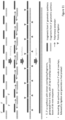
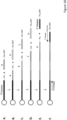
- Figures 3-8 show a schematic overview of an exemplary synthesis of a nucleic acid molecule using a 3' extension geometric synthesis method of the present disclosure.
- the nucleic acid to be synthesized comprises a fragment of the Aequorea victoria green-fluorescent protein (GFP).
- Figure 3A shows the entire coding region of the A. victoria GFP.
- the fragment to be synthesized is depicted in colored font and comprises the sequence:
- the fragment to be synthesized is subdivided into eight N-mers, wherein each N-mer comprises 21 nucleotides.
- the N-mers are depicted in different colored font in Figure 3A .
- the rest of the A. victoria GFP sequence can also be subdivided into N-mers comprising 21 nucleotides.
- each N-mer is assigned an identifier code as shown in Table 1.
- Table 1. N-mer sequences and identifier codes Identifier code Sequence SEQ ID NO 1aA1 TACACACGAATAAAAGATAAC 2 1aA2 ACTTTTCACTGGAGTTGTCCC 3 1aA3 CGATGTTAATGGGCAAAAATT 4 1aA4 AGGTGATGCAACATACGGAAA 5 1bA1 AAAGATGAGTAAAGGAGAAGA 6 1bA2 AATTCTTGTTGAATTAGATGG 7 1bA3 CTCTGTCAGTGGAGAGGGTGA 8 1bA4 ACTTACCCTTAAATTTATTTG 9
- the synthesis method continues by providing a plurality of anchor primers attached to solid supports, as shown in Figure 4 .
- the solid supports are beads and the anchor primers comprise the sequence GATATCGAGTCTTAAG (SEQ ID NO: 91).
- N-mers 1aA1, 1aA2, 1aA3, and 1aA4 are then provided with a 3' and a 5' -PO 4 group.
- N-mers 1aA1, 1aA2, 1aA3, and 1aA4 are then ligated onto the exposed 3' end of the anchor primers as shown in Figure 4 .
- a polymerase with 3'-5' exonuclease activity such as klenow polymerase, is added to remove any un-ligated anchor primers.
- Calf intestinal alkaline phosphatase (CIP) is then added to remove the 3' -PO 4 group on each of the ligated fragments. This step of synthesis results in nucleic acid fragments comprising the anchor primer and one of N-mers 1aA1, 1aA2, 1aA3, and 1aA4 attached to a solid bead, as shown in the right panel of Figure 4 .
- N-mer IbAl, 1bA2, 1bA3, and 1bA4 are then provided with a 3' and a 5' -PO 4 group.
- the 5' end of N-mer 1bA1 is ligated onto the 3' end of N-mer 1aA1
- the 5' end of N-mer 1bA2 is ligated onto the 3' end of N-mer 1aA2
- the 5' end of N-mer 1bA3 is ligated onto the 3' end of N-mer 1aA3
- the 5' end of N-mer 1bA4 is ligated onto the 3' end of N-mer 1aA4, as shown in the left panel of Figure 5 .
- CIP Calf intestinal alkaline phosphatase
- This step of synthesis results in the following nucleic acid fragments ligated to an anchor primer which is attached to a solid bead: a 1aA1-1bA1 fragment (1A1 fragment), a 1aA2-1bA2 fragment (1A2 fragment), a laA3-lbA3 fragment (1A3 fragment)and a laA4-lbA4 fragment (1A4 fragment).
- the anchor primer-1aA1-1bA1 fragment and the anchor primer-1aA3-1bA3 fragment do not have a 3' - PO 4 group.
- the anchor primer-1aA2-1bA2 fragment and the anchor primer-1aA4-1bA4 fragment do have a 3' -PO 4 group.
- the products of this synthesis step are shown in the right panel of Figure 5 .
- the synthesis method continues in Figure 6 .
- the 1A2 sample and the 1A4 samples are to be donor samples in the next synthesis round.
- a short reverse complementary oligonucleotide is mixed with the 1A2 sample and the 1A4 sample.
- the short reverse complementary oligonucleotide comprises the sequence CTATAGCTCAGAATTC (SEQ ID NO: 96) and is complementary to the anchor primer.
- the short reverse complementary oligonucleotide hybridizes to the anchor primer such that a double-stranded restriction endonuclease site is formed.
- the restriction endonuclease site is a MlyI restriction endonuclease site.
- the 1A2 sample and the 1A4 sample are incubated with MlyI restriction endonuclease, which cleaves at the MlyI restriction site, resulting in the release of the 1A2 fragment and 1A4 fragment.
- the synthesis method continues in Figure 7 .
- the 5' end of the 1A2 fragment is ligated onto the 3' end of the 1A1 fragment that is attached to the solid support to form a 1A1-1A2 fragment and the 5' end of the 1A4 fragment is ligated onto the 3' end of the 1A3 fragment that is attached to the solid support to form a 1A3-1A4 fragment.
- a polymerase with 3'-5' exonuclease activity such as klenow polymerase, is added to remove any un-ligated anchor primers.
- Calf intestinal alkaline phosphatase (CIP) is then added to remove the 3' -PO 4 group on the fragment.
- the 1A3-1A4 fragment is then incubated with the short reverse complementary oligonucleotide, which hybridizes to the anchor primer to form a double-stranded restriction endonuclease site.
- the site is a MlyI site.
- the sample is incubated with MlyI restriction endonuclease, which cleaves the MlyI restriction site to release the 1A3-1A4 fragment, as shown in the bottom panel of Figure 7 .
- the synthesis method continues in Figure 8 .
- the 5' end of the 1A3-1A4 fragment is ligated to the 3' end of the 1A1-1A2 fragment that is attached to the solid support to form a 1A1-1A2-1A3-1A4 fragment.
- a polymerase with 3'-5' exonuclease activity such as klenow polymerase, is added to remove any un-ligated anchor primers.
- the 1A1-1A2-1A3-1A4 fragment is then incubated with short reverse complementary oligonucleotide, which hybridizes to the anchor primer to form a double-stranded restriction endonuclease site.
- the site is a MlyI site.
- the sample After hybridization of the short reverse complementary oligonucleotide, the sample is incubated with MlyI restriction endonuclease, which cleaves the MlyI restriction site to release the 1A1-1A2-1A3-1A4 fragment (the fragment that was to be synthesized), as shown in the bottom panel of Figure 8 .
- the present disclosure provides a 3' extension parallel synthesis method.
- a 3' extension parallel synthesis method a plurality of 3' extension geometric synthesis reactions, as described above, are performed using N-mers and/or anchor primers that comprise a reversible block on the 3' -OH group.
- the plurality of reactions can be performed on a solid support comprising chambers that are arranged in a two-dimensional grid. At different stages of synthesis, certain reactions are allowed to proceed by removing the reversible block on the 3' -OH group in a particular chamber within the grid, thereby allowing the user to control what N-mer is incorporated in each step.
- a two-dimensional grid of reactions may begin with general attachment of 3' reversibly blocked anchor primers. If the incorporation of a specific N-mer, such as ACG, is required, then the region of the two-dimensional grid where the N-mer with the sequence ACG is required is unblocked, allowing the ACG N-mer to be incorporated only there. Such a process ensues for all 64 possible 3-mers suitably blocked at the 3' end. Any possible sequence combination can be manifest at any specific location on the grid.
- a specific N-mer such as ACG
- the reversible block may be removed by exposure to light.
- a two-dimensional grid of reactions may begin with general attachment of 3' reversibly blocked anchor primers. If the incorporation of a specific N-mer, such as ACG, is required, then the region of the two-dimensional grid where the N-mer with the sequence ACG is required is exposed to light, removing the reversible block in that region, allowing the ACG N-mer to be incorporated only there.
- a 5' extension geometric synthesis method is a geometric synthesis as described in Figures 1 and 15 , wherein the anchor primers are attached to the solid support via their 3' termini, thereby leaving their 5' termini exposed for ligation and extension.
- a plurality of N-mers as described above is provided, wherein the N-mers comprise a -OH group at the 3' terminus and the 5' terminus.
- anchor primers that are attached to a solid support via their 3' terminus.
- a 5' extension geometric synthesis method can comprise the steps:
- step (10) can be repeated until the desired nucleic acid fragment has been synthesized.
- the desired nucleic acid fragment can then be released from the anchor primer to which it is ligated.
- a plurality of N-mers as described above is provided, wherein the N-mers comprise an -OH group at the 3' terminus and a -PO 4 at the 5' terminus.
- the -PO 4 group can be attached a protecting group.
- the present disclosure provides a 5' extension parallel synthesis method.
- a 5' extension parallel synthesis method a plurality of 5' extension geometric synthesis reactions, as described above, are performed using N-mers and/or anchor primers that comprise a reversible block on the 5' -PO 4 group.
- the plurality of reactions can be performed on a solid support comprising chambers that are arranged in a two-dimensional grid. At different stages of synthesis, certain reactions are allowed to proceed by removing the reversible block on the 5' -PO 4 group in a particular chamber within the grid, thereby allowing the user to control what N-mer is incorporated in each step.
- a two-dimensional grid of reactions may begin with general attachment of 5' reversibly blocked anchor primers. If the incorporation of a specific N-mer, such as ACG, is required, then the region of the two-dimensional grid where the N-mer with the sequence ACG is required is unblocked, allowing the ACG N-mer to be incorporated only there. Such a process ensues for all 64 possible 3-mers suitably blocked at the 5' end. Any possible sequence combination can be manifest at any specific location on the grid.
- a specific N-mer such as ACG
- the reversible block may be removed by exposure to light.
- a two-dimensional grid of reactions may begin with general attachment of 5' reversibly blocked anchor primers. If the incorporation of a specific N-mer, such as ACG, is required, then the region of the two-dimensional grid where the N-mer with the sequence ACG is required is exposed to light, removing the reversible block in that region, allowing the ACG N-mer to be incorporated only there.
- a geometric transposase method comprises the use of a collection of plasmids with reverse oriented left and right terminal repeats derived from a precisely excising transposable element, such as piggyBac, as shown in the bottom panel Figure 12 .
- Each plasmid in the collection carries a different N-mer (e.g. a 3-, 4-, and 5-mers) that is flanked by reverse oriented left and right terminal repeats.
- An N-mer flanked by reverse oriented left and right terminal repeats is herein referred to as a transposable N-mer.
- each required transposable N-mer is excised from its plasmid backbone by an appropriate restriction endonuclease (RE) or similar digestion along with the flanking reverse oriented left and right terminal repeats, as shown in the top panel of Figure 12 .
- RE restriction endonuclease
- a plurality of anchor primers attached to a solid support are then provided.
- a geometric transposase method can comprise:
- Figure 13 shows a schematic overview of a geometric transposase method of the present disclosure.
- step (10) can be repeated until the desired nucleic acid fragment has been synthesized.
- the desired nucleic acid fragment can then be released from the anchor primer to which it is ligated.
- a geometric 3', 5' co-synthesis method comprises the use of a set of overlapping nucleic acid fragments, as described above.
- the bottom panel of Figure 10 shows a set of six overlapping nucleic acid fragments.
- a geometric 3', 5' co-synthesis method can comprise:
- Figure 11 shows a schematic overview of a geometric 3', 5' co-synthesis method.
- the set of overlapping nucleic acid fragments can be generated using any method of the present disclosure, including but not limited to, a geometric transposase method of the present disclosure, a 3' extension geometric synthesis method of the present disclosure, a 5' extension geometric synthesis method or any combination thereof.
- FIG. 18 depicts a schematic overview of the 5' modular linear synthesis method of the present disclosure.
- an anchor primer is first attached to a solid support, either directly or indirectly, via the 3' terminus of the anchor primer.
- the next step of the 5' modular synthesis method is to ligate the 3' terminus of an N-mer of the present disclosure to the 5' terminus of the anchor primer attached to the solid support. This step is shown in panel A of Figure 18 , where an N-mer labeled "A" is ligated onto an anchor primer referred to as a "T7 Anchor".
- any optional protecting groups on the 5' terminus of the ligated N-mer can be removed prior to the next ligation step.
- the method continues with the ligation of the 3' terminus of a second N-mer to the 5' end of the ligated first N-mer.
- This step is shown in panel B of Figure 18 , where an N-mer labeled "B" is ligated onto the "A" N-mer.
- any optional protecting groups on the 5' terminus of the newly ligated N-mer can be removed prior to the next ligation step.
- the method continues with the ligation of the 3' terminus of a third N-mer to the 5' end of the ligated second N-mer.
- This step is shown in panel C of Figure 18 , where an N-mer labeled "C" is ligated onto the "B" N-mer.
- any optional protecting groups on the 5' terminus of the newly ligated N-mer can be removed prior to the next ligation step.
- the method continues with the ligation of the 3' terminus of a fourth N-mer to the 5' end of the ligated third N-mer. This step is shown in panel D of Figure 18 , where an N-mer labeled "D" is ligated onto the "C” N-mer.
- the ligation steps in the 5' modular linear synthesis method can be repeated as many times as necessary using the appropriate N-mers to generate any full length nucleotide sequence.
- the present disclosure also provides a 3' modular linear synthesis method.
- a 3' modular linear synthesis method an anchor primer is first attached to a solid support, either directly or indirectly, via the 5' terminus of the anchor primer.
- the next step of the 3' modular synthesis method is to ligate the 5' terminus of an N-mer of the present disclosure to the 3' terminus of the anchor primer attached to the solid support.
- any optional protecting groups on the 3' terminus of the ligated N-mer can be removed prior to the next ligation step.
- the method continues with the ligation of the 5' terminus of a second N-mer to the 3' end of the ligated first N-mer. Following this second ligation step, any optional protecting groups on the 3' terminus of the newly ligated N-mer can be removed prior to the next ligation step.
- the method continues with the ligation of the 5' terminus of a third N-mer to the 3' end of the ligated second N-mer. Following this third ligation step, any optional protecting groups on the 3' terminus of the newly ligated N-mer can be removed prior to the next ligation step.
- the method continues with the ligation of the 5' terminus of a fourth N-mer to the 3' end of the ligated third N-mer.
- the ligation steps in the 3' modular linear synthesis method can be repeated as many times as necessary using the appropriate N-mers to generate any full length nucleotide sequence.
- N-mers and/or anchor primers can comprise a deoxyribose 5' (DNA) terminus and a ribose 3' (RNA) terminus.
- N-mers and/or anchor primers that comprise deoxyribose 5' (DNA) termini and a ribose 3' (RNA) termini exhibit increased ligation effincies as compared to the ligation of two fragments both 5' and 3' deoxyribose (DNA) termini or both 5' and 3' ribose (RNA) termini.
- any ligated N-mers can be adenylated at the 5' terminus.
- the N-mers can be adenylated using methods known in the art, including, but not limited to, treating the N-mers with Mth RNA ligase.
- any ligated N-mers can be phosphorylated at the 5' terminus.
- the N-mers can be phosphorylated using methods known in the art, including, but not limited to, treating the N-mers with T4 polynucleotide kinase.
- un-ligated N-mers and unattached anchor primers can be digested and removed using an exonuclease.
- a 5' to 3' exonuclease can be used to digest and remove un-ligated N-mers and unattached anchor primers.
- a 3' to 5' exonuclease can be used to digest and remove un-ligated N-mers
- the N-mers and/or ligated N-mers to be digested can be de-adenylated.
- De-adenylation can be accomplished using methods known in the art, including, but not limited to, treating the N-mers with S. cerevisiae 5' deadenylase.
- protecting groups located on the 5' or 3' end of an N-mer can be removed using methods known in the art. These methods can include, but are not limited to, acid and base washing steps.
- Baby Spinach enhances the fluorescence of 3,5-difluoro-4-hydroxybenzylidne imidazolinone (DFHBI), a compound that mimics the fluorescent core of fluorescent protenis like green fluorescent proteins (GFP).
- DHBI 3,5-difluoro-4-hydroxybenzylidne imidazolinone
- GFP green fluorescent proteins
- the anchor primer comprised a 5' phosphate group followed by a T7 promoter sequence (CTATAGTGAGTCGTATTA, SEQ ID NO: 10), followed by a DNA sequence spacer, followed by a tetraethylene glycol (TEG) spacer covalently linked to a biotin moiety.
- This anchor primer herein referred to as the "AB anchor primer” comprised the sequence CTATAGTGAGTCGTATTACCGTAGTGCTGCGTCGAGTGT (SEQ ID: 11).
- the anchor primer comprised a 5' phosphate group linked to a deoxyuracil nucleotide, followed by a DNA sequence spacer, followed by a tetraethylene glycol (TEG) spacer covalently linked to a biotin moiety.
- This anchor primer herein referred to as the "CD anchor primer” comprised the sequence dUCCATTGTGAGTCTTATTTCCGTAGTGCTGCGTCGAGTGTC (SEQ ID NO: 12).
- each biotinylated anchor primer was attached to the streptavidin-coated, magnetic beads (MyOne Dynal, Invitrogen) by incubating 500 pmols of the anchor primer for each 1 mg of beads used, such that the concentration of anchor primer in the reaction was 1 ⁇ M and the concentration of beads was 2 mg/ml.
- the incubation buffer comprised phosphate-buffered saline (PBS) with 0.01% TWEEN20. The reactions were incubated for 30 minutes at room temperature and vortexed. After incubation, the beads were washed three times with 0.7 ml of wash buffer comprising (20 mM HEPES, 0.01% TWEEN20, pH 8.0). The beads were then suspended in the wash buffer at a concentration of 10 mg/ml and stored at 4° C until further use.
- Each N-mer comprised a 5' DMT-PO 4 group attached to an initial deoxyribonucleotide (dN)and a ribonucleotide (rN) at the 3' end.
- the DMT-PO 4 group provides a block to subsequent ligations after a single oligonucleotide is ligated to the growing chain.
- the Baby Spinach sequence was divided into three 12-mers (Fragments A, B and C) and a 15-mer (Fragment D).
- the sequences of Fragments A-D are shown in Table 2.
- Table 2. N-mer sequences Fragment Name Sequence SEQ ID NO Fragment A CCGTCCTTCACrC 13 Fragment B GAACTACTGGArC 14 Fragment C CTCAACAGTAGrC 15 Fragment D GGAGCTCACACTCTrA 16
- Fragment A was ligated onto the 5' end of the AB anchor primer attached to the magnetic beads and Fragment C was ligated onto the 5' end of the CD anchor primer attached to magnetic beads, as shown in panel A of Figure 16 .
- 2.5 ⁇ M of anchor primer/beads were incubated with 0.5 ⁇ M of the respective fragment (A or C) in the presence of 1.5 units/ ⁇ l of T4 RNA ligase 1 in a buffer comprising 20 mM HEPES pH 8.0, 50 mM Potassium Acetate, 10 mM Magnesium Acetate, 0.1 mg/ml BSA and 0.01% TWEEN 20.
- the ligation reactions were incubated at 21° C for 30 minutes. After the ligation reaction, the beads were washed using a magnetic separator by washing three times with 0.7 ml of a buffer comprising 20 mM HEPES pH 8.0 and 0.01% TWEEN 20, followed by a wash with 0.7 ml of 0.01% TWEEN 20.
- the 5' PO 4 group of each ligated Fragment A and Fragment C were deprotected via an acid/base wash to allow for a second round of ligation.
- the beads were washed once with the ligation buffer, then once with 0.01% TWEEN 20, and then finally once briefly with acid buffer 3% dichloroacetic acid (DCA) in H 2 O. After these washes, the beads were then incubated in acid buffer 3% dichloroacetic acid (DCA) in H 2 O for 30 minutes with constant stirring.
- the beads were then washed with basic buffer comprising 1:9 Carbonate:Bicarbonate (-pH 9.0) and 0.01% TWEEN 20 and then incubated with the same buffer for 10 minutes with constant stirring. Finally, the beads were washed once with 0.01% TWEEN 20 and then washed twice with the ligation buffer.
- Fragment B was ligated to the 5' end of the ligated Fragment A (linked to the AB anchor primer and beads) to form a ligated Fragment AB and Fragment D was ligated to the 5' end of ligated Fragment C (linked to the CD anchor primer and beads) to form a ligated Fragment CD, as shown panel B of Figure 16 .
- the ligation reaction conditions were the same as for the first ligation described above.
- the 5' PO 4 group on ligated Fragment AB was deprotected using the same acid/base wash described above, as show in panel C of Figure 16 .
- the CD beads, now linked to the CD anchor primer ligated to Fragment CD were treated with uracil-N-deglycosylase (UNG) to remove the uracil base, leaving an abasic nucleotide.
- UNG uracil-N-deglycosylase
- the beads were then treated with either Endo IV or APE-1, which are endonucleases capable of cutting at a single stranded abasic site, thereby releasing the Fragment CD from the anchor primer and beads, as shown in panel C of Figure 16 .
- the untethered fragment CD was then ligated onto 5' end of the fragment AB (linked to the AB anchor primer and beads) using the ligation conditions described above to generate the complete sequence template for Baby Spinach, as shown in panel D of Figure 16 .
- the Baby Spinach template was then amplified via polymerase chain reaction (PCR) using a primer complementary to the T7 promoter sequence in the AB anchor primer and a primer complementary to a portion of Fragment D, as shown in panel D of Figure 16 .
- PCR polymerase chain reaction
- Figure 17 shows polyacrylamide gel analysis of the 5' extension geometric synthesis of the Baby Spinach sequence template described above. Contents of each lane of the gel are described in Table 3 Table 3. Lane descriptions Lane # Description 1 100 bp marker 2 PCR of positive control, full length Baby Spinach construct 3 AB anchor primers (AB beads) 4 AB beads after ligation of Fragment A onto anchor primer (1 st ligation) 5 AB beads after ligation of Fragment B onto Fragment A (2 nd ligation) 6 CD anchor primers (CD beads) 7 CD beads after ligation of Fragment C onto anchor primer and Fragment D onto Fragment C (1 st and 2 nd ligations) 8 Sample of lane 7 after treatment with UDG and cleavage with Endo IV 9 Sample of lane 8 after ligation of released Fragment CD onto Fragment AB (3 rd ligation) 10 PCR amplification of lane 9 11 Sample of lane 7 after treatment with UDG and cleavage with APE-1 12 Sample of
- Baby Spinach enhances the fluorescence of DFHBI.
- ligation and deprotection reactions are performed under the same conditions as described in Example 1 of the instant specification.
- biotinylated anchor primer comprising a T7 promoter sequence and a 5' PO 4 group were attached to streptavidin-coated, magnetic beads, using the anchor primer attachment method described in Example 1.
- a second ligation reaction was performed wherein Fragment B was ligated to the 5' end of the ligated Fragment A (linked to the anchor primer and beads) to form a ligated Fragment AB, as shown in the panel B of Figure 18 .
- the 5' PO 4 group of the ligated Fragment AB was then deprotected.
- a third ligation reaction was performed wherein Fragment C was ligated to the 5' end of the ligated Fragment AB (linked to the anchor primer and beads) to form a ligated Fragment ABC, as shown in the panel C of Figure 18 .
- the 5' PO 4 group of the ligated Fragment ABC was then deprotected.
- a fourth ligation reaction was performed wherein Fragment D was ligated to the 5' end of the ligated Fragment ABC (linked to the anchor primer and beads) to form a ligated Fragment ABCD, as shown in the panel D of Figure 18 .
- Ligated Fragment ABCD corresponds to the full length Baby Spinach template sequence.
- the 5' PO 4 group of the ligated Fragment ABCD was then deprotected.
- a fifth ligation reaction was performed wherein a 5' adapter oligonucleotide was ligated to the 5' end of the ligated Fragment ABCD, as shown in Panel E of Figure 18 .
- the 5' adapter oligonucleotide comprised a 5' DMT-PO 4 group.
- the ligated Fragment ABCD was amplified via PCR using a primer complementary to the T7 promoter sequence located in the anchor primer and a primer complementary to the 5' adapter oligonucleotide, as shown in Panel F of Figure 18 .
- the primer complementary to the 5' adapter oligonucleotide also comprised a 5' TEG and biotin moiety.
- the PCR reaction was purified using streptavidin beads.
- the amplified full length Baby Spinach template was used to synthesize the Baby Spinach RNA aptamer using RNA polymerase I.
- the synthesized aptamer and a control aptamer (synthesized from a DNA oligo synthesized using current methods in the art) were then incubated with 20 ⁇ M DFHBI.
- both the synthesized aptamer and the control aptamer enhanced the fluorescence of DFHBI, showing the methods of the present disclosure can be used to effectively synthesize polynucleotide molecules that can be used in a variety of different applications.
- Figure 20 shows polyacrylamide gel analysis of the 5' modular linear synthesis method of the Baby Spinach sequence template described above. Contents of each lane of the gel are described in Table 4 Table 4. Lane descriptions Lane # Description 1 100 bp marker 2 Anchor primer 3 Full length control Baby Spinach construct 4 Beads after ligation of Fragment A onto anchor primer (1 st ligation) 5 Beads after ligation of Fragment B onto Fragment A (2 nd ligation) 6 Beads after ligation of Fragment C onto Fragment AB (3 rd ligation) 7 Beads after ligation of Fragment D onto Fragment ABC (4 th ligation) 8 Beads after ligation of 5' adapter oligonucleotide onto Fragment ABCD (5 th ligation) 9 PCR amplification of lane 8 10 Biotin cleanup of lane 9 11 Transcription of lane 10 to make Baby Spinach RNA aptamer
- biotinylated anchor primer comprising a 5' POa group, a DNA spacer sequence and a TEG spacer covalently linked to a biotin moiety was attached to streptavidin-coated, magnetic beads, using the anchor primer attachment method described in Example 1.
- This anchor primer comprised the sequence CTATAGTGAGTCGTATTACCGTAGTGCTGCGTCGAGTGT (SEQ ID: 11).
- Each N-mer comprised a 5' PO 4 group attached to an initial deoxyribonucleotide (dN)and a ribonucleotide (rN) at the 3' end.
- dN deoxyribonucleotide
- rN ribonucleotide
- the Baby Spinach sequence was divided into three 12-mers (Fragments A, B and C) and a 15-mer (Fragment D).
- the sequences of Fragments A-D are shown in Table 2.
- the 5' modular linear synthesis reaction using these Fragments was performed as described in Example 2, with the exception that after each ligation step, no deprotecting step was performed. Instead, before the first ligation step and after each ligation step thereafter, the sample is treated with Mth RNA ligase, which adenylates the 5' end of the ligated fragments attached to the beads via their 5' PO 4 group. The adenylated 5' end is then primed for the next ligation.
- Figure 21 shows polyacrylamide gel analysis of the 5' modular linear synthesis method with 5' adenylation of the Baby Spinach sequence template described above. Contents of each lane of the gel are described in Table 5. Table 5. Lane descriptions Lane # Description 1 100 bp marker 2 Anchor primer 3 After 4 th ligation step (Fragment ABCD attached to beads)
- This example shows that the methods of the present disclosure can be controlled by 5' adenylation of the growing 5' ends.
- biotinylated anchor primer comprising a 5' PO 4 group, a DNA spacer sequence and a TEG spacer covalently linked to a biotin moiety was attached to streptavidin-coated, magnetic beads, using the anchor primer attachment method described in Example 1.
- This anchor primer comprised the sequence TGGAATTCTCGGGTGCCAAGGATGTTTTTTTTTTT (SEQ ID: 17).
- Each N-mer comprised a 5' initial deoxyribonucleotide (dN) and a ribonucleotide (rN) at the 3' end.
- dN deoxyribonucleotide
- rN ribonucleotide
- the Baby Spinach sequence was divided into three 12-mers (Fragments A, B and C) and a 15-mer (Fragment D).
- the sequences of Fragments A-D are shown in Table 2.
- the 5' modular linear synthesis reaction using these fragments was performed as described in Example 2, with the exception that after each ligation step, no deprotecting step was performed. Instead, after each ligation step, the sample is treated with T4 polynucleotide Kinase to phosphorylate the growing 5' end, thereby facilitating the next ligation step.
- Figure 22 shows polyacrylamide gel analysis of the 5' modular linear synthesis method with 5' phosphorylation of the Baby Spinach sequence template described above. Contents of each lane of the gel are described in Table 6. Table 6. Lane descriptions Lane # Description 1 100 bp marker 2 Anchor primer 3 After 1 st ligation step (Fragment A attached to beads) 4 After 2 st ligation step (Fragment AB attached to beads) 5 After 3 st ligation step (Fragment ABC attached to beads) 6 After 4 st ligation step (Fragment ABCD attached to beads)
- This example shows that the methods of the present disclosure can be controlled by 5' phosphorylation of the growing 5' ends.
- the following is an example that uses the 3' extension geometric synthesis method of the present disclosure to generate a synthetic oligonucleotide.
- biotinylated anchor primer comprising a 5' Biotin moiety group linked to a TEG spacer, followed by a DNA spacer sequence, followed by a terminal 3' ribonucleotide (rN) was attached to streptavidin-coated, magnetic beads, using the anchor primer attachment method described in Example 1.
- This anchor primer comprised the sequence TTTTTTTTTTGTAGTGCTGCGTGCTCTTCrA (SEQ ID: 18).
- Substrate A For subsequent ligation reactions, an oligonucleotide fragment, herein referred to as "Substrate A” was used.
- Substrate A comprised a 5' PO 4 group, followed by a ribonucleotide sequence, followed by a 3' PO 4 group.
- the ribonucleotide sequence of Substrate A comprised the sequence: rGrGrUrGrArArGrGrArCrGrG (SEQ ID NO: 19).
- substrate A was ligated onto the 3' end of the anchor primer attached to the magnetic beads using the ligation reaction conditions described in Example 1.
- another substrate A was ligated onto the 3' end of the substrate A ligated to the anchor primers, creating an "AA fragment".
- the magnetic beads were split into two pools: pool 1 and pool 2.
- Pool 1 was incubated with a single stranded DNA oligonucleotide herein referred to as a short reverse complementary oligonucleotide, comprising the nucleotide sequence: GAAGAGCACGCAGCACTAC (SEQ ID NO: 20).
- the short reverse complementary oligonucleotide comprises a sequence such that the short reverse complementary oligonucleotide hybridizes to the anchor primer to create a double-stranded DNA molecule that is cleavable by the Nt.BspQI nicking endonuclease.
- the Pool 1 sample was treated with Nt.BspQI, thereby releasing ligated A fragments and ligated AA fragments.
- the released, ligated A and ligated AA fragments were then incubated with the rSAP-treated pool 2 and a ligation reaction performed to ligate the released fragments to the AA fragments attached to the anchor primers.
- the result is the synthesis of complete AAAA fragments as well as several lower molecular weight products.
- Figure 23 shows polyacrylamide gel analysis of the 3' extension geometric synthesis method described above. Contents of each lane of the gel are described in Table 7. Table 7. Lane descriptions Lane # Description 1 100 bp marker 2 Anchor primer 3 After 1 st ligation step (Fragment A attached to beads) 4 After 2 nd ligation step (Fragment AA attached to beads) 5 After incubation with short reverse complementary oligonucleotide and Nt.BspQI (released 6 After 3 rd ligation step
- biotinylated anchor primer comprising a 5' PO 4 group, followed by a DNA spacer sequence, followed by a TEG spacer linked to a biotin moiety was attached to streptavidin-coated, magnetic beads, using the anchor primer attachment method described in Example 1.
- This anchor primer comprised the sequence TGGAATTCTCGGGTGCCAAGGATGTTTTTTTTTTTTT (SEQ ID: 17).
- N-mer sequences N-mer Sequence SEQ ID NO Chimera 1 CC rG - Chimera 2 TC rC - Chimera 3 CCGTCCTTCAC rC 21 RNA 12-mer rGrArGrUrGrUrGrArGrCrUrC 22 RNA 6-mer rCrArGrCrUrU - RNA 3-mer rCrUrG -
- XRN-1 a S. cerevisiae exonuclease which is dependent on the presence of a 5' PO4 group, was tested to determine if the enzyme can remove the un-ligated nucleic acids in the reactions described above.
- XRN-1 is capable of digesting both RNA and DNA and capable of digesting single stranded nucleic acids.
- DNA-to-RNA ligations have a higher efficiency than DNA-to DNA ligations when using T4 RNA ligase I. More specifically, the most efficient combination is a 3' ribonucleotide and a 5' deoxyribonucleotide, regardless of whether the 3' ribonucleotide is part of a chimeric molecule (a combination of DNA and RNA) or an RNA molecule.
- the sequence of the N-mers are shown in Table 11.
- the 5' PO 4 Donor N-mer further comprised a 5' PO 4 group and a 3' TEG linker attached to a biotin moiety.
- the Chimera N-mer further comprised a 5' biotin moiety linked to an initial deoxyribonucleotide (T) and a terminal 3' ribonucleotide (rG).
- T initial deoxyribonucleotide
- rG terminal 3' ribonucleotide
- N-mer sequences N-mer Sequence SEQ ID NO 5' PO 4 Donor N-mer 23 DNA N-mer GACACATGAAAGCTTGAATTCACGGCATATGAGTCCATGG 24 Chimera N-mer TTTTTTTTTTCTTCCGATCTGAGTCCAGCrG 25 RNA N-mer rGrUrUrCrArGrArGrUrUrCrUrArCrArGrUrCrCrGrArCrGrArUrC 26
- Figure 26 shows that where there is a 3' OH group on a ribonucleotide and a 5' PO4 group on a deoxynucleotide there is a much greater conversion to product, indicating higher ligation efficiency.
- a nucleic acid with 3' ribonucleotide either pure RNA or a chimera with a terminal 3' ribonucleotide, has a greater efficiency of ligation.
- the 5' PO 4 Internal Fluor A, 5' PO 4 Internal Fluor C, 5' PO 4 Internal Fluor G and 5' PO 4 Internal Fluor T N-mers comprised an internal fluorescein-labeled nucleotide (a base-labelled thymine; Fluor-T), a 5' PO 4 group and a 3' TEG linker attached to a biotin moiety.
- the 5' Cy5 Deoxy C, 5' Cy5 Deoxy G and 5' Cy5 Deoxy T N-mers (herein referred to collectively as the 5' Cy5 Deoxy N-mers) comprised a 5' Cy5 fluorescent label.
- the 5' Cy5 Ribo A N-mer, Cy5 Ribo C N-mer, Cy5 Ribo G N-mer and Cy5 Ribo T N-mer (herein reffered to collectively as the 5' Cy5 Ribo N-mers) comprised a 5' Cy5 fluorescent label and a terminal 3' ribonucleotide (rA, rC, rG or rT). Table 13.
- N-mer sequences N-mer Sequence SEQ ID NO 5' PO 4 Internal Fluor A N-mer 27 5' PO 4 Internal Fluor C N-mer 28 5' PO 4 Internal Fluor G N-mer 29 5' PO 4 Internal Fluor T N-mer 30 5' Cy5 Deoxy C N-mer ACTAGTTACGGAGCTCAC 31 5' Cy5 Deoxy G N-mer TGAATGAAATGGTGAAGG 32 5' Cy5 Deoxy T N-mer CGCTTTAGGTTAAGACT 33 5' Cy5 Ribo A N-mer GGAGCTCACACTCTACTCArA 34 5' Cy5 Ribo C N-mer GGAGCTCACACTCTACTCArC 35 5' Cy5 Ribo G N-mer GGAGCTCACACTCTACTCArG 36 5' Cy5 Ribo T N-mer GGAGCTCACACTCTACTCArT 37
- Figure 27 shows that when the 3' terminal base and the 5' terminal base that are being ligated are both DNA, the ligation yield (efficiency) is significantly lower than when the 3' terminal base is a ribonucleotide and the 5' base is a deoxyribonucleotide.
- each of the 4 different population of beads were then separately incubated with each of the Cy5 Ribo N-mers and a ligation reaction was performed.
- Figure 28 that there is little or no bias among the four different ribonucleotides in terms of ligation yield (efficiency), indicating little to no sequence bias in ligation.
- Example 8 Attaching anchor primers to a solid support using Click chemistry
- oligonucleotides such as anchor primers
- click chemistry see e.g. Hao, J., Huang, L. L., Zhang, R., Wang, H. Z. & Xie, H. Y.
- Anal Chem 84, 8364-8370, 2012 and used in the synthesis methods of the present disclosure.
- an anchor primer comprising a 5' PO 4 group, followed by a DNA spacer sequence, followed by a 3' Dibenzylcyclooctyne (DBCO) group was used.
- the DNA spacer sequence comprised the nucleotide sequence:
- the anchor primer was first attached via its 3' terminus to azide coated magnetic beads using click chemistry. After attachment of the anchor primer, the 3' terminus of an RNA N-mer (rArGrUrUrCrUrGrCrArGrUrCrUrGrCrArGrArArArArArArArArArArArArArArArArArArArArArArArArArArArArArArArArA, SEQ ID NO: 39) was ligated to the exposed 5' terminus of the anchor primer.
- an anchor primer comprising a 5' PO 4 group, followed by a 5' terminal ribonucleotide (rU), followed by a DNA spacer sequence (CCATGGACTCATATGCCGTGAA, SEQ ID NO: X), followed by a TEG linker attached to a biotin moiety, was attached to streptavidin coated beads and ligated to the same RNA N-mer.
- Figure 29 shows polyacrylamide gel analysis of the two ligation reactions described above. Contents of each lane are described in Table 14. Table 14 Lane descriptions Lane # Description 1 100 bp marker 2 RNA N-mer 3 Biotinylated anchor primer on streptavidin beads 4 RNA N-mer ligated onto biotinylated anchor on beads 5 DBCO anchor primer on azide ebads 6 RNA N-mer ligated onto DBCO anchor primer on beads
- Figure 29 shows that both the click-attached anchor primer and the biotin attached anchor primer are suitable for ligation of the RNA N-mer.
- both click-attached anchor primers and biotin attached anchor primers can be used in the methods of the present disclosure.
Landscapes
- Life Sciences & Earth Sciences (AREA)
- Chemical & Material Sciences (AREA)
- Health & Medical Sciences (AREA)
- Engineering & Computer Science (AREA)
- Organic Chemistry (AREA)
- Genetics & Genomics (AREA)
- Zoology (AREA)
- Wood Science & Technology (AREA)
- Molecular Biology (AREA)
- General Engineering & Computer Science (AREA)
- Biotechnology (AREA)
- Bioinformatics & Cheminformatics (AREA)
- Biomedical Technology (AREA)
- Biochemistry (AREA)
- Microbiology (AREA)
- General Health & Medical Sciences (AREA)
- Chemical Kinetics & Catalysis (AREA)
- Physics & Mathematics (AREA)
- Biophysics (AREA)
- General Chemical & Material Sciences (AREA)
- Plant Pathology (AREA)
- Analytical Chemistry (AREA)
- Proteomics, Peptides & Aminoacids (AREA)
- Immunology (AREA)
- Crystallography & Structural Chemistry (AREA)
- Measuring Or Testing Involving Enzymes Or Micro-Organisms (AREA)
- Enzymes And Modification Thereof (AREA)
Claims (12)
- Procédé comprenant :a) la mise en contact d'au moins une première pluralité de supports solides et d'au moins une première pluralité d'amorces d'ancrage, dans des conditions permettant la fixation d'une terminaison 3' d'au moins une amorce d'ancrage de l'au moins une première pluralité d'amorces d'ancrage à au moins un support solide de l'au moins une première pluralité de supports solides pour produire au moins un premier complexe amorce d'ancrage-substrat, les amorces d'ancrage dans la première pluralité d'amorces d'ancrage comprenant au moins une désoxyuridine à la terminaison 5' ;b) la mise en contact de l'au moins un premier complexe amorce d'ancrage-substrat et d'au moins une première pluralité de N-mères dans des conditions qui joignent une terminaison 3' d'au moins un N-mère de l'au moins une première pluralité de N-mères à une terminaison 5' de l'au moins un premier amorce d'ancrage-substrat pour produire au moins un premier complexe amorce d'ancrage-substrat étendu, la première pluralité de N-mères comprenant un groupe PO4 à la terminaison 5', le groupe PO4 étant lié de manière opérationnelle à un groupe protecteur ;c) l'élimination du groupe protecteur de l'au moins un premier complexe amorce d'ancrage-substrat étendu ;d) la mise en contact de l'au moins un premier complexe amorce d'ancrage-substrat étendu et d'au moins une deuxième pluralité de N-mères dans des conditions qui joignent une terminaison 3' d'au moins un N-mère de l'au moins une deuxième pluralité de N-mères à une terminaison 5' de l'au moins un premier complexe amorce d'ancrage-substrat étendu pour produire au moins un premier complexe donneur, la deuxième pluralité de N-mères comprenant un groupe PO4 à la terminaison 5', le groupe PO4 étant lié de manière opérationnelle à un groupe protecteur ;e) la mise en contact d'au moins une deuxième pluralité de supports solides et d'au moins une deuxième pluralité d'amorces d'ancrage, dans des conditions permettant la fixation d'une terminaison 3' d'au moins une amorce d'ancrage de l'au moins une deuxième pluralité d'amorces d'ancrage à au moins un support solide de l'au moins une deuxième pluralité de supports solides pour produire au moins un deuxième complexe amorce d'ancrage-substrat ;f) la mise en contact de l'au moins un deuxième complexe amorce d'ancrage-substrat et d'au moins une troisième pluralité de N-mères dans des conditions qui joignent une terminaison 3' d'au moins un N-mère de l'au moins une troisième pluralité de N-mères à une terminaison 5' de l'au moins un deuxième amorce d'ancrage-substrat pour produire au moins un deuxième complexe amorce d'ancrage-substrat étendu, la troisième pluralité de N-mères comprenant un groupe PO4 à la terminaison 5', le groupe PO4 étant lié de manière opérationnelle à un groupe protecteur ;g) l'élimination du groupe protecteur de l'au moins un deuxième complexe amorce d'ancrage-substrat étendu ;h) la mise en contact de l'au moins un deuxième complexe amorce d'ancrage-substrat étendu et d'au moins une quatrième pluralité de N-mères dans des conditions qui joignent une terminaison 3' d'au moins un N-mère de l'au moins une quatrième pluralité de N-mères à une terminaison 5' de l'au moins un deuxième complexe amorce d'ancrage-substrat étendu pour produire au moins un premier complexe cible, la quatrième pluralité de N-mères comprenant un groupe PO4 à la terminaison 5', le groupe PO4 étant lié de manière opérationnelle à un groupe protecteur ;i) la libération d'au moins une composition comprenant l'au moins un N-mère de l'au moins une première pluralité de N-mères et l'au moins un N-mère de l'au moins une deuxième pluralité de N-mères à partir de l'au moins un premier complexe donneur pour produire au moins un complexe intermédiaire libéré par mise en contact de l'au moins un premier complexe donneur avec une combinaison d'uracile ADN glycosylase et d'au moins une parmi l'ADN glycosylate-lyase endonucléase VIII, Endo IV et APE-1 ; etj) l'élimination du groupe protecteur de l'au moins un premier complexe cible ;k) la mise en contact de l'au moins un premier complexe cible et de l'au moins un complexe intermédiaire libéré dans des conditions qui joignent une terminaison 3' de l'au moins un complexe intermédiaire libéré à une terminaison 5' de l'au moins un complexe cible pour produire au moins un premier complexe cible étendu,dans lequel les amorces d'ancrage des première et deuxième pluralités d'amorces d'ancrage comprennent une terminaison 5' désoxyribose (ADN), etdans lequel les N-mères des première, deuxième, troisième et quatrième pluralités de N-mères sont des N-mères chimériques comprenant une terminaison désoxyribose 5' (ADN) et une terminaison ribose 3' (ARN).
- Procédé selon la revendication 1, dans lequel la jonction :a) comprend une ligature enzymatique dans des conditions permettant une activité de ligase, la ligature enzymatique comprenant de préférence une activité d'ARN ligase T4 ; oub) comprend une ligature qui n'est pas enzymatique.
- Procédé selon la revendication 1 ou la revendication 2, comprenant en outre :a) après la production de l'au moins un premier complexe amorce d'ancrage-substrat, l'élimination d'au moins une amorce d'ancrage non fixée ; oub) après la production de l'au moins un deuxième complexe amorce d'ancrage-substrat, l'élimination d'amorces d'ancrage non fixées.
- Procédé selon la revendication 3, dans lequel l'élimination de l'au moins une amorce d'ancrage non fixée comprend une activité d'exonucléase, l'activité d'exonucléase comprenant de préférence une exonucléase 5' à 3' spécifique, l'exonucléase 5' à 3' ne pouvant de préférence pas digérer les molécules d'acide nucléique comprenant un groupe 5' -OH.
- Procédé selon l'une quelconque des revendications précédentes, comprenant en outre :a) après la production de l'au moins un premier complexe amorce d'ancrage-substrat étendu, l'élimination d'au moins un N-mère non joint ;b) après la production de l'au moins un premier complexe donneur, l'élimination d'au moins un N-mère non joint ;c) après la production de l'au moins un deuxième complexe amorce d'ancrage-substrat étendu, l'élimination d'au moins un N-mère non joint ;d) après la production de l'au moins un premier complexe cible, l'élimination d'au moins un N-mère non joint ; oue) après la production de l'au moins un premier complexe cible étendu, l'élimination d'au moins un N-mère non joint.
- Procédé selon la revendication 5, dans lequel l'élimination de l'au moins un N-mère non joint comprend une activité d'exonucléase, l'exonucléase comprenant de préférence une exonucléase 5' à 3' spécifique, exonucléase 5' à 3' ne pouvant de préférence pas digérer les molécules d'acide nucléique comprenant un groupe 5' -OH.
- Procédé selon la revendication 4 ou la revendication 6, dans lequel l'exonucléase 5' à 3' comprend une exonucléase lambda, une exonucléase XRN-1 ou une combinaison de celles-ci.
- Procédé selon l'une quelconque des revendications précédentes, dans lequel l'au moins une première pluralité de N-mères, l'au moins une deuxième pluralité de N-mères, l'au moins une troisième pluralité de N-mères, l'au moins une quatrième pluralité de N-mères ou toute combinaison de celles-ci comprend au moins un N-mère comprenant un groupe OH à la terminaison 3' et à la terminaison 5' du N-mère.
- Procédé selon la revendication 8, comprenant en outre,a) après la production de l'au moins un premier complexe amorce d'ancrage-substrat étendu et avant la mise en contact de l'au moins un premier complexe amorce d'ancrage-substrat étendu avec au moins une deuxième pluralité de N-mères, la jonction d'un groupe PO4 à l'extrémité 5' de l'au moins un N-mère de l'au moins une première pluralité de N-mères ;b) après la production de l'au moins un deuxième complexe amorce d'ancrage-substrat étendu et avant la mise en contact de l'au moins un deuxième complexe amorce d'ancrage-substrat étendu et d'au moins une quatrième pluralité de N-mères, la jonction d'un groupe PO4 à l'extrémité 5' d'au moins un N-mère de l'au moins une troisième pluralité de N-mères ; ouc) avant la mise en contact de l'au moins un premier complexe cible et de l'au moins un complexe intermédiaire libéré, la jonction d'un groupe PO4 à l'extrémité 5' d'au moins un N-mère de l'au moins une quatrième pluralité de N-mères,
la jonction d'un groupe PO4 comprenant de préférence :i) une phosphorylation enzymatique, la phosphorylation enzymatique comprenant de préférence une activité polynucléotide kinase T4 ; ouii) une phosphorylation non enzymatique. - Procédé selon l'une quelconque des revendications précédentes, dans lequel le groupe protecteur comprend le phosphate de 4,4'-diméthoxytrityle.
- Procédé selon l'une quelconque des revendications précédentes, comprenant en outre :a) après la production de l'au moins un premier complexe amorce d'ancrage-substrat étendu et avant la production de l'au moins un premier complexe donneur, l'adénylation de la terminaison 5' de l'au moins un premier complexe amorce d'ancrage-substrat étendu ;b) après la production de l'au moins un deuxième complexe amorce d'ancrage-substrat étendu et avant la production de l'au moins un premier complexe cible, l'adénylation de la terminaison 5' de l'au moins un deuxième complexe amorce d'ancrage-substrat étendu ;c) avant la production de l'au moins un premier complexe cible étendu, l'adénylation de la terminaison 5' de l'au moins un premier complexe cible, l'adénylation comprenant de préférence :a) une activité enzymatique, l'activité enzymatique comprenant de préférence une activité ARN ligase Mth ; oub) une activité non enzymatique.
- Molécule d'acide nucléique produite par le procédé selon l'une quelconque des revendications précédentes.
Applications Claiming Priority (2)
| Application Number | Priority Date | Filing Date | Title |
|---|---|---|---|
| US201862617148P | 2018-01-12 | 2018-01-12 | |
| PCT/US2019/013441 WO2019140353A1 (fr) | 2018-01-12 | 2019-01-14 | Compositions et procédés de synthèse d'acides nucléiques enzymatique géométrique sans matrice |
Publications (2)
| Publication Number | Publication Date |
|---|---|
| EP3737755A1 EP3737755A1 (fr) | 2020-11-18 |
| EP3737755B1 true EP3737755B1 (fr) | 2024-08-28 |
Family
ID=65494496
Family Applications (1)
| Application Number | Title | Priority Date | Filing Date |
|---|---|---|---|
| EP19706056.9A Active EP3737755B1 (fr) | 2018-01-12 | 2019-01-14 | Procédé de synthèse d'acides nucléiques enzymatique géométrique sans matrice |
Country Status (5)
| Country | Link |
|---|---|
| US (1) | US11667941B2 (fr) |
| EP (1) | EP3737755B1 (fr) |
| ES (1) | ES2993016T3 (fr) |
| TW (1) | TW201940695A (fr) |
| WO (1) | WO2019140353A1 (fr) |
Families Citing this family (11)
| Publication number | Priority date | Publication date | Assignee | Title |
|---|---|---|---|---|
| GB2559117B (en) | 2017-01-19 | 2019-11-27 | Oxford Nanopore Tech Ltd | Double stranded polynucleotide synthesis method, kit and system |
| EP3737755B1 (fr) | 2018-01-12 | 2024-08-28 | Camena Bioscience Limited | Procédé de synthèse d'acides nucléiques enzymatique géométrique sans matrice |
| GB2574197B (en) | 2018-05-23 | 2022-01-05 | Oxford Nanopore Tech Ltd | Double stranded polynucleotide synthesis method and system. |
| GB201811811D0 (en) | 2018-07-19 | 2018-09-05 | Oxford Nanopore Tech Ltd | Method |
| WO2020150143A2 (fr) | 2019-01-14 | 2020-07-23 | Camena Bioscience Limited | Compositions et procédés de synthèse d'acide nucléique enzymatique géométrique sans matrice |
| WO2021055962A1 (fr) | 2019-09-19 | 2021-03-25 | Camena Bioscience Limited | Compositions et procédés de synthèse d'acide nucléique enzymatique géométrique double brin sans matrice |
| CA3144528A1 (fr) * | 2019-12-23 | 2021-07-01 | Illumina, Inc. | Nanoparticule a site unique pour la fixation de polynucleotide de matrice |
| JP2023535632A (ja) | 2020-07-27 | 2023-08-18 | アンジャリウム バイオサイエンシズ エージー | Dna分子の組成物、その作製方法、及びその使用方法 |
| JP2024520927A (ja) * | 2021-05-11 | 2024-05-27 | カメナ バイオサイエンス リミティド | オリゴヌクレオチドプールからの遺伝子アセンブリー |
| WO2023187175A1 (fr) | 2022-03-31 | 2023-10-05 | Ribbon Biolabs Gmbh | Assemblage asymetrique de polynucleotides |
| WO2025155732A1 (fr) * | 2024-01-16 | 2025-07-24 | Ansa Biotechnologies, Inc. | Procédés et compositions améliorés pour clonage des polynucléotides synthétisés de novo |
Citations (5)
| Publication number | Priority date | Publication date | Assignee | Title |
|---|---|---|---|---|
| DE4343591A1 (de) * | 1993-12-21 | 1995-06-22 | Evotec Biosystems Gmbh | Verfahren zum evolutiven Design und Synthese funktionaler Polymere auf der Basis von Formenelementen und Formencodes |
| WO2001088173A2 (fr) * | 2000-05-16 | 2001-11-22 | Hercules Incorporated | Procedes d'assemblage enzymatique de polynucleotides et identification de polynucleotides possedant des caracteristiques souhaitees |
| WO2011056866A2 (fr) * | 2009-11-05 | 2011-05-12 | Epicentre Technologies Corporation | Procédés et kits de marquage de l'extrémité 3' de l'arn |
| WO2012078312A2 (fr) * | 2010-11-12 | 2012-06-14 | Gen9, Inc. | Procédés et dispositifs pour la synthèse d'acides nucléiques |
| WO2013036810A1 (fr) * | 2011-09-07 | 2013-03-14 | X-Chem, Inc. | Procédés de marquage de banques codées par de l'adn |
Family Cites Families (18)
| Publication number | Priority date | Publication date | Assignee | Title |
|---|---|---|---|---|
| US5114839A (en) | 1988-05-24 | 1992-05-19 | Gesellschaft Fur Biotechnologische Forsching Mbh | Process for dna sequencing using oligonucleotide bank |
| US5516664A (en) * | 1992-12-23 | 1996-05-14 | Hyman; Edward D. | Enzymatic synthesis of repeat regions of oligonucleotides |
| US6670127B2 (en) | 1997-09-16 | 2003-12-30 | Egea Biosciences, Inc. | Method for assembly of a polynucleotide encoding a target polypeptide |
| PT1015576E (pt) * | 1997-09-16 | 2005-09-30 | Egea Biosciences Llc | Metodo para a sintese quimica completa e montagem de genes e de genomas |
| US5942609A (en) | 1998-11-12 | 1999-08-24 | The Porkin-Elmer Corporation | Ligation assembly and detection of polynucleotides on solid-support |
| WO2000049142A1 (fr) | 1999-02-19 | 2000-08-24 | Febit Ferrarius Biotechnology Gmbh | Procede de production de polymeres |
| US20040091920A1 (en) * | 2000-09-27 | 2004-05-13 | Mitsubishi Chemical Corporation | Method of constructing a mutant DNA library and use thereof |
| EP2285974A2 (fr) | 2008-05-14 | 2011-02-23 | British Columbia Cancer Agency Branch | Synthèse de gènes par assemblage convergent de sous-ensembles d'oligonucléotides |
| ES2699827T3 (es) * | 2009-06-17 | 2019-02-13 | Biogen Ma Inc | Composiciones y métodos para la modulación de corte y empalme de SMN2 en un sujeto |
| WO2012101151A1 (fr) * | 2011-01-26 | 2012-08-02 | Aalborg Universitet | Nouveau procédé permettant de fournir une bibliothèque de n-mères ou de biopolymères |
| DK2711370T3 (en) | 2011-05-17 | 2018-02-26 | Ajinomoto Kk | PROCEDURE FOR THE PREPARATION OF OLIGONUCLEOTIDES |
| JP6214530B2 (ja) * | 2011-07-15 | 2017-10-18 | ザ ジェネラル ホスピタル コーポレイション | 転写活性化因子様エフェクターの組立て方法 |
| US8808989B1 (en) * | 2013-04-02 | 2014-08-19 | Molecular Assemblies, Inc. | Methods and apparatus for synthesizing nucleic acids |
| US20150361422A1 (en) * | 2014-06-16 | 2015-12-17 | Agilent Technologies, Inc. | High throughput gene assembly in droplets |
| US20160215316A1 (en) | 2015-01-22 | 2016-07-28 | Genomic Expression Aps | Gene synthesis by self-assembly of small oligonucleotide building blocks |
| WO2018152323A1 (fr) | 2017-02-17 | 2018-08-23 | Camena Bioscience Limited | Compositions et procédés de synthèse enzymatique d'acides nucléiques sans matrice |
| WO2019073072A1 (fr) | 2017-10-13 | 2019-04-18 | Ribbon Biolabs Gmbh | Nouvelle méthode de synthèse de polynucléotides à l'aide d'une bibliothèque diversifiée d'oligonucléotides |
| EP3737755B1 (fr) | 2018-01-12 | 2024-08-28 | Camena Bioscience Limited | Procédé de synthèse d'acides nucléiques enzymatique géométrique sans matrice |
-
2019
- 2019-01-14 EP EP19706056.9A patent/EP3737755B1/fr active Active
- 2019-01-14 US US16/961,465 patent/US11667941B2/en active Active
- 2019-01-14 TW TW108101402A patent/TW201940695A/zh unknown
- 2019-01-14 ES ES19706056T patent/ES2993016T3/es active Active
- 2019-01-14 WO PCT/US2019/013441 patent/WO2019140353A1/fr not_active Ceased
Patent Citations (5)
| Publication number | Priority date | Publication date | Assignee | Title |
|---|---|---|---|---|
| DE4343591A1 (de) * | 1993-12-21 | 1995-06-22 | Evotec Biosystems Gmbh | Verfahren zum evolutiven Design und Synthese funktionaler Polymere auf der Basis von Formenelementen und Formencodes |
| WO2001088173A2 (fr) * | 2000-05-16 | 2001-11-22 | Hercules Incorporated | Procedes d'assemblage enzymatique de polynucleotides et identification de polynucleotides possedant des caracteristiques souhaitees |
| WO2011056866A2 (fr) * | 2009-11-05 | 2011-05-12 | Epicentre Technologies Corporation | Procédés et kits de marquage de l'extrémité 3' de l'arn |
| WO2012078312A2 (fr) * | 2010-11-12 | 2012-06-14 | Gen9, Inc. | Procédés et dispositifs pour la synthèse d'acides nucléiques |
| WO2013036810A1 (fr) * | 2011-09-07 | 2013-03-14 | X-Chem, Inc. | Procédés de marquage de banques codées par de l'adn |
Also Published As
| Publication number | Publication date |
|---|---|
| US11667941B2 (en) | 2023-06-06 |
| TW201940695A (zh) | 2019-10-16 |
| WO2019140353A1 (fr) | 2019-07-18 |
| US20210087600A1 (en) | 2021-03-25 |
| EP3737755A1 (fr) | 2020-11-18 |
| ES2993016T3 (en) | 2024-12-20 |
Similar Documents
| Publication | Publication Date | Title |
|---|---|---|
| EP3737755B1 (fr) | Procédé de synthèse d'acides nucléiques enzymatique géométrique sans matrice | |
| US12590324B2 (en) | Compositions and methods for template-free geometric enzymatic nucleic acid synthesis | |
| EP3615690B1 (fr) | Compositions et procédés d'amélioration de l'identification d'échantillons dans des bibliothèques indexées d'acides nucléiques | |
| CN109415758B (zh) | 使用含接头的经固定化的转座体进行的标签片段化 | |
| EP3066114B1 (fr) | Pluralité d'adaptateurs de transposase destinés à des manipulations d'adn | |
| US9206418B2 (en) | Compositions and methods for directional nucleic acid amplification and sequencing | |
| US20180073057A1 (en) | Methods for constructing consecutively connected copies of nucleic acid molecules | |
| US11041151B2 (en) | RNA array compositions and methods | |
| US9862994B2 (en) | Selective nucleic acid amplification from nucleic acid pools | |
| US10984891B2 (en) | Methods for global RNA-chromatin interactome discovery | |
| US20260002203A1 (en) | Primary template-directed amplification and methods thereof | |
| US20240271126A1 (en) | Oligo-modified nucleotide analogues for nucleic acid preparation | |
| EP3927717A1 (fr) | Construction de banques de brins guides et procédés d'utilisation associés | |
| EP4189100A1 (fr) | Modification de fusion de nickase ou de nucléase guidée par un acide nucléique en réseau | |
| HK40044254B (en) | Method for template-free geometric enzymatic nucleic acid synthesis | |
| HK40044254A (en) | Method for template-free geometric enzymatic nucleic acid synthesis | |
| CN120476206A (zh) | 一种荧光标记的复合sgRNA及其制备方法和应用 | |
| HK40122681A (zh) | 原代模板定向扩增及其方法 | |
| HK40049321A (en) | An improved diagnostic and/or sequencing method and kit | |
| HK40015459B (en) | Compositions and methods for improving sample identification in indexed nucleic acid libraries | |
| HK40015459A (en) | Compositions and methods for improving sample identification in indexed nucleic acid libraries |
Legal Events
| Date | Code | Title | Description |
|---|---|---|---|
| STAA | Information on the status of an ep patent application or granted ep patent |
Free format text: STATUS: UNKNOWN |
|
| STAA | Information on the status of an ep patent application or granted ep patent |
Free format text: STATUS: THE INTERNATIONAL PUBLICATION HAS BEEN MADE |
|
| PUAI | Public reference made under article 153(3) epc to a published international application that has entered the european phase |
Free format text: ORIGINAL CODE: 0009012 |
|
| STAA | Information on the status of an ep patent application or granted ep patent |
Free format text: STATUS: REQUEST FOR EXAMINATION WAS MADE |
|
| 17P | Request for examination filed |
Effective date: 20200724 |
|
| AK | Designated contracting states |
Kind code of ref document: A1 Designated state(s): AL AT BE BG CH CY CZ DE DK EE ES FI FR GB GR HR HU IE IS IT LI LT LU LV MC MK MT NL NO PL PT RO RS SE SI SK SM TR |
|
| AX | Request for extension of the european patent |
Extension state: BA ME |
|
| DAV | Request for validation of the european patent (deleted) | ||
| DAX | Request for extension of the european patent (deleted) | ||
| REG | Reference to a national code |
Ref country code: HK Ref legal event code: DE Ref document number: 40044254 Country of ref document: HK |
|
| PUAG | Search results despatched under rule 164(2) epc together with communication from examining division |
Free format text: ORIGINAL CODE: 0009017 |
|
| STAA | Information on the status of an ep patent application or granted ep patent |
Free format text: STATUS: EXAMINATION IS IN PROGRESS |
|
| 17Q | First examination report despatched |
Effective date: 20220713 |
|
| B565 | Issuance of search results under rule 164(2) epc |
Effective date: 20220713 |
|
| RIC1 | Information provided on ipc code assigned before grant |
Ipc: C12Q 1/6806 20180101ALI20220708BHEP Ipc: C12P 19/34 20060101ALI20220708BHEP Ipc: C12N 15/10 20060101AFI20220708BHEP |
|
| GRAP | Despatch of communication of intention to grant a patent |
Free format text: ORIGINAL CODE: EPIDOSNIGR1 |
|
| STAA | Information on the status of an ep patent application or granted ep patent |
Free format text: STATUS: GRANT OF PATENT IS INTENDED |
|
| INTG | Intention to grant announced |
Effective date: 20240322 |
|
| GRAS | Grant fee paid |
Free format text: ORIGINAL CODE: EPIDOSNIGR3 |
|
| GRAA | (expected) grant |
Free format text: ORIGINAL CODE: 0009210 |
|
| STAA | Information on the status of an ep patent application or granted ep patent |
Free format text: STATUS: THE PATENT HAS BEEN GRANTED |
|
| AK | Designated contracting states |
Kind code of ref document: B1 Designated state(s): AL AT BE BG CH CY CZ DE DK EE ES FI FR GB GR HR HU IE IS IT LI LT LU LV MC MK MT NL NO PL PT RO RS SE SI SK SM TR |
|
| REG | Reference to a national code |
Ref country code: GB Ref legal event code: FG4D |
|
| REG | Reference to a national code |
Ref country code: CH Ref legal event code: EP |
|
| REG | Reference to a national code |
Ref country code: DE Ref legal event code: R096 Ref document number: 602019057823 Country of ref document: DE |
|
| REG | Reference to a national code |
Ref country code: IE Ref legal event code: FG4D |
|
| REG | Reference to a national code |
Ref country code: ES Ref legal event code: FG2A Ref document number: 2993016 Country of ref document: ES Kind code of ref document: T3 Effective date: 20241220 |
|
| REG | Reference to a national code |
Ref country code: LT Ref legal event code: MG9D |
|
| PG25 | Lapsed in a contracting state [announced via postgrant information from national office to epo] |
Ref country code: NO Free format text: LAPSE BECAUSE OF FAILURE TO SUBMIT A TRANSLATION OF THE DESCRIPTION OR TO PAY THE FEE WITHIN THE PRESCRIBED TIME-LIMIT Effective date: 20241128 |
|
| REG | Reference to a national code |
Ref country code: AT Ref legal event code: MK05 Ref document number: 1717999 Country of ref document: AT Kind code of ref document: T Effective date: 20240828 |
|
| PG25 | Lapsed in a contracting state [announced via postgrant information from national office to epo] |
Ref country code: NL Free format text: LAPSE BECAUSE OF FAILURE TO SUBMIT A TRANSLATION OF THE DESCRIPTION OR TO PAY THE FEE WITHIN THE PRESCRIBED TIME-LIMIT Effective date: 20240828 Ref country code: PT Free format text: LAPSE BECAUSE OF FAILURE TO SUBMIT A TRANSLATION OF THE DESCRIPTION OR TO PAY THE FEE WITHIN THE PRESCRIBED TIME-LIMIT Effective date: 20241230 Ref country code: GR Free format text: LAPSE BECAUSE OF FAILURE TO SUBMIT A TRANSLATION OF THE DESCRIPTION OR TO PAY THE FEE WITHIN THE PRESCRIBED TIME-LIMIT Effective date: 20241129 Ref country code: FI Free format text: LAPSE BECAUSE OF FAILURE TO SUBMIT A TRANSLATION OF THE DESCRIPTION OR TO PAY THE FEE WITHIN THE PRESCRIBED TIME-LIMIT Effective date: 20240828 Ref country code: PL Free format text: LAPSE BECAUSE OF FAILURE TO SUBMIT A TRANSLATION OF THE DESCRIPTION OR TO PAY THE FEE WITHIN THE PRESCRIBED TIME-LIMIT Effective date: 20240828 |
|
| PG25 | Lapsed in a contracting state [announced via postgrant information from national office to epo] |
Ref country code: BG Free format text: LAPSE BECAUSE OF FAILURE TO SUBMIT A TRANSLATION OF THE DESCRIPTION OR TO PAY THE FEE WITHIN THE PRESCRIBED TIME-LIMIT Effective date: 20240828 |
|
| PG25 | Lapsed in a contracting state [announced via postgrant information from national office to epo] |
Ref country code: LV Free format text: LAPSE BECAUSE OF FAILURE TO SUBMIT A TRANSLATION OF THE DESCRIPTION OR TO PAY THE FEE WITHIN THE PRESCRIBED TIME-LIMIT Effective date: 20240828 |
|
| REG | Reference to a national code |
Ref country code: NL Ref legal event code: MP Effective date: 20240828 |
|
| PG25 | Lapsed in a contracting state [announced via postgrant information from national office to epo] |
Ref country code: IS Free format text: LAPSE BECAUSE OF FAILURE TO SUBMIT A TRANSLATION OF THE DESCRIPTION OR TO PAY THE FEE WITHIN THE PRESCRIBED TIME-LIMIT Effective date: 20241228 Ref country code: AT Free format text: LAPSE BECAUSE OF FAILURE TO SUBMIT A TRANSLATION OF THE DESCRIPTION OR TO PAY THE FEE WITHIN THE PRESCRIBED TIME-LIMIT Effective date: 20240828 |
|
| PG25 | Lapsed in a contracting state [announced via postgrant information from national office to epo] |
Ref country code: HR Free format text: LAPSE BECAUSE OF FAILURE TO SUBMIT A TRANSLATION OF THE DESCRIPTION OR TO PAY THE FEE WITHIN THE PRESCRIBED TIME-LIMIT Effective date: 20240828 |
|
| PG25 | Lapsed in a contracting state [announced via postgrant information from national office to epo] |
Ref country code: RS Free format text: LAPSE BECAUSE OF FAILURE TO SUBMIT A TRANSLATION OF THE DESCRIPTION OR TO PAY THE FEE WITHIN THE PRESCRIBED TIME-LIMIT Effective date: 20241128 |
|
| PG25 | Lapsed in a contracting state [announced via postgrant information from national office to epo] |
Ref country code: RS Free format text: LAPSE BECAUSE OF FAILURE TO SUBMIT A TRANSLATION OF THE DESCRIPTION OR TO PAY THE FEE WITHIN THE PRESCRIBED TIME-LIMIT Effective date: 20241128 Ref country code: PT Free format text: LAPSE BECAUSE OF FAILURE TO SUBMIT A TRANSLATION OF THE DESCRIPTION OR TO PAY THE FEE WITHIN THE PRESCRIBED TIME-LIMIT Effective date: 20241230 Ref country code: PL Free format text: LAPSE BECAUSE OF FAILURE TO SUBMIT A TRANSLATION OF THE DESCRIPTION OR TO PAY THE FEE WITHIN THE PRESCRIBED TIME-LIMIT Effective date: 20240828 Ref country code: NO Free format text: LAPSE BECAUSE OF FAILURE TO SUBMIT A TRANSLATION OF THE DESCRIPTION OR TO PAY THE FEE WITHIN THE PRESCRIBED TIME-LIMIT Effective date: 20241128 Ref country code: NL Free format text: LAPSE BECAUSE OF FAILURE TO SUBMIT A TRANSLATION OF THE DESCRIPTION OR TO PAY THE FEE WITHIN THE PRESCRIBED TIME-LIMIT Effective date: 20240828 Ref country code: LV Free format text: LAPSE BECAUSE OF FAILURE TO SUBMIT A TRANSLATION OF THE DESCRIPTION OR TO PAY THE FEE WITHIN THE PRESCRIBED TIME-LIMIT Effective date: 20240828 Ref country code: IS Free format text: LAPSE BECAUSE OF FAILURE TO SUBMIT A TRANSLATION OF THE DESCRIPTION OR TO PAY THE FEE WITHIN THE PRESCRIBED TIME-LIMIT Effective date: 20241228 Ref country code: HR Free format text: LAPSE BECAUSE OF FAILURE TO SUBMIT A TRANSLATION OF THE DESCRIPTION OR TO PAY THE FEE WITHIN THE PRESCRIBED TIME-LIMIT Effective date: 20240828 Ref country code: GR Free format text: LAPSE BECAUSE OF FAILURE TO SUBMIT A TRANSLATION OF THE DESCRIPTION OR TO PAY THE FEE WITHIN THE PRESCRIBED TIME-LIMIT Effective date: 20241129 Ref country code: FI Free format text: LAPSE BECAUSE OF FAILURE TO SUBMIT A TRANSLATION OF THE DESCRIPTION OR TO PAY THE FEE WITHIN THE PRESCRIBED TIME-LIMIT Effective date: 20240828 Ref country code: BG Free format text: LAPSE BECAUSE OF FAILURE TO SUBMIT A TRANSLATION OF THE DESCRIPTION OR TO PAY THE FEE WITHIN THE PRESCRIBED TIME-LIMIT Effective date: 20240828 Ref country code: AT Free format text: LAPSE BECAUSE OF FAILURE TO SUBMIT A TRANSLATION OF THE DESCRIPTION OR TO PAY THE FEE WITHIN THE PRESCRIBED TIME-LIMIT Effective date: 20240828 |
|
| PG25 | Lapsed in a contracting state [announced via postgrant information from national office to epo] |
Ref country code: RO Free format text: LAPSE BECAUSE OF FAILURE TO SUBMIT A TRANSLATION OF THE DESCRIPTION OR TO PAY THE FEE WITHIN THE PRESCRIBED TIME-LIMIT Effective date: 20240828 Ref country code: SM Free format text: LAPSE BECAUSE OF FAILURE TO SUBMIT A TRANSLATION OF THE DESCRIPTION OR TO PAY THE FEE WITHIN THE PRESCRIBED TIME-LIMIT Effective date: 20240828 Ref country code: DK Free format text: LAPSE BECAUSE OF FAILURE TO SUBMIT A TRANSLATION OF THE DESCRIPTION OR TO PAY THE FEE WITHIN THE PRESCRIBED TIME-LIMIT Effective date: 20240828 |
|
| PG25 | Lapsed in a contracting state [announced via postgrant information from national office to epo] |
Ref country code: EE Free format text: LAPSE BECAUSE OF FAILURE TO SUBMIT A TRANSLATION OF THE DESCRIPTION OR TO PAY THE FEE WITHIN THE PRESCRIBED TIME-LIMIT Effective date: 20240828 |
|
| PG25 | Lapsed in a contracting state [announced via postgrant information from national office to epo] |
Ref country code: CZ Free format text: LAPSE BECAUSE OF FAILURE TO SUBMIT A TRANSLATION OF THE DESCRIPTION OR TO PAY THE FEE WITHIN THE PRESCRIBED TIME-LIMIT Effective date: 20240828 |
|
| PG25 | Lapsed in a contracting state [announced via postgrant information from national office to epo] |
Ref country code: SK Free format text: LAPSE BECAUSE OF FAILURE TO SUBMIT A TRANSLATION OF THE DESCRIPTION OR TO PAY THE FEE WITHIN THE PRESCRIBED TIME-LIMIT Effective date: 20240828 |
|
| REG | Reference to a national code |
Ref country code: DE Ref legal event code: R097 Ref document number: 602019057823 Country of ref document: DE |
|
| PLBE | No opposition filed within time limit |
Free format text: ORIGINAL CODE: 0009261 |
|
| STAA | Information on the status of an ep patent application or granted ep patent |
Free format text: STATUS: NO OPPOSITION FILED WITHIN TIME LIMIT |
|
| 26N | No opposition filed |
Effective date: 20250530 |
|
| PG25 | Lapsed in a contracting state [announced via postgrant information from national office to epo] |
Ref country code: SE Free format text: LAPSE BECAUSE OF FAILURE TO SUBMIT A TRANSLATION OF THE DESCRIPTION OR TO PAY THE FEE WITHIN THE PRESCRIBED TIME-LIMIT Effective date: 20240828 |
|
| PG25 | Lapsed in a contracting state [announced via postgrant information from national office to epo] |
Ref country code: MC Free format text: LAPSE BECAUSE OF FAILURE TO SUBMIT A TRANSLATION OF THE DESCRIPTION OR TO PAY THE FEE WITHIN THE PRESCRIBED TIME-LIMIT Effective date: 20240828 Ref country code: LU Free format text: LAPSE BECAUSE OF NON-PAYMENT OF DUE FEES Effective date: 20250114 |
|
| PG25 | Lapsed in a contracting state [announced via postgrant information from national office to epo] |
Ref country code: BE Free format text: LAPSE BECAUSE OF NON-PAYMENT OF DUE FEES Effective date: 20250131 |
|
| REG | Reference to a national code |
Ref country code: BE Ref legal event code: MM Effective date: 20250131 |
|
| REG | Reference to a national code |
Ref country code: CH Ref legal event code: U11 Free format text: ST27 STATUS EVENT CODE: U-0-0-U10-U11 (AS PROVIDED BY THE NATIONAL OFFICE) Effective date: 20260201 |
|
| PGFP | Annual fee paid to national office [announced via postgrant information from national office to epo] |
Ref country code: GB Payment date: 20260105 Year of fee payment: 8 |
|
| PGFP | Annual fee paid to national office [announced via postgrant information from national office to epo] |
Ref country code: ES Payment date: 20260217 Year of fee payment: 8 |
|
| PGFP | Annual fee paid to national office [announced via postgrant information from national office to epo] |
Ref country code: DE Payment date: 20260120 Year of fee payment: 8 Ref country code: IE Payment date: 20260121 Year of fee payment: 8 |
|
| PGFP | Annual fee paid to national office [announced via postgrant information from national office to epo] |
Ref country code: IT Payment date: 20260130 Year of fee payment: 8 |
|
| PGFP | Annual fee paid to national office [announced via postgrant information from national office to epo] |
Ref country code: FR Payment date: 20260127 Year of fee payment: 8 |
|
| PGFP | Annual fee paid to national office [announced via postgrant information from national office to epo] |
Ref country code: CH Payment date: 20260201 Year of fee payment: 8 |