EP3744245A1 - Vorrichtung und verfahren zur überwachung der atemfrequenz eines subjekts - Google Patents
Vorrichtung und verfahren zur überwachung der atemfrequenz eines subjekts Download PDFInfo
- Publication number
- EP3744245A1 EP3744245A1 EP18902889.7A EP18902889A EP3744245A1 EP 3744245 A1 EP3744245 A1 EP 3744245A1 EP 18902889 A EP18902889 A EP 18902889A EP 3744245 A1 EP3744245 A1 EP 3744245A1
- Authority
- EP
- European Patent Office
- Prior art keywords
- subject
- respiratory frequency
- torso
- points
- values
- Prior art date
- Legal status (The legal status is an assumption and is not a legal conclusion. Google has not performed a legal analysis and makes no representation as to the accuracy of the status listed.)
- Withdrawn
Links
Images

Classifications
-
- G—PHYSICS
- G06—COMPUTING OR CALCULATING; COUNTING
- G06T—IMAGE DATA PROCESSING OR GENERATION, IN GENERAL
- G06T7/00—Image analysis
- G06T7/20—Analysis of motion
- G06T7/246—Analysis of motion using feature-based methods, e.g. the tracking of corners or segments
-
- A—HUMAN NECESSITIES
- A61—MEDICAL OR VETERINARY SCIENCE; HYGIENE
- A61B—DIAGNOSIS; SURGERY; IDENTIFICATION
- A61B5/00—Measuring for diagnostic purposes; Identification of persons
- A61B5/0059—Measuring for diagnostic purposes; Identification of persons using light, e.g. diagnosis by transillumination, diascopy, fluorescence
- A61B5/0062—Arrangements for scanning
- A61B5/0064—Body surface scanning
-
- A—HUMAN NECESSITIES
- A61—MEDICAL OR VETERINARY SCIENCE; HYGIENE
- A61B—DIAGNOSIS; SURGERY; IDENTIFICATION
- A61B5/00—Measuring for diagnostic purposes; Identification of persons
- A61B5/0059—Measuring for diagnostic purposes; Identification of persons using light, e.g. diagnosis by transillumination, diascopy, fluorescence
- A61B5/0075—Measuring for diagnostic purposes; Identification of persons using light, e.g. diagnosis by transillumination, diascopy, fluorescence by spectroscopy, i.e. measuring spectra, e.g. Raman spectroscopy, infrared absorption spectroscopy
-
- A—HUMAN NECESSITIES
- A61—MEDICAL OR VETERINARY SCIENCE; HYGIENE
- A61B—DIAGNOSIS; SURGERY; IDENTIFICATION
- A61B5/00—Measuring for diagnostic purposes; Identification of persons
- A61B5/0059—Measuring for diagnostic purposes; Identification of persons using light, e.g. diagnosis by transillumination, diascopy, fluorescence
- A61B5/0077—Devices for viewing the surface of the body, e.g. camera, magnifying lens
-
- A—HUMAN NECESSITIES
- A61—MEDICAL OR VETERINARY SCIENCE; HYGIENE
- A61B—DIAGNOSIS; SURGERY; IDENTIFICATION
- A61B5/00—Measuring for diagnostic purposes; Identification of persons
- A61B5/08—Measuring devices for evaluating the respiratory organs
- A61B5/0816—Measuring devices for examining respiratory frequency
-
- A—HUMAN NECESSITIES
- A61—MEDICAL OR VETERINARY SCIENCE; HYGIENE
- A61B—DIAGNOSIS; SURGERY; IDENTIFICATION
- A61B5/00—Measuring for diagnostic purposes; Identification of persons
- A61B5/103—Measuring devices for testing the shape, pattern, colour, size or movement of the body or parts thereof, for diagnostic purposes
- A61B5/11—Measuring movement of the entire body or parts thereof, e.g. head or hand tremor or mobility of a limb
- A61B5/113—Measuring movement of the entire body or parts thereof, e.g. head or hand tremor or mobility of a limb occurring during breathing
- A61B5/1135—Measuring movement of the entire body or parts thereof, e.g. head or hand tremor or mobility of a limb occurring during breathing by monitoring thoracic expansion
-
- A—HUMAN NECESSITIES
- A61—MEDICAL OR VETERINARY SCIENCE; HYGIENE
- A61B—DIAGNOSIS; SURGERY; IDENTIFICATION
- A61B2503/00—Evaluating a particular growth phase or type of persons or animals
- A61B2503/20—Workers
- A61B2503/22—Motor vehicles operators, e.g. drivers, pilots, captains
-
- A—HUMAN NECESSITIES
- A61—MEDICAL OR VETERINARY SCIENCE; HYGIENE
- A61B—DIAGNOSIS; SURGERY; IDENTIFICATION
- A61B2576/00—Medical imaging apparatus involving image processing or analysis
- A61B2576/02—Medical imaging apparatus involving image processing or analysis specially adapted for a particular organ or body part
-
- G—PHYSICS
- G01—MEASURING; TESTING
- G01B—MEASURING LENGTH, THICKNESS OR SIMILAR LINEAR DIMENSIONS; MEASURING ANGLES; MEASURING AREAS; MEASURING IRREGULARITIES OF SURFACES OR CONTOURS
- G01B11/00—Measuring arrangements characterised by the use of optical techniques
- G01B11/24—Measuring arrangements characterised by the use of optical techniques for measuring contours or curvatures
- G01B11/25—Measuring arrangements characterised by the use of optical techniques for measuring contours or curvatures by projecting a pattern, e.g. one or more lines, moiré fringes on the object
- G01B11/2513—Measuring arrangements characterised by the use of optical techniques for measuring contours or curvatures by projecting a pattern, e.g. one or more lines, moiré fringes on the object with several lines being projected in more than one direction, e.g. grids, patterns
-
- G—PHYSICS
- G06—COMPUTING OR CALCULATING; COUNTING
- G06T—IMAGE DATA PROCESSING OR GENERATION, IN GENERAL
- G06T2207/00—Indexing scheme for image analysis or image enhancement
- G06T2207/30—Subject of image; Context of image processing
- G06T2207/30004—Biomedical image processing
- G06T2207/30076—Plethysmography
-
- G—PHYSICS
- G06—COMPUTING OR CALCULATING; COUNTING
- G06T—IMAGE DATA PROCESSING OR GENERATION, IN GENERAL
- G06T2207/00—Indexing scheme for image analysis or image enhancement
- G06T2207/30—Subject of image; Context of image processing
- G06T2207/30196—Human being; Person
-
- G—PHYSICS
- G06—COMPUTING OR CALCULATING; COUNTING
- G06T—IMAGE DATA PROCESSING OR GENERATION, IN GENERAL
- G06T2207/00—Indexing scheme for image analysis or image enhancement
- G06T2207/30—Subject of image; Context of image processing
- G06T2207/30248—Vehicle exterior or interior
- G06T2207/30268—Vehicle interior
Definitions
- the present invention relates to technologies for the surveillance or monitoring of the respiratory rate of a subject, whether a driver of a vehicle, an athlete, a patient, etc., i.e., a subject involved in any activity that requires maintaining a continued monitoring of their respiratory rate.
- subject matters of the present application are a device and a method for monitoring the respiratory rate of a subject, based on registering the increases and decreases in volume of the subject's torso when breathing.
- Breathing frequency measurement is usually carried out in two ways: by measuring the intake and output of gas with a mask that measures the air volume, usually in a hospital setting; measuring a band attached to the chest as it expands and contracts.
- the breathing frequency gives information on the subject's overall health, and specifically, on the state of their lungs and respiratory system. Breathing usually accelerates when the subject has an infection, fever, blood loss or dehydration, lung problems, or other emergencies.
- Ventilation and gaseous exchange that occurs when a subject breathes are actions that are maintained during sleep. However, when sleeping, ventilation decreases, since the body does not demand as much energy.
- the activity of the receiving organs, either of oxygen or carbon dioxide, is less, so the response to variations in these gases is not as effective as when the subject is awake, reducing their breathing frequency.
- the monitoring of the respiratory frequency or rate of a subject is used in multiple applications, for example, in the control or monitoring of the health condition of hospitalised patients or at home. Also, in the detection of states of stress, drowsiness or negative emotional states in subjects who perform tasks or work that require high concentration, such as air traffic or automated metro controllers.
- the monitoring of a subject's respiratory frequency or rate can be used to know the state of the occupants of a vehicle, especially its driver, whether a car or any other means of transport with passengers.
- breathing monitoring is used to detect possible distractions during driving activity, such as sleep or fatigue, which may lead to unfortunate accidents.
- a Micropower Impulse Radar (MIR) sensor is used that sends the values it registers to a data processor to determine the breathing frequency of the subject (vehicle driver) based on registering their chest movement.
- MIR Micropower Impulse Radar
- emergency prevention means are activated, either a visible and/or audible alarm signal, or if the vehicle is equipped with automatic guiding and start-up systems, activating the latter to park and stop the vehicle safely.
- An object of the invention is a device for monitoring the respiratory rate of a subject, which comprises:
- the detection means comprise:
- the emitter and the camera operate properly in any band of the spectrum, as can be usual in the infrared band, without being limited thereto and therefore being able to be used in any other.
- Another object of the invention is a method for monitoring the respiratory rate of a subject, comprising the following steps:
- a monitoring of the subject's respiratory frequency or rate can be carried out in an effective and efficient way, without the loose clothing that the subject might be wearing, the presence of any object between the subject's torso and the means used to detect changes in said torso, the subject's own movements (e.g., to pick something up) or external thereto (e.g., the movement of the vehicle in which the subject is located), or the degree of ambient illumination, affecting the result of the measurements on the increases and decreases in the volume of the torso of the subject that allow knowing their actual respiratory frequency and checking if the latter is within pre-established reference respiratory frequency values.
- the pre-established reference respiratory frequency values to be used are selected based on the activity for which the object of the present invention is intended. For example, monitoring the respiratory rate of hospitalised patients, controlling subjects who perform tasks that require high concentration, controlling the training of subjects who practice high-performance sports, etc.
- the pre-established reference respiratory frequency values will correspond to the indicators of a subject at rest who is awake and in an acceptable state of health to drive a vehicle.
- the emergency prevention means may be activated when detecting that the subject's actual respiratory frequency is outside such pre-established reference values for a vehicle driver, either because they indicate that he or she is dozing or drowsy, or, quite the opposite, that he or she is in a state of stress or in a negative emotional or health state that prevents them from driving the vehicle with due concentration and safety.
- the emergency prevention means may be activated when detecting that the subject's actual respiratory frequency is outside such pre-established reference values for a vehicle driver, either because they indicate that he or she is dozing or drowsy, or, quite the opposite, that he or she is in a state of stress or in a negative emotional or health state that prevents them from driving the vehicle with due concentration and safety.
- Objects of the present invention are a device for monitoring the respiratory rate of a subject, as well as a method for the same purpose.
- the present invention is useful for multiple applications, for example, for monitoring the respiratory rate of hospitalised patients, for controlling subjects who perform tasks that require high concentration, for controlling the training of subjects who practice high-performance sports, among other applications.
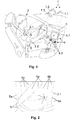
- Figure 1 One of the possible examples of embodiment of the invention is shown in Figure 1 , in this case, of application in monitoring the respiratory rate of a subject (2) driving a vehicle.
- the device comprises:
- the detection means (1) comprise:
- the laser emitter (1.1) projects a dot matrix or pattern of points (5) onto the torso (2.1) of the subject (2).
- the filter (1.3) it is adapted to detect only one light spectrum that corresponds to that emitted by the laser emitter (1.1).
- the degree of ambient illumination is prevented from affecting the retrieval of data captured by the camera (1.2) about the movements experienced by the point(s) (5) projected onto the torso (2.1) of the subject (2) during the latter's breathing. Otherwise, both too bright an ambient light or too weak a light could lead to misreadings of the movements of such points (5).
- the advantage of projecting a pattern of points (5) onto the torso (2.1) of the subject (2) is that if one or several points (5a) of said pattern of points (5) is projected onto an element other than the torso (2.1) of the subject (2) that stands between the latter and the camera (1.2) that captures their movement, for example, an arm (2.2) of the subject (2) or a safety belt (6), or simply, it is projected outside the torso (2.1) of the subject (2), said point(s) (5a) that would lead to the determination of an incorrect breathing frequency of the subject (2) can be discarded, the processor data (3) focusing on points of interest (5b) of said pattern of points (5) that show movements consistent or in accordance with the movement of the torso (2.1) of the subject (2) corresponding to breathing.
- the light spectrum in which the laser emitter emits and that the filter detects corresponds to a wavelength not visible to the human eye, for example, it could correspond to a wavelength of approximately 800 nm, corresponding to the near infrared. This does not exclude other wavelengths that would be equally viable.
- the emergency prevention means (4) could be an audible and/or visual alarm signal that alerts that the respiratory frequency of the subject (2) is outside the pre-established reference respiratory frequency values.
- the alarm or alert could be implemented inside the vehicle itself, using a screen (4.1) for the visual signal and/or speakers (4.2) for the audible signal; or, it could be displayed on the screen of a remote computer (not shown in the figures) that is in wireless communication with the device. Or they can act on other types of emergency systems (not shown in the figure), for example, automatic guiding and start-up systems of a vehicle for it to be parked and safely stopped.
- the emergency prevention means (4) can be an audible and/or visual alarm signal generated in the speakers and/or displayed on the computer screen (not shown in the figures) of the nurses' station as appropriate. If it were a respiratory rate monitoring device for a subject (2) applied to a high-performance sports training apparatus (not shown in the figures), the audible and/or visual alarm signal could be generated in the speakers and/or displayed on the training apparatus screen (not shown in the figures) as appropriate.
- the method is based on projecting at least one point (5) onto a torso (2.1) of the subject (2).
- a dot matrix or pattern of points (5) is projected onto said torso (2.1) of the subject (2).
- a laser emitter (1.1) can be used to project the point or points (5) onto the torso (2.1) of the subject (2).
- a camera (1.2) with a filter (1.3) can be used, wherein the filter (1.3) is adapted to detect only one light spectrum from the laser emitter (1.1).
- This image acquisition step starts by capturing a first image where the point(s) of interest (5b) are located, as appropriate, and then, in subsequent captured images, the displacement of the point (s) of interest (5b) on the torso (2.1) of the subject (2) during his or her breathing movements is updated or followed.
- a respiratory frequency of the subject (2) is then determined from the captured images.
- said point (5) would be a point of interest (5b)
- its movements are extracted from the captured images, and these movements are integrated throughout the frame of images captured on both sides of a main axis of movement to obtain a dimensionless oscillation (O), seen in Figure 3 , which corresponds to the increases and decreases in torso (2.1) volume of the subject (2), to then determine the respiratory frequency of the subject (2) based on said dimensionless oscillation (O).
- the movements of the previously selected points of interest (5b) are then extracted from the captured images, and the global or mean movement of said points of interest (5b) is integrated throughout the frame of captured images on both sides of a main axis of movement to obtain the dimensionless oscillation (O) for this case, seen in Figure 3 , which corresponds to the increases and decreases in torso (2.1) volume of the subject (2), in order to thus determine the respiratory frequency of the subject (2) based on said dimensionless oscillation (O).
- the respiratory frequency of the subject (2) (breaths per minute (BPM)) can be determined by locating peak values (P1, P2, P3, P4, Pn) in the dimensionless oscillation (O) obtained, which, correspond to the respective maximum and minimum extreme values of the increases and decreases in volume undergone by the torso (2.1) of the subject (2) when breathing, and measuring time values (T1, T2, T3, T4, Tn) that elapse between every two adjacent peak values (P1, P2, P3, P4, Pn), i.e., the times elapsed from peak to peak throughout the dimensionless oscillation (O) obtained.
- the respiratory frequency of said subject (2) is obtained by calculating the inverse of the mean of said measured time values (T1, T2, T3, T4, Tn).
- both the step of determining the respiratory frequency of the subject (2) and of checking that it is within pre-established reference respiratory frequency values are performed by a data processor (3), which will also be the one that commands the activation of the emergency prevention means (4), in case the respiratory frequency of the subject (2) is outside the pre-established reference respiratory frequency values.
- these pre-established reference respiratory frequency values are provided to the data processor (3) previously before the method starts. Which values are selected based on the activity for which the object of the present invention is intended. For example, in the case of monitoring a vehicle driver, the pre-established reference respiratory frequency values will correspond to the indicators of a subject at rest who is awake and in an acceptable state of health to drive a vehicle.
- the emergency prevention means (4) may be activated when detecting that the actual respiratory frequency of the subject (2) is outside such pre-established reference values for a vehicle driver, either because they indicate that he or she is dozing or drowsy, or, quite the opposite, that he or she is in a state of stress or in a negative emotional or health state that prevents them from driving the vehicle with due concentration and safety. Thus avoiding unwanted traffic accidents.
Landscapes
- Health & Medical Sciences (AREA)
- Life Sciences & Earth Sciences (AREA)
- Engineering & Computer Science (AREA)
- Physics & Mathematics (AREA)
- Pathology (AREA)
- Public Health (AREA)
- Veterinary Medicine (AREA)
- General Health & Medical Sciences (AREA)
- Animal Behavior & Ethology (AREA)
- Surgery (AREA)
- Molecular Biology (AREA)
- Biophysics (AREA)
- Medical Informatics (AREA)
- Biomedical Technology (AREA)
- Heart & Thoracic Surgery (AREA)
- Physiology (AREA)
- Pulmonology (AREA)
- Multimedia (AREA)
- Computer Vision & Pattern Recognition (AREA)
- Oral & Maxillofacial Surgery (AREA)
- Dentistry (AREA)
- Theoretical Computer Science (AREA)
- General Physics & Mathematics (AREA)
- Spectroscopy & Molecular Physics (AREA)
- Nuclear Medicine, Radiotherapy & Molecular Imaging (AREA)
- Radiology & Medical Imaging (AREA)
- Measurement Of The Respiration, Hearing Ability, Form, And Blood Characteristics Of Living Organisms (AREA)
Applications Claiming Priority (1)
| Application Number | Priority Date | Filing Date | Title |
|---|---|---|---|
| PCT/ES2018/070060 WO2019145580A1 (es) | 2018-01-26 | 2018-01-26 | Dispositivo y procedimiento de vigilancia del ritmo respiratorio de un sujeto |
Publications (2)
| Publication Number | Publication Date |
|---|---|
| EP3744245A1 true EP3744245A1 (de) | 2020-12-02 |
| EP3744245A4 EP3744245A4 (de) | 2021-09-01 |
Family
ID=67395758
Family Applications (1)
| Application Number | Title | Priority Date | Filing Date |
|---|---|---|---|
| EP18902889.7A Withdrawn EP3744245A4 (de) | 2018-01-26 | 2018-01-26 | Vorrichtung und verfahren zur überwachung der atemfrequenz eines subjekts |
Country Status (2)
| Country | Link |
|---|---|
| EP (1) | EP3744245A4 (de) |
| WO (1) | WO2019145580A1 (de) |
Families Citing this family (1)
| Publication number | Priority date | Publication date | Assignee | Title |
|---|---|---|---|---|
| WO2022118068A1 (en) | 2020-12-03 | 2022-06-09 | Alberghini Marco | Device for measuring the respiratory act |
Family Cites Families (9)
| Publication number | Priority date | Publication date | Assignee | Title |
|---|---|---|---|---|
| US6793242B2 (en) * | 1994-05-09 | 2004-09-21 | Automotive Technologies International, Inc. | Method and arrangement for obtaining and conveying information about occupancy of a vehicle |
| US6062216A (en) * | 1996-12-27 | 2000-05-16 | Children's Medical Center Corporation | Sleep apnea detector system |
| EP2074944A1 (de) * | 2007-12-20 | 2009-07-01 | Softgate GmbH | Vorrichtung zur multidimensionalen Atemdetektion mit einer Time-of-Flight Kamera |
| EP2380493A1 (de) * | 2010-04-21 | 2011-10-26 | Koninklijke Philips Electronics N.V. | Vorrichtung zur Erkennung der Atembewegung |
| US20130030257A1 (en) * | 2010-05-14 | 2013-01-31 | Kai Medical, Inc. | Systems and methods for non-contact multiparameter vital signs monitoring, apnea therapy, apnea diagnosis, and snore therapy |
| US20150148632A1 (en) * | 2013-11-26 | 2015-05-28 | David Alan Benaron | Calorie Monitoring Sensor And Method For Cell Phones, Smart Watches, Occupancy Sensors, And Wearables |
| WO2017060342A1 (en) * | 2015-10-06 | 2017-04-13 | Koninklijke Philips N.V. | Device, system and method for obtaining vital sign related information of a living being |
| CN105326506B (zh) * | 2015-12-04 | 2018-03-06 | 南昌航空大学 | 一种非接触式呼吸检测装置 |
| CN106646424A (zh) * | 2016-09-30 | 2017-05-10 | 深圳市镭神智能系统有限公司 | 一种光学探测系统 |
-
2018
- 2018-01-26 EP EP18902889.7A patent/EP3744245A4/de not_active Withdrawn
- 2018-01-26 WO PCT/ES2018/070060 patent/WO2019145580A1/es not_active Ceased
Also Published As
| Publication number | Publication date |
|---|---|
| EP3744245A4 (de) | 2021-09-01 |
| WO2019145580A1 (es) | 2019-08-01 |
Similar Documents
| Publication | Publication Date | Title |
|---|---|---|
| CN112584753B (zh) | 基于视频的患者监测系统以及用于检测和监测呼吸的相关方法 | |
| US11963744B2 (en) | Bio-information output device, bio-information output method and program | |
| EP2747651B1 (de) | Vorrichtung sowie verfahren zur überwachung der bewegung und ausrichtung dieser vorrichtung | |
| US20120083670A1 (en) | Method And Device For Monitoring The Risks For Sudden Infant Death Syndrom And For Positional Plagiocephaly | |
| CN105799509A (zh) | 一种防疲劳驾驶系统及方法 | |
| KR102267948B1 (ko) | 비접촉 생체 신호 검출을 이용한 운전자 건강 상태 진단 시스템 | |
| US11819315B2 (en) | Human condition detecting device | |
| CN105809893A (zh) | 一种防疲劳驾驶系统及方法 | |
| KR101647431B1 (ko) | 스마트폰을 이용한 실시간 수면 모니터링 시스템 | |
| EP3744245A1 (de) | Vorrichtung und verfahren zur überwachung der atemfrequenz eines subjekts | |
| JP4588423B2 (ja) | 状態解析装置及びソフトウエアプログラム | |
| US11548524B2 (en) | Vehicle and method of controlling the same | |
| JP2004267240A (ja) | 痰詰り検出装置 | |
| KR101474223B1 (ko) | 수면 무호흡 감지 장치 및 이를 이용한 방법 | |
| WO2015040548A1 (en) | Spirometer | |
| CN112466089B (zh) | 用于监控位置稳定性的系统和方法 | |
| US20160249838A1 (en) | Method and Apparatus for Effective Detection of Respiratory Blockage Using CO2 Monitor | |
| JP2021107190A (ja) | 監視装置、プログラム、システム及び監視方法 | |
| JP2018515161A (ja) | 拘束管理 | |
| KR102465031B1 (ko) | 개인 휴대형 폐활량 측정 디바이스 및 방법 | |
| CN112438708B (zh) | 人员状况检测装置 | |
| JP2003116818A (ja) | 痰詰まり検知システム | |
| TWI859963B (zh) | 跌床警示系統、跌床警示方法、電腦程式產品及電腦可讀取記錄媒體 | |
| KR102484784B1 (ko) | 네가티브 촬영 방식의 호흡 감지 응급 알림 시스템 | |
| JP2003079584A (ja) | 車椅子着座人異常検知装置 |
Legal Events
| Date | Code | Title | Description |
|---|---|---|---|
| STAA | Information on the status of an ep patent application or granted ep patent |
Free format text: STATUS: THE INTERNATIONAL PUBLICATION HAS BEEN MADE |
|
| PUAI | Public reference made under article 153(3) epc to a published international application that has entered the european phase |
Free format text: ORIGINAL CODE: 0009012 |
|
| STAA | Information on the status of an ep patent application or granted ep patent |
Free format text: STATUS: REQUEST FOR EXAMINATION WAS MADE |
|
| 17P | Request for examination filed |
Effective date: 20200805 |
|
| AK | Designated contracting states |
Kind code of ref document: A1 Designated state(s): AL AT BE BG CH CY CZ DE DK EE ES FI FR GB GR HR HU IE IS IT LI LT LU LV MC MK MT NL NO PL PT RO RS SE SI SK SM TR |
|
| AX | Request for extension of the european patent |
Extension state: BA ME |
|
| DAV | Request for validation of the european patent (deleted) | ||
| DAX | Request for extension of the european patent (deleted) | ||
| A4 | Supplementary search report drawn up and despatched |
Effective date: 20210729 |
|
| RIC1 | Information provided on ipc code assigned before grant |
Ipc: A61B 5/08 20060101AFI20210723BHEP Ipc: G01S 17/50 20060101ALI20210723BHEP Ipc: A61B 5/113 20060101ALI20210723BHEP Ipc: G06T 7/521 20170101ALI20210723BHEP |
|
| STAA | Information on the status of an ep patent application or granted ep patent |
Free format text: STATUS: THE APPLICATION IS DEEMED TO BE WITHDRAWN |
|
| 18D | Application deemed to be withdrawn |
Effective date: 20220301 |