EP3762319B1 - Station de préparation de commandes et procédé destiné à préparer automatiquement des commandes de marchandises - Google Patents
Station de préparation de commandes et procédé destiné à préparer automatiquement des commandes de marchandises Download PDFInfo
- Publication number
- EP3762319B1 EP3762319B1 EP19718228.0A EP19718228A EP3762319B1 EP 3762319 B1 EP3762319 B1 EP 3762319B1 EP 19718228 A EP19718228 A EP 19718228A EP 3762319 B1 EP3762319 B1 EP 3762319B1
- Authority
- EP
- European Patent Office
- Prior art keywords
- container
- target
- source
- containers
- order
- Prior art date
- Legal status (The legal status is an assumption and is not a legal conclusion. Google has not performed a legal analysis and makes no representation as to the accuracy of the status listed.)
- Active
Links
Images




Classifications
-
- B—PERFORMING OPERATIONS; TRANSPORTING
- B65—CONVEYING; PACKING; STORING; HANDLING THIN OR FILAMENTARY MATERIAL
- B65G—TRANSPORT OR STORAGE DEVICES, e.g. CONVEYORS FOR LOADING OR TIPPING, SHOP CONVEYOR SYSTEMS OR PNEUMATIC TUBE CONVEYORS
- B65G47/00—Article or material-handling devices associated with conveyors; Methods employing such devices
- B65G47/74—Feeding, transfer, or discharging devices of particular kinds or types
- B65G47/90—Devices for picking-up and depositing articles or materials
- B65G47/91—Devices for picking-up and depositing articles or materials incorporating pneumatic, e.g. suction, grippers
- B65G47/914—Devices for picking-up and depositing articles or materials incorporating pneumatic, e.g. suction, grippers provided with drive systems incorporating rotary and rectilinear movements
-
- B—PERFORMING OPERATIONS; TRANSPORTING
- B25—HAND TOOLS; PORTABLE POWER-DRIVEN TOOLS; MANIPULATORS
- B25J—MANIPULATORS; CHAMBERS PROVIDED WITH MANIPULATION DEVICES
- B25J15/00—Gripping heads and other end effectors
- B25J15/06—Gripping heads and other end effectors with vacuum or magnetic holding means
- B25J15/0616—Gripping heads and other end effectors with vacuum or magnetic holding means with vacuum
-
- B—PERFORMING OPERATIONS; TRANSPORTING
- B25—HAND TOOLS; PORTABLE POWER-DRIVEN TOOLS; MANIPULATORS
- B25J—MANIPULATORS; CHAMBERS PROVIDED WITH MANIPULATION DEVICES
- B25J9/00—Program-controlled manipulators
- B25J9/16—Program controls
- B25J9/1694—Program controls characterised by use of sensors other than normal servo-feedback from position, speed or acceleration sensors, perception control, multi-sensor controlled systems, sensor fusion
- B25J9/1697—Vision controlled systems
-
- B—PERFORMING OPERATIONS; TRANSPORTING
- B65—CONVEYING; PACKING; STORING; HANDLING THIN OR FILAMENTARY MATERIAL
- B65G—TRANSPORT OR STORAGE DEVICES, e.g. CONVEYORS FOR LOADING OR TIPPING, SHOP CONVEYOR SYSTEMS OR PNEUMATIC TUBE CONVEYORS
- B65G1/00—Storing articles, individually or in orderly arrangement, in warehouses or magazines
- B65G1/02—Storage devices
- B65G1/04—Storage devices mechanical
- B65G1/137—Storage devices mechanical with arrangements or automatic control means for selecting which articles are to be removed
- B65G1/1373—Storage devices mechanical with arrangements or automatic control means for selecting which articles are to be removed for fulfilling orders in warehouses
- B65G1/1378—Storage devices mechanical with arrangements or automatic control means for selecting which articles are to be removed for fulfilling orders in warehouses the orders being assembled on fixed commissioning areas remote from the storage areas
-
- B—PERFORMING OPERATIONS; TRANSPORTING
- B65—CONVEYING; PACKING; STORING; HANDLING THIN OR FILAMENTARY MATERIAL
- B65G—TRANSPORT OR STORAGE DEVICES, e.g. CONVEYORS FOR LOADING OR TIPPING, SHOP CONVEYOR SYSTEMS OR PNEUMATIC TUBE CONVEYORS
- B65G47/00—Article or material-handling devices associated with conveyors; Methods employing such devices
- B65G47/52—Devices for transferring articles or materials between conveyors i.e. discharging or feeding devices
-
- B—PERFORMING OPERATIONS; TRANSPORTING
- B65—CONVEYING; PACKING; STORING; HANDLING THIN OR FILAMENTARY MATERIAL
- B65G—TRANSPORT OR STORAGE DEVICES, e.g. CONVEYORS FOR LOADING OR TIPPING, SHOP CONVEYOR SYSTEMS OR PNEUMATIC TUBE CONVEYORS
- B65G47/00—Article or material-handling devices associated with conveyors; Methods employing such devices
- B65G47/52—Devices for transferring articles or materials between conveyors i.e. discharging or feeding devices
- B65G47/66—Fixed platforms or combs, e.g. bridges between conveyors
-
- B—PERFORMING OPERATIONS; TRANSPORTING
- B65—CONVEYING; PACKING; STORING; HANDLING THIN OR FILAMENTARY MATERIAL
- B65G—TRANSPORT OR STORAGE DEVICES, e.g. CONVEYORS FOR LOADING OR TIPPING, SHOP CONVEYOR SYSTEMS OR PNEUMATIC TUBE CONVEYORS
- B65G2203/00—Indexing code relating to control or detection of the articles or the load carriers during conveying
- B65G2203/04—Detection means
- B65G2203/041—Camera
Definitions
- the invention relates to a picking station for picking goods from source containers into target containers, as described in the preamble of claim 1, a storage and picking system for picking goods, as described in the preamble of claim 15, and a method for fully automated picking of different goods Source container into target container by a robot with a gripping unit.
- the EP 3 112 295 A1 and U.S. 2014/244026 A1 disclose a storage and picking system with a storage area for storing goods and a picking station for the automated picking of goods with a robot system.
- a gripping unit of the robot can remove individual goods from a source pallet and place them on a target pallet or manipulate an entire pallet.
- U.S. 2014/244026 A1 a gripping unit of the robot can remove individual goods for different orders from a first source container and/or second source container and place them in a first target container and/or second target container.
- the robot system includes a camera system as well as a robot controller that controls the robot with the gripper unit.
- the first source container, second source container, first target container and second target container are provided on an annular turntable.
- EP 3 112 295 A1 discloses the picking station according to the preamble of claim 1.
- the WO 2016/138101 A1 creates a "pick list of location data of items" in the scanned source container.
- the goods withdrawal is based on the position data of the goods in the source container.
- the goods are taken from this "pick list” one after the other until the source container is completely empty.
- Several withdrawals of goods can be made without having to capture the image again. What remains unnoticed, however, is that goods can slip between the individual goods removals and in the next gripping process it cannot be ensured that the goods can be gripped correctly or at all. This is associated with numerous faults and low picking performance.
- a picking station for the fully automated picking of different goods with a single robot is also available EP 2 984 007 B1 and the
- EP 2 315 714 B1 known. This means that orders can only be processed sequentially be, whereby the picking performance (picking performance) of the picking station is rather low.
- a picking station is known in which several robots are moved relative to source containers provided one behind the other on a conveyor device. Each robot is equipped with a gripping unit. The goods are removed from the source containers and placed on a storage rack.
- the disadvantages indicated above are to be overcome and a high picking performance is to be achieved.
- the order-picking process should be able to be carried out particularly reliably, so that hardly any disruptions should occur.
- the advantage here is that the source container and target container for a first order or the source container and target container for a second order can each be provided close together and the movements of the robot/gripping unit can be made particularly short as a result.
- the robot and the gripping unit can be moved along simple trajectories.
- the robot defines a working area within which the gripping unit is moved.
- the workspace is a three-dimensional space. It is therefore also referred to as a workroom.
- the work area can form a rectangular base area if the robot is designed as a portal robot, for example.
- the working area can also form a circular or oval base area if the robot is designed, for example, as an articulated-arm robot (or also known as an articulated-arm robot).
- the robot is preferably set up in a stationary manner.
- the working area of the robot is designed in such a way that it includes the first delivery device with the first removal location, second delivery device with the second removal location, first delivery device with the first loading location and second delivery device includes with the second loading place.
- the term "includes” is to be understood such that the working area is adjacent to a serving level of the first/second serving device or a serving level of the first/second serving device intersects the working area.
- first source container is at the first removal location
- second source container is at the second removal location
- first destination container is at the first loading location and/or the second destination container is at the second loading location, these are provided within the work area.
- the robot system can merely comprise a single robot which can access more than one source container, in particular the first source container and second source container, and more than one target container, in particular the first target container and second target container.
- the manual picking station is also connected to a source container conveyor for transporting source containers to the picking station and for transporting source containers away from the picking station, and to a target container conveyor for transporting target containers to the picking station and for transporting target containers away from the picking station . It is only necessary to replace the source container conveyor technology and the target container conveyor technology in the picking station and to supplement the robot system.
- a particularly simple configuration of the picking station results when the first delivery device with the first removal location and the second delivery device with the second removal location are designed on the second conveyor device for transporting away bulk containers.
- the first delivery device with the first loading place and the second delivery device with the second loading place can be configured on the second conveyor device for removing target containers.
- the second conveyor device for removing source containers and the second conveyor device for removing target containers are arranged at a maximum distance of 400 mm and in parallel.
- a distance between 150 mm and 250 mm has proven to be particularly favorable. This prevents the source containers and target containers from interfering with each other, but reduces the movements of the robot and the gripper unit for picking goods to a minimum. This achieves maximum picking performance.
- the first service device with the first removal area and the first service device with the first loading area each form a service level at the same height level.
- the second service device with the second removal station and the second service device with the second loading station can each form a service level at the same level. This allows the first source container/first destination container and second source container/second destination container to be provided at the same height level, which simplifies the removal of the goods from the first/second source container and the delivery of the goods into the first/second destination container.
- a buffer device with at least one buffer location is provided between the first service device with the first removal location and the second service device with the second removal location, at which a second source container can be buffered after picking.
- a buffer device with at least one buffer location can also be provided between the first service device with the first loading station and the second service device with the second loading station, at which a second target container can be buffered after picking.
- the respective storage plate can form a horizontally or diagonally aligned storage surface, and can be formed by a pivoting flap and can be arranged between the first source container/first target container or second source container/second target container, but also around the first source container/first target container or second Source container / second target container.
- the flap can be motor-driven or actuated by the robot.
- a storage area which is designed in the form of an inclined plane, goods that have fallen from the gripping unit can be automatically conveyed into the first source container/first target container or second source container/second target container.
- goods that have fallen from the gripping unit can be conveyed to the first source container/first target container or second source container/second target container.
- the picking station connects to a sorting buffer, which is controlled by a control unit and by means of which the target containers in the sorting buffer are sorted into an order that depends on the order in which the source containers are made available at the first removal location and second removal location, is determined.
- the destination bins are sorted in and by the sorting buffer into an order determined by the order of the source bins.
- the sequence determination point is preferably arranged along the source container conveyor system for transporting the source container, which is connected to the first conveyor device of the picking station. From the order determination point, the (chaotic) order remains unchanged.
- the destination bins in the sorting buffer determine which source bins need to be swapped out.
- the destination bins are sorted in and by the sorting buffer into an order determined by the (chaotic) order of the source bins.
- the object of the invention is also achieved by the storage and picking system according to claim 15 .
- the storage and picking system can be operated particularly economically.
- the picking station processes orders reliably and with high picking performance.
- a gripping surface pose of a gripping surface for at least one of the goods in the source container is determined with the aid of a sensor system.
- a gripping pose for the movable gripping unit can be calculated from the determined gripping surface pose.
- the gripping unit is moved into the calculated gripping pose and the gripping unit that is or will be in contact with the gripping surface of the goods, for example at least one suction gripper, is activated in order to pick up the goods.
- shifting of goods in the first source container/second source container is recorded after goods have been removed and an optimized gripping surface pose is always determined and the gripping unit is moved based on an optimized gripping pose. This reduces "mistakes" to a minimum and the goods are optimally picked up or gripped by the gripper unit.
- these procedural measures can be advantageous in connection with the described automatic error correction by the robot/gripping unit (claims 12 and 19). This is described using the following example. If, after goods have been removed, the gripping unit loses a product it has picked up and falls back into the source container and/or if a product it has picked up is lost on the movement from the source container to the target container and "caught" on the storage plate and placed back in the source container, a changed gripping surface pose of a gripping surface for at least one other product in the source container. Accordingly, an updated gripping pose for the gripping unit is calculated. This is also a measure in which the "mistakes" can be reduced to a minimum.
- An advantageous measure is when the first order with steps f) to h) and the second order with steps i) to k) are processed sequentially by the robot.
- step i) after the processing of the order line for the first order can take place during the movement of the robot/gripping unit from the first target container to the second source container be performed.
- step f) can be carried out after processing the order line for the second order during the movement of the robot/gripping unit from the second target container to the first source container.
- the order line for a first order or second order is completely processed.
- "Complete” in this context means that all goods must have been placed in the respective first target container / second target container in order to fulfill this order line.
- the order line for a first order is completely processed. Only then is step i) carried out and a gripping surface pose of a gripping surface is determined for at least one product in the second source container. For this reason, the said gripping surface pose is only determined just before a planned removal of goods from the second source container.
- the order line is then processed into a second order and completely processed.
- Step f) is then carried out and a gripping surface pose of a gripping surface is determined for at least one product in the first source container. For this reason, the said gripping surface pose is only determined just before a planned removal of goods from the first source container.
- step f) is carried out during the processing of the order line for the first order according to steps g) and h) and step i) during the processing of the order line for the second order according to steps j) and k). .
- first source container and second source container are returned to a storage area independently of one another after the goods have been picked according to steps g) and h) and steps j) and k), provided that goods are in the first source container and second source container after the goods have been removed source containers remain.
- first target container and second target container are transported independently of one another into a sorting buffer after the goods have been picked according to steps g) and h) and steps j) and k), provided that the order lines differ from the first order and differ from the second order order lines are to be processed.
- a storage and picking system for picking goods comprising a storage area 1 and one or more picking stations 2 for picking goods with a robot system, a source container distribution system 3 and a target container distribution system 4.
- a “goods” is understood to mean, in particular, an individually handleable object or a individually handleable group of objects.
- the storage area 1 shown as an example serves primarily to provide a large number of source containers 5, in which 2 represented goods A, B, etc., namely (stock) items are included.
- the source container 5 can each contain a single type of goods.
- a first source container 5a contains goods A
- a second source container 5b goods B etc.
- the source containers 5 can be divided into several storage compartments by partitions and accommodate different types of goods, with goods A in the first storage compartment and goods B in the second storage compartment can be included.
- the range of goods in the storage area 1 can be increased by segmented source containers 5 .
- the target containers can be divided into several receiving compartments by partitions and to accommodate different orders, with a first order containing one or more goods being able to be received in the first receiving compartment and a second order containing one or more goods being able to be received in the second receiving compartment.
- the target containers can also be designed without partitions and accommodate different orders.
- the sorting buffer described below can be reduced by segmenting the target containers, which means that the number of sorting locations and buffer locations can be reduced.
- the invention is not to be understood as being restricted to containers. On the contrary, other loading aids such as trays, boxes and the like can also be used.
- the source container corresponds to a source loading tool and the destination container corresponds to a destination loading tool.
- the storage area 1 preferably comprises an automated warehouse.
- the storage area 1 comprises storage racks 6 arranged in parallel and a rack aisle 7 provided between the storage racks 6.
- Each storage rack 6 forms a plurality of storage locations 8 next to one another in stacked rack levels, on which the source containers 5 are stored.
- two storage racks 6 are shown.
- more than two storage racks 6 can also be provided, with a rack aisle 7 being formed between adjacent storage racks 6 in each case.
- the source container distribution system 3 serves to transport source containers 5 between the storage area 1 and the picking station(s) 2.
- the source container distribution system 3 is preferably an automated source container distribution system. The removal of source containers 5 from the storage area 1 can be automated and the transport of the source containers 5 from the storage area 1 to the picking station 2 can be automated.
- the source container distribution system 3 comprises, for example, one or more storage service devices 9 and a source container conveyor system between the storage area 1 and the picking stations 2 in order to transport source containers 5 from the storage area 1 to the relevant picking stations 2 and to transport source containers 5 from the picking stations 2 to the storage area 1 to transport.
- the source container conveyor technology between the storage area 1 and the picking stations 2 can, for example, have a first conveyor device 10 for transporting source containers 5 to the storage area 1 and a second conveyor device 11 for transporting source containers 5 away from the storage area 1 and a third conveyor device 12 for transporting source containers 5 to the Picking station 2 and a fourth conveyor 13 for transporting source containers 5 from the picking station 2 and finally a fifth conveyor 14 for transporting source containers 5 between the conveyors 10, 11, 12, 13.
- the fifth conveying device 14 includes input and/or discharge devices 15 in order to transport the source container 5 between the conveying devices 10 to 14 .
- the fifth conveyor device 14 is, for example, a closed conveyor loop.
- the loading and/or unloading device 15 is formed, for example, by a belt converter.
- the source container distribution system 3 can additionally include a transfer device 16 for the transport of source containers 5 between the storage and retrieval device 9 and the source container conveyor system.
- single-level storage and retrieval devices are used as storage and retrieval device 9 in the storage area 1, guideways 17 are arranged in pairs in superimposed (horizontal) travel levels.
- the guide tracks 17 are preferably attached to the adjacent storage racks 6 .
- the storage and retrieval device 9 includes a loading platform and a transport device 18 (load handling device).
- the transport device 18 can manipulate the source containers 5 between the loading platform and the storage location 8, namely storing source containers 5 in the storage racks 6 arranged on both sides of the storage and retrieval device 9 or retrieving source containers 5 from the storage racks 6 arranged on both sides of the storage and retrieval device 9. Provision can be made for at least one storage and retrieval device 9 to be assigned to each shelf level.
- a storage service device 9 thus serves a shelf level via the transport device 18 .
- the transfer device 16 comprises a first buffer device 19a, a first lifting device 20a, a second buffer device 19b and a second lifting device 20b.
- the buffer device 19a comprises provision devices for the intermediate buffering of one or more source containers 5 to be stored per travel level and the buffer device 19b comprises provision devices for the intermediate buffering of one or more source containers 5 to be retrieved per travel level.
- Other variants are also possible, as in FIG WO 2013/090970 A2 described.
- the lifting devices 20a, 20b are set up in a stationary manner and each comprise a transfer device that can be raised and lowered via a lifting drive.
- the transfer devices are preferably each mounted on a vertical mast and each comprise a drivable conveying device.
- the source container distribution system 3 can include an optional turning station 23, with which the source containers 5 discharged from the fifth conveyor device 14 are turned from a transverse orientation to a longitudinal orientation.
- the picking station 2 includes a source container conveyor system for the automated transport of the source container 5, in particular for delivery from source containers 5 to a first delivery device 24a and a second delivery device 24b and for the removal of source containers from the first delivery device 24a and the second delivery device 24b.
- the source container conveyor of the picking station 2, as in the 3 and 4 is shown comprises a first conveyor device 25 for transporting source containers 5a, 5b, the first delivery device 24a for providing a first source container 5a, a second delivery device 24b for providing a second source container 5b and a second conveyor device 26 for transporting source containers 5a, 5b away from the first serving device 24a and the second serving device 24b.
- the first conveyor device 25 and second conveyor device 26 each comprise at least one conveyor 22a, 22b.
- the conveyor 22a is driven and coupled to a drive motor.
- the conveying means 22a has, for example, conveying rollers mounted rotatably on a frame.
- the conveyor 22b is driven and coupled to a drive motor.
- the conveying means 22b has, for example, conveying rollers rotatably mounted on a frame.
- the first conveyor device 25 and second conveyor device 26 are preferably formed by a roller conveyor and comprise a large number of conveyor rollers, at least some of which are driven by a drive motor.
- the first delivery device 24a with the first removal location 27a and the second delivery device 24b with the second removal location 27b are arranged one behind the other along the second conveyor device 26 and in the conveying direction (arrow).
- the first delivery device 24a is connected to the first conveyor device 25 in terms of conveyor technology and includes a first removal location 27a.
- the first service device 24a is preferably connected to the first conveyor device 25 via a first transfer device 28 in terms of conveyor technology.
- a first source container 5a is transported by the first conveyor device 25 and then transported by the first transfer device 28 to the first delivery device 24a to the first removal location 27a. Then the first source container 5a will be made available at the first removal location 27a (upright).
- the second service device 24b is connected to the first conveyor device 25 in terms of conveyor technology and includes a second removal station 27b.
- the second delivery device 24b is preferably connected to the first conveyor device via a second transfer device 29 25 conveying connected.
- a second source container 5b is transported by the first conveyor device 25 and then transported by the second transfer device 29 to the second delivery device 24b to the second removal station 27b.
- the second source container 5b will then be made available at the second removal location 27b (upright).
- the first transfer device 28 and second transfer device 29 each comprise a first conveyor 30a and a second conveyor 30b, which are formed, for example, by a first belt converter and a second belt converter.
- Such belt converters (and this also applies to the belt converters mentioned elsewhere) have conveyor belts coupled to a drive motor, which are mounted on a hoist and form the conveying plane.
- the conveyor belts of the first belt transfer device can be moved via the hoist between a lowered rest position, in which the conveyor belts are lowered below the conveying level of the first conveyor device 25 and a source container 5b is transported from the first conveyor device 25 to the second transfer device 29, and a raised conveying position, in which a source container 5a, 5b is lifted off the first conveyor device 25 and conveyed across the conveyor belts to the first conveyor device 25, can be adjusted.
- the conveyor belts of the second belt converter can be moved via the hoist between a raised conveying position, in which a source container 5a, 5b is taken over by the first belt converter and conveyed via the conveyor belts transversely to the second conveyor device 26, and a lowered rest position, in which the conveyor belts are below the conveying level of the second conveyor device 26 are lowered and a source container 5a, 5b is deposited on the second conveyor device 26 can be adjusted.
- the described embodiment of the first transfer device 28 and the second transfer device 29 are in no way to be understood as limiting.
- the first transfer device 28 and second transfer device 9 allow a first source container 5a transported on the first conveyor device 25 to be moved transversely and a second source container 5b transported on the first conveyor device 25 to be moved transversely, in order to move the first source container 5a to the first delivery device 24a and the second source container 5a to the to transport second service device 24b.
- the first delivery device 24a with the first removal location 27a and the second delivery device 24b with the second removal location 27b are configured on the second conveyor device 26 for the removal of bulk containers 5a, 5b.
- the first delivery device 24a with the first removal location 27a and the second delivery device 24b with the second removal location 27b are formed by conveyor sections on the second conveyor device 26 for the removal of source containers 5a, 5b. These conveying sections each comprise a control unit 31 ( 1 ) Controllable and drivable conveyor 22b.
- the conveyor 22b comprises a large number of conveyor rollers, at least some of which are driven by a drive motor.
- the conveyor 22b of a first conveyor section is controlled and driven by the control unit 31 in order to transport a first source container 5a away from the first delivery device 24a by the second conveyor device 26 after processing an order line for a first order.
- the conveyor 22b of a second conveyor section is controlled and driven by the control unit 31 in order to transport a second source container 5b away from the second delivery device 24b by the second conveyor device 26 of an order line to a second order.
- a buffer device 32 with at least one buffer location is provided between the first service device 24a with the first removal location 27a and the second service device 24b with the second removal location 27b, at which a second source container 5b after order picking (after processing an order line to a second order) can be buffered.
- the buffer device 32 is preferably formed on the second conveyor device 26 for the removal of source containers 5a, 5b.
- the buffer device 32 with the at least one buffer location is formed by a conveyor section on the second conveyor device 26 for the removal of source containers 5a, 5b.
- This conveyor section comprises a conveyor means 22b (not shown) that can be controlled and driven by the control unit 31 .
- the conveyor 22b comprises a large number of conveyor rollers, at least some of which are driven by a drive motor.
- the conveyor means 22b of said conveyor section is controlled and driven by the control unit 31 in order to receive a second source container 5b from the second serving device 24b to be transported to the buffer area and to be transported away a second source container 5b from the buffer area.
- the second source container 5b passes through the first delivery device 24a and is transported away by the second conveyor device 26 .
- the first conveying device 25 and the second conveying device 26 have opposite conveying directions, as in FIGS 3 and 4 indicated with the arrows.
- the conveying means 22a of the first conveying device 25 are preferably driven unidirectionally and the conveying means 22b of the second conveying device 26 are driven unidirectionally.
- the picking station 2 is connected to the source container conveyor system of the source container distribution system. Specifically, the picking station 2 connects to the third conveyor device 12 with the first conveyor device 25 and to the fourth conveyor device 13 with the second conveyor device 26 .
- the picking station 2 comprises a target container conveyor system for the automated transport of the target containers 33, in particular for transporting target containers 33 to a first service device 34a and a second service device 34b and for transporting target containers 33 away from the first service device 34a and the second service device 34b.
- the target container conveyor technology of the picking station 2 comprises a first conveyor device 35 for transporting target containers 33, the first delivery device 34a for providing a first target container 33a, a second delivery device 34b for providing a second target container 33b and a second conveyor device 36 for transporting the target containers 33 away from the first serving device 34a and the second serving device 34b.
- the first conveyor device 35 and second conveyor device 36 each comprise at least one conveyor 22a, 22b.
- the conveyor 22a is driven and coupled to a drive motor.
- the conveying means 22a has, for example, conveying rollers mounted rotatably on a frame.
- the conveyor 22b is driven and coupled to a drive motor.
- the conveying means 22b has, for example, conveying rollers rotatably mounted on a frame.
- the first conveyor device 35 and second conveyor device 36 are preferably formed by a roller conveyor and comprise a large number of conveyor rollers, at least some of which are driven by a drive motor.
- the first delivery device 34a with the first loading station 37a and the second delivery device 34b with the second loading station 37b are arranged one behind the other along the second conveyor device 36 and in the conveying direction (arrow).
- the first delivery device 34a is connected to the first conveyor device 35 in terms of conveyor technology and includes a first loading station 37a.
- the first delivery device 34a is preferably connected to the first conveyor device 35 in terms of conveyor technology via a first transfer device 38 .
- a first target container 33a is transported by the first conveyor device 35 and then transported by the first transfer device 38 to the first delivery device 34a to the first loading station 37a.
- the first target container 33a will then be made available at the first loading point 37a (upright).
- the second service device 34b is connected to the first conveyor device 35 in terms of conveyor technology and includes a second loading station 37b.
- the second service device 34b is preferably connected to the first conveyor device 35 via a second transfer device 39 in terms of conveyor technology.
- a second target container 33b is transported by the first conveyor device 35 and then transported by the second transfer device 39 to the second delivery device 34b to the second loading station 37b.
- the second target container 33b will then be made available at the second loading station 37b (upright).
- the first transfer device 38 and second transfer device 39 each comprise a first conveyor 30a and a second conveyor 30b, which are formed, for example, by a first belt converter and a second belt converter.
- Such belt converters (and this also applies to the belt converters mentioned elsewhere) have conveyor belts coupled to a drive motor, which are mounted on a hoist and form the conveying plane.
- the conveyor belts of the first belt converter can be moved via the hoist between a lowered rest position, in which the conveyor belts are lowered below the conveying level of the first conveyor device 35 and a target container 33b is transported from the first conveyor device 35 to the second converter device 39, and a raised conveying position, in which a target container 33a, 33b is lifted off the first conveyor device 35 and conveyed across the conveyor belt to the first conveyor device 35, can be adjusted.
- the conveyor belts of the second belt converter can be moved via the lifting gear between a raised conveying position, in which a target container 33a, 33b is taken over by the first belt converter and conveyed via the conveyor belts transversely to the second conveyor device 36, and a lowered rest position, in which the conveyor belts are below the conveying level of the second conveyor device 36 are lowered and a target container 33a, 33b is deposited on the second conveyor device 36 can be adjusted.
- the described embodiment of the first transfer device 38 and the second transfer device 39 are in no way to be understood as limiting.
- the first transfer device 38 and second transfer device 39 allow a first target container 33a transported on the first conveyor device 35 to be moved transversely and a second target container 33b transported on the first conveyor device 35 to be moved transversely, in order to move the first target container 5a to the first delivery device 34a and the second target container 33a to the to transport second service device 34b.
- the first delivery device 34a with the first loading station 37a and the second delivery device 34b with the second loading station 37b are designed on the second conveyor device 36 for transporting away target containers 33a, 33b.
- the first delivery device 34a with the first removal location 37a and the second delivery device 34b with the second loading location 37b are formed by conveyor sections on the second conveyor device 36 for transporting away target containers 33a, 33b.
- conveying sections each comprise a control unit 31 ( 1 ) Controllable and drivable conveyor 22b.
- the conveyor 22b comprises a large number of conveyor rollers, at least some of which are driven by a drive motor.
- the conveyor 22b of a first conveyor section is controlled and driven by the control unit 31 in order to transport a first target container 33a away from the first delivery device 34a by the second conveyor device 36 after processing an order line to a first order.
- the conveyor 22b of a second conveyor section is controlled and driven by the control unit 31 in order to transport a second target container 33b away from the second delivery device 34b by the second conveyor device 36 after processing an order line to a second order.
- a buffer device 40 with at least one buffer station, at which a second target container 33b after order picking (after processing an order line to a second picking order) can be buffered.
- the buffer device 40 is preferably formed on the second conveyor device 36 for transporting away target containers 33a, 33b.
- the buffer device 40 with the at least one buffer location is formed by a conveyor section on the second conveyor device 36 for the removal of source containers 33a, 33b.
- This conveyor section includes a conveyor 22b that can be controlled and driven by the control unit 31 .
- the conveyor 22b comprises a large number of conveyor rollers, at least some of which are driven by a drive motor.
- the conveyor means 22b of said conveyor section is controlled and driven by the control unit 31 in order to transport a second target container 33b from the second delivery device 34b to the buffer location and to transport a second target container 33b away from the buffer location.
- the second target container 33b passes the first delivery device 34a and is transported away by the second conveyor device 36 .
- the first conveying device 35 and the second conveying device 36 have opposite conveying directions, as in FIGS 3 and 4 indicated with the arrows.
- the conveying means 22a of the first conveying device 35 are preferably driven unidirectionally and the conveying means 22b of the second conveying device 36 are preferably driven unidirectionally.
- the picking station 2 is connected to a target container conveyor system of the target container distribution system 4 .
- the target container distribution system 4 is used to transport finished target containers 33 between the picking station(s) 2 and a goods issue, as indicated by the arrow 41 in 1 indicated, or the transport of partially picked target containers 33 between a first picking station 2 and a second picking station 2.
- the target container distribution system 4 is also used to transport empty target containers 33 or partially picked target containers 33 to the picking station(s) 2.
- the target container distribution system 4 is preferably an automatically operated target container distribution system. Said target containers 33 can be transported in an automated manner.
- the target container distribution system 4 includes a target container conveyor system.
- the target container conveyor system can, for example, have a first conveyor device 42 for transporting empty target containers 33 and/or partially picked target containers 33 to the relevant picking station(s) 2 and a second conveyor device 43 for transporting partially picked target containers 33 or completed target containers 33 away from the / include the relevant picking station (s) 2.
- the first conveyor device 42 and second conveyor device 43 each comprise a transfer device.
- the first conveyor device 35 of the picking station 2 and the first conveyor device 42 of the target container conveyor system are connected in terms of conveyor technology.
- the second conveyor device 36 of the picking station 2 and the second conveyor device 43 of the target container conveyor system are connected in terms of conveyor technology.
- the target container conveyor system can connect to a sorting buffer 44 to be described in more detail with its first conveyor device 42 for transporting empty target containers 33 and/or partially picked target containers 33 to the relevant picking station(s) 2 (as exemplified in 1 entered in dashed lines), so that empty target containers 33 and/or partially picked target containers 33 are initially transported to the sorting buffer 44 and then, if appropriate, sorted to the picking station(s) 2 in question.
- the first conveying device 42 can be connected either to the first conveying device 45 of the sorting buffer, to be described in more detail below, or to the second conveying device 46, to be described in more detail, of the sorting buffer.
- the first conveyor device 42 can, in contrast to the illustration in 1 also connect to the fifth conveyor 14 in order to transport empty target containers 33 and/or partially commissioned target containers 33.
- the empty target containers 33 and/or partially commissioned target containers 33 are transferred to a buffer location 47-4 and then transported to the first loading location 37a or second loading location 37b or to a sorting location 48-1.
- the conveyor device 13 for removing source containers 5 from the picking station 2 and the second conveyor device 36 for removing loaded target containers 33 from the picking station 2 are conveyably connected to a conveying means 50 via a third conveying device.
- the conveyor 50 is formed, for example, by a belt converter described above.
- the conveyor 50 is controlled by the control unit 31 in order to eject the loaded target container 33 from the target container conveyor to the source container conveyor.
- a single conveyor device 13 is used to transport loaded target containers 33 away from the picking station 2 and to transport source containers 5 away from the picking station 2 in order to save space.
- the picking station(s) 2 is/are connected to the source container conveyor system in order to transport source container 5 on a conveyor device 12 to the picking station(s) 2 and source container 5 on a conveyor device 13 from the picking station(s) 2 transported away, and is/are the picking station(s) 2 connected to the target container conveyor system in order to transport empty/partly picked target containers 33 on a conveyor 42 to the picking station(s) 2 and partially picked/completely picked target containers 33 on a conveyor 13 , 30 to be transported away from the picking station(s) 2 .
- a particularly advantageous embodiment results when the second conveyor device 26 for removing source containers 5a, 5b and the second conveyor device 36 for removing target containers 33a, 33b are arranged in parallel.
- the first serving device 24a with the first removal station 27a and the first serving device 34a with the first loading station 37a are arranged opposite one another.
- the first delivery device 34a with the first loading station 37a is arranged essentially mirrored with respect to an axis of symmetry with respect to the first delivery device 24a with the first removal station 27a.
- the axis of symmetry runs parallel to the conveying direction of the second conveying devices 26, 36.
- the first serving device 24b with the second removal station 27b and the second serving device 34b with the second loading station 27b are arranged opposite one another.
- the second delivery device 34b with the second loading station 37b is essentially mirrored in relation to an axis of symmetry with respect to the first Serving device 24b arranged with the first removal station 27b.
- the axis of symmetry runs parallel to the conveying direction of the second conveying devices 26, 36.
- the second conveyor device 26 for removing source containers 5a, 5b and the second conveyor device 36 for removing target containers 33a, 33b are arranged at a distance 51 of at most 400 mm.
- the first service device 24a with the first removal station 27a and the first service device 34a with the first loading station 37a each form a (horizontal) service level 52a, 53a at the same height level.
- the second service device 24b with the second removal station 27b and the second service device 34b with the second loading station 37b each form a (horizontal) service level 52b, 53b at the same level.
- the service levels 52a, 53a and service levels 52b, 53b are preferably at the same level.
- the picking station 2 connects to the sorting buffer 44, which is designed to provide the target containers 33 sorted in a sequence at the first loading station 37a and second loading station 37b.
- the order of the target containers 33 is determined depending on the order in which the source containers 5 are made available at the first removal location 27a and second removal location 27b.
- the sequence of the source containers 5 is detected by the control unit 31, using known path tracking systems (tracking system) which can determine the whereabouts of each source container 5 along the transport route, or by suitable sensors along the transport route.
- the sorting buffer 44 is an automatically operated sorting buffer. The transport of the target containers 33 in the sorting buffer 44 (in particular between the buffer and sorting locations 47, 48) and the sorting of the target containers 33 by the sorting buffer 44 takes place automatically.
- the sorting buffer 44 comprises buffer locations 47 arranged one behind the other on a first conveyor device 45 in a delivery direction (arrow from left to right) and sorting locations 48 arranged one behind the other on a second conveyor device 46 in a return direction (arrow from right to left) and the buffer locations 47 with the sorting locations 48 connecting third conveyors 54.
- the first conveyors are 45 and second conveyor device 46 are arranged in parallel, while the third conveyor devices 54 are arranged perpendicularly to the first conveyor device 45/second conveyor device 46.
- the delivery direction of the requested target container 33 on the first conveyor device 45 and the return direction of the returned target container 33 on the second conveyor device 46 run in opposite directions.
- the first conveyor device 45 and the second conveyor device 46 are connected in terms of conveyor technology to the first conveyor device 35 and the second conveyor device 36 in order to convey the target containers 33 for processing different order lines for at least one order from the sorting buffer 44 to the first loading station 34a or second loading station 34b and from first loading station 34a or second loading station 34b 35 conveyed to the sorting buffer 44.
- the first conveying device 45 and second conveying device 46 each have conveying means 55 , 56 .
- the target containers 33 are transported for processing orders on the first conveyor device 45 by means of the conveyor means 55 in the delivery direction and sorted to the first loading station 34a or second loading station 34b.
- the conveying means 55 forms a horizontal conveying plane.
- target containers 33 can be transported on the second conveyor device 46 by means of the conveyor means 56 in the return direction from the first loading station 34a or second loading station 34b to the sorting stations 48.
- the conveying means 56 forms a horizontal conveying plane.
- the conveying means 55, 56 each have, for example, conveying rollers mounted rotatably on a frame and each form a roller conveyor. At least one conveyor 55 for transporting the target containers 33 in the delivery direction is assigned to the buffer locations 47 and at least one conveyor 56 for transporting the target containers 33 in the return direction is assigned to the sorting locations 48 .
- the conveyor 55 is driven and coupled to a first drive motor.
- the conveyor 56 is driven and coupled to a second drive motor.
- each buffer location 47 comprises a conveyor 55 with a plurality of conveyor rollers, of which at least one conveyor roller is driven and coupled to a drive motor.
- each sorting station 48 includes a conveyor 56 with a plurality of conveyor rollers, of which at least one conveyor roller is driven and coupled to a drive motor.
- the drive motors are connected to the control unit 31, and the conveying means 55, 56 can be controlled separately by the control unit 31.
- the third conveyor devices 54 connect the mutually opposite buffer locations 47 and sorting locations 48 in order to deliver the target containers 33 from the sorting locations 48 to the buffer locations 47 in a time-controlled manner by the control unit 31 in such a way that the target containers 33b already leave the sorting buffer 44 in a sorted sequence and are transported in in this sorted order, the first loading station 34a and the second loading station 34b are fed one after the other.
- the third conveying devices 54 each have conveying means 57 , 58 .
- the destination containers 33 are transported from the sorting locations 48 to the buffer locations 47 by means of the conveyor means 57, 58 on the third conveyor device 54 for processing orders.
- the funding means 57, 58 form a horizontal conveying plane.
- the conveyor 57, 58 for each third conveyor 54 is driven and coupled to a third drive motor.
- some of the buffer locations 47 and sorting locations 48 can each be assigned a common conveyor 57 . Otherwise, some of the buffer locations 47 and sorting locations 48 can be assigned a conveyor 58 per buffer location 47 and a conveyor 58 per sorting location 48 .
- the conveying means 57, 58 are each formed, for example, by a belt converter, as described above.
- the conveyor belts can be moved via the lifting gear between a raised conveying position, in which a target container 33 is lifted from a sorting station 48 and conveyed via the conveyor belts to a buffer station 47, and a lowered rest position, in which the conveyor belts are lowered below the conveying level of the conveying means 55, 56 and a target container 33 is transported by the conveyor 56 from a first sorting location to a second sorting location or a target container 33 is transported by the conveyor 55 from a first buffer location to a second buffer location.
- the conveyor 58 on the sorting station 48-4 and the conveyor 58 on the buffer station 47-1 can be operated bidirectionally.
- the conveyors 55, 56, 57, 58 are controlled by the control unit 31 in such a way that the target containers 33 in the sorting buffer 44 are sorted into an order that depends on the order in which the source containers 5 are provided at the first removal location 27a and second removal location 27b are determined, and that a source container 5a, 5b and a target container 33a, 33b for an order arrive at the first/second removal location 27a, 27b and the first/second loading location 37a, 37b at approximately the same time.
- the drive motors/actuators are connected to the control unit 31, and the conveying means 57, 58 can be controlled separately by the control unit 31.
- the picking station 2 includes a fully automated robot system.
- the robot system comprises a robot 60 with a gripping unit 61 that can be moved relative to a robot base, by means of which goods A for a first order are removed from the first source container 5a and placed in the first target container 33a, and goods B for a second order are removed from the second source container 5b and placed in be deposited in the second target container 33b. It would also be conceivable that goods A, B are required for different orders and the first target container 33a and second target container 33b are already provided.
- goods A can first be removed from the first source container 5a and placed in the first destination container 33a by means of the gripping unit 61 and then goods A can again be removed from the first source container 5a and placed in the second destination container 33b.
- goods B can first be removed from the second source container 5b and placed in the first destination container 33a by means of the gripping unit 61 and then goods B can again be removed from the second source container 5b and placed in the second destination container 33b.
- a working space of the robot 60 is designed in such a way that the gripping unit 61 can access the first source container 5a, second source container 5b, first target container 33a and second target container 33b.
- the gripping unit 61 preferably comprises at least two vacuum suction pads, each vacuum suction pad being separately controllable. In principle, the gripping unit 61 can also only include a vacuum suction gripper.
- the robot 60 is formed by an articulated arm robot.
- a portal robot is also possible.
- the robot system also includes a sensor system 62a, 62b at least for detecting the goods A, B in the first source container 5a and second source container 5b.
- the sensor system 62a sets a gripping surface pose of a gripping surface 63 for at least one of the goods A in the first source container 5a detected.
- a gripping surface pose of a gripping surface 63 for at least one of the products B in the second source container 5b is detected by the sensor system 62b.
- the sensor system 62a, 62b is connected to a robot controller 64. According to the embodiment shown, the sensor system 62a, 62b comprises an image recognition device.
- the sensor system 62a, 62b or the image recognition device includes cameras which are arranged above the source containers 5a, 5b and are each designed as a stereo camera. Accordingly, the cameras capture a three-dimensional image of at least the source containers 5a, 5b and the goods A, B stored therein.
- the robot controller 64 calculates a gripping pose for the gripping unit 61 from the determined gripping surface pose and controls the robot 61 and/or the gripping unit 61 according to the gripping pose in order to remove goods from the first/second source container 5a, 5b.
- a gripping surface pose and a gripping surface size of a gripping surface 63 of goods A, B are determined with the aid of a sensor system 62a, 62b. From the determined gripping surface pose and gripping surface size, a gripping pose for the gripping unit 61 can be calculated, in which a maximum number of suction grippers are in contact with the gripping surface 63 of the goods A mentioned. The gripping unit 61 is moved into the calculated gripping pose and the suction grippers in contact or coming into contact with the gripping surface 63 of said good A are activated in order to pick up the good A.
- the sensor system 65a, 65b can also detect an available absorption volume in the first target container 33a and second target container 33b.
- the storage volume decreases with an increasing number of goods A, B placed in the first target container 33a/second target container 33b.
- an available storage volume is detected by the sensor system 65a and by the robot control 64 calculates a lay-down pose for the gripping unit 61.
- the gripping unit 61 is moved into the calculated placement position and the goods A, B are placed in the first target container 33a/second target container 33b.
- the sensor system 65b detects an available receiving volume and the robot controller 64 calculates a placement pose for the gripping unit 61.
- the sensor system 65a, 65b is connected to a robot controller 64.
- the sensor system 65a, 65b comprises an image recognition device.
- the term "depositing a product in a target container” is not to be understood in a restrictive sense within the meaning of the invention, in that the product is only placed in the target container, but the product can also be dropped into the target container. "Drop off” is particularly suitable for soft goods in particular, since these cannot be damaged and the gripping unit 61 can make shorter movements. In this case, the laying-down pose can also be referred to as the dropping pose.
- the sensor system 65a, 65b or the image recognition device includes cameras which are arranged above the target containers 33a, 33b and are each designed as a stereo camera. Accordingly, the cameras capture a three-dimensional image at least of the target containers 33a, 33b and the available recording volume.
- a “pose” is generally the combination of position and orientation in space. Accordingly, a “gripping surface pose” is the combination of position and orientation of the gripping surface of a product and the “gripping pose” and “putting down pose” are the combination of position and orientation of the gripping unit 61.
- a "gripping surface" of a product which is used for gripping said product with the gripping unit 61, can have any shape and, for example, be polygonal (especially rectangular), circular or elliptical or also be formed by a free-form surface.
- the goods in the source containers 5 can be arranged next to one another, one on top of the other, standing or lying down, and are therefore disordered (chaotic) or in a jumbled position.
- a storage plate 66a is arranged above the second conveyor device 26 for removing source containers 5a, 5b and the second conveyor device 36 for removing target containers 33a, 33b.
- the storage plate 66a is arranged between the first service device 24a with the first removal location 27a and the first service device 34a with the first loading location 37a and comprises a first access opening 67a (vertical) above the first removal location 27a and a second access opening 67b (vertical) above the first loading station 37a.
- a storage plate 66b is arranged above the second conveyor device 26 for the removal of source containers 5a, 5b and the second conveyor device 36 for the removal of target containers 33a, 33b .
- the storage plate 66b is arranged between the second service device 24b with the second removal location 27b and the second service device 34b with the second loading location 37b and comprises a first access opening 67a (vertical) above the second removal location 27b and a second access opening 67b (vertical) above the second loading station 37b.
- the storage plate 66a and the storage plate 66b essentially cover the distance 51 between the second conveyor device 26 and the second conveyor device 36 in the area of the first/second removal location 27a, 27b and the first/second loading location 37a, 37b.
- a storage plate 66c is additionally arranged above the second conveyor device 26 for the removal of swelling containers 5a, 5b between the first service device 24a with the first removal location 27a and the second service device 24b with the second removal location 27b.
- This storage plate 66c extends parallel to the conveying direction of the second conveyor device 26 for the removal of source containers 5a, 5b and connects to the storage plates 66a, 66b.
- a storage plate 66d is arranged above the second conveyor device 36 for the removal of target containers 33a, 33b between the first delivery device 34a with the first loading place 37a and the second delivery device 34b with the second loading place 37b.
- This storage plate 66d extends parallel to the conveying direction of the second conveyor device 36 for transporting away target containers 33a, 33b and connects to the storage plates 66a, 66b.
- the storage plate 66c or storage plate 66d can serve as an assembly portal for the robot 60 at the same time.
- goods A can be removed from the first source container 5a and placed in the second destination container 33b, or goods B can be removed from the second source container 5b and placed in the first destination container 33a.
- Goods A, B picked up at the gripping unit 61 can be lost during a diagonal movement between the first/second removal location 27a, 27b and the first/second loading location 37a, 37b.
- the goods A, B that have (unintentionally) fallen down from the gripping unit do not fall onto the floor or onto the second conveyor devices 26, 36, but come to rest on the storage plate 66c/storage plate 66d.
- the trays 66a..66c are formed by a single tray.
- the sensor system can also be used to detect a product A, B, which is picked up by the gripping unit 61 after it has been removed from the first/second source container 5a, 5b and before it is placed in the first / second target container 33a, 33b (or on the movement of the gripping unit 61 between the first/second removal location 27a, 27b and the first/second loading location 37a, 37b) has fallen down and is lying on the storage plate 66a..66d.
- Robot controller 64 can control robot 60 and/or gripping unit 61 in such a way that it picks up said goods A, B and places them back in first source container 5a or second source container 5b or places them in the intended first target container 33a or second target container 33b.
- the goods A are to be deposited in the first target container 33a.
- the goods A, B on the storage shelf 66a..66d can be detected by the already existing sensor system 62a, 62b and/or sensor system 65a, 65b.
- a sensor system 68 (as shown in dashed lines) can be provided above the shelf 66a..66d, by means of which goods A, B that have (unintentionally) fallen down on the shelf 66a..66d can be detected.
- the sensor system 68 is connected to a robot controller 64 .
- the sensor system 68 comprises an image recognition device.
- the sensor system 68 or the image recognition device comprises one or more cameras, which are arranged above the shelf 66a..66d and are each designed as a stereo camera. Accordingly, the camera(s) captures/capture a three-dimensional image of at least the goods A, B on the storage shelf 66a..66d.
- a gripping surface pose of a gripping surface 63 of the fallen goods A, B is determined.
- a gripping pose for the gripping unit 61 can be calculated from the determined gripping surface pose in order to pick up the goods A, B mentioned on the gripping unit 61 .
- the gripping unit 61 is moved into the calculated gripping pose and the suction grippers in contact or coming into contact with the gripping surface 63 of the goods A mentioned are activated in order to pick up the goods A, B mentioned.
- the sensor system can not only have cameras, but alternatively or additionally can also include a spatial depth sensor, a laser scanner and/or an ultrasonic sensor.
- a three-dimensional image of the goods A, B can be recorded with the aid of these sensors.
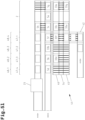
- FIG. 5a to 5m describes a method for picking goods at a picking station 2, where orders are processed.
- the robot system and the conveyor means 22a, 22b, 55, 56 of the source container conveyor system or target container conveyor system are not entered.
- the robot 60 and gripping unit 61 are also not shown.
- An order can also be processed in partial orders at a single picking station 2 . Otherwise the orders or partial orders of the orders can also be processed at several picking stations 2 .
- a target container 33 is initially fed to a first picking station 2 and at least one item is picked. Thereafter, the target container 33 is fed to a second picking station 2 and at least one item is picked.
- the order cannot be processed completely at a single picking station 2 and the target container 33 is transported via the fifth conveyor device 14 ( 1 ) transported to the second picking station 2.
- Orders are used below.
- An order can also be understood as a picking order.
- a customer order includes at least one order.
- the orders are available as data records.
- the orders are recorded electronically on a computer (not shown) and the control units 31, 64 are transmitted.
- Each order consists of one or more order lines. If the order specifies several order lines, different goods are required.
- Each order line has at least information about the number of items ordered and about a type of goods.
- a first order includes a first order line, e.g. 2 items of item A, and a second order line, e.g. 1 item of item H.
- a second order includes a single order line, e.g. 1 item of item B.
- a third order includes a first order line, for example 1 piece of goods N (which is already in the target container 33d), and a second order line, for example 2 pieces of goods D and a third order line, for example 4 pieces of goods O.
- a fourth order includes a first order line, e.g. 2 items of item C, and a second order line, e.g. 3 items of item P.
- a fifth order includes a first order line, e.g. 1 item of item F.
- a sixth order includes a first order line, e.g. 1 piece of product E and a second order line, for example 3 pieces of product Q.
- empty target containers 33a, 33b, 33c and 33e are fed via the conveyor device 42.
- the empty target containers 33a, 33b, 33c and 33e are identified and an empty target container 33a, 33b, 33c and 33e is linked in terms of data to a recorded order.
- the identified and empty target containers 33a, 33b, 33c and 33e are transported to the first loading point 34a and second loading point 34b by conveyor 42 and in the picking station 2 by the first conveyor 35 and the transfer devices 38, 39.
- Target containers 33 which require goods for more than one order line and already contain a first order line, for example the target containers 33d, 33f, are temporarily buffered in the sorting buffer 44. At least one product has therefore already been placed in each of the target containers 33 . However, some target containers 33 (not shown) can also be empty, which are supplied via the conveyor system 42 connected to the sorting buffer 44 .
- the source containers 5a..5h are removed from the storage area 1 in a disordered (chaotic) sequence and conveyed in a disordered (chaotic) sequence to the first removal location 24a and second removal location 24b.
- Preferably stock up the source containers 5a..5h each have a single type of goods.
- the first source container 5a contains product A
- the second source container 5b contains product B
- the third source container 5c contains product C, etc.
- a number of orders are usually to be processed at the picking station 2 and some orders contain more than one order line.
- the target containers 33 assigned to these orders (for example the target containers 33a, 33c, 33d) must be made available several times at the first and second loading locations 37a, 37b and in an order which depends on the order in which the source containers 5a..5h are provided at the first and second removal locations 24a, 24b. This is illustrated, for example, using the target container 33a, which carries 2 pieces of goods A for a first order line and 1 piece of goods H for a second order line.
- target containers 33 for different orders in the sorting locations 48-1 to 48-4 and in the buffer locations 47-4 to 47-1 target containers 33 for different orders for example a target container
- a previously processed target container 33a is transported via the second conveyor device 36 from the first loading location 37a back into the sorting buffer 44 and to a sorting location 48-3 determined by the control unit 31, since a second order line still has to be processed.
- the source container 5a is transported away from the first removal location 24a on the source container conveyor system and stored back in the storage area 1 .
- a previously processed target container 33c can be transported via the second conveyor device 36 from the second loading station 37b back to the sorting buffer 44 and to a sorting station 48-1 to 48-4 determined by the control unit 31, since a second order line still has to be processed.
- the source container 5c is transported away from the second removal location 24b on the source container conveyor system and stored back in the storage area 1 .
- the target container 33a can be transported from the sorting station 48-3 to one of the buffer locations 47-2 determined by the control unit 31 immediately after it has been transported to the sorting buffer 44, after the source container 5h with the goods H for the second order line has already been transported transported to picking station 2 becomes.
- the target container 33a is transported from one of the sorting locations 48-3 to one of the buffer locations 47-2 by means of the conveyor 57 of one of the third conveyor devices 54.
- the target container 33a is transported along the sorting locations 48-4 and 48-3 by means of the conveyor 56 of the second conveyor device 46.
- the transport of the target container 33a along the buffer locations 47-2 and 47-1 takes place by means of the conveyor 55 of the first conveyor device 45.
- the target containers 33 in the sorting buffer 44 along the sorting locations 48-4 to 48-1 and along of the buffer locations 47-1 to 47-4 are transported in parallel. It is also possible for a target container 33 previously transported to one of the sorting locations 48-4 to 48-1 to be moved past a target container 33 subsequently transported to one of the sorting locations 48-4 to 48-1.
- a sorting process is thus carried out by the sorting buffer 44 via the buffer locations 47-1 to 47-4 and/or sorting locations 48-4 to 48-1.
- a previously processed target container 33b is transported via the second conveyor device 36 from one of the first and second loading locations 34a, 34b, for example the second loading location 37a and the conveyor device 43 to the conveyor device 13 for the removal of target containers 33 from the picking station 2, as in FIGS Figures 5f-5j evident.
- the source containers 5 are preferably also transported away from the picking station 2 by the conveyor device 13 .
- a possible sorting function of the sorting buffer 44 can thus be described as follows: a first target container 33 is transported back to the sorting buffer 44 for processing different order lines for at least one order after goods have been deposited for a first order line, and is temporarily buffered at a first sorting station 48 until a source container 5 with goods becomes one second order line is conveyed into a conveyor device 12 provided upstream of the picking station 2 (in particular the first removal location 24a and second removal location 24b) for transporting source containers 5 to the picking station 2, and said first target container 33 from the first sorting location 48 to one of the buffer locations 47 and thereafter can be moved to one of the first and second loading places 34a, 34b after the source container 5 has been transported with a product to a second order line on the conveyor device 12 for the transport of source containers 5 to the picking station 2, and
- a second target container 33 for processing different order lines for at least one order after depositing a product on a first order line is transported back to the sorting buffer 36 and moved via a second sorting location 48 to one of the buffer locations 47 and then to the first and second loading locations 34a, 34b if a source container 5 with goods for a second order line has already been transported into a conveyor device 12 provided upstream of the picking station 2 (in particular the first removal location 24a and second removal location 24b) for transporting source containers 5 to the picking station 2.
- a first embodiment of a method for the fully automated picking of different goods A..H from source container 5a..5h to target container 33a..33g by a robot 60 with a gripping unit 61 according to orders is described below.
- This method for fully automated picking can be used particularly well at the picking station 2 described above.
- step c) the first source container 5a is made available at the first removal location 27a and the second source container 5c is made available at the second removal location 27b, which can essentially take place at the same time or at different times.
- the transport of the first and second target containers 33a, 33c in steps d) and e) can take place at the same time or at different times.
- the transport of the first and second target containers 33a, 33c in steps d) and e) and the transport of the first and second source containers 5a, 5c in step b) can take place at the same time or at different times.
- the transport of the first and second source containers 5a, 5c to the first and second removal locations 24a, 24b and the transport of the target containers 33a, 33c to the first and second loading locations 34a, 34b are matched to one another in such a way that a source container 5a, 5c and a destination container 33a, 33c arrive at the removal location 24a, 24b and loading location 34a, 34b for an order approximately at the same time.
- a gripping surface pose is repeatedly determined if goods A of this goods type are required again for the first order.
- the first order therefore includes an order line, for example with at least 2 pieces of goods A.
- Step h) is therefore carried out before each new removal of goods A from the first source container 5a.
- the sensor system 62a can repeatedly detect the goods A in the first source container 5a and repeatedly determine a gripping surface pose. If the sensor system 62a is a camera system (of an image recognition device), the repeated detection of the goods A in the first source container 5a can take place when the robot 60 and/or the gripping unit 61 has been moved out of the image detection area.
- step k) a gripping surface pose is repeatedly determined if goods C of this goods type are required again for the second order. Therefore, the second order includes an order line, for example, with at least 2 pieces of goods C. Step k) is therefore carried out before each new removal of goods C from the second source container 5c.
- the sensor system 62b can repeatedly detect the goods C in the second source container 5c and repeatedly determine a gripping surface pose. If the sensor system 62b is a camera system (of an image recognition device), the repeated detection of the goods C in the second source container 5c can take place when the robot 60 and/or the gripping unit 61 has been moved out of the image detection area.
- step f) during the processing of the order line can become the first order according to steps g) and h) and step i) during the processing of the order line (e.g. with at least 2 pieces from the goods C) to the second order according to steps j) and k).
- step h) and/or step k) is only carried out if the order requires an order line with at least 2 goods A, C. Requires the order for one order line for more than 2 goods, step h) and/or step k) is repeated. If, on the other hand, the order includes an order line with a single item, for example item B (see Figure 5d , 5e ) step h) and/or step k) can be omitted.
- step f) and/or step i) is carried out, namely determination of a gripping surface pose of a gripping surface 63 for at least one of the goods B in the second source container 5b using a sensor system 62b, in particular an image recognition device with a Camera system as soon as the second source container 5b has been made available at the second removal location 24b (see Figure 5d - Hatching of the second source container 5b symbolizes the one-time determination of a gripping surface pose),
- step m) the first target container 33a is transported away after processing the order line for the first order from the first loading station 34a and the second target container 33c is transported away from the second loading station 34b after processing the order line for the second order independently of one another by a second conveyor device 36.
- the first target container 33a/second target container 33c can be transported away from the picking station 2 by the target container conveyor system (conveyor devices 13, 43) (see, for example, target container 33b).
- the first target container 33a/second target container 33c is transported to the sorting buffer 44 described above in order to be able to be fed again to the first loading station 34a/second loading station 34b (See, for example, target container 33a).
- step i) the first source container 5a is transported away from the first removal location 27a and the second source container 5c is transported away from the second removal location 27b, which can essentially take place at the same time or at different times.
- step m the first target container 33a is transported away from the first loading station 37a and the second target container 33c is transported away from the second loading station 37b, which can take place at different times.
- the removal of the first source container 5 (e.g. source container 5a) after processing the order line for the first order from the first removal location 24a and the removal of the first destination container 33 (e.g. destination container 33a) after processing the order line for the first order from the first loading location 34a can be offset in time or temporally synchronous (simultaneously), as in the Figures 5a-5m shown.
- the removal of the second source container 5 (e.g. source container 5c) after processing the order line for the second order from the second removal location 24b and the removal of the second destination container 33 (e.g. destination container 33c) after processing the order line for the second order from the second loading location 34b can be offset in time or temporally synchronous (simultaneously), as in the Figures 5a-5m shown.
- the first order with steps f) to h) and the second order with steps i) to k) are processed sequentially by the robot 60 / the gripping unit 61 .
- step i) is carried out after the (complete) processing of the order line for the first order and during the movement of the robot 60/gripping unit 61 from the first target container 33a to the second source container 5c.
- the robot controller 64 receives the gripping surface pose of a gripping surface 63 for at least one of the goods C in the second source container 5c from the sensor system 62b, preferably shortly before the robot 60/the gripping unit 61 has reached the second source container 5c.
- Step f) is carried out after the (complete) processing of the order line for the second order during the movement of the robot 60/gripping unit 61 from the second target container 33c to the first source container 5a.
- the robot controller 64 receives the gripping surface pose of a gripping surface 63 for at least one of the goods A in the first source container 5a from the sensor system 62a, preferably shortly before the robot 60/the gripping unit 61 has reached the first source container 5a.
- first delivery device 24a and the second delivery device 24b are arranged at a distance from one another in the conveying direction of the second conveying device 26 .
- This distance can be defined by the buffer device 32 and is at least the container dimension (length of the container parallel to the conveying direction). However, this distance can also correspond to a multiple of the container dimensions.
- first delivery device 34a and the second delivery device 34b are arranged at a distance from one another in the conveying direction of the second conveying device 36 .
- the apparent performance disadvantage due to the sequence of steps f) to h) and steps i) to k) for processing different orders is compensated by the higher picking performance, which is due to the short robot movements / gripping unit movements between the first source container 5 and the first target container 33 or second source container 5 and second target container 33 is reached.
- the short robot movements/gripping unit movements result from the compact design of the picking station 2, in particular due to the small distance 51 between the second conveyor devices 26, 36. This also has the advantage that the control sequences can be made simpler.
- different order lines for a first order can be processed in such a way that first the first target container 33a is loaded with goods A from the first source container 5a and then with goods C from the second source container 5c, without the first being transported away in the meantime Target container 33a from the first loading station 37a and renewed transport to the first loading station 37a.
- different order lines for a second order can be processed in such a way that first the second target container 33c is loaded with a product C from the second source container 5c and then with a product A from the first source container 5a, without the first target container 33a being transported away in the meantime from the second loading station 37b and renewed transport to the second loading station 37b.
- the sorting buffer 44 described above would not be absolutely necessary or can even be omitted.
- a “diagonal movement” of the robot 60/gripping unit 61 takes place between the first/second removal location 27a, 27b and the first/second loading location 37a, 37b).
- step i) after removal of goods A for an order line for the second order is carried out during the movement of the robot 60/gripping unit 61 from the first source container 5a to the second target container 33c.
- step f) is carried out after removal of a product C for an order line for the second order during the movement of the robot 60/gripping unit 61 from the second source container 5c to the first target container 33a.
- step i) after processing an order line for the first order and after removal of goods A for an order line for the second order during the movement of the robot 60 / the gripping unit 61 from the first target container 33a is carried out to the second source container 5c.
- step f) is carried out after the order line for the second order has been processed during the movement of the robot 60/gripping unit 61 from the second target container 33c to the first source container 5a.
- the sorting buffer 44 is not absolutely necessary.
- the source container 5 and target container 33 are coordinated by the source container distribution system and target container distribution system to the first/second removal locations 27a, 27b and first/second loading locations 37a, 37b that they are delivered to the respective orders and approximately at the same time to the first / second removal places 27a, 27b and first / second loading places 37a, 37b are provided.
- the sorting buffer 44 can also be realized by a different configuration.
- a second embodiment of a method for the fully automated picking of different goods A..H from source container 5a..5h to target container 33a..33g by a robot 60 with a gripping unit 61 according to orders is described below.
- method step m) is optional.
- the methods described for picking goods are not to be understood as being limited to the embodiment of the source container conveyor technology and/or target container conveyor technology described above.
- the source container conveyor technology can, for example, have first conveyor devices arranged separately from one another for transporting the source container 5 to the first delivery device 24a and second delivery device 24b.
- the source container conveyor system can, for example, have second conveyor devices arranged separately from one another for transporting the source container 5 away from the first delivery device 24a and second delivery device 24b.
- the target container conveyor technology can, for example, have first conveyor devices arranged separately from one another for transporting the target container 33 to the first delivery device 34a and second delivery device 34b.
- the target container conveyor technology can also have, for example, second conveyor devices arranged separately from one another for transporting the target container 33 away from the first delivery device 34a and second delivery device 34b.
- the method also includes step m): Removal of the first target container (33a) after processing the order line for the first order from the first loading point (37a) and removal of the second target container (33c) after processing the order line for the second order from the second loading point (37b) independently of one another by a through the target container -Conveyor technology.
- the method additionally comprises steps m) to u). These steps are used to process an order line for the first order, which, for example, includes 2 pieces of goods A, ( Figures 6a-6b ) and the processing of an order line for the second order, which, for example, includes 1 piece of goods C, ( Figures 6b-6c ) in advance. This applies to steps b) to 1) as described above.
- the provision of the third source container 5c at the first removal location 27a and the provision of the fourth source container 5g at the second removal location 27b can essentially take place at the same time or at different times.
- Method steps m) to u) relate to further processing of the first order with a next order line and/or second order with a next order line and another measure in the provision of the first target container 33a and/or second target container 33a.
- Step n) is to be understood in such a way that the first target container 33a..33g and/or second target container 33a..33g remains on the first loading station 34a/second loading station 34b (stationary) until preferably all order lines for the first order and/or or all order lines for the second order have been (completely) processed.
- the first source container 5a..5h and/or second source container 5a..5h are moved to the first removal location 24a and/or second removal location in a corresponding sequence depending on the first target container 33a..33g and/or second target container 33a..33g to be processed 24b provided.
- step r) after the (complete) processing of the order line for the first order and during the movement of the robot 60 / the gripping unit 61 from the first target container 33a to the fourth Source container 5g is carried out.
- the robot controller 64 receives the gripping surface pose of a gripping surface 63 for at least one of the goods G in the fourth source container 5g from the sensor system 62b, preferably shortly before the robot 60/the gripping unit 61 has reached the fourth source container 5g.
- Step o) is carried out after the (complete) processing of the order line for the second order during the movement of the robot 60/gripping unit 61 from the second target container 33c to the third source container 5h.
- the robot controller 64 receives the gripping surface pose of a gripping surface 63 for at least one of the goods H in the third source container 5a from the sensor system 62a, preferably shortly before the robot 60/the gripping unit 61 has reached the third source container 5h.
- FIG. 7 shows a possible combination of the above-described picking station 2 with robot 60 for automatic picking and a picking station 2' with manual picking by an operator.
- a picking station 2 'with manual picking is in WO 2018/006112 A1 described.
- the same structure of the source container serving device 69 and the same structure of the destination container serving device 70 can be used.
- Serving device 69 preferably has a single picking location for a source container and serving device 70 preferably has a single loading location for a destination container.
- the WO 2018/006112 A1 made the subject of this disclosure.
- Such an embodiment makes it possible for those goods which can only be manipulated (picked) with difficulty or not at all by the robot 60/gripping unit 61 to be processed at the picking station 2' with manual picking.
- the source container conveyor technology of the picking station 2 is connected to the delivery device 69 in terms of conveyor technology
- the target container conveyor technology of the picking station 2 is connected to the delivery device 70 in terms of conveyor technology.
- the source containers containing such goods can be provided at the serving device 69 .
- the target containers, which are loaded with such goods can be made available at the service device 70 .
- the 8 and 9 now show an example picking station 2a with a fully automated robot system, which includes a portal robot 60a, in an oblique view, wherein the 8 the picking station 2a obliquely from the front and the 9 shows the picking station 2a diagonally from behind.
- the 10 and 11 show the gantry robot 60a from FIGS 8 and 9 with the gripping unit 61 extended downwards, also in an oblique view.
- the 10 shows the gantry robot 60a at an angle from the front and the 11 obliquely from behind.
- This portal robot 60a can be used at the picking station 2 described above.
- This portal robot 60a can also be used to carry out the method described above for the fully automated picking of different goods from source containers 5a..5h to target containers 33a..33g (compare also claims 16 to 25 or claims 26 to 38).
- the picking station 2a comprises two removal stations 27a, 27b, which are part of a conveyor device 12 or can be connected to it, and two loading stations 37a, 37b, which Are part of a conveyor 13, or can be connected to it.
- a source container 5a is arranged on the removal location 27a.
- the removal location 27b is empty in this example, but a source container 5b could of course be arranged on it.
- the loading places 37a, 37b are also empty in this example, but target containers 33a, 33b could be positioned thereon.
- the picking station 2a includes two removal locations 27a, 27b and two loading locations 37a, 37b.
- a different number of removal locations 27a, 27b and loading locations 37a, 37b to be provided, for example only one removal location 27a and one loading location 37a or more than two removal locations 27a, 27b and loading locations 37a, 37b.
- the goods A..H to be picked are provided directly (i.e. without source containers 5a, 5b and destination containers 33a, 33b at the removal locations 27a, 27b and loading locations 37a, 37b.
- the conveyor device 12 is part of a source container conveyor technology for the automated transport of source containers 5a, 5b. Furthermore, the conveyor device 13 is part of a target container conveyor system for the automated transport of target containers 33a, 33b.
- the source container conveyor system and/or the target container conveyor system can in particular be designed as shown in one of the preceding figures. Accordingly, the source container conveyor system can have a first delivery device 24a, which includes the first removal location 27a, and an optional second delivery device 24b, which includes the second removal location 27b.
- the target container conveyor system can also have a first delivery device 34a, which includes the first loading station 37a, and a second delivery device 34b, which includes the second loading station 37b.
- the source container conveyor technology for the automated transport of source containers 5a, 5b and/or the target container conveyor technology for the automated transport of target containers 33a, 33b can be designed according to the embodiments described above.
- the storage tray 66a and/or storage tray 66b and/or storage tray 66c and/or storage tray 66d described above can also be present.
- the portal robot 60a includes a base frame that includes four vertical posts 71 in this example.
- the base frame could be longitudinal beams and/or transverse beams (running in the y-direction) connected to the vertical uprights 71 (and running in the x-direction). exhibit. It would also be conceivable for the base frame to have several side walls instead of the vertical posts 71 or in addition to them.
- gantry robot 60a also includes a first gantry carriage 74, which is movably mounted relative to vertical uprights 71 of the base frame and can be moved horizontally via a first drive device 72 along a first guide arrangement 73 in a first direction x mounted and can be moved horizontally via a second drive device 75 along a second guide arrangement 76 in a second direction y running transversely to the first direction x.
- the portal robot 60a comprises a slidably mounted on the second portal slide 77 and via a third drive device 78 third portal slide 80 that can be moved vertically along a third guide arrangement 79 in a third direction z.
- portal robot 60a comprises a gripping unit 61 that is coupled to third portal slide 80 and is mounted such that it can rotate about a first axis of rotation Da1 and can be moved via a fourth drive device 81.
- the gantry robot 60a includes a gantry arm 82 that can be moved via the fourth drive device 81 and is mounted on the third gantry slide 80 so that it can rotate about a first, vertical axis of rotation Da1.
- the gripping unit 61 is mounted on the portal arm 82 such that it can rotate about a second, horizontal axis of rotation Da2 and can be moved via a fifth drive device 83 . Accordingly, the gripping unit 61 can be rotated both about the vertical axis of rotation Da1 and about the horizontal axis of rotation Da2.
- the gripping unit 61 can therefore be moved particularly well into an advantageous gripping pose, for example if the goods A..H to be gripped are formed by a box lying at an angle in a swelling container or if the gripping unit 61 is not (rotationally) symmetrical when viewed from below, as is the case with the portal robot 60a shown. Even if a rotation about two axes of rotation Da1, Da2 is advantageous, it would of course also be conceivable for the gripping unit 61 to be rotated only about a vertical axis of rotation Da1 or only about a horizontal axis of rotation Da2.
- portal robot 60a also specifically includes a first x-guide rail 84a, which is arranged on a first x-carrier 85a, and a second x-guide rail 84b, which is arranged on a second x-carrier 85b.
- the first x guide carriage 86a of the first portal slide 74 can be displaced on the first x guide rail 84a stored, and on the second x-guide rail 84b of the second x-guide carriage 86b of the first portal carriage 74 is slidably mounted.
- the first x guide rail 84a, the first x guide carriage 86a, the second x guide rail 84b and the second x guide carriage 86b form the first guide arrangement 73 in this example.
- the first drive device 72 includes according to the Figures 8 to 11 illustrated embodiment has an x-traction mechanism connected to the first portal carriage 74, which in this example has an endlessly circulating first x-traction mechanism 87a and an endlessly circulating second x-traction mechanism 87b.
- the first x-traction means 87a and the second x-traction means 87b are each guided around a deflection wheel and a drive wheel (not shown), which are arranged in first wheel housings 88a..88d at the ends of the x-beams 85a, 85b.
- One of the drive wheels is coupled to an electric x-servomotor 89 and the two drive wheels of the x-traction mechanism are coupled via a coupling shaft 90 in this example.
- the x-traction means 87a, 87b can be driven via separate (and electronically coupled) x-servomotors 89.
- the coupling shaft 90 can then be omitted.
- a clockwise or counterclockwise rotation of the drive wheel causes the first portal carriage 74 (and thus also the second portal carriage 77 and the third portal carriage 80) to move relative to the removal locations 27a, 27b and to the source container 5a, 5b and relative to the loading locations 37a, 37b and moved to the target container 33a, 33b horizontally in the x-direction.
- the portal robot 60a also includes a first y-guide rail 91a and a second y-guide rail 91b, which are arranged on a y-beam 92.
- the y-guide carriage 93 of the second portal carriage 77 is displaceably mounted on the first y-guide rail 91a and the second y-guide rail 91b.
- the first y-guide rail 91a, the second y-guide rail 91b and the y-guide carriage 93 form the second guide arrangement 76.
- the second drive device 75 comprises according to the Figures 8 to 11
- the embodiment shown has a y-traction mechanism connected to the second portal carriage 77, which in this example also has an endlessly circulating y-traction mechanism 94.
- the first y-pulling means 94 is in turn guided around a deflection wheel and a drive wheel (not shown), which are arranged in second wheel housings 95a, 95b at the ends of the y-beam 92.
- the drive wheel is coupled to an electric y-servomotor 96 .
- the second portal carriage 77 By rotating the drive wheel clockwise or counterclockwise, the second portal carriage 77 (and thus also the third portal carriage 80) is moved relative to the removal locations 27a, 27b and to the source container 5a, 5b and relative to the loading locations 37a, 37b and to the target container 33a, 33b is moved horizontally in the y-direction.
- the portal robot 60a also includes three base plates 97a .
- four z guide rails 98a..98d are arranged on the second base plate 97b.
- the guide rails 98a, 98b are arranged on the front side of the second base plate 97b, and the other two guide rails 98c, 98d are respectively arranged behind the guide rails 98a, 98b on the rear side of the second base plate 97b.
- the guide rails 98a, 98b on the back of the second base plate 97b are slidably mounted in z guide carriages 99a which are mounted on the first base plate 97a (note: in Figs Figures 8 to 11 only one z guide carriage 99a of the two z guide carriages is visible).
- Two further z guide carriages 100a, 100b are mounted on the third base plate 98c and are slidably mounted on the guide rails 98a, 98b.
- the first base plate 97a and the z guide carriages 99a are thus encompassed by the second portal carriage 77 .
- the second base plate 97b and the third base plate 97c, the guide rails 98a..98d and the z guide carriages 100a, 100b are part of the third portal slide 80.
- the third drive device 78 comprises according to the Figures 8 to 11
- a gear (not shown) is housed in a gear housing 101.
- the gear is connected to a shaft of an electric z-actuator motor 102 and meshes with a rack 103 mounted on the rear of the second base plate 97b. This allows the second base plate 97b to be moved relative to the first base plate 97a.
- a first deflection wheel 104 is rotatably mounted on the second base plate 97b in the upper area and a second deflection wheel 105 in the lower area, around which a z-traction means 106 is guided.
- the z-traction means 106 is connected to the first base plate 97a and to the third base plate 97c.
- the third portal slide 80 is thus moved vertically in the z-direction relative to the removal locations 27a, 27b and the source container 5a, 5b and relative to the loading locations 37a, 37b and the target container 33a, 33b.
- the 8 and 9 show the third portal slide 80 in its upper rest position.
- the 10 and 11 show a view in which the third portal carriage 80 and thus the movable gripping unit 61 are extended downwards.
- the gantry robot 60a can include a path measuring device, not shown, by means of which the adjustment movements of the first gantry carriage 74, the second gantry carriage 77 and the third gantry carriage 80 are detected. You can make use of the measuring method of absolute and incremental displacement measurement.
- FIG. 12a now shows a detailed view of the portal arm 82 with the gripping unit 61 arranged in the lower area, diagonally from the front.
- Figure 12b shows the portal arm 82 with the gripping unit 61 arranged in the lower area from an angle from behind.
- FIG. 13a also shows a detailed view of the portal arm 82 with the gripping unit 61 arranged in the lower area from the left side, the Figure 13b from the right side.
- the gripping unit 61 is pivoted backwards by 45° about the horizontal axis of rotation Da2.
- a pivoting of the gripping unit 61 by 45° to the front is also shown with dashed lines.
- a pivoting angle of 45° is not to be understood as limiting, rather the gripping unit 61 can also be pivoted by a different pivoting angle about the horizontal axis of rotation Da2.
- the fourth drive device 81 includes according to the Figures 8 to 13b shown embodiment has a first rotary servomotor 107, which transmits a rotary movement to the portal arm 82 via a gear (not shown) in the first gear housing 108 and thus a relative rotation of the portal arm 82 relative to the removal locations 27a, 27b and to the source container 5a, 5b and relative allows to the loading places 37a, 37b and to the target container 33a, 33b.
- the possible angle of rotation is 360° in the example shown, and in particular the portal arm 82 can be rotated endlessly. However, it would also be conceivable for the angle of rotation of the portal arm 82 to be limited to smaller angles of rotation.
- the fifth drive device 83 includes according to the Figures 8 to 13b illustrated embodiment, a second rotary servomotor 109, which transmits a rotary movement to the gripping unit 61 and thus a relative rotation of the gripping unit 61 relative to the removal locations 27a, 27b and to the source container 5a, 5b and relative to the loading locations 37a, 37b and to the target container 33a, 33b allows.
- the rotational movement is transmitted from a first belt wheel 110 via a first belt 111 to a second belt wheel 112, to the shaft 113, from the shaft to a (bevel) gear (not shown), to two third belt wheels 114a, 114b, to two second ones belts 115a, 115b and finally to two fourth pulleys 116a, 116b.
- the possible swivel angle is ⁇ 45°.
- the maximum angle of rotation of the gripping unit 61 it would also be conceivable for the maximum angle of rotation of the gripping unit 61 to be less than ⁇ 45° or even greater than ⁇ 45°.
- the gantry robot 60a can also include an angle measuring device, not shown, by means of which the adjustment movements of the gantry arm 82 and the gripping unit 61 are recorded.
- the measuring method of absolute and incremental angle measurement can be used here.
- the gripping unit 61 in this example comprises three vacuum suction pads 117 which are connected via fluid lines, in particular air hoses 118 to a vacuum generator (not shown). It proves to be advantageous if the air hoses 118 (fluid lines) are accommodated in an internal (integrally designed) line-receiving channel, not shown in detail, running in the longitudinal direction of the portal arm 82 . On the other hand, air ducts (fluid lines) can be worked out in the portal arm 82, for example there are bores in the portal arm which form the air ducts.
- the fluid lines are integral with the portal arm 82 .
- This in turn favors the removal of goods from a source container 5a or the placement of goods in a target container 33.
- the portal arm 82 can be moved unhindered and particularly close to a container wall and dip into the source container 5a or target container 33, as in 14 shown.
- goods A..H can be gripped in this way with a particularly low error rate. That is, a number of failed Handlings of goods A..H in relation to a total number of handlings of these goods A..H is small.
- the vacuum suction pads 117 are arranged in a triangle and form a gripping plane, as a result of which goods A..H that have a flat boundary surface or several such boundary surfaces, for example boxes, are gripped well.
- the portal arm 82 includes a flat, vertical boundary surface 119 which is aligned parallel to one of the sides a of that triangle at whose corner points the centers of the vacuum suction pads 117 lie.
- the portal arm 82 as in the Figures 8 to 13a shown, have a round (circular) cross-section which is flattened in the region of said vertical boundary surface 119.
- the portal arm 82 it would also be conceivable for the portal arm 82 to have a polygonal cross section (in particular a rectangular cross section or a triangular cross section).
- Said vertical boundary surface 119 is then formed by a side surface of a polygonal prism.
- the portal arm 82 Due to the at least one vertical boundary surface 119 of the portal arm 82, which is aligned to one of the sides of the triangle, it can be immersed particularly close to a container wall in a source container 5a or target container 33 in order to grip goods A..H, as in the example in the 14 for commodity A is shown.
- the flat, vertical boundary surface 119 of the portal arm 82 up to the lower end of the gripping unit 61 is greater (longer) than 1.1 times the container height hB of the source container 5a and/or the target container 33, such as that in connection with 14 is shown. That means it applies: immersion ⁇ Height hey > 1.1 -fold container height hB .
- the portal arm 82 has a vertical, flat boundary surface 119 (side wall), which is set back compared to a maximum cross-sectional contour of the portal arm 82 .
- the (entire) portal arm 82 it would also be conceivable for the (entire) portal arm 82 to have a prismatic outer contour.
- a diameter of the gripping unit 61 regardless of the number of vacuum suction grippers 117 used, is not or not significantly larger than a diameter of the portal arm 82.
- the portal arm 82 or the gripping unit 61 is not rotationally symmetrical when viewed from below, which is why it is particularly advantageous for the gripping unit 61 to be rotatable about the vertical axis of rotation Da1. If, on the other hand, the portal arm 82 and the gripping unit 61 are rotationally symmetrical when viewed from below, then the ability of the gripping unit 61 to rotate about the vertical axis of rotation Da1 can also be omitted under certain circumstances without any significant disadvantage.
- the gantry robot 60a has a gripper receptacle 120 which is mounted on the gantry arm 82 so as to be rotatable about the second, horizontal axis of rotation Da2 and on which the gripping unit 61 is fastened.
- the gripper mount 120 allows gripping units 61 of different types to be attached to the gantry robot 60a, with the gripping units 61 being adapted to different gripping tasks.
- mechanical gripping elements e.g. a robot hand or gripping tongs
- a gripping unit 61 is not limited to three vacuum suction pads 117 arranged in a triangle, but the gripping unit 61 may have more or less than three vacuum suction pads 117, and the vacuum suction pads 117 may be geometrically arranged differently.
- the gripping unit 61 can also be moved into an advantageous gripping pose for gripping goods A..H, but by rotating the source container 5a, 5b and/or target container 33a, 33b relative to the portal robot 60a. If the source container 5a, 5b and the target container 33a, 33b can be rotated about a vertical axis of rotation, then the gripping unit 61 does not need to be mounted so that it can rotate about a vertical axis of rotation Da2 relative to the third portal slide 80.
- the gripping unit 61 does not need to be mounted such that it can rotate about a horizontal axis of rotation Da1 relative to the third portal carriage 80 if the source container 5a, 5b and the target container 33a, 33b can be tilted about a horizontal axis of rotation.
- the fully automated robot system with the portal robot 60a comprises a sensor system 62a, 62b, in particular a camera system, at least for detecting the goods A..H in the first source container 5a and optionally in the second source container 5b, if a second delivery device 24b is provided, and a robot controller 64, which is connected to the sensor system 62a, 62b and controls the robot 60 with the gripping unit 61.
- the robot controller 64 which is connected to the sensor system 62a, 62b and controls the robot 60 with the gripping unit 61.
- the proposed measures also make it possible to correct any errors that may occur during order picking.
- the measures presented enable the gripping unit 61 to be moved particularly well into an advantageous gripping pose.
- the portal arm 82 can be moved in a vertical direction onto a bottom of a source container 5a, 5b or target container 37a, 37b.
- An optimal gripping pose can be achieved by maintaining the gantry arm 82 in its vertical position while the gripping unit 61 pivots relative to the gantry arm 82 .
- the portal arm 82 and the gripping unit 61 can thus enter a source container 5a, 5b or target container 37a, 37b very close to a side wall, even if the portal arm 82 does not have a specially shaped boundary surface 119.
- goods A..H in the edge area can also be removed from a source container 5a, 5b, and goods A..H can be delivered in the edge area of a target container 37a, 37b.
- the devices shown can also include more or fewer components than shown.
- the devices shown or their components may also be shown not to scale and/or enlarged and/or reduced.
Landscapes
- Engineering & Computer Science (AREA)
- Mechanical Engineering (AREA)
- Robotics (AREA)
- Warehouses Or Storage Devices (AREA)
- Specific Conveyance Elements (AREA)
- Manipulator (AREA)
Claims (19)
- Station de préparation de commandes (2, 2a) pour la préparation de commandes de marchandises (A, B) à partir de récipients sources (5a, 5b) vers des récipients cibles (33a, 33b), avec- un système de convoyage de récipients sources pour le transport automatisé des récipients sources (5a, 5b), comprenant- un premier dispositif de convoyage (25) pour l'approvisionnement des récipients sources (5a, 5b),- un premier dispositif de transfert (28) pour le transport d'un premier récipient source (5a) du premier dispositif de convoyage (25) vers un premier dispositif de desserte (24a),- un deuxième dispositif de transfert (29) pour le transport d'un deuxième récipient source (5b) du premier dispositif de convoyage (25) vers un deuxième dispositif de desserte (24b),- un premier dispositif de desserte (24a) avec un premier emplacement de prélèvement (27a) au niveau duquel un premier récipient source (5a) est mis à disposition,- un deuxième dispositif de desserte (24b) avec un deuxième emplacement de prélèvement (27b), au niveau duquel un deuxième récipient source (5b) est mis à disposition,- un deuxième dispositif de convoyage (26) pour l'évacuation des récipients sources (5a, 5b) du premier dispositif de desserte (24a) et du deuxième dispositif de desserte (24b),- dans lequel le premier dispositif de desserte (24a) avec le premier emplacement de prélèvement (27a) et le deuxième dispositif de desserte (24b) avec le deuxième emplacement de prélèvement (27b) sont disposés le long du deuxième dispositif de convoyage (26) pour l'évacuation des récipients sources (5a, 5b),- un système de convoyage de récipients cibles pour le transport automatisé des récipients cibles (33a ; 33b), comprenant- un premier dispositif de convoyage (35) pour l'approvisionnement des récipients cibles (33a, 33b),- un premier dispositif de transfert (38) pour le transport d'un premier récipient cible (33a) du premier dispositif de convoyage (35) vers un premier dispositif de desserte (34a),- un deuxième dispositif de transfert (39) pour le transport d'un deuxième récipient cible (33b) du premier dispositif de convoyage (35) vers un deuxième dispositif de desserte (34b),- un premier dispositif de desserte (34a) avec un premier emplacement de chargement (37a) au niveau duquel un premier récipient cible (33a) est mis à disposition,- un deuxième dispositif de desserte (34b) avec un deuxième emplacement de chargement (37b), au niveau duquel un deuxième récipient cible (33b) est mis à disposition,- un deuxième dispositif de convoyage (36) pour l'évacuation des récipients cibles (33a, 33b) du premier dispositif de desserte (34a) et du deuxième dispositif de desserte (34b),- dans lequel le premier dispositif de desserte (34a) avec le premier emplacement de chargement (37a) et le deuxième dispositif de desserte (34b) avec le deuxième emplacement de chargement (37b) sont disposés le long du deuxième dispositif de convoyage (36) pour l'évacuation des récipients cibles (33a, 33b),dans lequel le premier dispositif de desserte (24a) avec le premier emplacement de prélèvement (27a) et le premier dispositif de desserte (34a) avec le premier emplacement de chargement (37a) sont superposés entre eux,dans lequel le deuxième dispositif de desserte (24b) avec le deuxième emplacement de prélèvement (27b) et le deuxième dispositif de desserte (34b) avec le deuxième emplacement de chargement (37b) sont superposés entre eux,dans lequel le deuxième dispositif de convoyage (26) pour l'évacuation des récipients sources (5a, 5b) et le deuxième dispositif de convoyage (36) pour l'évacuation des récipients cibles (33a, 33b) sont disposés parallèlement entre eux,- un système robotique entièrement automatisé comprenantcaractérisé en ce que- un robot (60, 60a) avec une unité de préhension (61) mobile par rapport à une base de robot, qui est conçu pour prélever, pour différentes tâches, des marchandises (A, B) du premier récipient source (5a) et/ou du deuxième récipient source (5b) et les déposer dans le premier récipient cible (33a) et/ou le deuxième récipient cible (33b),- un système de capteurs (62a, 62b), plus particulièrement un système de caméra, au moins pour la détection des marchandises (A, B) dans le premier récipient source (5a) et le deuxième récipient source (5b),- une commande de robot (64) qui est reliée avec le système de capteurs (62a, 62b) et qui contrôle le robot (60, 60a) avec l'unité de préhension (61).le premier dispositif de desserte (24a) avec le premier emplacement de prélèvement (27a) est relié, par l'intermédiaire du premier dispositif de transfert (28), avec le premier dispositif de convoyage (25) pour l'approvisionnement des récipients sources (5a, 5b), le deuxième dispositif de desserte (24b) avec le deuxième emplacement de prélèvement (27b) est relié, par l'intermédiaire du deuxième dispositif de transfert (29), avec le premier dispositif de convoyage (25) pour l'approvisionnement des récipients sources (5a, 5b),le premier dispositif de desserte (34a) avec le premier emplacement de chargement (37a) est relié, par l'intermédiaire du premier dispositif de transfert (38), avec le premier dispositif de convoyage (35) pour l'approvisionnement des récipients cibles (33a, 33b) etle deuxième dispositif de desserte (34b) avec le deuxième emplacement de chargement (37b) est relié, par l'intermédiaire du deuxième dispositif de desserte (39), avec le premier dispositif de convoyage (35) pour l'approvisionnement des récipients cibles (33a, 33b).
- Station de préparation de commandes selon la revendication 1, caractérisée en ce que le premier dispositif de desserte (24a) avec le premier emplacement de prélèvement (27a) et le deuxième dispositif de desserte (24b) avec le deuxième emplacement de prélèvement (27b) sont réalisés sur le deuxième dispositif de convoyage (26) pour l'évacuation des récipients sources (5a, 5b).
- Station de préparation de commandes selon la revendication 1 ou 2, caractérisée en ce que le premier dispositif de desserte (34a) avec le premier emplacement de chargement (37a) et le deuxième dispositif de desserte (34b) avec le deuxième emplacement de chargement (37b) sont réalisés sur le deuxième dispositif de convoyage (36) pour l'évacuation des récipients cibles (33a, 33b).
- Station de préparation de commandes selon l'une des revendications 1 à 3, caractérisée en ce que le deuxième dispositif de convoyage (26) pour l'évacuation des récipients sources (5a, 5b) et le deuxième dispositif de convoyage (36) pour l'évacuation des récipients cibles (33a, 33b) sont disposés à une distance (51) de 400 mm maximum et parallèlement entre eux.
- Station de préparation de commandes selon l'une des revendications 1 à 4, caractérisée en ce que le premier dispositif de desserte (24a) avec le premier emplacement de prélèvement (27a) et le premier dispositif de desserte (34a) avec le premier emplacement de chargement (37a) forment chacun un niveau de desserte (52a, 53a) sur le même niveau de hauteur.
- Station de préparation de commandes selon l'une des revendications 1 à 5, caractérisée en ce que le deuxième dispositif de desserte (24b) avec le deuxième emplacement de prélèvement (27b) et le deuxième dispositif de desserte (34b) avec le deuxième emplacement de chargement (37b) forment chacun un niveau de desserte (52b, 53b) sur le même niveau de hauteur.
- Station de préparation de commandes selon l'une des revendications 1 à 6, caractérisée en ce que, entre le premier dispositif de desserte (24a) avec le premier emplacement de prélèvement (27a) et le deuxième dispositif de desserte (24b) avec le deuxième emplacement de prélèvement (27b), est prévu un dispositif tampon (32) avec au moins un emplacement tampon, au niveau duquel un deuxième récipient source (5b) peut être mis en tampon après la préparation de commande.
- Station de préparation de commandes selon l'une des revendications 1 à 7, caractérisée en ce que, entre le premier dispositif de desserte (34a) avec le premier emplacement de chargement (37a) et le deuxième dispositif de desserte (34b) avec le deuxième emplacement de chargement (37b), est prévu un dispositif tampon (40) avec au moins un emplacement tampon, au niveau duquel un deuxième récipient cible (33b) peut être mis en tampon après la préparation de commande.
- Station de préparation de commandes selon l'une des revendications 1 à 8, caractérisée en ce que le deuxième dispositif de convoyage (26) pour l'évacuation des récipients sources (5a, 5b) et le deuxième dispositif de convoyage (36) pour l'évacuation des récipients cibles (33a, 33b) sont reliés par l'intermédiaire d'un troisième dispositif de convoyage (43) afin de transporter les récipients sources (5a, 5b) et les récipients cibles (33a, 33b), après la préparation de commande, sur un trajet de convoyage commun.
- Station de préparation de commandes selon l'une des revendications 1 à 9, caractérisée en ce que- au-dessus du deuxième dispositif de convoyage (26) pour l'évacuation des récipients sources (5a, 5b) et du deuxième dispositif de convoyage (36) pour l'évacuation des récipients cibles (33a, 33b), entre le premier dispositif de desserte (24a) avec le premier emplacement de prélèvement (27a) et le premier dispositif de desserte (34a) avec le premier emplacement de chargement (37a), est disposée une plaque de pose (66a) qui comprend une première ouverture d'accès (67a) au-dessus du premier emplacement de prélèvement (27a) et une deuxième ouverture d'accès (67b) au-dessus du premier emplacement de chargement (37a) et- au-dessus du deuxième dispositif de convoyage (26) pour l'évacuation des récipients sources (5a, 5b) et du deuxième dispositif de convoyage (36) pour l'évacuation des récipients cibles (33a, 33b), entre le deuxième dispositif de desserte (24b) avec le deuxième emplacement de prélèvement (27b) et le deuxième dispositif de desserte (34b) avec le deuxième emplacement de chargement (37b), est disposée une plaque de pose (66b), qui comprend une première ouverture d'accès (67a) au-dessus du premier emplacement de prélèvement (27b) et une deuxième ouverture d'accès (67b) au-dessus du premier emplacement de chargement (37b).
- Station de préparation de commandes selon l'une des revendications 1 à 10, caractérisée en ce que- au-dessus du deuxième dispositif de convoyage (26) pour l'évacuation des récipients sources (5a, 5b), entre le premier dispositif de desserte (24a) avec le premier emplacement de prélèvement (27a) et le deuxième dispositif de desserte (24b) avec le deuxième emplacement de prélèvement (27b), est disposée une plaque de pose (66c) et- au-dessus du deuxième dispositif de convoyage (36) pour l'évacuation des récipients cibles (33a, 33b), entre le premier dispositif de desserte (34a) avec le premier emplacement de chargement (37a) et le deuxième dispositif de desserte (34b) avec le deuxième emplacement de chargement (37b), est disposée une plaque de pose (66d).
- Station de préparation de commandes selon la revendication 10 ou 11, caractérisée en ce que le système de capteurs (62a, 62b ; 65a, 65b ; 68), plus particulièrement le système de caméra, est conçu pour la détection d'une marchandise (A...C) qui est tombée accidentellement de l'unité de préhension (61) et qui se trouve sur la plaque de pose (66a... 66d) et la commande robotique (64) contrôle l'unité de préhension (61) de façon à ce que celle-ci prenne en charge la marchandise (A...C) sur la plaque de pose (66a... 66d) et la pose dans- le premier récipient source (5a) ou- le deuxième récipient source (5b) ou- le premier récipient cible (33a) ou- le deuxième récipient cible (33b).
- Station de préparation de commandes selon l'une des revendications 1 à 12, caractérisée en ce que la station de préparation de commandes (2) se raccorde à un tampon de tri (44) qui est contrôlé par une unité de commande (31) et au moyen duquel les récipients cibles (33a, 33b) sont triés dans le tampon de tri (36) dans un ordre qui est déterminé en fonction de l'ordre dans lequel les récipients sources (5a, 5b) sont mis à disposition respectivement dur le premier emplacement de prélèvement (27a) et le deuxième emplacement de prélèvement (27b).
- Station de préparation de commandes selon la revendication 13, caractérisée en ce que le tampon de tri (44) comprend des emplacements tampons (47) disposés les uns derrière les autres sur un premier dispositif de convoyage (45) dans un sens de distribution et des emplacements de tri (48) disposés les uns derrière les autres sur un deuxième dispositif de convoyage (46) dans une direction de retour et des troisièmes dispositifs (54) reliant les emplacements de tri (48) avec les emplacements tampons (47),dans lequel le premier dispositif de convoyage (45) du tampon de tri (44) se raccorde au premier dispositif de convoyage (35) pour l'approvisionnement des récipients cibles (33a, 33b) et le deuxième dispositif de convoyage (46) du tampon de tri (44) se raccorde au deuxième dispositif de convoyage (36) pour l'évacuation des récipients cibles (33a, 33b) etdans lequel le premier dispositif de convoyage (45) comprend au moins un moyen de convoyage (55) pour le transport des récipients cibles (33a, 33b) et le deuxième dispositif de convoyage (46) comprend au moins un moyen de convoyage (56) pour le transport des récipients cibles (33a, 33b) etdans lequel, aux emplacements tampons (47) et aux emplacements de tri (48), correspondent des moyens de convoyage (57, 58) pour le transport des récipients cibles (33a, 33b) et l'unité de commande (31) contrôle les moyens de convoyage (55, 56, 57, 58) de manière sélective et de façon à ce que les récipients cibles (33a, 33b) dans le tampon de tri (44) soient triés dans un ordre qui est déterminé en fonction de l'ordre dans lequel les récipients sources (5a, 5b) sont mis à disposition respectivement sur le premier emplacement de prélèvement (27a) et le deuxième emplacement de prélèvement (27b) et en ce que un premier/deuxième récipient source (5a, 5b) et premier/deuxième récipient cible (33a, 33b) arrivent respectivement, pour une tâche, approximativement en même temps au premier/deuxième emplacement de prélèvement (27a, 27b) et au premier/deuxième emplacement de chargement (37a, 37b).
- Système de stockage et de préparation de commandes pour la préparation de commandes de marchandises (A, B), comprenant une zone de stockage (1) pour le stockage de marchandises (A, B) et au moins une station de préparation de commandes (2) pour la préparation de commandes automatisée de marchandises (A, B) avec un système robotique, caractérisé en ce que la station de préparation de commandes (2) est conçue selon l'une des revendications 1 à 14.
- Procédé de préparation de commande entièrement automatisé de différentes marchandises à partir de récipients sources (5a... 5h) vers des récipients cibles (33a... 33g) au niveau d'une station de préparation de commandes (2, 2a) selon la revendication 1 par le robot (60, 60a) avec l'unité de préhension (61) selon les tâches, avec les étapes suivantes :a) détection de tâches avec respectivement une ou plusieurs lignes de tâches, dans lequel chaque ligne de tâche spécifie au moins une marchandise (A, C) selon son type de marchandise et son nombre de pièces commandées, dont une première tâche comprend une ligne de tâche avec au moins deux marchandises (A) et/ou dont une deuxième tâche comprend une ligne de tâche avec au moins deux marchandises (C),b) approvisionnement d'un premier récipient source (5a) pour la première tâche et approvisionnement d'un deuxième récipient source (5c) pour la deuxième tâche sur le premier dispositif de convoyage (25) et transport du premier récipient source (5a) du premier dispositif de convoyage (25) vers le premier dispositif de desserte (24a) avec le premier emplacement de prélèvement (27a) et transport du deuxième récipient source (5c) du premier dispositif de convoyage (25) vers le deuxième dispositif de desserte (24b) avec le deuxième emplacement de prélèvement (27b),c) mise à disposition du premier récipient source (5a) sur le premier emplacement de prélèvement (27a) et mise à disposition du deuxième récipient source (5c) sur le deuxième emplacement de prélèvement (27b),d) transport d'un premier récipient cible (33a) vers le premier dispositif de desserte (34a) avec le premier emplacement de chargement (37a) et mise à disposition d'un premier récipient cible (33a) sur le premier emplacement de chargement (37a), afin de traiter une ligne de tâche de la première tâche,e) transport d'un deuxième récipient cible (33c) vers le deuxième dispositif de desserte (34b) avec le deuxième emplacement de changement (37b) et mise à disposition d'un deuxième récipient cible (33c) sur le deuxième emplacement de chargement (37b), afin de traiter une ligne de tâche de la deuxième tâche,f) détermination d'une posture de surface de préhension d'une surface de préhension (63) pour au moins une des marchandises (A) dans le premier récipient source (5a) à l'aide du système de capteurs (62a), après que le premier récipient source (5a) a été mis à disposition sur le premier emplacement de prélèvement (27a) et calcul d'une posture de préhension pour l'unité de préhension (61) à partir de la posture de surface de préhension déterminée par la commande robotique (64),g) prélèvement de la marchandise (A) mentionnée dans le premier récipient source (5a) et dépose de la marchandise (A) mentionnée dans le premier récipient cible (33a) par l'unité de préhension (61) du robot (60, 60a) selon la première tâche,h) répétition de l'étape f) si la ligne de tâche de la première tâche contient encore une marchandise (A) de ce type de marchandise, nouveau prélèvement de la marchandise (A) mentionnée dans le premier récipient source (5a) et dépose de la marchandise (A) mentionnée dans le premier récipient cible (33a) par l'unité de préhension (61) du robot (60, 60a),i) détermination d'une posture de surface de préhension d'une surface de préhension (63) pour au moins une des marchandises (C) dans le deuxième récipient source (5c) à l'aide du système de capteurs (62b), après que le deuxième récipient source (5c) a été mis à disposition sur le deuxième emplacement de prélèvement (27b) et calcul d'une posture de préhension pour l'unité de préhension (61) à partir de la posture de surface de préhension déterminée par la commande robotique (64),j) prélèvement de la marchandise (C) mentionnée dans le deuxième récipient source (5c) et dépose de la marchandise (C) mentionnée dans le deuxième récipient cible (33c) par l'unité de préhension (61) du robot (60, 60a) selon la deuxième tâche,k) répétition de l'étape i) si la ligne de tâche de la deuxième tâche contient encore une marchandise (C) de ce type de marchandise, nouveau prélèvement de la marchandise (C) mentionnée dans le deuxième récipient source (5c) et dépose de la marchandise (C) mentionnée dans le deuxième récipient cible (33c) par l'unité de préhension (61) du robot (60, 60a),l) évacuation du premier récipient source (5a), après l'exécution de la ligne de tâche de la première tâche, hors du premier emplacement de prélèvement (27a) et évacuation du deuxième récipient source (5c), après l'exécution de la ligne de tâche de la deuxième tâche, hors du deuxième emplacement de prélèvement (27b), indépendamment entre eux, par le deuxième dispositif de convoyage (26),m) évacuation du premier récipient cible (33a), après l'exécution de la ligne de tâche de la première tâche, hors du premier emplacement de chargement (37a) et évacuation du deuxième récipient cible (33c), après l'exécution de la ligne de tâche de la deuxième tâche, hors du deuxième emplacement de chargement (37b), indépendamment entre eux, par le deuxième dispositif de convoyage (36).
- Procédé selon la revendication 16, caractérisé en ce que le premier récipient source (5a) et le deuxième récipient source (5c) sont à nouveau stockés, après la préparation de commandes des marchandises (A, C) selon les étapes g) et h) et les étapes j) et k), indépendamment entre eux, dans une zone de stockage (1) si, après le prélèvement, des marchandises (A, C) restent dans le premier récipient source (5a) et le deuxième récipient source (5c).
- Procédé selon la revendication 16, caractérisé en ce que le premier récipient cible (33a) et le deuxième récipient cible (33c) sont transportés, après la préparation de commandes des marchandises (A, C) selon les étapes g) et h) et les étapes j) et k), indépendamment entre eux, dans un tampon de tri (44) si différentes lignes de tâches de la première tâche et différentes lignes de tâches de la deuxième tâche doivent être traitées.
- Procédé selon la revendication 16, caractérisé en ce que le système de capteurs (62a, 62b ; 65a, 65b ; 68) vérifie, après le prélèvement d'une marchandise (A, C) par l'unité de préhension (61) dans un des premier et deuxième récipients sources (5a... 5h) selon l'étape g) ou l'étape j)- si une marchandise (A... C) est tombée de l'unité de préhension (61) et se trouve sur une plaque de pose (66a, 66b) qui est disposée au-dessus du deuxième dispositif de convoyage (26, 36) entre le premier récipient source et le premier récipient cible et entre le deuxième récipient source (5a... 5h) et le deuxième récipient cible (33a... 33g) et- si la marchandise (A... C) se trouvant sur la plaque de pose (66a, 66b) est prise en charge par l'unité de préhension (61) et est déposée dans- le premier récipient source (5a... 5h) ou- le deuxième récipient source (5a... 5h) ou- le premier récipient cible (33a... 33g) ou- le deuxième récipient cible (33a... 33g).
Priority Applications (3)
| Application Number | Priority Date | Filing Date | Title |
|---|---|---|---|
| EP23154646.6A EP4194376B1 (fr) | 2018-03-09 | 2019-03-07 | Procédé de préparation automatique de commandes de marchandises |
| EP23154647.4A EP4201852B1 (fr) | 2018-03-09 | 2019-03-07 | Poste de préparation de commandes et procédé automatique de commandes de marchandises |
| EP24208756.7A EP4474318A3 (fr) | 2018-03-09 | 2019-03-07 | Procédé de préparation automatique de commandes de marchandises |
Applications Claiming Priority (4)
| Application Number | Priority Date | Filing Date | Title |
|---|---|---|---|
| ATA50207/2018A AT520945A1 (de) | 2018-03-09 | 2018-03-09 | Kommissionierstation und Verfahren zum automatischen Kommissionieren von Waren |
| ATA50217/2018A AT520973A1 (de) | 2018-03-09 | 2018-03-13 | Kommissionierstation und Verfahren zum automatischen Kommissionieren von Waren |
| ATA50886/2018A AT520959A2 (de) | 2018-03-09 | 2018-10-10 | Kommissionierstation und Verfahren zum automatischen Kommissionieren von Waren |
| PCT/AT2019/060077 WO2019169419A2 (fr) | 2018-03-09 | 2019-03-07 | Station de préparation de commandes et procédé destiné à préparer automatiquement des commandes de marchandises |
Related Child Applications (5)
| Application Number | Title | Priority Date | Filing Date |
|---|---|---|---|
| EP23154647.4A Division EP4201852B1 (fr) | 2018-03-09 | 2019-03-07 | Poste de préparation de commandes et procédé automatique de commandes de marchandises |
| EP23154647.4A Division-Into EP4201852B1 (fr) | 2018-03-09 | 2019-03-07 | Poste de préparation de commandes et procédé automatique de commandes de marchandises |
| EP23154646.6A Division EP4194376B1 (fr) | 2018-03-09 | 2019-03-07 | Procédé de préparation automatique de commandes de marchandises |
| EP23154646.6A Division-Into EP4194376B1 (fr) | 2018-03-09 | 2019-03-07 | Procédé de préparation automatique de commandes de marchandises |
| EP24208756.7A Division EP4474318A3 (fr) | 2018-03-09 | 2019-03-07 | Procédé de préparation automatique de commandes de marchandises |
Publications (3)
| Publication Number | Publication Date |
|---|---|
| EP3762319A2 EP3762319A2 (fr) | 2021-01-13 |
| EP3762319C0 EP3762319C0 (fr) | 2023-06-07 |
| EP3762319B1 true EP3762319B1 (fr) | 2023-06-07 |
Family
ID=67874555
Family Applications (4)
| Application Number | Title | Priority Date | Filing Date |
|---|---|---|---|
| EP19718228.0A Active EP3762319B1 (fr) | 2018-03-09 | 2019-03-07 | Station de préparation de commandes et procédé destiné à préparer automatiquement des commandes de marchandises |
| EP24208756.7A Pending EP4474318A3 (fr) | 2018-03-09 | 2019-03-07 | Procédé de préparation automatique de commandes de marchandises |
| EP23154646.6A Active EP4194376B1 (fr) | 2018-03-09 | 2019-03-07 | Procédé de préparation automatique de commandes de marchandises |
| EP23154647.4A Active EP4201852B1 (fr) | 2018-03-09 | 2019-03-07 | Poste de préparation de commandes et procédé automatique de commandes de marchandises |
Family Applications After (3)
| Application Number | Title | Priority Date | Filing Date |
|---|---|---|---|
| EP24208756.7A Pending EP4474318A3 (fr) | 2018-03-09 | 2019-03-07 | Procédé de préparation automatique de commandes de marchandises |
| EP23154646.6A Active EP4194376B1 (fr) | 2018-03-09 | 2019-03-07 | Procédé de préparation automatique de commandes de marchandises |
| EP23154647.4A Active EP4201852B1 (fr) | 2018-03-09 | 2019-03-07 | Poste de préparation de commandes et procédé automatique de commandes de marchandises |
Country Status (7)
| Country | Link |
|---|---|
| US (2) | US12098037B2 (fr) |
| EP (4) | EP3762319B1 (fr) |
| AT (4) | AT520945A1 (fr) |
| CA (1) | CA3093312A1 (fr) |
| DE (1) | DE112019001217A5 (fr) |
| ES (3) | ES2955509T3 (fr) |
| WO (1) | WO2019169419A2 (fr) |
Families Citing this family (13)
| Publication number | Priority date | Publication date | Assignee | Title |
|---|---|---|---|---|
| US11345029B2 (en) | 2019-08-21 | 2022-05-31 | Mujin, Inc. | Robotic multi-gripper assemblies and methods for gripping and holding objects |
| CN112405570A (zh) | 2019-08-21 | 2021-02-26 | 牧今科技 | 用于夹持和保持物体的机器人多夹持器组件和方法 |
| AT522891B1 (de) | 2019-08-22 | 2021-03-15 | Tgw Logistics Group Gmbh | Transport- und Manipulationssystem und Verfahren zum Transport von Ladungsträgern |
| PL3808685T3 (pl) * | 2019-10-16 | 2025-05-12 | Apo.Com Group Gmbh | Urządzenie i sposób sortowania i komisjonowania artykułów |
| AT524101A1 (de) * | 2020-07-27 | 2022-02-15 | Tgw Logistics Group Gmbh | System und Verfahren zur Erfassung einer Warenanzahl in einem Ladungsträger |
| GB202012459D0 (en) | 2020-08-11 | 2020-09-23 | Ocado Innovation Ltd | A selector for robot-retrievable items |
| NO346957B1 (en) * | 2021-08-27 | 2023-03-20 | Autostore Tech As | A gripper assembly |
| EP4258195A1 (fr) * | 2022-04-07 | 2023-10-11 | TGW Logistics Group GmbH | Optimisation de la fourniture de la marchandise à charger à un poste de préparation de commandes d'un système intralogistique |
| TW202413237A (zh) * | 2022-07-29 | 2024-04-01 | 日商遠程連接股份有限公司 | 商品移動裝置、商品移動裝置之控制方法及電腦程式 |
| US12377557B2 (en) | 2023-01-14 | 2025-08-05 | Sarcos Corp. | Robotic article handling end effector with capture device having a compliant material |
| WO2025059009A1 (fr) * | 2023-09-15 | 2025-03-20 | FORTNA Systems, Inc. | Sous-système de transporteur permettant de manipuler des colis non transportables et système de transfert de colis le comprenant |
| DE102024113427A1 (de) | 2024-05-14 | 2025-11-20 | Ssi Schäfer Automation Gmbh | Maverick-Bündelung |
| FR3166374A1 (fr) * | 2024-09-19 | 2026-03-20 | Fives Xcella | Systeme de preparation de commandes |
Family Cites Families (79)
| Publication number | Priority date | Publication date | Assignee | Title |
|---|---|---|---|---|
| JPS5259475A (en) | 1975-11-07 | 1977-05-16 | Hitachi Ltd | Palletizer for mixed transportation |
| FR2396709A1 (fr) * | 1977-07-08 | 1979-02-02 | Thibault Jacques | Appareil de palettisation |
| JPS5542991A (en) | 1978-09-22 | 1980-03-26 | Pechiyorusukii Gni I Puroekuto | Method of recovering petroleum by thermal mining |
| JPH0639387U (ja) | 1992-10-31 | 1994-05-24 | 株式会社イナックス | タンク製品の持上装置 |
| DE4407324C2 (de) * | 1993-03-24 | 1996-05-09 | Bat Cigarettenfab Gmbh | Robotarm eines Flächenportalroboters |
| ATE157919T1 (de) | 1993-03-24 | 1997-09-15 | Hauni Maschinenbau Ag | Robotarm eines flächenportalroboters |
| IT1263434B (it) * | 1993-06-16 | 1996-08-05 | Gd Spa | Unita' di prelievo ed alimentazione di pile di sbozzati |
| CN1320511C (zh) | 2000-05-23 | 2007-06-06 | 芒罗·切尔诺马斯 | 商品储藏和取出设备及其操作方法 |
| US6681151B1 (en) | 2000-12-15 | 2004-01-20 | Cognex Technology And Investment Corporation | System and method for servoing robots based upon workpieces with fiducial marks using machine vision |
| JP3801498B2 (ja) | 2001-12-17 | 2006-07-26 | 有限会社誠和工業 | 真空吸着パッドセッティング装置 |
| DE10352279A1 (de) | 2003-11-08 | 2005-06-09 | Kuka Roboter Gmbh | Verfahren und Vorrichtung zum Handhaben von Objekten |
| NO322426B1 (no) * | 2004-12-15 | 2006-10-02 | Optimar Giske As | Palleteringssystem |
| US7559737B2 (en) * | 2005-01-14 | 2009-07-14 | Sentry Equipment Erectors Inc. | Vertically staggered pallet stacking assembly line and method |
| US8276739B2 (en) | 2007-01-25 | 2012-10-02 | Bastian Material Handling, Llc | Three-dimensional automated pick module |
| DE102007005534A1 (de) | 2007-02-03 | 2008-08-07 | Volkswagen Ag | Verfahren zur Steuerung der Position von verstellbaren Spann- und/oder Auflageelementen |
| DE102008006956B3 (de) | 2008-01-31 | 2009-09-03 | Grenzebach Maschinenbau Gmbh | Portalumsetzer für großflächige Glasplatten |
| US7967354B2 (en) * | 2008-05-06 | 2011-06-28 | Fanuc Robotics America, Inc. | Mixed size product handling end of arm tool |
| DE102008046325A1 (de) | 2008-08-29 | 2010-03-11 | SSI Schäfer PEEM GmbH | Verfahren und Vorrichtung zum mannlosen, vollautomatisierten Kommissionieren von Artikeln in Auftragsladehilfsmittel |
| DE102009011294B4 (de) | 2009-03-02 | 2020-12-24 | Kuka Roboter Gmbh | Palletieren von Paketen mittels eines Manipulators |
| US8825193B2 (en) | 2009-11-25 | 2014-09-02 | Fastcorp 3, Llc | Control system for and method of controlling product delivery systems |
| CN201711969U (zh) | 2010-07-09 | 2011-01-19 | 华南理工大学 | 一种自带真空源的负压吸附模块 |
| AT511558B1 (de) * | 2011-05-30 | 2013-04-15 | Knapp Ag | Knickarmgreifer |
| US8868231B2 (en) | 2011-08-10 | 2014-10-21 | Xerox Corporation | Flexible production collating system |
| AT511867A1 (de) | 2011-09-05 | 2013-03-15 | Tgw Mechanics Gmbh | Kommissionierstation und verfahren zum kommissionieren von artikeln aus ladehilfsmitteln |
| AT512339B1 (de) | 2011-12-21 | 2015-10-15 | Tgw Logistics Group Gmbh | Regallagersystem und verfahren zum betreiben desselben |
| CN104137051B (zh) | 2012-02-21 | 2017-06-16 | 亚马逊技术有限公司 | 用于材料处理设施中的产品自动拾取的系统和方法 |
| NL2008631C2 (nl) * | 2012-04-12 | 2013-10-16 | Vanderlande Ind Bv | Werkwijze en inrichting voor het vanuit producthouders volgens orders in verzamelhouders verzamelen van producten. |
| CN202640363U (zh) | 2012-06-04 | 2013-01-02 | 浙江好亚能源股份有限公司 | 一种输送硅片的吸盘装置 |
| US9064920B2 (en) | 2012-07-22 | 2015-06-23 | Varian Semiconductor Equipment Associates, Inc. | Electrostatic charge removal for solar cell grippers |
| CN105143075B (zh) | 2013-01-20 | 2017-03-29 | 株式会社大福 | 用于从拖车和集装箱卸载/卸装产品的自动卡车卸载器 |
| DE102013202247A1 (de) | 2013-02-12 | 2014-08-14 | Krones Aktiengesellschaft | Verfahren zur Störungsmeldung bei der Gruppierung von Artikeln |
| US9481518B2 (en) * | 2013-02-24 | 2016-11-01 | Intelligrated Headquarters Llc | Order fulfillment system and method |
| JP5768827B2 (ja) | 2013-03-14 | 2015-08-26 | 株式会社安川電機 | ロボットシステムおよびワークの搬送方法 |
| AT514162A1 (de) | 2013-04-09 | 2014-10-15 | Knapp Ag | Lager- und Kommissioniersystem zum vollautomatisierten Erkennen und Kommissionieren von Artikeln |
| GB201402263D0 (en) | 2014-02-10 | 2014-03-26 | Ocado Ltd | Intermediate holding facility for picking station |
| NL2012528B1 (nl) | 2014-03-28 | 2016-02-15 | Vanderlande Ind Bv | Systeem voor het verzamelen van producten alsmede werkwijze voor toepassing daarvan. |
| FR3020303B1 (fr) | 2014-04-25 | 2016-07-15 | Sileane | Procede et installation de prehension automatique d'un objet. |
| US20150314439A1 (en) | 2014-05-02 | 2015-11-05 | Precision Machinery Research & Development Center | End effector controlling method |
| WO2016007940A1 (fr) | 2014-07-11 | 2016-01-14 | Dematic Corp. | Poste de préparation de commandes avec entrepôt automatisé |
| US9205558B1 (en) | 2014-07-16 | 2015-12-08 | Google Inc. | Multiple suction cup control |
| US9272417B2 (en) | 2014-07-16 | 2016-03-01 | Google Inc. | Real-time determination of object metrics for trajectory planning |
| US9457477B1 (en) | 2014-08-25 | 2016-10-04 | Google Inc. | Variable stiffness suction gripper |
| JP5893695B1 (ja) | 2014-09-10 | 2016-03-23 | ファナック株式会社 | 物品搬送システム |
| US9381645B1 (en) | 2014-12-08 | 2016-07-05 | Amazon Technologies, Inc. | System for automating manipulation of items |
| US9492923B2 (en) | 2014-12-16 | 2016-11-15 | Amazon Technologies, Inc. | Generating robotic grasping instructions for inventory items |
| JP6486114B2 (ja) | 2015-01-16 | 2019-03-20 | 株式会社東芝 | 荷役装置 |
| US9656806B2 (en) | 2015-02-13 | 2017-05-23 | Amazon Technologies, Inc. | Modular, multi-function smart storage containers |
| US9950863B2 (en) * | 2015-02-25 | 2018-04-24 | Dematic Corp. | Automated order fulfillment system and method |
| KR20160120373A (ko) | 2015-04-07 | 2016-10-18 | 삼성중공업 주식회사 | 연료가스 공급시스템 |
| US9327397B1 (en) | 2015-04-09 | 2016-05-03 | Codeshelf | Telepresence based inventory pick and place operations through robotic arms affixed to each row of a shelf |
| DE102015007863A1 (de) | 2015-06-18 | 2015-12-10 | Daimler Ag | Verfahren und Vorrichtung zum Positionieren eines Bauteils, insbesondere zur Herstellung eines Fahrzeugs |
| NL2015044B1 (nl) * | 2015-06-29 | 2017-01-24 | Stichting Sangria | Systeem en werkwijze voor het opslaan van voorwerpen. |
| US10023393B2 (en) | 2015-09-29 | 2018-07-17 | Amazon Technologies, Inc. | Robotic tossing of items in inventory system |
| US9926138B1 (en) | 2015-09-29 | 2018-03-27 | Amazon Technologies, Inc. | Determination of removal strategies |
| JP2017100214A (ja) | 2015-11-30 | 2017-06-08 | 株式会社リコー | マニピュレータシステム、撮像システム、対象物の受け渡し方法、及び、マニピュレータ制御プログラム |
| EP3789837B1 (fr) * | 2015-12-04 | 2023-06-21 | Berkshire Grey Operating Company, Inc. | Systèmes et procédés de traitement dynamique d'objets |
| US9751693B1 (en) * | 2016-02-01 | 2017-09-05 | Amazon Technologies, Inc. | Automated shipment set item consolidation |
| WO2017143367A1 (fr) | 2016-02-26 | 2017-08-31 | Knapp Ag | Système d'entreposage et de préparation de commandes partiellement automatique |
| CN205552559U (zh) | 2016-03-28 | 2016-09-07 | 苏州倍特罗智能科技有限公司 | 一种三吸盘结构 |
| US20170322561A1 (en) | 2016-05-03 | 2017-11-09 | Bby Solutions, Inc. | Robotic inventory dispensary operational enhancements |
| US9827677B1 (en) | 2016-05-16 | 2017-11-28 | X Development Llc | Robotic device with coordinated sweeping tool and shovel tool |
| EP3445680A1 (fr) | 2016-05-17 | 2019-02-27 | Liebherr-Verzahntechnik GmbH | Cellule de préparation des commandes |
| ITUA20163824A1 (it) | 2016-05-26 | 2017-11-26 | Granitifiandre Spa | Apparecchiatura per smistare oggetti |
| EP3263292B1 (fr) | 2016-06-28 | 2025-07-16 | Tata Consultancy Services Limited | Dispositif de préhension adaptatif |
| DE102016008078A1 (de) | 2016-06-30 | 2018-01-04 | Servus Intralogistics Gmbh | Schienengebundener Transportroboter zur Kommissionierung von Waren im Lagerregal und Verfahren zu dessen Betrieb |
| AT518818B1 (de) * | 2016-07-08 | 2018-06-15 | Tgw Logistics Group Gmbh | Verfahren zum Kommissionieren von Artikeln und Kommissionierstation |
| JP2018015815A (ja) | 2016-07-25 | 2018-02-01 | 株式会社村上製作所 | 移送装置及びワーク吸着装置 |
| US10108194B1 (en) | 2016-09-02 | 2018-10-23 | X Development Llc | Object placement verification |
| CN206066477U (zh) | 2016-09-28 | 2017-04-05 | 吉首大学 | 一种用于转移曲面玻璃板的机械臂 |
| US11312571B2 (en) | 2017-01-17 | 2022-04-26 | Amazon Technologies, Inc. | Stackable inventory storage modules, storage systems, and methods of using the same |
| AT519452B1 (de) | 2017-01-18 | 2018-07-15 | Tgw Logistics Group Gmbh | Verfahren und Vorrichtung zum Kommissionieren von Waren |
| US11514386B1 (en) | 2017-03-01 | 2022-11-29 | Blue Yonder Group, Inc. | System and method of displaying layout-based instructions using augmented reality |
| JP6438512B2 (ja) | 2017-03-13 | 2018-12-12 | ファナック株式会社 | 機械学習により補正した計測データでワークの取り出しを行うロボットシステム、計測データ処理装置および計測データ処理方法 |
| US10586418B2 (en) | 2017-09-29 | 2020-03-10 | Omnicell, Inc. | Apparatuses, systems, and methods for the automated dispensing of articles |
| US10926408B1 (en) | 2018-01-12 | 2021-02-23 | Amazon Technologies, Inc. | Artificial intelligence system for efficiently learning robotic control policies |
| US10773839B1 (en) | 2018-02-08 | 2020-09-15 | Amazon Technologies, Inc. | Methods for packaging items and preparing packaging materials |
| US10843333B2 (en) * | 2018-03-05 | 2020-11-24 | Berkshire Grey, Inc. | Systems and methods for processing objects, including automated re-circulating processing stations |
| JP7145702B2 (ja) * | 2018-09-07 | 2022-10-03 | 株式会社日立物流 | ロボットシステム及びその制御方法 |
| US10549928B1 (en) | 2019-02-22 | 2020-02-04 | Dexterity, Inc. | Robotic multi-item type palletizing and depalletizing |
-
2018
- 2018-03-09 AT ATA50207/2018A patent/AT520945A1/de not_active Application Discontinuation
- 2018-03-13 AT ATA50217/2018A patent/AT520973A1/de not_active Application Discontinuation
- 2018-10-10 AT ATA50886/2018A patent/AT520959A2/de not_active Application Discontinuation
-
2019
- 2019-03-07 EP EP19718228.0A patent/EP3762319B1/fr active Active
- 2019-03-07 AT ATA9085/2019A patent/AT523873B1/de active
- 2019-03-07 DE DE112019001217.7T patent/DE112019001217A5/de active Pending
- 2019-03-07 EP EP24208756.7A patent/EP4474318A3/fr active Pending
- 2019-03-07 EP EP23154646.6A patent/EP4194376B1/fr active Active
- 2019-03-07 EP EP23154647.4A patent/EP4201852B1/fr active Active
- 2019-03-07 ES ES19718228T patent/ES2955509T3/es active Active
- 2019-03-07 US US16/978,305 patent/US12098037B2/en active Active
- 2019-03-07 WO PCT/AT2019/060077 patent/WO2019169419A2/fr not_active Ceased
- 2019-03-07 CA CA3093312A patent/CA3093312A1/fr active Pending
- 2019-03-07 ES ES23154646T patent/ES3023457T3/es active Active
- 2019-03-07 ES ES23154647T patent/ES3040271T3/es active Active
-
2024
- 2024-07-25 US US18/783,828 patent/US20240375889A1/en active Pending
Also Published As
| Publication number | Publication date |
|---|---|
| EP3762319C0 (fr) | 2023-06-07 |
| WO2019169419A3 (fr) | 2019-10-31 |
| ES3040271T3 (en) | 2025-10-29 |
| EP4194376A1 (fr) | 2023-06-14 |
| EP3762319A2 (fr) | 2021-01-13 |
| DE112019001217A5 (de) | 2021-02-18 |
| AT520973A1 (de) | 2019-09-15 |
| EP4201852B1 (fr) | 2025-07-02 |
| CA3093312A1 (fr) | 2019-09-12 |
| US20210024298A1 (en) | 2021-01-28 |
| AT523873A5 (de) | 2021-11-15 |
| EP4474318A2 (fr) | 2024-12-11 |
| EP4194376C0 (fr) | 2025-01-29 |
| WO2019169419A2 (fr) | 2019-09-12 |
| AT520959A2 (de) | 2019-09-15 |
| AT520945A1 (de) | 2019-09-15 |
| ES3023457T3 (en) | 2025-06-02 |
| EP4194376B1 (fr) | 2025-01-29 |
| EP4201852A1 (fr) | 2023-06-28 |
| US20240375889A1 (en) | 2024-11-14 |
| ES2955509T3 (es) | 2023-12-04 |
| AT523873B1 (de) | 2022-03-15 |
| US12098037B2 (en) | 2024-09-24 |
| EP4201852C0 (fr) | 2025-07-02 |
| EP4474318A3 (fr) | 2025-03-12 |
Similar Documents
| Publication | Publication Date | Title |
|---|---|---|
| EP3762319B1 (fr) | Station de préparation de commandes et procédé destiné à préparer automatiquement des commandes de marchandises | |
| EP4144673B1 (fr) | Dispositif de transfert permettant de décharger une aide au chargement pour le transport, station de déchargement et entrepôt de préparation des commandes permettant de stocker et de préparer des commandes des marchandises | |
| EP2315714B1 (fr) | Dispositif entièrement automatique de préparation d'articles dans des contenants de commandes | |
| AT512338B1 (de) | Kommissionierstation und verfahren zum kommissionieren von artikeln | |
| EP1452462B1 (fr) | Système et procédé pour la préparation de commandes d'articles stockés dans des conteneurs | |
| AT518818B1 (de) | Verfahren zum Kommissionieren von Artikeln und Kommissionierstation | |
| EP2102063B1 (fr) | Chargement et déchargement de bagages aériens | |
| EP3330200A1 (fr) | Procédé de stockage et de distribution d'objets ainsi que système de stockage permettant la mise en uvre dudit procédé | |
| DE102009032406A1 (de) | Regallagersystem und Verfahren zum Betreiben eines Regallagersystems | |
| EP3762189B1 (fr) | Système-robot de contrôle d'un espace de chargement d'un outil de chargement dans un système d'entreposage et de préparation de commandes et son procédé de fonctionnement | |
| DE2406378A1 (de) | Lagerhauseinrichtung | |
| DE29723878U1 (de) | Vorrichtung zum Kommissionieren | |
| EP3459880B1 (fr) | Système de préparation des commandes au moyen d'un bras robotisé articulé | |
| AT511868A9 (de) | Kommissionierstation und verfahren zum kommissionieren von artikeln aus ladehilfsmitteln | |
| AT511860A2 (de) | Kommissionierstation und verfahren zum bereitstellen von ladehilfsmitteln | |
| DE102004025070C5 (de) | Verfahren und Vorrichtung zur Einlagerung von Waren in eine automatisierte Lagervorrichtung | |
| DE19712839A1 (de) | Kommissionierverfahren, Kommissionieranlage zur Durchführung des Verfahrens sowie Sortierpuffer hierfür | |
| EP4444637B1 (fr) | Navette de prélèvement et procédé de prélèvement à l'intérieur d'une allée de rayonnages pour navettes | |
| WO2024224357A1 (fr) | Système de préparation de commandes et procédé de préparation de commandes de marchandises à la pièce | |
| EP4067266B1 (fr) | Poste de travail de préparation de commande et procédé de préparation de commande sur un poste de travail de préparation de commande | |
| EP4337574A1 (fr) | Dispositif de tri | |
| DE102024123149A1 (de) | Inbound-system und verfahren zum aufnehmen zumindest eines artikels in ein lagersystem | |
| DE102023103337A1 (de) | Vollautomatisiertes Sortiersystem zum Sortieren von einzelnen Artikeln in Behälter sowie Verfahren zum Betreiben eines solchen Sortiersystems |
Legal Events
| Date | Code | Title | Description |
|---|---|---|---|
| STAA | Information on the status of an ep patent application or granted ep patent |
Free format text: STATUS: UNKNOWN |
|
| STAA | Information on the status of an ep patent application or granted ep patent |
Free format text: STATUS: THE INTERNATIONAL PUBLICATION HAS BEEN MADE |
|
| PUAI | Public reference made under article 153(3) epc to a published international application that has entered the european phase |
Free format text: ORIGINAL CODE: 0009012 |
|
| STAA | Information on the status of an ep patent application or granted ep patent |
Free format text: STATUS: REQUEST FOR EXAMINATION WAS MADE |
|
| 17P | Request for examination filed |
Effective date: 20200922 |
|
| AK | Designated contracting states |
Kind code of ref document: A2 Designated state(s): AL AT BE BG CH CY CZ DE DK EE ES FI FR GB GR HR HU IE IS IT LI LT LU LV MC MK MT NL NO PL PT RO RS SE SI SK SM TR |
|
| AX | Request for extension of the european patent |
Extension state: BA ME |
|
| DAV | Request for validation of the european patent (deleted) | ||
| DAX | Request for extension of the european patent (deleted) | ||
| GRAP | Despatch of communication of intention to grant a patent |
Free format text: ORIGINAL CODE: EPIDOSNIGR1 |
|
| STAA | Information on the status of an ep patent application or granted ep patent |
Free format text: STATUS: GRANT OF PATENT IS INTENDED |
|
| INTG | Intention to grant announced |
Effective date: 20220923 |
|
| GRAS | Grant fee paid |
Free format text: ORIGINAL CODE: EPIDOSNIGR3 |
|
| GRAA | (expected) grant |
Free format text: ORIGINAL CODE: 0009210 |
|
| STAA | Information on the status of an ep patent application or granted ep patent |
Free format text: STATUS: THE PATENT HAS BEEN GRANTED |
|
| AK | Designated contracting states |
Kind code of ref document: B1 Designated state(s): AL AT BE BG CH CY CZ DE DK EE ES FI FR GB GR HR HU IE IS IT LI LT LU LV MC MK MT NL NO PL PT RO RS SE SI SK SM TR |
|
| REG | Reference to a national code |
Ref country code: GB Ref legal event code: FG4D Free format text: NOT ENGLISH |
|
| REG | Reference to a national code |
Ref country code: CH Ref legal event code: EP Ref country code: AT Ref legal event code: REF Ref document number: 1574453 Country of ref document: AT Kind code of ref document: T Effective date: 20230615 |
|
| REG | Reference to a national code |
Ref country code: DE Ref legal event code: R096 Ref document number: 502019008028 Country of ref document: DE |
|
| U01 | Request for unitary effect filed |
Effective date: 20230620 |
|
| U07 | Unitary effect registered |
Designated state(s): AT BE BG DE DK EE FI FR IT LT LU LV MT NL PT SE SI Effective date: 20230713 |
|
| REG | Reference to a national code |
Ref country code: LT Ref legal event code: MG9D |
|
| PG25 | Lapsed in a contracting state [announced via postgrant information from national office to epo] |
Ref country code: NO Free format text: LAPSE BECAUSE OF FAILURE TO SUBMIT A TRANSLATION OF THE DESCRIPTION OR TO PAY THE FEE WITHIN THE PRESCRIBED TIME-LIMIT Effective date: 20230907 |
|
| PG25 | Lapsed in a contracting state [announced via postgrant information from national office to epo] |
Ref country code: RS Free format text: LAPSE BECAUSE OF FAILURE TO SUBMIT A TRANSLATION OF THE DESCRIPTION OR TO PAY THE FEE WITHIN THE PRESCRIBED TIME-LIMIT Effective date: 20230607 Ref country code: HR Free format text: LAPSE BECAUSE OF FAILURE TO SUBMIT A TRANSLATION OF THE DESCRIPTION OR TO PAY THE FEE WITHIN THE PRESCRIBED TIME-LIMIT Effective date: 20230607 Ref country code: GR Free format text: LAPSE BECAUSE OF FAILURE TO SUBMIT A TRANSLATION OF THE DESCRIPTION OR TO PAY THE FEE WITHIN THE PRESCRIBED TIME-LIMIT Effective date: 20230908 |
|
| REG | Reference to a national code |
Ref country code: ES Ref legal event code: FG2A Ref document number: 2955509 Country of ref document: ES Kind code of ref document: T3 Effective date: 20231204 |
|
| PG25 | Lapsed in a contracting state [announced via postgrant information from national office to epo] |
Ref country code: SK Free format text: LAPSE BECAUSE OF FAILURE TO SUBMIT A TRANSLATION OF THE DESCRIPTION OR TO PAY THE FEE WITHIN THE PRESCRIBED TIME-LIMIT Effective date: 20230607 |
|
| PG25 | Lapsed in a contracting state [announced via postgrant information from national office to epo] |
Ref country code: IS Free format text: LAPSE BECAUSE OF FAILURE TO SUBMIT A TRANSLATION OF THE DESCRIPTION OR TO PAY THE FEE WITHIN THE PRESCRIBED TIME-LIMIT Effective date: 20231007 |
|
| PG25 | Lapsed in a contracting state [announced via postgrant information from national office to epo] |
Ref country code: SM Free format text: LAPSE BECAUSE OF FAILURE TO SUBMIT A TRANSLATION OF THE DESCRIPTION OR TO PAY THE FEE WITHIN THE PRESCRIBED TIME-LIMIT Effective date: 20230607 Ref country code: SK Free format text: LAPSE BECAUSE OF FAILURE TO SUBMIT A TRANSLATION OF THE DESCRIPTION OR TO PAY THE FEE WITHIN THE PRESCRIBED TIME-LIMIT Effective date: 20230607 Ref country code: RO Free format text: LAPSE BECAUSE OF FAILURE TO SUBMIT A TRANSLATION OF THE DESCRIPTION OR TO PAY THE FEE WITHIN THE PRESCRIBED TIME-LIMIT Effective date: 20230607 Ref country code: IS Free format text: LAPSE BECAUSE OF FAILURE TO SUBMIT A TRANSLATION OF THE DESCRIPTION OR TO PAY THE FEE WITHIN THE PRESCRIBED TIME-LIMIT Effective date: 20231007 Ref country code: CZ Free format text: LAPSE BECAUSE OF FAILURE TO SUBMIT A TRANSLATION OF THE DESCRIPTION OR TO PAY THE FEE WITHIN THE PRESCRIBED TIME-LIMIT Effective date: 20230607 |
|
| PG25 | Lapsed in a contracting state [announced via postgrant information from national office to epo] |
Ref country code: PL Free format text: LAPSE BECAUSE OF FAILURE TO SUBMIT A TRANSLATION OF THE DESCRIPTION OR TO PAY THE FEE WITHIN THE PRESCRIBED TIME-LIMIT Effective date: 20230607 |
|
| REG | Reference to a national code |
Ref country code: DE Ref legal event code: R097 Ref document number: 502019008028 Country of ref document: DE |
|
| PLBE | No opposition filed within time limit |
Free format text: ORIGINAL CODE: 0009261 |
|
| STAA | Information on the status of an ep patent application or granted ep patent |
Free format text: STATUS: NO OPPOSITION FILED WITHIN TIME LIMIT |
|
| U20 | Renewal fee for the european patent with unitary effect paid |
Year of fee payment: 6 Effective date: 20240312 |
|
| 26N | No opposition filed |
Effective date: 20240308 |
|
| PG25 | Lapsed in a contracting state [announced via postgrant information from national office to epo] |
Ref country code: MC Free format text: LAPSE BECAUSE OF FAILURE TO SUBMIT A TRANSLATION OF THE DESCRIPTION OR TO PAY THE FEE WITHIN THE PRESCRIBED TIME-LIMIT Effective date: 20230607 |
|
| PG25 | Lapsed in a contracting state [announced via postgrant information from national office to epo] |
Ref country code: MC Free format text: LAPSE BECAUSE OF FAILURE TO SUBMIT A TRANSLATION OF THE DESCRIPTION OR TO PAY THE FEE WITHIN THE PRESCRIBED TIME-LIMIT Effective date: 20230607 |
|
| PG25 | Lapsed in a contracting state [announced via postgrant information from national office to epo] |
Ref country code: IE Free format text: LAPSE BECAUSE OF NON-PAYMENT OF DUE FEES Effective date: 20240307 |
|
| PG25 | Lapsed in a contracting state [announced via postgrant information from national office to epo] |
Ref country code: IE Free format text: LAPSE BECAUSE OF NON-PAYMENT OF DUE FEES Effective date: 20240307 |
|
| U1H | Name or address of the proprietor changed after the registration of the unitary effect |
Owner name: TGW HOLDING GMBH; AT |
|
| U20 | Renewal fee for the european patent with unitary effect paid |
Year of fee payment: 7 Effective date: 20250327 |
|
| U1K | Transfer of rights of the unitary patent after the registration of the unitary effect |
Owner name: TGW LOGISTICS GMBH; AT |
|
| REG | Reference to a national code |
Ref country code: GB Ref legal event code: 732E Free format text: REGISTERED BETWEEN 20250522 AND 20250528 |
|
| PGFP | Annual fee paid to national office [announced via postgrant information from national office to epo] |
Ref country code: ES Payment date: 20250403 Year of fee payment: 7 |
|
| PGFP | Annual fee paid to national office [announced via postgrant information from national office to epo] |
Ref country code: CH Payment date: 20250429 Year of fee payment: 7 |
|
| PG25 | Lapsed in a contracting state [announced via postgrant information from national office to epo] |
Ref country code: CY Free format text: LAPSE BECAUSE OF FAILURE TO SUBMIT A TRANSLATION OF THE DESCRIPTION OR TO PAY THE FEE WITHIN THE PRESCRIBED TIME-LIMIT; INVALID AB INITIO Effective date: 20190307 |
|
| PG25 | Lapsed in a contracting state [announced via postgrant information from national office to epo] |
Ref country code: HU Free format text: LAPSE BECAUSE OF FAILURE TO SUBMIT A TRANSLATION OF THE DESCRIPTION OR TO PAY THE FEE WITHIN THE PRESCRIBED TIME-LIMIT; INVALID AB INITIO Effective date: 20190307 |
|
| PG25 | Lapsed in a contracting state [announced via postgrant information from national office to epo] |
Ref country code: TR Free format text: LAPSE BECAUSE OF FAILURE TO SUBMIT A TRANSLATION OF THE DESCRIPTION OR TO PAY THE FEE WITHIN THE PRESCRIBED TIME-LIMIT Effective date: 20230607 |
|
| PGFP | Annual fee paid to national office [announced via postgrant information from national office to epo] |
Ref country code: GB Payment date: 20260324 Year of fee payment: 8 |
|
| U20 | Renewal fee for the european patent with unitary effect paid |
Year of fee payment: 8 Effective date: 20260306 |