EP3767981A1 - Procédé et appareil de communication - Google Patents
Procédé et appareil de communication Download PDFInfo
- Publication number
- EP3767981A1 EP3767981A1 EP19780668.0A EP19780668A EP3767981A1 EP 3767981 A1 EP3767981 A1 EP 3767981A1 EP 19780668 A EP19780668 A EP 19780668A EP 3767981 A1 EP3767981 A1 EP 3767981A1
- Authority
- EP
- European Patent Office
- Prior art keywords
- network
- key
- key information
- amf entity
- deriving
- Prior art date
- Legal status (The legal status is an assumption and is not a legal conclusion. Google has not performed a legal analysis and makes no representation as to the accuracy of the status listed.)
- Granted
Links
Images






Classifications
-
- H—ELECTRICITY
- H04—ELECTRIC COMMUNICATION TECHNIQUE
- H04W—WIRELESS COMMUNICATION NETWORKS
- H04W12/00—Security arrangements; Authentication; Protecting privacy or anonymity
- H04W12/04—Key management, e.g. using generic bootstrapping architecture [GBA]
- H04W12/041—Key generation or derivation
-
- H—ELECTRICITY
- H04—ELECTRIC COMMUNICATION TECHNIQUE
- H04W—WIRELESS COMMUNICATION NETWORKS
- H04W12/00—Security arrangements; Authentication; Protecting privacy or anonymity
- H04W12/04—Key management, e.g. using generic bootstrapping architecture [GBA]
-
- H—ELECTRICITY
- H04—ELECTRIC COMMUNICATION TECHNIQUE
- H04W—WIRELESS COMMUNICATION NETWORKS
- H04W12/00—Security arrangements; Authentication; Protecting privacy or anonymity
- H04W12/08—Access security
-
- H—ELECTRICITY
- H04—ELECTRIC COMMUNICATION TECHNIQUE
- H04W—WIRELESS COMMUNICATION NETWORKS
- H04W36/00—Hand-off or reselection arrangements
- H04W36/0005—Control or signalling for completing the hand-off
- H04W36/0011—Control or signalling for completing the hand-off for data sessions of end-to-end connection
- H04W36/0022—Control or signalling for completing the hand-off for data sessions of end-to-end connection for transferring data sessions between adjacent core network technologies
- H04W36/00224—Control or signalling for completing the hand-off for data sessions of end-to-end connection for transferring data sessions between adjacent core network technologies between packet switched [PS] and circuit switched [CS] network technologies, e.g. circuit switched fallback [CSFB]
- H04W36/00226—Control or signalling for completing the hand-off for data sessions of end-to-end connection for transferring data sessions between adjacent core network technologies between packet switched [PS] and circuit switched [CS] network technologies, e.g. circuit switched fallback [CSFB] wherein the core network technologies comprise IP multimedia system [IMS], e.g. single radio voice call continuity [SRVCC]
-
- H—ELECTRICITY
- H04—ELECTRIC COMMUNICATION TECHNIQUE
- H04W—WIRELESS COMMUNICATION NETWORKS
- H04W36/00—Hand-off or reselection arrangements
- H04W36/14—Reselecting a network or an air interface
-
- H—ELECTRICITY
- H04—ELECTRIC COMMUNICATION TECHNIQUE
- H04W—WIRELESS COMMUNICATION NETWORKS
- H04W36/00—Hand-off or reselection arrangements
- H04W36/0005—Control or signalling for completing the hand-off
- H04W36/0011—Control or signalling for completing the hand-off for data sessions of end-to-end connection
- H04W36/0033—Control or signalling for completing the hand-off for data sessions of end-to-end connection with transfer of context information
- H04W36/0038—Control or signalling for completing the hand-off for data sessions of end-to-end connection with transfer of context information of security context information
Definitions
- This application relates to the communications field, and in particular, to a communication method and a communications apparatus.
- a voice service is a session service carried in a circuit switched (circuit service, CS) domain.
- CS circuit service
- PS packet switched
- LTE long term evolution
- Single radio voice call continuity is a solution for implementing voice service continuity in the long term evolution (long term evolution, LTE) network.
- LTE long term evolution
- the SRVCC solution may be used to hand over the voice service from the packet switched (packet switch, PS) domain to the circuit switched (circuit switch, CS) domain, ensuring that the voice service is not interrupted.
- a voice over IP multimedia subsystem (voice over IP multimedia subsystem, VoIMS) technology is supported.
- VoIMS voice over IP multimedia subsystem
- This application provides a communication method and a communications apparatus, so that a voice service of a terminal is handed over from a bearer in a PS domain to a bearer in a CS domain, to ensure continuity of the voice service in a 5G network, and improve user experience.
- a communication method includes: receiving, by an access and mobility management function AMF entity, a first message from an access network device, where the first message includes information for indicating to hand over a voice service of a terminal from a packet switched PS domain to a circuit switched CS domain, the first message further includes identification information of a target device, and the target device is an access network device in a 3G network and/or a 4G network; and deriving, by the AMF entity, key information of a network in which the target device is located.
- the AMF entity determines, based on an identifier of the target device in the first message, the network to which the voice service is to be handed over, to derive the key information of the network in which the target device is located, ensuring that the voice service is handed over from a bearer in the PS domain to the network in which the target device is located, ensuring continuity of the voice service, and improving user experience.
- the target device is an access network device in the 3G network
- the deriving, by the AMF entity, key information of a network in which the target device is located includes:
- the deriving, by the AMF entity, the key information of the 3G network based on the key derivation parameters of the 3G network and a root key of a network in which the AMF entity is located includes:
- the AMF entity determines, based on an identifier of the access network device in the 3G network, the key derivation parameters for deriving the key information of the 3G network, and derives the key information of the 3G network based on the root key of a 5G network and the key derivation parameters of the 3G network.
- the target device is an access network device in the 3G network
- the deriving, by the AMF entity, key information of a network in which the target device is located includes:
- the target device is an access network device in the 4G network
- the deriving, by the AMF entity, key information of a network in which the target device is located includes:
- the deriving, by the AMF entity, the key information of the 4G network based on the key derivation parameters of the 4G network and a root key of a network in which the AMF entity is located includes:
- the AMF entity determines, based on an identifier of the access network device in the 4G network, the key derivation parameters for deriving the key information of the 4G network, and derives the key information of the 4G network based on the root key of a 5G network and the key derivation parameters of the 4G network.
- the deriving, by the AMF entity, the key information of the 3G network based on the key information of the 4G network includes:
- the AMF entity derives the key information of the 3G network based on an identifier of the access network device in the 3G network, the derived key information of the 4G network, and the key derivation parameters of the 3G network.
- the deriving, by the AMF entity, the key information of the 3G network based on the key information of the 4G network includes:
- the key derivation parameters used to derive the key information of the 3G network based on the key information of the 4G network may be the same as the key derivation parameters used to derive the key information of the 4G network or the 3G network based on a key of a 5G network, or may be different from the key derivation parameters used to derive the key information of the 4G network or the 3G network based on a key of a 5G network.
- the key derivation parameters include parameters such as the first FC, the second FC, the third FC, the first downlink non-access stratum value, the second downlink non-access stratum value, the preset value, and the random number.
- the key derivation parameters used to derive the key information are not limited to the key derivation parameters of the 4G network or the 3G network in this application.
- key derivation may be performed based on another parameter in combination with the key derivation parameters in this application.
- key derivation may be performed based on some of the key derivation parameters that are used to derive the 4G network or the 3G network and that are proposed in this application.
- the communication method further includes: the root key of the network in which the AMF entity is located is any one of K AMF , K SEAF , K AUSF , and a cipher key CK+an integrity key IK.
- the communication method further includes:
- the MME entity may serve as a network device for forwarding a message between the AMF entity and an MSC entity.
- the AMF entity sends the key information to the MSC entity via the MME entity, or the AMF entity sends a handover request message via the MME entity.
- a manner in which the AMF entity derives the key information of the network in which the target device is located and sends the key information to the MSC entity in the 3G network includes but is not limited to any one of the following manners:
- the communication method further includes:
- the communication method further includes: sending, by the AMF entity, configuration information to the terminal, where the configuration information includes information indicating a network to which the terminal preferentially falls back when a call of the voice service ends in the CS domain.
- this application provides an implementation of key derivation, and this implementation is applicable to all scenarios of this application.
- the AMF entity first derives the key information of the 4G network, then derives the key information of the 3G network based on the key information of the 4G network, and sends the derived key information of the 3G network to the MME entity or the MSC entity.
- An input parameter for deriving a 4G key based on root key information of the 5G network includes at least one of the following parameters: the first FC, the second FC, the first downlink non-access stratum count, the second downlink non-access stratum count, a second preset value, a first preset value, a first random number, or a second random number.
- the 4G key may be K ASME .
- An input parameter for deriving a 3G key based on the derived key information of the 4G network includes at least one of the following parameters: the first FC, the second FC, the third FC, the first downlink non-access stratum count, the second downlink non-access stratum count, a third downlink non-access stratum count, a third preset value, the second preset value, the first preset value, the first random number, the second random number, or a third random number.
- the first FC, the first downlink non-access stratum count, the first random number, or the first preset value may be used by the AMF entity to derive the key information of the 3G network based on the root key of the 5G network.
- the second FC, the second downlink non-access stratum count, the second random number, or the second preset value may be used by the AMF entity to derive the key information of the 4G network based on the root key of the 5G network.
- the third FC, the third downlink non-access stratum count, the third random number, or the third preset value may be used by the AMF entity to derive the key information of the 3G network based on a root key of the 4G network.
- the 4G network is used to forward the handover request message generated by the AMF entity.
- the message includes an information field for indicating to hand over the voice service of the terminal from the packet switched PS domain to the circuit switched CS domain, and the information filed is a transparent container for the MME entity.
- the key information of the 3G network is carried in this field.
- the message is a request message that is sent by reusing the AMF entity and for handing over the voice service to the 4G system, and a source is added to the message to carry the information.
- the MME entity is slightly affected, and requires only identification and forwarding.
- the AMF entity and the MME entity define a message, which is used to send a message generated by the AMF entity.
- the message is used to request handover of the voice service of the terminal from the packet switched PS domain to the circuit switched CS domain.
- a new message needs to be defined, and the request message sent by the AMF entity for handover to the 4G network is not affected.
- the MME entity After receiving the message or the information, the MME entity forwards the message or the information to a default or pre-configured anchor MSC device, or an anchor MSC device indicated in the message.
- the terminal processes the voice service or the non-voice service of the terminal based on the received third message, and hands over the voice service from a bearer in the PS domain to a bearer in the CS domain, to ensure continuity of the voice service and improve user experience.
- the third message further includes key derivation parameters, and the key derivation parameters are determined by an access and mobility management function AMF entity.
- the communication method further includes:
- the deriving the key information of the 3G network based on the key derivation parameters of the 3G network and a root key includes:
- the AMF entity determines, based on an identifier of the access network device in the 3G network, the key derivation parameters for deriving the key information of the 3G network, and derives the key information of the 3G network based on the root key of a 5G network and the key derivation parameters of the 3G network.
- the deriving the key information of the 4G network based on the key derivation parameters of the 4G network and a root key includes:
- the AMF entity determines, based on an identifier of the access network device in the 4G network, the key derivation parameters for deriving the key information of the 4G network, and derives the key information of the 4G network based on the root key of a 5G network and the key derivation parameters of the 4G network.
- the preset value for deriving a key of the 3G network is the same as or different from the preset value for deriving a key of 4G.
- the random number for deriving the key of the 3G network is the same as or different from the random number for deriving the key of 4G.
- the root key is any one of K AMF , K SEAF , K AUSF , and a cipher key CK+an integrity key IK.
- the communication method further includes: deriving the key information of the 3G network based on the key information of the 4G network.
- the deriving the key information of the 3G network based on the key information of the 4G network includes:
- the deriving, by the AMF entity, the key information of the 3G network based on the key information of the 4G network includes:
- the AMF entity derives the key information of the 3G network based on an identifier of the access network device in the 3G network, the derived key information of the 4G network, and the key derivation parameters of the 3G network.
- the key derivation parameters used to derive the key information of the 3G network based on the key information of the 4G network may be the same as the key derivation parameters used to derive the key information of the 3G network, or may be different from the key derivation parameters used to derive the key information of the 3G network.
- the key derivation parameters include parameters such as the first FC, the second FC, the third FC, the first downlink non-access stratum count, the second downlink non-access stratum count, the preset value, and the random number.
- the key derivation parameters used to derive the key information are not limited to the key derivation parameters of the 4G network or the 3G network in this application.
- key derivation may be performed based on another parameter in combination with the derivation parameters in this application.
- key derivation may be performed based on some of the key derivation parameters that are used to derive the 4G network or the 3G network and that are proposed in this application.
- the communication method further includes: receiving configuration information from the AMF entity, where the configuration information includes information indicating a network to which the terminal preferentially falls back when a call of the voice service ends in the CS domain.
- the access network device generates the third message, and sends the third message to the terminal.
- the terminal indicates, according to the indication information included in the third message, to suspend the voice service or the non-voice service, to ensure that the voice service is handed over from a bearer in the PS domain to a bearer in the CS domain, ensure continuity of the voice service, and improve user experience.
- the third message includes key derivation parameters of a network in which the target device is located, and the key derivation parameters are determined by an AMF entity.
- a communication method includes: receiving, by an access and mobility management function AMF entity, a second message sent by a mobile switching center MSC entity, where the second message is used to indicate that handover of a voice service of a terminal from a packet switched PS domain to a circuit switched CS domain is complete; and determining, by the AMF entity based on the second message, to suspend or release a PDN session of a non-voice service or of a non-GBR bearer.
- the communication method further includes: deriving, by the AMF entity, key information of a CS domain network, where the key information includes a cipher key, an integrity protection key, or a cipher key and an integrity protection key.
- the deriving, by the AMF entity, key information of a CS domain network includes: determining, by the AMF entity, key derivation parameters; and deriving, by the AMF entity, the key information of the CS domain network based on the key derivation parameters and a root key, where the root key includes any one of K AMF , K SEAF , K AUSF , and the cipher key CK+the integrity key IK.
- the communication method further includes: sending, by the AMF entity, configuration information to the terminal, where the configuration information includes information indicating a network to which the terminal preferentially falls back when a call of the voice service ends in the CS domain.
- a communications apparatus includes a module, component, or circuit configured to implement the communication method according to any one of the first aspect or the possible implementations of the first aspect.
- a communications apparatus includes a module, component, or circuit configured to implement the communication method according to any one of the second aspect or the possible implementations of the second aspect.
- a communications apparatus includes a module, component, or circuit configured to implement the communication method according to any one of the third aspect or the possible implementations of the third aspect.
- a communications apparatus includes a processor and a transceiver, configured to perform the communication method according to any one of the first aspect to the fourth aspect or the possible implementations of the first aspect to the fourth aspect.
- a chip includes a processor and a transceiver, configured to perform the communication method according to any one of the first aspect to the fourth aspect or the possible implementations of the first aspect to the fourth aspect.
- a computer-readable storage medium includes an instruction.
- the communications apparatus is enabled to implement the communication method according to any one of the first aspect to the fourth aspect or the possible implementations of the first aspect to the fourth aspect.
- a computer program is provided.
- the communications apparatus is enabled to implement the communication method according to any one of the first aspect to the fourth aspect or the possible implementations of the first aspect to the fourth aspect.
- the terms such as “component”, “module”, and “system” used in this application are used to indicate computer-related entities, hardware, firmware, combinations of hardware and software, software, or software being executed.
- the component may be, but is not limited to, a process that runs on a processor, a processor, an object, an executable file, an execution thread, a program, and/or a computer.
- a computing device and an application that runs on the computing device may be components.
- One or more components may reside within a process and/or an execution thread, and a component may be located on one computer and/or distributed between two or more computers.
- these components may be executed from various computer-readable media that store various data structures.
- the components may communicate by performing a local and/or remote process and based on, for example, a signal having one or more data packets (for example, data from two components interacting with another component in a local system, a distributed system, and/or across a network such as an internet interacting with another system by using the signal).
- a signal having one or more data packets (for example, data from two components interacting with another component in a local system, a distributed system, and/or across a network such as an internet interacting with another system by using the signal).
- GSM global system for mobile communications
- CDMA code division multiple access
- WCDMA wideband code division multiple access
- general packet radio service general packet radio service, GPRS
- LTE long term evolution
- LTE frequency division duplex frequency division duplex
- time division duplex time division duplex
- UMTS universal mobile telecommunications system
- WiMAX worldwide interoperability for microwave access
- EPS evolved packet system
- 5G future 5th generation
- 5G new radio
- a terminal apparatus in the embodiments of this application may be user equipment, an access terminal, a subscriber unit, a subscriber station, a mobile station, a remote station, a remote terminal, a mobile device, a user terminal, a terminal, a wireless communication device, a user agent, or a user apparatus.
- the terminal apparatus may alternatively be a cellular phone, a cordless phone, a session initiation protocol (session initiation protocol, SIP) phone, a wireless local loop (wireless local loop, WLL) station, a personal digital assistant (personal digital assistant, PDA), a handheld device having a wireless communication function, a computing device, another processing device connected to a wireless modem, a vehicle-mounted device, a wearable device, a terminal apparatus in a 5G network, or a terminal apparatus in a future evolved public land mobile network (public land mobile network, PLMN).
- SIP session initiation protocol
- WLL wireless local loop
- PDA personal digital assistant
- PLMN public land mobile network
- a base station in the embodiments this application may be a device configured to communicate with a terminal apparatus.
- the base station may be a base transceiver station (base transceiver station, BTS) in a global system for mobile communications (global system of mobile communication, GSM) or a code division multiple access (code division multiple access, CDMA) system, or may be a NodeB (NodeB, NB) in a wideband code division multiple access (wideband code division multiple access, WCDMA) system, or may be an evolved NodeB (evolutional nodeB, eNB or eNodeB) in an LTE system, or may be a radio controller in a cloud radio access network (cloud radio access network, CRAN) scenario, or the like. This is not limited in the embodiments of this application.
- Network elements in the embodiments of this application may include network devices in a 5G system architecture and/or in a 4G system architecture.
- the network elements may include an access and mobility management function (access and mobility management function, AMF) entity, a mobility management entity (mobility management entity, MME), a mobile switching center (mobile switching center, MSC) entity, a session management function (session management function, SMF) entity, a unified data management (unified data management, UDM) entity, a policy control function (policy control function, PCF) entity, a policy and charging rules function (policy and charging rule function, PCRF) entity, a packet data network (packet data network, PDN), a packet data unit (packet data unit, PDU), a control plane gateway (PDN gateway-control plane, PGW-C), a user plane gateway (PDN gateway-user plane, PGW-U), a home subscriber server (home Subscriber Server, HSS), an application function (application function, AF) entity, and the like.
- AMF access
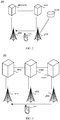
- FIG. 1 to FIG. 3 are respectively schematic diagrams of possible system architectures 100 to 300 in the embodiments of this application.
- FIG. 1 shows a communications system 100 applied in an embodiment of this application.
- FIG. 2 is a communication architecture diagram of handover of a voice service in a 5G system when there is a direct interface between an AMF entity and a mobile switching center (mobile switching center, MSC) entity in a 3G network.
- FIG. 3 is a communication architecture diagram of handover of a voice service in a 5G system when there is no direct interface between an AMF entity and an MSC entity.
- FIG. 1 shows the communications system 100 applied in the embodiment of this application.
- the communications system 100 may include at least one terminal 110, an access network device 120, and a core network device 130.
- a plurality of terminals 110 may be grouped based on a service feature.
- the access network device 120 may be a device that communicates with the terminal 110, for example, a base station or a base station controller.
- the core network device 130 has functions of providing a connection for a terminal, managing a terminal, and bearing a service, and serves as a bearer network to provide an interface for an external network.
- FIG. 2 is a communication architecture diagram of handover of a voice service in a 5G system when there is a direct interface between an AMF entity and an MSC entity.
- the AMF entity is configured to provide access and mobility management of a user, mainly including registration management, reachability management, mobility management, paging management, access authentication and authorization, encryption and integrity protection on non-access stratum signaling, and the like of the user.
- the voice service may be directly handed over from the 5G network to a 3G network after the terminal moves out of coverage of the 5G network, to ensure continuity of the voice service.
- FIG. 3 is a communication architecture diagram of handover of a voice service in a 5G system when there is no direct interface between an AMF entity and an MSC entity.
- a terminal supports SRVCC, when the terminal performs a voice service in a fifth generation communications system, the voice service needs to be forwarded via an MME entity after the terminal moves out of coverage of the 5G network, so that the voice service is handed over to a 3G network.
- the MME entity is used for mobility management of a user.
- the mobility management of the user mainly includes attach management, reachability management, mobility management, paging management, access authentication and authorization, encryption and integrity protection on non-access stratum signaling, and the like of the user.
- the terminal in a 5G NR network does not support SRVCC to a CS domain of a 3G network
- the voice service of the 5G network needs to be first handed over to an LTE network and then the voice service is handed over from the LTE network to the 3G network after the terminal moves out of coverage of the 5G network.
- the MME entity forwards the voice service during voice service handover, so that the voice service is handed over from the 5G network to the 3G network, to ensure continuity of the voice service.
- a communication method is proposed.
- a voice service may be handed over between the 5G system and the 3G system based on a network requirement, to ensure continuity of the voice service, and improve user experience.
- this application provides an implementation of deriving key information, which is applicable to all the foregoing scenarios of this application.
- the key information is used to perform encryption, or integrity protection, or encryption and integrity protection on the CS domain of the 3G network.
- the AMF entity may first derive key information of a 4G network, then derive key information of the 3G network based on the key information of the 4G network, and send the derived key information of the 3G network to the MME entity or the MSC entity.
- deriving a key or key derivation means obtaining a key based on an input parameter.
- An input parameter for deriving the key information of the 4G network based on root key information of the 5G network includes at least one of the following parameters: a first FC, a second FC, a first downlink non-access stratum count, a second downlink non-access stratum count, a second preset value, a first preset value, a first random number, or a second random number.
- the key information of the 4G network may be K ASME , or may be key information derived based on CK
- a function code (function code, FC) may be understood as an input parameter used based on a different function when the key information is derived.
- the first FC may be function code used when the key information of the 3G network is derived based on the root key of the 5G network
- the second FC may be function code used when the key information of the 4G network is derived based on the root key of the 5G network
- the third FC may be function code used when the key information of the 3G network is derived based on a root key of the 4G network.
- a non-access stratum count includes a sequence number and an overflow counter, and the non-access stratum count may be an uplink non-access stratum count or a downlink non-access stratum count.
- a derivation parameter may be a downlink non-access stratum count, or may be an uplink non-access stratum count.
- the first downlink non-access stratum count may be a downlink non-access stratum count used when the key information of the 3G network is derived based on the root key of the 5G network
- the second downlink non-access stratum count may be a downlink non-access stratum count used when the key information of the 4G network is derived based on the root key of the 5G network.
- K ASME is key information generated after the terminal and the network complete authentication.
- An input parameter for deriving a a key of the 3G network based on the derived key information of the 4G network includes at least one of the following parameters: the first FC, the second FC, the third FC, the first downlink non-access stratum count, the second downlink non-access stratum count, a third downlink non-access stratum count, a third preset value, the second preset value, the first preset value, the first random number, the second random number, or a third random number.
- the first FC, the first downlink non-access stratum count, the first random number, or the first preset value may be used by the AMF entity to derive the key information of the 3G network based on the root key of the 5G network.
- the second FC, the second downlink non-access stratum count, the second random number, or the second preset value may be used by the AMF entity to derive the key information of the 4G network based on the root key of the 5G network.
- the third FC, the third downlink non-access stratum count, the third random number, or the third preset value may be used by the AMF entity to derive the key information of the 3G network based on the root key of the 4G network.
- the key derivation parameters used to derive the key information are not limited to the key derivation parameters of the 4G network or the 3G network in this application.
- key derivation may be performed based on another parameter in combination with the derivation parameters in this application.
- key derivation may be performed based on some of the key derivation parameters that are used to derive the 4G network or the 3G network and that are proposed in this application.
- the 4G network is used to forward the handover request message generated by the AMF entity.
- the message includes an information field for indicating to hand over the voice service of the terminal from the packet switched PS domain to the circuit switched CS domain, and the information filed is a transparent container for the MME entity.
- the key information of the 3G network is carried in this field.
- the message is a request message that is sent by reusing the AMF entity and for handing over the voice service to the 4G system, and a source is added to the message to carry the information.
- the MME entity is slightly affected, and requires only identification and forwarding.
- the AMF entity and the MME entity define a message, which is used to send a message generated by the AMF entity.
- the message is used to request handover of the voice service of the terminal from the packet switched PS domain to the circuit switched CS domain.
- a new message needs to be defined, and the request message sent by the AMF entity for handover to the 4G network is not affected.
- the MME entity After receiving the message or the information, the MME entity forwards the message or the information to a default or pre-configured anchor MSC device, or an anchor MSC device indicated in the message.
- a communication method in an embodiment of this application is described below with reference to FIG. 4 .
- the method 400 in FIG. 4 may be applied to any architecture in FIG. 1 to FIG. 3 .
- the method in FIG. 4 may also be applied to another similar architecture.
- An access and mobility management function AMF entity may be a core network device in a 5G network or a core network device in another network.
- the access network device may be a base station in the 5G network, for example, a gNB. This is not limited in the embodiments of this application.
- the method 400 includes the following steps.
- Step 401 The access and mobility management function AMF entity receives a first message from an access network device, where the first message includes information for indicating to hand over a voice service of a terminal from a packet switched PS domain to a circuit switched CS domain, the first message further includes identification information of a target device, and the target device is an access network device in a 3G network and/or a 4G network.
- the first message may include identification information of the 3G network.
- the first message may include identification information of the 4G network.
- the first message includes identification information of the 3G network and identification information of the 4G network.
- the access network device sends the first message to the AMF entity based on a factor such as a measurement report reported by the terminal or load of the access network device.
- the first message is used to request the access network device to hand over a voice service of a 5G system from the PS domain to a CS domain of a 3G/2G system.
- Step 402 The AMF entity derives key information of a network in which the target device is located.
- the key information includes key information of the 3G network and key information of the 4G network.
- a manner in which the AMF entity derives the key information of the network in which the target device is located and sends the key information to an MSC entity in the 3G network includes but is not limited to any one of the following manners:
- a manner in which the AMF entity determines key derivation parameters of the 3G network and derives the key information of the 3G network based on the key derivation parameters of the 3G network and a root key of a network in which the AMF entity is located includes but is not limited to the following derivation manners: For example, the AMF entity derives the key information of the 3G network based on a first FC, a first downlink non-access stratum count, and the root key of the network in which the AMF entity is located.
- the AMF entity derives the key information of the 3G network based on a first FC, a preset value, and the root key of the network in which the AMF entity is located.
- the preset value may be a preset value that is configured in advance and maintained by both the terminal and the AMF entity.
- the AMF entity derives the key information of the 3G network based on a first FC, a random number, and the root key of the network in which the AMF entity is located.
- the random number may be a parameter known to the AMF entity, and the AMF entity sends the parameter to the terminal.
- the root key of the network in which the AMF entity is located may be any one of K AMF , K SEAF , K AUSF , and a cipher key CK+an integrity key IK.
- a manner in which the AMF entity determines key derivation parameters of the 4G network and derives the key information of the 4G network based on the key derivation parameters of the 4G network and a root key of a network in which the AMF entity is located includes but is not limited to the following derivation manners: For example, the AMF entity derives the key information of the 4G network based on a first FC, a second downlink non-access stratum count, and the root key of the network in which the AMF entity is located.
- the AMF entity derives the key information of the 4G network based on a second FC, a second downlink non-access stratum count, and the root key of the network in which the AMF entity is located.
- the AMF entity derives the key information of the 4G network based on a second FC, a preset value, and the root key of the network in which the AMF entity is located.
- the AMF entity derives the key information of the 4G network based on a second FC, a random number, and the root key of the network in which the AMF entity is located.
- the preset value for deriving a key of the 3G network is the same as or different from the preset value for deriving a key of 4G.
- the random number for deriving the key of the 3G network is the same as or different from the random number for deriving the 4G parameter. This is not limited in this application.
- the root key of the network in which the AMF entity is located may be any one of K AMF , K SEAF , K AUSF , and a cipher key CK+an integrity key IK.
- a manner in which the AMF entity derives the key information of the 3G network based on the key information of the 4G network includes but is not limited to the following derivation manners: For example, the AMF entity derives the key information of the 3G network based on the key information of the 4G network, a first FC, and a second downlink non-access stratum count.
- the AMF entity derives the key information of the 3G network based on the key information of the 4G network, a second FC, and a second downlink non-access stratum count.
- the AMF entity derives the key information of the 3G network based on the key information of the 4G network, a second FC, and a preset value.
- the AMF entity derives the key information of the 3G network based on the key information of the 4G network, a second FC, and a random number.
- that the AMF entity derives the key information of the 3G network based on the key information of the 4G network includes:
- the key derivation parameters used to derive the key information of the 3G network based on the key information of the 4G network may be the same as the key derivation parameters used to derive the key information of the 3G network, or may be different from the key derivation parameters used to derive the key information of the 3G network.
- the key derivation parameters include parameters such as the first FC, the second FC, the third FC, the first downlink non-access stratum value, the second downlink non-access stratum value, the preset value, and the random number.
- the key derivation parameters used to derive the key information are not limited to the key derivation parameters of the 4G network or the 3G network in this application.
- key derivation may be performed based on another parameter in combination with the derivation parameters in this application.
- key derivation may be performed based on some of the key derivation parameters that are used to derive the 4G network or the 3G network and in this application.
- the method 400 further includes the following steps:
- the AMF entity receives a second message from a mobile switching center MSC entity, where the second message includes information indicating that handover of the voice service from the PS domain to the CS domain is complete.
- the AMF entity determines, based on the second message, to suspend or release a PDN session of a non-voice service.
- the method 400 further includes the following step:
- the AMF entity sends configuration information to the terminal, where the configuration information includes information indicating a network to which the terminal preferentially falls back when a call of the voice service ends in the CS domain.
- the terminal may fall back to the 4G network or fall back to the 5G network based on the configuration information, to perform the non-voice service.
- the terminal processes the voice service or the non-voice service of the terminal according to a received handover instruction sent by the access network device, and hands over the voice service from a bearer in the PS domain to a bearer in the CS domain, to ensure continuity of the voice service and improve user experience.
- the examples include a communication method for handing over a voice service of a terminal from a bearer in a PS domain of a 5G network to a bearer in a CS domain of a 3G network in the following scenarios:
- the terminal supports handover of the voice service from the 5G network to the 3G network, and there is an interface between an AMF entity and an MSC entity;
- the terminal supports handover of the voice service from the 5G network to the 3G network, and there is no interface between an AMF entity and an MSC entity;
- the terminal does not support handover of the voice service from the 5G network to the 3G network.
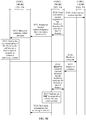
- FIG. 5A and FIG. 5B a method in FIG. 5A and FIG. 5B may be applied to the architecture 200.
- the method in FIG. 5A and FIG. 5B includes the following steps.
- S501 A terminal reports, to an AMF entity, support for handover of a voice service from a 5G network to a 3G network.
- the terminal supports SRVCC to a bearer in a CS domain of the 3G network.
- the AMF entity notifies a gNB that the terminal supports SRVCC to the bearer in the CS domain of the 3G network.
- S503 The terminal sends a measurement report to the gNB.
- the gNB determines, based on a factor such as the measurement report or current load, to initiate, to the AMF entity, a handover request for handing over the voice service to a CS domain of a 3G network, where the handover request message includes an identifier of a target device to which the voice service is handed over, for example, an identifier of a radio network controller (radio network controller, RNC) entity.
- a radio network controller radio network controller
- the handover request message sent by the gNB to the AMF entity may be the first message in the method 400.
- the AMF entity determines to hand over the voice service to the bearer in the CS domain of the 3G network, and the AMF entity derives key information of the 3G network, where the key information is used to perform encryption, or integrity protection, or encryption and integrity protection on the CS domain of the 3G network.
- the AMF entity derives the key information of the 3G network based on a first FC, a first downlink non-access stratum count, and a root key of a network in which the AMF entity is located.
- the AMF entity derives the key information of the 3G network based on a first FC, a preset value, and a root key of a network in which the AMF entity is located.
- the preset value may be a preset value that is configured in advance and maintained by both the terminal and the AMF entity.
- the AMF entity derives the key information of the 3G network based on a first FC, a random number, and a root key of a network in which the AMF entity is located.
- the random number may be a parameter known to the AMF entity, and the AMF entity sends the parameter to the terminal.
- the root key of the network in which the AMF entity is located may be any one of K AMF , K SEAF , K AUSF , and a cipher key CK+an integrity key IK.
- the AMF entity derives the key information of the 3G network based on the root key and a derivation parameter.
- the key information of the 3G network includes the cipher key CK and the integrity key IK.
- the derivation parameter may be one of the first downlink non-access stratum count, the random number, or the preset value, that is, K AMF ->>K ASME ->>CS domain CK IK.
- the AMF entity directly uses the root key CK+IK.
- the AMF entity sends, to an MSC entity in the 3G network, the handover request message for handing over the voice service from a PS domain to the CS domain.
- the handover request message includes the key information of the 3G network derived by the AMF entity.
- the MSC entity in the 3G network sends a migration request message of the voice service to a radio network controller (Radio Network Controller, RNC) of the 3G network, where the migration request message includes the key information of the 3G network derived by the AMF entity.
- RNC Radio Network Controller
- the RNC sends a migration request acknowledgment message to the MSC entity, where the migration request acknowledgment message includes a radio resource configuration parameter allocated by the RNC to the terminal.
- the MSC entity initiates voice session transfer information to an IP multimedia subsystem (IP multimedia subsystem, IMS) entity, and the IMS entity updates a voice session and a user plane bearer based on the message.
- IP multimedia subsystem IP multimedia subsystem
- the MSC entity sends, to the AMF entity, a handover request response for handing over the voice service from the PS domain to the CS domain, where the handover request response includes the radio resource configuration parameter that is allocated by the RNC to the terminal and that is received by the MSC entity.
- the AMF entity sends a handover request acknowledgment message to the gNB, where the handover request acknowledgment message includes the radio resource configuration parameter allocated by the RNC to the terminal and key derivation parameters that are used to derive the key information of the 3G network and that are determined by the AMF entity.
- the gNB sends, to the terminal, a handover instruction for handing over the voice service from the PS domain of the 5G network to the bearer in the CS domain of the 3G network, where the handover instruction includes the key derivation parameters used to derive the key information of the 3G network, and the key derivation parameters are determined by the AMF entity.
- the terminal receives the handover instruction including the key derivation parameters, derives the key information of the 3G network based on the key derivation parameters and a root key of the 5G network, and indicatess, according to the received handover instruction, an upper layer of the terminal to suspend or release a PDN session of a non-voice service.
- the terminal receives a third message sent by the base station gNB of the 5G network.
- the terminal receives the handover instruction sent by the base station gNB of the 5G network.
- the third message is information for indicating the terminal to hand over the voice service from the packet switched PS domain to the circuit switched CS domain
- the terminal determines, according to the third message, to suspend or release the PDN session of the non-voice service.
- the third message may be the handover instruction sent by the base station, such as the gNB, in the 5G network.
- the third message may be a handover instruction sent by a base station, such as an eNB, in a 4G network. This is not limited in this embodiment of this application.
- S514 The terminal accesses the 3G network, and sends a handover complete message to the RNC.
- the message indicates that the terminal has completed handover of the voice service from the bearer in the PS domain to the bearer in the CS domain.
- the RNC sends the handover complete message to the MSC entity, to notify the MSC entity that the terminal has completed handover of the voice service from the bearer in the PS domain to the bearer in the CS domain.
- S516 The MSC entity sends the handover complete message to the AMF entity.
- the handover complete message sent by the gNB to the terminal may be the second message in the method 400.
- the AMF entity After receiving the handover complete message sent by the MSC entity, the AMF entity indicates an SMF entity to suspend or release the PDN session of the non-voice service.
- the AMF entity indicates the SMF entity to suspend or release the PDN session of the non-voice service, and the SMF entity suspends or releases the PDN session of the non-voice service or of a non-GBR bearer via a user port function (user port function, UPF) entity.
- the SMF entity indicates the UPF entity to suspend or release all PDN sessions of the terminal.
- the AMF entity indicates the SMF entity to suspend or release all PDN sessions of the terminal.
- the AMF entity sends, to the base station gNB of the 5G network, indication information for releasing a resource.
- the method 500 is the communication method for handing over the voice service of the terminal from the bearer in the PS domain of the 5G network to the bearer in the CS domain of the 3G network when the terminal supports handover of the voice service from the 5G network to the 3G network, and there is an interface between the AMF entity and the MSC entity.
- the AMF entity needs to perform a transfer operation via an anchor MME entity, to hand over the voice service of the terminal from the bearer in the PS domain of the 5G network to the bearer in the CS domain of the 3G network.
- step S506 when there is no interface between the AMF entity and the MSC entity, the AMF entity sends, to the MME entity, the handover request message for handing over the voice service from the PS domain to the CS domain.
- the handover request message includes the key information of the 3G network derived by the AMF entity and identification information of the target base station of the voice service, for example, an RNC ID.
- the MME entity sends the handover request message to the MSC entity.
- the AMF entity may directly derive the key information of the 3G network, and send the derived key information of the 3G network to the MME entity or the MSC entity.
- the AMF entity derives the key information of the 3G network based on the first FC, the first downlink non-access stratum count, and the root key of the network in which the AMF entity is located.
- the AMF entity derives the key information of the 3G network based on the first FC, the preset value, and the root key of the network in which the AMF entity is located.
- the preset value may be a preset value that is configured in advance and maintained by both the terminal and the AMF entity.
- the AMF entity derives the key information of the 3G network based on the first FC, the random number, and the root key of the network in which the AMF entity is located.
- the random number may be a parameter known to the AMF entity, and the AMF entity sends the parameter to the terminal.
- the AMF entity may first derive key information of a 4G network, then derive key information of the 3G network based on the key information of the 4G network, and send the derived key information of the 3G network to the MME entity or the MSC entity.
- An input parameter for deriving the key information of the 4G network based on root key information of the 5 G network includes at least one of the following parameters: the first FC, a second FC, the first downlink non-access stratum count, a second downlink non-access stratum count, a second preset value, a first preset value, a first random number, or a second random number.
- the key information of the 4G network may be K ASME , or may be key information derived based on CK
- An input parameter for deriving a 3G key based on the derived key information of the 4G network includes at least one of the following parameters: the first FC, the second FC, a third FC, the first downlink non-access stratum count, the second downlink non-access stratum count, a third downlink non-access stratum count, a third preset value, the second preset value, the first preset value, the first random number, the second random number, or a third random number.
- the first FC, the first downlink non-access stratum count, the first random number, or the first preset value may be used by the AMF entity to derive the key information of the 3G network based on the root key of the 5G network.
- the second FC, the second downlink non-access stratum count, the second random number, or the second preset value may be used by the AMF entity to derive the key information of the 4G network based on the root key of the 5G network.
- the third FC, the third downlink non-access stratum count, the third random number, or the third preset value may be used by the AMF entity to derive the key information of the 3G network based on the root key of the 4G network.
- the key derivation parameters used to derive the key information are not limited to the key derivation parameters of the 4G network or the 3G network in this application.
- key derivation may be performed based on another parameter in combination with the derivation parameters in this application.
- key derivation may be performed based on some of the key derivation parameters that are used to derive the 4G network or the 3G network and that are proposed in this application.
- a method in FIG. 6A and FIG. 6B may be applied to the architecture 300.
- the method in FIG. 6A and FIG. 6B is a communication method for handing over a voice service of a terminal from a bearer in a PS domain of a 5G network to a bearer in CS domain of a 3G network when the terminal does not support handover of the voice service from the 5G network to the 3G network.
- the method in FIG. 6A and FIG. 6B includes the following steps.
- S601 The terminal sends a measurement report to a gNB.
- the gNB determines, based on a factor such as the measurement report or current load, to initiate, to an AMF entity, a handover request message for handing over the voice service to a 3G CS domain.
- the handover request message sent by the gNB to the AMF entity may be the first message in the method 400.
- the AMF entity determines to hand over a non-voice service or a non-GBR bearer to a 4G network, and the AMF entity derives key information.
- the AMF entity may directly derive key information of the 3G network.
- the AMF entity may first derive key information of the 4G network, and then derive key information of the 3G network based on the key information of the 4G network.
- the AMF entity derives the key information of the 3G network.
- a manner in which the AMF entity determines key derivation parameters of the 3G network and derives the key information of the 3G network based on the key derivation parameters of the 3G network and a root key of a network in which the AMF entity is located includes but is not limited to the following manners:
- the AMF entity derives the key information of the 3G network based on a first FC, a first downlink non-access stratum count, and the root key of the network in which the AMF entity is located.
- the AMF entity derives the key information of the 3G network based on a first FC, a preset value, and the root key of the network in which the AMF entity is located.
- the preset value may be a preset value that is configured in advance and maintained by both the terminal and the AMF entity.
- the AMF entity derives the key information of the 3G network based on a first FC, a random number, and the root key of the network in which the AMF entity is located.
- the random number may be a parameter known to the AMF entity, and the AMF entity sends the parameter to the terminal.
- the root key of the network in which the AMF entity is located may be any one of K AMF , K SEAF , K AUSF , and a cipher key CK+an integrity key IK.
- the AMF entity derives the key information of the 3G network based on the root key and a derivation parameter.
- the key information of the 3G network includes the cipher key CK and the integrity key IK.
- the derivation parameter may be one of the first downlink non-access stratum count, the random number, or the preset value, that is, K AMF ->>K ASME ->>CS domain CK+IK.
- the AMF entity directly uses the root key CK+IK.
- the AMF entity derives the key information of the 4G network and the key information of the 3G network.
- a manner in which the AMF entity determines key derivation parameters of the 4G network and derives the key information of the 4G network based on the key derivation parameters of the 4G network and the root key of the network in which the AMF entity is located includes but is not limited to the following manners: For example, the AMF entity derives the key information of the 4G network based on a first FC, a second downlink non-access stratum count, and the root key of the network in which the AMF entity is located.
- the AMF entity derives the key information of the 4G network based on a second FC, a second downlink non-access stratum count, and the root key of the network in which the AMF entity is located.
- the AMF entity derives the key information of the 4G network based on a second FC, a preset value, and the root key of the network in which the AMF entity is located.
- the AMF entity derives the key information of the 4G network based on a second FC, a random number, and the root key of the network in which the AMF entity is located.
- the root key of the network in which the AMF entity is located is any one of K AMF , K SEAF , K AUSF , and a cipher key CK+an integrity key IK.
- the AMF entity derives the key information of the 3G network based on the derived key information of the 4G network.
- the AMF entity derives the key information of the 3G network based on the key information of the 4G network, a first FC, and a second downlink non-access stratum count.
- the AMF entity derives the key information of the 3G network based on the key information of the 4G network, a second FC, and a second downlink non-access stratum count.
- the AMF entity derives the key information of the 3G network based on the key information of the 4G network, a second FC, and a preset value.
- the preset value may be a preset value that is configured in advance and maintained by both the terminal and the AMF entity.
- the AMF entity derives the key information of the 3G network based on the key information of the 4G network, a second FC, and a random number.
- the AMF entity derives the key information of the 3G network based on the derived key information of the 4G network.
- the AMF entity derives the key information of the 3G network based on the key information of the 4G network, a third FC, and a second downlink non-access stratum count.
- the AMF entity derives the key information of the 3G network based on the key information of the 4G network, a third FC, and a second downlink non-access stratum count.
- the AMF entity derives the key information of the 3G network based on the key information of the 4G network, a third FC, and a preset value.
- the AMF entity derives the key information of the 3G network based on the key information of the 4G network, a third FC, and a random number.
- the key derivation parameters used to derive the key information of the 3G network based on the key information of the 4G network may be the same as the key derivation parameters used to derive the key information of the 3G network, or may be different from the key derivation parameters used to derive the key information of the 3G network.
- the key derivation parameters include parameters such as the first FC, the second FC, the first downlink non-access stratum value, the second downlink non-access stratum value, the preset value, and the random number. It should be noted that, in the implementations of this application, the key derivation parameters used to derive the key information are not limited to the key derivation parameters of the 4G network or the 3G network in this application.
- key derivation may be performed based on another parameter in combination with the derivation parameters in this application.
- key derivation may be performed based on some of the key derivation parameters that are used to derive the 4G network or the 3G network and that are proposed in this application.
- the random number may be a parameter known to the AMF entity, and the AMF entity sends the parameter to the terminal.
- the AMF entity derives the key information of the 4G network, for example, K ASME .
- the AMF entity sends a handover instruction to an MME entity, where the handover instruction instructs handover of the non-voice service of the terminal from the bearer in the PS domain to the 4G network.
- the base station eNB of the 4G network sends a handover instruction response to the MME entity, where the handover instruction response indicates that the eNB prepares a target eNB to source eNB container.
- the MME entity sends the handover instruction response to the AMF entity.
- the AMF entity sends a handover request acknowledgment message to the gNB of the 5G network, where the handover request acknowledgment message includes information for indicating to hand over the non-voice service or the non-GBR bearer from the PS domain to the 4G network.
- S609 The gNB of the 5G network sends a handover instruction to the terminal, where the handover instruction instructs handover of the voice service from the PS domain to the 4G network.
- the terminal receives a third message sent by the base station gNB of the 5G network.
- the terminal receives the handover instruction sent by the base station gNB of the 5G network.
- the terminal sends a handover complete message of the non-voice service to the base station eNB of the 4G network.
- the MME entity sends, to the MSC entity, the handover complete message for handing over the non-voice service from the PS domain to the 4G network.
- the MME After receiving a request sent by the eNB for handing over the voice service from the PS domain to the CS domain of the 3G network, the MME initiates S612.
- the MME After receiving the handover complete message sent by the eNB, the MME initiates S612.
- the MME entity sends, to the MSC entity, a handover request message for handing over the voice service from the bearer in the PS domain to the bearer in the CS domain, where the handover request message may include the key information of the 3G network derived by the AMF entity.
- the handover request message may be generated by the AMF entity.
- the MME extracts the cipher key and the integrity protection key of the 3G network from the key information sent by the AMF entity.
- the MSC entity sends a migration request message of the voice service to an RNC, where the migration request message includes the key information of the 3G network derived by the AMF entity.
- the RNC sends a migration request acknowledgment message to the MSC entity, where the migration request acknowledgment message includes a radio resource configuration parameter allocated by the RNC to the terminal.
- S616 The MSC entity initiates voice session transfer information to an IMS entity, and the IMS entity updates a voice session and a user plane bearer based on the message.
- the MSC entity sends, to the MME entity, a handover request response for handing over the voice service from the PS domain to the CS domain.
- the MME entity sends a handover instruction to the gNB, where the handover instruction includes key derivation parameters determined by the AMF entity.
- the gNB sends, to the terminal, the handover instruction for handing over the voice service from the PS domain of the 5G network to the bearer in the CS domain of the 3G network, where the handover instruction includes the key derivation parameters used to derive the key information of the 3G network, and the key derivation parameters are determined by the AMF entity.
- the terminal receives the handover instruction including the key derivation parameters, and derives the key information of the 3G network based on the key derivation parameters and a root key of the 5G network.
- S621 The terminal accesses the 3G network, and sends a handover complete message to the RNC.
- the message indicates that the terminal has completed handover of the voice service from the bearer in the PS domain to the bearer in the CS domain.
- the RNC sends a migration complete message to the MSC entity, to notify the MSC entity that the terminal has completed handover of the voice service from the bearer in the PS domain to the bearer in the CS domain.
- the MSC entity sends, to the MME entity, the handover complete message for handing over the voice service from the bearer in the PS domain to the bearer in the CS domain.
- S624 The MME entity sends the handover complete message to the AMF entity.
- S625 The AMF entity receives the handover complete message sent by the MME entity.
- the AMF entity sends, to the base station gNB of the 5G network, indication information for releasing a resource.
- the AMF entity indicatess the SMF to release or suspend a PDN session of a non-voice bearer or of a non-GBR.
- the AMF entity indicates the SMF to release or suspend PDN sessions of all bearers.
- the method 600 may be the communication method for handing over the voice service of the terminal from the bearer in the PS domain of the 5G network to the bearer in the CS domain of the 3G network when the terminal does not support handover of the voice service from the 5G network to the 3G network.
- FIG. 4 to FIG. 6B describe the communication methods used in a 5G communications system and used for handing over the voice service from the bearer in the PS domain of the 5G network to the bearer in the CS domain of the 3G network to maintain continuity of the voice service after the terminal performing the voice service moves out of coverage of the 5G network.
- An embodiment of this application further provides a communication method for fast fallback.
- a communication method for fast fallback.
- a terminal rapidly falls back to a proper network, and restores the service of the bearer that is in the PS domain and suspended during voice handover.
- a core network device after the call of the voice service of the terminal ends in the 3G network, a core network device notifies an RNC, and the RNC indicates UE.
- Step 1 An AMF entity or an MME entity sends a handover request message to an MSC entity.
- the handover request message includes handover information indicating that the handover is from an NR node or the MME entity. It should be understood that in this embodiment of this application, this step is optional.
- Step 2 The MSC entity sends the handover information to an RNC.
- the information is used to indicate the handover from the NR node or the MME entity to the RNC.
- the MSC entity may determine, based on a type of a source node in the handover request message, whether the source node is an MME entity or an NR node.
- Step 3 When Iu is released, the MSC entity indicates to the RNC that the terminal is handed over from the NR node or the MME entity. The RNC determines to release a connection of the terminal on the RNC.
- connection release information is sent to the terminal to indicate frequency information of LTE or NR.
- the terminal After receiving the information, the terminal first measures the indicated ARFCN of a radio access system, and performs a cell reselection process. The terminal first measures the indicated ARFCN, and then reselects to a cell having an ARFCN that meets an R criteria.
- Q meas is an RSRP value of a measured cell
- Q offset defines an offset value of the target cell.
- two parts are included: a cell-based offset value and a frequency-based offset value. If Rt is always greater than Rs within a time T reselection (where T reselection of an intra-frequency cell may be different from that of the inter-frequency cell), the terminal reselects to a target cell.
- the AMF entity or the MME entity sends configuration information to the terminal.
- the configuration information includes information indicating a network to which the terminal preferentially falls back when the call of the voice service ends in the CS domain.
- the configuration information may be information configured before the voice service is handed over, and is used to indicate the terminal to preferentially fall back to NR or LTE after the terminal is handed over from NR or LTE to the 3G network and an air interface connection is released.
- the terminal when preferentially falling back to NR, the terminal first measures an NR-ARFCN, and reselects to an NR cell that meets the R criteria. If no suitable NR cell is available, the terminal reselects to a suitable LTE cell.
- the terminal when preferentially falling back to LTE, the terminal first measures an LTE-ARFCN, and reselects to an LTE cell that meets the R criteria. If no suitable LTE cell is available, the terminal reselects to a suitable NR cell.
- the communication method for fast fallback may be combined with the communication methods that are used for handing over the voice service from the bearer in the PS domain of the 5G network to the bearer in the CS domain of the 3G network and that are described in FIG. 4 to FIG. 6B . This is not limited in the embodiments of this application.
- sequence numbers of the foregoing processes do not mean execution sequences in various embodiments of this application.
- the execution sequences of the processes should be determined based on functions and internal logic of the processes, and should not constitute any limitation on the implementation processes of the embodiments of this application.
- steps or operations implemented by the terminal may alternatively be implemented by a component (for example, a chip or a circuit) that may be used in the terminal
- steps or operations implemented by the access network device may alternatively be implemented by a component (for example, a chip or a circuit) that may be used in the access network device.
- the foregoing describes in detail the communication methods for handing over the voice service from the bearer in the PS domain of the 5G network to the bearer in the CS domain of the 3G network in different scenarios according to the embodiments of this application.
- the following describes a communications apparatus according to the embodiments of this application. It should be understood that the communications apparatus in the embodiments of this application may perform the various communication methods in the foregoing embodiments of this application. In other words, for specific working processes of the following products, refer to corresponding processes in the foregoing method embodiments.
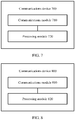
- FIG. 7 is a schematic structural diagram of a communications apparatus according to an embodiment of this application.
- the communications apparatus 700 in FIG. 7 may correspondingly implement steps or operations performed by the AMF entity in the foregoing descriptions, and may include:
- the communications apparatus determines, based on an identifier of the target device in a handover request message of the voice service, the network to which the voice service is to be handed over, to derive the key information of the network in which the target device is located, ensuring that the voice service is handed over from a bearer in the PS domain to the network in which the target device is located, ensuring continuity of the voice service, and improving user experience.
- the processing module 720 is specifically configured to:
- processing module 720 is specifically configured to:
- processing module 720 is specifically configured to:
- processing module 720 is specifically configured to:
- processing module 720 is specifically configured to:
- processing module 720 is specifically configured to:
- the root key is any one of K AMF , K SEAF , K AUSF , and a cipher key CK+an integrity key IK.
- the communications module 720 is further configured to:
- the communications module 710 is further configured to receive a second message, where the second message includes information indicating that handover of the voice service from the PS domain to the CS domain is complete.
- the processing module 720 is further configured to determine, based on the second message, to suspend or release a PDN session of a non-voice service.
- the communications module 710 is further configured to send configuration information, where the configuration information includes information indicating a network to which the terminal preferentially falls back when a call of the voice service ends in the CS domain.
- the communications apparatus 700 may be a core network device in a 5G communications system, and the communications apparatus may be configured to hand over the voice service of the terminal from a bearer in the PS domain to a bearer in the CS domain.
- FIG. 8 is a schematic structural diagram of a communications apparatus according to an embodiment of this application.
- the communications apparatus 800 in FIG. 8 may correspond to the terminal in the foregoing embodiments, and may include:
- the communications apparatus processes the voice service or the non-voice service based on a received handover request message, to hand over the voice service from a bearer in the PS domain to a bearer in the CS domain, ensuring continuity of the voice service, and improving user experience.
- the third message further includes key derivation parameters, and the key derivation parameters are determined by an access and mobility management function AMF entity.
- processing module 820 is further configured to:
- processing module 820 is specifically configured to:
- processing module 820 is specifically configured to:
- the root key is any one of K AMF , K SEAF , K AUSF , and a cipher key CK+an integrity key IK.
- the processing module 820 is further configured to: derive the key information of the 3G network based on the key information of the 4G network.
- processing module 820 is specifically configured to:
- the communications module 810 is further configured to receive configuration information, where the configuration information includes information indicating a network to which the terminal preferentially falls back when a call of the voice service ends in the CS domain.
- FIG. 9 is a schematic structural diagram of a communications apparatus according to an embodiment of this application.
- the communications apparatus 900 in FIG. 9 may correspond to the base station in the foregoing 5G communications system, for example, the gNB, and may include:
- an access network device generates the third message, and sends the third message to the terminal.
- the terminal indicates, according to the indication information included in the third message, to suspend the voice service or the non-voice service, to ensure that the voice service is handed over from a bearer in the PS domain to a bearer in the CS domain, ensuring continuity of the voice service, and improving user experience.
- the third message includes key derivation parameters of a network in which the target device is located, and the key derivation parameters are determined by the AMF entity.
- modules in the communications apparatus 700, the communications apparatus 800, and the communications apparatus 900 may be separately disposed, or may be integrated together.
- the foregoing modules may also be referred to as components or circuits.
- the communications apparatus 700, the communications apparatus 800, or the communications apparatus 900 may be implemented by using at least one processor, or may be implemented by using at least one processor and at least one memory, or may be implemented by using at least one processor and at least one transceiver, or may be implemented by using at least one processor, at least one transceiver, and at least one memory.
- the processor, the transceiver, and the memory may be disposed separately, or may be integrated together.
- FIG. 10 is a schematic structural diagram of a communications apparatus.
- the communications apparatus 1000 may be configured to implement a method that corresponds to the AMF entity and is described in the foregoing method embodiments, or may be configured to implement a method that corresponds to the terminal and is described in the foregoing method embodiments, or may be configured to implement a method that corresponds to the access network device such as the gNB and is described in the foregoing method embodiments.
- the access network device such as the gNB
- the communications apparatus 1000 may include one or more processors 31.
- the processor 31 may also be referred to as a processing unit, and may implement a specific control function.
- the processor 31 may be a general-purpose processor, a dedicated processor, or the like.
- a memory 32 may store an instruction 33.
- the instruction 33 may be run by the processor 31, so that the communications apparatus 1000 performs the method that corresponds to the AMF entity, the terminal, or the access network device and that is described in the foregoing method embodiments.
- the communications apparatus 1000 may include a circuit.
- the circuit may implement the sending, receiving, or communication function in the foregoing method embodiments.
- the communications apparatus 1000 may include one or more memories 32.
- the memory stores an instruction 33 or intermediate data.
- the instruction 33 may be run on the processor 31, so that the communications apparatus 1000 performs the method that is performed by the AMF entity, the terminal, or the access network device and described in the foregoing embodiments.
- the memory may further store other related data.
- the processor may also store an instruction and/or data.
- the processor and the memory may be disposed separately, or may be integrated together.
- the communications apparatus 1000 may further include a transceiver 35.
- the processor 31 may be referred to as a processing unit.
- the transceiver 35 may be referred to as a transceiver unit, a transceiver machine, a transceiver circuit, a transceiver, or the like, and is configured to implement a transceiver function of the communications apparatus.
- the communications apparatus (for example, an integrated circuit, a wireless device, a circuit module, a network device, or a terminal device) may include a processor and a transceiver. If the communications apparatus is configured to implement steps or operations performed by the AMF entity in the embodiments corresponding to FIG. 4 to FIG.
- the transceiver 35 may receive a first message, where the first message includes information for indicating to hand over a voice service of a terminal from a packet switched PS domain to a circuit switched CS domain, the first message further includes identification information of a target device, and the target device is an access network device in a 3G network and/or a 4G network; and the processor 31 is configured to derive key information of a network in which the target device is located.
- the processor 31 is specifically configured to:
- the processor 31 is further configured to:
- the processor 31 is further configured to:
- the processor 31 is further configured to:
- the processor 31 is further configured to:
- the processor 31 is further configured to: derive the key information of the 3G network based on the key information of the 4G network.
- the processor 31 is configured to:
- the root key is any one of K AMF , K SEAF , K AUSF , and a cipher key CK+an integrity key IK.
- the transceiver 35 is further configured to:
- the transceiver 35 is further configured to: receive a second message, where the second message includes information indicating that handover of the voice service from the PS domain to the CS domain is complete.
- the processor 31 is configured to determine, based on the second message, to suspend or release a PDN session of a non-voice service.
- the transceiver 35 is further configured to: send configuration information, where the configuration information includes information indicating a network to which the terminal preferentially falls back when a call of the voice service ends in the CS domain.
- the communications apparatus (for example, an integrated circuit, a wireless device, a circuit module, a network device, or a terminal device) may include a processor and a transceiver. If the communications apparatus is configured to implement steps or operations performed by the terminal in the embodiment corresponding to FIG. 5A and FIG. 5B or FIG. 6A and FIG.
- the processor 31 is further configured to:
- the processor 31 is specifically configured to:
- the processor 31 is specifically configured to:
- the root key is any one of K AMF , K SEAF , K AUSF , and a cipher key CK+an integrity key IK.
- the processor 31 is further configured to: derive the key information of the 3G network based on the key information of the 4G network.
- the processor 31 is specifically configured to:
- the transceiver 35 is further configured to:
- the communications apparatus may include a processor and a transceiver. If the communications apparatus is configured to implement the access network device in the embodiment corresponding to FIG. 4 or implement steps or operations performed by the gNB in the embodiment corresponding to FIG. 5A and FIG. 5B and in the embodiment corresponding to FIG. 6A and FIG.
- the third message includes key derivation parameters of a network in which the target device is located, and the key derivation parameters are determined by the AMF entity.
- the processor and the transceiver described in this application may be implemented on an integrated circuit (integrated circuit, IC), an analog IC, a radio frequency integrated circuit RFIC, a hybrid signal IC, an application-specific integrated circuit (application specific integrated circuit, ASIC), a printed circuit board (printed circuit board, PCB), an electronic device, or the like.
- integrated circuit integrated circuit, IC
- analog IC analog IC
- radio frequency integrated circuit RFIC radio frequency integrated circuit
- RFIC radio frequency integrated circuit
- hybrid signal IC an application-specific integrated circuit (application specific integrated circuit, ASIC), a printed circuit board (printed circuit board, PCB), an electronic device, or the like.
- ASIC application specific integrated circuit
- PCB printed circuit board
- the processor and the transceiver may also be manufactured by using various 1C technologies, for example, a complementary metal oxide semiconductor (complementary metal oxide semiconductor, CMOS), an N-channel metal-oxide-semiconductor (nMetal-oxide-semiconductor, NMOS), a P-channel metal-oxide-semiconductor (positive channel metal oxide semiconductor, PMOS), a bipolar junction transistor (bipolar junction transistor, BJT), a bipolar CMOS (BiCMOS), silicon germanium (SiGe), and gallium arsenide (GaAs).
- CMOS complementary metal oxide semiconductor
- NMOS N-channel metal-oxide-semiconductor
- PMOS positive channel metal oxide semiconductor
- BJT bipolar junction transistor
- BiCMOS bipolar CMOS
- SiGe silicon germanium
- GaAs gallium arsenide
- the communications apparatus 1000 is described by using the AMF entity, the access network device, or the terminal as an example, but a scope of the communications apparatus described in this application is not limited to the AMF entity, the access network device, or the terminal, and a structure of the communications apparatus may not be limited by FIG. 10 .
- the communications apparatus may be an independent device or may be a part of a relatively large device.
- the device may be:
- the disclosed system, apparatus, and method may be implemented in other manners.
- the described apparatus embodiments are merely examples.
- division into the modules or units is merely logical function division and may be other division during actual implementation.
- a plurality of units or components may be combined or integrated into another system, or some features may be ignored or not performed.
- the displayed or discussed mutual couplings or direct couplings or communication connections may be implemented by using some interfaces.
- the indirect couplings or communication connections between the apparatuses or units may be implemented in electronic, mechanical, or other forms.
- the units described as separate parts may or may not be physically separate, and parts displayed as units may or may not be physical units, in other words, may be located in one position, or may be distributed on a plurality of network units. Some or all of the units may be selected based on actual requirements to achieve the objectives of the solutions of the embodiments.
- function units in the embodiments of this application may be integrated into one processing unit, or each of the units may exist alone physically, or two or more units may be integrated into one unit.
- All or some of the foregoing embodiments may be implemented by using software, hardware, firmware, or any combination thereof.
- software is used to implement the embodiments, all or some of the embodiments may be implemented in a form of a computer program product.
- the computer program product includes one or more computer program instructions.
- the computer may be a general-purpose computer, a dedicated computer, a computer network, or another programmable apparatus.
- the computer instructions may be stored in a computer-readable storage medium or may be transmitted from a computer-readable storage medium to another computer-readable storage medium.
- the computer instruction may be transmitted from a website, computer, server, or data center to another website, computer, server, or data center in a wired (for example, a coaxial cable, an optical fiber, or a digital subscriber line (DSL)) or wireless (for example, infrared, radio, or microwave) manner.
- the computer-readable storage medium may be any usable medium accessible by the computer, or a data storage device, such as a server or a data center, integrating one or more usable media.
- the usable medium may be a magnetic medium (for example, a floppy disk, a hard disk, or a magnetic tape), an optical medium (for example, a DVD), a semiconductor medium (for example, a solid-state drive solid state disk (SSD)), or the like.
- a magnetic medium for example, a floppy disk, a hard disk, or a magnetic tape
- an optical medium for example, a DVD
- a semiconductor medium for example, a solid-state drive solid state disk (SSD)
Landscapes
- Engineering & Computer Science (AREA)
- Computer Networks & Wireless Communication (AREA)
- Signal Processing (AREA)
- Computer Security & Cryptography (AREA)
- Multimedia (AREA)
- Mobile Radio Communication Systems (AREA)
Applications Claiming Priority (2)
| Application Number | Priority Date | Filing Date | Title |
|---|---|---|---|
| CN201810301411.2A CN110351724B (zh) | 2018-04-04 | 2018-04-04 | 通信方法和装置 |
| PCT/CN2019/080964 WO2019192460A1 (fr) | 2018-04-04 | 2019-04-02 | Procédé et appareil de communication |
Publications (3)
| Publication Number | Publication Date |
|---|---|
| EP3767981A1 true EP3767981A1 (fr) | 2021-01-20 |
| EP3767981A4 EP3767981A4 (fr) | 2021-04-28 |
| EP3767981B1 EP3767981B1 (fr) | 2024-12-18 |
Family
ID=68100006
Family Applications (1)
| Application Number | Title | Priority Date | Filing Date |
|---|---|---|---|
| EP19780668.0A Active EP3767981B1 (fr) | 2018-04-04 | 2019-04-02 | Procédé et appareil de communication |
Country Status (5)
| Country | Link |
|---|---|
| US (1) | US11523308B2 (fr) |
| EP (1) | EP3767981B1 (fr) |
| JP (1) | JP2021517786A (fr) |
| CN (1) | CN110351724B (fr) |
| WO (1) | WO2019192460A1 (fr) |
Families Citing this family (14)
| Publication number | Priority date | Publication date | Assignee | Title |
|---|---|---|---|---|
| CN112073184B (zh) | 2017-10-23 | 2022-01-14 | 华为技术有限公司 | 一种生成密钥的方法、装置及系统 |
| WO2020038562A1 (fr) * | 2018-08-21 | 2020-02-27 | Telefonaktiebolaget Lm Ericsson (Publ) | Technique de préparation de la mobilité d'un équipement utilisateur |
| CN110856229B (zh) * | 2019-11-21 | 2021-12-07 | 中国联合网络通信集团有限公司 | 一种网络切换方法、装置及通信系统 |
| CN111132214A (zh) * | 2019-12-18 | 2020-05-08 | 东莞宇龙通信科技有限公司 | 语音通话的方法、装置、电子设备及介质 |
| WO2021253263A1 (fr) * | 2020-06-17 | 2021-12-23 | Qualcomm Incorporated | Transfert intercellulaire de voix sur une nouvelle radio (vonr) déclenchée par une tentative de vonr infructueuse |
| EP4187829A4 (fr) | 2020-08-06 | 2023-08-30 | Huawei Technologies Co., Ltd. | Procédé de configuration d'informations auxiliaires et appareil de communication |
| CN115226165B (zh) * | 2021-04-14 | 2024-05-07 | 维沃移动通信有限公司 | 传输切换方法、终端及网络侧设备 |
| US11595872B1 (en) * | 2021-04-28 | 2023-02-28 | T-Mobile Usa, Inc. | Selection of rats for handovers from 4G |
| CN115348621B (zh) * | 2021-05-12 | 2026-03-17 | 维沃移动通信有限公司 | 信息处理方法、装置、终端和网络侧设备 |
| US11711732B2 (en) * | 2021-05-19 | 2023-07-25 | Microsoft Technology Licensing, Llc | Minimizing disruption to a voice call in a mobile network that includes different network segments having different capabilities for supporting voice calls |
| CN113810990B (zh) * | 2021-09-23 | 2024-06-18 | 上海移远通信技术股份有限公司 | 通信方法和装置 |
| CN116033361A (zh) * | 2021-10-25 | 2023-04-28 | 华为技术有限公司 | 一种保障语音业务的方法及通信装置 |
| CN116935870A (zh) * | 2022-04-08 | 2023-10-24 | 中兴通讯股份有限公司 | 语音传输方法、终端和计算机可读存储介质 |
| CN115396988B (zh) * | 2022-08-29 | 2025-01-10 | 大陆软件系统开发中心(重庆)有限公司 | Nsa模式下5g新无线电的接入技术 |
Family Cites Families (10)
| Publication number | Priority date | Publication date | Assignee | Title |
|---|---|---|---|---|
| CN102204301A (zh) * | 2008-11-03 | 2011-09-28 | 诺基亚公司 | 用于在分组交换网络和电路交换网络之间切换期间提供安全性的方法、装置和计算机程序产品 |
| KR101556906B1 (ko) * | 2008-12-29 | 2015-10-06 | 삼성전자주식회사 | 선인증을 통한 이종 무선 통신망 간의 핸드오버 방법 |
| IN2014DN08448A (fr) * | 2012-04-11 | 2015-05-08 | Nokia Siemens Networks Oy | |
| US10080162B2 (en) * | 2012-04-11 | 2018-09-18 | Nokia Solutions And Networks Oy | Network sharing and reverse single radio voice call continuity |
| CN103686673B (zh) * | 2012-09-21 | 2019-06-04 | 北京三星通信技术研究有限公司 | 一种支持指示失败事件给源接入系统的方法 |
| JP2017519452A (ja) * | 2014-06-24 | 2017-07-13 | 華為技術有限公司Huawei Technologies Co.,Ltd. | 音声リソース節減方法、デバイスおよびシステム |
| EP3189644A1 (fr) * | 2014-09-05 | 2017-07-12 | Intel Corporation | Évitement de transcodage pendant une continuité d'appel vocal radio unique (srvcc) |
| EP3255914A4 (fr) * | 2015-02-28 | 2018-02-14 | Huawei Technologies Co. Ltd. | Procédé, dispositif et système de génération de clé |
| WO2019098745A1 (fr) * | 2017-11-19 | 2019-05-23 | 엘지전자 주식회사 | Procédé de transfert dans un système de communication sans fil, et appareil correspondant |
| US11284310B2 (en) * | 2018-02-12 | 2022-03-22 | Apple Inc. | Single radio voice call continuity handover |
-
2018
- 2018-04-04 CN CN201810301411.2A patent/CN110351724B/zh active Active
-
2019
- 2019-04-02 WO PCT/CN2019/080964 patent/WO2019192460A1/fr not_active Ceased
- 2019-04-02 JP JP2020554115A patent/JP2021517786A/ja active Pending
- 2019-04-02 EP EP19780668.0A patent/EP3767981B1/fr active Active
-
2020
- 2020-09-30 US US17/038,207 patent/US11523308B2/en active Active
Also Published As
| Publication number | Publication date |
|---|---|
| CN110351724B (zh) | 2021-09-14 |
| CN110351724A (zh) | 2019-10-18 |
| WO2019192460A1 (fr) | 2019-10-10 |
| EP3767981B1 (fr) | 2024-12-18 |
| JP2021517786A (ja) | 2021-07-26 |
| US11523308B2 (en) | 2022-12-06 |
| EP3767981A4 (fr) | 2021-04-28 |
| US20210045018A1 (en) | 2021-02-11 |
Similar Documents
| Publication | Publication Date | Title |
|---|---|---|
| EP3767981B1 (fr) | Procédé et appareil de communication | |
| CN109997408B (zh) | 用户设备ue状态的核心网络意识 | |
| US12010759B2 (en) | Method for processing change in radio capability of terminal apparatus and apparatus | |
| EP3198935B1 (fr) | Intelligence d'évaluation de transfert intercellulaire d'appels lte/volte afin d'améliorer une continuité d'utilisation | |
| US11523310B2 (en) | Redirection method, communications system, and communications apparatus | |
| US8913583B2 (en) | Receiving information relation radio access technology capabilities of a mobile station | |
| EP3806537A1 (fr) | Procédé de transmission de politique, élément de réseau pcf et support de stockage informatique | |
| EP3941119A1 (fr) | Procédé et appareil de commande de transfert | |
| CN104067648A (zh) | 在支持不同安全性上下文的蜂窝通信系统节点之间的呼叫切换 | |
| US10602404B2 (en) | Data offloading method and base station | |
| US9503393B2 (en) | S-GW relocation and QoS change without mobility | |
| CN103168483B (zh) | 方法和网络节点 | |
| WO2018195943A1 (fr) | Procédé et dispositif de traitement de congestion | |
| WO2025171952A1 (fr) | Transfert conditionnel avec nœud secondaire cible | |
| HK40011669B (en) | Core network awareness of user equipment, ue, state | |
| WO2014179970A1 (fr) | Libération de connexion en cas de double connexion |
Legal Events
| Date | Code | Title | Description |
|---|---|---|---|
| STAA | Information on the status of an ep patent application or granted ep patent |
Free format text: STATUS: THE INTERNATIONAL PUBLICATION HAS BEEN MADE |
|
| PUAI | Public reference made under article 153(3) epc to a published international application that has entered the european phase |
Free format text: ORIGINAL CODE: 0009012 |
|
| STAA | Information on the status of an ep patent application or granted ep patent |
Free format text: STATUS: REQUEST FOR EXAMINATION WAS MADE |
|
| 17P | Request for examination filed |
Effective date: 20201013 |
|
| AK | Designated contracting states |
Kind code of ref document: A1 Designated state(s): AL AT BE BG CH CY CZ DE DK EE ES FI FR GB GR HR HU IE IS IT LI LT LU LV MC MK MT NL NO PL PT RO RS SE SI SK SM TR |
|
| AX | Request for extension of the european patent |
Extension state: BA ME |
|
| A4 | Supplementary search report drawn up and despatched |
Effective date: 20210325 |
|
| RIC1 | Information provided on ipc code assigned before grant |
Ipc: H04W 12/04 20210101AFI20210319BHEP Ipc: H04W 12/041 20210101ALI20210319BHEP |
|
| DAV | Request for validation of the european patent (deleted) | ||
| DAX | Request for extension of the european patent (deleted) | ||
| REG | Reference to a national code |
Ref country code: DE Ref legal event code: R079 Ref document number: 602019063709 Country of ref document: DE Free format text: PREVIOUS MAIN CLASS: H04W0012040000 Ipc: H04W0012041000 |
|
| GRAP | Despatch of communication of intention to grant a patent |
Free format text: ORIGINAL CODE: EPIDOSNIGR1 |
|
| STAA | Information on the status of an ep patent application or granted ep patent |
Free format text: STATUS: GRANT OF PATENT IS INTENDED |
|
| INTG | Intention to grant announced |
Effective date: 20240708 |
|
| RIC1 | Information provided on ipc code assigned before grant |
Ipc: H04W 36/00 20090101ALI20240630BHEP Ipc: H04W 36/14 20090101ALI20240630BHEP Ipc: H04W 12/041 20210101AFI20240630BHEP |
|
| GRAS | Grant fee paid |
Free format text: ORIGINAL CODE: EPIDOSNIGR3 |
|
| GRAA | (expected) grant |
Free format text: ORIGINAL CODE: 0009210 |
|
| STAA | Information on the status of an ep patent application or granted ep patent |
Free format text: STATUS: THE PATENT HAS BEEN GRANTED |
|
| AK | Designated contracting states |
Kind code of ref document: B1 Designated state(s): AL AT BE BG CH CY CZ DE DK EE ES FI FR GB GR HR HU IE IS IT LI LT LU LV MC MK MT NL NO PL PT RO RS SE SI SK SM TR |
|
| REG | Reference to a national code |
Ref country code: CH Ref legal event code: EP |
|
| REG | Reference to a national code |
Ref country code: DE Ref legal event code: R096 Ref document number: 602019063709 Country of ref document: DE |
|
| REG | Reference to a national code |
Ref country code: IE Ref legal event code: FG4D |
|
| REG | Reference to a national code |
Ref country code: LT Ref legal event code: MG9D |
|
| PG25 | Lapsed in a contracting state [announced via postgrant information from national office to epo] |
Ref country code: HR Free format text: LAPSE BECAUSE OF FAILURE TO SUBMIT A TRANSLATION OF THE DESCRIPTION OR TO PAY THE FEE WITHIN THE PRESCRIBED TIME-LIMIT Effective date: 20241218 |
|
| PG25 | Lapsed in a contracting state [announced via postgrant information from national office to epo] |
Ref country code: FI Free format text: LAPSE BECAUSE OF FAILURE TO SUBMIT A TRANSLATION OF THE DESCRIPTION OR TO PAY THE FEE WITHIN THE PRESCRIBED TIME-LIMIT Effective date: 20241218 |
|
| PG25 | Lapsed in a contracting state [announced via postgrant information from national office to epo] |
Ref country code: BG Free format text: LAPSE BECAUSE OF FAILURE TO SUBMIT A TRANSLATION OF THE DESCRIPTION OR TO PAY THE FEE WITHIN THE PRESCRIBED TIME-LIMIT Effective date: 20241218 |
|
| PG25 | Lapsed in a contracting state [announced via postgrant information from national office to epo] |
Ref country code: NO Free format text: LAPSE BECAUSE OF FAILURE TO SUBMIT A TRANSLATION OF THE DESCRIPTION OR TO PAY THE FEE WITHIN THE PRESCRIBED TIME-LIMIT Effective date: 20250318 |
|
| REG | Reference to a national code |
Ref country code: NL Ref legal event code: MP Effective date: 20241218 |
|
| PG25 | Lapsed in a contracting state [announced via postgrant information from national office to epo] |
Ref country code: LV Free format text: LAPSE BECAUSE OF FAILURE TO SUBMIT A TRANSLATION OF THE DESCRIPTION OR TO PAY THE FEE WITHIN THE PRESCRIBED TIME-LIMIT Effective date: 20241218 Ref country code: GR Free format text: LAPSE BECAUSE OF FAILURE TO SUBMIT A TRANSLATION OF THE DESCRIPTION OR TO PAY THE FEE WITHIN THE PRESCRIBED TIME-LIMIT Effective date: 20250319 |
|
| PG25 | Lapsed in a contracting state [announced via postgrant information from national office to epo] |
Ref country code: RS Free format text: LAPSE BECAUSE OF FAILURE TO SUBMIT A TRANSLATION OF THE DESCRIPTION OR TO PAY THE FEE WITHIN THE PRESCRIBED TIME-LIMIT Effective date: 20250318 |
|
| PG25 | Lapsed in a contracting state [announced via postgrant information from national office to epo] |
Ref country code: NL Free format text: LAPSE BECAUSE OF FAILURE TO SUBMIT A TRANSLATION OF THE DESCRIPTION OR TO PAY THE FEE WITHIN THE PRESCRIBED TIME-LIMIT Effective date: 20241218 |
|
| REG | Reference to a national code |
Ref country code: AT Ref legal event code: MK05 Ref document number: 1753247 Country of ref document: AT Kind code of ref document: T Effective date: 20241218 |
|
| PG25 | Lapsed in a contracting state [announced via postgrant information from national office to epo] |
Ref country code: SM Free format text: LAPSE BECAUSE OF FAILURE TO SUBMIT A TRANSLATION OF THE DESCRIPTION OR TO PAY THE FEE WITHIN THE PRESCRIBED TIME-LIMIT Effective date: 20241218 |
|
| PG25 | Lapsed in a contracting state [announced via postgrant information from national office to epo] |
Ref country code: PL Free format text: LAPSE BECAUSE OF FAILURE TO SUBMIT A TRANSLATION OF THE DESCRIPTION OR TO PAY THE FEE WITHIN THE PRESCRIBED TIME-LIMIT Effective date: 20241218 |
|
| PGFP | Annual fee paid to national office [announced via postgrant information from national office to epo] |
Ref country code: DE Payment date: 20250305 Year of fee payment: 7 |
|
| PG25 | Lapsed in a contracting state [announced via postgrant information from national office to epo] |
Ref country code: ES Free format text: LAPSE BECAUSE OF FAILURE TO SUBMIT A TRANSLATION OF THE DESCRIPTION OR TO PAY THE FEE WITHIN THE PRESCRIBED TIME-LIMIT Effective date: 20241218 |
|
| PG25 | Lapsed in a contracting state [announced via postgrant information from national office to epo] |
Ref country code: IS Free format text: LAPSE BECAUSE OF FAILURE TO SUBMIT A TRANSLATION OF THE DESCRIPTION OR TO PAY THE FEE WITHIN THE PRESCRIBED TIME-LIMIT Effective date: 20250418 |
|
| PG25 | Lapsed in a contracting state [announced via postgrant information from national office to epo] |
Ref country code: PT Free format text: LAPSE BECAUSE OF FAILURE TO SUBMIT A TRANSLATION OF THE DESCRIPTION OR TO PAY THE FEE WITHIN THE PRESCRIBED TIME-LIMIT Effective date: 20250421 |
|
| PG25 | Lapsed in a contracting state [announced via postgrant information from national office to epo] |
Ref country code: EE Free format text: LAPSE BECAUSE OF FAILURE TO SUBMIT A TRANSLATION OF THE DESCRIPTION OR TO PAY THE FEE WITHIN THE PRESCRIBED TIME-LIMIT Effective date: 20241218 |
|
| PG25 | Lapsed in a contracting state [announced via postgrant information from national office to epo] |
Ref country code: AT Free format text: LAPSE BECAUSE OF FAILURE TO SUBMIT A TRANSLATION OF THE DESCRIPTION OR TO PAY THE FEE WITHIN THE PRESCRIBED TIME-LIMIT Effective date: 20241218 Ref country code: RO Free format text: LAPSE BECAUSE OF FAILURE TO SUBMIT A TRANSLATION OF THE DESCRIPTION OR TO PAY THE FEE WITHIN THE PRESCRIBED TIME-LIMIT Effective date: 20241218 |
|
| PG25 | Lapsed in a contracting state [announced via postgrant information from national office to epo] |
Ref country code: SK Free format text: LAPSE BECAUSE OF FAILURE TO SUBMIT A TRANSLATION OF THE DESCRIPTION OR TO PAY THE FEE WITHIN THE PRESCRIBED TIME-LIMIT Effective date: 20241218 |
|
| PG25 | Lapsed in a contracting state [announced via postgrant information from national office to epo] |
Ref country code: CZ Free format text: LAPSE BECAUSE OF FAILURE TO SUBMIT A TRANSLATION OF THE DESCRIPTION OR TO PAY THE FEE WITHIN THE PRESCRIBED TIME-LIMIT Effective date: 20241218 |
|
| PG25 | Lapsed in a contracting state [announced via postgrant information from national office to epo] |
Ref country code: IT Free format text: LAPSE BECAUSE OF FAILURE TO SUBMIT A TRANSLATION OF THE DESCRIPTION OR TO PAY THE FEE WITHIN THE PRESCRIBED TIME-LIMIT Effective date: 20241218 |
|
| PG25 | Lapsed in a contracting state [announced via postgrant information from national office to epo] |
Ref country code: SE Free format text: LAPSE BECAUSE OF FAILURE TO SUBMIT A TRANSLATION OF THE DESCRIPTION OR TO PAY THE FEE WITHIN THE PRESCRIBED TIME-LIMIT Effective date: 20241218 |
|
| REG | Reference to a national code |
Ref country code: DE Ref legal event code: R097 Ref document number: 602019063709 Country of ref document: DE |
|
| PG25 | Lapsed in a contracting state [announced via postgrant information from national office to epo] |
Ref country code: DK Free format text: LAPSE BECAUSE OF FAILURE TO SUBMIT A TRANSLATION OF THE DESCRIPTION OR TO PAY THE FEE WITHIN THE PRESCRIBED TIME-LIMIT Effective date: 20241218 |
|
| PLBE | No opposition filed within time limit |
Free format text: ORIGINAL CODE: 0009261 |
|
| STAA | Information on the status of an ep patent application or granted ep patent |
Free format text: STATUS: NO OPPOSITION FILED WITHIN TIME LIMIT |
|
| REG | Reference to a national code |
Ref country code: CH Ref legal event code: L10 Free format text: ST27 STATUS EVENT CODE: U-0-0-L10-L00 (AS PROVIDED BY THE NATIONAL OFFICE) Effective date: 20251029 |
|
| REG | Reference to a national code |
Ref country code: CH Ref legal event code: H13 Free format text: ST27 STATUS EVENT CODE: U-0-0-H10-H13 (AS PROVIDED BY THE NATIONAL OFFICE) Effective date: 20251125 |
|
| 26N | No opposition filed |
Effective date: 20250919 |
|
| PG25 | Lapsed in a contracting state [announced via postgrant information from national office to epo] |
Ref country code: LU Free format text: LAPSE BECAUSE OF NON-PAYMENT OF DUE FEES Effective date: 20250402 |
|
| PG25 | Lapsed in a contracting state [announced via postgrant information from national office to epo] |
Ref country code: MC Free format text: LAPSE BECAUSE OF FAILURE TO SUBMIT A TRANSLATION OF THE DESCRIPTION OR TO PAY THE FEE WITHIN THE PRESCRIBED TIME-LIMIT Effective date: 20241218 |
|
| REG | Reference to a national code |
Ref country code: BE Ref legal event code: MM Effective date: 20250430 |
|
| PG25 | Lapsed in a contracting state [announced via postgrant information from national office to epo] |
Ref country code: FR Free format text: LAPSE BECAUSE OF NON-PAYMENT OF DUE FEES Effective date: 20250430 |
|
| PG25 | Lapsed in a contracting state [announced via postgrant information from national office to epo] |
Ref country code: BE Free format text: LAPSE BECAUSE OF NON-PAYMENT OF DUE FEES Effective date: 20250430 |
|
| PG25 | Lapsed in a contracting state [announced via postgrant information from national office to epo] |
Ref country code: CH Free format text: LAPSE BECAUSE OF NON-PAYMENT OF DUE FEES Effective date: 20250430 |
|
| PGFP | Annual fee paid to national office [announced via postgrant information from national office to epo] |
Ref country code: GB Payment date: 20260310 Year of fee payment: 8 |
|
| PG25 | Lapsed in a contracting state [announced via postgrant information from national office to epo] |
Ref country code: IE Free format text: LAPSE BECAUSE OF NON-PAYMENT OF DUE FEES Effective date: 20250402 |