EP3775133B1 - Reinigungszusammensetzung mit superabsorbierendem polymer - Google Patents
Reinigungszusammensetzung mit superabsorbierendem polymer Download PDFInfo
- Publication number
- EP3775133B1 EP3775133B1 EP19782170.5A EP19782170A EP3775133B1 EP 3775133 B1 EP3775133 B1 EP 3775133B1 EP 19782170 A EP19782170 A EP 19782170A EP 3775133 B1 EP3775133 B1 EP 3775133B1
- Authority
- EP
- European Patent Office
- Prior art keywords
- cleaning
- composition
- compositions
- effective
- sap
- Prior art date
- Legal status (The legal status is an assumption and is not a legal conclusion. Google has not performed a legal analysis and makes no representation as to the accuracy of the status listed.)
- Active
Links
Images




Classifications
-
- C—CHEMISTRY; METALLURGY
- C11—ANIMAL OR VEGETABLE OILS, FATS, FATTY SUBSTANCES OR WAXES; FATTY ACIDS THEREFROM; DETERGENTS; CANDLES
- C11D—DETERGENT COMPOSITIONS; USE OF SINGLE SUBSTANCES AS DETERGENTS; SOAP OR SOAP-MAKING; RESIN SOAPS; RECOVERY OF GLYCEROL
- C11D3/00—Other compounding ingredients of detergent compositions covered in group C11D1/00
- C11D3/48—Medical, disinfecting agents, disinfecting, antibacterial, germicidal or antimicrobial compositions
-
- C—CHEMISTRY; METALLURGY
- C11—ANIMAL OR VEGETABLE OILS, FATS, FATTY SUBSTANCES OR WAXES; FATTY ACIDS THEREFROM; DETERGENTS; CANDLES
- C11D—DETERGENT COMPOSITIONS; USE OF SINGLE SUBSTANCES AS DETERGENTS; SOAP OR SOAP-MAKING; RESIN SOAPS; RECOVERY OF GLYCEROL
- C11D17/00—Detergent materials or soaps characterised by their shape or physical properties
- C11D17/06—Powder; Flakes; Free-flowing mixtures; Sheets
-
- C—CHEMISTRY; METALLURGY
- C11—ANIMAL OR VEGETABLE OILS, FATS, FATTY SUBSTANCES OR WAXES; FATTY ACIDS THEREFROM; DETERGENTS; CANDLES
- C11D—DETERGENT COMPOSITIONS; USE OF SINGLE SUBSTANCES AS DETERGENTS; SOAP OR SOAP-MAKING; RESIN SOAPS; RECOVERY OF GLYCEROL
- C11D17/00—Detergent materials or soaps characterised by their shape or physical properties
- C11D17/0008—Detergent materials or soaps characterised by their shape or physical properties aqueous liquid non soap compositions
- C11D17/0013—Liquid compositions with insoluble particles in suspension
-
- C—CHEMISTRY; METALLURGY
- C11—ANIMAL OR VEGETABLE OILS, FATS, FATTY SUBSTANCES OR WAXES; FATTY ACIDS THEREFROM; DETERGENTS; CANDLES
- C11D—DETERGENT COMPOSITIONS; USE OF SINGLE SUBSTANCES AS DETERGENTS; SOAP OR SOAP-MAKING; RESIN SOAPS; RECOVERY OF GLYCEROL
- C11D17/00—Detergent materials or soaps characterised by their shape or physical properties
- C11D17/0008—Detergent materials or soaps characterised by their shape or physical properties aqueous liquid non soap compositions
- C11D17/0026—Structured liquid compositions, e.g. liquid crystalline phases or network containing non-Newtonian phase
-
- C—CHEMISTRY; METALLURGY
- C11—ANIMAL OR VEGETABLE OILS, FATS, FATTY SUBSTANCES OR WAXES; FATTY ACIDS THEREFROM; DETERGENTS; CANDLES
- C11D—DETERGENT COMPOSITIONS; USE OF SINGLE SUBSTANCES AS DETERGENTS; SOAP OR SOAP-MAKING; RESIN SOAPS; RECOVERY OF GLYCEROL
- C11D3/00—Other compounding ingredients of detergent compositions covered in group C11D1/00
- C11D3/02—Inorganic compounds ; Elemental compounds
- C11D3/12—Water-insoluble compounds
- C11D3/14—Fillers; Abrasives ; Abrasive compositions; Suspending or absorbing agents not provided for in one single group of C11D3/12; Specific features concerning abrasives, e.g. granulometry or mixtures
-
- C—CHEMISTRY; METALLURGY
- C11—ANIMAL OR VEGETABLE OILS, FATS, FATTY SUBSTANCES OR WAXES; FATTY ACIDS THEREFROM; DETERGENTS; CANDLES
- C11D—DETERGENT COMPOSITIONS; USE OF SINGLE SUBSTANCES AS DETERGENTS; SOAP OR SOAP-MAKING; RESIN SOAPS; RECOVERY OF GLYCEROL
- C11D3/00—Other compounding ingredients of detergent compositions covered in group C11D1/00
- C11D3/16—Organic compounds
- C11D3/20—Organic compounds containing oxygen
- C11D3/22—Carbohydrates or derivatives thereof
- C11D3/222—Natural or synthetic polysaccharides, e.g. cellulose, starch, gum, alginic acid or cyclodextrin
-
- C—CHEMISTRY; METALLURGY
- C11—ANIMAL OR VEGETABLE OILS, FATS, FATTY SUBSTANCES OR WAXES; FATTY ACIDS THEREFROM; DETERGENTS; CANDLES
- C11D—DETERGENT COMPOSITIONS; USE OF SINGLE SUBSTANCES AS DETERGENTS; SOAP OR SOAP-MAKING; RESIN SOAPS; RECOVERY OF GLYCEROL
- C11D3/00—Other compounding ingredients of detergent compositions covered in group C11D1/00
- C11D3/16—Organic compounds
- C11D3/37—Polymers
- C11D3/3746—Macromolecular compounds obtained by reactions only involving carbon-to-carbon unsaturated bonds
- C11D3/3757—(Co)polymerised carboxylic acids, -anhydrides, -esters in solid and liquid compositions
-
- C—CHEMISTRY; METALLURGY
- C11—ANIMAL OR VEGETABLE OILS, FATS, FATTY SUBSTANCES OR WAXES; FATTY ACIDS THEREFROM; DETERGENTS; CANDLES
- C11D—DETERGENT COMPOSITIONS; USE OF SINGLE SUBSTANCES AS DETERGENTS; SOAP OR SOAP-MAKING; RESIN SOAPS; RECOVERY OF GLYCEROL
- C11D2111/00—Cleaning compositions characterised by the objects to be cleaned; Cleaning compositions characterised by non-standard cleaning or washing processes
- C11D2111/10—Objects to be cleaned
- C11D2111/14—Hard surfaces
Definitions
- Embodiments of the invention pertain to cleaning and disinfecting of surfaces in the broadest sense, such as of medical devices, skin, mucosal surfaces, complex structure inside or outside the body of a host, and particularly medical devices that have lumens.
- Embodiments of the invention pertain to compositions and methods for the decontamination, cleaning, sanitization, disinfection, sterilization, storing in disinfected or sterilized condition, and treatment, of long narrow lumens, channels and tubes such as in endoscopes, other luminal medical devices as well as other surfaces irrespective of geometries or material of construction.
- CRE contamination has been linked to biofilm growth in ERCP endoscopes, and this biofilm can be related to the often inability to clean the internal channels of the endoscope or other parts of the elevator section of the endoscope.
- Biofilms are highly resistant to standard cleaning, and a common cause of infectious diseases, especially from medical devices.
- Biofilms adhere on surfaces utilizing layers of extracellular polysaccharide substances (EPS) in which the microorganisms are embedded.
- EPS extracellular polysaccharide substances
- EPS provide biofilm structural stability and also protection from environmental factors such as antimicrobial substances.
- organisms may be dormant in a biofilm, the biofilm will release bacteria in the more infectious planktonic form.
- Medical devices tend to form strongly adherent biofilms that can be modeled with the "built-up biofilm” (BBF) described by Alfa et al., Gastrointestinal Endoscopy 85(5), Supplement, pp. AB67-AB68, 2017 .
- BBF built-up biofilm
- BBF is as described in ⁇ 0061 and Example 2 of WO2018064284A1 . Modeling can also be done with less adherent biofilm models, such as traditional biofilm (TBF). For the purposes of this application, BBF is as described in Example 1 of WO2018064284A1 .
- WO2018064284A1 describes cleaning biofilms in endoscope channels with gels or other high viscosity fluids pumped through these channels at pressures falling within the operating parameters for an endoscope (e.g., 28 psi) can provide shear stress on the surfaces of the channels higher than that of conventional water-based cleaners to more effectively remove contaminants.
- an endoscope e.g., 28 psi
- still more effective are compositions containing Minute Fibrils (MFs) as that term is defined in T0026 of WO'284, and below.
- MF include microfibrillated celluloses (MFCs).
- MF compositions typically contain traditional cleaning agents, and can further include stiffening polymers or particles such as microcrystalline cellulose (MCC) or silicified MCC (SMCC) or silica, and additional polymer added in amounts effective to increase the yield shear stress of the composition.
- MCC microcrystalline cellulose
- SMCC silicified MCC
- additional polymer added in amounts effective to increase the yield shear stress of the composition.
- the MF compositions, MF compositions with stiffening polymer or additional polymer, or MF compositions with both stiffening polymer or particles, or additional polymer are effective against BBF in narrow channels. With the right choice of stiffening polymer or additional polymer or particles, the last option can be the most effective.
- WO2014075845 describes a granular surface cleaning composition comprising from 0.2 to 12 wt. % of polyacrylic acid based swellable polymer; from 10 to 80 wt. % of cellulose fiber and from 10 to 45 wt. % of water.
- SAP super absorbent polymer
- PSAP particulate super absorbent polymers
- the composition is remarkably more effective in removing BBF. For instance, if one monitors stained BBF in a 1.37 mm ID Teflon tube, where MF compositions without SAP take 6 to 12 minutes flow at 5mL/min flowrate to achieve stain removal, with SAP the stain removal can occur in 20 to 120 seconds. In effect, it appears that while the MF compositions of WO'284 serially remove a portion of the BBF as each segment of composition flows past, with the PSAP formulations, each pass of composition can take all or at least a much more substantial portion of the BBF.
- PSAP particulate super absorbent polymer
- SAP compositions without MF are effective in removing biofilm.
- the velocity profile is parabolic as a function of radial position.
- the boundary condition at the wall is that the velocity of the fluid at the wall is zero.
- the velocity gradient near the wall defines the shear stress exerted at the wall.
- compositions can have shear-thinning properties and can have a desired yield shear stress between 1 Pa and 100 Pa, such as between 6 Pa and 100 Pa. It is believed that such composition flows with a velocity distribution that is not the traditional parabolic distribution, but rather has a flatter velocity distribution near the center of the flow and a steeper velocity gradient near the wall.
- the shear-thinning property can be expected to keep the yielded region near the wall moving, while the central plug of fluid remains relatively undeformed, moving as a plug.
- composition of embodiments of the invention can be caused to flow as an intact network or body in most of the interior of the flow, and in the immediate vicinity of the wall the network is more broken up.
- a plug-like flow that places most of the velocity gradient in a narrow region near the wall.
- a steeper velocity gradient near the wall corresponds to a greater shear stress at the wall, at least in the sense of general or averaged shear stress.
- SAP may remove contaminants by yet another physical mechanism. It is believed that SAP may locally form attachments with contaminants and may then rip pieces of such contaminants away from the wall or whatever they are attached to. Again, this may occur on a localized instantaneous basis such that the detachment forces applied locally and instantaneously may be greater than the average shear forces that would occur with a uniform fluid.
- the ingredients fill or nearly fill the entire volume space of the composition to an extent that the composition is about or near or more concentrated than the percolation volume fraction as is known in physics or material science.
- the above components may either touch each other or entangle with each other to make contact so that when during flow they can make contact or near contact with the channel surface or with the surface to be cleaned, independent of geometry.
- the above components of the inventive composition may become involved in creating localized high shear stresses during flow or effectively increase the bulk shear stress or both.
- the degree of space filling may preferably be sufficient to create the localized shear stress levels suitable to remove the contaminant such as BBF from a channel surface. It is believed that localized shear stress plays a role in cleaning.
- the PSAP of the invention is particulate in the dry form, and substantially in the composition vehicle (solution components of the cleaning composition). In the swollen form, its volume can be significantly greater than in dry form, such as 10-fold or more. SAPs can be such that at the concentrations that are useful in the invention have the particles coalesce such that particle boundaries cannot be seen. Too much such coalescence is believed to be detrimental to cleaning.
- a practical measurement of when SAP has a sufficient particle character is when a cleaning composition is pushed through a 1.37 mm ID tube of 6 ft. length.
- a cleaning composition with SAP has, as defined in this context, PSAP character if at 20 psi the composition moves at about 3 mL/min or better. In general SAP that is not sufficiently PSAP in character becomes extremely viscous, such that flow rates of even 1 mL/min are uncommon.
- a preliminary test for whether a composition will have PSAP character is to swell the polymers in deionized water with SAP at 0.75 % wt/wt. If the resulting material gels, and has Newtonian flow properties (no shear thinking, no shear thickening), the composition is less likely to be useful.
- Some auxiliary polymers can have the function of helping to keep SAP particles separate. MFs can have this function.
- other high molecular weight polymers such as polyacrylamide (e.g., MW 5 to 6 million daltons) can have this function (possibly by steric stabilization or wrapping). It is believed that amounts for non-MF auxiliary polymers should be from about 20 ppm to about 1,000 ppm. Thus, in some instances the test is made with the auxiliary polymer present. More favorable results of the test show significant particles settling, instead of gelling.
- PSAP is uniformed crosslinked, or interiorly uniformly crosslinked with the exterior more densely crosslinked. In any case, the structure does not touch on a fibrous structure.
- the PSAP used in the invention has a centrifuge retention capacity (CRC) in the composition vehicle of about 30 to about 100 g/g (i.e., weight increase after swelling in vehicle as draining excess fluid at 250 G for 3 min).
- the PSAP used in the invention has a centrifuge retention capacity (CRC) in deionized water of about 30 (or 50) to about 500 g/g, or about 30 to about 180 g/g, or about 30 to about 100 g/g, or about 30 to about 80 or 88 g/g.
- the PSAP used in the invention has a centrifuge retention capacity (CRC) in phosphate buffered saline of about 16 to about 32 g/g. SAPs can have much higher CRC values, particularly when used commercially to suspend fluids containing particulate matter.
- the PSAP used in the invention has dry particle size from about 2 to about 800 or about 900 micrometers, for from about 2 to about 500 micrometers. Particle size is measured by sieving or photographic sampling.
- the composition with PSAP is generally at about or above the percolation volume fraction (PVF) of PSAP as in the cleaning composition.
- PVF percolation volume fraction
- the PVF can be measured by any of the following measurements or estimates: (1) A concentration where with added PSAP (and other polymers held the same) the change conductivity has a marked upward change; or (2) A concentration where after spinning at 2,130 G for 10 minutes, the volume of clear water is 40% or less.
- PVF is a concept that is meaningful in the context of this application for swollen PSAP.
- the volume fraction as determined by the centrifugation method may be considered as an indication of apparent volume fraction, where most of the interstitial water is excluded from the composition during centrifugation.
- the composition is substantially at the PVF or higher, meaning at a solids fraction of about 55% or higher.
- solids refers to the sum of the volume of swollen PSAP, Minute Fibrils and solid particles if present
- Superabsorbent polymers are typically made from the polymerization of monomers such acrylic acid or acrylates blended with sodium hydroxide in the presence of an initiator and crosslinking agents to form for example a poly-acrylic acid sodium salt (sometimes referred to as sodium polyacrylate). Cations other than sodium can be used including potassium, ammonium and others.
- Polyacrylate polymer is the most common type of SAP made today.
- the SAP can have a water absorption (in g/g) that is larger than the water absorption of the Minute Fibrils such as MFC, if such an ingredient is present in the composition.
- the superabsorbent can be synthetic, natural or their combination including modified natural materials that underwent chemical modification such as starch-acrylamide or the like.
- the polymer can be based polyacrylamide, with the water binding believed to be based on a hydrogen-bonding network.
- the SAP can be anionic, cationic, amphoteric, neutral zwitterionic, or mixtures thereof as desired or as required by the use or function.
- SAP Superabsorbent polymers
- SAP polymers can be surface crosslinked or not surface crosslinked, and can be made by solution, suspension or inverse phase polymerization or their combinations. SAPs can be made in a single step or in multiple steps.
- the invention uses PSAPs, which means that they are surface crosslinked, or more generally crosslinked at a density that prevents particle coalescence in the working cleaning composition.
- Cleaning compositions including a PSAP which may or may not include microfibrillated cellulose, is believed to be useful in any of several ways. As discussed above, they provide cleaning or enhanced cleaning.
- the PSAP can decrease the likelihood or extent of dewatering possibly because of its ability to absorb or suck up water and in this way it may minimize segregation or separation during storage or during cleaning or during flow. PSAP particles may also be deformable when in the swollen state and thus can reduce the possibility of clogging during cleaning of narrow channels such as found in endoscopes.
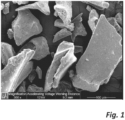
- the majority of PSAP particles are irregular in shape, have sharp edges and flat surfaces.
- substantially all (80% or more by weight) are surface crosslinked or more highly bulk crosslinked. Another motivation for using such crosslinked SAP, beyond avoiding coalescence, is that some SAP might not have sufficient stiffness to effect friction, erosion or abrasion of contaminants. Further, greater stiffness may provide a greater storage modulus, G'.
- U.S. Serial No. 62/828,134 filed April 2, 2019 also shows images of PSAPs that lack sharp edges, such as Aquakeep 10S, Aquakeep CA180N and Aquakeep SA60N (Sumitomo Seika Chemicals Co. Ltd., Tokyo, JP). It is believed that the rounded products of these images are made by suspension polymerization, and that the particles are not surface cross-linked. A variation on this is a grouping of nearly-spherical particles stuck together as an aggregate, resembling a bunch of grapes. From experimental experience so far, these rounded materials are less effective than crystal-shaped or irregular-shaped PSAPs having edges and corners and non-spherical shape. It may be that the very nearly spherical shapes rolled past and among each other easily, may roll over the surface as well during flow. Moreover, the spherical shapes can present less surface area to the surface to be cleaned.
- a mixture of rough-shaped PSAP with spherical SAP can yield compositions that flow better in narrow than compositions with spherical SAP alone or rough-shaped PSAP alone.
- SAP is formed by solution polymerization, followed by calendaring or extrusion, followed by drying and grinding.
- the resulting particles tend to be flat or irregular and they look like crystals or shattered glass and are sometimes described as crystal-like, though technically SAP material is not crystalline.
- SAP made by such shattering or cleaving processes have apparent cleavage surfaces, as can be seen in the images referenced above. This process can optionally be followed by another cross-linking step.
- SAPs are surface crosslinked. This is believed to help contain the particles in the swollen state such that they do not coalesce. A higher density of a more uniform crosslinking can also help avoid coalescence.
- Highly bulk crosslinked SAP is made during the main single solution crosslinking step and this is followed by calendaring and grinding. Such a product is mostly used in cable-lock applications. Examples of this latter form can have for example CRC values for deionized water of about 20 to about 50, or about 28 to about 32.
- An exemplary source of this type of PSAP is Stewart Superabsorbents Company, Hickory, NC.
- Surface crosslinking can for example be effected with a water-based crosslinking system, while the interior of the SAP defines a non-ionized, more hydrophobic phase.
- the particles are ground to form smaller particles. It is believed that such ground particles can have, as their exposed surfaces, a mixture of harder material and softer material, and quite possibly some of the resulting particles have exposed surfaces that are entirely soft material that was originally in the interior of the suspension-polymerized particles.
- the resulting particles, after grinding or breaking-up, have irregular, generally non-spherical morphologies, because of having been broken up during grinding, and many of the exposed surfaces are non-cross-linked or lightly crosslinked. This material runs a risk of inducing coalescence, but the test is whether the material performs as a PSAP. This material can be surface crosslinked to reduce the risk of coalescence. Keeping a useful amount SAP particle integrity is believed to be associated with creating high localized shear stress during flow at a cleaning surface of a channel, and this is believed to be useful in removing contaminants.
- the composition comprises two classes of SAPs, such that one of them is softer than the other.
- the softer one may swell more and fill volume and absorb excess water; on the other hand, the one which is harder such as more crosslinked or surface crosslinked, will swell less and the harder one can create more grip or friction or erosion of the contaminant.
- the included angle in almost all cases (such as in 80% or more of the particles that were measured for angled particle compositions), is less than 90 degrees. In some powders, a majority of the measured particles have an included angle that is less than 70 degrees. In some of the tables presented here, at least one-third of the measured particles have an included angle that is less than 40 degrees.
- ratios of overall dimensions of such angled particles it can be described that of the particles for which measurements of three different dimensions (including a depth dimension) were able to be taken or estimated, a ratio of maximum dimension to minimum dimension is greater than 2 for a majority of the particles. In fact, for a majority of the particles, such a ratio was greater than 4. Of course, for a sphere, the dimension in any direction would be the same, and so such a ratio would be one. So, the larger the ratio, the more the particle departs from spherical.
- radius of curvature it can be described that at least some of the particles can have a measured radius of curvature that is smaller than 100 microns, or smaller than 50 microns. In the case of some of the powders, at least a majority (more than half) of the particles measured have a radius of curvature at some corner that is less than 20 microns.
- the radius of curvature describing it in a more dimensionless way, i.e., it is possible to calculate a ratio of the radius of curvature of a sharp corner divided by the largest measured dimension of the particle (referred to as the length of the particle). Similarly, it is also possible to calculate a ratio of the radius of curvature of a sharp corner divided by another dimension of the particle, which might be described as a next-largest principal dimension of the particle (referred to as the width of the particle). It can be described that at least a majority of the particles of the superabsorbent polymer have a ratio of corner radius of curvature to maximum overall dimension that is less than 0.3, or less than 0.2.
- compositions where PSAP is used with MF in some cases the majority of the space may be occupied by SAP with MFC occupying a smaller volume.
- PSAP and other components can contribute to removal with friction-assisted mechanisms.
- PSAP compositions lacking MF were found to be more effective at higher pH of about 9 to 11, compared to those at lower pH.
- concentration of PSAP in such formulations may be from about 0.1% or 0.2% to about 3% by weight depending on the type of the PSAP material.
- Other factors influencing the concentration that is useful include salt concentration or ionic strength, solvents such as alcohols, glycols or polyethylene glycols (PEGs), type of ions used in solution, pH and surfactant.
- a concentration near or above PVP is desirable.
- Such compositions are effective against TBF and against lesser "BBF's," such as grown for 1 to 4 days, instead of the full BBF protocol.
- Ultrez 10 brand Carbopol (Lubrizol Corp., Wickliffe, Ohio), which as used did not meet the functional test for being a PSAP, was found notably less effective.
- the Ultrez 10 material was also undesirably small in terms of structures that it forms in the composition, namely less than 2 microns in the swollen state.
- PSAP compositions lacking MF can be expected to be effective if used with sufficient frequency to avoid formation of strongly adherent biofilm. Also, such compositions can be used between cleanings with PSAP and MF. Moreover, with the proper selection of PSAP and solid particles, these compositions can be expected to effectively clean BBF.
- these compositions are non-Newtonian and shear thinning and have viscosity between 3,000 to about 10,000 mPa-s at a shear rate of 1/sec. Such compositions are effective to clean BBF.
- compositions based on PSAPs and MFs appear to show that the MFs form a network and that the thicker branches of such network is located in spaces between SAP particles.
- surface-crosslinked PSAPs such as those obtained from Stewart Superabsorbents are used, the crystal-like PSAP particles appear to be lying flat and making large contact surface area with the surface of the channel.
- the PSAPs and fibrillated network components of the composition appear, under the microscope (SEM), to exist as distinct phases and may be intermingled together in some fashion.
- One phase comprises the PSAP particles and the other phase comprises the fibrillated network.
- Such phases may be continuous or co-continuous or one phase may present within the other.
- the minute fibrils may appear to provide a coating of the SAP particles.
- both phases are believed come in contact with the surface, meaning that at a given time some portions of the surface may experience contact with the SAP particles and other portions of the surface may experience contact with the fibrillated network. Over time, the same surface spots would experience SAP contact for some moments and may become in contact with minute fibril network for some moments during cleaning.
- compositions with this combination have been found to be extremely rapid in removing BBF.
- a composition according to the invention generally can be described with respect to storage modulus G', which describes the elastic properties, and , the loss modulus, which describes the viscous properties. Both quantities can be measured in units of Pascals.
- An Anton Paar Physica RM 501 Rheometer operating with a 25 mm and a 50 mm parallel plate at 1 mm or 2mm gap distance (as instructed by the manufacturer) is used.
- G' and G" measurements were performed as a function of strain and strain rate in rad/s.
- amplitude sweeps were performed as a function of shear stress (Pa). All measurements are made at room temperature.
- a composition of the invention will be viscoelastic (VE) in that at the start of the G" and G' measurement at 0.1 percent shear strain (or 0 rad/s in some embodiments) G' is higher than G".
- VE properties can be adjusted for example by adjusting the MF content, the PSAP content or solid particles content, or combinations thereof.
- VE may also be affected by selecting certain surfactants such as liquid crystal surfactants. Surfactants that form non-spherical micelles such as worm-shaped micelles can be useful.
- G' is 200 Pa or higher. In embodiments, G' is 250 Pa or higher. In embodiments, G' is 400 Pa or higher. In embodiments, G' is 500 Pa or higher. In embodiments, G' is 600 Pa or higher. In embodiments, G' is 1,000 Pa or higher. In embodiments, G' is 1,500 Pa or higher. In embodiments, G' is 2,000 Pa or higher. In embodiments, G' is 3,500 Pa or less.
- the cleaning composition has a yield shear stress of more than 1 Pa, such as more than 5 or 6 Pa. In embodiments, the yield shear stress is more than 20 Pa. In embodiments, the yield shear stress is more than 30 Pa. In embodiments, the yield shear stress is more than 42 Pa. In some cases the yield shear stress can be for example as high as 120 or 130 Pa
- the loss modulus G" (at 0.1 percent shear strain) is less than 500 Pa. In embodiments, G" is less than 200 Pa. In embodiments, G" is less than 100 Pa. In embodiments, G" is less than 50 Pa. In embodiments, G" is less than 30 Pa.
- a large viscous component (G") is generally not desirable for present cleaning, especially at 0.1% shear strain or less than 0.2% or less than 1%.
- Cleaning compositions can have for example viscosities of greater than 100 mPa-s or greater than 5000 mPa-s at a shear of 0.1 percent as measured by a Brookfield type viscometer, or from 100 to 1000 mPa-s, or from 500 to 9000 mPa-s, or from 500 to 5000 mPa-s, or from 4,000 to 9,000 mPa-s.
- flow rates of the inventive compositions can be in the range from 1 ml/minute to 20 ml/minute in narrow channels (e.g., ⁇ 2mm) and from 30 to 130 ml/minute in larger channels.
- PSAP materials are not ideally viscoelastic.
- some surface crosslinked or highly bulk crosslinked PSAP alone at 1% concentration by weight in water gives a nearly-Newtonian behavior with a viscosity of about 500 cP or milli-Pa-s.
- a composition containing 1% of such PSAP and 0.3% to 0.5% Exilva Forte (MFC) becomes shear thinning (thixotropic) and pseudo-plastic.
- MFC Exilva Forte
- the viscosity of the above composition increases by factor of 6 up to about 3000 mPa-s at low RPM or low shear rate (1 s-1).
- This rheology closely resembles the rheology of another formulation that has been used in certain experiments, namely a formulation containing 1% Exilva Forte + 2% SMCC 50 without containing any SAP.
- the resulting structure may resemble a 3D network complex fluid which exhibits a yield stress and behaves with viscoelastic properties where G' is several times larger than G" as described further in U.S. Serial No. 62/828,134 filed April 2, 2019 (NOVA004P4).
- a composition comprising a combination of SAP and MFC has higher yield shear stress.
- concentration of SAP and MFC can be varied to control the viscoelastic properties of the compositions such as G' and G", as is known in the rheology of complex fluids. Both yield stress and G' (storage modulus) are important to making formulations that more efficiently remove BBF and other similar contaminants, including protein and patient materials.
- the small and large fibrils of MF appears to help to keep the SAP particles separated from each other may be viewed as a protective layer and it is known in colloid science as "steric stabilization.”
- the nature and thickness of the protective layer can be tailored by selecting the MFC or other fibrillated materials, their degree of fibrillation, dimensions of fibers and fibrils, and concentration.
- the pragmatically measured coalescence measured in the context of the cleaning composition, can be less with MF present, even if the SAP has a larger tendency to coalesce than might otherwise be desired.
- the SAP particles because of their elastic properties, may help in pressing the whole network against the channel wall (imposing a normal force onto the wall). This may enhance the cleaning action due to the better contact of the Minute Fibrils (and solid particles if present) with contaminants present at the channel wall.
- the swollen SAP particles can effectively increase the elastic components (G') of the this complex viscoelastic material/fluid.
- the SAP particles themselves appear to have another specific cleaning action due to an apparent direct interaction with contaminants at the channel wall. The latter interaction may be more effective in removing highly adhering contaminants such as biofilms, although Applicant does not not wish to be limited to this theory.
- kits may be sold with two types of compositions. One for tubing with a high risk of clogging, and another where the clogging risk is lower.
- Minute Fibrils is a term coined to encompass what the industry terms as microfibrillated cellulose and nanofibrillated cellulose (which are basically the same thing) and substantially equivalent structures made from synthetic polymers, including without limitation those made by the Lyocell melt spinning process or similar processes.
- the structure of cellulose is illustrated in Figure 2 of WO2018064284A1 (adapted from nutrition.jbpub.com/resources/chemistryreview9.cfm).
- the structure of microfibrillated cellulose can be discussed with reference to this figure.
- Microfibrillated cellulose is cellulose that has typically been treated mechanically, chemically, enzymatically, or with combination treatments to separate out macro fibril bundles and micro fibril bundles. These can loop off larger fibril bundles, or extend from larger fibril bundles. It may be that there are unconnected micro fibril bundles, but the amounts are believed to be small, and the fibril bundles are believed to associate with the connected fibril bundles. There can be two or more tiers of diameter sizes. What is important is that the micro fibril bundles (or their analog) are connected to stiffer, larger bundles.
- the Minute Fibrils comprise thicker fibrils, from which branch thinner fibrils, the thicker fibrils having a diameter from about 250 to about 20,000 nm.
- the thinner fibrils contribute to the entangled network structure.
- the thinner fibrils can include for example fibrils of diameter of about 10 to about 90 nm.
- a useful measurement parameter for Minute Fibrils is the hydrodynamic size (HDS), especially the mean HDS (MHDS). This is measured by laser diffraction of a highly dilute suspension, using a Mastersizer 3000 (Malvern Instruments), [ Jose et al., On the morphology of cellulose nanofibrils obtained by TEMPO-mediated oxidation and mechanical treatment, Micron, 72, 28-33 (2015 )]. Though energy is applied (by sonication) to separate structures, it is not clear whether the entity measured is a single structure, or a floc of two or more. The substance so measured is a "fibrillated entity.”
- microfibrillated cellulose that has been processed to the extent that the MHDS is as low as about 20 micron (micrometer) is less effective, if provided on its own, than microfibrillated cellulose with MHDS of for example 30 to 70 micron.
- the larger microfibrillated cellulose is in some embodiments even more effective if appropriately mixed with smaller microfibrillated cellulose.
- a ratio having more of the larger Minute Fibril component is used, such as a ratio of about 1.5:1 or more, such as about 2:1 or more, or about 3:1.
- the distribution of the source compositions is tight enough such that the mixture is indicated in the product by a bimodal (or for further mixtures, multi-modal) distribution.
- a fibrillated network is a 3-D network structure made from the interaction of fibrillated entities as the result of entanglements of fibrils as well as due to hydrogen bonding (or other non-covalent bonding mechanisms including electrostatic) when the fibrillated materials are properly mixed with water or solvents. Entanglement can be tested for by optical microscopy and by ensuring that the composition show some yield shear stress (such as more than 1 Pa, or more than 10 Pa or even up to 100 Pa) as per rheological testing as is known the art. This entanglement is believed to be useful for achieving effective cleaning and for ensuring complete rinsing without leaving residues on the surface. Minute Fibrils of the invention can form 3-D network at small weight percent, such as 0.3 or 0.4% wt/wt (in the absence of other polymers).
- the very large specific surface area of the Minute Fibrils can significantly facilitate material transfer and removal of contaminants from the walls of channels, tubes or confined space during flow.
- the specific surface area of for example some nano- or microfibrillated cellulose material (as determined by the BET (Brunauer-Emmett-Teller) method) can be more than about10 m ⁇ 2/g and up to more than 300 m ⁇ 2/g or 500 m ⁇ 2/g and in some cases can be more than one or two billion m ⁇ 2/g, which can produce effective and efficient treatment and can clean walls as they contact or nearly contact them during flow.
- the large surface area can facilitate adsorption of contaminants and can trap contaminant fragments during cleaning.
- the surface area can be estimated from SEM micrographs, adsorption of nitrogen or other gas, surfactant or other molecular probe with known surface area or combination of methods as it is known in the colloid and surface science or materials science literature.
- measurement is by the adsorption of nitrogen onto the surface of the material.
- This technique is based on the Brunauer-Emmett-Teller (BET) theory of the adsorption of gas molecules on a solid surface.
- BET Brunauer-Emmett-Teller
- the material is prepared by first desorbing whatever is adsorbed onto the surface of the material, and then the material is placed in an environment where it can adsorb nitrogen.
- the amount of gas adsorbed at a given pressure indicates the specific surface area of the material.
- This measurement of the amount of the amount of adsorbed gas can be made by measuring the change in the amount of gas present, or by measuring the change in the weight of the material.
- the specific surface area for the Minute Fibril composition providing the major portion (50% or more) of Minute Fibrils is about 30 m ⁇ 2/g to about 300 m ⁇ 2/g, or higher in some cases.
- Methods of production of Minute Fibrils include mechanical processing, TEMPO-catalyzed processing, and enzymatic processes, and combinations of thereof.
- Exilva grade microfibrillated cellulose (made by Borregaard) is made by a purely mechanical process with many passes through Borregaard's processor machine, which includes a form of microfluidizer.
- the Lyocell process which can be used with cellulose, is similar to what is used in making Nylon and it can also be used with acrylics or other polymers.
- TEMPO (a common name for a catalyst whose chemical name is (2,2,6,6-Tetramethylpiperidin-1-yl)oxyl or (2,2,6,6-tetramethylpiperidin-1-yl)oxidanyl) is used in some processes to induce partial cleavage in the cellulose.
- Sodium hypochlorite or sodium bromide can also be used as oxidizing agents (for example along with TEMPO) for cleavage, in combination with mechanical force.
- a variety of mechanical processes can be used such as high pressure homogenization, microfluidization, grinding, refinery-based processes, cryocrushing, and high intensity ultrasonication. It can include directing jets of fiber-containing liquid to impinge on one another.
- a process may use for example, two passes through a grinder or refiner, and multiple passes through a homogenizer.
- some illustrative cellulosic Minute Fibrils have the following features: Table 2 Microfibrillated Cellulose Fibers (Larger) Fibrils (Smaller) Diameter Length Diameter Length Exilva Forte 0.5 - 3 ⁇ m 10 - 100 ⁇ m 30 - 60 nm >2 ⁇ m Exilva Piano 0.1 - 20 ⁇ m 5 - 150 ⁇ m 50 - 70 nm 2 - 3 ⁇ m Exilva Piano Light 0.3 - 20 ⁇ m 20 - 200 ⁇ m 20 - 75 nm 1 - 5 ⁇ m Sensefi 0.25 - 15 ⁇ m 5 - 60 ⁇ m 30 - 60 nm 0.4 - 1.0 ⁇ m
- the results of Table 2 include a summary of the SEM analysis of some of the fibrillated materials as described in embodiments of the invention.
- the top three materials listed in the Table represent different degrees of fibrillation and are sold without other additives.
- the fourth material (Sensefi) is made by a special process and as sold includes carboxymethyl cellulose (CMC).
- CMC carboxymethyl cellulose
- Diameters can be highly accurate since they can be obtained from the micrographs. On the other hand, the lengths can be less precise since it difficult to ascertain because of high magnification of the SEM images.
- the SEMs for each material was obtained at 100X, 1,000X, 2,000X, 10,000X, 50,000X and 10,0000X.
- the diameter and length of the fibers and fibrils represent the ranges used to prepare the networks described in the specification. This can be important since the diameter and length are believed to contribute to the mechanical properties of the network, especially strength, stiffens and rigidity which are important for cleaning according to the invention.
- Microfibrillated fibrous materials are now commercially available from such suppliers as: Borregaard (Sarpsborg, Norway) (products include Exilva, Sensefi); Weidmann Fiber Technology (Rapperswil SG, Switzerland) (WWC_QAdvanced); Engineered Fibers Technology LLC (Shelton, CT) (EFTec TM nanofibrillated fibers); American Process, Inc. (Atlanta, GA) (BioPlus ® Fibrils); Celluforce (Montreal, Canada); Forest Products Laboratory (US Department of Agriculture); Lenzig AG (Austria)(products include Lyocell); Weyerhaeuser (Seattle, WA)(products include Lyocell); and other suppliers in Scandinavia and Japan.
- Synthetic polymers can be formed into macro fibril structures for example by spinning (extruding) a solubilized formulation.
- cellulosic polymers can be so extruded, for example using N-methyl-morpholin-N-oxide (NMMO) as the solubilizing solvent.
- NMMO N-methyl-morpholin-N-oxide
- Other solvents can be chosen as appropriate for solubilizing the polymer in question, such as acrylics and others.
- the spun fiber can then be cut and mechanically converted into a Minute Fibril form as outlined above.
- Engineered Fibers Technology sells fibrillated polymers of Acrylic (CFF ® , acrylic copolymer), Lyocell (Tencel ® , for wood pulp), LCP (Vectran ® , aromatic polyester), PBO (Zylon ® , crystalline polyoxazole), Para-aramid and Cellulose (wood and non-wood).
- CFF ® Acrylic copolymer
- Lyocell Lyocell
- LCP Vinyl ® , aromatic polyester
- PBO Zylon ® , crystalline polyoxazole
- Para-aramid and Cellulose wood and non-wood.
- Synthetic and cellulosic MF can be made by the well-known Lyocell process.
- Additional components can be added to provide a stiff network, which can be useful to supplement the effects of the stiff components of Minute Fibrils, add stiff components to PSAPs, or provide abrasives to Minute Fibrils, PSAPs or gels.
- Non-polymer abrasives or solids can also be added. The manner in which these components are added can have a notable effect. Without being bound by theory, if introduced with high energy, they are anticipated to uniformly distribute. If added with less energy, e.g., whisking, they are anticipated to more strongly populate the outer parts of flocs of Minute Fibrils. In certain embodiments, such as for example cleaning optical lenses, extra care may be taken with the selection these components to avoid damage. In certain embodiments, such as cleaning or sharpening blades, the selection of these components may be made to accentuate microabrasion.
- Such Solid particles can impart functions that increase G' of the cleaning composition.
- Solid Particles such as Polymers; friction elements or stiffening elements
- Solid polymers are exemplified by MCC or SMCC, though other polymers that can provide this function can be substituted.
- MCC is available in various grades from several sources and vendors, and can be obtained from FMC Corporation, Newark, DE, under the name Avicel ® .
- Microcrystalline Cellulose is made by a hydrolysis process which removes the amorphous fraction from cellulose fibers and controls the degree of polymerization at the same time. In embodiments, MCC fibers are not as elongated (as described by length/diameter ratio) as some of the Minute Fibrils described herein. Microcrystalline Cellulose is safe and is used extensively to make tablets and other pharmaceutical and food products. Another version of MicroCrystalline Cellulose is SMCC.
- Microcrystalline Cellulose can form gels that have increased viscosity when standing, especially when the Microcrystalline Cellulose is co-processed with carboxymethyl cellulose (CMC) polymer. Because of its elongated shape and stiff crystalline nature, Microcrystalline Cellulose does not readily form gels that have entangled network structures; however, it can make some kind of 3D network that forms weak gels over one or more weeks. Accordingly, gels based on MCC-CMC may be weaker (in terms of yield shear stress) compared to gels made from Minute Fibrils.
- CMC carboxymethyl cellulose
- MCC can provide rigidity, stiffness and hardness to the Minute fibril compositions described herein.
- MCC can provide a stronger network (or increase yield shear stress and storage modulus) and abrading action at the wall or surface to remove strong contaminants such as for example build up biofilm.
- Cellulosic particles appear to be more effective if derived from a harder wood.
- the composition may comprise Minute Fibrils and
- compositions including solid particles or fibers are effective in removing biofilms and contaminants from passageways and surfaces.
- Hardness can be described, at least qualitatively, using the Mohs hardness scale that was originally developed in the field of mineralogy, or another scale. It is believed that the hardness of cellulose is about 3 on the Mohs hardness scale.
- the particles may be simple inorganic substances, which may be insoluble or poorly-soluble in water.
- Calcium Carbonate (CaCO3) is one such substance. Calcium carbonate is believed to have a Mohs hardness of around 4.
- Colloidal silica (silica gel) is another possible substance. Colloidal silica is not as hard as ordinary silica or quartz. The Mohs hardness of silica gel is around 4, similar to that of CaCO3. Silica gel is amorphous and is not very scratchy.
- Ordinary silica or quartz in contrast to colloidal silica, is hard enough to remove biofilm, but also is hard enough to scratch typical polymeric materials used for the wall of the passageway. Quartz, which is ordinary silica, like sand, has a Mohs hardness of 7. Silica gel is FDA approved for use as a dentifrice also is approved for exfoliating, and it does not cause silicosis.
- Another suitable particle material of the inventive composition could include crushed olive pits and crushed cashew nut, both of which are available commercially in a range of particle size from 50 microns to more than 500 microns. Such material can be mixed in with other components of the Minute Fibril composition.
- Particles or fibers used can include: Wool made by Goonvean, Nylon made by Goonvean, Olive Stone made by Goonvean, Syloid EXF150 (SiO2) made by W.R. Grace, FMC Lattice NTC-80 Microcrystalline Cellulose, FMC Lattice NTC-61 Microcrystalline Cellulose, FMC NT-100, FMC NT-200, Precipitated CaCO3, and the like.
- Insoluble or poorly-soluble material can also be formed within the composition by a precipitation reaction that could take place upon the mixing of appropriate aqueous-solution ingredients.
- a precipitation reaction that could take place upon the mixing of appropriate aqueous-solution ingredients.
- examples include but not are limited to precipitated calcium carbonate, silica, calcium phosphates including hydroxyapatite, fluorophosphates, alumina and other materials.
- the particles formed within the network can be crystalline, amorphous or comprising mixed phases as desired.
- the particle size and size distribution of particles formed within the network can for example range from 50 nanometers to several microns possibly in the range from 0.5 to 100 microns, or even up to 500 microns or more.
- a reaction that produces insoluble calcium carbonate particles within the network includes mixing calcium chloride and sodium carbonate which can be formed in situ within the Minute Fibril network during preparation.
- Other reactions include: reaction between various carbonates (e.g. sodium carbonate) and calcium hydroxide; reaction of soluble calcium salt and carbon dioxide gas; reaction between ammonium carbonate and calcium hydroxide or other reactions known to form calcium carbonate as is known in inorganic chemistry.
- the sizes of such produced precipitate particles can be dependent upon the rate and other conditions at which the reaction takes place. Scanning Electron Microscope examination has shown that precipitated calcium carbonate is distributed onto the fibers and fibers and on the spaces between them within a Minute Fibril network.
- Precipitated particles that adhere to fibril surfaces are especially useful as they can modify the stiffness and hardness of the network and can thus improve the abrasion properties of the network.
- Composition comprising in situ precipitated particle were found to be effective in removing strong build up biofilms.
- Table 3 Product Source Wool CMW80; Dia.: 20-30 ⁇ m (>90%); Length: Max: 200 ⁇ m (>95%) Goonvean Fibres (goonveanfibres.com) Nylon (Polyamide) Fibre WN60; Dia.: 10-20 ⁇ m ⁇ 10% (>95%); Length: Max: 250 ⁇ m (>90%)(Average (>50%): ⁇ 125-250 ⁇ m Goonvean Fibres Viscose Fibre RM60; Dia.: 8-25 ⁇ m ⁇ 10% (>95%); Length: Max: 250 ⁇ m (>95%)(Average (>50%): ⁇ 100-225 ⁇ m Goonvean Fibres Olive Stone Grit EFOG; Max: 355 ⁇ m (>99%); Passing: 200 ⁇ m ( ⁇ 15%); Passing: 150 ⁇ m ( ⁇ 4%) Goonvean Fibres Silica Syloid EXF 150 (150 ⁇ m) W.R.
- Cleaning compositions based on PSAP or MF appear to generally function better against strongly adhering contaminants if the compositions contain added solid particles. Such solid particles appear to provide friction, abrasion, erosion, fragmentation or their combination to achieve often superior removal of BBF from a channel wall.
- Fig. 2 shows an SEM micrograph of a composition containing PSAP, MF and MCC.
- The shows the appearance of the ingredients in a dry condition after the ingredients were mixed together in a wet condition and then were dried out.
- the image reflects some shrinkage of the PSAP from the drying process. Drying was required because the of the need for vacuum in Scanning Electron Microscope.
- Provisional Patent Application U.S. Serial No. 62/828,134 filed April 2, 2019 (NOVA004P4) contains more such images of like compositions.
- Fig. 3 shows a schematic of what is believed to be a representative structure of compositions of embodiments of the invention.
- the somewhat large irregular shapes are representations of PSAP.
- the smaller rod-like shapes are representations of MCC.
- the curved lines are representations of MFs. Many of the MFs are between other particles but also in this view some of the Minute Fibrils overlap or overlie particles (PSAP or of MCC).
- This schematic representation can be referred to as a "mosaic.”
- the spaces between SAP particles contain MFC or in other words such spaces are filled with fibrillated material.
- the visible microstructure of the composition may also be that MFC coats the surface of SAP particles.
- the above two microstructures can be present together and their ratio may depend on the ratio of SAP-to-MFC in the composition. It appears that the SAP particles may lie flat on the surface of a channel and can occupy a large fraction of the surface to be cleaned. It is believed that the SAP particles themselves don't entangle with each other, but may join together in some other fashion such as by forming gel bridges between each other, and in this sense they form secondary network.
- the SAPs appear to form gels by merging with each other.
- the fraction of merging into gels may be 10 to 50% but can be more than 20% based on microscopic examination.
- the SEM images show that SAP and fibrillated materials can merge together. There is evidence based on SEM that some fibrils become incorporated in the SAP gel materials. As mentioned above, the test for too much coalescence is with respect to retaining good flow.
- a composition has a protein cleaning effective amount of fibrils plus any gel-forming polymer or any stiffening components if that amount, formulated at one or more of pH 7 or 9 in CS-19 (described in ⁇ 0104 and Table 4 of WO2018064284A1 ) would clean Austrian Soil-derived protein (applied as described below in ⁇ 0194-97 of WO2018064284A1 ) from the inner surface of a six foot length of 3.2 mm ID PTFE tubing to reduce adherent protein by 50-fold or more to a level of about 6.4 ⁇ g/cm2 or less.
- a composition has a protein cleaning effective amount of PSAP plus any any further gel-forming polymer or any stiffening components if that amount, formulated at one or more of pH 7 or 9 in CS-19 (described in ⁇ 0104 and Table 4 of WO2018064284A1 ) would clean Austrian Soil-derived protein (applied as described below in ⁇ 0194-97 of WO2018064284A1 ) from the inner surface of a six foot length of 3.2 mm ID PTFE tubing to reduce adherent protein by 50-fold or more to a level of about 6.4 ⁇ g/cm2 or less.
- a BBF cleaning effective amount of fibrils plus any gel-forming polymer or any stiffening components is one that if that amount, formulated at one or more of pH 7 or 9 in CS-19, would remove BBF (formed as described ⁇ 0061 and Example 2 of WO2018064284A1 ) from the inner surface of a six foot length of 3.2 mm ID PTFE tubing as measured by SEM analysis.
- a BBF cleaning effective amount of PSAP plus any additional gel-forming polymer or any stiffening components is one that if that amount, formulated at one or more of pH 7 or 9 in CS-19, would remove BBF (formed as described ⁇ 0061 and Example 2 of WO2018064284A1 ) from the inner surface of a six foot length of 3.2 mm ID PTFE tubing as measured by SEM analysis.
- a composition for any gel, fiber or other cleaning embodiment is protein cleaning effective if it cleans Austrian Soil-derived protein (described in ⁇ 0104 and Table 4 of WO2018064284A1 ) from the inner surface of a six foot length of 3.2 mm ID PTFE tubing to reduce adherent protein by 50-fold or more to a level of about 6.4 ⁇ g/cm2 or less.
- a composition for any PSAP, gel, fiber or other cleaning embodiment
- BBF cleaning effective if it removes 90% or more of BBF from the inner surface of a six foot length of 3.2 mm ID PTFE tubing as measured by SEM analysis.
- a TBF cleaning effective amount of fibrils plus any gel-forming polymer or any stiffening components is one that if that amount, formulated at one or more of pH 7 or 9 in CS-19, would remove TBF (formed as described Example 1 of WO2018064284A1 ) from the inner surface of a six foot length of 3.2 mm ID PTFE tubing as measured by SEM analysis. (TBF is essentially BBF but without chemical crosslinking.)
- a TBF cleaning effective amount of PSAP plus any additional gel-forming polymer or any stiffening components is one that if that amount, formulated at one or more of pH 7 or 9 in CS-19, would remove TBF (formed as described Example 1 of WO2018064284A1 ) from the inner surface of a six foot length of 3.2 mm ID PTFE tubing as measured by SEM analysis.
- a composition for any PSAP, gel, fiber or other cleaning embodiment
- formulations configured for open surfaces and having too much viscosity for measuring protein or BBF removal in a tube if formulations included within the components are protein cleaning or BFF cleaning, the formulation is so effective.
- the contaminant is removed in a short period of flow through the segment of less than 12 minutes, or in less than 6 minutes, or less than 3 minutes, or less than 1 minute.
- Useful concentrations of PSAP can include for example from about 0.1% w/w to about 2% w/w.
- PSAP is about 1 to 2% wt/wt.
- solid particles are about 0.4 to about 1.0 or about 1.2% wt/wt.
- surfactant is nonionic, and present in an amount from about 0.1% to about 1 % wt/wt.
- EDTA is present.
- propylene glycol is present.
- pH is from about 7.5 to about 11.
- Useful concentrations of Minute Fibrils can include for example from about 0.2% w/w to about 4% w/w, or from 0.2% w/w to about 1% w/w, with useful concentrations of PSAP including for example from about 0.2% w/w to about 1.2% w/w, or from about 0.4% w/w to about 1% w/w.
- Factors for selection of MF are as described above.
- PSAP allows for lower amounts of MF (while MF can still provide the scaffold for entanglement), which can provide the added benefit of reducing the risk of clogging.
- the deformability of PSAP is also believed to be beneficial to avoiding clogging.
- Useful concentrations of SAP can include for example about 0.5 % wt/wt to about 2% wt/wt, with useful concentrations of MF for example from about 0.2% wt/wt to about 1% wt/wt, and with useful concentrations of solid particles for example from about 0.3 wt/wt to about 1% wt/wt.
- a useful pH is from about 8.5 to about 11.
- the gel or Minute Fibrils are suspended in a carrier fluid, such as without limitation an aqueous fluid.
- a carrier fluid such as without limitation an aqueous fluid.
- surfactant component configured to help loosen the attachment of a contaminant to a surface.
- the fluid composition can comprise a surfactant or a surfactant package or mixture containing one or more surfactants.
- surfactants can prevent and decrease strong adhesion of patient's biological material such as fecal matter, blood, mucus, protein and organisms that has recently contacted the surface of an endoscope or device, and also can help to prevent drying of such material onto surfaces.
- surfactants can also promote wetting of hydrophobic surfaces and prevent de-wetting of surfaces by promoting formation of a thin film on the surface if drainage of composition would take place.
- Surfactants also can help in the removal of such materials (organic soils, biofilms, organism and patient materials such as fecal matter) from the surfaces and can lower the adhesion force of contaminants with the surface.
- a surfactant package (which can be a combination of more than one surfactant) can use a nonionic surfactant, or can use an anionic or cationic surfactant or an amphoteric surfactant or a mixture comprising various different surfactants.
- surfactants examples include sodium dodecyl sulfate; alkyl ethoxylates; amine oxides; amphoteric betaines; alkyl sulfonates; alkyl phenosulfonates; fluorosurfactants; and the like.
- Sodium dodecyl sulfate (SDS) which is an anionic surfactant, is known to penetrate and help dislodge biofilm.
- SDS sodium dodecyl sulfate
- Other surfactants can be used to make the compositions of invention without limitation as provided for example in Milton J. Rosen Monograph "Surfactants and interfacial phenomena", third edition, Wiley Interscience (2004 ), and in " Surfactants - A Practical Handbook", Edited by K. Robert Lange, Hanser Publisher, Kunststoff (1999 ).
- Suitable anionic surfactants include fatty acid soaps covering a range of alkyl chain length, for example up to about 18 carbon atoms, and may be straight or branched chain alkyl groups. These surfactants are normally used at a pH higher than the dissociation constant of their corresponding carboxylic acid.
- Another class of anionic surfactants that has been found to be effective with the present method is alkyl sulfates and sulfonates, such as SDS.
- Another useful anionic surfactant may be based on alkylpolyoxyethylene sulfate.
- Another anionic surfactant that can be used is an alkylbenzene sulfonate.
- Suitable anionic surfactants also include alphaolefin sulfonates, monoalkyl phosphates, acyl isothionates, acyl glutamates, N-acyl sarcosinates and alkenyl succinates and the like that have an anionic surface group and possess surface activity.
- Suitable amphoteric surfactants include for example alkyldimethylamine oxides, alkylcarboxy betaines, alkylsulfobetaines, amide-amino acid type amphoterics and others that may exhibit amphoteric and surface activity.
- Amphoteric substances have characteristics of both acid and alkali groups.
- Useful nonionic surfactants include for example polyoxyethylene alkyl ethers, polyethylene alkylphenyl ethers, polyethylene fatty acid esters, sorbitan fatty acid esters, polyethylene sorbitan fatty acid esters, sugar esters of fatty acids, alkyl polyglycosides, fatty acid diethanolamides, fatty acid monoglycerides, alkylmonoglyceral ethers, fatty acid polypropyleneglycol esters and the like.
- Useful cationic surfactants include for example alkyltrimethylammonium salts and their phosphonium analogues, dialkyldimethyl ammonium salts, alkylammonium salts, alkylbenzyldimethylammonium salts, alkylpyridinium salts and the like which bear cationic functional groups and possess some surface activity.
- Polymeric dispersants can also be used. Although they do not have the molecular structure of a typical surfactant, they have similar effects. These include formaldehyde condensates of naphthalene sulfonate, sodium acrylates or copolymers of other acrylic acids, copolymers of olefins and sodium maleate, lignin sulfonates, polyphosphates, silicates and polysilicates, carboxymethyl cellulose, cationic cellulose, cationic starches, polyvinyl alcohol, polyethylene glycol, polyacrylamides, polyethylene oxide/polypropylene oxide block copolymers (e.g., di- and triblock), and the like. These compositions are also useful herein to function substantially as surfactants. There are also detergent substances which are not strictly surfactants. Examples include trisodium phosphate, sodium carbonate and polymers. Such substances can also be used with the present invention.
- the carrier fluid or vehicle for the gel or Minute Fibrils can comprise an organic solvent and optionally can further include a co-solvent.
- a co-solvent is a second solvent added in a smaller quantity than the primary solvent to enhance the dissolving ability of the primary organic solvent.
- the solvent and optionally the co-solvent can help to remove substances such as protein or organic soil.
- Organic soil can be protein, lipids, carbohydrate, hemoglobin or similar substances.
- the solvent and the optional co-solvent can be for example propylene glycol or a glycol ether.
- Solvents such as propylene glycol and glycols ethers (from e.g., DOW Chemical Company) and others can be useful in the compositions of the invention because they contribute to achieving high-level removal of lipids and some proteins from endoscope channels and from external surfaces of medical or industrial devices.
- propylene glycol is intended to refer to any enantiomer or isomer of propylene glycol, either alone or in combination. This includes ⁇ -propylene glycol (propane-1,2-diol) and ⁇ -propylene glycol (propane-1,3-diol). Propylene glycol is highly miscible with water and also is able to dissolve various organic substances.
- Glycol ethers are a group of solvents (often termed "cleaners") based on alkyl ethers of ethylene glycol or propylene glycol. Most glycol ethers are water-soluble. They are also able to dissolve various organic substances.
- glycol ethers include at least the following substances: Ethylene glycol monomethyl ether (2-methoxyethanol, CH3OCH2CH2OH); Ethylene glycol monoethyl ether (2-ethoxyethanol, CH3CH2OCH2CH2OH); Ethylene glycol monopropyl ether (2-propoxyethanol, CH3CH2CH2OCH2CH2OH); Ethylene glycol monoisopropyl ether (2-isopropoxyethanol, (CH3)2CHOCH2CH2OH); Ethylene glycol monobutyl ether (2-butoxyethanol, CH3CH2CH2CH2OCH2CH2OH); Ethylene glycol monophenyl ether (2-phenoxyethanol, C6H5OCH2CH2OH); Ethylene glycol monobenzyl ether (2-benzyloxyethanol, C6H5CH2OCH2CH2OH); Diethylene glycol monomethyl ether (2-(2-methoxyethoxy)ethanol,
- solvents and co-solvents beyond those named can also be used, such as esters or ketones (such as water-soluble such compounds), and alcohols.
- the solvent is not primarily aqueous.
- the composition can include an additive that adjusts the pH of the composition in a desired direction.
- substances that can adjust the pH of a solution in the alkaline direction include sodium hydroxide, sodium phosphate and sodium metasilicate.
- HCl or other organic or inorganic acids can be used, thereby providing compositions of lower pH.
- a pH range between about 3 to 11.5 can be useful for the formulations of invention.
- a basic or acidic range can be chosen in light of anticipated contaminants.
- a cleaning cycle with one pH can be followed with one configured for another pH.
- a pH range between 7 and 11 can be favorable for cleaning of endoscopes and similar devices.
- a composition of any desired pH can be formulated and used depending on the surface and on the contaminants to be cleaned.
- the composition can include an additive to help maintain a desired pH of the composition.
- buffering additives can include acetate, citrate, phosphate, tris-buffer and other known buffers as is known in buffering systems in chemistry and biology.
- Other buffering systems, especially bicarbonate and phosphate, are also suitable in the compositions of the invention.
- Phosphate can be used to keep the pH of the composition between 7 and 11, which may be favorable for cleaning of endoscopes and similar devices.
- a buffer based on sodium hydroxide and tri-sodium phosphate can also be used to make the carrier fluid.
- the composition can include chelating agent(s) that can sequester calcium and other multivalent cations that can stabilize built-up solid matter. This can help in killing bacteria and in facilitating cleaning especially if the water used has some hardness or containing multivalent cations such as calcium. Removing Calcium can disrupt cell walls, which in turn can make the contaminant easier to remove. Removing calcium also can prevent the formation of scale if tap water is used for certain processing steps later.
- chelating substance examples include EDTA (ethylenediamine tetra acetic acid); tetra sodium ethylene diamine tetraacetic acid (available commercially as Versene TM from DOW Chemical Company); sodium metasilicate; phosphates including polyphosphates; and similar substances.
- the compositions can include builders, similar to chelating agents that sequester ions such as calcium or magnesium ions.
- An exemplary builder is sodium tripolyphosphate (STPP).
- the liquid composition can include an antimicrobial additive.
- antimicrobials is intended to include any one or more of various categories of substances, such as antimicrobials, antiseptics, disinfectants, biocides, antibiotics, virucides, prion-inactivating agents, antifungals, antiparasitics, and the like.
- Antimicrobial substances include drugs, chemicals, or other substances that either kill or slow the growth of microbes.
- the category also includes any of a large variety of chemical compounds and physical agents that are used to destroy microorganisms or to prevent their growth or development.
- Alcohol, and alcohol in combination with other compounds is a class of proven surface sanitizers and disinfectants.
- a mixture of 70% ethanol or isopropanol diluted in water is effective against a wide spectrum of bacteria.
- the synergistic effect of 29.4% ethanol with dodecanoic acid is effective against a broad spectrum of bacteria, fungi, and viruses.
- an alcohol can be combined with a quaternary ammonium antimicrobial such as is described herein.
- aldehydes such as formaldehyde, glutaraldehyde, or ortho-phthalaldehyde. These compounds have a wide microbiocidal activity and are sporicidal and fungicidal.
- oxidizing agents such as chlorine and oxygen that are strong oxidizers, are widely used for antibacterial purposes.
- oxidizing agents include: sodium hypochlorite (commonly known as bleach), one of whose precursors is dichloroisocyanurate; other hypochlorites such as calcium hypochlorite (it can be noted that hypochlorites yield an aqueous solution of hypochlorous acid that is the true disinfectant, with hypobromite solutions also being used sometimes); electrolyzed water or "Anolyte,” which is an oxidizing, acidic hypochlorite solution made by electrolysis of sodium chloride into sodium hypochlorite and hypochlorous acid (the predominant oxychlorine species being hypochlorous acid); chloramine, which is often used in drinking water treatment; chloramine-T (which is antibacterial even after the chlorine has been spent, because the parent compound is a sulfonamide antibiotic); chlorine dioxide (with sodium chlorite, sodium chlorate, and potassium chlorate being used as precursors for generating chlorine dioxide
- Quaternary ammonium compounds are a large group of related compounds. These substances are biocides that also kill algae. Examples include benzalkonium chloride, benzethonium chloride, methylbenzethonium chloride, cetalkonium chloride, cetylpyridinium chloride, cetrimonium, cetrimide, dofanium chloride, tetraethylammonium bromide, didecyldimethylammonium chloride and domiphen bromide. Biguanide compounds, including chlorhexidine (CHX) and polyhexamethylene biguanide (PHMB), represent another class of cationic antimicrobial compounds that are effective against a wide spectrum of organisms. Specifically, biguanides are attractive antimicrobials for use in the present invention because resistant strains have not appeared since their discovery more than 50 years ago.
- CHX chlorhexidine
- PHMB polyhexamethylene biguanide
- Phenolics are active ingredients in some household disinfectants, some mouthwashes and in disinfectant soap and handwashes. They include the following substances: phenol (formerly called carbolic acid); o-Phenylphenol, which is often used instead of phenol, since it is somewhat less corrosive; Chloroxylenol; hexachlorophene; thymol (a phenolic chemical found in thyme); amylmetacresol; and 2,4-dichlorobenzyl alcohol.
- Still other known antimicrobial substances include: silver dihydrogen citrate (SDC), which is a chelated form of silver that maintains its stability; biguanide polymer; polyaminopropyl biguanide; sodium bicarbonate (NaHCO3), which has antifungal properties; lactic acid; copper-alloy surfaces.
- SDC silver dihydrogen citrate
- biguanide polymer polyaminopropyl biguanide
- NaHCO3 sodium bicarbonate
- studies showed inactivation of diverse bacteria, influenza virus, and Penicillium chrysogenum (previously P. notatum) mold fungus using various glycols, principally propylene glycol and triethylene glycol.
- Antibiotics including all classes [see e.g. Anthony RM Coates, Gerry Halls, and Yanmin Hu, "Novel classes of antibiotics or more of the same?”, Br J Pharmacol. 2011 May; 163(1): 184-194 ] can also be used as antimicrobial agents in the compositions of the invention.
- the composition can include a gel forming substance or a viscosity modifier.
- a Minute Fibril formulation can be further modified with a gel forming substance (not comprising Minute Fibrils) or a viscosity modifier.
- a viscosity modifier can be a substance that, when dissolved in water or an aqueous solution or a carrier fluid used in the invention, increases the viscosity.
- examples of such substances include: carboxymethyl cellulose, hydroxyethylcellulose; hydroxy propyl methyl cellulose; polyvinyl alcohol; polyvinyl acetate copolymer; polyvinyl pyrrolidone; and the like.
- Such additives can increase the viscosity of water from its ordinary value of approximately 1 centipoise to a value in the range of 500 to 10000 centipoise (mPa.s) or more.
- Such property can also work as a suspending agent to prevent possible separation of components, provide stability, and provide a composition with a longer shelf life.
- Other polymers that can increase the yield shear stress and stiffness of the gel network such as carbopols and the like can also be used as described elsewhere herein
- gels which can be homogeneous gels (without fibers or Minute Fibrils), which can be hydrogels.
- Such gels provide a viscosity greater than the viscosity of water such as in the range between 100 to 10,000 centipoise or higher.
- the viscosity discussed can be an average or effective viscosity at conditions of interest for cleaning applications.
- Such viscosity can be the value of the viscosity that, when used in the Hagen-Poiseuille Law, best correlates an observed volumetric flowrate and an observed pressure drop.
- a homogeneous composition can be made with small molecular weight viscosity enhancing compounds such as glycerol or sugars, or from macromolecules either cellulosic or non-cellulosic, or from inorganic gel forming substances such as silica or clays including laponite, hectorite, bentonite or others. Such gels, even if they do not contain solids or fibers (as described elsewhere herein), can have usefulness for decontamination. Compositions based on homogeneous gels can be for storage of a medical device or an article, as discussed in various places herein. Also, such gels can have some usefulness for cleaning as described elsewhere herein.
- a factor that can influence the choice of a gel forming agent or viscosity modifier is the ease with which that substance can be rinsed from the channel after residing in the channel.
- Some gel-forming substances are very soluble in water, which contributes to their ability to be rinsed out.
- polyethylene oxide (PEO) and polyethylene glycol (PEG) of intermediate or high molecular weight are highly water-soluble and are easy to rinse out. As long as such compositions can hold a sufficient amount of various additional substances, they can be useful according to embodiments of the invention.
- the fluid composition can be hygroscopic or can contain a humectant, so as to inhibit drying over extended periods of time. Drying can increase the adherence of contaminants.
- Hygroscopic or humectant additives include: propylene glycol; hexylene glycol; butylene glycol; glyceryl triacetate; neoagarobiose; sugar alcohols (sugar polyols) such as glycerol, sorbitol, xylitol, maltitol; and the like.
- hygroscopic additives include: polyvinyl alcohol; polyethyleneglycol; hydroxypropylmethylcellulose; polyacrylic acid (available as Carbomer ® ); polyvinyl pyrrolidone. These substances are hygroscopic as well as hydrophilic. There is a tendency for hydrophilic substances to also be hygroscopic to at least some extent.
- the composition can include a preservative, especially for some of the compositions.
- a preservative especially for some of the compositions.
- it can be appropriate to include a preservative in compositions that contain ingredients such as guar gum, xanthan gum, carrageenan, or other substances which could support the growth of bacteria.
- Preservatives include but are not limited to: 1,2 Benzisothiazolin-3-one (BIT) (Koralone B-119, available from DuPont); 5-chloro-2-methyl-4-isothiazolin-3-one / 2-methyl-4-isothiazolin-3-one and 2-Bromo-2-nitro-1,3-propanediol (CMIT / MIT and Bronopol, available from DuPont); octyl-4-isothiazolin (MIT, OIT, available from DuPont) and phenoxyethanol (Bioban PH 100, available from DuPont) These preservatives are pH stable, and function at high pH. Other preservatives may include parabens, benzoic acid, sodium benzoate, sorbic acid, citric acid and others. Concentrations can be selected that prevent growth and provide a product shelf life of about one year or more.
- compositions of embodiments can include a number adjuvants (color, preservative, suspending agent, flavor, and others as known in the art). Appropriate additives for these purposes can be used.
- carrier fluids more specifically aqueous carrier fluids that can be used in embodiments of the invention.
- the cleaning composition can comprise a substance that fluoresces (emits visible light) when it is exposed to ultraviolet light.
- a suitable substance that fluoresces is riboflavin (Vitamin B2).
- Use of such an additive can provide a useful indicator to personnel performing the cleaning. It can indicate when and where the cleaning composition (NanoClean) is present, especially with respect to irregular surfaces of the object being cleaned. It also can indicate if the cleaning composition (NanoClean) has been fully rinsed from various surfaces, especially irregular geometries of the object being cleaned.
- ultraviolet light to cause fluorescence is consistent with the fact that ultraviolet light also has some effect in killing bacteria and promoting disinfection.
- the use of ultraviolet light to detect the presence or absence of cleaning composition could also have a secondary benefit.
- the type of ultraviolet light used to create fluorescence could be UV A (365nm) Inspection lamps.
- antimicrobial or antibiotics or drugs can be incorporated in SAP for example by swelling SAP with a solution of the drug or compound and then using the treated SAPs in making the inventive compositions.
- These hybrid compositions can provide bothcleaning and disinfection functions or function to as drug delivery vehicle. During cleaning the forces imposed on the composition including shear, pressure and normal forces can facilitate and enhance the release the active drugs and deliver them to the surface during treatment.
- Chlorohexidine, Quats (quaternary ammonium compounds), Lauryl arginate ester (LAE), antibiotics of all classes or similar compounds are example compounds that can be considered in this case, If the liquid that is absorbed into the SAP particle contains a drug or antibiotic, then the SAP particles can be viewed as a reservoir of that substance and may release it over time during cleaning or surface treatment or when the compositions is used to treat skin or tissue and remains there for some time.
- antibiotics include but are not limited to: Hypocholesterolemic agents; Lipopeptide; Macrolides; Monobactams; Nitrofurans; Oxazolidinones; Polypeptides; Quinolones; Sulfonamides; Tetracyclines; Lincosamides; Glycopeptides; Immunosuppressive agents; Anti-migraine agents; Anti-bacterials; Antifungals; Penicillins; Aminoglycosides; Ansamycins; Carbapenems; Cephalosporins; Fluoroquinolones
- the liquid that is absorbed into the SAP particle can contain surfactants, flavors, lubricants, moisturizers or other substances.
- surfactants flavors, lubricants, moisturizers or other substances.
- Antimicrobial compositions can be made with quaternary ammonium compounds (quats). Some composition made with quats become more effective at high pH of about 10 to 11. Addition of sufficient glycol ether or other co-solvents can make such formulations effective against mycobacteria when the pH is about 10 to 11 or preferably more than 11.0.
- SAP particle strength in the swollen state can be manipulated by saturating the SAP particles with alcohols, glycols and PEGs of different molecular weights (400 to 10,000 Daltons). These agents can be used to adjust the gel strength of the whole composite. Instead of swelling SAP with water, swelling is made with one of the above compounds or their solution in water where they impart strength to the SAP particles. This can refer to the strength of an individual particle and also the strength of the overall composition.
- the SAP used in the composition may be modified by absorbing some compounds that retard water absorption, and that can made SAP particle stronger or with stiffer elastic properties compared to SAP swollen in pure water only.
- SAP can be loaded with surfactant by swelling as described above and the resulting SAP can be used to make the inventive compositions to remove other contaminants from the surface, such as simethicone as an example of a contaminant.
- SAP can be loaded with high-level disinfectants so that cleaning and high-level disinfection may be achieved in a single step.
- These compositions can be used for surface cleaning and disinfection such as for endoscopes, for hand washing or on skin as desired.
- compositions of the invention can include active molecules or drugs that can impart specific function to such composition.
- actives may include but not limited to: antimicrobials, antibiotics, drugs of all classes, lubricants, solvents, surfactant of all types, emulsifiers, moisturizing compounds, dispersants, flocculants, de-flocculants, and polymers of all types.
- inventive composition can provide functions other than or in addition to cleaning or to treating a surface. These applications may include skin cleaning, skin treatment, wound debridement, acne treatment, skin dehydration, nasal decolonization, and other treatments.
- One skilled in the art may employ some form of the composition using other compounds to add new function or other utility based on the teachings of the present invention.
- the liquid vehicle used to make the inventive compositions typically includes salts, surfactants, polymers, and other ingredients that contribute to cleaning and also influence the osmolality of the composition.
- Osmotic concentration formerly known as osmolarity, is the measure of solute concentration and more particularly of the number of ions present.
- the swelling of SAPs within the compositions is influenced by the osmolality of the liquid vehicle, which is absorbed into the SAP.
- CRC values which are measured using a protocol using pure water, can provide guidance as to water absorption by SAP particles.
- the liquid being absorbed into the SAP particles is not pure water, and absorption is different if the liquid is something other than pure water. Therefore, it is the osmolality and ionic strength that determine the actual absorbency of the SAP in the composition. This situation may be similar to consideration employed when absorption of urine in diapers or hygiene pads; in this case saline or other simulated fluids with similar osmolality are used in testing SAP- containing products.
- the osmolality of the liquid vehicle may be chosen so that the liquid vehicle absorbs into the SAP particles to a desired extent.
- the osmolality of the cleaning composition be chosen to be similar to the osmolality of bodily fluids. This may be the case for applications involving treatment of wounds, or toothpaste, or other similar applications. In this way, the cleaning composition will not tend to either remove fluids from the body by osmosis or add fluids to the body by osmosis.
- the osmolality of the composition may be controlled by the ingredients of the liquid vehicles of the compositions and their concentrations.
- compounds such as salts or osmogenes such as glycerin or polyethylene glycols (PEGs), or alcohols can be included to control the osmolality of the compositions as desired.
- PEGs polyethylene glycols
- alcohols can be included to control the osmolality of the compositions as desired.
- PEGs with molecular weight between 400 and 3350 Daltons or higher can be used to modulate the absorbency of the SAP in the compositions.
- the embodiments should not be limited to the type or the concentration of the osmogenes sued in the compositions of the invention.
- WO2018064284A1 contains further operative information that can be of use to this invention, including at ⁇ 108-116 and 142-182.
- Topics include Rinsing, Optional Minimization of Lubricious Substances, Shear Thinning and Substantial Plug Flow, Mixing Parameters for Composition Preparation, Channel Bias, Segmented Flow, Negative Pressure, Medical Device Prep, Device Storage, Oral Use, Cleaning Contaminant Targets, Apparatuses and Additional Methods for Cleaning an Open Surface, Sterility, Additional Carrier Fluids, and Other Surfaces to Be Cleaned.
- Figure 4A is a representation of the situation that occurs with a conventional brush with bristles.
- the bristles apply a shear force where the bristles contact the surfaces and typically during brushing there is also some normal force applied (as shown in B), with the brush being pushed against the surface.
- B normal force applied
- the composition makes contact with the biofilm.
- the normal force can be intentionally applied when cleaning open surfaces or can be created in situ when flowing the compositions in tubes under pressure. In the latter the normal force arises due the elastic component (G') of the viscoelastic (VE) composition.
- G' elastic component of the viscoelastic
- normal and shear forces help to remove biofilm with the 3-D network.
- the network is illustrated in Figures 4B-4D as a fibrous mass.
- the network may include relatively stiff particles incorporated into the network as friction elements (not illustrated). Within the biofilm, bacteria are illustrated as rod-like structures.
- the invention achieves cleaning by creating localized peaks of shear stress at the wall, and at the peaks the localized shear interaction with the wall are larger than the average shear stress at the wall.
- These localized peak interactions may be due to the interaction of flocs, or fibers, or particles of hard material, or particles of SAP, interacting with contaminants. Such interaction may comprise friction forces that can erode strong contaminants such as BBF.
- Another believed principle is that one seeks to have a volume entirely filled with solids so that the formed composition contacts and engages in friction with the surface to be cleaned, and effects cleaning by contact or erosion-like mechanisms.
- compositions and methods may be used with an automated dispenser that has the ability to reliably and conveniently and verifiably deliver the gel to the endoscope being treated.
- Rinsing with water may preferably be done in the turbulent regime.
- About more than 2 liters of rinse liquid per channel, for a typical endoscope, may be used to ensure effective rinsing. This was found to be effective in obtaining a very clean surface without loose particles remaining at the end of the cycle.
- Flow rates of rinse water between 100 ml/minute to 3000 ml/minute may be used to perform rinsing the channels. Air purge after cleaning and rinsing for one minute was found to be effective in removing residual water from the channels.
- the plugs could be a plug of cleaning composition followed by a plug of water, with those plugs alternating with each other repeatedly. More generally, it would be possible to have plugs of cleaning composition, plugs of water and plugs of air in any sequence or combination. In such an operating scenario, the plugs of water could help to clear out contaminants that may have been loosened by a previous plug of cleaning composition, and could help carry such contaminants to the exit of the channel. Flowing a series of plugs of various fluids also could reduce the total amount of cleaning composition that is used. For example, rinse water is less expensive than the cleaning composition.
- the use of short or alternating plugs of fluid appears to lower the hydrodynamic resistance during cleaning of long narrow channels.
- the invention should not be limited to the sequence used or to fluid used to propel plugs of the composition through the channels.
- Composition plugs should be long enough so that they do not become destroyed during cleaning according these new methods. Persons skilled in the art may use different sequences or different combinations to optimize the process; however, such manipulations or optimization are contemplated based on the teachings provided in this disclosure.
- SAP particles swollen in water can be viewed as polymer particles including a plasticizer, where water here is the functional plasticizer.
- SAP properties used in the inventive composition can be modified with organic compounds such as alcohols, glycols, solvents, PEGs and polymer solutions to tailor their mechanical strength, water absorption or elasticity. This process can be used to adjust the rheology and mechanical properties of the final composite or cleaning compositions of the present invention.
- These new SAP materials represent a new dimension in making SAP with special mechanical properties that would provide good cleaning results per embodiments of the invention.
- Solution of hydroxy propyl cellulose (HPC) or similar polymers in water can be used to modify SAP particles for use in the compositions as described elsewhere herein. This can be achieved by absorbing the HPC solution into SAP particles prior to forming the compositions.
- Compositions made with modified SAP can exhibit a range of mechanical properties that can be more effective in surface treatments or surface cleaning as desired.
- a mixture of two or more kinds of superabsorbents can be used to make the viscoelastic composition, such as one SAP with lower CRC and another SAP with higher CRC. They can differ in their chemical composition, their manufacturing method, or any other respect.
- fibrillated material such as Minute Fibrils can be made of a material that is resorbable.
- solid particles can be made of a material that is resorbable. Examples of materials that are resorbable include PLGA (poly lactic co-glycolic acid) and related resorbable polymers. Resorbable fibers in fibrillated form made by electrospinning. Another resorbable material is collagen, and another is beta tricalcium phosphate.
- Chewing gum compositions can be made in which polymers and active antimicrobial can be incorporated as described elsewhere herein.
- Compounds such as Lauryl arginate ester (LAE), essential oils, chlorhexidine, and flavors can be included in the compositions.
- compositions of the invention can be used in wound management and treatment.
- Biofilm removal, wound debridement and delivery of drugs provide examples of the functions that can be achieved with the compositions of the invention with respect to wound management and to skin treatment at large.
- compositions of the invention can render skin sterile for purposes of surgery, and that such sterile state stays in place for a substantial period thereafter.
- compositions have been formulated to treat acne and other skin conditions.
- Compositions that include LAE were made and tested. They were found to improve skin conditions of persons with acne; they made the skin smoother and decreased the frequency of new breakouts.
- the compositions made included SAP, MFC, MCC and surfactants. Some formulations were made without LAE and they appear to have beneficial effects on skin.
- Formulations for skin applications were made in saline solution, buffers and at physiologic pH. Some compositions having higher pH from about 8 to 11 were found to provides better removal of biofilms and organisms from skin. Such compositions can be used as hand wash, body wash, nasal canal wash, and on or in other parts of human or animal body.
- a new class of cleaning compositions is disclosed in the present invention. These compositions function by new cleaning mechanisms and are fundamentally different from current conventional industry cleaners such dishwashing cleaners or hard surface cleaners that are mostly based on detergent/surfactant action and that are mostly delivered to the surface as a solution in water. For the past hundred years, conventional cleaning has been achieved by the detersive action of soaps and surfactants and depends on liquid flow or mechanical action which either may be manual or may be automated as in dishwashers.
- This new class of cleaning compositions is based on new mechanisms not known in the cleaning industry.
- the new cleaning compositions include SAPs as an ingredient that can effect surface cleaning according to a new mechanism.
- SAPs can remove contaminants and biofilms from surfaces by some sloughing mechanism and possibly by the formation of new material phases arising from some form of intermixing between the SAPs and the contaminants as described elsewhere herein.
- Other complementary mechanisms including abrasion, erosion and detachment, can be combined with the sloughing mechanism imparted by SAPs to provide broad spectrum surface cleaning compositions that are more robust compared to compositions based on SAPs alone.
- the erosion and abrasion components of the new cleaning compositions can include MFC and some form of particles such as MCC, SMCC and silica or the like.
- the new compositions are effective because they contact with the surface to be cleaned and in this way they are different and distinct from conventional cleaners, which depend of surfactant action or detersive function and suffer from the boundary layer limitation of low shear stress near or at the surface as described above.
- SAPs can function as a vehicle to deliver drugs or compounds to a surface during treatment or cleaning.
- SAP, MFC and MCC and their combination may be used to remove biofilms and bioburden from breast implants and other medical implants before surgery, or during revision surgery after implantation.
- biofilms and bioburden There is no known way to effectively remove BBF and other forms of biofilms from surface of breast implants because, as described elsewhere herein, conventional cleaning methods do not work.
- This embodiment is not limited to breast implants but can be applied generally to any implanted device and can be used or employed both outside and inside the body of a host.
- SAP based compositions and their variations can be used to clean poultry, meat surfaces or other biological tissue or food due to their high effectiveness in removing biofilm and contaminants from various surfaces.
- compositions of the invention can be used to clean skin in general. Inventive compositions were found to remove biofilms from hands and body as per ATP testing using the 3M ATP device Trace. ATP RLU decreased from about 9999 RLU to about 0 to 3 RLU or less than 10 RLU.
- compositions of the invention were found to achieve effective nasal canal decolonization as tested by ATP.
- Nasal decolonization has become the standard of care in healthcare to avoid staph MRSA infections.
- ATP in RLU units decreased from about 9999 before swabbing with the composition to about less than 10 RLU or less than 3 RLU after swapping or spraying the nasal canal with a composition comprising MFC, MCC and a surfactant at pH 8.5 or higher followed by water rinsing. Testing was repeated more than 50 times using human subjects and the same results were achieved, namely effective decolonization of the mucosal surface of the nasal cavity.
- compositions of the invention were found to provide effective decolonization of the nasal cavity. They can be used to treat the sinuses to remove biofilms, dead tissues, solid mucous and allergens. The embodiment is equally applicable to other decontaminating or decolonizing other mucosal tissues including oral, intestinal, eye, urinary tract and tissue of the reproductive tract both in men and women.
- the treatment is not intended to be limited to removing biofilms, and the treatment can include removing forms of diseased tissues, blood clots and debris of any forms.
- the compositions can be used for cleaning, treatment, drug delivery and their combination without limitation.
- compositions of the invention may include fluorides of different forms both in soluble form (sodium fluoride, fluorophosphates) or particulate form such as fluoride-containing abrasive particles.
- compositions of embodiments of the invention include: dental applications; cosmetics; deodorant; removal of smoke odor and other odors; nasal decolonization; sinus treatment; site preparation for implanting a needle or catheter; wound management; dandruff removal; and veterinary products. Surface cleaning is covered without exclusions.
- inclusion of SAPs in cleaning compositions provides a new direction in surface cleaning as described elsewhere herein.
- SAPs When SAPs are included and when they may make contact with the surface, they remove contaminants and biofilms by mechanisms distinct from known detersive action of conventional detergents or enzymatic cleaners. The latter mostly work by known detergent action including lowering surface tension as is known in the art of cleaning.
- compositions comprising SAPs, surfactants and cleaning additives are more effective than conventional detergents in achieving better surface cleaning because of the new and more effective cleaning mechanisms involving direct interaction of SAP with biofilms and contaminants, and in this way the compositions of the invention do not suffer from the low shear stress at the surface known to be present in liquid cleaning.
- SAPs When SAPs are used in cleaning compositions, either alone or with MFC or with MCC or with their combinations, they may provide better removal of biofilms, BBF and other contaminants more effectively compared to detergent-based cleaners that are based on liquid cleaning action.
- the latter mostly works by detersive mechanism that removes dirt interaction with surfactant or by solubilization or by emulsification as it is known in the art of detergency, and in this context such detersive mechanism lack direct contact with the surface to be cleaned as described herein.
- viscoelastic cleaning compositions comprising SAPs either alone or with MFC or with stiffening/friction elements/particulate such as MCC or the like, or with both MFC and MCC are disclosed.
- the viscoelastic properties can be characterized by G' and G" and by the yield stress of the composition.
- Preferred viscoelastic cleaning or surface treatment compositions may have G' higher than G" and typically have a yield stress, preferably more than 5 Pa.
- the viscoelastic compositions exhibit G' higher than about 500 Pa and preferably more than 1500 Pa.
- the ratio G'/G" may be about from 2 to 10 at small percent strain.
- compositions normally manifest a linear viscoelastic region at reasonable percent strain more than 2% and can remain elastic (G'>G") during flow and cleaning.
- SAP, MFC and MCC can be used in some proportions to make the viscoelastic cleaning compositions.
- the cleaning compositions may make direct contact with the surface during cleaning and can operate by several mechanisms including sloughing, friction and erosion or their combinations.
- the viscoelastic compositions may overcome the limitation of conventional liquid cleaning and may eliminate the disadvantage of low shear stress arising from the nearly stagnant boundary layer at the surface during flow of ordinary (simple composition water-like) liquid.
- the compositions behave as a viscoelastic material and preferably possess reasonable elastic component during flow and cleaning.
- the G' and yield stress can be adjusted so that the compositions do not transform into viscous fluid during flow and cleaning. Such adjustment can be made by selecting SAP, MFC and the stiffening/friction elements/particles that make up the viscoelastic compositions.
Landscapes
- Chemical & Material Sciences (AREA)
- Life Sciences & Earth Sciences (AREA)
- Wood Science & Technology (AREA)
- Engineering & Computer Science (AREA)
- Chemical Kinetics & Catalysis (AREA)
- Oil, Petroleum & Natural Gas (AREA)
- Organic Chemistry (AREA)
- Inorganic Chemistry (AREA)
- Health & Medical Sciences (AREA)
- Crystallography & Structural Chemistry (AREA)
- Molecular Biology (AREA)
- Emergency Medicine (AREA)
- Detergent Compositions (AREA)
- Cosmetics (AREA)
Claims (8)
- Reinigungszusammensetzung umfassend ein Trägerfluid umfassend in dem Trägerfluid Polymer umfassend partikelförmiges superabsorbierendes Polymer (PSAP), das oberflächenvernetzt ist, oder allgemeiner mit einer Dichte vernetzt ist, die Partikelkoaleszenz in der arbeitenden Reinigungszusammensetzung verhindert, und kleine Fibrillen (MF) umfassend dickere Fibrillen, von denen dünnere Fibrillen abzweigen, wobei die dickeren Fibrillen einen Durchmesser von etwa 250 bis etwa 20.000 nm aufweisen,
wobei die Reinigungszusammensetzung im Wesentlichen an dem Perkolations-Volumenanteil oder höher vorliegt, der bei einem Feststoffanteil von etwa 55 % oder höher liegt; wobei die Reinigungszusammensetzung von einem Druckabfall getrieben, der wirksam ist, die Zusammensetzung für herkömmlichen Biofilm (TBF) reinigungswirksam und Protein-reinigungswirksam zu machen, über eine Oberfläche geführt werden kann. - Reinigungszusammensetzung gemäß Anspruch 1, wobei die dünneren Fibrillen Fibrillen mit einem Durchmesser von etwa 10 bis etwa 90 nm enthalten.
- Reinigungszusammensetzung gemäß Anspruch 1, wobei die Zusammensetzung ferner feste Nichtpolymer-Partikel umfasst.
- Reinigungszusammensetzung gemäß Anspruch 1, wobei die Zusammensetzung einen Speichermodul G' bei 0,1 Prozent Scherverformung von 250 Pa oder höher aufweist; oder wobei die Zusammensetzung einen Verlustmodul G" bei 0,1 Prozent Scherverformung von 0,5 Pa oder weniger aufweist, wobei der Speichermodul G' und der Verlustmodul G" wie in der Beschreibung beschrieben gemessen werden.
- Reinigungszusammensetzung gemäß Anspruch 1, wobei die Zusammensetzung eine Scherspannungsgrenze von 1 Pa oder mehr aufweist.
- Reinigungszusammensetzung gemäß Anspruch 1, wobei bei 0,1 Prozent Scherverformung der Speichermodul G' höher als der Verlustmodul G" ist.
- Verfahren zum Reinigen einer Oberfläche, umfassend Bereitstellen einer Reinigungszusammensetzung gemäß Anspruch 1; und
Bewirken, dass die Reinigungszusammensetzung über die Oberfläche tritt, getrieben von einem Druckabfall, der wirksam ist, die Zusammensetzung für herkömmlichen Biofilm (TBF) reinigungswirksam und Protein-reinigungswirksam zu machen. - Verfahren zum Reinigen einer Oberfläche, umfassend Bereitstellen einer Reinigungszusammensetzung gemäß Anspruch 3; und
Bewirken, dass die Reinigungszusammensetzung über die Oberfläche tritt, getrieben von einem Druckabfall, der wirksam ist, die Zusammensetzung für aufgebauten Biofilm (BBF) reinigungswirksam und Protein-reinigungswirksam zu machen.
Applications Claiming Priority (5)
| Application Number | Priority Date | Filing Date | Title |
|---|---|---|---|
| US201862652079P | 2018-04-03 | 2018-04-03 | |
| US201862692082P | 2018-06-29 | 2018-06-29 | |
| US201962822432P | 2019-03-22 | 2019-03-22 | |
| US201962828134P | 2019-04-02 | 2019-04-02 | |
| PCT/US2019/025558 WO2019195403A1 (en) | 2018-04-03 | 2019-04-03 | Cleaning composition with superabsorbent polymer |
Publications (4)
| Publication Number | Publication Date |
|---|---|
| EP3775133A1 EP3775133A1 (de) | 2021-02-17 |
| EP3775133A4 EP3775133A4 (de) | 2021-12-15 |
| EP3775133B1 true EP3775133B1 (de) | 2024-10-09 |
| EP3775133C0 EP3775133C0 (de) | 2024-10-09 |
Family
ID=68101497
Family Applications (1)
| Application Number | Title | Priority Date | Filing Date |
|---|---|---|---|
| EP19782170.5A Active EP3775133B1 (de) | 2018-04-03 | 2019-04-03 | Reinigungszusammensetzung mit superabsorbierendem polymer |
Country Status (6)
| Country | Link |
|---|---|
| US (2) | US11345878B2 (de) |
| EP (1) | EP3775133B1 (de) |
| JP (1) | JP2021520442A (de) |
| AU (1) | AU2019249171B2 (de) |
| CA (1) | CA3095752A1 (de) |
| WO (1) | WO2019195403A1 (de) |
Families Citing this family (11)
| Publication number | Priority date | Publication date | Assignee | Title |
|---|---|---|---|---|
| WO2018064284A1 (en) * | 2016-09-30 | 2018-04-05 | Novaflux, Inc. | Compositions for cleaning and decontamination |
| EP3775133B1 (de) * | 2018-04-03 | 2024-10-09 | Novaflux, Inc. | Reinigungszusammensetzung mit superabsorbierendem polymer |
| AU2019361735A1 (en) * | 2018-10-16 | 2021-05-27 | Saban Ventures Pty Limited | Apparatus and method for cleaning a medical device |
| WO2021067872A1 (en) | 2019-10-03 | 2021-04-08 | Novaflux, Inc. | Oral cavity cleaning composition, method, and apparatus |
| US12064495B2 (en) | 2019-10-03 | 2024-08-20 | Protegera, Inc. | Oral cavity cleaning composition, method, and apparatus |
| WO2022212913A1 (en) | 2021-04-01 | 2022-10-06 | Novaflux Inc. | Oral cavity cleaning composition, method, and apparatus |
| FI20216290A1 (en) * | 2021-12-17 | 2023-06-18 | Premix Oy | CLEANING COMPOSITION |
| EP4253512A1 (de) * | 2022-03-29 | 2023-10-04 | David Garcia Paez | Desinfektionsmittel zum reinigen und desinfizieren von futterrohren |
| CN117344392B (zh) * | 2023-12-06 | 2024-02-02 | 西南石油大学 | 一种轻质耐热pipd纳米纤维制备设备 |
| KR102908638B1 (ko) * | 2023-12-28 | 2026-01-08 | 아쿠아켐(주) | 반도체 봉지용 금형 세정용 수지 조성물 |
| US20250213777A1 (en) * | 2023-12-29 | 2025-07-03 | IRRIMAX Corporation | Devices and methods for delivering synergistic active agents to target sites |
Family Cites Families (211)
| Publication number | Priority date | Publication date | Assignee | Title |
|---|---|---|---|---|
| US3209771A (en) | 1961-10-12 | 1965-10-05 | Marathon Oil Co | Method for controlling interface in pipeline fluid transport |
| US3225787A (en) | 1962-03-15 | 1965-12-28 | Marathon Oil Co | Batching pig and separation of interfaces in pipe line flow |
| US3852200A (en) | 1973-02-08 | 1974-12-03 | Gulf Research Development Co | Drilling liquid containing microcrystalline cellulose |
| US4003393A (en) | 1973-02-14 | 1977-01-18 | The Dow Chemical Company | Gel-like composition for use as a pig in a pipeline |
| CA1043264A (en) | 1975-03-25 | 1978-11-28 | Martin Cordon | Dentifrices |
| NO144895B (no) | 1978-08-23 | 1981-08-24 | Borregaard Ind | Fremgangsmaate for toerking av kjemiske og halvkjemiske masser |
| US4216026A (en) | 1979-02-05 | 1980-08-05 | Shell Oil Company | System for removing fluid and debris from pipelines |
| US4270914A (en) | 1979-10-26 | 1981-06-02 | Borregaard Industries Limited | Process for controlling hemicellulose concentration during the mercerization of cellulose |
| US4543131A (en) | 1979-11-20 | 1985-09-24 | The Dow Chemical Company | Aqueous crosslinked gelled pigs for cleaning pipelines |
| US4254559A (en) | 1980-02-19 | 1981-03-10 | The Dow Chemical Company | Method for drying pipelines |
| US4374702A (en) | 1979-12-26 | 1983-02-22 | International Telephone And Telegraph Corporation | Microfibrillated cellulose |
| US4362713A (en) | 1980-07-25 | 1982-12-07 | Johnson & Johnson Products Inc. | Salts of maleic acid copolymers as dental plaque barrier agents |
| GB2086523B (en) | 1980-10-31 | 1984-06-27 | Gen Descaling Co Ltd | Pipeline spheres |
| US4341807A (en) | 1980-10-31 | 1982-07-27 | International Telephone And Telegraph Corporation | Food products containing microfibrillated cellulose |
| US4378381A (en) | 1980-10-31 | 1983-03-29 | International Telephone And Telegraph Corporation | Suspensions containing microfibrillated cellulose |
| US4500546A (en) | 1980-10-31 | 1985-02-19 | International Telephone And Telegraph Corporation | Suspensions containing microfibrillated cellulose |
| US4416703A (en) | 1981-11-20 | 1983-11-22 | Shell Oil Company | System for removing debris from pipelines |
| US4473408A (en) | 1982-01-12 | 1984-09-25 | The Dow Chemical Company | Cleaning pipeline interior with gelled pig |
| US4693840A (en) | 1982-07-26 | 1987-09-15 | The Procter & Gamble Company | No rinse liquid car cleaner with solid polymers |
| US4629575A (en) | 1982-09-03 | 1986-12-16 | Sbp, Inc. | Well drilling and production fluids employing parenchymal cell cellulose |
| US4481077A (en) | 1983-03-28 | 1984-11-06 | International Telephone And Telegraph Corporation | Process for preparing microfibrillated cellulose |
| DE3417571C2 (de) | 1983-05-16 | 1986-10-30 | Olympus Optical Co., Ltd., Tokio/Tokyo | Verfahren zum Reinigen von Endoskopen, sowie Endoskop hierfür |
| JPS61103818A (ja) | 1984-10-24 | 1986-05-22 | Daicel Chem Ind Ltd | 歯磨 |
| US4775525A (en) | 1985-12-16 | 1988-10-04 | Ivo Pera | Oral hygiene formulation containing sodium alginate |
| JPS6354117U (de) | 1986-09-26 | 1988-04-12 | ||
| US4914170A (en) * | 1987-11-17 | 1990-04-03 | Rohm And Haas Company | Superabsorbent polymeric compositions and process for producing the same |
| US4855128A (en) | 1988-01-14 | 1989-08-08 | Warner-Lambert Company | Saccharide inhibition of dental plaque |
| US4860821A (en) | 1988-07-15 | 1989-08-29 | Hagewood Brown T | Process for cleaning tube type heat exchangers |
| US5202112A (en) | 1991-08-01 | 1993-04-13 | Colgate-Palmolive Company | Viscoelastic dentifrice composition |
| US5075104A (en) | 1989-03-31 | 1991-12-24 | Alcon Laboratories, Inc. | Ophthalmic carboxy vinyl polymer gel for dry eye syndrome |
| DE3927975A1 (de) * | 1989-04-13 | 1990-10-18 | Vorwerk Co Interholding | Pulverfoermiges reinigungsmittel |
| US5443801A (en) | 1990-07-20 | 1995-08-22 | Kew Import/Export Inc. | Endoscope cleaner/sterilizer |
| WO1992018151A1 (en) | 1991-04-10 | 1992-10-29 | Atlantic Richfield Company | Ablating gelatin pig and method for use in tubulars |
| US5362480A (en) | 1991-12-31 | 1994-11-08 | Lever Brothers Company, Division Of Conopco, Inc. | Oral hygiene compositions containing amino sugars as antiplaque agents |
| FR2689530B1 (fr) | 1992-04-07 | 1996-12-13 | Aussedat Rey | Nouveau produit complexe a base de fibres et de charges, et procede de fabrication d'un tel nouveau produit. |
| US5260021A (en) | 1992-06-29 | 1993-11-09 | Allergan, Inc. | Hydrogen peroxide-containing gels and contact lens disinfecting using same |
| US5346339A (en) | 1993-06-16 | 1994-09-13 | Halliburton Company | Pipeline cleaning process |
| US5527204A (en) | 1993-08-27 | 1996-06-18 | Rhoades; Lawrence J. | Abrasive jet stream cutting |
| US5512199A (en) | 1993-11-02 | 1996-04-30 | Becton Dickinson And Company | Hand wipe solution |
| GB9412048D0 (en) | 1994-06-16 | 1994-08-03 | Boots Co Plc | Oral hygiene composition |
| US5664992A (en) | 1994-06-20 | 1997-09-09 | Abclean America, Inc. | Apparatus and method for cleaning tubular members |
| JP3046918B2 (ja) * | 1994-10-17 | 2000-05-29 | クレオール株式会社 | 塗装面の洗浄方法 |
| US5703026A (en) | 1995-06-01 | 1997-12-30 | The Procter & Gamble Company | Skin cleansing bar soap compositions comprising particles of absorbent gellant materials |
| FR2739394B1 (fr) | 1995-10-03 | 1997-12-05 | Rhone Poulenc Chimie | Formulations detartrantes et nettoyantes a base de microfibrilles de cellulose |
| US5964644A (en) | 1996-03-01 | 1999-10-12 | Extrude Hone Corporation | Abrasive jet stream polishing |
| US5763335A (en) * | 1996-05-21 | 1998-06-09 | H.H. Brown Shoe Technologies, Inc. | Composite material for absorbing and dissipating body fluids and moisture |
| US6231657B1 (en) | 1996-07-15 | 2001-05-15 | Rhodia Chimie | Supplementation of cellulose nanofibrils with carboxycellulose with low degree of substitution |
| US6066325A (en) | 1996-08-27 | 2000-05-23 | Fusion Medical Technologies, Inc. | Fragmented polymeric compositions and methods for their use |
| CN1163748A (zh) | 1996-09-05 | 1997-11-05 | 辛益群 | 一种牙膏及其制法 |
| GB2323100B (en) | 1996-11-29 | 2001-06-06 | Cellcat Gmbh | Polysaccharide particles, method for producing them and their use |
| US6037380A (en) | 1997-04-11 | 2000-03-14 | Fmc Corporation | Ultra-fine microcrystalline cellulose compositions and process |
| US6045623A (en) | 1997-04-24 | 2000-04-04 | Cannon; Bradley Jay | Method and apparatus for cleaning catheter lumens |
| US6027572A (en) | 1997-06-23 | 2000-02-22 | Princeton Trade And Technologt, Inc | Cleaning method for removing biofilm and debris from lines and tubing |
| DE69839096T2 (de) | 1997-12-04 | 2009-01-29 | Asahi Kasei Kabushiki Kaisha | Dispersion von cellulose |
| US20020064479A1 (en) | 1998-03-26 | 2002-05-30 | Nobuyuki Nakanishi | Apparatus for washing and disinfecting-sterilizing endoscope |
| CA2339274C (en) | 1998-08-10 | 2008-11-04 | University Of Manitoba | Artificial test soil |
| AUPP537098A0 (en) | 1998-08-20 | 1998-09-10 | Novapharm Research (Australia) Pty Ltd | Endoscope cleaning device |
| CA2255499C (en) | 1998-12-11 | 2006-04-25 | Robert P. Lotwin | Internal pipe cleaning device |
| US6602994B1 (en) | 1999-02-10 | 2003-08-05 | Hercules Incorporated | Derivatized microfibrillar polysaccharide |
| US6849581B1 (en) | 1999-03-30 | 2005-02-01 | Bj Services Company | Gelled hydrocarbon compositions and methods for use thereof |
| FR2794762B1 (fr) | 1999-06-14 | 2002-06-21 | Centre Nat Rech Scient | Dispersion de microfibrilles et/ou de microcristaux, notamment de cellulose, dans un solvant organique |
| US6803107B2 (en) | 1999-09-07 | 2004-10-12 | Basf Aktiengesellschaft | Surface-treated superabsorbent polymer particles |
| US6506435B1 (en) | 1999-11-03 | 2003-01-14 | Regents Of The University Of Minnesota | Cellulose fiber-based compositions and their method of manufacture |
| MXPA02006537A (es) | 1999-12-28 | 2002-12-09 | Kimberly Clark Co | Polimeros superabsorbentes. |
| US6683036B2 (en) | 2000-07-19 | 2004-01-27 | The Procter & Gamble Company | Cleaning composition |
| US6905986B2 (en) | 2001-10-09 | 2005-06-14 | Kimberly-Clark Worldwide, Inc. | Composites comprising superabsorbent materials having a bimodal particle size distribution and methods of making the same |
| US20030121532A1 (en) | 2001-10-11 | 2003-07-03 | Coughlin Robert W. | Removal of biofilm from surfaces |
| RU2281959C2 (ru) | 2001-10-15 | 2006-08-20 | Хенкель КГАА | Смесь и способ введения, по меньшей мере, одного ультрадисперсного активного компонента в жидкую водную систему |
| EP1446470B1 (de) | 2001-11-06 | 2006-02-08 | Unilever N.V. | Flüssige scheuermittel |
| US20060034782A1 (en) | 2001-12-04 | 2006-02-16 | Brown Dale G | Biofilm therapy interproximal devices |
| TWI258356B (en) | 2002-03-28 | 2006-07-21 | Onestep Co Ltd | Cleaning member for medical tubes, porous member for cleaning treatment appliance insertion lumen of endoscope, and cleaning apparatus for cleaning treatment appliance insertion lumen of endoscope |
| US6706775B2 (en) * | 2002-04-02 | 2004-03-16 | H. H. Brown Shoe Technologies, Inc. | Polyurethane foam products with controlled release of agents and additives |
| US20030213501A1 (en) | 2002-04-06 | 2003-11-20 | Timothy Thomson | Apparatus and method for cleaning an endoscope |
| JP4594727B2 (ja) | 2002-05-02 | 2010-12-08 | チバ ホールディング インコーポレーテッド | 安定化ボディケア製品、家庭用品、織物材料及び織物 |
| US20040000012A1 (en) | 2002-06-26 | 2004-01-01 | Borregaard Chemcell | Treatment of a mixture containing cellulose |
| JP2005537347A (ja) | 2002-07-26 | 2005-12-08 | エフ エム シー コーポレーション | 微結晶質セルロースの製造 |
| US20050176614A1 (en) | 2002-10-16 | 2005-08-11 | Heinz-Dieter Soldanski | Transparent abrasive cleaning product, especially manual dishwashing liquid |
| US20040081828A1 (en) | 2002-10-25 | 2004-04-29 | Dezutter Ramon C. | Flowable and meterable densified fiber particle |
| US9629790B2 (en) | 2002-11-06 | 2017-04-25 | Fiberstar, Inc | Stabilization of cosmetic compositions |
| US7053131B2 (en) * | 2002-12-03 | 2006-05-30 | Kimberly-Clark Worldwide, Inc. | Absorbent articles comprising supercritical fluid treated HIPE, I-HIPE foams and other foams |
| DE10308565A1 (de) | 2003-02-25 | 2004-09-09 | Symrise Gmbh & Co. Kg | Universell einsetzbarer Emulgator vom Typ O/W basierend auf einem voll neutralisierten Phosphorsäureester und Palmglyceriden zur Herstellung von Cremes, Milchen und sehr niederviskosen, sprühfähigen Lotionen |
| US7037405B2 (en) | 2003-05-14 | 2006-05-02 | International Paper Company | Surface treatment with texturized microcrystalline cellulose microfibrils for improved paper and paper board |
| BRPI0411370B1 (pt) | 2003-06-24 | 2018-04-10 | Nippon Shokubai Co., Ltd. | Composição de resina absorvente de água, absorvente, artigo absorvente, método para produzir uma composição de resina absorvente de água |
| US7135163B2 (en) | 2003-10-16 | 2006-11-14 | Church & Dwight Co., Inc. | Prevention of crystal formation in toothpaste |
| KR100555300B1 (ko) | 2003-10-29 | 2006-03-03 | 유재현 | 섬유치약 |
| US20050201965A1 (en) | 2004-03-11 | 2005-09-15 | The Procter & Gamble Company | Personal cleansing compositions |
| AU2005244811B2 (en) | 2004-05-13 | 2010-07-15 | Baker Hughes Incorporated | System stabilizers and performance enhancers for aqueous fluids gelled with viscoelastic surfactants |
| US6903057B1 (en) | 2004-05-19 | 2005-06-07 | Unilever Home & Personal Care Usa, Division Of Conopco, Inc. | Personal product liquid cleansers stabilized with starch structuring system |
| GB2417031A (en) * | 2004-07-14 | 2006-02-15 | Craig Med Prod Ltd | Superabsorbent composition |
| US20060032633A1 (en) * | 2004-08-10 | 2006-02-16 | Nguyen Philip D | Methods and compositions for carrier fluids comprising water-absorbent fibers |
| US7459028B2 (en) | 2005-07-13 | 2008-12-02 | American Sterilizer Company | Method for cleaning a lumen |
| CN1994268A (zh) | 2005-11-28 | 2007-07-11 | 刘明龙 | 天然纤维牙膏 |
| US20070141095A1 (en) | 2005-12-15 | 2007-06-21 | L'oreal | Aqueous dispersion of colloidal particles of mineral filler and fibres |
| ZA200804379B (en) | 2005-12-16 | 2009-09-30 | Unilever Plc | Surface-active material and its application |
| US20100221294A1 (en) | 2005-12-29 | 2010-09-02 | AVONE Products ,Inc. | Use of Non-Straight Fiber Dispersed in a Composition and Compositions Thereof |
| JP4633640B2 (ja) | 2006-02-02 | 2011-02-16 | オリンパスメディカルシステムズ株式会社 | 内視鏡管路除水方法、及び内視鏡洗滌消毒装置 |
| CA2641607C (en) | 2006-02-08 | 2013-03-26 | Stfi-Packforsk Ab | Method for the manufacturing of microfibrillated cellulose |
| US8187422B2 (en) | 2006-03-21 | 2012-05-29 | Georgia-Pacific Consumer Products Lp | Disposable cellulosic wiper |
| US8236010B2 (en) | 2006-03-23 | 2012-08-07 | Ethicon Endo-Surgery, Inc. | Surgical fastener and cutter with mimicking end effector |
| GB0608342D0 (en) | 2006-04-27 | 2006-06-07 | Agt Sciences Ltd | Conduits |
| US8143309B2 (en) * | 2006-07-14 | 2012-03-27 | Urthtech, Llc | Methods and composition for treating a material |
| US20080082067A1 (en) | 2006-10-02 | 2008-04-03 | Weyerhaeuser Co. | Cellulose fibers having superabsorbent particles adhered thereto |
| US20080082065A1 (en) | 2006-10-02 | 2008-04-03 | Weyerhaeuser Co. | Mixed polymer superabsorbent fibers containing cellulose |
| FR2906717B1 (fr) * | 2006-10-04 | 2012-08-31 | Oreal | Composition de nettoyage contenant des polymeres superabsorbants. |
| US8772359B2 (en) | 2006-11-08 | 2014-07-08 | Cp Kelco U.S., Inc. | Surfactant thickened systems comprising microfibrous cellulose and methods of making same |
| US9045716B2 (en) | 2006-11-08 | 2015-06-02 | Cp Kelco U.S., Inc. | Surfactant thickened systems comprising microfibrous cellulose and methods of making same |
| TWI419708B (zh) | 2006-11-14 | 2013-12-21 | Sunstar Inc | And an oral composition containing crystalline cellulose which is surface-treated with a water-soluble substance |
| US8187056B2 (en) | 2006-12-14 | 2012-05-29 | Flow International Corporation | Process and apparatus for surface-finishing |
| US20080147026A1 (en) | 2006-12-15 | 2008-06-19 | Jian Qin | Absorbent fiber with a low absorbent capacity and slow absorption rate |
| US7888308B2 (en) | 2006-12-19 | 2011-02-15 | Cp Kelco U.S., Inc. | Cationic surfactant systems comprising microfibrous cellulose |
| US20080167527A1 (en) | 2007-01-09 | 2008-07-10 | Slenker Dale E | Surgical systems and methods for biofilm removal, including a sheath for use therewith |
| US8206349B2 (en) | 2007-03-01 | 2012-06-26 | Medtronic Xomed, Inc. | Systems and methods for biofilm removal, including a biofilm removal endoscope for use therewith |
| WO2008109270A1 (en) | 2007-03-06 | 2008-09-12 | Arkema France | Abrasive formulation containing organic polymer particles |
| US7740813B2 (en) | 2007-08-29 | 2010-06-22 | Ethicon, Inc. | Automated endoscope reprocessor self-disinfection connection |
| BRPI0817176A2 (pt) | 2007-10-30 | 2015-03-17 | Unilever Nv | "métodos para aumentar a viscosidade de solução tensoativa micelar, para estabelecer ou aumentar o comportamento viscoelástico de solução tensoativa micelar, de controlar viscosidade e viscoelasticidade da solução tensoativa micelar e solução tensoativa" |
| US7883726B2 (en) | 2007-11-14 | 2011-02-08 | Cuticeuticals, Inc. | Skin care compositions with botanic seed oils |
| HUE034051T2 (en) | 2007-11-27 | 2018-01-29 | Algipharma As | Use of alginate-containing oligomers to combat biofilms |
| KR20090071717A (ko) | 2007-12-28 | 2009-07-02 | 김성태 | 다공질 섬유소 치약 연마제를 포함하는 치약 조성물 |
| ES2672110T3 (es) | 2008-02-15 | 2018-06-12 | The Procter & Gamble Company | Composición de detergente líquida que comprende un sistema estructurante externo que comprende una red de celulosa bacteriana |
| US7994111B2 (en) | 2008-02-15 | 2011-08-09 | The Procter & Gamble Company | Liquid detergent composition comprising an external structuring system comprising a bacterial cellulose network |
| WO2009140577A1 (en) | 2008-05-16 | 2009-11-19 | Colgate-Palmolive Company | Oral compositions and uses thereof |
| US7776807B2 (en) * | 2008-07-11 | 2010-08-17 | Conopco, Inc. | Liquid cleansing compositions comprising microfibrous cellulose suspending polymers |
| BRPI0918009A2 (pt) | 2008-08-12 | 2017-06-27 | Board Of Supervisors Of Lousiana State Univ And Agricultural And Mechanical College | misturas de fibra termoplástica celulósica como materais de perda de circulação |
| US8211407B2 (en) | 2008-11-25 | 2012-07-03 | The Procter & Gamble Company | Method of making oral care compositions with fused silica slurries |
| RU2503465C2 (ru) | 2008-12-19 | 2014-01-10 | Ска Хайджин Продактс Аб | Супервпитывающий полимерный композит, содержащий супервпитывающий полимер и целлюлозные нанофибриллы |
| GB0823292D0 (en) | 2008-12-20 | 2009-01-28 | Pipeline Cleaning Solutions Ltd | Treating moving and removing particles in fluid-carrying apparatus |
| CN102405063B (zh) | 2009-02-18 | 2015-12-09 | 奎克-麦德技术公司 | 含有过氧化物的超吸收材料 |
| CA2754988C (en) | 2009-03-11 | 2017-11-07 | Borregaard Industries Limited, Norge | Method for drying microfibrillated cellulose |
| CN102361924B (zh) | 2009-03-20 | 2014-08-06 | 鲍利葛股份公司 | 作为消泡剂的纤维素微纤维 |
| US8097574B2 (en) | 2009-08-14 | 2012-01-17 | The Gillette Company | Personal cleansing compositions comprising a bacterial cellulose network and cationic polymer |
| DE102009046272A1 (de) | 2009-11-02 | 2011-05-05 | Evonik Stockhausen Gmbh | Reibmittel auf natürlicher Rohstoffbasis mit die Rheologie verbessernden Eigenschaften |
| CN102695501A (zh) | 2009-11-09 | 2012-09-26 | 聚光灯技术合伙有限责任公司 | 碎裂水凝胶 |
| EP3115382B1 (de) * | 2010-04-07 | 2019-07-10 | Nippon Shokubai Co., Ltd. | Verfahren zur herstellung eines wasserabsorbierenden polyacrylsäure(salz)-harzpulvers sowie wasserabsorbierendes polyacrylsäure(salz)-harzpulver |
| EP2561055A1 (de) | 2010-04-21 | 2013-02-27 | The Procter & Gamble Company | Flüssigreinigung und/oder reinigungszusammensetzung |
| CH703039A2 (de) | 2010-04-26 | 2011-10-31 | Joker Ag | Mittel zur Desinfektion von Oberflächen. |
| DK2582820T3 (da) | 2010-06-17 | 2019-06-24 | Borregaard As | Enzymatisk hydrolyse af cellulose |
| US20130261208A1 (en) | 2010-07-01 | 2013-10-03 | Ecole Polytechnique Federale De Lausanne (Epfl) | Composite hydrogels |
| BR112013000101A2 (pt) | 2010-07-02 | 2016-05-17 | Procter & Gamble | filamentos compreendendo mantas de não tecido com agente ativo e métodos de fabricação dos mesmos |
| KR101035140B1 (ko) * | 2010-07-12 | 2011-05-17 | 유승연 | 클렌징 패드 |
| FI122548B (fi) | 2010-09-17 | 2012-03-15 | Upm Kymmene Corp | Menetelmä vedenpoiston parantamiseksi |
| WO2012040142A1 (en) | 2010-09-21 | 2012-03-29 | The Procter & Gamble Company | Liquid cleaning composition |
| EP2431453B1 (de) | 2010-09-21 | 2019-06-19 | The Procter & Gamble Company | Flüssigreinigungs- und/oder Reinigungszusammensetzung |
| EP2431451A1 (de) | 2010-09-21 | 2012-03-21 | The Procter & Gamble Company | Flüssige Reinigungsmittelzusammensetzung mit Schleifpartikeln |
| PL2624702T3 (pl) | 2010-10-06 | 2016-09-30 | Kompozycje przeciwko tworzeniu biofilmów oraz sposoby ich zastosowania | |
| CN103180423B (zh) | 2010-10-22 | 2015-08-12 | 荷兰联合利华有限公司 | 外部结构化的水性洗涤剂液体 |
| US8642529B2 (en) | 2010-11-15 | 2014-02-04 | Conopco, Inc. | Liquid low surfactant compositions structured with a fibrous polymer |
| WO2012065924A1 (en) | 2010-11-15 | 2012-05-24 | Unilever Plc | Liquid surfactant compositions structured with fibrous polymer and water soluble polymers |
| GB201019288D0 (en) | 2010-11-15 | 2010-12-29 | Imerys Minerals Ltd | Compositions |
| FI126259B (fi) | 2011-02-11 | 2016-09-15 | Upm Kymmene Corp | Mikrofibrilloitu selluloosa käytettäväksi erityisesti atooppisen ihotulehduksen ja psoriasiksen hoidossa |
| US8802786B2 (en) * | 2011-04-21 | 2014-08-12 | Evonik Corporation | Particulate superabsorbent polymer composition having improved performance properties |
| US8852643B2 (en) | 2011-06-20 | 2014-10-07 | The Procter & Gamble Company | Liquid cleaning and/or cleansing composition |
| WO2013009225A1 (en) | 2011-07-08 | 2013-01-17 | Sca Hygiene Products Ab | Absorbent composite material and an absorbent article comprising the absorbent composite material |
| US20130029894A1 (en) * | 2011-07-27 | 2013-01-31 | Jean-Luc Philippe Bettiol | Multiphase liquid detergent composition |
| EP2747792B1 (de) * | 2011-08-23 | 2018-04-25 | BSN medical GmbH | Wundauflage aufweisend einen anteil an kupfer bzw. kupferionen |
| US20140000891A1 (en) | 2012-06-21 | 2014-01-02 | Self-Suspending Proppant Llc | Self-suspending proppants for hydraulic fracturing |
| EP2573157A1 (de) | 2011-09-20 | 2013-03-27 | The Procter and Gamble Company | Flüssiges Reinigungsmittel mit Schleifpartikeln |
| ES2756848T3 (es) | 2011-10-08 | 2020-04-27 | Next Science IP Holdings Pty Ltd | Composiciones antimicrobianas y métodos que las emplean |
| US20130098407A1 (en) | 2011-10-21 | 2013-04-25 | Timothy J. Perlman | Instrument reprocessors, systems, and methods |
| US8920574B2 (en) | 2011-10-21 | 2014-12-30 | Ethicon, Inc. | Instrument reprocessor and instrument reprocessing methods |
| US20130230609A1 (en) | 2012-03-05 | 2013-09-05 | Shanta Modak | Antimicrobial/preservative compositions comprising botanicals |
| FR2984170B1 (fr) * | 2011-12-19 | 2014-01-17 | Commissariat Energie Atomique | Gel de decontamination et procede de decontamination de surfaces par trempage utilisant ce gel. |
| EP2836434A1 (de) | 2012-04-10 | 2015-02-18 | POET Research, Inc. | Verfahren zur beseitigung eines verpackungsmaterials |
| DE102012206014A1 (de) | 2012-04-12 | 2013-10-17 | Henkel Ag & Co. Kgaa | Mikrofibrilläre Cellulose als schmutzablösevermögender Wirkstoff |
| DK2836581T3 (da) | 2012-04-13 | 2023-05-15 | Cp Kelco Us Inc | Højeffektiv og praktisk form for mikrofibercellulose |
| FR2990853B1 (fr) | 2012-05-22 | 2014-06-13 | Rhodia Poliamida E Especialidades Ltda | Composition cosmetique contenant une dispersion de particules a base de polymere et de charges minerales |
| US20150164769A1 (en) | 2012-06-29 | 2015-06-18 | Colgate-Palmolive Company | High Water Content Oral Compositions Comprising Microcrystalline Cellulose and Carboxymethylcellulose |
| RU2671650C2 (ru) | 2012-07-27 | 2018-11-06 | Селльюкомп Лтд. | Выделяемые из растительного сырья целлюлозные композиции для использования в качестве буровых растворов |
| PT2877497T (pt) * | 2012-07-27 | 2017-02-14 | Koninklijke Coöperatie Cosun U A | Agente estruturante para detergentes líquidos e produtos de higiene pessoal |
| GB2506653B (en) | 2012-10-05 | 2017-09-27 | Speciality Fibres And Mat Ltd | Absorbent materials |
| EP2719752B1 (de) | 2012-10-15 | 2016-03-16 | The Procter and Gamble Company | Flüssige reinigungsmittelzusammensetzung mit schleifpartikeln |
| US20140134218A1 (en) | 2012-11-09 | 2014-05-15 | Johnson & Johnson Consumer Companies, Inc. | Rinse-off skin care compositions containing cellulosic materials |
| US9370478B2 (en) | 2012-11-09 | 2016-06-21 | Johnson & Johnson Consumer Inc. | Skin care compositions containing cotton and citrus-derived materials |
| EA027538B1 (ru) | 2012-11-16 | 2017-08-31 | Юнилевер Н.В. | Композиция для очистки поверхностей |
| CN104837468B (zh) | 2012-11-27 | 2018-04-24 | 荷兰联合利华有限公司 | 口腔护理组合物 |
| JP6351509B2 (ja) | 2012-12-07 | 2018-07-04 | 日本製紙株式会社 | カルボキシメチル化セルロースの繊維 |
| EP2941128B1 (de) | 2012-12-20 | 2023-06-28 | Rajiv Bhushan | Antimikrobielle zusammensetzungen |
| US9303239B2 (en) | 2013-02-27 | 2016-04-05 | Shimadzu Corporation | Method for cleaning microfluidic device and cleaning liquid |
| HK1217665A1 (zh) * | 2013-03-14 | 2017-01-20 | 森普拉制药公司 | 用於治療呼吸道疾病的方法及其製劑 |
| JP6064706B2 (ja) * | 2013-03-18 | 2017-01-25 | 富士通株式会社 | バイオフィルム除去剤、バイオフィルム除去方法、及び情報処理装置 |
| WO2014154348A1 (en) | 2013-03-25 | 2014-10-02 | Borregaard As | Composition comprising water-soluble polymer and microfibrillated cellulose, product and method for oilfield applications |
| CN105073343B (zh) | 2013-03-29 | 2017-11-03 | 圣戈班磨料磨具有限公司 | 具有特定形状的磨粒、形成这种粒子的方法及其用途 |
| US9796914B2 (en) | 2013-05-07 | 2017-10-24 | Baker Hughes Incorporated | Hydraulic fracturing composition, method for making and use of same |
| US9650597B2 (en) | 2013-06-19 | 2017-05-16 | Okft Kft. | Gel composition for cleaning pipelines and pipe-networks and the use thereof |
| EP2824170B1 (de) | 2013-07-12 | 2018-11-14 | The Procter & Gamble Company | Strukturierte Flüssigkeitszusammensetzungen |
| MX370332B (es) | 2013-08-12 | 2019-12-10 | Bsn Medical Gmbh | Articulo para el cuidado de heridas que presenta fibras superabsorbentes y particulas superabsorbentes. |
| WO2015069229A1 (en) | 2013-11-05 | 2015-05-14 | Halliburton Energy Services, Inc. | Wellbore fluid additives of fibrillated fibers |
| CN103599000B (zh) | 2013-11-20 | 2016-01-20 | 杭州皎洁口腔保健用品有限公司 | 一种全食品级婴幼儿牙膏及其制备方法 |
| AU2014364520B2 (en) * | 2013-12-20 | 2020-01-02 | The General Hospital Corporation | Methods and assays relating to circulating tumor cells |
| KR102350783B1 (ko) * | 2013-12-31 | 2022-01-14 | 킴벌리-클라크 월드와이드, 인크. | 경질 표면 세정 방법 |
| PL3099775T3 (pl) | 2014-01-29 | 2021-03-08 | Cooperatie Koninklijke Cosun U.A. | Wodne kompozycje detergentu |
| WO2015123049A1 (en) | 2014-02-17 | 2015-08-20 | The Procter & Gamble Company | Skin cleansing compositions comprising biodegradable abrasive particles |
| AU2014384678B2 (en) | 2014-02-26 | 2016-12-15 | Halliburton Energy Services, Inc. | Crosslinker-coated proppant particulates for use in treatment fluids comprising gelling agents |
| CA2942335C (en) * | 2014-03-11 | 2021-04-27 | Flex Technology, Inc. | Cannulated instrument flushing and cleaning instrument |
| FI126755B (en) | 2014-04-28 | 2017-05-15 | Kemira Oyj | A process for preparing a suspension from microfibrillated cellulose, microfibrillated cellulose and its use |
| EP3492571A1 (de) | 2014-05-02 | 2019-06-05 | Novozymes A/S | Reinigungsmittelzusammensetzung |
| WO2015180844A1 (en) * | 2014-05-30 | 2015-12-03 | Borregaard As | Microfibrillated cellulose |
| MX2017000254A (es) | 2014-07-11 | 2017-04-27 | Koninklijke Philips Nv | Sistema para la administracion de una composicion de higiene bucal. |
| US10266792B2 (en) | 2014-07-23 | 2019-04-23 | The Procter & Gamble Company | Treatment compositions |
| US10793682B2 (en) | 2014-12-05 | 2020-10-06 | Empa Eidgenössische Materialprüfungs-Und Forschngsanstalt | Method for manufacturing hydrophilic cellulosic nanofibers in low-polarity environments and materials comprising such nanofibers |
| US9693675B2 (en) | 2014-12-20 | 2017-07-04 | Medivators Inc. | Cleaning composition |
| EP3081209A1 (de) | 2015-04-13 | 2016-10-19 | Borregaard AS | Hautpflegezusammensetzungen mit mikrofibrillierter cellulose |
| US10617791B2 (en) | 2015-05-29 | 2020-04-14 | The Trustees Of Princeton University | Injectable hydrogels from microfiber suspensions |
| US9826877B2 (en) * | 2015-06-17 | 2017-11-28 | Johnson & Johnson Consumer Inc. | Gel wipe composition comprising a superabsorbent gel fiber |
| CN106331442B (zh) * | 2015-07-02 | 2021-01-15 | 松下知识产权经营株式会社 | 摄像装置 |
| WO2018064284A1 (en) | 2016-09-30 | 2018-04-05 | Novaflux, Inc. | Compositions for cleaning and decontamination |
| US10337147B2 (en) | 2016-11-23 | 2019-07-02 | Kimberly-Clark Worldwide, Inc. | Highly dispersible hesperaloe tissue |
| US10199269B2 (en) | 2016-11-28 | 2019-02-05 | United Microelectronics Corp. | Conductive structure and method for manufacturing conductive structure |
| CN106691886B (zh) | 2017-02-10 | 2020-04-21 | 杭州皎洁口腔保健用品有限公司 | 一种含不溶性膳食纤维和植酸钠的牙膏及其制备方法 |
| EP3775133B1 (de) * | 2018-04-03 | 2024-10-09 | Novaflux, Inc. | Reinigungszusammensetzung mit superabsorbierendem polymer |
| WO2021067872A1 (en) | 2019-10-03 | 2021-04-08 | Novaflux, Inc. | Oral cavity cleaning composition, method, and apparatus |
| US12064495B2 (en) | 2019-10-03 | 2024-08-20 | Protegera, Inc. | Oral cavity cleaning composition, method, and apparatus |
-
2019
- 2019-04-03 EP EP19782170.5A patent/EP3775133B1/de active Active
- 2019-04-03 AU AU2019249171A patent/AU2019249171B2/en active Active
- 2019-04-03 JP JP2021503703A patent/JP2021520442A/ja active Pending
- 2019-04-03 WO PCT/US2019/025558 patent/WO2019195403A1/en not_active Ceased
- 2019-04-03 CA CA3095752A patent/CA3095752A1/en active Pending
- 2019-04-03 US US16/461,536 patent/US11345878B2/en active Active
-
2022
- 2022-05-23 US US17/751,186 patent/US12060539B2/en active Active
Also Published As
| Publication number | Publication date |
|---|---|
| JP2021520442A (ja) | 2021-08-19 |
| AU2019249171A1 (en) | 2020-11-26 |
| EP3775133A4 (de) | 2021-12-15 |
| AU2019249171B2 (en) | 2025-02-20 |
| US20220396752A1 (en) | 2022-12-15 |
| US12060539B2 (en) | 2024-08-13 |
| EP3775133A1 (de) | 2021-02-17 |
| CA3095752A1 (en) | 2019-10-10 |
| US11345878B2 (en) | 2022-05-31 |
| WO2019195403A1 (en) | 2019-10-10 |
| US20200270551A1 (en) | 2020-08-27 |
| EP3775133C0 (de) | 2024-10-09 |
Similar Documents
| Publication | Publication Date | Title |
|---|---|---|
| US12060539B2 (en) | Cleaning composition with superabsorbent polymer | |
| US11680226B2 (en) | Compositions for cleaning and decontamination | |
| Ribeiro et al. | Injectable MMP-responsive nanotube-modified gelatin hydrogel for dental infection ablation | |
| JP7147002B2 (ja) | 抗微生物性組成物とその使用方法 | |
| Solovyeva et al. | Cleaning effectiveness of root canal irrigation with electrochemically activated anolyte and catholyte solutions: a pilot study | |
| Bukhari et al. | Irrigation in endodontics: a review | |
| EP4041180A1 (de) | Reinigungszusammensetzung für die mundhöhle, verfahren und vorrichtung | |
| JP2026012760A (ja) | 多機能洗浄および/または清拭組成物 | |
| Cavassim et al. | Influence of concentration, time and method of application of citric acid and sodium citrate in root conditioning | |
| JP2023518701A (ja) | 洗浄、消毒、および/または殺菌するための改良型液体組成物 | |
| Mukhlif et al. | The effect of adding poloxamer surfactant on the penetration depth of NaOCl and NaOH into dentinal tubules | |
| Araújo et al. | Influence of in vitro irrigation protocols on root canal treatment for bond strength to enamel and coronary dentin | |
| WO2020256130A1 (ja) | 歯牙消毒用組成物 | |
| Borges | Analysis of different irrigants and irrigation protocols in cleaning, dentinal structure, and antibiofilm action | |
| EP3881901A1 (de) | Verbesserte flüssige zusammensetzung zum reinigen, desinfizieren und/oder hygienisieren | |
| WO2024253916A1 (en) | Dissolvable cleansing strips for cleaning, disinfecting, or sterilizing healthcare devices | |
| JP2024510019A (ja) | 歯周病及びインプラント周囲疾患の予防及び処置 | |
| CN117396183A (zh) | 口腔清洁组合物、方法和装置 | |
| Al-Khafaji | The influence of different irrigation regimes on the cleanliness and physical properties of the root canal walls |
Legal Events
| Date | Code | Title | Description |
|---|---|---|---|
| STAA | Information on the status of an ep patent application or granted ep patent |
Free format text: STATUS: THE INTERNATIONAL PUBLICATION HAS BEEN MADE |
|
| PUAI | Public reference made under article 153(3) epc to a published international application that has entered the european phase |
Free format text: ORIGINAL CODE: 0009012 |
|
| STAA | Information on the status of an ep patent application or granted ep patent |
Free format text: STATUS: REQUEST FOR EXAMINATION WAS MADE |
|
| 17P | Request for examination filed |
Effective date: 20201030 |
|
| AK | Designated contracting states |
Kind code of ref document: A1 Designated state(s): AL AT BE BG CH CY CZ DE DK EE ES FI FR GB GR HR HU IE IS IT LI LT LU LV MC MK MT NL NO PL PT RO RS SE SI SK SM TR |
|
| AX | Request for extension of the european patent |
Extension state: BA ME |
|
| DAV | Request for validation of the european patent (deleted) | ||
| DAX | Request for extension of the european patent (deleted) | ||
| A4 | Supplementary search report drawn up and despatched |
Effective date: 20211112 |
|
| RIC1 | Information provided on ipc code assigned before grant |
Ipc: B08B 3/04 20060101ALI20211108BHEP Ipc: C11D 17/00 20060101ALI20211108BHEP Ipc: C11D 11/00 20060101ALI20211108BHEP Ipc: C11D 3/22 20060101ALI20211108BHEP Ipc: C11D 3/37 20060101ALI20211108BHEP Ipc: C11D 3/48 20060101ALI20211108BHEP Ipc: B08B 3/08 20060101ALI20211108BHEP Ipc: C11D 3/14 20060101AFI20211108BHEP |
|
| STAA | Information on the status of an ep patent application or granted ep patent |
Free format text: STATUS: EXAMINATION IS IN PROGRESS |
|
| 17Q | First examination report despatched |
Effective date: 20221108 |
|
| GRAP | Despatch of communication of intention to grant a patent |
Free format text: ORIGINAL CODE: EPIDOSNIGR1 |
|
| STAA | Information on the status of an ep patent application or granted ep patent |
Free format text: STATUS: GRANT OF PATENT IS INTENDED |
|
| RIN1 | Information on inventor provided before grant (corrected) |
Inventor name: SOHN, SEO YEAN Inventor name: ROBERTSON, JEFFREY C. Inventor name: MATERNA, PETER Inventor name: MANGANARO, JAMES L. Inventor name: LAI, CHING-YUE Inventor name: TABANI, YACOOB Inventor name: DUKHIN, STANISLAV S. Inventor name: LABIB, MOHAMED EMAM |
|
| INTG | Intention to grant announced |
Effective date: 20240502 |
|
| GRAS | Grant fee paid |
Free format text: ORIGINAL CODE: EPIDOSNIGR3 |
|
| GRAA | (expected) grant |
Free format text: ORIGINAL CODE: 0009210 |
|
| STAA | Information on the status of an ep patent application or granted ep patent |
Free format text: STATUS: THE PATENT HAS BEEN GRANTED |
|
| AK | Designated contracting states |
Kind code of ref document: B1 Designated state(s): AL AT BE BG CH CY CZ DE DK EE ES FI FR GB GR HR HU IE IS IT LI LT LU LV MC MK MT NL NO PL PT RO RS SE SI SK SM TR |
|
| REG | Reference to a national code |
Ref country code: CH Ref legal event code: EP |
|
| REG | Reference to a national code |
Ref country code: DE Ref legal event code: R096 Ref document number: 602019060133 Country of ref document: DE |
|
| REG | Reference to a national code |
Ref country code: IE Ref legal event code: FG4D |
|
| U01 | Request for unitary effect filed |
Effective date: 20241107 |
|
| U07 | Unitary effect registered |
Designated state(s): AT BE BG DE DK EE FI FR IT LT LU LV MT NL PT RO SE SI Effective date: 20241115 |
|
| PG25 | Lapsed in a contracting state [announced via postgrant information from national office to epo] |
Ref country code: HR Free format text: LAPSE BECAUSE OF FAILURE TO SUBMIT A TRANSLATION OF THE DESCRIPTION OR TO PAY THE FEE WITHIN THE PRESCRIBED TIME-LIMIT Effective date: 20241009 Ref country code: IS Free format text: LAPSE BECAUSE OF FAILURE TO SUBMIT A TRANSLATION OF THE DESCRIPTION OR TO PAY THE FEE WITHIN THE PRESCRIBED TIME-LIMIT Effective date: 20250209 |
|
| U20 | Renewal fee for the european patent with unitary effect paid |
Year of fee payment: 7 Effective date: 20250310 |
|
| PG25 | Lapsed in a contracting state [announced via postgrant information from national office to epo] |
Ref country code: ES Free format text: LAPSE BECAUSE OF FAILURE TO SUBMIT A TRANSLATION OF THE DESCRIPTION OR TO PAY THE FEE WITHIN THE PRESCRIBED TIME-LIMIT Effective date: 20241009 |
|
| PG25 | Lapsed in a contracting state [announced via postgrant information from national office to epo] |
Ref country code: NO Free format text: LAPSE BECAUSE OF FAILURE TO SUBMIT A TRANSLATION OF THE DESCRIPTION OR TO PAY THE FEE WITHIN THE PRESCRIBED TIME-LIMIT Effective date: 20250109 |
|
| PG25 | Lapsed in a contracting state [announced via postgrant information from national office to epo] |
Ref country code: GR Free format text: LAPSE BECAUSE OF FAILURE TO SUBMIT A TRANSLATION OF THE DESCRIPTION OR TO PAY THE FEE WITHIN THE PRESCRIBED TIME-LIMIT Effective date: 20250110 |
|
| PG25 | Lapsed in a contracting state [announced via postgrant information from national office to epo] |
Ref country code: PL Free format text: LAPSE BECAUSE OF FAILURE TO SUBMIT A TRANSLATION OF THE DESCRIPTION OR TO PAY THE FEE WITHIN THE PRESCRIBED TIME-LIMIT Effective date: 20241009 |
|
| PG25 | Lapsed in a contracting state [announced via postgrant information from national office to epo] |
Ref country code: RS Free format text: LAPSE BECAUSE OF FAILURE TO SUBMIT A TRANSLATION OF THE DESCRIPTION OR TO PAY THE FEE WITHIN THE PRESCRIBED TIME-LIMIT Effective date: 20250109 |
|
| PG25 | Lapsed in a contracting state [announced via postgrant information from national office to epo] |
Ref country code: SM Free format text: LAPSE BECAUSE OF FAILURE TO SUBMIT A TRANSLATION OF THE DESCRIPTION OR TO PAY THE FEE WITHIN THE PRESCRIBED TIME-LIMIT Effective date: 20241009 |
|
| PG25 | Lapsed in a contracting state [announced via postgrant information from national office to epo] |
Ref country code: SK Free format text: LAPSE BECAUSE OF FAILURE TO SUBMIT A TRANSLATION OF THE DESCRIPTION OR TO PAY THE FEE WITHIN THE PRESCRIBED TIME-LIMIT Effective date: 20241009 |
|
| PG25 | Lapsed in a contracting state [announced via postgrant information from national office to epo] |
Ref country code: CZ Free format text: LAPSE BECAUSE OF FAILURE TO SUBMIT A TRANSLATION OF THE DESCRIPTION OR TO PAY THE FEE WITHIN THE PRESCRIBED TIME-LIMIT Effective date: 20241009 |
|
| PLBE | No opposition filed within time limit |
Free format text: ORIGINAL CODE: 0009261 |
|
| STAA | Information on the status of an ep patent application or granted ep patent |
Free format text: STATUS: NO OPPOSITION FILED WITHIN TIME LIMIT |
|
| 26N | No opposition filed |
Effective date: 20250710 |
|
| REG | Reference to a national code |
Ref country code: CH Ref legal event code: H13 Free format text: ST27 STATUS EVENT CODE: U-0-0-H10-H13 (AS PROVIDED BY THE NATIONAL OFFICE) Effective date: 20251125 |
|
| PG25 | Lapsed in a contracting state [announced via postgrant information from national office to epo] |
Ref country code: MC Free format text: LAPSE BECAUSE OF FAILURE TO SUBMIT A TRANSLATION OF THE DESCRIPTION OR TO PAY THE FEE WITHIN THE PRESCRIBED TIME-LIMIT Effective date: 20241009 |
|
| GBPC | Gb: european patent ceased through non-payment of renewal fee |
Effective date: 20250403 |
|
| PG25 | Lapsed in a contracting state [announced via postgrant information from national office to epo] |
Ref country code: GB Free format text: LAPSE BECAUSE OF NON-PAYMENT OF DUE FEES Effective date: 20250403 |
|
| PG25 | Lapsed in a contracting state [announced via postgrant information from national office to epo] |
Ref country code: CH Free format text: LAPSE BECAUSE OF NON-PAYMENT OF DUE FEES Effective date: 20250430 |
|
| PG25 | Lapsed in a contracting state [announced via postgrant information from national office to epo] |
Ref country code: IE Free format text: LAPSE BECAUSE OF NON-PAYMENT OF DUE FEES Effective date: 20250403 |
|
| U20 | Renewal fee for the european patent with unitary effect paid |
Year of fee payment: 8 Effective date: 20260310 |