EP3783266B1 - Appareil de cuisson doté d'un compartiment de cuisson pouvant être fermé - Google Patents
Appareil de cuisson doté d'un compartiment de cuisson pouvant être fermé Download PDFInfo
- Publication number
- EP3783266B1 EP3783266B1 EP20190665.8A EP20190665A EP3783266B1 EP 3783266 B1 EP3783266 B1 EP 3783266B1 EP 20190665 A EP20190665 A EP 20190665A EP 3783266 B1 EP3783266 B1 EP 3783266B1
- Authority
- EP
- European Patent Office
- Prior art keywords
- door
- drive unit
- force introduction
- cooking appliance
- carriage
- Prior art date
- Legal status (The legal status is an assumption and is not a legal conclusion. Google has not performed a legal analysis and makes no representation as to the accuracy of the status listed.)
- Active
Links
Images






Classifications
-
- F—MECHANICAL ENGINEERING; LIGHTING; HEATING; WEAPONS; BLASTING
- F24—HEATING; RANGES; VENTILATING
- F24C—DOMESTIC STOVES OR RANGES ; DETAILS OF DOMESTIC STOVES OR RANGES, OF GENERAL APPLICATION
- F24C15/00—Details
- F24C15/02—Doors specially adapted for stoves or ranges
- F24C15/023—Mounting of doors, e.g. hinges, counterbalancing
-
- E—FIXED CONSTRUCTIONS
- E05—LOCKS; KEYS; WINDOW OR DOOR FITTINGS; SAFES
- E05F—DEVICES FOR MOVING WINGS INTO OPEN OR CLOSED POSITION; CHECKS FOR WINGS; WING FITTINGS NOT OTHERWISE PROVIDED FOR, CONCERNED WITH THE FUNCTIONING OF THE WING
- E05F15/00—Power-operated mechanisms for wings
- E05F15/60—Power-operated mechanisms for wings using electrical actuators
- E05F15/603—Power-operated mechanisms for wings using electrical actuators using rotary electromotors
- E05F15/611—Power-operated mechanisms for wings using electrical actuators using rotary electromotors for swinging wings
-
- E—FIXED CONSTRUCTIONS
- E05—LOCKS; KEYS; WINDOW OR DOOR FITTINGS; SAFES
- E05Y—INDEXING SCHEME ASSOCIATED WITH SUBCLASSES E05D AND E05F, RELATING TO CONSTRUCTION ELEMENTS, ELECTRIC CONTROL, POWER SUPPLY, POWER SIGNAL OR TRANSMISSION, USER INTERFACES, MOUNTING OR COUPLING, DETAILS, ACCESSORIES, AUXILIARY OPERATIONS NOT OTHERWISE PROVIDED FOR, APPLICATION THEREOF
- E05Y2201/00—Constructional elements; Accessories therefor
- E05Y2201/20—Brakes; Disengaging means; Holders; Stops; Valves; Accessories therefor
- E05Y2201/218—Holders
-
- E—FIXED CONSTRUCTIONS
- E05—LOCKS; KEYS; WINDOW OR DOOR FITTINGS; SAFES
- E05Y—INDEXING SCHEME ASSOCIATED WITH SUBCLASSES E05D AND E05F, RELATING TO CONSTRUCTION ELEMENTS, ELECTRIC CONTROL, POWER SUPPLY, POWER SIGNAL OR TRANSMISSION, USER INTERFACES, MOUNTING OR COUPLING, DETAILS, ACCESSORIES, AUXILIARY OPERATIONS NOT OTHERWISE PROVIDED FOR, APPLICATION THEREOF
- E05Y2201/00—Constructional elements; Accessories therefor
- E05Y2201/40—Motors; Magnets; Springs; Weights; Accessories therefor
- E05Y2201/404—Function thereof
- E05Y2201/418—Function thereof for holding
-
- E—FIXED CONSTRUCTIONS
- E05—LOCKS; KEYS; WINDOW OR DOOR FITTINGS; SAFES
- E05Y—INDEXING SCHEME ASSOCIATED WITH SUBCLASSES E05D AND E05F, RELATING TO CONSTRUCTION ELEMENTS, ELECTRIC CONTROL, POWER SUPPLY, POWER SIGNAL OR TRANSMISSION, USER INTERFACES, MOUNTING OR COUPLING, DETAILS, ACCESSORIES, AUXILIARY OPERATIONS NOT OTHERWISE PROVIDED FOR, APPLICATION THEREOF
- E05Y2900/00—Application of doors, windows, wings or fittings thereof
- E05Y2900/30—Application of doors, windows, wings or fittings thereof for domestic appliances
-
- E—FIXED CONSTRUCTIONS
- E05—LOCKS; KEYS; WINDOW OR DOOR FITTINGS; SAFES
- E05Y—INDEXING SCHEME ASSOCIATED WITH SUBCLASSES E05D AND E05F, RELATING TO CONSTRUCTION ELEMENTS, ELECTRIC CONTROL, POWER SUPPLY, POWER SIGNAL OR TRANSMISSION, USER INTERFACES, MOUNTING OR COUPLING, DETAILS, ACCESSORIES, AUXILIARY OPERATIONS NOT OTHERWISE PROVIDED FOR, APPLICATION THEREOF
- E05Y2900/00—Application of doors, windows, wings or fittings thereof
- E05Y2900/30—Application of doors, windows, wings or fittings thereof for domestic appliances
- E05Y2900/308—Application of doors, windows, wings or fittings thereof for domestic appliances for ovens
Definitions
- the invention relates to a cooking appliance comprising a housing, a cooking chamber arranged in the housing with a cooking chamber opening and a door assigned to the cooking chamber opening, the door being pivotable about a rotation axis arranged on the housing in a range of movement between a closed position and an open position of the door, and wherein the cooking chamber is closed in the closed position of the door and accessible in the open position of the door.
- the known cooking appliances include a housing, a cooking chamber arranged in the housing with a cooking chamber opening and a door assigned to the cooking chamber opening, the door being movable in a range of movement between a closed position and an open position of the door, and the cooking chamber being closed in the closed position of the door and is accessible when the door is open.
- the door is automatically moved by a motor. This activates a coupling device connected to the door via a gear.
- the gear is designed to produce an increased force in the movement portion of the door that includes closing to pull the door against a seal.
- the DE 10 2004 061 231 B3 discloses a door lock for a stove in which a pivoting lever acts as a locking element. When closing the door, the lever not only performs a pivoting movement, but also a linear movement backwards, pulling the door closed.
- the invention therefore faces the problem of providing a cooking appliance of the type mentioned in which the door operating mechanism and the door operation are improved.
- the advantage that can be achieved with the invention is, in particular, that in a cooking appliance comprising a housing, a cooking chamber arranged in the housing with a cooking chamber opening and a door assigned to the cooking chamber opening, as well as in a method for its operation, the door operating mechanism and the door actuation are improved.
- the door operating mechanism and the door actuation are improved.
- the cooking space opening of the cooking space can be tightly closed by means of the door, for example during a cooking process.
- a cleaning process taking place in the cooking space such as pyrolytic cleaning of the cooking space or the like.
- the Special features when transferring the door into its open position and into its closed position are advantageously taken into account.
- the above-mentioned high contact pressure when moving the door is only required when it is transferred to its closed position.
- the door it is possible for the door to be movable and moved not only in the second movement section by means of the second drive unit, but also in the first Movement section, namely when the door is transferred to its open position.
- this embodiment of the invention is to be understood purely as an example.
- the design of the door operating mechanism can be freely selected within wide, suitable limits.
- the design of the cooking appliance according to the invention provides that the door is arranged to be pivotable about an axis of rotation arranged on the housing.
- the first drive unit and the second drive unit are each connected to the door in a force-transmitting manner for the automatic movement of the door by means of a common coupling device.
- the first and second drive units are each connected to the door in a force-transmitting manner for the automatic movement of the door by means of a common coupling device and the first drive unit and the second drive unit are each connected to the door by means of this common coupling device move automatically, a particularly simple and therefore cost-effective design of the cooking appliance is possible.
- the first drive unit and the second drive unit are connected to the door on the rotation axis side in a force-transmitting manner by means of the coupling device. In this way, for example, a compact and therefore space-saving arrangement of the door operating mechanism is made possible.
- the cooking appliance according to the invention can therefore be implemented in a way that saves components.
- a very advantageous development of the cooking appliance according to the invention provides that the first drive unit has a force introduction device, the force introduction device being between an engagement position in which the force introduction device is in force-transmitting engagement with the coupling device, and a non-engagement position in which the force introduction device is not force-transmitting with the coupling device is engaged, can be transferred back and forth. This makes it possible to either connect the first drive unit to the coupling device in a force-transmitting manner by means of the force introduction device or to release this force transmission connection.
- the first drive unit can, for example, be connected to the coupling device in a force-transmitting manner by means of the force introduction device only in the case when the above-mentioned high contact pressure of the door is required for a tight closure of the cooking chamber opening of the cooking chamber. Otherwise, the first drive unit can be decoupled from the coupling device in the aforementioned manner, so that any other movement of the door, manually or automatically, is significantly facilitated.
- the first drive unit has a force introduction device, the force introduction device being between an engagement position in which the force introduction device is in force-transmitting engagement with the coupling device, and a non-engagement position in which the force introduction device is not in force-transmitting engagement with the coupling device and is transferred back and forth.
- the first drive unit additionally has a motor, an eccentric connected to the motor in a torque-transmitting manner and a carriage, the carriage being resiliently mounted on the housing by means of at least one return spring in such a way that the The force introduction device mounted on the carriage can be automatically transferred from its engaged position to its non-engaged position by means of the return spring, and the motor, the eccentric and the carriage are designed and arranged in relation to one another in such a way that the force introduction device mounted on the carriage can be moved by means of the motor, the eccentric and the carriage from their non-intervention position can be automatically transferred to their engagement position.
- the first drive unit can be implemented particularly easily in terms of construction and production technology.
- the carriage can be mounted on the housing directly or indirectly.
- the first drive unit and the second drive unit can be at least partially designed as an assembly, which is then connected as a whole to the housing in a force-transmitting manner. Accordingly, the carriage can be resiliently mounted on a mounting plate or the like of this assembly.
- the force introduction device is resiliently mounted on the carriage by means of at least one force introduction spring, with a range of movement of the force introduction device relative to the carriage being limited by means of mutually corresponding limiting means of the force introduction device and the carriage.
- This enables the force introduction device arranged on the carriage to rest resiliently on the coupling device in the engaged position of the force introduction device.
- the door can be manually moved from its closed position to its open position against a spring force of the force introduction spring, for example by a user of the cooking appliance.
- the coupling device has a coupling link, the force introduction device of the first drive unit in its engaged position being in engagement with the coupling device by means of the coupling link, preferably that the coupling link has a coupling link slope for redirecting a force introduction device into the Coupling device has force introduced.
- the structural design of the cooking appliance according to the invention is further simplified.
- the preferred embodiment of this development has the additional advantage that by means of the Force introduction device into the coupling device can be redirected in a simple and robust manner by means of the coupling link slope. Accordingly, the first drive unit can be arranged more flexibly and freely relative to the coupling device, so that the installation space available in the respective cooking appliance according to the invention can be used in a manner adapted to the requirements of the individual case.
- the coupling device has a control link, the control link being designed to actuate at least one switch connected to a control of the cooking appliance in a signal-transmitting manner, preferably that a plurality of switches can be actuated by means of the control link, wherein by means of of the individual switches, the open position of the door, the closed position of the door and an intermediate position of the door can be detected, and wherein the first movement section is formed between the intermediate layer and the closed position of the door and the second movement section is formed between the intermediate layer and the open position of the door.
- the preferred embodiment of this development is particularly advantageous since, among other things, the positions of the door that are important for controlling the first and second drive units for the automatic movement of the door can be detected.
- the aforementioned detection of the at least one position of the door can of course also be used for other functions of the cooking appliance, for example for cooking functions or a pyrolysis function of the cooking appliance, in the control of the cooking appliance.
- the force introduction device of the first drive unit can be transferred from its engaged position to its non-engaged position and/or from its non-engaged position to its engaged position depending on the detection of the intermediate layer.
- the control of the first drive unit is realized in a particularly obvious way by means of the control of the cooking appliance.
- the intermediate layer is designed as the position of the door in which the door is in contact with a sealing device surrounding the cooking space opening, i.e. is in contact with the aforementioned sealing device, without significantly compressing this sealing device.
- the force introduction device of the first drive unit can then be transferred from its non-engaged position into its engaged position, so that the door is firmly against by means of the first drive unit and the coupling device the aforementioned sealing device is pressed, namely in such a way that the cooking space opening is essentially tightly closed by means of the door and the sealing device.
- the first movement section is positioned on the closing position side and the second movement section is positioned on the opening position side.
- a high actuating force for example a contact pressure for the door to fit tightly against the above-mentioned sealing device, is required when operating the door, particularly when the door is moved into its closed position. Accordingly, it is advantageous to carry out a change in the actuation of the door from the second drive unit to the first drive unit for the corresponding movement section in the movement range of the door.
- a further advantageous development provides that the door is automatically transferred to at least one intermediate position of the door by means of the first drive unit and/or the second drive unit and is held in this intermediate position, the intermediate layer of the door being positioned between the closed position and the open position of the door .
- the door can not only be automatically moved back and forth between its closed position and its open position. Instead, the door can also occupy at least one intermediate position between its closed position and its open position.
- the at least one intermediate layer of the door can be freely selected within wide, suitable limits.
- a particularly advantageous development of the method according to the invention provides that an automatic program for rapid cooling of the cooking chamber is stored in a control of the cooking appliance, the door being automatically transferred to an intermediate position corresponding to this automatic program when the automatic program is executed. This enables a rapid cooling function in the cooking appliance according to the invention without additional design effort.
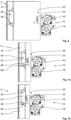
- the cooking appliance 2 is designed as a household oven and comprises a housing 4, a cooking chamber 6 arranged in the housing 4 with a cooking chamber opening 8 and a door 10 assigned to the cooking chamber opening 8, the door 10 being in a range of movement between one in the Fig. 3 shown closed position and one in the Fig. 1 shown opening position of the door 10 is movable.
- the cooking space 6 is closed in the closed position of the door 10 and accessible in the open position of the door 10, with a first drive unit 12 and a second drive unit 14 each being arranged on the housing 4 for the automatic movement of the door 10, the door 10 being moved by means of the first drive unit 12 in a first movement section of the movement range and by means the second drive unit 14 is movable in a second movement section of the movement range of the door 10.
- the door 10 is in the first movement section of the movement range by means of the first drive unit 12 in the first movement section of the movement range and by means of the second drive unit 14 in the second movement section of the movement range of the door, depending on the transfer of the door 10 into its open position or into its closed position 10 movable, which will be explained in more detail below.
- the door 10 is arranged to be pivotable about an axis of rotation 16 arranged on the housing 4, the first drive unit 12 being arranged on a side of the cooking chamber opening 8 opposite the axis of rotation 16 on the housing 4 and the second drive unit 14 being connected to the door 10 on the axis of rotation in a force-transmitting manner . See the Fig. 1 and 2 .
- the first movement section of the door 10 ranges from 0° to approximately 3° door opening, with 0° door opening being the one in the Fig. 3 shown closed position of the door 10 corresponds.
- the second movement section of the door 10 ranges from about 3° to about 85° door opening, with 85° door opening being the one in the Fig. 1 shown opening position of the door 10 corresponds.
- the first movement section is therefore positioned on the closing position side and the second movement section is positioned on the opening position side.
- the first drive unit 12 has a base plate 18 and a carriage 20, the first drive unit 12 being fastened to the housing 4 by means of the base plate 18 and the carriage 20 being movably held on the base plate 18. See the Fig. 1 to 12 in the synopsis.
- the carriage 20 has a base part 22 assigned to the base plate 18 and an actuating part 24 assigned to the door 10, the base part 22 and the actuating part 24 being resiliently connected to one another. See also this Fig. 1 to 12 in the synopsis.
- the carriage 20 as a whole, i.e. base part 22 and actuating part 24, is between one in the by means of an electric motor 25 Fig. 2 to 5 and 8 to 12 rest position shown and one in the 6, 7a and 7b shown gripping position can be moved back and forth.
- the door 10 and the first drive unit 12 have mutually corresponding coupling means 26, 28, wherein the door 10 and the first drive unit 12 can be coupled in a force-transmitting manner by means of these coupling means 26, 28.
- the coupling means 26 is designed as a hook and is arranged on the actuating part 24 of the carriage 22.
- the hook 26 can be moved back and forth between an actuation position and a non-actuation position, the door 10 being connectable to the hook 26 in a force-transmitting manner in the actuation position of the hook 26 and not being able to be connected to the hook 26 in a force-transmitting manner in the non-actuation position of the hook 26.
- the operating position of the hook 26 is in the Fig.
- the non-actuation position of the hook 26 is in the Figs. 4 and 5 shown.
- the hook 26 is initially moved from the door 10 when it is transferred from its open position to its closed position against the spring force of a spring element (not shown).
- Fig. 6 illustrated actuation position is transferred in the direction of its non-actuation position, in order to then be transferred again into its actuation position by means of the spring force of this spring element when the door 10 is further transferred from its open position to its closed position. This will be explained in more detail below.
- the coupling means 28 of the door 10 corresponding to the hook 26 is designed in the present exemplary embodiment as an undercut in an opening 30 of the door 10.
- the hook 26 can be automatically moved back and forth between its actuation position and its non-actuation position by means of an electric motor 32 of the first drive unit 12.
- the first drive unit 12 is simultaneously designed as a locking unit for holding the door 10 in its closed position.
- the hook 26 is simultaneously designed as a locking hook for holding the door 10 in its closed position. Accordingly, it is possible by means of the first drive unit 12 to hold the door 10 in its closed position.
- the closure unit, in particular the hook and an undercut (coupling means 28) are designed so that there is a frictional connection, but not a positive connection.
- the door 10 can therefore be torn open even with a hook 26 in the closed position. There is therefore no locking by the locking unit. Locking the door 10 in its closed position is necessary, for example, when the cooking appliance is in pyrolysis mode and can be implemented by a separate locking unit.
- the door 10 of the cooking appliance 2 is initially in the Fig. 3 closed position shown, so that the cooking space opening 8 and thus the cooking space 6 is closed. In the closed position, the door 10 is frictionally engaged by means of the hook 26, which is also designed as a locking hook held so that the door 10 is effectively secured against unwanted automatic opening.
- the carriage 20 In the closed position of the door 10, the carriage 20 is in its rest position and the hook 26 is in its operating position.
- the rest position of the carriage 20 can be detected by means of a switch 34, while the actuating position of the hook 26 can be detected by means of a switch 36.
- the contact of the door 10 on the carriage 20 can be detected by means of a switch 38.
- the closed position of the door 10 can be detected by means of the aforementioned switch 38 in combination with a switch 40. See also this Fig. 2 , 9 and 10 .
- a user In order to transfer the door 10 from its closed position to its closed position Fig. 1 In the opening position shown, a user, not shown, of the cooking appliance 2 in the present exemplary embodiment operates a button in the Fig. 1 to 12 Control element, not shown, of the cooking appliance 2. For example, the user presses a control element designed as a push button. However, other controls are also conceivable.
- the transfer of the door 10 from its closed position to its open position can also be initiated automatically. For example, a program sequence of an automatic program stored in a control of the cooking appliance 2 (not shown) provides for such an automatic transfer of the door 10.
- the hook 26 is first automatically removed from it by means of the electric motor 32 Fig. 3 shown operating position in its in the Fig. 4 transferred to the non-operation position shown.
- the hook 26 is moved in the image plane by means of the electric motor 32 3 and 4 pivoted upwards.
- the non-actuation position of the hook 26 can be detected by means of the switch 36, analogous to the actuation position of the hook 26.
- the mutually corresponding coupling means 26, 28 of the door 10 and the first drive unit 12 are no longer in engagement with one another. Please refer Fig. 4 .
- the door 10 is then moved from its closed position to its closed position by means of the second drive unit 14 Fig. 1 shown opening position transferred. See the Fig.
- the door 10 is balanced in such a way that very little force is required to transfer the door 10 from its closed position to its open position, i.e. over the entire range of movement of the door 10 in the direction of the open position. Accordingly, an electric motor, not shown, of the second drive unit 14 can be designed to be weak and therefore inexpensive.
- the carriage 20 of the first drive unit 12 is moved by means of the electric motor 25, for example into the Fig. 3 to 5 shown rest position in its example in the Fig. 6, 7a and 7b shown gripping position transferred. Furthermore, the hook 26 is automatically transferred again from its non-actuation position to its actuation position by means of the electric motor 32. See the Fig. 5 and 6 in the synopsis.
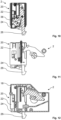
- the door 10 In order to transfer the door 10 from their in the Fig. 1 shown opening position in the Fig. 3 In the closed position shown, for example in order to start a cooking process in the cooking chamber 6, the door 10 is first automatically moved by means of the second drive unit 14 from its open position, i.e. at approximately 85° door opening, to approximately 3° door opening. See the Fig. 7a , in which the door 10 is shown at approximately 3° door opening. At approximately 3° door opening, the door 10, namely the undercut 28 of the door 10 formed at the opening 30, comes into engagement with the hook 26.
- the door 10 pushes the hook 26 away from the actuation position against the above-mentioned spring force of the spring element, not shown of the hook 26 initially in the direction of the non-actuation position of the hook 26, so that the hook 26 comes into engagement with the undercut 28 of the door 10 when it is automatically returned to its actuation position by means of the spring force of the aforementioned spring element. See the Fig. 7b .
- the operating position of the hook 26 and the contact of the door 10 on the carriage 22 are, analogous to above, detected by means of the switches 36 and 38.
- the door 10 is now no longer moved in the direction of its closed position with the second drive unit 14, but rather by means of the first drive unit 12.
- the carriage 20 is automatically moved from it into the position by means of the electric motor 25 Fig. 6 to 7b shown gripping position in its in the Fig. 3 to 5 shown rest position, so that the door 10 is moved from approximately 3° door opening to 0° door opening, i.e. in the first movement section when the door 10 is transferred from its open position to its closed position, by means of the first drive unit 12.
- the first drive unit 12 pulls the door 10 against the above-mentioned sealing device in such a way that the door 10 lies tightly against the sealing device, not shown, in its closed position. Please refer Fig. 3 .
- the rest position of the carriage 20 is by means of the switch 34, the actuation position of the hook 26 by means of the Switch 36, the contact of the door 10 on the carriage 20 by means of the switch 38 and the closed position of the door 10 by means of the aforementioned switch 38 in combination with the switch 40 can be detected.
- the cooking appliance 2 also has a so-called rapid cooling function.
- this rapid cooling function By means of this rapid cooling function, it is possible to cool down the cooking chamber 6 in a shorter time by automatically moving the door 10 into an intermediate position between the open position and the closed position of the door 10.
- an automatic program for the rapid cooling function of the cooking chamber 6 is stored, the door 10 being automatically transferred to an intermediate position corresponding to this automatic program when the automatic program is executed.
- the door 10 is transferred from its closed position to the aforementioned intermediate position automatically by means of the second drive unit 14, the door 10 being automatically held in this intermediate position.
- This intermediate layer can, for example, be used as the one in the Fig. 7b
- the position of the door 10 shown and already explained above can be formed. Accordingly, if the automatic program for the rapid cooling function is selected manually or automatically, the hook 26 would remain positioned in its operating position, in contrast to the above statements for transferring the door 10 from its closed position to its open position. The mutually corresponding coupling means 26, 28 of the door 10 and the first drive unit 12 thus remain in engagement with one another. The door 10 is moved from its closed position 10 to its closed position by means of the second drive unit 14 Fig. 7b shown intermediate layer transferred.
- the door 10 can also be automatically transferred to at least one intermediate position for other cooking appliance functions. For this purpose, in contrast to the example case explained, it may be necessary to move the hook into its non-actuated position.
- a second exemplary embodiment of a cooking appliance according to the invention and the method according to the invention is shown purely as an example.
- components that are the same or have the same effect are in the Fig. 13 to 16c with the same reference numbers as in the Fig. 1 to 12 designated.
- the cooking appliance 2 is also designed as a household oven and comprises a housing 4, a cooking chamber 6 arranged in the housing 4 with a cooking chamber opening 8 and a door 10 assigned to the cooking chamber opening 8, the door 10 being in a range of movement between one and the other Fig. 14 and 16a to 16c corresponding closed position and one in the Fig. 13 shown and to the Fig. 15a and 15b corresponding opening position of the door 10 can be moved.
- the cooking space 6, namely the cooking space opening 8, is essentially tightly closed in the closed position of the door 10 and accessible in the open position of the door 10, with a first drive unit 12 and a second drive unit 14 on the housing 4 each for the automatic movement of the door 10 are arranged, and wherein the door 10 can be moved by means of the first drive unit 12 in a first movement section of the range of movement and by means of the second drive unit 14 in a second movement section of the range of movement of the door 10.
- the door 10 is in the first movement section of the movement range by means of the first drive unit 12 in the first movement section of the movement range and by means of the second drive unit 14 in the second movement section of the movement range, depending on the transfer of the door 10 into its open position or into its closed position
- Door 10 is movable, which will be explained in more detail below.
- the door 10 is arranged to be pivotable about a rotation axis 16 arranged on the housing 4, the first drive unit 12 and the second drive unit 14 being connected to the door 10 on the rotation axis side in a force-transmitting manner. See the Fig. 14 .
- the first movement section of the door 10 ranges from 0° to approximately 3° door opening, with 0° door opening corresponding to the closed position of the door 10.
- the second movement section of the door 10 ranges from about 3° to about 85° door opening, with 85° door opening being the one in the Fig. 13 shown opening position of the door 10 corresponds.
- the first movement section is therefore positioned on the closing position side and the second movement section is positioned on the opening position side.
- the first drive unit 12 and the second drive unit 14 are each connected to the door 10 in a force-transmitting manner for the automatic movement of the door 10 by means of a common coupling device 50.
- the coupling device 50 comprises a lever 51 which is connected to the door 10 of the cooking appliance 2 in a force-transmitting manner known to those skilled in the art. See the Fig. 14 , in which, however, only the mechanism of the door 10 connected to the coupling device 50 in a torque-transmitting manner is shown.
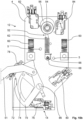
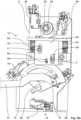
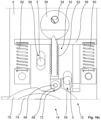
- the first drive unit 12 has a force introduction device 52, the force introduction device 52 being between one in the Fig. 16a to 16c illustrated engagement position, in which the force introduction device 52 is in force-transmitting engagement with the coupling device 50, and one in the Fig. 15a and 15b shown non-engagement position, in which the force introduction device 52 is not in force-transmitting engagement with the coupling device 50, can be moved back and forth.
- the view in the Fig. 15b differs from the view in the Fig. 15a simply because in the Fig. 15b the carriage 58 is not shown in order to be able to see the force introduction device 52.
- the carriage 58 is partially shown.
- the first drive unit 12 has a motor 54, for example an electric motor, an eccentric 56 connected to the motor 54 in a torque-transmitting manner, and a slide 58, the slide 58 being resiliently mounted on the housing 4 by means of two return springs 60 that the force introduction device 52 mounted on the carriage 58 can be automatically moved from its engaged position to its non-engaged position by means of the return springs 60, and the motor 54, the eccentric 56 and the carriage 58 are designed and arranged relative to one another in such a way that the ones on the carriage 58 mounted force introduction device 52 can be automatically moved from its non-engaged position into its engaged position by means of the motor 54, the eccentric 56 and the slide 58.
- a motor 54 for example an electric motor
- an eccentric 56 connected to the motor 54 in a torque-transmitting manner
- a slide 58 being resiliently mounted on the housing 4 by means of two return springs 60 that the force introduction device 52 mounted on the carriage 58 can be automatically moved from its engaged position to its non-engaged position by means of the return
- the carriage 58 is guided on the housing 4 by means of mutually corresponding guide means 5, 59, the guide means of the housing 4 being designed as two guide bolts 5 and the corresponding guide means of the carriage 58 being designed as two elongated holes 59 arranged parallel to one another. See for example the Fig. 15a .
- the force introduction device 52 is resiliently mounted on the carriage 58 by means of a force introduction spring 62, namely such that a range of movement of the force introduction device 52 relative to the carriage 58 is limited by means of mutually corresponding limiting means 64, 66 of the force introduction device 52 and the carriage 58.
- the mutually corresponding limiting means 64, 66 are designed as an elongated hole 64 in the carriage 58 and a bolt 66 of the force introduction device 52 corresponding to the elongated hole 64. See also for example that Fig. 15a and 15b in the synopsis.
- An impeller 68 is arranged on the bolt 66, which is rotatably arranged on the rest of the force introduction device 52, so that the force introduction device 52 can roll with little friction in its engaged position on the coupling device 50. See for example the Fig. 16a to 16c in the synopsis. In the Fig. 16c The impeller 68 appears more like a polygon in cross section; In practice, however, the impeller 68 has a circular running surface.
- the coupling device 50 For the purpose of transmitting force between the first drive unit 12 on one side and the coupling device 50 on the other side, in the engaged position of the force introduction device 52, the coupling device 50 has a coupling link 70, the force introduction device 52 of the first drive unit 12 being in its engaged position by means of the Coupling link 70 is engaged with the coupling device 50, namely such that the coupling link 70 has a coupling link slope 72 for redirecting a force introduced into the coupling device 50 by means of the force introduction device 52. See the Fig. 16b and 16c .
- the coupling device 50 has a control link 74, the control link 74 being designed to actuate a total of three switches 76, 78, 80 which are connected to a control 7 of the cooking appliance 2 in a signal-transmitting manner, namely that by means of the control link 74, the plurality of switches 76, 78, 80 can be actuated in such a way that the opening position of the door 10, the closed position of the door 10 and an intermediate position of the door 10 can be detected by means of the individual switches 76, 78, 80, the first movement section between the intermediate position and the closed position of the door 10 and the second movement section is formed between the intermediate layer and the opening position of the door 10.
- the switch 76 is used to detect the open position of the door 10
- the switch 78 is used to detect the intermediate position of the door 10
- the switch 80 is used to detect the closed position of the door 10.
- the force introduction device 52 of the first drive unit 12 is in the present exemplary embodiment Depending on the detection of the intermediate layer during the transfer of the door 10 into its closed position, it can be transferred from its non-engaged position into its engaged position, which is explained in more detail below.
- the switches 82 and 84 both serve to detect a rotational position of the eccentric 56, the switches 82, 84 and the eccentric 56 being designed and arranged relative to one another in such a way that both switches 82, 84 can be actuated simultaneously by means of the eccentric 56 when the eccentric 56 in one in the Fig. 16a to 16c shown position, which corresponds to the engagement position of the force introduction device 52.
- neither of the two switches 82, 84 can be actuated by means of the eccentric 56 when the eccentric 56 is in one in the Fig. 15a , 15b shown position, which corresponds to the non-engaged position of the force introduction device 52.
- the second drive unit 14 is continuously connected to the coupling device 50 in a force-transmitting manner.
- a motor 86 for example an electric motor, of the second drive unit 14 is connected to the coupling link 70 in a torque-transmitting manner. See for example the Fig. 14 and 15a in the synopsis.
- the door 10 of the cooking appliance 2 is initially in its position Fig. 16a to 16c corresponding closed position, so that the cooking space opening 8 and thus the cooking space 6 is closed.
- the door 10 is held by means of the first drive unit 12 with the force introduction device 52 and the coupling link 70 of the coupling device 50, so that the door 10 is effectively secured against unwanted automatic opening.
- a user In order to transfer the door 10 from its closed position to its closed position Fig. 13 In the opening position shown, a user, not shown, of the cooking appliance 2 in the present exemplary embodiment operates a button in the Fig. 13 to 16c Control element, not shown, of the cooking appliance 2. For example, the user presses a control element designed as a push button. However, other controls are also conceivable.
- the transfer of the door 10 from its closed position to its open position can also be initiated automatically. For example, a program sequence of an automatic program stored in the control 7 of the cooking appliance 2 provides for such an automatic transfer of the door 10.
- the force introduction device 52 is first moved from its engagement position according to Fig. 16a to 16c in theirs Non-intervention situation according to the Fig. 15a and 15b transferred.
- the motor 54 of the first drive unit 12 is controlled accordingly by means of the controller 7, so that the motor 54 moves the eccentric 56 from it to the Fig. 16a to 16c corresponding rotational position in its to the Fig. 15a and 15b transferred to the corresponding rotational position.
- the motor 54 of the first drive unit 12 is then switched off using the controller 7. Due to the spring force of the two return springs 60, the carriage 58 and thus the force introduction device 52 arranged on the carriage 58 is in the respective image plane Fig. 15a to 16c moved upwards. The ones to the Fig. 15a and 15b
- the corresponding rotational position of the eccentric 56 is detected in the manner explained above by means of the two switches 82, 84 and forwarded to the controller 7.
- the door 10 is now moved further by means of the second drive unit 14 from a position of the door 10 located between the closed position and the intermediate layer, via the intermediate layer in the Fig. 13 shown opening position transferred.
- the door 10 is balanced in such a way that very little force is required to transfer the door 10 from its closed position to its open position, i.e. over the entire range of movement of the door 10 in the direction of the open position.
- the motor 86 of the second drive unit 14 can be designed to be weak and therefore inexpensive.
- the opening position of the door 10 can be detected using the switch 76, as explained above.
- the door 10 is first automatically moved by means of the second drive unit 14 from its opening position, i.e. at approximately 85 ° door opening, to approximately 3 ° door opening.
- the door 10 is in its intermediate position, which is detected by means of the switch 78 and forwarded to the control 7.
- the controller 7 then switches off the motor 86 of the second drive unit 14, so that the door 10 is no longer moved with the second drive unit 14 in the direction of its closed position.
- the controller 7 controls the motor 54 in a manner known to those skilled in the art in such a way that the motor 54 moves the eccentric 56 from it into the Fig. 15a and 15b shown rotational position in its in the Fig. 16a to 16c shown rotation position transferred.
- the motor 54 moves the eccentric 56 in the image plane Fig. 15a turns left or right.
- the eccentric 56 presses the carriage 58 against the spring force of the two return springs 60 in the respective image plane Fig. 15a to 16c downward, so that the force introduction device 52 arranged on the carriage 58 is transferred from its non-engaged position into its engaged position and comes into force-transmitting engagement with the coupling link 70.
- the Force introduction device 52 presses against the coupling link slope 72 by means of the impeller 68, so that the force introduced into the coupling link 70 by means of the force introduction device 52 is deflected in such a way that the door 10 essentially seals the cooking chamber opening 8 of the cooking chamber 6 by means of the coupling device 50.
- the door 10 is thus moved from approximately 3° door opening to 0° door opening, i.e. in the first movement section when the door 10 is transferred from its open position to its closed position, by means of the first drive unit 12.
- the first drive unit 12 presses the door 10 by means of the force introduction device 52, for example, against the above-mentioned sealing device, not shown, in such a way that the door 10 lies tightly against the sealing device, not shown, in its closed position. Accordingly, the higher force required for this and applied by the first drive unit 12, namely the contact force against the aforementioned sealing device, is only required over the small first movement section. Due to the favorable arrangement of the first drive unit 12 in terms of power transmission, it is nevertheless possible to reduce the required power of the first drive unit 12 to a minimum.
- the door 10 Due to the resilient contact of the force introduction device 52 arranged on the carriage 58 on the coupling device 50, namely the coupling link 70, in the engaged position of the force introduction device 52, the door 10, when the force introduction device 52 is in the engaged position, is against a spring force of the force introduction spring 62, for example from the user of the cooking appliance 2, not shown, can be manually moved from its closed position to its open position.
- the force introduction device 52 moves relative to the carriage 58 in its range of motion limited by the limiting means 64, 66 of the carriage 58 and the force introduction device 52.
- the invention can also be used advantageously in other cooking appliances, such as steamers, microwave ovens or combination appliances with a plurality of different types of heating.
- the invention can also be used in the professional sector, i.e. in commercial cooking appliances.
- the cooking appliance according to the invention according to the second exemplary embodiment can, analogous to the first exemplary embodiment, also have a so-called rapid cooling function.
- an automatic program for the rapid cooling function of the cooking space is stored in the control of the cooking appliance, with the door being automatically transferred to an intermediate position corresponding to this automatic program when the automatic program is executed.
- the door is transferred from its closed position to the aforementioned intermediate position automatically, for example, by means of the second drive unit, with the door being automatically held in this intermediate position.
- the door can also be automatically transferred to at least one intermediate position for other cooking appliance functions.
- the door 10 in the engaged position of the force introduction device 52, the door 10, with the force introduction device 52 in the engaged position, can be manually moved from its closed position to its open position against a spring force of the force introduction spring 62, for example by the user of the cooking appliance 2, not shown.
- the force introduction device 52 moves relative to the carriage 58 in its range of motion limited by the limiting means 64, 66 of the carriage 58 and the force introduction device 52.
- the invention is not limited to the present exemplary embodiments of the cooking appliance according to the invention and the method according to the invention.
- the invention can also be used advantageously in other cooking appliances, such as steamers, microwave ovens or combination appliances with a plurality of different types of heating.
- the invention can also be used in the professional sector, i.e. in commercial cooking appliances.
- the door can be moved by means of the first drive unit in a first movement section of the range of movement and by means of the second drive unit in a second movement section of the range of movement of the door, regardless of whether the door is in its open position or in whose closed position is transferred.
- embodiments with other dependencies are also possible when transferring the door from its open position to its closed position or vice versa, as well as when transferring the door from the open position or its closed position into an intermediate layer positioned between the open position and the closed position. The same applies to a transfer from one intermediate layer of the door to a different intermediate layer of the door.
- the cooking appliance according to the invention according to the second exemplary embodiment can, analogous to the first exemplary embodiment, also have a so-called rapid cooling function.
- an automatic program for the rapid cooling function of the cooking space is stored in the control of the cooking appliance, with the door being automatically transferred to an intermediate position corresponding to this automatic program when the automatic program is executed.
- the door is transferred from its closed position to the aforementioned intermediate position automatically, for example, by means of the second drive unit, with the door being automatically held in this intermediate position.
- the door can also be automatically transferred to at least one intermediate position for other cooking appliance functions.
Landscapes
- Engineering & Computer Science (AREA)
- Chemical & Material Sciences (AREA)
- Combustion & Propulsion (AREA)
- Mechanical Engineering (AREA)
- General Engineering & Computer Science (AREA)
- Electric Ovens (AREA)
Claims (9)
- Appareil de cuisson (2), comprenant un boîtier (4), un espace de cuisson (6) disposé dans le boîtier (4) et comportant une ouverture d'espace de cuisson (8) et une porte (10) associée à l'ouverture d'espace de cuisson (8), dans lequel la porte (10) peut pivoter autour d'un axe de rotation (16) disposé sur le boîtier (4) dans une zone de déplacement entre une position de fermeture et une position d'ouverture de la porte (10), et dans lequel l'espace de cuisson (6) est fermé dans la position de fermeture de la porte (10) et est accessible dans la position d'ouverture de la porte (10),
caractérisé en ce que
au niveau du boîtier (4), une première unité d'entraînement (12) et une seconde unité d'entraînement (14) sont reliées à la porte (10) de manière à transmettre une force du côté de l'axe de rotation au moyen d'un dispositif d'accouplement (50) commun, respectivement pour le déplacement automatique de la porte (10), dans lequel la porte (10) peut être déplacée dans une première section de déplacement de la zone de déplacement au moyen de la première unité d'entraînement (12) et dans une seconde section de déplacement de la zone de déplacement de la porte (10) au moyen de la seconde unité d'entraînement (14). - Appareil de cuisson (2) selon la revendication 1, caractérisé en ce que la première unité d'entraînement (12) présente un dispositif d'introduction de force (52), dans lequel le dispositif d'introduction de force (52) peut être transféré d'avant en arrière entre une position de mise en prise, dans laquelle le dispositif d'introduction de force (52) est en prise de manière à transmettre une force avec le dispositif d'accouplement (50), et une position de non-mise en prise, dans laquelle le dispositif d'introduction de force (52) n'est pas en prise de manière à transmettre une force avec le dispositif d'accouplement (50),
- Appareil de cuisson (2) selon la revendication 2, caractérisé en ce que la première unité d'entraînement (12) présente en outre un moteur (54), un excentrique (56) relié au moteur (54) de manière à transmettre un couple et un chariot (58), dans lequel le chariot (58) est monté de manière élastique sur le boîtier (4) au moyen d'au moins un ressort de rappel (60) de telle manière que le dispositif d'introduction de force (52) monté sur le chariot (58) peut être automatiquement transféré de sa position de mise en prise à sa position de non-mise en prise au moyen du ressort de rappel (60), et dans lequel le moteur (54), l'excentrique (56) et le chariot (58) sont réalisés et disposés les uns par rapport aux autres de telle manière que le dispositif d'introduction de force (52) monté sur le chariot (58) peut être automatiquement transféré de sa position de non-mise en prise à sa position de mise en prise au moyen du moteur (54), de l'excentrique (56) et du chariot (58),
- Appareil de cuisson (2) selon la revendication 3, caractérisé en ce que le dispositif d'introduction de force (52) est monté de manière élastique sur le chariot (58) au moyen d'au moins un ressort d'introduction de force (62), dans lequel une zone de déplacement du dispositif d'introduction de force (52) par rapport au chariot (58) est limitée par des moyens de limitation (64, 66) correspondant les uns aux autres du dispositif d'introduction de force (52) et du chariot (58).
- Appareil de cuisson (2) selon l'une des revendications 2 à 4,
caractérisé en ce que le dispositif d'accouplement (50) présente une coulisse d'accouplement (70), dans lequel le dispositif d'introduction de force (52) de la première unité d'entraînement (12), dans sa position de mise en prise, est en prise avec le dispositif d'accouplement (50) au moyen de la coulisse d'accouplement (70), de préférence, en ce que la coulisse d'accouplement (70) présente une pente de coulisse d'accouplement (72) pour la déviation d'une force introduite dans le dispositif d'accouplement (50) au moyen du dispositif d'introduction de force (52). - Appareil de cuisson (2) selon l'une des revendications 1 à 5,
caractérisé en ce que le dispositif d'accouplement (50) présente une coulisse de commande (74), dans lequel la coulisse de commande (74) est réalisée pour l'actionnement d'au moins un commutateur (76, 78, 80) connecté de manière à transmettre des signaux à une commande (7) de l'appareil de cuisson (2), de préférence, en ce qu'au moyen de la coulisse de commande (74), une pluralité de commutateurs (76, 78, 80) peuvent être actionnés, dans lequel, au moyen du commutateur (76, 78, 80) individuel, la position d'ouverture de la porte (10), la position de fermeture de la porte (10) et une position intermédiaire de la porte (10) peuvent être détectées, et dans lequel la première section de déplacement est réalisée entre la position intermédiaire et la position de fermeture de la porte (10) et la seconde section de déplacement est réalisée entre la position intermédiaire et la position d'ouverture de la porte (10). - Appareil de cuisson (2) selon l'une des revendications 1 à 6,
caractérisé en ce que la première section de déplacement est positionnée côté position de fermeture et la seconde section de déplacement est positionnée côté position d'ouverture. - Appareil de cuisson (2) selon l'une des revendications 1 à 7,
caractérisé en ce que la porte (10) peut être automatiquement transférée dans au moins une position intermédiaire de la porte (10) au moyen de la première unité d'entraînement et/ou de la seconde unité d'entraînement (14) et peut être maintenue dans ladite position intermédiaire, dans lequel la position intermédiaire de la porte (10) est positionnée entre la position de fermeture et la position d'ouverture de la porte (10). - Appareil de cuisson (2) selon la revendication 8, caractérisé en ce que le dispositif d'introduction de force (52) de la première unité d'entraînement (12) est transféré, en fonction de la détection de la position intermédiaire, de sa position de mise en prise à sa position de non-mise en prise et/ou de sa position de non-mise en prise à sa position de mise en prise, dans lequel la position intermédiaire de la porte (10) est positionnée entre la position de fermeture et la position d'ouverture de la porte (10).
Applications Claiming Priority (1)
| Application Number | Priority Date | Filing Date | Title |
|---|---|---|---|
| DE102019122513 | 2019-08-21 |
Publications (3)
| Publication Number | Publication Date |
|---|---|
| EP3783266A1 EP3783266A1 (fr) | 2021-02-24 |
| EP3783266B1 true EP3783266B1 (fr) | 2023-12-27 |
| EP3783266C0 EP3783266C0 (fr) | 2023-12-27 |
Family
ID=72050711
Family Applications (1)
| Application Number | Title | Priority Date | Filing Date |
|---|---|---|---|
| EP20190665.8A Active EP3783266B1 (fr) | 2019-08-21 | 2020-08-12 | Appareil de cuisson doté d'un compartiment de cuisson pouvant être fermé |
Country Status (2)
| Country | Link |
|---|---|
| EP (1) | EP3783266B1 (fr) |
| DE (1) | DE202020005561U1 (fr) |
Families Citing this family (7)
| Publication number | Priority date | Publication date | Assignee | Title |
|---|---|---|---|---|
| DE102020107758A1 (de) * | 2020-03-20 | 2021-09-23 | Miele & Cie. Kg | Haushaltsgerät, insbesondere wasserführendes Haushaltsgerät |
| DE102021205018A1 (de) | 2021-05-18 | 2022-11-24 | BSH Hausgeräte GmbH | Haushaltsgerät mit spezifischer automatischer Türöffnung, sowie Verfahren |
| BE1029884B1 (de) * | 2021-10-27 | 2023-05-31 | Miele & Cie | Gerät mit einem Behandlungsraum zur Zubereitung eines Lebensmittels oder zur Reinigung eines zu reinigenden Gutes und Verfahren zu dessen Betrieb |
| DE102022132280B3 (de) | 2022-12-06 | 2024-03-21 | Miele & Cie. Kg | System mit einem Haushaltgerät und einem Möbel zur Aufnahme des Haushaltgeräts sowie Verfahren zum Betrieb eines Systems |
| DE102023134410B4 (de) * | 2023-11-23 | 2025-06-26 | Miele & Cie. Kg | Haushaltsgerät mit beweglichem Verschlusselement |
| EP4560201A1 (fr) | 2023-11-23 | 2025-05-28 | Miele & Cie. KG | Appareil ménager avec élément de fermeture mobile |
| DE102023132657A1 (de) * | 2023-11-23 | 2025-05-28 | Miele & Cie. Kg | Haushaltsgerät mit beweglichem Verschlusselement |
Family Cites Families (4)
| Publication number | Priority date | Publication date | Assignee | Title |
|---|---|---|---|---|
| DE102004061231B3 (de) * | 2004-12-20 | 2006-04-20 | Ellenberger & Poensgen Gmbh | Türverriegelung für einen Herd |
| ITBO20130139A1 (it) * | 2013-03-29 | 2014-09-30 | Nuova Star Spa | Sistema di movimentazione per un'anta o sportello di un elettrodomestico ed elettrodomestico provvisto di detto sistema. |
| DE102016107137A1 (de) * | 2016-04-18 | 2017-05-18 | Miele & Cie. Kg | Kücheneinbaugerät und Verfahren zum Betreiben |
| DE102018112289B3 (de) * | 2018-05-23 | 2019-07-11 | Miele & Cie. Kg | Gerät für die Zubereitung von Speisen und/oder Getränken oder für die Reinigung eines zu reinigenden Gutes |
-
2020
- 2020-08-12 EP EP20190665.8A patent/EP3783266B1/fr active Active
- 2020-08-12 DE DE202020005561.1U patent/DE202020005561U1/de active Active
Also Published As
| Publication number | Publication date |
|---|---|
| EP3783266A1 (fr) | 2021-02-24 |
| DE202020005561U1 (de) | 2021-08-30 |
| EP3783266C0 (fr) | 2023-12-27 |
Similar Documents
| Publication | Publication Date | Title |
|---|---|---|
| EP3783266B1 (fr) | Appareil de cuisson doté d'un compartiment de cuisson pouvant être fermé | |
| EP2174572B1 (fr) | Dispositif d'ouverture et de fermeture pour un élément de coulissement | |
| EP2574712B1 (fr) | Appareil ménager avec une cavité et une porte pour fermer la cavité et procédé d'actionnement d'une porte d'un appareil ménager | |
| EP3336292B1 (fr) | Procédé d'actionnement d'une serrure de porte et serrure de porte | |
| EP1828686B1 (fr) | Verrouillage de porte de cuisinière | |
| EP1548366A2 (fr) | Charnière pour une porte d'un appareil électroménager | |
| EP3045639A1 (fr) | Charniere d'appareil menager et procede de fonctionnement d'une telle charniere | |
| DE102009002276A1 (de) | Hausgerätvorrichtung | |
| DE102013109620A1 (de) | Haushaltgerät mit automatischem Türöffnungsmechanismus | |
| AT504333A4 (de) | Vorrichtung zum sperren eines schlosses | |
| EP0481503A1 (fr) | Verrouillage de porte pour appareil ménager | |
| DE10228140A1 (de) | Gargerät | |
| DE102011084571A1 (de) | Vorrichtung zur Behandlung von Lebensmitteln mit verbesserter Tür-Anbindung | |
| EP3631301B1 (fr) | Dispositif de fermeture électromécanique pour portes d'appareils | |
| EP2741015B1 (fr) | Porte pour un appareil ménager comprenant une partie de préhension de type plaque et un système d'ouverture de la partie de préhension, appareil ménager doté d'une telle porte et procédé d'ouverture d'une porte d'un appareil ménager | |
| DE102019115157B4 (de) | Schaltervorrichtung für ein Gargerät mit einem durch eine Tür verschließbaren Garraum und Gargerät | |
| EP4174271B1 (fr) | Appareil avec un espace de traitement pour la préparation d'un aliment ou pour le nettoyage d'un produit à nettoyer et son procédé de fonctionnement | |
| EP3273164B1 (fr) | Appareil de cuisson comprenant un dispositif de verrouillage | |
| DE10312305B4 (de) | Türverriegelung für elektrische Geräte, insbesondere für Waschmaschinen | |
| EP0338328A1 (fr) | Armoire de commutation compartimentée | |
| DE102020121174A1 (de) | Gargerät mit einem mittels einer Tür verschließbaren Garraum und Verfahren zu dessen Betrieb | |
| DE102011085447A1 (de) | Haushaltsmaschine | |
| EP1418385B1 (fr) | Dispositif de verrouillage de porte pour four de cuisson | |
| DE102013101947A1 (de) | Türverschluss für Gerätetüren, insbesondere von Heiß-, Gar-, Back- oder Kühlgeräten | |
| DE102019116335A1 (de) | Gargerät mit einem durch eine Tür verschließbaren Garraum |
Legal Events
| Date | Code | Title | Description |
|---|---|---|---|
| REG | Reference to a national code |
Ref country code: DE Ref legal event code: R138 Ref document number: 202020005561 Country of ref document: DE Free format text: GERMAN DOCUMENT NUMBER IS 502020006496 |
|
| PUAI | Public reference made under article 153(3) epc to a published international application that has entered the european phase |
Free format text: ORIGINAL CODE: 0009012 |
|
| STAA | Information on the status of an ep patent application or granted ep patent |
Free format text: STATUS: THE APPLICATION HAS BEEN PUBLISHED |
|
| AK | Designated contracting states |
Kind code of ref document: A1 Designated state(s): AL AT BE BG CH CY CZ DE DK EE ES FI FR GB GR HR HU IE IS IT LI LT LU LV MC MK MT NL NO PL PT RO RS SE SI SK SM TR |
|
| AX | Request for extension of the european patent |
Extension state: BA ME |
|
| STAA | Information on the status of an ep patent application or granted ep patent |
Free format text: STATUS: REQUEST FOR EXAMINATION WAS MADE |
|
| 17P | Request for examination filed |
Effective date: 20210824 |
|
| RBV | Designated contracting states (corrected) |
Designated state(s): AL AT BE BG CH CY CZ DE DK EE ES FI FR GB GR HR HU IE IS IT LI LT LU LV MC MK MT NL NO PL PT RO RS SE SI SK SM TR |
|
| GRAP | Despatch of communication of intention to grant a patent |
Free format text: ORIGINAL CODE: EPIDOSNIGR1 |
|
| STAA | Information on the status of an ep patent application or granted ep patent |
Free format text: STATUS: GRANT OF PATENT IS INTENDED |
|
| RIC1 | Information provided on ipc code assigned before grant |
Ipc: E05F 15/611 20150101ALI20230907BHEP Ipc: F24C 15/02 20060101AFI20230907BHEP |
|
| INTG | Intention to grant announced |
Effective date: 20231002 |
|
| GRAS | Grant fee paid |
Free format text: ORIGINAL CODE: EPIDOSNIGR3 |
|
| GRAA | (expected) grant |
Free format text: ORIGINAL CODE: 0009210 |
|
| STAA | Information on the status of an ep patent application or granted ep patent |
Free format text: STATUS: THE PATENT HAS BEEN GRANTED |
|
| REG | Reference to a national code |
Ref country code: DE Ref legal event code: R084 Ref document number: 502020006496 Country of ref document: DE |
|
| AK | Designated contracting states |
Kind code of ref document: B1 Designated state(s): AL AT BE BG CH CY CZ DE DK EE ES FI FR GB GR HR HU IE IS IT LI LT LU LV MC MK MT NL NO PL PT RO RS SE SI SK SM TR |
|
| REG | Reference to a national code |
Ref country code: GB Ref legal event code: FG4D Free format text: NOT ENGLISH |
|
| REG | Reference to a national code |
Ref country code: CH Ref legal event code: EP |
|
| REG | Reference to a national code |
Ref country code: DE Ref legal event code: R096 Ref document number: 502020006496 Country of ref document: DE |
|
| REG | Reference to a national code |
Ref country code: IE Ref legal event code: FG4D Free format text: LANGUAGE OF EP DOCUMENT: GERMAN |
|
| U01 | Request for unitary effect filed |
Effective date: 20231227 |
|
| U07 | Unitary effect registered |
Designated state(s): AT BE BG DE DK EE FI FR IT LT LU LV MT NL PT SE SI Effective date: 20240109 |
|
| U79 | Statement concerning licences of right filed [unitary effect] |
Effective date: 20240112 |
|
| PG25 | Lapsed in a contracting state [announced via postgrant information from national office to epo] |
Ref country code: GR Free format text: LAPSE BECAUSE OF FAILURE TO SUBMIT A TRANSLATION OF THE DESCRIPTION OR TO PAY THE FEE WITHIN THE PRESCRIBED TIME-LIMIT Effective date: 20240328 |
|
| PG25 | Lapsed in a contracting state [announced via postgrant information from national office to epo] |
Ref country code: ES Free format text: LAPSE BECAUSE OF FAILURE TO SUBMIT A TRANSLATION OF THE DESCRIPTION OR TO PAY THE FEE WITHIN THE PRESCRIBED TIME-LIMIT Effective date: 20231227 |
|
| PG25 | Lapsed in a contracting state [announced via postgrant information from national office to epo] |
Ref country code: GR Free format text: LAPSE BECAUSE OF FAILURE TO SUBMIT A TRANSLATION OF THE DESCRIPTION OR TO PAY THE FEE WITHIN THE PRESCRIBED TIME-LIMIT Effective date: 20240328 Ref country code: ES Free format text: LAPSE BECAUSE OF FAILURE TO SUBMIT A TRANSLATION OF THE DESCRIPTION OR TO PAY THE FEE WITHIN THE PRESCRIBED TIME-LIMIT Effective date: 20231227 |
|
| PG25 | Lapsed in a contracting state [announced via postgrant information from national office to epo] |
Ref country code: RS Free format text: LAPSE BECAUSE OF FAILURE TO SUBMIT A TRANSLATION OF THE DESCRIPTION OR TO PAY THE FEE WITHIN THE PRESCRIBED TIME-LIMIT Effective date: 20231227 Ref country code: NO Free format text: LAPSE BECAUSE OF FAILURE TO SUBMIT A TRANSLATION OF THE DESCRIPTION OR TO PAY THE FEE WITHIN THE PRESCRIBED TIME-LIMIT Effective date: 20240327 Ref country code: HR Free format text: LAPSE BECAUSE OF FAILURE TO SUBMIT A TRANSLATION OF THE DESCRIPTION OR TO PAY THE FEE WITHIN THE PRESCRIBED TIME-LIMIT Effective date: 20231227 |
|
| PG25 | Lapsed in a contracting state [announced via postgrant information from national office to epo] |
Ref country code: IS Free format text: LAPSE BECAUSE OF FAILURE TO SUBMIT A TRANSLATION OF THE DESCRIPTION OR TO PAY THE FEE WITHIN THE PRESCRIBED TIME-LIMIT Effective date: 20240427 |
|
| PG25 | Lapsed in a contracting state [announced via postgrant information from national office to epo] |
Ref country code: CZ Free format text: LAPSE BECAUSE OF FAILURE TO SUBMIT A TRANSLATION OF THE DESCRIPTION OR TO PAY THE FEE WITHIN THE PRESCRIBED TIME-LIMIT Effective date: 20231227 |
|
| PG25 | Lapsed in a contracting state [announced via postgrant information from national office to epo] |
Ref country code: SK Free format text: LAPSE BECAUSE OF FAILURE TO SUBMIT A TRANSLATION OF THE DESCRIPTION OR TO PAY THE FEE WITHIN THE PRESCRIBED TIME-LIMIT Effective date: 20231227 |
|
| PG25 | Lapsed in a contracting state [announced via postgrant information from national office to epo] |
Ref country code: SM Free format text: LAPSE BECAUSE OF FAILURE TO SUBMIT A TRANSLATION OF THE DESCRIPTION OR TO PAY THE FEE WITHIN THE PRESCRIBED TIME-LIMIT Effective date: 20231227 Ref country code: SK Free format text: LAPSE BECAUSE OF FAILURE TO SUBMIT A TRANSLATION OF THE DESCRIPTION OR TO PAY THE FEE WITHIN THE PRESCRIBED TIME-LIMIT Effective date: 20231227 Ref country code: RO Free format text: LAPSE BECAUSE OF FAILURE TO SUBMIT A TRANSLATION OF THE DESCRIPTION OR TO PAY THE FEE WITHIN THE PRESCRIBED TIME-LIMIT Effective date: 20231227 Ref country code: IS Free format text: LAPSE BECAUSE OF FAILURE TO SUBMIT A TRANSLATION OF THE DESCRIPTION OR TO PAY THE FEE WITHIN THE PRESCRIBED TIME-LIMIT Effective date: 20240427 Ref country code: CZ Free format text: LAPSE BECAUSE OF FAILURE TO SUBMIT A TRANSLATION OF THE DESCRIPTION OR TO PAY THE FEE WITHIN THE PRESCRIBED TIME-LIMIT Effective date: 20231227 |
|
| PG25 | Lapsed in a contracting state [announced via postgrant information from national office to epo] |
Ref country code: PL Free format text: LAPSE BECAUSE OF FAILURE TO SUBMIT A TRANSLATION OF THE DESCRIPTION OR TO PAY THE FEE WITHIN THE PRESCRIBED TIME-LIMIT Effective date: 20231227 |
|
| PG25 | Lapsed in a contracting state [announced via postgrant information from national office to epo] |
Ref country code: PL Free format text: LAPSE BECAUSE OF FAILURE TO SUBMIT A TRANSLATION OF THE DESCRIPTION OR TO PAY THE FEE WITHIN THE PRESCRIBED TIME-LIMIT Effective date: 20231227 |
|
| REG | Reference to a national code |
Ref country code: DE Ref legal event code: R097 Ref document number: 502020006496 Country of ref document: DE |
|
| U20 | Renewal fee for the european patent with unitary effect paid |
Year of fee payment: 5 Effective date: 20240902 |
|
| PLBE | No opposition filed within time limit |
Free format text: ORIGINAL CODE: 0009261 |
|
| STAA | Information on the status of an ep patent application or granted ep patent |
Free format text: STATUS: NO OPPOSITION FILED WITHIN TIME LIMIT |
|
| 26N | No opposition filed |
Effective date: 20240930 |
|
| REG | Reference to a national code |
Ref country code: CH Ref legal event code: PL |
|
| PG25 | Lapsed in a contracting state [announced via postgrant information from national office to epo] |
Ref country code: MC Free format text: LAPSE BECAUSE OF FAILURE TO SUBMIT A TRANSLATION OF THE DESCRIPTION OR TO PAY THE FEE WITHIN THE PRESCRIBED TIME-LIMIT Effective date: 20231227 Ref country code: CH Free format text: LAPSE BECAUSE OF NON-PAYMENT OF DUE FEES Effective date: 20240831 |
|
| PG25 | Lapsed in a contracting state [announced via postgrant information from national office to epo] |
Ref country code: IE Free format text: LAPSE BECAUSE OF NON-PAYMENT OF DUE FEES Effective date: 20240812 |
|
| U20 | Renewal fee for the european patent with unitary effect paid |
Year of fee payment: 6 Effective date: 20250901 |
|
| PGFP | Annual fee paid to national office [announced via postgrant information from national office to epo] |
Ref country code: GB Payment date: 20250826 Year of fee payment: 6 |
|
| PG25 | Lapsed in a contracting state [announced via postgrant information from national office to epo] |
Ref country code: CY Free format text: LAPSE BECAUSE OF FAILURE TO SUBMIT A TRANSLATION OF THE DESCRIPTION OR TO PAY THE FEE WITHIN THE PRESCRIBED TIME-LIMIT; INVALID AB INITIO Effective date: 20200812 |
|
| PG25 | Lapsed in a contracting state [announced via postgrant information from national office to epo] |
Ref country code: HU Free format text: LAPSE BECAUSE OF FAILURE TO SUBMIT A TRANSLATION OF THE DESCRIPTION OR TO PAY THE FEE WITHIN THE PRESCRIBED TIME-LIMIT; INVALID AB INITIO Effective date: 20200812 |