EP3812036A1 - Neuartiger verbundstoff und emulsionszusammensetzung - Google Patents
Neuartiger verbundstoff und emulsionszusammensetzung Download PDFInfo
- Publication number
- EP3812036A1 EP3812036A1 EP19821654.1A EP19821654A EP3812036A1 EP 3812036 A1 EP3812036 A1 EP 3812036A1 EP 19821654 A EP19821654 A EP 19821654A EP 3812036 A1 EP3812036 A1 EP 3812036A1
- Authority
- EP
- European Patent Office
- Prior art keywords
- hydrocarbon group
- substituted
- emulsion
- group
- formula
- Prior art date
- Legal status (The legal status is an assumption and is not a legal conclusion. Google has not performed a legal analysis and makes no representation as to the accuracy of the status listed.)
- Withdrawn
Links
Images




Classifications
-
- A—HUMAN NECESSITIES
- A61—MEDICAL OR VETERINARY SCIENCE; HYGIENE
- A61K—PREPARATIONS FOR MEDICAL, DENTAL OR TOILETRY PURPOSES
- A61K8/00—Cosmetics or similar toiletry preparations
- A61K8/18—Cosmetics or similar toiletry preparations characterised by the composition
- A61K8/72—Cosmetics or similar toiletry preparations characterised by the composition containing organic macromolecular compounds
- A61K8/81—Cosmetics or similar toiletry preparations characterised by the composition containing organic macromolecular compounds obtained by reactions involving only carbon-to-carbon unsaturated bonds
- A61K8/8164—Compositions of homopolymers or copolymers of compounds having one or more unsaturated aliphatic radicals, each having only one carbon-to-carbon double bond, and at least one being terminated by a carboxyl radical, and containing at least one other carboxyl radical in the molecule, or of salts, anhydrides, esters, amides, imides or nitriles thereof; Compositions of derivatives of such polymers, e.g. poly (methyl vinyl ether-co-maleic anhydride)
-
- A—HUMAN NECESSITIES
- A61—MEDICAL OR VETERINARY SCIENCE; HYGIENE
- A61K—PREPARATIONS FOR MEDICAL, DENTAL OR TOILETRY PURPOSES
- A61K8/00—Cosmetics or similar toiletry preparations
- A61K8/02—Cosmetics or similar toiletry preparations characterised by special physical form
- A61K8/04—Dispersions; Emulsions
- A61K8/06—Emulsions
- A61K8/062—Oil-in-water emulsions
-
- A—HUMAN NECESSITIES
- A61—MEDICAL OR VETERINARY SCIENCE; HYGIENE
- A61K—PREPARATIONS FOR MEDICAL, DENTAL OR TOILETRY PURPOSES
- A61K8/00—Cosmetics or similar toiletry preparations
- A61K8/02—Cosmetics or similar toiletry preparations characterised by special physical form
- A61K8/04—Dispersions; Emulsions
-
- A—HUMAN NECESSITIES
- A61—MEDICAL OR VETERINARY SCIENCE; HYGIENE
- A61K—PREPARATIONS FOR MEDICAL, DENTAL OR TOILETRY PURPOSES
- A61K8/00—Cosmetics or similar toiletry preparations
- A61K8/02—Cosmetics or similar toiletry preparations characterised by special physical form
- A61K8/04—Dispersions; Emulsions
- A61K8/06—Emulsions
- A61K8/064—Water-in-oil emulsions, e.g. Water-in-silicone emulsions
-
- A—HUMAN NECESSITIES
- A61—MEDICAL OR VETERINARY SCIENCE; HYGIENE
- A61K—PREPARATIONS FOR MEDICAL, DENTAL OR TOILETRY PURPOSES
- A61K8/00—Cosmetics or similar toiletry preparations
- A61K8/18—Cosmetics or similar toiletry preparations characterised by the composition
- A61K8/30—Cosmetics or similar toiletry preparations characterised by the composition containing organic compounds
- A61K8/40—Cosmetics or similar toiletry preparations characterised by the composition containing organic compounds containing nitrogen
- A61K8/42—Amides
-
- A—HUMAN NECESSITIES
- A61—MEDICAL OR VETERINARY SCIENCE; HYGIENE
- A61K—PREPARATIONS FOR MEDICAL, DENTAL OR TOILETRY PURPOSES
- A61K8/00—Cosmetics or similar toiletry preparations
- A61K8/18—Cosmetics or similar toiletry preparations characterised by the composition
- A61K8/72—Cosmetics or similar toiletry preparations characterised by the composition containing organic macromolecular compounds
- A61K8/81—Cosmetics or similar toiletry preparations characterised by the composition containing organic macromolecular compounds obtained by reactions involving only carbon-to-carbon unsaturated bonds
-
- A—HUMAN NECESSITIES
- A61—MEDICAL OR VETERINARY SCIENCE; HYGIENE
- A61K—PREPARATIONS FOR MEDICAL, DENTAL OR TOILETRY PURPOSES
- A61K8/00—Cosmetics or similar toiletry preparations
- A61K8/18—Cosmetics or similar toiletry preparations characterised by the composition
- A61K8/72—Cosmetics or similar toiletry preparations characterised by the composition containing organic macromolecular compounds
- A61K8/81—Cosmetics or similar toiletry preparations characterised by the composition containing organic macromolecular compounds obtained by reactions involving only carbon-to-carbon unsaturated bonds
- A61K8/8135—Compositions of homopolymers or copolymers of compounds having one or more unsaturated aliphatic radicals, each having only one carbon-to-carbon double bond, and at least one being terminated by an acyloxy radical of a saturated carboxylic acid, of carbonic acid or of a haloformic acid; Compositions of derivatives of such polymers, e.g. vinyl esters (polyvinylacetate)
-
- A—HUMAN NECESSITIES
- A61—MEDICAL OR VETERINARY SCIENCE; HYGIENE
- A61Q—SPECIFIC USE OF COSMETICS OR SIMILAR TOILETRY PREPARATIONS
- A61Q17/00—Barrier preparations; Preparations brought into direct contact with the skin for affording protection against external influences, e.g. sunlight, X-rays or other harmful rays, corrosive materials, bacteria or insect stings
- A61Q17/04—Topical preparations for affording protection against sunlight or other radiation; Topical sun tanning preparations
-
- A—HUMAN NECESSITIES
- A61—MEDICAL OR VETERINARY SCIENCE; HYGIENE
- A61Q—SPECIFIC USE OF COSMETICS OR SIMILAR TOILETRY PREPARATIONS
- A61Q19/00—Preparations for care of the skin
-
- A—HUMAN NECESSITIES
- A61—MEDICAL OR VETERINARY SCIENCE; HYGIENE
- A61Q—SPECIFIC USE OF COSMETICS OR SIMILAR TOILETRY PREPARATIONS
- A61Q19/00—Preparations for care of the skin
- A61Q19/007—Preparations for dry skin
-
- A—HUMAN NECESSITIES
- A61—MEDICAL OR VETERINARY SCIENCE; HYGIENE
- A61Q—SPECIFIC USE OF COSMETICS OR SIMILAR TOILETRY PREPARATIONS
- A61Q5/00—Preparations for care of the hair
-
- A—HUMAN NECESSITIES
- A61—MEDICAL OR VETERINARY SCIENCE; HYGIENE
- A61Q—SPECIFIC USE OF COSMETICS OR SIMILAR TOILETRY PREPARATIONS
- A61Q5/00—Preparations for care of the hair
- A61Q5/12—Preparations containing hair conditioners
-
- B—PERFORMING OPERATIONS; TRANSPORTING
- B01—PHYSICAL OR CHEMICAL PROCESSES OR APPARATUS IN GENERAL
- B01J—CHEMICAL OR PHYSICAL PROCESSES, e.g. CATALYSIS OR COLLOID CHEMISTRY; THEIR RELEVANT APPARATUS
- B01J13/00—Colloid chemistry, e.g. the production of colloidal materials or their solutions, not otherwise provided for; Making microcapsules or microballoons
-
- C—CHEMISTRY; METALLURGY
- C07—ORGANIC CHEMISTRY
- C07C—ACYCLIC OR CARBOCYCLIC COMPOUNDS
- C07C235/00—Carboxylic acid amides, the carbon skeleton of the acid part being further substituted by oxygen atoms
- C07C235/02—Carboxylic acid amides, the carbon skeleton of the acid part being further substituted by oxygen atoms having carbon atoms of carboxamide groups bound to acyclic carbon atoms and singly-bound oxygen atoms bound to the same carbon skeleton
- C07C235/04—Carboxylic acid amides, the carbon skeleton of the acid part being further substituted by oxygen atoms having carbon atoms of carboxamide groups bound to acyclic carbon atoms and singly-bound oxygen atoms bound to the same carbon skeleton the carbon skeleton being acyclic and saturated
- C07C235/06—Carboxylic acid amides, the carbon skeleton of the acid part being further substituted by oxygen atoms having carbon atoms of carboxamide groups bound to acyclic carbon atoms and singly-bound oxygen atoms bound to the same carbon skeleton the carbon skeleton being acyclic and saturated having the nitrogen atoms of the carboxamide groups bound to hydrogen atoms or to acyclic carbon atoms
-
- A—HUMAN NECESSITIES
- A61—MEDICAL OR VETERINARY SCIENCE; HYGIENE
- A61K—PREPARATIONS FOR MEDICAL, DENTAL OR TOILETRY PURPOSES
- A61K47/00—Medicinal preparations characterised by the non-active ingredients used, e.g. carriers or inert additives; Targeting or modifying agents chemically bound to the active ingredient
- A61K47/06—Organic compounds, e.g. natural or synthetic hydrocarbons, polyolefins, mineral oil, petrolatum or ozokerite
- A61K47/08—Organic compounds, e.g. natural or synthetic hydrocarbons, polyolefins, mineral oil, petrolatum or ozokerite containing oxygen, e.g. ethers, acetals, ketones, quinones, aldehydes, peroxides
- A61K47/10—Alcohols; Phenols; Salts thereof, e.g. glycerol; Polyethylene glycols [PEG]; Poloxamers; PEG/POE alkyl ethers
-
- A—HUMAN NECESSITIES
- A61—MEDICAL OR VETERINARY SCIENCE; HYGIENE
- A61K—PREPARATIONS FOR MEDICAL, DENTAL OR TOILETRY PURPOSES
- A61K47/00—Medicinal preparations characterised by the non-active ingredients used, e.g. carriers or inert additives; Targeting or modifying agents chemically bound to the active ingredient
- A61K47/06—Organic compounds, e.g. natural or synthetic hydrocarbons, polyolefins, mineral oil, petrolatum or ozokerite
- A61K47/16—Organic compounds, e.g. natural or synthetic hydrocarbons, polyolefins, mineral oil, petrolatum or ozokerite containing nitrogen, e.g. nitro-, nitroso-, azo-compounds, nitriles, cyanates
- A61K47/18—Amines; Amides; Ureas; Quaternary ammonium compounds; Amino acids; Oligopeptides having up to five amino acids
-
- A—HUMAN NECESSITIES
- A61—MEDICAL OR VETERINARY SCIENCE; HYGIENE
- A61K—PREPARATIONS FOR MEDICAL, DENTAL OR TOILETRY PURPOSES
- A61K47/00—Medicinal preparations characterised by the non-active ingredients used, e.g. carriers or inert additives; Targeting or modifying agents chemically bound to the active ingredient
- A61K47/30—Macromolecular organic or inorganic compounds, e.g. inorganic polyphosphates
- A61K47/32—Macromolecular compounds obtained by reactions only involving carbon-to-carbon unsaturated bonds, e.g. carbomers, poly(meth)acrylates, or polyvinyl pyrrolidone
-
- A—HUMAN NECESSITIES
- A61—MEDICAL OR VETERINARY SCIENCE; HYGIENE
- A61K—PREPARATIONS FOR MEDICAL, DENTAL OR TOILETRY PURPOSES
- A61K9/00—Medicinal preparations characterised by special physical form
- A61K9/0012—Galenical forms characterised by the site of application
- A61K9/0014—Skin, i.e. galenical aspects of topical compositions
-
- A—HUMAN NECESSITIES
- A61—MEDICAL OR VETERINARY SCIENCE; HYGIENE
- A61K—PREPARATIONS FOR MEDICAL, DENTAL OR TOILETRY PURPOSES
- A61K9/00—Medicinal preparations characterised by special physical form
- A61K9/10—Dispersions; Emulsions
- A61K9/107—Emulsions ; Emulsion preconcentrates; Micelles
Definitions
- the present invention relates to a novel complex having emulsifying properties and an emulsion composition.
- a water-in-oil emulsion composition which comprises one or more oil components selected from the group consisting of fatty acids and higher alcohols, one or more polymers soluble in the oils, and one or more compounds selected from the group consisting of inorganic salts, organic acid salts, amino acids and salts thereof, and which is characterized in that it does not contain a surfactant (Patent Document 1).
- PVP polyvinylpyrrolidone
- Patent Document 1 JP A No. 2003-252723
- an object of the present invention is to provide an agent that exerts emulsifying power.
- an object of the present invention to provide an emulsion utilizing such emulsifying power. Another object of the present invention is to provide an agent capable of obtaining an emulsion having excellent stability as well as a stable emulsion. Furthermore, another object of the present invention is to provide an agent capable of obtaining an emulsion having excellent feeling of use for skin and hair, and an emulsion having excellent feeling of use.
- the present invention relates to the following [1] to [13].
- the present invention it is possible to provide an agent and a complex that exert emulsifying power. In addition, according to the present invention, it is also possible to provide an emulsion utilizing such emulsifying power.
- an agent capable of obtaining an emulsion having excellent stability as well as a stable emulsion can be provided, and also an agent capable of obtaining an emulsion having excellent usability on the skin and hair, as well as an emulsion having excellent usability can be provided.
- the amide alcohol ester used in the present invention is a compound represented by the following formula (I): wherein
- hydrocarbon group may be saturated or unsaturated, linear or branched or cyclic, or a combination of linear or branched with cyclic, unless otherwise specified, and includes a hydrocarbon group consisting of a linear or branched hydrocarbon moiety such as benzyl group, phenylethyl group and a cyclic hydrocarbon moiety.
- the C6-C22 hydrocarbon group in R 1 and R 2 includes a saturated or unsaturated, linear, branched or cyclic C6-C22 hydrocarbon group, or a C6-C22 hydrocarbon group consisting of a saturated or unsaturated, linear or branched hydrocarbon moiety and a cyclic hydrocarbon moiety, and examples thereof include cyclic groups such as cyclohexyl, decahydronaphthyl, tetrahydrodicyclopentadiene, sterol, phenyl, naphthyl, anthracenyl; branched alkyl groups such as ethylhexyl, isostearyl, octyldodecyl; multibranched alkyl groups such as dimethyl, trimethyl, tetramethyl; linear alkyl groups such as hexyl, octyl, lauryl, myristyl, cetyl, stearyl, arachyl
- R 1 is preferably cyclohexyl, ethylhexyl, octyl, lauryl, myristyl, stearyl, oleyl, benzyl or phenylethyl.
- R 2 is preferably H.
- the hydrocarbon group in R 3 is a saturated or unsaturated, linear or branched C2-C21 hydrocarbon group having no cyclic structure, and examples thereof include alkyl groups such as propyl, butyl, pentyl, hexyl, heptyl, octyl, ethylhexyl, and alkenyl groups such as butylene, pentylene, hexylene, heptylene.
- R 3 is preferably propylene, butylene, pentylene or hexylene.
- the C1-C42 hydrocarbon group in R 4 includes a saturated or unsaturated, linear, branched or cyclic C1-C42 hydrocarbon group, or a C1-C42 hydrocarbon group consisting of a saturated or unsaturated, linear or branched hydrocarbon moiety and a cyclic hydrocarbon moiety, which is typically a fatty acid residue, and examples thereof include cyclic groups such as cyclohexyl, decahydronaphthyl, tetrahydrodicyclopentadiene, sterol, phenyl, naphthyl and anthracel, branched alkyl groups such as ethylhexyl, isostearyl and octyldodecyl, and multibranched alkyl groups such as dimethyl, trimethyl and tetramethyl, linear alkyl groups such as ethyl, propyl, butyl, hexyl, octyl, lauryl, my
- each of R 1 to R 3 may be the same as or different from R 1 to R 3 in formula (I), but are preferably the same, and the compound in which R 1 to R 3 are the same can be expressed by the following formula:
- the hydrocarbon group in R 5 includes a saturated or unsaturated, linear, branched or cyclic C2-C42 hydrocarbon group, or a C2-C42 hydrocarbon group consisting of a linear or branched hydrocarbon moiety and a cyclic hydrocarbon moiety, and is typically a residue of carboxylic acid, and examples thereof include alkylene groups such as ethyl, butyl, hexylene, octyl, hydrogenated dimer dilinoleyl, and alkenylene groups such as butene, hexene, etc.
- the hydrocarbon group may be substituted with a substituent that does not significantly affect the emulsifying power of the complex, for example, a hydroxy group, a carboxyl group or an aldehyde group. These substituents do not significantly affect the emulsifying power of the complex of the present invention.
- Examples of substituted C6-C22 hydrocarbon groups in R 1 and R 2 include hexanol, ethylcyclohexanol, and hexanoic acid.
- Examples of substituted C2-C21 hydrocarbon groups in R 3 include hydroxybutyl and butyl ketone.
- substituted C1-C42 hydrocarbon groups in R 4 include hydroxylauryl and hydroxyisostearyl.
- substituted C2-C42 hydrocarbon groups in R 5 include hydroxyethyl and hydroxy hydrogenated dimer dilinoleyl.
- R 5 is a residue of dicarboxylic acid, particularly a residue of dimeric acid.
- Dimer acid is a dibasic acid having 36 carbon atoms, which is obtained by polymerizing two molecules in the Diels Alder reaction of an unsaturated fatty acid having 18 carbon atoms such as oleic acid and linoleic acid, etc.
- a saturated aliphatic dibasic acid having 36 carbon atoms in which the double bond in the dimer acid is reduced by hydrogenation reduction is also called a hydrogenated dimer acid.
- Dimer acid is usually produced using an unsaturated fatty acid having 18 carbon atoms mainly composed of oleic acid or linoleic acid, and is obtained as a mixture consisting of many compounds including monomer acid, trimer acid, etc. obtained as by-products.
- the dimer acid used in the present invention may be a mixture of two or more kinds obtained from such a mixture.
- the dimer acid is preferably hydrogenated dimer acid, and the double bond of dimer acid is preferably completely hydrogenated, but the double bond may remain partially.
- the compound of formula (I) is preferably the following compounds:
- the ester of amide alcohol of formula (I) can be produced by using a known ester production method.
- examples of fatty acid used in the synthesis of the compound of formula (I) include acetic acid, palmitic acid, stearic acid, behenic acid, oleic acid, lauric acid, myristic acid, isostearic acid, etc.
- dicarboxylic acid used in one embodiment of the present invention examples include succinic acid, adipic acid, hydrogenated dimer dilinoleic acid, and behenic acid dimer, etc.
- Component (B) carboxyl group-containing polymer
- the carboxyl group-containing polymer used in the present invention is not particularly limited as long as it is a polymer having a carboxyl group in the molecule. From the viewpoint of providing appropriate emulsifying ability, typically, those having a molecular weight of 500,000 to 3,000,000 and a carboxyl group content of approximately 50 to 70% are preferred.
- the carboxyl group-containing polymer becomes water-soluble by neutralization with an alkaline substance, and it is generally used as a thickener.
- carboxyl group-containing polymer examples include carboxyvinyl polymer, and alkyl-modified carboxyvinyl polymers such as alkyl acrylate/methacrylate copolymer, etc., acrylic polymers such as alkyl acrylate/alkyl methacrylate polyoxyethylene ester copolymer, alkyl acrylate/alkyl itaconate polyoxyethylene ester copolymer, steareth-10 allyl ether/alkyl acrylate copolymer, etc., and non-acrylic polymers such as methyl vinyl ether/maleic anhydride/decadiene copolymer, etc.
- carboxyl group-containing polymer carboxyvinyl polymers and alkyl-modified carboxyvinyl polymers are particularly preferred.
- the carboxyl group-containing polymer is not gelatin.
- a carboxyvinyl polymer also called carbomer (INCI name: Carbomer) is a polymer having a structure represented by the following formula (IV): wherein n is an integer, which is typically from 40 to 100.
- examples include carboxyvinyl polymers commercially available under the following trade name: Acritamer 934 (Rita Corporation)
- the alkyl-modified carboxyvinyl polymer is a copolymer of acrylic acid and/or methacrylic acid with alkyl acrylate and/or alkyl methacrylate thereof.
- alkyl-modified carboxyvinyl polymer examples include (acrylates/alkyl acrylates (C10-30)) cross polymer (INCI name: Acrylates/C10-30 Alkyl Acrylates Cross polymer, also called alkyl acrylate/methacrylate copolymer), which is a polymer having a structure represented by the following formula (V): wherein
- the examples include alkyl-modified carboxyvinyl polymers commercially available under the following trade name:
- Complex in the present invention means a complex formed from an amide alcohol ester and a carboxyl group-containing polymer.
- the complex can be formed by mixing a carboxyl group-containing polymer and an amide alcohol ester. By neutralizing such a mixture with an alkali, a complex having a higher emulsifying ability can be formed.
- the complex can be formed by adding an amide alcohol ester to an aqueous solution of a carboxyl group-containing polymer, and then neutralizing with an alkali.
- the complex can be formed by adding a carboxyl group-containing polymer to an oil phase containing an amide alcohol ester, and then neutralizing with an alkali.
- the complex can be formed by adding an aqueous phase comprising a carboxyl group-containing polymer and an alkali to an oil phase containing an amide alcohol ester.
- the complex can be formed by adding an amide alcohol ester to an aqueous solution comprising a carboxyl group-containing polymer and an alkali.
- the amide bond portion of the amide alcohol ester and the carbonyl group of the polymer form a hydrogen bond, and a part of the carboxyl group becomes COO - and has hydrophilicity, thereby exerting emulsifying ability.
- the complex of the present invention forms a complex by bonding, more specifically hydrogen bonding of the amide bond moiety of the amide alcohol ester and the carbonyl group of the polymer.
- emulsion means a composition prepared by emulsifying an oil phase comprising an oily component and an aqueous phase comprising an aqueous component, and includes an O/W emulsion, a W/O emulsion, etc.
- the "O/W emulsion" is an oil-in-water emulsion, that is, an emulsion in which an oily component is dispersed in a continuous phase comprising an aqueous component.
- the "W/O emulsion” is a water-in-oil emulsion, that is, an emulsion in which an aqueous component is dispersed in a continuous phase comprising an oily component.
- the O/W emulsion can be prepared by dispersing an oil phase comprising an amide alcohol ester in an aqueous phase comprising a carboxyl group-containing polymer.
- an emulsion is neutralized with an alkali, a more stable emulsion having finer oil droplets can be prepared.
- the O/W emulsion can be prepared by dispersing an oil phase comprising an amide alcohol ester in an aqueous phase comprising a carboxyl group-containing polymer, and neutralizing with an alkali.
- the O/W emulsion can be prepared by dispersing an oil phase comprising an amide alcohol ester in an aqueous phase comprising a carboxyl group-containing polymer and an alkali.
- the W/O emulsion can be prepared by dispersing an aqueous phase comprising a carboxyl group-containing polymer in an oil phase comprising an amide alcohol ester. When such an emulsion is neutralized with an alkali, a more stable emulsion having finer oil droplets can be prepared.
- the W/O emulsion can be prepared by dispersing an aqueous phase comprising a carboxyl group-containing polymer in an oil phase comprising an amide alcohol ester, and neutralizing with an alkali.
- the W/O emulsion can be prepared by dispersing an aqueous phase comprising a carboxyl group-containing polymer and an alkali in an oil phase comprising an amide alcohol ester.
- emulsions can be used for all purposes, but typically, they can be used for external preparations such as pharmaceuticals, quasi drugs, and cosmetics.
- Emulsions of the present invention can be used for various forms of products including pharmaceuticals such as external skin preparation comprising a drug; quasi drugs such as medicated cosmetics; skin care cosmetics such as gel lotion, milky lotion, cream, beauty essence, sunscreen, and daytime moisturizer; makeup cosmetics such as foundation, makeup base, eye shadow, mascara, as well as hair care cosmetics such as hair treatment, etc.
- pharmaceuticals such as external skin preparation comprising a drug
- quasi drugs such as medicated cosmetics
- skin care cosmetics such as gel lotion, milky lotion, cream, beauty essence, sunscreen, and daytime moisturizer
- makeup cosmetics such as foundation, makeup base, eye shadow, mascara, as well as hair care cosmetics such as hair treatment, etc.
- the oily component used in the emulsion of the present invention is not particularly limited as long as it is a component generally used for cosmetics and the like; and examples thereof include oil agents such as animal and vegetable fats and oils, hydrocarbon oils, higher fatty acids, higher alcohols, ester oils, silicone oils, which can be used alone or in combination of two or more kinds.
- animal and vegetable fats and oils or hydrogenated animal and vegetable fats and oils include avocado oil, eno oil, olive oil, cacao butter, kaya oil, apricot kernel oil, hydrogenated oil, wheat germ oil, sesame oil, rice germ oil, rice bran oil, sugar cane wax, camellia sinensis leaf oil, safflower oil, shea butter, Chinese tung oil, cinnamon oil, soybean oil, tea seed oil, camellia oil, evening primrose oil, corn oil, rapeseed oil, germ oil, palm oil, palm kernel oil, castor oil, hydrogenated castor oil, sunflower oil, grape oil, jojoba oil, macadamia nut oil, beeswax, cottonseed oil, cotton wax, Japan wax, montan wax, coconut oil, hydrogenated coconut oil, peanut oil, lanolin, liquid lanolin, reduced lanolin, lanolin alcohol, hard lanolin, lanolin acetate, lanolin fatty acid isopropyl ester, hexyl laur
- hydrocarbon oils examples include ozokerite, squalane, squalene, ceresin, paraffin, isoparaffin, paraffin wax, liquid paraffin (mineral oil), pristane, polyisobutylene, polyisobutene, hydrogenated polyisobutene, microcrystalline wax, polyethylene wax, vaseline, etc.
- higher fatty acids examples include lauric acid, myristic acid, palmitic acid, stearic acid, isostearic acid, oleic acid, behenic acid, undecylenic acid, oleic acid, linoleic acid, linolenic acid, arachidonic acid, eicosapentaenoic acid (EPA), docosahexaenoic acid (DHA), isostearic acid, etc.
- lauric acid myristic acid, palmitic acid, stearic acid, isostearic acid, oleic acid, behenic acid, undecylenic acid, oleic acid, linoleic acid, linolenic acid, arachidonic acid, eicosapentaenoic acid (EPA), docosahexaenoic acid (DHA), isostearic acid, etc.
- higher alcohols examples include myristyl alcohol, cetanol, stearyl alcohol, arachidyl alcohol, behenyl alcohol, hydrogenated rapeseed oil alcohol, etc.
- ester oils include, as monoester, isononanoic acid esters such as isononyl isononanoate, isotridecyl isononanoate; 2-ethylhexanoic acids such as cetyl ethylhexanoate, hexyldecyl ethylhexanoate; myristic acid esters such as isopropyl myristate, isocetyl myristate, octyldodecyl myristate; isostearic acid esters such as ethyl isostearate, isopropyl isostearate, hexyldecyl isostearate, isostearyl isostearate, cholesteryl isostearate, phytosteryl isostearate; lactic acid esters such as isostearyl lactate, octyldodecyl lactate; oleic acid esters such as oleyl
- diester oils include diisobutyl adipate, diisopropyl adipate, diethylhexyl succinate, neopentyl glycol diisononanoate, neopentyl glycol diethylhexanoate, neopentyl glycol dicaprate, diisostearyl malate, diisopropyl dilinoleate, ethylene glycol dioctanoate, octyldodecyl stearoyl oxystearate, diisopropyl sebacate, di(cholesteryl/octyldodecyl) lauroyl glutamate, di(phytosteryl/octyldodecyl) lauroyl glutamate, etc.
- triester oils include triethylhexanoin, trimethylolpropane triethylhexanoate, glyceryl tri(caprylate/caprate), triisostearin, trimethylolpropane triisostearate, etc.
- tetraester oils examples include pentaerythrityl tetraethylhexanoate, pentaerythrityl tetraisostearate, etc.
- polyester oils include polyglyceryl fatty acid esters such as polyglyceryl-2 isostearate, polyglyceryl-2 diisostearate, polyglyceryl-2 triisostearate, polyglyceryl-2 tetraisostearate.
- highly viscous ester oils include hydrogenated castor oil isostearate, hydrogenated castor oil dimer dilinoleate, (polyglyceryl-2 isostearate/dimer dilinoleate) copolymer, (phytosteryl/isostearyl/cetyl/stearyl/behenyl) dimer dilinoleate, dimer dilinoleyl bis(phytosteryl/behenyl/isostearyl) dimer dilinoleate, di(isostearyl/phytosteryl) dimer dilinoleate, dimer dilinoleyl hydrogenated rosin condensate, dimer dilinoleyl diisostearate, dimer dilinoleyl dimer dilinoleate, di(cholesteryl/behenyl/octyldodecyl) lauroyl glutamate, di(octyldodecyl
- silicone oils include dimethylpolysiloxane, methyl phenyl polysiloxane, alkyl-modified organopolysiloxane, terminal modified organopolysiloxane, fluorine-modified organopolysiloxane, amodimethicone, amino-modified organopolysiloxane, volatile silicone, alkyl dimethicone, cyclopentasiloxane, etc.
- the blending amount of the oily component in the O/W emulsion is not particularly limited; from the viewpoint of usability, it may be 1.0 to 30.0 mass%, preferably 2.0 to 20.0 mass%, and more preferably 5.0 to 15.0 mass%.
- the blending amount of the oily component in the W/O emulsion is not particularly limited; from the viewpoint of usability, it may be 30.0 to 80.0 mass%, preferably 40.0 to 70.0 mass%, and more preferably 50.0 to 60.0 mass%.
- Aqueous components used in the emulsion of the present invention are not particularly limited as long as they are components generally used in cosmetics and the like; and examples thereof include water such as purified water, ion exchanged water; and lower alcohols such as BG (1,3-butylene glycol), PG (propylene glycol), glycerin, ethanol, and these can be used alone or in combination of two or more kinds.
- water such as purified water, ion exchanged water
- lower alcohols such as BG (1,3-butylene glycol), PG (propylene glycol), glycerin, ethanol, and these can be used alone or in combination of two or more kinds.
- the blending amount of the aqueous component in the O/W emulsion is not particularly limited; from the viewpoint of usability, it may be 1.0 to 50.0 mass%, preferably 3.0 to 20.0 mass%, and more preferably 5.0 to 15.0 mass%.
- the blending amount of the aqueous component in the W/O emulsion is not particularly limited; from the viewpoint of usability, it may be 10.0 to 70.0 mass%, preferably 15.0 to 65.0 mass%, and more preferably 20.0 to 60.0 mass%.
- a neutralizing agent used for preparing the emulsion of the present invention is not particularly limited as long as it is an alkaline component generally used in cosmetics and the like, and examples thereof include potassium hydroxide, triethanolamine, sodium hydroxide, basic amino acids such as L-arginine and L-lysine, 2-amino-2-methyl-1-propanol, etc., and these can be used alone or in combination of two or more kinds.
- the neutralizing agent may be an active component such as tranexamic acid, carnosine.
- the blending amount of the neutralizing agent can be appropriately selected depending on the type of the neutralizing agent and the composition of the whole emulsion; it is typically about 0.01 to 1.0 mass%.
- surfactant means a compound having both a hydrophilic group and a hydrophobic group in one molecule, and a surfactant may be appropriately added as necessary to an emulsion.
- the complex of the present invention has an emulsifying ability, preferably, emulsions are substantially free of surfactant. This makes it possible to provide an emulsifier and an emulsion having less stickiness derived from emulsifier, and furthermore, less irritation.
- substantially free of means that the surfactant is not contained in an amount sufficient for the emulsification of an emulsion.
- substantially free of surfactant means that it comprises no surfactant at all or comprises a surfactant in an amount that does not emulsify.
- the amount that does not emulsify can be appropriately determined by a person skilled in the art according to the compositional ratio, for example, in one embodiment it is less than 2.0 mass%, in another embodiment it is less than 0.2 mass%, or less than 0.02 mass%.
- the conditioning composition is an emulsion composition substantially free of surfactant such as cationic surfactant.
- the emulsion of the present invention may comprise any components used in external preparations such as cosmetics, etc.
- UV absorbers such as ethylhexyl methoxycinnamate, hexyl diethylamino hydroxybenzoyl benzoate
- thickeners and gelling agents such as dextrin palmitate, xanthan gum
- quality maintaining components such as antioxidant, preservative
- medicinal components and active components such as whitening agent, anti-wrinkle agent, antioxidative agent
- fragrances coloring agents such as pigment and dyestuff, and the like.
- the oil phase can be oil-gelled with an oil gelling agent in order to improve the stability of the emulsion.
- an organically modified clay mineral and/or a polymer ester of sugar and fatty acid can be used as a component used for oil gelation.
- the organically modified clay mineral and the polymer ester of sugar and fatty acid used in the preparation of the emulsion of the present invention are not particularly limited as long as they are components generally used in cosmetics and the like.
- organically modified clay mineral examples include those wherein a convertible cation intervening between crystal layers of a water-swellable clay mineral (for example, montmorillonite, saponite, hectorite, bentonite, etc.) is replaced with an organic polar compound or an organic cation (for example, a quaternary ammonium salt type cationic surfactant) .
- a convertible cation intervening between crystal layers of a water-swellable clay mineral for example, montmorillonite, saponite, hectorite, bentonite, etc.
- an organic cation for example, a quaternary ammonium salt type cationic surfactant
- organically modified clay minerals can be used; for example, BENTONE 27V (stearalkonium hectorite), BENTONE 27VCG (stearalkonium hectorite), BENTONE 38V (disteardimonium hectorite), BENTONE 38VCG (disteardimonium hectorite), etc. are commercially available from Elementis Specialties.
- Organically modified clay minerals are also commercially available as premixes dissolved in silicone oils, ester oils and/or other oils, and premixes may also be used in the present invention; they are commercially available from, for example, Elementis Specialties, under the following trade names.
- ENTONE GEL 1002V cyclopentasiloxane, disteardimonium hectorite, propylene carbonate
- BENTONE GEL ABO V Crambe abyssinica seed oil, stearalkonium hectorite, propylene carbonate
- BENTONE GEL CAO V castor oil, stearalkonium hectorite, propylene carbonate
- BENTONE GEL EUG V octyldodecanol, disteardimonium hectorite, propylene carbonate
- BENTONE GTCC V glyceryl tri(caprylate/caprate), stearalkonium hectorite, propylene carbonate
- BENTONE HSO V glyceryl tri(caprylate/caprate), stearalkonium hectorite, propylene carbonate
- BENTONE IHD V isohexadecane, disteardimonium hectorite,
- the blending amount of the organically modified clay mineral in the emulsion can be appropriately adjusted depending on the type and amount of the oily component, the viscosity required for the emulsion, and the like, and is not particularly limited; it may be 0.5 to 8.0 mass%, preferably 0.7 to 6.0 mass%, more preferably 1.0 to 5.0 mass%.
- polymer ester of sugar and fatty acid examples include those commercially available from Chiba Flour Milling Co., Ltd. under the following trade names: Rheopearl KL2 (dextrin palmitate), Rheopearl TL2 (dextrin palmitate), Rheopearl MKL (dextrin myristate), Rheopearl TT2 [dextrin (palmitate/ethylhexanoate)], Rheopearl 2WX [dextrin (palmitate/hexyldecanoate), Rheopearl ISL2 (inulin stearate), Rheopearl ISK2 (inulin stearate).
- the blending amount of the polymer ester of sugar and fatty acid in the emulsion can be appropriately adjusted depending on the type and amount of the oily component, the viscosity required for the emulsion, and the like, and is not particularly limited; it may be 0.5 to 8.0 mass%, preferably 0.7 to 6.0 mass%, more preferably 1.0 to 5.0 mass%.
- emulsifying properties can be further improved by blending a polyhydric alcohol such as pentylene glycol and octylene glycol.
- the improvement of emulsifying properties by blending polyhydric alcohol is considered to be due to the formation of a complex by hydrogen bonding between the hydroxy group in the molecule of polyhydric alcohol and the carbonyl group of the amide bond in the molecule of amide alcohol ester.
- the present invention also provides a complex formed from an amide alcohol ester, a carboxyl group-containing polymer, a higher fatty acid and a polyhydric alcohol.
- pentylene glycol has a moisturizing effect and an antibacterial effect, and can be said to be a preferable component for using the emulsion as an external preparation for cosmetics, etc.
- pentylene glycol is commercially available under the following trade names.
- Examples include Diol PD (Kokyu Alcohol Kogyo Co, Ltd.) and Diol PD-V (Kokyu Alcohol Kogyo Co, Ltd.).
- octylene glycol is commercially available under the following trade names.
- Examples include OD Eight (Kankosha Co., Ltd.).
- the blending amount of the polyhydric alcohol can be appropriately adjusted depending on the type and amount of the oily component, the viscosity required for the emulsion, and the like, and is not particularly limited; it may be 0.1 to 10.0 mass%, preferably 0. 5 to 8.0 mass%, more preferably 1.0 to 6.0 mass%.
- the blending amount of the component (A) in the emulsion can be appropriately selected depending on the emulsification type, the kind and amount of an oil agent to be used, and the viscosity required, etc.
- the blending amount of the component (A) in the O/W emulsion can be appropriately selected depending on the kind and amount of an oil agent to be used, the viscosity required, and the like, and is typically 0.1 to 10. 0 mass%, preferably 0.5 to 8.0 mass%, and more preferably 1.0 to 5.0 mass%.
- the blending amount of the component (A) in the W/O emulsion can be appropriately selected depending on the kind and amount of an oil agent to be used, the viscosity required, and the like, and is typically 0.1 to 15. 0 mass%, preferably 0.5 to 10.0 mass%, and more preferably 1.0 to 8.0 mass%.
- the blending amount of the component (B) in the emulsion can be appropriately selected depending on the emulsification type, the kind and amount of an oil agent to be used, and the viscosity required, etc.
- the blending amount of the component (B) in the O/W emulsion can be appropriately selected depending on the kind and amount of an oil agent to be used, the viscosity required for the emulsion composition, and the like, and is 0.01 to 5.0 mass%, preferably 0.05 to 3.0 mass%, and more preferably 0.1 to 2.0 mass%.
- the blending amount of the component (B) in the W/O emulsion can be appropriately selected depending on the kind and amount of an oil agent to be used, the viscosity required, and the like, and is typically 0.01 to 5. 0 mass%, preferably 0.05 to 3.0 mass%, and more preferably 0.1 to 2.0 mass%.
- an emulsion composition excellent in usability and stability of emulsion such as oil-in-water type or water-in-oil type of the complex consisting of component A and component B in the present invention can be achieved.
- the pH of the emulsion of the present invention can be appropriately selected, and it is preferably about pH 5.0 to 10.0, and more preferably about pH 5.0 to 8.0. Without being bound by any theory, it is considered that, by making the pH within this range, component A and component B are appropriately hydrogen-bonded to form a complex, and the dissociation of a carboxyl group is moderate, so that excellent emulsifying ability is brought about.
- the viscosity of the emulsion of the present invention can be appropriately selected depending on the characteristics of an objective product.
- a viscosity higher than 10,000 mPa ⁇ s from the viewpoint of obtaining a creamy emulsion, it is preferable to have a viscosity higher than 10,000 mPa ⁇ s, and from the viewpoint of obtaining an emulsion in the form of milky lotion, it is preferable to have a viscosity of about 300 to 100,000 mPa ⁇ s.
- the viscosity of the emulsion can be appropriately selected within the range of 300 to 1,000,000 mPa ⁇ s.
- the present invention provides an agent containing an amide alcohol ester represented by formula (I), wherein the agent is used for emulsification by forming a complex with a carboxyl group-containing polymer.
- the present invention also provides an agent containing a carboxyl group-containing polymer, which is used for emulsification by forming a complex with an amide alcohol ester represented by formula (I).
- Table 1 Formulations of O/W emulsion Material name Example 1A
- Example 1B (1) Ion exchanged water 72.7 72.7 (2) Glycerin 5.0 5.0 (3) 1,3-Butylene glycol 3.0 3.0 (4) Carbopol ETD2050 (Component B) 0.3 0.3 (5) Dimethicone 5cP 12.0 12.0 (6) Amide alcohol ester (Component A) 2.0 2.0 (7) Alcohol No.20-B 3.5 3.5 (8) Potassium hydroxide (10%) 1.5 1.5 Total 100.0 100.0 Emulsion particle size ( ⁇ m) ⁇ 20 (40) ⁇ 20 (40) pH 6.8 6.7 Viscosity (mPa ⁇ s) S64, 12rpm, 25°C 11,000 6,000
- ⁇ 20 (40) means that it is on average 20 ⁇ m or less, but there are particles with a diameter of about 40 ⁇ m scattered in some places. Hereinafter, it is expressed in the same sense.
- amide alcohol ester OLHA is also referred to as "amide alcohol ester OLHA”.
- (1) to (4) were uniformly stirred and dissolved at 80°C to obtain an aqueous phase. Meanwhile, (5) to (7) were uniformly stirred and dissolved at 80°C to obtain an oil phase. The oil phase was mixed in the obtained aqueous phase and dissolved uniformly, and stirred with a disperser at 80°C to prepare a mixture. (8) was added with stirring of the mixture to obtain an oil-in-water emulsion composition.
- (1) to (4) and (8) were uniformly stirred and dissolved at 80°C to obtain an aqueous phase. Meanwhile, (5) to (7) were uniformly stirred and dissolved at 80°C to obtain an oil phase. The oil phase was mixed in the obtained aqueous phase and dissolved uniformly, and stirred with a disperser at 80°C to obtain an oil-in-water emulsion composition.
- the emulsion particle size of the emulsions is on average about 20 ⁇ m or less (there rarely are oil droplets of about 40 ⁇ m), and it can be said that a highly stable emulsions are obtained.
- the emulsions were stored in a constant temperature bath at 45°C for 1 month and visually observed 1 month later; no change was observed in the emulsified state, and the storage stability was also good.
- Viscosity was measured with Brookfield viscometer: PROGRAMMABLE DV-II + VISCOMETER, using S64 SPINDLE, with a rotation speed of 12 rpm.
- the viscosity of Example 1A was 11,000 mPa ⁇ s, and the viscosity of Example 1B was 6,000 mPa ⁇ s. It can be said that emulsions having a viscosity suitable for creamy cosmetic compositions, etc. can be provided.
- Example 1A pH was measured with a HORIBA pH meter LAQUAact pH/ORP METER D-72.
- the pH of Example 1A was 6.8 and the pH of Example 1B was 6.7. It can be said that stable emulsions can be provided at a pH suitable for cosmetic compositions.
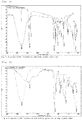
- Example 1A The formulation in which the composition of Example 1A was naturally dried at 25°C for 2 weeks, as well as the amide alcohol ester and the carbomer were subjected to the measurement of Fourier transform infrared spectrophotometer (hereinafter, FT-IR) using an infrared spectrophotometer (Spectrum One from PerkinElmer Japan, Co., Ltd.) .
- FT-IR Fourier transform infrared spectrophotometer
- Spectrum One from PerkinElmer Japan, Co., Ltd.
- Fig. 3 shows a diagram in which IR spectra of the formulation and the amide alcohol ester alone are superimposed and compared
- Fig. 4 shows a diagram in which IR spectra of the formulation and the carboxyl group-containing polymer alone are superimposed and compared.
- the absorption spectrum of the formulation is different from the superimposed absorption spectra of the amide alcohol ester alone and the carboxyl group-containing polymer alone.
- N of the amide bond portion of the amide alcohol and the carboxyl group of the carbomer form a hydrogen bond and exert an emulsifying ability in both non-neutralized and neutralized states.
- the carboxyl group of the carboxyl group-containing polymer in the non-neutralized state, is -COOH, and this -COOH forms a hydrogen bond with the carbonyl group of the amide bond of the amide alcohol ester, and the complex is hydrophobic; when this complex is gradually neutralized, a part of the carbomer side chain dissociates into COO- and regains hydrophilicity, and the complex has a hydrophobic part and a hydrophilic part, thereby exhibiting higher emulsifying ability.
- Example 2A Example 2B Product name mass% Oil phase 1. Mineral oil 12.0 2. Alcohol No.20-B 3.5 3. Amide alcohol ester OLHA (Component A) 2.0 Neutralizing agent 4. Potassium hydroxide (10%) 1.5 Aqueous phase 5. Diol PD - 5.0 6. Triol VE 5.0 7. Haisugarcane BG 3.0 8. Carbopol ETD2050 (Component B) 0.3 9. Purified water 72.7 67.7 Emulsion particle size ( ⁇ m) ⁇ 30 (50) ⁇ 10 (20)
- the emulsion particle size was evaluated by the same method as in Example 1.
- the emulsion particle size was evaluated by the same method as in Example 1.
- Emulsifying property was confirmed in the emulsification of various oils.
- the W/O emulsion composition described in the table below was prepared.
- Table 4 Composition of W/O emulsion composition Material name
- Example 4 Ion exchanged water 40.45 (2) Glycerin 5.0 (3) 1,3-Butylene glycol 3.0 (4) Diol PD 2.0 (5) PEMULEN TR-2 (Component B) 0.2 (6) Squalane 35.1 (7) Amide alcohol ester OLHA (Component A) 6.00 (8) BENTONE GEL ISD V 3.5 (9) Rheopearl KL2 3.0 (10) Rheopearl WX 1.5 (11) Potassium hydroxide (10%) 0.25 Total 100.0 Emulsion particle size ( ⁇ m) ⁇ 30 Viscosity (mPa ⁇ s) (No.64, 1.5 rpm) 315,000
- (1) to (5) were uniformly stirred and dissolved at 80°C to obtain an aqueous phase.
- (6) to (10) were uniformly stirred and dissolved at 80°C to obtain an oil phase.
- the aqueous phase was mixed in the obtained oil phase and uniformly dissolved, and stirred with a disperser at 80°C to prepare a mixture. While stirring the mixture, (11) was added to obtain a water-in-oil emulsion composition.
- a W/O emulsion was obtained from the carboxyl group-containing polymer and the amide alcohol.
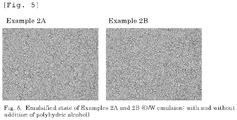
- the emulsified state is shown in Fig. 5 .
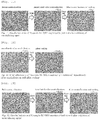
- the emulsion particle size of the emulsion before neutralization, after neutralization, and after neutralization & cooling was measured by the same method as in Example 1. The results are shown in Fig. 7 .
- the emulsion particle size of the emulsion is about 30 ⁇ m or less on average, and it can be said that a very stable emulsion is obtained.
- Viscosity was measured by the same method as in Example 1 except that the rotation speed was set to 1. 5 rpm in accordance with the viscosity.
- an emulsion having a viscosity suitable for creamy cosmetic compositions, etc. can be provided.
- Example 4 The formulation in which the composition of Example 4 was naturally dried at 25°C for 2 weeks, as well as the amide alcohol ester and the carbomer were subjected to the measurement of Fourier transform infrared spectrophotometer (hereinafter, FT-IR) using an infrared spectrophotometer (Spectrum One from PerkinElmer Japan, Co., Ltd.). Measurement results of the amide alcohol ester, the formulation (Example 4), and the carboxyl group-containing polymer are shown in Fig. 8 .
- FT-IR Fourier transform infrared spectrophotometer
- Fig. 9 shows a diagram in which IR spectra of the agent and the amide alcohol ester alone are superimposed and compared
- Fig. 10 shows a diagram in which IR spectra of the agent and the carboxyl group-containing polymer alone are superimposed and compared.
- the absorption spectrum of the agent is different from the superimposed absorption spectra of the amide alcohol ester alone and the carboxyl group-containing polymer alone.
- N of the amide bond portion of the amide alcohol and the carboxyl group of the carbomer form a hydrogen bond and exert an emulsifying ability in both non-neutralized and neutralized states.
- the carboxyl group of the carboxyl group-containing polymer in the non-neutralized state, is -COOH, and this -COOH forms a hydrogen bond with the carbonyl group of the amide bond of the amide alcohol ester, and the complex is hydrophobic; when this complex is gradually neutralized, a part of the carbomer side chain dissociates into COO- and regains hydrophilicity, and the complex has a hydrophobic part and a hydrophilic part, thereby exhibiting higher emulsifying ability.
- (1) to (5) and (12) were uniformly stirred and dissolved at 80°C to obtain an aqueous phase.
- (6) to (11) were uniformly stirred and dissolved at 80°C to obtain an oil phase.
- the aqueous phase was mixed in the obtained oil phase and uniformly dissolved, and stirred with a disperser at 80°C to prepare a mixture.
- Example 2 For the production method 1, the emulsion particle size of the emulsion before neutralization, after neutralization, and after neutralization & cooling was measured; and for the production method 2, emulsion particle size of the emulsion immediately after emulsification and after cooling was measured, with the same method as in Example 1.
- the results of Examples 5A to 5F are shown in Figs. 11 to 16 , respectively.
- Viscosity was measured by the same method as in Example 1 except that the rotation speed was set to 0. 3 rpm in accordance with the viscosity.
- an emulsion having a viscosity suitable for creamy cosmetic compositions, etc. can be provided.
- aqueous phase While adding the oil phase to the aqueous phase, these are stirred with a disperser. Then, a solution prepared with (10) and a part of (11) is added and emulsified. Upon completion of the emulsification, the mixed solution of (9) and (12) is added and cooled to normal temperature, to obtain a targeted hair treatment lotion which is an O/W emulsion having pH 6.2.
- Alkyl-modified carboxyvinyl polymer (Component B) Trade name: Pemulen TR-2, Lubrizol Advanced Materials, Inc. 0.1 (12) Sodium hydroxide Suitable amount (13) Acetylated hyaluronic acid 0.01 (14) Polymethacryloyl ethyl phosphorylcholine derivative Trade name: LIPIDURE-PMB (Ph10), NOF Corporation 0.1 (15) Equisetum arvense extract 0.1 (16) Hamamelis virginiana (witch hazel) leaf extract 0.1 (17) Ethanol 5.0 (18) Phenoxyethanol 0.3 (19) Ion exchanged water Balance (20) Polyvinyl alcohol 0.3
- the mixture While adding the aqueous phase to the oil phase, the mixture is stirred with a disperser.
- (1) to (4), (6) to (8), and (11) to (14) are uniformly dispersed at 80°C (oil phase).
- an aqueous phase of (5), (9) and (15) is uniformly dissolved and mixed at 80°C, and the mixture is stirred with a disperser while slowly being added to the previously prepared oil phase.
- a solution prepared with (9) and a part of (10) is added and emulsified.
- the mixture is cooled to normal temperature to obtain a targeted W/O emulsion foundation having a viscosity of 715,000 mPa ⁇ s.
- Blending amount (%) (1) Hydrogenated polyisobutene 3.0 (2) Liquid paraffin 3.0 (3) Isostearyl neopentanoate Trade name: Neolight 180P, Kokyu Alcohol Kogyo Co. , Ltd. 6.0 (4) (5) Decamethylcyclopentasiloxane (Dimethicone/Phenylvinyl 5.0 dimethicone)crosspolymer /Diphenylsiloxy phenyl trimethicone mixture (Trade name: KSG-18A, Shin-Etsu Chemical Co., Ltd.
- Amide alcohol ester (LHA) of structural formula (I) (Component A) 6.0 (8) Ethylparaben 0.1 (9) Butylparaben 0.1 (10) Tocopherol 0.5 (11) Alkyl-modified carboxyvinyl polymer (Component B) (Trade name: Pemulen TR-2, Lubrizol Advanced Materials, Inc.) 0.15 (12) Carboxyvinyl polymer (Component B) (Trade name: Synthalen L, 3V Sigma USA Inc.) 0.15 (13) Polyethylene glycol 20000 1.0 (14) Crataegus cuneata fruit extract 0.1 (15) Syzygium jambos leaf extract 0.1 (16) Aloe extract 0.1 (17) Sanguisorba officinalis root extract 0.1 (18) Eugenia Caryophyllus (clove) flower extract 0.1 (19) Houttuynia cordata extract 0.1 (20) Althaea officinalis root extract 0.1 (21) Lithosperm
- (1) to (10) are heated to 80°C and uniformly mixed (oil phase).
- (11) to (25), (27) and (28) are uniformly mixed at 80°C (aqueous phase).
- a solution prepared with (25) and a part of (26) is added and emulsified.
- the mixture is cooled to normal temperature to obtain a targeted W/O emulsion emollient cream having a viscosity of 280,000 mPa ⁇ s.
- Isostearic acid (Trade name: Isostearic Acid EX, Kokyu Alcohol Kogyo Co., Ltd.) 0.5
- Squalane (Trade name: Olive Squalane, Kokyu Alcohol Kogyo Co., Ltd.) 25.0
- Triethylhexanoin (Trade name: TOG, Kokyu Alcohol Kogyo Co., Ltd.) 3.0
- Hexyl laurate Trade name: KAK HL, Kokyu Alcohol Kogyo Co., Ltd.
- Pentylene glycol (Trade name: Diol PD-V, Kokyu Alcohol Kogyo Co., Ltd. ) 3.0
- Hypericum perforatum extract 0.1 (17) Leontopodium Alpinum extract 0.1 (18) Royal jelly extract 0.1 (19) Sodium ascorbyl phosphate 0.1
- Ion exchanged water Balance (21) Organically modified clay mineral premix (Trade name: BENTONE ISD V (Isododecane, disteardimonium hectorite, propylene carbonate), Elementis Specialties) 3.5
- Dextrin myristate (Trade name: Rheopearl MKL, Chiba Flour Milling Co., Ltd. ) 2.5
- (1) to (8), (21) and (22) are uniformly mixed at 80°C (oil phase).
- (9) to (20) are heated to 80°C and mixed uniformly (aqueous phase) . Since tranexamic acid has an action to increase pH, an extremely stable emulsion can be obtained without separately blending an alkali agent.
- the mixture Upon completion of the emulsification, the mixture is cooled to normal temperature to obtain a targeted W/O emulsion whitening cream having a viscosity of 544,000 mPa ⁇ s.
- Blending amount (%) (1) Di(phytosteryl 2-octyldodecyl)N-lauroyl-L-glutamate (Trade name: Eldew PS-203, Ajinomoto Co., Inc.) 0.5 (2) Mineral oil 5.0 (3) Squalane (Trade name: Olive squalane, Kokyu Alcohol Kogyo Co., Ltd.) 15.0 (4) Isododecane 10.0 (5) Isodecyl neopentanoate (Trade name : Neolight 100P, Kokyu Alcohol Kogyo Co., Ltd.
- Amide alcohol ester (LHL) of structural formula (I) (Component A) 5.5 (8) Alkyl-modified carboxyvinyl polymer (Component B) (Trade name: Pemulen TR-1, Lubrizol Advanced Materials, Inc.) 0.1 (9) Carboxyvinyl polymer (Component B) (Trade name: Carbopol ETD2050 Polymer, Lubrizol Advanced Materials, Inc.) 0.05 (10) Sodium hyaluronate 0.1 (11) Glycerin (Trade name: Triol VE, Kokyu Alcohol Kogyo Co., Ltd.
- (8) to (21) are uniformly dissolved at 80°C (aqueous phase).
- the aqueous phase at 80°C is added to said oil phase at 80°C and stirred with a disperser.
- an aqueous solution in which (17) is dissolved in a part of (19) is added and emulsified by stirring with a disperser.
- a mixed solution of (13) and (10) is added and cooled to normal temperature to obtain a targeted whitening beauty essence having a viscosity of 357,000 mPa ⁇ s.
- Blendin g amount (%) (1) Octyl p-methoxycinnamate 3.0 (2) Glyceryl ethylhexanoate di-p-methoxycinnamate 2.0 (3) 4-tert-buty-4'-methoxydibenzoylmethane 2.0 (4) Tetra(octanoate/p-methoxycinnamate pentaerythritol 3.0 (5) Ethylhexyl isononanoate (Trade name: ES108109, Kokyu Alcohol Kogyo Co., Ltd.
- Ion exchanged water Balance (11) Dipropylene glycol 1.0 (12) Methylparaben 0.2 (13) Alkyl-modified carboxyvinyl polymer (Component B) (Trade name: Pemulen TR-2, Lubrizol Advanced Materials, Inc.) 0.1 (14) Fragrance 0.1 (15) Triethanolamine Suitable amount (20) Pentylene glycol (Trade name: Diol PD-V, Kokyu Alcohol Kogyo Co., Ltd.
- This aqueous phase is gradually added to said oil phase heated to 80°C, and stirred with a disperser.
- an agent and a complex by combining an amide alcohol ester and a carboxyl group-containing polymer, an agent and a complex can be provided which is capable of preparing emulsions such as O/W emulsion and W/O emulsion using any oil agent.
- Such emulsions can be used for applications including cosmetics.
Landscapes
- Health & Medical Sciences (AREA)
- Life Sciences & Earth Sciences (AREA)
- Chemical & Material Sciences (AREA)
- Animal Behavior & Ethology (AREA)
- General Health & Medical Sciences (AREA)
- Public Health (AREA)
- Veterinary Medicine (AREA)
- Epidemiology (AREA)
- Birds (AREA)
- Dispersion Chemistry (AREA)
- Organic Chemistry (AREA)
- Dermatology (AREA)
- Oil, Petroleum & Natural Gas (AREA)
- Pharmacology & Pharmacy (AREA)
- Medicinal Chemistry (AREA)
- Chemical Kinetics & Catalysis (AREA)
- General Chemical & Material Sciences (AREA)
- Engineering & Computer Science (AREA)
- Proteomics, Peptides & Aminoacids (AREA)
- Inorganic Chemistry (AREA)
- Cosmetics (AREA)
- Medicinal Preparation (AREA)
- Emulsifying, Dispersing, Foam-Producing Or Wetting Agents (AREA)
- Colloid Chemistry (AREA)
Applications Claiming Priority (2)
| Application Number | Priority Date | Filing Date | Title |
|---|---|---|---|
| JP2018116956A JP6469286B1 (ja) | 2018-06-20 | 2018-06-20 | 新規複合体および乳化組成物 |
| PCT/JP2019/022754 WO2019244674A1 (ja) | 2018-06-20 | 2019-06-07 | 新規複合体および乳化組成物 |
Publications (1)
| Publication Number | Publication Date |
|---|---|
| EP3812036A1 true EP3812036A1 (de) | 2021-04-28 |
Family
ID=65356110
Family Applications (1)
| Application Number | Title | Priority Date | Filing Date |
|---|---|---|---|
| EP19821654.1A Withdrawn EP3812036A1 (de) | 2018-06-20 | 2019-06-07 | Neuartiger verbundstoff und emulsionszusammensetzung |
Country Status (6)
| Country | Link |
|---|---|
| US (1) | US20210196584A1 (de) |
| EP (1) | EP3812036A1 (de) |
| JP (1) | JP6469286B1 (de) |
| KR (1) | KR20210002603A (de) |
| TW (1) | TW202006022A (de) |
| WO (1) | WO2019244674A1 (de) |
Families Citing this family (1)
| Publication number | Priority date | Publication date | Assignee | Title |
|---|---|---|---|---|
| JP6469286B1 (ja) * | 2018-06-20 | 2019-02-13 | 高級アルコール工業株式会社 | 新規複合体および乳化組成物 |
Family Cites Families (5)
| Publication number | Priority date | Publication date | Assignee | Title |
|---|---|---|---|---|
| JP3789027B2 (ja) * | 1997-07-17 | 2006-06-21 | 株式会社資生堂 | W/o/w型複合エマルジョン |
| JP3860766B2 (ja) | 2002-03-01 | 2006-12-20 | 第一工業製薬株式会社 | 油中水型乳化組成物 |
| CN102727392A (zh) * | 2011-03-31 | 2012-10-17 | 花王株式会社 | 乳化组合物 |
| JP6964856B2 (ja) * | 2016-06-08 | 2021-11-10 | 高級アルコール工業株式会社 | アミドアルコールのエステルを含む化粧用基剤および化粧品 |
| JP6469286B1 (ja) * | 2018-06-20 | 2019-02-13 | 高級アルコール工業株式会社 | 新規複合体および乳化組成物 |
-
2018
- 2018-06-20 JP JP2018116956A patent/JP6469286B1/ja active Active
-
2019
- 2019-06-07 US US17/057,149 patent/US20210196584A1/en not_active Abandoned
- 2019-06-07 WO PCT/JP2019/022754 patent/WO2019244674A1/ja not_active Ceased
- 2019-06-07 EP EP19821654.1A patent/EP3812036A1/de not_active Withdrawn
- 2019-06-07 KR KR1020207033542A patent/KR20210002603A/ko not_active Ceased
- 2019-06-20 TW TW108121467A patent/TW202006022A/zh unknown
Also Published As
| Publication number | Publication date |
|---|---|
| US20210196584A1 (en) | 2021-07-01 |
| WO2019244674A1 (ja) | 2019-12-26 |
| TW202006022A (zh) | 2020-02-01 |
| KR20210002603A (ko) | 2021-01-08 |
| JP6469286B1 (ja) | 2019-02-13 |
| JP2019218301A (ja) | 2019-12-26 |
Similar Documents
| Publication | Publication Date | Title |
|---|---|---|
| EP2392314B1 (de) | Öliges haarkosmetikum | |
| EP3327064B1 (de) | Gehärtete silikonpartikel und kosmetikum mit einbindung davon | |
| EP3915642A1 (de) | Neuartiger verbundkörper und emulsionszusammensetzung | |
| EP3597691A1 (de) | Neuartiger verbund und emulgierte zusammensetzung | |
| US10729629B2 (en) | Complex and emulsion composition | |
| JP6368064B1 (ja) | 新規複合体および油中水型乳化組成物 | |
| EP3409262B1 (de) | Emulsion vom w/o-typ und eine vormischung zur herstellung davon | |
| EP3812036A1 (de) | Neuartiger verbundstoff und emulsionszusammensetzung | |
| US12558304B2 (en) | Metal oxide particle ester dispersions including polyesters having a broad molecular weight distribution | |
| JP2020125374A (ja) | 乳化組成物および複合体 | |
| JP2021147379A (ja) | 油中水型乳化物 | |
| JP2020083861A (ja) | 水中油型乳化組成物 | |
| JP2024138795A (ja) | 水中油型乳化組成物および水中油型乳化化粧料 | |
| WO2024135258A1 (ja) | 増粘組成物およびその製造方法、ならびに化粧料 | |
| EP4506331A1 (de) | Verbindung mit polyglycerol, fettsäure und dicarbonsäure verestert | |
| EP2512411B1 (de) | Zusammensetzung mit erhöhter hydrierfähigkeit | |
| WO2025023137A1 (ja) | エステル、化粧料用基剤および化粧料 | |
| JP2024061324A (ja) | 水中油型乳化組成物および乳化化粧料 |
Legal Events
| Date | Code | Title | Description |
|---|---|---|---|
| STAA | Information on the status of an ep patent application or granted ep patent |
Free format text: STATUS: THE INTERNATIONAL PUBLICATION HAS BEEN MADE |
|
| PUAI | Public reference made under article 153(3) epc to a published international application that has entered the european phase |
Free format text: ORIGINAL CODE: 0009012 |
|
| STAA | Information on the status of an ep patent application or granted ep patent |
Free format text: STATUS: REQUEST FOR EXAMINATION WAS MADE |
|
| 17P | Request for examination filed |
Effective date: 20201119 |
|
| AK | Designated contracting states |
Kind code of ref document: A1 Designated state(s): AL AT BE BG CH CY CZ DE DK EE ES FI FR GB GR HR HU IE IS IT LI LT LU LV MC MK MT NL NO PL PT RO RS SE SI SK SM TR |
|
| AX | Request for extension of the european patent |
Extension state: BA ME |
|
| DAV | Request for validation of the european patent (deleted) | ||
| DAX | Request for extension of the european patent (deleted) | ||
| STAA | Information on the status of an ep patent application or granted ep patent |
Free format text: STATUS: THE APPLICATION IS DEEMED TO BE WITHDRAWN |
|
| 18D | Application deemed to be withdrawn |
Effective date: 20220104 |