EP3824953B1 - Erhalt eines energiespektrums eines fokussierten ionenstrahls - Google Patents
Erhalt eines energiespektrums eines fokussierten ionenstrahls Download PDFInfo
- Publication number
- EP3824953B1 EP3824953B1 EP19210528.6A EP19210528A EP3824953B1 EP 3824953 B1 EP3824953 B1 EP 3824953B1 EP 19210528 A EP19210528 A EP 19210528A EP 3824953 B1 EP3824953 B1 EP 3824953B1
- Authority
- EP
- European Patent Office
- Prior art keywords
- energy
- ion beam
- spectrum
- idd
- focused ion
- Prior art date
- Legal status (The legal status is an assumption and is not a legal conclusion. Google has not performed a legal analysis and makes no representation as to the accuracy of the status listed.)
- Active
Links
Images



Classifications
-
- A—HUMAN NECESSITIES
- A61—MEDICAL OR VETERINARY SCIENCE; HYGIENE
- A61N—ELECTROTHERAPY; MAGNETOTHERAPY; RADIATION THERAPY; ULTRASOUND THERAPY
- A61N5/00—Radiation therapy
- A61N5/10—X-ray therapy; Gamma-ray therapy; Particle-irradiation therapy
- A61N5/1048—Monitoring, verifying, controlling systems and methods
- A61N5/1064—Monitoring, verifying, controlling systems and methods for adjusting radiation treatment in response to monitoring
- A61N5/1065—Beam adjustment
-
- A—HUMAN NECESSITIES
- A61—MEDICAL OR VETERINARY SCIENCE; HYGIENE
- A61N—ELECTROTHERAPY; MAGNETOTHERAPY; RADIATION THERAPY; ULTRASOUND THERAPY
- A61N5/00—Radiation therapy
- A61N5/10—X-ray therapy; Gamma-ray therapy; Particle-irradiation therapy
- A61N5/103—Treatment planning systems
-
- H—ELECTRICITY
- H01—ELECTRIC ELEMENTS
- H01J—ELECTRIC DISCHARGE TUBES OR DISCHARGE LAMPS
- H01J37/00—Discharge tubes with provision for introducing objects or material to be exposed to the discharge, e.g. for the purpose of examination or processing thereof
- H01J37/30—Electron-beam or ion-beam tubes for localised treatment of objects
- H01J37/304—Controlling tubes by information coming from the objects or from the beam, e.g. correction signals
-
- A—HUMAN NECESSITIES
- A61—MEDICAL OR VETERINARY SCIENCE; HYGIENE
- A61N—ELECTROTHERAPY; MAGNETOTHERAPY; RADIATION THERAPY; ULTRASOUND THERAPY
- A61N5/00—Radiation therapy
- A61N5/10—X-ray therapy; Gamma-ray therapy; Particle-irradiation therapy
- A61N5/1048—Monitoring, verifying, controlling systems and methods
- A61N5/1071—Monitoring, verifying, controlling systems and methods for verifying the dose delivered by the treatment plan
-
- H—ELECTRICITY
- H01—ELECTRIC ELEMENTS
- H01J—ELECTRIC DISCHARGE TUBES OR DISCHARGE LAMPS
- H01J37/00—Discharge tubes with provision for introducing objects or material to be exposed to the discharge, e.g. for the purpose of examination or processing thereof
- H01J37/02—Details
- H01J37/04—Arrangements of electrodes and associated parts for generating or controlling the discharge, e.g. electron-optical arrangement or ion-optical arrangement
- H01J37/05—Electron or ion-optical arrangements for separating electrons or ions according to their energy or mass
-
- A—HUMAN NECESSITIES
- A61—MEDICAL OR VETERINARY SCIENCE; HYGIENE
- A61N—ELECTROTHERAPY; MAGNETOTHERAPY; RADIATION THERAPY; ULTRASOUND THERAPY
- A61N5/00—Radiation therapy
- A61N5/10—X-ray therapy; Gamma-ray therapy; Particle-irradiation therapy
- A61N2005/1085—X-ray therapy; Gamma-ray therapy; Particle-irradiation therapy characterised by the type of particles applied to the patient
- A61N2005/1087—Ions; Protons
-
- A—HUMAN NECESSITIES
- A61—MEDICAL OR VETERINARY SCIENCE; HYGIENE
- A61N—ELECTROTHERAPY; MAGNETOTHERAPY; RADIATION THERAPY; ULTRASOUND THERAPY
- A61N5/00—Radiation therapy
- A61N5/10—X-ray therapy; Gamma-ray therapy; Particle-irradiation therapy
- A61N2005/1085—X-ray therapy; Gamma-ray therapy; Particle-irradiation therapy characterised by the type of particles applied to the patient
- A61N2005/1087—Ions; Protons
- A61N2005/1088—Ions; Protons generated by laser radiation
Definitions
- the present disclosure relates to the field of radiation therapy and in particular to generating radiation therapy plans while restricting to a subset of fluence elements.
- a beam of ions e.g. protons or heavier ions, such as carbon ions
- the target volume can e.g. represent a cancer tumour.
- the ions penetrate the tissue and deliver a dose of energy to destroy cancer cells.
- An advantage of ion beam therapy is that there is a significant peak in the dose distribution, known as the Bragg peak.
- the Bragg peak is a peak of dose delivery occurring at a certain depth, after which the dose delivery falls of quickly. This can be compared with electron beam therapy or X-ray therapy where the peak occurs very close to entering the tissue and dose fall off cannot be controlled with the same sharp fall off as for ion therapy.
- the depth of the Bragg peak in the patient can be controlled by adjusting an energy amount of the ions. Lateral position can be controlled using electromagnets to deflect the beam.
- a spot in ion beam therapy refers to a collection of ions of a specific energy level at a specific lateral location. The number of particles delivered to a spot is commonly referred to as the spot weight.
- the target volume can be covered with a desired dose distribution. This procedure is called active scanning ion beam therapy, also known as pencil beam scanning.
- the planning of how the spots should be delivered is performed in a treatment planning system.
- the treatment planning system determines a set of spots, typically to fulfil some criteria with respect to target coverage and healthy tissue sparing.
- the spots are then communicated to the ion beam treatment delivery system, which delivers the ion beam.
- the treatment planning system and the ion beam treatment delivery system are connected in a way that is known in the art per se.
- a Bragg peak chamber is often used to measure delivery of a single spot in the form of an integrated depth dose (IDD).
- IDD integrated depth dose
- a fraction of the dose delivered by the single spot may be lost in the measurement, with the result that the measured IDD does not represent the complete IDD. If this discrepancy is not accounted for, the modelled delivery may significantly deviate from the total delivered dose. In the prior art, this discrepancy has been compensated for by adjusting the measured IDDs prior to using them in the beam modelling of the Treatment Planning System (TPS).
- TPS Treatment Planning System
- Prior art document WO 2004/109717 describes a method for calculating and simulating the proton/ion energy spectrum of a radiation treatment.
- One object is to improve modelling of delivery of ion beams.
- the method is performed in a spectrum determiner and comprises the steps of: simulating doses, in at least two dimensions, of a set of nominally mono energetic focused ion beams, wherein the energies of the set cover a range of supported energies of the ion beam treatment delivery system; determining a lateral extension of a Bragg peak chamber to evaluate; calculating a set of theoretic component IDD curves, CIDDs, by laterally integrating the dose of the simulated set of the nominally mono energetic focused ion beams, over the lateral extension of the Bragg peak chamber; storing calculated CIDDs; obtaining a measured IDD of a focused ion beam with a nominal energy using the Bragg peak chamber; and performing a fit of a linear combination of CIDDs, wherein all CIDD weights are equal to, or greater than zero, to the measured IDD, to determine an energy spectrum for the focused ion beam with the nominal beam energy.
- each simulated nominally mono energetic focused ion beam may have an energy distribution with a standard deviation that is smaller than the standard deviation of the energy distribution of the focused ion beam of the treatment delivery system.
- each simulated nominally mono energetic focused ion beam may be strictly mono energetic.
- the steps of obtaining a measured IDD and performing a fit may be repeated for a plurality of nominal beam energies.
- the method further comprises the step of: determining the energy spectrum for an additional nominal beam energy of the ion beam treatment delivery system by interpolation between previously determined energy spectra.
- the method may further comprise the step of: using the energy spectrum as input to Monte Carlo based dose computation algorithms.
- the method may further comprise the step of: generating a complete IDD using the energy spectrum and a second set of CIDDs that are laterally integrated over a larger area than that used to determine the CIDDs used for determining the energy spectra, the complete IDD being usable as input to analytical dose computation algorithms.
- a spectrum determiner for obtaining an energy spectrum of a focused ion beam, generated by an ion beam treatment delivery system, for a specific nominal energy, when a Bragg peak chamber is used to measure an integrated depth dose, IDD.
- the spectrum determiner comprises: a processor; and a memory storing instructions that, when executed by the processor, cause the spectrum determiner to: simulate doses, in at least two dimensions, of a set of nominally mono energetic focused ion beams, wherein the energies of the set cover a range of supported energies of the ion beam treatment delivery system; determine a lateral extension of a Bragg peak chamber to evaluate; calculate a set of theoretic component IDD curves, CIDDs, by laterally integrating the dose of the simulated set of the nominally mono energetic focused ion beams, over the lateral extension of the Bragg peak chamber; store calculated CIDDs; obtain a measured IDD of a focused ion beam with a nominal energy using the Bragg peak chamber; and perform a fit of a linear combination of CIDDs, wherein all CIDD weights are equal to, or greater than zero, to the measured IDD, to determine an energy spectrum for the focused ion beam with the nominal beam energy.
- the energy distribution of each simulated nominally mono energetic focused ion beam may have an energy distribution with a standard deviation that is smaller than the standard deviation of the energy distribution of the focused ion beam of the treatment delivery system
- each simulated nominally mono energetic focused ion beam may be strictly mono energetic.
- the spectrum determiner may further comprise instructions that, when executed by the processor, cause the spectrum determiner to: repeat the instructions to obtain a measured IDD and perform a fit for a plurality of nominal beam energies, and determine the energy spectrum for an additional nominal beam energy of the ion beam treatment delivery system by interpolation between previously determined energy spectra.
- the spectrum determiner may further comprise instructions that, when executed by the processor, cause the spectrum determiner to: use the energy spectrum as input to Monte Carlo based dose computation algorithms.
- the spectrum determiner may further comprise instructions that, when executed by the processor, cause the spectrum determiner to: generate a complete IDD using the energy spectrum and a second set of CIDDs that are laterally integrated over a larger area than that used to determine the CIDDs used for determining the energy spectra, the complete IDD being usable as input to analytical dose computation algorithms.
- a computer program for obtaining an energy spectrum of a focused ion beam, generated by an ion beam treatment delivery system, for a specific nominal energy, when a Bragg peak chamber is used to measure an integrated depth dose, IDD.
- the computer program comprises computer program code which, when run on a spectrum determiner causes the spectrum determiner to: simulate doses, in at least two dimensions, of a set of nominally mono energetic focused ion beams, wherein the energies of the set cover a range of supported energies of the ion beam treatment delivery system; determine a lateral extension of a Bragg peak chamber to evaluate; calculate a set of theoretic component IDD curves, CIDDs, by laterally integrating the dose of the simulated set of the nominally mono energetic focused ion beams, over the lateral extension of the Bragg peak chamber; store calculated CIDDs; obtain a measured IDD of a focused ion beam with a nominal energy using the Bragg peak chamber; and perform a fit of a linear combination of CIDDs, wherein all CIDD weights are equal to, or greater than zero, to the measured IDD, to determine an energy spectrum for the focused ion beam with the nominal beam energy.
- a computer program product comprising a computer program according to the third aspect and a computer readable means on which the computer program is stored.
- FIG 1 is a schematic drawing illustrating an environment in which embodiments presented herein can be applied.
- a treatment planning system 1 determines how radiation doses are to be delivered to a target volume 3 of a patient. More specifically, the treatment planning system 1 supplies a treatment plan 7 to an ion beam treatment delivery system 2.
- the treatment plan 7 specifies weights for a plurality of geometrically defined scanning spots. Each weight defines an amount of radiation provided at the respective scanning spot, to thereby provide radiation dose to the target volume 3.
- the treatment plan is delivered by the ion beam treatment delivery system 2 using a scanned ion beam, delivering dose to the patient in scanning spots.
- the scanning spot is defined by a lateral scan position for the beam and a beam energy.
- the treatment plan 7 is made up of a distribution of scanning spots for ion beam therapy, to thereby define dose delivery in three dimensions to the target volume 3.
- the ion beam treatment delivery system 2 Based on the treatment plan 7, the ion beam treatment delivery system 2 generates an ion beam 12 that is scanned spot by spot over the target volume 3 of a patient. Each scanning spot generates a spot dose distribution in the target volume 3 of the patient.
- depth is represented along a z axis.
- the location of the dose maximum (Bragg peak) of a spot dose distribution depthwise, i.e. along the z axis, is controlled by the kinetic energy of the ions; higher energy results in a deeper location of the dose maximum.
- the lateral position in two dimensions is controlled using electromagnets to deflect the beam 12. In this way, the ion beam treatment delivery system 2 delivers the scanning spots in three dimensions in accordance with the treatment plan 7.
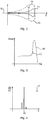
- Fig 2 is a schematic diagram illustrating lateral extension as a function of depth of the dose delivered by a single focused ion beam 11. Depth is indicated by the z axis and the vertical axis indicates a lateral direction. It can there be seen how a core dose delivery 11 (containing most of the dose delivery) of the ion beam 12 extends laterally from the centre of the ion beam 12, especially as it approaches the Bragg peak.
- a Bragg peak chamber is used to measure dose delivery in the form of integrated depth dose (IDD).
- the Bragg peak chamber to be any type of dosimetric device that is used to measure the IDD of a focused ion beam.
- the Bragg peak chamber has a finite lateral extension 14.
- lateral extension 14 of the Bragg peak chamber covers the lateral extension of the core dose delivery 11, there is a small amount of dose that is delivered all the way to a peripheral dose delivery 13. Consequently, there will be some delivery of dose outside the finite lateral extension 14 of the Bragg peak chamber, which will thus not be captured by the Bragg peak chamber.
- Fig 3 is a schematic diagram illustrating the difference between total dose delivery 10 and measured dose delivery 10', measured using a Bragg peak chamber.
- the total dose delivery 10 as well as the measured dose delivery 10' illustrate the presence of the Bragg peak at a specific depth and a sharp drop-off thereafter.
- the finite lateral extension 14 of the Bragg peak chamber due to the finite lateral extension 14 of the Bragg peak chamber, there will be small amounts of dose delivery which is not captured by the Bragg peak chamber. It is for this reason that there is a discrepancy between the measured dose delivery 10' and the total dose delivery 10. In the prior art, this discrepancy has been compensated for numerically.
- Fig 4 is a schematic histogram illustrating the energy spectrum of a single ion beam in the ion beam treatment delivery system 2 of Fig 1 .
- the single ion beam has a nominal energy, which is the configured energy in the ion beam treatment delivery system for this particular ion beam.
- Energy E is shown along the x axis and the y axis indicates distribution of energies in the ion beam, dN/dE.
- the energy intervals, i.e. the size of each bin for the energies, along the x axis can e.g. be 0.2 MeV.
- the ion beam has a certain nominal energy 18. However, as seen in the histogram, there is some variation in dose delivery for different energies around the nominal energy 18. In other words, in a real ion beam treatment delivery system, there is some variation in the energy level in ions of the ion beam, reflected by the energy spectrum 17 illustrated in Fig 4 .
- Figs 5A-C are flow charts illustrating methods for obtaining an energy spectrum of a focused ion beam.
- the focused ion beam is generated by the ion beam treatment delivery system, for a specific nominal energy.
- a Bragg peak chamber is used to measure an integrated depth dose, IDD. The methods are performed in a spectrum determiner. First, embodiments illustrated by Fig 5A will be described.
- the spectrum determiner simulates doses, in at least two dimensions (i.e. in two or three dimensions), of a set of nominally mono energetic focused ion beams.
- the energies of the set cover a range of supported energies of the ion beam treatment delivery system. As an example, the energies of the set cover between 5 MeV to 250 MeV. In one embodiment, the spacing between the simulated nominally mono energetic ion beams in the set is 0.2 MeV.
- each simulated nominally mono energetic focused ion beam does not need to be strictly mono energetic, as long as the energy distribution of the simulated ion beam is narrow compared to that of the ion beam treatment delivery system.
- the energy distribution of the mono energetic focused ion beams can have a standard deviation that is smaller than the standard deviation of the energy distribution of the focused ion beam of the treatment delivery system.
- the energy distribution of each simulated nominally mono energetic focused ion beam is strictly mono energetic.
- the spectrum determiner determines a lateral extension of a Bragg peak chamber to evaluate.
- the lateral extension can be a diameter of a circular Bragg peak chamber or the area of the Bragg peak chamber.
- the spectrum determiner calculates a set of theoretic component IDD curves, here denoted CIDDs. This calculation is performed by laterally integrating the dose of the simulated set of the nominally mono energetic focused ion beams, over the lateral extension of the Bragg peak chamber.
- the CIDDs are simulated measurements corresponding to in lateral extension to the size of the Bragg peak chamber.
- the spectrum determiner stores the calculated CIDDs.
- the CIDDs can be precalculated and stored in advance, long before the measurement with the Bragg peak chamber occurs. Furthermore, CIDDs can be precalculated for several sizes of Bragg peak chambers, and only the CIDDs of the Bragg peak chamber used is later employed.
- the spectrum determiner obtains a measured IDD of a focused ion beam with a nominal energy using the Bragg peak chamber.
- the spectrum determiner performs a fit of a linear combination of CIDDs to the measured IDD (with the CIDDs corresponding in lateral extension to the Bragg peak chamber used in step 48). All CIDD weights are equal to, or greater than zero in this linear combination. In this way, an energy spectrum for the focused ion beam with the nominal beam energy is determined.
- the fit can e.g. be performed using a least squares method.
- steps 48 and 50 are repeated for a plurality of nominal beam energies.
- the method can further comprise an optional determine additional energy spectrum step 52.
- the spectrum determiner determines the energy spectrum for an additional nominal beam energy of the ion beam treatment delivery system by interpolation between previously determined energy spectra.
- step 52 can optionally be performed in this embodiment also.
- the spectrum determiner uses the energy spectrum as input to Monte Carlo based dose computation algorithms.
- step 52 can optionally be performed in this embodiment also.
- the spectrum determiner In a generate IDD step 56, the spectrum determiner generates a complete IDD (corresponding to the example shown in Fig 3 ) using the energy spectrum and a second set of CIDDs that are laterally integrated over a larger area than that used to determine the CIDDs used for determining the energy spectra.
- the complete IDD is then usable as input to analytical dose computation algorithms.
- Fig 6 is a schematic diagram illustrating components of the spectrum determiner 5 of Fig 1 according to one embodiment.
- the spectrum determiner 1 forms part of a host device, such as the treatment planning system 1 of Fig 1
- one or more of the mentioned components can be shared with the host device.
- a processor 60 is provided using any combination of one or more of a suitable central processing unit (CPU), multiprocessor, microcontroller, digital signal processor (DSP), application specific integrated circuit etc., capable of executing software instructions 67 stored in a memory 64, which can thus be a computer program product.
- the processor 60 can be configured to execute the method described with reference to Figs 5A-C above.
- the memory 64 can be any combination of random-access memory (RAM) and read only memory (ROM).
- the memory 64 also comprises persistent storage, which, for example, can be any single one or combination of magnetic memory, optical memory, solid-state memory or even remotely mounted memory.
- a data memory 66 is also provided for reading and/or storing data during execution of software instructions in the processor 60.
- the data memory 66 can be any combination of random-access memory (RAM) and read only memory (ROM).
- the spectrum determiner 5 further comprises an I/O interface 62 for communicating with other external entities.
- the I/O interface 62 also includes a user interface.
- Fig 7 shows one example of a computer program product comprising computer readable means.
- a computer program 91 can be stored, which computer program can cause a processor to execute a method according to embodiments described herein.
- the computer program product is an optical disc, such as a CD (compact disc) or a DVD (digital versatile disc) or a Blu-Ray disc.
- the computer program product could also be embodied in a memory of a device, such as the computer program product 64 of Fig 6 .
- the computer program 91 is here schematically shown as a track on the depicted optical disk, the computer program can be stored in any way which is suitable for the computer program product, such as a removable solid-state memory, e.g. a Universal Serial Bus (USB) drive.
- USB Universal Serial Bus
Landscapes
- Health & Medical Sciences (AREA)
- Engineering & Computer Science (AREA)
- Biomedical Technology (AREA)
- Pathology (AREA)
- Nuclear Medicine, Radiotherapy & Molecular Imaging (AREA)
- Radiology & Medical Imaging (AREA)
- Life Sciences & Earth Sciences (AREA)
- Animal Behavior & Ethology (AREA)
- General Health & Medical Sciences (AREA)
- Public Health (AREA)
- Veterinary Medicine (AREA)
- Chemical & Material Sciences (AREA)
- Analytical Chemistry (AREA)
- Radiation-Therapy Devices (AREA)
- Particle Accelerators (AREA)
Claims (14)
- Verfahren zum Erhalten eines Energiespektrums eines fokussierten lonenstrahls, der von einem lonenstrahlbehandlungsabgabesystem (2) erzeugt wird, für eine spezifische nominale Energie, wenn eine Bragg-Peak-Kammer (30) verwendet wird, um eine integrierte Tiefendosis IDD (10') zu messen, wobei das Verfahren in einem Spektrumbestimmer (1) durchgeführt wird, und umfassend die Schritte:Simulieren (40) von Dosen, in mindestens zwei Dimensionen, eines Satzes nominell monoenergetischer fokussierter lonenstrahlen, wobei die Energien des Satzes einen Bereich unterstützter Energien des lonenstrahlbehandlungsabgabesystems (2) abdecken;Bestimmen (42) einer lateralen Ausdehnung einer zu evaluierenden Bragg-Peak-Kammer (20);Berechnen (44) eines Satzes theoretischer IDD-Komponentenkurven, CIDDs, durch laterales Integrieren der Dosis des simulierten Satzes der nominell monoenergetischen fokussierten lonenstrahlen über die laterale Ausdehnung der Bragg-Peak-Kammer (20);Speichern (46) berechneter CIDDs;Erhalten (48) einer gemessenen IDD eines fokussierten lonenstrahls mit einer nominalen Energie unter Verwendung der Bragg-Peak-Kammer (20); undDurchführen (50) einer Anpassung einer Linearkombination von CIDDs, wobei alle CIDD-Gewichtungen gleich oder größer als Null sind, an die gemessene IDD, um ein Energiespektrum für den fokussierten lonenstrahl mit der nominalen Strahlenergie zu bestimmen.
- Verfahren nach Anspruch 1, wobei die Energieverteilung jedes simulierten nominell monoenergetischen fokussierten lonenstrahls eine Energieverteilung mit einer Standardabweichung aufweist, die kleiner als die Standardabweichung der Energieverteilung des fokussierten lonenstrahls des Behandlungsabgabesystems ist.
- Verfahren nach Anspruch 1 oder 2, wobei die Energieverteilung jedes simulierten nominell monoenergetischen fokussierten lonenstrahls streng monoenergetisch ist.
- Verfahren nach einem der vorstehenden Ansprüche, wobei die Schritte des Erhaltens (48) einer gemessenen IDD und Durchführens (50) einer Anpassung für eine Vielzahl von nominalen Strahlenergien wiederholt werden, und wobei das Verfahren ferner den Schritt umfasst:
Bestimmen (52) des Energiespektrums für eine zusätzliche nominale Strahlenergie des lonenstrahlbehandlungsabgabesystems durch Interpolation zwischen zuvor bestimmten Energiespektren. - Verfahren nach einem der vorstehenden Ansprüche, ferner umfassend den Schritt:
Verwenden (54) des Energiespektrums als Eingabe in Monte-Carlo-basierten Dosiserrechnungsalgorithmen. - Verfahren nach einem der vorstehenden Ansprüche, ferner umfassend den Schritt:
Erzeugen (56) einer vollständigen IDD unter Verwendung des Energiespektrums und eines zweiten Satzes von CIDDs, die lateral über einen größeren Bereich integriert werden als der, der verwendet wird, um die CIDDs zu bestimmen, die zum Bestimmen der Energiespektren verwendet werden, wobei die vollständige IDD als Eingabe in analytische Dosiserrechnungsalgorithmen verwendbar ist. - Spektrumbestimmer (1) zum Erhalten eines Energiespektrums eines fokussierten lonenstrahls, der von einem
lonenstrahlbehandlungsabgabesystem (2) erzeugt wird, für eine spezifische nominale Energie, wenn eine Bragg-Peak-Kammer (30) verwendet wird, um eine integrierte Tiefendosis IDD (10') zu messen, wobei der Spektrumbestimmer (1) umfasst:einen Prozessor (60); undeinen Speicher (64), der Anweisungen (67) speichert, die, wenn von dem Prozessor ausgeführt, den Spektrumbestimmer (1) zu Folgendem veranlassen:Dosen, in mindestens zwei Dimensionen, eines Satzes von nominell monoenergetischen fokussierten lonenstrahlen zu simulieren, wobei die Energien des Satzes einen Bereich unterstützter Energien des lonenstrahlbehandlungsabgabesystems (2) abdecken;eine laterale Ausdehnung einer zu evaluierenden Bragg-Peak-Kammer (20) zu bestimmen;einen Satz theoretischer IDD-Komponentenkurven, CIDDs, durch laterales Integrieren (46) der Dosis des simulierten Satzes der nominell monoenergetischen fokussierten lonenstrahlen über die laterale Ausdehnung der Bragg-Peak-Kammer (20) zu berechnen;berechnete CIDDs zu speichern;eine gemessene IDD eines fokussierten lonenstrahls mit einer nominalen Energie unter Verwendung der Bragg-Peak-Kammer (20) zu erhalten; undeine Anpassung einer Linearkombination von CIDDs, wobei alle CIDD-Gewichtungen gleich oder größer als Null sind, an die gemessene IDD durchzuführen, um ein Energiespektrum für den fokussierten lonenstrahl mit der nominalen Strahlenergie zu bestimmen. - Spektrumbestimmer (1) nach Anspruch 7, wobei die Energieverteilung jedes simulierten nominell monoenergetischen fokussierten lonenstrahls eine Energieverteilung mit einer Standardabweichung aufweist, die kleiner als die Standardabweichung der Energieverteilung des fokussierten lonenstrahls des Behandlungsabgabesystems ist.
- Spektrumbestimmer (1) nach Anspruch 7 oder 8, wobei die Energieverteilung jedes simulierten nominell monoenergetischen fokussierten lonenstrahls streng monoenergetisch ist.
- Spektrumbestimmer (1) nach einem der Ansprüche 7 bis 9, ferner umfassend Anweisungen (67), die, wenn von dem Prozessor ausgeführt, den Spektrumbestimmer (1) zu Folgendem veranlassen:die Anweisungen zu wiederholen, um eine gemessene IDD zu erhalten und eine Anpassung für eine Vielzahl von nominalen Strahlenergien durchzuführen, unddas Energiespektrum für eine zusätzliche nominale Strahlenergie des lonenstrahlbehandlungsabgabesystems durch Interpolation zwischen zuvor bestimmten Energiespektren zu bestimmen.
- Spektrumbestimmer (1) nach einem der Ansprüche 7 bis 10, ferner umfassend Anweisungen (67), die, wenn von dem Prozessor ausgeführt, den Spektrumbestimmer (1) zu Folgendem veranlassen: das Energiespektrum als Eingabe in Monte-Carlo-basierten Dosiserrechnungsalgorithmen zu verwenden.
- Spektrumbestimmer (1) nach einem der Ansprüche 7 bis 11, ferner umfassend Anweisungen (67), die, wenn von dem Prozessor ausgeführt, den Spektrumbestimmer (1) zu Folgendem veranlassen:
eine vollständige IDD unter Verwendung des Energiespektrums und eines zweiten Satzes von CIDDs, die lateral über einen größeren Bereich integriert sind als der, der verwendet wird, um die CIDDs zu bestimmen, die zum Bestimmen der Energiespektren verwendet werden, zu erzeugen, wobei die vollständige IDD als Eingabe in analytische Dosiserrechnungsalgorithmen verwendbar ist. - Computerprogramm (67, 91) zum Erhalten eines Energiespektrums eines fokussierten lonenstrahls, der von einem lonenstrahlbehandlungsabgabesystem (2) erzeugt wird, für eine spezifische nominale Energie, wenn eine Bragg-Peak-Kammer (30) verwendet wird, um eine integrierte Tiefendosis IDD (10') zu messen, wobei das Computerprogramm Computerprogrammcode umfasst, der, wenn auf einem Spektrumbestimmer (1) ausgeführt, den Spektrumbestimmer (1) zu Folgendem veranlasst:Dosen, in mindestens zwei Dimensionen, eines Satzes von nominell monoenergetischen fokussierten lonenstrahlen zu simulieren, wobei die Energien des Satzes einen Bereich unterstützter Energien des lonenstrahlbehandlungsabgabesystems (2) abdecken;eine laterale Ausdehnung einer zu evaluierenden Bragg-Peak-Kammer (20) zu bestimmen;einen Satz theoretischer IDD-Komponentenkurven, CIDDs, durch laterales Integrieren (46) der Dosis des simulierten Satzes der nominell monoenergetischen fokussierten lonenstrahlen über die laterale Ausdehnung der Bragg-Peak-Kammer (20) zu berechnen;berechnete CIDDs zu speichern;eine gemessene IDD eines fokussierten lonenstrahls mit einer nominalen Energie unter Verwendung der Bragg-Peak-Kammer (20) zu erhalten; undeine Anpassung einer Linearkombination von CIDDs, wobei alle CIDD-Gewichtungen gleich oder größer als Null sind, an die gemessene IDD durchzuführen, um ein Energiespektrum für den fokussierten lonenstrahl mit der nominalen Strahlenergie zu bestimmen.
- Computerprogrammprodukt (64, 90), umfassend ein Computerprogramm nach Anspruch 13 und ein computerlesbares Mittel, auf dem das Computerprogramm gespeichert ist.
Priority Applications (4)
| Application Number | Priority Date | Filing Date | Title |
|---|---|---|---|
| EP19210528.6A EP3824953B1 (de) | 2019-11-21 | 2019-11-21 | Erhalt eines energiespektrums eines fokussierten ionenstrahls |
| JP2020185769A JP7485585B2 (ja) | 2019-11-21 | 2020-11-06 | 集束イオンビームのエネルギースペクトルを得ること |
| US17/097,199 US11170974B2 (en) | 2019-11-21 | 2020-11-13 | Obtaining an energy spectrum of a focused ion beam |
| CN202011283856.6A CN112823820B (zh) | 2019-11-21 | 2020-11-17 | 获得聚焦离子束的能谱技术领域 |
Applications Claiming Priority (1)
| Application Number | Priority Date | Filing Date | Title |
|---|---|---|---|
| EP19210528.6A EP3824953B1 (de) | 2019-11-21 | 2019-11-21 | Erhalt eines energiespektrums eines fokussierten ionenstrahls |
Publications (2)
| Publication Number | Publication Date |
|---|---|
| EP3824953A1 EP3824953A1 (de) | 2021-05-26 |
| EP3824953B1 true EP3824953B1 (de) | 2022-01-05 |
Family
ID=68653318
Family Applications (1)
| Application Number | Title | Priority Date | Filing Date |
|---|---|---|---|
| EP19210528.6A Active EP3824953B1 (de) | 2019-11-21 | 2019-11-21 | Erhalt eines energiespektrums eines fokussierten ionenstrahls |
Country Status (4)
| Country | Link |
|---|---|
| US (1) | US11170974B2 (de) |
| EP (1) | EP3824953B1 (de) |
| JP (1) | JP7485585B2 (de) |
| CN (1) | CN112823820B (de) |
Families Citing this family (2)
| Publication number | Priority date | Publication date | Assignee | Title |
|---|---|---|---|---|
| WO2024020874A1 (zh) * | 2022-07-27 | 2024-02-01 | 上海联影医疗科技股份有限公司 | 一种能谱获取方法、系统和存储介质 |
| CN118131302B (zh) * | 2024-05-07 | 2024-08-30 | 迈胜医疗设备有限公司 | 医用粒子加速器初级能谱的计算方法及相关设备 |
Family Cites Families (9)
| Publication number | Priority date | Publication date | Assignee | Title |
|---|---|---|---|---|
| WO2004109717A2 (en) * | 2003-06-02 | 2004-12-16 | Fox Chase Cancer Center | High energy polyenergetic ion beam systems |
| AU2004298243A1 (en) * | 2003-12-02 | 2005-06-23 | Fox Chase Cancer Center | Method of modulating laser-accelerated protons for radiation therapy |
| EP2229981A1 (de) * | 2009-03-17 | 2010-09-22 | Paul Scherrer Institut | Verfahren zur Bewertung von Strahlungsmodelldaten in Teilchenstrahlstrahlungsanwendungen |
| WO2016047194A1 (ja) * | 2014-09-24 | 2016-03-31 | 株式会社日立製作所 | 放射線治療計画装置、放射線治療計画方法および放射線治療システム |
| DE112015004797B4 (de) * | 2014-10-24 | 2022-11-03 | National Institutes For Quantum And Radiological Science And Technology | Bestrahlungsplanungsvorrichtung und Bestrahlungsplankorrekturverfahren |
| CN106853272A (zh) * | 2015-12-08 | 2017-06-16 | 南京中硼联康医疗科技有限公司 | 射束的照射角度评价方法 |
| US10918888B2 (en) * | 2017-02-28 | 2021-02-16 | Sun Nuclear Corporation | Radiation therapy treatment verification with electronic portal imaging device transit images |
| US10661100B2 (en) * | 2017-03-08 | 2020-05-26 | Mayo Foundation For Medical Education And Research | Method for measuring field size factor for radiation treatment planning using proton pencil beam scanning |
| CN109407134B (zh) * | 2018-10-19 | 2020-06-12 | 神州数码医疗科技股份有限公司 | 剂量分布计算方法及系统 |
-
2019
- 2019-11-21 EP EP19210528.6A patent/EP3824953B1/de active Active
-
2020
- 2020-11-06 JP JP2020185769A patent/JP7485585B2/ja active Active
- 2020-11-13 US US17/097,199 patent/US11170974B2/en active Active
- 2020-11-17 CN CN202011283856.6A patent/CN112823820B/zh active Active
Also Published As
| Publication number | Publication date |
|---|---|
| EP3824953A1 (de) | 2021-05-26 |
| US20210159047A1 (en) | 2021-05-27 |
| US11170974B2 (en) | 2021-11-09 |
| JP7485585B2 (ja) | 2024-05-16 |
| CN112823820A (zh) | 2021-05-21 |
| CN112823820B (zh) | 2022-05-24 |
| JP2021097997A (ja) | 2021-07-01 |
Similar Documents
| Publication | Publication Date | Title |
|---|---|---|
| EP2313155B1 (de) | Vorrichtung und verfahren zur überwachung und verifizierung einer teilchentherapie | |
| Ma et al. | A Monte Carlo dose calculation tool for radiotherapy treatment planning | |
| Fogliata et al. | Dosimetric validation of the Acuros XB Advanced Dose Calculation algorithm: fundamental characterization in water | |
| EP3421085A1 (de) | Bestimmung einer verteilung von spoten von varying grössen für ion beam therapie mit optimierung | |
| CN115004312B (zh) | 为多标准优化生成多个潜在的治疗计划 | |
| Calvo et al. | On the quantification of the dosimetric accuracy of collapsed cone convolution superposition (CCCS) algorithm for small lung volumes using IMRT | |
| US11170974B2 (en) | Obtaining an energy spectrum of a focused ion beam | |
| Sikora et al. | A virtual source model of electron contamination of a therapeutic photon beam | |
| Park et al. | Analysis of dose distribution according to the initial electron beam of the linear accelerator: a Monte Carlo study | |
| Cranmer-Sargison et al. | Modelling an extreme water–lung interface using a single pencil beam algorithm and the Monte Carlo method | |
| Brualla et al. | Comparison between PENELOPE and electron Monte Carlo simulations of electron fields used in the treatment of conjunctival lymphoma | |
| Simoni et al. | FRED: a fast Monte Carlo code on GPU for quality control in Particle Therapy | |
| US11602644B2 (en) | Determining a distribution of spots of varying sizes for ion beam therapy based on user configuration | |
| Hoshida et al. | Monte Carlo dose verification for a single-isocenter VMAT plan in multiple brain metastases | |
| Phillips et al. | A macropencil beam model: clinical implementation for conformal and intensity modulated radiation therapy | |
| WO2021152881A1 (ja) | 治療計画装置、粒子線治療システム及びコンピュータプログラム | |
| Northway et al. | A quantitative framework for patient‐specific collision detection in proton therapy | |
| JPWO2021165118A5 (de) | ||
| Granja et al. | Computational Modeling of CyberKnife® System Using the Monte Carlo Method | |
| Wieslander et al. | Monte Carlo based verification of a beam model used in a treatment planning system | |
| Cronholm | Monte Carlo Treatment Planning for Advanced Radiotherapy | |
| HK40009604A (en) | Optimizing radiation dose to overlapping structures | |
| Liu et al. | Mathematical Modeling of Dose Volume Histograms (DVHs) among Patients undergoing Radiation Therapy for Prostate Cancer | |
| Davis | Dosimetric Tranferability of a Medical Linear Accelerator Mounted Mini-Beam Collimator | |
| de Vries | An EGSnrc Monte Carlo investigation of backscattered electrons from internal shielding in clinical electron beams |
Legal Events
| Date | Code | Title | Description |
|---|---|---|---|
| PUAI | Public reference made under article 153(3) epc to a published international application that has entered the european phase |
Free format text: ORIGINAL CODE: 0009012 |
|
| STAA | Information on the status of an ep patent application or granted ep patent |
Free format text: STATUS: REQUEST FOR EXAMINATION WAS MADE |
|
| 17P | Request for examination filed |
Effective date: 20200615 |
|
| AK | Designated contracting states |
Kind code of ref document: A1 Designated state(s): AL AT BE BG CH CY CZ DE DK EE ES FI FR GB GR HR HU IE IS IT LI LT LU LV MC MK MT NL NO PL PT RO RS SE SI SK SM TR |
|
| GRAP | Despatch of communication of intention to grant a patent |
Free format text: ORIGINAL CODE: EPIDOSNIGR1 |
|
| STAA | Information on the status of an ep patent application or granted ep patent |
Free format text: STATUS: GRANT OF PATENT IS INTENDED |
|
| GRAS | Grant fee paid |
Free format text: ORIGINAL CODE: EPIDOSNIGR3 |
|
| INTG | Intention to grant announced |
Effective date: 20211019 |
|
| GRAA | (expected) grant |
Free format text: ORIGINAL CODE: 0009210 |
|
| STAA | Information on the status of an ep patent application or granted ep patent |
Free format text: STATUS: THE PATENT HAS BEEN GRANTED |
|
| AK | Designated contracting states |
Kind code of ref document: B1 Designated state(s): AL AT BE BG CH CY CZ DE DK EE ES FI FR GB GR HR HU IE IS IT LI LT LU LV MC MK MT NL NO PL PT RO RS SE SI SK SM TR |
|
| REG | Reference to a national code |
Ref country code: GB Ref legal event code: FG4D |
|
| REG | Reference to a national code |
Ref country code: CH Ref legal event code: EP |
|
| REG | Reference to a national code |
Ref country code: AT Ref legal event code: REF Ref document number: 1459996 Country of ref document: AT Kind code of ref document: T Effective date: 20220115 |
|
| REG | Reference to a national code |
Ref country code: DE Ref legal event code: R096 Ref document number: 602019010643 Country of ref document: DE |
|
| REG | Reference to a national code |
Ref country code: IE Ref legal event code: FG4D |
|
| REG | Reference to a national code |
Ref country code: LT Ref legal event code: MG9D |
|
| REG | Reference to a national code |
Ref country code: NL Ref legal event code: MP Effective date: 20220105 |
|
| REG | Reference to a national code |
Ref country code: AT Ref legal event code: MK05 Ref document number: 1459996 Country of ref document: AT Kind code of ref document: T Effective date: 20220105 |
|
| PG25 | Lapsed in a contracting state [announced via postgrant information from national office to epo] |
Ref country code: NL Free format text: LAPSE BECAUSE OF FAILURE TO SUBMIT A TRANSLATION OF THE DESCRIPTION OR TO PAY THE FEE WITHIN THE PRESCRIBED TIME-LIMIT Effective date: 20220105 |
|
| PG25 | Lapsed in a contracting state [announced via postgrant information from national office to epo] |
Ref country code: SE Free format text: LAPSE BECAUSE OF FAILURE TO SUBMIT A TRANSLATION OF THE DESCRIPTION OR TO PAY THE FEE WITHIN THE PRESCRIBED TIME-LIMIT Effective date: 20220105 Ref country code: RS Free format text: LAPSE BECAUSE OF FAILURE TO SUBMIT A TRANSLATION OF THE DESCRIPTION OR TO PAY THE FEE WITHIN THE PRESCRIBED TIME-LIMIT Effective date: 20220105 Ref country code: PT Free format text: LAPSE BECAUSE OF FAILURE TO SUBMIT A TRANSLATION OF THE DESCRIPTION OR TO PAY THE FEE WITHIN THE PRESCRIBED TIME-LIMIT Effective date: 20220505 Ref country code: NO Free format text: LAPSE BECAUSE OF FAILURE TO SUBMIT A TRANSLATION OF THE DESCRIPTION OR TO PAY THE FEE WITHIN THE PRESCRIBED TIME-LIMIT Effective date: 20220405 Ref country code: LT Free format text: LAPSE BECAUSE OF FAILURE TO SUBMIT A TRANSLATION OF THE DESCRIPTION OR TO PAY THE FEE WITHIN THE PRESCRIBED TIME-LIMIT Effective date: 20220105 Ref country code: HR Free format text: LAPSE BECAUSE OF FAILURE TO SUBMIT A TRANSLATION OF THE DESCRIPTION OR TO PAY THE FEE WITHIN THE PRESCRIBED TIME-LIMIT Effective date: 20220105 Ref country code: ES Free format text: LAPSE BECAUSE OF FAILURE TO SUBMIT A TRANSLATION OF THE DESCRIPTION OR TO PAY THE FEE WITHIN THE PRESCRIBED TIME-LIMIT Effective date: 20220105 Ref country code: BG Free format text: LAPSE BECAUSE OF FAILURE TO SUBMIT A TRANSLATION OF THE DESCRIPTION OR TO PAY THE FEE WITHIN THE PRESCRIBED TIME-LIMIT Effective date: 20220405 |
|
| RAP4 | Party data changed (patent owner data changed or rights of a patent transferred) |
Owner name: RAYSEARCH LABORATORIES AB |
|
| PG25 | Lapsed in a contracting state [announced via postgrant information from national office to epo] |
Ref country code: PL Free format text: LAPSE BECAUSE OF FAILURE TO SUBMIT A TRANSLATION OF THE DESCRIPTION OR TO PAY THE FEE WITHIN THE PRESCRIBED TIME-LIMIT Effective date: 20220105 Ref country code: LV Free format text: LAPSE BECAUSE OF FAILURE TO SUBMIT A TRANSLATION OF THE DESCRIPTION OR TO PAY THE FEE WITHIN THE PRESCRIBED TIME-LIMIT Effective date: 20220105 Ref country code: GR Free format text: LAPSE BECAUSE OF FAILURE TO SUBMIT A TRANSLATION OF THE DESCRIPTION OR TO PAY THE FEE WITHIN THE PRESCRIBED TIME-LIMIT Effective date: 20220406 Ref country code: FI Free format text: LAPSE BECAUSE OF FAILURE TO SUBMIT A TRANSLATION OF THE DESCRIPTION OR TO PAY THE FEE WITHIN THE PRESCRIBED TIME-LIMIT Effective date: 20220105 Ref country code: AT Free format text: LAPSE BECAUSE OF FAILURE TO SUBMIT A TRANSLATION OF THE DESCRIPTION OR TO PAY THE FEE WITHIN THE PRESCRIBED TIME-LIMIT Effective date: 20220105 |
|
| PG25 | Lapsed in a contracting state [announced via postgrant information from national office to epo] |
Ref country code: IS Free format text: LAPSE BECAUSE OF FAILURE TO SUBMIT A TRANSLATION OF THE DESCRIPTION OR TO PAY THE FEE WITHIN THE PRESCRIBED TIME-LIMIT Effective date: 20220505 |
|
| REG | Reference to a national code |
Ref country code: DE Ref legal event code: R097 Ref document number: 602019010643 Country of ref document: DE |
|
| PG25 | Lapsed in a contracting state [announced via postgrant information from national office to epo] |
Ref country code: SM Free format text: LAPSE BECAUSE OF FAILURE TO SUBMIT A TRANSLATION OF THE DESCRIPTION OR TO PAY THE FEE WITHIN THE PRESCRIBED TIME-LIMIT Effective date: 20220105 Ref country code: SK Free format text: LAPSE BECAUSE OF FAILURE TO SUBMIT A TRANSLATION OF THE DESCRIPTION OR TO PAY THE FEE WITHIN THE PRESCRIBED TIME-LIMIT Effective date: 20220105 Ref country code: RO Free format text: LAPSE BECAUSE OF FAILURE TO SUBMIT A TRANSLATION OF THE DESCRIPTION OR TO PAY THE FEE WITHIN THE PRESCRIBED TIME-LIMIT Effective date: 20220105 Ref country code: EE Free format text: LAPSE BECAUSE OF FAILURE TO SUBMIT A TRANSLATION OF THE DESCRIPTION OR TO PAY THE FEE WITHIN THE PRESCRIBED TIME-LIMIT Effective date: 20220105 Ref country code: DK Free format text: LAPSE BECAUSE OF FAILURE TO SUBMIT A TRANSLATION OF THE DESCRIPTION OR TO PAY THE FEE WITHIN THE PRESCRIBED TIME-LIMIT Effective date: 20220105 Ref country code: CZ Free format text: LAPSE BECAUSE OF FAILURE TO SUBMIT A TRANSLATION OF THE DESCRIPTION OR TO PAY THE FEE WITHIN THE PRESCRIBED TIME-LIMIT Effective date: 20220105 |
|
| PLBE | No opposition filed within time limit |
Free format text: ORIGINAL CODE: 0009261 |
|
| STAA | Information on the status of an ep patent application or granted ep patent |
Free format text: STATUS: NO OPPOSITION FILED WITHIN TIME LIMIT |
|
| PG25 | Lapsed in a contracting state [announced via postgrant information from national office to epo] |
Ref country code: AL Free format text: LAPSE BECAUSE OF FAILURE TO SUBMIT A TRANSLATION OF THE DESCRIPTION OR TO PAY THE FEE WITHIN THE PRESCRIBED TIME-LIMIT Effective date: 20220105 |
|
| 26N | No opposition filed |
Effective date: 20221006 |
|
| PG25 | Lapsed in a contracting state [announced via postgrant information from national office to epo] |
Ref country code: MC Free format text: LAPSE BECAUSE OF FAILURE TO SUBMIT A TRANSLATION OF THE DESCRIPTION OR TO PAY THE FEE WITHIN THE PRESCRIBED TIME-LIMIT Effective date: 20220105 |
|
| REG | Reference to a national code |
Ref country code: CH Ref legal event code: PL |
|
| REG | Reference to a national code |
Ref country code: BE Ref legal event code: MM Effective date: 20221130 |
|
| PG25 | Lapsed in a contracting state [announced via postgrant information from national office to epo] |
Ref country code: LI Free format text: LAPSE BECAUSE OF NON-PAYMENT OF DUE FEES Effective date: 20221130 Ref country code: IT Free format text: LAPSE BECAUSE OF FAILURE TO SUBMIT A TRANSLATION OF THE DESCRIPTION OR TO PAY THE FEE WITHIN THE PRESCRIBED TIME-LIMIT Effective date: 20220105 Ref country code: CH Free format text: LAPSE BECAUSE OF NON-PAYMENT OF DUE FEES Effective date: 20221130 |
|
| PG25 | Lapsed in a contracting state [announced via postgrant information from national office to epo] |
Ref country code: LU Free format text: LAPSE BECAUSE OF NON-PAYMENT OF DUE FEES Effective date: 20221121 |
|
| P01 | Opt-out of the competence of the unified patent court (upc) registered |
Effective date: 20230731 |
|
| PG25 | Lapsed in a contracting state [announced via postgrant information from national office to epo] |
Ref country code: IE Free format text: LAPSE BECAUSE OF NON-PAYMENT OF DUE FEES Effective date: 20221121 |
|
| PG25 | Lapsed in a contracting state [announced via postgrant information from national office to epo] |
Ref country code: BE Free format text: LAPSE BECAUSE OF NON-PAYMENT OF DUE FEES Effective date: 20221130 |
|
| PG25 | Lapsed in a contracting state [announced via postgrant information from national office to epo] |
Ref country code: CY Free format text: LAPSE BECAUSE OF FAILURE TO SUBMIT A TRANSLATION OF THE DESCRIPTION OR TO PAY THE FEE WITHIN THE PRESCRIBED TIME-LIMIT Effective date: 20220105 |
|
| PG25 | Lapsed in a contracting state [announced via postgrant information from national office to epo] |
Ref country code: MK Free format text: LAPSE BECAUSE OF FAILURE TO SUBMIT A TRANSLATION OF THE DESCRIPTION OR TO PAY THE FEE WITHIN THE PRESCRIBED TIME-LIMIT Effective date: 20220105 Ref country code: HU Free format text: LAPSE BECAUSE OF FAILURE TO SUBMIT A TRANSLATION OF THE DESCRIPTION OR TO PAY THE FEE WITHIN THE PRESCRIBED TIME-LIMIT; INVALID AB INITIO Effective date: 20191121 |
|
| PG25 | Lapsed in a contracting state [announced via postgrant information from national office to epo] |
Ref country code: MT Free format text: LAPSE BECAUSE OF FAILURE TO SUBMIT A TRANSLATION OF THE DESCRIPTION OR TO PAY THE FEE WITHIN THE PRESCRIBED TIME-LIMIT Effective date: 20220105 |
|
| PG25 | Lapsed in a contracting state [announced via postgrant information from national office to epo] |
Ref country code: TR Free format text: LAPSE BECAUSE OF FAILURE TO SUBMIT A TRANSLATION OF THE DESCRIPTION OR TO PAY THE FEE WITHIN THE PRESCRIBED TIME-LIMIT Effective date: 20220105 |
|
| PGFP | Annual fee paid to national office [announced via postgrant information from national office to epo] |
Ref country code: DE Payment date: 20251022 Year of fee payment: 7 |
|
| PGFP | Annual fee paid to national office [announced via postgrant information from national office to epo] |
Ref country code: GB Payment date: 20251022 Year of fee payment: 7 |
|
| PGFP | Annual fee paid to national office [announced via postgrant information from national office to epo] |
Ref country code: FR Payment date: 20251022 Year of fee payment: 7 |
|
| PG25 | Lapsed in a contracting state [announced via postgrant information from national office to epo] |
Ref country code: SI Free format text: LAPSE BECAUSE OF FAILURE TO SUBMIT A TRANSLATION OF THE DESCRIPTION OR TO PAY THE FEE WITHIN THE PRESCRIBED TIME-LIMIT Effective date: 20220105 |