EP3852624B1 - Sensor und verfahren zur messung der bewegung von brustgewebe während der aktivität - Google Patents
Sensor und verfahren zur messung der bewegung von brustgewebe während der aktivität Download PDFInfo
- Publication number
- EP3852624B1 EP3852624B1 EP19863650.8A EP19863650A EP3852624B1 EP 3852624 B1 EP3852624 B1 EP 3852624B1 EP 19863650 A EP19863650 A EP 19863650A EP 3852624 B1 EP3852624 B1 EP 3852624B1
- Authority
- EP
- European Patent Office
- Prior art keywords
- user
- sensor
- acceleration
- breast tissue
- axis
- Prior art date
- Legal status (The legal status is an assumption and is not a legal conclusion. Google has not performed a legal analysis and makes no representation as to the accuracy of the status listed.)
- Active
Links
Images




Classifications
-
- A—HUMAN NECESSITIES
- A61—MEDICAL OR VETERINARY SCIENCE; HYGIENE
- A61B—DIAGNOSIS; SURGERY; IDENTIFICATION
- A61B5/00—Measuring for diagnostic purposes; Identification of persons
- A61B5/103—Measuring devices for testing the shape, pattern, colour, size or movement of the body or parts thereof, for diagnostic purposes
- A61B5/11—Measuring movement of the entire body or parts thereof, e.g. head or hand tremor or mobility of a limb
-
- A—HUMAN NECESSITIES
- A61—MEDICAL OR VETERINARY SCIENCE; HYGIENE
- A61B—DIAGNOSIS; SURGERY; IDENTIFICATION
- A61B5/00—Measuring for diagnostic purposes; Identification of persons
- A61B5/103—Measuring devices for testing the shape, pattern, colour, size or movement of the body or parts thereof, for diagnostic purposes
- A61B5/11—Measuring movement of the entire body or parts thereof, e.g. head or hand tremor or mobility of a limb
- A61B5/1113—Local tracking of patients, e.g. in a hospital or private home
- A61B5/1114—Tracking parts of the body
-
- A—HUMAN NECESSITIES
- A61—MEDICAL OR VETERINARY SCIENCE; HYGIENE
- A61B—DIAGNOSIS; SURGERY; IDENTIFICATION
- A61B5/00—Measuring for diagnostic purposes; Identification of persons
- A61B5/0002—Remote monitoring of patients using telemetry, e.g. transmission of vital signals via a communication network
-
- A—HUMAN NECESSITIES
- A61—MEDICAL OR VETERINARY SCIENCE; HYGIENE
- A61B—DIAGNOSIS; SURGERY; IDENTIFICATION
- A61B5/00—Measuring for diagnostic purposes; Identification of persons
- A61B5/103—Measuring devices for testing the shape, pattern, colour, size or movement of the body or parts thereof, for diagnostic purposes
- A61B5/107—Measuring physical dimensions, e.g. size of the entire body or parts thereof
-
- A—HUMAN NECESSITIES
- A61—MEDICAL OR VETERINARY SCIENCE; HYGIENE
- A61B—DIAGNOSIS; SURGERY; IDENTIFICATION
- A61B5/00—Measuring for diagnostic purposes; Identification of persons
- A61B5/68—Arrangements of detecting, measuring or recording means, e.g. sensors, in relation to patient
- A61B5/6801—Arrangements of detecting, measuring or recording means, e.g. sensors, in relation to patient specially adapted to be attached to or worn on the body surface
- A61B5/6802—Sensor mounted on worn items
- A61B5/6804—Garments; Clothes
-
- A—HUMAN NECESSITIES
- A61—MEDICAL OR VETERINARY SCIENCE; HYGIENE
- A61B—DIAGNOSIS; SURGERY; IDENTIFICATION
- A61B5/00—Measuring for diagnostic purposes; Identification of persons
- A61B5/68—Arrangements of detecting, measuring or recording means, e.g. sensors, in relation to patient
- A61B5/6801—Arrangements of detecting, measuring or recording means, e.g. sensors, in relation to patient specially adapted to be attached to or worn on the body surface
- A61B5/6813—Specially adapted to be attached to a specific body part
- A61B5/6823—Trunk, e.g., chest, back, abdomen, hip
-
- A—HUMAN NECESSITIES
- A61—MEDICAL OR VETERINARY SCIENCE; HYGIENE
- A61B—DIAGNOSIS; SURGERY; IDENTIFICATION
- A61B5/00—Measuring for diagnostic purposes; Identification of persons
- A61B5/68—Arrangements of detecting, measuring or recording means, e.g. sensors, in relation to patient
- A61B5/6801—Arrangements of detecting, measuring or recording means, e.g. sensors, in relation to patient specially adapted to be attached to or worn on the body surface
- A61B5/683—Means for maintaining contact with the body
- A61B5/6832—Means for maintaining contact with the body using adhesives
-
- A—HUMAN NECESSITIES
- A61—MEDICAL OR VETERINARY SCIENCE; HYGIENE
- A61B—DIAGNOSIS; SURGERY; IDENTIFICATION
- A61B5/00—Measuring for diagnostic purposes; Identification of persons
- A61B5/74—Details of notification to user or communication with user or patient; User input means
- A61B5/742—Details of notification to user or communication with user or patient; User input means using visual displays
-
- A—HUMAN NECESSITIES
- A61—MEDICAL OR VETERINARY SCIENCE; HYGIENE
- A61B—DIAGNOSIS; SURGERY; IDENTIFICATION
- A61B2503/00—Evaluating a particular growth phase or type of persons or animals
- A61B2503/10—Athletes
-
- A—HUMAN NECESSITIES
- A61—MEDICAL OR VETERINARY SCIENCE; HYGIENE
- A61B—DIAGNOSIS; SURGERY; IDENTIFICATION
- A61B2562/00—Details of sensors; Constructional details of sensor housings or probes; Accessories for sensors
- A61B2562/02—Details of sensors specially adapted for in-vivo measurements
- A61B2562/0219—Inertial sensors, e.g. accelerometers, gyroscopes, tilt switches
-
- A—HUMAN NECESSITIES
- A61—MEDICAL OR VETERINARY SCIENCE; HYGIENE
- A61B—DIAGNOSIS; SURGERY; IDENTIFICATION
- A61B2562/00—Details of sensors; Constructional details of sensor housings or probes; Accessories for sensors
- A61B2562/04—Arrangements of multiple sensors of the same type
-
- A—HUMAN NECESSITIES
- A61—MEDICAL OR VETERINARY SCIENCE; HYGIENE
- A61B—DIAGNOSIS; SURGERY; IDENTIFICATION
- A61B5/00—Measuring for diagnostic purposes; Identification of persons
- A61B5/103—Measuring devices for testing the shape, pattern, colour, size or movement of the body or parts thereof, for diagnostic purposes
- A61B5/107—Measuring physical dimensions, e.g. size of the entire body or parts thereof
- A61B5/1075—Measuring physical dimensions, e.g. size of the entire body or parts thereof for measuring dimensions by non-invasive methods, e.g. for determining thickness of tissue layer
-
- A—HUMAN NECESSITIES
- A61—MEDICAL OR VETERINARY SCIENCE; HYGIENE
- A61B—DIAGNOSIS; SURGERY; IDENTIFICATION
- A61B5/00—Measuring for diagnostic purposes; Identification of persons
- A61B5/103—Measuring devices for testing the shape, pattern, colour, size or movement of the body or parts thereof, for diagnostic purposes
- A61B5/11—Measuring movement of the entire body or parts thereof, e.g. head or hand tremor or mobility of a limb
- A61B5/1118—Determining activity level
Definitions
- This disclosure relates to a sensor and method for measuring movement of breast tissue during activity.
- the disclosure relates to a method for measuring acceleration of breast tissue during activity and a method of using acceleration measurements for recommending and fitting an undergarment.
- Typical athletic or sports bras are designed to restrict the movement of breast tissue related to activity by uniformly compressing the breast tissue to the wearer's chest. While the uniform compression effected by a typical athletic or sports bra may provide adequate movement management of the breast tissue, this compression can also be uncomfortable for the wearer because it does not effectively distribute the pressure around the wearer's torso. This discomfort is typically experienced around the wearer's back and shoulders.
- a typical athletic or sports bra completely captures and compresses the wearer's breast tissue to the wearer's chest, and is not designed to account for any specific directional movement or acceleration of the breast tissue resulting from the wearer's activity or the wearer's individual movement profile.
- a typical athletic or sports bra does not effectively maximize the balance between maintaining the comfort of the wearer and managing movement of the wearer's breast tissue.
- Multi-planar kinematics included relative nipple marker displacement projected in the axes of the trunk coordinate system in the vertical, mediolateral and antero-posterior directions. Multi-planar kinetics were calculated as the forces transferred through Cooper's ligaments, the pectoralis fascia and the ribs.
- US2017/202271 discloses bras comprising a shape memory alloy, an accelerometer, a power source, a microprocessor and an algorithm implemented by the microprocessor, to learn and adapt to the displacement pattern of the wearer's breasts during physical activity.
- Wood, Louise Ellen, et al. Med. Sci. Sports Exerc., (2012), 44(7): 1351-1357 disclose that differences in breast displacement, velocity, and acceleration between breast cup sizes can be predicted using estimates of breast mass based on conventional brassiere sizing.
- US Patent 9,173,596 B1 discloses the comparison of accelerometer data to motion profiles in general.
- the present disclosure provides a sensor for measuring movement or acceleration of breast tissue during activity and using the acceleration measurements in a method of fitting an undergarment for a user.
- the present invention provides a sensor system for measuring movement of breast tissue during activity, the sensor system comprising: a first sensor for placement on a sternum of a user, the first sensor comprising a first accelerometer operable to generate acceleration data indicative of acceleration of a torso of the user along a reference x-axis, y-axis and/or z-axis; a second sensor operatively connected to the first sensor for placement on breast tissue of the user, the second sensor comprising a second accelerometer operable to generate acceleration data indicative of acceleration of breast tissue of the user; and a microprocessor operatively connected to the first and second sensors and configured to use the acceleration data generated from the first sensor and the second sensor to determine a magnitude of breast tissue acceleration relative to the torso of the user along the reference x-axis, y-axis and/or z-axis, wherein the microprocessor is further configured to compare the relative medial/lateral, anterior/posterior and/or superior/inferior breast tissue acceleration data of the user to
- the present invention provides a method executed by a microprocessor for generating a breast motion profile for a user, comprising: obtaining first acceleration data indicative of acceleration of a torso of the user along the reference x-axis, y-axis and/or z-axis; obtaining second acceleration data indicative of acceleration of breast tissue of the user; using the first and second acceleration data to determine an axial offset and/or a magnitude of breast tissue acceleration relative to the torso of the user; determining relative medial/lateral, anterior/posterior and/or superior/inferior breast tissue acceleration data from the determined magnitude of breast tissue acceleration relative to the torso of the user; comparing determined data of the user's medial/lateral, anterior/posterior and/or superior/inferior breast tissue acceleration to a database of known breast motion profiles to find a closest match; and generating the breast motion profile for the user by scaling the closest match based on the determined relative medial/lateral, anterior/posterior and/or superior/inferior breast tissue acceleration data
- the sensor system and the method according to the present invention are suitable to be used in a method of fitting an undergarment for a user to control breast tissue acceleration during activity, the method comprising: receiving static breast parameters of the user, wherein the static breast parameters comprise one or more of a circumference of a torso of the user and a breast cup size of the user; measuring relative medial/lateral, anterior/posterior and/or superior/inferior breast tissue acceleration using a sensor as disclosed herein while the use is wearing a reference undergarment; comparing obtained data of the user's medial/lateral, anterior/posterior and/or superior/inferior breast tissue acceleration to a threshold level, wherein the threshold level is a range of combinations of at least two of medial/lateral, superior/inferior and anterior/posterior acceleration values that are perceived as comfortable or uncomfortable to a population of users for the reference undergarment at the static breast parameters; and selecting the undergarment from a collection of undergarments that controls the relative medial/lateral, anterior/posterior
- the sensor system and the method according to the present invention are suitable to be used in a method of fitting an undergarment for a user to control breast tissue movement during activity, the method comprising: receiving static breast parameters of the user; determining an axial offset and/or a magnitude of breast tissue acceleration relative to the torso of the user along a reference x-axis, y-axis and/or z-axis; selecting, based on the static breast parameters and the axial offset and/or magnitude of breast tissue acceleration, an undergarment from among a collection of undergarments that controls the determined magnitude of breast tissue acceleration relative to the torso of the user within a threshold level, wherein the threshold level is a range of combinations of at least two of medial/lateral, superior/inferior and anterior/posterior acceleration values that are perceived as comfortable or uncomfortable to a population of users for the reference undergarment at the static breast parameters.
- Various aspects of the present disclosure also provide a computer-readable medium having stored thereon computer program code configured when executed by one or more processors to cause the one or more processors to perform a method as described herein.
- Disclosed embodiments include systems, apparatus, methods and storage media associated with measuring breast tissue movement, including breast tissue acceleration.
- the disclosure provides a sensor for measuring breast tissue acceleration and methods of using the acceleration data to fit an undergarment such as a bra for a user.
- breast tissue has a range of motion in three dimensions, the medial/lateral (side-to-side) direction corresponding to movement along an x-axis, the superior/inferior (up and down) direction corresponding to movement along a y-axis and the anterior/posterior (in and out) direction corresponding to movement along a z-axis. Furthermore, this range of motion in three dimensions during activity is unique to each individual.
- the disclosure provides a sensor and method for measuring acceleration of breast tissue in three dimensions relative to movement of a torso of a user. These measurements may then be used in a method of fitting an undergarment for a user.
- the method uses the acceleration data to fit an undergarment, such as a bra, to control or decrease breast tissue acceleration in one or more of the medial/lateral, superior/inferior and/or anterior/posterior directions.
- a sensor system 10 comprises a first sensor 12 and a second sensor 14.
- the first sensor 12 is for placement on a sternum of the user and comprises a first accelerometer operable to generate data indicative of acceleration of a torso of the user.
- the first accelerometer can be a triaxial accelerometer that can generate data of torso acceleration along a reference x-axis, y-axis and z-axis.
- the data indicative of acceleration of the torso of the user along the reference x-axis, y-axis and z-axis may serve as a reference vector.
- the first sensor 12 is contained in a first housing.
- the first housing is designed to retain and protect the first accelerometer and other electronic components positioned within the first housing.
- the first housing may be of any shape, configuration or material that allows for coupling of the first sensor 12 to the sternum of the user.
- the first housing includes a relatively rigid portion that securely retains the electronic components, and a more resilient portion which functions as an outer layer to provide shock absorption.
- the first sensor 12 may be provided as part of a chest strap or may include a clip or other arrangement that allows the first sensor 12 to be coupled to the sternum of the user.
- the first housing may comprise a surface which faces the user and which can be attached to the user.
- the surface of the first housing containing the first sensor 12 comprises an adhesive for placement on the sternum of the user.
- An example of a first housing 13 for the first sensor 12 is shown in Figure 2 .
- the first housing containing the first sensor 12 may also include other features visible on the first housing such as one or more coloured lights to communicate information, for example, the charge remaining in a battery.
- the second sensor 14 is operatively connected to the first sensor 12, as shown, for example, in Figure 3 .
- the second sensor 14 is for placement on breast tissue of the user.
- the second sensor 14 is for placement over a nipple of the user.
- the second sensor 14 comprises a second accelerometer operable to generate acceleration data indicative of acceleration of breast tissue of the user.
- the second accelerometer may be a second triaxial accelerometer.
- the second accelerometer may generate breast tissue acceleration data in respect of one or more of any of the three dimensions (along an x-axis, a y-axis and/or a z-axis).
- the second sensor 14 is contained in a second housing that is designed to retain and protect the various components positioned within the second housing.
- the second housing may be of any shape, configuration or material that allows for positioning of the second sensor 14 over the breast tissue of the wearer.
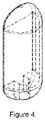
- Figure 4 shows an example of the second housing 15 for the second sensor 14 according to an embodiment of the invention.
- the second housing 15 includes a relatively rigid portion that securely retains the electronic components, and a more resilient portion which functions as an outer layer to provide shock absorption.
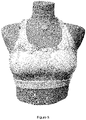
- the second sensor 14 may be positioned against the skin of the user, such as, for example, adhered to the skin of the user, or may be configured for placement in a receptacle on an article of clothing, such as a bra, over the breast tissue of the user as shown in Figure 5 .
- the receptacle on the article of clothing is on a surface of the article of clothing facing away from the user.
- the receptacle is on a surface of the article of clothing facing towards the user.
- the second sensor 14 is placed in a receptacle on a bra that is worn by the user for purposes of measuring breast tissue acceleration. In various embodiments described herein, this bra may be referred to as a "reference bra".
- the orientation of each of the first sensor 12 and the second sensor 14 can affect the acceleration measurements, and therefore, the orientation of the sensors needs to be calibrated before positioning the first and second sensors 12 and 14 onto the body.
- the orientation of the first and second sensors 12 and 14 needs to be within an upper and a lower threshold limit of the offset angle of the sensors 12 and 14 when positioned onto the body.
- the rotation of the first and second sensors 12 and 14 needs to be within about ⁇ 10 degrees of the offset angle when positioned onto the body.
- Each of the first and second sensors 12 and 14 will detect the calibration values for each axis (x-, y-, and z-values) and convert them into an offset angle. If the offset angle is outside the threshold limits of about ⁇ 10 degrees, the sensor will send an output signal to the user to rotate the sensor in a pre-determined direction for the sensor to be properly aligned.
- the senor Once the sensor is oriented within the ⁇ 10 degrees threshold limits, it will send an output calibration signal to the user to attach the appropriate sensor onto the body. For example, once the first sensor 12 is oriented within the threshold limits, it will send a signal to the user to position the sensor on its pre-determined position onto the body, for example, onto the sternum. Once the second sensor 14 is oriented within the upper and lower threshold limits, it will send a signal to the user to position the sensor to its predetermined position onto the body, for example, onto the breast area.
- the output calibration signal can be a visual output signal, such as a light or an image, a sound output signal, or a vibrational output signal.
- the processing of the calibration values for each of the first and second sensors 12 and 14 can be done by a sensor orientation calibration processor integrated within each of the sensors or that is separate from the first and second sensors 12 and 14 and is operatively connected to the sensors.
- the sensor orientation calibration processor will receive the calibration values for each of the sensors, process such values to calculate the offset angle of each sensor, compare if the offset angle is within the upper and lower threshold limits, and send an appropriate output signal to the user.
- the first and second triaxial accelerometers may be MEMS 14-bit, triaxial accelerometers.
- the first and second triaxial accelerometers can measure three-dimensional acceleration from ground to ground, or stride to stride, contact of the user's feet during activity.
- the activity may be any activity that involves a change of direction.
- the activity may be running or any other activity such as, for example, walking, jumping, etc.
- the sensor system 10 further comprises a microprocessor 16 operatively connected to the first and second sensors 12 and 14.
- the microprocessor 16 can be the same or separate from the sensor orientation calibration processor.
- the microprocessor 16 may be any of various microprocessors as will be recognized by those of ordinary skill in the art.
- the microprocessor 16 is configured to receive data signals from the first and second sensors 12 and 14, and other component parts of the sensor system 10, and process such signals.
- the first and second sensors 12 and 14 may generate two bits of data per stride of the user during activity which correspond to the peak to peak acceleration in m/s 2 for each stride in one or more of the x-axis, y-axis and z-axis.
- the data from the first and second sensors 12 and 14 is synchronized to each stride of the user.
- the microprocessor 16 is on the first sensor 12. In other embodiments, the microprocessor 16 is on the second sensor 14.
- Raw acceleration data collected by the first and second sensors 12 and 14 may be processed by the microprocessor 16 and/or delivered to a remote server for further processing.
- Typical processing may include averaging the peak to peak measurements of acceleration along the reference x-axis, y-axis and/or z-axis from the first sensor 12 and/or averaging the peak to peak measurements of breast tissue acceleration from the second sensor 14 along each axis. For each axis, the sum of peak to peak acceleration may be divided by the number of data points (or strides).
- processing may also include using the acceleration data from the first and second sensors 12 and 14 to determine an axial offset and a magnitude of breast tissue acceleration relative to the acceleration of the torso of the user along the reference x-axis, y-axis and/or z-axis.
- Such processing may comprise comparing the average peak to peak acceleration of breast tissue along one axis to the average peak to peak acceleration of the torso along the same reference axis or vector.
- the axial offset and magnitude of breast tissue acceleration may be processed to determine one or more of relative medial/lateral, anterior/posterior and/or superior/inferior breast tissue acceleration.
- the acceleration data may be processed into different forms and formats, depending on the particular device that will be ultimately used to view the data.
- the microprocessor 16 may use SPI to send data between the first or second sensors 12 and 14, and the microprocessor 16.
- the microprocessor 16 may be connected to a memory 18 and a first transceiver 20, and may deliver processed data to one or both of the memory 18 and the first transceiver 20. Additionally, the microprocessor 16 may perform processing of the received data prior to delivery thereof to the memory 18 or the first transceiver 20 as described above.
- the memory 18 is configured to store information, including both data and instructions.
- the data generally include acceleration data that may be retrieved from the microprocessor 16 along with other data that may be ancillary to the basic operation of the microprocessor 16.
- the instructions which are stored at the memory 18 generally include firmware and/or software for execution by the microprocessor 16, such as a program that controls the settings for the first and second sensors 12 and 14, a program that controls averaging peak to peak acceleration data from the first and second sensors 12 and 14, a program that controls calibration of the orientation of the sensors 12 and 14, a program that controls the processing of acceleration data from the first sensor 12 and the second sensor 14 to determine an axial offset and magnitude of breast tissue acceleration relative to the acceleration of the torso of the user along the reference x-axis, y-axis and z-axis, a program that controls the processing of acceleration data to determine relative medial/lateral, anterior/posterior and/or superior/inferior breast tissue acceleration with respect to the torso of the user, a program that controls the receipt
- the memory 18 may be of any type capable of storing information accessible by the microprocessor 16, such as ROM, RAM, write-capable, read-only memories, or other computer-readable media.
- the data may also be formatted in any computer-readable format such as, but not limited to, binary values, ASCII or Unicode.
- the first transceiver 20 comprises a RF transmitter and receiver configured to transmit and receive communications signals over a short range using a wireless communications technology, such as Bluetooth ® , using any of various communications protocols.
- a wireless communications technology such as Bluetooth ®
- the first transceiver 20 is configured to communicate with a display device 22 when the first transceiver 20 is within a given range of the display device 22, and transmit acceleration data to the display device 22.
- the first transceiver 20 is configured to transmit a wireless RF signal representative of acceleration data collected and obtained at the microprocessor 16 to at least the display device 22.
- the power source (not shown) is configured to provide power to one or more of the microprocessor 16 and the first and second sensors 12 and 14 during use.
- the power source is a battery such as a rechargeable battery.
- the display device 22 may be a standalone device such as a desktop PC or smart television or any type of portable or other personal electronic device such as a smartphone, tablet computer, laptop computer, smartwatch, or any of various other mobile computing devices.
- the components of the display device may vary depending on the type of display device used.
- the display device 22 generally includes an input/output interface 24, a processor 26, a memory 28 and a second transceiver 30.
- the I/O interface 24 of the display device 22 includes software and hardware configured to facilitate communications with the first transceiver 20 and/or communications to the user.
- the hardware includes a display screen 32 configured to visually display graphics, text and other data to the user.
- the display screen 32 is configured to display breast tissue movement or acceleration data received from the microprocessor 16 via the first transceiver 20.
- the hardware may also include a microphone and/or speakers to facilitate audio communications with the user and/or verbal entry of commands to the device.
- the display screen is a touch screen display that allows the user to see data presented on the display screen and input data into the display device via a keyboard on the touch screen.
- the processor 26 of the display device 22 may be any of various processors as will be recognized by those of ordinary skill in the art.
- the processor 26 is connected to the I/O interface 24, the memory 28, and the second transceiver 30, and is configured to deliver data to and/or receive data from each of these components.
- the processor 26 is configured to process breast tissue movement or acceleration data received from the microprocessor 16 via the first transceiver 20 and transform the data into a graphical format for presentation on the display screen.
- a "processor" as used herein includes any hardware system, hardware mechanism or hardware component that processes data, signals or other information.
- a processor can include a system with a central processing unit, multiple processing units, dedicated circuitry for achieving functionality, or other systems.
- the memory 28 is configured to store information, including both data and instructions.
- the data may be breast tissue movement or acceleration data, along with other data that may be ancillary to the basic operation of the display device and any applications retained on the display device.
- the instructions which are stored at the memory 28 generally include firmware and other software for execution by the processor 26, such as a program that controls the settings for the display device 22, a program that controls the output of the display on the display device 22, programs that control various applications on the display device 22, a program that controls the transmission and reception of data via the second transceiver 30, as well as any of various other programs that may be associated with the display device 22.
- the instructions stored in the memory 28 for execution by the processor 26 may include, for example, an app for recommending an undergarment such as a bra to the user.
- the memory 28 may be of any type of device capable of storing information accessible by the processor 26, such as a memory card, ROM, RAM, write-capable memories, read-only memories, hard drives, discs, flash memory, or any of various other computer-readable medium serving as data storage devices as known by a person of ordinary skill in the art.
- portions of the system and methods described herein may be implemented in suitable software code that may reside within the memory ( 18 and/or 28 ). Such software code may be present on the device or microprocessor at the time of manufacture or may be downloaded thereto via well-known mechanisms.
- a computer program product implementing an embodiment disclosed herein may therefore comprise one or more computer-readable storage media storing computer instructions translatable by a processor or microprocessor to provide an embodiment of a system or perform an embodiment of a method disclosed herein.
- Computer instructions may be provided by lines of code in any of various languages as will be recognized by those of ordinary skill in the art.
- a "computer-readable medium” may be any type of data storage medium that can store computer instructions, including, but not limited to, the memory devices discussed above.
- the second transceiver 30 is an RF transmitter and receiver configured to transmit and receive communications signals over a short range using wireless communications technology, such as Bluetooth ® , using any of various communications protocols.
- the second transceiver 30 is configured to communicate with the first transceiver 20.
- the transmission of data from the first transceiver 20 to the display device 22 may occur automatically without the user needing to prompt the transmission. For example, some mechanism may be used to turn on the first transceiver 20 or otherwise indicate that automatic transmissions should begin. In another embodiment, the first transceiver 20 may be configured to begin transmissions once it receives a confirmation that the display device 22 is within an appropriate range of the first transceiver 20. In yet another embodiment, data transmission may occur periodically at predetermined intervals of time.
- the display device 22 also includes a battery or other power source (not shown) configured to power the various electronic components within the display device 22.
- the memory (18 and/or 28) is configured to store data of a plurality of known breast motion profiles in a breast motion profile database.
- the axial offset and magnitude of breast tissue acceleration during an activity such as running, walking or jumping while wearing a particular bra or a reference bra can be measured using a number of motion capturing devices, and such data is processed to determine one or more of relative medial/lateral, anterior/posterior and/or superior/inferior breast tissue acceleration during the particular activity, and to determine a particular breast motion profile for the bra at certain static breast parameters, which is stored in the breast motion profile database.
- Computer instructions can also be provided by lines of code in any of various languages as will be recognized by those of ordinary skill in the art.
- the data obtained from the first and the second sensors 12 and 14 are processed to determine the relative medial/lateral, anterior/posterior and/or superior/inferior breast tissue acceleration of the user wearing the particular bra or reference bra at specific static breast parameters during the particular activity and then the data of the relative medial/lateral, anterior/posterior and/or superior/inferior breast tissue acceleration is compared to the data included in the breast motion profile database in order to find the closest match which may be displayed to the user as a breast motion profile.
- the data of the relative medial/lateral, anterior/posterior and/or superior/inferior breast tissue acceleration is scaled to determine the breast motion profile for display to the user.
- the database can also include data on a plurality of bras in addition to the reference bra which may form part of one or more bra recommendation areas or a selection of bras as discussed below, parameters relating to bras in the database which may include, for example, descriptions of "feeling" associated with each of the bras and differences in medial/lateral, anterior/posterior and/or superior/inferior acceleration measurements between the reference bra and each bra in the database, etc.
- Figure 6 shows one format of a breast motion profile in which the personal breast tissue acceleration data are presented to the user via the screen 32.
- the acceleration data may be processed and displayed using the software application or "app" stored in a computer readable medium such as the memory 28 of the display device 22.
- the processor of the display device is configured to process the instructions for the app.
- the processor 26 may be controlled by computer-executable instructions stored in memory 28 so as to provide functionality as is described herein.
- the processor may process the breast tissue movement or acceleration data in order to present the data in a format for quickly and easily communicating the data to the user.
- the display device 22 includes a screen 32 configured to display the processed data.
- a non-transient computer readable medium contains instructions for controlling a display device by receiving breast tissue acceleration data from the microprocessor 16 and presenting a breast motion profile for the wearer on the display device and recommending an undergarment, such as a bra, to the wearer.
- the methods disclosed herein provide a customized fit and/or recommendation for undergarments, such as bras.
- the methods disclosed herein are based on an optimized fitting of the acceleration profile of breast tissue of the user with the functional characteristics of a bra to reduce or control that acceleration in each axis to a threshold level.
- Theshold level refers to a range of combinations of at least two of medial/lateral, superior/inferior and anterior/posterior acceleration values that are perceived as comfortable or uncomfortable to a population of users for a particular bra or a reference bra at specific static breast parameters.
- the threshold level can be determined based on measurements of a population of users wearing a particular bra, such as the reference bra, for specific static breast parameters.
- the threshold level may also depend on an activity being done by a user. For example, one undergarment may have a different threshold level for running as compared to the threshold level for yoga.
- static breast parameters refers to measureable characteristics of breast tissue when the user is not engaged in activity. Any value or combination of values below the threshold level for each of medial/lateral acceleration, superior/inferior acceleration and/or anterior/posterior acceleration may be viewed as providing support and comfort to a user during activity when wearing the particular bra.
- the user may require an undergarment which provides for greater reduction in medial/lateral acceleration in order to be comfortable during activity, or the user may require an undergarment which provides for greater reduction in anterior/superior acceleration in order to feel comfortable during activity.
- the user may require an undergarment which provides for approximately equal reduction in both medial/lateral and anterior/superior acceleration in order to feel comfortable during activity.
- various combinations of values for medial/lateral and superior/inferior acceleration may be perceived as comfortable or uncomfortable by a population of users when wearing a particular bra or a reference bra for specific static breast parameters and therefore defines the threshold level.
- the methods as disclosed herein recommend an undergarment to the user that decreases one or more of the medial/lateral acceleration, superior/inferior acceleration or anterior/posterior acceleration so that the user is more comfortable compared to the reference bra.
- the method includes providing input on static breast parameters of the user (110), the static breast parameters may comprise a circumference of a torso of the user and a breast cup size of the user.
- the static breast parameters may comprise a circumference of a torso of the user and a breast cup size of the user.
- user underband and bust size can be measured to determine bra size and a size of a reference bra that the user can use during an activity.
- the static breast parameters may be input to the display device 22.
- the method further includes measuring breast tissue acceleration (120) using a sensor system as described herein.
- the breast tissue acceleration of the user may be measured while the user wears the reference bra during the activity, such as running.
- Data obtained from the sensors 12 and 14 are processed to obtained the user's medial/lateral and superior/inferior breast tissue acceleration (peak to peak) and compare the value of the user's breast acceleration to the acceleration data in the breast motion profile database to find the closest match and determine the user's breast movement profile.
- the user's breast tissue acceleration data is compared to the threshold level for the reference bra at the inputted static breast parameters (130).
- the measured medial/lateral and/or superior/inferior acceleration may have higher values than the threshold level of the reference bra at the inputted static breast parameters and the user may experience discomfort while undertaking the activity while wearing the reference bra.
- the measured axial offset and/or magnitude of breast tissue acceleration exceeds the threshold level.
- the processor 26 processes the data related to the breast acceleration profile and provides an output or a recommendation to the user for an undergarment (i.e., bra) in the user's size so that the breast acceleration remains below the threshold level for the recommended undergarment.
- the recommended undergarment provides the desired control for the user's unique breast motion profile in order to increase the user's comfort while engaged in the activity (140).
- the method recommends a bra from a selection of bras (also referred to as the "bra recommendation area") that provides more control in the medial/lateral direction compared to the reference bra. If the user's acceleration profile indicates greater values of acceleration in both the superior/inferior and the medial/lateral directions compared to the threshold level for the reference bra, then the method recommends a bra from a selection of bras or from a bra recommendation area that provides more control in the superior/inferior and medial/lateral directions compared to the reference bra.
- each bra in the selection of bras or bra recommendation area decreases one or more of the medial/lateral, superior/inferior and/or anterior/posterior acceleration is pre-determined based on the obtained data of the acceleration profile and this data is stored in the display device 22. Wearing the recommended bra, the user experiences an increased level of comfort, as a result of reduced medial/lateral, superior/inferior, and/or anterior/posterior acceleration of breast tissue during activity.
- the method may further comprise receiving comfort perception data from the user.
- comfort perception data may include intended activity of the user while wearing the undergarment and other characteristics preferred by a user. The higher the intensity of intended activity of the user while wearing the undergarment, generally the greater the reduction in breast tissue acceleration required by the user.
- "Perception” as used herein refers to a personal feeling or subjective perception of one's own feeling of comfort as determined by the user based on the user's own senses, feelings, awareness, mental impressions or other perceptions of the user.
Landscapes
- Health & Medical Sciences (AREA)
- Life Sciences & Earth Sciences (AREA)
- Engineering & Computer Science (AREA)
- Medical Informatics (AREA)
- Surgery (AREA)
- Biophysics (AREA)
- Pathology (AREA)
- Veterinary Medicine (AREA)
- Biomedical Technology (AREA)
- Heart & Thoracic Surgery (AREA)
- Public Health (AREA)
- Molecular Biology (AREA)
- Physics & Mathematics (AREA)
- Animal Behavior & Ethology (AREA)
- General Health & Medical Sciences (AREA)
- Dentistry (AREA)
- Oral & Maxillofacial Surgery (AREA)
- Physiology (AREA)
- Computer Networks & Wireless Communication (AREA)
- Measurement Of The Respiration, Hearing Ability, Form, And Blood Characteristics Of Living Organisms (AREA)
- Apparatus For Radiation Diagnosis (AREA)
Claims (11)
- Sensorsystem (10) zum Messen der Bewegung von Brustgewebe während einer Aktivität, wobei das Sensorsystem aufweist:einen ersten Sensor (12) zur Platzierung auf dem Brustbein einer Benutzerin, wobei der erste Sensor (12) einen ersten Beschleunigungsmesser zur Erzeugung von Beschleunigungsdaten aufweist, wobei die Beschleunigungsdaten die Beschleunigung des Rumpfes des Benutzers entlang einer Referenz-X-Achse, -Y-Achse und/oder -Z-Achse anzeigen;einen mit dem ersten Sensor (12) wirkverbundenen zweiten Sensor (14) zur Platzierung auf dem Brustgewebe der Benutzerin, wobei der zweite Sensor (14) einen zweiten Beschleunigungsmesser zur Erzeugung von Beschleunigungsdaten umfasst, wobei die Beschleunigungsdaten die Beschleunigung des Brustgewebes der Benutzerin anzeigen; undeinen Mikroprozessor (16), der mit dem ersten und dem zweiten Sensor (12 und 14) wirkverbunden und so konfiguriert ist, dass er die Beschleunigungsdaten von dem ersten Sensor (12) und dem zweiten Sensor (14) verwendet, um das Ausmaß der Brustgewebebeschleunigung relativ zu dem Rumpf des Benutzers entlang der Referenz-Achse, -Y-Achse und/oder -Z-Achse zu bestimmen und relative mediale/laterale, anteriore/posteriore und/oder superior/inferiore Brustgewebebeschleunigungsdaten aus dem Ausmaß der Brustgewebebeschleunigung relativ zum Rumpf der Benutzerin entlang der Referenz-Achse, -Y-Achse und/oder -Z-Achse zu bestimmen,wobei der Mikroprozessor (16) weiterhin so konfiguriert ist, dass er die relativen medialen/lateralen, anterioren/posterioren und/oder superioren/inferioren Brustgewebebeschleunigungsdaten der Benutzerin mit einer Brustbewegungsprofildatenbank bekannter Brustbewegungsprofile vergleicht, um eine engste Übereinstimmung zu finden und auf der Grundlage der ermittelten Daten zur Beschleunigung des Brustgewebes die engste Übereinstimmung entsprechend zu skalieren, um ein Brustbewegungsprofil für die Benutzerin zu bestimmen.
- Sensorsystem (10) nach Anspruch 1,
wobei der erste Beschleunigungsmesser und der zweite Beschleunigungsmesser triaxiale Beschleunigungsmesser sind. - Sensorsystem (10) nach Anspruch 1 oder 2,wobei der Mikroprozessor (16) weiterhin so konfiguriert ist, dass er einen axialen Versatz der Brustgewebebeschleunigung relativ zum Rumpf der Benutzerin entlang der Referenz-X-Achse, -Y-Achse und/oder -Z-Achse bestimmt, und/oderwobei der Mikroprozessor (16) weiterhin so konfiguriert ist, dass er vor seiner Platzierung auf dem Brustbein bzw. dem Brustgewebe der Benutzerin die Ausrichtung des ersten Sensors (12) und des zweiten Sensors (14) auf ±10 Grad der Versatzwinkel der Sensoren kalibriert.
- Sensorsystem (10) nach einem der vorangehenden Ansprüche, weiterhin aufweisend eine Anzeigevorrichtung (22), die so konfiguriert ist, dass sie das Brustbewegungsprofil anzeigt.
- Sensorsystem (10) nach einem der vorangehenden Ansprüche, weiterhin aufweisend ein erstes Gehäuse (13), das den ersten Sensor (12) enthält, und ein zweites Gehäuse (15), das den zweiten Sensor (14) enthält.
- Sensorsystem (10) nach Anspruch 5,wobei das erste Gehäuse (13) den Mikroprozessor (16) enthält, oderdas zweite Gehäuse (15) den Mikroprozessor (16) enthält.
- Sensorsystem (10) nach Anspruch 5 oder 6, wobei das erste Gehäuse (13) einen Klebstoff zur Befestigung des ersten Gehäuses (13) am Brustbein der Benutzerin auf einer der Benutzerin zugewandten Oberfläche des ersten Gehäuses (13) aufweist.
- Sensorsystem (10) nach einem der vorangehenden Ansprüche, wobei der zweite Sensor (14) zur Platzierung in einer Aufnahmeeinrichtung an einem Kleidungsstück über dem Brustgewebe der Benutzerin vorgesehen ist, wobei sich die Aufnahmeeinrichtung an dem Kleidungsstück vorzugsweise auf einer der Benutzerin zugewandten Oberfläche des Kleidungsstücks oder auf einer der Benutzerin abgewandten Oberfläche des Kleidungsstücks befindet, und wobei der zweite Sensor (14) besonders bevorzugt zur Platzierung über einer Brustwarze der Benutzerin vorgesehen ist.
- Sensorsystem (10) nach einem der Ansprüche 1 bis 13, weiterhin aufweisend einen ersten Transceiver (20), wobei der Transceiver (20) so betrieben werden kann, dass er drahtlos Beschleunigungsdaten überträgt.
- Verfahren zur Erzeugung eines Brustbewegungsprofils für eine Benutzerin, wobei das Verfahren von einem Mikroprozessor ausgeführt wird, umfassend:Erhalten von ersten Beschleunigungsdaten, die die Beschleunigung des Rumpfes der Benutzerin entlang der Referenz-X-Achse, -Y-Achse und/oder -Z-Achse anzeigen;Erhalten von zweiten Beschleunigungsdaten, die die Beschleunigung des Brustgewebes der Benutzerin anzeigen;Verwenden der ersten und zweiten Beschleunigungsdaten zum Bestimmen eines axialen Versatzes und/oder des Ausmaßes der Brustgewebebeschleunigung relativ zum Rumpf der Benutzerin;Bestimmen relativer medialer/lateraler, anteriorer/posteriorer und/oder superiorer/inferiorer Brustgewebebeschleunigungsdaten aus dem bestimmten Ausmaß der Brustgewebebeschleunigung relativ zum Rumpf der Benutzerin;Vergleichen der ermittelten Daten der medialen/lateralen, anterioren/posterioren und/oder superioren/inferioren Brustgewebebeschleunigung der Benutzerin mit einer Datenbank bekannter Brustbewegungsprofile, um die engste Übereinstimmung zu finden; undErzeugen des Brustbewegungsprofils für die Benutzerin durch Skalieren der engsten Übereinstimmung auf der Grundlage der bestimmten relativen medialen/lateralen, anterioren/posterioren und/oder superioren/inferioren Brustgewebebeschleunigungsdaten.
- Computerlesbares Medium mit darauf gespeichertem Computerprogrammcode, wobei der Computerprogrammcode bei Ausführung durch einen oder mehrere Prozessoren den einen oder mehrere Prozessoren zur Ausführung des Verfahrens nach Anspruch 10 veranlasst.
Priority Applications (1)
| Application Number | Priority Date | Filing Date | Title |
|---|---|---|---|
| EP22213513.9A EP4218564B1 (de) | 2018-09-20 | 2019-09-16 | Sensor und verfahren zur messung der bewegung von brustgewebe während der aktivität |
Applications Claiming Priority (2)
| Application Number | Priority Date | Filing Date | Title |
|---|---|---|---|
| US201862734217P | 2018-09-20 | 2018-09-20 | |
| PCT/CA2019/051310 WO2020056498A1 (en) | 2018-09-20 | 2019-09-16 | Sensor and method for measuring movement of breast tissue during activity |
Related Child Applications (1)
| Application Number | Title | Priority Date | Filing Date |
|---|---|---|---|
| EP22213513.9A Division EP4218564B1 (de) | 2018-09-20 | 2019-09-16 | Sensor und verfahren zur messung der bewegung von brustgewebe während der aktivität |
Publications (3)
| Publication Number | Publication Date |
|---|---|
| EP3852624A1 EP3852624A1 (de) | 2021-07-28 |
| EP3852624A4 EP3852624A4 (de) | 2022-01-26 |
| EP3852624B1 true EP3852624B1 (de) | 2022-12-21 |
Family
ID=69886797
Family Applications (2)
| Application Number | Title | Priority Date | Filing Date |
|---|---|---|---|
| EP22213513.9A Active EP4218564B1 (de) | 2018-09-20 | 2019-09-16 | Sensor und verfahren zur messung der bewegung von brustgewebe während der aktivität |
| EP19863650.8A Active EP3852624B1 (de) | 2018-09-20 | 2019-09-16 | Sensor und verfahren zur messung der bewegung von brustgewebe während der aktivität |
Family Applications Before (1)
| Application Number | Title | Priority Date | Filing Date |
|---|---|---|---|
| EP22213513.9A Active EP4218564B1 (de) | 2018-09-20 | 2019-09-16 | Sensor und verfahren zur messung der bewegung von brustgewebe während der aktivität |
Country Status (5)
| Country | Link |
|---|---|
| US (1) | US20210345911A1 (de) |
| EP (2) | EP4218564B1 (de) |
| CN (1) | CN112739260B (de) |
| CA (1) | CA3112272C (de) |
| WO (1) | WO2020056498A1 (de) |
Families Citing this family (2)
| Publication number | Priority date | Publication date | Assignee | Title |
|---|---|---|---|---|
| CN117441181A (zh) * | 2021-03-18 | 2024-01-23 | 加拿大露露乐檬运动用品有限公司 | 用于生成或修改服装样式的系统、方法和界面 |
| CN119149861A (zh) * | 2024-08-12 | 2024-12-17 | 苏州大学 | 基于乳房和文胸相互力学作用的乳房质量测量方法及系统 |
Family Cites Families (12)
| Publication number | Priority date | Publication date | Assignee | Title |
|---|---|---|---|---|
| GB2501269A (en) * | 2012-04-17 | 2013-10-23 | Poorandokht Anvar | A breast weighing system |
| US10018466B2 (en) * | 2013-04-18 | 2018-07-10 | Van De Velde Nv | Bra fitting method |
| CN103445787A (zh) * | 2013-08-30 | 2013-12-18 | 单学蕾 | 一种评价文胸对女性乳房保护作用的方法及装置 |
| US10285625B2 (en) * | 2013-10-07 | 2019-05-14 | Wahoo Fitness Llc | Activity monitoring computing device and system |
| US9173596B1 (en) * | 2014-06-28 | 2015-11-03 | Bertec Limited | Movement assessment apparatus and a method for providing biofeedback using the same |
| US10426202B2 (en) * | 2016-01-19 | 2019-10-01 | Recovery Force, LLC | System for minimizing multi-dimensional displacement of the body |
| US10188152B2 (en) * | 2016-01-19 | 2019-01-29 | Recovery Force, LLC | System for minimizing multi-dimensional breast displacement |
| WO2017143312A1 (en) * | 2016-02-19 | 2017-08-24 | Cahan Anthony Crawford | Support garment with cantilevered sinusoidal support form |
| CN106388018A (zh) * | 2016-09-20 | 2017-02-15 | 宏杰内衣股份有限公司 | 一种带人体躯干运动姿态识别和评价功能的运动内衣 |
| GB2558306B (en) * | 2016-12-30 | 2020-10-07 | Suunto Oy | A wearable garment as well as a system and method for determining the support provided by a wearable garment |
| CN108366636B (zh) * | 2017-03-08 | 2020-06-05 | 厦门波耐模型设计有限责任公司 | 一种人体胸部尺寸测量计量方法、内衣尺码选择及实现方法 |
| US11122994B2 (en) * | 2017-06-16 | 2021-09-21 | Medstar Health | Systems and methods for injury prevention and rehabilitation |
-
2019
- 2019-09-16 EP EP22213513.9A patent/EP4218564B1/de active Active
- 2019-09-16 CN CN201980061585.9A patent/CN112739260B/zh active Active
- 2019-09-16 US US17/277,899 patent/US20210345911A1/en not_active Abandoned
- 2019-09-16 EP EP19863650.8A patent/EP3852624B1/de active Active
- 2019-09-16 CA CA3112272A patent/CA3112272C/en active Active
- 2019-09-16 WO PCT/CA2019/051310 patent/WO2020056498A1/en not_active Ceased
Also Published As
| Publication number | Publication date |
|---|---|
| CN112739260B (zh) | 2024-08-27 |
| CN112739260A (zh) | 2021-04-30 |
| EP3852624A1 (de) | 2021-07-28 |
| US20210345911A1 (en) | 2021-11-11 |
| EP4218564A2 (de) | 2023-08-02 |
| EP4218564B1 (de) | 2025-12-31 |
| CA3112272C (en) | 2021-11-23 |
| CA3112272A1 (en) | 2020-03-26 |
| EP4218564A3 (de) | 2023-09-20 |
| WO2020056498A1 (en) | 2020-03-26 |
| EP3852624A4 (de) | 2022-01-26 |
Similar Documents
| Publication | Publication Date | Title |
|---|---|---|
| EP3010414B1 (de) | Gangüberwachungseinheit und verfahren zur überwachung des gangs einer person | |
| CN107095677B (zh) | 步态分析系统及方法 | |
| US20180125423A1 (en) | System and method for activity monitoring eyewear and head apparel | |
| US10765345B2 (en) | Method and system for determining a length of an object using an electronic device | |
| US20160146848A1 (en) | Subject monitor | |
| US20170164899A1 (en) | Devices embedded smart shoes | |
| KR101975585B1 (ko) | 신축성 센서를 이용한 보행 분석 시스템 및 보행 코칭 방법 | |
| KR20170072888A (ko) | 자세 개선 장치, 개선 시스템, 및 개선 방법 | |
| KR101659154B1 (ko) | 보행 알림 장치 및 보행 알림 장치의 동작 방법 | |
| CN110236555B (zh) | 姿势和深呼吸改善装置、系统和方法 | |
| EP3852624B1 (de) | Sensor und verfahren zur messung der bewegung von brustgewebe während der aktivität | |
| CN112617805A (zh) | 一种足部监测系统 | |
| KR20180075060A (ko) | 둥근 어깨 자세를 교정하는 자세교정시스템 | |
| KR101905695B1 (ko) | 넥밴드형 웨어러블 장치 및 이를 이용한 활동알림 시스템 | |
| CN117582645A (zh) | 健身跟踪装置及方法 | |
| KR20160098566A (ko) | 웨어러블 기기를 이용한 신체변화 정보제공 시스템 및 그 방법 | |
| US20240082004A1 (en) | Sensory modulation systems for improving gait function and/or balance control and related methods | |
| EP3326518B1 (de) | Tragbare vorrichtung zur überwachung der körperhaltung | |
| CN211750326U (zh) | 一种人体智能穿戴装置 | |
| HK40012656A (en) | Posture and deep breathing improvement device, system, and method | |
| KR20170071760A (ko) | 스마트 스포츠 브라 |
Legal Events
| Date | Code | Title | Description |
|---|---|---|---|
| STAA | Information on the status of an ep patent application or granted ep patent |
Free format text: STATUS: THE INTERNATIONAL PUBLICATION HAS BEEN MADE |
|
| PUAI | Public reference made under article 153(3) epc to a published international application that has entered the european phase |
Free format text: ORIGINAL CODE: 0009012 |
|
| STAA | Information on the status of an ep patent application or granted ep patent |
Free format text: STATUS: REQUEST FOR EXAMINATION WAS MADE |
|
| 17P | Request for examination filed |
Effective date: 20210319 |
|
| AK | Designated contracting states |
Kind code of ref document: A1 Designated state(s): AL AT BE BG CH CY CZ DE DK EE ES FI FR GB GR HR HU IE IS IT LI LT LU LV MC MK MT NL NO PL PT RO RS SE SI SK SM TR |
|
| DAV | Request for validation of the european patent (deleted) | ||
| DAX | Request for extension of the european patent (deleted) | ||
| A4 | Supplementary search report drawn up and despatched |
Effective date: 20220104 |
|
| RIC1 | Information provided on ipc code assigned before grant |
Ipc: A61B 5/00 20060101ALI20211221BHEP Ipc: A61B 5/107 20060101ALI20211221BHEP Ipc: A61B 5/11 20060101AFI20211221BHEP |
|
| RIC1 | Information provided on ipc code assigned before grant |
Ipc: A61B 5/00 20060101ALI20220824BHEP Ipc: A61B 5/107 20060101ALI20220824BHEP Ipc: A61B 5/11 20060101AFI20220824BHEP |
|
| GRAP | Despatch of communication of intention to grant a patent |
Free format text: ORIGINAL CODE: EPIDOSNIGR1 |
|
| STAA | Information on the status of an ep patent application or granted ep patent |
Free format text: STATUS: GRANT OF PATENT IS INTENDED |
|
| GRAS | Grant fee paid |
Free format text: ORIGINAL CODE: EPIDOSNIGR3 |
|
| INTG | Intention to grant announced |
Effective date: 20221018 |
|
| GRAA | (expected) grant |
Free format text: ORIGINAL CODE: 0009210 |
|
| STAA | Information on the status of an ep patent application or granted ep patent |
Free format text: STATUS: THE PATENT HAS BEEN GRANTED |
|
| AK | Designated contracting states |
Kind code of ref document: B1 Designated state(s): AL AT BE BG CH CY CZ DE DK EE ES FI FR GB GR HR HU IE IS IT LI LT LU LV MC MK MT NL NO PL PT RO RS SE SI SK SM TR |
|
| REG | Reference to a national code |
Ref country code: GB Ref legal event code: FG4D |
|
| REG | Reference to a national code |
Ref country code: DE Ref legal event code: R096 Ref document number: 602019023526 Country of ref document: DE |
|
| REG | Reference to a national code |
Ref country code: CH Ref legal event code: EP |
|
| REG | Reference to a national code |
Ref country code: AT Ref legal event code: REF Ref document number: 1538537 Country of ref document: AT Kind code of ref document: T Effective date: 20230115 |
|
| REG | Reference to a national code |
Ref country code: IE Ref legal event code: FG4D |
|
| REG | Reference to a national code |
Ref country code: LT Ref legal event code: MG9D |
|
| REG | Reference to a national code |
Ref country code: NL Ref legal event code: MP Effective date: 20221221 |
|
| PG25 | Lapsed in a contracting state [announced via postgrant information from national office to epo] |
Ref country code: SE Free format text: LAPSE BECAUSE OF FAILURE TO SUBMIT A TRANSLATION OF THE DESCRIPTION OR TO PAY THE FEE WITHIN THE PRESCRIBED TIME-LIMIT Effective date: 20221221 Ref country code: NO Free format text: LAPSE BECAUSE OF FAILURE TO SUBMIT A TRANSLATION OF THE DESCRIPTION OR TO PAY THE FEE WITHIN THE PRESCRIBED TIME-LIMIT Effective date: 20230321 Ref country code: LT Free format text: LAPSE BECAUSE OF FAILURE TO SUBMIT A TRANSLATION OF THE DESCRIPTION OR TO PAY THE FEE WITHIN THE PRESCRIBED TIME-LIMIT Effective date: 20221221 Ref country code: FI Free format text: LAPSE BECAUSE OF FAILURE TO SUBMIT A TRANSLATION OF THE DESCRIPTION OR TO PAY THE FEE WITHIN THE PRESCRIBED TIME-LIMIT Effective date: 20221221 |
|
| REG | Reference to a national code |
Ref country code: AT Ref legal event code: MK05 Ref document number: 1538537 Country of ref document: AT Kind code of ref document: T Effective date: 20221221 |
|
| PG25 | Lapsed in a contracting state [announced via postgrant information from national office to epo] |
Ref country code: RS Free format text: LAPSE BECAUSE OF FAILURE TO SUBMIT A TRANSLATION OF THE DESCRIPTION OR TO PAY THE FEE WITHIN THE PRESCRIBED TIME-LIMIT Effective date: 20221221 Ref country code: LV Free format text: LAPSE BECAUSE OF FAILURE TO SUBMIT A TRANSLATION OF THE DESCRIPTION OR TO PAY THE FEE WITHIN THE PRESCRIBED TIME-LIMIT Effective date: 20221221 Ref country code: HR Free format text: LAPSE BECAUSE OF FAILURE TO SUBMIT A TRANSLATION OF THE DESCRIPTION OR TO PAY THE FEE WITHIN THE PRESCRIBED TIME-LIMIT Effective date: 20221221 Ref country code: GR Free format text: LAPSE BECAUSE OF FAILURE TO SUBMIT A TRANSLATION OF THE DESCRIPTION OR TO PAY THE FEE WITHIN THE PRESCRIBED TIME-LIMIT Effective date: 20230322 |
|
| P01 | Opt-out of the competence of the unified patent court (upc) registered |
Effective date: 20230519 |
|
| PG25 | Lapsed in a contracting state [announced via postgrant information from national office to epo] |
Ref country code: NL Free format text: LAPSE BECAUSE OF FAILURE TO SUBMIT A TRANSLATION OF THE DESCRIPTION OR TO PAY THE FEE WITHIN THE PRESCRIBED TIME-LIMIT Effective date: 20221221 |
|
| PG25 | Lapsed in a contracting state [announced via postgrant information from national office to epo] |
Ref country code: SM Free format text: LAPSE BECAUSE OF FAILURE TO SUBMIT A TRANSLATION OF THE DESCRIPTION OR TO PAY THE FEE WITHIN THE PRESCRIBED TIME-LIMIT Effective date: 20221221 Ref country code: RO Free format text: LAPSE BECAUSE OF FAILURE TO SUBMIT A TRANSLATION OF THE DESCRIPTION OR TO PAY THE FEE WITHIN THE PRESCRIBED TIME-LIMIT Effective date: 20221221 Ref country code: PT Free format text: LAPSE BECAUSE OF FAILURE TO SUBMIT A TRANSLATION OF THE DESCRIPTION OR TO PAY THE FEE WITHIN THE PRESCRIBED TIME-LIMIT Effective date: 20230421 Ref country code: ES Free format text: LAPSE BECAUSE OF FAILURE TO SUBMIT A TRANSLATION OF THE DESCRIPTION OR TO PAY THE FEE WITHIN THE PRESCRIBED TIME-LIMIT Effective date: 20221221 Ref country code: EE Free format text: LAPSE BECAUSE OF FAILURE TO SUBMIT A TRANSLATION OF THE DESCRIPTION OR TO PAY THE FEE WITHIN THE PRESCRIBED TIME-LIMIT Effective date: 20221221 Ref country code: CZ Free format text: LAPSE BECAUSE OF FAILURE TO SUBMIT A TRANSLATION OF THE DESCRIPTION OR TO PAY THE FEE WITHIN THE PRESCRIBED TIME-LIMIT Effective date: 20221221 Ref country code: AT Free format text: LAPSE BECAUSE OF FAILURE TO SUBMIT A TRANSLATION OF THE DESCRIPTION OR TO PAY THE FEE WITHIN THE PRESCRIBED TIME-LIMIT Effective date: 20221221 |
|
| PG25 | Lapsed in a contracting state [announced via postgrant information from national office to epo] |
Ref country code: SK Free format text: LAPSE BECAUSE OF FAILURE TO SUBMIT A TRANSLATION OF THE DESCRIPTION OR TO PAY THE FEE WITHIN THE PRESCRIBED TIME-LIMIT Effective date: 20221221 Ref country code: PL Free format text: LAPSE BECAUSE OF FAILURE TO SUBMIT A TRANSLATION OF THE DESCRIPTION OR TO PAY THE FEE WITHIN THE PRESCRIBED TIME-LIMIT Effective date: 20221221 Ref country code: IS Free format text: LAPSE BECAUSE OF FAILURE TO SUBMIT A TRANSLATION OF THE DESCRIPTION OR TO PAY THE FEE WITHIN THE PRESCRIBED TIME-LIMIT Effective date: 20230421 Ref country code: AL Free format text: LAPSE BECAUSE OF FAILURE TO SUBMIT A TRANSLATION OF THE DESCRIPTION OR TO PAY THE FEE WITHIN THE PRESCRIBED TIME-LIMIT Effective date: 20221221 |
|
| REG | Reference to a national code |
Ref country code: DE Ref legal event code: R097 Ref document number: 602019023526 Country of ref document: DE |
|
| PLBE | No opposition filed within time limit |
Free format text: ORIGINAL CODE: 0009261 |
|
| STAA | Information on the status of an ep patent application or granted ep patent |
Free format text: STATUS: NO OPPOSITION FILED WITHIN TIME LIMIT |
|
| PG25 | Lapsed in a contracting state [announced via postgrant information from national office to epo] |
Ref country code: DK Free format text: LAPSE BECAUSE OF FAILURE TO SUBMIT A TRANSLATION OF THE DESCRIPTION OR TO PAY THE FEE WITHIN THE PRESCRIBED TIME-LIMIT Effective date: 20221221 |
|
| 26N | No opposition filed |
Effective date: 20230922 |
|
| PG25 | Lapsed in a contracting state [announced via postgrant information from national office to epo] |
Ref country code: SI Free format text: LAPSE BECAUSE OF FAILURE TO SUBMIT A TRANSLATION OF THE DESCRIPTION OR TO PAY THE FEE WITHIN THE PRESCRIBED TIME-LIMIT Effective date: 20221221 |
|
| REG | Reference to a national code |
Ref country code: CH Ref legal event code: PL |
|
| PG25 | Lapsed in a contracting state [announced via postgrant information from national office to epo] |
Ref country code: LU Free format text: LAPSE BECAUSE OF NON-PAYMENT OF DUE FEES Effective date: 20230916 |
|
| REG | Reference to a national code |
Ref country code: BE Ref legal event code: MM Effective date: 20230930 |
|
| PG25 | Lapsed in a contracting state [announced via postgrant information from national office to epo] |
Ref country code: LU Free format text: LAPSE BECAUSE OF NON-PAYMENT OF DUE FEES Effective date: 20230916 Ref country code: IT Free format text: LAPSE BECAUSE OF FAILURE TO SUBMIT A TRANSLATION OF THE DESCRIPTION OR TO PAY THE FEE WITHIN THE PRESCRIBED TIME-LIMIT Effective date: 20221221 Ref country code: MC Free format text: LAPSE BECAUSE OF FAILURE TO SUBMIT A TRANSLATION OF THE DESCRIPTION OR TO PAY THE FEE WITHIN THE PRESCRIBED TIME-LIMIT Effective date: 20221221 |
|
| REG | Reference to a national code |
Ref country code: IE Ref legal event code: MM4A |
|
| PG25 | Lapsed in a contracting state [announced via postgrant information from national office to epo] |
Ref country code: IE Free format text: LAPSE BECAUSE OF NON-PAYMENT OF DUE FEES Effective date: 20230916 |
|
| PG25 | Lapsed in a contracting state [announced via postgrant information from national office to epo] |
Ref country code: CH Free format text: LAPSE BECAUSE OF NON-PAYMENT OF DUE FEES Effective date: 20230930 |
|
| PG25 | Lapsed in a contracting state [announced via postgrant information from national office to epo] |
Ref country code: IE Free format text: LAPSE BECAUSE OF NON-PAYMENT OF DUE FEES Effective date: 20230916 Ref country code: CH Free format text: LAPSE BECAUSE OF NON-PAYMENT OF DUE FEES Effective date: 20230930 |
|
| PG25 | Lapsed in a contracting state [announced via postgrant information from national office to epo] |
Ref country code: BE Free format text: LAPSE BECAUSE OF NON-PAYMENT OF DUE FEES Effective date: 20230930 |
|
| PG25 | Lapsed in a contracting state [announced via postgrant information from national office to epo] |
Ref country code: BG Free format text: LAPSE BECAUSE OF FAILURE TO SUBMIT A TRANSLATION OF THE DESCRIPTION OR TO PAY THE FEE WITHIN THE PRESCRIBED TIME-LIMIT Effective date: 20221221 |
|
| PG25 | Lapsed in a contracting state [announced via postgrant information from national office to epo] |
Ref country code: BG Free format text: LAPSE BECAUSE OF FAILURE TO SUBMIT A TRANSLATION OF THE DESCRIPTION OR TO PAY THE FEE WITHIN THE PRESCRIBED TIME-LIMIT Effective date: 20221221 |
|
| PG25 | Lapsed in a contracting state [announced via postgrant information from national office to epo] |
Ref country code: CY Free format text: LAPSE BECAUSE OF FAILURE TO SUBMIT A TRANSLATION OF THE DESCRIPTION OR TO PAY THE FEE WITHIN THE PRESCRIBED TIME-LIMIT; INVALID AB INITIO Effective date: 20190916 |
|
| PG25 | Lapsed in a contracting state [announced via postgrant information from national office to epo] |
Ref country code: HU Free format text: LAPSE BECAUSE OF FAILURE TO SUBMIT A TRANSLATION OF THE DESCRIPTION OR TO PAY THE FEE WITHIN THE PRESCRIBED TIME-LIMIT; INVALID AB INITIO Effective date: 20190916 |
|
| PGFP | Annual fee paid to national office [announced via postgrant information from national office to epo] |
Ref country code: DE Payment date: 20250819 Year of fee payment: 7 |
|
| PGFP | Annual fee paid to national office [announced via postgrant information from national office to epo] |
Ref country code: GB Payment date: 20250916 Year of fee payment: 7 |
|
| PGFP | Annual fee paid to national office [announced via postgrant information from national office to epo] |
Ref country code: FR Payment date: 20250922 Year of fee payment: 7 |
|
| PG25 | Lapsed in a contracting state [announced via postgrant information from national office to epo] |
Ref country code: TR Free format text: LAPSE BECAUSE OF FAILURE TO SUBMIT A TRANSLATION OF THE DESCRIPTION OR TO PAY THE FEE WITHIN THE PRESCRIBED TIME-LIMIT Effective date: 20221221 |