EP3879360A1 - Procédé de commande et/ou de surveillance d'un équipement d'une usine chimique - Google Patents
Procédé de commande et/ou de surveillance d'un équipement d'une usine chimique Download PDFInfo
- Publication number
- EP3879360A1 EP3879360A1 EP20162780.9A EP20162780A EP3879360A1 EP 3879360 A1 EP3879360 A1 EP 3879360A1 EP 20162780 A EP20162780 A EP 20162780A EP 3879360 A1 EP3879360 A1 EP 3879360A1
- Authority
- EP
- European Patent Office
- Prior art keywords
- parameter
- chemical
- plant equipment
- equipment layout
- model
- Prior art date
- Legal status (The legal status is an assumption and is not a legal conclusion. Google has not performed a legal analysis and makes no representation as to the accuracy of the status listed.)
- Withdrawn
Links
- 238000000034 method Methods 0.000 title claims abstract description 228
- 239000000126 substance Substances 0.000 title claims abstract description 210
- 238000012544 monitoring process Methods 0.000 title claims abstract description 33
- 238000004519 manufacturing process Methods 0.000 claims abstract description 102
- 230000000704 physical effect Effects 0.000 claims abstract description 91
- 230000015572 biosynthetic process Effects 0.000 claims abstract description 69
- 238000004088 simulation Methods 0.000 claims abstract description 65
- 239000007787 solid Substances 0.000 claims abstract description 64
- 238000012545 processing Methods 0.000 claims abstract description 58
- 239000012530 fluid Substances 0.000 claims abstract description 28
- 230000008569 process Effects 0.000 claims description 76
- 238000001556 precipitation Methods 0.000 claims description 56
- 238000004590 computer program Methods 0.000 claims description 24
- 238000004891 communication Methods 0.000 claims description 11
- 230000002123 temporal effect Effects 0.000 claims description 10
- 238000007792 addition Methods 0.000 claims description 6
- 239000004615 ingredient Substances 0.000 claims description 6
- 239000002245 particle Substances 0.000 description 48
- 238000013461 design Methods 0.000 description 34
- 239000000463 material Substances 0.000 description 23
- 238000002156 mixing Methods 0.000 description 23
- 230000002776 aggregation Effects 0.000 description 22
- 239000000047 product Substances 0.000 description 20
- 238000005054 agglomeration Methods 0.000 description 19
- 230000012010 growth Effects 0.000 description 16
- 238000003860 storage Methods 0.000 description 14
- 238000013459 approach Methods 0.000 description 11
- 239000003054 catalyst Substances 0.000 description 11
- 230000007246 mechanism Effects 0.000 description 11
- 239000012071 phase Substances 0.000 description 11
- 230000006911 nucleation Effects 0.000 description 10
- 238000010899 nucleation Methods 0.000 description 10
- 239000000049 pigment Substances 0.000 description 10
- 238000002360 preparation method Methods 0.000 description 10
- OKKJLVBELUTLKV-UHFFFAOYSA-N Methanol Chemical compound OC OKKJLVBELUTLKV-UHFFFAOYSA-N 0.000 description 9
- 230000032683 aging Effects 0.000 description 9
- 238000012546 transfer Methods 0.000 description 9
- 230000008878 coupling Effects 0.000 description 8
- 238000010168 coupling process Methods 0.000 description 8
- 238000005859 coupling reaction Methods 0.000 description 8
- 238000009826 distribution Methods 0.000 description 8
- 239000007790 solid phase Substances 0.000 description 8
- 239000010457 zeolite Substances 0.000 description 8
- 238000010923 batch production Methods 0.000 description 7
- 238000010924 continuous production Methods 0.000 description 7
- 239000013078 crystal Substances 0.000 description 7
- 238000005457 optimization Methods 0.000 description 7
- 238000003889 chemical engineering Methods 0.000 description 6
- 238000013500 data storage Methods 0.000 description 6
- 230000015654 memory Effects 0.000 description 6
- 238000002474 experimental method Methods 0.000 description 5
- GWEVSGVZZGPLCZ-UHFFFAOYSA-N Titan oxide Chemical compound O=[Ti]=O GWEVSGVZZGPLCZ-UHFFFAOYSA-N 0.000 description 4
- TZCXTZWJZNENPQ-UHFFFAOYSA-L barium sulfate Chemical compound [Ba+2].[O-]S([O-])(=O)=O TZCXTZWJZNENPQ-UHFFFAOYSA-L 0.000 description 4
- 238000004364 calculation method Methods 0.000 description 4
- 230000014509 gene expression Effects 0.000 description 4
- 150000002500 ions Chemical class 0.000 description 4
- 238000012423 maintenance Methods 0.000 description 4
- 239000002244 precipitate Substances 0.000 description 4
- 238000004220 aggregation Methods 0.000 description 3
- 239000012018 catalyst precursor Substances 0.000 description 3
- 238000006243 chemical reaction Methods 0.000 description 3
- 238000002425 crystallisation Methods 0.000 description 3
- 230000008025 crystallization Effects 0.000 description 3
- 239000003792 electrolyte Substances 0.000 description 3
- 150000004673 fluoride salts Chemical class 0.000 description 3
- 238000011835 investigation Methods 0.000 description 3
- 239000002105 nanoparticle Substances 0.000 description 3
- 238000005192 partition Methods 0.000 description 3
- 238000011160 research Methods 0.000 description 3
- 238000005406 washing Methods 0.000 description 3
- XLYOFNOQVPJJNP-UHFFFAOYSA-N water Substances O XLYOFNOQVPJJNP-UHFFFAOYSA-N 0.000 description 3
- 239000008346 aqueous phase Substances 0.000 description 2
- 238000003491 array Methods 0.000 description 2
- 238000001354 calcination Methods 0.000 description 2
- UNYSKUBLZGJSLV-UHFFFAOYSA-L calcium;1,3,5,2,4,6$l^{2}-trioxadisilaluminane 2,4-dioxide;dihydroxide;hexahydrate Chemical compound O.O.O.O.O.O.[OH-].[OH-].[Ca+2].O=[Si]1O[Al]O[Si](=O)O1.O=[Si]1O[Al]O[Si](=O)O1 UNYSKUBLZGJSLV-UHFFFAOYSA-L 0.000 description 2
- BVKZGUZCCUSVTD-UHFFFAOYSA-N carbonic acid Chemical compound OC(O)=O BVKZGUZCCUSVTD-UHFFFAOYSA-N 0.000 description 2
- 150000004649 carbonic acid derivatives Chemical class 0.000 description 2
- 230000015556 catabolic process Effects 0.000 description 2
- 229910052676 chabazite Inorganic materials 0.000 description 2
- 238000004140 cleaning Methods 0.000 description 2
- 238000000975 co-precipitation Methods 0.000 description 2
- 230000009918 complex formation Effects 0.000 description 2
- 150000001875 compounds Chemical class 0.000 description 2
- 238000006731 degradation reaction Methods 0.000 description 2
- 230000001419 dependent effect Effects 0.000 description 2
- 238000011143 downstream manufacturing Methods 0.000 description 2
- 230000006870 function Effects 0.000 description 2
- 230000006872 improvement Effects 0.000 description 2
- 230000001939 inductive effect Effects 0.000 description 2
- 239000007788 liquid Substances 0.000 description 2
- 238000011068 loading method Methods 0.000 description 2
- 238000005259 measurement Methods 0.000 description 2
- 238000002844 melting Methods 0.000 description 2
- 230000008018 melting Effects 0.000 description 2
- 229910000000 metal hydroxide Inorganic materials 0.000 description 2
- 150000004692 metal hydroxides Chemical class 0.000 description 2
- 239000012621 metal-organic framework Substances 0.000 description 2
- 239000012452 mother liquor Substances 0.000 description 2
- 238000004886 process control Methods 0.000 description 2
- 230000005070 ripening Effects 0.000 description 2
- 238000013341 scale-up Methods 0.000 description 2
- 238000004904 shortening Methods 0.000 description 2
- 230000007704 transition Effects 0.000 description 2
- 239000002699 waste material Substances 0.000 description 2
- 230000003936 working memory Effects 0.000 description 2
- 230000009286 beneficial effect Effects 0.000 description 1
- 230000003467 diminishing effect Effects 0.000 description 1
- 238000002296 dynamic light scattering Methods 0.000 description 1
- 238000013178 mathematical model Methods 0.000 description 1
- -1 reaction kinetics Substances 0.000 description 1
- 238000001878 scanning electron micrograph Methods 0.000 description 1
- 239000002002 slurry Substances 0.000 description 1
- 230000003068 static effect Effects 0.000 description 1
- 238000001370 static light scattering Methods 0.000 description 1
- 238000003756 stirring Methods 0.000 description 1
- 238000010200 validation analysis Methods 0.000 description 1
- 238000002424 x-ray crystallography Methods 0.000 description 1
Images


Classifications
-
- G—PHYSICS
- G05—CONTROLLING; REGULATING
- G05B—CONTROL OR REGULATING SYSTEMS IN GENERAL; FUNCTIONAL ELEMENTS OF SUCH SYSTEMS; MONITORING OR TESTING ARRANGEMENTS FOR SUCH SYSTEMS OR ELEMENTS
- G05B13/00—Adaptive control systems, i.e. systems automatically adjusting themselves to have a performance which is optimum according to some preassigned criterion
- G05B13/02—Adaptive control systems, i.e. systems automatically adjusting themselves to have a performance which is optimum according to some preassigned criterion electric
- G05B13/04—Adaptive control systems, i.e. systems automatically adjusting themselves to have a performance which is optimum according to some preassigned criterion electric involving the use of models or simulators
- G05B13/048—Adaptive control systems, i.e. systems automatically adjusting themselves to have a performance which is optimum according to some preassigned criterion electric involving the use of models or simulators using a predictor
-
- G—PHYSICS
- G05—CONTROLLING; REGULATING
- G05B—CONTROL OR REGULATING SYSTEMS IN GENERAL; FUNCTIONAL ELEMENTS OF SUCH SYSTEMS; MONITORING OR TESTING ARRANGEMENTS FOR SUCH SYSTEMS OR ELEMENTS
- G05B13/00—Adaptive control systems, i.e. systems automatically adjusting themselves to have a performance which is optimum according to some preassigned criterion
- G05B13/02—Adaptive control systems, i.e. systems automatically adjusting themselves to have a performance which is optimum according to some preassigned criterion electric
- G05B13/04—Adaptive control systems, i.e. systems automatically adjusting themselves to have a performance which is optimum according to some preassigned criterion electric involving the use of models or simulators
- G05B13/042—Adaptive control systems, i.e. systems automatically adjusting themselves to have a performance which is optimum according to some preassigned criterion electric involving the use of models or simulators in which a parameter or coefficient is automatically adjusted to optimise the performance
-
- G—PHYSICS
- G05—CONTROLLING; REGULATING
- G05B—CONTROL OR REGULATING SYSTEMS IN GENERAL; FUNCTIONAL ELEMENTS OF SUCH SYSTEMS; MONITORING OR TESTING ARRANGEMENTS FOR SUCH SYSTEMS OR ELEMENTS
- G05B17/00—Systems involving the use of models or simulators of said systems
- G05B17/02—Systems involving the use of models or simulators of said systems electric
Definitions
- the invention relates to a computer-implemented method for controlling and/or monitoring an equipment of a chemical plant, a computer-implemented method for designing plant equipment layout of a chemical plant, a computer programs, a controlling system and a designing system.
- the invention specifically may be used for technical precipitation processes in the chemical industry such as of pigments, catalysts, crop science materials, or batteries. Other applications are possible.
- the term "chemical plant” as used herein is a broad term and is to be given its ordinary and customary meaning to a person of ordinary skill in the art and is not to be limited to a special or customized meaning.
- the term specifically may refer, without limitation, to a device or system of devices or complex of devices for producing and/or manufacturing and/or generating and/or processing at least one chemical product.
- the chemical plant may be configured for performing at least one production process.
- production process as used herein is a broad term and is to be given its ordinary and customary meaning to a person of ordinary skill in the art and is not to be limited to a special or customized meaning.
- the term specifically may refer, without limitation, to an arbitrary chemical and/or physical process for generating at least one chemical product.
- precipitation is a broad term and is to be given its ordinary and customary meaning to a person of ordinary skill in the art and is not to be limited to a special or customized meaning.
- the term specifically may refer, without limitation, to a process of generating of a solid from a solution.
- the chemical plant may be configured for mixing of at least two liquid streams such that supersaturation is created.
- the precipitation may comprise nucleation processes, particle growth and agglomeration processes.
- further mechanisms may be considered such as aging and/or ripening, in particular phase transition of material into the thermodynamic stable form, and/or attrition and/or breakage, such as by collision with the stirrer and internals of the reactor.
- equipment also denoted plant equipment
- the term specifically may refer, without limitation, to at least one component and/or element of the chemical plant.
- the chemical plant may comprise at least one reactor, also denoted chemical reactor.
- reactor as used herein is a broad term and is to be given its ordinary and customary meaning to a person of ordinary skill in the art and is not to be limited to a special or customized meaning.
- the term specifically may refer, without limitation, to a process vessel configured for carrying out at least one chemical reaction.
- the reactor may comprise a plurality of components or elements such as at least one housing, at least one feed inlet, at least one outlet, at least one mixer, at least one mixing nozzle and the like.
- the reactor in particular the housing, may have a geometry such as a cylinder geometry or barrel geometry.
- the reactor may have a size defined by a base area and height.
- the reactor may be configured for performing the at least one precipitation process.
- the chemical plant may comprise at least one process chain.
- process chain as used herein is a broad term and is to be given its ordinary and customary meaning to a person of ordinary skill in the art and is not to be limited to a special or customized meaning.
- the term specifically may refer, without limitation, to a sequence of processes or production steps performed in at least one processing unit or in a plurality of processing units.
- the process chain may comprise steps or processes, which may be performed simultaneously and/or steps or processes which may be performed successively.
- the process chain may comprise at least one production line.
- the process chain may comprise multiple production lines, in particular multiple production lines, which can be operated in parallel.
- the process chain may comprise at least one batch process and/or at least one continuous process.
- the chemical plant may be configured for continuous processing and/or batch processing.
- the chemical plant may comprise a plurality of parallel continuous and/or batch processes.
- batch process as used herein is a broad term and is to be given its ordinary and customary meaning to a person of ordinary skill in the art and is not to be limited to a special or customized meaning.
- continuous process as used herein is a broad term and is to be given its ordinary and customary meaning to a person of ordinary skill in the art and is not to be limited to a special or customized meaning.
- Design of the chemical plant, in particular of the plant equipment may be defined by a plant equipment layout.
- physical properties of the realized plant equipment may be defined by physical properties of the plant equipment layout.
- the plant equipment layout may specify physical properties of the plant equipment.
- the plant equipment layout may specify one or more of: type of elements of the equipment, geometry of elements of the equipment, size of elements of the equipment, position of elements of the equipment, number of elements of the equipment, order of elements of the equipment, connection between elements, status of at least one element.
- the plant equipment layout may comprise information about the chemical plant such design of the chemical plant and/or status such as in operation, in maintenance, maintenance planed, current operation status e.g. degradation status.
- the plant equipment layout may comprise real time data.
- the real time data may comprise information about a current state of the chemical plant.
- the plant equipment layout may comprise pre-defined layout parameters.
- the pre-defined layout parameters may comprise one or more of geometry, specifications such as minimum temperature, maximum temperature, speed and the like.
- the design may comprise parameters specifying the physical reactor design at hand such as the reactor geometry, number of reactors, plant layout such as continuous process or batch process.
- the physical properties of plant equipment layout may comprise data of at least one of: reactor design; reactor geometry; reactor size; mixing nozzle design; mixer geometry; mixer position; feed supply; feed inlet design such as geometry and position; outlet design such as geometry and position.
- monitoring and/or controlling is a broad term and is to be given its ordinary and customary meaning to a person of ordinary skill in the art and is not to be limited to a special or customized meaning.
- the term specifically may refer, without limitation, to determining and/or adapting and/or influencing at least one operating condition and/or at least one physical property of the equipment of the chemical plant.
- operating condition as used herein is a broad term and is to be given its ordinary and customary meaning to a person of ordinary skill in the art and is not to be limited to a special or customized meaning.
- the term specifically may refer, without limitation, to setting and/or configuration under which the production process, in particular the precipitation, is carried out.
- the operating conditions may comprise production process conditions for operating the chemical plant, in particular production process conditions for one or a plurality or even for all units of the chemical plant.
- the operating conditions of the production process may comprise physical conditions and chemical conditions.
- the operating conditions may comprise operating conditions for the reactor.
- the operating conditions may comprise at least one parameter selecting from the group consisting of: temperature; pressure; pH-value; viscosity; rotational speed of mixer; flow rate such as volumetric or mass flow rates; feed composition; feed mass flow; ingredients, concentration; order of additions; residence time, pressure.
- the method comprises the following method steps which, specifically, may be performed in the given order. Still, a different order is also possible. It is further possible to perform two or more of the method steps fully or partially simultaneously. Further, one or more or even all of the method steps may be performed once or may be performed repeatedly, such as repeated once or several times. Further, the method may comprise additional method steps which are not listed.
- the method comprises the following steps:
- the term "parameter of a production process" as used herein is a broad term and is to be given its ordinary and customary meaning to a person of ordinary skill in the art and is not to be limited to a special or customized meaning.
- the term specifically may refer, without limitation, to at an arbitrary parameter having an impact on the chemical product.
- the parameter to be optimized may be at least one physical property.
- the physical property may be one or more of: particle shape; particle size, particle size distribution; particle morphology.
- the input channel may provide a data transfer connection, e.g. Bluetooth, NFC, inductive coupling or the like.
- the input channel may be or may comprise at least one port comprising one or more of a network or internet port, a USB-port and a disk drive.
- the input channel may be at least one web interface.
- the receiving of the input data may comprise downloading the input data and/or retrieving the input data and/or entering the input data.
- the physico-chemical white box model may comprise at least one model of at least one precipitation process.
- the term "physico-chemical white box model" as used herein is a broad term and is to be given its ordinary and customary meaning to a person of ordinary skill in the art and is not to be limited to a special or customized meaning.
- the term specifically may refer, without limitation, to a mathematical model based on physico-chemical laws.
- the physico-chemical laws may be derived from first principles.
- the physico-chemical laws may comprise one or more of thermodynamics, in particular thermodynamics having one or more supersaturated phases which precipitate as solid, reaction kinetics, solid formation kinetics, conservation laws of mass, momentum and energy, particle population in arbitrary dimension.
- the at least one solid formation model may be based at least partially on experimental data.
- the model preparation step may comprise preparing, in particular calibrating, the solid formation model.
- the solid formation model may comprise at least one first model part relating to primary mechanisms such as nucleation and growth.
- the solid formation model may comprise at least one second model part relating to secondary mechanisms such as agglomeration and/or aging and/or attrition.
- solid formation model reference is made to e.g. Kügler et al. "On Precipitation of Sparingly Soluble Fluoride Salts", Cryst. Growth Des. 2018, 18, 2, 728-733, December 13, 2017, https://doi.org/10.1021/acs.cgd.7b01115 .
- the solid formation model may be prepared by using information from non-mixing influenced experiments with a mixing nozzle and fitting of rigorous, physical models with one single fit parameter adapted with one-dimensional population balance to experimentally achieved particle sizes.
- the solid formation model may be prepared by using information from tailored experiments. For example, information about agglomeration and/or aging may be determined in an aging vessel with a defined initial particle size distribution by measuring agglomeration tendency and fitting of agglomeration kernel for the population balance. For example, information about attrition may be determined in a high shear cell with defined energy input and fitting of attrition kernel for the population balance.
- the specified parameter is optimized by adapting the operating conditions of the production process and/or the physical properties of the plant equipment layout based on the predicted parameter.
- the optimizing may comprise comparing the predicted parameter to at least one threshold and/or at least one tolerance range. In case the predicted parameter is below or above the threshold and/or deviates from the tolerance range, the operating conditions and/or the physical properties of the plant equipment layout may be adapted depending on the comparison.
- the predicted parameter may comprise local information about supersaturation for a mixing nozzle design.
- the mixing nozzle design may comprise a relative position or offset of mixer and mixing nozzle.
- the predicted parameter may comprise information of the particle size.
- a computer-implemented method for designing plant equipment layout of a chemical plant comprises the following method steps which, specifically, may be performed in the given order. Still, a different order is also possible. It is further possible to perform two or more of the method steps fully or partially simultaneously. Further, one or more or even all of the method steps may be performed once or may be performed repeatedly, such as repeated once or several times. Further, the method may comprise additional method steps which are not listed.
- the method comprises the following steps:
- the term "providing the target plant equipment layout” may refer to generating at least one output, in particular to at least one designed of the plant equipment layout.
- the target plant equipment layout may be provided via at least one output channel.
- the output channel may comprise at least one output device.
- the term "output device” as used herein is a broad term and is to be given its ordinary and customary meaning to a person of ordinary skill in the art and is not to be limited to a special or customized meaning.
- the term specifically may refer, without limitation, to a device configured for providing at least one information to a user.
- the output device may comprise at least one display device.
- the method may comprise using a designing system, such as the designing system described in more details below.
- the chemical plant may be designed according to the determined target plant equipment layout.
- the computer program may be stored on a computer-readable data carrier and/or on a computer-readable storage medium.
- computer-readable data carrier and “computer-readable storage medium” specifically may refer to non-transitory data storage means, such as a hardware storage medium having stored thereon computer-executable instructions.
- the computer-readable data carrier or storage medium specifically may be or may comprise a storage medium such as a random-access memory (RAM) and/or a read-only memory (ROM).
- RAM random-access memory
- ROM read-only memory
- a data carrier having a data structure stored thereon, which, after loading into a computer or computer network, such as into a working memory or main memory of the computer or computer network, may execute the method for designing according to one or more of the embodiments disclosed herein.
- a controlling system for controlling and/or monitoring equipment of a chemical plant comprises at least one communication interface configured for specifying at least one parameter of a production process to be optimized.
- the controlling system comprises at least one input channel configured for receiving input data, wherein the input data comprises operating conditions of the production process, physical properties of a plant equipment layout, and at least one predicted parameter determined from a physico-chemical white box model.
- the physico-chemical white box model comprises at least one thermodynamics model, at least one solid formation model and a computational fluid dynamics (CFD) based numerical simulation.
- the controlling system comprises at least one processing device configured for optimizing the specified parameter.
- the processing device is configured for optimizing the specified parameter by adapting the operating conditions of the production process and/or the physical properties of the plant equipment layout based on the predicted parameter.
- the terms "at least one”, “one or more” or similar expressions indicating that a feature or element may be present once or more than once typically are used only once when introducing the respective feature or element.
- the expressions “at least one” or “one or more” are not repeated, non-withstanding the fact that the respective feature or element may be present once or more than once.
- non-polar large organic molecules for crop protection precipitated in aqueous phase may be produced.
- the chemical plant may be configured for performing at least one precipitation process of one or more of catalysts, zeolites, battery material, pigments, crop-science materials.
- the precipitation may comprise nucleation processes, particle growth and agglomeration processes.
- further mechanisms may be considered such as aging and/or ripening, in particular phase transition of material into the thermodynamic stable form, and/or attrition and/or breakage, such as by collision with the stirrer and internals of the reactor.
- the chemical plant may comprise at least one process chain.
- the process chain may comprise a sequence of processes or production steps performed in at least one processing unit or in a plurality of processing units.
- the process chain may comprise steps or processes, which may be performed simultaneously and/or steps or processes which may be performed successively.
- the process chain may comprise at least one production line.
- the process chain may comprise multiple production lines, in particular multiple production lines, which can be operated in parallel.
- the process chain may comprise at least one batch process and/or at least one continuous process.
- the chemical plant may be configured for continuous processing and/or batch processing.
- the chemical plant may comprise a plurality of parallel continuous and/or batch processes.
- Design of the chemical plant, in particular of the plant equipment 110 may be defined by a plant equipment layout.
- physical properties of the realized plant equipment 110 may be defined by physical properties of the plant equipment layout.
- the plant equipment layout may specify physical properties of the plant equipment 110.
- the plant equipment layout may specify one or more of: type of elements of the equipment 110, geometry of elements of the equipment 110, size of elements of the equipment 110, position of elements of the equipment 110, number of elements of the equipment 110, order of elements of the equipment 110, connection between elements, status of at least one element.
- the plant equipment layout may comprise information about the chemical plant such design of the chemical plant and/or status such as in operation, in maintenance, maintenance planed, current operation status e.g. degradation status.
- the plant equipment layout may comprise real time data.
- the input channel 126 may be or may comprise at least one port comprising one or more of a network or internet port, a USB-port and a disk drive.
- the input channel 126 may be at least one web interface.
- the receiving of the input data may comprise downloading the input data and/or retrieving the input data and/or entering the input data.
- the at least one solid formation model 132 may be based at least partially on experimental data.
- the model preparation step 144 may comprise preparing, in particular calibrating, the solid formation model 132.
- the solid formation model 132 may comprise at least one first model part relating to primary mechanisms such as nucleation and growth.
- the solid formation model 132 may comprise at least one second model part relating to secondary mechanisms such as agglomeration and/or aging and/or attrition.
- solid formation model reference is made to e.g. Kügler et al. "On Precipitation of Sparingly Soluble Fluoride Salts", Cryst. Growth Des. 2018, 18, 2, 728-733, December 13, 2017, https://doi.org/10.1021/acs.cgd.7b01115 .
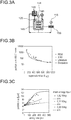
- Figure 3C shows calibration of agglomeration kinetics in a stirred vessel.
- the particle size in ⁇ m as a function of the stirring time in minutes is shows for different mean energy input (for 0.52 W/kg, 0.11 W/kg and 0.26 W/kg) and fit results.
- the model preparation step 144 may comprise preparing the CFD based numerical simulation 134.
- the predicted parameter may comprise additional information about supersaturation.
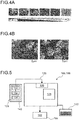
- Figure 4A shows experimental results showing impact of supersaturation S on particle size p. from left to right the particle size gets smaller, indicated with diminishing arrow p. At the same time from left to right the supersaturation increases, indicated with increasing arrow S. Thus, by control of supersaturation it is possible to adjust the particle morphology.
- the method for designing may comprise specifying the production process.
- the production process may be at least one precipitation process of one or more of catalysts, zeolites, battery material, pigments, crop-science materials.
- Figure 5 shows an embodiment of a controlling system 166 and a designing system 168 according to the present invention.
- the controlling system 166 comprises at least one communication interface 170 configured for specifying at least one parameter of a production process to be optimized.
- the controlling system 166 comprises the input channel 126 configured for receiving input data, wherein the input data comprises operating conditions of the production process, physical properties of a plant equipment layout, and at least one predicted parameter determined from the physico-chemical white box model 128.
- the physico-chemical white box model 128 comprises at least one thermodynamics model 130, at least one solid formation model 132 and a computational fluid dynamics (CFD) based numerical simulation 134.
- the controlling system 166 comprises the processing device 138 configured for optimizing the specified parameter.
- the processing device 138 is configured for optimizing the specified parameter by adapting the operating conditions of the production process and/or the physical properties of the plant equipment layout based on the predicted parameter.
- the controlling system 166 may be configured for performing the method for controlling and/or monitoring according to the present invention.
Landscapes
- Engineering & Computer Science (AREA)
- Physics & Mathematics (AREA)
- General Physics & Mathematics (AREA)
- Automation & Control Theory (AREA)
- Health & Medical Sciences (AREA)
- Artificial Intelligence (AREA)
- Computer Vision & Pattern Recognition (AREA)
- Evolutionary Computation (AREA)
- Medical Informatics (AREA)
- Software Systems (AREA)
- Feedback Control In General (AREA)
- Testing And Monitoring For Control Systems (AREA)
Priority Applications (7)
| Application Number | Priority Date | Filing Date | Title |
|---|---|---|---|
| EP20162780.9A EP3879360A1 (fr) | 2020-03-12 | 2020-03-12 | Procédé de commande et/ou de surveillance d'un équipement d'une usine chimique |
| JP2022554816A JP2023517983A (ja) | 2020-03-12 | 2021-03-11 | 化学プラント設備の制御及び/又は監視方法 |
| EP21710962.8A EP4118494A1 (fr) | 2020-03-12 | 2021-03-11 | Procédé de commande et/ou de surveillance d'un équipement d'une installation chimique |
| KR1020227034799A KR20220151664A (ko) | 2020-03-12 | 2021-03-11 | 화학 공장의 장비를 제어 및/또는 모니터링하기 위한 방법 |
| CN202180019550.6A CN115244474A (zh) | 2020-03-12 | 2021-03-11 | 用于控制和/或监视化工厂设备的方法 |
| US17/910,065 US20230094113A1 (en) | 2020-03-12 | 2021-03-11 | Method for controlling and/or monitoring an equipment of a chemical plant |
| PCT/EP2021/056235 WO2021180870A1 (fr) | 2020-03-12 | 2021-03-11 | Procédé de commande et/ou de surveillance d'un équipement d'une installation chimique |
Applications Claiming Priority (1)
| Application Number | Priority Date | Filing Date | Title |
|---|---|---|---|
| EP20162780.9A EP3879360A1 (fr) | 2020-03-12 | 2020-03-12 | Procédé de commande et/ou de surveillance d'un équipement d'une usine chimique |
Publications (1)
| Publication Number | Publication Date |
|---|---|
| EP3879360A1 true EP3879360A1 (fr) | 2021-09-15 |
Family
ID=69810690
Family Applications (2)
| Application Number | Title | Priority Date | Filing Date |
|---|---|---|---|
| EP20162780.9A Withdrawn EP3879360A1 (fr) | 2020-03-12 | 2020-03-12 | Procédé de commande et/ou de surveillance d'un équipement d'une usine chimique |
| EP21710962.8A Withdrawn EP4118494A1 (fr) | 2020-03-12 | 2021-03-11 | Procédé de commande et/ou de surveillance d'un équipement d'une installation chimique |
Family Applications After (1)
| Application Number | Title | Priority Date | Filing Date |
|---|---|---|---|
| EP21710962.8A Withdrawn EP4118494A1 (fr) | 2020-03-12 | 2021-03-11 | Procédé de commande et/ou de surveillance d'un équipement d'une installation chimique |
Country Status (6)
| Country | Link |
|---|---|
| US (1) | US20230094113A1 (fr) |
| EP (2) | EP3879360A1 (fr) |
| JP (1) | JP2023517983A (fr) |
| KR (1) | KR20220151664A (fr) |
| CN (1) | CN115244474A (fr) |
| WO (1) | WO2021180870A1 (fr) |
Cited By (1)
| Publication number | Priority date | Publication date | Assignee | Title |
|---|---|---|---|---|
| CN120260709A (zh) * | 2025-06-03 | 2025-07-04 | 宁波大学 | 基于Fluent的啤酒发酵生化反应仿真方法及系统 |
Families Citing this family (3)
| Publication number | Priority date | Publication date | Assignee | Title |
|---|---|---|---|---|
| US12563421B2 (en) | 2023-10-16 | 2026-02-24 | T-Mobile Usa, Inc. | Predicting and mitigating failure of telecommunications network equipment |
| EP4586031A1 (fr) * | 2024-01-12 | 2025-07-16 | Abb Schweiz Ag | Procédé de détermination d'un paramètre de conception d'une installation |
| CN118067201B (zh) * | 2024-04-17 | 2024-06-21 | 四川赛康智能科技股份有限公司 | 一种防爆盒全生命周期监测方法及系统 |
Family Cites Families (16)
| Publication number | Priority date | Publication date | Assignee | Title |
|---|---|---|---|---|
| US6028014A (en) * | 1997-11-10 | 2000-02-22 | Lsi Logic Corporation | Plasma-enhanced oxide process optimization and material and apparatus therefor |
| CA2418836A1 (fr) * | 2003-02-12 | 2004-08-12 | Resorption Canada Ltd. | Dispositif a generateurs multiples de plasma pour le traitement des dechets dangereux |
| US7069203B2 (en) * | 2003-10-31 | 2006-06-27 | Chevron Oronite Company Llc | Method and system of product development process for chemical compositions using high volume modeling |
| GB2432239A (en) * | 2005-11-15 | 2007-05-16 | Toshiba Kk | Building layout design support system |
| WO2009023659A1 (fr) * | 2007-08-14 | 2009-02-19 | Shell Oil Company | Système et procédés pour la surveillance en ligne continue d'une usine chimique ou d'une raffinerie |
| US9046882B2 (en) * | 2010-06-30 | 2015-06-02 | Rockwell Automation Technologies, Inc. | Nonlinear model predictive control of a batch reaction system |
| US9296833B2 (en) * | 2010-07-08 | 2016-03-29 | Exxonmobil Chemical Patents Inc. | Method for controlling bubble formation in polymerization reactors |
| US8221687B2 (en) * | 2010-10-29 | 2012-07-17 | Ernest John Shearing | System and method for the removal of greenhouse gases |
| CN104487458B (zh) * | 2012-03-29 | 2017-09-12 | 卡勒拉公司 | 使用电石石灰的方法和系统 |
| US9233485B1 (en) * | 2012-09-16 | 2016-01-12 | Michael Gurin | Low energy slag and cement production |
| WO2015175387A1 (fr) * | 2014-05-11 | 2015-11-19 | Texas Tech University System | Appareil et procédé informatisé pour optimiser ou générer un profil sigma pour une molécule |
| DE102016117073B4 (de) * | 2016-09-12 | 2024-09-26 | Samson Aktiengesellschaft | Steuerungs-Interaktions-Verfahren und Kommunikationsvorrichtung zum Durchführen einer Steuerungs-Interaktion zwischen einer Bedienelektronik und einem Stellgerät |
| US20200290945A1 (en) * | 2017-11-22 | 2020-09-17 | Exxonmobil Chemical Patents Inc. | Preparation and Purification of Biphenyldicarboxylic Acids |
| SE542816C2 (sv) * | 2018-02-12 | 2020-07-14 | Ulmert David | Metod att optimera den kemiska fällningsprocessen i vatten- och avloppsreningsverk |
| WO2019246615A1 (fr) * | 2018-06-22 | 2019-12-26 | Delphi Scientific, Llc | Appareil, systèmes et procédés de fabrication en continu de nanomatériaux et de produits chimiques de haute pureté |
| EP3733389A1 (fr) * | 2019-04-29 | 2020-11-04 | Covestro Deutschland AG | Procédé de fabrication de matières plastiques renforcées par des fibres |
-
2020
- 2020-03-12 EP EP20162780.9A patent/EP3879360A1/fr not_active Withdrawn
-
2021
- 2021-03-11 CN CN202180019550.6A patent/CN115244474A/zh active Pending
- 2021-03-11 KR KR1020227034799A patent/KR20220151664A/ko active Pending
- 2021-03-11 WO PCT/EP2021/056235 patent/WO2021180870A1/fr not_active Ceased
- 2021-03-11 US US17/910,065 patent/US20230094113A1/en active Pending
- 2021-03-11 JP JP2022554816A patent/JP2023517983A/ja active Pending
- 2021-03-11 EP EP21710962.8A patent/EP4118494A1/fr not_active Withdrawn
Non-Patent Citations (16)
| Title |
|---|
| ANDERSON ET AL.: "Predicting crystal growth via a unified kinetic three-dimensional partition model", NATURE, vol. 544, 2017, pages 456 - 459, Retrieved from the Internet <URL:https://doi.org/10.1038/nature21684> |
| ANDERSON M W ET AL: "Predicting crystal growth via a unified kinetic three-dimensional partition model", NATURE, vol. 544, no. 7651, 27 April 2017 (2017-04-27), NATURE PUBLISHING GROUP UK, pages 456 - 459, XP002799184, ISSN: 0028-0836, DOI: 10.1038/NATURE21684 * |
| CHENG ET AL.: "CFD-PBE simulation of premixed continuous precipitation incorporating nucleation, growth and aggregation in a stirred tank with multi-class method", CHEMICAL ENGINEERING SCIENCE, vol. 68, no. 1, 22 January 2012 (2012-01-22), pages 469 - 480, XP028107817, Retrieved from the Internet <URL:https://doi.Org/10.1016/j.ces.2011.10.032> DOI: 10.1016/j.ces.2011.10.032 |
| CHOI ET AL.: "Investigation of Crystallization in a Jet Y-Mixer by a Hybrid Computational Fluid Dynamics and Process Simulation Approach", CRYSTAL GROWTH & DESIGN 2005, vol. 5, no. 3, 9 April 2005 (2005-04-09), pages 959 - 968, Retrieved from the Internet <URL:https://doi.org/10.1021/cg049670x> |
| GAVI ET AL.: "CFD Modelling of Nano-Particle Precipitation in Confined Impinging Jet Reactors", CHEMICAL ENGINEERING RESEARCH AND DESIGN, vol. 85, no. 5, 2007, pages 735 - 744, XP022525672, Retrieved from the Internet <URL:https://doi.org/10.1205/cherd06176> DOI: 10.1205/cherd06176 |
| GAVI ET AL: "CFD Modelling of Nano-Particle Precipitation in Confined Impinging Jet Reactors", CHEMICAL ENGINEERING RESEARCH AND DESIGN, vol. 85, no. 5, 1 January 2007 (2007-01-01), ELSEVIER, AMSTERDAM, NL, pages 735 - 744, XP022525672, ISSN: 0263-8762, DOI: 10.1205/CHERD06176 * |
| HARTIG ET AL.: "Multi-component and multi-phase population balance model: The case of Georgeite formation as methanol catalyst precursor phase", CHEMICAL ENGINEERINGSCIENCE, vol. 1 09, 2014, pages 158 - 170, XP028632791, DOI: 10.1016/j.ces.2014.01.026 |
| HARTIG MARTIN A J ET AL: "Multi-component and multi-phase population balance model: The case of Georgeite formation as methanol catalyst precursor phase", CHEMICAL ENGINEERING SCIENCE, vol. 109, 2 February 2014 (2014-02-02), OXFORD, GB, pages 158 - 170, XP028632791, ISSN: 0009-2509, DOI: 10.1016/J.CES.2014.01.026 * |
| JINGCAI CHENG ET AL: "CFD-PBE simulation of premixed continuous precipitation incorporating nucleation, growth and aggregation in a stirred tank with multi-class method", CHEMICAL ENGINEERING SCIENCE, vol. 68, no. 1, 5 October 2011 (2011-10-05), OXFORD, GB, pages 469 - 480, XP028107817, ISSN: 0009-2509, [retrieved on 20111018], DOI: 10.1016/J.CES.2011.10.032 * |
| KUGLER ET AL.: "On Precipitation of Sparingly Soluble Fluoride Salts", CRYST. GROWTH DES. 2018, vol. 18, no. 2, 13 December 2017 (2017-12-13), pages 728 - 733 |
| KUGLER R T ET AL: "On Precipitation of Sparingly Soluble Fluoride Salts", CRYSTAL GROWTH AND DESIGN, vol. 18, no. 2, 7 February 2018 (2018-02-07), AMERICAN CHEMICAL SOCIETY USA, pages 728 - 733, XP002799185, DOI: 10.1021/ACS.CGD.7B01115 * |
| MARCHISIO ET AL., QUADRATURE METHOD OF MOMENTS FOR POPULATION-BALANCE EQUATIONS, 16 April 2004 (2004-04-16), Retrieved from the Internet <URL:https://doi.org/10.1002/aic.690490517> |
| NATURE, pages 21684, Retrieved from the Internet <URL:https://doi.org/10.1038> |
| P. VEGA ET AL: "Integrated design and control of chemical processes - Part II: An illustrative example", COMPUTERS & CHEMICAL ENGINEERING, vol. 71, 1 December 2014 (2014-12-01), GB, pages 618 - 635, XP055700575, ISSN: 0098-1354, DOI: 10.1016/j.compchemeng.2014.09.019 * |
| SCHINDLER ET AL.: "Zur Thermodynamik der Metallcarbonate, Loslichkeitskonstanten und Freie Bildungsenthalpien von Cu (OH) C0 (Maiachit) und Cu (OH) (C0 ) (Azurit) bei 25 °C", HELVETICA CHIMICA, vol. 51 |
| SCHINDLER ET AL.: "Zur Thermodynamik der Metallcarbonate, Loslichkeitskonstanten und Freie Bildungsenthalpien von Cu (OH) C0 (Maiachit) und Cu (OH) (CC> ) (Azurit) bei 25 °C", HELVETICA CHIMICA, vol. 51 |
Cited By (1)
| Publication number | Priority date | Publication date | Assignee | Title |
|---|---|---|---|---|
| CN120260709A (zh) * | 2025-06-03 | 2025-07-04 | 宁波大学 | 基于Fluent的啤酒发酵生化反应仿真方法及系统 |
Also Published As
| Publication number | Publication date |
|---|---|
| US20230094113A1 (en) | 2023-03-30 |
| CN115244474A (zh) | 2022-10-25 |
| WO2021180870A1 (fr) | 2021-09-16 |
| KR20220151664A (ko) | 2022-11-15 |
| EP4118494A1 (fr) | 2023-01-18 |
| JP2023517983A (ja) | 2023-04-27 |
Similar Documents
| Publication | Publication Date | Title |
|---|---|---|
| EP3879360A1 (fr) | Procédé de commande et/ou de surveillance d'un équipement d'une usine chimique | |
| Barai et al. | Multiscale computational model for particle size evolution during coprecipitation of Li-ion battery cathode precursors | |
| Vetter et al. | Modeling nucleation, growth, and Ostwald ripening in crystallization processes: a comparison between population balance and kinetic rate equation | |
| Cheng et al. | CFD modeling of nucleation, growth, aggregation, and breakage in continuous precipitation of barium sulfate in a stirred tank | |
| Wei et al. | Computational fluid dynamics modeling of the precipitation process in a semibatch crystallizer | |
| Rielly et al. | A particle's eye view of crystallizer fluid mechanics | |
| Zhao et al. | Application of the compartmental model to the gas–liquid precipitation of CO2‐Ca (OH) 2 aqueous system in a stirred tank | |
| Öncül et al. | Numerical and analytical investigation of barium sulphate crystallization | |
| WO2004081680A1 (fr) | Systeme de modelisation de procede physicochimique | |
| Szilagyi et al. | Cross-pharma collaboration for the development of a simulation tool for the model-based digital design of pharmaceutical crystallization processes (CrySiV) | |
| Vicum et al. | Multi-scale modeling of a mixing-precipitation process in a semibatch stirred tank | |
| Duan et al. | CFD modeling of turbulent reacting flow in a semi-batch stirred-tank reactor | |
| Querio et al. | Comparison between compartment and computational fluid dynamics models for simulating reactive crystallization processes | |
| Irizarry | Fast compartmental Monte Carlo simulation of population balance models: application to nanoparticle formation in nonhomogeneous conditions | |
| Marcfflsio et al. | On the simulation of turbulent precipitation in a tubular reactor via computational fluid dynamics (CFD) | |
| Guo et al. | Experimental and numerical investigation of the precipitation of barium sulfate in a rotating liquid film reactor | |
| Bałdyga et al. | Double-feed semibatch precipitation effects of mixing | |
| Barai et al. | Deciphering the morphology of transition metal carbonate cathode precursors | |
| CN114141313B (zh) | 一种预测液/液两相界面反应相变过程的数值模拟方法 | |
| Wei | Computer-aided design and scale-up of crystallization processes: Integrating approaches and case studies | |
| Wang et al. | Simulation of Barium Sulfate Precipitation using CFD and FM‐PDF Modeling in a Continuous Stirred Tank | |
| Güldenpfennig et al. | How to estimate material parameters for multiphase, multicomponent precipitation modeling | |
| Rehage et al. | Experimental investigation of a two-zone model for semi-batch precipitation in stirred-tank reactors | |
| Khopkar et al. | Stirred vessels: Computational modeling of multiphase flows and mixing | |
| Cekinski et al. | A new aproach to characterize suspensions in stirred vessels based on computational fluid dynamics |
Legal Events
| Date | Code | Title | Description |
|---|---|---|---|
| PUAI | Public reference made under article 153(3) epc to a published international application that has entered the european phase |
Free format text: ORIGINAL CODE: 0009012 |
|
| STAA | Information on the status of an ep patent application or granted ep patent |
Free format text: STATUS: THE APPLICATION HAS BEEN PUBLISHED |
|
| AK | Designated contracting states |
Kind code of ref document: A1 Designated state(s): AL AT BE BG CH CY CZ DE DK EE ES FI FR GB GR HR HU IE IS IT LI LT LU LV MC MK MT NL NO PL PT RO RS SE SI SK SM TR |
|
| STAA | Information on the status of an ep patent application or granted ep patent |
Free format text: STATUS: THE APPLICATION IS DEEMED TO BE WITHDRAWN |
|
| 18D | Application deemed to be withdrawn |
Effective date: 20220316 |