EP3931191B1 - Dérivés de pyrazolopyridine utilisés comme inhibiteurs de pask - Google Patents
Dérivés de pyrazolopyridine utilisés comme inhibiteurs de pask Download PDFInfo
- Publication number
- EP3931191B1 EP3931191B1 EP20706194.6A EP20706194A EP3931191B1 EP 3931191 B1 EP3931191 B1 EP 3931191B1 EP 20706194 A EP20706194 A EP 20706194A EP 3931191 B1 EP3931191 B1 EP 3931191B1
- Authority
- EP
- European Patent Office
- Prior art keywords
- pyridin
- pyrazolo
- compound
- ethyl
- pharmaceutically acceptable
- Prior art date
- Legal status (The legal status is an assumption and is not a legal conclusion. Google has not performed a legal analysis and makes no representation as to the accuracy of the status listed.)
- Active
Links
Classifications
-
- C—CHEMISTRY; METALLURGY
- C07—ORGANIC CHEMISTRY
- C07D—HETEROCYCLIC COMPOUNDS
- C07D471/00—Heterocyclic compounds containing nitrogen atoms as the only ring hetero atoms in the condensed system, at least one ring being a six-membered ring with one nitrogen atom, not provided for by groups C07D451/00 - C07D463/00
- C07D471/02—Heterocyclic compounds containing nitrogen atoms as the only ring hetero atoms in the condensed system, at least one ring being a six-membered ring with one nitrogen atom, not provided for by groups C07D451/00 - C07D463/00 in which the condensed system contains two hetero rings
- C07D471/04—Ortho-condensed systems
-
- A—HUMAN NECESSITIES
- A61—MEDICAL OR VETERINARY SCIENCE; HYGIENE
- A61K—PREPARATIONS FOR MEDICAL, DENTAL OR TOILETRY PURPOSES
- A61K31/00—Medicinal preparations containing organic active ingredients
- A61K31/33—Heterocyclic compounds
- A61K31/395—Heterocyclic compounds having nitrogen as a ring hetero atom, e.g. guanethidine or rifamycins
- A61K31/435—Heterocyclic compounds having nitrogen as a ring hetero atom, e.g. guanethidine or rifamycins having six-membered rings with one nitrogen as the only ring hetero atom
- A61K31/4353—Heterocyclic compounds having nitrogen as a ring hetero atom, e.g. guanethidine or rifamycins having six-membered rings with one nitrogen as the only ring hetero atom ortho- or peri-condensed with heterocyclic ring systems
- A61K31/437—Heterocyclic compounds having nitrogen as a ring hetero atom, e.g. guanethidine or rifamycins having six-membered rings with one nitrogen as the only ring hetero atom ortho- or peri-condensed with heterocyclic ring systems the heterocyclic ring system containing a five-membered ring having nitrogen as a ring hetero atom, e.g. indolizine, beta-carboline
-
- A—HUMAN NECESSITIES
- A61—MEDICAL OR VETERINARY SCIENCE; HYGIENE
- A61P—SPECIFIC THERAPEUTIC ACTIVITY OF CHEMICAL COMPOUNDS OR MEDICINAL PREPARATIONS
- A61P3/00—Drugs for disorders of the metabolism
-
- A—HUMAN NECESSITIES
- A61—MEDICAL OR VETERINARY SCIENCE; HYGIENE
- A61P—SPECIFIC THERAPEUTIC ACTIVITY OF CHEMICAL COMPOUNDS OR MEDICINAL PREPARATIONS
- A61P5/00—Drugs for disorders of the endocrine system
-
- A—HUMAN NECESSITIES
- A61—MEDICAL OR VETERINARY SCIENCE; HYGIENE
- A61P—SPECIFIC THERAPEUTIC ACTIVITY OF CHEMICAL COMPOUNDS OR MEDICINAL PREPARATIONS
- A61P9/00—Drugs for disorders of the cardiovascular system
Definitions
- the present invention relates to compounds which may be useful in the prophylaxis and/or treatment of endocrine, nutritional, metabolic, and/or cardiovascular diseases.
- the compounds of the invention may inhibit PASK, a serine/threonine kinase involved in endocrine, nutritional, metabolic, and/or cardiovascular diseases.
- the present invention also provides methods for the production of the compounds of the invention, pharmaceutical compositions comprising the compound of the invention, and methods for the prophylaxis and/or treatment of endocrine, nutritional, metabolic, and/or cardiovascular diseases by administering the compound of the invention.
- Type 2 diabetes mellitus is a chronic disease with significant morbidity and mortality. Recent projections indicate that approximately 629 million people will be affected by diabetes in 2045, making this a disease of considerable public health concern given the direct health costs and indirect costs of loss of work productivity. Most patients with diabetes have other features of the metabolic syndrome such as abdominal obesity, hypertriglyceridemia, low high-density lipoprotein cholesterol (HDL-C) levels and hypertension (Moller & Kaufman 2005).
- a limitation of currently available therapies is that no single agent is able to address more than one comorbid condition. Thus, multiple therapies are often prescribed in combination, leading to tolerability issues, poor patient compliance, and suboptimal outcomes. This provides an incentive to develop new therapeutic approaches that are able to address the multiple comorbidities associated with T2DM.
- PASK is a Per-Arnt-Sim (PAS) domain-containing serine/threonine kinase that is described to be involved in glucose homeostasis and controlling lipid levels (Zhang et al. 2015).
- PASK is a nutrient-responsive protein kinase conserved from yeast to man. Biochemical and genetic data have implicated yeast PASK in the regulation of glucose utilization. Mammalian PASK is also involved in glucose and energy homeostasis through the regulation of insulin expression, lipid metabolism, and mitochondrial respiration. PASK may directly affect cellular glucose utilization through phosphorylation and inactivation of glycogen synthase (Hao & Rutter 2008).
- PASK -/- mice Mice lacking PASK are viable and exhibit no obvious developmental or reproductive defect (Katschinski et al. 2003). Nevertheless, when PASK -/- animals are fed with a high fat diet they show a nearly complete protection from obesity, hepatic triglyceride accumulation and insulin resistance (Hao et al. 2007; Pérez-Garc ⁇ a et al. 2018). This protection is likely due to increased metabolic rate and energy expenditure in PASK -/- mice independent of the activity of AMP-activated protein kinase (AMPK), mammalian target of rapamycin (mTOR), and peroxisome proliferator-activated receptor ⁇ coactivator 1 (PGC-1).
- AMPK AMP-activated protein kinase
- mTOR mammalian target of rapamycin
- POC-1 peroxisome proliferator-activated receptor ⁇ coactivator 1
- RNA interference RNA interference
- SREBP-1 sterol regulatory element-binding protein 1
- PASK Inhibition of PASK improves lipid and glucose metabolism in dietary animal models of obesity and dyslipidemia.
- Administration of a PASK inhibitor decreases hepatic expression of lipogenic SREBP-1c target genes, decreases serum triglycerides and partially reverses insulin resistance (Wu et al. 2014).
- the present invention relates to compounds which may be useful in the prophylaxis and/or treatment of endocrine, nutritional, metabolic, and/or cardiovascular diseases.
- the compounds of the invention may inhibit PASK, a serine/threonine kinase involved in endocrine, nutritional, metabolic, and/or cardiovascular diseases.
- the present invention also provides methods for the production of the compounds of the invention, pharmaceutical compositions comprising the compound of the invention, and methods for the prophylaxis and/or treatment of endocrine, nutritional, metabolic, and/or cardiovascular diseases by administering the compound of the invention.
- the compounds of the invention are provided for use in the prophylaxis and/or treatment of endocrine, nutritional, metabolic, and/or cardiovascular diseases.
- the compounds of the invention may improve both glucose and lipid profiles, in particular in treated animal models of metabolic disease.
- the present invention provides pharmaceutical compositions comprising a compound of the invention, and a pharmaceutical carrier, excipient or diluent.
- the pharmaceutical composition may additionally comprise further therapeutically active ingredients suitable for use in combination with the compounds of the invention.
- the further therapeutically active ingredient is an agent for the treatment of endocrine, nutritional, metabolic, and/or cardiovascular diseases.
- the compounds of the invention useful in the pharmaceutical compositions and treatment methods disclosed herein, are pharmaceutically acceptable as prepared and used.
- this invention provides a method of treating a mammal, in particular humans, afflicted with a condition selected from among those listed herein, and particularly endocrine, nutritional, metabolic, and/or cardiovascular diseases, which method comprises administering an effective amount of the pharmaceutical composition or compounds of the invention as described herein.
- the present invention also provides pharmaceutical compositions comprising a compound of the invention, and a suitable pharmaceutical carrier, excipient or diluent for use in medicine.
- the pharmaceutical composition is for use in the prophylaxis and/or treatment of endocrine, nutritional, metabolic, and/or cardiovascular diseases.
- this invention provides methods for synthesizing the compounds of the invention, with representative synthetic protocols and pathways disclosed later on herein.
- the articles 'a' and 'an' may be used herein to refer to one or to more than one (i.e. at least one) of the grammatical objects of the article.
- analogue' means one analogue or more than one analogue.
- 'Alkyl' means straight or branched aliphatic hydrocarbon having the specified number of carbon atoms. Particular alkyl groups have 1 to 6 carbon atoms or 1 to 4 carbon atoms. Branched means that one or more alkyl groups such as methyl, ethyl or propyl is attached to a linear alkyl chain.
- alkyl groups are methyl (-CH 3 ), ethyl (-CH 2 -CH 3 ), n-propyl (-CH 2 -CH 2 -CH 3 ), isopropyl (-CH(CH 3 ) 2 ), n-butyl (-CH 2 -CH 2 -CH 2 -CH 3 ), tert-butyl (-CH 2 -C(CH 3 ) 3 ), sec-butyl (-CH 2 -CH(CH 3 ) 2 ), n-pentyl (-CH 2 -CH 2 -CH 2 -CH 2 -CH 3 ), n-hexyl (-CH 2 -CH 2 -CH 2 -CH 2 -CH 2 -CH 3 ), and 1,2-dimethylbutyl (-CHCH 3 )-C(CH 3 )H 2 -CH 2 -CH 3 ).
- Particular alkyl groups have between 1 and 4 carbon atoms.
- alkenyl' refers to monovalent olefinically (unsaturated) hydrocarbon groups with the number of carbon atoms specified.
- Particular alkenyl has 2 to 8 carbon atoms, and more particularly, from 2 to 6 carbon atoms, which can be straight-chained or branched and having at least 1 and particularly from 1 to 2 sites of olefinic unsaturation.
- alkoxy' refers to the group O-alkyl, where the alkyl group has the number of carbon atoms specified. In particular the term refers to the group -O-C 1-6 alkyl.
- Particular alkoxy groups are methoxy, ethoxy, n-propoxy, isopropoxy, n-butoxy, tert-butoxy, sec-butoxy, n-pentoxy, n-hexoxy, and 1,2-dimethylbutoxy.
- Particular alkoxy groups are lower alkoxy, i.e. with between 1 and 6 carbon atoms. Further particular alkoxy groups have between 1 and 4 carbon atoms.
- 'Amino' refers to the radical -NH 2 .
- 'Aryl' refers to a monovalent aromatic hydrocarbon group derived by the removal of one hydrogen atom from a single carbon atom of a parent aromatic ring system.
- aryl refers to an aromatic ring structure, monocyclic or fused polycyclic, with the number of ring atoms specified.
- the term includes groups that include from 6 to 10 ring members.
- Particular aryl groups include phenyl, and naphthyl.
- 'Cycloalkyl refers to a non-aromatic hydrocarbyl ring structure, monocyclic, fused polycyclic, bridged polycyclic, or spirocyclic, with the number of ring atoms specified.
- a cycloalkyl may have from 3 to 12 carbon atoms, in particular from 3 to 10, and more particularly from 3 to 7 carbon atoms.
- Such cycloalkyl groups include, by way of example, single ring structures such as cyclopropyl, cyclobutyl, cyclopentyl, cyclohexyl, and cycloheptyl.
- 'Cyano' refers to the radical -CN.
- ⁇ Halo' or ⁇ halogen' refers to fluoro (F), chloro (Cl), bromo (Br) and iodo (I). Particular halo groups are either fluoro or chloro.
- Hetero when used to describe a compound or a group present on a compound means that one or more carbon atoms in the compound or group have been replaced by a nitrogen, oxygen, or sulfur heteroatom. Hetero may be applied to any of the hydrocarbyl groups described above such as alkyl, e.g. heteroalkyl, cycloalkyl, e.g. heterocycloalkyl, aryl, e.g. heteroaryl, and the like having from 1 to 4, and particularly from 1 to 3 heteroatoms, more typically 1 or 2 heteroatoms, for example a single heteroatom.
- Heteroaryl' means an aromatic ring structure, monocyclic or fused polycyclic, that includes one or more heteroatoms independently selected from O, N and S and the number of ring atoms specified.
- the aromatic ring structure may have from 5 to 9 ring members.
- the heteroaryl group can be, for example, a five membered or six membered monocyclic ring or a fused bicyclic structure formed from fused five and six membered rings or two fused six membered rings or, by way of a further example, two fused five membered rings. Each ring may contain up to four heteroatoms typically selected from nitrogen, sulphur and oxygen.
- the heteroaryl ring will contain up to 4 heteroatoms, more typically up to 3 heteroatoms, more usually up to 2, for example a single heteroatom.
- the heteroaryl ring contains at least one ring nitrogen atom.
- the nitrogen atoms in the heteroaryl rings can be basic, as in the case of an imidazole or pyridine, or essentially non-basic as in the case of an indole or pyrrole nitrogen. In general the number of basic nitrogen atoms present in the heteroaryl group, including any amino group substituents of the ring, will be less than five.
- Examples of five membered monocyclic heteroaryl groups include but are not limited to pyrrolyl, furanyl, thiophenyl, imidazolyl, furazanyl, oxazolyl, oxadiazolyl, oxatriazolyl, isoxazolyl, thiazolyl, isothiazolyl, pyrazolyl, triazolyl and tetrazolyl groups.
- Examples of six membered monocyclic heteroaryl groups include but are not limited to pyridinyl, pyrazinyl, pyridazinyl, pyrimidinyl and triazinyl.
- bicyclic heteroaryl groups containing a five membered ring fused to another five-membered ring include but are not limited to imidazothiazolyl and imidazoimidazolyl.
- bicyclic heteroaryl groups containing a six membered ring fused to a five membered ring include but are not limited to benzofuranyl, benzothiophenyl, benzoimidazolyl, benzoxazolyl, isobenzoxazolyl, benzisoxazolyl, benzothiazolyl, benzoisothiazolyl, isobenzofuranyl, indolyl, isoindolyl, indolizinyl, purinyl (e.g. adenine, guanine), indazolyl, pyrazolopyrimidinyl, triazolopyrimidinyl, and pyrazolopyridinyl groups.
- bicyclic heteroaryl groups containing two fused six membered rings include but are not limited to quinolinyl, isoquinolinyl, pyridopyridinyl, quinoxalinyl, quinazolinyl, cinnolinyl, phthalazinyl, naphthyridinyl, and pteridinyl groups.
- Particular heteroaryl groups are those derived from thiophenyl, pyrrolyl, benzothiophenyl, benzofuranyl, indolyl, pyridinyl, quinolinyl, imidazolyl, oxazolyl and pyrazinyl.
- Heterocycloalkyl means a non-aromatic fully saturated ring structure, monocyclic, fused polycyclic, spirocyclic, or bridged polycyclic, that includes one or more heteroatoms independently selected from O, N and S and the number of ring atoms specified.
- the heterocycloalkyl ring structure may have from 4 to 12 ring members, in particular from 4 to 10 ring members and more particularly from 4 to 7 ring members.
- Each ring may contain up to four heteroatoms typically selected from nitrogen, sulphur and oxygen.
- the heterocycloalkyl ring will contain up to 4 heteroatoms, more typically up to 3 heteroatoms, more usually up to 2, for example a single heteroatom.
- heterocyclic rings include, but are not limited to azetidinyl, oxetanyl, thietanyl, pyrrolidinyl ( e.g . 1-pyrrolidinyl, 2-pyrrolidinyl and 3-pyrrolidinyl), tetrahydrofuranyl ( e.g . 1-tetrahydrofuranyl, 2-tetrahydrofuranyl and 3-tetrahydrofuranyl), tetrahydrothiophenyl ( e.g . 1-tetrahydrothiophenyl, 2-tetrahydrothiophenyl and 3-tetrahydrothiophenyl), piperidinyl ( e.g.
- each W and Y is independently selected from -CH 2 -, -NH-, -O- and -S-.
- fused bicyclic rings are shown in the following illustrative examples: wherein each W and Y is independently selected from -CH 2 -, -NH-, -O- and -S-.
- bridged bicyclic rings are shown in the following illustrative examples: wherein each W and Y is independently selected from -CH 2 -, -NH-, -O- and -S- and each Z is selected from N or CH.
- each Y is selected from -CH 2 -, -NH-, -O- and -S-.
- heterocycloalkenyl' means a 'heterocycloalkyl', which comprises at least one double bond.
- ⁇ Hydroxyl' refers to the radical -OH.
- 'Substituted' refers to a group in which one or more hydrogen atoms are each independently replaced with the same or different substituent(s).
- term 'substituted with one or more' refers to one to four substituents. In one embodiment it refers to one to three substituents. In further embodiments it refers to one or two substituents. In a yet further embodiment it refers to one substituent.
- heterocyclic ring may have one to four heteroatoms so long as the heteroaromatic ring is chemically feasible and stable.
- 'Pharmaceutically acceptable means approved or approvable by a regulatory agency of the Federal or a state government or the corresponding agency in countries other than the United States, or that is listed in the U.S. Pharmacopoeia or other generally recognized pharmacopoeia for use in animals, and more particularly, in humans.
- 'Pharmaceutically acceptable salt' refers to a salt of a compound of the invention that is pharmaceutically acceptable and that possesses the desired pharmacological activity of the parent compound.
- such salts are non-toxic may be inorganic or organic acid addition salts and base addition salts.
- such salts include: (1) acid addition salts, formed with inorganic acids such as hydrochloric acid, hydrobromic acid, sulfuric acid, nitric acid, phosphoric acid, and the like; or formed with organic acids such as acetic acid, propionic acid, hexanoic acid, cyclopentanepropionic acid, glycolic acid, pyruvic acid, lactic acid, malonic acid, succinic acid, malic acid, maleic acid, fumaric acid, tartaric acid, citric acid, benzoic acid, 3-(4-hydroxybenzoyl) benzoic acid, cinnamic acid, mandelic acid, methanesulfonic acid, ethanesulfonic acid, 1,2-ethane-disulfonic acid, 2-hydroxyethanesulfonic acid, benzenesulfonic acid, 4-chlorobenzenesulfonic acid, 2-naphthalenesulfonic acid, 4-toluenesulfonic acid
- Salts further include, by way of example only, sodium, potassium, calcium, magnesium, ammonium, tetraalkylammonium, and the like; and when the compound contains a basic functionality, salts of non toxic organic or inorganic acids, such as hydrochloride, hydrobromide, tartrate, mesylate, acetate, maleate, oxalate and the like.
- the term 'pharmaceutically acceptable cation' refers to an acceptable cationic counter-ion of an acidic functional group. Such cations are exemplified by sodium, potassium, calcium, magnesium, ammonium, tetraalkylammonium cations, and the like.
- 'Pharmaceutically acceptable vehicle' refers to a diluent, adjuvant, excipient or carrier with which a compound of the invention is administered.
- Prodrugs' refers to compounds, including derivatives of the compounds of the invention, which have cleavable groups and become by solvolysis or under physiological conditions the compounds of the invention which are pharmaceutically active in vivo.
- Such examples include, but are not limited to, choline ester derivatives and the like, N-alkylmorpholine esters and the like.
- ⁇ Solvate' refers to forms of the compound that are associated with a solvent, usually by a solvolysis reaction. This physical association includes hydrogen bonding.
- Conventional solvents include water, EtOH, acetic acid and the like.
- the compounds of the invention may be prepared e.g. in crystalline form and may be solvated or hydrated.
- Suitable solvates include pharmaceutically acceptable solvates, such as hydrates, and further include both stoichiometric solvates and non-stoichiometric solvates. In certain instances the solvate will be capable of isolation, for example when one or more solvent molecules are incorporated in the crystal lattice of the crystalline solid.
- 'Solvate' encompasses both solution-phase and isolable solvates.
- Representative solvates include hydrates, ethanolates and methanolates.
- 'Subject' includes humans.
- the terms 'human', 'patient' and 'subject' are used interchangeably herein.
- ⁇ Effective amount' means the amount of a compound of the invention that, when administered to a subject for treating a disease, is sufficient to effect such treatment for the disease.
- the ⁇ effective amount' can vary depending on the compound, the disease and its severity, and the age, weight, etc., of the subject to be treated.
- 'Preventing' or 'prevention' refers to a reduction in risk of acquiring or developing a disease or disorder (i.e. causing at least one of the clinical symptoms of the disease not to develop in a subject that may be exposed to a disease-causing agent, or predisposed to the disease in advance of disease onset.
- 'prophylaxis' is related to 'prevention', and refers to a measure or procedure the purpose of which is to prevent, rather than to treat or cure a disease.
- prophylactic measures may include the administration of vaccines; the administration of low molecular weight heparin to hospital patients at risk for thrombosis due, for example, to immobilization; and the administration of an anti-malarial agent such as chloroquine, in advance of a visit to a geographical region where malaria is endemic or the risk of contracting malaria is high.
- 'Treating' or 'treatment' of any disease or disorder refers, in one embodiment, to ameliorating the disease or disorder (i.e. arresting the disease or reducing the manifestation, extent or severity of at least one of the clinical symptoms thereof).
- 'treating' or 'treatment' refers to ameliorating at least one physical parameter, which may not be discernible by the subject.
- 'treating' or 'treatment' refers to modulating the disease or disorder, either physically, ( e.g. stabilization of a discernible symptom), physiologically, ( e.g . stabilization of a physical parameter), or both.
- 'treating' or 'treatment' relates to slowing the progression of the disease.
- ⁇ endocrine diseases' refers to disorders of the endocrine system and hormonal secretion.
- the term refers to adrenal diseases, obesity, metabolic syndrome, impaired glucose tolerance, prediabetes, Cushing's syndrome, chronic pancreatitis, insulin resistance, hyperglycemia, hyperinsulinemia, gestational diabetes, diabetes mellitus, insulin-dependent (type 1) diabetes mellitus, non-insulin-dependent (type 2) diabetes mellitus, and acromegaly. More particularly, the term refers to type 2 diabetes mellitus, obesity, and insulin resistance.
- ⁇ nutritional diseases' refers to nutrient-related diseases and conditions resulting from eating a diet in which one or more nutrients are either not enough or are too much.
- the term refers to malnutrition, hyperalimentation, hyperglycemia, dyslipidemia, hyperlipidemia, hypertriglyceridemia, hypercholesterolemia, obesity, drug-induced obesity, morbid obesity, localized adiposity, and malnutrition-related diabetes mellitus. More particularly, the term refers to obesity, hyperlipidemia, and hyperglycemia.
- ⁇ metabolic diseases refers to disorders that disrupt normal metabolism, the process of converting food to energy on a cellular level. Metabolic diseases affect the ability to perform critical biochemical reactions that involve the processing or transport of proteins (amino acids), carbohydrates (sugars and starches), or lipids (fatty acids).
- the term refers to obesity, diabetes mellitus, especially type 2 diabetes, hyperinsulinemia, glucose intolerance, metabolic syndrome X, dyslipidemia, hyperlipidemia, hypertriglyceridemia, hypercholesterolemia, hyperlipoproteinemia, combined hyperlipidemia, and hepatic steatosis (fatty liver disease), including non-alcoholic fatty liver disease (NAFLD) and non-alcoholic steatohepatitis (NASH). More particularly, the term refers to type 2 diabetes, hyperlipidemia, and NASH.
- cardiovascular disease refers to diseases affecting the heart or blood vessels, or both.
- cardiovascular disease includes arrhythmia (atrial or ventricular or both); atherosclerosis and its sequelae; angina; cardiac rhythm disturbances; myocardial ischemia; myocardial infarction; cardiac or vascular aneurysm; vasculitis, stroke; peripheral obstructive arteriopathy of a limb, an organ, or a tissue; reperfusion injury following ischemia of the brain, heart, kidney or other organ or tissue; endotoxic, surgical, or traumatic shock; hypertension, valvular heart disease, heart failure, abnormal blood pressure; shock; vasoconstriction (including that associated with migraines); vascular abnormality, inflammation, insufficiency limited to a single organ or tissue. More particularly, the term refers to vascular disease, atherosclerosis, coronary heart disease, cerebrovascular disease, heart failure and peripheral vessel disease, and hypertension.
- Prodrugs include acid derivatives well know to practitioners of the art, such as, for example, esters prepared by reaction of the parent acid with a suitable alcohol, or amides prepared by reaction of the parent acid compound with a substituted or unsubstituted amine, or acid anhydrides, or mixed anhydrides. Simple aliphatic or aromatic esters, amides and anhydrides derived from acidic groups pendant on the compounds of this invention are particularly useful prodrugs.
- double ester type prodrugs such as (acyloxy)alkyl esters or ((alkoxycarbonyl)oxy)alkylesters.
- Particular such prodrugs are the C 1-8 alkyl, C 2-8 alkenyl, C 6-10 optionally substituted aryl, and (C 6-10 aryl)-(C 1-4 alkyl) esters of the compounds of the invention.
- the present disclosure includes all isotopic forms of the compounds of the invention provided herein, whether in a form (i) wherein all atoms of a given atomic number have a mass number (or mixture of mass numbers) which predominates in nature (referred to herein as the ⁇ natural isotopic form') or (ii) wherein one or more atoms are replaced by atoms having the same atomic number, but a mass number different from the mass number of atoms which predominates in nature (referred to herein as an ⁇ unnatural variant isotopic form'). It is understood that an atom may naturally exists as a mixture of mass numbers.
- ⁇ unnatural variant isotopic form' also includes embodiments in which the proportion of an atom of given atomic number having a mass number found less commonly in nature (referred to herein as an ⁇ uncommon isotope') has been increased relative to that which is naturally occurring e.g. to the level of >20%, >50%, >75%, >90%, >95% or> 99% by number of the atoms of that atomic number (the latter embodiment referred to as an ⁇ isotopically enriched variant form').
- the term ⁇ unnatural variant isotopic form' also includes embodiments in which the proportion of an uncommon isotope has been reduced relative to that which is naturally occurring.
- Isotopic forms may include radioactive forms (i.e. they incorporate radioisotopes) and non-radioactive forms. Radioactive forms will typically be isotopically enriched variant forms.
- An unnatural variant isotopic form of a compound may thus contain one or more artificial or uncommon isotopes such as deuterium ( 2 H or D), carbon-11 ( 11 C), carbon-13 ( 13 C), carbon-14 ( 14 C), nitrogen-13 ( 13 N), nitrogen-15 ( 15 N), oxygen-15 ( 15 O), oxygen-17 ( 17 O), oxygen-18 ( 18 O), phosphorus-32 ( 32 P), sulphur-35 ( 35 S), chlorine-36 ( 36 Cl), chlorine-37 ( 37 Cl), fluorine-18 ( 18 F) iodine-123 ( 123 I), iodine-125 ( 125 I) in one or more atoms or may contain an increased proportion of said isotopes as compared with the proportion that predominates in nature in one or more atoms.
- isotopes such as deuterium ( 2 H or D), carbon-11 ( 11 C), carbon-13 ( 13 C), carbon-14 ( 14 C), nitrogen-13 ( 13 N), nitrogen-15 ( 15 N), oxygen-15 ( 15 O), oxygen-17 ( 17 O), oxygen-18 (
- Unnatural variant isotopic forms comprising radioisotopes may, for example, be used for drug and/or substrate tissue distribution studies.
- the radioactive isotopes tritium, i.e. 3 H, and carbon-14, i.e. 14 C, are particularly useful for this purpose in view of their ease of incorporation and ready means of detection.
- Unnatural variant isotopic forms which incorporate deuterium i.e 2 H or D may afford certain therapeutic advantages resulting from greater metabolic stability, for example, increased in vivo half-life or reduced dosage requirements, and hence may be preferred in some circumstances.
- unnatural variant isotopic forms may be prepared which incorporate positron emitting isotopes, such as 11 C, 18 F, 15 O and 13 N, and would be useful in Positron Emission Topography (PET) studies for examining substrate receptor occupancy.
- PET Positron Emission Topography
- Stereoisomers that are not mirror images of one another are termed 'diastereomers' and those that are non-superimposable mirror images of each other are termed 'enantiomers'.
- a compound has an asymmetric center, for example, it is bonded to four different groups, a pair of enantiomers is possible.
- An enantiomer can be characterized by the absolute configuration of its asymmetric center and is described by the R- and S-sequencing rules of Cahn and Prelog, or by the manner in which the molecule rotates the plane of polarized light and designated as dextrorotatory or levorotatory (i.e. as (+) or (-)-isomers respectively).
- a chiral compound can exist as either individual enantiomer or as a mixture thereof. A mixture containing equal proportions of the enantiomers is called a ⁇ racemic mixture'.
- 'Tautomers' refer to compounds that are interchangeable forms of a particular compound structure, and that vary in the displacement of hydrogen atoms and electrons. Thus, two structures may be in equilibrium through the movement of ⁇ electrons and an atom (usually H).
- enols and ketones are tautomers because they are rapidly interconverted by treatment with either acid or base.
- Another example of tautomerism is the aci- and nitro- forms of phenylnitromethane, that are likewise formed by treatment with acid or base.
- Tautomeric forms may be relevant to the attainment of the optimal chemical reactivity and biological activity of a compound of interest.
- the compounds of the invention may possess one or more asymmetric centers; such compounds can therefore be produced as individual (R)- or (S)- stereoisomers or as mixtures thereof.
- the present invention relates to compounds which may be useful in the prophylaxis and/or treatment of endocrine, nutritional, metabolic, and/or cardiovascular diseases.
- the compounds of the invention may inhibit PASK, a serine/threonine kinase involved in endocrine, nutritional, metabolic, and/or cardiovascular diseases.
- compositions comprising the compound of the invention, and methods for the prophylaxis and/or treatment of endocrine, nutritional, metabolic, and/or cardiovascular diseases by administering the compound of the invention.
- a compound of the invention is according to Formula I, wherein Het is pyrrolyl, furanyl, thiophenyl, pyrazolyl, imidazolyl, oxazolyl, isoxazolyl, thiazolyl, isothiazolyl, triazolyl, furazanyl, oxadiazolyl, or thiadiazolyl.
- Het is pyrrolyl, furanyl, thiophenyl, pyrazolyl, imidazolyl, oxazolyl, isoxazolyl, thiazolyl, isothiazolyl, triazolyl, 1,2,4-oxadiazolyl, 1,3,4-oxadiazolyl, 1,2,4-thiadiazolyl, or 1,3,4-thiadiazolyl.
- Het is furanyl, pyrazolyl, oxazolyl, or thiazolyl.
- Het is furanyl or thiazolyl.
- Het is furanyl.
- a compound of the invention is according to Formula IIa, IIb, IIc, or IId: wherein R 1 , R 2 , R 3a , R 3b , X and the subscript n are as described above.
- a compound of the invention is according to any one of Formulae I-IId, wherein R 3a is H.
- a compound of the invention is according to any one of Formulae I-IId, wherein R 3a is C 1-3 alkyl.
- R 3a is -CH 3 , -CH 2 CH 3 , or -CH(CH 3 ) 2 .
- R 3a is -CH 3 .
- a compound of the invention is according to any one of Formulae I-IId, wherein R 3a is C 1-3 alkyl substituted with one or more independently selected halo.
- R 3a is -CH 3 , -CH 2 CH 3 , or -CH(CH 3 ) 2 , each of which is substituted with one or more independently selected halo.
- R 3a is C 1-3 alkyl substituted with one, two, or three independently selected halo.
- R 3a is C 1-3 alkyl substituted with one or more independently selected F or Cl.
- R 3a is -CH 3 substituted with one or more independently selected halo.
- R 3a is -CH 3 , -CH 2 CH 3 , or -CH(CH 3 ) 2 , each of which is substituted with one, two or three independently selected halo.
- R 3a is -CH 3 , -CH 2 CH 3 , or -CH(CH 3 ) 2 , each of which is substituted with one or more independently selected F or Cl.
- R 3a is C 1-3 alkyl substituted with one, two, or three independently selected F or Cl.
- R 3a is C 1-3 alkyl substituted with one or more F.
- R 3a is -CH 3 substituted with one, two or three independently selected halo.
- R 3a is -CH 3 , -CH 2 CH 3 , or -CH(CH 3 ) 2 , each of which is substituted with one, two or three independently selected F or Cl.
- R 3a is C 1-3 alkyl substituted with one, two, or three F.
- R 3a is -CH 3 substituted with one or more independently selected F or Cl.
- R 3a is -CH 3 , -CH 2 CH 3 , or -CH(CH 3 ) 2 , each of which is substituted with one or more F.
- R 3a is -CH 3 substituted with one, two, or three F.
- R 3a is -CF 3 .
- a compound of the invention is according to any one of Formulae I-IId, wherein R 3b is H.
- a compound of the invention is according to any one of Formulae I-IId, wherein R 3b is C 1-3 alkyl.
- R 3b is -CH 3 , -CH 2 CH 3 , or -CH(CH 3 ) 2 .
- R 3b is -CH 3 .
- a compound of the invention is according to any one of Formulae I-IId, wherein R 3b is C 1-3 alkyl substituted with one or more independently selected halo.
- R 3b is -CH 3 , -CH 2 CH 3 , or -CH(CH 3 ) 2 , each of which is substituted with one or more independently selected halo.
- R 3b is C 1-3 alkyl substituted with one, two, or three independently selected halo.
- R 3b is C 1-3 alkyl substituted with one or more independently selected F or Cl.
- R 3b is -CH 3 substituted with one or more independently selected halo.
- R 3b is -CH 3 , -CH 2 CH 3 , or -CH(CH 3 ) 2 , each of which is substituted with one, two or three independently selected halo.
- R 3b is -CH 3 , -CH 2 CH 3 , or -CH(CH 3 ) 2 , each of which is substituted with one or more independently selected F or Cl.
- R 3b is C 1-3 alkyl substituted with one, two, or three independently selected F or Cl.
- R 3b is C 1-3 alkyl substituted with one or more F.
- R 3b is -CH 3 substituted with one, two or three independently selected halo.
- R 3b is -CH 3 , -CH 2 CH 3 , or -CH(CH 3 ) 2 , each of which is substituted with one, two or three independently selected F or Cl.
- R 3b is C 1-3 alkyl substituted with one, two, or three F.
- R 3b is -CH 3 substituted with one or more independently selected F or Cl.
- R 3b is -CH 3 , -CH 2 CH 3 , or -CH(CH 3 ) 2 , each of which is substituted with one or more F.
- R 3b is -CH 3 substituted with one, two, or three F.
- R 3b is -CF 3 .
- a compound of the invention is according to any one of Formulae I-IId, wherein n is 0 or 1. In a particular embodiment, n is 0.
- a compound of the invention is according to Formula IIIa, IIIb, IIIc, or IIId: wherein R 1 , R 2 , and X are as described above.
- a compound of the invention is according to any one of Formulae I-IIId, wherein R 2 is -O-R 7 , and R 7 is as previously described.
- a compound of the invention is according to any one of Formulae I-IIId, wherein R 2 is -O-R 7 , and R 7 is C 1-6 alkyl.
- R 7 is -CH 3 , -CH 2 CH 3 , -CH 2 CH 2 CH 3 , -CH(CH 3 ) 2 , -CH 2 CH(CH 3 ) 2 , -C(CH 3 ) 3 , -CH(CH 3 )CH 2 CH 3 , or -CH(CH 3 )CH(CH 3 ) 2 .
- R 7 is -CH 3 , -CH 2 CH 3 , or -CH(CH 3 ) 2 .
- R 7 is -CH 2 CH 3 .
- a compound of the invention is according to any one of Formulae I-IIId, wherein R 2 is -O-R 7 , and R 7 is C 1-6 alkyl substituted with one or more independently selected halo or C 1-4 alkoxy.
- R 7 is -CH 3 , -CH 2 CH 3 , -CH 2 CH 2 CH 3 , -CH(CH 3 ) 2 , -CH 2 CH(CH 3 ) 2 , -C(CH 3 ) 3 , -CH(CH 3 )CH 2 CH 3 , or -CH(CH 3 )CH(CH 3 ) 2 , each of which is substituted with one or more independently selected halo or C 1-4 alkoxy.
- R 7 is C 1-6 alkyl substituted with one, two, or three independently selected halo or C 1-4 alkoxy.
- R 7 is C 1-6 alkyl substituted with one or more independently selected F, Cl, -O-CH 3 , -O-CH 2 CH 3 , or -O-CH(CH 3 ) 2 .
- R 7 is -CH 3 or -CH 2 CH 3 , each of which is substituted with one or more independently selected halo or C 1-4 alkoxy.
- R 7 is -CH 3 , -CH 2 CH 3 , -CH 2 CH 2 CH 3 , -CH(CH 3 ) 2 , -CH 2 CH(CH 3 ) 2 , -C(CH 3 ) 3 , -CH(CH 3 )CH 2 CH 3 , or -CH(CH 3 )CH(CH 3 ) 2 , each of which is substituted with one, two, or three independently selected halo or C 1-4 alkoxy.
- R 7 is -CH 3 , -CH 2 CH 3 , -CH 2 CH 2 CH 3 , -CH(CH 3 ) 2 , -CH 2 CH(CH 3 ) 2 , -C(CH 3 ) 3 , -CH(CH 3 )CH 2 CH 3 , or -CH(CH 3 )CH(CH 3 ) 2 , each of which is substituted with one or more independently selected F, Cl, -O-CH 3 , -O-CH 2 CH 3 , or -O-CH(CH 3 ) 2 .
- R 7 is C 1-6 alkyl substituted with one, two, or three independently selected F, Cl, -O-CH 3 , -O-CH 2 CH 3 , or -O-CH(CH 3 ) 2 . In yet another more particular embodiment, R 7 is C 1-6 alkyl substituted with one or more independently selected F, -O-CH 3 , or -O-CH 2 CH 3 . In a further more particular embodiment, R 7 is -CH 3 or -CH 2 CH 3 , each of which is substituted with one, two, or three independently selected halo or C 1-4 alkoxy.
- R 7 is -CH 3 , -CH 2 CH 3 , -CH 2 CH 2 CH 3 , -CH(CH 3 ) 2 , -CH 2 CH(CH 3 ) 2 , -C(CH 3 ) 3 , -CH(CH 3 )CH 2 CH 3 , or -CH(CH 3 )CH(CH 3 ) 2 , each of which is substituted with one, two, or three independently selected F, Cl, -O-CH 3 , -O-CH 2 CH 3 , or -O-CH(CH 3 ) 2 .
- R 7 is C 1-6 alkyl substituted with one, two, or three independently selected F, -O-CH 3 , or -O-CH 2 CH 3 .
- R 7 is -CH 3 or -CH 2 CH 3 , each of which is substituted with one or more independently selected F, Cl, -O-CH 3 , -O-CH 2 CH 3 , or -O-CH(CH 3 ) 2 .
- R 7 is -CH 3 , -CH 2 CH 3 , -CH 2 CH 2 CH 3 , -CH(CH 3 ) 2 , -CH 2 CH(CH 3 ) 2 , -C(CH 3 ) 3 , -CH(CH 3 )CH 2 CH 3 , or -CH(CH 3 )CH(CH 3 ) 2 , each of which is substituted with one or more independently selected F, -O-CH 3 , or -O-CH 2 CH 3 .
- R 7 is -CH 3 or -CH 2 CH 3 , each of which is substituted with one, two, or three independently selected F, -O-CH 3 , or -O-CH 2 CH 3 .
- R 7 is -CHF 2 , -CH 2 CF 3 , -CH 2 CH 2 -O-CH 3 , or -CH 2 CH 2 -O-CH 2 CH 3 .
- a compound of the invention is according to any one of Formulae I-IIId, wherein R 2 is -O-R 7 , and R 7 is 4-6 membered monocyclic heterocycloalkyl comprising one, two or three heteroatoms independently selected from N, O, and S.
- R 7 is azetidinyl, oxetanyl, pyrrolidinyl, tetrahydrofuranyl, piperidinyl, tetrahydropyranyl, tetrahydrothiopyranyl, morpholinyl, thiomorpholinyl, dioxanyl, or piperazinyl.
- R 7 is oxetanyl.
- a compound of the invention is according to any one of Formulae I-IIId, wherein R 2 is C 1-6 alkyl.
- R 2 is -CH 3 , -CH 2 CH 3 , -CH 2 CH 2 CH 3 , -CH(CH 3 ) 2 , -CH 2 CH(CH 3 ) 2 , -C(CH 3 ) 3 , -CH(CH 3 )CH 2 CH 3 , or -CH(CH 3 )CH(CH 3 ) 2 .
- R 2 is -CH 3 , -CH 2 CH 3 , or -CH 2 CH(CH 3 ) 2 .
- a compound of the invention is according to any one of Formulae I-IIId, wherein R 2 is C 1-6 alkyl substituted with one or more independently selected halo.
- R 2 is -CH 3 , -CH 2 CH 3 , -CH 2 CH 2 CH 3 , -CH(CH 3 ) 2 , -CH 2 CH(CH 3 ) 2 , -C(CH 3 ) 3 , -CH(CH 3 )CH 2 CH 3 , or -CH(CH 3 )CH(CH 3 ) 2 , each of which is substituted with one or more independently selected halo.
- R 2 is C 1-6 alkyl substituted with one, two, or three independently selected halo.
- R 2 is C 1-6 alkyl substituted with one or more independently selected F, Cl, or Br.
- R 2 is -CH 3 substituted with one or more independently selected halo.
- R 2 is -CH 3 , -CH 2 CH 3 , -CH 2 CH 2 CH 3 , -CH(CH 3 ) 2 , -CH 2 CH(CH 3 ) 2 , -C(CH 3 ) 3 , -CH(CH 3 )CH 2 CH 3 , or -CH(CH 3 )CH(CH 3 ) 2 , each of which is substituted with one, two, or three independently selected halo.
- R 2 is -CH 3 , -CH 2 CH 3 , -CH 2 CH 2 CH 3 , -CH(CH 3 ) 2 , -CH 2 CH(CH 3 ) 2 , -C(CH 3 ) 3 , -CH(CH 3 )CH 2 CH 3 , or -CH(CH 3 )CH(CH 3 ) 2 , each of which is substituted with one or more independently selected F, Cl, or Br.
- R 2 is -CH 3 substituted with one, two, or three independently selected halo.
- R 2 is -CH 3 , -CH 2 CH 3 , -CH 2 CH 2 CH 3 , -CH(CH 3 ) 2 , -CH 2 CH(CH 3 ) 2 , -C(CH 3 ) 3 , -CH(CH 3 )CH 2 CH 3 , or -CH(CH 3 )CH(CH 3 ) 2 , each of which is substituted with one, two, or three independently selected F, Cl, or Br.
- R 2 is -CH 3 , -CH 2 CH 3 , -CH 2 CH 2 CH 3 , -CH(CH 3 ) 2 , -CH 2 CH(CH 3 ) 2 , -C(CH 3 ) 3 , -CH(CH 3 )CH 2 CH 3 , or -CH(CH 3 )CH(CH 3 ) 2 , each of which is substituted with one or more F.
- R 2 is -CHF 2 or -CF 3 .
- a compound of the invention is according to any one of Formulae I-IIId, wherein R 2 is C 3-6 cycloalkyl.
- R 2 is cyclopropyl, cyclobutyl, or cyclopentyl.
- R 2 is cyclopropyl.
- R 8a and R 8b are both H.
- one of R 8a and R 8b is H, and the other is C 1-4 alkyl, or phenyl.
- R 8a and R 8b are both C 1-4 alkyl.
- one of R 8a and R 8b is H, and the other is -CH 3 , -CH 2 CH 3 , or -CH(CH 3 ) 2 , or phenyl.
- R 8a and R 8b are independently -CH 3 , -CH 2 CH 3 , or -CH(CH 3 ) 2 .
- one of R 8a and R 8b is H, and the other is phenyl.
- a compound of the invention is according to any one of Formulae I-IIId, wherein R 2 is 4-6 membered monocyclic heterocycloalkyl comprising one, two or three heteroatoms independently selected from N, O, and S.
- R 2 is azetidinyl, oxetanyl, pyrrolidinyl, tetrahydrofuranyl, piperidinyl, tetrahydropyranyl, tetrahydrothiopyranyl, morpholinyl, thiomorpholinyl, dioxanyl, or piperazinyl.
- R 2 is tetrahydropyranyl.
- a compound of the invention is according to any one of Formulae I-IIId, wherein R 2 is 4-6 membered monocyclic heterocycloalkenyl comprising one double bond and further comprising one, or two heteroatoms independently selected from N, O, and S.
- R 2 is pyrrolinyl, pyrazolinyl, imidazolinyl, tetrahydropyridinyl, or dihydropyranyl.
- R 2 is 3,6-dihydro-2H-pyranyl.
- a compound of the invention is according to Formula IVa, IVb, IVc, or IVd: wherein R 1 and X are as described above.
- a compound of the invention is according to any one of Formulae I-IVd, wherein X is O.
- a compound of the invention is according to any one of Formulae I-IVd, wherein X is NR 4 , and R 4 is as previously described.
- R 4 is C 1-3 alkyl.
- R 4 is -CH 3 , -CH 2 CH 3 , or -CH(CH 3 ) 2 .
- R 4 is -CH(CH 3 ) 2 .
- a compound of the invention is according to any one of Formulae I-IVd, wherein X is NR 4 , and R 4 is as previously described.
- R 4 is C 1-3 alkyl substituted with one or more F.
- R 4 is -CH 3 , -CH 2 CH 3 , or -CH(CH 3 ) 2 , each of which is substituted with one or more F.
- R 4 is C 1-3 alkyl substituted with one, two, or three F.
- R 4 is -CH 3 , -CH 2 CH 3 , or -CH(CH 3 ) 2 , each of which is substituted with one, two or three F.
- R 4 is - CHF 2 , -CF 3 , -CH 2 -CF 3 , or -CH(CH 3 )-CF 3 . In a further most particular embodiment, R 4 is -CHF 2 or -CH 2 -CF 3 .
- a compound of the invention is according to Formula Va, Vb, or Vc: wherein R 1 and R 4 are as described above.
- a compound of the invention is according to any one of Formulae Va-Vc, wherein R 4 is C 1-3 alkyl.
- R 4 is -CH 3 , -CH 2 CH 3 , or -CH(CH 3 ) 2 .
- R 4 is -CH(CH 3 ) 2 .
- a compound of the invention is according to any one of Formulae Va-Vc, wherein R 4 is C 1-3 alkyl substituted with one or more F.
- R 4 is -CH 3 , -CH 2 CH 3 , or -CH(CH 3 ) 2 , each of which is substituted with one or more F.
- R 4 is C 1-3 alkyl substituted with one, two, or three F.
- R 4 is -CH 3 , -CH 2 CH 3 , or -CH(CH 3 ) 2 , each of which is substituted with one, two or three F.
- R 4 is -CHF 2 , -CF 3 , -CH 2 -CF 3 , or -CH(CH 3 )-CF 3 . In a most particular embodiment, R 4 is -CHF 2 or -CH 2 -CF 3 .
- a compound of the invention is according to any one of Formulae I-Vc, wherein R 1 is -OR 5 , and R 5 is as previously described.
- a compound of the invention is according to any one of Formulae I-Vc, wherein R 1 is -OR 5 , and R 5 is H.
- a compound of the invention is according to any one of Formulae I-Vc, wherein R 1 is -OR 5 , and R 5 is C 1-4 alkyl.
- R 5 is -CH 3 , -CH 2 CH 3 , or -CH(CH 3 ) 2 .
- R 5 is -CH 3 or -CH 2 CH 3 .
- R 9a and R 9b are both H.
- one of R 9a and R 9b is H, and the other is C 1-4 alkyl.
- R 9a and R 9b are both C 1-4 alkyl.
- one of R 9a and R 9b is H, and the other is -CH 3 , -CH 2 CH 3 , or -CH(CH 3 ) 2 .
- R 9a and R 9b are independently -CH 3 , -CH 2 CH 3 , or -CH(CH 3 ) 2 .
- R 9a and R 9b are both -CH 3 .
- a compound of the invention is according to any one of Formulae I-Vc, wherein R 1 is -NR 6a R 6b , and each R 6a and R 6b is as previously described.
- R 6a and R 6b are both H.
- a compound of the invention is according to Formula I, wherein the compound is selected from:
- a compound of the invention is according to Formula I, wherein the compound is 5 -[3 -(1 -isopropyl-3,5 -dimethyl-pyrazol-4-yl)pyrazolo [1,5 -a]pyridin-5 -yl]furan-3 -carboxylic acid.
- a compound of the invention is according to Formula I, wherein the compound is not 5-[3-(1-isopropyl-3,5-dimethyl-pyrazol-4-yl)pyrazolo[1,5-a]pyridin-5-yl]furan-3-carboxylic acid.
- a compound of the invention is according to Formula I, wherein the compound is 5-[3-[3,5-dimethyl-1-(2,2,2-trifluoroethyl)pyrazol-4-yl]pyrazolo[1,5-a]pyridin-5-yl]furan-3-carboxylic acid.
- a compound of the invention is according to Formula I, wherein the compound is not 5-[3-[3,5-dimethyl-1-(2,2,2-trifluoroethyl)pyrazol-4-yl]pyrazolo[1,5-a]pyridin-5-yl]furan-3-carboxylic acid.
- the compounds of the invention are provided in a natural isotopic form.
- the compounds of the invention are provided in an unnatural variant isotopic form.
- the unnatural variant isotopic form is a form in which deuterium (i.e. 2 H or D) is incorporated where hydrogen is specified in the chemical structure in one or more atoms of a compound of the invention.
- the atoms of the compounds of the invention are in an isotopic form which is not radioactive.
- one or more atoms of the compounds of the invention are in an isotopic form which is radioactive.
- radioactive isotopes are stable isotopes.
- the unnatural variant isotopic form is a pharmaceutically acceptable form.
- a compound of the invention whereby a single atom of the compound exists in an unnatural variant isotopic form. In another embodiment, a compound of the invention is provided whereby two or more atoms exist in an unnatural variant isotopic form.
- Unnatural isotopic variant forms can generally be prepared by conventional techniques known to those skilled in the art or by processes described herein e.g. processes analogous to those described in the accompanying Examples for preparing natural isotopic forms.
- unnatural isotopic variant forms could be prepared by using appropriate isotopically variant (or labelled) reagents in place of the normal reagents employed in the illustrative example as examples.
- a compound of the invention according to any one of the embodiments herein described is present as the free base.
- a compound of the invention according to any one of the embodiments herein described is a pharmaceutically acceptable salt.
- a compound of the invention according to any one of the embodiments herein described is a solvate of the compound.
- a compound of the invention according to any one of the embodiments herein described is a solvate of a pharmaceutically acceptable salt of a compound.
- a compound of the invention may be one for which one or more variables (for example, R groups) is selected from one or more embodiments according to any of the Formula(e) listed above. Therefore, the present invention is intended to include all combinations of variables from any of the disclosed embodiments within its scope.
- Prodrugs include acid derivatives well known to practitioners of the art, such as, for example, esters prepared by reaction of the parent acid with a suitable alcohol, or amides prepared by reaction of the parent acid compound with a substituted or unsubstituted amine, or acid anhydrides, or mixed anhydrides. Simple aliphatic or aromatic esters, amides and anhydrides derived from acidic groups pendant on the compounds of this invention are preferred prodrugs.
- double ester type prodrugs such as (acyloxy)alkyl esters or ((alkoxycarbonyl)oxy)alkylesters.
- Particularly useful are the C1 to C8 alkyl, C2-C8 alkenyl, aryl, C7-C 12 substituted aryl, and C7-C12 arylalkyl esters of the compounds of the invention.
- Embodiments according to the invention are provided as set out below.
- a compound of the invention When employed as a pharmaceutical, a compound of the invention is typically administered in the form of a pharmaceutical composition. Such compositions can be prepared in a manner well known in the pharmaceutical art and comprise at least one active compound of the invention according to Formula I. Generally, a compound of the invention is administered in a pharmaceutically effective amount. The amount of compound of the invention actually administered will typically be determined by a physician, in the light of the relevant circumstances, including the condition to be treated, the chosen route of administration, the actual compound of the invention administered, the age, weight, and response of the individual patient, the severity of the patient's symptoms, and the like.
- compositions of this invention can be administered by a variety of routes including oral, rectal, transdermal, subcutaneous, intra-articular, intravenous, intramuscular, and intranasal.
- routes including oral, rectal, transdermal, subcutaneous, intra-articular, intravenous, intramuscular, and intranasal.
- a compound of the invention is preferably formulated as either injectable or oral compositions or as salves, as lotions or as patches all for transdermal administration.
- compositions for oral administration can take the form of bulk liquid solutions or suspensions, or bulk powders. More commonly, however, the compositions are presented in unit dosage forms to facilitate accurate dosing.
- unit dosage forms refers to physically discrete units suitable as unitary dosages for human subjects and other mammals, each unit containing a predetermined quantity of active material calculated to produce the desired therapeutic effect, in association with a suitable pharmaceutical excipient, vehicle or carrier.
- Typical unit dosage forms include prefilled, premeasured ampules or syringes of the liquid compositions or pills, tablets, capsules or the like in the case of solid compositions.
- the compound of the invention according to Formula I is usually a minor component (from about 0.1 to about 50% by weight or preferably from about 1 to about 40% by weight) with the remainder being various vehicles or carriers and processing aids helpful for forming the desired dosing form.
- Liquid forms suitable for oral administration may include a suitable aqueous or non-aqueous vehicle with buffers, suspending and dispensing agents, colorants, flavors and the like.
- Solid forms may include, for example, any of the following ingredients, or compound of the inventions of a similar nature: a binder such as microcrystalline cellulose, gum tragacanth or gelatin; an excipient such as starch or lactose, a disintegrating agent such as alginic acid, Primogel, or corn starch; a lubricant such as magnesium stearate; a glidant such as colloidal silicon dioxide; a sweetening agent such as sucrose or saccharin; or a flavoring agent such as peppermint or orange flavoring.
- a binder such as microcrystalline cellulose, gum tragacanth or gelatin
- an excipient such as starch or lactose, a disintegrating agent such as alginic acid, Primogel, or corn starch
- a lubricant
- Injectable compositions are typically based upon injectable sterile saline or phosphate-buffered saline or other injectable carriers known in the art.
- the active compound of the invention according to Formula I in such compositions is typically a minor component, often being from about 0.05 to 10% by weight with the remainder being the injectable carrier and the like.
- Transdermal compositions are typically formulated as a topical ointment or cream containing the active ingredient(s), generally in an amount ranging from about 0.01 to about 20% by weight, preferably from about 0.1 to about 20% by weight, preferably from about 0.1 to about 10% by weight, and more preferably from about 0.5 to about 15% by weight.
- the active ingredients When formulated as an ointment, the active ingredients will typically be combined with either a paraffinic or a water-miscible ointment base. Alternatively, the active ingredients may be formulated in a cream with, for example an oil-in-water cream base.
- Such transdermal formulations are well-known in the art and generally include additional ingredients to enhance the dermal penetration or stability of the active ingredients or the formulation. All such known transdermal formulations and ingredients are included within the scope of this invention.
- a compound of the invention can also be administered by a transdermal device. Accordingly, transdermal administration can be accomplished using a patch either of the reservoir or porous membrane type, or of a solid matrix variety.
- a compound of the invention can also be administered in sustained release forms or from sustained release drug delivery systems.
- sustained release materials can be found in Remington's Pharmaceutical Sciences.
- a compound of the invention according to Formula I may be admixed as a dry powder with a dry gelatin binder in an approximate 1:2 weight ratio.
- a minor amount of magnesium stearate may be added as a lubricant.
- the mixture may be formed into 240-270 mg tablets (80-90 mg of active compound of the invention according to Formula I per tablet) in a tablet press.
- a compound of the invention according to Formula I may be admixed as a dry powder with a starch diluent in an approximate 1: 1 weight ratio.
- the mixture may be filled into 250 mg capsules (125 mg of active compound of the invention according to Formula I per capsule).
- a compound of the invention according to Formula I may be admixed with sucrose (1.75 g) and xanthan gum (4 mg) and the resultant mixture may be blended, passed through a No. 10 mesh U.S. sieve, and then mixed with a previously made solution of microcrystalline cellulose and sodium carboxymethyl cellulose (11:89, 50 mg) in water.
- Sodium benzoate (10 mg) flavor, and color may be diluted with water and added with stirring. Sufficient water may then be added with stirring. Further sufficient water may be then added to produce a total volume of 5 mL.
- a compound of the invention according to Formula I may be admixed as a dry powder with a dry gelatin binder in an approximate 1:2 weight ratio.
- a minor amount of magnesium stearate may be added as a lubricant.
- the mixture may be formed into 450-900 mg tablets (150-300 mg of active compound of the invention according to Formula I) in a tablet press.
- a compound of the invention according to Formula I may be dissolved or suspended in a buffered sterile saline injectable aqueous medium to a concentration of approximately 5 mg/mL.
- Stearyl alcohol (250 g) and a white petrolatum (250 g) may be melted at about 75°C and then a mixture of A compound of the invention according to Formula I (50 g) methylparaben (0.25 g), propylparaben (0.15 g), sodium lauryl sulfate (10 g), and propylene glycol (120 g) dissolved in water (about 370 g) may be added and the resulting mixture may be stirred until it congeals.
- a compound of the invention according to Formula I 50 g) methylparaben (0.25 g), propylparaben (0.15 g), sodium lauryl sulfate (10 g), and propylene glycol (120 g) dissolved in water (about 370 g) may be added and the resulting mixture may be stirred until it congeals.
- the present invention provides compounds of the invention, or pharmaceutical compositions comprising a compound of the invention, for use in medicine.
- the present invention provides compounds of the invention or pharmaceutical compositions comprising a compound of the invention, for use in the prophylaxis and/or treatment of endocrine diseases.
- endocrine diseases refers to adrenal diseases, obesity, metabolic syndrome, impaired glucose tolerance, prediabetes, Cushing's syndrome, chronic pancreatitis, insulin resistance, hyperglycemia, hyperinsulinemia, gestational diabetes, diabetes mellitus, insulin-dependent (type 1) diabetes mellitus, non-insulin-dependent (type 2) diabetes mellitus, and acromegaly. More particularly, the term refers to type 2 diabetes mellitus, and insulin resistance.
- the present invention provides the use of compounds of the invention or pharmaceutical compositions comprising compounds of the invention in the manufacture of a medicament for the prophylaxis and/or treatment of endocrine diseases.
- endocrine diseases refers to adrenal diseases, obesity, metabolic syndrome, impaired glucose tolerance, prediabetes, Cushing's syndrome, chronic pancreatitis, insulin resistance, hyperglycemia, hyperinsulinemia, gestational diabetes, diabetes mellitus, insulin-dependent (type 1) diabetes mellitus, non-insulin-dependent (type 2) diabetes mellitus, and acromegaly. More particularly, the term refers to type 2 diabetes mellitus, and insulin resistance.
- this invention provides methods of prophylaxis and/or treatment of a mammal afflicted with an endocrine disease, which methods comprise the administration of an effective amount of a compound of the invention or one or more of the pharmaceutical compositions herein described for the treatment or prophylaxis of said condition.
- endocrine diseases refers to adrenal diseases, obesity, metabolic syndrome, impaired glucose tolerance, prediabetes, Cushing's syndrome, chronic pancreatitis, insulin resistance, hyperglycemia, hyperinsulinemia, gestational diabetes, diabetes mellitus, insulin-dependent (type 1) diabetes mellitus, non-insulin-dependent (type 2) diabetes mellitus, and acromegaly. More particularly, the term refers to type 2 diabetes mellitus, and insulin resistance.
- the present invention provides pharmaceutical compositions comprising a compound of the invention, and another therapeutic agent.
- the other therapeutic agent is an endocrine diseases treatment agent.
- endocrine diseases refers to adrenal diseases, obesity, metabolic syndrome, impaired glucose tolerance, prediabetes, Cushing's syndrome, chronic pancreatitis, insulin resistance, hyperglycemia, hyperinsulinemia, gestational diabetes, diabetes mellitus, insulin-dependent (type 1) diabetes mellitus, non-insulin-dependent (type 2) diabetes mellitus, and acromegaly. More particularly, the term refers to type 2 diabetes mellitus, and insulin resistance.
- the present invention provides compounds of the invention or pharmaceutical compositions comprising a compound of the invention, for use in the prophylaxis and/or treatment of nutritional diseases.
- nutritional diseases refers to malnutrition, hyperalimentation, hyperglycemia, dyslipidemia, hyperlipidemia, hypertriglyceridemia, hypercholesterolemia, obesity, drug-induced obesity, morbid obesity, localized adiposity, and malnutrition-related diabetes mellitus. More particularly, the term refers to obesity, hyperlipidemia, and hyperglycemia.
- the present invention provides the use of compounds of the invention or pharmaceutical compositions comprising compounds of the invention in the manufacture of a medicament for the prophylaxis and/or treatment of nutritional diseases.
- nutritional diseases refers to malnutrition, hyperalimentation, hyperglycemia, dyslipidemia, hyperlipidemia, hypertriglyceridemia, hypercholesterolemia, obesity, drug-induced obesity, morbid obesity, localized adiposity, and malnutrition-related diabetes mellitus. More particularly, the term refers to obesity, hyperlipidemia, and hyperglycemia.
- this invention provides methods of prophylaxis and/or treatment of a mammal afflicted with a nutritional disease, which methods comprise the administration of an effective amount of a compound of the invention or one or more of the pharmaceutical compositions herein described for the treatment or prophylaxis of said condition.
- nutritional diseases refers to malnutrition, hyperalimentation, hyperglycemia, dyslipidemia, hyperlipidemia, hypertriglyceridemia, hypercholesterolemia, obesity, drug-induced obesity, morbid obesity, localized adiposity, and malnutrition-related diabetes mellitus. More particularly, the term refers to obesity, hyperlipidemia, and hyperglycemia.
- the present invention provides pharmaceutical compositions comprising a compound of the invention, and another therapeutic agent.
- the other therapeutic agent is a nutritional diseases treatment agent.
- nutritional diseases refers to malnutrition, hyperalimentation, hyperglycemia, dyslipidemia, hyperlipidemia, hypertriglyceridemia, hypercholesterolemia, obesity, drug-induced obesity, morbid obesity, localized adiposity, and malnutrition-related diabetes mellitus. More particularly, the term refers to obesity, hyperlipidemia, and hyperglycemia.
- the present invention provides compounds of the invention or pharmaceutical compositions comprising a compound of the invention, for use in the prophylaxis and/or treatment of metabolic diseases.
- metabolic diseases refers to obesity, diabetes mellitus, especially type 2 diabetes, hyperinsulinemia, glucose intolerance, metabolic syndrome X, dyslipidemia, hyperlipidemia, hypertriglyceridemia, hypercholesterolemia, hyperlipoproteinemia, combined hyperlipidemia, and hepatic steatosis (fatty liver disease), including non-alcoholic fatty liver disease (NAFLD) and non-alcoholic steatohepatitis (NASH). More particularly, the term refers to type 2 diabetes, hyperlipidemia, and NASH.
- the present invention provides the use of compounds of the invention or pharmaceutical compositions comprising compounds of the invention in the manufacture of a medicament for the prophylaxis and/or treatment of metabolic diseases.
- metabolic diseases refers to obesity, diabetes mellitus, especially type 2 diabetes, hyperinsulinemia, glucose intolerance, metabolic syndrome X, dyslipidemia, hyperlipidemia, hypertriglyceridemia, hypercholesterolemia, hyperlipoproteinemia, combined hyperlipidemia, and hepatic steatosis (fatty liver disease), including non-alcoholic fatty liver disease (NAFLD) and non-alcoholic steatohepatitis (NASH). More particularly, the term refers to type 2 diabetes, hyperlipidemia, and NASH.
- this invention provides methods of prophylaxis and/or treatment of a mammal afflicted with a metabolic disease, which methods comprise the administration of an effective amount of a compound of the invention or one or more of the pharmaceutical compositions herein described for the treatment or prophylaxis of said condition.
- metabolic diseases refers to obesity, diabetes mellitus, especially type 2 diabetes, hyperinsulinemia, glucose intolerance, metabolic syndrome X, dyslipidemia, hyperlipidemia, hypertriglyceridemia, hypercholesterolemia, hyperlipoproteinemia, combined hyperlipidemia, and hepatic steatosis (fatty liver disease), including non-alcoholic fatty liver disease (NAFLD) and non-alcoholic steatohepatitis (NASH). More particularly, the term refers to type 2 diabetes, hyperlipidemia, and NASH.
- the present invention provides pharmaceutical compositions comprising a compound of the invention, and another therapeutic agent.
- the other therapeutic agent is a metabolic diseases treatment agent.
- metabolic diseases refers to obesity, diabetes mellitus, especially type 2 diabetes, hyperinsulinemia, glucose intolerance, metabolic syndrome X, dyslipidemia, hyperlipidemia, hypertriglyceridemia, hypercholesterolemia, hyperlipoproteinemia, combined hyperlipidemia, and hepatic steatosis (fatty liver disease), including non-alcoholic fatty liver disease (NAFLD) and non-alcoholic steatohepatitis (NASH). More particularly, the term refers to type 2 diabetes, hyperlipidemia, and NASH.
- the present invention provides compounds of the invention or pharmaceutical compositions comprising a compound of the invention, for use in the prophylaxis and/or treatment of cardiovascular diseases.
- cardiovascular diseases refers to arrhythmia (atrial or ventricular or both); atherosclerosis and its sequelae; angina; cardiac rhythm disturbances; myocardial ischemia; myocardial infarction; cardiac or vascular aneurysm; vasculitis, stroke; peripheral obstructive arteriopathy of a limb, an organ, or a tissue; reperfusion injury following ischemia of the brain, heart, kidney or other organ or tissue; endotoxic, surgical, or traumatic shock; hypertension, valvular heart disease, heart failure, abnormal blood pressure; shock; vasoconstriction (including that associated with migraines); vascular abnormality, inflammation, insufficiency limited to a single organ or tissue. More particularly, the term refers to vascular disease, atherosclerosis, coronary heart disease, cerebrovascular disease, heart failure
- the present invention provides the use of compounds of the invention or pharmaceutical compositions comprising compounds of the invention in the manufacture of a medicament for the prophylaxis and/or treatment of cardiovascular diseases.
- cardiovascular diseases refers to arrhythmia (atrial or ventricular or both); atherosclerosis and its sequelae; angina; cardiac rhythm disturbances; myocardial ischemia; myocardial infarction; cardiac or vascular aneurysm; vasculitis, stroke; peripheral obstructive arteriopathy of a limb, an organ, or a tissue; reperfusion injury following ischemia of the brain, heart, kidney or other organ or tissue; endotoxic, surgical, or traumatic shock; hypertension, valvular heart disease, heart failure, abnormal blood pressure; shock; vasoconstriction (including that associated with migraines); vascular abnormality, inflammation, insufficiency limited to a single organ or tissue. More particularly, the term refers to vascular disease, atherosclerosis, coronary heart disease, cerebro
- this invention provides methods of prophylaxis and/or treatment of a mammal afflicted with cardiovascular diseases, which methods comprise the administration of an effective amount of a compound of the invention or one or more of the pharmaceutical compositions herein described for the treatment or prophylaxis of said condition.
- cardiovascular diseases refers to arrhythmia (atrial or ventricular or both); atherosclerosis and its sequelae; angina; cardiac rhythm disturbances; myocardial ischemia; myocardial infarction; cardiac or vascular aneurysm; vasculitis, stroke; peripheral obstructive arteriopathy of a limb, an organ, or a tissue; reperfusion injury following ischemia of the brain, heart, kidney or other organ or tissue; endotoxic, surgical, or traumatic shock; hypertension, valvular heart disease, heart failure, abnormal blood pressure; shock; vasoconstriction (including that associated with migraines); vascular abnormality, inflammation, insufficiency limited to a single organ or tissue. More particularly, the term refers to vascular disease, atherosclerosis, coronary heart disease, cerebrovascular disease, heart failure and peripheral vessel disease, and hypertension.
- the present invention provides pharmaceutical compositions comprising a compound of the invention, and another therapeutic agent.
- the other therapeutic agent is a cardiovascular diseases treatment agent.
- cardiovascular diseases refers to arrhythmia (atrial or ventricular or both); atherosclerosis and its sequelae; angina; cardiac rhythm disturbances; myocardial ischemia; myocardial infarction; cardiac or vascular aneurysm; vasculitis, stroke; peripheral obstructive arteriopathy of a limb, an organ, or a tissue; reperfusion injury following ischemia of the brain, heart, kidney or other organ or tissue; endotoxic, surgical, or traumatic shock; hypertension, valvular heart disease, heart failure, abnormal blood pressure; shock; vasoconstriction (including that associated with migraines); vascular abnormality, inflammation, insufficiency limited to a single organ or tissue. More particularly, the term refers to vascular disease, atherosclerosis, coronary heart disease, cerebrovascular disease, heart
- Injection dose levels range from about 0.1 mg/kg/h to at least 10 mg/kg/h, all for from about 1 to about 120 h and especially 24 to 96 h.
- a preloading bolus of from about 0.1 mg/kg to about 10 mg/kg or more may also be administered to achieve adequate steady state levels.
- the maximum total dose is not expected to exceed about 1 g/day for a 40 to 80 kg human patient.
- the regimen for treatment usually stretches over many months or years so oral dosing is preferred for patient convenience and tolerance.
- one to four (1-4) regular doses daily especially one to three (1-3) regular doses daily, typically one to two (1-2) regular doses daily, and most typically one (1) regular dose daily are representative regimens.
- dosage regimen can be every 1-14 days, more particularly 1-10 days, even more particularly 1-7 days, and most particularly 1-3 days.
- each dose provides from about 1 to about 1000 mg of a compound of the invention, with particular doses each providing from about 10 to about 500 mg and especially about 30 to about 250 mg.
- Transdermal doses are generally selected to provide similar or lower blood levels than are achieved using injection doses.
- a compound of the invention When used to prevent the onset of a condition, a compound of the invention will be administered to a patient at risk for developing the condition, typically on the advice and under the supervision of a physician, at the dosage levels described above.
- Patients at risk for developing a particular condition generally include those that have a family history of the condition, or those who have been identified by genetic testing or screening to be particularly susceptible to developing the condition.
- a compound of the invention can be administered as the sole active agent or it can be administered in combination with other therapeutic agents, including other compound of the inventions that demonstrate the same or a similar therapeutic activity and that are determined to be safe and efficacious for such combined administration.
- co-administration of two (or more) agents allows for significantly lower doses of each to be used, thereby reducing the side effects seen.
- a compound of the invention or a pharmaceutical composition comprising a compound of the invention is administered as a medicament.
- said pharmaceutical composition additionally comprises a further active ingredient.
- a compound of the invention is co-administered with another therapeutic agent for the treatment and/or prophylaxis of endocrine, nutritional and metabolic diseases.
- agents include, but are not limited to, (i) anti-diabetic agents such as insulin, insulin derivatives and mimetics; insulin secretagogues such as sulfonylureas, e.g., glipizide, glibenclamide and glimepiride; insulinotropic sulfonylurea receptor ligands such as meglitinides, e.g., nateglinide and repaglinide; insulin sensitizers; GSK-3 (glycogen synthase kinase-3) inhibitors; RXR ligands; sodium-dependent glucose co-transporter inhibitors; glycogen phosphorylase A inhibitors such as BAY R3401; biguanides such as metformin; alpha-glucosidase inhibitors such as acarb
- a compound of the invention is co-administered with another therapeutic agent for the treatment and/or prophylaxis of cardiovascular diseases.
- agents include, but are not limited to, (i) anti-hypertensive agents, e.g., loop diuretics such as etacrynic acid, furosemide and torsemide; diuretics such as thiazide derivatives, chlorothiazide, hydrochlorothiazide, amiloride; angiotensin converting enzyme (ACE) inhibitors such as benazepril, captopril, enalapril, fosinopril, lisinopril, moexipril, perindopril, quinapril, ramipril and trandolapril; inhibitors of the Na + /K + -ATPase membrane pump such as digoxin; neutral endopeptidase (NEP) inhibitors, e.g., thiorphan,
- any means of delivering two or more therapeutic agents to the patient as part of the same treatment regime is included any means of delivering two or more therapeutic agents to the patient as part of the same treatment regime, as will be apparent to the skilled person.
- the two or more agents may be administered simultaneously in a single formulation, i.e. as a single pharmaceutical composition, this is not essential.
- the agents may be administered in different formulations and at different times.
- the compound of the invention can be prepared from readily available starting materials using the following general methods and procedures. It will be appreciated that where typical or preferred process conditions (i.e ., reaction temperatures, times, mole ratios of reactants, solvents, pressures, etc.) are given, other process conditions can also be used unless otherwise stated. Optimum reaction conditions may vary with the particular reactants or solvent used, but such conditions can be determined by one skilled in the art by routine optimization procedures.
- a compound of the invention may be prepared from known or commercially available starting materials and reagents by one skilled in the art of organic synthesis.
- Biotage ® ISOLUTE ® phase separators (e.g., Cat# 120-1907-E) are used for aqueous phase separation.
- 1 H NMR spectra are recorded on a Bruker DPX 400 NMR spectrometer (400 MHz) or a Bruker Avance 300 NMR spectrometer (300 MHz). Chemical shifts ( ⁇ ) for 1 H NMR spectra are reported in parts per million (ppm) relative to tetramethylsilane ( ⁇ 0.00) or the appropriate residual solvent peak, i.e. CHCl 3 ( ⁇ 7.27), as internal reference.
- Electrospray MS spectra are obtained on a Waters Acquity H-Class or I-Class UPLC system coupled to a UV PDA detector and to a Waters SQD or SQD2 mass spectrometer. Columns used: Waters Acquity UPLC BEH C18 1.7 ⁇ m, 2.1 mm ID ⁇ 30/50 mm L. The methods are using MeCN/H 2 O gradients with either 0.1% formic acid in both mobile phases or 0.05% NH 4 OH in both mobile phases.
- Preparative HPLC is performed on a Waters AutoPurification system with UV and MS detections using Waters XBRIDGE BEH C18 OBD 30 mm ID ⁇ 100 mm L columns and MeCN/H 2 O gradients with either 0.1% formic acid in both mobile phases or 0.1% diethylamine in both mobile phases. Microwave heating is performed with a Biotage ® Initiator. Table I.
- reaction mixture is concentrated. Water is added and the aq. phase is acidified with an aq. solution of 1N HCl. The precipitate is filtrated, washed and dried to afford expected acid compound. Some acids are purified by preparative HPLC.
- the residue is purified by flash chromatography on silica gel (dry loading, elution with a DCM - DCM/MeOH 90/10 0%to 100% gradient). After concentration of the fractions containing expected product, the solid is triturated in water to afford Int 26.
- Ethyl furan-3-carboxylate (CAS# 614-98-2 ; 50.0 g, 357 mmol, 2.38 eq.), Bzpinz (38.0 g, 150 mmol, 1.00 eq), BBBPY (0.82 g, 3.0 mmol, 0.02 eq.), and [Ir(OMe)(1,5-cod)]z (1.00 g, 1.48 mmol, 0.01 eq.) are added to THF (275 mL). The reaction mixture is then refluxed for 1 h. The reaction mixture is then cooled to RT.
- NBS (12.5 g, 69.5 mmol, 1.10 eq.) is added portionwise to a suspension of Int 7 (16.2 g, 63.2 mmol, 1.00 eq.) in 1-methyl-2-pyrrolidinone (80 mL) keeping the temperature below 30 °C.
- the reaction mixture is stirred at RT for 15 min and then water (80 mL) is slowly added keeping the temperature below 30 °C.
- the suspension is stirred at RT for 30 min, filtered and the solid is washed with water. The solid is dried under reduced pressure to afford Int 8.
- the reaction mixture is heated at 100 °C for 2 h.
- 5-(4,4,5,5-tetramethyl-1,3,2-dioxaborolan-2-yl)furan-3-carboxylic acid (5 g, 21 mmol , 1.1 eq.) is added for a second time, then Pd(PPh 3 ) 4 (1.10 g, 0.955 mmol, 0.05 eq.).
- the reaction mixture is heated at 100 °C overnight and then concentrated in vacuum. Water is added to the residue. The aq. phase is acidified and the precipitate is recovered to afford Int 9.
- a RBF is charged with potassium acetate (14.94 g, 152.24 mmol, 3 eq.). The whole system is dried and flushed with N 2 . Anhydrous dioxane (200 mL) is added and the resulting suspension is degassed with N 2 (bubbling for 20 min).
- Cpd 36 is prepared from Int 37 according to general method E. Saponification occurs during the Suzuki reaction. The reaction mixture is filtered on Celite ® , eluting with EtOAc. The filtrate is concentrated to dryness. The residue is dissolved in DCM and purified on a Biotage ® ISOLUTE ® PE-AX column, eluting with a DCM/MeCN 1/1 + 5% AcOH mixture to afford Cpd 36.
- Int 8 (14.065 g, 41.96 mmol, 1.00 eq.), Int 78 (16.265 g, 58.49 mmol, 1.39 eq.), Pd(OAc) 2 (140 mg, 0.63 mmol, 0.015 eq.), Xantphos (726 mg, 1.25 mmol, 0.03 eq.) and K 3 PO 4 (18.65 g, 85.25 mmol, 2.03 eq.) are added to a dioxane/water (55 mL/14 mL) mixture. The reaction mixture is refluxed for 18 h and then cooled to RT. EtOAc (28 mL) and water (28 mL) are added.
- the solution is filtered on a pad of Celite ® , the cake being washed with water.
- the solution is diluted with EtOAc (150 mL) and a 20% NaCl aq. solution (150 mL).
- the organic phase is concentrated.
- the crude residue is dissolved in iPrzO (50 mL) and stirred at RT for 1 h.
- the suspension is filtered and the solid is dried to afford Cpd 102.
- SM Starting Material
- Mtd Method
- MS Mes'd Mesured mass Table III.
- Illustrative compounds of the invention Cpd# Structure Name SM Mtd MW MS Mes'd 1 5-[3-(1-methylpyrazol-4-yl)pyrazolo[1,5-a]pyridin-5- yl]-2-(phenylcarbamoyl) furan-3-carboxylic acid Int 1 + CAS# 761446-44-0 E 427.4 428.4 2 5-[3-(1,3,5-trimethylpyrazol-4-yl)pyrazolo[1,5-a]pyridin-5-yl]furan-3-carboxylic acid Int 11 + CAS# 847818-62-6 E 336.3 337.5 3 5-[3-(1-methylpyrazol-4-yl)pyrazolo[1,5-a]pyridin-5-yl]furan-3-carboxylic acid Cpd 91 F 308.3 309.5
- the principle of the 33 P radioactive kinase assay consists in measuring the incorporated 33 P into the ZIPtide peptide substrate when phosphorylated by human PASK using [ 33 P]- ⁇ -ATP and ATP, which correlates with kinase activity.
- test compounds are prepared as a serial dilution of 10 point dose responses with 1/5 dilution steps in 100% DMSO starting from 0.2 or 2 mM highest concentration, diluted 1/20 in water and 5 ⁇ L is transferred to the assay plates (Greiner, Cat# 651201).
- PASK radioactive assay Kinase
- [Kinase] Substrate, [Substrate] ATP Assay buffer PASK (ThermoFisher Scientific, Cat# PR7013A), 200 ng/mL ZIPtide (Merck Millipore, Cat# 12-545), 1 ⁇ M 10 ⁇ M ATP + 0.25 ⁇ Ci/25 ⁇ L [ ⁇ - 33 P]ATP 25 mM MOPS pH 7.0 0.01% Triton X-100 0.5 mM EGTA 2.5 mM DTT 5 mM MgCl 2
- the reactions are stopped by adding 25 ⁇ L phosphoric acid (150 mM) to the reactions.
- the completely terminated kinase reactions are transferred using a harvester on pre-wetted UniFilter-96 plates (UniFilter-96 GF/B, PerkinElmer Inc., Cat# 6005177).
- the filter plates are washed 6 times with phosphoric acid (75 mM).
- the back of the UniFilter-96 plates are sealed and 40 ⁇ L MicroScint-20 (PerkinElmer Inc., Cat#6013621) is added to each well.
- the top of each plate is sealed with TopSeal-A (PerkinElmer Inc., Cat# 6050185). Read-out is performed with a TopCount instrument (PerkinElmer Inc.).
- the ADP-Glo TM kinase assay is a luminescent technology assay which measures the ADP formed from a kinase reaction.
- the kinase reactions consisted of the phosphorylation of the ZIPtide peptide substrate by human recombinant PASK.
- the kinase reaction is terminated and all the remaining ATP is depleted.
- the ADP is converted into ATP and this newly synthesized ATP is measured by using a luciferase/luciferin reaction.
- the generated light is measured using an Envision plate reader, wherein the luminescent signal obtained positively correlates with the kinase activity.
- test compounds are prepared as a serial dilution of 10 point dose responses with 1/5 dilution steps in 100% DMSO starting from 2 mM highest concentration, diluted 1/20 in water and 1 ⁇ L is transferred to the assay plates (PerkinElmer Inc., Cat# 6007290).
- the reaction is started by adding 2 ⁇ L diluted ATP on the assay plates immediately after addition of the enzyme-substrate mixture to the compound. Plates are centrifuged for a few seconds at 1000 rpm and gently shaken for 2 min followed by an incubation at RT for 120 min.
- the reactions are stopped and the unconsumed ATP is depleted by adding 5 ⁇ L ADP-Glo Reagent (Promega, Cat# V912B) to the reaction.
- the plates are centrifuged for a few seconds at 1000 rpm and incubated at RT for 40 min (ATP depletion).
- the ADP is converted to ATP and luciferase and luciferin is introduced to detect ATP by adding 10 ⁇ L Kinase Detection Reagent (Promega, Cat# V913B + V914B) to the reaction.
- the plates are centrifuged for a few seconds at 1000 rpm and incubated at RT for 30 min (ADP detection).
- Luminescence is measured on an Envision plate reader (PerkinElmer Inc.). Table VII. Conditions for human PASK kinase ADP-Glo TM assay Kinase, [Kinase] Substrate, [Substrate] ATP Assay buffer PASK (ThermoFisher Scientific, Cat# PR7013A), 125 ng/mL ZIPtide (Merck Millipore, Cat# 12-545), 25 ⁇ M 25 ⁇ M ATP (Promega, Cat# V915B) 25 mM MOPS pH 7.0 0.01% Triton X-100 0.5 mM EGTA 2.5 mM DTT 5 mM MgCl 2
- Raw data are generated following the read-out performed on the Envision plate reader, used to calculate percentage inhibition (PIN) values and plotted to generate dose response curves and derive the average half maximal inhibitory concentrations (IC 50 ) reported in Table VIII.
- Table VIII. ADP-Glo TM PASK kinase assay IC 50 of illustrative compounds of the invention Cpd# PASK IC 50 2 **** 4 **** 8 **** 9 **** 10 **** 12 **** 13 ** 14 **** 15 **** 17 **** 18 **** 20 ** 28 **** 29 **** 30 **** 32 **** 34 *** 35 **** 36 ** 37 **** 38 **** 39 **** 40 **** 42 **** 43 **** 44 **** 47 *** 48 **** 49 **** 50 **** 51 **** 52 **** 53 **** 54 **** 55 **** 56 **** 57 **** 58 **** 59 **** 60 **** 61 **** 62 **** 63 *** 64 **** 65 **** 66 **** 67 **** 68 **** 69 *
- the compounds of the invention are profiled in a cellular assay to determine their capacity to reduce the autophosphorylation levels of PASK at position Thr307 in Hek293 cells overexpressing PASK, using an ELISA-based readout.
- a 96-well cell assay plate is coated with poly-D-lysine (50 ⁇ L/well of a 0.05 mg/mL solution in PBS) and incubated for h at 37 °C. The plate is subsequently washed once with PBS and stored dry at RT until further use.
- Hek293 cells are transfected with a pcDNA3.1-PASK(FL,WT)-FLAG construct (SEQ ID1) and seeded in culture medium (DMEM + 10% FBS) in a poly-D-lysine coated 96-well plate (0.3 ⁇ L JetPEI DNA transfection reagent (Polyplus-transfection SA, Cat# 101-40), 10 ng construct and 90 ng pBluescript, 60000 cells per well).
- Hek293 cells are transfected with pcDNA3.1-PASK(FL,DN)-FLAG construct (kinase inactive K1028R mutant of PASK; SEQ ID2), following the same transfection conditions.
- the cell plate is incubated overnight at 37 °C, 5% CO 2 .
- the medium of the assay plate is removed and 100 ⁇ L of fresh medium (DMEM + 10% FBS) is added to the plate.
- Cell plate is further incubated overnight at 37 °C, 5% CO 2 . This to allow further expression of PASK protein.
- DMEM serum free medium
- Test compound is added to the plate (8 points concentration curve with 1/3 dilution steps starting from 30 ⁇ M final concentration in 0.3% DMSO final). In the positive and negative control wells of the plate, 0.3% DMSO final is added. For each tested condition, duplicates are made for ELISA readout. Cell plate is incubated 24 h at 37 °C, 5% CO 2 .
- the medium is removed and the plate is washed once with 100 ⁇ L/well PBS.
- Cells are lysed by adding 50 ⁇ L/well western blot lysis buffer (20 mM Tris pH 7.5, 150 mM NaCl and 1% Triton) to the plate.
- the assay plate is stored at -80 °C and thawed to perform the ELISA readout.
- the ELISA plate is coated with the mouse anti-FLAG antibody (2 ⁇ g/mL diluted in PBS, 100 ⁇ L/well) and incubated overnight at 4 °C.
- the plate is washed once with 150 ⁇ L/well PBS. 200 ⁇ L/well blocking buffer (PBS with 3% BSA) is added and the plate is incubated for 4 h at RT. The plate is washed with 150 ⁇ L/well high salt washing buffer (20 mM Na 2 HPO 4 , 0.5% Triton X-100, 0.1% SDS, 0.1% BSA and 1 M NaCl) followed by one wash with 150 ⁇ L/well low salt washing buffer (20 mM NazHPOa, 0.5% Triton X-100, 0.1% SDS, 0.1% BSA and 150 mM NaCl). Meanwhile, the cell lysate plate is thawed, two wells of the same condition are pooled (2 ⁇ 50 ⁇ L) and added to the ELISA plate. The ELISA plate is incubated overnight at 4 °C.
- 150 ⁇ L/well high salt washing buffer (20 mM Na 2 HPO 4 , 0.5% Triton X-100, 0.1% S
- the ELISA plate is washed twice with 150 ⁇ L/well high salt washing buffer followed by two washes with low salt washing buffer.
- the plate is washed twice with high and low salt wash buffer (150 ⁇ L/well) and 100 ⁇ L/well of an HRP antibody (swine anti-rabbit HRP antibody (Agilent Technologies, Inc., Cat# P039901) diluted 1/2000 in PBS with 3% BSA and 1x Halt TM protease and phosphatase inhibitor cocktail) is added to the plate, followed by an incubation for 1 h at RT in the dark (plate sealed with aluminum seal).
- HRP antibody wine anti-rabbit HRP antibody (Agilent Technologies, Inc., Cat# P039901) diluted 1/2000 in PBS with 3% BSA and 1x Halt TM protease and phosphatase inhibitor cocktail
- the plate is washed twice with high and low salt wash buffer (150 ⁇ L/well) and 100 ⁇ L/well of SuperSignal TM ELISA Pico Chemiluminescent Substrate (Thermo Fisher Scientific, Inc., Cat# 37070)(premix part 1 and part 2, 1/1) is added.
- the plate is incubated for 4 min at RT before measuring luminescence on the Luminoskan TM Ascent (Thermo Fisher Scientific, Inc.) (PMT default voltage; 100 ms integration time).
- Raw data are generated following the read-out performed by the Luminoskan TM Ascent, used to calculate percentage inhibition (PIN) values which are then imported into Graphpad Prism ® software (GraphPad Software, Inc.) to generate dose response curves and derive the average half maximal inhibitory concentrations (IC 50 ) reported in Table IX. Table IX.
- PASK autophosphorylation IC 50 of illustrative compounds of the invention Cpd# PASK IC 50 2 *** 8 * 9 *** 18 *** 23 **** 28 *** 32 ** 35 ** 38 **** 39 **** 40 ** 42 **** 43 ** 50 * 62 * 64 **** 65 **** 66 * 67 ** 68 * 69 * 70 **** 71 * 72 ** 74 * 76 ** 77 * 78 ** 79 * 82 * 84 ** 85 ** 86 **** 89 ** 90 *** * > 5000 nM ** > 1000 - 5000 nM *** > 500 - 1000 nM **** 0.1 - 500 nM
- the aim of this assay is to determine the efficacy of a test compound in a diet-induced mouse model where the insulin resistance disease is a consequence of a high fat, high fructose diet.
- mice Five week-old C57BL/6NRj male mice (Janvier Labs, France) are maintained at 22 °C on a 12h light/dark cycle (7 AM - 7 PM); food and water are provided ad libitum.
- mice After a 7-day acclimatization period, the routine diet of mice is replaced by a chow diet (10 kcal% fat) for the control group or by a high fat diet (60 kcal% fat) for western diet (WD) group mice. Furthermore, for WD groups, drinking water is supplemented with 15% fructose and 1% dextrose and water is changed twice a week. Mice are maintained under chow or western diet for 6 weeks with a weekly body weight measurement.
- mice are randomly assigned to a group according to their body weight and glycaemia. Mice are dosed from day 42 to day 84 with either vehicle (PEG200/methylcellulose 0.5% (25/75) + 1 mol eq. NaOH), metformin (150 mg/kg, b.i.d., p.o. in methylcellulose 0.5%), or test compound (5 mg/kg, b.i.d., p.o. in PEG200/methylcellulose 0.5% (25/75) + 1 mol eq. NaOH).
- vehicle PEG200/methylcellulose 0.5% (25/75) + 1 mol eq. NaOH
- metformin 150 mg/kg, b.i.d., p.o. in methylcellulose 0.5%)
- test compound 5 mg/kg, b.i.d., p.o. in PEG200/methylcellulose 0.5% (25/75) + 1 mol eq. NaOH).
- mice are dosed in order to be at Tmax at T0. Glycaemia is measured at T0; the mice then undergo oral glucose administration (1 g/kg) and glycaemia is measured at T30, T60, T90 and T120 min with a handheld glucose meter, by pricking tail vein in order to obtain a drop of blood.
- mice are sacrificed. Blood is collected on EDTA, centrifuged, and plasma is frozen.
- liver steatosis is measured as the percentage of lipid droplet area per liver tissue area.
- the aim of this assay is to determine the effect of a test compound on the glucose profile in a high fat, high fructose diet mouse model.
- mice Five week-old C57BL/6 male mice (Charles River, France) are maintained at 22 °C on a 12h light/dark cycle (8 AM - 8 PM); food and water are provided ad libitum.
- mice are fed a 60 kcal% high fat diet and 15% fructose in drinking water. Control animals are fed an RM1 diet and tap water.
- mice are fasted for 6 h (fructose replaced by tap water) and blood is collected to measure glucose, insulin and calculate the HOMA-IR.
- Responding DIO mice are then randomized in homogenous groups according to their body weight and HOMA-IR.
- mice are dosed with either vehicle (PEG200/methylcellulose 0.5% (25/75)), pioglitazone (30 mg/kg, q.d., p.o. in PEG200/methylcellulose 0.5% (25/75)), sitagliptin (50 mg/kg, q.d., p.o. in PEG200/methylcellulose 0.5% (25/75)), or test compound (30 mg/kg, b.i.d., p.o. in PEG200/methylcellulose 0.5% (25/75) + 1 mol eq. NaOH).
- vehicle PEG200/methylcellulose 0.5% (25/75)
- pioglitazone 30 mg/kg, q.d., p.o. in PEG200/methylcellulose 0.5% (25/75)
- sitagliptin 50 mg/kg, q.d., p.o. in PEG200/methylcellulose 0.5% (25/75)
- test compound (30 mg/kg, b.i.d., p.o
- mice are fasted for 6 h, and blood (+ EDTA) is collected from the tail tip to measure glycaemia, insulin, free fatty acids, triglycerides, and total cholesterol.
- mice are subjected to an oral glucose tolerance test. Mice are fasted for 6 h (+ tap water) and blood glucose is measured before (T0) and after a bolus injection of glucose solution (2 g/kg) at 15, 30, 60, 90 and 120 min. Plasma insulin level is also assessed before and 15 min post-glucose bolus to evaluate glucose-induced insulin secretion.
- mice are submitted to an insulin tolerance test.
- mice are fasted for 6 h (+ tap water) and blood glucose is measured before and after subcutaneous injection of insulin (1 U/kg) at 15, 30, 60, 90 and 120 min.
- mice from each group are sampled at time T0, 15 min, 3 h and 6 h post-dosing.
- blood plasma is collected in Li-heparin tubes via the retro-orbital sinus, then centrifuged at 3000 rpm, 4 °C for 20 min.
- mice are sacrificed ⁇ 2 h after the last dosing by maximal blood withdrawal performed via the retro-orbital sinus and cervical dislocation under 4% isoflurane.
- Fed plasma triglycerides are measured, and liver, pancreas and epididymal white adipose tissue (eWAT) are collected.
- liver steatosis is measured as the percentage of lipid droplet area per liver tissue area.
- the aim of this assay is to determine the effect of a test compound on lipid metabolism and glucose handling in diabetic non human primates (NHPs) under a high-calorie diet (HCD) consisting of high-fat and high-fructose.
- NHS diabetic non human primates
- HCD high-calorie diet
- Metformin hydrochloride ( CAS# 1115-70-4 ) was obtained from TCI Europe NV (Cat# M2009).
- the composition of the high-calorie diet is shown in Error! Reference source not found.. Table X. Nutrient and energy composition of the high fat high fructose diet (HCD) Nutrient composition (weight %) Energy composition (cal %) protein fat fiber calcium phosphate cholesterol protein fat carbohydrate ⁇ 16.3% ⁇ 17.7% ⁇ 1.9% 1.1% 0.6% ⁇ 0.5% 16.2% 39.5% 44.3% (10% of total energy from fructose)
- Male obese diabetic cynomolgus monkeys were selected based on their body weights, glucose, insulin levels, and blood lipid parameters. The inclusion criteria were the following: age ⁇ 22 years; fasted plasma glucose between 120 and 300 mg/dL; triglycerides > 125 mg/dL, and insulin > 75 mIU/mL.
- the animals are maintained at 20-23 °C and 40-70% humidity on a 12h light/dark cycle (7 AM - 7 PM). Water is provided ad libitum and the animals are fed twice daily with the high-calorie diet (HCD) enriched with seasonal fruits or vegetables.
- HCD high-calorie diet
- the animals were fed with HCD for 16 weeks, divided into 3 periods:
- mice were randomized into 4 groups according to body weight, as well as their blood glucose and lipid parameters. The animals were then dosed with either vehicle (methylcellulose 0.5%, b.i.d., p.o. ), metformin (25 mg/kg, b.i.d., p.o. in methylcellulose 0.5%), test compound alone (30 mg/kg, q.d., p.o. in methylcellulose 0.5% + 1 mol eq. NaOH in the morning, with vehicle dosing in the afternoon), or a combination of metformin and test compound (morning: 25 mg/kg metformin + 30 mg/kg test compound, both in methylcellulose 0.5%; afternoon: 25 mg/kg metformin in methylcellulose 0.5%).
- vehicle methylcellulose 0.5%, b.i.d., p.o.
- metformin 25 mg/kg, b.i.d., p.o. in methylcellulose 0.5%)
- test compound alone (30 mg/kg, q.d.
- metformin and test compound All doses of metformin and test compound were reduced by one third after 4 weeks of treatment because of some mild clinical signs (soft stools and some vomiting) in some of the drug-treated animals. After the dose reduction, these mild clinical signs improved for the other 4 weeks of treatment.
- Table XI The treatment groups of the study are summarized in Table XI. Table XI. Study groups overview Group # Group Purpose Dose (weeks 1-4) Dose (weeks 5-8) Vehicle Dose schedule Route N 1 vehicle negative control - - methylcellulose 0.5% b.i.d. p.o. 6 2 metformin positive control 25 mg/kg 16.7 mg/kg methylcellulose 0.5% b.i.d. p.o. 6 3 test compound test 30 mg/kg 20 mg/kg methylcellulose 0.5% + 1 mol eq. NaOH q.d. p.o. 6 4 metformin + test compound test 25 mg/kg + 30 mg/kg 16.7 mg/kg + 20 mg/kg methylcellulose 0.5% b.i.d. + q.d. p.o. 6
- Oral glucose tolerance was measured in fasted animals before treatment initiation (baseline), at the end of the treatment period (week 8), and after 4 weeks of washout (week 12).
- Hepatic echogenicity attenuation is a marker of liver steatosis, measured by ultrasound technology. At baseline and at the end of the 8-week treatment period, hepatic echogenicity measurements were generated by calculating the echogenicity attenuation of near and far regions of liver tissue by ultrasound. The kidney cortex region was used as a reference region in which there is no change expected during the treatment period. Data are expressed as H/R: Hepatic (right lobe)/Renal cortex (right kidney) echogenicity ratios.
- HbAlc change (% change from baseline) Week 1 2 3 4 5 6 7 8 9 10 11 12 Period treatment washout Group 1 -2.4 -5.4 -6.3 -6.5 -6.4 -5.5 -2.5 -4.8 -8.4 -10.1 -6.2 -5.4 s.e.m. 1.0 1.2 1.5 1.3 3.4 2.7 2.8 3.3 2.3 3.9 5.0 4.0 N 6 6 6 6 6 6 6 6 6 6 6 6 6 6 6 Group 2 -2.8 -12.3 -17.2 -18.9 -28.6 -30.9 -28.0 -20.5 -24.1 -23.5 -30.1 -28.6 s.e.m.
- Oral glucose tolerance test (glucose AUC mmol/L*min) Week 0 8 12 Period baseline treatment washout Group 1 2568 3192 3249 s.e.m. 354 255 295 N 6 6 6 Group 2 2167 1562 2376 s.e.m. 418 300 491 N 6 6 6 p-value ns * ns Group 3 2371 2307 2291 s.e.m. 464 486 540 N 5 5 5 5 p-value ns ns ns Group 4 2182 1136 1710 s.e.m.
Landscapes
- Health & Medical Sciences (AREA)
- Chemical & Material Sciences (AREA)
- Organic Chemistry (AREA)
- Pharmacology & Pharmacy (AREA)
- Public Health (AREA)
- Veterinary Medicine (AREA)
- General Health & Medical Sciences (AREA)
- Animal Behavior & Ethology (AREA)
- Life Sciences & Earth Sciences (AREA)
- Medicinal Chemistry (AREA)
- Bioinformatics & Cheminformatics (AREA)
- Nuclear Medicine, Radiotherapy & Molecular Imaging (AREA)
- General Chemical & Material Sciences (AREA)
- Chemical Kinetics & Catalysis (AREA)
- Engineering & Computer Science (AREA)
- Diabetes (AREA)
- Heart & Thoracic Surgery (AREA)
- Cardiology (AREA)
- Endocrinology (AREA)
- Hematology (AREA)
- Obesity (AREA)
- Epidemiology (AREA)
- Pharmaceuticals Containing Other Organic And Inorganic Compounds (AREA)
- Nitrogen Condensed Heterocyclic Rings (AREA)
Claims (15)
- Composé selon la Formule I :
 X est O ou NR4 ;N est 0, 1, ou 2 ;Het est un hétéroaryle monocyclique à 5 chaînons comprenant un, deux ou trois hétéroatomes indépendamment choisi parmi N, O et S ;R1 est -OR5 ou -NR6aR6b ;chaque R2 est choisi indépendamment parmi- -O-R7,- alkyle en C1-6 éventuellement substitué par un ou plusieurs halogéno choisis indépendamment,- un cycloalkyle en C3-6,- C(=O)-NR8aR8b,- un hétérocycloalkyle monocyclique ayant 4 à 6 chaînons et comprenant un, deux ou trois hétéroatomes choisis indépendamment parmi N, O et S, et- un hétérocycloalcényle monocyclique ayant 4 à 6 chaînons, comprenant une double liaison et comprenant en outre un ou deux hétéroatomes choisis indépendamment parmi N, O et S ;R3a et R3b sont indépendamment H ou un alkyle en C1-3 éventuellement substitué par un ou plusieurs halogéno choiis indépendamment ;R4 est un alkyle en C1-3 éventuellement substitué par un ou plusieurs F ;R5 est H ou un alkyle en C1-4 éventuellement substitué par un ou plusieurs -C(=O)-NR9aR9b choisis indépendamment ou -O-C(=O)-alkyle en C1-6 :R6a et R6b sont indépendamment H, -S(=O)2-alkyle en Cl-4, ou -S(=O)2-cycloalkyle en C3-6 ;chaque R7 est choisi indépendamment parmi- alkyle en C1-6 éventuellement substitué par un ou plusieurs halogéno ou alcoxy en C1-4 et- un hétérocycloalkyle monocyclique ayant 4 à 6 chaînons et comprenant un, deux ou trois hétéroatomes choisis indépendamment parmi N, O, et S ;R8a et R8b sont indépendamment H, un alkyle en C1-4 ou un phényle : etR9a et R9b sont indépendamment H ou un alkyle en C1-4 ;ou un sel, un solvate ou un sel d'un solvate pharmaceutiquement acceptable de celui-ci.
 - Composé ou sel pharmaceutiquement acceptable de celui-ci, selon la revendication 1, Het étant un furanyle, un pyrazolyle, un oxazolyle, ou un thiazolyle.
- Composé ou sel pharmaceutiquement acceptable de celui-ci selon la revendication 1, le composé étant conforme à la formule IIa, IIb, IIc, ou IId :

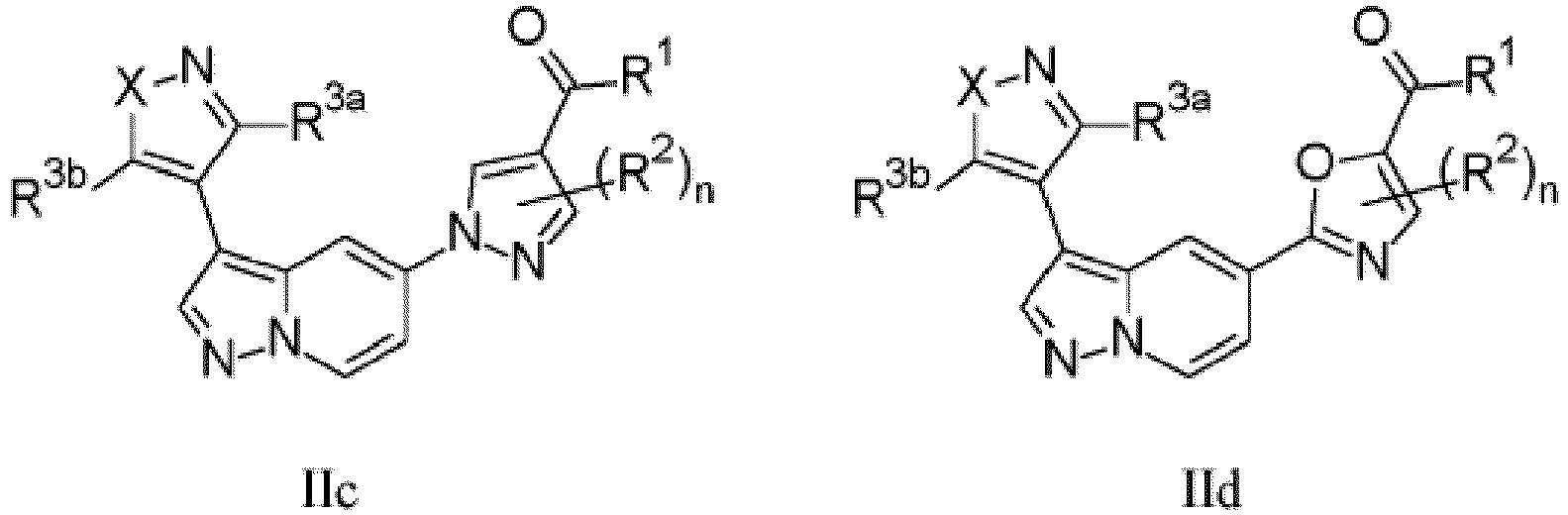
- Composé ou sel pharmaceutiquement acceptable de celui-ci, selon l'une quelconque des revendications 1 à 3, R3a et R3b étant indépendamment H, -CH3, -CH2CH3, -CH(CH3)2 ou -CF3.
- Composé ou sel pharmaceutiquement acceptable de celui-ci, selon l'une quelconque des revendications 1 à 3, R3a et R3b étant tous deux -CH3.
- Composé ou sel pharmaceutiquement acceptable de celui-ci selon la revendication 1, le composé étant conforme à la Formule IIIa, IIIb, IIIc, ou IIId :

- Composé ou sel pharmaceutiquement acceptable de celui-ci, selon l'une quelconque des revendications 1 à 6, R2 étant -O-R7, ou un cycloalkyle en C3-6.
- Composé ou sel pharmaceutiquement acceptable de celui-ci, selon l'une quelconque des revendications 1 à 6, R2 étant -O-CH2CH3, ou un cyclopropyle.
- Composé ou sel pharmaceutiquement acceptable de celui-ci selon la revendication 1, le composé étant conforme à la Formule Iva, IVb, IVc, ou IVd :

- Composé ou sel pharmaceutiquement acceptable de celui-ci, selon l'une quelconque des revendications 1 à 9, X étant O.
- Composé ou sel pharmaceutiquement acceptable de celui-ci, selon la revendication 1, le composé étant conforme à la Formule Va, Vb, ou Vc :

- Composé ou sel pharmaceutiquement acceptable de celui-ci, selon l'une quelconque des revendications 1 à 9 et 11, R4 étant -CH3, -CH2CH3, -CH(CH3)2, -CHF2 ou -CH2-CF3.
- Composition pharmaceutique comprenant un véhicule pharmaceutiquement acceptable et une quantité pharmaceutiquement efficace d'un composé ou d'un sel pharmaceutiquement acceptable de celui-ci selon l'une quelconque des revendications 1 à 12.
- Composé ou sel pharmaceutiquement acceptable de celui-ci, selon l'une quelconque des revendications 1 à 12, ou composition pharmaceutique selon la revendication 13 destinés à une utilisation médicale.
- Composé ou sel pharmaceutiquement acceptable de celui-ci selon l'une quelconque des revendications 1 à 12, ou composition pharmaceutique selon la revendication 13 destinés à une utilisation dans la prophylaxie et/ou le traitement de maladies endocriniennes, nutritionnelles, métaboliques et/ou cardiovasculaires.
Applications Claiming Priority (2)
| Application Number | Priority Date | Filing Date | Title |
|---|---|---|---|
| GBGB1902490.0A GB201902490D0 (en) | 2019-02-25 | 2019-02-25 | Novel compounds and pharmaceutical compositions thereof for the treatment of diseases |
| PCT/EP2020/054122 WO2020173739A1 (fr) | 2019-02-25 | 2020-02-17 | Dérivés de pyrazolopyridine utilisés comme inhibiteurs de pask |
Publications (2)
| Publication Number | Publication Date |
|---|---|
| EP3931191A1 EP3931191A1 (fr) | 2022-01-05 |
| EP3931191B1 true EP3931191B1 (fr) | 2023-10-04 |
Family
ID=65998935
Family Applications (1)
| Application Number | Title | Priority Date | Filing Date |
|---|---|---|---|
| EP20706194.6A Active EP3931191B1 (fr) | 2019-02-25 | 2020-02-17 | Dérivés de pyrazolopyridine utilisés comme inhibiteurs de pask |
Country Status (19)
| Country | Link |
|---|---|
| US (1) | US20220144823A1 (fr) |
| EP (1) | EP3931191B1 (fr) |
| JP (1) | JP2022525121A (fr) |
| KR (1) | KR20210134001A (fr) |
| CN (1) | CN113474344A (fr) |
| AR (1) | AR124749A1 (fr) |
| AU (1) | AU2020229041A1 (fr) |
| BR (1) | BR112021016642A2 (fr) |
| CA (1) | CA3130154A1 (fr) |
| CO (1) | CO2021010485A2 (fr) |
| ES (1) | ES2963409T3 (fr) |
| GB (1) | GB201902490D0 (fr) |
| IL (1) | IL285751A (fr) |
| MA (1) | MA55074A (fr) |
| MX (1) | MX2021010093A (fr) |
| PH (1) | PH12021552032A1 (fr) |
| SG (1) | SG11202109157TA (fr) |
| TW (1) | TW202045505A (fr) |
| WO (1) | WO2020173739A1 (fr) |
Families Citing this family (2)
| Publication number | Priority date | Publication date | Assignee | Title |
|---|---|---|---|---|
| WO2022070288A1 (fr) * | 2020-09-30 | 2022-04-07 | 旭化成ファーマ株式会社 | Composé bicyclique contenant de l'azote |
| WO2025143152A1 (fr) * | 2023-12-27 | 2025-07-03 | 全薬工業株式会社 | Composé thiazolyle-pyrazolo[1,5-a]pyridine et son utilisation en tant qu'inhibiteur de mylk4 |
Family Cites Families (6)
| Publication number | Priority date | Publication date | Assignee | Title |
|---|---|---|---|---|
| US7074801B1 (en) * | 2001-04-26 | 2006-07-11 | Eisai Co., Ltd. | Nitrogen-containing condensed cyclic compound having a pyrazolyl group as a substituent group and pharmaceutical composition thereof |
| AU2009279936A1 (en) * | 2008-08-05 | 2010-02-11 | Banyu Pharmaceutical Co., Ltd. | Therapeutic compounds |
| WO2010090716A1 (fr) * | 2009-01-30 | 2010-08-12 | Millennium Pharmaceuticals, Inc. | Hétéroaryles et applications associées |
| WO2014066795A1 (fr) * | 2012-10-25 | 2014-05-01 | Bioenergenix | Composés hétérocycliques pour l'inhibition de pask |
| CN107257796A (zh) * | 2014-12-02 | 2017-10-17 | 拜耳医药股份有限公司 | 取代的吡唑并[1,5‑a]吡啶和咪唑并[1,2‑a]吡嗪及其用途 |
| WO2018200855A1 (fr) * | 2017-04-27 | 2018-11-01 | The Brigham And Women's Hospital, Inc. | Nouveaux inhibiteurs d'alk2 et procédés d'inhibition de la signalisation bmp |
-
2019
- 2019-02-25 GB GBGB1902490.0A patent/GB201902490D0/en not_active Ceased
-
2020
- 2020-02-17 CA CA3130154A patent/CA3130154A1/fr active Pending
- 2020-02-17 PH PH1/2021/552032A patent/PH12021552032A1/en unknown
- 2020-02-17 JP JP2021555034A patent/JP2022525121A/ja active Pending
- 2020-02-17 BR BR112021016642A patent/BR112021016642A2/pt not_active IP Right Cessation
- 2020-02-17 MA MA055074A patent/MA55074A/fr unknown
- 2020-02-17 US US17/433,503 patent/US20220144823A1/en not_active Abandoned
- 2020-02-17 MX MX2021010093A patent/MX2021010093A/es unknown
- 2020-02-17 EP EP20706194.6A patent/EP3931191B1/fr active Active
- 2020-02-17 SG SG11202109157TA patent/SG11202109157TA/en unknown
- 2020-02-17 ES ES20706194T patent/ES2963409T3/es active Active
- 2020-02-17 WO PCT/EP2020/054122 patent/WO2020173739A1/fr not_active Ceased
- 2020-02-17 AU AU2020229041A patent/AU2020229041A1/en not_active Abandoned
- 2020-02-17 CN CN202080016700.3A patent/CN113474344A/zh active Pending
- 2020-02-17 KR KR1020217030814A patent/KR20210134001A/ko not_active Ceased
- 2020-02-21 AR ARP200100485A patent/AR124749A1/es not_active Application Discontinuation
- 2020-02-24 TW TW109105861A patent/TW202045505A/zh unknown
-
2021
- 2021-08-10 CO CONC2021/0010485A patent/CO2021010485A2/es unknown
- 2021-08-22 IL IL285751A patent/IL285751A/en unknown
Also Published As
| Publication number | Publication date |
|---|---|
| MX2021010093A (es) | 2021-09-21 |
| CA3130154A1 (fr) | 2020-09-03 |
| CO2021010485A2 (es) | 2021-08-19 |
| MA55074A (fr) | 2022-01-05 |
| US20220144823A1 (en) | 2022-05-12 |
| BR112021016642A2 (pt) | 2021-11-03 |
| SG11202109157TA (en) | 2021-09-29 |
| GB201902490D0 (en) | 2019-04-10 |
| AU2020229041A1 (en) | 2021-10-21 |
| CN113474344A (zh) | 2021-10-01 |
| JP2022525121A (ja) | 2022-05-11 |
| PH12021552032A1 (en) | 2022-11-14 |
| IL285751A (en) | 2021-10-31 |
| ES2963409T3 (es) | 2024-03-27 |
| KR20210134001A (ko) | 2021-11-08 |
| AR124749A1 (es) | 2023-05-03 |
| WO2020173739A1 (fr) | 2020-09-03 |
| EP3931191A1 (fr) | 2022-01-05 |
| TW202045505A (zh) | 2020-12-16 |
Similar Documents
| Publication | Publication Date | Title |
|---|---|---|
| EP3378862B1 (fr) | Dihydropyrimidinoisoquinoléinones et leurs compositions pharmaceutiques pour le traitement de la sclérose en plaques | |
| ES2664985T3 (es) | Compuestos y métodos para modulación de quinasa, e indicaciones de los mismos | |
| JP6949952B2 (ja) | スピロ環化合物 | |
| KR102924294B1 (ko) | 아졸-융합된 피리다진-3(2h)-온 유도체 | |
| RU2675818C2 (ru) | Новые соединения и фармацевтические композиции, их содержащие, для лечения воспалительных расстройств | |
| KR20240006606A (ko) | Nav1.8 억제제로서의 아릴 3-옥소피페라진 카르복스아미드 및 헤테로아릴 3-옥소피페라진 카르복스아미드 | |
| WO2017147700A1 (fr) | Inhibiteurs de la liaison protéine wdr5-protéine | |
| EP4562016A2 (fr) | Inhibiteurs de cdk2 et leurs procédés d'utilisation | |
| CA3253414A1 (fr) | Composés et procédés utiles pour stabiliser des mutations de phénylalanine hydroxylase | |
| EP3931191B1 (fr) | Dérivés de pyrazolopyridine utilisés comme inhibiteurs de pask | |
| KR20250151455A (ko) | Egfr 억제제로서의 마크로시클릭 아미노피리딘 화합물 | |
| CN117355532A (zh) | 三并环类usp1抑制剂及其用途 | |
| HK40076219A (en) | Azole-fused pyridazin-3(2h)-one derivatives | |
| HK40076219B (en) | Azole-fused pyridazin-3(2h)-one derivatives | |
| NZ717556A (en) | Spirocyclic compounds as tryptophan hydroxylase inhibitors | |
| HK1201528B (en) | Novel dihydropyrimidinoisoquinolinones and pharmaceutical compositions thereof for the treatment of inflammatory disorders |
Legal Events
| Date | Code | Title | Description |
|---|---|---|---|
| STAA | Information on the status of an ep patent application or granted ep patent |
Free format text: STATUS: UNKNOWN |
|
| STAA | Information on the status of an ep patent application or granted ep patent |
Free format text: STATUS: THE INTERNATIONAL PUBLICATION HAS BEEN MADE |
|
| PUAI | Public reference made under article 153(3) epc to a published international application that has entered the european phase |
Free format text: ORIGINAL CODE: 0009012 |
|
| STAA | Information on the status of an ep patent application or granted ep patent |
Free format text: STATUS: REQUEST FOR EXAMINATION WAS MADE |
|
| 17P | Request for examination filed |
Effective date: 20210917 |
|
| AK | Designated contracting states |
Kind code of ref document: A1 Designated state(s): AL AT BE BG CH CY CZ DE DK EE ES FI FR GB GR HR HU IE IS IT LI LT LU LV MC MK MT NL NO PL PT RO RS SE SI SK SM TR |
|
| RAV | Requested validation state of the european patent: fee paid |
Extension state: TN Effective date: 20210917 Extension state: MD Effective date: 20210917 Extension state: MA Effective date: 20210917 |
|
| REG | Reference to a national code |
Ref country code: HK Ref legal event code: DE Ref document number: 40066874 Country of ref document: HK |
|
| GRAP | Despatch of communication of intention to grant a patent |
Free format text: ORIGINAL CODE: EPIDOSNIGR1 |
|
| STAA | Information on the status of an ep patent application or granted ep patent |
Free format text: STATUS: GRANT OF PATENT IS INTENDED |
|
| INTG | Intention to grant announced |
Effective date: 20221124 |
|
| GRAJ | Information related to disapproval of communication of intention to grant by the applicant or resumption of examination proceedings by the epo deleted |
Free format text: ORIGINAL CODE: EPIDOSDIGR1 |
|
| STAA | Information on the status of an ep patent application or granted ep patent |
Free format text: STATUS: REQUEST FOR EXAMINATION WAS MADE |
|
| GRAP | Despatch of communication of intention to grant a patent |
Free format text: ORIGINAL CODE: EPIDOSNIGR1 |
|
| STAA | Information on the status of an ep patent application or granted ep patent |
Free format text: STATUS: GRANT OF PATENT IS INTENDED |
|
| INTC | Intention to grant announced (deleted) | ||
| INTG | Intention to grant announced |
Effective date: 20230419 |
|
| GRAS | Grant fee paid |
Free format text: ORIGINAL CODE: EPIDOSNIGR3 |
|
| GRAA | (expected) grant |
Free format text: ORIGINAL CODE: 0009210 |
|
| STAA | Information on the status of an ep patent application or granted ep patent |
Free format text: STATUS: THE PATENT HAS BEEN GRANTED |
|
| P01 | Opt-out of the competence of the unified patent court (upc) registered |
Effective date: 20230817 |
|
| AK | Designated contracting states |
Kind code of ref document: B1 Designated state(s): AL AT BE BG CH CY CZ DE DK EE ES FI FR GB GR HR HU IE IS IT LI LT LU LV MC MK MT NL NO PL PT RO RS SE SI SK SM TR |
|
| REG | Reference to a national code |
Ref country code: GB Ref legal event code: FG4D |
|
| REG | Reference to a national code |
Ref country code: CH Ref legal event code: EP |
|
| REG | Reference to a national code |
Ref country code: DE Ref legal event code: R096 Ref document number: 602020018608 Country of ref document: DE |
|
| REG | Reference to a national code |
Ref country code: IE Ref legal event code: FG4D Ref country code: NL Ref legal event code: FP |
|
| REG | Reference to a national code |
Ref country code: LT Ref legal event code: MG9D |
|
| REG | Reference to a national code |
Ref country code: AT Ref legal event code: MK05 Ref document number: 1617675 Country of ref document: AT Kind code of ref document: T Effective date: 20231004 |
|
| REG | Reference to a national code |
Ref country code: ES Ref legal event code: FG2A Ref document number: 2963409 Country of ref document: ES Kind code of ref document: T3 Effective date: 20240327 |
|
| PG25 | Lapsed in a contracting state [announced via postgrant information from national office to epo] |
Ref country code: GR Free format text: LAPSE BECAUSE OF FAILURE TO SUBMIT A TRANSLATION OF THE DESCRIPTION OR TO PAY THE FEE WITHIN THE PRESCRIBED TIME-LIMIT Effective date: 20240105 |
|
| PG25 | Lapsed in a contracting state [announced via postgrant information from national office to epo] |
Ref country code: IS Free format text: LAPSE BECAUSE OF FAILURE TO SUBMIT A TRANSLATION OF THE DESCRIPTION OR TO PAY THE FEE WITHIN THE PRESCRIBED TIME-LIMIT Effective date: 20240204 |
|
| PG25 | Lapsed in a contracting state [announced via postgrant information from national office to epo] |
Ref country code: LT Free format text: LAPSE BECAUSE OF FAILURE TO SUBMIT A TRANSLATION OF THE DESCRIPTION OR TO PAY THE FEE WITHIN THE PRESCRIBED TIME-LIMIT Effective date: 20231004 |
|
| PG25 | Lapsed in a contracting state [announced via postgrant information from national office to epo] |
Ref country code: AT Free format text: LAPSE BECAUSE OF FAILURE TO SUBMIT A TRANSLATION OF THE DESCRIPTION OR TO PAY THE FEE WITHIN THE PRESCRIBED TIME-LIMIT Effective date: 20231004 |
|
| PG25 | Lapsed in a contracting state [announced via postgrant information from national office to epo] |
Ref country code: LT Free format text: LAPSE BECAUSE OF FAILURE TO SUBMIT A TRANSLATION OF THE DESCRIPTION OR TO PAY THE FEE WITHIN THE PRESCRIBED TIME-LIMIT Effective date: 20231004 Ref country code: IS Free format text: LAPSE BECAUSE OF FAILURE TO SUBMIT A TRANSLATION OF THE DESCRIPTION OR TO PAY THE FEE WITHIN THE PRESCRIBED TIME-LIMIT Effective date: 20240204 Ref country code: GR Free format text: LAPSE BECAUSE OF FAILURE TO SUBMIT A TRANSLATION OF THE DESCRIPTION OR TO PAY THE FEE WITHIN THE PRESCRIBED TIME-LIMIT Effective date: 20240105 Ref country code: BG Free format text: LAPSE BECAUSE OF FAILURE TO SUBMIT A TRANSLATION OF THE DESCRIPTION OR TO PAY THE FEE WITHIN THE PRESCRIBED TIME-LIMIT Effective date: 20240104 Ref country code: AT Free format text: LAPSE BECAUSE OF FAILURE TO SUBMIT A TRANSLATION OF THE DESCRIPTION OR TO PAY THE FEE WITHIN THE PRESCRIBED TIME-LIMIT Effective date: 20231004 Ref country code: PT Free format text: LAPSE BECAUSE OF FAILURE TO SUBMIT A TRANSLATION OF THE DESCRIPTION OR TO PAY THE FEE WITHIN THE PRESCRIBED TIME-LIMIT Effective date: 20240205 |
|
| PGFP | Annual fee paid to national office [announced via postgrant information from national office to epo] |
Ref country code: DE Payment date: 20231228 Year of fee payment: 5 Ref country code: GB Payment date: 20240108 Year of fee payment: 5 |
|
| PG25 | Lapsed in a contracting state [announced via postgrant information from national office to epo] |
Ref country code: SE Free format text: LAPSE BECAUSE OF FAILURE TO SUBMIT A TRANSLATION OF THE DESCRIPTION OR TO PAY THE FEE WITHIN THE PRESCRIBED TIME-LIMIT Effective date: 20231004 Ref country code: RS Free format text: LAPSE BECAUSE OF FAILURE TO SUBMIT A TRANSLATION OF THE DESCRIPTION OR TO PAY THE FEE WITHIN THE PRESCRIBED TIME-LIMIT Effective date: 20231004 Ref country code: PL Free format text: LAPSE BECAUSE OF FAILURE TO SUBMIT A TRANSLATION OF THE DESCRIPTION OR TO PAY THE FEE WITHIN THE PRESCRIBED TIME-LIMIT Effective date: 20231004 Ref country code: NO Free format text: LAPSE BECAUSE OF FAILURE TO SUBMIT A TRANSLATION OF THE DESCRIPTION OR TO PAY THE FEE WITHIN THE PRESCRIBED TIME-LIMIT Effective date: 20240104 Ref country code: LV Free format text: LAPSE BECAUSE OF FAILURE TO SUBMIT A TRANSLATION OF THE DESCRIPTION OR TO PAY THE FEE WITHIN THE PRESCRIBED TIME-LIMIT Effective date: 20231004 Ref country code: HR Free format text: LAPSE BECAUSE OF FAILURE TO SUBMIT A TRANSLATION OF THE DESCRIPTION OR TO PAY THE FEE WITHIN THE PRESCRIBED TIME-LIMIT Effective date: 20231004 |
|
| PGFP | Annual fee paid to national office [announced via postgrant information from national office to epo] |
Ref country code: IT Payment date: 20240111 Year of fee payment: 5 |
|
| REG | Reference to a national code |
Ref country code: DE Ref legal event code: R097 Ref document number: 602020018608 Country of ref document: DE |
|
| PG25 | Lapsed in a contracting state [announced via postgrant information from national office to epo] |
Ref country code: DK Free format text: LAPSE BECAUSE OF FAILURE TO SUBMIT A TRANSLATION OF THE DESCRIPTION OR TO PAY THE FEE WITHIN THE PRESCRIBED TIME-LIMIT Effective date: 20231004 |
|
| PG25 | Lapsed in a contracting state [announced via postgrant information from national office to epo] |
Ref country code: CZ Free format text: LAPSE BECAUSE OF FAILURE TO SUBMIT A TRANSLATION OF THE DESCRIPTION OR TO PAY THE FEE WITHIN THE PRESCRIBED TIME-LIMIT Effective date: 20231004 |
|
| PG25 | Lapsed in a contracting state [announced via postgrant information from national office to epo] |
Ref country code: SK Free format text: LAPSE BECAUSE OF FAILURE TO SUBMIT A TRANSLATION OF THE DESCRIPTION OR TO PAY THE FEE WITHIN THE PRESCRIBED TIME-LIMIT Effective date: 20231004 |
|
| PG25 | Lapsed in a contracting state [announced via postgrant information from national office to epo] |
Ref country code: SM Free format text: LAPSE BECAUSE OF FAILURE TO SUBMIT A TRANSLATION OF THE DESCRIPTION OR TO PAY THE FEE WITHIN THE PRESCRIBED TIME-LIMIT Effective date: 20231004 Ref country code: SK Free format text: LAPSE BECAUSE OF FAILURE TO SUBMIT A TRANSLATION OF THE DESCRIPTION OR TO PAY THE FEE WITHIN THE PRESCRIBED TIME-LIMIT Effective date: 20231004 Ref country code: RO Free format text: LAPSE BECAUSE OF FAILURE TO SUBMIT A TRANSLATION OF THE DESCRIPTION OR TO PAY THE FEE WITHIN THE PRESCRIBED TIME-LIMIT Effective date: 20231004 Ref country code: EE Free format text: LAPSE BECAUSE OF FAILURE TO SUBMIT A TRANSLATION OF THE DESCRIPTION OR TO PAY THE FEE WITHIN THE PRESCRIBED TIME-LIMIT Effective date: 20231004 Ref country code: DK Free format text: LAPSE BECAUSE OF FAILURE TO SUBMIT A TRANSLATION OF THE DESCRIPTION OR TO PAY THE FEE WITHIN THE PRESCRIBED TIME-LIMIT Effective date: 20231004 Ref country code: CZ Free format text: LAPSE BECAUSE OF FAILURE TO SUBMIT A TRANSLATION OF THE DESCRIPTION OR TO PAY THE FEE WITHIN THE PRESCRIBED TIME-LIMIT Effective date: 20231004 |
|
| PLBE | No opposition filed within time limit |
Free format text: ORIGINAL CODE: 0009261 |
|
| STAA | Information on the status of an ep patent application or granted ep patent |
Free format text: STATUS: NO OPPOSITION FILED WITHIN TIME LIMIT |
|
| 26N | No opposition filed |
Effective date: 20240705 |
|
| PG25 | Lapsed in a contracting state [announced via postgrant information from national office to epo] |
Ref country code: MC Free format text: LAPSE BECAUSE OF FAILURE TO SUBMIT A TRANSLATION OF THE DESCRIPTION OR TO PAY THE FEE WITHIN THE PRESCRIBED TIME-LIMIT Effective date: 20231004 |
|
| REG | Reference to a national code |
Ref country code: CH Ref legal event code: PL |
|
| VS25 | Lapsed in a validation state [announced via postgrant information from nat. office to epo] |
Ref country code: MD Free format text: LAPSE BECAUSE OF FAILURE TO SUBMIT A TRANSLATION OF THE DESCRIPTION OR TO PAY THE FEE WITHIN THE PRESCRIBED TIME-LIMIT Effective date: 20231004 |
|
| PG25 | Lapsed in a contracting state [announced via postgrant information from national office to epo] |
Ref country code: LU Free format text: LAPSE BECAUSE OF NON-PAYMENT OF DUE FEES Effective date: 20240217 |
|
| PG25 | Lapsed in a contracting state [announced via postgrant information from national office to epo] |
Ref country code: CH Free format text: LAPSE BECAUSE OF NON-PAYMENT OF DUE FEES Effective date: 20240229 |
|
| PG25 | Lapsed in a contracting state [announced via postgrant information from national office to epo] |
Ref country code: SI Free format text: LAPSE BECAUSE OF FAILURE TO SUBMIT A TRANSLATION OF THE DESCRIPTION OR TO PAY THE FEE WITHIN THE PRESCRIBED TIME-LIMIT Effective date: 20231004 |
|
| PG25 | Lapsed in a contracting state [announced via postgrant information from national office to epo] |
Ref country code: SI Free format text: LAPSE BECAUSE OF FAILURE TO SUBMIT A TRANSLATION OF THE DESCRIPTION OR TO PAY THE FEE WITHIN THE PRESCRIBED TIME-LIMIT Effective date: 20231004 Ref country code: LU Free format text: LAPSE BECAUSE OF NON-PAYMENT OF DUE FEES Effective date: 20240217 Ref country code: CH Free format text: LAPSE BECAUSE OF NON-PAYMENT OF DUE FEES Effective date: 20240229 |
|
| PG25 | Lapsed in a contracting state [announced via postgrant information from national office to epo] |
Ref country code: IE Free format text: LAPSE BECAUSE OF NON-PAYMENT OF DUE FEES Effective date: 20240217 |
|
| PG25 | Lapsed in a contracting state [announced via postgrant information from national office to epo] |
Ref country code: IE Free format text: LAPSE BECAUSE OF NON-PAYMENT OF DUE FEES Effective date: 20240217 |
|
| REG | Reference to a national code |
Ref country code: ES Ref legal event code: FD2A Effective date: 20250327 |
|
| PG25 | Lapsed in a contracting state [announced via postgrant information from national office to epo] |
Ref country code: ES Free format text: LAPSE BECAUSE OF NON-PAYMENT OF DUE FEES Effective date: 20240218 |
|
| PG25 | Lapsed in a contracting state [announced via postgrant information from national office to epo] |
Ref country code: CY Free format text: LAPSE BECAUSE OF FAILURE TO SUBMIT A TRANSLATION OF THE DESCRIPTION OR TO PAY THE FEE WITHIN THE PRESCRIBED TIME-LIMIT; INVALID AB INITIO Effective date: 20200217 |
|
| REG | Reference to a national code |
Ref country code: DE Ref legal event code: R119 Ref document number: 602020018608 Country of ref document: DE |
|
| PG25 | Lapsed in a contracting state [announced via postgrant information from national office to epo] |
Ref country code: HU Free format text: LAPSE BECAUSE OF FAILURE TO SUBMIT A TRANSLATION OF THE DESCRIPTION OR TO PAY THE FEE WITHIN THE PRESCRIBED TIME-LIMIT; INVALID AB INITIO Effective date: 20200217 |
|
| PG25 | Lapsed in a contracting state [announced via postgrant information from national office to epo] |
Ref country code: FI Free format text: LAPSE BECAUSE OF FAILURE TO SUBMIT A TRANSLATION OF THE DESCRIPTION OR TO PAY THE FEE WITHIN THE PRESCRIBED TIME-LIMIT Effective date: 20231004 |
|
| GBPC | Gb: european patent ceased through non-payment of renewal fee |
Effective date: 20250217 |
|
| VS25 | Lapsed in a validation state [announced via postgrant information from nat. office to epo] |
Ref country code: MA Free format text: FAILURE TO ELECT DOMICILE IN THE NATIONAL COUNTRY Effective date: 20240105 |
|
| PG25 | Lapsed in a contracting state [announced via postgrant information from national office to epo] |
Ref country code: TR Free format text: LAPSE BECAUSE OF FAILURE TO SUBMIT A TRANSLATION OF THE DESCRIPTION OR TO PAY THE FEE WITHIN THE PRESCRIBED TIME-LIMIT Effective date: 20231004 |
|
| PG25 | Lapsed in a contracting state [announced via postgrant information from national office to epo] |
Ref country code: DE Free format text: LAPSE BECAUSE OF NON-PAYMENT OF DUE FEES Effective date: 20250902 |
|
| PG25 | Lapsed in a contracting state [announced via postgrant information from national office to epo] |
Ref country code: GB Free format text: LAPSE BECAUSE OF NON-PAYMENT OF DUE FEES Effective date: 20250217 |
|
| PG25 | Lapsed in a contracting state [announced via postgrant information from national office to epo] |
Ref country code: IT Free format text: LAPSE BECAUSE OF NON-PAYMENT OF DUE FEES Effective date: 20250217 |
|
| PGFP | Annual fee paid to national office [announced via postgrant information from national office to epo] |
Ref country code: NL Payment date: 20251215 Year of fee payment: 7 Ref country code: FR Payment date: 20251208 Year of fee payment: 7 |
|
| PGFP | Annual fee paid to national office [announced via postgrant information from national office to epo] |
Ref country code: BE Payment date: 20260105 Year of fee payment: 7 |