EP3940630A1 - Computerimplementiertes angepasstes anomaliedetektionsverfahren für pulverbettbasierte generative fertigung - Google Patents
Computerimplementiertes angepasstes anomaliedetektionsverfahren für pulverbettbasierte generative fertigung Download PDFInfo
- Publication number
- EP3940630A1 EP3940630A1 EP20186278.6A EP20186278A EP3940630A1 EP 3940630 A1 EP3940630 A1 EP 3940630A1 EP 20186278 A EP20186278 A EP 20186278A EP 3940630 A1 EP3940630 A1 EP 3940630A1
- Authority
- EP
- European Patent Office
- Prior art keywords
- anomaly
- image data
- cluster
- centroids
- images
- Prior art date
- Legal status (The legal status is an assumption and is not a legal conclusion. Google has not performed a legal analysis and makes no representation as to the accuracy of the status listed.)
- Pending
Links
Images

Classifications
-
- G—PHYSICS
- G06—COMPUTING OR CALCULATING; COUNTING
- G06T—IMAGE DATA PROCESSING OR GENERATION, IN GENERAL
- G06T7/00—Image analysis
- G06T7/0002—Inspection of images, e.g. flaw detection
- G06T7/0004—Industrial image inspection
- G06T7/001—Industrial image inspection using an image reference approach
-
- B—PERFORMING OPERATIONS; TRANSPORTING
- B22—CASTING; POWDER METALLURGY
- B22F—WORKING METALLIC POWDER; MANUFACTURE OF ARTICLES FROM METALLIC POWDER; MAKING METALLIC POWDER; APPARATUS OR DEVICES SPECIALLY ADAPTED FOR METALLIC POWDER
- B22F10/00—Additive manufacturing of workpieces or articles from metallic powder
- B22F10/30—Process control
- B22F10/36—Process control of energy beam parameters
-
- B—PERFORMING OPERATIONS; TRANSPORTING
- B22—CASTING; POWDER METALLURGY
- B22F—WORKING METALLIC POWDER; MANUFACTURE OF ARTICLES FROM METALLIC POWDER; MAKING METALLIC POWDER; APPARATUS OR DEVICES SPECIALLY ADAPTED FOR METALLIC POWDER
- B22F12/00—Apparatus or devices specially adapted for additive manufacturing; Auxiliary means for additive manufacturing; Combinations of additive manufacturing apparatus or devices with other processing apparatus or devices
- B22F12/90—Means for process control, e.g. cameras or sensors
-
- B—PERFORMING OPERATIONS; TRANSPORTING
- B33—ADDITIVE MANUFACTURING TECHNOLOGY
- B33Y—ADDITIVE MANUFACTURING, i.e. MANUFACTURING OF THREE-DIMENSIONAL [3D] OBJECTS BY ADDITIVE DEPOSITION, ADDITIVE AGGLOMERATION OR ADDITIVE LAYERING, e.g. BY 3D PRINTING, STEREOLITHOGRAPHY OR SELECTIVE LASER SINTERING
- B33Y50/00—Data acquisition or data processing for additive manufacturing
- B33Y50/02—Data acquisition or data processing for additive manufacturing for controlling or regulating additive manufacturing processes
-
- G—PHYSICS
- G06—COMPUTING OR CALCULATING; COUNTING
- G06T—IMAGE DATA PROCESSING OR GENERATION, IN GENERAL
- G06T7/00—Image analysis
- G06T7/10—Segmentation; Edge detection
- G06T7/168—Segmentation; Edge detection involving transform domain methods
-
- G—PHYSICS
- G06—COMPUTING OR CALCULATING; COUNTING
- G06F—ELECTRIC DIGITAL DATA PROCESSING
- G06F18/00—Pattern recognition
- G06F18/20—Analysing
- G06F18/23—Clustering techniques
- G06F18/232—Non-hierarchical techniques
- G06F18/2321—Non-hierarchical techniques using statistics or function optimisation, e.g. modelling of probability density functions
- G06F18/23213—Non-hierarchical techniques using statistics or function optimisation, e.g. modelling of probability density functions with fixed number of clusters, e.g. K-means clustering
-
- G—PHYSICS
- G06—COMPUTING OR CALCULATING; COUNTING
- G06F—ELECTRIC DIGITAL DATA PROCESSING
- G06F18/00—Pattern recognition
- G06F18/20—Analysing
- G06F18/24—Classification techniques
- G06F18/243—Classification techniques relating to the number of classes
- G06F18/2433—Single-class perspective, e.g. one-against-all classification; Novelty detection; Outlier detection
-
- G—PHYSICS
- G06—COMPUTING OR CALCULATING; COUNTING
- G06F—ELECTRIC DIGITAL DATA PROCESSING
- G06F18/00—Pattern recognition
- G06F18/40—Software arrangements specially adapted for pattern recognition, e.g. user interfaces or toolboxes therefor
-
- G—PHYSICS
- G06—COMPUTING OR CALCULATING; COUNTING
- G06T—IMAGE DATA PROCESSING OR GENERATION, IN GENERAL
- G06T2207/00—Indexing scheme for image analysis or image enhancement
- G06T2207/10—Image acquisition modality
- G06T2207/10024—Color image
-
- G—PHYSICS
- G06—COMPUTING OR CALCULATING; COUNTING
- G06T—IMAGE DATA PROCESSING OR GENERATION, IN GENERAL
- G06T2207/00—Indexing scheme for image analysis or image enhancement
- G06T2207/10—Image acquisition modality
- G06T2207/10072—Tomographic images
-
- G—PHYSICS
- G06—COMPUTING OR CALCULATING; COUNTING
- G06T—IMAGE DATA PROCESSING OR GENERATION, IN GENERAL
- G06T2207/00—Indexing scheme for image analysis or image enhancement
- G06T2207/20—Special algorithmic details
- G06T2207/20021—Dividing image into blocks, subimages or windows
-
- G—PHYSICS
- G06—COMPUTING OR CALCULATING; COUNTING
- G06T—IMAGE DATA PROCESSING OR GENERATION, IN GENERAL
- G06T2207/00—Indexing scheme for image analysis or image enhancement
- G06T2207/30—Subject of image; Context of image processing
- G06T2207/30108—Industrial image inspection
- G06T2207/30164—Workpiece; Machine component
-
- G—PHYSICS
- G06—COMPUTING OR CALCULATING; COUNTING
- G06T—IMAGE DATA PROCESSING OR GENERATION, IN GENERAL
- G06T2207/00—Indexing scheme for image analysis or image enhancement
- G06T2207/30—Subject of image; Context of image processing
- G06T2207/30204—Marker
-
- Y—GENERAL TAGGING OF NEW TECHNOLOGICAL DEVELOPMENTS; GENERAL TAGGING OF CROSS-SECTIONAL TECHNOLOGIES SPANNING OVER SEVERAL SECTIONS OF THE IPC; TECHNICAL SUBJECTS COVERED BY FORMER USPC CROSS-REFERENCE ART COLLECTIONS [XRACs] AND DIGESTS
- Y02—TECHNOLOGIES OR APPLICATIONS FOR MITIGATION OR ADAPTATION AGAINST CLIMATE CHANGE
- Y02P—CLIMATE CHANGE MITIGATION TECHNOLOGIES IN THE PRODUCTION OR PROCESSING OF GOODS
- Y02P10/00—Technologies related to metal processing
- Y02P10/25—Process efficiency
Definitions
- the present invention relates to a computer-implemented (adapted) anomaly detection or defect prediction method for powder-bed-based additive manufacturing processes.
- the presented approach preferably, relates to a semi-supervised adaptive thresholding methodology e.g. as part of image processing for the described anomaly detection.
- the overall methodology is neither a (full) supervised machine detection or machine learning approach, nor a (full) unsupervised machine learning approach; but preferably an intermediate solution.
- Said approach is applicable for all types of powder-bed-based additive manufacturing processes, such as for processing plastics or metals.
- the presented solution is applicable to the additive manufacture of parts or workpieces established by laser powder bed fusion (LPBF) out of a powder bed.
- LPBF laser powder bed fusion
- DED Directed Energy Deposition
- such workpieces are high-performance parts, like components applied in power generation, aerospace or the automotive sector.
- the component may as well be a component of a turbo machine, e.g. in the flow path hardware of a gas turbine.
- the component is, thus, preferably made of a nickel-or cobalt-based superalloy, particularly a precipitation hardened alloy.
- Additive manufacturing particularly powder-bed methods have proven to be useful and advantageous in the fabrication of prototypes or complex components, such as components with a mazelike or convoluted structure or functionally cooled components. Further, the additive manufacture stands out for its short chain of process steps which in turn enables material economization and a particularly low lead time.
- Powder bed fusion manufacturing devices or setups for the given methods usually comprise a manufacturing or build platform on which the component is built layer-by-layer after the feeding of a layer of base material which may then be melted, e.g. by an energy beam, such as a laser, and subsequently solidified.
- the layer thickness is determined by a recoater that moves, e.g. automatically, over the powder bed and removes excess material from a manufacturing plane or build space. Typical layer thicknesses amount to between 20 ⁇ m and 40 ⁇ m.
- said energy beam scans over the surface and melts the powder on selected areas which may be predetermined by a CAD-file according to the geometry of the component to be manufactured.
- Said scanning or irradiation is, preferably, carried out in a computer implemented way or via computer-aided means, such as computer aided manufacturing (CAM) instructions, which may be present in the form of a dataset.
- CAM computer aided manufacturing
- Said dataset or CAM-file may be or refer to a computer program or computer program product.
- Such manufacturing devices are usually equipped with different types of optical process monitoring systems, such as CCD or sCMOS cameras or (other) photodiode-based systems. These systems generate layerwise images of the workpiece during its build-up. These images usually need to be analysed for anomalies, such as so-called hot spots, cold spots, over- or underexposed regions, or other anomalies. These defects are often crucial to the workpiece's structure. Due to the complexity of the mentioned selective melting (welding) processes such anomalies or defects are likely to occur during the buildup of any component. If such defects were not detected early on, this would probably lead to scrapping of the part and to a waste of process capacity and manufacturing time.
- optical process monitoring systems such as CCD or sCMOS cameras or (other) photodiode-based systems. These systems generate layerwise images of the workpiece during its build-up. These images usually need to be analysed for anomalies, such as so-called hot spots, cold spots, over- or underexposed regions, or other anomalies. These defects are often crucial to the
- anomalies are detected by means of image data, particularly using static thresholding-based image processing algorithms or other machine learning approaches.
- static thresholding-based image processing algorithms or other machine learning approaches are still not robust enough to detect defects or anomalies and the abundance of image data to be rendered and processed.
- thresholds usually need to be defined for specific types of anomalies. This is often done manually by an operator of the given process.
- static thresholds may cause inconsistencies when image settings are changed. Therefore, automatic evaluation of multisource image data using a general, automated method or approach is still not possible.
- threshold values are usually determined by experts or machine operators themselves by means of manual color value analyses of the respective images. If the images are to be processed on a basis of other characteristics, threshold values must again be determined manually. Threshold values must also be adjusted manually for each dataset. Setting the threshold values manually by different experts, however, leads to inconsistencies in the results. Extensive research has already been performed using so-called supervised machine learning approaches to predict the anomalies in the underlying image data. However, this nevertheless leads to the generation of huge amounts of (unlabelled) data which has to be labelled or classified by the user in a manual way. Further complicating is the fact that such approaches are hardware-specific.
- an object of the present invention to provide means which help to overcome the mentioned drawbacks.
- a semi-automated determination of adaptive thresholds is provided that adapts to the recorded dataset during process monitoring. This approach is intended to allow different users with different levels of knowledge and expertise to evaluate data sets in order to provide consistent results.
- An aspect of the present invention relates to a computer-implemented anomaly detection method in powder bed based additive manufacturing of a workpiece comprising providing an image data set, such as a stack of layered image data, and applying a so-called Principal Component Analysis (PCA) to said image data in order to compute a number of image clusters.
- Said PCA usually serves the purpose to structure, simplify or illustrate statistical variables in huge amounts of data in that said variables are approximated by a smaller number of significant linear combinations or "components".
- the method further comprises applying a clustering algorithm to the analysed image data and computing respective cluster centroids, such as corresponding to the computed number of image clusters.
- a clustering algorithm to the analysed image data and computing respective cluster centroids, such as corresponding to the computed number of image clusters.
- the computed cluster centroids or centroid positions may be used as a reference template for further processing of the respective fraction of data or variable.
- a k-means clustering e.g. a method for quantifying vectors or objects, wherein a predefined number of K groups or clusters is generated out of an amount of similar objects.
- the method further comprises storing and/or comparing the computed cluster centroids with a set of reference anomaly centroids, such as of a reference template, wherein - based on a match of the determined computed cluster centroids with the reference - the image data is segmented layerwise into cluster images of a specific anomaly.
- a set of reference anomaly centroids such as of a reference template
- the method further comprises transforming the segmented images (from an as-is state), such as from an RGB colour space into a defined colour space, like a Lab colour space or greyscale spectrum.
- a defined colour space like a Lab colour space or greyscale spectrum.
- the decision between the Lab colour space or greyscale space may depend on the respective input data type.
- the method further comprises integrating a pixel information of the transformed segmented cluster images to compute a threshold value for the image data set in order to determine a respective anomaly or process defect during the manufacture of the workpiece.
- the presented method advantageously allows to automatedly or semi-automatedly and reliably evaluate an image data set independently of user input-based inaccuracies.
- the method is particularly suitable and effective for determining threshold values for patterns that are difficult to distinguish.
- the quality of the adaptively determined threshold values as described herein is - for the presented approach - far superior than if such threshold values were to be determined manually by experts.
- the presented approach calculates adaptive thresholds as described herein.
- unsupervised machine learning is used to find defect or anomaly patterns in unlabelled data.
- the present invention relates to an adaptive and color- or intensity-based calculation of threshold values for new datasets and image patterns.
- the presented approach can advantageously be applied to all types of image data. It cannot only be applied for optical process monitoring data but also for any other applications in computer vision.
- the presented approach can, advantageously, applied in serial additive production of workpieces or components in an ever more industrialised way; provided that the given hardware is equipped with in-situ optical monitoring systems, such as optical cameras or other sensor technology (see below).
- optical monitoring systems such as optical cameras or other sensor technology (see below).
- the invention helps to further broaden the scope of additive manufacturing technologies in general.
- a "hot spot”, a "cold spot”, a blob defect, or e.g. an overexposed or underexposed region can be detected or predicted in the recorded image of the powder bed during the manufacture of the given workpiece.
- a hotspot or cold spot may refer or be recorded by means of an RGB color image, whereas an under-fused or over-fused region in the powder bed may relate to a greyscale picture.
- the image data is constituted by a stack of layered images, such as photographic and/or optical tomography data.
- the image data set is provided by a stack of random and/or test images as a reference which are subjected to a PCA and, such as subsequently, to a clustering algorithm (cf. above) for computing respective cluster centroids, wherein the image clusters are, such as visually and/or manually, selected in order to provide for a reference anomaly centroids information.
- said reference information may relate to an unlabelled test template for providing the reference anomaly centroids, e.g. a stack of between 20 to 50 images.
- a one-time manual selection of relevant patterns can be carried out.
- said image data is constituted by an input of an optical monitoring system of powder bed fusion device, such as a CCD, sCMOS or any other photodiode based sensor, and said image data forms a test reference.
- an optical monitoring system of powder bed fusion device such as a CCD, sCMOS or any other photodiode based sensor
- a lower, such as a minimum, and/or an upper, such as maximum, threshold value is computed for the image data set in order to provide a threshold image for the respective anomaly.
- the computed threshold values are used or foreseen as input parameters (source data input) for a subsequent anomaly detection, thresholding or image processing method. These computed thresholds can also be used further for the same source data input especially in the case of the serial production of new data input from the same printer or manufacturing device.
- an anomaly is marked in each layer of the image data set and formed into anomaly clusters, such as by using a nearest neighbour search algorithm or cluster position computation, like a Connected Component Labeling, a Proximity or Closest Point Search, a Point Location or Point in Triangle Search or a k-Nearest Neighbor algorithm.
- a nearest neighbour search algorithm or cluster position computation like a Connected Component Labeling, a Proximity or Closest Point Search, a Point Location or Point in Triangle Search or a k-Nearest Neighbor algorithm.
- the location and/or a size of the respective anomaly cluster is determined with reference to the actual workpiece geometry.
- a size and a location of the anomaly or anomaly cluster may be computed based on the camera pixel field and lateral coordinates. Thereby, subsequently, a region of interest extraction may be carried out, wherein a position of the detected cluster (and size) is used for computing a part severity or (layerwise) severity of the manufactured structure.
- anomaly cluster information comprising a location, a size and/or a severity indicator of the given cluster is stored in a report file, such as a point cloud or point cloud database.
- a so-called point cloud database is used as output data format for the size, the location and/or severity of the given cluster or part anomaly.
- an anomaly cluster information comprising location, size and/or a severity indicator of the given anomaly cluster is correlated with real material manufacturing defects. According to this embodiment, better insights can be derived for post-inspection, quality control or further aspects of upcoming additive manufacturing processes or according manufacturing parameters development.
- Another aspect of the present invention relates to a method of manufacturing a workpiece out of a powder bed by selective laser sintering, selective laser melting or electron beam melting, applying the computer-implemented anomaly detection method as described above.
- Another aspect of the present invention relates to a data processing apparatus configured to carry out the method as described, wherein the apparatus further comprises an interface to a powder bed fusion device or an according monitoring system.
- a further aspect of the present invention relates to a computer program product comprising instructions or information which, when a corresponding program is executed by a data processing apparatus or a computer, cause it to carry out the described method steps.
- a computer program product as referred to herein may relate to a computer program means constituting or comprising a storage medium like a memory card, a USB stick, a CD-ROM, a DVD or a file downloaded or downloadable from a server or network.
- Such product may be provided by a wireless communication network or via transfer of the corresponding information by the given computer program, computer program product or computer program means.
- a computer program product may include a non-transitory computer-readable storage medium storing applications, programs, program modules, scripts, source code, program code, object code, byte code, compiled code,interpreted code, machine code, executable instructions,and/or the like (also referred to herein as executable instructions, instructions for execution, program code,and/or similar terms used herein interchangeably).
- Such non-transitory computer-readable storage media include all computer-readable media (including volatile and non-volatile media).
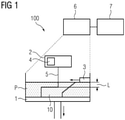
- FIG. 1 shows an additive manufacturing device 100.
- Said device 100 may be a conventional device for manufacturing any type of components by powder-bed-fusion (PBF).
- PBF powder-bed-fusion
- Such techniques employ a bed of a powder or base material P which is selectively and layerwise exposed to or irradiated by an energy beam 5, such as a laser or an electron beam of an irradiation apparatus or energy beam source 2.
- the given PBF method may relate to selective laser sintering, selective laser melting or electron beam melting.
- Said processes allow to establish a workpiece or part 10 on top of a build platform 1 in that powdery layers L for the part 10 are fused or welded onto said platform 1 and consecutively irradiated by selectively solidified by the beam 5 according to its predefined (CAD-)geometry.
- CAD- predefined
- the irradiation apparatus 20 is connected to or may be controlled by a control device 4, e.g. comprising a build processor means.
- the device 100 may further feature a, preferably optical, monitoring system 6, such as comprising a CCD or sCMOS camera or any other photodiode type imaging system with which layerwise images can be taken during the build job, such as one image after a powder recoating step and one image after an according (selective) laser scanning step.
- a monitoring system 6 such as comprising a CCD or sCMOS camera or any other photodiode type imaging system with which layerwise images can be taken during the build job, such as one image after a powder recoating step and one image after an according (selective) laser scanning step.
- a certain optical, monitoring system 6 such as comprising a CCD or sCMOS camera or any other photodiode type imaging system with which layerwise images can be taken during the build job, such as one image after a powder recoating step and one image after an according (selective) laser scanning step.
- the workpiece 10 as referred to herein may particularly relate to a part or an article of complex shape, such as with filigree portions of structures.
- said part is made of a high-performance material, such as a material of great strength and/or thermal resistivity.
- said part may constitute a part of a steam or gas turbine component, such as a blade, vane, shroud, shield, such as heat shield, tip, segment, insert, injector, seal, transition, burner, nozzle, strainer, orifice, liner, distributor, dome, boost, cone, lance, plate, resonator, piston or any corresponding retrofit kit.
- said component may relate to another or similar component.
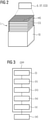
- Figure 2 indicates a schematic perspective view of a stack of layers L above a workpiece 10.
- the layer stack shall indicate subsequent layers L for the component 10 to be selectively irradiated or - as the case maybe - optical images taken in order to detect anomalies in the process, be it in the powder layer or in the already (partly) solidified layer.
- the stack of layers as shown in Figure 2 may as well relate to optical tomography data as set forth below. By way of the topmost layer of the stack as indicated in Figure 2 , an anomaly detection shall be illustrated.
- the optical monitoring system 6 may particularly detect, record or register different types of defects, flaws or anomalies, e.g. after a selective melting step has been carried out.
- a hot spot HS shall be indicated, i.e. a region in the powder bed or structure for the workpiece 10 which has e.g. been overexposed by the energy beam 5.
- a local or spatial energy density, brought in the powder bed may have been chosen too excessive as to result in a sufficient irradiation result. It is known that excessive heat causes powder particles to evaporate and may cause voids or so-called "keyhole porosity" in the workpiece's structure, i.e approximately spherical bubbles in the structure of the part.
- irradiation parameters to be selected in a reasonable process "window", i.e. a range of parameters which allow a good structural result, preferably without or poor in defects and anomalies. It is, of course, not only the energy parameter which can cause hot spots and other defects. Also material or the geometry of the workpiece itself (which is of course oversimplified in the scheme of Figure 2 ) may lead to hotspots at corners of the contour of the workpiece, e.g. where the energy output is critical. It is known that the mere powder bed, e.g. surrounding solidified structures for the workpiece 10, is thermally "quasi-insulating" and excess heat needs to be dissipated via the build plate (not explicitly indicated in Figure 2 ).
- cold spots CS as indicated in the lower part of the upmost layer in Figure 2 may arise. These cold spots CS may be attributed to an underexposed region, e.g. wherein the energy applied by beam 5 to the powder was not sufficient to fully and reliably melt the according powder bed regions. These cold spots CS may likewise result in an adverse structural quality, such as a residual porosity in the powder P.
- the presented approach as well as the optical monitoring system 6 is capable of detecting a plurality of defects, such as the described hot spot HS, cold spots CS, an according overfused and/or an undefused region, but also so-called blob defects, in the buildup structure for the workpiece 10.
- a plurality of defects such as the described hot spot HS, cold spots CS, an according overfused and/or an undefused region, but also so-called blob defects, in the buildup structure for the workpiece 10.
- All of the listed types of anomalies in the process may lead to scrap or waste of the whole component, particularly when the manufacture of high-performance materials is concerned. This leads in turn to a waste of manufacturing time and resources.
- a porosity defect can only reliably be detected when repeatedly occurring at the same location in the layered build-up, i.e. over an extension of two to three layers or more, for instance.
- Figure 3 indicates in a simplified schematic, method steps according to the method of the present invention. Said method being preferably computer-implemented, is an anomaly detection approach for an application of powder bed based additive manufacturing processes.
- the method comprises, (i), providing an image data set OT, such as a stack of layered data recorded during a one-time build job or only during the manufacture of a plurality of layers.
- This step further applies a Principal Component Analysis PCA to said image data to compute or analyse a number of image clusters C.
- Said PCA in fact restructures characteristic variables in the image data set and extracts an amount of relevant cluster numbers, wherein at least some clusters out of many indicate or relate to a sort of anomaly or defect as described above.
- the remainder of the clusters may include information about background or non-anomaly data information. Because in the (visual) selection and/or when comparing the centroids with the reference centroids, the anomaly clusters get identified.
- the method further comprises, (ii), applying a clustering algorithm to the analysed image data and computing respective cluster centroids C, such as corresponding to the computed number of image clusters.
- Said clustering may relate to a so-called k-means clustering, a fuzzy C-Means clustering or a density-based spatial clustering algorithm, such as a so-called DBSCAN.
- the method further comprises, (iii), comparing the computed cluster centroids C with a set of reference anomaly centroids, wherein - based on a match of cluster centroids with the reference - the image data is segmented (layerwise) into cluster images of a specific anomaly. Only the segmented clusters or anomalies are processed any further, such as e.g. five clusters out of a number of 20 overall quantified clusters or the like are segmented. Furthermore, each type of anomaly cluster is then processed serially and/or separately.
- the method further comprises, (iv), transforming the segmented images into a defined color space, such as a Lab (Lab) color space or greyscale (GV) spectrum, this particularly facilitates the detection of anomalies by way of a thresholding approach as will be described below.
- a defined color space such as a Lab (Lab) color space or greyscale (GV) spectrum
- the method further comprises, (v), integrating a pixel information of the transformed segmented cluster images to compute a threshold value for the image data set in order to determine a respective anomaly (cf. reference numerals a, t in Figure 4 below).
- the whole presented detection or monitoring solution may be implemented in an only semi-automated or semi-supervised way. This brings e.g. advantages over a fully automated way which suffers from the drawbacks as listed further above.
- Figure 4 indicates particulars of the presented approach in more detail. Some aspects of the present invention may in this regard be described in a redundant way.
- the upper part or line of the indicated flow chart or chart of pictograms in Figure 4 under step "1)" may relate to a reference template generation which may be carried out at least in a one-time computational step.
- the described image data set OT or stack of optical images is - provided that the whole manufacturing and printer setup is validated for the first time - supplied by a stack of random and/or test images as a reference, which are then subjected to a Principal Component Analysis PCA and to a clustering algorithm for computing cluster centroids C (similarly as described above), wherein the image clusters are selected in order to provide for a reference anomaly centroids information.
- a dimensional reduction algorithm can be applied by the PCA in combination with clustering algorithm, preferably "k-means", to form the clusters from the image data and computing the cluster centroids.
- clustering algorithm preferably "k-means”
- Each cluster centroid is referred to the "sub-components" of an individual image.
- the cluster centroids C that refer to the desired anomalies are selected and exported as a reference template file. Which can be used as a reference template to match the similar anomalies from new image data (see “2)" below).
- accuracy and quality of the presented anomaly detection increases. I.e. the better the data input gets, the better is potentially a resolution of the presented thresholding and anomaly detection functionality. Generally, accuracy will usually be increased to a certain level. Then, after a certain data input, accuracy will flatten because the centroid values will not change drastically anymore. But if e.g. different data input stems from different build jobs, whereas monitoring data stem from the same machine and optical tomography system, then accuracy will increase depending on the geometry and/or features within the data, as this would generate different cluster values.
- the corresponding image set get segmented and generate images with anomalies only.
- New segmented images of a given color space get transformed into LAB color space or grey spectrum depending on its input format (color/ greyscale images).
- a new grid with individual color plane is formed where pixel-wise intensity values get integrated to compute the lower and upper thresholds for the dataset (cf. above).
- a lower value (cf. t low ) and/or an upper threshold value t up is computed for the image data set in order to provide a threshold range for the respective anomaly.
- These computed thresholds can also be used further for the same source data input, especially in the case of the serial production or new data input from the same printer, as shall be indicated by the further OT data input from the left in the bottom row of Figure 4 .
- New computed thresholds may then become input parameters for conventional thresholding based image processing algorithms where anomalies get marked on layerwise images, and formed into clusters using nearest neighbor methods and finally compute the location and size of the respective anomaly using a pixel size and a field of view information, such as e.g. based on the pixel coordinates (x,y) of the respective layer.
- an anomaly a is marked in each layer L of the image data set and formed into anomaly clusters, such as by using a nearest neighbor search algorithm, like a Connected Component Labeling, a Proximity or Closest Point Search, a Point Location or Point in Triangle Search or a k-Nearest Neighbor algorithm.
- a nearest neighbor search algorithm like a Connected Component Labeling, a Proximity or Closest Point Search, a Point Location or Point in Triangle Search or a k-Nearest Neighbor algorithm.
- a location and/or a size of the respective anomaly cluster may be determined with reference to the actual workpiece geometry.
- a region of interest ROI may be used or extracted. This may particularly be implemented via binary mask with an according ROI information; or by similar means.
- defect or anomaly clusters may be registered with in specified region of interest ROI.
- an information of a specific location, dimensional and/or a severity indicator of a given anomaly cluster may be computed and reported, such as by way of a point cloud database PCD.
- the database may e.g.
- each type of anomalies may in turn be correlated with real material or manufacturing defects, which may be detected either in-situ by other monitoring approaches or e.g. by computed tomography as post-manufacturing inspection.
- a generated anomaly information file (location, size and severity) can then be used as quality report or further used to accelerate printing process parameter development or used with post-inspection data to correlate with real material defects.
Landscapes
- Engineering & Computer Science (AREA)
- Chemical & Material Sciences (AREA)
- Materials Engineering (AREA)
- Manufacturing & Machinery (AREA)
- Physics & Mathematics (AREA)
- Theoretical Computer Science (AREA)
- General Physics & Mathematics (AREA)
- Computer Vision & Pattern Recognition (AREA)
- Automation & Control Theory (AREA)
- Quality & Reliability (AREA)
- Analytical Chemistry (AREA)
- Investigating Materials By The Use Of Optical Means Adapted For Particular Applications (AREA)
- Powder Metallurgy (AREA)
Priority Applications (5)
| Application Number | Priority Date | Filing Date | Title |
|---|---|---|---|
| EP20186278.6A EP3940630A1 (de) | 2020-07-16 | 2020-07-16 | Computerimplementiertes angepasstes anomaliedetektionsverfahren für pulverbettbasierte generative fertigung |
| US18/014,969 US12499533B2 (en) | 2020-07-16 | 2021-05-05 | Computer-implemented, adapted anomaly detection method for powder-bed-based additive manufacturing |
| CN202180049827.XA CN115943431A (zh) | 2020-07-16 | 2021-05-05 | 用于基于粉末床的增材制造的计算机实现的、适合的异常检测方法 |
| PCT/EP2021/061867 WO2022012796A1 (en) | 2020-07-16 | 2021-05-05 | Computer-implemented, adapted anomaly detection method for powder-bed-based additive manufacturing |
| EP21728007.2A EP4150571B1 (de) | 2020-07-16 | 2021-05-05 | Computerimplementiertes angepasstes anomaliedetektionsverfahren für pulverbettbasierte generative fertigung |
Applications Claiming Priority (1)
| Application Number | Priority Date | Filing Date | Title |
|---|---|---|---|
| EP20186278.6A EP3940630A1 (de) | 2020-07-16 | 2020-07-16 | Computerimplementiertes angepasstes anomaliedetektionsverfahren für pulverbettbasierte generative fertigung |
Publications (1)
| Publication Number | Publication Date |
|---|---|
| EP3940630A1 true EP3940630A1 (de) | 2022-01-19 |
Family
ID=71661761
Family Applications (2)
| Application Number | Title | Priority Date | Filing Date |
|---|---|---|---|
| EP20186278.6A Pending EP3940630A1 (de) | 2020-07-16 | 2020-07-16 | Computerimplementiertes angepasstes anomaliedetektionsverfahren für pulverbettbasierte generative fertigung |
| EP21728007.2A Active EP4150571B1 (de) | 2020-07-16 | 2021-05-05 | Computerimplementiertes angepasstes anomaliedetektionsverfahren für pulverbettbasierte generative fertigung |
Family Applications After (1)
| Application Number | Title | Priority Date | Filing Date |
|---|---|---|---|
| EP21728007.2A Active EP4150571B1 (de) | 2020-07-16 | 2021-05-05 | Computerimplementiertes angepasstes anomaliedetektionsverfahren für pulverbettbasierte generative fertigung |
Country Status (4)
| Country | Link |
|---|---|
| US (1) | US12499533B2 (de) |
| EP (2) | EP3940630A1 (de) |
| CN (1) | CN115943431A (de) |
| WO (1) | WO2022012796A1 (de) |
Cited By (1)
| Publication number | Priority date | Publication date | Assignee | Title |
|---|---|---|---|---|
| US20240390983A1 (en) * | 2023-05-25 | 2024-11-28 | Raytheon Technologies Corporation | Uncertainty quantification or predictive defect model for multi-laser powder bed fusion additive manufacturing |
Families Citing this family (5)
| Publication number | Priority date | Publication date | Assignee | Title |
|---|---|---|---|---|
| EP3933528B1 (de) * | 2020-06-30 | 2024-10-02 | Bull SAS | Vorhersagesystem in einem prozess zur generativen fertigung durch maschinenlernalgorithmen |
| US20230386007A1 (en) * | 2022-05-31 | 2023-11-30 | Lawrence Livermore National Security, Llc | Manufacturing process monitoring and inspection based on coregistration of diverse sensor data |
| CN114882020B (zh) * | 2022-07-06 | 2022-11-11 | 深圳市信润富联数字科技有限公司 | 产品的缺陷检测方法、装置、设备及计算机可读介质 |
| US20240391174A1 (en) * | 2023-05-25 | 2024-11-28 | Raytheon Technologies Corporation | Quality metric for predictive defect model for multi-laser powder bed fusion additive manufacturing |
| CN116645370B (zh) * | 2023-07-27 | 2023-10-10 | 山东顺发重工有限公司 | 基于三维点云数据的高温锻件表面缺陷实时检测方法 |
Family Cites Families (4)
| Publication number | Priority date | Publication date | Assignee | Title |
|---|---|---|---|---|
| DE102015212837A1 (de) * | 2015-07-09 | 2017-01-12 | Siemens Aktiengesellschaft | Verfahren zur Überwachung eines Prozesses zur pulverbettbasierten additiven Herstellung eines Bauteils und Anlage, die für ein solches Verfahren geeignet ist |
| US10719929B2 (en) * | 2015-11-16 | 2020-07-21 | Materialise N.V. | Error detection in additive manufacturing processes |
| CN106626377B (zh) * | 2016-10-25 | 2019-08-30 | 天津清研智束科技有限公司 | 实时检测粉床表面变形的增材制造方法及增材制造装置 |
| US11559854B2 (en) * | 2018-11-09 | 2023-01-24 | General Electric Company | Methods for detecting errors in an additive manufacturing process |
-
2020
- 2020-07-16 EP EP20186278.6A patent/EP3940630A1/de active Pending
-
2021
- 2021-05-05 WO PCT/EP2021/061867 patent/WO2022012796A1/en not_active Ceased
- 2021-05-05 EP EP21728007.2A patent/EP4150571B1/de active Active
- 2021-05-05 US US18/014,969 patent/US12499533B2/en active Active
- 2021-05-05 CN CN202180049827.XA patent/CN115943431A/zh active Pending
Non-Patent Citations (3)
| Title |
|---|
| ANONYMOUS: "Can k-means clustering do classification?", STACKOVERFLOW, 29 April 2020 (2020-04-29), Internet, XP055762507, Retrieved from the Internet <URL:https://stackoverflow.com/questions/22300830/can-k-means-clustering-do-classification> [retrieved on 20201223] * |
| MARCO GRASSO ET AL: "In-Process Monitoring of Selective Laser Melting: Spatial Detection of Defects Via Image Data Analysis", JOURNAL OF MANUFACTURING SCIENCE AND ENGINEERING, vol. 139, no. 5, 10 November 2016 (2016-11-10), US, XP055762386, ISSN: 1087-1357, DOI: 10.1115/1.4034715 * |
| SNELL ROBERT ET AL: "Methods for Rapid Pore Classification in Metal Additive Manufacturing", JOM: JOURNAL OF METALS, SPRINGER NEW YORK LLC, UNITED STATES, vol. 72, no. 1, 4 September 2019 (2019-09-04), pages 101 - 109, XP036968291, ISSN: 1047-4838, [retrieved on 20190904], DOI: 10.1007/S11837-019-03761-9 * |
Cited By (2)
| Publication number | Priority date | Publication date | Assignee | Title |
|---|---|---|---|---|
| US20240390983A1 (en) * | 2023-05-25 | 2024-11-28 | Raytheon Technologies Corporation | Uncertainty quantification or predictive defect model for multi-laser powder bed fusion additive manufacturing |
| US12485489B2 (en) * | 2023-05-25 | 2025-12-02 | Rtx Corporation | Uncertainty quantification or predictive defect model for multi-laser powder bed fusion additive manufacturing |
Also Published As
| Publication number | Publication date |
|---|---|
| WO2022012796A1 (en) | 2022-01-20 |
| CN115943431A (zh) | 2023-04-07 |
| EP4150571A1 (de) | 2023-03-22 |
| US12499533B2 (en) | 2025-12-16 |
| US20230260103A1 (en) | 2023-08-17 |
| EP4150571C0 (de) | 2025-08-27 |
| EP4150571B1 (de) | 2025-08-27 |
Similar Documents
| Publication | Publication Date | Title |
|---|---|---|
| EP4150571B1 (de) | Computerimplementiertes angepasstes anomaliedetektionsverfahren für pulverbettbasierte generative fertigung | |
| Huang et al. | Rapid surface defects detection in wire and arc additive manufacturing based on laser profilometer | |
| Taherkhani et al. | Development of a defect-detection platform using photodiode signals collected from the melt pool of laser powder-bed fusion | |
| US20230302539A1 (en) | Tool for scan path visualization and defect distribution prediction | |
| US10857738B2 (en) | Systems and methods for real-time defect detection, and automatic correction in additive manufacturing environment | |
| JP6923269B2 (ja) | 付加製造プロセスにおけるエラー検出及び熱放散に対する補償の方法 | |
| Ertay et al. | Process performance evaluation and classification via in-situ melt pool monitoring in directed energy deposition | |
| Abdelrahman et al. | Flaw detection in powder bed fusion using optical imaging | |
| CN111168062B (zh) | 用于检测增材制造处理中的错误的熔池监测系统和方法 | |
| US20240239049A1 (en) | Computer-implemented correlation between monitoring data and according inspection data in powder-bed additive manufacturing | |
| CN117282987B (zh) | 大功率激光熔丝沉积熔池同步智能整形的方法 | |
| US11141923B2 (en) | Method and device of detecting part quality of a three dimensional manufacturing object | |
| US12263636B2 (en) | In-process optical based monitoring and control of additive manufacturing processes | |
| Bonato et al. | Prediction of spatter-related defects in metal laser powder bed fusion by analytical and machine learning modelling applied to off-axis long-exposure monitoring | |
| Colosimo et al. | On-machine measurement, monitoring and control | |
| Armin et al. | Defect detection in 3D printing: A review of image processing and machine vision techniques | |
| Zhang et al. | Multiscale basis modeling of 3D melt-pool morphological variations for manufacturing process monitoring | |
| Kunkel et al. | Deep learning-based automated defect classification for powder bed fusion–Laser beam | |
| Chitral et al. | Novel on-site layer dimensioning and deep learning-enabled predictive modelling for wire arc additive manufacturing | |
| Terry et al. | Active monitoring of powder bed fusion process by training an artificial neural net classifier on layer-by-layer surface laser profilometry data | |
| Cannizzaro et al. | In-Situ Monitoring of Additive Manufacturing | |
| JP7851908B2 (ja) | 加工区域上に堆積された付加製造粉体層内の欠陥を検出する方法 | |
| Fu et al. | A study of online melt pool, plume, and spatter tracking in laser powder bed fusion using DBSCAN | |
| US12502715B2 (en) | Method for detecting defects in an additive manufacturing powder layer deposited on a working area | |
| Villalva | Sensor Data Analysis for Additive Manufacturing Process Monitoring |
Legal Events
| Date | Code | Title | Description |
|---|---|---|---|
| PUAI | Public reference made under article 153(3) epc to a published international application that has entered the european phase |
Free format text: ORIGINAL CODE: 0009012 |
|
| STAA | Information on the status of an ep patent application or granted ep patent |
Free format text: STATUS: THE APPLICATION HAS BEEN PUBLISHED |
|
| AK | Designated contracting states |
Kind code of ref document: A1 Designated state(s): AL AT BE BG CH CY CZ DE DK EE ES FI FR GB GR HR HU IE IS IT LI LT LU LV MC MK MT NL NO PL PT RO RS SE SI SK SM TR |