EP3956887B1 - Atténuation de bruit pour des signaux audio dans un véhicule - Google Patents
Atténuation de bruit pour des signaux audio dans un véhicule Download PDFInfo
- Publication number
- EP3956887B1 EP3956887B1 EP20716796.6A EP20716796A EP3956887B1 EP 3956887 B1 EP3956887 B1 EP 3956887B1 EP 20716796 A EP20716796 A EP 20716796A EP 3956887 B1 EP3956887 B1 EP 3956887B1
- Authority
- EP
- European Patent Office
- Prior art keywords
- vehicle
- noise
- noise rejection
- noise suppression
- frequency
- Prior art date
- Legal status (The legal status is an assumption and is not a legal conclusion. Google has not performed a legal analysis and makes no representation as to the accuracy of the status listed.)
- Active
Links
Images

Classifications
-
- G—PHYSICS
- G10—MUSICAL INSTRUMENTS; ACOUSTICS
- G10L—SPEECH ANALYSIS TECHNIQUES OR SPEECH SYNTHESIS; SPEECH RECOGNITION; SPEECH OR VOICE PROCESSING TECHNIQUES; SPEECH OR AUDIO CODING OR DECODING
- G10L21/00—Speech or voice signal processing techniques to produce another audible or non-audible signal, e.g. visual or tactile, in order to modify its quality or its intelligibility
- G10L21/02—Speech enhancement, e.g. noise reduction or echo cancellation
- G10L21/0208—Noise filtering
-
- G—PHYSICS
- G10—MUSICAL INSTRUMENTS; ACOUSTICS
- G10L—SPEECH ANALYSIS TECHNIQUES OR SPEECH SYNTHESIS; SPEECH RECOGNITION; SPEECH OR VOICE PROCESSING TECHNIQUES; SPEECH OR AUDIO CODING OR DECODING
- G10L21/00—Speech or voice signal processing techniques to produce another audible or non-audible signal, e.g. visual or tactile, in order to modify its quality or its intelligibility
- G10L21/02—Speech enhancement, e.g. noise reduction or echo cancellation
- G10L21/0208—Noise filtering
- G10L21/0264—Noise filtering characterised by the type of parameter measurement, e.g. correlation techniques, zero crossing techniques or predictive techniques
Definitions
- the invention relates to a method and an arrangement for noise suppression in audio signals in a vehicle and a vehicle comprising such an arrangement.
- audio signals in a vehicle and in particular in a vehicle interior for transmission can be transmitted to a communication partner positioned outside the vehicle using a so-called hands-free device via mobile radio or other wireless communication connections.
- process and/or prepare such audio signals within the vehicle in particular in such a way that their quality is improved from the perspective of the external communication partner. For example, noise components that do not represent a useful signal (for example not a speech signal) can be filtered out and/or suppressed from these audio signals. Only the appropriately processed signal can then actually be transmitted to the external communication partner.
- the invention is therefore aimed at improving the use of noise suppression for audio signals in a vehicle, in particular in such a way that, from the perspective of any external communication partner, it does not lead to undesirably high quality losses in a transmitted audio signal.
- the emergency call can, for example, be received from an emergency call center of the type described here or, in particular, be sent to one automatically. In the latter case, the procedure may have determined that an accident scenario exists.
- noise suppression of audio signals in a vehicle is adapted to the current operating situations of the vehicle. This applies in particular to the extent of noise suppression, i.e. to what extent and in particular how strongly or, in other words, how intensively noise components in the audio signal are suppressed.
- vehicle speed is a reliable indicator of an appropriate level of noise suppression in a vehicle.
- the ambient or wind, engine, rolling noise and/or other disturbing noises that can be perceived in a vehicle interior depend significantly on the vehicle speed and increase as the vehicle speed increases. Accordingly, embodiments of the invention also provide for increasing the noise suppression as the vehicle speed increases.
- the invention enables audio signals to be transmitted only with little and, in particular, as little information loss as possible, since the noise suppression is reduced accordingly.
- the noise suppression can be significantly reduced or even eliminated completely.
- the audio signal is transmitted as unfiltered as possible, so that an employee of a service center or emergency call center receives as much audio information as possible in order to draw conclusions about the possible well-being of the driver or about the conditions at the possible scene of the accident.
- the employee can receive breathing noises or ambient noises (e.g. moving traffic or sirens) with only minor loss of information and pass this on to emergency services.
- the audio signal can be an input signal (in particular an input signal measured by a microphone) of a hands-free device in the vehicle.
- the emergency call system can be comprised of a hands-free device.
- a hands-free device can be activated selectively when an emergency call is made externally or is sent externally in order to ensure the condition of the vehicle and the vehicle occupants.
- it can be a specific operating mode or operating function of a hands-free device, which can be activated, for example, in response to an incoming call or a detected accident.
- any hands-free device can form an emergency call system, provided it is set up to receive external emergency calls and/or to automatically make emergency calls, for example after a detected accident.
- the noise suppression filter can be a functionality of a control device that, for example, provides or interacts with a hands-free device, communication device or other audio processing device of the vehicle.
- the noise suppression filter can be an algorithm and/or a software component that is controlled by a control device Vehicle or the other facilities mentioned above.
- the noise suppression filter can receive the audio signal as an input signal and output it in processed form as an output signal (ie output it with a suppressed noise component).
- the audio signal can be an audio signal received in a vehicle interior or recorded via a microphone. It can therefore result from the in Vehicle occupants included, for example if they want to speak to an external communication partner.
- the audio signal can be divided into a useful component and a noise component.
- the useful portion can include the portion that is actually to be communicated to the external communication partner and/or that contains relevant information, in particular the voice information expressed by a vehicle occupant.
- the noise component can relate to parts of the audio signal that do not provide any benefit and/or that are not speech information.
- the noise component can include the above-mentioned noise or sources of interference or can be attributed to them.
- the noise suppression filter can be set up using conventional algorithms to differentiate between these components and/or to at least partially filter out the noise component.
- the parameters of the noise suppression filter can be selected appropriately, in particular with regard to which frequency ranges should be attenuated and/or completely filtered out and in what way. Dampening can generally be understood here as reducing a volume value (or decibel value) of the audio signal or at least an audio signal component (e.g. frequency component).
- the vehicle speed value can be obtained from any vehicle system in a manner known per se. For example, it can be read from a CAN bus and/or queried by speed sensors.
- the method can generally be implemented by computer or carried out by a control device with at least one microprocessor.
- a software component for example a component upstream of the noise suppression filter and/or interacting with it
- a software component can also be used to determine those properties that are to be determined depending on the driving speed value and/or the extent of these determinations can be determined and calculated.
- this occurs continuously during ongoing vehicle operation, ie the properties of the noise suppression filter are continuously adapted to the vehicle speed, for example at least when audio signals are currently present and/or are to be transmitted.
- the property that is to be determined depending on the vehicle speed value obtained is an intensity variable of the noise suppression filter.
- it can be an intensity variable relating to the extent or, in other words, the strength of the noise suppression.
- the intensity magnitude or the extent of noise suppression can increase as the vehicle speed increases and in particular increase proportionally thereto (for example in at least one frequency range of the type explained below).
- the intensity variable can be an attenuation variable of the noise reduction filter.
- this size can indicate to what extent (e.g. to what percentage) the audio signal should be attenuated in at least one frequency band compared to the value measured (e.g. by a microphone) before it is output and, if necessary, further communicated.
- the attenuation size can differ depending on the frequency band. For example, at a certain speed it can be larger in frequency bands in which significant amounts of noise have been detected, and lower in other frequency bands in which higher amounts of useful signals have been detected. This determination can be carried out as part of vehicle development or during ongoing operation (see the following discussion).
- the property which is determined depending on the vehicle speed value obtained, is at least one Frequency range of the audio signal in which the noise reduction filter is to be used (ie is to carry out noise reduction). More precisely, the frequency range can be defined, for example, in terms of its size. In particular, the limit frequencies of this frequency range can be defined, i.e. from where to where it should extend. In the context of this disclosure, the terms frequency range and frequency band are used equivalently.
- a plurality of corresponding frequency ranges is preferably defined, specifically for each vehicle speed value or vehicle speed value range. This makes it possible, for example, to assign separate and generally smaller frequency ranges to those frequency ranges at a given vehicle speed in which a high level of noise suppression should take place. However, those areas in which little interference is suspected and therefore no above-average noise suppression is required may experience lower noise suppression.
- focal points can be set within the audio signal frequency spectrum by defining corresponding frequency ranges, depending on the current driving speed, in which particularly strong noise suppression should take place. Consequently, frequency range-specific values of an intensity variable of the noise suppression filter explained above can generally also be assigned to a frequency range.
- At least one frequency range is defined with an above-average intensity, in which a correspondingly high level of noise suppression is then to take place in order to filter out speed-dependent interference components.
- the frequency ranges that include this frequency range or, in general, the remaining frequency ranges can only be filtered to a lesser extent or not at all (i.e. have a correspondingly lower intensity value).
- a predetermined value of an intensity variable of the noise suppression filter is predetermined for the at least one frequency range described above, i.e. that a frequency range-specific value of the intensity variable is present.
- noise suppression can only be activated if a predetermined activation criterion is present. This can, for example, involve starting an internal combustion or electric traction engine, in which the respective engines are enabled to deliver traction energy. So it can be a state in which... to provide traction energy. It can therefore be a condition in which the vehicle would in principle be able to move forward under its own power. It can also involve activating a communication, emergency call or telephone device.
- the property of the noise suppression filter can also be defined in such a way that, despite such an activation state, no noise suppression takes place or is implemented when the vehicle speed falls below a minimum vehicle speed.
- the vehicle speed value is below 3 km/h or if it is 0 km/h, no noise suppression can take place and/or at least 50% lower noise suppression can take place than while driving at 50 km/h.
- the at least one property of the noise suppression filter is set and/or updated while the vehicle is traveling. For example, measurements can be carried out while driving and preferably when there are no useful signals in order to record speed-dependent frequency distributions of interior noise or any background noise. In accordance with these distributions, the above-described values of the intensity variables and/or the frequency ranges can then be selected appropriately, in particular in such a way that speed-dependent focal points of the disturbing noise are specifically suppressed. This determination or updating can be done autonomously by the driver. For example, it can be carried out automatically at regular time or distance intervals.
- the arrangement can include a control device or be designed as such.
- the control device may include the noise reduction filter.
- the control unit can also include the device for determining the vehicle speed value, for example by evaluating GPS data or if this device is set up to query the vehicle speed value from a CAN bus or generally from vehicle speed sensors external to the system.
- the device itself can be designed as a corresponding vehicle speed sensor.
- the control device can be set up to determine a property of the noise suppression filter in the above manner, for which corresponding software components and / or program instructions can be stored, which, for example, include or can access tabular or functional relationships in order to make such a determination.
- the arrangement may generally be adapted to carry out a method according to any of the above and below aspects.
- the arrangement can include any further features, developments and variants in order to provide all of the functions, steps, interactions and effects described in the method.
- all of the above and below explanations of the process features can also apply to the identical arrangement features.
- the invention is defined solely by the claims.
- the invention further relates to a vehicle comprising an arrangement of the above type, provided that the arrangement belongs to the invention.
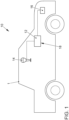
- FIG. 1 an arrangement 10 according to the invention is shown according to an exemplary embodiment of the invention.
- the arrangement 10 is installed in a vehicle 1.
- the arrangement 10 includes a control device 12, which is connected to at least one microphone 14.
- the microphone 14 measures audio signals in a vehicle interior.
- This audio signal contains any voice information or voice input expressed by vehicle occupants as well as general ambient and/or noise of the type described in the introduction.
- the voice information represents useful parts of the audio signal that are to be transmitted via mobile radio to a communication partner external to the vehicle, not shown separately.
- the background noise and/or ambient noise represents a component of interference that should be at least partially filtered out using noise suppression.
- the control device For transmission to a communication partner external to the vehicle, the control device is also connected to or includes a communication device (not shown separately), such as a mobile radio antenna.
- the control unit 12 is also connected to a device 16 for determining a vehicle speed. In the case shown, this is a wheel speed sensor.
- a device 16 for determining the vehicle speed can also be provided in that the control unit 12 is set up to be connected to a corresponding speed sensor external to the arrangement, for example by a signal connection (e.g. a CAN bus) (i.e. the arrangement itself does not necessarily have to have a speed sensor include, but can only be connected to it).
- the control device 12 itself, a speed determination software component of the control device 12 or a hardware signal input of the control device 12 can be a device 16 for speed determination.
- the control unit 12 can determine the speed based on GPS data.
- control device 12 also includes a noise suppression filter 18, which is not shown separately.
- This is a software component that is executed by at least one microprocessor of the control device 12 and that processes or filters the audio signal of the microphone 14 for the purpose of noise suppression. This processed audio signal can then be transmitted to a communication partner external to the vehicle via the communication device mentioned.
- Properties of the noise reduction filter e.g. frequency ranges explained below or Intensity variables can be flexibly determined by the control unit 12, in accordance with a vehicle speed value obtained.
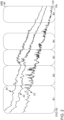
- Fig. 2 A diagram is shown in which volume values in decibels are entered for individual frequencies of the audio signal. These are frequencies of the audio signal that occur within a frequency spectrum that can be detected by the microphone 14 during operation of the vehicle 1 (i.e., for example when the engine is switched on), but without voice input.
- the lowest frequency curve 20 represents the recorded frequencies or frequency-dependent volumes at a vehicle speed of 0 km/h but with the engine switched on.
- a middle curve 22 is also shown, which was determined for a speed of 60 km/h.
- only the driving noises or the possible interference component are recorded (see ambient and/or interference noises above), but not any voice information or other noises emitted by a vehicle occupant.
- the curves 20, 22 and 24 each represent the frequency ranges in which comparatively strong (or loud) noise is perceptible. As part of noise suppression by the noise suppression filter 18, these frequencies should also be filtered out or attenuated to an above-average extent.
- frequency ranges B1 ... Bn are defined in which noise suppressions of different levels are to be carried out.
- Fig. 2 is shown as an example for the middle curve 22 (60 km/h) that a frequency range B3 is specifically defined around the most pronounced frequency in the range of 1,000 Hz. There are particularly pronounced background noises that need to be filtered out accordingly. Any number of other frequency ranges can be defined, as in Fig. 2 indicated by B1 ... B.
- Each of these frequency ranges B1...Bn can be assigned an intensity value of the noise suppression explained below, which is, for example, an intensity of attenuation in this frequency range B1...Bn by the noise suppression filter 18.
- Fig. 3 which is based on the representation of Fig. 2 builds up, values of frequency range-specific noise suppression intensity variables were plotted for each of the frequency ranges B1 to Bn and for each of the speed-dependent curves 20, 22, 24. More precisely, for each frequency range B1 ... Bn, corresponding intensity variables are entered as bars 20.1 ... 20.n, 22.1 ... 22.n, 24.1 ... 24.n, where the corresponding numbers 20, 22 and 24 are refer to the similarly designated frequency curves and apply when the corresponding vehicle speeds are present.
- the intensity of the noise suppression is determined depending on the speed as properties of the noise suppression filter 18. Referring to the frequency range B3, for example, for frequencies in this range there is a stronger attenuation at the vehicle speed according to curve 22 (60 km/h) than at the vehicle speeds according to curves 24 and 20 (120 km/h and 0 km/h), since For these curves there is not the strongest noise in the corresponding frequency range B3.
- the frequency ranges B1 ... Bn are optionally determined as properties of the noise suppression filter depending on the speed, whereby at least in Fig. 3
- the same frequency ranges B1 ... Bn for all curves 20, 22, 24 are selected and the assigned area-specific intensity variables 20.1 ... 24.n are entered. But this is not mandatory. Instead, separate frequency ranges B1...Bn, together with the associated area-specific intensity variables 20.1...24.n, could be selected for each of the curves 20, 22, 24.
- An advantage of the embodiment shown in Fig. 3 lies in the fact that the noise suppression at the vehicle speed of 0 km/h is lower than the other vehicle speeds or at least does not exceed them (see correspondingly lower or at least not higher bars 20.1 ... 20.n). This is based on the idea that emergency conditions and, in particular, accident scenarios can be characterized by an eventual standstill of the vehicle 1. In this case, it is advantageous if as little information loss as possible occurs and the audio signal is transmitted completely or only slightly attenuated by the noise reduction filter 18. This prevents, for example, the breathing noises of a vehicle occupant, which indicate a living condition, from being accidentally filtered out.
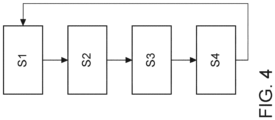
- step S1 speed-dependent disturbance and/or ambient noise measurements are recorded in order to record the speed-dependent frequency distributions in the vehicle interior according to curves 20, 22, 24 for generally any number of speed values.
- suitable frequency ranges B1 ... Bn are then selected either using an automatic algorithm or manually (e.g. during vehicle development). If this is to be done automatically, defined rules can be stored, for example, according to which criteria the frequency ranges B1 ... Bn should be selected. For this purpose, for example, certain value spectrums around a local maximum or minimum or change gradients that can define corresponding range limits come into consideration.
- the frequency ranges B1...Bn are then assigned area-specific values of the intensity variable 20.1...24.n explained above. This can also be done automatically or manually.
- the criterion can be that the strongest or loudest frequency in a frequency range B1 ... Bn is considered (or alternatively an average value thereof within a frequency range B1 ... Bn) and then a suitable distribution of the Intensity size 20.1 ... 24.n is determined over all frequency ranges B1 ... Bn in accordance with the above frequency becomes.
- step S4 which is carried out while the vehicle is driving, audio signals are recorded by the microphone 14 and filtered by the noise suppression filter 18 in accordance with the specified properties and transmitted to a communication partner external to the vehicle. It is also indicated that z. B. can be returned to step S1 at regular intervals in order to recalibrate the system, so to speak. This is preferably done autonomously by the driver and then with appropriate automatic determination of the properties mentioned.
Landscapes
- Engineering & Computer Science (AREA)
- Computational Linguistics (AREA)
- Quality & Reliability (AREA)
- Signal Processing (AREA)
- Health & Medical Sciences (AREA)
- Audiology, Speech & Language Pathology (AREA)
- Human Computer Interaction (AREA)
- Physics & Mathematics (AREA)
- Acoustics & Sound (AREA)
- Multimedia (AREA)
- Fittings On The Vehicle Exterior For Carrying Loads, And Devices For Holding Or Mounting Articles (AREA)
Claims (10)
- Procédé de suppression de bruit dans des signaux audio dans un véhicule (1), ledit procédé comprenant les étapes suivantes :- fournir un filtre de suppression de bruit (18) qui est conçu pour supprimer au moins partiellement une composante de bruit dans un signal audio ;- déterminer si un appel d'urgence est reçu ou émis ; et si c'est le cas :- réduire la suppression de bruit du filtre de suppression de bruit (18) par rapport à un état de fonctionnement dans lequel aucun appel d'urgence n'est reçu ou émis.
- Procédé selon la revendication 1, caractérisé par les étapes suivantes :- obtenir une valeur de vitesse de véhicule ;- déterminer au moins une propriété du filtre de suppression de bruit (18) en fonction de la valeur de vitesse de véhicule obtenue.
- Procédé selon la revendication 2, caractérisé en ce que la propriété est une grandeur d'intensité (20.1...24.n) du filtre de suppression de bruit (18).
- Procédé selon la revendication 3,
caractérisé en ce que la grandeur d'intensité (20.1...24.n) est une grandeur d'atténuation du filtre de suppression de bruit (18). - Procédé selon l'une des revendications 2 à 4, caractérisé en ce que la propriété est au moins un domaine de fréquences (B1...Bn) du signal audio dans lequel le filtre de suppression de bruit (18) doit être utilisé.
- Procédé selon la revendication 5, caractérisé en ce qu'une valeur prédéterminée d'une grandeur d'intensité (20.1...24.n) du filtre de suppression de bruit (18) est spécifiée pour le domaine de fréquences (B1...Bn).
- Procédé selon l'une des revendications 2 à 5, caractérisé en ce que, si la valeur de vitesse de véhicule est inférieure à 3 km/h, aucune suppression de bruit n'est effectuée et/ou une suppression de bruit inférieure d'au moins 50 % à celle d'un déplacement à plus de 50 km/h.
- Procédé selon l'une des revendications précédentes, au moins une propriété du filtre de suppression de bruit (18) étant déterminée et/ou actualisée pendant que le véhicule (1) se déplace.
- Ensemble (10) destiné à la suppression de bruit dans des signaux audio dans un véhicule (1), ledit ensemble comprenant :- un filtre de suppression de bruit (18) qui est conçu pour supprimer au moins partiellement une composante de bruit dans un signal audio ; l'ensemble (10) étant conçu pour déterminer si un appel d'urgence est reçu ou émis ; si tel est le cas, la suppression de bruit du filtre de suppression de bruit (18) étant réduite par rapport à un état de fonctionnement dans lequel aucun appel d'urgence n'est reçu ou émis.
- Véhicule (1), comprenant un ensemble (10) selon la revendication 9.
Applications Claiming Priority (2)
| Application Number | Priority Date | Filing Date | Title |
|---|---|---|---|
| DE102019205694.6A DE102019205694A1 (de) | 2019-04-18 | 2019-04-18 | Geschwindigkeitsabhängige Rauschunterdrückung bei Audiosignalen in einem Fahrzeug |
| PCT/EP2020/059741 WO2020212178A1 (fr) | 2019-04-18 | 2020-04-06 | Atténuation de bruit dépendante de la vitesse pour des signaux audio dans un véhicule |
Publications (2)
| Publication Number | Publication Date |
|---|---|
| EP3956887A1 EP3956887A1 (fr) | 2022-02-23 |
| EP3956887B1 true EP3956887B1 (fr) | 2024-03-27 |
Family
ID=70166039
Family Applications (1)
| Application Number | Title | Priority Date | Filing Date |
|---|---|---|---|
| EP20716796.6A Active EP3956887B1 (fr) | 2019-04-18 | 2020-04-06 | Atténuation de bruit pour des signaux audio dans un véhicule |
Country Status (3)
| Country | Link |
|---|---|
| EP (1) | EP3956887B1 (fr) |
| DE (1) | DE102019205694A1 (fr) |
| WO (1) | WO2020212178A1 (fr) |
Families Citing this family (1)
| Publication number | Priority date | Publication date | Assignee | Title |
|---|---|---|---|---|
| DE102023004940B3 (de) | 2023-11-30 | 2025-02-27 | Mercedes-Benz Group AG | Verfahren zur Unterdrückung von Störfrequenzanteilen aus einem mittels eines Außenmikrofons eines Fahrzeugs aufgenommenen Mikrofonsignal |
Family Cites Families (16)
| Publication number | Priority date | Publication date | Assignee | Title |
|---|---|---|---|---|
| US2370216A (en) * | 1942-07-22 | 1945-02-27 | Gen Electric | Noise suppression circuits |
| US6496581B1 (en) * | 1997-09-11 | 2002-12-17 | Digisonix, Inc. | Coupled acoustic echo cancellation system |
| US20020071573A1 (en) * | 1997-09-11 | 2002-06-13 | Finn Brian M. | DVE system with customized equalization |
| US6420975B1 (en) * | 1999-08-25 | 2002-07-16 | Donnelly Corporation | Interior rearview mirror sound processing system |
| ATE420526T1 (de) * | 2003-11-12 | 2009-01-15 | Harman Becker Automotive Sys | Verfahren und vorrichtung zur rauschverminderung in einem schallsignal |
| DE102005051699A1 (de) | 2005-10-28 | 2007-05-03 | Daimlerchrysler Ag | Physiologische Korrektur für Audio-Empfangssysteme |
| TW200922272A (en) * | 2007-11-06 | 2009-05-16 | High Tech Comp Corp | Automobile noise suppression system and method thereof |
| KR101239318B1 (ko) * | 2008-12-22 | 2013-03-05 | 한국전자통신연구원 | 음질 향상 장치와 음성 인식 시스템 및 방법 |
| US9263040B2 (en) * | 2012-01-17 | 2016-02-16 | GM Global Technology Operations LLC | Method and system for using sound related vehicle information to enhance speech recognition |
| US20160019890A1 (en) * | 2014-07-17 | 2016-01-21 | Ford Global Technologies, Llc | Vehicle State-Based Hands-Free Phone Noise Reduction With Learning Capability |
| DE102014220602A1 (de) | 2014-10-10 | 2016-04-14 | Brose Fahrzeugteile Gmbh & Co. Kommanditgesellschaft, Coburg | Steuergerät, Fahrzeugbaugruppe, Kraftfahrzeug und Verfahren |
| US10652397B2 (en) * | 2016-10-07 | 2020-05-12 | Samsung Electronics Co., Ltd. | Terminal device and method for performing call function |
| US10957340B2 (en) * | 2017-03-10 | 2021-03-23 | Samsung Electronics Co., Ltd. | Method and apparatus for improving call quality in noise environment |
| EP3605529B1 (fr) * | 2017-03-22 | 2022-09-21 | Samsung Electronics Co., Ltd. | Procédé et appareil de traitement d'un signal de parole s'adaptant à un environnement de bruit |
| US10224053B2 (en) * | 2017-03-24 | 2019-03-05 | Hyundai Motor Company | Audio signal quality enhancement based on quantitative SNR analysis and adaptive Wiener filtering |
| DE102017212980B4 (de) | 2017-07-27 | 2023-01-19 | Volkswagen Aktiengesellschaft | Verfahren zur Kompensation von Störgeräuschen bei einer Freisprecheinrichtung in einem Kraftfahrzeug und Freisprecheinrichtung |
-
2019
- 2019-04-18 DE DE102019205694.6A patent/DE102019205694A1/de not_active Ceased
-
2020
- 2020-04-06 WO PCT/EP2020/059741 patent/WO2020212178A1/fr not_active Ceased
- 2020-04-06 EP EP20716796.6A patent/EP3956887B1/fr active Active
Also Published As
| Publication number | Publication date |
|---|---|
| DE102019205694A1 (de) | 2020-10-22 |
| EP3956887A1 (fr) | 2022-02-23 |
| WO2020212178A1 (fr) | 2020-10-22 |
Similar Documents
| Publication | Publication Date | Title |
|---|---|---|
| EP1919257B1 (fr) | Réduction du bruit dépendant du niveau | |
| DE102018109937A1 (de) | Aktive Tondesensibilisierung für tonale Geräusche in einem Fahrzeug | |
| DE102017222750B4 (de) | Regel- oder Steuervorrichtung und Verfahren zur Verbesserung einer Geräuschqualität eines Klimatisierungssystems | |
| DE102013214201A1 (de) | Verfahren zur Steuerung einer Kraftfahrzeug-Klimaanlage | |
| EP3576433B1 (fr) | Procédé de réduction de la présence d'une rétroaction acoustique dans un appareil auditif | |
| DE112017004568B4 (de) | Fahrzeuginternes Privatsphärensystem, Verfahren zum Maskieren von Sprache und Fahrzeug umfassend ein fahrzeuginternes Privatsphärensystem | |
| EP3956887B1 (fr) | Atténuation de bruit pour des signaux audio dans un véhicule | |
| EP0623995B1 (fr) | Dispositif de réglage en fonction du bruit du volume d'un autoradio | |
| EP0899164B1 (fr) | Dispositif pour commander les fonctions d'un auto radio | |
| DE102019102090A1 (de) | Fahrzeuginterne medienstimmunterdrückung | |
| DE102008007240A1 (de) | Verfahren zur automatischen Kontrolle mindestens eines akustischen Parameters | |
| DE4427912B4 (de) | Verfahren und Einrichtung zur Anpassung von Ausgangssignalen eines Tonwiedergabegerätes an den Geräuschpegel im Fahrgastraum eines Kraftfahrzeuges | |
| EP1445761B1 (fr) | Appareil et méthode pour le fonctionnement de systèmes assistés par la parole dans des véhicules automobiles | |
| EP0966100B1 (fr) | Procédé et dispositif pour agir sur le volume d'un appareil de reproduction audio dans un véhicule automobile | |
| EP1649719B1 (fr) | Dispositif et procédé pour exploiter des systèmes à assistance vocale dans des automobiles | |
| EP3403260B1 (fr) | Procédé et dispositif de mise en forme d'un signal audio comprimé avec perte | |
| EP3410606B1 (fr) | Dispositif de couplage du signal et procédé de fonctionnement d'un dispositif de couplage du signal | |
| DE102004035988A1 (de) | Notrufsystem für ein Personentransportsystem, insbesondere für ein Kraftfahrzeug, und Verfahren zur automatischen Übermittlung eines Notrufes | |
| EP3449613B1 (fr) | Procédé et dispositif d'amélioration de la qualité vocale d'une installation de communication couplée à un véhicule | |
| DE102016220365B4 (de) | Verfahren zum Betreiben einer Audioausgabevorrichtung, Audioausgabevorrichtung für ein Kraftfahrzeug und Kraftfahrzeug | |
| DE102016005904A1 (de) | Unverzögerte Störschallunterdrückung in einem Kraftfahrzeug | |
| DE102016005876A1 (de) | Fest lokalisierte Störschallunterdrückung in einem Kraftfahrzeug | |
| DE102024002681B3 (de) | Verfahren zum Maskieren von Störgeräuschen und Fahrzeug | |
| EP3116236A1 (fr) | Procédé pour le traitement de signaux pour un appareil auditif, appareil auditif, système à appareil auditif et émetteur de source parasite pour un système à appareil auditif | |
| EP3799033B1 (fr) | Procédé de commande d'un système d'atténuation acoustique pour un véhicule de travail agricole |
Legal Events
| Date | Code | Title | Description |
|---|---|---|---|
| STAA | Information on the status of an ep patent application or granted ep patent |
Free format text: STATUS: UNKNOWN |
|
| STAA | Information on the status of an ep patent application or granted ep patent |
Free format text: STATUS: THE INTERNATIONAL PUBLICATION HAS BEEN MADE |
|
| PUAI | Public reference made under article 153(3) epc to a published international application that has entered the european phase |
Free format text: ORIGINAL CODE: 0009012 |
|
| STAA | Information on the status of an ep patent application or granted ep patent |
Free format text: STATUS: REQUEST FOR EXAMINATION WAS MADE |
|
| 17P | Request for examination filed |
Effective date: 20211118 |
|
| AK | Designated contracting states |
Kind code of ref document: A1 Designated state(s): AL AT BE BG CH CY CZ DE DK EE ES FI FR GB GR HR HU IE IS IT LI LT LU LV MC MK MT NL NO PL PT RO RS SE SI SK SM TR |
|
| DAV | Request for validation of the european patent (deleted) | ||
| DAX | Request for extension of the european patent (deleted) | ||
| GRAP | Despatch of communication of intention to grant a patent |
Free format text: ORIGINAL CODE: EPIDOSNIGR1 |
|
| STAA | Information on the status of an ep patent application or granted ep patent |
Free format text: STATUS: GRANT OF PATENT IS INTENDED |
|
| INTG | Intention to grant announced |
Effective date: 20231124 |
|
| GRAS | Grant fee paid |
Free format text: ORIGINAL CODE: EPIDOSNIGR3 |
|
| GRAA | (expected) grant |
Free format text: ORIGINAL CODE: 0009210 |
|
| STAA | Information on the status of an ep patent application or granted ep patent |
Free format text: STATUS: THE PATENT HAS BEEN GRANTED |
|
| AK | Designated contracting states |
Kind code of ref document: B1 Designated state(s): AL AT BE BG CH CY CZ DE DK EE ES FI FR GB GR HR HU IE IS IT LI LT LU LV MC MK MT NL NO PL PT RO RS SE SI SK SM TR |
|
| REG | Reference to a national code |
Ref country code: GB Ref legal event code: FG4D Free format text: NOT ENGLISH |
|
| REG | Reference to a national code |
Ref country code: CH Ref legal event code: EP |
|
| REG | Reference to a national code |
Ref country code: DE Ref legal event code: R096 Ref document number: 502020007465 Country of ref document: DE |
|
| REG | Reference to a national code |
Ref country code: IE Ref legal event code: FG4D Free format text: LANGUAGE OF EP DOCUMENT: GERMAN |
|
| PG25 | Lapsed in a contracting state [announced via postgrant information from national office to epo] |
Ref country code: LT Free format text: LAPSE BECAUSE OF FAILURE TO SUBMIT A TRANSLATION OF THE DESCRIPTION OR TO PAY THE FEE WITHIN THE PRESCRIBED TIME-LIMIT Effective date: 20240327 |
|
| REG | Reference to a national code |
Ref country code: LT Ref legal event code: MG9D |
|
| PG25 | Lapsed in a contracting state [announced via postgrant information from national office to epo] |
Ref country code: GR Free format text: LAPSE BECAUSE OF FAILURE TO SUBMIT A TRANSLATION OF THE DESCRIPTION OR TO PAY THE FEE WITHIN THE PRESCRIBED TIME-LIMIT Effective date: 20240628 |
|
| PG25 | Lapsed in a contracting state [announced via postgrant information from national office to epo] |
Ref country code: RS Free format text: LAPSE BECAUSE OF FAILURE TO SUBMIT A TRANSLATION OF THE DESCRIPTION OR TO PAY THE FEE WITHIN THE PRESCRIBED TIME-LIMIT Effective date: 20240627 Ref country code: HR Free format text: LAPSE BECAUSE OF FAILURE TO SUBMIT A TRANSLATION OF THE DESCRIPTION OR TO PAY THE FEE WITHIN THE PRESCRIBED TIME-LIMIT Effective date: 20240327 |
|
| P01 | Opt-out of the competence of the unified patent court (upc) registered |
Free format text: CASE NUMBER: APP_35935/2024 Effective date: 20240617 |
|
| PG25 | Lapsed in a contracting state [announced via postgrant information from national office to epo] |
Ref country code: RS Free format text: LAPSE BECAUSE OF FAILURE TO SUBMIT A TRANSLATION OF THE DESCRIPTION OR TO PAY THE FEE WITHIN THE PRESCRIBED TIME-LIMIT Effective date: 20240627 Ref country code: NO Free format text: LAPSE BECAUSE OF FAILURE TO SUBMIT A TRANSLATION OF THE DESCRIPTION OR TO PAY THE FEE WITHIN THE PRESCRIBED TIME-LIMIT Effective date: 20240627 Ref country code: LT Free format text: LAPSE BECAUSE OF FAILURE TO SUBMIT A TRANSLATION OF THE DESCRIPTION OR TO PAY THE FEE WITHIN THE PRESCRIBED TIME-LIMIT Effective date: 20240327 Ref country code: HR Free format text: LAPSE BECAUSE OF FAILURE TO SUBMIT A TRANSLATION OF THE DESCRIPTION OR TO PAY THE FEE WITHIN THE PRESCRIBED TIME-LIMIT Effective date: 20240327 Ref country code: GR Free format text: LAPSE BECAUSE OF FAILURE TO SUBMIT A TRANSLATION OF THE DESCRIPTION OR TO PAY THE FEE WITHIN THE PRESCRIBED TIME-LIMIT Effective date: 20240628 Ref country code: FI Free format text: LAPSE BECAUSE OF FAILURE TO SUBMIT A TRANSLATION OF THE DESCRIPTION OR TO PAY THE FEE WITHIN THE PRESCRIBED TIME-LIMIT Effective date: 20240327 Ref country code: BG Free format text: LAPSE BECAUSE OF FAILURE TO SUBMIT A TRANSLATION OF THE DESCRIPTION OR TO PAY THE FEE WITHIN THE PRESCRIBED TIME-LIMIT Effective date: 20240327 |
|
| REG | Reference to a national code |
Ref country code: NL Ref legal event code: MP Effective date: 20240327 |
|
| PG25 | Lapsed in a contracting state [announced via postgrant information from national office to epo] |
Ref country code: SE Free format text: LAPSE BECAUSE OF FAILURE TO SUBMIT A TRANSLATION OF THE DESCRIPTION OR TO PAY THE FEE WITHIN THE PRESCRIBED TIME-LIMIT Effective date: 20240327 Ref country code: LV Free format text: LAPSE BECAUSE OF FAILURE TO SUBMIT A TRANSLATION OF THE DESCRIPTION OR TO PAY THE FEE WITHIN THE PRESCRIBED TIME-LIMIT Effective date: 20240327 |
|
| PG25 | Lapsed in a contracting state [announced via postgrant information from national office to epo] |
Ref country code: NL Free format text: LAPSE BECAUSE OF FAILURE TO SUBMIT A TRANSLATION OF THE DESCRIPTION OR TO PAY THE FEE WITHIN THE PRESCRIBED TIME-LIMIT Effective date: 20240327 |
|
| PG25 | Lapsed in a contracting state [announced via postgrant information from national office to epo] |
Ref country code: NL Free format text: LAPSE BECAUSE OF FAILURE TO SUBMIT A TRANSLATION OF THE DESCRIPTION OR TO PAY THE FEE WITHIN THE PRESCRIBED TIME-LIMIT Effective date: 20240327 |
|
| PG25 | Lapsed in a contracting state [announced via postgrant information from national office to epo] |
Ref country code: IS Free format text: LAPSE BECAUSE OF FAILURE TO SUBMIT A TRANSLATION OF THE DESCRIPTION OR TO PAY THE FEE WITHIN THE PRESCRIBED TIME-LIMIT Effective date: 20240727 |
|
| PG25 | Lapsed in a contracting state [announced via postgrant information from national office to epo] |
Ref country code: PT Free format text: LAPSE BECAUSE OF FAILURE TO SUBMIT A TRANSLATION OF THE DESCRIPTION OR TO PAY THE FEE WITHIN THE PRESCRIBED TIME-LIMIT Effective date: 20240729 Ref country code: SM Free format text: LAPSE BECAUSE OF FAILURE TO SUBMIT A TRANSLATION OF THE DESCRIPTION OR TO PAY THE FEE WITHIN THE PRESCRIBED TIME-LIMIT Effective date: 20240327 |
|
| PG25 | Lapsed in a contracting state [announced via postgrant information from national office to epo] |
Ref country code: ES Free format text: LAPSE BECAUSE OF FAILURE TO SUBMIT A TRANSLATION OF THE DESCRIPTION OR TO PAY THE FEE WITHIN THE PRESCRIBED TIME-LIMIT Effective date: 20240327 |
|
| PG25 | Lapsed in a contracting state [announced via postgrant information from national office to epo] |
Ref country code: EE Free format text: LAPSE BECAUSE OF FAILURE TO SUBMIT A TRANSLATION OF THE DESCRIPTION OR TO PAY THE FEE WITHIN THE PRESCRIBED TIME-LIMIT Effective date: 20240327 Ref country code: CZ Free format text: LAPSE BECAUSE OF FAILURE TO SUBMIT A TRANSLATION OF THE DESCRIPTION OR TO PAY THE FEE WITHIN THE PRESCRIBED TIME-LIMIT Effective date: 20240327 |
|
| PG25 | Lapsed in a contracting state [announced via postgrant information from national office to epo] |
Ref country code: PL Free format text: LAPSE BECAUSE OF FAILURE TO SUBMIT A TRANSLATION OF THE DESCRIPTION OR TO PAY THE FEE WITHIN THE PRESCRIBED TIME-LIMIT Effective date: 20240327 |
|
| PG25 | Lapsed in a contracting state [announced via postgrant information from national office to epo] |
Ref country code: SK Free format text: LAPSE BECAUSE OF FAILURE TO SUBMIT A TRANSLATION OF THE DESCRIPTION OR TO PAY THE FEE WITHIN THE PRESCRIBED TIME-LIMIT Effective date: 20240327 |
|
| PG25 | Lapsed in a contracting state [announced via postgrant information from national office to epo] |
Ref country code: SM Free format text: LAPSE BECAUSE OF FAILURE TO SUBMIT A TRANSLATION OF THE DESCRIPTION OR TO PAY THE FEE WITHIN THE PRESCRIBED TIME-LIMIT Effective date: 20240327 Ref country code: SK Free format text: LAPSE BECAUSE OF FAILURE TO SUBMIT A TRANSLATION OF THE DESCRIPTION OR TO PAY THE FEE WITHIN THE PRESCRIBED TIME-LIMIT Effective date: 20240327 Ref country code: RO Free format text: LAPSE BECAUSE OF FAILURE TO SUBMIT A TRANSLATION OF THE DESCRIPTION OR TO PAY THE FEE WITHIN THE PRESCRIBED TIME-LIMIT Effective date: 20240327 Ref country code: PT Free format text: LAPSE BECAUSE OF FAILURE TO SUBMIT A TRANSLATION OF THE DESCRIPTION OR TO PAY THE FEE WITHIN THE PRESCRIBED TIME-LIMIT Effective date: 20240729 Ref country code: PL Free format text: LAPSE BECAUSE OF FAILURE TO SUBMIT A TRANSLATION OF THE DESCRIPTION OR TO PAY THE FEE WITHIN THE PRESCRIBED TIME-LIMIT Effective date: 20240327 Ref country code: IS Free format text: LAPSE BECAUSE OF FAILURE TO SUBMIT A TRANSLATION OF THE DESCRIPTION OR TO PAY THE FEE WITHIN THE PRESCRIBED TIME-LIMIT Effective date: 20240727 Ref country code: ES Free format text: LAPSE BECAUSE OF FAILURE TO SUBMIT A TRANSLATION OF THE DESCRIPTION OR TO PAY THE FEE WITHIN THE PRESCRIBED TIME-LIMIT Effective date: 20240327 Ref country code: EE Free format text: LAPSE BECAUSE OF FAILURE TO SUBMIT A TRANSLATION OF THE DESCRIPTION OR TO PAY THE FEE WITHIN THE PRESCRIBED TIME-LIMIT Effective date: 20240327 Ref country code: CZ Free format text: LAPSE BECAUSE OF FAILURE TO SUBMIT A TRANSLATION OF THE DESCRIPTION OR TO PAY THE FEE WITHIN THE PRESCRIBED TIME-LIMIT Effective date: 20240327 |
|
| REG | Reference to a national code |
Ref country code: CH Ref legal event code: PL |
|
| PG25 | Lapsed in a contracting state [announced via postgrant information from national office to epo] |
Ref country code: IT Free format text: LAPSE BECAUSE OF FAILURE TO SUBMIT A TRANSLATION OF THE DESCRIPTION OR TO PAY THE FEE WITHIN THE PRESCRIBED TIME-LIMIT Effective date: 20240327 |
|
| PG25 | Lapsed in a contracting state [announced via postgrant information from national office to epo] |
Ref country code: LU Free format text: LAPSE BECAUSE OF NON-PAYMENT OF DUE FEES Effective date: 20240406 |
|
| REG | Reference to a national code |
Ref country code: BE Ref legal event code: MM Effective date: 20240430 |
|
| PG25 | Lapsed in a contracting state [announced via postgrant information from national office to epo] |
Ref country code: LU Free format text: LAPSE BECAUSE OF NON-PAYMENT OF DUE FEES Effective date: 20240406 Ref country code: IT Free format text: LAPSE BECAUSE OF FAILURE TO SUBMIT A TRANSLATION OF THE DESCRIPTION OR TO PAY THE FEE WITHIN THE PRESCRIBED TIME-LIMIT Effective date: 20240327 |
|
| REG | Reference to a national code |
Ref country code: DE Ref legal event code: R097 Ref document number: 502020007465 Country of ref document: DE |
|
| PG25 | Lapsed in a contracting state [announced via postgrant information from national office to epo] |
Ref country code: MC Free format text: LAPSE BECAUSE OF FAILURE TO SUBMIT A TRANSLATION OF THE DESCRIPTION OR TO PAY THE FEE WITHIN THE PRESCRIBED TIME-LIMIT Effective date: 20240327 |
|
| PG25 | Lapsed in a contracting state [announced via postgrant information from national office to epo] |
Ref country code: DK Free format text: LAPSE BECAUSE OF FAILURE TO SUBMIT A TRANSLATION OF THE DESCRIPTION OR TO PAY THE FEE WITHIN THE PRESCRIBED TIME-LIMIT Effective date: 20240327 |
|
| PG25 | Lapsed in a contracting state [announced via postgrant information from national office to epo] |
Ref country code: BE Free format text: LAPSE BECAUSE OF NON-PAYMENT OF DUE FEES Effective date: 20240430 |
|
| PG25 | Lapsed in a contracting state [announced via postgrant information from national office to epo] |
Ref country code: MC Free format text: LAPSE BECAUSE OF FAILURE TO SUBMIT A TRANSLATION OF THE DESCRIPTION OR TO PAY THE FEE WITHIN THE PRESCRIBED TIME-LIMIT Effective date: 20240327 Ref country code: DK Free format text: LAPSE BECAUSE OF FAILURE TO SUBMIT A TRANSLATION OF THE DESCRIPTION OR TO PAY THE FEE WITHIN THE PRESCRIBED TIME-LIMIT Effective date: 20240327 Ref country code: BE Free format text: LAPSE BECAUSE OF NON-PAYMENT OF DUE FEES Effective date: 20240430 Ref country code: CH Free format text: LAPSE BECAUSE OF NON-PAYMENT OF DUE FEES Effective date: 20240430 |
|
| PLBE | No opposition filed within time limit |
Free format text: ORIGINAL CODE: 0009261 |
|
| STAA | Information on the status of an ep patent application or granted ep patent |
Free format text: STATUS: NO OPPOSITION FILED WITHIN TIME LIMIT |
|
| 26N | No opposition filed |
Effective date: 20250103 |
|
| PG25 | Lapsed in a contracting state [announced via postgrant information from national office to epo] |
Ref country code: IE Free format text: LAPSE BECAUSE OF NON-PAYMENT OF DUE FEES Effective date: 20240406 |
|
| PG25 | Lapsed in a contracting state [announced via postgrant information from national office to epo] |
Ref country code: SI Free format text: LAPSE BECAUSE OF FAILURE TO SUBMIT A TRANSLATION OF THE DESCRIPTION OR TO PAY THE FEE WITHIN THE PRESCRIBED TIME-LIMIT Effective date: 20240327 |
|
| PGFP | Annual fee paid to national office [announced via postgrant information from national office to epo] |
Ref country code: DE Payment date: 20250430 Year of fee payment: 6 |
|
| PGFP | Annual fee paid to national office [announced via postgrant information from national office to epo] |
Ref country code: GB Payment date: 20250422 Year of fee payment: 6 |
|
| PGFP | Annual fee paid to national office [announced via postgrant information from national office to epo] |
Ref country code: FR Payment date: 20250424 Year of fee payment: 6 |
|
| PGFP | Annual fee paid to national office [announced via postgrant information from national office to epo] |
Ref country code: AT Payment date: 20250721 Year of fee payment: 5 |
|
| PG25 | Lapsed in a contracting state [announced via postgrant information from national office to epo] |
Ref country code: CY Free format text: LAPSE BECAUSE OF FAILURE TO SUBMIT A TRANSLATION OF THE DESCRIPTION OR TO PAY THE FEE WITHIN THE PRESCRIBED TIME-LIMIT; INVALID AB INITIO Effective date: 20200406 |
|
| PG25 | Lapsed in a contracting state [announced via postgrant information from national office to epo] |
Ref country code: HU Free format text: LAPSE BECAUSE OF FAILURE TO SUBMIT A TRANSLATION OF THE DESCRIPTION OR TO PAY THE FEE WITHIN THE PRESCRIBED TIME-LIMIT; INVALID AB INITIO Effective date: 20200406 |
|
| PG25 | Lapsed in a contracting state [announced via postgrant information from national office to epo] |
Ref country code: TR Free format text: LAPSE BECAUSE OF FAILURE TO SUBMIT A TRANSLATION OF THE DESCRIPTION OR TO PAY THE FEE WITHIN THE PRESCRIBED TIME-LIMIT Effective date: 20240327 |