EP3970909A1 - Fil fourré destiné à un gaz mixte ar-co2 - Google Patents
Fil fourré destiné à un gaz mixte ar-co2 Download PDFInfo
- Publication number
- EP3970909A1 EP3970909A1 EP20836250.9A EP20836250A EP3970909A1 EP 3970909 A1 EP3970909 A1 EP 3970909A1 EP 20836250 A EP20836250 A EP 20836250A EP 3970909 A1 EP3970909 A1 EP 3970909A1
- Authority
- EP
- European Patent Office
- Prior art keywords
- mass
- flux
- less
- slag
- total
- Prior art date
- Legal status (The legal status is an assumption and is not a legal conclusion. Google has not performed a legal analysis and makes no representation as to the accuracy of the status listed.)
- Pending
Links
Images
Classifications
-
- B—PERFORMING OPERATIONS; TRANSPORTING
- B23—MACHINE TOOLS; METAL-WORKING NOT OTHERWISE PROVIDED FOR
- B23K—SOLDERING OR UNSOLDERING; WELDING; CLADDING OR PLATING BY SOLDERING OR WELDING; CUTTING BY APPLYING HEAT LOCALLY, e.g. FLAME CUTTING; WORKING BY LASER BEAM
- B23K35/00—Rods, electrodes, materials, or media, for use in soldering, welding, or cutting
- B23K35/02—Rods, electrodes, materials, or media, for use in soldering, welding, or cutting characterised by mechanical features, e.g. shape
- B23K35/0255—Rods, electrodes, materials, or media, for use in soldering, welding, or cutting characterised by mechanical features, e.g. shape for use in welding
- B23K35/0261—Rods, electrodes or wires
- B23K35/0266—Rods, electrodes or wires flux-cored
-
- B—PERFORMING OPERATIONS; TRANSPORTING
- B23—MACHINE TOOLS; METAL-WORKING NOT OTHERWISE PROVIDED FOR
- B23K—SOLDERING OR UNSOLDERING; WELDING; CLADDING OR PLATING BY SOLDERING OR WELDING; CUTTING BY APPLYING HEAT LOCALLY, e.g. FLAME CUTTING; WORKING BY LASER BEAM
- B23K35/00—Rods, electrodes, materials, or media, for use in soldering, welding, or cutting
- B23K35/22—Rods, electrodes, materials, or media, for use in soldering, welding, or cutting characterised by the composition or nature of the material
- B23K35/24—Selection of soldering or welding materials proper
- B23K35/30—Selection of soldering or welding materials proper with the principal constituent melting at less than 1550°C
- B23K35/3053—Fe as the principal constituent
- B23K35/3073—Fe as the principal constituent with Mn as next major constituent
-
- B—PERFORMING OPERATIONS; TRANSPORTING
- B23—MACHINE TOOLS; METAL-WORKING NOT OTHERWISE PROVIDED FOR
- B23K—SOLDERING OR UNSOLDERING; WELDING; CLADDING OR PLATING BY SOLDERING OR WELDING; CUTTING BY APPLYING HEAT LOCALLY, e.g. FLAME CUTTING; WORKING BY LASER BEAM
- B23K35/00—Rods, electrodes, materials, or media, for use in soldering, welding, or cutting
- B23K35/22—Rods, electrodes, materials, or media, for use in soldering, welding, or cutting characterised by the composition or nature of the material
- B23K35/36—Selection of non-metallic compositions, e.g. coatings or fluxes; Selection of soldering or welding materials, conjoint with selection of non-metallic compositions, both selections being of interest
- B23K35/3601—Selection of non-metallic compositions, e.g. coatings or fluxes; Selection of soldering or welding materials, conjoint with selection of non-metallic compositions, both selections being of interest with inorganic compounds as principal constituents
-
- B—PERFORMING OPERATIONS; TRANSPORTING
- B23—MACHINE TOOLS; METAL-WORKING NOT OTHERWISE PROVIDED FOR
- B23K—SOLDERING OR UNSOLDERING; WELDING; CLADDING OR PLATING BY SOLDERING OR WELDING; CUTTING BY APPLYING HEAT LOCALLY, e.g. FLAME CUTTING; WORKING BY LASER BEAM
- B23K35/00—Rods, electrodes, materials, or media, for use in soldering, welding, or cutting
- B23K35/22—Rods, electrodes, materials, or media, for use in soldering, welding, or cutting characterised by the composition or nature of the material
- B23K35/36—Selection of non-metallic compositions, e.g. coatings or fluxes; Selection of soldering or welding materials, conjoint with selection of non-metallic compositions, both selections being of interest
- B23K35/368—Selection of non-metallic compositions of core materials either alone or conjoint with selection of soldering or welding materials
-
- C—CHEMISTRY; METALLURGY
- C22—METALLURGY; FERROUS OR NON-FERROUS ALLOYS; TREATMENT OF ALLOYS OR NON-FERROUS METALS
- C22C—ALLOYS
- C22C38/00—Ferrous alloys, e.g. steel alloys
- C22C38/002—Ferrous alloys, e.g. steel alloys containing In, Mg, or other elements not provided for in one single group C22C38/001 - C22C38/60
-
- C—CHEMISTRY; METALLURGY
- C22—METALLURGY; FERROUS OR NON-FERROUS ALLOYS; TREATMENT OF ALLOYS OR NON-FERROUS METALS
- C22C—ALLOYS
- C22C38/00—Ferrous alloys, e.g. steel alloys
- C22C38/02—Ferrous alloys, e.g. steel alloys containing silicon
-
- C—CHEMISTRY; METALLURGY
- C22—METALLURGY; FERROUS OR NON-FERROUS ALLOYS; TREATMENT OF ALLOYS OR NON-FERROUS METALS
- C22C—ALLOYS
- C22C38/00—Ferrous alloys, e.g. steel alloys
- C22C38/04—Ferrous alloys, e.g. steel alloys containing manganese
-
- C—CHEMISTRY; METALLURGY
- C22—METALLURGY; FERROUS OR NON-FERROUS ALLOYS; TREATMENT OF ALLOYS OR NON-FERROUS METALS
- C22C—ALLOYS
- C22C38/00—Ferrous alloys, e.g. steel alloys
- C22C38/14—Ferrous alloys, e.g. steel alloys containing titanium or zirconium
-
- B—PERFORMING OPERATIONS; TRANSPORTING
- B23—MACHINE TOOLS; METAL-WORKING NOT OTHERWISE PROVIDED FOR
- B23K—SOLDERING OR UNSOLDERING; WELDING; CLADDING OR PLATING BY SOLDERING OR WELDING; CUTTING BY APPLYING HEAT LOCALLY, e.g. FLAME CUTTING; WORKING BY LASER BEAM
- B23K35/00—Rods, electrodes, materials, or media, for use in soldering, welding, or cutting
- B23K35/22—Rods, electrodes, materials, or media, for use in soldering, welding, or cutting characterised by the composition or nature of the material
- B23K35/36—Selection of non-metallic compositions, e.g. coatings or fluxes; Selection of soldering or welding materials, conjoint with selection of non-metallic compositions, both selections being of interest
- B23K35/3601—Selection of non-metallic compositions, e.g. coatings or fluxes; Selection of soldering or welding materials, conjoint with selection of non-metallic compositions, both selections being of interest with inorganic compounds as principal constituents
- B23K35/3607—Silica or silicates
-
- B—PERFORMING OPERATIONS; TRANSPORTING
- B23—MACHINE TOOLS; METAL-WORKING NOT OTHERWISE PROVIDED FOR
- B23K—SOLDERING OR UNSOLDERING; WELDING; CLADDING OR PLATING BY SOLDERING OR WELDING; CUTTING BY APPLYING HEAT LOCALLY, e.g. FLAME CUTTING; WORKING BY LASER BEAM
- B23K35/00—Rods, electrodes, materials, or media, for use in soldering, welding, or cutting
- B23K35/22—Rods, electrodes, materials, or media, for use in soldering, welding, or cutting characterised by the composition or nature of the material
- B23K35/36—Selection of non-metallic compositions, e.g. coatings or fluxes; Selection of soldering or welding materials, conjoint with selection of non-metallic compositions, both selections being of interest
- B23K35/3601—Selection of non-metallic compositions, e.g. coatings or fluxes; Selection of soldering or welding materials, conjoint with selection of non-metallic compositions, both selections being of interest with inorganic compounds as principal constituents
- B23K35/3608—Titania or titanates
-
- B—PERFORMING OPERATIONS; TRANSPORTING
- B23—MACHINE TOOLS; METAL-WORKING NOT OTHERWISE PROVIDED FOR
- B23K—SOLDERING OR UNSOLDERING; WELDING; CLADDING OR PLATING BY SOLDERING OR WELDING; CUTTING BY APPLYING HEAT LOCALLY, e.g. FLAME CUTTING; WORKING BY LASER BEAM
- B23K35/00—Rods, electrodes, materials, or media, for use in soldering, welding, or cutting
- B23K35/22—Rods, electrodes, materials, or media, for use in soldering, welding, or cutting characterised by the composition or nature of the material
- B23K35/36—Selection of non-metallic compositions, e.g. coatings or fluxes; Selection of soldering or welding materials, conjoint with selection of non-metallic compositions, both selections being of interest
- B23K35/3601—Selection of non-metallic compositions, e.g. coatings or fluxes; Selection of soldering or welding materials, conjoint with selection of non-metallic compositions, both selections being of interest with inorganic compounds as principal constituents
- B23K35/361—Alumina or aluminates
-
- Y—GENERAL TAGGING OF NEW TECHNOLOGICAL DEVELOPMENTS; GENERAL TAGGING OF CROSS-SECTIONAL TECHNOLOGIES SPANNING OVER SEVERAL SECTIONS OF THE IPC; TECHNICAL SUBJECTS COVERED BY FORMER USPC CROSS-REFERENCE ART COLLECTIONS [XRACs] AND DIGESTS
- Y02—TECHNOLOGIES OR APPLICATIONS FOR MITIGATION OR ADAPTATION AGAINST CLIMATE CHANGE
- Y02P—CLIMATE CHANGE MITIGATION TECHNOLOGIES IN THE PRODUCTION OR PROCESSING OF GOODS
- Y02P10/00—Technologies related to metal processing
- Y02P10/20—Recycling
Definitions
- the present invention relates to a flux-cored wire for use with an Ar-CO 2 mixed gas.
- Patent Literature 1 proposes a flux-cored wire for gas shielded arc welding, which enables high-efficiency welding and prevention of occurrence of defects in a shape of a bead by appropriately controlling flux components and metal components in a wire.
- Patent Literature 2 discloses a metal-based flux-cored wire for gas shielded arc welding, which can contribute to a reduction in the amount of generated fume by adjusting the content of metal components in a soft steel sheath and appropriately adjusting the content of metal components, oxides, and fluorides in a flux.
- Patent Literature 3 proposes a metal-based flux-cored wire which can give a weld metal having good slag removability, good appearance and shape of the bead, excellent crack resistance, and good mechanical properties by limiting the content of components in a steel sheath and a flux and appropriately adjusting the content of a fluorine compound, SiO 2 , a Na compound, a K compound, and an iron powder in the flux.
- the present invention has been made in view of the above circumstances, and an object of the present invention is to provide a flux-cored wire for use with an Ar-CO 2 mixed gas, which can give a weld metal having good slag aggregation and slag removability and excellent low-temperature toughness.
- the present inventors have found that the slag aggregation can be significantly enhanced by controlling a content of Mg in a wire and a weld metal. It is presumed that this is because Mg has an effect of increasing a difference between a surface tension of the weld metal and a surface tension of a slag.
- the present inventors have found that the balance between the content of Mg and the slag forming agent also greatly affects the slag aggregation. That is, when the slag forming agent is contained in a large amount, the amount of slag increases even if an appropriate amount of Mg is contained, and thus, the slag aggregation effect cannot be obtained. In addition, when the content of Mg is large, the amount of slag precipitated increases, and as a result, the slag aggregation effect cannot be obtained.
- the present inventors have found that a weld metal having excellent low-temperature toughness can be obtained by controlling the other components in the wire to a predetermined range.
- the present invention has been made based on these findings.
- a flux-cored wire is a flux-cored wire for use with an Ar-CO 2 mixed gas, which has a steel sheath filled with a flux, the flux-cored wire comprising, as a total of the steel sheath and the flux, relative to a total mass of the wire:
- the slag forming agent preferably contains any one or more of a Mg compound, a Li compound, a Ti compound, a Si compound, a Zr compound, a Fe compound, an A1 compound, a Na compound, and a fluoride.
- the flux-cored wire preferably contains, as the total of the steel sheath and the flux, relative to the total mass of the wire: metal Ti: less than 0.17 mass%.
- the present invention can provide a flux-cored wire for use with an Ar-CO 2 mixed gas, which can give a weld metal having good slag aggregation and slag removability and excellent low-temperature toughness.
- the flux-cored wire in the present embodiment includes a steel sheath having a tubular shape and a flux with which the steel sheath is filled.
- the flux-cored wire may be in any form of a seamless type flux-cored wire having no seam in the sheath, or a seam type flux-cored wire having formed into a tubular shape such as a C cross section or an overlapped cross section and having a seam in the sheath.
- each element for obtaining the weld metal having the required properties may be added to at least one of a steel sheath and a filling flux. Therefore, unless otherwise specified in the following description, the amount of each component in the flux-cored wire is specified by a value of the total amount of the components contained in the steel sheath and the flux relative to the total mass of the wire (the total amount of the steel sheath and the flux inside the sheath).
- Fe is a main component of the flux-cored wire in the present embodiment. From the deposition amount and the relationship with the composition of other components, the content of Fe in the steel sheath and the flux is 92.00 mass% or more, preferably 95.00 mass% or more, and more preferably 96.00 mass% or more, relative to the total mass of the wire. In addition, it is practical that the content of Fe is 98.00 mass% or less.
- the content of C in the wire is 0.15 mass% or less, preferably 0.13 mass% or less, and more preferably 0.11 mass% or less.
- the total Si means a value obtained by converting the total of metal Si and Si compounds contained in the steel sheath and the flux into Si.
- the metal Si means the total of Si contained in elemental Si and alloy of Si.
- Si is a component having an effect of ensuring a desired strength of the weld metal.
- the content of the total Si in the steel sheath and the flux is 0.50 mass% or more, preferably 0.60 mass% or more, and more preferably 0.70 mass% or more, relative to the total mass of the wire.
- the content of the total Si in the steel sheath and the flux is 1.50 mass% or less, preferably 1.35 mass% or less, and more preferably 1.20 mass% or less, relative to the total mass of the wire.
- the Si compound is preferably contained within a range of 0.20 mass% or less in terms of a SiO 2 conversion value.
- Examples of the Si compound include a Si oxide and the like.
- Mn is a component having an effect of ensuring a desired strength of the weld metal.
- the content of Mn in the steel sheath and the flux is 1.00 mass% or more, preferably 1.15 mass% or more, and more preferably 1.30 mass% or more, relative to the total mass of the wire.
- the content of Mn in the steel sheath and the flux is 3.00 mass% or less, preferably 2.75 mass% or less, and more preferably 2.50 mass% or less, relative to the total mass of the wire.
- Total Li 0.010 mass% or more and 0.10 mass% or less>
- the total Li means a value obtained by converting the total of metal Li and Li compounds contained in the steel sheath and the flux into Li.
- the metal Li means the total of Li contained in elemental Li and alloy of Li.
- Li is a component that can improve arc stability. Na and K also have the effect of improving the arc stability, but the amount of fume generated may be large. Therefore, in the present embodiment, Li that can prevent the generation of fume as compared with Na and K is contained.
- the content of the total Li in the steel sheath and the flux is 0.010 mass% or more, preferably 0.015 mass% or more, and more preferably 0.020 mass% or more, relative to the total mass of the wire.
- the content of the total Li in the steel sheath and the flux is 0.10 mass% or less, preferably 0.085 mass% or less, and more preferably 0.070 mass% or less, relative to the total mass of the wire.
- Li source examples include Li compounds such as fluorides and Li oxides, and Li alloys such as Li-Fe. These may be used alone or in combination, and the Li alloys are preferably used.
- Total Mg 0.02 mass% or more and less than 0.50 mass%>
- the total Mg means a value obtained by converting the total of metal Mg and Mg compounds contained in the steel sheath and the flux into Mg.
- the metal Mg means the total of Mg contained in elemental Mg and alloy of Mg.
- Mg is a component having an effect of enhancing the slag aggregation. It is presumed that the effect of the slag aggregation is obtained because Mg has an effect of increasing a difference between a surface tension of the weld metal and a surface tension of a slag.
- the content of the total Mg in the steel sheath and the flux is 0.02 mass% or more, preferably 0.03 mass% or more, and more preferably 0.04 mass% or more, relative to the total mass of the wire.
- the content of the total Mg in the steel sheath and the flux is less than 0.50 mass%, and preferably less than 0.48 mass%, relative to the total mass of the wire.
- Examples of the Mg compound include MgO and the like.
- the content of P in the steel sheath and the flux is 0.030 mass% or less, and preferably 0.020 mass% or less, relative to the total mass of the wire.
- S is also an impurity element similarly to P, and in a case where a content of S in the wire is more than 0.030 mass%, the toughness of the weld metal decreases and the sensitivity to hot cracking increases. Therefore, the content of S in the steel sheath and the flux is 0.030 mass% or less, and preferably 0.020 mass% or less, relative to the total mass of the wire.
- the flux-cored wire in the present embodiment containing Li as an essential component does not necessarily need to contain the metal Ti.
- a content of the metal Ti in the wire is less than 0.17 mass%, excessive generation of slag is prevented, and the slag aggregation is improved. Therefore, the content of the metal Ti in the steel sheath and the flux is less than 0.17 mass%, preferably 0.14 mass% or less, and more preferably 0.10 mass% or less, relative to the total mass of the wire.
- the slag forming agent refers to a compound such as an oxide, a fluoride, an alkali metal compound, or the like in the flux.
- the flux-cored wire in the present embodiment does not necessarily need to contain the slag forming agent.
- the content of the slag forming agent is more than 0.50 mass%, the amount of slag increases, and the slag aggregation decreases. That is, when the amount of slag is too much larger than the predetermined amount, the effect of the wire in the present embodiment cannot be obtained even if the content of Mg is controlled to fall within the above-described range. Therefore, the content of the slag forming agent in the steel sheath and the flux is 0.50 mass% or less, preferably 0.40 mass% or less, and more preferably 0.30 mass% or less, relative to the total mass of the wire.
- the slag forming agent is preferably any one or more of a Mg compound, a Li compound, a Ti compound, a Si compound, a Zr compound, a Fe compound, an A1 compound, a Na compound, and a fluoride.
- the content of each of the oxides and the fluoride is preferably within the following range.
- the Ti compound is, for example, a Ti oxide, and a content of the Ti compound is 0.50 mass% or less, and preferably 0.30 mass% or less, in terms of a TiO 2 conversion value. In a case where the content of the Ti oxide is more than 0.50 mass% in terms of a TiO 2 conversion value, the slag aggregation decreases.
- the Si compound is, for example, a Si oxide, and a content of the Si compound is 0.20 mass% or less, and preferably 0.10 mass% or less, in terms of a SiO 2 conversion value. In a case where the content of the Si compound is more than 0.20 mass% in terms of a SiO 2 conversion value, the slag aggregation decreases.
- the Zr compound is, for example, a Zr oxide, and a content of the Zr compound is 0.20 mass% or less, and preferably 0.10 mass% or less, in terms of a ZrO 2 conversion value. In a case where the content of the Zr compound is more than 0.20 mass% in terms of a ZrO 2 conversion value, the slag aggregation decreases.
- the Fe compound is, for example, a Fe oxide, and a content of the Fe compound is 0.50 mass% or less, and preferably 0.30 mass% or less, in terms of a Fe 2 O 3 conversion value. In a case where the content of the Fe compound is more than 0.50 mass% in terms of a Fe 2 O 3 conversion value, the slag aggregation decreases.
- the Al compound is, for example, an Al oxide, and a content of the Al compound is 0.50 mass% or less, and preferably 0.30 mass% or less, in terms of an Al 2 O 3 conversion value. In a case where the content of the Al compound is more than 0.50 mass% in terms of an Al 2 O 3 conversion value, the slag aggregation decreases.
- a content of the Na oxide is 0.50 mass% or less, and preferably 0.30 mass% or less, in terms of a Na 2 O conversion value. In a case where the content of the Na oxide is more than 0.50 mass% in terms of a Na 2 O conversion value, the slag aggregation decreases.
- a content of the fluoride is 0.30 mass% or less, and preferably 0.20 mass% or less, in terms of a F conversion value. In a case where the content of the fluoride is more than 0.30 mass% in terms of a F conversion value, the slag aggregation decreases.
- F source examples include metal fluorides such as alkaline metal fluorides, alkaline earth metal fluorides, and rare earth element fluorides, for example, K 2 SiF 6 , Na 3 AlF 6 , LiF, and CeF3, and these may be used alone or in combination.
- metal fluorides such as alkaline metal fluorides, alkaline earth metal fluorides, and rare earth element fluorides, for example, K 2 SiF 6 , Na 3 AlF 6 , LiF, and CeF3, and these may be used alone or in combination.
- various metal components or slag forming agent may be added to the flux to the extent that the effects thereof are not impaired, and the kind and amount thereof are not limited.
- the metal component Cu, V, W, N and the like may be contained in the wire from the viewpoint of corrosion resistance and mechanical performance, and the total amount thereof is, for example, less than 0.30 mass%.
- inevitable impurities are contained, and examples of the inevitable impurities include R 2 O 3 , Nb 2 O 5 , and V 2 O 5 , in addition to P and S described above.
- an Ar-CO 2 mixed gas is used as a shielding gas.
- the Ar-CO 2 mixed gas oxidation of a deoxidizing agent is prevented by the CO2 gas, and the amount of slag decreases. Therefore, the slag aggregation is improved and the arc stability is also improved.
- the ratio of the Ar-CO 2 mixed gas for example, 80%Ar-20%CO 2 mixed gas in terms of volume% may be used.
- the welding position where the flux wire in the present embodiment is used is not particularly limited, and the effect can be particularly obtained in the case of performing welding by horizontal fillet welding.
- the thickness of the steel sheath of the flux-cored wire in the present embodiment and the wire diameter (diameter) are not particularly limited, and the flux-cored wire can be applied to a wire having a diameter specified in the welding material standard such as AWS or JIS.
- Flux-cored wires having a wire diameter of 1.2 mm were produced such that the components of the wires had various contents.
- the chemical components in the steel sheath and the flux, and the respective contents (mass%) thereof relative to the total mass of the wire are shown in Table 1 below.
- the balance excluding the chemical components shown in Table 1 below in the wire is inevitable impurities.
- "-" in Table 1 indicates that the component is not added or the content is at an impurity level.
- the value of the slag forming agent in Table means the total of oxides, fluorides in a F conversion value, Mg compounds, and Li compounds listed in Table.
- a surface of the weld metal was beaten with a chisel, and the slag removability was evaluated by inspecting whether the slag was removed or not.
- the case where the slag was easily peeled off from the surface of the weld metal and removed was evaluated as ⁇ (good), and the case where the slag was not peeled off was evaluated as ⁇ (poor).
- Test pieces were taken from the weld metal obtained by the gas shielded arc welding, and each test piece was subjected to a Charpy impact test at -40°C to measure absorbed energy vE -40°C (J), thereby evaluating the low-temperature toughness.
- vE -40°C was 50 J or more was evaluated as having excellent low-temperature toughness
- vE -40°C was less than 50 J was evaluated as having poor low-temperature toughness.
- each wire component was within the numerical range specified in the present invention, and thus, a weld metal having good slag aggregation and slag removability and excellent low-temperature toughness could be obtained.
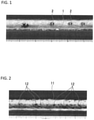
- FIG. 1 is a photograph as a substitute for a drawing showing a surface of a weld metal obtained by welding using the wire in Invention Example No. 1. As shown in FIG. 1 , the slag 2 having a uniform size was finely aggregated on a surface of the weld metal 1, so that the appearance of the bead after slag removal was good.
- FIG. 2 is a photograph as a substitute for a drawing showing a surface of a weld metal obtained by welding using the wire in Comparative Example No.1. As shown in FIG. 2 , the slag 12 spottedly adhered to the surface of the weld metal 11, and thus, the appearance of the bead after slag removal was poor.
Landscapes
- Engineering & Computer Science (AREA)
- Mechanical Engineering (AREA)
- Chemical & Material Sciences (AREA)
- Materials Engineering (AREA)
- Metallurgy (AREA)
- Organic Chemistry (AREA)
- Inorganic Chemistry (AREA)
- Nonmetallic Welding Materials (AREA)
Applications Claiming Priority (2)
| Application Number | Priority Date | Filing Date | Title |
|---|---|---|---|
| JP2019127697A JP7244373B2 (ja) | 2019-07-09 | 2019-07-09 | Ar-CO2混合ガス用フラックス入りワイヤ |
| PCT/JP2020/024816 WO2021006040A1 (fr) | 2019-07-09 | 2020-06-24 | Fil fourré destiné à un gaz mixte ar-co2 |
Publications (2)
| Publication Number | Publication Date |
|---|---|
| EP3970909A1 true EP3970909A1 (fr) | 2022-03-23 |
| EP3970909A4 EP3970909A4 (fr) | 2022-10-19 |
Family
ID=74114686
Family Applications (1)
| Application Number | Title | Priority Date | Filing Date |
|---|---|---|---|
| EP20836250.9A Pending EP3970909A4 (fr) | 2019-07-09 | 2020-06-24 | Fil fourré destiné à un gaz mixte ar-co2 |
Country Status (5)
| Country | Link |
|---|---|
| US (1) | US12434333B2 (fr) |
| EP (1) | EP3970909A4 (fr) |
| JP (1) | JP7244373B2 (fr) |
| CA (1) | CA3143013C (fr) |
| WO (1) | WO2021006040A1 (fr) |
Family Cites Families (15)
| Publication number | Priority date | Publication date | Assignee | Title |
|---|---|---|---|---|
| JP2614967B2 (ja) | 1993-02-05 | 1997-05-28 | 株式会社神戸製鋼所 | ガスシールドアーク溶接メタル系フラックス入りワイヤ |
| JP2565831B2 (ja) * | 1993-01-08 | 1996-12-18 | 新日本製鐵株式会社 | Ni基合金を外皮とするフラックス入りワイヤ |
| EP0652071A1 (fr) | 1993-08-12 | 1995-05-10 | Kabushiki Kaisha Kobe Seiko Sho | Fil à âme de flux pour le soudage à l'arc sous gaz protecteur à faible dégagement de fumées |
| JP2711077B2 (ja) | 1994-09-29 | 1998-02-10 | 株式会社神戸製鋼所 | ガスシールドアーク溶接用フラックス入りワイヤ |
| JP3815984B2 (ja) * | 2001-07-06 | 2006-08-30 | 株式会社神戸製鋼所 | 低合金耐熱鋼用ガスシールドアーク溶接用フラックス入りワイヤ |
| JP3804802B2 (ja) * | 2003-12-26 | 2006-08-02 | 株式会社神戸製鋼所 | ガスシールドアーク溶接用メタル系フラックス入りワイヤ及びガスシールドアーク溶接方法 |
| JP5205115B2 (ja) * | 2008-04-16 | 2013-06-05 | 株式会社神戸製鋼所 | 純Arシールドガス溶接用MIGフラックス入りワイヤ及びMIGアーク溶接方法 |
| JP6666098B2 (ja) * | 2015-09-29 | 2020-03-13 | 株式会社神戸製鋼所 | 高電流パルスアーク溶接方法及びフラックス入り溶接ワイヤ |
| JP6377591B2 (ja) | 2015-10-14 | 2018-08-22 | 日鐵住金溶接工業株式会社 | Ar−CO2混合ガスシールドアーク溶接用メタル系フラックス入りワイヤ |
| EP3427890B1 (fr) * | 2016-03-08 | 2021-06-02 | Nippon Steel Corporation | Fil fourré, procédé de fabrication d'un joint de soudure et joint de soudure |
| JP6762131B2 (ja) * | 2016-04-28 | 2020-09-30 | 株式会社神戸製鋼所 | フラックス入りワイヤ |
| JP6815157B2 (ja) * | 2016-10-11 | 2021-01-20 | 日鉄溶接工業株式会社 | 原油油槽鋼のガスシールドアーク溶接用フラックス入りワイヤ |
| JP6953869B2 (ja) * | 2017-07-31 | 2021-10-27 | 日本製鉄株式会社 | ガスシールドアーク溶接用フラックス入りワイヤ、及び溶接継手の製造方法 |
| JP6988323B2 (ja) * | 2017-09-27 | 2022-01-05 | 日本製鉄株式会社 | ガスシールドアーク溶接用フラックス入りワイヤ、及び溶接継手の製造方法 |
| JP2019127697A (ja) | 2018-01-22 | 2019-08-01 | 株式会社Lixil | 建具 |
-
2019
- 2019-07-09 JP JP2019127697A patent/JP7244373B2/ja active Active
-
2020
- 2020-06-24 US US17/625,667 patent/US12434333B2/en active Active
- 2020-06-24 EP EP20836250.9A patent/EP3970909A4/fr active Pending
- 2020-06-24 CA CA3143013A patent/CA3143013C/fr active Active
- 2020-06-24 WO PCT/JP2020/024816 patent/WO2021006040A1/fr not_active Ceased
Also Published As
| Publication number | Publication date |
|---|---|
| CA3143013A1 (fr) | 2021-01-14 |
| CA3143013C (fr) | 2023-04-04 |
| EP3970909A4 (fr) | 2022-10-19 |
| US12434333B2 (en) | 2025-10-07 |
| WO2021006040A1 (fr) | 2021-01-14 |
| JP7244373B2 (ja) | 2023-03-22 |
| US20220258290A1 (en) | 2022-08-18 |
| JP2021010939A (ja) | 2021-02-04 |
Similar Documents
| Publication | Publication Date | Title |
|---|---|---|
| EP2105243B1 (fr) | Fil à flux incorporé à base de métal pour soudure en arc blindé gaz mélangé Ar-CO2 | |
| JP5179073B2 (ja) | ガスシールドアーク溶接用フラックス入りワイヤ | |
| JP3956122B2 (ja) | 溶接性に優れた塩基性系フラックス入りワイヤ | |
| JP6296550B2 (ja) | Ni基合金被覆アーク溶接棒 | |
| JP5459083B2 (ja) | 高張力鋼用炭酸ガスシールドアーク溶接用フラックス入りワイヤ | |
| JP7221812B2 (ja) | 高張力鋼のAr-CO2混合ガスシールドアーク溶接用フラックス入りワイヤ | |
| JP4531617B2 (ja) | ガスシールドアーク溶接用フラックス入りワイヤ | |
| EP3208031B1 (fr) | Fil fourré de soudage à l'arc sous protection gazeuse | |
| JP2006272432A (ja) | 9%Ni鋼用被覆アーク溶接棒 | |
| EP3928918A1 (fr) | Fil fourré en alliage à base de ni | |
| JP2020015092A (ja) | 2相ステンレス鋼溶接用フラックス入りワイヤ、溶接方法および溶接金属 | |
| EP3081327A1 (fr) | Fil à flux incorporé pour soudure à l'arc sous protection gazeuse | |
| EP3970909A1 (fr) | Fil fourré destiné à un gaz mixte ar-co2 | |
| JP5518773B2 (ja) | ガスシールドアーク溶接用フラックス入りワイヤ | |
| JPH09314382A (ja) | Ni基合金溶接用フラックス入りワイヤ | |
| EP4112760A1 (fr) | Fil fourré en alliage à base de ni | |
| JP7055731B2 (ja) | 低水素系被覆アーク溶接棒 | |
| JP2008114264A (ja) | 耐候性鋼用ガスシールドアーク溶接用フラックス入りワイヤ | |
| JP6786431B2 (ja) | 炭酸ガスシールドアーク溶接用メタル系フラックス入りワイヤ | |
| JP4560418B2 (ja) | ガスシールドアーク溶接用フラックス入りワイヤ | |
| JP7580312B2 (ja) | 低水素系被覆アーク溶接棒 | |
| JP7244399B2 (ja) | ガスシールドアーク溶接用フラックス入りワイヤ | |
| KR100347294B1 (ko) | 일렉트로가스 아크 용접용 플럭스 충전 와이어 | |
| EP3284557A1 (fr) | Agent de revêtement et baguette de soudage à l'arc munie d'un revêtement | |
| JP7247081B2 (ja) | ガスシールドアーク溶接用メタル系フラックス入りワイヤ |
Legal Events
| Date | Code | Title | Description |
|---|---|---|---|
| STAA | Information on the status of an ep patent application or granted ep patent |
Free format text: STATUS: THE INTERNATIONAL PUBLICATION HAS BEEN MADE |
|
| PUAI | Public reference made under article 153(3) epc to a published international application that has entered the european phase |
Free format text: ORIGINAL CODE: 0009012 |
|
| STAA | Information on the status of an ep patent application or granted ep patent |
Free format text: STATUS: REQUEST FOR EXAMINATION WAS MADE |
|
| 17P | Request for examination filed |
Effective date: 20211213 |
|
| AK | Designated contracting states |
Kind code of ref document: A1 Designated state(s): AL AT BE BG CH CY CZ DE DK EE ES FI FR GB GR HR HU IE IS IT LI LT LU LV MC MK MT NL NO PL PT RO RS SE SI SK SM TR |
|
| A4 | Supplementary search report drawn up and despatched |
Effective date: 20220919 |
|
| DAV | Request for validation of the european patent (deleted) | ||
| DAX | Request for extension of the european patent (deleted) | ||
| RIC1 | Information provided on ipc code assigned before grant |
Ipc: B23K 35/36 20060101ALI20220913BHEP Ipc: B23K 35/02 20060101ALI20220913BHEP Ipc: B23K 35/368 20060101ALI20220913BHEP Ipc: B23K 35/30 20060101AFI20220913BHEP |