EP3994201B1 - Mousses de polyuréthane à autosoufflage sans isocyanate - Google Patents
Mousses de polyuréthane à autosoufflage sans isocyanate Download PDFInfo
- Publication number
- EP3994201B1 EP3994201B1 EP20737003.2A EP20737003A EP3994201B1 EP 3994201 B1 EP3994201 B1 EP 3994201B1 EP 20737003 A EP20737003 A EP 20737003A EP 3994201 B1 EP3994201 B1 EP 3994201B1
- Authority
- EP
- European Patent Office
- Prior art keywords
- compound
- carbon atoms
- formulation
- hydrocarbon chain
- unsubstituted
- Prior art date
- Legal status (The legal status is an assumption and is not a legal conclusion. Google has not performed a legal analysis and makes no representation as to the accuracy of the status listed.)
- Active
Links
Images


Classifications
-
- C—CHEMISTRY; METALLURGY
- C08—ORGANIC MACROMOLECULAR COMPOUNDS; THEIR PREPARATION OR CHEMICAL WORKING-UP; COMPOSITIONS BASED THEREON
- C08J—WORKING-UP; GENERAL PROCESSES OF COMPOUNDING; AFTER-TREATMENT NOT COVERED BY SUBCLASSES C08B, C08C, C08F, C08G or C08H
- C08J9/00—Working-up of macromolecular substances to porous or cellular articles or materials; After-treatment thereof
- C08J9/02—Working-up of macromolecular substances to porous or cellular articles or materials; After-treatment thereof using blowing gases generated by the reacting monomers or modifying agents during the preparation or modification of macromolecules
-
- C—CHEMISTRY; METALLURGY
- C08—ORGANIC MACROMOLECULAR COMPOUNDS; THEIR PREPARATION OR CHEMICAL WORKING-UP; COMPOSITIONS BASED THEREON
- C08G—MACROMOLECULAR COMPOUNDS OBTAINED OTHERWISE THAN BY REACTIONS ONLY INVOLVING UNSATURATED CARBON-TO-CARBON BONDS
- C08G71/00—Macromolecular compounds obtained by reactions forming a ureide or urethane link, otherwise, than from isocyanate radicals in the main chain of the macromolecule
- C08G71/04—Polyurethanes
-
- C—CHEMISTRY; METALLURGY
- C08—ORGANIC MACROMOLECULAR COMPOUNDS; THEIR PREPARATION OR CHEMICAL WORKING-UP; COMPOSITIONS BASED THEREON
- C08J—WORKING-UP; GENERAL PROCESSES OF COMPOUNDING; AFTER-TREATMENT NOT COVERED BY SUBCLASSES C08B, C08C, C08F, C08G or C08H
- C08J9/00—Working-up of macromolecular substances to porous or cellular articles or materials; After-treatment thereof
- C08J9/04—Working-up of macromolecular substances to porous or cellular articles or materials; After-treatment thereof using blowing gases generated by a previously added blowing agent
- C08J9/06—Working-up of macromolecular substances to porous or cellular articles or materials; After-treatment thereof using blowing gases generated by a previously added blowing agent by a chemical blowing agent
- C08J9/08—Working-up of macromolecular substances to porous or cellular articles or materials; After-treatment thereof using blowing gases generated by a previously added blowing agent by a chemical blowing agent developing carbon dioxide
-
- C—CHEMISTRY; METALLURGY
- C08—ORGANIC MACROMOLECULAR COMPOUNDS; THEIR PREPARATION OR CHEMICAL WORKING-UP; COMPOSITIONS BASED THEREON
- C08G—MACROMOLECULAR COMPOUNDS OBTAINED OTHERWISE THAN BY REACTIONS ONLY INVOLVING UNSATURATED CARBON-TO-CARBON BONDS
- C08G2101/00—Manufacture of cellular products
-
- C—CHEMISTRY; METALLURGY
- C08—ORGANIC MACROMOLECULAR COMPOUNDS; THEIR PREPARATION OR CHEMICAL WORKING-UP; COMPOSITIONS BASED THEREON
- C08G—MACROMOLECULAR COMPOUNDS OBTAINED OTHERWISE THAN BY REACTIONS ONLY INVOLVING UNSATURATED CARBON-TO-CARBON BONDS
- C08G2110/00—Foam properties
- C08G2110/0008—Foam properties flexible
-
- C—CHEMISTRY; METALLURGY
- C08—ORGANIC MACROMOLECULAR COMPOUNDS; THEIR PREPARATION OR CHEMICAL WORKING-UP; COMPOSITIONS BASED THEREON
- C08G—MACROMOLECULAR COMPOUNDS OBTAINED OTHERWISE THAN BY REACTIONS ONLY INVOLVING UNSATURATED CARBON-TO-CARBON BONDS
- C08G2110/00—Foam properties
- C08G2110/0025—Foam properties rigid
-
- C—CHEMISTRY; METALLURGY
- C08—ORGANIC MACROMOLECULAR COMPOUNDS; THEIR PREPARATION OR CHEMICAL WORKING-UP; COMPOSITIONS BASED THEREON
- C08G—MACROMOLECULAR COMPOUNDS OBTAINED OTHERWISE THAN BY REACTIONS ONLY INVOLVING UNSATURATED CARBON-TO-CARBON BONDS
- C08G2110/00—Foam properties
- C08G2110/0041—Foam properties having specified density
-
- C—CHEMISTRY; METALLURGY
- C08—ORGANIC MACROMOLECULAR COMPOUNDS; THEIR PREPARATION OR CHEMICAL WORKING-UP; COMPOSITIONS BASED THEREON
- C08G—MACROMOLECULAR COMPOUNDS OBTAINED OTHERWISE THAN BY REACTIONS ONLY INVOLVING UNSATURATED CARBON-TO-CARBON BONDS
- C08G2110/00—Foam properties
- C08G2110/0041—Foam properties having specified density
- C08G2110/005—< 50kg/m3
-
- C—CHEMISTRY; METALLURGY
- C08—ORGANIC MACROMOLECULAR COMPOUNDS; THEIR PREPARATION OR CHEMICAL WORKING-UP; COMPOSITIONS BASED THEREON
- C08G—MACROMOLECULAR COMPOUNDS OBTAINED OTHERWISE THAN BY REACTIONS ONLY INVOLVING UNSATURATED CARBON-TO-CARBON BONDS
- C08G2110/00—Foam properties
- C08G2110/0041—Foam properties having specified density
- C08G2110/0058—≥50 and <150kg/m3
-
- C—CHEMISTRY; METALLURGY
- C08—ORGANIC MACROMOLECULAR COMPOUNDS; THEIR PREPARATION OR CHEMICAL WORKING-UP; COMPOSITIONS BASED THEREON
- C08G—MACROMOLECULAR COMPOUNDS OBTAINED OTHERWISE THAN BY REACTIONS ONLY INVOLVING UNSATURATED CARBON-TO-CARBON BONDS
- C08G2110/00—Foam properties
- C08G2110/0041—Foam properties having specified density
- C08G2110/0066—≥ 150kg/m3
-
- C—CHEMISTRY; METALLURGY
- C08—ORGANIC MACROMOLECULAR COMPOUNDS; THEIR PREPARATION OR CHEMICAL WORKING-UP; COMPOSITIONS BASED THEREON
- C08G—MACROMOLECULAR COMPOUNDS OBTAINED OTHERWISE THAN BY REACTIONS ONLY INVOLVING UNSATURATED CARBON-TO-CARBON BONDS
- C08G2190/00—Compositions for sealing or packing joints
-
- C—CHEMISTRY; METALLURGY
- C08—ORGANIC MACROMOLECULAR COMPOUNDS; THEIR PREPARATION OR CHEMICAL WORKING-UP; COMPOSITIONS BASED THEREON
- C08G—MACROMOLECULAR COMPOUNDS OBTAINED OTHERWISE THAN BY REACTIONS ONLY INVOLVING UNSATURATED CARBON-TO-CARBON BONDS
- C08G2350/00—Acoustic or vibration damping material
-
- C—CHEMISTRY; METALLURGY
- C08—ORGANIC MACROMOLECULAR COMPOUNDS; THEIR PREPARATION OR CHEMICAL WORKING-UP; COMPOSITIONS BASED THEREON
- C08J—WORKING-UP; GENERAL PROCESSES OF COMPOUNDING; AFTER-TREATMENT NOT COVERED BY SUBCLASSES C08B, C08C, C08F, C08G or C08H
- C08J2375/00—Characterised by the use of polyureas or polyurethanes; Derivatives of such polymers
- C08J2375/04—Polyurethanes
Definitions
- the present invention relates to a method for producing self-blowing isocyanate-free polyurethanes foams from reactive curable isocyanate-free polyurethane formulations, the products formed thereof and the formulations for use in said process.
- Polyurethanes are employed in a wide range of applications, notably in the form of foams. Depending on their composition, polyurethane foams can vary in structure from soft flexible foams to rigid foams used in insulation or structural materials. Flexible or rigid polyurethane foams are key players for designing materials for wellness, furniture, mattresses, shock absorption, thermal/acoustic insulation or sealants.
- polyurethane foams are most often obtained by polymerization between a polyisocyanate and a hydroxyl terminated oligomer (polyol). Their foaming is generally induced by the in-situ generation of carbon dioxide (CO 2 ) upon addition of water within the reactive formulation (see reaction scheme below). The water provokes the hydrolysis of the isocyanate into CO 2 acting as a blowing agent and an amine that is incorporated into the growing PU chains.
- CO 2 carbon dioxide
- blowing agents may be used to perform expansion and foaming of the polymeric matrix.
- the blowing agent may be either produced in situ as a reaction product of the reactants (like water and isocyanate producing carbon dioxide). These blowing agents are called chemical blowing agents.
- the blowing agent may be a physical blowing agent, i.e. a non-reactive compound contained in the polymeric composition that is able to generate bubbles in the polymeric matrix during its formation, thereby leading to foam.
- polyurethane foams derived from polyisocyanates are associated with environmental issues because isocyanate raw materials, in particular methylene diphenyl 4,4'-diisocyanate (MDI) and toluene diisocyanate (TDI), the most widely used isocyanates in the polyurethane industry, and the corresponding aromatic diamines are classified as toxic (carcinogenic, mutagenic and reprotoxic substances). Prolonged exposure may lead to health problems such as asthma or other pulmonary diseases. They are also produced from the even more toxic and explosive phosgene and their decomposition induces the formation of carcinogenic mutagenic reprotoxic products. Due to these concerns, the handling of isocyanate is strictly regulated by REACH.
- MDI methylene diphenyl 4,4'-diisocyanate
- TDI toluene diisocyanate
- NIPUs non-isocyanate polyurethanes
- a bicyclic carbonate monomer and a diamine represent one of the most promising alternatives to the conventional synthesis of PUs.
- These polymers are also referred to as polyhydroxyurethanes (see reaction scheme below). See “ Isocyanate-Free Routes to Polyurethanes and Poly(hydroxy Urethane)s", by L. Maisonneuve, O. Lamarzelle, E. Rix, E. Grau, H. Cramail, Chem. Rev., 2015, 115, 22, 12407-12439 .
- Reaction Scheme synthesis of NIPUs by polyaddition of poly(cyclic carbonate)s with poly(amine)s.
- microcellular NIPU foams with densities of 100 - 300 kg/m 3 have been produced by using solkane, a fluorinated solvent, (as described in EP 3199569 and by Mulhaupt et al., "Flexible and Bio-Based Nonisocyanate Polyurethane (NIPU) Foams", Macromol. Mater.
- Reaction Scheme Reaction responsible for the formation of the blowing agent (CO 2 ) in the North work.
- the present invention therefor seeks to provide a self-blowing formulation to prepare NIPU foams of varying density and good foam quality.
- the present invention further seeks to provide a process to prepare NIPU foams from said self-blowing formulations that is easy to implement on an industrial scale.
- the inventors of the present invention have succeeded in providing such a formulation and process meeting all these needs.
- a curable isocyanate-free formulation for preparing a polyurethane self-blowing foam comprising at least one multifunctional cyclic carbonate having at least two cyclic carbonate groups at the end of the chain (compound A), at least one multifunctional amine (compound B), at least one multifunctional thiol (compound C) and at least one catalyst (compound D).
- a process for preparing a polyurethane self-blowing foam comprising the steps of providing said formulation and curing it so as to promote the formation of CO 2 and form a non-isocyanate polyurethane foam.
- a non-isocyanate polyurethane foam is provided by said process using said formulation.
- cyclic carbonates undergo decarboxylation upon reaction with thiols in the presence of an appropriate catalyst, typically an (organo)base, within the NIPU formulation (mixture of polyamines and polycyclic carbonates), thereby generating in-situ the blowing agent leading to the formation of NIPU foams (see reaction scheme below).
- an appropriate catalyst typically an (organo)base
- Reaction Scheme General scheme for the formation of self-blowing NIPUs according to the invention (for sake of clarity, it is illustrated for non-crosslinked NIPUs).
- thiols within the NIPU formulation surprisingly provides self-blowing NIPU foams generally at a temperature of from 60°C to 160°C of which the density and mechanical properties may be adjusted by controlling the thiol content and structure, and carbonate/amine composition and structure.
- the formation of NIPU polymers occurs simultaneously with the decarboxylative alkylation of thiols with carbonates, promoting the expansion of the material upon heating generally within 1 min (e.g. at high temperature such as 160°C) to 24h, providing flexible to rigid foams with densities generally within the range of 10 kg/m 3 to 800 kg/m 3 .
- the reaction of thiols with the cyclic carbonates forms thioether linkages that are incorporated within the polymer structure, and therefore contribute also to the formation of the polymer and thus helps fixating the 3D structural morphology of the foams.
- the content of urethane and thioether linkages depends on the amine/thiol content in the initial formulation.
- the structure of the NIPU foam of the present invention is therefore different to those of the state of the art that do not contain thioether linkages.
- the thiol further plays a role as a reactive diluent and allows to adjust the viscosity of the starting formulation. Controlling the viscosity of the precursor mixture is a key parameter to allow the easy deposition of the formulations onto various substrates without using organic solvents.
- the NIPU formulation may be applied by any suitable means. Examples include the deposition with syringes, through pistols or injectors, through continuous processes, through reactive molding or reactive foaming, by spraying means, through extruders.
- the terms "about” or “approximate” and the like are synonymous and are used to indicate that the value modified by the term has an understood range associated with it, where the range can be +20%, +15%, +10%, +5%, or +1%.
- the term “substantially” is used to indicate that a result (e.g., measurement value) is close to a targeted value, where close can mean, for example, the result is within 80% of the value, within 90% of the value, within 95% of the value, or within 99% of the value.
- heteroatom denotes an atom selected from N, O, S, Si and S(O)n (where n is 0, 1 or 2), SiO.
- cycloalkyl denotes a monovalent or bivalent 3 to 8 membered carbon ring, for example cyclopropyl, cyclobutyl, cyclopentyl, cyclohexyl, cycloheptyl or cyclooctyl.
- heterocycle denotes monovalent or bivalent non-aromatic mono- or bi-cyclic radical of four to nine ring atoms in which one to three ring atoms are heteroatoms independently selected from N, O and S(O)n (where n is 0, 1 or 2), with the remaining ring atoms being C.
- heteroatoms independently selected from N, O and S(O)n (where n is 0, 1 or 2), with the remaining ring atoms being C.
- aryl denotes a monovalent or bivalent aromatic carbocyclic group containing 6 to 14, particularly 6 to 10, carbon atoms and having at least one aromatic ring or multiple condensed rings in which at least one ring is aromatic. Examples include phenyl, benzyl, naphthyl, biphenyl, anthryl, azalenyl or indanyl.
- heteroaryl denotes a monovalent or bivalent cyclic aromatic group containing 1, 2 or 3 heteroatoms, having at least one aromatic ring or multiple condensed rings in which at least one ring is aromatic.
- the aromatic ring may be a 6 membered ring, such as pyridinyl, or a 5-membered ring, such as thiazolyl, isoxazolyl, isothiazolyl, oxadiazolyl, imidazolyl, triazolyl or thiadiazolyl.
- the formulation of the present invention comprises at least one multifunctional cyclic carbonate having at least two cyclic carbonate groups at the end of the chain (compound A), at least one preferably aliphatic, multifunctional amine (compound B), at least one multifunctional thiol (compound C) and at least one catalyst (compound D).
- the curable formulation of the invention is a liquid or a viscous liquid at ambient temperature (25 °C).
- the viscosity of said curable formulation is lower than or equal to 20 000 mPa.s at 50°C, more preferably lower than 10 000 mPa.s at 50°C, most preferably lower than 5 000 mPa.s at 50°C as measured with an oscillatory rheometer, with oscillatory frequency sweep at 50°C, 5% deformation, 100-0.1 rad s -1 .
- the curable formulation is not a liquid or a viscous liquid at ambient temperature it is rendered liquid by heating to a temperature of between 40 and 80°C.
- Compound A is chosen from multifunctional cyclic carbonates having at least two cyclic carbonates at the end of the chain (or so-called multifunctional external cyclic carbonates) or a mixture thereof.
- said compounds A correspond to formula (I) wherein
- Particularly preferred compounds A are:
- Compounds A can be prepared at large scale by any methods known by the art, for instance from polyols by converting all or part of the alcohol functions of said polyol into glydicylether functions, followed by carbonation of said glycidylether functions as described in EP 3 199 569A1 , or by epoxidation of molecules bearing at least 2 external double bonds, followed by the (organo)catalyzed carbon dioxide coupling reaction as described by L.-N. He & al., "One-pot stepwise synthesis of cyclic carbonates directly from olefins with CO2 promoted by K2S2O8/NaBr", J. CO2 Util., 2016, 16, 313-317 and by R.
- Compound B is chosen from multifunctional amines or a mixture thereof.
- said compounds B correspond to formula (II) R 2 -(NHR') j Formula (II) wherein
- Compound B acts as a hardener by reacting with cyclic carbonate groups of compounds A, and optional compounds E and F as described hereinafter, thereby cross-linking the cyclic carbonate chains to each other.
- suitable compounds B for use in the present invention include those amines which are classically used for epoxy curing, for instance diamines, in particular linear aliphatic diamines, such as 1,2-diaminoethane, 1,3-diaminopropane, butane-1,4-diamine, pentane-1,5-diamine, 1,6-diaminohexane, or 1,12-diaminododecane, or cyclic aliphatic diamines, such as isophoronediamine (IPDA), triamines, such as tris(2-aminoethyl)amine, or any other polyamines, such as polyethylene imine (e.g.
- diamines in particular linear aliphatic diamines, such as 1,2-diaminoethane, 1,3-diaminopropane, butane-1,4-diamine, pentane-1,5-diamine, 1,6-diaminohexan
- Lupasol ® FG from BASF
- dimeric fatty acid diamines such as Priamine ® 1074 or Priamine ® 1071 from Croda, or Jeffamine ® (D, ED, EDR or T #3) from Huntsman Petrochemical, LLC, or aromatic diamine, such as o-xylylenediamine, m-xylylenediamine, p -xylylenediamine or 1,2-diphenylethylenediamine
- compound B of multifunctional amines with long chain segments and/or a low number of -NH 2 functionalities (such as Lupasol ® FG and IPDA) will yield flexible foams, while the use of polyamines with short chain segments and/or a high number of -NH 2 functionalities (such as 1,6-diaminohexane or Priamine ® 1074) will yield rigid foams.
- secondary multifunctional amines can also be used instead of primary ones, or be used in combination with primary ones.
- Particularly preferred compounds B are:
- Compound C is chosen from multifunctional thiols or a mixture thereof.
- said compounds C correspond to formula (III) R 3 -(SH) k Formula III wherein
- Suitable compounds C for use in the present invention include bi-thiols, tri-thiols, tetra-thiols or hexa-thiols, preferably pentaerylingeretrathiol, thiol trimethyol propane, pentaerythritol tetra (3-mercaptopropionate), trimethylolpropane tri (3-mercaptopropionate), pentaerythritol tetrathioglycolate and/or trimethylolpropane thioglycolate, tris [2-(3-mercaptopropionyloxy)ethyl] isocyanurate.
- Compound C can also be a telechelic, branched or multiarms polymer bearing thiol groups at each chain-end (such as polyethylene glycol dithiol or polypropylene glycol dithiol) or along the polymer backbone as pendant groups, or a peptide or protein containing at least two thiols.
- Compound D is used to increase the kinetics of the carbonate/amine reaction (thus the formation of NIPU) and to permit the decarboxylation of the cyclic carbonate and thus the foaming.
- a wide range of catalysts can be used (see for instance Blain et al., Green Chemistry 2014, 16, 4286 ). The choice of suitable catalyst depends on the specific formulation used but also on the temperature used to form the foam.
- compound D can be chosen from amine catalysts, such as triazabicyclodecene (TBD), 1,4-diazabicyclo[2.2.2]octane (DABCO), 1,8-diazabicyclo[5.4.0]undec-7-ene (DBU), 7-Methyl-1,5,7-triazabicyclo[4.4.0]dec-5-ene (MTBD), or other guanidines and amidines, trimethylhydroxyethyl ethylene diamine, trimethylaminopropylethanolamine, dimethylethanolamine, bis(2-dimethylaminoethyl) ether, triethylenediamine, dimethylaminocyclohexane, N-methyl morpholine, dimethylaminopyridine (DMAP), trimethylamine (NEts), trimethylamine, phosphazenes, phosphines (triaryl and trialkylphosphines).
- TBD triazabicyclodecene
- DBUCO
- the compound D may also be chosen from ionic salts or ionic liquids composed of a combination of a cation and an anion.
- the cation may be selected from alkali metals such as Na + , Li + , K + , Cs + or other metal such as Mg 2+ , Ca 2+ or organic cations including ammonium (formula 1), phosphonium (formula 2), imidazolium (formula 3), pirazolium (formula 4), triazolium (formula 5), tetrazolium (formula 6), pyridinium (formula 7), piperidinium (formula 8), pyrrolidinium (formula 9), guanidinium (formula 10) or amidinium (formula 11).
- alkali metals such as Na + , Li + , K + , Cs + or other metal such as Mg 2+ , Ca 2+ or organic cations including ammonium (formul
- R 1 , R 2 , R 3 , R 4 , R 5 and/or R 6 is independently an hydrogen or an aromatic ring or linear or branched hydrocarbon chain, one or several carbon atoms of which may be replaced with an heteroatom, a cycloalkyl or an heterocycle, said hydrocarbon chain having at least 1 carbon atom, in particular from 1 to 60 carbon atoms, more particularly from 1 to 20 carbon atoms, even more particularly from 1 to 10 carbon atoms.
- the anion may be selected from halide (I - , Br - , or Cl - ), carbonate (CO 3 2- ), hydroxide (OH), carboxylate (formula 12) or dicarboxylate (such as oxalate), phenolate (formula 13), catecholate (formula 14), pyrogallolate (formula 15), boronate (formula 16), imidazolide (formula 17).
- R 1 , R 2 and/or R 3 is independently an hydrogen or an aromatic ring or linear or branched hydrocarbon chain, one or several carbon atoms of which may be replaced with an heteroatom, a cycloalkyl or an heterocycle, said hydrocarbon chain having at least 1 carbon atoms, in particular from 1 to 60 carbon atoms, more particularly from 1 to 20 carbon atoms, even more particularly from 1 to 10 carbon atoms.
- suitable compounds D include metal salts of inorganic acid or organometallic catalysts such as stannous octoate, lead octoate, dibutyltin dilaurate, potassium acetate or potassium ethyl-hexoate, or mixtures thereof.
- Further suitable compounds D include phosphines such as triarylphosphines and monoalkylbiarylphosphines, bases, thioureas, phosphazenes, carbenes or masked carbenes (as described by Taton et al in "N-Heterocyclic carbenes (NHCs) as organocatalysts and structural components in metal-free polymer synthesis", Chem. Soc. Rev. 2013, 42, 2142 ).
- the decarboxylative alkylation of polyfunctional thiol (compound C) and the aminolysis of cyclic carbonates (compound A) should occur with similar rates.
- the aminolysis of cyclic carbonates should be slightly faster to enable the formation of polymer chains of sufficient viscosity to be foamed by release of in-situ generated CO 2 . Therefore proper choice of the catalyst (compound D) to help adjusting the aminolysis rate of (a)cyclic carbonates and the decarboxylation rate by dithiols may be important.
- Particularly preferred catalysts for use as compound D in the present invention are 1,8-diazabicyclo[5.4.0]undec-7-ene (DBU), tetrabutyl ammonium oxalate and tetrabutyl ammonium phenolate (TBAP).
- DBU 1,8-diazabicyclo[5.4.0]undec-7-ene
- TBAP tetrabutyl ammonium oxalate
- TBAP tetrabutyl ammonium phenolate
- the formulation of the present invention may further contain any one of or a mixture of monofunctional cyclic carbonate (compound E), multifunctional cyclic carbonates having at least two cyclic carbonate groups within the chain (compound F), monofunctional thiols (compound G) and polyepoxides (compound H).
- compound E monofunctional cyclic carbonate
- compound F multifunctional cyclic carbonates having at least two cyclic carbonate groups within the chain
- compound G monofunctional thiols
- polyepoxides compound H
- Compound E generally acts as a reactive diluent and is chosen from monofunctional cyclic carbonates or a mixture thereof, which preferably correspond to formula (IV) or a mixture thereof.
- R 4 is hydrogen or a linear or branched hydrocarbon chain, which may be unsubstituted or substituted e.g. with a functional group such as an alcohol, a secondary or tertiary amine, a carboxylic acid, an alkene, an ester, etc.
- hydrocarbon chain wherein one or several hydrocarbon groups of said hydrocarbon chain may be replaced by an heteroatom, a cycloalkyl or an heterocycle, each of which may be unsubstituted or substituted, said hydrocarbon chain having at least 1 carbon atom, in particular from 2 to 60 carbon atoms, more particularly from 2 to 20 carbon atoms, even more particularly from 2 to 15 carbon atoms.
- Suitable examples of compounds E for use in the present invention are ethylene carbonate, propylene carbonate, 4-vinyl-1,3-dioxolan-2-one, etc.
- Compound F contributes to the formation of the NIPU matrix; due to sterical hindrance by the internal cyclic carbonates it reacts more slowly than compound A.
- Compound F is chosen from multifunctional internal cyclic carbonates thus having at least two cyclic carbonate groups within the chain (so-called internal cyclic carbonates) or any mixture thereof.
- Compound F may correspond to any one of formula (V), (VI) and (VII) or a mixture thereof. wherein :
- Compound F are all molecules containing internal cyclic carbonates that can be prepared by all methods known by the art such as by the (organo)catalyzed coupling of carbon dioxide to epoxidized vegetable oils or fatty esters/acids. Partially cyclocarbonated epoxidized vegetable oils or fatty acid/esters can also be used. Examples of suitable compounds F are:
- Compound G also reacts with the cyclic carbonate to generate CO 2 but will not crosslink the matrix due to its monofunctionality and allows to graft interesting groups to NIPU.
- Compound G is chosen from monofunctional thiol or any mixture thereof, and preferably corresponds to formula (VIII) R 17 -SH Formula (VIII) wherein:
- Compound G can be any monofunctional thiol but monofunctional thiol of high boiling point is preferred.
- Thioamines such as cysteamine or cysteine are also preferred because the thiol group contributes to the formation of the blowing agent and to the formation of the thioether linkage, and the amine group contributes to the formation of the urethane linkage.
- Compound H is chosen from polyepoxides or a mixture thereof and will contribute to the crosslinking of the material.
- compound H corresponds to any one of formula (IX), (X), (XI) or (XII). wherein:
- suitable compounds H are polyepoxides that are used in formulations for epoxy resins, such as epoxidized linseed oil, epoxidized soybean oil, epoxidized rapeseed oil, epoxidized tall oil, or epoxidized peanut oil, poly(dimethyl siloxane) diepoxide, cyclohexane-1,4-dicarboxylic acid-diglycidylester, cyclohexane-1,3-dicarboxylic acid-diglycidylester, cyclohexane-1,2-dicarboxylic acid-diglycidylester, phthalic acid-diglycidylester, isophthalic acid-diglycidylester, terephthalic acid-diglycidylester, norbornenedicarboxylic acid-diglycidylester, 3,4-epoxycyclohexylmethyl-3,4-epoxycyclohexanecarboxylate, Bis((3,4-
- polyepoxides are aromatic diglycidylether, cyclohexane- 1,4-dimethanol-diglycidylether, cyclohexane-1,2-dimethanol-diglycidylether, Bisphenol-A-diglycidylether, Bisphenol-F-diglycidylether, Bisphenol-S-diglycidylether, N,N-di-glycidyl-4-glycidyloxyaniline, 4,4'-methylene-bis(N,N-diglycidylaniline), 1,4-cyclohexanedimethanol-bis(3,4-epoxycyclohexanecarboxylate), epoxidized cycloolefine such as vinylcyclohexene-dioxide and dicyclopentadiene-dioxide, epoxy functional poly(dimethylsiloxane) (such as TEGOMER E-SI 2330 sold by Evonik), epoxy functional (polyethylene glycol), epoxy functional (
- a particularly preferred compound H is
- the amount of compound A generally ranges from 18 wt% to 80 wt%, in particular from 40 wt% to 70 wt %, more in particular from 40 to 60 wt%, the percentage being expressed relative to the total weight of the compounds.
- the amount of compound B generally ranges from 10 wt% to 80 wt%, in particular from 10 to 70 wt%, more in particular from 10 wt% to 50 wt %, the percentage being expressed relative to the total weight of the compounds.
- the amount of compound C generally ranges from 1 wt% to 60 wt%, in particular from 2 to 40 wt%, more in particular from 5 to 20 wt %, the percentage being expressed relative to the total weight of the compounds.
- the molar ratio between compound A, compound B and compound C will affect the foaming of the formulations and the properties of the obtained foams.
- an equimolar amount of cyclic carbonate groups (from compound A) and respectively amine groups (from compound B) + thiol groups (from compound C) is used.
- the amount of compound D generally ranges from 0.1 wt% to 15 wt%, in particular from 0.5 wt% to 7 wt %, the percentage being expressed relative to the total weight of the compounds.
- the amount of compound E generally ranges from 0 wt% to 50 wt%, in particular from 1 wt% to 50 wt%, more in particular from 5 wt% to 10 wt %, the percentage being expressed relative to the total weight of the compounds.
- the amount of compound F generally ranges from 0 wt% to 50 wt%, in particular from 1 wt% to 50 wt%, more in particular from 2 wt% to 20 wt %, the percentage being expressed relative to the total weight of the compounds.
- the amount of compound G generally ranges from 0 wt% to 50 wt%, in particular from 1 wt% to 50 wt%, more in particular from 2 wt% to 10 wt %, the percentage being expressed relative to the total weight of the compounds.
- the amount of compound H generally ranges from 0 wt% to 50 wt%, in particular from 0.1 wt% to 50 wt%, more in particular from 0.5 wt% to 20 wt %, the percentage being expressed relative to the total weight of the compounds.
- the formulation of the present invention is obtained by mixing the ingredients, compounds A, B, C, D and optionally E, F, G and H at a temperature of between 15 and 120°C, preferably between 25 and 80°C, and more preferably between 25 and 60°C.
- the mixing can be performed using any suitable mixing equipment, including static mixing equipment, impingement mixing equipment, or other suitable mixing equipment.
- CO 2 blowing agent is generated in-situ
- the formulation of the present invention may contain additional chemical or physical blowing agent.
- physical blowing agent may be added, especially when NIPU foams with high thermal insulation performance are targeted.
- suitable physical blowing agents include any of the physical blowing agents used to formulate thermal insulating foams such alkanes (e.g. pentane), cycloalkanes (e.g. cyclopentane) and hydrofluoroalkanes.
- alkanes e.g. pentane
- cycloalkanes e.g. cyclopentane
- hydrofluoroalkanes hydrofluoroalkanes.
- a preferred nonflammable liquid hydrofluorocarbon with no ozone depletion potential is Solkane 365/227 or Solvokan.
- blowing agents ranges from 0 wt% to 70 wt%, preferably between 10 wt% and 30 wt%, the percentage being expressed relative to the weight of the formulation.
- blowing agents are added to the formulation containing all the other ingredients generally at a temperature between 10 to 30°C in order to avoid complete vaporization of the blowing agent before effective mixing with the reaction mixture.
- the reaction mixture may further contain optional ingredients such as plasticizers, fillers, colorants, preservatives, odor masking agents, flame retardants, smoke suppressants, thixotropic agents, mould release agents, surfactants, foam stabilizers, biocides, antioxidants, UV stabilizers, antistatic agents or foam cell nucleators.
- plasticizers such as plasticizers, fillers, colorants, preservatives, odor masking agents, flame retardants, smoke suppressants, thixotropic agents, mould release agents, surfactants, foam stabilizers, biocides, antioxidants, UV stabilizers, antistatic agents or foam cell nucleators.
- Stabilizers may be used to stabilize the NIPU foams. Suitable stabilizers are reactive polydimethylsiloxane and polyethylene oxide. Fillers may also be added, such as silica, clays, cellulose nanowhiskers, carbon black, carbon nanotubes, graphene, etc. The addition of fillers may advantageously create nucleation nodes for the control of the foam density and size distribution of the cells (from 1 ⁇ m to 1-2 mm). Fillers may also improve the mechanical performance of the foams. Foams containing fillers are referred to as nanocomposite foams. Fillers can be functionalized by appropriate reactive groups such as epoxides, amines, cyclic carbonate or thiol making them reactive.
- the mechanical performance of the foams may also be adjusted by selecting suitable structure of cyclic carbonates (compounds A, E, F) and/or amines (compound B) and/or thiols (compounds C and G) and/or polyepoxides (compound H).
- the blowing agent is formed by decarboxylation of cyclic carbonates (compounds A, E and F) by thiols (compound C) in the presence of a catalyst (compound D).
- the blowing agent carbon dioxide
- This reaction leads to the formation of thioether links according to the following reaction:
- the formation of the blowing agent generally occurs at a temperature of between 25°C and 200°C, preferably between 40 and 150°C and more preferably between 60 and 120°C.
- a process for preparing a self-blowing non-isocyanate polyurethane foam comprising the steps of providing a formulation as described above by mixing compounds A, B, C and optionally other additives, in the presence of compound D so as to form a viscous mixture and curing said formulation so as to promote the formation of CO 2 and form a non-isocyanate polyurethane foam.
- the curing and the expansion of the polymer matrix occur simultaneously and can be achieved within a relatively short time after the mixing of the ingredients (between 10 seconds to 24 hours) and leads to a homogeneous foam. Although the foaming can be fast (1 min to few hours), the expanded reaction mixture can be cured for a longer time (2 to 24 h) by heating until it is in tack free state. Curing to a tack-free state generally takes place within a few hours (e.g. 14 h at 100°C).
- the curing and expansion generally occurs at a temperature of between 25°C and 200°C, preferably between 40 and 150°C and more preferably between 60 and 120°C.
- compounds E, F, G and/or H can be added to the ingredients in the first step of the process in order to adjust the viscosity of the mixture and/or the final properties of the foam.
- These compounds may be added independently from each other or may be added in the form of a mixture.
- the process for preparing a self-blowing non-isocyanate polyurethane foam comprises the steps of mixing compounds A and B in the presence of compound D so as to form a viscous mixture, partially curing said mixture so as to form a non-isocyanate polyurethane viscous prepolymer, adding compound C to said prepolymer and curing the said mixture so as to form a non-isocyanate polyurethane foam.
- compounds E, F, G and/or H can be added to the ingredients in the first step of the process or in step 3 wherein compound C is added in order to adjust the viscosity of the mixture and/or the final properties of the foam.
- the process involves mixing compounds A and B in the presence of compound C so as to form a viscous mixture, partially curing said mixture so as to form a non-isocyanate polyurethane viscous prepolymer loaded by unreacted compound C, adding compound D to said prepolymer mixture and curing said mixture so as to promote the formation of CO 2 and form a non-isocyanate polyurethane foam.
- compounds E, F, G and/or H can be added to the ingredients in the first step of the process in order to adjust the viscosity of the mixture and/or the final properties of the foam.
- the formation of the prepolymer occurs by curing generally at a temperature of between 25°C and 200°C, preferably between 40 and 150°C and more preferably between 60 and 120°C. This step is stopped before the polymer is fully crosslinked, thus when the mixture remains viscous.
- Compound C is added and mixed to the ingredients generally at a temperature between 15 and 120°C, preferably between 20 and 80°C and more preferably between 25 and 60°C.
- the final curing and expansion of the foam generally occurs at a temperature between 25°C and 200°C, preferably between 40 and 150°C and more preferably between 60 and 120°C.
- the process of the present invention provides the following advantages: no by-products are formed, no volatile organic compounds are released, no organic solvents are used. Further the present process is compatible with existing manufacturing processes for conventional PU foaming and is tolerant to air, water or other moisture.
- a non-isocyanate polyurethane foam is provided obtainable by said process.
- the obtained polyurethane foam contains both urethane and thioether linkages, whose contents are fixed by the content of amine, cyclic carbonate and thiol used in the formulations.
- the process of the invention makes it possible to prepare flexible and rigid foams over a wide range of densities.
- the foam of the invention can be of high density (higher than 80 kg/m 3 ) or of low density (lower than or equal to 80 kg/m 3 ).
- the density of the foam of the invention can be less than 800 kg/m 3 , in particular from 10 kg/m 3 to 400 kg/m 3 , or from 20 kg/m 3 to 200 kg/m 3 .
- the foam pore sizes are generally lower than 5000 ⁇ m, in particular lower than 1000 ⁇ m.
- the foams of the invention have a glass transition temperature from -40°C to 200°C.
- the compression modulus of the foams of the invention can be from 0.005 MPa to 1000 MPa, in particular from 0.02 MPa to 200 MPa.
- the compression modulus is measured on an instron machine (5566) in compression mode at a rate of 1 mm/min.
- the slope of the strain/stress curve in the elastic regime is used to calculate the compression modulus.
- the NIPU foams according to the present invention can be used in any sector wherein traditional PU foams can be used, for example in the automotive, aeronautic, building, housing, footwear and health sector. Suitable applications include sandwich panels for thermal insulation (building and transportations insulations) and/or acoustic insulation foams for wellness (mattress, furniture, seats, cars), gasket in foam/adhesion joints for sealing (concrete, glass, metals, wood), also joints for car or building windows and for fixing solar cell panels.
- the viscous reactive and/or curable formulations of the present invention may be applied onto various substrates (metal, wood, glass, textiles...) using syringes or sprayers.
- the present formulations may also be used with continuous reactive extrusion-foaming or in reactive injection-molding.
- the formulation of the present invention may also be sprayable and cured in a second step.
- Example 1 Aminolysis of propylene carbonate (compound E) with 2,2'-(ethylenedioxy)-bis-ethylamine (compound B) driven by selected catalysts (compound D)
- Propylene carbonate (compound E, 1 eq) and a diamine (2,2'-(ethylenedioxy)-bis-ethylamine, compound B, 0.5 eq) were mixed at 80°C with 5 mol% of catalyst (compound D) under constant agitation of 300 rpm. To monitor the kinetics, samples were picked out every 5 minutes. The reaction was quenched by adding 1 drop of acetic acid before dilution in 800 ⁇ l of CDCl 3 (0.03% of TMS standard) for further 1 H NMR analysis (see Figure 1 ).
- the aminolysis of propylene carbonate (Compound E) leads to the formation of hydroxyurethanes with 3 regioisomeric structures as depicted above.
- the time evolution of the propylene carbonate (compound E) conversion into hydroxyurethane is depicted in figure 2 for selected catalysts (compounds D) and found to be more than 80% in 5 to 120 minutes with DBU (1,8-diazabicyclo[5.4.0]undec-7-ene), DBN (1,5-diazabicyclo[4.3.0]non-5-ene), DABCO (1,4-diazabicyclo[2.2.2]octane) and DMAP (dimethylaminopyridine) while being of about 40% in 120 minutes with MTBD (7-methyl-1,5,7-triazabicyclo[4.4.0]dec-5-ene).
- DBU 1,8-diazabicyclo[5.4.0]undec-7-ene
- DBN 1,5-diazabicyclo[4.3.0]non-5-ene
- DABCO 1,4-diazabicyclo[2.2.2]octane
- DMAP dimethylaminopyr
- Propylene carbonate (compound E, 1 eq.) and a dithiol (2,2'-(ethylenedioxy)diethanethiol, compound C, 0.5 eq) were mixed at 80°C with 5 mol% of catalyst (compound D) under constant agitation of 300 rpm.
- the reaction kinetics were monitored by picking out samples every 10 minutes.
- the aliquots were quenched by adding one drop of acetic acid before dilution in 800 ⁇ l of CDCl 3 (0.03% of TMS standard) for further 1 H NMR analysis.
- the time evolution of the propylene carbonate (compound E) conversion into thioether moieties was monitored by 1 H NMR spectroscopy ( figure 3 ).
- the propylene carbonate (compound E) conversion was found to be more than 90% in 60 to 120 minutes with MTBD, TBD (triazabicyclodecene), DBU and DBN while being of about 40% in 120 minutes with DMAP or DABCO ( figure 4 ).
- Figure 5 shows how, by an appropriate choice of the catalyst (compound D), both the aminolysis of propylene carbonate (compound E) and the decarboxylative alkylation of dithiols (compound C) can be adjusted to further control the simultaneous NIPU chains growth and the matrix foaming.
- Example 3 DBU (compound D) driven decarboxylative alkylation of dithiol (compound C) with propylene carbonate (compound E) at various temperatures
- Propylene carbonate (compound E, 1 eq.) and a dithiol (2,2'-(ethylenedioxy)diethanethiol, compound C, 0.5 eq) were mixed at 60°C, 80°C or 100°C with 5 mol% of DBU (compound D) at constant agitation of 300 rpm.
- the reaction kinetic was monitored by picking out samples every 10 minutes that were quenched by adding one drop of acetic acid before dilution in 800 ⁇ l of CDCl 3 (0.03% of TMS standard) for further 1 H NMR analysis.
- the time evolution of the propylene carbonate (compound E) conversion into thioether moieties was monitored by 1 H NMR spectroscopy and found to be more than 90% in 20, 60 or more than 120 minutes respectively at 100°C, 80°C or 60°C ( figure 6 ).
- the decarboxylation rate can therefore be controlled by the temperature.
- a mixture of compounds A (BPAcc and Dice) was first prepared in dichloromethane before removal of the solvent. Then, the mixture was added to another compound A (Trice) in a polypropylene container with Teflon liner and heated at 100°C until the mixture was completely molten (5-10 min).
- Self-blowing foams were prepared from the following monomers: Trice as compound A, DiA as compound B and DiTh as compound C.
- Various comonomer molar ratios A/B/C were tested, as listed in the table below.
- additives were added: either clay Laponite S482 (1.5 wt%) or a polydimethylsiloxane (PDMS, 0.01 eq compared to Tricc) namely E-Si2330 listed as compound H.
- a tacky-free foam was collected.
- the solid density was estimated to be 0.98 +/- 0.02 g/cm 3 on non-foamed samples.
- the densities of the obtained foams were measured and are listed in the table below.
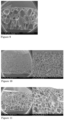
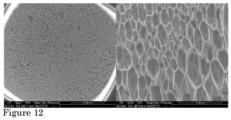
- the pore size and densities were evaluated by SEM characterization.
- the A h /A c ratio represents the open-to-close cell ratios, A h being the cell-faces holes area and A c the cell-faces area measured from SEM images.
- thermo-mechanical properties of the obtained foams are listed in the table below.
- the thermal degradation of the foams was evaluated by TGA and DSC.
- the mechanical properties were tested by Dynamic mechanical analysis (DMA).
- the stress is measured at a 50% of strain.
- the recovery time is measured for a 99% of shape recovery. After the third compression, all samples recovered over 99% of their initial shape in less than 30 s, qualifying these materials as flexible.
Landscapes
- Chemical & Material Sciences (AREA)
- Health & Medical Sciences (AREA)
- Chemical Kinetics & Catalysis (AREA)
- Medicinal Chemistry (AREA)
- Polymers & Plastics (AREA)
- Organic Chemistry (AREA)
- Engineering & Computer Science (AREA)
- Materials Engineering (AREA)
- General Chemical & Material Sciences (AREA)
- Polyurethanes Or Polyureas (AREA)
Claims (17)
- Formulation durcissable sans isocyanate pour préparation d'une mousse de polyuréthane auto-expansée, comprenant au moins un carbonate cyclique polyfonctionnel comportant au moins deux groupes carbonate cyclique en bout de chaîne (composé A), au moins une amine polyfonctionnelle (composé B), au moins un thiol polyfonctionnel (composé C), et au moins un catalyseur (composé D).
- Formulation conforme à la revendication 1, dans laquelle le composé A correspond à la formule 1 :
 - l'indice i est un nombre entier supérieur ou égal à 2, valant en particulier de 2 à 10 et plus particulièrement 2 ou 3,- et R1 représente une liaison carbone-carbone entre les cycles des groupes carbonate cyclique, ou représente une chaîne hydrocarbonée linéaire ou ramifiée, qui peut porter ou non un ou des substituant(s) et dans laquelle un ou plusieurs groupe(s) hydrocarboné(s) de cette chaîne hydrocarbonée peut ou peuvent être remplacé(s) par un hétéroatome ou un groupe cétone, cycloalkyle, hétérocyclique, aryle ou hétéroaryle, étant entendu que chacun de ces groupes peut porter ou non un ou des substituant(s), et que ladite chaîne hydrocarbonée comporte au moins 2 atomes de carbone et en particulier de 3 à 60 atomes de carbone.
 - Formulation conforme à la revendication 1 ou 2, dans laquelle le composé B correspond à la formule II :
R2-(NHR')j Formule (II)
dans laquelle- l'indice j est un nombre entier supérieur ou égal à 2, valant en particulier de 2 à 6,- R2 représente un groupe aryle ou hétéroaryle qui, dans chaque cas, peut porter ou non un ou des substituant(s), ou représente une chaîne hydrocarbonée linéaire ou ramifiée, qui peut porter ou non un ou des substituant(s) et dans laquelle un ou plusieurs groupe(s) hydrocarboné(s) de cette chaîne hydrocarbonée peut ou peuvent être remplacé(s) par un hétéroatome ou un groupe cycloalkyle ou hétérocyclique, étant entendu que chacun de ces groupes peut porter ou non un ou des substituant(s), et que ladite chaîne hydrocarbonée comporte au moins 2 atomes de carbone et en particulier de 2 à 60 atomes de carbone, plus particulièrement de 2 à 20 atomes de carbone, et encore plus particulièrement de 2 à 15 atomes de carbone,- et chaque symbole R' représente indépendamment un atome d'hydrogène ou un groupe alkyle ou cycloalkyle. - Formulation conforme à l'une des revendications précédentes, dans laquelle le composé C correspond à la formule III :
R3-(SH)k Formule (III)
dans laquelle- l'indice k est un nombre entier supérieur ou égal à 2, valant en particulier de 2 à 6,- et R3 représente une chaîne hydrocarbonée linéaire ou ramifiée, qui peut porter ou non un ou des substituant(s) et dans laquelle un ou plusieurs groupe(s) hydrocarboné(s) de cette chaîne hydrocarbonée peut ou peuvent être remplacé(s) par un hétéroatome ou un groupe cétone, cycloalkyle ou hétérocyclique, étant entendu que chacun de ces groupes peut porter ou non un ou des substituant(s), et que ladite chaîne hydrocarbonée comporte au moins 2 atomes de carbone et en particulier de 2 à 60 atomes de carbone, plus particulièrement de 2 à 20 atomes de carbone, et encore plus particulièrement de 2 à 15 atomes de carbone, ou bien R3 représente un groupe polymère linéaire ou ramifié. - Formulation conforme à l'une des revendications précédentes, dans laquelle le composé D est choisi dans l'ensemble constitué par un catalyseur de type amine, un sel ionique ou un liquide ionique, composé d'une combinaison d'un cation et d'un anion, un catalyseur organométallique et un catalyseur à base de phosphine, et est de préférence du 1,8-diaza-bicyclo[5.4.0]undéc-7-ène ou du phénolate de tétrabutyl-ammonium.
- Formulation conforme à l'une des revendications précédentes, dans laquelle le composé A se trouve présent en une proportion de 18 à 80 % en poids, en particulier de 40 à 70 % en poids et plus particulièrement de 40 à 60 % en poids, pourcentages rapportés au poids total de la formulation.
- Formulation conforme à l'une des revendications précédentes, dans laquelle le composé B se trouve présent en une proportion de 10 à 80 % en poids, en particulier de 10 à 70 % en poids et plus particulièrement de 10 à 50 % en poids, pourcentages rapportés au poids total de la formulation.
- Formulation conforme à l'une des revendications précédentes, dans laquelle le composé C se trouve présent en une proportion de 1 à 60 % en poids, en particulier de 2 à 40 % en poids et plus particulièrement de 5 à 20 % en poids, pourcentages rapportés au poids total de la formulation.
- Formulation conforme à l'une des revendications précédentes, dans laquelle le composé D se trouve présent en une proportion de 0,1 à 15 % en poids et en particulier de 0,5 à 7 % en poids, pourcentages rapportés au poids total de la formulation.
- Formulation conforme à l'une des revendications précédentes, qui comprend en outre un carbonate cyclique monofonctionnel (composé E), présent de préférence en une proportion de 1 à 50 % en poids et en particulier de 5 à 10 % en poids, pourcentages rapportés au poids total de la formulation, lequel carbonate cyclique monofonctionnel correspond de préférence à la formule IV :
 - R4 représente un atome d'hydrogène ou une chaîne hydrocarbonée linéaire ou ramifiée, qui peut porter ou non un ou des substituant(s), par exemple un groupe fonctionnel comme celui d'un alcool, d'une amine secondaire ou tertiaire, d'un acide carboxylique, d'un alcène, d'un ester, etc., et dans laquelle un ou plusieurs groupe(s) hydrocarboné(s) de cette chaîne hydrocarbonée peut ou peuvent être remplacé(s) par un hétéroatome ou un groupe cycloalkyle ou hétérocyclique, étant entendu que chacun de ces groupes peut porter ou non un ou des substituant(s), et que ladite chaîne hydrocarbonée comporte au moins 1 atome de carbone et en particulier de 2 à 60 atomes de carbone, plus particulièrement de 2 à 20 atomes de carbone, et encore plus particulièrement de 2 à 15 atomes de carbone.
 - Formulation conforme à l'une des revendications précédentes, qui comprend en outre au moins un carbonate cyclique polyfonctionnel comportant au moins deux groupes carbonate cyclique au sein de la chaîne (composé F), présent de préférence en une proportion de 1 à 50 % en poids et en particulier de 2 à 20 % en poids, pourcentages rapportés au poids total de la formulation.
- Formulation conforme à l'une des revendications précédentes, qui comprend en outre un thiol monofonctionnel (composé G), présent de préférence en une proportion de 1 à 50 % en poids et en particulier de 2 à 10 % en poids, pourcentages rapportés au poids total de la formulation, lequel thiol monofonctionnel correspond de préférence à la formule VIII :
R17-SH Formule (VIII)
dans laquelle- R17 représente un groupe aryle qui peut porter ou non un ou des substituant(s), un groupe polymère linéaire ou ramifié, ou une chaîne hydrocarbonée linéaire ou ramifiée, qui peut porter ou non un ou des substituant(s), par exemple un groupe fonctionnel comme celui d'un alcool, d'une amine primaire, secondaire ou tertiaire, d'un acide carboxylique, d'un ester, etc., et dans laquelle un ou plusieurs groupe(s) hydrocarboné(s) de cette chaîne hydrocarbonée peut ou peuvent être remplacé(s) par un hétéroatome ou un groupe cétone, cycloalkyle ou hétérocyclique, étant entendu que chacun de ces groupes peut porter ou non un ou des substituant(s), et que ladite chaîne hydrocarbonée comporte au moins 2 atomes de carbone et en particulier de 2 à 60 atomes de carbone, plus particulièrement de 2 à 20 atomes de carbone, et encore plus particulièrement de 2 à 15 atomes de carbone. - Formulation conforme à l'une des revendications précédentes, qui comprend en outre un polyépoxyde (composé H), présent de préférence en une proportion de 0,1 à 50 % en poids et en particulier de 0,5 à 20 % en poids, pourcentages rapportés au poids total de la formulation.
- Procédé de préparation d'une mousse de polyuréthane auto-expansée, comprenant les étapes consistant à prendre une formulation telle que définie dans l'une des revendications précédentes et à faire durcir cette formulation, à une température valant de préférence de 25 à 200 °C, mieux encore de 40 à 150 °C et surtout de 60 à 120 °C, de manière à ce que soit provoquée la formation de CO2 et qu'il se forme une mousse de polyuréthane qui n'est pas à base d'isocyanate.
- Procédé de préparation d'une mousse de polyuréthane, qui comprend les étapes suivantes :i) mélanger les composés A et B, et en option, n'importe lequel, certains ou tout l'ensemble des composés E, F, G et H, en présence du composé D, de manière à en faire un mélange visqueux,ii) faire durcir partiellement ce mélange, de manière à ce qu'il se forme un prépolymère visqueux polyuréthane qui n'est pas à base d'isocyanate,iii) ajouter à ce prépolymère le composé C, et en option, n'importe lequel, certains ou tout l'ensemble des composés E, F, G et H,iv) et faire durcir ce mélange obtenu dans l'étape (iii) de manière à ce qu'il se forme une mousse de polyuréthane qui n'est pas à base d'isocyanate,étant entendu que les composés A, B, C, D, E, F, G et H sont tels que définis dans l'une des revendications 1 à 13.
- Procédé de préparation d'une mousse de polyuréthane, qui comprend les étapes suivantes :i) mélanger les composés A et B, et en option, n'importe lequel, certains ou tout l'ensemble des composés E, F, G et H, en présence du composé C, de manière à en faire un mélange visqueux,ii) faire durcir partiellement ce mélange, de manière à ce qu'il se forme un prépolymère visqueux polyuréthane qui n'est pas à base d'isocyanate, chargé du composé C qui n'a pas réagi,iii) ajouter à ce prépolymère le composé D,iv) et faire durcir ce mélange obtenu dans l'étape (iii) de manière à ce que soit provoquée la formation de CO2 et qu'il se forme une mousse de polyuréthane qui n'est pas à base d'isocyanate,étant entendu que les composés A, B, C, D, E, F, G et H sont tels que définis dans l'une des revendications 1 à 13.
- Mousse de polyuréthane accessible par un procédé conforme à l'une des revendications 14 à 16.
Applications Claiming Priority (2)
| Application Number | Priority Date | Filing Date | Title |
|---|---|---|---|
| EP19184743.3A EP3760664A1 (fr) | 2019-07-05 | 2019-07-05 | Mousses de polyuréthane à autosoufflage sans isocyanate |
| PCT/EP2020/068962 WO2021004993A1 (fr) | 2019-07-05 | 2020-07-06 | Mousses de polyuréthane sans isocyanate autogonflantes |
Publications (3)
| Publication Number | Publication Date |
|---|---|
| EP3994201A1 EP3994201A1 (fr) | 2022-05-11 |
| EP3994201B1 true EP3994201B1 (fr) | 2023-09-06 |
| EP3994201C0 EP3994201C0 (fr) | 2023-09-06 |
Family
ID=67184910
Family Applications (2)
| Application Number | Title | Priority Date | Filing Date |
|---|---|---|---|
| EP19184743.3A Withdrawn EP3760664A1 (fr) | 2019-07-05 | 2019-07-05 | Mousses de polyuréthane à autosoufflage sans isocyanate |
| EP20737003.2A Active EP3994201B1 (fr) | 2019-07-05 | 2020-07-06 | Mousses de polyuréthane à autosoufflage sans isocyanate |
Family Applications Before (1)
| Application Number | Title | Priority Date | Filing Date |
|---|---|---|---|
| EP19184743.3A Withdrawn EP3760664A1 (fr) | 2019-07-05 | 2019-07-05 | Mousses de polyuréthane à autosoufflage sans isocyanate |
Country Status (5)
| Country | Link |
|---|---|
| US (1) | US12503552B2 (fr) |
| EP (2) | EP3760664A1 (fr) |
| ES (1) | ES2958985T3 (fr) |
| PL (1) | PL3994201T3 (fr) |
| WO (1) | WO2021004993A1 (fr) |
Families Citing this family (11)
| Publication number | Priority date | Publication date | Assignee | Title |
|---|---|---|---|---|
| EP4015563A1 (fr) * | 2020-12-18 | 2022-06-22 | Université de Liège | Mousses de polyuréthane à autosoufflage sans isocyanate |
| WO2022180235A1 (fr) | 2021-02-26 | 2022-09-01 | Université de Liège | Nouveau dispositif médical antimicrobien et antithrombogène |
| US20240301156A1 (en) * | 2021-09-30 | 2024-09-12 | Mitsubishi Gas Chemical Company, Inc. | Foamable resin composition, foam body, method for producing foam body, and foamable curing agent |
| EP4194481A1 (fr) * | 2021-12-10 | 2023-06-14 | Université de Liège | Mousses de polyuréthane à autosoufflage sans isocyanate |
| CN114874436B (zh) * | 2022-06-15 | 2024-03-12 | 石河子大学 | 巯基修饰不饱和脂肪酸基非异氰酸酯聚氨酯的制备方法 |
| KR102539602B1 (ko) * | 2022-12-02 | 2023-06-01 | 권오원 | 이소시아네이트를 사용하지 않는 바이오 폴리우레탄 바인더를 포함하는 바이오 수용성 도료 조성물 |
| WO2024152024A2 (fr) * | 2023-01-13 | 2024-07-18 | von Holzhausen | Couches de finition durables biosourcées durcies par rayonnement |
| FR3146473A1 (fr) * | 2023-03-08 | 2024-09-13 | Saint-Gobain Weber France | Procédé de préparation de polyuréthanes sans isocyanate |
| WO2024211258A2 (fr) * | 2023-04-07 | 2024-10-10 | Alliance For Sustainable Energy, Llc | Macromolécules amide-uréthane hautes performances |
| LU505106B1 (en) | 2023-09-15 | 2025-03-17 | Luxembourg Inst Science & Tech List | Method for producing thermoplastic polyurethane (PU) foams |
| EP4636010A1 (fr) | 2024-04-18 | 2025-10-22 | Université de Liège | Compositions améliorées pour mousses de polyuréthane sans isocyanate à autosoufflage |
Family Cites Families (5)
| Publication number | Priority date | Publication date | Assignee | Title |
|---|---|---|---|---|
| EP0830405B1 (fr) * | 1995-06-07 | 2002-11-27 | Akzo Nobel N.V. | Polyols de polyurethane possedant une faible viscosite et revetements produits avec ces polyols |
| EP1506975A1 (fr) * | 2003-08-13 | 2005-02-16 | Vantico GmbH | Nanocomposite comprenant resine polyurethanne ou polyurethanne-epoxy hybride preparés sans utilisation d'isocyanates |
| US8912303B1 (en) * | 2011-11-03 | 2014-12-16 | U.S. Department Of Energy | Poly(hydroxyl urethane) compositions and methods of making and using the same |
| EP3199569B1 (fr) | 2016-01-29 | 2021-05-19 | FAURECIA Sièges d'Automobile | Mousse de polyurethane sans isocyanate |
| CN109354681A (zh) * | 2018-11-19 | 2019-02-19 | 中国科学院青岛生物能源与过程研究所 | 一种非异氰酸酯聚氨酯的制备方法 |
-
2019
- 2019-07-05 EP EP19184743.3A patent/EP3760664A1/fr not_active Withdrawn
-
2020
- 2020-07-06 WO PCT/EP2020/068962 patent/WO2021004993A1/fr not_active Ceased
- 2020-07-06 PL PL20737003.2T patent/PL3994201T3/pl unknown
- 2020-07-06 ES ES20737003T patent/ES2958985T3/es active Active
- 2020-07-06 EP EP20737003.2A patent/EP3994201B1/fr active Active
-
2022
- 2022-01-03 US US17/567,420 patent/US12503552B2/en active Active
Also Published As
| Publication number | Publication date |
|---|---|
| EP3994201C0 (fr) | 2023-09-06 |
| PL3994201T3 (pl) | 2024-04-08 |
| US20220195117A1 (en) | 2022-06-23 |
| WO2021004993A1 (fr) | 2021-01-14 |
| US12503552B2 (en) | 2025-12-23 |
| EP3994201A1 (fr) | 2022-05-11 |
| EP3760664A1 (fr) | 2021-01-06 |
| ES2958985T3 (es) | 2024-02-19 |
Similar Documents
| Publication | Publication Date | Title |
|---|---|---|
| EP3994201B1 (fr) | Mousses de polyuréthane à autosoufflage sans isocyanate | |
| JP3887601B2 (ja) | 高い硬化速度を有するイソシアネート不含の発泡性混合物 | |
| EP3199569B1 (fr) | Mousse de polyurethane sans isocyanate | |
| EP2021433B1 (fr) | Composition retardatrice de flammes | |
| EP4194481A1 (fr) | Mousses de polyuréthane à autosoufflage sans isocyanate | |
| EP3063209B1 (fr) | Synthèse et utilisation de compositions de catalyseur comprenant des silsesquioxanes oligomères polyèdres métallisés | |
| CN110945047A (zh) | 柔性聚氨酯泡沫用的反应性阻燃剂 | |
| TW200923013A (en) | Processes for producing polyurethane foams containing alkoxysilane functional polymers and uses therefor | |
| ES2937698T3 (es) | Producto de poliuretano con poliéster poliol que contiene azufre | |
| CN102585134B (zh) | 通过卡宾催化的氨基甲酸酯和聚氨基甲酸酯的合成 | |
| EP4263672B1 (fr) | Mousses de polyuréthane à autosoufflage sans isocyanate | |
| JP6538831B2 (ja) | 少なくとも1つのアシルウレア単位を含む硬化性有機ポリマー、その製造及びその使用 | |
| JPS60161420A (ja) | ウレタン変性ポリイソシアネート配合物の製造方法 | |
| JP2020063379A (ja) | ポリウレタンインテグラルスキンフォーム用組成物、ポリウレタンインテグラルスキンフォーム、及びその製造方法 | |
| AU2016305201B2 (en) | Process for producing a ring-opening polymerization product | |
| JP2011521074A (ja) | シス,トランス−1,3−及び1,4−シクロヘキサンジメチルエーテル基を含む熱硬化性ポリウレタン | |
| CN1139122A (zh) | 用来制备聚氨酯泡沫塑料的羟甲基奎宁环催化剂组合物 | |
| EP4636010A1 (fr) | Compositions améliorées pour mousses de polyuréthane sans isocyanate à autosoufflage | |
| WO2021262953A1 (fr) | Polyol et mousse fabriquée à partir de celui-ci | |
| JP2013535559A (ja) | 耐光性ポリウレタンおよびその使用 | |
| WO2020038755A1 (fr) | Catalyseur pour la production de mousse pir/pur | |
| ES2960050T3 (es) | Formulaciones de espuma híbrida | |
| MXPA97002462A (en) | Amina reagent catalysts for use in polyuretry polymers | |
| PL217843B1 (pl) | Sposób otrzymywania elastomerów poliuretanowych |
Legal Events
| Date | Code | Title | Description |
|---|---|---|---|
| STAA | Information on the status of an ep patent application or granted ep patent |
Free format text: STATUS: UNKNOWN |
|
| STAA | Information on the status of an ep patent application or granted ep patent |
Free format text: STATUS: THE INTERNATIONAL PUBLICATION HAS BEEN MADE |
|
| PUAI | Public reference made under article 153(3) epc to a published international application that has entered the european phase |
Free format text: ORIGINAL CODE: 0009012 |
|
| STAA | Information on the status of an ep patent application or granted ep patent |
Free format text: STATUS: REQUEST FOR EXAMINATION WAS MADE |
|
| 17P | Request for examination filed |
Effective date: 20220106 |
|
| AK | Designated contracting states |
Kind code of ref document: A1 Designated state(s): AL AT BE BG CH CY CZ DE DK EE ES FI FR GB GR HR HU IE IS IT LI LT LU LV MC MK MT NL NO PL PT RO RS SE SI SK SM TR |
|
| DAV | Request for validation of the european patent (deleted) | ||
| DAX | Request for extension of the european patent (deleted) | ||
| GRAP | Despatch of communication of intention to grant a patent |
Free format text: ORIGINAL CODE: EPIDOSNIGR1 |
|
| STAA | Information on the status of an ep patent application or granted ep patent |
Free format text: STATUS: GRANT OF PATENT IS INTENDED |
|
| INTG | Intention to grant announced |
Effective date: 20221114 |
|
| GRAJ | Information related to disapproval of communication of intention to grant by the applicant or resumption of examination proceedings by the epo deleted |
Free format text: ORIGINAL CODE: EPIDOSDIGR1 |
|
| STAA | Information on the status of an ep patent application or granted ep patent |
Free format text: STATUS: REQUEST FOR EXAMINATION WAS MADE |
|
| GRAP | Despatch of communication of intention to grant a patent |
Free format text: ORIGINAL CODE: EPIDOSNIGR1 |
|
| STAA | Information on the status of an ep patent application or granted ep patent |
Free format text: STATUS: GRANT OF PATENT IS INTENDED |
|
| INTC | Intention to grant announced (deleted) | ||
| INTG | Intention to grant announced |
Effective date: 20230329 |
|
| GRAS | Grant fee paid |
Free format text: ORIGINAL CODE: EPIDOSNIGR3 |
|
| GRAA | (expected) grant |
Free format text: ORIGINAL CODE: 0009210 |
|
| STAA | Information on the status of an ep patent application or granted ep patent |
Free format text: STATUS: THE PATENT HAS BEEN GRANTED |
|
| AK | Designated contracting states |
Kind code of ref document: B1 Designated state(s): AL AT BE BG CH CY CZ DE DK EE ES FI FR GB GR HR HU IE IS IT LI LT LU LV MC MK MT NL NO PL PT RO RS SE SI SK SM TR |
|
| REG | Reference to a national code |
Ref country code: GB Ref legal event code: FG4D |
|
| REG | Reference to a national code |
Ref country code: CH Ref legal event code: EP |
|
| REG | Reference to a national code |
Ref country code: IE Ref legal event code: FG4D |
|
| REG | Reference to a national code |
Ref country code: DE Ref legal event code: R096 Ref document number: 602020017255 Country of ref document: DE |
|
| U01 | Request for unitary effect filed |
Effective date: 20231002 |
|
| U07 | Unitary effect registered |
Designated state(s): AT BE BG DE DK EE FI FR IT LT LU LV MT NL PT SE SI Effective date: 20231011 |
|
| REG | Reference to a national code |
Ref country code: NO Ref legal event code: T2 Effective date: 20230906 |
|
| PG25 | Lapsed in a contracting state [announced via postgrant information from national office to epo] |
Ref country code: GR Free format text: LAPSE BECAUSE OF FAILURE TO SUBMIT A TRANSLATION OF THE DESCRIPTION OR TO PAY THE FEE WITHIN THE PRESCRIBED TIME-LIMIT Effective date: 20231207 |
|
| PG25 | Lapsed in a contracting state [announced via postgrant information from national office to epo] |
Ref country code: RS Free format text: LAPSE BECAUSE OF FAILURE TO SUBMIT A TRANSLATION OF THE DESCRIPTION OR TO PAY THE FEE WITHIN THE PRESCRIBED TIME-LIMIT Effective date: 20230906 Ref country code: HR Free format text: LAPSE BECAUSE OF FAILURE TO SUBMIT A TRANSLATION OF THE DESCRIPTION OR TO PAY THE FEE WITHIN THE PRESCRIBED TIME-LIMIT Effective date: 20230906 Ref country code: GR Free format text: LAPSE BECAUSE OF FAILURE TO SUBMIT A TRANSLATION OF THE DESCRIPTION OR TO PAY THE FEE WITHIN THE PRESCRIBED TIME-LIMIT Effective date: 20231207 |
|
| REG | Reference to a national code |
Ref country code: ES Ref legal event code: FG2A Ref document number: 2958985 Country of ref document: ES Kind code of ref document: T3 Effective date: 20240219 |
|
| PG25 | Lapsed in a contracting state [announced via postgrant information from national office to epo] |
Ref country code: IS Free format text: LAPSE BECAUSE OF FAILURE TO SUBMIT A TRANSLATION OF THE DESCRIPTION OR TO PAY THE FEE WITHIN THE PRESCRIBED TIME-LIMIT Effective date: 20240106 |
|
| PG25 | Lapsed in a contracting state [announced via postgrant information from national office to epo] |
Ref country code: SM Free format text: LAPSE BECAUSE OF FAILURE TO SUBMIT A TRANSLATION OF THE DESCRIPTION OR TO PAY THE FEE WITHIN THE PRESCRIBED TIME-LIMIT Effective date: 20230906 Ref country code: RO Free format text: LAPSE BECAUSE OF FAILURE TO SUBMIT A TRANSLATION OF THE DESCRIPTION OR TO PAY THE FEE WITHIN THE PRESCRIBED TIME-LIMIT Effective date: 20230906 Ref country code: IS Free format text: LAPSE BECAUSE OF FAILURE TO SUBMIT A TRANSLATION OF THE DESCRIPTION OR TO PAY THE FEE WITHIN THE PRESCRIBED TIME-LIMIT Effective date: 20240106 Ref country code: CZ Free format text: LAPSE BECAUSE OF FAILURE TO SUBMIT A TRANSLATION OF THE DESCRIPTION OR TO PAY THE FEE WITHIN THE PRESCRIBED TIME-LIMIT Effective date: 20230906 Ref country code: SK Free format text: LAPSE BECAUSE OF FAILURE TO SUBMIT A TRANSLATION OF THE DESCRIPTION OR TO PAY THE FEE WITHIN THE PRESCRIBED TIME-LIMIT Effective date: 20230906 |
|
| REG | Reference to a national code |
Ref country code: DE Ref legal event code: R097 Ref document number: 602020017255 Country of ref document: DE |
|
| PLBE | No opposition filed within time limit |
Free format text: ORIGINAL CODE: 0009261 |
|
| STAA | Information on the status of an ep patent application or granted ep patent |
Free format text: STATUS: NO OPPOSITION FILED WITHIN TIME LIMIT |
|
| 26N | No opposition filed |
Effective date: 20240607 |
|
| U20 | Renewal fee for the european patent with unitary effect paid |
Year of fee payment: 5 Effective date: 20240724 |
|
| PG25 | Lapsed in a contracting state [announced via postgrant information from national office to epo] |
Ref country code: MC Free format text: LAPSE BECAUSE OF FAILURE TO SUBMIT A TRANSLATION OF THE DESCRIPTION OR TO PAY THE FEE WITHIN THE PRESCRIBED TIME-LIMIT Effective date: 20230906 |
|
| PGFP | Annual fee paid to national office [announced via postgrant information from national office to epo] |
Ref country code: PL Payment date: 20250630 Year of fee payment: 6 |
|
| PG25 | Lapsed in a contracting state [announced via postgrant information from national office to epo] |
Ref country code: IE Free format text: LAPSE BECAUSE OF NON-PAYMENT OF DUE FEES Effective date: 20240706 |
|
| U20 | Renewal fee for the european patent with unitary effect paid |
Year of fee payment: 6 Effective date: 20250728 |
|
| PGFP | Annual fee paid to national office [announced via postgrant information from national office to epo] |
Ref country code: ES Payment date: 20250827 Year of fee payment: 6 |
|
| PGFP | Annual fee paid to national office [announced via postgrant information from national office to epo] |
Ref country code: NO Payment date: 20250725 Year of fee payment: 6 |
|
| PGFP | Annual fee paid to national office [announced via postgrant information from national office to epo] |
Ref country code: GB Payment date: 20250722 Year of fee payment: 6 |
|
| PGFP | Annual fee paid to national office [announced via postgrant information from national office to epo] |
Ref country code: CH Payment date: 20250801 Year of fee payment: 6 |
|
| PG25 | Lapsed in a contracting state [announced via postgrant information from national office to epo] |
Ref country code: CY Free format text: LAPSE BECAUSE OF FAILURE TO SUBMIT A TRANSLATION OF THE DESCRIPTION OR TO PAY THE FEE WITHIN THE PRESCRIBED TIME-LIMIT; INVALID AB INITIO Effective date: 20200706 |
|
| PG25 | Lapsed in a contracting state [announced via postgrant information from national office to epo] |
Ref country code: HU Free format text: LAPSE BECAUSE OF FAILURE TO SUBMIT A TRANSLATION OF THE DESCRIPTION OR TO PAY THE FEE WITHIN THE PRESCRIBED TIME-LIMIT; INVALID AB INITIO Effective date: 20200706 |