EP4002172A1 - Method for classifying abnormal operating states of a computer network - Google Patents
Method for classifying abnormal operating states of a computer network Download PDFInfo
- Publication number
- EP4002172A1 EP4002172A1 EP21197043.9A EP21197043A EP4002172A1 EP 4002172 A1 EP4002172 A1 EP 4002172A1 EP 21197043 A EP21197043 A EP 21197043A EP 4002172 A1 EP4002172 A1 EP 4002172A1
- Authority
- EP
- European Patent Office
- Prior art keywords
- alarm
- sub
- alarm object
- objects
- groups
- Prior art date
- Legal status (The legal status is an assumption and is not a legal conclusion. Google has not performed a legal analysis and makes no representation as to the accuracy of the status listed.)
- Granted
Links
Images


Classifications
-
- G—PHYSICS
- G06—COMPUTING OR CALCULATING; COUNTING
- G06F—ELECTRIC DIGITAL DATA PROCESSING
- G06F21/00—Security arrangements for protecting computers, components thereof, programs or data against unauthorised activity
- G06F21/50—Monitoring users, programs or devices to maintain the integrity of platforms, e.g. of processors, firmware or operating systems
- G06F21/55—Detecting local intrusion or implementing counter-measures
- G06F21/554—Detecting local intrusion or implementing counter-measures involving event detection and direct action
-
- G—PHYSICS
- G06—COMPUTING OR CALCULATING; COUNTING
- G06F—ELECTRIC DIGITAL DATA PROCESSING
- G06F21/00—Security arrangements for protecting computers, components thereof, programs or data against unauthorised activity
- G06F21/50—Monitoring users, programs or devices to maintain the integrity of platforms, e.g. of processors, firmware or operating systems
- G06F21/55—Detecting local intrusion or implementing counter-measures
- G06F21/56—Computer malware detection or handling, e.g. anti-virus arrangements
- G06F21/566—Dynamic detection, i.e. detection performed at run-time, e.g. emulation, suspicious activities
-
- H—ELECTRICITY
- H04—ELECTRIC COMMUNICATION TECHNIQUE
- H04L—TRANSMISSION OF DIGITAL INFORMATION, e.g. TELEGRAPHIC COMMUNICATION
- H04L41/00—Arrangements for maintenance, administration or management of data switching networks, e.g. of packet switching networks
- H04L41/06—Management of faults, events, alarms or notifications
- H04L41/0631—Management of faults, events, alarms or notifications using root cause analysis; using analysis of correlation between notifications, alarms or events based on decision criteria, e.g. hierarchy, tree or time analysis
- H04L41/065—Management of faults, events, alarms or notifications using root cause analysis; using analysis of correlation between notifications, alarms or events based on decision criteria, e.g. hierarchy, tree or time analysis involving logical or physical relationship, e.g. grouping and hierarchies
-
- H—ELECTRICITY
- H04—ELECTRIC COMMUNICATION TECHNIQUE
- H04L—TRANSMISSION OF DIGITAL INFORMATION, e.g. TELEGRAPHIC COMMUNICATION
- H04L43/00—Arrangements for monitoring or testing data switching networks
-
- H—ELECTRICITY
- H04—ELECTRIC COMMUNICATION TECHNIQUE
- H04L—TRANSMISSION OF DIGITAL INFORMATION, e.g. TELEGRAPHIC COMMUNICATION
- H04L63/00—Network architectures or network communication protocols for network security
- H04L63/14—Network architectures or network communication protocols for network security for detecting or protecting against malicious traffic
- H04L63/1408—Network architectures or network communication protocols for network security for detecting or protecting against malicious traffic by monitoring network traffic
-
- H—ELECTRICITY
- H04—ELECTRIC COMMUNICATION TECHNIQUE
- H04L—TRANSMISSION OF DIGITAL INFORMATION, e.g. TELEGRAPHIC COMMUNICATION
- H04L63/00—Network architectures or network communication protocols for network security
- H04L63/14—Network architectures or network communication protocols for network security for detecting or protecting against malicious traffic
- H04L63/1408—Network architectures or network communication protocols for network security for detecting or protecting against malicious traffic by monitoring network traffic
- H04L63/1416—Event detection, e.g. attack signature detection
-
- H—ELECTRICITY
- H04—ELECTRIC COMMUNICATION TECHNIQUE
- H04L—TRANSMISSION OF DIGITAL INFORMATION, e.g. TELEGRAPHIC COMMUNICATION
- H04L63/00—Network architectures or network communication protocols for network security
- H04L63/14—Network architectures or network communication protocols for network security for detecting or protecting against malicious traffic
- H04L63/1433—Vulnerability analysis
-
- G—PHYSICS
- G06—COMPUTING OR CALCULATING; COUNTING
- G06F—ELECTRIC DIGITAL DATA PROCESSING
- G06F21/00—Security arrangements for protecting computers, components thereof, programs or data against unauthorised activity
- G06F21/50—Monitoring users, programs or devices to maintain the integrity of platforms, e.g. of processors, firmware or operating systems
- G06F21/55—Detecting local intrusion or implementing counter-measures
- G06F21/552—Detecting local intrusion or implementing counter-measures involving long-term monitoring or reporting
-
- G—PHYSICS
- G06—COMPUTING OR CALCULATING; COUNTING
- G06F—ELECTRIC DIGITAL DATA PROCESSING
- G06F2221/00—Indexing scheme relating to security arrangements for protecting computers, components thereof, programs or data against unauthorised activity
- G06F2221/03—Indexing scheme relating to G06F21/50, monitoring users, programs or devices to maintain the integrity of platforms
- G06F2221/033—Test or assess software
-
- G—PHYSICS
- G06—COMPUTING OR CALCULATING; COUNTING
- G06F—ELECTRIC DIGITAL DATA PROCESSING
- G06F2221/00—Indexing scheme relating to security arrangements for protecting computers, components thereof, programs or data against unauthorised activity
- G06F2221/21—Indexing scheme relating to G06F21/00 and subgroups addressing additional information or applications relating to security arrangements for protecting computers, components thereof, programs or data against unauthorised activity
- G06F2221/2151—Time stamp
-
- H—ELECTRICITY
- H04—ELECTRIC COMMUNICATION TECHNIQUE
- H04L—TRANSMISSION OF DIGITAL INFORMATION, e.g. TELEGRAPHIC COMMUNICATION
- H04L41/00—Arrangements for maintenance, administration or management of data switching networks, e.g. of packet switching networks
- H04L41/28—Restricting access to network management systems or functions, e.g. using authorisation function to access network configuration
-
- H—ELECTRICITY
- H04—ELECTRIC COMMUNICATION TECHNIQUE
- H04L—TRANSMISSION OF DIGITAL INFORMATION, e.g. TELEGRAPHIC COMMUNICATION
- H04L43/00—Arrangements for monitoring or testing data switching networks
- H04L43/16—Threshold monitoring
Definitions
- the invention relates to a method for classifying abnormal operating states of a computer network that are attributable to variations in different types of attacks, according to the preamble of patent claim 1.
- Attack detection systems are automated programs that monitor system behavior according to specified rules and analyze it using specially configured detectors and create alarms or alarm objects in the event of an attack or computer system malfunction being detected. Attack detection systems are used in a wide variety of network and system environments, for example to detect and prevent cyber attacks at an early stage.
- IP addresses are used to establish connections between alarms (see e.g Cuppens, F., & Miege, A. (2002, May). Alert correlation in a cooperative intrusion detection framework. In Proceedings 2002 IEEE symposium on security and privacy (pp. 202-215). IEEE ), or the grouping is based exclusively on a few predefined attributes from the IDMEF format (see e.g Risto Vaarandi. 2009. Real-time classification of IDS alerts with data mining techniques. In MILCOM 2009-2009 IEEE Military Communications Conference. IEEE, 1-7 ).
- IP addresses, ports are not necessarily present in the log lines, and on systems where network addresses do not allow clear assignments due to virtualization and containerization.
- patterns based on the occurrence of certain system-specific attributes such as IP addresses are difficult to generalize to a general decentralized network where creating connections based on identical IP addresses is not possible.
- the object of the invention is therefore to provide a method that makes it possible to automatically assign the alarms or alarm objects created by attack detection systems to individual attack types, so that the number of alarms or alarm objects that have to be checked manually can be effectively reduced.
- the method according to the invention advantageously makes it possible to assign alarm objects generated by attack detection systems to individual attacks or attack types by creating alarm object patterns. In this way, an effective reduction in the number of alarm objects that need to be viewed by humans, as well as semantic enrichment with attack information and automatic classification can be achieved.
- alarm object patterns are formed by aggregating individual alarm objects or alarm object groups.
- attack detection systems are understood as meaning automated programs for the automated analysis of the system behavior of computers or computer networks.
- Attack detection systems are used in a wide variety of network and system environments, for example to detect and prevent cyber attacks at an early stage. Attack detection systems are automated programs that monitor system behavior, for example, according to specified rules and analyze them using specifically configured detectors, or forward security-related events to the analysis components responsible for them.
- signature-based attack detection systems which search for predetermined patterns that are known to indicate attacks on or manipulation of the computer or computer network, for example a specific character string
- anomaly-based attack detection systems which use self-learning methods to create a basic behavior of the system environment and identify deviations from identify and report this basic behavior as a possible attack.
- network-based attack detection systems which analyze the data traffic between a number of network components, such as computers, routers, switches or firewalls, and host-based attack detection systems
- the events on a single network component for example in log data and security-related monitoring data be mapped, analyzed, differentiated.
- the events or activities identified by the automatic analysis as relevant for further processing, abnormal, or otherwise potentially dangerous lead to the creation of an alarm object that contains specific information about the attack detection system, the analyzed event, and the context (e.g. time, previous events, other events related to the event, which can also possibly come from different data sources) of the occurrence of this event, and to another system, in particular a security system, which is used to prepare alarm objects for control and processing by a human was developed.
- a security system which is used to prepare alarm objects for control and processing by a human was developed.
- attack detection systems can be used in parallel, each with different configurations. Since there is no standardization of alarms, or any attempt at standardization or unification (e.g. IDMEF standard in RFC4765) leads to the discarding of potentially essential attributes of an alarm object, this means that with different types of attacks or attack attempts , differently structured alarm object types can be created, each with certain non-uniform attributes.
- the alarm types can be differentiated using a variety of aspects, for example using attributes assigned to an alarm object, for example the time of occurrence, Information about the detector or the violated rule, the value leading to the violation of the rule, event information, suspicious and other unsuspicious parameters of the event, system measurements, folder structures, affected programs, pre-classifications by the attack detection system, etc.
- the sequences triggered by attacks or attack attempts of alarm objects is subject to variations, such as the order of occurrence of the alarm objects, the presence of additional alarm objects, the absence of alarm objects in alarm object sequences, the relative times of occurrence of the alarm objects, etc.
- a detection case in connection with the invention is understood to mean when an attack detection system that, for example, has a number of rules or self-learning detectors and analyzes a number of data sources that, for example, continuously provide network-based or host-based data, a violation of a rule, an occurrence of a certain predefined pattern, a detection of a security-related event, or any other unusual deviation from the normal behavior of a computer or computer system, and then generates an alarm object or alarm objects, which or which are made available to or at other systems can be forwarded.
- an alarm object is understood to mean a semi-structured object generated by an attack detection system on the basis of a detection event, which comprises one or more attributes, the values associated with the respective attributes being numbers, character strings, complex data types such as IP addresses, lists of such Values or other semi-structured objects can exist, and the number and characteristics of the attributes can vary depending on the attack detection system and detection case.
- An alarm object sequence in connection with the invention is understood as meaning a sequence of alarm objects arranged according to their chronological occurrence, it being possible for the alarm object sequences to be subdivided on the basis of the temporal proximity and logical association of the alarm objects.
- An alarm object group in connection with the invention comprises a number of alarm objects, ie a subsequence of an alarm object sequence which was formed, for example, on the basis of the temporal proximity and/or logical association of the alarm objects.
- an alarm object pattern is understood to be a “supergroup” alarm object that is formed as a representative of a number of alarm object groups.
- the alarm object pattern itself is not part of this set.
- the alarm object pattern represents the entirety of the represented alarm object groups as well as possible or is formed in such a way that it has the greatest possible similarity to each of the individual alarm object groups belonging to the set.
- the similarity of the alarm objects of the individual alarm object groups to one another and/or the similarity of newly created alarm object groups to the alarm object patterns already created can be determined particularly efficiently if the similarity of the alarm objects of the individual alarm object groups and/or for newly created alarm object groups the similarity to the alarm object patterns already created is calculated is performed by searching for matching attributes and/or matching values associated with the attributes.
- a method according to the invention it can be ensured in a particularly reliable manner that newly added alarm objects or alarm object groups are taken into account when creating the alarm object templates if the alarm object groups are combined into alarm object templates again, in particular continuously, after initial detection and the representative alarm objects of the individual alarm object patterns are updated on the basis of the alarm objects contained in the newly added alarm object groups recognized as similar, in particular using a method according to the invention,
- a program for carrying out a method according to the invention can advantageously also be stored on a data carrier.
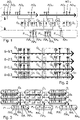
- the upper part of 1 represents alarm objects AO 1 , ..., AO 16 appearing as sequences of events on time lines.
- the figure contains two timelines to show that alarm objects AO 1 ,..., AO 16 can be collected from different intrusion detection systems SA , SB ,... deployed either in the same network infrastructure or also in separate system environments.
- Another possibility is that events from historical alarm object logs and used for forensic analysis of attack manifestations.
- alarm objects AO 1 , ..., AO 16 with specific symbols (rectangles, circles, triangles, bars) representing a specific type assigned to alarm object AO 1 , ..., AO 16 , where a type is based on one or more in particular all matching attributes and values associated with the attributes, and can be determined in particular by a similarity metric described in this invention, two alarm objects then being assigned the same type if they have a sufficiently great similarity, in particular a similarity greater than a certain threshold.
- each alarm object AO 1 , ..., AO 16 represents a unique event that occurs only at a specific point in time.
- alarm objects AO 1 , ..., AO 16 of the same type e.g. alarm objects AO 1 , ..., AO 16 generated by violation of a certain predefined rule, or alarm objects AO 1 , ..., AO 16 , which are reported by the same attack detection systems S A , S B ,... occur multiple times.
- These alarm objects AO 1 , ..., AO 16 are marked accordingly with the same symbol. . _ In the graphic above, this is visible in the triangle representing alarm objects AO 2 , AO 6 , AO 8 , AO 12 , AO 15 , the apex of which points up a few times and down a few times.
- a grouping according to alarm object types instead of according to temporal proximity is also possible with a method according to the invention, but this would result in a loss of information under certain circumstances, since alarm objects AO 1 , ..., AO 16 are independent of their context, i.e. other alarm objects AO 1 , ... . , AO 16 , presumably generated by the same triggering action, would have been associated with alarm object groups G 1 , ..., G 6 .
- grouping all circle-type alerts would have neglected the fact that this type occurs in both the square-triangle-circle and circle-circle-triangle patterns, and therefore might not, on its own, be a good indicator of a particular attack execution.
- the order, frequency and attributes of the alarm objects AO 1 , ..., AO 16 within the alarm object groups G 1 , ..., G 6 enable similarities between them to be calculated.
- Alarm object groups G 1 ,...,G 6 that give a high similarity are probably related to the same root cause and should therefore be combined into a condensed form reflecting a typical case of this alarm object group G 1 ,...,G 6 , which is referred to in the context of the invention as an alarm object pattern P 1 , ..., P k .
- FIG. 1 shows the generation of alarm object patterns P 1 ,...,P k from similar alarm object groups G 1 ,...,G 6 .
- orders, frequencies and attributes of the alarm object patterns P 1 , . . . , P k are created in such a way that all associated alarm object groups G 1 , .
- a representative alarm object RA 2 ie, for example, a new alarm object type, represented by two connected triangles pointing both up and down, is created.
- This representative alarm object RA 2 is thus a mixed type from the existing triangular alarm object types AO 2 , AO 8 , AO 15 . This could mean, for example, that two different attributes of the original alarm objects AO 2 , AO 8 , AO 15 are combined into a list, which will be discussed in more detail below.
- the second alarm object pattern P 2 with the alarm object type pattern circle-circle-triangle is formed from the two identical alarm object groups G 2 , G 4 and the representative alarm objects RA 4 , RA 5 , RA 6 therefore correspond to the original alarm object types of the alarm object groups G2, G4.
- the third alarm object pattern P 3 contains a single representative alarm object RA 7 (bar) which occurs only once and is the only alarm object in its group G 5 .
- An alarm object sequence from one or more attack detection systems S A , S B is used as the data basis for a method according to the invention, in which the individual alarm objects AO 1 , ..., AO n are contained in the sequence in which they occurred, in particular provided with a time stamp.
- the individual alarm objects AO 1 , ..., AO n are each assigned a number of attributes and values assigned to the attributes, in particular a number of numbers, character strings and/or objects, which indicate the abnormal operating state that has occurred in each case and that is detected by the respective attack detection system Characterize S A , S B as being recognized as corresponding to a recognition case.
- the first step of a method according to the invention is the formation of alarm object groups G 1 , ..., G m from these incoming alarm objects AO 1 , ..., AO n .
- those alarm objects AO 1 , . . . AO n are combined into an alarm object group G 1 , .
- a manual specification of a specific time interval threshold value as the maximum permissible time interval threshold value ⁇ between the alarm objects AO 1 , ..., AO n is not trivial, since a high degree of knowledge about the interactions of the alarm objects AO 1 , ..., AO n and the expected structures of the alarm object sequences are included.
- different alarm object patterns P 1 .
- the alarm object group formation can be performed in parallel for several temporal distance threshold values ⁇ . This increases the probability that valid and usable alarm object patterns P 1 ,...,P k will be found for different types of patterns of alarm objects AO 1 ,...,AO n .
- the comparison and summarization or aggregation of alarm object groups G 1 , ..., G n to alarm object patterns P 1 , ..., P n is in 3 shown schematically.
- 3 are in three columns three alarm object groups G 1 , G 2 , G 3 ; G4 , G5 , G6 ; G 7 , G 8 , G 9 are shown one below the other for which the similarity is to be determined using a predetermined similarity metric and which are to be aggregated into a single alarm object group G in each case.
- the dashed and solid arrows in 3 have different meanings:
- the solid arrows in 3 represent how alarm object groups G 1 , G 2 , G 3 ; G4 , G5 , G6 ; G 7 , G 8 , G 9 are aggregated with each other - at the tip of the arrow is the one from the individual alarm object groups G 1 , G 2 , G 3 ; G4 , G5 , G6 ; G 7 , G 8 , G 9 aggregated alarm object group.
- the dashed arrows in 3 represent that a single alarm object group G 1 , G 2 , G 3 ; G4 , G5 , G6 ; G 7 , G 8 , G 9 is converted to another representation, always in the order: original alarm item set (left) -> frequency-based alarm item set (middle) -> sequence alignment-based alarm item set (right).
- the left side of the 3 shows the first possibility, the alarm objects AO of the three alarm object groups G 1 , G 2 , G 3 being compared with one another.
- a similarity metric for alarm objects AO is established so as to facilitate finding pairs of To enable alarm objects AO across multiple alarm object groups G 1 , G 2 , G 3 that achieve a high level of similarity.
- the attributes of all alarm objects AO are compared with the aid of the similarity metric for alarm objects AO, with identical or similar attributes contributing to a higher probability between alarm objects AO than dissimilar or unequal attributes.
- the overall similarity of an alarm object group G 1 , G 2 , G 3 is then calculated as a weighted mean, in particular the average, of all similarities of the alarm object pairs found.
- those attributes which are the same in all alarm objects AO 1 when aggregating the alarm objects AO 1 , . . . , AO n , those attributes which are the same in all alarm objects AO 1 , . Furthermore, in a particularly advantageous manner, those attributes that take on few forms, in particular with a number below a predetermined threshold value, across the alarm objects AO 1 , . . . , AO n can be stored as lists.
- the middle part of 3 shows a particularly efficient method for finding the similarity of alarm object groups G 4 , G 5 , G 6 and creating an aggregated alarm object group or alarm object pattern P 2 , independent of the position of the alarm objects AO 1 , ..., AO n in the respective alarm object sequences.
- each alarm object group G 4 , G 5 , G 6 first determines the frequencies of all alarm objects AO 1 , ..., AO n , with similar alarm objects A, i.e.
- alarm objects A whose similarity exceeds a predetermined alarm similarity threshold value for the minimum similarity for alarm objects AO exceed, be considered equal, and each set of alarm objects AO is represented in the alarm object pattern P 2 or in the aggregated alarm object group by a representative alarm object RA 7 , RA 8 , RA 9 , which results from the aggregation of all similar alarm objects AO.
- the similarity of the alarm object groups G 1 can be determined such that matching frequencies have a positive impact on similarity, small deviations have a negative impact on similarity, and large deviations have a strong negative impact on similarity.
- the alarm object groups G 1 , G 1 , ..., G m correspond to these frequency intervals, i.e. for each of the representative alarm objects RA 7 , RA 8 , RA 9 the minimum and maximum frequency of the alarm objects AO 1 , ..., AO n associated with the representative alarm objects are determined and set as minimum and maximum limits for the frequencies of the representative alarm objects RA 7 , RA 8 , RA 9 in the alarm object pattern.
- the right side of the 3 shows a particularly efficient method for finding the similarity of the alarm object groups G 7 , G 8 , G 9 and creating an aggregated alarm object group or the alarm object pattern P 3 based on the positions of the alarm objects AO 1 , ..., A n in the respective alarm object sequences.
- the representative alarm objects RA 7 , RA 8 , RA 9 created in the course of the previous method are associated with the positions of the original alarm objects AO 1 , ..., AO n in the respective alarm object sequences of the alarm object groups G 7 , G 8 , G 9 .
- sequence alignment see e.g Gonzalo Navarro. 2001. A guided tour to approximate string matching.
- ACM computing surveys (CSUR) 33, 1 (2001), 31-88 ) counting the necessary change operations to match the respective alarm object sequences it is possible to determine the similarity of the alarm object groups G 7 , G 8 , G 9 .
- these methods particularly for finding a longest common and possibly broken alarm object chain present in all alarm object groups G 7 , G 8 , G 9 , can be used to create the alarm object pattern P 3 or the aggregated alarm object group.
- a first exemplary embodiment of a method according to the invention with two time interval threshold values ⁇ large and ⁇ small and a database D is explained by way of example.
- These alarm object patterns P 1 , P 2 and the affiliation of the individual alarm object groups G 1 , . . . , G 4 to the individual alarm object patterns P 1 , P 2 are also stored in the database D.
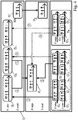
- the first embodiment in 4 shown deals with the finding of alarm object patterns P 1 , P 2 and the recognition of these alarm object patterns P 1 , P 2 on different attack detection systems S A , S B.
- the lower part of 4 shows the occurrence of alarm objects AO 1 , ..., AO n in the form of alarm object sequences generated by the attack detection systems SA, SB .
- the alarm object sequences contain the individual alarm objects AO 1 , .
- the middle part of 4 includes the created alarm object patterns P 1 , P 2 .
- the upper part of 4 shows a database D in which, in the exemplary embodiment , all alarm object groups G 1 , .
- the database D thus advantageously ensures that alarm object templates P 1 , P 2 are generated as a kind of representative aggregated alarm object group for all alarm object groups G 1 , . . . , G 4 stored in the database D.
- a method according to the invention functions sufficiently reliably even without such a database D.
- such a database D advantageously prevents the existing alarm object templates P 1 , P 2 from being continually changed as soon as new alarm object groups G are assigned, which could lead to over-generalization. Since over-generalized alarm object patterns P 1 , P 2 receive all the more assignments from newly created alarm object groups G, this effect could even increase over time, which a database D reliably prevents.
- the creation of a database could, under certain circumstances, result in increased complexity of the procedure, an increase in memory requirements, since a number of alarm object groups G 1 , ..., G m are stored for each alarm object pattern P 1 , . . . , P k , and one Increasing the running time, since each time an alarm object pattern P 1 , . . . , P k is created, several alarm object groups G 1 , . This could lead to problems, especially in real-time operation, if the number of alarm object groups G 1 , . . . ..., P k associated alarm object groups G 1 , ..., G m could be caused, new alarm objects AO 1 , ..., AO n would no longer be processed without a great delay.
- the number of alarm object groups formed is influenced by the time interval threshold values ⁇ , ie for the attack detection system S
- a two alarm object groups G 1 , G 2 are used for a large time interval threshold value ⁇ large and four alarm object groups G' 1 , ..., G ' 4 formed for a small temporal distance threshold ⁇ small .
- the alarm object groups P 1 , P 2 which are formed for the large temporal distance threshold values ⁇ large , starting with the first alarm object group P 1 , which includes alarm objects AO 1 , ..., AO 6 , which are a twice-repeating pattern of the symbols rectangle-triangle-circle can be represented.
- the alarm object group G 1 is included in the database D and at the same time added as a new alarm object pattern by copying it, as in step (1) specified in 4 . Since at this time only this alarm object group G 1 exists in the database D, the alarm object pattern is identical to the original alarm object group G 1 . Only then is an alarm object pattern P 1 generated from a plurality of alarm object groups G 1 , G 2 in the database D, as indicated in step (2).
- the second alarm object group G 2 which was identified by the attack detection system SA using the large temporal distance threshold ⁇ large , contains the same sequence of alarm objects as the first alarm object group G 1 .
- Step (3) shows that the similarity between the second alarm object group G 2 and the alarm object pattern P 1 is calculated.
- the second alarm object group G 2 is added to the database D, which stores the alarm object groups G 1 , G 2 , associated with the alarm object pattern P 1 as indicated in step (4).
- the addition triggers a re-creation of the alarm object pattern P 1 as indicated in step (5).
- the re-creation of the alarm object pattern P 1 is advantageous so that the alarm object pattern P 1 always corresponds to a typical representation of all alarm object groups G 1 , G 2 assigned to it and stored in the database D, and thus also to those contained in the newly assigned alarm object group G 2 Structures of alarm objects AO 1 , ..., AO 6 or sequences of alarm objects sufficiently corresponds. Assuming that all alarm objects AO 1 , ..., AO 6 in the first and second alarm object groups G 1 , G 2 have the same attributes, the newly created alarm object pattern P 1 remains unchanged.
- a third alarm object group G 3 now occurs in the attack detection system S B at a point in time which was generated by the attack detection system S A after the alarm object pattern P 1 had been created.
- the similarity to all previously existing alarm object patterns in Fig.4 this is just the alarm object pattern P 1 calculated as shown in step (6).
- a new alarm object pattern P is generated based on the third alarm object group G 3 .
- the alarm object group G 3 is added to the database D as indicated in step (7).
- a new generation of the alarm object pattern or generation of a further alarm object pattern is not shown in the graphic since the second exemplary embodiment deals with this case in more detail.
- two alarm object groups G' 5 , G' 6 are identified for the small temporal distance threshold ⁇ small , of which alarm object groups G' 5 comprise the same alarm object sequence as alarm object pattern P 2 and are therefore similar enough to enable successful detection of the attack type associated with alarm object pattern P 2 , while the other alarm object group G' 6 has only one of three alarm objects in common with alarm object pattern P 2 and is therefore not similar enough to be recognized as based on the attack type associated with alarm object pattern P 2 assigned.
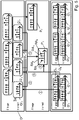
- the second embodiment is in figure 5 shown schematically and focuses on the merging of alarm object groups identified on different attack detection systems SA, SB .
- Marked steps focus only on the results of the small temporal distance threshold ⁇ small for the sake of simplicity.
- the individual alarm objects AO 1 , ..., AO n of the alarm groups G' 1 , ..., G' 6 are not identified by reference symbols.
- steps (1) and (2) indicate the generation of an alarm object pattern P 1 from the first alarm object group G' 1 on intrusion detection system S A , the alarm object group G' 1 being added to the database D first and only then the alarm object pattern P 1 is generated.
- the second alarm object group G ′ 2 of attack detection system SA differs in the second and fourth alarm object from alarm object group G′ 1 , which is indicated by the tips of the triangles pointing in different directions. It is assumed that the alarm object group G' 2 still shows a sufficiently high similarity in the check in step (3) and is therefore added to the database D in step (4) and assigned to the alarm object pattern P 1 . This in turn leads to the new generation of the alarm object pattern P 1 , the first and the second alarm object group G′ 1 , G′ 2 being aggregated or combined.
- the resulting alarm object pattern P 1 is a merging of these alarm object groups G' 1 , G' 2 , such that the second and fourth alarm objects are a mixed type of the respective second and fourth alarm objects of the first and second alarm object groups G' 1 , G' 2 of attack detection system S A represents.
- the alarm object groups from attack detection system SB are now also included in order to generate a system-wide alarm object pattern.
- each alarm object group G' 1 ,..., G' 6 the first and third alarm objects are of the same type circle, which is retained in the resulting alarm object pattern as the representative alarm object RA 1 and RA 3 respectively.
- the second alarm object is a triangle point up, in the other three it is a triangle point down.
- the second representative alarm object RA 2 in the alarm object pattern P 1 is merged into a combined alarm object type consisting of two triangles, each pointing up and down, which in the second embodiment means that an attribute of the alarm object is represented by a list represented with two different values. This ensures that the respective attribute of each alarm object group G' 1 , ..., G' 6 matches the attribute in the alarm object pattern P 1 .
- the fourth alarm object is more diverse, since an alarm object type with a triangle pointing in each of the four possible directions occurs in at least one alarm object group G' 1 , ..., G' 6 at this position.
- the aggregation method for alarm objects replaces the corresponding attribute of the respective alarm object in the alarm object pattern P 1 with a representative alarm object RA 4 in the form of a placeholder, which is characterized by the alarm object type asterisk.
- the affected attribute could contain a counter that changes with each execution and should therefore be considered variable and not specific to the alarm object or attack. Since the value is replaced by a placeholder, not only do the alarm objects of all alarm object groups G' 1 , ..., G' 6 match, but also any value that might occur for this attribute.
- the second alarm object pattern P 2 generated based on the alarm object groups G 1 , ..., G 3 of the intrusion detection systems S A , S B formed using the large temporal distance threshold ⁇ large , shows that the sequence of the merged alarm objects deviates from the first alarm object pattern P 1 , e.g. the alarm object types triangle point up and triangle point down occur instead of the combined alarm object type containing two triangles.
- the third temporal distance threshold ⁇ 3 is smaller than both in figure 5 illustrated temporal distance threshold values ⁇ large , ⁇ small and is intended to illustrate the borderline case in which, due to a very small temporal distance threshold value ⁇ , each alarm object AO 1 , ..., AO n forms its own alarm object group G 1 , ..., G n .
- the two other time-distance threshold values ⁇ large , ⁇ small in the example correspond exactly to the time-distance threshold values ⁇ large , ⁇ small figure 5 .
- alarm objects AO 1 , . . . , AO n are viewed as time events with various semi-structured attributes.
- Two alarm object types are used as an example, which differ greatly in terms of the attributes that are present.
- Alarm object type 1 (represented by the circle icon) has attributes A, B, and C
- alarm object type 2 (represented by the triangle icon) has attributes X, Y, and Z.
- the attribute Z can take one of four different values, these are z1, z2, z3, and z4 (see Table 1).
- the alarm objects AO 9 , ..., AO 24 that occur form repetitive sequences or patterns.
- alarm object type 1 and alarm object type 2 alternate in each case.
- the alarm objects accumulate at specific points in time: four alarm objects occur at intervals of 3 seconds and form alarm object groups (for example alarm objects AO 9 -AO 12 on attack detection system S B ). Two of these alarm object groups occur every 22 seconds (e.g. alarm objects AO 9 -AO12 and alarm objects AO 13 -AO 16 ). Only one such pair occurs in attack detection system SA (alarm objects AO 1 -AO 4 and alarm objects AO 5 -AO 8 ), in attack detection system S B two of these pairs occur at intervals of 63 seconds.
- each alarm object AO forms an alarm object group G for itself, since there is no shorter time distance of less than 1 second between any two alarm objects AO. 8 shows these alarm object groups G and the associated alarm objects AO for the two attack detection systems SA, SB .
- a first alarm object pattern P 1 is created for the first alarm object group G 1 , which contains the first alarm object AO 1 of alarm object type 1 from attack detection system S A (alarm object ID 1, alarm object type circle), since there is no alarm object pattern at this point in time. This is done by associating the alarm object group with a database D, as previously described, which then creates the alarm object pattern P 1 .
- the second alarm object group G 2 is therefore added to the knowledge base D, from which a second alarm object pattern P 2 , which at this time only includes the second alarm object group G 2 , is created.
- the third alarm object AO 3 from attack detection system S A is in turn of alarm object type 1 (alarm object ID 3, alarm object type circle) and is stored in the third alarm object group G 3 . Since there are now two alarm object patterns P 1 , P 2 , the similarity to both is calculated. The similarity between the third alarm object group G 3 and the first alarm object pattern P 1 results in the highest possible similarity value of 1, since all attributes A, B, C are present in both and every value of each attribute (a, b, c) matches. The third alarm object group G 3 is thus assigned to the first alarm object pattern P 1 .
- the alarm object group G 3 in the database D dem is assigned to the first alarm object pattern P 1 , and this alarm object pattern P 1 is then newly generated from all alarm object groups G 1 , G 3 that are assigned to it in the database D. Since the two alarm object groups G 1 , G 3 associated with it are identical in the database D (both alarm object groups G 1 , G 3 each contain an alarm object AO 1 , AO 3 of the circle alarm object type with identical attributes and values), the alarm object pattern P 1 also remains unchanged after renewed generation.
- the two following alarm object groups with alarm object ID 4 (alarm object type triangle with point up) and alarm object ID 5 (alarm object type circle) are assigned in the same way to the second alarm object pattern P 2 and the first alarm object pattern P 1 respectively.
- the sixth alarm object group G 6 which contains the alarm object with alarm object ID 6 (alarm object type triangle with point downwards), has a different value for attribute Z than all previous alarm object groups.
- the sixth alarm object group G 6 is assigned to the second alarm object pattern P 2 .
- the second alarm object pattern P 2 which at this point in time includes the second and fourth alarm object groups G 2 , G 4 .
- the alarm object pattern P 2 is then newly generated from these three alarm object groups G 2 , G 4 , G 6 .
- the seventh alarm object group G 7 again contains an alarm object AO 7 of the circle alarm object type and is treated in the same way as the previous alarm object groups G 1 , G 3 , which were assigned to the first alarm object pattern P 1 .
- the eighth alarm object group G 8 in turn has an alarm object AO 8 of the alarm object type triangle with apex to the right, which has a new value for attribute Z.
- the similarity to the first alarm object pattern P 1 is 0. If the value for attribute Z were either z1 or z3, the similarity to the second alarm object pattern P 2 would be 1, since both z1 and z3 are present in the alarm object pattern at attribute Z are, and thus both values would be accepted as a match. However, since the attribute Z assumes the value z2 in the eighth alarm object group G 8 , the similarity is 0.83, as before.
- This alarm object group G 8 is thus also assigned to the second alarm object pattern P 2 in the database D and the alarm object pattern P 2 is newly generated.
- Attributes X and Y remain unchanged as before, only attribute Z now has three different values. Since the maximum size of the list of values that can be assigned to an attribute of a representative alarm object RA was set at 2, the value of the attribute Z is replaced with a placeholder symbolized by an asterisk. From now on, any value of the Z attribute results in a match.
- the sixteenth alarm object group G 16 which includes an alarm object AO 16 of the alarm object type triangle with a left apex and which occurs in alarm detection system SB , will be considered occurring in alarm detection system SB .
- the similarity to the first alarm object pattern P 1 is 0.
- a comparison with the second alarm object pattern P 2 shows that a new value for the attribute Z, namely z4, occurs.
- the second alarm object pattern P 2 already has a placeholder for the attribute Z and thus the value z4 leads to a match, and all other attributes and values also match, the similarity between the sixteenth alarm object group G 16 and the second alarm object pattern P 2 is equal to 1.
- the alarm object group G 16 is thus added in the database D to the second alarm object pattern P 2 .
- a placeholder is again created for the attribute Z, since four different values are now already present in the associated alarm object groups stored in the database D.
- the fixed value of the maximum size of the lists is assumed to be 4. Since alarm object type 1 is not subject to any changes, as can be seen in the previously explained second exemplary embodiment, only alarm object type 2 is considered.
- the linearly fillable list is filled until the maximum value is reached. This is the case as soon as the list associated with the second alarm object pattern P 2 contains the alarm object groups, which each comprise alarm objects with alarm object IDs 2, 4, 6 and 8. Since the procedure up to this point is the same as the procedure with lists that can be filled indefinitely, the second alarm object pattern with a placeholder for attribute Z exists at this point.
- the alarm object AO 10 with alarm object ID 10 is processed, since it achieves a perfect similarity value of 1 due to the placeholder in the second alarm object pattern P 2 , it is added to the list of alarm object groups associated with the second alarm object pattern P 2 Exceeds maximum value of lists. As dictated by the linearly fillable list strategy, the oldest alarm object set, that is, the alarm object set that includes the alarm object with alarm object ID 2, is removed from the list, so that the resulting list reaches a size of 4 again. If the second alarm object pattern P 2 is now updated using these alarm object groups, the resulting alarm object pattern P 2 still has a placeholder for attribute Z, since three different values occur for this attribute.
- this effect is advantageous because it means that alarm object groups that may have been incorrectly added age out of the alarm object pattern P 2 .
- the placeholder has proven to be correct over a long period of time and multiple alarm collection add operations, and should be retained. This can be achieved by increasing the maximum size of the lists, for example from 4 to 5, thereby achieving sufficiently large diversity of attributes.
- the strategy of logarithmically fillable lists is discussed.
- the maximum size of the lists is set at 4. Since the selection of alarm object groups is based on chance, only an exemplary process flow can be shown. Adding the alarm object groups and contained alarm objects with alarm object ID 2, 4, 6, and 8 to the list associated with the second alarm object pattern is identical to the other strategies. Adding the alarm item group that includes alarm item with alarm item id 10 could replace the last added alarm item group, as this happens 50% of the time.
- attribute Z in the alarm object pattern changes to a list containing z1 and z3 since the value z2 was overwritten.
- the alarm item set containing alarm object with alarm object ID 12 could move the last two alarm item groups towards the first position and insert them in the last position, since this happens 12.5% of the time.
- the alarm item group containing the alarm object with alarm object ID 13 could move the last alarm item group towards the first position and insert it in the last position, since this happens 25% of the time.
- Table 6 shows these and subsequent operations: Table 6: Attributes of alarm object pattern P ⁇ sub>2 ⁇ /sub> and list entries List entries (only alarm object type 2) Attributes of second alarm object pattern P 2 time step 1. 2. 3. 4.
- the list of alarm item groups associated with the second alarm item pattern consists of various alarm item groups that have occurred over a long period of time.
- one alarm item set from System A and three alarm items from System B reside in this knowledge base.
- This list thus represents a random sample that is more representative of cross-system alarm object groups than a list that can be filled linearly, and has the advantage of a shorter computing time and lower memory requirements than an unlimited list.
- the list is filled statistically, there is no guarantee that the resulting alarm object patterns will be identical in every execution.
- Alarm objects that are less than 10 seconds away from another alarm object or alarm object group are combined into one or that alarm object group.
- the alarm object groups G 1 , ..., G 6 are in 11 pictured.
- the first alarm object group G 1 which includes alarm objects AO 1 , ..., AO 4 with alarm object ID 1 to 4, is therefore inserted into a new database D (step (1) in figure 5 ), and a new alarm object pattern P 1 is generated from this alarm object group G 1 (step (2) in figure 5 ).
- the second alarm object group G 2 includes alarm objects AO 5 , ..., AO 8 with alarm object ID 5 to 8 and is compared with the alarm object pattern P 1 (step (3) in figure 5 ). Since the alarm object group G 2 and the alarm object pattern P 1 each have a plurality of alarm objects AO 5 , ..., AO 8 or representative alarm objects RA 1 , ..., RA 4 , an association between the alarm objects AO 5 , ... , AO 8 and representative alarm objects RA 1 , ..., RA 4 based on the similarity of the alarm objects.
- the first alarm object AO 5 of the second alarm object group G 2 is compared with the first representative alarm object RA 1 of the alarm object pattern P 1 , the second alarm object AO 6 of the second alarm object group G 2 with the second representative alarm object RA 2 of the alarm object pattern P 1 , etc., then there is a similarity of 1 for the pairing of the first alarm object AO 5 of the second alarm object group G 2 with the first representative alarm object RA 1 of the alarm object pattern P 1 , since all attributes and values match.
- the alarm object groups for the period of 50 seconds are considered. This corresponds to the large temporal distance threshold ⁇ large in figure 5 .
- the attack detection system SA there is only a single alarm object group G 1
- the attack detection system S B there are two alarm object groups G 2 , G 3 .
- the alarm object groups G 1 , ..., G 3 are in 13 shown.
- the first and only alarm object group G 1 is added to the database D by attack detection system S A and a new alarm object pattern P 1 is generated based on the alarm object group G 1 , since there is no alarm object pattern at this time, as before.
- the similarity to the alarm object pattern P 1 is then calculated for the first alarm object group G 2 by attack detection system S B . It is in 13 It can be seen that the first seven alarm objects AO 9 , ..., AO 15 of the second alarm object group G 2 and the first seven alarm objects AO 1 , ..., AO 7 of the alarm object pattern P 1 , which at this time belong to the first and only alarm object group G 1 of attack detection system S A , correspond to one another and thus result in the best possible similarities, ie, in each case a similarity of 1, between these alarm objects.
- the eighth representative alarm object RA 8 of the alarm object pattern P 1 which corresponds to the eighth alarm object AO 8 of the alarm object group G 1 , is of the alarm object type triangle with the apex to the right, while the eighth alarm object AO 16 of the first alarm object group G 2 of intrusion detection system SB is of the type triangle with apex to the left.
- the similarity of these alarm objects AO 8 , AO 16 is estimated at 0.83.
- the second alarm object group G 3 from attack detection system S B is treated analogously. Since in turn this alarm object group G 3 with the alarm object pattern P 1 only at the eighth position of the alarm object sequence, a similarity of 0.98 is again achieved.
- the alarm object group G 3 is therefore assigned to the alarm object pattern P 1 in the database D and, after regeneration, the alarm object pattern P 1 has a representative alarm object RA 8 of the alarm object type triangle in the eighth position of the alarm object sequence (see 14 ), where the attribute Z is present as a placeholder, since there are already three different values in the eighth positions of the alarm object sequences of the three alarm object groups G 1 , ..., G 3 in the database D.
- the generated alarm object patterns P can differ greatly, depending on which temporal distance threshold value ⁇ is chosen. This affects both the number of alarm objects AO in the alarm object pattern P and their attributes after aggregation. It is therefore advantageous to apply several temporal distance thresholds ⁇ in parallel in order to derive different types of alarm object patterns P from different attack types, in order to increase the probability that at least one of these alarm object patterns P allows a specific occurrence of a similar or varied attack to be recognized.
- Alarm objects AO are considered semi-structured objects.
- a semi-structured representation of alarm objects AO is also common in practice (see e.g OSSEC alerts in JSON format (https://ossec-docs.readthedocs.io/en/latest/docs/formats/alerts.html#sample-alertsjson-messages, last accessed on November 17th, 2020 ).
- each structured alarm object AO can also be represented as a semi-structured alarm object AO.
- alarm objects AO are presented below as objects that have a specific number of attributes, with a specific value being stored for each attribute.
- Values can either represent simple values such as numbers or character strings, or take on complex structures, such as lists of numbers or character strings that are marked with square brackets, or nested objects that are marked with curly brackets.
- the similarity between AO 1 and AO 2 is to be determined.
- the similarity metric compares all attributes of the two alarm objects AO 1 and AO 2 and counts the number of matches and the number of differences.
- Attribute A is present in both alarm objects AO 1 and AO 2 and has the same value a, the number of matches increases by 1 to 1.
- Attribute B is present in both alarm objects AO 1 and AO 2 , but has the value b1 in alarm object 1 and b2 in alarm object AO 2 . Therefore, the number of differences increases by 1 to 1.
- Attribute C is present in both alarm objects AO 1 and AO 2 , but is a two-element list in alarm object AO 1 and a single-element list in alarm object AO 2 . Since one element of the list, c1, matches in both alarm objects AO 1 and AO 2 , and thus half of the list matches, the matches are increased by 0.5 to 1.5. Since an element of the list in alarm object AO 1 is not present in the list of alarm object AO 2 , and thus half of the list does not match, the number of differences is increased by 0.5 to 1.5.
- Attribute D is a nested object in both alarm objects AO 1 and AO 2 . Each attribute in the nested object is treated as a normal attribute. Attribute D1 is present in both alarm objects AO 1 and AO 2 and has the same value d1, the number of matches increases by 1 to 2.5. Attribute D2 is only present in alarm object AO 1 , but not in alarm object AO 2 . In order to weight missing attributes more than different values for the same attributes, the number of differences is increased by 1.5 to 3.
- Attribute E is present in both alarm objects AO 1 and AO 2 , and in alarm object AO 2 is an aggregated list. This means that even a subset of the list is sufficient as a value to be considered a match. Since the value of alarm object AO 1 in attribute E is equal to e2, and e2 is part of the list of attribute E in alarm object AO 2 , the number of matches is increased by 1 to 3.5.
- attribute F is present in both alarm objects AO 1 and AO 2 and in alarm object AO 2 an aggregated list, however the value f4 of alarm object AO 1 is not included in the list. Therefore the number of differences is increased by 1 to 4.
- Attribute G is also present in both alarm objects and has a placeholder in alarm object AO 2 . Therefore, no matter what the value of the attribute G in AlarmObject1, the number of matches will be increased by 1 to 4.5 in any case.
- the final number of matches is 4.5 and the final number of differences is 4.
- alarm objects AO are semi-structured objects.
- the following alarm objects are considered:
- the three alarm objects AO 3 , AO 4 , AO 5 are to be aggregated.
- the following parameters are used for this.
- the maximum size of the aggregated lists is 2 and the minimum relative occurrence of an attribute is 0.4.
- Attribute A is present in all alarm objects AO 3 , AO 4 , AO 5 and has the same value a1 in all alarm objects AO 3 , AO 4 , AO 5 .
- the attribute A is therefore generated as an aggregated list with only one element a1.
- the attribute B is present in all alarm objects AO 3 , AO 4 , AO 5 and assumes the values b1 twice and b2 once. Since there are two different values, the attribute B is stored in the aggregated alarm object as an aggregated list with the two values b1 and b2.
- the attribute C is present in all alarm objects AO 3 , AO 4 , AO 5 and assumes the values c1, c2 and c3. Since there are thus three different values, and this number exceeds the maximum size of the aggregated lists, the attribute C is added with a placeholder in the aggregated alarm object.
- Attribute D only occurs in alarm object AO 3 . It is therefore only present in one of 3 alarm objects, i.e. the relative frequency 0.33 is less than the minimum relative occurrence 0.4 and the attribute is therefore not included in the aggregated alarm object.
- the aggregated alarm object thus looks like this:
- the first alarm object group G 1 thus consists of three alarm objects AO 1 , AO 3 , AO 5
- the second alarm object group G 2 consists of four alarm objects AO 5 , AO 2 , AO 4 , AO 4 .
- alarm object AO 5 is present in both alarm object groups G 1 , G 2
- alarm object AO 4 is present twice in the second alarm object group G 2 .
- the list is run through from top to bottom and all pairings are removed that contain alarm objects AO that are already present in another pairing, alarm objects AO occurring multiple times being allowed to appear in the pairings accordingly.
- the first pairing is accepted since it includes only alarm object AO 5 present in both alarm object groups G 1 , G 2 .
- the second pairing is also accepted since alarm object AO 1 is in alarm object group G 1 and alarm object AO 2 is in alarm object group G 2 .
- alarm object AO 4 in alarm object group G 2 which is considered an unsuccessful pairing with similarity 0.
- alarm object AO 5 is at position 3 in the first alarm object group G 1 but at position 1 in the second alarm object group G 2 , two move operations are necessary to move the alarm objects to the same position.
- the alarm objects are representative, which means that the identical alarm object AO 1 is not necessarily present 1000 times in alarm object group G 3 , but 1000 alarm objects AO are present that are sufficiently similar to alarm object AO 1 to be counted together .
- the first step in computing the similarity metric for large alarm object groups G is finding pairs of representative alarm objects. From previous examples it is known that alarm object AO 1 in alarm object group G 3 and alarm object AO 2 in alarm object group G 4 , alarm object AO 4 in alarm object group G 3 and alarm object AO 4 in alarm object group G 4 , and alarm object AO 5 in alarm object group G 3 and alarm object AO 5 form a pairing in alarm object group G 4 .
- alarm object group G 5 comprises four alarm objects AO 3 , AO 4 , AO 5 , AO 5
- alarm object group G 6 and alarm object group G 7 each have only three alarm objects AO 4 , AO 5 , AO 3 ; AO 3 , AO 3 , AO 1 .
- alarm object AO 5 occurs twice in alarm object group G 5 and alarm object AO 3 occurs twice in alarm object group G 7 .
- the alarm object group compositions were chosen as an example to demonstrate the aggregation metrics. In practice, these alarm object groups G would probably be too dissimilar to be meaningfully aggregated into a single alarm object pattern P.
- the minimum similarity for alarm objects is set at 0.2.
- the largest alarm object group G is selected because, due to the larger number of existing alarm objects, this offers the best opportunities for all other alarm object groups to find good pairings of alarm objects.
- This alarm object group G is alarm object group G 5 .
- the pair of alarm object AO 4 from alarm object group G 5 with alarm object AO 3 from alarm object group G 5 is not formed because it has less similarity than the pair of alarm object AO 5 from alarm object group G 5 with alarm object AO 3 from alarm object group G 7 .
- the alarm objects were formed as follows.
Landscapes
- Engineering & Computer Science (AREA)
- Computer Security & Cryptography (AREA)
- Computer Hardware Design (AREA)
- General Engineering & Computer Science (AREA)
- Software Systems (AREA)
- Theoretical Computer Science (AREA)
- Computer Networks & Wireless Communication (AREA)
- Signal Processing (AREA)
- General Physics & Mathematics (AREA)
- Physics & Mathematics (AREA)
- Computing Systems (AREA)
- Health & Medical Sciences (AREA)
- General Health & Medical Sciences (AREA)
- Virology (AREA)
- Data Exchanges In Wide-Area Networks (AREA)
- Alarm Systems (AREA)
Abstract
Die Erfindung betrifft ein Verfahren zur Klassifizierung von anomalen Betriebszuständen eines Computernetzwerks (1), die auf Variationen unterschiedlicher Angriffstypen zurückzuführen sind,- wobei das Computernetzwerk eine Anzahl von Computern umfasst, wobei auf den Computern zumindest ein Angriffserkennungssystem (S<sub>A</sub>, S<sub>B</sub>) zur Erkennung von anomalen Betriebszuständen des Computers und/oder des Computernetzwerks abläuft, wobei das zumindest eine Angriffserkennungssystem (S<sub>A</sub>, S<sub>B</sub>) dazu ausgebildet ist, bei Eintreten von anomalen Betriebszuständen, die vorab vorgegebenen Erkennungsfällen entsprechen, insbesondere einen Angriff auf den Computer und/oder das Computernetzwerk darstellen, Alarmobjekte (AO; AO<sub>1</sub>, ..., AO<sub>n</sub>) zu erstellen, sodass derart eine Alarmobjektsequenz erzeugt wird, in der die einzelnen Alarmobjekte (AO; AO<sub>1</sub>, ..., AO<sub>n</sub>) in der Abfolge ihres Auftretens, insbesondere versehen mit einem Zeitstempel, enthalten sind,wobei den einzelnen Alarmobjekten (AO; AO<sub>1</sub>, ..., AO<sub>n</sub>) jeweils eine Anzahl von Attributen und den Attributen zugeordneten Werten, insbesondere eine Anzahl von Zahlen, Zeichenketten, Wertelisten, und/oder Objekten, zugeordnet sind, die den jeweils aufgetretenen anomalen Betriebszustand, der als einem Erkennungsfall entsprechend erkannt wurde, charakterisieren, wobei- die einzelnen Alarmobjekte (AO; AO<sub>1</sub>, ..., AO<sub>n</sub>) der Alarmobjektsequenz zu Alarmobjektgruppen (G; G<sub>1</sub>, ..., G<sub>m</sub>; G'<sub>1</sub>, ..., G'<sub>m</sub>) zusammengefasst werden,- dass die einzelnen Alarmobjektgruppen (G; G<sub>1</sub>, ..., G<sub>m</sub>; G'<sub>1</sub>, ..., G'<sub>m</sub>) basierend auf der Reihenfolge, der Häufigkeit und/oder den Attributen der den jeweiligen Alarmobjektgruppen (G; G<sub>1</sub>, ..., G<sub>m</sub>; G'<sub>1</sub>, ..., G'<sub>m</sub>) zugeordneten Alarmobjekte (AO; AO<sub>1</sub>, ..., AO<sub>n</sub>) nach einer vorgegebenen Ähnlichkeitsmetrik hinsichtlich ihrer Ähnlichkeit verglichen und unter Vorgabe eines Alarmobjektgruppen-Ähnlichkeitsschwellenwerts (t) aufgrund deren Ähnlichkeit nach einer vorgegebenen Aggregationsmetrik zu Alarmobjektmustern (P; P<sub>1</sub>, ..., P<sub>k</sub>) in Form von Datenobjekten zusammengefasst werden,wobei den Alarmobjektmustern (P; P<sub>1</sub>, ..., P<sub>k</sub>) jeweils repräsentative Alarmobjekte (RA; RA<sub>1</sub>, ..., P<sub>l</sub>) zugewiesen werden, die diejenigen Alarmobjekte (AO; AO<sub>1</sub>, ..., AO<sub>n</sub>), insbesondere deren Attribute und Werte, die den als ähnlich erkannten Alarmobjektgruppen (G; G<sub>1</sub>, ..., G<sub>m</sub>; G'<sub>1</sub>, ..., G'<sub>m</sub>) zugeordnet sind, repräsentieren und wobei jedem Alarmobjektmuster (P; P<sub>1</sub>, ..., P<sub>k</sub>) ein Angriffstyp zugeordnet wird, und- diejenigen anomalen Betriebszustände, die denjenigen Alarmobjekten (AO; AO<sub>1</sub>, ..., AO<sub>n</sub>) zugrunde liegen, die den zu einem jeweiligen Alarmobjektmuster (P; P<sub>1</sub>, ..., P<sub>k</sub>) zusammengefassten Alarmobjektgruppen (G; G<sub>1</sub>, ..., G<sub>m</sub>; G'<sub>1</sub>, ..., G'<sub>m</sub>) zugeordnet sind, als anomale Betriebszustände erkannt werden, die auf denjenigen Angriffstyp zurückzuführen sind, der dem jeweiligen Alarmobjektmuster (P; P<sub>1</sub>, ..., P<sub>k</sub>) zugeordnet ist.The invention relates to a method for classifying abnormal operating states of a computer network (1) which can be traced back to variations of different types of attack, the computer network comprising a number of computers, with at least one attack detection system (S<sub>A</sub >, S<sub>B</sub>) for detecting abnormal operating states of the computer and/or the computer network, wherein the at least one attack detection system (S<sub>A</sub>, S<sub>B</sub> >) is designed to, when abnormal operating states occur that correspond to previously specified detection cases, in particular representing an attack on the computer and/or the computer network, alarm objects (AO; AO<sub>1</sub>, ..., AO <sub>n</sub>) so that an alarm object sequence is generated in which the individual alarm objects (AO; AO<sub>1</sub>, ..., AO<sub>n</sub> ) in the sequence of their occurrence, in particular provided with a time stamp, are included, with the individual alarm objects (AO; AO<sub>1</sub>, ..., AO<sub>n</sub>) in each case a number of attributes and values assigned to the attributes, in particular a number of numbers, character strings, lists of values and/or objects, are assigned, which characterize the abnormal operating state that occurred in each case, which was recognized as corresponding to a detection case, wherein the individual alarm objects (AO; AO<sub>1</sub>, ..., AO<sub>n</sub >) the alarm object sequence to alarm object groups (G; G<sub>1</sub>, ..., G<sub>m</sub>; G'<sub>1</sub>, ..., G' <sub>m</sub>),- that the individual alarm object groups (G; G<sub>1</sub>, ..., G<sub>m</sub>; G'<sub>1 </sub>, ..., G'<sub>m</sub>) based on the order, frequency and/or attributes of the respective alarm object groups (G; G<sub>1</sub>, . .., G<sub>m</sub>; G'<sub>1</sub>, ..., G'<sub>m</sub>) associated alarm objects (AO; AO<sub>1< /sub>, ..., AO<sub>n</sub>) according to a predetermined similarity metric regarding their similarity compared to alarm object patterns (P; P<sub>1</sub>, ..., P<sub>k</sub>) in the form of data objects, where the alarm object patterns (P; P<sub>1</sub>, ... , P<sub>k</sub>) are assigned to respective representative alarm objects (RA; RA<sub>1</sub>, ..., P<sub>l</sub>) that contain those alarm objects (AO; AO<sub>1</sub>, ..., AO<sub>n</sub>), in particular their attributes and values, which correspond to the alarm object groups recognized as similar (G; G<sub>1</sub>, ..., G<sub>m</sub>; G'<sub>1</sub>, ..., G'<sub>m</sub>) and where each alarm object pattern (P ; P<sub>1</sub>, ..., P<sub>k</sub>) is assigned an attack type, and- those anomalous operating states which are associated with those alarm objects (AO; AO<sub>1</sub >, ..., AO<sub>n</sub>) which form the basis for a respective alarm object pattern (P; P<sub>1</sub>, ..., P<sub>k</sub >) summarized alarm object groups (G; G<sub>1</sub>, ..., G<sub>m</sub>; G'<sub>1</sub>, ..., G'<sub >m</sub>) are assigned as abnormal operating states annunciated, which can be traced back to the type of attack that corresponds to the respective alarm object pattern (P; P<sub>1</sub>, ..., P<sub>k</sub>) is assigned.
Description
Die Erfindung betrifft ein Verfahren zur Klassifizierung von anomalen Betriebszuständen eines Computernetzwerks, die auf Variationen unterschiedlicher Angriffstypen zurückzuführen sind, gemäß dem Oberbegriff von Patentanspruch 1.The invention relates to a method for classifying abnormal operating states of a computer network that are attributable to variations in different types of attacks, according to the preamble of
Angriffserkennungssysteme sind automatisierte Programme, die das Systemverhalten nach vorgegebenen Regeln beobachten und mithilfe spezifisch konfigurierter Detektoren analysieren und in Fall einer Detektion eines Angriffs oder einer Fehlfunktion des Computersystems Alarme bzw. Alarmobjekte erstellt. Angriffserkennungssysteme werden in verschiedensten Netzwerk- und Systemumgebungen eingesetzt, um z.B. Cyber-Angriffe frühzeitig zu erkennen und zu verhindern.Attack detection systems are automated programs that monitor system behavior according to specified rules and analyze it using specially configured detectors and create alarms or alarm objects in the event of an attack or computer system malfunction being detected. Attack detection systems are used in a wide variety of network and system environments, for example to detect and prevent cyber attacks at an early stage.
In vielbenützten Systemen ist die Anzahl der Alarme sowohl durch ständige Angriffe - etwa aus dem Internet durch automatisierte Skripte oder Bots - als auch normales Benutzerverhalten, das Fehlalarme auslösen kann, oft immens. Dazu ist es meist nicht möglich, einen Alarm einem bestimmten Angriff zuzuordnen, da:
- Aktionen, die möglicherweise Alarme auslösen, nicht nur einen einzigen Alarm spezifisch für diese Aktion auslösen, sondern meist eine Reihe von Alarmen auslösen.
- Jeder dieser ausgelösten Alarme auch bei anderen Aktionen auftreten könnte, zum Beispiel als Teil der dabei entstehenden Alarme. Dies wird dadurch bekräftigt, dass es im Allgemeinen von Interesse ist, möglichst generische Regeln und Detektoren zur Erkennung von Angriffen zu entwerfen, um so auch noch unbekannte Angriffstechniken oder Varianten von Angriffen mit möglichst großer Wahrscheinlichkeit erkennen zu können.
- Auch bei Auftreten derselben Aktion nicht garantiert ist, dass exakt die gleichen Alarme ausgelöst werden, sondern diese sich in ihren Attributen, Reihenfolgen, oder Auftrittszeitpunkten unterscheiden können.
- Gleiche oder ähnliche Angriffe mit unterschiedlichen Konfigurationen ausgeführt werden können, wodurch sich deren Manifestationen in den beobachteten Systemdaten ändert und somit auch die resultierenden Alarme beeinflusst werden.
- Sich Mischungen aus mehreren Angriffen oder auch Fehlalarmen, die zufällig gleichzeitig auftreten, ergeben können.
- Eine Zuordnung eine vom Menschen durchgeführte semantische Bearbeitung bedarf, diese jedoch im Allgemeinen Fall bei unterschiedlichen Systemumgebungen jeweils spezifisch durchgeführt werden müsste, und es somit keine generell gültige Regelbasis für das Zuordnen von Alarmen zu Angriffen gibt.
- Actions that may trigger alerts do not only trigger a single alert specific to that action, but tend to trigger a series of alerts.
- Each of these triggered alarms could also occur during other actions, for example as part of the resulting alarms. This is reinforced by the fact that it is generally of interest to design rules and detectors for detecting attacks that are as generic as possible, so that unknown attack techniques or variants of attacks can also be detected with the greatest possible probability.
- Even if the same action occurs, there is no guarantee that exactly the same alarms will be triggered, but that they can differ in their attributes, sequence or times of occurrence.
- The same or similar attacks can be carried out with different configurations, which changes their manifestations in the observed system data and thus also influences the resulting alarms.
- Mixtures of several attacks or false alarms that happen to occur simultaneously can result.
- An assignment requires human semantic processing, but this would generally have to be carried out specifically in different system environments, and there is therefore no generally valid rule base for assigning alarms to attacks.
Im derzeitigen Stand der Technik existiert jedoch kein Ansatz, der es erlaubt, auftretende Alarme, deren Struktur bzw. beinhaltete Attribute unbekannt sind, spezifischen Angriffstechniken zuzuordnen. Existierende Ansätze basieren ausschließlich auf dem Finden von vordefinierten Werten in verschiedenen Alarmen. Dabei werden vor allem IP-Adressen verwendet, um Verbindungen zwischen Alarmen herzustellen (siehe z.B.
Aufgabe der Erfindung ist es daher, ein Verfahren bereitzustellen, das es ermöglicht, die von Angriffserkennungssystemen erstellten Alarme bzw. Alarmobjekte automatisiert einzelnen Angriffstypen zuzuordnen, sodass die Anzahl an Alarmen bzw. Alarmobjekten, die manuell überprüft werden müssen, effektiv reduziert werden kann.The object of the invention is therefore to provide a method that makes it possible to automatically assign the alarms or alarm objects created by attack detection systems to individual attack types, so that the number of alarms or alarm objects that have to be checked manually can be effectively reduced.
Die Erfindung löst diese Aufgabe bei einem Verfahren gemäß dem Oberbegriff des Patentanspruchs 1 mit den kennzeichnenden Merkmalen des Patentanspruchs 1. Erfindungsgemäß ist dabei vorgesehen,
- dass die einzelnen Alarmobjekte der Alarmobjektsequenz zu Alarmobjektgruppen zusammengefasst werden,
- dass die einzelnen Alarmobjektgruppen basierend auf der Reihenfolge, der Häufigkeit und/oder den Attributen der den jeweiligen Alarmobjektgruppen zugeordneten Alarmobjekte nach einer vorgegebenen Ähnlichkeitsmetrik hinsichtlich ihrer Ähnlichkeit verglichen und unter Vorgabe eines Alarmobjektgruppen-Ähnlichkeitsschwellenwerts aufgrund deren Ähnlichkeit nach einer vorgegebenen Aggregationsmetrik zu Alarmobjektmustern in Form von Datenobjekten zusammengefasst werden,
- wobei den Alarmobjektmustern jeweils repräsentative Alarmobjekte zugewiesen werden, die diejenigen Alarmobjekte, insbesondere deren Attribute und Werte, die den als ähnlich erkannten Alarmobjektgruppen zugeordnet sind, repräsentieren und
- wobei jedem Alarmobjektmuster ein Angriffstyp zugeordnet wird, und
- dass diejenigen anomalen Betriebszustände, die denjenigen Alarmobjekten zugrunde liegen, die den zu einem jeweiligen Alarmobjektmuster zusammengefassten Alarmobjektgruppen zugeordnet sind, als anomale Betriebszustände erkannt werden, die auf denjenigen Angriffstyp zurückzuführen sind, der dem jeweiligen Alarmobjektmuster zugeordnet ist.
- that the individual alarm objects of the alarm object sequence are combined into alarm object groups,
- that the individual alarm object groups based on the order, the frequency and/or the attributes of the alarm objects assigned to the respective alarm object groups are compared in terms of their similarity according to a predetermined similarity metric and, with the specification of an alarm object group similarity threshold value, based on their similarity according to a predetermined aggregation metric to alarm object patterns in the form of data objects be summarized,
- wherein the alarm object templates are each assigned representative alarm objects which represent those alarm objects, in particular their attributes and values, which are assigned to the alarm object groups recognized as similar, and
- wherein an attack type is assigned to each alarm object pattern, and
- that those anomalous operating states which are based on those alarm objects which are assigned to the alarm object groups combined to form a respective alarm object pattern are recognized as anomalous operating states which can be attributed to the attack type which is assigned to the respective alarm object pattern.
Das erfindungsgemäße Verfahren ermöglicht es vorteilhafterweise, von Angriffserkennungssystemen erzeugten Alarmobjekte durch die Erstellung von Alarmobjektmustern einzelnen Angriffen bzw. Angriffstypen zuzuordnen. Auf diese Weise kann eine effektive Reduktion der Anzahl der Alarmobjekte, die von Menschen gesichtet werden müssen, sowie eine semantische Anreicherung mit Angriffsinformationen und automatische Klassifizierung erzielt werden. Dabei werden Alarmobjektmuster durch Aggregation von Einzelalarmobjekten bzw. Alarmobjektgruppen gebildet.The method according to the invention advantageously makes it possible to assign alarm objects generated by attack detection systems to individual attacks or attack types by creating alarm object patterns. In this way, an effective reduction in the number of alarm objects that need to be viewed by humans, as well as semantic enrichment with attack information and automatic classification can be achieved. In this case, alarm object patterns are formed by aggregating individual alarm objects or alarm object groups.
Diese Vorgehensweise bringt unter anderem folgende Vorteile mit sich:
- Reduktion der Alarmobjekte, die vom Menschen gesichtet und interpretiert werden müssen.
- Wiederverwendbarkeit der Alarmobjektmuster, um gleiche oder ähnliche Angriffe auf anderen Systemen erkennen zu können.
- Geringere Wahrscheinlichkeit einer Fehlinterpretation des Menschen durch zusätzliche Information, da ähnliche Alarmobjektmuster bereits in vergangenen Situationen gefunden wurden.
- Verbesserungen der existierenden Erkennungsregeln und Detektoren.
- Reduction of alarm objects that need to be viewed and interpreted by humans.
- Reusability of the alarm object pattern in order to be able to detect the same or similar attacks on other systems.
- Less likelihood of human being misinterpreted by additional information since similar alarm object patterns have already been found in past situations.
- Improvements to existing detection rules and detectors.
Unter Angriffserkennungssystemen werden im Zusammenhang mit der Erfindung automatisierte Programme zur automatisierten Analyse des Systemverhaltens von Computern bzw. Computernetzwerken verstanden.In connection with the invention, attack detection systems are understood as meaning automated programs for the automated analysis of the system behavior of computers or computer networks.
Angriffserkennungssysteme werden in verschiedensten Netzwerk- und Systemumgebungen eingesetzt, um z.B. Cyber-Angriffe frühzeitig zu erkennen und zu verhindern. Angriffserkennungssysteme sind automatisierte Programme, die das Systemverhalten beispielsweise nach vorgegebenen Regeln beobachten und mithilfe spezifisch konfigurierter Detektoren analysieren, oder sicherheitsrelevante Ereignisse an dafür zuständige Analysekomponenten weiterleiten.Attack detection systems are used in a wide variety of network and system environments, for example to detect and prevent cyber attacks at an early stage. Attack detection systems are automated programs that monitor system behavior, for example, according to specified rules and analyze them using specifically configured detectors, or forward security-related events to the analysis components responsible for them.
Dabei kann zwischen signaturbasierten Angriffserkennungssystemen, die nach vorgegebenen Mustern suchen, die bekanntermaßen auf Angriffe auf bzw. Manipulation des Computers bzw. Computernetzwerks hindeuten, zum Beispiel eine bestimmte Zeichenkette, und anomaliebasierten Angriffserkennungssystemen, die mithilfe von selbstlernenden Methoden ein Basisverhalten der Systemumgebung erstellen und Abweichungen von diesem Grundverhalten als möglichen Angriff kennzeichnen und melden, unterschieden werden.A distinction can be made between signature-based attack detection systems, which search for predetermined patterns that are known to indicate attacks on or manipulation of the computer or computer network, for example a specific character string, and anomaly-based attack detection systems, which use self-learning methods to create a basic behavior of the system environment and identify deviations from identify and report this basic behavior as a possible attack.
Weiters kann zwischen netzwerkbasierten Angriffserkennungssystemen, die den Datenverkehr zwischen einer Menge an Netzwerkkomponenten, wie zum Beispiel Computern, Routern, Switches oder Firewalls, analysieren, und host-basierten Angriffserkennungssystemen, die Ereignisse auf einer einzelnen Netzwerkkomponente, die zum Beispiel in Protokolldaten und sicherheitsrelevanten Monitoring Daten abgebildet werden, analysieren, unterschieden werden.Furthermore, between network-based attack detection systems, which analyze the data traffic between a number of network components, such as computers, routers, switches or firewalls, and host-based attack detection systems, the events on a single network component, for example in log data and security-related monitoring data be mapped, analyzed, differentiated.
Unabhängig vom Typ des Angriffserkennungssystems führen die durch die automatische Analyse als für die weitere Bearbeitung relevant, anomal, oder anderweitig als potentiell gefährlich erkannten Ereignisse oder Aktivitäten zu einer Erzeugung eines Alarmobjekts, das spezifische Informationen über das Angriffserkennungssystem, das analysierte Ereignis, sowie den Kontext (z.B. Uhrzeit, vorhergehende Ereignisse, andere mit dem Ereignis zusammenhängende Ereignisse, die auch möglicherweise aus unterschiedlichen Datenquellen stammen können) des Auftreten dieses Ereignisses umfasst, und an ein weiteres System, insbesondere ein Sicherheitssystem das zur Aufbereitung von Alarmobjekten für die Kontrolle und Bearbeitung durch einen Menschen entwickelt wurde, weitergeleitet wird.Regardless of the type of attack detection system, the events or activities identified by the automatic analysis as relevant for further processing, abnormal, or otherwise potentially dangerous lead to the creation of an alarm object that contains specific information about the attack detection system, the analyzed event, and the context ( e.g. time, previous events, other events related to the event, which can also possibly come from different data sources) of the occurrence of this event, and to another system, in particular a security system, which is used to prepare alarm objects for control and processing by a human was developed.
Je nach Systemvoraussetzungen können verschiedenste Angriffserkennungssysteme parallel verwendet werden, die jeweils unterschiedliche Konfigurationen aufweisen. Da es keine Standardisierung von Alarmen gibt, bzw. jeder Versuch einer Standardisierung bzw. Vereinheitlichung (zum Beispiel IDMEF Standard in RFC4765) zu einem Verwerfen von möglicherweise wesentlichen Attributen eines Alarmobjekts führt, hat dies zur Folge, dass bei unterschiedlichen Arten von Angriffen bzw. Angriffsversuchen, unterschiedlich strukturierte Alarmobjekttypen erstellt werden, die jeweils über bestimmte nicht-einheitliche Attribute verfügen.Depending on the system requirements, a wide variety of attack detection systems can be used in parallel, each with different configurations. Since there is no standardization of alarms, or any attempt at standardization or unification (e.g. IDMEF standard in RFC4765) leads to the discarding of potentially essential attributes of an alarm object, this means that with different types of attacks or attack attempts , differently structured alarm object types can be created, each with certain non-uniform attributes.
Die Unterscheidungen der Alarmtypen kann über eine Vielzahl von Aspekten erfolgen, zum Beispiel über einem Alarmobjekt zugeordnete Attribute, zum Beispiel Auftrittszeitpunkt, Information des Detektors oder der verletzten Regel, der zur Verletzung der Regel geführte Wert, Ereignisinformationen, verdächtige und weitere unverdächtige Parameter des Ereignisses, Systemmesswerte, Ordnerstrukturen, betroffene Programme, Vorklassifizierungen durch das Angriffserkennungssystem, etc. Weiters sind die von Angriffen bzw. Angriffsversuchen ausgelösten Sequenzen von Alarmobjekten Variationen unterworfen, wie etwa die Reihenfolge des Auftretens der Alarmobjekte, das Vorhandensein von zusätzlichen Alarmobjekten, dem Ausbleiben von Alarmobjekten in Alarmobjektsequenzen, die relativen Auftrittszeitpunkte der Alarmobjekte, etc.The alarm types can be differentiated using a variety of aspects, for example using attributes assigned to an alarm object, for example the time of occurrence, Information about the detector or the violated rule, the value leading to the violation of the rule, event information, suspicious and other unsuspicious parameters of the event, system measurements, folder structures, affected programs, pre-classifications by the attack detection system, etc. Furthermore, the sequences triggered by attacks or attack attempts of alarm objects is subject to variations, such as the order of occurrence of the alarm objects, the presence of additional alarm objects, the absence of alarm objects in alarm object sequences, the relative times of occurrence of the alarm objects, etc.
Unter einem Erkennungsfall im Zusammenhang mit der Erfindung wird verstanden, wenn ein Angriffserkennungssystem, das z.B. über eine Anzahl an Regeln oder selbstlernenden Detektoren verfügt und eine Anzahl an Datenquellen, die z.B. kontinuierlich netzwerkbasierte oder host-basierte Daten zur Verfügung stellen, analysiert, eine Verletzung einer Regel, ein Auftreten eines bestimmten vordefinierten Musters, eine Erkennung eines sicherheitsrelevanten Ereignisses, oder ein anderweitiges ungewöhnliches Abweichen vom als normal angesehenen Verhalten eines Computers bzw. Computersystems feststellt, und daraufhin ein Alarmobjekt oder mehrere Alarmobjekte erzeugt, das oder die an zur Verfügung gehalten oder an andere Systeme weitergeleitet werden können.A detection case in connection with the invention is understood to mean when an attack detection system that, for example, has a number of rules or self-learning detectors and analyzes a number of data sources that, for example, continuously provide network-based or host-based data, a violation of a rule, an occurrence of a certain predefined pattern, a detection of a security-related event, or any other unusual deviation from the normal behavior of a computer or computer system, and then generates an alarm object or alarm objects, which or which are made available to or at other systems can be forwarded.
Unter einem Alarmobjekt wird im Zusammenhang mit der Erfindung ein von einem Angriffserkennungssystem aufgrund eines Erkennungsfalls generiertes semi-strukturiertes Objekt verstanden, das eines oder mehrere Attribute umfasst, wobei die den jeweiligen Attributen zugehörigen Werte aus Zahlen, Zeichenketten, komplexen Datentypen wie IP Adressen, Listen solcher Werte, oder anderen semi-strukturierten Objekten bestehen können, und die Anzahl und Ausprägung der Attribute je nach Angriffserkennungssystem und Erkennungsfall unterschiedlich sein können.In connection with the invention, an alarm object is understood to mean a semi-structured object generated by an attack detection system on the basis of a detection event, which comprises one or more attributes, the values associated with the respective attributes being numbers, character strings, complex data types such as IP addresses, lists of such Values or other semi-structured objects can exist, and the number and characteristics of the attributes can vary depending on the attack detection system and detection case.
Unter einer Alarmobjektsequenz im Zusammenhang mit der Erfindung wird eine Abfolge von nach deren zeitlichem Auftreten geordneten Alarmobjekten verstanden, wobei die Alarmobjektsequenzen aufgrund der zeitlichen Nähe und logischen Zusammengehörigkeit der Alarmobjekte unterteilt werden können.An alarm object sequence in connection with the invention is understood as meaning a sequence of alarm objects arranged according to their chronological occurrence, it being possible for the alarm object sequences to be subdivided on the basis of the temporal proximity and logical association of the alarm objects.
Eine Alarmobjektgruppe im Zusammenhang mit der Erfindung umfasst eine Anzahl von Alarmobjekten, d.h. eine Teilsequenz einer Alarmobjektsequenz, die z.B. aufgrund der zeitlichen Nähe und/oder logischen Zusammengehörigkeit der Alarmobjekte gebildet wurde.An alarm object group in connection with the invention comprises a number of alarm objects, ie a subsequence of an alarm object sequence which was formed, for example, on the basis of the temporal proximity and/or logical association of the alarm objects.
Unter einem Alarmobjektmuster wird im Zusammenhang mit der Erfindung eine Alarmobjekt"Übergruppe" verstanden, die repräsentativ für eine Menge an Alarmobjektgruppen gebildet wird. Das Alarmobjektmuster selbst ist jedoch nicht Teil dieser Menge. Das Alarmobjektmuster stellt die Gesamtheit der repräsentierten Alarmobjektgruppen möglichst gut darstellt bzw. wird so gebildet, dass es eine möglichst hohe Ähnlichkeit zu jeder der einzelnen, der Menge zugehörigen, Alarmobjektgruppen aufweist.In connection with the invention, an alarm object pattern is understood to be a “supergroup” alarm object that is formed as a representative of a number of alarm object groups. However, the alarm object pattern itself is not part of this set. The alarm object pattern represents the entirety of the represented alarm object groups as well as possible or is formed in such a way that it has the greatest possible similarity to each of the individual alarm object groups belonging to the set.
Eine besonders effektive Zuordnung von Alarmobjekten zu Alarmobjektgruppen kann erzielt werden,
- wenn die einzelnen Alarmobjekte der Alarmsequenz nach der zeitlichen Nähe des Zeitpunkts ihrer Erstellung, insbesondere unter Vorgabe eines zeitlichen Abstandsschwellenwerts, zu Alarmobjektgruppen zusammengefasst werden,
und/oder - wenn die einzelnen Alarmobjekte der Alarmsequenz nach der Ähnlichkeit der den Alarmobjekten zugeordneten Attribute zu Alarmobjektgruppen zusammengefasst werden.
- if the individual alarm objects of the alarm sequence are combined into alarm object groups according to the temporal proximity of the time of their creation, in particular with the specification of a time interval threshold value,
and or - if the individual alarm objects of the alarm sequence are combined into alarm object groups according to the similarity of the attributes assigned to the alarm objects.
Um zu erzielen, dass jedes Alarmobjekt jeweils mehreren Alarmobjektgruppen zugeordnet wird, kann dabei insbesondere vorgesehen sein, dass eine Anzahl unterschiedlicher zeitlicher Abstandsschwellenwerte gleichzeitig für die Zusammenfassung zu Alarmobjektgruppen herangezogen werden.In order to ensure that each alarm object is assigned to a plurality of alarm object groups, provision can be made in particular for a number of different time interval threshold values to be used simultaneously for the combination into alarm object groups.
Um sicherzustellen, dass die Alarmobjektmuster basierend auf einer robusten und repräsentativen Auswahl von Alarmobjektgruppen erstellt werden, kann vorgesehen sein, dass eine Datenbank angelegt wird, wobei in der Datenbank die erstellten Alarmobjektgruppen und Alarmobjektmuster, sowie die Zugehörigkeit der einzelnen Alarmobjektgruppen zu den einzelnen Alarmobjektmustern hinterlegt werden.In order to ensure that the alarm object templates are created based on a robust and representative selection of alarm object groups, it can be provided that a database is created, the alarm object groups and alarm object templates created and the affiliation of the individual alarm object groups to the individual alarm object templates being stored in the database .
Eine weitere Verbesserung der Repräsentativität der Alarmobjektmuster basierend kann erzielt werden,
- wenn die einzelnen Alarmobjektgruppen nach deren Erstellung in der Datenbank hinterlegt werden, und
- wenn die Alarmobjektmuster auf Grundlage der in der Datenbank hinterlegten Alarmobjektgruppen erstellt werden, wobei insbesondere vorgesehen ist, dass, im Fall, dass die Datenbank nur eine einzige Alarmobjektgruppe enthält, ein Alarmobjektmuster erstellt wird, dessen repräsentative Alarmobjekte den Alarmobjekten der einzigen Alarmobjektgruppe entsprechen, insbesondere mit den Alarmobjekten der einzigen Alarmobjektgruppe identisch sind.
- when the individual alarm object groups are stored in the database after they have been created, and
- if the alarm object templates are created on the basis of the alarm object groups stored in the database, it being provided in particular that, in the event that the database contains only a single alarm object group, an alarm object template is created whose representative alarm objects correspond to the alarm objects of the single alarm object group, in particular with are identical to the alarm objects of the single alarm object group.
Um bei einem erfindungsgemäßen Verfahren die Datenbank besonders übersichtlich und kompakt zu gestalten, kann vorgesehen sein, dass die Zugehörigkeit der einzelnen Alarmobjektgruppen zu den einzelnen Alarmobjektmustern in Form von Listen umfassend die einem jeweiligen Alarmobjektmuster zugeordneten Alarmobjektgruppen in der Datenbank hinterlegt wird,
- wobei Listen zumindest eines der folgenden Typen angelegt werden:
- unbeschränkte Listen,
- linear befüllbare Listen,
- logarithmisch befüllbare Listen, und
- wobei insbesondere vorgesehen ist, dass die Wahrscheinlichkeit einer Ersetzung eines Elements einer logarithmisch befüllbaren Liste mit absteigender Position des Elements in der logarithmisch befüllbaren Liste abnimmt.
- where lists of at least one of the following types are created:
- unlimited lists,
- linear fillable lists,
- logarithmically fillable lists, and
- In particular, it is provided that the probability of replacing an element in a list that can be filled logarithmically decreases as the position of the element in the list that can be filled logarithmically decreases.
Besonders effizient kann die Ähnlichkeit der Alarmobjekte der einzelnen Alarmobjektgruppen untereinander und/oder die Ähnlichkeit neu erstellter Alarmobjektgruppen mit den bereits erstellten Alarmobjektmustern ermittelt werden, wenn die Ähnlichkeit der Alarmobjekte der einzelnen Alarmobjektgruppen und/oder für neu erstellte Alarmobjektgruppen die Ähnlichkeit mit den bereits erstellten Alarmobjektmustern berechnet wird, indem nach übereinstimmenden Attributen und/oder übereinstimmenden, den Attributen zugeordneten, Werten gesucht wird.The similarity of the alarm objects of the individual alarm object groups to one another and/or the similarity of newly created alarm object groups to the alarm object patterns already created can be determined particularly efficiently if the similarity of the alarm objects of the individual alarm object groups and/or for newly created alarm object groups the similarity to the alarm object patterns already created is calculated is performed by searching for matching attributes and/or matching values associated with the attributes.
Eine Gesamtähnlichkeit der Alarmobjekte innerhalb einer Alarmobjektgruppe kann auf besonders einfache Weise ermittelt werden,
- wenn alle Attribute der hinsichtlich ihrer Ähnlichkeit zu analysierenden Alarmobjekte miteinander verglichen werden und jeweils die Anzahl der Übereinstimmungen und der Unterschiede der den jeweiligen Attributen zugeordneten Werte ermittelt werden und
- wenn eine Gesamtähnlichkeit der Alarmobjekte innerhalb einer Alarmobjektgruppe als Verhältnis der ermittelten Übereinstimmungen zur Summe der Übereinstimmungen und Unterschiede ermittelt wird.
- if all attributes of the alarm objects to be analyzed with regard to their similarity are compared with one another and the number of matches and differences of the values assigned to the respective attributes are determined in each case and
- if an overall similarity of the alarm objects within an alarm object group is determined as a ratio of the matches found to the sum of the matches and differences.
Eine besonders effiziente Vorgehensweise zur Zusammenfassung bzw. Aggregation von Alarmobjektgruppen zu Alarmobjektmustern kann bereitgestellt werden, wenn die als ähnlich erkannten Alarmobjektgruppen zu Alarmobjektmustern zusammengefasst werden, indem
- nach einer vorgegebenen Ähnlichkeitsmetrik nach übereinstimmenden Alarmobjekten in den einzelnen als ähnlich erkannten Alarmobjektgruppen gesucht wird, und
- die einzelnen übereinstimmenden Alarmobjekte zusammengefasst werden, indem jeweils die als übereinstimmend erkannten Attribute der übereinstimmenden Alarmobjekte herangezogen werden und ausgewählte, insbesondere alle, Werte, die den als übereinstimmend erkannten Attributen in den jeweiligen Alarmobjekten zugeordnet sind, gemeinsam mit dem jeweiligen Attribut im entsprechenden repräsentativen Alarmobjekt des Alarmobjektmusters hinterlegt werden.
- according to a predetermined similarity metric, matching alarm objects are searched for in the individual alarm object groups recognized as similar, and
- the individual matching alarm objects are summarized by using the matching recognized attributes of the matching alarm objects and selected, in particular all, values which are associated with the attributes recognized as matching in the respective alarm objects are stored together with the respective attribute in the corresponding representative alarm object of the alarm object pattern.
Eine besonders effiziente Vorgehensweise zur Erstellung von repräsentativen Alarmobjekten von Alarmobjektmustern kann bereitgestellt werden, wenn beim Zusammenfassen der einzelnen übereinstimmenden Alarmobjekte der Alarmobjektgruppen zu Alarmobjektmustern
- Listen umfassend ausgewählte, insbesondere alle, Werte, die einem als übereinstimmend erkannten Attribut in den jeweiligen übereinstimmenden Alarmobjekten zugeordnet sind, gemeinsam mit dem jeweiligen Attribut im jeweils entsprechenden repräsentativen Alarmobjekt des Alarmobjektmusters hinterlegt werden und/oder
- Platzhalter für die Werte, die einem als übereinstimmend erkannten Attribut in den jeweiligen übereinstimmenden Alarmobjekten zugeordnet sind, im jeweils entsprechenden repräsentativen Alarmobjekt des Alarmobjektmusters hinterlegt werden, wenn die Anzahl an unterschiedlichen Werten, die das jeweilige Attribut in den jeweiligen Alarmobjekten annimmt, einen vorgegebenen Maximalwert überschreitet.
- Lists comprising selected, in particular all, values that are assigned to an attribute recognized as matching in the respective matching alarm objects, are stored together with the respective attribute in the respective corresponding representative alarm object of the alarm object pattern and/or
- Placeholders for the values assigned to an attribute recognized as a match in the respective matching alarm objects are stored in the respective corresponding representative alarm object of the alarm object pattern if the number of different values that the respective attribute assumes in the respective alarm objects exceeds a predetermined maximum value .
Eine besonders effiziente Vorgehensweise zur Suche nach übereinstimmenden Alarmobjekten in den Alarmobjektgruppen kann bereitgestellt werden, wenn die Ähnlichkeitsmetrik für die Suche nach übereinstimmenden Alarmobjekten in den Alarmobjektgruppen auf zumindest einer der folgenden Vorgehensweisen beruht:
- a) dass die den Alarmobjektgruppen zugeordneten Alarmobjekte jeweils paarweise hinsichtlich deren Ähnlichkeit miteinander verglichen werden, und dass diejenigen Alarmobjektpaare ermittelt werden, deren Ähnlichkeit am größten ist, wobei insbesondere vorgesehen ist, dass jedes Alarmobjekt nur in einem Alarmobjektpaar enthalten ist,
- b) dass zunächst innerhalb der einzelnen Alarmobjektgruppen die Häufigkeiten der einzelnen zugeordneten Alarmobjekte ermittelt werden und Alarmobjekte, deren Ähnlichkeit einen vorgegebenen Alarmobjekt-Ähnlichkeitsschwellenwert übersteigt, als gleich angesehen und zu einem aggregierten Alarmobjekt zusammengefasst werden, dass die aggregierten Alarmobjekte der Alarmobjektgruppen jeweils paarweise miteinander verglichen werden, und dass diejenigen Alarmobjektpaare ermittelt werden, deren Ähnlichkeit am größten ist, indem die Häufigkeiten der einzelnen zugeordneten Alarmobjekte verglichen werden,
- c) dass zunächst innerhalb der einzelnen Alarmobjektgruppen Alarmobjekte, deren Ähnlichkeit einen vorgegebenen Alarmobjekt-Ähnlichkeitsschwellenwert übersteigt, als gleich angesehen und zu einem aggregierten Alarmobjekt zusammengefasst werden, dass die aggregierten Alarmobjekte der einzelnen Alarmobjektgruppen Positionen innerhalb des jeweiligen Abschnitts der Alarmsequenz, den die jeweilige Alarmobjektgruppe umfasst, zugeordnet werden und dass mittels Sequenzalignment die Ähnlichkeiten der aggregierten Alarmobjekte der als ähnlich erkannten Alarmobjektgruppen ermittelt werden.
- a) that the alarm objects assigned to the alarm object groups are compared with each other in pairs with regard to their similarity, and that those alarm object pairs are determined whose similarity is greatest, it being provided in particular that each alarm object is contained in only one alarm object pair,
- b) that within the individual alarm object groups, the frequencies of the individually assigned alarm objects are first determined and alarm objects whose similarity exceeds a predetermined alarm object similarity threshold value are regarded as the same and are combined to form an aggregated alarm object, that the aggregated alarm objects of the alarm object groups are compared with each other in pairs , and that those alarm object pairs are determined whose similarity is greatest by comparing the frequencies of the individually assigned alarm objects,
- c) that initially, within the individual alarm object groups, alarm objects whose similarity exceeds a predetermined alarm object similarity threshold value are regarded as the same and are combined into an aggregated alarm object, that the aggregated alarm objects of the individual alarm object groups positions within the respective Section of the alarm sequence, which includes the respective alarm object group, are assigned and that the similarities of the aggregated alarm objects of the alarm object groups recognized as similar are determined by means of sequence alignment.
Gemäß einer vorteilhaften Ausführungsform eines erfindungsgemäßen Verfahrens kann auf besonders zuverlässige Weise sichergestellt werden, dass neu hinzugekommene Alarmobjekte bzw. Alarmobjektgruppen bei der Erstellung der Alarmobjektmuster berücksichtigt werden, wenn das Zusammenfassen der Alarmobjektgruppen zu Alarmobjektmustern nach einer erstmaligen Erkennung neuerlich, insbesondere laufend, durchgeführt wird und die repräsentativen Alarmobjekte der einzelnen Alarmobjektmuster auf Grundlage der, in den neu hinzugekommenen, als ähnlich erkannten, Alarmobjektgruppen enthaltenen, Alarmobjekte, insbesondere mit einem erfindungsgemäßen Verfahren, aktualisiert werden,
wobei insbesondere vorgesehen ist, dass die bereits erstellten Alarmobjektmuster mit den neu erstellten Alarmobjektgruppen mit einem erfindungsgemäßen Verfahren zusammengefasst werden.According to an advantageous embodiment of a method according to the invention, it can be ensured in a particularly reliable manner that newly added alarm objects or alarm object groups are taken into account when creating the alarm object templates if the alarm object groups are combined into alarm object templates again, in particular continuously, after initial detection and the representative alarm objects of the individual alarm object patterns are updated on the basis of the alarm objects contained in the newly added alarm object groups recognized as similar, in particular using a method according to the invention,
In particular, provision is made for the alarm object templates already created to be combined with the newly created alarm object groups using a method according to the invention.
Eine besonders rasche und rechenleistungsschonende Vorgehensweise zur Klassifizierung des Angriffstyps auf dem neu hinzugekommen Alarmobjekte bzw. Alarmobjektgruppen basieren, kann bereitgestellt werden,
- wenn für neu erstellte Alarmobjektgruppen die Ähnlichkeit mit den bereits erstellten Alarmobjektmustern berechnet wird, wobei eine neue erstellte Alarmobjektgruppe als einem Alarmobjektmuster ähnlich erkannt wird, wenn die berechnete Ähnlichkeit zwischen der jeweiligen Alarmobjektgruppe und dem jeweiligen Alarmobjektmuster einen vorgegebenen Ähnlichkeitsschwellenwert übersteigt, und
- wenn diejenigen Alarmobjektmuster, denen die neu erstellten Alarmobjektgruppen als ähnlich erkannt wurden, auf Grundlage der, in den neu hinzugekommenen Alarmobjektgruppen enthaltenen, Alarmobjekte aktualisiert, insbesondere die jeweiligen Alarmobjektmuster mit den neu erstellten Alarmobjektgruppen mit einem erfindungsgemäßen Verfahren zusammengefasst, werden,
wobei, im Fall, dass diejenige Alarmobjektgruppe, die als einem Alarmobjektmuster ähnlich erkannt wird, die gleichen Attribute aufweist, wie die Alarmobjektgruppen, auf denen das jeweilige Alarmobjektmuster basiert, die Attribute der repräsentativen Alarmobjekte des Alarmobjektmusters unverändert bleiben, und/oder - wenn ein neues Alarmobjektmuster erstellt wird, wenn die Ähnlichkeit zwischen den neu erstellten Alarmobjektgruppen und den bereits erstellten Alarmobjektmustern den vorgegebenen Ähnlichkeitsschwellenwert nicht übersteigt.
- if the similarity with the alarm object patterns already created is calculated for newly created alarm object groups, wherein a newly created alarm object group is recognized as being similar to an alarm object pattern if the calculated similarity between the respective alarm object group and the respective alarm object pattern exceeds a predetermined similarity threshold value, and
- if those alarm object patterns to which the newly created alarm object groups were recognized as similar are updated on the basis of the alarm objects contained in the newly added alarm object groups, in particular the respective alarm object patterns are combined with the newly created alarm object groups using a method according to the invention,
wherein, in the event that that alarm object group which is recognized as being similar to an alarm object pattern has the same attributes as the alarm object groups on which the respective alarm object pattern is based, the attributes of the representative alarm objects of the alarm object pattern remain unchanged, and/or - when a new alarm object pattern is created, if the similarity between the newly created alarm object groups and the already created alarm object patterns does not exceed the predetermined similarity threshold.
Ein Programm zur Durchführung eines erfindungsgemäßen Verfahrens kann vorteilhafterweise auch auf einem Datenträger gespeichert sein.A program for carrying out a method according to the invention can advantageously also be stored on a data carrier.
Weitere Vorteile und Ausgestaltungen der Erfindung ergeben sich aus der Beschreibung und den beiliegenden Zeichnungen.Further advantages and refinements of the invention result from the description and the accompanying drawings.
Die Erfindung ist im Folgenden anhand von besonders vorteilhaften, aber nicht einschränkend zu verstehenden Ausführungsbeispielen in den Zeichnungen schematisch dargestellt und wird unter Bezugnahme auf die Zeichnungen beispielhaft beschrieben.In the following, the invention is shown schematically in the drawings using particularly advantageous, but non-limiting, exemplary embodiments and is described by way of example with reference to the drawings.
Im Folgenden zeigen:
-
Fig. 1 ein Ausführungsbeispiel für das Zusammenfassen von Alarmobjekten zu Alarmobjektgruppen und das Zusammenfassen von Alarmobjektgruppen zu Alarmobjektm ustern, -
Fig. 2 ein Ausführungsbeispiel für das Zusammenfassen von Alarmobjekten zu Alarmobjektgruppen basierend auf verschiedenen zeitlichen Abstandsschwellenwerten, -
Fig. 3 Ausführungsbeispiele für das Zusammenfassen von Alarmobjektgruppen zu Alarmobjektm ustern, -
Fig. 4 ein erstes Ausführungsbeispiel eines erfindungsgemäßen Verfahrens mit einer Datenbank und zwei verschiedenen zeitlichen Abstandsschwellenwerten, -
Fig. 5 ein zweites Ausführungsbeispiel eines erfindungsgemäßen Verfahrens mit einer Datenbank und zwei verschiedenen zeitlichen Abstandsschwellenwerten, -
Fig. 6, Fig. 7, Fig. 8 Beispiele für Alarmobjekte und Alarmobjektgruppen verschiedener Angriffserkennungssysteme, -
Fig. 9, Fig. 10 Beispiele für repräsentative Alarmobjekte und Alarmobjektmuster, -
Fig. 11, Fig. 13 weitere Beispiele für Alarmobjekte und Alarmobjektgruppen verschiedener Angriffserkennungssysteme, -
Fig. 12, Fig. 14 weitere Beispiele für repräsentative Alarmobjekte und Alarmobjektmuster.
-
1 an embodiment for combining alarm objects into alarm object groups and combining alarm object groups into alarm object patterns, -
2 an embodiment for combining alarm objects into alarm object groups based on different time interval threshold values, -
3 Exemplary embodiments for combining alarm object groups into alarm object patterns, -
4 a first exemplary embodiment of a method according to the invention with a database and two different time interval threshold values, -
figure 5 a second exemplary embodiment of a method according to the invention with a database and two different time interval threshold values, -
6, 7, 8 Examples of alarm objects and alarm object groups of various intrusion detection systems, -
Figure 9, Figure 10 examples of representative alarm objects and alarm object patterns, -
11, 13 further examples of alarm objects and alarm object groups of various intrusion detection systems, -
12, 14 other examples of representative alarm objects and alarm object patterns.
Im Allgemeinen stellt jedes Alarmobjekt AO1, ..., AO16 ein einzigartiges Ereignis dar, das nur zu einem bestimmten Zeitpunkt eintritt. Allerdings können Alarmobjekte AO1, ..., AO16 desselben Typs, z.B. Alarmobjekte AO1, ..., AO16, die durch die Verletzung einer bestimmten vordefinierten Regel erzeugt werden, oder Alarmobjekte AO1, ..., AO16, die von denselben Angriffserkennungssystemen SA, SB,... gemeldet werden, mehrfach auftreten. Diese Alarmobjekte AO1, ..., AO16 werden entsprechend mit dem gleichen Symbol gekennzeichnet. Alarmobjekte AO1, ..., AO16, die sich nur durch wenige zusätzliche, fehlende, oder veränderte Attribute unterscheiden, beispielsweise durch eines von mehreren abweichenden Attributen, werden beispielhaft zwar mit dem gleichen, aber gedrehten Symbol dargestellt. In oben gezeigter Grafik ist dies bei dem Dreieck, das die Alarmobjekte AO2, AO6, AO8, AO12, AO15 repräsentiert, sichtbar, dessen Spitze einige Male nach oben und einige Male nach unten zeigt.In general, each alarm object AO 1 , ..., AO 16 represents a unique event that occurs only at a specific point in time. However, alarm objects AO 1 , ..., AO 16 of the same type, e.g. alarm objects AO 1 , ..., AO 16 generated by violation of a certain predefined rule, or alarm objects AO 1 , ..., AO 16 , which are reported by the same attack detection systems S A , S B ,... occur multiple times. These alarm objects AO 1 , ..., AO 16 are marked accordingly with the same symbol. . _ In the graphic above, this is visible in the triangle representing alarm objects AO 2 , AO 6 , AO 8 , AO 12 , AO 15 , the apex of which points up a few times and down a few times.
Wie schon zuvor erwähnt, ist die Zuordnung von Alarmobjekten AO1, ..., AO16 zu abstrakten Alarmobjektmustern P1, ..., Pk, d.h., Mustern, die ein typisches Auftreten von einem oder mehreren Alarmobjekten AO1, ..., AO16 repräsentativ beschreiben, nicht trivial.As already mentioned before, the assignment of alarm objects AO 1 , ..., AO 16 to abstract alarm object patterns P 1 , ..., P k , ie patterns representing a typical occurrence of one or more alarm objects AO 1 , ... ., AO 16 describe representative, not trivial.
In dem einfachen Beispiel in
Eine Gruppierung nach Alarmobjekttypen statt nach zeitlicher Nähe ist bei einem erfindungsgemäßen Verfahren zwar ebenfalls möglich, hätte aber unter Umständen einen Informationsverlust zur Folge, da Alarmobjekte AO1, ..., AO16 unabhängig von ihrem Kontext, d.h. anderen Alarmobjekten AO1, ..., AO16, die vermutlich von derselben auslösenden Aktion erzeugt werden, Alarmobjektgruppen G1, ..., G6 zugeordnet worden wären. Beispielsweise hätte eine Gruppierung aller Warnmeldungen des Typs Kreis die Tatsache vernachlässigt, dass dieser Typ sowohl in den Mustern Rechteck-Dreieck-Kreis sowie Kreis-Kreis-Dreieck auftritt, und wäre daher für sich allein genommen möglicherweise kein guter Indikator für eine bestimmte Angriffsausführung.A grouping according to alarm object types instead of according to temporal proximity is also possible with a method according to the invention, but this would result in a loss of information under certain circumstances, since alarm objects AO 1 , ..., AO 16 are independent of their context, i.e. other alarm objects AO 1 , ... . , AO 16 , presumably generated by the same triggering action, would have been associated with alarm object groups G 1 , ..., G 6 . For example, grouping all circle-type alerts would have neglected the fact that this type occurs in both the square-triangle-circle and circle-circle-triangle patterns, and therefore might not, on its own, be a good indicator of a particular attack execution.
Die Reihenfolge, Häufigkeit und Attribute der Alarmobjekte AO1, ..., AO16 innerhalb der Alarmobjektgruppen G1, ..., G6 ermöglichen die Berechnung von Ähnlichkeiten zwischen ihnen. Alarmobjektgruppen G1, ..., G6, die eine hohe Ähnlichkeit ergeben, stehen wahrscheinlich mit derselben Grundursache in Zusammenhang und sollten daher zu einer komprimierten Form zusammengefasst werden, die einen typischen Fall dieser Alarmobjektgruppe G1, ..., G6 widerspiegelt, was im Zusammenhang mit der Erfindung als ein Alarmobjektmuster P1, ..., Pk bezeichnet wird.The order, frequency and attributes of the alarm objects AO 1 , ..., AO 16 within the alarm object groups G 1 , ..., G 6 enable similarities between them to be calculated. Alarm object groups G 1 ,...,G 6 that give a high similarity are probably related to the same root cause and should therefore be combined into a condensed form reflecting a typical case of this alarm object group G 1 ,...,G 6 , which is referred to in the context of the invention as an alarm object pattern P 1 , ..., P k .
Der untere Teil der
Das zweite Alarmobjektmuster P2 mit dem Alarmobjekttyp-Muster Kreis-Kreis-Dreieck wird aus den zwei identischen Alarmobjektgruppen G2, G4 gebildet und die repräsentativen Alarmobjekt RA4, RA5, RA6 entsprechen daher den ursprünglichen Alarmobjekttypen der Alarmobjektgruppen G2, G4.The second alarm object pattern P 2 with the alarm object type pattern circle-circle-triangle is formed from the two identical alarm object groups G 2 , G 4 and the representative alarm objects RA 4 , RA 5 , RA 6 therefore correspond to the original alarm object types of the alarm object groups G2, G4.
Wenn die Generierung von Alarmobjektmustern P1, ..., Pk auf der Ähnlichkeit der Alarmobjekte AO1, ..., AOn und nicht auf Alarmobjektgruppen G1, ..., Gm basieren würde und angenommen würde, dass das Dreieck mit der Spitze nach unten und das Dreieck mit der Spitze nach oben ähnliche Alarmobjekte AO1, ..., AOn repräsentieren, wären alle ihre Vorkommnisse durch den vorher genannten Mischtyp als repräsentatives Alarmobjekt RA ersetzt worden, und hätten somit die Genauigkeit des zweiten Alarmobjektmusters P1, ..., Pk verringert. Dies legt nahe, dass die Bildung von Alarmobjektgruppen G1, ..., Gm logisch zusammenhängender Alarmobjekte AO1, ..., AOn ein wesentlicher Vorteil bei der Generierung von Alarmobjektmustern P1, ..., Pk ist.If the generation of alarm object patterns P 1 , ..., P k were based on the similarity of alarm objects AO 1 , ..., AO n and not on alarm object groups G 1 , ..., G m and it was assumed that the triangle point-down and the triangle point-up represent similar alarm objects AO 1 ,...,AO n , all of their occurrences would have been replaced by the aforesaid mixed type as the representative alarm object RA, and thus would have the accuracy of the second alarm object pattern P 1 , ..., P k decreased. This suggests that the formation of alarm object groups G 1 , .
Abschließend enthält des dritte Alarmobjektmuster P3 ein einziges repräsentatives Alarmobjekt RA7 (Balken), das nur einmal auftritt und das einzige Alarmobjekt in seiner Gruppe G5 ist.Finally, the third alarm object pattern P 3 contains a single representative alarm object RA 7 (bar) which occurs only once and is the only alarm object in its group G 5 .
Als Datengrundlage für ein erfindungsgemäßes Verfahren wird eine Alarmobjektsequenz aus einem oder mehreren Angriffserkennungssystemen SA, SB genutzt, in der die einzelnen Alarmobjekte AO1, ..., AOn in der Abfolge ihres Auftretens, insbesondere versehen mit einem Zeitstempel, enthalten sind, wobei den einzelnen Alarmobjekten AO1, ..., AOn jeweils eine Anzahl von Attributen und den Attributen zugeordnete Werte, insbesondere eine Anzahl von Zahlen, Zeichenketten und/oder Objekten, zugeordnet sind, die den jeweils aufgetretenen anomalen Betriebszustand, der vom jeweiligen Angriffserkennungssystem SA, SB als einem Erkennungsfall entsprechend erkannt wurde, charakterisieren.An alarm object sequence from one or more attack detection systems S A , S B is used as the data basis for a method according to the invention, in which the individual alarm objects AO 1 , ..., AO n are contained in the sequence in which they occurred, in particular provided with a time stamp. wherein the individual alarm objects AO 1 , ..., AO n are each assigned a number of attributes and values assigned to the attributes, in particular a number of numbers, character strings and/or objects, which indicate the abnormal operating state that has occurred in each case and that is detected by the respective attack detection system Characterize S A , S B as being recognized as corresponding to a recognition case.
Der erste Schritt eines erfindungsgemäßen Verfahrens ist die Bildung von Alarmobjektgruppen G1, ..., Gm aus diesen eingehenden Alarmobjekten AO1, ..., AOn. Dabei werden z.B. diejenigen Alarmobjekte AO1, ..., AOn zu einer Alarmobjektgruppe G1, ..., Gm zusammengefasst, deren Abstände zum jeweils nächsten Alarmobjekt AO in der Alarmobjektsequenz einen vorgegebenen zeitlichen Abstandsschwellenwert δ unterschreiten.The first step of a method according to the invention is the formation of alarm object groups G 1 , ..., G m from these incoming alarm objects AO 1 , ..., AO n . In this case, for example, those alarm objects AO 1 , . . . AO n are combined into an alarm object group G 1 , .
Eine manuelle Angabe eines bestimmten zeitlichen Abstandsschwellenwerts als maximal zulässiger zeitlichen Abstandsschwellenwert δ zwischen den Alarmobjekten AO1, ..., AOn ist nicht trivial, da ein hohes Maß an Wissen über die Interaktionen der Alarmobjekte AO1, ..., AOn und die erwarteten Strukturen der Alarmobjektsequenzen einfließen. Dazu kommt, dass unterschiedliche Alarmobjektmuster P1, ..., Pk spezifische Einstellungen für den zeitlichen Abstandsschwellenwert δ erfordern können, die jedoch untereinander inkompatibel sind. Um dieses Problem zu lösen, kann die Alarmobjektgruppenbildung für mehrere zeitliche Abstandsschwellenwerte δ parallel durchgeführt werden. Dadurch erhöht sich die Wahrscheinlichkeit, dass für verschiedene Arten von Mustern von Alarmobjekten AO1, ..., AOn gültige und brauchbare Alarmobjektmustern P1, ..., Pk gefunden werden.A manual specification of a specific time interval threshold value as the maximum permissible time interval threshold value δ between the alarm objects AO 1 , ..., AO n is not trivial, since a high degree of knowledge about the interactions of the alarm objects AO 1 , ..., AO n and the expected structures of the alarm object sequences are included. In addition, different alarm object patterns P 1 , . In order to solve this problem, the alarm object group formation can be performed in parallel for several temporal distance threshold values δ. This increases the probability that valid and usable alarm object patterns P 1 ,...,P k will be found for different types of patterns of alarm objects AO 1 ,...,AO n .
Das Vergleichen und Zusammenfassen bzw. Aggregieren von Alarmobjektgruppen G1, ..., Gn zu Alarmobjektmustern P1, ..., Pn wird in
Die strichlierten und durchgezogenen Pfeile in
Insgesamt werden drei Möglichkeiten betrachtet:
Die linke Seite der
The left side of the
Mit Hilfe der Ähnlichkeitsmetrik für Alarmobjekte AO werden dabei die Attribute aller Alarmobjekte AO verglichen, wobei idente oder ähnliche Attribute zu einer höheren Wahrscheinlichkeit zwischen Alarmobjekten AO beitragen, als unähnliche oder ungleiche Attribute. Die Gesamtähnlichkeit einer Alarmobjektgruppe G1, G2, G3 wird dann als ein gewichtetes Mittel, insbesondere der Durchschnitt, aller Ähnlichkeiten der gefundenen Alarmobjekt-Paare berechnet.The attributes of all alarm objects AO are compared with the aid of the similarity metric for alarm objects AO, with identical or similar attributes contributing to a higher probability between alarm objects AO than dissimilar or unequal attributes. The overall similarity of an alarm object group G 1 , G 2 , G 3 is then calculated as a weighted mean, in particular the average, of all similarities of the alarm object pairs found.
Um Alarmobjektgruppen G1, ..., Gm zu aggregieren, kann wiederum ein Auffinden von Paaren von zusammengehörigen Alarmobjekten AO1, ..., AOn verwendet werden, um diese dann einzeln zu Aggregieren und deren Gesamtheit der Alarmobjektgruppe zuzuordnen. Diese zweite Möglichkeit ist in der Mitte der
Besonders vorteilhaft können in diesem Zusammenhang beim Aggregieren der Alarmobjekte AO1, ..., AOn diejenigen Attribute, die in allen Alarmobjekten AO1, ..., AOn gleich sind, als einfache Attribute eingefügt werden. Weiters können besonders vorteilhaft, diejenigen Attribute, die wenige Ausprägungen, insbesondere mit einer Anzahl unterhalb eines vorgegebenen Schwellenwerts, über die Alarmobjekte AO1, ..., AOn hinweg annehmen, als Listen gespeichert werden.In this context, when aggregating the alarm objects AO 1 , . . . , AO n , those attributes which are the same in all alarm objects AO 1 , . Furthermore, in a particularly advantageous manner, those attributes that take on few forms, in particular with a number below a predetermined threshold value, across the alarm objects AO 1 , . . . , AO n can be stored as lists.
Außerdem können vorteilhafterweise diejenigen Attribute, die viele Ausprägungen über die Alarmobjekte AO1, ..., AOn hinweg annehmen, insbesondere mit einer Anzahl über einen bestimmten Schwellenwert, als Platzhalter, die beliebige Werte annehmen können, gespeichert werden. Die Ähnlichkeitsmetrik der Alarmobjekte AO1, ..., AOn könnte dann die Attribute, die einen der in den Listen gespeicherten Werte annehmen, sowie diejenigen Attribute, die zu den Platzhaltern zugeordnet werden, positiv auf die Gesamtähnlichkeit auswirken lassen. Solch eine Zuordnung von Platzhaltern und Listen zu Attributen von Alarmobjekten wird im Folgenden als Aggregationsmethode für Alarmobjekte bezeichnet.In addition, those attributes that take on many forms across the alarm objects AO 1 , . The similarity metric of the alarm objects AO 1 , . Such an assignment of placeholders and lists to attributes of alarm objects is referred to below as an aggregation method for alarm objects.
Der mittlere Teil der
Dann wird wie zuvor eine Zuordnung zwischen den repräsentativen Alarmobjekten RA7, RA8, RA9 über die Alarmobjektgruppen G1, ..., Gm hinweg durchgeführt, wobei sich in diesem Fall die Anzahl der notwendigen Vergleiche von der Gesamtheit der Alarmobjekte AO1, ..., AOn auf die repräsentativen Alarmobjekte RA7, RA8, RA9 reduziert hat.Then, as before, an association is made between the representative alarm objects RA 7 , RA 8 , RA 9 across the alarm object groups G 1 , ..., G m , in which case the number of necessary comparisons differs from the totality of alarm objects AO 1 , ..., AO n to the representative alarm objects RA 7 , RA 8 , RA 9 .
Die Ähnlichkeit der Alarmobjektgruppen G1, ..., Gm kann nun einerseits bestimmt werden, indem die Häufigkeiten der zugeordneten repräsentativen Alarmobjekte RA7, RA8, RA9 verglichen wird. Beispielsweise kann das Verhältnis der Häufigkeiten bestimmt werden, sodass übereinstimmende Häufigkeiten einen positiven Einfluss auf die Ähnlichkeit haben, geringe Abweichungen einen negativen Einfluss auf die Ähnlichkeit haben, und starke Abweichungen einen stark negativen Einfluss auf die Ähnlichkeit haben.The similarity of the alarm object groups G 1 , . For example, the ratio of frequencies can be determined such that matching frequencies have a positive impact on similarity, small deviations have a negative impact on similarity, and large deviations have a strong negative impact on similarity.
Ein Zusammenfassen bzw. eine Aggregation der Alarmobjektgruppen G1, ..., Gm zu einem Alarmobjektmuster P2 ist anschließend möglich, indem Grenzen für die jeweiligen Häufigkeiten der vorkommenden repräsentativen Alarmobjekte RA7, RA8, RA9 festgelegt werden, sodass alle Alarmobjektgruppen G1, ..., Gm diesen Häufigkeitsintervallen entsprechen, das heißt, dass für jedes der repräsentativen Alarmobjekte RA7, RA8, RA9 die minimale und maximale Häufigkeit der den repräsentativen Alarmobjekten zugehörigen Alarmobjekte AO1, ..., AOn bestimmt und als minimale und maximale Grenzen für die Häufigkeiten der repräsentativen Alarmobjekte RA7, RA8, RA9 im Alarmobjektmuster festgelegt werden. Die zugehörigen Alarmobjekte AO1, ..., AOn zu diesen Häufigkeitsverteilungen werden wiederum durch eine Aggregation der repräsentativen Alarmobjekte RA7, RA8, RA9 der Alarmobjektgruppen G1, ..., Gm erzeugt.It is then possible to combine or aggregate the alarm object groups G 1 , G 1 , ..., G m correspond to these frequency intervals, i.e. for each of the representative alarm objects RA 7 , RA 8 , RA 9 the minimum and maximum frequency of the alarm objects AO 1 , ..., AO n associated with the representative alarm objects are determined and set as minimum and maximum limits for the frequencies of the representative alarm objects RA 7 , RA 8 , RA 9 in the alarm object pattern. The alarm objects AO 1 , .
Die rechte Seite der
Anhand der
Das erste Ausführungsbeispiel in
Der obere Teil der
Die Datenbank D stellt somit vorteilhafterweise sicher, dass Alarmobjektmuster P1, P2 quasi als repräsentative aggregierte Alarmobjektgruppe für alle in der Datenbank D gespeicherten Alarmobjektgruppen G1, ..., G4 erzeugt werden. Zwar funktioniert ein erfindungsgemäßes Verfahren auch ohne eine derartige Datenbank D ausreichend zuverlässig. Eine derartige Datenbank D verhindert allerdings vorteilhafterweise, dass die bestehenden Alarmobjektmuster P1, P2 immer weiter verändert werden, sobald neue Alarmobjektgruppen G zugeordnet werden, was zu einer Übergeneralisierung führen könnte. Da übergeneralisierte Alarmobjektmuster P1, P2 umso mehr Zuordnungen von neu erstellten Alarmobjektgruppen G erhalten, könnte sich dieser Effekt über die Zeit sogar verstärken, was durch eine Datenbank D zuverlässig verhindert wird.The database D thus advantageously ensures that alarm object templates P 1 , P 2 are generated as a kind of representative aggregated alarm object group for all alarm object groups G 1 , . . . , G 4 stored in the database D. A method according to the invention functions sufficiently reliably even without such a database D. However, such a database D advantageously prevents the existing alarm object templates P 1 , P 2 from being continually changed as soon as new alarm object groups G are assigned, which could lead to over-generalization. Since over-generalized alarm object patterns P 1 , P 2 receive all the more assignments from newly created alarm object groups G, this effect could even increase over time, which a database D reliably prevents.
Das Erstellen einer Datenbank könnte unter Umständen mit einer erhöhten Komplexität des Verfahrensablaufs, einer Erhöhung des Speicherbedarfs, da zu jedem Alarmobjektmuster P1, ..., Pk eine Menge an Alarmobjektgruppen G1, ..., Gm gespeichert werden, und einer Erhöhung der Laufzeit, da bei jeder Neuerstellung eines Alarmobjektmusters P1, ..., Pk mehrere Alarmobjektgruppen G1, ..., Gm aggregiert werden, einhergehen. Dies könnte vor allem im Betrieb in Echtzeit zu Problemen führen, wenn sich die Anzahl der Alarmobjektgruppen G1, ..., Gm stetig erhöht und somit bei längerem Betrieb aufgrund einer zu hohen Rechenzeit, die durch die Aggregation der den Alarmobjektmustern P1, ..., Pk zugehörigen Alarmobjektgruppen G1, ..., Gm verursacht werden könnte, neue Alarmobjekte AO1, ..., AOn nicht mehr ohne große Verzögerung prozessiert werden würden.The creation of a database could, under certain circumstances, result in increased complexity of the procedure, an increase in memory requirements, since a number of alarm object groups G 1 , ..., G m are stored for each alarm object pattern P 1 , . . . , P k , and one Increasing the running time, since each time an alarm object pattern P 1 , . . . , P k is created, several alarm object groups G 1 , . This could lead to problems, especially in real-time operation, if the number of alarm object groups G 1 , . . . ..., P k associated alarm object groups G 1 , ..., G m could be caused, new alarm objects AO 1 , ..., AO n would no longer be processed without a great delay.
Daher können bei einem erfindungsgemäßen Verfahren optional zur Vermeidung dieser Probleme drei verschiedene Strategien zur Speicherung von Listen der zu Alarmobjektmustern P1, ..., Pk zugehörigen Alarmobjektgruppen G1, ..., Gm angewendet werden, die je nach Anwendungsfall ausgewählt werden können:
So kann die Zugehörigkeit der einzelnen Alarmobjektgruppen G1, ..., Gm zu den einzelnen Alarmobjektmustern P1, ..., Pk in Form von Listen umfassend die einem jeweiligen Alarmobjektmuster P1, ..., Pk zugeordneten Alarmobjektgruppen G1, ..., Gm in der Datenbank D hinterlegt werden. Dabei kann es sich um einen oder mehrere der folgenden Listentypen handeln:
- Unbeschränkte Listen: Diese Strategie impliziert, dass die Zahl der Listeneinträge unbegrenzt anwachsen kann. Eine solche Strategie ist nützlich für forensische Analysen, bei denen keine Prozessierung in Echtzeit notwendig ist und die Gesamtzahl der Alarmobjektgruppen G1, ..., Gm begrenzt und klein genug ist, um alle Alarmobjektgruppen G1, ..., Gm zu speichern.
- Linear befüllbare Listen: Bei dieser Strategie ist die Größe der Listen auf einen Fixwert begrenzt. Sobald die Größe einer Liste diesen Wert erreicht, führt das Hinzufügen einer neuen Alarmobjektgruppe G dazu, dass die älteste Alarmobjektgruppe in der Liste G1, ..., Gm entfernt wird, womit sich die Listengröße nicht weiter ändert.
- Logarithmisch befüllbare Listen: Zuerst wird die Liste bis zu ihrer maximalen Größe wie bei einer linear befüllbaren Liste gefüllt. Dann ersetzt jede neu hinzugefügte Alarmobjektgruppe Gm die Alarmobjektgruppe Gm an der letzten Position mit einer Wahrscheinlichkeit von 50%, verschiebt die Alarmobjektgruppe Gm an der letzten Position mit einer Wahrscheinlichkeit von 25% um eine Position in Richtung der Alarmobjektgruppe G1 an ersten Position und überschreibt somit die Alarmobjektgruppe Gm-1 an der vorletzten Position, verschiebt die beiden letzten Alarmobjektgruppen mit einer
Wahrscheinlichkeit von 12,5% gemeinsam um eine Position in Richtung der ersten Position und überschreibt somit die Alarmobjektgruppe Gm-2 an der vorvorletzten Position, usw. Dadurch wird sichergestellt, dass Alarmobjektgruppen G1, ..., Gm, die in den ersten Positionen der Liste gespeichert sind, länger in den Listen gespeichert bleiben und somit die Gesamtheit der in der Liste gespeicherten Alarmobjektgruppen G1, ..., Gm eine vielfältigere und repräsentativere Menge darstellen. Diese Strategie ist daher besonders nützlich, wenn Alarmobjektgruppen G1, ..., Gm über lange Zeitintervalle auftreten, z.B. wenn sie aus verschiedenen Systemumgebungen gesammelt werden.
In this way, the affiliation of the individual alarm object groups G 1 , ..., G m to the individual alarm object patterns P 1 , ..., P k can be displayed in the form of lists comprising the alarm object groups G assigned to a respective alarm object pattern P 1 , ..., P k 1 , ..., G m are stored in the database D. It can be one or more of the following list types:
- Unbounded lists: This strategy implies that the number of list entries can grow indefinitely. Such a strategy is useful for forensic analysis where real-time processing is not necessary and the total number of alarm object groups G 1 ,..., G m is limited and small enough to include all alarm object groups G 1 ,..., G m to save.
- Lists that can be filled linearly: With this strategy, the size of the lists is limited to a fixed value. Once the size of a list reaches this value, adding a new alarm item group G will result in the oldest alarm item group in the list G 1 ,...,G m being removed, thus stopping the list size from changing.
- Logarithmically fillable lists: First, the list is filled to its maximum size like a linearly fillable list. Then each newly added alarm object group G m replaces the alarm object group G m at the last position with a probability of 50%, shifts the alarm object group G m at the last position by one position towards the alarm object group G 1 at the first position with a probability of 25% and thus overwrites the alarm object group G m-1 in the penultimate position, shifts the last two alarm object groups together by one position towards the first position with a probability of 12.5% and thus overwrites the alarm object group G m-2 in the penultimate position, etc. This ensures that alarm object groups G 1 , ..., G m , which are stored in the first positions of the list, remain stored longer in the lists and thus the entirety of the alarm object groups G 1 , ... stored in the list. , G m represent a more diverse and representative set. This strategy is therefore particularly useful when alert object groups G 1 ,...,G m occur over long time intervals, eg when they are collected from different system environments.
In
Der Einfachheit halber wird im Folgenden nur auf die Alarmobjektgruppen P1, P2, die für den großen zeitlichen Abstandsschwellenwerten δlarge gebildet werden, beginnend mit der ersten Alarmobjektgruppe P1, die Alarmobjekte AO1, ..., AO6 umfasst, die durch ein sich zweimal wiederholendes Muster der Symbole Rechteck-Dreieck-Kreis repräsentiert werden.For the sake of simplicity, in the following only the alarm object groups P 1 , P 2 , which are formed for the large temporal distance threshold values δ large , starting with the first alarm object group P 1 , which includes alarm objects AO 1 , ..., AO 6 , which are a twice-repeating pattern of the symbols rectangle-triangle-circle can be represented.
Da am Beginn des Ablaufs eines erfindungsgemäßen Verfahrens zunächst keine Alarmobjektmuster P existieren, wird die Alarmobjektgruppe G1 in die Datenbank D aufgenommen und gleichzeitig als neues Alarmobjektmuster hinzugefügt, indem sie kopiert wird, wie in Schritt (1) angegeben in
Die zweite Alarmobjektgruppe G2, die vom Angriffserkennungssystem SA unter Verwendung des großen zeitlichen Abstandsschwellenwerten δlarge identifiziert wurde, beinhaltet die gleiche Abfolge an Alarmobjekten wie die erste Alarmobjektgruppe G1. Schritt (3) zeigt, dass die Ähnlichkeit zwischen der zweiten Alarmobjektgruppe G2 und dem Alarmobjektmuster P1 berechnet wird.The second alarm object group G 2 , which was identified by the attack detection system SA using the large temporal distance threshold δ large , contains the same sequence of alarm objects as the first alarm object group G 1 . Step (3) shows that the similarity between the second alarm object group G 2 and the alarm object pattern P 1 is calculated.
Da es nur ein Alarmobjektmuster P1 gibt und angenommen wird, dass die erreichte Ähnlichkeit mit der zweiten Alarmobjektgruppe größer als ein vordefinierter Alarmobjektgruppen-Ähnlichkeitsschwellenwert t ist, wird die zweite Alarmobjektgruppe G2 der Datenbank D hinzugefügt, die die Alarmobjektgruppen G1, G2 speichert, die dem Alarmobjektmuster P1 zugeordnet sind, wie in Schritt (4) angegeben.Since there is only one alarm object pattern P 1 and it is assumed that the similarity achieved with the second alarm object group is greater than a predefined alarm object group similarity threshold t, the second alarm object group G 2 is added to the database D, which stores the alarm object groups G 1 , G 2 , associated with the alarm object pattern P 1 as indicated in step (4).
Das Hinzufügen löst eine Neuerstellung des Alarmobjektmusters P1 aus, wie in Schritt (5) angegeben. Die Neuerstellung des Alarmobjektmusters P1 ist vorteilhaft, damit das Alarmobjektmuster P1 stets einer typischen Repräsentation aller ihm zugeordneten Alarmobjektgruppen G1, G2, die in der Datenbank D gespeichert sind, entspricht, und somit auch den in der neu zugeordneten Alarmobjektgruppe G2 enthaltenen Strukturen von Alarmobjekten AO1, ..., AO6 oder Abfolgen von Alarmobjekten ausreichend entspricht. Unter der Annahme, dass alle Alarmobjekte AO1, ..., AO6 in der ersten und zweiten Alarmobjektgruppe G1, G2 die gleichen Attribute haben, bleibt das neuerstellte Alarmobjektmuster P1 unverändert.The addition triggers a re-creation of the alarm object pattern P 1 as indicated in step (5). The re-creation of the alarm object pattern P 1 is advantageous so that the alarm object pattern P 1 always corresponds to a typical representation of all alarm object groups G 1 , G 2 assigned to it and stored in the database D, and thus also to those contained in the newly assigned alarm object group G 2 Structures of alarm objects AO 1 , ..., AO 6 or sequences of alarm objects sufficiently corresponds. Assuming that all alarm objects AO 1 , ..., AO 6 in the first and second alarm object groups G 1 , G 2 have the same attributes, the newly created alarm object pattern P 1 remains unchanged.
Nun tritt eine dritte Alarmobjektgruppe G3 im Angriffserkennungssystem SB zu einem Zeitpunkt auf, der nach der Erstellung des Alarmobjektmusters P1 von Angriffserkennungssystem SA generiert wurde. Wie zuvor wird für die dritte Alarmobjektgruppe G3 die Ähnlichkeit zu allen bisher vorhandenen Alarmobjektmustern, in
In diesem Fall stimmen nur die ersten vier Alarmobjekte AO1, ..., AO4 der sechs Alarmobjekte der Alarmobjektgruppe G3 überein, was bedeutet, dass die Ähnlichkeit geringer ist als die zuvor berechnete Ähnlichkeit der zweiten Alarmobjektgruppe G2 zum Alarmobjektmuster P1. Ein Grund dafür könnten systemspezifische Attributwerte in Warnmeldungen oder Variationen der Angriffsausführung sein, die die Alarmobjekte auf Angriffserkennungssystem SB entsprechend abändern. Unter der Annahme, dass die Ähnlichkeit ausreichend hoch ist, d.h. über dem vorgegebenen Alarmobjektgruppen-Ähnlichkeitsschwellenwert t liegt, kann dies als Erkennung einer Ausführung desselben Angriffs auf Angriffserkennungssystem SB interpretiert werden.In this case, only the first four alarm objects AO 1 , ..., AO 4 of the six alarm objects of the alarm object group G 3 match, which means that the similarity is lower than the previously calculated similarity of the second alarm object group G 2 to the alarm object pattern P 1 . One reason for this could be system-specific attribute values in alerts or variations in attack execution, which change the alarm objects on attack detection system SB accordingly. Assuming that the similarity is sufficiently high, ie above the predefined alarm object group similarity threshold value t, this can be interpreted as detection of an execution of the same attack on attack detection system SB .
Andernfalls wird ein neues Alarmobjektmuster P basierend der dritten Alarmobjektgruppe G3 generiert. In jedem Fall wird die Alarmobjektgruppe G3 der Datenbank D hinzugefügt, wie in Schritt (7) angegeben.Otherwise, a new alarm object pattern P is generated based on the third alarm object group G 3 . In any case, the alarm object group G 3 is added to the database D as indicated in step (7).
Eine Neugenerierung des Alarmobjektmusters bzw. Generierung eines weiteren Alarmobjektmusters ist in der Grafik nicht dargestellt, da sich das zweite Ausführungsbeispiel ausführlicher mit diesem Fall befasst.A new generation of the alarm object pattern or generation of a further alarm object pattern is not shown in the graphic since the second exemplary embodiment deals with this case in more detail.
Die Vorgehensweise für diejenigen Alarmobjektgruppen G'1, ..., G'4, die für den kleinen zeitlichen Abstandsschwellenwert δsmall identifiziert wurden, ist analog, aber aus Übersichtsgründen nicht in
Das zweite Ausführungsbeispiel ist in
Ähnlich wie im ersten Ausführungsbeispiel deuten die Schritte (1) und (2) auf die Generierung eines Alarmobjektmusters P1 aus der ersten Alarmobjektgruppe G'1 auf Angriffserkennungssystem SA hin, wobei die Alarmobjektgruppe G'1 zuerst der Datenbank D hinzugefügt wird und erst dann das Alarmobjektmuster P1 erzeugt wird.Similar to the first embodiment, steps (1) and (2) indicate the generation of an alarm object pattern P 1 from the first alarm object group G' 1 on intrusion detection system S A , the alarm object group G' 1 being added to the database D first and only then the alarm object pattern P 1 is generated.
In diesem zweiten Ausführungsbeispiel unterscheidet sich jedoch die zweite Alarmobjektgruppe G'2 von Angriffserkennungssystem SA im zweiten und vierten Alarmobjekt von Alarmobjektgruppe G'1, was dadurch angedeutet ist, dass die Spitzen der Dreiecke in unterschiedliche Richtungen zeigen. Es wird angenommen, dass die Alarmobjektgruppe G'2 dennoch eine ausreichend hohe Ähnlichkeit bei der Prüfung in Schritt (3) ergibt und daher in Schritt (4) zur Datenbank D hinzugefügt und dem Alarmobjektmuster P1 zugeordnet wird. Dies wiederum führt zur Neuerzeugung des Alarmobjektmusters P1, wobei die erste als auch die zweite Alarmobjektgruppe G'1, G'2 aggregiert bzw. zusammengefasst werden. Das daraus resultierende Alarmobjektmuster P1 ist eine Verschmelzung dieser Alarmobjektgruppen G'1, G'2, in der Art, dass der zweite und vierte Alarmobjekt ein Mischtyp aus den jeweiligen zweiten und vierten Alarmobjekten der ersten und zweiten Alarmobjektgruppe G'1, G'2 von Angriffserkennungssystem SA darstellt.In this second exemplary embodiment, however, the second alarm object group G ′ 2 of attack detection system SA differs in the second and fourth alarm object from alarm object group G′ 1 , which is indicated by the tips of the triangles pointing in different directions. It is assumed that the alarm object group G' 2 still shows a sufficiently high similarity in the check in step (3) and is therefore added to the database D in step (4) and assigned to the alarm object pattern P 1 . This in turn leads to the new generation of the alarm object pattern P 1 , the first and the second alarm object group G′ 1 , G′ 2 being aggregated or combined. The resulting alarm object pattern P 1 is a merging of these alarm object groups G' 1 , G' 2 , such that the second and fourth alarm objects are a mixed type of the respective second and fourth alarm objects of the first and second alarm object groups G' 1 , G' 2 of attack detection system S A represents.
Anders als im ersten Ausführungsbeispiel, wo es darum geht, dasselbe Alarmobjektmuster auf einem anderen System zu erkennen, werden jetzt auch die Alarmobjektgruppen von Angriffserkennungssystem SB miteinbezogenen, um einen systemübergreifendes Alarmobjektmuster zu generieren.Unlike in the first exemplary embodiment, where it is a question of recognizing the same alarm object pattern on another system, the alarm object groups from attack detection system SB are now also included in order to generate a system-wide alarm object pattern.
Auf Angriffserkennungssystem SB wurden für den kleinen zeitlichen Abstandsschwellenwert δ small weitere vier Alarmobjektgruppen G'3, ..., G'6 identifiziert, und unter der Annahme, dass alle ähnlich genug zu dem Alarmobjektmuster P1 sind, werden alle zur Datenbank D hinzugefügt und dem Alarmobjektmuster P1 zugeordnet. Bei der Generierung des Alarmobjektmusters P1 werden also die sechs Alarmobjektgruppen G'1, ..., G'6 zusammengefasst bzw. aggregiert.On attack detection system SB , for the small temporal distance threshold δ small , another four alarm object groups G' 3 , ..., G' 6 have been identified, and assuming that all are similar enough to the alarm object pattern P 1 , all are added to the database D and assigned to the alarm object pattern P 1 . When generating the Alarm object pattern P 1 so the six alarm object groups G ' 1 , ..., G' 6 are combined or aggregated.
In jeder Alarmobjektgruppe G'1, ..., G'6 sind das erste und das dritte Alarmobjekt vom gleichen Typ Kreis, welcher im resultierenden Alarmobjektmuster als repräsentatives Alarmobjekt RA1 bzw. RA3 beibehalten wird. In drei der Alarmobjektgruppen ist das zweite Alarmobjekt vom Typ Dreieck mit der Spitze nach oben, in den anderen drei ist es der Typ Dreieck mit der Spitze nach unten. Dementsprechend wird das zweite repräsentative Alarmobjekt RA2 im Alarmobjektmuster P1 in einem kombinierten Alarmobjekttyp, der aus zwei Dreiecken besteht, die jeweils mit der Spitze nach oben und unten zeigen, zusammengeführt, was im zweiten Ausführungsbeispiel bedeutet, dass ein Attribut des Alarmobjekts durch eine Liste mit zwei verschiedenen Werten dargestellt wird. Dadurch wird sichergestellt, dass das jeweilige Attribut jeder Alarmobjektgruppe G'1, ..., G'6 mit dem Attribut im Alarmobjektmuster P1 übereinstimmt.In each alarm object group G' 1 ,..., G' 6 the first and third alarm objects are of the same type circle, which is retained in the resulting alarm object pattern as the representative alarm object RA 1 and RA 3 respectively. In three of the alarm object groups, the second alarm object is a triangle point up, in the other three it is a triangle point down. Accordingly, the second representative alarm object RA 2 in the alarm object pattern P 1 is merged into a combined alarm object type consisting of two triangles, each pointing up and down, which in the second embodiment means that an attribute of the alarm object is represented by a list represented with two different values. This ensures that the respective attribute of each alarm object group G' 1 , ..., G' 6 matches the attribute in the alarm object pattern P 1 .
Das vierte Alarmobjekt hingegen ist diverser, da ein Alarmobjekttyp mit einem Dreieck, das in jede der vier möglichen Richtungen zeigt, in mindestens einer Alarmobjektgruppe G'1, ..., G'6 an dieser Position vorkommt. Dementsprechend ersetzt die Aggregationsmethode für Alarmobjekte das entsprechende Attribut des jeweiligen Alarmobjekts im Alarmobjektmuster P1 durch ein repräsentatives Alarmobjekt RA4 in Form eines Platzhalters, der durch den Alarmobjekttyp Stern gekennzeichnet ist. Beispielsweise könnte in dem betroffenen Attribut ein Zähler stehen, der sich bei jeder Ausführung ändert, und deshalb als variabel und nicht spezifisch für das Alarmobjekt oder Angriff gelten sollte. Da der Wert durch einen Platzhalter ersetzt wird, stimmen nicht nur die Alarmobjekte aller Alarmobjektgruppen G'1, ..., G'6 überein, sondern auch jeder Wert, der für dieses Attribut auftreten könnte.The fourth alarm object, on the other hand, is more diverse, since an alarm object type with a triangle pointing in each of the four possible directions occurs in at least one alarm object group G' 1 , ..., G' 6 at this position. Accordingly, the aggregation method for alarm objects replaces the corresponding attribute of the respective alarm object in the alarm object pattern P 1 with a representative alarm object RA 4 in the form of a placeholder, which is characterized by the alarm object type asterisk. For example, the affected attribute could contain a counter that changes with each execution and should therefore be considered variable and not specific to the alarm object or attack. Since the value is replaced by a placeholder, not only do the alarm objects of all alarm object groups G' 1 , ..., G' 6 match, but also any value that might occur for this attribute.
Das zweite Alarmobjektmuster P2, das basierend auf den Alarmobjektgruppen G1, ..., G3 der Angriffserkennungssystem SA, SB generiert wurde, die unter Verwendung des großen zeitlichen Abstandsschwellenwerts δlarge gebildet wurden, zeigt, dass die Abfolge der zusammengeführten Alarmobjekte vom ersten Alarmobjektmuster P1 abweicht, z.B. treten die Alarmobjekttypen Dreieck mit der Spitze nach oben sowie Dreieck mit der Spitze nach unten anstelle des kombinierten Alarmobjekttyps, der zwei Dreiecke beinhaltet, auf.The second alarm object pattern P 2 , generated based on the alarm object groups G 1 , ..., G 3 of the intrusion detection systems S A , S B formed using the large temporal distance threshold δ large , shows that the sequence of the merged alarm objects deviates from the first alarm object pattern P 1 , e.g. the alarm object types triangle point up and triangle point down occur instead of the combined alarm object type containing two triangles.
Dies legt nahe, dass es vorteilhaft ist, verschiedene zeitlichen Abstandsschwellenwerte δ gleichzeitig zu berücksichtigen, da jedes der erstellten Alarmobjektmuster P die bestmögliche Wiedererkennung ermöglichen könnte, je nachdem, welche Alarmobjekte AO bei einer erneuten Ausführung des Angriffs erstellt werden würden.This suggests that it is advantageous to consider different temporal distance thresholds δ at the same time, since each of the generated alarm object patterns P could provide the best possible recognition, depending on which alarm objects AO would be generated if the attack were executed again.
Im Folgenden wird dieses zweite Ausführungsbeispiel der Erfindung im Detail diskutiert. Im Gegensatz zur
Im folgenden Ausführungsbeispiel werden Alarmobjekte AO1, ..., AOn als zeitliche Ereignisse mit verschiedenen semi-strukturierten Attributen betrachtet. Beispielhaft werden zwei Alarmobjekttypen verwendet, die sich stark in den jeweils vorhandenen Attributen unterscheiden.In the following exemplary embodiment, alarm objects AO 1 , . . . , AO n are viewed as time events with various semi-structured attributes. Two alarm object types are used as an example, which differ greatly in terms of the attributes that are present.
Alarmobjekttyp 1 (dargestellt durch das Symbol Kreis) besitzt die Attribute A, B, und C, Alarmobjekttyp 2 (dargestellt durch das Symbol Dreieck) besitzt die Attribute X, Y, und Z. Jedes Attribut kann einen bestimmten Wert annehmen, zum Beispiel, X=x. Es ist möglich, dass komplexe Werte, wie zum Beispiel Listen oder weitere semi-strukturierte Objekte mit weiteren Attributen, angenommen werden. Im folgenden Beispiel werden jedoch nur einfache Werte verwendet. Insbesondere werden für die Attribute A, B, C, X, und Y, jeweils die Werte a, b, c, x, und y verwendet. Das Attribut Z kann eines von vier verschiedenen Werten einnehmen, diese sind z1, z2, z3, und z4 (siehe Tabelle 1).
In
Wobei die folgende Zuordnung von Symbolen und Alarmobjekt-Typen gewählt wurde:
- Alarmobjekttyp 1 (Attribute A=a, B=b, und C=c): Kreis
- Alarmobjekttyp 2 (Attribute X=x, Y=y, und Z=z1): Dreieck mit Spitze nach oben
- Alarmobjekttyp 2 (Attribute X=x, Y=y, und Z=z2): Dreieck mit Spitze nach rechts
- Alarmobjekttyp 2 (Attribute X=x, Y=y, und Z=z3): Dreieck mit Spitze nach unten
- Alarmobjekttyp 2 (Attribute X=x, Y=y, und Z=z4): Dreieck mit Spitze nach links
- Alarm object type 1 (attributes A=a, B=b, and C=c): Circle
- Alarm object type 2 (attributes X=x, Y=y, and Z=z1): Triangle with point up
- Alarm object type 2 (attributes X=x, Y=y, and Z=z2): triangle pointing to the right
- Alarm object type 2 (attributes X=x, Y=y, and Z=z3): Triangle pointing down
- Alarm object type 2 (attributes X=x, Y=y, and Z=z4): triangle pointing to the left
In
Zu beachten ist, dass die auftretenden Alarmobjekte AO9, ..., AO24 wiederholende Abfolgen bzw. Muster bilden. Insbesondere wechseln sich der Alarmobjekttyp 1 und der Alarmobjekttyp 2 jeweils ab. Weiters häufen sich die Alarmobjekte an bestimmten Zeitpunkten: Jeweils vier Alarmobjekte treten im Abstand von 3 Sekunden auf und formen Alarmobjektgruppen (zum Beispiel Alarmobjekte AO9-AO12 auf Angriffserkennungssystem SB). Jeweils zwei dieser Alarmobjektgruppen treten im Abstand von 22 Sekunden auf (zum Beispiel Alarmobjekte AO9-AO12 und Alarmobjekte AO13-AO16). In Angriffserkennungssystem SA tritt nur ein solches Paar auf (Alarmobjekte AO1-AO4 und Alarmobjekte AO5-AO8), in Angriffserkennungssystem SB treten zwei dieser Paare im Abstand von 63 Sekunden auf.It should be noted that the alarm objects AO 9 , ..., AO 24 that occur form repetitive sequences or patterns. In particular,
Im Folgenden werden die Zeitspannen 1 Sekunde, 10 Sekunden (entspricht dem kleinen zeitlichen Abstandsschwellenwert δsmall in Abb.
Wird eine Zeitspanne von 1 Sekunde gewählt, so bildet jedes Alarmobjekt AO für sich eine Alarmobjektgruppe G, da zwischen keinen zwei Alarmobjekten AO eine kleinere zeitliche Distanz kleiner als 1 Sekunde besteht.
Zunächst wird für die erste Alarmobjektgruppe G1, die das erste Alarmobjekt AO1 des Alarmobjekttyps 1 von Angriffserkennungssystem SA (Alarmobjekt-ID 1, Alarmobjekttyp Kreis) beinhaltet, ein erstes Alarmobjektmuster P1 erstellt, da zu diesem Zeitpunkt noch kein Alarmobjektmuster vorhanden ist. Dies geschieht, indem die Alarmobjektgruppe, wie zuvor beschrieben, einer Datenbank D zugeordnet wird, durch die anschließend das Alarmobjektmuster P1 erstellt wird.First, a first alarm object pattern P 1 is created for the first alarm object group G 1 , which contains the first alarm object AO 1 of
Als nächstes wird die zweite Alarmobjektgruppe G2, die das zweite Alarmobjekt AO2 des Alarmobjekttyps 2 (Alarmobjekt-ID 2, Alarmobjekttyp Dreieck mit Spitze nach oben) beinhaltet, betrachtet. Da es zu dem Zeitpunkt nur ein Alarmobjektmuster P1 gibt, wird die Ähnlichkeit zwischen der zweiten Alarmobjektgruppe G2 und dem ersten Alarmobjektmuster P1 berechnet. Da keines der Attribute übereinstimmt, entspricht die Ähnlichkeit zwischen der zweiten Alarmobjektgruppe G2 und dem ersten Alarmobjektmuster P1 dem kleinstmöglichen Ähnlichkeitswert 0. Dieser Ähnlichkeitswert überschreitet nicht den vorgeschriebenen Alarmobjektgruppen-Ähnlichkeitsschwellenwert von t=0,5 und die Alarmobjektgruppe G2 und das Alarmobjektmuster P1 werden somit nicht als ähnlich betrachtet. Die zweite Alarmobjektgruppe G2 wird deshalb der Wissensbasis D hinzugefügt, aus der ein zweites Alarmobjektmuster P2, das zu diesem Zeitpunkt nur die zweite Alarmobjektgruppe G2 umfasst, erstellt wird.Next, the second alarm object group G 2 including the second alarm object AO 2 of alarm object type 2 (
Das dritte Alarmobjekt AO3 von Angriffserkennungssystem SA ist wiederum vom Alarmobjekttyp 1 (Alarmobjekt-ID 3, Alarmobjekttyp Kreis) und in der dritten Alarmobjektgruppe G3 gespeichert. Da es nun zwei Alarmobjektmuster P1, P2 gibt, wird die Ähnlichkeit zu beiden berechnet. Die Ähnlichkeit zwischen der dritten Alarmobjektgruppe G3 und dem ersten Alarmobjektmuster P1 ergibt den höchstmöglichen Ähnlichkeitswert von 1, da sowohl alle Attribute A, B, C in beiden vorhanden sind, als auch jeder Wert jedes Attributs (a, b, c) übereinstimmt. Die dritte Alarmobjektgruppe G3 wird somit dem ersten Alarmobjektmuster P1 zugeordnet. Dies geschieht, indem die Alarmobjektgruppe G3 in der Datenbank D dem ersten Alarmobjektmuster P1 zugeordnet wird, und dieses Alarmobjektmuster P1 wird dann neu aus allen Alarmobjektgruppen G1, G3, die ihm in der Datenbank D zugeordnet sind, generiert. Da die beiden ihm zugehörigen Alarmobjektgruppen G1, G3 in der Datenbank D ident sind (beide Alarmobjektgruppen G1, G3 beinhalten jeweils einen Alarmobjekt AO1, AO3 des Alarmobjekttyps Kreis mit identen Attributen und Werten), bleibt das Alarmobjektmuster P1 auch nach erneuter Generierung unverändert.The third alarm object AO 3 from attack detection system S A is in turn of alarm object type 1 (
Die beiden folgenden Alarmobjektgruppen mit Alarmobjekt-ID 4 (Alarmobjekttyp Dreieck mit Spitze nach oben) und Alarmobjekt-ID 5 (Alarmobjekttyp Kreis) werden in gleicher Weise jeweils dem zweiten Alarmobjektmuster P2 und dem ersten Alarmobjektmuster P1 zugeordnet. Die sechste Alarmobjektgruppe G6, die das Alarmobjekt mit Alarmobjekt-ID 6 (Alarmobjekttyp Dreieck mit Spitze nach unten) beinhaltet, weist einen anderen Wert bei Attribut Z auf, als alle bisherigen Alarmobjektgruppen.The two following alarm object groups with alarm object ID 4 (alarm object type triangle with point up) and alarm object ID 5 (alarm object type circle) are assigned in the same way to the second alarm object pattern P 2 and the first alarm object pattern P 1 respectively. The sixth alarm object group G 6 , which contains the alarm object with alarm object ID 6 (alarm object type triangle with point downwards), has a different value for attribute Z than all previous alarm object groups.
Bei der Berechnung des Ähnlichkeitswertes zum ersten Alarmobjektmuster P1 kommt es wie bei der zweiten Alarmobjektgruppe G2 zu einem Ähnlichkeitswert von 0, da keines der Attribute übereinstimmt. Bei der Berechnung des Ähnlichkeitswertes zum zweiten Alarmobjektmuster P2 jedoch stimmen zwar alle Attribute überein, nicht jedoch der Wert des Attributs Z, da im zweiten Alarmobjektmuster das Attribute den Wert z1 annimmt, in der Alarmobjektgruppe jedoch den Wert z3.When the similarity value for the first alarm object pattern P 1 is calculated, a similarity value of 0 occurs, as with the second alarm object group G 2 , since none of the attributes match. When calculating the similarity value for the second alarm object pattern P 2 , however, all the attributes match, but not the value of the attribute Z, since the attribute assumes the value z1 in the second alarm object pattern but the value z3 in the alarm object group.
Für dieses Ausführungsbeispiel wird vereinfacht davon ausgegangen, dass sowohl eine Übereinstimmung der Attribute als auch eine Übereinstimmung der Werte gleichermaßen zum Ähnlichkeitswert beiträgt, so ergeben sich 5 von 6 möglichen Übereinstimmungen und somit ein Ähnlichkeitswert von 5/6 = 0,83. Da dieser Wert den vorgegebenen Alarmobjektgruppen-Ähnlichkeitsschwellenwert t=0,5 überschreitet und auch größer als der Ähnlichkeitswert zum ersten Alarmobjektmuster P1 ist, wird die sechste Alarmobjektgruppe G6 dem zweiten Alarmobjektmuster P2 zugeordnet. Dabei wird sie in der Datenbank D dem zweiten Alarmobjektmuster P2 zugeordnet, das zu diesem Zeitpunkt die zweite und vierte Alarmobjektgruppe G2, G4 umfasst. Aus diesen drei Alarmobjektgruppen G2, G4, G6 wird dann das Alarmobjektmuster P2 neu generiert.For this exemplary embodiment, it is assumed in simplified form that both a match of the attributes and a match of the values contribute equally to the similarity value, resulting in 5 out of 6 possible matches and thus a similarity value of 5/6=0.83. Since this value exceeds the predefined alarm object group similarity threshold value t=0.5 and is also greater than the similarity value to the first alarm object pattern P 1 , the sixth alarm object group G 6 is assigned to the second alarm object pattern P 2 . In doing so, it is assigned in the database D to the second alarm object pattern P 2 , which at this point in time includes the second and fourth alarm object groups G 2 , G 4 . The alarm object pattern P 2 is then newly generated from these three alarm object groups G 2 , G 4 , G 6 .
Dabei werden alle Attribute einzeln aggregiert. Da Attribute X und Y in allen Alarmobjektgruppen in den Werten übereinstimmen, werden diese unverändert in das Alarmobjektmuster P2 übernommen. Da das Attribut Z in den Alarmobjektgruppen G2, G4, G6 zwei unterschiedliche Werte aufweist, nämlich z1 und z3, werden diese Werte als Liste im zweiten Alarmobjektmuster P2 aufgenommen. Es ergibt sich somit zu diesem Zeitpunkt die in
Visuelle Darstellung der des ersten (links) und zweiten (rechts) Alarmobjektmusters P1, P2 siehe
Die siebente Alarmobjektgruppe G7 beinhaltet wiederum ein Alarmobjekt AO7 des Alarmobjekttyps Kreis und wird gleichermaßen wie die vorherigen Alarmobjektgruppen G1, G3, die zum ersten Alarmobjektmuster P1 zugeordnet wurden, behandelt.The seventh alarm object group G 7 again contains an alarm object AO 7 of the circle alarm object type and is treated in the same way as the previous alarm object groups G 1 , G 3 , which were assigned to the first alarm object pattern P 1 .
Die achte Alarmobjektgruppe G8 besitzt wiederum ein Alarmobjekt AO8 des Alarmobjekttyps Dreieck mit Spitze nach rechts, der einen neuen Wert für Attribut Z innehat. Wie vorhin ist die Ähnlichkeit zum ersten Alarmobjektmuster P1 gleich 0. Wäre der Wert für das Attribut Z entweder z1 oder z3, so würde die Ähnlichkeit zum zweiten Alarmobjektmuster P2 gleich 1 betragen, da sowohl z1 als auch z3 in Alarmobjektmuster bei Attribut Z vorhanden sind, und somit beide Werte als Übereinstimmung akzeptiert werden würden. Da jedoch in der achten Alarmobjektgruppe G8 das Attribut Z den Wert z2 annimmt, beträgt die Ähnlichkeit wie vorhin 0,83. Somit wird auch diese Alarmobjektgruppe G8 in der Datenbank D dem zweiten Alarmobjektmuster P2 zugeordnet und das Alarmobjektmuster P2 neu generiert. Die Attribute X und Y bleiben wie vorhin unverändert, nur bei Attribut Z sind nun drei verschiedene Werte vorhanden. Da die Maximalgröße der Liste an Werten, die einem Attribut eines repräsentativen Alarmobjekts RA zugeordnet werden können, mit 2 festgelegt wurde, wird der Wert des Attributs Z mit einem Platzhalter, symbolisiert durch einen Stern, ersetzt. Von nun an führt jeder Wert des Attributs Z zu einer Übereinstimmung.The eighth alarm object group G 8 in turn has an alarm object AO 8 of the alarm object type triangle with apex to the right, which has a new value for attribute Z. As before, the similarity to the first alarm object pattern P 1 is 0. If the value for attribute Z were either z1 or z3, the similarity to the second alarm object pattern P 2 would be 1, since both z1 and z3 are present in the alarm object pattern at attribute Z are, and thus both values would be accepted as a match. However, since the attribute Z assumes the value z2 in the eighth alarm object group G 8 , the similarity is 0.83, as before. This alarm object group G 8 is thus also assigned to the second alarm object pattern P 2 in the database D and the alarm object pattern P 2 is newly generated. Attributes X and Y remain unchanged as before, only attribute Z now has three different values. Since the maximum size of the list of values that can be assigned to an attribute of a representative alarm object RA was set at 2, the value of the attribute Z is replaced with a placeholder symbolized by an asterisk. From now on, any value of the Z attribute results in a match.
Als nächstes wird die sechzehnte Alarmobjektgruppe G16, die ein Alarmobjekt AO16 des Alarmobjekttyps Dreieck mit Spitze nach links beinhaltet und die in Alarmerkennungssystem SB auftritt, betrachtet, die in Alarmerkennungssystem SB auftritt. Die Ähnlichkeit zum ersten Alarmobjektmuster P1 beträgt wie bei anderen Alarmobjektgruppen des Alarmobjekttyps 2 gleich 0.Next, the sixteenth alarm object group G 16 , which includes an alarm object AO 16 of the alarm object type triangle with a left apex and which occurs in alarm detection system SB , will be considered occurring in alarm detection system SB . As with other alarm object groups of
Beim Vergleich mit dem zweiten Alarmobjektmuster P2 fällt auf, dass wiederum ein neuer Wert für das Attribut Z, nämlich z4, auftritt. Da jedoch der zweite Alarmobjektmuster P2 bereits für das Attribut Z über einen Platzhalter verfügt und somit der Wert z4 zu einer Übereinstimmung führt, sowie auch alle anderen Attribute und Werte übereinstimmen, ist die Ähnlichkeit zwischen der sechzehnten Alarmobjektgruppe G16 und dem zweiten Alarmobjektmuster P2 gleich 1. Die Alarmobjektgruppe G16 wird demnach in der Datenbank D dem zweiten Alarmobjektmuster P2 hinzugefügt. Bei der Neugenerierung des zweiten Alarmobjektmusters P2 entsteht für das Attribut Z wiederum ein Platzhalter, da nun bereits vier verschiedene Werte in den in der Datenbank D gespeicherten zugehörigen Alarmobjektgruppen vorhanden sind.A comparison with the second alarm object pattern P 2 shows that a new value for the attribute Z, namely z4, occurs. However, since the second alarm object pattern P 2 already has a placeholder for the attribute Z and thus the value z4 leads to a match, and all other attributes and values also match, the similarity between the sixteenth alarm object group G 16 and the second alarm object pattern P 2 is equal to 1. The alarm object group G 16 is thus added in the database D to the second alarm object pattern P 2 . When the second alarm object pattern P 2 is regenerated, a placeholder is again created for the attribute Z, since four different values are now already present in the associated alarm object groups stored in the database D.
Diese Prozedur wird für alle restlichen Alarmobjektgruppen G fortgesetzt, wobei sich die Alarmobjektmuster P1, P2 nicht weiter ändern. Aufgrund der hohen Ähnlichkeit von Alarmobjekten des Alarmobjekttyps 1, der hohen Ähnlichkeit von Alarmobjekten des Alarmobjekttyps 2, und der hohen Unähnlichkeit zwischen Alarmobjekten des Alarmobjekttyps 1 und Alarmobjekten des Alarmobjekttyps 2, existieren nach Bearbeitung aller restlichen Alarmobjekte zwei Alarmobjektmuster P1, P2, dabei steht jeweils ein Alarmobjektmuster für einen Alarmobjekttyp. Die Alarmobjektmuster P1, P2 sind wie in Tabelle 4 zusammengefasst:
In dieser, oben angeführten, detaillierten Beschreibung des zweiten Ausführungsbeispiels wurden unbeschränkt befüllbaren Listen verwendet.In this detailed description of the second exemplary embodiment given above, unlimited fillable lists were used.
Beispielhaft wird die Vorgehensweise nun auch für die beiden anderen zuvor erwähnten Strategien der Alarmobjektgruppenspeicherung erklärt. Bei der Strategie der linear befüllbaren Listen wird ein Fixwert für die maximale Alarmobjektgruppengröße vorgegeben. Ist dieser Fixwert größer als die maximal erreichte Alarmobjektgruppengröße, so gibt es keinen Unterschied zur Strategie der unbeschränkt befüllbaren Listen. Im vorher erklärten Anwendungsbeispiel entspricht das einem Fixwert von 12 oder mehr, da am Ende des Beispiels beide Alarmobjektmuster P1, P2 über Listen der Größe 12 in der Datenbank D verfügen.The procedure for the two other alarm object group storage strategies mentioned above will now also be explained as an example. With the strategy of linearly fillable lists, a fixed value is specified for the maximum alarm object group size. If this fixed value is greater than the maximum alarm object group size reached, there is no difference to the strategy of lists that can be filled indefinitely. In the application example explained above, this corresponds to a fixed value of 12 or more, since both alarm object patterns P 1 , P 2 have lists of size 12 in the database D at the end of the example.
Beispielhaft wird der Fixwert der Maximalgrößen der Listen mit 4 angenommen. Da der Alarmobjekttyp 1 wie im vorher erklärten zweiten Ausführungsbeispiel ersichtlich keinen Änderungen unterworfen ist, wird nur der Alarmobjekttyp 2 betrachtet. Zunächst wird die linear befüllbare Liste solange befüllt, bis der Maximalwert erreicht ist. Das ist der Fall, sobald die dem zweiten Alarmobjektmuster P2 zugehörige Liste die Alarmobjektgruppen beinhaltet, die jeweils Alarmobjekte mit Alarmobjekt-ID 2, 4, 6, und 8 umfassen. Da die Vorgehensweise bis zu diesem Zeitpunkt gleich wie die Vorgehensweise mit unbeschränkt befüllbaren Listen ist, existiert zu diesem Zeitpunkt das zweite Alarmobjektmuster mit einem Platzhalter für Attribut Z.For example, the fixed value of the maximum size of the lists is assumed to be 4. Since
Sobald das Alarmobjekt AO10 mit Alarmobjekt-ID 10 prozessiert wird, wird dieses, da es aufgrund des Platzhalters im zweiten Alarmobjektmuster P2 eine perfekten Ähnlichkeitswert von 1 erreicht, zu der dem zweiten Alarmobjektmuster P2 zugehörigen Liste an Alarmobjektgruppen hinzugefügt, die damit allerdings den Maximalwert der Listen überschreitet. Wie von der Strategie für linear befüllbare Listen vorgeschrieben, wird die älteste Alarmobjektgruppe, also die Alarmobjektgruppe die das Alarmobjekt mit Alarmobjekt-ID 2 umfasst, aus der Liste entfernt, sodass die resultierende Liste wieder eine Größe von 4 erreicht. Wird nun der zweite Alarmobjektmuster P2 anhand dieser Alarmobjektgruppen aktualisiert, so besitzt der resultierende Alarmobjektmuster P2 nach wie vor einen Platzhalter für Attribut Z, da für dieses Attribut drei verschiedene Werte vorkommen.As soon as the alarm object AO 10 with alarm object ID 10 is processed, since it achieves a perfect similarity value of 1 due to the placeholder in the second alarm object pattern P 2 , it is added to the list of alarm object groups associated with the second alarm object pattern P 2 Exceeds maximum value of lists. As dictated by the linearly fillable list strategy, the oldest alarm object set, that is, the alarm object set that includes the alarm object with
Dieses Vorgehen kann nun auch für alle restlichen Alarmobjekte AO durchgeführt werden. Die folgende Aufzählung (siehe Tabelle 5) zeigt dabei in jeder Zeile die in den Listen gespeicherten Alarmobjekte, wobei zur einfacheren Darstellung nur die Alarmobjekt-ID und die Richtung des Dreiecks von Alarmobjekttyp 2 genannt wird, und die damit einhergehende Veränderung des zweiten Alarmobjektmusters:
Obenstehende Aufzählung zeigt, dass sich über lange Zeit (Zeitschritte 40-249) das zweite Alarmobjektmuster P2 mit einem Platzhalter für Attribut Z ergibt. Jedoch wird in Zeitschritt 255 dieser Platzhalter wieder durch eine Liste ersetzt, da die vier, in der dem Alarmobjektmuster P2 zugehörigen Liste gespeicherten, Alarmobjektgruppen nur Alarmobjekte beinhalten, die bei Attribut zwei verschiedene Werte, z1 und z3, annehmen, und somit nicht die notwendige Diversität erreichen, um durch einen Platzhalter ersetzt zu werden.The list above shows that the second alarm object pattern P 2 with a placeholder for attribute Z results over a long period of time (time steps 40-249). However, in time step 255 this placeholder is again replaced by a list, since the four alarm object groups stored in the list associated with the alarm object pattern P 2 only contain alarm objects that assume two different values, z1 and z3, for the attribute, and thus not the necessary one Achieving diversity to be replaced by a placeholder.
In manchen Fällen ist dieser Effekt vorteilhaft, da dadurch erreicht wird, dass möglicherweise inkorrekt hinzugefügte Alarmobjektgruppen aus dem Alarmobjektmuster P2 herausaltern. In diesem Fall jedoch hat sich der Platzhalter über lange Zeit und mehrere Hinzufügeoperationen von Alarmobjektgruppen als korrekt erwiesen und sollte somit beibehalten werden. Dies kann erreicht werden, indem die maximale Größe der Listen erhöht wird, zum Beispiel von 4 auf 5, wodurch ausreichend große Diversität von Attributen erreicht wird.In some cases, this effect is advantageous because it means that alarm object groups that may have been incorrectly added age out of the alarm object pattern P 2 . In this case, however, the placeholder has proven to be correct over a long period of time and multiple alarm collection add operations, and should be retained. This can be achieved by increasing the maximum size of the lists, for example from 4 to 5, thereby achieving sufficiently large diversity of attributes.
Als nächstes wird die Strategie der logarithmisch befüllbaren Listen diskutiert. Wie bei der Strategie der linear befüllbaren Listen, wird die maximale Größe der Listen mit 4 festgelegt. Da es sich um eine auf dem Zufall basierende Auswahl von Alarmobjektgruppen handelt, kann nur ein beispielhafter Prozessablauf gezeigt werden. Das Hinzufügen der Alarmobjektgruppen und beinhalteten Alarmobjekte mit Alarmobjekt-ID 2, 4, 6, und 8 zu der dem zweiten Alarmobjektmuster zugehörigen Liste ist ident zu den anderen Strategien. Das Hinzufügen der Alarmobjektgruppe, die Alarmobjekt mit Alarmobjekt-ID 10 beinhaltet, könnte die zuletzt hinzugefügte Alarmobjektgruppe ersetzen, da dies in 50% aller Fälle geschieht.Next, the strategy of logarithmically fillable lists is discussed. As with the linearly fillable list strategy, the maximum size of the lists is set at 4. Since the selection of alarm object groups is based on chance, only an exemplary process flow can be shown. Adding the alarm object groups and contained alarm objects with
In dem Fall verändert sich Attribut Z im Alarmobjektmuster zu einer Liste die z1 und z3 beinhaltet, da der Wert z2 überschrieben wurde. Die Alarmobjektgruppe, die Alarmobjekt mit Alarmobjekt-ID 12 beinhaltet, könnte die letzten beiden Alarmobjektgruppen in Richtung der ersten Position verschieben und an der letzten Position eingefügt werden, da dies in 12,5% aller Fälle geschieht. Die Alarmobjektgruppe, die das Alarmobjekt mit Alarmobjekt-ID 13 beinhaltet, könnte die letzte Alarmobjektgruppe in Richtung der ersten Position verschieben und an der letzten Position eingefügt werden, da dies in 25% aller Fälle geschieht. Die folgende Tabelle 6 stellt diese und darauffolgende Operationen dar:
Wie in der Auflistung zu sehen ist, besteht die Liste der dem zweiten Alarmobjektmuster zugeordneten Alarmobjektgruppen aus verschiedenen Alarmobjektgruppen, die über einen langen Zeitraum aufgetreten sind. Insbesondere befinden sich eine Alarmobjektgruppe von System A und drei Alarmobjektgruppen von System B in dieser Wissensbasis. Somit stellt diese Liste eine Stichprobe dar, die repräsentativer für systemübergreifende Alarmobjektgruppen ist, als eine linear befüllbare Liste, und hat den Vorteil einer geringeren Rechenlaufzeit sowie geringeren benötigten Speicherbedarf als eine unbeschränkte Liste. Da es sich um eine statistische Befüllung der Liste handelt, ist jedoch nicht garantiert, dass die resultierenden Alarmobjektmustere in jeder Ausführung ident sind.As can be seen in the listing, the list of alarm item groups associated with the second alarm item pattern consists of various alarm item groups that have occurred over a long period of time. In particular, one alarm item set from System A and three alarm items from System B reside in this knowledge base. This list thus represents a random sample that is more representative of cross-system alarm object groups than a list that can be filled linearly, and has the advantage of a shorter computing time and lower memory requirements than an unlimited list. However, since the list is filled statistically, there is no guarantee that the resulting alarm object patterns will be identical in every execution.
Aus Gründen der Einfachheit wird im Folgenden ausschließlich die Strategie der unbeschränkten Listen erklärt. Die anderen Strategien können analog zum vorher erklärten Beispiel angewandt werden. Als nächstes wird die Zeitspanne 10 Sekunden betrachtet, die in Abb.
Alarmobjekte, die sich in einem Abstand von weniger als 10 Sekunden zu einem anderen Alarmobjekt oder einer Alarmobjektgruppe befinden, werden in einer oder dieser Alarmobjektgruppe zusammengefasst. Es entstehen somit zwei Alarmobjektgruppen G1, G2 in Angriffserkennungssystem SA und vier Alarmobjektgruppen G3, ..., G6 in Angriffserkennungssystem SB, die jeweils vier Alarmobjekte AO umfassen. Die Alarmobjektgruppen G1, ..., G6 sind in
Am Beginn des Ablaufs eines erfindungsgemäßen Verfahrens sind wiederum keine Alarmobjektmuster P vorhanden. Die erste Alarmobjektgruppe G1, die Alarmobjekte AO1, ..., AO4 mit Alarmobjekt-ID 1 bis 4 umfassen, wird deshalb in eine neue Datenbank D eingefügt (Schritt (1) in
Die zweite Alarmobjektgruppe G2 umfasst Alarmobjekte AO5, ..., AO8 mit Alarmobjekt-ID 5 bis 8 und wird mit dem Alarmobjektmuster P1 verglichen (Schritt (3) in
Unter der Annahme, dass das erste Alarmobjekt AO5 der zweiten Alarmobjektgruppe G2 mit dem ersten repräsentativen Alarmobjekt RA1 des Alarmobjektmusters P1 verglichen wird, das zweite Alarmobjekt AO6 der zweiten Alarmobjektgruppe G2 mit dem zweiten repräsentativen Alarmobjekt RA2 des Alarmobjektmusters P1, usw., dann ergibt sich für die Paarung des ersten Alarmobjekts AO5 der zweiten Alarmobjektgruppe G2 mit dem ersten repräsentativen Alarmobjekt RA1 des Alarmobjektmusters P1 eine Ähnlichkeit von 1, da alle Attribute und Werte übereinstimmen. Für die Paarung des zweiten Alarmobjekts AO6 der zweiten Alarmobjektgruppe G2 mit dem zweiten repräsentativen Alarmobjekt RA2 des Alarmobjektmusters P1 eine Ähnlichkeit von 0,83, da sich die Werte des Attributs Z unterscheiden, für die Paarung des dritten Alarmobjekts AO7 der zweiten Alarmobjektgruppe G2 mit dem dritten repräsentativen Alarmobjekt RA3 des Alarmobjektmusters P1 eine Ähnlichkeit von 1, da alle Attribute und Werte übereinstimmen, und für die Paarung des vierten Alarmobjekts AO8 der zweiten Alarmobjektgruppe G2 mit dem vierten repräsentativen Alarmobjekt RA4 des Alarmobjektmusters P1 eine Ähnlichkeit von 0,83, da sich die Werte des Attributs Z unterscheiden.Assuming that the first alarm object AO 5 of the second alarm object group G 2 is compared with the first representative alarm object RA 1 of the alarm object pattern P 1 , the second alarm object AO 6 of the second alarm object group G 2 with the second representative alarm object RA 2 of the alarm object pattern P 1 , etc., then there is a similarity of 1 for the pairing of the first alarm object AO 5 of the second alarm object group G 2 with the first representative alarm object RA 1 of the alarm object pattern P 1 , since all attributes and values match. For the pairing of the second alarm object AO 6 of the second alarm object group G 2 with the second representative alarm object RA 2 of the alarm object pattern P 1 a similarity of 0.83, since the values of the attribute Z differ, for the pairing of the third alarm object AO 7 of the second alarm object group G 2 with the third representative alarm object RA 3 of the alarm object pattern P 1 a similarity of 1, since all attributes and values match, and for the pairing of the fourth alarm object AO 8 of the second alarm object group G 2 with the fourth representative alarm object RA 4 of the alarm object pattern P 1 has a similarity of 0.83 because the values of the Z attribute are different.
Vorteilhafterweise würden an dieser Stelle alle Paarungen, deren Ähnlichkeit einen vorgegebenen Alarmobjekt-Ähnlichkeitsschwellenwert unterschreiten, ignoriert werden, um falsche Zuordnungen und in weiterer Folge inkorrekte Alarmobjektaggregationen, die im Zuge des Zusammenfassens bzw. Aggregierens von Alarmobjektgruppen durchgeführt werden und zu übergeneralisierten Alarmobjekten führen, zu vermeiden.At this point, all pairings whose similarity falls below a predetermined alarm object similarity threshold value would advantageously be ignored in order to avoid incorrect assignments and subsequently incorrect alarm object aggregations, which are carried out in the course of combining or aggregating alarm object groups and lead to overgeneralized alarm objects .
Die Ähnlichkeit der zweiten Alarmobjektgruppe G2 zum Alarmobjektmuster P1 wird beispielsweise als Durchschnitt der Ähnlichkeiten der Paarungen berechnet, also (1+0,83+1+0,83)/4 = 0,92. Da diese Ähnlichkeit den Schwellenwert von 0,5 übersteigt, wird die zweite Alarmobjektgruppe G2 in der Datenbank D dem Alarmobjektmuster P1 zugeordnet (Schritt (4) in
Es wird gleichermaßen für alle Alarmobjektgruppen G3, ..., G6 des Alarmerkennungssystems SB fortgefahren (wiederholtes Ausführen der Schritte (3)-(5) in
Auffallend ist, dass alle weiteren Alarmobjektgruppen G3, ..., G6 des Alarmerkennungssystems SB für das zweite Alarmobjekt einen der Werte z1 und z3 im Attribut Z annehmen. Somit wird die Maximalgröße der Liste der aggregierten Alarmobjektgruppen des Alarmobjektmusters P1 nicht überschritten. Anders ist es bei dem vierten Alarmobjekt in allen Alarmobjektgruppen G3, ..., G6 wo alle Werte z1, z2, z3, und z4 im Attribut Z angenommen werden. Dementsprechend wird dieser Wert wieder mit einem Platzhalter ersetzt. Es ergibt sich also nur ein Alarmobjektmuster P1 (siehe
Visuelle Darstellung des Alarmobjektmusters siehe
Abschließend werden die Alarmobjektgruppen für die Zeitspanne 50 Sekunden betrachtet. Dies entspricht dem großen zeitlichen Abstandsschwellenwert δlarge in
Zuerst wird die erste und einzige Alarmobjektgruppe G1 von Angriffserkennungssystem SA der Datenbank D hinzugefügt und anhand der Alarmobjektgruppe G1 ein neues Alarmobjektmuster P1 generiert, da es wie vorhin zu diesem Zeitpunkt noch kein Alarmobjektmuster gibt.First, the first and only alarm object group G 1 is added to the database D by attack detection system S A and a new alarm object pattern P 1 is generated based on the alarm object group G 1 , since there is no alarm object pattern at this time, as before.
Danach wird für die erste Alarmobjektgruppe G2 von Angriffserkennungssystem SB die Ähnlichkeit zum Alarmobjektmuster P1 berechnet. Es ist in
Das achte repräsentative Alarmobjekt RA8 des Alarmobjektmusters P1, das dem achten Alarmobjekt AO8 der Alarmobjektgruppe G1 entspricht, ist vom Alarmobjekttyp Dreieck mit der Spitze nach rechts, während das achte Alarmobjekt AO16 der ersten Alarmobjektgruppe G2 von Angriffserkennungssystem SB vom Typ Dreieck mit Spitze nach links ist. Wie vorhin wird die Ähnlichkeit dieser Alarmobjekte AO8, AO16 mit 0,83 beziffert.The eighth representative alarm object RA 8 of the alarm object pattern P 1 , which corresponds to the eighth alarm object AO 8 of the alarm object group G 1 , is of the alarm object type triangle with the apex to the right, while the eighth alarm object AO 16 of the first alarm object group G 2 of intrusion detection system SB is of the type triangle with apex to the left. As before, the similarity of these alarm objects AO 8 , AO 16 is estimated at 0.83.
Der Durchschnitt über alle Alarmobjekte AO1, ..., AO8; AO9, ..., AO16 und somit die Ähnlichkeit der Alarmobjektgruppen G1, G2 beläuft sich auf (1+1+1+1+1+1+1+0,83)/8 = 0,98. Da diese Ähnlichkeit den Schwellenwert von 0,5 überschreitet, wird die erste Alarmobjektgruppe G2 von Angriffserkennungssystem SB in der Datenbank D dem Alarmobjektmuster P1 zugeordnet. Wie vorhin wird das Alarmobjektmuster P1 neu generiert, wobei der achte repräsentative Alarmobjekt RA8 als Mischtyp des Dreiecks mit der Spitze nach rechts und des Dreiecks mit der Spitze nach links erzeugt wird.The average over all alarm objects AO 1 , ..., AO 8 ; AO 9 , ..., AO 16 and thus the similarity of the alarm object groups G 1 , G 2 amounts to (1+1+1+1+1+1+1+0.83)/8=0.98. Since this similarity exceeds the threshold of 0.5, the first alarm object group G 2 from intrusion detection system S B in the database D is associated with the alarm object pattern P 1 . As before, the alarm object pattern P 1 is newly generated, and the eighth representative alarm object RA 8 is generated as a mixed type of the triangle with the vertex to the right and the triangle with the vertex to the left.
Die zweite Alarmobjektgruppe G3 von Angriffserkennungssystem SB wird analog behandelt. Da sich wiederum diese Alarmobjektgruppe G3 mit dem Alarmobjektmuster P1 nur an der achten Position der Alarmobjektsequenz unterscheidet, wird erneut eine Ähnlichkeit von 0,98 erreicht. Die Alarmobjektgruppe G3 wird also in der Datenbank D dem Alarmobjektmuster P1 zugeordnet und das Alarmobjektmuster P1 besitzt nach Neugenerierung an der achten Position der Alarmobjektsequenz ein repräsentatives Alarmobjekt RA8 vom Alarmobjekttyp Dreieck (siehe
Wie vorhin bildet sich nach Prozessierung aller Alarmobjektgruppen G1, ..., G3 also nur ein einziges Alarmobjektmuster P1, da alle Alarmobjektgruppen die notwendige Ähnlichkeit zu dem schrittweise generierten Alarmobjektmuster P1 erreichen. Das Alarmobjektmuster P1 ist in
Visuelle Darstellung des Alarmobjektmusters siehe
Es ist anzumerken, dass sich die erstellten Alarmobjektmuster P stark unterscheiden können, je nachdem, welcher zeitliche Abstandsschwellenwert δ gewählt wird. Das betrifft sowohl die Anzahl der Alarmobjekte AO im Alarmobjektmuster P, als auch deren Attribute nach der Aggregation. Es ist daher vorteilhaft, mehrere zeitliche Abstandsschwellenwert δ parallel anzuwenden, um von verschiedenen Angriffstypen unterschiedliche Arten von Alarmobjektmustern P abzuleiten, um somit die Wahrscheinlichkeit zu erhöhen, dass zumindest eines dieser Alarmobjektmuster P ermöglicht, ein konkretes Vorkommen eines ähnlichen oder variierten Angriffs wiederzuerkennen.It should be noted that the generated alarm object patterns P can differ greatly, depending on which temporal distance threshold value δ is chosen. This affects both the number of alarm objects AO in the alarm object pattern P and their attributes after aggregation. It is therefore advantageous to apply several temporal distance thresholds δ in parallel in order to derive different types of alarm object patterns P from different attack types, in order to increase the probability that at least one of these alarm object patterns P allows a specific occurrence of a similar or varied attack to be recognized.
Dies beendet das zweite Ausführungsbeispiel eines beispielhaften Prozessablaufs eines erfindungsgemäßen Verfahrens. Um das Ausführungsbeispiel simpel zu halten, wurden Alarmobjekte AO mit einem einfachen Aufbau verwendet, insbesondere mit jeweils drei Attributen, wobei zwei Attribute bei jedem Alarmobjekttyp konstant sind. Weiters treten alle Alarmobjekte AO in der korrekten Reihenfolge auf, um die Zuordnungen zu vereinfachen. Um zusätzlich die Berechnung der Ähnlichkeit zwischen Alarmobjekten AO und Alarmobjektgruppen G sowie die Aggregation von Alarmobjekten AO und Alarmobjektgruppen G im Detail zu erklären, werden im Folgenden beispielhaft die Ähnlichkeitsmetriken und Zusammenfassungs- bzw. Aggregationsmethoden erklärt. Dabei sind die genannten Ausführungsbeispiele unabhängig von den zuvor erklärten Ausführungsbeispielen.This ends the second exemplary embodiment of an exemplary process flow of a method according to the invention. In order to keep the exemplary embodiment simple, alarm objects AO with a simple structure were used, in particular with three attributes each, with two attributes being constant for each alarm object type. Next step everyone Alarm objects AO in the correct order to simplify assignments. In order to additionally explain the calculation of the similarity between alarm objects AO and alarm object groups G and the aggregation of alarm objects AO and alarm object groups G in detail, the similarity metrics and summary or aggregation methods are explained below by way of example. The exemplary embodiments mentioned are independent of the exemplary embodiments explained above.
Im Folgenden wird eine beispielhafte Ähnlichkeitsmetrik für Alarmobjekte AO erklärt. Alarmobjekte AO werden als semi-strukturierte Objekte angesehen. Eine semi-strukturierte Darstellung von Alarmobjekten AO ist auch in der Praxis üblich (siehe z.B.
Sollten Alarmobjekte AO in strukturierter Form vorliegen, lässt sich die Metrik ebenfalls anwenden, da jedes strukturierte Alarmobjekt AO auch als semi-strukturiertes Alarmobjekt AO darstellbar ist.If alarm objects AO are present in a structured form, the metric can also be used since each structured alarm object AO can also be represented as a semi-structured alarm object AO.
Entsprechend der semi-strukturierten Eigenschaften werden im Folgenden Alarmobjekte AO als Objekte dargestellt, die über eine bestimmte Anzahl an Attributen verfügen, wobei zu jedem Attribut ein bestimmter Wert gespeichert wird. Werte können dabei entweder simple Werte wie Zahlen oder Zeichenketten darstellen, oder komplexe Strukturen annehmen, wie Listen von Zahlen oder Zeichenketten, die mit eckigen Klammern gekennzeichnet sind, oder auch verschachtelte Objekte, die mit geschwungenen Klammer gekennzeichnet sind.According to the semi-structured properties, alarm objects AO are presented below as objects that have a specific number of attributes, with a specific value being stored for each attribute. Values can either represent simple values such as numbers or character strings, or take on complex structures, such as lists of numbers or character strings that are marked with square brackets, or nested objects that are marked with curly brackets.
Weiters ist es möglich, dass Attribute die vorher erwähnten Strukturen von aggregierten Listen, die mit spitzen Klammern gekennzeichnet sind, und Platzhalter, die mit einem Stern gekennzeichnet sind, speichern. Im Folgenden werden zwei Beispiel Alarmobjekte Alarmobjekt1 (AO1) und Alarmobjekt2 (AO2) betrachtet, die verschiedene dieser Attribute beinhalten.


Die Ähnlichkeit zwischen AO1 und AO2 soll bestimmt werden. Die Ähnlichkeitsmetrik vergleicht dazu alle Attribute der beiden Alarmobjekte AO1 und AO2 und zählt dazu die Anzahl der Übereinstimmungen sowie die Anzahl der Unterschiede.The similarity between AO 1 and AO 2 is to be determined. The similarity metric compares all attributes of the two alarm objects AO 1 and AO 2 and counts the number of matches and the number of differences.
Das Attribut A ist in beiden Alarmobjekten AO1 und AO2 vorhanden und besitzt den gleichen Wert a, die Anzahl der Übereinstimmungen erhöht sich um 1 auf 1. Das Attribut B ist in beiden Alarmobjekten AO1 und AO2 vorhanden, nimmt allerdings den Wert b1 in Alarmobjekt1 und b2 in Alarmobjekt AO2 an. Deshalb erhöht sich die Anzahl der Unterschiede um 1 auf 1.Attribute A is present in both alarm objects AO 1 and AO 2 and has the same value a, the number of matches increases by 1 to 1. Attribute B is present in both alarm objects AO 1 and AO 2 , but has the value b1 in
Das Attribut C ist in beiden Alarmobjekten AO1 und AO2 vorhanden, ist jedoch eine Liste mit zwei Elementen in Alarmobjekt AO1 und eine Liste mit nur einem Element in Alarmobjekt AO2. Da ein Element der Liste, c1, in beiden Alarmobjekten AO1 und AO2 übereinstimmt, und somit die Hälfte der Liste übereinstimmt, werden die Übereinstimmungen um 0,5 auf 1,5 erhöht. Da ein Element der Liste in Alarmobjekt AO1 nicht in der Liste von Alarmobjekt AO2 vorhanden ist, und somit die Hälfte der Liste nicht übereinstimmt, wird die Anzahl der Unterschiede um 0,5 auf 1,5 erhöht.Attribute C is present in both alarm objects AO 1 and AO 2 , but is a two-element list in alarm object AO 1 and a single-element list in alarm object AO 2 . Since one element of the list, c1, matches in both alarm objects AO 1 and AO 2 , and thus half of the list matches, the matches are increased by 0.5 to 1.5. Since an element of the list in alarm object AO 1 is not present in the list of alarm object AO 2 , and thus half of the list does not match, the number of differences is increased by 0.5 to 1.5.
Das Attribut D ist in beiden Alarmobjekten AO1 und AO2 ein verschachteltes Objekt. Jedes Attribut im verschachtelten Objekt wird als normales Attribut gehandhabt. Das Attribut D1 ist in beiden Alarmobjekten AO1 und AO2 vorhanden und besitzt den gleichen Wert d1, die Anzahl der Übereinstimmungen erhöht sich um 1 auf 2,5. Das Attribut D2 ist nur in Alarmobjekt AO1 vorhanden, nicht aber in Alarmobjekt AO2. Um fehlende Attribute höher zu gewichten als unterschiedliche Werte bei gleichen Attributen, wird die Anzahl der Unterschiede um 1,5 auf 3 erhöht.Attribute D is a nested object in both alarm objects AO 1 and AO 2 . Each attribute in the nested object is treated as a normal attribute. Attribute D1 is present in both alarm objects AO 1 and AO 2 and has the same value d1, the number of matches increases by 1 to 2.5. Attribute D2 is only present in alarm object AO 1 , but not in alarm object AO 2 . In order to weight missing attributes more than different values for the same attributes, the number of differences is increased by 1.5 to 3.
Das Attribut E ist in beiden Alarmobjekten AO1 und AO2 vorhanden, und ist in Alarmobjekt AO2 eine aggregierte Liste. Das bedeutet, dass auch eine Teilmenge der Liste als Wert ausreicht, um als Übereinstimmung zu gelten. Da der Wert von Alarmobjekt AO1 in Attribut E gleich e2 ist, und e2 ein Teil der Liste von Attribut E in Alarmobjekt AO2 ist, wird die Anzahl der Übereinstimmungen um 1 auf 3,5 erhöht.Attribute E is present in both alarm objects AO 1 and AO 2 , and in alarm object AO 2 is an aggregated list. This means that even a subset of the list is sufficient as a value to be considered a match. Since the value of alarm object AO 1 in attribute E is equal to e2, and e2 is part of the list of attribute E in alarm object AO 2 , the number of matches is increased by 1 to 3.5.
Auch das Attribut F ist in beiden Alarmobjekten AO1 und AO2 vorhanden und in Alarmobjekt AO2 eine aggregierte Liste, jedoch ist der Wert f4 von Alarmobjekt AO1 nicht in der Liste enthalten. Deshalb wird die Anzahl der Unterschiede um 1 auf 4 erhöht. Das Attribut G ist ebenfalls in beiden Alarmobjekten vorhanden und weist einen Platzhalter in Alarmobjekt AO2 auf. Daher ist egal, welchen Wert das Attribut G in Alarmobjekt1 einnimmt, die Anzahl der Übereinstimmungen wird auf jeden Fall um 1 auf 4,5 erhöht.Also the attribute F is present in both alarm objects AO 1 and AO 2 and in alarm object AO 2 an aggregated list, however the value f4 of alarm object AO 1 is not included in the list. Therefore the number of differences is increased by 1 to 4. Attribute G is also present in both alarm objects and has a placeholder in alarm object AO 2 . Therefore, no matter what the value of the attribute G in AlarmObject1, the number of matches will be increased by 1 to 4.5 in any case.
Somit ist die finale Anzahl der Übereinstimmungen 4,5 und die finale Anzahl der Unterschiede 4. Die Ähnlichkeit wird durch das Verhältnis der Übereinstimmungen und der Summe der Übereinstimmungen und Unterschiede ermittelt, also 4,5/(4,5+4) = 0,53.So the final number of matches is 4.5 and the final number of differences is 4. The similarity is determined by the ratio of the matches and the sum of the matches and differences, i.e. 4.5/(4.5+4) = 0, 53
Im Folgenden wird eine beispielhafte Aggregationsmetrik für Alarmobjekte AO erklärt. Wie vorhin sind Alarmobjekte AO semi-strukturierte Objekte. Es werden folgende Alarmobjekte betrachtet:


Die drei Alarmobjekte AO3, AO4, AO5 sollen aggregiert werden. Dazu werden folgende Parameter verwendet. Die Maximalgröße der aggregierten Listen beträgt 2 und das minimale relative Auftreten eines Attributes beträgt 0,4.The three alarm objects AO 3 , AO 4 , AO 5 are to be aggregated. The following parameters are used for this. The maximum size of the aggregated lists is 2 and the minimum relative occurrence of an attribute is 0.4.
Es werden alle Attribute getrennt betrachtet. Das Attribut A ist in allen Alarmobjekten AO3, AO4, AO5 vorhanden und hat in allen Alarmobjekten AO3, AO4, AO5 den gleichen Wert a1. In einem aggregierten Alarmobjekt bzw. repräsentativen Alarmobjekt RA eines Alarmobjektmusters P wird das Attribut A deshalb als aggregierte Liste mit nur einem Element a1 erzeugt.All attributes are considered separately. Attribute A is present in all alarm objects AO 3 , AO 4 , AO 5 and has the same value a1 in all alarm objects AO 3 , AO 4 , AO 5 . In an aggregated alarm object or representative alarm object RA of an alarm object pattern P, the attribute A is therefore generated as an aggregated list with only one element a1.
Das Attribut B ist in allen Alarmobjekten AO3, AO4, AO5 vorhanden und nimmt dabei zweimal die Werte b1 und einmal den Wert b2 an. Da somit zwei verschiedene Werte vorliegen, wird im aggregierten Alarmobjekt das Attribut B als aggregierte Liste mit den zwei Werten b1 und b2 gespeichert.The attribute B is present in all alarm objects AO 3 , AO 4 , AO 5 and assumes the values b1 twice and b2 once. Since there are two different values, the attribute B is stored in the aggregated alarm object as an aggregated list with the two values b1 and b2.
Das Attribut C ist in allen Alarmobjekten AO3, AO4, AO5 vorhanden und nimmt dabei die Werte c1, c2, und c3 an. Da somit drei verschiedene Werte vorliegen, und diese Anzahl die Maximalgröße der aggregierten Listen überschreitet, wird das Attribut C mit einem Platzhalter im aggregierten Alarmobjekt hinzugefügt.The attribute C is present in all alarm objects AO 3 , AO 4 , AO 5 and assumes the values c1, c2 and c3. Since there are thus three different values, and this number exceeds the maximum size of the aggregated lists, the attribute C is added with a placeholder in the aggregated alarm object.
Das Attribut D kommt nur in Alarmobjekt AO3 vor. Somit ist es nur in einem von 3 Alarmobjekten vorhanden, das heißt, die relative Häufigkeit 0,33 ist kleiner als das minimale relative Auftreten 0,4 und das Attribut wird somit nicht in das aggregierte Alarmobjekt übernommen. Das aggregierte Alarmobjekt sieht somit folgendermaßen aus:

Im Folgenden wird eine Ähnlichkeitsmetrik für Alarmobjektgruppen G beispielhaft erklärt. Dafür werden die folgenden zwei Alarmobjektgruppen G1, G2 definiert.
- G1 = { AO1, AO3, AO5}
- G2 = {AO5, AO2, AO4, AO4}
- G 1 = { AO 1 , AO 3 , AO 5 }
- G 2 = {AO 5 , AO 2 , AO 4 , AO 4 }
Die erste Alarmobjektgruppe G1 besteht somit aus drei Alarmobjekten AO1, AO3, AO5, die zweite Alarmobjektgruppe G2 besteht aus vier Alarmobjekten AO5, AO2, AO4, AO4. Dabei ist Alarmobjekt AO5 in beiden Alarmobjektgruppen G1, G2 vorhanden, Alarmobjekt AO4 ist doppelt in der zweiten Alarmobjektgruppe G2 vorhanden.The first alarm object group G 1 thus consists of three alarm objects AO 1 , AO 3 , AO 5 , the second alarm object group G 2 consists of four alarm objects AO 5 , AO 2 , AO 4 , AO 4 . In this case, alarm object AO 5 is present in both alarm object groups G 1 , G 2 , alarm object AO 4 is present twice in the second alarm object group G 2 .
Es wird wieder die zuvor beschriebene Ähnlichkeitsmetrik verwendet, die alle Alarmobjekte AO miteinander vergleicht. Im Folgenden wird die Ähnlichkeit jeder Kombination aus Alarmobjekten AO aus den beiden Alarmobjektgruppen G1, G2 genannt, wobei die Ähnlichkeit zwischen AO1 und AO2 wie im Ausführungsbeispiel Ähnlichkeitsmetrik für Alarmobjekte durchgeführt wird, alle anderen Ähnlichkeiten analog berechnet werden, und idente Paarungen nicht doppelt genannt werden.
- Ähnlichkeit von AO1 und AO5: 0,1
- Ähnlichkeit von AO1 und AO2: 0,53
- Ähnlichkeit von AO1 und AO4: 0,1
- Ähnlichkeit von AO3 und AO5: 0,44
- Ähnlichkeit von AO3 und AO2: 0,12
- Ähnlichkeit von AO3 und AO4: 0,22
- Ähnlichkeit von AO5 und AO5: 1,0
- Ähnlichkeit von AO5 und AO2: 0,0
- Ähnlichkeit von AO5 und AO4: 0,33
- Similarity of AO 1 and AO 5 : 0.1
- Similarity of AO 1 and AO 2 : 0.53
- Similarity of AO 1 and AO 4 : 0.1
- Similarity of AO 3 and AO 5 : 0.44
- Similarity of AO 3 and AO 2 : 0.12
- Similarity of AO 3 and AO 4 : 0.22
- Similarity of AO 5 and AO 5 : 1.0
- Similarity of AO 5 and AO 2 : 0.0
- Similarity of AO 5 and AO 4 : 0.33
Es werden nun die besten Übereinstimmungen, d.h., die Paarungen, die die höchste Ähnlichkeit erzielen, zwischen allen Alarmobjekten AO gesucht, wobei jedes Alarmobjekt AO nur in einer Paarung auftreten darf. Dazu werden zuerst die Paarungen absteigend nach Ähnlichkeit sortiert.
- Ähnlichkeit von AO5 und AO5: 1,0
- Ähnlichkeit von AO1 und AO2: 0,53
- Ähnlichkeit von AO3 und AO5: 0,44
- Ähnlichkeit von AO5 und AO4: 0,33
- Ähnlichkeit von AO3 und AO4: 0,22
- Ähnlichkeit von AO3 und AO2: 0,12
- Ähnlichkeit von AO1 und AO5: 0,1
- Ähnlichkeit von AO1 und AO4: 0,1
- Ähnlichkeit von AO5 und AO2: 0,0
- Similarity of AO 5 and AO 5 : 1.0
- Similarity of AO 1 and AO 2 : 0.53
- Similarity of AO 3 and AO 5 : 0.44
- Similarity of AO 5 and AO 4 : 0.33
- Similarity of AO 3 and AO 4 : 0.22
- Similarity of AO 3 and AO 2 : 0.12
- Similarity of AO 1 and AO 5 : 0.1
- Similarity of AO 1 and AO 4 : 0.1
- Similarity of AO 5 and AO 2 : 0.0
Als nächstes wird von oben nach unten die Liste durchgegangen, und alle Paarungen entfernt, die Alarmobjekte AO beinhalten, die bereits in einer anderen Paarung vorhanden sind, wobei mehrfach auftretende Alarmobjekte AO entsprechend oft in den Paarungen vorkommen dürfen.Next, the list is run through from top to bottom and all pairings are removed that contain alarm objects AO that are already present in another pairing, alarm objects AO occurring multiple times being allowed to appear in the pairings accordingly.
In diesem Fall wird die erste Paarung akzeptiert, da sie nur Alarmobjekt AO5 umfasst, der in beiden Alarmobjektgruppen G1, G2 vorhanden ist. Die zweite Paarung wird ebenfalls akzeptiert, da Alarmobjekt AO1 in Alarmobjektgruppe G1 und Alarmobjekt AO2 in Alarmobjektgruppe G2 vorhanden sind.In this case, the first pairing is accepted since it includes only alarm object AO 5 present in both alarm object groups G 1 , G 2 . The second pairing is also accepted since alarm object AO 1 is in alarm object group G 1 and alarm object AO 2 is in alarm object group G 2 .
Die dritte Paarung jedoch betrifft Alarmobjekt AO5 in der zweiten Alarmobjektgruppe G2, wobei dieses Alarmobjekt AO5 schon in der ersten Paarung verwendet wurde. Deshalb wird die dritte Paarung entfernt. Selbiges gilt für die vierte Paarung. Erst die fünfte Paarung, die Alarmobjekt AO3 in Alarmobjektgruppe G1 und Alarmobjekt AO4 in Alarmobjektgruppe G2 betrifft, wird wieder akzeptiert. Da es keine weiteren noch nicht in Paarungen verwendeten Alarmobjekte in Alarmobjektgruppe G1 gibt, kann an dieser Stelle abgebrochen werden. Die resultierenden Paarungen sind also wie folgt.
- Ähnlichkeit von AO5 und AO5: 1,0
- Ähnlichkeit von AO1 und AO2: 0,53
- Ähnlichkeit von AO3 und AO4: 0,22
- Similarity of AO 5 and AO 5 : 1.0
- Similarity of AO 1 and AO 2 : 0.53
- Similarity of AO 3 and AO 4 : 0.22
Weiters existiert ein zusätzlicher Alarmobjekt AO4 in Alarmobjektgruppe G2, der als nicht erfolgreiche Paarung mit der Ähnlichkeit 0 gilt. Die Ähnlichkeit der Alarmobjektgruppen G1, G2 ergibt sich aus dem Durchschnitt aller Paarungen, also (1,0+0,53+0,22+0)/4 = 0,44. Dieser Werte könnte noch modifiziert werden, indem die Reihenfolge der Paarungen berücksichtigt wird.There is also an additional alarm object AO 4 in alarm object group G 2 which is considered an unsuccessful pairing with similarity 0. The similarity of the alarm object groups G 1 , G 2 results from the average of all pairings, i.e. (1.0+0.53+0.22+0)/4 = 0.44. This value could still be modified by considering the order of pairings.
Da beispielsweise Alarmobjekt AO5 in der ersten Alarmobjektgruppe G1 an Position 3 steht, aber an Position 1 in der zweiten Alarmobjektgruppe G2, sind zwei Verschiebungsoperationen notwendig, um die Alarmobjekte an die gleiche Position zu befördern. Da somit zwei der vier Positionen in Alarmobjektgruppe G2 verändert werden müssen, beträgt die Ähnlichkeit der Reihenfolge nur (1-2/4)=0,5. Dieser Wert könnte gewichtet in den Alarmobjektgruppenähnlichkeitswert miteinfließen, bei einer gleich hohen Gewichtung wäre der resultierende Wert beispielsweise 0,44*0,5=0,22.For example, since alarm object AO 5 is at
Da die Anzahl der Paarungen quadratisch mit den Alarmobjektgruppengrößen anwächst, ist die zuvor erklärte Ähnlichkeitsmetrik nur für kleine Alarmobjektgruppen G durchführbar. Wir erklären nun eine Ähnlichkeitsmetrik für große Alarmobjektgruppen G anhand der folgenden Alarmobjektgruppen G3 (Alarmobjektgruppe3), G4 (Alarmobjektgruppe4), wobei die Zahlen angeben, wie oft der jeweilige Alarmobjekt AO in der Alarmobjektgruppe G3, G4 vorkommt, und Paare von Zahlen angeben, in welchem Bereich die Anzahl der vorkommenden Alarmobjekte AO des jeweiligen Typs vorkommen kann, d.h., im folgenden Beispiel kommt Alarmobjekt AO1 in Alarmobjektgruppe G3 genau 1000 Mal vor, während Alarmobjekt AO4 in einem Bereich zwischen 90 und 100 Mal vorkommen kann.

Dabei stellen die Alarmobjekte Repräsentative dar, das heißt, dass nicht notwendigerweise zum Beispiel 1000 Mal der idente Alarmobjekt AO1 in Alarmobjektgruppe G3 vorhanden ist, sondern 1000 Alarmobjekte AO vorhanden sind, die ausreichend ähnliche zu Alarmobjekt AO1 sind, um gemeinsam gezählt zu werden.The alarm objects are representative, which means that the identical alarm object AO 1 is not necessarily present 1000 times in alarm object group G 3 , but 1000 alarm objects AO are present that are sufficiently similar to alarm object AO 1 to be counted together .
Der erste Schritt, um die Ähnlichkeitsmetrik für große Alarmobjektgruppen G zu berechnen, ist das Finden von Paaren von repräsentativen Alarmobjekten. Aus vorherigen Beispielen ist bekannt, dass Alarmobjekt AO1 in Alarmobjektgruppe G3 und Alarmobjekt AO2 in Alarmobjektgruppe G4, Alarmobjekt AO4 in Alarmobjektgruppe G3 und Alarmobjekt AO4 in Alarmobjektgruppe G4, und Alarmobjekt AO5 in Alarmobjektgruppe G3 und Alarmobjekt AO5 in Alarmobjektgruppe G4 eine Paarung bilden.The first step in computing the similarity metric for large alarm object groups G is finding pairs of representative alarm objects. From previous examples it is known that alarm object AO 1 in alarm object group G 3 and alarm object AO 2 in alarm object group G 4 , alarm object AO 4 in alarm object group G 3 and alarm object AO 4 in alarm object group G 4 , and alarm object AO 5 in alarm object group G 3 and alarm object AO 5 form a pairing in alarm object group G 4 .
Die jeweiligen Häufigkeiten der Paarungen werden verglichen, indem die Verhältnisse aus der kleineren und größeren Häufigkeit berechnet werden. Sollten Häufigkeiten als Bereiche angegeben sein, ist die Ähnlichkeit 1, wenn es eine Überschneidung gibt oder der andere Wert innerhalb des Bereichs liegt, andernfalls werden die am nächsten beieinanderliegende Werte der Bereiche für die Verhältnisbildung verwendet.
- Paarung AO1 und AO2: 1000/1050=0,95
- Paarung AO4 und AO4: 85/90=0,94
- Paarung AO5 und AO5: 1,0
- Pairing AO 1 and AO 2 : 1000/1050=0.95
- Pairing AO 4 and AO 4 : 85/90=0.94
- Pairing AO 5 and AO 5 : 1.0
Es existiert keine Paarung für Alarmobjekt AO3 in Alarmobjektgruppe G4, die deshalb den Wert 0 zur Gesamtähnlichkeit beiträgt. Die Gesamtähnlichkeit berechnet sich wieder als Durchschnitt der Teilähnlichkeiten, also (0,95+0,94+1,0+0,0)/4 = 0,72. Wie vorhin können Verschiebungen der Reihenfolge herangezogen werden, um die Ähnlichkeit weiter zu verfeinern.There is no pairing for alarm object AO 3 in alarm object group G 4 , which therefore contributes the value 0 to the overall similarity. The overall similarity is again calculated as the average of the partial similarities, i.e. (0.95+0.94+1.0+0.0)/4 = 0.72. As before, shifts in the order can be used to further refine the similarity.
Im Folgenden wird eine Aggregationsmetrik für Alarmobjektgruppen G erklärt. Die dafür verwendeten Alarmobjektgruppen sind wie folgt.
- G5 = {AO3, AO4, AO5, AO5}
- G6 = {AO4, AO5, AO3}
- G7 = {AO3, AO3, AO1}
- G 5 = {AO 3 , AO 4 , AO 5 , AO 5 }
- G 6 = {AO 4 , AO 5 , AO 3 }
- G 7 = {AO 3 , AO 3 , AO 1 }
Wie zu sehen ist, umfasst Alarmobjektgruppe G5 vier Alarmobjekte AO3, AO4, AO5, AO5, während Alarmobjektgruppe G6 und Alarmobjektgruppe G7 nur jeweils drei Alarmobjekte AO4, AO5, AO3; AO3, AO3, AO1 umfassen. Außerdem kommt Alarmobjekt AO5 doppelt in Alarmobjektgruppe G5 und Alarmobjekt AO3 doppelt in Alarmobjektgruppe G7 vor.As can be seen, alarm object group G 5 comprises four alarm objects AO 3 , AO 4 , AO 5 , AO 5 , while alarm object group G 6 and alarm object group G 7 each have only three alarm objects AO 4 , AO 5 , AO 3 ; AO 3 , AO 3 , AO 1 . In addition, alarm object AO 5 occurs twice in alarm object group G 5 and alarm object AO 3 occurs twice in alarm object group G 7 .
Die Alarmobjektgruppenzusammensetzungen wurden beispielhaft so gewählt, um die Aggregationsmetrik zu demonstrieren. In der Praxis wären diese Alarmobjektgruppen G vermutlich zu unähnlich, um sinnvoll zu einem einzigen Alarmobjektmuster P aggregiert zu werden.The alarm object group compositions were chosen as an example to demonstrate the aggregation metrics. In practice, these alarm object groups G would probably be too dissimilar to be meaningfully aggregated into a single alarm object pattern P.
Im Folgenden wird angenommen, dass die Mindestähnlichkeit für Alarmobjekte auf 0,2 festgesetzt wird. Zunächst wird die größte Alarmobjektgruppe G ausgewählt, da diese aufgrund der höheren Anzahl an vorhandenen Alarmobjekten die besten Möglichkeiten für alle anderen Alarmobjektgruppen bietet, gute Paarungen von Alarmobjekten zu finden. Diese Alarmobjektgruppe G ist Alarmobjektgruppe G5.In the following it is assumed that the minimum similarity for alarm objects is set at 0.2. First, the largest alarm object group G is selected because, due to the larger number of existing alarm objects, this offers the best opportunities for all other alarm object groups to find good pairings of alarm objects. This alarm object group G is alarm object group G 5 .
Die erste Alarmobjektgruppe G, die mit dieser repräsentativen Alarmobjektgruppe abgeglichen wird, ist Alarmobjektgruppe G6. Es werden analog zur Ähnlichkeitsmetrik für kleine Alarmobjektgruppen G, die bestmöglichen Paarungen zwischen den Alarmobjektgruppen G5, G6 gesucht. Diese lauten wie folgt.
- AO3 aus G5 mit AO3aus G6
- AO4 aus G5 mit AO4aus G6
- AO5 aus G5 mit AO5aus G6
- AO 3 from G 5 with AO 3 from G 6
- AO 4 from G 5 with AO 4 from G 6
- AO 5 from G 5 with AO 5 from G 6
Somit bleibt noch ein Alarmobjekt AO5 aus Alarmobjektgruppe G5 übrig, das in keiner Paarung auftritt. Die Paarungen und restlichen nicht-gepaarten Alarmobjekte werden nun in Listen gespeichert, die solange erweitert werden, bis alle Alarmobjektgruppen prozessiert wurden. Dabei stehen die Alarmobjekte AO von Alarmobjektgruppe G5 an erster Stelle der Listen. Zu diesem Zeitpunkt sehen die Listen wie folgt aus:
- (AO3, AO3)
- (AO4, AO4)
- (AO5, AO5)
- (AO5)
- ( AO3 , AO3 )
- (AO 4 , AO 4 )
- ( AO5 , AO5 )
- (AO 5 )
Es wird nun Alarmobjektgruppe G7 mit Alarmobjektgruppe G5 abgeglichen. Dabei entstehen folgende Paarungen:
- AO3 aus G5 mit AO3 aus G7
- AO5 aus G5 mit AO3 aus G7
- AO 3 from G 5 with AO 3 from G 7
- AO 5 from G 5 with AO 3 from G 7
Das Paar Alarmobjekt AO4 aus Alarmobjektgruppe G5 mit Alarmobjekt AO3 aus Alarmobjektgruppe G5 wird nicht gebildet, da es eine geringere Ähnlichkeit als das Paar Alarmobjekt AO5 aus Alarmobjektgruppe G5 mit Alarmobjekt AO3 aus Alarmobjektgruppe G7 aufweist.The pair of alarm object AO 4 from alarm object group G 5 with alarm object AO 3 from alarm object group G 5 is not formed because it has less similarity than the pair of alarm object AO 5 from alarm object group G 5 with alarm object AO 3 from alarm object group G 7 .
Es wird kein Paar mit Alarmobjekt AO1 aus Alarmobjektgruppe G7 gefunden, da es keine Kombination gibt, die eine Ähnlichkeit ergibt, die über der Mindestähnlichkeit für Alarmobjekte liegt. Somit wird Alarmobjekt AO1 als eigene Liste zu den aktuellen Listen hinzugefügt. Die erweiterten Listen ergeben sich, indem man die neuen Paarungen zu den jeweiligen Einträgen, die bereits von Alarmobjektgruppe G5 ausgehend gebildet wurden, hinzufügt. Die Liste ergeben sich somit wie folgt:
- (AO3, AO3, AO3)
- (AO4, AO4)
- (AO5, AO5, AO3)
- (AO5)
- (AO1)
- ( AO3 , AO3 , AO3 )
- (AO 4 , AO 4 )
- (AO 5 , AO 5 , AO 3 )
- (AO 5 )
- (AO 1 )
Jede Liste wird nun einzeln mithilfe der zuvor beschriebenen Aggregationsmetrik für Alarmobjekte AO aggregiert. Die resultierenden aggregierten Alarmobjekte werden als Sequenz zu einer neuen Alarmobjektgruppe bzw. einem Alarmobjektmuster P gebildet. Die neue Alarmobjektgruppe lautet also wie folgt. 
Wobei die Alarmobjekte wie folgt gebildet wurden.


Claims (13)
wobei den einzelnen Alarmobjekten (AO; AO1, ..., AOn) jeweils eine Anzahl von Attributen und den Attributen zugeordneten Werten, insbesondere eine Anzahl von Zahlen, Zeichenketten, Wertelisten, und/oder Objekten, zugeordnet sind, die den jeweils aufgetretenen anomalen Betriebszustand, der als einem Erkennungsfall entsprechend erkannt wurde, charakterisieren,
wobei den Alarmobjektmustern (P; P1, ..., Pk) jeweils repräsentative Alarmobjekte (RA; RA1, ..., Pl) zugewiesen werden, die diejenigen Alarmobjekte (AO; AO1, ..., AOn), insbesondere deren Attribute und Werte, die den als ähnlich erkannten Alarmobjektgruppen (G; G1, ..., Gm; G'1, ..., G'm) zugeordnet sind, repräsentieren und wobei jedem Alarmobjektmuster (P; P1, ..., Pk) ein Angriffstyp zugeordnet wird, und
wherein the individual alarm objects (AO; AO 1 , ..., AO n ) are each assigned a number of attributes and values assigned to the attributes, in particular a number of numbers, character strings, lists of values and/or objects that correspond to the respectively occurred characterize abnormal operating condition recognized as corresponding to a detection case,
wherein the alarm object patterns (P; P 1 , ..., P k ) are each assigned representative alarm objects (RA; RA 1 , ..., P l ) which those alarm objects (AO; AO 1 , ..., AO n ), in particular their attributes and values, which are assigned to the alarm object groups (G; G 1 , ..., G m ; G' 1 , ..., G' m ) recognized as being similar, and each alarm object pattern (P; P 1 , ..., P k ) is assigned an attack type, and
wobei insbesondere vorgesehen ist, dass eine Anzahl unterschiedlicher zeitlicher Abstandsschwellenwerte (δsmall, δlarge, δ3) gleichzeitig für die Zusammenfassung zu Alarmobjektgruppen (G; G1, ..., Gm; G'1, ..., G'm) herangezogen werden,
In particular, it is provided that a number of different time interval threshold values (δ small , δ large , δ 3 ) are used simultaneously for the grouping into alarm object groups (G; G 1 , ..., G m ; G' 1 , ..., G' m ) are used,
wobei insbesondere vorgesehen ist, dass die bereits erstellten Alarmobjektmuster (P; P1, ..., Pk) mit den neu erstellten Alarmobjektgruppen (G; G1, ..., Gm; G'1, ..., G'm) mit dem Verfahren eines der Ansprüche 8 bis 10 zusammengefasst werden.Method according to one of the preceding claims, characterized in that the grouping of the alarm object groups (G; G 1 , ..., G m ; G' 1 , ..., G' m ) into alarm object patterns (P; P 1 , .. ., P k ) is carried out again, in particular continuously, after an initial detection and the representative alarm objects (RA; RA 1 , ..., RA l ) of the individual alarm object patterns (P; P 1 , ..., P k ). Basis of the alarm objects (AO; AO 1 , ..., G' m ) contained in the newly added alarm object groups (G; G 1 , ..., G m ; G' 1 , ..., G' m ) recognized as similar. , AO n ), in particular with the method of one of claims 8 to 10, are updated,
In particular, provision is made for the already created alarm object patterns (P; P 1 , ..., P k ) to be combined with the newly created alarm object groups (G; G 1 , ..., G m ; G' 1 , ..., G ' m ) are combined with the method of one of claims 8 to 10.
wobei, im Fall, dass diejenige Alarmobjektgruppe, die als einem Alarmobjektmuster (P; P1, ..., Pk) ähnlich erkannt wird, die gleichen Attribute aufweist, wie die Alarmobjektgruppen (G; G1, ..., Gm; G'1, ..., G'm), auf denen das jeweilige Alarmobjektmuster (P; P1, ..., Pk) basiert, die Attribute der repräsentativen Alarmobjekte (RA; RA1, ..., RAl) des Alarmobjektmusters (P; P1, ..., Pk) unverändert bleiben,
wherein, in case that alarm object group recognized as similar to an alarm object pattern (P; P 1 , ..., P k ) has the same attributes as the alarm object groups (G; G 1 , ..., G m ; G' 1 , ..., G' m ) on which the respective Alarm object pattern (P; P 1 ,..., P k ) based, the attributes of the representative alarm objects (RA; RA 1 ,..., RA l ) of the alarm object pattern (P; P 1 ,..., P k ) unchanged stay,
Applications Claiming Priority (1)
| Application Number | Priority Date | Filing Date | Title |
|---|---|---|---|
| ATA51010/2020A AT523933B1 (en) | 2020-11-18 | 2020-11-18 | Method for classifying abnormal operating states of a computer network |
Publications (2)
| Publication Number | Publication Date |
|---|---|
| EP4002172A1 true EP4002172A1 (en) | 2022-05-25 |
| EP4002172B1 EP4002172B1 (en) | 2023-01-18 |
Family
ID=77801532
Family Applications (1)
| Application Number | Title | Priority Date | Filing Date |
|---|---|---|---|
| EP21197043.9A Active EP4002172B1 (en) | 2020-11-18 | 2021-09-16 | Method for classifying abnormal operating states of a computer network |
Country Status (2)
| Country | Link |
|---|---|
| EP (1) | EP4002172B1 (en) |
| AT (1) | AT523933B1 (en) |
Citations (2)
| Publication number | Priority date | Publication date | Assignee | Title |
|---|---|---|---|---|
| US20200053111A1 (en) * | 2018-08-08 | 2020-02-13 | Rightquestion Llc | Artifact modification and associated abuse detection |
| US20200336497A1 (en) * | 2019-04-18 | 2020-10-22 | International Business Machines Corporation | Detecting sensitive data exposure via logging |
Family Cites Families (7)
| Publication number | Priority date | Publication date | Assignee | Title |
|---|---|---|---|---|
| EP1277326A2 (en) * | 2000-04-28 | 2003-01-22 | Internet Security Systems, Inc. | Method and system for managing computer security information |
| JP2002342276A (en) * | 2001-05-17 | 2002-11-29 | Ntt Data Corp | Network intrusion detection system and method |
| US7941854B2 (en) * | 2002-12-05 | 2011-05-10 | International Business Machines Corporation | Method and system for responding to a computer intrusion |
| JP3697249B2 (en) * | 2003-04-30 | 2005-09-21 | 株式会社エヌ・ティ・ティ・データ | Network status monitoring system and program |
| EP1668511B1 (en) * | 2003-10-03 | 2014-04-30 | Enterasys Networks, Inc. | Apparatus and method for dynamic distribution of intrusion signatures |
| JP4523480B2 (en) * | 2005-05-12 | 2010-08-11 | 株式会社日立製作所 | Log analysis system, analysis method, and log analysis device |
| US9225730B1 (en) * | 2014-03-19 | 2015-12-29 | Amazon Technologies, Inc. | Graph based detection of anomalous activity |
-
2020
- 2020-11-18 AT ATA51010/2020A patent/AT523933B1/en active
-
2021
- 2021-09-16 EP EP21197043.9A patent/EP4002172B1/en active Active
Patent Citations (2)
| Publication number | Priority date | Publication date | Assignee | Title |
|---|---|---|---|---|
| US20200053111A1 (en) * | 2018-08-08 | 2020-02-13 | Rightquestion Llc | Artifact modification and associated abuse detection |
| US20200336497A1 (en) * | 2019-04-18 | 2020-10-22 | International Business Machines Corporation | Detecting sensitive data exposure via logging |
Non-Patent Citations (5)
| Title |
|---|
| CUPPENS, F.MIEGE, A.: "In Proceedings 2002 IEEE symposium on security and privacy", May 2002, IEEE, article "Alert correlation in a cooperative intrusion detection framework", pages: 202 - 215 |
| GONZALO NAVARRO: "A guided tour to approximate string matching", ACM COMPUTING SURVEYS (CSUR, vol. 33, no. 1, 2001, pages 31 - 88, XP058312744, DOI: 10.1145/375360.375365 |
| HAAS STEFFEN ET AL: "Efficient Attack Correlation and Identification of Attack Scenarios based on Network-Motifs", 2019 IEEE 38TH INTERNATIONAL PERFORMANCE COMPUTING AND COMMUNICATIONS CONFERENCE (IPCCC), IEEE, 29 October 2019 (2019-10-29), pages 1 - 11, XP033690301, DOI: 10.1109/IPCCC47392.2019.8958734 * |
| OSSEC ALARME IM JSON FORMAT, 17 November 2020 (2020-11-17), Retrieved from the Internet <URL:https://ossec-docs.readthedocs.io/en/latest/docs/formats/alerts.html#sample-alerts-json-messages> |
| RISTO VAARANDI: "MILCOM 2009-2009 IEEE Military Communications Conference", 2009, IEEE, article "Real-time classification of IDS alerts with data mining techniques", pages: 1 - 7 |
Also Published As
| Publication number | Publication date |
|---|---|
| AT523933B1 (en) | 2022-01-15 |
| EP4002172B1 (en) | 2023-01-18 |
| AT523933A4 (en) | 2022-01-15 |
Similar Documents
| Publication | Publication Date | Title |
|---|---|---|
| EP1223709B1 (en) | Method and apparatus for computer aided monitoring of a telecommunications network | |
| DE60214994T2 (en) | METHOD AND SYSTEM FOR REDUCING FALSE ALARMS IN NETWORK FAULT MANAGEMENT SYSTEMS | |
| DE102022201746A1 (en) | MANAGE DATA CENTERS WITH MACHINE LEARNING | |
| DE112016001742B4 (en) | Integrated community and role discovery in corporate networks | |
| DE69422436T2 (en) | Network analysis procedure | |
| DE112021006206T5 (en) | Learning from distributed traces for anomaly detection and root cause analysis | |
| DE112016005266T5 (en) | Fast pattern detection for log analysis | |
| EP2975801A1 (en) | Method for detecting an attack in a computer network | |
| DE69310946T2 (en) | Method and means for detecting a routing loop in a telecommunications network | |
| EP3682610A1 (en) | Method and device for detecting an attack on a serial communications system | |
| AT520746B1 (en) | Method for detecting abnormal operating conditions | |
| EP3861681B1 (en) | System and method for fault detection and root cause analysis in a network of network components | |
| DE102019210227A1 (en) | Device and method for anomaly detection in a communication network | |
| DE112015006287B4 (en) | information processing device | |
| EP3582443B1 (en) | Grammar detection | |
| EP4002172B1 (en) | Method for classifying abnormal operating states of a computer network | |
| DE112018007194T5 (en) | DATA PROCESSING DEVICE | |
| EP3620923A1 (en) | Watchdog for monitoring a processor | |
| EP3672200B1 (en) | Method for collaboration of multiple devices in a local network | |
| AT523948B1 (en) | Method for detecting abnormal operating states of a computer system | |
| EP1717651B1 (en) | Method and system for analysing events related to operating a vehicle | |
| EP3945423B1 (en) | Method for detecting abnormal operating states of a computer system | |
| EP1717990B1 (en) | Test device for a telecommunications network and method to perform a test of a telecommunications network | |
| DE102019210230A1 (en) | Device and method for attack detection in a computer network | |
| DE102024206859A1 (en) | Methods for detecting attacks on a computer system |
Legal Events
| Date | Code | Title | Description |
|---|---|---|---|
| PUAI | Public reference made under article 153(3) epc to a published international application that has entered the european phase |
Free format text: ORIGINAL CODE: 0009012 |
|
| STAA | Information on the status of an ep patent application or granted ep patent |
Free format text: STATUS: THE APPLICATION HAS BEEN PUBLISHED |
|
| AK | Designated contracting states |
Kind code of ref document: A1 Designated state(s): AL AT BE BG CH CY CZ DE DK EE ES FI FR GB GR HR HU IE IS IT LI LT LU LV MC MK MT NL NO PL PT RO RS SE SI SK SM TR |
|
| STAA | Information on the status of an ep patent application or granted ep patent |
Free format text: STATUS: REQUEST FOR EXAMINATION WAS MADE |
|
| 17P | Request for examination filed |
Effective date: 20220614 |
|
| RBV | Designated contracting states (corrected) |
Designated state(s): AL AT BE BG CH CY CZ DE DK EE ES FI FR GB GR HR HU IE IS IT LI LT LU LV MC MK MT NL NO PL PT RO RS SE SI SK SM TR |
|
| GRAP | Despatch of communication of intention to grant a patent |
Free format text: ORIGINAL CODE: EPIDOSNIGR1 |
|
| STAA | Information on the status of an ep patent application or granted ep patent |
Free format text: STATUS: GRANT OF PATENT IS INTENDED |
|
| RIC1 | Information provided on ipc code assigned before grant |
Ipc: G06F 21/56 20130101ALI20220829BHEP Ipc: G06F 21/55 20130101AFI20220829BHEP Ipc: H04L 9/40 20220101ALI20220829BHEP |
|
| INTG | Intention to grant announced |
Effective date: 20221004 |
|
| GRAS | Grant fee paid |
Free format text: ORIGINAL CODE: EPIDOSNIGR3 |
|
| GRAA | (expected) grant |
Free format text: ORIGINAL CODE: 0009210 |
|
| STAA | Information on the status of an ep patent application or granted ep patent |
Free format text: STATUS: THE PATENT HAS BEEN GRANTED |
|
| AK | Designated contracting states |
Kind code of ref document: B1 Designated state(s): AL AT BE BG CH CY CZ DE DK EE ES FI FR GB GR HR HU IE IS IT LI LT LU LV MC MK MT NL NO PL PT RO RS SE SI SK SM TR |
|
| REG | Reference to a national code |
Ref country code: GB Ref legal event code: FG4D Free format text: NOT ENGLISH |
|
| REG | Reference to a national code |
Ref country code: CH Ref legal event code: EP |
|
| REG | Reference to a national code |
Ref country code: DE Ref legal event code: R096 Ref document number: 502021000393 Country of ref document: DE |
|
| REG | Reference to a national code |
Ref country code: AT Ref legal event code: REF Ref document number: 1545082 Country of ref document: AT Kind code of ref document: T Effective date: 20230215 Ref country code: IE Ref legal event code: FG4D Free format text: LANGUAGE OF EP DOCUMENT: GERMAN |
|
| REG | Reference to a national code |
Ref country code: LT Ref legal event code: MG9D |
|
| REG | Reference to a national code |
Ref country code: NL Ref legal event code: MP Effective date: 20230118 |
|
| PG25 | Lapsed in a contracting state [announced via postgrant information from national office to epo] |
Ref country code: NL Free format text: LAPSE BECAUSE OF FAILURE TO SUBMIT A TRANSLATION OF THE DESCRIPTION OR TO PAY THE FEE WITHIN THE PRESCRIBED TIME-LIMIT Effective date: 20230118 |
|
| PG25 | Lapsed in a contracting state [announced via postgrant information from national office to epo] |
Ref country code: RS Free format text: LAPSE BECAUSE OF FAILURE TO SUBMIT A TRANSLATION OF THE DESCRIPTION OR TO PAY THE FEE WITHIN THE PRESCRIBED TIME-LIMIT Effective date: 20230118 Ref country code: PT Free format text: LAPSE BECAUSE OF FAILURE TO SUBMIT A TRANSLATION OF THE DESCRIPTION OR TO PAY THE FEE WITHIN THE PRESCRIBED TIME-LIMIT Effective date: 20230518 Ref country code: NO Free format text: LAPSE BECAUSE OF FAILURE TO SUBMIT A TRANSLATION OF THE DESCRIPTION OR TO PAY THE FEE WITHIN THE PRESCRIBED TIME-LIMIT Effective date: 20230418 Ref country code: LV Free format text: LAPSE BECAUSE OF FAILURE TO SUBMIT A TRANSLATION OF THE DESCRIPTION OR TO PAY THE FEE WITHIN THE PRESCRIBED TIME-LIMIT Effective date: 20230118 Ref country code: LT Free format text: LAPSE BECAUSE OF FAILURE TO SUBMIT A TRANSLATION OF THE DESCRIPTION OR TO PAY THE FEE WITHIN THE PRESCRIBED TIME-LIMIT Effective date: 20230118 Ref country code: HR Free format text: LAPSE BECAUSE OF FAILURE TO SUBMIT A TRANSLATION OF THE DESCRIPTION OR TO PAY THE FEE WITHIN THE PRESCRIBED TIME-LIMIT Effective date: 20230118 Ref country code: ES Free format text: LAPSE BECAUSE OF FAILURE TO SUBMIT A TRANSLATION OF THE DESCRIPTION OR TO PAY THE FEE WITHIN THE PRESCRIBED TIME-LIMIT Effective date: 20230118 |
|
| PG25 | Lapsed in a contracting state [announced via postgrant information from national office to epo] |
Ref country code: SE Free format text: LAPSE BECAUSE OF FAILURE TO SUBMIT A TRANSLATION OF THE DESCRIPTION OR TO PAY THE FEE WITHIN THE PRESCRIBED TIME-LIMIT Effective date: 20230118 Ref country code: PL Free format text: LAPSE BECAUSE OF FAILURE TO SUBMIT A TRANSLATION OF THE DESCRIPTION OR TO PAY THE FEE WITHIN THE PRESCRIBED TIME-LIMIT Effective date: 20230118 Ref country code: IS Free format text: LAPSE BECAUSE OF FAILURE TO SUBMIT A TRANSLATION OF THE DESCRIPTION OR TO PAY THE FEE WITHIN THE PRESCRIBED TIME-LIMIT Effective date: 20230518 Ref country code: GR Free format text: LAPSE BECAUSE OF FAILURE TO SUBMIT A TRANSLATION OF THE DESCRIPTION OR TO PAY THE FEE WITHIN THE PRESCRIBED TIME-LIMIT Effective date: 20230419 Ref country code: FI Free format text: LAPSE BECAUSE OF FAILURE TO SUBMIT A TRANSLATION OF THE DESCRIPTION OR TO PAY THE FEE WITHIN THE PRESCRIBED TIME-LIMIT Effective date: 20230118 |
|
| REG | Reference to a national code |
Ref country code: DE Ref legal event code: R097 Ref document number: 502021000393 Country of ref document: DE |
|
| PG25 | Lapsed in a contracting state [announced via postgrant information from national office to epo] |
Ref country code: SM Free format text: LAPSE BECAUSE OF FAILURE TO SUBMIT A TRANSLATION OF THE DESCRIPTION OR TO PAY THE FEE WITHIN THE PRESCRIBED TIME-LIMIT Effective date: 20230118 Ref country code: RO Free format text: LAPSE BECAUSE OF FAILURE TO SUBMIT A TRANSLATION OF THE DESCRIPTION OR TO PAY THE FEE WITHIN THE PRESCRIBED TIME-LIMIT Effective date: 20230118 Ref country code: EE Free format text: LAPSE BECAUSE OF FAILURE TO SUBMIT A TRANSLATION OF THE DESCRIPTION OR TO PAY THE FEE WITHIN THE PRESCRIBED TIME-LIMIT Effective date: 20230118 Ref country code: DK Free format text: LAPSE BECAUSE OF FAILURE TO SUBMIT A TRANSLATION OF THE DESCRIPTION OR TO PAY THE FEE WITHIN THE PRESCRIBED TIME-LIMIT Effective date: 20230118 Ref country code: CZ Free format text: LAPSE BECAUSE OF FAILURE TO SUBMIT A TRANSLATION OF THE DESCRIPTION OR TO PAY THE FEE WITHIN THE PRESCRIBED TIME-LIMIT Effective date: 20230118 |
|
| PLBE | No opposition filed within time limit |
Free format text: ORIGINAL CODE: 0009261 |
|
| STAA | Information on the status of an ep patent application or granted ep patent |
Free format text: STATUS: NO OPPOSITION FILED WITHIN TIME LIMIT |
|
| PG25 | Lapsed in a contracting state [announced via postgrant information from national office to epo] |
Ref country code: SK Free format text: LAPSE BECAUSE OF FAILURE TO SUBMIT A TRANSLATION OF THE DESCRIPTION OR TO PAY THE FEE WITHIN THE PRESCRIBED TIME-LIMIT Effective date: 20230118 |
|
| 26N | No opposition filed |
Effective date: 20231019 |
|
| PG25 | Lapsed in a contracting state [announced via postgrant information from national office to epo] |
Ref country code: SI Free format text: LAPSE BECAUSE OF FAILURE TO SUBMIT A TRANSLATION OF THE DESCRIPTION OR TO PAY THE FEE WITHIN THE PRESCRIBED TIME-LIMIT Effective date: 20230118 |
|
| PG25 | Lapsed in a contracting state [announced via postgrant information from national office to epo] |
Ref country code: LU Free format text: LAPSE BECAUSE OF NON-PAYMENT OF DUE FEES Effective date: 20230916 |
|
| REG | Reference to a national code |
Ref country code: BE Ref legal event code: MM Effective date: 20230930 |
|
| PG25 | Lapsed in a contracting state [announced via postgrant information from national office to epo] |
Ref country code: LU Free format text: LAPSE BECAUSE OF NON-PAYMENT OF DUE FEES Effective date: 20230916 Ref country code: IT Free format text: LAPSE BECAUSE OF FAILURE TO SUBMIT A TRANSLATION OF THE DESCRIPTION OR TO PAY THE FEE WITHIN THE PRESCRIBED TIME-LIMIT Effective date: 20230118 Ref country code: MC Free format text: LAPSE BECAUSE OF FAILURE TO SUBMIT A TRANSLATION OF THE DESCRIPTION OR TO PAY THE FEE WITHIN THE PRESCRIBED TIME-LIMIT Effective date: 20230118 |
|
| REG | Reference to a national code |
Ref country code: IE Ref legal event code: MM4A |
|
| PG25 | Lapsed in a contracting state [announced via postgrant information from national office to epo] |
Ref country code: IE Free format text: LAPSE BECAUSE OF NON-PAYMENT OF DUE FEES Effective date: 20230916 |
|
| PG25 | Lapsed in a contracting state [announced via postgrant information from national office to epo] |
Ref country code: IE Free format text: LAPSE BECAUSE OF NON-PAYMENT OF DUE FEES Effective date: 20230916 Ref country code: FR Free format text: LAPSE BECAUSE OF NON-PAYMENT OF DUE FEES Effective date: 20230930 |
|
| PG25 | Lapsed in a contracting state [announced via postgrant information from national office to epo] |
Ref country code: BE Free format text: LAPSE BECAUSE OF NON-PAYMENT OF DUE FEES Effective date: 20230930 |
|
| PG25 | Lapsed in a contracting state [announced via postgrant information from national office to epo] |
Ref country code: BG Free format text: LAPSE BECAUSE OF FAILURE TO SUBMIT A TRANSLATION OF THE DESCRIPTION OR TO PAY THE FEE WITHIN THE PRESCRIBED TIME-LIMIT Effective date: 20230118 |
|
| PG25 | Lapsed in a contracting state [announced via postgrant information from national office to epo] |
Ref country code: BG Free format text: LAPSE BECAUSE OF FAILURE TO SUBMIT A TRANSLATION OF THE DESCRIPTION OR TO PAY THE FEE WITHIN THE PRESCRIBED TIME-LIMIT Effective date: 20230118 |
|
| REG | Reference to a national code |
Ref country code: CH Ref legal event code: PL |
|
| PG25 | Lapsed in a contracting state [announced via postgrant information from national office to epo] |
Ref country code: CH Free format text: LAPSE BECAUSE OF NON-PAYMENT OF DUE FEES Effective date: 20240930 |
|
| PG25 | Lapsed in a contracting state [announced via postgrant information from national office to epo] |
Ref country code: CY Free format text: LAPSE BECAUSE OF FAILURE TO SUBMIT A TRANSLATION OF THE DESCRIPTION OR TO PAY THE FEE WITHIN THE PRESCRIBED TIME-LIMIT; INVALID AB INITIO Effective date: 20210916 |
|
| PGFP | Annual fee paid to national office [announced via postgrant information from national office to epo] |
Ref country code: DE Payment date: 20250919 Year of fee payment: 5 |
|
| PGFP | Annual fee paid to national office [announced via postgrant information from national office to epo] |
Ref country code: AT Payment date: 20251020 Year of fee payment: 5 |
|
| PG25 | Lapsed in a contracting state [announced via postgrant information from national office to epo] |
Ref country code: TR Free format text: LAPSE BECAUSE OF FAILURE TO SUBMIT A TRANSLATION OF THE DESCRIPTION OR TO PAY THE FEE WITHIN THE PRESCRIBED TIME-LIMIT Effective date: 20230118 |
|
| PG25 | Lapsed in a contracting state [announced via postgrant information from national office to epo] |
Ref country code: HU Free format text: LAPSE BECAUSE OF FAILURE TO SUBMIT A TRANSLATION OF THE DESCRIPTION OR TO PAY THE FEE WITHIN THE PRESCRIBED TIME-LIMIT; INVALID AB INITIO Effective date: 20210916 |