EP4059901A1 - Boratgläser mit hohem index - Google Patents
Boratgläser mit hohem index Download PDFInfo
- Publication number
- EP4059901A1 EP4059901A1 EP22162611.2A EP22162611A EP4059901A1 EP 4059901 A1 EP4059901 A1 EP 4059901A1 EP 22162611 A EP22162611 A EP 22162611A EP 4059901 A1 EP4059901 A1 EP 4059901A1
- Authority
- EP
- European Patent Office
- Prior art keywords
- mol
- equal
- less
- glass
- composition
- Prior art date
- Legal status (The legal status is an assumption and is not a legal conclusion. Google has not performed a legal analysis and makes no representation as to the accuracy of the status listed.)
- Granted
Links
Images






Classifications
-
- C—CHEMISTRY; METALLURGY
- C03—GLASS; MINERAL OR SLAG WOOL
- C03C—CHEMICAL COMPOSITION OF GLASSES, GLAZES OR VITREOUS ENAMELS; SURFACE TREATMENT OF GLASS; SURFACE TREATMENT OF FIBRES OR FILAMENTS MADE FROM GLASS, MINERALS OR SLAGS; JOINING GLASS TO GLASS OR OTHER MATERIALS
- C03C3/00—Glass compositions
- C03C3/04—Glass compositions containing silica
- C03C3/062—Glass compositions containing silica with less than 40% silica by weight
- C03C3/064—Glass compositions containing silica with less than 40% silica by weight containing boron
- C03C3/068—Glass compositions containing silica with less than 40% silica by weight containing boron containing rare earths
-
- C—CHEMISTRY; METALLURGY
- C03—GLASS; MINERAL OR SLAG WOOL
- C03C—CHEMICAL COMPOSITION OF GLASSES, GLAZES OR VITREOUS ENAMELS; SURFACE TREATMENT OF GLASS; SURFACE TREATMENT OF FIBRES OR FILAMENTS MADE FROM GLASS, MINERALS OR SLAGS; JOINING GLASS TO GLASS OR OTHER MATERIALS
- C03C1/00—Ingredients generally applicable to manufacture of glasses, glazes, or vitreous enamels
-
- C—CHEMISTRY; METALLURGY
- C03—GLASS; MINERAL OR SLAG WOOL
- C03C—CHEMICAL COMPOSITION OF GLASSES, GLAZES OR VITREOUS ENAMELS; SURFACE TREATMENT OF GLASS; SURFACE TREATMENT OF FIBRES OR FILAMENTS MADE FROM GLASS, MINERALS OR SLAGS; JOINING GLASS TO GLASS OR OTHER MATERIALS
- C03C3/00—Glass compositions
- C03C3/12—Silica-free oxide glass compositions
- C03C3/14—Silica-free oxide glass compositions containing boron
- C03C3/15—Silica-free oxide glass compositions containing boron containing rare earths
- C03C3/155—Silica-free oxide glass compositions containing boron containing rare earths containing zirconium, titanium, tantalum or niobium
Definitions
- the present disclosure generally relates to borate and silicoborate glasses having a high refractive index and low density.
- Glass is used in a variety of optical devices, examples of which include augmented reality devices, virtual reality devices, mixed reality devices, eye wear, etc. Desirable properties for this type of glass often include a high refractive index and a low density. Additional desirable properties may include high transmission in the visible and near-ultraviolet (near-UV) range of the electromagnetic spectrum and/or low optical dispersion. It can be challenging to find glasses having the desired combination of these properties and which can be formed from compositions having good glass-forming ability. For example, generally speaking, as the refractive index of a glass increases, the density also tends to increase. Species such as TiO 2 and Nb 2 O 5 are often added to increase the refractive index of a glass without increasing the density of the glass.
- these materials often absorb blue and UV light, which can undesirably decrease the transmittance of light in this region of the spectrum by the glass.
- attempts to increase the refractive index of a glass while maintaining a low density, and without decreasing transmittance in the blue and UV region of the spectrum can result in a decrease in the glass-forming ability of the material.
- crystallization and/or liquid-liquid phase separation can occur during cooling of the glass melt at cooling rates that are generally acceptable in the industry.
- the decrease in glass-forming ability appears as the amount of certain species, such as ZrO 2 , Y 2 O 3 , Sc 2 O 3 , BeO, etc. increases.
- Low density, high refractive index glasses often belong to one of two types of chemical systems, based on the glass formers used: (a) silicoborate or borosilicate glasses in which SiO 2 and/or B 2 O 3 are used as the main glass formers and (b) phosphate glasses in which P 2 O 5 is used as a main glass former. Glasses which rely on other oxides as main glass formers, such as GeO 2 , TeO 2 , Bi 2 O 3 , and V 2 O 5 , can be challenging to use due to cost, glass-forming ability, optical properties, and/or production requirements.
- Phosphate glasses can be characterized by a high refractive index and low density, however, phosphate glasses can be challenging to produce due to volatilization of P 2 O 5 from the melts and/or risks of platinum incompatibility.
- phosphate glasses are often highly colored and may require an extra bleaching step to provide a glass having the desired transmittance characteristic.
- phosphate glasses exhibiting a high refractive index also tend to have an increase in optical dispersion.
- Silicoborate and borate glasses are typically easier to produce and can exhibit a high transmittance without a bleaching step.
- silicoborate and borosilicate glasses typically exhibit an increase in density at increasing refractive indices, compared to phosphate glasses.
- borate and silicoborate glasses having a high refractive index, a low density, and a high transmittance to blue light.
- a glass comprises a plurality of components, the glass having a composition of the components comprising greater than or equal to 3.0 mol.% and less than or equal to 35.0 mol.% WO 3 , greater than or equal to 0.3 mol.% and less than or equal to 50.0 mol.% TiO 2 , greater than or equal to 0.3 mol.% and less than or equal to 50.0 mol.% Nb 2 O 5 , greater than or equal to 0.0 mol.% and less than or equal to 20.0 mol.% Bi 2 O 3 , greater than or equal to 0.0 mol.% and less than or equal to 10.0 mol.% TeO 2 , greater than or equal to 0.0 mol.% and less than or equal to 5.0 mol.% PbO, greater than or equal to 0.0 mol.% and less than or equal to 3.0 mol.% MoO 3 , greater than or equal to 0.0 mol.% and less than or equal to 1.0 mol.% V 2 O
- a glass comprises a plurality of components, the glass having a composition of the components comprising greater than or equal to 7.5 mol.% and less than or equal to 28.0 mol.% TiO 2 , greater than or equal to 1.0 mol.% and less than or equal to 40.0 mol.% B 2 O 3 , greater than or equal to 0.3 mol.% and less than or equal to 19.5 mol.% Nb 2 O 5 , greater than or equal to 0.0 mol.% and less than or equal to 35.0 mol.% WO 3 , greater than or equal to 0.0 mol.% and less than or equal to 25.0 mol.% La 2 O 3 , greater than or equal to 0.0 mol.% and less than or equal to 25.0 mol.% Gd 2 O 3 , greater than or equal to 0.0 mol.% and less than or equal to 20.0 mol.% Bi 2 O 3 , greater than or equal to 0.0 mol.% and less than or equal to 20.0 mol.%
- a glass comprises a plurality of components, the glass having a composition of the components comprising greater than or equal to 1.0 mol.% and less than or equal to 40.0 mol.% WO 3 , greater than or equal to 0.3 mol.% and less than or equal to 20.0 mol.% ZrO 2 , greater than or equal to 0.0 mol.% and less than or equal to 40.0 mol.% B 2 O 3 , greater than or equal to 0.0 mol.% and less than or equal to 35.0 mol.% La 2 O 3 , greater than or equal to 0.0 mol.% and less than or equal to 35.0 mol.% Bi 2 O 3 , greater than or equal to 0.0 mol.% and less than or equal to 35.0 mol.% ZnO, greater than or equal to 0.0 mol.% and less than or equal to 25.0 mol.% Ta 2 O 5 , greater than or equal to 0.0 mol.% and less than or equal to 10.0 mol.%
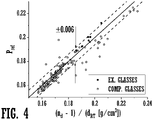
- P Tg is a T g parameter, calculated from the glass composition in terms of mol.% of the components according to the Formula (V):
- P Tg ° C 595.358 ⁇ 0.63217 * B 2 O 3 ⁇ 0.46552 * SiO 2 + 1.1849 * TiO 2 + 0.59610 * Nb 2 O 5 ⁇ 1.6293 * WO 3 + 1.3877 * ZrO 2 + 4.4090 * La 2 O 3 + 4.1695 * Y 2 O 3 ⁇ 5.0756 * Bi 2 O 3 + 0.55630 * CaO ⁇ 5.3892 * PbO ⁇ 4.2774 * TeO 2 + 1.8497 * Al 2 O 3 ⁇ 0.40659 * GeO 2 ⁇ 1.7011 * ZnO ⁇ 4.1520 * Li 2 O + 3.0777 * Gd 2 O 3 ,
- RE 2 O 3 is a total sum of rare earth metal oxides in trivalent equivalent
- an asterisk ( ⁇ ) means multiplication.
- the term "and/or,” when used in a list of two or more items, means that any one of the listed items can be employed by itself, or any combination of two or more of the listed items can be employed.
- the composition can contain A alone; B alone; C alone; A and B in combination; A and C in combination; B and C in combination; or A, B, and C in combination.
- the term “about” means that amounts, sizes, formulations, parameters, and other quantities and characteristics are not and need not be exact, but may be approximate and/or larger or smaller, as desired, reflecting tolerances, conversion factors, rounding off, measurement error and the like, and other factors known to those skilled in the art.
- the term “about” is used in describing a value or an end-point of a range, the disclosure should be understood to include the specific value or end-point referred to.
- formed from can mean one or more of comprises, consists essentially of, or consists of.
- a component that is formed from a particular material can comprise the particular material, consist essentially of the particular material, or consist of the particular material.
- the terms “free” and “substantially free” are used interchangeably herein to refer to an amount and/or an absence of a particular component in a glass composition that is not intentionally added to the glass composition. It is understood that the glass composition may contain traces of a particular constituent component as a contaminant or a tramp in an amount of less than 0.10 mol%.
- tramp when used to describe a particular constituent component in a glass composition, refers to a constituent component that is not intentionally added to the glass composition and is present in an amount of less than 0.05 mol%. Tramp components may be unintentionally added to the glass composition as an impurity in another constituent component and/or through migration of the tramp component into the composition during processing of the glass composition.
- glass is used to refer to a glass made from a glass composition disclosed herein.
- glass former is used herein to refer to a component that, being solely present in the glass composition (i.e., without other components, except for tramps), is able to form a glass when cooling the melt at a rate of not greater than about 200 °C/min to about 300 °C/min.
- modifier refers to the oxides of monovalent or divalent metals, i.e., R 2 O or RO, where "R” stands for a cation. Modifiers can be added to a glass composition to change the atomic structure of the melt and the resulting glass. In some embodiments, the modifier may change the coordination numbers of cations present in the glass formers (e.g., boron in B 2 O 3 ), which may result in forming a more polymerized atomic network and, as a result, may provide better glass formation.
- the glass formers e.g., boron in B 2 O 3
- the term "RO" refers to a total content of divalent metal oxides
- the term “R 2 O” refers to a total content of monovalent metal oxides
- the term “Alk 2 O” refers to a total content of alkali metal oxides.
- the term R 2 O encompasses alkali metal oxides (Alk 2 O), in addition to other monovalent metal oxides, such as Ag 2 O, Tl 2 O, and Hg 2 O, for example.
- a rare earth metal oxide is referred to herein by its normalized formula (RE 2 O 3 ) in which the rare earth metal has the redox state "+3,” and thus rare earth metal oxides are not encompassed by the term RO.
- the term “rare earth metals” refers to the metals listed in the Lanthanide Series of the IUPAC Periodic Table, plus yttrium and scandium.
- the term “rare earth metal oxides,” is used to refer to the oxides of rare earth metals in different redox states, such as "+3" for lanthanum in La 2 O 3 , "+4" for cerium in CeO 2 , “+2" for europium in EuO, etc.
- the redox states of rare earth metals in oxide glasses may vary and, in particular, the redox state may change during melting, based on the batch composition and/or the redox conditions in the furnace where the glass is melted and/or heat-treated (e.g., annealed).
- a rare earth metal oxide is referred to herein by its normalized formula in which the rare earth metal has the redox state "+3.” Accordingly, in the case in which a rare earth metal having a redox state other than "+3" is added to the glass composition batch, the glass compositions are recalculated by adding or removing some oxygen to maintain the stoichiometry.
- the resulting as-batched composition is recalculated assuming that two moles of CeO 2 is equivalent to one mole of Ce 2 O 3 , and the resulting as-batched composition is expressed in terms of Ce 2 O 3 .
- the term “RE m O n " is used to refer to the total content of rare earth metal oxides in all redox states present in the as-batched composition
- the term “RE 2 O 3 " is used to refer to the total content of rare earth metal oxides in the as-batched composition when recalculated to "+3" redox state.
- the term “RE 2 O 3 " is also specified herein as "trivalent equivalent”.
- compositions are expressed in terms of as-batched mole percent (mol%).
- references to "composition” or “glass composition” thus refer to composition expressed in terms of mol.% in the as-batched state.
- various melt constituents e.g., fluorine, alkali metals, boron, etc.
- volatilization e.g., as a function of vapor pressure, melt time and/or melt temperature
- the term "about,” in relation to such constituents is intended to encompass values within about 0.2 mol% when measuring final articles as compared to the as-batched compositions provided herein.
- substantial compositional equivalence between final articles and as-batched compositions is expected.
- the compositions may be expressed in terms of as-batched percent by weight of oxides (wt%).
- Oxides and other constituents of the glass are referred to as "components”.
- Expressions combining components with the mathematical symbols "+” and “-” refer to sums and differences, respectively, of the as-batched composition of the components expressed in mol.%.
- the expression “SiO 2 + GeO 2 " or the expression “SiO 2 + GeO 2 [mol.%]” means the sum of the components SiO 2 and GeO 2 , each expressed in mol.%, in the as-batched composition.
- the expression “B 2 O 3 +SiO 2 -P 2 O 5 " or the expression “B 2 O 3 +SiO 2 -P 2 O 5 [mol.%]” means the sum of the components B 2 O 3 +SiO 2 less the component P 2 O 5 , each expressed in mol.%, in the as-batched composition. If the expression is preceded by an amount, the amount refers to the combined as-batched compositions of the components listed in the expression.
- the expression “4.8 mol.% SiO 2 + GeO 2” means that the combined amount of the components SiO 2 and GeO 2 in the as-batched composition is 4.8 mol.% and the expression “less than or equal to 4.8 mol.% SiO 2 + GeO 2 " means that the combined amount of the components of SiO 2 and GeO 2 in the as-batched composition is less than or equal to 4.8 mol.%.
- the molecular representation of the resulting as-batched composition may be expressed in different ways.
- the content of a halogen as a component, when present, is expressed in terms of atomic percent (at.%), which is determined based on the fraction of the halogen in a total sum of all atoms in the as-batched composition multiplied by a factor of 100.
- the concentration limits for all oxides are presented under the assumption that the respective cations (such as, for example, silicon [Si 4 + ], boron [B 3 + ], sodium [Na + ], etc.) are initially presented in the form of the corresponding oxides.
- fluorine is present as a sole halogen, for the purposes of calculating the concentration of components of the as-batched composition, some part of the oxygen in the oxide is equivalently replaced with fluorine (i.e. one atom of oxygen is replaced with two atoms of fluorine).
- the fluorine is assumed to be present in the form of silicon fluoride (SiF4); accordingly, the total sum of all oxides plus SiF 4 is assumed to be 100 mole percent or 100 weight percent in all compositions. Analogous treatment of other halogens as sole halogens or combinations of halogens applies.
- the measured density values for the glasses reported herein were measured at room temperature in units of g/cm 3 by the Archimedes method in water with an uncertainty of 0.001 g/cm 3 .
- density measurements at room temperature are indicated as being measured at 20 °C or 25 °C, and encompass measurements obtained at temperatures that may range from 20 °C to 25 °C. It is understood that room temperature may vary between about 20 °C to about 25 °C, however, for the purposes of the present disclosure, the variation in density within the temperature range of 20 °C to 25 °C is expected to be less than the uncertainty of 0.001 g/cm 3 , and thus is not expected to impact the room temperature density measurements reported herein.
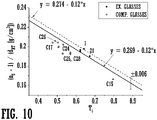
- the term "refraction" refers to the relationship of the refractive index to the density according to the ratio: (n d -1)/d RT , where the refractive index n d is measured at 587.56 nm and the density d RT is measured in g/cm 3 at room temperature.
- the ratio (n d -1)/d RT , or refraction, may characterize the relationship between the refractive index n d and the density d RT . The higher the refraction value, the higher the refractive index is at a given density.
- good glass forming ability refers to a resistance of the melt to devitrification as the melt cools. Glass forming ability can be measured by determining the critical cooling rate of the melt.
- critical cooling rate or “v cr " are used herein to refer to the minimum cooling rate at which a melt of a given composition forms a glass free of crystals visible under an optical microscope under magnification from 100x to 500x.
- the critical cooling rate can be used to measure the glass-forming ability of a composition, i.e., the ability of the melt of a given glass composition to form glass when cooling. Generally speaking, the lower the critical cooling rate, the better the glass-forming ability.
- liquidus temperature is used herein to refer to a temperature above which the glass composition is completely liquid with no crystallization of constituent components of the glass.
- the liquidus temperature values reported herein were obtained by measuring samples using either DSC or by isothermal hold of samples wrapped in platinum foil or in thermal gradient test in a platinum boat. For samples measured using DSC, powdered samples were heated at 10 K/min to 1250°C. The end of the endothermal event corresponding to the melting of crystals was taken as the liquidus temperature.
- a glass block (about 1 cm 3 ) was put in platinum foil and placed in a furnace at a given temperature for 4 hours to 24 hours. The glass block was then observed under an optical microscope to check for crystals.
- thermo gradient test For the third technique (thermal gradient test), about 10 g of glass cullet was placed in a thin platinum boat and placed in a furnace at a given temperature for 4 hours to 24 hours. The glass block was then observed by a naked eye to check for crystals. For some of Exemplary Glasses of the present disclosure, several different tests were used to determine the liquidus temperature, and they provided essentially the same results.
- the term "internal transmittance" or ⁇ int is used to refer to the transmittance through a glass sample that is corrected for Fresnel losses.
- the term “total transmittance” or ⁇ is used to refer to transmittance values for which Fresnel losses are not accounted for.
- Total transmittance of the glass samples were measured on samples with two or three different thicknesses using a Cary 5000 Spectrometer at wavelengths of from 250 nm to 2500 nm, at a resolution of 1 nm, and using an integrating sphere.
- the internal transmittance values for 10 mm thick samples was calculated between 375 nm and 1175 nm using the measured refractive index and the measured total transmittance at those said different thicknesses.
- the total transmittance considers the loss by reflection of light on the surface of the sample.
- the wavelengths corresponding to specific values of total transmittance, such as, for example, 5% or 70%, are represented as ⁇ with corresponding subscripts, such as ⁇ 5% and ⁇ 70% , respectively.
- the refractive index values reported herein were measured at room temperature (about 25 °C), unless otherwise specified.
- the refractive index values for a glass sample were measured using a Metricon Model 2010 prism coupler refractometer with an uncertainty of about ⁇ 0.0002.
- the refractive index of a glass sample was measured at two or more wavelengths of about 406 nm, 473 nm, 532 nm, 633 nm, 828 nm, and 1064 nm.
- the measured dependence characterizes the dispersion and was then fitted with a Cauchy's law equation or Sellmeier equation to allow for calculation of the refractive index of the sample at a given wavelength of interest between the measured wavelengths.
- refractive index n d or "n d” is used herein to refer to a refractive index calculated as described above at a wavelength of 587.56 nm, which corresponds to the helium d-line wavelength.
- the term “refractive index n F “ or “n F “ is used herein to refer to a refractive index calculated as described above at a wavelength of 486.1 nm.
- refractive index n g or “n g” is used herein to refer to a refractive index calculated as described above at a wavelength of 435.8 nm.
- high refractive index or “high index” refer to a refractive index value of a glass that is greater than or equal to 1.80, unless otherwise indicated. Where indicated, embodiments of the terms “high refractive index” or “high index” refer to a refractive index value of a glass that is greater than or equal to 1.85, greater than or equal to 1.90, or greater than or equal to 1.95, or greater than or equal to 2.00.
- v x (n x - 1)/(n F - nc), where "x" in the present disclosure stands for one of the commonly used wavelengths (for example, 587.56 nm [d-line] for v d or 589.3 nm [D-line] for v D ), n x is the refractive index at this wavelength (for example, n d for v d and n D for v D ), and n F and n c are refractive indices at the wavelengths 486.1 nm (F-line) and 656.3 nm (C-line), respectively.
- the numerical values of v d and v D differ very slightly, mostly within ⁇ 0.1% to ⁇ 0.2
- the numerical value for an Abbe number corresponding to "high dispersion” or “low dispersion” may vary depending on the refractive indices for which the Abbe number is calculated. In some cases, an Abbe number corresponding to "low dispersion” for a high refractive index glass may be lower than an Abbe number corresponding to "low dispersion” for a low refractive index glass. In other words, as the calculated refractive index value increases, the value of the Abbe number corresponding to low dispersion decreases. The same relates to "high dispersion" as well.
- ⁇ refers to the average coefficient of linear thermal expansion (CTE) of the glass composition over a temperature range from 20°C to 300 °C. This property is measured by using a horizontal dilatometer (push-rod dilatometer) in accordance with ASTM E228-11.
- the Young's elastic modulus E and the Poisson's ratio ⁇ are measured by using Resonant Ultrasound Spectroscopy, using a Quasar RUSpec 4000 available from ITW Indiana Private Limited, Magnaflux Division.
- the glass transition temperature (T g ) is measured by differential scanning calorimeter (DSC) at the heating rate of 10 K/min after cooling in air.
- annealing point refers to the temperature determined according to ASTM C598-93(2013), at which the viscosity of a glass of a given glass composition is approximately 10 13.2 poise.
- Glass composition may include boron oxide (B 2 O 3 ).
- B 2 O 3 may play a role of a glass former.
- B 2 O 3 may help to increase the liquidus viscosity and, therefore, protect a glass composition from crystallization.
- adding B 2 O 3 to a glass composition may cause liquid-liquid phase separation, which may cause devitrification and/or reducing the transmittance of the resulting glass.
- adding B 2 O 3 to the high-index glasses reduces the refractive index. Accordingly, the amount of boron oxide in glasses of the present disclosure is limited, or glasses may be substantially free of B 2 O 3 .
- the glass composition may contain boron oxide (B 2 O 3 ) in an amount from greater than or equal to 0.0 mol.% to less than or equal to 41.0 mol.% and all ranges and sub-ranges between the foregoing values.
- the glass composition may contain B 2 O 3 in an amount greater than or equal to 0.0 mol.%, greater than or equal to 1.0 mol.%, greater than or equal to 5.0 mol.%, greater than or equal to 10.0 mol.%, greater than or equal to 20.0 mol.%, greater than or equal to 21.5 mol.%, greater than or equal to 23.0 mol.%, greater than or equal to 27.0 mol.%, greater than or equal to 30.0 mol.%, greater than or equal to 35.0 mol.%, or greater than or equal to 40.0 mol.%.
- the glass composition may contain B 2 O 3 in an amount less than or equal to 41.0 mol.%, less than or equal to 40.0 mol.%, less than or equal to 35.0 mol.%, less than or equal to 34.5 mol.%, less than or equal to 33.0 mol.%, less than or equal to 30.0 mol.%, less than or equal to 20.0 mol.%, or less than or equal to 5.0 mol.%.
- the glass composition may contain B 2 O 3 in an amount greater than or equal to 0.0 mol.% and less than or equal to 40.0 mol.%, greater than or equal to 1.0 mol.% and less than or equal to 40.0 mol.%, greater than or equal to 10.0 mol.% and less than or equal to 40.0 mol.%, greater than or equal to 20.0 mol.% and less than or equal to 35.0 mol.%, greater than or equal to 21.5 mol.% and less than or equal to 34.5 mol.%, greater than or equal to 23.0 mol.% and less than or equal to 33.0 mol.%, greater than or equal to 27.05 mol.% and less than or equal to 33.24 mol.%, greater than or equal to 0.0 mol.% and less than or equal to 41.0 mol.%, greater than or equal to 0.0 mol.% and less than or equal to 5.0 mol.%, greater than or equal to 20.0 mol.% and less than or equal to
- Glass composition may include silica (SiO 2 ).
- Silica may play a role of an additional glassformer.
- Silica, as well as B 2 O 3 may help to increase the liquidus viscosity (viscosity at the liquidus temperature) and, therefore, protect a glass composition from crystallization.
- adding SiO 2 to a glass composition may cause liquid-liquid phase separation, which may cause devitrification and/or reducing the transmittance of the resulting glass.
- SiO 2 is a low refractive index component and makes it difficult to achieve high index glasses. Accordingly, the content of SiO 2 in the embodiments of the present disclosure is limited, or glasses may be substantially free of SiO 2 .
- the glass composition may contain silica (SiO 2 ) in an amount from greater than or equal to 0.0 mol.% to less than or equal to 15.0 mol.% and all ranges and sub-ranges between the foregoing values. In some embodiments, the glass composition may contain SiO 2 in an amount greater than or equal to 0.0 mol.%, greater than or equal to 5.0 mol.%, greater than or equal to 9.0 mol.%, greater than or equal to 10.0 mol.%, greater than or equal to 11.0 mol.%, or greater than or equal to 13.0 mol.%.
- the glass composition may contain SiO 2 in an amount less than or equal to 15.0 mol.%, less than or equal to 13.5 mol.%, less than or equal to 13.0 mol.%, less than or equal to 12.5 mol.%, less than or equal to 11.5 mol.%, less than or equal to 11.0 mol.%, less than or equal to 10.0 mol.%, less than or equal to 9.0 mol.%, less than or equal to 6.0 mol.%, less than or equal to 5.0 mol.%, less than or equal to 4.8 mol.%, or less than or equal to 4.5 mol.%.
- the glass composition may contain SiO 2 in an amount greater than or equal to 0.0 mol.% and less than or equal to 15.0 mol.%, greater than or equal to 0.0 mol.% and less than or equal to 13.5 mol.%, greater than or equal to 0.0 mol.% and less than or equal to 12.5 mol.%, greater than or equal to 0.0 mol.% and less than or equal to 11.5 mol.%, greater than or equal to 0.0 mol.% and less than or equal to 4.5 mol.%, greater than or equal to 0.03 mol.% and less than or equal to 5.77 mol.%, greater than or equal to 4.5 mol.% and less than or equal to 4.8 mol.%, greater than or equal to 4.8 mol.% and less than or equal to 15.0 mol.%, greater than or equal to 5.0 mol.% and less than or equal to 15.0 mol.%, greater than or equal to 6.0 mol.% and less than or equal to 9.0 mol.
- Glass composition may include germania (GeO 2 ).
- Germania (GeO 2 ) provides excellent ratio between the refractive index and density and does not reduce transmittance.
- germania is too expensive, and thus it may make a glass composition not economical. Accordingly, the content of germania should be limited, or glass compositions may be free of GeO 2 , or glasses may be substantially free of GeO 2 .
- the glass composition may contain germania (GeO 2 ) in an amount from greater than or equal to 0.0 mol.% to less than or equal to 10.0 mol.% and all ranges and sub-ranges between the foregoing values.
- the glass composition may contain GeO 2 in an amount greater than or equal to 0.0 mol.%, greater than or equal to 5.0 mol.%, greater than or equal to 7.0 mol.%, greater than or equal to 8.0 mol.%, or greater than or equal to 9.0 mol.%. In some other embodiments, the glass composition may contain GeO 2 in an amount less than or equal to 10.0 mol.%, less than or equal to 9.0 mol.%, less than or equal to 8.0 mol.%, less than or equal to 7.0 mol.%, less than or equal to 5.0 mol.%, less than or equal to 4.8 mol.%, or less than or equal to 0.5 mol.%.
- the glass composition may contain GeO 2 in an amount greater than or equal to 0.0 mol.% and less than or equal to 10.0 mol.%, greater than or equal to 0.0 mol.% and less than or equal to 5.0 mol.%, greater than or equal to 0.0 mol.% and less than or equal to 0.5 mol.%, greater than or equal to 0.5 mol.% and less than or equal to 10.0 mol.%, greater than or equal to 0.5 mol.% and less than or equal to 4.8 mol.%, greater than or equal to 4.8 mol.% and less than or equal to 10.0 mol.%, greater than or equal to 4.8 mol.% and less than or equal to 5.0 mol.%, greater than or equal to 5.0 mol.% and less than or equal to 10.0 mol.%, greater than or equal to 5.0 mol.% and less than or equal to 7.0 mol.%.
- Glass composition may include monovalent metal oxides (R 2 O).
- Monovalent metal oxides such as alkali metal oxides (Li 2 O, Na 2 O, K 2 O, Rb 2 O and Cs 2 O) or others (for example, Ag 2 O or Tl 2 O) may help to better accommodate the index raisers, such as TiO 2 , Nb 2 O 5 or WO 3 , in the glass structure, which may cause increasing their solubility in a glass and, accordingly, indirectly cause increasing the refractive index at an acceptably low density.
- the glass composition may contain monovalent metal oxides R 2 O in an amount greater than or equal to 0.0 mol.%, greater than or equal to 1.0 mol.%, greater than or equal to 2.0 mol.%, greater than or equal to 3.0 mol.%, or greater than or equal to 4.0 mol.%. In some other embodiments, the glass composition may contain monovalent metal oxides R 2 O in an amount less than or equal to 5.0 mol.%, less than or equal to 4.0 mol.%, less than or equal to 3.0 mol.%, less than or equal to 2.0 mol.%, or less than or equal to 1.0 mol.%.
- the glass composition may contain R 2 O in an amount from 0.0 mol.% to 5.0 mol.%, from 0.0 mol.% to 4.0 mol.%, from 0.0 mol.% to 3.0 mol.%, from 0.0 mol.% to 2.0 mol.%, from 1.0 mol.% to 5.0 mol.%, from 1.0 mol.% to 4.0 mol.%, from 1.0 mol.% to 3.0 mol.%, from 1.0 mol.% to 2.0 mol.%, from 2.0 mol.% to 5.0 mol.%, from 2.0 mol.% to 4.0 mol.%, from 2.0 mol.% to 3.0 mol.%, from 3.0 mol.% to 5.0 mol.%, from 3.0 mol.% to 4.0 mol.%, from 1.0 mol.% to 3.0 mol.%, from 2.0 mol.% to 4.0 mol.%, or from 1.0 mol.% to 4.0 mol.%.
- Glass composition may include divalent metal oxides (RO).
- Divalent metal oxides such as alkaline earth metal oxides (BeO, MgO, CaO, SrO and BaO), zinc oxide (ZnO), cadmium oxide (CdO), lead oxide (PbO) and others, being added to a glass, provide comparably high refractive indexes, greater than those for most of monovalent oxides.
- Some divalent metal oxides, such as, for example, CaO, SrO and ZnO also provide comparably low density, therefore, increasing the ratio of the refractive index to density and, accordingly, improving the performance of optical glasses in certain applications.
- divalent metal oxides may help to increase the solubility of high index components, such as TiO 2 , Nb 2 O 5 and WO 3 , which indirectly leads to a further increase in the refractive index at a comparable density.
- some divalent metal oxides such as, for example, ZnO and MgO, provide comparably low thermal expansion coefficient, which may reduce the thermal stresses formed in the glass articles when cooling and, therefore, improve the quality of the glass articles.
- divalent metal oxides may cause crystallization of refractory minerals from the melts or liquid-liquid phase separation, which may reduce the glass-forming ability of glasses. Accordingly, the amount of divalent metal oxides in glass compositions of the present disclosure is limited.
- the glass composition may contain divalent metal oxides RO in an amount greater than or equal to 0.0 mol.%, greater than or equal to 1.0 mol.%, greater than or equal to 2.0 mol.%, greater than or equal to 3.0 mol.%, or greater than or equal to 4.0 mol.%. In some other embodiments, the glass composition may contain divalent metal oxides RO in an amount less than or equal to 5.0 mol.%, less than or equal to 4.0 mol.%, less than or equal to 3.0 mol.%, less than or equal to 2.0 mol.%, or less than or equal to 1.0 mol.%.
- the glass composition may contain RO in an amount from 0.0 mol.% to 5.0 mol.%, from 0.0 mol.% to 4.0 mol.%, from 0.0 mol.% to 3.0 mol.%, from 0.0 mol.% to 2.0 mol.%, from 1.0 mol.% to 5.0 mol.%, from 1.0 mol.% to 4.0 mol.%, from 1.0 mol.% to 3.0 mol.%, from 1.0 mol.% to 2.0 mol.%, from 2.0 mol.% to 5.0 mol.%, from 2.0 mol.% to 4.0 mol.%, from 2.0 mol.% to 3.0 mol.%, from 3.0 mol.% to 5.0 mol.%, from 3.0 mol.% to 4.0 mol.%, from 0 mol.% to 2.0 mol.%, from 2.0 mol.% to 4.0 mol.%, or from 2.0 mol.% to 5.0 mol.%.
- Glass composition may include zinc oxide (ZnO).
- Zinc oxide provides a good refractive index to density ratio and may sometimes increase the solubility of titania, which indirectly increases the refractive index of glasses.
- ZnO zinc oxide
- the glass-forming ability of the melt decreases and the melt may tend to crystallize during cooling.
- the glass composition may contain ZnO in an amount greater than or equal to 0.0 mol.%, greater than or equal to 5.0 mol.%, greater than or equal to 20.0 mol.%, greater than or equal to 25.0 mol.%, or greater than or equal to 30.0 mol.%. In some other embodiments, the glass composition may contain ZnO in an amount less than or equal to 35.0 mol.%, less than or equal to 30.0 mol.%, less than or equal to 25.0 mol.%, less than or equal to 20.0 mol.%, less than or equal to 5.0 mol.%, or less than or equal to 0.05 mol.%.
- the glass composition may contain ZnO in an amount greater than or equal to 0.0 mol.% and less than or equal to 35.0 mol.%, greater than or equal to 0.0 mol.% and less than or equal to 25.0 mol.%, greater than or equal to 0.0 mol.% and less than or equal to 0.05 mol.%, greater than or equal to 0.05 mol.% and less than or equal to 35.0 mol.%, greater than or equal to 0.05 mol.% and less than or equal to 5.0 mol.%, greater than or equal to 5.0 mol.% and less than or equal to 35.0 mol.%, greater than or equal to 5.0 mol.% and less than or equal to 20.0 mol.%, greater than or equal to 20.0 mol.% and less than or equal to 35.0 mol.%, greater than or equal to 20.0 mol.% and less than or equal to 25.0 mol.%.
- Glass composition may include barium oxide (BaO).
- Barium oxide may increase the solubility of high index components, such as TiO 2 and Nb 2 O 5 , which may indirectly lead to a further increase in the refractive index at comparably low density.
- barium is a heavy element and, being added in a high amount, may increase the density of glass. Also, in high concentration, it may cause crystallization of such minerals as barium titanate (BaTiO 3 ), barium niobate (BaNb 2 O 6 ) and others. Accordingly, the amount of BaO in glasses of the present disclosure is limited, or glasses may be substantially free of BaO.
- the glass composition may contain barium oxide (BaO) in an amount from greater than or equal to 0.0 mol.% to less than or equal to 10.0 mol.% and all ranges and sub-ranges between the foregoing values.
- the glass composition may contain BaO in an amount greater than or equal to 0.0 mol.%, or greater than or equal to 5.0 mol.%.
- the glass composition may contain BaO in an amount less than or equal to 10.0 mol.%, less than or equal to 5.0 mol.%, less than or equal to 4.6 mol.%, less than or equal to 4.0 mol.%, or less than or equal to 1.6 mol.%.
- the glass composition may contain BaO in an amount greater than or equal to 0.0 mol.% and less than or equal to 5.0 mol.%, greater than or equal to 0.0 mol.% and less than or equal to 4.6 mol.%, greater than or equal to 0.0 mol.% and less than or equal to 4.0 mol.%, greater than or equal to 0.01 mol.% and less than or equal to 1.6 mol.%, greater than or equal to 0.0 mol.% and less than or equal to 10.0 mol.%, greater than or equal to 0.0 mol.% and less than or equal to 1.6 mol.%, greater than or equal to 1.6 mol.% and less than or equal to 10.0 mol.%, greater than or equal to 1.6 mol.% and less than or equal to 4.0 mol.%.
- Glass composition may include lead oxide (PbO).
- Lead oxide provides very high refractive index, but also significantly increases the density. Also, PbO may cause ecological concern. For these reasons, the content of PbO in glasses of the present disclosure should be limited, or glasses may be substantially free of PbO.
- the glass composition may contain lead oxide (PbO) in an amount from greater than or equal to 0.0 mol.% to less than or equal to 10.0 mol.% and all ranges and sub-ranges between the foregoing values.
- the glass composition may contain PbO in an amount greater than or equal to 0.0 mol.%, greater than or equal to 5.0 mol.%, greater than or equal to 7.0 mol.%, greater than or equal to 8.0 mol.%, or greater than or equal to 9.0 mol.%. In some other embodiments, the glass composition may contain PbO in an amount less than or equal to 10.0 mol.%, less than or equal to 9.0 mol.%, less than or equal to 8.0 mol.%, less than or equal to 7.0 mol.%, less than or equal to 5.0 mol.%, or less than or equal to 0.5 mol.%.
- the glass composition may contain PbO in an amount greater than or equal to 0.0 mol.% and less than or equal to 5.0 mol.%, greater than or equal to 0.0 mol.% and less than or equal to 0.5 mol.%, greater than or equal to 0.0 mol.% and less than or equal to 10.0 mol.%, greater than or equal to 0.5 mol.% and less than or equal to 10.0 mol.%, greater than or equal to 0.5 mol.% and less than or equal to 5.0 mol.%, greater than or equal to 5.0 mol.% and less than or equal to 10.0 mol.%, greater than or equal to 5.0 mol.% and less than or equal to 7.0 mol.%, greater than or equal to 7.0 mol.% and less than or equal to 10.0 mol.%, greater than or equal to 7.0 mol.% and less than or equal to 8.0 mol.%.
- the glass composition may contain rare earth metal oxides in trivalent equivalent RE 2 O 3 in an amount greater than or equal to 0.0 mol.%, greater than or equal to 0.25 mol.%, greater than or equal to 0.5 mol.%, or greater than or equal to 0.75 mol.%.
- Glass composition may include lanthanum oxide (La 2 O 3 ).
- Lanthanum oxide is one of the cheapest oxides providing high refractive indexes without significant loss of transmittance in visible range.
- addition of La 2 O 3 may reduce the risk of phase separation.
- La 2 O 3 provides higher density than other high-index components, such as, for example, TiO 2 , Nb 2 O 5 or WO 3 .
- it may cause crystallization of refractory species. For this reason, the content of La 2 O 3 in the glasses of the present disclosure should be limited.
- the glass composition may contain lanthanum oxide (La 2 O 3 ) in an amount from greater than or equal to 0.0 mol.% to less than or equal to 35.0 mol.% and all ranges and sub-ranges between the foregoing values.
- the glass composition may contain La 2 O 3 in an amount greater than or equal to 0.0 mol.%, greater than or equal to 5.0 mol.%, greater than or equal to 10.0 mol.%, greater than or equal to 13.0 mol.%, greater than or equal to 14.5 mol.%, greater than or equal to 15.0 mol.%, greater than or equal to 20.0 mol.%, greater than or equal to 25.0 mol.%, or greater than or equal to 30.0 mol.%.
- the glass composition may contain La 2 O 3 in an amount less than or equal to 35.0 mol.%, less than or equal to 30.0 mol.%, less than or equal to 25.0 mol.%, less than or equal to 24.0 mol.%, less than or equal to 22.5 mol.%, less than or equal to 21.4 mol.%, less than or equal to 20.0 mol.%, less than or equal to 5.0 mol.%, or less than or equal to 1.0 mol.%.
- the glass composition may contain La 2 O 3 in an amount greater than or equal to 0.0 mol.% and less than or equal to 35.0 mol.%, greater than or equal to 0.0 mol.% and less than or equal to 25.0 mol.%, greater than or equal to 10.0 mol.% and less than or equal to 25.0 mol.%, greater than or equal to 13.0 mol.% and less than or equal to 24.0 mol.%, greater than or equal to 14.5 mol.% and less than or equal to 22.5 mol.%, greater than or equal to 15.0 mol.% and less than or equal to 25.0 mol.%, greater than or equal to 19.97 mol.% and less than or equal to 21.43 mol.%, greater than or equal to 0.0 mol.% and less than or equal to 1.0 mol.%, greater than or equal to 1.0 mol.% and less than or equal to 5.0 mol.%, greater than or equal to 5.0 mol.% and less than or equal to 35.0 mol.%, greater
- the glass composition may contain yttria (Y 2 O 3 ) in an amount from greater than or equal to 0.0 mol.% to less than or equal to 10.0 mol.% and all ranges and sub-ranges between the foregoing values. In some embodiments, the glass composition may contain Y 2 O 3 in an amount greater than or equal to 0.0 mol.%, greater than or equal to 5.0 mol.%, greater than or equal to 7.0 mol.%, greater than or equal to 8.0 mol.%, or greater than or equal to 9.0 mol.%.
- the glass composition may contain Y 2 O 3 in an amount less than or equal to 10.0 mol.%, less than or equal to 9.0 mol.%, less than or equal to 8.0 mol.%, less than or equal to 7.5 mol.%, less than or equal to 7.0 mol.%, less than or equal to 6.5 mol.%, less than or equal to 5.75 mol.%, less than or equal to 5.0 mol.%, or less than or equal to 1.0 mol.%.
- the glass composition may contain Y 2 O 3 in an amount greater than or equal to 0.0 mol.% and less than or equal to 10.0 mol.%, greater than or equal to 0.0 mol.% and less than or equal to 7.5 mol.%, greater than or equal to 0.0 mol.% and less than or equal to 6.5 mol.%, greater than or equal to 0.0 mol.% and less than or equal to 5.75 mol.%, greater than or equal to 0.0 mol.% and less than or equal to 5.0 mol.%, greater than or equal to 0.38 mol.% and less than or equal to 5.02 mol.%, greater than or equal to 0.0 mol.% and less than or equal to 1.0 mol.%, greater than or equal to 1.0 mol.% and less than or equal to 5.0 mol.%, greater than or equal to 5.0 mol.% and less than or equal to 10.0 mol.%, greater than or equal to 5.0 mol.% and less than or equal to 5.75
- the glass composition may contain gadolinium oxide (Gd 2 O 3 ) in an amount from greater than or equal to 0.0 mol.% to less than or equal to 5.0 mol.% and all ranges and sub-ranges between the foregoing values.
- the glass composition may contain Gd 2 O 3 in an amount greater than or equal to 0.0 mol.%, or greater than or equal to 2.5 mol.%.
- the glass composition may contain Gd 2 O 3 in an amount less than or equal to 5.0 mol.%, less than or equal to 5.0 mol.%, less than or equal to 2.5 mol.%, or less than or equal to 1.0 mol.%.
- the glass composition may contain Gd 2 O 3 in an amount greater than or equal to 0.0 mol.% and less than or equal to 25.0 mol.%, greater than or equal to 0.0 mol.% and less than or equal to 1.0 mol.%, greater than or equal to 1.0 mol.% and less than or equal to 25.0 mol.%, greater than or equal to 1.0 mol.% and less than or equal to 2.5 mol.%, greater than or equal to 2.5 mol.% and less than or equal to 25.0 mol.%, greater than or equal to 2.5 mol.% and less than or equal to 5.0 mol.%.
- Glass composition may include alumina (Al 2 O 3 ).
- Alumina may increase the viscosity of glassforming melts at high temperature, which may reduce the critical cooling rate and improve the glassforming ability.
- addition of Al 2 O 3 may cause crystallization of refractory minerals, such as aluminum titanate (Al 2 TiO 5 ), aluminum niobate (AlNbO 4 ) and others, in the melts when cooling. Accordingly, the amount of Al 2 O 3 in glasses of the present disclosure is limited, or glasses may be substantially free of Al 2 O 3 .
- the glass composition may contain alumina (Al 2 O 3 ) in an amount from greater than or equal to 0.0 mol.% to less than or equal to 10.0 mol.% and all ranges and sub-ranges between the foregoing values.
- the glass composition may contain Al 2 O 3 in an amount greater than or equal to 0.0 mol.%, greater than or equal to 5.0 mol.%, greater than or equal to 7.0 mol.%, greater than or equal to 8.0 mol.%, or greater than or equal to 9.0 mol.%.
- the glass composition may contain Al 2 O 3 in an amount less than or equal to 10.0 mol.%, less than or equal to 9.0 mol.%, less than or equal to 8.0 mol.%, less than or equal to 7.0 mol.%, or less than or equal to 5.0 mol.%. In some more embodiments, the glass composition may contain Al 2 O 3 in an amount greater than or equal to 0.0 mol.% and less than or equal to 10.0 mol.%, greater than or equal to 0.0 mol.% and less than or equal to 5.0 mol.%, greater than or equal to 5.0 mol.% and less than or equal to 10.0 mol.%.
- the glass composition may contain molybdenum oxide (MoO 3 ) in an amount from greater than or equal to 0.0 mol.% to less than or equal to 10.0 mol.% and all ranges and sub-ranges between the foregoing values.
- MoO 3 molybdenum oxide
- the glass composition may contain MoO 3 in an amount greater than or equal to 0.0 mol.%, greater than or equal to 5.0 mol.%, greater than or equal to 7.0 mol.%, greater than or equal to 8.0 mol.%, or greater than or equal to 9.0 mol.%.
- the glass composition may contain MoO 3 in an amount less than or equal to 10.0 mol.%, less than or equal to 9.0 mol.%, less than or equal to 8.0 mol.%, less than or equal to 7.0 mol.%, less than or equal to 5.0 mol.%, or less than or equal to 3.0 mol.%. In some more embodiments, the glass composition may contain MoO 3 in an amount greater than or equal to 0.0 mol.% and less than or equal to 3.0 mol.%, greater than or equal to 0.0 mol.% and less than or equal to 10.0 mol.%.
- Glass composition may include tellurium oxide (TeO 2 ).
- Tellurium oxide generally works like below-described bismuth oxide; in addition, TeO 2 is very expensive, which may make the cost of starting materials unacceptably high. Accordingly, the content of tellurium oxide should be limited, or glass compositions may be free of TeO 2 .
- the glass composition may contain tellurium oxide (TeO 2 ) in an amount from greater than or equal to 0.0 mol.% to less than or equal to 20.0 mol.% and all ranges and sub-ranges between the foregoing values.
- the glass composition may contain TeO 2 in an amount greater than or equal to 0.0 mol.%, greater than or equal to 5.0 mol.%, greater than or equal to 10.0 mol.%, greater than or equal to 14.0 mol.%, greater than or equal to 16.0 mol.%, or greater than or equal to 18.0 mol.%. In some other embodiments, the glass composition may contain TeO 2 in an amount less than or equal to 20.0 mol.%, less than or equal to 18.0 mol.%, less than or equal to 16.0 mol.%, less than or equal to 14.0 mol.%, less than or equal to 10.0 mol.%, less than or equal to 5.0 mol.%, or less than or equal to 2.0 mol.%.
- the glass composition may contain TeO 2 in an amount greater than or equal to 0.0 mol.% and less than or equal to 20.0 mol.%, greater than or equal to 0.0 mol.% and less than or equal to 10.0 mol.%, greater than or equal to 0.0 mol.% and less than or equal to 2.0 mol.%.
- Glass composition may include vanadia (V 2 O 5 ). Vanadia provides the highest ratio of the refractive index to density among all oxides. However, vanadia may cause undesirable dark coloring. For these reasons, the content of vanadia in the glasses of the present disclosure is limited, or glass compositions may be free of V 2 O 5 .
- the glass composition may contain vanadia (V 2 O 5 ) in an amount from greater than or equal to 0.0 mol.% to less than or equal to 5.0 mol.% and all ranges and sub-ranges between the foregoing values. In some embodiments, the glass composition may contain V 2 O 5 in an amount greater than or equal to 0.0 mol.%, or greater than or equal to 2.5 mol.%.
- the glass composition may contain V 2 O 5 in an amount less than or equal to 5.0 mol.%, less than or equal to 2.5 mol.%, less than or equal to 1.0 mol.%, or less than or equal to 0.1 mol.%. In some more embodiments, the glass composition may contain V 2 O 5 in an amount greater than or equal to 0.0 mol.% and less than or equal to 5.0 mol.%, greater than or equal to 0.0 mol.% and less than or equal to 1.0 mol.%, greater than or equal to 0.0 mol.% and less than or equal to 0.1 mol.%.
- the glass composition may contain thorium oxide (ThO 2 ) in an amount from greater than or equal to 0.0 mol.% to less than or equal to 10.0 mol.% and all ranges and sub-ranges between the foregoing values.
- the glass composition may contain ThO 2 in an amount greater than or equal to 0.0 mol.%, greater than or equal to 5.0 mol.%, greater than or equal to 7.0 mol.%, greater than or equal to 8.0 mol.%, or greater than or equal to 9.0 mol.%.
- the glass composition may contain ThO 2 in an amount less than or equal to 10.0 mol.%, less than or equal to 9.0 mol.%, less than or equal to 8.0 mol.%, less than or equal to 7.0 mol.%, or less than or equal to 5.0 mol.%. In some more embodiments, the glass composition may contain ThO 2 in an amount greater than or equal to 0.0 mol.% and less than or equal to 10.0 mol.%, greater than or equal to 0.0 mol.% and less than or equal to 5.0 mol.%.
- Glass composition may include tantalum oxide (Ta 2 O 5 ). Tantalum oxide increases the refractive index while maintaining an acceptable density without reducing the blue transmittance. However, Ta 2 O 5 may cause crystallization of refractory minerals. Accordingly, the content of tantalum oxide should be limited, or glass compositions may be free of Ta 2 O 5 . In embodiments, the glass composition may contain tantalum oxide (Ta 2 O 5 ) in an amount from greater than or equal to 0.0 mol.% to less than or equal to 25.0 mol.% and all ranges and sub-ranges between the foregoing values.
- the glass composition may contain Ta 2 O 5 in an amount greater than or equal to 0.0 mol.%, greater than or equal to 5.0 mol.%, greater than or equal to 10.0 mol.%, greater than or equal to 19.0 mol.%, greater than or equal to 20.0 mol.%, greater than or equal to 21.0 mol.%, or greater than or equal to 23.0 mol.%.
- the glass composition may contain Ta 2 O 5 in an amount less than or equal to 25.0 mol.%, less than or equal to 23.0 mol.%, less than or equal to 21.0 mol.%, less than or equal to 20.0 mol.%, less than or equal to 19.0 mol.%, less than or equal to 10.0 mol.%, less than or equal to 5.0 mol.%, or less than or equal to 2.0 mol.%.
- the glass composition may contain Ta 2 O 5 in an amount greater than or equal to 0.0 mol.% and less than or equal to 25.0 mol.%, greater than or equal to 0.0 mol.% and less than or equal to 10.0 mol.%, greater than or equal to 0.0 mol.% and less than or equal to 2.0 mol.%.
- Glass composition may include zirconia (ZrO 2 ).
- Zirconia can increase the refractive index while maintaining an acceptably low density.
- ZrO 2 can also increase the viscosity of the melt, which may help to protect the melt from crystallization.
- ZrO 2 does not introduce coloring in the glass in the visible and near-UV ranges, which may help to maintain a high transmittance of the glass.
- high concentrations of zirconia may cause crystallization of refractory minerals, such as zirconia (ZrO 2 ), zircon (ZrSiO 4 ), calcium zirconate (CaZrO 3 ) and others, which may decrease the glass forming ability of the melt.
- the glass composition may contain zirconia (ZrO 2 ) in an amount from greater than or equal to 0.0 mol.% to less than or equal to 20.0 mol.% and all ranges and sub-ranges between the foregoing values.
- the glass composition may contain ZrO 2 in an amount greater than or equal to 0.0 mol.%, greater than or equal to 0.3 mol.%, greater than or equal to 0.5 mol.%, greater than or equal to 1.75 mol.%, greater than or equal to 5.0 mol.%, greater than or equal to 6.99 mol.%, greater than or equal to 10.0 mol.%, greater than or equal to 14.0 mol.%.
- the glass composition may contain ZrO 2 in an amount less than or equal to 20.0 mol.%, less than or equal to 18.0 mol.%, less than or equal to 16.0 mol.%, less than or equal to 14.0 mol.%, less than or equal to 10.0 mol.%, less than or equal to 8.0 mol.%, less than or equal to 7.5 mol.%, less than or equal to 7.25 mol.%, less than or equal to 7.0 mol.%, or less than or equal to 5.0 mol.%.
- the glass composition may contain ZrO 2 in an amount greater than or equal to 0.0 mol.% and less than or equal to 10.0 mol.%, greater than or equal to 0.0 mol.% and less than or equal to 7.5 mol.%, greater than or equal to 0.3 mol.% and less than or equal to 20.0 mol.%, greater than or equal to 0.5 mol.% and less than or equal to 8.0 mol.%, greater than or equal to 1.75 mol.% and less than or equal to 7.25 mol.%, greater than or equal to 6.99 mol.% and less than or equal to 7.0 mol.%, greater than or equal to 0.0 mol.% and less than or equal to 20.0 mol.%, greater than or equal to 0.0 mol.% and less than or equal to 5.0 mol.%, greater than or equal to 5.0 mol.% and less than or equal to 7.0 mol.%, greater than or equal to 7.0 mol.% and less than or equal to 7.25 mol
- Glass composition may include bismuth oxide (Bi 2 O 3 ).
- Bi 2 O 3 provides very high refractive index, ut leads to increases in density. However, it may decrease the viscosity of melts at high temperatures, which may cause crystallization of the melts when cooling. Accordingly, the content of bismuth oxide should be limited, or glass compositions may be free of Bi 2 O 3 .
- the glass composition may contain bismuth oxide (Bi 2 O 3 ) in an amount from greater than or equal to 0.0 mol.% to less than or equal to 35.0 mol.% and all ranges and sub-ranges between the foregoing values.
- the glass composition may contain Bi 2 O 3 in an amount greater than or equal to 0.0 mol.%, greater than or equal to 5.0 mol.%, greater than or equal to 20.0 mol.%, greater than or equal to 25.0 mol.%, or greater than or equal to 30.0 mol.%.
- the glass composition may contain Bi 2 O 3 in an amount less than or equal to 35.0 mol.%, less than or equal to 30.0 mol.%, less than or equal to 25.0 mol.%, less than or equal to 20.0 mol.%, less than or equal to 10.0 mol.%, less than or equal to 7.5 mol.%, less than or equal to 7.0 mol.%, or less than or equal to 5.0 mol.%.
- the glass composition may contain Bi 2 O 3 in an amount greater than or equal to 0.0 mol.% and less than or equal to 35.0 mol.%, greater than or equal to 0.0 mol.% and less than or equal to 20.0 mol.%, greater than or equal to 0.0 mol.% and less than or equal to 10.0 mol.%, greater than or equal to 0.0 mol.% and less than or equal to 7.5 mol.%, greater than or equal to 0.0 mol.% and less than or equal to 7.0 mol.%.
- Glass composition may include niobia (Nb 2 O 5 ).
- Niobia can be used to increase the refractive index of glass while maintaining a low density.
- niobia can introduce a yellow coloring to the glass that cannot be bleached in the same manner as titania, which can result in a loss of transmittance, particularly in the blue and UV range.
- Niobia may cause crystallization and/or phase separation of the melt.
- the glasses may be substantially free of Nb 2 O 5 .
- the glass composition may contain niobia (Nb 2 O 5 ) in an amount from greater than or equal to 0.0 mol.% to less than or equal to 50.0 mol.% and all ranges and sub-ranges between the foregoing values.
- the glass composition may contain Nb 2 O 5 in an amount greater than or equal to 0.0 mol.%, greater than or equal to 0.3 mol.%, greater than or equal to 1.0 mol.%, greater than or equal to 3.0 mol.%, greater than or equal to 4.5 mol.%, greater than or equal to 5.0 mol.%, greater than or equal to 6.0 mol.%, greater than or equal to 7.8 mol.%, greater than or equal to 10.0 mol.%, greater than or equal to 25.0 mol.%, greater than or equal to 35.0 mol.%, greater than or equal to 40.0 mol.%, or greater than or equal to 45.0 mol.%.
- the glass composition may contain Nb 2 O 5 in an amount less than or equal to 50.0 mol.%, less than or equal to 45.0 mol.%, less than or equal to 40.0 mol.%, less than or equal to 35.0 mol.%, less than or equal to 25.0 mol.%, less than or equal to 20.0 mol.%, less than or equal to 19.5 mol.%, less than or equal to 19.0 mol.%, less than or equal to 18.0 mol.%, less than or equal to 16.5 mol.%, less than or equal to 15.0 mol.%, or less than or equal to 10.0 mol.%.
- the glass composition may contain Nb 2 O 5 in an amount greater than or equal to 0.3 mol.% and less than or equal to 50.0 mol.%, greater than or equal to 0.3 mol.% and less than or equal to 20.0 mol.%, greater than or equal to 0.3 mol.% and less than or equal to 19.5 mol.%, greater than or equal to 1.0 mol.% and less than or equal to 19.0 mol.%, greater than or equal to 3.0 mol.% and less than or equal to 20.0 mol.%, greater than or equal to 4.5 mol.% and less than or equal to 18.0 mol.%, greater than or equal to 6.0 mol.% and less than or equal to 16.5 mol.%, greater than or equal to 7.79 mol.% and less than or equal to 15.0 mol.%, greater than or equal to 0.0 mol.% and less than or equal to 50.0 mol.%, greater than or equal to 0.0 mol.% and less than or equal to 10.0
- Glass composition may include titania (TiO 2 ).
- TiO 2 titania
- the levels of TiO 2 and/or Nb 2 O 5 that are typically used in glasses to increase refractive index tend to decrease the transmittance in the near-UV region and shift the UV cut-off to higher wavelengths. Accordingly, the amount of TiO 2 is limited.
- the glass composition may contain titania (TiO 2 ) in an amount from greater than or equal to 0.0 mol.% to less than or equal to 50.0 mol.% and all ranges and sub-ranges between the foregoing values.
- the glass composition may contain TiO 2 in an amount greater than or equal to 0.0 mol.%, greater than or equal to 0.3 mol.%, greater than or equal to 1.0 mol.%, greater than or equal to 5.0 mol.%, greater than or equal to 6.0 mol.%, greater than or equal to 7.5 mol.%, greater than or equal to 8.0 mol.%, greater than or equal to 10.0 mol.%, greater than or equal to 25.0 mol.%, greater than or equal to 35.0 mol.%, greater than or equal to 40.0 mol.%, or greater than or equal to 45.0 mol.%.
- the glass composition may contain TiO 2 in an amount less than or equal to 50.0 mol.%, less than or equal to 45.0 mol.%, less than or equal to 40.0 mol.%, less than or equal to 35.0 mol.%, less than or equal to 30.0 mol.%, less than or equal to 28.0 mol.%, less than or equal to 25.0 mol.%, less than or equal to 22.0 mol.%, less than or equal to 20.0 mol.%, less than or equal to 19.0 mol.%, less than or equal to 17.0 mol.%, or less than or equal to 10.0 mol.%.
- the glass composition may contain TiO 2 in an amount greater than or equal to 0.3 mol.% and less than or equal to 50.0 mol.%, greater than or equal to 0.3 mol.% and less than or equal to 30.0 mol.%, greater than or equal to 1.0 mol.% and less than or equal to 19.0 mol.%, greater than or equal to 5.0 mol.% and less than or equal to 25.0 mol.%, greater than or equal to 6.0 mol.% and less than or equal to 22.0 mol.%, greater than or equal to 7.5 mol.% and less than or equal to 28.0 mol.%, greater than or equal to 8.0 mol.% and less than or equal to 20.0 mol.%, greater than or equal to 10.0 mol.% and less than or equal to 16.98 mol.%, greater than or equal to 0.0 mol.% and less than or equal to 50.0 mol.%, greater than or equal to 0.0 mol.% and less than or equal to 10.0 mol.
- Glass composition may include tungsten oxide (WO 3 ).
- WO 3 provides high refractive index without significantly increasing density or causing undesirable coloring.
- it was empirically found that addition of WO 3 to glass composition may decrease the liquidus temperature, which allows melting such glasses at lower temperatures, that, in turn, may increase the transmittance of such glasses.
- addition of WO 3 may decrease the glass transition temperature T g , which allows forming these glasses at lower temperatures.
- T g glass transition temperature
- the liquidus temperature tends to increase, and the viscosity at the liquidus temperature drops, making it difficult to avoid crystallization of melts when cooling. Accordingly, the content of WO 3 should be limited, or glass compositions may be free of WO 3 .
- the glass composition may contain tungsten oxide (WO 3 ) in an amount from greater than or equal to 0.0 mol.% to less than or equal to 40.0 mol.% and all ranges and sub-ranges between the foregoing values.
- the glass composition may contain WO 3 in an amount greater than or equal to 0.0 mol.%, greater than or equal to 1.0 mol.%, greater than or equal to 2.0 mol.%, greater than or equal to 3.0 mol.%, greater than or equal to 5.0 mol.%, greater than or equal to 6.0 mol.%, greater than or equal to 9.0 mol.%, greater than or equal to 20.0 mol.%, greater than or equal to 25.0 mol.%, greater than or equal to 30.0 mol.%, or greater than or equal to 35.0 mol.%.
- the glass composition may contain WO 3 in an amount less than or equal to 40.0 mol.%, less than or equal to 35.0 mol.%, less than or equal to 30.0 mol.%, less than or equal to 26.0 mol.%, less than or equal to 25.0 mol.%, less than or equal to 23.0 mol.%, less than or equal to 20.0 mol.%, or less than or equal to 5.0 mol.%.
- the glass composition may contain WO 3 in an amount greater than or equal to 0.0 mol.% and less than or equal to 35.0 mol.%, greater than or equal to 0.0 mol.% and less than or equal to 30.0 mol.%, greater than or equal to 1.0 mol.% and less than or equal to 40.0 mol.%, greater than or equal to 2.0 mol.% and less than or equal to 26.0 mol.%, greater than or equal to 3.0 mol.% and less than or equal to 35.0 mol.%, greater than or equal to 5.0 mol.% and less than or equal to 23.0 mol.%, greater than or equal to 8.68 mol.% and less than or equal to 20.45 mol.%, greater than or equal to 0.0 mol.% and less than or equal to 40.0 mol.%, greater than or equal to 5.0 mol.% and less than or equal to 40.0 mol.%, greater than or equal to 5.0 mol.% and less than or equal to 20.0 mol
- Glass composition may include fluorine (F). Adding fluorine to a glass composition is known to provide lower optical dispersion, which may improve the image quality. Also, fluorine can in some cases decrease the liquidus temperature, preventing a glass article from crystallization when cooling the melt. However, fluorine may be a subject of ecological concern. For that reason, the content of fluorine is limited, or glasses are free of fluorine.
- the glass composition may contain fluorine (F) in an amount from greater than or equal to 0.0 at.% to less than or equal to 5.0 at.% and all ranges and sub-ranges between the foregoing values.
- the glass composition may contain F in an amount greater than or equal to 0.0 at.%, or greater than or equal to 2.5 at.%. In some other embodiments, the glass composition may contain F in an amount less than or equal to 5.0 at.%, less than or equal to 2.5 at.%, or less than or equal to 0.1 at.%.
- the glass composition may contain chlorine (CI) in an amount from greater than or equal to 0.0 at.% to less than or equal to 1.0 at.% and all ranges and sub-ranges between the foregoing values.
- the glass composition may contain Cl in an amount greater than or equal to 0.0 at.%, or greater than or equal to 0.5 at.%.
- the glass composition may contain Cl in an amount less than or equal to 1.0 at.% or less than or equal to 0.5 at.%.
- the glass composition may contain bromine (Br) in an amount from greater than or equal to 0.0 at.% to less than or equal to 1.0 at.% and all ranges and sub-ranges between the foregoing values.
- the glass composition may contain Br in an amount greater than or equal to 0.0 at.%, or greater than or equal to 0.5 at.%.
- the glass composition may contain Br in an amount less than or equal to 1.0 at.% or less than or equal to 0.5 at.%.
- the glass composition may contain iodine (I) in an amount from greater than or equal to 0.0 at.% to less than or equal to 1.0 at.% and all ranges and sub-ranges between the foregoing values. In some embodiments, the glass composition may contain I in an amount greater than or equal to 0.0 at.%, or greater than or equal to 0.5 at.%. In some other embodiments, the glass composition may contain I in an amount less than or equal to 1.0 at.% or less than or equal to 0.5 at.%.
- the glass composition may have a sum of Al 2 O 3 +RE m O n less than or equal to 30.0 mol.%.
- the glass composition may have a sum of R 2 O+RO less than or equal to 5.0 mol.% or less than or equal to 1.0 mol.%.
- the glass composition may have a sum of RE 2 O 3 +ZrO 2 +TiO 2 +Nb 2 O 5 +WO 3 greater than or equal to 0.0 mol.%, greater than or equal to 10.0 mol.%, greater than or equal to 20.0 mol.%, greater than or equal to 30.0 mol.%, greater than or equal to 40.0 mol.%, greater than or equal to 50.0 mol.%, greater than or equal to 60.0 mol.%, or greater than or equal to 65.0 mol.%.
- the glass composition may have a sum of RE 2 O 3 +ZrO 2 +TiO 2 +Nb 2 O 5 +WO 3 less than or equal to 69.0 mol.%, less than or equal to 60.0 mol.%, less than or equal to 50.0 mol.%, less than or equal to 40.0 mol.%, less than or equal to 30.0 mol.%, less than or equal to 20.0 mol.%, or less than or equal to 10.0 mol.%.
- the glass composition may have a sum of RE 2 O 3 +ZrO 2 +TiO 2 +Nb 2 O 5 +WO 3 from 0.0 mol.% to 69.0 mol.%, from 0.0 mol.% to 50.0 mol.%, from 0.0 mol.% to 30.0 mol.%, from 10.0 mol.% to 50.0 mol.%, from 10.0 mol.% to 30.0 mol.%, from 20.0 mol.% to 60.0 mol.%, from 20.0 mol.% to 50.0 mol.%, from 30.0 mol.% to 69.0 mol.%, from 30.0 mol.% to 60.0 mol.%, from 40.0 mol.% to 60.0 mol.%, from 21.0 mol.% to 46.0 mol.%, from 33.0 mol.% to 63.0 mol.%, or from 9.0 mol.% to 39.0 mol.%.
- the glass composition may have a sum of SiO 2 +GeO 2 less than or equal to 4.8 mol.%.
- the glass composition may have a sum of TiO 2 +Nb 2 O 5 greater than or equal to 0.0 mol.%, greater than or equal to 0.6 mol.%, greater than or equal to 10.0 mol.%, greater than or equal to 20.0 mol.%, greater than or equal to 21.0 mol.%, greater than or equal to 30.0 mol.%, greater than or equal to 40.0 mol.%, or greater than or equal to 50.0 mol.%.
- the glass composition may have a sum of TiO 2 +Nb 2 O 5 less than or equal to 60.0 mol.%, less than or equal to 50.0 mol.%, less than or equal to 40.0 mol.%, less than or equal to 35.0 mol.%, less than or equal to 30.0 mol.%, less than or equal to 29.6 mol.%, less than or equal to 20.0 mol.%, or less than or equal to 10.0 mol.%.
- the glass composition may have a sum of TiO 2 +Nb 2 O 5 from 0.0 mol.% to 35.0 mol.%, from 0.6 mol.% to 60.0 mol.%, from 0.0 mol.% to 60.0 mol.%, from 0.0 mol.% to 40.0 mol.%, from 10.0 mol.% to 40.0 mol.%, from 10.0 mol.% to 30.0 mol.%, from 10.0 mol.% to 20.0 mol.%, from 20.0 mol.% to 40.0 mol.%, from 21.0 mol.% to 30.0 mol.%, from 8.0 mol.% to 35.0 mol.%, from 3.0 mol.% to 43.0 mol.%, or from 15.0 mol.% to 55.0 mol.%.
- the glass composition may have a sum of WO 3 +TiO 2 greater than or equal to 0.0 mol.%, greater than or equal to 5.0 mol.%, greater than or equal to 10.0 mol.%, greater than or equal to 15.0 mol.%, greater than or equal to 20.0 mol.%, greater than or equal to 23.0 mol.%, greater than or equal to 25.0 mol.%, greater than or equal to 30.0 mol.%, or greater than or equal to 35.0 mol.%.
- the glass composition may have a sum of WO 3 +TiO 2 less than or equal to 40.0 mol.%, less than or equal to 35.0 mol.%, less than or equal to 34.0 mol.%, less than or equal to 30.0 mol.%, less than or equal to 25.0 mol.%, less than or equal to 20.0 mol.%, less than or equal to 15.0 mol.%, less than or equal to 10.0 mol.%, or less than or equal to 5.0 mol.%.
- the glass composition may have a sum of WO 3 +TiO 2 from 0.0 mol.% to 40.0 mol.%, from 0.0 mol.% to 30.0 mol.%, from 0.0 mol.% to 15.0 mol.%, from 5.0 mol.% to 15.0 mol.%, from 10.0 mol.% to 15.0 mol.%, from 20.0 mol.% to 40.0 mol.%, from 20.0 mol.% to 35.0 mol.%, from 20.0 mol.% to 30.0 mol.%, from 23.0 mol.% to 35.0 mol.%, from 23.0 mol.% to 34.0 mol.%, from 8.0 mol.% to 20.0 mol.%, from 0 mol.% to 28.0 mol.%, or from 15.0 mol.% to 27.0 mol.%.
- glass may have limitations for the difference B 2 0 3 +Si0 2 -P 2 0 5 .
- the difference (B 2 O 3 +SiO 2 -P 2 O 5 ) distinguishes borate, silicoborate and borosilicate glasses from phosphate glasses. Positive values of the difference (B 2 O 3 +SiO 2 -P 2 O 5 ) identify borate, silicoborate or borosilicate glasses, whereas negative values of this quantity identify phosphate glasses.
- the glass may have a difference B 2 O 3 +SiO 2 -P 2 O 5 greater than or equal to 0 mol.%.
- the glass composition may have a difference B 2 O 3 +SiO 2 -P 2 O 5 greater than or equal to 0 mol.%, greater than or equal to 1 mol.%, greater than or equal to 5 mol.%, greater than or equal to 10 mol.%, greater than or equal to 15 mol.%, greater than or equal to 20 mol.%, greater than or equal to 25 mol.%, greater than or equal to 30 mol.%, or greater than or equal to 35 mol.%.
- the glass composition may have a difference B 2 O 3 +SiO 2 -P 2 O 5 less than or equal to 40 mol.%, less than or equal to 35 mol.%, less than or equal to 30 mol.%, less than or equal to 25 mol.%, less than or equal to 20 mol.%, or less than or equal to 15 mol.%.
- the glass composition may have a B 2 O 3 +SiO 2 -P 2 O 5 from 0 mol.% to 40 mol.%, from 0 mol.% to 10 mol.%, from 1 mol.% to 20 mol.%, from 1 mol.% to 10 mol.%, from 5 mol.% to 20 mol.%, from 5 mol.% to 10 mol.%, from 10 mol.% to 30 mol.%, from 10 mol.% to 20 mol.%, from 15 mol.% to 40 mol.%, from 15 mol.% to 35 mol.%, from 15 mol.% to 30 mol.%, from 15 mol.% to 25 mol.%, from 15 mol.% to 20 mol.%, from 20 mol.% to 25 mol.%, from 20 mol.% to 35 mol.%, from 6 mol.% to 25 mol.%, or from 9 mol.% to 31 mol.%.
- glass composition may have limitations for the difference TiO 2 -SiO 2 .
- the higher this difference the higher refractive index may be expected to reach at a given density. However, if this difference is too high, the risk of phase separation may appear, which may cause crystallization and/or loss of transmittance.
- the glass may have a difference TiO 2 -SiO 2 greater than or equal to 7.5mol.%, greater than or equal to 8 mol.%, greater than or equal to 8 mol.%, greater than or equal to 10 mol.%, greater than or equal to 12 mol.%, or greater than or equal to 15 mol.%.
- the glass composition may have a difference TiO 2 -SiO 2 less than or equal to 16 mol.%, less than or equal to 15 mol.%, less than or equal to 12 mol.%, or less than or equal to 10 mol.%.
- the glass composition may have a TiO 2 -SiO 2 from 8 mol.% to 16 mol.%, from 8 mol.% to 15 mol.%, from 8 mol.% to 12 mol.%, from 8 mol.% to 16 mol.%, from 8 mol.% to 15 mol.%, from 8 mol.% to 12 mol.%, from 10 mol.% to 16 mol.%, from 10 mol.% to 15 mol.%, from 10 mol.% to 12 mol.%, from 12 mol.% to 16 mol.%, from 12 mol.% to 15 mol.%, from 9 mol.% to 12 mol.%, from 11 mol.% to 14 mol.%, or from 11 mol.% to 15 mol.%.
- the glass produced from the glass composition may have n d from greater than or equal to 1.85 to less than or equal to 2.10 and all ranges and sub-ranges between the foregoing values.
- the glass may have the n d greater than or equal to 1.85, greater than or equal to 1.86, greater than or equal to 1.88, greater than or equal to 1.90, greater than or equal to 1.92, greater than or equal to 1.95, greater than or equal to 1.98, greater than or equal to 2.01, greater than or equal to 2.04, greater than or equal to 2.05, greater than or equal to 2.06, or greater than or equal to 2.08.
- the glass may have the n d less than or equal to 2.10, less than or equal to 2.08, less than or equal to 2.08, less than or equal to 2.07, less than or equal to 2.06, less than or equal to 2.05, less than or equal to 2.04, less than or equal to 2.03, less than or equal to 1.95, less than or equal to 1.92, less than or equal to 1.90, less than or equal to 1.88, or less than or equal to 1.86.
- the glass may have the n d greater than or equal to 1.85 to 2.10, greater than or equal to 1.92 to 2.08, greater than or equal to 1.95 to 2.07, greater than or equal to 1.85 and less than or equal to 2.06, greater than or equal to 1.85 and less than or equal to 1.86, greater than or equal to 1.86 and less than or equal to 1.95, greater than or equal to 1.88 and less than or equal to 2.07, greater than or equal to 1.88 and less than or equal to 1.92, greater than or equal to 1.90 and less than or equal to 2.07, greater than or equal to 1.90 and less than or equal to 1.92, greater than or equal to 1.92 and less than or equal to 2.04, greater than or equal to 1.95 and less than or equal to 2.08, greater than or equal to 1.95 and less than or equal to 2.06, greater than or equal to 1.95 and less than or equal to 2.04, greater than or equal to 2.03 and less than or equal to 2.08, greater than or equal to 2.03 and less than or equal to 2.06, greater than or equal to 1.86
- the glass composition may have a liquidus temperature T liq from greater than or equal to 850 °C to less than or equal to 1350 °C and all ranges and sub-ranges between the foregoing values.
- the glass composition may have the T liq greater than or equal to 850 °C, greater than or equal to 860 °C, greater than or equal to 880 °C, greater than or equal to 900 °C, greater than or equal to 1000 °C, greater than or equal to 1065 °C, greater than or equal to 1100 °C, greater than or equal to 1200 °C, greater than or equal to 1300 °C, greater than or equal to 1320 °C, or greater than or equal to 1340 °C.
- the glass composition may have the T liq less than or equal to 1350 °C, less than or equal to 1340 °C, less than or equal to 1320 °C, less than or equal to 1300 °C, less than or equal to 1200 °C, less than or equal to 1108 °C, less than or equal to 1100 °C, less than or equal to 1050 °C, less than or equal to 1000 °C, less than or equal to 900 °C, less than or equal to 880 °C, or less than or equal to 860 °C.
- the glass composition may have the T liq greater than or equal to 850 °C to 1350 °C, greater than or equal to 850 °C and less than or equal to 1200 °C, greater than or equal to 850 °C and less than or equal to 1000 °C, greater than or equal to 860 °C and less than or equal to 1300 °C, greater than or equal to 860 °C and less than or equal to 900 °C, greater than or equal to 880 °C and less than or equal to 1350 °C, greater than or equal to 880 °C and less than or equal to 1300 °C, greater than or equal to 880 °C and less than or equal to 1100 °C, greater than or equal to 880 °C and less than or equal to 900 °C, greater than or equal to 900 °C and less than or equal to 1300 °C, greater than or equal to 1000 °C and less than or equal to 1200 °C, greater than or
- the glass may have a glass transition temperature T g from greater than or equal to 500 °C to less than or equal to 725 °C and all ranges and sub-ranges between the foregoing values.
- the glass may have the T g greater than or equal to 500 °C, greater than or equal to 510 °C, greater than or equal to 520 °C, greater than or equal to 530 °C, greater than or equal to 550 °C, greater than or equal to 600 °C, greater than or equal to 625 °C, greater than or equal to 650 °C, greater than or equal to 660 °C, greater than or equal to 700 °C, greater than or equal to 710 °C, or greater than or equal to 720 °C.
- the glass may have the T g less than or equal to 725 °C, less than or equal to 720 °C, less than or equal to 710 °C, less than or equal to 700 °C, less than or equal to 687 °C, less than or equal to 650 °C, less than or equal to 600 °C, less than or equal to 550 °C, less than or equal to 530 °C, less than or equal to 520 °C, or less than or equal to 510 °C.
- the glass may have the T g greater than or equal to 500 °C to 700 °C, greater than or equal to 500 °C and less than or equal to 725 °C, greater than or equal to 500 °C and less than or equal to 600 °C, greater than or equal to 500 °C and less than or equal to 520 °C, greater than or equal to 510 °C and less than or equal to 700 °C, greater than or equal to 510 °C and less than or equal to 600 °C, greater than or equal to 520 °C and less than or equal to 725 °C, greater than or equal to 520 °C and less than or equal to 700 °C, greater than or equal to 530 °C and less than or equal to 710 °C, greater than or equal to 530 °C and less than or equal to 600 °C, greater than or equal to 550 °C and less than or equal to 710 °C, greater than or equal to 550 °C and less than or equal to 710
- the glass may have the density at room temperature d RT from greater than or equal to 4.50 g/cm 3 to less than or equal to 6.00 g/cm 3 and all ranges and sub-ranges between the foregoing values. In some embodiments, the glass may have the d RT greater than or equal to 4.50 g/cm 3 , greater than or equal to 4.60 g/cm 3 , greater than or equal to 4.70 g/cm 3 , greater than or equal to 4.80 g/cm 3 , greater than or equal to 5.00 g/cm 3 , greater than or equal to 5.50 g/cm 3 , greater than or equal to 5.70 g/cm 3 , greater than or equal to 5.80 g/cm 3 , or greater than or equal to 5.90 g/cm 3 .
- the glass may have the d RT less than or equal to 6.00 g/cm 3 , less than or equal to 5.90 g/cm 3 , less than or equal to 5.80 g/cm 3 , less than or equal to 5.70 g/cm 3 , less than or equal to 5.50 g/cm 3 , less than or equal to 5.30 g/cm 3 , less than or equal to 5.00 g/cm 3 , less than or equal to 4.80 g/cm 3 , less than or equal to 4.70 g/cm 3 , or less than or equal to 4.60 g/cm 3 .
- the glass may have the d RT greater than or equal to 4.50 g/cm 3 to 5.50 g/cm 3 , greater than or equal to 4.50 g/cm 3 and less than or equal to 6.00 g/cm 3 , greater than or equal to 4.50 g/cm 3 and less than or equal to 5.70 g/cm 3 , greater than or equal to 4.60 g/cm 3 and less than or equal to 5.70 g/cm 3 , greater than or equal to 4.70 g/cm 3 and less than or equal to 5.50 g/cm 3 , greater than or equal to 4.70 g/cm 3 and less than or equal to 5.00 g/cm 3 , greater than or equal to 4.80 g/cm 3 and less than or equal to 5.80 g/cm 3 , greater than or equal to 4.80 g/cm 3 and less than or equal to 5.50 g/cm 3 , greater than or equal to 4.80 g/cm 3 and less than or equal
- the glass composition may have the decimal logarithm of liquidus viscosity greater than or equal to 0.5 or greater than or equal to 0.75.
- the glass may have a quantity n d - (1.437 + 0.0005 ⁇ T liq ) greater than or equal to 0.
- the glass may have a quantity n d - (1.481 + 0.0005 ⁇ T liq ) greater than or equal to 0.
- the glass may have a quantity (n d -1)/d RT - (0.269 - 0.12 ⁇ T i ) greater than or equal to 0.
- the glass may have a quantity (n d -1)/d RT - (0.274 - 0.12 ⁇ T i ) greater than or equal to 0.
- the glass may have a quantity n d - (1.571 + 0.083 ⁇ d RT ) greater than or equal to 0.
- FIG. 1 shows the relationship between the transmittance index T i according to formula (I) and the quantity ⁇ 70% .
- the quantity ⁇ 70% is a measured quantity and indicates the minimum wavelength corresponding to a total transmittance of 70% or higher for a glass sample in the form of a plate having a thickness of 10 mm. Lower values of ⁇ 70% generally correspond to a higher range of wavelengths at which the glass sample has a high internal transmittance, and therefore lower values of ⁇ 70% generally correspond to a higher transmittance of the glass sample overall.
- the data points in FIG. 1 correspond to data taken from U.S. Patent No. 10,287,205 (labeled as US 10287205 ), U.S. Patent Application No.
- Refractive index n d , density d RT , refraction (n d -1)/d RT and glass transition temperature T g are properties of glass that can be predicted from the glass composition.
- a linear regression analysis of the Exemplary Glasses of the present disclosure in the EXAMPLES section below and other glass compositions reported in the literature was performed to determine equations that can predict the composition dependences of the refractive index n d , density d RT , refraction (n d -1)/d RT and glass transition temperature T g .
- the linear regression analysis on the above-specified dataset was used to determine the formulas, with the exclusion of insignificant variables and outliers. The resulting formulas are presented in Table 2 below.
- refractive index parameter P n is a parameter that predicts the refractive index n d at 587.56 nm, calculated from the components of the glass composition expressed in mol.%
- density parameter P d is a parameter that predicts the density d RT at room temperature [g/cm 3 ], calculated from the components of the glass composition expressed in mol.%
- refraction parameter P ref is a parameter that predicts the refraction (n d -1)/d RT , calculated from the components of the glass composition expressed in mol.%
- T g parameter P Tg is a parameter that predicts the glass transition temperature T g [°C], calculated from the components of the glass composition expressed in mol.%.
- each component of the glass composition is listed in terms of its chemical formula, where the chemical formula refers to the concentration of the component in the as-batched glass composition expressed in mol.%. It is understood that not all components listed in Formulas (II), (III), (IV) and (V) are necessarily present in a particular glass composition and that Formulas (II), (III), (IV) and (V) are equally valid for glass compositions that contain less than all of the components listed in the formulas. It is further understood that Formulas (II), (III), (IV) and (V) are also valid for glass compositions within the scope and claims of the present disclosure that contain components in addition to the components listed in the formulas.
- RE m O n is a total sum of rare earth metal oxides.
- Table 1 Composition Space Used for Modeling Property n d d RT , g/cm 3 (n d -1)/d RT T g , °C Component limits Min, mol.% Max, mol.% Min, mol.% Max, mol.% Min, mol.% Max, mol.% Max, mol.% Max, mol.% Max, mol.% TiO 2 5 40 1 20 0 20 1 35 La 2 O 3 0 30 1 30 0 30 Not limited Not limited Not limited B 2 O 3 5 30 0 35 0 35 5 30 SiO 2 0 15 0 30 0 30 0 15 ZrO 2 0 10 0 20 0 20 0 15 Nb 2 O 5 0 15 0 15 0 15 0 15 CaO 0 20 Not limited Not limited Not limited Not limited Not limited 0 20 BaO 0 10 Not limited Not limited Not limited Not limited Not limited Not limited 0 10 WO
- FIG.2 is a plot of the parameter P n calculated by Formula (II) as a function of measured refractive index n d for some Literature Glasses ("Comp. Glasses”) and some Exemplary Glasses ("Ex. Glasses”). As illustrated by the data in FIG. 2 , the compositional dependence of the parameter P n had an error within a range of ⁇ 0.021 unit of the measured n d for the majority of glasses, that corresponds to the standard error specified in Table 2.
- FIG.3 is a plot of the parameter P d calculated by Formula (III) as a function of measured density d RT for some Literature Glasses ("Comp. Glasses”) and some Exemplary Glasses ("Ex. Glasses”). As illustrated by the data in FIG. 3 , the compositional dependence of the parameter P d had an error within a range of ⁇ 0.12 unit of the measured d RT for the majority of glasses, that corresponds to the standard error specified in Table 2.
- FIG.4 is a plot of the parameter P ref calculated by Formula (IV) as a function of measured refraction (n d -1)/d RT for some Literature Glasses ("Comp. Glasses”) and some Exemplary Glasses ("Ex. Glasses”).
- the compositional dependence of the parameter P ref had an error within a range of ⁇ 0.006 unit of the measured (n d -1)/d RT for the majority of glasses, that corresponds to the standard error specified in Table 2.
- FIG. 5 is a plot of the parameter P Tg calculated by Formula (V) as a function of measured glass transition temperature T g for some Literature Glasses ("Comp. Glasses") and some Exemplary Glasses ("Ex. Glasses”). As illustrated by the data in FIG. 5 , the compositional dependence of the parameter P Tg had an error within a range of ⁇ 15 unit of the measured T g for the majority of glasses, that corresponds to the standard error specified in Table 2.
- T g as a function of glass composition
- DSC differential scanning calorimetry
- DTA differential thermal analysis
- TMA thermomechanical analysis
- the thermal history that means the time-temperature schedule of preliminary thermal treatment, starting from melting a sample. That is why comparison of measured values of T g with the results of calculation from the glass composition may give some deviations caused by different method of measurement, and/or different process conditions, and/or different thermal history.
- the formula for prediction of T g from the glass composition presented in the present disclosure relates to the experimental conditions and methods described in the disclosure, which assumes the measurement by DSC method when heating the glass samples with the rate of 10°C/min cooled according to the procedure described in the present disclosure without special preliminary treatment.
- the published values of T g typically do not deviate from the values obtained in the conditions used herein by more than approximately 20°C.
- Table 3 identifies the combination of components and their respective amounts according to some embodiments of the present disclosure.
- the Exemplary Glasses A in Table 3 may include additional components according to any aspects of the present disclosure as described herein.
- Exemplary Glasses A may have a refractive index at 587.56 nm n d from 1.92 to 2.08.
- Exemplary Glasses A may also have a liquidus temperature T liq [°C] from 850 to 1350.
- Exemplary Glasses A may also satisfy the following formula: n d ⁇ 1.437 + 0.0005 * T liq > 0.00 , where n d is a refractive index at 587.56 nm, and T liq is a liquidus temperature.
- Exemplary Glasses A may also satisfy the following formula: n d ⁇ 1.481 + 0.0005 * T liq > 0.00 , where n d is a refractive index at 587.56 nm, and T liq is a liquidus temperature.
- Table 4 identifies the combination of components and their respective amounts according to some embodiments of the present disclosure.
- the Exemplary Glasses B in Table 4 may include additional components according to any aspects of the present disclosure as described herein.
- Exemplary Glasses B may satisfy the following condition: TiO 2 ⁇ SiO 2 mol . % ⁇ 7.5 , where chemical formulas refer to the amounts of components in glass, expressed in mol.%.
- Exemplary Glasses B may also satisfy the following condition: B 2 O 3 + SiO 2 ⁇ P 2 O 5 mol . % ⁇ 0.00 , where chemical formulas refer to the amounts of components in glass, expressed in mol.%.
- Exemplary Glasses B may also have a refractive index at 587.56 nm n d from 1.85 to 2.1.
- Exemplary Glasses B may also satisfy the following formula: n d ⁇ 1 / d RT ⁇ 0.269 ⁇ 0.12 * T i > 0.00 , where (n d -1)/d RT is a refractive index to density ratio ("refraction") (cm 3 /g), and T i is a transmittance index.
- Exemplary Glasses B may also satisfy the following formula: n d ⁇ 1 / d RT ⁇ 0.274 ⁇ 0.12 * T i > 0.00 , where (n d -1)/d RT is a refractive index to density ratio ("refraction") (cm 3 /g), and T i is a transmittance index.
- Table 5 identifies the combination of components and their respective amounts according to some embodiments of the present disclosure.
- the Exemplary Glasses C in Table 5 may include additional components according to any aspects of the present disclosure as described herein.
- Exemplary Glasses C may satisfy the following condition: B 2 O 3 + SiO 2 ⁇ P 2 O 5 mol . % ⁇ 0.50 , where chemical formulas refer to the amounts of components in glass, expressed in mol.%.
- Exemplary Glasses C may also have a glass transition temperature T g [°C] from 500 to 700.
- Exemplary Glasses C may also have a density at room temperature d RT [g/cm 3 ] of less than or equal to 6.
- Exemplary Glasses C may also satisfy the following formula: n d ⁇ 1.571 + 0.083 * d RT > 0.00 , where n d is a refractive index at 587.56 nm, and d RT is a density at room temperature (g/cm 3 ).
- the second condition (referred to as "2.5 min test” or “2.5 min devit test”), it took about 2.5 min for the samples to cool from 1100 °C to 500 °C in air inside a furnace. Temperature readings were obtained by direct reading of the furnace temperature or using an IR camera reading with calibration scaling.
- the first condition (15 min test) approximately corresponds to the cooling rate of up to 300 °C/min at a temperature of 1000°C and the second test approximately corresponds to the cooling rate of up to 600 °C/min at 1000 °C (near to this temperature, the cooling rate approached the maximum). When the temperature is lower, the cooling rate also decreases significantly. Typical schedules of the first and second cooling regimes are shown in FIG. 6 .
- a one kilogram batch of the components was prepared in a pure platinum crucible.
- the crucible was placed in a furnace set at a temperature of 1250°C, after which, the temperature in the furnace was raised to 1300°C and held at 1300°C for 2 hours.
- the furnace temperature was then reduced to 1250°C and the glass was allowed to equilibrate at this temperature for an hour before being poured on a steel table followed by annealing at Tg for an hour.
- Some sample melts were also melted in a "one liter" platinum crucible heated by Joule effect.
- approximately 3700 g of raw materials was used.
- the crucible was filled in 1.5 hours at 1250°C.
- the temperature was then raised to 1300°C and held for one hour.
- the glass was continuously stirred at 60 rpm.
- the temperature was then decreased to 1200°C where it was allowed to equilibrate for 30 minutes and the stirring speed was decreased to 20 rpm.
- the delivery tube was heated at 1225°C and the glass was cast on a cooled graphite table.
- the glass was formed into a bar of approximately 25 mm in thickness, 50 mm in width, and 90 cm in length.
- the prepared bars were inspected under an optical microscope to check for crystallization and were all crystal free.
- the glass quality observed under the optical microscope was good with the bars being free of striae and bubbles.
- the glass was placed at Tg in a lehr oven for 1 hour for a rough annealing.
- the bars were then annealed in a static furnace for one hour at Tg and the temperature was then lowered at 1°C/min.
- n refers to the refractive index at a corresponding wavelength in nm; for example, n 632.8 nm refers to the refractive index at wavelengths of 632.8 nm.
- T x refers to the crystallization onset temperature.
- the liquidus temperature was measured by using several of the above-specified methods, including the gradient boat test with observation of the resulting material by a naked eye, and isothermal tests for 24 hours with observation of the resulting material under an optical microscope. Both methods provided the results that were consistent with each other within ⁇ 7°C.
- FIG. 7 is a plot showing the relationship between the liquidus temperature T liq and the refractive index parameter P n for some of the Exemplary Glasses and some of the Comparative Glasses.
- the Exemplary Glasses are the Examples 1, 40, 48, 50 to 53, 58, 60, 62, 66, 67, 69, 71, 72, 122, 123, 125, 127, 128 and 133 to 141 from Table 6.
- the Comparative Glasses (open circles) are the Examples C1 to C10 from Table 7.
- the refractive index parameter P n was determined according to Formula (II). All of the Exemplary Glasses and Comparative Glasses shown in FIG. 7 have the features specified in Table 8.
- Comparative Glasses were selected as having the highest refractive index parameter P n at comparable values of liquidus temperature T liq among the known glasses that have the features specified in Table 8.
- FIG. 8 is a plot showing the relationship between the liquidus temperature T liq and n d for some of the Exemplary Glasses and some of the Comparative Glasses.
- the Exemplary Glasses are the Examples 1 and 40 from Table 6.
- the Comparative Glasses are the Examples C1, C3 to C8 and C11 to C13 from Table 7. All of the Exemplary Glasses and Comparative Glasses shown in FIG. 8 have the features specified in Table 9.
- Table 9 the specification "Not limited” refers to a limitation that was not considered when selecting the compositions. Table 9.
- Comparative Glasses were selected as having the highest measured values of n d at comparable values of the liquidus temperature T liq among the known glasses that have the mentioned features specified in Table 9.
- some of the Exemplary Glasses and none of the Comparative Glasses represented in FIG. 8 satisfy the following formula (VII)(a): n d ⁇ 1.437 + 0.0005 * T liq > 0.00
- FIG. 9 is a plot showing the relationship between the transmittance index T i (a predictor of transmittance in the blue and given by Formula (IV)) and the refraction parameter P ref (a prediction of refraction and given by Formula (II)) for some of the Exemplary Glasses and some of the Comparative Glasses.
- the Exemplary Glasses are the Examples 1 to 19, 21, 25 to 38, 41, 43, 48 to 61, 63 to 74, 76, 77, 80 to 105, 107 to 124, 126, 127, 130, 131 and 133 to 147 from Table 6.
- the Comparative Glasses (open circles) are the Examples C14 to C23 from Table 7. All of the Exemplary Glasses and Comparative Glasses shown in FIG.
- Comparative Glasses were selected as having the highest refraction parameter Pref at comparable values of transmittance index T i among the known glasses that have the features specified in Table 11.
- FIG. 10 is a plot showing the relationship between the transmittance index T i and the refractive index to density ratio ("refraction") (n d -1)/d RT for some of the Exemplary Glasses and some of the Comparative Glasses.
- the Exemplary Glasses are the Examples 1, 14, 21 and 25 from Table 6.
- the Comparative Glasses are the Examples C15, C17 to C19, C22 and C24 to C28 from Table 7. All of the Exemplary Glasses and Comparative Glasses shown in FIG. 10 have the features specified in Table 12.
- Table 12 the specification "Not limited” refers to a limitation that was not considered when selecting the compositions. Table 12.
- Comparative Glasses were selected as having the highest measured values of the refractive index to density ratio ("refraction") (n d -1)/d RT at comparable values of the transmittance index T i among the known glasses that have the mentioned features specified in Table 12.
- some of the Exemplary Glasses and none of the Comparative Glasses represented in FIG. 10 satisfy the following formula (IX)(a): n d ⁇ 1 / d RT ⁇ 0.269 ⁇ 0.12 * T i > 0.00
- FIG. 11 is a plot showing the relationship between the density parameter P d (Formula III) and the refractive index parameter P n (Formula II) for some of the Exemplary Glasses and some of the Comparative Glasses.
- the Exemplary Glasses are the Examples 1 to 4, 18 to 21, 29, 30, 52, 53, 63 to 75, 77 to 105, 107 to 124, 126, 127, 130, 131 and 133 to 147 from Table 6.
- the Comparative Glasses (open circles) are the Examples C29 to C38 from Table 7. All of the Exemplary Glasses and Comparative Glasses shown in FIG. 11 have the features specified in Table 14. In Table 14, the specification "Not limited” refers to a limitation that was not considered when selecting the compositions.
- Comparative Glasses were selected as having the highest refractive index parameter P n at comparable values of density parameter P d among the known glasses that have the features specified in Table 14.
- some of the Exemplary Glasses and none of the Comparative Glasses represented in FIG. 11 satisfy the following formula (X): P n ⁇ 1.571 + 0.083 * P d > 0.00
- FIG. 12 is a plot showing the relationship between d RT and n d for some of the Exemplary Glasses and some of the Comparative Glasses.
- the Exemplary Glasses are the Examples 1 from Table 6.
- the Comparative Glasses are the Examples C3, C11, C35 and C38 to C44 from Table 7. All of the Exemplary Glasses and Comparative Glasses shown in FIG. 12 have the features specified in Table 15. In Table 15, the specification "Not limited” refers to a limitation that was not considered when selecting the compositions. Table 15.
- Comparative Glasses were selected as having the highest measured values of n d at comparable values of d RT among the known glasses that have the mentioned features specified in Table 15.
- some of the Exemplary Glasses and none of the Comparative Glasses represented in FIG. 12 satisfy the following formula (XI): n d ⁇ 1.571 + 0.083 * d RT > 0.00
- FIG. 13 shows the total transmittance ⁇ of Exemplary Glass 1 according to the present disclosure at wavelengths of from 350 nm to about 500 nm.
- the sample was bleached at 650 °C for 90 hours.
- the glass was heated from the room temperature with the rate of about 4 °C/min.
- the glass was cooled to the room temperature with the rate from about 2 °C/min.
- the total transmittance ⁇ data shown in FIG. 13 was obtained from glass sample having a thickness of 10 mm.
- any one of the features of the first through the eighty-sixth aspect may be combined in part or in whole with features of any one or more of the other aspects of the present disclosure to form additional aspects, even if such a combination is not explicitly described.
- the glass comprises a plurality of components, the glass having a composition of the components comprising greater than or equal to 3.0 mol.% and less than or equal to 35.0 mol.% WO 3 , greater than or equal to 0.3 mol.% and less than or equal to 50.0 mol.% TiO 2 , greater than or equal to 0.3 mol.% and less than or equal to 50.0 mol.% Nb 2 O 5 , greater than or equal to 0.0 mol.% and less than or equal to 20.0 mol.% Bi 2 O 3 , greater than or equal to 0.0 mol.% and less than or equal to 10.0 mol.% TeO 2 , greater than or equal to 0.0 mol.% and less than or equal to 5.0 mol.% PbO, greater than or equal to 0.0 mol.% and less than or equal to 3.0 mol.% MoO 3 , greater than or equal to 0.0 mol.% and less than or equal to 1.0 mol.% V 2 O 5 ,
- the glass of the first aspect wherein the glass has a refractive index at 587.56 nm, n d , that is greater than or equal to 1.92 and less than or equal to 2.08 and wherein the glass satisfies the condition: n d - (1.437 + 0.0005 ⁇ T liq ) > 0.00.
- the glass of any one of aspects 1-2 wherein the glass satisfies the condition: n d - (1.481 + 0.0005 ⁇ T liq ) > 0.00, where n d is refractive index at 587.56 nm.
- the glass of any one of aspects 1-3 wherein the glass satisfies the condition: P n - (1.481 + 0.0005 ⁇ T liq ) > 0.00.
- the glass of any one of aspects 1-4 wherein the composition of the components comprises greater than or equal to 0.3 mol.% and less than or equal to 20.0 mol.% ZrO 2 , greater than or equal to 0.0 mol.% and less than or equal to 25.0 mol.% ZnO, greater than or equal to 0.0 mol.% and less than or equal to 10.0 mol.% P 2 O 5 , greater than or equal to 0.0 mol.% and less than or equal to 5.0 mol.% GeO 2 , greater than or equal to 17.0 mol.% TiO 2 + Nb 2 O 5 + ZrO 2 and wherein the composition of the components satisfies the condition: 0 ⁇ B 2 O 3 + SiO 2 - P 2 O 5 [mol.%] ⁇ 40.
- the glass of any one of aspects 1-5 wherein the composition of the components comprises greater than or equal to 1.0 mol.% and less than or equal to 19.0 mol.% Nb 2 O 5 and greater than or equal to 1.0 mol.% and less than or equal to 19.0 mol.% TiO 2 .
- the glass of any one of aspects 1-6, wherein the composition of the components comprises greater than or equal to 5.0 mol.% La 2 O 3 , greater than or equal to 5.0 mol.% Nb 2 O 5 and greater than or equal to 5.0 mol.% TiO 2 .
- the glass of any one of aspects 1-7 wherein the composition of the components comprises greater than or equal to 6.0 mol.% WO 3 , greater than or equal to 0.0 mol.% and less than or equal to 5.0 mol.% P 2 O 5 , greater than or equal to 95.0 mol.% R m O n and greater than or equal to 0.0 mol.% and less than or equal to 30.0 mol.% Al 2 O 3 + RE m O n , where RE m O n is a total sum of rare earth metal oxides, and R m O n is a total sum of all oxides.
- the glass of any one of aspects 1-8 wherein the composition of the components comprises greater than or equal to 0.0 mol.% and less than or equal to 5.0 mol.% R 2 O + RO, where R 2 O is a total sum of monovalent metal oxides, and RO is a total sum of divalent metal oxides.
- the glass of the ninth aspect wherein the composition of the components comprises greater than or equal to 0.0 mol.% and less than or equal to 1.0 mol.% R 2 O + RO.
- the glass of any one of aspects 1-10 wherein the composition of the components comprises greater than or equal to 0.0 mol.% and less than or equal to 4.5 mol.% SiO 2 .
- the glass of any one of aspects 1-11 wherein the composition of the components comprises greater than or equal to 10.0 mol.% and less than or equal to 40.0 mol.% B 2 O 3 , greater than or equal to 10.0 mol.% and less than or equal to 25.0 mol.% La 2 O 3 , greater than or equal to 3.0 mol.% and less than or equal to 30.0 mol.% WO 3 , greater than or equal to 0.3 mol.% and less than or equal to 30.0 mol.% TiO 2 , greater than or equal to 0.3 mol.% and less than or equal to 20.0 mol.% Nb 2 O 5 , greater than or equal to 0.0 mol.% and less than or equal to 15.0 mol.% SiO 2 , greater than or equal to 0.0 mol.% and less than or equal to 10.0 mol.% Bi 2 O 3 , greater than or equal to 0.0 mol.% and less than or equal to 10.0 mol.% Y
- the glass of any one of aspects 1-12 wherein the composition of the components comprises greater than or equal to 21.5 mol.% and less than or equal to 34.5 mol.% B 2 O 3 , greater than or equal to 13.0 mol.% and less than or equal to 24.0 mol.% La 2 O 3 , greater than or equal to 6.0 mol.% and less than or equal to 22.0 mol.% TiO 2 , greater than or equal to 4.5 mol.% and less than or equal to 18.0 mol.% Nb 2 O 5 , greater than or equal to 3.0 mol.% and less than or equal to 26.0 mol.% WO 3 , greater than or equal to 0.5 mol.% and less than or equal to 8.0 mol.% ZrO 2 , greater than or equal to 0.0 mol.% and less than or equal to 12.5 mol.% SiO 2 , greater than or equal to 0.0 mol.% and less than or equal to 7.5 mol.% Bi 2 O 3 ,
- the glass of any one of aspects 1-13 wherein the the composition of the components comprises greater than or equal to 23.0 mol.% and less than or equal to 33.0 mol.% B 2 O 3 , greater than or equal to 14.5 mol.% and less than or equal to 22.5 mol.% La 2 O 3 , greater than or equal to 8.0 mol.% and less than or equal to 20.0 mol.% TiO 2 , greater than or equal to 6.0 mol.% and less than or equal to 16.5 mol.% Nb 2 O 5 , greater than or equal to 5.0 mol.% and less than or equal to 23.0 mol.% WO 3 , greater than or equal to 1.75 mol.% and less than or equal to 7.25 mol.% ZrO 2 , greater than or equal to 0.0 mol.% and less than or equal to 11.5 mol.% SiO 2 , greater than or equal to 0.0 mol.% and less than or equal to 7.0 mol.% Bi
- the glass of any one of aspects 1-15 wherein the composition of the components comprises greater than or equal to 0.0 mol.% and less than or equal to 5.0 mol.% Y 2 O 3 , greater than or equal to 0.0 mol.% and less than or equal to 2.0 mol.% Ta 2 O 5 , greater than or equal to 0.0 mol.% and less than or equal to 2.0 mol.% TeO 2 , greater than or equal to 0.0 mol.% and less than or equal to 0.5 mol.% GeO 2 , greater than or equal to 0.0 mol.% and less than or equal to 0.5 mol.% PbO, greater than or equal to 0.0 mol.% and less than or equal to 0.2 mol.% As 2 O 3 and greater than or equal to 0.0 mol.% and less than or equal to 0.2 mol.% Sb 2 O 3 , and wherein the composition of the components is substantially free of fluorine and substantially free of V 2 O 5 .
- the glass of the seventeenth aspect wherein T i ⁇ 0.57.
- the glass of the eighteenth aspect wherein 0.62 ⁇ T i ⁇ 0.95.
- the glass of any one of aspects 1-20 wherein the glass has a density at room temperature, d RT , that is greater than or equal to 4.5 g/cm 3 and less than or equal to 5.5 g/cm 3 and a refractive index at 587.56 nm, n d , that is greater than or equal to 1.95 and less than or equal to 2.07.
- the glass of the twenty-second aspect wherein the liquidus temperature, T liq , is less than or equal to 1050 °C.
- the glass of the twenty-fourth aspect wherein the decimal logarithm of liquidus viscosity, Log( ⁇ liq [P]), is greater than or equal to 0.75.
- a glass of any one of aspects 1-25 wherein when cooled in air from 1100 °C to 500 °C in 2.5 minutes, the glass does not crystallize.
- a method for manufacturing an optical element comprising processing the glass of any one of aspects 1-27.
- an optical element comprising the glass of any one of aspects 1-28.
- the glass comprises a plurality of components, the glass having a composition of the components comprising greater than or equal to 7.5 mol.% and less than or equal to 28.0 mol.% TiO 2 , greater than or equal to 1.0 mol.% and less than or equal to 40.0 mol.% B 2 O 3 , greater than or equal to 0.3 mol.% and less than or equal to 19.5 mol.% Nb 2 O 5 , greater than or equal to 0.0 mol.% and less than or equal to 35.0 mol.% WO 3 , greater than or equal to 0.0 mol.% and less than or equal to 25.0 mol.% La 2 O 3 , greater than or equal to 0.0 mol.% and less than or equal to 25.0 mol.% Gd 2 O 3 , greater than or equal to 0.0 mol.% and less than or equal to 20.0 mol.% Bi 2 O 3 , greater than or equal to 0.0 mol.% and less than or equal to 20.0 mol.%
- the glass of any one of aspects 30-33 wherein the composition of the components comprises greater than or equal to 7.5 mol.% and less than or equal to 19.0 mol.% TiO 2 and greater than or equal to 1.0 mol.% and less than or equal to 19.0 mol.% Nb 2 O 5 .
- the glass of any one of aspects 30-34, wherein the composition of the components comprises greater than or equal to 5.0 mol.% La 2 O 3 and greater than or equal to 5.0 mol.% Nb 2 O 5 .
- the glass of any one of aspects 30-35 wherein the composition of the components comprises greater than or equal to 6.0 mol.% WO 3 , greater than or equal to 0.0 mol.% and less than or equal to 5.0 mol.% P 2 O 5 , greater than or equal to 95.0 mol.% R m O n and greater than or equal to 0.0 mol.% and less than or equal to 30.0 mol.% Al 2 O 3 + RE m O n , where RE m O n is a total sum of rare earth metal oxides, and R m O n is a total sum of all oxides.
- the glass of any one of aspects 30-36, wherein the composition of the components comprises greater than or equal to 0.0 mol.% and less than or equal to 5.0 mol.% R 2 O + RO.
- the glass of the thirty-seventh aspect wherein the composition of the components comprises greater than or equal to 0.0 mol.% and less than or equal to 1.0 mol.% R 2 O + RO.
- the glass of any one of aspects 30-38, wherein the composition of the components comprises greater than or equal to 0.0 mol.% and less than or equal to 4.5 mol.% SiO 2 .
- the glass of any one of aspects 30-39 wherein the composition of the components comprises greater than or equal to 10.0 mol.% and less than or equal to 40.0 mol.% B 2 O 3 , greater than or equal to 10.0 mol.% and less than or equal to 25.0 mol.% La 2 O 3 , greater than or equal to 0.0 mol.% and less than or equal to 30.0 mol.% WO 3 , greater than or equal to 0.0 mol.% and less than or equal to 10.0 mol.% Bi 2 O 3 , greater than or equal to 0.0 mol.% and less than or equal to 10.0 mol.% Y 2 O 3 , greater than or equal to 0.0 mol.% and less than or equal to 10.0 mol.% ZrO 2 , greater than or equal to 0.0 mol.% and less than or equal to 7.5 mol.% CaO, greater than or equal to 0.0 mol.% and less than or equal to 5.0 mol.% BaO,
- the glass of any one of aspects 30-40 wherein the composition of the components comprises greater than or equal to 21.5 mol.% and less than or equal to 34.5 mol.% B 2 O 3 , greater than or equal to 13.0 mol.% and less than or equal to 24.0 mol.% La 2 O 3 , greater than or equal to 7.5 mol.% and less than or equal to 22.0 mol.% TiO 2 , greater than or equal to 4.5 mol.% and less than or equal to 18.0 mol.% Nb 2 O 5 , greater than or equal to 2.0 mol.% and less than or equal to 26.0 mol.% WO 3 , greater than or equal to 0.5 mol.% and less than or equal to 8.0 mol.% ZrO 2 , greater than or equal to 0.0 mol.% and less than or equal to 12.5 mol.% SiO 2 , greater than or equal to 0.0 mol.% and less than or equal to 7.5 mol.% Bi 2 O 3 ,
- the glass of any one of aspects 30-37 wherein the composition of the components comprises greater than or equal to 23.0 mol.% and less than or equal to 33.0 mol.% B 2 O 3 , greater than or equal to 14.5 mol.% and less than or equal to 22.5 mol.% La 2 O 3 , greater than or equal to 8.0 mol.% and less than or equal to 20.0 mol.% TiO 2 , greater than or equal to 6.0 mol.% and less than or equal to 16.5 mol.% Nb 2 O 5 , greater than or equal to 5.0 mol.% and less than or equal to 23.0 mol.% WO 3 , greater than or equal to 1.75 mol.% and less than or equal to 7.25 mol.% ZrO 2 , greater than or equal to 0.0 mol.% and less than or equal to 11.5 mol.% SiO 2 , greater than or equal to 0.0 mol.% and less than or equal to 7.0 mol.% Bi
- the glass of any one of aspects 30-43 wherein the composition of the components comprises greater than or equal to 0.0 mol.% and less than or equal to 5.0 mol.% Y 2 O 3 , greater than or equal to 0.0 mol.% and less than or equal to 2.0 mol.% Ta 2 O 5 , greater than or equal to 0.0 mol.% and less than or equal to 2.0 mol.% TeO 2 , greater than or equal to 0.0 mol.% and less than or equal to 0.5 mol.% GeO 2 , greater than or equal to 0.0 mol.% and less than or equal to 0.5 mol.% PbO, greater than or equal to 0.0 mol.% and less than or equal to 0.2 mol.% As 2 O 3 and greater than or equal to 0.0 mol.% and less than or equal to 0.2 mol.% Sb 2 O 3 , and wherein the composition of the components is substantially free of fluorine and substantially free of V 2 O 5 .
- the glass of the forty-fifth aspect wherein T i ⁇ 0.57.
- the glass of the forty-sixth aspect wherein 0.62 ⁇ T i ⁇ 0.95.
- the glass of any one of aspects 30-48 wherein the glass has a density at room temperature, d RT , that is greater than or equal to 4.5 g/cm 3 and less than or equal to 5.5 g/cm 3 and a refractive index at 587.56 nm, n d , that is greater than or equal to 1.95 and less than or equal to 2.07.
- the glass of the fifty-second aspect wherein the liquidus temperature, T liq , is less than or equal to 1050 °C.
- the glass of the fifty-fourth aspect wherein the decimal logarithm of liquidus viscosity, Log( ⁇ liq [P]), is greater than or equal to 0.75.
- a glass of any one of aspects 30-53 wherein when cooled in air from 1100 °C to 500 °C in 2.5 minutes, the glass does not crystallize.
- a glass of any one of aspects 30-54 wherein when having a thickness of 10 mm, the glass can be bleached in less than or equal to 96 hours at a temperature less than or equal to 700°C.
- a method for manufacturing an optical element comprising processing the glass of any one of aspects 30-55.
- an optical element comprising the glass of any one of aspects 30-56.
- the glass comprises a plurality of components, the glass having a composition of the components comprising greater than or equal to 1.0 mol.% and less than or equal to 40.0 mol.% WO 3 , greater than or equal to 0.3 mol.% and less than or equal to 20.0 mol.% ZrO 2 , greater than or equal to 0.0 mol.% and less than or equal to 40.0 mol.% B 2 O 3 , greater than or equal to 0.0 mol.% and less than or equal to 35.0 mol.% La 2 O 3 , greater than or equal to 0.0 mol.% and less than or equal to 35.0 mol.% Bi 2 O 3 , greater than or equal to 0.0 mol.% and less than or equal to 35.0 mol.% ZnO, greater than or equal to 0.0 mol.% and less than or equal to 25.0 mol.% Ta 2 O 5 , greater than or equal to 0.0 mol.% and less than or equal to 10.0 mol.%
- P Tg is a T g parameter, calculated from the glass composition in terms of mol.% of the components according to the Formula (V):
- P Tg ° C 595.358 ⁇ 0.63217 * B 2 O 3 ⁇ 0.46552 * SiO 2 + 1.1849 * TiO 2 + 0.59610 * Nb 2 O 5 ⁇ 1.6293 * WO 3 + 1.3877 * ZrO 2 + 4.4090 * La 2 O 3 + 4.1695 * Y 2 O 3 ⁇ 5.0756 * Bi 2 O 3 + 0.55630 * CaO ⁇ 5.3892 * PbO ⁇ 4.2774 * TeO 2 + 1.8497 * Al 2 O 3 ⁇ 0.40659 * GeO 2 ⁇ 1.7011 * ZnO ⁇ 4.1520 * Li 2 O + 3.0777 * Gd 2 O 3 , where RE 2 O 3 is a total sum of rare earth metal oxides in trivalent equivalent, and an asterisk ( ⁇ ) means multiplication.
- the glass of the fifty-eighth aspect wherein the glass has a glass transition temperature, T g , that is greater than or equal to 500 °C and less than or equal to 700 °C and a density at room temperature, d RT , that is less than or equal to 6.0 g/cm 3 and wherein the glass satisfies the following condition: n d - (1.571 + 0.083 ⁇ d RT ) > 0.00, where n d is a refractive index at 587.56 nm.
- the glass of any one of aspects 58-59 wherein the composition of the components comprises greater than or equal to 1.0 mol.% and less than or equal to 19.0 mol.% Nb 2 O 5 and greater than or equal to 1.0 mol.% and less than or equal to 19.0 mol.% TiO 2 .
- the glass of any one of aspects 58-60 wherein the composition of the components comprises greater than or equal to 5.0 mol.% La 2 O 3 , greater than or equal to 5.0 mol.% Nb 2 O 5 and greater than or equal to 5.0 mol.% TiO 2 .
- the glass of any one of aspects 58-61 wherein the composition of the components comprises greater than or equal to 6.0 mol.% WO 3 , greater than or equal to 0.0 mol.% and less than or equal to 20.0 mol.% Bi 2 O 3 , greater than or equal to 0.0 mol.% and less than or equal to 5.0 mol.% P 2 O 5 , greater than or equal to 95.0 mol.% R m O n and greater than or equal to 0.0 mol.% and less than or equal to 30.0 mol.% Al 2 O 3 + RE m O n , where RE m O n is a total sum of rare earth metal oxides, and R m O n is a total sum of all oxides.
- the glass of any one of aspects 58-62 wherein the composition of the components comprises greater than or equal to 0.0 mol.% and less than or equal to 5.0 mol.% R 2 O + RO, where R 2 O is a total sum of monovalent metal oxides, and RO is a total sum of divalent metal oxides.
- the glass of the sixty-third aspect wherein the glass further comprises greater than or equal to 0.0 mol.% and less than or equal to 1.0 mol.% R 2 O + RO, where R 2 O is total sum of monovalent metal oxides, and RO is total sum of divalent metal oxides.
- the glass of any one of aspects 58-64, wherein the composition of the components comprises greater than or equal to 0.0 mol.% and less than or equal to 4.5 mol.% SiO 2 .
- the glass of any one of aspects 58-65 wherein the composition of the components comprises greater than or equal to 10.0 mol.% and less than or equal to 40.0 mol.% B 2 O 3 , greater than or equal to 10.0 mol.% and less than or equal to 25.0 mol.% La 2 O 3 , greater than or equal to 1.0 mol.% and less than or equal to 30.0 mol.% WO 3 , greater than or equal to 0.3 mol.% and less than or equal to 30.0 mol.% TiO 2 , greater than or equal to 0.3 mol.% and less than or equal to 20.0 mol.% Nb 2 O 5 , greater than or equal to 0.3 mol.% and less than or equal to 10.0 mol.% ZrO 2 , greater than or equal to 0.0 mol.% and less than or equal to 4.8 mol.% SiO 2 , greater than or equal to 0.0 mol.% and less than or equal to 10.0 mol.%
- the glass of any one of aspects 58-66 wherein the composition of the components comprises greater than or equal to 21.5 mol.% and less than or equal to 34.5 mol.% B 2 O 3 , greater than or equal to 13.0 mol.% and less than or equal to 24.0 mol.% La 2 O 3 , greater than or equal to 6.0 mol.% and less than or equal to 22.0 mol.% TiO 2 , greater than or equal to 4.5 mol.% and less than or equal to 18.0 mol.% Nb 2 O 5 , greater than or equal to 2.0 mol.% and less than or equal to 26.0 mol.% WO 3 , greater than or equal to 0.5 mol.% and less than or equal to 8.0 mol.% ZrO 2 , greater than or equal to 0.0 mol.% and less than or equal to 4.8 mol.% SiO 2 , greater than or equal to 0.0 mol.% and less than or equal to 7.5 mol.% Bi
- the glass of any one of aspects 58-67 wherein the composition of the components comprises greater than or equal to 23.0 mol.% and less than or equal to 33.0 mol.% B 2 O 3 , greater than or equal to 14.5 mol.% and less than or equal to 22.5 mol.% La 2 O 3 , greater than or equal to 8.0 mol.% and less than or equal to 20.0 mol.% TiO 2 , greater than or equal to 6.0 mol.% and less than or equal to 16.5 mol.% Nb 2 O 5 , greater than or equal to 5.0 mol.% and less than or equal to 23.0 mol.% WO 3 , greater than or equal to 1.75 mol.% and less than or equal to 7.25 mol.% ZrO 2 , greater than or equal to 0.0 mol.% and less than or equal to 4.8 mol.% SiO 2 , greater than or equal to 0.0 mol.% and less than or equal
- the glass of any one of aspects 58-69 wherein the composition of the components comprises greater than or equal to 0.0 mol.% and less than or equal to 2.0 mol.% Ta 2 O 5 , greater than or equal to 0.0 mol.% and less than or equal to 2.0 mol.% TeO 2 , greater than or equal to 0.0 mol.% and less than or equal to 0.5 mol.% GeO 2 , greater than or equal to 0.0 mol.% and less than or equal to 0.5 mol.% PbO, greater than or equal to 0.0 mol.% and less than or equal to 0.2 mol.% As 2 O 3 and greater than or equal to 0.0 mol.% and less than or equal to 0.2 mol.% Sb 2 O 3 , and wherein the composition of the components is substantially free of fluorine and substantially free of V 2 O 5 .
- the glass of the seventy-first aspect wherein T i ⁇ 0.57.
- the glass of the seventy-second aspect wherein 0.62 ⁇ T i ⁇ 0.95.
- the glass of any one of aspects 58-73 wherein the glass satisfies the conditions: 4.5 ⁇ P d ⁇ 5.5 and 1.95 ⁇ P n ⁇ 2.07.
- the glass of any one of aspects 58-74 wherein the glass has a density at room temperature, d RT , that is greater than or equal to 4.5 and less than or equal to 5.5 and a refractive index at 587.56 nm, n d , that is greater than or equal to 1.95 and less than or equal to 2.07.
- the glass of the seventy-sixth aspect wherein the liquidus temperature, T liq , is less than or equal to 1050 °C.
- the glass of the seventy-eighth aspect wherein the decimal logarithm of liquidus viscosity, Log( ⁇ liq [P]), is greater than or equal to 0.75.
- a glass of any one of aspects 58-79 wherein when cooled in air from 1100 °C to 500 °C in 2.5 minutes, the glass does not crystallize.
- a glass of any one of aspects 58-80 wherein when having a thickness of 10 mm, the glass can be bleached in less than or equal to 96 hours at a temperature less than or equal to 700°C.
- a method for manufacturing an optical element comprising processing the glass of any one of aspects 58-81.
- an optical element comprising the glass of any one of aspects 58-82.
- a glass of any one of aspects 1-29 wherein the glass has a total transmittance measured on a sample of 10 mm thickness that is greater than or equal to 70% at a wavelength of 450 nm.
- a glass of any one of aspects 30-57 wherein the glass has a total transmittance measured on a sample of 10 mm thickness that is greater than or equal to 70% at a wavelength of 450 nm.
Landscapes
- Chemical & Material Sciences (AREA)
- Life Sciences & Earth Sciences (AREA)
- Engineering & Computer Science (AREA)
- Chemical Kinetics & Catalysis (AREA)
- General Chemical & Material Sciences (AREA)
- Geochemistry & Mineralogy (AREA)
- Materials Engineering (AREA)
- Organic Chemistry (AREA)
- Glass Compositions (AREA)
Applications Claiming Priority (2)
| Application Number | Priority Date | Filing Date | Title |
|---|---|---|---|
| US202163163269P | 2021-03-19 | 2021-03-19 | |
| NL2028260A NL2028260B1 (en) | 2021-03-19 | 2021-05-20 | High-Index Borate Glasses |
Publications (2)
| Publication Number | Publication Date |
|---|---|
| EP4059901A1 true EP4059901A1 (de) | 2022-09-21 |
| EP4059901B1 EP4059901B1 (de) | 2024-06-05 |
Family
ID=80683719
Family Applications (1)
| Application Number | Title | Priority Date | Filing Date |
|---|---|---|---|
| EP22162611.2A Active EP4059901B1 (de) | 2021-03-19 | 2022-03-17 | Hochbrechendes boratglas |
Country Status (5)
| Country | Link |
|---|---|
| US (1) | US12515982B2 (de) |
| EP (1) | EP4059901B1 (de) |
| JP (1) | JP2024511745A (de) |
| CN (1) | CN117295695B (de) |
| WO (1) | WO2022197495A1 (de) |
Cited By (2)
| Publication number | Priority date | Publication date | Assignee | Title |
|---|---|---|---|---|
| WO2025006093A1 (en) * | 2023-06-28 | 2025-01-02 | Corning Incorporated | Wet etching of high index glass for surface strength improvement |
| US12577146B2 (en) | 2021-08-03 | 2026-03-17 | Corning Incorporated | Borate and silicoborate optical glasses with high refractive index and low liquidus temperature |
Families Citing this family (3)
| Publication number | Priority date | Publication date | Assignee | Title |
|---|---|---|---|---|
| NL2034604B1 (en) | 2023-02-21 | 2024-09-03 | Corning Inc | Glasses with high refractive indexes containing boron oxide |
| CN120712239A (zh) | 2023-02-21 | 2025-09-26 | 康宁股份有限公司 | 含氧化硼的高折射率玻璃 |
| EP4719997A1 (de) | 2023-05-25 | 2026-04-08 | Corning Incorporated | System und verfahren zum platinfreien schmelzen von gläsern mit hohem brechungsindex |
Citations (24)
| Publication number | Priority date | Publication date | Assignee | Title |
|---|---|---|---|---|
| JPS52129716A (en) | 1976-04-26 | 1977-10-31 | Hoya Glass Works Ltd | Optical glass |
| US4268312A (en) | 1978-10-24 | 1981-05-19 | Nippon Kogaku K.K. | Optical glass |
| US4584279A (en) | 1983-12-01 | 1986-04-22 | Schott Glaswerke | Optical glass with refractive indices>1.90, Abbe numbers>25 and high chemical stability |
| CN101215082A (zh) | 2007-01-06 | 2008-07-09 | 湖北新华光信息材料股份有限公司 | 高折射率光学玻璃 |
| US20090197754A1 (en) * | 2008-01-31 | 2009-08-06 | Ohara Inc. | Optical glass |
| WO2012099168A1 (ja) | 2011-01-18 | 2012-07-26 | 株式会社オハラ | 光学ガラス、プリフォーム及び光学素子 |
| US8404606B2 (en) | 2009-02-27 | 2013-03-26 | Schott Ag | Optical glass, optical elements made therefrom, method of making the optical elements from the glass, and optical components comprising one or more optical elements |
| US8476177B2 (en) | 2009-12-04 | 2013-07-02 | Schott Ag | Highly refractive and highly transparent optical glass |
| US8575048B2 (en) | 2009-09-30 | 2013-11-05 | Hoya Corporation | Optical glass, precision press-molding preform, optical element and process for producing the same |
| US8609560B2 (en) | 2010-04-15 | 2013-12-17 | Hoya Corporation | Optical glass, preform for precision press molding, optical element, and method for manufacturing optical element |
| US8661853B2 (en) | 2008-11-10 | 2014-03-04 | Hoya Corporation | Method for producing glass, optical glass, glass material for press molding, optical element and methods for producing same |
| US8728963B2 (en) | 2008-06-27 | 2014-05-20 | Hoya Corporation | Optical glass |
| US8835336B2 (en) | 2009-11-26 | 2014-09-16 | Konica Minolta Advanced Layers, Inc. | Optical glass and optical element |
| CN104583142A (zh) | 2012-08-30 | 2015-04-29 | 株式会社小原 | 光学玻璃、预成型坯以及光学元件 |
| US20150225282A1 (en) | 2012-09-29 | 2015-08-13 | Cdgm Glass Co., Ltd | Optical glass for precision molding, prefabricated glass, optical element and optical instrument |
| US9255028B2 (en) | 2012-04-26 | 2016-02-09 | Hoya Corporation | Optical glass, precision press molding preform, and optical element and method of manufacturing the same |
| US9302930B2 (en) | 2012-02-28 | 2016-04-05 | Hoya Corporation | Optical glass and use thereof |
| US9394194B2 (en) | 2012-03-26 | 2016-07-19 | Hoya Corporation | Optical glass and use thereof |
| US9643880B2 (en) | 2013-08-23 | 2017-05-09 | Hoya Corporation | Optical glass and use thereof |
| US10287205B2 (en) | 2015-04-10 | 2019-05-14 | Cdgm Glass Co., Ltd. | Optical glass |
| WO2020034215A1 (zh) | 2018-08-17 | 2020-02-20 | 成都光明光电股份有限公司 | 光学玻璃、由其制备而成的玻璃预制件或光学元件及光学仪器 |
| WO2020045417A1 (ja) | 2018-08-31 | 2020-03-05 | Agc株式会社 | 光学ガラスおよび光学部品 |
| WO2020062009A1 (zh) | 2018-09-28 | 2020-04-02 | 成都光明光电股份有限公司 | 光学玻璃、其预制件、光学元件和光学仪器 |
| JP2020073453A (ja) | 2018-06-26 | 2020-05-14 | Hoya株式会社 | 光学ガラスおよびその利用 |
Family Cites Families (103)
| Publication number | Priority date | Publication date | Assignee | Title |
|---|---|---|---|---|
| JPS5023842B2 (de) | 1973-06-18 | 1975-08-11 | ||
| JPS5263920A (en) | 1975-11-25 | 1977-05-26 | Nippon Chemical Ind | Optical glass |
| JPS534023A (en) | 1976-07-02 | 1978-01-14 | Obara Optical Glass | Optical glass |
| DE2824891B2 (de) | 1978-06-07 | 1980-07-17 | Jenaer Glaswerk Schott & Gen., 6500 Mainz | Hochbrechende Brillenrohgläser des Systems SiO2 -B2 O3 - TiO2 -La2 O3 -Erdalkalioxide mit geringer |
| DE3201344C2 (de) | 1982-01-18 | 1984-02-16 | Schott Glaswerke, 6500 Mainz | Hochbrechende optische Gläser im System SiO↓2↓-B↓2↓O↓3↓-Alkalioxid-Erdalkalioxid-La↓2↓O↓3↓-ZrO↓2↓-TiO↓2↓-Nb↓2↓O↓5↓ mit Brechwerten von 1,79 - 1,82, Abbezahlen ≥ 32 und Dichten ≦ 4,0 |
| DE3201346C2 (de) | 1982-01-18 | 1986-03-13 | Schott Glaswerke, 6500 Mainz | Hochbrechende optische Gläser mit Brechungsindices von 1,84 - 1,87 und Abbezahlen von 30 - 33 im System SiO↓2↓-B↓2↓O↓3↓-Alkalioxid-Erdalkalioxid/ZnO-PbO-La↓2↓O↓3↓-ZrO↓2↓-TiO↓2↓-Nb↓2↓O↓5↓ |
| JPS6021828A (ja) | 1983-07-14 | 1985-02-04 | Hoya Corp | 眼鏡レンズ用ガラス |
| JPS60122745A (ja) | 1983-12-07 | 1985-07-01 | Hoya Corp | 光学ガラス |
| JPS61232243A (ja) | 1985-04-04 | 1986-10-16 | Ohara Inc | 眼鏡用および光学用ガラス |
| SU1728144A1 (ru) | 1989-07-03 | 1992-04-23 | Ленинградский государственный технологический университет | Стекло дл градиентной оптики |
| FR2690436B1 (fr) | 1992-04-22 | 1995-02-03 | Corning France | Verres à très haut indice de réfraction et faible densité. |
| JP3113591B2 (ja) | 1996-02-13 | 2000-12-04 | 株式会社オハラ | 高屈折率光学ガラス |
| DE69901147T2 (de) | 1998-10-02 | 2002-10-31 | Kabushiki Kaisha Ohara, Sagamihara | Ophthalmische und optische Gläser |
| JP2000128570A (ja) | 1998-10-21 | 2000-05-09 | Minolta Co Ltd | 光学ガラス |
| JP2000159537A (ja) | 1998-11-20 | 2000-06-13 | Minolta Co Ltd | 光学ガラス |
| JP2001072432A (ja) | 1999-07-06 | 2001-03-21 | Minolta Co Ltd | 光学ガラス |
| JP4127949B2 (ja) | 2000-06-27 | 2008-07-30 | Hoya株式会社 | 光学ガラス及びそれを用いた光学製品 |
| JP3943348B2 (ja) | 2001-06-06 | 2007-07-11 | 株式会社オハラ | 光学ガラス |
| JP2002362939A (ja) | 2001-06-07 | 2002-12-18 | Minolta Co Ltd | 光学ガラス |
| JP3912774B2 (ja) | 2002-03-18 | 2007-05-09 | Hoya株式会社 | 精密プレス成形用光学ガラス、精密プレス成形用プリフォームおよびその製造方法 |
| DE10227494C1 (de) | 2002-06-19 | 2003-12-04 | Schott Glas | Blei- und vorzugsweise Arsen-freie Lanthan-Schwerflint-Gläser sowie ihre Verwendung |
| CN100351193C (zh) | 2002-08-20 | 2007-11-28 | Hoya株式会社 | 光学玻璃、预型件及其制造方法、光学元件及其制造方法 |
| JP2004175632A (ja) | 2002-11-28 | 2004-06-24 | Hikari Glass Co Ltd | 光学ガラス |
| EP1433757B1 (de) | 2002-12-27 | 2017-02-01 | Hoya Corporation | Optisches glas, glastropfen für pressformen und optisches element |
| JP2005047732A (ja) | 2003-07-31 | 2005-02-24 | Minolta Co Ltd | 光学ガラス及び光学素子 |
| JP2005330154A (ja) | 2004-05-20 | 2005-12-02 | Hoya Corp | 光学ガラス、精密プレス成形用プリフォームのガラス母材とその製造方法、精密プレス成形用プリフォーム、光学素子ならびにそれぞれの製造方法 |
| EP1604959A1 (de) | 2004-06-02 | 2005-12-14 | Kabushiki Kaisha Ohara | Optisches Glas |
| WO2005121039A1 (ja) | 2004-06-14 | 2005-12-22 | Kabushiki Kaisha Ohara | ガラス組成物及びレーザーガラス |
| WO2006022438A1 (ja) | 2004-08-27 | 2006-03-02 | Kabushiki Kaisha Ohara | 光学ガラス |
| JP4361004B2 (ja) | 2004-11-15 | 2009-11-11 | Hoya株式会社 | 光学ガラス、精密プレス成形用プリフォームおよびその製造方法ならびに光学素子およびその製造方法 |
| JP5079979B2 (ja) | 2004-12-27 | 2012-11-21 | 日本電気硝子株式会社 | 光学用ガラス |
| JP4322217B2 (ja) | 2005-02-21 | 2009-08-26 | Hoya株式会社 | 光学ガラス、プレス成形用ガラスゴブ、光学部品、ガラス成形体の製造方法および光学部品の製造方法 |
| TW200642979A (en) | 2005-04-28 | 2006-12-16 | Ohara Kk | Optical glass |
| JP4810901B2 (ja) | 2005-07-11 | 2011-11-09 | コニカミノルタオプト株式会社 | 光学ガラス及び光学素子 |
| JP4466955B2 (ja) | 2005-07-15 | 2010-05-26 | Hoya株式会社 | 光学ガラス、プレス成形用ガラスゴブおよび光学素子 |
| JP4508987B2 (ja) | 2005-08-31 | 2010-07-21 | Hoya株式会社 | 光学ガラス、精密プレス成形用プリフォームとその製造方法および光学素子とその製造方法 |
| JP4446982B2 (ja) | 2005-09-21 | 2010-04-07 | Hoya株式会社 | 光学ガラス、プレス成形用ガラスゴブ、ガラス成形体、光学素子およびそれらの製造方法 |
| JP4746995B2 (ja) | 2006-02-02 | 2011-08-10 | 株式会社オハラ | 光学ガラス |
| EP1996525B1 (de) * | 2006-02-10 | 2019-05-22 | Corning Incorporated | Glaszusammensetzungen mit hoher wärme- und chemikalienbeständigkeit und verfahren zu deren herstellung |
| JP4756554B2 (ja) | 2006-03-23 | 2011-08-24 | Hoya株式会社 | 光学ガラス、精密プレス成形用プリフォームとその製造方法、および光学素子とその製造方法 |
| JP4785047B2 (ja) | 2006-03-27 | 2011-10-05 | Hoya株式会社 | レンズおよびその製造方法 |
| TWI273097B (en) | 2006-06-12 | 2007-02-11 | Asia Optical Co Inc | Low temperature molded optical glass |
| TW200813467A (en) | 2006-06-13 | 2008-03-16 | Asahi Glass Co Ltd | Optical glass and lens using the same |
| CN101117267A (zh) * | 2006-08-01 | 2008-02-06 | 湖北华光新材料有限公司 | 高折射率眼镜片玻璃 |
| CN101134641B (zh) | 2006-08-29 | 2011-09-14 | 亚洲光学股份有限公司 | 低温模造光学玻璃 |
| CN1935717B (zh) | 2006-10-17 | 2010-10-06 | 成都光明光电股份有限公司 | 高折射率低色散精密压型用光学玻璃 |
| JP2008105863A (ja) | 2006-10-23 | 2008-05-08 | Sumita Optical Glass Inc | 高屈折率低分散の精密プレス成形用光学ガラス |
| JP4567713B2 (ja) | 2007-01-24 | 2010-10-20 | Hoya株式会社 | 光学ガラスおよび光学素子 |
| JP5290528B2 (ja) | 2007-03-05 | 2013-09-18 | 株式会社住田光学ガラス | 精密プレス成形用光学ガラス |
| JP2008233547A (ja) | 2007-03-20 | 2008-10-02 | Hoya Corp | 車載カメラ用レンズ硝材及び車載カメラ用レンズ |
| US7897532B2 (en) | 2007-04-24 | 2011-03-01 | Panasonic Corproation | Optical glass composition, preform and optical element |
| JP5610560B2 (ja) | 2007-06-25 | 2014-10-22 | 日本電気硝子株式会社 | モールドプレス成形用光学ガラス |
| JP2009173520A (ja) | 2007-10-30 | 2009-08-06 | Nippon Electric Glass Co Ltd | モールドプレス成形用光学ガラス |
| JP5365523B2 (ja) | 2007-12-06 | 2013-12-11 | 旭硝子株式会社 | 光学ガラス、およびそれを用いた精密プレス成形用プリフォームおよび光学素子 |
| JP2009167025A (ja) | 2008-01-11 | 2009-07-30 | Nippon Electric Glass Co Ltd | 絶縁層形成用ガラス組成物および絶縁層形成用材料 |
| JP5138401B2 (ja) | 2008-01-30 | 2013-02-06 | Hoya株式会社 | 光学ガラス、プレス成形用ガラスゴブおよび光学素子とその製造方法ならびに光学素子ブランクの製造方法 |
| JP5671776B2 (ja) | 2008-02-26 | 2015-02-18 | 日本電気硝子株式会社 | 光学ガラス |
| JP5650371B2 (ja) | 2008-04-29 | 2015-01-07 | 株式会社オハラ | 光学ガラス |
| RU2010154445A (ru) * | 2008-05-30 | 2012-07-10 | Фостер Вилер Энергия Ой (Fi) | Способ и система для генерации энергии путем сжигания в чистом кислороде |
| WO2009144947A1 (ja) | 2008-05-30 | 2009-12-03 | Hoya株式会社 | 光学ガラス、精密プレス成形用プリフォーム、光学素子とそれら製造方法、ならびに撮像装置 |
| JP5448238B2 (ja) | 2008-08-26 | 2014-03-19 | 日本電気硝子株式会社 | TeO2−ZnO−B2O3系光学ガラス |
| JP5180758B2 (ja) | 2008-09-30 | 2013-04-10 | Hoya株式会社 | 光学ガラス、プレス成形用ガラスゴブおよび光学素子とその製造方法ならびに光学素子ブランクの製造方法 |
| CN101386469B (zh) | 2008-10-16 | 2011-05-11 | 成都光明光电股份有限公司 | 高折射低色散光学玻璃 |
| WO2010090014A1 (ja) | 2009-02-03 | 2010-08-12 | Hoya株式会社 | 光学ガラス、精密プレス成形用プリフォーム、光学素子 |
| WO2010131741A1 (ja) | 2009-05-15 | 2010-11-18 | Hoya株式会社 | プレス成形用ガラス素材、該ガラス素材を用いたガラス光学素子の製造方法、及びガラス光学素子 |
| CN102428045B (zh) | 2009-05-20 | 2014-02-26 | Hoya株式会社 | 压制成型用玻璃材料、以及使用该玻璃材料的玻璃光学元件的制造方法、以及玻璃光学元件 |
| JP5678477B2 (ja) | 2009-05-28 | 2015-03-04 | 旭硝子株式会社 | 光学ガラス |
| JP5624832B2 (ja) | 2009-09-30 | 2014-11-12 | Hoya株式会社 | 光学ガラス、プレス成形用ガラス素材、光学素子とその製造方法 |
| JP2011178571A (ja) * | 2009-10-27 | 2011-09-15 | Ohara Inc | 光学ガラス |
| JP5813926B2 (ja) | 2010-03-31 | 2015-11-17 | Hoya株式会社 | 光学ガラス、精密プレス成形用プリフォーム、光学素子、それらの製造方法、及び撮像装置 |
| JP5723542B2 (ja) | 2010-04-15 | 2015-05-27 | Hoya株式会社 | 光学ガラス、精密プレス成形用プリフォーム、光学素子とその製造方法 |
| JP5946237B2 (ja) | 2010-07-26 | 2016-07-06 | 株式会社オハラ | 光学ガラス、プリフォーム材及び光学素子 |
| JP5260623B2 (ja) | 2010-09-30 | 2013-08-14 | Hoya株式会社 | 光学ガラス、プレス成形用ガラス素材および光学素子 |
| TWI594966B (zh) * | 2010-10-08 | 2017-08-11 | Ohara Kk | Optical glass, preform and optical element |
| JP5543395B2 (ja) | 2011-02-23 | 2014-07-09 | Hoya株式会社 | 光学ガラス、プレス成形用ガラス素材および光学素子 |
| JP5856509B2 (ja) | 2011-04-19 | 2016-02-09 | Hoya株式会社 | 光学ガラス、プレス成形用ガラス素材、および光学素子とその製造方法 |
| KR20130016126A (ko) | 2011-08-05 | 2013-02-14 | 가부시키가이샤 오하라 | 광학 유리, 프리폼 및 광학 소자 |
| CN102503121B (zh) | 2011-10-08 | 2013-09-18 | 成都光明光电股份有限公司 | 一种光学玻璃及光学元件 |
| JP5854956B2 (ja) | 2011-12-07 | 2016-02-09 | 株式会社オハラ | 光学ガラス、プリフォーム及び光学素子 |
| CN103771706A (zh) | 2012-10-19 | 2014-05-07 | 成都光明光电股份有限公司 | 光学玻璃 |
| CN103241942B (zh) | 2013-05-24 | 2016-01-13 | 成都尤利特光电科技有限公司 | 高折射低色散光学玻璃及其制造方法 |
| JP6218536B2 (ja) | 2013-09-30 | 2017-10-25 | Hoya株式会社 | 光学素子およびその製造方法 |
| CN104788018B (zh) | 2014-01-22 | 2019-03-05 | 成都光明光电股份有限公司 | 高折射高色散光学玻璃、光学元件及光学仪器 |
| JP2016088835A (ja) * | 2014-10-30 | 2016-05-23 | 株式会社オハラ | 光学ガラス、プリフォーム及び光学素子 |
| CN107445473B (zh) | 2015-08-14 | 2020-08-11 | 成都光明光电股份有限公司 | 光学玻璃 |
| CN106467359A (zh) | 2015-08-14 | 2017-03-01 | 成都光明光电股份有限公司 | 光学玻璃 |
| CN105271715B (zh) | 2015-10-14 | 2018-05-25 | 成都光明光电股份有限公司 | 光学玻璃 |
| CN108290768A (zh) | 2015-11-24 | 2018-07-17 | 旭硝子株式会社 | 光学玻璃 |
| WO2017110304A1 (ja) | 2015-12-24 | 2017-06-29 | 光ガラス株式会社 | 光学ガラス、光学素子、及び光学装置 |
| CN107879620B (zh) | 2016-09-29 | 2020-12-29 | 成都光明光电股份有限公司 | 光学玻璃、玻璃预制件和光学元件 |
| CN121225869A (zh) | 2016-10-03 | 2025-12-30 | 株式会社小原 | 光学玻璃、预制件以及光学元件 |
| TWI766992B (zh) | 2017-05-16 | 2022-06-11 | 日商小原股份有限公司 | 光學玻璃、預形成體以及光學元件 |
| JP6517411B2 (ja) | 2017-07-20 | 2019-05-22 | Hoya株式会社 | 光学ガラスおよび光学素子 |
| CN114835393B (zh) | 2017-09-21 | 2024-05-28 | 株式会社尼康 | 光学玻璃、由光学玻璃构成的光学元件、光学系统、更换镜头以及光学装置 |
| JP7325927B2 (ja) | 2017-12-27 | 2023-08-15 | 株式会社オハラ | 光学ガラス、プリフォーム及び光学素子 |
| JP7171734B2 (ja) | 2018-08-17 | 2022-11-15 | シーディージーエム グラス カンパニー リミテッド | 光学ガラス、ガラスプリフォーム、光学素子及びこれを有する光学機器 |
| CN110963706A (zh) | 2018-09-28 | 2020-04-07 | 成都光明光电股份有限公司 | 氟磷酸盐光学玻璃、光学预制件、元件及仪器 |
| JP7194551B6 (ja) | 2018-10-11 | 2024-02-06 | Hoya株式会社 | 光学ガラス、プレス成形用ガラス素材、光学素子ブランクおよび光学素子 |
| CN111253064B (zh) | 2018-12-03 | 2022-03-08 | 成都光明光电股份有限公司 | 光学玻璃、光学预制件、光学元件和光学仪器 |
| CN119461783A (zh) | 2019-04-04 | 2025-02-18 | 株式会社小原 | 光学玻璃的制造方法 |
| CN111018343B (zh) | 2019-12-30 | 2023-02-03 | 湖北新华光信息材料有限公司 | 光学玻璃及其制备方法和光学元器件 |
| CN112028473B (zh) | 2020-09-07 | 2022-02-11 | 成都光明光电股份有限公司 | 精密模压用光学玻璃 |
| CN112028472B (zh) | 2020-09-07 | 2022-04-15 | 成都光明光电股份有限公司 | 光学玻璃、光学元件和光学仪器 |
-
2022
- 2022-03-01 US US17/683,527 patent/US12515982B2/en active Active
- 2022-03-09 WO PCT/US2022/019420 patent/WO2022197495A1/en not_active Ceased
- 2022-03-09 JP JP2023555781A patent/JP2024511745A/ja active Pending
- 2022-03-09 CN CN202280034214.3A patent/CN117295695B/zh active Active
- 2022-03-17 EP EP22162611.2A patent/EP4059901B1/de active Active
Patent Citations (24)
| Publication number | Priority date | Publication date | Assignee | Title |
|---|---|---|---|---|
| JPS52129716A (en) | 1976-04-26 | 1977-10-31 | Hoya Glass Works Ltd | Optical glass |
| US4268312A (en) | 1978-10-24 | 1981-05-19 | Nippon Kogaku K.K. | Optical glass |
| US4584279A (en) | 1983-12-01 | 1986-04-22 | Schott Glaswerke | Optical glass with refractive indices>1.90, Abbe numbers>25 and high chemical stability |
| CN101215082A (zh) | 2007-01-06 | 2008-07-09 | 湖北新华光信息材料股份有限公司 | 高折射率光学玻璃 |
| US20090197754A1 (en) * | 2008-01-31 | 2009-08-06 | Ohara Inc. | Optical glass |
| US8728963B2 (en) | 2008-06-27 | 2014-05-20 | Hoya Corporation | Optical glass |
| US8661853B2 (en) | 2008-11-10 | 2014-03-04 | Hoya Corporation | Method for producing glass, optical glass, glass material for press molding, optical element and methods for producing same |
| US8404606B2 (en) | 2009-02-27 | 2013-03-26 | Schott Ag | Optical glass, optical elements made therefrom, method of making the optical elements from the glass, and optical components comprising one or more optical elements |
| US8575048B2 (en) | 2009-09-30 | 2013-11-05 | Hoya Corporation | Optical glass, precision press-molding preform, optical element and process for producing the same |
| US8835336B2 (en) | 2009-11-26 | 2014-09-16 | Konica Minolta Advanced Layers, Inc. | Optical glass and optical element |
| US8476177B2 (en) | 2009-12-04 | 2013-07-02 | Schott Ag | Highly refractive and highly transparent optical glass |
| US8609560B2 (en) | 2010-04-15 | 2013-12-17 | Hoya Corporation | Optical glass, preform for precision press molding, optical element, and method for manufacturing optical element |
| WO2012099168A1 (ja) | 2011-01-18 | 2012-07-26 | 株式会社オハラ | 光学ガラス、プリフォーム及び光学素子 |
| US9302930B2 (en) | 2012-02-28 | 2016-04-05 | Hoya Corporation | Optical glass and use thereof |
| US9394194B2 (en) | 2012-03-26 | 2016-07-19 | Hoya Corporation | Optical glass and use thereof |
| US9255028B2 (en) | 2012-04-26 | 2016-02-09 | Hoya Corporation | Optical glass, precision press molding preform, and optical element and method of manufacturing the same |
| CN104583142A (zh) | 2012-08-30 | 2015-04-29 | 株式会社小原 | 光学玻璃、预成型坯以及光学元件 |
| US20150225282A1 (en) | 2012-09-29 | 2015-08-13 | Cdgm Glass Co., Ltd | Optical glass for precision molding, prefabricated glass, optical element and optical instrument |
| US9643880B2 (en) | 2013-08-23 | 2017-05-09 | Hoya Corporation | Optical glass and use thereof |
| US10287205B2 (en) | 2015-04-10 | 2019-05-14 | Cdgm Glass Co., Ltd. | Optical glass |
| JP2020073453A (ja) | 2018-06-26 | 2020-05-14 | Hoya株式会社 | 光学ガラスおよびその利用 |
| WO2020034215A1 (zh) | 2018-08-17 | 2020-02-20 | 成都光明光电股份有限公司 | 光学玻璃、由其制备而成的玻璃预制件或光学元件及光学仪器 |
| WO2020045417A1 (ja) | 2018-08-31 | 2020-03-05 | Agc株式会社 | 光学ガラスおよび光学部品 |
| WO2020062009A1 (zh) | 2018-09-28 | 2020-04-02 | 成都光明光电股份有限公司 | 光学玻璃、其预制件、光学元件和光学仪器 |
Non-Patent Citations (1)
| Title |
|---|
| IMAOKA M.YAMAZAKI T.: "Refractive index and Abbes number of glass of lanthanum borate system", J.CERAM.ASSOC.JPN, vol. 70, no. 5, 1962, pages 115 - 123 |
Cited By (2)
| Publication number | Priority date | Publication date | Assignee | Title |
|---|---|---|---|---|
| US12577146B2 (en) | 2021-08-03 | 2026-03-17 | Corning Incorporated | Borate and silicoborate optical glasses with high refractive index and low liquidus temperature |
| WO2025006093A1 (en) * | 2023-06-28 | 2025-01-02 | Corning Incorporated | Wet etching of high index glass for surface strength improvement |
Also Published As
| Publication number | Publication date |
|---|---|
| WO2022197495A1 (en) | 2022-09-22 |
| CN117295695B (zh) | 2025-10-28 |
| US20220306517A1 (en) | 2022-09-29 |
| EP4059901B1 (de) | 2024-06-05 |
| JP2024511745A (ja) | 2024-03-15 |
| CN117295695A (zh) | 2023-12-26 |
| US12515982B2 (en) | 2026-01-06 |
Similar Documents
| Publication | Publication Date | Title |
|---|---|---|
| EP4059901A1 (de) | Boratgläser mit hohem index | |
| US12187644B2 (en) | Silicoborate and borosilicate glasses having high refractive index and high transmittance to blue light | |
| US12195389B2 (en) | Silicoborate and borosilicate glasses having high refractive index and low density | |
| US12577146B2 (en) | Borate and silicoborate optical glasses with high refractive index and low liquidus temperature | |
| US11472731B2 (en) | Phosphate glasses with high refractive index and reduced dispersion | |
| US20230339801A1 (en) | Optical Glasses Containing Bismuth Oxide | |
| EP4281421B1 (de) | Kalzium enthaltende phosphatgläser mit hohem brechungsindex | |
| EP4071118A1 (de) | Borosilikat mit hohem index und borosilikatgläser | |
| EP4281420A1 (de) | Phosphatgläser mit hohem brechungsindex und niedriger dichte | |
| US20230339803A1 (en) | High-Index Silicoborate and Borosilicate Glasses | |
| NL2028260B1 (en) | High-Index Borate Glasses | |
| WO2024177781A1 (en) | Glasses with high refractive indexes containing boron oxide |
Legal Events
| Date | Code | Title | Description |
|---|---|---|---|
| PUAI | Public reference made under article 153(3) epc to a published international application that has entered the european phase |
Free format text: ORIGINAL CODE: 0009012 |
|
| STAA | Information on the status of an ep patent application or granted ep patent |
Free format text: STATUS: REQUEST FOR EXAMINATION WAS MADE |
|
| 17P | Request for examination filed |
Effective date: 20220317 |
|
| AK | Designated contracting states |
Kind code of ref document: A1 Designated state(s): AL AT BE BG CH CY CZ DE DK EE ES FI FR GB GR HR HU IE IS IT LI LT LU LV MC MK MT NL NO PL PT RO RS SE SI SK SM TR |
|
| GRAP | Despatch of communication of intention to grant a patent |
Free format text: ORIGINAL CODE: EPIDOSNIGR1 |
|
| STAA | Information on the status of an ep patent application or granted ep patent |
Free format text: STATUS: GRANT OF PATENT IS INTENDED |
|
| INTG | Intention to grant announced |
Effective date: 20240206 |
|
| GRAS | Grant fee paid |
Free format text: ORIGINAL CODE: EPIDOSNIGR3 |
|
| GRAA | (expected) grant |
Free format text: ORIGINAL CODE: 0009210 |
|
| STAA | Information on the status of an ep patent application or granted ep patent |
Free format text: STATUS: THE PATENT HAS BEEN GRANTED |
|
| AK | Designated contracting states |
Kind code of ref document: B1 Designated state(s): AL AT BE BG CH CY CZ DE DK EE ES FI FR GB GR HR HU IE IS IT LI LT LU LV MC MK MT NL NO PL PT RO RS SE SI SK SM TR |
|
| REG | Reference to a national code |
Ref country code: CH Ref legal event code: EP |
|
| P01 | Opt-out of the competence of the unified patent court (upc) registered |
Effective date: 20240521 |
|
| REG | Reference to a national code |
Ref country code: DE Ref legal event code: R096 Ref document number: 602022003732 Country of ref document: DE |
|
| REG | Reference to a national code |
Ref country code: IE Ref legal event code: FG4D |
|
| REG | Reference to a national code |
Ref country code: LT Ref legal event code: MG9D |
|
| PG25 | Lapsed in a contracting state [announced via postgrant information from national office to epo] |
Ref country code: BG Free format text: LAPSE BECAUSE OF FAILURE TO SUBMIT A TRANSLATION OF THE DESCRIPTION OR TO PAY THE FEE WITHIN THE PRESCRIBED TIME-LIMIT Effective date: 20240605 |
|
| REG | Reference to a national code |
Ref country code: NL Ref legal event code: MP Effective date: 20240605 |
|
| PG25 | Lapsed in a contracting state [announced via postgrant information from national office to epo] |
Ref country code: FI Free format text: LAPSE BECAUSE OF FAILURE TO SUBMIT A TRANSLATION OF THE DESCRIPTION OR TO PAY THE FEE WITHIN THE PRESCRIBED TIME-LIMIT Effective date: 20240605 Ref country code: HR Free format text: LAPSE BECAUSE OF FAILURE TO SUBMIT A TRANSLATION OF THE DESCRIPTION OR TO PAY THE FEE WITHIN THE PRESCRIBED TIME-LIMIT Effective date: 20240605 |
|
| PG25 | Lapsed in a contracting state [announced via postgrant information from national office to epo] |
Ref country code: GR Free format text: LAPSE BECAUSE OF FAILURE TO SUBMIT A TRANSLATION OF THE DESCRIPTION OR TO PAY THE FEE WITHIN THE PRESCRIBED TIME-LIMIT Effective date: 20240906 |
|
| PG25 | Lapsed in a contracting state [announced via postgrant information from national office to epo] |
Ref country code: ES Free format text: LAPSE BECAUSE OF FAILURE TO SUBMIT A TRANSLATION OF THE DESCRIPTION OR TO PAY THE FEE WITHIN THE PRESCRIBED TIME-LIMIT Effective date: 20240605 |
|
| PG25 | Lapsed in a contracting state [announced via postgrant information from national office to epo] |
Ref country code: LV Free format text: LAPSE BECAUSE OF FAILURE TO SUBMIT A TRANSLATION OF THE DESCRIPTION OR TO PAY THE FEE WITHIN THE PRESCRIBED TIME-LIMIT Effective date: 20240605 |
|
| PG25 | Lapsed in a contracting state [announced via postgrant information from national office to epo] |
Ref country code: NO Free format text: LAPSE BECAUSE OF FAILURE TO SUBMIT A TRANSLATION OF THE DESCRIPTION OR TO PAY THE FEE WITHIN THE PRESCRIBED TIME-LIMIT Effective date: 20240905 Ref country code: LV Free format text: LAPSE BECAUSE OF FAILURE TO SUBMIT A TRANSLATION OF THE DESCRIPTION OR TO PAY THE FEE WITHIN THE PRESCRIBED TIME-LIMIT Effective date: 20240605 Ref country code: HR Free format text: LAPSE BECAUSE OF FAILURE TO SUBMIT A TRANSLATION OF THE DESCRIPTION OR TO PAY THE FEE WITHIN THE PRESCRIBED TIME-LIMIT Effective date: 20240605 Ref country code: GR Free format text: LAPSE BECAUSE OF FAILURE TO SUBMIT A TRANSLATION OF THE DESCRIPTION OR TO PAY THE FEE WITHIN THE PRESCRIBED TIME-LIMIT Effective date: 20240906 Ref country code: FI Free format text: LAPSE BECAUSE OF FAILURE TO SUBMIT A TRANSLATION OF THE DESCRIPTION OR TO PAY THE FEE WITHIN THE PRESCRIBED TIME-LIMIT Effective date: 20240605 Ref country code: ES Free format text: LAPSE BECAUSE OF FAILURE TO SUBMIT A TRANSLATION OF THE DESCRIPTION OR TO PAY THE FEE WITHIN THE PRESCRIBED TIME-LIMIT Effective date: 20240605 Ref country code: BG Free format text: LAPSE BECAUSE OF FAILURE TO SUBMIT A TRANSLATION OF THE DESCRIPTION OR TO PAY THE FEE WITHIN THE PRESCRIBED TIME-LIMIT Effective date: 20240605 Ref country code: RS Free format text: LAPSE BECAUSE OF FAILURE TO SUBMIT A TRANSLATION OF THE DESCRIPTION OR TO PAY THE FEE WITHIN THE PRESCRIBED TIME-LIMIT Effective date: 20240905 |
|
| PG25 | Lapsed in a contracting state [announced via postgrant information from national office to epo] |
Ref country code: NL Free format text: LAPSE BECAUSE OF FAILURE TO SUBMIT A TRANSLATION OF THE DESCRIPTION OR TO PAY THE FEE WITHIN THE PRESCRIBED TIME-LIMIT Effective date: 20240605 |
|
| REG | Reference to a national code |
Ref country code: AT Ref legal event code: MK05 Ref document number: 1692354 Country of ref document: AT Kind code of ref document: T Effective date: 20240605 |
|
| PG25 | Lapsed in a contracting state [announced via postgrant information from national office to epo] |
Ref country code: NL Free format text: LAPSE BECAUSE OF FAILURE TO SUBMIT A TRANSLATION OF THE DESCRIPTION OR TO PAY THE FEE WITHIN THE PRESCRIBED TIME-LIMIT Effective date: 20240605 |
|
| PG25 | Lapsed in a contracting state [announced via postgrant information from national office to epo] |
Ref country code: PT Free format text: LAPSE BECAUSE OF FAILURE TO SUBMIT A TRANSLATION OF THE DESCRIPTION OR TO PAY THE FEE WITHIN THE PRESCRIBED TIME-LIMIT Effective date: 20241007 |
|
| PG25 | Lapsed in a contracting state [announced via postgrant information from national office to epo] |
Ref country code: PT Free format text: LAPSE BECAUSE OF FAILURE TO SUBMIT A TRANSLATION OF THE DESCRIPTION OR TO PAY THE FEE WITHIN THE PRESCRIBED TIME-LIMIT Effective date: 20241007 |
|
| PG25 | Lapsed in a contracting state [announced via postgrant information from national office to epo] |
Ref country code: PL Free format text: LAPSE BECAUSE OF FAILURE TO SUBMIT A TRANSLATION OF THE DESCRIPTION OR TO PAY THE FEE WITHIN THE PRESCRIBED TIME-LIMIT Effective date: 20240605 |
|
| PG25 | Lapsed in a contracting state [announced via postgrant information from national office to epo] |
Ref country code: EE Free format text: LAPSE BECAUSE OF FAILURE TO SUBMIT A TRANSLATION OF THE DESCRIPTION OR TO PAY THE FEE WITHIN THE PRESCRIBED TIME-LIMIT Effective date: 20240605 |
|
| PG25 | Lapsed in a contracting state [announced via postgrant information from national office to epo] |
Ref country code: AT Free format text: LAPSE BECAUSE OF FAILURE TO SUBMIT A TRANSLATION OF THE DESCRIPTION OR TO PAY THE FEE WITHIN THE PRESCRIBED TIME-LIMIT Effective date: 20240605 Ref country code: IS Free format text: LAPSE BECAUSE OF FAILURE TO SUBMIT A TRANSLATION OF THE DESCRIPTION OR TO PAY THE FEE WITHIN THE PRESCRIBED TIME-LIMIT Effective date: 20241005 |
|
| PG25 | Lapsed in a contracting state [announced via postgrant information from national office to epo] |
Ref country code: CZ Free format text: LAPSE BECAUSE OF FAILURE TO SUBMIT A TRANSLATION OF THE DESCRIPTION OR TO PAY THE FEE WITHIN THE PRESCRIBED TIME-LIMIT Effective date: 20240605 |
|
| PG25 | Lapsed in a contracting state [announced via postgrant information from national office to epo] |
Ref country code: SK Free format text: LAPSE BECAUSE OF FAILURE TO SUBMIT A TRANSLATION OF THE DESCRIPTION OR TO PAY THE FEE WITHIN THE PRESCRIBED TIME-LIMIT Effective date: 20240605 Ref country code: RO Free format text: LAPSE BECAUSE OF FAILURE TO SUBMIT A TRANSLATION OF THE DESCRIPTION OR TO PAY THE FEE WITHIN THE PRESCRIBED TIME-LIMIT Effective date: 20240605 |
|
| PG25 | Lapsed in a contracting state [announced via postgrant information from national office to epo] |
Ref country code: SM Free format text: LAPSE BECAUSE OF FAILURE TO SUBMIT A TRANSLATION OF THE DESCRIPTION OR TO PAY THE FEE WITHIN THE PRESCRIBED TIME-LIMIT Effective date: 20240605 |
|
| PG25 | Lapsed in a contracting state [announced via postgrant information from national office to epo] |
Ref country code: SM Free format text: LAPSE BECAUSE OF FAILURE TO SUBMIT A TRANSLATION OF THE DESCRIPTION OR TO PAY THE FEE WITHIN THE PRESCRIBED TIME-LIMIT Effective date: 20240605 Ref country code: SK Free format text: LAPSE BECAUSE OF FAILURE TO SUBMIT A TRANSLATION OF THE DESCRIPTION OR TO PAY THE FEE WITHIN THE PRESCRIBED TIME-LIMIT Effective date: 20240605 Ref country code: RO Free format text: LAPSE BECAUSE OF FAILURE TO SUBMIT A TRANSLATION OF THE DESCRIPTION OR TO PAY THE FEE WITHIN THE PRESCRIBED TIME-LIMIT Effective date: 20240605 Ref country code: PL Free format text: LAPSE BECAUSE OF FAILURE TO SUBMIT A TRANSLATION OF THE DESCRIPTION OR TO PAY THE FEE WITHIN THE PRESCRIBED TIME-LIMIT Effective date: 20240605 Ref country code: IS Free format text: LAPSE BECAUSE OF FAILURE TO SUBMIT A TRANSLATION OF THE DESCRIPTION OR TO PAY THE FEE WITHIN THE PRESCRIBED TIME-LIMIT Effective date: 20241005 Ref country code: EE Free format text: LAPSE BECAUSE OF FAILURE TO SUBMIT A TRANSLATION OF THE DESCRIPTION OR TO PAY THE FEE WITHIN THE PRESCRIBED TIME-LIMIT Effective date: 20240605 Ref country code: CZ Free format text: LAPSE BECAUSE OF FAILURE TO SUBMIT A TRANSLATION OF THE DESCRIPTION OR TO PAY THE FEE WITHIN THE PRESCRIBED TIME-LIMIT Effective date: 20240605 Ref country code: AT Free format text: LAPSE BECAUSE OF FAILURE TO SUBMIT A TRANSLATION OF THE DESCRIPTION OR TO PAY THE FEE WITHIN THE PRESCRIBED TIME-LIMIT Effective date: 20240605 |
|
| PG25 | Lapsed in a contracting state [announced via postgrant information from national office to epo] |
Ref country code: IT Free format text: LAPSE BECAUSE OF FAILURE TO SUBMIT A TRANSLATION OF THE DESCRIPTION OR TO PAY THE FEE WITHIN THE PRESCRIBED TIME-LIMIT Effective date: 20240605 |
|
| REG | Reference to a national code |
Ref country code: DE Ref legal event code: R097 Ref document number: 602022003732 Country of ref document: DE |
|
| PLBE | No opposition filed within time limit |
Free format text: ORIGINAL CODE: 0009261 |
|
| STAA | Information on the status of an ep patent application or granted ep patent |
Free format text: STATUS: NO OPPOSITION FILED WITHIN TIME LIMIT |
|
| PG25 | Lapsed in a contracting state [announced via postgrant information from national office to epo] |
Ref country code: DK Free format text: LAPSE BECAUSE OF FAILURE TO SUBMIT A TRANSLATION OF THE DESCRIPTION OR TO PAY THE FEE WITHIN THE PRESCRIBED TIME-LIMIT Effective date: 20240605 |
|
| 26N | No opposition filed |
Effective date: 20250306 |
|
| PG25 | Lapsed in a contracting state [announced via postgrant information from national office to epo] |
Ref country code: SE Free format text: LAPSE BECAUSE OF FAILURE TO SUBMIT A TRANSLATION OF THE DESCRIPTION OR TO PAY THE FEE WITHIN THE PRESCRIBED TIME-LIMIT Effective date: 20240605 |
|
| PG25 | Lapsed in a contracting state [announced via postgrant information from national office to epo] |
Ref country code: MC Free format text: LAPSE BECAUSE OF FAILURE TO SUBMIT A TRANSLATION OF THE DESCRIPTION OR TO PAY THE FEE WITHIN THE PRESCRIBED TIME-LIMIT Effective date: 20240605 |
|
| REG | Reference to a national code |
Ref country code: CH Ref legal event code: H13 Free format text: ST27 STATUS EVENT CODE: U-0-0-H10-H13 (AS PROVIDED BY THE NATIONAL OFFICE) Effective date: 20251023 |
|
| PG25 | Lapsed in a contracting state [announced via postgrant information from national office to epo] |
Ref country code: LU Free format text: LAPSE BECAUSE OF NON-PAYMENT OF DUE FEES Effective date: 20250317 |
|
| REG | Reference to a national code |
Ref country code: BE Ref legal event code: MM Effective date: 20250331 |
|
| PG25 | Lapsed in a contracting state [announced via postgrant information from national office to epo] |
Ref country code: FR Free format text: LAPSE BECAUSE OF NON-PAYMENT OF DUE FEES Effective date: 20250331 |
|
| PG25 | Lapsed in a contracting state [announced via postgrant information from national office to epo] |
Ref country code: BE Free format text: LAPSE BECAUSE OF NON-PAYMENT OF DUE FEES Effective date: 20250331 |
|
| PG25 | Lapsed in a contracting state [announced via postgrant information from national office to epo] |
Ref country code: CH Free format text: LAPSE BECAUSE OF NON-PAYMENT OF DUE FEES Effective date: 20250331 |
|
| PG25 | Lapsed in a contracting state [announced via postgrant information from national office to epo] |
Ref country code: IE Free format text: LAPSE BECAUSE OF NON-PAYMENT OF DUE FEES Effective date: 20250317 |
|
| PGFP | Annual fee paid to national office [announced via postgrant information from national office to epo] |
Ref country code: DE Payment date: 20260213 Year of fee payment: 5 |