EP4060712B1 - Schutzschalter - Google Patents
Schutzschalter Download PDFInfo
- Publication number
- EP4060712B1 EP4060712B1 EP20887992.4A EP20887992A EP4060712B1 EP 4060712 B1 EP4060712 B1 EP 4060712B1 EP 20887992 A EP20887992 A EP 20887992A EP 4060712 B1 EP4060712 B1 EP 4060712B1
- Authority
- EP
- European Patent Office
- Prior art keywords
- gear
- energy
- bevel gear
- accumulating
- accumulating unit
- Prior art date
- Legal status (The legal status is an assumption and is not a legal conclusion. Google has not performed a legal analysis and makes no representation as to the accuracy of the status listed.)
- Active
Links
Images






Classifications
-
- H—ELECTRICITY
- H01—ELECTRIC ELEMENTS
- H01H—ELECTRIC SWITCHES; RELAYS; SELECTORS; EMERGENCY PROTECTIVE DEVICES
- H01H3/00—Mechanisms for operating contacts
- H01H3/22—Power arrangements internal to the switch for operating the driving mechanism
- H01H3/30—Power arrangements internal to the switch for operating the driving mechanism using spring motor
- H01H3/3005—Charging means
- H01H3/3015—Charging means using cam devices
-
- H—ELECTRICITY
- H01—ELECTRIC ELEMENTS
- H01H—ELECTRIC SWITCHES; RELAYS; SELECTORS; EMERGENCY PROTECTIVE DEVICES
- H01H73/00—Protective overload circuit-breaking switches in which excess current opens the contacts by automatic release of mechanical energy stored by previous operation of a hand reset mechanism
- H01H73/02—Details
-
- H—ELECTRICITY
- H01—ELECTRIC ELEMENTS
- H01H—ELECTRIC SWITCHES; RELAYS; SELECTORS; EMERGENCY PROTECTIVE DEVICES
- H01H71/00—Details of the protective switches or relays covered by groups H01H73/00 - H01H83/00
- H01H71/10—Operating or release mechanisms
-
- H—ELECTRICITY
- H01—ELECTRIC ELEMENTS
- H01H—ELECTRIC SWITCHES; RELAYS; SELECTORS; EMERGENCY PROTECTIVE DEVICES
- H01H71/00—Details of the protective switches or relays covered by groups H01H73/00 - H01H83/00
- H01H71/02—Housings; Casings; Bases; Mountings
-
- H—ELECTRICITY
- H01—ELECTRIC ELEMENTS
- H01H—ELECTRIC SWITCHES; RELAYS; SELECTORS; EMERGENCY PROTECTIVE DEVICES
- H01H2221/00—Actuators
-
- H—ELECTRICITY
- H01—ELECTRIC ELEMENTS
- H01H—ELECTRIC SWITCHES; RELAYS; SELECTORS; EMERGENCY PROTECTIVE DEVICES
- H01H2235/00—Springs
Definitions
- the present disclosure relates to a circuit breaker in which primary and secondary bevel gears are engaged with each other only when a manual energy-accumulating handle is inserted into the circuit breaker.
- a circuit breaker has a fixed contact and a movable contact that may move to a closing position for closing an alive circuit in contact with the fixed contact and to a breaking (trip) position for opening the alive circuit separated from the fixed contact, and the fixed contact and the movable contact are always in contact with each other to allow current to flow.
- the circuit breaker quickly disconnects the movable contact from the fixed contact and breaks the current, thereby protecting internal circuits and accessories of electronic devices from the overcurrent.
- the circuit breaker as described above as a device used for providing/breaking high-voltage electric power, such as in a power plant or a substation, has an actuator that may quickly block/separate contact points of the fixed and movable contacts, which are in contact with each other, from each other when necessary.
- Schemes for driving the actuator may be divided into a manual manipulation scheme, a solenoid manipulation scheme, and a closing spring manipulation scheme.
- the closing spring manipulation scheme via energy-accumulating unit among the schemes for driving the actuator charges a closing spring to be in a state in which energy thereof may be accumulated by a rotational force. Further, in order to prevent accidents when the overcurrent occurs, the closing spring that has accumulated the energy is relaxed to separate the movable contact from the fixed contact and break the current flow.
- the energy-accumulating unit is disposed in a body, so that, after opening a door of the body, the closing spring is charged manually to be in a re-closing state.
- the closing spring is charged manually to be in a re-closing state.
- a structure capable of manually charging the closing spring by inputting the rotational force from the outside of the body via manual energy-accumulating unit was developed.
- gears for example, bevel gears
- the bevel gears may be instantaneously in a non-rotatable state depending on machined and assembled states of the engaged bevel gears.
- the electric motor may also become unable to rotate and may be damaged. As the charging of the circuit breaker becomes impossible, insertion of the circuit breaker in abnormal situations such as the overcurrent becomes impossible.
- KR 101 769 195 B1 discloses a circuit breaker.
- the circuit breaker is provided inside a circuit breaker body portion having a door and being connected to an operating mechanism that is rotated by a rotational force transmitted from the outside so that contacts of the stationary contactor and the movable contactor are brought into contact with each other.
- the electromotive energy-accumulating unit includes a cam shaft-linked groove connected to the cam shaft, an auxiliary output gear disposed in the cam shaft-linked groove, at least one linkage gear linked with the auxiliary output gear, and an electric motor for rotating the linkage gear.
- the linkage gear includes an electric motor gear linked with a rotation shaft of the electric motor, a primary gear linked with the electric motor gear, a primary upper gear linked with a rotation shaft of the primary gear, a secondary gear linked with the primary gear, and a tertiary gear disposed between the secondary gear and the auxiliary output gear and linked with the secondary gear and the auxiliary output gear.
- the manual energy-accumulating unit includes a secondary bevel gear linked with the linkage gear, a primary bevel gear engaged with the secondary bevel gear by the external force, a shaft that is a rotation shaft of the primary bevel gear, a spring support formed on the shaft to be spaced apart from the primary bevel gear, a rotation key protruding from a side face in a length direction of the shaft in an area of an end of the shaft, a bush formed in a cylindrical shape with only one side open as a bottom plate is formed between the primary bevel gear and the spring support, wherein a position of the bush is fixed, and a manual energy-accumulating spring disposed between the bottom plate of the bush and the spring support, wherein the manual energy-accumulating spring provides an elastic force in a direction for separating the primary bevel gear from the secondary bevel gear.
- the secondary bevel gear is linked with a rotation shaft of an integral gear linked with the primary upper gear, and a direction of the external force is a clockwise direction.
- the circuit breaker according to the present disclosure may separate the primary bevel gear and the secondary bevel gear from each other in normal times and allow the primary bevel gear and the secondary bevel gear to be engaged with each other only during the manual energy-accumulating, thereby preventing the damage and the deformation of the energy-accumulating unit.
- first element or layer when a first element or layer is referred to as being present "on” or “beneath” a second element or layer, the first element may be disposed directly on or beneath the second element or may be disposed indirectly on or beneath the second element with a third element or layer being disposed between the first and second elements or layers.
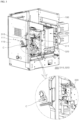
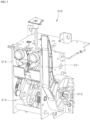
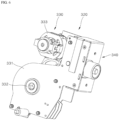
- FIGS. 1 to 3 are schematic perspective views of a circuit breaker according to the present disclosure.
- FIG. 1 is a view with a door removed
- FIG. 2 is a view showing the door
- FIG. 3 is a view with a door cover open and a manual energy-accumulating handle inserted.
- the circuit breaker includes a body 100, circuit breaking unit 200 disposed in the body 100 and in which contact points of a fixed contact and a movable contact are in contact with each other, and energy-accumulating unit 300 for accumulating energy of a closing spring that actuates the circuit breaking unit 200.
- the body 100 accommodates the circuit breaking unit 200 and the energy-accumulating unit 300 therein, and has a door 110 that may be opened and closed on at least one face thereof. Further, the door 110 may have a door cover 111 that is opened and closed such that a manual energy-accumulating handle C for driving manual energy-accumulating unit 340 to be described later is inserted thereinto. In another example, door cover 111 may be omitted.
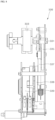
- FIG. 4 is a schematic side view of circuit breaking unit in a circuit breaker according to the present disclosure.
- the circuit breaking unit 200 is disposed in the body 100 and breaks or closes (applies current to) a circuit by a closing spring.
- Such circuit breaking unit 200 includes a drive shaft 210 that pivots in a vertical direction by the energy-accumulating unit 300, a drive link 220 that performs a vertical reciprocating motion by the drive shaft 210, a drive link 230 that pivots in the vertical direction by the vertical reciprocating motion of the drive link 220, a movable contact 240 that controls closing (electrical conduction) and breaking of the circuit breaker fixed via a fixed contact 250, and the fixed contact 250. Because of such structure, when an overcurrent or an accidental current occurs in the state in which the energy of the closing spring is accumulated, the closing spring may be released (relaxed) to separate the movable contact 240 from the fixed contact 250.
- the mechanical portion according to the present disclosure may not be limited to the above-described structure, and any structure may be applied as long as it is a structure capable of breaking the circuit by being driven by the closing spring.
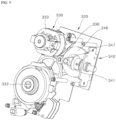
- the energy-accumulating unit 300 is for accumulating the energy of the closing spring, and includes main energy-accumulating unit 310 for accumulating the energy of the closing spring, and auxiliary energy-accumulating unit 320 for accumulating the energy of the closing spring by driving the main energy-accumulating unit 310 via an electric motor 333 or manual manipulation.
- FIG. 5 is a perspective view of the main energy-accumulating unit in a circuit breaker according to the present disclosure.
- the main energy-accumulating unit 310 includes a manual handle 311, a cam shaft 312 to which the manual handle 311 is coupled, a main output gear 313 that transmits a rotational force received via the cam shaft 312 to a cam shaft, and a main energy-accumulating casing 314 that accommodates the main output gear 313 therein. Because of such structure, in the main energy-accumulating unit 310, when the manual handle 311 pivots to one side, and the cam shaft 312 connected to the manual handle 311 also rotates. Thus, the main output gear 313 may be operated to manually accumulate the energy of the closing spring.
- the auxiliary energy-accumulating unit 320 as well as the manual handle 311 are connected, so that not only the energy-accumulating of the closing spring by the electric motor 333 of the auxiliary energy-accumulating unit 320, but also energy-accumulating of the closing spring by the manual handle 311 and energy-accumulating of the closing spring by the manual energy-accumulating handle C are possible.
- FIG. 6 is a perspective view of auxiliary energy-accumulating unit in a circuit breaker according to the present disclosure.
- the auxiliary energy-accumulating unit 320 rotates the cam shaft 312 (in FIG. 5 ) by the electric motor 333 or the manual energy-accumulating handle C to accumulate the energy of the closing spring.
- the auxiliary energy-accumulating unit 320 includes electromotive energy-accumulating unit 330 and manual energy-accumulating unit 340.
- FIG. 7 is a perspective view of electromotive energy-accumulating unit in a circuit breaker according to the present disclosure.
- FIG. 8 is a front view of electromotive energy-accumulating unit in a circuit breaker according to the present disclosure.
- the electromotive energy-accumulating unit 330 When control power is supplied to the electric motor 333, the electromotive energy-accumulating unit 330 causes an auxiliary output gear 339 to rotate in response to the operation of the electric motor 333.
- at a position between the electric motor 333 and the auxiliary output gear 339 at least one linkage gear for linking the electric motor 333 and the auxiliary output gear 339 to each other may be disposed.
- This embodiment exemplifies a primary gear 335, a secondary gear 337, and a tertiary gear 338 as the at least one linkage gear. Further, in this embodiment, when the electric motor 333 rotates, the electric motor gear 334 rotates, and as the electric motor gear 334 rotates, the primary gear 335, the secondary gear 337, the tertiary gear 338, and the auxiliary output gear 339 sequentially rotate by being linked to each other. Further, a cam shaft-linked groove 332 connected to the auxiliary output gear 339 is assembled with the cam shaft 312 to enable a closing spring charging operation.
- FIG. 9 is a schematic perspective view of an auxiliary energy-accumulating unit in a circuit breaker according to the present disclosure
- FIG. 10 is a schematic perspective view of an auxiliary energy-accumulating unit into which a manual energy-accumulating handle is inserted in a circuit breaker according to the present disclosure
- FIG. 11 is a schematic exploded perspective view of manual energy-accumulating unit in a circuit breaker according to the present disclosure.
- the manual energy-accumulating unit 340 rotates the auxiliary output gear 339 manually from the outside, so that the energy of the closing spring is accumulated. More specifically, referring to FIG. 9 and FIG. 10 , when the manual energy-accumulating handle C pivots in one direction, for example, in a clockwise direction, the primary bevel gear 341 also rotates in the clockwise direction. Further, the secondary bevel gear 347 linked with the primary bevel gear 341 also rotates. When the secondary bevel gear 347 rotates, a gear 348 integral with the secondary bevel gear 347 also rotates to drive a primary upper gear 336. Accordingly, the secondary gear 337, the tertiary gear 338, and the auxiliary output gear 339 rotate to perform the charging operation of the mechanism.
- the manual energy-accumulating unit 340 includes the primary bevel gear 341 engaged with the secondary bevel gear 347 by compression, a shaft 342 that is a rotation shaft of the primary bevel gear 341, a spring support 343 disposed on the shaft 342 so as to be spaced apart from the primary bevel gear 341, a rotation key 344 protruding from a side face in a length direction of the shaft 342 at an end of the shaft 342, a bush 346 having a cylindrical shape with only one side open as a bottom plate is formed, wherein the bottom plate is located between the primary bevel gear 341 and the spring support 343 and fixed to an auxiliary energy-accumulating casing 331, and a manual energy-accumulating spring 345 disposed between the bottom plate of the bush 346 and the spring support 343.
- the primary bevel gear 341 is engaged with the secondary bevel gear 347 to rotate the secondary bevel gear 347.
- the present disclosure makes the primary bevel gear 341 to be spaced apart from the secondary bevel gear 347 when the manual energy-accumulating unit 340 is not in operation, and makes the primary bevel gear 341 to be engaged with the secondary bevel gear 347 only when the manual energy-accumulating unit 340 is in operation.
- the shaft 342 is formed in a shape extending from the rotation shaft of the primary bevel gear 341. The other side of such shaft 342 is exposed to the outside of the auxiliary energy-accumulating casing 331 through the bush 346, which will be described later, and the shaft 342 rotates in engagement with the manual energy-accumulating handle C to rotate the primary bevel gear 341 disposed on one side thereof.
- the spring support 343 is disposed on the shaft 342 to support one side of the manual energy-accumulating spring 345. Further, spring support 343 is disposed on the shaft 342 to be spaced apart from the primary bevel gear 341.
- This embodiment illustrates an O-ring as the spring support 343.
- the present disclosure may not be limited thereto, and the spring support 343 may be formed to extend and protrude circularly from the shaft 342 without being coupled to the shaft 342 in the form of the O-ring. Further, the present disclosure may support said one side of the manual energy-accumulating spring 345 by protruding a protrusion from a side face of the shaft 342 like the rotation key 344 instead of the O-ring-shaped spring support 343. That is, the present disclosure is not limited in the shape and the structure of the spring support 343 as long as it is able to support said one side of the manual energy-accumulating spring 345.
- the rotation key 344 When the manual energy-accumulating unit 340 is operated, the rotation key 344 is coupled to the manual energy-accumulating handle C to rotate the shaft 342. That is, the rotation key 344 serves as a protrusion for rotating the shaft 342, and is disposed on the other side of the shaft 342 to protrude in a direction intersecting the length direction of the shaft 342. Further, the rotation key 344 is disposed on the other side of the shaft 342 to be disposed on the other side of the spring support 343, that is, the primary bevel gear 341, the spring support 343, and the rotation key 344 are disposed on the shaft 342 in the order.
- the bush 346 supports the other side of the manual energy-accumulating spring 345 and supports the manual energy-accumulating handle C, which is inserted thereinto when the manual energy-accumulating unit 340 is operated.
- the bush 346 has the cylindrical shape having the hollow defined therein with only one side open as the bottom plate is formed on one side as described above, and a hole is defined in the bottom plate to allow the shaft 342 to extend therethrough. Further, an inner face of the bottom plate of said one side supports the other side of the manual energy-accumulating spring 345, and the aforementioned spring support 343 supports said one side of the manual energy-accumulating spring 345.
- the bush 346 is fixed by being coupled to the auxiliary energy-accumulating casing 331, so that the shaft 342 equipped with the primary bevel gear 341, the spring support 343, and the rotation key 344 may reciprocate through the fixed bush 346.
- the spring support 343 is exposed to the outside of the auxiliary energy-accumulating casing 331 through the bush 346 and a bottom face of the bush 346 is located inside the auxiliary energy-accumulating casing 331, the shaft 342 equipped with the primary bevel gear 341, the spring support 343, and the rotation key 344 does not deviate from the fixed bush 346.
- the manual energy-accumulating spring 345 is positioned between the bottom plate of the fixed bush 346 and the spring support 343 disposed on the reciprocating shaft 342. Further, accordingly, the spring support 343 is pushed from the bush 346, so that the shaft 342 equipped with the spring support 343 is also pushed out of the auxiliary energy-accumulating casing 331. Therefore, the primary bevel gear 341 disposed on one side of the shaft 342 is also pushed out together with the shaft 342 to be separated from the secondary bevel gear 347. In another example, when the manual energy-accumulating handle C is inserted into the bush 346, is coupled with the other side of the shaft 342 and the rotation key 344, and then applies a pressure to the shaft 342, the manual energy-accumulating spring 345 is compressed.
- the spring support 343 is moved into the auxiliary energy-accumulating casing 331, and accordingly, the shaft 342 coupled with the spring support 343 and the primary bevel gear 341 disposed on said one side of the shaft 342 are also moved together and engaged with the secondary bevel gear 347.
- FIG. 12 is a perspective view of manual energy-accumulating unit before a shaft is compressed in a circuit breaker according to the present disclosure
- FIG. 13 is a plan view of auxiliary energy-accumulating unit in a state before a manual energy-accumulating handle is inserted to compress a shaft in a circuit breaker according to the present disclosure.
- the manual energy-accumulating spring 345 presses the spring support 343 to increase a gap between the bush 346 and the spring support 343.
- the bush 346 is fixed in position, so that only the spring support 343 is moved away from the bush 346, and the shaft 342 coupled with the spring support 343 and the primary bevel gear 341 disposed on said one side of the shaft 342 are also moved following the spring support 343.
- the primary bevel gear 341 may be separated from the secondary bevel gear 347, and the secondary bevel gear 347 may rotate without the influence of the primary bevel gear 341 when the electromotive energy-accumulating unit 300 is operated. That is, the present disclosure makes a distance between the primary bevel gear 341 and the bottom plate of the bush 346 the same as a distance between the secondary bevel gear 347 and the bottom plate of the bush 346 when the manual energy-accumulating spring 345 is compressed, so that the primary bevel gear 341 and the secondary bevel gear 347 are engaged with each other only when the manual energy-accumulating spring is compressed.
- FIG. 14 is a perspective view of manual energy-accumulating unit after a shaft is compressed in a circuit breaker according to the present disclosure
- FIG. 15 is a plan view of auxiliary energy-accumulating unit in a state in which a manual energy-accumulating handle is inserted and compresses a shaft in a circuit breaker according to the present disclosure.
- the primary bevel gear 341 is engaged with the secondary bevel gear 347, and the secondary bevel gear 347 is also rotated by the primary bevel gear 341 that rotates in response to the pivoting of the manual energy-accumulating handle C, thereby accumulating the energy of the closing spring.
- the present disclosure separates the secondary bevel gear and the primary bevel gear from each other in normal times, and allows the secondary bevel gear and the primary bevel gear to be engaged with each other only during the manual energy-accumulating, thereby preventing the damage and the deformation of the energy-accumulating unit.
Landscapes
- Driving Mechanisms And Operating Circuits Of Arc-Extinguishing High-Tension Switches (AREA)
- Breakers (AREA)
Claims (6)
- Schutzschalter, umfassend:Schutzschaltereinheit (200), beinhaltend einen festen Kontakt (250) und einen beweglichen Kontakt (240), deren Kontaktstellen miteinander in Kontakt stehen; undeine Energiespeichereinheit (300) zum Speichern von Energie einer Schließfeder zur Steuerung des Kontakts zwischen dem festen Kontakt (250) und dem beweglichen Kontakt (240),wobei die Energiespeichereinheit (300) beinhaltet:eine Hauptenergiespeichereinheit (310), beinhaltend eine Nockenwelle (312), ein Hauptabtriebsrad (313), das auf der Nockenwelle (312) angeordnet ist, und ein Hauptenergiespeichergehäuse (314) zur Aufnahme des Hauptabtriebrads (313); undeine Hilfsenergiespeichereinheit (320), beinhaltend eine elektromotorische Energiespeichereinheit (330), die mit der Nockenwelle (312) verbunden ist, und eine manuelle Energiespeichereinheit (340), die mit der elektromotorischen Energiespeichereinheit (330) verbunden ist, wobei Kegelräder in der manuellen Energiespeichereinheit (340) durch eine externe Kraft miteinander in Eingriff stehen, um die äußere Eingangskraft auf die elektromotorische Energiespeichereinheit (330) zu übertragen, um die Energie einer Schließfeder zu speichern;wobei die Kegelräder ein primäres Kegelrad (341) und ein sekundäres Kegelrad (347) umfassen,die dadurch gekennzeichnet sind dass das primäre Kegelrad (341) und das sekundäre Kegelrad (347) so angeordnet sind, dass sie voneinander beabstandet sind, wenn die manuelle Energiespeichereinheit (340) nicht in Betrieb ist, undwobei das primäre Kegelrad (341) und das sekundäre Kegelrad (347) so angeordnet sind, dass sie miteinander im Eingriff stehen, wenn die manuelle Energiespeichereinheit (340) in Betrieb ist.
- Schutzschalter nach Anspruch 1, wobei die elektromotorische Energiespeichereinheit (330) beinhaltet:eine mit der Nockenwelle (312) verbundene, nockenwellenverbundene Nut (332);ein Hilfsabtriebsrad (339), das in der nockenwellenverbundenen Nut (332) angeordnet ist;mindestens ein mit dem Hilfsabtriebsrad (339) verbundenes Verbindungsgetriebe; undeinen Elektromotor (333) zum Drehen des Verbindungsgetriebes.
- Schutzschalter nach Anspruch 2, wobei das Verbindungsgetriebe beinhaltet:ein Elektromotorzahnrad (334), das mit einer Drehwelle des Elektromotors (333) verbunden ist;ein primäres Zahnrad (335), das mit dem Elektromotorzahnrad (334) verbunden ist;ein primäres oberes Zahnrad (336), das mit einer Drehwelle des primären Zahnrads (335) verbunden ist;ein sekundäres Zahnrad, das mit dem primären Zahnrad (335) verbunden ist; undein tertiäres Zahnrad, das zwischen dem sekundären Zahnrad und dem Hilfsabtriebrad angeordnet und mit dem sekundären Zahnrad und dem Hilfsabtriebsrad verbunden ist.
- Schutzschalter nach Anspruch 3, wobei die manuelle Energiespeichereinheit (340) beinhaltet:das sekundäre Kegelrad (347), das mit dem Verbindungsgetriebe verbunden ist;das primäre Kegelrad (341), das mit dem sekundären Kegelrad (347) durch die äußere Kraft in Eingriff steht;eine Welle (342), die eine Drehwelle des primären Kegelrads (341) ist;eine Federaufnahme (343), die auf der Welle (342) so ausgebildet ist, dass sie von dem primären Kegelrad (341) beabstandet ist;einen Drehschlüssel (344), der von einer Seitenfläche in einer Längsrichtung der Welle (342) in einem Bereich eines Endes der Welle vorsteht;eine Buchse (346), die in einer zylindrischen Form ausgebildet ist, wobei nur eine Seite als Bodenplatte offen ist, die zwischen dem primären Kegelrad und der Federaufnahme (343) ausgebildet ist, wobei eine Position der Buchse (346) feststeht; undeine manuelle energiespeichernde Feder (345), die zwischen der Bodenplatte der Buchse (346) und der Federaufnahme (343) angeordnet ist, wobei die manuelle energiespeichernde Feder (345) eine Federkraft in einer Richtung zum Trennen des primären Kegelrads (341) von dem sekundären Kegelrad (347) bereitstellt.
- Schutzschalter nach Anspruch 4, wobei das sekundäre Kegelrad (347) mit einer Drehwelle eines Integralgetriebes verbunden ist, das mit dem primären oberen Zahnrad (336) verbunden ist.
- Schutzschalter nach Anspruch 4 oder 5, wobei eine Richtung der äußeren Kraft eine Richtung im Uhrzeigersinn ist.
Applications Claiming Priority (2)
| Application Number | Priority Date | Filing Date | Title |
|---|---|---|---|
| KR1020190145093A KR102285035B1 (ko) | 2019-11-13 | 2019-11-13 | 회로 차단기 |
| PCT/KR2020/004278 WO2021096002A1 (ko) | 2019-11-13 | 2020-03-27 | 회로 차단기 |
Publications (3)
| Publication Number | Publication Date |
|---|---|
| EP4060712A1 EP4060712A1 (de) | 2022-09-21 |
| EP4060712A4 EP4060712A4 (de) | 2023-03-15 |
| EP4060712B1 true EP4060712B1 (de) | 2025-04-16 |
Family
ID=75912162
Family Applications (1)
| Application Number | Title | Priority Date | Filing Date |
|---|---|---|---|
| EP20887992.4A Active EP4060712B1 (de) | 2019-11-13 | 2020-03-27 | Schutzschalter |
Country Status (6)
| Country | Link |
|---|---|
| US (1) | US12087534B2 (de) |
| EP (1) | EP4060712B1 (de) |
| JP (1) | JP7335438B2 (de) |
| KR (1) | KR102285035B1 (de) |
| CN (1) | CN114586126A (de) |
| WO (1) | WO2021096002A1 (de) |
Families Citing this family (3)
| Publication number | Priority date | Publication date | Assignee | Title |
|---|---|---|---|---|
| CN113823538B (zh) * | 2021-10-25 | 2025-07-18 | 安心智能技术股份有限公司 | 一种智能断路器用电动分合闸装置 |
| TWI834240B (zh) * | 2022-08-09 | 2024-03-01 | 陳錫瑜 | 模殼式斷路器電動操作機構改良裝置 |
| CN117110667B (zh) * | 2023-10-20 | 2023-12-26 | 江苏华鹏智能仪表科技股份有限公司 | 一种适用于供电领域的采集器 |
Citations (1)
| Publication number | Priority date | Publication date | Assignee | Title |
|---|---|---|---|---|
| CN205824058U (zh) * | 2016-06-29 | 2016-12-21 | 甘肃威尔晟农业装备制造有限公司 | 一种小型机械换向传动离合装置 |
Family Cites Families (17)
| Publication number | Priority date | Publication date | Assignee | Title |
|---|---|---|---|---|
| KR100295908B1 (ko) * | 1998-08-28 | 2001-08-07 | 이종수 | 고압전기기기의스프링차징장치 |
| CN2662804Y (zh) | 2003-08-01 | 2004-12-15 | 深圳市宝安区西乡镇臣田唐锋电器厂 | 用于烹调装置的自动搅拌机构 |
| KR101050589B1 (ko) * | 2007-03-27 | 2011-07-19 | 미쓰비시덴키 가부시키가이샤 | 개폐 장치의 축세(蓄勢) 기구 |
| JP4767344B2 (ja) | 2007-03-27 | 2011-09-07 | 三菱電機株式会社 | 開閉装置の蓄勢機構 |
| KR100908373B1 (ko) | 2007-08-20 | 2009-07-20 | 엘에스산전 주식회사 | 기중차단기의 투입스프링 차징장치에 사용되는 구동모터 |
| EP2093780B1 (de) * | 2008-02-22 | 2014-11-05 | ABB Technology AG | Federantriebseinheit und Verfahren zum Spannen und/oder Lösen der Feder in einer Betriebsvorrichtung für eine elektrische Schaltvorrichtung |
| CN202957195U (zh) * | 2012-09-17 | 2013-05-29 | 四川电器集团股份有限公司 | 一种模块化弹簧操纵装置以及一种真空断路器 |
| CN104141761B (zh) * | 2014-07-18 | 2017-01-18 | 北京双杰电气股份有限公司 | 储能传动装置 |
| CN104576235B (zh) | 2015-01-23 | 2017-02-22 | 环宇集团浙江高科有限公司 | 小型断路器的自动重合闸装置 |
| KR101536943B1 (ko) | 2015-02-02 | 2015-07-17 | 주식회사 에너지로드 | 안전경보장치를 구비한 고압 개폐기 및 이를 구비한 수배전반 |
| CN104733216B (zh) * | 2015-03-31 | 2018-02-09 | 浙江华仪电器科技有限公司 | 离合储能装置 |
| KR101769195B1 (ko) * | 2015-04-13 | 2017-08-18 | 엘에스산전 주식회사 | 회로 차단기 |
| CN105225862B (zh) * | 2015-09-28 | 2017-07-28 | 平高集团有限公司 | 一种弹簧操动机构及其手动储能装置 |
| CN106409546B (zh) * | 2016-11-24 | 2018-03-13 | 贵州泰永长征技术股份有限公司 | 一种永磁中压双电源转换开关动触头驱动助力机构 |
| US10340096B2 (en) * | 2017-05-19 | 2019-07-02 | Mitsubishi Electric Power Products, Inc. | System and method for air motor recharging of spring mechanisms |
| CN208189470U (zh) * | 2018-05-17 | 2018-12-04 | 深圳市铭泽智能电力科技有限公司 | 一种用于充气柜断路器机构手动储能轴防护装置 |
| CN108425994B (zh) * | 2018-05-18 | 2023-06-16 | 山东钢铁股份有限公司 | 边部遮挡控制单元齿轮传动装置 |
-
2019
- 2019-11-13 KR KR1020190145093A patent/KR102285035B1/ko active Active
-
2020
- 2020-03-27 JP JP2022523376A patent/JP7335438B2/ja active Active
- 2020-03-27 WO PCT/KR2020/004278 patent/WO2021096002A1/ko not_active Ceased
- 2020-03-27 US US17/755,954 patent/US12087534B2/en active Active
- 2020-03-27 EP EP20887992.4A patent/EP4060712B1/de active Active
- 2020-03-27 CN CN202080073570.7A patent/CN114586126A/zh active Pending
Patent Citations (1)
| Publication number | Priority date | Publication date | Assignee | Title |
|---|---|---|---|---|
| CN205824058U (zh) * | 2016-06-29 | 2016-12-21 | 甘肃威尔晟农业装备制造有限公司 | 一种小型机械换向传动离合装置 |
Also Published As
| Publication number | Publication date |
|---|---|
| EP4060712A4 (de) | 2023-03-15 |
| JP2022553287A (ja) | 2022-12-22 |
| JP7335438B2 (ja) | 2023-08-29 |
| WO2021096002A1 (ko) | 2021-05-20 |
| KR102285035B1 (ko) | 2021-08-02 |
| US20220384132A1 (en) | 2022-12-01 |
| EP4060712A1 (de) | 2022-09-21 |
| CN114586126A (zh) | 2022-06-03 |
| KR20210058089A (ko) | 2021-05-24 |
| US12087534B2 (en) | 2024-09-10 |
Similar Documents
| Publication | Publication Date | Title |
|---|---|---|
| EP4060712B1 (de) | Schutzschalter | |
| RU2401471C2 (ru) | Устройство заводки пружины воздушного автоматического выключателя | |
| EP2028745B1 (de) | Motor für eine Federladevorrichtung in einem Druckluftschalter | |
| CN112038188B (zh) | 一种具有远程控制功能的智能微型断路器 | |
| CN102842444B (zh) | 开关装置 | |
| RU2372683C1 (ru) | Устройство для указания на замкнутое рабочее состояние воздушного выключателя и воздушный выключатель с таким устройством | |
| US7009130B2 (en) | Switching device | |
| CN111916317B (zh) | 断路器 | |
| CN214797293U (zh) | 一种漏电断路器 | |
| JP2014002876A (ja) | 電磁操作式開閉装置 | |
| CN100466138C (zh) | 电路断路器的外部操作手柄装置 | |
| EP2763155B1 (de) | Elektrischer Antrieb für einen Schutzschalter und Verfahren dafür | |
| EP3482408B1 (de) | Schnelle erdungsschaltervorrichtung für hochspannungsanwendungen | |
| US6084370A (en) | Switching device for the manual drive of an electromotive actuator | |
| KR101678002B1 (ko) | 가스 절연 부하개폐기 | |
| CN111899992A (zh) | 1p+n断路器和安装有该断路器的电气设备 | |
| CN112151328B (zh) | 一种离合装置、操作机构和断路器 | |
| JP7287256B2 (ja) | 真空遮断器の操作機構 | |
| KR100889924B1 (ko) | 기중차단기의 캠축과 출력기어의 연결구조 | |
| KR200295509Y1 (ko) | 부하 개폐기 | |
| US11840151B2 (en) | Device for encapsulating and interrupting the power supply of a battery | |
| KR900005688B1 (ko) | 솔레노이드 투입식 고압개폐기의 투입상태 유지방법 및 장치 | |
| CN121545941A (zh) | 一种转换机构、融合开关和储能系统 | |
| EP4338188A1 (de) | Vorrichtung zum abschalten einer elektrischen schaltung | |
| KR900009089Y1 (ko) | 솔레노이드 투입식 고압개폐기의 투입상태 분산 유지장치 |
Legal Events
| Date | Code | Title | Description |
|---|---|---|---|
| STAA | Information on the status of an ep patent application or granted ep patent |
Free format text: STATUS: THE INTERNATIONAL PUBLICATION HAS BEEN MADE |
|
| PUAI | Public reference made under article 153(3) epc to a published international application that has entered the european phase |
Free format text: ORIGINAL CODE: 0009012 |
|
| STAA | Information on the status of an ep patent application or granted ep patent |
Free format text: STATUS: REQUEST FOR EXAMINATION WAS MADE |
|
| 17P | Request for examination filed |
Effective date: 20220504 |
|
| AK | Designated contracting states |
Kind code of ref document: A1 Designated state(s): AL AT BE BG CH CY CZ DE DK EE ES FI FR GB GR HR HU IE IS IT LI LT LU LV MC MK MT NL NO PL PT RO RS SE SI SK SM TR |
|
| DAV | Request for validation of the european patent (deleted) | ||
| DAX | Request for extension of the european patent (deleted) | ||
| A4 | Supplementary search report drawn up and despatched |
Effective date: 20230209 |
|
| RIC1 | Information provided on ipc code assigned before grant |
Ipc: H01H 3/30 20060101ALI20230203BHEP Ipc: H01H 71/02 20060101ALI20230203BHEP Ipc: H01H 73/02 20060101AFI20230203BHEP |
|
| RIC1 | Information provided on ipc code assigned before grant |
Ipc: H01H 3/30 20060101ALI20241219BHEP Ipc: H01H 71/02 20060101ALI20241219BHEP Ipc: H01H 73/02 20060101AFI20241219BHEP |
|
| GRAP | Despatch of communication of intention to grant a patent |
Free format text: ORIGINAL CODE: EPIDOSNIGR1 |
|
| STAA | Information on the status of an ep patent application or granted ep patent |
Free format text: STATUS: GRANT OF PATENT IS INTENDED |
|
| GRAS | Grant fee paid |
Free format text: ORIGINAL CODE: EPIDOSNIGR3 |
|
| INTG | Intention to grant announced |
Effective date: 20250205 |
|
| GRAA | (expected) grant |
Free format text: ORIGINAL CODE: 0009210 |
|
| STAA | Information on the status of an ep patent application or granted ep patent |
Free format text: STATUS: THE PATENT HAS BEEN GRANTED |
|
| AK | Designated contracting states |
Kind code of ref document: B1 Designated state(s): AL AT BE BG CH CY CZ DE DK EE ES FI FR GB GR HR HU IE IS IT LI LT LU LV MC MK MT NL NO PL PT RO RS SE SI SK SM TR |
|
| REG | Reference to a national code |
Ref country code: GB Ref legal event code: FG4D |
|
| REG | Reference to a national code |
Ref country code: CH Ref legal event code: EP Ref country code: DE Ref legal event code: R096 Ref document number: 602020049718 Country of ref document: DE |
|
| REG | Reference to a national code |
Ref country code: IE Ref legal event code: FG4D |
|
| REG | Reference to a national code |
Ref country code: NL Ref legal event code: MP Effective date: 20250416 |
|
| PG25 | Lapsed in a contracting state [announced via postgrant information from national office to epo] |
Ref country code: NL Free format text: LAPSE BECAUSE OF FAILURE TO SUBMIT A TRANSLATION OF THE DESCRIPTION OR TO PAY THE FEE WITHIN THE PRESCRIBED TIME-LIMIT Effective date: 20250416 |
|
| REG | Reference to a national code |
Ref country code: AT Ref legal event code: MK05 Ref document number: 1786379 Country of ref document: AT Kind code of ref document: T Effective date: 20250416 |
|
| PG25 | Lapsed in a contracting state [announced via postgrant information from national office to epo] |
Ref country code: PT Free format text: LAPSE BECAUSE OF FAILURE TO SUBMIT A TRANSLATION OF THE DESCRIPTION OR TO PAY THE FEE WITHIN THE PRESCRIBED TIME-LIMIT Effective date: 20250818 Ref country code: FI Free format text: LAPSE BECAUSE OF FAILURE TO SUBMIT A TRANSLATION OF THE DESCRIPTION OR TO PAY THE FEE WITHIN THE PRESCRIBED TIME-LIMIT Effective date: 20250416 Ref country code: ES Free format text: LAPSE BECAUSE OF FAILURE TO SUBMIT A TRANSLATION OF THE DESCRIPTION OR TO PAY THE FEE WITHIN THE PRESCRIBED TIME-LIMIT Effective date: 20250416 |
|
| REG | Reference to a national code |
Ref country code: LT Ref legal event code: MG9D |
|
| PG25 | Lapsed in a contracting state [announced via postgrant information from national office to epo] |
Ref country code: NO Free format text: LAPSE BECAUSE OF FAILURE TO SUBMIT A TRANSLATION OF THE DESCRIPTION OR TO PAY THE FEE WITHIN THE PRESCRIBED TIME-LIMIT Effective date: 20250716 Ref country code: GR Free format text: LAPSE BECAUSE OF FAILURE TO SUBMIT A TRANSLATION OF THE DESCRIPTION OR TO PAY THE FEE WITHIN THE PRESCRIBED TIME-LIMIT Effective date: 20250717 |
|
| PG25 | Lapsed in a contracting state [announced via postgrant information from national office to epo] |
Ref country code: PL Free format text: LAPSE BECAUSE OF FAILURE TO SUBMIT A TRANSLATION OF THE DESCRIPTION OR TO PAY THE FEE WITHIN THE PRESCRIBED TIME-LIMIT Effective date: 20250416 |
|
| PG25 | Lapsed in a contracting state [announced via postgrant information from national office to epo] |
Ref country code: BG Free format text: LAPSE BECAUSE OF FAILURE TO SUBMIT A TRANSLATION OF THE DESCRIPTION OR TO PAY THE FEE WITHIN THE PRESCRIBED TIME-LIMIT Effective date: 20250416 |
|
| PG25 | Lapsed in a contracting state [announced via postgrant information from national office to epo] |
Ref country code: HR Free format text: LAPSE BECAUSE OF FAILURE TO SUBMIT A TRANSLATION OF THE DESCRIPTION OR TO PAY THE FEE WITHIN THE PRESCRIBED TIME-LIMIT Effective date: 20250416 |
|
| PG25 | Lapsed in a contracting state [announced via postgrant information from national office to epo] |
Ref country code: AT Free format text: LAPSE BECAUSE OF FAILURE TO SUBMIT A TRANSLATION OF THE DESCRIPTION OR TO PAY THE FEE WITHIN THE PRESCRIBED TIME-LIMIT Effective date: 20250416 |
|
| PG25 | Lapsed in a contracting state [announced via postgrant information from national office to epo] |
Ref country code: RS Free format text: LAPSE BECAUSE OF FAILURE TO SUBMIT A TRANSLATION OF THE DESCRIPTION OR TO PAY THE FEE WITHIN THE PRESCRIBED TIME-LIMIT Effective date: 20250716 |
|
| PG25 | Lapsed in a contracting state [announced via postgrant information from national office to epo] |
Ref country code: IS Free format text: LAPSE BECAUSE OF FAILURE TO SUBMIT A TRANSLATION OF THE DESCRIPTION OR TO PAY THE FEE WITHIN THE PRESCRIBED TIME-LIMIT Effective date: 20250816 |
|
| PG25 | Lapsed in a contracting state [announced via postgrant information from national office to epo] |
Ref country code: LV Free format text: LAPSE BECAUSE OF FAILURE TO SUBMIT A TRANSLATION OF THE DESCRIPTION OR TO PAY THE FEE WITHIN THE PRESCRIBED TIME-LIMIT Effective date: 20250416 |
|
| PG25 | Lapsed in a contracting state [announced via postgrant information from national office to epo] |
Ref country code: SM Free format text: LAPSE BECAUSE OF FAILURE TO SUBMIT A TRANSLATION OF THE DESCRIPTION OR TO PAY THE FEE WITHIN THE PRESCRIBED TIME-LIMIT Effective date: 20250416 Ref country code: DK Free format text: LAPSE BECAUSE OF FAILURE TO SUBMIT A TRANSLATION OF THE DESCRIPTION OR TO PAY THE FEE WITHIN THE PRESCRIBED TIME-LIMIT Effective date: 20250416 |
|
| REG | Reference to a national code |
Ref country code: DE Ref legal event code: R097 Ref document number: 602020049718 Country of ref document: DE |
|
| PG25 | Lapsed in a contracting state [announced via postgrant information from national office to epo] |
Ref country code: CZ Free format text: LAPSE BECAUSE OF FAILURE TO SUBMIT A TRANSLATION OF THE DESCRIPTION OR TO PAY THE FEE WITHIN THE PRESCRIBED TIME-LIMIT Effective date: 20250416 |
|
| PG25 | Lapsed in a contracting state [announced via postgrant information from national office to epo] |
Ref country code: EE Free format text: LAPSE BECAUSE OF FAILURE TO SUBMIT A TRANSLATION OF THE DESCRIPTION OR TO PAY THE FEE WITHIN THE PRESCRIBED TIME-LIMIT Effective date: 20250416 |
|
| PG25 | Lapsed in a contracting state [announced via postgrant information from national office to epo] |
Ref country code: SK Free format text: LAPSE BECAUSE OF FAILURE TO SUBMIT A TRANSLATION OF THE DESCRIPTION OR TO PAY THE FEE WITHIN THE PRESCRIBED TIME-LIMIT Effective date: 20250416 |
|
| PG25 | Lapsed in a contracting state [announced via postgrant information from national office to epo] |
Ref country code: IT Free format text: LAPSE BECAUSE OF FAILURE TO SUBMIT A TRANSLATION OF THE DESCRIPTION OR TO PAY THE FEE WITHIN THE PRESCRIBED TIME-LIMIT Effective date: 20250416 |
|
| PLBE | No opposition filed within time limit |
Free format text: ORIGINAL CODE: 0009261 |
|
| STAA | Information on the status of an ep patent application or granted ep patent |
Free format text: STATUS: NO OPPOSITION FILED WITHIN TIME LIMIT |
|
| REG | Reference to a national code |
Ref country code: CH Ref legal event code: L10 Free format text: ST27 STATUS EVENT CODE: U-0-0-L10-L00 (AS PROVIDED BY THE NATIONAL OFFICE) Effective date: 20260225 |
|
| 26N | No opposition filed |
Effective date: 20260119 |
|
| PGFP | Annual fee paid to national office [announced via postgrant information from national office to epo] |
Ref country code: DE Payment date: 20251208 Year of fee payment: 7 |