EP4066960A1 - Polymère soluble dans l'eau pour la formation de noyau - Google Patents
Polymère soluble dans l'eau pour la formation de noyau Download PDFInfo
- Publication number
- EP4066960A1 EP4066960A1 EP22160763.3A EP22160763A EP4066960A1 EP 4066960 A1 EP4066960 A1 EP 4066960A1 EP 22160763 A EP22160763 A EP 22160763A EP 4066960 A1 EP4066960 A1 EP 4066960A1
- Authority
- EP
- European Patent Office
- Prior art keywords
- mold parts
- wsp
- slurry
- core
- forming
- Prior art date
- Legal status (The legal status is an assumption and is not a legal conclusion. Google has not performed a legal analysis and makes no representation as to the accuracy of the status listed.)
- Pending
Links
- 229920003169 water-soluble polymer Polymers 0.000 title claims abstract description 95
- 238000000034 method Methods 0.000 claims abstract description 75
- 239000002002 slurry Substances 0.000 claims abstract description 72
- XLYOFNOQVPJJNP-UHFFFAOYSA-N water Substances O XLYOFNOQVPJJNP-UHFFFAOYSA-N 0.000 claims abstract description 37
- 239000011248 coating agent Substances 0.000 claims description 22
- 238000000576 coating method Methods 0.000 claims description 22
- 238000002347 injection Methods 0.000 claims description 21
- 239000007924 injection Substances 0.000 claims description 21
- 238000005495 investment casting Methods 0.000 claims description 14
- 238000001035 drying Methods 0.000 claims description 9
- 229920002451 polyvinyl alcohol Polymers 0.000 claims description 9
- 235000019422 polyvinyl alcohol Nutrition 0.000 claims description 9
- 238000005507 spraying Methods 0.000 claims description 7
- 239000000919 ceramic Substances 0.000 description 24
- 230000015572 biosynthetic process Effects 0.000 description 8
- 238000001816 cooling Methods 0.000 description 5
- 239000000463 material Substances 0.000 description 5
- 239000004593 Epoxy Substances 0.000 description 3
- 239000007767 bonding agent Substances 0.000 description 3
- 238000005266 casting Methods 0.000 description 3
- 229920001971 elastomer Polymers 0.000 description 3
- 238000004519 manufacturing process Methods 0.000 description 3
- 239000013528 metallic particle Substances 0.000 description 3
- 239000005060 rubber Substances 0.000 description 3
- 239000000853 adhesive Substances 0.000 description 2
- 230000001070 adhesive effect Effects 0.000 description 2
- 238000010586 diagram Methods 0.000 description 2
- 238000012986 modification Methods 0.000 description 2
- 230000004048 modification Effects 0.000 description 2
- -1 but not limited to Substances 0.000 description 1
- 239000002131 composite material Substances 0.000 description 1
- 230000000694 effects Effects 0.000 description 1
- 125000003700 epoxy group Chemical group 0.000 description 1
- 238000001746 injection moulding Methods 0.000 description 1
- 150000001247 metal acetylides Chemical class 0.000 description 1
- 229910001092 metal group alloy Inorganic materials 0.000 description 1
- 239000000203 mixture Substances 0.000 description 1
- 229920000647 polyepoxide Polymers 0.000 description 1
- 229920000642 polymer Polymers 0.000 description 1
- 239000000843 powder Substances 0.000 description 1
- 238000003825 pressing Methods 0.000 description 1
- 229920002379 silicone rubber Polymers 0.000 description 1
- 239000004945 silicone rubber Substances 0.000 description 1
- 239000007787 solid Substances 0.000 description 1
- 239000000243 solution Substances 0.000 description 1
- 239000002904 solvent Substances 0.000 description 1
- 239000000126 substance Substances 0.000 description 1
- 150000003673 urethanes Chemical class 0.000 description 1
Images


Classifications
-
- B—PERFORMING OPERATIONS; TRANSPORTING
- B22—CASTING; POWDER METALLURGY
- B22C—FOUNDRY MOULDING
- B22C9/00—Moulds or cores; Moulding processes
- B22C9/10—Cores; Manufacture or installation of cores
-
- B—PERFORMING OPERATIONS; TRANSPORTING
- B22—CASTING; POWDER METALLURGY
- B22C—FOUNDRY MOULDING
- B22C1/00—Compositions of refractory mould or core materials; Grain structures thereof; Chemical or physical features in the formation or manufacture of moulds
- B22C1/02—Compositions of refractory mould or core materials; Grain structures thereof; Chemical or physical features in the formation or manufacture of moulds characterised by additives for special purposes, e.g. indicators, breakdown additives
- B22C1/14—Compositions of refractory mould or core materials; Grain structures thereof; Chemical or physical features in the formation or manufacture of moulds characterised by additives for special purposes, e.g. indicators, breakdown additives for separating the pattern from the mould
-
- B—PERFORMING OPERATIONS; TRANSPORTING
- B22—CASTING; POWDER METALLURGY
- B22C—FOUNDRY MOULDING
- B22C7/00—Patterns; Manufacture thereof so far as not provided for in other classes
- B22C7/02—Lost patterns
-
- C—CHEMISTRY; METALLURGY
- C08—ORGANIC MACROMOLECULAR COMPOUNDS; THEIR PREPARATION OR CHEMICAL WORKING-UP; COMPOSITIONS BASED THEREON
- C08L—COMPOSITIONS OF MACROMOLECULAR COMPOUNDS
- C08L29/00—Compositions of homopolymers or copolymers of compounds having one or more unsaturated aliphatic radicals, each having only one carbon-to-carbon double bond, and at least one being terminated by an alcohol, ether, aldehydo, ketonic, acetal or ketal radical; Compositions of hydrolysed polymers of esters of unsaturated alcohols with saturated carboxylic acids; Compositions of derivatives of such polymers
- C08L29/02—Homopolymers or copolymers of unsaturated alcohols
- C08L29/04—Polyvinyl alcohol; Partially hydrolysed homopolymers or copolymers of esters of unsaturated alcohols with saturated carboxylic acids
Definitions
- the present disclosure relates to the formation of complex articles by injection into a fugitive mold system including a water-soluble polymer (WSP).
- WSP water-soluble polymer
- Investment casting is commonly used in the aerospace and power industries to produce gas turbine components such as airfoils having complex outer surface shapes and internal cooling passage geometries.
- the production of a component using investment casting processes involves producing a ceramic casting vessel including an outer ceramic shell having an inside surface corresponding to the desired outer surface shape of the component, and one or more ceramic cores positioned within the outer ceramic shell corresponding to hollow interior passages to be formed within the component.
- Molten metal alloy is introduced into the ceramic casting vessel and is then allowed to cool and to solidify.
- the outer ceramic shell and ceramic core(s) are then removed by mechanical or chemical means to reveal the cast component having the desired external shape and hollow interior volume(s) in the shape of the ceramic core(s).
- Such investment casting processes are useful for producing components having a limited number of interior passages of relatively simple shape, such as a turbine blade design which includes relatively straight radially extending cooling passages.
- a turbine blade design which includes relatively straight radially extending cooling passages.
- much more complex three dimensional cooling schemes incorporating convoluted 3-D cooling passages will be needed in the near future for advanced gas turbine blades, and the production and use of ceramic cores reflecting such convoluted cooling passages will surpass existing investment casting process capabilities.
- a method for forming a core for use in investment casting.
- the core forming method includes forming one or more mold parts (e.g. first and second mold parts) of water-soluble polymer (WSP), each mold part including a bond area and a part forming area, moistening the bond areas, bonding the mold parts together with the bond areas moistened and the part forming areas aligned to form a cavity shaped as a negative of the core, injecting a slurry, e.g. a slurry which is non-reactive with the WSP, into the cavity and removing the WSP with water once the slurry is cured.
- WSP water-soluble polymer
- the WSP includes one or more polyvinyl alcohols dissolvable at a water temperature between about 20°C to about 100°C.
- the forming of the mold parts includes providing master tools from which the mold parts are formable.
- the moistening of the bond areas includes exposing the bond areas to hot or cold water vapor.
- the bonding of the mold parts together includes one or more of self-aligning the mold parts and placing the mold parts in an injection frame.
- the bonding of the mold parts together includes drying the mold parts prior to the injecting of the slurry.
- the slurry includes a non-aqueous slurry.
- the removing of the WSP includes spraying the WSP with water.
- a method for forming a core for use in investment casting.
- the core forming method includes forming first and second mold parts of water-soluble polymer (WSP), each of the first and second mold parts including a bond area and a part forming area, moistening the bond areas, bonding the first and second mold parts together with the bond areas moistened and the part forming areas aligned to form a cavity shaped as a negative of the core, injecting a non-aqueous slurry, which is non-reactive with the WSP, into the cavity and removing the WSP with water once the non-aqueous slurry is cured.
- WSP water-soluble polymer
- the WSP includes one or more polyvinyl alcohols dissolvable at a water temperature between about 20°C to about 100°C.
- the forming of the first and second mold parts includes providing first and second master tools and forming the first and second mold parts from the first and second master tools, respectively.
- the moistening of the bond areas includes exposing the bond areas to hot or cold water vapor.
- the bonding of the first and second mold parts together includes one or more of self-aligning the first and second mold parts and placing the first and second mold parts in an injection frame.
- the bonding of the first and second mold parts together includes drying the first and second mold parts prior to the injecting of the slurry.
- the removing of the WSP includes spraying the WSP with water.
- the method comprises injecting a coating into the cavity to coat the part forming areas and injecting a slurry, which is isolated from the WSP by the coating, into the cavity.
- a method for forming a core for use in investment casting.
- the core forming method includes forming mold parts (e.g. one or more mold parts, or first and second mold parts) of water-soluble polymer (WSP), each mold part including a bond area and a part forming area, moistening the bond areas, bonding the mold parts together with the bond areas moistened and the part forming areas aligned to form a cavity shaped as a negative of the core, injecting a coating into the cavity to coat the part forming areas, injecting a slurry, which is isolated from the WSP by the coating, into the cavity, and removing the WSP with water once the slurry is cured.
- WSP water-soluble polymer
- the WSP includes one or more polyvinyl alcohols dissolvable at a water temperature between about 20°C to about 100°C.
- the forming of the mold parts includes providing master tools from which the mold parts are formable.
- the moistening of the bond areas includes exposing the bond areas to hot or cold water vapor.
- the bonding of the mold parts together includes one or more of self-aligning the mold parts and placing the mold parts in an injection frame.
- the bonding of the mold parts together includes drying the mold parts prior to the injecting of the coating and the injecting of the slurry.
- the slurry includes aqueous slurry.
- the core forming method further includes removing the coating.
- the removing of the WSP includes spraying the WSP with water.
- WSPs water-soluble polymers
- the WSP is compatible with the slurry mixture and the resultant core is sufficiently rigid to enable injection molding of the ceramic cores at relatively high-pressure for more reliable filling of the core mold.
- mold parts formed of WSPs are relatively easily bondable together upon exposure to a small amount of water. As a result, if alignment between the mold parts can be achieved to a high tolerance, the resulting ceramic core will be relatively free of flash.
- the core forming method includes providing first and second master tools 101 and forming first and second mold parts of water-soluble polymer (WSP) from the first and second master tools 102.
- WSP water-soluble polymer
- the forming of the first and second mold parts of operation 102 is executed by injection into the master tools and is executed such that each of the first and second mold parts include a bond area and a part forming area.
- the core forming method further includes moistening the bond areas 103 of each of the first and second mold parts and, seconds later while the bond areas 103 remain moistened, bonding the first and second mold parts together 104.
- the bonding of the first and second mold parts together of operation 104 is executed such that, with the bond areas moistened and with the part forming areas aligned, the part forming areas form a cavity that is shaped as a negative of the core.
- the core forming method includes injecting a slurry, such as non-aqueous slurry, which is non-reactive with the WSP, into the cavity 105 and removing the WSP with water once the non-aqueous slurry is cured 106 from the cured slurry.
- first and second mold parts Although the description provided above refers to first and second mold parts, it is to be understood that this is not required and that other embodiments exist in which, for example, additional mold parts are formed. In these or other cases, the first and second mold parts and the additional mold parts can be bonded or ganged together at various stages of the core forming method.
- the WSP is preferably one or more polyvinyl alcohols capable of being dissolved at a water temperature between about 20°C to about 100°C, preferably at about 22°C to 50°C.
- a preferred WSP is Aquasys120 TM available from Infinite Material Solutions, LLC, or another similar product.
- the moistening of the bond areas of operation 103 can include exposing the bond areas 1031 to hot or cold water vapor or other similar methods provided the bonding of operation 104 can be executed within seconds of the bond areas becoming moistened.
- the bonding of the first and second mold parts together of operation 104 can include one or more of self-aligning the first and second mold parts 1041 by, for example, forming alignment members, for example only cones and holes, in the first and second mold parts that serve to position the first and second mold parts in an alignment condition, and placing the first and second mold parts in an injection frame 1042 which is configured to reliably position the first and second mold parts in an alignment condition.
- the bonding of the first and second mold parts together of operation 104 can further include drying the first and second mold parts prior to the injection of the slurry 1043.
- applying pressure such that the bonding surfaces of the first and second mold parts press together is an element of the bonding process.
- the injection frame or another apparatus that holds the first and second mold parts needs to be specifically designed to apply pressure to the bonding surfaces.
- the bonding of the first and second mold parts together of operation 104 does not require the application of adhesive or any other bonding agent which might add a variable thickness between bonded parts, result in a leakage of the adhesive or bonding agent or otherwise alter the overall geometry of the components.
- the slurry or the non-aqueous slurry can include epoxy and one or more of ceramic and metallic particles, powdered metallic particles, carbides and various other composite components mixed therein.
- the slurry or the non-aqueous slurry can also include compatible polymers, such as epoxies or urethanes with no powder or solids component at all.
- the removing of the WSP once the non-aqueous slurry is cured of operation 106 can include spraying the WSP with water or another solvent 1061 of the WSP for a sufficient period of time to remove all of the WSP from the cured slurry. In some cases, some of the WSP can remain and be burned out when the cured slurry is fired in a kiln.
- a core forming method for forming a core is provided in accordance with alternative embodiments.
- the core forming method of FIG. 2 is similar to that of FIG. 1 and like elements will not be redescribed for clarity and brevity.
- the major difference between the core forming method of FIG. 2 and that of FIG. 1 is that the core forming method of FIG. 2 includes injecting a coating into the cavity to coat the part forming areas 201 prior to injecting the slurry and subsequently injecting the slurry, which is then isolated from the WSP by the coating, into the cavity 202.
- the slurry can include non-aqueous or aqueous slurry.
- the core forming method of FIG. 2 can further include a step of removing the coating 203 or permitting the coating to remain in place.
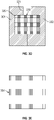
- FIGS. 3A -3F With reference to FIGS. 3A -3F, the core forming methods of FIGS. 1 and 2 will be illustrated in further detail.
- FIGS. 3A -3F show mirrored components, this is not required and that other configurations are possible. Indeed, since the core forming methods described herein are intended to form complex ceramic cores, in particular, the components shown in FIGS. 3A -3F are not going to be mirrors of one another in actuality and are presented as such only for clarity and brevity.
- first and second mold parts 301 and 302 are formed of WSP from first and second master tools 303 and 304, respectively.
- the first and second master tools 303 and 304 each have two components (not shown in FIG. 3A ).
- each of the first and second master tools 303 and 304 has two sides, one that forms the part shape and one that forms the side that mates to the injection frame.
- the first and second mold parts 301 each include a bond area 305 and a part forming area 306.
- the bond area 305 can generally surround the part forming area 306 of each of the first and second mold parts 301 and 302, except to the extent that the part forming areas 306 can be configured to define ribs 307 that will contribute to the formation of distinct holes in the ceramic core being investment casted. In these cases, the bond areas 305 can also be provided at the edges of the ribs 307.
- the bond areas 305 of each of the first and second mold parts 301 and 302 are moistened by, for example, exposing the bond areas 305 to hot or cold water vapor.
- the bond areas 305 of each of the first and second mold parts 301 and 302, which surround the part forming areas 306 (see FIG. 3A ) and which are provided at the edges of the ribs 307, are easily bondable to one another in a manner that does not lead to flash formation in particular.
- the first and second mold parts 301 and 302 are aligned with each other and brought together such that the bond areas 305 are bonded.
- the first and second mold parts 301 and 302 are aligned by self-alignment or by disposition in an injection frame.
- the part forming areas 306 (see FIG. 3A ) cooperatively form a cavity 310.
- This cavity 310 is shaped as a negative of the shape of the ceramic core being investment casted.
- the cavity 310 can have a relatively complex geometry that corresponds negatively to the relatively complex geometry of the ceramic core being investment casted.
- slurry 320 such as non-aqueous slurry, which is non-reactive with the WSP of the first and second mold parts 301 and 302 is injected into the cavity 310 through injection opening 321.
- the slurry 320 can include epoxy and one or more of ceramic and metallic particles mixed therein.
- the injection of the slurry 320 can be preceded by an injection of the coating to coat the interior surfaces of the part forming areas 306 (see FIG. 3A ) of each of the first and second mold parts 301 and 302.
- the coating isolates the slurry 320 from the WSP of the first and second mold parts 301 and 302, the slurry 320 can be a non-aqueous slurry or an aqueous slurry.
- the slurry 320 As shown in FIG. 3E , once the slurry 320 is cured, it forms the ceramic core 330. At this point, the WSP of the first and second mold parts 301 and 302 is removed to reveal the ceramic core 330.
- a core forming method that involves the use of WSP to form a core.
- the WSP is more rigid than other fugitive materials commonly used in core forming and is compatible with the slurry.
- WSP is bondable to WSP when moistened, the core forming method can be executed without the formation of flash.
- advantages of WSP over current systems lies in the rigidity of WSP versus flexible silicone rubber and wax that may be used to form complex parts.
- most core production involves the formation of a complex core by injection of individual sub-component parts in hard tools and then a bonding of those parts together if necessary, to form the desired complex shape.
- a ceramic slurry is cast around a wax fugitive which is melted out to create a "monolithic multiwall" part.
- WSP is more rigid, allowing higher injection pressures and temperatures; WSP can hold tighter dimensional repeatability; and WSP can be bonded to itself to eliminate flash using no additional bonding agent.
Landscapes
- Engineering & Computer Science (AREA)
- Mechanical Engineering (AREA)
- Chemical & Material Sciences (AREA)
- Materials Engineering (AREA)
- Molds, Cores, And Manufacturing Methods Thereof (AREA)
Applications Claiming Priority (1)
| Application Number | Priority Date | Filing Date | Title |
|---|---|---|---|
| US17/217,490 US11571738B2 (en) | 2021-03-30 | 2021-03-30 | Water soluble polymer for core forming |
Publications (1)
| Publication Number | Publication Date |
|---|---|
| EP4066960A1 true EP4066960A1 (fr) | 2022-10-05 |
Family
ID=80683765
Family Applications (1)
| Application Number | Title | Priority Date | Filing Date |
|---|---|---|---|
| EP22160763.3A Pending EP4066960A1 (fr) | 2021-03-30 | 2022-03-08 | Polymère soluble dans l'eau pour la formation de noyau |
Country Status (2)
| Country | Link |
|---|---|
| US (1) | US11571738B2 (fr) |
| EP (1) | EP4066960A1 (fr) |
Families Citing this family (1)
| Publication number | Priority date | Publication date | Assignee | Title |
|---|---|---|---|---|
| CN116285176B (zh) * | 2023-02-03 | 2025-09-19 | 厦门九牧研发有限公司 | 一种高强速溶模芯材料及其制备的模芯 |
Citations (2)
| Publication number | Priority date | Publication date | Assignee | Title |
|---|---|---|---|---|
| US3762987A (en) * | 1967-06-20 | 1973-10-02 | Kao Corp | Water solubilized polyvinyl adhesive method |
| US20200062877A1 (en) * | 2017-02-22 | 2020-02-27 | Ioana Knopf | Curable and Solvent Soluble Formulations and Methods of Making and Using Therof |
Family Cites Families (4)
| Publication number | Priority date | Publication date | Assignee | Title |
|---|---|---|---|---|
| CN102827445B (zh) * | 2012-08-21 | 2015-01-14 | 中国航天科工集团第六研究院41所 | 一种纤维缠绕壳体成型用水溶性芯模及制备方法 |
| US20160023375A1 (en) | 2013-05-17 | 2016-01-28 | Core Cast, Llc | Slip mixture for 3d printed molds and 3d printing ceramic material |
| CN104493081B (zh) * | 2014-12-09 | 2016-07-06 | 南京航空航天大学 | 用于空心涡轮叶片熔模铸造的注蜡模具及其快速制造方法 |
| CA3106541A1 (fr) | 2018-07-18 | 2020-01-23 | Poly6 Technologies, Inc. | Articles et procedes de fabrication |
-
2021
- 2021-03-30 US US17/217,490 patent/US11571738B2/en active Active
-
2022
- 2022-03-08 EP EP22160763.3A patent/EP4066960A1/fr active Pending
Patent Citations (2)
| Publication number | Priority date | Publication date | Assignee | Title |
|---|---|---|---|---|
| US3762987A (en) * | 1967-06-20 | 1973-10-02 | Kao Corp | Water solubilized polyvinyl adhesive method |
| US20200062877A1 (en) * | 2017-02-22 | 2020-02-27 | Ioana Knopf | Curable and Solvent Soluble Formulations and Methods of Making and Using Therof |
Also Published As
| Publication number | Publication date |
|---|---|
| US11571738B2 (en) | 2023-02-07 |
| US20220314306A1 (en) | 2022-10-06 |
Similar Documents
| Publication | Publication Date | Title |
|---|---|---|
| CN102753284B (zh) | 用于中空部件的熔模铸造过程 | |
| EP1495820B1 (fr) | Procédé de coulée de précision | |
| JP5318372B2 (ja) | 金属複合材発泡体構成部品を製造する方法及び金属複合材構成部品のためのプリフォーム | |
| US10807153B2 (en) | Method of manufacturing advanced features in a core for casting | |
| US9835035B2 (en) | Cast-in cooling features especially for turbine airfoils | |
| EP3381585B1 (fr) | Appareil et procédé de fabrication de passages à parois multiples dans des composants | |
| CA2958128C (fr) | Fonte de composantes metalliques et de couches pelliculaires metalliques | |
| CN103567384B (zh) | 制造转子的方法 | |
| EP3381582B1 (fr) | Procédé de fabrication de passages internes complexes dans des aubes de turbine | |
| CN109128020B (zh) | 用于制造多孔陶瓷立体光刻的树脂及其使用方法 | |
| CN102413969B (zh) | 包括多个安装在平台中的叶片的组件的制造方法 | |
| US20050258577A1 (en) | Method of producing unitary multi-element ceramic casting cores and integral core/shell system | |
| EP4066960A1 (fr) | Polymère soluble dans l'eau pour la formation de noyau | |
| CN107127346A (zh) | 使用热等静压围绕第一金属构件形成第二金属构件的铸造 | |
| CN107000246A (zh) | 制造陶瓷涡轮叶片的工艺 | |
| Kietzman et al. | Layered manufacturing material issues for SDM of polymers and ceramics | |
| EP3431206B1 (fr) | Appareil et procédé de fabrication de noyau de coulée de précision | |
| EP3433036B1 (fr) | Procédé de fabrication d'un noyau hybridé avec un moulage en saillie dans des caractéristiques de refroidissement pour un moulage d'investissement |
Legal Events
| Date | Code | Title | Description |
|---|---|---|---|
| PUAI | Public reference made under article 153(3) epc to a published international application that has entered the european phase |
Free format text: ORIGINAL CODE: 0009012 |
|
| STAA | Information on the status of an ep patent application or granted ep patent |
Free format text: STATUS: THE APPLICATION HAS BEEN PUBLISHED |
|
| AK | Designated contracting states |
Kind code of ref document: A1 Designated state(s): AL AT BE BG CH CY CZ DE DK EE ES FI FR GB GR HR HU IE IS IT LI LT LU LV MC MK MT NL NO PL PT RO RS SE SI SK SM TR |
|
| STAA | Information on the status of an ep patent application or granted ep patent |
Free format text: STATUS: REQUEST FOR EXAMINATION WAS MADE |
|
| 17P | Request for examination filed |
Effective date: 20230331 |
|
| RBV | Designated contracting states (corrected) |
Designated state(s): AL AT BE BG CH CY CZ DE DK EE ES FI FR GB GR HR HU IE IS IT LI LT LU LV MC MK MT NL NO PL PT RO RS SE SI SK SM TR |
|
| RAP3 | Party data changed (applicant data changed or rights of an application transferred) |
Owner name: RTX CORPORATION |