EP4092679A1 - Seuil de fréquence d'allèle variable - Google Patents
Seuil de fréquence d'allèle variable Download PDFInfo
- Publication number
- EP4092679A1 EP4092679A1 EP21174919.7A EP21174919A EP4092679A1 EP 4092679 A1 EP4092679 A1 EP 4092679A1 EP 21174919 A EP21174919 A EP 21174919A EP 4092679 A1 EP4092679 A1 EP 4092679A1
- Authority
- EP
- European Patent Office
- Prior art keywords
- allele frequency
- data
- observed
- driven model
- thresholds
- Prior art date
- Legal status (The legal status is an assumption and is not a legal conclusion. Google has not performed a legal analysis and makes no representation as to the accuracy of the status listed.)
- Withdrawn
Links
Images


Classifications
-
- G—PHYSICS
- G16—INFORMATION AND COMMUNICATION TECHNOLOGY [ICT] SPECIALLY ADAPTED FOR SPECIFIC APPLICATION FIELDS
- G16B—BIOINFORMATICS, i.e. INFORMATION AND COMMUNICATION TECHNOLOGY [ICT] SPECIALLY ADAPTED FOR GENETIC OR PROTEIN-RELATED DATA PROCESSING IN COMPUTATIONAL MOLECULAR BIOLOGY
- G16B20/00—ICT specially adapted for functional genomics or proteomics, e.g. genotype-phenotype associations
- G16B20/20—Allele or variant detection, e.g. single nucleotide polymorphism [SNP] detection
-
- G—PHYSICS
- G16—INFORMATION AND COMMUNICATION TECHNOLOGY [ICT] SPECIALLY ADAPTED FOR SPECIFIC APPLICATION FIELDS
- G16B—BIOINFORMATICS, i.e. INFORMATION AND COMMUNICATION TECHNOLOGY [ICT] SPECIALLY ADAPTED FOR GENETIC OR PROTEIN-RELATED DATA PROCESSING IN COMPUTATIONAL MOLECULAR BIOLOGY
- G16B40/00—ICT specially adapted for biostatistics; ICT specially adapted for bioinformatics-related machine learning or data mining, e.g. knowledge discovery or pattern finding
- G16B40/20—Supervised data analysis
-
- G—PHYSICS
- G16—INFORMATION AND COMMUNICATION TECHNOLOGY [ICT] SPECIALLY ADAPTED FOR SPECIFIC APPLICATION FIELDS
- G16H—HEALTHCARE INFORMATICS, i.e. INFORMATION AND COMMUNICATION TECHNOLOGY [ICT] SPECIALLY ADAPTED FOR THE HANDLING OR PROCESSING OF MEDICAL OR HEALTHCARE DATA
- G16H20/00—ICT specially adapted for therapies or health-improving plans, e.g. for handling prescriptions, for steering therapy or for monitoring patient compliance
-
- G—PHYSICS
- G16—INFORMATION AND COMMUNICATION TECHNOLOGY [ICT] SPECIALLY ADAPTED FOR SPECIFIC APPLICATION FIELDS
- G16H—HEALTHCARE INFORMATICS, i.e. INFORMATION AND COMMUNICATION TECHNOLOGY [ICT] SPECIALLY ADAPTED FOR THE HANDLING OR PROCESSING OF MEDICAL OR HEALTHCARE DATA
- G16H50/00—ICT specially adapted for medical diagnosis, medical simulation or medical data mining; ICT specially adapted for detecting, monitoring or modelling epidemics or pandemics
- G16H50/20—ICT specially adapted for medical diagnosis, medical simulation or medical data mining; ICT specially adapted for detecting, monitoring or modelling epidemics or pandemics for computer-aided diagnosis, e.g. based on medical expert systems
-
- G—PHYSICS
- G16—INFORMATION AND COMMUNICATION TECHNOLOGY [ICT] SPECIALLY ADAPTED FOR SPECIFIC APPLICATION FIELDS
- G16H—HEALTHCARE INFORMATICS, i.e. INFORMATION AND COMMUNICATION TECHNOLOGY [ICT] SPECIALLY ADAPTED FOR THE HANDLING OR PROCESSING OF MEDICAL OR HEALTHCARE DATA
- G16H50/00—ICT specially adapted for medical diagnosis, medical simulation or medical data mining; ICT specially adapted for detecting, monitoring or modelling epidemics or pandemics
- G16H50/70—ICT specially adapted for medical diagnosis, medical simulation or medical data mining; ICT specially adapted for detecting, monitoring or modelling epidemics or pandemics for mining of medical data, e.g. analysing previous cases of other patients
Definitions
- the present invention relates to monitoring a patient's response to a cancer therapy, and in particular to an apparatus and a method for setting an allele frequency threshold, a computer program element, and a computer readable medium.
- Monitoring therapy response of a cancer patient may be done by analysing patient's samples, such as a liquid biopsy, and following the occurrence of specific mutations over time during treatment.
- a graph of circulating tumour DNA (ct-DNA) data over time may be very informative when studying the effect of a therapy, particularly when combined with other parameters.
- an apparatus for determining an allele frequency threshold comprises an input module and a processing module.
- the input module is configured to receive allele frequency data that comprises a plurality of observed variants in a nucleic acid sample of a patient and an allele frequency of each of the plurality of observed variants over time.
- the processing module configured to set at least two different allele frequency thresholds for the plurality of observed variants, each allele frequency threshold being set for respective one or more observed variants selected from the plurality of observed variants for selecting alleles that have an allele frequency higher than the respective allele frequency threshold.
- a single generic allele frequency threshold does not take into account differences between genes and single nucleotide polymorphisms (SNPs). For example, for one specific SNP, a certain allele frequency threshold of 0.4 % might be very high, whereas for another SNP this threshold might be low.
- the present disclosure proposes using multiple allele frequency thresholds to account for differences between genes and/or SNPs.
- two different allele frequency thresholds may be set, e.g. a first allele frequency threshold of 0.3% for one specific SNP and a second allele frequency threshold of 0.5% for another SNP.
- the multiple allele frequency thresholds may provide significant value to improve personalized therapy selection (including the use of combination therapies), disease surveillance, and monitoring to improve patient outcomes.
- the at least two allele frequency thresholds may be set in various ways.
- the at least two allele frequency thresholds may be set on a per observed variant basis. For example, if there are five observed variants, five different allele frequency thresholds may be set. Each allele frequency threshold is associated with a respective observed variant.
- the at least two allele frequency thresholds may not be set on a per observed variant basis. Also taking as an example five observed variants, it may be considered to set two different thresholds. For example, a first allele frequency threshold may be set for three observed variants, whilst a second allele frequency threshold may be set for the remaining two observed variants.
- the at least two allele frequency thresholds may be previously calculated based on empirical data from previous studies, and may optionally be optimized using machine learning techniques on a set of data fields from, for example, clinical data, imaging data, and/or digital pathology data.
- the maximum number of the allele frequency thresholds to be set is equal to the number of observed variants, if the allele frequency thresholds are set on a per observed variant basis. Therefore, if there are five observed variants, the number of the allele frequency thresholds may range between 2 and 5 such as 2, 3, 4 and 5. This will be explained in detail hereinafter and in particular with respect to the example shown in Fig. 1 .
- variants refer to genetic sequences that are different from a wild type or control sequence.
- the plurality of observed variants comprise at least two variants from the same gene.
- the plurality of observed variants comprise at least two variants from different genes.
- the plurality of observed variants comprise at least two different types of variants, such as SNP mutations and epigenetic mutations.
- the plurality of observed variants comprise variants of the same type, such SNP mutations.
- the plurality of observed variants comprise at least two different types of mutations selected from a group comprising a SNP mutation, an epigenetic mutation, and a copy number variation (CNV).
- the processing module is configured to set the at least two different allele frequency thresholds differently between the at least two different mutations.
- Another problem of a single generic allele frequency threshold is that this threshold does not take into account differences between different types of mutations, e.g. between SNPs and epigenetic mutations (also referred to as methylation).
- Methylation which is so-called epigenetic change, and CNVs play the role of mutation such as SNPs.
- the allele frequency is the frequency at which they occur with respect to the wild-type gene. So a patient have an epigenetic changes (i.e. methylation) at some base in the gene (e.g. in the cancer) tissue where the normal tissue does not have this methylation (or vice versa).
- the allele frequency can be calculated by comparing the number of duplications, which is higher in tumour tissue than in normal tissue.
- the allele frequency thresholds between different types of mutations may be different.
- the present disclosure proposes setting allele frequency thresholds differently between different types of mutations. For example, if the plurality of observed variants comprises SNP mutations and epigenetic mutations, two different allele frequency thresholds may be set, including one threshold for SNP mutations and one different threshold for epigenetic mutations.
- the processing module is configured to provide the received allele frequency data to a data-driven model to determine the at least two allele frequency thresholds on a per observed variant basis.
- the data-driven model has been trained based on a training dataset comprising data samples obtained from a plurality of patients to learn a correlation between an allele frequency threshold on a per observed variant basis and or a response to a selection of one or more treatments.
- the data-driven model may be a neural network, a support vector machine, a decision tree, or the like.
- the training dataset may comprise pre-treatment data including allele frequencies of given mutations at pre-treatment.
- the training dataset may also comprise post-treatment data, which may include genomics data indicative of a reduction in tumour DNA, image data indicative of a reduction in tumour size, and/or pathology data indicative of residual mass after resection.
- the data-driven model may vary an allele frequency threshold of a given mutation (or given mutations) and select only these patients in the dataset for which the measured allele frequency lies above the threshold. Then the average of the outcome variable may be calculated.
- the allele frequency threshold which gives a desirable treatment outcome (e.g. the largest reduction in tumour DNA and/or tumour size), may then be stored.
- the processing module is further configured to apply the data-driven model to a group of observed variants to determine a respective allele frequency threshold for each observed variant in the group.
- the data-driven model has further been trained to learn a correlation between a group of allele frequency thresholds on a per observed variant basis and a desirable treatment outcome given by a selection of one or more treatments.
- the data-driven model may be used for any combination of SNPs (e.g. individual mutations).
- the data-driven model may be used for any combination of SNPs from the same gene, e.g. KRAS - c.34_35FF>TT - p.G12F, KRAS - c.34_35GG>CT > p.G12L, KRAS - c.35_36GT>TC - p.G12V, and KRAS - c.34G>T -p.G12C.
- the data-driven model may be used for any combination of SNPs from different genes, e.g. KRAS - c.34_35GG>TT - p.G12F, NRAS - c.34_35GG>CC - p.G12P, BRAF - c.1406G>C - p.G469A, and PIK3CA - c.1624G>A - p.E542K.
- the data-driven model may then calculate what optimal allele frequency threshold for each of these SNPs together gives the optimal outcome.
- the training dataset comprises post-treatment data including at least one of genomics data indicative of a reduction in tumour DNA, image data indicative of a reduction in tumour size, and pathology data indicative of residual mass after resection.
- the post-treatment data is used for determining a treatment outcome.
- the outcome may be measured by a reduction in the tumour DNA (e.g. measured by the reduction in the allele frequencies), a reduction in tumour size (as determined from imaging), and/or other parameters (such as residual mass after resection), after treatment.
- the genomics data may comprise one or more of SNPs, methylations, and copy number variations (CNVs).
- the input module is further configured to receive clinical data comprising information about the patient.
- the processing module is further configured to provide the received clinical data to the data-driven model to determine the at least two allele frequency thresholds.
- the training dataset further comprises information about the plurality of patients for training the data-driven model to determine the at least two allele frequency thresholds on a per patient basis.
- the inventors of the present disclosure have also found that a further problem of the generic allele frequency threshold is that this threshold does not take into account differences between patients. For example, for a patient with a very large tumour, the allele frequency threshold might be different than for a patient with a very small tumour.
- the present disclosure further proposes training the data-driven model on a cohort of similar patients in terms of age, gender, cancer type, tumour size, etc.
- the trained data-driven model may be used to calculate patient-specific thresholds, which may be beneficial for creating personalized diagnosis and therapy to enable a tailor-made treatment for each patient.
- imaging data of the tumour may be used to decide on what threshold to use for that specific patient.
- the information from the patient may comprise a class of the patient, which may be defined to which cancer-type the patient's disease belongs e.g. a certain type of breast cancer. There are such molecular subgroups in breast cancer such as HER2+ or triple neg.
- the allele frequency threshold also takes into account differences between diseases, e.g. between similar mutation (EGFR) in lung and colon cancer and is thus disease-specific.
- the data-driven model comprises a neural network, preferably a Deep Neural Network.
- the processing module is further configured to select, from a plurality of available treatments, one or more treatments that give a desirable treatment outcome based on the at least two allele frequency thresholds.
- the multiple allele frequency thresholds may provide significant value to improve therapy selection, disease surveillance, and monitoring.
- a computer-implemented method for determining an allele frequency threshold comprises:
- the plurality of observed variants comprise at least two different types of mutations selected from a group comprising a SNP mutation, an epigenetic mutation, and a copy number variation (CNV).
- Step b) further comprises the step of setting the at least two different allele frequency thresholds differently between the at least two different mutations.
- step b) further comprises providing the received allele frequency data to a data-driven model to determine the at least two allele frequency thresholds on a per observed variant basis.
- the data-driven model has been trained based on a training dataset comprising data samples obtained from a plurality of patients to learn a correlation between an allele frequency threshold on a per observed variant basis and a desirable treatment outcome given by a selection of one or more treatments.
- step b) further comprises applying the data-driven model to a group of observed variants to determine a respective allele frequency threshold for each observed variant in the group.
- the data-driven model has further been trained to learn a correlation between a group of allele frequency thresholds on a per observed variant basis and a desirable treatment outcome given by a selection of one or more treatments.
- step a) further comprises receiving clinical data comprising information about the patient.
- step b) further comprises providing the received clinical data to the data-driven model to determine the at least two allele frequency thresholds.
- the training dataset further comprises information about the plurality of patients for training the data-driven model to determine the at least two allele frequency thresholds on a per patient basis.
- a computer program product comprising instructions which, when executed by at least one processing unit, cause the at least one processing unit to perform the steps of the method according to the second aspect and any associated example.
- a computer readable medium having stored the program element.
- the data-driven model refers to a trained mathematical model that is parametrized according to a training dataset to reflect a correlation between an allele frequency threshold on a per observed variant basis and a desirable treatment outcome given by a selection of one or more treatments.
- the data-driven model may comprise a data-driven machine learning model.
- machine learning may refer to a statistical method that enables machines to "learn” tasks from data without explicitly programming.
- Machine learning techniques may comprise "traditional machine learning" - the workflow in which one manually selects features and then trains the model. Examples of traditional machine learning techniques may include decision trees, support vector machines, and ensemble methods.
- the data-driven model may comprise a data-driven deep learning model.
- Deep learning is a subset of machine learning modelled loosely on the neural pathways of the human brain. Deep refers to the multiple layers between the input and output layers. In deep learning, the algorithm automatically learns what features are useful. Examples of deep learning techniques may include convolutional neural networks (CNNs) and deep Q networks.
- CNNs convolutional neural networks
- deep Q networks deep Q networks.
- Fig. 1 illustrates a flow diagram of a computer-implemented method 200 for setting an allele frequency threshold.
- step 210 allele frequency data is received.
- the allele frequency data comprises a plurality of observed variants in a nucleic acid sample of a patient and an allele frequency of each of the plurality of observed variants over time.
- the allele frequency data may have been obtained based on an analysis of a biomarker in a patient sample and stored in a dataset.
- the patient sample may comprise, e.g. a tissue sample, a body fluid, a cell sample, or a stool sample.
- the patient sample may comprise a body fluid, such as whole blood, saliva, tears, sweat, sputum, or urine.
- a portion of the whole blood such as blood plasma which contains the cell free nucleic acid is used.
- the patient sample is a tissue sample, such as a formalin-fixed parafin-embedded (FFPE) tissue sample, a fresh frozen (FF) tissue sample, or a combination thereof.
- FFPE formalin-fixed parafin-embedded
- tumours may release multiple biomarkers in the bloodstream, such as ct-DNA, circulating tumour cells (CTCs), exosomes, and platelets.
- ct-DNA originates from dying tumour cells. CTCs are shed into the bloodstream from primary tumours and metastases. Exosomes are cell-derived vesicles containing tumour messenger RNA (mRNA), microRNA (miRNA), protein, and doublestranded DNA (dsDNA). Platelets are reported to pick up tumour RNA in circulation.
- mRNA tumour messenger RNA
- miRNA microRNA
- dsDNA doublestranded DNA
- Platelets are reported to pick up tumour RNA in circulation.
- ct-DNA and CTCs may be clinically the most relevant biomarkers used to monitor therapy response. Of these, ct-DNA may be commonly used, as CTCs may occur at low count (e.g., less than 10) in most cancer patients unless they have metastatic disease.
- breast cancer is a very heterogeneous disease with a wide range of genetic changes that may occur, yet all with a limited frequency among the patient population, e.g., at 15% or less.
- Table 1 shows the frequency that certain genes (left column) are mutated (right column) in a general population of women having breast cancer. The middle column gives how many studies in the scientific literature have reported on this mutation from which the frequency was derived.
- Each of the plurality of observed variants is longitudinally tracked through time at a plurality of time points.
- the plurality of time points may comprise a first time point (or more time points) before a treatment and a second time point (or more time points) after the treatment.
- the treatment could be cytostatic drugs, a targeted drug therapy or radiation therapy or any combination of these.
- step 220 i.e. step b
- at least two different allele frequency thresholds are set for the plurality of observed variants.
- Each allele frequency threshold is set for respective one or more observed variants selected from the plurality of observed variants for selecting alleles that have an allele frequency higher than the respective allele frequency threshold.
- multiple allele frequency thresholds are introduced to account for differences between e.g. genes and/or SNPs.
- the multiple allele frequency thresholds are set differently between different mutations in a single patient.
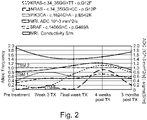
- Fig. 2 shows an exemplary graph displaying allele frequencies of four observed variants and MR parameters on five different time points.
- the horizontal TSM (Therapy Selection Module) line is an allele frequency threshold that can be used to select specific alleles that have a frequency higher than that threshold.
- the allele frequency threshold TSM1 may be set for two observed variants (e.g. KRAS - c.34_35GG>TT - p.G12F and NRAS - c.34_35GG>CC - p.G12P), whilst the allele frequency threshold TSM2 may be set for the remaining two observed variants (e.g. BRAF - c. 1406G>C - p.G469A, and PIK3CA - c.1624G>A - p.E542K).
- two observed variants e.g. KRAS - c.34_35GG>TT - p.G12F and NRAS - c.34_35GG>CC - p.G12P
- the allele frequency threshold TSM2 may be set for the remaining two observed variants (e.g. BRAF - c. 1406G>C - p.G469A, and PIK3CA - c
- the allele frequency threshold TSM1 may be set for three observed variants (e.g. KRAS - c.34_35GG>TT - p.G12F, NRAS - c.34_35GG>CC - p.G12P, and BRAF - c. 1406G>C - p.G469A), whilst a second allele frequency threshold may be set for the remaining one observed variant (e.g. PIK3CA - c. 1624G>A - p.E542K).
- a first allele frequency threshold may be set for one observed variant; a second allele frequency threshold may be set for two observed variants; and a third allele frequency threshold may be set for the remaining one observed variants.
- an allele frequency threshold on a per observed variant basis.
- four different allele frequency thresholds may be set.
- the at least two allele frequency thresholds may be displayed when a user input is received that selects 1) a certain patient and 2) a specific mutation (or several specific mutations).
- the two allele frequency thresholds TSM1 and TSM 2 are both displayed.
- the user may select one allele frequency threshold to display.
- the at least two different allele frequency thresholds may be previously calculated e.g. using empirical approaches. For example, empirical bottom-up analysis using allele frequency thresholds of e.g. 0.001%, 0.005%, 0.01%, 0.05%, and 0.1% may be adopted from a previous study.
- variable allele frequency threshold for pre-treatment data, which was previously calculated from another dataset, as the allele frequency threshold.
- machine learning techniques may be used on a wide range of data items derived from clinical data, genomics data, imaging data and/or digital pathology data.
- step b) may further comprise the step of providing the received allele frequency data to a data-driven model to determine the at least two allele frequency thresholds on a per observed variant basis.
- the data-driven model has been trained based on a training dataset comprising data samples obtained from a plurality of patients to learn a correlation between an allele frequency threshold on a per observed variant basis and a desirable treatment outcome given by a selection of one or more treatments.
- KRAS Kirsten Rat Sarcoma
- outcome may be measured using genomics data obtained from liquid biopsies, such as ct-DNA data, indicative of a reduction in tumour DNA.
- genomics data obtained from liquid biopsies, such as ct-DNA data
- other genomics data could be used, such as methylations or copy number variations (CNVs).
- outcome may be measured using image data indicative of a reduction in tumour size.
- the reduction in tumour size could be determined by any imaging type, such as magnetic resonance imaging (MRI), ultrasound imaging (US), positron emission tomography (PET), and/or computed tomography (CT).
- the image data may be obtained from the acquisition of e.g. magnetic resonance signals, or separately such as offline or in the Cloud.
- outcome may be measured using pathology data indicative of residual mass after resection.
- the machine learning algorithm may vary an allele frequency threshold of a given mutation (or given mutations) and select only these patients in the dataset for which the measured allele frequency lies above the threshold. Then the average of the outcome variable may be calculated.
- the allele frequency threshold which gives a desirable treatment outcome e.g. the largest reduction in tumour DNA and/or tumour size
- the machine learning algorithm may be used for any combination of SNPs (e.g. individual mutations).
- the machine learning algorithm is used for a combination of SNPs from the same gene.
- the machine learning algorithm may be used for a combination of SNPs from different genes.
- the following SNPs shown in Fig. 1 may be selected: KRAS ⁇ c .34 _ 35 GG > TT ⁇ p . G 12 F ; NRAS ⁇ c .34 _ 35 GG > CC ⁇ p . G 12 P ; BRAF ⁇ c .1406 G > C ⁇ p . G 469 A ; and PIK 3 CA ⁇ c .1624 G > A ⁇ p . E 542 K .
- step b) may further comprise applying the data-driven model to a group of observed variants (e.g. two combinations of SNPs described above) to determine a respective allele frequency threshold for each observed variant in the group.
- the data-driven model has further been trained to learn a correlation between a group of allele frequency thresholds on a per observed variant basis and a desirable treatment outcome given by a selection of one or more treatments.
- the machine learning algorithm may calculate what optimal allele frequency threshold for each of these observed variants in the group together gives the optimal outcome.
- the machine learning algorithm may also use the above-described approach, but vary values of the multiple allele frequency thresholds in the group and determine a combination of allele frequency threshold values that gives a desirable treatment outcome.
- multiple allele frequency thresholds may be introduced to account for differences between different types of mutations.
- the plurality of observed variants comprise at least two different types of mutations selected from a group comprising an SNP mutation, an epigenetic mutation, and a CNV.
- Step b) further comprises the step of setting the at least two different allele frequency thresholds differently between the at least two different mutations.
- the allele frequency thresholds for different types of mutations may be previously calculated based on empirical data from previous studies and may optionally be optimized using machine learning techniques as described above.
- step a) may further comprise the step of receiving clinical data comprising information about the patient.
- the clinical data may include imaging data of tumours.
- the information from the patient may comprise a class of the patient, which may be defined to which the patient belongs e.g. a certain type of breast cancer.
- information from the patient such as age, gender, race, ethnicity, family disease history, weight, body mass index, height, and prior and/or concurrent infections may also be brought into the data-driven model.
- Step b) may further comprise the step of providing the received clinical data to the data-driven model to determine the at least two allele frequency thresholds.
- the training dataset may further comprise information about the plurality of patients for training the data-driven model to determine the at least two allele frequency thresholds on a per patient basis.
- the data-driven model may be trained on a cohort of similar patients in terms of age, gender, cancer type, etc.
- the allele frequency thresholds may be set differently for patients with different tumour sizes, disease types, genders, ages, etc.
- a patient-specific threshold may be preferred for software related to Precision Medicine, as this field is all about creating personalized diagnosis and therapy to allow a tailor-made treatment for each patient.
- the computer-implemented method 100 may further comprise the step of selecting, from a plurality of available treatments, one or more treatments that give a desirable treatment outcome based on the at least two allele frequency thresholds.
- selecting, from a plurality of available treatments, one or more treatments that give a desirable treatment outcome based on the at least two allele frequency thresholds can inform personalized treatment selection, including the use of combination therapies, to improve patient outcomes.
- Fig. 3 schematically shows an apparatus 10 for setting an allele frequency threshold.
- the apparatus 10 comprises an input module 12 and a processing module 14.
- Each module may be part of, or include an Application Specific Integrated Circuit (ASIC), an electronic circuit, a processor (shared, dedicated, or group) and/or memory (shared, dedicated, or group) that execute one or more software or firmware programs, a combinational logical circuit, and/or other suitable components that provide the described functionality.
- ASIC Application Specific Integrated Circuit
- the input module 12 is configured to receive allele frequency data that comprises a plurality of observed variants in a nucleic acid sample of a patient and an allele frequency of each of the plurality of observed variants over time.
- the processing module 14 is configured to set at least two different allele frequency thresholds for the plurality of observed variants, each allele frequency threshold being set for respective one or more observed variants selected from the plurality of observed variants for selecting alleles that have an allele frequency higher than the respective allele frequency threshold.
- the number of the allele frequency thresholds may range between 2 and the number of the observed variants. For example, if there are nine observed variants, the number of the allele frequency thresholds may range between 2 and 9, such as 2, 3, 4, 5, 6, 7, 8 and 9.
- the apparatus 10 may further comprise an output unit 16 for outputting the results.
- the output unit 16 may comprise a display.
- the apparatus 10 may be configured to be carry out any one of the above-described method steps.
- the plurality of observed variants may comprise at least two different types of mutations selected from a group comprising a SNP mutation, an epigenetic mutation, and a CNV.
- the processing module may be configured to set the at least two different allele frequency thresholds differently between the at least two different mutations
- the allele frequency thresholds may be determined using machine learning approaches.
- the processing module 14 may be configured to provide the received allele frequency data to a data-driven model to determine the at least two allele frequency thresholds on a per observed variant basis.
- the data-driven model has been trained based on a training dataset comprising data samples obtained from a plurality of patients to learn a correlation between an allele frequency threshold on a per observed variant basis and or a response to a selection of one or more treatments.
- the training dataset may comprise pre-treatment data including allele frequencies of given mutations at pre-treatment.
- the training dataset may comprise post-treatment data including genomics data indicative of a reduction in tumour DNA, image data indicative of a reduction in tumour size, and/or pathology data indicative of residual mass after resection.
- the processing module 14 may be further configured to apply the data-driven model to a group of observed variants to determine a respective allele frequency threshold for each observed variant in the group.
- the data-driven model has further been trained to learn a correlation between a group of allele frequency thresholds on a per observed variant basis and a desirable treatment outcome given by a selection of one or more treatments.
- the input module 12 may be further configured to receive clinical data comprising information about the patient.
- the processing module 14 may be further configured to provide the received clinical data to the data-driven model to determine the at least two allele frequency thresholds.
- the training dataset may further comprise information about the plurality of patients for training the data-driven model to determine the at least two allele frequency thresholds on a per patient basis.
- Fig. 4 schematically shows a system 100 for monitoring a patient's response to a cancer therapy.
- the system 100 comprises an apparatus 10 as described above and a sample analysing device 20.
- the apparatus 10 may be any computing device, including desktop and laptop computers, smartphones, tablets, etc.
- the apparatus 10 may be a general-purpose device or a device with a dedicated unit of equipment suitable for providing the below-described functionality.
- the components of the apparatus 10 are shown as integrated in one single unit. However, in alternative examples, some or all components may be arranged as separate modules in a distributed architecture and connected in a suitable communication network.
- the apparatus 10 and its components may be arranged as dedicated field-programmable gate arrays (FPGAs) or as hardwired standalone chips.
- the apparatus 10 or some of its components may be resident in sample analysing device 20 running as software routines.
- the sample analysing device 20 is configured for analysing a patient sample to obtain allele frequency data of the patient to be output to the apparatus 10.
- the sample analysing device 20 may be sequencers, such as the HiSeq of Illumina or the IonTorrent of ThermoFisher.
- the sample analysing device 20 may be mass-spectrometry systems, such as the Agena Biosciences MassARRAY system.
- the sample analysing device 20 may be a digital droplet polymerase chain reaction (PCR) system, such as the Bio-Rad QX200 digital droplet PCR.
- the sample analysing device 20 may be a multiplex PCR system, such as the Biocartis Idylla platform.
- a computer program or a computer program element is provided that is characterized by being adapted to execute the method steps of the method according to one of the preceding embodiments, on an appropriate system.
- the computer program element might therefore be stored on a computer unit, which might also be part of an embodiment of the present invention.
- This computing unit may be adapted to perform or induce a performing of the steps of the method described above. Moreover, it may be adapted to operate the components of the above described apparatus.
- the computing unit can be adapted to operate automatically and/or to execute the orders of a user.
- a computer program may be loaded into a working memory of a data processor.
- the data processor may thus be equipped to carry out the method of the invention.
- This exemplary embodiment of the invention covers both, a computer program that right from the beginning uses the invention and a computer program that by means of an up-date turns an existing program into a program that uses the invention.
- the computer program element might be able to provide all necessary steps to fulfil the procedure of an exemplary embodiment of the method as described above.
- a computer readable medium such as a CD-ROM
- the computer readable medium has a computer program element stored on it which computer program element is described by the preceding section.
- a computer program may be stored and/or distributed on a suitable medium, such as an optical storage medium or a solid state medium supplied together with or as part of other hardware, but may also be distributed in other forms, such as via the internet or other wired or wireless telecommunication systems.
- a suitable medium such as an optical storage medium or a solid state medium supplied together with or as part of other hardware, but may also be distributed in other forms, such as via the internet or other wired or wireless telecommunication systems.
- the computer program may also be presented over a network like the World Wide Web and can be downloaded into the working memory of a data processor from such a network.
- a medium for making a computer program element available for downloading is provided, which computer program element is arranged to perform a method according to one of the previously described embodiments of the invention.
Landscapes
- Engineering & Computer Science (AREA)
- Health & Medical Sciences (AREA)
- Medical Informatics (AREA)
- Public Health (AREA)
- Data Mining & Analysis (AREA)
- General Health & Medical Sciences (AREA)
- Life Sciences & Earth Sciences (AREA)
- Physics & Mathematics (AREA)
- Epidemiology (AREA)
- Bioinformatics & Cheminformatics (AREA)
- Databases & Information Systems (AREA)
- Biomedical Technology (AREA)
- Primary Health Care (AREA)
- Biophysics (AREA)
- Evolutionary Biology (AREA)
- Biotechnology (AREA)
- Spectroscopy & Molecular Physics (AREA)
- Theoretical Computer Science (AREA)
- Bioinformatics & Computational Biology (AREA)
- Pathology (AREA)
- Proteomics, Peptides & Aminoacids (AREA)
- Computer Vision & Pattern Recognition (AREA)
- Bioethics (AREA)
- Molecular Biology (AREA)
- Evolutionary Computation (AREA)
- Genetics & Genomics (AREA)
- Software Systems (AREA)
- Analytical Chemistry (AREA)
- Artificial Intelligence (AREA)
- Chemical & Material Sciences (AREA)
- Measuring Or Testing Involving Enzymes Or Micro-Organisms (AREA)
Priority Applications (5)
| Application Number | Priority Date | Filing Date | Title |
|---|---|---|---|
| EP21174919.7A EP4092679A1 (fr) | 2021-05-20 | 2021-05-20 | Seuil de fréquence d'allèle variable |
| EP22727190.5A EP4341937A1 (fr) | 2021-05-20 | 2022-05-12 | Seuil de fréquence allélique variable |
| PCT/EP2022/062898 WO2022243149A1 (fr) | 2021-05-20 | 2022-05-12 | Seuil de fréquence allélique variable |
| CN202280036323.9A CN117355897A (zh) | 2021-05-20 | 2022-05-12 | 可变等位基因频率阈值 |
| US18/556,113 US20240185951A1 (en) | 2021-05-20 | 2022-05-12 | Variable allele frequency threshold |
Applications Claiming Priority (1)
| Application Number | Priority Date | Filing Date | Title |
|---|---|---|---|
| EP21174919.7A EP4092679A1 (fr) | 2021-05-20 | 2021-05-20 | Seuil de fréquence d'allèle variable |
Publications (1)
| Publication Number | Publication Date |
|---|---|
| EP4092679A1 true EP4092679A1 (fr) | 2022-11-23 |
Family
ID=76034492
Family Applications (2)
| Application Number | Title | Priority Date | Filing Date |
|---|---|---|---|
| EP21174919.7A Withdrawn EP4092679A1 (fr) | 2021-05-20 | 2021-05-20 | Seuil de fréquence d'allèle variable |
| EP22727190.5A Pending EP4341937A1 (fr) | 2021-05-20 | 2022-05-12 | Seuil de fréquence allélique variable |
Family Applications After (1)
| Application Number | Title | Priority Date | Filing Date |
|---|---|---|---|
| EP22727190.5A Pending EP4341937A1 (fr) | 2021-05-20 | 2022-05-12 | Seuil de fréquence allélique variable |
Country Status (4)
| Country | Link |
|---|---|
| US (1) | US20240185951A1 (fr) |
| EP (2) | EP4092679A1 (fr) |
| CN (1) | CN117355897A (fr) |
| WO (1) | WO2022243149A1 (fr) |
Citations (1)
| Publication number | Priority date | Publication date | Assignee | Title |
|---|---|---|---|---|
| WO2020051529A1 (fr) * | 2018-09-07 | 2020-03-12 | Sequenom, Inc. | Procédés et systèmes pour détecter un rejet de greffe |
Family Cites Families (1)
| Publication number | Priority date | Publication date | Assignee | Title |
|---|---|---|---|---|
| CA3090426A1 (fr) * | 2018-04-14 | 2019-10-17 | Natera, Inc. | Procedes de detection et de surveillance du cancer au moyen d'une detection personnalisee d'adn tumoral circulant |
-
2021
- 2021-05-20 EP EP21174919.7A patent/EP4092679A1/fr not_active Withdrawn
-
2022
- 2022-05-12 CN CN202280036323.9A patent/CN117355897A/zh active Pending
- 2022-05-12 US US18/556,113 patent/US20240185951A1/en active Pending
- 2022-05-12 EP EP22727190.5A patent/EP4341937A1/fr active Pending
- 2022-05-12 WO PCT/EP2022/062898 patent/WO2022243149A1/fr not_active Ceased
Patent Citations (1)
| Publication number | Priority date | Publication date | Assignee | Title |
|---|---|---|---|---|
| WO2020051529A1 (fr) * | 2018-09-07 | 2020-03-12 | Sequenom, Inc. | Procédés et systèmes pour détecter un rejet de greffe |
Non-Patent Citations (3)
| Title |
|---|
| ALKES L. PRICE ET AL: "Pooled Association Tests for Rare Variants in Exon-Resequencing Studies", THE AMERICAN JOURNAL OF HUMAN GENETICS, vol. 86, no. 6, 11 June 2010 (2010-06-11), US, pages 832 - 838, XP055464451, ISSN: 0002-9297, DOI: 10.1016/j.ajhg.2010.04.005 * |
| GIANG NGUYEN ET AL.: "Machine Learning and Deep Learning frameworks and libraries for large-scale data mining: a survey", ARTIFICIAL INTELLIGENCE REVIEW, vol. 52, June 2019 (2019-06-01), pages 77 - 124, XP036788201, DOI: 10.1007/s10462-018-09679-z |
| SHEARER A. ELIOT ET AL: "Utilizing Ethnic-Specific Differences in Minor Allele Frequency to Recategorize Reported Pathogenic Deafness Variants", THE AMERICAN JOURNAL OF HUMAN GENETICS, vol. 95, no. 4, 2 October 2014 (2014-10-02), US, pages 445 - 453, XP055855985, ISSN: 0002-9297, DOI: 10.1016/j.ajhg.2014.09.001 * |
Also Published As
| Publication number | Publication date |
|---|---|
| WO2022243149A1 (fr) | 2022-11-24 |
| EP4341937A1 (fr) | 2024-03-27 |
| CN117355897A (zh) | 2024-01-05 |
| US20240185951A1 (en) | 2024-06-06 |
Similar Documents
| Publication | Publication Date | Title |
|---|---|---|
| US11848107B2 (en) | Predicting likelihood and site of metastasis from patient records | |
| US11996202B2 (en) | Cancer evolution detection and diagnostic | |
| CN113930507A (zh) | 疾病的检测和治疗以及用于传送测试结果的系统和方法 | |
| US20250372224A1 (en) | Machine learning predictive models of treatment response | |
| Voigt et al. | Beyond tissue biopsy: a diagnostic framework to address tumor heterogeneity in lung cancer | |
| US20240105333A1 (en) | Method and apparatus for assessing patient's response to therapy | |
| US20240185951A1 (en) | Variable allele frequency threshold | |
| US20230230704A1 (en) | Methods and systems for providing molecular data based on ct images | |
| WO2024187092A1 (fr) | Classificateur hiérarchique de tumeurs par intelligence artificielle pour identifier le tissu d'origine et le type de tumeur | |
| US20260066047A1 (en) | Models and methods for predicting cell-surface protein expression | |
| KR102138517B1 (ko) | 췌장암 진단용 바이오마커의 추출 방법, 이를 위한 컴퓨팅 장치, 췌장암 진단용 바이오마커 및 이를 포함하는 췌장암 진단 장치 | |
| Scandino | Non-Invasive cancer detection: computational applications in liquid biopsy and radiomics | |
| KR20140077018A (ko) | 약 스크리닝을 수행하는 방법 및 장치 |
Legal Events
| Date | Code | Title | Description |
|---|---|---|---|
| PUAI | Public reference made under article 153(3) epc to a published international application that has entered the european phase |
Free format text: ORIGINAL CODE: 0009012 |
|
| STAA | Information on the status of an ep patent application or granted ep patent |
Free format text: STATUS: THE APPLICATION HAS BEEN PUBLISHED |
|
| AK | Designated contracting states |
Kind code of ref document: A1 Designated state(s): AL AT BE BG CH CY CZ DE DK EE ES FI FR GB GR HR HU IE IS IT LI LT LU LV MC MK MT NL NO PL PT RO RS SE SI SK SM TR |
|
| STAA | Information on the status of an ep patent application or granted ep patent |
Free format text: STATUS: THE APPLICATION IS DEEMED TO BE WITHDRAWN |
|
| 18D | Application deemed to be withdrawn |
Effective date: 20230524 |