EP4101646A1 - Composition de béton pour l'impression 3d - Google Patents
Composition de béton pour l'impression 3d Download PDFInfo
- Publication number
- EP4101646A1 EP4101646A1 EP21179062.1A EP21179062A EP4101646A1 EP 4101646 A1 EP4101646 A1 EP 4101646A1 EP 21179062 A EP21179062 A EP 21179062A EP 4101646 A1 EP4101646 A1 EP 4101646A1
- Authority
- EP
- European Patent Office
- Prior art keywords
- concrete composition
- cement
- concrete
- mixture
- cementitious mixture
- Prior art date
- Legal status (The legal status is an assumption and is not a legal conclusion. Google has not performed a legal analysis and makes no representation as to the accuracy of the status listed.)
- Withdrawn
Links
Images


Classifications
-
- B—PERFORMING OPERATIONS; TRANSPORTING
- B33—ADDITIVE MANUFACTURING TECHNOLOGY
- B33Y—ADDITIVE MANUFACTURING, i.e. MANUFACTURING OF THREE-DIMENSIONAL [3D] OBJECTS BY ADDITIVE DEPOSITION, ADDITIVE AGGLOMERATION OR ADDITIVE LAYERING, e.g. BY 3D PRINTING, STEREOLITHOGRAPHY OR SELECTIVE LASER SINTERING
- B33Y70/00—Materials specially adapted for additive manufacturing
-
- B—PERFORMING OPERATIONS; TRANSPORTING
- B33—ADDITIVE MANUFACTURING TECHNOLOGY
- B33Y—ADDITIVE MANUFACTURING, i.e. MANUFACTURING OF THREE-DIMENSIONAL [3D] OBJECTS BY ADDITIVE DEPOSITION, ADDITIVE AGGLOMERATION OR ADDITIVE LAYERING, e.g. BY 3D PRINTING, STEREOLITHOGRAPHY OR SELECTIVE LASER SINTERING
- B33Y80/00—Products made by additive manufacturing
-
- C—CHEMISTRY; METALLURGY
- C04—CEMENTS; CONCRETE; ARTIFICIAL STONE; CERAMICS; REFRACTORIES
- C04B—LIME, MAGNESIA; SLAG; CEMENTS; COMPOSITIONS THEREOF, e.g. MORTARS, CONCRETE OR LIKE BUILDING MATERIALS; ARTIFICIAL STONE; CERAMICS; REFRACTORIES; TREATMENT OF NATURAL STONE
- C04B28/00—Compositions of mortars, concrete or artificial stone, containing inorganic binders or the reaction product of an inorganic and an organic binder, e.g. polycarboxylate cements
- C04B28/02—Compositions of mortars, concrete or artificial stone, containing inorganic binders or the reaction product of an inorganic and an organic binder, e.g. polycarboxylate cements containing hydraulic cements other than calcium sulfates
- C04B28/04—Portland cements
-
- C—CHEMISTRY; METALLURGY
- C04—CEMENTS; CONCRETE; ARTIFICIAL STONE; CERAMICS; REFRACTORIES
- C04B—LIME, MAGNESIA; SLAG; CEMENTS; COMPOSITIONS THEREOF, e.g. MORTARS, CONCRETE OR LIKE BUILDING MATERIALS; ARTIFICIAL STONE; CERAMICS; REFRACTORIES; TREATMENT OF NATURAL STONE
- C04B28/00—Compositions of mortars, concrete or artificial stone, containing inorganic binders or the reaction product of an inorganic and an organic binder, e.g. polycarboxylate cements
- C04B28/02—Compositions of mortars, concrete or artificial stone, containing inorganic binders or the reaction product of an inorganic and an organic binder, e.g. polycarboxylate cements containing hydraulic cements other than calcium sulfates
- C04B28/06—Aluminous cements
-
- C—CHEMISTRY; METALLURGY
- C04—CEMENTS; CONCRETE; ARTIFICIAL STONE; CERAMICS; REFRACTORIES
- C04B—LIME, MAGNESIA; SLAG; CEMENTS; COMPOSITIONS THEREOF, e.g. MORTARS, CONCRETE OR LIKE BUILDING MATERIALS; ARTIFICIAL STONE; CERAMICS; REFRACTORIES; TREATMENT OF NATURAL STONE
- C04B28/00—Compositions of mortars, concrete or artificial stone, containing inorganic binders or the reaction product of an inorganic and an organic binder, e.g. polycarboxylate cements
- C04B28/02—Compositions of mortars, concrete or artificial stone, containing inorganic binders or the reaction product of an inorganic and an organic binder, e.g. polycarboxylate cements containing hydraulic cements other than calcium sulfates
- C04B28/06—Aluminous cements
- C04B28/065—Calcium aluminosulfate cements, e.g. cements hydrating into ettringite
-
- C—CHEMISTRY; METALLURGY
- C04—CEMENTS; CONCRETE; ARTIFICIAL STONE; CERAMICS; REFRACTORIES
- C04B—LIME, MAGNESIA; SLAG; CEMENTS; COMPOSITIONS THEREOF, e.g. MORTARS, CONCRETE OR LIKE BUILDING MATERIALS; ARTIFICIAL STONE; CERAMICS; REFRACTORIES; TREATMENT OF NATURAL STONE
- C04B2111/00—Mortars, concrete or artificial stone or mixtures to prepare them, characterised by specific function, property or use
- C04B2111/00034—Physico-chemical characteristics of the mixtures
- C04B2111/00181—Mixtures specially adapted for three-dimensional printing (3DP), stereo-lithography or prototyping
-
- C—CHEMISTRY; METALLURGY
- C04—CEMENTS; CONCRETE; ARTIFICIAL STONE; CERAMICS; REFRACTORIES
- C04B—LIME, MAGNESIA; SLAG; CEMENTS; COMPOSITIONS THEREOF, e.g. MORTARS, CONCRETE OR LIKE BUILDING MATERIALS; ARTIFICIAL STONE; CERAMICS; REFRACTORIES; TREATMENT OF NATURAL STONE
- C04B2111/00—Mortars, concrete or artificial stone or mixtures to prepare them, characterised by specific function, property or use
- C04B2111/10—Compositions or ingredients thereof characterised by the absence or the very low content of a specific material
-
- Y—GENERAL TAGGING OF NEW TECHNOLOGICAL DEVELOPMENTS; GENERAL TAGGING OF CROSS-SECTIONAL TECHNOLOGIES SPANNING OVER SEVERAL SECTIONS OF THE IPC; TECHNICAL SUBJECTS COVERED BY FORMER USPC CROSS-REFERENCE ART COLLECTIONS [XRACs] AND DIGESTS
- Y02—TECHNOLOGIES OR APPLICATIONS FOR MITIGATION OR ADAPTATION AGAINST CLIMATE CHANGE
- Y02W—CLIMATE CHANGE MITIGATION TECHNOLOGIES RELATED TO WASTEWATER TREATMENT OR WASTE MANAGEMENT
- Y02W30/00—Technologies for solid waste management
- Y02W30/50—Reuse, recycling or recovery technologies
- Y02W30/91—Use of waste materials as fillers for mortars or concrete
Definitions
- the present invention relates to a cementitious mixture and to a concrete composition from it which is printable with a 3D printer, and to its use for as well as to a method for the production of buildings and building elements by a 3D printing device.
- 3D printing has become an established technology for prototyping as well as for robotic production.
- EP 3 421 201 A1 and WO 2018/128791 A1 propose mixtures for 3D printing comprising cement or a hydraulic binder, filler, aggregates, admixtures, and water, wherein selection of the admixtures (called additives therein) and restricting aggregate size to ⁇ 2mm or ⁇ 1 mm, respectively, allows to print also complex forms.
- the compositions are mortars, not concretes.
- US 2019/0009428 A1 describes a specific cement for 3D printing of building elements and buildings, the problem of aggregate size is not discussed.
- a printable concrete can be obtained by designing the mixture with a specific proportion of hydraulic cement in such a way that the particle size distribution follows a Dinger-Funk distribution with an appropriate modulus qD-F, and tuning the amount of paste in order to simultaneously obtain a certain excess paste thickness.
- a cementitious mixture comprising a hydraulic cement, a filler, and aggregate with a maximum size above 2 mm, wherein the mixture has a 1973r-Funk particle size distribution modulus qD-F in the range from 0.20 to 0.30, a hydraulic cement content from 1 to 40 wt.-% with respect to the total dry mixture weight, and no clay or silica fume are contained.
- a concrete composition comprising a hydraulic cement, a filler, aggregate with a maximum size above 2 mm, and water, wherein the mixture has a 1973r-Funk particle size distribution modulus qD-F in the range from 0.20 to 0.30, an excess paste thickness in the range from 5 to 35 ⁇ m, a cement content from 1 to 40 wt.-% with respect to the total weight of dry components, and no clay or silica fume are contained.
- the object is solved by a use of the cement mixture or concrete composition for producing buildings and building elements by 3D printing as well as by a method for producing buildings and building elements by 3D printing of the cement mixture or concrete composition.
- the desired properties for a printable concrete composition or cement mixture to provide it by mixing with water can be obtained without the necessity of using special materials such as silica fumes, clays or organoclays and with aggregate sizes above 2 mm and above 4 mm.
- special materials such as silica fumes, clays or organoclays and with aggregate sizes above 2 mm and above 4 mm.
- the specific qD-F usually associated with easily flowable cementitious materials (such as self-flowing and self-leveling castables), surprisingly provides a concrete able to substantially retain its shape once a layer is extruded through a nozzle while it ensures a suitable extrudability in order to be efficiently delivered through the nozzle of the printer.
- aggregate designates a granular material, such as sand, gravel, crushed stone, crushed waste concrete, crushed iron blast-furnace slag, etc., used with a binder to produce for example concrete or mortar.
- Coarse aggregate designates the larger aggregate sizes with a D max greater than 2 or ⁇ 4 mm and a d min greater than or equal to 1 mm.
- 0 means particle sizes passing the smallest sieve used to determine particle size distribution (abbreviated PSD herein) of aggregate, as usual in the cement field, see ISO 19595. Typically, this corresponds to sizes below 0.063 mm.
- PSD particle size distribution
- filler More or less inert particles with a high fineness are designated fillers.
- Filler is defined by the standard EN 12620-1 as an aggregate, most of which passes a 0.063 mm sieve.
- supplementary cementitious materials abbreviated SCM
- SCM supplementary cementitious materials
- Latent hydraulic materials contain both calcium and silicium/aluminium so that they merely need an activation to hydrate within useful times.
- Pozzolans are characterized by high silicium and/or alumnium contents but typically have low or no calcium. Thus, they need combination with a source of calcium, e.g.
- SCMs portlandite formed by hydration of Portland Cement clinker, to form strength providing silcate-hydrates, aluminate-hydrates, and silicate-aluminate-hydrates.
- SCMs are ground granulated blast furnace slag, fly ash with high (class C) or low (class F) calcium content, natural pozzolans like volcanic ashes and glasses, calcined clay, trass, and silica fume.
- Hydraulic cement is a cement that sets and hardens by chemical reaction with water (hydration) and is capable of doing so under water. The hydration reactions result in the formation of a hard solid mass.
- the term hydraulic cement most often denotes a clinker ground with or without further components, but also mixtures like super sulphated cement, geopolymer binder, and hydraulic materials not obtained by sintering like a dicalcium silicate obtained by hydrothermal treatment and tempering/reactive grinding.
- Concrete is a composite material that comprises a mixture of hydraulic cement, aggregates, and water, with or without admixtures, additives, or other cementitious materials.
- Mortar is a mixture of hydraulic cement, water and fine aggregate.
- joint mortar may contain masonry cement, or may contain hydraulic cement with lime (and possibly other admixtures) to afford greater plasticity and workability than are attainable with standard Portland cement mortar.
- the combination of sufficient fluidity for 3D printing and necessary shape retention of the printed mass under self-weight as well as ability to withstand the load of subsequently printed layers is achieved with a specific hydraulic cement amount together with selected particle sizes of hydraulic cement, filler and aggregate. While admixtures and additives can be used, they are not necessary and in particular, no combination of clay and silica fume is contained, preferably no combination of silica fume, fly ash and clay. Most preferred the cementitious mixture and concrete composition is substantially free of clay. As opposed to calcined clay suitable as pozzolan, clay has a high surface and is problematic in concrete.
- Particle packing density of a powder mix can be defined as the volume of solids in a unit volume; it can also be expressed as unity minus the porosity.
- Typical concrete is a system of multiple components with common particles sizes from tens of mm to 0.1 ⁇ m. The particles should be selected and arranged in such a way to fill up the voids between larger particles with smaller ones and so on hence achieving a high packing density.
- higher packing density could improve the flowability of concrete by releasing excess water, which otherwise would be entrapped in the pores.
- the cement paste will have more water for lubrication. Alternatively, it would improve the strength of the concrete at the same water content without compromising flowability.
- PSD particle size distribution
- the mixtures are usually designed in order to follow as much as possible predefined grading curves by combining the available granulometric fractions found on the market, each one having a well-defined particle size distribution.
- the first of such grading curves was presented by Fuller and Thompson ( Fuller, W.B. and Thompson, S.E. (1907) The laws of proportioning concrete. ASCE J. Transport., Vol. 59, pp. 67-143 .).
- the dimensionless parameter q is often referred to as "distribution modulus", and the Fuller and Thompson curve uses a value of q equal to 0.5.
- Andreasen and Andersen performed a further study on the Fuller and Thompson model and presented a semi empirical packing model of continuous particle size distributions, which obeys the same equation.
- Andreasen and Andersen proposed a value of q between 0.33 to 0.5 and found that optimum packing is obtained when q is 0.37, see Andreasen, A.H.M., and Andersen, J. "Uber die imphne Kornabstufung und insects indip aus losen Körnern (mit automatically Experimenten)", Colloid Polym. Sci., 50(3) (1930), 217-228 .
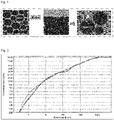
- cementitious mixtures with water in the fresh state can be seen as a two-phase suspension where particles are enveloped by a layer of excess paste that reduces friction in the aggregate skeleton by separating and lubricating those particles, see figure 1 , reproduced from Reinhardt et al., "About the influence of the cement content and composition of the aggregates on the rheological behaviour of self-compacting concrete", Materials and Structures (2006) 39:683-693 .
- the paste itself is composed of cement, possibly fine particles and water.
- the model assumes that concrete consists of the fluid phase paste and the solid phase aggregates.
- the solid-fluid interactions respective the solid-solid interactions are controlled by the so-called excess paste thickness t which is equivalent to half the distance between two neighbouring aggregates, if the distance is assumed to be independent of the aggregate size. Said excess paste thickness is only partially correlated with the distribution modulus q.
- the excess paste thickness t can be determined if the excess paste volume V Paste,ex, that remains after the voids between the aggregates V A , void are filled with paste, is constantly layered on the surface of the aggregates.
- a printable concrete can be obtained by designing the mixture in such a way that the particle size distribution follows a Dinger-Funk distribution with a modulus qD-F from 0.20 to 0.30, tuning the amount of paste in order to simultaneously obtain an excess paste thickness from 5 to 35 ⁇ m, and selecting an amount of hydraulic cement from 1 to 40 wt.-% with respect to the total weight of all dry components.
- the desired properties can be obtained without the necessity of using special materials such as silica fume, clay or organoclay while coarse aggregate can be used and no special admixture system is needed.
- the material properties can be measured with rotational rheometry, and preferably are as follows:
- a particle size distribution modulus q D-F comprised in the range from 0.20 - 0.30 according to the invention, preferably from 0.20 - 0.25, most preferred from 0.20 - 0.23.
- Particle sizes are measured herein by sieving for sizes with a minimum size above approximately 1 or 2 mm (e.g. for aggregate) and with laser diffraction analysis for particle sizes with a maximum size below approximately 1 or 2 mm (e.g. for cement, filler and SCM).
- excess paste thickness which ranges from 5-35 ⁇ m, preferably from 10 - 27 ⁇ m, for concrete compositions according to the invention.
- the excess paste thickness is determined as described above.
- the hydraulic cement content ranges from 1 - 40 wt.-%, preferably from 10 - 35 wt.-%, most preferred from 15 - 30 wt.-%, referred to the solids in the mixture or composition.
- suitable hydraulic cements for the cementitious mixture and concrete composition according to the present invention are Portland clinker containing cement, sulfoaluminate cement, aluminous cement, fast natural cement of the "Roman cement” type, and mixtures thereof.
- a suitable concrete composition for 3D printing is a mixture with a rapid setting and hardening, which comprises as main binder a hydraulic cement, preferably a fast binder selected from aluminous cement and/or sulfoaluminate cement and/or Portland cement, possibly with additives or accelerated.
- Portland cement is produced by pulverizing Portland cement clinker which typically comprise at least two-thirds by mass of calcium silicates, specifically 2 CaO ⁇ SiO 2 and 3 CaO ⁇ SiO 2 , the remainder being aluminium- and iron-containing clinker phases and other compounds.
- the ratio of CaO to SiO 2 shall not be less than 2.0 and the magnesium oxide content (MgO) shall not exceed 5.0 wt.-%.
- Portland cement is designated CEM I in EN 197-1.
- Other Portland cement clinker based cements inside and outside the standard are also possible, however, filler is a mandatory component of the cementitious mixture and concrete composition according to the invention.
- Portland cement clinker based cements preferably have a strength class 42.5 or 52.5, with an ordinary (N) or high (R) initial strength class, preferably with high initial strength class.
- the most preferred Portland cement clinker based cement types are CEM I and CEM II types.
- CEM II cements the preferred ones are the Portland-limestone cements CEM II/A-L, CEM II/B-L, CEM II/A-LL, and CEM II/B-LL. In those the contained limestone can consitute all or a part of the necessary filler.
- Sulfoaluminate cement is obtained by grinding sulfoaluminate clinker and adding variable quantities of calcium sulfate, lime, limestone and other components as described by the standard EN 197-1 for Portland clinker containing cements.
- sulfoaluminate clinkers and cements on the market and described in patents.
- Sulfoaluminate clinkers or cements on the market are for example: Lafarge Rockfast ® , Italcementi Alipre ® , Buzzi Next ® clinker, Vicat Aveat ® S, Denka ® CSA and those described in the Chinese standard GB 20472-2006 . These are all suitable.
- Aluminous cements and fast natural cements are also possible.
- Aluminous cements are based on calcium aluminate clinkers like CaO ⁇ Al 2 O 3 , 12CaO ⁇ 7Al 2 O 3 etc. and are available commercially. They are made by fusing together a mixture of a calcium-bearing material (like calcium oxide from limestone) and an aluminium-bearing material (typically bauxite).
- Fast natural cements also designated Roman cements, are made by burning a raw material comprising clay and limestone or dolomite, often a marl, below the sintering temperature and grinding.
- the hydraulic cement can also be a mixture of hydraulic cements.
- a supplementary cementitious material is defined as a pozzolanic and/or latent hydraulic material useful to replace a part of the clinker in a binder.
- Latent hydraulic materials have a composition that allows hydraulic reaction upon contact with water, wherein typically an activator is needed to enable hardening within technically feasible times.
- Activator means a substance that accelerates the hardening of latent hydraulic materials. It can be an addition like sulfate or calcium (hydr)oxide and/or products of the hydraulic reaction of the ground clinker, e.g. calcium silicates liberate calcium hydroxide during hardening.
- Pozzolanic materials are characterized by a content of reactive silica and/or alumina which form strength providing calcium silicate hydrates and calcium aluminate hydrates, respectively, during hydration of the clinker together with the calcium hydroxides liberated.
- the limit between latent hydraulic and pozzolanic materials is not well defined, for example fly ashes can be both latent hydraulic and pozzolanic depending on their calcium oxide content. Consequently, the term SCM designates both latent hydraulic as well as pozzolanic materials.
- SCM designates both latent hydraulic as well as pozzolanic materials.
- OPC based composite cements are preferred as hydraulic cement, most preferred ones comprising latent hydraulic or highly reactive pozzolanic SCM.
- the cementitious mixture and concrete composition include a filler with a typical d min ⁇ 1 ⁇ m to obtain the desired particle size distribution providing the q d-f and adjusting excess paste thickness.
- the filler according to the present invention can be an aggregate most of which passes a 0.063 mm sieve, as defined by the standard EN 12620-1. Thus, a very fine fraction of the aggregate can constitute at least a part of the filler when the PSD covers the appropriate sizes.
- Other more or less inert materials with approppriate PSD, especially ground minerals, but also synthetic materials, are also possible, e.g. dolomite, fines from concrete demolition waste, clinker kiln dust, and others.
- the filler comprises particles with a D 90 of 0.063 mm and preferably with a D 10 of ⁇ 1 ⁇ m, more preferred ⁇ 0.5 ⁇ m and most preferred ⁇ 0.1 ⁇ m.
- Preferred fillers according to the present invention are limestone, siliceous or silico-calcareous fillers, more preferably limestone fillers, alone or in a mixture with for example, but not exclusively, dolomite, fines from concrete demolition waste, clinker kiln dust, and mixtures thereof.
- the aggregate contained in the cementitious mixture and concrete composition according to the invention comprises coarse aggregate with a D max of at least 2 mm, preferably ⁇ 4 mm.
- D max is ⁇ 20 mm, preferably ⁇ 12 mm, most preferred ⁇ 8 mm, and/or d min is ⁇ 1 mm, preferably ⁇ 2 mm, most preferred ⁇ 4 mm.
- fine aggregate can and usually is contained, i.e. with a D max ⁇ 4 mm, preferably ⁇ 2 mm.
- the fine aggregate has a d min ⁇ 0.1 mm or ⁇ 0.2 mm.
- aggregates for use in cementitious mixtures and concrete compositions are defined in the standard EN 206 and standard EN 12620 as a natural, artificial, reclaimed or recycled granular mineral constituent suitable for use in concrete.
- the aggregate can be any known aggregate, preferably it is a calcareous, siliceous or silico-calcareous aggregate which is a known and commonly available product.
- the amount of aggregate generally ranges from 10 to 80 wt.-% with respect to the total solids content of the cementitious mixture or concrete composition, preferably from 30 to 70 wt.-%.
- the cementitious mixture and concrete composition can further contain fibres, including polymeric fibres, metallic fibres, in order to enhance the stability of the fresh material and to provide a diffused reinforcement.
- said fibres can increase their orientation degree during the extrusion, thereby improving the mechanical properties of the finished product, i.e. building or building element.
- the concrete mixture can further comprise admixtures accelerating the setting and/or hardening so as to increase the vertical progress of the printing process.
- suitable admixtures for this purpose are, for example but not limited to, lithium carbonate, sodium carbonate, sodium chloride, aluminium hydroxide, aluminium sulphate, lithium sulfate, calcium nitrate, and calcium nitrite.
- lithium carbonate and/or sodium carbonate are used.
- the cementitious mixture and concrete composition according to the present invention preferably comprises one or more superplasticisers (also known as high range water reducers).
- superplasticisers also known as high range water reducers.
- superplasticisers acrylic-based polycarboxylates are preferred, dosed in relation to the temperature of the mixture, the environmental temperature and the degree of fluidity required in the formulation.
- superplasticisers are lignosulfonates, naphthalene sulfonates, melamine compounds, and vinyl compounds.
- the superplasticisers are usually present in an amount ranging from 0.01 wt.-% to 1.00 wt.-% referred to the weight of the solid mix, preferably from 0.03 wt.-% to 0.50 wt.-%, even more preferred from 0.04 wt.-% to 0.20 wt.-%.
- the cementitious mixture and concrete composition preferably also comprises a rheology modifying agent, i.e. an admixture capable of modifying the water retention, material cohesion and adhesion characteristics to the support.
- a rheology modifying agent i.e. an admixture capable of modifying the water retention, material cohesion and adhesion characteristics to the support.
- the rheology modifying agent according to the present invention is preferably "a rheology modifying system", i.e. at least two rheology modifying agents, said system comprising 1) one or more rheology modifying agents having a pseudo plastic behaviour, such as long-chain polysaccharides or high-molecular-weight hetero-polysaccharides with or without substituent groups bound to the hydroxyl groups of the pyranose rings and 2) high-molecular weight polymers.
- the rheology modifying system is capable of improving the mixing by adjusting rheological properties, reducing the mixing time itself.
- the rheology modifying agent(s) can be included in the present formulation to reduce surface water bleeding and the presence of fine particles on the surface of the prepared material, and also to increase the viscosity and uniformity of the cementitious formulation.
- Said rheology modifying agents 1) are typically selected from the group of starch derivatives, vinyl-acetate, vinyl-versatate, cellulose, cellulose derivatives, and mixtures thereof, preferably cellulose derivatives. Usually they are present in an amount ranging from 0.003 wt.-% to 0.500 wt.-% referred to the weight of the solid mix, preferably from 0.005 wt.-% to 0.100 wt.-%, even more preferred from 0.006 wt.-% to 0.050 wt.-%.
- Preferred cellulose derivatives include hydroxymethyl-cellulose, hydroxyethylcellulose, hydroxymethylpropylcellulose, carboxymethylcellulose, methylcellulose, and hydroxymethylethylcellulose, most preferred hydroxymethylethylcellulose.
- the high-molecular-weight polymers 2) also called high-molecular-weight polymeric stabilizers, are typically polyamides, preferably polyamides with substituted amide nitrogen, having a molecular weight ranging from 2•10 6 Da to 2•10 7 Da, preferably from 2•10 6 Da to 5•10 6 Da.
- Said high-molecular weight polymer 2) is usually present in an amount from 0.009 wt.-% to 0.500 wt.-% referred to the weight of the solid mix, preferably from 0.010 wt.-% to 0.300 wt.-%.
- the superplasticiser and the rheology modifying system are both present, wherein preferably their weight ratio ranges from 0.5 to 2.2, more preferred from 0.7 to 1.3.
- known admixtures such as but not limted to setting retarders, and/or additives, such as but not limited to pigments, are also possible and if used are present in their known and usual dosage.
- the concrete composition according to the present invention preferably has a water/solid weight ratio ranging from 0.05 to 0.15, preferably from 0.06 to 0.13, most preferred from 0.08 to 0.11. This provides concrete compositions with the necessary excess paste thickness when the Dinger-Funk particle size distribution modulus ranges from 0.20 to 0.30.
- the cementitious mixture or concrete composition according to the invention is used for producing buildings or building elements by 3D printing according to the invention.
- the printing process comprises the following steps:
- the 3D model is usually obtained by creation as 3D CAD object, sectioning into horizontal layers and storing the map (arrangement for concrete composition deposit) of each layer.
- the 3D model is maintained in the form of digital data converted into instructions for the 3D printing device and stored in a controller.
- the controller positions the nozzle for deposition of the concrete composition.
- the controller also controls the flow of the concrete composition through the nozzle, i.e. the amount deposited at a particular point in the layer. Further, the controller adjusts the time until the next layer is printed so that the layer below has enough strength to support the next layer but still allows complete adhesion between the layers.
- printing speed is from 10 to 1000 mm/sec, typically 100 - 250 mm/sec.
- Usual layer thicknesses range from 2 to 40 cm, typically from 4 to 10 cm.
- the time between printing layers is suitably from 10 sec to 20 minutes, typically from 30 sec to 10 min.
- the substrate is the foundation in case of a building being printed. Typically, it is more efficient to cast the ground plate, but it can also be printed.
- openings and ducts are preferably formed, i.e. no deposition of concrete composition at appropriate points in the layers, as needed for doors and windows as well as pipes and wires.
- Building elements are printed on suitable supports as substrates, from which they can be easily taken off after sufficient hardening.
- Building elements can be walls, floors, stairs, all with appropriate openings/ducts as mentioned for buildings, as well as slabs, pillars, posts, plates, blocks, tubes, arches, pavement, and even more complicated elements like tables, benches, fountain basins, plant containers, and ornamental objects, e.g. figurines and artificial rocks. Any shape is possible, even intricate ones.
- Reinforcement for increasing ductility can be used; they can be traditional steel rebars, post or pre tensioned systems, steel cables, diffuse reinforcement (steel fibers) or fiber reinforce polymers (FRP). Reinforcement can be added in the concrete mix (e.g. steel fibers), during the printing (e.g. steel cables and steel-rebars), or on finished printed elements (post or pre tensioned systems or FRP).
- Reinforcement can be added in the concrete mix (e.g. steel fibers), during the printing (e.g. steel cables and steel-rebars), or on finished printed elements (post or pre tensioned systems or FRP).
- any amount in % or parts is by weight and in the case of doubt referring to the total weight of the composition/mixture concerned.
- a characterization as “approximately”, “around” and similar expression in relation to a numerical value means that up to 10 % higher and lower values are included, preferably up to 5 % higher and lower values, and in any case at least up to 1 % higher and lower values, the exact value being the most preferred value or limit.
- substantially free means that a particular material is not purposefully added to a composition, and is only present in trace amounts or as an impurity. As used herein, unless indicated otherwise, the term “free from” means that a composition does not comprise a particular material, i.e. the composition comprises 0 weight percent of such material.
- the ground granulated blast furnace slag (GGBFS) included in the reported formulations was a granular blast furnace slag with the tradename of "Loppa di altoforno granulata macinata” compliant with EN 15167-1, having a specific surface equal to 4,450 cm 2 /g (determined according to the Blaine method according to the standard EN 196-6), obtained from Ecocem France SAS, FR.
- the calcareous filler was a limestone-based filler marketed by Omya S.p.A., IT, under the tradename of Omyacarb 2-AV.
- Another calcareous limestone-based filler marketed by Cremaschi Granulati S.r.l., IT has also been used where indicated, in order to have a better particle size distribution fitting.
- the aggregates were different granulometric fractions of silico-calcareous aggregates marketed by Sabbie Sataf s.r.l., IT.
- the superplasticizer was based on polycarboxylic ether, called Melflux 2641 F, and marketed in powder form by BASF SE, DE.
- the rheology modifier 1 was a hydroxymethylethylcellulose, "Tylose MH 60004P6", marketed in powder form by ShinEtsu, JP.
- the rheology modifier 2 was a high-molecular weight synthetic polymer, more specifically a polyamide with the amide nitrogen substituted with a molecular weight approximately equal to 2•10 6 Da, called Starvis 3040F marketed in powder form by BASF SE, DE.
- the particle size distributions of the individual components adopted to illustrate the main aspects of the present invention are shown in figure 2 . Said particle size distributions have been measured adopting a laser analyzer for the fractions up to 2 mm, while for the remaining coarser fraction determination by sieving has been carried out according to the standard EN 933-1.
- a comparative example is represented by formulation n.3, which was made similarly to the one described in patent application IT102018000020080 , but extending the particle size distribution upwards, adding aggregates with a D max of 8 mm.
- the calculated excess paste thickness was outside the range of the present invention.
- another formulation n.4 was made adopting instead a close qD-F, namely 0.20, and simultaneously applying the constraints related to clinker content and excess paste thickness of the present invention.
- the components and amounts as well as the measured parameters are listed in table 3.
- n.5 and n.6 were made in the same way according to the present invention, except the fact that n.5 had an hydraulic binder which is a CEM II/A-LL 42.5R containing the same clinker used for the production of CEM I 52.5R, which in turn has been used for n.6.
- the individual effect of the clinker amount variation did not alter the printability of the material, as the properties listed in table 4 are satisfactory for both the formulations.
- the material satisfied the requirements, and exhibited a surprisingly high static yield stress, resulting in an enhanced buildability, and advantageously maintained similar flow properties and pumpability. Moreover, after 15 minutes, the material was hardened and could withstand considerable compressive and flexural loads.
- the formulation n.8 was made adopting the high end of the distribution modulus qD-F according to the present invention, and simultaneously applying the constraints related to clinker content and excess paste thickness.
- the formulation n.9 was made with a distribution modulus qD-F higher than the upper end of the range according to the invention.
- the amounts and measured properties are listed in table 6.
Landscapes
- Chemical & Material Sciences (AREA)
- Engineering & Computer Science (AREA)
- Ceramic Engineering (AREA)
- Materials Engineering (AREA)
- Chemical Kinetics & Catalysis (AREA)
- Inorganic Chemistry (AREA)
- Structural Engineering (AREA)
- Organic Chemistry (AREA)
- Manufacturing & Machinery (AREA)
- Curing Cements, Concrete, And Artificial Stone (AREA)
Priority Applications (1)
| Application Number | Priority Date | Filing Date | Title |
|---|---|---|---|
| EP21179062.1A EP4101646A1 (fr) | 2021-06-11 | 2021-06-11 | Composition de béton pour l'impression 3d |
Applications Claiming Priority (1)
| Application Number | Priority Date | Filing Date | Title |
|---|---|---|---|
| EP21179062.1A EP4101646A1 (fr) | 2021-06-11 | 2021-06-11 | Composition de béton pour l'impression 3d |
Publications (1)
| Publication Number | Publication Date |
|---|---|
| EP4101646A1 true EP4101646A1 (fr) | 2022-12-14 |
Family
ID=76392304
Family Applications (1)
| Application Number | Title | Priority Date | Filing Date |
|---|---|---|---|
| EP21179062.1A Withdrawn EP4101646A1 (fr) | 2021-06-11 | 2021-06-11 | Composition de béton pour l'impression 3d |
Country Status (1)
| Country | Link |
|---|---|
| EP (1) | EP4101646A1 (fr) |
Cited By (2)
| Publication number | Priority date | Publication date | Assignee | Title |
|---|---|---|---|---|
| WO2024200708A1 (fr) * | 2023-03-29 | 2024-10-03 | Sika Technology Ag | Dalle de plancher pour cabines de salle de bains modulaires préfabriquées |
| WO2025262172A1 (fr) * | 2024-06-19 | 2025-12-26 | Roadstone Limited | Procédé et paroi en béton d'impression 3d |
Citations (11)
| Publication number | Priority date | Publication date | Assignee | Title |
|---|---|---|---|---|
| EP0812811A1 (fr) | 1996-06-10 | 1997-12-17 | Cementos Mexicanos, S.A. de C.V. | Ciment hydraulique à développement de haute résistance accélérée |
| WO2013023728A2 (fr) | 2011-08-18 | 2013-02-21 | Heidelbergcement Ag | Ciment de sulfoaluminate de calcium contenant de la ternésite |
| US20130233207A1 (en) | 2010-11-15 | 2013-09-12 | Maurizio Iler Marchi | High performance sulfo-aluminous clinker |
| US20140364543A1 (en) | 2010-05-07 | 2014-12-11 | Pkl Corporation | Calcium sulfo aluminate cement with polymer |
| US20180057454A1 (en) | 2007-05-11 | 2018-03-01 | Apicore Us Llc | Process for preparation of isosulfan blue |
| WO2018128791A1 (fr) | 2017-01-05 | 2018-07-12 | General Electric Company | Entrée de noyau protégée |
| EP3421201A1 (fr) | 2017-06-30 | 2019-01-02 | ITALCEMENTI S.p.A. | Mélange cimentaire pour imprimante 3d et son utilisation |
| US20190009428A1 (en) | 2015-09-22 | 2019-01-10 | Heidelbergcement Ag | 3d printing of building elements and buildings with bct cement |
| WO2019030256A1 (fr) * | 2017-08-09 | 2019-02-14 | Sika Technology Ag | Procédé d'application de compositions de liants minérales contenant des fibres |
| CN111233407A (zh) * | 2020-03-12 | 2020-06-05 | 河北工业大学 | 一种3d打印固废混凝土构件及制备方法 |
| IT201800020080A1 (it) | 2018-12-18 | 2020-06-18 | Heidelbergcement Ag | Miscela cementizia per stampante 3D, a prestazioni migliorate, e relativo uso in detta stampante |
-
2021
- 2021-06-11 EP EP21179062.1A patent/EP4101646A1/fr not_active Withdrawn
Patent Citations (11)
| Publication number | Priority date | Publication date | Assignee | Title |
|---|---|---|---|---|
| EP0812811A1 (fr) | 1996-06-10 | 1997-12-17 | Cementos Mexicanos, S.A. de C.V. | Ciment hydraulique à développement de haute résistance accélérée |
| US20180057454A1 (en) | 2007-05-11 | 2018-03-01 | Apicore Us Llc | Process for preparation of isosulfan blue |
| US20140364543A1 (en) | 2010-05-07 | 2014-12-11 | Pkl Corporation | Calcium sulfo aluminate cement with polymer |
| US20130233207A1 (en) | 2010-11-15 | 2013-09-12 | Maurizio Iler Marchi | High performance sulfo-aluminous clinker |
| WO2013023728A2 (fr) | 2011-08-18 | 2013-02-21 | Heidelbergcement Ag | Ciment de sulfoaluminate de calcium contenant de la ternésite |
| US20190009428A1 (en) | 2015-09-22 | 2019-01-10 | Heidelbergcement Ag | 3d printing of building elements and buildings with bct cement |
| WO2018128791A1 (fr) | 2017-01-05 | 2018-07-12 | General Electric Company | Entrée de noyau protégée |
| EP3421201A1 (fr) | 2017-06-30 | 2019-01-02 | ITALCEMENTI S.p.A. | Mélange cimentaire pour imprimante 3d et son utilisation |
| WO2019030256A1 (fr) * | 2017-08-09 | 2019-02-14 | Sika Technology Ag | Procédé d'application de compositions de liants minérales contenant des fibres |
| IT201800020080A1 (it) | 2018-12-18 | 2020-06-18 | Heidelbergcement Ag | Miscela cementizia per stampante 3D, a prestazioni migliorate, e relativo uso in detta stampante |
| CN111233407A (zh) * | 2020-03-12 | 2020-06-05 | 河北工业大学 | 一种3d打印固废混凝土构件及制备方法 |
Non-Patent Citations (8)
| Title |
|---|
| ALI ZEINAB SAYED ET AL: "New aggregate grading models for low-binder self-consolidating and semi-self-consolidating concrete (Eco-SCC and Eco-semi-SCC)", CONSTRUCTION AND BUILDING MATERIALS, ELSEVIER, NETHERLANDS, vol. 265, 3 August 2020 (2020-08-03), XP086339011, ISSN: 0950-0618, [retrieved on 20200803], DOI: 10.1016/J.CONBUILDMAT.2020.120314 * |
| ANDREASEN, A.H.M.ANDERSEN, J.: "Uber die Beziehung zwischen Kornabstufung und Zwischenraum in Produkten aus losen Kornern (mit einigen Experimenten", COLLOID POLYM. SCI., vol. 50, no. 3, 1930, pages 217 - 228 |
| FULLER, W.B.THOMPSON, S.E.: "The laws of proportioning concrete", ASCE J. TRANSPORT., vol. 59, 1907, pages 67 - 143 |
| J.E. FUNKD.R. DINGER: "Predictive process control of crowded particulate suspensions", 1994, SPRINGER, article "Introduction to predictive process control", pages: 1 - 16 |
| OURO KOURA BABA-ISSA ET AL: "A new proportioning approach of low and normal binder self-consolidating concrete based on the characteristics of fine mortar and granular skeleton", CONSTRUCTION AND BUILDING MATERIALS, ELSEVIER, NETHERLANDS, vol. 239, 23 December 2019 (2019-12-23), XP086075808, ISSN: 0950-0618, [retrieved on 20191223], DOI: 10.1016/J.CONBUILDMAT.2019.117892 * |
| R. SARKAR: "Particle Size Distribution for Refractory Castables: A Review", INTERCERAM, vol. 65, no. 3, 2016, pages 82 - 86 |
| REINHARDT ET AL.: "About the influence of the cement content and composition of the aggregates on the rheological behaviour of self-compacting concrete", MATERIALS AND STRUCTURES, vol. 39, 2006, pages 683 - 693 |
| ZHANG HONG-PING ET AL: "Preparation of Rapid-Hardening, Early-Strengthening, High-Density Composite Cement Based on Dinger-Funk Equation", ARABIAN JOURNAL FOR SCIENCE AND ENGINEERING, SPRINGER BERLIN HEIDELBERG, BERLIN/HEIDELBERG, vol. 45, no. 5, 23 November 2019 (2019-11-23), pages 3719 - 3730, XP037095624, ISSN: 2193-567X, [retrieved on 20191123], DOI: 10.1007/S13369-019-04217-7 * |
Cited By (2)
| Publication number | Priority date | Publication date | Assignee | Title |
|---|---|---|---|---|
| WO2024200708A1 (fr) * | 2023-03-29 | 2024-10-03 | Sika Technology Ag | Dalle de plancher pour cabines de salle de bains modulaires préfabriquées |
| WO2025262172A1 (fr) * | 2024-06-19 | 2025-12-26 | Roadstone Limited | Procédé et paroi en béton d'impression 3d |
Similar Documents
| Publication | Publication Date | Title |
|---|---|---|
| Xu et al. | Effect of FA and GGBFS on compressive strength, rheology, and printing properties of cement-based 3D printing material | |
| US10457603B2 (en) | Casting method for making a lightweight concrete product | |
| Topçu et al. | Experimental investigation of some fresh and hardened properties of rubberized self-compacting concrete | |
| Heikal et al. | Mechanical, microstructure and rheological characteristics of high performance self-compacting cement pastes and concrete containing ground clay bricks | |
| US10882791B2 (en) | High performance concretes and methods of making thereof | |
| EP2668144B1 (fr) | Liant hydraulique à faible teneur en scories | |
| AU2007219709B2 (en) | Matrix for masonry elements and method of manufacture thereof | |
| CN112299764B (zh) | 一种含铜尾矿料砂的钢筋套筒灌浆料及其配比设定方法 | |
| EP2822918A1 (fr) | Composition hydraulique à faible teneur en clinker | |
| CN108101427A (zh) | 一种用于钢桁梁无砟轨道充填层的高聚物自充填混凝土 | |
| EP4101646A1 (fr) | Composition de béton pour l'impression 3d | |
| WO2020249145A1 (fr) | Mélange sec pour la préparation de béton, béton frais et procédé de préparation de béton frais | |
| CN109095802B (zh) | 混凝土用膨胀剂、混凝土及其制备方法 | |
| Thajeel et al. | Enhancing printability of 3D printed concrete by using metakaolin and silica fume | |
| EP2953914B1 (fr) | Liant hydraulique | |
| CN115838266A (zh) | 一种机制砂混凝土及其制备方法 | |
| Hela et al. | Development of ultra high performance concrete and reactive powder concrete with nanosilica | |
| Shareef et al. | Potential use of wastes of thermostone blocks and ceramic tiles as recycled aggregates in production of foam concrete | |
| WO2024246168A1 (fr) | Procédés de fabrication de matériaux cimentaires ayant des agrégats fins remplacés par des résidus et matériaux cimentaires ainsi obtenus | |
| Kumar et al. | A review on wider application of supplementary cementitious materials on the development of high-performance concrete | |
| EP4470988A1 (fr) | Laitier de haut fourneau granulé broyé ayant des propriétés améliorées | |
| WO2024052850A1 (fr) | Procédé de mise en place d'un matériau de construction pouvant s'écouler | |
| EP4628465A1 (fr) | Mortiers et coulis à ultra-haute performance | |
| Dong et al. | Study on Mix Design and Performance of Low Shrinkage Self compacting Concrete with Machine Made Sand | |
| JP2005263518A (ja) | 高流動コンクリート混練物 |
Legal Events
| Date | Code | Title | Description |
|---|---|---|---|
| PUAI | Public reference made under article 153(3) epc to a published international application that has entered the european phase |
Free format text: ORIGINAL CODE: 0009012 |
|
| STAA | Information on the status of an ep patent application or granted ep patent |
Free format text: STATUS: THE APPLICATION HAS BEEN PUBLISHED |
|
| AK | Designated contracting states |
Kind code of ref document: A1 Designated state(s): AL AT BE BG CH CY CZ DE DK EE ES FI FR GB GR HR HU IE IS IT LI LT LU LV MC MK MT NL NO PL PT RO RS SE SI SK SM TR |
|
| RAP3 | Party data changed (applicant data changed or rights of an application transferred) |
Owner name: HEIDELBERG MATERIALS AG |
|
| STAA | Information on the status of an ep patent application or granted ep patent |
Free format text: STATUS: THE APPLICATION IS DEEMED TO BE WITHDRAWN |
|
| 18D | Application deemed to be withdrawn |
Effective date: 20230615 |