EP4145943A1 - Improved timing alignment in an lte system - Google Patents
Improved timing alignment in an lte system Download PDFInfo
- Publication number
- EP4145943A1 EP4145943A1 EP22169663.6A EP22169663A EP4145943A1 EP 4145943 A1 EP4145943 A1 EP 4145943A1 EP 22169663 A EP22169663 A EP 22169663A EP 4145943 A1 EP4145943 A1 EP 4145943A1
- Authority
- EP
- European Patent Office
- Prior art keywords
- timing advance
- random access
- advance value
- user terminal
- controlling node
- Prior art date
- Legal status (The legal status is an assumption and is not a legal conclusion. Google has not performed a legal analysis and makes no representation as to the accuracy of the status listed.)
- Pending
Links
Images


Classifications
-
- H—ELECTRICITY
- H04—ELECTRIC COMMUNICATION TECHNIQUE
- H04W—WIRELESS COMMUNICATION NETWORKS
- H04W56/00—Synchronisation arrangements
- H04W56/0005—Synchronisation arrangements synchronizing of arrival of multiple uplinks
-
- H—ELECTRICITY
- H04—ELECTRIC COMMUNICATION TECHNIQUE
- H04W—WIRELESS COMMUNICATION NETWORKS
- H04W56/00—Synchronisation arrangements
- H04W56/004—Synchronisation arrangements compensating for timing error of reception due to propagation delay
- H04W56/0045—Synchronisation arrangements compensating for timing error of reception due to propagation delay compensating for timing error by altering transmission time
-
- H—ELECTRICITY
- H04—ELECTRIC COMMUNICATION TECHNIQUE
- H04W—WIRELESS COMMUNICATION NETWORKS
- H04W74/00—Wireless channel access
- H04W74/08—Non-scheduled access, e.g. ALOHA
- H04W74/0833—Random access procedures, e.g. with 4-step access
-
- H—ELECTRICITY
- H04—ELECTRIC COMMUNICATION TECHNIQUE
- H04W—WIRELESS COMMUNICATION NETWORKS
- H04W74/00—Wireless channel access
- H04W74/08—Non-scheduled access, e.g. ALOHA
- H04W74/0833—Random access procedures, e.g. with 4-step access
- H04W74/0841—Random access procedures, e.g. with 4-step access with collision treatment
-
- H—ELECTRICITY
- H04—ELECTRIC COMMUNICATION TECHNIQUE
- H04W—WIRELESS COMMUNICATION NETWORKS
- H04W74/00—Wireless channel access
- H04W74/002—Transmission of channel access control information
- H04W74/006—Transmission of channel access control information in the downlink, i.e. towards the terminal
Definitions
- the present invention discloses a method for use in a user terminal in a cellular communications system, where the user terminal applies a first timing advance value to its transmissions to a controlling node.
- the downlink transmissions i.e. transmission to the users in a cell
- OFDM modulation Orthogonal Frequency Division Multiplex
- the uplink transmissions i.e. transmission from the users in a cell
- OFDM or OFDM-like technologies such as DFTS-OFDM
- Transmissions to and from users in a cell are made to/from a controlling node of the cell, this node in LTE being known as the eNodeB, "evolved NodeB".
- eNodeB evolved NodeB
- Users in an LTE system are sometimes referred to as UEs, "User Equipment”.
- transmissions from the UEs in a cell need to be time aligned when they arrive at the eNodeB, i.e. the transmissions from the UEs in the cell of the eNodeB need to arrive more or less simultaneously at the eNodeB.
- the UEs in a cell may be located at different distances from the eNodeB of the cell, the UEs need to initiate their transmissions at different points in time in order for their transmissions to arrive simultaneously at the eNodeB. For example, a UE which is at the cell edge needs to start its transmissions prior to a UE which is closer to the eNodeB.
- timing advance in other words an “offset” value in time at which a UE needs to start its transmissions relative to a nominal transmission time specified by the eNodeB.
- the value of the timing advance for a UE can be determined by the eNodeB by means of measuring the arrival of uplink transmissions from the UE, and the eNodeB then transmits the timing advance value to the UE with regular updates, since the UE may move around in the cell.
- the timing advance needed by the UE becomes uncertain, for example due to possible movement away from the eNodeB of the UE.
- a timer in both the eNodeB and the UE which determines when a UE falls "out of synchronization" in uplink.
- Random Access a procedure which is used in a number of cases, such as, for example:
- Random Access procedures defined for LTE systems is a so called contention based procedure, and can briefly be described as follows: The UE starts the Random Access procedure by randomly selecting one of the preambles available for contention-based random access, and then transmits the selected random access preamble on the physical random access channel, PRACH, to the eNodeB.
- PRACH physical random access channel
- the eNodeB acknowledges reception of the preamble by transmitting a response, which includes a timing advance value update to be used in future transmissions from the UE.
- the eNodeB will resolve the conflict by transmitting a so called contention resolution message, which informs the UEs of which one of them has "won" the contention based procedure, and may thus communicate with the eNodeB.
- the timing advance value update which was transmitted by the eNodeB in response to the preamble is based on the transmission from the "winning" UE, but has been adopted by all of the UEs involved in the "contention conflict".
- one or more UEs may have erroneous timing advance values. This is particularly bothersome in the case of a UE which has entered the contention based procedure due to a Scheduling Request, since the UE in that case will have been "in synch" prior to having entered the procedure, but may come out of the procedure "out of synch”.
- Such a solution is offered by the present solution in that it discloses a method for use in a user terminal in a cellular communications system.
- the user terminal applies a first timing advance value to its transmissions to a controlling node, and the user terminal requests communication with the controlling node in a contention based procedure by transmitting an access request, in response to which the controlling node transmits an initiation message of the requested communication along with a second timing advance value.
- the user terminal uses the first timing advance value if the user terminal loses the contention based procedure, i.e. if the controlling node subsequently continues the initiated communication with another user terminal.
- the problem of users who "lose” a contention based procedure such as, for example, a random access procedure, but who during the procedure have received a timing advance intended for the "winner” of the procedure, is solved in that the "original" timing advance value is used if the user terminal loses the procedure.
- the user terminal uses the second timing advance value in a message which is subsequent to said initiation message, and in one version of this embodiment, the user terminal uses the second timing advance message if the user terminal wins the contention based procedure.
- the user terminal uses the first timing advance message if the user terminal wins the contention based procedure.
- the inventive method is applied if the first timing advance value is considered valid by the user terminal, which for example, can be done by means of letting the timing advance value in a user terminal be associated with a timer and be considered valid for the duration of said timer.
- the timer is suitably started upon reception of a predefined message from the controlling node, so that each of the first and second timing advance values are associated with respective first and second timers which have been started upon reception of respective messages.
- the user terminal lets the timer which is associated with the first timing advance value continue running after receipt of the message associated with the second timer, and uses the timer value which is associated with the timing advance value which is subsequently used.
- which timer that is used is tied to the outcome of the contention based procedure, i.e. if the user "wins” or “loses” the contention based procedure.
- the user terminal saves the value of the timer which is associated with the first timing advance value when it receives the second timing advance value, and if the controlling node subsequently continues the initiated communication with another user terminal, the user terminal uses a timer value which is the sum of the saved value and the current value of the timer of the second advance value.
- the user terminal restarts the timer upon reception of the new timing advance value, but since it knows the value of the "old” timer at the reset point, the user terminal can revert back to the "old” timer by adding the saved value of the "old” timer to the current value of the "new” timer, if the user terminal "loses” the contention based procedure.
- the invention also discloses a user terminal which works according to the inventive method.
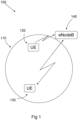
- Fig 1 shows an overview of a system 100 in which the invention can be applied.
- the system 100 comprises a number of cells, one of which is shown as 110 in fig 1 .
- Each cell can hold a number of users, two of which are shown in fig 1 as 120 and 130.
- the generic term for users in an LTE system is "UE", User Equipment, a term which will also be used here, and which is used in fig 1 .
- an eNodeB 140, which controls the traffic to and from the users in the cell.
- Traffic from the UEs to the eNodeB is known as uplink traffic, UL traffic, and traffic in the other direction is known as downlink traffic, DL traffic.
- the UEs receive instructions from the eNodeB regarding when to make their UL transmissions, but as can be realized, and as can also be seen in fig 1 , the arrival of an UL transmission at the eNodeB will depend on the distance between the eNodeB and the UE in question. For example, simultaneous transmissions from the UEs 120 and 130 will arrive at the eNodeB 140 at different points in time, with the UL transmissions from the UE 120 arriving before those of the UE 130.
- the LTE system employs a system of "timing advance" of UL transmissions, so that a UE is informed by the eNodeB of a timing advance value, i.e. an "offset" which should be applied to timing instructions for UL transmissions.
- the timing advance value for a UE is determined by the eNodeB of the cell by measurements on UL transmissions received from the UE at the eNodeB, and is signalled as a time alignment command.
- the notion of timing advance, and of different values for this parameter, is illustrated in fig 2 , by means of three time lines: the top time line shows a nominal window for UL transmissions from the UEs in the cell 110 to the eNodeB 140.
- the nominal window extends between t 1 and t 2 .
- the middle time line shows a timing advance for the UE 120: since the UE 120 is at a certain distance from the eNodeB, the UE 120 needs to make its transmissions between t' 1 and t' 2 in order for those transmissions to arrive at the eNodeB between t 1 and t 2 .
- This can also be viewed as displacing the UL transmission window of UE 120 by an offset in time, i.e. a timing advance, with a value of ⁇ 1 in fig 2 .
- the bottom time line in fig 2 shows the timing advance for the UE 130: since the UE 130 is quite far from the eNodeB, the UE 130 needs to make its transmissions between t" 1 and t" 2 in order for those transmissions to arrive at the eNodeB between t 1 and t 2 . This can also be viewed as displacing the UL transmission window of UE 130 by a timing advance with a value of ⁇ 2 , as shown in fig 2 .
- the invention is mainly intended for the contention based Random Access procedure, which is illustrated in fig 3 , with the messages, "MSG”, being numbered as follows:
- the timing advance value transmitted by the eNodeB in message 2 is based on message 1 from the "winning" UE, but is applied to all UEs in the conflict.
- the timing advance value transmitted by the eNodeB in message 2 is based on message 1 from the "winning" UE, but is applied to all UEs in the conflict.
- all UEs in the conflict but one, the winning one will apply a timing advance value which is erroneous for them.
- a basic idea of the invention is that in order to overcome this problem, a UE which requests communication with its eNodeB will use the timing advance value that the UE had prior to requesting communication with the eNodeB if the UE loses the contention based procedure. Thus, if the eNodeB transmits an initiation message with a timing advance value, but then continues the communication with another UE, for example if the UE's request for communication was part of a contention based procedure which the UE loses, the UE will use its "original" timing advance value.
- the UE uses the original timing advance value, i.e. T TA1 if the UE loses the contention based procedure, but uses the "updated" timing advance value, i.e. T TA2 , in the subsequent message shown as MSG 3 of fig 3 .
- the UE will also use T TA2 if the UE "wins" the contention based procedure.
- the UE will use the original timing advance value, i.e. T TA1 , if the UE "wins" the contention based procedure.
- T TA1 the original timing advance value
- the principle shown in fig 4 and the versions described above are only applied if the UE has a valid timing advance value when it requests communication with the eNodeB.
- the notion of a valid timing advance value can preferably be implemented as follows: the timing advance values, e.g. T TA1 and T TA2 , have a validity which is tied to a timer, here referred to as a "timing alignment timer", so that a timing advance value may become invalid due to the fact that the timing alignment timer has expired, i.e. when the timing alignment timer is not running.
- the timer is started when a specific predetermined message such as, for example, the timing advance value is received from the eNodeB, and, in this case, a reason for the invalidity mentioned above is that the timer has expired.
- the timer or timers may also be started by predetermined messages during an ongoing "data session" between the NodeB and the UE.
- T TA1 and T TA2 the timing advance values shown above, i.e. T TA1 and T TA2 , and these timers will need to be handled in the following manner:
- the invention proposes a number of different possibilities in order to correctly manage the timer of the timing advance value in the UE:
- Fig 5 shows a flow chart of a generalized method of the invention. Steps which are options or alternatives are indicated with dashed lines in fig 5 .
- the method 500 is intended for use in a user terminal in a cellular communications system, and, as indicated in step 505, according to the inventive method, the user terminal applies a first timing advance value T TA1 to its transmissions to a controlling node. Also, according to the method 500, the user terminal requests, step 510, communication with the controlling node in a contention based procedure by transmitting an access request, such as MSG1 which was shown in fig 3 , in and as shown in step 515, in response the controlling node transmits an initiation message, such as MSG 2 from fig 3 , for the requested communication, along with a second timing advance value T TA2 .
- an access request such as MSG1 which was shown in fig 3
- an initiation message such as MSG 2 from fig 3
- Step 520 shows the message MSG 3 from fig 3 , i.e. a scheduled transmission from the UE, based on the instructions in MSG 2.
- the user terminal uses the second timing advance value in a message which is subsequent to said initiation message, such as MSG 3.
- Steps 523 and 524 indicate that the user terminal uses the first timing advance value T TA1 if the user terminal loses the contention based procedure, i.e. if the controlling node subsequently continues the initiated communication with another user terminal.
- the outcome of the contention based procedure is indicated by means of MSG 4, as was also explained in connection with fig 3 .
- Step 531 shows that in an alternative embodiment, the user terminal uses the first timing advance value if the user terminal wins the contention based procedure.
- Step 532 shows that in one version of this embodiment, the user terminal uses the second timing advance value if the user terminal wins the contention based procedure.
- the method of the invention is applied in the case that the first timing advance value is considered valid by the user terminal.
- Step 540 indicates that in a further embodiment of the invention, a timing advance value in a user terminal is associated with a timer and is considered valid for the duration of the timer.
- the timer is started upon reception of a predefined message from the controlling node 140, so that each of the first and second timing advance values are associated with respective first and second timers which have been started upon reception of respective messages.
- the user terminal can, as shown in step 545, let the timer associated with the first timing advance value continue running after receipt of the initiation message associated with the second timer, and then use the timer value associated with the timing advance value (T TA N ) which is subsequently used.
- the user terminal upon reception of the second timing advance value, saves the value of the timer which is associated with the first timing advance value. If the controlling node subsequently continues the initiated communication with the other user terminal, the user terminal then uses a timer value which is the sum of the saved value and the current value of the timer of the second advance value.
- a user terminal which has a valid timing alignment value uses this value regardless of receipt of a second timing alignment value.
- the method of the invention is applied in an LTE system, Long Term Evolution, so that the user terminal will be an LTE UE and the controlling node will be an LTE eNodeB. If the method is applied in an LTE system, the procedure in which it is employed is preferably an LTE Random Access procedure.
- Fig 6 shows a schematic block diagram of a transceiver 600 for use as a user terminal, a UE which functions according to the invention.
- the transceiver 600 will comprise an antenna, shown as block 610, and will also comprise a receive part 620 and a transmit part 630.
- the transceiver 600 also comprises a control means 640 such as a micro processor, as well as a memory 650.
- the control means 640 and the memory 650 are used by the transceiver in order to apply a first timing advance value to its transmissions to a controlling node, and the transceiver further comprising means such as the memory 640, the transmit part 630 and the antenna 610 for requesting communication with the controlling node in a contention based procedure by transmitting an access request such as MSG 1.
- the transceiver 600 also uses the antenna 610 and the receiver 620 for receiving an initiation message such as MSG 2 in response from the controlling node along with a second timing advance value.
- the transceiver 600 uses the control means 640 and the memory 650 for using the first timing advance value if the user terminal loses the contention based procedure, i.e. if the controlling node subsequently continues the initiated communication with another user terminal.
- the transceiver will use the following components for using the second timing advance value in a message such as MSG 3 which is subsequent to said initiation message: the control means 640, the memory 650, the receiver 630 and the antenna 610.
- the transceiver 600 it is also possible for the transceiver 600 to uses the second timing advance message if the contention based procedure is won.
- the transceiver 600 uses the following components for applying the first timing advance message if the contention based procedure is won: the control means 640, the memory 650, the receiver 630 and the antenna 610.
- the transceiver 600 uses the control means 640, the memory 650, the receiver 630 and the antenna 610 for checking if the first timing advance value is considered valid by the user terminal, and in that case, for applying the first timing advance value.
- the transceiver 600 may use the control means 640 together with the memory 650 for associating a timing advance value with a timer as well as for considering the timing advance value valid for the duration of said timer, in conjunction with which the antenna 610 and the receive part 620 may be used for starting the timer upon reception of a predefined message from the controlling node, so that each of the first and second timing advance values are associated with respective first and second timers which have been started upon reception of respective messages.
- control part 640 and the memory 650 may be used for letting the timer which is associated with the first timing advance value continue running after receipt of the message which starts the second timer, as well as for using the timer value that is associated with the timing advance value which is subsequently used.
- control part 640 and the memory 650 can be used by the transceiver 600 for saving the value of the timer associated with the first timing advance value upon reception of the second timing advance value, as well as for using a timer value which is the sum of the saved value and the current value of the timer of the second advance value, if the controlling node subsequently continues the initiated communication with said other user terminal.
- the transceiver 600 if it has a valid timing alignment value will use this value regardless of receipt of a second timing alignment value.
- the transceiver 600 is suitably a user terminal, a UE, in an LTE system, Long Term Evolution, i.e. it is an LTE UE.
Landscapes
- Engineering & Computer Science (AREA)
- Computer Networks & Wireless Communication (AREA)
- Signal Processing (AREA)
- Mobile Radio Communication Systems (AREA)
Applications Claiming Priority (5)
| Application Number | Priority Date | Filing Date | Title |
|---|---|---|---|
| US98537907P | 2007-11-05 | 2007-11-05 | |
| EP18182159.6A EP3462800A1 (en) | 2007-11-05 | 2008-06-09 | Improved timing alignment in an lte system |
| EP08779367.5A EP2208291B1 (en) | 2007-11-05 | 2008-06-09 | Improved timing alignment in an lte system in case of random access preamble conflict |
| EP16187576.0A EP3203799B1 (en) | 2007-11-05 | 2008-06-09 | Improved timing alignment in an lte system |
| PCT/SE2008/050685 WO2009061256A1 (en) | 2007-11-05 | 2008-06-09 | Improved timing alignment in an lte system |
Related Parent Applications (3)
| Application Number | Title | Priority Date | Filing Date |
|---|---|---|---|
| EP18182159.6A Division EP3462800A1 (en) | 2007-11-05 | 2008-06-09 | Improved timing alignment in an lte system |
| EP08779367.5A Division EP2208291B1 (en) | 2007-11-05 | 2008-06-09 | Improved timing alignment in an lte system in case of random access preamble conflict |
| EP16187576.0A Division EP3203799B1 (en) | 2007-11-05 | 2008-06-09 | Improved timing alignment in an lte system |
Publications (1)
| Publication Number | Publication Date |
|---|---|
| EP4145943A1 true EP4145943A1 (en) | 2023-03-08 |
Family
ID=40625993
Family Applications (4)
| Application Number | Title | Priority Date | Filing Date |
|---|---|---|---|
| EP08779367.5A Active EP2208291B1 (en) | 2007-11-05 | 2008-06-09 | Improved timing alignment in an lte system in case of random access preamble conflict |
| EP22169663.6A Pending EP4145943A1 (en) | 2007-11-05 | 2008-06-09 | Improved timing alignment in an lte system |
| EP18182159.6A Ceased EP3462800A1 (en) | 2007-11-05 | 2008-06-09 | Improved timing alignment in an lte system |
| EP16187576.0A Active EP3203799B1 (en) | 2007-11-05 | 2008-06-09 | Improved timing alignment in an lte system |
Family Applications Before (1)
| Application Number | Title | Priority Date | Filing Date |
|---|---|---|---|
| EP08779367.5A Active EP2208291B1 (en) | 2007-11-05 | 2008-06-09 | Improved timing alignment in an lte system in case of random access preamble conflict |
Family Applications After (2)
| Application Number | Title | Priority Date | Filing Date |
|---|---|---|---|
| EP18182159.6A Ceased EP3462800A1 (en) | 2007-11-05 | 2008-06-09 | Improved timing alignment in an lte system |
| EP16187576.0A Active EP3203799B1 (en) | 2007-11-05 | 2008-06-09 | Improved timing alignment in an lte system |
Country Status (11)
| Country | Link |
|---|---|
| US (6) | US9204468B2 (pt) |
| EP (4) | EP2208291B1 (pt) |
| JP (1) | JP4870838B2 (pt) |
| CN (1) | CN101849366B (pt) |
| BR (1) | BRPI0819206B1 (pt) |
| DK (2) | DK2208291T3 (pt) |
| ES (2) | ES2612785T3 (pt) |
| MX (1) | MX2010002756A (pt) |
| PL (2) | PL3203799T3 (pt) |
| TR (1) | TR201815459T4 (pt) |
| WO (1) | WO2009061256A1 (pt) |
Families Citing this family (65)
| Publication number | Priority date | Publication date | Assignee | Title |
|---|---|---|---|---|
| JP4677490B2 (ja) | 2005-10-31 | 2011-04-27 | エルジー エレクトロニクス インコーポレイティド | 無線移動通信システムにおける無線接続情報送受信方法 |
| WO2007061272A2 (en) | 2005-11-28 | 2007-05-31 | Lg Electronics Inc. | Method and apparatus for generating and transmitting code sequence in a wireless communication system |
| TWI625954B (zh) | 2006-06-09 | 2018-06-01 | 進化無線責任有限公司 | 行動通訊系統中傳送資料之方法和裝置 |
| CN101682935B (zh) * | 2007-06-15 | 2012-08-08 | 夏普株式会社 | 基站装置、移动站装置、无线通信系统、程序、随机接入响应发送方法以及随机接入响应接收方法 |
| EA016365B1 (ru) * | 2007-08-08 | 2012-04-30 | Шарп Кабусики Кайся | Система радиосвязи и устройство мобильной станции |
| WO2009061256A1 (en) * | 2007-11-05 | 2009-05-14 | Telefonaktiebolaget L M Ericsson (Publ) | Improved timing alignment in an lte system |
| JP5091328B2 (ja) * | 2007-11-05 | 2012-12-05 | テレフオンアクチーボラゲット エル エム エリクソン(パブル) | ランダムアクセスプリアンブルの衝突検出 |
| KR100925333B1 (ko) * | 2008-03-14 | 2009-11-04 | 엘지전자 주식회사 | 랜덤 액세스 과정에서 상향링크 동기화를 수행하는 방법 |
| KR100939722B1 (ko) | 2008-08-11 | 2010-02-01 | 엘지전자 주식회사 | 데이터 전송 방법 및 이를 위한 사용자 기기 |
| CN102318233B (zh) * | 2009-04-24 | 2014-01-22 | 华为技术有限公司 | 上行同步方法及装置 |
| US9590733B2 (en) | 2009-07-24 | 2017-03-07 | Corning Optical Communications LLC | Location tracking using fiber optic array cables and related systems and methods |
| EP2493254B1 (en) | 2009-10-20 | 2015-06-10 | Huawei Technologies Co., Ltd. | Method, base station and system for performing timing-adjustment on component carriers |
| US9426765B2 (en) * | 2010-01-11 | 2016-08-23 | Acer Incorporated | Method of handling uplink synchronization and related communication device |
| EP3550916B1 (en) * | 2010-03-03 | 2021-01-20 | BlackBerry Limited | Method and apparatus to signal use-specific capabilities of mobile stations to establish data transfer sessions |
| EP2364041B1 (en) * | 2010-03-03 | 2012-09-19 | Research In Motion Limited | Method and apparatus to signal use-specific capabilities of mobile stations to establish data transfer sessions |
| EP2367394B1 (en) | 2010-03-12 | 2015-11-25 | BlackBerry Limited | Base station and method for receiving transmissions on an enhanced random access channel |
| EP2367386B1 (en) * | 2010-03-12 | 2020-08-12 | BlackBerry Limited | Timing advance enhancements for cellular communications |
| EP3675587B1 (en) * | 2010-03-12 | 2022-12-28 | BlackBerry Limited | Method and device for registration and data transmission using fast / zero contention resolution |
| EP4033824A1 (en) * | 2010-03-12 | 2022-07-27 | BlackBerry Limited | Communication station and method for transmitting on a random access channel |
| EP2367393B8 (en) * | 2010-03-12 | 2015-12-30 | BlackBerry Limited | Communication Station and Method for Transmitting Additional Information on an Enhanced Random Access Channel |
| US8594072B2 (en) | 2010-03-31 | 2013-11-26 | Qualcomm Incorporated | User equipment based method to improve synchronization shift command convergence in TD-SCDMA uplink synchronization |
| WO2011123336A1 (en) | 2010-03-31 | 2011-10-06 | Corning Cable Systems Llc | Localization services in optical fiber-based distributed communications components and systems, and related methods |
| US8570914B2 (en) * | 2010-08-09 | 2013-10-29 | Corning Cable Systems Llc | Apparatuses, systems, and methods for determining location of a mobile device(s) in a distributed antenna system(s) |
| US9161350B2 (en) | 2010-12-30 | 2015-10-13 | Telefonaktiebolaget L M Ericsson (Publ) | Uplink transmission timing |
| JP2013021496A (ja) * | 2011-07-11 | 2013-01-31 | Fujitsu Ltd | 移動局、及び送信制御方法 |
| US8395985B2 (en) | 2011-07-25 | 2013-03-12 | Ofinno Technologies, Llc | Time alignment in multicarrier OFDM network |
| CN102932908B (zh) * | 2011-08-12 | 2016-03-23 | 上海贝尔股份有限公司 | 控制用户设备在从小区组中的从小区上的上行传输的方法 |
| TWI500344B (zh) | 2011-09-30 | 2015-09-11 | Alcatel Lucent | A method of configuring the timing of the advance group and / or the time synchronization timer |
| WO2013050083A1 (en) * | 2011-10-07 | 2013-04-11 | Nokia Siemens Networks Oy | Determination of transmission timing information after activation of a cell |
| US8964780B2 (en) | 2012-01-25 | 2015-02-24 | Ofinno Technologies, Llc | Sounding in multicarrier wireless communications |
| US9237537B2 (en) | 2012-01-25 | 2016-01-12 | Ofinno Technologies, Llc | Random access process in a multicarrier base station and wireless device |
| EP3937551A3 (en) | 2012-01-25 | 2022-02-09 | Comcast Cable Communications, LLC | Random access channel in multicarrier wireless communications with timing advance groups |
| US8964683B2 (en) | 2012-04-20 | 2015-02-24 | Ofinno Technologies, Llc | Sounding signal in a multicarrier wireless device |
| US20130259008A1 (en) | 2012-04-01 | 2013-10-03 | Esmael Hejazi Dinan | Random Access Response Process in a Wireless Communications |
| US11943813B2 (en) | 2012-04-01 | 2024-03-26 | Comcast Cable Communications, Llc | Cell grouping for wireless communications |
| US8934438B2 (en) * | 2012-04-01 | 2015-01-13 | Ofinno Technologies, Llc | Uplink transmission timing advance in a wireless device and base station |
| WO2013151651A1 (en) | 2012-04-01 | 2013-10-10 | Dinan Esmael Hejazi | Cell group configuration in a wireless device and base station with timing advance groups |
| US11252679B2 (en) | 2012-04-16 | 2022-02-15 | Comcast Cable Communications, Llc | Signal transmission power adjustment in a wireless device |
| US11825419B2 (en) | 2012-04-16 | 2023-11-21 | Comcast Cable Communications, Llc | Cell timing in a wireless device and base station |
| US9210664B2 (en) | 2012-04-17 | 2015-12-08 | Ofinno Technologies. LLC | Preamble transmission in a wireless device |
| US11582704B2 (en) | 2012-04-16 | 2023-02-14 | Comcast Cable Communications, Llc | Signal transmission power adjustment in a wireless device |
| EP3337079B1 (en) | 2012-04-16 | 2024-06-05 | Comcast Cable Communications, LLC | Cell group configuration for uplink transmission in a multicarrier wireless device and base station with timing advance groups |
| US8964593B2 (en) | 2012-04-16 | 2015-02-24 | Ofinno Technologies, Llc | Wireless device transmission power |
| US9179425B2 (en) | 2012-04-17 | 2015-11-03 | Ofinno Technologies, Llc | Transmit power control in multicarrier communications |
| US9155078B2 (en) * | 2012-04-19 | 2015-10-06 | Telefonaktiebolaget L M Ericsson (Publ) | Multireceiver timing advance provisioning |
| US9781553B2 (en) | 2012-04-24 | 2017-10-03 | Corning Optical Communications LLC | Location based services in a distributed communication system, and related components and methods |
| WO2013181247A1 (en) | 2012-05-29 | 2013-12-05 | Corning Cable Systems Llc | Ultrasound-based localization of client devices with inertial navigation supplement in distributed communication systems and related devices and methods |
| US8971298B2 (en) | 2012-06-18 | 2015-03-03 | Ofinno Technologies, Llc | Wireless device connection to an application server |
| US9179457B2 (en) | 2012-06-20 | 2015-11-03 | Ofinno Technologies, Llc | Carrier configuration in wireless networks |
| US9210619B2 (en) | 2012-06-20 | 2015-12-08 | Ofinno Technologies, Llc | Signalling mechanisms for wireless device handover |
| US11622372B2 (en) | 2012-06-18 | 2023-04-04 | Comcast Cable Communications, Llc | Communication device |
| US9107206B2 (en) | 2012-06-18 | 2015-08-11 | Ofinne Technologies, LLC | Carrier grouping in multicarrier wireless networks |
| US9084228B2 (en) | 2012-06-20 | 2015-07-14 | Ofinno Technologies, Llc | Automobile communication device |
| US9113387B2 (en) | 2012-06-20 | 2015-08-18 | Ofinno Technologies, Llc | Handover signalling in wireless networks |
| US11882560B2 (en) | 2012-06-18 | 2024-01-23 | Comcast Cable Communications, Llc | Carrier grouping in multicarrier wireless networks |
| US9572121B2 (en) * | 2012-08-17 | 2017-02-14 | Qualcomm Incorporated | Methods and apparatus for timing synchronization during a wireless uplink random access procedure |
| WO2014029092A1 (zh) * | 2012-08-22 | 2014-02-27 | 华为技术有限公司 | 接入的方法、设备和基站 |
| US9158864B2 (en) | 2012-12-21 | 2015-10-13 | Corning Optical Communications Wireless Ltd | Systems, methods, and devices for documenting a location of installed equipment |
| WO2015032088A1 (zh) * | 2013-09-09 | 2015-03-12 | 华为技术有限公司 | 时间提前量的调整方法、设备及系统 |
| US20150230194A1 (en) * | 2014-02-10 | 2015-08-13 | Qualcomm Incorporated | Uplink timing adjustment for wireless communication |
| CN107431990B (zh) * | 2015-04-07 | 2021-03-05 | 高通股份有限公司 | 用于调整时序提前值的方法、移动通信设备和存储介质 |
| US9648580B1 (en) | 2016-03-23 | 2017-05-09 | Corning Optical Communications Wireless Ltd | Identifying remote units in a wireless distribution system (WDS) based on assigned unique temporal delay patterns |
| CN110392990B (zh) * | 2017-01-08 | 2021-07-09 | Lg电子株式会社 | 用于控制交叉链路干扰的方法及其设备 |
| KR102687067B1 (ko) | 2018-08-09 | 2024-07-22 | 삼성전자 주식회사 | 무선 통신 시스템에서 상향링크 데이터 보고 및 제어 채널의 동기화를 위한 장치 및 방법 |
| EP4627846A1 (en) * | 2022-11-29 | 2025-10-08 | Telefonaktiebolaget LM Ericsson (publ) | Resource request for wireless communication |
Citations (1)
| Publication number | Priority date | Publication date | Assignee | Title |
|---|---|---|---|---|
| US20090300457A1 (en) * | 2008-06-03 | 2009-12-03 | Richard Lee-Chee Kuo | Method and Apparatus for Improving HARQ Uplink Transmission |
Family Cites Families (32)
| Publication number | Priority date | Publication date | Assignee | Title |
|---|---|---|---|---|
| FR2695777B1 (fr) * | 1992-09-15 | 1994-10-14 | Alcatel Radiotelephone | Procédé de transmission d'une information d'avance temporelle à un mobile évoluant dans des cellules d'un réseau GSM à BTS asynchrones. |
| US5959980A (en) * | 1995-06-05 | 1999-09-28 | Omnipoint Corporation | Timing adjustment control for efficient time division duplex communication |
| FR2765763B1 (fr) * | 1997-07-07 | 1999-09-24 | Alsthom Cge Alcatel | Procede de determination d'une information d'avance temporelle dans un systeme de radiocommunication cellulaire, procede de transfert intercellulaire et procede de localisation correspondants |
| US6304759B1 (en) * | 1998-08-31 | 2001-10-16 | Lucent Technologies Inc. | Method for extending the range of a wireless communication system |
| US20010041575A1 (en) * | 1998-11-18 | 2001-11-15 | Shahrokh Amirijoo | Positioning of gprs mobiles using toa methodology |
| US6633559B1 (en) | 1999-08-11 | 2003-10-14 | Ericsson Inc. | Apparatus and methods for extended base station range using staggered uplink frame structures |
| DE10039967B4 (de) * | 2000-08-16 | 2004-11-18 | Siemens Ag | Anpassung des Timing Advance beim synchronen Handover |
| US6937641B2 (en) * | 2001-02-28 | 2005-08-30 | Golden Bridge Technology, Inc. | Power-controlled random access |
| AU2002362869A1 (en) * | 2001-10-17 | 2003-04-28 | Nokia Corporation | A handover method |
| US20040203926A1 (en) * | 2003-04-14 | 2004-10-14 | Ville Ruutu | Selection of measurement apparatus for location of user equipment |
| US8483105B2 (en) * | 2003-10-15 | 2013-07-09 | Qualcomm Incorporated | High speed media access control |
| RU2382507C2 (ru) * | 2004-04-14 | 2010-02-20 | Телеком Италия С.П.А. | Способ и система для распределения мультимедийного содержимого посредством сети беспроводной связи, в частности сети мобильной телефонной связи |
| KR100994285B1 (ko) * | 2005-11-04 | 2010-11-15 | 엘지전자 주식회사 | 주파수분할 다중접속 시스템을 위한 랜덤 액세스 채널 호핑 |
| USRE44283E1 (en) * | 2005-12-23 | 2013-06-11 | Lg Electronics Inc. | Method and procedures for unsynchronized, synchronized, and synchronization stand by communications in E-UTRA systems |
| WO2007083230A2 (en) | 2006-01-20 | 2007-07-26 | Nokia Corporation | Random access procedure with enhanced coverage |
| US8078170B2 (en) * | 2006-02-07 | 2011-12-13 | Nokia Corporation | Apparatus, method and computer program product providing fast and reliable uplink synchronization using dedicated resources for user equipment in need of synchronization |
| FI20065197A0 (fi) * | 2006-03-27 | 2006-03-27 | Nokia Corp | Nousevan siirtotien synkronointiparametrin voimassaolon päättely pakettiradiojärjestelmässä |
| CN101411095B (zh) * | 2006-03-28 | 2013-06-19 | 三星电子株式会社 | 用于移动通信系统中的连接终端的非连续接收的方法和设备 |
| EP2016689B1 (en) * | 2006-05-01 | 2017-06-21 | Nokia Technologies Oy | Apparatus, method and computer program product providing uplink synchronization through use of dedicated uplink resource assignment |
| US8711765B2 (en) * | 2006-09-27 | 2014-04-29 | Texas Instruments Incorporated | Uplink synchronization management in wireless networks |
| CN101272562A (zh) * | 2007-03-21 | 2008-09-24 | 华硕电脑股份有限公司 | 无线通信系统处理随机存取程序的方法及其相关装置 |
| US8218526B2 (en) * | 2007-04-30 | 2012-07-10 | Texas Instruments Incorporated | Uplink synchronization maintenance principles in wireless networks |
| US9307464B2 (en) * | 2007-06-21 | 2016-04-05 | Sony Corporation | Cellular communication system, apparatus and method for handover |
| US8169992B2 (en) * | 2007-08-08 | 2012-05-01 | Telefonaktiebolaget Lm Ericsson (Publ) | Uplink scrambling during random access |
| EP2188918B1 (en) * | 2007-08-15 | 2012-01-18 | LG Electronics Inc. | Dedicated signature assignment |
| KR101441138B1 (ko) * | 2007-09-28 | 2014-09-18 | 엘지전자 주식회사 | 무선통신 시스템에서 상향링크 시간 동기 수행 방법 |
| US20090111445A1 (en) * | 2007-10-29 | 2009-04-30 | Motorola, Inc. | Method and apparatus for controlling uplink transmission timing in a communication network |
| WO2009061256A1 (en) * | 2007-11-05 | 2009-05-14 | Telefonaktiebolaget L M Ericsson (Publ) | Improved timing alignment in an lte system |
| KR100925333B1 (ko) * | 2008-03-14 | 2009-11-04 | 엘지전자 주식회사 | 랜덤 액세스 과정에서 상향링크 동기화를 수행하는 방법 |
| US9806873B2 (en) * | 2012-05-09 | 2017-10-31 | Samsung Electronics Co., Ltd. | Method and apparatus for controlling discontinuous reception in mobile communication system |
| US10721755B2 (en) * | 2017-06-15 | 2020-07-21 | Ofinno, Llc | Grant free for large data size |
| WO2019066558A1 (en) * | 2017-09-29 | 2019-04-04 | Lg Electronics Inc. | METHOD AND APPARATUS FOR EMPTYING HARQ BUFFER MEMORY IN WIRELESS COMMUNICATION SYSTEM |
-
2008
- 2008-06-09 WO PCT/SE2008/050685 patent/WO2009061256A1/en not_active Ceased
- 2008-06-09 EP EP08779367.5A patent/EP2208291B1/en active Active
- 2008-06-09 US US12/741,328 patent/US9204468B2/en not_active Expired - Fee Related
- 2008-06-09 BR BRPI0819206A patent/BRPI0819206B1/pt active IP Right Grant
- 2008-06-09 EP EP22169663.6A patent/EP4145943A1/en active Pending
- 2008-06-09 PL PL16187576T patent/PL3203799T3/pl unknown
- 2008-06-09 MX MX2010002756A patent/MX2010002756A/es active IP Right Grant
- 2008-06-09 ES ES08779367.5T patent/ES2612785T3/es active Active
- 2008-06-09 PL PL08779367T patent/PL2208291T3/pl unknown
- 2008-06-09 ES ES16187576.0T patent/ES2693209T3/es active Active
- 2008-06-09 EP EP18182159.6A patent/EP3462800A1/en not_active Ceased
- 2008-06-09 EP EP16187576.0A patent/EP3203799B1/en active Active
- 2008-06-09 JP JP2010531989A patent/JP4870838B2/ja active Active
- 2008-06-09 CN CN2008801145015A patent/CN101849366B/zh active Active
- 2008-06-09 DK DK08779367.5T patent/DK2208291T3/en active
- 2008-06-09 TR TR2018/15459T patent/TR201815459T4/tr unknown
- 2008-06-09 DK DK16187576.0T patent/DK3203799T3/en active
-
2015
- 2015-11-16 US US14/941,711 patent/US9468023B2/en active Active
-
2016
- 2016-09-08 US US15/259,689 patent/US10257793B2/en active Active
-
2019
- 2019-02-25 US US16/284,555 patent/US10736060B2/en active Active
-
2020
- 2020-07-30 US US16/943,277 patent/US20200359347A1/en not_active Abandoned
-
2024
- 2024-11-08 US US18/941,282 patent/US20250071698A1/en active Pending
Patent Citations (2)
| Publication number | Priority date | Publication date | Assignee | Title |
|---|---|---|---|---|
| US20090300457A1 (en) * | 2008-06-03 | 2009-12-03 | Richard Lee-Chee Kuo | Method and Apparatus for Improving HARQ Uplink Transmission |
| EP2131517A2 (en) * | 2008-06-03 | 2009-12-09 | Innovative Sonic Limited | Method and apparatus for improving HARQ uplink transmission |
Non-Patent Citations (3)
| Title |
|---|
| ANONYMOUS: "Universal Mobile Telecommunications System (UMTS); Evolved Universal Terrestrial Radio Access (E-UTRA) andEvolved Universal Terrestrial Radio Access (E-UTRAN);Overall description; Stage 2 (3GPP TS 36.300 version 8.2.0 Release 8)", 3GPP TS 36.300 VERSION 8.2.0 RELEASE 8), 1 October 2007 (2007-10-01), XP055894160 * |
| ERICSSON: "Handling of Timing Advance during RA", 3GPP DRAFT; R2-082403, 3RD GENERATION PARTNERSHIP PROJECT (3GPP), MOBILE COMPETENCE CENTRE ; 650, ROUTE DES LUCIOLES ; F-06921 SOPHIA-ANTIPOLIS CEDEX ; FRANCE, vol. RAN WG2, no. Kansas City, USA; 20080429, 29 April 2008 (2008-04-29), XP050140093 * |
| NOKIA CORPORATION ET AL: "On timing advance commands and synchronization status", 3GPP DRAFT; R2-082435 TIME ALIGNMENT, 3RD GENERATION PARTNERSHIP PROJECT (3GPP), MOBILE COMPETENCE CENTRE ; 650, ROUTE DES LUCIOLES ; F-06921 SOPHIA-ANTIPOLIS CEDEX ; FRANCE, vol. RAN WG2, no. Kansas City, USA; 20080429, 29 April 2008 (2008-04-29), XP050140123 * |
Also Published As
| Publication number | Publication date |
|---|---|
| PL2208291T3 (pl) | 2017-04-28 |
| US10736060B2 (en) | 2020-08-04 |
| EP2208291B1 (en) | 2016-11-02 |
| BRPI0819206A2 (pt) | 2015-05-05 |
| US9468023B2 (en) | 2016-10-11 |
| CN101849366A (zh) | 2010-09-29 |
| EP3203799A1 (en) | 2017-08-09 |
| JP2011503960A (ja) | 2011-01-27 |
| EP2208291A1 (en) | 2010-07-21 |
| WO2009061256A1 (en) | 2009-05-14 |
| US20190191400A1 (en) | 2019-06-20 |
| TR201815459T4 (tr) | 2018-11-21 |
| US9204468B2 (en) | 2015-12-01 |
| US20200359347A1 (en) | 2020-11-12 |
| PL3203799T3 (pl) | 2019-01-31 |
| US10257793B2 (en) | 2019-04-09 |
| US20100254356A1 (en) | 2010-10-07 |
| BRPI0819206B1 (pt) | 2020-05-05 |
| DK3203799T3 (en) | 2018-11-26 |
| US20250071698A1 (en) | 2025-02-27 |
| EP3462800A1 (en) | 2019-04-03 |
| DK2208291T3 (en) | 2017-01-30 |
| JP4870838B2 (ja) | 2012-02-08 |
| EP2208291A4 (en) | 2016-01-06 |
| US20160381653A1 (en) | 2016-12-29 |
| CN101849366B (zh) | 2013-03-27 |
| US20160073432A1 (en) | 2016-03-10 |
| EP3203799B1 (en) | 2018-08-15 |
| MX2010002756A (es) | 2010-03-30 |
| ES2612785T3 (es) | 2017-05-18 |
| ES2693209T3 (es) | 2018-12-10 |
Similar Documents
| Publication | Publication Date | Title |
|---|---|---|
| US20250071698A1 (en) | Timing Alignment in an LTE System | |
| US8411664B2 (en) | Random access preamble collision detection | |
| KR101514079B1 (ko) | 상향링크 시간 동기 타이머의 재구성 방법 | |
| JP5564114B2 (ja) | 端末アクセス方法、システム及び関連装置 | |
| EP2288223B1 (en) | Method for timing adjustment, mobile station, base station, and mobile communication system | |
| US20190327769A1 (en) | Method and apparatus for processing beam failure recovery | |
| CN108882386B (zh) | 用于随机接入处理的网络节点、用户设备及其方法 | |
| US20190223224A1 (en) | Apparatus and method for performing random access in wireless communication system | |
| BRPI0818806B1 (pt) | método e aparelho de comunicação sem fio para autoconfigurar relações vizinhas de uma rede, e memória legível por computador | |
| JP5091328B2 (ja) | ランダムアクセスプリアンブルの衝突検出 | |
| WO2023131175A1 (zh) | 确定prach重复传输资源的方法、终端及网络侧设备 | |
| WO2021239199A1 (en) | Apparatuses of a radio communications network, methods to operate an apparatus of a communications network | |
| JP7542064B2 (ja) | ランダムアクセス問題の報告方法、端末デバイス及び記憶媒体 |
Legal Events
| Date | Code | Title | Description |
|---|---|---|---|
| PUAI | Public reference made under article 153(3) epc to a published international application that has entered the european phase |
Free format text: ORIGINAL CODE: 0009012 |
|
| STAA | Information on the status of an ep patent application or granted ep patent |
Free format text: STATUS: THE APPLICATION HAS BEEN PUBLISHED |
|
| AC | Divisional application: reference to earlier application |
Ref document number: 2208291 Country of ref document: EP Kind code of ref document: P Ref document number: 3203799 Country of ref document: EP Kind code of ref document: P Ref document number: 3462800 Country of ref document: EP Kind code of ref document: P |
|
| AK | Designated contracting states |
Kind code of ref document: A1 Designated state(s): AT BE BG CH CY CZ DE DK EE ES FI FR GB GR HR HU IE IS IT LI LT LU LV MC MT NL NO PL PT RO SE SI SK TR |
|
| STAA | Information on the status of an ep patent application or granted ep patent |
Free format text: STATUS: REQUEST FOR EXAMINATION WAS MADE |
|
| 17P | Request for examination filed |
Effective date: 20230906 |
|
| RBV | Designated contracting states (corrected) |
Designated state(s): AT BE BG CH CY CZ DE DK EE ES FI FR GB GR HR HU IE IS IT LI LT LU LV MC MT NL NO PL PT RO SE SI SK TR |
|
| STAA | Information on the status of an ep patent application or granted ep patent |
Free format text: STATUS: EXAMINATION IS IN PROGRESS |
|
| 17Q | First examination report despatched |
Effective date: 20250904 |