EP4195552B1 - Procédé de transmission d'un contenu de message au moyen d'une pluralité de messages de diffusion, réseau ou système de télécommunications permettant de transmettre un contenu de message au moyen de la pluralité de messages de diffusion, participant à la communication, en particulier émetteur ou récepteur, programme informatique et support lisible par ordinateur - Google Patents
Procédé de transmission d'un contenu de message au moyen d'une pluralité de messages de diffusion, réseau ou système de télécommunications permettant de transmettre un contenu de message au moyen de la pluralité de messages de diffusion, participant à la communication, en particulier émetteur ou récepteur, programme informatique et support lisible par ordinateur Download PDFInfo
- Publication number
- EP4195552B1 EP4195552B1 EP21213967.9A EP21213967A EP4195552B1 EP 4195552 B1 EP4195552 B1 EP 4195552B1 EP 21213967 A EP21213967 A EP 21213967A EP 4195552 B1 EP4195552 B1 EP 4195552B1
- Authority
- EP
- European Patent Office
- Prior art keywords
- message
- broadcast
- communication
- broadcast message
- messages
- Prior art date
- Legal status (The legal status is an assumption and is not a legal conclusion. Google has not performed a legal analysis and makes no representation as to the accuracy of the status listed.)
- Active
Links
Images
Classifications
-
- H—ELECTRICITY
- H04—ELECTRIC COMMUNICATION TECHNIQUE
- H04W—WIRELESS COMMUNICATION NETWORKS
- H04W4/00—Services specially adapted for wireless communication networks; Facilities therefor
- H04W4/80—Services using short range communication, e.g. near-field communication [NFC], radio-frequency identification [RFID] or low energy communication
-
- H—ELECTRICITY
- H04—ELECTRIC COMMUNICATION TECHNIQUE
- H04L—TRANSMISSION OF DIGITAL INFORMATION, e.g. TELEGRAPHIC COMMUNICATION
- H04L1/00—Arrangements for detecting or preventing errors in the information received
- H04L1/12—Arrangements for detecting or preventing errors in the information received by using return channel
- H04L1/16—Arrangements for detecting or preventing errors in the information received by using return channel in which the return channel carries supervisory signals, e.g. repetition request signals
- H04L1/18—Automatic repetition systems, e.g. Van Duuren systems
- H04L1/1829—Arrangements specially adapted for the receiver end
- H04L1/1835—Buffer management
- H04L1/1841—Resequencing
-
- H—ELECTRICITY
- H04—ELECTRIC COMMUNICATION TECHNIQUE
- H04L—TRANSMISSION OF DIGITAL INFORMATION, e.g. TELEGRAPHIC COMMUNICATION
- H04L1/00—Arrangements for detecting or preventing errors in the information received
- H04L1/12—Arrangements for detecting or preventing errors in the information received by using return channel
- H04L1/16—Arrangements for detecting or preventing errors in the information received by using return channel in which the return channel carries supervisory signals, e.g. repetition request signals
- H04L1/18—Automatic repetition systems, e.g. Van Duuren systems
- H04L1/1829—Arrangements specially adapted for the receiver end
- H04L1/1848—Time-out mechanisms
-
- H—ELECTRICITY
- H04—ELECTRIC COMMUNICATION TECHNIQUE
- H04L—TRANSMISSION OF DIGITAL INFORMATION, e.g. TELEGRAPHIC COMMUNICATION
- H04L1/00—Arrangements for detecting or preventing errors in the information received
- H04L1/12—Arrangements for detecting or preventing errors in the information received by using return channel
- H04L1/16—Arrangements for detecting or preventing errors in the information received by using return channel in which the return channel carries supervisory signals, e.g. repetition request signals
- H04L1/18—Automatic repetition systems, e.g. Van Duuren systems
- H04L1/1867—Arrangements specially adapted for the transmitter end
- H04L1/188—Time-out mechanisms
-
- H—ELECTRICITY
- H04—ELECTRIC COMMUNICATION TECHNIQUE
- H04L—TRANSMISSION OF DIGITAL INFORMATION, e.g. TELEGRAPHIC COMMUNICATION
- H04L1/00—Arrangements for detecting or preventing errors in the information received
- H04L2001/0092—Error control systems characterised by the topology of the transmission link
- H04L2001/0093—Point-to-multipoint
-
- H—ELECTRICITY
- H04—ELECTRIC COMMUNICATION TECHNIQUE
- H04L—TRANSMISSION OF DIGITAL INFORMATION, e.g. TELEGRAPHIC COMMUNICATION
- H04L1/00—Arrangements for detecting or preventing errors in the information received
- H04L2001/0092—Error control systems characterised by the topology of the transmission link
- H04L2001/0097—Relays
-
- H—ELECTRICITY
- H04—ELECTRIC COMMUNICATION TECHNIQUE
- H04W—WIRELESS COMMUNICATION NETWORKS
- H04W4/00—Services specially adapted for wireless communication networks; Facilities therefor
- H04W4/06—Selective distribution of broadcast services, e.g. multimedia broadcast multicast service [MBMS]; Services to user groups; One-way selective calling services
-
- H—ELECTRICITY
- H04—ELECTRIC COMMUNICATION TECHNIQUE
- H04W—WIRELESS COMMUNICATION NETWORKS
- H04W4/00—Services specially adapted for wireless communication networks; Facilities therefor
- H04W4/30—Services specially adapted for particular environments, situations or purposes
- H04W4/40—Services specially adapted for particular environments, situations or purposes for vehicles, e.g. vehicle-to-pedestrians [V2P]
-
- H—ELECTRICITY
- H04—ELECTRIC COMMUNICATION TECHNIQUE
- H04W—WIRELESS COMMUNICATION NETWORKS
- H04W4/00—Services specially adapted for wireless communication networks; Facilities therefor
- H04W4/70—Services for machine-to-machine communication [M2M] or machine type communication [MTC]
Definitions
- the invention relates to a method for transmitting a message content by means of a plurality of broadcast messages, wherein the transmission of the message content takes place between a plurality of communication participants of a group of communication participants, wherein a sender sends at least one broadcast message, wherein the message content is sent by the sender to a plurality of recipients of the group of communication participants by means of the at least one broadcast message using a PC5 sidelink functionality, in particular using the Mode 4 functionality.
- the invention further relates to a telecommunications network or system for transmitting a message content by means of a plurality of broadcast messages, in particular comprising a plurality of participants of a group of communication participants, wherein the transmission of the message content takes place between the plurality of participants of the group of communication participants, wherein a transmitter sends at least one broadcast message, wherein the message content is sent by the transmitter to a plurality of recipients of the group of communication participants by means of the at least one broadcast message using a PC5 sidelink functionality, in particular using the Mode 4 functionality.
- the invention further relates to a communication participant, in particular a transmitter or receiver for use in a telecommunications network according to the invention or in a system according to the invention.
- the invention relates to a computer program comprising instructions with the aid of which the steps of a method according to the invention can be carried out, and a computer-readable medium provided for storing a computer program, or a data carrier signal provided for transmitting a Computer program, wherein the computer-readable medium or the data carrier signal stores or transmits the computer program according to the invention.
- C-V2X cellular V2X communication
- NETWORKS UNIVERSITY OF TWENTE, 13 December 2018, XP055921315 , discloses a system and method for broadcast-based exchange of vehicle-to-X messages, in which missing, ie unsuccessfully received, packets are detected by checking the received sequence numbers of received packets and are then requested again from neighboring vehicles.
- the invention is based on the object of specifying a method for transmitting a message content by means of a plurality of broadcast messages, wherein the transmission of the message content between a plurality of communication participants of a group of communication participants takes place by means of a PC5 sidelink functionality, in particular using the Mode 4 functionality, wherein the method enables the messages of a message session to be completely present or available to a communication participant in a comparatively simple and efficient manner.
- the messages of a message session it is therefore advantageously possible for the messages of a message session to be completely available or available to a communication participant in a comparatively simple manner - i.e. that the transmission of the relevant message content is actually successful, i.e. is both sent and received by the respective recipient, even if the reception of the message content by means of the at least one broadcast message by a specific recipient (initially) fails.
- the number of messages used or required for any completion of the messages of a message session i.e. for retransmission of the message content
- communication according to the PC5 sidelink specification - as implemented for LTE - is suitable for this purpose.
- the method according to the invention relates to the transmission of a message content within a group of communication participants by means of broadcast messages using the PC5 sidelink functionality, in particular using the Mode 4 functionality.
- one of the communication participants i.e. the sender
- this broadcast message (and thus the message content or the useful information to be transmitted) is received correctly by the other communication participants in the group (i.e. the recipients).
- the broadcast message is usually part of a message session of broadcast messages, i.e.
- the message session is usually initiated by one of the communication participants, whereby the broadcast message with the considered message content can originate from the initiating communication participant, although this does not necessarily have to be the case, i.e. any other communication participant can also be the sender.
- the relevant (considered) broadcast message i.e.
- the at least one broadcast message comprising the message content in question
- this message content can still reach the specific recipient in a simple and efficient manner.
- the specific recipient recognizes the failure of the reception of the message content by means of the at least one broadcast message.
- the specific recipient sends a transmission request for retransmission of the message content by means of a further broadcast message.
- one of the plurality of communication participants in the group of communication participants sends the message content to the specific recipient.
- the detection of the failure to receive the message content during the first step is carried out based on sequence information of a broadcast message received by the specific recipient and following the at least one broadcast message, wherein such detection is carried out in particular by comparison with sequence information of a broadcast message also received by the specific recipient and preceding the at least one broadcast message.
- a plurality of broadcast messages are sent and received between the communication participants of the group of communication participants, wherein the majority of these broadcast messages are part of a message session of broadcast messages, wherein each broadcast message of the message session has sequence information, wherein in particular the sequence information of successive broadcast messages within the message session is increased, in particular increased by one counting unit.
- the message content is sent by means of a message in which the specific recipient is explicitly named as recipient.
- the additional broadcast message required in the event of a missed message or in the event of a failure to receive a broadcast message is marked (in particular for the other communication participants not affected by this failure) in such a way that such a broadcast message is targeted to the specific recipient (i.e. the communication participant who missed the original message).
- the message content is sent by the sender of the at least one broadcast message to the specific recipient, in particular during a first time interval after the sending - during the second step - of the further broadcast message by the specific recipient.
- the message content is sent to the specific recipient by a communication participant of the group of communication participants other than the sender, in particular during a second time interval after the sending - during the second step - of the further broadcast message by the specific recipient, wherein the second time interval starts in particular after the expiry of the first time interval.
- At least one first broadcast message is sent by a first communication participant of the group of communication participants and at least one second broadcast message is sent by a second communication participant of the group of communication participants, wherein both the first broadcast message and the second broadcast message have the same or identical sequence information, wherein in particular a further broadcast message sent by a further communication participant of the group of communication participants has sequence information incremented by two counting units.
- the message session of broadcast messages is started or initiated by a specific communication participant of the group of communication participants by means of an initial broadcast message, wherein during the third step the message content is sent by the specific communication participant to the specific recipient, in particular during a first time interval after the sending - during the second step - of the further broadcast message by the specific recipient, wherein in particular during the third step the message content is sent by a further specific communication participant to the specific recipient, wherein the further specific communication participant is the communication participant who sent the broadcast message following the initial broadcast message, wherein the message content is sent to the specific recipient in particular during a second time interval after the sending - during the second step - of the further broadcast message by the specific recipient, wherein the second time interval starts in particular after the expiry of the first time interval.
- the object is further achieved by a communication participant, in particular a transmitter or receiver for use in a telecommunications network or system according to the invention.
- a computer program comprising instructions with the aid of which the steps of a method according to the invention can be carried out when the computer program is executed on a programmable device, in particular on a network node in the form of a transmitter and/or receiver and/or a communication participant.
- a computer-readable medium provided for storing a computer program, or data carrier signal, provided for transmitting a computer program
- the computer-readable medium or the data carrier signal stores or transmits the computer program according to the invention
- the computer-readable medium or the data carrier signal stores or transmits the part of the computer program according to the invention to be executed on a programmable device, in particular on a network node in the form of a transmitter and/or receiver and/or a communication participant.
- first, second, third, and the like are used in the specification and claims to distinguish between similar elements and not necessarily to describe a sequential or chronological order. It is to be understood that the terms so used are interchangeable under appropriate circumstances and that the embodiments of the invention described herein may function in a different order than that described or illustrated herein.
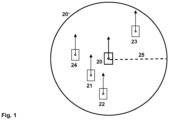
- Figure 1 is a schematic representation of a situation of a plurality of communication participants of a group of communication participants within a transmission area 20' or radio coverage area 20' of a first communication participant 20.
- the group of communication participants (who are in spatial proximity to one another) in the exemplary situation shown also includes a second communication participant 21, a third communication participant 22, a third communication participant 23 and a fourth communication participant 24.
- the reference number 25 schematically indicates the approximate radius of the (essentially circular) radio coverage area 20'.
- the radio coverage area 20 ⁇ of the first communication participant 20 can be regarded as the spatial area within which the signals transmitted or received by the first communication participant 20 can be received.
- radiated radio signals in particular including broadcast messages, still have a signal strength or signal properties such that other communication participants 21, 22, 23, 24 can receive and process them, ie, if necessary, process and/or decrypt them.
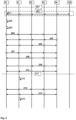
- FIG. 2 a communication diagram is shown schematically which illustrates the implementation of the method according to the invention.
- the communication diagram shows the communication between the first communication participant 20, the second communication participant 21, the third communication participant 22, the fourth communication participant 23, the fifth communication participant 24 and an application server entity 120, in particular for a V2X application, vehicle-to-x-application.
- a first process step 201 it is first necessary to create the foundations or basic requirements so that the communication participants 20, 21, 22, 23, 24 can communicate with each other and with the application server entity 120.
- a registration 201' of the communication participants 20, 21, 22, 23, 24 for the V2X application takes place with the application server entity 120.
- a plurality of messages 201" are exchanged between the communication participants 20, 21, 22, 23, 24 and the application server entity 120.
- This creation of the prerequisites for the communication between the communication participants 20, 21, 22, 23, 24 takes place according to the invention according to known methods, in particular according to standardized methods.
- service identification information which is in particular specific to the V2X application, is transmitted to the communication participants 20, 21, 22, 23, 24.
- a communication session (or a message session) is started or initiated by one of the communication participants 20, 21, 22, 23, 24.
- the fourth communication participant 23 initiates the message session.
- a session identification information (Session ID, SID) is generated by the communication participant who initiates the message session (in Figure 2 Due to the registration of the communication participants 20, 21, 22, 23, 24 in or during the first Process step 201 in the application server entity 120 for the V2X application in particular, it is now possible for the various communication participants 20, 21, 22, 23, 24 to exchange broadcast messages.
- Examples of such broadcast messages are shown schematically and by way of example in a fourth process step 204, a fifth process step 205 and a sixth process step 206 in Figure 2 shown:
- the fourth communication participant 23 sends the first broadcast message of the message session in its radio coverage area or its transmission range; this first broadcast message is also received by the other communication participants because the other communication participants 20, 21, 22, 24 of the group of communication participants are in the radio coverage area of the fourth communication participant 23.
- the first broadcast message includes in particular the service identification information, the session identification information, sequence information of the first broadcast message, an indication of which communication participant sent the broadcast message (in this case the fourth communication participant 23), and a first message content.
- the fifth communication participant 24 sends the second broadcast message of the message session in its radio coverage area or its transmission range; this second broadcast message is in turn also received by the other communication participants, since the other communication participants 20, 21, 22, 23 of the group of communication participants are in the radio coverage area of the fifth communication participant 24.
- the second broadcast message in particular again comprises the service identification information, the session identification information, sequence information of the second broadcast message, an indication of which communication participant sent the broadcast message (in this case the fifth communication participant 24), and a second message content.
- the third communication participant 22 sends the third broadcast message of the message session in its radio coverage area or its transmission range; this third broadcast message is in turn also received by the other communication participants, since the other communication participants 20, 21, 23, 24 of the group of communication participants are in the radio coverage area of the third communication participant 22.
- the third broadcast message includes in particular the service identification information, the session identification information, sequence information of the third broadcast message, an indication of which communication participant sent the broadcast message (in this case the third communication participant 22), as well as a third message content.
- the first, second and third broadcast messages are part of the message session and have the respective sequence information such that in particular the sequence information of consecutive broadcast messages within the message session is increased, in particular increased by one counting unit. Based on the sequence information, it is thus possible for all communication participants 20, 21, 22, 23, 24 to determine whether the sequence of broadcast messages of the message session is complete.
- All broadcast messages of the message session include - in addition to the sequence information - in particular the service identification information, the session identification information, an indication of which communication participant sent the broadcast message, and a corresponding message content.
- Figure 2 shows in the seventh, eighth, ninth and tenth process steps 207, 208, 209, 210, by way of example, a situation in which the second communication participant 21 (or the specific receiver 21 under consideration) does not receive at least one broadcast message of the message session from the first communication participant 20 (which is also referred to as the transmitter 20):
- the fourth communication participant 23 first sends (by way of example) in its radio coverage area or its transmission range the last broadcast message of the message session still received by the specific receiver 21; this last broadcast message still received (by the specific receiver 21) is also received by the other communication participants, since the other communication participants 20, 21, 22, 24 of the group of communication participants are in the radio coverage area of the fourth communication participant 23.
- the sequence information of the last broadcast message received by the specific receiver 21 is also referred to below as the sequence information lastSeq.
- the first communication participant 20 (or transmitter 20) sends the subsequent broadcast message of the message session (i.e. the broadcast message following the last broadcast message received by the specific receiver 21, which includes the sequence information of the broadcast message following the last broadcast message received by the specific receiver 21, hereinafter also referred to as sequence information lastSeq+1) in its radio coverage area 20' or its transmission range; this subsequent broadcast message is not received by the specific receiver 21 (initially), but in the example shown it is received by the other communication participants 22, 23, 24 of the group of communication participants.
- the subsequent broadcast message of the message session i.e. the broadcast message following the last broadcast message received by the specific receiver 21, which includes the sequence information of the broadcast message following the last broadcast message received by the specific receiver 21, hereinafter also referred to as sequence information lastSeq+1
- the first communication participant 20 (or transmitter 20) sends a broadcast message in its radio coverage area 20' or its transmission range, which is received by the specific receiver 21 (and by the other communication participants 22, 23, 24 of the group of communication participants).
- This broadcast message is, for example, the broadcast message (of the message session) currently received by the specific receiver 21.
- the specific receiver 21 is able to recognize that the sequence of received broadcast messages of the message session is not complete.
- the sequence information of the broadcast message currently received by the specific receiver 21 is also referred to below as sequence information curSeq.
- the specific receiver 21 In a part of the presentation referred to as the eleventh process step 211 in Figure 2 it is thus initially possible for the specific receiver 21 to recognize or detect (in the example in particular because the specific receiver 21 recognized in the message of process step 210 that the messages of process steps 208 and 209 were missed) that broadcast messages were missed and also to initiate or trigger the steps of the method according to the invention:
- a twelfth process step 212 it is initially recognized or detected that at least one broadcast message was missed (ie the specific receiver 21 recognizes in particular - in accordance with the first step of the method according to the invention - the failure to receive the message content of the at least one broadcast message, in particular based on a comparison of the sequence information of the received broadcast messages, ie based on the comparison of the sequence information curSeq and lastSeq).
- a fourteenth process step 214 - corresponding to the third step of the method according to the invention one of the plurality of communication participants of the group of communication participants 20, 21, 22, 23, 24 sends the message content to the specific recipient 21 (in the form of a broadcast message).
- the third communication participant 22 that sends the message content or the at least one missed broadcast message (or the majority of missed broadcast messages); however, one of the other communication participants 20, 23, 24 could also send the message content or the at least one missed broadcast message (or the majority of missed broadcast messages) in the fourteenth process step 214, in particular, for example, the first communication participant 20 (or sender 20).
- the broadcast message sent in the fourteenth process step 214 includes - in addition to the sequence information, the service identification information, the session identification information, the indication of which communication participant sent the broadcast message, and the corresponding message content - additionally information about the intended recipient of the broadcast message, i.e. in this case the specific recipient 21.
- the specific recipient 21 receives the message content or the at least one missed broadcast message (or the majority of missed broadcast messages), so that the message session is now completely available to the specific recipient.
- the broadcast messages sent in the thirteenth process step 213 and in the fourteenth process step 214 are usually sent for reception by all communication participants in the group of communication participants. This makes it possible according to the invention to ensure that after the thirteenth process step 213 the message content or the missed message actually reaches the specific recipient 21 without sending an excessively large number of broadcast messages multiple times. According to the invention, it is particularly provided that within a first time interval after sending - during the second Step - the further broadcast message, a specific communication participant (such as the sender 20) sends the message content and that within a second time interval after sending the further broadcast message, a specific other communication participant (such as the communication participant who had sent the previously sent broadcast message) sends the message content to the specific recipient 21.
- a specific communication participant such as the sender 20
- a specific other communication participant such as the communication participant who had sent the previously sent broadcast message
- the messages of the V2X session are temporarily stored by the communication participants (or road users) 20, 21, 22, 23, 24 participating in the message session.
- the communication participants 20, 21, 22, 23, 24 can determine whether and, if so, which messages they have missed. This ensures that only the missed messages are actually resent. Since these are broadcast messages or multicast messages, it could otherwise happen that the corresponding V2X frequency bands in the area are overloaded with V2X messages.
- the communication participants (or road users) 20, 21, 22, 23, 24 are able to make a request to the other session participants (thirteenth process step 213, second step) as to which messages they have missed and to request that the messages be sent again.
- the invention can ensure that only one of the participants in the group of communication participants (or at least a minimal or small number of the session participants) sends the messages again. This ensures that not all communication participants 20, 21, 22, 23, 24 send the missed messages (redundantly). Since these are broadcast messages or multicast messages, it could otherwise happen that the corresponding V2X frequency bands in the area are overloaded with V2X messages.
- the messages of the V2X session are temporarily stored by the communication participants (or road users) 20, 21, 22, 23, 24 participating in the message session or by at least one communication participant 20, 21, 22, 23, 24.
- the V2X messages (or broadcast messages) of the message session are stored by one of the communication participants.
- the service identification information can, for example, be an identifier or information provided in the V2X standard for a specific use case, but also an identifier or information or identifier for a service and/or an application of a service provider for specific V2X applications.
- the session identification information is generally generated by the communication participant or road user who sends the first message (or broadcast message) within the message session or initiates the V2X communication for a V2X use case/application.
- sequence numbers for the broadcast message of the message session
- the invention provides that the combination of a unique identifier (or an identifier) of the (sending) road user or communication participant (VT-ID) for the V2X application and an ascending sequence number (Seq) is used as the "sequence number" (or sequence information).
- VT-ID unique identifier
- Seq ascending sequence number
- an identifier of the communication participant or road user is within the V2X application or alternatively an ID (or identifier) assigned by the sender itself for the V2X session (i.e. the message session).
- the sequence number Seq is set to, for example, "1" (or "0" or "10") by the communication participant or road user who sends the first broadcast message of the message session. set.
- Each additional sender increments the highest sequence number received and sets this as a new Seq in its message. If two or more messages have the same Seq due to a temporal overlap, the sender increases the new Seq by the number of the same (highest) sequence numbers Seq (i.e.
- the participating communication participants 20, 21, 22, 23, 24 or road users are registered in an intelligent transport system (ITS) covering the use case or with the V2X service / V2X application of the service provider (or with the application server entity 120) and in particular support any necessary security mechanisms, such as signing with pseudonymized certificates, etc.
- ITS intelligent transport system
- all communication participants or VTs 20, 21, 22, 23, 24 participating in the message session store all V2X messages of the session, i.e. all broadcast messages, that they have received.
- V2X session (or a message session)
- one of the communication participants in the example, the Figure 2 this is the fourth communication participant 23; however, it could also be any other communication participant 20, 21, 22, 24
- the V2X session for a specific V2X application ie with a ServID, service identification information
- a session ID session identification information
- All communication participants are then able to participate in the message session, because they are registered for the V2X application and are in the receiving environment of the respective transmitter; they can therefore send corresponding broadcast messages (ie in particular with ServID, SID, Seq, their VT ID and a content).
- the communication participants or road users (VT) participating in the V2X session save in particular all V2X messages that they receive.
- a communication participant or VT in the example the second communication participant 21 or the specific recipient 21 participating in the V2X session (SID) of the V2X application (ServID) receives a V2X message of the session whose sequence number curSeq is at least 2 (or two increments) higher than the sequence number of the last received message lastSeq, it is recognized that the reception of a broadcast message or an associated message content was missed or failed.
- the road user who sent the message curSeq i.e. the sender 20 or first communication participant 20
- the transmitter 20 i.e. the communication participant who sent the message with the session ID "curSeq-1"
- the transmitter 20 i.e. the communication participant who sent the message with the session ID "curSeq-1”
- the transmitter 20 sends the messages missed by the specific receiver 21 within a further (second) predetermined time interval of ⁇ t
- this message with the missed messages is in particular not part of the message session and is not stored by the communication participants or VT. It continues accordingly until one of the communication participants or VT sends the messages.
- This option is particularly suitable for use cases in which the initiator and sender of the first message as well as the senders of the subsequent messages are most likely still in the message session (i.e. in particular are in the radio coverage area of the communication), because they have a special meaning / role, for example.
- the initiator of the message session i.e. the communication participant who sends the first broadcast message
- the initiator and first sender of a message has a prominent role in the session (i.e. if he initiates, manages and also ends the session, for example), it is sufficient if only he saves all messages.
- a communication participant or VT then makes a request for missed messages, the initiator of the session sends the missed messages. All other VTs then do not need to save anything.
- a communication participant or VT wants to leave the message session, it is particularly preferred that the saved messages of the session are deleted. It is also preferably provided according to the invention that a time is defined after which a VT considers the session to be ended, i.e. during which it does not receive any new messages. In this case too, the VT then deletes all saved messages.
Landscapes
- Engineering & Computer Science (AREA)
- Computer Networks & Wireless Communication (AREA)
- Signal Processing (AREA)
- Mobile Radio Communication Systems (AREA)
Claims (11)
- Procédé de transmission d'un contenu de message au moyen d'une pluralité de messages de diffusion, la transmission du contenu de message s'effectuant entre une pluralité de participants à la communication d'un groupe de participants à la communication (20, 21, 22, 23, 24), une pluralité de messages de diffusion étant envoyés et reçus entre les participants à la communication du groupe de participants à la communication (20, 21, 22, 23, 24), la pluralité de ces messages de diffusion faisant partie d'une session de messages de messages de diffusion,dans lequel chaque message de diffusion de la session de messages présente une information de séquence et chaque participant à la communication définit, pour l'envoi d'un message de diffusion, son information de séquence contenant un numéro de séquence de telle sorte que son numéro de séquence soit augmenté par rapport au numéro de séquence le plus élevé reçu par le participant à la communication, dans lequel un émetteur (20) envoie au moins un message de diffusion, le contenu de message étant envoyé par l'émetteur (20) à une pluralité de récepteurs (21, 22, 23, 24) du groupe de participants à la communication (20, 21, 22, 23, 24) au moyen dudit au moins un message de diffusion au moyen d'une fonctionnalité sidelink PC5, en particulier en utilisant la fonctionnalité mode 4,dans lequel le procédé de transmission du contenu de message, dans le cas où la réception du contenu de message au moyen dudit au moins un message de diffusion par un récepteur spécifique (21) de la pluralité de récepteurs (21, 22, 23, 24) échoue, comprend les étapes suivantes :- dans une première étape, le récepteur spécifique (21) détecte l'échec de la réception du contenu de message au moyen dudit au moins un message de diffusion, la détection de l'échec de la réception du contenu de message se faisant sur la base d'une information de séquence d'un message de diffusion reçu par le récepteur spécifique (21) et suivant ledit au moins un message de diffusion, une telle détection se faisant par comparaison avec une information de séquence d'un message de diffusion également reçu par le récepteur spécifique (21) et précédant ledit au moins un message de diffusion,- dans une deuxième étape suivant la première étape, le récepteur spécifique (21) envoie, au moyen d'un autre message de diffusion, une demande d'émission pour une nouvelle transmission du contenu de message,- dans une troisième étape suivant la deuxième étape, l'un de la pluralité de participants à la communication du groupe de participants à la communication (20, 21, 22, 23, 24) envoie le contenu de message au récepteur spécifique (21).
- Procédé selon la revendication 1, caractérisé en ce que, pendant la troisième étape, le contenu de message est envoyé au moyen d'un message dans lequel le récepteur spécifique (21) est explicitement désigné comme récepteur.
- Procédé selon l'une des revendications précédentes, caractérisé en ce que, pendant la troisième étape, le contenu de message est envoyé par l'émetteur (20) dudit au moins un message de diffusion au récepteur spécifique (21), en particulier pendant un premier intervalle de temps après l'envoi - pendant la deuxième étape - de l'autre message de diffusion par le récepteur spécifique (21).
- Procédé selon l'une des revendications précédentes, caractérisé en ce que, pendant la troisième étape, le contenu de message est envoyé au récepteur spécifique (21) par un participant à la communication du groupe de participants à la communication (20, 21, 22, 23, 24) différent de l'émetteur (20), en particulier pendant un deuxième intervalle de temps après l'envoi - pendant la deuxième étape - de l'autre message de diffusion par le récepteur spécifique (21), le deuxième intervalle de temps démarrant en particulier après expiration du premier intervalle de temps.
- Procédé selon l'une des revendications précédentes, caractérisé en ce que, dans le cadre de la session de messages de diffusion, au moins un premier message de diffusion est émis par un premier participant à la communication du groupe de participants à la communication (20, 21, 22, 23, 24) et au moins un deuxième message de diffusion est émis par un deuxième participant à la communication du groupe de participants à la communication (20, 21, 22, 23, 24), aussi bien le premier message de diffusion que le deuxième message de diffusion présentant une même information de séquence identique ou similaire, un autre message de diffusion émis par un autre participant à la communication du groupe de participants à la communication (20, 21, 22, 23, 24) présentant en particulier une information de séquence incrémentée de deux unités de comptage.
- Procédé selon l'une des revendications précédentes, caractérisé en ce que la session de messages de messages de diffusion est démarrée ou initiée par un participant à la communication spécifique du groupe de participants à la communication (20, 21, 22, 23, 24) au moyen d'un message de diffusion initial,dans lequel, pendant la troisième étape, le contenu de message est envoyé par le participant à la communication spécifique au récepteur spécifique (21), en particulier pendant un premier intervalle de temps après l'envoi - pendant la deuxième étape - de l'autre message de diffusion par le récepteur spécifique (21),dans lequel, en particulier pendant la troisième étape, le contenu de message est envoyé au récepteur spécifique (21) par un autre participant à la communication spécifique, l'autre participant à la communication spécifique étant le participant à la communication qui a envoyé le message de diffusion suivant le message de diffusion initial, le contenu de message étant envoyé au récepteur spécifique (21) en particulier pendant un deuxième intervalle de temps après l'envoi - pendant la deuxième étape - de l'autre message de diffusion par le récepteur spécifique (21), le deuxième intervalle de temps démarrant en particulier après expiration du premier intervalle de temps.
- Procédé selon l'une des revendications précédentes, caractérisé en ce que- les messages de diffusion de la session de messages, ou en tout cas leur contenu de message respectif, sont mémorisés par les participants à la communication du groupe de participants à la communication (20, 21, 22, 23, 24),- ou que les messages de diffusion de la session de messages, ou en tout cas leur contenu de message respectif, sont mémorisés par un participant à la communication, en particulier le participant à la communication spécifique du groupe de participants à la communication (20, 21, 22, 23, 24).
- Réseau de télécommunication (100) ou système de transmission d'un contenu de message au moyen d'une pluralité de messages de diffusion, comprenant une pluralité de participants à la communication d'un groupe de participants à la communication (20, 21, 22, 23, 24), la transmission du contenu de message s'effectuant entre la pluralité de participants à la communication du groupe de participants à la communication (20, 21, 22, 23, 24), les participants à la communication étant configurés pour envoyer et recevoir une pluralité de messages de diffusion, la pluralité de ces messages de diffusion faisant partie d'une session de messages de diffusion,dans lequel chaque message de diffusion de la session de messages présente une information de séquence et chaque participant à la communication est configuré, pour envoyer un message de diffusion, pour définir son information de séquence contenant un numéro de séquence de telle sorte que son numéro de séquence soit augmenté par rapport au numéro de séquence le plus élevé reçu par le participant à la communication,dans lequel un émetteur (20) envoie au moins un message de diffusion, le contenu de message étant envoyé par l'émetteur (20) à une pluralité de récepteurs (21, 22, 23, 24) du groupe de participants à la communication (20, 21, 22, 23, 24) au moyen dudit au moins un message de diffusion au moyen d'une fonctionnalité sidelink PC5, en particulier en utilisant la fonctionnalité mode 4,dans lequel le réseau de télécommunication (100) ou le système est configuré de telle sorte que, dans le cas où la réception du contenu de message au moyen dudit au moins un message de diffusion par un récepteur spécifique (21) de la pluralité de récepteurs (21, 22, 23, 24) échoue,- le récepteur spécifique (21) est configuré pour détecter l'échec de la réception du contenu de message au moyen dudit au moins un message de diffusion, le récepteur spécifique (21) étant configuré de telle sorte que la détection de l'échec de la réception du contenu de message se fasse sur la base d'une information de séquence d'un message de diffusion reçu par le récepteur spécifique (21) et suivant ledit au moins un message de diffusion, et se fasse par comparaison avec une information de séquence d'un message de diffusion également reçu par le récepteur spécifique (21) et précédant ledit au moins un message de diffusion,- le récepteur spécifique (21) est configuré pour envoyer, au moyen d'un autre message de diffusion, une demande d'émission pour une nouvelle transmission du contenu de message,- l'un de la pluralité de participants à la communication du groupe de participants à la communication (20, 21, 22, 23, 24) est configuré pour envoyer le contenu de message au destinataire spécifique (21).
- Participant à la communication configuré en tant qu'émetteur (20) ou récepteur (21, 22, 23, 24) pour une utilisation dans un réseau de télécommunication (100) ou dans un système selon la revendication 8.
- Programme d'ordinateur comprenant des instructions à l'aide desquelles les étapes d'un procédé selon l'une des revendications 1 à 7 peuvent être mises en œuvre lorsque le programme d'ordinateur est exécuté sur un dispositif programmable, en particulier sur un noeud de réseau sous la forme d'un émetteur (20) et/ou d'un récepteur (21, 22, 23, 24) et/ou d'un participant à la communication (20, 21, 22, 23, 24).
- Support lisible par ordinateur, prévu pour stocker un programme d'ordinateur, ou signal de support de données, prévu pour transmettre un programme d'ordinateur, le support lisible par ordinateur ou le signal de support de données stockant ou transmettant le programme d'ordinateur selon la revendication 10, ou le support lisible par ordinateur ou le signal de support de données stockant ou transmettant la partie du programme d'ordinateur selon la revendication 10 à exécuter sur le dispositif programmable, en particulier un noeud de réseau sous la forme d'un émetteur (20) et/ou d'un récepteur (21, 22, 23, 24) et/ou d'un participant à la communication (20, 21, 22, 23, 24).
Priority Applications (1)
| Application Number | Priority Date | Filing Date | Title |
|---|---|---|---|
| EP21213967.9A EP4195552B1 (fr) | 2021-12-13 | 2021-12-13 | Procédé de transmission d'un contenu de message au moyen d'une pluralité de messages de diffusion, réseau ou système de télécommunications permettant de transmettre un contenu de message au moyen de la pluralité de messages de diffusion, participant à la communication, en particulier émetteur ou récepteur, programme informatique et support lisible par ordinateur |
Applications Claiming Priority (1)
| Application Number | Priority Date | Filing Date | Title |
|---|---|---|---|
| EP21213967.9A EP4195552B1 (fr) | 2021-12-13 | 2021-12-13 | Procédé de transmission d'un contenu de message au moyen d'une pluralité de messages de diffusion, réseau ou système de télécommunications permettant de transmettre un contenu de message au moyen de la pluralité de messages de diffusion, participant à la communication, en particulier émetteur ou récepteur, programme informatique et support lisible par ordinateur |
Publications (2)
| Publication Number | Publication Date |
|---|---|
| EP4195552A1 EP4195552A1 (fr) | 2023-06-14 |
| EP4195552B1 true EP4195552B1 (fr) | 2024-11-20 |
Family
ID=78844621
Family Applications (1)
| Application Number | Title | Priority Date | Filing Date |
|---|---|---|---|
| EP21213967.9A Active EP4195552B1 (fr) | 2021-12-13 | 2021-12-13 | Procédé de transmission d'un contenu de message au moyen d'une pluralité de messages de diffusion, réseau ou système de télécommunications permettant de transmettre un contenu de message au moyen de la pluralité de messages de diffusion, participant à la communication, en particulier émetteur ou récepteur, programme informatique et support lisible par ordinateur |
Country Status (1)
| Country | Link |
|---|---|
| EP (1) | EP4195552B1 (fr) |
-
2021
- 2021-12-13 EP EP21213967.9A patent/EP4195552B1/fr active Active
Also Published As
| Publication number | Publication date |
|---|---|
| EP4195552A1 (fr) | 2023-06-14 |
Similar Documents
| Publication | Publication Date | Title |
|---|---|---|
| EP2186379B1 (fr) | Dispositif et procédé pour transmettre des informations | |
| DE102004016580B4 (de) | Verfahren zur Übertragung von Daten in einem Ad Hoc Netzwerk oder einem Sensornetzwerk | |
| DE10132273A1 (de) | Verfahren zum Übertragen von Multicast-Nachrichten in einem Funksystem sowie entsprechend ausgestaltetes Funksystem und entsprechend ausgestalteter Sender und Empfänger | |
| DE102009039442B4 (de) | System und Verfahren für das Vorrichtungsmanagement in einem dedizierten kurzreichweitigen Kommunikationsnetz | |
| DE60111431T2 (de) | Verfahren zur bereitstellung von multicast- und/oder rundsendediensten zu benutzerendgeräten | |
| DE19752697A1 (de) | Drahtloses lokales Netzwerk mit Controller und wenigstens einem als Controller einsetzbaren Terminal | |
| DE102009003724A1 (de) | Verfahren zur Optimierung von Netzwerkstrukturen in Funknetzwerken | |
| EP2795848A1 (fr) | Station participante à un système de bus et procédé de transmission de messages entre des stations participantes à un système de bus | |
| DE102005033667A1 (de) | Kommunikationssitzungs-Server-Einheit, Kommunikations-Endgerät, Broadcast-Server-Einheit, Netzwerkeinheit, Verfahren zum Steuern einer Kommunikationssitzung mit mehreren Kommunikations-Endgeräten, Verfahren zum Aufbauen einer Kommunikationssitzung, Verfahren zum Übertragen von Daten im Rahmen einer Kommunikationssitzung mittels einer Broadcast-Server-Einheit und Computerprogrammelemente | |
| DE102011003624A1 (de) | Verfahren und System zur Reduzierung der Datenauslastung eines Fahrzeug-zu-X-Kommunikationskanals | |
| EP0989701A2 (fr) | Bus de donneés | |
| EP4195552B1 (fr) | Procédé de transmission d'un contenu de message au moyen d'une pluralité de messages de diffusion, réseau ou système de télécommunications permettant de transmettre un contenu de message au moyen de la pluralité de messages de diffusion, participant à la communication, en particulier émetteur ou récepteur, programme informatique et support lisible par ordinateur | |
| EP1540985A2 (fr) | Procede de realisation d'une procedure de transfert dans un systeme de communication radio destinee a une connexion a commutation par paquets et systeme de communication radio adapte a cet effet | |
| EP4210281B1 (fr) | Procédé de transmission d'un contenu de message entre une pluralité d'abonnés de communication, réseau ou système de télécommunications permettant de transmettre un contenu de message entre une pluralité d'abonnés de communication, abonné de communication, programme informatique et support lisible par ordinateur | |
| WO2023093954A1 (fr) | Procédé de transmission de messages de véhicule à x, et module de communication de véhicule à x | |
| EP1615374B1 (fr) | Procédé d'émission et de réception des notifications d'événement | |
| DE10224994A1 (de) | Verfahren und System zum Übertragen von Datenpaketen | |
| EP3989504B1 (fr) | Procédé de communication authentifiée entre un premier partenaire de communication et un second partenaire de communication, le premier partenaire de communication et/ou le second partenaire de communication étant un abonné du trafic ou une partie d'une infrastructure du trafic, système, partenaire de communication, programme informatique et support lisible par ordinateur | |
| DE102023210102A1 (de) | Computerimplementiertes Verfahren zur Integritätsprüfung eines Zielteilnehmers in einem drahtlos kommunizierenden Infrastruktursystem | |
| DE10244981B4 (de) | Verfahren zur Realisierung einer Kommunikationsverbindung, zugehöriges Funkkommunikationsgerät sowie Netzwerkkontrolleinheit | |
| DE102005038588B4 (de) | Verfahren zum verlässlichen Übermitteln von Broadcast-Nachrichten | |
| EP3485591B1 (fr) | Canal d'accusé de réception pour la transmission de données sécurisée | |
| DE102018003539A1 (de) | Autonome Sicherheit in Drahtlosnetzwerken mit mehreren Betreibern oder Zugangspunkten | |
| DE102004005254B4 (de) | Empfängerklassifizierung bei Push-to-talk-over-Cellular (PoC) Verfahren | |
| EP3902332A1 (fr) | Procédé de synchronisation des données d'une banque de données ainsi que programme informatique, dispositif de traitement des données et terminal mobile associé |
Legal Events
| Date | Code | Title | Description |
|---|---|---|---|
| PUAI | Public reference made under article 153(3) epc to a published international application that has entered the european phase |
Free format text: ORIGINAL CODE: 0009012 |
|
| STAA | Information on the status of an ep patent application or granted ep patent |
Free format text: STATUS: REQUEST FOR EXAMINATION WAS MADE |
|
| 17P | Request for examination filed |
Effective date: 20221026 |
|
| AK | Designated contracting states |
Kind code of ref document: A1 Designated state(s): AL AT BE BG CH CY CZ DE DK EE ES FI FR GB GR HR HU IE IS IT LI LT LU LV MC MK MT NL NO PL PT RO RS SE SI SK SM TR |
|
| REG | Reference to a national code |
Ref country code: DE Ref legal event code: R079 Free format text: PREVIOUS MAIN CLASS: H04L0001180000 Ipc: H04W0004800000 Ref country code: DE Ref legal event code: R079 Ref document number: 502021005861 Country of ref document: DE Free format text: PREVIOUS MAIN CLASS: H04L0001180000 Ipc: H04W0004800000 |
|
| RIC1 | Information provided on ipc code assigned before grant |
Ipc: H04W 4/70 20180101ALN20240404BHEP Ipc: H04W 4/40 20180101ALN20240404BHEP Ipc: H04L 1/1867 20230101ALI20240404BHEP Ipc: H04L 1/1829 20230101ALI20240404BHEP Ipc: H04H 20/53 20080101ALI20240404BHEP Ipc: H04H 20/38 20080101ALI20240404BHEP Ipc: H04L 1/08 20060101ALI20240404BHEP Ipc: H04L 1/00 20060101ALI20240404BHEP Ipc: H04L 1/18 20230101ALI20240404BHEP Ipc: H04W 4/06 20090101ALI20240404BHEP Ipc: H04W 4/80 20180101AFI20240404BHEP |
|
| GRAP | Despatch of communication of intention to grant a patent |
Free format text: ORIGINAL CODE: EPIDOSNIGR1 |
|
| STAA | Information on the status of an ep patent application or granted ep patent |
Free format text: STATUS: GRANT OF PATENT IS INTENDED |
|
| RIC1 | Information provided on ipc code assigned before grant |
Ipc: H04W 4/70 20180101ALN20240529BHEP Ipc: H04W 4/40 20180101ALN20240529BHEP Ipc: H04L 1/1867 20230101ALI20240529BHEP Ipc: H04L 1/1829 20230101ALI20240529BHEP Ipc: H04H 20/53 20080101ALI20240529BHEP Ipc: H04H 20/38 20080101ALI20240529BHEP Ipc: H04L 1/08 20060101ALI20240529BHEP Ipc: H04L 1/00 20060101ALI20240529BHEP Ipc: H04L 1/18 20230101ALI20240529BHEP Ipc: H04W 4/06 20090101ALI20240529BHEP Ipc: H04W 4/80 20180101AFI20240529BHEP |
|
| INTG | Intention to grant announced |
Effective date: 20240618 |
|
| GRAS | Grant fee paid |
Free format text: ORIGINAL CODE: EPIDOSNIGR3 |
|
| GRAA | (expected) grant |
Free format text: ORIGINAL CODE: 0009210 |
|
| STAA | Information on the status of an ep patent application or granted ep patent |
Free format text: STATUS: THE PATENT HAS BEEN GRANTED |
|
| AK | Designated contracting states |
Kind code of ref document: B1 Designated state(s): AL AT BE BG CH CY CZ DE DK EE ES FI FR GB GR HR HU IE IS IT LI LT LU LV MC MK MT NL NO PL PT RO RS SE SI SK SM TR |
|
| REG | Reference to a national code |
Ref country code: GB Ref legal event code: FG4D Free format text: NOT ENGLISH |
|
| REG | Reference to a national code |
Ref country code: CH Ref legal event code: EP |
|
| REG | Reference to a national code |
Ref country code: DE Ref legal event code: R096 Ref document number: 502021005861 Country of ref document: DE |
|
| REG | Reference to a national code |
Ref country code: IE Ref legal event code: FG4D Free format text: LANGUAGE OF EP DOCUMENT: GERMAN |
|
| REG | Reference to a national code |
Ref country code: LT Ref legal event code: MG9D |
|
| REG | Reference to a national code |
Ref country code: NL Ref legal event code: MP Effective date: 20241120 |
|
| PG25 | Lapsed in a contracting state [announced via postgrant information from national office to epo] |
Ref country code: HR Free format text: LAPSE BECAUSE OF FAILURE TO SUBMIT A TRANSLATION OF THE DESCRIPTION OR TO PAY THE FEE WITHIN THE PRESCRIBED TIME-LIMIT Effective date: 20241120 Ref country code: PT Free format text: LAPSE BECAUSE OF FAILURE TO SUBMIT A TRANSLATION OF THE DESCRIPTION OR TO PAY THE FEE WITHIN THE PRESCRIBED TIME-LIMIT Effective date: 20250320 Ref country code: IS Free format text: LAPSE BECAUSE OF FAILURE TO SUBMIT A TRANSLATION OF THE DESCRIPTION OR TO PAY THE FEE WITHIN THE PRESCRIBED TIME-LIMIT Effective date: 20250320 |
|
| PG25 | Lapsed in a contracting state [announced via postgrant information from national office to epo] |
Ref country code: FI Free format text: LAPSE BECAUSE OF FAILURE TO SUBMIT A TRANSLATION OF THE DESCRIPTION OR TO PAY THE FEE WITHIN THE PRESCRIBED TIME-LIMIT Effective date: 20241120 Ref country code: NL Free format text: LAPSE BECAUSE OF FAILURE TO SUBMIT A TRANSLATION OF THE DESCRIPTION OR TO PAY THE FEE WITHIN THE PRESCRIBED TIME-LIMIT Effective date: 20241120 |
|
| PG25 | Lapsed in a contracting state [announced via postgrant information from national office to epo] |
Ref country code: BG Free format text: LAPSE BECAUSE OF FAILURE TO SUBMIT A TRANSLATION OF THE DESCRIPTION OR TO PAY THE FEE WITHIN THE PRESCRIBED TIME-LIMIT Effective date: 20241120 |
|
| PG25 | Lapsed in a contracting state [announced via postgrant information from national office to epo] |
Ref country code: ES Free format text: LAPSE BECAUSE OF FAILURE TO SUBMIT A TRANSLATION OF THE DESCRIPTION OR TO PAY THE FEE WITHIN THE PRESCRIBED TIME-LIMIT Effective date: 20241120 |
|
| PG25 | Lapsed in a contracting state [announced via postgrant information from national office to epo] |
Ref country code: NO Free format text: LAPSE BECAUSE OF FAILURE TO SUBMIT A TRANSLATION OF THE DESCRIPTION OR TO PAY THE FEE WITHIN THE PRESCRIBED TIME-LIMIT Effective date: 20250220 |
|
| PG25 | Lapsed in a contracting state [announced via postgrant information from national office to epo] |
Ref country code: LV Free format text: LAPSE BECAUSE OF FAILURE TO SUBMIT A TRANSLATION OF THE DESCRIPTION OR TO PAY THE FEE WITHIN THE PRESCRIBED TIME-LIMIT Effective date: 20241120 Ref country code: GR Free format text: LAPSE BECAUSE OF FAILURE TO SUBMIT A TRANSLATION OF THE DESCRIPTION OR TO PAY THE FEE WITHIN THE PRESCRIBED TIME-LIMIT Effective date: 20250221 |
|
| PG25 | Lapsed in a contracting state [announced via postgrant information from national office to epo] |
Ref country code: PL Free format text: LAPSE BECAUSE OF FAILURE TO SUBMIT A TRANSLATION OF THE DESCRIPTION OR TO PAY THE FEE WITHIN THE PRESCRIBED TIME-LIMIT Effective date: 20241120 |
|
| PG25 | Lapsed in a contracting state [announced via postgrant information from national office to epo] |
Ref country code: RS Free format text: LAPSE BECAUSE OF FAILURE TO SUBMIT A TRANSLATION OF THE DESCRIPTION OR TO PAY THE FEE WITHIN THE PRESCRIBED TIME-LIMIT Effective date: 20250220 |
|
| PG25 | Lapsed in a contracting state [announced via postgrant information from national office to epo] |
Ref country code: SM Free format text: LAPSE BECAUSE OF FAILURE TO SUBMIT A TRANSLATION OF THE DESCRIPTION OR TO PAY THE FEE WITHIN THE PRESCRIBED TIME-LIMIT Effective date: 20241120 |
|
| PG25 | Lapsed in a contracting state [announced via postgrant information from national office to epo] |
Ref country code: DK Free format text: LAPSE BECAUSE OF FAILURE TO SUBMIT A TRANSLATION OF THE DESCRIPTION OR TO PAY THE FEE WITHIN THE PRESCRIBED TIME-LIMIT Effective date: 20241120 |
|
| PG25 | Lapsed in a contracting state [announced via postgrant information from national office to epo] |
Ref country code: EE Free format text: LAPSE BECAUSE OF FAILURE TO SUBMIT A TRANSLATION OF THE DESCRIPTION OR TO PAY THE FEE WITHIN THE PRESCRIBED TIME-LIMIT Effective date: 20241120 |
|
| PG25 | Lapsed in a contracting state [announced via postgrant information from national office to epo] |
Ref country code: RO Free format text: LAPSE BECAUSE OF FAILURE TO SUBMIT A TRANSLATION OF THE DESCRIPTION OR TO PAY THE FEE WITHIN THE PRESCRIBED TIME-LIMIT Effective date: 20241120 |
|
| PG25 | Lapsed in a contracting state [announced via postgrant information from national office to epo] |
Ref country code: SK Free format text: LAPSE BECAUSE OF FAILURE TO SUBMIT A TRANSLATION OF THE DESCRIPTION OR TO PAY THE FEE WITHIN THE PRESCRIBED TIME-LIMIT Effective date: 20241120 |
|
| PG25 | Lapsed in a contracting state [announced via postgrant information from national office to epo] |
Ref country code: CZ Free format text: LAPSE BECAUSE OF FAILURE TO SUBMIT A TRANSLATION OF THE DESCRIPTION OR TO PAY THE FEE WITHIN THE PRESCRIBED TIME-LIMIT Effective date: 20241120 |
|
| PG25 | Lapsed in a contracting state [announced via postgrant information from national office to epo] |
Ref country code: IT Free format text: LAPSE BECAUSE OF FAILURE TO SUBMIT A TRANSLATION OF THE DESCRIPTION OR TO PAY THE FEE WITHIN THE PRESCRIBED TIME-LIMIT Effective date: 20241120 |
|
| REG | Reference to a national code |
Ref country code: CH Ref legal event code: PL |
|
| PG25 | Lapsed in a contracting state [announced via postgrant information from national office to epo] |
Ref country code: LU Free format text: LAPSE BECAUSE OF NON-PAYMENT OF DUE FEES Effective date: 20241213 |
|
| REG | Reference to a national code |
Ref country code: DE Ref legal event code: R097 Ref document number: 502021005861 Country of ref document: DE |
|
| PG25 | Lapsed in a contracting state [announced via postgrant information from national office to epo] |
Ref country code: SE Free format text: LAPSE BECAUSE OF FAILURE TO SUBMIT A TRANSLATION OF THE DESCRIPTION OR TO PAY THE FEE WITHIN THE PRESCRIBED TIME-LIMIT Effective date: 20241120 |
|
| PG25 | Lapsed in a contracting state [announced via postgrant information from national office to epo] |
Ref country code: MC Free format text: LAPSE BECAUSE OF FAILURE TO SUBMIT A TRANSLATION OF THE DESCRIPTION OR TO PAY THE FEE WITHIN THE PRESCRIBED TIME-LIMIT Effective date: 20241120 |
|
| PLBE | No opposition filed within time limit |
Free format text: ORIGINAL CODE: 0009261 |
|
| STAA | Information on the status of an ep patent application or granted ep patent |
Free format text: STATUS: NO OPPOSITION FILED WITHIN TIME LIMIT |
|
| REG | Reference to a national code |
Ref country code: BE Ref legal event code: MM Effective date: 20241231 |
|
| PG25 | Lapsed in a contracting state [announced via postgrant information from national office to epo] |
Ref country code: BE Free format text: LAPSE BECAUSE OF NON-PAYMENT OF DUE FEES Effective date: 20241231 |
|
| PG25 | Lapsed in a contracting state [announced via postgrant information from national office to epo] |
Ref country code: CH Free format text: LAPSE BECAUSE OF NON-PAYMENT OF DUE FEES Effective date: 20241231 |
|
| 26N | No opposition filed |
Effective date: 20250821 |
|
| PG25 | Lapsed in a contracting state [announced via postgrant information from national office to epo] |
Ref country code: IE Free format text: LAPSE BECAUSE OF NON-PAYMENT OF DUE FEES Effective date: 20241213 |
|
| PGFP | Annual fee paid to national office [announced via postgrant information from national office to epo] |
Ref country code: GB Payment date: 20251218 Year of fee payment: 5 |
|
| PGFP | Annual fee paid to national office [announced via postgrant information from national office to epo] |
Ref country code: AT Payment date: 20260113 Year of fee payment: 5 |
|
| PGFP | Annual fee paid to national office [announced via postgrant information from national office to epo] |
Ref country code: FR Payment date: 20251217 Year of fee payment: 5 |
|
| PGFP | Annual fee paid to national office [announced via postgrant information from national office to epo] |
Ref country code: DE Payment date: 20251222 Year of fee payment: 5 |