EP4286052A1 - Procédé de production d'un catalyseur métallique hétérogène d'hydrogénation - Google Patents
Procédé de production d'un catalyseur métallique hétérogène d'hydrogénation Download PDFInfo
- Publication number
- EP4286052A1 EP4286052A1 EP22746148.0A EP22746148A EP4286052A1 EP 4286052 A1 EP4286052 A1 EP 4286052A1 EP 22746148 A EP22746148 A EP 22746148A EP 4286052 A1 EP4286052 A1 EP 4286052A1
- Authority
- EP
- European Patent Office
- Prior art keywords
- reactor
- metal
- catalyst
- bimetallic
- group
- Prior art date
- Legal status (The legal status is an assumption and is not a legal conclusion. Google has not performed a legal analysis and makes no representation as to the accuracy of the status listed.)
- Pending
Links
Images

Classifications
-
- B—PERFORMING OPERATIONS; TRANSPORTING
- B01—PHYSICAL OR CHEMICAL PROCESSES OR APPARATUS IN GENERAL
- B01J—CHEMICAL OR PHYSICAL PROCESSES, e.g. CATALYSIS OR COLLOID CHEMISTRY; THEIR RELEVANT APPARATUS
- B01J37/00—Processes, in general, for preparing catalysts; Processes, in general, for activation of catalysts
- B01J37/16—Reducing
-
- B—PERFORMING OPERATIONS; TRANSPORTING
- B01—PHYSICAL OR CHEMICAL PROCESSES OR APPARATUS IN GENERAL
- B01J—CHEMICAL OR PHYSICAL PROCESSES, e.g. CATALYSIS OR COLLOID CHEMISTRY; THEIR RELEVANT APPARATUS
- B01J21/00—Catalysts comprising the elements, oxides, or hydroxides of magnesium, boron, aluminium, carbon, silicon, titanium, zirconium, or hafnium
- B01J21/18—Carbon
-
- B—PERFORMING OPERATIONS; TRANSPORTING
- B01—PHYSICAL OR CHEMICAL PROCESSES OR APPARATUS IN GENERAL
- B01J—CHEMICAL OR PHYSICAL PROCESSES, e.g. CATALYSIS OR COLLOID CHEMISTRY; THEIR RELEVANT APPARATUS
- B01J23/00—Catalysts comprising metals or metal oxides or hydroxides, not provided for in group B01J21/00
- B01J23/38—Catalysts comprising metals or metal oxides or hydroxides, not provided for in group B01J21/00 of noble metals
- B01J23/54—Catalysts comprising metals or metal oxides or hydroxides, not provided for in group B01J21/00 of noble metals combined with metals, oxides or hydroxides provided for in groups B01J23/02 - B01J23/36
- B01J23/56—Platinum group metals
- B01J23/62—Platinum group metals with gallium, indium, thallium, germanium, tin or lead
-
- B—PERFORMING OPERATIONS; TRANSPORTING
- B01—PHYSICAL OR CHEMICAL PROCESSES OR APPARATUS IN GENERAL
- B01J—CHEMICAL OR PHYSICAL PROCESSES, e.g. CATALYSIS OR COLLOID CHEMISTRY; THEIR RELEVANT APPARATUS
- B01J23/00—Catalysts comprising metals or metal oxides or hydroxides, not provided for in group B01J21/00
- B01J23/38—Catalysts comprising metals or metal oxides or hydroxides, not provided for in group B01J21/00 of noble metals
- B01J23/54—Catalysts comprising metals or metal oxides or hydroxides, not provided for in group B01J21/00 of noble metals combined with metals, oxides or hydroxides provided for in groups B01J23/02 - B01J23/36
- B01J23/56—Platinum group metals
- B01J23/62—Platinum group metals with gallium, indium, thallium, germanium, tin or lead
- B01J23/622—Platinum group metals with gallium, indium, thallium, germanium, tin or lead with germanium, tin or lead
-
- B—PERFORMING OPERATIONS; TRANSPORTING
- B01—PHYSICAL OR CHEMICAL PROCESSES OR APPARATUS IN GENERAL
- B01J—CHEMICAL OR PHYSICAL PROCESSES, e.g. CATALYSIS OR COLLOID CHEMISTRY; THEIR RELEVANT APPARATUS
- B01J23/00—Catalysts comprising metals or metal oxides or hydroxides, not provided for in group B01J21/00
- B01J23/38—Catalysts comprising metals or metal oxides or hydroxides, not provided for in group B01J21/00 of noble metals
- B01J23/54—Catalysts comprising metals or metal oxides or hydroxides, not provided for in group B01J21/00 of noble metals combined with metals, oxides or hydroxides provided for in groups B01J23/02 - B01J23/36
- B01J23/56—Platinum group metals
- B01J23/62—Platinum group metals with gallium, indium, thallium, germanium, tin or lead
- B01J23/622—Platinum group metals with gallium, indium, thallium, germanium, tin or lead with germanium, tin or lead
- B01J23/626—Platinum group metals with gallium, indium, thallium, germanium, tin or lead with germanium, tin or lead with tin
-
- B—PERFORMING OPERATIONS; TRANSPORTING
- B01—PHYSICAL OR CHEMICAL PROCESSES OR APPARATUS IN GENERAL
- B01J—CHEMICAL OR PHYSICAL PROCESSES, e.g. CATALYSIS OR COLLOID CHEMISTRY; THEIR RELEVANT APPARATUS
- B01J23/00—Catalysts comprising metals or metal oxides or hydroxides, not provided for in group B01J21/00
- B01J23/38—Catalysts comprising metals or metal oxides or hydroxides, not provided for in group B01J21/00 of noble metals
- B01J23/54—Catalysts comprising metals or metal oxides or hydroxides, not provided for in group B01J21/00 of noble metals combined with metals, oxides or hydroxides provided for in groups B01J23/02 - B01J23/36
- B01J23/56—Platinum group metals
- B01J23/64—Platinum group metals with arsenic, antimony, bismuth, vanadium, niobium, tantalum, polonium, chromium, molybdenum, tungsten, manganese, technetium or rhenium
- B01J23/656—Manganese, technetium or rhenium
- B01J23/6567—Rhenium
-
- B—PERFORMING OPERATIONS; TRANSPORTING
- B01—PHYSICAL OR CHEMICAL PROCESSES OR APPARATUS IN GENERAL
- B01J—CHEMICAL OR PHYSICAL PROCESSES, e.g. CATALYSIS OR COLLOID CHEMISTRY; THEIR RELEVANT APPARATUS
- B01J35/00—Catalysts, in general, characterised by their form or physical properties
- B01J35/30—Catalysts, in general, characterised by their form or physical properties characterised by their physical properties
- B01J35/391—Physical properties of the active metal ingredient
- B01J35/393—Metal or metal oxide crystallite size
-
- B—PERFORMING OPERATIONS; TRANSPORTING
- B01—PHYSICAL OR CHEMICAL PROCESSES OR APPARATUS IN GENERAL
- B01J—CHEMICAL OR PHYSICAL PROCESSES, e.g. CATALYSIS OR COLLOID CHEMISTRY; THEIR RELEVANT APPARATUS
- B01J35/00—Catalysts, in general, characterised by their form or physical properties
- B01J35/30—Catalysts, in general, characterised by their form or physical properties characterised by their physical properties
- B01J35/391—Physical properties of the active metal ingredient
- B01J35/394—Metal dispersion value, e.g. percentage or fraction
-
- B—PERFORMING OPERATIONS; TRANSPORTING
- B01—PHYSICAL OR CHEMICAL PROCESSES OR APPARATUS IN GENERAL
- B01J—CHEMICAL OR PHYSICAL PROCESSES, e.g. CATALYSIS OR COLLOID CHEMISTRY; THEIR RELEVANT APPARATUS
- B01J37/00—Processes, in general, for preparing catalysts; Processes, in general, for activation of catalysts
- B01J37/02—Impregnation, coating or precipitation
-
- B—PERFORMING OPERATIONS; TRANSPORTING
- B01—PHYSICAL OR CHEMICAL PROCESSES OR APPARATUS IN GENERAL
- B01J—CHEMICAL OR PHYSICAL PROCESSES, e.g. CATALYSIS OR COLLOID CHEMISTRY; THEIR RELEVANT APPARATUS
- B01J37/00—Processes, in general, for preparing catalysts; Processes, in general, for activation of catalysts
- B01J37/02—Impregnation, coating or precipitation
- B01J37/0201—Impregnation
-
- B—PERFORMING OPERATIONS; TRANSPORTING
- B01—PHYSICAL OR CHEMICAL PROCESSES OR APPARATUS IN GENERAL
- B01J—CHEMICAL OR PHYSICAL PROCESSES, e.g. CATALYSIS OR COLLOID CHEMISTRY; THEIR RELEVANT APPARATUS
- B01J37/00—Processes, in general, for preparing catalysts; Processes, in general, for activation of catalysts
- B01J37/08—Heat treatment
-
- B—PERFORMING OPERATIONS; TRANSPORTING
- B01—PHYSICAL OR CHEMICAL PROCESSES OR APPARATUS IN GENERAL
- B01J—CHEMICAL OR PHYSICAL PROCESSES, e.g. CATALYSIS OR COLLOID CHEMISTRY; THEIR RELEVANT APPARATUS
- B01J37/00—Processes, in general, for preparing catalysts; Processes, in general, for activation of catalysts
- B01J37/16—Reducing
- B01J37/18—Reducing with gases containing free hydrogen
-
- C—CHEMISTRY; METALLURGY
- C07—ORGANIC CHEMISTRY
- C07C—ACYCLIC OR CARBOCYCLIC COMPOUNDS
- C07C29/00—Preparation of compounds having hydroxy or O-metal groups bound to a carbon atom not belonging to a six-membered aromatic ring
- C07C29/132—Preparation of compounds having hydroxy or O-metal groups bound to a carbon atom not belonging to a six-membered aromatic ring by reduction of an oxygen containing functional group
- C07C29/136—Preparation of compounds having hydroxy or O-metal groups bound to a carbon atom not belonging to a six-membered aromatic ring by reduction of an oxygen containing functional group of >C=O containing groups, e.g. —COOH
- C07C29/147—Preparation of compounds having hydroxy or O-metal groups bound to a carbon atom not belonging to a six-membered aromatic ring by reduction of an oxygen containing functional group of >C=O containing groups, e.g. —COOH of carboxylic acids or derivatives thereof
- C07C29/149—Preparation of compounds having hydroxy or O-metal groups bound to a carbon atom not belonging to a six-membered aromatic ring by reduction of an oxygen containing functional group of >C=O containing groups, e.g. —COOH of carboxylic acids or derivatives thereof with hydrogen or hydrogen-containing gases
-
- C—CHEMISTRY; METALLURGY
- C07—ORGANIC CHEMISTRY
- C07C—ACYCLIC OR CARBOCYCLIC COMPOUNDS
- C07C35/00—Compounds having at least one hydroxy or O-metal group bound to a carbon atom of a ring other than a six-membered aromatic ring
- C07C35/02—Compounds having at least one hydroxy or O-metal group bound to a carbon atom of a ring other than a six-membered aromatic ring monocyclic
- C07C35/08—Compounds having at least one hydroxy or O-metal group bound to a carbon atom of a ring other than a six-membered aromatic ring monocyclic containing a six-membered rings
- C07C35/14—Compounds having at least one hydroxy or O-metal group bound to a carbon atom of a ring other than a six-membered aromatic ring monocyclic containing a six-membered rings with more than one hydroxy group bound to the ring
-
- B—PERFORMING OPERATIONS; TRANSPORTING
- B01—PHYSICAL OR CHEMICAL PROCESSES OR APPARATUS IN GENERAL
- B01J—CHEMICAL OR PHYSICAL PROCESSES, e.g. CATALYSIS OR COLLOID CHEMISTRY; THEIR RELEVANT APPARATUS
- B01J2235/00—Indexing scheme associated with group B01J35/00, related to the analysis techniques used to determine the catalysts form or properties
- B01J2235/30—Scanning electron microscopy; Transmission electron microscopy
-
- B—PERFORMING OPERATIONS; TRANSPORTING
- B01—PHYSICAL OR CHEMICAL PROCESSES OR APPARATUS IN GENERAL
- B01J—CHEMICAL OR PHYSICAL PROCESSES, e.g. CATALYSIS OR COLLOID CHEMISTRY; THEIR RELEVANT APPARATUS
- B01J23/00—Catalysts comprising metals or metal oxides or hydroxides, not provided for in group B01J21/00
- B01J23/70—Catalysts comprising metals or metal oxides or hydroxides, not provided for in group B01J21/00 of the iron group metals or copper
- B01J23/89—Catalysts comprising metals or metal oxides or hydroxides, not provided for in group B01J21/00 of the iron group metals or copper combined with noble metals
- B01J23/8906—Iron and noble metals
-
- C—CHEMISTRY; METALLURGY
- C07—ORGANIC CHEMISTRY
- C07C—ACYCLIC OR CARBOCYCLIC COMPOUNDS
- C07C2523/00—Catalysts comprising metals or metal oxides or hydroxides, not provided for in group C07C2521/00
- C07C2523/38—Catalysts comprising metals or metal oxides or hydroxides, not provided for in group C07C2521/00 of noble metals
- C07C2523/40—Catalysts comprising metals or metal oxides or hydroxides, not provided for in group C07C2521/00 of noble metals of the platinum group metals
-
- C—CHEMISTRY; METALLURGY
- C07—ORGANIC CHEMISTRY
- C07C—ACYCLIC OR CARBOCYCLIC COMPOUNDS
- C07C2601/00—Systems containing only non-condensed rings
- C07C2601/12—Systems containing only non-condensed rings with a six-membered ring
- C07C2601/14—The ring being saturated
Definitions
- the present invention relates to a method of preparing a bimetallic hydrogenation catalyst and, more particularly to, a method of preparing a bimetallic hydrogenation catalyst having improved catalytic activity in hydrogenation through reduction of the catalyst under appropriate reduction conditions using a specific reducing gas.
- a heterogeneous hydrogenation catalyst may be prepared by supporting, drying, reducing, and passivating an active metal. In order to have catalytic activity, the catalyst is activated through a process in which an active metal in the form of a supported metal compound is reduced to a metal. Catalyst activation may be achieved by reducing the active metal prior to reaction through slurry reduction and thermal reduction.
- Slurry reduction has an advantage of using a reducing agent with high hydrogen content, such as hydrazine hydrate (N 2 H 4 ⁇ H 2 O) and sodium borohydride (NaBH 4 ), to reduce an active metal to a metal in a short time at a relatively low temperature.
- a reducing agent with high hydrogen content such as hydrazine hydrate (N 2 H 4 ⁇ H 2 O) and sodium borohydride (NaBH 4
- a catalyst reducing agent although hydrazine hydrate (N 2 H 4 ⁇ H 2 O) is highly effective in catalyst reduction in small amounts due to a high reduction potential thereof, hydrazine hydrate can cause respiratory toxicity and environmental pollution.
- Ru-Pt-Sn/Al 2 O 3 as a catalyst for conversion of dicarboxylic acid, wherein a slurry reduction method using NaBH 4 is employed to reduce the catalyst.
- NaBH 4 which has high hydrogen content, is hydrolyzed in an aqueous solution to generate hydrogen, thereby reducing a metal compound.
- Na, B, and the like generated upon hydrolysis of NaBH 4 can act as catalyst poisons due to strong binding ability to metals, and thus can reduce catalytic activity.
- Thermal reduction is a method of reducing a metal salt to a metal by supplying a reducing agent to a catalyst precursor under heat, wherein the reducing agent includes hydrogen, carbon dioxide, carbon monoxide, methane, and the like, specifically hydrogen.
- the reducing agent includes hydrogen, carbon dioxide, carbon monoxide, methane, and the like, specifically hydrogen.
- Concentrated hydrogen mixed with air in a certain mixing ratio is prone to deflagration or explosion. Accordingly, a mixture of hydrogen and an inert gas (about 2% to 10% hydrogen) is commonly used in commercial processes to secure safety.
- the present invention is conceived to solve such problems in the art and it is one object of the present invention to provide a method of reducing a bimetallic hydrogenation catalyst.
- a method of reducing a bimetallic hydrogenation catalyst includes: charging a reactor with a catalyst precursor including a bimetallic compound supported on a carrier; and reducing the bimetallic compound in the catalyst precursor by heating the reactor while supplying a reducing gas to the reactor.
- the bimetallic compound may include a first metal and a second metal, wherein the first metal may include a compound of a metal selected from the group consisting of Ru, Pt, Pd, Rh, and combinations thereof and the second metal may include a compound of a metal selected from the group consisting of Sn, Fe, Ga, Re, and combinations thereof.
- a molar ratio of the first metal to the second metal may range from 1:0.5 to 1:3.
- the carrier may include a material selected from the group consisting of silica (SiO 2 ), alumina (Al 2 O 3 ), zirconia (Zr0 2 ), titania (TiO 2 ), carbon, and combinations thereof.
- the carbon may include a material selected from the group consisting of activated carbon, carbon black, graphite, graphene, ordered mesoporous carbon (OMC), carbon nanotubes (CNTs), and combinations thereof.
- activated carbon carbon black, graphite, graphene, ordered mesoporous carbon (OMC), carbon nanotubes (CNTs), and combinations thereof.
- OMC ordered mesoporous carbon
- CNTs carbon nanotubes
- the bimetallic compound may be present in an amount of 1 part by weight to 20 parts by weight based on 100 parts by weight of the carrier.
- the reactor may be heated at a rate of 1°C/min to 15°C /min.
- Reduction of the bimetallic compound may be carried out in a kiln, a furnace, or a reactor with a fixed bed type, a fluidized bed type, a moving bed type or a static box type.
- the reducing gas may include a gas selected from the group consisting of hydrogen (H 2 ), carbon monoxide (CO), carbon dioxide (CO 2 ), methane (CH 4 ), ammonia (NH 3 ), hydrogen sulfide (H 2 S), and combinations thereof.
- the reducing gas may be supplied in an amount greater than or equal to the number of moles of the bimetallic compound per unit mass of the catalyst precursor during heating of the reactor.
- the method may further include: subsequent to reducing the bimetallic compound by heating the reactor, maintaining the temperature of the reactor.
- the reactor may be maintained at a temperature of 200°C to 500°C.
- Heating and temperature maintenance of the reactor may be performed for 30 minutes to 24 hours.
- the bimetallic catalyst may be used in hydrogenation.
- Hydrogenation using the bimetallic catalyst may reduce a carboxylic acid group, an aldehyde group, or a ketone group to an alcohol group.
- Hydrogenation using the bimetallic catalyst may reduce a dicarboxylic acid group to a dialcohol group.
- Cyclohexane dimethanol may be prepared at a yield of 70% or more.
- the method of reducing a bimetallic hydrogenation catalyst according to the present invention may control segregation, sintering, and leaching out of an active metal, which can occur during a process of reducing of a bimetallic compound to a metal, and may obtain a bimetallic hydrogenation catalyst including a supported active metal having a homogeneous alloy phase.
- the bimetallic hydrogenation catalyst reduced by the method set forth above may efficiently reduce a dicarboxylic acid group to a dialcohol group.
- a first aspect of the present invention provides a method of reducing a bimetallic hydrogenation catalyst, including: charging a reactor with a catalyst precursor including a bimetallic compound supported on a carrier; and reducing the bimetallic compound in the catalyst precursor to a metal by heating the reactor while supplying a reducing gas to the reactor.
- a bimetallic hydrogenation catalyst is a bifunctional catalyst in which the roles of the heterogeneous active metals are different and is effective in promoting hydrogenation of a carboxylic acid group or a carbonyl group by electronic ensemble effects induced by alloying a metal having high oxygen affinity (for example, Sn, Re, Ga, Fe, and the like) with a noble metal. Therefore, in order to obtain a bimetallic hydrogenation catalyst having good catalytic activity, it is necessary to design appropriate active metals ( Appl. Catal. A-Gen. 318 (2007) 70-78 ).
- Such a supported catalyst reduction process generally employs a thermal reduction method in which a supported catalyst is heated to a target reduction temperature while supplying a mixed gas comprising hydrogen.
- insufficient reduction conditions during the heating process make it impossible to obtain catalytic properties and performance as designed. That is, an excessively high heating rate or an excessively high target reduction temperature can cause metal particles to migrate or agglomerate with each other on the surface of the catalyst during reduction, resulting in grain growth (sintering) and thus reduction in effective reaction surface area of active sites participating in reaction.
- appropriate reduction conditions for each metal species are essential ( J. A. Anderson et al. "Supported Metals in Catalysis", Imperial college press ).
- the present invention is aimed at solving the aforementioned problems through reduction of a bimetallic hydrogenation catalyst under appropriate reduction conditions using a specific reducing gas.
- the method of reducing a bimetallic hydrogenation catalyst may include: charging a reactor with a catalyst precursor including a bimetallic compound supported on a carrier.
- the bimetallic compound may include a first metal and a second metal, wherein the first metal may include a compound of a metal selected from the group consisting of Ru, Pt, Pd, Rh, and combinations thereof, and the second metal may include a compound of a metal selected from the group consisting of Sn, Fe, Ga, Re, and combinations thereof.
- a molar ratio of the first metal to the second metal may be 1:0.5 to 1:3, preferably 1:1. More preferably, the first metal and the second metal may be present in a molar ratio of 1:1 after reduction.
- the second metal is present in an amount of less than 0.5 moles per 1 mole of the first metal, it may inhibit the activation of a carboxylic acid group, resulting in low selectivity of desired products. Conversely, if the second metal is present in an amount of greater than 3 moles per 1 mole of the first metal, it may inhibit generation of a metal-hydride compound involved in hydrogenation, rendering the catalyst unsuitable for use in promoting hydrogenation.
- the first metal and the second metal are used as an active metal, and may have a metal crystallite size of 1 nm to 20 nm, preferably 1 nm to 15 nm. If the first metal and the second metal have a metal crystallite size exceeding 20 nm, this makes it difficult to obtain a high catalytic conversion rate.
- the carrier may include a material selected from the group consisting of silica (SiO 2 ), alumina (Al 2 O 3 ), zirconia (ZrO 2 ), titania (TiO 2 ), carbon, and combinations thereof.
- the carrier may include carbon.
- the carbon may include a material selected from the group consisting of activated carbon, carbon black, graphite, graphene, ordered mesoporous carbon (OMC), carbon nanotubes (CNTs), and combinations thereof.
- mesopores of the carbon carrier when the carrier is a carbon carrier, mesopores of the carbon carrier, ranging in size from 2 nm to 50 nm, may occupy 50% or more of the total pore volume of the carrier.
- the mesopores of the carbon carrier may occupy 70% or more of the total pore volume of the carrier, more preferably 75% or more of the total pore volume of the carrier. If the volume fraction of the mesopores is less than 50%, this can slow down microscopic mass transfer of a reactant and a product in the carbon carrier and, if the carbon carrier has an average pore size of greater than 50 nm, the carbon carrier can have poor physical strength. Accordingly, the above range of volume fraction of the mesopores is considered appropriate.
- the carbon may include activated carbon having a specific surface area (BET) of 100 m 2 /g to 1,500 m 2 /g.
- the carbon may include activated carbon having a specific surface area (BET) of 200 m 2 /g to 1,000 m 2 /g. If the specific surface area of the carbon is less than 100 m 2 /g, this cannot ensure high dispersion of the active metal on the carbon, whereas, if the specific surface area of the carbon exceeds 1,500 m 2 /g, this can result in decrease in volume fraction of mesopores. Accordingly, the above range of specific surface area of the carbon is considered appropriate.
- the carbon carrier may include an appropriate fraction of micropores in addition to mesopores of medium size.
- the micropores may occupy 25% or less of the total pore volume of the carbon carrier. If the volume fraction of the micropores exceeds 25%, this can slow down microscopic mass transfer of a reactant and a product in the carbon carrier. In this sense, the above range of volume fraction of the micropores is considered appropriate.
- the bimetallic compound may be present in an amount of 1 part by weight to 20 parts by weight based on 100 parts by weight of the carrier, specifically 1 part by weight to 10 parts by weight based on 100 parts by weight of the carrier, preferably 3 parts by weight to 7 parts by weight based on 100 parts of the carrier. If the content of the bimetallic compound is less than 1 part by weight based on 100 parts by weight of the carrier, this can cause low catalytic conversion efficiency or low selectivity of desired products, resulting in excessive separation and recovery costs in related processes, whereas, if the content of the bimetallic compound exceeds 20 parts by weight based on 100 parts of the carrier, this results in high yield of undesirable by-products, which is economically inefficient.
- the hydrogenation catalyst may have an average particle size (d 50 ) of 3 ⁇ m to 50 ⁇ m. If the average particle size of the catalyst is less than this range, loss of the catalyst can occur during passage of the catalyst through a filtration membrane, resulting in reduction in purity of a product and additional cost due to loss of the catalyst, whereas, if the average particle size of the catalyst exceeds this range, this can lead to poor catalytic efficiency in hydrogenation due to low dispersion of the catalyst in a reaction medium.
- the active metal of the hydrogenation catalyst may have a homogenous miscible phase.
- the active metal includes, for example, ruthenium (Ru) and tin (Sn)
- Ru and Sn may form a homogenous miscible phase rather than existing independently of each other.
- the catalyst according to the present invention contains a homogenous bimetallic active phase, thereby improving catalytic efficiency in hydrogenation.
- the method of reducing a bimetallic hydrogenation catalyst may include: reducing the bimetallic compound in the catalyst to a metal by heating the reactor while supplying a reducing gas to the reactor.
- the reducing gas may include a gas selected from the group consisting of hydrogen (H 2 ), carbon monoxide (CO), carbon dioxide (CO 2 ), methane (CH 4 ), ammonia (NH 3 ), hydrogen sulfide (H 2 S), and combinations thereof.
- the reducing gas may include hydrogen (H 2 ), which has a high reduction potential.
- the reactor may be heated at a rate of 1°C/min to 15°C/min, preferably at a rate of 1°C/min to 5°C/min. If the reactor is heated at a rate of less than 1°C/min, this is inefficient since it takes a long time for the reactor to reach a target temperature, whereas, if the reactor is heated at a rate exceeding 15°C/min, this can cause accelerated metal sintering due to rapid supply of a heat source under insufficient reducing conditions.
- reduction of the bimetallic compound is preferably carried out in a fixed bed type, a fluidized bed type, a moving bed type or a static box type of a kiln, a furnace or a reactor so as to ensure easy introduction and discharge of the reducing gas and to allow supply of the reducing gas to be simultaneously performed with heating of the reactor.
- the reducing gas may be supplied in an amount greater than or equal to the number of moles of the bimetallic compound per unit mass of the bimetallic hydrogenation catalyst. If the amount of the reducing gas supplied is less than the number of moles of the bimetallic compound per unit mass of the bimetallic hydrogenation catalyst or if there is no supply of the reducing gas, the two metals can undergo segregation, rather than forming an alloy, and can leach out of the catalyst during heat treatment of the reactor, making it impossible to obtain a catalyst having desired properties as designed. In addition, such insufficient reducing conditions cannot ensure effective removal of ligand from the bimetallic compound, causing reduction in reaction efficiency and generation of side reactions.
- the method of reducing a bimetallic hydrogenation catalyst may further include: subsequent to reducing the bimetallic compound by heating the reactor, maintaining the temperature of the reactor.
- the reactor may be maintained at a temperature of 200°C to 500°C, preferably 350°C to 450°C.
- the step of maintaining the temperature of the reactor after heating the reactor serves to complete reduction of the bimetallic hydrogenation catalyst. If the reactor is maintained at a temperature of less than 200°C, this cause incomplete reduction of the bimetallic compound to a metal and generation of side reactions due to insufficient removal of ligand from the bimetallic compound, whereas, if the reactor is maintained at a temperature exceeding 500°C, this can cause accelerated metal sintering.
- heating and temperature maintenance of the reactor may be carried out for 30 minutes to 24 hours. If heating and temperature maintenance of the reactor is carried out for less than 30 minutes, this is insufficient to ensure smooth reduction of the bimetallic hydrogenation catalyst, whereas, if heating and temperature maintenance of the reactor is carried out for more than 24 hours, this is economically disadvantageous since there is no further improvement in reduction of the bimetallic hydrogenation catalyst.
- the bimetallic hydrogenation catalyst may be used in hydrogenation.
- hydrogenation using the bimetallic hydrogenation catalyst may reduce a carboxylic acid group, an aldehyde group, or a ketone group to an alcohol group, preferably to reduce a dicarboxylic acid group to a dialcohol group, more preferably, to reduce cyclohexanedicarboxylic acid (CHDA) to cyclohexane dimethanol (CHDM).
- CHDA cyclohexanedicarboxylic acid
- CHDM cyclohexane dimethanol
- carboxylic acids having the carboxylic acid group may include, for example, a material selected from the group consisting of oxalic acid, malonic acid, succinic acid, glutaric acid, adipic acid, pimelic acid, suberic acid, azelaic acid, sebacic acid, phthalic acid, isophthalic acid, terephthalic acid, formic acid, acetic acid, caproic acid, caprylic acid, lauric acid, myristic acid, palmitic acid, stearic acid, isostearyl acid, oleic acid, maleic acid, adipic acid, sebacic acid, cyclohexanecarboxylic acid, benzoic acid, and combinations thereof.
- aldehydes having the aldehyde group may include, for example, a material selected from the group consisting of formaldehyde, propionaldehyde, n-butyraldehyde, isobutyraldehyde, valeraldehyde, 2-methylbutyraldehyde, 3-methylbutyraldehyde, 2,2-dimethylpropionaldehyde, capronaldehyde, 2-methylvaleraldehyde, 3-methylvaleraldehyde, 4-methylvaleraldehyde, 2-ethylbutyraldehyde, 2,2-dimethylbutyraldehyde, 3,3-dimethylbutyraldehyde, caprylaldehyde, caprinaldehyde, glutardialdehyde, and combinations thereof.
- ketones having the ketone group may include, for example, a material selected from the group consisting of acetone, butanone, pentanone, hexanone, cyclohexanone, acetophenone, and combinations thereof.
- a second aspect of the present invention provides a method of preparing clohexane dimethanol (CHDM) through hydrogenation of cyclohexanedicarboxylic acid (CHDA) using the bimetallic hydrogenation catalyst reduced by the method according to the first aspect of the present invention.
- CHDM cyclohexane dimethanol
- hydrogenation of CHDA may be carried out at a temperature of 200°C to 300°C and a pressure of 50 bar to 150 bar for 2 to 24 hours.
- hydrogenation of CHDA may be carried out at a temperature of 200°C to 270°C and a pressure of 70 bar to 130 bar. If hydrogenation of CHDA is carried out at a temperature of less than 180°C, this results in an insufficient reaction rate, making it impossible to achieve a desired CHDM yield, whereas, if hydrogenation of CHDA is carried out at a temperature exceeding 300°C, this can cause side reactions such as decomposition of a reactant and a product.
- hydrogenation of CHDA is carried out at a pressure less than 50 bar, this can slow down a rate of hydrogenation of CHDA since there is no sufficient hydrogen participating in hydrogenation in a solvent, whereas, if hydrogenation of CHDA is carried out at a pressure exceeding 150 bar, this is economically disadvantageous since there is no further improvement in reaction rate. More preferably, hydrogenation of CHDA may be carried out at a temperature of 200°C to 250°C and a pressure of 80 bar to 110 bar for 2 to 6 hours.
- cyclohexane dimethanol may be prepared at a yield of at least 70%, preferably at least 85%, more preferably at least 95%.
- a catalyst precursor was prepared by supporting metallic Ru and Sn on a carbon carrier through incipient-wetness impregnation. Specifically, a ruthenium compound (RuCl 3 ⁇ 3H 2 O) and a tin compound (SnCl 2 ⁇ 2H 2 O) were weighed and dissolved in ultrapure water and then the carbon carrier was co-impregnated with the resulting solution by stirring in a mortar with a pestle while introducing the solution onto the carbon carrier dropwise. Among the two metals forming a bimetallic active phase, Ru was supported in an amount of 5 parts by weight based on 100 parts by weight of the carbon carrier and Sn was supported in an amount of equal to the number of moles of Ru. Thereafter, the supported specimen was dried in a drying oven at 100°C for 12 hours, thereby preparing a bimetallic catalyst including an Ru-Sn bimetallic compound supported on carbon.
- RuCl 3 ⁇ 3H 2 O ruthenium compound
- Example 1 Reduction of catalyst precursor (using 5% H 2 )
- Reduction of the catalyst precursor prepared in Preparative Example was performed in a fixed bed reactor.
- equipment for reduction of the catalyst precursor included a reactor adapted to be charged with a catalyst, a reactor heater to control the temperature of the specimen, and a mass flow controller (MFC) to control the flow rate of gas.
- Reduction of the catalyst precursor was performed by heat treatment in which the specimen was programmatically heated to a target reduction temperature using a PID controller while supplying a reducing gas to the reactor.
- the reducing gas was mixed hydrogen gas (5% hydrogen, balance N 2 ) and the specimen was heated to 350°C (the target reduction temperature) at a rate of 5°C/min, followed by maintaining the temperature of the reactor at 350°C for 3 hours.
- Reduction of the catalyst precursor was performed in the same manner as in Example 1 except that pure hydrogen gas (100% hydrogen) was used as the reducing gas instead of mixed hydrogen gas (5% hydrogen).
- Reduction of the catalyst precursor was performed in the same manner as in Example 1 except that pure hydrogen gas (100% hydrogen) was used as the reducing gas instead of mixed hydrogen gas (5% hydrogen), wherein the hydrogen gas was only supplied during the heating step.
- reduction of the catalyst precursor prepared in Preparative Example was performed by heating the reactor to 350°C at a rate of 5°C/min and maintaining the temperature of the reactor for 3 hours. Pure hydrogen was only supplied during the heating step (for about 70 minutes) of the reduction process and was replaced with nitrogen gas during the temperature maintenance step.
- a catalyst thus reduced was cooled to room temperature by supplying nitrogen (F/W: 20 ml-N 2 /min.g-Cat.) to the reactor and then was passivated by supplying 3% oxygen-nitrogen mixed gas (F/W: 20 ml/min.g-Cat.) to the reactor at room temperature for 2 hours.
- Comparative Example 1 Reduction of catalyst precursor (using 100% N 2 )
- Reduction of the catalyst precursor prepared in Preparative Example was performed by heating the reactor to 350°C at a rate of 5°C/min and maintaining the temperature of the reactor at 350°C for 3 hours.
- nitrogen gas was supplied during the heating step of the reduction process and, after the temperature of the reactor reached 350°C, hydrogen gas was supplied for 180 min in place of the nitrogen gas.
- a catalyst thus reduced was cooled to room temperature by supplying nitrogen (F/W: 0.05 g-Cat.min/ml) to the reactor and then was passivated by supplying 3% oxygen-nitrogen mixed gas (F/W: 0.05 g-Cat.min/ml) to the reactor at room temperature for 2 hours.
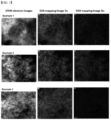
- FIG. 1 shows the results of STEM-EDX (energy dispersive X-ray spectroscopy) mapping analysis of catalysts supplied with hydrogen during the heating step (Examples 1 to 3).
- STEM images of the catalysts showed that metal crystals had a size of less than 5 nm and active components were uniformly distributed on the carbon carrier.
- Table 1 shows an atomic ratio of Sn to Ru (Sn/Ru) at an active site, which was obtained from the results of EDX mapping analysis. Therefrom, it could be seen that there was little or no difference in Sn/Ru before and after reduction, indicating that the catalysts were prepared as designed.
- FIG. 2 shows the results of STEM-EDX (energy dispersive x-ray spectroscopy) mapping analysis of catalysts supplied with nitrogen during the heating step (Comparative Examples 1 to 2).
- STEM images of the catalysts showed that metal crystals partially form agglomerates having a size of 10 nm or more and Ru was dominant in the agglomerates, indicating that phase segregation occurred during reduction.
- Sn/Ru after reduction was lower than that before reduction, that is, a proportion of Sn decreased after reduction, indicating that the catalysts were not prepared as designed.
- Table 1 also shows the amount of hydrogen input and catalytic activity in terms of CHDM yield under different catalyst reduction conditions.
- the catalysts supplied with hydrogen during reduction exhibited high CHDM yields of 70% or more, whereas the catalysts supplied with nitrogen during reduction exhibited low CHDM yields.
- Catalytic activity of a bimetallic catalyst depends on the ratio between Sn and Ru forming the active metal (Sn/Ru) and the amount of hydrogen available to participate in reaction.
- Sn/Ru active metal
- a reducing gas supplied during the heating step greatly influences catalyst properties, particularly the effective reaction surface area of the active metal, including the size and dispersion of active metal particles, and thus is an important factor determining catalytic activity in conversion of CHDA to CHDM.
- the method of reducing a bimetallic hydrogenation catalyst according to the present invention may control segregation, sintering, and leaching out of an active metal, which can occur during a process of reducing of a bimetallic compound to a metal and may obtain a bimetallic hydrogenation catalyst including a supported active metal having homogenous alloy phase.
- the bimetallic hydrogenation catalyst reduced by the method set forth above may efficiently reduce a dicarboxylic acid group to a dialcohol group.
Landscapes
- Chemical & Material Sciences (AREA)
- Organic Chemistry (AREA)
- Engineering & Computer Science (AREA)
- Materials Engineering (AREA)
- Chemical Kinetics & Catalysis (AREA)
- Physics & Mathematics (AREA)
- Thermal Sciences (AREA)
- Catalysts (AREA)
- Organic Low-Molecular-Weight Compounds And Preparation Thereof (AREA)
- Low-Molecular Organic Synthesis Reactions Using Catalysts (AREA)
Applications Claiming Priority (2)
| Application Number | Priority Date | Filing Date | Title |
|---|---|---|---|
| KR1020210013970A KR102758777B1 (ko) | 2021-02-01 | 2021-02-01 | 이종금속 수소화 촉매의 제조 방법 |
| PCT/KR2022/000997 WO2022164121A1 (fr) | 2021-02-01 | 2022-01-19 | Procédé de production d'un catalyseur métallique hétérogène d'hydrogénation |
Publications (2)
| Publication Number | Publication Date |
|---|---|
| EP4286052A1 true EP4286052A1 (fr) | 2023-12-06 |
| EP4286052A4 EP4286052A4 (fr) | 2025-01-01 |
Family
ID=82654818
Family Applications (1)
| Application Number | Title | Priority Date | Filing Date |
|---|---|---|---|
| EP22746148.0A Pending EP4286052A4 (fr) | 2021-02-01 | 2022-01-19 | Procédé de production d'un catalyseur métallique hétérogène d'hydrogénation |
Country Status (7)
| Country | Link |
|---|---|
| US (1) | US20240116045A1 (fr) |
| EP (1) | EP4286052A4 (fr) |
| JP (1) | JP2024504416A (fr) |
| KR (1) | KR102758777B1 (fr) |
| CN (1) | CN117015439A (fr) |
| TW (1) | TWI828048B (fr) |
| WO (1) | WO2022164121A1 (fr) |
Family Cites Families (16)
| Publication number | Priority date | Publication date | Assignee | Title |
|---|---|---|---|---|
| US6008384A (en) * | 1998-03-03 | 1999-12-28 | E. I. Du Pont De Nemours And Company | Method and Ru,Re,Sn/carbon catalyst for hydrogenation in aqueous solution |
| AU1055701A (en) * | 1999-11-05 | 2001-06-06 | Asahi Kasei Kabushiki Kaisha | Process for the preparation of diol mixtures |
| KR100922998B1 (ko) * | 2008-03-06 | 2009-10-22 | 한국화학연구원 | 모노카르복실산 또는 그의 유도체로부터 일가 알콜의 제조방법 |
| KR101177565B1 (ko) * | 2009-01-15 | 2012-08-28 | 한국화학연구원 | 고순도 부탄올 제조 공정 |
| US8410317B2 (en) * | 2011-07-29 | 2013-04-02 | Eastman Chemical Company | Process for the preparation of 1,4-cyclohexanedimethanol |
| CN102580732B (zh) | 2012-01-11 | 2013-12-25 | 北京化工大学 | 一种用于催化对苯二甲酸二甲酯一步加氢制备1,4-环己烷二甲醇的催化剂及其制备方法 |
| ES2626530T3 (es) * | 2012-10-15 | 2017-07-25 | Mitsubishi Gas Chemical Company, Inc. | Nuevo compuesto diol de tipo alicíclico y método para su producción |
| CN106164028B (zh) * | 2014-04-07 | 2019-07-26 | 乐天化学株式会社 | 复合金属催化剂组合物及使用其用于制备1,4-环己烷二甲醇的方法和装置 |
| CN106457219B (zh) * | 2014-05-23 | 2020-10-23 | 三菱化学株式会社 | 负载金属催化剂、负载金属催化剂的保存方法以及醇的制造方法 |
| KR101828002B1 (ko) * | 2016-09-08 | 2018-02-13 | 롯데케미칼 주식회사 | 1,3-사이클로헥산디메탄올의 제조 방법 |
| CN108654613B (zh) * | 2017-03-29 | 2020-06-16 | 中国石油化工股份有限公司 | 一种含炭负载型双金属催化剂及其制备方法和甘油氢解反应方法 |
| KR102188755B1 (ko) * | 2017-12-22 | 2020-12-08 | 한화솔루션 주식회사 | 높은 트랜스 함량을 갖는 사이클로헥산 디메탄올 제조방법 및 이에 의해 제조된 사이클로헥산 디메탄올 |
| KR102238560B1 (ko) * | 2017-12-29 | 2021-04-08 | 한화솔루션 주식회사 | 고선택 전환이 가능한 탄소 기반의 귀금속-전이금속 촉매 및 이의 제조방법 |
| KR102238548B1 (ko) * | 2017-12-29 | 2021-04-08 | 한화솔루션 주식회사 | 카본이 코팅된 실리카-알루미나 담체에 담지된 귀금속-전이금속 복합 촉매 및 이의 제조방법 |
| TWI684585B (zh) * | 2018-11-14 | 2020-02-11 | 中國石油化學工業開發股份有限公司 | 1,4-環己烷二甲酸二甲酯之製法 |
| KR102287646B1 (ko) * | 2018-12-31 | 2021-08-06 | 한화솔루션 주식회사 | 탄소 기반의 귀금속-전이금속 복합촉매 및 이의 제조방법 |
-
2021
- 2021-02-01 KR KR1020210013970A patent/KR102758777B1/ko active Active
-
2022
- 2022-01-19 WO PCT/KR2022/000997 patent/WO2022164121A1/fr not_active Ceased
- 2022-01-19 CN CN202280012724.0A patent/CN117015439A/zh active Pending
- 2022-01-19 JP JP2023544684A patent/JP2024504416A/ja active Pending
- 2022-01-19 EP EP22746148.0A patent/EP4286052A4/fr active Pending
- 2022-01-19 US US18/263,724 patent/US20240116045A1/en active Pending
- 2022-01-25 TW TW111103194A patent/TWI828048B/zh active
Also Published As
| Publication number | Publication date |
|---|---|
| TW202231359A (zh) | 2022-08-16 |
| CN117015439A (zh) | 2023-11-07 |
| JP2024504416A (ja) | 2024-01-31 |
| KR20220110945A (ko) | 2022-08-09 |
| US20240116045A1 (en) | 2024-04-11 |
| WO2022164121A1 (fr) | 2022-08-04 |
| KR102758777B1 (ko) | 2025-01-23 |
| EP4286052A4 (fr) | 2025-01-01 |
| TWI828048B (zh) | 2024-01-01 |
Similar Documents
| Publication | Publication Date | Title |
|---|---|---|
| EP2617679B1 (fr) | Matière à base de silice, son procédé de fabrication, matière portant un métal noble et procédé de fabrication d'un acide carboxylique à l'aide de celle-ci comme catalyseur | |
| TW593242B (en) | A process for the hydrogenation of carbonyl compounds | |
| EP3092072B1 (fr) | Procédé de carbonylation en phase vapeur de méthanol en formiate de méthyle | |
| EP2401080B1 (fr) | Procédé pour la préparation des catalyseurs fischer-tropsch et leur utilisation | |
| EP2418017B1 (fr) | Catalyseur contenant du palladium sur chromite de zinc cristallin et son utilisation en autocondensation d'acétone | |
| CN111905755B (zh) | 一种用于2,2,4,4-四甲基-1,3-环丁二酮加氢的催化剂及其制备方法、应用 | |
| Bankmann et al. | Forming of high surface area TiO2 to catalyst supports | |
| US20220106193A1 (en) | Ammonia synthesis catalyst, method for producing ammonia synthesis catalyst, and method for synthesizing ammonia | |
| CN114308035A (zh) | 一种用于1,4-环己烷二甲酸的加氢催化剂、其制备方法及其应用 | |
| EP4066938A1 (fr) | Catalyseur pour l'hydrogénation de coen méthane à basses températures | |
| CN113070058A (zh) | 一种用于有机储氢介质脱氢的复合载体单原子催化剂及其制备方法 | |
| KR102287646B1 (ko) | 탄소 기반의 귀금속-전이금속 복합촉매 및 이의 제조방법 | |
| WO2010149286A1 (fr) | Catalyseur pour la production de chlore comprenant un aluminate de cuivre du type spinelle | |
| CN103418375A (zh) | 贵金属负载的介孔复合氧化物催化剂及其制备方法和应用 | |
| EP4286052A1 (fr) | Procédé de production d'un catalyseur métallique hétérogène d'hydrogénation | |
| CN111545239A (zh) | 一种用于甘油氧化的固体催化剂及其制备方法 | |
| KR20190026465A (ko) | 아세톤의 환원성 아민화를 통한 모노이소프로필아민의 제조 및 이를 위한 촉매 | |
| CN108097244A (zh) | 一种高分散抗烧结负载型钌催化剂的制备及催化剂和应用 | |
| KR101178940B1 (ko) | 알킬아민 제조용 촉매 및 이의 제조방법 | |
| JP5588657B2 (ja) | カルボン酸の製造方法 | |
| US10668460B2 (en) | Composite catalyst, method for manufacturing composite catalyst and application thereof | |
| Zhang et al. | Mesoporous CeO 2-supported ultrafine PdCu nanoparticle catalyst for selective hydrogenation of alkynols | |
| JPWO2019156029A1 (ja) | 複合物、触媒及びアンモニアの製造方法 | |
| KR101159077B1 (ko) | 코발트계 촉매의 제조방법 | |
| RU2448772C2 (ru) | Катализатор для переработки растительных масел и дистиллированных жирных кислот и способ его приготовления |
Legal Events
| Date | Code | Title | Description |
|---|---|---|---|
| STAA | Information on the status of an ep patent application or granted ep patent |
Free format text: STATUS: THE INTERNATIONAL PUBLICATION HAS BEEN MADE |
|
| PUAI | Public reference made under article 153(3) epc to a published international application that has entered the european phase |
Free format text: ORIGINAL CODE: 0009012 |
|
| STAA | Information on the status of an ep patent application or granted ep patent |
Free format text: STATUS: REQUEST FOR EXAMINATION WAS MADE |
|
| 17P | Request for examination filed |
Effective date: 20230718 |
|
| AK | Designated contracting states |
Kind code of ref document: A1 Designated state(s): AL AT BE BG CH CY CZ DE DK EE ES FI FR GB GR HR HU IE IS IT LI LT LU LV MC MK MT NL NO PL PT RO RS SE SI SK SM TR |
|
| DAV | Request for validation of the european patent (deleted) | ||
| DAX | Request for extension of the european patent (deleted) | ||
| REG | Reference to a national code |
Ref country code: DE Ref legal event code: R079 Free format text: PREVIOUS MAIN CLASS: B01J0037160000 Ipc: B01J0023620000 |
|
| A4 | Supplementary search report drawn up and despatched |
Effective date: 20241202 |
|
| RIC1 | Information provided on ipc code assigned before grant |
Ipc: C07C 31/27 20060101ALI20241126BHEP Ipc: B01J 35/30 20240101ALI20241126BHEP Ipc: C07C 35/14 20060101ALI20241126BHEP Ipc: C07C 29/149 20060101ALI20241126BHEP Ipc: B01J 23/656 20060101ALI20241126BHEP Ipc: B01J 37/08 20060101ALI20241126BHEP Ipc: B01J 37/02 20060101ALI20241126BHEP Ipc: B01J 37/18 20060101ALI20241126BHEP Ipc: B01J 21/18 20060101ALI20241126BHEP Ipc: B01J 23/62 20060101AFI20241126BHEP |
|
| STAA | Information on the status of an ep patent application or granted ep patent |
Free format text: STATUS: EXAMINATION IS IN PROGRESS |
|
| 17Q | First examination report despatched |
Effective date: 20251008 |