EP4311768B1 - Spoileraktuator - Google Patents
Spoileraktuator Download PDFInfo
- Publication number
- EP4311768B1 EP4311768B1 EP22306118.5A EP22306118A EP4311768B1 EP 4311768 B1 EP4311768 B1 EP 4311768B1 EP 22306118 A EP22306118 A EP 22306118A EP 4311768 B1 EP4311768 B1 EP 4311768B1
- Authority
- EP
- European Patent Office
- Prior art keywords
- rod
- cam
- output rod
- housing
- output
- Prior art date
- Legal status (The legal status is an assumption and is not a legal conclusion. Google has not performed a legal analysis and makes no representation as to the accuracy of the status listed.)
- Active
Links
Images




Classifications
-
- B—PERFORMING OPERATIONS; TRANSPORTING
- B64—AIRCRAFT; AVIATION; COSMONAUTICS
- B64C—AEROPLANES; HELICOPTERS
- B64C13/00—Control systems or transmitting systems for actuating flying-control surfaces, lift-increasing flaps, air brakes, or spoilers
- B64C13/24—Transmitting means
- B64C13/38—Transmitting means with power amplification
- B64C13/50—Transmitting means with power amplification using electrical energy
-
- B—PERFORMING OPERATIONS; TRANSPORTING
- B64—AIRCRAFT; AVIATION; COSMONAUTICS
- B64C—AEROPLANES; HELICOPTERS
- B64C5/00—Stabilising surfaces
- B64C5/10—Stabilising surfaces adjustable
-
- F—MECHANICAL ENGINEERING; LIGHTING; HEATING; WEAPONS; BLASTING
- F16—ENGINEERING ELEMENTS AND UNITS; GENERAL MEASURES FOR PRODUCING AND MAINTAINING EFFECTIVE FUNCTIONING OF MACHINES OR INSTALLATIONS; THERMAL INSULATION IN GENERAL
- F16H—GEARING
- F16H25/00—Gearings comprising primarily only cams, cam-followers and screw-and-nut mechanisms
- F16H25/18—Gearings comprising primarily only cams, cam-followers and screw-and-nut mechanisms for conveying or interconverting oscillating or reciprocating motions
- F16H25/20—Screw mechanisms
-
- F—MECHANICAL ENGINEERING; LIGHTING; HEATING; WEAPONS; BLASTING
- F16—ENGINEERING ELEMENTS AND UNITS; GENERAL MEASURES FOR PRODUCING AND MAINTAINING EFFECTIVE FUNCTIONING OF MACHINES OR INSTALLATIONS; THERMAL INSULATION IN GENERAL
- F16H—GEARING
- F16H25/00—Gearings comprising primarily only cams, cam-followers and screw-and-nut mechanisms
- F16H25/18—Gearings comprising primarily only cams, cam-followers and screw-and-nut mechanisms for conveying or interconverting oscillating or reciprocating motions
- F16H25/20—Screw mechanisms
- F16H25/24—Elements essential to such mechanisms, e.g. screws, nuts
- F16H25/2454—Brakes; Rotational locks
-
- F—MECHANICAL ENGINEERING; LIGHTING; HEATING; WEAPONS; BLASTING
- F16—ENGINEERING ELEMENTS AND UNITS; GENERAL MEASURES FOR PRODUCING AND MAINTAINING EFFECTIVE FUNCTIONING OF MACHINES OR INSTALLATIONS; THERMAL INSULATION IN GENERAL
- F16H—GEARING
- F16H25/00—Gearings comprising primarily only cams, cam-followers and screw-and-nut mechanisms
- F16H25/18—Gearings comprising primarily only cams, cam-followers and screw-and-nut mechanisms for conveying or interconverting oscillating or reciprocating motions
- F16H25/20—Screw mechanisms
- F16H2025/2062—Arrangements for driving the actuator
- F16H2025/2081—Parallel arrangement of drive motor to screw axis
Definitions
- the present document relates to an electromechanical actuator with an anti-extension device.
- Actuators are widely used in aircraft.
- electromechanical actuators EMAs
- EMAs electromechanical actuators
- Weight considerations are often paramount in designing aircraft components and so designing lighter weight components is generally desired for aerospace applications.
- Document WO 98/42567 A1 describes an electrical mechanical blow-down mechanism having a structure including a ball screw mechanism adapted to be connected to the spoiler and including an input gear adapted for rotation about an axis. The mechanism is ultimately driven by an electrical motor having a rotary output with at least one gear interconnecting the input gear and the rotary output.
- a pawl (36) is mounted for movement between positions engaged with and disengaged from the input gear and a spring is utilized to normally bias the pawl toward the engaged position.
- a solenoid is operable to move the pawl against the spring toward the disengaged position and a motion sensor is associated with the input gear to determine the direction of rotation thereof.
- a latch is provided for holding the pawl in the disengaged position for one direction of movement of the input gear and releasing the pawl for the other direction of rotation of the input gear.
- an electromechanical actuator comprising: a motor; a gearbox; an anti-extension device mounted between the motor and the gearbox; wherein the motor and anti-extension device are mounted on a housing of the actuator; a screw shaft; a nut mounted on the screw shaft; an output rod connected to the nut, the output rod having a linear range of motion defined between full extension of the output rod at a first end point and full retraction of the output rod at a second end point; wherein the screw shaft, nut, and output rod are located in a cavity of the housing; wherein the output rod and nut are held against rotation relative to the housing, such that rotation of the screw shaft drives the output rod to move linearly within the housing; wherein the anti-extension device comprises: a ratchet wheel mounted on a shaft arranged to be driven by the motor; a pivotable rod comprising a pawl; the pivotable rod being pivotable between a first position in which the pawl engages with the ratchet wheel to
- the anti-extension device is automatically disabled such that the pawl does not engage with the ratchet wheel.
- the housing may comprise a housing connection end for connecting the actuator to an airframe; and the output rod may comprise an output rod connection end for connecting the actuator to a spoiler.
- the cam may have a curved or chamfered end; and/or the end of the output rod may be curved or chamfered.
- the anti-extension device may be directly connected to the gearbox. That is, the actuator may lack a torque limiter between the anti-extension device and the gearbox, for example.
- the anti-extension device may further comprise a solenoid having a movable output; wherein, when the axial end of the output rod is between the intermediate point and the first end point, movement of the movable output moves the pivotable rod to the second position.
- the solenoid may be used to control the position of the pivotable rod and pawl relative to the ratchet wheel.
- the electromechanical actuator may optionally not comprise a torque limiter at any location along a load path between the motor and the screw shaft.
- the existence of the cam and its interaction with the output rod and the anti-extension device may eliminate the need for any torque limiter, such as is often provided on prior art actuators.
- an aircraft comprising an airframe and a flight surface, and the electromechanical actuator as described hereinabove.
- the housing of the electromechanical actuator is connected to the airframe and the output rod of the electromechanical actuator is connected to the flight surface, such that the position of the output rod relative to the housing controls an angular position of the flight surface relative to the airframe.
- the actuator may be arranged such that when the end of the output rod is at a second intermediate axial point, the flight surface is at an angle of zero degrees relative to the airframe.
- the second intermediate axial point may be coincident with the predetermined intermediate point, such that the output rod bears against the cam only when the spoiler at an angle of greater than zero degrees relative to the airframe.
- the second intermediate point may be at a different axial location from the predetermined intermediate point.
- the second intermediate point may be located axially between the predetermined intermediate point and the second end point.
- the flight surface may be is a spoiler.
- FIG. 1 shows a known design of electromechanical actuator (EMA) 10.
- the EMA 10 comprises a motor 12 that is connected, in sequence, to an anti-extension device 14, a torque-limiter 16, and to a gearbox 18. These components 12,14,16,18 are mounted to an external surface of a housing 20.
- the gearbox 18 extends through the housing and drives a screw shaft 22 in rotation.
- the screw shaft 22 extends within the housing 20 along an axis X.
- a nut 24 is mounted on the screw shaft and an output rod 26 is connected to the radially-outer side of the nut 24.
- the output rod 26 is held against rotation relative to the housing 20, e.g. via splines (not shown), and this holds the nut 24 against rotation relative to the housing 20.
- the output rod 26 has a connection end 28 for connection to a spoiler 34.
- the housing 20 has a housing connection end 30 whereby the housing 20 (and EMA 10 as a whole) may be connected to an airframe 32.
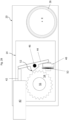
- Figure 2A shows a cross-section of the known anti-extension device 14. This cross-sectional drawing further shows the housing 20, upon which the anti-extension device 14 is mounted, and also shows the output rod 26 (inside the housing 20) in cross-section.
- the anti-extension device 14 comprises a solenoid 40 having a movable output 42 that bears against a first end of a pivotable rod 44.
- the pivotable rod 44 may be pivoted around a pivot point 46.
- a second end of the pivotable rod 44 abuts a pusher 48.
- the pusher 48 is biased by a spring 50.
- the pivotable rod 44 further comprises a pawl 52 that is arranged adjacent to a ratchet wheel 54.
- the ratchet wheel 54 is fixedly mounted on a shaft 56.
- an output shaft of the motor 12 connects to the shaft 56 (or, as above, the shaft 56 may itself be the output shaft of the motor 12), such that torque from the motor 12 turns the shaft 56 and thus turns the ratchet wheel 54 if possible.
- the shaft 56 also connects (or extends into) the torque limiter 16.
- the pivotable rod 44 is arranged such that, in the first position (i.e. when the solenoid 40 is not energized, shown in Figure 2A ), the pawl 52 abuts the ratchet wheel 54 and, through engagement with teeth of the ratchet wheel 54, prevents rotation of the ratchet wheel in one direction of rotation.
- Figure 2B shows the second position (i.e. when the solenoid is energized), wherein the pivotable rod 44 has been pushed by the movable output 42 to a position where the pawl 52 does not abut the ratchet wheel 54, and the ratchet wheel 54 and shaft 56 may rotate in either direction of rotation.
- the force from the movable output 42 to pivot the rod 44 also compresses the spring 50.
- the solenoid 40 is later de-energised, the force from the spring 50 pushes the pivotable rod 44 back to the first position, whereupon the pawl 52 reengages the ratchet wheel 54.
- the motor 12 may be used to drive the output rod 26 in extension to a first desired position.
- the EMA 10 may then engage the anti-extension device by de-energising the solenoid 40.
- This causes the pawl 52 to engage the ratchet wheel 54 and prevent rotation of the shaft 56 in a first direction of rotation.
- This first direction corresponds to extension of the output rod 26 out from the housing 20. That is, when aerodynamic forces on the spoiler 34 seek to pull the output rod 26 further out from the housing 20, this linear force is converted, by the interaction of the nut 24 with the screw shaft 22, into a torque on the screw shaft 22.
- This torque is then transmitted, via the gearbox 18 and torque limiter 16 into the anti-extension device 14. There the torque is reacted by the engagement of the pawl 52 with the ratchet wheel 54. This prevents the torque from being transmitted back into the motor 12 which could damage the motor 12.
- an aircraft spoiler may be extended to negative angular positions so that it follows an extended flap of the aircraft wing. This provides a largely continuous surface between a leading edge of the wing and the trailing edge of the flap. In the negative angular positions, the anti-extension mode may be active so that the spoiler cannot move from its negative angular position towards the neutral position/towards a positive position.
- the torque limiter 16 limits the maximum torque transmitted between the gearbox 18 and the anti-extension device 16. The skilled reader will appreciate that, when the torque limit of the torque limiter 16 is exceeded, the torque limiter will allow rotation on the gearbox 18 side even while the shaft 56 on the side of the anti-extension device 14 is prevented from turning. This thus allows some rotation of the screw shaft 22 and, ultimately, extension of the spoiler 34 towards the neutral position.
- EMA 100 A new design of EMA 100 will now be described in relation to Figures 3 to 8 .
- the new design of EMA 100 shares several similarities with the known EMA 10 design described hereinabove, and where like components are used, the same reference numeral will be used.
- the EMA 100 shown in Figure 3 comprises a motor 12 and a new design of anti-extension device 140 having a cam 142.
- the anti-extension device 140 connects directly between the motor 12 and a gearbox 18. That is, compares to the known EMA 10 described above, there is no torque-limiter 16 present in the new design of EMA 100. Removal of the torque limiter may reduce the overall weight of the new design of EMA 100 compared to the known EMA 10 described above.
- the motor 12, anti-extension device 140, and gearbox 18 are mounted to a housing 200.
- the housing 200 may be identical to the housing 20 of Figure 1 except that the housing 200 comprises an aperture 202 through which the cam 142 extends.
- a housing 20 from the known design of EMA 10 may be simply converted into the new design of housing 200 simply by drilling a hole through the housing 20, to form the aperture 202 that receives the cam 142.
- the aperture 202 allows the cam 142 to extend from the anti-extension device 140, through the housing 200, and into a cavity 204 inside the housing, in which the output rod 26 moves.
- the cam 142 is movable along a second axis Y between a first cam position (shown in Figure 4 ) and a second cam position (shown in Figure 6 ).
- the second axis Y is non-parallel with the first axis X and may be generally perpendicular to the first axis X.
- the output rod 26 has a connection end 28 for connection to a spoiler 34 and the housing 200 has a housing connection end 30 where the housing (and EMA 100 as a whole) may be connected to the airframe 32.
- the anti-extension functionality of the anti-extension device 140 is automatically disabled, i.e. the anti-extension device 140 does not prevent extension of the output rod 26 while the anti-extension device is disabled, regardless of whether the solenoid 40 is energized or not, in the manner discussed in greater detail below.
- the gearbox 18 transmits torque from the motor 12 to turn the screw shaft 22.
- the nut 24 is mounted on the screw shaft 22 and the nut connects to the output rod 26 which, like before, is held against rotation relative to the housing 200.
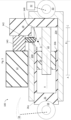
- Figure 4 shows a cross-sectional view of the new design of anti-extension device 140.
- the new anti-extension device 14 shares a number of similar components to the anti-extension device 14 described above in relation to Figure 2 , and where like components are used, the same reference numeral will be used.
- the anti-extension device 140 comprises the solenoid 40 having the movable output 42 that bears against the first end of a pivotable rod 44.
- the pivotable rod 44 may be pivoted around the pivot point 46.
- the anti-extension device While the cam 142 is not pushed into the anti-extension device 140 by the output rod 26, the anti-extension device is not disabled.
- the position of the pawl 52 with respect to the ratchet wheel 54 is under the control of the solenoid 40. That is, when the solenoid 40 is energized, the movable output moves towards the pivotable rod 44 and pivots the rod, from a first rod position to a second rod position, said pivoting being about the pivot point 46 and against the bias from the spring 50.
- the solenoid When the solenoid is de-energized, the bias from the spring 50 pivots the pivotable rod back to its initial first rod position.
- the solenoid 40 controls whether the anti-extension device acts to prevent extension of the output rod 26 or not.
- a second end of the pivotable rod 44 abuts the cam 142.
- the cam 142 comprises a first flange 144 and a second flange 146.
- the spring 50 biases the cam 142 outward from the anti-extension device 140 (and therefore, biases the cam 142 generally in towards the axis X, into the cavity 204 of the housing 200) - this position is the first cam position of the cam 142.
- the second end of the pivotable rod 44 is located between the first and second flanges 144,146 of the cam 142, such that movement of the cam 142 in either direction along the second axis Y controls the angular position of the pivotable rod 44 about the pivot point 46.
- the pivotable rod 44 may be moved by the solenoid 40 such that the pawl 52 is disengaged from the ratchet wheel 54.
- the solenoid 40 moves the pivotable rod 44 to such a disengaged rod position, the second end of the pivotable rod 44 presses against the first flange 144 and, against the bias of the spring 50, pulls the cam 142 into the anti-extension device 140.
- the output rod 26 is linearly movable relative to the housing 200 along a range of motion depicted by the line A-C in Figure 3 .
- Point A corresponds to full extension of the output rod 26, i.e. out from the housing 200
- point C corresponds to full retraction of the output rod 26. More precisely, point A may correspond to a first axial position of an end 26b of the output rod 26 within the housing 200, and point C may correspond to a second axial position of the end 26b of the output rod 26 within the housing 200.
- the linear position of the output rod 26 relative to the housing 200 sets the angle of the spoiler 34 relative to the airframe 32.
- Various angles of the spoiler 34 are shown in Figure 7 .
- the EMA 100 may be arranged such that a given axial position B of the output rod 26 within the housing 200 corresponds to a 0° position of the spoiler 34.
- the position B may be located between the ends A and C of the range of motion available to the output rod 26. That is, the EMA 100 may be arranged to allow the spoiler 34 to be moved within a range of positive angles, a range of negative angles, and to be held at a 0° position.
- the spoiler 34 may be movable between +15° and -50°, where +15° of the spoiler 34 corresponds to the output rod 26 being at full retraction at position C, and where -50° of the spoiler 34 corresponds to the output rod 26 being at full extension at position A.
- the spoiler 24 When the spoiler 34 is at positive angular positions, i.e. its angular position is >0°, the spoiler 24 is said to be operating in the "droop area".
- the droop area of the spoiler 34 thus corresponds to the output rod 26 being in the linear range of ⁇ B and ⁇ C relative to the housing 200.
- the output rod 26 is at a linear position within the cavity 204 where the output rod 26 does not abut against the cam 142.
- the angled end 148 may be a curved end, e.g. hemispherical, or may be e.g. chamfered (as shown in Figure 8 ).
- the angled end 148 allows the cam 142 to ride up onto a radially outer surface 26a of the output rod 26 when, during retraction of the output rod 26, an end 26b of the output rod 26 first comes into alignment with the cam 142.
- the end 26b of the output rod 26 may also be chamfered or curved (as shown in Figure 8 ) to allow a smooth motion of pushing the cam 142 out from the cavity 204.
- this Figure depicts a cross-section of the EMA 100 where the output rod 26 is retracted sufficiently far into the housing 200 that the cam 142 is pressed away from the first axis X and into the anti-extension device 140.
- An intermediate axial position D of the output rod 26, between the end points A and C, is defined as the point where the end 26b of the output rod 26 first bears against the angled end 148 of the cam 142 and has pushed the cam 142 into the anti-extension device 140 sufficiently far so as to cause the pawl 52 to disengage from ratchet wheel 54.
- the anti-extension device 140 is disabled. That is, in this cam position, regardless of whether the solenoid 40 is energized or not, the pawl 52 does not contact the ratchet wheel 54 and thus the shaft 56 is free to rotate in either direction.
- Intermediate axial position D (where the end 26b of the output rod 26 first meets the cam 142) may be identical to position B (where the spoiler is at 0°), but this is not essential.
- axial positions D and B are identical, i.e. at the same axial location along axis X, this means that the anti-extension device 140 is disabled whenever the spoiler 34 is at 0° or higher.
- the anti-extension device 140 is no longer disabled and the engagement/disengagement of the pawl 52 from the ratchet wheel 54 is again under the control of the solenoid 40.
- intermediate axial position D is offset from position B.
- the intermediate axial position D may be set at a spoiler angle of +10°.
- the anti-extension device 140 will be disabled whenever the spoiler 34 is at a 10° angle or higher.
- Figure 6 shows the cross-section of the anti-extension device 140 when the output rod 26 is at the rod position shown in Figure 5 , i.e. where the output rod 26 has pushed the cam 142 in to the anti-extension device 140.
- the first flange 144 has compressed the spring and the second flange 146 has pushed the second end of the pivotable rod 44 to the second rod position wherein the pawl 52 does not engage the ratchet wheel 54.
- the movable output 42 of the solenoid 40 is still in its original position (i.e. the solenoid 40 is not energized) and the movable output 42 is not presently in abutment with the pivotable rod 44.
- the pawl 52 is disengaged from the ratchet wheel 52 regardless of whether or not the solenoid 40 is energized. That is, the anti-extension device 140 is automatically disabled whenever the output rod 26 is pressing the cam 142 into the anti-extension device 140.
- the solenoid 40 determines whether the anti-extension device 140 is engaged or not.
- the anti-extension device 140 is automatically disabled, by virtue of the cam 142 being pushed into the anti-extension device 140 and thereby disengaging the pawl 52 from the ratchet wheel 54.
- Figure 8 depicts various alternative shapes for the angled end 148 of the cam 142 and for the end 26b of the output rod 26.
- Figure 8 shows: a chamfered end of the output rod 26; a rounded end of the output rod 26; and a chamfered end of the cam 142.
- the EMA 100 may use any combination of the various end shapes depicted in any of the Figures for the cam 142 and for the output rod 26.
- Figure 9 shows an aircraft 33 having the spoiler 34.
- the aircraft 33 comprises the airframe 32 and the EMA may be connected to any suitable part of the airframe, such as inside of the wing or on the underside of the wing, near the spoiler 34.
- the electromechanical actuator 100 may be used to control different control surfaces of an aircraft, including flaps, slats, ailerons etc.
- Reference numerals (known) EMA 10 Motor 12 (known) Anti-extension device 14 Torque limiter 16 Gearbox 18 Housing 20 Screw shaft 22 Nut 24 Output rod 26 Outer surface (of output rod) 26a End (of output rod) 26b Connection end (of output rod) 28 Housing connection end 30 Airframe 32 Aircraft 33 Spoiler 34 Solenoid 40 Movable output (of solenoid) 42 Pivotable rod 44 Pivot point (of pivotable rod) 46 Pusher 48 Spring 50 Pawl (on pivot rod) 52 Ratchet wheel 54 Shaft 56 (new) anti-extension device 140 Cam 142 First flange (of cam) 144 Second flange (of cam) 146 End (of cam) 148 (new) housing 200 Aperture (of new housing) 202 Cavity (in new housing) 204 End of range of motion (fully extended)
Landscapes
- Engineering & Computer Science (AREA)
- General Engineering & Computer Science (AREA)
- Mechanical Engineering (AREA)
- Aviation & Aerospace Engineering (AREA)
- Automation & Control Theory (AREA)
- Transmission Devices (AREA)
Claims (12)
- Elektromechanischer Aktuator (100), umfassend:einen Motor (12);ein Getriebe (18);eine zwischen dem Motor und dem Getriebe montierte Erstreckungsbegrenzungsvorrichtung (140);wobei der Motor und die Erstreckungsbegrenzungsvorrichtung an einem Gehäuse (200) des Aktuators montiert sind;eine Schraubenwelle (22);eine auf der Schraubenwelle montierte Mutter (24);eine Abtriebsstange (26), die mit der Mutter verbunden ist, wobei die Abtriebsstange einen linearen Bewegungsbereich aufweist, der zwischen der vollständigen Erstreckung der Abtriebsstange an einem ersten Endpunkt (A) und dem vollständigen Einzug der Abtriebsstange an einem zweiten Endpunkt (C) definiert ist;wobei sich die Schraubenwelle, die Mutter und die Abtriebsstange in einem Hohlraum (204) des Gehäuses befinden;wobei die Abtriebsstange und die Mutter gegen Drehung relativ zu dem Gehäuse gesichert sind, sodass eine Drehung der Schraubenwelle die Abtriebsstange zu einer linearen Bewegung innerhalb des Gehäuses antreibt;wobei die Erstreckungsbegrenzungsvorrichtung (140) Folgendes umfasst:ein Sperrrad (54), das auf einer Welle (56) montiert ist, die angeordnet ist, um durch den Motor angetrieben zu werden;eine schwenkbare Stange (44), die eine Sperrklinke (52) umfasst;wobei die schwenkbare Stange zwischen einer ersten Stangenposition, in der die Sperrklinke (52) mit dem Sperrrad in Eingriff steht, um eine Drehung des Sperrrads in einer Drehrichtung zu verhindern, und einer zweiten Stangenposition, in der die Sperrklinke eine Drehung des Sperrrads nicht verhindert, schwenkbar ist; dadurch gekennzeichnet, dass die Verlängerungsbegrenzungsvorrichtung ferner Folgendes umfasst:einen Nocken (142), der mit der schwenkbaren Stange verbunden ist, wobei der Nocken zwischen einer ersten Nockenposition und einer zweiten Nockenposition bewegbar ist, wobei der Nocken durch eine Feder (50) in Richtung der ersten Nockenposition vorgespannt ist, in der sich ein Abschnitt des Nockens durch eine Öffnung (202) in dem Gehäuse und in den Hohlraum (204) erstreckt; wobei der Nocken in der zweiten Nockenposition die schwenkbare Stange in der zweiten Stangenposition hält, in der die Sperrklinke die Drehung des Sperrrads nicht verhindert;wobei der Nocken durch eine Außenfläche (26a) der Abtriebsstange, die an dem Nocken anliegt, in die zweite Nockenposition bewegt wird, wenn sich ein axiales Ende (26b) der Abtriebsstange (26) an einem vorbestimmten Zwischenpunkt (D) oder zwischen dem Zwischenpunkt (D) und dem zweiten Endpunkt (C) befindet; und wobei die Abtriebsstange nicht an dem Nocken anliegt, wenn sich das axiale Ende der Abtriebsstange zwischen dem Zwischenpunkt (D) und dem ersten Endpunkt (A) befindet.
- Elektromechanischer Aktuator nach Anspruch 1, wobei das Gehäuse ein Gehäuseverbindungsende (30) zum Verbinden des Aktuators mit einer Flugzeugzelle umfasst; und wobei die Abtriebsstange ein Abtriebsstangenverbindungsende (28) zum Verbinden des Aktuators mit einem Spoiler (34) umfasst.
- Elektromechanischer Aktuator nach einem der vorhergehenden Ansprüche, wobei der Nocken ein gekrümmtes oder abgeschrägtes Ende (148) aufweist; und/oder wobei das Ende (26b) der Abtriebsstange gekrümmt oder abgeschrägt ist.
- Elektromechanischer Aktuator nach einem der vorhergehenden Ansprüche, wobei die Erstreckungsbegrenzungsvorrichtung direkt mit dem Getriebe verbunden ist.
- Elektromechanischer Aktuator nach einem der vorhergehenden Ansprüche, wobei die Erstreckungsbegrenzungsvorrichtung ferner einen Elektromagneten (40) mit einem beweglichen Ausgang (42) umfasst;
wobei die Bewegung des beweglichen Ausgangs die schwenkbare Stange in die zweite Stangenposition bewegt, wenn sich das axiale Ende der Abtriebsstange zwischen dem Zwischenpunkt (D) und dem ersten Endpunkt (A) befindet. - Elektromechanischer Aktuator nach Anspruch 5, wobei die Bewegung des beweglichen Ausgangs die Position der schwenkbaren Stange nicht beeinflusst, wenn sich ein axiales Ende (26b) der Abtriebsstange (26) an dem vorbestimmten Zwischenpunkt (D) oder zwischen dem Zwischenpunkt (D) und dem zweiten Endpunkt (C) befindet.
- Elektromechanischer Aktuator nach einem der vorhergehenden Ansprüche, wobei der elektromechanische Aktuator an keiner Stelle entlang eines Lastpfads zwischen dem Motor und der Schraubenwelle einen Drehmomentbegrenzer umfasst.
- Flugzeug (33), das eine Flugzeugzelle (32) und eine Flugfläche (34) und den elektromechanischen Aktuator (110) nach einem der vorhergehenden Ansprüche umfasst;
wobei das Gehäuse (200) des elektromechanischen Aktuators mit der Flugzeugzelle verbunden ist und die Abtriebsstange (26) des elektromechanischen Aktuators mit der Flugfläche derart verbunden ist, dass die Position der Abtriebsstange relativ zu dem Gehäuse eine Winkelposition der Flugfläche relativ zu der Flugzeugzelle steuert. - Flugzeug nach Anspruch 8, wobei der Aktuator derart angeordnet ist, dass die Flugfläche in einem Winkel von null Grad relativ zu der Flugzeugzelle liegt, wenn sich das Ende (26b) der Abtriebsstange an einem zweiten axialen Zwischenpunkt (B) befindet.
- Flugzeug nach Anspruch 9, wobei der zweite axiale Zwischenpunkt (B) mit dem vorbestimmten Zwischenpunkt (D) zusammenfällt, sodass die Abtriebsstange nur dann an dem Nocken anliegt, wenn sich der Spoiler in einem Winkel von mehr als null Grad relativ zu der Flugzeugzelle befindet.
- Flugzeug nach Anspruch 9, wobei sich der zweite Zwischenpunkt (B) an einer anderen axialen Position als der vorbestimmte Zwischenpunkt (D) befindet; wobei sich der zweite Zwischenpunkt optional axial zwischen dem vorbestimmten Zwischenpunkt (D) und dem zweiten Endpunkt (C) befindet.
- Flugzeug nach Anspruch 11, wobei die Flugfläche ein Spoiler (34) ist.
Priority Applications (3)
| Application Number | Priority Date | Filing Date | Title |
|---|---|---|---|
| EP22306118.5A EP4311768B1 (de) | 2022-07-27 | 2022-07-27 | Spoileraktuator |
| CA3201336A CA3201336A1 (en) | 2022-07-27 | 2023-05-31 | Spoiler actuator |
| US18/348,420 US12384526B2 (en) | 2022-07-27 | 2023-07-07 | Spoiler actuator |
Applications Claiming Priority (1)
| Application Number | Priority Date | Filing Date | Title |
|---|---|---|---|
| EP22306118.5A EP4311768B1 (de) | 2022-07-27 | 2022-07-27 | Spoileraktuator |
Publications (2)
| Publication Number | Publication Date |
|---|---|
| EP4311768A1 EP4311768A1 (de) | 2024-01-31 |
| EP4311768B1 true EP4311768B1 (de) | 2025-04-23 |
Family
ID=82846385
Family Applications (1)
| Application Number | Title | Priority Date | Filing Date |
|---|---|---|---|
| EP22306118.5A Active EP4311768B1 (de) | 2022-07-27 | 2022-07-27 | Spoileraktuator |
Country Status (3)
| Country | Link |
|---|---|
| US (1) | US12384526B2 (de) |
| EP (1) | EP4311768B1 (de) |
| CA (1) | CA3201336A1 (de) |
Family Cites Families (8)
| Publication number | Priority date | Publication date | Assignee | Title |
|---|---|---|---|---|
| US5918836A (en) * | 1997-03-25 | 1999-07-06 | Sundstrand Corporation | Aircraft spoiler blow-down mechanism |
| US6116103A (en) * | 1998-05-29 | 2000-09-12 | P. L. Porter Co. | Device for securing gear nut on actuator |
| FR2988797B1 (fr) * | 2012-04-02 | 2015-04-24 | Sagem Defense Securite | Actionneur electromecanique de surface de vol d'aeronef et aeronef pourvu d'un tel actionneur |
| EP3018384A1 (de) | 2014-11-06 | 2016-05-11 | Goodrich Actuation Systems SAS | Drehantrieb zur Steuerung einer Flugsteuerfläche |
| RU2714658C1 (ru) * | 2016-12-30 | 2020-02-18 | Сафран Электроникс Энд Дифенс | Привод с пассивной блокировкой |
| FR3063532B1 (fr) * | 2017-03-06 | 2019-04-05 | Safran Electronics & Defense | Actionneur equipe d’un systeme de no back a zone d’inhibition |
| EP3620334B8 (de) * | 2018-09-05 | 2021-06-23 | ZF CV Systems Europe BV | Bremsbetätigungsvorrichtung für ein nutzfahrzeug und bremssystem damit |
| US11873092B2 (en) * | 2020-12-16 | 2024-01-16 | The Boeing Company | Trim actuators for horizontal stabilizers and methods of controlling horizontal stabilizers |
-
2022
- 2022-07-27 EP EP22306118.5A patent/EP4311768B1/de active Active
-
2023
- 2023-05-31 CA CA3201336A patent/CA3201336A1/en active Pending
- 2023-07-07 US US18/348,420 patent/US12384526B2/en active Active
Also Published As
| Publication number | Publication date |
|---|---|
| US12384526B2 (en) | 2025-08-12 |
| CA3201336A1 (en) | 2024-01-27 |
| EP4311768A1 (de) | 2024-01-31 |
| US20240034460A1 (en) | 2024-02-01 |
Similar Documents
| Publication | Publication Date | Title |
|---|---|---|
| US10538310B2 (en) | Near synchronous distributed hydraulic motor driven actuation system | |
| US10215246B2 (en) | Integrated torque limiter/no-back device | |
| CN103946590B (zh) | 用于飞行器控制表面的机电致动器以及设有这种致动器的飞行器 | |
| US11498658B2 (en) | System for an aircraft wing | |
| EP4049925B1 (de) | Stellvorrichtung zum bewegen einer beweglichen flügelspitze eines flugzeuges | |
| EP3613667B1 (de) | Linearantrieb mit prüfbarem kegelrückdreh- und -drehmomentbegrenzer | |
| EP4039586B1 (de) | Aktuatoranordnung | |
| US8152098B2 (en) | Torque limiter with brake | |
| EP1980770A2 (de) | Aktuatoranordnung | |
| US10344840B2 (en) | Actuator no-back arrangement | |
| EP4311768B1 (de) | Spoileraktuator | |
| US9809326B2 (en) | Method for adjusting the play in a high-lift system of an aircraft | |
| EP4257484B1 (de) | Notbremse für einen aktuator im falle des durchdrehens | |
| EP4400420B1 (de) | Stoppsschutzverwaltung für einen ema mit droop-funktion | |
| EP4219297B1 (de) | Aerostrukturbetätigungssystem | |
| BR102023012614A2 (pt) | Atuador eletromecânico, e, aeronave |
Legal Events
| Date | Code | Title | Description |
|---|---|---|---|
| PUAI | Public reference made under article 153(3) epc to a published international application that has entered the european phase |
Free format text: ORIGINAL CODE: 0009012 |
|
| STAA | Information on the status of an ep patent application or granted ep patent |
Free format text: STATUS: THE APPLICATION HAS BEEN PUBLISHED |
|
| AK | Designated contracting states |
Kind code of ref document: A1 Designated state(s): AL AT BE BG CH CY CZ DE DK EE ES FI FR GB GR HR HU IE IS IT LI LT LU LV MC MK MT NL NO PL PT RO RS SE SI SK SM TR |
|
| STAA | Information on the status of an ep patent application or granted ep patent |
Free format text: STATUS: REQUEST FOR EXAMINATION WAS MADE |
|
| 17P | Request for examination filed |
Effective date: 20240725 |
|
| RBV | Designated contracting states (corrected) |
Designated state(s): AL AT BE BG CH CY CZ DE DK EE ES FI FR GB GR HR HU IE IS IT LI LT LU LV MC MK MT NL NO PL PT RO RS SE SI SK SM TR |
|
| GRAP | Despatch of communication of intention to grant a patent |
Free format text: ORIGINAL CODE: EPIDOSNIGR1 |
|
| STAA | Information on the status of an ep patent application or granted ep patent |
Free format text: STATUS: GRANT OF PATENT IS INTENDED |
|
| RIC1 | Information provided on ipc code assigned before grant |
Ipc: F16H 25/20 20060101ALI20241115BHEP Ipc: F16H 25/24 20060101ALI20241115BHEP Ipc: B64C 13/50 20060101AFI20241115BHEP |
|
| INTG | Intention to grant announced |
Effective date: 20241205 |
|
| GRAS | Grant fee paid |
Free format text: ORIGINAL CODE: EPIDOSNIGR3 |
|
| GRAA | (expected) grant |
Free format text: ORIGINAL CODE: 0009210 |
|
| STAA | Information on the status of an ep patent application or granted ep patent |
Free format text: STATUS: THE PATENT HAS BEEN GRANTED |
|
| AK | Designated contracting states |
Kind code of ref document: B1 Designated state(s): AL AT BE BG CH CY CZ DE DK EE ES FI FR GB GR HR HU IE IS IT LI LT LU LV MC MK MT NL NO PL PT RO RS SE SI SK SM TR |
|
| REG | Reference to a national code |
Ref country code: GB Ref legal event code: FG4D |
|
| REG | Reference to a national code |
Ref country code: CH Ref legal event code: EP |
|
| REG | Reference to a national code |
Ref country code: DE Ref legal event code: R096 Ref document number: 602022013514 Country of ref document: DE |
|
| REG | Reference to a national code |
Ref country code: IE Ref legal event code: FG4D |
|
| PGFP | Annual fee paid to national office [announced via postgrant information from national office to epo] |
Ref country code: FR Payment date: 20250620 Year of fee payment: 4 |
|
| REG | Reference to a national code |
Ref country code: NL Ref legal event code: MP Effective date: 20250423 |
|
| PG25 | Lapsed in a contracting state [announced via postgrant information from national office to epo] |
Ref country code: NL Free format text: LAPSE BECAUSE OF FAILURE TO SUBMIT A TRANSLATION OF THE DESCRIPTION OR TO PAY THE FEE WITHIN THE PRESCRIBED TIME-LIMIT Effective date: 20250423 |
|
| REG | Reference to a national code |
Ref country code: AT Ref legal event code: MK05 Ref document number: 1787551 Country of ref document: AT Kind code of ref document: T Effective date: 20250423 |
|
| PG25 | Lapsed in a contracting state [announced via postgrant information from national office to epo] |
Ref country code: FI Free format text: LAPSE BECAUSE OF FAILURE TO SUBMIT A TRANSLATION OF THE DESCRIPTION OR TO PAY THE FEE WITHIN THE PRESCRIBED TIME-LIMIT Effective date: 20250423 Ref country code: PT Free format text: LAPSE BECAUSE OF FAILURE TO SUBMIT A TRANSLATION OF THE DESCRIPTION OR TO PAY THE FEE WITHIN THE PRESCRIBED TIME-LIMIT Effective date: 20250825 Ref country code: ES Free format text: LAPSE BECAUSE OF FAILURE TO SUBMIT A TRANSLATION OF THE DESCRIPTION OR TO PAY THE FEE WITHIN THE PRESCRIBED TIME-LIMIT Effective date: 20250423 |
|
| PGFP | Annual fee paid to national office [announced via postgrant information from national office to epo] |
Ref country code: DE Payment date: 20250620 Year of fee payment: 4 |
|
| REG | Reference to a national code |
Ref country code: LT Ref legal event code: MG9D |
|
| PG25 | Lapsed in a contracting state [announced via postgrant information from national office to epo] |
Ref country code: NO Free format text: LAPSE BECAUSE OF FAILURE TO SUBMIT A TRANSLATION OF THE DESCRIPTION OR TO PAY THE FEE WITHIN THE PRESCRIBED TIME-LIMIT Effective date: 20250723 Ref country code: GR Free format text: LAPSE BECAUSE OF FAILURE TO SUBMIT A TRANSLATION OF THE DESCRIPTION OR TO PAY THE FEE WITHIN THE PRESCRIBED TIME-LIMIT Effective date: 20250724 |
|
| PG25 | Lapsed in a contracting state [announced via postgrant information from national office to epo] |
Ref country code: PL Free format text: LAPSE BECAUSE OF FAILURE TO SUBMIT A TRANSLATION OF THE DESCRIPTION OR TO PAY THE FEE WITHIN THE PRESCRIBED TIME-LIMIT Effective date: 20250423 |
|
| PGFP | Annual fee paid to national office [announced via postgrant information from national office to epo] |
Ref country code: IT Payment date: 20250731 Year of fee payment: 4 |
|
| PG25 | Lapsed in a contracting state [announced via postgrant information from national office to epo] |
Ref country code: BG Free format text: LAPSE BECAUSE OF FAILURE TO SUBMIT A TRANSLATION OF THE DESCRIPTION OR TO PAY THE FEE WITHIN THE PRESCRIBED TIME-LIMIT Effective date: 20250423 |
|
| PG25 | Lapsed in a contracting state [announced via postgrant information from national office to epo] |
Ref country code: HR Free format text: LAPSE BECAUSE OF FAILURE TO SUBMIT A TRANSLATION OF THE DESCRIPTION OR TO PAY THE FEE WITHIN THE PRESCRIBED TIME-LIMIT Effective date: 20250423 |
|
| PG25 | Lapsed in a contracting state [announced via postgrant information from national office to epo] |
Ref country code: AT Free format text: LAPSE BECAUSE OF FAILURE TO SUBMIT A TRANSLATION OF THE DESCRIPTION OR TO PAY THE FEE WITHIN THE PRESCRIBED TIME-LIMIT Effective date: 20250423 |
|
| PG25 | Lapsed in a contracting state [announced via postgrant information from national office to epo] |
Ref country code: RS Free format text: LAPSE BECAUSE OF FAILURE TO SUBMIT A TRANSLATION OF THE DESCRIPTION OR TO PAY THE FEE WITHIN THE PRESCRIBED TIME-LIMIT Effective date: 20250723 |
|
| PG25 | Lapsed in a contracting state [announced via postgrant information from national office to epo] |
Ref country code: IS Free format text: LAPSE BECAUSE OF FAILURE TO SUBMIT A TRANSLATION OF THE DESCRIPTION OR TO PAY THE FEE WITHIN THE PRESCRIBED TIME-LIMIT Effective date: 20250823 |
|
| PG25 | Lapsed in a contracting state [announced via postgrant information from national office to epo] |
Ref country code: LV Free format text: LAPSE BECAUSE OF FAILURE TO SUBMIT A TRANSLATION OF THE DESCRIPTION OR TO PAY THE FEE WITHIN THE PRESCRIBED TIME-LIMIT Effective date: 20250423 |
|
| PG25 | Lapsed in a contracting state [announced via postgrant information from national office to epo] |
Ref country code: SM Free format text: LAPSE BECAUSE OF FAILURE TO SUBMIT A TRANSLATION OF THE DESCRIPTION OR TO PAY THE FEE WITHIN THE PRESCRIBED TIME-LIMIT Effective date: 20250423 Ref country code: DK Free format text: LAPSE BECAUSE OF FAILURE TO SUBMIT A TRANSLATION OF THE DESCRIPTION OR TO PAY THE FEE WITHIN THE PRESCRIBED TIME-LIMIT Effective date: 20250423 |
|
| PG25 | Lapsed in a contracting state [announced via postgrant information from national office to epo] |
Ref country code: CZ Free format text: LAPSE BECAUSE OF FAILURE TO SUBMIT A TRANSLATION OF THE DESCRIPTION OR TO PAY THE FEE WITHIN THE PRESCRIBED TIME-LIMIT Effective date: 20250423 |
|
| PG25 | Lapsed in a contracting state [announced via postgrant information from national office to epo] |
Ref country code: EE Free format text: LAPSE BECAUSE OF FAILURE TO SUBMIT A TRANSLATION OF THE DESCRIPTION OR TO PAY THE FEE WITHIN THE PRESCRIBED TIME-LIMIT Effective date: 20250423 |
|
| REG | Reference to a national code |
Ref country code: DE Ref legal event code: R097 Ref document number: 602022013514 Country of ref document: DE |
|
| PG25 | Lapsed in a contracting state [announced via postgrant information from national office to epo] |
Ref country code: SK Free format text: LAPSE BECAUSE OF FAILURE TO SUBMIT A TRANSLATION OF THE DESCRIPTION OR TO PAY THE FEE WITHIN THE PRESCRIBED TIME-LIMIT Effective date: 20250423 |
|
| REG | Reference to a national code |
Ref country code: CH Ref legal event code: U11 Free format text: ST27 STATUS EVENT CODE: U-0-0-U10-U11 (AS PROVIDED BY THE NATIONAL OFFICE) Effective date: 20260130 |
|
| PGFP | Annual fee paid to national office [announced via postgrant information from national office to epo] |
Ref country code: LU Payment date: 20260130 Year of fee payment: 4 |
|
| PLBE | No opposition filed within time limit |
Free format text: ORIGINAL CODE: 0009261 |
|
| STAA | Information on the status of an ep patent application or granted ep patent |
Free format text: STATUS: NO OPPOSITION FILED WITHIN TIME LIMIT |
|
| REG | Reference to a national code |
Ref country code: CH Ref legal event code: L10 Free format text: ST27 STATUS EVENT CODE: U-0-0-L10-L00 (AS PROVIDED BY THE NATIONAL OFFICE) Effective date: 20260304 |
|
| PG25 | Lapsed in a contracting state [announced via postgrant information from national office to epo] |
Ref country code: RO Free format text: LAPSE BECAUSE OF FAILURE TO SUBMIT A TRANSLATION OF THE DESCRIPTION OR TO PAY THE FEE WITHIN THE PRESCRIBED TIME-LIMIT Effective date: 20250423 |
|
| 26N | No opposition filed |
Effective date: 20260126 |
|
| PGFP | Annual fee paid to national office [announced via postgrant information from national office to epo] |
Ref country code: IE Payment date: 20260130 Year of fee payment: 4 |
|
| PGFP | Annual fee paid to national office [announced via postgrant information from national office to epo] |
Ref country code: BE Payment date: 20260130 Year of fee payment: 4 |