EP4342334B1 - Dossier pour chaise et chaise - Google Patents
Dossier pour chaise et chaise Download PDFInfo
- Publication number
- EP4342334B1 EP4342334B1 EP23197120.1A EP23197120A EP4342334B1 EP 4342334 B1 EP4342334 B1 EP 4342334B1 EP 23197120 A EP23197120 A EP 23197120A EP 4342334 B1 EP4342334 B1 EP 4342334B1
- Authority
- EP
- European Patent Office
- Prior art keywords
- backrest
- support
- support elements
- base
- chair
- Prior art date
- Legal status (The legal status is an assumption and is not a legal conclusion. Google has not performed a legal analysis and makes no representation as to the accuracy of the status listed.)
- Active
Links
Images



Classifications
-
- A—HUMAN NECESSITIES
- A47—FURNITURE; DOMESTIC ARTICLES OR APPLIANCES; COFFEE MILLS; SPICE MILLS; SUCTION CLEANERS IN GENERAL
- A47C—CHAIRS; SOFAS; BEDS
- A47C7/00—Parts, details, or accessories of chairs or stools
- A47C7/36—Supports for the head or the back
- A47C7/40—Supports for the head or the back for the back
Definitions
- the present application relates to a backrest for a chair according to the preamble of claim 1. Furthermore, the present application relates to a chair according to the preamble of claim 12.
- the backrest comprises a base by means of which the backrest can be connected or is connected to the rest of the chair.
- This connection can be achieved, in particular, by forming at least one pivot axis, so that the backrest can be pivoted about the pivot axis relative to a seat element that provides a seating surface for a person.
- a translational movement of the backrest relative to the rest of the chair is also possible, whereby the base, in particular, can be provided and configured to interact with the rest of the chair in a translationally movable manner.
- a translational movement in a horizontal direction (“forward and backward") can be enabled.
- the base can also be connected or is connected to a counterpart of the chair in a force-transmitting manner, so that forces acting on the backrest can be diverted into the rest of the chair and ultimately into a base.
- the base is not intended for a person to lean on.
- the base can, for example, extend at an angle relative to a back element of the backrest, so that the backrest as a whole is J-shaped when viewed from the side, wherein an at least substantially vertical section of the backrest is formed by the back element and the section which runs obliquely relative to it is formed by the base.
- the backrest further comprises a back element that provides a support surface for the back of a person sitting on the chair. This allows the person to lean against the backrest, which supports the person's back.
- the back element is connected to the base in a force-transmitting manner, so that forces acting on the back element can be transferred to the base and, ultimately, from the base into the rest of the chair and the ground below.
- the back element comprises a plurality of individual support elements, each of which is designed to support different areas of the back of the person sitting on the chair.
- the support elements can, for example, interact with different areas of the back of the respective person, with the support elements each having a Provide part of the backrest surface of the back element.
- the chair to which the backrest is or can be connected can, in particular, be an office chair.
- the chair comprises a base frame for placement on a surface. It also comprises a seat element for providing a seat on which a person sitting on the chair can sit.
- the chair also comprises a backrest that provides support for the person sitting on the chair.
- office chairs in particular, it is important that an ergonomic sitting position can be assumed, with office chairs typically providing a variety of adjustment options to enable them to be adapted to the individual stature of each person. This can, for example and in particular, relate to the adjustability of the backrest.
- a backrest and a chair of the type described above are already known in the prior art. Reference is made, for example, to German Offenlegungsschrift DE 10 2018 123 731 A1.
- This document deals with a backrest and a chair, which can in particular be an office chair.
- the aim of this document is to provide a flexibly adjustable backrest. To this end, it is proposed to equip the backrest with a frame-shaped supporting structure connected to a backrest element.
- the latter comprises at least two different materials with different moduli of elasticity.
- the US 6,409,268 B1 a backrest with a back element that provides a leaning surface.
- a back element that provides a leaning surface.
- a plurality of U-shaped slots are provided in an upper half of the back element, facing away from a base of the back element. This reduces the stiffness of the back element, so that the backrest can better deform and adapt to the shape of the person's back when a force is applied as a result of a person leaning against the backrest.
- Another generic backrest is known from US 7 347 495 B2 known.
- backrests especially those intended for office chairs, is extremely complex, as a multitude of requirements must be considered. This particularly applies to the support properties of the respective backrest, which should enable the person sitting on the chair to have optimal back support while still maintaining a high degree of freedom of movement, encouraging them to remain "active" while sitting. In particular, it is highly recommended to regularly change one's sitting position in everyday life and thereby keep the body and muscles moving.
- the backrest of such a chair therefore actually has conflicting functions: stabilizing the back while simultaneously maintaining flexibility that allows the person to comfortably change their sitting position.
- the backrest should be a component that takes a back seat for the person, so that the support and load transfer occur as subconsciously as possible, and the person is automatically encouraged to regularly change their sitting position.
- the present application is therefore based on the object of providing a backrest and a chair equipped therewith that supports a healthy sitting behavior of a respective person.
- the backrest is characterized in that the support elements each have a web spaced from the base and two opposing flanges, each connected to one side of the associated web.
- a central axis of the web of a respective support element typically extends horizontally or in a horizontal plane when the backrest is viewed in a properly upright position, while central axes of the flanges each extend at least substantially vertically or in a vertical plane.
- the flanges of a The respective support elements face the base and are directly or indirectly connected to the base.
- the web of each support element is arranged at ends of the associated flanges spaced from the base. In this way, the support elements each form an inverted or upside-down U-shape with respect to the base.
- the back element is formed with a plurality of U-shaped recesses, which may in particular be slot-shaped. These recesses divide the back element into the support elements, or the support elements are determined by the recesses in their shape.
- the back element can be formed such that the support elements are separated from one another by means of the recesses and are thus deformable at least substantially independently of one another.
- the support elements are arranged in a nested manner relative to one another in such a way that a support element located further outwards frames an adjacent support element located further inwards on three sides.
- the support elements are thus arranged in a nested manner, with a first, smallest, innermost support element being arranged starting from the center of the backrest and then adjoining it at least one further, larger, further outward support element framing the first support element.
- a further, larger third support element is arranged further outwards and frames the second support element, which third support element is optionally framed in the same way by one or more further support elements.
- At least one support element extends with its flanges into a lower end section of the back element.
- the "lower end section” refers to a section of the back element that, when the backrest is used as intended, either does not come into direct contact with the person's back at all or only comes into contact with the lower lumbar region.
- the backrest has a lumbar support, wherein the lower end section can be located, in particular, below the lumbar support.
- the flanges preferably have a length measured along their respective central axis which is at least 50%, preferably at least 70%, more preferably at least 90%, of a length measured along a respective central axis of the Flanges associated with a web.
- the lengths of the flanges of a support element, in particular of the innermost support element correspond at least substantially to the length of the web of the same support element.
- the support elements each have different stiffnesses relative to the base, which is due to the different lengths of the flanges.
- a further outer support element generally has longer flanges, whereby the lever arm of a force acting on the web of the respective support element relative to the base is greater than with a further inner support element.
- the stiffness of the back element is therefore segmented by means of the nesting of the support elements, whereby the support elements are deformable at least substantially independently of one another.
- a deformation acting on one of the support elements therefore has no or only a very limited direct effect on the deformation of an adjacent or other support element.
- the back element can thus support a person's back in the location and manner that is individually required for each person in a particular sitting position.
- the flanges of all support elements can extend into the lower end section of the back element.
- the support elements – as they are each individually suitable for transferring loads – allow the greatest possible flexibility in the movement of the person sitting on the chair.
- an external support element can be subjected to a disproportionately high force during a lateral tilting movement of the back, while an internal support element, for example, hardly comes into contact with the person's back.
- the support elements act independently of one another, the support element subjected to the most severe load is deformed relatively strongly in the presence of the acting force and thus avoids the person's movement. Therefore, the person does not perceive the back element as an obstacle to free movement, but is, on the contrary, encouraged to perform a movement without any Person is subjected to unpleasantly hard counter pressure on the back by the back element.
- the same comprises at least three, preferably exactly three, support elements.
- This number has proven particularly advantageous for providing individual support to a person's back in different areas as needed using the support elements.
- the use of three support elements compared to an alternative embodiment comprising more than three support elements is advantageous in that the flanges of the individual support elements can be dimensioned, while maintaining the usual dimensions of the back element, in such a way that they are mechanically suitable for dissipating forces that experience has shown to occur as a result of a person leaning against the support elements.
- a configuration of the backrest can be advantageous in which at least two flanges of adjacent support elements, which are spatially associated with one another, are joined toward the base to form a common hyperflange.
- the flanges of the adjacent support elements are "fused” into a common flange and thus do not extend to the base as separate flanges.
- the section in which the flanges are joined into a common flange is referred to in the present application as a "hyperflange.”
- the hyperflange is directly connected to the base.
- the hyperflange like the other flanges, is not directly connected to the base, but rather, for example, to an intermediate section, which then, for example, directly merges into the base.
- the intermediate section can be located, in particular, in a lower third, preferably a lower quarter, of the backrest. This results in the intermediate section being positioned so low on the back element that, when the backrest is used as intended, it does not function as part of the backrest surface and, as such, is not directly subjected to forces from the back of a person leaning against it.
- the intermediate section can therefore be formed by the lower end section.
- An embodiment is advantageous in which the flanges of at least one of the support elements, preferably of several support elements, more preferably of all support elements, in sections in which they are present individually (that is to say in sections in which they do not form part of a hyperflange), have a
- the flanges and hyperflanges preferably extend into the lower end portion of the back element.
- a cross-section of the hyperflange corresponds at least substantially to a sum of the cross-sections of the flanges that are combined to form the hyperflange.
- the back element comprises a total of three support elements, wherein the flanges of the two outer support elements are joined from one point to form a common hyperflange, and the hyperflange extends to a lower end section of the back element.
- the flanges of the innermost support element also extend to the lower end section of the back element, wherein the flanges of the innermost support element are not part of the hyperflange, but extend individually over their entire length.
- the lengths of the flanges of all support elements in which they are present individually are at least 50% of the length of the respective associated web.
- the same comprises at least one stiffening strut, by means of which the flanges of at least one support element are coupled to one another in addition to the respective associated web.
- the stiffening strut is preferably connected to the ends of the flanges facing the base.
- the stiffening strut is not as such part of the support elements, so that the latter have the U-shape described above.
- at least one stiffening strut is designed such that it couples the flanges of several support elements to one another. It is also conceivable for the backrest to comprise a plurality of stiffening struts.
- the at least one stiffening strut is oriented at least substantially parallel to the web of the respective associated support element.
- a respective The support element is closed at its open end facing away from the web, resulting in a self-contained supporting structure.
- the stiffening strut can be arranged, in particular, in the lower end section of the back element.
- the web of the innermost support element is arranged relative to the base such that a distance of said central axis from a lower end of the base, measured perpendicular to a central axis of the web of the support element, amounts to at least 50%, preferably at least 55%, more preferably at least 60%, of a total height which, in the sense of the present application, is measured from the lower end of the base to an upper end of the web of the outermost support element.
- the support elements - starting with the first, innermost support element - are functionally assigned to an upper part of the back of a respective person, in particular to an upper half of the back. In this area, the need for back support is typically greatest.
- the web of at least one support element is doubly curved in the manner of a hyperbolic paraboloid.
- This preferably applies to the webs of all support elements of the backrest.
- the described shape has the advantage that the respective web, on its surface facing the back, which forms part of the backrest surface of the back element, has a shape adapted to the shape of the back, which is perceived as particularly comfortable.
- the web of the at least one support element is concavely curved along a central axis extending from flange to flange and convexly curved along a vertical axis oriented perpendicular to the central axis.
- the back element can have a central, preferably flat, recess, which is framed on three sides by the support elements.
- the recess forms a free space that determines the shape of the innermost support element.
- the innermost support element is defined by the recess toward the center of the back element and by a U-shaped recess toward the nearest, outermost support element. This is also implemented in the exemplary embodiment below.
- the backrest according to the invention comprises a lumbar support arranged in a lower region of the backrest of the back element.
- This "lower region” is characterized by being framed by all support elements. Therefore, it is particularly It is advantageous if the lumbar support is formed centrally or centrally on the back element, so that the U-shaped support elements frame the lumbar support on three sides.
- the support elements interact primarily with an upper region of a respective back, as explained above, while the lumbar support is intended and configured to support a lower region of the back, in particular in the region between the first and fifth lumbar vertebrae.
- the lumbar support is particularly well suited to correcting the sitting position of a person sitting on the associated chair and thereby preventing discomfort in the lumbar region.
- the lumbar support can in particular be inserted into a flat recess as described above, which is arranged in the lower region of the back element.
- the lumbar support is detachably mounted or mounted on the rest of the backrest, preferably on the base and/or a nearby support element, in a non-destructive manner.
- the lumbar support can be mounted or dismounted as needed, particularly allowing for retrofitting of a lumbar support if necessary.
- a lumbar support of this type is particularly advantageous if its position perpendicular to the backrest can be changed by means of an adjusting element, so that it can be adjusted as needed.
- the lumbar support can be brought into supportive engagement with the back when the person leans against the backrest.
- the lumbar support is adjustable in two directions, wherein preferably by adjusting in the first direction a support surface of the lumbar support can be adjusted back and forth at least substantially perpendicular to the backrest, and by adjusting in the second direction the support surface of the lumbar support can be adjusted up and down at least substantially parallel to the backrest.
- the directions in which the lumbar support can be adjusted are preferably oriented perpendicular to one another.
- the backrest is formed in one piece.
- the backrest as a whole is formed in one piece, with the back element and the base being formed as a single part.
- the backrest can be manufactured by means of an injection molding process, thereby giving it a one-piece shape.
- This type of design is particularly advantageous because, in the absence of transitions from one component to another, the associated weak points are avoided. which in practice can lead, for example, to noise due to relative movements of adjacent components.
- the one-piece design has the advantage that the individual elements of the backrest interact in a defined manner, whereas with assembled backrests, the quality of the connections between the components can influence the interaction. With the one-piece design, such sources of error are eliminated.
- At least the back element preferably the backrest as a whole, is formed from a glass-fiber-reinforced plastic.
- a glass-fiber-reinforced plastic can be, for example, polyamide with a glass fiber content of 30%.
- Such a design is particularly advantageous for keeping the overall mass of the backrest low, while the material exhibits high elasticity with a low tendency to fracture. This results in the backrest, in particular its back element, being particularly highly deformable without causing damage and/or plastic deformation.
- the back element tapers towards the base.
- the base is preferably designed to be compact, so that it can be connected to the rest of the chair particularly easily. Accordingly, it is advantageous if the back element tapers towards an end facing the base, so that the back element, at its end facing the base, is at least substantially converged to the same size as the base.
- the backrest comprises a backrest cover that is pulled over the back element in such a way that it encloses at least a portion of the support elements. It is conceivable that the backrest cover encloses all of the support elements of the back element or only a portion of the support elements.
- the backrest cover can, in particular, be made of a knitted fabric. Furthermore, the backrest cover is preferably formed in one piece.
- the backrest cover can be in the form of a sleeve that is open on one side, so that the backrest cover can be pulled over the backrest element particularly easily from an upper end of the backrest element facing away from the base.
- the backrest cover can contribute to changing the visual appearance of the backrest element; Furthermore, the supporting effect of the backrest cover on the back of a person sitting on the associated chair can be of technical importance.
- the backrest element has a has a cheek that protrudes perpendicular to the rest of the backrest, whereby the cheeks together give the back element a shell shape.
- the backrest cover can be pulled over the back element, whereby the backrest cover is stretched between the lateral, opposing cheeks of the back element and is thus suitable for absorbing forces acting perpendicular to a surface of the backrest cover. This allows the backrest cover to further enhance the supporting effect of the support elements and enable more comfortable sitting for the person sitting on the chair.
- the protruding shape of the cheeks means that when the backrest cover is pulled over the cheeks, the back of a person leaning against the back element first comes into contact with the backrest cover before the back comes into contact with one or more support elements, i.e., with the actual backrest. This is particularly advantageous for seating comfort, since at the moment of leaning, the back is initially "softly" cushioned by the backrest cover before the support elements are activated.
- the back element is designed in the manner described above with hyperflanges, which, for example, comprise the flanges of two outer support elements, it can be advantageous if the cheeks are formed in the region of the hyperflanges or if the hyperflanges are curved up at the lateral edges of the back element to form the aforementioned cheeks.
- the back element can comprise a total of three support elements, wherein the mutually associated flanges of the two outer support elements are each combined to form a hyperflange, and wherein the hyperflanges are curved up and form the cheeks.
- the flanges of the innermost support element are not part of the hyperflange in this embodiment and extend individually.
- the chair is characterized in that its backrest is designed according to one of claims 1 to 11.
- the backrest supports the back of a person sitting on the chair without restricting their freedom of movement.
- the chair can be an office chair, for example, whereby the base frame is preferably equipped with castors so that the chair can be easily moved on a surface. Furthermore, it can be advantageous if the chair includes armrests on which the person sitting on the chair can rest their arms, for example, their forearms. According to general regulations for the design of office chairs, the chair can provide a variety of adjustment options to adapt it to the individual requirements of each person.
- the backrest can be adjustable.
- the backrest can be adjustable between a rigid and a swinging state.
- the chair can have a coupling between the seat element and the backrest, which causes the seat surface of the seat element to tilt depending on the inclination of the backrest.
- the seat element is also increasingly tilted backwards as the backrest is increasingly tilted backwards.
- the inclination of the seat element is preferably significantly smaller than the inclination of the backrest. For example, one-third or one-quarter of the inclination of the backrest can be transferred to the seat element, so that the inclination of the latter—and thus of the seat surface—is tilted accordingly relative to the horizontal.
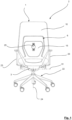
- FIG. 1 to 7 An example of implementation that is shown in the Figures 1 to 7 shown comprises a chair 2, which here is formed by an office chair.
- the chair 2 comprises a seat element 18, which provides a seat surface 19 for a person sitting on the chair 2.
- the chair 2 comprises two opposing armrests 23 arranged laterally of the seat element 18 , which can be particularly well understood from the Figures 1 and 2
- the Chair 2 has a base frame 22, which in the example shown comprises a total of five diagonally splayed legs, each with a caster 30.
- the base frame 22 allows the chair 2 to be moved across a surface.
- the remaining elements of the chair 2 are connected to the base frame 22 , forming a vertical pivot axis 24 , thus providing a rotating function.
- the chair 2 shown is a swivel chair.
- the chair 2 comprises a backrest 1 according to the invention, which comprises a back element 4 and a base 3.
- the backrest 1 is connected to the rest of the chair 2 , as can be seen particularly well from Figure 2
- the connection of the backrest 1 to the rest of the chair 2 is realized in such a way that the backrest 1 can be pivoted about a transversely oriented pivot axis 31 relative to the chassis 22.
- the backrest 1 is shown in a non-pivoted state.
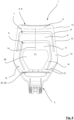
- the back element 4 comprises a total of three support elements 6, 7, 8 which can be particularly well identified by the Figures 3 to 7
- the back element 4 forms a backrest 5 , which is available to a person sitting on the chair 2 to lean his back against the backrest 1.
- the backrest 1 comprises, in addition to the support elements 6, 7, 8 , a lumbar support 15, by means of which the back of a respective person can be supported in the lumbar region.
- the lumbar support 15 is arranged in a center 11 of the backrest 5 , wherein in the example shown, the lumbar support 15 is inserted into a central recess 28 , which is framed on three sides by the support elements 6, 7, 8. This is explained separately below in connection with the support elements 6, 7, 8 .
- the lumbar support 15 comprises an adjusting element 25, by means of which the position of a support surface of the lumbar support 15 relative to the support elements 6, 7, 8 can be adjusted, so that the lumbar support 15 can be tailored to the individual needs of each person.
- the lumbar support 15 is adjustable in two separate directions, which in the example shown are oriented perpendicular to each other. By means of an adjustment in the first direction, the support surface of the lumbar support 15 can be moved back and forth in a direction oriented at least substantially perpendicular to the backrest surface 5 , and by means of an adjustment in the second direction, it can be moved up and down in a direction oriented at least substantially parallel to the backrest surface 5.
- the back element 4 By means of fastening means 35. This is particularly evident from Figure 3 .
- the aforementioned support elements 6, 7, 8 each comprise a web 9 and two flanges 10.
- the flanges 10 are connected to opposite ends of the respective web 9 , so that the support elements 6, 7, 8 each have a U-shape. Since the webs 9 are each arranged at the ends of the flanges 10 facing away from the base 3 , the U-shape of each support element 6, 7, 9 is "reversed.”
- the support elements 6, 7, 8 are nested relative to one another in such a way that a support element 7, 8 located further outwards frames a support element 6, 7 located further inwards on three sides. This is particularly evident from the Figures 3 and 5 .
- the support elements 6, 7, 8 together form the backrest surface 5 , which is available for a person to lean on.
- the support elements 6, 7, 8 are arranged relative to the base 3 such that a distance 33 between a lower end 34 of the base 3 and a central axis 13 of the web 9 of the innermost support element 6 is approximately 65% of a total height 32 , which extends from the lower end 34 of the base 3 to an upper end 29 of the back element 4.
- the described arrangement results in a comparatively large free space between the base 3 and the web 9 of the innermost support element 6 , in which the recess 28 is located, into which the lumbar support 15 can be inserted or is inserted.
- the design of the support elements 6, 7, 8 in the manner described results in the sections of the backrest 5 provided on the webs 9 being suitable for supporting the upper back region.
- the flanges 10 are important for the described segmentation of the backrest 5 , as they are each separately assigned to the corresponding webs 9 of the respective support element 6, 7, 8.
- the support elements 6, 7, 8 or in particular their webs 9, are thereby essentially deformable independently of one another, so that a load on one of the webs 9 does not directly lead to a deformation of another web 9. In this way, the back element 4 can be segmented to individually support the back of a respective person in different areas.
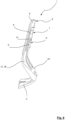
- the webs 9 of the back element 4 are each shaped like a hyperbolic paraboloid, as can be seen particularly well from Figure 6 Thus, the webs 9 are each doubly curved. In the example shown, this double curvature is designed such that—viewed from a front side of the back element 4 —the webs 9 are each concavely curved along their central axis 13, which extends from flange 10 to flange 10 of the respective support element 6, 7, 8 , and convexly curved along their vertical axis 14 , which is oriented perpendicular to the central axis 13. This design is particularly advantageous for the seating comfort offered by the back element 4 .
- the opposing hyperflanges 12 and the flanges 10 of the innermost support element 6 at the base 3 are connected to each other by means of a stiffening strut 20.
- the support elements 6, 7, 8 are indirectly connected to the base 3 by means of an intermediate section, wherein the intermediate section is formed so low on the back element 4 that, when the backrest 1 is used as intended, it does not act as part of the backrest surface 5 and, as such, is not directly subjected to forces or comes into contact with the back of a person leaning against it.
- the flanges 10 therefore extend into a lower end section of the back element 4.
- this is done in such a way that the flanges 10 of the innermost support element 6 extend individually (i.e., not as part of a hyperflange 12 ) into the lower end section of the back element 4 , and the flanges of the two other support elements 7, 8 are joined above the lower end section to form hyperflanges 12 and, as parts of the hyperflange 12 , extend into the lower end section.
- the individual flanges 10 of the innermost support element 6 have a length measured along their central axis that approximately corresponds to a length of the associated web 9 measured along its central axis.
- the individual flanges 10 of the middle support element 7 have a length measured along their central axis that approximately corresponds to 50% of a length of the associated web 9 measured along its central axis.
- the individual flanges 10 of the outermost support element 8 have a length measured along their central axis that approximately corresponds to 70% of a length of the associated web 9 measured along its central axis.
- the backrest 1 is formed as a single piece, manufactured using an injection molding process.
- the support elements 6, 7, 8, the intermediate section, and the base 3 merge directly into one another.
- the backrest 1 is formed here from a glass-fiber-reinforced plastic.
- the support elements 6, 7, 8 are defined by recesses formed in the back element 4.
- the innermost support element 6 is delimited or defined by the central recess 28 toward the center 11 of the backrest 5 and by a U-shaped recess toward the middle support element 7.
- the U-shaped recess is slit-shaped.
- the middle support element 7 is also defined by a U-shaped recess toward the outermost support element 8, which is also slit-shaped here.
- the outermost support element 8 forms an outer edge of the back element 4.
- the backrest 1 has a backrest cover 16, which is shown here as an example using the Figures 1 and 2
- the backrest cover 16 is made of a knitted fabric that is seamless.
- the backrest cover 16 is a cover open on one side, which is pulled from the upper end 29 of the back element 4 over the same. In the example shown, this is done in such a way that the two outer support elements 7, 8 are wrapped by the backrest cover 16 , while the innermost support element 6 remains outside the backrest cover 16 .
- the backrest cover 16 leads to a uniform appearance of the back element 4 , since the segmented design of the back element 4, which results from the individual support elements 6, 7, 8 , is visually combined into a coherent backrest surface 5.
- the backrest cover 16, in the example shown also fulfills a technical function. This is due to the fact that the back element 4 is designed in the area of the hyperflanges 12 with cheeks 36 that protrude beyond the rest of the backrest surface 5 , or the hyperflanges 12 are curved at the lateral edges of the back element 4 to form the aforementioned cheeks 36. This is particularly evident from the Figures 4 and 6 . As a result of this configuration, the back element 4 takes on a shell shape, as is known from typical bucket seats.
- the backrest cover 16 when arranged on the back element 4 , is stretched over the cheeks 36.
- the backrest cover 16 is suitable for absorbing forces acting perpendicularly on its surface, developing an elastic deformation and thus supporting the back of a person leaning against it. Since the cheeks 36 protrude slightly beyond the remaining backrest surface 5 , the back of the person leaning against it first comes into contact with the backrest cover 16 when leaning, before the support elements 6, 7, 8 are finally activated.
- the back element 4 in the example shown comprises two grooves 26, 27 which are suitable for interacting in a form-fitting manner with correspondingly designed piping of the backrest cover 16 and thereby establishing a force-transmitting connection between the backrest cover 16 and the back element 4 .
Landscapes
- Chair Legs, Seat Parts, And Backrests (AREA)
Claims (12)
- Dossier (1) pour chaise (2), en particulier chaise de bureau, comprenant- un socle (3) au moyen duquel le dossier (1) peut être relié ou est relié à la chaise (2),- un élément dorsal (4) pour créer une surface de dossier (5) pour le dos d'une personne assise sur la chaise (2),l'élément dorsal (4) étant relié de manière à transmettre une force à la base (3),l'élément dorsal (4) comprenant une pluralité d'éléments de support (6, 7, 8),les éléments de support (6, 7, 8) étant conçus pour soutenir différentes zones du dos,les éléments de support (6, 7, 8) présentant chacun une traverse (9) espacée de la base (3) et deux brides (10) opposées l'une à l'autre, reliées chacune à un côté de la traverse correspondante (9),les brides (10) d'un élément de support respectif (6, 7, 8) étant chacune tournées vers la base (3) et reliées directement ou indirectement à la base (3),la traverse (9) d'un élément de support respectif (6, 7, 8) étant disposée aux extrémités des brides associées (10) espacées de la base (3), de sorte que les éléments de support (6, 7, 8) présentent chacun une forme en U inversée par rapport à la base (3),les éléments de support (6, 7, 8) étant disposés emboîtés les uns par rapport aux autres de telle sorte que - par rapport à un centre (11) de la surface de dossier (5) - un autre élément de support extérieur respectif (7, 8) encadre chacun un autre élément de support intérieur adjacent (6, 7) sur trois côtés,une rigidité de l'élément dorsal (4) étant segmentée par emboîtement des éléments de support (6, 7, 8) et les éléments de support (6, 7, 8) étant au moins sensiblement déformables indépendamment les uns des autres,les éléments de support (6, 7, 8) présentant des rigidités différentes par rapport à la base en raison de longueurs différentes des brides (10), de sorte que les éléments de support (6, 7, 8) se comportent d'autant plus différemment sous une charge due à l'inclinaison d'un dos sur l'élément dorsal (4) qu'un élément de support extérieur situé plus à l'extérieur (7, 8) se déforme plus fortement sous la même charge qu'un élément de support situé plus à l'intérieur (6, 7),étant prévu un support lombaire (15) qui est disposé dans une partie inférieure de l'élément dorsal (4) qui est encadrée par tous les éléments de support (6, 7, 8),caractérisé en ce que le support lombaire (15) peut être monté ou est monté sans dommage de manière amovible sur l'autre dossier (1).
- Dossier (1) selon la revendication 1, caractérisé en ce que l'élément dorsal (4) comprend au moins trois, de préférence exactement trois, éléments de support (6, 7, 8).
- Dossier (1) selon l'une quelconque des revendications précédentes, caractérisé en ce qu'au moins deux brides (10) d'éléments de support adjacents (7, 8) sont reliées en direction de la base (3) en une hyper-bride commune (12), l'hyper-bride (12) étant de préférence reliée directement à la base (3).
- Dossier (1) selon la revendication 3, caractérisé en ce qu'au moins une autre bride (10) d'un élément de support (6) est combinée en direction de la base (3) avec l'hyper-bride (12).
- Dossier (1) selon l'une quelconque des revendications précédentes, caractérisé en ce que les rebords (10) d'un premier élément de support plus vers l'intérieur (6, 7) sont plus courts que les rebords (10) d'un second élément de support plus vers l'extérieur (7, 8) par rapport au premier élément de support (6, 7).
- Dossier (1) selon l'une quelconque des revendications précédentes, caractérisé en ce que la traverse a nervure (9) d'au moins un élément de support (6, 7, 8), de préférence les traverses (9) de tous les éléments de support (6, 7, 8) sont doublement courbées à la manière d'un paraboloïde hyperbolique, la traverse (9) - vue sur une face frontale de l'élément dorsal (4) - présentant une courbure concave le long d'un axe central (13) s'étendant d'une bride (10) à l'autre (10) et convexe le long d'un axe vertical (14) orienté perpendiculairement à l'axe central (13).
- Dossier (1) selon l'une quelconque des revendications précédentes, caractérisé en ce qu'au moins l'élément dorsal (4), de préférence le dossier (1) dans son ensemble, est réalisé d'une seule pièce.
- Dossier (1) selon la revendication 7, caractérisé en ce qu'au moins l'élément dorsal (4), de préférence le dossier (1) dans son ensemble, est constitué d'une matière plastique renforcée par des fibres de verre.
- Dossier (1) selon l'une quelconque des revendications précédentes, caractérisé en ce que l'élément dorsal (4) se rétrécit vers la base.
- Dossier (1) selon l'une quelconque des revendications précédentes, caractérisé par une housse de dossier (16) qui est tirée sur l'élément dorsal (4) de manière à envelopper au moins une partie des éléments de support (6, 7, 8), de préférence tous les éléments de support (6, 7, 8).
- Dossier (1) selon la revendication 10, caractérisé en ce que la housse de dossier (16) est formée par un tricot extensible.
- Chaise (2), notamment chaise de bureau, comprenant- un socle (17) pour poser la chaise (2) sur une surface,- un élément d'assise (18) pour créer une surface d'assise (19),- un dossier (1) permettant de créer une surface de dossier (5) pour le dos d'une personne assise sur la chaise (2),caractérisée en ce que le dossier (1) est réalisé selon l'une quelconque des revendications 1 à 11.
Applications Claiming Priority (1)
| Application Number | Priority Date | Filing Date | Title |
|---|---|---|---|
| DE102022124131.9A DE102022124131A1 (de) | 2022-09-20 | 2022-09-20 | Rückenlehne für einen Stuhl sowie Stuhl |
Publications (3)
| Publication Number | Publication Date |
|---|---|
| EP4342334A1 EP4342334A1 (fr) | 2024-03-27 |
| EP4342334B1 true EP4342334B1 (fr) | 2025-06-04 |
| EP4342334C0 EP4342334C0 (fr) | 2025-06-04 |
Family
ID=88020839
Family Applications (1)
| Application Number | Title | Priority Date | Filing Date |
|---|---|---|---|
| EP23197120.1A Active EP4342334B1 (fr) | 2022-09-20 | 2023-09-13 | Dossier pour chaise et chaise |
Country Status (2)
| Country | Link |
|---|---|
| EP (1) | EP4342334B1 (fr) |
| DE (1) | DE102022124131A1 (fr) |
Family Cites Families (4)
| Publication number | Priority date | Publication date | Assignee | Title |
|---|---|---|---|---|
| US5997094A (en) * | 1998-06-05 | 1999-12-07 | Stylex, Inc. | Stackable chair with lumbar support |
| US6409268B1 (en) * | 2000-06-09 | 2002-06-25 | Stylex, Inc. | Flexible chair back |
| CA2850677C (fr) * | 2005-03-01 | 2015-11-10 | Haworth, Inc. | Dossier de fauteuil equipe de supports pour les lombaires et le bassin |
| DE102018123731B4 (de) | 2018-09-26 | 2022-10-06 | Figueroa Büro für Gestaltung GmbH | Rückenlehne sowie Sitzmöbel |
-
2022
- 2022-09-20 DE DE102022124131.9A patent/DE102022124131A1/de active Pending
-
2023
- 2023-09-13 EP EP23197120.1A patent/EP4342334B1/fr active Active
Also Published As
| Publication number | Publication date |
|---|---|
| DE102022124131A1 (de) | 2024-03-21 |
| EP4342334A1 (fr) | 2024-03-27 |
| EP4342334C0 (fr) | 2025-06-04 |
Similar Documents
| Publication | Publication Date | Title |
|---|---|---|
| DE19646470B4 (de) | Kraftfahrzeugsitz mit einer Lehne und einem Sitz | |
| DE68902020T2 (de) | Kraftfahrzeugsitz. | |
| DE3879062T2 (de) | Ergonomischer stuhl. | |
| EP1121269B1 (fr) | Siege | |
| DE69406225T2 (de) | Fahrgastsitz | |
| DE69123459T2 (de) | Einrichtung in einem verstellbaren lehnstuhl | |
| EP2047769B1 (fr) | Siège de personnes à suspension | |
| AT502780B1 (de) | System zur automatischen verstellung der sitz-kontur sowie sitz, insbesondere fahrzeugsitz für automobile, flugzeuge oder dergleichen | |
| DE4405653C2 (de) | Fahrzeugsitz | |
| DE20302612U1 (de) | Liegestuhl | |
| EP1712411B1 (fr) | Siège de véhicule à dossier deformable en forme de S | |
| EP2301796B1 (fr) | Siège de véhicule doté d'un dossier à contour déformable | |
| DE2822574A1 (de) | Stuhl | |
| EP3792101A1 (fr) | Agencement des sièges pour un moyen de transport | |
| DE69301206T2 (de) | Kissen für einen Sitz mit verstellbarer Sitzfläche und Anwendung bei einem Fahrzeugsitz | |
| DE102009043298A1 (de) | Fahrzeugsitz mit erhöhtem Sitzkomfort | |
| EP4342334B1 (fr) | Dossier pour chaise et chaise | |
| DE2226055A1 (de) | Sitz, insbesondere fuer kraftfahrzeuge | |
| DE4424096A1 (de) | Stuhl | |
| DE102004027900B4 (de) | Fahrzeugsitz | |
| EP2689692B1 (fr) | Meuble d'assise, en particulier chaise de bureau | |
| DE202022105298U1 (de) | Rückenlehne für einen Stuhl sowie Stuhl | |
| EP4308415B1 (fr) | Ensemble d'ajustement pour ajuster au moins une région de contour de siège d'un siège de véhicule pour un véhicule, siège de véhicule ayant l'ensemble d'ajustement, et véhicule ayant le siège de véhicule | |
| EP4385813A1 (fr) | Siège de véhicule permettant de régler simultanément la profondeur du siège et le support lombaire | |
| DE102005035947B4 (de) | Fahrzeugsitz mit einer verformbaren Rückenlehne |
Legal Events
| Date | Code | Title | Description |
|---|---|---|---|
| PUAI | Public reference made under article 153(3) epc to a published international application that has entered the european phase |
Free format text: ORIGINAL CODE: 0009012 |
|
| STAA | Information on the status of an ep patent application or granted ep patent |
Free format text: STATUS: THE APPLICATION HAS BEEN PUBLISHED |
|
| AK | Designated contracting states |
Kind code of ref document: A1 Designated state(s): AL AT BE BG CH CY CZ DE DK EE ES FI FR GB GR HR HU IE IS IT LI LT LU LV MC ME MK MT NL NO PL PT RO RS SE SI SK SM TR |
|
| STAA | Information on the status of an ep patent application or granted ep patent |
Free format text: STATUS: REQUEST FOR EXAMINATION WAS MADE |
|
| 17P | Request for examination filed |
Effective date: 20240716 |
|
| RBV | Designated contracting states (corrected) |
Designated state(s): AL AT BE BG CH CY CZ DE DK EE ES FI FR GB GR HR HU IE IS IT LI LT LU LV MC ME MK MT NL NO PL PT RO RS SE SI SK SM TR |
|
| GRAP | Despatch of communication of intention to grant a patent |
Free format text: ORIGINAL CODE: EPIDOSNIGR1 |
|
| STAA | Information on the status of an ep patent application or granted ep patent |
Free format text: STATUS: GRANT OF PATENT IS INTENDED |
|
| RIC1 | Information provided on ipc code assigned before grant |
Ipc: A47C 7/40 20060101AFI20250218BHEP |
|
| INTG | Intention to grant announced |
Effective date: 20250314 |
|
| GRAS | Grant fee paid |
Free format text: ORIGINAL CODE: EPIDOSNIGR3 |
|
| GRAA | (expected) grant |
Free format text: ORIGINAL CODE: 0009210 |
|
| STAA | Information on the status of an ep patent application or granted ep patent |
Free format text: STATUS: THE PATENT HAS BEEN GRANTED |
|
| AK | Designated contracting states |
Kind code of ref document: B1 Designated state(s): AL AT BE BG CH CY CZ DE DK EE ES FI FR GB GR HR HU IE IS IT LI LT LU LV MC ME MK MT NL NO PL PT RO RS SE SI SK SM TR |
|
| REG | Reference to a national code |
Ref country code: GB Ref legal event code: FG4D Free format text: NOT ENGLISH |
|
| REG | Reference to a national code |
Ref country code: CH Ref legal event code: EP |
|
| REG | Reference to a national code |
Ref country code: DE Ref legal event code: R096 Ref document number: 502023001088 Country of ref document: DE |
|
| REG | Reference to a national code |
Ref country code: IE Ref legal event code: FG4D Free format text: LANGUAGE OF EP DOCUMENT: GERMAN |
|
| U01 | Request for unitary effect filed |
Effective date: 20250624 |
|
| U07 | Unitary effect registered |
Designated state(s): AT BE BG DE DK EE FI FR IT LT LU LV MT NL PT RO SE SI Effective date: 20250701 |
|
| PG25 | Lapsed in a contracting state [announced via postgrant information from national office to epo] |
Ref country code: ES Free format text: LAPSE BECAUSE OF FAILURE TO SUBMIT A TRANSLATION OF THE DESCRIPTION OR TO PAY THE FEE WITHIN THE PRESCRIBED TIME-LIMIT Effective date: 20250604 |
|
| PG25 | Lapsed in a contracting state [announced via postgrant information from national office to epo] |
Ref country code: GR Free format text: LAPSE BECAUSE OF FAILURE TO SUBMIT A TRANSLATION OF THE DESCRIPTION OR TO PAY THE FEE WITHIN THE PRESCRIBED TIME-LIMIT Effective date: 20250905 Ref country code: NO Free format text: LAPSE BECAUSE OF FAILURE TO SUBMIT A TRANSLATION OF THE DESCRIPTION OR TO PAY THE FEE WITHIN THE PRESCRIBED TIME-LIMIT Effective date: 20250904 |
|
| PG25 | Lapsed in a contracting state [announced via postgrant information from national office to epo] |
Ref country code: PL Free format text: LAPSE BECAUSE OF FAILURE TO SUBMIT A TRANSLATION OF THE DESCRIPTION OR TO PAY THE FEE WITHIN THE PRESCRIBED TIME-LIMIT Effective date: 20250604 |
|
| PG25 | Lapsed in a contracting state [announced via postgrant information from national office to epo] |
Ref country code: HR Free format text: LAPSE BECAUSE OF FAILURE TO SUBMIT A TRANSLATION OF THE DESCRIPTION OR TO PAY THE FEE WITHIN THE PRESCRIBED TIME-LIMIT Effective date: 20250604 |
|
| PG25 | Lapsed in a contracting state [announced via postgrant information from national office to epo] |
Ref country code: RS Free format text: LAPSE BECAUSE OF FAILURE TO SUBMIT A TRANSLATION OF THE DESCRIPTION OR TO PAY THE FEE WITHIN THE PRESCRIBED TIME-LIMIT Effective date: 20250904 |
|
| U20 | Renewal fee for the european patent with unitary effect paid |
Year of fee payment: 3 Effective date: 20250930 |
|
| PG25 | Lapsed in a contracting state [announced via postgrant information from national office to epo] |
Ref country code: IS Free format text: LAPSE BECAUSE OF FAILURE TO SUBMIT A TRANSLATION OF THE DESCRIPTION OR TO PAY THE FEE WITHIN THE PRESCRIBED TIME-LIMIT Effective date: 20251004 |
|
| PG25 | Lapsed in a contracting state [announced via postgrant information from national office to epo] |
Ref country code: SM Free format text: LAPSE BECAUSE OF FAILURE TO SUBMIT A TRANSLATION OF THE DESCRIPTION OR TO PAY THE FEE WITHIN THE PRESCRIBED TIME-LIMIT Effective date: 20250604 |
|
| PG25 | Lapsed in a contracting state [announced via postgrant information from national office to epo] |
Ref country code: CZ Free format text: LAPSE BECAUSE OF FAILURE TO SUBMIT A TRANSLATION OF THE DESCRIPTION OR TO PAY THE FEE WITHIN THE PRESCRIBED TIME-LIMIT Effective date: 20250604 |
|
| PG25 | Lapsed in a contracting state [announced via postgrant information from national office to epo] |
Ref country code: SK Free format text: LAPSE BECAUSE OF FAILURE TO SUBMIT A TRANSLATION OF THE DESCRIPTION OR TO PAY THE FEE WITHIN THE PRESCRIBED TIME-LIMIT Effective date: 20250604 |
|
| PLBE | No opposition filed within time limit |
Free format text: ORIGINAL CODE: 0009261 |
|
| STAA | Information on the status of an ep patent application or granted ep patent |
Free format text: STATUS: NO OPPOSITION FILED WITHIN TIME LIMIT |
|
| REG | Reference to a national code |
Ref country code: CH Ref legal event code: L10 Free format text: ST27 STATUS EVENT CODE: U-0-0-L10-L00 (AS PROVIDED BY THE NATIONAL OFFICE) Effective date: 20260416 |