EP4367310B1 - Matériau non tissé comprenant des fibres multicomposées frisées - Google Patents
Matériau non tissé comprenant des fibres multicomposées frisées Download PDFInfo
- Publication number
- EP4367310B1 EP4367310B1 EP23700387.6A EP23700387A EP4367310B1 EP 4367310 B1 EP4367310 B1 EP 4367310B1 EP 23700387 A EP23700387 A EP 23700387A EP 4367310 B1 EP4367310 B1 EP 4367310B1
- Authority
- EP
- European Patent Office
- Prior art keywords
- nonwoven fabric
- fabric sheet
- fibers
- polymer
- polymer component
- Prior art date
- Legal status (The legal status is an assumption and is not a legal conclusion. Google has not performed a legal analysis and makes no representation as to the accuracy of the status listed.)
- Active
Links
Images



Classifications
-
- D—TEXTILES; PAPER
- D04—BRAIDING; LACE-MAKING; KNITTING; TRIMMINGS; NON-WOVEN FABRICS
- D04H—MAKING TEXTILE FABRICS, e.g. FROM FIBRES OR FILAMENTARY MATERIAL; FABRICS MADE BY SUCH PROCESSES OR APPARATUS, e.g. FELTS, NON-WOVEN FABRICS; COTTON-WOOL; WADDING ; NON-WOVEN FABRICS FROM STAPLE FIBRES, FILAMENTS OR YARNS, BONDED WITH AT LEAST ONE WEB-LIKE MATERIAL DURING THEIR CONSOLIDATION
- D04H3/00—Non-woven fabrics formed wholly or mainly of yarns or like filamentary material of substantial length
- D04H3/005—Synthetic yarns or filaments
- D04H3/007—Addition polymers
-
- D—TEXTILES; PAPER
- D01—NATURAL OR MAN-MADE THREADS OR FIBRES; SPINNING
- D01D—MECHANICAL METHODS OR APPARATUS IN THE MANUFACTURE OF ARTIFICIAL FILAMENTS, THREADS, FIBRES, BRISTLES OR RIBBONS
- D01D5/00—Formation of filaments, threads, or the like
- D01D5/08—Melt spinning methods
- D01D5/098—Melt spinning methods with simultaneous stretching
- D01D5/0985—Melt spinning methods with simultaneous stretching by means of a flowing gas (e.g. melt-blowing)
-
- B—PERFORMING OPERATIONS; TRANSPORTING
- B32—LAYERED PRODUCTS
- B32B—LAYERED PRODUCTS, i.e. PRODUCTS BUILT-UP OF STRATA OF FLAT OR NON-FLAT, e.g. CELLULAR OR HONEYCOMB, FORM
- B32B5/00—Layered products characterised by the non- homogeneity or physical structure, i.e. comprising a fibrous, filamentary, particulate or foam layer; Layered products characterised by having a layer differing constitutionally or physically in different parts
- B32B5/02—Layered products characterised by the non- homogeneity or physical structure, i.e. comprising a fibrous, filamentary, particulate or foam layer; Layered products characterised by having a layer differing constitutionally or physically in different parts characterised by structural features of a fibrous or filamentary layer
- B32B5/022—Non-woven fabric
-
- B—PERFORMING OPERATIONS; TRANSPORTING
- B32—LAYERED PRODUCTS
- B32B—LAYERED PRODUCTS, i.e. PRODUCTS BUILT-UP OF STRATA OF FLAT OR NON-FLAT, e.g. CELLULAR OR HONEYCOMB, FORM
- B32B5/00—Layered products characterised by the non- homogeneity or physical structure, i.e. comprising a fibrous, filamentary, particulate or foam layer; Layered products characterised by having a layer differing constitutionally or physically in different parts
- B32B5/22—Layered products characterised by the non- homogeneity or physical structure, i.e. comprising a fibrous, filamentary, particulate or foam layer; Layered products characterised by having a layer differing constitutionally or physically in different parts characterised by the presence of two or more layers which are next to each other and are fibrous, filamentary, formed of particles or foamed
- B32B5/24—Layered products characterised by the non- homogeneity or physical structure, i.e. comprising a fibrous, filamentary, particulate or foam layer; Layered products characterised by having a layer differing constitutionally or physically in different parts characterised by the presence of two or more layers which are next to each other and are fibrous, filamentary, formed of particles or foamed one layer being a fibrous or filamentary layer
- B32B5/26—Layered products characterised by the non- homogeneity or physical structure, i.e. comprising a fibrous, filamentary, particulate or foam layer; Layered products characterised by having a layer differing constitutionally or physically in different parts characterised by the presence of two or more layers which are next to each other and are fibrous, filamentary, formed of particles or foamed one layer being a fibrous or filamentary layer another layer next to it also being fibrous or filamentary
- B32B5/265—Layered products characterised by the non- homogeneity or physical structure, i.e. comprising a fibrous, filamentary, particulate or foam layer; Layered products characterised by having a layer differing constitutionally or physically in different parts characterised by the presence of two or more layers which are next to each other and are fibrous, filamentary, formed of particles or foamed one layer being a fibrous or filamentary layer another layer next to it also being fibrous or filamentary characterised by one fibrous or filamentary layer being a non-woven fabric layer
- B32B5/266—Layered products characterised by the non- homogeneity or physical structure, i.e. comprising a fibrous, filamentary, particulate or foam layer; Layered products characterised by having a layer differing constitutionally or physically in different parts characterised by the presence of two or more layers which are next to each other and are fibrous, filamentary, formed of particles or foamed one layer being a fibrous or filamentary layer another layer next to it also being fibrous or filamentary characterised by one fibrous or filamentary layer being a non-woven fabric layer next to one or more non-woven fabric layers
- B32B5/268—Layered products characterised by the non- homogeneity or physical structure, i.e. comprising a fibrous, filamentary, particulate or foam layer; Layered products characterised by having a layer differing constitutionally or physically in different parts characterised by the presence of two or more layers which are next to each other and are fibrous, filamentary, formed of particles or foamed one layer being a fibrous or filamentary layer another layer next to it also being fibrous or filamentary characterised by one fibrous or filamentary layer being a non-woven fabric layer next to one or more non-woven fabric layers characterised by at least one non-woven fabric layer that is a melt-blown fabric
- B32B5/269—Layered products characterised by the non- homogeneity or physical structure, i.e. comprising a fibrous, filamentary, particulate or foam layer; Layered products characterised by having a layer differing constitutionally or physically in different parts characterised by the presence of two or more layers which are next to each other and are fibrous, filamentary, formed of particles or foamed one layer being a fibrous or filamentary layer another layer next to it also being fibrous or filamentary characterised by one fibrous or filamentary layer being a non-woven fabric layer next to one or more non-woven fabric layers characterised by at least one non-woven fabric layer that is a melt-blown fabric characterised by at least one non-woven fabric layer that is a melt-blown fabric next to a non-woven fabric layer that is a spunbonded fabric
-
- D—TEXTILES; PAPER
- D01—NATURAL OR MAN-MADE THREADS OR FIBRES; SPINNING
- D01D—MECHANICAL METHODS OR APPARATUS IN THE MANUFACTURE OF ARTIFICIAL FILAMENTS, THREADS, FIBRES, BRISTLES OR RIBBONS
- D01D5/00—Formation of filaments, threads, or the like
- D01D5/22—Formation of filaments, threads, or the like with a crimped or curled structure; with a special structure to simulate wool
-
- D—TEXTILES; PAPER
- D01—NATURAL OR MAN-MADE THREADS OR FIBRES; SPINNING
- D01D—MECHANICAL METHODS OR APPARATUS IN THE MANUFACTURE OF ARTIFICIAL FILAMENTS, THREADS, FIBRES, BRISTLES OR RIBBONS
- D01D5/00—Formation of filaments, threads, or the like
- D01D5/28—Formation of filaments, threads, or the like while mixing different spinning solutions or melts during the spinning operation; Spinnerette packs therefor
- D01D5/30—Conjugate filaments; Spinnerette packs therefor
- D01D5/32—Side-by-side structure; Spinnerette packs therefor
-
- D—TEXTILES; PAPER
- D01—NATURAL OR MAN-MADE THREADS OR FIBRES; SPINNING
- D01F—CHEMICAL FEATURES IN THE MANUFACTURE OF ARTIFICIAL FILAMENTS, THREADS, FIBRES, BRISTLES OR RIBBONS; APPARATUS SPECIALLY ADAPTED FOR THE MANUFACTURE OF CARBON FILAMENTS
- D01F1/00—General methods for the manufacture of artificial filaments or the like
- D01F1/02—Addition of substances to the spinning solution or to the melt
- D01F1/10—Other agents for modifying properties
-
- D—TEXTILES; PAPER
- D01—NATURAL OR MAN-MADE THREADS OR FIBRES; SPINNING
- D01F—CHEMICAL FEATURES IN THE MANUFACTURE OF ARTIFICIAL FILAMENTS, THREADS, FIBRES, BRISTLES OR RIBBONS; APPARATUS SPECIALLY ADAPTED FOR THE MANUFACTURE OF CARBON FILAMENTS
- D01F8/00—Conjugated, i.e. bi- or multicomponent, artificial filaments or the like; Manufacture thereof
- D01F8/04—Conjugated, i.e. bi- or multicomponent, artificial filaments or the like; Manufacture thereof from synthetic polymers
- D01F8/06—Conjugated, i.e. bi- or multicomponent, artificial filaments or the like; Manufacture thereof from synthetic polymers with at least one polyolefin as constituent
-
- D—TEXTILES; PAPER
- D04—BRAIDING; LACE-MAKING; KNITTING; TRIMMINGS; NON-WOVEN FABRICS
- D04H—MAKING TEXTILE FABRICS, e.g. FROM FIBRES OR FILAMENTARY MATERIAL; FABRICS MADE BY SUCH PROCESSES OR APPARATUS, e.g. FELTS, NON-WOVEN FABRICS; COTTON-WOOL; WADDING ; NON-WOVEN FABRICS FROM STAPLE FIBRES, FILAMENTS OR YARNS, BONDED WITH AT LEAST ONE WEB-LIKE MATERIAL DURING THEIR CONSOLIDATION
- D04H1/00—Non-woven fabrics formed wholly or mainly of staple fibres or like relatively short fibres
- D04H1/40—Non-woven fabrics formed wholly or mainly of staple fibres or like relatively short fibres from fleeces or layers composed of fibres without existing or potential cohesive properties
- D04H1/42—Non-woven fabrics formed wholly or mainly of staple fibres or like relatively short fibres from fleeces or layers composed of fibres without existing or potential cohesive properties characterised by the use of certain kinds of fibres insofar as this use has no preponderant influence on the consolidation of the fleece
- D04H1/4282—Addition polymers
- D04H1/4291—Olefin series
-
- D—TEXTILES; PAPER
- D04—BRAIDING; LACE-MAKING; KNITTING; TRIMMINGS; NON-WOVEN FABRICS
- D04H—MAKING TEXTILE FABRICS, e.g. FROM FIBRES OR FILAMENTARY MATERIAL; FABRICS MADE BY SUCH PROCESSES OR APPARATUS, e.g. FELTS, NON-WOVEN FABRICS; COTTON-WOOL; WADDING ; NON-WOVEN FABRICS FROM STAPLE FIBRES, FILAMENTS OR YARNS, BONDED WITH AT LEAST ONE WEB-LIKE MATERIAL DURING THEIR CONSOLIDATION
- D04H1/00—Non-woven fabrics formed wholly or mainly of staple fibres or like relatively short fibres
- D04H1/40—Non-woven fabrics formed wholly or mainly of staple fibres or like relatively short fibres from fleeces or layers composed of fibres without existing or potential cohesive properties
- D04H1/42—Non-woven fabrics formed wholly or mainly of staple fibres or like relatively short fibres from fleeces or layers composed of fibres without existing or potential cohesive properties characterised by the use of certain kinds of fibres insofar as this use has no preponderant influence on the consolidation of the fleece
- D04H1/4382—Stretched reticular film fibres; Composite fibres; Mixed fibres; Ultrafine fibres; Fibres for artificial leather
- D04H1/43825—Composite fibres
- D04H1/43832—Composite fibres side-by-side
-
- D—TEXTILES; PAPER
- D04—BRAIDING; LACE-MAKING; KNITTING; TRIMMINGS; NON-WOVEN FABRICS
- D04H—MAKING TEXTILE FABRICS, e.g. FROM FIBRES OR FILAMENTARY MATERIAL; FABRICS MADE BY SUCH PROCESSES OR APPARATUS, e.g. FELTS, NON-WOVEN FABRICS; COTTON-WOOL; WADDING ; NON-WOVEN FABRICS FROM STAPLE FIBRES, FILAMENTS OR YARNS, BONDED WITH AT LEAST ONE WEB-LIKE MATERIAL DURING THEIR CONSOLIDATION
- D04H1/00—Non-woven fabrics formed wholly or mainly of staple fibres or like relatively short fibres
- D04H1/40—Non-woven fabrics formed wholly or mainly of staple fibres or like relatively short fibres from fleeces or layers composed of fibres without existing or potential cohesive properties
- D04H1/42—Non-woven fabrics formed wholly or mainly of staple fibres or like relatively short fibres from fleeces or layers composed of fibres without existing or potential cohesive properties characterised by the use of certain kinds of fibres insofar as this use has no preponderant influence on the consolidation of the fleece
- D04H1/4391—Non-woven fabrics formed wholly or mainly of staple fibres or like relatively short fibres from fleeces or layers composed of fibres without existing or potential cohesive properties characterised by the use of certain kinds of fibres insofar as this use has no preponderant influence on the consolidation of the fleece characterised by the shape of the fibres
- D04H1/43918—Non-woven fabrics formed wholly or mainly of staple fibres or like relatively short fibres from fleeces or layers composed of fibres without existing or potential cohesive properties characterised by the use of certain kinds of fibres insofar as this use has no preponderant influence on the consolidation of the fleece characterised by the shape of the fibres nonlinear fibres, e.g. crimped or coiled fibres
-
- D—TEXTILES; PAPER
- D04—BRAIDING; LACE-MAKING; KNITTING; TRIMMINGS; NON-WOVEN FABRICS
- D04H—MAKING TEXTILE FABRICS, e.g. FROM FIBRES OR FILAMENTARY MATERIAL; FABRICS MADE BY SUCH PROCESSES OR APPARATUS, e.g. FELTS, NON-WOVEN FABRICS; COTTON-WOOL; WADDING ; NON-WOVEN FABRICS FROM STAPLE FIBRES, FILAMENTS OR YARNS, BONDED WITH AT LEAST ONE WEB-LIKE MATERIAL DURING THEIR CONSOLIDATION
- D04H1/00—Non-woven fabrics formed wholly or mainly of staple fibres or like relatively short fibres
- D04H1/40—Non-woven fabrics formed wholly or mainly of staple fibres or like relatively short fibres from fleeces or layers composed of fibres without existing or potential cohesive properties
- D04H1/54—Non-woven fabrics formed wholly or mainly of staple fibres or like relatively short fibres from fleeces or layers composed of fibres without existing or potential cohesive properties by welding together the fibres, e.g. by partially melting or dissolving
- D04H1/541—Composite fibres, e.g. sheath-core, sea-island or side-by-side; Mixed fibres
- D04H1/5414—Composite fibres, e.g. sheath-core, sea-island or side-by-side; Mixed fibres side-by-side
-
- D—TEXTILES; PAPER
- D04—BRAIDING; LACE-MAKING; KNITTING; TRIMMINGS; NON-WOVEN FABRICS
- D04H—MAKING TEXTILE FABRICS, e.g. FROM FIBRES OR FILAMENTARY MATERIAL; FABRICS MADE BY SUCH PROCESSES OR APPARATUS, e.g. FELTS, NON-WOVEN FABRICS; COTTON-WOOL; WADDING ; NON-WOVEN FABRICS FROM STAPLE FIBRES, FILAMENTS OR YARNS, BONDED WITH AT LEAST ONE WEB-LIKE MATERIAL DURING THEIR CONSOLIDATION
- D04H3/00—Non-woven fabrics formed wholly or mainly of yarns or like filamentary material of substantial length
- D04H3/018—Non-woven fabrics formed wholly or mainly of yarns or like filamentary material of substantial length characterised by the shape
-
- D—TEXTILES; PAPER
- D04—BRAIDING; LACE-MAKING; KNITTING; TRIMMINGS; NON-WOVEN FABRICS
- D04H—MAKING TEXTILE FABRICS, e.g. FROM FIBRES OR FILAMENTARY MATERIAL; FABRICS MADE BY SUCH PROCESSES OR APPARATUS, e.g. FELTS, NON-WOVEN FABRICS; COTTON-WOOL; WADDING ; NON-WOVEN FABRICS FROM STAPLE FIBRES, FILAMENTS OR YARNS, BONDED WITH AT LEAST ONE WEB-LIKE MATERIAL DURING THEIR CONSOLIDATION
- D04H3/00—Non-woven fabrics formed wholly or mainly of yarns or like filamentary material of substantial length
- D04H3/08—Non-woven fabrics formed wholly or mainly of yarns or like filamentary material of substantial length characterised by the method of strengthening or consolidating
- D04H3/14—Non-woven fabrics formed wholly or mainly of yarns or like filamentary material of substantial length characterised by the method of strengthening or consolidating with bonds between thermoplastic yarns or filaments produced by welding
- D04H3/147—Composite yarns or filaments
-
- D—TEXTILES; PAPER
- D04—BRAIDING; LACE-MAKING; KNITTING; TRIMMINGS; NON-WOVEN FABRICS
- D04H—MAKING TEXTILE FABRICS, e.g. FROM FIBRES OR FILAMENTARY MATERIAL; FABRICS MADE BY SUCH PROCESSES OR APPARATUS, e.g. FELTS, NON-WOVEN FABRICS; COTTON-WOOL; WADDING ; NON-WOVEN FABRICS FROM STAPLE FIBRES, FILAMENTS OR YARNS, BONDED WITH AT LEAST ONE WEB-LIKE MATERIAL DURING THEIR CONSOLIDATION
- D04H3/00—Non-woven fabrics formed wholly or mainly of yarns or like filamentary material of substantial length
- D04H3/08—Non-woven fabrics formed wholly or mainly of yarns or like filamentary material of substantial length characterised by the method of strengthening or consolidating
- D04H3/16—Non-woven fabrics formed wholly or mainly of yarns or like filamentary material of substantial length characterised by the method of strengthening or consolidating with bonds between thermoplastic filaments produced in association with filament formation, e.g. immediately following extrusion
-
- B—PERFORMING OPERATIONS; TRANSPORTING
- B32—LAYERED PRODUCTS
- B32B—LAYERED PRODUCTS, i.e. PRODUCTS BUILT-UP OF STRATA OF FLAT OR NON-FLAT, e.g. CELLULAR OR HONEYCOMB, FORM
- B32B2262/00—Composition or structural features of fibres which form a fibrous or filamentary layer or are present as additives
- B32B2262/02—Synthetic macromolecular fibres
- B32B2262/0253—Polyolefin fibres
-
- B—PERFORMING OPERATIONS; TRANSPORTING
- B32—LAYERED PRODUCTS
- B32B—LAYERED PRODUCTS, i.e. PRODUCTS BUILT-UP OF STRATA OF FLAT OR NON-FLAT, e.g. CELLULAR OR HONEYCOMB, FORM
- B32B2262/00—Composition or structural features of fibres which form a fibrous or filamentary layer or are present as additives
- B32B2262/12—Conjugate fibres, e.g. core/sheath or side-by-side
- B32B2262/124—Non-woven fabric
-
- D—TEXTILES; PAPER
- D10—INDEXING SCHEME ASSOCIATED WITH SUBLASSES OF SECTION D, RELATING TO TEXTILES
- D10B—INDEXING SCHEME ASSOCIATED WITH SUBLASSES OF SECTION D, RELATING TO TEXTILES
- D10B2321/00—Fibres made from polymers obtained by reactions only involving carbon-to-carbon unsaturated bonds
- D10B2321/02—Fibres made from polymers obtained by reactions only involving carbon-to-carbon unsaturated bonds polyolefins
- D10B2321/022—Fibres made from polymers obtained by reactions only involving carbon-to-carbon unsaturated bonds polyolefins polypropylene
-
- D—TEXTILES; PAPER
- D10—INDEXING SCHEME ASSOCIATED WITH SUBLASSES OF SECTION D, RELATING TO TEXTILES
- D10B—INDEXING SCHEME ASSOCIATED WITH SUBLASSES OF SECTION D, RELATING TO TEXTILES
- D10B2401/00—Physical properties
- D10B2401/06—Load-responsive characteristics
- D10B2401/063—Load-responsive characteristics high strength
-
- D—TEXTILES; PAPER
- D10—INDEXING SCHEME ASSOCIATED WITH SUBLASSES OF SECTION D, RELATING TO TEXTILES
- D10B—INDEXING SCHEME ASSOCIATED WITH SUBLASSES OF SECTION D, RELATING TO TEXTILES
- D10B2509/00—Medical; Hygiene
Definitions
- the invention relates to nonwoven fabric sheets containing crimped multicomponent fibers.
- crimped multicomponent fibers comprise two or more polymers of different physical properties that are asymmetrically distributed over their cross section. The most common is side-by-side. This configuration causes the fibers to crimp when they are physically stressed like, in the case of spunbonded fibers, during fiber drawing and quenching.
- Patents that resulted out of these developments include EP 3 165 656 B1 , EP 3 121 314 B1 , EP 3 246 443 B1 and EP 3 246 444 B1 , all going back to research made by the co-applicants of the present application.
- Nonwoven spunbond fabrics comprising multicomponent filaments are also known from EP 3 321 407 A1 , WO 2020/230006 A1 , US 2010/261399 A1 and WO 2021/226246 A1 .
- the present invention proposes a nonwoven fabric sheet comprising crimped multicomponent fibers, wherein the fibers comprise two different polymer components (A) and (B) distributed over the cross section of the fiber in a side by side arrangement, wherein the interface line, contained in the radial plane of the fibers, between the two polymer components (A) and (B) is curved and its curvature (c), as defined by the quotient (h)/(b), is 0.05 to 0.25, wherein (b), the "baseline length”, is the length of the imaginary straight baseline connecting the two endpoints of the curved interface line, and (h), the "bow height", is the distance of the crest of the curved interface line from the baseline.
- the interface line has the shape of a single arc, i.e. is not wavy and, in more mathematical terms, has no inflection point at which the curvature changes sign. Reference is again made to the shape of the interface line as contained in any radial plane of the fibers, and hence as visible when the fiber is cut in radial direction.
- the radial plane is perpendicular to the longitudinal direction of the fibers, and as such at a 90°angle to the longitudinal axis of the fiber at the given position.
- the shape of the radial interface line, which defines the present invention is the shape of the interface line that is contained in this plane. This is to distinguish from the contour of the interface along a longitudinal or oblique line, which in a crimped fiber is naturally curved to some extent by geometrical relation.
- the curved nature of the radial interface line, which defines the present invention, is not geometrically related to the crimp of the fiber.
- the curvature (c) of the radial interface line is between 0.08 to 0.22, preferably 0.10 to 0.20, more preferably 0.12 to 0.18. Very favourable crimping behaviour has been observed in many cases when the curvature is within these ranges.
- a side-by-side arrangement of polymer components (A) and (B) is given in a standard side-by-side fiber, but can also be present in an eccentric sheath-core fiber with a D-shaped core, the latter essentially corresponding to a side-by-side fiber enclosed by a coating of either of the polymers. Still, the effects when the curvature is in the range as defined are observed in particular in side-by-side bicomponent fibers, which comprise only two polymer components distributed over the cross section in a side-by-side arrangement.
- the nonwoven material of the present invention is a spunbonded material and the crimped multicomponent fibers are spunbonded fibers.
- the sheet can comprise the bicomponent fibers following the inventive definition, in addition to other fibers like linear monocomponent fibers, or consist of bicomponent fibers following the inventive definition.
- the millions of fibers forming for a nonwoven material are never always identical, the term consisting of must be understood in a sense that the requirement is fulfilled when the fibers are all the same by production and the vast majority of fibers, e.g. more than 80% of the fibers, preferably more than 90% of the fibers show the inventive characteristic.
- the spunbonding machine must allow for a side-by-side flow of directly adjacent streams of two different polymers on the scale of a single fiber.
- the streams combine shortly before the combined stream leaves the spinnerette (die plate).
- the formation of a curved interface and the degree of curvature depends on the polymers used and process conditions during drawing and quenching of the fibers.
- At least one of the polymer components (A) or (B) is a polyolefin polymer. More preferably still, both polymer component (A) and polymer component (B) are polyolefin polymers.
- polyolefin polymers propylene homopolymers, ethylene homopolymers, and co-polymers of propylene or ethylene with other ⁇ -olefins, especially propylene- ⁇ -olefin copolymers like propylene-ethylene copolymers or propylene-C4-C8-copolymers, are preferred. Propylene-ethylene copolymers in an embodiment are most preferred.
- a homopolymer is defined as a polymer having a co-monomer content of smaller 1 weight percent, preferably smaller than 0.5 weight percent.
- the co-polymers of propylene or ethylene with other ⁇ -olefins preferably have a co-monomer content of between 1.0 and 5.5 weight percent.
- the co-polymers are preferably random co-polymers.
- one of the polymer components (A) is a propylene homopolymer and the other one of the polymer components (B) is a propylene- ⁇ -olefin copolymer, wherein the propylene- ⁇ -olefin copolymer preferably has a co-monomer content of between 1.0 and 5.5 weight percent.
- the difference in crystallization temperatures T c of the two polymer components has been identified as a paramount parameter.
- the absolute value of the difference of the crystallization temperature [T c (A)] of the polymer component (A) and the crystallization temperature [T c (B)] of the polymer component (B) is greater than 0°C and smaller than 30°C, preferably greater than 10°C and smaller than 25°C, as measured by differential scanning calorimetry (DSC, ISO 11357-1 & -2).
- polymer component (A) is a propylene homopolymer and polymer component (B) is a propylene- ⁇ -olefin copolymer
- the crystallization temperature [Tc(A)] of the propylene homopolymer (A) is higher than the crystallization temperature [Tc(B)] of the propylene- ⁇ -olefin copolymer (B) to the said extent.
- the curved radial interface line is arched towards the polymer component with the lower crystallization temperature, preferably a propylene- ⁇ -olefin-copolymer.
- the polymer component with the higher crystallization temperature preferably the homo-polypropylene, has the more compact cross-section.
- the absolute value for the crystallization temperature [T c (A)] for the polymer component (A) with the higher crystallization temperature preferably lies in the range of between 90°C to 135°C, preferably 100°C to 125°C.
- the absolute value for the crystallization temperature [T c (B)] for the polymer component (B) with the lower crystallization temperature preferably lies in the range of between 80°C to 125°C, preferably 90°C to 115°C.
- the crystallization temperatures T c of the polymers (A) and (B) are connected to the chemical nature of the polymers, and vary, for example, with the co-monomer content in a propylene- ⁇ -olefin copolymer, the tacticity, or the molecular weight distributions.
- Crystallization behaviour and kinetics can further be influenced and balanced against each other by adding a nucleating agent to one or both of the polymer components (A) and (B).
- Nucleating agents increase the number of sites where crystallites begin to form, and hence promote crystallization.
- Suitable nucleating agents comprise nonitol- or sorbitol based nucleating agents.
- the nucleating agent is an ⁇ -nucleating agent.
- Suitable ⁇ -nucleating agents comprise salts of monocarboxylic acids and polycarboxylic acids (e.g. sodium benzoate or aluminum tert-butylbenzoate), dibenzylidenesorbitol (e.g. 1,3:2,4 dibenzylidenesorbitol), C1-C8-alkyl-substituted dibenzylidenesorbitol derivatives (e.g.
- methyldibenzylidenesorbitol ethyldibenzylidenesorbitol or dimethyldibenzylidenesorbitol, like 1,3:2,4 di(methylbenzylidene) sorbitol), or substituted nonitol-derivatives (e.g. 1,2,3,-trideoxy-4,6:5,7-bis-O-[(4-propylphenyl)methylene]-nonitol), salts of diesters of phosphoric acid, e.g.
- Dibenzylidenesorbitol e.g. 1,3:2,4 dibenzylidene sorbitol
- dibenzylidenesorbitol derivative preferably dimethyldibenzylidenesorbitol (e.g.
- nonitol-derivatives such as 1,2,3,-trideoxy-4,6:5,7-bis-O-[(4-propylphenyl)methylene]-nonitol, sodium 2,2'-methylenebis (4, 6,-di-tert-butylphenyl) phosphate, vinylcycloalkane polymers, or vinylalkane polymers may be most preferred.
- Suitable amounts of addition lie between 0.01-5000 ppm, preferably in the range of 0.05-4500 ppm, more preferably 0.1-4000 ppm, like 0.15-3000 ppm based on the total weight of the respective polymer component.
- the difference in melting points T m of the two polymer components has been identified as a parameter that can be important.
- the melting temperature T m of the polymer component (A) with the higher crystallization (and melting) temperature preferably lies in the range of between 155°C to 164°C (when determined by DSC, ISO 11357-1 & -2).
- the absolute value for the melting temperature T m of the polymer component (B) with the lower crystallization (and melting) temperature preferably lies in the range of between 142°C to 155°C (when determined by DSC, ISO 11357-1 & -2).
- the melt flow rate of at least one, more preferably both of the two polymer components (A) and (B) is in the range of 15 to 120 g/10 min (when determined according to ISO 1133 at 230°C and 2.16 kg).
- Preferred melt flow rates at least for the component having the higher melt flow rate, in embodiments the propylene homopolymer, are below 60 g/10 min.
- the polydispersity (M w /M n ) of at least one, more preferably both of the two polymer components (A) and (B) is in the range of 4.5 to 10.0 (when measured by size exclusion chromatography according to ISO 16014), preferably in the range of 5.0 to 9.0, more preferably in the range of 5.5 to 8.5.
- the absolute difference between the polydispersity of the two polymer components is preferably 0.3 or higher.
- polymer component (A) is a propylene homopolymer and polymer component (B) is a propylene- ⁇ -olefin copolymer
- polydispersity of the propylene homopolymer (A) is lower than the polydispersity of the propylene- ⁇ -olefin copolymer (B).
- melt viscosity at a given temperature can be a relevant parameter in the given context.
- polymer component (A) is a propylene homopolymer and polymer component (B) is a propylene- ⁇ -olefin copolymer
- melt viscosity of the propylene homopolymer (A) is lower than the melt viscosity of the propylene- ⁇ -olefin copolymer (B).
- At least one, more preferably both of the two polymer components (A) and (B) have a xylene cold soluble content (XCS) in the range of 1.5 to 10.0 wt%, more preferably in the range of 1.5 to 8.0 wt%.
- XCS xylene cold soluble content
- one or both of the polymer components (A) and (B) are visbroken.
- Visbreaking refers to a controlled polymer chain cracking by adding a visbreaking additive to the polymer components.
- the polymer chain cracking occurs at elevated temperatures when the polymer components are molten and extruded through the spinnerette of the spunbonding machine.
- Suitable visbreaking additives comprise organic peroxides, organic hydroxylamine esters or mercaptane compounds as source of free radicals. Suitable amounts of addition are between 100 ppm and 500 ppm. Visbreaking can be used to influence viscosity and adjust the polydispersity, and further melting and crystallization behavior of the two polymer components (A) and (B) against each other.
- only one of the propylene polymers (A and B) is visbroken, and the absolute value of the difference of Mz/Mw between propylene polymer A and B is from 0.3 to 10.0, preferably from 0.5 to 8.5, more preferably from 1.0 to 5.5, even more preferably from 1.5 to 4.0.
- both of the Propylene polymers (A and B) are visbroken, and the absolute value of the difference of Mz/Mw between propylene polymer A and B is between 0.0 to 0.3, preferably between 0.00 to 0.25, more preferably between 0.00 to 0.22, even more preferably between 0.00 to 0.15.
- the findings of this invention are not restricted to fibers where the two polymer components (A) and (B) arranged side-by-side are used within the fiber in a 50:50 weight ratio. Rather, the finding is applicable to a wide range of weight ratios, like from 90:10 to 10:90. Preferred weight ratios leading to pronounced crimp are between 80:20 and 20:80, more preferably between 70:30 and 30:70, and yet more preferred between 60:40 and 40:60, however.
- the weight ratio of the polymer component (A) with the higher crystallization temperature, preferably a propylene homopolymer, to the polymer component (B) with the lower crystallization temperature, preferably a propylene- ⁇ -olefin-copolymer, is smaller 50:50, meaning that there is an excess of the polymer component (B) with the lower crystallization temperature in the fiber. This has been found to potentially enhance crimp.
- the weight ratio of the polymer component (A) with the higher crystallization temperature, preferably a propylene homopolymer, to the polymer component (B) with the lower crystallization temperature, preferably a propylene- ⁇ -olefin-copolymer, is greater 50:50, meaning that there is an excess of the polymer component (A) with the higher crystallization temperature in the fiber. This has been found to potentially enhance stability of the production process.
- the crimped bicomponent fibers are typically helically crimped.
- the average crimp number of the crimped multicomponent fibers is in the range of at least 7 and preferably at least 10 crimps per cm in the fiber, as measured as per Japanese standard JIS L-1015-1981 under a pretension load of 2mg/denier.
- the crimp amplitude is preferably in the range of below 0,30 mm and preferably between 0,20 and 0,30 mm when measured according to JIS L-1015-1981 under a pre-tension load of 2mg/denier.
- the fibers preferably have a linear mass density in the range of between 1,0 to 2,2 denier, preferably 1,2 to 2,0 denier.
- the basis weight of each of the spunbonded layers within the multilayer sheet may be between 4-40 g/m 2 , preferably between 5-25 g/m 2 .
- the density of the nonwoven fabric sheet is preferably less than 60 mg/cm 3 and preferably less than 50 mg/cm 3 , which are values that are typical for high loft nonwovens with crimped fibers. Standard loft nonwovens with uncrimped fibers, as a comparison, typically have densities higher than 60-70 mg/cm 3 .
- the thickness of the nonwoven fabric sheet is preferably greater than 0,35 mm for basis weights of 20 g/m 2 or more, when measured according to WSP.120.6, option A, pressure of 0,5 kPa on a 2500 mm 2 plate.
- the spunbonded sheet forms one layer of a multilayer sheet comprising, in addition to the spunbonded sheet according to the invention, one or more additional layers.
- the additional layers can be nonwoven materials, like additional spunbonded sheets or meltblown sheets, or other sheets like polymer films or woven fabrics.
- Preferred embodiments comprise S n -type structures (like SS, SSS, etc.), where the sheet according to the invention is combined with at least one further spunbonded nonwoven fabric sheets, preferably a spunbonded nonwoven fabric sheet formed from non-crimped fibers, like monocomponent fibers, or any SM- or SMS-type structures (like SSM, SSMS, SMMS, SSMMS, etc.), where the sheet according to the invention is combined with one or more meltblown nonwoven fabric sheets, and optionally in addition with at least one further spunbonded nonwoven fabric sheet, preferably a spunbonded nonwoven fabric sheet formed from non-crimped fibers.
- the nonwoven sheet according to the invention forms an outer layer of the multilayer sheet.
- the nonwoven fabric sheet or multilayer sheet comprises a bond pattern that is introduced by calander rolls during manufacture.
- the bond pattern comprises a bond area of 10-16 % and/or a dot density of 20-45 dots/cm 2 and/or a dot size of 0,35-0,55 mm 2 per dot. These relatively open bond patterns are typical for sheets comprising high loft spunbonded materials formed from crimped fibers.
- the basis weight of each of the spunbonded layers within the multilayer sheet may be between 3-25 g/m 2 , preferably between 4-20 g/m 2 .
- the basis weight of the meltblown layer may be between 0,5-5 g/m 2 , preferably between 1-4 g/m 2 .
- the invention further relates to a method for making a spunbonded nonwoven fabric sheet or a multilayer as defined above.
- the spunbonded nonwoven fabric sheet is made in an apparatus comprising at least two extruders with a spinnerette, a drawing channel and a moving belt, wherein the fibers are spun in a spinnerette, drawn in a drawing channel and laid down on a moving belt, wherein the apparatus comprises a pressurized process air cabin from which process air is directed through the drawing channel to draw fibers.
- the drawing channel may comprise more than one section.
- the drawing channel or a section of the drawing channel may get narrower with increasing distance from the spinnerette. It one embodiment the converging angle can be adjusted.
- the apparatus may form a closed aggregate extending between at least the point of process air entry until the end of the drawing channel, so no air can enter from the outside and no process air supplied can escape to the outside.
- the apparatus comprises at least one diffuser, which is arranged between the end of the drawing channel and the moving belt.
- the pressure difference between the ambient pressure and the pressure in the process air cabin is usually higher than 2000 Pascal. It has been observed that, within reasonable overall ranges, higher cabin pressures tend to lead to curvatures in the desired ranges and have a positive influence on crimp.
- the cabin pressure is hence higher than 2500 Pascal, more preferably higher than 3000 Pascal or even higher than 3500 Pascal.
- the cabin pressures preferably are less than 6000 Pascal and preferably less than 5000 Pascal.
- Suitable process air temperatures are usually greater than 10°C. It has been observed, however, that, within reasonable overall ranges, higher process air temperatures tend to lead to curvatures in the desired ranges and have a positive influence on crimp.
- the process air temperature is hence higher than 20°C, more preferably higher than 25°C.
- the process air temperatures are preferably below 60°C. If process air of two different temperatures is applied to the fibers during drawing, the above description relates to the process temperature of the air contacting the filaments first.
- the maximum air speed in the drawing channel is usually higher than 50 m/s.
- the invention relates to a hygiene product comprising a nonwoven fabric sheet or a multilayer sheet according to the invention.
- the sheets of the present invention may be used in the hygiene industry as nonwoven sheets in hygiene products such as adult incontinence products, baby diapers, sanitary napkins and the like.
- Figure 1 shows schematic illustration of a cross-section of a side-by-side bicomponent fiber.
- the fiber F comprise first and second polymer components A and B arranged side-by-side. The arrangement extends over the entire length of the fiber.
- Figure 2 is a schematic illustration of a section of a crimped fiber F as comprised in a nonwoven fabric sheet of the invention.
- the fiber is curved and comprises a certain crimp radius and a certain crimp count.
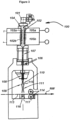
- FIG 3 shows a spinning machine 100 that is suitable for producing spunbonded nonwovens according to the invention.
- Spunbonded nonwovens NW are produced from continuous fibers F of thermoplastic material, which are spun in a spinnerette 101 and subsequently passed through a cooling device 102.
- a monomer suctioning device 104 to remove gases in the form of decomposition products, monomers, oligomers and the like generated during the spinning of the fibers F is arranged between the spinnerette 101 and the cooling device 102.
- the monomer extraction device 4 comprises suction openings or suction gaps.
- process air is applied to the fiber curtain from the spinnerette 101 from opposite sides.
- the cooling device 102 is divided into two sections 102a and 102b, which are arranged in series along the flow direction of the fibers.
- process air of a relatively higher temperature for example 60°C
- process air of a relatively lower temperature for example 30°C
- the supply of process air takes place via air supply chambers 105a and 105b, respectively.
- the cabin pressure within chambers 105a and 105b can be the same and can, for example, be about 3000 Pascal above ambient pressure, for example.
- a drawing device 106 to draw and stretch the fibers F is arranged below the cooling device 102.
- the drawing device includes an intermediate channel 107, which preferably converges and gets narrower with increasing distance from the spinnerette 101. It one embodiment the converging angle of the intermediate channel 107 can be adjusted. After the intermediate channel 107 the fiber curtain enters the lower channel 108.
- the cooling device 102 and the drawing device 106 are together formed as a closed aggregate, meaning that over the entire length of the aggregate, no major air flow can enter from the outside and no major process air supplied in the cooling device 102 can escape to the outside.
- Some fume extraction devices directly under the spinneret extracting a minor air volume can be incorporated.
- the fibers F leaving the drawing device 106 are then passed through a laying unit 109, which comprises two successively arranged diffusers 110 and 111 are provided, with diffuser 110 having a divergent section and diffuser 111 having a convergent section and an adjoining divergent section.
- the diffuser angles in particular the diffuser angles in the divergent regions of the diffusers 110 and 111, are adjustable. Between the diffusers 110 and 111 is a gap 115 through which ambient air is sucked into the fiber flow space.
- the fibers F are deposited as nonwoven web NW on a spinbelt 113, formed from an air-permeable web.
- a suctioning device 116 is arranged below the laydown area of the spinbelt 113 so suck off process air, which is illustrated in Figure 3 by the arrow 117.
- the nonwoven web NW is first guided through the gap between a pair of pre-consolidation rollers 114 for pre-consolidating the nonwoven web NW.
- Figure 4 illustrates a production line 200 for producing SMS-type nonwoven laminate fabric sheets NWLS of the present invention.
- the machine is configured for producing an SMS-type nonwoven laminate fabric sheet NWLS in the form of, specifically, an SMMS H sheet, where "S” stands for a regular spunbonded layer, i.e. a layer formed from uncrimped fibers, "M” stands for a meltblown layer, and “S H “ stands for a high loft spunbonded layer formed from crimped bicomponent fibers.
- the layer “S H " within this fabric is the layer that is according to the invention.
- An SMS-type sheet where the spunbonded structure on one side of the internal meltblown structure is high loft and the spunbonded structure on one side of the internal meltblown structure is a regular spunbonded sheet are known as semi-high-loft structures.
- the regular S layer provides mechanical stability, the M layer improves liquid barrier properties, and the loft S layer enhances softness and flexibility of the fabric.
- the production line 200 comprises a spinning machine 100 for producing the S H -layer, which is configured as illustrated in Figure 3 .
- the two reservoirs 118a and 118b contain the two different polymer components A and B used for spinning the bicomponent fibers.
- An annex reservoir 119 may contain a masterbatch with an additive such as a nucleating agent or a visbreaking additive.
- the production line 200 comprises a spinbelt 213, a first spinning machine 220, comprising only one polymer reservoir 218 and configured for spinning monocomponent fibers, for forming the regular S layer, two meltblowing machines 230 for forming the MM double layer meltblown structure.
- the machines 220, 230 and 100 are serially arranged along the spinbelt 213.
- each spinning machine 220 and 100 Downstream each spinning machine 220 and 100 a pair of pre-consolidation rollers 214 and 114 is arranged.
- a calender / embossing roll 240 for firmly bonding the layers of the laminate sheet NWLS is arranged downstream the last spinning machine.
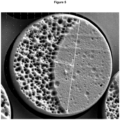
- Figure 5 shows an SEM picture (Scanning Electron Microscope) of a cross-section of a bicomponent fiber having a curved interface line between the polymer components.
- the picture of Figure 5 was taken by the method explained in the following, which is generally a good method to measure the curvature that defines the present invention.
- the curvature in principle, is an absolute geometrical property of the fibers and not dependent on how it is measured. There are naturally some variations of curvature within a single fiber over its length, and not every fiber in the fabric sheet is the same. For practical purposes, it is most preferred that at least ten fibers are picked from a nonwoven sheet, the curvature of each of the picked fiber measured at a randomly selected length position, and the average number used.
- the machine direction is identified and the sheet encapsulated and demobilized in a polyester or epoxy resin.
- the resulting polymer block is then cut in a cross-machine directional plane that is perpendicular to the plane of the encapsulated nonwoven sheet.
- the cut surface is polished to have a visible interface after etching.
- the cross-sectional surface of the fibers exposed at the polished cut surface are etched to etch away the more amorphous of the polymer components. Fiber ends having the most circular cross sections and hence being oriented in machine direction as strictly as possible at the cut surface are selected for measurement. Small direction deviations can be corrected for distortion.
- a useful fiber-cross-section is an ellipse with a ratio between the major and minor axis below 1.2. Preferred is that the fibers show up as circle.
- the interface between the two polymers is curved. More specifically, the interface line has the shape of a single arc and has no inflection point at which the curvature changes sign.
- the polymer on the left hand side was a propylene- ⁇ -olefin copolymer with a relatively lower crystallization temperature and the polymer on the right hand side was a propylene homopolymer with a relatively higher crystallization temperature.
- the curved interface is arched toward the left side, i.e. arched toward the propylene- ⁇ -olefin copolymer with a relatively lower crystallization temperature.
- the polymer component with the higher crystallization temperature has the more compact cross-section.
- the curvature "c" is measured and calculated according to the following description. First the distance “b" between the polymer surface intersections is measured with a line drawn between the polymer intersections of the fiber surfaces. This line is the imaginary baseline. It is 540 pixels in the given example. Next the bow height "h” is measured by drawing a line orthogonally from the baseline (usually the middle of the baseline) to the crest of the curved interface line. The length of the line corresponds to the bow height "h" and, in the given example, is 111 pixels.
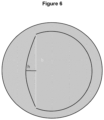
- Figure 6 illustrates how the teaching of the present invention is also applicable to eccentric sheath-core fibers with a D-shaped core.
- a basis weight of 20 g/m 2 for the spunbonded nonwoven material sheet For all options, a basis weight of 20 g/m 2 for the spunbonded nonwoven material sheet. Specific polymer throughput in the spinnerette 101 was approximately 0,52 g polymer per hole per minute. The cabin pressure was kept mostly constant at 4000 Pascal. Other process settings were kept in a normal range for the production of crimped fibers.
- the ceramic pre-consolidation rollers 114 on the spinbelt at the outlet side of the beam were run with a temperature of 50-70°C.
- the calender (not shown in Figure 3 , but positioned downstream the pre-consolidation rollers 114) was a standard open dot calender with 12% bonding area and 25 circular bonding points per cm 2 . The temperature of the calender was in the range of 135-145°C.
- Table 1 Example # Polymer A Polymer B Mass content of polymer A [wt%] Cabin pressure [Pa] SAS gap [mm] Pre-Diffusor gap [mm] CE1 PP2 PP4 60 4000 22 24 CE2 PP2 PP3 60 4000 22 24 IE1 PP1 PP2 40 4000 22 24 IE2 PP1 PP2 70 4000 22 24 IE3 PP1 PP3 50 4000 22 24 IE4 PP1 PP2 60 4000 22 24 IE5 PP1 PP4 60 4000 22 24 IE6 PP1 PP2 70 6000 22 24 IE7 PP5 PP6 50 4000 22 24
- Polymer component PP1 is the polymer Borealis HG 475 FB, a polypropylene homopolymer that is described on pages 17-20 of the application WO 2017/118612 A1 .
- Polymer component PP2 is a combination of 95 wt% PP1 and 5 wt% of a polypropylene masterbatch including a nucleating agent.
- the masterbatch is described as "IE2" in EP 3 184 587 B1 and is a nucleated polypropylene homopolymer, MFR 230/2.16 of 8.0 g/10 min.
- Polymer component PP3 is a polypropylene homopolymer that is prepared as follows: The catalyst used in the polymerization process of polymer component PP3 was prepared as follows:
- Mg alkoxide solution was prepared by adding, with stirring (70 rpm), into 11 kg of a 20 wt-% solution in toluene of butyl ethyl magnesium (Mg(Bu)(Et)), a mixture of 4.7 kg of 2-ethylhexanol and 1.2 kg of butoxypropanol in a 20 l stainless steel reactor. During the addition the reactor contents were maintained below 45 °C. After addition was completed, mixing (70 rpm) of the reaction mixture was continued at 60 °C for 30 minutes. After cooling to room temperature 2.3 kg g of the donor bis(2-ethylhexyl)citraconate was added to the Mg-alkoxide solution keeping temperature below 25 °C. Mixing was continued for 15 minutes under stirring (70 rpm).
- the catalyst particles were washed with 45 kg of toluene at 90°C for 20 minutes followed by two heptane washes (30 kg, 15 min). During the first heptane wash the temperature was decreased to 50 °C and during the second wash to room temperature.
- the thus obtained catalyst was used along with triethyl-aluminium (TEAL) as cocatalyst and dicyclopentyl dimethoxy silane donor (D-donor) as external donor.
- TEAL triethyl-aluminium
- D-donor dicyclopentyl dimethoxy silane donor
- Polymerizations were performed in a Borstar PP-type polypropylene (PP) pilot plant, comprising one loop reactor and one gas phase reactor. polymerization conditions for PP3 base polymer are described in Table 2.
- polymer component PP3 the polymer thus obtained was then visbroken together with 5 wt% of PP-MB, 500ppm of Irganox 3114(BASF), 500 ppm of Irgafos 168 (BASF), 500 ppm of Ceasit FI (Baerlocher) by a co-rotating twin-screw extruder at 200-230°C using an appropriate amount of (tert.butylperoxy)-2,5-dimethylhexane (Trigonox 101, distributed by Akzo Nobel, Netherlands).
- Irganox 3114(BASF) 500 ppm of Irgafos 168 (BASF)
- Ceasit FI Baerlocher
- Polymer component PP4 is a polypropylene copolymer as described in EP 2 999 721 B2 as inventive example "IE3".
- Polymer component PP5 is the commercial grade resin Sabic 511A.
- Polymer component PP6 is the commercial grade resin Basell Moplen RP248R.
- Table 3 shows physical properties of the polymer components PP1-PP6.
- Table 3 PP1 PP2 PP3 MFR* [g/10min] 27 27 27 Mw/Mn** [-] 4.7 4.7 4.6 Mz/Mw** [-] 2.07 2.08 2.06 XCS*** [wt.-%] 4.5 4.4 3.4 Tm**** [°C] 158 163 154 T c **** [°C] 111 124 119
- Table 3 (ctnd.) PP4 PP5 PP6 MFR* [g/10min] 33 25 30 Mw/Mn** [-] 6.4 Mz/Mw** [-] 2.07 XCS*** [wt.-%] 8.1 Tm**** [°C] 149 164 142 T c **** [°C] 120 122 112 *MFR is measured according to ISO 1133 (230°C, 2.16 kg load).
- the column set was calibrated using universal calibration (according to ISO 16014-2:2003) with at least 15 narrow MWD polystyrene (PS) standards in the range of 0,5 kg/mol to 11 500 kg/mol. Mark Houwink constants for PS, PE and PP used are as described per ASTM D 6474-99. All samples were prepared by dissolving the polymer sample to achieve concentration of ⁇ 1 mg/ml (at 160°C) in stabilized TCB (same as mobile phase) for 2.5 hours for PP at max. 160°C under continuous gently shaking in the autosampler of the GPC instrument.
- PS polystyrene
- xylene cold soluble XCS xylene cold soluble XCS, wt%): The amount of the polymer soluble in xylene is determined at 25 °C according to ISO 16152; 5th edition; 2005-07-01. ****Melting temperature (Tm) and crystallization temperature (Tc) are measured with a TA Instrument Q200 differential scanning calorimetry (DSC) on 5 to 7 mg samples. DSC is run according to ISO 11357-1, -2 and -3 / method C2 in a heat / cool / heat cycle with a scan rate of 10 °C/min in the temperature range of -30 to +225°C. Crystallization temperature (Tc) is determined from the cooling step, while melting temperature (Tm) is determined from the second heating step.
- Figure 7 illustrates a graphic where material thickness (of the 20 g/m 2 materials), which correlates to loft and fiber crimp, is plotted against the curvature "c" (determined as explained above) for examples IE1-IE6 and some additional examples. Since a standard 20 g/m 2 spunbond nonwoven without any crimped fibers and bonded with the same bonding calender will have an thickness of approximately 0,28 mm, a baseline was drawn at 0,30 mm. It becomes apparent that loft, and hence fiber crimp, is most prominent when the values for the curvature "c" is between about 0.05 and about 0.25, peaking in between about 0.12 and about 0.20. This applies independently of whether the weight ratio between polymers A and B in the fibers is 50:50, 40:60, 60:40 or 70:30.
Landscapes
- Engineering & Computer Science (AREA)
- Textile Engineering (AREA)
- Mechanical Engineering (AREA)
- Chemical & Material Sciences (AREA)
- Chemical Kinetics & Catalysis (AREA)
- General Chemical & Material Sciences (AREA)
- Manufacturing & Machinery (AREA)
- Nonwoven Fabrics (AREA)
- Multicomponent Fibers (AREA)
- Cleaning Implements For Floors, Carpets, Furniture, Walls, And The Like (AREA)
Claims (15)
- Feuille de non-tissé (NW) comprenant des fibres à multicomposants frisées (F), les fibres (F) comprenant deux composants polymères différents (A) et (B) répartis sur la section transversale de la fibre (F) en agencement côte à côte,
caractérisée en ce quela ligne d'interface, contenue dans le plan radial des fibres (F), entre les deux composants polymères (A) et (B) est incurvée, et sa courbure (c) est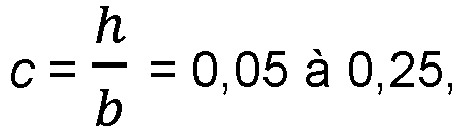 la longueur (b) de ligne de base étant la longueur de la ligne de base droite imaginaire reliant les deux extrémités de la ligne d'interface incurvée, et la hauteur de courbe (h) étant la distance de la crête de la ligne d'interface incurvée à la ligne de base, la ligne d'interface présentant la forme d'un arc simple dépourvu de point d'inflexion au niveau duquel la courbure change de signe.
 - La feuille de non-tissé (NW) de la revendication 1, dans laquelle la courbure (c) de la ligne d'interface est

- La feuille de non-tissé (NW) d'une revendication précédente quelconque, dans laquelle la feuille (NW) est une feuille de non-tissé filée-liée et dans laquelle les fibres à multicomposants frisées (F) sont des fibres filées-liées.
- La feuille de non-tissé (NW) d'une revendication précédente quelconque, dans laquelle l'un des composants polymères (A) est un homopolymère de propylène et l'autre des composants polymères (B) est un copolymère de propylène-α-oléfine, et dans laquelle le copolymère de propylène-α-oléfine présente de préférence une teneur en comonomère comprise entre 1,0 et 5,5 pour cent en poids.
- La feuille de non-tissé (NW) d'une revendication précédente quelconque, dans laquelle la valeur absolue de la différence entre la température de cristallisation [Tc(A)] du composant polymère (A) et la température de cristallisation [Tc(B)] du composant polymère (B) est supérieure à 0 °C et inférieure à 30 °C, de préférence supérieure à 10 °C et inférieure à 25 °C, lors de la mesure par DSC selon ISO 11357-1 et -2, et dans laquelle, de préférence, la ligne d'interface radiale incurvée est arquée vers le composant polymère à température de cristallisation inférieure, et le composant polymère à température de cristallisation supérieure présente la section transversale plus compacte.
- La feuille de non-tissé (NW) d'une revendication précédente quelconque, dans laquelle la valeur absolue pour la température de cristallisation [Tc(A)] pour le composant polymère (A) à température de cristallisation supérieure est comprise de préférence entre 90 °C et 135 °C, lors de la mesure par DSC selon ISO 11357-1 et -2, et dans laquelle la valeur absolue pour la température de cristallisation [Tc(B)] pour le composant polymère (B) à température de cristallisation inférieure est comprise de préférence entre 80 °C et 125 °C, lors de la mesure par DSC selon ISO 11357-1 et -2.
- La feuille de non-tissé (NW) d'une revendication précédente quelconque, dans laquelle l'un des composants polymères (A) et (B), ou les deux, comprennent un agent de nucléation, de préférence un agent de nucléation à base de nonitol ou à base de sorbitol, et dans laquelle l'agent de nucléation est présent de préférence en une quantité comprise entre 0,15 ppm et 3000 ppm.
- La feuille de non-tissé (NW) d'une revendication précédente quelconque, dans laquelle la valeur absolue pour la température de fusion [Tm(A)] pour le composant polymère (A) à température de fusion supérieure est comprise de préférence entre 155 °C et 164 °C, lors de la mesure par DSC selon ISO 11357-1 et -2, et dans laquelle la valeur absolue pour la température de fusion [Tm(B)] pour le composant polymère (B) à température de fusion inférieure est comprise de préférence entre 142 °C et 155 °C, lors de la mesure par DSC selon ISO 11357-1 et -2.
- La feuille de non-tissé (NW) d'une revendication précédente quelconque, dans laquelle l'un des composants polymères (A) et (B), ou les deux, présentent un taux de fluidité à chaud compris entre 15 et 120 g/10 min lors de la détermination selon ISO 1133 à 230 °C et 2,16 kg, et/ou dans laquelle l'un des composants polymères (A) et (B), ou les deux, présentent une polydispersité Mw/Mn comprise entre 2,5 et 10,0 lors de la mesure par chromatographie par exclusion de taille selon ISO 16014, et dans laquelle, de préférence, la différence absolue entre la polydispersité des deux composants polymères est de préférence égale ou supérieure à 0,3.
- La feuille de non-tissé (NW) d'une revendication précédente quelconque, dans laquelle l'un des composants polymères (A) et (B), ou les deux, comprennent un additif de réduction de viscosité, de préférence un peroxyde organique ou un ester d'hydroxylamine organique, et dans laquelle l'additif de réduction de viscosité est présent de préférence en une quantité comprise entre 100 ppm et 500 ppm.
- La feuille de non-tissé (NW) d'une revendication précédente quelconque, dans laquelle le rapport en poids entre les deux composants polymères (A) et (B) est compris entre 80:20 et 20:80, de préférence entre 60:40 et 40:60.
- La feuille de non-tissé (NW) de l'une quelconque des revendication 5 à 11, dans laquelle il existe un excès de composant polymère (B) à température de cristallisation inférieure dans la fibre à multicomposants.
- Feuille multicouche (NWLS) comprenant une feuille de non-tissé (NW) filée-liée de l'une quelconque des revendications 3 à 12 et, de plus, au moins une feuille de non-tissé filée-liée et/ou au moins une feuille de non-tissé produite par extrusion soufflage.
- Procédé de fabrication d'une feuille de non-tissé (NW) filée-liée de l'une quelconque des revendications 3 à 12 ou d'une feuille multicouche (NWLS) de la revendication 13, dans lequel la feuille de non-tissé (NW) filée-liée est fabriquée dans un appareil (100) comprenant au moins deux extrudeuses comportant une filière (101), un canal d'étirage (107, 108) et une courroie mobile (113), dans lequel les fibres (F) sont filées dans une filière (101), étirées dans un canal d'étirage (107, 108) et déposées sur une courroie mobile (113), et dans lequel l'appareil (100) comprend une cabine à air de traitement sous pression (105a, 105b) à partir de laquelle de l'air de traitement est dirigé à travers le canal d'étirage (107, 108) afin d'étirer les fibres.
- Produit hygiénique comprenant une feuille de non-tissé (NW) filée-liée de l'une quelconque des revendications 1 à 12 ou une feuille multicouche (NWLS) de la revendication 13.
Applications Claiming Priority (2)
| Application Number | Priority Date | Filing Date | Title |
|---|---|---|---|
| EP22150331 | 2022-01-05 | ||
| PCT/EP2023/050033 WO2023131591A1 (fr) | 2022-01-05 | 2023-01-03 | Matériau non tissé comprenant des fibres multicomposants frisées |
Publications (3)
| Publication Number | Publication Date |
|---|---|
| EP4367310A1 EP4367310A1 (fr) | 2024-05-15 |
| EP4367310B1 true EP4367310B1 (fr) | 2024-11-20 |
| EP4367310C0 EP4367310C0 (fr) | 2024-11-20 |
Family
ID=79230720
Family Applications (1)
| Application Number | Title | Priority Date | Filing Date |
|---|---|---|---|
| EP23700387.6A Active EP4367310B1 (fr) | 2022-01-05 | 2023-01-03 | Matériau non tissé comprenant des fibres multicomposées frisées |
Country Status (16)
| Country | Link |
|---|---|
| US (1) | US20250101647A1 (fr) |
| EP (1) | EP4367310B1 (fr) |
| JP (1) | JP7710113B2 (fr) |
| KR (1) | KR102760586B1 (fr) |
| CN (1) | CN118696154B (fr) |
| AU (1) | AU2023206000B2 (fr) |
| CL (1) | CL2024001633A1 (fr) |
| CO (1) | CO2024006321A2 (fr) |
| ES (1) | ES3010933T3 (fr) |
| IL (1) | IL313197B2 (fr) |
| MX (1) | MX2024006959A (fr) |
| MY (1) | MY206169A (fr) |
| PE (1) | PE20241511A1 (fr) |
| PL (1) | PL4367310T3 (fr) |
| WO (1) | WO2023131591A1 (fr) |
| ZA (1) | ZA202403292B (fr) |
Families Citing this family (2)
| Publication number | Priority date | Publication date | Assignee | Title |
|---|---|---|---|---|
| WO2025032154A1 (fr) * | 2023-08-08 | 2025-02-13 | Sabic Global Technologies B.V. | Fibre à deux composants |
| WO2025032155A1 (fr) * | 2023-08-08 | 2025-02-13 | Sabic Global Technologies B.V. | Fibre à deux composants |
Family Cites Families (30)
| Publication number | Priority date | Publication date | Assignee | Title |
|---|---|---|---|---|
| JP2565769B2 (ja) * | 1988-12-02 | 1996-12-18 | 株式会社ペトカ | 活性炭繊維およびその製造法 |
| JP2682130B2 (ja) * | 1989-04-25 | 1997-11-26 | 三井石油化学工業株式会社 | 柔軟な長繊維不織布 |
| JP2741122B2 (ja) * | 1991-10-28 | 1998-04-15 | ユニチカ株式会社 | 伸縮性嵩高長繊維不織布及びその製造方法 |
| WO1997023670A1 (fr) * | 1995-12-25 | 1997-07-03 | Teijin Limited | Fibre conjuguee thermosoudable et structure spherique en fibres de ce type a haut module |
| US6454989B1 (en) | 1998-11-12 | 2002-09-24 | Kimberly-Clark Worldwide, Inc. | Process of making a crimped multicomponent fiber web |
| JP3582466B2 (ja) * | 2000-09-14 | 2004-10-27 | 東レ株式会社 | 高伸縮性ポリエステル系複合繊維 |
| KR100506884B1 (ko) * | 2003-07-12 | 2005-08-08 | 주식회사 휴비스 | 잠재권축성이 우수한 폴리에스테르계 복합섬유 및 그제조방법 |
| JP4581725B2 (ja) * | 2004-02-13 | 2010-11-17 | 東レ株式会社 | 皮革様シート状物およびその製造方法 |
| AU2005212087B9 (en) * | 2004-02-13 | 2011-01-06 | Toray Industries, Inc. | Leather-like sheeting and process for production thereof |
| KR20060029943A (ko) * | 2004-10-04 | 2006-04-07 | 주식회사 휴비스 | 고권축 폴리에스테르 복합섬유 및 이를 이용한 가공사 |
| US8513146B2 (en) * | 2005-09-29 | 2013-08-20 | Invista North America S.ár.l. | Scalloped oval bicomponent fibers with good wicking, and high uniformity spun yarns comprising such fibers |
| TW200934897A (en) * | 2007-12-14 | 2009-08-16 | Es Fiber Visions Co Ltd | Conjugate fiber having low-temperature processability, nonwoven fabric and formed article using the conjugate fiber |
| KR101354331B1 (ko) * | 2010-04-16 | 2014-01-22 | 미쓰이 가가쿠 가부시키가이샤 | 권축 복합 섬유, 및 당해 섬유로 이루어지는 부직포 |
| DK2708623T3 (en) * | 2011-05-11 | 2015-10-05 | Mitsui Chemicals Inc | Creped composite fiber and nonwoven fabric comprising this |
| JP5741225B2 (ja) * | 2011-06-01 | 2015-07-01 | Jnc株式会社 | 熱融着性複合繊維とそれを用いた不織布 |
| CZ201324A3 (cs) * | 2013-01-14 | 2014-07-23 | Pegas Nonwovens S.R.O. | Vrstva vláken obsahující obloučkovaná bi-nebo multi-komponentní vlákna a způsob její výroby |
| ES2652323T5 (es) | 2013-05-22 | 2021-10-19 | Borealis Ag | Copolímero de propileno para embalaje de pared delgada |
| JP6618002B2 (ja) | 2014-03-20 | 2019-12-11 | 出光興産株式会社 | 捲縮繊維及び不織布 |
| EP3165656B1 (fr) | 2014-07-03 | 2021-05-12 | Idemitsu Kosan Co., Ltd | Tissu non-tisse file-lie et son procédé de fabrication |
| KR101644067B1 (ko) * | 2014-10-31 | 2016-08-11 | 주식회사 휴비스 | 잠재권축성이 우수한 생분해성 복합섬유 및 그 제조 방법 |
| EP3184587B1 (fr) | 2015-12-21 | 2020-03-18 | Borealis AG | Articles extrudés avec des propriétés optiques améliorées |
| EP3400330B1 (fr) | 2016-01-04 | 2021-11-17 | Borealis AG | Tissus non tissés filés-liés constitués d'homopolymères de polypropylène (pp) exempts de phthalates |
| ES2835052T3 (es) * | 2016-05-18 | 2021-06-21 | Fibertex Personal Care As | Tejido de laminado no tejido que comprende capas de soplado en estado fundido y de unión por hilado |
| EP3246443B1 (fr) | 2016-05-18 | 2020-06-17 | Fibertex Personal Care A/S | Tissu non tissé comprenant une couche à effet gonflant élevé |
| DK3246444T3 (da) | 2016-05-18 | 2020-06-02 | Reifenhaeuser Masch | Fremgangsmåde til fremstilling af en højvoluminøs non-woven bane |
| EP3321407B1 (fr) * | 2016-11-14 | 2023-05-10 | Fare' S.p.A. a Socio Unico | Tissu non tissé filé-lié |
| US11091861B2 (en) * | 2018-01-31 | 2021-08-17 | Fibertex Personal Care A/S | Spunbonded nonwoven with crimped fine fibers |
| PL3521496T3 (pl) * | 2018-01-31 | 2020-09-07 | Reifenhäuser GmbH & Co. KG Maschinenfabrik | Laminat z włókniny spunbond i sposób wytwarzania laminatu z włókniny spunbond |
| US20220235502A1 (en) * | 2019-05-10 | 2022-07-28 | Fare' S.P.A. | Process for the production of a multilayer fabric |
| AR121943A1 (es) * | 2020-05-08 | 2022-07-27 | Dow Global Technologies Llc | Fibras bicomponentes con curvatura alta |
-
2023
- 2023-01-03 JP JP2024540785A patent/JP7710113B2/ja active Active
- 2023-01-03 ES ES23700387T patent/ES3010933T3/es active Active
- 2023-01-03 EP EP23700387.6A patent/EP4367310B1/fr active Active
- 2023-01-03 MX MX2024006959A patent/MX2024006959A/es unknown
- 2023-01-03 PL PL23700387.6T patent/PL4367310T3/pl unknown
- 2023-01-03 IL IL313197A patent/IL313197B2/en unknown
- 2023-01-03 AU AU2023206000A patent/AU2023206000B2/en active Active
- 2023-01-03 US US18/726,168 patent/US20250101647A1/en active Pending
- 2023-01-03 KR KR1020247022645A patent/KR102760586B1/ko active Active
- 2023-01-03 MY MYPI2024002897A patent/MY206169A/en unknown
- 2023-01-03 WO PCT/EP2023/050033 patent/WO2023131591A1/fr not_active Ceased
- 2023-01-03 PE PE2024001085A patent/PE20241511A1/es unknown
- 2023-01-03 CN CN202380016318.6A patent/CN118696154B/zh active Active
-
2024
- 2024-04-26 ZA ZA2024/03292A patent/ZA202403292B/en unknown
- 2024-05-17 CO CONC2024/0006321A patent/CO2024006321A2/es unknown
- 2024-05-31 CL CL2024001633A patent/CL2024001633A1/es unknown
Also Published As
| Publication number | Publication date |
|---|---|
| KR102760586B1 (ko) | 2025-02-03 |
| ZA202403292B (en) | 2024-12-18 |
| AU2023206000A1 (en) | 2024-05-23 |
| JP7710113B2 (ja) | 2025-07-17 |
| PE20241511A1 (es) | 2024-07-19 |
| CN118696154A (zh) | 2024-09-24 |
| US20250101647A1 (en) | 2025-03-27 |
| CL2024001633A1 (es) | 2024-12-27 |
| EP4367310C0 (fr) | 2024-11-20 |
| JP2025501352A (ja) | 2025-01-17 |
| IL313197B2 (en) | 2025-04-01 |
| AU2023206000B2 (en) | 2024-11-14 |
| IL313197A (en) | 2024-07-01 |
| ES3010933T3 (en) | 2025-04-04 |
| IL313197B1 (en) | 2024-12-01 |
| KR20240113599A (ko) | 2024-07-22 |
| MX2024006959A (es) | 2024-06-24 |
| PL4367310T3 (pl) | 2025-03-24 |
| CA3237017A1 (fr) | 2023-07-13 |
| CN118696154B (zh) | 2025-11-25 |
| CO2024006321A2 (es) | 2024-07-18 |
| WO2023131591A1 (fr) | 2023-07-13 |
| EP4367310A1 (fr) | 2024-05-15 |
| MY206169A (en) | 2024-12-03 |
Similar Documents
| Publication | Publication Date | Title |
|---|---|---|
| EP3521495B1 (fr) | Non-tissé filé-lié à fibres fines serties et uniformité améliorée | |
| EP2126168B1 (fr) | Fibres de polypropylène et non-tissés spunbound (voie fondue directe) en polypropylène présentant des propriétés améliorées | |
| EP4367310B1 (fr) | Matériau non tissé comprenant des fibres multicomposées frisées | |
| EP2307595B1 (fr) | Fibres bicomposants dotées d un composant extérieur comprenant du polypropylène | |
| US20110183568A1 (en) | Fibers and nonwovens with increased surface roughness | |
| EP4209629B1 (fr) | Utilisation de composition polymère pour la fabrication de tissus non tissés doux | |
| CA3237017C (fr) | Materiau non tisse comprenant des fibres multicomposants frisees | |
| EA049870B1 (ru) | Нетканый материал, содержащий извитые многокомпонентные волокна | |
| KR102251754B1 (ko) | 기계적 강도가 향상된 부직포 | |
| RU2856111C2 (ru) | Ламинат из фильерного нетканого материала и способ изготовления ламината из фильерного нетканого материала | |
| BR112024009131B1 (pt) | Material não tecido que compreende fibras de múltiplos componentes pregueadas | |
| KR20220111200A (ko) | 스펀본디드 부직포 적층체 및 스펀본디드 부직포 적층체의 제조 방법 | |
| EP1942213A1 (fr) | Fibre comprenant un copolymère dýéthylène |
Legal Events
| Date | Code | Title | Description |
|---|---|---|---|
| STAA | Information on the status of an ep patent application or granted ep patent |
Free format text: STATUS: UNKNOWN |
|
| STAA | Information on the status of an ep patent application or granted ep patent |
Free format text: STATUS: THE INTERNATIONAL PUBLICATION HAS BEEN MADE |
|
| PUAI | Public reference made under article 153(3) epc to a published international application that has entered the european phase |
Free format text: ORIGINAL CODE: 0009012 |
|
| STAA | Information on the status of an ep patent application or granted ep patent |
Free format text: STATUS: REQUEST FOR EXAMINATION WAS MADE |
|
| 17P | Request for examination filed |
Effective date: 20240205 |
|
| AK | Designated contracting states |
Kind code of ref document: A1 Designated state(s): AL AT BE BG CH CY CZ DE DK EE ES FI FR GB GR HR HU IE IS IT LI LT LU LV MC ME MK MT NL NO PL PT RO RS SE SI SK SM TR |
|
| GRAP | Despatch of communication of intention to grant a patent |
Free format text: ORIGINAL CODE: EPIDOSNIGR1 |
|
| STAA | Information on the status of an ep patent application or granted ep patent |
Free format text: STATUS: GRANT OF PATENT IS INTENDED |
|
| DAV | Request for validation of the european patent (deleted) | ||
| DAX | Request for extension of the european patent (deleted) | ||
| INTG | Intention to grant announced |
Effective date: 20240702 |
|
| RIN1 | Information on inventor provided before grant (corrected) |
Inventor name: AGERSNAP SCHERER, MATHIAS Inventor name: RISE, HANSEN MORTEN Inventor name: GEUS, HANS-GEORG Inventor name: BOHL, PATRICK Inventor name: SOMMER, SEBASTIAN Inventor name: TOBIESON, GUSTAF Inventor name: VAN PARIDON, HENK Inventor name: FIEBIG, JOACHIM EDMUND Inventor name: WANG, JINGBO Inventor name: BROCH, THOMAS |
|
| GRAS | Grant fee paid |
Free format text: ORIGINAL CODE: EPIDOSNIGR3 |
|
| GRAA | (expected) grant |
Free format text: ORIGINAL CODE: 0009210 |
|
| STAA | Information on the status of an ep patent application or granted ep patent |
Free format text: STATUS: THE PATENT HAS BEEN GRANTED |
|
| AK | Designated contracting states |
Kind code of ref document: B1 Designated state(s): AL AT BE BG CH CY CZ DE DK EE ES FI FR GB GR HR HU IE IS IT LI LT LU LV MC ME MK MT NL NO PL PT RO RS SE SI SK SM TR |
|
| REG | Reference to a national code |
Ref country code: GB Ref legal event code: FG4D |
|
| REG | Reference to a national code |
Ref country code: CH Ref legal event code: EP |
|
| REG | Reference to a national code |
Ref country code: DE Ref legal event code: R096 Ref document number: 602023001108 Country of ref document: DE |
|
| REG | Reference to a national code |
Ref country code: IE Ref legal event code: FG4D |
|
| U01 | Request for unitary effect filed |
Effective date: 20241210 |
|
| U07 | Unitary effect registered |
Designated state(s): AT BE BG DE DK EE FI FR IT LT LU LV MT NL PT RO SE SI Effective date: 20241219 |
|
| REG | Reference to a national code |
Ref country code: ES Ref legal event code: FG2A Ref document number: 3010933 Country of ref document: ES Kind code of ref document: T3 Effective date: 20250404 |
|
| PG25 | Lapsed in a contracting state [announced via postgrant information from national office to epo] |
Ref country code: HR Free format text: LAPSE BECAUSE OF FAILURE TO SUBMIT A TRANSLATION OF THE DESCRIPTION OR TO PAY THE FEE WITHIN THE PRESCRIBED TIME-LIMIT Effective date: 20241120 Ref country code: IS Free format text: LAPSE BECAUSE OF FAILURE TO SUBMIT A TRANSLATION OF THE DESCRIPTION OR TO PAY THE FEE WITHIN THE PRESCRIBED TIME-LIMIT Effective date: 20250320 |
|
| U20 | Renewal fee for the european patent with unitary effect paid |
Year of fee payment: 3 Effective date: 20250307 |
|
| PG25 | Lapsed in a contracting state [announced via postgrant information from national office to epo] |
Ref country code: NO Free format text: LAPSE BECAUSE OF FAILURE TO SUBMIT A TRANSLATION OF THE DESCRIPTION OR TO PAY THE FEE WITHIN THE PRESCRIBED TIME-LIMIT Effective date: 20250220 |
|
| PGFP | Annual fee paid to national office [announced via postgrant information from national office to epo] |
Ref country code: GR Payment date: 20250312 Year of fee payment: 3 |
|
| PG25 | Lapsed in a contracting state [announced via postgrant information from national office to epo] |
Ref country code: RS Free format text: LAPSE BECAUSE OF FAILURE TO SUBMIT A TRANSLATION OF THE DESCRIPTION OR TO PAY THE FEE WITHIN THE PRESCRIBED TIME-LIMIT Effective date: 20250220 |
|
| REG | Reference to a national code |
Ref country code: GR Ref legal event code: EP Ref document number: 20250400369 Country of ref document: GR Effective date: 20250409 |
|
| PG25 | Lapsed in a contracting state [announced via postgrant information from national office to epo] |
Ref country code: SM Free format text: LAPSE BECAUSE OF FAILURE TO SUBMIT A TRANSLATION OF THE DESCRIPTION OR TO PAY THE FEE WITHIN THE PRESCRIBED TIME-LIMIT Effective date: 20241120 |
|
| PG25 | Lapsed in a contracting state [announced via postgrant information from national office to epo] |
Ref country code: SK Free format text: LAPSE BECAUSE OF FAILURE TO SUBMIT A TRANSLATION OF THE DESCRIPTION OR TO PAY THE FEE WITHIN THE PRESCRIBED TIME-LIMIT Effective date: 20241120 |
|
| PG25 | Lapsed in a contracting state [announced via postgrant information from national office to epo] |
Ref country code: MC Free format text: LAPSE BECAUSE OF FAILURE TO SUBMIT A TRANSLATION OF THE DESCRIPTION OR TO PAY THE FEE WITHIN THE PRESCRIBED TIME-LIMIT Effective date: 20241120 |
|
| PLBE | No opposition filed within time limit |
Free format text: ORIGINAL CODE: 0009261 |
|
| STAA | Information on the status of an ep patent application or granted ep patent |
Free format text: STATUS: NO OPPOSITION FILED WITHIN TIME LIMIT |
|
| 26N | No opposition filed |
Effective date: 20250821 |
|
| U1N | Appointed representative for the unitary patent procedure changed after the registration of the unitary effect |
Representative=s name: LORENZ SEIDLER GOSSEL PART. MBB; DE |
|
| PG25 | Lapsed in a contracting state [announced via postgrant information from national office to epo] |
Ref country code: IE Free format text: LAPSE BECAUSE OF NON-PAYMENT OF DUE FEES Effective date: 20250103 |
|
| PGFP | Annual fee paid to national office [announced via postgrant information from national office to epo] |
Ref country code: CZ Payment date: 20251218 Year of fee payment: 4 |
|
| PGFP | Annual fee paid to national office [announced via postgrant information from national office to epo] |
Ref country code: PL Payment date: 20251219 Year of fee payment: 4 |
|
| REG | Reference to a national code |
Ref country code: CH Ref legal event code: U11 Free format text: ST27 STATUS EVENT CODE: U-0-0-U10-U11 (AS PROVIDED BY THE NATIONAL OFFICE) Effective date: 20260201 |
|
| U20 | Renewal fee for the european patent with unitary effect paid |
Year of fee payment: 4 Effective date: 20260121 |
|
| PGFP | Annual fee paid to national office [announced via postgrant information from national office to epo] |
Ref country code: ES Payment date: 20260202 Year of fee payment: 4 |
|
| PGFP | Annual fee paid to national office [announced via postgrant information from national office to epo] |
Ref country code: TR Payment date: 20260102 Year of fee payment: 4 |