EP4368749A1 - Procédé de traitement de substrat et appareil de traitement de substrat - Google Patents
Procédé de traitement de substrat et appareil de traitement de substrat Download PDFInfo
- Publication number
- EP4368749A1 EP4368749A1 EP22837607.5A EP22837607A EP4368749A1 EP 4368749 A1 EP4368749 A1 EP 4368749A1 EP 22837607 A EP22837607 A EP 22837607A EP 4368749 A1 EP4368749 A1 EP 4368749A1
- Authority
- EP
- European Patent Office
- Prior art keywords
- metal
- gas
- film
- precursor
- protective film
- Prior art date
- Legal status (The legal status is an assumption and is not a legal conclusion. Google has not performed a legal analysis and makes no representation as to the accuracy of the status listed.)
- Pending
Links
Images






Classifications
-
- C—CHEMISTRY; METALLURGY
- C23—COATING METALLIC MATERIAL; COATING MATERIAL WITH METALLIC MATERIAL; CHEMICAL SURFACE TREATMENT; DIFFUSION TREATMENT OF METALLIC MATERIAL; COATING BY VACUUM EVAPORATION, BY SPUTTERING, BY ION IMPLANTATION OR BY CHEMICAL VAPOUR DEPOSITION, IN GENERAL; INHIBITING CORROSION OF METALLIC MATERIAL OR INCRUSTATION IN GENERAL
- C23F—NON-MECHANICAL REMOVAL OF METALLIC MATERIAL FROM SURFACE; INHIBITING CORROSION OF METALLIC MATERIAL OR INCRUSTATION IN GENERAL; MULTI-STEP PROCESSES FOR SURFACE TREATMENT OF METALLIC MATERIAL INVOLVING AT LEAST ONE PROCESS PROVIDED FOR IN CLASS C23 AND AT LEAST ONE PROCESS COVERED BY SUBCLASS C21D OR C22F OR CLASS C25
- C23F1/00—Etching metallic material by chemical means
- C23F1/10—Etching compositions
- C23F1/12—Gaseous compositions
-
- C—CHEMISTRY; METALLURGY
- C23—COATING METALLIC MATERIAL; COATING MATERIAL WITH METALLIC MATERIAL; CHEMICAL SURFACE TREATMENT; DIFFUSION TREATMENT OF METALLIC MATERIAL; COATING BY VACUUM EVAPORATION, BY SPUTTERING, BY ION IMPLANTATION OR BY CHEMICAL VAPOUR DEPOSITION, IN GENERAL; INHIBITING CORROSION OF METALLIC MATERIAL OR INCRUSTATION IN GENERAL
- C23F—NON-MECHANICAL REMOVAL OF METALLIC MATERIAL FROM SURFACE; INHIBITING CORROSION OF METALLIC MATERIAL OR INCRUSTATION IN GENERAL; MULTI-STEP PROCESSES FOR SURFACE TREATMENT OF METALLIC MATERIAL INVOLVING AT LEAST ONE PROCESS PROVIDED FOR IN CLASS C23 AND AT LEAST ONE PROCESS COVERED BY SUBCLASS C21D OR C22F OR CLASS C25
- C23F1/00—Etching metallic material by chemical means
- C23F1/02—Local etching
-
- H—ELECTRICITY
- H10—SEMICONDUCTOR DEVICES; ELECTRIC SOLID-STATE DEVICES NOT OTHERWISE PROVIDED FOR
- H10P—GENERIC PROCESSES OR APPARATUS FOR THE MANUFACTURE OR TREATMENT OF DEVICES COVERED BY CLASS H10
- H10P50/00—Etching of wafers, substrates or parts of devices
- H10P50/71—Etching of wafers, substrates or parts of devices using masks for conductive or resistive materials
-
- H—ELECTRICITY
- H10—SEMICONDUCTOR DEVICES; ELECTRIC SOLID-STATE DEVICES NOT OTHERWISE PROVIDED FOR
- H10P—GENERIC PROCESSES OR APPARATUS FOR THE MANUFACTURE OR TREATMENT OF DEVICES COVERED BY CLASS H10
- H10P50/00—Etching of wafers, substrates or parts of devices
- H10P50/20—Dry etching; Plasma etching; Reactive-ion etching
- H10P50/24—Dry etching; Plasma etching; Reactive-ion etching of semiconductor materials
- H10P50/242—Dry etching; Plasma etching; Reactive-ion etching of semiconductor materials of Group IV materials
-
- H—ELECTRICITY
- H10—SEMICONDUCTOR DEVICES; ELECTRIC SOLID-STATE DEVICES NOT OTHERWISE PROVIDED FOR
- H10P—GENERIC PROCESSES OR APPARATUS FOR THE MANUFACTURE OR TREATMENT OF DEVICES COVERED BY CLASS H10
- H10P50/00—Etching of wafers, substrates or parts of devices
- H10P50/20—Dry etching; Plasma etching; Reactive-ion etching
- H10P50/26—Dry etching; Plasma etching; Reactive-ion etching of conductive or resistive materials
- H10P50/264—Dry etching; Plasma etching; Reactive-ion etching of conductive or resistive materials by chemical means
- H10P50/266—Dry etching; Plasma etching; Reactive-ion etching of conductive or resistive materials by chemical means by vapour etching only
- H10P50/267—Dry etching; Plasma etching; Reactive-ion etching of conductive or resistive materials by chemical means by vapour etching only using plasmas
-
- H—ELECTRICITY
- H10—SEMICONDUCTOR DEVICES; ELECTRIC SOLID-STATE DEVICES NOT OTHERWISE PROVIDED FOR
- H10P—GENERIC PROCESSES OR APPARATUS FOR THE MANUFACTURE OR TREATMENT OF DEVICES COVERED BY CLASS H10
- H10P50/00—Etching of wafers, substrates or parts of devices
- H10P50/20—Dry etching; Plasma etching; Reactive-ion etching
- H10P50/26—Dry etching; Plasma etching; Reactive-ion etching of conductive or resistive materials
- H10P50/264—Dry etching; Plasma etching; Reactive-ion etching of conductive or resistive materials by chemical means
- H10P50/266—Dry etching; Plasma etching; Reactive-ion etching of conductive or resistive materials by chemical means by vapour etching only
- H10P50/267—Dry etching; Plasma etching; Reactive-ion etching of conductive or resistive materials by chemical means by vapour etching only using plasmas
- H10P50/268—Dry etching; Plasma etching; Reactive-ion etching of conductive or resistive materials by chemical means by vapour etching only using plasmas of silicon-containing layers
-
- H—ELECTRICITY
- H10—SEMICONDUCTOR DEVICES; ELECTRIC SOLID-STATE DEVICES NOT OTHERWISE PROVIDED FOR
- H10P—GENERIC PROCESSES OR APPARATUS FOR THE MANUFACTURE OR TREATMENT OF DEVICES COVERED BY CLASS H10
- H10P50/00—Etching of wafers, substrates or parts of devices
- H10P50/20—Dry etching; Plasma etching; Reactive-ion etching
- H10P50/28—Dry etching; Plasma etching; Reactive-ion etching of insulating materials
- H10P50/282—Dry etching; Plasma etching; Reactive-ion etching of insulating materials of inorganic materials
- H10P50/283—Dry etching; Plasma etching; Reactive-ion etching of insulating materials of inorganic materials by chemical means
- H10P50/285—Dry etching; Plasma etching; Reactive-ion etching of insulating materials of inorganic materials by chemical means of materials not containing Si, e.g. PZT or Al2O3
-
- H—ELECTRICITY
- H10—SEMICONDUCTOR DEVICES; ELECTRIC SOLID-STATE DEVICES NOT OTHERWISE PROVIDED FOR
- H10P—GENERIC PROCESSES OR APPARATUS FOR THE MANUFACTURE OR TREATMENT OF DEVICES COVERED BY CLASS H10
- H10P50/00—Etching of wafers, substrates or parts of devices
- H10P50/73—Etching of wafers, substrates or parts of devices using masks for insulating materials
-
- H—ELECTRICITY
- H10—SEMICONDUCTOR DEVICES; ELECTRIC SOLID-STATE DEVICES NOT OTHERWISE PROVIDED FOR
- H10P—GENERIC PROCESSES OR APPARATUS FOR THE MANUFACTURE OR TREATMENT OF DEVICES COVERED BY CLASS H10
- H10P76/00—Manufacture or treatment of masks on semiconductor bodies, e.g. by lithography or photolithography
- H10P76/40—Manufacture or treatment of masks on semiconductor bodies, e.g. by lithography or photolithography of masks comprising inorganic materials
- H10P76/408—Manufacture or treatment of masks on semiconductor bodies, e.g. by lithography or photolithography of masks comprising inorganic materials characterised by their sizes, orientations, dispositions, behaviours or shapes
- H10P76/4085—Manufacture or treatment of masks on semiconductor bodies, e.g. by lithography or photolithography of masks comprising inorganic materials characterised by their sizes, orientations, dispositions, behaviours or shapes characterised by the processes involved to create the masks
Definitions
- Exemplary embodiments of the present disclosure relate to a substrate processing method and a substrate processing apparatus.
- Patent Literature 1 discloses an atomic layer etching (ALE) method.
- ALE atomic layer etching
- Patent Literature 1 Japanese Unexamined Patent Publication No. 2018-26566
- the present disclosure provides a substrate processing method and a substrate processing apparatus in which a metal-containing film can be selectively etched with respect to other films.
- a substrate processing method includes: (a) providing a substrate including a metal-containing film and a mask provided on the metal-containing film; (b) forming a protective film on the mask; and (c) etching the metal-containing film after (b), and (c) includes (c1) forming a second metal-containing substance from a first metal-containing substance contained in the metal-containing film by using a first processing gas including a fluorine-containing gas, and (c2) removing the second metal-containing substance by using a second processing gas including a precursor.
- a substrate processing method and a substrate processing apparatus in which a metal-containing film can be selectively etched with respect to other films are provided.
- a substrate processing method includes: (a) providing a substrate including a metal-containing film and a mask provided on the metal-containing film; (b) forming a protective film on the mask; and (c) etching the metal-containing film after (b), and (c) includes (c1) forming a second metal-containing substance from a first metal-containing substance contained in the metal-containing film by using a first processing gas including a fluorine-containing gas, and (c2) removing the second metal-containing substance by using a second processing gas including a precursor.
- etching of the mask is suppressed by the protective film during etching of the metal-containing film. Therefore, the metal-containing film can be selectively etched with respect to other films.
- the substrate processing method may further include (d) removing fluorine on a surface of the protective film by using a third processing gas after (c). In this case, a further protective film can be then formed in a short time.
- the substrate processing method may further include (e) repeating (b), (c), and (d) after (d).
- the etching depth of the metal-containing film can be increased.
- the thickness of the protective film formed on a side surface of the mask may decrease toward the metal-containing film from the upper surface of the mask. In this case, since the thickness of the protective film formed on the metal-containing film is reduced, the etching rate of the metal-containing film is improved.
- plasma generated from the third processing gas is used and the third processing gas may include at least one of an oxygen-containing gas, a hydrogen-containing gas, and a nitrogen-containing gas.
- the protective film may contain at least one of silicon, carbon, and metal.
- the first processing gas may be used without generating plasma.
- plasma generated from the first processing gas may be used.
- the substrate may be heated in at least one of (c1) and (c2). In this case, the reaction between the first metal-containing substance and the fluorine-containing gas or the reaction between the second metal-containing substance and the precursor is accelerated.
- the precursor may include a metal-containing precursor.
- the metal-containing precursor can react with the second metal-containing substance with low energy.
- the metal-containing precursor may include a metal complex.
- another highly volatile metal complex is generated by a ligand exchange reaction between the second metal-containing substance and the metal complex.
- the metal complex may be a complex including at least one monodentate ligand selected from the group consisting of an alkyl, a hydride, a carbonyl, a halide, an alkoxide, an alkylamide, and a silylamide, or at least one chelate selected from the group consisting of ⁇ -diketonate, amidinate, acetamidinate, ⁇ -diketiminate, diaminoalkoxide, and metallocene.
- monodentate ligand selected from the group consisting of an alkyl, a hydride, a carbonyl, a halide, an alkoxide, an alkylamide, and a silylamide
- at least one chelate selected from the group consisting of ⁇ -diketonate, amidinate, acetamidinate, ⁇ -diketiminate, diaminoalkoxide, and metallocene.
- the metal contained in the metal-containing precursor may be at least one selected from the group consisting of Sn, Ge, Al, B, Ga, In, Zn, Ni, Pb, Si, Hf, Zr, and Ti.
- the precursor may include a metal-free precursor. In this case, metal residue due to the reaction between the second metal-containing substance and the precursor is hardly generated.
- the metal-free precursor may be at least one ⁇ -diketone selected from the group consisting of acetylacetone (acac), hexafluoroacetylacetone (hfac), trifluoroacetylacetone (tfac), and tetramethylheptanedione (tmhd).
- acac acetylacetone
- hfac hexafluoroacetylacetone
- tfac trifluoroacetylacetone
- tmhd tetramethylheptanedione
- the metal-containing film may contain at least one metal selected from the group consisting of Al, Hf, Zr, Fe, Ni, Co, Mn, Mg, Rh, Ru, Cr, Si, Ti, Ga, In, Zn, Pb, Ge, Ta, Cu, W, Mo, Pt, Cd, and Sn.
- the metal-containing film may be an oxide or a nitride of the metal.
- the fluorine-containing gas may include at least one selected from the group consisting of a hydrogen fluoride gas, a fluorocarbon gas, a nitrogen-containing gas, and a sulfur-containing gas.
- a substrate processing method includes: (a) providing a substrate including a film to be etched and a mask provided on the film to be etched; (b) forming a metal-containing protective film on the mask; (c) removing a part of the metal-containing protective film after (b); and (d) etching the film to be etched after (c), (b) includes (b1) forming a precursor layer on a side surface of the mask by using a first precursor containing a metal, and (b2) modifying the precursor layer into the metal-containing protective film by using a modifying gas including an oxidizing gas or a reducing gas, and (c) includes (c1) forming a second metal-containing substance from a first metal-containing substance contained in the metal-containing protective film by using a first processing gas including at least one of a halogen-containing gas and an oxygen-containing gas, and (c2) removing the second metal-containing substance by using a second processing gas including a second precursor.
- the metal-containing protective film can be etched at a high selectivity with respect to the film to be etched and the mask.
- the first precursor may contain at least one metal selected from the group consisting of Ti, Ta, Ru, Al, Hf, and Sn.
- the halogen-containing gas may contain at least one selected from the group consisting of fluorine, chlorine, and bromine.
- the second precursor may contain a metal including at least one selected from the group consisting of Sn, Ge, Al, B, Ga, In, Zn, Ni, Pb, Si, Hf, Zr, and Ti, or a complex of the metal.
- the film to be etched may be a silicon-containing film.
- a substrate processing apparatus includes: a chamber; a substrate support for supporting a substrate in the chamber, the substrate including a metal-containing film and a mask provided on the metal-containing film; a gas supply configured to supply each of a first processing gas including a hydrogen fluoride gas, a second processing gas including a precursor, a third processing gas, and a fourth processing gas for forming a protective film into the chamber; and a controller, the controller is configured to control the gas supply in order to form the protective film on the mask by using the fourth processing gas, the controller is configured to control the gas supply in order to form a second metal-containing substance from a first metal-containing substance contained in the metal-containing film by using the first processing gas after formation of the protective film, the controller is configured to control the gas supply in order to remove the second metal-containing substance by using the second processing gas after formation of the second metal-containing substance, and the controller is configured to control the gas supply in order to remove fluorine on a surface of the protective film by using the third processing gas after removal of
- etching of the mask is suppressed by the protective film during etching of the metal-containing film. Therefore, the metal-containing film can be selectively etched with respect to other films. Furthermore, the fluorine on the surface of the protective film is removed by using the third processing gas. Therefore, a further protective film can be then formed in a short time.
- FIGS. 1 and 2 are diagrams schematically showing the substrate processing apparatus according to one exemplary embodiment.
- the substrate processing apparatus of the present embodiment is, for example, a plasma processing system.
- the plasma processing system includes a plasma processing apparatus 1 and a controller 2.
- the plasma processing apparatus 1 includes a plasma processing chamber 10, a substrate support 11, and a plasma generator 12.
- the plasma processing chamber 10 has a plasma processing space.
- the plasma processing chamber 10 has at least one gas supply port for supplying at least one processing gas to the plasma processing space and at least one gas discharge port for discharging the gas from the plasma processing space.
- the gas supply port is connected to a gas supply 20 to be described later, and the gas discharge port is connected to an exhaust system 40 to be described later.
- the substrate support 11 is disposed in the plasma processing space and has a substrate support surface for supporting the substrate.
- the plasma generator 12 is configured to generate plasma from at least one processing gas supplied into the plasma processing space.
- the plasma formed in the plasma processing space may be capacitively coupled plasma (CCP), inductively coupled plasma (ICP), electron-cyclotron-resonance plasma (ECR plasma), helicon wave plasma (HWP), or surface wave plasma (SWP).
- various types of plasma generators may be used, including an alternating current (AC) plasma generator and a direct current (DC) plasma generator.
- the AC signal (AC power) used in the AC plasma generator has a frequency in a range of 100 kHz to 10 GHz. Therefore, the AC signal includes a radio frequency (RF) signal and a microwave signal.
- the RF signal has a frequency in a range of 200 kHz to 150 MHz.
- the controller 2 processes computer-executable instructions that cause the plasma processing apparatus 1 to execute the various steps described in the present disclosure.
- the controller 2 may be configured to control each element of the plasma processing apparatus 1 to execute the various steps described herein.
- a part or the whole of the controller 2 may be included in the plasma processing apparatus 1.
- the controller 2 may include, for example, a computer 2a.
- the computer 2a may include, for example, a central processing unit (CPU) 2a1, a storage unit 2a2, and a communication interface 2a3.
- the processing unit 2a1 may be configured to perform various control operations based on the program stored in the storage unit 2a2.
- the storage unit 2a2 may include a random access memory (RAM), a read only memory (ROM), a hard disk drive (HDD), a solid state drive (SSD), or combinations thereof.
- the communication interface 2a3 may be communicated with the plasma processing apparatus 1 through a communication line such as a local area network (LAN).
- LAN local area network
- the plasma processing system includes a capacitively coupled plasma processing apparatus 1 and a controller 2.
- the capacitively coupled plasma processing apparatus 1 includes a plasma processing chamber 10, a gas supply 20, a power source 30, and an exhaust system 40.
- the plasma processing apparatus 1 includes a substrate support 11 and a gas introduction unit.
- the gas introduction unit is configured to introduce at least one processing gas into the plasma processing chamber 10.
- the gas introduction unit includes a shower head 13.
- the substrate support 11 is disposed in the plasma processing chamber 10.
- the shower head 13 is disposed above the substrate support 11. In one embodiment, the shower head 13 constitutes at least a part of a ceiling of the plasma processing chamber 10.
- the plasma processing chamber 10 has a plasma processing space 10s defined by the shower head 13, side walls 10a of the plasma processing chamber 10, and the substrate support 11.
- the plasma processing chamber 10 has at least one gas supply port for supplying at least one processing gas to the plasma processing space 10s and at least one gas discharge port for discharging the gas from the plasma processing space.
- the side wall 10a is grounded.
- the shower head 13 and the substrate support 11 are electrically insulated from the housing of the plasma processing chamber 10.
- the substrate support 11 includes a main body 111 and a ring assembly 112.
- the main body 111 has a central region (substrate support surface) 111a for supporting a substrate (wafer) W and an annular region (ring support surface) 111b for supporting the ring assembly 112.
- the annular region 111b of the main body 111 surrounds the central region 111a of the main body 111 in a plan view.
- the substrate W is disposed on the central region 111a of the main body 111
- the ring assembly 112 is disposed on the annular region 111b of the main body 111 to surround the substrate W on the central region 111a of the main body 111.
- the main body 111 includes a base and an electrostatic chuck.
- the base includes a conductive member.
- the conductive member of the base functions as a lower electrode.
- the electrostatic chuck is disposed on the base.
- the upper surface of the electrostatic chuck has the substrate support surface 111a.
- the ring assembly 112 includes one or more annular members. At least one of the one or more annular members is an edge ring.
- the substrate support 11 may include a temperature adjusting module configured to adjust at least one of the electrostatic chuck, the ring assembly 112, and the substrate to a target temperature.
- the temperature adjusting module may include a heater, a heat transfer medium, a flow passage, or combinations thereof.
- a heat transfer fluid such as brine or gas flows through the flow passage.
- the substrate support 11 may include a heat transfer gas supply configured to supply a heat transfer gas to a gap between a rear surface of the substrate W and the substrate support surface 111a.
- the shower head 13 is configured to introduce at least one processing gas from the gas supply 20 into the plasma processing space 10s.
- the shower head 13 has at least one gas supply port 13a, at least one gas diffusion chamber 13b, and a plurality of gas introduction ports 13c.
- the processing gas supplied to the gas supply port 13a passes through the gas diffusion chamber 13b and is introduced into the plasma processing space 10s from the plurality of gas introduction ports 13c.
- the shower head 13 includes a conductive member.
- the conductive member of the shower head 13 functions as an upper electrode.
- the gas introduction unit may include one or more side gas injectors (SGI) attached to one or more openings formed in the side wall 10a, in addition to the shower head 13.
- SGI side gas injectors
- the gas supply 20 may include at least one gas source 21 and at least one flow rate controller 22.
- the gas supply 20 is configured to supply at least one processing gas from each corresponding gas source 21 to the shower head 13 through each corresponding flow rate controller 22.
- Each flow rate controller 22 may include, for example, a mass flow controller or a pressure control type flow rate controller.
- the gas supply 20 may include one or more flow rate modulation devices that modulate or pulse the flow rate of at least one processing gas.
- the power source 30 includes an RF power source 31 coupled to the plasma processing chamber 10 through at least one impedance matching circuit.
- the RF power source 31 is configured to supply at least one RF signal (RF power) such as a source RF signal and a bias RF signal to the conductive member of the substrate support 11 and/or the conductive member of the shower head 13. Accordingly, plasma is formed from at least one processing gas supplied to the plasma processing space 10s. Therefore, the RF power source 31 may function as at least a part of a plasma generator configured to generate plasma from the one or more processing gases in the plasma processing chamber 10. Further, by supplying a bias RF signal to the conductive member of the substrate support 11, a bias potential is generated in the substrate W and ion components in the formed plasma can be drawn to the substrate W.
- the RF power source 31 includes a first RF generator 31a and a second RF generator 31b.
- the first RF generator 31a is configured to be coupled to the conductive member of the substrate support 11 and/or the conductive member of the shower head 13 through at least one impedance matching circuit and to generate a source RF signal (source RF power) for plasma generation.
- the source RF signal has a frequency in a range of 13 MHz to 150 MHz.
- the first RF generator 31a may be configured to generate a plurality of source RF signals having different frequencies. The generated one or more source RF signals are supplied to the conductive member of the substrate support 11 and/or the conductive member of the shower head 13.
- the second RF generator 31b is configured to be coupled to the conductive member of the substrate support 11 through at least one impedance matching circuit and to generate a bias RF signal (bias RF power).
- the bias RF signal has a lower frequency than the source RF signal.
- the bias RF signal has a frequency in a range of 400 kHz to 13.56 MHz.
- the second RF generator 31b may be configured to generate a plurality of bias RF signals having different frequencies. The generated one or more bias RF signals are supplied to the conductive member of the substrate support 11. Further, in various embodiments, at least one of the source RF signal and the bias RF signal may be pulsed.
- the power source 30 may include a DC power source 32 coupled to the plasma processing chamber 10.
- the DC power source 32 includes a first DC generator 32a and a second DC generator 32b.
- the first DC generator 32a is configured to be connected to the conductive member of the substrate support 11 and to generate a first DC signal.
- the generated first bias DC signal is applied to the conductive member of the substrate support 11.
- the first DC signal may be applied to another electrode such as an electrode in the electrostatic chuck.
- the second DC generator 32b is connected to the conductive member of the shower head 13 and is configured to generate a second DC signal.
- the generated second DC signal is applied to the conductive member of the shower head 13.
- at least one of the first and second DC signals may be pulsed.
- the first and second DC generators 32a and 32b may be provided in addition to the RF power source 31, or the first DC generator 32a may be provided in place of the second RF generator 31b.
- the exhaust system 40 may be connected to, for example, a gas discharge port 10e provided in a bottom portion of the plasma processing chamber 10.
- the exhaust system 40 may include a pressure adjusting valve and a vacuum pump. The pressure in the plasma processing space 10s is adjusted by the pressure adjusting valve.
- the vacuum pump may include a turbo molecular pump, a dry pump, or combinations thereof.
- FIG. 3 is a partially enlarged sectional view of an exemplary substrate.
- the substrate W includes a metal-containing film MF and a mask MK.
- the mask MK is provided on the metal-containing film MF.
- the substrate W may include a base region UR.
- the base region UR may contain silicon.
- the metal-containing film MF may be provided on the base region UR.
- the metal-containing film MF may contain at least one of oxygen and nitrogen.
- the metal-containing film MF may contain at least one of a metal oxide and a metal nitride.
- the metal-containing film MF may contain at least one of Al, Hf, Zr, Fe, Ni, Co, Mn, Mg, Rh, Ru, Cr, Si, Ti, Ga, In, Zn, Pb, Ge, Ta, Cu, W, Mo, Pt, Cd, and Sn.
- the mask MK may contain silicon.
- the mask MK may contain at least one of a silicon oxide and a silicon nitride.
- the mask MK may contain carbon (organic matter).
- the mask MK may contain at least one of photoresist, spin-on carbon, amorphous carbon, and tungsten carbide.
- the mask MK may include at least one recess RS. Each recess RS may be an opening.
- FIG. 4 is a flowchart of the substrate processing method according to one exemplary embodiment.
- the substrate processing method shown in FIG. 4 (hereinafter, referred to as "method MT1") may be executed by the substrate processing apparatus of the embodiment.
- the method MT1 may include Steps ST1 to ST5. Steps ST1 to ST5 may be executed in order. Step ST5 may not be executed.
- the method MT1 will be described with reference to FIGS. 4 to 8 .
- the method MT1 may be executed in the plasma processing apparatus 1 under the control of each part of the plasma processing apparatus 1 by the controller 2.
- the metal-containing film MF can be etched.
- Steps ST1 to ST5 may be performed in-situ. That is, the method MT1 may be performed without taking the substrate W out of the plasma processing chamber 10.
- Step ST1 the substrate W shown in FIG. 3 is provided.
- the substrate W may be supported by the substrate support 11 in the plasma processing chamber 10 as shown in FIG. 2 .
- FIG. 5 is a partially enlarged sectional view of the exemplary substrate in forming a protective film on a mask.
- a protective film PR is formed on the mask MK.
- the protective film PR may be formed by atomic layer deposition (ALD), molecular layer deposition (MLD), or chemical vapor deposition (CVD).
- a fourth processing gas may be used to form the protective film PR.
- the fourth processing gas is supplied from the gas supply 20 into the plasma processing chamber 10. In the plasma processing chamber 10, the substrate W is exposed to the fourth processing gas.
- a precursor gas and a modifying gas are used as the fourth processing gas.
- the protective film PR may be formed on an upper surface MKt and a side surface MKs of the mask MK.
- the thickness of the protective film PR formed on the upper surface MKt of the mask MK is larger than the thickness of the protective film PR formed on the side surface MKs of the mask MK.
- the thickness of the protective film PR formed on the side surface MKs of the mask MK may decrease toward the metal-containing film MF from the upper surface MKt of the mask MK. That is, the protective film PR may be a sub-conformal film.
- the protective film PR may not be formed on the metal-containing film MF in a bottom portion of a recess RS of the mask MK.
- the thickness of the protective film PR formed on the bottom portion of the recess RS of the mask MK is smaller than the thickness of the protective film PR formed on the upper surface MKt and the side surfaces MKs of the mask MK.
- the protective film PR may be a conformal film.
- the protective film PR formed on the bottom portion of the recess RS of the mask MK can be selectively removed by, for example, anisotropic etching. Accordingly, while the protective film PR on the upper surface MKt and the side surface MKs of the mask MK remains, the protective film PR on the bottom portion of the recess RS of the mask MK can be removed.
- the protective film PR may contain at least one of silicon, carbon, and metal.
- the protective film PR has a silicon oxide film formed by ALD or MLD
- a silicon-containing gas such as aminosilane, SiCl 4 , or SiF 4 is used as the precursor gas
- an oxygen-containing gas such as an oxygen gas may be used as the modifying gas.
- the protective film PR has a silicon nitride film formed by ALD or MLD
- a silicon-containing gas such as aminosilane, SiCl 4 , dichlorosilane, or hexachlorodisilane may be used as the precursor gas.
- a nitrogen-containing gas such as an ammonia gas or a nitrogen gas may be used.
- the protective film PR has an organic film formed by ALD
- an epoxide, a carboxylic acid, a carboxylic acid halide, a carboxylic acid anhydride, an isocyanate, phenols, or the like may be used as the precursor gas.
- an inorganic compound gas including an N-H bond, an inert gas, a mixed gas of N 2 and H 2 , an H 2 O gas, or a mixed gas of H 2 and O 2 may be used.
- an isocyanate, a carboxylic acid, or a carboxylic acid halide may be used as the precursor gas, and an amine or a compound including a hydroxyl group may be used as the modifying gas.
- a carboxylic acid anhydride may be used as the precursor gas, and an amine may be used as the modifying gas.
- bisphenol A may be used as the precursor gas, and diphenyl carbonate or epichlorohydrin may be used as the modifying gas.
- the protective film PR has a metal-containing film formed by ALD or MLD
- a gas containing a metal such as Ti, Ta, Ru, Al, Hf, or Sn or a metal-containing gas such as a gas containing an oxide, a nitride, a sulfide, or a halide of these metals
- a modifying gas such as a hydrogen-containing gas (H 2 or the like), an oxygen-containing gas (O 2 or the like), a mixed gas of H 2 and N 2 , or a gas containing hydrogen and nitrogen (NH 3 or the like) may be used.
- Step ST12 may be performed to remove the protective film PR formed on the bottom portion of the recess RS of the mask MK.
- Step ST12 may be performed before Step ST3.
- the protective film PR formed on the bottom portion of the recess RS may be removed by plasma generated from a fluorine-containing gas.
- the protective film PR formed on the bottom portion of the recess RS may be removed by an O 2 gas or an H 2 gas.
- Step ST3 the metal-containing film MF is etched.
- the metal-containing film MF may be etched by atomic layer etching (ALE).
- Step ST3 includes Steps ST31 and ST32.
- Step ST32 is performed after Step ST31.
- Step ST3 Steps ST31 and ST32 may be alternately repeated.
- FIG. 6 is a partially enlarged sectional view of the exemplary substrate in forming a second metal-containing substance.
- a second metal-containing substance MS2 is formed from a first metal-containing substance MS1 (see FIG. 5 ) contained in the metal-containing film MF by using a first processing gas G1 including a fluorine-containing gas.
- the first metal-containing substance MS1 may be positioned on the surface of the metal-containing film MF.
- the first processing gas G1 etches the protective film PR, so that the protective film PR on the metal-containing film MF is removed while the protective film PR on the mask MK is thinned.
- the surface of the metal-containing film MF is exposed to the first processing gas G1.
- the first metal-containing substance MS1 reacts with the first processing gas G1.
- the first processing gas G1 is supplied from the gas supply 20 into the plasma processing chamber 10. In the plasma processing chamber 10, the substrate W is exposed to the first processing gas G1.
- the fluorine-containing gas may include at least one of a hydrogen fluoride gas (HF gas), a fluorocarbon gas, a nitrogen-containing gas, and a sulfur-containing gas.
- the fluorocarbon gas may include at least one of a C 4 F 6 gas, a C 4 F 8 gas, a C 3 F 8 gas, and a CF 4 gas.
- the nitrogen-containing gas may include an NF 3 gas.
- the sulfur-containing gas may include an SF 6 gas.
- the examples of the first metal-containing substance MS1 are the same as the examples of the constituent materials of the metal-containing film MF.
- the second metal-containing substance MS2 may be generated by the reaction between the first metal-containing substance MS1 and the fluorine-containing gas.
- the second metal-containing substance MS2 may contain the same metal as the metal contained in the first metal-containing substance MS1 and fluorine.
- the second metal-containing substance MS2 is, for example, a metal fluoride.
- the first metal-containing substance MS1 includes an aluminum oxide and the fluorine-containing gas includes a hydrogen fluoride gas.
- the second metal-containing substance MS2 includes an aluminum fluoride.
- a surface PRs of the protective film PR may be fluorinated by the reaction between the surface PRs of the protective film PR and the fluorine-containing gas. As a result, fluorine may remain on the surface PRs of the protective film PR.
- the first processing gas G1 may be used without generating plasma, or plasma generated from the first processing gas G1 may be used. In a case where no plasma is generated, the first processing gas G1 may include a hydrogen fluoride gas.
- the substrate W may be heated.
- the temperature of the substrate support 11 may be 100°C or higher, 150°C or higher, or 200°C or higher.
- the temperature of the substrate support 11 may be 450°C or lower.
- the heating may be performed by plasma generated in the plasma processing chamber 10 or the temperature adjusting module in the substrate support 11. The heating accelerates the reaction between the first metal-containing substance MS1 and the fluorine-containing gas.
- a purge step may be performed.
- a purge gas is supplied into the plasma processing chamber 10, and then exhausted.
- the purge gas is, for example, an inert gas such as nitrogen or argon.
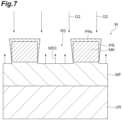
- FIG. 7 is a partially enlarged sectional view of the exemplary substrate in removing the second metal-containing substance.
- the second metal-containing substance MS2 is removed by using a second processing gas G2 including a precursor.
- the second processing gas G2 is supplied from the gas supply 20 into the plasma processing chamber 10.
- the second processing gas G2 may be used without generating plasma.
- the substrate W is exposed to the second processing gas G2.
- the precursor may include a metal-containing precursor.
- the metal-containing precursor may include a metal complex.
- the metal complex may be a complex including a monodentate ligand or a chelate.
- the monodentate ligand may be at least one of an alkyl, a hydride, a carbonyl, a halide, an alkoxide, an alkylamide, and a silylamide.
- the chelate may be at least one of ⁇ -diketonate, amidinate, acetamidinate, ⁇ -diketiminate, diaminoalkoxide, and metallocene.
- the ⁇ -diketonate may be at least one of acetylacetonate (acac), hexafluoroacetylacetonate (hfac), trifluoroacetylacetonate (tfac), and tetramethylheptanedionate (tmhd).
- the metal contained in the metal-containing precursor may be at least one of Sn, Ge, Al, B, Ga, In, Zn, Ni, Pb, Si, Hf, Zr, and Ti.
- the precursor may include a metal-free precursor.
- the metal-free precursor may include a carbon-containing precursor.
- the carbon-containing precursor may be at least one of alcohol, ⁇ -diketone, amidine, acetamidine, and ⁇ -diketimine.
- the ⁇ -diketone may be at least one of acetylacetone (acac), hexafluoroacetylacetone (hfac), trifluoroacetylacetone (tfac), and tetramethylheptanedione (tmhd).
- a volatile third metal-containing substance MS3 may be generated by the reaction between the second metal-containing substance MS2 and the precursor. Accordingly, the second metal-containing substance MS2 is removed.
- the precursor includes a metal-containing precursor
- the metal-containing precursor can react with the second metal-containing substance with low energy.
- the metal-containing precursor includes a metal complex
- due to a ligand exchange reaction between the second metal-containing substance MS2 and the metal complex another highly volatile metal complex is generated.
- the second metal-containing substance MS2 includes an aluminum fluoride
- the metal-containing precursor includes tin (II) acetylacetonate (Sn(acac) 2 ).
- the precursor includes a metal-free precursor
- metal residue due to the reaction between the second metal-containing substance and the precursor is hardly generated.
- the metal-free precursor includes a carbon-containing precursor
- residue containing a carbon compound is generated. The residue containing a carbon compound may be relatively easily removed.
- the substrate W may be heated in Step ST32.
- the heating accelerates the reaction between the second metal-containing substance MS2 and the precursor.
- a purge step may be performed in the same manner as the purge step that is performed after Step ST31.
- FIG. 8 is a partially enlarged sectional view of the exemplary substrate in modifying the surface of the protective film.
- the surface PRs of the protective film PR is modified.
- the fluorine on the surface PRs of the protective film PR is removed by using a third processing gas.
- plasma PL generated from the third processing gas is used in Step ST4.
- the plasma PL may be generated by the plasma generator 12 from the third processing gas supplied from the gas supply 20 into the plasma processing chamber 10.
- the substrate W is exposed to the plasma PL.
- the third processing gas may be used without generating plasma.
- an Si-F bond may remain in the surface PRs of the protective film PR after Step ST31.
- the fluorine atom in the surface PRs of the protective film PR is substituted with an OH group.
- an Si-OH bond is formed in the surface PRs of the protective film PR.
- the fluorine atom in the surface PRs of the protective film PR is substituted with a hydrogen atom.
- an Si-H bond is formed in the surface PRs of the protective film PR.
- the fluorine atom in the surface PRs of the protective film PR is substituted with a nitrogen atom.
- an Si-N bond is formed in the surface PRs of the protective film PR.
- a C-F bond may be present in the surface PRs of the protective film PR after Step ST31.
- the fluorine atom in the surface PRs of the protective film PR is substituted with an H group.
- a C-H bond is formed in the surface PRs of the protective film PR. This is because the generated carbon monoxide volatilizes.
- the fluorine atom in the surface PRs of the protective film PR is substituted with a nitrogen atom.
- a C-N bond is formed in the surface PRs of the protective film PR.
- the surface PRs of the protective film PR is scraped.
- the constituent materials of the protective film PR is exposed.
- the constituent materials include a C-H bond
- the C-H bond is exposed in the surface PRs of the protective film PR.
- Step ST5 Steps ST2, ST3, and ST4 are repeated. Steps ST2, ST3, and ST4 may be repeated a plurality of times. The etching depth of the metal-containing film MF can be increased through Step ST5.
- etching of the mask MK is suppressed by the protective film PR during etching of the metal-containing film MF. Therefore, the metal-containing film MF can be selectively etched with respect to other films. Furthermore, the fluorine on the surface PRs of the protective film PR is removed through Step ST4. In a case where the fluorine remains on the surface PRs of the protective film PR, the time until the start of the deposition of the protective film PR tends to become longer. In the method MT1 described above, since the fluorine on the surface PRs of the protective film PR is removed in Step ST4, a further protective film PR can be formed in a short time thereafter.
- Step ST2 in a case where the thickness of the protective film PR formed on the side surface MKs of the mask MK decreases toward the metal-containing film MF from the upper surface MKt of the mask MK, the thickness of the protective film PR formed on the metal-containing film MF decreases. Therefore, the protective film PR on the metal-containing film MF can be removed in a short time, and thus the etching rate of the metal-containing film MF is improved.
- the substrate processing apparatus may not include the plasma generator 12. In this case, the plasma processing is not performed in the chamber of the substrate processing apparatus.
- the method MT1 can also be performed using such a substrate processing apparatus.
- the first processing gas G1 may include a halogen-containing gas.
- the first processing gas G1 may include at least one of a chlorine-containing gas and a bromine-containing gas instead of or together with the above-described fluorine-containing gas.
- the chlorine-containing gas may include at least one of a chlorine (Cl 2 ) gas and a hydrogen chloride (HCl) gas.
- the bromine-containing gas may include at least one of a bromine (Br 2 ) gas and a hydrogen bromide (HBr) gas.
- the halogen-containing gas may contain at least one of silicon and carbon.
- the second metal-containing substance M2 generated in Step ST31 may be formed by the reaction between the first metal-containing substance MS1 and the halogen-containing gas.
- the second metal-containing substance MS2 may contain the same metal as the metal contained in the first metal-containing substance MS1 and halogen.
- the second metal-containing substance MS2 is, for example, a metal halide.
- the second metal-containing substance MS2 may be a metal fluoride, a metal chloride, or a metal bromide.
- the second metal-containing substance MS2 is a metal halide (a metal chloride or a metal bromide) other than a metal fluoride
- the second metal-containing substance MS2 can be removed by the second processing gas G2 including the precursor described above.
- the first processing gas G1 may include an oxygen-containing gas instead of or together with the halogen-containing gas.
- the first processing gas G1 may include at least one of an oxygen (O 2 ) gas, a carbon monoxide (CO) gas, and a carbon dioxide gas (CO 2 ) as the oxygen-containing gas.
- the second metal-containing substance M2 generated in Step ST31 may be formed by the reaction between the first metal-containing substance MS1 and the oxygen-containing gas.
- the second metal-containing substance MS2 may contain the same metal as the metal contained in the first metal-containing substance MS1 and oxygen.
- the second metal-containing substance MS2 is, for example, a metal oxide.
- the second metal-containing substance MS2 can be removed by the second processing gas G2 including the metal-free precursor described above.
- FIG. 9 is a flowchart of a substrate processing method according to Another Embodiment 4.
- the substrate processing method shown in FIG. 9 may include Steps ST1 to ST5.
- the method MT2 includes Step ST33 after Step ST32 and before Step ST4.
- Step ST33 is exposing the substrate W to plasma generated from a fifth processing gas including at least one of a fluorine-containing gas, an oxygen-containing gas, a hydrogen-containing gas, and a nitrogen-containing gas.
- the fluorine-containing gas may include at least one of a fluorocarbon gas, a nitrogen-containing gas, and a sulfur-containing gas.
- the fluorocarbon gas may include at least one of a C 4 F 6 gas, a C 4 F 8 gas, a C 3 F 8 gas, and a CF 4 gas.
- the nitrogen-containing gas may include an NF 3 gas.
- the sulfur-containing gas may include an SF 6 gas.
- the oxygen-containing gas may include at least one of an oxygen gas, a carbon monoxide gas, and a carbon dioxide gas.
- the hydrogen-containing gas may include a hydrogen gas.
- the nitrogen-containing gas may include a nitrogen gas.
- the fifth processing gas may include at least one of a hydrogen gas, a CH 4 gas, and a carbon monoxide gas.
- the fifth processing gas may include a fluorine-containing gas.
- the fifth processing gas may include at least one of a CH 4 gas and a carbon monoxide gas.
- the fifth processing gas may include at least one of a hydrogen gas and an oxygen gas.
- the residue for example, a residual material derived from the precursor
- MS2 the residue present on the substrate W after removal of the second metal-containing substance MS2 can be removed.
- FIG. 10 is a flowchart of a substrate processing method according to Another Embodiment 5.
- the substrate processing method shown in FIG. 10 (hereinafter, referred to as "method MT3") may include Steps ST1a to ST5a. Steps ST1a to ST5a may be executed in order.
- the method MT3 may not include Step ST4a.
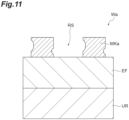
- a substrate Wa shown in FIG. 11 includes a film EF to be etched and a mask MKa.
- the substrate Wa may further include a base region UR below the film EF to be etched.
- the film EF to be etched may be a silicon-containing film.
- the film EF to be etched may be at least one of a silicon oxide film, a silicon nitride film, and a polysilicon film, or may be a laminated film including two or more of these films.
- the mask MK may include at least one recess RS.
- the mask MKa may contain silicon.
- the mask MKa may contain at least one of a silicon oxide and a silicon nitride.
- the mask MKa may contain carbon (organic matter).
- the mask MKa may contain at least one of photoresist, spin-on carbon, amorphous carbon, and tungsten carbide.
- the mask MKa may contain a metal.
- the mask MKa may contain at least one of tin (Sn), tellurium (Te), antimony (Sb), indium (In), silver (Ag), titanium (Ti), chromium (Cr), cobalt (Co), nickel (Ni), copper (Cu), zinc (Zn), germanium (Ge), and hafnium (Hf).
- the mask MKa may contain an oxide of Sn or a hydroxide of Sn.
- a metal-containing protective film PRa shown in FIG. 12 is formed on the mask MKa.
- the metal-containing protective film PRa may be formed by atomic layer deposition (ALD), molecular layer deposition (MLD), or chemical vapor deposition (CVD).
- the metal-containing protective film PRa may be a conformal film or a sub-conformal film. In a bottom portion of a recess RSa of the mask MKa, the metal-containing protective film PRa may not be formed on the film EF to be etched.
- Step ST2a may include Steps ST21a and ST22a.
- Step ST22a is performed after Step ST21a.
- Step ST2a Steps ST21a and ST22a may be alternately repeated.
- a precursor layer is formed on the mask MKa by using a gas of a first precursor containing a metal.
- the precursor layer may be formed on a side surface of the mask MKa.
- the precursor layer may be formed or may not be formed on an upper surface of the mask MKa.
- the precursor layer may be formed or may not be formed on the bottom portion of the recess RSa of the mask MKa.
- a gas containing a metal such as Ti, Ta, Ru, Al, Hf, or Sn
- a metal-containing gas such as a gas containing an oxide, a nitride, a sulfide, or a halide of these metals may be used.
- Step ST22a by using a modifying gas including an oxidizing gas or a reducing gas, the precursor layer is modified to form the metal-containing protective film PRa.
- a modifying gas including an oxidizing gas or a reducing gas
- an oxidizing gas or a reducing gas such as a hydrogen-containing gas (H 2 or the like), an oxygen-containing gas (O 2 or the like), a mixed gas of H 2 and N 2 , or a gas containing hydrogen and nitrogen (NH 3 or the like) may be used.
- Step ST3a a part of the metal-containing protective film PRa is etched. The remaining part of the metal-containing protective film PRa is not etched. A part of the metal-containing protective film PRa may be etched by atomic layer etching (ALE).
- Step ST3a includes Steps ST31a and ST32a. Step ST32a is performed after Step ST31a. In Step ST3a, Steps ST31a and ST32a may be alternately repeated.
- a second metal-containing substance MS2 is formed from a first metal-containing substance MS1 contained in the metal-containing protective film PRa by using a first processing gas G1a including at least one of a halogen-containing gas and an oxygen-containing gas.
- a first processing gas G1a including at least one of a halogen-containing gas and an oxygen-containing gas.
- the first processing gas G1a the same gas as the first processing gas G1 can be used.
- the first metal-containing substance MS1 filling the recesses occurring due to the surface roughness of the mask MKa may not react with the first processing gas G1a.
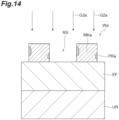
- Step ST32a as shown in FIG. 14 , the second metal-containing substance MS2 is removed by using a second processing gas G2a including a second precursor.
- a second processing gas G2a including a second precursor As the second precursor, the same precursor as the precursor included in the second processing gas G2 can be used.
- Step ST4a Steps ST2a and ST3a are repeated. Steps ST2a and ST3a may be repeated a plurality of times.
- the etching amount of the metal-containing protective film PRa can be controlled by the number of times of repetition of Steps ST2a and ST3a.
- the film EF to be etched is etched via the recess RS (opening) of the mask MKa on which the metal-containing protective film PRa is formed.
- the film EF to be etched may be etched by plasma generated from a sixth processing gas.
- the sixth processing gas may include a fluorine-containing gas.
- the fluorine-containing gas may include at least one of a hydrogen fluoride gas (HF gas), a fluorocarbon gas, and a hydrofluorocarbon gas.
- the metal-containing protective film PRa can be etched with a high selectivity with respect to the film EF to be etched and the mask MKa. Further, according to the method MT3, in a case where the mask MKa has a large surface roughness, the surface roughness of the mask MKa can be improved.
- a substrate processing method including:
- plasma generated from the third processing gas is used and the third processing gas includes at least one of an oxygen-containing gas, a hydrogen-containing gas, and a nitrogen-containing gas.
- the protective film contains at least one of silicon, carbon, and a metal.
- the metal complex is a complex including at least one monodentate ligand selected from the group consisting of an alkyl, a hydride, a carbonyl, a halide, an alkoxide, an alkylamide, and a silylamide, or at least one chelate selected from the group consisting of ⁇ -diketonate, amidinate, acetamidinate, ⁇ -diketiminate, diaminoalkoxide, and metallocene.
- monodentate ligand selected from the group consisting of an alkyl, a hydride, a carbonyl, a halide, an alkoxide, an alkylamide, and a silylamide
- at least one chelate selected from the group consisting of ⁇ -diketonate, amidinate, acetamidinate, ⁇ -diketiminate, diaminoalkoxide, and metallocene.
- a metal contained in the metal-containing precursor is at least one selected from the group consisting of Sn, Ge, Al, B, Ga, In, Zn, Ni, Pb, Si, Hf, Zr, and Ti.
- the metal-free precursor is at least one ⁇ -diketone selected from the group consisting of acetylacetone (acac), hexafluoroacetylacetone (hfac), trifluoroacetylacetone (tfac), and tetramethylheptanedione (tmhd).
- the metal-containing film contains at least one metal selected from the group consisting of Al, Hf, Zr, Fe, Ni, Co, Mn, Mg, Rh, Ru, Cr, Si, Ti, Ga, In, Zn, Pb, Ge, Ta, Cu, W, Mo, Pt, Cd, and Sn.
- the metal-containing film is an oxide or a nitride of the metal.
- the fluorine-containing gas includes at least one selected from the group consisting of a hydrogen fluoride gas, a fluorocarbon gas, a nitrogen-containing gas, and a sulfur-containing gas.
- a substrate processing method including:
- the first precursor contains at least one metal selected from the group consisting of Ti, Ta, Ru, Al, Hf, and Sn.
- halogen-containing gas contains at least one selected from the group consisting of fluorine, chlorine, and bromine.
- the second precursor contains a metal including at least one selected from the group consisting of Sn, Ge, Al, B, Ga, In, Zn, Ni, Pb, Si, Hf, Zr, and Ti or a complex of the metal.
- a substrate processing apparatus including:
Landscapes
- Chemical & Material Sciences (AREA)
- Engineering & Computer Science (AREA)
- Chemical Kinetics & Catalysis (AREA)
- General Chemical & Material Sciences (AREA)
- Materials Engineering (AREA)
- Mechanical Engineering (AREA)
- Metallurgy (AREA)
- Organic Chemistry (AREA)
- Drying Of Semiconductors (AREA)
- Physics & Mathematics (AREA)
- Plasma & Fusion (AREA)
- Internal Circuitry In Semiconductor Integrated Circuit Devices (AREA)
Applications Claiming Priority (2)
| Application Number | Priority Date | Filing Date | Title |
|---|---|---|---|
| JP2021111618 | 2021-07-05 | ||
| PCT/JP2022/026372 WO2023282191A1 (fr) | 2021-07-05 | 2022-06-30 | Procédé de traitement de substrat et appareil de traitement de substrat |
Publications (2)
| Publication Number | Publication Date |
|---|---|
| EP4368749A1 true EP4368749A1 (fr) | 2024-05-15 |
| EP4368749A4 EP4368749A4 (fr) | 2025-09-24 |
Family
ID=84801736
Family Applications (1)
| Application Number | Title | Priority Date | Filing Date |
|---|---|---|---|
| EP22837607.5A Pending EP4368749A4 (fr) | 2021-07-05 | 2022-06-30 | Procédé de traitement de substrat et appareil de traitement de substrat |
Country Status (6)
| Country | Link |
|---|---|
| US (1) | US20240128092A1 (fr) |
| EP (1) | EP4368749A4 (fr) |
| JP (1) | JP7712362B2 (fr) |
| KR (1) | KR20240027026A (fr) |
| TW (1) | TW202314808A (fr) |
| WO (1) | WO2023282191A1 (fr) |
Families Citing this family (3)
| Publication number | Priority date | Publication date | Assignee | Title |
|---|---|---|---|---|
| KR102930908B1 (ko) * | 2022-09-05 | 2026-02-25 | 에스케이하이닉스 주식회사 | 리간드 교환반응을 이용한 원자층의 에칭방법 |
| TW202437387A (zh) * | 2023-02-21 | 2024-09-16 | 日商東京威力科創股份有限公司 | 蝕刻方法及電漿處理裝置 |
| WO2025198956A1 (fr) * | 2024-03-22 | 2025-09-25 | Applied Materials, Inc. | Nettoyage de semi-conducteurs pour éliminer des sous-produits contenant du fluor |
Family Cites Families (11)
| Publication number | Priority date | Publication date | Assignee | Title |
|---|---|---|---|---|
| US7977390B2 (en) * | 2002-10-11 | 2011-07-12 | Lam Research Corporation | Method for plasma etching performance enhancement |
| US7790334B2 (en) | 2005-01-27 | 2010-09-07 | Applied Materials, Inc. | Method for photomask plasma etching using a protected mask |
| JP5646190B2 (ja) | 2010-03-12 | 2014-12-24 | 東京エレクトロン株式会社 | 洗浄方法及び処理装置 |
| JP6373150B2 (ja) * | 2014-06-16 | 2018-08-15 | 東京エレクトロン株式会社 | 基板処理システム及び基板処理方法 |
| WO2016100873A1 (fr) * | 2014-12-18 | 2016-06-23 | The Regents Of The University Of Colorado, A Body Corporate | Nouveaux procédés de gravure par couches atomiques (ale) utilisant des réactions thermiques auto-limitantes séquentielles |
| US9543148B1 (en) * | 2015-09-01 | 2017-01-10 | Lam Research Corporation | Mask shrink layer for high aspect ratio dielectric etch |
| US10229837B2 (en) * | 2016-02-04 | 2019-03-12 | Lam Research Corporation | Control of directionality in atomic layer etching |
| US20170345665A1 (en) | 2016-05-26 | 2017-11-30 | Tokyo Electron Limited | Atomic layer etching systems and methods |
| US10283369B2 (en) | 2016-08-10 | 2019-05-07 | Tokyo Electron Limited | Atomic layer etching using a boron-containing gas and hydrogen fluoride gas |
| JP7022651B2 (ja) * | 2018-05-28 | 2022-02-18 | 東京エレクトロン株式会社 | 膜をエッチングする方法及びプラズマ処理装置 |
| KR20210117344A (ko) * | 2019-02-14 | 2021-09-28 | 램 리써치 코포레이션 | 희생 마스크 (sacrificial mask) 를 사용하는 선택적인 에칭 |
-
2022
- 2022-06-30 KR KR1020247002714A patent/KR20240027026A/ko active Pending
- 2022-06-30 WO PCT/JP2022/026372 patent/WO2023282191A1/fr not_active Ceased
- 2022-06-30 EP EP22837607.5A patent/EP4368749A4/fr active Pending
- 2022-06-30 JP JP2023533096A patent/JP7712362B2/ja active Active
- 2022-07-05 TW TW111125092A patent/TW202314808A/zh unknown
-
2023
- 2023-12-27 US US18/397,020 patent/US20240128092A1/en active Pending
Also Published As
| Publication number | Publication date |
|---|---|
| EP4368749A4 (fr) | 2025-09-24 |
| US20240128092A1 (en) | 2024-04-18 |
| KR20240027026A (ko) | 2024-02-29 |
| JPWO2023282191A1 (fr) | 2023-01-12 |
| TW202314808A (zh) | 2023-04-01 |
| JP7712362B2 (ja) | 2025-07-23 |
| WO2023282191A1 (fr) | 2023-01-12 |
Similar Documents
| Publication | Publication Date | Title |
|---|---|---|
| EP4368749A1 (fr) | Procédé de traitement de substrat et appareil de traitement de substrat | |
| TWI624870B (zh) | 用於蝕刻速率一致性的方法 | |
| JP6298059B2 (ja) | 差異的な酸化ケイ素エッチング | |
| JP2022506456A (ja) | エッチング層をエッチングするための方法 | |
| KR20010041280A (ko) | 흡착력이 증가된 구리 증착 | |
| JP2015531547A (ja) | ラジカル構成要素の酸化物エッチング | |
| TW201929051A (zh) | 針對pecvd金屬摻雜碳硬遮罩之均質介面的沉積系統和方法 | |
| TW202303752A (zh) | 蝕刻方法及電漿處理裝置 | |
| JP2023008824A (ja) | エッチング方法及びプラズマ処理装置 | |
| JP2021028959A (ja) | エッチング方法及び基板処理装置 | |
| JP7603634B2 (ja) | エッチング方法及びプラズマ処理装置 | |
| WO2023234214A1 (fr) | Procédé de gravure et dispositif de traitement au plasma | |
| US20240165677A1 (en) | Method for cleaning chamber or component, substrate processing method and substrate processing apparatus | |
| JP2024001464A (ja) | エッチング方法及びプラズマ処理装置 | |
| US20240355590A1 (en) | Plasma processing method and plasma processing apparatus | |
| WO2024075539A1 (fr) | Procédé de traitement de substrat et dispositif de traitement de substrat | |
| JP7836946B2 (ja) | エッチング方法及びプラズマ処理装置 | |
| TW202314852A (zh) | 蝕刻方法及電漿處理裝置 | |
| WO2025182805A1 (fr) | Procédé de gravure et système de traitement au plasma | |
| JP2025029205A (ja) | エッチング方法及びプラズマ処理装置 | |
| WO2025182810A1 (fr) | Procédé de gravure et système de traitement au plasma | |
| TW202603881A (zh) | 蝕刻方法及電漿處理裝置 | |
| TW202503092A (zh) | 用於硬遮罩應用之含矽及金屬材料之形成 | |
| JP2024176159A (ja) | プラズマ処理方法及びプラズマ処理装置 | |
| TW202603879A (zh) | 蝕刻方法及電漿處理裝置 |
Legal Events
| Date | Code | Title | Description |
|---|---|---|---|
| STAA | Information on the status of an ep patent application or granted ep patent |
Free format text: STATUS: THE INTERNATIONAL PUBLICATION HAS BEEN MADE |
|
| PUAI | Public reference made under article 153(3) epc to a published international application that has entered the european phase |
Free format text: ORIGINAL CODE: 0009012 |
|
| STAA | Information on the status of an ep patent application or granted ep patent |
Free format text: STATUS: REQUEST FOR EXAMINATION WAS MADE |
|
| 17P | Request for examination filed |
Effective date: 20240125 |
|
| AK | Designated contracting states |
Kind code of ref document: A1 Designated state(s): AL AT BE BG CH CY CZ DE DK EE ES FI FR GB GR HR HU IE IS IT LI LT LU LV MC MK MT NL NO PL PT RO RS SE SI SK SM TR |
|
| DAV | Request for validation of the european patent (deleted) | ||
| DAX | Request for extension of the european patent (deleted) | ||
| REG | Reference to a national code |
Ref country code: DE Ref legal event code: R079 Free format text: PREVIOUS MAIN CLASS: C23F0001120000 Ipc: H01L0021306500 |
|
| A4 | Supplementary search report drawn up and despatched |
Effective date: 20250826 |
|
| RIC1 | Information provided on ipc code assigned before grant |
Ipc: H01L 21/3065 20060101AFI20250820BHEP Ipc: C23F 1/12 20060101ALI20250820BHEP Ipc: H01L 21/311 20060101ALI20250820BHEP Ipc: H01L 21/033 20060101ALI20250820BHEP |