EP4371961A1 - Feuerbeständige gipsplatten und verfahren zu ihrer herstellung - Google Patents
Feuerbeständige gipsplatten und verfahren zu ihrer herstellung Download PDFInfo
- Publication number
- EP4371961A1 EP4371961A1 EP23152888.6A EP23152888A EP4371961A1 EP 4371961 A1 EP4371961 A1 EP 4371961A1 EP 23152888 A EP23152888 A EP 23152888A EP 4371961 A1 EP4371961 A1 EP 4371961A1
- Authority
- EP
- European Patent Office
- Prior art keywords
- gypsum
- silicone oil
- gypsum core
- fire
- calcium sulfate
- Prior art date
- Legal status (The legal status is an assumption and is not a legal conclusion. Google has not performed a legal analysis and makes no representation as to the accuracy of the status listed.)
- Withdrawn
Links
Images



Classifications
-
- C—CHEMISTRY; METALLURGY
- C04—CEMENTS; CONCRETE; ARTIFICIAL STONE; CERAMICS; REFRACTORIES
- C04B—LIME, MAGNESIA; SLAG; CEMENTS; COMPOSITIONS THEREOF, e.g. MORTARS, CONCRETE OR LIKE BUILDING MATERIALS; ARTIFICIAL STONE; CERAMICS; REFRACTORIES; TREATMENT OF NATURAL STONE
- C04B24/00—Use of organic materials as active ingredients for mortars, concrete or artificial stone, e.g. plasticisers
- C04B24/40—Compounds containing silicon, titanium or zirconium or other organo-metallic compounds; Organo-clays; Organo-inorganic complexes
- C04B24/42—Organo-silicon compounds
-
- C—CHEMISTRY; METALLURGY
- C04—CEMENTS; CONCRETE; ARTIFICIAL STONE; CERAMICS; REFRACTORIES
- C04B—LIME, MAGNESIA; SLAG; CEMENTS; COMPOSITIONS THEREOF, e.g. MORTARS, CONCRETE OR LIKE BUILDING MATERIALS; ARTIFICIAL STONE; CERAMICS; REFRACTORIES; TREATMENT OF NATURAL STONE
- C04B28/00—Compositions of mortars, concrete or artificial stone, containing inorganic binders or the reaction product of an inorganic and an organic binder, e.g. polycarboxylate cements
- C04B28/14—Compositions of mortars, concrete or artificial stone, containing inorganic binders or the reaction product of an inorganic and an organic binder, e.g. polycarboxylate cements containing calcium sulfate cements
-
- B—PERFORMING OPERATIONS; TRANSPORTING
- B32—LAYERED PRODUCTS
- B32B—LAYERED PRODUCTS, i.e. PRODUCTS BUILT-UP OF STRATA OF FLAT OR NON-FLAT, e.g. CELLULAR OR HONEYCOMB, FORM
- B32B13/00—Layered products comprising a a layer of water-setting substance, e.g. concrete, plaster, asbestos cement, or like builders' material
- B32B13/04—Layered products comprising a a layer of water-setting substance, e.g. concrete, plaster, asbestos cement, or like builders' material comprising such water setting substance as the main or only constituent of a layer, which is next to another layer of the same or of a different material
- B32B13/08—Layered products comprising a a layer of water-setting substance, e.g. concrete, plaster, asbestos cement, or like builders' material comprising such water setting substance as the main or only constituent of a layer, which is next to another layer of the same or of a different material of paper or cardboard
-
- C—CHEMISTRY; METALLURGY
- C04—CEMENTS; CONCRETE; ARTIFICIAL STONE; CERAMICS; REFRACTORIES
- C04B—LIME, MAGNESIA; SLAG; CEMENTS; COMPOSITIONS THEREOF, e.g. MORTARS, CONCRETE OR LIKE BUILDING MATERIALS; ARTIFICIAL STONE; CERAMICS; REFRACTORIES; TREATMENT OF NATURAL STONE
- C04B22/00—Use of inorganic materials as active ingredients for mortars, concrete or artificial stone, e.g. accelerators or shrinkage compensating agents
- C04B22/08—Acids or salts thereof
- C04B22/10—Acids or salts thereof containing carbon in the anion, e.g. carbonates
-
- C—CHEMISTRY; METALLURGY
- C04—CEMENTS; CONCRETE; ARTIFICIAL STONE; CERAMICS; REFRACTORIES
- C04B—LIME, MAGNESIA; SLAG; CEMENTS; COMPOSITIONS THEREOF, e.g. MORTARS, CONCRETE OR LIKE BUILDING MATERIALS; ARTIFICIAL STONE; CERAMICS; REFRACTORIES; TREATMENT OF NATURAL STONE
- C04B28/00—Compositions of mortars, concrete or artificial stone, containing inorganic binders or the reaction product of an inorganic and an organic binder, e.g. polycarboxylate cements
- C04B28/14—Compositions of mortars, concrete or artificial stone, containing inorganic binders or the reaction product of an inorganic and an organic binder, e.g. polycarboxylate cements containing calcium sulfate cements
- C04B28/145—Calcium sulfate hemi-hydrate with a specific crystal form
-
- B—PERFORMING OPERATIONS; TRANSPORTING
- B32—LAYERED PRODUCTS
- B32B—LAYERED PRODUCTS, i.e. PRODUCTS BUILT-UP OF STRATA OF FLAT OR NON-FLAT, e.g. CELLULAR OR HONEYCOMB, FORM
- B32B2307/00—Properties of the layers or laminate
- B32B2307/30—Properties of the layers or laminate having particular thermal properties
- B32B2307/306—Resistant to heat
- B32B2307/3065—Flame resistant or retardant, fire resistant or retardant
-
- B—PERFORMING OPERATIONS; TRANSPORTING
- B32—LAYERED PRODUCTS
- B32B—LAYERED PRODUCTS, i.e. PRODUCTS BUILT-UP OF STRATA OF FLAT OR NON-FLAT, e.g. CELLULAR OR HONEYCOMB, FORM
- B32B2307/00—Properties of the layers or laminate
- B32B2307/30—Properties of the layers or laminate having particular thermal properties
- B32B2307/308—Heat stability
-
- B—PERFORMING OPERATIONS; TRANSPORTING
- B32—LAYERED PRODUCTS
- B32B—LAYERED PRODUCTS, i.e. PRODUCTS BUILT-UP OF STRATA OF FLAT OR NON-FLAT, e.g. CELLULAR OR HONEYCOMB, FORM
- B32B2607/00—Walls, panels
-
- C—CHEMISTRY; METALLURGY
- C04—CEMENTS; CONCRETE; ARTIFICIAL STONE; CERAMICS; REFRACTORIES
- C04B—LIME, MAGNESIA; SLAG; CEMENTS; COMPOSITIONS THEREOF, e.g. MORTARS, CONCRETE OR LIKE BUILDING MATERIALS; ARTIFICIAL STONE; CERAMICS; REFRACTORIES; TREATMENT OF NATURAL STONE
- C04B2111/00—Mortars, concrete or artificial stone or mixtures to prepare them, characterised by specific function, property or use
- C04B2111/00474—Uses not provided for elsewhere in C04B2111/00
- C04B2111/00612—Uses not provided for elsewhere in C04B2111/00 as one or more layers of a layered structure
- C04B2111/0062—Gypsum-paper board like materials
-
- C—CHEMISTRY; METALLURGY
- C04—CEMENTS; CONCRETE; ARTIFICIAL STONE; CERAMICS; REFRACTORIES
- C04B—LIME, MAGNESIA; SLAG; CEMENTS; COMPOSITIONS THEREOF, e.g. MORTARS, CONCRETE OR LIKE BUILDING MATERIALS; ARTIFICIAL STONE; CERAMICS; REFRACTORIES; TREATMENT OF NATURAL STONE
- C04B2111/00—Mortars, concrete or artificial stone or mixtures to prepare them, characterised by specific function, property or use
- C04B2111/10—Compositions or ingredients thereof characterised by the absence or the very low content of a specific material
-
- C—CHEMISTRY; METALLURGY
- C04—CEMENTS; CONCRETE; ARTIFICIAL STONE; CERAMICS; REFRACTORIES
- C04B—LIME, MAGNESIA; SLAG; CEMENTS; COMPOSITIONS THEREOF, e.g. MORTARS, CONCRETE OR LIKE BUILDING MATERIALS; ARTIFICIAL STONE; CERAMICS; REFRACTORIES; TREATMENT OF NATURAL STONE
- C04B2111/00—Mortars, concrete or artificial stone or mixtures to prepare them, characterised by specific function, property or use
- C04B2111/20—Resistance against chemical, physical or biological attack
- C04B2111/28—Fire resistance, i.e. materials resistant to accidental fires or high temperatures
-
- C—CHEMISTRY; METALLURGY
- C04—CEMENTS; CONCRETE; ARTIFICIAL STONE; CERAMICS; REFRACTORIES
- C04B—LIME, MAGNESIA; SLAG; CEMENTS; COMPOSITIONS THEREOF, e.g. MORTARS, CONCRETE OR LIKE BUILDING MATERIALS; ARTIFICIAL STONE; CERAMICS; REFRACTORIES; TREATMENT OF NATURAL STONE
- C04B2111/00—Mortars, concrete or artificial stone or mixtures to prepare them, characterised by specific function, property or use
- C04B2111/20—Resistance against chemical, physical or biological attack
- C04B2111/28—Fire resistance, i.e. materials resistant to accidental fires or high temperatures
- C04B2111/285—Intumescent materials
-
- C—CHEMISTRY; METALLURGY
- C04—CEMENTS; CONCRETE; ARTIFICIAL STONE; CERAMICS; REFRACTORIES
- C04B—LIME, MAGNESIA; SLAG; CEMENTS; COMPOSITIONS THEREOF, e.g. MORTARS, CONCRETE OR LIKE BUILDING MATERIALS; ARTIFICIAL STONE; CERAMICS; REFRACTORIES; TREATMENT OF NATURAL STONE
- C04B2111/00—Mortars, concrete or artificial stone or mixtures to prepare them, characterised by specific function, property or use
- C04B2111/34—Non-shrinking or non-cracking materials
Definitions
- the present invention relates generally to fire-resistant gypsum boards and methods of making the same.
- Gypsum building products e.g., known variously as wallboard, ceiling board, plasterboard and "drywall" are panels made of a gypsum core sandwiched between two layers of liner, often paper, on the outside surfaces of the gypsum core. They are widely used as construction materials due to their ease of fabrication, high mechanical strength, low thermal conductivity, resistance to spread of fire, and soundproofing properties.
- the quality of a gypsum board is strongly dependent on its gypsum core, which is fabricated by the hydration of stucco slurry (mainly containing calcium sulfate hemihydrate) into a set body of calcium sulfate dihydrate.
- additives are often added to the stucco slurry during the board making process.
- foaming agents, inorganic compounds, and other additives may be included in the slurry to modulate the density, strength, and/or fire resistance properties of the board.
- the present invention relates to a method of producing a fire-resistant gypsum board comprising a gypsum core, the method comprising:
- the silicone oil can be provided to the calcium sulfate slurry using, e.g., an aqueous emulsion of the silicone oil.
- an aqueous emulsion of the silicone oil e.g., aqueous emulsion of the silicone oil.
- the silicone oil can be emulsified in the high-shear mixing.
- the present invention relates to a fire-resistant gypsum board made by the methods as described herein.
- the present invention relates to a fire-resistant gypsum board (e.g., made by the methods as described herein) comprising a gypsum core that shrinks by less than 6% by volume when heated to 850 °C, wherein the gypsum core comprises a silicone oil having a hydride content of no more than 0.01 equivalents of Si-H per equivalent of silicon, present in an amount in the range of 0.1 to 1 wt% based on the weight of the gypsum core.
- a fire-resistant gypsum board e.g., made by the methods as described herein
- the gypsum core comprises a silicone oil having a hydride content of no more than 0.01 equivalents of Si-H per equivalent of silicon, present in an amount in the range of 0.1 to 1 wt% based on the weight of the gypsum core.
- the present inventors have developed a method of producing a fire-resistant board that does not require the use of polymethylhydrosiloxane (PMHS) but still has desired fire resistance properties.
- PMHS polymethylhydrosiloxane
- PMHS is often used to provide fire resistance properties to gypsum boards.
- the use of PMHS in gypsum boards is becoming more expensive due to the short supply of the silicone oil.
- PMHS has the propensity to migrate to the surface of gypsum boards during the setting and drying of the boards. This propensity for PMHS to migrate to the board surface can leave a relatively lower amount of PHMS at the center of the board, thus rendering the center of the board relatively less fire-resistant.
- the present inventors have found methods to provide fire-resistant gypsum boards that improve thermal performance and better disperse silicone oil inside the gypsum board.
- the present invention is concerned with fire-resistant gypsum boards comprising a gypsum core and methods for making them.
- the present invention relates to a method for producing a fire-resistant gypsum board comprising a gypsum core, the method comprising providing a calcium sulfate slurry comprising a silicone oil having a hydride content of no more than 0.01 equivalents of Si-H per equivalent of silicon, in an amount of 0.1 to 1 wt% of the mass of the gypsum core; allowing the calcium sulfate slurry to set to form a set gypsum mater; and drying the set gypsum material to provide the gypsum core.
- the present invention relates to a fire-resistant gypsum board (e.g., made by the methods as described herein) comprising a gypsum core that shrinks by less than 6% by volume when heated to 850 °C, wherein the gypsum core comprises a silicone oil having a hydride content of no more than 0.01 equivalents of Si-H per equivalent of silicon, present in an amount in the range of 0.1 to 1 wt% based on the weight of the gypsum core.
- the present inventors have determined that the use of polydimethylsiloxane is a good choice for the silicone oil in the methods and systems of the invention.
- silicone oil can include a variety of different polysiloxanes. Such polysiloxanes can include both hydrogen and other functional groups to modify the polysiloxane backbone.
- PMHS includes both Si-H and Si-CH 3 bonds.
- the silicone oil of the emulsion as described herein has a hydride content of no more than 0.01 equivalents of Si-H per equivalent of silicon. As such, the silicone oil as described here has a low amount of hydride content. In various embodiments, the silicone oil has a hydride content of no more than 0.005 equivalents, or 0.002 equivalents, or 0.001 equivalents of Si-H per equivalent of silicon. As would be understood by the skilled person, equivalents are calculated as molar equivalents.
- the silicone oil includes an alkyl-functional silicone.
- an alkyl-functional silicone is a polysiloxane functionalized with alkyl groups.
- the silicone oil includes a methyl-functional silicone, an ethyl-functional silicone, a propyl-functional silicone, or a butyl-functional silicone.
- the silicone oil is polydimethylsiloxane.
- the silicone oil can be a copolymer of dimethylsiloxane, for example, with methylsiloxane or phenylsiloxane (in amounts such that the hydride content remains low).
- the molar content of dimethylsiloxane units in the silicon oil is at least 90%, e.g., at least 95% or at least 99%.
- the silicone oil can be provided to the calcium sulfate slurry using, e.g., an aqueous emulsion of the silicone oil.
- the aqueous emulsion of silicone oil can be provided by emulsifying the silicone oil in water.
- the aqueous emulsion of silicone oil may be prepared by any emulsifying process as known in the art. In some embodiments, emulsifying is accomplished through mechanical processes. For example, in some embodiments, the aqueous emulsion of silicone oil is emulsified by mixing, shaking, and/or vortexing water with the silicone oil.
- the emulsifying process does not require any additional additives (e.g., emulsifiers) to provide an emulsified silicone.
- the emulsifying may be conducted for a time, at a mixer speed, and at a temperature, and such parameters are not particularly limited. It may be desirable to introduce the emulsion to the calcium sulfate slurry shortly after emulsification, before the emulsion has time to degrade significantly.
- the emulsion of silicone oil may in some embodiments have a silicone oil concentration of, e.g., 10-70% silicone oil.
- the silicone oil can in some embodiments be provided to the calcium sulfate by mixing the silicone oil into the calcium sulfate slurry under conditions sufficient to form an emulsion.
- the mixing conditions of the calcium sulfate slurry itself may be sufficient to provide a desired emulsion of silicone oil, e.g., when high shear mixing is used.
- the high-shear mixer used to mix the calcium sulfate slurry itself can emulsify the silicone into the slurry.
- the silicone can be emulsified into the water used to make the calcium sulfate slurry.
- the silicone oil has a d50 droplet size in the range of 5-100 microns. This can be, e.g., the d50 droplet size of a silicone oil emulsion that is added to a calcium sulfate slurry, and/or the d50 droplet size of the silicone oil in the calcium sulfate slurry itself.
- the silicone oil concentration in the center of the gypsum core is at least 50% of the concentration within 10% of an outer edge of the gypsum core.
- the silicone oil concentration in the center of the gypsum core is at least 60%, or at least 65%, or at least 70%, or at least 75%, of the concentration within 10% of an outer edge of the gypsum core.
- the silicone oil concentration in the center of the gypsum core is at least 50% of the concentration at the edge of the gypsum core. In various embodiments, the silicone oil concentration in the center of the gypsum core is at least 60 %, or at least 65%, or at least 70%, or at least 75% of the concentration at the edge of the gypsum core.
- Center and “outer edge” in this regard refers to sites measured along the thickness axis of the board. The “center” of the core is indicated by the dashed line 120 in FIG. 1 , and the "outer edge" of the core is indicated by arrows 125 in FIG. 1 , which is described in more detail below.
- the method as described herein includes combining the providing a calcium sulfate slurry.
- the calcium sulfate slurry is formed by combining stucco and water.
- stucco can have a variety of compositions depending on the source and application at hand.
- a "stucco" is a material having at least 75 wt% of calcium sulfate hemihydrate. It is typically provided by calcining gypsum to convert the dihydrate of gypsum to hemihydrate.
- Real-world samples of stucco typically include, together with the hemihydrate (e.g., present as ⁇ -calcium sulfate hemihydrate, ⁇ -calcium sulfate hemihydrate, or combinations thereof), one or more of calcium sulfate dihydrate, calcium sulfate anhydrate, and inert calcium sulfate.
- the hemihydrate e.g., present as ⁇ -calcium sulfate hemihydrate, ⁇ -calcium sulfate hemihydrate, or combinations thereof
- calcium sulfate dihydrate e.g., calcium sulfate dihydrate, calcium sulfate anhydrate, and inert calcium sulfate.
- the calcium sulfate slurry comprises stucco and water.
- the water provides fluidity to the slurry for ease of handling, as well as provides the necessary water for hydration of the hemihydrate to gypsum.
- the person of ordinary skill in the art will select a desirable ratio of stucco to water.
- the weight ratio of stucco to water in the slurry is no more than 3:1, e.g., no more than 5:2, or no more than 2:1, or no more than 7:4, or no more than 3:2.
- the weight ratio of stucco to water is in the range of 3:1 to 1:2.
- the weight ratio of stucco to water is in the range of 2:1 to 4:7, or 3:1 to 2:3, or 3:1 to 1:1, or 5:2 to 1:2, or 5:2 to 4:7, or 5:2 to 2:3, or 5:2 to 1:1, or 2:1 to 1:2, or 2:1 to 4:7, or 2:1 to 2:3, or 2:1 to 1:1, or 7:4 to 1:2, or 7:4 to 4:7, or 7:4 to 2:3, or 7:1 to 1:1, or 3:2 to 1:2, or 3:2 to 4:7, or 3:2 to 2:3, or 3:2 to 1:1.
- the stucco is desirably present in the calcium sulfate slurry to provide a gypsum core comprising mostly gypsum.
- the gypsum core comprise at least 75% gypsum, or at least 80 wt% gypsum, or at least 85 wt% gypsum.
- the emulsified silicone oil is present in the calcium sulfate slurry in an amount of 0.1 to 1 wt% of the mass of the gypsum core.
- the emulsified silicone oil is present in the calcium sulfate slurry in an amount in the range of 0.1 to 0.75 wt%, or 0.1 to 0.5 wt%, or 0.1 to 0.25 wt% of the mass of the gypsum core.
- the emulsified silicone oil is present in the calcium sulfate slurry in an amount in the range of 0.25 to 1 wt% of the mass of the gypsum core.
- the emulsified silicone oil is present in the calcium sulfate slurry in an amount in the range of 0.25 to 0.75 wt%, or 0.25 to 0.5 wt% of the mass of the gypsum core.
- one or more additives can be provided in the calcium sulfate slurry.
- the additives are selected from one or more accelerators, fluidizers, retarders, dispersants, foaming agents, and/or glass fibers.
- the additives are present in an amount of no more than 10 wt% of the mass of calcium sulfate in the slurry.
- the additives are present in an amount of no more than 8 wt% or no more than 5 wt% of the mass of the gypsum core.
- the person of ordinary skill in the art will use an appropriate set of additives for a desired gypsum core material.
- the method also includes allowing the calcium sulfate slurry to set to form a set gypsum material.
- a calcium sulfate slurry as described herein will set over time to form a set gypsum material. Accelerators or retarders in the slurry can be used to adjust set time.
- the person of ordinary skill in the art can use conventional board manufacturing lines to form the set gypsum material between liners to make building boards.
- the method includes drying the set gypsum material to provide the gypsum core.
- drying occurs at a temperature in the range of 50-350 °C or 50-300 °C (i.e., measured in the environment above the board during drying, e.g., in a drying oven) to provide the gypsum core.
- drying occurs at a temperature in the range of 100-350 °C, or 100-325 °C , or 100-300 °C, or 150-350 °C, or 150-325 °C , or 150-300 °C, or 200-350 °C, or 200-325 °C , or 200-300 °C.
- Drying may be accomplished with an oven, wherein the oven temperature is in the range of 50-350 °C, or 50-325 °C, or 50-300°C, or 100-350 °C, or 100-325 °C , or 100-300 °C, or 150-350 °C, or 150-325 °C , or 150-300 °C, or 200-350 °C, or 200-325 °C , or 200-300 °C.
- the temperature of the gypsum core desirably does not exceed 125 °C, e.g., does not exceed 120 °C, 115 °C, 110 °C, or 105 °C.
- the person of ordinary skill in the art can use conventional drying methods in practicing the methods and boards of the invention.
- the use of silicone as described here can provide gypsum boards with good fire resistance.
- One way to measure the fire resistance properties of the board is to measure the amount of shrinkage the board undergoes when exposed to high temperature. Such measurements are performed as described in ASTM C1795, which can be used to measure high-temperature shrinkage at 850 °C. Lower shrinkage is indicative of better fire resistance.
- the gypsum core shrinks by less than 6% (e.g., less than 5%, or less than 4%) when heated to 850 °C as measured by ASTM C1795.
- Another object of the present invention is a fire-resistant gypsum board made by the methods as described herein. Even if the board made by the methods described herein does not meet all the limitations of the boards as described in more detail below, the parameters described herein can be advantaged by many of the particular methods described above.
- Another object of the present invention is a fire-resistant gypsum board (e.g., made by the methods as described herein) comprising a gypsum core that shrinks by less than 6% by volume when heated to 850 °C, wherein the gypsum core comprises as silicone oil having a hydride content of no more than 0.01 equivalents of Si-H per equivalent of silicon, present in an amount in the range of 0.1 to 1 wt% based on the weight of the gypsum core.
- evaluation of the fire resistance of a gypsum board can be accomplished by measuring the shrinkage of the board at high temperatures.
- the fire-resistant gypsum board as described herein shrinks by less than 5% by volume (e.g., less than 4% by volume) when heated to 850 °C.
- the silicone oil can be as described in any embodiment described above with respect to the method of producing gypsum boards of the invention.
- the silicone oil is an alkyl-functional is polydimethylsiloxane.
- the gypsum core of the fire-resistant gypsum board as described herein comprises a silicone oil in an amount in the range of 0.1 to 0.75 wt% based on the mass of the gypsum core.
- the gypsum core comprises a silicone oil in an amount in the range of 0.1 to 0.5 wt%, or 0.1 to 0.25 wt%, based on the mass of the gypsum core.
- the gypsum core of the fire-resistant gypsum board as described herein comprises a silicone oil in an amount in the range of 0.25 to 1 wt%, based on the mass of the gypsum core.
- the gypsum core comprises a silicone oil in an amount in the range of 0.25 to 0.75 wt%, or 0.25 to 0.5 wt%, based on the mass of the gypsum core.
- gypsum boards are typically provided with liners at opposing major surfaces thereof.
- the gypsum core of the fire-resistant gypsum board is disposed between a first liner at a first major surface of the gypsum board and a second liner at a second, opposing major surface of the board.
- the gypsum core of the fire resistant gypsum is disposed between a first paper liner at a first major surface of the gypsum board and a second paper liner at a second, opposing major surface of the board.
- An example of such a gypsum board is shown in a cross-sectional schematic view in FIG. 1 .
- fire-resistant gypsum board (100) including a gypsum core (101) and a first liner (102) at a first major surface (112) of the gypsum board; a second liner (104) at a second, opposing major surface (114) of the gypsum board.
- the liners can be formed, for example, from paper (which itself can be coated with a variety of substances, e.g., wax or silicone) or fiberglass. Of course, other liner materials are possible.
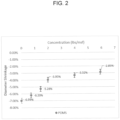
- Gypsum boards were prepared with different polydimethylsiloxane (PDMS) concentrations.
- PDMS polydimethylsiloxane
- a gypsum slurry including 550 g of stucco, 284.08 g of water, 2 g (5.79 Ibs/msf, 0.4 wt% based on the weight of stucco) of an accelerator, 5 g (14.48 Ibs/msf, 1 wt% based on the weight of stucco) of a plaster retardant, and 1 wt% of a surfactant, based on the weight of stucco, was prepared.
- PDMS was added in a variety of amounts. The PDMS was not emulsified prior to addition to the slurry.
- a gypsum slurry without any silicone oil were prepared.
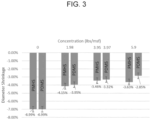
- FIG. 3 shows the results of the ASTM C1795 high temperature shrinkage at 850 °C (including error bars) for the PMHS boards and the PDMS boards. From FIG. 3 , it can be seen that PDMS and PMHS have a similar action on the shrinkage of plasterboards at the same concentration. However, the impact of increasing the concentration of PMHS seems to reach a plateau after 2 Ibs/msf.
- PMHS polymethylhydrosiloxane
- Gypsum boards were prepared as described in Example 1, however the PDMS was first emulsified prior to addition to the gypsum slurry.
- To emulsify the silicone oil it is mixed in a VMI Rayneri equipped with an emulsion blade (from VMI Linxis group: B00181347).
- the emulsion blade uses a combination of a stator, that is 30 mm high with 29 slots, and a rotor, that includes 4 blades. Emulsification is done by mixing for 2 minutes at 2750 rpm with water at room temperature with the silicone oil before the rest of the liquid part of the formulation is added, followed by the dry part.
- the boards were then tested by ASTM C1795 high temperature shrinkage at 850 °C to evaluate the fire-resistant properties of the board.
- Table 2 reports the board formulation and the results of the high temperature shrinkage test.
- FIG. 4 also shows the results of the ASTM C1795 high temperature shrinkage at 850 °C, including error bars. The error bar of ASTM C1795 high temperature shrinkage at 850 °C in these measurements is around 0.35%.
- FIG. 5 shows the results of the ASTM C1795 high temperature shrinkage at 850 °C (including error bars) for the PMHS boards and the PDMS boards. From FIG. 5 , it can be seen that emulsification of PDMS provided improved shrinkage performance that was not observed with the PMHS boards.
- each embodiment disclosed herein can comprise, consist essentially of or consist of its particular stated element, step, ingredient or component.
- the transition term “comprise” or “comprises” means includes, but is not limited to, and allows for the inclusion of unspecified elements, steps, ingredients, or components, even in major amounts.
- the transitional phrase “consisting of” excludes any element, step, ingredient or component not specified.
- the transition phrase “consisting essentially of” limits the scope of the embodiment to the specified elements, steps, ingredients or components and to those that do not materially affect the embodiment.
Landscapes
- Chemical & Material Sciences (AREA)
- Engineering & Computer Science (AREA)
- Ceramic Engineering (AREA)
- Structural Engineering (AREA)
- Inorganic Chemistry (AREA)
- Materials Engineering (AREA)
- Organic Chemistry (AREA)
- Chemical Kinetics & Catalysis (AREA)
- Crystallography & Structural Chemistry (AREA)
- Curing Cements, Concrete, And Artificial Stone (AREA)
Priority Applications (6)
| Application Number | Priority Date | Filing Date | Title |
|---|---|---|---|
| JP2025528561A JP2025536676A (ja) | 2022-11-16 | 2023-11-16 | 耐火性石膏ボード及びそれを作製する方法 |
| US18/511,476 US20240158299A1 (en) | 2022-11-16 | 2023-11-16 | Fire-resistant gypsum boards and methods of making them |
| AU2023379683A AU2023379683A1 (en) | 2022-11-16 | 2023-11-16 | Fire-resistant gypsum boards and methods for making them |
| PCT/US2023/080073 WO2024107991A1 (en) | 2022-11-16 | 2023-11-16 | Fire-resistant gypsum boards and methods for making them |
| CA3220220A CA3220220A1 (en) | 2022-11-16 | 2023-11-16 | Fire-resistant gypsum boards and methods of making them |
| EP23825566.5A EP4619357A1 (de) | 2022-11-16 | 2023-11-16 | Feuerbeständige gipsplatten und verfahren zu ihrer herstellung |
Applications Claiming Priority (1)
| Application Number | Priority Date | Filing Date | Title |
|---|---|---|---|
| US202263384059P | 2022-11-16 | 2022-11-16 |
Publications (1)
| Publication Number | Publication Date |
|---|---|
| EP4371961A1 true EP4371961A1 (de) | 2024-05-22 |
Family
ID=85036143
Family Applications (2)
| Application Number | Title | Priority Date | Filing Date |
|---|---|---|---|
| EP23152888.6A Withdrawn EP4371961A1 (de) | 2022-11-16 | 2023-01-23 | Feuerbeständige gipsplatten und verfahren zu ihrer herstellung |
| EP23825566.5A Pending EP4619357A1 (de) | 2022-11-16 | 2023-11-16 | Feuerbeständige gipsplatten und verfahren zu ihrer herstellung |
Family Applications After (1)
| Application Number | Title | Priority Date | Filing Date |
|---|---|---|---|
| EP23825566.5A Pending EP4619357A1 (de) | 2022-11-16 | 2023-11-16 | Feuerbeständige gipsplatten und verfahren zu ihrer herstellung |
Country Status (5)
| Country | Link |
|---|---|
| US (1) | US20240158299A1 (de) |
| EP (2) | EP4371961A1 (de) |
| JP (1) | JP2025536676A (de) |
| AU (1) | AU2023379683A1 (de) |
| CA (1) | CA3220220A1 (de) |
Citations (4)
| Publication number | Priority date | Publication date | Assignee | Title |
|---|---|---|---|---|
| US20080000392A1 (en) * | 2005-06-14 | 2008-01-03 | Blackburn David R | Foamed slurry and building panel made therefrom |
| US20160236979A1 (en) * | 2013-08-12 | 2016-08-18 | Certainteed Gypsum, Inc. | Struvite-K and Syngenite Composition for Use in Building Materials |
| WO2022017516A1 (zh) * | 2020-07-23 | 2022-01-27 | 中建材创新科技研究院有限公司 | 一种耐水纸面石膏板及其制备方法 |
| WO2022106419A1 (en) * | 2020-11-17 | 2022-05-27 | Etex Building Performance International Sas | Plaster composition for fire resistant plasterboard |
-
2023
- 2023-01-23 EP EP23152888.6A patent/EP4371961A1/de not_active Withdrawn
- 2023-11-16 US US18/511,476 patent/US20240158299A1/en active Pending
- 2023-11-16 EP EP23825566.5A patent/EP4619357A1/de active Pending
- 2023-11-16 CA CA3220220A patent/CA3220220A1/en active Pending
- 2023-11-16 AU AU2023379683A patent/AU2023379683A1/en active Pending
- 2023-11-16 JP JP2025528561A patent/JP2025536676A/ja active Pending
Patent Citations (4)
| Publication number | Priority date | Publication date | Assignee | Title |
|---|---|---|---|---|
| US20080000392A1 (en) * | 2005-06-14 | 2008-01-03 | Blackburn David R | Foamed slurry and building panel made therefrom |
| US20160236979A1 (en) * | 2013-08-12 | 2016-08-18 | Certainteed Gypsum, Inc. | Struvite-K and Syngenite Composition for Use in Building Materials |
| WO2022017516A1 (zh) * | 2020-07-23 | 2022-01-27 | 中建材创新科技研究院有限公司 | 一种耐水纸面石膏板及其制备方法 |
| WO2022106419A1 (en) * | 2020-11-17 | 2022-05-27 | Etex Building Performance International Sas | Plaster composition for fire resistant plasterboard |
Also Published As
| Publication number | Publication date |
|---|---|
| JP2025536676A (ja) | 2025-11-07 |
| EP4619357A1 (de) | 2025-09-24 |
| AU2023379683A1 (en) | 2025-06-05 |
| CA3220220A1 (en) | 2024-05-16 |
| US20240158299A1 (en) | 2024-05-16 |
Similar Documents
| Publication | Publication Date | Title |
|---|---|---|
| RU2475361C2 (ru) | Гипсовая стеновая панель с низким пылением | |
| JP4332223B2 (ja) | 永久変形に対する抗力が大きな石膏を含む製品並びに製品を製造する方法およびそれにより形成する配合物 | |
| JP5302218B2 (ja) | 繊維状マット張りのセメント系物品 | |
| JP7253921B2 (ja) | セメント系スラリーのための発泡調整剤、方法、及び生成物 | |
| TWI623419B (zh) | 輕重量石膏板 | |
| AU2007307233A1 (en) | Fire-resistant gypsum panel | |
| JP2021524814A (ja) | 多層石膏ボードおよび関連方法およびスラリー | |
| WO2017058316A1 (en) | Foam modifiers for cementitious slurries, methods, and products | |
| EP4371961A1 (de) | Feuerbeständige gipsplatten und verfahren zu ihrer herstellung | |
| JP7254521B2 (ja) | セメント系スラリー添加用の発泡調整剤を用いた起泡剤のオンラインブレンド方法 | |
| AU2014355746A1 (en) | Gypsum slurry, hardened gypsum body, gypsum-based building material, gypsum board, process for manufacturing gypsum slurry, process for manufacturing hardened gypsum body, process for manufacturing gypsum-based building material, and process for manufacturing gypsum board | |
| WO2024107991A1 (en) | Fire-resistant gypsum boards and methods for making them | |
| CA3222517A1 (en) | Gypsum wallboard having multiple blended surfactants | |
| US20250319689A1 (en) | Fire resistant building board | |
| US12612334B2 (en) | Gypsum wallboard having multiple blended surfactants | |
| CA3270336A1 (en) | Fire resistant building board | |
| WO2025215073A1 (en) | Fire resistant building board | |
| US20250361183A1 (en) | Plaster material composition for use in construction and methods of preparing the same | |
| WO2025117327A2 (en) | Moisture-resistant gypsum boards and methods of making them | |
| CA3256298A1 (en) | Moisture-resistant gypsum boards and methods of making them | |
| WO2025219437A1 (en) | Method for manufacturing a moisture-resistant plasterboard | |
| WO2025064299A1 (en) | Gypsum boards prepared using uncalcined gypsum and slurries and methods related thereto | |
| BR112018076224B1 (pt) | Método para produzir uma placa cimentícia espumada |
Legal Events
| Date | Code | Title | Description |
|---|---|---|---|
| PUAI | Public reference made under article 153(3) epc to a published international application that has entered the european phase |
Free format text: ORIGINAL CODE: 0009012 |
|
| STAA | Information on the status of an ep patent application or granted ep patent |
Free format text: STATUS: THE APPLICATION HAS BEEN PUBLISHED |
|
| STAA | Information on the status of an ep patent application or granted ep patent |
Free format text: STATUS: THE APPLICATION HAS BEEN WITHDRAWN |
|
| AK | Designated contracting states |
Kind code of ref document: A1 Designated state(s): AL AT BE BG CH CY CZ DE DK EE ES FI FR GB GR HR HU IE IS IT LI LT LU LV MC ME MK MT NL NO PL PT RO RS SE SI SK SM TR |
|
| 18W | Application withdrawn |
Effective date: 20240514 |