EP4431487A1 - Procede d'obtention d'un acide alcanoique - Google Patents
Procede d'obtention d'un acide alcanoique Download PDFInfo
- Publication number
- EP4431487A1 EP4431487A1 EP23162609.4A EP23162609A EP4431487A1 EP 4431487 A1 EP4431487 A1 EP 4431487A1 EP 23162609 A EP23162609 A EP 23162609A EP 4431487 A1 EP4431487 A1 EP 4431487A1
- Authority
- EP
- European Patent Office
- Prior art keywords
- catalyst
- biogenic material
- solution
- total weight
- total
- Prior art date
- Legal status (The legal status is an assumption and is not a legal conclusion. Google has not performed a legal analysis and makes no representation as to the accuracy of the status listed.)
- Pending
Links
- 239000002253 acid Substances 0.000 title claims abstract description 125
- 238000000034 method Methods 0.000 title claims abstract description 78
- 239000003054 catalyst Substances 0.000 claims abstract description 200
- 239000000463 material Substances 0.000 claims abstract description 186
- 230000000035 biogenic effect Effects 0.000 claims abstract description 179
- 239000007787 solid Substances 0.000 claims abstract description 98
- 239000000203 mixture Substances 0.000 claims abstract description 69
- MYMOFIZGZYHOMD-UHFFFAOYSA-N Dioxygen Chemical compound O=O MYMOFIZGZYHOMD-UHFFFAOYSA-N 0.000 claims abstract description 31
- 229910001882 dioxygen Inorganic materials 0.000 claims abstract description 31
- 150000003839 salts Chemical class 0.000 claims abstract description 12
- 238000006555 catalytic reaction Methods 0.000 claims abstract description 10
- GNTDGMZSJNCJKK-UHFFFAOYSA-N divanadium pentaoxide Chemical compound O=[V](=O)O[V](=O)=O GNTDGMZSJNCJKK-UHFFFAOYSA-N 0.000 claims abstract description 8
- 150000002500 ions Chemical class 0.000 claims abstract description 8
- 229910000365 copper sulfate Inorganic materials 0.000 claims abstract description 4
- ARUVKPQLZAKDPS-UHFFFAOYSA-L copper(II) sulfate Chemical compound [Cu+2].[O-][S+2]([O-])([O-])[O-] ARUVKPQLZAKDPS-UHFFFAOYSA-L 0.000 claims abstract description 4
- IMBKASBLAKCLEM-UHFFFAOYSA-L ferrous ammonium sulfate (anhydrous) Chemical compound [NH4+].[NH4+].[Fe+2].[O-]S([O-])(=O)=O.[O-]S([O-])(=O)=O IMBKASBLAKCLEM-UHFFFAOYSA-L 0.000 claims abstract description 4
- LGQLOGILCSXPEA-UHFFFAOYSA-L nickel sulfate Chemical compound [Ni+2].[O-]S([O-])(=O)=O LGQLOGILCSXPEA-UHFFFAOYSA-L 0.000 claims abstract description 4
- 229910000363 nickel(II) sulfate Inorganic materials 0.000 claims abstract description 4
- GLMOMDXKLRBTDY-UHFFFAOYSA-A [V+5].[V+5].[V+5].[O-]P([O-])([O-])=O.[O-]P([O-])([O-])=O.[O-]P([O-])([O-])=O.[O-]P([O-])([O-])=O.[O-]P([O-])([O-])=O Chemical compound [V+5].[V+5].[V+5].[O-]P([O-])([O-])=O.[O-]P([O-])([O-])=O.[O-]P([O-])([O-])=O.[O-]P([O-])([O-])=O.[O-]P([O-])([O-])=O GLMOMDXKLRBTDY-UHFFFAOYSA-A 0.000 claims abstract description 3
- 239000012002 vanadium phosphate Substances 0.000 claims abstract description 3
- IAZDPXIOMUYVGZ-UHFFFAOYSA-N Dimethylsulphoxide Chemical compound CS(C)=O IAZDPXIOMUYVGZ-UHFFFAOYSA-N 0.000 claims description 40
- 229920002678 cellulose Polymers 0.000 claims description 40
- 239000001913 cellulose Substances 0.000 claims description 40
- 229920000742 Cotton Polymers 0.000 claims description 39
- UUUGYDOQQLOJQA-UHFFFAOYSA-L vanadyl sulfate Chemical group [V+2]=O.[O-]S([O-])(=O)=O UUUGYDOQQLOJQA-UHFFFAOYSA-L 0.000 claims description 35
- 229910000352 vanadyl sulfate Inorganic materials 0.000 claims description 35
- 229910052760 oxygen Inorganic materials 0.000 claims description 28
- 239000001301 oxygen Substances 0.000 claims description 26
- QVGXLLKOCUKJST-UHFFFAOYSA-N atomic oxygen Chemical compound [O] QVGXLLKOCUKJST-UHFFFAOYSA-N 0.000 claims description 25
- 239000002023 wood Substances 0.000 claims description 25
- 229920005610 lignin Polymers 0.000 claims description 24
- 229910052799 carbon Inorganic materials 0.000 claims description 23
- 230000036961 partial effect Effects 0.000 claims description 18
- 239000007789 gas Substances 0.000 claims description 16
- XLYOFNOQVPJJNP-UHFFFAOYSA-N water Substances O XLYOFNOQVPJJNP-UHFFFAOYSA-N 0.000 claims description 15
- LFQSCWFLJHTTHZ-UHFFFAOYSA-N Ethanol Chemical compound CCO LFQSCWFLJHTTHZ-UHFFFAOYSA-N 0.000 claims description 14
- 241000196324 Embryophyta Species 0.000 claims description 11
- 239000008188 pellet Substances 0.000 claims description 11
- 239000004626 polylactic acid Substances 0.000 claims description 11
- 229920000704 biodegradable plastic Polymers 0.000 claims description 10
- 229920002101 Chitin Polymers 0.000 claims description 8
- 239000004460 silage Substances 0.000 claims description 8
- 241000233866 Fungi Species 0.000 claims description 7
- 241000206572 Rhodophyta Species 0.000 claims description 7
- 235000005824 Zea mays ssp. parviglumis Nutrition 0.000 claims description 7
- 235000002017 Zea mays subsp mays Nutrition 0.000 claims description 7
- 235000005822 corn Nutrition 0.000 claims description 7
- 239000002904 solvent Substances 0.000 claims description 7
- 239000010902 straw Substances 0.000 claims description 7
- 229920000297 Rayon Polymers 0.000 claims description 6
- 241000219310 Beta vulgaris subsp. vulgaris Species 0.000 claims description 5
- 235000021536 Sugar beet Nutrition 0.000 claims description 5
- 239000010801 sewage sludge Substances 0.000 claims description 5
- 238000005507 spraying Methods 0.000 claims description 5
- 239000004753 textile Substances 0.000 claims description 5
- -1 vanadyl acetonate Chemical compound 0.000 claims description 5
- 235000015099 wheat brans Nutrition 0.000 claims description 5
- 241000219146 Gossypium Species 0.000 claims description 4
- 238000010438 heat treatment Methods 0.000 claims description 4
- 229940016409 methylsulfonylmethane Drugs 0.000 claims description 4
- HHVIBTZHLRERCL-UHFFFAOYSA-N sulfonyldimethane Chemical compound CS(C)(=O)=O HHVIBTZHLRERCL-UHFFFAOYSA-N 0.000 claims description 4
- 229920008262 Thermoplastic starch Polymers 0.000 claims description 3
- CMZUMMUJMWNLFH-UHFFFAOYSA-N sodium metavanadate Chemical compound [Na+].[O-][V](=O)=O CMZUMMUJMWNLFH-UHFFFAOYSA-N 0.000 claims description 3
- 239000004628 starch-based polymer Substances 0.000 claims description 3
- 241001465754 Metazoa Species 0.000 claims description 2
- 229910003206 NH4VO3 Inorganic materials 0.000 claims description 2
- 229920006395 saturated elastomer Polymers 0.000 claims description 2
- 238000009736 wetting Methods 0.000 claims description 2
- 241000209149 Zea Species 0.000 claims 2
- 239000000243 solution Substances 0.000 description 118
- 241000218657 Picea Species 0.000 description 86
- 238000000354 decomposition reaction Methods 0.000 description 63
- 239000011541 reaction mixture Substances 0.000 description 58
- 238000007254 oxidation reaction Methods 0.000 description 54
- 230000003197 catalytic effect Effects 0.000 description 51
- 239000000047 product Substances 0.000 description 50
- BDAGIHXWWSANSR-UHFFFAOYSA-N methanoic acid Natural products OC=O BDAGIHXWWSANSR-UHFFFAOYSA-N 0.000 description 38
- 238000006243 chemical reaction Methods 0.000 description 36
- LEONUFNNVUYDNQ-UHFFFAOYSA-N vanadium atom Chemical group [V] LEONUFNNVUYDNQ-UHFFFAOYSA-N 0.000 description 33
- QTBSBXVTEAMEQO-UHFFFAOYSA-N Acetic acid Chemical compound CC(O)=O QTBSBXVTEAMEQO-UHFFFAOYSA-N 0.000 description 31
- 229910052720 vanadium Inorganic materials 0.000 description 31
- 230000003647 oxidation Effects 0.000 description 28
- OSWFIVFLDKOXQC-UHFFFAOYSA-N 4-(3-methoxyphenyl)aniline Chemical compound COC1=CC=CC(C=2C=CC(N)=CC=2)=C1 OSWFIVFLDKOXQC-UHFFFAOYSA-N 0.000 description 19
- OKTJSMMVPCPJKN-UHFFFAOYSA-N Carbon Chemical group [C] OKTJSMMVPCPJKN-UHFFFAOYSA-N 0.000 description 19
- 235000019253 formic acid Nutrition 0.000 description 19
- 238000005160 1H NMR spectroscopy Methods 0.000 description 18
- 238000004448 titration Methods 0.000 description 17
- 230000001404 mediated effect Effects 0.000 description 14
- 150000001875 compounds Chemical class 0.000 description 13
- OKKJLVBELUTLKV-UHFFFAOYSA-N Methanol Chemical compound OC OKKJLVBELUTLKV-UHFFFAOYSA-N 0.000 description 12
- 235000008331 Pinus X rigitaeda Nutrition 0.000 description 12
- 235000011613 Pinus brutia Nutrition 0.000 description 12
- 241000018646 Pinus brutia Species 0.000 description 12
- 150000001720 carbohydrates Chemical class 0.000 description 12
- 235000014633 carbohydrates Nutrition 0.000 description 11
- 238000004519 manufacturing process Methods 0.000 description 11
- 229930182470 glycoside Natural products 0.000 description 10
- 150000002338 glycosides Chemical class 0.000 description 10
- 239000012071 phase Substances 0.000 description 10
- 239000006193 liquid solution Substances 0.000 description 9
- 230000035484 reaction time Effects 0.000 description 9
- 239000000725 suspension Substances 0.000 description 9
- 241001070947 Fagus Species 0.000 description 8
- 235000010099 Fagus sylvatica Nutrition 0.000 description 8
- 229920002488 Hemicellulose Polymers 0.000 description 8
- 229920002301 cellulose acetate Polymers 0.000 description 8
- 238000001035 drying Methods 0.000 description 8
- 239000000758 substrate Substances 0.000 description 8
- 238000003556 assay Methods 0.000 description 7
- 239000004744 fabric Substances 0.000 description 7
- 239000007788 liquid Substances 0.000 description 7
- 239000012528 membrane Substances 0.000 description 7
- 229920000747 poly(lactic acid) Polymers 0.000 description 7
- 239000002028 Biomass Substances 0.000 description 6
- 229920002472 Starch Polymers 0.000 description 6
- 230000002829 reductive effect Effects 0.000 description 6
- 235000019698 starch Nutrition 0.000 description 6
- 239000008107 starch Substances 0.000 description 6
- 240000008042 Zea mays Species 0.000 description 5
- 239000011521 glass Substances 0.000 description 5
- WQZGKKKJIJFFOK-GASJEMHNSA-N Glucose Natural products OC[C@H]1OC(O)[C@H](O)[C@@H](O)[C@@H]1O WQZGKKKJIJFFOK-GASJEMHNSA-N 0.000 description 4
- QAOWNCQODCNURD-UHFFFAOYSA-N Sulfuric acid Chemical compound OS(O)(=O)=O QAOWNCQODCNURD-UHFFFAOYSA-N 0.000 description 4
- 239000000470 constituent Substances 0.000 description 4
- 239000008103 glucose Substances 0.000 description 4
- 239000007791 liquid phase Substances 0.000 description 4
- 239000000123 paper Substances 0.000 description 4
- 238000000926 separation method Methods 0.000 description 4
- 239000000126 substance Substances 0.000 description 4
- WQZGKKKJIJFFOK-VFUOTHLCSA-N beta-D-glucose Chemical compound OC[C@H]1O[C@@H](O)[C@H](O)[C@@H](O)[C@@H]1O WQZGKKKJIJFFOK-VFUOTHLCSA-N 0.000 description 3
- 230000003247 decreasing effect Effects 0.000 description 3
- 238000004821 distillation Methods 0.000 description 3
- 238000000605 extraction Methods 0.000 description 3
- 239000002798 polar solvent Substances 0.000 description 3
- 229920000642 polymer Polymers 0.000 description 3
- 238000000425 proton nuclear magnetic resonance spectrum Methods 0.000 description 3
- 238000000746 purification Methods 0.000 description 3
- 239000002994 raw material Substances 0.000 description 3
- 239000002002 slurry Substances 0.000 description 3
- 241000894006 Bacteria Species 0.000 description 2
- GUBGYTABKSRVRQ-CUHNMECISA-N D-Cellobiose Chemical compound O[C@@H]1[C@@H](O)[C@H](O)[C@@H](CO)O[C@H]1O[C@@H]1[C@@H](CO)OC(O)[C@H](O)[C@H]1O GUBGYTABKSRVRQ-CUHNMECISA-N 0.000 description 2
- SRBFZHDQGSBBOR-IOVATXLUSA-N D-xylopyranose Chemical compound O[C@@H]1COC(O)[C@H](O)[C@H]1O SRBFZHDQGSBBOR-IOVATXLUSA-N 0.000 description 2
- BDAGIHXWWSANSR-UHFFFAOYSA-M Formate Chemical compound [O-]C=O BDAGIHXWWSANSR-UHFFFAOYSA-M 0.000 description 2
- PEDCQBHIVMGVHV-UHFFFAOYSA-N Glycerine Chemical compound OCC(O)CO PEDCQBHIVMGVHV-UHFFFAOYSA-N 0.000 description 2
- AEMRFAOFKBGASW-UHFFFAOYSA-N Glycolic acid Chemical compound OCC(O)=O AEMRFAOFKBGASW-UHFFFAOYSA-N 0.000 description 2
- VEXZGXHMUGYJMC-UHFFFAOYSA-N Hydrochloric acid Chemical compound Cl VEXZGXHMUGYJMC-UHFFFAOYSA-N 0.000 description 2
- XEEYBQQBJWHFJM-UHFFFAOYSA-N Iron Chemical compound [Fe] XEEYBQQBJWHFJM-UHFFFAOYSA-N 0.000 description 2
- 239000004368 Modified starch Substances 0.000 description 2
- 229920000881 Modified starch Polymers 0.000 description 2
- PXHVJJICTQNCMI-UHFFFAOYSA-N Nickel Chemical compound [Ni] PXHVJJICTQNCMI-UHFFFAOYSA-N 0.000 description 2
- 150000007513 acids Chemical class 0.000 description 2
- 239000007864 aqueous solution Substances 0.000 description 2
- 238000007664 blowing Methods 0.000 description 2
- 239000006227 byproduct Substances 0.000 description 2
- 230000001419 dependent effect Effects 0.000 description 2
- 235000013305 food Nutrition 0.000 description 2
- 238000004128 high performance liquid chromatography Methods 0.000 description 2
- 125000002887 hydroxy group Chemical group [H]O* 0.000 description 2
- JVTAAEKCZFNVCJ-UHFFFAOYSA-N lactic acid Chemical compound CC(O)C(O)=O JVTAAEKCZFNVCJ-UHFFFAOYSA-N 0.000 description 2
- JJTUDXZGHPGLLC-UHFFFAOYSA-N lactide Chemical compound CC1OC(=O)C(C)OC1=O JJTUDXZGHPGLLC-UHFFFAOYSA-N 0.000 description 2
- 239000011344 liquid material Substances 0.000 description 2
- 238000004949 mass spectrometry Methods 0.000 description 2
- 150000007522 mineralic acids Chemical class 0.000 description 2
- 238000002156 mixing Methods 0.000 description 2
- 235000019426 modified starch Nutrition 0.000 description 2
- 235000013379 molasses Nutrition 0.000 description 2
- 229910052757 nitrogen Inorganic materials 0.000 description 2
- 125000004433 nitrogen atom Chemical group N* 0.000 description 2
- 150000007524 organic acids Chemical class 0.000 description 2
- 239000011368 organic material Substances 0.000 description 2
- 230000001590 oxidative effect Effects 0.000 description 2
- 125000004430 oxygen atom Chemical group O* 0.000 description 2
- 239000002243 precursor Substances 0.000 description 2
- 238000002203 pretreatment Methods 0.000 description 2
- 238000003756 stirring Methods 0.000 description 2
- 125000001424 substituent group Chemical group 0.000 description 2
- 125000004434 sulfur atom Chemical group 0.000 description 2
- 229920001169 thermoplastic Polymers 0.000 description 2
- 239000004416 thermosoftening plastic Substances 0.000 description 2
- FSJSYDFBTIVUFD-SUKNRPLKSA-N (z)-4-hydroxypent-3-en-2-one;oxovanadium Chemical compound [V]=O.C\C(O)=C\C(C)=O.C\C(O)=C\C(C)=O FSJSYDFBTIVUFD-SUKNRPLKSA-N 0.000 description 1
- 238000009622 Bergius process Methods 0.000 description 1
- 244000025254 Cannabis sativa Species 0.000 description 1
- 235000012766 Cannabis sativa ssp. sativa var. sativa Nutrition 0.000 description 1
- 235000012765 Cannabis sativa ssp. sativa var. spontanea Nutrition 0.000 description 1
- RYGMFSIKBFXOCR-UHFFFAOYSA-N Copper Chemical compound [Cu] RYGMFSIKBFXOCR-UHFFFAOYSA-N 0.000 description 1
- 240000000491 Corchorus aestuans Species 0.000 description 1
- 235000011777 Corchorus aestuans Nutrition 0.000 description 1
- 235000010862 Corchorus capsularis Nutrition 0.000 description 1
- 229920002261 Corn starch Polymers 0.000 description 1
- 241000238424 Crustacea Species 0.000 description 1
- 241000195493 Cryptophyta Species 0.000 description 1
- 241000192700 Cyanobacteria Species 0.000 description 1
- 241000238631 Hexapoda Species 0.000 description 1
- 240000006240 Linum usitatissimum Species 0.000 description 1
- 235000004431 Linum usitatissimum Nutrition 0.000 description 1
- 241000736262 Microbiota Species 0.000 description 1
- 229910019142 PO4 Inorganic materials 0.000 description 1
- CZMRCDWAGMRECN-UGDNZRGBSA-N Sucrose Chemical compound O[C@H]1[C@H](O)[C@@H](CO)O[C@@]1(CO)O[C@@H]1[C@H](O)[C@@H](O)[C@H](O)[C@@H](CO)O1 CZMRCDWAGMRECN-UGDNZRGBSA-N 0.000 description 1
- 229930006000 Sucrose Natural products 0.000 description 1
- 238000005411 Van der Waals force Methods 0.000 description 1
- 239000000654 additive Substances 0.000 description 1
- 230000000996 additive effect Effects 0.000 description 1
- 238000004458 analytical method Methods 0.000 description 1
- 239000003963 antioxidant agent Substances 0.000 description 1
- 235000006708 antioxidants Nutrition 0.000 description 1
- PYMYPHUHKUWMLA-UHFFFAOYSA-N arabinose Natural products OCC(O)C(O)C(O)C=O PYMYPHUHKUWMLA-UHFFFAOYSA-N 0.000 description 1
- SRBFZHDQGSBBOR-UHFFFAOYSA-N beta-D-Pyranose-Lyxose Natural products OC1COC(O)C(O)C1O SRBFZHDQGSBBOR-UHFFFAOYSA-N 0.000 description 1
- 229920002988 biodegradable polymer Polymers 0.000 description 1
- 239000004621 biodegradable polymer Substances 0.000 description 1
- 235000009120 camo Nutrition 0.000 description 1
- 125000004432 carbon atom Chemical group C* 0.000 description 1
- 230000015556 catabolic process Effects 0.000 description 1
- 235000005607 chanvre indien Nutrition 0.000 description 1
- 229910052802 copper Inorganic materials 0.000 description 1
- 239000010949 copper Substances 0.000 description 1
- 239000008120 corn starch Substances 0.000 description 1
- 230000007423 decrease Effects 0.000 description 1
- 238000006731 degradation reaction Methods 0.000 description 1
- 150000002016 disaccharides Chemical class 0.000 description 1
- 230000000694 effects Effects 0.000 description 1
- 238000005516 engineering process Methods 0.000 description 1
- 239000003925 fat Substances 0.000 description 1
- 235000019197 fats Nutrition 0.000 description 1
- 230000002349 favourable effect Effects 0.000 description 1
- 238000001914 filtration Methods 0.000 description 1
- 235000013312 flour Nutrition 0.000 description 1
- 235000001727 glucose Nutrition 0.000 description 1
- MNQZXJOMYWMBOU-UHFFFAOYSA-N glyceraldehyde Chemical compound OCC(O)C=O MNQZXJOMYWMBOU-UHFFFAOYSA-N 0.000 description 1
- 235000011187 glycerol Nutrition 0.000 description 1
- 230000005484 gravity Effects 0.000 description 1
- 239000011487 hemp Substances 0.000 description 1
- 230000007062 hydrolysis Effects 0.000 description 1
- 238000006460 hydrolysis reaction Methods 0.000 description 1
- XLYOFNOQVPJJNP-UHFFFAOYSA-M hydroxide Chemical compound [OH-] XLYOFNOQVPJJNP-UHFFFAOYSA-M 0.000 description 1
- 229910052500 inorganic mineral Inorganic materials 0.000 description 1
- 229910052742 iron Inorganic materials 0.000 description 1
- 239000004310 lactic acid Substances 0.000 description 1
- 235000014655 lactic acid Nutrition 0.000 description 1
- 238000005259 measurement Methods 0.000 description 1
- 239000011707 mineral Substances 0.000 description 1
- 235000010755 mineral Nutrition 0.000 description 1
- 150000002772 monosaccharides Chemical class 0.000 description 1
- 229910052759 nickel Inorganic materials 0.000 description 1
- 229920001542 oligosaccharide Polymers 0.000 description 1
- 150000002482 oligosaccharides Chemical class 0.000 description 1
- 235000005985 organic acids Nutrition 0.000 description 1
- 150000002926 oxygen Chemical class 0.000 description 1
- 239000010893 paper waste Substances 0.000 description 1
- 239000002245 particle Substances 0.000 description 1
- 239000010452 phosphate Substances 0.000 description 1
- 229920003023 plastic Polymers 0.000 description 1
- 239000004033 plastic Substances 0.000 description 1
- 229920000728 polyester Polymers 0.000 description 1
- 229920001282 polysaccharide Polymers 0.000 description 1
- 239000005017 polysaccharide Substances 0.000 description 1
- 150000004804 polysaccharides Chemical class 0.000 description 1
- 229920001592 potato starch Polymers 0.000 description 1
- 150000003138 primary alcohols Chemical class 0.000 description 1
- BDERNNFJNOPAEC-UHFFFAOYSA-N propan-1-ol Chemical compound CCCO BDERNNFJNOPAEC-UHFFFAOYSA-N 0.000 description 1
- 235000018102 proteins Nutrition 0.000 description 1
- 102000004169 proteins and genes Human genes 0.000 description 1
- 108090000623 proteins and genes Proteins 0.000 description 1
- 239000003586 protic polar solvent Substances 0.000 description 1
- 238000004537 pulping Methods 0.000 description 1
- 238000005086 pumping Methods 0.000 description 1
- 230000001172 regenerating effect Effects 0.000 description 1
- 230000008929 regeneration Effects 0.000 description 1
- 238000011069 regeneration method Methods 0.000 description 1
- 230000000717 retained effect Effects 0.000 description 1
- 238000001223 reverse osmosis Methods 0.000 description 1
- 150000003384 small molecules Chemical class 0.000 description 1
- 239000011343 solid material Substances 0.000 description 1
- 239000007858 starting material Substances 0.000 description 1
- 230000003068 static effect Effects 0.000 description 1
- 238000003860 storage Methods 0.000 description 1
- 239000005720 sucrose Substances 0.000 description 1
- 229920001864 tannin Polymers 0.000 description 1
- 235000018553 tannin Nutrition 0.000 description 1
- 239000001648 tannin Substances 0.000 description 1
- 229940041260 vanadyl sulfate Drugs 0.000 description 1
- 235000015112 vegetable and seed oil Nutrition 0.000 description 1
- 239000008158 vegetable oil Substances 0.000 description 1
- 239000011782 vitamin Substances 0.000 description 1
- 235000013343 vitamin Nutrition 0.000 description 1
- 229940088594 vitamin Drugs 0.000 description 1
- 229930003231 vitamin Natural products 0.000 description 1
- 239000002699 waste material Substances 0.000 description 1
- 238000005303 weighing Methods 0.000 description 1
- 229920001221 xylan Polymers 0.000 description 1
- 150000004823 xylans Chemical class 0.000 description 1
Images


Classifications
-
- C—CHEMISTRY; METALLURGY
- C07—ORGANIC CHEMISTRY
- C07C—ACYCLIC OR CARBOCYCLIC COMPOUNDS
- C07C51/00—Preparation of carboxylic acids or their salts, halides or anhydrides
Definitions
- the invention relates to a method for obtaining an alkanoic acid, wherein molecular oxygen, a biogenic material and a solution of a catalyst are used in a catalytic reaction.
- WO 2012/034839 A1 discloses a method for catalytically producing formic acid.
- the separation is accomplished by extraction by means of a linear primary alcohol.
- the carbon chain of the alcohol has five to twelve carbon atoms, and the reaction mixture is in a protic solvent.
- EP 3 484 846 A1 discloses a method for catalytically producing formic acid and regenerating the catalyst employed.
- the reduced catalyst is returned by oxidation to its original state.
- the solution is contacted with a gas comprising a volume fraction of at least 18 % of oxygen at a pressure of at least 2 bar and at most 16 bar, by means of a mixing apparatus or via a liquid-impermeable, gas-permeable membrane, where CO and/or CO 2 formed in the reaction and passing into the gas are/is taken off in a quantity such that the volume fraction of CO and CO 2 together in the gas does not exceed 80 %.
- the catalyst reduced in this way is returned to its starting state by oxidation.
- the contacting is carried out in the vessel at an oxygen partial pressure below 1 bar.
- a portion of the liquid solution is diverted out of the vessel, has oxygen or a gas mixture containing oxygen applied thereto at an oxygen partial pressure of 1 to 500 bar, and is subsequently fed back to the rest of the liquid solution.
- the oxygen partial pressure in the vessel is constantly maintained below 1 bar, wherein the oxygen partial pressure of 1 to 500 bar being applied to the portion of the liquid solution is reduced to below 5 bar before the portion of the liquid solution is fed back to the rest of the liquid solution.
- the method comprises the following steps: a) separating a mixture of formic acid and water from the reaction mixture by reverse osmosis and/or as vapor, the vapor subsequently being condensed and b) reacting the formic acid not separated from the water with a hydroxide in aqueous solution to produce a solution of a formate, wherein the organic material is an alpha-hydroxyaldehyde, an alpha-hydroxycarboxylic acid, a carbohydrate, or a glycoside.
- the problem to be solved by the present invention is to provide an alternative method for the production of an alkanoic acid.
- the method shall enable the degradation of a complex biomass without requirement of its prior disintegration, e.g. by use of a strong organic or inorganic acid.
- Embodiments of the invention are subject-matter of claims 2 to 15.
- a method for obtaining an alkanoic acid is provided.
- Molecular oxygen, a solid biogenic material and a solution of a catalyst in a solvent are used in a catalytic reaction.
- the relation of the total dry weight of the biogenic material to the total weight of the biogenic material together with a total weight of the solution of the catalyst is at least 15 wt.% in the method according to the invention.
- the total weight of the solid biogenic material is equal to the sum of the total dry weight of the solid biogenic material and the total weight of vaporizable liquid, in particular water, contained in the solid biogenic material.
- the total dry weight - which term is here synonymously used with the term "total dry matter" - is the total weight of solids in the solid biogenic material remaining after its total drying.
- the total dry weight of the solid biogenic material can be measured by weighing the solid biogenic material after its total drying.
- the total weight of vaporizable liquid can be determined by subtraction of the weight of the solid biogenic material after total drying from the weight of the solid biogenic material before total drying. From the weight of a sample of the solid biogenic material before and after total drying, the percentage of the total dry weight from the total weight of the solid biogenic material can be determined.
- the total dry weight of the solid biogenic material can then be calculated at any time from its weight.
- total dry weight and “total dry matter” are common technical terms in waste technology, paper production, wood processing, food production and/or feed production.
- the total dry weight of the solid biogenic material may comprise the weight of carbohydrates, chitin, lignin, tannins, fats, proteins, vitamins, minerals and antioxidants contained in the solid biogenic material.
- the biogenic material is always present in solution or in suspension.
- the relation of the total dry weight of the biogenic material to the total weight of the biogenic material together with a total weight of the solution of the catalyst does not exceed about 12 wt.%.
- the relation is higher than 12 wt.% the resulting composition cannot be considered as suspension but, e.g., as a lumpy material, i. e. a material in which particles or pieces of the biogenic material cannot freely flow within the solution of the catalyst.
- Usual processing of the biogenic material e. g. by pumping or stirring, is difficult in case the relation is higher than 12 wt.% and it becomes the more difficult the higher this relation is.
- the method according to the invention enables the use of a relatively high portion of solid biomass by weight, in particular solid biomass in a portion of at least 15 wt.%, in particular of at least 20 wt.%, in particular of at least 25 wt.%, in particular of at least 30 wt.%, in particular of at least 35 wt.%, in particular of at least 40 wt.%, and of at most 75 wt.%, in particular of at most 70 wt.%, in particular of at most 65 wt.%, in particular of at most 60 wt.%, in particular of at most 55 wt.%, in particular of at most 50 wt.%, in particular of at most 45 wt.%, of the total quantity of the reaction components by weight.
- At least 70 wt.%, in particular at least 80 wt.%, in particular at least 90 wt.%, in particular at least 95 wt.%, and at most 100 wt.%, in particular at most 99.9 wt.%, of the total weight of the biogenic material may be in direct contact with the molecular oxygen.
- a direct contact with the molecular oxygen of 100 wt.% of the total weight of the biogenic material may be achieved in a fluidized bed reactor.
- the inventors of the present invention further found that the alkanoic acid accumulates in the solution of the catalyst and that the method according to the invention results in an alkanoic acid content in this solution of up to 45 wt.% of the total dry weight of the biogenic material present at the beginning of performance of the method according to the invention. Products resulting from decomposition of the biogenic material are predominantly water and the alkanoic acid. This further distinguishes the method according to the invention from the catalytic oxidation of biogenic materials in solution and/or in suspension known in the art. The method according to the invention allows obtaining an alkanoic acid in a relatively high yield by catalytic oxidation of a solid biogenic material.
- the triphasic composition formed at step b) comprises or consists of a solid material in form of the biogenic material, a liquid material in form of the solution of the catalyst, and a gaseous material in form of the molecular oxygen.
- the film of the solution of the catalyst on the surface of the biogenic material is to be understood as an interrupted or in particular a continuous liquid layer on the surface of the biogenic material. Usually, this layer remains on the surface even when the solution of the catalyst, in particular an excess solution of the catalyst, is drained off.
- the film is that part of the solution that is retained on the surface of the biogenic material by intermolecular forces, in particular van der Waals forces, between molecules of the surface of the biogenic material and molecules of the solution of the catalyst.
- the film has a phase boundary to the molecular oxygen and a further phase boundary to the solid biogenic material.
- the contact area between the film on the solid biogenic material and the molecular oxygen is usually 100 % of the surface area of the film.
- the surface-area-to-volume ratio of the solution of the catalyst forming the film is much higher than that of the solution of the catalyst in every suspension of biogenic material known in the art. Since the relatively low volume of the solution of the catalyst means that only a relatively small amount of the catalyst is present in the oxidation reaction, the relatively high efficiency of the oxidation reaction observed by the inventors is very astonishing. As the catalyst is relatively expensive, this is an important aspect of the invention.
- the film may be formed on the surface of the biogenic material by spraying or sprinkling the solution of the catalyst on the surface of the biogenic material or by totally wetting the biogenic material with the solution of the catalyst, in particular by immersing the biogenic material in the solution of the catalyst, followed by draining the solution of the catalyst from the biogenic material, in particular the excess solution of the catalyst. Draining the solution of the catalyst, in particular the excess solution of the catalyst, may be performed as an active draining, e. g. by blowing off excess solution from the biogenic material, or as a passive draining, i.e. by letting the solution of the catalyst drain off by gravity.
- Drying-out of the film and/or the moistened and/or soaked biogenic material may be prevented by continuously spraying or sprinkling the solution of the catalyst on the surface of the biogenic material, in particular in a trickle-bed reactor, or by enclosing the triphasic composition in an atmosphere saturated with vapor of the solvent.
- the triphasic composition is not a suspension of the solid biogenic material in the solution of the catalyst and in particular not such a suspension through which molecular oxygen bubbles.
- the solid biogenic material is decomposed by catalytic oxidation by means of the catalyst to generate the alkanoic acid.
- Catalytic oxidation of the solid biogenic material by the catalyst results in the reduction of the catalyst.
- the reduced catalyst is not able to perform catalytic oxidation of the solid biogenic material.
- the contact area between the film of the solution of the catalyst on the solid biogenic material and the molecular oxygen is relatively large in relation to the volume of the film. In case of the biogenic material soaked with the solution of the catalyst, the molecular oxygen can penetrate the soaked biogenic material.
- the inventors of the present invention found, that in the method according to the invention, the undesired further catalytic oxidation of the alkanoic acid to CO 2 is relatively low.
- the reason for this could be that the alkanoic acid formed by decomposition of the biogenic material usually drains off from the remaining biogenic material and collects at the bottom. This results in a much smaller surface-area-to-volume ratio than in the film and thus could result in a much lower oxidative activity in this solution containing the alkanoic acid than in the film.
- the method according to the invention differs from the liquid phase processes known from the above prior art documents.
- a pretreatment of the suspended solid biogenic material may be necessary or at least advantageous for accelerating the catalytic oxidation.
- the pretreatment may comprise disintegration of cellulose and/or lignin or addition of relatively strong organic acids or inorganic acids, in particular hydrochloric acid and sulfuric acid.
- the pretreatment mainly removes the hemicellulotic fractions, storage compounds and extractives, such as starch and saccharides, from the solid biogenic material. These hemicellulotic fractions can then be dissolved in the liquid phase and thus oxidized.
- pretreatment procedures and further treatment procedures will always result in fractions of an educt remaining as constituent or even main constituent in the obtained reaction mixture.
- remaining main constituents are cellulose, lignin or wood.
- the remaining main constituents may remain in a relatively high content of at least 20 wt.% in the obtained reaction mixture.
- no pretreatment or further treatment is necessary in order to selectively and efficiently convert cellulose or lignin into alkanoic acid, even if the catalyst concentration is relatively low.
- the method according to the invention enables a conversion of up to 100 wt.% of cellulose and lignin.
- the solid biogenic material may be chitin from animals, such as insects or crustaceans, a plant-based solid biogenic material, a sewage sludge or a bioplastic.
- the plant-based solid biogenic material may be a plant-based solid biogenic material containing lignin, cellulose, hemicellulose and/or chitin, in particular a plant-based solid biogenic material containing lignin, cellulose and/or chitin.
- the chitin may be chitin from fungi.
- the sewage sludge may be a sewage sludge containing lignin, cellulose and/or hemicellulose, in particular a sewage sludge containing lignin and/or cellulose.
- a bioplastic is a plastic derived from a biomass source.
- a bioplastic may be derived from lactide, glucose, molasses, vegetable oil, starch, in particular corn starch, pea starch, potato starch, or microbiota.
- the bioplastic may be a bioplastic containing lignin, cellulose and/or hemicellulose, in particular a bioplastic containing lignin and/or cellulose.
- the bioplastic may be thermoplastic starch, in particular thermoplastic modified starch or polylactic acid (PLA) which polylactic acid may be derived from lactide obtained from glucose and molasses.
- PLA polylactic acid
- the inventors of the present invention found that contrary to catalytic oxidations in known methods lignin, cellulose and hemicellulose are directly catalytically oxidized to alkanoic acid by the method according to the invention.
- the catalytic oxidation of lignin, cellulose and hemicellulose in the plant-based solid biogenic material may result from a relatively high concentration of the molecular oxygen in the film of the solution of the catalyst and/or in the solution of the catalyst on the moistened plant-based biogenic material and/or within the soaked biogenic material.
- the catalytic oxidation of lignin and cellulose can be achieved by the method according to the invention without pre-treatment of the solid biogenic material and without the addition of an additive, in particular without the addition of an acid, a derivative of an acid or a salt of an acid.
- the inventors achieved an alkanoic acid content of up to 45 wt.% of the total weight of the decomposition products.
- the term "decomposition products” refers here and in the following to the solution or suspension resulting after the decomposition.
- This solution or suspension contains the solution of the catalyst, all products formed by the catalytic reaction and the residues of the biogenic material remaining after the catalytic reaction.
- the achievable alkanoic acid content is dependent on the solid biogenic material, the degree of moisture of the solid biogenic material and the ratio of the total dry weight of the solid biogenic material to the total weight of the catalyst.
- a relatively high alkanoic acid content in the total decomposition products facilitates purification of the alkanoic acid from the decomposition products and makes purification less energy consuming than purification of alkanoic acid less concentrated in the total decomposition products.
- the method according to the invention enables a sustainable production of alkanoic acid.
- the solid biogenic material may be a material consisting of or comprising an alpha-hydroxyaldehyde, alpha-hydroxycarboxylic acid, carbohydrate, or glycoside, as is known from WO 2012/034839 A1 , or polylactic acid.
- Alpha-hydroxyaldehydes, carbohydrates, and glycosides are present in a large number of renewable resources such as starch, cellulose, or hemicellulose.
- Starch, cellulose, and hemicellulose are obtained in large quantities as a product of crops or industrial pulping, for example for paper production.
- the alpha-hydroxyaldehyde, alpha-hydroxycarboxylic acid, carbohydrate, or glycoside may be a monosaccharide, particularly an aldose, disaccharide, oligosaccharide or polysaccharide, starch, cellulose, hemicellulose, glucose, sucrose, xylose, cellobiose, xylan, heterooligosaccharide, heteropolysaccharide, glycolic acid, polylactic acid or lactic acid, or alpha-hydroxyaldehyde, alpha-hydroxycarboxylic acid, carbohydrate, or glycoside-containing residues or, in particular a renewable, especially an untreated raw material. Untreated means that it has not previously been pulped.
- the residual material or renewable raw material can be a plant, fungus or bacteria, or components of plants, fungi or bacteria, wood, in particular in the form of wood flour or wood shavings, paper, especially waste paper, algae, cyanobacteria, or silage.
- the alpha-hydroxyaldehyde, alpha-hydroxycarboxylic acid, carbohydrate, or glycoside may also comprise a mixture of at least two of said substances or have been formed from at least one of said substances or the mixture.
- the alpha-hydroxyaldehyde, the alpha-hydroxycarboxylic acid, carbohydrate, or glycoside can also comprise a mixture of at least two of the named substances or can be made from at least one of the named substances or the mixture.
- the plant-based solid biogenic material may be wood chips, wood pellets, cotton, fungi, sugar beet residues, corn silage, straw, red algae, wheat bran, cardboard, solid digestate, cellulose, a derivative of cellulose, a textile, viscose or a mixture of at least two of wood chips, wood pellets, cotton, fungi, sugar beet residues, corn silage, straw, red algae, wheat bran, cardboard, solid digestate, cellulose, a derivative of cellulose, a textile and viscose.
- the wood chips may be spruce chips, beech chips, pine chips, in particular pine splint wood chips and pine heartwood chips, and tropical wood chips.
- the wood pellets may be spruce pellets, beech pellets, pine pellets, in particular pine splint wood pellets and pine heartwood pellets, and tropical wood pellets.
- the cellulose may be pine cellulose.
- the derivative of cellulose may be cellulose acetate.
- the textile may be cotton fabric, hemp fabric, jute fabric, flax fabric, viscose fabric, cellulose acetate fabric or a biodegradable polymer fabric.
- the bioplastic may be polylactic acid (PLA) or thermoplastic starch, in particular thermoplastic modified starch. The carbon content of the biogenic material is dependent on the biogenic material.
- the carbon content of spruce chips may be 51 wt.%
- the carbon content of beech chips may be 48 wt.%
- the carbon content of cotton may be 44 wt.%
- the carbon content of straw may be 46 wt.%.
- the maintaining at step c) is performed until at least 50 wt.%, in particular at least 55 wt.%, in particular at least 60 wt.%, in particular at least 65 wt.%, in particular at least 70 wt.%, in particular at least 75 wt.%, in particular at least 80 wt.%, in particular at least 85 wt.%, in particular at least 90 wt.%, in particular at least 95 wt.%, in particular at least 99 wt.%, in particular 100 wt.%, of the total dry weight of the lignin and/or the cellulose is/are decomposed.
- Decomposition of the total dry weight of the lignin and/or the cellulose can be measured by HPLC or by mass spectrometry of the decomposed material or by the Weender analysis method of the remaining lignin and/or the cellulose.
- the lignin and/or the cellulose in the solid biogenic material, in particular in a solid polymer may be hydrolyzed using an acid, in particular sulfuric acid, prior to measurement by HPLC and/or mass spectrometry. In case of cellulose this hydrolysis results in glucose or cellobiose.
- the total dry weight of the biogenic material in relation to the total weight of the biogenic material together with the total weight of the solution of the catalyst may be at least 20 wt.%, in particular at least 25 wt.%, in particular at least 30 wt.%, in particular at least 35 wt.%, in particular at least 40 wt.%, in particular at least 45 wt.%, in particular at least 50 wt.%, in particular at least 55 wt.%, and at most 70 wt.%, in particular at most 65 wt.%, in particular at most 60 wt.%.
- the VO 2+ containing salt may be VOSO 4 or vanadyl acetonate.
- the [VO 3 ] - containing salt may be NH 4 VO 3 or sodium metavanadate.
- the inventors of the present invention found that the VO 2+ containing salt, in particular VOSO 4 , enables a relatively effective catalytic oxidation of the solid biogenic material.
- the inventors assume that the freely accessible vanadium atoms in dissolved VOSO 4 enable this relatively effective catalytic oxidation of the biogenic material.
- the alkanoic acid may be a formic acid or a linear alkanoic acid, in particular acetic acid, or a mixture of at least two different alkanoic acids, in particular a mixture of formic acid and acetic acid.
- the solvent in which the catalyst is dissolved may be a polar solvent, i. e. a solvent with a dielectric constant greater than 15.
- a polar solvent comprises or consists of molecules having a permanent electric dipole moment.
- the polar solvent may be water, a monohydric alcohol, a trihydric alcohol, dimethyl sulfoxide (DMSO), methylsulfonylmethane or a mixture of at least two of water, a monohydric alcohol, a trihydric alcohol, dimethyl sulfoxide and methylsulfonylmethane.
- the monohydric alcohol may be methanol, ethanol and propanol.
- the trihydric alcohol may be glycerin.
- the molecular oxygen may be contained in pure oxygen gas or in a gas mixture.
- the gas mixture may be air or a gas mixture containing a volume percentage of oxygen of at least 10 %, in particular at least 15 %, in particular at least 20 %, in particular at least 25 %, in particular at least 30 %, in particular at least 35 %, in particular at least 40 %, in particular at least 45 %, in particular at least 50 %, in particular at least 55 %, in particular at least 60 %, in particular at least 65 %, in particular at least 70 %, in particular at least 75 %, in particular at least 80 %, in particular at least 85 %, in particular at least 90 %, in particular at least 95 %, in particular at least 99 %.
- the inventors of the present invention found that a relatively high volume percentage of oxygen, in particular pure oxygen gas, results in a relatively short reaction time and allows the catalytic oxidation reaction to be performed at a relatively low oxygen partial pressure.
- the total weight of the solid biogenic material in relation to the total weight of the biogenic material together with a total weight of the solution of the catalyst may be at least 15 wt.%, in particular at least 20 wt.%, in particular at least 25 wt.%, in particular at least 30 wt.%, in particular at least 35 wt.%, in particular at least 40 wt.%, in particular at least 45 wt.%, in particular at least 50 wt.%, in particular at least 55 wt.%, in particular at least 60 wt.%, in particular at least 65 wt.%.
- the total weight of the solution of the catalyst in relation to the total weight of the biogenic material together with a total weight of the solution of the catalyst may be at most 85 wt.%, in particular at most 80 wt.%, in particular at most 75 wt.%, in particular at most 70 wt.%, in particular at most 65 wt.%, in particular at most 60 wt.%, in particular at most 55 wt.%, in particular at most 50 wt.%, in particular at most 45 wt.%, in particular at most 40 wt.%, in particular at most 35 wt.%.
- the total weight of the catalyst in relation to the total dry weight of the biogenic material may be at most 20 wt.%, in particular at most 18 wt.%, in particular at most 16 wt.%, in particular at most 14 wt.%, in particular at most 12 wt.%, in particular at most 6 wt.%, in particular at most 4 wt.%, in particular at most 2 wt.%, in particular at most 1 wt.%, in particular at most 0.5 wt.%.
- the solid biogenic material is a material that contains carbon. If the catalyst contains vanadium, the total weight of vanadium contained in the catalyst in relation to the total weight of carbon contained in the solid biogenic material may be at most 6 wt.%, in particular at most 4 wt.%, in particular at most 2 wt.%, in particular at most 1 wt.%.
- the inventors of the present invention found that a relatively low total weight of vanadium contained in the catalyst in relation to a relatively high total weight of carbon contained in the solid biogenic material allows a relatively efficient catalytic oxidation of the solid biogenic material.
- the inventors of the present invention further found that a constant total weight of vanadium contained in the catalyst in relation to an increasing total weight of carbon contained in the solid biogenic material results in the obtaining of an increasing amount of alkanoic acid.
- a relatively high total weight of carbon contained in the solid biogenic material can be converted without increasing the total weight of the vanadium contained in the catalyst. Therefore, the method according to the invention allows a relatively effective catalytic oxidation with a relatively low total weight content of the catalyst. Due to the relatively high costs of the catalyst, the method according to the invention thus ensures an inexpensive and material-conserving method for obtaining alkanoic acid.
- the ratio of the total dry weight of the solid biogenic material to the total weight of the catalyst may be at least 5:1, in particular at least 10:1, in particular at least 20:1, in particular at least 50:1, and at most 170:1, in particular at most 80:1.
- the inventors of the present invention found that a relatively high ratio of the total dry weight of the solid biogenic material to the total weight of the catalyst results in a relatively effective catalytic oxidation of the solid biogenic material and thus, a relatively high yield of alkanoic acid.
- the temperature may be a temperature in the range of 80 °C to 190 °C, in particular a temperature in the range of 85 °C to 185 °C, in particular a temperature in the range of 90 °C to 180 °C, in particular a temperature in the range of 95 °C to 175 °C, in particular a temperature in the range of 100 °C to 170 °C, in particular a temperature in the range of 105 °C to 165 °C, in particular a temperature in the range of 110 °C to 160 °C, in particular a temperature in the range of 115 °C to 155 °C, in particular a temperature in the range of 120 °C to 150 °C, in particular a temperature in the range of 125 °C to 145 °C, in particular a temperature in the range of 130 °C to 140 °C.
- the temperature may be maintained for at least 30 minutes, in particular at least 1 hour, in particular at least 2 hours, in particular at least 3 hours, in particular at least 4 hours, in particular at least 5 hours, in particular at least 7 hours in particular at least 10 hours, and at most 144 hours, in particular at most 72 hours, in particular at most 48 hours, in particular at most 24 hours, in particular at most 19 hours.
- the oxygen partial pressure may be in the range of 1 bar to 24 bar, in particular in the range of 2.1 bar to 9 bar, in particular in the range of 2.5 to 8 bar, in particular in the range of 2,8 bar to 7.5 bar, in particular in the range of 3 bar to 7 bar, in particular in the range of 3.3 bar to 6.5 bar, in particular in the range of 3.7 bar to 6 bar, in particular in the range of 3.8 bar to 5.5 bar; in particular in the range of 3.9 bar to 4.9 bar.
- step c) may be performed until at least 50 wt.%, in particular at least 55 wt.%, in particular at least 60 wt.%, in particular at least 65 wt.%, in particular at least 70 wt.%, in particular at least 75 wt.%, in particular at least 80 wt.%, in particular at least 85 wt.%, in particular at least 90 wt.%, in particular at least 95 wt.%, in particular at least 99 wt.%, in particular 100 wt.%, of the total dry weight of the solid biogenic material is decomposed.
- the alkanoic acid produced by the method according to the invention may be separated from the triphasic composition or from the solution of the catalyst by means of a known separation process.
- the separation process may be by extraction, distillation, filtration or a separation process using a semi-permeable membrane or a combination of at least two of these processes.
- the semi-permeable membrane may be a membrane permeable for small molecules such as an alkanoic acids, but impermeable for larger molecules such as cellulose or lignin, or a liquid-impermeable, gas-permeable membrane.
- CO 2 may be formed as a by-product of catalytic oxidation reaction.
- the formed CO 2 may be removed, in particular by means of a semi-permeable membrane, in particular a liquid-impermeable, gas-permeable membrane.
- the method according to the invention may be performed in a batch reactor. From the batch reactor, a part of the liquid material forming during performance of the method, in particular the solution of the catalyst containing the alkanoic acid and other decomposition products, may be discharged continuously or in intervals, in particular at regular intervals.
- the alkanoic acid may be separated from the catalyst, in particular by means of distillation or extraction.
- the remaining solution of the catalyst may be fed back to the triphasic composition, in particular by spraying or sprinkling the remaining solution of the catalyst onto the solid biogenic material, either continuously or at intervals, in particular at regular intervals. This makes it possible to maintain the catalyst used in the process in sufficient amount in contact with the biogenic material during the entire performance of the method. Thus, use of a relatively large amount of the relatively expensive catalyst can be prevented.
- the biogenic material may be pre-treated prior to providing the biogenic material according to step a) of the method according to the invention, in particular if the total dry weight of the biogenic material is at most 30 wt.%, in particular at most 25 wt.%, in particular at most 20 wt.%, in particular at most 15 wt.%, in particular at most 10 wt.%, in particular at most 5 wt.%, and if the total vaporizable liquid, in particular water, contained in the biogenic material is at least 70 wt.%, in particular at least 75 wt.%, in particular at least 80 wt.%, in particular at least 85 wt.%, in particular at least 90 wt.%, in particular at least 95 wt.%, of the biogenic material.
- the pre-treatment of the biogenic material may comprise partial or total drying of the biogenic material.
- the partial or total drying of the biogenic material increases the total dry weight content of the biogenic material, in particular to a total dry weight content of at least 40 wt.%, in particular at least 45 wt.%, in particular at least 50 wt.%, in particular at least 55 wt.%, in particular at least 60 wt.%, in particular at least 65 wt.%, in particular at least 70 wt.%, in particular at least 75 wt.%, in particular at least 80 wt.%, in particular at least 85 wt.%, in particular at least 90 wt.%, in particular at least 95 wt.%, in particular at least 99 wt.%, and at most 100 wt.%.
- the inventors of the present invention found that pre-drying the biogenic material to a relatively high total dry weight content of the biogenic material results in the obtaining of alkanoic acid in a relatively
- Example 1 Conversion of spruce chips to formic acid and acetic acid
- air-dry spruce chips (90 wt.% total dry weight content/total dry matter content in relation to the total weight of the air-dry spruce chips) are mixed with 1.65 g of a reaction solution containing 1.8 wt.% of a VOSO 4 catalyst in a glass vessel. The mixture is charged into a 10 mL reactor and processed at 127 °C for 16.4 hours at 20 bar O 2 . This results in the decomposition of 94 wt.% of the total dry weight of the spruce chips.
- 15.8 wt.% alkanoic acid content in relation to the total weight of the decomposition products is measured, composed of 15.4 wt.% formic acid and 0.4 wt.% acetic acid.
- the alkanoic acid determinations were made by titration and 1 H-NMR.
- 0.55 g of air-dry cotton (95 wt.% total dry weight content/total dry matter content in relation to the total weight of the air-dry cotton) is mixed with 0.37 g of a reaction solution containing 1.8 wt.% of a VOSO 4 catalyst in a glass vessel.
- the mixture is charged into a 10 mL reactor and processed at 127 °C for 16.4 hours at 20 bar O 2 .
- 95 wt.% of the total dry weight of the cotton is decomposed.
- 38.9 wt.% alkanoic acid content in relation to the total weight of the decomposition products is measured, composed of 37.7 wt.% formic acid and 1.2 wt.% acetic acid.
- the alkanoic acid determinations were made by titration and 1 H-NMR.
- Example 3 Conversion of cellulose acetate to acetic acid and formic acid
- 0.55 g of air-dry cellulose acetate (93 wt.% total dry weight content/total dry matter content in relation to the total weight of the air-dry cellulose acetate) is mixed with 0.55 g of a reaction solution containing 1.8 wt.% of a VOSO 4 catalyst in a glass vessel.
- the mixture is charged into a 10 mL reactor and processed at 127 °C for 16.4 hours at 20 bar O 2 . At the end of the reaction, virtually no solid is present.
- 43.6 wt.% alkanoic acid content in relation to the total weight of the decomposition products is measured, composed of 17.3 wt.% formic acid and 26.3 wt.% acetic acid.
- the alkanoic acid determinations were made by titration and 1 H-NMR.
- Example 4 HPA-5-mediated conversion of different feedstocks with a total dry weight content of 25 % in the reaction mixture
- Different solid feedstocks are each mixed with a catalyst solution containing 3.5 wt.% of a H 8 [PV 5 Mo 7 O 40 ] (HPA-5) catalyst such that a total dry weight content of 25 wt.% in relation to the total weight of the solid feedstocks together with the total weight of the solution of the catalyst is obtained in the reaction mixture.
- the mixture is charged into a reactor and processed at 127 °C for 4 hours to 17 hours at 20 bar O 2 .
- the feedstock decomposition rate is measured.
- the alkanoic acid content in relation to the total weight of the decomposition products is measured by titration and 1 H-NMR.
- Table 1 Conversion of different solid feedstocks by HPA-5 catalysis with a total dry weight content of 25 % in the reaction mixture Substrate Alkanoic acid content (in relation to the total weight of the decomposition products) [wt.%] Decomposition rate in relation to the dry weight of the substrate Spruce chips 14 88 Beech chips 13 98 Pine splint wood chips 13 93 Pine heartwood chips 11 87 Cotton 11 85 Sugar beet 11 not determined Corn silage 7 82 Straw 5 88 Red algae 8 92 Tropical wood chips 5 86 Wheat bran 5 97 Cardboard 4 88 Solid digestate 2 81
- Table 1 shows that the HPA-5-mediated feedstock decomposition rate is in a range of 81 wt.% for solid digestate to 98 wt.% for beech chips.
- the alkanoic acid content in relation to the total weight of the decomposition products is in a range of 2 wt.% for solid digestate to 14 wt.% for spruce chips.
- Different feedstocks can be efficiently converted to alkanoic acid by HPA-5-mediated catalytic oxidation.
- Example 5 VOSO 4 -mediated conversion of different feedstocks with a total dry weight content of 25 wt.% in the reaction mixture
- Different solid feedstocks are each mixed with a catalyst solution containing 1.8 wt.% of a VOSO 4 catalyst such that a total dry weight content of 25 wt.% in relation to the total weight of the solid feedstocks together with the total weight of the solution of the catalyst is obtained in the reaction mixture.
- the mixture is charged into a reactor and processed at 127 °C for 4 hours to 17 hours at 20 bar O 2 .
- the feedstock decomposition rate is measured.
- the alkanoic acid content in relation to the total weight of the decomposition products is measured by titration and 1 H-NMR.
- Table 2 Conversion of different solid feedstocks by VOSO 4 catalysis with a total dry weight content of 25 % in the reaction mixture Substrate Alkanoic acid content (in relation to the total weight of the decomposition products) [wt.%] Decomposition rate in relation to the dry weight of the substrate Spruce chips 16 94 Beech chips 15 94 Pine splint wood chips 14 92 Pine heartwood chips 12 81 Cotton 11 70 Corn silage 10 85 Corn silage (shredded) 13 74 Straw 10 87 Red algae 7 98 Tropical wood chips 7 66 Solid digestate 3 not determined
- Table 2 shows that the VOSO 4 -mediated feedstock decomposition rate is in a range of 66 wt.% for tropical wood chips to 98 wt.% for red algae.
- the alkanoic acid content in relation to the total weight of the decomposition products is in a range of 3 wt.% for solid digestate to 16 wt.% for spruce chips.
- Different feedstocks can be efficiently converted to alkanoic acid by VOSO 4 -mediated catalytic oxidation.
- Example 6 HPA-5-mediated conversion of different feedstocks with a total dry weight content of 50 wt.% in the reaction mixture
- Different solid feedstocks are each mixed with a catalyst solution containing 3.5 wt.% of a HPA-5 catalyst such that a total dry weight content of 50 wt.% in relation to the total weight of the solid feedstocks together with the total weight of the solution of the catalyst is obtained in the reaction mixture.
- the mixture is charged into a reactor and processed at 127 °C for 16.4 hours at 20 bar O 2 .
- the feedstock decomposition rate is measured.
- the alkanoic acid content in relation to the total weight of the decomposition products is measured by titration and 1 H-NMR.
- Table 3 Conversion of different solid feedstocks by HPA-5 catalysis with a total dry weight content of 50 % in the reaction mixture Substrate Alkanoic acid content (in relation to the total weight of the decomposition products) [wt.%] Decomposition rate in relation to the dry weight of the substrate Spruce chips 27 85 Beech chips 24 97 Cotton 16 94
- Table 3 shows that the HPA-5-mediated feedstock decomposition rate is in a range of 85 wt.% for spruce chips to 97 wt.% for beech chips.
- the alkanoic acid content in relation to the total weight of the decomposition products is in a range of 16 wt.% for cotton to 27 wt.% for spruce chips.
- Different feedstocks can be efficiently converted to alkanoic acid by HPA-5-mediated catalytic oxidation.
- Example 7 VOSO 4 -mediated conversion of different feedstocks with a total dry weight content of 50 wt.% in the reaction mixture
- Different solid feedstocks are each mixed with a catalyst solution containing 1.8 wt.% of a VOSO 4 catalyst such that a total dry weight content of 50 wt.% in relation to the total weight of the solid feedstocks together with the total weight of the solution of the catalyst is obtained in the reaction mixture.
- the mixture is charged into a reactor and processed at 127 °C for 16.4 hours at 20 bar O 2 .
- the feedstock decomposition rate is measured.
- the alkanoic acid content in relation to the total weight of the decomposition products is measured by titration and 1 H-NMR.
- Table 4 Conversion of different solid feedstocks by VOSO 4 catalysis with a total dry weight content of 50 % in the reaction mixture Substrate Alkanoic acid content (in relation to the total weight of the decomposition products) [wt.%] Decomposition rate in relation to the total dry weight of the substrate Spruce chips 32 94 Cotton 31 96 Pine cellulose 37 99 Viscose 33 95 Cellulose acetate 44 > 99
- Table 4 shows that the VOSO 4 -mediated feedstock decomposition rate is in a range of 94 wt.% for spruce chips to more than 99 wt.% for cellulose acetate.
- the alkanoic acid content in relation to the total weight of the decomposition products is in a range of 31 wt.% for cotton to 44 wt.% for cellulose acetate.
- Different feedstocks can be efficiently converted to alkanoic acid by VOSO 4 -mediated catalytic oxidation.
- the cotton also shows a relatively high alkanoic acid content.
- VOSO 4 -mediated catalytic oxidation generally results in a relatively high alkanoic acid content.
- Example 8 VOSO 4 -mediated conversion of cotton linters with increasing total dry weight contents using an equal amount of catalyst
- the mixture initially containing air-dry cotton linters having a total dry weight content of 24 wt.% yields 10.7 wt.% alkanoic acid in relation to the total weight of the decomposition products.
- the mixture initially containing air-dry cotton linters having a total dry weight content of 48 wt.% yields 31.3 wt.% alkanoic acid in relation to the total weight of the decomposition products.
- the mixture initially containing air-dry cotton linters having a total dry weight content of 60 wt.% yields 39.0 wt.% alkanoic acid in relation to the total weight of the decomposition products.
- an identical amount of VOSO 4 catalyst in an identical volume of catalyst solution was used.
- a relatively high total dry weight content of the solid biogenic material results in the obtaining of a relatively high total weight of alkanoic acid in a relatively high concentration using a relatively low total weight content of the catalyst.
- the relatively high concentration of the alkanoic acid in the reaction mixture allows an easy and cost-effective further processing, e.g. by distillation of the reaction mixture in order to separate the alkanoic acid from the reaction mixture.
- Example 9 Catalytic oxidation reaction of spruce chips as a function of the total dry weight content of the spruce chips in the reaction mixture
- 10 g spruce chips having a total dry weight ranging from 6.8 wt.% to 9.1 wt.% in relation to the total weight of the spruce chips together with the total weight of the solution of the catalyst are each mixed with the catalyst solution containing an HPA-5 catalyst.
- the obtained mixtures form a slurry and are each charged into a stirred batch autoclave. In these mixtures the spruce chips are surrounded by a liquid continuum.
- spruce chips having a total dry weight of at least 11 wt.% and at most 60 wt.% in relation to the total weight of the spruce chips together with the total weight of the solution of the catalyst are each mixed with the catalyst solution containing either an HPA-5 catalyst or a VOSO 4 catalyst.
- the obtained mixtures are each charged into a 10 mL autoclave without stirring.
- the spruce chips are covered by a film of the solution the catalyst or moistened or soaked with the solution of the catalyst and surrounded by a gas phase continuum. All the mixtures are processed at 127 °C for 16.4 hours at 20 bar O 2 .
- the alkanoic acid content in relation to the total weight of the decomposition products is measured.
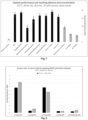
- the alkanoic acid determinations were made by titration and 1 H-NMR. The results are given in Fig. 1 .
- Fig. 1 shows the total weight content of alkanoic acid in relation to the total weight of the decomposition products (Acid concentration [wt.%]) obtained in a catalytic oxidation reaction of spruce chips as a function of the total dry weight content of the spruce chips (Dry matter content of Spruce [wt.%]) in the reaction mixture.
- the results obtained with reaction mixtures processed in the slurry system/liquid continuum with a total dry weight of at most 9.1 wt.% in relation to the total weight of the spruce chips together with the total weight of the solution of the catalyst are shown.
- the results obtained with reaction mixtures processes in gas phase/O 2 continuum with a total dry weight of at least 11.4 wt.% in relation to the total weight of the spruce chips together with the total weight of the solution of the catalyst are shown.
- the total weight of vanadium contained in the catalyst in relation to the total dry weight of the spruce chips is held constant at 1.7 wt.% and 0.39 wt.% in relation to the total dry weight of the spruce chips for HPA-5 (empty circles) and VOSO 4 (empty square), respectively.
- the concentration of the catalyst in the catalyst solution is constant at 1.8 wt.% for VOSO4 and 3.5 wt.% for HPA-5.
- a total weight of vanadium contained in the catalyst in relation to the total dry weight of the spruce chips is variable ranging from 5.5 wt.% to 0.8 wt.% for HPA-5 (filled circles) and from 1.7 wt.% to 0.2 wt.% for VOSO 4 (filled squares), respectively.
- the total weight of vanadium contained in the catalyst in relation to the total dry weight of the spruce chips decreases with an increasing total dry weight of the spruce chips.
- the total weight content of alkanoic acid obtained from the reaction mixtures in the gas phase/O 2 continuum is higher compared to that obtained from the reaction mixtures in the slurry system/liquid continuum.
- the obtained alkanoic acid content increases with an increasing total dry weight content of the spruce chips in relation to the total weight of the spruce chips together with the total weight of the solution of the catalyst.
- Example 10 Catalytic oxidation reaction and remaining dry matter of different solid biogenic materials
- 0.5 g of different dry biogenic materials or dry non-biogenic materials are each mixed with 0.5 g of a catalyst solution containing 1.8 wt.% VOSO 4 such that a total dry weight content of the biogenic material or the non-biogenic material of 50 wt.% in relation to the total weight of the biogenic or non-biogenic material together with the total weight of the solution of the catalyst is obtained in the reaction mixtures.
- the mixtures are each charged into a 10 mL reactor and processed at 127 °C for 16.4 hours at 20 bar O 2 . At the end of the reaction, the remaining dry matter is measured.
- the alkanoic acid content in relation to the total weight of the decomposition products is measured by titration and 1 H-NMR. The results are given in Fig. 2 .
- Fig. 2 shows that the remaining dry-matter content is relatively high for the reaction mixtures containing non-biogenic materials, such as polyester and polyacryl.
- the remaining dry matter content is relatively low for the reaction mixtures containing biogenic materials with a remaining dry matter content of at most 10 wt.%.
- the biogenic materials are effectively decomposed to a relatively high total weight content of alkanoic acid.
- Example 11 Catalytic oxidation reaction of cotton linters as a function of the reaction time and the total dry weight content of the cotton linters
- 0.53 g cotton linters having a total dry weight / total dry matter (DM) content of 25 wt.%, 50 wt.% and only for VOSO 4 also 60 wt.% in relation to the total weight of the cotton linters together with the total weight of the solution of the catalyst are each mixed with a catalyst solution containing 0.05 g and 0.02 g HPA-5 and 0.03 g, 0.01 g and 0.006 g VOSO 4 , respectively.
- DM total dry weight / total dry matter
- the mixture with cotton linters having a DM content of 25 wt.% contained 0.017 gram vanadium per gram dry matter (g V / g DM) which corresponds to a total weight of vanadium in relation to the total dry weight of the cotton linters of 1.7 wt.%.
- the mixture with cotton linters having a DM content of 50 wt.% contained 0.008 g V / g DM which corresponds to a total weight of vanadium in relation to the total dry weight of the cotton linters of 0.8 wt.%.
- the mixture with cotton linters having a DM content of 60 wt.% contained 0.006 g V / g DM, which corresponds to a total weight of vanadium in relation to the total dry weight of the cotton linters of 0.6 wt.%.
- the alkanoic acid determinations were made by titration and 1 H-NMR. The results are given in Fig. 3 in which DM means "dry matter content".
- Fig. 3 shows the total weight content of alkanoic acid in relation to the total weight of the decomposition products (Acid concentration [wt.%]) obtained in a catalytic oxidation reaction of cotton linters as a function of the reaction time (Time [hours]) and the total dry weight content of the cotton linters in the reaction mixture.
- the total weight content of alkanoic acid obtained from the reaction mixtures increases with an increasing total dry weight content of the cotton linters, despite the reduced total weight of vanadium in relation to the total dry weight of the cotton linters. This effect can be observed after 2 hours and increases with increasing reaction time.
- Example 12 Catalytic oxidation reaction of spruce chips as a function of the ratio of the total weight of the catalytic active vanadium contained in HPA-5 and VOSO 4 catalysts
- spruce chips having a total dry weight / total dry matter (DM) content of 89 wt.% in relation to the total weight of the spruce chips are each mixed with a reaction solution containing either an HPA-5 catalyst or a VOSO 4 catalyst.
- the total dry weight of the spruce chips is 45.5 wt.% of the total weight of the spruce chips together with the total weight of the solution of the catalyst.
- the obtained mixtures contained at least 0.004 g V / g DM and at most 0.025 g V / g DM corresponding to a total weight of vanadium in relation to the total dry weight of the spruce chips of at least 0.4 wt.% and at most 2.5 wt.%.
- the total weight content of alkanoic acid obtained from the reaction mixtures containing the HPA-5 catalyst increases with a decreasing total weight of vanadium in relation to the total dry weight of the spruce chips.
- the total weight of vanadium in relation to the total dry weight of the spruce chips does not affect the total weight content of alkanoic acid obtained which remains in the range of 25 wt.% to 30 wt.%.
- the inventors assume that the freely accessible vanadium atoms in dissolved VOSO 4 enable a relatively effective catalytic oxidation of the biogenic material even at relatively low total weight of vanadium in relation to the total dry weight of the spruce chips.
- Example 13 1 H-NMR spectrum of the decomposition products after the catalytic oxidation reaction
- spruce chips having a total dry weight / total dry matter (DM) content of 89 wt.% in relation to the total weight of the spruce chips are mixed with 1.65 g of a catalyst solution containing 3.51 wt.% HPA-5 catalyst.
- the total dry weight of the spruce chips is 22.6 wt.% of the total weight of the spruce chips together with the total weight of the solution of the catalyst.
- the mixture is charged into a 10 mL autoclave and processed at 127 °C for 16.4 hours at 20 bar O 2 . At the end of the reaction, the decomposition products are measured by 1 H-NMR. The results are given in Fig. 5 .
- Fig. 5 the 1 H-NMR spectrum of the decomposition products after the catalytic oxidation reaction is shown.
- the decomposition products comprise water, 19.7 wt.% formic acid and 1.8 wt.% acetic acid.
- Example 14 Catalytic oxidation reaction of spruce chips as a function of the reaction time and the oxygen partial pressure
- Fig. 6 shows the content of alkanoic acid c Acid [wt.%] in relation to the total weight of the decomposition products obtained in a catalytic oxidation reaction of spruce chips as a function of the reaction time and the partial oxygen pressure.
- the content of alkanoic acid obtained from the reaction mixtures increases with an increasing reaction time. Furthermore, the partial oxygen pressure does not affect the total weight content of alkanoic acid obtained from the reaction mixtures. Thus, also relatively low partial oxygen pressures can be applied in order to obtain alkanoic acid.
- 0.55 g of air-dry spruce chips having a total dry weight / total dry matter (DM) content of 90 wt.% in relation to the total weight of the spruce chips are each mixed with 1.45 g of a catalyst solution containing either a vanadium-based or a vanadium-substituted compound.
- the total dry weight of the spruce chips is 25 wt.% of the total weight of the spruce chips together with the total weight of the solution of the catalyst.
- the vanadium-based compound is selected from a group consisting of HPA-5, vanadyl sulfate, sodium metavanadate, vanadyl phosphate, vanadyl acetylacetonate, vanadium pentoxide and the HPA-5 precursor H 9 PV 14 O 42 (Precursor).
- the vanadium-substituted compound is selected from a group consisting of ammonium iron sulfate, copper sulfate and nickel sulfate.
- the catalyst solutions containing the vanadium-based compound each contained 0.007 g of vanadium, respectively.
- the reaction mixtures containing the vanadium-based compounds yielded a total weight content of alkanoic acid in the range of 8 wt.% to 20 wt.%.
- the reaction mixtures containing the vanadium-substituted compounds yielded a total weight content of alkanoic acid in the range of 4 wt.% to 10 wt.%.
- Example 16 Catalytic oxidation reaction of polylactic acid with VOSO 4
- 0.51 g fleece of polylactic acid (PLA) having a total dry weight / total dry matter (DM) content of 99 wt.% in relation to the total weight of the PLA are mixed with 0.485 g of a catalyst solution containing 1.8 wt.% VOSO 4 catalyst.
- the total dry weight of the PLA is 50 wt.% of the total weight of the PLA together with the total weight of the solution of the catalyst.
- the mixture is charged into a 10 mL autoclave and processed at 127 °C for 16.4 hours at 20 bar O 2 . At the end of the reaction, virtually no solid is present. 28.8 wt.% alkanoic acid content in relation to the total weight of the decomposition products is measured.
- the alkanoic acid is composed of 4.2 wt.% formic acid and 24.6 wt.% acetic acid. The alkanoic acid determinations were made by titration and 1 H-NMR.
- Example 17 Increase of alkanoic acid selectivity by applying DMSO
- spruce chips having a total dry weight / total dry matter (DM) content of 90 wt.% in relation to the total weight of the spruce chips are each mixed with 1.45 g of a catalyst solution containing 1.8 wt.% VOSO 4 catalyst in a vessel. Additionally, 5 wt.% DMSO (in relation to the total weight of the complete reaction mixture including the spruce chips and the catalyst solution) were added to one of the vessels.
- the obtained mixtures have in each case a dry matter content of 25 wt.% in relation to the total weight of the spruce chips together with the total weight of the solution of the catalyst.
- the mixtures are charged into a 10 mL autoclave and processed at 127 °C for 16.4 hours at 20 bar O 2 .
- 18.7 wt.% alkanoic acid content in relation to the total weight of the decomposition products is measured for the reference without DSMO and 23.7 wt.% is measured for the reaction in presence of DMSO.
- the alkanoic acid determinations were made by titration and 1H-NMR.
- FA formic acid
- AA acetic acid
- a higher selectivity for alkanoic acid as well as a lower selectivity for CO 2 in case of the DMSO containing assay can be observed.
- the weight ratio between FA : CO 2 shifts from 1 : 1 (reference without DMSO) to 1.5 : 1 in case of the DMSO containing assay.
- Example 18 Processing with different solvents, mixture and catalysts
- 0.55 g of spruce chips having a total dry weight / total dry matter (DM) content of 90 wt.% in relation to the total weight of the spruce chips are each mixed with 1.45 g of a catalyst solution in pure water, in pure DMSO, 5 wt.% DMSO (in relation to the total weight of the complete reaction mixture including the spruce chips and the catalyst solution in water) or 5 wt.% methanol (in relation to the total weight of the complete reaction mixture including the spruce chips and the catalyst solution in water).
Landscapes
- Chemical & Material Sciences (AREA)
- Organic Chemistry (AREA)
- Engineering & Computer Science (AREA)
- Oil, Petroleum & Natural Gas (AREA)
- Catalysts (AREA)
Priority Applications (1)
| Application Number | Priority Date | Filing Date | Title |
|---|---|---|---|
| EP23162609.4A EP4431487A1 (fr) | 2023-03-17 | 2023-03-17 | Procede d'obtention d'un acide alcanoique |
Applications Claiming Priority (1)
| Application Number | Priority Date | Filing Date | Title |
|---|---|---|---|
| EP23162609.4A EP4431487A1 (fr) | 2023-03-17 | 2023-03-17 | Procede d'obtention d'un acide alcanoique |
Publications (1)
| Publication Number | Publication Date |
|---|---|
| EP4431487A1 true EP4431487A1 (fr) | 2024-09-18 |
Family
ID=85705023
Family Applications (1)
| Application Number | Title | Priority Date | Filing Date |
|---|---|---|---|
| EP23162609.4A Pending EP4431487A1 (fr) | 2023-03-17 | 2023-03-17 | Procede d'obtention d'un acide alcanoique |
Country Status (1)
| Country | Link |
|---|---|
| EP (1) | EP4431487A1 (fr) |
Citations (6)
| Publication number | Priority date | Publication date | Assignee | Title |
|---|---|---|---|---|
| WO2012034839A1 (fr) | 2010-09-17 | 2012-03-22 | Jbach Gmbh | Procédé pour la préparation catalytique d'acide formique |
| US20160115091A1 (en) * | 2013-05-14 | 2016-04-28 | Ciris Energy, Inc. | Treatment of Carbonaceous Feedstocks |
| WO2016078698A1 (fr) | 2014-11-18 | 2016-05-26 | Jbach Gmbh | Procédé d'obtention d'un formiate à partir d'un mélange réactionnel |
| WO2016116405A1 (fr) | 2015-01-19 | 2016-07-28 | Jbach Gmbh | Procédé pour séparer de l'acide formique d'un mélange réactionnel |
| WO2016120169A1 (fr) | 2015-01-26 | 2016-08-04 | Jbach Gmbh | Procédé de production catalytique d'acide formique sous une pression partielle d'oxygène inférieure à 1 bar et de recyclage du catalyseur utilisé lors de celui-ci |
| EP3484846A1 (fr) | 2016-07-18 | 2019-05-22 | OxFA GmbH | Procédé de production catalytique d'acide formique et régénération du catalyseur utilisé à cet effet à pression positive réduite |
-
2023
- 2023-03-17 EP EP23162609.4A patent/EP4431487A1/fr active Pending
Patent Citations (6)
| Publication number | Priority date | Publication date | Assignee | Title |
|---|---|---|---|---|
| WO2012034839A1 (fr) | 2010-09-17 | 2012-03-22 | Jbach Gmbh | Procédé pour la préparation catalytique d'acide formique |
| US20160115091A1 (en) * | 2013-05-14 | 2016-04-28 | Ciris Energy, Inc. | Treatment of Carbonaceous Feedstocks |
| WO2016078698A1 (fr) | 2014-11-18 | 2016-05-26 | Jbach Gmbh | Procédé d'obtention d'un formiate à partir d'un mélange réactionnel |
| WO2016116405A1 (fr) | 2015-01-19 | 2016-07-28 | Jbach Gmbh | Procédé pour séparer de l'acide formique d'un mélange réactionnel |
| WO2016120169A1 (fr) | 2015-01-26 | 2016-08-04 | Jbach Gmbh | Procédé de production catalytique d'acide formique sous une pression partielle d'oxygène inférieure à 1 bar et de recyclage du catalyseur utilisé lors de celui-ci |
| EP3484846A1 (fr) | 2016-07-18 | 2019-05-22 | OxFA GmbH | Procédé de production catalytique d'acide formique et régénération du catalyseur utilisé à cet effet à pression positive réduite |
Similar Documents
| Publication | Publication Date | Title |
|---|---|---|
| EP2513080B1 (fr) | Procédé de production de furfural à partir d'un matériau biomassique lignocellulosique | |
| EP3684827B1 (fr) | Polymères ioniques et utilisation associée dans le traitement d'une biomasse | |
| WO2015154258A1 (fr) | Conversion sélective de charge d'alimentation contenant des saccharides en éthylène glycol | |
| JP2015523084A (ja) | バイオマスの超臨界加水分解 | |
| EP2786988B1 (fr) | Procédé de production de monosaccharides, d'oligosaccharides et de furfurals à partir de biomasse | |
| Dai et al. | Multi-strategy in production of high titer gluconic acid by the fermentation of concentrated cellulosic hydrolysate with Gluconobacter oxydans | |
| Tayeh et al. | Subcritical hydrothermal pretreatment of olive mill solid waste for biofuel production | |
| US20170044177A1 (en) | Methods and systems for producing isosorbide from biomass | |
| US20100024810A1 (en) | Decrystallization of cellulosic biomass with an acid mixture comprising phosphoric and sulfuric acids | |
| US20190031797A1 (en) | Ionic polymers and use thereof in processing of biomass | |
| Liao et al. | Optimizing tri-acid mixture hydrolysis: An improved strategy for efficient xylooligosaccharides production from corncob | |
| EP2534123B1 (fr) | Procédé de transformation de biomasse lignocellulosique ou de cellulose par des acides solides de lewis a base de tungstene | |
| CN109896922A (zh) | 一种木质纤维素高效分离并实现全组分利用的方法 | |
| Monção et al. | Salicornia dolichostachya organosolv fractionation: towards establishing a halophyte biorefinery | |
| US8460901B2 (en) | Formic acid treatments of biomass feedstock | |
| US20170292167A1 (en) | Mixed super critical fluid hydrolysis and alcoholysis of cellulose to form glucose and glucose derivatives | |
| KR20100096408A (ko) | 해조류 추출물로부터 불균일계 촉매를 이용한 가수분해를 통해 바이오 연료를 제조하는 방법 | |
| CN114514216A (zh) | 用于产生二醇的木质纤维素进料的预处理 | |
| EP4431487A1 (fr) | Procede d'obtention d'un acide alcanoique | |
| Xiao et al. | Biochemical coupling strategy promotes saccharification of bamboo leaves biomass via xylanase and heteropolyacids | |
| Judiawan et al. | Conversion of hemicellulose from kenaf core fiber to xylose through dilute sulfuric acid hydrolysis | |
| JP2013112661A (ja) | バイオマスからのフルフラールの連続製造方法 | |
| CN107540721B (zh) | 一种基于凹土基催化剂催化纤维木质素的阿魏酸酯制备方法 | |
| JP5805390B2 (ja) | 農産物又は農産副産物からの糖アルコール及び糖の製造方法 | |
| WO2015142399A1 (fr) | Préparation de biomasse |
Legal Events
| Date | Code | Title | Description |
|---|---|---|---|
| PUAI | Public reference made under article 153(3) epc to a published international application that has entered the european phase |
Free format text: ORIGINAL CODE: 0009012 |
|
| STAA | Information on the status of an ep patent application or granted ep patent |
Free format text: STATUS: THE APPLICATION HAS BEEN PUBLISHED |
|
| AK | Designated contracting states |
Kind code of ref document: A1 Designated state(s): AL AT BE BG CH CY CZ DE DK EE ES FI FR GB GR HR HU IE IS IT LI LT LU LV MC ME MK MT NL NO PL PT RO RS SE SI SK SM TR |
|
| STAA | Information on the status of an ep patent application or granted ep patent |
Free format text: STATUS: REQUEST FOR EXAMINATION WAS MADE |
|
| 17P | Request for examination filed |
Effective date: 20250317 |