EP4456671A1 - Wandler für eine leuchtdiodenlast - Google Patents
Wandler für eine leuchtdiodenlast Download PDFInfo
- Publication number
- EP4456671A1 EP4456671A1 EP23170234.1A EP23170234A EP4456671A1 EP 4456671 A1 EP4456671 A1 EP 4456671A1 EP 23170234 A EP23170234 A EP 23170234A EP 4456671 A1 EP4456671 A1 EP 4456671A1
- Authority
- EP
- European Patent Office
- Prior art keywords
- converter
- circuit
- time
- control
- accordance
- Prior art date
- Legal status (The legal status is an assumption and is not a legal conclusion. Google has not performed a legal analysis and makes no representation as to the accuracy of the status listed.)
- Withdrawn
Links
Images



Classifications
-
- H—ELECTRICITY
- H05—ELECTRIC TECHNIQUES NOT OTHERWISE PROVIDED FOR
- H05B—ELECTRIC HEATING; ELECTRIC LIGHT SOURCES NOT OTHERWISE PROVIDED FOR; CIRCUIT ARRANGEMENTS FOR ELECTRIC LIGHT SOURCES, IN GENERAL
- H05B45/00—Circuit arrangements for operating light-emitting diodes [LED]
- H05B45/30—Driver circuits
- H05B45/355—Power factor correction [PFC]; Reactive power compensation
-
- H—ELECTRICITY
- H02—GENERATION; CONVERSION OR DISTRIBUTION OF ELECTRIC POWER
- H02M—APPARATUS FOR CONVERSION BETWEEN AC AND AC, BETWEEN AC AND DC, OR BETWEEN DC AND DC, AND FOR USE WITH MAINS OR SIMILAR POWER SUPPLY SYSTEMS; CONVERSION OF DC OR AC INPUT POWER INTO SURGE OUTPUT POWER; CONTROL OR REGULATION THEREOF
- H02M1/00—Details of apparatus for conversion
- H02M1/32—Means for protecting converters other than automatic disconnection
- H02M1/34—Snubber circuits
- H02M1/342—Active non-dissipative snubbers
-
- H—ELECTRICITY
- H02—GENERATION; CONVERSION OR DISTRIBUTION OF ELECTRIC POWER
- H02M—APPARATUS FOR CONVERSION BETWEEN AC AND AC, BETWEEN AC AND DC, OR BETWEEN DC AND DC, AND FOR USE WITH MAINS OR SIMILAR POWER SUPPLY SYSTEMS; CONVERSION OF DC OR AC INPUT POWER INTO SURGE OUTPUT POWER; CONTROL OR REGULATION THEREOF
- H02M1/00—Details of apparatus for conversion
- H02M1/38—Means for preventing simultaneous conduction of switches
-
- H—ELECTRICITY
- H02—GENERATION; CONVERSION OR DISTRIBUTION OF ELECTRIC POWER
- H02M—APPARATUS FOR CONVERSION BETWEEN AC AND AC, BETWEEN AC AND DC, OR BETWEEN DC AND DC, AND FOR USE WITH MAINS OR SIMILAR POWER SUPPLY SYSTEMS; CONVERSION OF DC OR AC INPUT POWER INTO SURGE OUTPUT POWER; CONTROL OR REGULATION THEREOF
- H02M1/00—Details of apparatus for conversion
- H02M1/42—Circuits or arrangements for compensating for or adjusting power factor in converters or inverters
- H02M1/4208—Arrangements for improving power factor of AC input
- H02M1/4258—Arrangements for improving power factor of AC input using a single converter stage both for correction of AC input power factor and generation of a regulated and galvanically isolated DC output voltage
-
- H—ELECTRICITY
- H05—ELECTRIC TECHNIQUES NOT OTHERWISE PROVIDED FOR
- H05B—ELECTRIC HEATING; ELECTRIC LIGHT SOURCES NOT OTHERWISE PROVIDED FOR; CIRCUIT ARRANGEMENTS FOR ELECTRIC LIGHT SOURCES, IN GENERAL
- H05B45/00—Circuit arrangements for operating light-emitting diodes [LED]
- H05B45/30—Driver circuits
- H05B45/32—Pulse-control circuits
- H05B45/325—Pulse-width modulation [PWM]
-
- H—ELECTRICITY
- H05—ELECTRIC TECHNIQUES NOT OTHERWISE PROVIDED FOR
- H05B—ELECTRIC HEATING; ELECTRIC LIGHT SOURCES NOT OTHERWISE PROVIDED FOR; CIRCUIT ARRANGEMENTS FOR ELECTRIC LIGHT SOURCES, IN GENERAL
- H05B45/00—Circuit arrangements for operating light-emitting diodes [LED]
- H05B45/30—Driver circuits
- H05B45/37—Converter circuits
- H05B45/3725—Switched mode power supply [SMPS]
- H05B45/38—Switched mode power supply [SMPS] using boost topology
-
- H—ELECTRICITY
- H05—ELECTRIC TECHNIQUES NOT OTHERWISE PROVIDED FOR
- H05B—ELECTRIC HEATING; ELECTRIC LIGHT SOURCES NOT OTHERWISE PROVIDED FOR; CIRCUIT ARRANGEMENTS FOR ELECTRIC LIGHT SOURCES, IN GENERAL
- H05B45/00—Circuit arrangements for operating light-emitting diodes [LED]
- H05B45/30—Driver circuits
- H05B45/37—Converter circuits
- H05B45/3725—Switched mode power supply [SMPS]
- H05B45/385—Switched mode power supply [SMPS] using flyback topology
Definitions
- the present disclosure relates to lighting technology, and in particular, to a converter for a light-emitting diode (LED) load, and a luminaire based thereon.
- LED light-emitting diode
- PFC Power factor correction circuits attempt to maximize a power factor of a connected load by drawing from an alternating current (AC) power supply an AC current that corresponds in amplitude curve and phase to the supplied AC voltage, thereby minimizing a Total Harmonic Distortion (THD).
- AC alternating current
- TDD Total Harmonic Distortion
- Such PFC circuits typically make use of peak-current control, since an average-current control needs a more complicate current sensing.
- Integrated circuits (ICs) for analog peak-current control do not avoid or reduce said plateau, whereas ICs for digital peak-current control typically increase an on-time of a power switch of the PFC circuit close to the zero-crossings via calculations or table-based loop-up.
- a parameterization of such solutions is difficult because of their relatively complicated design, and for higher switching frequencies multiple look-up tables may be needed.
- a first aspect of the present disclosure relates to a converter for an LED load.
- the converter comprises a power factor correction, PFC, circuit.
- the PFC circuit comprises a series connection of an inductance and a power switch; and a control circuit.
- the control circuit is configured to regulate an output voltage of the PFC circuit in accordance with a current through the series connection and a peak current envelope for the same; and to offset the peak current envelope by a direct current, DC, component that depends on an output power of the PFC circuit.
- the peak current envelope may depend on a control variable of the control circuit.
- the control variable may depend on a differential of the output voltage and its reference variable, and on a multiplicative fraction of a rectified input voltage of the PFC circuit.
- the DC component may depend on the control variable of the control circuit, a constant coefficient of the control variable, and a constant offset of the DC component.
- the constant coefficient and the constant offset may be derived from simulations or measurements at a minimum value and a maximum value of the output power of the PFC circuit.
- the control circuit may comprise a proportional integral, PI, controller, being configured to provide the control variable of the control circuit in dependence of the differential of the output voltage and its reference variable.
- PI proportional integral
- the control circuit may comprise a pulse width modulation, PWM, signal generator, being configured to provide a first PWM control signal for the power switch in accordance with the control variable, the current through the series connection and the peak current envelope for the same.
- PWM pulse width modulation
- An on-time of the first PWM control signal may depend on a given minimum on-time, on a given maximum on-time, and on an instant of on-time expiration when the current through the series connection exceeds the peak current envelope for the same.
- the PFC circuit may comprise a Boost converter; and the first PWM control signal may be in accordance with one of: a discontinuous conduction mode, DCM, and a borderline conduction mode, BCM.
- the PFC circuit may comprise a Flyback converter.
- the Flyback converter may comprise a further series connection of a clamp switch and a clamp capacitance in parallel with the inductance.
- the PWM signal generator may further be configured to provide a second PWM control signal for the clamp switch.
- An on-time of the second PWM control signal may depend on a given on-time.
- the on-times of the first and second PWM control signals may be mutually exclusive in accordance with a dead-time depending on a given minimum dead-time, and on an instant of dead-time expiration when a time derivative of a drain-source voltage of a last active switch of the power switch and the clamp switch becomes zero.
- a second aspect of the present disclosure relates to a luminaire, comprising an LED load and a converter of the first aspect.
- a DC component that depends on the output power of the PFC circuit provides a simple control scheme for good THD over a wide output power range.
- the DC component proposed herein comprises a constant coefficient and a constant offset wherein both constants are derived from simulations or measurements at a minimum value and a maximum value of the output power of the PFC circuit.
- the constants themselves are independent of the output voltage of the PFC stage but do capture the dependency of the DC component of the output voltage by a simple parameterization.
- the parameterized DC component avoids or at least reduces the non-zero voltage plateau across the EMI capacitor around the zero-crossings of the supplied AC voltage for the whole output power range, ultimately resulting in a low THD.
- the switching frequency may be increased and a size of passive components may be reduced.
- FIG. 1 illustrates a luminaire 3 in accordance with the present disclosure.
- the luminaire 3 comprises an LED load 2, R 11 and a converter 1 for the LED load 2, R 11 .
- the LED load 2, R 11 may comprise one or more LEDs in series and/or in parallel, depending on the lighting scenario.
- FIG. 2 illustrates a converter 1 in accordance with the present disclosure.
- the converter 1 comprises a PFC circuit/stage 11 and may further comprise a DC-DC converter/stage 12.
- FIG. 3 illustrates a PFC circuit 11 in accordance with the present disclosure.
- PFC may refer to a maximization of a power factor of a connected load by drawing from an AC power supply an AC current that corresponds in amplitude curve and phase to the supplied AC voltage, thereby minimizing a THD.
- a power factor of an AC circuit may refer to a ratio of a real power absorbed by a connected load to an apparent power flowing in the circuit.
- a THD may refer to a ratio of a sum of powers of all harmonic frequency components to a power of the fundamental frequency.
- the PFC circuit 11 comprises a Flyback converter.
- a Boost converter (not shown) being operated in accordance with modes of operation such as a discontinuous conduction mode (DCM) or a borderline conduction mode (BCM) may be deployed as well.
- DCM discontinuous conduction mode
- BCM borderline conduction mode
- the PFC circuit 11 comprises a series connection 111, 112 of an inductance 111 and a power switch 112.
- the inductance 111 may be modelled as a parallel circuit of a magnetizing inductance L 2 and a primary inductance L 4 of an ideal transformer, for example.
- the power switch 112 may in particular comprise a power semiconductor switch, such as a power metal-oxide-semiconductor field-effect transistor (MOSFET).
- MOSFET power metal-oxide-semiconductor field-effect transistor
- the PFC circuit 11 further comprises a control circuit 113.
- the control circuit 113 is configured to regulate an output voltage 114, V out of the PFC circuit 11 in accordance with a current 115, I through the series connection 111, 112 and a peak current envelope 116, Î for the same.
- the output voltage 114, V out may be tapped off at the LED load 2, R 11 being connected to an output port of the PFC circuit 11, the current 115, I through the series connection 111, 112 may be captured by means of a ground-referenced current sensing resistor R 10 in series to the power switch 112, and the peak current envelope 116, Î for the current 115, I may be provided by a ground-referenced resistive voltage divider R 2 , R 3 in parallel to an EMI capacitor C 4 .
- the control circuit 113 may comprise a proportional integral (PI) controller 1131 and a PWM signal generator 1132.
- PI proportional integral
- PWM may refer to a continual on-off modulation of an electrical quantity, such as a voltage, by a switch, in accordance with a particular mode of operation of the superordinate circuit.
- a PFC circuit may involve a PWM in accordance with modes of operation such as the DCM, the BCM or a continuous conduction mode (CCM).
- modes of operation such as the DCM, the BCM or a continuous conduction mode (CCM).
- the PWM signal generator 1132 may be configured to provide a first PWM control signal for the power switch 112 in accordance with a control variable 119, R of the control circuit 113, the current 115, I through the series connection 111, 112 and the peak current envelope 116, Î for the same.
- the PI controller 1131 may be configured to provide the control variable 119, R of the control circuit 113 in dependence of a differential V out - V out_ref of the output voltage 114, V out and its reference variable V out_ref .
- the peak current envelope 116, Î C ⁇
- ⁇ R ( V out - V out_ref ) may depend on the control variable 119, R of the control circuit 113 and on a multiplicative fraction C of a rectified input voltage C ⁇
- the multiplicative fraction C may correspond to a given ratio R 2 R 2 + R 3 defined by the above-mentioned resistive voltage divider R 2 , R 3 .
- the control circuit 113 is further configured to offset the peak current envelope 116, Î by a DC component 117, Î DC that depends on an output power of the PFC circuit 11.
- the constant coefficient k and the constant offset d may be derived from simulations or measurements at a minimum value and a maximum value of the output power of the PFC circuit 11, thereby capturing the dependency of the DC component 117, Î DC on the output power of the PFC circuit 11 over the whole output power range.
- the Flyback converter may comprise a further series connection 120, 121 of a clamp switch 120 and a clamp capacitance 121 in parallel with the inductance 111, thereby ending up with an active clamp Flyback (ACF) converter.
- ACF active clamp Flyback
- the PWM signal generator 1132 may further be configured to provide a second PWM control signal for the clamp switch 120.
- the floating electric reference potential of the clamp switch 120 may require a so-called high-side drive circuit, such as the one illustrated in FIG. 4 being operable in a transforming manner.
- FIG. 4 illustrates an exemplary implementation of a drive circuit 123 for the clamp switch 120 including an ancillary transformer 131, 132, which may be connected to the PWM signal generator 1132 (see FIG. 3 ) and configured to transform a drive current I SW2 in terms of its electric potential.
- an ancillary transformer 131, 132 which may be connected to the PWM signal generator 1132 (see FIG. 3 ) and configured to transform a drive current I SW2 in terms of its electric potential.
- the (transformed) drive current I SW2 includes alternating trains of positive current pulses and negative current pulses.
- the clamp switch 120 is operable in accordance with the transformed drive current I SW2 .
- the drive circuit 123 may further comprise a circuitry for conditioning of the transformed drive current I SW2 into a control signal V SW2 of the clamp switch 120.
- the conditioning circuitry is configured to convert each train of positive current pulses into a positive voltage pulse of the control signal V SW2 , wherein a time duration of the positive voltage pulse corresponds to a time duration of the underlying train of positive current pulses.
- the conditioning circuitry is further configured to convert each train of negative current pulses into a zero line voltage of the control signal V SW2 , wherein a time duration of the zero line voltage corresponds to a time duration of the underlying train of negative current pulses.
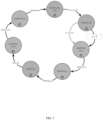
- FIG. 5 illustrates a state diagram of the PFC circuit 11 in accordance with the present disclosure.
- the PWM signal generator 1132 may be configured to provide a first PWM control signal for the power switch 112 and may further be configured to provide a second PWM control signal for the clamp switch 120.
- an on-time of the first PWM control signal may depend on a given minimum on-time t ON_LS_min , on a given maximum on-time t ON_LS_max , and on an instant of on-time expiration when the current 115, I through the series connection 111, 112 exceeds the peak current envelope 116, Î for the same. This corresponds to the peak-current control of the power switch 112.
- an on-time of the second PWM control signal may depend on a given on-time t ON_HS . This corresponds to an active clamping of the inductance 111, thereby supplying the energy stored in a leakage inductance (not shown) of the inductance 111 to the LED load 2, R 11 and improving a converter efficiency.
- a peak voltage across the power switch 112 during its turn-off events may be reduced significantly, resulting in a lower voltage rating of the power switch 112.
- the on-times of the first and second PWM control signals may be mutually exclusive in accordance with a dead-time depending on a given minimum dead-time t dead_min , and on an instant of dead-time expiration when a time derivative d dt of a drain-source voltage V ds of a last active switch of the power switch 112 and the clamp switch 120 becomes zero. More specifically, in states 43 to 45 the power switch 112 was last active, whereas in states 46 to 41 the clamp switch 120 was last active. Note that a dead time when the power switch 112 was last active may be different from a dead time when the clamp switch 120 was last active.
- FIG. 6 illustrates a various electrical quantities of the PFC circuit 11 in accordance with the present disclosure.
- FIG. 6 A top diagram of FIG. 6 shows a control variable 119, R of the control circuit 113 and a DC component 117, Î DC of the peak current envelope 116, Î vs. LED load 2, R 11 , whereas a bottom diagram of FIG. 6 depicts the regulated output voltage 114, V out and an output power 118, P of the PFC circuit 11 vs. LED load 2, R 11 .
- the output power 118, P V out 2 R 11 declines inversely proportional to the LED load 2, R 11 , as may be expected in connection with the regulated output voltage 114, V out .
- the control variable 119, R shows a similar decline vs. the LED load 2, R 11 .
- the DC component 117, Î DC depending on the control variable 119, R rises with increasing LED load 2, R 11 and approaches an asymptotic value. It may be established that the DC component 117, Î DC varies with / depends on LED load 2, R 11 , or alternatively on the output power 118, P.
- an increase in the output power 118, P therefore coincides with a decrease in the DC component 117, Î DC , and vice versa.
Landscapes
- Engineering & Computer Science (AREA)
- Power Engineering (AREA)
- Dc-Dc Converters (AREA)
- Rectifiers (AREA)
Priority Applications (3)
| Application Number | Priority Date | Filing Date | Title |
|---|---|---|---|
| EP23170234.1A EP4456671A1 (de) | 2023-04-27 | 2023-04-27 | Wandler für eine leuchtdiodenlast |
| EP24722030.4A EP4666813A1 (de) | 2023-04-27 | 2024-04-26 | Umrichter für eine leuchtdiodenlast |
| PCT/EP2024/061494 WO2024223798A1 (en) | 2023-04-27 | 2024-04-26 | Converter for a light-emitting diode load |
Applications Claiming Priority (1)
| Application Number | Priority Date | Filing Date | Title |
|---|---|---|---|
| EP23170234.1A EP4456671A1 (de) | 2023-04-27 | 2023-04-27 | Wandler für eine leuchtdiodenlast |
Publications (1)
| Publication Number | Publication Date |
|---|---|
| EP4456671A1 true EP4456671A1 (de) | 2024-10-30 |
Family
ID=86272297
Family Applications (2)
| Application Number | Title | Priority Date | Filing Date |
|---|---|---|---|
| EP23170234.1A Withdrawn EP4456671A1 (de) | 2023-04-27 | 2023-04-27 | Wandler für eine leuchtdiodenlast |
| EP24722030.4A Pending EP4666813A1 (de) | 2023-04-27 | 2024-04-26 | Umrichter für eine leuchtdiodenlast |
Family Applications After (1)
| Application Number | Title | Priority Date | Filing Date |
|---|---|---|---|
| EP24722030.4A Pending EP4666813A1 (de) | 2023-04-27 | 2024-04-26 | Umrichter für eine leuchtdiodenlast |
Country Status (2)
| Country | Link |
|---|---|
| EP (2) | EP4456671A1 (de) |
| WO (1) | WO2024223798A1 (de) |
Citations (5)
| Publication number | Priority date | Publication date | Assignee | Title |
|---|---|---|---|---|
| US4437146A (en) * | 1982-08-09 | 1984-03-13 | Pacific Electro Dynamics, Inc. | Boost power supply having power factor correction circuit |
| US20120176101A1 (en) * | 2011-01-07 | 2012-07-12 | Tdk-Lambda Uk Limited | Power Factor Correction Device |
| WO2014009773A1 (en) * | 2012-07-11 | 2014-01-16 | Roal Electronics S.P.A. | Control circuit for reducing of total harmonic distortion (thd) in the power supply to an electric load |
| US9621029B2 (en) * | 2015-03-18 | 2017-04-11 | Stmicroelectronics S.R.L. | Method and device for high-power-factor flyback converter |
| EP3736959A1 (de) * | 2019-05-09 | 2020-11-11 | Tridonic GmbH & Co. KG | Resonanter hb-wandler |
Family Cites Families (2)
| Publication number | Priority date | Publication date | Assignee | Title |
|---|---|---|---|---|
| KR101357727B1 (ko) * | 2011-09-08 | 2014-02-06 | 주식회사 동부하이텍 | Led 구동장치를 위한 절연형 플라이백 변환회로 |
| US20210399643A1 (en) * | 2020-06-17 | 2021-12-23 | Apple Inc. | Active Clamp Resonant Flyback Converter with Integrated Boost Stage |
-
2023
- 2023-04-27 EP EP23170234.1A patent/EP4456671A1/de not_active Withdrawn
-
2024
- 2024-04-26 EP EP24722030.4A patent/EP4666813A1/de active Pending
- 2024-04-26 WO PCT/EP2024/061494 patent/WO2024223798A1/en not_active Ceased
Patent Citations (5)
| Publication number | Priority date | Publication date | Assignee | Title |
|---|---|---|---|---|
| US4437146A (en) * | 1982-08-09 | 1984-03-13 | Pacific Electro Dynamics, Inc. | Boost power supply having power factor correction circuit |
| US20120176101A1 (en) * | 2011-01-07 | 2012-07-12 | Tdk-Lambda Uk Limited | Power Factor Correction Device |
| WO2014009773A1 (en) * | 2012-07-11 | 2014-01-16 | Roal Electronics S.P.A. | Control circuit for reducing of total harmonic distortion (thd) in the power supply to an electric load |
| US9621029B2 (en) * | 2015-03-18 | 2017-04-11 | Stmicroelectronics S.R.L. | Method and device for high-power-factor flyback converter |
| EP3736959A1 (de) * | 2019-05-09 | 2020-11-11 | Tridonic GmbH & Co. KG | Resonanter hb-wandler |
Non-Patent Citations (1)
| Title |
|---|
| SEBASTIAN J ET AL: "Improving power factor correction in distributed power supply systems using PWM and ZCS-QR SEPIC topologies", PROCEEDINGS OF THE ANNUAL POWER ELECTRONICS SPECIALISTS CONFERENCE. MASSACHUSETTS, 25 - 27 JUNE, 1991; [PROCEEDINGS OF THE ANNUAL POWER ELECTRONICS SPECIALISTS CONFERENCE], NEW YORK, IEEE, US, vol. CONF. 22, 24 June 1991 (1991-06-24), pages 780 - 791, XP010048400, ISBN: 978-0-7803-0090-3, DOI: 10.1109/PESC.1991.162764 * |
Also Published As
| Publication number | Publication date |
|---|---|
| WO2024223798A1 (en) | 2024-10-31 |
| EP4666813A1 (de) | 2025-12-24 |
Similar Documents
| Publication | Publication Date | Title |
|---|---|---|
| US10015849B2 (en) | Ripple cancellation converter with high power factor | |
| EP3437178B1 (de) | Wechselstrom/gleichstrom-pfc-wandler mit verwendung eines halbbrückenresonanzwandlers und zugehöriges umwandlungsverfahren | |
| US8493757B2 (en) | AC/DC converter with a PFC and a DC/DC converter | |
| CN101282079B (zh) | 用于功率控制器的系统和方法 | |
| CN108539984B (zh) | 开关电源电路的pfwm控制系统 | |
| US8503204B2 (en) | Power converter circuit | |
| US20100259240A1 (en) | Bridgeless PFC converter | |
| US20180004240A1 (en) | Device and method for quasi-resonant-mode voltage control of a switching converter | |
| US10256712B2 (en) | Current ripple sensing controller for a single-stage LED driver | |
| WO2013074220A1 (en) | Led power source with over-voltage protection | |
| EP3895298A1 (de) | Wechselstrom-gleichstrom-wandler mit leistungsfaktorkorrektur | |
| US20100259957A1 (en) | Bridgeless pfc circuit for critical continuous current mode and controlling method thereof | |
| CN1293885A (zh) | 有功率因数校正功能的灯用电子镇流器 | |
| Luewisuthichat et al. | Analysis and implement DC-DC integrated boost-flyback converter with LED street light stand-by application | |
| US10581321B1 (en) | Flyback converter with multiplier signal control circuit and method | |
| US6819575B1 (en) | AC/DC switch mode power supply with power factor correction using direct energy transfer concept | |
| EP4456671A1 (de) | Wandler für eine leuchtdiodenlast | |
| KR101609726B1 (ko) | 고역률 스위칭 정류기의 제어회로 | |
| KR100420964B1 (ko) | 역률보상 단일단 컨버터 | |
| CN106413202A (zh) | 基于SEPIC与Flyback电路的原边控制LED驱动电路 | |
| CN113872455B (zh) | 电负载供电装置的升压转换器及供电装置和在电负载供电装置中将输入电压升压的方法 | |
| US20140002035A1 (en) | Common-core power factor correction resonant converter | |
| KR20190019547A (ko) | 간단한 고역률 스위칭 정류기의 제어회로 | |
| WO2006137744A1 (en) | Control method and device for a converter using a three-state switching cell | |
| Farcas et al. | A novel topology based on forward converter with passive power factor correction |
Legal Events
| Date | Code | Title | Description |
|---|---|---|---|
| PUAI | Public reference made under article 153(3) epc to a published international application that has entered the european phase |
Free format text: ORIGINAL CODE: 0009012 |
|
| STAA | Information on the status of an ep patent application or granted ep patent |
Free format text: STATUS: THE APPLICATION HAS BEEN PUBLISHED |
|
| AK | Designated contracting states |
Kind code of ref document: A1 Designated state(s): AL AT BE BG CH CY CZ DE DK EE ES FI FR GB GR HR HU IE IS IT LI LT LU LV MC ME MK MT NL NO PL PT RO RS SE SI SK SM TR |
|
| STAA | Information on the status of an ep patent application or granted ep patent |
Free format text: STATUS: THE APPLICATION IS DEEMED TO BE WITHDRAWN |
|
| 18D | Application deemed to be withdrawn |
Effective date: 20250501 |