EP4461704A1 - Procédé de production de carbonate d'ammonium et de carbonate de sodium - Google Patents
Procédé de production de carbonate d'ammonium et de carbonate de sodium Download PDFInfo
- Publication number
- EP4461704A1 EP4461704A1 EP23172803.1A EP23172803A EP4461704A1 EP 4461704 A1 EP4461704 A1 EP 4461704A1 EP 23172803 A EP23172803 A EP 23172803A EP 4461704 A1 EP4461704 A1 EP 4461704A1
- Authority
- EP
- European Patent Office
- Prior art keywords
- chamber
- base chamber
- process according
- solution
- aqueous solution
- Prior art date
- Legal status (The legal status is an assumption and is not a legal conclusion. Google has not performed a legal analysis and makes no representation as to the accuracy of the status listed.)
- Withdrawn
Links
Images
Classifications
-
- B—PERFORMING OPERATIONS; TRANSPORTING
- B01—PHYSICAL OR CHEMICAL PROCESSES OR APPARATUS IN GENERAL
- B01D—SEPARATION
- B01D61/00—Processes of separation using semi-permeable membranes, e.g. dialysis, osmosis or ultrafiltration; Apparatus, accessories or auxiliary operations specially adapted therefor
- B01D61/42—Electrodialysis; Electro-osmosis ; Electro-ultrafiltration; Membrane capacitive deionization
- B01D61/44—Ion-selective electrodialysis
- B01D61/445—Ion-selective electrodialysis with bipolar membranes; Water splitting
-
- B—PERFORMING OPERATIONS; TRANSPORTING
- B01—PHYSICAL OR CHEMICAL PROCESSES OR APPARATUS IN GENERAL
- B01D—SEPARATION
- B01D61/00—Processes of separation using semi-permeable membranes, e.g. dialysis, osmosis or ultrafiltration; Apparatus, accessories or auxiliary operations specially adapted therefor
- B01D61/42—Electrodialysis; Electro-osmosis ; Electro-ultrafiltration; Membrane capacitive deionization
- B01D61/44—Ion-selective electrodialysis
- B01D61/46—Apparatus therefor
- B01D61/465—Apparatus therefor comprising the membrane sequence AB or BA, where B is a bipolar membrane
-
- C—CHEMISTRY; METALLURGY
- C01—INORGANIC CHEMISTRY
- C01C—AMMONIA; CYANOGEN; COMPOUNDS THEREOF
- C01C1/00—Ammonia; Compounds thereof
- C01C1/26—Carbonates or bicarbonates of ammonium
-
- C—CHEMISTRY; METALLURGY
- C01—INORGANIC CHEMISTRY
- C01D—COMPOUNDS OF ALKALI METALS, i.e. LITHIUM, SODIUM, POTASSIUM, RUBIDIUM, CAESIUM, OR FRANCIUM
- C01D7/00—Carbonates of sodium, potassium or alkali metals in general
- C01D7/18—Preparation by the ammonia-soda process
Definitions
- the present invention relates to a process for producing (NH 4 ) 2 CO 3 and Na 2 CO 3 from an aqueous solution comprising ammonium chloride, sodium chloride, and dissolved CO 2 using an electrodialyzer cellstack.
- the major industrial process for the production of synthetic sodium carbonate is the soda ash process, also known as SOLVAY process (ammonia-soda process) or, in a modified embodiment as HOU process.
- This process consists in treating an ammoniacal brine with gas containing carbon dioxide. From the solution sodium bicarbonate precipitates, is recovered and calcined to obtain sodium carbonate.
- the mother liquid obtained from the sodium bicarbonate separation contains ammonium chloride and sodium chloride. The mother liquid is then reacted either with calcium oxide or with calcium hydroxide to obtain ammonia, which is recycled back to the initial brine solution in the ammonia-soda process or treated to precipitate solid NH 4 Cl in the HOU process.
- a process for obtaining chemicals from the waste process water of the soda ash process, and in particular, from the mother liquid obtained after sodium bicarbonate filtration and containing ammonium chloride and sodium chloride, is described in Austrian Patent No. AT 96/01330 .
- the sodium and ammonium ions are separated from the chloride ions, and the ions so separated, together with the relevant counter-ions of the water dissociation are converted into sodium hydroxide, ammonium hydroxide, ammonia and hydrochloric acid, respectfully.
- the separation of the sodium and ammonium ions from the chloride ions is conducted by electrodialysis.
- the electrodialysis is conducted using at least three chambers (see Fig.
- An alternative embodiment of this disclosure uses only two chambers that are separated alternatively with a bipolar membrane and a cationic selective membrane to obtain one flow containing: hydrochloric acid, sodium chloride and ammonium chloride, and a second flow containing ammonium hydroxide and sodium hydroxide.
- the solution entering the base chamber is deprived of carbon dioxide.
- Electrodialysis technologies are well known and are mainly used for electro-separation processes, such as the production of drinkable water, sea water desalination, brackish desalination water, industrial waste water treatments, acid or alkali recovery in metal plating industries, food and pharmaceuticals processes. Electrodialysis principles are well described for instance in Ullmann's Encyclopedia of Industrial Chemistry (2011 edition, Wendt, -VCH Verlag GmbH & Co, Vol. 12 pp 273-313, Electrochemistry ), or in Technique de l'Ingur Encyclopedia 2006 edition, (Chapter Electrodialyse, J2840 V1, 2006, pp 1-15 and Technical appendixes pp 1-3 ).
- WO2016/055367 in the name of SOLVAY describes a process for producing ammonia from a solution comprising ammonium chloride (NH 4 Cl) fed in at least one base chamber of an electrodialyzer cellstack, said base chamber being maintained at a pH of at least 10, preferably maintained in the range between 10.3 to 12.0.
- Example in this disclosure shows the possibility to convert at least 98.5% of ammonium chloride (NH 4 Cl) into ammonia (NH 4 OH); as in the same conditions maintaining the base chamber at pH 9.8 the conversion of ammonium chloride to ammonia decreases to 86.5%.
- ammonium ions (NH 4 + ) leaks from the base chamber to the acid chamber through the selective membranes, generating then acid solutions comprising ammonium ions that are detrimental for specific uses when the said acid solution is valorized as acid, or when it is discharged in the environment after neutralization.
- ammonia is toxic to most aquatic species, and is difficult and it is costly, when present at low concentration, to strip it with steam, or to oxidize by photo-catalytic techniques, or to treat by biological treatment that are expensive.
- the present inventors found that ammonia leak through electrodialyzer membranes of a base chamber fed with an aqueous solution comprising NH 4 Cl, NaCl, and dissolved CO 2 , is strongly reduced or eliminated by maintaining the pH in the base chamber to less than 9.5.
- the presence of dissolved CO 2 may be provided by carbonating with a CO 2 containing gas at least part of the NH 4 Cl and NaCl solution upstream the base chamber, so that the resulting solution comprises NH 4 Cl, NaCl, and dissolved CO 2 before feeding the aqueous solution in the base chamber.
- the present invention relates to a process for producing (NH 4 ) 2 CO 3 and Na 2 CO 3 in an electrodialyzer cellstack by feeding a base chamber of the electrodialyzer cellstack with an aqueous solution comprising NH 4 Cl, NaCl, dissolved CO 2 and obtaining an outlet solution from the base chamber comprising (NH 4 ) 2 CO 3 and Na 2 CO 3 , and wherein the pH of the outlet solution from the base chamber is at most 9.5.
- the invention relates also to a process for producing sodium carbonate by a soda ash process, comprising the step of producing (NH 4 ) 2 CO 3 and Na 2 CO 3 , using the above process,
- Electrodialysis is a technique that consists in combining, within a set of adjoining chambers, bipolar ion-exchange membranes with anionic and/or cationic ion-exchange membranes.
- the anionic membranes are ion-exchange membranes that are permeable to anions and, ideally, impermeable to cations.
- the cationic membranes are themselves permeable to cations and impermeable to anions.
- a bipolar membrane is an ion-exchange membrane comprising a cationic face and an anionic face. Such membranes may be produced by joining a cationic membrane and an anionic membrane.
- the bipolar membrane may for example be produced by the process described in WO 01/79335 in the name of SOLVAY.
- bipolar membrane Under the action of a sufficient local electric field, the dissociation of the water that has diffused therein, to its H + and OH - ions takes places which ions then migrate on both sides of this membrane. There is therefore acidification in one of the chambers adjacent to the bipolar membrane and alkalinization in the other adjacent chamber. Successive bipolar membranes are separated by cationic or anionic monopolar membranes.
- the electrodialyzer only possesses bipolar membranes and one type of monopolar membranes (cationic or anionic), they are said to have two (types of) chambers.
- the electrodialyzer used in the process of the present invention possesses preferably only bipolar and anionic membranes.
- the chamber located between the anionic face of the bipolar membrane and an anionic membrane constitutes a base chamber.
- this chamber there is a supply of OH - ions originating from the bipolar membrane.
- the base chamber is fed with the aqueous solution comprising ammonium chloride, sodium chloride and dissolved CO 2 .
- the OH - ions supplied from the bipolar membrane will react with the ammonium cations to yield the desired ammonia and water.
- the dissolved CO 2 in the solution comprising NH 4 Cl and NaCl fed in the base chamber, at pH of at most 9.5 are generally present as bicarbonate ions (HCO 3 - ) and carbonate ions (CO 3 2- ).
- Counter ions of the bicarbonate ions being the cation present in the aqueous solution such as ammonium (NH 4 +), sodium (Na + ), and in less extent hydronium ions (H 3 O + ).
- a first advantage of the present invention is the reduced amount of ammonium ions loss through the membranes of the base chamber(s) dialyzer cellstack.
- a second advantage of the present invention linked to the first advantage is the limited amount of ammonium ions transferred into adjacent acidic chamber(s) that eases the valorization of the produced acid solutions with a reduced amount of ammonium impurities in it.
- a third advantage of the present invention is to ease the use of the acid produced in the electrodialyzer cellstack, to reduce the cost of treatment of the acids solutions after their use to remove ammonia, and also reduce the environmental impact towards fish and aquatic flora, when releasing the used acids in rivers and sea after said appropriate treatment, as ammonia is detrimental for such living species in nature.
- a fourth advantage of the present invention is to increase the sustainability of processes for producing sodium carbonate according to the ammonia-soda ash process, by reducing the CO 2 emissions from fossil fuels.
- the present invention enables to replace, partly or totally, the use of lime (CaO) to regenerate the ammonium chloride (NH 4 Cl) into alkaline ammonia (in present invention as (NH 4 ) 2 CO 3 ), by an electrodialysis process that can use ⁇ green electricity' (ie. produced from solar, wind, geothermal, biogas, and low impact hydroelectric sources).
- lime (CaO) in conventional soda ash process is manufactured mainly in limekilns wherein calcium carbonate (limestone) is calcined by using fossil carbon sources such as coke.
- a fifth advantage of the present invention which is an advantageous embodiment, no limekiln is used for the production of the ammonium carbonate or the sodium carbonate in the present process. This enables to avoid such equipment operating at high temperature that is costly to build, and to decrease the associated maintenance costs.
- a sixth advantage of the present invention is to decrease solid effluents from the ammonia distillation, as when using lime, or milk of lime, in distillation sectors, part of unreacted lime or limestone remain in the solid effluents.
- a limestone attack with an acid solution enables to generate the needed carbon dioxide, with minimal unreacted limestone in the final solid effluent.
- a seventh advantage of the present invention is also to increase the yield in the ammonia-soda process of the sodium use of sodium chloride (NaCl) from 60 to 70% to figures of more than 90% or 95%.
- NaCl sodium chloride
- anionic membranes in the present process enables to migrate chlorides from NH4Cl and NaCl into acidic solution (ie solutions comprising HCl) while keeping the sodium ions in the base chamber and to recycle part of the outlet solution into a soda ash process. Therefore, the process of present invention enables to improve the circularity of the use of raw material such as sodium chloride or limestone to produce sodium carbonate.
- ammonia-soda ash process refers to the processes described in the above technical field as the first or second variant of the SOLVAY process, for producing sodium carbonate (soda-ash) by an ammonia process.
- the term 'electrodialysis' refers to an electrochemical process which enables to at least partially or totally extract salt ions from one solution through an ion-exchange membrane subjected to an electric field to another solution.
- ⁇ electrodialyzer cellstack' refers to an equipment wherein an electrodialysis process may be performed. It generally comprises several cells delimited by ion exchange membranes (also called ion perm-selective membranes).
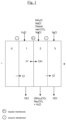
- Figure 1 shows schematically the function of the electrodialyzer in one embodiment of the process of the present invention.
- Electrodialysis is a technique that consists in combining, within a set of adjoining chambers, different membranes types, such as: bipolar ion-exchange membranes, anionic ion-exchange membranes, and/or cationic ion-exchange membranes.
- the anionic membranes are ion-exchange membranes that are permeable to anions and, ideally, impermeable to cations.
- the cationic membranes are themselves permeable to cations and impermeable to anions.
- a bipolar membrane is an ion-exchange membrane comprising a cationic face and an anionic face. Such membranes may be produced by joining a cationic membrane and an anionic membrane.
- the bipolar membrane may for example be produced by the process described in WO 01/79335 in the name of SOLVAY.
- bipolar membranes are separated by cationic or anionic monopolar membranes.
- the electrodialyzer only possesses bipolar membranes and one type of monopolar membranes (cationic or anionic), they are said to have two (types of) chambers.
- the electrodialyzer used in the process of the present invention possesses preferably only bipolar and anionic membranes.
- the chamber located between the anionic face of the bipolar membrane and the anionic membrane constitutes a base chamber.
- this chamber there is a supply of OH - ions originating from the bipolar membrane.
- the base chamber is fed with the solution containing ammonium chloride, sodium chloride and dissolved CO 2 .
- the OH - ions supplied from the bipolar membrane will react with the dissolved CO 2 , present as solved carbon dioxide (H 2 CO 3 ) or as bicarbonate ion (HCO 3 - ) and will form ammonium carbonate or sodium carbonate.
- the pH in the base chamber is generally maintained within a desired range by controlling the flow rate of the feed solution and the current density applied to the electrodialyzer cellstack, which will induces the generation of OH-.
- the pH of the outlet solution from the base chamber is at most 9.5, preferably at most 9.0.
- the pH of the outlet solution from the base chamber is generally at least 6.5, preferably at least 7.0.
- the chamber located between the cationic face of the bipolar membrane and the anionic membrane constitutes an acid chamber.
- this chamber there is a supply of H + ions originating from the bipolar membrane and Cl - ions crossing the anionic membrane from the basic chamber fed with the aqueous solution comprising ammonium and sodium chloride.
- the present invention relates also to a number of further embodiments of the process described hereafter, and combinable with any one of the other embodiment, isolated or in combination with several embodiments, unless obviously non-compatible.
- the electrodialyzer cellstack used in the process of the present invention, comprises at least four chambers being separated from each other by alternating bipolar and anionic membranes.
- each anionic membrane separates a base chamber from an acid chamber.
- the electrodialyzer cellstack comprises a plurality of alternating base chambers and acid chambers being separated from each other by a plurality of alternating bipolar and anionic membranes.
- a cellstack can be composed of a succession of acid and base chambers limited by successive anionic and bipolar membranes.
- each anionic or bipolar membrane has one face in a base chamber and the other face in an acid chamber.
- the electrodialysis cellstack is closed at both sides with electrolyte chambers, comprising electrode elements and degassing means.
- Said electrode elements are generally made of corrosive resistant materials, such as metals or metal oxides.
- the concentration of ammonium and sodium chloride salts and dissolved carbon dioxide in the aqueous feed solution is not particularly limited. However, too diluted solutions leads to important energy consumption for recovering or concentrating the then generated ammonium carbonate or sodium carbonate.
- Concentrated solutions may be suitable until they are not saturated in ammonium or sodium chlorides and or/ in ammonium and sodium bicarbonates or carbonates so that to avoid to be on the limit of the saturation of said salts.
- the aqueous solution fed in the base chamber comprises at most 6 mol NH 4 + / kg, at most 6 mol Cl - / kg, and at most 3.5 mol Na + / kg, and at most 3.5 mol / kg of dissolved CO 2 , expressed by kg of the aqueous solution.
- the chemical species concentrations should respect ions neutrality: i.e. the sum of the cation species equals the sum of the anion species expressed in equivalent electronic charges.
- the aqueous feed solution comprises ammonium chloride and sodium chloride, dissolved CO 2 , and may comprise other components such as ammonium bicarbonate, and/or sodium bicarbonate.
- the said aqueous feed solution is advantageously deriving from a filter solution, obtained from the separation of crude sodium bicarbonate crystals in their mother liquor, exiting a SOLVAY carbonation column.
- the aqueous solution comprising NH 4 Cl, NaCl, dissolved CO 2 is the mother liquid obtained after sodium bicarbonate filtration (crude sodium bicarbonate) in a soda ash process.
- the mother liquid is pre-treated to reduce or adjust volatile ammonia (NH 3 ) and carbon dioxide (CO 2 ) content.
- the aqueous feed solution of the base chamber(s) may comprise advantageously a complement of dissolved CO 2 by injecting carbon dioxide in the mother liquor (ie carbonating the mother liquor).
- the outlet solution from the base chamber comprising solved (NH 4 ) 2 CO 3 and Na 2 CO 3 is carbonated by injection of a CO 2 comprising gas to produce a carbonated liquor or a carbonated slurry, wherein at least part of the solved carbonate ions (CO 3 2- ) from the ammonium and sodium carbonate are transformed into bicarbonate ions (HCO 3 - ), and at least part of the carbonated liquor or slurry is recycled back into the base chamber.
- the concentration of ammonium chloride in the aqueous feed solution of the invention is not particularly limited.
- the feed solution comprises at least 2 g/kg, such as at least 5 g/kg, preferably at least 10 g/kg, more preferably at least 50g/kg, even more preferably at least 100 g/kg, even more preferably at least 130 g/kg, and even more preferably at least 160 g/kg of ammonium chloride per kg of the feed solution.
- the outlet solution from the base chamber comprises generally at most 5.0 mol. of total ammonia/ kg.
- it comprises at most 2.0 mol of total ammonia/ kg, more advantageously at most 1.5, or even more advantageously at most 1.0 mol of total ammonia / kg of outlet solution.
- the total free ammonia is advantageously at most 0.5 mol of free ammonia / kg of outlet solution, or even more advantageously at most 0.3 mol of free ammonia / kg of outlet solution.
- the outlet solution from the base chamber comprising (NH 4 ) 2 CO 3 and Na 2 CO 3 , is introduced into a soda ash process.
- gaseous ammonia from the outlet liquid of the base chamber is recovered. Such recovery of ammonia may be made by heating and stripping.
- the process comprises the further step of dissolving sodium chloride in the outlet solution of the base chamber to obtain an ammonia brine and introducing the thus obtained ammonia brine into the soda ash process.
- the separation of crude sodium bicarbonate crystals from their mother liquor, when exiting a SOLVAY carbonation column, is operated generally on a rotary filter, or a band filter or a centrifuge.
- the said mother liquid comprises then ammonium chloride that has to be regenerated into ammonia to be recycled and use again in the ammonia - soda ash process.
- the regeneration of at least part of the said ammonium chloride (NH 4 Cl) into alkaline ammonia such as ammonium carbonate or as ammonium bicarbonate, may be then operated according to the present invention.
- the concentration of the sodium chloride in the aqueous feed solution is not particularly limited.
- the aqueous feed solution may comprise at least 20 g/kg.
- the aqueous feed solution comprises generally at most 250 g/kg, preferably at most 100 g/kg sodium chloride.
- the chamber located between the cationic face of the bipolar membrane and the anionic membrane constitutes an acid chamber.
- This chamber there is a supply of H + ions originating from the bipolar membrane and Cl - ions crossing the anionic membrane.
- the acid chamber may for example be fed with water or diluted aqueous hydrochloric acid solution in which case the H + ions and the Cl - ions supplied by the membranes form hydrochloric acid, which is obtained as an outlet liquid from the acid chamber.
- the process of the present invention comprises recovering in a further step, an outlet liquid from the acid chamber containing hydrochloric acid.
- the outlet liquid from the acid chamber may be partially recycled to the inlet of the acidic chamber. The remaining of this outlet liquid is taken out of the process, and corresponds to one co-production of the process of the present invention.
- hydrochloric acid may be used as such, or may be concentrated by removing at least part of its water content to produce a concentrated aqueous solution of hydrochloric acid. Concentration of up to 37.5% HCl or more, in weight, is advantageous for the transport of such concentrated acid.
- the hydrochloric acid or the concentrated hydrochloric acid can also either be sold, used in other processes, or for example be reacted with calcium carbonate (limestone) to produce carbon dioxide.
- the carbon dioxide gas obtained by such acid attack is of high concentration, such as at least 80% CO 2 in volume, or at least 90% CO 2 in volume or higher. This may be rendered possible by tightening air entries in used acid attack equipment.
- conventional limekilns for calcining calcium carbonate produce CO 2 comprising gas at a concentration of about 40% in volume.
- high CO 2 concentrations bring a high flexibility for the use of the associated CO 2 comprising gas, for its further use in a soda ash process. It also limits the size of the pipes for transporting such gas and reduces the power to compress said gas for injecting it in bicarbonation columns (to produce crude bicarbonate) or for injecting it in sodium bicarbonate crystallizers.
- the aqueous solution of hydrochloric acid from the acid chamber, or the concentrated aqueous solution of hydrochloric acid is reacted with limestone, to obtain carbon dioxide (CO 2 ) and an aqueous solution of calcium chloride (CaCh).
- the present process comprises the further step of recycling at least partly the aqueous solution of calcium chloride (CaCl 2 ) to the acid chamber.
- the thus obtain carbon dioxide may be advantageously injected and dissolved in the aqueous solution feeding the base chamber. This is particularly advantageous, as it enables to ease the control of the pH at the outlet of the base chamber to at most 9.5, or at most 9.0.
- the above obtained carbon dioxide (CO 2 ) can alternatively be injected and dissolved in at least part of the outlet solution from the base chamber (comprising (NH 4 ) 2 CO 3 and Na 2 CO 3 ) so that to form dissolved ammonium bicarbonate (NH 4 HCO 3 ) or dissolved sodium bicarbonate (NaHCO 3 ), and recycling the thus obtained solution with the aqueous solution comprising NH 4 Cl, NaCl, and dissolved CO 2 to feed the base chamber.
- This is particularly advantageous in a ⁇ feed and bleed' operation of the electrodialyzer.
- carbon dioxide (CO 2 ) can also be advantageously introduced into a soda ash process, optionally together with additional carbon dioxide from external sources, such as steam generators using carbonated combustibles, or such as carbon dioxide from other industries such as cement industry or glass industry.
- the process of the present invention relates then also to a process for producing sodium carbonate by a soda ash process, comprising the step of producing (NH 4 ) 2 CO 3 and Na 2 CO 3 according to one of the embodiments of the present invention or of its optional alternatives.
- the present invention has the advantage to regenerate the acidic form of ammonia such as ammonium chloride (NH 4 Cl) into an alkaline ammonia: such as ammonium carbonate or ammonia bicarbonate.
- NH 4 Cl ammonium chloride
- alkaline ammonia such as ammonium carbonate or ammonia bicarbonate.
- Such dissolved ammonium alkaline salts can be usefully recycled in brines upstream of the conventional soda ash process, to be able to absorb again acidic carbon dioxide in one of, or in all of, the different steps were CO 2 is used.
- the (NH 4 ) 2 CO 3 and Na 2 CO 3 from the base chamber outlet solution, or deriving from said base chamber outlet solution is fed in a soda ash process before the ammonia (NH 3 ) absorption in NaCl brine, such as before stage 3 of Ullmann's Encycl. 2012, "Sodium carbonate " chapters reported above.
- the (NH 4 ) 2 CO 3 and Na 2 CO 3 from the base chamber outlet solution, or deriving from said base chamber outlet solution is fed in a soda ash process before the precipitation of crude sodium bicarbonate produced in a bicarbonation column (ie. ⁇ making column'), such as before stage 4 of Ullmann's Encycl. 2012, "Sodium carbonate " chapters reported above, or fed directly in a bicarbonation column.
- a bicarbonate column they may be fed before (or into) a sodium bicarbonate crystallizer.
- the CO 2 sourcing can be originated from, or complemented with, CO 2 containing gases comprising a CO 2 capture step: such as from fumes, combustion gases, industrial gases, gas effluents, or even CO 2 captured from ambient air.
- gases may be used as such, or after re-concentration in CO 2 , generally to reduce their inert and air content to reduce constraints for their transport and increase their absorption yields.
- the recovery of CO 2 containing gases exiting soda ash process or exiting refined sodium bicarbonate process, such as fumes from steam generators, or from carbonation columns constitutes an advantageous further embodiment.
- the said CO 2 containing gas may also be re-concentrated in CO 2 before its use. Examples of techniques for such re-concentration are described in WO2016/102568 in the name of SOLVAY.
- Such CO 2 containing gases or re-concentrated CO 2 containing gasses may also be used for providing the dissolved CO 2 of the aqueous solution comprising NH 4 Cl and NaCl that feeds the base chamber of the electrodialyzer cellstack of the present invention.
- the hydrochloric acid produced in the acid chamber may be reacted in totality or partially with limestone to obtain carbon dioxide.
- the said carbon dioxide may be then used for precipitating crude sodium bicarbonate crystals in a bicarbonation column; or alternatively said carbon dioxide may be then used for precipitating crude sodium bicarbonate in a sodium bicarbonate crystallizer.
- the base chambers of an electrodialysis cellstack comprising bipolar membranes and anionic membranes were fed with the mother liquid obtained after sodium bicarbonate filtration from a soda ash plant comprising ammonium chloride, sodium chloride and dissolved CO 2 .
- the liquid contained as dissolved species: 170 g/l of ammonium chloride, 70 g/l of sodium chloride, 60 g/l of ammonium bicarbonate, and 40 g/l sodium bicarbonate.
- the solution was diluted with deionized water to test different ammonium chloride concentrations reported in the following tables columns 2 & 3.
- the temperature in the electrodialysis cellstack was set to 50°C and several current densities of 0 to 1.5 kA/m 2 were applied.
- the pH of the base chamber was measured at the outlet of the chamber (ie representative of the pH in the chamber) and was maintained at the indicated strongly alkaline pH (10.5 and 13.0).
- Ammonium ions leak from the base chamber (indicated as the quantity of ammonium mole-equivalent NH 4 + flow (or flux) and reported by surface unit of the corresponding membrane per unit of time expressed in hours, so expressed overall as mol eq NH 4 + / m 2 .h, through the Anion exchange membrane (Anion permselective membrane) were measured by increase of ammonium concentration raise in respective acid chambers:
- Example 1 was repeated in similar conditions but with a pH controlled 8.0 to 8.6 at the outlet of the base chamber.
- Sensitively lower ammonia leaks(*) could be measured in a test of 10 hours, in comparable current density through each membranes, whatever the same current densities applied in the same range 0 - 1.5 kA/ m 2 .
Landscapes
- Chemical & Material Sciences (AREA)
- Engineering & Computer Science (AREA)
- Water Supply & Treatment (AREA)
- Organic Chemistry (AREA)
- Health & Medical Sciences (AREA)
- Urology & Nephrology (AREA)
- Chemical Kinetics & Catalysis (AREA)
- Inorganic Chemistry (AREA)
- Materials Engineering (AREA)
- Separation Using Semi-Permeable Membranes (AREA)
Priority Applications (4)
| Application Number | Priority Date | Filing Date | Title |
|---|---|---|---|
| EP23172803.1A EP4461704A1 (fr) | 2023-05-11 | 2023-05-11 | Procédé de production de carbonate d'ammonium et de carbonate de sodium |
| CN202480031705.1A CN121127441A (zh) | 2023-05-11 | 2024-05-13 | 用于生产碳酸铵和碳酸钠的方法 |
| PCT/EP2024/063045 WO2024231571A1 (fr) | 2023-05-11 | 2024-05-13 | Procédé de production de carbonate d'ammonium et de carbonate de sodium |
| EP24724290.2A EP4709687A1 (fr) | 2023-05-11 | 2024-05-13 | Procédé de production de carbonate d'ammonium et de carbonate de sodium |
Applications Claiming Priority (1)
| Application Number | Priority Date | Filing Date | Title |
|---|---|---|---|
| EP23172803.1A EP4461704A1 (fr) | 2023-05-11 | 2023-05-11 | Procédé de production de carbonate d'ammonium et de carbonate de sodium |
Publications (1)
| Publication Number | Publication Date |
|---|---|
| EP4461704A1 true EP4461704A1 (fr) | 2024-11-13 |
Family
ID=86332313
Family Applications (2)
| Application Number | Title | Priority Date | Filing Date |
|---|---|---|---|
| EP23172803.1A Withdrawn EP4461704A1 (fr) | 2023-05-11 | 2023-05-11 | Procédé de production de carbonate d'ammonium et de carbonate de sodium |
| EP24724290.2A Pending EP4709687A1 (fr) | 2023-05-11 | 2024-05-13 | Procédé de production de carbonate d'ammonium et de carbonate de sodium |
Family Applications After (1)
| Application Number | Title | Priority Date | Filing Date |
|---|---|---|---|
| EP24724290.2A Pending EP4709687A1 (fr) | 2023-05-11 | 2024-05-13 | Procédé de production de carbonate d'ammonium et de carbonate de sodium |
Country Status (3)
| Country | Link |
|---|---|
| EP (2) | EP4461704A1 (fr) |
| CN (1) | CN121127441A (fr) |
| WO (1) | WO2024231571A1 (fr) |
Cited By (2)
| Publication number | Priority date | Publication date | Assignee | Title |
|---|---|---|---|---|
| CN119345879A (zh) * | 2024-12-04 | 2025-01-24 | 江南大学 | 一种工业废气中二氧化碳捕集制碱装置及其方法 |
| CN119912033A (zh) * | 2025-01-22 | 2025-05-02 | 宝武集团环境资源科技有限公司 | 一种利用芒硝尾矿水洗滤液固碳制碱的电渗析方法及系统 |
Citations (4)
| Publication number | Priority date | Publication date | Assignee | Title |
|---|---|---|---|---|
| US2209681A (en) | 1937-05-05 | 1940-07-30 | Autoxygen Inc | Electrolysis of ammonium chloride |
| WO2001079335A1 (fr) | 2000-04-19 | 2001-10-25 | Solvay (Societe Anonyme) | Procede de fabrication d'une membrane bipolaire et utilisation de la membrane bipolaire ainsi obtenue |
| WO2016055367A1 (fr) | 2014-10-09 | 2016-04-14 | Solvay Sa | Procédé de production d'ammoniac |
| WO2016102568A1 (fr) | 2014-12-22 | 2016-06-30 | Solvay Sa | Procédé permettant la production de carbonate de sodium/bicarbonate de sodium |
-
2023
- 2023-05-11 EP EP23172803.1A patent/EP4461704A1/fr not_active Withdrawn
-
2024
- 2024-05-13 CN CN202480031705.1A patent/CN121127441A/zh active Pending
- 2024-05-13 WO PCT/EP2024/063045 patent/WO2024231571A1/fr not_active Ceased
- 2024-05-13 EP EP24724290.2A patent/EP4709687A1/fr active Pending
Patent Citations (4)
| Publication number | Priority date | Publication date | Assignee | Title |
|---|---|---|---|---|
| US2209681A (en) | 1937-05-05 | 1940-07-30 | Autoxygen Inc | Electrolysis of ammonium chloride |
| WO2001079335A1 (fr) | 2000-04-19 | 2001-10-25 | Solvay (Societe Anonyme) | Procede de fabrication d'une membrane bipolaire et utilisation de la membrane bipolaire ainsi obtenue |
| WO2016055367A1 (fr) | 2014-10-09 | 2016-04-14 | Solvay Sa | Procédé de production d'ammoniac |
| WO2016102568A1 (fr) | 2014-12-22 | 2016-06-30 | Solvay Sa | Procédé permettant la production de carbonate de sodium/bicarbonate de sodium |
Non-Patent Citations (3)
| Title |
|---|
| "Technique de 1'Ingenieur Encyclopedia", 2006, pages: 1 - 15 |
| "Ullmann's Encyclopedia of Industrial Chemistry", vol. 12, 2011, WENDT, -VCH VERLAG GMBH & CO, article "Electrochemistry", pages: 273 - 313 |
| TECHNICAL APPENDIXES, pages 1 - 3 |
Cited By (2)
| Publication number | Priority date | Publication date | Assignee | Title |
|---|---|---|---|---|
| CN119345879A (zh) * | 2024-12-04 | 2025-01-24 | 江南大学 | 一种工业废气中二氧化碳捕集制碱装置及其方法 |
| CN119912033A (zh) * | 2025-01-22 | 2025-05-02 | 宝武集团环境资源科技有限公司 | 一种利用芒硝尾矿水洗滤液固碳制碱的电渗析方法及系统 |
Also Published As
| Publication number | Publication date |
|---|---|
| WO2024231571A1 (fr) | 2024-11-14 |
| CN121127441A (zh) | 2025-12-12 |
| EP4709687A1 (fr) | 2026-03-18 |
Similar Documents
| Publication | Publication Date | Title |
|---|---|---|
| AU2023241281B2 (en) | Li recovery processes and onsite chemical production for li recovery processes | |
| EP2867388B1 (fr) | Procédé et appareil de génération ou de récupération d'acide chlorhydrique à partir de solutions de sels métalliques | |
| Tu et al. | Reclaimed seawater discharge–desalination brine treatment and resource recovery system | |
| AU2009238625B8 (en) | Method of making high purity lithium hydroxide and hydrochloric acid | |
| US3463814A (en) | Chemical cycle for evaporative water desalination plant | |
| EP3326974A1 (fr) | Procédé pour la production d'hydroxyde de lithium et du carbonate de lithium | |
| EP4461704A1 (fr) | Procédé de production de carbonate d'ammonium et de carbonate de sodium | |
| US10105653B2 (en) | System for rinsing electrodialysis electrodes | |
| CN120019175A (zh) | 从电池制造和回收出口料流中电化学生产碱金属氢氧化物和硫酸 | |
| Virruso et al. | A pilot plant investigation on a real seawater brine valorisation via electrodialysis with bipolar membranes | |
| KR20180111229A (ko) | 저 에너지 비용의 염분차발전-담수화 하이브리드 시스템 | |
| EP3006400B1 (fr) | Procédé de production d'ammoniac | |
| CN104529016A (zh) | 一种处理高盐废水的方法 | |
| KR20250153803A (ko) | 대기 중 이산화탄소 포집 및 저장을 위한 장치 및 방법 | |
| CN121532360A (zh) | 用于制造碳酸钠溶液的方法 | |
| EP4729490A1 (fr) | Système de production d'hypochlorite de sodium et d'hydrogène gazeux | |
| EP4653582A2 (fr) | Procédé d'extraction de minéraux | |
| HK1210233B (en) | Process and apparatus for generating or recovering hydrochloric acid from metal salt solutions |
Legal Events
| Date | Code | Title | Description |
|---|---|---|---|
| PUAI | Public reference made under article 153(3) epc to a published international application that has entered the european phase |
Free format text: ORIGINAL CODE: 0009012 |
|
| STAA | Information on the status of an ep patent application or granted ep patent |
Free format text: STATUS: THE APPLICATION HAS BEEN PUBLISHED |
|
| AK | Designated contracting states |
Kind code of ref document: A1 Designated state(s): AL AT BE BG CH CY CZ DE DK EE ES FI FR GB GR HR HU IE IS IT LI LT LU LV MC ME MK MT NL NO PL PT RO RS SE SI SK SM TR |
|
| STAA | Information on the status of an ep patent application or granted ep patent |
Free format text: STATUS: THE APPLICATION IS DEEMED TO BE WITHDRAWN |
|
| 18D | Application deemed to be withdrawn |
Effective date: 20250514 |