EP4474341A1 - Dispositif mems avec une couche de recouvrement ayant des espaces et procédé de fabrication d'un dispositif mems - Google Patents
Dispositif mems avec une couche de recouvrement ayant des espaces et procédé de fabrication d'un dispositif mems Download PDFInfo
- Publication number
- EP4474341A1 EP4474341A1 EP23177967.9A EP23177967A EP4474341A1 EP 4474341 A1 EP4474341 A1 EP 4474341A1 EP 23177967 A EP23177967 A EP 23177967A EP 4474341 A1 EP4474341 A1 EP 4474341A1
- Authority
- EP
- European Patent Office
- Prior art keywords
- face
- silicon
- layer
- cap layer
- cap
- Prior art date
- Legal status (The legal status is an assumption and is not a legal conclusion. Google has not performed a legal analysis and makes no representation as to the accuracy of the status listed.)
- Pending
Links
Images


Classifications
-
- B—PERFORMING OPERATIONS; TRANSPORTING
- B81—MICROSTRUCTURAL TECHNOLOGY
- B81B—MICROSTRUCTURAL DEVICES OR SYSTEMS, e.g. MICROMECHANICAL DEVICES
- B81B7/00—Microstructural systems; Auxiliary parts of microstructural devices or systems
- B81B7/0032—Packages or encapsulation
- B81B7/0077—Other packages not provided for in groups B81B7/0035 - B81B7/0074
-
- B—PERFORMING OPERATIONS; TRANSPORTING
- B81—MICROSTRUCTURAL TECHNOLOGY
- B81C—PROCESSES OR APPARATUS SPECIALLY ADAPTED FOR THE MANUFACTURE OR TREATMENT OF MICROSTRUCTURAL DEVICES OR SYSTEMS
- B81C1/00—Manufacture or treatment of devices or systems in or on a substrate
- B81C1/00015—Manufacture or treatment of devices or systems in or on a substrate for manufacturing microsystems
- B81C1/00261—Processes for packaging MEMS devices
- B81C1/00269—Bonding of solid lids or wafers to the substrate
-
- B—PERFORMING OPERATIONS; TRANSPORTING
- B81—MICROSTRUCTURAL TECHNOLOGY
- B81B—MICROSTRUCTURAL DEVICES OR SYSTEMS, e.g. MICROMECHANICAL DEVICES
- B81B7/00—Microstructural systems; Auxiliary parts of microstructural devices or systems
- B81B7/0032—Packages or encapsulation
-
- B—PERFORMING OPERATIONS; TRANSPORTING
- B81—MICROSTRUCTURAL TECHNOLOGY
- B81B—MICROSTRUCTURAL DEVICES OR SYSTEMS, e.g. MICROMECHANICAL DEVICES
- B81B2203/00—Basic microelectromechanical structures
- B81B2203/03—Static structures
- B81B2203/0361—Tips, pillars
-
- B—PERFORMING OPERATIONS; TRANSPORTING
- B81—MICROSTRUCTURAL TECHNOLOGY
- B81C—PROCESSES OR APPARATUS SPECIALLY ADAPTED FOR THE MANUFACTURE OR TREATMENT OF MICROSTRUCTURAL DEVICES OR SYSTEMS
- B81C2201/00—Manufacture or treatment of microstructural devices or systems
- B81C2201/01—Manufacture or treatment of microstructural devices or systems in or on a substrate
- B81C2201/0101—Shaping material; Structuring the bulk substrate or layers on the substrate; Film patterning
- B81C2201/0118—Processes for the planarization of structures
- B81C2201/0125—Blanket removal, e.g. polishing
-
- B—PERFORMING OPERATIONS; TRANSPORTING
- B81—MICROSTRUCTURAL TECHNOLOGY
- B81C—PROCESSES OR APPARATUS SPECIALLY ADAPTED FOR THE MANUFACTURE OR TREATMENT OF MICROSTRUCTURAL DEVICES OR SYSTEMS
- B81C2201/00—Manufacture or treatment of microstructural devices or systems
- B81C2201/01—Manufacture or treatment of microstructural devices or systems in or on a substrate
- B81C2201/0101—Shaping material; Structuring the bulk substrate or layers on the substrate; Film patterning
- B81C2201/0128—Processes for removing material
- B81C2201/013—Etching
-
- B—PERFORMING OPERATIONS; TRANSPORTING
- B81—MICROSTRUCTURAL TECHNOLOGY
- B81C—PROCESSES OR APPARATUS SPECIALLY ADAPTED FOR THE MANUFACTURE OR TREATMENT OF MICROSTRUCTURAL DEVICES OR SYSTEMS
- B81C2201/00—Manufacture or treatment of microstructural devices or systems
- B81C2201/01—Manufacture or treatment of microstructural devices or systems in or on a substrate
- B81C2201/0101—Shaping material; Structuring the bulk substrate or layers on the substrate; Film patterning
- B81C2201/0147—Film patterning
-
- B—PERFORMING OPERATIONS; TRANSPORTING
- B81—MICROSTRUCTURAL TECHNOLOGY
- B81C—PROCESSES OR APPARATUS SPECIALLY ADAPTED FOR THE MANUFACTURE OR TREATMENT OF MICROSTRUCTURAL DEVICES OR SYSTEMS
- B81C2201/00—Manufacture or treatment of microstructural devices or systems
- B81C2201/03—Processes for manufacturing substrate-free structures
- B81C2201/034—Moulding
-
- B—PERFORMING OPERATIONS; TRANSPORTING
- B81—MICROSTRUCTURAL TECHNOLOGY
- B81C—PROCESSES OR APPARATUS SPECIALLY ADAPTED FOR THE MANUFACTURE OR TREATMENT OF MICROSTRUCTURAL DEVICES OR SYSTEMS
- B81C2203/00—Forming microstructural systems
- B81C2203/01—Packaging MEMS
- B81C2203/0109—Bonding an individual cap on the substrate
-
- B—PERFORMING OPERATIONS; TRANSPORTING
- B81—MICROSTRUCTURAL TECHNOLOGY
- B81C—PROCESSES OR APPARATUS SPECIALLY ADAPTED FOR THE MANUFACTURE OR TREATMENT OF MICROSTRUCTURAL DEVICES OR SYSTEMS
- B81C2203/00—Forming microstructural systems
- B81C2203/03—Bonding two components
- B81C2203/031—Anodic bondings
Definitions
- the present invention relates to an apparatus and methods of manufacturing such apparatus related to microelectromechanical system (MEMS) devices. More particularly, the invention relates to a design of a cap layer of a MEMS device and methods of manufacturing of the cap layer and a MEMS device with the cap layer.
- MEMS microelectromechanical system
- a seismic element refers to an internal, physically moving element of a MEMS device. Seismic elements of a MEMS device are typically comprised in one or more structural layers referred to as device layer(s). Any number of seismic elements may be provided in the MEMS device.
- a seismic element may be configured for translational and/or rotational movement in response to any physical phenomenon, such as acceleration or pressure.
- the seismic element may be driven into a motion by driving means, such as capacitive or piezoelectric transducers.
- the seismic element may be configured to move in response to the Coriolis force affecting the seismic element first driven into a motion by transducers.
- the MEMS structures may include a plurality of layers. Layers are attached to each other by bonding. Practical MEMS processes use modified semiconductor device fabrication and packaging technologies, so the bonding is often one of successive wafer-level processes, wherein a large number of MEMS structures are manufactured jointly, and then diced for separate use.
- bonded surfaces of layers form a continuously closed peripheral region in a plane around the internal part so that one or more hermetically sealed internal spaces are formed into the MEMS structure, the internal spaces comprising seismic elements.
- Gaps are provided in the MEMS device to provide space for seismic elements to move as intended.
- a common solution to provide gaps is to recess seismic elements from one or two horizontal outer surfaces of the device layer to create sufficient space for movement of seismic elements. Mere creation of free space is not always sufficient, but for example capacitive MEMS devices should also be provided with accurate dimensions to control distances between moving electrodes attached or associated with seismic elements and stationary electrodes.
- one or more device layers are sandwiched between so called bottom layer and cap layer.
- seismic elements are hermetically encapsulated between the bottom layer and cap layer, and electrical contacts are routed through the cap layer.
- An object is to provide a MEMS device and a MEMS device manufacturing method so as to improve accuracy of dimensions with respect to seismic elements and/or other functional elements on a device layer.
- the objects of the present invention are achieved with a MEMS device according to claim 1.
- Objects of the present invention are further achieved with a manufacturing method according to claim 9.
- the present invention is based on the idea of providing one or more gaps in the cap layer, instead of providing gaps in a device layer to increase distance between these two layers, to provide sufficient space for desired motions of one or more seismic elements of the device layer when these layers are superposed.
- a MEMS device comprises a cap layer and a device layer.
- the cap layer comprises a cap wafer made of electrically insulating material, such as glass.
- the device layer comprising at least one seismic element.
- the cap layer comprises at least one silicon-filled portion at a first face of the cap layer facing the device layer, and at least one of said at least one silicon-filled portion comprises a gap.
- the gap is a recessed area in the respective silicon-filled portion that locally increases distance from the cap layer to the at least one seismic element comprised in the device layer.
- the plurality of silicon-filled portions is filled with monocrystalline silicon or with polycrystalline silicon.
- the cap layer further comprises at least one silicon bump extending from the gap towards the device layer.
- the silicon bump is electrically insulated from other portions of the gap by at least one exposed portion of the cap wafer.
- the MEMS device further comprises at least one metal film pattern disposed on a silicon surface of the gap.
- the MEMS device further comprises at least one bump extending from the at least one metal film pattern towards the device layer.
- At least one of the silicon-filled portions forms a silicon pillar extending between the first face of the cap layer and a second face of the cap layer facing away from the device layer.
- the cap layer comprises at least one metallic press contact configured to electrically couple the cap layer to the superposed device layer.
- At least one exposed portion of glass at the first face of the cap layer comprises at least one recess configured to facilitate metal bonding of the first face of the cap layer with the device layer.
- a method of manufacturing a MEMS device comprises a) providing a three-dimensionally patterned silicon mold, b) depositing glass or applying heat-softened glass on the three-dimensionally patterned silicon mold to create a cap wafer with a three-dimensionally patterned first face, and optionally grinding the cap wafer to remove excess edge glass and/or to planarize a second face of the cap wafer and c) removing at least part of the silicon mold by grinding and/or chemical-mechanical polishing.
- the method optionally comprises d) removing remaining portions of the silicon mold by etching.
- the method then comprises, e) if the remaining portions of the silicon mold are removed by etching in step d), depositing a layer of polysilicon on the first face of the cap wafer, and thinning the deposited layer of polysilicon by grinding and/or chemical-mechanical polishing.
- the first face of the cap layer comprises a flat surface comprising one or more silicon-filled portions and one or more areas of exposed glass.
- the method further comprises f) at least partially recessing at least one of the one or more silicon-filled portions below the flat surface at the first face of the cap layer by etching to generate at least one gap, and h) bonding the cap wafer at its first face to a device layer such that the at least one gap is superposed with one or more seismic elements comprised in the device layer.
- the method further comprises, between steps f) and h), placing at least one metal film pattern on the first face of the cap layer at a bottom of at least one of the at least one gap.
- the method further comprises generating at least one bump on the metal film pattern.
- At least one of the at least one silicon-filled portion forms a silicon pillar extending from the first face of the cap layer towards the second face of the cap layer.
- the method further comprises either, before step h) performing step g) thinning the cap wafer at the second face of the cap layer to expose the at least one silicon pillar on the second face of the cap layer, or after step h) performing step i) thinning the cap layer at the second face to expose the at least one silicon pillar at the second face of the cap layer.
- the at least one silicon pillar exposed at both faces of the cap wafer provides an electrical contact between the first face of the cap layer and the second face of the cap layer.
- the method comprises providing at least one of the at least one silicon pillar with a metallic press contact at the first face of the cap layer.
- the three-dimensionally patterned silicon mold determines at least one recess that is not filled with poly-Si in the step e), or ii) the three-dimensionally patterned silicon mold determines at least one recess from which all deposited poly-Si is removed in the step f), or iii) the method further comprises a step of etching at least one recess in at least one area of exposed glass at the first face of the cap wafer.
- the at least one recess at the first face of the cap wafer is used for metal bonding, and the bonding step h) comprises: providing the at least one recess with a first metal pattern at the bottom thereof, providing at least one second metal pattern on a face of the device layer configured to face the first face of the cap layer, wherein the second metal pattern is superposed with a respective first metal pattern when the cap layer and the device layer are superposed, and metal bonding the first face of the cap layer with the face of the device layer by heating the first metal pattern and the second metal pattern to form a eutectic metal phase.
- the first metal pattern comprises any one of aluminium or germanium
- the second metal pattern comprises the other one of aluminium and germanium
- the present invention enables new types of cap layer designs.
- the cap layer design may have narrower silicon structures coupled to wider silicon areas.
- the amount of exposed glass or any other cap wafer material can be reduced on bonding surface between the cap layer and a device layer, even without additional metal shields in the cap layer.
- Silicon electrodes can be provided in the cap layer instead of traditional metal film electrodes on the bottom face of the cap layer.
- Out-of-plane bumps, such as one or more electrically isolated silicon bumps, may be provided on the cap layer.
- Getter size can be reduced by increasing its effective area by adding surface topography below the getter. As is known in the art, a getter is a deposit of reactive material that is placed inside a vacuum system to complete and maintain the vacuum.
- metal bonding or anodic bonding may be used for bonding the cap layer to the device layer of the MEMS device.
- Alkali-free glasses can be used for the cap layer in metal bonding.
- Drawings are not in scale. Drawings do not illustrate an actual MEMS device design but represent a collection of exemplary structural elements which can be used as elements of a functional MEMS device and manufacturing steps for generating such structural elements.
- Figure 1 is a cross section of a cap layer 5 according to some embodiments.
- term cap layer 5 refers to the entire cap structure
- term cap wafer 10 refers to the insulating material, such as glass, which can alternatively be referred to as substrate. Since the cap layer is to be bonded to the silicon wafer based device layer(s), coefficient of thermal expansion of the insulating material of the cap wafer 10 should be similar to a silicon wafer to provide a robust MEMS device not susceptible to tension caused by change of temperatures.
- Examples of applicable glass materials for the cap wafer 10 are for example borosilicate glasses, such as Corning Pyrex ® 7740 and Schott Borofloat ® 33 Also alkali-free glasses such as Schott AF32 ® can be used, which has a low coefficient of thermal expansion similar to a silicon wafer.
- borosilicate glasses such as Corning Pyrex ® 7740 and Schott Borofloat ® 33
- alkali-free glasses such as Schott AF32 ® can be used, which has a low coefficient of thermal expansion similar to a silicon wafer.
- Functional elements may have mechanical and/or electrical characteristics.
- Functional elements comprise silicon-filled areas 100, recessed silicon filled areas referred to as gaps 101, which may be provided with metal film patterns 112 such as metal electrodes and optionally bumps 115, both of which are also considered functional elements.
- Term bump refers to a mechanical movement limiter.
- Bumps may be electrically connected or electrically isolated.
- Further functional elements may comprise a silicon electrode 102, as well as one or more electrically insulated silicon bumps 105 extending towards device layer from the cap layer's surface. A top view of a silicon bump 105 encircled in the cross-section is shown, in which the insulating cap layer area surrounds the silicon bump 105.
- the cap layer may be provided with a press contact 106 comprising an electrically conducting silicone pillar or "via" through the cap layer and a silicon bump.
- the press contact 106 may be used for making electrical contact between two wafers when stacked. Such electrical contact may be needed, for example for signal routing between different layers in MEMS sensors.
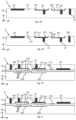
- Figures 2A to 2F illustrate steps of a manufacturing process of a cap layer using a mono-Si mold and bonding the cap layer on a device layer according to some embodiments.
- Figure 2A illustrates a mold 20, preferably a silicon mold.
- the mold 20 is made out of a single crystal silicon wafer.
- the mold 20 is patterned using known silicon wafer patterning methods, such as thermal oxidation and deep reactive ion etching (DRIE).
- DRIE deep reactive ion etching
- Single-crystal silicon, mono-Si, known also as monocrystalline silicon is the well-known base semiconductor material for silicon-based discrete components and integrated circuits. It consists of silicon in which the crystal lattice of the entire solid is continuous. Mono-Si is the material of first choice for robust MEMS devices, because of its excellent mechanical strength and elasticity, and the large variety of available standard processes. It is well known in the art, that in MEMS devices, mono-Si layer is used as a conductor, for which purpose it is doped to make it electrically conducting. For example, Boron-doped P-type silicon wafers are common, but also Phosphorus-doped N-type wafers are used in some special applications.
- Figure 2B illustrates a result after molding of insulating cap wafer 10.
- heat-softened glass may be applied/inserted on the mold 20 or glass may be deposited on the mold 20 in any other applicable way.
- a typical glass molding process further comprises grinding to remove any excess edge glass at the lateral sides of the cap wafer 10 and to planarize the xy-plane direction glass surface.
- Figure 2C illustrates a result of grinding and/or chemical-mechanical polishing to remove excess mold 20 from the patterned surface. Portions 20' of the mold remain in recesses of the insulating material of the cap wafer 10, including silicon pillars 22, which may be comprised in some MEMS device designs.
- Figure 2D illustrates results of next step, in which one or more gaps 101 are formed in selected ones of the remaining mono-Si portions 20' of the mold.
- Gaps 101 refer to recessed areas in the mono-Si portions 20', where the silicon is recessed from the initial, flat upper face of the cap layer 5 after grinding the mold.
- Gaps 101 are preferably created by dry etching, such as DRIE or plasma enhanced reactive ion etching (PERIE).
- PERIE plasma enhanced reactive ion etching
- the cap layer may also comprise one or more recesses 24.
- the recess 24 can be generated by etching the cap wafer 10, or they may be generated with help of the mold. If mold was used for generating the recess 24 of figures 2A to 2D , the remaining portion of the silicon mold in a relatively shallow recess 24 can be removed simultaneously with forming the gaps 101.
- FIG. 2E illustrates results of further, optional metal processing steps of cap layer manufacturing.
- Metal processing steps can be used for generating metal film patterns 112 such as metal electrodes, when needed on the bottom of one or more gaps 101 the cap in the MEMS device design.
- One or more metal film patterns 112 are patterned in the selected gaps 101.
- bumps 115 are formed on one or more metal film patterns 112.
- bumps 115 are used in MEMS devices to prevent sticking of a seismic element to an electrode if these would accidentally touch each other for example due to an excess shock.
- Bumps may be made of various materials, a non-limiting examples of which are ceramic oxides with diamond-like-carbon film (DLC).
- one or more press contacts 106 can be provided in a metal processing step by forming a metal pattern.
- electrical wiring 114 for routing electrical signals may be added on the top face of the cap wafer 10.
- electrical wiring 114 is placed in a recess 24 on the cap wafer 10.
- Figure 2F illustrates bonding the cap layer 5 to a device layer 40 upon superposing the two layers in anodic bonding.
- silicon pillars 22 are exposed on the upper face of the cap layer, away from the device layer 40. Thinning may be implemented using grinding and/or chemical mechanical polishing. In this example press contact 106 and/or any of the exposed silicon pillars 22 can be used for providing an electrical connection from the upper face of the cap layer 5 all the way to the device layer 40. Silicon pillars 22 may also or alternatively be used for electrical connections of the MEMS device's electrodes and/or transducers when in operation.
- a device layer 40 comprising a plurality of seismic elements 401 is sandwiched between the cap layer and a bottom layer 50.
- the cap layer 5 comprises gaps 101 that increase distance from the upper face of the device layer 40 to the cap layer 10 such that there is space above seismic elements 401 to move upwards.
- the bottom layer 50 also comprises gaps 501 to increase distance from the bottom face of the device layer 40 to the bottom layer 50 such that there is space below the seismic elements 401 to move downwards.
- the device layer 40 can be implemented essentially flat: gaps 501 provided in the bottom layer 50 and gaps 101 provided in the cap layer leave sufficient free space for the seismic elements 401 to move up and down as needed.
- the device layer does not have to be recessed, but entire thickness of the device layer 40 can be utilized for the seismic elements 401, which enables maximizing mass of seismic elements 401.
- the flat device layer can be patterned using planar lithography, which improves accuracy of patterning of the device layer. Planar lithography facilitates better control of line widths over the entire lateral dimension of the device wafer.
- Figure 2F also shows electrical wiring 114 in a recess 24 on the cap layer 5. By placing the electrical wiring 114 in a recess of the cap layer 5, electrical contact can be avoided between the electrical wiring 114 and device layer 40.
- Figure 3 shows an alternative method to implement electrical wiring 114 for routing signals and/or for electrical grounding when the cap layer 5 is superposed with the device layer 40.
- This electrical wiring 114 may be manufactured during the same metal processing step or steps that are used to generate other metal film patterns 112 such as metal electrodes.
- the cap layer is not recessed under the electrical wiring 114, but the device layer 40 is patterned to avoid unwanted contacts with the electrical wiring 114.
- Figures 4A and 4B illustrate metal bonding of the cap layer according to some embodiments.
- the cap layer 5 is bonded to the device layer 40 by metal bonding 45.
- metal bonding 45 An example of applicable metal bonding is so called AIGe wafer bonding.
- germanium is typically provided on face of one wafer and aluminum is provided on face of the other wafer.
- further thin coating layers may be provided in addition to the metals themselves.
- the provided germanium and aluminum form a eutectic AlGe-phase.
- a eutectic phase is a melting composition of minimum two components, each of which melts and freezes congruently. During crystallization phase, a mixture of the components is formed, hence acting as a single component.
- Cap wafer 10 may be bonded first, as shown in the figure 3a, and thinned only after bonding has been completed, as shown in the figure 3b, to expose the silicon pillars 22 for providing electrical connections to electrodes and/or electromechanical transducers.
- thinning of the cap wafer 10 may be performed before bonding. No press contact is needed in this embodiment.
- Thinning of the cap layer 5 may be performed by chemical-mechanical grinding and polishing.
- FIGS 5A, 5B, 6A and 6B illustrate benefits achieved by having a recess 24 for metal bonding. Although this example is illustrated with a specific combination of metals, a skilled person understands that the same arrangement with a recess can be applied with any selected bonding metal combinations.
- Figures 5A and 5B illustrate metal bonding of two flat surfaces.
- Figure 5A shows aluminum 50 patterned on the flat bottom face of the cap wafer 10, and germanium 51 patterned on the flat top face of the device layer 40.
- Figure 5B illustrates the result of metal bonding, in which aluminum and germanium have formed a eutectic AlGe-phase.
- the problem in this arrangement is that vertical distance 55 between the cap wafer and the device layer is difficult to control in the manufacturing process, which inevitably causes vertical distance between functional elements in the device layer and functional elements to be likewise difficult to control.
- Figures 6A and 6B illustrate metal bonding using a recess 24 formed on the cap wafer 50.
- aluminum 50 is patterned at the bottom of the recess 24, while germanium is patterned on the flat top face of the device layer 40.
- the result of the metal bonding step is that the metal bonding 45 comprising the eutectic AlGe-phase is within the recess 24, and bottom face of the cap wafer 10 and top face of the device layer 40 become in contact with each other.
- the metal bonding 45 is entirely within the recess 24 such that distance between nonrecessed portions of the first face of the cap layer and the flat upper face of the device layer is zero. This enables precise control of vertical distance between functional elements on the preferably flat device layer 40 and on the cap wafer 10, since the vertical distance is fully determined by recesses in the cap wafer 10 as shown in figures 4A and 4B .
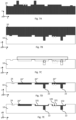
- Figures 7A to 7D illustrate steps of a manufacturing process of a cap layer according to some embodiments.
- Steps illustrated in figures 7A and 7B correspond to steps illustrated in connection with figures 2A and 2B .
- the recess 24 is generated using the mold 20.
- the recess 24 can be generated by dry or wet etching the cap wafer 10.
- Applicable wet etching methods are for example Potassium Hydroxide (KOH) etching and tetramethyl ammonium hydroxide (TMAH) etching.
- the entire mold 20 is removed. Removal of the mold 20 can be performed by etching, for example wet etching or vapor etching. Alternatively, removal of the mold 20 can be implemented in two steps, combining grinding and etching. Grinding is first used to reduce thickness of the mold before remaining portions of the mold 20 are removed by etching.
- step 7D recesses in the cap wafer 10 are filled by depositing polysilicon.
- polysilicon poly-Si, known also as polycrystalline silicon or multicrystalline silicon refers to silicon consisting of small crystals, known as crystallites.
- Polysilicon is doped to make it electrically conducting.
- Poly-Si comprises mutually differently aligned crystals. Therefore, its elasticity constant is not dependent on geometry and/or direction. Electrical characteristics of poly-Si are relatively easy and economical to adjust in comparison to adjusting electrical characteristics of mono-Si.
- Applied poly-Si covers recesses in the cap wafer 10, thus forming filled areas 20" and also silicon pillars 22 but is also applied at least on the entire the upper face of the cap wafer 10.
- the upper face is subjected to chemical-mechanical polishing to even out the upper face such that applied poly-Si remains only in wanted recesses.
- the mold 20 also determines one or more recesses 24, from which poly-Si is removed or deposition of poly-Si is prevented for example by masking.
- cap wafer 10 may be etched to determine recesses 24.
- FIG 5E illustrates result of the next step, in which at least some of the poly-Si fillings on the upper face of the cap wafer 10 are recessed to form gaps 101.
- This step corresponds to step shown in the Figure 2d with the difference that gaps 101 are formed in selected ones of the poly-Si filled portions 20" instead of remaining portions of the mono-Si mold.
- gaps 101 are preferably created in poly-Si by dry etching, such as DRIE or plasma enhanced reactive ion etching (PERIE).
- the manufacturing process is similar to what is already described above, namely various metal processing steps may be performed to generate further conductive structures such as metal film patterns. Also bumps may be added.
- the cap is bonded on top of the device layer using a selected bonding method such as anodic bonding as illustrated with figures 2F and 3 or metal bonding as illustrated with figures 4A and 4B .
Landscapes
- Engineering & Computer Science (AREA)
- Microelectronics & Electronic Packaging (AREA)
- Manufacturing & Machinery (AREA)
- Computer Hardware Design (AREA)
- Micromachines (AREA)
Priority Applications (2)
| Application Number | Priority Date | Filing Date | Title |
|---|---|---|---|
| EP23177967.9A EP4474341A1 (fr) | 2023-06-07 | 2023-06-07 | Dispositif mems avec une couche de recouvrement ayant des espaces et procédé de fabrication d'un dispositif mems |
| US18/733,381 US20240409398A1 (en) | 2023-06-07 | 2024-06-04 | Mems device with a cap layer having gaps and method of manufacturing a mems device |
Applications Claiming Priority (1)
| Application Number | Priority Date | Filing Date | Title |
|---|---|---|---|
| EP23177967.9A EP4474341A1 (fr) | 2023-06-07 | 2023-06-07 | Dispositif mems avec une couche de recouvrement ayant des espaces et procédé de fabrication d'un dispositif mems |
Publications (1)
| Publication Number | Publication Date |
|---|---|
| EP4474341A1 true EP4474341A1 (fr) | 2024-12-11 |
Family
ID=86732015
Family Applications (1)
| Application Number | Title | Priority Date | Filing Date |
|---|---|---|---|
| EP23177967.9A Pending EP4474341A1 (fr) | 2023-06-07 | 2023-06-07 | Dispositif mems avec une couche de recouvrement ayant des espaces et procédé de fabrication d'un dispositif mems |
Country Status (2)
| Country | Link |
|---|---|
| US (1) | US20240409398A1 (fr) |
| EP (1) | EP4474341A1 (fr) |
Citations (2)
| Publication number | Priority date | Publication date | Assignee | Title |
|---|---|---|---|---|
| EP3705451A1 (fr) * | 2019-03-06 | 2020-09-09 | Murata Manufacturing Co., Ltd. | Structure mems comprenant un capot ayant un trou d'interconnexion |
| CN115403005A (zh) * | 2022-11-02 | 2022-11-29 | 苏州敏芯微电子技术股份有限公司 | 压力感测模组、电阻式压力传感器及其制作方法 |
-
2023
- 2023-06-07 EP EP23177967.9A patent/EP4474341A1/fr active Pending
-
2024
- 2024-06-04 US US18/733,381 patent/US20240409398A1/en active Pending
Patent Citations (2)
| Publication number | Priority date | Publication date | Assignee | Title |
|---|---|---|---|---|
| EP3705451A1 (fr) * | 2019-03-06 | 2020-09-09 | Murata Manufacturing Co., Ltd. | Structure mems comprenant un capot ayant un trou d'interconnexion |
| CN115403005A (zh) * | 2022-11-02 | 2022-11-29 | 苏州敏芯微电子技术股份有限公司 | 压力感测模组、电阻式压力传感器及其制作方法 |
Also Published As
| Publication number | Publication date |
|---|---|
| US20240409398A1 (en) | 2024-12-12 |
Similar Documents
| Publication | Publication Date | Title |
|---|---|---|
| CN113697766B (zh) | 用于制造微机电设备的工艺和mems设备 | |
| US6030850A (en) | Method for manufacturing a sensor | |
| EP2697159B1 (fr) | Électrode hors plan délimitée par une entretoise | |
| US5313836A (en) | Semiconductor sensor for accelerometer | |
| US6445053B1 (en) | Micro-machined absolute pressure sensor | |
| US7736931B1 (en) | Wafer process flow for a high performance MEMS accelerometer | |
| TWI419239B (zh) | 用於形成陀螺儀與加速度感測儀之方法和結構 | |
| EP2810915B1 (fr) | Structure de détection capacitive avec canaux acoustiques intégrés | |
| EP3052901B1 (fr) | Capteurs inertiels et de pression sur une seule puce | |
| JP2010171422A (ja) | Memsセンサおよびmemsセンサの製造方法 | |
| US9487391B2 (en) | Micro-electro mechanical system (MEMS) device having a blocking layer formed between closed chamber and a dielectric layer of a CMOS substrate | |
| USRE41856E1 (en) | Process for manufacturing high-sensitivity accelerometric and gyroscopic integrated sensors, and sensor thus produced | |
| EP4446281A1 (fr) | Dispositifs mems à double couche et procédé de fabrication | |
| TW201524889A (zh) | 微機械構件與製造微機械構件的方法 | |
| US9513476B2 (en) | Microelectromechanical component and corresponding production method | |
| EP2973665B1 (fr) | Arrêt de gravure à base de silicium poly-cristallin épitaxié pour électrode mobile hors plan | |
| EP4474341A1 (fr) | Dispositif mems avec une couche de recouvrement ayant des espaces et procédé de fabrication d'un dispositif mems | |
| WO2025112423A1 (fr) | Capteur mems et son procédé de préparation | |
| US8430255B2 (en) | Method of accurately spacing Z-axis electrode | |
| US10843921B2 (en) | Electrical connection to a micro electro-mechanical system | |
| US20040081809A1 (en) | Microstructured component and method for its manufacture | |
| EP4421022A1 (fr) | Dispositifs mems à double couche | |
| EP3786108A1 (fr) | Procédé de fabrication d'un dispositif mems | |
| CN119986042B (zh) | 一种mems加速度计、地震检波器及制备方法 | |
| KR100416763B1 (ko) | 수직변위 측정 및 구동 구조체와 그 제조방법 |
Legal Events
| Date | Code | Title | Description |
|---|---|---|---|
| PUAI | Public reference made under article 153(3) epc to a published international application that has entered the european phase |
Free format text: ORIGINAL CODE: 0009012 |
|
| STAA | Information on the status of an ep patent application or granted ep patent |
Free format text: STATUS: REQUEST FOR EXAMINATION WAS MADE |
|
| 17P | Request for examination filed |
Effective date: 20230607 |
|
| AK | Designated contracting states |
Kind code of ref document: A1 Designated state(s): AL AT BE BG CH CY CZ DE DK EE ES FI FR GB GR HR HU IE IS IT LI LT LU LV MC ME MK MT NL NO PL PT RO RS SE SI SK SM TR |
|
| GRAP | Despatch of communication of intention to grant a patent |
Free format text: ORIGINAL CODE: EPIDOSNIGR1 |
|
| STAA | Information on the status of an ep patent application or granted ep patent |
Free format text: STATUS: GRANT OF PATENT IS INTENDED |
|
| INTG | Intention to grant announced |
Effective date: 20251023 |
|
| GRAJ | Information related to disapproval of communication of intention to grant by the applicant or resumption of examination proceedings by the epo deleted |
Free format text: ORIGINAL CODE: EPIDOSDIGR1 |
|
| STAA | Information on the status of an ep patent application or granted ep patent |
Free format text: STATUS: REQUEST FOR EXAMINATION WAS MADE |
|
| GRAP | Despatch of communication of intention to grant a patent |
Free format text: ORIGINAL CODE: EPIDOSNIGR1 |
|
| STAA | Information on the status of an ep patent application or granted ep patent |
Free format text: STATUS: GRANT OF PATENT IS INTENDED |
|
| INTC | Intention to grant announced (deleted) | ||
| INTG | Intention to grant announced |
Effective date: 20260223 |