EP4541507A1 - Système de détection d'anomalie, dispositif de détection d'anomalie, précédé de détection d'anomalie, et programme informatique - Google Patents
Système de détection d'anomalie, dispositif de détection d'anomalie, précédé de détection d'anomalie, et programme informatique Download PDFInfo
- Publication number
- EP4541507A1 EP4541507A1 EP22946860.8A EP22946860A EP4541507A1 EP 4541507 A1 EP4541507 A1 EP 4541507A1 EP 22946860 A EP22946860 A EP 22946860A EP 4541507 A1 EP4541507 A1 EP 4541507A1
- Authority
- EP
- European Patent Office
- Prior art keywords
- tool
- anomaly detection
- data
- anomaly
- distance
- Prior art date
- Legal status (The legal status is an assumption and is not a legal conclusion. Google has not performed a legal analysis and makes no representation as to the accuracy of the status listed.)
- Pending
Links
Images




Classifications
-
- G—PHYSICS
- G05—CONTROLLING; REGULATING
- G05B—CONTROL OR REGULATING SYSTEMS IN GENERAL; FUNCTIONAL ELEMENTS OF SUCH SYSTEMS; MONITORING OR TESTING ARRANGEMENTS FOR SUCH SYSTEMS OR ELEMENTS
- G05B19/00—Program-control systems
- G05B19/02—Program-control systems electric
- G05B19/18—Numerical control [NC], i.e. automatically operating machines, in particular machine tools, e.g. in a manufacturing environment, so as to execute positioning, movement or co-ordinated operations by means of program data in numerical form
- G05B19/406—Numerical control [NC], i.e. automatically operating machines, in particular machine tools, e.g. in a manufacturing environment, so as to execute positioning, movement or co-ordinated operations by means of program data in numerical form characterised by monitoring or safety
- G05B19/4065—Monitoring tool breakage, life or condition
-
- G—PHYSICS
- G06—COMPUTING OR CALCULATING; COUNTING
- G06F—ELECTRIC DIGITAL DATA PROCESSING
- G06F11/00—Error detection; Error correction; Monitoring
- G06F11/07—Responding to the occurrence of a fault, e.g. fault tolerance
- G06F11/0703—Error or fault processing not based on redundancy, i.e. by taking additional measures to deal with the error or fault not making use of redundancy in operation, in hardware, or in data representation
- G06F11/079—Root cause analysis, i.e. error or fault diagnosis
-
- G—PHYSICS
- G05—CONTROLLING; REGULATING
- G05B—CONTROL OR REGULATING SYSTEMS IN GENERAL; FUNCTIONAL ELEMENTS OF SUCH SYSTEMS; MONITORING OR TESTING ARRANGEMENTS FOR SUCH SYSTEMS OR ELEMENTS
- G05B19/00—Program-control systems
- G05B19/02—Program-control systems electric
- G05B19/18—Numerical control [NC], i.e. automatically operating machines, in particular machine tools, e.g. in a manufacturing environment, so as to execute positioning, movement or co-ordinated operations by means of program data in numerical form
- G05B19/408—Numerical control [NC], i.e. automatically operating machines, in particular machine tools, e.g. in a manufacturing environment, so as to execute positioning, movement or co-ordinated operations by means of program data in numerical form characterised by data handling or data format, e.g. reading, buffering or conversion of data
-
- G—PHYSICS
- G06—COMPUTING OR CALCULATING; COUNTING
- G06F—ELECTRIC DIGITAL DATA PROCESSING
- G06F11/00—Error detection; Error correction; Monitoring
- G06F11/07—Responding to the occurrence of a fault, e.g. fault tolerance
- G06F11/0703—Error or fault processing not based on redundancy, i.e. by taking additional measures to deal with the error or fault not making use of redundancy in operation, in hardware, or in data representation
- G06F11/0706—Error or fault processing not based on redundancy, i.e. by taking additional measures to deal with the error or fault not making use of redundancy in operation, in hardware, or in data representation the processing taking place on a specific hardware platform or in a specific software environment
- G06F11/0736—Error or fault processing not based on redundancy, i.e. by taking additional measures to deal with the error or fault not making use of redundancy in operation, in hardware, or in data representation the processing taking place on a specific hardware platform or in a specific software environment in functional embedded systems, i.e. in a data processing system designed as a combination of hardware and software dedicated to performing a certain function
-
- G—PHYSICS
- G05—CONTROLLING; REGULATING
- G05B—CONTROL OR REGULATING SYSTEMS IN GENERAL; FUNCTIONAL ELEMENTS OF SUCH SYSTEMS; MONITORING OR TESTING ARRANGEMENTS FOR SUCH SYSTEMS OR ELEMENTS
- G05B2219/00—Program-control systems
- G05B2219/30—Nc systems
- G05B2219/37—Measurements
- G05B2219/37027—Sensor integrated with tool or machine
-
- G—PHYSICS
- G05—CONTROLLING; REGULATING
- G05B—CONTROL OR REGULATING SYSTEMS IN GENERAL; FUNCTIONAL ELEMENTS OF SUCH SYSTEMS; MONITORING OR TESTING ARRANGEMENTS FOR SUCH SYSTEMS OR ELEMENTS
- G05B2219/00—Program-control systems
- G05B2219/30—Nc systems
- G05B2219/37—Measurements
- G05B2219/37242—Tool signature, compare pattern with detected signal
-
- G—PHYSICS
- G05—CONTROLLING; REGULATING
- G05B—CONTROL OR REGULATING SYSTEMS IN GENERAL; FUNCTIONAL ELEMENTS OF SUCH SYSTEMS; MONITORING OR TESTING ARRANGEMENTS FOR SUCH SYSTEMS OR ELEMENTS
- G05B2219/00—Program-control systems
- G05B2219/30—Nc systems
- G05B2219/37—Measurements
- G05B2219/37252—Life of tool, service life, decay, wear estimation
-
- G—PHYSICS
- G05—CONTROLLING; REGULATING
- G05B—CONTROL OR REGULATING SYSTEMS IN GENERAL; FUNCTIONAL ELEMENTS OF SUCH SYSTEMS; MONITORING OR TESTING ARRANGEMENTS FOR SUCH SYSTEMS OR ELEMENTS
- G05B2219/00—Program-control systems
- G05B2219/30—Nc systems
- G05B2219/37—Measurements
- G05B2219/37256—Wear, tool wear
-
- G—PHYSICS
- G05—CONTROLLING; REGULATING
- G05B—CONTROL OR REGULATING SYSTEMS IN GENERAL; FUNCTIONAL ELEMENTS OF SUCH SYSTEMS; MONITORING OR TESTING ARRANGEMENTS FOR SUCH SYSTEMS OR ELEMENTS
- G05B2219/00—Program-control systems
- G05B2219/30—Nc systems
- G05B2219/37—Measurements
- G05B2219/37274—Strain gauge
-
- G—PHYSICS
- G05—CONTROLLING; REGULATING
- G05B—CONTROL OR REGULATING SYSTEMS IN GENERAL; FUNCTIONAL ELEMENTS OF SUCH SYSTEMS; MONITORING OR TESTING ARRANGEMENTS FOR SUCH SYSTEMS OR ELEMENTS
- G05B2219/00—Program-control systems
- G05B2219/30—Nc systems
- G05B2219/37—Measurements
- G05B2219/37388—Acceleration or deceleration, inertial measurement
-
- G—PHYSICS
- G05—CONTROLLING; REGULATING
- G05B—CONTROL OR REGULATING SYSTEMS IN GENERAL; FUNCTIONAL ELEMENTS OF SUCH SYSTEMS; MONITORING OR TESTING ARRANGEMENTS FOR SUCH SYSTEMS OR ELEMENTS
- G05B2219/00—Program-control systems
- G05B2219/30—Nc systems
- G05B2219/50—Machine tool, machine tool null till machine tool work handling
- G05B2219/50203—Tool, monitor condition tool
Definitions
- PATENT LITERATURE 1 discloses an anomaly detection device that detects an anomaly in a tool of a machine tool.
- the anomaly detection device disclosed in PATENT LITERATURE 1 learns, according to a one-class SVM method, pieces of measurement data of vibration information, cutting force information, sound information, a spindle load, a motor current, and an electric power value of the tool, to create a normal model; and while acquiring measurement data during machining after the normal model has been created, diagnoses whether the measurement data is normal or abnormal, based on the normal model. Further, the anomaly detection device re-diagnoses the measurement data having been diagnosed to be abnormal, according to a method, such as an invariant analysis, that is different from the one-class SVM method.
- PATENT LITERATURE 1 Japanese Laid-Open Patent Publication No. 2018-024055
- An anomaly detection system is configured to detect an anomaly in a tool of a machine tool.
- the anomaly detection system includes: a sensor provided to the tool, the sensor being configured to measure a physical quantity, of the tool, that varies while the machine tool is machining a machining target object by means of the tool; and an anomaly detection device configured to detect an anomaly in the tool, based on measurement data obtained by the sensor.
- the anomaly detection device includes: a synchronization unit configured to achieve synchronization between target data being measurement data in time series obtained by the sensor, and reference data being a measurement result in time series of the physical quantity when the tool is in a normal state; a distance calculation unit configured to calculate a distance between the reference data and the target data between which synchronization has been achieved by the synchronization unit; and an anomaly detection unit configured to detect an anomaly in the tool by comparing the distance calculated by the distance calculation unit with a threshold.
- the present disclosure can be realized not only as an anomaly detection system including such a characteristic configuration as above, but also as an anomaly detection device included in the anomaly detection system, or as an anomaly detection method having steps of characteristic processes in the anomaly detection system.
- the present disclosure can be realized as a computer program that causes a computer to function as the anomaly detection device, or a part or the entirety of the anomaly detection device can be realized as a semiconductor integrated circuit.
- the anomaly detection device disclosed in PATENT LITERATURE 1 requires a large number of sensors such as a vibration sensor for measuring vibration of the tool, a tool dynamometer for measuring the cutting force of the tool, and a sound sensor for measuring the sound of the tool. Further, for machine learning, a large amount of measurement data needs to be acquired, and even when the measurement data for machine learning has been able to be acquired, the acquired measurement data needs to be inputted. Thus, machine learning requires a lot of work.
- an anomaly in a tool of a machine tool can be detected without requiring a large number of sensors and a large amount of data.
- FIG. 1 shows an example of an entire configuration of an anomaly detection system according to the present embodiment.
- An anomaly detection system 10 detects an anomaly in a cutting tool 30 of a machine tool 20.
- the cutting tool 30 is mounted to the machine tool 20.
- the machine tool 20 performs cutting machining on a machining target object by using the cutting tool 30.
- "Cutting machining” here includes: “turning machining” in which a machining target object that is rotating is cut by the cutting tool 30; and “rotating machining” in which a machining target object that is fixed is cut by the cutting tool 30 that is rotating.
- the machine tool 20 may be a turning machine such as a lathe, or may be a rotating machine such as a milling machine.
- the anomaly detection system 10 includes the cutting tool 30, a wireless device 200, and an anomaly detection device 300.
- the wireless device 200 is connected to the anomaly detection device 300 in a wired manner, for example.
- the wireless device 200 is an access point, for example.
- the cutting tool 30 includes a sensor module 100. As described later, the sensor module 100 includes a sensor.
- the configuration of the anomaly detection system 10 is not limited to a configuration of including a single cutting tool 30, and the anomaly detection system 10 may include a plurality of the cutting tools 30.
- the cutting tool 30 transmits a measurement result obtained by the sensor in the sensor module 100 to the anomaly detection device 300 in time series.
- the cutting tool 30 wirelessly transmits a radio signal including a packet storing a measurement value, to the wireless device 200.
- the wireless device 200 acquires the packet included in the radio signal received from the cutting tool 30, and relays the packet to the anomaly detection device 300.
- the anomaly detection device 300 Upon receiving the sensor packet from the cutting tool 30 via the wireless device 200, the anomaly detection device 300 acquires measurement information from the received sensor packet, and processes the acquired measurement information.
- the cutting tool 30 and the wireless device 200 perform wireless communication using a communication protocol such as ZigBee according to IEEE 802.15.4, Bluetooth (registered trademark) according to IEEE 802.15.1, or UWB (Ultra Wide Band) according to IEEE802.15.3a, for example. Between the cutting tool 30 and the wireless device 200, a communication protocol other than the above may be used.
- FIG. 2A shows an example of a configuration of a cutting tool according to the present embodiment.
- a turning tool 30A which is an example of the cutting tool 30, is a tool for turning machining to be used in machining of a machining target object that is rotating, and is mounted to a machine tool such as a lathe.
- the turning tool 30A includes a cutting part 31A and the sensor module 100 provided to the cutting part 31A.
- the cutting part 31A can have mounted thereto a cutting insert 32 having a cutting blade.
- the cutting part 31A is a shank that holds the cutting insert 32. That is, the turning tool 30A is a so-called throw-away cutting tool.
- the cutting part 31A includes fixing members 33A, 33B.
- the fixing members 33A, 33B hold the cutting insert 32.
- the cutting insert 32 has a polygonal shape such as a triangle, a square, a rhombus, or a pentagon, for example.
- the cutting insert 32 has a through-hole formed at the center of the top face of the cutting insert 32, and is fixed to the cutting part 31A by the fixing members 33A, 33B.
- FIG. 2B shows another example of the configuration of the cutting tool according to the present embodiment.
- a turning tool 30B which is an example of the cutting tool 30, is a tool for turning machining, and is mounted to a machine tool such as a lathe.
- the turning tool 30B includes a cutting part 31B and the sensor module 100 provided to the cutting part 31B.
- the cutting part 31B has a cutting blade 34. That is, the turning tool 30B is a solid cutting tool or a brazed cutting tool.
- FIG. 2C shows another example of the configuration of the cutting tool according to the present embodiment.
- FIG. 2C shows a cross-sectional view of the cutting tool.
- a rotating tool 30C which is an example of the cutting tool 30, is a tool for rotating machining to be used in machining of a machining target object that is fixed, and is mounted to a machine tool such as a milling machine.
- the rotating tool 30C includes a cutting part 31C and the sensor module 100 provided to the cutting part 31C.
- the cutting part 31C can have mounted thereto the cutting insert 32 having a cutting blade.
- the cutting part 31C is a holder that holds the cutting insert 32. That is, the rotating tool 30C is a so-called milling cutter.
- the cutting part 31C includes a plurality of fixing members 33C.
- Each fixing member 33C holds the cutting insert 32.
- the cutting inserts 32 are fixed to the cutting part 31C by the fixing members 33C.
- FIG. 2D shows another example of the configuration of the cutting tool according to the present embodiment.
- a rotating tool 30D which is an example of the cutting tool 30, is a tool for rotating machining, and is mounted to a machine tool such as a milling machine.
- the rotating tool 30D includes a cutting part 31D, and the sensor module 100 provided to the cutting part 31D.
- the cutting part 31D has a cutting blade 35. That is, the rotating tool 30D is an end mill.
- FIG. 3 shows an example of a configuration of a sensor module according to the present embodiment.
- the sensor module 100 includes a processor 101, a nonvolatile memory 102, a volatile memory 103, a communication interface (I/F) 104, and strain sensors 110A, 110B.
- the volatile memory 103 is a volatile memory such as an SRAM (Static Random Access Memory) or a DRAM (Dynamic Random Access Memory), for example.
- the nonvolatile memory 102 is a nonvolatile memory such as a flash memory or a ROM (Read Only Memory), for example.
- the nonvolatile memory 102 has stored therein a computer program (not shown) and data to be used in execution of the computer program.
- the computer program is a program for transmitting, in time series, the measurement values obtained by the strain sensors 110A, 110B.
- the processor 101 is a CPU (Central Processing Unit), for example. However, the processor 101 is not limited to a CPU.
- the processor 101 may be a GPU (Graphics Processing Unit).
- the processor 101 is a multicore GPU.
- the processor 101 may be an ASIC (Application Specific Integrated Circuit), or may be a programmable logic device such as a gate array or an FPGA (Field Programmable Gate Array).
- the communication I/F 104 is a communication interface for a communication protocol such as ZigBee according to IEEE 802.15.4, Bluetooth according to IEEE 802.15.1, or UWB according to IEEE802.15.3a, for example.
- the communication I/F 104 is realized by a communication circuit such as a communication IC (Integrated Circuit), for example.
- the sensor module 100 includes a battery 105.
- the battery 105 supplies electric power to the processor 101, the nonvolatile memory 102, the volatile memory 103, the communication I/F 104, and the strain sensors 110A, 110B.
- the strain sensors 110A, 110B are provided in the vicinity of the cutting blade in the cutting tool 30, for example.
- the strain sensors 110A and 110B are mounted to the cutting tool 30 so as to measure strains in directions different from each other.
- the strain sensor 110A measures a strain in the longitudinal direction of the cutting tool 30, and the strain sensor 110B measures a strain in the width direction of the cutting tool 30.
- the strain sensors 110A, 110B will also be collectively referred to as a strain sensor 110.
- the strain sensor 110 is an example of a sensor. The sensor is driven with electric power supplied from the battery 105.
- the configuration of the sensor module 100 is not limited to the configuration of including two strain sensors 110, and the sensor module 100 may include one or three or more strain sensors 110. Instead of the strain sensor 110 or in addition to the strain sensor 110, the sensor module 100 may include other sensors such as an acceleration sensor, a pressure sensor, a sound sensor, and a temperature sensor.
- FIG. 4 is a block diagram showing an example of a hardware configuration of an anomaly detection device according to the present embodiment.
- the anomaly detection device 300 includes a processor 301, a nonvolatile memory 302, a volatile memory 303, an input/output interface (I/O) 304, a graphic controller 305, and a display device 306.
- the volatile memory 303 is a volatile memory such as an SRAM or a DRAM, for example.
- the nonvolatile memory 302 is a nonvolatile memory such as a flash memory, a hard disk, or a ROM, for example.
- the nonvolatile memory 302 has stored therein an anomaly detection program 307, which is a computer program, and data to be used in execution of the anomaly detection program 307. Each function of the anomaly detection device 300 is realized by the anomaly detection program 307 being executed by the processor 301.
- the anomaly detection program 307 can be stored in a storage medium such as a flash memory, a ROM, or a CD-ROM.
- the nonvolatile memory 302 has stored therein reference data 308.
- the reference data 308 is data to be used by the anomaly detection program 307, and is the measurement result in time series of the strain when the cutting tool 30 is in a normal state.
- the nonvolatile memory 302 is provided with a measurement result database (DB) 309.
- the measurement result DB 309 stores measurement results obtained by the strain sensor 110. More specifically, in the measurement result DB 309, measurement values of the strain outputted from the strain sensor 110 are accumulated in time series in each constant sampling cycle.
- the reference data 308 is data created from past measurement results stored in the measurement result DB 309, for example.
- the processor 301 is a CPU, for example.
- the processor 301 may be one or a plurality of CPUs. However, the processor 301 is not limited to a CPU.
- the processor 301 may be a GPU. In a specific example, the processor 301 is a multicore GPU.
- the processor 301 may be an ASIC, or may be a programmable logic device such as a gate array or an FPGA. In this case, the ASIC or the programmable logic device is configured to be able to execute the same processes as the anomaly detection program 307.
- the I/O 304 is connected to the wireless device 200.
- the I/O 304 is a communication I/F, and can perform communication according to a specific communication protocol.
- the I/O 304 includes an Ethernet interface ("Ethernet" is a registered trademark), for example.
- the I/O 304 can receive a measurement result obtained by the strain sensor 110 from the cutting tool 30 via the wireless device 200.
- the graphic controller 305 is connected to the display device 306, and controls display in the display device 306.
- the graphic controller 305 includes a GPU and a VRAM (Video RAM), holds, in the VRAM, data to be displayed in the display device 306, periodically reads out video data corresponding to one frame from the VRAM, and generates a video signal. The generated video signal is outputted to the display device 306, and the video is displayed in the display device 306.
- the function of the graphic controller 305 may be included in the processor 301.
- a partial region of the volatile memory 303 may be used as the VRAM.
- the display device 306 includes a liquid crystal panel or an OEL (organic electroluminescence) panel, for example.
- the display device 306 can display information of characters or figures.
- FIG. 5 is a function block diagram showing an example of the function of the anomaly detection device according to the present embodiment.
- the anomaly detection device 300 has functions of an acquisition unit 311, a synchronization unit 312, a period setting unit 313, a correction unit 314, a distance calculation unit 315, an anomaly detection unit 316, and a display control unit 317.
- the acquisition unit 311 acquires measurement data of the strain in the cutting tool 30 during the time when the machine tool 20 is machining the machining target object by means of the cutting tool 30.
- the measurement data is time-series data of the measurement values obtained by the strain sensor 110.
- the strain in the cutting tool 30 is an example of the physical quantity that varies while the machine tool 20 is machining the machining target object by means of the cutting tool 30.
- FIG. 6 is a graph showing an example of the waveform in time series of the strain in the cutting tool.
- the vertical axis represents strain and the horizontal axis represents time.
- Cutting machining of the machining target object includes a plurality of steps having different machining conditions. For example, turning machining by means of a lathe onto one machining target object includes outer diameter machining steps for a plurality of outer diameters, and inner diameter machining steps for a plurality of inner diameters. In a series of cutting machining, in each step, the waveform pattern of the measurement value of the strain in the cutting tool 30 changes. In the example in FIG.
- cutting machining of one machining target object includes a step A, a step B, a step C, a step D, a step E, and a step F.
- the step A is executed in a period P1
- the step B is executed in a period P2
- the step C is executed in a period P3
- the step D is executed in a period P4
- the step E is executed in a period P5
- the step F is executed in a period P6.
- the respective machining conditions of the step A, the step B, the step C, the step D, the step E, and the step F are different from each other. Therefore, the respective waveform patterns of the strain in the step A, the step B, the step C, the step D, the step E, and the step F are different from each other.
- the synchronization unit 312 achieves synchronization between the target data, which is the measurement data in time series acquired by the acquisition unit 311, and the reference data 308, which is the measurement result in time series of the strain when the cutting tool 30 is in a normal state.
- the magnitude of the strain differs depending on the cutting machining step. Therefore, unless the measurement values of the strain in a specific step are evaluated, detection of an anomaly in the cutting tool 30 cannot be accurately performed.
- the synchronization unit 312 achieves synchronization between the target data and the reference data 308.
- FIG. 7 is a graph showing an example of the reference data
- FIG. 8 is a graph showing an example of the target data.
- the vertical axis represents strain and the horizontal axis represents time.
- the anomaly detection device 300 compares target data 400 with the reference data 308 and detects an anomaly in the cutting tool 30. Therefore, it is necessary to achieve synchronization between the target data 400 and the reference data 308.
- Achieving synchronization between the target data 400 and the reference data 308 means matching the start time of the step in the target data 400 with the start time period of the step in the reference data 308 and matching the end time of the step in the target data 400 with the end time period of the step in the reference data 308.
- FIG. 8 shows the target data 400 synchronized with the reference data 308 shown in FIG. 7 .
- the waveform of the reference data and the waveform of the target data 400 in an identical step can be compared, and an anomaly in the cutting tool 30 can be detected with high accuracy.
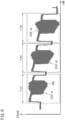
- FIG. 9 is a graph showing an example of the measurement result obtained by the strain sensor when a step having an identical machining condition is repeated a plurality of times.
- the measurement result obtained by the strain sensor in three steps of the step A1, the step A2, and the step A3 is shown.
- the step A1, the step A2, and the step A3 are steps having an identical machining condition.
- the waveforms of the steps A2 and A3 have shifted due to thermal drift. The waveform shift will be described later.
- the waveform pattern of the strain in each of the steps A1, A2, A3 is acquired.
- the synchronization unit 312 determines a cut-out period including one step in the target data 400, and extracts (cuts out) the time-series waveform pattern of the determined cut-out period from the target data 400.
- the cut-out period is a period corresponding to a period showing a waveform pattern in the reference data 308.
- the synchronization unit 312 determines cut-out periods P_A1, P_A2, P_A3 of the respective steps A1, A2, A3, and cuts out the time-series waveform patterns of the respective steps A1, A2, A3 from the target data 400.
- the synchronization unit 312 calculates a first moving average and a second moving average of the target data 400.
- FIG. 10 is a graph showing an example of the first moving average and the second moving average of the target data 400.
- the vertical axis represents the moving average value of strain and the horizontal axis represents time.
- the upper graph shows the first moving average
- the lower graph shows the second moving average.
- the numbers of data points for calculating the average value are different from each other. For example, the number of data points for the first moving average is 100, and the number of data points for the second moving average is 200.
- FIG. 11 is an enlarged graph of a T portion in FIG. 10 .
- the vertical axis represents the moving average value of strain and the horizontal axis represents time.
- the black-line graph shows the first moving average
- a gray-line graph shows the second moving average.
- the change in the value are different. That is, in a period P_S in which the value is approximately constant, the first moving average and the second moving average show substantially identical values, and in a period P_C in which the value changes, the first moving average and the second moving average show values different from each other.
- the synchronization unit 312 specifies the change point of the value of the moving average, i.e., the boundary point between the period P_S and the period P_T.
- the synchronization unit 312 calculates the absolute value (hereinafter referred to as "difference between moving averages") of the difference between the first moving average and the second moving average.
- difference between moving averages In the period P_S in FIG. 11 , the difference between moving averages is small, and in the period P_T, the difference between moving averages includes a large value.
- FIG. 12 is a graph showing an example of the difference between moving averages. In FIG. 12 , the vertical axis represents the difference between moving averages and the horizontal axis represents time.
- the synchronization unit 312 compares the difference between moving averages with a threshold (first threshold) and specifies a time point ts0 when the difference between moving averages has exceeded the first threshold.
- the synchronization unit 312 compares the difference between moving averages with the first threshold in time order from the start time of the difference between moving averages, and specifies the time point ts0 when the difference between moving averages has exceeded the first threshold for the first time.
- the synchronization unit 312 determines a provisional period starting from the specified time point ts0.
- the provisional period is determined by using a registered period, which has been registered in advance based on the reference data 308. For example, a user registers, as the registered period, a period of one specific step included in the reference data 308. Information on the registered period is stored in the nonvolatile memory 302, for example. Using the time point ts0 as the starting point, the synchronization unit 312 determines a period having the same length as the registered period, as the provisional period.
- the synchronization unit 312 From a time te01, which is the end point of the provisional period, the synchronization unit 312 compares the difference between moving averages with the first threshold in reverse time order, and specifies a time point te02 when the difference between moving averages has exceeded the first threshold for the first time. The synchronization unit 312 determines the period from the time point ts0 to the time point te02, as a step period.
- the synchronization unit 312 determines a cut-out period, based on the step period.
- the cut-out period is a period for cutting out waveform data from the target data 400.
- FIG. 13 is a graph for describing an example of determination of the cut-out period.
- the vertical axis represents the difference between moving averages and the horizontal axis represents time.
- the synchronization unit 312 specifies a time point ts1, which is before, by a margin, the time point ts0, and specifies a time point te1, which is after, by a margin, the time point te02.
- the synchronization unit 312 determines the period from the time point ts1 to the time point te1, as the cut-out period.
- the margin is determined based on the step period. For example, the margin is 1/2 of the difference between the registered period and the step period. However, the margin may be a period determined in advance.
- the cut-out period as described above is set in a period in which a specific step is being performed by using the cutting tool 30.
- the cut-out period is set in an intermittent cutting step in which cutting and non-cutting of the machining target object are repeated.
- a continuous machining step in which cutting of the machining target object continues, even when an anomaly has occurred in the cutting tool 30, a constant strain is stably caused in the cutting tool 30.
- the intermittent cutting step no strain is caused in the cutting tool 30 during non-cutting, and a strain is caused in the cutting tool 30 during cutting. That is, a state where a strain is caused in the cutting tool 30 and a state where no strain is caused in the cutting tool 30 are repeated. Therefore, an anomaly having been caused in the cutting tool 30 appears as a variation in the strain in the cutting tool 30, for example. Therefore, if the measurement result of the strain in the intermittent cutting step is used, an anomaly in the cutting tool 30 can be accurately detected.
- the synchronization unit 312 cuts out the waveform data in the determined cut-out period from the target data 400.
- the cut-out waveform data (hereinafter, referred to as "cut-out data") has been synchronized with the reference data 308.
- the period setting unit 313 sets a target period (hereinafter referred to as "window") in a machining step, that is identical, in the reference data 308 and the cut-out data. With reference to FIG. 7 and FIG. 8 , the window will be described.
- a window W is a partial period in one step.
- the window W is a period common between the reference data 308 and the cut-out data.
- the period setting unit 313 sets a partial period in the reference data 308, as the window W.
- the correction unit 314 corrects the baseline of the cut-out data.
- the waveform data of the measurement values of the strain shifts due to thermal drift.
- FIG. 9 is referred to.
- the measurement result that is obtained by the strain sensor 110 varies under influence of the heat. This is the thermal drift.
- the strain waveform shifts due to the thermal drift.
- the correction unit 314 corrects the shift of the strain waveform due to the thermal drift.
- the same step is repeatedly performed, and the waveform pattern of the strain in the subsequent steps A2 and A3 shifts, due to the thermal drift, to the positive side with respect to the waveform pattern of the strain in the previous step A1.
- the waveform pattern of the strain in the subsequent step A3 shifts to the positive side with respect to the waveform pattern of the strain in the previous step A2.
- FIG. 14A is a graph showing an example of the cut-out data before correction
- FIG. 14B is a graph showing an example of the cut-out data after correction.
- the vertical axis represents strain and the horizontal axis represents time.
- the black-line graph shows the reference data 308, and the gray-line graph shows cut-out data 410.
- the reference data 308 is data after correction. That is, in the reference data 308, the waveform shift due to the thermal drift is corrected in advance.
- the correction unit 314 calculates the average value of the strain measurement values of the cut-out data 410 in the window W, and subtracts the average value from each measurement value of the cut-out data 410 in the window W, to correct the baseline of the cut-out data 410.
- the baseline of cut-out data 410A after correction coincides with the baseline of the reference data 308.
- the baseline of the reference data 308 need not necessarily be corrected in advance. In this case, the correction unit 314 subtracts the average value from each measurement value of the reference data 308 in the window W, to correct the baseline of the reference data 308.
- the distance calculation unit 315 calculates the distance between the reference data 308 and the target data 400 (the cut-out data 410A) between which synchronization has been achieved by the synchronization unit 312. In a specific example, the distance calculation unit 315 calculates the distance between the reference data 308 and the cut-out data 410A in the window W set by the period setting unit 313. The distance calculation unit 315 calculates the distance between the reference data 308 and the cut-out data 410A of which the baseline has been corrected by the correction unit 314.
- An example of the distance between the reference data 308 and the cut-out data 410A is the distance between the time-series waveform of the reference data 308 and the time-series waveform of the cut-out data 410A.
- the distance between the reference data 308 and the cut-out data 410A is DTW (dynamic time warping) between the reference data 308 and the cut-out data 410A.
- FIG. 15 is a graph for describing the DTW between the reference data 308 and the cut-out data 410A.
- the vertical axis represents strain and the horizontal axis represents time.
- the upper graph shows the reference data 308 and the lower graph shows the cut-out data 410A.
- the reference data 308 and the cut-out data 410A are shown in separate coordinate systems. However, in actuality, the DTW between the waveform of the reference data 308 and the waveform of the cut-out data 410A in one common coordinate axes (axis for strain and axis for time) is calculated.
- the distance calculation unit 315 calculates, in a round-robin manner, the distance (the absolute value of error) between each point of the reference data 308 and each point of the cut-out data 410A, and determines the minimum value out of the calculated distances, as the distance between the reference data 308 and the cut-out data 410A.
- the determined distance is regarded as an anomaly degree of the cutting tool 30.
- the anomaly detection unit 316 detects an anomaly in the cutting tool 30 by comparing the distance (the anomaly degree) calculated by the distance calculation unit 315 with a threshold (second threshold). Specifically, when the anomaly degree has exceeded the second threshold, the anomaly detection unit 316 determines that an anomaly has occurred in the cutting tool 30, and when the anomaly degree is equal to or less than the second threshold, determines that no anomaly has occurred in the cutting tool 30 (being in a normal state).
- the second threshold is determined based on the position of the window W. However, the second threshold may be set in advance. For example, the second threshold is determined according to Hotelling's T 2 method. However, the second threshold may be determined by using another method.
- the period setting unit 313 sets a period slightly shifted from the original window W, as a new window W.
- the cut-out data 410 is cut out from the target data 400
- the correction unit 314 corrects the baseline of the cut-out data 410
- the distance calculation unit 315 calculates the distance between the reference data 308 and the cut-out data 410A
- the anomaly detection unit 316 performs comparison between the anomaly degree and the second threshold.
- a period (hereinafter, "detection target period") in which anomaly detection is performed is set in advance, and the period setting unit 313 can sequentially set the window W by shifting a predetermined time, from the starting point to the end point of the detection target period. Accordingly, in the entirety of the detection target period, the anomaly degree is sequentially calculated, whereby the anomaly detection for the cutting tool 30 is performed.
- the detection target period is set as a partial or the entire period of the cut-out period, for example.
- the display control unit 317 outputs a video signal to the display device 306 and controls display of the display device 306.
- the display control unit 317 causes the display device 306 to display the detection of the anomaly. Accordingly, the user is notified of the detection of the anomaly.
- the display control unit 317 can cause the display device 306 to display a time-series graph (hereinafter, referred to as "anomaly degree graph") of the anomaly degree calculated by the distance calculation unit 315.
- FIG. 16A is a graph showing an example of the anomaly degree graph
- FIG. 16B is a graph showing another example of the anomaly degree graph.
- the vertical axis represents anomaly degree
- the horizontal axis represents time.
- FIG. 16A is the anomaly degree graph when the cutting tool 30 is in a normal state
- FIG. 16B is the anomaly degree graph when the cutting tool 30 is in an abnormal state.
- the user can confirm temporal transition of the anomaly degree.
- the user can confirm how the state has changed.
- FIG. 17 is a flowchart showing an example of the anomaly detection process performed by the anomaly detection device according to the present embodiment.
- the strain sensor 110 measures the strain in the cutting tool 30.
- the sensor module 100 wirelessly transmits a measurement result obtained by the strain sensor 110 to the anomaly detection device 300.
- the anomaly detection device 300 receives the measurement result of the strain, and stores the measurement result into the measurement result DB 309. In this manner, measurement data in time series is accumulated in the measurement result DB 309.
- the processor 301 acquires the target data 400, which is the measurement data to serve as the target of the anomaly detection, from the measurement result DB (step S101).
- the processor 301 executes a synchronization process of achieving synchronization between the acquired target data 400 and the reference data 308 (step S102).
- FIG. 18 is a flowchart showing an example of the synchronization process.
- the processor 301 calculates the first moving average and the second moving average of the target data 400, and calculates the difference between moving averages (step S201). Next, the processor 301 compares the difference between moving averages with the first threshold, and specifies the time point ts0 when the difference between moving averages has exceeded the first threshold (step S202).
- the processor 301 determines a provisional period with the specified time point ts0 used as the starting point (step S203).
- the processor 301 compares the difference between moving averages with the first threshold in reverse time order from the time te01, which is the end point of the provisional period, and specifies the time point te02 when the difference between moving averages has exceeded the first threshold for the first time.
- the processor 301 determines the period from the time point ts0 to the time point te02, as the step period (step S204).
- the processor 301 adds a margin before and after the step period, and determines a cut-out period (step S205).
- the processor 301 cuts out the waveform data (cut-out data) in the cut-out period from the target data 400 (step S206). Then, the synchronization process ends.
- the processor 301 sets the window W to the cut-out data 410 and the reference data 308 for which synchronization has been achieved (step S103).
- the first window W is set at the start-edge of the detection target period.
- the processor 301 calculates the average value of the measurement values of the cut-out data 410 in the window W, and subtracts the average value from each measurement value. Accordingly, the baseline of the cut-out data 410 is corrected (step S104).
- the processor 301 calculates the distance between the reference data 308 and the cut-out data 410A after correction, as the anomaly degree (step S105).
- the processor 301 compares the anomaly degree with the second threshold (step S106). When the anomaly degree is equal to or less than the second threshold (NO in step S106), the processor 301 proceeds to step S109.
- the processor 301 determines that an anomaly has occurred in the cutting tool 30. That is, the processor 301 detects an anomaly in the cutting tool 30 (step S107).
- the processor 301 causes the display device 306 to display the detection of the anomaly in the cutting tool 30 (step S108). Accordingly, the user is notified of the detection of the anomaly.
- the processor 301 determines whether or not the window W has reached the end-edge of the detection target period (step S109). When the window W has not reached the end-edge of the detection target period (NO in step S109), the processor 301 returns to step S103 and sets a period after a predetermined time from the window W, as a new window W. The processor 301 executes step S104 and thereafter. With the window W being sequentially updated, the anomaly degree is calculated in the entirety of the detection target period, and whether or not the cutting tool 30 is in an abnormal state is determined.
- the processor 301 creates an anomaly degree graph of the detection target period and causes the display device 306 to display the anomaly degree graph (step S110). Then, the anomaly detection process ends.
- the cut-out period is set in an intermittent cutting step, and an anomaly in the cutting tool in the intermittent cutting step is detected.
- the cut-out period may be set in a continuous machining step, and an anomaly in the cutting tool in the continuous machining step may be detected.
- a period that includes one or a plurality of intermittent cutting steps and one or a plurality of continuous machining steps may be set as the cut-out period, and an anomaly in the cutting tool in the cut-out period may be detected.
- the distance between the time-series waveform of the reference data and the time-series waveform of the cut-out data (target data) is calculated.
- the difference between the distribution of the reference data and the distribution of the cut-out data (target data) may be calculated.
- the distance between the time-series waveform of the reference data and the time-series waveform of the cut-out data is not limited to the DTW, and may be the Euclidean distance, for example.
- the phase with the time-series waveform of the cut-out data may be matched with the phase of the time-series waveform of the reference data.
- the cross entropy may be calculated, or the density ratio may be estimated.
- an anomaly in the cutting tool 30 is detected by using the measurement data, of the strain in the cutting tool 30, obtained by the strain sensor 110.
- An anomaly in the cutting tool 30 may be detected by providing an acceleration sensor to the cutting tool 30 and using the acceleration in time series measured by the acceleration sensor. When an acceleration sensor is used, the difference between the distribution of the reference data of acceleration and the distribution of the target data of acceleration can be calculated as the anomaly degree.
Landscapes
- Engineering & Computer Science (AREA)
- Theoretical Computer Science (AREA)
- Physics & Mathematics (AREA)
- General Physics & Mathematics (AREA)
- Quality & Reliability (AREA)
- General Engineering & Computer Science (AREA)
- Manufacturing & Machinery (AREA)
- Human Computer Interaction (AREA)
- Automation & Control Theory (AREA)
- Biomedical Technology (AREA)
- Health & Medical Sciences (AREA)
- Numerical Control (AREA)
- Machine Tool Sensing Apparatuses (AREA)
Applications Claiming Priority (1)
| Application Number | Priority Date | Filing Date | Title |
|---|---|---|---|
| PCT/JP2022/024155 WO2023243043A1 (fr) | 2022-06-16 | 2022-06-16 | Système de détection d'anomalie, dispositif de détection d'anomalie, précédé de détection d'anomalie, et programme informatique |
Publications (2)
| Publication Number | Publication Date |
|---|---|
| EP4541507A1 true EP4541507A1 (fr) | 2025-04-23 |
| EP4541507A4 EP4541507A4 (fr) | 2025-08-13 |
Family
ID=86996542
Family Applications (1)
| Application Number | Title | Priority Date | Filing Date |
|---|---|---|---|
| EP22946860.8A Pending EP4541507A4 (fr) | 2022-06-16 | 2022-06-16 | Système de détection d'anomalie, dispositif de détection d'anomalie, précédé de détection d'anomalie, et programme informatique |
Country Status (5)
| Country | Link |
|---|---|
| US (1) | US20250355750A1 (fr) |
| EP (1) | EP4541507A4 (fr) |
| JP (1) | JP7302757B1 (fr) |
| CN (1) | CN119173356A (fr) |
| WO (1) | WO2023243043A1 (fr) |
Families Citing this family (3)
| Publication number | Priority date | Publication date | Assignee | Title |
|---|---|---|---|---|
| JP7537647B1 (ja) * | 2023-10-12 | 2024-08-21 | 住友電気工業株式会社 | 処理装置、処理システム、コンピュータプログラム、および処理方法 |
| CN119238469B (zh) * | 2024-10-18 | 2025-11-14 | 武汉大学人民医院(湖北省人民医院) | 外骨骼机器人及其异常检测方法、装置和介质 |
| CN119443742A (zh) * | 2025-01-10 | 2025-02-14 | 陕西雷诺贝尔铝业有限公司 | 幕墙单铝板的生产加工数据协同管理系统及方法 |
Family Cites Families (15)
| Publication number | Priority date | Publication date | Assignee | Title |
|---|---|---|---|---|
| US7110917B2 (en) * | 2003-11-14 | 2006-09-19 | Ricoh Company, Ltd. | Abnormality determining method, and abnormality determining apparatus and image forming apparatus using same |
| GB0709420D0 (en) * | 2007-05-17 | 2007-06-27 | Rolls Royce Plc | Machining process monitor |
| CN103250107A (zh) * | 2010-12-31 | 2013-08-14 | 中国科学院自动化研究所 | 用于设备故障检测的智能检测系统及检测方法 |
| US9928130B2 (en) * | 2011-06-03 | 2018-03-27 | Beet, Llc | Method for generating a machine heartbeat |
| JP6001518B2 (ja) * | 2013-10-17 | 2016-10-05 | 株式会社神戸製鋼所 | 状態計測装置及び状態計測システム |
| US10043211B2 (en) * | 2014-09-08 | 2018-08-07 | Leeo, Inc. | Identifying fault conditions in combinations of components |
| KR102446325B1 (ko) * | 2015-06-24 | 2022-09-22 | 삼성전자주식회사 | 어플리케이션 프로그램 운용 방법 및 이를 지원하는 전자 장치 |
| US11683234B2 (en) * | 2015-07-14 | 2023-06-20 | Netflix, Inc. | Server outlier detection |
| JP6426667B2 (ja) | 2016-08-10 | 2018-11-21 | 三菱重工工作機械株式会社 | 工作機械の工具の異常検知装置及び方法 |
| JP2019207542A (ja) * | 2018-05-29 | 2019-12-05 | ファナック株式会社 | 分析装置、分析方法及び分析プログラム |
| CN113165134B (zh) * | 2018-12-12 | 2023-10-13 | 株式会社富士 | 异常检测装置、机床、异常检测方法及程序 |
| JP2021112800A (ja) * | 2020-01-20 | 2021-08-05 | 株式会社日立製作所 | 異常予兆検知システムおよび方法 |
| WO2021261418A1 (fr) * | 2020-06-24 | 2021-12-30 | ファナック株式会社 | Dispositif de diagnostic d'outil et procédé de diagnostic d'outil |
| US12271572B2 (en) * | 2021-10-25 | 2025-04-08 | Oracle International Corporation | Unified user interface for monitoring hybrid deployment of computing systems |
| US11899527B2 (en) * | 2021-11-30 | 2024-02-13 | Caterpillar Inc. | Systems and methods for identifying machine anomaly root cause based on a selected reduced order model and a selected fault model |
-
2022
- 2022-06-16 EP EP22946860.8A patent/EP4541507A4/fr active Pending
- 2022-06-16 US US18/874,312 patent/US20250355750A1/en active Pending
- 2022-06-16 WO PCT/JP2022/024155 patent/WO2023243043A1/fr not_active Ceased
- 2022-06-16 JP JP2022574118A patent/JP7302757B1/ja active Active
- 2022-06-16 CN CN202280096024.4A patent/CN119173356A/zh active Pending
Also Published As
| Publication number | Publication date |
|---|---|
| JP7302757B1 (ja) | 2023-07-04 |
| US20250355750A1 (en) | 2025-11-20 |
| CN119173356A (zh) | 2024-12-20 |
| EP4541507A4 (fr) | 2025-08-13 |
| WO2023243043A1 (fr) | 2023-12-21 |
| JPWO2023243043A1 (fr) | 2023-12-21 |
Similar Documents
| Publication | Publication Date | Title |
|---|---|---|
| EP4541507A1 (fr) | Système de détection d'anomalie, dispositif de détection d'anomalie, précédé de détection d'anomalie, et programme informatique | |
| JP7435576B2 (ja) | 切削システム、表示システム、処理装置、処理方法および処理プログラム | |
| EP4570429A1 (fr) | Système de détection d'anomalie, dispositif de détection d'anomalie, procédé de détection d'anomalie et programme informatique | |
| EP3238887A2 (fr) | Dispositif et procédé de détermination d'anomalie | |
| US10010991B2 (en) | State measuring device and state measuring system | |
| JP2022020722A5 (fr) | ||
| JPWO2013073436A1 (ja) | 工作機械の切削力検出装置、切削力検出方法、加工異常検出方法、および加工条件制御システム | |
| WO2021156991A1 (fr) | Dispositif d'analyse, dispositif d'approvisionnement, procédé de détermination, procédé d'approvisionnement, programme de détermination et programme d'approvisionnement | |
| JP2019207126A (ja) | 異常診断システム及び振動センサ | |
| JP7811889B2 (ja) | 加工条件管理システム、加工制御装置、加工システム、および加工プログラム | |
| WO2025022632A1 (fr) | Système de traitement, dispositif de traitement, procédé de traitement et programme de traitement | |
| JP7160230B1 (ja) | 監視装置、監視方法、加工システム、およびプログラム | |
| EP4261512B1 (fr) | Système de traitement | |
| JP2016139274A (ja) | 不具合診断方法及び不具合診断システム | |
| JP2019130627A (ja) | 熱変位補正装置及び機械学習装置 | |
| EP4420829A1 (fr) | Dispositif d'analyse, procédé d'analyse, système d'usinage et programme | |
| CN118081479B (zh) | 一种机床运行故障在线监测方法与系统 | |
| JP7723926B2 (ja) | 異常検知装置及び異常検知方法 | |
| JP7678430B2 (ja) | 振動解析方法および振動解析装置 | |
| JP2025015081A (ja) | 切削工具の異常検知装置および異常検知方法 | |
| CN107168243A (zh) | 一种基于分时间温度检测的机床运动补偿系统 | |
| Broel-Plater et al. | Force-measurement based tool-workpiece contact detection in micromilling | |
| WO2021153655A1 (fr) | Outil de coupe, système d'outil et procédé de transmission d'informations de coupe | |
| CN114087940B (zh) | 一种多功能游标卡尺使用方法 | |
| CN113447045B (zh) | 一种惯性系统精度可靠度分析方法及系统 |
Legal Events
| Date | Code | Title | Description |
|---|---|---|---|
| STAA | Information on the status of an ep patent application or granted ep patent |
Free format text: STATUS: THE INTERNATIONAL PUBLICATION HAS BEEN MADE |
|
| PUAI | Public reference made under article 153(3) epc to a published international application that has entered the european phase |
Free format text: ORIGINAL CODE: 0009012 |
|
| STAA | Information on the status of an ep patent application or granted ep patent |
Free format text: STATUS: REQUEST FOR EXAMINATION WAS MADE |
|
| 17P | Request for examination filed |
Effective date: 20241206 |
|
| AK | Designated contracting states |
Kind code of ref document: A1 Designated state(s): AL AT BE BG CH CY CZ DE DK EE ES FI FR GB GR HR HU IE IS IT LI LT LU LV MC MK MT NL NO PL PT RO RS SE SI SK SM TR |
|
| REG | Reference to a national code |
Ref country code: DE Ref legal event code: R079 Free format text: PREVIOUS MAIN CLASS: B23Q0017090000 Ipc: G05B0019408000 |
|
| A4 | Supplementary search report drawn up and despatched |
Effective date: 20250711 |
|
| RIC1 | Information provided on ipc code assigned before grant |
Ipc: G05B 19/408 20060101AFI20250707BHEP Ipc: G05B 19/4065 20060101ALI20250707BHEP Ipc: B23Q 17/09 20060101ALI20250707BHEP |
|
| DAV | Request for validation of the european patent (deleted) | ||
| DAX | Request for extension of the european patent (deleted) |