EP4557843A1 - Système et procédé de distribution d'énergie dans un système à antennes multiples - Google Patents
Système et procédé de distribution d'énergie dans un système à antennes multiples Download PDFInfo
- Publication number
- EP4557843A1 EP4557843A1 EP24214072.1A EP24214072A EP4557843A1 EP 4557843 A1 EP4557843 A1 EP 4557843A1 EP 24214072 A EP24214072 A EP 24214072A EP 4557843 A1 EP4557843 A1 EP 4557843A1
- Authority
- EP
- European Patent Office
- Prior art keywords
- antennas
- transmission
- cces
- pdcch
- antenna elements
- Prior art date
- Legal status (The legal status is an assumption and is not a legal conclusion. Google has not performed a legal analysis and makes no representation as to the accuracy of the status listed.)
- Pending
Links
Images









Classifications
-
- H—ELECTRICITY
- H04—ELECTRIC COMMUNICATION TECHNIQUE
- H04W—WIRELESS COMMUNICATION NETWORKS
- H04W52/00—Power management, e.g. Transmission Power Control [TPC] or power classes
- H04W52/04—Transmission power control [TPC]
- H04W52/38—TPC being performed in particular situations
- H04W52/42—TPC being performed in particular situations in systems with time, space, frequency or polarisation diversity
-
- H—ELECTRICITY
- H04—ELECTRIC COMMUNICATION TECHNIQUE
- H04B—TRANSMISSION
- H04B7/00—Radio transmission systems, i.e. using radiation field
- H04B7/02—Diversity systems; Multi-antenna system, i.e. transmission or reception using multiple antennas
- H04B7/04—Diversity systems; Multi-antenna system, i.e. transmission or reception using multiple antennas using two or more spaced independent antennas
- H04B7/06—Diversity systems; Multi-antenna system, i.e. transmission or reception using multiple antennas using two or more spaced independent antennas at the transmitting station
- H04B7/0686—Hybrid systems, i.e. switching and simultaneous transmission
- H04B7/0691—Hybrid systems, i.e. switching and simultaneous transmission using subgroups of transmit antennas
-
- H—ELECTRICITY
- H04—ELECTRIC COMMUNICATION TECHNIQUE
- H04B—TRANSMISSION
- H04B7/00—Radio transmission systems, i.e. using radiation field
- H04B7/02—Diversity systems; Multi-antenna system, i.e. transmission or reception using multiple antennas
- H04B7/10—Polarisation diversity; Directional diversity
-
- H—ELECTRICITY
- H04—ELECTRIC COMMUNICATION TECHNIQUE
- H04W—WIRELESS COMMUNICATION NETWORKS
- H04W52/00—Power management, e.g. Transmission Power Control [TPC] or power classes
- H04W52/04—Transmission power control [TPC]
- H04W52/06—TPC algorithms
- H04W52/14—Separate analysis of uplink or downlink
- H04W52/143—Downlink power control
Definitions
- the present disclosure relates to systems and methods for radio access networks.
- the present disclosure relates to the design of operation, administration and management of various network elements of 4G, 5G, and further ongoing generational mobile networks, including Physical Downlink Control Channel (PDCCH) and Physical Downlink Shared Channel (PDSCH) transmission in a Fifth Generation (5G) New Radio (NR) system.
- PDCCH Physical Downlink Control Channel
- PDSCH Physical Downlink Shared Channel
- Wireless communication systems are widely deployed to provide variety of communication services such as for voice, data transmission and so on.
- the need for an increase in data rate transmission is growing rapidly.
- One of the ways this is accomplished is by adopting multiple antennas in wireless systems. These multiple antennas are used for sending and receiving data signals over radio channels.
- multiple antenna transmission techniques can provide robust transmission over multipath fading channels.
- the number of antennas in a wireless system depends on the implementation complexity, and the distance between the antenna elements depends on the operating frequency.
- Physical Downlink Control Channel (PDCCH) transmission in a 5G NR system is used to carry Downlink Control Information (DCI) for transmitting Physical Downlink Shared Channel (PDSCH), Physical Uplink Shared Channel (PUSCH), Medium Access Control (MAC) level information for a single or group of UEs.
- DCI Downlink Control Information
- PDSCH Physical Downlink Shared Channel
- PUSCH Physical Uplink Shared Channel
- MAC Medium Access Control
- PDCCH transmission in 5G NR is designed in the form of Control Resource Set (CORESET) based transmission.
- CORESET defines the control region in a slot in terms of OFDM symbols and Resource Block (RBs).
- Control Channel Elements (CCEs) within a CORESET are allocated to UEs in an interleaved or non-interleaved form.
- Physical Resource block Group (PRG) bundling refers to applying the same Precoding Matrix Index (PMI) over a plurality of adjacent resource blocks during PDSCH transmission.
- PMI Precoding Matrix Index
- UE User Equipment
- Size of the PRG bundle depends on the system bandwidth and it can be fixed either in static or dynamic manner. For a static configuration, PRG bundle size is informed through initial Radio Resource Control (RRC) configuration whereas for dynamic configuration it is informed while allocating the downlink resources.
- RRC Radio Resource Control
- aspects of the disclosure are as follows: Described are implementations of a system and methods for PDCCH transmission. including a system and methods for mapping one or more CCEs for a UE to antenna elements based on the polarization of the antenna. Also described are implementations of a system and methods for distributing the power levels for transmission of CCEs for a UE to the antenna elements.
- An exemplary advantage of implementations as described herein include improved decoding at a wireless receiver side.
- FIG. 1 shows multiple antenna transmission in a wireless system such as the exemplary systems shown in FIGS. 10-20 .
- transmission of data can be mapped to one or more antennas to enhance the overall system performance.
- Wireless communication systems are widely deployed to provide a variety of communication services such as for voice, data transmission and so on. The need for an increase in data rate transmission is growing rapidly.
- One of the ways this is accomplished is by adopting multiple antennas in wireless systems.
- Thes multiple antennas are used for sending and receiving data signals over radio channels.
- the same or different signals belonging to one or many users can be transmitted simultaneously over multiple antenna elements A1, A2 ...AN.
- multiple antenna transmission techniques can provide robust transmission over multipath fading channels.
- the number of antennas in a wireless system depends on implementation complexity, and the distance between the antenna elements depends on the operating frequency.
- FIG. 2 shows signal transmission over horizontal and vertical polarization directions in parallel.
- Radio signals can be transmitted with more than one polarization by exploiting the property of signal transmission over different angular spreads. It is possible to have more than one rank transmission by sending data over cross polarized elements of the transmission antennas.
- signal mapping can be done using +45 degree polarized antenna elements on one set and -45 degree polarized antenna elements on another set, where both sets are in the same single panel antenna structure. This can be done using polarized antenna elements.
- transmission can be done in both vertical and horizontal polarization direction in parallel.
- FIG. 3 shows mapping of multiple antenna elements over cross-polarized antenna elements.
- FIG. 3 shows an example of data signal mapping over 4 transmit antennas arranged in a cross-polarized panel.
- Antenna elements are equally distributed across the vertical and horizontal polarization directions. Transmit signals from the same polarization antenna can have destructive interference due to same angular spread. This can degrade the system performance for some channel conditions.
- PDCCH transmission in a 5G NR system is used to carry DCI for transmitting PDSCH, PUSCH, and MAC level information for a single or group of UEs.
- PDCCH transmission in 5G NR is designed in the form of CORESET based transmission.
- CORESET defines the control region in a slot in terms of OFDM symbols and RBs.
- CCEs in a CORESET are allocated to UEs in an interleaved or non-interleaved form.
- Aggregation Level (AL) is quantified in terms of number of CCEs that it occupies.
- a number of CCEs in PDCCH CORESET depends on the dimension of CORESET.
- FIG. 4 shows an example of PDCCH CCEs distribution based on non-interleaved pattern for 10 MHz system and two OFDM symbol duration. Each CCE occupies 6 RBs in frequency domain for a PDCCH length of 1 OFDM symbol.
- PRG bundling refers to applying the same PMI over a plurality of adjacent resource blocks during PDSCH transmission.
- UE can assume the estimates are constant across the RBs in a PRG bundle. Size of the PRG bundle depends on the system bandwidth and it can be fixed either in static or dynamic manner. For a static configuration, PRG bundle size is informed through initial Radio RRC configuration whereas for dynamic configuration it is informed while allocating the Downlink resources.
- FIG. 5 shows PRG bundling with bundle size of 2 RB and 4 RB for PDSCH transmission.
- FIG. 6 shows a PDCCH CCE mapping over antenna elements in an existing design. All CCEs are transmitted over an antenna element with equal transmit power levels. Based on the existing design, PDCCH CCEs are mapped over multiple antennas with equal power on all antenna elements. PDCCH signal mapping over antenna elements does not consider the polarization of the antennas. For example, as shown in FIG. 6 , PDCCH transmission of 'N' CCEs for a UE is mapped on 4 transmission antennas (2 cross polarized pairs) with equal power on all antenna elements.
- FIG. 7 shows conventional mapping of PRGs associated with single layer to multiple antenna elements. As shown in FIG. 7 , all PRGs are transmitted over each antenna element with equal transmit power levels. For a PDSCH transmission, mapping of one layer to multiple antenna elements is done by distributing power equally over all the antenna elements and does not consider antenna polarization into account. In the example of FIG. 7 , one layer transmission data is replicated over multiple antennas with PRG size of 4 RBs for PDSCH transmission. This can impact the decoding performance at the receiver side due to interference between antenna elements in some channel conditions.
- the present disclosure provides implementations to improve the link reliability for PDCCH and PDSCH transmission in a 5G NR system.
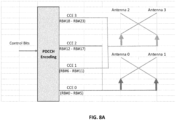
- FIG. 8A and FIG. 8B show CCE mapping over antenna elements for PDCCH transmission. As shown in FIG. 8B , only 50% of the RBs are occupied per antenna element. The transmit power per Antenna element can thus be increased to two times. This adds 3 dB gain at the receiver side.
- FIG .9A and FIG. 9B show PRG mapping over antenna elements for PDSCH transmission. As shown in FIG. 9B , only 50% of the RBs are occupied in per antenna element. The transmit power per antenna element can thus be increased to two times. This also adds a 3 dB gain at the receiver side for the better decoding of signals.
- transmit signals from the same polarization antenna can have destructive interference due to same angular spread. This can degrade the system performance for some channel conditions.
- the present disclosure provides implementations for PDCCH and PDSCH transmission in 5G NR system.
- Described herein are implementations for the distribution of power levels to the lowest possible granularity of RBs for PDCCH and PDSCH transmission over the antenna elements. Implementations as described herein can improve the overall link budget for achieving better signal reception at the receiver.
- Implementations as described herein can minimize the interference at the receiver side, thereby improving the probability of decoding signals at the receiver side.
- the present disclosure shows systems and methods for improving the detectability of downlink (DL) transmission by effective mapping of RBs and allocating power levels over antenna elements in a wireless transmitter system, which increases the probability of decoding the data at the receiver side.
- DL downlink
- Described is a system and method for mapping of CCEs in PDCCH transmission over multiple antenna elements in a wireless communication system.
- CCEs are distributed over antenna elements based on two factors.
- CCE 0 and CCE 1 are mapped over Antenna 0 and Antenna 1 and CCE 2 and CCE 3 are mapped over Antenna 2 and Antenna 3.
- RB level CCE distribution are shown in FIG. 8B .
- the transmit power level of CCE 0 and CCE 1 can be increased to two times due to the empty RB positions in the same antenna elements. This increases the path loss by 3dB at the receiver side.
- Described is a system and method for PDSCH transmission over multiple antenna elements at PRG level in a wireless system.
- PRGs are distributed over antennal elements based on two factors.
- an odd number of PRGs associated with one user PDSCH allocation is mapped to one set of cross polarized antennas and an even number of PRGs with the same user PDSCH allocation is mapped to another set of cross polarized antennas.
- FIG. 9B shows PRG mapping over each antenna element. As shown in FIG. 9B , only 50 % of RBs are occupied per antenna element. Hence transmit power can be increased by 2 times.
- DU and RU communicates through a FH interface.
- the CCE / PRG to antenna element mapping in the RU can be checked by capturing the IQ data samples in the FH interface.
- IQ samples can be further analyzed by Wireshark or equivalent tools to understand the value of each sample.
- Embodiments can be implemented analyzing the data samples at the UE side using QXDM or equivalent analysis tools to determine data mapping patterns and transmission power levels over antenna elements for CCE and PDSCH transmission.
- Embodiments can be implemented by analyzing the encoding pattern of the PDCCH / PDSCH transmission message from L2. This can be done by analyzing FAPI messages in Wireshark or equivalent tools.
- FIGS. 10-20 in which example architectures of a system and network according to various embodiments, is illustrated.
- the following description is provided for an example system that operates in conjunction with the LTE system standards and 5G or NR system standards as provided by 3GPP technical specifications.
- the example embodiments are not limited in this regard and the described embodiments can apply to other networks that benefit from the principles described herein, such as future 3GPP systems (e.g., Sixth Generation (6G)) systems, IEEE 802.16 protocols (e.g., WMAN, WiMAX, etc.), or the like.
- 6G Sixth Generation
- IEEE 802.16 protocols e.g., WMAN, WiMAX, etc.
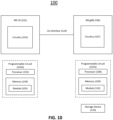
- FIG. 10 is a block diagram of a system 100 for implementations as described herein.
- System 100 includes a NR UE 101, a NR gNB 106.
- the NR UE and NR gNB are communicatively coupled via a Uu interface 120.
- NR UE 101 includes electronic circuitry, namely circuitry 102, that performs operations on behalf of NR UE 101 to execute methods described herein.
- Circuity 102 can be implemented with any or all of (a) discrete electronic components, (b) firmware, and (c) a programmable circuit 102A.
- NR gNB 106 includes electronic circuitry, namely circuitry 107, that performs operations on behalf of NR gNB 106 to execute methods described herein.
- Circuity 107 can be implemented with any or all of (a) discrete electronic components, (b) firmware, and (c) a programmable circuit 107A.
- Programmable circuit 107A which is an implementation of circuitry 107, includes a processor 108 and a memory 109.
- Processor 108 is an electronic device configured of logic circuitry that responds to and executes instructions.
- Memory 109 is a tangible, non-transitory, computer-readable storage device encoded with a computer program.
- memory 109 stores data and instructions, i.e., program code, that are readable and executable by processor 108 for controlling operations of processor 108.
- Memory 109 can be implemented in a random-access memory (RAM), a hard drive, a read only memory (ROM), or a combination thereof.
- One of the components of memory 109 is a program module, namely module 110.
- Module 110 contains instructions for controlling processor 108 to execute operations described herein on behalf of NR gNB 106.
- module is used herein to denote a functional operation that can be embodied either as a stand-alone component or as an integrated configuration of a plurality of subordinate components.
- each of module 105 and 110 can be implemented as a single module or as a plurality of modules that operate in cooperation with one another.
- Storage device 130 is a tangible, non-transitory, computer-readable storage device that stores module 110 thereon.
- Examples of storage device 130 include (a) a compact disk, (b) a magnetic tape, (c) a read only memory, (d) an optical storage medium, (e) a hard drive, (f) a memory unit consisting of multiple parallel hard drives, (g) a universal serial bus (USB) flash drive, (h) a random-access memory, and (i) an electronic storage device coupled to NR gNB 106 via a data communications network.
- Uu Interface (120) is the radio link between the NR UE and NR gNB, which is compliant to the 5G NR specification.
- UEs 101 can be dispersed throughout wireless communication network, and each UE may be stationary or mobile.
- a UE includes: an access terminal, a terminal, a mobile station, a subscriber unit, a station, and the like.
- a UE can also include be a cellular phone (e.g., a smart phone), a personal digital assistant (PDA), a wireless modem, a wireless communication device, a handheld device, a laptop computer, a cordless phone, a wireless local loop (WLL) station, a tablet, a camera, a gaming device, a drone, a robot/robotic device, a netbook, a smartbook, an ultrabook, a medical device, medical equipment, a healthcare device, a biometric sensor/device, a wearable device such as a smart watch, smart clothing, smart glasses, a smart wristband, and/or smart jewellery (e.g., a smart ring, a smart bracelet, and the like), an entertainment device (e.g., a music
- UEs can include UEs considered as machine-type communication (MTC) UEs or enhanced/evolved MTC (eMTC) UEs.
- MTC/eMTC UEs that can be implemented as IoT UEs.
- IoT UEs include, for example, robots/robotic devices, drones, remote devices, sensors, meters, monitors, cameras, location tags, etc., that can communicate with a BS, another device (e.g., remote device), or some other entity.
- a wireless node can provide, for example, connectivity for or to a network (e.g., a wide area network such as Internet or a cellular network) via a wired or wireless communication link.
- a network e.g., a wide area network such as Internet or a cellular network
- One or more UEs 101 in the wireless communication network can be a narrowband bandwidth UE.
- devices with limited communication resources e.g. smaller bandwidth, are considered as narrowband UEs.
- legacy devices such as legacy and/or advanced UEs (e.g., in LTE) can be considered as wideband UEs.
- Wideband UEs are generally understood as devices that use greater amounts of bandwidth than narrowband UEs.
- the UEs 101 are configured to connect, for example, communicatively couple, with an or RAN.
- the RAN may be an NG RAN or a 5G RAN, an E-UTRAN, an MF RAN, or a legacy RAN, such as a UTRAN or GERAN.
- NG RAN refers to a RAN 110 that operates in an NR or 5G system
- E-UTRAN refers to a RAN that operates in an LTE or 4G system
- MF RAN refers to a RAN that operates in an MF system 100.
- the UEs 101 utilize connections (or channels), respectively, each of which comprises a physical communications interface or layer.
- the connections can comprise several different physical DL channels and several different physical UL channels.
- the physical DL channels include the PDSCH, PMCH, PDCCH, EPDCCH, MPDCCH, R-PDCCH, SPDCCH, PBCH, PCFICH, PHICH, NPBCH, NPDCCH, NPDSCH, and/or any other physical DL channels mentioned herein.
- the physical UL channels include the PRACH, PUSCH, PUCCH, SPUCCH, NPRACH, NPUSCH, and/or any other physical UL channels mentioned herein.
- the RAN can include one or more AN nodes or RAN nodes. These access nodes can be referred to as BS, gNBs, RAN nodes, eNBs, NodeBs, RSUs, MF-APs, TRxPs or TRPs, and so forth, and comprise ground stations (e.g., terrestrial access points) or satellite stations providing coverage within a geographic area (e.g., a cell).
- NG RAN node refers to a RAN node that operates in an NR or 5G system (e.g., a gNB), and the term “E-UTRAN node” or the like refers to a RAN node that operates in an LTE or 4G system (e.g., an eNB).
- the RAN nodes can be implemented as one or more of a dedicated physical device such as a macrocell base station, and/or a low power base station for providing femtocells, picocells or other like cells having smaller coverage areas, smaller user capacity, or higher bandwidth compared to macrocells.
- all or parts of the RAN nodes can be implemented as one or more software entities running on server computers as part of a virtual network, which may be referred to as a CRAN and/or a vBBU.
- the CRAN or vBBU can implement a RAN function split, such as a PDCP split in which RRC and PDCP layers are operated by the CRAN/vBBU and other L2 protocol entities are operated by individual RAN nodes; a MAC/PHY split wherein RRC, PDCP, RLC, and MAC layers are operated by the CRAN/vBBU and the PHY layer is operated by individual RAN nodes; or a "lower PHY" split in which RRC, PDCP, RLC, MAC layers and upper portions of the PHY layer are operated by the CRAN/vBBU and lower portions of the PHY layer are operated by individual RAN nodes.
- a RAN function split such as a PDCP split in which RRC and PDCP layers are operated by the CRAN/vB
- an individual RAN node can represent individual gNB-DUs that are connected to a gNB-CU via individual F1 interfaces.
- the gNB-DUs can include one or more remote radio heads (RRH), and the gNB-CU may be operated by a server that is located in the RAN or by a server pool in a similar manner as the CRAN/vBBU.
- RRH remote radio heads
- ng-eNBs next generation eNBs
- MF-APs are entities that provide MultiFire radio services, and may be similar to eNBs in an 3GPP architecture.
- BS or gNB can be equipped with T antennas and UE 101 can be equipped with R antennas, where in general T ⁇ 1 and R ⁇ 1.
- a transmit processor is configured to receive data from a data source for one or more UEs 101 and select one or more modulation and coding schemes (MCS) for each UE based on channel quality indicators (CQIs) received from the UE 101.
- MCS modulation and coding schemes
- CQIs channel quality indicators
- the BS is configured to process (e.g., encode and modulate) the data for each UE 101 based on the MCS(s) selected for the UE 101, and provide data symbols for all UEs.
- a transmit processor is also configured to process system information (e.g., for static resource partitioning information (SRPI), and the like) and control information (e.g., CQI requests, grants, upper layer signaling, and the like) and can provide overhead symbols and control symbols.
- Processor 108 can also generate reference symbols for reference signals (e.g., the cell-specific reference signal (CRS)) and synchronization signals (e.g., the primary synchronization signal (PSS) and the secondary synchronization signal (SSS)).
- reference signals e.g., the cell-specific reference signal (CRS)
- synchronization signals e.g., the primary synchronization signal (PSS) and the secondary synchronization signal (SSS)
- a transmit (TX) multiple-input multiple-output (MIMO) processor can be configured perform spatial processing (e.g., precoding) on the data symbols, the control symbols, the overhead symbols, and/or the reference symbols, if applicable, and can be configured to provide T output symbol streams to T modulators (MODs).
- Each modulator can be configured to process a respective output symbol stream (e.g., for OFDM, and the like) to obtain an output sample stream.
- Each modulator can further be configured to process (e.g., convert to analog, amplify, filter, and upconvert) the output sample stream to obtain a downlink signal.
- T downlink signals from modulators can be transmitted via T antennas.
- 5G NR New Radio
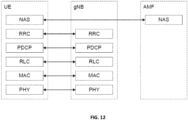
- user and control plane functions with monolithic gNB are shown in the figures below.
- PHY physical
- MAC Medium Access Control
- RLC Radio Link Control
- PDCP Packet Data Convergence Protocol
- SDAP Service Data Adaptation Protocol
- RRC Radio Resource Control
- PDCP Packet Data Convergence Protocol
- SDAP Service Data Adaptation Protocol
- RRC Radio Resource Control
- PDCP Packet Data Convergence Protocol
- SDAP Service Data Adaptation Protocol
- RRC Radio Resource Control
- PDCP Packet Data Convergence Protocol
- SDAP Service Data Adaptation Protocol
- RRC Radio Resource Control
- PDCP Packet Data Convergence Protocol
- MAC Service Data Adaptation Protocol
- NAS Non-Access Stratum
- AMF Access Mobility Function
- NG-RAN NG-Radio Access Network
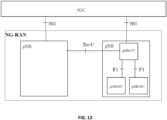
- F1 is the interface between gNB-CU (gNB - Centralized Unit) and gNB-DU (gNB - Distributed Unit)
- NG is the interface between gNB-CU (or gNB) and 5GC (5G Core)
- E1 is the interface between CU-CP (CU-Control Plane) and CU-UP (CU-User Plane)
- Xn is interface between gNBs.
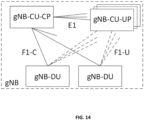
- a gNB can have a gNB-CU-CP, multiple gNB-CU-UPs and multiple gNB-DUs.
- the gNB-CU-CP is connected to the gNB-DU through the F1-C interface and to the gNB-CU-UP through the E1 interface.
- the gNB-CU-UP is connected to the gNB-DU through the F1-U interface and to the gNB-CU-CP through the E1 interface.
- One gNB-DU is connected to only one gNB-CU-CP and one gNB-CU-UP is connected to only one gNB-CU-CP.
- FIG. 13 shows an example of an NG-RAN Architecture as described in 3GPP TS 38.501.
- FIG. 14 shows an example of a Separation of CU-CP (CU-Control Plane) and CU-UP (CU-User Plane) as described in 3GPP TS 38.401.
- L2 Layer 2 of 5G NR is split into the following sublayers is described in 3GPP TS 38.300):
- FIG. 15 shows a DL (Downlink) Layer 2 Structure as described in 3GPP TS 38.300.
- FIG. 11 shows an UL (uplink) Layer 2 Structure in accord with 3GPP TS38.300.
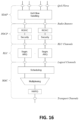
- FIG. 17 shows an L2 Data Flow example in accord with 3GPP TS 38.300 [H denotes headers or subheaders in FIG. 17 ].
- O-RAN which is based on disaggregated components and connected through open and standardized interfaces, is based on 3GPP NG-RAN.
- An overview of O-RAN with disaggregated RAN (CU, DU, and RU), near-real-time RIC and non-real-time RIC is shown in the figure below.
- DU Distributed Unit
- CU Centralized Unit
- COTS Communication off-the-shelf
- FIG. 18 shows an example of an O-RAN architecture.
- the CU and the DU are connected using the F1 interface (with F1-C for control plane and F1-U for user plane traffic) over the midhaul (MH) path.
- F1 interface with F1-C for control plane and F1-U for user plane traffic
- MH midhaul
- One DU could host multiple cells (for example, one DU could host 24 cells) and each cell may support many users.
- one cell can support 600 RRC Connected users and out of these 600, there may be 200 Active users (i.e., users which have data to send at a given point of time).
- a cell site could have multiple sectors and each sector can support multiple cells. For example, one site could consist of three sectors and each sector could support 8 cells (with 8 cells in each sector on different frequency bands).
- One CU-CP could support multiple DUs and thus multiple cells. For example, a CU-CP could support 1000 cells and around 100,000 UEs. Each UE could support multiple DRBs and there could be multiple instances of CU-UP to serve these DRBs. For example, each UE could support 4 DRBs, and 400,000 DRBs (corresponding to 100,000 UEs) may be served by five CU-UP instances (and one CU-CP instance).
- DU could be located in a private data center or it could be located at a cell-site too. CU could also be located in a private data center or even hosted on a public cloud system. DU and CU could be tens of kilometers away. CU could communicate with 5G core system which could also be hosted in the same public cloud system (or could be hosted by a different cloud provider).
- RU Radio Unit
- FH fronthaul
- the E2 nodes (CU and DU) are connected to the near-real-time RIC using the E2 interface.
- the E2 interface is used to send data (e.g., user, cell, slice KPMs) from the RAN, and deploy control actions and policies to the RAN at near-real-time RIC.
- the application or service at the near-real-time RIC that deploys the control actions and policies to the RAN are called xApps.
- the near-real-time RIC is connected to the non-real-time RIC using the A1 interface.
- the E-UTRAN comprises eNBs, providing the E-UTRA U-plane (PDCP/RLC/MAC/PHY) and control plane (RRC) protocol terminations towards the UE.
- the eNBs are interconnected with each other by the X2 interface.
- the eNBs are also connected by the S1 interface to the EPC (Evolved Packet Core), more specifically to the MME (Mobility Management Entity) by the S1-MME interface and to the Serving Gateway (S-GW) by the S1-U interface.
- EPC Evolved Packet Core
- MME Mobility Management Entity
- S-GW Serving Gateway
- E-UTRAN also supports MR-DC via E-UTRA-NR Dual Connectivity (EN-DC), in which a UE is connected to one eNB that acts as a MN and one en-gNB that acts as a SN.
- EN-DC E-UTRA-NR Dual Connectivity
- the eNB is connected to the EPC via the S1 interface and to the en-gNB via the X2 interface.
- the en-gNB might also be connected to the EPC via the S1-U interface and other en-gNBs via the X2-U interface.
- an en-gNB comprises gNB-CU and gNB-DU(s).
- E-UTRAN also supports and NG-RAN architecture.
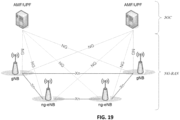
- An NG-RAN architecture is illustrated in FIG. 20 .
- An NG-RAN node is either:
- the gNBs and ng-eNBs are interconnected with each other by the Xn interface.
- the gNBs and ng-eNBs are also connected by the NG interfaces to the 5GC, more specifically to the AMF (Access and Mobility Management Function) by the NG-C interface and to the UPF (User Plane Function) by the NG-U interface.
- the gNB and ng-eNB host functions for Radio Resource Management such as: Radio Bearer Control, Radio Admission Control, Connection Mobility Control, Dynamic allocation of resources to UEs in both uplink and downlink (scheduling), connection setup and release; session Management; QoS Flow management and mapping to data radio bearers; Dual Connectivity. Tight interworking between NR and E-UTRA.
- NB-IoT UE is supported by ng-eNB.
- the gNB and ng-eNB host functions such as functions for Radio Resource Management: Radio Bearer Control, Radio Admission Control, Connection Mobility Control, Dynamic allocation of resources to UEs in both uplink and downlink (scheduling), connection setup and release; session Management; QoS Flow management and mapping to data radio bearers; Dual Connectivity; and Tight interworking between NR and E-UTRA.
- Radio Resource Management Radio Bearer Control, Radio Admission Control, Connection Mobility Control, Dynamic allocation of resources to UEs in both uplink and downlink (scheduling), connection setup and release; session Management; QoS Flow management and mapping to data radio bearers; Dual Connectivity; and Tight interworking between NR and E-UTRA.
- NB-IoT UE is supported by ng-eNB.
- control information (e.g., scheduling information) may be provided for broadcast and/or multicast operation.
- the UE can monitor different bundle sizes for the control channel depending on the maximum number of repetitions.
- implementations and embodiments can be implemented by computer program instructions. These program instructions can be provided to a processor to produce a machine, such that the instructions, which execute on the processor, create means for implementing the actions specified herein.
- the computer program instructions can be executed by a processor to cause a series of operational steps to be performed by the processor to produce a computer-implemented process such that the instructions, which execute on the processor to provide steps for implementing the actions specified.
- some of the steps can also be performed across more than one processor, such as might arise in a multi-processor computer system or even a group of multiple computer systems.
- one or more blocks or combinations of blocks in the flowchart illustration can also be performed concurrently with other blocks or combinations of blocks, or even in a different sequence than illustrated without departing from the scope or spirit of the disclosure.
Landscapes
- Engineering & Computer Science (AREA)
- Computer Networks & Wireless Communication (AREA)
- Signal Processing (AREA)
- Mobile Radio Communication Systems (AREA)
Applications Claiming Priority (2)
| Application Number | Priority Date | Filing Date | Title |
|---|---|---|---|
| IN202321078816 | 2023-11-20 | ||
| US18/950,292 US20250168859A1 (en) | 2023-11-20 | 2024-11-18 | System and method for power distribution in multiple antenna system |
Publications (1)
| Publication Number | Publication Date |
|---|---|
| EP4557843A1 true EP4557843A1 (fr) | 2025-05-21 |
Family
ID=93607754
Family Applications (1)
| Application Number | Title | Priority Date | Filing Date |
|---|---|---|---|
| EP24214072.1A Pending EP4557843A1 (fr) | 2023-11-20 | 2024-11-20 | Système et procédé de distribution d'énergie dans un système à antennes multiples |
Country Status (1)
| Country | Link |
|---|---|
| EP (1) | EP4557843A1 (fr) |
-
2024
- 2024-11-20 EP EP24214072.1A patent/EP4557843A1/fr active Pending
Non-Patent Citations (4)
| Title |
|---|
| "3rd Generation Partnership Project; Technical Specification Group Radio Access Network; NG-RAN; Architecture description (Release 17)", 3 April 2023 (2023-04-03), XP052452014, Retrieved from the Internet <URL:https://ftp.3gpp.org/3guInternal/3GPP_ultimate_versions_to_be_transposed/sentToDpc/38401-h40.zip 38401-h40.docx> [retrieved on 20230403] * |
| "3rd Generation Partnership Project; Technical Specification Group Radio Access Network; NG-RAN; NR user plane protocol (Release 17)", 3 April 2023 (2023-04-03), XP052452020, Retrieved from the Internet <URL:https://ftp.3gpp.org/3guInternal/3GPP_ultimate_versions_to_be_transposed/sentToDpc/38425-h30.zip 38425-h30.docx> [retrieved on 20230403] * |
| "3rd Generation Partnership Project; Technical Specification Group Radio Access Network; NR; NR and NG-RAN Overall Description; Stage 2 (Release 17)", 28 September 2023 (2023-09-28), XP052532536, Retrieved from the Internet <URL:https://ftp.3gpp.org/3guInternal/3GPP_ultimate_versions_to_be_transposed/sentToDpc/38300-h60.zip 38300-h60.docx> [retrieved on 20230928] * |
| "3rd Generation Partnership Project; Technical Specification Group Services and System Aspects; System architecture for the 5G System (5GS); Stage 2 (Release 18)", 4 April 2023 (2023-04-04), XP052454776, Retrieved from the Internet <URL:https://ftp.3gpp.org/tsg_sa/WG2_Arch/Latest_SA2_Specs/DRAFT_INTERIM/Archive/23501-i10_CRs_Implemented_rev7.zip 23501-i10_CRs_Implemented_rev7.docx> [retrieved on 20230404] * |
Similar Documents
| Publication | Publication Date | Title |
|---|---|---|
| JP7848130B2 (ja) | 能力削減型nr(新無線)デバイスのための制御リソースセット0 | |
| US10735072B2 (en) | Method and apparatus for transmitting data in wireless communication system | |
| US20240406891A1 (en) | Method and device for time and phase synchronization between base stations in network cooperative communication | |
| US11863489B2 (en) | Method and apparatus for transmitting and receiving multiple data in wireless cooperative communication system | |
| US11343730B2 (en) | Method and apparatus for inter-node coordination for auto neighbor relation | |
| CN115053561A (zh) | 促进在多trp通信中的csi反馈的方法和装置 | |
| EP2942996A1 (fr) | Procédé et appareil permettant de transmettre et de recevoir des informations de fonctionnalité d'une ue dans un système de communication mobile | |
| WO2018141272A1 (fr) | Terminal, dispositif de réseau et procédé de communication | |
| EP4460137A1 (fr) | Procédé de fonctionnement d'un appareil dans un système de communication sans fil, et appareil utilisant ledit procédé | |
| EP3565290A1 (fr) | Procédé et appareil permettant de transmettre et de recevoir des informations de fonctionnalité d'une ue dans un système de communication mobile | |
| US20250167847A1 (en) | Operation method of device in wireless communication system and device using same method | |
| WO2015046270A1 (fr) | Terminal utilisateur, station de base et processeur | |
| US12200708B2 (en) | Timelines for uplink control information multiplexing over multiple slot transmissions | |
| CN115516932B (zh) | 通信网络中的动态功率共享处理 | |
| CN119948980A (zh) | 交叉链路干扰处理的协调 | |
| TW202249522A (zh) | 用於多波束pusch的srs資源集合和波束順序關聯 | |
| US20250070838A1 (en) | Method for operation of apparatus in wireless communication system, and apparatus using said method | |
| EP4557843A1 (fr) | Système et procédé de distribution d'énergie dans un système à antennes multiples | |
| US20250168859A1 (en) | System and method for power distribution in multiple antenna system | |
| WO2025111925A1 (fr) | Procédé d'indicateur de faisceau analogique pour interface fapi | |
| EP4462926A1 (fr) | Système et procédé pour régler une capacité pucch | |
| JP7853321B2 (ja) | 複数スロット送信上のアップリンク制御情報多重化についてのタイムライン | |
| US20250266883A1 (en) | Method and apparatus for channel state information pre-acquisition | |
| US20240147507A1 (en) | Interference cancellation capability awareness for sidelink communications | |
| US20250323700A1 (en) | Method for beam tracking of mobile node in wireless communication system, and device using same method |
Legal Events
| Date | Code | Title | Description |
|---|---|---|---|
| PUAI | Public reference made under article 153(3) epc to a published international application that has entered the european phase |
Free format text: ORIGINAL CODE: 0009012 |
|
| STAA | Information on the status of an ep patent application or granted ep patent |
Free format text: STATUS: REQUEST FOR EXAMINATION WAS MADE |
|
| 17P | Request for examination filed |
Effective date: 20241120 |
|
| AK | Designated contracting states |
Kind code of ref document: A1 Designated state(s): AL AT BE BG CH CY CZ DE DK EE ES FI FR GB GR HR HU IE IS IT LI LT LU LV MC ME MK MT NL NO PL PT RO RS SE SI SK SM TR |