EP4559888A1 - Film résistant au sable et à la poussière - Google Patents
Film résistant au sable et à la poussière Download PDFInfo
- Publication number
- EP4559888A1 EP4559888A1 EP23842623.3A EP23842623A EP4559888A1 EP 4559888 A1 EP4559888 A1 EP 4559888A1 EP 23842623 A EP23842623 A EP 23842623A EP 4559888 A1 EP4559888 A1 EP 4559888A1
- Authority
- EP
- European Patent Office
- Prior art keywords
- coating
- cmas
- alumina
- formula
- region
- Prior art date
- Legal status (The legal status is an assumption and is not a legal conclusion. Google has not performed a legal analysis and makes no representation as to the accuracy of the status listed.)
- Pending
Links
Images




Classifications
-
- C—CHEMISTRY; METALLURGY
- C09—DYES; PAINTS; POLISHES; NATURAL RESINS; ADHESIVES; COMPOSITIONS NOT OTHERWISE PROVIDED FOR; APPLICATIONS OF MATERIALS NOT OTHERWISE PROVIDED FOR
- C09D—COATING COMPOSITIONS, e.g. PAINTS, VARNISHES OR LACQUERS; FILLING PASTES; CHEMICAL PAINT OR INK REMOVERS; INKS; CORRECTING FLUIDS; WOODSTAINS; PASTES OR SOLIDS FOR COLOURING OR PRINTING; USE OF MATERIALS THEREFOR
- C09D5/00—Coating compositions, e.g. paints, varnishes or lacquers, characterised by their physical nature or the effects produced; Filling pastes
- C09D5/18—Fireproof paints including high temperature resistant paints
-
- C—CHEMISTRY; METALLURGY
- C04—CEMENTS; CONCRETE; ARTIFICIAL STONE; CERAMICS; REFRACTORIES
- C04B—LIME, MAGNESIA; SLAG; CEMENTS; COMPOSITIONS THEREOF, e.g. MORTARS, CONCRETE OR LIKE BUILDING MATERIALS; ARTIFICIAL STONE; CERAMICS; REFRACTORIES; TREATMENT OF NATURAL STONE
- C04B41/00—After-treatment of mortars, concrete, artificial stone or ceramics; Treatment of natural stone
- C04B41/80—After-treatment of mortars, concrete, artificial stone or ceramics; Treatment of natural stone of only ceramics
- C04B41/81—Coating or impregnation
- C04B41/85—Coating or impregnation with inorganic materials
- C04B41/87—Ceramics
-
- C—CHEMISTRY; METALLURGY
- C09—DYES; PAINTS; POLISHES; NATURAL RESINS; ADHESIVES; COMPOSITIONS NOT OTHERWISE PROVIDED FOR; APPLICATIONS OF MATERIALS NOT OTHERWISE PROVIDED FOR
- C09D—COATING COMPOSITIONS, e.g. PAINTS, VARNISHES OR LACQUERS; FILLING PASTES; CHEMICAL PAINT OR INK REMOVERS; INKS; CORRECTING FLUIDS; WOODSTAINS; PASTES OR SOLIDS FOR COLOURING OR PRINTING; USE OF MATERIALS THEREFOR
- C09D1/00—Coating compositions, e.g. paints, varnishes or lacquers, based on inorganic substances
-
- C—CHEMISTRY; METALLURGY
- C23—COATING METALLIC MATERIAL; COATING MATERIAL WITH METALLIC MATERIAL; CHEMICAL SURFACE TREATMENT; DIFFUSION TREATMENT OF METALLIC MATERIAL; COATING BY VACUUM EVAPORATION, BY SPUTTERING, BY ION IMPLANTATION OR BY CHEMICAL VAPOUR DEPOSITION, IN GENERAL; INHIBITING CORROSION OF METALLIC MATERIAL OR INCRUSTATION IN GENERAL
- C23C—COATING METALLIC MATERIAL; COATING MATERIAL WITH METALLIC MATERIAL; SURFACE TREATMENT OF METALLIC MATERIAL BY DIFFUSION INTO THE SURFACE, BY CHEMICAL CONVERSION OR SUBSTITUTION; COATING BY VACUUM EVAPORATION, BY SPUTTERING, BY ION IMPLANTATION OR BY CHEMICAL VAPOUR DEPOSITION, IN GENERAL
- C23C14/00—Coating by vacuum evaporation, by sputtering or by ion implantation of the coating forming material
- C23C14/06—Coating by vacuum evaporation, by sputtering or by ion implantation of the coating forming material characterised by the coating material
- C23C14/08—Oxides
Definitions
- the present disclosure relates to a coating that protects a subject body against a high-temperature environment, which is particularly protective in a case where the subject body is exposed to a high-temperature atmosphere including some substances such as dust that would melt at high temperature.
- CMCs Ceramic-matrix composites
- EBCs environmental barrier coatings
- Alumina partially replaced with rare-earth oxides such as yttria is reported to, on contact with molten CMAS, react therewith and raise the melting point of CMAS, thereby making it less likely to produce a liquid phase. This is thus promising as a candidate for the top coating that protects the EBC but is in turn open to question on the issue of the long-term protection ability because the reaction consumes this substance itself.
- the coating disclosed hereinafter has been studied in order to solve this problem.
- aluminum in the substance forms one or more chemical compounds selected from Re 4 Al 2 O 9 , ReAlO 3 and Re 3 Al 5 O 12 .
- b further satisfies a formula of b>0.2.
- Re is one or more selected from Yb and Lu, and Tr is Hf.
- the disclosed art provides a coating capable of protecting ceramic-matrix composites against a high-temperature environment including dust over a long term.
- a coating of the present embodiment is preferably used for the purpose of protecting a subject body against an environment, where the subject body may be a stator vane or a rotor blade of a gas turbine used in a high-temperature environment for example.
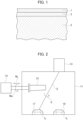
- a substrate 5 of the subject body is covered with an environmental barrier coating (EBC) 3 for example, and its surface is further covered with an anti-dust coating 1.
- EBC environmental barrier coating
- the substrate 5 is of a ceramic matrix composite (CMC) for example.
- the CMC is for example of reinforcement fibers of a ceramic such as silicon carbide and a matrix forming a composite with the reinforcement fibers to combine these fibers together.
- the reinforcement fibers may be of another ceramic instead of silicon carbide.
- the matrix is mainly of a ceramic that is common with the reinforcement fibers but may be of another ceramic instead.
- the present embodiment is, however, not limited to CMC but may be applicable to any publicly-known material or any still unknown material.
- the environmental barrier coating 3 is of a material having an ability of shielding the substrate 5 from the environment.
- the material is beneficial in shielding the substrate 5 from a corrosive atmosphere such as high-temperature steam to prevent its oxidization.
- the material is, still preferably, sufficiently close in thermal expansion coefficient to the substrate 5. This is to prevent exfoliation of the environmental barrier coating 3 from the substrate 5 by thermal expansion/contraction.
- the environmental barrier coating 3 may be, however, directed not to prevention of steam oxidation but to another purpose, and therefore the material may have another ability additionally or alternatively.
- rare-earth silicates such as ytterbium silicate, silicates such as mullite (aluminosilicate), or transition metal oxides such as zirconia or hafnia are preferably applicable.
- zirconia can be so-called stabilized-zirconia to which an oxide of a rare earth element such as yttrium is added so as to stabilize its cubic crystal.
- any intermediate layer such as silicon can be interposed to relieve difference in thermal expansion coefficient.
- barium strontium aluminosilicate (BSAS) may be applied to the environmental barrier coating 3.
- the anti-dust coating 1 is mainly used for the purpose of protecting the environmental barrier coating 3 and the substrate 5 against a high-temperature environment including dust. Of course, it is not intended to exclude any other purposes.
- the anti-dust coating 1 is generally of a mixture of a rare-earth oxide, alumina and a transition metal oxide, which fuse together partly or totally to form sinter, multi compound or mixed oxide.
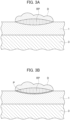
- the anti-dust coating 1 may be formed by an electron beam physical vapor deposition method (EBPVD) using a device illustrated in FIG. 2 for example.
- the chamber 11 is so structured as to keep its interior in a high-vacuum state.
- an actuator 15 is coupled to the chamber 11 to support a subject body 21 within the chamber 11 and further make it controllably into a linear motion ML and a rotational motion MR.
- an electron beam gun 13 and a first crucible 17 are installed and so structured that an electron beam E is drawn out and led to the first crucible 17 when potential difference is given therebetween. A first ingredient I a in the crucible 17 is thereby irradiated by the electron beam E.
- a mixture in which powders respectively of a rare-earth oxide, alumina and a transition element metal oxide are mixed together for example is applicable to the first ingredient I a .
- This is loaded in the first crucible 17 and CMC is in advance formed into a shape of a rotor blade for example as the subject body 21, these bodies are introduced into the device and the EBPVD is executed, thereby producing the anti-dust coating 1 on the surface.
- the environmental barrier coating 3 Prior to the formation of the anti-dust coating 1, of course, by using the second crucible 19, the environmental barrier coating 3 may be in advance formed. More specifically, the environmental barrier coating 3 and the anti-dust coating 1 can be produced in series.
- EBPVD EBPVD
- another publicly-known method such as spraying using arc discharge for example may be used.
- two or more methods may be used in combination.
- the EBPVD generally creates a columnar crystal
- the spraying may create a lamellar structure, thereby creating some differences in exfoliation and covering properties.
- a part of the impurities adheres to the coating and then forms a deposit D thereon. If the temperature of the deposit D rises above 1240 degrees C, calcia, magnesia, alumina and silica (collectively, CMAS) contained therein start melting and partly react with the coating to form a product RP. If the melting point of the product RP is below the environmental temperature, it is left in a liquid phase and therefore the reaction with the coating further progresses, and the liquid will intrude through small cracks, if any, into the coating and eventually reach and corrode the environmental coating.
- CMAS calcia, magnesia, alumina and silica
- the anti-dust coating 1 according to the present embodiment reacts with the CMAS to form a protective product P that remains solid even at high-temperatures. Details will be described below with reference to FIG. 4 .
- FIG. 4 is a phase diagram obtained by a software for thermodynamic equilibrium calculation available under the name of "Fact Sage ver. 8.1" (GTT Technologies) from the assumption that the total pressure is 10 5 Pa, the oxygen partial pressure is 0.2x10 5 Pa, and the temperature is 1500 degrees C.
- the hypotenuse in the upper left corresponds to CMAS ((SiO 2 ,CaO)-6MgO-6FeO 1.5 -18AlO 1.5 ).
- FIG. 4 is drawn as a quasi-ternary phase diagram with the top apex as a Si-rich composition (0.7SiO 2 ,0.3CaO)-6MgO-6FeO 1.5 -18AlO 1.5 ) and the lower-left apex as a Ca-rich composition (0.3SiO 2 ,0.7CaO)-6MgO-6FeO 1.5 -18AlO 1.5 ). Further, to simplify the drawing, only three regions are drawn, one of which includes a liquid phase, another of which includes apatite as a solid phase, and the other of which includes garnet as another solid phase.
- a liquid phase is dominant but, in a region close to the lower-right hypotenuse (meaning that the components soaking from the coating are more influential), apatite or garnet, or both, crystallizes out. Which of them crystals out and how wide the crystallization occurs depend on the composition of the coating. In a case where the coating is only of alumina for example, liquid phases occupy most areas in the phase diagram at 1500 degrees C, whereas apatite can crystal out in considerable areas if the coating is of ytterbium silicate. As illustrated in FIG. 4 , in a case where the coating is of a composition of ytterbia, alumina and hafnia, the areas where apatite and garnet can crystal out become larger and as well mutually overlap.
- apatite if alone, can be expected to achieve the protection ability against the CMAS, the present inventors have found that coexistence of garnet with apatite would prominently improve the protection ability. Further, if the composition of the coating makes larger the region where garnet coexists with apatite, it is expected that slight elution of the coating can cause generation of the protective product and therefore elongate the protective ability. Then the inventors have carried out calculations again and again about various coating compositions to find compositions that make larger the region where garnet coexists with apatite.
- the present inventors on the basis of the aforementioned studies, have reached mixtures of a rare-earth oxide, alumina and a transition metal oxide.
- ReO 1.5 sufficiently reacts with AlO 1.5 in the coating, they constitute complex oxides. Particularly, if a mole fraction of ReO 1.5 to AlO 1.5 is 0.5 or higher, AlO 1.5 does not exist but is expected to form any one or more chemical compounds of Re 4 Al 2 O 9 , ReAlO 3 and Re 3 Al 5 O 12 . ReAlO 3 among them tends to decompose below 1730 degrees C and thus gives rise to structural damage to the coating by temperature change accompanied by phase transition. Accordingly, to improve thermodynamic stability of ReAlO 3 , any additional elements may be further added to the coating. Gd and Nd can be listed among such examples and may be added in the form of these oxides to the coating.
- Powders of various oxides were mixed in various ratios, subject to press-forming at normal temperature to form disk-like compacts of 20 mm ⁇ x 4 mm t , and these compacts were sintered at 1500 degrees C for 50 hours to obtain disk-like sintered bodies 31. They could simulate coatings.
- CaO, MgO, Fe 2 O 3 , Al 2 O 3 and SiO 2 were mixed in a composition of CaO33MgO5FeO 1.5 5AlO 1.5 19SiO 2 38 (at%) and kneaded in a paste-like form to form simulated CMAS 33. This could simulate CMAS adhering to the coating.
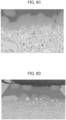
- the simulated CMAS 33 was applied respectively to a plurality of sintered bodies 31 as shown in FIG. 5 and they were subject to a heating test at 1400 degrees C for 7 hours. Test pieces after heating were naturally cooled, cut and embedded in resin, and respectively subject to sectional observation by scanning electron microscopy (SEM).
- the sintered body including ytterbia, alumina and zirconia, as shown in FIG. 6A exhibits a thin dense reacted layer, which is expected to have excellent CMAS-attack resistance.
- the sintered body not including zirconia, as shown in FIG. 6B exhibits a thin but coarse reacted layer and as well lumps in the CMAS region, which resemble the reacted layer. These lumps are considered to originate from a liquid phase that could be secondarily crystalized in the course of cooling into a composition similar to the reacted layer. Considering its structure, even though the reacted layer is thin, the coating is expected to be inferior in light of the CMAS-attack resistance.
- the surface of the reacted layer 7 and the original surface of the sintered body 1 are generally accordant.
- measurement of the thickness t of the reacted layer 7 can be an index of wastage of the sintered body. Measurements of thicknesses of reacted layers were therefore carried out with using the sectional SEM images. As shown in FIG. 7B , however, if the secondary crystal 7a were observed, this was omitted from the measurement.
- test results are summarized in Tables 1 through 3.
- the second to fourth columns show mixing ratios of ytterbia, alumina and hafnia (zirconia in Table 3) and the fifth column shows the measured thicknesses of the reacted layers.
- Table 1 CMAS-attack test results (binary system) No.
- the thicknesses of the reacted layers are less than 100 ⁇ m provided that the mole fractions of ytterbia are generally 0.5 or greater. Particularly in the range 0.8 or less (No. 25-68), the thicknesses tend to be smaller. Generally these pieces give thin reacted layers as compared with those by the binary system (Table 1) and are therefore expected to be superior in light of the CMAS-attack resistance. Among them, the test pieces with mole fractions of alumina over 0.2 (No. 32, 36, 37, 41, 43-52 and 54-68) tend to form further thinner reacted layers.
- FIG. 8 shows a ternary diagram on which test results about the test pieces listed in Tables 1 and 2 are plotted. Circles represent the results in which the thicknesses of the reacted layers are in the range of 0-30 ⁇ m, triangles represent those in which the thickness are in the range of 30-100 ⁇ m and crosses represent those in which the thickness are more than 100 ⁇ m.
- Yb may be of course replaced partially or totally with another rare-earth element, and such an example is Lu.
- Hf can be partially or totally replaced with another group 4 transition element, and such an example is Zr.
- the disclosed art provides a coating capable of protecting ceramic-matrix composites against a high-temperature environment including dust over a long term.
Landscapes
- Chemical & Material Sciences (AREA)
- Engineering & Computer Science (AREA)
- Organic Chemistry (AREA)
- Materials Engineering (AREA)
- Life Sciences & Earth Sciences (AREA)
- Wood Science & Technology (AREA)
- Inorganic Chemistry (AREA)
- Ceramic Engineering (AREA)
- Structural Engineering (AREA)
- Chemical Kinetics & Catalysis (AREA)
- Mechanical Engineering (AREA)
- Metallurgy (AREA)
- Turbine Rotor Nozzle Sealing (AREA)
- Inorganic Compounds Of Heavy Metals (AREA)
Applications Claiming Priority (2)
| Application Number | Priority Date | Filing Date | Title |
|---|---|---|---|
| JP2022116970 | 2022-07-22 | ||
| PCT/JP2023/010057 WO2024018686A1 (fr) | 2022-07-22 | 2023-03-15 | Film résistant au sable et à la poussière |
Publications (1)
| Publication Number | Publication Date |
|---|---|
| EP4559888A1 true EP4559888A1 (fr) | 2025-05-28 |
Family
ID=89617573
Family Applications (1)
| Application Number | Title | Priority Date | Filing Date |
|---|---|---|---|
| EP23842623.3A Pending EP4559888A1 (fr) | 2022-07-22 | 2023-03-15 | Film résistant au sable et à la poussière |
Country Status (4)
| Country | Link |
|---|---|
| US (1) | US20240368412A1 (fr) |
| EP (1) | EP4559888A1 (fr) |
| JP (1) | JP7726405B2 (fr) |
| WO (1) | WO2024018686A1 (fr) |
Families Citing this family (1)
| Publication number | Priority date | Publication date | Assignee | Title |
|---|---|---|---|---|
| WO2025154372A1 (fr) * | 2024-01-19 | 2025-07-24 | 株式会社Ihi | Film résistant au sable et à la poussière |
Family Cites Families (4)
| Publication number | Priority date | Publication date | Assignee | Title |
|---|---|---|---|---|
| US8062759B2 (en) | 2007-12-27 | 2011-11-22 | General Electric Company | Thermal barrier coating systems including a rare earth aluminate layer for improved resistance to CMAS infiltration and coated articles |
| US20090169752A1 (en) | 2007-12-27 | 2009-07-02 | Ming Fu | Method for Improving Resistance to CMAS Infiltration |
| US8039113B2 (en) | 2008-12-19 | 2011-10-18 | General Electric Company | Environmental barrier coatings providing CMAS mitigation capability for ceramic substrate components |
| CN111417740A (zh) | 2017-12-19 | 2020-07-14 | 欧瑞康美科(美国)公司 | 用于保护ebc和cmc层的抗侵蚀和cmas的涂层以及热喷涂方法 |
-
2023
- 2023-03-15 WO PCT/JP2023/010057 patent/WO2024018686A1/fr not_active Ceased
- 2023-03-15 EP EP23842623.3A patent/EP4559888A1/fr active Pending
- 2023-03-15 JP JP2024534924A patent/JP7726405B2/ja active Active
-
2024
- 2024-07-18 US US18/777,421 patent/US20240368412A1/en active Pending
Also Published As
| Publication number | Publication date |
|---|---|
| US20240368412A1 (en) | 2024-11-07 |
| WO2024018686A1 (fr) | 2024-01-25 |
| JP7726405B2 (ja) | 2025-08-20 |
| JPWO2024018686A1 (fr) | 2024-01-25 |
Similar Documents
| Publication | Publication Date | Title |
|---|---|---|
| RU2218447C2 (ru) | Изделие, подвергаемое воздействию горячего агрессивного газа, в частности, деталь газовой турбины (варианты) и способ изготовления теплоизоляционного слоя для изделия | |
| US7867575B2 (en) | Sintering resistant, low conductivity, high stability thermal barrier coating/environmental barrier coating system for a ceramic-matrix composite (CMC) article to improve high temperature capability | |
| EP1666438B1 (fr) | Système de couches barrière thermique/environnementale pour un substrat contenant du silicium pour améliorer la résistance à haute température | |
| US11046614B2 (en) | Ceramic material for high temperature service | |
| RU2519250C2 (ru) | Барьер для защиты от окружающей среды для жаростойкого субстрата, содержащего кремний | |
| EP1621647B1 (fr) | Renforcement par dispersion de zircon stablisé pour terres rares | |
| EP1309738B1 (fr) | Revetement a barriere thermique a stabilite de phase elevee | |
| US6821656B2 (en) | Material for thermally loaded substrates | |
| EP1577499A2 (fr) | Composants de turbine à revêtements faisant barrière thermique | |
| US20040101699A1 (en) | Heat insulating layer based on la2zr2o7 for high temperatures | |
| CA2938229A1 (fr) | Revetements protecteurs environnementaux resistant aux poussieres chaudes | |
| US20240368412A1 (en) | Anti-dust coating | |
| US11845701B2 (en) | EBC layer containing boron | |
| US20060121294A1 (en) | Low thermal conductivity thermal barrier coating system and method therefor | |
| WO2023200720A1 (fr) | Matériaux de barrière environnementale et revêtements contenant des phases à basse température de fusion | |
| JP4031244B2 (ja) | 耐食性セラミックス | |
| KR102844599B1 (ko) | 초고온 가스 터빈 열차폐 코팅용 저열전도 세라믹 분말 및 이를 이용한 열차폐 코팅 | |
| JP4090335B2 (ja) | 耐食性セラミックス | |
| US12043550B2 (en) | CMAS resistant thermal barrier coating system | |
| JP2005525472A (ja) | 断熱層 | |
| WO2025154372A1 (fr) | Film résistant au sable et à la poussière |
Legal Events
| Date | Code | Title | Description |
|---|---|---|---|
| STAA | Information on the status of an ep patent application or granted ep patent |
Free format text: STATUS: THE INTERNATIONAL PUBLICATION HAS BEEN MADE |
|
| PUAI | Public reference made under article 153(3) epc to a published international application that has entered the european phase |
Free format text: ORIGINAL CODE: 0009012 |
|
| STAA | Information on the status of an ep patent application or granted ep patent |
Free format text: STATUS: REQUEST FOR EXAMINATION WAS MADE |
|
| 17P | Request for examination filed |
Effective date: 20241004 |
|
| AK | Designated contracting states |
Kind code of ref document: A1 Designated state(s): AL AT BE BG CH CY CZ DE DK EE ES FI FR GB GR HR HU IE IS IT LI LT LU LV MC ME MK MT NL NO PL PT RO RS SE SI SK SM TR |
|
| DAV | Request for validation of the european patent (deleted) | ||
| DAX | Request for extension of the european patent (deleted) |