EP4563310A1 - Planche à thé et son procédé de fabrication - Google Patents
Planche à thé et son procédé de fabrication Download PDFInfo
- Publication number
- EP4563310A1 EP4563310A1 EP23213561.6A EP23213561A EP4563310A1 EP 4563310 A1 EP4563310 A1 EP 4563310A1 EP 23213561 A EP23213561 A EP 23213561A EP 4563310 A1 EP4563310 A1 EP 4563310A1
- Authority
- EP
- European Patent Office
- Prior art keywords
- teak
- plank
- veneers
- making
- primary
- Prior art date
- Legal status (The legal status is an assumption and is not a legal conclusion. Google has not performed a legal analysis and makes no representation as to the accuracy of the status listed.)
- Pending
Links
Images



Classifications
-
- B—PERFORMING OPERATIONS; TRANSPORTING
- B27—WORKING OR PRESERVING WOOD OR SIMILAR MATERIAL; NAILING OR STAPLING MACHINES IN GENERAL
- B27L—REMOVING BARK OR VESTIGES OF BRANCHES; SPLITTING WOOD; MANUFACTURE OF VENEER, WOODEN STICKS, WOOD SHAVINGS, WOOD FIBRES OR WOOD POWDER
- B27L5/00—Manufacture of veneer ; Preparatory processing therefor
-
- B—PERFORMING OPERATIONS; TRANSPORTING
- B27—WORKING OR PRESERVING WOOD OR SIMILAR MATERIAL; NAILING OR STAPLING MACHINES IN GENERAL
- B27D—WORKING VENEER OR PLYWOOD
- B27D1/00—Joining wood veneer with any material; Forming articles thereby; Preparatory processing of surfaces to be joined, e.g. scoring
- B27D1/04—Joining wood veneer with any material; Forming articles thereby; Preparatory processing of surfaces to be joined, e.g. scoring to produce plywood or articles made therefrom; Plywood sheets
- B27D1/06—Manufacture of central layers; Form of central layers
-
- B—PERFORMING OPERATIONS; TRANSPORTING
- B27—WORKING OR PRESERVING WOOD OR SIMILAR MATERIAL; NAILING OR STAPLING MACHINES IN GENERAL
- B27D—WORKING VENEER OR PLYWOOD
- B27D1/00—Joining wood veneer with any material; Forming articles thereby; Preparatory processing of surfaces to be joined, e.g. scoring
- B27D1/04—Joining wood veneer with any material; Forming articles thereby; Preparatory processing of surfaces to be joined, e.g. scoring to produce plywood or articles made therefrom; Plywood sheets
- B27D1/08—Manufacture of shaped articles; Presses specially designed therefor
-
- B—PERFORMING OPERATIONS; TRANSPORTING
- B27—WORKING OR PRESERVING WOOD OR SIMILAR MATERIAL; NAILING OR STAPLING MACHINES IN GENERAL
- B27G—ACCESSORY MACHINES OR APPARATUS FOR WORKING WOOD OR SIMILAR MATERIALS; TOOLS FOR WORKING WOOD OR SIMILAR MATERIALS; SAFETY DEVICES FOR WOOD WORKING MACHINES OR TOOLS
- B27G1/00—Machines or devices for removing knots or other irregularities or for filling-up holes
-
- B—PERFORMING OPERATIONS; TRANSPORTING
- B27—WORKING OR PRESERVING WOOD OR SIMILAR MATERIAL; NAILING OR STAPLING MACHINES IN GENERAL
- B27M—WORKING OF WOOD NOT PROVIDED FOR IN SUBCLASSES B27B - B27L; MANUFACTURE OF SPECIFIC WOODEN ARTICLES
- B27M3/00—Manufacture or reconditioning of specific semi-finished or finished articles
-
- B—PERFORMING OPERATIONS; TRANSPORTING
- B32—LAYERED PRODUCTS
- B32B—LAYERED PRODUCTS, i.e. PRODUCTS BUILT-UP OF STRATA OF FLAT OR NON-FLAT, e.g. CELLULAR OR HONEYCOMB, FORM
- B32B21/00—Layered products comprising a layer of wood, e.g. wood board, veneer, wood particle board
- B32B21/13—Layered products comprising a layer of wood, e.g. wood board, veneer, wood particle board all layers being exclusively wood
-
- B—PERFORMING OPERATIONS; TRANSPORTING
- B32—LAYERED PRODUCTS
- B32B—LAYERED PRODUCTS, i.e. PRODUCTS BUILT-UP OF STRATA OF FLAT OR NON-FLAT, e.g. CELLULAR OR HONEYCOMB, FORM
- B32B21/00—Layered products comprising a layer of wood, e.g. wood board, veneer, wood particle board
- B32B21/14—Layered products comprising a layer of wood, e.g. wood board, veneer, wood particle board comprising wood board or veneer
-
- B—PERFORMING OPERATIONS; TRANSPORTING
- B32—LAYERED PRODUCTS
- B32B—LAYERED PRODUCTS, i.e. PRODUCTS BUILT-UP OF STRATA OF FLAT OR NON-FLAT, e.g. CELLULAR OR HONEYCOMB, FORM
- B32B7/00—Layered products characterised by the relation between layers; Layered products characterised by the relative orientation of features between layers, or by the relative values of a measurable parameter between layers, i.e. products comprising layers having different physical, chemical or physicochemical properties; Layered products characterised by the interconnection of layers
- B32B7/04—Interconnection of layers
- B32B7/12—Interconnection of layers using interposed adhesives or interposed materials with bonding properties
-
- B—PERFORMING OPERATIONS; TRANSPORTING
- B32—LAYERED PRODUCTS
- B32B—LAYERED PRODUCTS, i.e. PRODUCTS BUILT-UP OF STRATA OF FLAT OR NON-FLAT, e.g. CELLULAR OR HONEYCOMB, FORM
- B32B2307/00—Properties of the layers or laminate
- B32B2307/70—Other properties
- B32B2307/732—Dimensional properties
- B32B2307/737—Dimensions, e.g. volume or area
- B32B2307/7375—Linear, e.g. length, distance or width
- B32B2307/7376—Thickness
-
- B—PERFORMING OPERATIONS; TRANSPORTING
- B32—LAYERED PRODUCTS
- B32B—LAYERED PRODUCTS, i.e. PRODUCTS BUILT-UP OF STRATA OF FLAT OR NON-FLAT, e.g. CELLULAR OR HONEYCOMB, FORM
- B32B2419/00—Buildings or parts thereof
Definitions
- the present invention generally relates to a method of making a teak plank and the teak plank obtained from the method.
- Teakwood is a dense, close-grained hardwood sourced from the Tectona grandis tree, native to South and Southeast Asia. Teakwood is originally golden in color and has a smooth grain and texture. Natural antimicrobial and insecticide substances of teakwood cause excellent natural anti-rot and weathering resistance, even if left untreated. This precious wood is suitable in shipbuilding: the nautical sector uses teak to build manufactured teak decks to join on yachts and sailing, thanks to teakwood's superior durability.
- Natural teak forests occur only in four countries of the world: India, Lao PDR, Sri Lanka, and Thailand.
- Sri Lanka is the only country supplying teak from natural forests to the international market.
- Global teak supply from natural and planted teak forests contributes 2 to 2.5 million m 3 , roughly 2% of the total tropical round wood production.
- the supply of teak from natural forests is declining at an alarming rate of about 1.3% globally and the planted teak shows an increasing trend from 1.3 to 5.7 million ha between 1995-2010 (Kollert and Cherubini, 2012).
- the traditional method of producing teak plank using natural teakwood consists of several steps including (i) cutting a teak log into teak quartered log; (ii) re-sawing the teak quartered log into teak boards; (iii) removing bark and heartwood from the teak boards; (iv) ripping the teak boards into sawn timbers; (v) ripping the sawn timbers with quality satisfaction to obtain teak planks in size required for the production of final product; (vi) kiln drying the teak planks; (vii) planing the dried teak planks to remove the irregularities on the outside of the teak planks; (viii) sun burning the planed teak planks to mature their color; (ix) removing defects from the sunburned teak planks; (x) finishing the teak planks by a variety of ways known in the related art to receive the final teak planks with desired characteristics. (See Fig. 1 ).
- US20070292656A1 discloses a composite board comprising a first layer having an orientation and a second layer bonded to the first layer where the second layer comprises a plurality of wooden veneer structures, each wooden veneer structure is substantially perpendicular to the orientation of the first layer. It also discloses a method of making a composite board comprising of providing a first layer having an orientation; assembling a second layer by arranging a plurality of wooden veneer structures so that each wooden veneer structure is substantially perpendicular to the orientation of the first layer; and bonding the first layer to a first surface of the second layer.
- CN100344425C discloses a technology for producing floor board with plywood made of medium- or small-diameter includes such steps as spinning cutting to obtain ply, drying, removing excessive edges, milling edge to form bevel edge, longitudinal splicing, abrading, coating resin, laminating, pre-pressing, hot pressing, longitudinal sawing to become strips, planning, lateral splicing, planning, making tenon and slot mortise, painting and polishing.
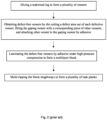
- Thai Petty Patent No. 14937 discloses a method for producing teak plank from planted teakwood comprising steps of: (i) slicing a teakwood log to form a plurality of veneers 1-2 mm thick; (ii) obtaining defect-free veneers by die cutting a defect area out of each defective veneer, filling the gaping veneer with a corresponding piece of other veneers and attaching another veneer to the gaping veneer by adhesive; (iii) laminating the defect-free veneers by adhesive under high-pressure compression to form a multilayer block; and (iv) multi-ripping the block lengthways to form a plurality of teak planks (see Fig. 2 )
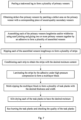
- One embodiment of the invention well suited for achieving the object is a method of making a teak plank comprising steps of (a) peeling a teakwood log to form a plurality of primary veneers; (b) obtaining defect-free primary veneers by patching a defect area on the primary veneer with a corresponding piece of sound quality secondary veneers; (c) assembling each of the primary veneers in lengthwise and/or widthwise using scarf jointing and gluing two or more of primary veneers together by an adhesive to form a plurality of the assembled veneers; (d) ripping each of the assembled veneers lengthways to form a plurality of strips; (e) laminating the strips by the adhesive under high-pressure compression to form a multilayer block; (f) multi-ripping the multilayer block to form a plurality of teak planks with desired thickness and width; and (g) kiln drying each of teak planks to have the desired moisture.
- the method of the present invention gives the ability to use younger trees, remove defects more efficiently, and
- Another embodiment is the teak plank obtained from the aforesaid method of making teak plank with the straight grain pattern and the transverse coefficients of thermal expansion (CTE) less than 50 x 10-6/degree Celsius.
- the teak plank of the present invention is well suited for decking on luxury vessels e.g. super yachts, making furniture and other decorations due to its durability against UV and saltwater.
- the method of the present invention has advantages over the method of the prior arts.
- One of the main advantages is that the method of the present invention can produce longer lengths of teak plank since the method uses scarf jointing.
- Length is considered important in teak plank manufacture since natural teakwood is becoming scarce, especially one with a length of 2 meters or longer.
- This production method allows the manufacturers to use shorter teak logs (below 2 meters long) for easily producing final teak planks longer than 4 meters.
- the preferable length of teak planks produced by the method of the present invention is 4 meters as it is suitable and practicable for production and transport. Width is also considered important, the lamination allows for wider planks which is considered a scarcity nowadays, for example, to find natural teak with straight grain with 100 millimeters and up width is considered rare. Anything near or above 100 millimeters us considered wide.
- Another advantage of the method of the present invention is the faster production of teak planks compared with the methods of the prior arts partly because the method of the present invention uses veneer patching for removing the defects on the veneer instead of a die cut or laser to cut out the defect like the methods of the prior arts. Veneer patching is much more time efficient when compared to the previous methods. Since less precision is required, production at this stage can be twice as fast when comparing to prior arts.
- the method of the present invention can reduce waste (higher yield) and be able to use an entire teak log throughout its length.
- the prior methods rely on the length and width of the teak log.
- the method of the present invention also provides teak planks with a more aesthetically pleasing "look".
- the teak plank obtained from the method of the present invention is more similar to natural teakwood since the method can produce a thinner veneer which in turn will make the "lines" made from layers of the strips less visible.
- the teak plank of the present invention varies in dimension. It is suitable for outdoor and indoor use such as decking on luxury vessels e.g. yachts or making furniture, other application can be interior paneling.
- a method of making a teak plank (60) in accordance with one embodiment of the present invention is described in more detail hereafter.
- the method comprises steps:
- vendor means a thin or fine sheet of wood produced by rotary cutting, peeling, or slicing.
- peeling refers to when the whole round log is mounted in a large lathe and turned against the blade which peels the veneers in long sheets. Also called rotary cut which produces a continuous wide sheet of veneer.
- the peeling method is the most economical method of cutting.
- the logs are sawn into halves, thirds, or quarters or more.
- the slicing methods e.g. plain slice, rift cut, or quarter cut are used to make the veneers.
- the veneers obtained from the peeling method are different from those obtained from the slicing method.
- the method follows the tree's annual growth rings resulting in bold, irregular markings.
- Rotary cut veneers are wide so they are usually cut to size and defects, if any, are removed. It is a very cost-effective cutting method due to its yield.
- the slicing method is favored for the production of decorative timber veneers and cuts. The most common methods are quarter and crown.
- the log In order to produce quarter-cut veneer, the log must be cut into quarters before slicing. A quarter log is placed on a frame so that the knife meets the growth rings at a right angle. The result is veneers with stripes, which depending on the species may or may not be straight.
- This slicing technique requires trees of large diameter and yields are typically lower than peeling methods, meaning quarter-cut veneer can be more expensive.
- a crown cut (also known as a flat cut or plain sliced) involves a half log being moved towards a knife in an up-and-down movement.
- the slices, referred to as leaves, are stored in sequential order as they are cut. This practice is important for matching veneers for project aesthetics.
- Crown cut is a widely used slicing method in veneer manufacturing and typically results in a straight grain interspersed with cathedral patterns, also known as crowns.
- veneer Other methods of producing veneer include half-round slicing and rift cut, where the log is sliced on a slight angle.
- the peeling method of the present invention can be the automated, semi-automated, or manual peeling method.
- Each of the primary veneers (20) may be in the same or different sizes depending on the size of the teakwood log.
- the primary veneers may have a thickness (T) between 0.5-2.0 mm, a width (W) between 1.2-1.5 m, and a length (L) between 1.2-1.5 m.
- Figs. 3A, 3B, and 3C illustrate a teakwood log (60) for peeling into primary veneer (20), the primary veneer (20) having defects (12) and the primary veneer (20) patched with the corresponding pieces of the sound quality secondary veneers (24);
- the term "scarf joint” means a lapped joint between two pieces of veneers made by notching or grooving the ends and strapping, bolting, or gluing the two pieces together.
- the scarf joint is used when the material being joined is not available in the length required. Joints other than the scarf joint such as the butt joint and the splice joint may be used.
- Figs. 4A, 4B, and 4C illustrate the top view of an assembled veneer (30) and, the top and perspective views of a strip (40), respectively ripped from the assembled veneer (30).
- the assembled veneer (30) is wider and/or longer than the primary veneer (20) at least 1.5-fold e.g. 1.5, 2, 2.5, 3-fold, etc.
- the size of the assembled veneer varies based on the desired size of the teak plank (60).
- Each of the assembled veneers (30) may have a thickness between 0.5-2 mm, a width between 60-180 mm, and a length between 900-5000 mm.
- the method of making the teak plank (60) of the present invention may further comprise of calibrating each strip (40) to obtain the strips having the same thickness and evenness before laminating step.
- the strip (40) may have a thickness between 0.5-2.0 mm, the width between 75-155 mm. and the length between 900-5000 mm.
- laminateating means to unite layers of material e.g. layers of wood by an adhesive or other means.
- Figs. 5A, 5B, and 5C illustrate the perspective view of a multilayer block (50) made from laminating the strips (40), the front view of the multilayer block (50) showing one strip layer is substantially perpendicular to another strip layer, and perspective view of the multilayer block (50) with ripping marks (A-A), respectively.
- the multilayer block (50) is ripped in the direction along the dotted line A-A perpendicular to the plane of the strip (40) with a saw or similar tool to form the teak plank.
- the teak plank is 30mm thick, 150mm wide, and 4000mm long with a straight grain.
- ripping is used to describe cutting the assembled veneer or multilayer block lengthwise. Ripping can be accomplished using a table saw, saw machine, circular saw, frame saw, band saw, or even a handsaw.
- the adhesive used therein is selected from a group consisting of polyvinyl Acetate (PVA), polyurethane, cyanoacrylate (CA), Ethylene-Vinyl Acetate (EVA), urea-formaldehyde, hide glue, epoxy, melamine-based glue and a combination thereof.
- PVA polyvinyl Acetate
- CA cyanoacrylate
- EVA Ethylene-Vinyl Acetate
- urea-formaldehyde hide glue
- epoxy epoxy
- melamine-based glue a combination thereof.
- the adhesive used may be commercially available or freshly prepared according to the method well known to a person having ordinary skill in the art.
- MF-3L/M-610LY from Hexion (Thailand) Co., Ltd. may be used in the laminating step.
- the resulting wood laminate is introduced into the high-pressure compression for 2-5 hours under pressure between 10-20 kg/cm 2 to form the multilayer block (50).
- the adhesive used in the laminating step also may be a dyed adhesive.
- the multilayer block (50) may have a thickness between 30-300 mm, a width between 80-120 mm, and a length between 900-5000 mm.
- the multilayer block (50) is then ripped passing lengthwise through the body of the multilayer block (50) to form a plurality of teak planks (60) with a consistent and even straight grain pattern.
- the teak plank may have a thickness between 3-120 mm a width between 30-300 mm and a length between 900-5000 mm.
- the term "kiln drying” is used to describe the standard process of efficiently bringing moisture levels in wood to a "workable” range.
- the kiln process involves the drying of wood in a chamber where air circulation, relative humidity, and temperature can be controlled so that the moisture content of wood can be reduced to a target point without having any drying defects.
- the used kilns in the present invention can be conventional and dehumidification kilns. Vacuum and solar kilns also can be used.
- the teak plank After the kiln drying step, the teak plank has a moisture content between 8-20%.
- the method of making the teak plank of the present invention may further comprise conditioning each strip to obtain the strips with the desired moisture content before the laminating step.
- conditioning is used to describe the process of relieving tension while drying wood.
- the strips After the conditioning step, the strips have a moisture content between 8-20%.
- the method of making the teak plank as discussed above may further comprise sun burning the teak planks for 24-48 hours to mature the color of the teak plank.
- the method of making the teak plank as discussed above may further comprise finishing steps to provide the teak plank with scratch resistance, chemical resistance, moisture resistance, clarity, appearance, sheen, and reparability.
- teak decks have been finished.
- natural finishes such as beeswax or linseed oil
- the teak plank industry's techniques have evolved to include a number of different catalyst, water-based, and urethane finish options.
- a catalyzed finish mixes a resin with a catalyst to create a reaction and this includes catalyzed lacquer, conversion varnish, urethanes, polyesters, and UV-cured processes.
- Water-based finishes and urethane or urethane/acrylic blends can be solvent-based or water-based.
- Stain/toner includes semitransparent colors used to block out or reduce color variation.
- Wash coat includes seals in the base color of the stain, while still allowing the wiping glaze to seep into the pores without changing the background color.
- Wiping glaze is a pigmented oil applied to the teak plank that fills the pores to provide a subtle undertone that accents the grain.
- Seal is a protective layer of clear coating that locks in the colors and provides a smooth surface for the clear coat.
- a topcoat is a clear coat that provides protection and a finished appearance.
- finishing materials used in the finishing steps according to the present invention are selected from the group consisting of beeswax, linseed oil, catalyzed lacquer, conversion varnish, urethanes, polyesters, urethane/acrylic blends, stain/toner, wash coat, wiping glaze, seal, and topcoat.
- the plank could also be left untreated, depending on the requirement.
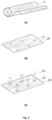
- Fig. 6 illustrates the perspective view of teak planks obtained from the method of the present invention.
- the resulting teak plank has a higher density than natural teak (about 650-900 kg/m3) has a compressive strength close to or higher than natural teak and has transverse coefficients of thermal expansion (CTE) less than 50 x 10-6/degree Celsius. This makes it well resistant to humidity and heat.
- the teak plank of the present invention is thus suitable for decking, and making decorative items and furniture.
- Fig. 7 illustrates the flow chart for the method of teak plank manufacture according to the specific embodiment of the present invention. The method comprises steps:
- the teak plank of the present invention has been tested to the JAS ( Japanese Agricultural Standard) 1152 2007 : Boiling water soak delamination test. It is standard testing for structural glued laminated timber. The test consists of cutting the specimen into 75 mm, weighing each specimen, soaking each specimen in boiling water for 4 hours then cooling it in water at 10-25 degrees Celsius for 1 hour, drying the specimen in an oven (with circulating air) at 70 ⁇ 3 degrees Celsius until weight of the specimen is between 100 - 110% of the weight before soaking in boiling water. The test was performed in 2 cycles. Delamination must not exceed 3 mm in length and 0.05 mm in width. Also, the delamination ratio must be less than 5%. From the test result, no delamination of the teak deck of this invention was found.
- Table 1 shows that there are no significant changes in the thickness and length of both teak planks obtained from the traditional method and the present invention.
- the process of measuring the density of the teak plank begins by embedding a steel ball that has a diameter of 11.28 millimeters (roughly 0.444 inches) halfway into the surface of the teak plank.
- the force required to push the ball into the teak plank indicates how dense and strong the teak plank is. Higher density indicates a greater strength.
- Table 3 The density of the teak planks obtained from the traditional method and the method of the present invention Samples Density (kg/m 3 ) Comparative sample 631 Test sample 703
- Table 3 shows that the teak plank obtained from the method of the present invention has greater strength than the teak plank obtained from the traditional method.
- the method of the present invention reduces manufacturing time when compared to other natural wood deck/plank "alternatives".
- the method also retains the aesthetics of natural teak compared to other previous arts.
- the method of the present invention can produce wider and longer lengths of teak plank from the shorter teak logs.
- the teak planks obtained from the method of the present invention also have the same or even higher quality compared with one obtained from the traditional method.
Landscapes
- Life Sciences & Earth Sciences (AREA)
- Engineering & Computer Science (AREA)
- Wood Science & Technology (AREA)
- Forests & Forestry (AREA)
- Manufacturing & Machinery (AREA)
- Mechanical Engineering (AREA)
- Veneer Processing And Manufacture Of Plywood (AREA)
Priority Applications (3)
| Application Number | Priority Date | Filing Date | Title |
|---|---|---|---|
| EP23213561.6A EP4563310A1 (fr) | 2023-11-30 | 2023-11-30 | Planche à thé et son procédé de fabrication |
| US18/964,405 US20250178232A1 (en) | 2023-11-30 | 2024-11-30 | Teak plank and method of making same |
| CN202510078583.8A CN120056221A (zh) | 2023-11-30 | 2025-01-17 | 柚木板条及其制造方法 |
Applications Claiming Priority (1)
| Application Number | Priority Date | Filing Date | Title |
|---|---|---|---|
| EP23213561.6A EP4563310A1 (fr) | 2023-11-30 | 2023-11-30 | Planche à thé et son procédé de fabrication |
Publications (1)
| Publication Number | Publication Date |
|---|---|
| EP4563310A1 true EP4563310A1 (fr) | 2025-06-04 |
Family
ID=89073231
Family Applications (1)
| Application Number | Title | Priority Date | Filing Date |
|---|---|---|---|
| EP23213561.6A Pending EP4563310A1 (fr) | 2023-11-30 | 2023-11-30 | Planche à thé et son procédé de fabrication |
Country Status (3)
| Country | Link |
|---|---|
| US (1) | US20250178232A1 (fr) |
| EP (1) | EP4563310A1 (fr) |
| CN (1) | CN120056221A (fr) |
Citations (7)
| Publication number | Priority date | Publication date | Assignee | Title |
|---|---|---|---|---|
| JPS5914909A (ja) * | 1982-07-15 | 1984-01-25 | 松下電工株式会社 | 化粧単板の製造方法 |
| TH14937A (th) | 1993-04-26 | 1994-11-25 | นายโรจน์วิทย์ เปเรร่า | คอลลอยด์เปลี่ยนวัฎภาคที่ใช้เป็นสารเปรียบเทียบในอัลตราซาวด์ |
| US20010000876A1 (en) * | 1999-03-15 | 2001-05-10 | 3M Innovative Properties Company | Veneer tape and method of use |
| CN100344425C (zh) | 2005-11-08 | 2007-10-24 | 南京林业大学 | 中小径级可旋木材制作单板层积材地板的生产方法 |
| US20070292656A1 (en) | 2006-06-20 | 2007-12-20 | Pt. Tanjung Kreasi Parquet Industry | Engineered wood floor using core material with vertical glue-line position |
| CN101550759A (zh) * | 2009-04-24 | 2009-10-07 | 冯桔红 | 以单板层积材板条为基材的实木复合地板及其生产方法 |
| WO2010072139A1 (fr) * | 2008-12-24 | 2010-07-01 | 中国林业科学研究院木材工业研究所 | Panneau composite en bambou ultra-épais, panneau composite en bois plein ultra-épais et procédés de fabrication associés |
Family Cites Families (2)
| Publication number | Priority date | Publication date | Assignee | Title |
|---|---|---|---|---|
| GB421979A (en) * | 1933-06-29 | 1934-12-31 | Klinger Johann | Process for the manufacture of laminated joinery members |
| CN102371603A (zh) * | 2010-08-06 | 2012-03-14 | 郭侃 | 高强度细木工板制作工艺 |
-
2023
- 2023-11-30 EP EP23213561.6A patent/EP4563310A1/fr active Pending
-
2024
- 2024-11-30 US US18/964,405 patent/US20250178232A1/en active Pending
-
2025
- 2025-01-17 CN CN202510078583.8A patent/CN120056221A/zh active Pending
Patent Citations (7)
| Publication number | Priority date | Publication date | Assignee | Title |
|---|---|---|---|---|
| JPS5914909A (ja) * | 1982-07-15 | 1984-01-25 | 松下電工株式会社 | 化粧単板の製造方法 |
| TH14937A (th) | 1993-04-26 | 1994-11-25 | นายโรจน์วิทย์ เปเรร่า | คอลลอยด์เปลี่ยนวัฎภาคที่ใช้เป็นสารเปรียบเทียบในอัลตราซาวด์ |
| US20010000876A1 (en) * | 1999-03-15 | 2001-05-10 | 3M Innovative Properties Company | Veneer tape and method of use |
| CN100344425C (zh) | 2005-11-08 | 2007-10-24 | 南京林业大学 | 中小径级可旋木材制作单板层积材地板的生产方法 |
| US20070292656A1 (en) | 2006-06-20 | 2007-12-20 | Pt. Tanjung Kreasi Parquet Industry | Engineered wood floor using core material with vertical glue-line position |
| WO2010072139A1 (fr) * | 2008-12-24 | 2010-07-01 | 中国林业科学研究院木材工业研究所 | Panneau composite en bambou ultra-épais, panneau composite en bois plein ultra-épais et procédés de fabrication associés |
| CN101550759A (zh) * | 2009-04-24 | 2009-10-07 | 冯桔红 | 以单板层积材板条为基材的实木复合地板及其生产方法 |
Also Published As
| Publication number | Publication date |
|---|---|
| US20250178232A1 (en) | 2025-06-05 |
| CN120056221A (zh) | 2025-05-30 |
Similar Documents
| Publication | Publication Date | Title |
|---|---|---|
| RU2361730C2 (ru) | Способ изготовления шпона | |
| US10603812B2 (en) | Process of making compreg multi-colored laminated wood and utility, ornamental, decorative products thereof | |
| US9855673B2 (en) | Method for producing a veneer | |
| CN106088524B (zh) | 一种实木多层复合地板及其制备工艺和组坯方法 | |
| CN102744748B (zh) | 一种工字型竹集成材家具板材及其加工方法 | |
| CN102744749B (zh) | 一种工字型竹集成材超薄家具板材及其加工方法 | |
| CN109732735A (zh) | 一种防水静音木铝复合推拉门生产工艺 | |
| EP4563310A1 (fr) | Planche à thé et son procédé de fabrication | |
| EP4610009A1 (fr) | Planche en bois de teck et son procédé de fabrication | |
| CN108858631B (zh) | 一种多层实木地板表面结疤修补工艺 | |
| ES2907487T3 (es) | Procedimiento de fabricación de paneles de madera maciza multicapa | |
| WO2022190070A1 (fr) | Panneaux de bois décoratifs prêts à l'emploi et leur procédé de préparation | |
| WO2006081754A1 (fr) | Production et produits pour un panneau en bois composite et une colonne carree | |
| AU2017216557B2 (en) | Product and method | |
| Wind | Effects of Temperature and Moisture Content on Bonding Performance of Mass Plywood Panels | |
| CN105756313B (zh) | 一种棕榈藤藤片复合装饰板及其制作方法 | |
| US20130288012A1 (en) | Contoured veneer and method of making same | |
| RU2049661C1 (ru) | Паркетная плита и способ ее изготовления | |
| CN120985776A (zh) | 一种龙眼木实木复合地板的加工方法 | |
| EP2574436A1 (fr) | Procédé de fabrication d'un contreplaqué latté multicouche à partir de lamelles solides de bois de conifère à dureté et résistance à l'abrasion améliorées | |
| Benson | Woodworker's Guide to Veneering & Inlay: Techniques, Projects & Expert Advice for Fine Furniture | |
| RU2104150C1 (ru) | Способ изготовления торцевой плашки для паркетных щитов или настенных панелей | |
| CN108789695A (zh) | 一种整竹刨切薄竹装饰材料的加工方法 | |
| JP2022138888A (ja) | 無垢材木理シート基材の作製方法 | |
| CN1628943A (zh) | 竹材拼花板及其制造方法 |
Legal Events
| Date | Code | Title | Description |
|---|---|---|---|
| PUAI | Public reference made under article 153(3) epc to a published international application that has entered the european phase |
Free format text: ORIGINAL CODE: 0009012 |
|
| STAA | Information on the status of an ep patent application or granted ep patent |
Free format text: STATUS: THE APPLICATION HAS BEEN PUBLISHED |
|
| AK | Designated contracting states |
Kind code of ref document: A1 Designated state(s): AL AT BE BG CH CY CZ DE DK EE ES FI FR GB GR HR HU IE IS IT LI LT LU LV MC ME MK MT NL NO PL PT RO RS SE SI SK SM TR |
|
| STAA | Information on the status of an ep patent application or granted ep patent |
Free format text: STATUS: REQUEST FOR EXAMINATION WAS MADE |
|
| 17P | Request for examination filed |
Effective date: 20251202 |
|
| GRAP | Despatch of communication of intention to grant a patent |
Free format text: ORIGINAL CODE: EPIDOSNIGR1 |
|
| STAA | Information on the status of an ep patent application or granted ep patent |
Free format text: STATUS: GRANT OF PATENT IS INTENDED |
|
| INTG | Intention to grant announced |
Effective date: 20260115 |
|
| GRAS | Grant fee paid |
Free format text: ORIGINAL CODE: EPIDOSNIGR3 |
|
| GRAA | (expected) grant |
Free format text: ORIGINAL CODE: 0009210 |
|
| STAA | Information on the status of an ep patent application or granted ep patent |
Free format text: STATUS: THE PATENT HAS BEEN GRANTED |